Franck, James
James Franck (26 August 1882 – 21 May 1964) was a German physicist who won the 1925 Nobel Prize for Physics with Gustav Hertz "for their discovery of the laws governing the impact of an electron upon an atom".[1] He completed his doctorate in 1906 and his habilitation in 1911 at the Frederick William University in Berlin, where he lectured and taught until 1918, having reached the position of professor extraordinarius. He served as a volunteer in the German Army during World War I. He was seriously injured in 1917 in a gas attack and was awarded the Iron Cross 1st Class.
Franck became the Head of the Physics Division of the Kaiser Wilhelm Gesellschaft for Physical Chemistry. In 1920, Franck became professor ordinarius of experimental physics and Director of the Second Institute for Experimental Physics at the University of Göttingen. While there he worked on quantum physics with Max Born, who was Director of the Institute of Theoretical Physics. His work included the Franck–Hertz experiment, an important confirmation of the Bohr model of the atom. He promoted the careers of women in physics, notably Lise Meitner, Hertha Sponer and Hilde Levi.
After the NSDAP came to power in Germany in 1933, Franck resigned his post in protest against the dismissal of fellow academics. He assisted Frederick Lindemann in helping dismissed Jewish scientists find work overseas, before he left Germany in November 1933. After a year at the Niels Bohr Institute in Denmark, he moved to the United States, where he worked at Johns Hopkins University in Baltimore and then the University of Chicago. During this period he became interested in photosynthesis.
Franck participated in the Manhattan Project during World War II as Director of the Chemistry Division of the Metallurgical Laboratory. He was also the chairman of the Committee on Political and Social Problems regarding the atomic bomb, which is best known for the compilation of the Franck Report, which recommended that the atomic bombs not be used on the Japanese cities without warning.
Contents
- 1 Early life
- 2 Franck–Hertz experiment
- 3 World War I
- 4 Göttingen
- 5 Exile
- 6 Later life
- 7 Notes
- 8 References
- 9 External links
...
Exile
This period came to an end when the Nazi Party won power in Germany in an election on 2 March 1933. The following month it enacted the Law for the Restoration of the Professional Civil Service, which provided for the retirement or dismissal of all Jewish civil servants, along with political opponents of the government. As a veteran of the First World War, Franck was exempt, but he submitted his resignation anyway on 17 April 1933.[37] He once commented that science was his God and nature was his religion. He did not require his daughters to attend religious instruction classes at school,[38] and even let them have a decorated tree at Christmas;[39] but he was proud of his Jewish heritage all the same.[38] He was the first academic to resign in protest over the law.[40] Newspapers around the world reported it, but no government or university protested.[41]
Franck assisted Frederick Lindemann in helping dismissed Jewish scientists find work overseas, before he left Germany in November 1933.[42] After a brief visit to the United States, where he measured the absorption of light in heavy water with Wood at Johns Hopkins University, he took up a position at the Niels Bohr Institute in Copenhagen.[43] He needed a new collaborator, so he took on Hilde Levi, whose recent thesis had impressed him.[44] His original intention was to continue his research into the fluorescence of vapours and liquids, but under Bohr's influence they began to take an interest in biological aspects of these reactions, particularly photosynthesis, the process by which plants use light to convert carbon dioxide and water into more organic compounds. Biological processes turned out to be far more complicated than simple reactions in atoms and molecules. He co-authored two papers with Levi on the subject, which he would return to over the following years.[43][45][46]
Franck found a position at the Polytekniske Læreanstalt in Copenhagen for Arthur von Hippel, who was now his son in law, having married his daughter Dagmar. He decided to provide financial security for his children by dividing his Nobel Prize money between them. The gold medal itself was entrusted to Niels Bohr for safekeeping.[47] When Germany invaded Denmark on 9 April 1940, the Hungarian chemist George de Hevesy dissolved the gold medal, along with that of Max von Laue in aqua regia to prevent the Germans from taking them. He placed the resulting solution on a shelf in his laboratory at the Niels Bohr Institute. After the war, he returned to find the solution undisturbed and precipitated the gold out of the acid. The Nobel Society then recast the Nobel Prize medals.[48][49]
In 1935, Franck moved to the United States, where he had accepted a professorship at Johns Hopkins University.[50] The laboratory there was poorly equipped compared to the one in Göttingen, but he received $10,000 for equipment from the Rockefeller Foundation. A more intractable problem was that the university had no money to hire skilled staff. Franck was concerned about his family members remaining in Germany, and needed money to help them emigrate. He therefore accepted an offer from the University of Chicago, where his work on photosynthesis had attracted interest, in 1938.[51]
Franck's first paper there, co-authored with Edward Teller, was on photochemical processes in crystals.[52] Hans Gaffron became his collaborator.[53] They were joined by Pringsheim, who escaped from Belgium after the German invasion. Franck arranged a position for Pringsheim at his laboratory.[54] Both his daughters and their families moved to the United States, and he was also able to bring out his elderly mother and aunt.[55] He became a naturalised United States citizen on 21 July 1941,[23] so he was not an enemy alien when the United States declared war on Germany on 11 December 1941. His daughters still were, though, so they were restricted from travelling, and could not take care of their mother when she fell ill and died on 10 January 1942, although they were permitted to attend her funeral.[56]
In February 1942, Arthur H. Compton established its Metallurgical Laboratory at the University of Chicago. As part of the Manhattan Project, its mission was to build nuclear reactors to create plutonium that would be used in atomic bombs.[57] The Metallurgical Laboratory's Chemistry Division was initially headed by Frank Spedding, but he preferred hands on work to administration. Compton then turned to Franck, with some trepidation owing to his German background.[58] Compton later wrote:
How Franck welcomed an invitation to join our project! It was a vote of confidence that far exceeded his hopes, and it gave him a chance to do his part for the cause of freedom. "It's not the German people I'm fighting", he explained. "It's the Nazis. They have a stranglehold over Germany. The German people are helpless until we can break the strength of their Nazi masters." The chemists welcomed Franck as an elder scientific statesman whose guidance they were glad to follow.[59]
In addition to heading the Chemistry Division, Franck was also the chairman of the Metallurgical Laboratory's Committee on Political and Social Problems regarding the atomic bomb, which consisted of himself and Donald J. Hughes, J. J. Nickson, Eugene Rabinowitch, Glenn T. Seaborg, J. C. Stearns and Leó Szilárd.[60] In 1945, Franck warned Henry A. Wallace of their fears that "mankind has learned to unleash atomic power without being ethically and politically prepared to use it wisely."[61] The committee compiled what became known as the Franck Report. Finished on 11 June 1945, it recommended that the atomic bombs not be used on the Japanese cities without warning.[60] In any event, the Interim Committee decided otherwise.[62]
Later life
[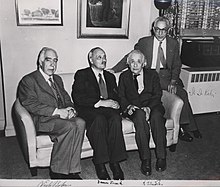
Four Nobel Prize laureates. Franck between Niels Bohr and Albert Einstein, with Isidor Isaac Rabi in 1954
Franck married Hertha Sponer in a civil ceremony on 29 June 1946,[63] his first wife, Ingrid, having died in 1942. In his post-war research, he continued to tackle the problem of explaining the mechanism of photosynthesis. Meitner saw no break between his early and later work. She recalled that
Franck enjoyed talking about his problems, not so much to explain them to others as to satisfy his own mind. Once a problem had aroused his interest he was completely captivated, indeed obsessed by it. Common sense and straight logic were his main tools, together with simple apparatus. His research followed an almost straight line, from his early studies of ion mobilities to his last work on photosynthesis; it was always the energy exchange between atoms or molecules that fascinated him.[64]
In addition to the Nobel Prize. Franck was awarded the Max Planck medal of the Deutsche Physikalische Gesellschaft in 1951 and the Rumford Medal of the American Academy of Arts and Sciences for his work on photosynthesis in 1955. He became an honorary citizen of Göttingen in 1953,[65] was elected a member of the United States National Academy of Sciences in 1944,[66] and elected a Foreign Member of the Royal Society (ForMemRS) in 1964.[67] He was also an International Member of the American Philosophical Society.[68]
He died suddenly from a heart attack while visiting Göttingen on 21 May 1964,[67] and was buried in Chicago with his first wife.[69]
In 1967, the University of Chicago named the James Franck Institute after him.[70] A lunar crater has also been named in his honour.[71] His papers are in the University of Chicago Library.[23]