Chekhov
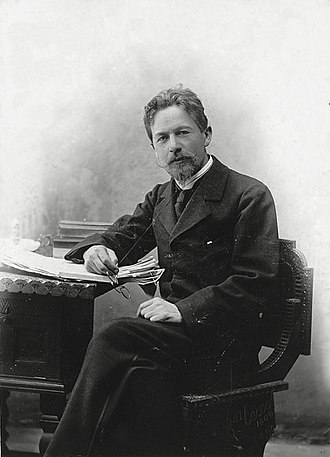
NAME: Chekhov, Anton Pavlovich
ACHIEVEMENTS: Renowned writer, considered the greatest of Russian dramatists
PLACE AND DATE OF BIRTH: January 29, 1860, Tagonrog, Russia
PLACE/DATE/AGE AT DEATH: July 14/15, 1904, Badenweiler, Germany. Aged 44
DISCIPLINE: Writer, doctor
FIELD: Literature, medicine
LANGUAGE: Russian
PARENTS: Father, Pavel Chekhov, mother, Eugenia Morozov Chekhov
SIBLINGS: Aleksandr, Nikolai, Ivan, Maria, Mikhail, Eugenia
SPOUSE: Olga Knipper
CHILDREN: None
EDUCATION: University of Moscow
MAJOR WORKS: The Seagull (1896), Uncle Vanya (1900), Three Sisters (1901), The Cherry Orchard (1904)
LIFE AND TIMES:
Chekhov’s early years were spent in the Russian town of Tagonrog on the Sea of Azov. His father was a struggling merchant and a harsh disciplinarian, who forced Chekhov and his brothers to spend long hours working in the family shop and singing in the church choir. During this time, Chekhov attended the local gimnazia, a progressive institution for its time, in that physical punishment was forbidden. The school offered Anton a good education as well as a reprieve from the thrashings he received at home. His father’s cruelty remained a bitter memory for Chekhov, though he drew heavily on his childhood experiences in his literary works.
Chekhov became head of the household at age 16, when his father went bankrupt and moved to Moscow, where his eldest sons were attending the University. Chekhov’s mother and younger siblings eventually followed, leaving him alone to fend off the creditors. He earned money by tutoring younger pupils while he finished school. In his last years there, he started a class magazine and began submitting comic sketches to literary journals.
In 1879, he graduated from the gimnazia and joined his family in Moscow, where he enrolled in the University as a medical student. While studying medicine, Chekhov continued to write as a means of supporting his family, since his father could only find low-paying jobs.
Chekhov graduated from medical school in 1884 and became a general practitioner. He was determined to succeed as a writer too by having his work published in the capital, St. Petersburg. He began to experiment with more serious subjects, which soon took precedence over his comic efforts.
When the Northern Herald, a leading literary review, published his long story: “Steppe,” Chekhov gained serious recognition as a writer. In 1888, he was awarded the Russian Academy’s prize for literature.
By 1890, Chekhov had become disillusioned with the literary scene and his status as a fashionable writer. He was uncomfortable with the demands of the intellectual elite, who criticized him for holding no firm political or social views. He decided to take a trip to Siberia to study the penal colony on the remote island of Sakhalin. He surveyed the population and wrote a research thesis: The Island of Sakhalin, which was published as a serial beginning in 1893.
For Chekhov, The Island of Sakhalin marked a turn towards conscience-stirring prose, earning him the approval of radical writers and critical comparison with Russia’s leading writer, Tolstoy*.
In 1892, Chekhov purchased a country estate in the village of Melikhovo, about 50 miles south of Moscow. He lived there, together with his parents and sister, for about six years. Chekhov played an active role in the local community, volunteering his medical expertise during the cholera epidemic of 1892.
His tireless service won commendation and he was recruited to serve on committees working to improve the lives of village residents. In this capacity, he developed an intimate knowledge of peasant life, which became a leading theme in his stories. In “Peasants” (1897), he presented an uncompromising picture of the harshness and misery endemic to rural villages.
In doing so, he angered Tolstoy and other writers who tended to sentimentalize the “simple life” of the Russian peasantry. Having once been compared to Tolstoy, Chekhov now set himself apart.
In his early Moscow days, Chekhov had experimented with writing for the theater. His plays from that period were well received but made no lasting impact. This was to change with The Seagull, a four-act drama that Chekhov confusingly referred to as a comedy. The Seagull defied theatrical conventions of its time, so much so that Chekhov described it as unstagable. Its opening in St. Petersburg in 1896 threatened to prove him right.
The play was received so badly that Chekhov left the auditorium in embarrassment. He was distressed and vowed never to write for the stage again. Two years later, The Seagull was revived by the fledgling Moscow Art Theater. Its return was a triumph and Chekhov’s reputation was established.
Another success soon followed with Uncle Vanya, considered one of Chekhov’s greatest masterpieces. Uncle Vanya, a story of disillusioned characters sharing an estate, was a rewrite of The Wood Demon, one of Chekhov’s more forgettable early plays.
Chekhov was greatly impressed by one of the performers in his plays, a young actress named Olga Knipper. Their marriage in 1901 further strengthened Chekhov’s relationship with the Moscow Art Theater and its founders, Vladimir Nemirovish-Danchenko and director Stanislavsky*. Stanislavsky was known for his understated style, which made him a good match for Chekhov, who insisted that his plays should be acted lightly. However, even Stanislavsky could not always satisfy Chekhov’s stylistic demands.
Despite this, their partnership was beneficial for both Chekhov and the theater company.
Managing the estate at Melikhovo became a burden to Chekhov as his health began to deteriorate. He had displayed symptoms of tuberculosis for most of his life, but did not acknowledge his illness until he suffered a pulmonary hemorrhage in 1897. He sold the estate and moved to Yalta, a resort town on the Crimean coast.
He divided his time between Yalta and the French Riviera, while Olga was often required at the theater in Moscow. At Yalta, he wrote his last two plays for the Moscow Art Theater: Three Sisters (1901) and The Cherry Orchard (1904).
In May 1904, Olga took Chekhov to a health resort in Germany for medical treatment. In July, just six months after the premiere of The Cherry Orchard, Chekhov died at age 44.
ASSESSMENT: Four of Chekhov’s plays, The Seagull, Uncle Vanya, Three Sisters and The Cherry Orchard, are part of the core repertoire of modern theater.
EXTRA CONNECTIONS:
Chekhov took his first political stand in defense of Dreyfus*, a Jewish officer convicted of treason by the French government.
He was a friend and admirer of composer Tchaikovsky*.
Writer and dramatist J.B. Priestley* wrote a critical survey on Chekhov.
He admired singer Chaliapin*
Translations won him an English-language readership and the admiration of writers such as James Joyce, Virginia Woolf, and Katherine Mansfield.
In the United States, Chekhov's reputation began its rise slightly later, partly through the influence of Stanislavski's system of acting, with its notion of subtext: "Chekhov often expressed his thought not in speeches", wrote Stanislavski, "but in pauses or between the lines or in replies consisting of a single word ... the characters often feel and think things not expressed in the lines they speak."[123][124]
The Group Theatre, in particular, developed the subtextual approach to drama, influencing generations of American playwrights, screenwriters, and actors, including Clifford Odets, Elia Kazan and, in particular, Lee Strasberg. In turn, Strasberg's Actors Studio and the "Method" acting approach influenced many actors, including Marlon Brando and Robert De Niro, though by then the Chekhov tradition may have been distorted by a preoccupation with realism.[125] In 1981, the playwright Tennessee Williams adapted The Seagull as The Notebook of Trigorin. One of Anton's nephews, Michael Chekhov, would also contribute heavily to modern theatre, particularly through his unique acting methods which developed Stanislavski's ideas further.
ONELINER: Anton Chekhov, perhaps Russia’s greatest dramatist
BIBLIOGRAPHY:
Rayfield, Donald, Anton Chekhov: A Life, Henry Holt and Company, New York, 1997.
The Reader’s Advisor, Volume 2: The Best in World Literature, p. 707-708.
EB