Tchaikovsky
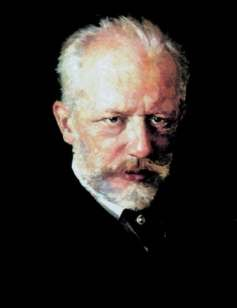
Full Name: Peter Ilich Tchaikovsky
Achievements: Great Russian composer
Born: April 25, 1840; Votkinsk, Russia
Died: October 25, 1893 ; St. Petersburg,Russia. ( Aged 53)
Field & Discipline: Music; Composer
Language: Russian
Father:: Ilya Petrovich Tchaikovsky
Mother: Alexandra Adreyevna Assier
Siblings: Nikolay; Ippolit; Anatoly; Modest; Sacha (sister)
Spouse: Antonina Milyukova
Children: None
Education: At home; Schmelling School, St Petersburg; School of Jurisprudence, St. Petersburg
Major Work:
"First Piano Concerto"
"Symphony No.6 in B Minor"
"Swan Lake"
"Eugene Onegin"
"Overture to Romeo and Juliet"
"1812 Overture"
"Nutcracker"
"The Sleeping Beauty"
"Pathetique"
Life & Times:
In 1862 in St. Petersburg, Tchaikovsky attended music courses given by the Russian Musical Society at the Mikhailovsky Palace, home of the Grand Duchess Elena Pavlovna. She was a patron of Anton Rubinstein, a composer and pianist who was internationally known. In 1862, Rubinstein became the director of the newly opened St. Petersburg Conservatory and accepted Tchaikovsky as one of his first pupils.
In 1864, Tchaikovsky spent the summer on the estate of a friend, Prince Alexei Golitsyn, where, as his summer project for school, he wrote an overture inspired by Aleksandr Ostrovsky's play "The Storm" (a work on which Czech composer Leos Janacek later based his opera "Kat a Kabanova").
Tchaikovsky's first publicly-performed work was a set of dances conducted in an open-air concert by Johann Strauss the Younger. In 1866, when he was 26, Tchaikovsky took up a position as Professor of Harmony at the Moscow Conservatory, run by Rubinstein's brother Nikolai. Also in 1866, he began writing an opera based on Ostrovksy's "The Voyevoda", and conducted dance sequences from it himself at the Bolshoi Theater. The music was well received; Tchaikovksy's conducting skills were
not.
Turning his hand to music criticism, Tchaikovsky wrote a defense of Russian composer [a fan was] Rimsky-Korsakov*, an article that favorably impressed "The Five,” a group of five Nationalist Russian composers ([a fan was] Mussorgsky*, Ceu, [a fan was] Borodin*, and Rimsky-Korsakov, and led by Mily Balakirev). At Balakirev's suggestion, Tchaikovsky wrote his overture "Romeo and Juliet", a work that is generally considered his first real masterpiece, but that was coolly received at its first performance in Moscow in 1870.
In 1871 Tchaikovsky gave a piano concert of his music at the Russian Musical Society in
Moscow. Russian novelist [ a fan was] Turgenev* was at the concert and his presence was a public endorsement of Tchaikovsky's music. The 1872 performance of Tchaikovsky's second symphony in both Moscow and St. Petersburg was received enthusiastically. In March 1874, he completed his second string quartet, and in December, wrote his "First Piano Concerto," dedicating it to German composer [dedicated work to] Hans von Bulow*, whose recital in Moscow in 1874 had impressed him. For his part, von Bulow admired Tchaikovksy's music and promoted it in Western Europe. Von Bulow gave the "First Piano Concerto" its first performance in 1875 in Boston, in the United States. It was immediately popular.
Also in 1875, Tchaikovsky started to write his third symphony, and also began work on music for "Swan Lake", commissioned by the Imperial Theaters. In late 1875, the "First Piano Concerto" and "Third Symphony" were given their first Russian performances. After finishing "Swan Lake," Tchaikovsky went to Bayreuth for the premiere of [a fan of] Wagner*'s "Das Rheingold." Tchaikovsky, now 36, had a stellar reputation as a composer, both in Russia and abroad, but he was not making much money. His life also was unsettled and his composing sporadic. He drank heavily and felt guilt about his homosexuality, particularly after a brief affair with a singer.
In 1876, a young pupil, to whom Tchaikovsky was giving violin lessons, introduced him to a rich widow, Nadezhda Filaretovna Frolovskaya von [patron was] Meck*. Tchaikovsky agreed to arrange some of his music for von Meck and his pupil
to play together. Von Meck was so delighted with Tchaikovsky that she became his patron and eventually arranged for him to have an annuity so that he could compose free of financial worry.
In 1877, the first performance of "Swan Lake" was enthusiastically received. It also was the first theatrical music composed on a large symphonic scale by a major composer. The first performance of Tchaikovsky's masterpiece "Eugene Onegin" took place in March, 1879, in Moscow. Between 1878 and 1881, he wrote some of his best known works: "Violin Concerto in D Major", "Serenade for Strings in C Major", "Capriccio Italien" and the "1812 Overture". In 1885, he bought a house just outside Moscow and wrote his "Manfred Symphony", which was lavishly praised.
In 1888, he toured with his own music in European cities, including Berlin, Prague, Paris and London. In Leipzig, he met composers [met] Grieg* and [met] Brahms*. On his return, he began to write the "Symphony No 5 In E Minor". He wrote another opera based on the work of writer Alexander Pushkin: "The Queen of Spades" and also the music for "The Sleeping Beauty", his favorite ballet.
In 1890, Tchaikovsky was devastated when Nadezhda von Meck had a reversal of fortunes and withdrew not only her financial support, but her moral support and her admiration for his music. In 1891, Tchaikovsky conducted in New York, Baltimore and Philadelphia. In 1892, he wrote music for the "Nutcracker" ballet, which was received with rapture. Soon after, he finished "Symphony No 6 in B Minor" or the "Pathetique", noted for its unusually slow, rather than upbeat, finale. He conducted its premiere in St. Petersburg in 1893. He died that year during a cholera epidemic in Moscow.
Extra Connections: Tchaikovsky was a friend of [a pal of] Saint-Saens* and [a pal of] Dvorak*
[shared patron with] Debussy* was another protégé of Von Meck.
Wrote an opera about [wrote opera about] Joan of Arc*
His work related to that of [work related to] Delibes*
Dancer Isidora [work choreographed by] Duncan* choreographed his music.
Attended premiere of [attended premiere of] Gustav Mahler’s* “Drei Pintos”
Concert endowed by [concert endowed by] Carnegie*
He was [mentored] Rachmaninov*’s mentor.
He influenced [influenced] Sibelius*
Assessment: Tchaikovsky's writing music for classical ballet is unsurpassed.
One-liner: Peter Tchaikovsky, great Russian composer
Bibliography:
- Holden, A., Tchaikovsky, Bantam Press, London, 1995.