Sharp, Granville
ACHIEVEMENTS: Obtained the ruling that slavery was illegal in England
DATE AND PLACE OF BIRTH: November 10, 1735, Durham, England
DATE/PLACE OF DEATH/AGE AT DEATH: July 6, 1813, London. Aged 78
DISCIPLINE: Scholar
FIELD: Philanthropy
LANGUAGE: English
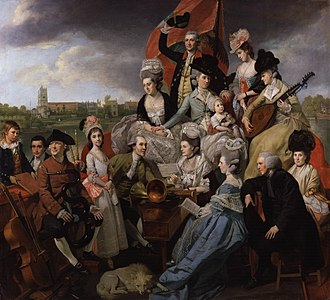
[enlarge] (Granville Sharp is the seated male figure in the centre)

PARENTS: Thomas Sharp; Judith Wheeler
SIBLINGS: 3 sisters -- names unknown; brothers Thomas, John, William, James
SPOUSE: None
CHILDREN: None
EDUCATION: Durham Grammar School; Local school, Durham
MAJOR WORK: "Remarks on the Uses of the Definitive Article in the Greek
Test of the New Testament"
LIFE AND TIMES:
At 15 Sharp was apprenticed to a linen draper in London. In his free time, Sharp taught himself Greek and Hebrew. At 22, he became a member of the Fishmongers' Company by which he became a freeman of the city of London. A year later, he got a job in the Department of Ordnance.
An event in 1765, when he was 30, directed Sharp on the major campaign of his life. Sharp met in the street an ailing black slave, Jonathan Strong, who was trying to get to William Sharp, Sharp's brother, a surgeon who treated the poor every morning. Strong apparently had been abandoned by his master, David Lisle, a lawyer in Barbados.
The Sharp brothers helped Strong and got him a job working for an apothecary. Strong worked for two years until one day, Strong's owner, Lisle, saw his slave in the street, followed him home, trapped him and had him sent to prison as a runaway slave. For the next two years, Sharp worked in his spare time on research into the place of personal liberty in law in England.
In 1767, Sharp published a "Short Treatise on the English Tongue". A year later, he published his biblical research, "Remarks on several very important Prophecies, in five parts".
Sharp was increasingly active on behalf of slaves and was beginning to be known as the protector of distressed Africans. In one much talked-about case, Sharp personally interceded on behalf of a slave who was being dragged off the street to be sent to Jamaica.
In 1769, he published his research on individual liberty, "A Representation of the Injustice...of tolerating Slavery". Sharp also investigated other cases in which English masters claimed the right of property over their slaves. In 1772, one such case, concerning James Sommersett, resulted in a landmark ruling "that as soon as any slave sets his foot upon English territory, he becomes free".
Sharp was also a supporter of independence for America, and in 1774, published "A Declaration of the People's Natural Right to a Share in the Legislature".
When his job at the Ordnance Department required him to become involved in sending military supplies to the colonies, he resigned . He now was left without an income, but his brothers William and James supported him.
In 1776, Sharp published five tracts about the abolition of slavery. In the same year, he received an admiring letter from Gen. James Edward Oglethorpe, and soon added his help to Oglethorpe's campaign to abolish "press ganging", whereby men and boys were captured and pressed into naval service by licensed gangs. In this matter, Sharp tried to enlist the support of <failed to interest> Dr. Johnson*, but Johnson was not sympathetic.
Among his other causes, he supported the reform of Parliament. In 1779, he began writing to bishops to enlist their support for establishing a society for the abolition of slavery.
In 1785, Sharp became a member of the Society for the Propagation of the Gospel. When the war with America ended in 1787, he argued for the right of the newly independent states to have their own bishops. During this campaign, he corresponded with American statesmen <corresponded with> Franklin* and John Adams.
Sharp energetically lobbied the archbishops of Canterbury and York to consecrate the American bishops elect and so preserve the apostolic succession. In 1787, two American bishops elect were presented by Sharp to the Archbishop of Canterbury at Lambeth and were later consecrated. A third bishop was consecrated in 1790. After this, the American church was able to consecrate without further application to England since they had enough consecrated bishops in America.
By 1783, many slaves in Britain had been freed and Sharp suggested that a colony of free slaves should be set up in Africa. Sierra Leone was eventually selected as the site of the colony. In 1786, Sharp published a "Short Sketch of the Temporary Regulations for the intended settlement near Sierra Leona".
In 1787, the various members of the anti-slavery movement decided to unite. It was decided that politician <collaborated with> William Wilberforce would take the lead in Parliament to press for the abolition of the slavery trade. The Committee for the Society for the Abolition of Slavery was established, and included Sharp. Sharp was active in the cause and conferred with Prime Minister <discussed aims with> Pitt* several times.
In 1787, the first boatload of freed slaves sailed to Sierra Leone. In 1789, Sharp was made a director of the <director of> Sierra Leone Company*, which was to manage the colony.
Sharp was involved in founding the British and Foreign Bible Society and at the inaugural meeting in 1804, was appointed Chairman. In 1807, he helped found the African Institution. In 1808, he was involved in founding the Society for the Conversion of the Jews.
ASSESSMENT: Sharp's perseverance in obtaining the ruling that slaves automatically became freemen when they enter English territory provided the legal plank for the battle for Abolition.
EXTRA CONNECTIONS: Painter <meeting attended by> Sir Joshua Reynolds* attended one of Sharp's anti-slavery meetings
ONELINER: Granville Sharp, early anti-slavery campaigner
BIBLIOGRAPHY:
Hoare, Prince, Memoirs of Granville Sharp, Esq., Henry Colburn & Co., London, England, 1820
Dictionary of National Biography