Johnson Dr
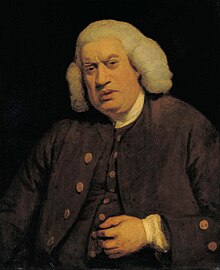
Achievements: Literary criticism, essays, lexicography
Born: 18 September 18, 1709; Litchfield, Staffordshire, England
Died: 13 December 13, 1784; London, England (Aged 75)
Field & Discipline: Art; Literature; Writer; Lexicographer
Language: English
Education: Lichfield Grammar School; Pembroke College, Oxford University
Major Work:
“Dictionary of the English Language” (1752)
“Lives of the Poets” (1779–81)
Life & Times:
Johnson had poor health as a child, which left him with deficient eyesight and facial tics. After only a year at university he was forced to leave through lack of funds. Over the next five years he worked as a teacher in a grammar school, did some translating work and had essays published in a Birmingham newspaper. In 1735 he married a widow twenty years older than himself and used her small dowry to open a school near Lichfield the following year. The school failed and in 1737 Johnson left for London with [taught] Garrick*, one of his pupils.
Johnson planned to make a living as a literary man and in 1738 he began writing for the “Gentleman’s Magazine.” He contributed poetry and prose, short biographies, and also a series of satirical pieces in which he attacked the government of the day (led by [attacked] Robert Walpole*) and the monarchy. He came to public attention for the first time with his long poem “London,” written in heroic couplets in the style of the Roman satirist Juvenal, in which he criticized contemporary mores and the evils of city life. The poem was praised by the poet [a fan was] Pope* who tried, unsuccessfully, to get Johnson a job. Despite its success, the poem did not earn much money, and nor did Johnson’s biography of his friend, the bohemian poet Richard Savage (1744) although it, too, was warmly received and was praised by the French Encyclopedist [a fan was] Diderot*.
In 1746 a group of London booksellers commissioned him to compile an English dictionary. The popular dissemination of knowledge was proving a money-spinner for publishers and the “Cyclopaedia” written by [influenced by] Ephraim Chambers* earlier in the century was regularly reprinted. [work related to] John Wesley* was compiling a pocket dictionary for the working man. Johnson recorded later that he was influenced by Chambers in planning his own project, which he outlined in his “Plan for a Dictionary of the English Language” (1747). He began with the lists of words which were already in print, to which he added more words as he read through a vast body of English literature. While working on the dictionary, Johnson wrote and published a series of essays. The first series began in March 1750 and appeared twice a week, totaling over two hundred essays. They appeared in “The Rambler,” a magazine similar to the “Spectator” established by [work related to] Joseph Addison* earlier in the century which was much admired by Johnson.
The novelist [co-writer with] Samuel Richardson* wrote one of the very few numbers of “The Rambler” which was not produced entirely by Johnson. In 1752 Johnson’s wife died. Soon after the funeral he was presented with a black child as a servant. Francis Barber was the son of a Jamaican slave who had been brought to England by a plantation owner in the hope of giving him education and freedom. Johnson deeply disapproved of slavery and of Jamaica, and until [knew] Sharpe* fought for the rights of ex-slaves in England there was no law to protect ex-slaves from their former masters. When Barber later ran away and joined the navy, Johnson enlisted the help of the novelist [a pal of] Smollett*, who had served as a ship’s surgeon, in getting Barber discharged, after which Barber rejoined Johnson’s household and remained there for the rest of Johnson’s life.
After eight years’ slog, during which he had only clerical help, Johnson completed and published “A Dictionary of the English Language” (1755). He had standardized spelling, given precise definitions for words, based on actual usage, and illustrated the meanings of words by quotations. After publication, Johnson was known as “Dictionary Johnson” or “The Great Lexicographer.” A second series of over one hundred essays came out weekly from April 1758, under the name “The Idler.” Johnson’s essays were sometimes satirical but the majority were serious commentaries on the vanity of human life which reflected his strong Christian faith.
Although his public persona was one of great, sometimes excessive, conviviality, he was privately sensitive and subject to melancholy fits. Johnson’s cure for depression was in dining and conversing with intelligent company. In 1763, at the instigation of the painter [club member with] Sir Joshua Reynolds*, a dining club was formed which met regularly at the Turk’s Head tavern every Monday. Membership was strictly vetted by Johnson. Among those who were invited to join were the playwright [club member with] Goldsmith*, the historian [club member with] Gibbon*, the politician[club member with] Burke*, the dramatist [club member with] Sheridan* and Bishop [club member with] Shipley*.
In 1763, Johnson first met [biographer was] Boswell*, who later became famous as his biographer. Another acquaintance dating from this period was [acquaintance was] Hastings* with whom Johnson afterwards corresponded on occasion.
Johnson had been awarded a pension in recognition of his services as a lexicographer and he produced only two more major works. His renown in literary and social circles was based less on his writings than on his erudition and his brilliant conversation. In 1765 his long-planned edition of the plays of [did edition of] Shakespeare* appeared, with commentary and a preface which was the most in-depth critique of the playwright to date. His reputation was higher than ever and his friends referred to him affectionately as the “The Great Cham of Literature.” Even the economist [knew] Adam Smith* who very much disliked Johnson praised his preface. In the same year, Mrs Hester Thrale met Johnson for the first time, having already heard his praises sung by the artist [a fan was] Hogarth* who had taught her drawing. Thrale, then still married to a wealthy brewer, became the confidant and close friend of Johnson and over the next two decades he spent much of his time in her household. Johnson was fond of the company of spirited, intelligent women as long as they remained feminine and he admired the work and relished the company of the poets [a pal was] Home* and [a pal was] Hannah More*, and the writer [a pal was] Burney*.
In 1768 Johnson was appointed as honorary Professor of Ancient Literature to the newly created Royal Academy. He was known for his bluff ways and trenchant opinions but Johnson was also very kind. In 1773 Johnson agreed to accompany Boswell on a trip to Scotland. On the island of Skye they met [met] MacDonald* and Johnson slept in the bed in which [slept in bed of] Prince Charles Stuart* had lain while evading capture after the Jacobite rebellion of 1745. Johnson described his travels in “Journey to the Western Islands of Scotland” (1775).
In 1774 he accompanied the Thrales on a tour during which they had breakfast with the scholar and physician [met] Erasmus Darwin* in Staffordshire, looked over Kedleston Hall, recently finished by the architect [critiqued] Adam* which Johnson thought showed “more cost than judgement,” and visited the Soho factory of [visited] Boulton*. The following year Johnson and the Thrales went to France.
In 1777 he was asked by a group of booksellers to write the introductions for a collected edition of English poets from the seventeenth century to his own time. The term “metaphysical poets,” now commonly used to describe John Donne and his school, was invented by Johnson. His opinions, especially his criticisms of [critiqued] Milton* and Thomas Gray, were disputed by his contemporaries and [a pal of] Lady Mary Wortley Montagu* broke off her friendship with Johnson because he attacked the work of Lord Lyttelton. Johnson’s introductions were published separately in a collected edition as “Lives of the English Poets” in 1781.
Hester Thrale let her home at Streatham to [knew] Shelburne* in 1782, an event which distressed Johnson who had come to regard it as his own country home. He was even more put out when Thrale, who had been widowed, re-married an Italian singer (Gabriel Piozzi) in 1784. Although he continued to relish conversation and new acquaintances, such as the physician and man of letters [a pal of] Dr John Moore* whom he met in 1784, Johnson’s health was declining. He gave his doctors, especially [doctor was] Cruikshank*, the noted anatomist, a hard time but he remained lucid and burned many of his private memoirs before he died in December 1784.
Extra Connections: He was an admirer of the [admirer of] Duchess of Devonshire*
He knew Dr William [knew] Heberden*
He supported [supported] Paoli*
He was a friend of Elizabeth [a pal of] Carter*
Assessment: Johnson is regarded as one of the greatest men of letters in English history and he produced the first modern dictionary of the English language.
Oneliner: Dr Samuel Johnson, great English man of letters and lexicographer
Bibliography:
- Bate, W Jackson, Samuel Johnson, Chatto & Windus, London, 1978.
- Hibbert, Christopher, The Personal History of Samuel Johnson, Penguin Books, Middlesex, England, 1984.
- Lane, Margaret, Samuel Johnson and His World, Hamish Hamilton Ltd., London, 1975.
- Wain, John, Samuel Johnson, Papermac, London, 1980.
Father: Michael Johnson
Mother: Sarah
Siblings: None
Spouse: Elizabeth Porter
Children: None