William Herschel
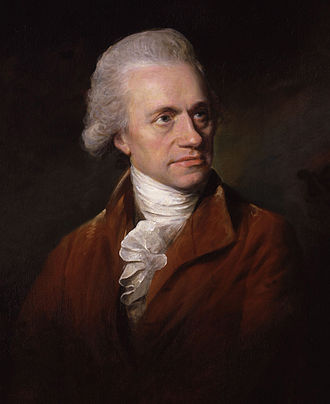
ACHIEVEMENTS:
Founded the science of galactic structure
Discovered the planet Uranus, classified over 2,500 star clusters and nebulae, over 800 double stars
NICKNAME/ALIAS: Born: Friedrich Wilhelm Herschel
DATE AND PLACE OF BIRTH: 15 November 1738, Hanover, Germany
DATE AND PLACE OF DEATH AND AGE AT DEATH:
25 August 1822, Slough, near Windsor, England. Aged 84
DISCIPLINE: Astronomer
FIELD: Astronomy
PARENTS:
Father: Isaac Herschel
Mother: Anna Ilse Moritzen
SIBLINGS: 9 including Caroline
SPOUSE: Mary Baldwin
CHILDREN: 1 son:John Frederick William Herschel
EDUCATION: Garrison school, Hanover
MAJOR WORK:
“On the proper Motion of the Sun” (1785)
“Catalogue of a Second Thousand of new Nebulae and Clusters of Stars” (1789)
LIFE AND TIMES:
Herschel’s father was bandmaster in the Hanoverian Guard and at fourteen years of age, Herschel also joined the band. Two years later, he accompanied the regiment to England. In London, he earned his keep as a copyist, musician and soloist and his virtuosity and musicality attracted notice. In 1766 he took the post of oboist in Linley’s* orchestra in the fashionable town of Bath.
When he discovered astronomy, he was hooked and from the first was determined to see for himself what others had described. Not being able to afford the best astronomical instruments available, he began to make his own. Herschel eventually constructed a reasonable reflecting telescope, often running back to his home to work on it between the acts of a musical entertainment. On 4 March 1774, he used the new instrument to observe the nebula in Orion.
He was now determined to conduct a complete survey of the Heavens. He moved to a new house in Bath were there was some land which could be used for workshops and there he constructed extremely large reflecting telescopes, using a mirror not a lens (thus avoiding the problems related to chromatic and spherical aberration). Before 1781, he recorded that he had made over 200 seven-foot mirrors, a further 150 ten-foot mirrors, and about 80 measuring 20 feet.
In 1779 he began reviewing the sky. On March 1781, Herschel was working his way through the constellation Gemini when he saw something that was not entered on any celestial chart. His experience told him was not a fixed star. He saw that the object had a disc, and when he magnified the disc he observed that the object was made of substance which meant it could not be a star (stars gain nothing from magnification).
The idea that there were just five planets (Mercury, Venus, Mars, Jupiter, Saturn) was so set in stone that at first Herschel labeled his discovery as a comet and then as a ‘singular star’. The discovery also made waves outside England. The German astronomer Bode* corresponded with Herschel, as did the French astronomer Lalande* and the mathematician Laplace* who calculated the orbit that would fit the observed positions of the new object and found that it was a planet circling round the sun at twice the distance of Saturn.
Herschel’s discovery made him famous. In November 1782 he declared that his discovery was a new planet which, at the suggestion of Bode, was named Uranus.
In 1782 Herschel published a catalogue which included the 269 double and multiple stars he had noted in his first review of the sky. He was appointed astronomer to the king but his salary was not particularly generous and he made money by selling his telescopes. Catherine the Great* of Russia tried to buy some of his speculum mirrors.
In 1783 Herschel completed his large 20 foot telescope which had an aperture of 18.7 inches and was the instrument he used most regularly. He had now begun to study nebulae, the milky-looking patches in the sky which by the magnification of his telescopes he could break down into clusters of separate or double stars. He carried out star counts in over 3,000 areas of sky and used his findings on the distribution and brightness of the stars to discover the form and extent of the Milky Way.
He was plagued by visitors like the novelist Burney*, the musician Haydn*, and foreign visitors such as one of the famous Cassini* family of astronomers in France, the French mathematician Legendre*, and the Italian astronomer Piazzi*.
In 1785 Herschel published his second catalogue of 434 double and multiple stars. He also brought out his most important work to date, entitled “On the proper Motion of the Sun” in which he linked the sun with the stellar universe and so changed the whole orientation of astronomy by demonstrating that the stellar universe was at least as interesting and fruitful for study as the solar system.
Over the next few years, he developed a theory that the universe began with stars scattered through infinite space; over time, groups of stars came together to form patches in the sky in which they were loosely clustered; eventually, over a further period of time, these patches fragmented into tightly packed clusters of stars.
In 1792 he visited the Soho factory in Birmingham where he and his wife dined with Watt*. But his consuming interest was astronomy and his work laid the foundation for future findings by astrophysicists Doppler*, and Smyth*. In 1802 he visited Paris, and took his son, JFW Herschel* to meet Napoleon*.
Herschel’s theory of the galactic universe was modified by his further findings on nebulae. The discoveries made by the German astronomer Olbers* of small heavenly bodies which moved in orbits situated between those of Mars and Jupiter engaged Herschel in a correspondence with Olbers, Piazzi and Bode, and it was Herschel who named these unknown bodies ‘asteroids’.
Herschel was knighted in 1816 and in 1821 made president of the Astronomical Society.
ASSESSMENT: Herschel founded stellar astronomy. He was the first to extend observations beyond the solar system into galactic and extra-galactic space.
EXTRA CONNECTIONS: He influenced the work of Struve*
ONELINER: William Herschel, discoverer of Uranus
BIBLIOGRAPHY:
Armitage, Angus, William Herschel, Thomas Nelson & Sons Ltd., London, 1962
Clerke, Agnes M,The Herschels and Modern Astronomy,Cassell & Co. Ltd., London, 1895
Sidgwick, JB, William Herschel, Explorer of the Heavens, Faber and Faber Ltd., London, 1953
Erik Washam "Lunar Bat-men, the Planet Vulcan and Martian Canals"Smithsonian MagazineDecember 2010