Conrad, Joseph
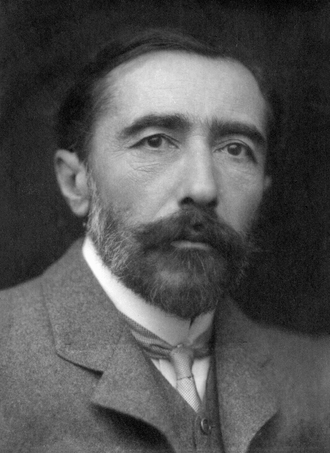
Nickname/Alias: Józef Teodor Konrad Korzeniowski
Achievements: Wrote more than 20 novels and a large collection of short stories. Developed a powerful prose style and influenced many modern novelists.
Born: December 3, 1857; Berdichev, Ukraine
Died: August 3, 1924; Bishopsbourne, England
Field & Discipline: Literature; Writer
Language: Polish; French; English
Father: Apollo Korzeniowska
Mother: Ewelina (née Bobrowska)
Siblings: None
Spouse: Jessie (née George)
Children: Borys; John
Education: Encouraged by his father (a translator of English and French literature) to read widely. He missed the opportunity to pursue extensive formal education because he went to sea at the age of 16.
Major Works:
“Heart of Darkness”
“Lord Jim”
“Nostromo”
“The Secret Agent”
“Under Western Eyes”
“Victory”
Life & Times:
Joseph Conrad was born in the town of Berdichev, Poland. At the time the region was part of the Russian-occupied Ukraine and Conrad’s patriotic father, Apollo, was a member of a committee that planned a Polish protest against the Russians. The plans proved successful and resulted in the January Uprising which began in 1863. However, by that time misfortune had already fallen upon some of the committee members. In late 1861, when Conrad was just four years old, Apollo was arrested. The family was exiled to Vologda in northern Russia where, for almost half the year, the average high temperature is below freezing.
To support his wife and son, Apollo worked as a translator of English and French literature. He seized the opportunity to tutor the young Joseph, encouraging him to read Victor Hugo, Shakespeare, Charles Dickens, Sir Walter Scott, and William Makepeace Thackeray. Unfortunately, the harsh climate took its toll on all three of them. Both parents both fell ill with tuberculosis; Conrad’s mother died in 1865 and he lost his father in 1869, when he was 12.
For the next four years Conrad lived with his mother’s brother, Tadeusz Bobrowska, who owned land in the city of Krakow in Poland. His uncle saw to it that Conrad received some schooling, but he did not enjoy his lessons. He had read books by James Fenimore [inspired by] Cooper*, whose writings included adventure stories set at sea. Perhaps they inspired Conrad because he made it clear that he longed to travel. At the age of 16, with an allowance from his uncle, he moved to the port of Marseilles on the Mediterranean coast of France.
Conrad made his first voyage to the Caribbean island of Martinique as a passenger but soon he took work aboard a French merchant boat, first as an apprentice and then as a steward. It was the beginning of a 15-year career at sea, a period when he gathered many experiences that appeared later in his writing. He seems to have enjoyed the maritime life, voyaging widely and experiencing a series of adventures that included gunrunning and smuggling.
He gambled, too, and in 1878, facing debts that he could not repay, he tried to commit suicide by shooting himself in the chest. He cannot have been a very good shot because he survived the incident and his uncle stepped in to settle the debts. The event triggered a major change in Conrad’s life. He lost his job and signed on with an English freighter destined for Constantinople with a cargo of coal. When the voyage was over, the ship returned to the English port of Lowestoft and Conrad took his first step on British soil. He had reached the country where he would find fame.
His command of English was still poor and it was only after his twentieth birthday that he became fluent, a remarkable fact considering that he went on to build a reputation as one of the most gifted writers in English. In 1886 he became a British citizen. Though he never lost his strong Polish accent, he changed his name from the original Jozef Teodor Konrad Korzeniowski to Joseph Conrad. He continued to accumulate experience at sea, travelling to the Malay Archipelago and the Gulf of Siam. He visited the Belgian Congo in 1890, fulfilling a childhood ambition to see Africa. There he gathered research for a book that would eventually become “Heart of Darkness” (Francis Ford Coppola’s 1979 movie, Apocalypse Now, was inspired by this novel).
His four-month stay in the Congo, where the natives were ruthlessly exploited by the Belgian colonial power, made a deep and disturbing impression on Conrad. Many biographers suggest that his bleak vision of the world and his preoccupation with the dark side of human nature, views that would stay with him for the rest of his life, solidified during his stay in Africa. Critics agree that he was also preoccupied with corruption (which features prominently in his book “The Nigger of the Narcissus”) and alienation (a major topic in “Heart of Darkness”). While in the Congo he met a British diplomat, Sir [met] Roger Casement*, who wrote “The Congo Report,” describing the abuses and atrocities suffered by the population.
Conrad’s health began to fail and he retired, returning to hospital in England and working sporadically on his first book, “Almayer’s Folly.” It was the beginning of a new career. Despite his undoubted success as a seafarer, writing would be the field in which Conrad’s strongest talents shone through. In 1895, at the age of 38, he married an Englishwoman, Jessie George, who was more than 15 years his junior. The couple settled in Kent, and Conrad was to live in this part of Southern England for the rest of his life. He had known Jessie for several years before he proposed, and at least one biographer suggests that the offer of marriage was less than conventional; when Conrad proposed, he warned his beloved that he did not wish to have children and felt that he had little time left to live. (In fact, he died almost two decades later, having fathered two sons.)
The next years were challenging because the family lacked financial stability. Conrad wrote novels and stories, and collaborated with [worked with]Ford Madox Ford* on two books: “The Inheritors” and “Romance.” Magazines began to serialize Conrad’s work, bringing the family extra income. In 1910 he was awarded a pension of 100 pounds and he gained a little extra money when the manuscripts of his books became collectible. However, the first real financial success did not happen until 1912, when his novel “Chance” was serialized in “The New York Herald.”
In 1924 the British Prime Minister, Ramsay McDonald, offered Conrad a knighthood, but he turned it down. On August 3 of that year he suffered a heart attack at home. Conrad was buried in Canterbury, England. His gravestone carries his original Polish name.
Extra Connections:
He was studied by French poet Paul [read by]Valery* and UK academic F.R.[studied by] Leavis*
He was financially helped by the painter Sir William[financially helped by] Rothenstein*
Admirers included author John [a fan was]Galsworthy* and publisher Nelson [a fan was] Doubleday*
He was a friend of writer [a pal of] H.G. Wells*
Said to have influenced Orwell, Hemingway, Fitzgerald, Garcia-Marquez among others.
Assessment: Polish-born master seafarer and writer, he is regarded as one of the greatest English-language novelists, noted for the richness of his prose, his realism, and his ability to evoke atmosphere.
Oneliner: Joseph Conrad, seafarer and novelist
Bibliography:
- Encyclopedia Britannica 15th Edition.
- Written Lives by Javier Marias.
- Novelists and Novels – Bloom’s 20th Century Literary Criticism.
- Merriam-Webster Encyclopedia of Literature.