Fitzgerald, Scott
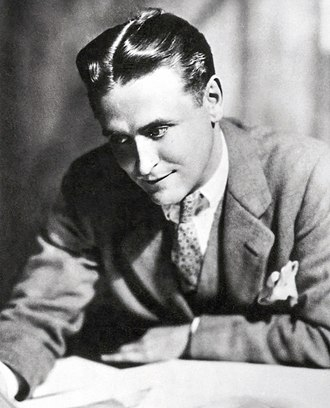
Name: F. Scott Fitzgerald
Nickname/Alias: born: Francis Scott Key Fitzgerald
Achievements: Novels and short stories.
Born: September 24, 1896; St Paul, Minnesota
Died: December 21, 1940; Hollywood, California (Aged 44)
Field & Discipline: Literature; Writer
Language: English.
Father: Edward Fitzgerald
Mother: Mary McQuilan
Siblings: None
Spouse: Zelda Sayre
Children: Frances (daughter)
Education: St Paul Academy, St Paul, Minnesota; Newman Academy, Hackensack, New Jersey; Princeton University, New Jersey
Major Work:
“This Side of Paradise” (1920)
“The Beautiful and the Damned” (1922)
“The Great Gatsby” (1925)
“Tender is the Night” (1934)
Life & Times:
On his father's side, Fitzgerald was related to [distant relative of] Key*, who wrote the words of “The Star-Spangled Banner,” while his mother's family were Irish-American. When he was two, his father’s business collapsed and the family moved around, so he spent his early years in Buffalo and Syracuse, New York then, in 1908, they moved back to Minnesota. In 1913, he started at Princeton University.
He fell behind in his studies and in 1915, knowing that he was going to fail his exams, he left university. The following year, he was given another chance and when he returned to Princeton, he put all his energy into his literary studies rather than his social life.
Fitzgerald worked on the undergraduate literary magazine and wrote the first version of his novel, “This Side of Paradise.” Around the same time, he made friends with Edmund Wilson, who later became a distinguished writer and critic.
When America entered World War I in 1917, Fitzgerald left Princeton and joined the army as Second Lieutenant, but never served abroad. During his military training, he had time to revise his novel, which had been turned down by the publishers.
In 1918, he was stationed near Montgomery, Alabama and, at a local dance, he met Zelda Sayre, the daughter of an Alabama Supreme Court judge. The couple fell in love and planned to marry as soon as Fitzgerald was earning a decent living.
He left the army in February 1919 and went to New York, where he took a job in an advertising agency. Once again, he revised his novel and tried hard to get some of his short stories published. At last, a magazine accepted his story, “Babes in the Woods” but Zelda broke off their engagement, not believing he would ever be able to support her.
Making his mind up to be a successful writer, Fitzgerald gave up his advertising job and went to his parents’ home where he polished his novel. “This Side of Paradise,” Based on his Princeton experiences, it was finally published in March 1920 and, a month later, he and Zelda married.
The novel captured the post-war spirit of rebellion among wealthy youngsters and it reflected the manners and morals of a new era. Fitzgerald was now seen as the voice of the Jazz Age and he became instantly famous.
He and Zelda went to Europe for the first time in 1921 and his collection of short stories, “Flappers and Philosophers” came out. In 1922, he published “The Beautiful and the Damned,” which has since been seen as prophetic of the Fitzgeralds’ future life.
It told the story of Anthony and Gloria Patch, a young, privileged couple living, in expectation of a large inheritance, in drunkenness and extravagance. By the time they came into the inheritance, they were too jaded and worn out to participate fully in a worthwhile life.
“Tales of the Jazz Age,” a collection of more upbeat stories, was published the same year and allowed the Fitzgeralds to continue what was by now an extravagant lifestyle. In 1923, he spent most of his time writing a play, “The Vegetable,” which opened in Atlantic City and failed.
To pay his rising debts, he spent the next few months writing popular stories, then began his more serious work: “The Great Gatsby” in 1924, the year they decided to move to France to save money. They settled at St Raphael in the South of France and the novel was published in April 1925.
The book, sometimes referred to as the Great American Novel because of its very American theme based on the ideal of unlimited dreams that are impossible to fulfill, was a critical success, but not a financial one.
The character of Jay Gatsby is a brash, self-made man from the West, who dreams of social success in the East. The central character of Gatsby's dream is Daisy Buchanan, a shallow but charming young woman married to a rich man.
After publication, the Fitzgerald’s went to Paris for the summer and were received with open arms. They became friendly with [a pal of] Hemingway* who, as a young writer trying to make his way, accepted Fitzgerald’s help on his unpublished novel “The Sun Also Rises.”
Over the next four years, Fitzgerald split his time between America and Europe and, in 1926, some of his best short stories appeared in “All the Sad Young Men.” At the same time, “The Great Gatsby” was successfully dramatized.
In 1927, Fitzgerald went to Hollywood, where he met Lois Moran, who provided the inspiration for the character of Rosemary Hoyt in his next novel, “Tender is the Night.” Both Zelda and Fitzgerald were now drinking heavily and in 1930, Zelda had a nervous breakdown. She went into hospital in Switzerland until September 1931, then they returned to America.
After her father died in 1932, she had another breakdown, which put her back in hospital. During this time, Fitzgerald finally completed his most deeply emotional novel, “Tender is the Night.” The central character, Dick Diver, is a psychiatrist who marries one of his patients. She is a wealthy young woman called Nicole Warren, who ultimately destroys Diver.
The book repeats Fitzgerald's recurring theme of a poor, aspiring young man investing his hopes in a rich, carelessly superior young woman who uses him and then leaves him. The novel reflects Fitzgerald's own feelings about his marriage and the nature of his success.
In 1926, he published “The Rich Boy,” a short story that contains the words “They are different from you and me,” his continual statement about the rich. Rich was no longer a term used to describe Fitzgerald’s life because, over the next decade, money dwindled, he gave up hope of a cure for Zelda’s depression and his own drinking problem became worse.
Fitzgerald used his own recent experiences to create a new work and, in 1936, published the “Crack-Up,” which described his own collapse. The next year, badly in debt, he went to Hollywood to work as a scriptwriter and met Sheilah Graham, who became his constant companion and lover.
When his scriptwriting was rejected, he started to write stories for “Esquire” then, in 1939, he began his final novel, “The Last Tycoon.” The six chapters he completed show signs of a reawakened talent but, before he could finish the book, he died suddenly of a heart attack.
Extra Connections: His career was promoted by [promoted by] Mencken*
He was a favorite of [a favorite of] Stein*
His father’s first cousin twice removed, Mary Surratt, was hanged in 1865 for conspiring to assassinate [Abraham Lincoln].
While awaiting deployment to the Western front where he hoped to die in combat,[35] he was stationed in a training camp at Fort Leavenworth under the command of Captain Dwight Eisenhower, the future general of the Army and United States President.[36] Fitzgerald purportedly chafed under Eisenhower's authority and disliked him intensely.
Assessment: He was one of the writers of the Great American Novel.
Oneliner: F Scott Fitzgerald, American writer of the 1930’s
Bibliography:
- Mizener, A., The Far Side of Paradise, Heinemann, London, 1953.
- Bruccoli, M., Some Sort of Epic Grandeur: a biography of Fitzgerald, 1981.