Breton A
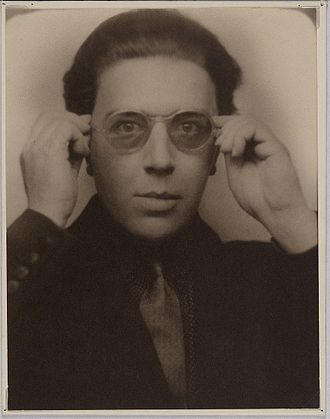
ACHIEVEMENTS: Founded Surrealism
NICKNAME/ALIAS: None
DATE AND PLACE OF BIRTH: 19 February 1896, Tinchebray, Normandy, France
DATE/PLACE OF DEATH/AGE AT DEATH: September 28, 1966 Paris. Aged 70.
DISCIPLINE: Poetry
FIELD: Poet
LANGUAGE: French
EDUCATION: Degree in Neuroscience from Faculté des Sciences, Paris
MAJOR WORK: Magnetic Fields(1919), Earthlight (1924) Nadja (1928), Immaculate Conception (1930)
LIFE AND TIMES:
In 1919 Breton left the army and returned to Paris where he met Tzara* and participated in Dada. The same year he published his first poems, Mont de Pieté, and founded the magazine Littérature. An article he wrote, “Les Champs Magnétiques”, is usually considered the first authentic piece of surrealist writing.
By 1920 he felt Dada wasn’t living up to its subversive potential and that it was being played for laughs by its members. He was also denied the Blumenthal prize, although he had been nominated by Valéry and seconded by Proust* and Gide*. The jury shied away from Breton’s Dada activities, but this was ironic since Breton was moving away from Dada and writing his surrealist manifesto.
In 1920 he met Freud* in Vienna. Freud’s dream theories mirrored Breton’s surrealist theories. In 1922 he moved into a studio on Rue Fontaine in Paris, where he lived for the rest of his life. In 1923, he self-published “Earthlight”, a collection of poems. It featured a portrait done by Picasso*. The collection included dream narratives, calligrams, and automatic prose. He also published “Les Pas Perdus”, an essay collection which outlined his views on art. By summer 1924 he had replaced the magazine Littérature with La Révolution Surréaliste. He prefaced it with his Manifesto of Surrealism which outlines his theories’ relation to the group’s activities, which included hypnosis, dream narratives, sleeping fits and automatic writing. He traced Surrealism back to Sade, Poe, EA 2*, Swift*, Baudelaire*, Rimbaud*, and Reverdy.
Breton was deeply interested in astrology, which he viewed as a means of deciphering the hidden meanings and coincidences in life. He believed so strongly in its influence that he changed his birth date to February 18 because he believed that day better reflected his personality and destiny.
Another influence was Breton’s belief in the importance of childhood as a period in one’s life where people experienced true freedom. This was ironic, because Breton did not actually like children, he merely wanted to feel “childlike”. Never overtly political, Breton nevertheless flirted with the communist and anarchist movements of his day. In 1924 Breton opened The Bureau of Surrealist Research, which was to be a surrealist information center for the public.
In 1925 he chose Antonin Artaud to head the bureau. Breton promptly imposed order on the group’s manic activities. Before long Breton fired Artaud and closed the Bureau altogether, uncomfortable with sharing leadership with anyone else. In 1926 Surrealist “cells” were emerging all over Paris. Members of these loose ranks were Miro* and >Magritte*.
In 1928 he published one of his most famous works, the novel Nadja. The title character, Nadja, is Breton’s ideal woman, who also reflects his preoccupation with how to live by Surrealism’s ideals in the waking world.
In 1930 he published the second surrealist manifesto, as part of the collection Immaculate Conception which promoted an anti-morality that would reject predictability in favor of surprise, spontaneity, and revolt. He also discussed the surrealists’ attempted simulations of psychotic states, hoping to show how the boundary between the language of insanity and that of poetry was mostly imaginary. The work was influenced by Hegel’s* Phenomenology of Mind and by Dali’s* “paranoid-critical” method.
He founded the magazine Minotaure in 1932. Not long after, he broke off relations with the Communist party. In 1938, the International Exposition of Surrealism was held in Paris, where he met Diego Rivera and Trotsky*.
In 1941 he went to New York, where he founded VVV in collaboration with Marcel Duchamp. Before leaving America he also published Arcane 17. In 1947 he organized a new International Exposition of Surrealism.
ASSESSMENT: Breton’s surrealist theories had an impact on a majority of the continental artists in the twenties, regardless of their affiliation with the movement. Surrealism made it acceptable for artists to explore irrational areas of thought and feeling.
EXTRA CONNECTIONS: None
ONELINER: Andre Breton, founder of Surrealism
BIBLIOGRAPHY:
Polizzotti, MarkRevolution of the Mind: the Life of Andre Breton,Farrar, Straus, and Giroux 1995
Encyclopedia of World Literature in the 20thCentury
Ed. Fleischmann, Wolfgang Bernard V1-3, Frederick Ungar 1971
PARENTS: Marguerite and Louis Breton
SIBLINGS: None
SPOUSE: Elise (third wife)
CHILDREN: Daughter, Aube