De Musset
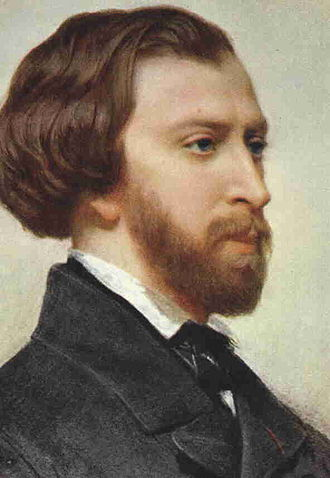
Name: Musset, Louis-Charles-Alfred de
ACHIEVEMENT(S): Plays, critical essays, light satirical pieces, poems.
DATE/PLACE OF BIRTH: December 11, 1810 Paris, France
DATE AND PLACE OF DEATH/AGE AT DEATH: May 2, 1857, Paris, France. Aged 46
DISCIPLINE: Poet and playwright
FIELD: Literature and theater
EDUCATION: Private tutor until 1819, then Lycee Henri IV
MAJOR WORK: (see below)
LIFE AND TIMES:
As a teenager, Musset became a frequent visitor to Hugo*'s house, where he met poet de Vigny*, as well as novelist Merimee*. By 1828 Musset had become a talented draughtsman. Delacroix* said he could have become a great artist had he so chosen.
By the time he was 19, Musset had already started his many romantic and sexual liaisons and had embarked on a life of alcoholic dissipation. His autobiographical "La Confession d'un enfant du siècle (The Confession of a Child of the Century" 1826), presents a striking picture of Musset's youth as a member of a noble family, well-educated but ruled by his emotions.
Musset soon took up gambling and fell massively in debt. His father, a civil servant in the Ministry of War, decided to put a stop to this dissolute lifestyle, and in 1829 found a post for him in the office of a contractor for the central heating of military establishments. Musset immediately gathered up his collection of verses, the manuscript of the "Contes d'Espagne et d'Italie (Stories of Spain and Italy") on which he had been working, and took it to a publisher who told him it needed another 500 lines.
Musset's employer granted him three weeks' summer vacation, after which he showed up with the poem "Mardoche" (about 600 lines he had written during the three weeks). It was published at the end of the year.
Overnight, Musset became a celebrated writer. Women started sending him love letters and gifts. His father was impressed and agreed that Musset could give up his civil service career.
Musset now had theatrical ambitions. In 1830, the director of the Odéon asked him for a play and Musset wrote "La Nuit Vénitienne (The Venetian Night"), which opened in December, 1830. The opening night was a disaster.
The death of Musset's father in the cholera epidemic of 1832 meant he had to keep his family going, so wrote more verse and plays, which came out in 1833 as "Spectacle dans un fauteuil". He began contributing to the "Revue des deux Mondes", whose editor, Frédéric Buloz, highly impressed with Musset, published all his writings from then on -- articles, criticism, essays, poems, and plays.
In the spring of 1833, Buloz invited all his contributors to a dinner party to celebrate the journal's second anniversary. It was here that Musset, now 23, first met George Sand*, the only woman present. It was a meeting that changed his life forever. Sand, then aged 29, had published her first novel, "Indiana" the year before. It had been an instant success and she had now just finished her second, novel "Lélia", was married with two children, but had had numerous lovers including Merimee. Smitten, Musset re-read "Indiana" the next day and sent her some verses he composed after reading it. A few months later, they became lovers.
Musset and Sand decided to spend the winter of 1834-35 in Italy. They took a steamship down the Rhone, on which they met the writer Stendahl*, whom Sand detested (he was drunk and cynical most of the time) but whom Musset greatly liked. In Florence, Musset went sightseeing most days, while Sand stayed in to write. In Venice, Sand suffered a violent attack of dysentery, leaving Musset free to pursue his dissolute life.
He soon believed he had caught a venereal disease from a prostitute, but it appears now the disease was probably malaria or typhoid. After much suffering, he recovered, but while he was recuperating, Sand began an affair with the doctor who was tending him. Once he was well, Musset left Venice and went to for Geneva in April, 1834, while Sand returned to Paris in August, taking the doctor with her.
By October, Musset and Sand were back in each other's arms. The most important lasting result of the five-year affair was that it inspired the best of Musset's poetry. During 1835-36, he wrote "La Nuit de Mai", "La Nuit de Decembre", "La Nuit de Juin", and "La Nuit d"Aout".
Musset was now approaching 30 but still living at home, earning only pennies from his writings in the "Revues des deux Mondes". His amorous liaisons included a noblewoman, Aimee Alton, whom he refused to marry. She was, however, inspiration. He wrote his successful play "Un Caprice" and "La Nuit d'Octobre" before their affair ended in 1838.
The Paris of 1840 was filled with talented men, most of whom Musset knew. They included Hugo, Balzac*, Lamartine*,Ingres*,Delacroix, Rossini*, Berlioz*, Liszt*, and Chopin*, who was now having an affair with George Sand.
Musset had not seen Sand for several years, but one evening in February, 1841, he ran into her again at the Theatre des Italiens. He went straight home and wrote the last in the series that began with "La Nuit de Mai". It was the epitaph of his grand passion for Sand. He called it "Souvenir"; it was one of his best poems.
From 1840 to 1847, Musset's excessive lifestyle led increasingly to bouts of illness accompanied by fits of delirium and hysteria. But in September, 1847, he had a stroke of luck. The Comedie-Francaise began to stage his plays, so he wrote several more, including "Louison", "On ne saurait penser a tout", "Bettine" and "Carmosine". Musset at last became a celebrated wit, but by now the drinking was taking its final toll.
He was elected to the French Academy in 1852, and invited to dine with Napoleon III* at the Palais-Royal in April, 1857. It was his last outing. He went home and never left his bed again.
ASSESSMENT: His greatest poems were always written under the pressure of intense and unhappy emotion.
EXTRA CONNECTIONS:
The tale of his celebrated love affair with George Sand in 1833–1835[1] is told from his point of view in his autobiographical novel La Confession d'un Enfant du Siècle (The Confession of a Child of the Century).
The French poet Arthur Rimbaud was highly critical of Musset's work.
In 1872 Offenbach composed an opéra comique Fantasio with a libretto by Paul de Musset closely based on the 1834 play of the same name by his brother Alfred.
In 2007, Céline Dion recorded a song called "Lettre de George Sand à Alfred de Musset" for her album D'elles.
ONELINER: Alfred de Musset, great and dissolute French Romantic poet
BIBLIOGRAPHY:
EB
Haldane, Charlotte, Alfred: The Passionate Life of Alfred de Musset, London: Anthony Blond, 1960.
LANGUAGE: French
PARENTS: Victor-Donatien de Musset-Pathay; mother known as "Madame de Musset"
SIBLINGS: Paul; sister Hermine
SPOUSE: None
CHILDREN: None