Degas
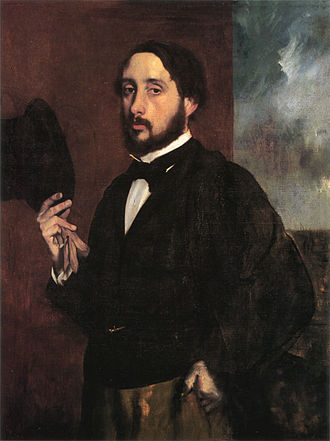
Name: Hilaire German Edgar Degas
Achievements: One of the founders of the Impressionist Movement in French art.
Born: July 19, 1834; Paris, France
Died: September 27, 1917; Paris (Aged 83)
Field & Discipline: Art; Painting
Language: French.
Father: Auguste de Gas (French banker)
Mother: Unknown
Siblings: Rene; Achille; Marguerite
Spouse: None
Children: None
Education: Lycee Louis-le-Grand; Ecole des Beaux-Arts
Life & Times:
In 1856, at the age of twenty-two, Degas travelled to Italy to study the Renaissance painters, classical sculptures and architecture and to copy the masters. After the summer, he moved to Rome and worked at the Villa Medici, the institute which awarded the Prix de Rome, a prize allowing a student to work there.
At this time, Degas was able to strike up a relationship with Gustave Moreau, in 1857, who later taught George Rouault and Henri Emile Benoit Matisse. This was Degas' introduction to Romanticism, whereas his previous experience had been gained from the traditional Classicism of [knew] Ingres*, a friend of his father. During the summer of 1858, Degas travelled in Italy and met Italian “macchiaioli” painters who portrayed scenes of landscapes and everyday life.
In April 1859, he returned to Paris and while living in his father's house, bought himself a studio to work in on the Left Bank. Here he met the painters [a pal of] Whistler* and [influenced by pal] Manet*, who were looking for a way to include modern images in their art, in direct opposition to the accepted, traditional heroics and ideals.
In 1862, Degas met Manet in the Louvre and it is said that they were both copying a Velasquez portrait. Degas was drawing it directly onto an etching plate which amazed and impressed Manet, who at the time, was quite a scandalous figure as he had already painted “Dejeuner sur l'Herbe.” Manet’s work strongly influenced Degas.
Aged 31, Degas left his father’s home, in 1865, and set up his new home in Rue de Laval in Paris. At the time it was Degas' discovery of the racing world that fed his interest in a more modern approach to painting. He first became interested on a visit to a family friend's home in Normandy, which was near a famous stud farm. He painted the horses, the jockeys and the spectators and he was fascinated by the whole racing scene.
He then started to paint musicians, concerts and dancers; pictures of people absorbed in their real activities. He was exploring new ways to show the movement of the human figure and also worked on the composition of groups of figures. One of his first ballet pictures was of Mademoiselle Fiocre in the Ballet “La Source.” His classical training, however, was still apparent in his positioning of subjects. Degas was accepted by the Salon whenever he submitted between 1865 and 1870, despite the fact that he rejected their values.
1870 saw the beginning of the Franco-Prussian War and the National Guard was formed in order to defend the capital, Paris, from the Prussian army. Both Degas and Manet enlisted but, during rifle training for the infantry, Degas was discovered to have poor eyesight, so he joined the artillery.
Paris surrendered on January 28 1871 and, although Degas saw no action, he was heavily affected by the defeat, in which he lost two of his friends.
As a result of the war, the dealer Paul Durand-Ruel had evacuated part of his business to London, and in 1871. During a visit to London, Degas visited the Durand-Ruel exhibition, where he met other painters who rejected the traditional values of the Paris salon, such as [a pal of] Pissarro* and [a pal of] Monet*. The following year, a Degas ballet picture was shown in London and was enthusiastically received.
In the autumn of 1872 he visited his maternal family in New Orleans and stayed with his uncle, who was a cotton merchant, where he painted “Portraits dans un Bureau.” This was the first of Degas' paintings to go into a public collection and again portrays modern activities and occupations using the basic principles of the formal tradition.
From 1873 he became one of the leaders in arranging exhibitions for painters soon to be known as Impressionists. In 1874, Degas set up the first exhibition and had no hesitation in lobbying fellow painters. He was not, however, in favour of the more radical element of the Impressionist movement or the publicity that most of the artists relished. The press coined the name “Impressionists,” which Degas felt was derogatory, so the people he recruited for his exhibitions were not of the radical element. Degas exhibited every year except one and after his 1879 exhibition, he had made a small profit.
By 1880, [a pal of] Renoir* and Claude Monet had gone back to the Paris Salon, much to the disapproval of Degas. It was at this time that he used the subject of bathing in his work, and it remained compelling to him for the rest of his life. At the 1886 Impressionist exhibition bathing featured in ten Degas pastels, considered to be among his finest works in both composition and technique.
He was also exploring new techniques such as mixtures of media, distemper in painting and in particular he transformed the use of pastels, making what was a minor medium into one as substantial as oils.
Another of Degas’ pastel drawings was “Six Friends at Dieppe,” completed in 1885, after he had spent the summer there. One of the figures in the drawing was [a pal of] Sickert,* to whom Degas had been introduced earlier in Paris. It was Sickert who backed Degas during the uproar created by his picture, “Dans Un Café,” portraying two drunks, in 1893.
Toward the end of the decade, Degas was known to have made misogynist remarks, but he did have some close women friends, such as [a pal of] Cassatt* who is famously represented in the Degas prints shown in the Louvre.
Degas had possibly one of the largest art collections assembled by an artist, by his death in 1917, totalling one hundred pieces by Ingres, thirteen paintings and over two hundred drawings by Delacroix, and hundreds of Daumier’s lithographs. He also obtained works of his contemporaries which included eight pieces by Manet, seven pieces by Cezanne, plus work by [bought work of] zjr4 m,jdxsGauguin*, [bought work of] Van Gogh*, Pissarro, and Cassat.
Extra Connections: He admired the work of [admired] Millet*
[a supporter was] Zola* wrote in support of this work
He painted [painted wife of] Toulouse-Lautrec’s* wife
[influenced by] Muybridge* stop-motion photos influenced his work.
Met [met] Hugo*
Met [met] Wilde*
Rothenstein?
He knew [knew] Valery* and [knew] Mallarme*
Assessment: A man who devoted all of his energies to the art world and exerted great influence during the establishment of the Impressionist era.
Oneliner: Edgar Degas, major French Impressionist painter
Bibliography:
- Forge, Andrew and Gordon, Robert, Degas, Thames and Hudson Ltd, London, 1988.
- Vollard, Ambroise, Degas, An Intimate Portrait (trans. Randolph T Weaver), Dover Publications Inc., New York, 1986.