Fahrenheit, DG
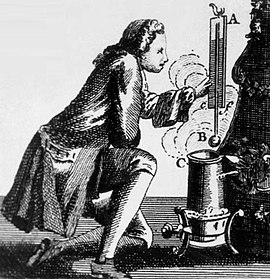
Achievements: Development of the standard thermometer scale
Born: May 24, 1686; Danzig (now Gdansk), Poland
Died: September 16, 1736; The Hague, Netherlands. Aged 50
Field & Discipline: Science; Experimental Physics; Instrument Maker
Language: Polish
Father: Daniel Fahrenheit
Mother: Concordia Schumann
Siblings: 1 brother; 3 sisters
Spouse: None
Children: None
Education: Private tutors; Marienschule, Danzig
Life & Times:
Around 1707, Fahrenheit began to travel through Germany, Sweden and Denmark. He then began to make thermometers and barometers and sent them to a number of countries, including Iceland and Lapland.
In 1708 he visited the Danish astronomer [inspired by] Romer* in Copenhagen and watched him graduating the thermometers he used for meteorological readings. At that time, there were no standardized thermometers, so scientists in different locations could not compare temperature readings and even all of a scientist's own thermometers did not give matched readings. Each scientific worker had his set of individually scaled thermometers and each applied an arbitrary scale. It was impossible to supply more accurate readings than, for example, “very cold, cold, warm, hot.”
Roemer obtained a top temperature reading by plunging his thermometers into warm water, and a bottom temperature by plunging them in water and ice. He then worked out the scale divisions in between the two points.
Fahrenheit was inspired to find an easier and more reliable way to make thermometers which would result in improved accuracy. He learned French so he could read up on thermometers in the papers published by the scientific academy in Paris. In 1711 his parents' estate was settled and he received his inheritance. He then travelled in the Baltic before spending 1712-14 in Danzig, where he most probably worked out how he was going to make his thermometers, possibly with the help of a mathematics master at the high school with whom he became friendly.
In 1713 Fahrenheit constructed several alcohol thermometers with a scale graduation was based on Roemer's. Wrongly believing that Romer had used normal body heat for his fixed upper limit, Fahrenheit set his top calibration by putting the bulb of the thermometer under the armpit of a healthy male. His lower fixed point was obtained by putting the thermometer bulb into a mix of ice and water. He then divided each of Roemer's degrees into four and ended up with a top fixed point of 90 degrees and a low fixed point of 30 degrees.
Fahrenheit then discovered that alcohol and mercury thermometers did not give the same readings, and realised this was because the different types of glass used to enclose the liquids expanded at a different rate. In 1714 he went to Berlin and Dresden and demanded better capillary tubes from the glass blowers.
His inheritance was disappearing fast on this work, particularly as he was pursuing various other projects which caught his interest. In 1715 he wrote to [corresponded with] Leibniz* asking his opinion of a mercury clock he had designed for use at sea (in connection with the reward offered by the Royal Society of London for solving the problem of determining longitude at sea).
He began trying to make a perpetual motion machine and wrote to [corresponded with] Boerhaave* about it. He devised a heliostat and also worked on an improved reflecting telescope. Eventually, he was reduced to asking Leibniz to help him get a job but Leibniz died in November 1716 and some time in the next year Fahrenheit settled in Amsterdam.
He had learned from Roemer that accurate and reliable thermometers were much in demand by scientists and around 1717 he began to make mercury thermometers
commercially (and barometers and areometers). He changed the upper point on his scale to 96 degrees, and the lower to 32 degrees (his [developed] temperature scale*) probably because the scale was then easier to divide.
He gave these thermometers to friends in the scientific world such as Boerhaave, [a pal of] Pieter van Musschenbroek* and [a pal of] 'sGravesande*.
Fahrenheit did not limit himself to making instruments. He gave public lectures on optics, perspective, reflection, hydraulics and chemistry. He continued experimental physics, including investigations into temperature measurements, specific gravity, the expansion of glass, and the boiling points of various liquids.
His experiments into the boiling point of various liquids resulted in him giving a temperature of 212 degrees F and after his death this became the upper fixed point of a Fahrenheit thermometer, making 98.4 the fixed point for a normal body temperature, while keeping 32 degrees F as the lowest fixed point.
In 1724 Fahrenheit visited England and presented five papers dealing with his various findings, written in Latin, to the [member of] Royal Society*, of which he was elected a Fellow.
In 1729 Booerhave asked Fahrenheit to do some experiments for inclusion in his manual of chemistry. Fahrenheit's last project was a machine for pumping water, a kind of centrifugal pump which he claimed could do the work of four windmills. In 1736, Fahrenheit travelled to the Hague to negotiate for a patent for this device. In August of that year the States of Holland and West Friesland recommended he be awarded a fifteen-year patent.
The following month Fahrenheit became ill and died in the Hague. Fahrenheit thermometers quickly became standard in Holland and Britain and thereafter were widely used for meteorological purposes in many parts of the world.
Extra Connections: [thermometer used by] Franklin* used his thermometer.
[temperature scale adapted by] Reaumur* developed a variant of his temperature scale.
His work related to that of [work related to] Celsius*
He began training as a merchant in Amsterdam after both of his parents died on 14 August 1701 from eating poisonous mushrooms.
Assessment: Fahrenheit's work enabled the boiling point of liquids to be accurately measured for the first time, and greatly increased the precision of temperature measurements in experimental physics during the eighteenth century.
Oneliner: Gabriel Fahrenheit, inventor of a temperature scale
Bibliography:
- Middleton, W.E. Knowles, A History of the Thermometer and Its Use in Meteorology, John Hopkins Press, Maryland, 1966.
- Star, Pieter van der, Fahrenheit's Letters to Leibniz and Boerhaave, Rodopi, Leiden and Amsterdam, 1983.