Gould, Jay 2
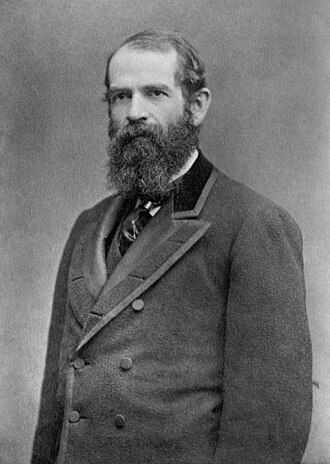
Jason Gould (/ɡuːld/; May 27, 1836 – December 2, 1892) was an American railroad magnate and financial speculator who is generally identified as one of the robber barons of the Gilded Age. His sharp and often unscrupulous business practices made him one of the wealthiest men of the late nineteenth century. Gould was an unpopular figure during his life and remains controversial.[2][3][4]
Early life and education
Gould was born in Roxbury, New York, to Mary More (1798–1841) and John Burr Gould (1792–1866). His maternal grandfather Alexander T. More was a businessman, and his great-grandfather John More was a Scottish immigrant who founded the town of Moresville, New York. Gould studied at the Hobart Academy in Hobart, New York,[5] paying his way by bookkeeping.[6] As a young boy, he decided that he wanted nothing to do with farming, his father's occupation, so his father dropped him off at a nearby school with fifty cents and a sack of clothes.[7]
Early career

Jay Gould (right) in 1855
Gould's school principal was credited with getting him a job as a bookkeeper for a blacksmith.[8] A year later, the blacksmith offered him half interest in the blacksmith shop, which he sold to his father during the early part of 1854. Gould devoted himself to private study, emphasizing surveying and mathematics. In 1854, he surveyed and created maps of the Ulster County, New York, area. In 1856, he published History of Delaware County, and Border Wars of New York, which he had spent several years writing.[9] While engaged in surveying he started a side activity financing operators making woodash for tannin used in tanning leather.
[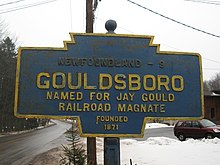
Keystone Marker for Gouldsboro, Pennsylvania, named after Gould
In 1856, Gould entered a partnership with Zadock Pratt[8] to create a tanning business in Pennsylvania in an area that was later named Gouldsboro. He eventually bought out Pratt, who retired. In 1856, Gould entered a partnership with Charles Mortimer Leupp, a son-in-law of Gideon Lee and one of the leading leather merchants in the United States. The partnership was successful, until the Panic of 1857. Leupp lost all his money in that financial crisis, but Gould took advantage of the depreciation in property value and bought up former partnership properties.[8]
Gould also started an ice harvesting industry on the large Gouldsboro lake. In the winter ice was harvested and stored in large ice houses at the side of the lake. He had a railroad line installed next to the lake and he supplied New York City with ice during the summer months.
The Gouldsboro Tannery became a disputed property after Leupp's death. Leupp's brother-in-law David W. Lee was also a partner in Leupp and Gould, and he took armed control of the tannery. He believed that Gould had cheated the Leupp and Lee families in the collapse of the business. Gould eventually took physical possession, but he was later forced to sell his shares in the company to Lee's brother.[10]
Railroad investing
In 1859, Gould began speculative investing by buying stock in small railways. His father-in-law Daniel S. Miller introduced him to the railroad industry by suggesting that Gould help him save his investment in the Rutland and Washington Railroad in the Panic of 1857. Gould purchased stock for 10 cents on the dollar, which left him in control of the company.[11] He engaged in more speculation on railroad stocks in New York City throughout the Civil War, and he was appointed manager of the Rensselaer and Saratoga Railroad in 1863.
The Erie Railroad encountered financial troubles in the 1850s, despite receiving loans from financiers Cornelius Vanderbilt and Daniel Drew. It entered receivership in 1859 and was reorganized as the Erie Railway. Gould, Drew, and James Fisk engaged in stock manipulations known as the Erie War, and Drew, Fisk, and Vanderbilt lost control of the Erie in the summer of 1868, while Gould became its president.[12]
Tammany Hall
It was during the same period that Gould and Fisk became involved with Tammany Hall, the Democratic Party political machine that largely ran New York City at the time. They made its boss, notorious William M. "Boss" Tweed, a director of the Erie Railroad, and Tweed arranged favorable legislation. Tweed and Gould became the subjects of political cartoons by Thomas Nast in 1869. Gould was the chief bondsman in October 1871 when Tweed was held on $1 million bail. Tweed was eventually convicted of corruption and died in jail.[13]
Black Friday
Main article: Black Friday (1869)
In August 1869, Gould and his partner James Fisk conspired to begin to buy gold in an attempt to illegally corner the market. During this time, Gould used contacts with President Ulysses S. Grant's brother-in-law Abel Corbin to influence the president and his Secretary General Horace Porter.[14][15]
These speculations culminated in the panic of Black Friday on September 24, 1869, when the greenback (cash) premium over face value fell on a gold double eagle from 62 percent to 35 percent. Gould made a small profit from this operation by hedging against his own attempted corner as it was about to collapse, but he lost it in subsequent lawsuits. The gold corner established Gould's reputation in the press as an all-powerful figure who could drive the market up and down at will.[16] Favored by Tweed Ring judges, the conspiratorial partners escaped prosecution, but the months of economic turmoil that rocked the nation following the failed corner proved both ruinous to farmers and bankrupting of some of Wall Street's most venerable financial institutions.
More railroads
Erie Railroad
In 1873, Gould attempted to take control of the Erie Railroad by recruiting foreign investments from Lord Gordon-Gordon, supposedly a cousin of the wealthy Campbell clan who was buying land for immigrants. He bribed Gordon-Gordon with a million dollars in stock, but Gordon-Gordon was an impostor and cashed the stock immediately. Gould sued him, and the case went to trial in March 1873. In court, Gordon-Gordon gave the names of the Europeans whom he claimed to represent, and he was granted bail while the references were checked. He immediately fled to Canada, where he convinced authorities that the charges were false.[17][18]
Having failed to convince Canadian authorities to hand over Gordon-Gordon, Gould attempted to kidnap Gordon-Gordon with the help of his associates and future members of Congress* Loren Fletcher, John Gilfillan, and Eugene McLanahan Wilson. The group captured him successfully, but they were stopped and arrested by the North-West Mounted Police before they could return to the US. Canadian authorities put them in prison and refused them bail,[17][18] and this led to an international incident between the United States and Canada. Governor Horace Austin of Minnesota demanded their return when he learned that they had been denied bail, and he put the local militia on full readiness, and thousands of Minnesotans volunteered for an invasion of Canada. After negotiations, the Canadian authorities released them on bail. Gordon-Gordon was eventually ordered to be deported but committed suicide before the order could be carried out.[17][18]
Western railroads
[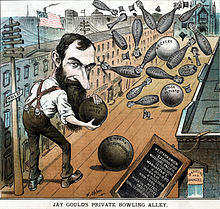
1882 cartoon depicting Wall Street as "Jay Gould's Private Bowling Alley"
After being forced out of the Erie Railroad, Gould started to build up a system of railroads in the midwest and west. He took control of the Union Pacific in 1873 when its stock was depressed by the Panic of 1873, and he built a viable railroad that depended on shipments from farmers and ranchers. He immersed himself in every operational and financial detail of the Union Pacific system, building an encyclopedic knowledge and acting decisively to shape its destiny. Biographer Maury Klein states that "he revised its financial structure, waged its competitive struggles, captained its political battles, revamped its administration, formulated its rate policies, and promoted the development of resources along its lines."[19][20]
By 1879, Gould gained control of three more important western railroads, including the Missouri Pacific Railroad. He controlled 10,000 miles (16,000 km) of railway, about one-ninth of the rail in the United States at that time. He obtained a controlling interest in the Western Union telegraph company and in the elevated railways in New York City after 1881, and he had controlling interest in 15 percent of the country's railway tracks by 1882. The railroads were making profits and set their own rates, and his wealth increased dramatically. He withdrew from management of the Union Pacific in 1883 amid political controversy over its debts to the federal government, but he realized a large profit for himself.
n 1889, he organized the Terminal Railroad Association of St. Louis which acquired a bottleneck in east–west railroad traffic at St. Louis, but the government brought an antitrust suit to eliminate the bottleneck control after Gould died.[21]
Personal life
[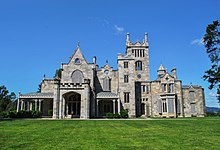
Gould purchased Lyndhurst on the east bank of the Hudson River as a country home in 1880

Gould's portrait hanging in his office at Lyndhurst
Gould was a member of West Presbyterian Church at 31 West 42nd Street. It later merged with Park Presbyterian to form West-Park Presbyterian.[22]
He married Helen Day Miller (1838–1889) in 1863 and they had six children.
Together with his son George, Gould was a founding member of American Yacht Club.[23][24] He owned the steam yacht Atalanta (1883).
Gould died of tuberculosis, then referred to as "consumption" on December 2, 1892, and was interred in the Woodlawn Cemetery, The Bronx, New York. His fortune was conservatively estimated for tax purposes at $72 million (equivalent to $2.17 billion in 2023[25]), which he willed in its entirety to his family.[5]
At the time of his death, Gould was a benefactor in the reconstruction of the Reformed Church of Roxbury, New York, now known as the Jay Gould Memorial Reformed Church.[26] It is located within the Main Street Historic District and listed on the National Register of Historic Places in 1988.[27] The family mausoleum was designed by Francis O'Hara.
Descendants...
Knowledge Web content (see main node)
NAME: Gould, Jay.
ACHIEVEMENTS: Helped to develop American railroad network.
NICKNAME/ALIAS: Born Jason Gould.
DATE/PLACE OF BIRTH: 27th May 1836, in Roxbury, NY.
DATE/PLACE/AGE AT DEATH: 2nd December 1892, in New York, NY. Aged 56.
DISCIPLINE: Railroad development.
FIELD: Business.
LANGUAGE: English.
PARENTS: John Burr Gould and Mary More.
SIBLINGS: Sarah, Anna, Nancy, Mary and Elizabeth.
SPOUSE: Helen Day Miller.
CHILDREN: George, Edwin, Howard and Helen.
EDUCATION: Local school, Roxbury and a private school in Hobart.
MAJOR WORK: None.
LIFE AND TIMES:
In 1859, Gould went to New York looking for fame and fortune, in spite of the fact that he had no contacts on Wall Street and no significant source of capital. When an acquaintance wanted to sell out his mortgage bonds in the small and poorly performing Rutland & Washington Railroad, Gould took the bonds over.
He gradually increased his holdings, ending up with a controlling interest and, by the time he leased the railroad in 1865, he had made a good profit and, equally important, had learned the business.
During the Civil War, the railroads came under government control and <work related to> McCallum* increased their importance with his expansion plans. Railroading was now big business and, in 1866, Gould became a public figure during the battle for control of the Erie railroad.
In 1867, he became a director of the railroad and, together with James Fisk and the notorious speculator Daniel Drew, he set out to take it away from the people who controlled it, Cornelius Vanderbilt, a ruthless entrepreneur and John H Eldridge, a Boston banker.
After a series of highly questionable dealings, Gould and Fiske ended up in control of the railroad which, by then, was more or less broke. People assumed that Gould was only a speculator, but he surprised everybody when he put together a plan to expand the Erie railroad into a major rail concern. This triggered competition and brought about a new growth in railroad rivalry, but his plans were set back when he tried to take control of the supply of US gold.
In 1869, he and Fisk joined with the Tamanny Hall chief, William ‘Boss’ Tweed and Peter Sweeney. They used Erie railroad stock to fund speculation aimed at cornering the gold market, but their activities caused ‘Black Friday’, the market crash on 24th September 1869.
New York's financial institutions came to a halt and many traders were ruined. As a result, Gould’s reputation was shredded and, in 1872, he was thrown off the Erie board.
He went back to Wall Street as a trader and, although he never owned a seat on the New York Stock Exchange, he was extremely successful.
In 1874, he took control of the Pacific Mail Steamship Company and the Union
Pacific railroad, which was in really poor shape but provided the ideal springboard for him to start all over again. By 1878, he needed extra capital so he sold his Union Pacific holdings and used some of the proceeds to set up his own railroad system.
Between 1879 and 1881, he gained control of the Kansas Pacific, the Wabash and the Missouri Pacific railroads, together with some other smaller railroads. Having built up a system to rival the Union Pacific, he sold Kansas Pacific to them and used the proceeds to buy railroads in the southwest.
In the southwest, he didn’t have competition from Union Pacific and he made the Missouri Pacific the core of his new railroad system. He gradually moved into the East and the North by extending the Wabash railroad up to Detroit and Chicago and, by the end of 1880, Gould owned more railroad track than anybody else in the world.
Always the entrepreneur, he became involved in the growing communications industry and, in 1878, he bought the patents for <bought patents of> Edison*'s automatic high-speed telegraphic system. He was doing very well financially and, in 1881, took Western Union away from William H Vanderbilt. This move gave him control over most of the US telegraph system.
In the same year, his fortune was threatened by a crisis in the economy. Gould successfully fought off financial ruin and, once his position was secure again, he left Wall Street to concentrate on his other business interests. He continued to expand his railroads and drove the enormous railroad expansion in the US in the 1880s.
In 1886, he acquired the Manhattan Elevated Railroad, which gave him the monopoly on all elevated railroads in New York City, but two years later, he was diagnosed with tuberculosis. He kept the news to himself and for the next four years continued to devote his time to the railroads.
During this time, he was a figure of hate for the press who labelled him 'Mephistopheles' and the 'Wizard of Wall Street'. In 1888 and 1890, at the home of <a pal of> JP Morgan*, Gould called meetings of the railroad presidents, in an attempt to control competition between them that was getting out of hand.
By 1890, Gould owned fifty per cent of all railroad tracks in the southwest and, in the same year, he regained control of the now run-down Union Pacific. His son, George Jay Gould, inherited the line but it only started to get back its previous strength when <taken over by> E H Harriman* took over.
ASSESSMENT: Gould is labelled as a classic railroad robber but recent studies have restored something of his reputation as a brilliant entrepreneur.
EXTRA CONNECTIONS: Daughter-in-law painted by <daughter-in-law painted by> Mucha*
Had business dealings with <failed takeover by> JE Thomson*
ONELINER: Jay Gould, American railroad robber baron
BIBLIOGRAPHY:
Klein, Maury, The Life and Legend of Jay Gould, The Johns Hopkins University Press, Baltimore and London, 1986.