Morgan JP
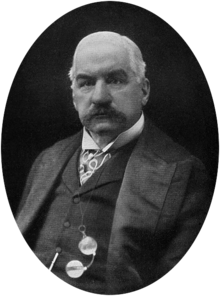
Nickname/Alias: JP Morgan
Achievements: Restructured several major railroads; arranged and financed the consolidation of U.S. Steel, International Harvester and General Electric corporations
Born: April 17, 1837, Hartford, CT
Died: March 31, 1913, Rome, Italy. Aged 75
Field & Discipline: Business; Industry; Finance
Language: English
Father: Junius Spencer Morgan
Mother: Juliet Pierpont
Siblings: 3 sisters
Spouse: 1) Amelia Sturges; 2) Frances Tracey
Children: John Pierpont Jr.; Anne; Louisa
Education: Schools in Hartford and Boston; Gottingen University, Germany
Life & Times:
Morgan's father brought him into a firm that looked after the elder Morgan's banking interests in New York, but, skeptical of his son's abilities, he also brought in a trusted accountant, Charles Dabney, as senior partner, who was in effect Morgan's overseer. Dabney and Morgan did well in dealing with railroad securities on the international market, increased their railroad business in the U.S. and, inevitably, came up against railroad robber barons like [a rival was] Gould*
In 1871, when Morgan was 34, his father released him from the supervision of Dabney and encouraged him to form his own firm, which became Drexel, Morgan and Co. But before he allowed Morgan to run the company, he insisted his son spend some time in Europe. When he returned to America some months later, Morgan set up his office in New York and bought a large house on the Hudson River.
Over the next decade, Drexel, Morgan and Co. financed much of the American industrial expansion with loans of British capital arranged through London. Morgan gradually became extraordinarily rich in his own right, and slowly freed himself of his father's domination. Although his father would command his presence in London, Morgan would drop in briefly, then take his family off to Paris, Venice and Egypt. He traveled widely in Europe and the Near East, acquired a knowledge of antiquities, cultivated the company of archeologists, and began a collection of priceless artefacts.
In 1885, Morgan's father asked him to sort out the speculation and rivalry on the railroads threatening the industry. [a rival was] EH Harriman*, a young railroad financier, outmaneuvered him over acquisition of the Dubuque and Sioux City line in Iowa, but despite the setback, Morgan's reputation grew as a skilled organizer and he built a massive power base in the railroad industry. His aim was to discourage too much speculative competition and to achieve a stable reliable transport system. In the course of this he became a great railroad baron himself, controlling thousands of miles of track.
In 1891, Morgan financed the merger of Edison General Electric and Thomson-Houston Electric to create General Electric. He helped the US Treasury during the financial panic of 1893 by forming a syndicate which restocked the government's gold reserves. During the four-year depression which followed, he helped keep the economy afloat by lending huge sums to industry.
By the end of the 19th century, it was clear that competition in the growing American manufacturing industry was becoming unmanageable. Morgan concluded that the way to ensure growth with stability was to create giant corporations. [influenced by] CM Schwab*, who ran [work related to] Carnegie's* steel company, inspired Morgan to venture into the steel industry. With Schwab as middleman, Morgan and Carnegie agreed to a deal which saw Morgan financing the mergers which resulted in the formation of United States Steel Corp., the world's first billion-dollar corporation.
In 1892, Morgan organized the amalgamation of agricultural machinery manufacturers into the [organized] International Harvester Company*. He lent money for the purchase of the Panama Railroad, helped fund the Mexican national debt, and funded a large proportion of Britain's costs in the Boer War through loans underwritten by his firm.
In 1904, he became President of the Metropolitan Museum of Art and hired English art critic Roger Fry as European advisor and curator of paintings. He bought a portrait of the Duchess of Devonshire by English artist [bought work by] Gainsborough*.
When President [targeted by] Theodore Roosevelt* decided to curb the powers of the big manufacturing cartels and introduce anti-trust measures, Morgan was an obvious target. For a time, he became the model of a rapacious industrialist. But all that was forgotten when he spearheaded an attempt to head off a crash after the stock market panic in 1907. He bullied a group of bankers into drawing on their reserves and by sheer force of personality held back raiders. Though Roosevelt was indebted to Morgan, the crisis, and the government's dependence on him, showed the dangers of one man holding so much power.
Morgan relaxed his interest in large industrial mergers and built a power base in banking and insurance. But again he inspired distrust and resentment, as the influence of the Morgan banking house grew. In 1912, he was called to give evidence to a Congressional committee on money trusts. He denied allegations of stock-watering, price-fixing, and the creation of voting trusts in the companies he controlled, and the committee could prove nothing. In early 1913, he traveled to Rome to buy two Roman columns for the entrance of his new office building in New York, but died a few days after his arrival.
Extra Connections:
During the Civil War, Morgan avoided serving during the war by paying a substitute $300 to take his place. He also made money speculating and selling guns.
Hired the [employed] WJ Burns’* detective agency and [employed] Gary*
He owned shares in [owned shares in] Bethlehem Steel*
[a partner was] Morrow* was later a partner in his firm.
[satirized by] Sinclair* satirized him
He worked with [worked with] HF Osborn*
Was a partner of George [a partner of] Peabody*
Investigation by historian James Lide discovered that through parts of its business, JPMorgan Chase accepted thousands of slaves as collateral on loans made to plantation owners in the early 19th century, and that it ended up owning several hundred slaves.[58] The banks in question, Citizens' Bank and Canal Bank, both now part of JPMorgan, served plantations from the 1830s until the American Civil War, and sometimes took ownership of slaves when the plantation owners defaulted on loans. JPMorgan estimated that between 1831 and 1865, the two banks accepted approximately 13,000 slaves as collateral and ended up owning about 1,250 slaves. An apology was made in compliance with a rule requiring companies to detail past dealings with the slave trade when doing business with the city of Chicago.[59][60]
Extra Connections: George Walbridge Perkins I (January 31, 1862 – June 18, 1920) was an American politician and businessman worked for Morgan.. A strong believer in the Efficiency Movement, he sought out instances of waste and believed that any practice could be improved by careful analysis. He was a leader of the Progressive Movement, especially Theodore Roosevelt's presidential candidacy for the Progressive partyProgressive Party in 1912 , becoming its executive secretary. At the convention, an antitrust plank was suddenly dropped, shocking reformers like Gifford Pinchot, who saw Roosevelt as a true trust-buster. They blamed Perkins, who was still on the board of U.S. Steel and remained on it until his death. Perkins's ties to big business alarmed the radical wing of the party. Roosevelt lost to the Democrat Woodrow Wilson. As chairman of a finance committee of YMCA, he raised $200,000,000 for welfare work among American soldiers abroad in WWI.
Assessment: For decades until his death, he was regarded as America's pre-eminent capitalist.
Oneliner: JP Morgan, great American financier
Bibliography:
- Sinclair, Andrew, Corsair, The Life of J. Pierpont Morgan, Weidenfeld and Nicholson, London, 1981.
https://en.wikipedia.org/wiki/J._P._Morgan
Sandbox (extensive)