Gould, Jay
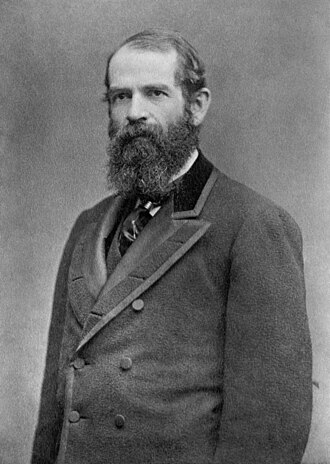
ACHIEVEMENTS: Helped to develop American railroad network.
NICKNAME/ALIAS: Born Jason Gould.
DATE/PLACE OF BIRTH: 27th May 1836, in Roxbury, NY.
DATE/PLACE/AGE AT DEATH: 2nd December 1892, in New York, NY. Aged 56.
DISCIPLINE: Railroad development.
FIELD: Business.
LANGUAGE: English.
PARENTS: John Burr Gould and Mary More.
SIBLINGS: Sarah, Anna, Nancy, Mary and Elizabeth.
SPOUSE: Helen Day Miller.
CHILDREN: George, Edwin, Howard and Helen.
EDUCATION: Local school, Roxbury and a private school in Hobart.
MAJOR WORK: None.
LIFE AND TIMES:
In 1859, Gould went to New York looking for fame and fortune, in spite of the fact that he had no contacts on Wall Street and no significant source of capital. When an acquaintance wanted to sell out his mortgage bonds in the small and poorly performing Rutland & Washington Railroad, Gould took the bonds over.
He gradually increased his holdings, ending up with a controlling interest and, by the time he leased the railroad in 1865, he had made a good profit and, equally important, had learned the business.
During the Civil War, the railroads came under government control and McCallum* increased their importance with his expansion plans. Railroading was now big business and, in 1866, Gould became a public figure during the battle for control of the Erie railroad.
In 1867, he became a director of the railroad and, together with James Fisk and the notorious speculator Daniel Drew, he set out to take it away from the people who controlled it, Cornelius Vanderbilt, a ruthless entrepreneur and John H Eldridge, a Boston banker.
After a series of highly questionable dealings, Gould and Fiske ended up in control of the railroad which, by then, was more or less broke. People assumed that Gould was only a speculator, but he surprised everybody when he put together a plan to expand the Erie railroad into a major rail concern. This triggered competition and brought about a new growth in railroad rivalry, but his plans were set back when he tried to take control of the supply of US gold.
In 1869, he and Fisk joined with the Tamanny Hall chief, William ‘Boss’ Tweed and Peter Sweeney. They used Erie railroad stock to fund speculation aimed at cornering the gold market, but their activities caused ‘Black Friday’, the market crash on 24th September 1869.
New York's financial institutions came to a halt and many traders were ruined. As a result, Gould’s reputation was shredded and, in 1872, he was thrown off the Erie board.
He went back to Wall Street as a trader and, although he never owned a seat on the New York Stock Exchange, he was extremely successful.
In 1874, he took control of the Pacific Mail Steamship Company and the Union
Pacific railroad, which was in really poor shape but provided the ideal springboard for him to start all over again. By 1878, he needed extra capital so he sold his Union Pacific holdings and used some of the proceeds to set up his own railroad system.
Between 1879 and 1881, he gained control of the Kansas Pacific, the Wabash and the Missouri Pacific railroads, together with some other smaller railroads. Having built up a system to rival the Union Pacific, he sold Kansas Pacific to them and used the proceeds to buy railroads in the southwest.
In the southwest, he didn’t have competition from Union Pacific and he made the Missouri Pacific the core of his new railroad system. He gradually moved into the East and the North by extending the Wabash railroad up to Detroit and Chicago and, by the end of 1880, Gould owned more railroad track than anybody else in the world.
Always the entrepreneur, he became involved in the growing communications industry and, in 1878, he bought the patents for Edison*'s automatic high-speed telegraphic system. He was doing very well financially and, in 1881, took Western Union away from William H Vanderbilt. This move gave him control over most of the US telegraph system.
In the same year, his fortune was threatened by a crisis in the economy. Gould successfully fought off financial ruin and, once his position was secure again, he left
Wall Street to concentrate on his other business interests. He continued to expand his railroads and drove the enormous railroad expansion in the US in the 1880s.
In 1886, he acquired the Manhattan Elevated Railroad, which gave him the monopoly on all elevated railroads in New York City, but two years later, he was diagnosed with tuberculosis. He kept the news to himself and for the next four years continued to devote his time to the railroads.
During this time, he was a figure of hate for the press who labelled him 'Mephistopheles' and the 'Wizard of Wall Street'. In 1888 and 1890, at the home of JP Morgan*, Gould called meetings of the railroad presidents, in an attempt to control competition between them that was getting out of hand.
By 1890, Gould owned fifty per cent of all railroad tracks in the southwest and, in the same year, he regained control of the now run-down Union Pacific. His son, George Jay Gould, inherited the line but it only started to get back its previous strength when E H Harriman* took over.
ASSESSMENT: Gould is labelled as a classic railroad robber but recent studies have restored something of his reputation as a brilliant entrepreneur.
EXTRA CONNECTIONS: Daughter-in-law painted by Mucha*
Had business dealings with JE Thomson*
Bankrupted Field, elevated train
ONELINER: Jay Gould, American railroad robber baron
BIBLIOGRAPHY:
Klein, Maury, The Life and Legend of Jay Gould, The Johns Hopkins University Press, Baltimore and London, 1986.
Wikipedia (see node 2)