camera obscura 2
See main node
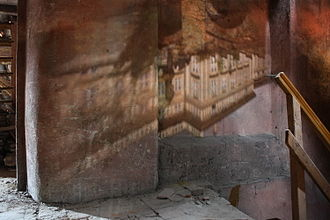
A camera obscura (Latin: "dark chamber") is an optical device that led to photography and the camera. The device consists of a box or room with a hole in one side. Light from an external scene passes through the hole and strikes a surface inside, where it is reproduced, rotated 180 degrees (thus upside-down), but with color and perspectivepreserved. The image can be projected onto paper, and can then be traced to produce a highly accurate representation. The largest camera obscura in the world is on Constitution Hill in Aberystwyth, Wales.[1]
Using mirrors, as in an 18th-century overhead version, it is possible to project a right-side-up image. Another more portable type is a box with an angled mirror projecting ontotracing paper placed on the glass top, the image being upright as viewed from the back.
As the pinhole is made smaller, the image gets sharper, but the projected image becomes dimmer. With too small a pinhole, however, the sharpness worsens, due todiffraction. Some practical camera obscuras use a lens rather than a pinhole (as in a pinhole camera) because it allows a larger aperture, giving a usable brightness while maintaining focus.
Contents
Role in the Modern age
While the technical principles of the Camera obscura have been known since antiquity, the broad use of the technical concept in producing images with a linear perspective in paintings, maps, theatre setups and architectural and later photographic images and movies started in the Western Renaissance and the scientific revolution. While e.g.Alhazen had already observed an optical effect and developed a state of the art theory of the refraction of light, he was less interested to produce images with it (compareHans Belting 2005); the society he lived in was even hostile (compare Aniconism in Islam) towards personal images.[2] Western artists and philosphers used the Arab findings in new frameworks of epistemic relevance.[3] E.g. Leonardo da Vinci used the Camera obscura as model of the eye, René Descartes for eye and mind and John Locke started to use the camera obscura as a metaphor of human understanding per se.[4] The modern use of the Camera Obscura as an epistemic machine had important side effects for science.[5][6]
The first surviving mention of some of the principles behind the pinhole camera or camera obscura belongs to Mozi (470 to 390 BCE), a Chinese philosopher and the founder of Mohism. Mozi correctly asserted that the image in a camera obscura is flipped upside down because light travels in straight lines from its source. His disciples developed this into a minor theory of optics.[7][note 1]
The Greek philosopher Aristotle (384 to 322 BCE) understood the optical principle of the pinhole camera.[8] He viewed the crescent shape of a partially eclipsed sun projected on the ground through the holes in a sieve and through the gaps between the leaves of a plane tree. In the 4th century BCE, Aristotle noted that "sunlight travelling through small openings between the leaves of a tree, the holes of a sieve, the openings wickerwork, and even interlaced fingers will create circular patches of light on the ground."
Euclid's Optics (ca 300 BCE) presupposed the camera obscura as a demonstration that light travels in straight lines.[9] In the 4th century, Greek scholar Theon of Alexandriaobserved that "candlelight passing through a pinhole will create an illuminated spot on a screen that is directly in line with the aperture and the center of the candle."
In the 6th century, the Byzantine-Greek mathematician and architect Anthemius of Tralles (most famous for designing the Hagia Sophia), used a type of camera obscura in his experiments.[10]
In the 9th century, Al-Kindi (Alkindus) demonstrated that "light from the right side of the flame will pass through the aperture and end up on the left side of the screen, while light from the left side of the flame will pass through the aperture and end up on the right side of the screen."
Then Ibn al-Haytham (965–1039 A.D.), also known as Alhazen, described a 'dark chamber' [11] and experimented with images seen through the pinhole. He arranged three candles in a row and put a screen with a small hole between the candles and the wall. He noted that images were formed only by means of small holes and that the candle to the right made an image to the left on the wall.[12]:91#5:p379[6.85],[6.86]
Leonardo da Vinci (1452–1519), familiar with the work of Alhazen and after an extensive study of optics and human vision, published the first clear description of the camera obscura in Codex Atlanticus (1502):
If the facade of a building, or a place, or a landscape is illuminated by the sun and a small hole is drilled in the wall of a room in a building facing this, which is not directly lighted by the sun, then all objects illuminated by the sun will send their images through this aperture and will appear, upside down, on the wall facing the hole.
You will catch these pictures on a piece of white paper, which placed vertically in the room not far from that opening, and you will see all the above-mentioned objects on this paper in their natural shapes or colors, but they will appear smaller and upside down, on account of crossing of the rays at that aperture. If these pictures originate from a place which is illuminated by the sun, they will appear colored on the paper exactly as they are. The paper should be very thin and must be viewed from the back.[13]
The Song Dynasty Chinese scientist Shen Kuo (1031–1095) experimented with a camera obscura, and was the first to apply geometrical and quantitative attributes to it in his book of 1088 AD, the Dream Pool Essays.[14][verification needed] However, Shen Kuo alluded to the fact that the Miscellaneous Morsels from Youyang written in about 840 AD by Duan Chengshi (d. 863) during the Tang Dynasty (618–907) mentioned inverting the image of a Chinese pagoda tower beside a seashore.[14]
In fact, Shen makes no assertion that he was the first to experiment with such a device.[14] Shen wrote of Cheng's book: "[Miscellaneous Morsels from Youyang] said that the image of the pagoda is inverted because it is beside the sea, and that the sea has that effect. This is nonsense. It is a normal principle that the image is inverted after passing through the small hole."[14]
In 13th-century England, Roger Bacon described the use of a camera obscura for the safe observation of solar eclipses.[15] At the end of the 13th century, Arnaldus de Villa Nova is credited with using a camera obscura to project live performances for entertainment.[16][17] Its potential as a drawing aid may have been familiar to artists by as early as the 15th century; Leonardo da Vinci (1452–1519 AD) described the camera obscura in Codex Atlanticus. Johann Zahn's "Oculus Artificialis Teledioptricus Sive Telescopium, which was published in 1685, contains many descriptions and diagrams, illustrations and sketches of both the camera obscura and of the magic lantern.
Giambattista della Porta is said to have perfected camera obscura. He described it as having a convex lens in later editions of his Magia Naturalis (1558-1589), the popularity of which helped spread knowledge of it. He compared the shape of the human eye to the lens in his camera obscura, and provided an easily understandable example of how light could bring images into the eye. One chapter in the Conte Algarotti's Saggio sopra Pittura (1764) is dedicated to the use of a camera ottica ("optic chamber") in painting.[18]

Camera obscura, from a manuscript of military designs. 17th century, possibly Italian.
The 17th century Dutch Masters, such as Johannes Vermeer, were known for their magnificent attention to detail. It has been widely speculated that they made use of such a camera, but the extent of their use by artists at this period remains a matter of considerable controversy, recently revived by the Hockney–Falco thesis.
The term "camera obscura" itself was first used by the German astronomer Johannes Kepler in 1604.[19] The term is based on the Latin camera, "(vaulted) chamber or room", and obscura, "darkened" (plural: camerae obscurae). The English physician and author Sir Thomas Browne speculated upon the interrelated workings of optics and the camera obscura in his 1658 discourse

Knowledge Web Content (see main node)
NAME: Camera obscura
LANGUAGE: Arabic and Latin
TIME: Antiquity to 19th century
LOCATION: No single location
CATEGORY: Optical effect
DISCIPLINE: Astronomy and art
SHORT DESCRIPTION: Apparatus used by scientists and artists from the 16th to
19th centuries in which the images of external objects, formed by a convex
lens or a concave mirror, are thrown on a paper or other white surface
placed in the focus of the lens or mirror, inside a darkened chamber, or box,
so that the outlines may be traced.
DESCRIPTION: The forerunner of the photographic camera, the camera obscura
was originally literally a dark room with a tiny hole in the roof, wall, or window-shutter through which the view outside was projected as an upside-down image on to the opposite wall or a white screen opposite the hole. Although its invention has been credited variously to Roger Bacon*, Alberti*, Da Vinci* and Della Porta*, it was in fact described by the 10th-century Islamic scholar Al Hazen*.
However, the optical principle of the camera obscura images was known in the 4thcentury BC to Aristotle*, who described a method for viewing a solar eclipse without damaging the eye in which a metal plate punched with small holes was held up to the sun, and a corresponding image of the sun could then be projected through it and onto the ground. Aristotle also noticed that the smaller the hole, the sharper the image (a simple optical principle which is the foundation of photography).
Bacon's ideas were adapted for astronomical observations of the sun, and as a popular tool for the observation of eclipses - as, for example, by ben Gershom*, a Jewish philosopher and mathematician living at Arles, in Provence, France in the early 14thcentury.
In the 15th century Renaissance artists were becoming interested in the possibility of the camera obscura as an aid to drawing. In Rome in the 1430s, Alberti used a camera obscura for pictorial projection, studying the formation of visual images by light rays and making "artificial images" which laid the foundations for his systematization of painter's perspective.
Around 1490 Da Vinci built a small camera obscura to test his theories about the workings of the human eye and the concept of perspective, describing his experiments in notebooks which were not deciphered and published until 1797.
Meanwhile, the German painter and engraver Durer*, in his 'Underweysung' (1525), made woodcuts of drawing aids which showed telescopic, or sighting tubes and grids used by the artist. The first published account of the camera obscura appeared in the first Italian edition (1521) of Vitruvius'* 'Treatise on Architecture', and the first illustration of the instrument was published by the Dutch physician and mathematician Reinerus Gemma-Frisius in 1544.
During the first half of the 16th century, the 'orbem e vitro', a kind of primitive bi-convex lens (i.e. convex on both sides), was introduced. This reduced distortion, increased clarity, and revolutionized the utility of the camera obscura.
The lens was first described by the Italian physician and mathematician Cardano*, in the 1550 edition of his scientific encyclopedia, 'De Subtilitate.' Eight years later came the publication of Giovanni Battista della Porta's influential work on popular science, 'Magiae naturalis' (1558), which contained the most extensive description of the camera obscura, and the first suggestion of its use for drawing. He suggested the additional use of a bi-convex lens in the aperture in order to improve the clarity of the image, and discussed the application of this improved instrument (with a concave mirror, placed so that its focus coincides with that of the lens, so that the mirror will then reflect an enlarged image the right way up on to the screen) to portraiture (the sitter being placed at a suitable distance outside the room and in front of the aperture in direct sunlight), landscapes, and the copying of other paintings.
The camera obscura was still in use by astronomers, and in 1617 Scheiner* used a refracting telescope, with a small camera obscura attached, for the observation of sunspots.
Three years later in a letter to Francis Bacon*, the English traveller and diplomat Sir Henry Wooton first described a portable tent camera obscura used by the astronomer Kepler* when making a survey of Upper Austria in his capacity as Imperial Mathematician. In his tent camera obscura, Kepler used a telescope from which the concave lens had been removed. So his instrument was an intermediate form between the darkened room and the future box camera.
By the mid-17th century, the portable camera obscura was being used in astronomy, painting, architectural drawing and spying. The Dutch painter Vermeer* was introduced to the camera obscura by the prominent Dutch physicist and astronomer, Christiaan Huyghens*.
Scientist users included the English physicists Boyle* (1669) and Hooke* (1680), who constructed his own "perspective box" to demonstrate to the Royal Society the law of vision (it included the novel feature of diaphragms of different sizes to be put over the lens to demonstrate the expansion and contraction of the pupil of the eye).
Meanwhile, in 1676, a German mathematician, Johann Christoph Sturm, had described and illustrated the first portable reflex camera obscura for drawing, in which a plane mirror set at an angle of 45 degrees to the lens reflected the image the right way up on to a piece of oil paper stretched across the camera, and shaded by a box-shaped paper hood in which the head and hand of the artist were inserted - an elegant configuration which is at the core of modern single lens reflex cameras.
Then, in 1685, Johann Zahn, a monk from Wurzburg, solved the final piece in the optical puzzle; improving on Sturm's design, he introduced lenses of longer and shorter focal lengths. Scenes as wide as a landscape or as close as a portrait could now be viewed with a simple change of lens. He also painted the interior of his camera obscura black, to avoid internal reflections. Such instruments were much used by painters, including Canaletto and Sir Joshua Reynolds*.
Excepting a mechanical shutter, in size and construction Zahn's cameras were prototypes of 19th-century box and reflex cameras. Although throughout the 18th century the camera obscura became increasingly popular, both as entertainments and by scientists (such as Cheselden* in his 'Osteographia', (1733) and the surgeon Monro*) and artists (as recommended in Algarotti's* 'Essay on Painting', 1764) it would be over 150 years before the camera obscura and photosensitive chemicals were first combined by the French chemist Niepce*, Fox Talbot* and Daguerre* to make permanent photographs.
OTHER CONNECTIONS: It was used in Royal Society experiments by Desaguliers*
ONELINER: camera obscura, an image-making device in use since antiquity
BIBLIOGRAPHY:
Gernsheim, Helmut & Alison, The History of Photography: From the Camera Obscura to the Beginning of the Modern Era, Revised ed., London: Thames & Hudson, 1969