Dali
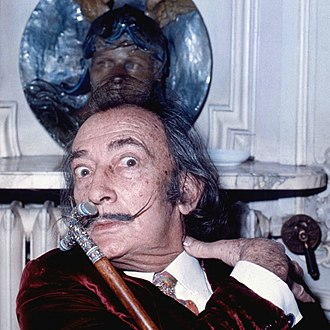
OTHER-NAME: Salvador Felipe Jacinto Dalí Y Domenech
BIRTH: 11 May 1904, Figueras, Spain
DEATH: 23 January 1989, Figueras, Spain
DISCIPLINE: The Arts
FIELD: Painting; printing
ASSESSMENT: He contributed to the Surrealist movement and became a public face for it even after he had moved on to other styles. His eccentricity defined what it was to be a movie star and an artist at the same time.
LANGUAGE: Spanish, English, French
EDUCATION: Real Academia de Bellas Artes de San Fernando
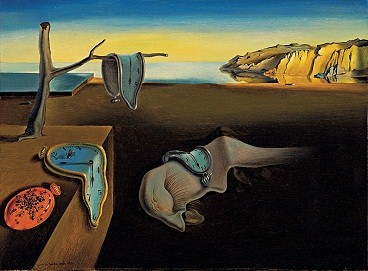
ACHIEVEMENT: ‘The Persistence of Memory’
MAJOR-WORK: ‘The Secret Life of Salvador Dalí’
PARENTS: Salvador Dalí I Cusí and Felipa Domenech Ferres
SPOUSE: Gala
SIBLINGS: A brother named Salvador who died in 1903, Ana Maria
CHILDREN: none
DETAILS:
Dalí was named after an older brother who died in 1903, a circumstance that may have contributed to his later explorations of identity. Dalí’s first experience with painting was through a friend of his father, Ramon Pichot, a local impressionist painter. Although influenced by impressionism, Dalí was experimenting with divisionism and futurism by 1921 when he entered the Real Academia de Bellas Artes de San Fernando in Madrid.
Once at the Academia, Dalí became friends with poet García < pal of > Lorca* and film maker Luis < pal of > Buñuel*. Dalí was expelled in 1926 for inciting rebellion and refusing examination. He didn’t feel the teachers were qualified to judge his work.
In 1927, he traveled to Paris where he met < met > Picasso* whom he greatly admired. As his success grew, he sent monthly contributions to the journal ‘L’Amic des Arts’. He also designed scenery for Lorca’s ‘Mariana Pineda’ and illustrated friend’s books.
Dalí began to experiment with surrealism and in 1929 made the film ‘Un Chien andalou’ with Buñuel. The film simulated a dream and used the same montage transformations which would become characteristic of Dalí’s surreal paintings. When the film was screened in Paris it brought Dalí into contact with the surrealism group including < pal of > Tzara*, < pal of > Breton*, < pal of > Magritte* and Camille Goemans as well as introducing him to his future wife Gala Éluard, married to Paul Éluard at the time. Gala left her husband the summer after meeting Dalí and they married in a civil ceremony in 1934.
Dalí’s surrealism involved his ‘paranoiac-critical method,’ first described in his article ‘L’Ane pourri’ in 1930. It requires the artist to perceive and portray different images with one collection of shapes. He used the method as a way to experiment with resemblances and associations, allowing the viewer to see more than was actually portrayed. Dalí based the method on the writings of < met > Freud*, whom he eventually met in 1938 in London. In 1931 he created one of his best known works, ‘The Persistence of Memory’ which featured watches melting in a landscape. He met and influenced < met > Henry Moore*.
Obsession with a work by < influenced by > Millet* entitled ‘The Angelus’ lead Dalí to create a series of paintings including ‘The Atavism of Twilight’ in 1933. In 1936, an exhibition at the Galerie Charles Ratton in Paris displayed Dalí’s surreal objects the ‘Lobster Telephone’ and the ‘Face of Mae West (Useable as a Surrealist Apartment).’
He also contributed to the International Surrealist Exhibitions at the New Burlington Galleries in London in 1936, where he appeared in a diving suit and the Galerie Beaux-Arts in Paris in 1938. He illustrated the surrealist book Les Chants de Maldoror by Comte de Lautréamont and worked with fashion designer Elsa Schiaparelli. He painted two works, ‘Soft Construction with Boiled Beans: Premonition of Civil War’ in 1936 and ‘Autumn Cannibalism,’ in response to the Spanish Civil War. His political frivolity lead to a series on Adolf Hitler in 1937 entitled ‘The Enigma of Hitler’ which, along with his support of Franco’s fascist regime in Spain, led to his expulsion from the Surrealist group.
Dalí moved to the United States in 1940 and spent World War II in creative endeavor. From 1941-1942, he had a retrospective at the Museum of Modern Art in New York. He painted portraits, designed shop windows, created a dream sequence for film-maker Alfred < met > Hitchcock* ( ‘Spellbound’) and worked with Walt Disney to plan a cartoon called ‘Destino’. He published his personal memoir ‘The Secret Life of Salvador Dalí’ in 1942 and his commercial persona, nicknamed Avida Dollars by Breton, was in full swing.
Dalí’s bizarre clothing and eccentric personality was part of his art, as he wanted to live his art as well as create it. Dalí was also a guest at the “February House,” a Brooklyn Heights house inhabited by W.H. < met > Auden*, Carson McCullers, Benjamin < met > Britten*, and Paul Bowles and written about in a book of the same name by Sherrill Tippins.
Dalí returned to Spain in 1948. He was finished with surrealism. He was extremely productive and his work focused on history, art history, science and religion. He incorporated optical illusionism, photographic realism, divisionism, abstract expressionism, pop art, stereoscopy and holography. He doubled images and used himself and Gala as subjects. He became fascinated with the atom after the explosion of the atom bomb.
In 1969 he designed the Chupa Chups logo and created the advertising for the Eurovision Song Contest.
In 1979 the last major exhibition of Dalí’s work during his lifetime was at the Centre Georges Pompidou in Paris. His early and late works were displayed side by side. In 1982, King Juan Carlos of Spain gave Dalí the title of Marquis of Púbol for which Dali thanked him with a drawing which turned out to be his last. In June of 1982 Gala died and Dalí lost his interest in life and art. He died January 23, 1989 and was buried the Teatre-Museu Dalí in Figueras, a repository of his work and theatrical monument to him which he constructed in 1974.
EXTRA-CONNECTIONS: He collaborated with choreographer Massine, illustrated Alice in Wonderland*
BIBLIOGRAPHY:
“Dalí, Salvador.” Encyclopaedia Britannica. 2007. Encyclopaedia Britannica Online. 18 June 2007 .
Fiona Bradley: “Dalí, Salvador” Grove Art Online. Oxford University Press, [June 18 2007], http://www.groveart.com.proxy.lib.ohio-state.edu/
Salvador Dali. Frieze Magazine, issue 79. Nov-Dec. 2003.
Pendergast, Sarah. Pendergast, Tom eds. Contemporary Artist Vol. 1. St. James Press, New York: 2002
Picardie, Justine. “Salvador’s Siren.” The Daily Telegraph 18 May 2007.
www.telegraph.co.uk/fashion/stellamagazine/3360135/salvadors_siren
AUDIO/VISUAL:
http://www.salvador-dali.org/en_index.html
official Salvador Dali Estate and Museums
http://www.virtualdali.com/
Huge galleries of paintings from all stages of his life
http://www.bbc.co.uk/bbcfour/audiointerviews/profilepages/dalis1.shtml
audio clips of BBC interviews with Dali.