Child Labor
Child labour is the exploitation of children through any form of work that deprives them of their childhood,[3] interferes with their ability to attend regular school, or is mentally, physically, socially and morally harmful.[4] Such exploitation is prohibited by legislation worldwide,[5][6] although these laws do not consider all work by children as child labour; exceptions include work by child artists, family duties, supervised training, and some forms of work undertaken by Amish children, as well as by Indigenous children in the Americas.[7][8][9]
Child labour has existed to varying extents throughout history. During the 19th and early 20th centuries, many children aged 5–14 from poorer families worked in Western nations and their colonies alike. These children mainly worked in agriculture, home-based assembly operations, factories, mining, and services such as news boys – some worked night shifts lasting 12 hours. With the rise of household income, availability of schools and passage of child labour laws, the incidence rates of child labour fell.[10][11][12]
As of 2023, in the world's poorest countries, around one in five children are engaged in child labour, the highest number of whom live in sub-saharan Africa, where more than one in four children are so engaged.[13] This represents a decline in child labour over the preceding half decade.[14] In 2017, four African nations (Mali, Benin, Chad and Guinea-Bissau) witnessed over 50 per cent of children aged 5–14 working.[14]
Worldwide agriculture is the largest employer of child labour.[15] The vast majority of child labour is found in rural settings and informal urban economies; children are predominantly employed by their parents, rather than factories.[16] Poverty and lack of schools are considered the primary cause of child labour.[17] UNICEF notes that "boys and girls are equally likely to be involved in child labour", but in different roles, girls being substantially more likely to perform unpaid household labour.[13]
Globally the incidence of child labour decreased from 25% to 10% between 1960 and 2003, according to the World Bank.[18] Nevertheless, the total number of child labourers remains high, with UNICEF and ILO acknowledging an estimated 168 million children aged 5–17 worldwide were involved in child labour in 2013.[19]
History
Child labour in preindustrial societies
Child labour forms an intrinsic part of pre-industrial economies.[20][21] In pre-industrial societies, there is rarely a concept of childhood in the modern sense. Children often begin to actively participate in activities such as child rearing, hunting and farming as soon as they are competent. In many societies, children as young as 13 are seen as adults and engage in the same activities as adults.[20]
The work of children was important in pre-industrial societies, as children needed to provide their labour for their survival and that of their group.[22] Pre-industrial societies were characterised by low productivity and short life expectancy; preventing children from participating in productive work would be more harmful to their welfare and that of their group in the long run. In pre-industrial societies, there was little need for children to attend school. This is especially the case in non-literate societies. Most pre-industrial skill and knowledge were amenable to being passed down through direct mentoring or apprenticing by competent adults.[20]
...
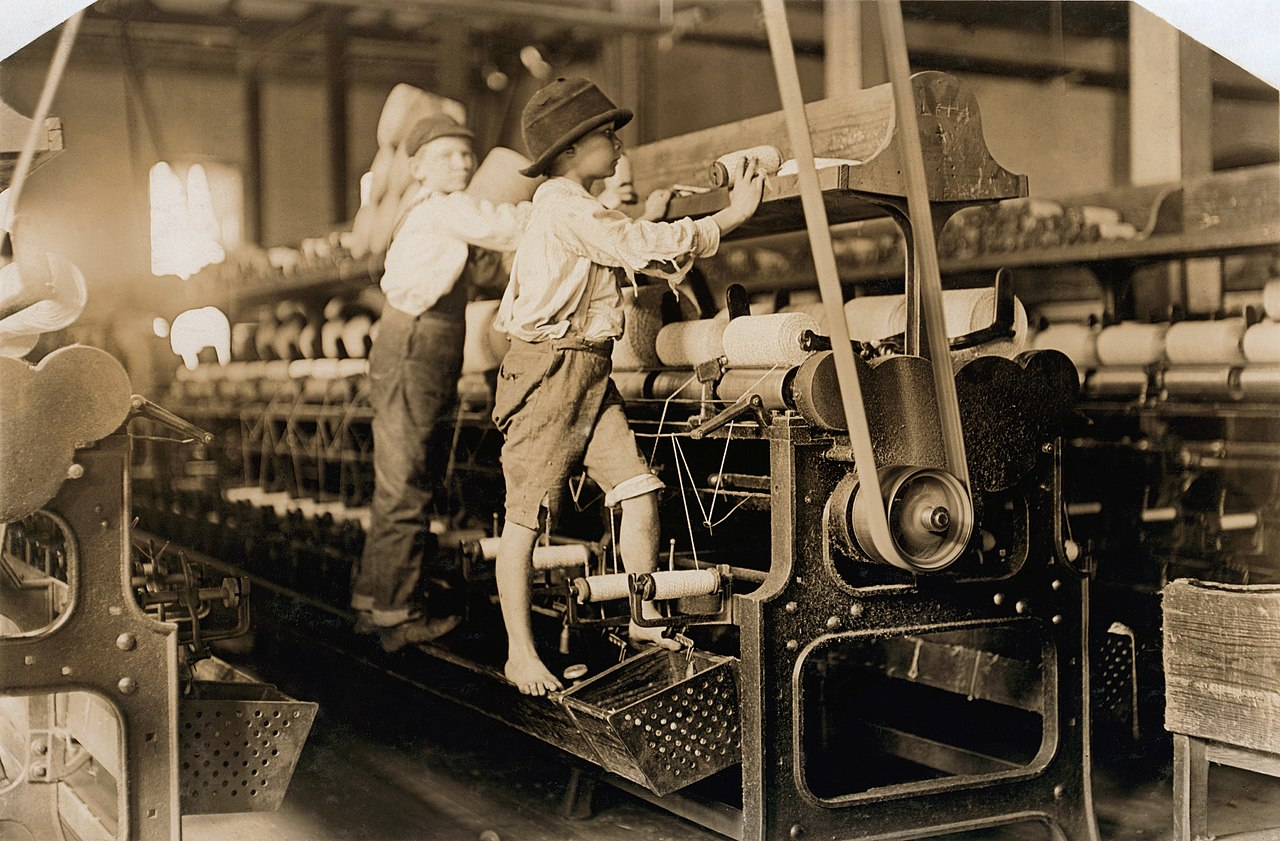
Industrial Revolution
Children going to a 12-hour night shift in the United States (1908) The early 20th century witnessed many home-based enterprises involving child labour. An example is shown above from New York in 1912.

Wikisource has original text related to this article:
"The Factory", a poem by L. E. L.
With the onset of the Industrial Revolution in Britain in the late 18th century, there was a rapid increase in the industrial exploitation of labour, including child labour. Industrial cities such as Birmingham, Manchester, and Liverpool rapidly grew from small villages into large cities and improving child mortality rates. These cities drew in the population that was rapidly growing due to increased agricultural output. This process was replicated in other industrialising countries.[23]
The Victorian era in particular became notorious for the conditions under which children were employed.[24] Children as young as four were employed in production factories and mines working long hours in dangerous, often fatal, working conditions.[25] In coal mines, children would crawl through tunnels too narrow and low for adults.[26] Children also worked as errand boys, crossing sweepers, shoe blacks, or selling matches, flowers and other cheap goods.[27] Some children undertook work as apprentices to respectable trades, such as building or as domestic servants (there were over 120,000 domestic servants in London in the mid-18th century). Working hours were long: builders worked 64 hours a week in the summer and 52 hours in winter, while servants worked 80-hour weeks.[28]
Child labour played an important role in the Industrial Revolution from its outset, often brought about by economic hardship. The children of the poor were expected to contribute to their family income.[27] In 19th-century Great Britain, one-third of poor families were without a breadwinner, as a result of death or abandonment, obliging many children to work from a young age. In England and Scotland in 1788, two-thirds of the workers in 143 water-powered cotton mills were described as children.[29] A high number of children also worked as prostitutes.[30] The author Charles Dickens worked at the age of 12 in a blacking factory, with his family in debtor's prison.[31]
Child wages were often low, the wages were as little as 10–20% of an adult male's wage.[32][better ^source ^needed] Karl Marx was an outspoken opponent of child labour,[33] saying British industries "could but live by sucking blood, and children’s blood too", and that U.S. capital was financed by the "capitalized blood of children".[34][35] Letitia Elizabeth Landon castigated child labour in her 1835 poem The Factory, portions of which she pointedly included in her 18th Birthday Tribute to Princess Victoria in 1837.
Throughout the second half of the 19th century, child labour began to decline in industrialised societies due to regulation and economic factors because of the Growth of trade unions. The regulation of child labour began from the earliest days of the Industrial Revolution. The first act to regulate child labour in Britain was passed in 1803.
As early as 1802 and 1819 Factory Acts were passed to regulate the working hours of workhouse children in factories and cotton mills to 12 hours per day. These acts were largely ineffective and after radical agitation, by for example the "Short Time Committees" in 1831, a Royal Commission recommended in 1833 that children aged 11–18 should work a maximum of 12 hours per day, children aged 9–11 a maximum of eight hours, and children under the age of nine were no longer permitted to work. This act however only applied to the textile industry, and further agitation led to another act in 1847 limiting both adults and children to 10-hour working days. Lord Shaftesbury was an outspoken advocate of regulating child labour.
As technology improved and proliferated, there was a greater need for educated employees. This saw an increase in schooling, with the eventual introduction of compulsory schooling. Improved technology, automation and further legislation significantly reduced child labour particularly in western Europe and the U.S.[citation ^needed]
Early 20th century
Percentage children working in England and Wales[36]| Census year | % boys aged 10–14 as child labour |
| 1881 | 22.9 |
|---|---|
| 1891 | 26.0 |
| 1901 | 21.9 |
| 1911 | 18.3 |
| Note: These are averages; child labour in Lancashire was 80% | Note: These are averages; child labour in Lancashire was 80% |
| Source: Census of England and Wales | Source: Census of England and Wales |
In the early 20th century, thousands of boys were employed in glass making industries. Glass making was a dangerous and tough job especially without the current technologies. The process of making glass includes intense heat to melt glass (3,133 °F (1,723 °C)). When the boys are at work, they are exposed to this heat. This could cause eye trouble, lung ailments, heat exhaustion, cuts, and burns. Since workers were paid by the piece, they had to work productively for hours without a break. Since furnaces had to be constantly burning, there were night shifts from 5:00 pm to 3:00 am. Many factory owners preferred boys under 16 years of age.[37]
An estimated 1.7 million children under the age of fifteen were employed in American industry by 1900.[38]
In 1910, over 2 million children in the same age group were employed in the United States.[39] This included children who rolled cigarettes,[40] engaged in factory work, worked as bobbin doffers in textile mills, worked in coal mines and were employed in canneries.[41] Lewis Hine's photographs of child labourers in the 1910s powerfully evoked the plight of working children in the American south. Hine took these photographs between 1908 and 1917 as the staff photographer for the National Child Labor Committee.[42]
Household enterprises
Factories and mines were not the only places where child labour was prevalent in the early 20th century. Home-based manufacturing across the United States and Europe employed children as well.[10] Governments and reformers argued that labour in factories must be regulated and the state had an obligation to provide welfare for poor. Legislation that followed had the effect of moving work out of factories into urban homes. Families and women, in particular, preferred it because it allowed them to generate income while taking care of household duties.
Home-based manufacturing operations were active year-round. Families willingly deployed their children in these income generating home enterprises.[43] In many cases, men worked from home. In France, over 58% of garment workers operated out of their homes; in Germany, the number of full-time home operations nearly doubled between 1882 and 1907; and in the United States, millions of families operated out of home seven days a week, year round to produce garments, shoes, artificial flowers, feathers, match boxes, toys, umbrellas and other products.
Children aged 5–14 worked alongside the parents. Home-based operations and child labour in Australia, Britain, Austria and other parts of the world was common. Rural areas similarly saw families deploying their children in agriculture. In 1946, Frieda S. Miller – then Director of the United States Department of Labor – told the International Labour Organization (ILO) that these home-based operations offered "low wages, long hours, child labour, unhealthy and insanitary working conditions".[10][44][45][46]
21st century
See also: Children's rights
 Map for child labour worldwide
Child labour is still common in many parts of the world. Estimates for child labour vary. It ranges between 250 and 304 million, if children aged 5–17 involved in any economic activity are counted. If light occasional work is excluded, ILO estimates there were 153 million child labourers aged 5–14 worldwide in 2008. This is about 20 million less than ILO estimate for child labourers in 2004. Some 60 per cent of the child labour was involved in agricultural activities such as farming, dairy, fisheries and forestry.
Another 25% of child labourers were in service activities such as retail, hawking goods, restaurants, load and transfer of goods, storage, picking and recycling trash, polishing shoes, domestic help, and other services.
The remaining 15% laboured in assembly and manufacturing in informal economy, home-based enterprises, factories, mines, packaging salt, operating machinery, and such operations.[49][50][51] Two out of three child workers work alongside their parents, in unpaid family work situations. Some children work as guides for tourists, sometimes combined with bringing in business for shops and restaurants. Child labour predominantly occurs in the rural areas (70%) and informal urban sector (26%).
Contrary to popular belief, most child labourers are employed by their parents rather than in manufacturing or formal economy. Children who work for pay or in-kind compensation are usually found in rural settings as opposed to urban centres. Less than 3% of child labour aged 5–14 across the world work outside their household, or away from their parents.[16]
Child labour accounts for 22% of the workforce in Asia, 32% in Africa, 17% in Latin America, 1% in the US, Canada, Europe and other wealthy nations.[52] The proportion of child labourers varies greatly among countries and even regions inside those countries. Africa has the highest percentage of children aged 5–17 employed as child labour, and a total of over 65 million. Asia, with its larger population, has the largest number of children employed as child labour at about 114 million. Latin America and the Caribbean region have lower overall population density, but at 14 million child labourers has high incidence rates too.[53]
...