Bulwer-Lytton
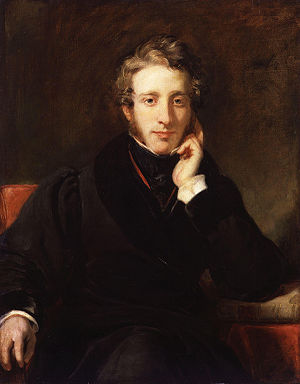
Edward George Earle Lytton Bulwer-Lytton, 1st Baron Lytton PC (25 May 1803 – 18 January 1873), was an English novelist, poet, playwright, and politician. He was immensely popular with the reading public and wrote a stream of bestselling novels which earned him a considerable fortune. He coined the phrases "the great unwashed",[1] "pursuit of the almighty dollar", "the pen is mightier than the sword", "dweller on the threshold", and the well-known opening line "It was a dark and stormy night".[2]
Contents
- 1Life
- 2Career
- 3Literary works
- 4Legacy
- 5Works by Edward Bulwer-Lytton
- 6See also
- 7References
- 8Further reading
- 9External links
Life
Bulwer-Lytton was born on 25 May 1803 to General William Earle Bulwer of Heydon Hall and Wood Dalling, Norfolk and Elizabeth Barbara Lytton, daughter of Richard Warburton Lytton of Knebworth, Hertfordshire. He had two elder brothers, William Earle Lytton Bulwer (1799–1877) and Henry (1801–1872), later Lord Dalling and Bulwer.
When Edward was four his father died and his mother moved to London. He was a delicate, neurotic child and was discontented at a number of boarding schools. But he was precocious and Mr Wallington at Baling encouraged him to publish, at the age of fifteen, an immature work, Ishmael and Other Poems.[citation needed]
In 1822 he entered Trinity College, Cambridge, where he met John Auldjo, but shortly afterwards moved to Trinity Hall. In 1825 he won the Chancellor's Gold Medal for English verse.[3] In the following year he took his B.A. degree and printed, for private circulation, a small volume of poems, Weeds and Wild Flowers.
He purchased a commission in the army, but sold it without serving.
Edward Bulwer-Lytton. His Harold, the Last of the Saxons (1848) was the source for Verdi's opera Aroldo
In August 1827, against his mother's wishes, he married Rosina Doyle Wheeler (1802–1882), a famous Irish beauty. When they married his mother withdrew his allowance and he was forced to work for a living.[4] They had two children, Lady Emily Elizabeth Bulwer-Lytton (1828–1848), and (Edward) Robert Lytton Bulwer-Lytton, 1st Earl of Lytton (1831–1891) who became Governor-General and Viceroy of British India (1876–1880).
...
Contest
Further information: Bulwer-Lytton Fiction Contest
Bulwer-Lytton's name lives on in the annual Bulwer-Lytton Fiction Contest, in which contestants think up terrible openings for imaginary novels, inspired by the first line of his 1830 novel Paul Clifford:[30]
It was a dark and stormy night; the rain fell in torrents—except at occasional intervals, when it was checked by a violent gust of wind which swept up the streets (for it is in London that our scene lies), rattling along the housetops, and fiercely agitating the scanty flame of the lamps that struggled against the darkness.
Entrants in the contest seek to capture the rapid changes in point of view, the florid language, and the atmosphere of the full sentence.[citation needed] The opening was popularized by the Peanuts comic strip, in which Snoopy's sessions on the typewriter usually began with It was a dark and stormy night.[31] The same words also form the first sentence of Madeleine L'Engle’s Newbery Medal-winning novel A Wrinkle in Time. Similar wording appears in Edgar Allan Poe's 1831 short story, The Bargain Lost, although not at the very beginning. It reads:
It was a dark and stormy night. The rain fell in cataracts.