Home, Daniel Dunglas
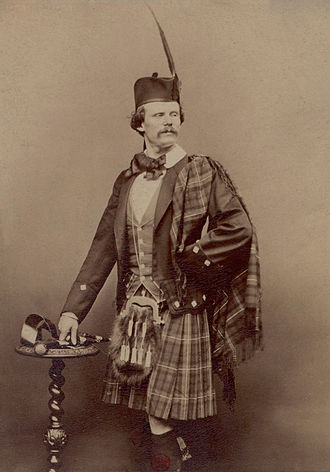
Daniel Dunglas Home (pronounced Hume; 20 March 1833 – 21 June 1886) was a Scottish physical medium with the reported ability to levitate to a variety of heights, speak with the dead, and to produce rapping and knocks in houses at will. His biographer Peter Lamont opines that he was one of the most famous men of his era.[1]
Harry Houdini described him as "one of the most conspicuous and lauded of his type and generation" and "the forerunner of the mediums whose forte is fleecing by presuming on the credulity of the public."[2] Home conducted hundreds of séances, which were attended by many eminent Victorians. There have been eyewitness accounts by séance sitters describing conjuring methods and fraud that Home may have employed.[3][4][5]
Family
Daniel Home's mother, Elizabeth ("Betsy") Home (née McNeill) was known as a seer in Scotland, as were many of her predecessors, like her great uncle Colin Uruqhart, and her uncle Mr. McKenzie. The gift of second sight was often seen as a curse, as it foretold instances of tragedy and death.[6][7] Home's father, William Home, was the illegitimate son of Alexander, the 10th Earl of Home.[6] Evidence supports the elder Home's illegitimacy, as various payments meant for William were made by the 10th Earl.[8] Elizabeth and William were married when he was 19 years old, and found employment at the Balerno paper mill. The Homes moved into one of small houses built in the mill for the workforce, in Currie (six miles south-west of Edinburgh).[9]
William was described as a "bitter, morose and unhappy man" who drank, and was often aggressive towards his wife.[9] Elizabeth had eight children while living in the mill house: six sons and two daughters, although their lives were not fully recorded. The eldest, John, later worked in the Balerno mill and eventually managed a paper mill in Philadelphia, Mary drowned in a stream at the age of 12 years in 1846, and Adam died at sea at the age of 17 while en route to Greenland, which Home says he saw in a vision and reportedly confirmed five months later.[10][11]
Early life
Daniel Home was Elizabeth's third child, and was born on 20 March 1833. He was baptised by the Reverend Mr. Somerville three weeks after his birth at Currie Parish Church on 14 April 1833.[12] The one-year-old Home was deemed a delicate child, having a "nervous temperament", and was passed to Elizabeth's childless sister, Mary Cook. She lived with her husband in the coastal town of Portobello, 3 miles (4.8 km) east of Edinburgh.[13] According to Home, his cradle rocked by itself at the Cooks' house, and he had a vision of a cousin's death, who lived in Linlithgow, to the west of Edinburgh.[14][15]
United States

Home pondering a skull. A staged studio photograph typical of the era.
Sometime between 1838 and 1841, Home's aunt and uncle decided to emigrate to the United States with their adopted son, sailing in the cheapest class of steerage as they could not afford a cabin.[16] After landing in New York, the Cooks travelled to Greeneville, near Norwich, Connecticut.[17] The red-haired and freckled Home attended school in Greeneville, where he was known as "Scotchy" by the other students.[18]
The 13-year-old Home did not join in sports games with other boys, preferring to take walks in the local woods with a friend called Edwin. The two boys read the Bible to each other and told stories, and made a pact stating that if one or the other were to die, they would try to make contact after death.[18] Home and his aunt soon moved to Troy, New York, which is about 155 miles (249 km) from Greeneville, although Home in his own book stated it was 300 miles (480 km) away.[19]
Home lost contact with Edwin until one night when Home, according to Lamont, saw a brightly lit vision of him standing at the foot of the bed, which gave Home the feeling that his friend was dead. Edwin made three circles in the air before disappearing, and a few days later a letter arrived stating that Edwin had died of malignant dysentery three days before Home's vision.[20]
A few years later Home and his aunt returned to Greeneville, and Elizabeth Home emigrated from Scotland to America with the surviving members of the family to live in Waterford, Connecticut, which was 12 miles (19 km) away from the Cook's house.[21] Home and his mother's reunion was short-lived, as Elizabeth appeared to foretell her own death in 1850. Home said he saw his mother in a vision saying, "Dan, 12 o'clock", which was the time of her death.[10][21]
After Elizabeth's death Home turned to religion. His aunt was a Presbyterian, and held the Calvinist view that one's fate has been decided, so Home embraced the Wesleyan faith, which believed that every soul can be saved.[22] Home's aunt resented Wesleyans so much that she forced Home to change to Congregationalist, which was not to her liking, either, but was more in line with her own religion.[23] The house was reportedly disturbed by rappings and knocking similar to those that had occurred two years earlier at the home of the Fox sisters.
Ministers were called to the Cooks' house: a Baptist, a Congregationalist, and even a Wesleyan minister, who all believed that Home was possessed by the Devil, although Home believed it was a gift from God.[24] According to Home, the knocking did not stop, and a table started to move by itself, even though Home's aunt put a bible on it and then placed her full body weight on it.[25][26] According to Lamont, the noises did not stop and were attracting the unwanted attention of Cook's neighbours, so Home was told to leave the house.[27]
Fame

William Cullen Bryant, a poet, and editor of the New York Evening Post, who witnessed one of Home's séances.
The 18-year-old Home stayed with a friend in Willimantic, Connecticut, and later Lebanon, Connecticut. Home held his first séance in March 1851, which was reported in a Hartford newspaper managed by W. R. Hayden, who wrote that the table moved without anyone touching it, and kept moving when Hayden physically tried to stop it.[28][29] After the newspaper report, Home became well known in New England, travelling around healing the sick and communicating with the dead, although he wrote that he was not prepared for this sudden change in his life because of his supposed shyness.[30]
Home never directly asked for money, although he lived very well on gifts, donations and lodging from wealthy admirers. He felt that he was on a "mission to demonstrate immortality", and wished to interact with his clients as one gentleman to another, rather than as an employee.[31][32] In 1852, Home was a guest at the house of Rufus Elmer in Springfield, Massachusetts, giving séances six or seven times a day, which were visited by crowds of people, including a Harvard professor, David Wells, and the poet and editor of the New York Evening Post, William Cullen Bryant. They were all convinced of Home's credibility and wrote to the Springfield Republican newspaper stating that the room was well lit, full inspections were allowed, and said, "We know that we were not imposed upon nor deceived".[33]
It was also reported that at one of Home's demonstrations five men of heavy build (with a combined weight of 850 pounds) sat on a table, but it still moved, and others saw "a tremulous phosphorescent light gleam over the walls".[34] Home was investigated by numerous people, such as Professor Robert Hare, the inventor of the oxy-hydrogen blowpipe, and John W. Edmonds, a trial court judge, who were sceptical, but later said they believed Home was not fraudulent.[34][35]
In his book, "Incidents in My Life", Home claims that in August 1852, in South Manchester, Connecticut, at the house of Ward Cheney, a successful silk manufacturer, he was reportedly seen to levitate twice and then rise to up to the ceiling, with louder rappings and knocking than ever before, more aggressive table movements and the sounds of a ship at sea in a storm, although persons present said that the room was badly lit so as to see the spirit lights.[36][37]
New York was now interested in Home's abilities, so he moved to an apartment at Bryant Park on 42nd street. His most verbal critic in New York was William Makepeace Thackeray, the author of Vanity Fair. Thackeray dismissed Home's abilities as "dire humbug", and "dreary and foolish superstition", although Thackeray had been impressed when he saw a table turning.[38] Home thought that Thackeray was "the most sceptical inquirer" he had ever met, and as Thackeray made his thoughts public, Home faced public scepticism and further scrutiny.[39]
Home travelled between Hartford, Springfield, and Boston during the next few months, and settled in Newburgh by the Hudson River in the summer of 1853.[40] He resided at the Theological Institute, but took no part in any of the theological discussions held there, as he wanted to take a course in medicine. Dr. Hull funded Home's studies, and offered to pay Home five dollars a day for his séances, but Home refused, as always.[41] His idea was to fund his work with a legitimate salary by practicing medicine, but he became ill in early 1854, and stopped his studies. Home was diagnosed with Tuberculosis, and his doctors recommended recuperation in Europe. His last séance in America was in March 1855, in Hartford, Connecticut, before he travelled to Boston and sailed to England on board the Africa, at the end of March.[42]
Europe
Home's name was originally Daniel Home, but by the time he arrived in Europe he had lengthened it to Daniel Dunglas Home, in reference to the Scottish house of Home, of which his father claimed to be a part.[43] In London, Home found a believer in spiritualism, William Cox, who owned a large hotel at 53, 54 and 55 Jermyn Street, London. As Cox was so enamoured of Home's abilities, he let him stay at the hotel without payment.[44]
Robert Owen, an 83-year-old social reformer, was also staying at the hotel, and introduced Home to many of his friends in London society.[45] At the time Home was described as "tall and thin, with blue eyes and auburn hair, fastidiously dressed but seriously ill with consumption". Nevertheless, he held sittings for notable people in full daylight, moving objects that were some distance away.[46]
Some early guests at Home's sittings included the scientist Sir David Brewster (who remained unconvinced), the novelists Sir Edward Bulwer-Lytton and Thomas Adolphus Trollope, and the Swedenborgian James John Garth Wilkinson.[47][48]
As well as Brewster, fellow scientists Michael Faraday and Thomas Huxley were prominent contemporary critics of Home's claims.[49] It was the poet Robert Browning however, who proved to be one of Home's most adamant critics. After attending a séance of Home's, Browning wrote in a letter to The Times that: 'the whole display of hands, spirit utterances etc., was a cheat and imposture'.[50] Browning gave his unflattering impression of Home in the poem, "Sludge the Medium" (1864).[51]
His wife, Elizabeth Barrett Browning, was convinced that the phenomena she witnessed were genuine and their discussions about Home were a constant source of disagreement.[52] Frank Podmore writes of a Mr Merrifield's first-hand account of experiencing Home's fraudulence during a séance.[50]
Home's fame grew, fuelled by his ostensible feats of levitation. William Crookes claimed Home could levitate five to seven feet above the floor.[53] Crookes wrote "We all saw him rise from the ground slowly to a height of about six inches, remain there for about ten seconds, and then slowly descend."[54]
In the following years Home travelled across continental Europe, and always as a guest of wealthy patrons. In Paris, he was summoned to the Tuileries to perform a séance for Napoleon III. He also performed for Queen Sophia of the Netherlands, who wrote: "I saw him four times...I felt a hand tipping my finger; I saw a heavy golden bell moving alone from one person to another; I saw my handkerchief move alone and return to me with a knot... He himself is a pale, sickly, rather handsome young man but without a look or anything which would either fascinate or frighten you. It is wonderful. I am so glad I have seen it..."[55]
In 1866, Mrs Jane Lyon, a wealthy widow, adopted Home as her son, giving him £60,000[56] in an attempt to gain introduction into high society. Finding that the adoption did not change her social situation, Lyon changed her mind, and brought a suit for the return of her money from Home on the grounds that it had been obtained by spiritual influence.[51] Under British law, the defendant bears the burden of proof in such a case, and proof was impossible since there was no physical evidence. The case was decided against Home,[57] Mrs Lyon's money was returned, and the press pilloried Home's reputation. Home's high society acquaintances thought that he behaved like a complete gentleman throughout the ordeal, and he did not lose a single important friend.[58]
Sir Arthur Conan Doyle, a spiritualist who supported the mediumship of Home, stated that he was unusual in that he had four different types of mediumship: direct voice (the ability to let spirits audibly speak); trance speaker (the ability to let spirits speak through oneself); clairvoyant (ability to see things that are out of view); and physical medium (moving objects at a distance, levitation, etc., which was the type of mediumship in which he had no equal).[59]
According to Eric Dingwall, a lady acted as a medium and used to help Home during the séances attended by Henrietta Ada Ward.[60][61]
Alleged levitations
A feat of low levitation by Daniel Dunglas Home was recorded by paranormal historian Frank Podmore. "We all saw him rise from the ground slowly to a height of about six inches, remain there for about ten seconds, and then slowly descend."[62] The Balducci levitation is a levitation illusion first described by Ed Balducci. Its inventor is unknown. The performer stands at an angle facing away from the spectators. The performer appears to levitate a few inches above the ground. The effect generally does not last for more than five seconds. The performer's feet return to the ground, and the effect is complete.[citation needed]

The levitation of Daniel Dunglas Home at Ward Cheney's house interpreted in a lithograph from Louis Figuier, Les Mystères de la science 1887
Home met one of his future closest friends in 1867; the young Lord Adare (later the 4th Earl of Dunraven). Adare was fascinated by Home, and began documenting the séances they held. The following year, Home was said to have levitated out of the third storey window of one room, and back in through the window of the adjoining room in front of three witnesses (Adare, Captain Wynne, and Lord Lindsay).[63]...
Arthur Conan Doyle said there were many cases on record of Home levitating, but skeptics assert the alleged levitations occurred in darkened conditions susceptible to trickery.[71][72][73][74]
Science historian Sherrie Lynne Lyons has stated that a possible explanation for Home's alleged levitation phenomena was revealed in the twentieth century by Clarence E. Willard (1882–1962). Willard revealed his technique in 1958 to members of the Society of American Magicians. He demonstrated how he could add two inches to his height by stretching. According to Lyons "it is quite likely that [Home] used a similar technique to the one that Willard used decades later".[75]
Author Donald Serrell Thomas has asserted that Jean Eugène Robert-Houdin, the French stage magician was refused admission to Home's séances.[76] In opposition to this, spiritualists have said that Houdin was unable to explain the phenomena at a Home séance. Regarding both these claims, Peter Lamont has noted:
It is probably worth noting, if only to avoid confusion, that such claims (much like those made by spiritualists that conjurors were unable to explain the phenomena) were often unfounded. For example, spiritualists claimed that Robert-Houdin had been unable to explain what happened at a Home seance, and critics claimed that Home had refused an invitation to perform in front of Robert-Houdin. There is, however, not a shred of evidence for either of these claims.[77]
Historian Simon During has suggested the levitation of Home was a magic trick, influenced by Robert-Houdin.[78]
Critical reception
Allegations of fraud

It is often claimed in parapsychology and spiritualist books that Home was never caught in fraud. However, skeptics have stated that this claim does not hold up to scrutiny as Home was caught utilizing tricks by different witnesses on different occasions.[79] Gordon Stein has noted that "While the statement that Home was never caught in fraud has been made many times, it simply is not true... It is simply that Home was never publicly exposed in fraud. Privately, he was caught in fraud several times. In addition, there are natural explanations both possible and likely for each of his phenomena."[80]
At a séance in the house of the solicitor John Snaith Rymer in Ealing in July 1855, a sitter (Frederick Merrifield) observed that a "spirit-hand" was in fact a false limb attached on the end of Home's arm. Merrifield also claimed to have observed Home use his foot in the séance room.[3]
The poet Robert Browning and his wife Elizabeth attended a séance on 23, July 1855 in Ealing with the Rymers.[76] In 1895, after the deaths of Robert and Elizabeth, the journalist Frederick Greenwood alleged that Browning had told him that during the séance he had taken hold of a luminous object that appeared above the edge of the table, which turned out to be Home's naked foot.[81]
Later Browning's son Robert, in a letter to the London Times, 5 December 1902, also referred to the incident, saying that Browning had caught hold of Home's foot under the table. The allegation was repeated by Harry Houdini and later writers.[82] But detailed descriptions of the séance written soon afterwards by Robert and Elizabeth make no mention of any such incident. Browning's account states that, although he was promised that he would be allowed to hold a "spirit-hand," the promise was not kept.[83]
Writing in the journal for the Society for Psychical Research, Count Perovsky-Petrovo-Solovovo described a letter by Dr. Barthez, a physician in the court of Empress Eugenie, which claimed a sitter Morio de l'lle caught Home using his foot to fake supposed spirit effects during a séance in Biarritz in 1857.[84][85][86] Home wore thin shoes, easy to take off and draw on, and also cut socks that left the toes free. "At the appropriate moment he takes off one of his shoes and with his foot pulls a dress here, a dress there, rings a bell, knocks one way and another, and, the thing done, quickly puts his shoe on again."[4]
Home positioned himself between the empress and Napoleon III. One of the séance sitters known as General Fleury also suspected that Home was utilizing trickery and asked to leave but returned unobserved to watch from another door behind Home. He saw Home slip his foot from his shoe and touch the arm of the Empress, who believed it to be one of her dead children. The observer stepped forward and revealed the fraud, and Home was conducted out of the country: "The order was to keep the incident secret."[4][85] The allegations described by Dr. Barthez and General Fleury are second hand and have caused dispute between psychical researchers and skeptics.[85][86][87]
The journalist Delia Logan who attended a séance with Home in London claimed that Home had used a phosphorus trick. During the séance luminous hands were observed and the host told Logan that had seen Home place a small bottle upon the mantle piece. The host slipped the bottle into his pocket and when examined the next day, it was found to contain phosphorus oil.[88][89]
The neoclassical sculptor Hiram Powers who was a convinced spiritualist attended a séance with Home, but wrote a letter to Elizabeth Browning claiming Home had faked the table-turning movements.[90]
Speculations on trickery

Frank Podmore, a skeptic of Home's mediumship.
The researchers Frank Podmore (1910), Milbourne Christopher (1970), Trevor H. Hall (1984) and Gordon Stein (1993) were convinced that Home was a fraud and have provided a source of speculation on the ways in which he could have duped his séance sitters.[91][92][93][94]
Skeptics have criticized the lighting conditions of Home's séances. Home and his followers claimed that some of the séances took place in "light" but this was nothing more than a few candles, or some glow from a fireplace or open window. Home would adjust the lighting to his needs with no objections from his séance sitters.[95] For example, there is this report from a witness: "The room was very dark ... Home's hands were visible only as a faint white heap".[96] Home selected the séance sitters who sat next to him, his hands and feet were not controlled and according to Frank Podmore "no precautions were taken against trickery."[97]
Home was never searched before or after his séances. Science historian Sherrie Lynne Lyons wrote that the glowing or light-emitting hands in his séances could easily be explained by the rubbing of oil of phosphorus on his hands.[75] It has been suggested that the "spirit hands" in the séances of Home were made of gloves stuffed with a substance. Robert Browning believed they were attached to Home's feet.[98] Home was a sculptor and his studio in Rome contained sculpted hands. Lyons has speculated that he may have substituted the sculptor hands, leaving his real hands free to perform phenomena in the séance room.[75]
Home was known for his alleged feat of handling a heated lump of coal taken from a fire. The magician Henry Evans speculated that this was a juggling trick, performed by a hidden piece of platinum.[99] Hereward Carrington described Evans hypothesis as "certainly ingenious" but pointed out William Crookes an experienced chemist was present at a séance whilst Home performed the feat and would have known how to distinguish the difference between coal and platinum.[100] Frank Podmore wrote that most of the fire feats could have easily be performed by conjuring tricks and sleight of hand but hallucination and sense-deception may have explained Crookes' claim about observing flames from Home's fingers.[71]
William Crookes investigation
Between 1870 and 1873, chemist and physicist William Crookes conducted experiments to determine the validity of the phenomena produced by three mediums: Florence Cook, Kate Fox, and Home. Crookes' final report in 1874 concluded that the phenomena produced by all three mediums were genuine, a result which was roundly derided by the scientific establishment.[101] Crookes recorded that he controlled and secured Home by placing his feet on the top of Home's feet.[102]
Crookes' method of foot control later proved inadequate when used with Eusapia Palladino, as she merely slipped her foot out and into her sturdy shoe. In addition, Crookes' motives, methods, and conclusions with regard to Florence Cook were called into question, both at the time and subsequently, casting doubt on his conclusions about Home.[103][104][105] In a series of experiments in London at the house of Crookes in February 1875, the medium Anna Eva Fay managed to fool Crookes into believing she had genuine psychic powers. Fay later confessed to her fraud and revealed the tricks she had used.[106]
Home was investigated by Crookes in a self-built laboratory at the rear of his house at Mornington Road, North London in 1871. No plans of the laboratory have been found and there is no contemporary description of it. Crookes wrote the board and spring balance experiment was a success with Home and had proven "beyond doubt" the existence of a "psychic force." However, the experiment could be easily dismissed as the result of vibrations caused by the passage of Euston trains in the large railway cutting near his house in London.[107]
The experiment was not repeatable and sometimes failed to produce any phenomena. The experiment was rejected and ridiculed by the scientific community for lack of scientific controls. In the experiment Home refused for Crookes to be near him and would draw attention to something on the other side of the room, or make conversation for diversionary signals.[107]

William Crookes tested Home in a series of experiments.
In 1871, Balfour Stewart in an article for Nature noted that the experiments were not conducted in broad daylight before a large unbiased audience and the results were inconclusive. Stewart suspected the phenomena observed were "subjective, rather than objective, occurring in the imaginations of those present rather than in the outward physical world."[108] In the same year, J. P. Earwaker wrote a science review that heavily criticized the Crookes' experiments for their poor design concluding they were pseudoscientific. According to Earwaker "For in truth they are the very opposite of scientific. Even to call them unscientific is not strong enough; clumsy and futile are much nearer the truth."[109]
The engineer Coleman Sellers questioned the origin and weight of the board used with the balance spring apparatus. Sellers wrote that a standard mahogany board weighs around thirteen and half pounds but the one used in Crookes' experiment may have been at fault at only six pounds.[110] Crookes responded to Sellers claiming the board weighed six pounds and this was not a mistake, he also stated he had the board for about sixteen years and it was originally cut in a lumber yard.[111]
P. H. Vanderweyde noted that Crookes was already a believer in psychic powers before he obtained the results of the experiments. Vanderweyde stated the spring balance used in Crookes' experiment was unreliable as it was easy to manipulate by deception and suggested he should repeat the experiment by using a chemical balance.[112]
According to Barry Wiley during the board and spring balance experiment, Home refused for Crookes to sit near him and he was occupied by writing notes. Wiley suspected Home used resin on his finger tips to tamper with the apparatus which managed to fool Crookes into believing a psychic force was being displayed.[113] Regarding Crookes, the magician Harry Houdini wrote:
There is not the slightest doubt in my mind that this brainy man was hoodwinked, and that his confidence was betrayed by the so-called mediums that he tested. His powers of observation were blinded and his reasoning faculties so blunted by his prejudice in favor of anything psychic or occult that he could not, or would not, resist the influence.[114]
Historian Ruth Brandon in an article for the New Scientist noted that William Huggins, Serjeant Cox, Crooke's wife and daughter, his laboratory assistant, and a Mrs Humphrey were all present during the Crookes experiments with Home.[115] However, Barry Wiley has written that when Crookes published his report on the experiments in the Quarterly Journal of Science in 1871 he did not mention all the names of the observers present in the room.
Wiley has stated that four females were present during the experiments as was Crookes' brother and the original report by Crookes did not refer to any spirits but many years later in 1889 he revealed in his Notes of séances with D. D. Home the names of the observers and claimed Home was in communication with spirits.[116]
Crookes' assistant was the glass blower Charles Henry Gimingham (1853–1890) who had built the experimental apparatus. Wiley suspected that Gimingham worked as a secret accomplice for Anna Eva Fay in her experiments with Crookes. Wiley noted that "Gimingham had free and open access to Crookes' laboratory and frequently worked there unsupervised with Crookes' full trust."[117]
Joseph McCabe criticized the Crookes experiments for lack of scientific controls and wrote Home was "daily in and out of Crookes's laboratory, and it appears that he closely watched the development of the tests and was prepared in advance."[118] Before the experiments, Crookes was present with Home whilst he changed dress but Frank Podmore noted this would not have prevented Home from slipping into his pocket apparatus to cheat on the experiments.[119] Edward Clodd wrote that Home chose his séance sitters and "if test experiments were suggested, he imposed the conditions."[120]
The physicist Victor Stenger commented that the experiments were poorly controlled; he gave the example of Home requesting all hands to be removed from the table whilst all those present complied. Stenger noted that "Crookes gullibly swallowed ploys such as this and allowed Home to call the shots... his desire to believe blinded him to the chicanery of his psychic subjects."[121]

Home performing the accordion experiment.
Accordion experiment
In the accordion experiment, Home sat at a table, with Crookes and another observer on either side of him, each with a foot on one of Home's feet. Home inserted his hand inside a wire cage that was pushed under the table. One of Home's hands was placed on the top of the table, and the other inside the cage which held an accordion on the non-key side, so the keyed end was hanging downwards. The accordion was reported to have played musical sounds.[122] However, the amount of light in the room was not stated, and the accordion was not observed in good light. According to Frank Podmore there was no evidence the accordion played at all, as the keys were not observed to have moved. Podmore suggested the musical sounds could have come from an automatic instrument that Home had concealed.[122]
...
Personal life
Home married twice. In 1858, he married Alexandria de Kroll ("Sacha"), the 17-year-old daughter of a noble Russian family, in Saint Petersburg. His Best Man was the writer Alexandre Dumas.[146] They had a son, Gregoire ("Grisha"),[146] but Alexandria fell ill with tuberculosis, and died in 1862.[147] In October 1871, Home married for the second, and last time, to Julie de Gloumeline, a wealthy Russian, whom he also met in St Petersburg.[148] In the process, he converted to the Greek Orthodox faith.[149]
In 1869 Lord Adare revealed in his diaries under the title Experiences in Spiritualism with D. D. Home that he had slept in the same bed with Home. Many of the diary entries contain erotic homosexual overtones between Adare and Home.[150]
Death
Home retired due to ill health; the tuberculosis, from which he had suffered for much of his life, was advancing and he said his powers were failing. He died on 21 June 1886 at the age of 53 and was buried in the Russian cemetery of St. Germain-en-Laye, in Paris.[149][151]
Research notes:
Daniel Dunglas Home (pronounced "hume"), was once
described by Dr. John Beloff as ''the most celebrated medium of all time,
judging by the number and impressiveness of the séances of which we have
records and by the calibre of the observers whom he attracted in the many
countries he visited". A phenomenon in his own right, Home conducted over
1500 séances and physic demonstrations. He was investigated by world famous
scientists, his 'acts' always conducted in broad daylight, and in settings
other than his own home.
Daniel Dunglas Home was born near Edinburgh in 1833 into impoverished
family of 9 children reason why, at an early age, he was adopted by his
maternal aunt, Mrs McNeill Cook and her husband. In 1842, Cooks emigrated
with him to America, and shortly afterwards they were followed by the Homes
- 2 families settled near each other in Greenville, Connecticut. Home a v.
kind, gentle and sensitive child who showed early signs of clairvoyance (his
mother a clairvoyant, and some of her relatives before her), but had a v.
happy childhood playing in the Greenville woods until age of 13, when the
Cooks moved to Troy, N.Y. Was here that Home had first real spiritualist
type experience saw vision of a friend from Greenville, and afterwards
announced boy was dead: turned out that boy had in fact died 2 days earlier.
When he was 16, his mother predicted her own death, and died accordingly -
Home had vision of mother while dying: this shock brought on first religious
impulse, and he joined the local Wesleyan church.
Aunt v. disturbed by all this, but worse was to come: 17-yr-old Home then
began to develop paranormal/poltergeist-type symptoms, such as knocking
sounds, furniture moving around house, lights going on and off, etc. Aunt
convinced that a devil had come into the house, and sought aid of three
ministers, Congregationalist, Baptist and Wesleyan, but none any good. By
age of 19, Home plagued also by 'gift' of telekinesis he himself found
this so alarming, that he later always expressed great dislike of furniture
moving during seances. For solace, Home frequently visited home of another
relative, a widow, who more sympathetic to the supernatural, and here he
first began seriously to interpret sounds he was hearing, ask questions of
unseen presences, and gain intelligent replies. Began to use the alphabet,
and when the letters which were greeted with an answering rap were written
down, it was found that they composed sentences first one being from his
mother: said, "Daniel, fear not, my child . . . seek to do good, be truthful
and truth-loving, and you will prosper . . . Yours is a glorious mission -
you will convince the infidel, cure the sick and console the weeping." This
was the great spur for Home throughout his life within a week he had left
his Aunt's house.
For next 4 yrs, Home relied on his v. appealing personality and weird gifts
for food and shelter just went from family to family, and was looked after
in return for giving seances, during which tables would raise off floor,
rappings would be produced in the room, and even spirit voices sometimes
heard: what greatly added to his credibility was fact that seances were
always held either during daylight or in well-lit rooms, and were never in
his own house greatly reducing chance of 'staging' it. Plus capacity to
receive spirit communication was accompanied by extraordinary physical
attributes independence of the laws of gravity, immunity from the effects
of burning heat, and elongation his height could be extended up to 11
inches or reduced by 6-8 inches. (This latter apparently something
contortionists can teach themselves to do, and not that amazing). By this
time, the press had got hold of him also, so Home was often hounded and by
age 20 was famous in U.S.. In 1852 he moved to Springfield, Mass. in order
to stay with Rufus Elmer, a wealthy manufacturer: here Home was besieged by
huge number of people, and ended up holding six or seven seances a day. One
in particular was important for his future, as v. impressive telekinesis
witnessed (and signed) by investigating committee from Harvard, including
Prof Wells and poet William Cullen Bryant. Was also during this period
(August 1852) that he was guest of another wealthy manufacturer, Ward
Cheney, a silk-merchant, in South Manchester, who became a lifelong friend
and would later visit Home in England. Was at Ward Cheney's that Home first
levitated himself in the air, and that instruments in the room during a
seance would be played by 'unseen agencies'.
In 1853, Home began studying French and German at the Theological Institute
at Newburgh, with ultimate intention of studying medicine (as had great
talent for natural healing). Meanwhile, his own health had been failing, and
in January 1855 bad cough that had been troubling him got much worse was
now diagnosed as having TB in left lung, and doctors advised a milder
climate. England advised as preferable to Connecticut really didn't want
to go, but his 'spirit friends' (including his mother) told him he must, so
he went sponsored by group of professional men who gave him introductions
to various literary and scientific men in England, as his fame had spread
across the Atlantic.
Home arrived at Liverpool on 9 April 1855, aged 22: he arrived ill and v.
depressed, feeling that his unusual gifts were an affliction that separated
him from other people. However, rallied and travelled to London, where
stayed at Cox's Hotel, 55 Jermyn Street, run by William Cox, who was known
to be much interested in spiritualism. He and his wife welcomed Home, and
pretty much adopted him never gave him a bill, and for a long time acted
as bankers for him. Once his arrival became known, many people wanted to see
him one of most famous being Lord Brougham (who had defended Princess
Caroline, now aged 77), who attended a Home seance in June 1855 with Sir
David Brewster, at which much rapping was heard and table rose from the
floor plus also addition of levitation and apports (ethereal hands that
would materialize and then dissolve). Afterwards, Brewster accepted that
these phenomena as something quite outside human agency, although he was
reluctant to attribute them to 'the work of idle spirits' (and would later
denounce Home entirely). Lots more celebrity (and otherwise) seances
followed, with virtually everyone convinced that Home was no fraud these
took place at Ealing home of John Snaith Rymer and his wife, attended eg by
Edward Bulwer Lytton, Frances Trollope (sister of Anthony) and Robert and
Elizabeth Browning. These last caused a furore, as Robert took great dislike
to Home and decided he was an imposter, while Elizabeth came away a true
believer. Browning (who was maddened by anything he could not share with his
wife) was so infuriated by whole experience, that he kept up vendetta
against Home for next decade culminating in libellous poem 'Sludge the
Medium' (1864).
During the winter of 1855, Home travelled to Florence to stay at the
Trollopes' villa lots more seances followed for Brits and Americans
abroad, including Hiram Powers, Henry Cotterell. Here Home also found great
success, although many people (usually men) took great dislike to his
'effeminate' personality, majority appeared to believe that the
manifestations were genuine. Many found Home strange and off-putting, but
this hardly surprising if he is to be believed, he was living in a
permanently abnormal condition, continually invaded by supernatural forces
which entirely exhausted him plus was of course very ill with TB. Did have
many fans also, including Countess Antoinette Orsini (daughter of Count
Orloff). Was in Florence that Home really got quite shady and mysterious
reputation: hundreds of rumours flying around about him (that he was
sleeping with various countesses, or was homosexual), he was badly beaten up
late at night, and was both courted and vilified in equal measure by the
rich and famous (was esp favourite of European aristocrats). Meanwhile, his
finances were another mystery he never charged for the seances, but still
always had money: this has never been cleared up. He continued with his
daily seances until 10 February 1856 (after series of v. powerful seances at
the Villa Colombaia) when suddenly, that night, he received a spirit
communication warning him that his mediumistic powers were now going to be
suspended for one year this then happened exactly, and were only restored
to him on 10 Feb 1857.
Home had been invited to accompany to Naples a Polish nobleman, Count
Branicka, and his party, and was still invited even when he confessed that
he had lost his powers. Went to Naples for 6 weeks, where Home made 2
interesting acquaintances Robert Dale Owen (American Minister at Naples
from 1855), who became v. interested in spiritualism from moment of his
meeting with Home; and Prince Luigi, the King of Naples' brother, who was
himself a medium he gave Home large ruby ring, first of his collection of
magnificent jewels for which was afterwards famous. (Home became famous, and
was frequently criticized, for fact that he wore huge jewelled rings on his
long white fingers, but apparently connected them with his visionary life -
never sold any of them, even when v. hard up). From Naples, party went on to
Rome, where Home almost immediately felt desire to be received into the
Catholic Church was confirmed on Easter Sunday 1856; fame also led him to
be received the Pope PiusIX, who questioned him intently as to his past life
and his psychic experiences.
In June 1856, Home left Rome for Paris, where he took as his confessor Pere
Xavier de Ravignan and moved into the Hotel de Vouillement. He spent half a
year there, but was ill much of time until 10 February 1857 when his powers
restored, and he suddenly felt much better. On 13 Feb he was then presented
to Emperor Napoleon III and his wife at the Tuileries, with 4 other sitters
(Home never like there to be more than 8): Napoleon at first observant and
sceptical, but by end was v. impressed (verifying 'direct writing' of
Napoleon Bonaparte signing his name), as was the Empress Eugenie. Did
several more seances, and Home became the darling of the royal circle in
Paris within a month Eugenie had become so familiar with his family
circumstances that she sent Home to America in order to bring his sister,
Christine, to Paris and set her up at the exclusive Convent of the Sacred
Heart in the Rue de Varennes. As usual, slander followed Home everywhere -
was printed in several newspapers that he had been banished by the French
court, and even that he had stolen £30,000 however, all this entirely
disproved when he returned from Philadelphia, bringing Christine with him,
and at once re-entered the charmed royal circle in Paris.
Soon afterwards, however, Home decided to travel again\went to Baden-Baden
for his health (Aug-Sept 1857), where he met the King of Wurtemberg, the
Prince of Nassau, and Frederick William, Prince Regent of Prussia. Later he
travelled to Biarritz, where he again attended Empress Eugenie, and then in
February 1858 he was taken to The Hague, where his powers were
systematically tested by a group of rationalist sceptics, in group called De
Dageraad (the Dawn) group (as many other rationalists) accepted the
honesty of Home's mediumship, but refused to accord it a spiritualist
interpretation. Home then went to Paris, and then ill again to Rome,
while Parisian newspapers reported that he had been arrested and put in
Mazas Prison, Paris. Was at Rome that Home met his future wife, 17-yr-old
Alexandra de Kroll (known as Sacha), god-daughter of Czar Nicholas I and
sister to Countess de Koucheleff was sign of his international celebrity
that even though he came of humble family, had no money, and was obviously
tubercular, Alexandra's family consented happily to marriage they were
married at St. Petersburg on 1 August 1858, with Alexander Dumas pere as
best man. While in Russia, Home also invited to the Winter Palace by
Alexander II, where he stayed for a week first of several visits to
Russian royal palaces. Formed strong friendship with Tsar, who gave him a
diamond ring as wedding present, and then sent another ring, an emerald
surrounded by diamonds, on birth of Home's first son, Gregoire, in May 1859.
Family moved first to Paris, and then to London in late 1859. Period that
followed was heydey of Home very happily married, power as a medium at its
height, and was feted by huge number of fashionable people in London,
frequently giving seances at home of Milner Gibson, president of the board
of trade, at Hyde Park Place was here that Home was again to levitate, as
written up in Robert Bell's famous article for William Thackeray's 'Cornhill
Magazine', entitled "Stranger than Fiction". During early 1860s Home's
seances attended by huge number of notables, including John Elliotson,
Robert Chambers, Count Alexis Tolstoy, Turgenev (who became family friend),
and Thackeray (ditto). Around same time, Home became friendly with poet
Shelley's son, Sir Percy Florence Shelley who with his wife, Lady Shelley,
in summer of 1860 introduced Home to hydropathist Dr. James Manby Gully of
Malvern, who was much interested in psychic phenomena, and soon after became
Home's main physician. Afterwards, Home took wife for European tour, but she
already seeming ill arrived back in London in November 1860, but by now
clear that Sacha v. ill: appears to have caught TB from him, but had
'galloping' kind, and died from it in July 1862.
Home left in grief, ill-health and great anxiety over money Russian
relatives attempted to sequester wife's estate, and in fact he didn't
receive estate til 1871, when tsar intervened on his behalf. As a result, in
January 1863 Home went to Paris (son being looked after by Gully, who had by
this time become a good friend), where conducted brilliant seances with
Princess Pauline Metternich and Princess Caroline Murat (one particularly
famous for bunch of violets that flew across room from piano top to
someone's lap), but meanwhile money still a big problem, so began casting
around for way of making money decided on sculpture, but first thought he
write a memoir, entitled 'Incidents in my Life', published in March 1863.
Home then travelled to Rome in November 1863 in order to study sculpture,
his arrival greatly incensing resident Browning. Spent 2 months there
visiting galleries and working in his studio, but then on 3 January 1864 he
was summoned to the Palazzo Citerio, chief police station in Rome, and told
that he had to leave in three days, as was a practiser of sorcery. He
complained to British consul (Joseph Severn, who had brought Keats to Rome
in 1820 and nursed him til he died), but nothing could be done Home's book
had been put on the 'Index', and that hundreds of rumours circulating about
him: how he called up spirits, that he was able to foretell winning nos in
the Govt lottery, that he had made a statue and animated it, that he could
float on air. Result was that Home forced to leave went first to Naples,
and then returned to London in May 1864.
On his return, Home faced with Browning's recently-published 'Dramatis
Personae', which included 'Mr. Sludge the Medium' poem depicts a ruthless
and diabolically clever swindler who pretends to be a medium, growing rich
through public's determination to be hoodwinked, but reserving to himself
slight possibility that there might be something in spiritualism after all.
Main part of poem basically concerned with how Sludge exploits humanity's
deep-seated longing to be deceived. Was great as study of a charlatan, but
was libellous as it also made connections with Home plus Browning admitted
to Allingham that he meant Sludge to be Home.
Meanwhile, in summer 1864 Home travelled to the U.S., still anxious to find
some kind of livelihood. Had now decided to give public lectures on
spiritualism, but also gave many either free to wounded soldiers or for the
Soldiers' Aid Fund, as Civil War raging. He spent almost a year there,
returned briefly to England, and then went to Russia in July 1865: was here
courted by the Tsar again, and by the Grand Duke and Duchess Constantine,
and conducted numerous seances. Then returned to London for winter 1865-66,
and spent much time in Malvern with Gully as was feeling ill again, but
recovered sufficiently to give a lecture on 15 Feb 1866 at Willis's Rooms,
and over the next few months tried a variety of occupations including
appearing in a play (through Gully) as Guy de Neuville in Tom Taylor's
comedy, 'Plot and Passion', at the Theatre Royal, Worcester. Gully also
tried to raise a subscription for him, which he refused (as would never be
paid for his seances), and then organiszed a spiritualist HQ in August 1866
under the name of the Spiritual Athenaeum at 22 Sloane Street, with Home as
Resident Secretary this gave him a place to live and a small salary to
live on. (Was during winter 1866 that had weird night with Gully pp.
191-193)
Spiritual Athenaeum was set up for the scientific investigation of
spiritualism started off with 15 members, including Gully, Home,
Elliotson, S.C. Hall, etc. From here, Home free to give seances when and if
he wanted to was here during mid-1860s that he gave seances for John
Ruskin and John Bright. However, although position seemed v. fortunate, was
to prove disaster of his career, for in April 1867 case was brought against
him by Mrs. Jane Lyon, in which she sued him for the return of £60,000
which, she asserted, he had got from her by pretending that the payments had
been made in obedience to spirit communications from her dead husband.
Before case came to court, Home found himself imprisoned in Whitecross
Prison (debtors' prison, June 1867), but was looked after here by friends
Lord Adare and Lord Lindsay and was released 24 hrs later. Case came to
court in spring 1868, and was decided in her favour, but judge
Vice-Chancellor Sir George Gifford, said that he did not find the Defendant,
Home, had demanded the money or used undue influence in gaining it, while
the Plaintiff's evidence contained 'innumerable mis-statements in many
important particulars" but he said that the gifts would not have been made
to the Defendant unless he had been a medium and as he, the judge, held that
spiritualism was 'mischievous nonsense', he directed that the money must be
returned though made Plaintiff pay her own costs.
Was after this case, that one of Home's most legendary events occurred.
During a séance at the home of Mr. S.C. Hall (at No. 15 Ashley Place), Home
demonstrated his abilities before a crowd of people, and most notably one
amazing event occurred -Home effortlessly floated across the room, passed
out an open third story window, and returned the same way he left. Lord
Lindsay recorded the event: "I was sitting on December 16, 1868, Lord
Adare's rooms in Asley Place, London, S.W., with Mr. Home and Lord Adare and
cousin of his. During the sitting, Mr. Home went into a trance, and in that
state was carried out of the window in the room next to where we were, and
was brought in at our window. The distance between the windows was about
seven feet six inches, and there was not the slightest foothold between
them, nor was there more than a 12 in projection to each window, which
served as a ledge to put flowers on. We heard the window in the next room
lifted up, and almost immediately after we saw Home floating in the air
outside our window. The moon was shinning full into the room; my back was to
the light, and I saw the shadow on the wall of the windowsill, and Home's
feet about six inches above it. He remained in this position for a few
seconds, then raised the window and glided into the room feet foremost and
sat down. Lord Adare then went into the next room to look at the window from
which he had been carried. It was raised about 18 inches, and he expressed
his wonder how Mr. Home had been taken through so narrow an aperture. Home
said (still in a trance) " I will show you," and then with his back to the
window he leaned back and was shot out of the aperture head first, with the
body rigid, and then returned quite quietly. The window is about 70 feet
from the ground." (Lord Adare also described same thing in his book,
'Experiences in Spiritualism with D.D. Home', 1869)
With his reputation somewhat regained, in summer 1869 Home then made some
money by public readings did a tour of 50 cities of Britain reading
passages from English & American lit: not as successful as Dickens, but did
very well. He then toured elsewhere, and after having experienced the siege
of Paris by Germany during Jan 1871 he made his way to St. Petersburg -
where he met his second wife, 38-yr-old Julie de Goumeline, an affluent
Russian heiress, in Feb 1871. Betrothed to her, Home then returned to
London, where he had agreed to collaborate in highly controlled experiments
with scientist Sir William Crookes, who had devised series of experiments to
test Home's powers in collaboration with three others barrister, Edward
Cox; astronomer Dr. William Huggins, and electrical engineer Cromwell
Varley.
Crookes subjected him to a number of tests, beginning with a simple
experiment designed to measure Home's ability to move objects at a distance.
Crookes asked him to move a spring balance at the end of the room. Home
easily achieved this. He then instructed Home to sit at a table under which
a closed copper cage was situated. The cage contained an accordion, which
Crookes asked Home to play using his telekinetic powers. Home obliged. It
continued to play even when Home moved away from the table. Home also gave a
demonstration of his immunity to flame by reaching into an open fire in
front of Crookes and stirring the burning coals with his hand: when Crookes
examined Home's hand, he was baffled to find no burns. Crookes carried out
more tests and made a list of the strange phenomena witnessed. He catalogued
the following:
- Movement of heavy bodies with contact but no physical pressure.
- Currents of air and changes of temperature.
- Percussive noises raps, faint scratchings, detonations.
- Alteration in the weight of objects.
- Movement or levitation of furniture.
- Levitation of Home himself.
- Luminescences, phantoms and materializations .
- "Direct writing" where hands, visible or invisible, took up pens to
write messages.
- Points of light darting about and settling upon heads.
In Crookes's studies, he thus documented currents of air, quantifiable
changes of temperature, percussive noises, deviations in the weight of
objects, movement and levitation of furniture with no contact, levitation of
Home himself, movements of objects from a distance, luminescences (points of
light darting about), materializations, direct writing (hands visible of
invisible taking up pens to write messages), apparitions, and demonstrations
of knowledge that Home would have had no way of knowing in advance (Home
could tell people specific events about their life and their future). Soon
after, Crookes published a report in the 'Quarterly Journal of Science'
naming Huggins and Varley as his witnesses and stating the conclusions of
all three as to what Cox had first called the 'psychic force' but of
course paper drew much abuse, though did have other scientific supporters:
eg Francis Galton. Moreover, throughout Home's life, whole series of
scientists and debunkers attended Home's 'sittings' none were ever able to
prove that Home was a fraud. (One of few mediums to be so investigated that
was never debunked).
Shortly after these tests, Home married Julie de Gloumeline, in October 1871
in Paris on this occasion, he again received superb ring (this time
sapphire set in diamonds) from Tsar, and soon after came into possession of
first wife's estate, so now had no money worries. In 1872 he published
second volume of his 'Incidents of My Life', Series II, and from this point
onwards spent married life between Italy, France, Switzerland, and Russia,
with little time in Britain endless search for health, as TB at last got
proper hold of him. In 1873, Home bought a house at Nice, and spent much
time there until his death on 12 June 1886, aged 53, and was buried at St
Germain-en-Laye. He published one last work, 'Light and Shadows' (1877), and
after his death, his wife Julie, published two books about her husband: 'D.
D. Home: His Life and Mission' (1888) and 'The Gift of D. D. Home' (1890).