Oppenheimer
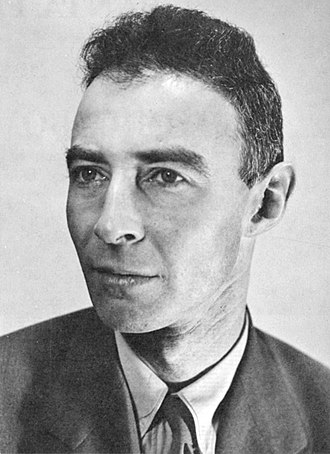
Name: Julius Robert Oppenheimer
Achievements: Director of the Los Alamos laboratory during development of the atomic bomb.
Born: April 22, 1904; New York, NY
Died: February 18, 1967; Princeton, New Jersey (Aged 62)
Field & Discipline: Science; Physics; Nuclear physicist
Language: English
Father: Julius Oppenheimer
Mother: Ella Friedman
Siblings: Frank
Spouse: Katherine Puening Harrison
Children: Katherine; Peter
Education: Ethical Culture School, New York City; Harvard University
Major Work:
"Letters and Recollections"
Life & Times:
In 1925 physicist [studied under] J.J. Thomson* at the Cambridge University Cavendish Laboratory, accepted him Oppenheimer as a research student. During the few months he worked there, he submitted two papers for publication, on the strength of which he was invited in 1926 to the University of Gottingen by German physicist [invited by] Born 2*, where he met other prominent physicists, such as [met] Bohr* of Denmark.
Oppenheimer received his doctorate from Gottingen in March, 1927, then stayed briefly at science centers in Leyden, Holland, where he worked with Paul Ehrenfest, and Zurich, Switzerland, where he worked with another distinguished physicist, [worked with] Pauli*. In 1928, he demonstrated that when electrons were excited by a weak electric field, they could "tunnel" their way through the electrostatic forces that bound them to a nucleus. By 1929, his work in Europe had brought him the offer of two teaching posts in the United States -- at the University of California at Berkeley, and at the California Institute of Technology (CalTech) in Pasadena. He accepted both posts.
In 1935, he discovered that it was possible to accelerate deuterons, made up of a proton and a neutron, to much higher energies than neutrons alone. As a consequence, deuterons could be used to bombard positively charged atomic nuclei at high energies, enabling further research into atomic particles.
In the early 40s, Oppenheimer began to sever ties with many leftist friends and organizations, partly because of Soviet leader [influenced by] Stalin’s* oppressive actions and partly in preparation for playing a major role in the development of the atom bomb.
For years, physicists had believed that bombarding the nucleus of certain molecules could result in a chain reaction that would release an extremely large amount of energy. With the onset of the Second World War in 1939, scientists in the United States and Nazi Germany quickly began working on a weapon that could harness this energy: the [atomic bomb.
In 1940-41 at Berkeley’s Radiation Laboratory, under the direction of Ernest Orlando Lawrence, a colleague of Oppenheimer’s, researchers selected uranium as the chemical element most likely to lend itself to nuclear fission for military purposes, although at this time no coordinated effort to design and fabricate an actual atomic weapon had been made.
In early 1942, Lawrence asked Oppenheimer to take charge of the work on fast neutrons and the problem of the bomb, and he started to assemble a team of brilliant theoretical physicists, including [worked with] Teller* and Hans Bethe, both emigres from Nazi Germany.
In August, 1942, the U.S. Army was given charge of the entire atomic bomb mission, which became known as the Manhattan Project. Its director, General Leslie A. Groves, wanted Lawrence to direct the bomb design unit, but Lawrence was indispensable to the incredibly difficult work of separating fissionable uranium from its chemically indistinguishable isotope, so Oppenheimer got the job on the recommendation of Groves. In 1943, Oppenheimer selected the plateau of Los Alamos, near Santa Fe, New Mexico, as the site for the secret work. Eventually, Oppenheimer was in charge of more than 1,500 people.
By mid-1945, a design for the bomb was ready, and a fissionable form of plutonium had been produced to fuel it. On the morning of July 16, 1945, two months after the surrender of Germany, a plutonium bomb, the world’s first nuclear device, was detonated at Alamogordo, New Mexico.
Oppenheimer wrote in his "Letters and Recollections" that the explosion had the "radiance of a thousand suns", but he was also reminded of a foreboding line from the Hindu "Bhagavadgita": "I am become Death, the destroyer of worlds."
Oppenheimer, Lawrence, [collaborated with] Fermi* and Arthur Compton were the four scientists asked by the U.S. government whether they approved the use of the atomic bomb to end the war with Japan. Told that a military invasion of Japan would cost many American lives, while a nuclear attack, even on a "military" target, would kill many Japanese civilians, the panel voted to use the bomb.
Oppenheimer later regretted his decision, saying that the intentional slaughter of civilians in the cities of Hiroshima and Nagasaki had been entirely unnecessary and wrong, and that more effective warning and more limited use would have achieved the purpose with "much less wanton killing".
Opposing any further development of nuclear weapons, Oppenheimer resigned his post at Los Alamos in October, 1945. Nevertheless, he remained an important figure in atomic policy. In 1946, he became chairman of the General Advisory Committee of the Atomic Energy Commission (until 1953), which in October, 1949, opposed the development of the hydrogen bomb, and continued to advocate controls on the development of nuclear power.
In 1947, Oppenheimer became head of the Institute for Advanced Study at Princeton University, New Jersey, and under his direction, the Institute became one of the foremost centers of research in theoretical physics, even though Oppenheimer himself did little research from this time on.
In 1949, with the unexpected explosion of a nuclear device by the Soviet Union, Teller and Lawrence lobbied intensively to develop the hydrogen bomb, and President Harry S. Truman eventually agreed, ignoring the opposition of the Atomic Energy Commission Advisory Committee. Oppenheimer tendered his resignation from the Committee, but Truman refused to accept it.
Oppenheimer resolutely continued his campaign against the proliferation of nuclear weapons, and his frequent and vocal protests began to annoy politicians. In December, 1953 Oppenheimer was informed that his security clearance, which he needed as to have access to classified information, was revoked on suspicion of unpatriotic activities.
A Congressional committee, after many hours of testimony, much of it delivered in Oppenheimer’s favor by leading politicians and scientists, including American physicist [clearance annulled by] Bush*, declared Oppenheimer not guilty of treason, but ruled that his security clearance would not be reinstated. As a result, his contract as adviser to the Atomic Energy Commission was cancelled.
Oppenheimer continued to direct the Institute for Advanced Study. In 1963 President Lyndon B. Johnson formalized Oppenheimer’s reinstatement by presenting him with the prestigious Enrico Fermi Award of the Atomic Energy Commission.
Extra Connections: Worked with [worked with] Neumann*
He knew [knew] Dirac*
His work was influenced by that of [influenced by] Rutherford*
Assessment: A pioneer in the field of quantum mechanics. His research on protons and their relation to electrons led directly to the discovery of a new particle, the positron.
Oneliner: Robert Oppenheimer, director of atom bomb research
Bibliography:
- Branca, Barbara A., "J. Robert Oppenheimer", in Notable Twentieth Century Scientists, ed. Emily J. McMurray, New York & London: Gale Research Inc., 1995.
- Collier’s Encyclopaedia
- Carnes, Mark C., "Oppenheimer, J. Robert", in Dictionary of American National Biography, New York & Oxford: OUP, 1999.
- Dictionary of Scientific Biography.
- Encyclopedia Britannica.
- Rouze, Michel, Robert Oppenheimer: The Man and His Theories, Berkeley, 1965.