Corot
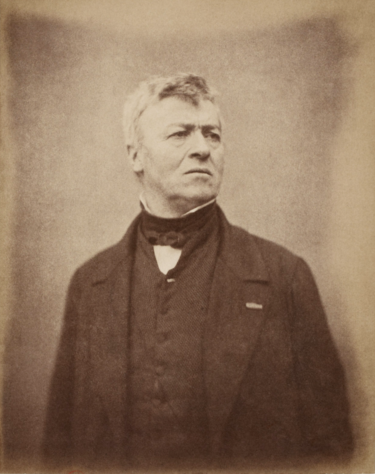
Name: Jean-Baptiste-Camille Corot
Achievements: An important French painter.
Born: July 16, 1786; Paris, France.
Died: February 22, 1875; Paris, France (Aged 89)
Field & Discipline: Art; Painter
Language: French
Father: Louis Jacques
Mother: Marie Francoise Oberson
Siblings: 2 sisters: Victoire; Sister, Name Unknown.
Spouse: None
Children: None
Education: Local school in Paris; College at Rouen and Poissy
Major Work:
"L'Atelier" (c.1865)
Life & Times:
Corot's first pictures were painted on aboard a barge near his home. The greatest influence on Corot’s work came from Pierre Henri Valenciennes, who taught the French classic style, in which landscapes were used only as background to the main subject. Corot worked hard at the classical disciplines he was being taught, but he also showed an interest in the work of the late seventeenth century Dutch naturalists.
In 1825 Corot went to live in Rome, travelling to Tuscany, Campania and Venice. He did not follow the usual route of absorbing the classical masterpieces of antique and Renaissance art. For example, while in Rome he did not go to the Sistine chapel to see Michelangelo's work. He wrote to a friend, not about the glories of the past, but about the difficulty in capturing the way the sunlight fell on his bedroom wall. Corot learned little from the Renaissance masters (though later he cited Leonardo da Vinci as his favorite painter)
He developed his own distinctive and unique use of light. He would not use the artificial shadows and contrasting tones which most contemporaries used to create perspective. Instead, he produced the illusion of space by separating the different elements in the picture, according to their reflected light. This produced a pure, brilliant tone for each separate part of the picture, but the overall effect was harmonious, because he painted only what he saw. He maintained that a painter must respect the light-value of each separate object or part of the picture.
The picture he sent to the Paris Salon of 1827, "Le Pont de Narni", was conventional enough in execution to be exhibited. But by the time he returned to Paris in 1828, though, he was painting in the way for which he is now remembered. After his return to Paris, he regularly travelled away from the city in the spring and summer and painted in the open air, assembling little sketches in oil, sometimes on wood or even cardboard, from which he painted large, fairly orthodox, pictures during the winter months.
When he painted buildings or other man-made objects, Corot applied his own principles about showing different light values. In painting Chartres Cathedral, for example, in 1830, he did not paint Gothic power and mystery. He painted what he saw, even including the hillock which obscured part of the Cathedral.
In 1833, he was awarded a second-class medal for a large landscape of Fontainbleu forest. In moving out of Paris to paint, Corot was part of a developing trend. For the first time, a group of French landscape painters were leaving the centre of art in northern Europe to go and paint in the countryside. Many went to Normandy. Others travelled just outside Paris to the forest. The latter group became known as the school of Barbizon, after a village near Fontainbleu.
In 1834, Corot went to Italy for the second time, and the self-portrait he painted at this time was remarkable for its unconventional simplicity. In his painting of the fortress at Avignon in 1836, the influence of his southern journeys is seen most fully. In 1836, he painted "Diana surprised by Actaeon". In 1840, his "Le Petit Berger" was brought by the French state, and by the time he painted "Homer and the Shepherds" in 1845, he was described by the poet and art critic [a fan was] Baudelaire* as being "at the head of the modern school of landscape".
In 1846, Corot was made a member of the Legion d'Honneur. The following year, he inherited a country home at Ville d'Avray and was now financially secure and also enjoying critical success.
He continued to paint his sketches in the open air, but for his picture the "Nymphs' Dance", in 1851, he invited the corps-de-ballet from the Opera to pose in his studio.
His painting of the "Rue des Saules, Montmartre" is a typical example of his Paris work, showing how carefully he painted the different textures of the stone walls and buildings. He used light to create space but, unlike the Impressionists, did not separate light into its different constituent colors.
In 1855, [taught] Pissarro* became a pupil. Alfred Sisley and [taught] Whistler*, the American-born artist who lived in England, also learned from Corot.
In 1855, Corot was awarded a first-class medal at the Paris Universal Exhibition and the Emperor [bought by] Napoleon III* bought a Corot for his wife, Empress [work owned by] Eugenie*’s apartments. At about this time, discerning collectors were beginning to appreciate his informal oil sketches and buying them.
Corot painted right up into his old age, apparently in good health. "Woman in Blue" was painted in 1874. In 1875, Corot became ill and died in February at his home in Paris. [funeral attended by] van Gogh*, who was greatly influenced by Corot, attended his funeral as a mark of respect.
Extra Connections: He attended the Suisse studio, as did [same studio as] Monet*
In Arthur Conan Doyle’s 1890 novel The Sign of the Four Thaddeus Sholto has an unknown work of Corot on display.
Assessment: Corot's landscape painting and use of light to create space and distance in paintings enhanced the status given to naturalist landscapes and anticipated the work of the Impressionists.
Oneliner: Camille Corot, major French 19th century painter
Bibliography:
- Meynell, Everard, Corot and his Friends, Methuen & Co., London, 1908.
- Thomas, David, Corot, The Medici Society Ltd., London, 1956.