Auden WH
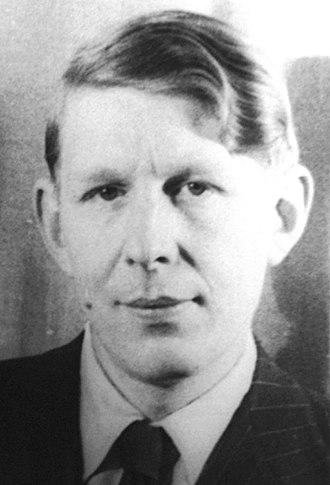
NAME: Auden, Wystan Hugh
ACHIEVEMENT(S): Major modern poet.
NICKNAME/ALIAS: W.H. Auden
DATE AND PLACE OF BIRTH: February 21, 1907, York, Yorkshire, England
DATE/PLACE OF DEATH/AGE AT DEATH: September 29, 1973, Vienna, Austria. Aged 66
DISCIPLINE: Poet
FIELD: Literature
LANGUAGE: English, German
PARENTS: George Augustus Auden; Constance Rosalie Bicknell
SIBLINGS: Bernard; John
SPOUSE: Erika Mann (German author Thomas Mann's daughter)
CHILDREN: None
EDUCATION: St. Edmund's School, Hindhead, Surrey; Gresham's School, Holt,
Norfolk; Christ Church College, Oxford
MAJOR WORK: "Lullaby"; "The Age of Anxiety"; "The Shield of Achilles"
LIFE AND TIMES:
At the age of eight, while his father was serving in the Royal Army Medical Corps in the First World War, Auden was sent to St. Edmund's School in Hindhead, Surrey, where he met his future collaborator, Isherwood* in 1918. When the 18-year-old Auden entered Christ Church College, Oxford, he first studied natural science.
But before long, he switched to English literature, having been tremendously influenced by American poet T.S. Eliot's "The Waste Land". A brilliant and charismatic youth, Auden quickly became part of a literary group, which included poets MacNeice*, and Spender*, and he began to establish a reputation as a poet. In 1928, Spender privately published the first collection of Auden's poems.
As a graduation present in 1928, Auden's parents treated him to a year abroad. Rather than Paris, the mecca of the previous literary generation, Auden chose Berlin. Berlin in the 20s was, for Auden, an exhilarating mix of experimentation in art, music and sexual freedom.
In 1929, Isherwood joined him and the pair lived a carefree, licentious existence. They became enamored of the German language, its poetry, its theater -- especially the plays of Brecht*.
Leaving Isherwood in Berlin, Auden returned to England in the summer of 1929, and spent the next five years as a schoolmaster in Scotland and England. In 1930, his play "Paid on Both Sides" and his collection "Poems" (which included some pieces previously published by Spender) were accepted by T.S. Eliot* for publication by Faber and Faber.
In 1931, while teaching at Larchfield Academy, Hellensborough, Auden worked on a book of poetry and prose, "The Orators",which was published in 1932. His poems, plays and essays often would take a pro-Communist stance, and he began to be considered somewhat of a hero in the eyes of the left.
For the Group Theatre, he wrote "The Dance of Death", a musical propaganda play, and then three plays in collaboration with Isherwood: "The Dog Beneath the Skin" (1935), "The Ascent of F6" (1936); and "On the Frontier" (1938). His next collection of poems "On This Island" (1937), published in Great Britain as "Look, Stranger!", warned of the threat of totalitarianism.
From 1935, Auden worked with the Post Office Film Unit, for which he wrote the commentary for the famous documentary "Night Mail" He became friends with British composer Britten*, who set many of Auden's poems to music. He entered into a marriage with Erika Mann, the eldest daughter of German novelist Mann*, so that she could obtain a British passport and escape from Nazi Germany. This year he also met and became friends with novelist E.M. Forster*.
In 1936, Auden visited Iceland with fellow poet MacNeice and the two collaborated on "Letters from Iceland". The next year, he spent two months in Spain during the civil war. His support for the Republican cause resulted in his poem "Spain". On his return to Britain, he wrote the libretto for Britten's "Ballad of Heroes", and then, in 1938, set off with Isherwood to China to observe the Sino-Japanese war. His verse commentary "Journey to a War" reflects his views of the conflict.
Auden and Isherwood emigrated to the United States together in January, 1939, and settled in New York City. Within a few days of his arrival, Auden met the successful American poet Chester Kallman, who became his lifelong partner. In 1940, Auden moved from an apartment into a house, into which, at various times, he welcomed as guests American novelist Carson McCullers, writers Paul and Jane Bowles, and Spanish artist Dali*.
In 1940, Auden's verse collection "Another Time" was published. It contained many of his most famous poems, including "September 1939" and "Lullaby".
Also in 1940, Auden converted to Anglicanism. His verse collection of that year, "The Double Man" contained the poem "New Year Letter", which embodied his position on religion. Auden's poetry started to become increasingly Christian in tone. His collection of verse "For the Time Being: A Christmas Oratorio" (1944) was dedicated to his devout Catholic mother, who died in 1941. It was published along with "The Sea and the Mirror", a series of dramatic monologues inspired by Shakespeare's "The Tempest".
From 1942 to 1945, Auden was a part-time lecturer in English literature at Swarthmore College. In 1946 he became a U.S. citizen. In 1947, he published the long poem that won him the Pulitzer Prize in 1948, "The Age of Anxiety".
In October, 1947, Russian composer Stravinsky* asked him to write the libretto for an opera: "The Rake's Progress."
Auden was in the habit of spending April to October in Europe. From 1948 to 1957, his summer residence was on the Italian island of Ischia, off Naples. From 1957, he made his summer home in Kirchstetten, Austria. During his vacations, Auden continued to write. His "The Shield of Achilles" (1955), which includes "Horae Canonicae" and "Bucolics", is considered his best single volume of poetry.
In his last years, he spent much time on editing and translating, notably "The Collected Poems of St. John Perse" (1972).
In 1972, Auden moved back to Oxford for the winter months, where he was an honorary fellow at Christ Church College. In September, 1973, having locked up the Kirchstetten house for the winter, Auden was in Vienna with Kallman on his way home to Oxford, when he died of heart failure.
ASSESSMENT: Sometimes his apparent need to express the inner world of fantasy and dream made his poetry bewildering.
EXTRA CONNECTIONS: Received an Oxford honorary doctorate alongside Cocteau*
He knew sculptor Henry Moore*
He met Betjeman* at Oxford
ONELINER: WH Auden, major modern poet
BIBLIOGRAPHY:
EB
Oxford Companion to English Literature
Osborne, Charles, W.H. Auden: The Life of a Poet, London: Macmillan, 1979