Van Gogh
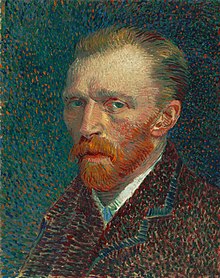
ACHIEVEMENTS: Major artist and influence on the development of modern art
DATE AND PLACE OF BIRTH: March 30, 1853, Zundert, Netherlands
DATE AND PLACE OF DEATH/AGE AT DEATH: July 29, 1890, Auvers-sur-Oise, near Paris. Aged 37
DISCIPLINE: Painter
FIELD: Art
LANGUAGE: Dutch, French, English
PARENTS: Theodorus Van Gogh, pastor; Anna Carbentus
SIBLINGS: Theodore, youngest brother, was a successful art dealer.
SPOUSE: None
CHILDREN: None
EDUCATION: Protestant boarding school, Zevenbergen King Willem 11-State
Secondary School, Tilburg, Belgium; Academy of Brussels; Academy of Antwerp, Belgium
MAJOR WORKS: "The Potato Eaters" 1885; "Portrait of Pere Tanguy" 1888;
"Self-Portrait in Front of an Easel" 1888
LIFE AND TIMES:
At 15 Van Gogh was hired as an apprentice by his uncle, a partner in a firm of art dealers, Goupil & Co., in The Hague. In charge of photograph reproductions, he one day came across photos of paintings by Millet* and was enthralled. In 1873 he was sent to Goupil's in London, to manage the photographic reproduction section. Goupil's sent him to Paris with another promotion, but Van Gogh now saw salon art as irrelevant, and art dealing as useless.
In 1875, he attended the funeral of Corot* as an act of protest. He considered Carot a great nature painter, but felt Carot had been badly used by the Salon, which had offered him the medal of honor only to withdraw it at the last moment. For a short time, Van Gogh became an itinerant lay preacher in England, but it became obvious he was mentally unstable and unsuited to the life. Back in the Netherlands, his uncle again came to the rescue, finding him a job with a bookseller in Dordrecht, which Van Gogh took up in early 1877, at age 24. He studied theology in Amsterdam briefly, then studied with Evangelists in Brussels, but they dismissed him after three months. He was taken on as a missionary in Borinage, a coal-mining area in Belgium. During this time, he read the social novels of Dickens* and Hugo*, which exactly suited his mood.
He next studied drawing at the Academy in Brussels and in 1881 went home to draw the countryside. He moved to The Hague at the end of the year, meeting other artists and studying works in the museums. In 1882, he began to paint in oils and then discovered the works of Zola*. At the end of 1883, he went to Drenthe, a remote part of northern Netherlands. After three months, loneliness drove him back to his father's parsonage. Over the next two years, Van Gogh drew and painted landscapes, figures and still-life, all related to the peasantry. In 1885, he read Zola's "Germinal", a novel depicting the grim reality of life in a coal-mining region, and was greatly impressed. Like Zola, Van Gogh's work implied a criticism of the social order. For example, his famous painting of "The Potato Eaters" shows a family eating from a common dish of potatoes.
After a day in the new Rijksmuseum in Amsterdam examining Rembrandt's "The Jewish Bride", Van Gogh decided he must master the use of color. He later said that as he sat in the museum, he had also thought of Paul Rubens* and his use of color. He enrolled at the Academy in Antwerp, where the greatest numbers of Rubens's paintings were. He also discovered Japanese prints. He savored the art for its "liberating power of color."
Van Gogh persuaded his brother Theo to let him come to Paris to work at Cormon's* studio. Through Theo, he met the French artists who were revolutionizing art: Toulouse-Lautrec*, Gauguin*, Seurat* and others. By chance, he met Pissarro* in the street and immediately brought out his own canvases, propped them up against a wall, and begged for advice. Pissarro ignored the passers-by and discussed Van Gogh's art with him, saying it was impossible to create light with white paint. Theo enrolled him in Cormon's studio. Cormon was more open-minded than most traditional teachers and also much admired as a colorist. A contemporary commented that Van Gogh piled on the oils in a way that was shocking to even the most sophisticated eye. By 1888, he had found his post-Impressionist style and painted the masterpieces: "Portrait of Pere Tanquy" and "Self-Portrait in Front of an Easel".
At the beginning of 1888, he left Paris for southern France, saying he wanted "to look at nature under a brighter sky". In Arles, he painted landscapes, portraits, interiors and his renowned sunflowers. He painted quickly and intensely. He came up with the idea of establishing a community of like-minded artists. Believing Gauguin and Toulouse-Lautrec would share his dream, he rented a house and prepared it for a community of "Impressionists of the South". He had great regard for Gauguin's Martinique work and his forceful personality.
But after Gauguin arrived, it became clear they were not like-minded. They could not even share the same house amicably. Aware that Gauguin was preparing to leave, Van Gogh became agitated and mentally unstable. On Christmas Eve, Gauguin discovered that Van Gogh had cut off part of his left ear. Fearing he no longer would be able to paint, and seeing art as he only way to retain his sanity, Van Gogh committed himself to an asylum at St.-Remy-de-Provence in April, 1889.
After a year, he yearned to see Theo and the north again discharged himself. Back in Paris, Van Gogh stayed with Paul-Ferdinand-Gachet, a homeopathic doctor, artist and friend of Pissarro. Gachet lived in Auvers-sur-Oise, a small village. At first this seemed to soothe Van Gogh. His paintings of the period seem calmer. He painted cornfields, the church, and the river valley in a less contorted way and with less violent use of color. But the serenity did not last and he quarreled with Gachet. Devastated that he would once again be a burden on Theo, lonely, and convinced he would never be cured, Van Gogh shot himself on July, 27, 1890. He died two days later.
ASSESSMENT: The greatest Dutch painter after Rembrandt and one of the greatest of the post-Impressionist painters.
EXTRA CONNECTIONS: Degas* and Mondrian* and sculptor Henry Moore*.
Matisse* bought his work.
Sickert* criticised his work.
ONELINER: Vincent Van Gogh, major precursor of modern art
BIBLIOGRAPHY:
Sweetman, David, The Love of Many Things, Hodder & Stoughton, London, 1990