leukemia cancer 3
---
MERRI OK
see kid killers
NANCY BECK ACC REV DOOR 2X
PRUITT WHEELER WEHRUM
see API KOCH BP
---
5 26 Jennie child took extract before chemo?
---
ggl 5 26
AI Overview
PFAS ("forever chemicals") are synthetic compounds that take centuries to degrade, accumulating in the body and the environment. Health organizations formally classify certain types, like PFOA, as known human carcinogens. Prolonged exposure is scientifically linked to significantly increased risks of specific cancers. [1, 2, 3, 4, 5]
Primary Cancer Links
According to the National Cancer Institute and extensive research, PFAS exposure is primarily associated with:
- Kidney & Testicular Cancers: The strongest established links in human studies.
- Hormone-Related Cancers: Elevated odds of ovarian and uterine cancers, particularly observed in women.
- Liver & Digestive Cancers: Rising evidence connects water contamination to mouth, throat, and digestive tract cancers.
- Childhood Leukemia: Early exposure has been linked to increased risk of acute lymphoblastic leukemia. [1, 2, 3, 4, 5]
- ...
Researchers suggest that PFAS act as endocrine disruptors. They interfere with hormone functions, alter reproductive and metabolic systems, and can damage DNA. Because they resist natural degradation, continuous low-dose exposure can lead to years of cellular damage. [1, 2, 3, 4, 5]
Common Exposure Sources
You can encounter PFAS in everyday products and environments:
- Drinking Water: Estimated to be in nearly 45% of U.S. public tap water supplies.
- Household Items: Nonstick cookware, stain-resistant fabrics, cosmetics, and fast-food packaging.
- Workplace: Firefighting foams and protective gear contain high levels. [1, 2, 3, 4]
---
http://web.archive.org/web/20180705200611/https://publicintegrity.org/2014/12/04/16320/benzene-and-worker-cancers-american-tragedy
...In 1997, the NCI published a landmark study on benzene-exposed workers in Shanghai. The results reinforced past research showing the chemical causes leukemia, said Richard Hayes, a former NCI epidemiologist and the study’s lead author, but “what moved the science forward” were two findings: That workers with chronic benzene exposures had an increased risk of developing MDS and non-Hodgkin’s lymphoma — i.e., diseases other than leukemia— and that such effects could be triggered by doses of the chemical as low as the OSHA limit
==
---
series?
no lnx
Internal documents reveal industry 'pattern of behavior' on toxic chemicals
Benzene and worker cancers: 'An American tragedy'
A dozen dirty documents
New battlefront for petrochemical industry: benzene and childhood leukemia
no lnx 12/14
aTHENS, Georgia — It was December 29, 1998, six years after Jill McElheney and her family had moved next to a cluster of 12 petroleum storage tanks. Jill was escorting her son Jarrett, then 4, to the doctor again. He had spent the day slumped in a stroller, looking so pale and fatigued that a stranger stopped her to ask if he was all right.
It was an encounter Jill couldn’t shake. For the previous three months, she had noticed her once-energetic preschooler deteriorating. He complained of pain in his knee, which grew excruciating. It migrated to his shoulder and then his leg. His shins swelled, as did his temples. At night, Jarrett awoke drenched in sweat, screaming from spasms. Jill took him to a pediatrician and an infectious-disease specialist. A rheumatologist diagnosed him with anemia.
Now, as Jarrett lay listless, Jill found herself back at the pediatrician’s office. Tests confirmed a blood count so low that she was instructed to get him to an emergency room immediately. Within hours she was at a hospital in Atlanta, some 65 miles from her home in Athens, watching nurses rush in and out of Jarrett’s room. Doctors identified a common form of childhood leukemia. “I heard the words,” Jill recalled, “and I only knew the bald heads and the sadness.”
In the waiting room, family members heard more unsettling news: A neighbor’s child also had developed leukemia.
Days later, Jarrett’s doctor penned a letter to federal environmental regulators about the two cancer patients, highlighting their “close proximity” to Southeast Terminals, a group of 10,000-gallon tanks containing gasoline, diesel and fuel oil.
“Could you please investigate,” the doctor wrote, “whether high levels of chemicals could have contaminated the water, possibly contributing … to the development of leukemia?”
Only then did the McElheneys consider the possibility that living beside one of the nation’s 1,500 bulk-oil terminals — known sources of cancer-causing benzene — had triggered their son’s leukemia.
“It was one of those light-bulb moments for us,” said Jeff McElheney, Jarrett’s father. “You never get over it.”
[Benzene and worker cancers: 'An American tragedy'
By Kristen Lombardi December 4, 2014
Internal documents reveal industry 'pattern of behavior' on toxic chemicals
By David Heath and Jim Morris December 4, 2014]
New battlefront for industry
Jarrett McElheney does not represent the standard benzene plaintiff. He’s not among the hundreds of thousands of people who toil in American oil refineries or other workplaces contaminated with the chemical and run the risk of developing leukemia. In the rancorous world of toxic-tort litigation, he stands virtually alone. A lawsuit filed by his parents in 2011 against Southeast Terminals owners BPand TransMontaigne is among a relatively few alleging leukemia caused by environmental benzene exposure. Among these, the McElheney case is rarer still: Most have hinged on adult leukemia.
Yet the case may signal an emerging quandary for the petrochemical industry, according to tens of thousands of pages of previously secret documents that have come to light in lawsuits filed against benzene manufacturers and suppliers on behalf of those who suffered from leukemia and other blood diseases, including Jarrett McElheney.
Internal memorandums, emails, letters and meeting minutes obtained by the Center for Public Integrity over the past year suggest that BP and four other major petrochemical companies, coordinated by their trade association, the American Petroleum Institute, spent at least $36 million on research “designed to protect member company interests,” as one 2000 API summary put it. Many of the documents chronicle a systematic attempt by the petrochemical industry to influence the science linking benzene to cancer. Others attest to the industry’s longstanding interest in topics such as childhood leukemia.
"It’s in the industry’s economic interests to refuse to acknowledge the relationship between benzene and childhood leukemia."
- Peter Infante, former director of health standard reviews at the Occupational Safety and Health Administration
“A number of publications in the last few years have attempted to link increased risks of childhood leukemia with proximity to both petroleum facilities and local traffic density,” another 2000 API memo warns. “Although these publications have had little impact to date, the emphasis on ‘Children’s Health’ may cause these concerns to resurface.”
“This is indeed a battlefront for the oil industry,” said Peter Infante, a former director of the office that reviews health standards at the Occupational Safety and Health Administration, who has studied benzene for 40 years and now testifies for plaintiffs in benzene litigation. He has worked on a handful of cases involving children sickened by leukemia.
“It’s in the industry’s economic interests to refuse to acknowledge the relationship between benzene and childhood leukemia,” Infante said.
In May, in a sign of the chemical’s continuing threat, the U.S. Environmental Protection Agency estimated that 5 million Americans — excluding workers — face heightened cancer risks from benzene and 68 other carcinogens spewed into the air by the nation’s 149 oil refineries. The EPA has proposed a rule that would require refinery operators to monitor for benzene, in particular, along their fence lines.
Where are the nation's oil refineries?
[The Environmental Protection Agency estimates that 5 million Americans — not counting those with workplace exposures — face heightened cancer risks from benzene and 68 other carcinogens spewed into the air by the nation’s 149 oil refineries. It has proposed a rule that would require refinery operators to monitor for benzene, in particular, along their fence lines.
Source: U.S. Energy Information Administration]
Aimed at curbing “fugitive” emissions from equipment leaks and similar releases, the proposal would set a fence line limit for benzene of 3 parts per billion — a fraction of the 10 ppb the agency recommends as the maximum chronic exposure level for the chemical.
Industry groups are pushing back. In written comments, the API’s Matthew Todd called the proposal “a major and significant Agency action [that] will dramatically increase the paperwork and recordkeeping burden on refineries. It includes several precedent-setting proposals, will cost our industry hundreds of millions of dollars per year, increase safety risk [and] may impact fuels production and cost …. Production outages will likely occur.”
The EPA also heard from the people the rule is designed to protect. “We live near a refinery, and as a result my son can’t breathe,” a woman from Fontana, California, wrote in Spanish. “My cousin had respiratory problems while living near a refinery for more than 10 years,” a woman from Houston wrote, also in Spanish. “Unfortunately, he died 2 years ago from bone cancer. We believe this was a result of the ambient air where he lived.”
In June, California officials lowered the long-term exposure level for benzene from 20 ppb to 1 ppb — among the lowest in the country— setting the stage for further emissions cuts at refineries and bulk-oil terminals in that state. Officials say such regulatory actions aim to protect children, who are more susceptible to benzene’s toxic effects than adults because their cells aren’t as developed. California is considering classifying benzene not just as a human carcinogen, but as a “toxic air contaminant which may disproportionately impact children.”
“The fact that benzene impacts the blood-forming organs when you’re a developing child is a big deal,” said Melanie Marty of the state’s Office of Environmental Health Hazard Assessment.
"It's not like Cancer Alley, with smokestacks belching crap in your face. It's hidden — literally."
- Jill McElheney
Hidden menace
Jill McElheney agrees. A warm, garrulous mother of five who has schooled herself in the health effects of pollution, she has spent the past 16 years seeking the cause of her son’s leukemia. She has filed open-records requests and contacted state and federal agencies, piecing together a history of gasoline spills and diesel-fuel leaks at Southeast Terminals. She can cite endless details about lingering benzene contamination on terminal property — extensively catalogued in state enforcement files — located “a stone’s throw away” from the trailer park where her family lived for seven years.
[pix Jeff, Jarrett and Jill McElheney stand in the former site of the Oakwood Mobile Home Park, where the family was living when Jarrett was diagnosed with a form of childhood leukemia. Phil Skinner for the Center for Public Integrity]
Now vacant and overgrown with brush, the former site of the Oakwood Mobile Home Park lies across a residential street from Southeast Terminals, its tanks rising above a thicket of pines and oaks. All day, every day, trucks drive in and out of the facility’s gates, filling tankers with gasoline and other products.
What can’t be seen is the plume of benzene that has worked its way into the groundwater beneath the tanks. “It’s not like Cancer Alley, with smokestacks belching crap in your face,” Jill said. “It’s hidden — literally.”
When she and Jeff moved to Oakwood in 1992, they saw the 14-trailer community as something of an oasis — quiet, tight-knit. Nestled under shady trees, near churches and schools, it seemed like the perfect location. Even the park’s water supply, drawn from an unpermitted well dating back decades, appeared idyllic: Its pump house served as a beacon on park property, visible for all to see — including, court depositions later confirmed, terminal employees.
“We saw Oakwood as an opportunity,” recalled Jeff, a mustachioed, genial man who operates a roofing company and managed the park for his father, its previous owner.
Jarrett McElheney, center, with 3 of his 4 siblings. Courtesy of the McElheney family]
Jarrett arrived two years later and, by his fourth birthday, had grown into an adventurous boy with an abiding love of water. His parents remember him splashing in the tub for hours. Often, he swam in an inflatable pool in their yard, dressed in what he called his “little blue [wet] suit.” He slurped on Kool Aid and popsicles made from well water whose purity his parents never questioned — until his 1998 diagnosis of acute lymphocytic leukemia, or ALL, a form of the blood cancer found overwhelmingly in children.
Within days of hearing the news, Jarrett’s parents tested their water. Samples from the Oakwood well revealed a brew of such chemicals as carbon tetrachloride and 1,2-dichloroethane, sparking a state investigation. The Georgia Environmental Protection Division (EPD) found benzene in the water of Oakwood’s well at levels up to 13 ppb — 26 times higher than the federal safety standard. In response, the agency shuttered the well and connected residents to public water.
Over the next year, state geologists worked to identify the contamination’s source. They dug monitoring wells and collected soil samples. Their initial investigation linked at least one pollutant in the park well — not benzene — to nearby abandoned grain silos. Geologists eventually eyed Southeast Terminals as a likely source of the benzene contamination, records show.
“The terminals are certainly suspects for the benzene detected in the [Oakwood] well,” one posited in a 2000 email. “The probable path is deep ground water.”
Another noted the presence of “a possible plume (with benzene) moving by Oakwood … and within a few hundred feet of the [park]’s former well, [thus] too close for comfort for a public-water supply well.”
Two years later, EPD investigators were still documenting high levels of benzene, ranging from 8,000 to 12,000 ppb, on terminal property — as well as the likelihood that, one 2002 EPD memorandum states, “the benzene contamination found in the trailer park well came from the Southeast Terminals.”
Ultimately, though, the state’s two-year, nearly $200,000 investigation yielded few answers. By 2008, groundwater monitoring results revealed only trace amounts of benzene at Oakwood. Today, EPD officials say they lack definitive proof tying the well’s benzene pollution to any source.
For Jill McElheney, the outcome of the inquiry was anything but satisfying. “It just seems to me that when you’ve got benzene in a well and a major source of it next door, you’d make the connection,” she said.
In fact, Jill already had been seeking answers elsewhere. In 2000, she turned to the federal Agency for Toxic Substances and Disease Registry, or ATSDR, petitioning it for a public health assessment. Instead, the agency launched a less-thorough public health consultation, meant to ascertain the risk to human health posed by the contaminated well water at Oakwood.
The results brought little clarity. In a 2001 report, the ATSDR determined that “the groundwater contaminant plume” initially sampled in the Oakwood well “is a public health hazard.” At the same time, it singled out a pollutant other than benzene as the threat. For benzene, the agency found that “the likelihood someone would get cancer as a result of their exposure is very low.”
In a 2000 draft filed with the state, however, the ATSDR concluded that the highest concentrations of benzene in the water were of concern. “This risk DOES exceed an acceptable risk level,” the draft states, “and may result in an elevated risk of cancer for exposed individuals.”
An ASTDR spokeswoman did not respond to requests for comment.
Mounting evidence on benzene and leukemia
The science linking benzene to cancer — particularly leukemia, in all its forms — has preoccupied the petrochemical industry for more than half a century. As far back as 1948, the API’s toxicological profile of the chemical discussed “reasonably well documented instances of the development of leukemia as a result of chronic benzene exposure,” cautioning that “the only absolutely safe concentration … is zero.”
Later, as scientific evidence of benzene’s hazards accumulated and regulatory limits on workplace and environmental levels tightened, the industry took a different stance. By 1990, the API and member companies such as BP, Chevron, Mobil and Shell had launched a research program meant to keep further restrictions at bay — or, minutes from an API meeting in 1992 state, research “that will be most useful in improving risk assessment and influencing regulation.”
Within months, the API task force overseeing the program was enumerating “developing issues.” Topping its list, according to minutes from a meeting in 1993, was this notation: “link to childhood leukemia?”
That possible link appeared on the industry’s radar again in 2000, documents show. At the time, API representatives were drumming up financial support for an unparalleled study of workers exposed to benzene inShanghai, China, delivering what amounted to a sales pitch for the project. They touted what one 2000 API overview described as its “tremendous economic benefit to the petroleum industry” — helping to combat “onerous regulations” and “litigation costs due to perceptions about the risks of even very low exposures to benzene.” Childhood leukemia was mentioned explicitly.
Five years later, industry representatives grew concerned enough to bankroll their own research. Documents show the API task force approved funding for what minutes of one meeting in 2005 dubbed a “benzene regulatory response,” comprising a “childhood leukemia review” and “child-to-adult sensitivity to benzene” analysis, for a total of $30,000.
By then, the scientific evidence on benzene and leukemia in adults was well-established. Throughout the 1960s and early 1970s, studies of Italian shoe and leather workers indicated a relationship between the chemical and the cancer. Then, in 1977, the National Institute for Occupational Safety and Health, part of the Centers for Disease Control and Prevention, launched a seminal study of two Goodyear plants in Ohio that made Pliofilm, a thin rubber wrap. The research quantified for the first time the leukemia risk for workers exposed to benzene, prompting OSHA to work on a stricter standard that took effect in 1987.
In years since, the science has solidified. Recent research has shown lower and lower levels of the chemical — less than the OSHA limit of 1 part per million — can cause leukemia as well as other blood and bone marrow disorders.
By contrast, experts say, the research on benzene and childhood leukemia isn’t as conclusive. Multiple studies have indicated that children whose mothers were exposed to benzene-containing solvents during pregnancy experience elevated risks of developing the disease. Others have shown that children living near gas stations or highways — breathing in benzene in the air — face heightened risks. One 2008 study reported a significant spike in the rate of the disease in Houston neighborhoods with the highest benzene emissions.
Taken together, the nearly four dozen publications on the topic strongly suggest the carcinogen can cause leukemia as much in children as adults, experts say.
“Children aren’t another species,” said Infante, the former OSHA official who has reviewed the scientific literature for medical associations and governmental agencies. “If benzene causes leukemia in adults, why wouldn’t it cause leukemia in children?”
The scientist behind the API-commissioned analysis would likely disagree. In 2009, David Pyatt, a Colorado toxicologist with long-standing ties to the petrochemical industry, published a journal article about his review, in which he reported examining 236 studies on the relationship between benzene and childhood leukemia. Many of the studies suggesting a link “suffer from the same limitations,” he concluded, such as poorly quantified exposure estimates.
“At this point,” Pyatt wrote, “there is insufficient epidemiologic support for an association or causal connection between environmental benzene exposure … and the development of childhood [leukemia].”
Some say the review reflects a common industry tactic: Compile studies on a subject, and then shed doubt on each one by claiming the data aren’t good enough.
Pyatt did not respond to repeated emails and phone calls from the Center seeking comment; nor did the API.
In depositions, Pyatt acknowledged that he has never testified for a plaintiff in a benzene exposure case. He has worked as a consultant and defense expert for such petrochemical giants as BP, ConocoPhillips, ExxonMobil and Shell, he has said; the API has financed additional work of his on benzene, as has the American Chemistry Council, the chemical industry’s main lobby.
In a deposition taken last year, Pyatt said he wouldn’t discount benzene’s link to childhood leukemia — at least, not to acute myeloid leukemia, or AML, a type rarely found in children.
“There is no reason to think that [children] are going to be protected,” he testified. “So I would certainly think that a child can develop AML if they are exposed to enough benzene.”
In other depositions, Pyatt has conceded no link between benzene and ALL, the type that attacked Jarrett McElheney.
‘They have to stop this practice’
For the McElheneys, the extent of the benzene contamination from Southeast Terminals only came to light years after Jarrett’s chemotherapy regimen had beaten back his leukemia. Yet state and federal enforcement records pinpoint on-site releases of the chemical in 1991, a year before the family moved to the area. At the time, managers of the terminal — jointly owned and operated by BP and Unocal Corp. — discovered a leak of diesel fuel seeping through soil where an underground pipeline was buried.
Terminal employees removed 40 cubic yards of “petroleum contaminated soils,” according to a report filed by BP with the state,and recorded benzene on site at levels as high as 81 ppb. Groundwater samples showed even higher concentrations: 12,000 ppb.
State regulators found such pollution “exceeds our ‘trigger’ levels,” a 1991 letter to the company states, and requested further action.
Under Georgia law, the company was required to develop what the EPD calls a “corrective action plan,” which, among other things, would have delineated the terminal’s benzene plume, as well as identified nearby public water wells.
In a 1991 reply, BP promised the EPD it would file its plan in four months.
Nine years later — after the McElheneys had tested their well water and the EPD had issued a 2000 citation against BP for failing to submit a “timely” corrective action plan — the company finally carried out that requirement, records show.
BP, in charge of the terminal’s daily operations, declined to comment for this article. At different times, Unocal, Louis Dreyfus Energy and TransMontaigne have been BP’s partners at the site. TransMontaigne, its current partner, did not respond to repeated emails and phone calls. TransMontaigne purchased Louis Dreyfus Energy in 1998. Chevron, which merged with Unocal in 2005, declined to comment.
Today, state regulators attribute their own delay in cracking down on the diesel leak to an internal debate over which EPD division had authority over the terminal’s benzene contamination — its underground storage tank program, which has purview over the pipeline; or, its hazardous waste branch. For years, compliance officers in that branch, along with their counterparts at the EPA, had been monitoring the facility’s practice of dumping benzene-laced wastewater on site — a practice later confirmed by terminal employees in court depositions.
In 1990, the EPA issued new rules classifying benzene as hazardous waste and requiring bulk-oil terminals to have permits for discharging the “bottoms water” in petroleum tanks. This wastewater can become tainted by the chemical when mixed with gasoline. Rather than treat the water, Southeast Terminals funneled it through an “oil/water separator” to skim off fuel, and then dumped it into a ditch on the ground.
Company records at the time show that terminal supervisors admitted they drained the wastewater “direct into streams” or “a dike area which eventually drains offsite into a stream.”
“I remember thinking, ‘They have to stop this practice,’” said John Williams, an EPD environmental specialist who inspected the terminal in 1993 and documented the dumping.
Three months later, the EPD issued a notice of violation against Southeast Terminals, forcing supervisors to test the bottoms water. Regulators found benzene at levels four times greater than the legal limit of 0.5 ppb, prompting the EPA to take action.
“We saw an issue there,” said Darryl Hines, of the EPA’s regional office in Atlanta, explaining why officials initiated a 1997 civil enforcement action against the facility.
In its complaint, the EPA accused BP and then-partner Louis Dreyfus Energy of violating federal hazardous-waste law — disposing waste without a permit, and failing to categorize it as hazardous. The agency ordered the companies to shut down the oil/water separator, and implement a plan addressing “any groundwater contamination.”
By the time Jarrett developed leukemia a year later, the EPA had negotiated a settlement with the companies and laid out a series of requirements for cleaning up the benzene. Without admitting fault, BP and Louis Dreyfus agreed to spend at least $100,000 to remove leaking underground pipelines and install above-ground infrastructure. They also paid a penalty of $15,000.
When BP finally filed its long-delayed action plan, it revealed the presence of what EPD project officer Calvin Jones described as a “dissolved hydrocarbon” plume containing benzene — “a bigger problem than we had thought.” The chemical, concentrated at 500 ppb and counting, had spread beyond the immediate spill areas. Of greater concern to regulators, the plan identified “free product” in groundwater.
“There was actually gasoline floating on the water,” explained Jones, of the EPD’s underground storage tank program, who oversaw the facility’s protracted cleanup. Referring to gasoline’s ability to dissolve in water, he said, “You can’t get higher concentrations of benzene … than free product.”
Despite a decade-long cleanup — 35.2 million gallons of contaminated groundwater and1,009 pounds of benzene were collected— the chemical still saturates much of the nearly 19-acre Southeast Terminals site, records show. Last year, the EPD issued a letter declaring “no further action required,” which released the companies from remediation. At the time, the state-sanctioned benzene count remained at 1,440 ppb.
Over the years, enforcement records show, company consultants and regulators alike have tried to trace the path of the wastewater at the terminal. One company analysis details a trail beginning at the property line and then spilling into adjacent woods before hitting a tributary. Another document, produced by the EPA, depicts the discharge as moving offsite through woods and into a resident’s backyard.
“It’s where the drainage flows,” said Jeffrey Pallas, deputy director of the agency’s hazardous waste division in Atlanta, who oversaw the case against BP and Louis Dreyfus, explaining that the document, complete with photographs, was only intended to verify the hazardous-waste law violations.
“We cannot substantiate from the documentation we have that the benzene left the site,” he said.
Exposed: Decades of denial on poisons
Seeking accountability
The McElheneys have seen the evidence they need to connect Southeast Terminals to the benzene in the Oakwood well — and Jarrett’s suffering. They believe all the state and federal enforcement actions have yielded few consequences for the facility’s owners. If Jarrett hadn’t gotten sick, they say, they might never have known about the benzene hazard. “The companies would have paid off their small fines,” Jill said, “and nobody would have been the wiser.”
Seeking some accountability, the family filed a lawsuit three years ago against BP, TransMontaigne and seven other previous owners, alleging that the “illegal discharge and release of toxic chemicals” at Southeast Terminals contaminated the surrounding environment and caused Jarrett to develop leukemia.
In court filings, the companies denied the allegations and dismissed any link between benzene and childhood leukemia. Last year, defense lawyers invoked a familiar tactic: They cited the Pyatt review to support their claims that the chemical couldn’t have caused Jarrett’s illness. The family recently has agreed on a settlement in principle and is working toward resolving the litigation.
“I thought, ‘This is par for the course,’” said Jill, who has read some of the industry documents uncovered by the lawsuit. “The oil industry has fought regulations and lawsuits for workers and adults. Now they’re going to do it with children.”
Jarrett is now a slight, reserved 20-year-old in remission. He remembers his bout with leukemia through a child’s eyes — the “really cool” ambulance rides, the nurses with coloring books, swinging golf clubs in hospital hallways. “I remember being stuck over and over again by needles” while getting a bone-marrow aspiration or a chest catheter or countless blood draws, he said. “But it wasn’t until much later I realized what happened to me didn’t happen to other kids.”
Today, he has had to grapple with cancer’s lasting effects — the feebleness, and the fatigue — as well as its lingering fears. As a leukemia survivor, he is at risk for developing osteoporosis, cataracts, or even another cancer. Sitting in an Olive Garden in Athens, sandwiched between his parents, Jarrett came across as exceedingly shy, uncomfortable in the limelight. Often, his parents did the speaking for him.
Moments earlier, Jill had explained how leukemia had changed her son, taken an emotional toll.
“He had a really loud voice as a toddler but that voice has mellowed,” she said. “I’ll take that voice over anything.”
Maryam Jameel contributed to this story.
More stories about
Carcinogens, Occupational safety and health, Benzene, Mutagens, Petrochemicals, Leukemia, Childhood leukemia, National Petrochemical Company, Jarrett McElheney, Jill McElheney
---
---
https://theintercept.com/2020/01/12/cancer-trump-administration-epa-carcinogens-regulations/
the war on the war on cancer
no pix no lnx many no graf
Sharon Lerner
January 12 2020,
WHEN ANGELA RAMIREZ was 38, she felt a slight pain in her chest. At first she thought she had pulled a muscle, but when it didn’t go away, Ramirez went to her doctor, who diagnosed her with stage 2 breast cancer. A mother of three and a parent educator in a local public school in Lake County, Illinois, Ramirez had to undergo a double mastectomy, chemotherapy, radiation, and five follow-up surgeries.
Eight years since the diagnosis, her family is still recovering. Because of complications, Ramirez is awaiting several more reconstructive surgeries. Her daughter Ada, now 15, was recently diagnosed with PTSD, in part, Ramirez thinks, because she spent much of her childhood worrying that her mother wouldn’t survive. And her husband is working 80 hours a week to cover medical expenses and lost income. “Cancer changes your whole life,” she said recently.
Ramirez used to think of her ordeal as random bad luck — an inexplicable series of genetic mutations that just happened to derail her life. But that changed in 2018, after she learned that she both lived and worked near two facilities that were emitting a cancer-causing chemical called ethylene oxide.
Two years earlier, the Environmental Protection Agency released an assessment of ethylene oxide performed by a small division of the agency known as IRIS, which crunched numbers showing that exposure to ethylene oxide caused elevated rates of tumors in the brain, lungs, uterus, and lymph systems. The technical report from IRIS, which stands for the Integrated Risk Information System, changed the classification of ethylene oxide, an odorless gas used to make other chemicals and sterilize medical equipment, from probably carcinogenic to plainly carcinogenic to humans. Based in part on several studies showing that female workers exposed to ethylene oxide had higher breast cancer rates, the report calculated a safety threshold that was 30 times more sensitive than previous estimates. Combined with agency data about local emissions, the new threshold allowed the EPA Office of Air and Radiation to identify the census tracts where residents were at increased risk of cancer from breathing ethylene oxide.
As Ramirez could plainly see on the EPA’s interactive map, the cancer risk was elevated both where she lived and, even more extremely, at the office where she worked for several years before her diagnosis, which was less than a mile from one factory that emitted the carcinogenic gas and less than three miles from another. The news was like a missing puzzle piece. “I had always found it kind of strange that I was the only one in my family who ever had cancer,” said Ramirez, who had moved to the suburbs from Chicago in 2005 in part because she wanted to be closer to nature.
Ramirez still suffers from chronic back pain and weakness. But the realization that her cancer may have resulted from emissions from the local factories has caused a different kind of suffering. “Every time I open the windows I think about it now,” she said. “I’m so angry. My kids at 2nd and 3rd grade shouldn’t have had to wonder whether their mother was going to die.”
Angela Ramirez's neighborhood is seen in this photo. The neighborhood in Waukegan, Ill., is located in a census tract that is at high risk for cancer. Jan. 2, 2020. Pat Nabong for The Intercept.Construction at Medline's facility in Waukegan, Ill. is underway on Jan. 2, 2020. In May 2019, Medline submitted a proposal to build new equipment that would control air pollution, after they came under fire for emitting ethylene oxide, a gas linked to cancer. Pat Nabong for The Intercept.]
Left/Top: The Ramirez's neighborhood in Waukegan, Ill., is part of a census tract that is at high risk for cancer. Right/Bottom: Construction at Medline's facility in Waukegan, Ill. is underway on Jan. 2, 2020. In May 2019, Medline submitted a proposal to build new equipment that would control air pollution, after they came under fire for emitting ethylene oxide.Photos: Pat Nabong for The Intercept]
The chemical industry also reacted strongly to the reports on ethylene oxide. In September 2018, after the National Air Toxics Assessment pinpointed the areas affected by the chemical, the American Chemistry Council, or ACC, a trade group that represents U.S. chemical manufacturers, asked IRIS to change its assessment of ethylene oxide. Dow Chemical, the biggest producer of ethylene oxide in the country and the second biggest in the world, also disputed the EPA’s assessment.
Now, political appointees at the EPA are engaged in what appears to be an end-run around the agency’s own science. While IRIS, which is staffed by career scientists, hasn’t officially backed away from its 2016 report, theTrump EPA recently announced that it would not be calling for the level of pollution reductions IRIS laid out during the previous administration, leaving people around the country more vulnerable to the known carcinogen. And that’s only one of the changes made under the Trump administration that promise to weaken protections for Americans’ health, many of which were intended specifically to stave off cancers.
Virtually no sector of the EPA’s work has escaped reversals that will cause disease and death among the U.S. population. The agency scrapped the Clean Power Plan and a rule to improve fuel efficiency standards for cars, depriving the public of not just the climate benefits but also the improvements to air quality and health both would have brought. The EPA rejected its own science in deciding not to ban chlorpyrifos, a pesticide linked to autism and other neurodevelopmental problems in children. Dozens of other EPA rollbacks — including the gutting of the Clean Water Act, the undermining of guidelines on emissions of methane from landfills, the loosening of restrictions on toxic air pollution from industrial facilities, the disbanding of a panel on air pollution — will have dire health consequences, as will the dramatic reduction in the enforcement of environmental laws.
The erosion of these protections may leave Americans at greater risk of all kinds of health effects, including fertility issues, birth defects, and neurodevelopmental problems — all of which have been linked to chemical exposure. But among the most devastating of Trump’s legacies will be an increase in cancers.
Trump’s Cancer Gang
With the election of Donald Trump, a small and previously marginalized group of toxics apologists suddenly and unexpectedly took control over health and environmental regulations in the United States. Considered too fringe, too craven, and too fact-averse for mainstream politics, this closely connected group had long been dismissed for taking the idea of environmental deregulation well past the point of absurdity. Under Trump, the EPA has begun executing some of these extremists’ schemes to undercut the federal government’s ability to protect the public from life-threatening toxic chemicals.
Way back in 1996, a lawyer named Christopher Horner working for R.J. Reynolds Tobacco Company came up with an ambitious plan to fight back against scientific studies linking cancer to secondhand smoke. Such studies, he realized, were based on the private health data of thousands of individuals. And without that data, scientists would be unable to prove a connection between cigarette smoke and cancer. Imagine if the government required that the data used for regulations be public. If that were the case, none of the crucial private health information used by scientists would be usable. Problem solved!
Horner, who worked at the firm then called Bracewell & Giuliani, recognized that the approach had “global applicability to industry” beyond tobacco and could make it nearly impossible to regulate a wide variety of cancer-causing chemicals and pollution. Within a few years, a group funded by the Koch brothers tried to use the strategy to undermine the Clean Air Act, demanding that researchers produce their data so a pivotal study could be repeated.
That attempt to destroy air pollution protections ultimately failed, and the idea hovered on the sidelines until 2014, when a few Republican House members introduced the “Secret Science Act.” Because most members of Congress recognized the gambit as a bald attempt to subvert science — then-Sen. Barbara Boxer called it “insane,” Sen. Bernie Sanders dismissed it as “laughable” — the bill didn’t come close to becoming law that year or the next, when it was introduced again. Even in mid-2016, the only support for the idea came from the fringe.
But with the election of Donald Trump later that year, the prospects of the “secret science” scheme — and others hatched over the years to help free industry of what it saw as profit-hampering regulations — suddenly became deadly serious. Trump, who had already been dismissive of science, named Horner and others interested in undermining environmental protections to his EPA transition team and then staffed the agency with political appointees who used to work for the industries they would be regulating. In April 2018, then-EPA administrator Scott Pruitt proposed a rule based on the “secret science” plan, and Horner’s wildest dreams of dismantling environmental and health regulations were set to become reality.
Andrew Wheeler, administrator of the U.S. Environmental Protection Agency (EPA), speaks to members of the media after signing the Affordable Clean Energy Rule at EPA headquarters in Washington, D.C., U.S., on Wednesday, June 19, 2019. President Donald Trump is scaling back sweeping Obama-era curbs on greenhouse gas emissions from power plants burning coal, his biggest step yet to fulfill his campaign promise to stop a "war" on the fossil fuel. Photographer: Al Drago/Bloomberg via Getty ImagesEPA administrator Andrew Wheeler, center, speaks to members of the media at EPA headquarters in Washington, D.C., on June 19, 2019. Photo: Al Drago/Bloomberg via Getty Images]
The war on cancer was meant to help banish a disease that by 1970 had become the second-leading cause of death in the United States. The Environmental Protection Agency, created that year, was part of the government’s assault on the rising tide of cancer cases. For some contaminants, such as asbestos and chemicals used in dye-making, the link to cancer was already clear. Scientists were beginning to understand that even tiny amounts of certain chemicals could alter cells, setting off a series of mutations that grow into cancerous tumors. The hope was that the agency could counter increasing cancer rates by limiting environmental exposures.
Yet 50 years after the federal government took up arms against cancer, the disease is still the second-leading cause of death. Even though cigarette smoking, the leading cause of cancer in the 1970s, has declined sharply, the American cancer rate has actually gone up over the past 40 years. Among children, who are particularly vulnerable to environmental exposures, the cancer rate has risen dramatically, increasing nearly 50 percent since 1975.
During that time, environmental exposures have been mounting. More than 140,000 chemicals and pesticides have been introduced since 1950. Even though the vast majority have not been evaluated for safety, 5,000 of them are made in such great quantities practically everyone is exposed to them. Yet most of the government spending on cancer has remained focused on treating the disease rather than preventing cancer by limiting exposure to carcinogens, such as pesticides and other environmental contaminants.
graf:
Left/Top: Federal political contributions by members of the American Chemistry Council,including parent companies and individual employees, 2008 - 2019. Compiled for The Intercept by MapLight. Right/Bottom: Federal political lobbying expenditures by members of the American Chemistry Council, including parent companies and individual employees, 2008 - 2019. Compiled for The Intercept by MapLight.Graphics: Soohee Cho/The Intercept
Since the first major law that attempted to regulate toxic chemicals passed in 1976, chemical companies have spent billions of dollars on lobbying. The member companies of the American Chemistry Council have spent more than $1.4 billion on lobbying and $77.8 million on political contributions since 2008, according to an analysis by MapLight for this story. The ACC by itself has spent $103 million on lobbying. Though staggering, these numbers are a small fraction of the trillions generated by chemical sales over that same period.
Throughout its 50-year existence, the EPA has faced the daunting task of regulating industries that are far better resourced than the agency. But the effort to rein in powerful companies, which has been met with varying degrees of success under previous administrations, has been largely abandoned under Trump. The EPA, now headed by a former coal lobbyist and run by other former lobbyists, executives, and lawyers from polluting industries, has set about undoing health protections, some of which were specifically designed to prevent cancer.
Trump, who recently tried to take credit for a 2017 dip in cancer mortality rates and announced that he would be “curing childhood cancer very shortly,” at a rally in Cincinnati last August, presumably isn’t interested in actively causing disease and death. But his eagerness to please the polluting chemical and fossil fuel industries that support him comes at the expense of American lives.
A Mess in Texas
For ethylene oxide, the chemical that Ramirez was exposed to, the road to deregulation passes through Texas. It was there, in the summer of 2018, that regulators led by state toxicologist Michael Honeycutt began working with the producers of ethylene oxide on their own standard for the chemical.
Honeycutt, who has overseen chemical assessment for the Texas Commission on Environmental Quality since 1996, is known for his extremely industry-friendly approach to chemicals. Until this administration, Honeycutt made his name fighting the EPA, challenging the limits the agency tried to place on emissions of chemicals, particularly those released by the oil and gas industry. He has argued that particulate air pollution, which causes lung cancer and other diseases, can help people live longer. And working with his longtime colleague and fellow toxicologist Michael Dourson, Honeycutt loosened state protections on dozens of chemicals — rollbacks that were encouraged and welcomed by chemical manufacturers. Now, under Trump, Honeycutt’s Texas agency has essentially become a shadow EPA and he has assumed a national role in cancer policy.
The assessment of ethylene oxide that Honeycutt oversaw and the TCEQ released last year no doubt pleased the companies that make the chemical — not least because it appears to have been written by them. In June 2018, before issuing a new safety limit for ethylene oxide, Honeycutt and members of the TCEQ’s toxicology staff met in Austin with Joanna Klapacz, a toxicologist from Dow; Bill Gulledge, a senior director at the American Chemistry Council; and three scientists from Exponent, a consulting company paid by the ACC to help fend off regulation of the chemical, among them two toxicologists named Abby Li and M. Jane Teta. Representatives of Shell, BASF, and Balchem, which together with Dow released more than 200,000 pounds of ethylene oxide over the previous six years, joined the conversation by phone, according to emails of TCEQ staff released in response to a FOIA from the Sierra Club.
Dr. Mike Honeycutt is an Air Toxicologist for the Texas Commission on Environmental Quality, the world's second largest environmental agency. RALPH BARRERA/ AMERICAN-STATESMANTexas state toxicologist Michael Honeycutt. Photo: Ralph Barrera/Austin American-Statesman]
At the meeting, a presentation from the American Chemistry Council recommended adopting estimates of safety thresholds from a paper written by Ciriaco Valdez-Flores, a Texas-based consultant who received funding from both the ACC and the Ethylene Oxide Sterilization Association. The TCEQ had considered — and rejected — the paper in an assessment of ethylene oxide it released less than two years earlier because, it said, Valdez-Flores hadn’t captured all the cancer risk from ethylene oxide. Although an EPA summary of the 2016 IRIS report on ethylene oxide characterized its confidence in the breast cancer data as “particularly high,” and noted that the breast cancer component “is based on over 200 incident cases for which the investigators also had information on other potential breast cancer risk factors,” the Valdez-Flores paper didn’t include the breast cancer studies in its evaluation. And in a presentation to the group, Teta also argued against the inclusion of the breast cancer data.
Gulledge, who manages the ACC’s panel on ethylene oxide, emailed TCEQ toxicologist Jessica Myers after the meeting and offered to draft the assessment of the chemical for the state agency. “Thank you for hosting us this week,” Gulledge wrote. “We are working on several ‘white papers’ on the risk assessment modeling and our alternative approach that should be ready in the next month or so with the goal to have a draft risk assessment manuscript ready shortly thereafter.”
Asked about the email, Tom Flanagin, director of product communications for the American Chemistry Council, denied that the group drafted the risk assessment for the TCEQ. “Mr. Gulledge is referring to a separate, independent effort … for publication in a peer reviewed journal. TCEQ acted independently in preparing their risk assessment.” Flanagin did not explain why Gulledge would be communicating with TCEQ about a purportedly separate, independent effort. Ryan Vise, director of external relations for the TCEQ, also denied that the ACC drafted or edited the state agency’s assessment. Exponent did not respond to requests for comment.
Yet the proposed ethylene oxide standard that TCEQ released this summer included many of the elements that the ACC and its scientific consultants recommended at the Texas meeting. The state agency omitted the breast cancer studies and adopted the paper by Valdez-Flores as its key study, just as the industry scientists had recommended.
And minutes from a meeting of the Ethylene Oxide Sterilization Association held the next month also indicate that the chemical industry, led by Teta and Li, who were both at the Texas meeting, drafted the state’s assessment of the chemical. According to the minutes, first reported by the Chicago Tribune, the assessment, which would provide an alternative to the IRIS ethylene oxide value, was funded and led by the industry groups. “Jane Teta and Abby Li (Exponent) will be leading” the recasting of the assessment to the industry’s liking, the minutes explained, and “TCEQ has indicated its receptiveness to considering an alternative to the IRIS value.”
The result of this collaboration between the ethylene oxide industry and Texas was a proposed standard that was 3,500 times weaker than the IRIS threshold. The Texas number was also 50 times less protective than the standard the state had released only two years earlier. While Texas offered no scientific reason for weakening its 2017 standard, regulatory developments can help explain the oddly timed reassessment: the EPA’s recognition of ethylene oxide as a carcinogen in 2018 had led to public pressure on companies that emit the gas, which had in turn led to the industry group to ask the TCEQ to issue an alternate standard.
Just as the ACC has done, the Texas agency also attempted to justify its new number by arguing that IRIS’s calculations couldn’t be correct because the body produces some ethylene oxide on its own — an idea dismissed by scientists who are not supported by the ethylene oxide industry.
“They make a big deal of endogenous exposure and say that’s why EPA numbers can’t be meaningful,” said Jennifer Jinot, a toxicologist who worked for EPA for 26 years, 12 of which she spent working on the IRIS assessment of ethylene oxide. Jinot described the TCEQ’s focus on purportedly natural levels of the chemical as “disingenuous” and said it was just one of several tricks the state agency used to make the chemical appear safer than it actually is.
“Texas has done something completely unreasonable,” said Jinot. “They’re just low-balling the whole thing.”
In an emailed response to questions, Dow spokesperson Ashley Mendoza acknowledged that Joanna Klapacz attended the 2018 meeting at TCEQ, but noted that “she was not part of the technical presentation.” The email also said that “Dow has continued to improve our [ethylene oxide] emission reduction as part of our own sustainability goals. As science advances, our ongoing collaboration with other manufacturers and multiple agencies continues to ensure maximum human safety while delivering products consumers want and need.”
The TCEQ responded to questions for this piece with an email saying that its assessment of ethylene oxide was “on the side of the best available science.” The email also said that the more protective ethylene oxide standard, which the state agency issued in March 2017, was never intended to be permanent, but instead was “to be used until a thorough multi-year systematic review and dose-response assessment could be conducted under the extensive TCEQ toxicity factor guidelines.”
The proposed safety level could have a dramatic effect on people in Texas, where at least 27 facilities emit more than 48 tons of ethylene oxide every year. At one of these facilities, a Huntsman Petrochemical Plant in Conroe Texas, the EPA estimated the cancer risk due to the release of ethylene oxide and other chemicals to be 3,000 in a million, according to a risk assessment report the agency released in December. Nationwide, the average risk of cancer from air pollution is 32 in a million.
The Texas standard could also weaken protections for people far beyond Texas, since states often consider one another’s regulations when issuing their own. “It could mess with the legal landscape globally,” said Tracey Woodruff, a professor of obstetrics and gynecology at the University of California, San Francisco school of medicine who studies how chemical exposures affect health. “Even if other states don’t adopt Texas’ levels, they tend to average them.”
Scenes from Freeport, Texas on Wednesday, December 18th, 2019. Todd Spoth for The Intercept.Dow Chemical’s plant can be seen just beyond homes in Freeport, Texas, on Dec. 18, 2019. Photo: Todd Spoth for The Intercept]
While Honeycutt was once one of EPA’s main opponents, the Trump administration is now relying on his agency’s industry-biased assessment of ethylene oxide to guide the federal government’s approach to the carcinogen.IRIS spent years calculating its safety threshold for ethylene oxide and noted in its 2016 report that scientists have been studying the chemical’s “DNA-damaging properties” since the 1940s. Yet in early November, the EPA indicated it would not be calling for the reduction of emissions as much as the IRIS report would suggest is necessary. Instead, the EPA’s proposed rule, which it is required to finalize by March, calculated risk levels that were six to nine times weaker than those issued in 2016. An explanatory document released by EPA cited the Texas estimate as well as the request for correction from the American Chemistry Council and attributed its decision to change its safety level to “uncertainties” in the science.
The people who will be affected by the weakening of ethylene oxide protections are disproportionately poor and nonwhite, as the EPA’s own analysis shows. While the U.S. population overall is 12 percent African American, the areas with elevated cancer risks due to ethylene oxide are 21 percent African American, according to the document the agency released in November. Latinos are also at greater risk of exposure, making up 18 percent of the U.S. population and 31 percent of those living in areas with elevated cancer risk due to the chemical.
Those demographics aren’t unusual. While black and Latino people produce less pollution, people of color have a higher burden of pollution and are more likely to live near industrial facilities. Penny Dryden, who grew up near several polluting plants in the Rosegate section of Wilmington, Delaware, was for years unaware of the disparity. Dryden, 62, has had cancer three times. The first, breast cancer, was diagnosed when she was just 19. But this seemed to be a fact of life in her mostly African American neighborhood. Many of her friends and relatives as well as both of her parents had cancer.
In 2018, a facility near Dryden’s home that makes chemicals used in antifreeze and some processed foods released so much ethylene oxide into the air that the nearby Delaware Bridge had to be temporarily shut down. That was a temporary inconvenience to commuters, but for people who live within a three-mile radius of the plant — 52 percent of whom are people of color, and 31 percent of whom are below the poverty level — the chemical poses an ongoing health threat.
Although the cancers have taken a toll, Dryden still considers herself lucky. “Lots of people here have died of it, whole families, so many of my friends,” said Dryden, who has come to recognize and fight against the extra burden of both pollution and disease that are clustered in several communities of color in Delaware. And while she has no experience living in a pollution-free area, she feels certain the people making decisions that affect pollution levels around the country have no idea how it feels to live with polluted air. “The people in D.C. don’t go into communities like ours,” said Dryden. “They probably have never heard of Rosegate.”
For people like Dryden and Ramirez, who live near the facilities around the country — more than 100 — that emit the carcinogenic gas, the weakening of the ethylene oxide standard will result in even greater risks of cancer. “By undermining the way risk assessments are done, Texas has allowed these plants to put out more pollution because it’ll look like it’s safe when it’s not,” said Woodruff, the reproductive health professor. “They’re resetting the bar to allow more pollution going out into the world.”
Children will also disproportionately bear the burden of this additional pollution. As the EPA has pointed out, children may also be especially vulnerable to the mutagenic effects of ethylene oxide — as they are for other carcinogens. Simon Strong came to recognize kids’ particular vulnerability after his son, Oliver, died suddenly in June 2015. An exuberant 12-year-old who played saxophone and tended goal for his soccer team, Oliver was diagnosed with leukemia a week after he complained of his first symptom: a headache. He died just 36 hours later, leaving his parents bereft and filled with questions.
Oliver-1578521871Oliver Strong. Photo: Courtesy of Simon Strong]
“We were there with his oncologist in floods of tears, and I said, ‘What caused this?’ and she just burst out, ‘It’s the environment,’” Strong remembered recently. He had no idea what she meant and had never thought much about cancer before Oliver’s illness. But after his son’s death, Strong, a reporter turned investigator, began researching the causes of pediatric cancer. He read with dismay about the alarming numbers of soccer players, particularly goalies, who have developed cancer; about the connection between cancer and Roundup, a weed killer he had used liberally in the family’s backyard in Florida; and about several pediatric cancer clusters in his home state.
The problem, as he learned, was also worsening. While pediatric cancer rates were increasing overall, there had been a particularly large jump in the number of cases in infants and children under 5. Yet the government seemed to be doing little to understand what was causing these cancers or to prevent them.
So Strong launched a project along with the Baylor College of Medicine to collect information about the environmental exposures of children with cancer from their families. It’s work he wishes the federal government was doing. But as Strong’s urgency about the problem was growing, the Trump administration was going in the opposite direction, unraveling the little work that was being done on the issue.
Indeed, in May, the EPA decided to pull its funding for a network of centers that had researched the effects of various substances, including chemicals, on children. One of those research hubs, the Center for Integrative Research on Childhood Leukemia and the Environment at Berkeley, had found that exposure to pesticides, traffic emissions, tobacco smoke, and solvents are associated with childhood leukemia, the most common children’s cancer. Staff there were continuing to research the environmental causes of the disease and to educate parents and physicians, according to the physician and epidemiologist who directs the center, Catherine Metayer. “There is still so much work to do,” said Metayer. But the center lost the $1.5 million per year it had been receiving from the EPA and the National Institute of Environmental Health Sciences. Barring intervention from Congress, the last of its federal money will be spent by this summer. “After that, our work will have to stop,” she said.
Known Killers
The closure of the pediatric environmental health centers is only one of many backward steps we’ve taken in our decades-long battle against cancer and cancer-causing exposures. The first major one came after the EPA attempted to use the Toxic Substances Control Act to ban asbestos in 1989. The ban was exactly what the EPA and the chemicals law were created to do: protect Americans from a substance that had been known for decades to cause cancer. But after the agency began the process, asbestos mining and manufacturing companies sued. A court struck down most of the government’s ban in 1991 and, since then, the agency has been wary of taking on regulatory battles it might not win. As a result, the EPA has not regulated a single chemical under the law in the almost 30 years after the 1991 ruling.
So, while 67 countries have already banned asbestos, we’re still importing it. And last year, the Trump EPA decided — against the advice of its own scientists — to continue to allow its use.
In a statement, an EPA spokesperson wrote that the agency “along with our state partners, is covering ALL bases under our legal authority to protect people’s health from asbestos exposure.” The spokesperson went on to explain an April 2019 rule that allows the agency to restrict or prohibit the use of products containing asbestos. But she declined to say why the EPA had chosen not to ban the substance altogether, as its own scientists and attorneys had recommended.
While the continued use of asbestos has deadly consequences, causing an estimated 39,000 deaths in the U.S. each year, it is just one of the chemicals the Trump administration is now in a position to greenlight. In 2016, Congress tried to improve our abysmal record on chemicals by fixing the broken Toxic Substances Control Act. The update of the law aimed to bring about greater protections by requiring the EPA to identify and restrict the most dangerous substances.But under Trump, the opposite is happening— and the opportunity to fix chemical regulation, 40 years in the making, has instead turned into another massive step backward. The assessment process, begun in the Obama era, is being carried out by an administration that is friendlier to the chemical industry than any other administration in history.
“There is no daylight between this EPA and what the big chemical companies want,” said Daniel Rosenberg, director of the federal toxics program for the Natural Resources Defense Council, or NRDC. “Whatever the term is for government by corporation, that’s what we’ve been living under for three years.” Lots of small decisions are involved in implementing the new law, including the choice of which chemicals to assess, what sources of information about them to use, and how to quantify the risks they pose. “And these details are all essentially being worked out by companies like Dow and DuPont and Chemours,” said Rosenberg. “It’s the worst-case scenario.”
Asbestos is now one of 10 compounds the EPA began assessing in 2016 under the new law. In August, the EPA announced that it was considering assessing an additional 20 chemicals and added another five in September. How these chemicals are assessed will affect Americans’ exposure levels and ultimately their risks for a range of health outcomes.
Scenes from Freeport, Texas on Wednesday, December 18th, 2019.Todd Spoth for The Intercept.Dow Chemical’s Freeport plant is the largest chemical production facility in the western hemisphere. Photo: Todd Spoth for The Intercept]
Having the Trump administration at the helm during a once-in-a-generation reassessment of toxic pollutants is especially disastrous for the effort to protect Americans from cancer. Of the 35 chemicals the EPA is now scrutinizing under the updated TSCA, 19 are widely considered by researchers to be carcinogenic. While only a tiny exposure can set off disease, more than 135 million pounds of these carcinogens were released in this country between 2014 and 2018, according to the most recent data from the EPA. And how dangerous they are found to be may ultimately impact federal and state limits on their use.
Obama administration officials were scrupulous when they began the assessment process back in 2016. “They clearly said we have to look at all the ways people are exposed because if we ignore even a single pathway, that can result in the difference between acceptable and unacceptable risk,” said Eve Gartner, an attorney who directs the toxics program at Earthjustice. But when Trump appointees came in to replace them at the EPA, that changed. Nancy Beck, who had been trying to convince the EPA to narrow the range of exposures it considered in chemical assessments when she was director of regulatory policy for the American Chemistry Council, joined the EPA in April 2017 and remade the rule exactly as industry wanted it.
Just as the environmental advocates feared, the first of the assessments under Beck’s rule, which were released over the past several months and will likely be finalized within the coming year, have minimized the risks posed by chemicals. “We’re seeing massive exclusions of known pathways for exposure,” said Gartner. “EPA is finding that chemicals that are universally understood to present massive risk are fine.”
Environmental groups, including Earthjustice, NRDC, and the Environmental Defense Fund, sued the EPA, arguing that the agency was wrong to rule out certain pathways of chemical exposures. In November, a federal appeals court agreed with them. If the ruling stands, EPA will be forced to consider exposures to chemicals through uses that have been phased out, which will affect the assessment of asbestos, for example, andPFOA, an industrial contaminant found in drinking water, even though the chemical is no longer used in the U.S.
Excluding consideration of certain exposures is just one of the ways industry insiders at the EPA appear to be underestimating the harms of toxic substances. “The specifics vary from one chemical to another, but by ignoring certain evidence, EPA uses the risk assessment process to put its thumb on the scales and come out with a result that is weaker and less health protective than it would otherwise be,” said Richard Denison, lead senior scientist at the Environmental Defense Fund. “Each time we see one of these assessments, there are ways in which the science has been played with.”
Denison pointed to the EPA’s recent handling of a likely carcinogen called 1,4-dioxane, which is used to make other chemicals and forms spontaneously in some shampoos, cosmetics, and cleaning products. In 2013, IRIS set a safety threshold for the chemical based, in part, on studies showing that female mice exposed to it developed cancerous tumors in their livers. Yet when the EPA released its draft risk assessment of 1,4-dioxane under the new TSCA law in June, “they conveniently omitted those tumors,” said Denison. “They removed the most sensitive endpoint and as a result came up with five-fold less protective risk value.”
Another dishonest technique the EPA has used to deem chemicals safe is to change safety thresholds when chemicals don’t meet them. Although the 1963 Clean Air Act mandated that the lifetime cancer risk to an average individual should be no greater than 1 in a million, since 2008 the agency has used a much less protective risk standard for carcinogens in the air: 1 in 10,000. NRDC sued in an effort to get the EPA under George W. Bush to stick with the more protective number, but a three-judge panel that included Brett Kavanaugh ruled against the environmental group in 2008. “They gutted the law and set the course for the next two decades,” said John Walke, the NRDC attorney who argued the case. When testifying before the Senate Judiciary Committee in 2018, Kavanaugh lied about the case, describing it as one in which he’d ruled for environmentalists.
Although previous administrations have used the 1-in-a-million standard when evaluating the safety of toxic chemicals, the Trump administration recently began using the 1-in-10,000 standard, Denison said. In several recent reports issued under the updated chemicals law, including a draft assessment of the deadly paint stripper methylene chloride, the EPA inexplicably used this lower bar for determining when a cancer rate for workers is unacceptable. “It looks to me like some scientists were doing the number-crunching, and somebody came up and said, ‘Yikes, look at all this risk. How do we make it go away?’” said Denison.
The EPA insists that it “is following the legal process in TSCA, which ensures that our risk evaluations are transparent and include a robust review of the available science,” according to an emailed statement from an EPA spokesperson. The statement also said, “The draft risk evaluations released so far represent the agency’s preliminary conclusions on these chemicals. EPA goes beyond what TSCA requires by peer reviewing the risk evaluations it releases in order to increase public transparency in the risk evaluation process and receive expert feedback on the science that underlies the risk determinations. If EPA’s final risk evaluations find there are unreasonable risks associated with these chemicals, the agency will propose actions to address those risks within the timeframe required by TSCA.”
Scenes from Freeport, Texas on Wednesday, December 18th, 2019.Todd Spoth for The Intercept.Dow’s Freeport facility released more than 200 air pollutants in 2017 and has violated its permits in every quarter of the past three years, making it a high-priority violator of the Clean Air Act. Photo: Todd Spoth for The Intercept]
A Polluter’s Paradise
There may be no better place to see the consequences of the unraveling of chemical regulation than in Texas.Home to roughly two-thirds of the nation’s petrochemical industry and a fast-growing number of factories that make plastic and its feedstocks, Texas is a hub for the production of carcinogenic compounds as well as a leader in the movement to weaken regulations of them. For years, Texas has been a polluter’s paradise. As the oil, gas, and petrochemical industries have exploded throughout the state, the TCEQ’s Honeycutt has presided over an easing of restrictions on their emissions even as his staff has been reduced.
With 1.7 million new cases estimated for 2019 in the United States, cancer is a particular problem in Freeport, Texas.Rates of Hodgkin lymphoma are elevated in this small town on the Gulf Coast, as are cancers of the liver and bile duct, lung, stomach, and nasal cavity and middle ear, according to a report that the Texas Department of State Health Services quietly released in 2018.
The report makes no mention of pollution as a possible cause of the elevated number of cancer cases, yet Freeport is home to the largest chemical production facility in the western hemisphere: 12,800 acres of holding tanks, machinery, canals, deep-water ports, and pipelines, owned by Dow. Alongside it are chemical production facilities owned by other companies, including BASF, Shintech, Huntsman, and the Olin Corporation, the largest chlor-alkali producer in the world, which bought part of its Freeport manufacturing site from Dow in 2015.
Dow’s Freeport plant produces more than 40 billion pounds of chemicals and other products, including the components of much of the world’s plastics. In the process, the plant emits hundreds of toxic chemicals. The facility released more than 200 air pollutants in 2017 and has violated its permits in every quarter of the past three years, making it a high-priority violator of the Clean Air Act. Between 2015 and 2018, the complex emitted more than 3 million pounds of unpermitted air pollution on top of what it was allowed to release, according to a report by the Environmental Integrity Project.
Cancer-2-08-1578686568On-site manufacturing releases of 18 of the 19 carcinogens currently being reviewed by the EPA under the revised 2016 Toxic Substances Control Act. All data drawn from the EPA’s Toxics Release Inventory, 2014 – 2018, as reported by manufacturers. Locations include facilities within 50 miles. Data does not include releases at waste disposal/recycling facilities or on-site underground injection wells. Graphic: Soohee Cho/The Intercept]
Among the pollutants being released by Dow in Freeport are 11 carcinogens that are now being assessed or considered for assessment by the EPA under the new toxic chemicals law, according to EPA data. Of those chemicals, five have been shown to increase levels of the very cancers that are elevated in Freeport. Over the past five years, the Dow plant released more than 221,000 pounds of these five chemicals, including 1,2-dichloropropane, which causes bile duct cancer and is a probable cause of cancer of the nasal cavity and inner ear; 1,3-butadiene, which has been shown to increase rates of stomach cancers (and was recently released in an explosion at another chemical plant on the Texas coast); 1,1,2-trichloroethane and 1,1-dichloroethane, both of which have been linked to liver cancer in mice; and 1,2-dichloroethane, a probable carcinogen that has been linked to stomach, liver, and lung cancers.
But initial reports that the EPA recently released on the chemicals it’s investigating omit information that the agency has in its own databases about where and in what quantities these chemicals are produced, which companies make them, and how they’re used. As a result, most people in Freeport — and other polluted communities — do not realize that the industrial facilities near them are releasing dangerous amounts of these carcinogens. Also, because they omit this critical information, the assessments themselves may not reflect the true dangers posed by these substances.
Dow has done little to address the prevalence of cancer in the area, though the company did sponsor a “Sparkles and Spurs” fundraiser in 2018 to help buy a CT scanner for the CHI St. Luke’s Health cancer center in Brazosport, Texas, which is just a 15-minute drive from the Dow Chemical plant. Some residents call it the “Dow Cancer Center” because it was built on land donated by the giant chemical company. The evening of food, fun, and “foot stompin’” country music helped the center purchase the CT scanner, which the hospital is still using to diagnose new cancer cases.
Although they are more likely to get certain cancers, residents of Freeport — where the median household income is less than $37,000 a year — may have a difficult time getting care at the local hospital. “The Dow cancer center won’t take indigent patients,” said Melanie Oldham, a Freeport resident and physical therapist who said that she has worked with hundreds of clients in the area who have had cancer. “People who don’t have good insurance end up having to drive back and forth to either Galveston or to MD Anderson, which is an hour away.” Many of them are workers at the Dow plant, according to Oldham. “These are great jobs until you’re 50 or so,” she said. “That’s when a lot of my patients develop cancer.”
Physical therapist, Melanie Oldham, in her Freeport, Texas home, Wednesday, December 18th, 2019.Todd Spoth for The Intercept.Physical therapist Melanie Oldham at her home in Freeport, Texas, on Dec. 18, 2019. Photo: Todd Spoth for The Intercept]
Oldham pushed for years to get the state to conduct the cancer incidence study it released in 2018. The results confirmed her hunch that cancer rates in Freeport continued to exceed state and national rates. But the vindication brought no relief. “Dow could prevent a lot of these cancers,” said Oldham, “but instead it’s ‘Let’s put money into the local cancer center.’ It’s all about PR for them.”
The CHI St. Luke’s Health-Brazosport Hospital emailed a statement in response to inquiries from The Intercept saying, “CHI St. Luke’s Health is committed to serving all in our community including the poor and vulnerable. We have a consistent stewardship policy across our division that outlines our process for caring for underserved and vulnerable patients who can’t afford healthcare services.”
The Texas Department of State Health Services said it has not investigated the environmental causes of the increased number of cancer cases in Freeport. “Our protocol is to continue to monitor the situation and re-evaluate as more data becomes available,” department spokesperson Chris Van Deusen wrote in an email to The Intercept. In a separate email, Van Deusen wrote that the health department could not provide any earlier reports on cancer rates in Freeport because it doesn’t retain them after four years.
For Clarence Thompson, cancer came as no surprise. Many of the people he worked with at the Dow plant in Freeport have already died of the disease. Thompson, who was employed by a company that contracted with Dow, did pipe-fitting, welding, and machine operation at the Texas plant for more than 25 years and worked there when a cluster of brain cancer cases was identified among workers. Back then Thompson was in near constant motion, according to Eve Thompson, his wife of 43 years. “Even when he’d come in from work, he’d keep working, mow the yard, or tinker with something,” she recently recalled. “I did not marry a lazy man.”
Clarence Thompson stands outside of his Brazoria, Texas home assisted by a walking stick, on Wednesday, December 18th, 2019.Todd Spoth for The Intercept.Clarence Thompson stands outside of his home in Brazoria, Texas, assisted by a walking stick, on Dec. 18, 2019. Photo: Todd Spoth for The Intercept]
The front yard of Clarence Thompson’s home in Brazoria, Texas, Wednesday, December 18th, 2019.Todd Spoth for The Intercept.Willie Leona Willow applies lotion to her father, Clarence Thompson’s face prior to going outside, at Clarence’s home in Brazoria, Texas, Wednesday, December 18th, 2019.Todd Spoth for The Intercept.
Left/Top: The front yard of the Thompson’s home in Brazoria. Right/Bottom: Thompson's daughter, Willie Leona Willow, applies lotion to her father's face prior to going outside.Photos: Todd Spoth for The Intercept]
At 68, Thompson still wants to work, but these days he can barely walk. He has trouble remembering things and difficulty eating, and suffers from near constant pain in his lower back. At first Thompson thought his symptoms were just part of growing older. But Eve suspected that something was wrong. And when she took him to a doctor in June, he was diagnosed with multiple myeloma, a cancer of the white blood cells. In the months since, Thompson, who is almost 6 feet tall, has lost 50 pounds and has been hospitalized with several life-threatening infections. Thompson said he was exposed to several carcinogens while working at the Dow plant, including ethylene oxide and asbestos, both of which have been linked to multiple myeloma.
Yet even as his vitality is draining away, Thompson worries about the dangers that chemicals from the plant may pose both to other workers and neighbors.
Residents of Freeport are not the only people living dangerously near facilities that emit the carcinogenic chemicals now under scrutiny from the EPA. An analysis performed for this story by Material Research, an environmental data analysis company, shows that the chemicals are being released in particularly large quantities in eight hubs for the production and disposal of plastic. Among the most polluted hotspots are industrial areas in Lake Charles and Baton Rouge, Louisiana; Port Arthur and Houston, Texas; El Dorado, Arkansas; and Louisville and Calvert City, Kentucky.
Many people living in these highly polluted communities don’t know what chemicals they’re breathing, let alone the dangers they present, according to Wilma Subra, an environmental consultant who has worked in all of these hotspots. “But when you go there and say these are the chemicals and these are their known human health impacts, people start saying Oh, I have that, I have that, and I have that,” said Subra. “Most of those facilities have been there two or three generations and people are able to tell you not just what cancers they have but what cancers their parents and aunts and uncles had.”
More Leukemia, Please
While some carcinogenic chemicals that have already gone through the IRIS process are getting a more forgiving assessment through TSCA, the EPA is also refusing to release one IRIS report — on formaldehyde— even as it performs a new assessment of the chemical. Formaldehyde, used in building materials, glue insulation, and fabric, has been widely recognized as a cause of leukemia. In 2018, IRIS’s assessment of the chemical, which was expected to confirm the link to the blood cancer, was ready for “imminent release,” as then-EPA administrator Scott Pruitt told the Senate.
Formaldehyde already accounts for more than half the nationwide cancer risk from air pollution. Because it’s so widespread — more than93 million pounds have been released in the U.S. since 2014 — and because itssafety threshold is now 30 years old and evidence of its carcinogenicity has mounted during that time, updating the number IRIS calculated would likely increase the official cancer risk in many places around the country and drive up the number of census tracts where the cancer rate is officially problematic. But in April, EPA administrator Andrew Wheeler announced that the agency would not be releasing the IRIS report on the chemical, which had been in the works for more than a decade.
The IRIS assessment was one of 11 the agency withheld from publication, according to a March report from the Government Accountability Office. (In its statement, the EPA described these reports as “reduced from the IRIS workflow.”) Wheeler said that the EPA would instead assess formaldehyde through the new toxic chemicals law, thus indefinitely delaying the bad news about formaldehyde and cancer.
It’s worth noting that the Trump appointee who now heads the EPA’s Office of Research Development where IRIS assessments are produced, David Dunlap, used to work for Koch Industries. Georgia-Pacific Chemicals, a subsidiary of Koch, is one of the country’s largest producers of formaldehyde. Before working for Koch, Dunlap handled regulation for the Chlorine Institute, a trade group to which Dow and Olin belong. Dunlap also served on the ACC’s formaldehyde panel, which has disputed the link between the chemical and leukemia. Nancy Beck, the political appointee at the EPA who rewrote the rule determining how the agency would assess chemicals, also worked for the ACC. And David Fischer, the person who replaced her at the agency after she left this summer, is an ACC alum as well, having spent a decade working there on the TSCA.
Honeycutt, who gave the keynote address at the ACC’s “premier” regulatory conference in 2018, also has strong ties to the trade group. Even though he remains in Texas, Honeycutt has had an outsized impact on chemical policy beyond the state and is in close touch with EPA staff. Before the TCEQ publicly released its ethylene oxide assessment, Honeycuttsent it to Anne Idsal, a former TCEQ employee who is now running the EPA’s Air Office, which is steering the agency’s policy on ethylene oxide. A Texan with close ties to the oil and gas industry, Idsal’s father owned the ranch where Dick Cheney shot a Texas attorney while hunting quail.
Honeycutt also emailed an explanation of the assessment to Erin Chancellor, another former TCEQ employee who now heads the EPA’s regional office in Texas, telling her to “hold it close.” Texas’s top toxicologist may have written about ethylene oxide to other EPA staff and industry representatives, but the Texas agency has refused to provide some documents in response to a Sierra Club public records request specifically asking for communications between TCEQ staff and a long list of interested parties, including the American Petroleum Institute, the American Fuel & Petrochemical Manufacturers, Chevron Phillips, Exxon Mobil, Formosa, Georgia-Pacific, and Dow/DuPont. In September, after the Sierra Club pushed to get the documents the TCEQ had withheld, the attorney general of Texas ruled in its favor. In response, the TCEQ took the unusual step of suing the attorney general rather than complying with the decision. That case is now pending.
Asked about Honeycutt’s emails to Idsal and Chancellor, the TCEQ’s spokesperson wrote in an email that “TCEQ routinely interacts and share information with EPA.” His email also said that the state attorney general didn’t rule on whether certain documents “fall within exceptions to disclosure under the Texas Public Information Act” and that the only way to get him to address the question was to sue.
Meanwhile, Honeycutt is also making changes that will affect how all cancer-causing chemicals are treated throughout the country. In 2017, then-EPA administrator Scott Pruitt named Honeycutt chair of the agency’s influential Science Advisory Board. The group is supposed to provide scientific advice to the administrator, but under Trump it has been stacked with industry apologists. This summer, Honeycutt, along with fellow advisory board members from Dow Chemical, Exxon Mobil, and the American Chemistry Council, quietly began proposing profound and lasting changes to the EPA’s cancer guidelines.
Throughout the EPA’s almost 50-year history, the agency has held that there is no safe level of a carcinogen. But Honeycutt and his colleagues on the advisory board have proposed reversing that assumption. “They want to flip it so there can be safe levels of cancer-causing chemicals,” said Jen Sass, a senior scientist at NRDC, who sees the move as a ruse for allowing companies to freely release pollutants. “Their presumption is that low levels of carcinogens aren’t harmful and might even be good for you. And industry wants to define low level as whatever level you’re exposed to.”
In an emailed response to questions about the cancer guidelines, a spokesperson for the agency wrote, “The EPA is currently considering the SAB member’s individual comments as well as those provided by the public as they consider next steps for this project.”
Because the nation’s cancer guidelines are rewritten very infrequently — the most recent version was published in 2005 — Sass fears that the new ones will have an enduring impact. “Guidances like this last for decades,” she said. “I don’t know how this could be undone later.”
[A white substance resembling steam billows out of Vantage's factory in Gurnee, Ill. on Jan. 2, 2020. Vantage is one of the factories in Lake County that emits ethylene oxide, a gas known to cause cancer. Pat Nabong for The Intercept.Steam billows out of Vantage’s factory in Gurnee, Ill., on Jan. 2, 2020. Vantage is one of the factories in Lake County that emits ethylene oxide. Photo: Pat Nabong for The Intercept]
Making America Sick Again
Other hard-to-reverse plans that could result in increased cancers rates throughout the country are also quietly moving ahead. On December 31, the deregulatory dream of tobacco industry attorney Christopher Horner took another step closer to becoming national policy. While Trump was preparing to ring in the new year at Mar-a-Lago with Rudy Giuliani, Honeycutt released an analysis of the proposed secret science rule — now rebranded “Strengthening Transparency in Regulatory Science” — on behalf of the EPA’s science advisory board.The EPA now has to answer several questions the board posed in that document. Once it is finalized, the rule will have to undergo a 60-day comment period. But after that, the once pie-in-the-sky scheme is likely to become the law of the land.
If and when it does get finalized and survives the legal challenges it will certainly face, the secret science rule will be even more crippling to health-based regulations than Horner first envisioned. His original idea was to require that studies used to make regulatory decisions be reproducible — which sounds fine in theory until you understand that they are often based on confidential private health data of thousands of individuals. And an earlier version of the EPA’s proposed rule called for placing these restrictions only on certain studies. But the EPA amended the proposal last year to require that all raw data and models underlying regulatory decisions be made available for reanalysis, with exceptions possible only on the administrator’s whim.
The requirement would mean that even science that was used to guide past regulations may be up for grabs. The EPA’s 2016 ethylene oxide assessment was partially based on breast cancer incidence data that contained confidential personal information, so under the proposed secret science rule that data could be ruled illegitimate. The rule could also undercut the utility of all the data that Simon Strong is collecting in honor of his son. Because that information will be collected in accordance with standard privacy protocols, it wouldn’t be considered in regulatory decision-making.
And the EPA could be prevented from basing any regulation on studies of cancer clusters like the one near the Dow plant in Freeport, Texas. “The way you show a cluster is to go to a community and enter their confidential health information and compare that to other areas,” said Andrew Rosenberg, director of the Center for Science and Democracy at the Union of Concerned Scientists, one of dozens of groups that oppose the proposed rule. “But you wouldn’t be able to release that raw data because it’s confidential.”
The rule could render other groundbreaking science useless for protecting public health, too, such as studies showing the link between air pollution and lung cancer, between smoking and various cancers, or between the industrial contaminant PFOA and testicular and kidney cancer. The change would mark a profound shift both for the U.S. government and for the American people. “It’s saying what’s important is no longer the public interest but the industrial interest,” said Rosenberg. “Cancer is the most obvious and feared sign of ignoring public interest. And this will lead to more cancer.”
---
---
childhood and Adolescent Blood Cancers
- Anestimated 54,025 children and adolescents younger than 20 years in the US are living with or in remission from leukemia, lymphoma, myeloma, myelodysplastic syndromes (MDS) or myeloproliferative neoplasms (MPNs) (see Table 2).
- Leukemia is the most common cancer diagnosed in children and adolescents younger than 20 years and accounts for 25.1 percent of all cancer cases in this age-group.
- From 2013 to 2017, the most recent 5 years for which data are available, leukemia and lymphoma accounted for 39.0 percent of all cancer types in children and adolescents younger than 20 years.
- The most common types of cancer in children and adolescents younger than 20 years are leukemia (25.1 percent), cancers of the brain and other nervous tissue (17.1 percent), NHL (7.5 percent), HL (6.4 percent), and soft tissue (5.9 percent).
- The age-adjusted incidence rate of leukemia and lymphoma in children and adolescents younger than 20 years is 7.3 per 100,000 (leukemia, 4.7 and lymphoma, 2.6).
- Leukemia is the second leading cause of cancer deaths (after cancers of the brain and other nervous tissue) among children and adolescents younger than 20 years. This accounts for 26.1 percent of all cancer-related deaths among this age-group.
- From 2013-2017, 4.7 percent of all leukemia and lymphoma cases were diagnosed in children and adolescents younger than 20 years.
- From 2013-2017, 3.4 percent of all blood cancers (leukemia, lymphoma, myeloma, MDS and MPNs*) were diagnosed in children and adolescents younger than 20 years.
*Myeloma, MDS and MPNs are not commonly diagnosed in children and adolescents younger than 20 years.
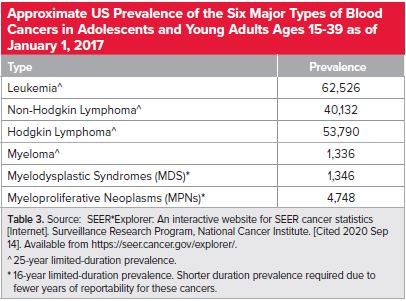
Source:
- Facts 2020-2021. Facts 2020-2021 provides updates from the American Cancer Society’s Cancer Facts & Figures 2021 (published online in 2021, https://www.cancer.org/research/cancer-facts-statistics. html) for estimated numbers of new blood cancer cases and estimated numbers of deaths due to blood cancers. The incidence rates, prevalence and mortality data in Facts 2020-2021 reflect the statistics from the National Cancer Institute’s Surveillance, Epidemiology and End Results (SEER) Program, Cancer Statistics Review (CSR)1975-2017 (published online in April 2020, www.seer.cancer.gov). National incidence counts are generated from the United States Cancer Statistics (USCS) Public Use Database for 2001-2017 (http://www.cdc.gov/cancer/uscs/public-use/). Incidence rates by state are provided by the North American Association of Central Cancer Registries (NAACCR), Cancer in North America: 2013-2017 (published online in May 2020, www.naaccr.org).
---
sharon lerner 921
2017 DRAFT assessment of formaldehyde that was suppressed by the Trump administration found that the chemical causes myeloid leukemia, according to several sources familiar with the document. The draft assessment concludes that 1 microgram of formaldehyde in a cubic meter of air increases the number of myeloid leukemia cases by roughly 3.5 in 100,000 people, more than three times the cancer risk in the assessment now in use. The EPA currently regulates formaldehyde using an outdated set of calculations, finalized in 1991, based on the risk of nasopharyngeal cancer. If the nasopharyngeal cancer and myeloid leukemia risks are combined, the cancer risk could be 4.5 times higher than the current value.
Although the suppressed assessment, produced by a division of the Environmental Protection Agency known as the Integrated Risk Information System, or IRIS, has grave implications for public health, Trump administration officials, including former EPA Administrator Andrew Wheeler, refused to allow the agency to release the assessment, several sources told The Intercept.
If the Biden EPA permits IRIS to finalize the assessment, which is among the most controversial in the agency’s history, other branches of the EPA will likely set regulatory limits based on the new risk value. IRIS values are used to determine safety thresholds for the amounts of the chemical permitted in air and water, emissions caps from industrial facilities, and guidance for cleanups. Such thresholds also alert exposed people to the dangers they face.
“This is a big, big deal. It could trigger significant interest by the personal injury bar,” said Bob Sussman, who served as the senior policy counsel to the EPA administrator during the Obama administration and deputy EPA administrator under President Bill Clinton. “Even without including the leukemia, the risk is a significant one. With the leukemia, it’s certainly a very significant public health concern.”
Even using the much lower, outdated cancer risk number set in 1991, formaldehyde is already the greatest source of nationwide cancer risk from industrial air pollutants, estimated to cause roughly 18 of the 32 cancers in every 1 million people in the U.S. that are caused by toxic pollutants in the air, according to the EPA’s own data. If the risk values are increased by a factor of four or more, the reported cancer risk from formaldehyde will go up accordingly, revealing previously unrecognized cancer hot spots around the country.
Formaldehyde, mainly used to make plywood, particleboard, and glues, is also a hazard for millions of workers who are exposed to the chemical through the production of resins, wood composite and furniture production, plastics manufacturing, paper production, embalming, foundry work, fiberglass production, building construction, agriculture, firefighting, and the teaching of biology, among other occupations. The general public is exposed to formaldehyde through tobacco smoke, cosmetics, food and water, as well as “off-gassing” from consumer goods, construction materials, and furniture. In 2019, 662 facilities reported releasing 47.7 million pounds of formaldehyde.
In addition to looking at the chemical’s relationships to nasopharyngeal cancer and leukemia, the draft assessment also factored in evidence that formaldehyde causes decreased lung function, allergic conditions, reproductive and developmental toxicity, and sensory irritation.
In part because formaldehyde is so pervasive, a wide range of business interests have attempted to prevent the EPA from finalizing the assessment and publicly acknowledging the connection to leukemia. Until now, the EPA has kept the contents of its assessment under tight wraps. The leaked information provides a window into how the science and regulation around the chemical will finally be updated.
“Just knowing that the IRIS assessment acknowledges that formaldehyde causes myeloid leukemia is huge, regardless of what the value is,” Jennifer McPartland, a senior scientist at the Environmental Defense Fund, said after being told about the main findings of the draft assessment. “But the numbers tell you even more. They set the tone for how the agency will proceed with risk management.”
Assessment Was “Ready to Go”
While the EPA has claimed in court that the formaldehyde assessment did not exist in a form that allowed it to be shared — and used that argument to refuse to release it in response to a Freedom of Information Act request from the environmental whistleblower group Public Employees for Environmental Responsibility, or PEER — former EPA officials told The Intercept that the completed assessment not only existed but that it had also been prepared for release in early 2018.
“We had the document ready to go for review within the agency, but we were not allowed to proceed,” said Jennifer Orme-Zavaleta, former director of the EPA Office of Research and Development, who retired from the agency in July. “Political leadership did not want me to move it forward.”
Wheeler, the former EPA administrator, was among the Trump appointees who were involved in suppressing the calculation of the myeloid leukemia risk, according to one former agency official who worked on the assessment. “The administrator would not allow us to put out that number,” the former official said, going on to explain how members of the administrator’s office, particularly his chief of staff Ryan Jackson, kept an unusually close eye on the formaldehyde assessment.
“Normally when we’re doing an assessment, they [the staff of the administrator’s office] don’t have access to the guts of it, because it’s deliberative. But they would demand that we give them pieces of the assessment, including what literature we were looking at for dose responses,” the former official said, referring to the precise relationship between exposure and cancer risk. “Then they would share it with ACC,” an acronym for the American Chemistry Council. Although the former official provided no direct evidence of the administrator’s office sending out the segments of the assessment, they said the actions of the trade group made it clear that it had reviewed the unpublished material.
“All of a sudden, after we gave the information to Ryan Jackson, there would be all this targeted activity by ACC that would basically dismiss or disprove whatever mathematical methodology that we were going to be using even though it hadn’t been published yet,” said the former official. If the EPA did share the information with the trade group, the report would be subject to release under FOIA and would not be exempt under the “deliberative process privilege,” contrary to the agency’s claim in the PEER lawsuit.
Orme-Zavaleta confirmed that Jackson, who now works for the National Mining Association, played a key role in preventing the assessment from moving forward. “The ACC was in contact with Ryan a lot,” she said.
Asked about his role in the formaldehyde assessment, Jackson stated, “Following enactment of the Lautenberg Act, EPA placed formaldehyde though the risk evaluation required in that new law so formaldehyde could be directly regulated by EPA,” referring to the Trump administration’s decision to add formaldehyde to the list of chemicals to be evaluated under the Toxic Substances Control Act. That assessment has also yet to be completed or released. Jackson also stated that “I’m not contributing to anonymous rumors.”
Andrew Wheeler declined to comment. In an emailed statement, a spokesperson for the ACC wrote that the group “has never had access in any manner to unpublished findings from the formaldehyde draft IRIS assessment.”
Orme-Zavaleta also pointed to other Trump appointees who she said were apparently involved in suppression of the document. Among them was the director of the Office of Air and Radiation, Bill Wehrum, whose input Orme-Zavaleta needed to move the assessment forward. “A couple times we set up briefings for Bill Wehrum. But they canceled those briefings, and I was not given the OK to further the review within the agency.”...https://beta.documentcloud.org/documents/21045297-dunlap-koch-email-to-epa" ...David Dunlap, who served as deputy assistant administrator in the EPA’s Office of Research and Development, also helped suppress the assessment, said Orme-Zavaleta. “When we were in the process of coming up with the priority list for IRIS assessments, a lot of those discussions were held during ‘politicals-only’ meetings, so I wasn’t there. But [Dunlap] was, he was our representative. Formaldehyde was on the list of chemicals being considered. And in November, I got back a short list of the chemicals IRIS would assess, and formaldehyde was not part of it,” she said. Dunlap worked for Koch Industries and defended formaldehyde until shortly before he joined the Trump administration in 2018. Dunlap did eventually recuse himself from work on the assessment, though only after formaldehyde was removed from the list of chemicals IRIS would be allowed to assess, according to Orme-Zavaleta. “I only received a copy of his recusal letter after I got the list of chemicals.”
David Dunlap declined to comment on the matter.
Presented with information from Orme-Zavaleta and others about the completion of the assessment in 2017, PEER attorney Kevin Bell expressed anger and frustration. Bell oversees 3-year-old litigation against the EPA over the group’s Freedom of Information Act request for the assessment. In that case, the agency has insisted that it didn’t have a completed version of the document that it could publicly release.
“EPA lied to us. And they lied to the court,” said Bell. “They said, ‘We just can’t give you anything like this, because it would be totally full of all sorts of irrelevant things, so that it would totally undermine the deliberative process,’ whereas in reality they had a fully drafted document that was all set to go.”
The EPA declined to comment on Bell’s statement but did provide a broader response, saying that “EPA is committed to ensuring that science is at the backbone of everything the Agency does to deliver on our public health and environmental protection mission, and that we operate in a transparent manner to ensure public trust.” Bill Wehrum did not respond to requests for comment.
Decades of Industry Influence
The suppression of the most recent draft assessment follows many years of interference with government science on formaldehyde. IRIS began updating its original assessment of the chemical in 1997 but almost immediately ran into resistance from industry, particularly around the link to leukemia. A group called the Formaldehyde Council, Inc., which represented companies that used the chemical, began challenging the numbers in the assessment and came up with a cancer risk that was thousands of times lower than the EPA’s. Political appointees in the George W. Bush administration also helped industry postpone the release of the updated document. A 2008 Government Accountability Office report documented those delays and lamented the public health implications of having to rely on an IRIS assessment that was then 18 years old.
Yet that first assessment, completed three decades ago, is still guiding regulation. In the intervening years, both the International Agency on Cancer Research, or IARC, and National Toxicology Program, whose chemical reviews don’t have the regulatory weight of IRIS assessments, classified formaldehyde as a known human carcinogen and recognized it as a cause of leukemia. In 2010, the EPA released a draft of the updated assessment, which also found that formaldehyde caused leukemia, but did not finalize it. The ACC was harshly critical of that draft, and the agency sent the report to the National Academy of Sciences for peer review. The external agency confirmed its finding that formaldehyde causes cancer and encouraged the agency to quickly rewrite and reissue its report. But the EPA didn’t complete that work until 2016.
Vincent Cogliano, who directed the IRIS program from 2010 to 2017, said the delays during those years weren’t due to political or industry pressure. “We were really trying to get a very objective assessment released,” said Cogliano, who attributed the slow progress on the assessment in that period to the heavy workload of the small program. While Cogliano characterized some of the science around formaldehyde as complex, he said that no one on the IRIS staff disagreed about the relationship between myeloid leukemia and formaldehyde. “When I left the IRIS program in January 2017, I thought that it was ready to be released,” he said.
And yet more than four years later, the EPA has yet to release the updated IRIS assessment.
“It’s very frustrating,” said Linda Birnbaum, who directed the National Toxicology Program from 2009 to 2019. “Here there is evidence that IARC said that formaldehyde was a known human carcinogen. And we said it was a known human carcinogen and that the data was clear. And more data has come out since then, especially from the National Cancer Institute, yet no word from EPA.”
Formaldehyde was added back on to the list of chemicals being assessed on the IRIS public calendar in March. According to an EPA spokesperson, the IRIS Program anticipates releasing the draft assessment of formaldehyde for public comment and external peer review by September 30, 2022. The agency is widely expected to ask the National Academy of Sciences to weigh in on how and whether the agency should combine the cancer risk estimates for myeloid leukemia and nasopharyngeal cancer.
Orme-Zavaleta said that no one in the Biden EPA expressed hesitation about resuming work on it when she raised the issue in the first weeks of President Joe Biden’s tenure. “I asked them several times. I said, ‘I’m going to unsuspend formaldehyde, are you good with that?’ And every time, everybody said, ‘Fine, do it,’” she said. “It is moving!”
Despite the assurances, those intimately familiar with the history of formaldehyde remain guarded in their optimism that the EPA is finally about to update the assessment of one of the most significant and widespread carcinogens in the U.S.
“For decades, up to now, the industry has pretty much managed to put out all the fires,” said Sussman. “But perhaps something really significant might be about to happen.”
---
---
https://cfpub.epa.gov/ncea/risk/recordisplay.cfm?deid=54932
1999 and related docs? no lnk?
---
https://blog.epa.gov/tag/ncea/
National Center for Environmental Assessment (NCEA)
https://nepis.epa.gov/Exe/ZyPURL.cgi?Dockey=P100893J.txt
---
---
https://www.cancer.org/cancer/leukemia.html
https://www.cancer.org/cancer/acute-myeloid-leukemia.html
what Is Acute Myeloid Leukemia (AML)?
Cancer starts when cells in a part of the body begin to grow out of control. There are many kinds of cancer. Cells in nearly any part of the body can become cancer. To learn more about cancer and how it starts and grows, see What Is Cancer?
Leukemias are cancers that start in cells that would normally develop into different types of blood cells. Most often, leukemia starts in early forms of white blood cells, but some leukemias start in other blood cell types. There are several types of leukemia, which are divided based mainly on whether the leukemia is acute (fast growing) or chronic (slower growing), and whether it starts in myeloid cells or lymphoid cells.
Acute myeloid leukemia (AML) starts in the bone marrow (the soft inner part of certain bones, where new blood cells are made), but most often it quickly moves into the blood, as well. It can sometimes spread to other parts of the body including the lymph nodes, liver, spleen, central nervous system (brain and spinal cord), and testicles.
Most often, AML develops from cells that would turn into white blood cells (other than lymphocytes), but sometimes AML develops in other types of blood-forming cells. The different types of AML are discussed in Acute Myeloid Leukemia (AML) Subtypes and Prognostic Factors.
Acute myeloid leukemia (AML) has many other names, including acute myelocytic leukemia, acute myelogenous leukemia, acute granulocytic leukemia, and acute non-lymphocytic leukemia.
Normal bone marrow, blood, and lymph tissue
To understand leukemia, it helps to know about the blood and lymph systems.
Bone marrow
Bone marrow is the soft inner part of certain bones. It is made up of blood-forming cells, fat cells, and supporting tissues. A small fraction of the blood-forming cells arebloodstem cells.
Inside the bone marrow, blood stem cells develop into new blood cells. During this process, the cells become either lymphocytes (a kind of white blood cell) or other blood-forming cells, which are types of myeloid cells. Myeloid cells can develop into red blood cells, white blood cells (other than lymphocytes), or platelets. These myeloid cells are the ones that are abnormal in AML.
Types of blood cells
There are 3 main types of blood cells:
- Red blood cells (RBCs)carry oxygen from the lungs to all other tissues in the body, and take carbon dioxide back to the lungs to be removed.
- Platelets are actually cell fragments made by a type of bone marrow cell called the megakaryocyte. Platelets are important in stopping bleeding. They help plug up holes in blood vessels caused by cuts or bruises.
- White blood cells (WBCs)help the body fight infections.
There are different types of WBCs:
- Granulocytes are mature WBCs that develop from myeloblasts, a type of blood-forming cell in the bone marrow. Granulocytes have granules that show up as spots under the microscope. These granules contain enzymes and other substances that can destroy germs, such as bacteria. The 3 types of granulocytes – neutrophils, basophils, and eosinophils – are distinguished by the size and color of their granules.
- Monocytes are WBCs that develop from blood-forming monoblasts in the bone marrow. After circulating in the bloodstream for about a day, monocytes enter body tissues to become macrophages, which can destroy some germs by surrounding and digesting them. Macrophages also help lymphocytes recognize germs and make antibodies to fight them.
- Lymphocytes are mature WBCs that develop from lymphoblasts in the bone marrow. Lymphocytes are the main cells that make up lymph tissue, a major part of the immune system. Lymph tissue is found in lymph nodes, the thymus (a small organ behind the breast bone), the spleen, the tonsils and adenoids, and is scattered throughout the digestive and respiratory systems and the bone marrow. The 2 main types of lymphocytes are B cell and T cells.
- ----
- American Cancer Society’s estimates for leukemia in the United States for 2020 are:
- About 60,530 new cases of leukemia (all kinds) and 23,100 deaths from leukemia (all kinds)
- About 19,940 new cases of acute myeloid leukemia (AML). Most will be in adults.
- About 11,180 deaths from AML. Almost all will be in adults.
AML is one of the most common types of leukemia in adults. Still, AML is fairly rare overall, accounting for only about 1% of all cancers.
AML is generally a disease of older people and is uncommon before the age of 45. The average age of people when they are first diagnosed with AML is about 68. But AML can occur in children as well.
AML is slightly more common among men than women, but the average lifetime risk of getting AML in both sexes is about ½ of 1%.
Information on treatment success rates for AML in adults can be found in Treatment Response Rates for Acute Myeloid Leukemia.
Visit the American Cancer Society’s Cancer Statistics Center for more key statistics.
---
key Statistics for Childhood Leukemia
Leukemia is the most common cancer in children and teens, accounting for almost 1 out of 3 cancers. Overall, however, childhood leukemia is a rare disease.
About 3 out of 4 leukemias among children and teens are acute lymphocytic leukemia (ALL). Most of the remaining cases are acute myeloid leukemia (AML).
- ALL is most common in early childhood, peaking between 2 and 5 years of age.
- AML tends to be more spread out across the childhood years, but it's slightly more common during the first 2 years of life and during the teenage years.
- ALL is slightly more common among Hispanic and white children than among African-American and Asian-American children, and it is more common in boys than in girls.
- AML occurs about equally among boys and girls of all races.
Chronic leukemias are rare in children. Most of these are chronic myeloid leukemia (CML), which tends to occur more in teens than in younger children.
Juvenile myelomonocytic leukemia (JMML) is also rare. It usually occurs in young children, with an average age of about 2. It is slightly more common in boys than in girls.
Visit the American Cancer Society’s Cancer Statistics Center for more key statistics.
For statistics related to survival, see Survival Rates for Childhood Leukemias.
---
a 2017 DRAFT assessment of formaldehyde that was suppressed by the Trump administration found that the chemical causes myeloid leukemia, according to several sources familiar with the document. The draft assessment concludes that 1 microgram of formaldehyde in a cubic meter of air increases the number of myeloid leukemia cases by roughly 3.5 in 100,000 people, more than three times the cancer risk in the assessment now in use. The EPA currently regulates formaldehyde using an outdated set of calculations, finalized in 1991, based on the risk of nasopharyngeal cancer. If the nasopharyngeal cancer and myeloid leukemia risks are combined, the cancer risk could be 4.5 times higher than the current value.....
---
https://www.ncbi.nlm.nih.gov/pmc/articles/PMC5550103/
Int J Cancer. Author manuscript; available in PMC 2017 Aug 9.
Published in final edited form as:
Int J Cancer. 2017 Mar 1; 140(5): 1000–1008.
Published online 2016 Nov 30. doi: 10.1002/ijc.30487
PMCID: PMC5550103
NIHMSID: NIHMS870702
PMID: 27778348
Trends in Childhood Leukemia Incidence Over Two Decades from 1992–2013
Jessica L. Barrington-Trimis,1 Myles Cockburn,1 Catherine Metayer,2 W. James Gauderman,1 Joseph Wiemels,3 and Roberta McKean-Cowdin1
Author information Copyright and License information Disclaimer
The publisher's final edited version of this article is available free at Int J Cancer
See other articles in PMC that cite the published article.
Associated Data
Abstract
Incidence rates of childhood leukemia in the United States have steadily increased over the last several decades, but only recently have disparities in the increase in incidence been recognized. In the current analysis, Surveillance, Epidemiology and End Results (SEER) data were used to evaluate recent trends in the incidence of childhood leukemia diagnosed at age 0–19 years from 1992–2013, overall and by age, race/ethnicity, gender, and histologic subtype. Hispanic White children were more likely than non-Hispanic White, non-Hispanic Black or non-Hispanic Asian children to be diagnosed with acute lymphocytic leukemia (ALL) from 2009–2013. From 1992–2013, a significant increase in ALL incidence was observed for Hispanic White children (annual percent change (APC)Hispanic=1.08, 95%CI:0.59, 1.58); no significant increase was observed for non-Hispanic White, Black or Asian children. ALL incidence increased by about 3% per year from 1992–2013 for Hispanic White children diagnosed from 15–19 years (APC=2.67; 95%CI:0.88, 4.49), and by 2% for those 10–14 years (APC=2.09; 95%CI:0.57, 3.63), while no significant increases in incidence were observed in non-Hispanic White, Black, or Asian children of the same age. Acute myeloid leukemia (AML) incidence increased among non-Hispanic White children under 1 year at diagnosis, and among Hispanic White children diagnosed at age 1–4. The increase in incidence rates of childhood ALL appears to be driven by rising rates in older Hispanic children (10–14, and 15–19 years). Future studies are needed to evaluate reasons for the increase in ALL among older Hispanic children.
Keywords:childhood leukemia, trends, incidence, SEER
INTRODUCTION
Leukemia is the most common cancer in children and adolescents 0 to 19 years of age (hereafter referred to as “children”), and the highest incidence rates of leukemia have been reported for children of Hispanic ethnicity (Age Adjusted Incidence Rate (AAIR) for 2009–2013=6.05 per 100,000)1. While incidence rates for childhood ALL in all races/ethnicities combined have increased approximately 1% per year since 1973, a greater increase in incidence has recently been observed among Hispanic children1, though reasons for this disparity in rates are unknown. In the past 20 years, numerous studies have focused on evaluating the association between childhood leukemia and environmental or lifestyle factors, which are likely to contribute to the observed racial/ethnic disparity in incidence.
Ionizing radiation remains the only established causal environmental risk factor for childhood leukemia. Other lifestyle or environmental factors have been suggested as causal agents, with compelling evidence for residential oroccupational exposure to pesticides2–5. A series of meta-analyses or pooled analyses also suggest ALL risk may be higher for children with exposure to non-ionizing radiation6–8, paternal tobacco use9, 10, paint 11–13, and high birth weight14, 15, whereas atopic conditions (e.g. allergy, asthma, hay fever)16, 17, day care attendance (as a surrogate for early life immune challenge, addressing the “population mixing” hypothesis of ALL leukomogenesis)18, 19, and maternal folate supplementation20 are associated with a reduced risk. However, few studies18, 21–24 have reported associations between these risk factors and childhood leukemia by Hispanic ethnicity, specifically.....
---