EPA 4 djt
619
SEE EPA 5 POST TRUMP
see DEREG 4
SEE SAB
bak 120
regulatory capture, swamp things, inside the wire, 5 amigos
an 7 22
In mere weeks, the Environmental Protection Agency is set to unveil a supplemental draft rule aimed at cracking down on the oil and gas industry’s rampant methane emissions. This rule, which sidesteps the Supreme Court’s West Virginia v. EPA ruling, provides a necessary advancement to 2016 rules that were rolled out similarly regulating methane emissions as part of the Obama administration’s ambitious climate goals. New rules could not come at a better time, given recent findings of rampant methane emissions in the oil-rich Permian Basin, where some fossil fuel companies are relentlessly polluting the region with nonstop methane emissions.
Taking data from NASA’s Jet Propulsion Lab project known as Carbon Mapper, the Associated Press found dozens of so-called “super emitters” located in the area, of which just 10 companies owned 164 sites responsible for major methane emissions. The Center for Biological Diversity’s Climate Law Institute Director, Kassie Siegel, provided an eye-opening analogy to the methane issue: “If carbon dioxide is the fossil-fuel broiler of our heating planet, methane is a blowtorch,” Siegel told the Associated Press. It’s long been understood that methane is more than 25 times more potent than carbon dioxide.
Yet polluters freely emit methane with little to no consequence because, at this juncture, it is ultimately a company’s responsibility to account for its own bad actions. This has been a massive issue throughout the Gulf South and beyond. In Colorado, local air quality monitoring found that company reports of reduced methane emissions were an outright lie. Officials in towns and counties near Boulder were alarmed that claims of methane emissions being reduced by half weren’t even close to what on-the-ground air quality monitors had found. Colorado is considered a leader in methane emission regulation, yet there is still much work to be done to ensure that fossil fuel companies aren’t continuing to do their worst.
The Associated Press cites years of inaction and the difficulty of tracking methane emissions that are intermittent as major culprits, along with the oil and gas industry’s own practices of simply flaring and venting its methane because companies are overwhelmed by their own output. Regional oversight has all but signaled its support of such actions. An environmental consultant told the outlet that the Texas Commission on Environmental Quality rarely, if ever, inspects oil and gas sites. And the primary agency overseeing onshore oil and gas projects in the state—the Texas Railroad Commission—itself benefits from a lack of oversight, allowing oil-loving commissioners to continue sitting on their hands in favor of constant fossil fuel development and production. If states like Colorado can’t even seem to get things right, it feels like Texas doesn’t even stand a chance to do right by its citizens.
tisch maine timeline:
2017 (June)
President Trump announces that the United States will withdraw from the Paris Climate
Agreement
Stephen Bannon and the anti-globalist, climate denying contingent of White House advisors
trump the personal entreaties of Al Gore, Leonardo DiCaprio, Pope Francis, Ivanka Trump, Rex
Tillerson, European Union heads of state and many others. Oblivious to the fact that the
emissions standards under the Agreement are voluntary, subject to revision, and entail no
penalties for noncompliance, the President calls the deal “draconian,” imposing unfair standards
on American companies and employees. “At what point does America get demeaned? At what
point do they start laughing at us as a country?” Trump says. “We don’t want other leaders and
other countries laughing at us anymore. And they won’t be.”
The New York Times observes that
“Mr. Trump’s decision to abandon the agreement for environmental action signed by 195 nations
is a remarkable rebuke to heads of state, climate activists, corporate executives and members of
the president’s own staff, who all failed to change his mind with an intense, last-minute lobbying
blitz. The Paris agreement was intended to bind the world community into battling rising
temperatures in concert, and the departure of the Earth’s second-largest polluter is a major
blow,”* and its editorial board calls the withdrawal “disgraceful.”** Wall Street Journal
headlines declare: “U.S. Climate Pivot Puts a Reluctant China in Driver’s Seat: Trump’s
withdrawal from Paris accord gives China a new opening to exert sway on a big global issue” ***
Some find a May 30 op/ed in the Wall Street Journal by presidential advisors H. R. McMaster
and Gary Cohn as illuminating on the withdrawal decision in: “The president embarked on his
first foreign trip with a cleareyed outlook that theworld is not a ‘global community’ but an arena
where nations, nongovernmental actors and businesses engage and compete for advantage.”
:{
}:
Writes David Brooks in The New York Times: “That sentence is the epitome of the Trump project.
It asserts that selfishness is the sole driver of human affairs.”**** Al Gore’s statement on the
withdrawal declares that “Removing the United States from the Paris Agreement is a reckless and
indefensible action. It undermines America’s standing in the world and threatens to damage
humanity’s ability to solve the climate crisis in time. But make no mistake: if President Trump
won’t lead, the American people will. Civic leaders, mayors, governors, CEOs, investors and the
majority of the business community will take up this challenge. We are in the middle of a clean
energy revolution that no single person or group can stop. President Trump’s decision is
profoundly in conflict with what the majority of Americans want from our president; but no
matter what he does, we will ensure that our inevitable transition to a clean energy economy
continues.”*****
Former Treasury Secretary Lawrence Summers states that “We may have our
first post-rational president,” and that “It is possible that last week will be remembered as a
hinge in history — a moment when the United States and the world started moving on a
path away from the peace, prosperity and stability that have defined the past 75
years.”****** The Yale Program on Climate Change Communication reports that US voters favor
staying in the Paris Agreement by a margin of 5 to 1, and that half of Trump voters support staying
in, with fewer than 3 in 10 saying we should not stay in.******* The formal process of
withdrawal will likely take four years, and not be final until after the 2020 presidential election.
[see 2015 (December)]
*Michael Shear, “Trump Will Withdraw U.S. From Paris Climate Agreement,” New York Times, June 1, 2017,
https://www.nytimes.com/2017/06/01/climate/trump-paris-climate-agreement.html
**Editorial Board, “Our Disgraceful Exit From the Paris Accord,” New York Times, June 1, 2017,
https://www.nytimes.com/2017/06/01/opinion/trump-paris-climate-change-agreement.html
***Brian Spegele and Te-Ping Chen, “U.S. Climate Pivot Puts a Reluctant China in Driver’s Seat,” Wall Street Journal, June 2, 2017,
https://www.wsj.com/articles/u-s-climate-pivot-puts-a-reluctant-china-in-drivers-seat-1496380249
****David Brooks, “Donald Trump Poisons the World,” New York Times, June 2, 2017,
https://www.nytimes.com/2017/06/02/opinion/donald-trump-poisons-the-world.html
*****The Climate Reality Project, “Statement by Former Vice President Al Gore on Today’s Decision by the Trump Administration
to Withdraw from the Paris Agreement,” June 1, 2017, https://www.climaterealityproject.org/press/statement-al-gore-us-commitmentparis-agreement
******Lawrence Summers, “After 75 years of progress, was last week a hinge in history?” Washington Post, June 4, 2017,
https://www.washingtonpost.com/opinions/after-75-years-of-progress-was-last-week-a-hinge-in-history/2017/06/04/2085b91e-47cf11e7-bcde-624ad94170ab_story.html?utm_term=.7ccf9ee984ec
*******Jennifer Marlon, Eric Fine, and Anthony Keiserowtiz, “Majorities of Americans in Every State Support Participation in the
Paris Agreement,” Yale Program on Climate Change Communication, May 8, 2017,
http://climatecommunication.yale.edu/publications/paris_agreement_by_state/
...
2019 (December)
Year-end count: 95 major environmental rules being rolled back by Trump
administration
Based on research from Harvard and Columbia law schools, the New York Times counts 16
rollbacks completed and 9 in process on air pollution and emissions; 10 rollbacks completed and
9 in process on drilling and extraction.* Many of those “completed” rollbacks are subject to court
challenges, which are tracked in the Harvard Law School Regulatory Rollback Tracker.**
* Nadja Popovich, Livia Albeck-Ripka and Kendra Pierre-Louis, “95 Environmental Rules Being Rolled Back Under Trump,” New
York Times, December 21, 2019, https://www.nytimes.com/interactive/2019/climate/trump-environment-rollbacks.html
**Harvard Law School, Environmental & Energy Law Program, https://eelp.law.harvard.edu/regulatory-rollback-tracker/
2019 (December)
EPA’s Scientific Advisory Board criticizes regulatory rollback justifications, including
proposed fuel efficiency rule
The Washington Post reveals that the Environmental Protection Agency (EPA) Scientific
Advisory Board, now purged of some distinguished scientists and composed of two-thirds Trump
administration appointees [see 2017 (October)], still delivers sharp criticism of major EPA
proposed regulations, in draft reviews posted by the EPA online.* One of these draft reviews
relates to the justifications for the 2018 “Safer Affordable Fuel-Efficient (SAFE) Vehicles Rule”,
rolling back Obama era vehicle fuel efficiency standards. [see 2018 (August) and 2019 (June –
November)] The draft cover letter from the Scientific Advisory Board to EPA chief Andrew
Wheeler states: “there appear to be significant weaknesses in the analysis supporting the 2018
notice of proposed rulemaking.” These weaknesses particularly relate to estimates of size of
vehicle fleets. “Together with other smaller problems and inconsistencies, the issues are of
sufficient magnitude that the estimated net benefits of the proposed revision may be substantially
overstated. In fact, the weaknesses are sufficiently important that they could reverse the rankings
of the policies being considered. In other words, the augural [original, Obama] standards might
provide a better outcome for society than the proposed revision.”**
*Juliet Eilperin, “EPA’s scientific advisers warn its regulatory rollbacks clash with established science,” The Washington Post,
December 31, 2019, https://www.washingtonpost.com/climate-solutions/epas-scientific-advisers-warn-its-regulatory-rollbacks-clashwith-established-science/2019/12/31/a1994f5a-227b-11ea-a153-dce4b94e4249_story.html; see also H. Holden Thorp, “Stick to
science,” Science 367, no. 6474 (January 10, 2020): 125, https://science.sciencemag.org/content/367/6474/125
**Environmental Protection Agency, Science Advisory Board, Draft Report (10/16/19),
https://yosemite.epa.gov/sab/sabproduct.nsf/ea5d9a9b55cc319285256cbd005a472e/3bd8a1aea4943223852584e1005463de/$FILE/SA
FE%20SAB%20Draft%20Review_10_16_19_.pdf
see fact data for intro
https://highline.huffingtonpost.com/article/disappearing-data/#science
...
STOPPED COLLECTING CRUCIAL METHANE EMISSIONS DATA FROM OIL AND GAS COMPANIES
02.01
One of the Obama administration’s most ambitious environmental policies was an unprecedented drive to reduce emissions of methane, the main component in natural gas and a major contributor to climate change. Two days after Donald Trump was elected president, Barack Obama's Environmental Protection Agency began the process of gathering wide-ranging data from about 15,000 owners and operators of oil and natural gas facilities. Earlier that year, the EPA had introduced regulations on methane emissions at new or modified oil and gas operations. This data was intended to provide the basis for regulating emissions at existing operations, which produce far more methane.
In March, new EPA Administrator Scott Pruitt withdrew the requests—a move that came as no surprise. As attorney general of Oklahoma, Pruitt had joined a group of state AGs to sue the EPA in 2016 over the first round of rules on methane emissions. (The EPA weakened those regulations in August.) Pruitt’s decision to cancel the data collection signaled that, under Trump, the EPA would axe the plans to regulate existing facilities.
Methane dissipates much more rapidly than carbon dioxide, but the gas is at least 86 times more potent during its first 20 years in the atmosphere. The EPA estimates that the oil and natural gas industry is responsible for nearly 30 percent of U.S. methane emissions. A 2018 study found that the EPA may underestimate the industry's methane emissions by as much as 60 percent. Trump’s EPA has launched its own programs to collect information from the industry, but companies are not required to participate, and if they do, they only need to report successful efforts to reduce methane emissions.
wrongly CLAIMED THAT ROLLING BACK FUEL STANDARDS WOULD SAVE MONEY AND THOUSANDS OF LIVES
02.02
In 2012, the Obama administration embarked on a plan to nearly halve planet-warming emissions from new cars and light trucks by 2025. The joint rules from the Environmental Protection Agency and the Department of Transportation progressively tightened both fuel economy and emissions standards, a program the EPA described as “the most significant federal action ever taken to reduce greenhouse gas emissions and improve fuel economy.”
Donald Trump, who had campaigned on promises to revive the auto industry, declared just two months into his presidency that he intended to roll back that rule. In 2018, his EPA and DOT issued a proposal to freeze the standards at 2020 levels through 2026. That would have meant keeping the fuel economy standard at an average of about 37 miles per gallon, rather than increasing it to 54 miles per gallon by 2025.
The administration claimed this would serve both the economy and public safety—and it appeared to have the numbers to prove it. Its proposal said that Trump's rule would have a net economic benefit of up to $201 billion and would prevent nearly 12,700 deaths in car accidents.
There was just one problem: The calculations were chock-full of errors that skewed the outcome to Trump's benefit. A group of prominent economists described the analysis as being "at odds with basic economic theory and empirical studies." Together with DOT officials, Trump appointees at the EPA had blocked the agency's engineers from contributing to the study, The Atlantic later reported. When EPA staffers warned the White House about problems with the analysis, their criticisms were ignored.
The Trump administration's final rule, which was released in March 2020, does not entirely freeze the fuel economy and emissions standards. Instead, it requires automakers to increase fleet fuel economy by 1.5 percent annually—still a dramatic cut from the Obama standards, which would have been about 5 percent.
The accompanying analysis was radically different as well. Rather than the massive benefit claimed in the draft, the final version projects that Trump's rollback could actually cost the economy as much as $22 billion, as compared to the Obama-era standards. Some critics find even this far less favorable conclusion dubious. In June, a coalition of advocacy groups petitioned the EPA to stay the final rule, writing that it is "premised on an analysis riddled with errors and inconsistencies."
Dave Cooke, a senior vehicles analyst at the Union of Concerned Scientists, said some of the errors show evidence of the administration "putting its thumb on the scale towards a pre-ordained outcome." For instance, the petitioners claim that the new analysis added $27 billion in savings under the Trump rule by inflating the "cost of congestion"—an estimate of traffic's negative economic impact—under the Obama standards.
As with the draft, the administration was accused of sidelining EPA staff and ignoring their criticisms. In July, the EPA's inspector general announced that it would investigate "potential irregularities" in the agency’s work.
DIRECTED STAFF TO USE CLIMATE CHANGE MODELS THAT END BEFORE THE MOST SEVERE IMPACTS WOULD TAKE PLACE
02.03
In 2019, the Donald Trump-appointed director of the U.S. Geological Survey ordered agency staff to only use climate models that project the impacts of emissions through 2040 in their scientific assessments, according to The New York Times. Models with projections through 2100 had typically been used previously.
Scientists told the Times that the new assessments will give a misleadingly optimistic projection of the future—barring changes in current global emissions, models suggest the most severe impacts of climate change will start to be felt after the 2040 cutoff, around 2050.
Decision-makers such as resource managers, infrastructure and city planners, emergency response professionals, elected officials, farmers and the public rely on USGS, the sole science agency for the Department of the Interior, to produce information that provides the scientific foundation for planning around environmental threats to lives and livelihoods.
used flawed CALCULATIONS TO ARGUE THAT CURTAILING GREENHOUSES GASES WASN'T WORTH THE COST
02.04
The U.S. government has a calculation for the “social cost of carbon,” which measures the environmental, economic and public health damages associated with emitting carbon dioxide into the atmosphere. Federal agencies use this figure to evaluate the costs and benefits of new climate regulations. At the end of President Barack Obama’s tenure in office, that figure was $40 per metric ton (a number environmental groups argued was too low). The number is expected to increase as the planet experiences rapid global warming.
But shortly after taking office, President Donald Trump signed an executive order that scrapped the Obama-era calculation, putting the economic harm of emitting climate-warming carbon dioxide far lower, at between $1 and $7 per ton. A July report by the Government Accountability Office determined that Trump’s calculations of the social cost of carbonare about seven times lower than previous federal estimates. And while Obama-era estimates placed future climate damages at $82 per ton of carbon by 2050, Trump’s calculation put it at just $11, the report found.
The lower figure allows the administration to argue that the upfront costs of reining in greenhouse gas emissions outweigh any future benefit to property, agriculture, coastal ecosystems and human health.Trump's EPA has used the number to justify weakening environmental safeguards and to roll back Obama-era regulations that slashed carbon pollution from power plants and new vehicles. For example, the EPA claims that rescinding the Clean Power Plan would save the U.S. $33 billion in “avoided costs” by 2030, a calculation it came to by looking only at the domestic costs of carbon pollution and by downplaying the impact that emissions will have on future generations.
Meanwhile, the Trump administration has led a campaign to undermine the validity of climate modeling so it can ignore possible environmental threats when evaluating new infrastructure, such as pipelines, power plants, highways and airports. When more than a dozen federal agencies published a sobering 1,600-page report in November 2018 that warned of the dire threat of global climate change, then-White House press secretary Sarah Huckabee Sanders claimed the assessment was “based on the most extreme model scenario” and “not data-driven.” Trump flatly denied the science: “I don’t believe it,” he told reporters.
TRIED TO STOP COLLECTING PAY DATA BROKEN DOWN BY RACE, GENDER AND ETHNICITY
03.03
In 2016, after a protracted political fight, the Obama administration scored what looked like a win in its fight for equal pay for women and people of color: The Equal Employment Opportunity Commission finally got the go-ahead to start collecting pay data from large companies that was organized by gender, race and ethnicity.
The EEOC is supposed to enforce federal antidiscrimination laws, and has long collected demographic data from companies that helps the agency detect discriminatory hiring patterns. Pay was a logical addition: A similar effort in the United Kingdom revealed significant differences in how much men and women earn in a surprising number of fields. Simply forcing companies to collect and report this kind of information might even push some to address disparities, experts reasoned.
Alas, in the summer of 2017, the Trump administration nixed the whole thing. In a short memo, the Office of Management and Budget claimed with no evidence that collecting pay data would be too burdensome for companies and was of dubious utility. Ivanka Trump, a supposed proponent of equal pay, put out a statement supporting the move.
In March 2019, a judge ruled that the administration had acted arbitrarily and that companies needed to turn over two years worth of pay data. Incredibly, most companies produced the numbers by the summer of 2020. And yet, the ruling doesn’t compel the EEOC to actually do anything with this trove of never-before-collected information.
And so it hasn't. In what seems like an obvious stalling tactic, all the agency has done so far is announce that it will convene a panel of experts—merely to examine whether the data is of any use. Meanwhile, in the U.S., women on average continue to make 82 percent of what men earn and Black women make only 62 percent
...
SUPPRESSED AND DEFUNDED STUDIES ON THE HARMFUL EFFECTS OF TOXIC CHEMICALS
04.01
The Trump administration has proven itself an ally of chemical companies, at times sidelining science to preserve the industry’s ability to use toxic chemicals.
President Donald Trump’s Environmental Protection Agency refused to ban the agricultural use of chlorpyrifos, an insecticide linked to brain damage in children that has been used on a variety of crops since the 1960s. It’s a move that defied the EPA’s own scientists, who in 2015 recommended banning the pesticide due to its potential health risks. In September 2020, the agency released a new assessment of chlorpyrifos that excluded a number of epidemiological studies, including one showing exposure to the chemical in the womb is associated with abnormal brain development.
The chlorpyrifos example is part of the Trump EPA’s broader push to crack down on so-called “secret science.” It’s limiting the types of scientific studies that can be used to craft new policy in the name of "transparency."
The Trump EPA also blocked the release of a yearslong study of the health risks associated with environmental exposures toformaldehyde, a widely used chemical known to cause cancer in humans. And it cut off funding for more than a dozen research centers around the country that study, among other things, childhood leukemia and how exposure to chemicals and industrial pollution impact child development.
If there's no data about how these exposures might hurt Americans, well—then what we don't know can truly hurt us.
Even in cases where the Trump EPA does have the data, moves to hide it have often left the public in the dark. Take, for example, the efforts the agency often touts to address per- and polyfluoroalkyl substances, or PFAS, the cancer-causing “forever chemicals” that contaminate the drinking water of :{millions of American:(style="background-color:#ffff66;"):}:s. In 2018, the EPA and White House attempted to block publication of a study into widespread PFAS contamination after a Trump aide warned it would be "potential public relations nightmare," according to an explosive Politico report.
That study, later released in June 2018, found that the chemicals threaten human health, even at levels seven to 10 times lower than EPA’s recommendations. Meanwhile, the Trump EPA has continued to approve new varieties of PFAS with little to no testing.
...
narrowed HOW IT MEASURES THE HEALTH BENEFITS OF REGULATIONS ON MERCURYEMISSIONS 04.02
Since the early days of Trump’s administration, his Environmental Protection Agency has been on a mission to neuter Obama’s landmark air pollution restrictions. One tactic has proved especially consequential: changing the way that agencies evaluate the economics of environmental regulations. If, on paper, the cost of a regulation suddenly outweighs its benefits, the administration can argue that the rule is too expensive to keep.
Changing these calculations is at the center of the EPA’s move to weaken a 2011 regulation curbing power plants’ mercury emissions, which can cause lasting brain damage in children and fetuses. After the rule was introduced, utility companies spent billions to meet the standards or switched to natural gas or renewable energy. Over the next six years, mercury emissions from power plants fell by more than 80 percent.
But the rule had a vulnerability. To withstand legal challenges, Obama's EPA had to establish that its new emissions restrictions were "appropriate and necessary." Its most powerful arguments were about the huge public health gains: Curbing mercury pollution would slash other forms of power plant pollution as well, potentially preventing 130,000 asthma attacks, 4,500 heart attacks, and up to 11,000 premature deaths annually. The agency projected that the rule could save society up to $80 billion each year.
To reach the opposite conclusion, Trump’s EPA simply decided to ignore almost all of the rule’s health benefits. EPA Administrator Andrew Wheeler argued that the agency should only measure the value of reducing mercury pollution, not any other indirect benefits that the rule would produce. After this mathematical sleight of hand, the rule was only projected to save $6 million annually—too little, the agency now said, to justify regulating mercury emissions. For now, the regulation remains intact, but the new assessment leaves it wide open to lawsuits from coal companies.
Former EPA Administrator Carol Browner warned that the move was a "sinister Trojan horse." Sure enough, in June, Wheeler proposed a new rule that would give little or no consideration to the indirect benefits of all pollution regulations under the Clean Air Act. “These economic cost-benefit analyses have been an important driver of Clean Air Act regulations for 40 years,” former EPA official Richard Morgenstern told The New York Times. “What this rule is doing is altering the math in such a way to potentially downplay the economic benefit to public health, so they are justified in writing weaker rules in the future.”
...
DISBANDED OR SIDELINED SCIENTIFIC ADVISORY COMMITTEES
05.01
Black people are dying from the coronavirus at a rate more than twice that of white Americans. One likely reason for this inequity is the very different air we breathe. People of color are more likely to live near highways and other sources of soot pollution—also known as fine particulate matter—which can cause health conditions that make people more vulnerable to the virus.
And yet on April 14, EPA Administrator Andrew Wheeler announced a preliminary decision not to issue tougher standards governing how much soot can be released into the air—a move that was cheered by the fossil fuel industry. Wheeler insisted that he was simply following the science. In December 2019, a majority of the Clean Air Scientific Advisory Committee—a group of outside experts that advises the EPA—recommended leaving the standards for fine particulate matter unchanged.
However, in the draft report that CASAC had reviewed to reach its recommendation, EPA scientists had advised tightening them, on the logic that long-term exposure to soot pollution was killing up to 52,100 people in the U.S. annually. As Gretchen Goldman, a research director at the Union of Concerned Scientists, explained to The Washington Post, “It’s not surprising they would retain the standards, because they broke the process.”
There are hundreds of advisory committees throughout the U.S. government, and they are part of a time-honored system that helps ensure that policy decisions are based on sound research. President Donald Trump’s administration has systematically sidelined, frozen and eliminated many of these committees.
The attack was particularly fierce at the EPA. Trump's first administrator, Scott Pruitt, and his successor, Wheeler, have replaced scientists on influential EPA committees with members sympathetic to the industries the agency was supposed to be regulating. Pruitt’s hand-picked chair for CASAC had worked as a consultant for groups such as the American Petroleum Institute and openly questioned whether air pollution causes serious health problems. For decades, CASAC had also convened panels of additional experts to help review the science on specific pollutants. Wheeler disbanded the panel that was assisting with the particulate matter standards. Six months later, CASAC said it lacked the expertise to carry out its review. But rather than reconvening the panel, Wheeler appointed a dozen new consultants. One of only two academic scientists on the committee pointed out that not a single expert in air pollution epidemiology was involved in the review. Inside Climate News reported that the recommendation to retain the soot standards partly rested on a widely criticized study based on unverified data.
Meanwhile, in May 2017, then-Interior Secretary Ryan Zinke temporarily halted the work of his department’s 200-plus committees. That year, committees dedicated to scientific and technical issues met the fewest times in any year since record-keeping began in 1997, according to an analysis by the Union of Concerned Scientists. At both the Department of the Interior and the National Oceanic and Atmospheric Administration, panels on climate science were shut down entirely, as was a food science panel at the Food and Drug Administration and a forensic science committee at the Department of Justice.
In June 2019, Trump took things a step further. The president instructed federal agencies to eliminate at least one-third of their committees and capped the total number across the government at 350. So far, the EPA, the Department of Energy and the Department of Commerce have each eliminated a handful. The Centers for Disease Control and Prevention shut down three.
A look at two of the former CDC panels reveals the vital functions that advisory committees perform behind the scenes. For example: In recent years, evidence has mounted that glyphosate, an herbicide used in weed killers, may cause cancer. The CDC does not collect countrywide data on Americans' exposure to glyphosate, despite having a system—the National Biomonitoring Program—that does just that for more than 300 other dangerous chemicals. So a now-disbanded committee that advised both the Agency for Toxic Substances and Disease Registry and the CDC's National Center for Environmental Health was working to have glyphosate and other herbicides added to the list, according to former member Dr. Aaron Bernstein, a pediatrician and interim director of the Center for Climate, Health, and the Global Environment at Harvard University’s school of public health.
The CDC also shut down its Advisory Committee to the Director, which consulted with agency leadership on big-picture strategy: Notably, it had advised CDC leaders during the Zika and Ebola outbreaks. “I'm looking at what's happening right now with COVID-19," said Dr. Lynn Goldman, a former committee member and dean of George Washington University's school of public health, "and I can't believe that the CDC director does not have a council of outside advisers that's able to serve as a sounding board for him.”
limited the TYPES OF SCIENTIFIC STUDIES THAT CAN BE USED TO CRAFT POLICY 05.02
In 1996, an enterprising tobacco industry lawyer named Chris Horner sent a memo to a client detailing a plan to stymie the Environmental Protection Agency’s crackdown on second-hand smoke. The idea was to “construct explicit procedural hurdles that the Agency must follow in issuing scientific reports”—in particular, requiring that agency data be transparent and independently reproducible. Sounds totally reasonable, right? In reality, it would disqualify a lot of peer-reviewed research. Steve Milloy, a lawyer with deep ties to tobacco and fossil fuel companies, became one of the biggest proponents of this war on so-called “secret science.”
Fast forward more than two decades, and this industry playbook is set to become standard operating procedure at the EPA. In April 2018, then-Administrator Scott Pruitt unveiled a proposed “transparency” rule to limit the types of scientific studies that the agency can use to craft new policy. It allows the EPA to ignore studies that don’t make their raw data public, effectively giving more weight to industry-backed research.
Most significantly, the latest version of the rule would disqualify public health studies that rely on keeping certain personal and medical information confidential. (This includes, for example, research on respiratory health that could be key to combating COVID-19.) The goal, experts say, is to make it harder for the government to enact more stringent protections for our air, water and environment.
Horner and Milloy, who served on Donald Trump’s EPA transition team, were both on hand for Pruitt’s announcement; Milloy has called it “one of my proudest achievements.” (The Interior Department later consulted him on a similar initiative.) The agency intends to finalize the rule this year—and although it is all but certain to face legal challenges, it would likely take a future Democratic administration months, if not years, to undo.
...
===
https://www.desmog.com/2019/10/16/fact-checking-american-petroleum-institute-gas-ads/
in 1998, the U.S.’s largest oil and gas industry lobbying group, the American Petroleum Institute (:{API:(style="box-sizing:border-box"):}:), was involved with a communications plan whose goal was promoting “uncertainties in climate science” among the American public. Over 20 years later, their communications plan looks a little different but still needs fact-checking.
In September, API began running:{TV:(style="box-sizing:border-box"):}:, billboard, and social media ads promoting natural gas as a climate solution.  ,” the ads claim, and
 .” But is all of that true?
In fact, U.S. carbon dioxide emissions actually rose 3.4 percent in 2018. While API appears to be specifically referring to emissions from power generation — attributing those savings to the switch from coal power to natural gas — even the power sector saw emissions rise 1.9 percent last year[pix]
from an American Petroleum Institute advertisement. ]
It’s true that U.S. CO2 emissions are down from the peak of 2005, which was a period of booming economic growth, but it was followed by a major recession just a couple years later. It’s also true that replacing coal with natural gas for electricity has contributed in part to that reduction, but so has the rise of solar and wind power and battery storage.
However, emissions from transportation — the direct result of burning oil produced by the petroleum industry — also increased in 2018. With the Trump administration aiming to weaken fuel efficiency standards, that rise in transportation emissions is likely to continue.
While the oil and gas industry — or as API‘s new ads call it, “the natural gas and oil industry” — is touting natural gas as a way to decrease emissions, the :{U.S.:(style="box-sizing:border-box"):}: Energy Information Administration predicts that natural gas will have the greatest increase in carbon dioxide emissions growth of any fuel source through 2050. That would make the U.S. a world leader in increasing CO2 emissions from natural gas.
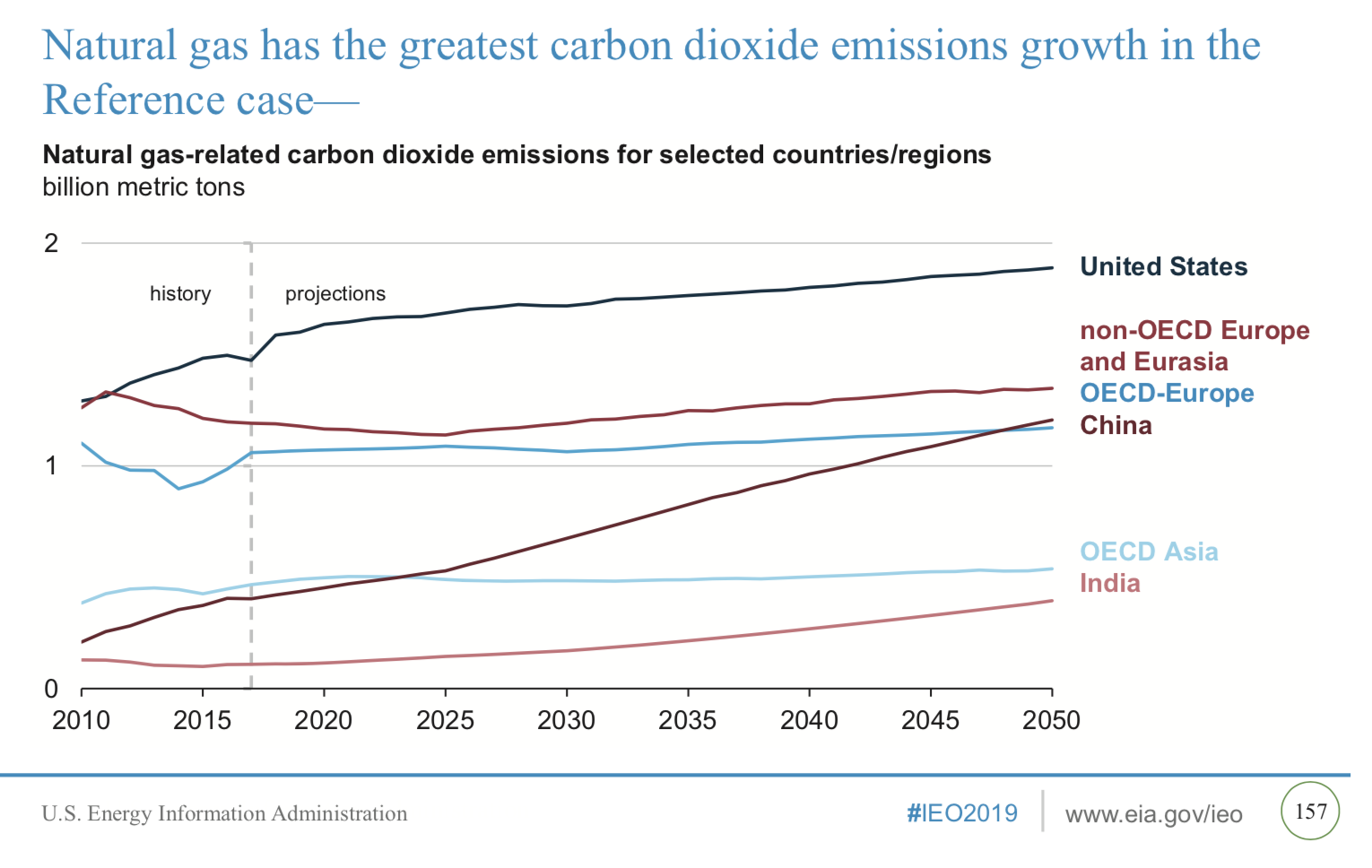
A reference case scenario in the 2019 Annual Energy Outlook forecasts considerable growth in carbon dioxide emissions in the U.S., and globally, from natural gas. Credit: :{U.S.:(style="box-sizing:border-box"):}: Energy Information Administration
About That Methane…
All of this so far is only focused on carbon dioxide emissions, but when discussing emissions and natural gas, you can’t leave out methane, a potent but short-lived greenhouse gas that is the primary constituent of natural gas. (Methane is also emitted by other sources, such as wetlands, landfills, and livestock.)
In one of the new API ads, viewers are presented with the claim that the largest producing oil and gas regions have seen a “60 percent reduction in emissions,” a point prominently flashed across the screen[pix]
from an ]
At first glance, that seems like a great accomplishment, but a close listen to the video’s narrator (and a close reading of the :{API:(style="box-sizing:border-box"):}: website) reveals the industry has reduced emission rates, not overall emissions, by 60 percent in the most productive oil and gas fields. That means greenhouse gas emissions are not increasing in these regions as fast as they once were, but that doesn’t mean they are going down.
However, methane emissions, both in the U.S. and globally, have surged in the past decade, and a 2019 Cornell University study points to fracked shale oil and gas production as a major culprit. Considering how much more powerful methane is at warming the climate compared to CO2 in the short term, these claims by API are misleading at best.
The Trump administration has proposed rolling back a regulation addressing methane leaks from oil and gas production, a move broadly opposed by large oil and gas companies like Exxon and BP but welcomed by API and the smaller firms it also represents.
ref
https://www.nytimes.com/2019/08/29/climate/epa-methane-greenhouse-gas.html
[[Curbs on Methane, Potent Greenhouse Gas, to Be Relaxed in U.S.
Leaks from natural gas drilling, shipping and storage are one of the main sources of methane emissions in the United States.
By Lisa Friedman and Coral Davenport
Published Aug. 29, 2019
WASHINGTON — The Trump administration laid out on Thursday a far-reaching plan to cut back on the regulation of methane emissions, a major contributor to climate change.
The Environmental Protection Agency’s proposed rule aims to eliminate federal requirements that oil and gas companies install technology to detect and fix methane leaks from wells, pipelines and storage facilities. It would also reopen the question of whether the E.P.A. had the legal authority to regulate methane as a pollutant.
...]]
Erik Milito, a vice president at API, voiced his support for replacing the methane rule with a looser one, telling the New York Times, “We think it’s a smarter way of targeting methane emissions.”
Meanwhile, global methane emissionscontinue to rise.
Flaring and Venting
As DeSmog has reported, the flaring and venting, or burning and direct release, of natural gas as part of the U.S. fracking industry is largely unregulated. These common oil and gas field activities are contributing to increasing carbon dioxide and methane emissions in states like North Dakota and Texas.
In Texas, the industry, while drilling for oil, is flaring enough natural gas to power the entire state, but because the gas is just being burned out in the oil fields, it’s not actually powering anything.
“It’s a black eye for the Permian basin,” Pioneer Natural Resources CEO Scott Sheffield said at an energy conference at Columbia University this spring. “The state, the pipeline companies, and the producers — we all need to come together to figure out a way to stop the flaring." [twt]
one way to stop flaring would be federal or state rules banning or limiting the practice, coupled with strong oversight from regulators. But in industry-friendly states like Texas and North Dakota, regulators have failed to enforce any real restrictions on flaring, and so the problem continues to grow.
The fracking industry has been losing money for more than a decade, which means shale oil firms are eager to keep costs low in an already expensive business. Flaring and venting natural gas, which is in oversupply and fetching low prices, saves these firms money when the alternative is building pricey pipelines and processing plants to otherwise deal with it. Ethan H. Bellamy, senior research analyst at Baird Equity Research, summed up the situation: “The business and regulatory question is what to waste, money or molecules?”
As always, the question comes back to profits. And the industry’s answer to that question is to “waste” molecules of natural gas by flaring or venting because this practice allows fracking firms to lose less money than they otherwise would, while still paying executive salaries and bonuses.
Even the International Energy Agency (:{IEA:(style="box-sizing:border-box"):}:) realizes this problem with natural gas.
IEA executive director Fatih Birol recentlytold :{CNBC:(style="box-sizing:border-box"):}:, “When you look at the future, the Achilles heel of the gas industry is the methane emissions.”
Despite the American Petroleum Institute’s new advertising claims, shifting power sources to natural gas won’t stave off the climate crisis.
But as viewers of API‘s new ad, “Together, We’re On It,” will note, the industry is starting to acknowledge public unrest over these issues. Framing it as “the energy debate,” the ad shows a young man sitting in a diner, watching a video of protesters on his laptop as a similar protest — perhaps the hoards of climate strikers who were slated to take the streets in September — marches by, reflected in the window.
Meanwhile, a sympathetic female narrator attempts to soothe this unrest, saying, “The energy debate, the pundits, the chatter, it’s constant. It can feel overwhelming,” before pivoting to a talking point about “the millions of problem solvers working in natural gas." [vid]
is the Gas Boom Already Over?
The oil and gas industry has been shifting its :{PR:(style="box-sizing:border-box"):}: narrative in recent years, with some like API trying to convince the world that natural gas is a climate solution, as companies move to lock in future demand by rapidly building new gas pipelines, power plants, and other infrastructure.
That’s despite reports like those from the nonpartisan but pro-clean energy nonprofit the Rocky Mountain Institute, which recently forecast that up to 90 percent of natural gas power plants (and many pipelines) may be more expensive to run than renewables by 2035. Reports like these show natural gas is a bad investment for both economics and a livable climate.
Along those lines, a recent headline from oil and energy news site Oilprice.com should concern natural gas investors, asking, “Is The :{U.S.:(style="box-sizing:border-box"):}: Gas Boom Already Over?”
The U.S. natural gas industry, whose growth largely has been driven by advances in fracking and drilling technology, has been plagued by losses, and investors are apparently getting tired of loaning money to companies that make it disappear.
Had an interesting lunch with @brucenilles today and heard about how the decline of natural gas, just like the decline of coal, is going to happen faster than people expect & catch industry flat-footed.
— David Roberts (@drvox) October 9, 2019
It isn’t hard to understand why API is now marketing natural gas using language about emissions reductions and energy demand. Rising pressure is coming from a public concerned about the climate crisis and from the increasingly cost-competitive renewables and storage industry.
An excellent example of this economic pressure came earlier this month. A northwest power company owned by billionaire Warren Buffet’s investment firm Berkshire Hathaway — which has no problem investing heavily in oil and gas — recently announced plans to shut down most of its coal plants serving Washington, Oregon, Wyoming, and Utah, and replace them with renewables and battery storage by 2038. That’s despite the abundance of very cheap natural gas in the U.S.
API knows the industry is feeling the heat, and it looks to be employing the same misinformation playbook that it used to sow doubt about the well-supported science of climate change and the resulting action the science demands.
https://www.rollingstone.com/politics/politics-news/oil-executives-recording-trump-access-812511/
oil executives have been reveling in all of the access and influence they now have because President Donald Trump is in office. A recording of a meeting of the Independent Petroleum Association of America (IPAA) obtained by Reveal from The Center for Investigative Reporting shows executives bragging about how they can affect change in both Interior Department and Environmental Protection Agency regulations after their former lawyer, David Bernhardt, was nominated to be the number two official at Interior.
“We know [Berndardt] very well, and we have direct access to him, have conversations with him about issues ranging from federal land access to endangered species, to a lot of issues,” Dan Naatz, IPAA’s political director said, in an hour-long recording of a June 2017 meeting
...ed in 'Dozens' of Planning Meetings With Members of Congress and White House Staff
Bernhardt is now up for a promotion: he is Acting Secretary of the Interior and is Trump’s nominee to replace former Interior chiefRyan Zinke.
“It’s really a new thing for us,” Barry Russell, CEO of IAPP said, bragging about his upcoming meetings with Trump officials. “For example, next week I’m invited to the White House to talk about tax code. Last week we were talking to [EPA] Secretary [Scott] Pruitt, and in about two weeks we have a meeting with [Interior] Secretary Zinke. So we have unprecedented access to people that are in these positions who are trying to help us, which is great, "
russell also laughed recalling a meeting with then-EPA administrator Scott Pruitt where Pruitt’s staff wrote down Russell’s criticisms of the EPA.
“Scott Pruitt, he came from Oklahoma, and we have a lot of friends in common and I thought that’s what we were going to talk about, we did that for about three minutes,” Russell said. “And then he started asking very technical questions about methane, about ozone… And what was really great is there was aboutfour or five EPA staffers there, who were all like, ‘Write that down, write that down,’ all the way through this. And when we left, I said that was just our overview.”
This prompted the audience to laugh at how easy it was for Russell to influence policy.
“So it’s really a new world for us and very, very helpful,” Russell concluded.
On the recording, the executives also discussed a “wish list” they drafted and gave to the administration detailing EPA regulations they wanted rolled back, including removing fracking regulations that protect water sources; limits on methane gas releases; restoration of publicly-owned land harmed by the oil industry and regulations to protect migratory bird populations. Each of those requests was granted.
Nada Culver, senior counsel for the Wilderness Society environmental group, told Reveal: “The IPAA’s wish list was granted as asked, in the executive order, and in the actions taken by the Department of the Interior. It pains me to say it.”
And, of course, with Bernhardt’s confirmation hearings approaching, groups like IAPP stand to gain even more as their access and influence within the Trump Administration grows.
sharon
https://theintercept.com/2021/09/18/epa-corruption-harmful-chemicals-testing/
sCIENTISTS AT THE Environmental Protection Agency have provided The Intercept with new information showing that senior staff have made chemicals appear safer — sometimes dodging restrictions on their use — by minimizing the estimates of how much is released into the environment.
The EPA gauges the potential risk posed by a chemical using two measures: how toxic the agency considers it and how much of the substance the public will likely be exposed to. Whistleblowers from the EPA’s New Chemicals Division have already provided The Intercept with evidence that managers and other officials were pressuring them to assess chemicals to be less toxic than they actually are — and sometimes removing references to their harms from chemical assessments.
now new documents, including meeting summaries, internal emails, and screenshots from the EPA’s computer system, along with interviews with whistleblowers and other EPA scientists, show that the agency’s New Chemicals Division has avoided calculating the exposure to — and thus the risk posed by — hundreds of chemicals and have repeatedly resisted calls to change that policy even after scientists have shown that it puts the public at risk.
Call It “Negligible”
Since 1995, the EPA has operated under the assumption that chemicals emitted below certain cutoff levels are safe. Whether a toxic chemical is emitted through the smokestacks of an industrial plant, via leaks in its machinery, or from a leaky landfill into groundwater, the agency requires scientists to quantify the precise risk posed by the chemical only if the release (and thus likely human exposure) reaches certain thresholds. If the releases from both smokestacks and leaks are below the thresholds, the chemical is given a pass. In recent years, however, scientists have shown that some of the chemicals allowed onto the market using this loophole do in fact present a danger, particularly to the people living in “fence-line communities” near industrial plants.
In 2018, several EPA scientists became worried that the use of these exposure thresholds could leave the public vulnerable to health risks.Their concern was heightened by an email that a manager in the Office of Pollution Prevention and Toxics sent in October of that year, instructing the scientists to change the language they used to classify chemicals that were exempted from risk calculation because they were deemed to have low exposure levels. Up to that point, they had described them in reports as “below modeling thresholds.” From then on, the manager explained, the scientists were to include the words “expects to be negligible” — a phrase that implies there’s no reason for concern....[cANCER]
https://theintercept.com/2021/08/19/formaldehyde-leukemia-epa-trump-suppressed/
hive?
https://www.vanityfair.com/news/2019/02/trump-put-a-koch-official-in-charge-of-americas-drinking-water
Of all the federal agencies that fall under Donald Trump’s purview, none embodies the administration’s unofficial mandate to do the exact opposite of its stated mission quite like the Environmental Protection Agency. For the last two years, the E.P.A.—which, as a reminder, is supposed to be protecting human health and the environment—has done everything in its power to turn the planet into an ashtray and convince Americans that toxic chemicals are actually totally fine to drink, breathe, and otherwise ingest, all in an effort to help companies secreting those chemicals maximize their profits. Which is to say, we probably should have seen this one coming:
The Trump administration has placed a former Koch Industries official in charge of research that will shape how the government regulates a class of toxic chemicals contaminating millions of Americans’ drinking water—an issue that could have major financial repercussions for his former employer.
David Dunlap, a deputy in E.P.A.’s Office of Research and Development, is playing a key role as the agency decides how to protect people from the pollution left behind at hundreds of military bases and factories across the country. ..He spent the previous eight years as Koch Industries’ lead expert on water and chemical regulations, a position that typically includes helping companies to limit regulatory restrictions and liability for cleanups.
Dunlap was hired in October, according to previously undisclosed documents. Since then, he has been extremely busy, having reportedly been involved in high-level meetings that preceded the agency’s decision not to set drinking water limits for chemicals known as perfluoroalkyl and polyfluoroalkyl substances, which “have been linked with kidney and testicular cancer, as well as other ailments.” (In a statement, David Ross, EPA Assistant Administrator for the Office of Water, told the Hive: “Despite what is being reported, EPA has not finalized or publicly issued its PFAS management plan, and any information that speculates what is included in the plan is premature. The agency is committed to following the Safe Drinking Water Act process for evaluating new drinking water standards, which is just one of the many components of the draft plan that is currently undergoing interagency review.”)
According to Politico,Dunlap has been able to avoid a Senate confirmation hearing in which his prior work experience might come up because Trump has not officially nominated anyone to run to office. (Dunlap’s official bio on the E.P.A. Web site declines to mention any of his employers during his “more than 30 years” working for “private industry, trade associations and as an environmental consultant.”)Currently, Koch subsidiary Georgia-Pacific, a paper and pulp conglomerate, is facing at least one class-action suit related to chemicals now under Dunlap’s purview.
Koch’s various environmental crimes against humanity are laid out in several high-profile lawsuits over the past 20 years. According to Bloomberg, “Koch Industries was assessed more than $400 million in fines, penalties, and judgments” between 1999 and 2003, such as for dumping hundreds of thousands of gallons of aviation fuel into a Minnesota wetland. “You want an independent, hardheaded scientific review of these issues; you don’t want somebody who is already taking the industry party line,” Erik Olson, who heads up the Natural Resources Defense Council’s public health work, told Politico. “There’s a legitimate threat there and, from my perspective, the conflicts of interest that [Dunlap] has having worked as a regulatory compliance director at Georgia-Pacific raises questions about whether he can make those objective decisions or should be recused.”
Dunlap, of course, is unlikely to be replaced by someone without a host of conflicts of interest given that the guy currently running the E.P.A., Andrew Wheeler, is a walking, talking conflict of interest, having served as a coal-lobbyist prior to taking over the top job from departed Grift King Scott Pruitt. It is, in other words, par for the course. Here’s a few other actions Trump’s E.P.A. has taken over the past two years:
- Argued **coal plants should regulate themselves**;
- Announced plans to roll back mercury regulations;
- Made it easier to release methane into the air;
- Tried to suppress a report showing “most Americans inhale enough formaldehyde vapor in the course of daily life to put them at risk of developing leukemia and other ailments”
- Pushed for asbestos to make a comeback; and
- Claimed a little **radiation**might actually be good for you.
You know, policies the Forgotten Man was hoping Trump would push through when they voted for him in 2016.
https://www.politico.com/news/2021/01/13/trump-epa-toxic-chemical-458962
no lnx many
trump’s EPA team overrules career scientists on toxic chemical
Changes to the safety assessment for a major cause of water pollution are the administration's latest “landmine” for Joe Biden's incoming appointees, one Democratic aide said.
The draft assessment EPA released for public comment in November 2018 took the standard approach of providing a single number describing how toxic the chemical is to humans. | Getty Images
By ANNIE SNIDER
01/13/2021
Political officials at EPA have overruled the agency’s career scientists to weaken a major health assessment for a toxic chemical contaminating the drinking water of an estimated 860,000 Americans, according to four sources with knowledge of the changes.
:{
}:
The changes to the safety assessment for the chemical PFBS, part of a class of "forever chemicals" called PFAS, is the latest example of the Trump administration's tailoring of science to align with its political agenda, and another in a series of eleventh-hour steps the administration has taken to hamstring President-elect Joe Biden's ability to support aggressive environmental regulations.
“They’re just trying to lay as many landmines as possible,” said a Democratic congressional aide with knowledge of the changes. “Every single thing that they’re doing ends up being a landmine for whoever comes next. It’s going to take a lot of time to unravel, which sort of takes away from the ability to do anything proactive.”
An EPA spokeswoman did not respond to a request for comment on the changes, but defended its effort to tap scientists from a different part of the agency to rewrite the rule.
:{
}:
PFBS is a replacement for a related chemical, PFOS, that was used for decades in Scotchguard and military firefighting foam before being phased out in the mid-2000s. PFBS has been in military firefighting foam, carpeting and food packaging,but independent scientists say it may not be much safer than the toxin it replaced. It has been linked with with thyroid, kidney and reproductive problems at very low levels of exposure.
While the new assessment is a science document, not a regulatory one, the changes in question open the door for state and federal regulators to potentially set less stringent cleanup standards, drinking water limits and other standards.
The broader class of PFAS, of which PFOS is a part, has been used in everything from stain-resistant carpeting to Teflon to microwave popcorn bags, and are linked with kidney and testicular cancer, immune effects and other health ailments. The chemicals contaminate the drinking water supplies of an estimated 200 million Americans, according to an analysis by the nonprofit Environmental Working Group.
Trump administration officials at EPA have vowed to aggressively address PFAS, touting a multi-pronged PFAS Action Plan. But they have fought efforts by lawmakers to accelerate work on a federal drinking water limit for the chemicals,and in 2018 POLITICO reported that White House officials sought to block a CDC assessment finding they are dangerous at much lower levels of exposure than EPA said was safe, calling it “a public relations nightmare.”
The PFBS assessment has been in the works for more than three years, and has been a particular concern for the Defense Department, which faces massive cleanup liability.
The draft assessment EPA released for public comment in November 2018 took the standard approach of providing a single number describing how toxic the chemical is to humans, called a “reference dose.” Regulators can then use that number to calculate a safety limit for different populations — for instance, for pregnant women or people with compromised immune systems.
But the final assessment sent to the White House for review Monday replaces that single reference dose value with a range of values, the sources said, a change made by staffers in the agency's pesticides office at the direction of political officials— not the career scientists at EPA who specialize in assessing the human health risks of chemicals.
EPA spokeswoman Molly Bock defended this reassignment, saying that it is "routine" to consult with other parts of the agency.
"This collaboration is important as other program offices have information and expertise that can improve the scientific quality of the work product under review. This aligns with EPA’s PFAS Action Plan, which is the first multi-media, multi-program office plan to address an emerging contaminant of concern," she said.
But the alterations were so alarming that several of the career EPA scientists who spent years working on the study have asked that their names be removed from the document, two of the sources said.
Environmental advocates say the range approach would allow industry and state and local officials to “cherry-pick” the number they like best, regardless of whether it is sufficiently protective.
“The dream of industry has always been a range of values so that you really can choose anywhere within that range,” said Betsy Southerland, a former top EPA scientist who led the agency’s work on the health assessment for two other PFAS chemicals in 2016.
The new range of reference doses in the final assessment includes slightly weaker values than EPA forward put forward in its draft assessment in November 2018, two of the sources said. But the most alarming part isn't the numbers themselves, they said, since the conclusion is still that PFBS is dangerous at very low levels of exposure. Rather, it's the fact that political officials upended the scientific process to arrive at them.
“It’s not orders of magnitudes, but that’s irrelevant. How much does it matter if you get one drop or two drops of cyanide?” said the source, a senior EPA scientist.
In a related move late last week, the Trump administration threw up a new roadblock to environmental health assessments with a new mandate from the powerful Office of Management and Budget, which resides at the White House.
On Friday, OMB ordered that the agency's gold-standard health assessments go through White House review -- a process that environmental and public health advocates say inserts political interference into documents that are meant to be purely scientific and have already been peer reviewed.
The order, sent from OMB to EPA Administrator Andrew Wheeler in a memo reviewed by POLITICO, effectively reinstates a process that was in place under the George W. Bush administration, which a government watchdog found “limits the credibility” of assessments from EPA’s premiere risk assessment program, the Integrated Risk Information System. The IRIS program has for years been a top target for the chemicals industry, Republicans on Capitol Hill and Trump's EPA research chief, David Dunlap, in his former role as a chemicals expert at Koch Industries.
The PFBS assessment is the first to go through the newly-mandated White House review, and the sources said they expect it to be perfunctory, aimed primarily at establishing a precedent. The assessment could be finalized as soon as Wednesday, they said.
“There’s no need for there to be a political review of these documents,” said Genna Reed with the Union of Concerned Scientists. “Largely it is an opportunity for political officials to interfere with the information, to weaken the science, and to play up uncertainty.”
OMB spokesman Edie Heipel defended the move, saying there is “nothing controversial about ensuring good science unless you are worried that your work won’t stand up to scrutiny from other scientists across the government.”
[SECRET SCI BS] These latest moves come after EPA Administrator Andrew Wheeler last week finalized a sweeping regulation limiting the agency’s ability to rely on scientific studies that don’t make all of their underlying data public – a requirement that public health advocates say will make it harder for the agency to use research on the health effects of toxic chemicals on humans.
To be sure, the incoming Biden administration is expected to attempt to reverse many of these moves. Environmental groups [EG EDF] have already filed suit seeking to overturn last week’s scientific transparency rule. But critics of the move say it will take some time to unwind, leaving health and safety gaps in the meantime.
epafoia
2017
all_pending_report_20170831.xlsx
https://www.epa.gov/sites/default/files/2017-09/all_pending_report_20170831.xlsx
Seeking all communications (emails, letters, PowerPoint presentations, etc.) sent by EPA and received at EPA to and from both the Trump transition team and the Trump "landing team" of select staff from Nov. 15, 2016, to Dec. 14, 2016. The transition team is the one with the website greatagain.gov. The "landing team" is the Trump transition team officials that are working directly with EPA: Myron Ebell, David Schnare, David Kreutzer, Austin Lipari, David Stevenson, and George Sugiyama. EPA is aware of the members of its own transition team, but to cover all the bases, the head of EPA's transition effort is Shannon Kenny. EPA has made minimal information about the transition available to the public, and the communications between EPA and the landing/transition team are impossible to obtain unless through FOIA. To make clear: this request includes all materials generated by EPA as well as all materials generated by the transition and/or landing team and sent to EPA.
lacey ant inside epa
cnn bracewell cpi cent publ integrity
bogardus e&e, sierra
e&e
I request copies of all emails containing at least one or more of the following search terms — “Russia,” "Russian," "Putin," "Kislyak," "kompromat," "Wikileaks," "Assange," "CIA," "FBI," "NSA," "Comey," and "Podesta" — resulting from an electronic automated search of the email accounts associated with the following listed EPA employees since Jan. 20, 2017 to the date that this FOIA request is processed. Those EPA employees are: Layne Bangerter, Don Benton, Patrick Davis, Doug Ericksen, Holly Greaves, John Konkus, David Kreutzer, Charles Munoz, David Schnare, Justin Schwab and George Sugiyama. I agree to accept the results of an electronic search for these records. EPA may consider news articles containing the identified search terms that have been emailed as non-responsive to my request unless those news articles have been forwarded with commentary.
2/17
I request copies of all emails containing at least one or more of the following search terms — “Trump,” "Make America Great Again," "MAGA," "Build The Wall," "Lock Her Up," "Drain The Swamp" and "DTS" — resulting from an electronic automated search of the email accounts associated with the following listed EPA employees since Jan. 20, 2017 to the date that this FOIA request is processed. Those EPA employees are: Layne Bangerter, Don Benton, Patrick Davis, Doug Ericksen, Holly Greaves, John Konkus, David Kreutzer, Charles Munoz, David Schnare, Justin Schwab and George Sugiyama. I agree to accept the results of an electronic search for these records. EPA may consider news articles containing the identified search terms that have been emailed as non-responsive to my request unless those news articles have been forwarded with commentary.
e&e news
access violation shut down?! too big cut?
NW envir advocates Nina Bell Northwest Environmental Advocates
an bridge 21c
Tuesday, January 24, 2017 Attn: FOIA Officer Environmental Protection Agency To Whom It May Concern, The following request is being made in accordance with the Freedom of Information Act (5 U.S.C. § 552). I am requesting copies of the following: Incoming-And-Outgoing Email Correspondence Between The Environmental Protection Agency And The Individuals Listed Below From November 9, 2016 Through The Present. I am requesting incoming-and-outgoing email correspondence between the Environmental Protection Agency and the individuals listed below from November 9, 2016 through the present. The search within the Environmental Protection Agency should be confined to the following offices: Office of Acquisition Management, Office of the Administrator, and the Office of General Counsel. The following individuals should be searched for correspondence with the Environmental Protection Agency: • Myron Ebell • Scott Pruitt • Stephen “Steve” Bannon • Jared Kushner • Michael Catanzaro • Ron Nicol • Rob Gordon I realize that certain costs may be applicable to this request. Please contact me when you can provide a payment amount for my requests. In the meantime, I authorize an initial expense cap of $100 to be accrued. To help assess my status for copying and mailing fees, please note that I am gathering information for research purposes and not for commercial activities. I also request that you state the specific legal and factual grounds for withholding any documents or portions of documents, should you withhold any. Please identify each document that falls within the scope of this request but is withheld from release. If requested documents are located in, or originated in, another installation or bureau, I would request that you please refer this request, or any relevant portion of this request, to the appropriated installation or bureau. To the extent that the information is available in electronic format, I would prefer
alex g politico
I am requesting any email or other communication that include the words “Pruitt” or “vote” that were sent on Feb. 17, 2017, to or from the following EPA employees: Don Benton; Charles Munoz; Doug Ericksen; Layne Bangerter; John Konkus; Patrick Davis; Holly Greaves; David Kreutzer; David Schnare; Justin Schwab; George Sugiyama. If you deny all or any part of this request, please cite each specific exemption you think justifies your withholding of information. Please notify me of appeal procedures available under the law. If you have any questions about handling this request, you may telephone me at 703-341-4619 or 571-839-6243.
kothari ucs
All communications from January 20, 2017 to present, between EPA staff and members of the EPA beachhead team. In particular, we request access to and copies of all communications between the following EPA staff:_x000D_
- Catherine McCabe_x000D_
- Mike Flynn_x000D_
- Donna Vizian_x000D_
- Sarah Dunham_x000D_
- Wendy Cleland-Hamnett_x000D_
- David Bloom_x000D_
- Lawrence Starfield_x000D_
- Steven Fine_x000D_
- Kevin S. Minoli_x000D_
- Arthur A. Elkins, Jr._x000D_
- Jane Nishida_x000D_
- Barry Breen_x000D_
- Robert Kavlock_x000D_
- Michael Shapiro_x000D_
- David Kling_x000D_
- Shannon Kenny_x000D_
- George Hull_x000D_
- Tom Brennan_x000D_
- Robin Richardson_x000D_
- John Reeder_x000D_
- Lilian Dorka_x000D_
- Christopher Zarba_x000D_
- Brian Hope_x000D_
- Denise Benjamin-Sirmons_x000D_
_x000D_
And the following members of the beachhead and landing teams:_x000D_
- Layne Bangerter_x000D_
- Don Benton_x000D_
- Patrick Davis_x000D_
- Doug Ericksen_x000D_
- Holly Greaves_x000D_
- David Kreutzer_x000D_
- Charles Munoz_x000D_
- David Schnare_x000D_
- Justin Schwab_x000D_
- George Sugiyama_x000D_
- Chris Horner_x000D_
- Myron EbellAll communications from January 20, 2017 to present, between EPA staff and members of the EPA beachhead team. In particular, we request access to and copies of all communications between the following EPA staff:_x000D_
- Catherine McCabe_x000D_
- Mike Flynn_x000D_
- Donna Vizian_x000D_
- Sarah Dunham_x000D_
- Wendy Cleland-Hamnett_x000D_
- David Bloom_x000D_
- Lawrence Starfield_x000D_
- Steven Fine_x000D_
- Kevin S. Minoli_x000D_
- Arthur A. Elkins, Jr._x000D_
- Jane Nishida_x000D_
- Barry Breen_x000D_
- Robert Kavlock_x000D_
- Michael Shapiro_x000D_
- David Kling_x000D_
- Shannon Kenny_x000D_
- George Hull_x000D_
- Tom Brennan_x000D_
- Robin Richardson_x000D_
- John Reeder_x000D_
- Lilian Dorka_x000D_
- Christopher Zarba_x000D_
- Brian Hope_x000D_
- Denise Benjamin-Sirmons_x000D_
_x000D_
And the following members of the beachhead and landing teams:_x000D_
- Layne Bangerter_x000D_
- Don Benton_x000D_
- Patrick Davis_x000D_
- Doug Ericksen_x000D_
- Holly Greaves_x000D_
- David Kreutzer_x000D_
- Charles Munoz_x000D_
- David Schnare_x000D_
- Justin Schwab_x000D_
- George Sugiyama_x000D_
- Chris Horner_x000D_
- Myron Ebell
Judicial Watch
kate bailey
crew, edf, pro pub, nrdc,
Dear Sir or Madam: Please see attached letter. Pursuant to the provisions of the Freedom of Information Act, 5 U.S.C. § 552 and the regulations promulgated thereunder, we respectfully request copies of the following records in the possession, custody, or control of the United States Environmental Protection Agency’s Office of Land and Emergency Management (“OLEM”): all documents, communications, records, files, drafts, and reports related to the development of the Provisional Peer Reviewed Toxicity Value (“PPRTV”) for p-Chlorobenzenesulfonic Acid (“p-CBSA” or “pCBSA”). I understand that in order to fulfill this request there may be fees associated with duplication and research. Please be advised that I agree to pay reasonable fees to secure the records requested. Thank you in advance for your anticipated prompt response and professional courtesy. Please do not hesitate to contact me at (858) 509-8451 or francesca.bochner@lw.com if you require additional information. Best regards, Francesca F. Bochner of LATHAM & WATKINS LLP
bill kovacs CoC FOIA request to EPA on citizen suit complaints and notices of intent to sue filed under the Clean Air Act and Clean Water Act from January 1, 2014 to December 31, 2015.
CU! John T. Mastranadi
In accordance with the Freedom of Information Act, I hereby request all emails and other records of communication sent or received by any employees of the Environmental Protection Agency, to or from employees in the office of U.S. Senator Charles Schumer, including but not limited to, the email domain “@schumer.senate.gov”. The time period for this request is January 1, 2015 – January 20, 2017.
Per FOIA regulations, please provide the complete and unredacted text and contents of the "Action Plan" for the Environmental Protection Agency created by EPA Transition Team Leader, Myron Ebell- Fellow at the Competitive Enterprise Institute.
ann land FTI
Site: Curtiss Wright Corp., 1 Passaic Street, Wood-Ridge, NJ Request is to review records from (1) Emergency and Remedial Response including preliminary assessment and site inspections; (2) Clean Water Div. (NJPDES permit No., any records including records prior to NJDEP certification of NPDES program); (3) Div. of Enforcement and Compliance (RCRA inspections/corrective actions) and TSCA records; and (4) any releasable records maintained by Regional Counsel. Please include any records being held in the FRC.
==
intercept 921
https://theintercept.com/2021/08/24/chlorpyrifos-epa-ban-pesticides/
EPA’s Rationale for Banning Chlorpyrifos May Make it Harder to Eliminate Other Brain-Harming Pesticides
Sharon Lerner
an 721 no lnx
https://www.alternet.org/2021/07/biden-science/
Four scientists at the Environmental Protection Agency are alleging that the "war on science" is continuing under the Biden administration, with managers at the agency altering reports about the risks posed by chemicals and retaliating against employees who report the misconduct.
The government watchdog Public Employees for Environmental Responsibility (PEER) filed a formal complaint Friday on behalf of the scientists with the EPA's Office of the Inspector General, calling for an investigation into reports that high-level employees routinely delete crucial information from chemical risk assessments or change the documents' conclusions to give the impression that the chemicals in question are not toxic.
The group also wrote to the House Committee on Oversight and Reform's Subcommittee on Environment, calling on lawmakers to work with the inspector general to investigate the allegations.
The report follows outrage about officials in the Trump administration covering up scientific facts by deleting the EPA's climate change website, but PEER emphasized that the problem is persisting at the agency six months into President Joe Biden's term.
"These alterations of risk assessments are not just artifacts of the Trump administration; they are continuing on a weekly basis," said Kyla Bennett, science policy director at PEER who formerly worked at the EPA.
Under the Toxic Substances Control Act, the agency is responsible for evaluating the risks of existing chemicals as well as those slated to be manufactured in or imported to the United States.
The four employees said in the complaint that they've observed "numerous instances" in which significant changes were made to their own assessments, including:
The removal of language identifying possible adverse effects of chemicals, including developmental toxicity, neurotoxicity, mutagenicity, and/or carcinogenicity;
Changes to report conclusions to indicate that there are no signs of toxicity "despite significant data to the contrary"; and
Risk assessments being reassigned to inexperienced employees "to secure their agreement to remove issues whose inclusion would be protective of human health."
"The resulting Material Safety Data Sheets lack information vital to prevent harmful exposures, such as proper handling procedures, personal protection needed, accidental release measures, first aid, and firefighting measures," said PEER.
In one case, managers increased the dose considered safe for consumption for a certain chemical by nearly 10,000-fold, according to The Hill.
"All of these altered assessments need to be pulled back and corrected in order to protect both workers handling chemicals and the American public," said Bennett.
According to PEER, staff scientists at EPA have spent months raising concerns internally and filing a formal complaint on their own—only to face "harassment from managers named in the complaints."
Hours after PEER filed the complaint on Friday, the organization said, the four whistleblowers' names were released internally at the EPA in "a troubling move" by someone at the agency.
"Whistleblowers help protect us all—we must protect them," PEER said.
The organization called on the inspector general to "identify all the alterations and restore the correct risk information," and to dismiss the civil service managers found responsible for the misconduct in the investigation.
"EPA's lack of accountability for scientific misconduct poses a direct danger to public health," said Bennett. "Inside EPA, scientific integrity has become an oxymoron and a cure will require a complete overhaul."
FROM YOUR SITE ARTICLES
Is Joe Biden ready for the urgency of the climate crisis? - Alternet.org ›
Joe Biden's blitz on climate policy is impressive. Here's what it ... ›
'Like drinking bleach': Former Obama adviser derails Fox News ... ›
RELATED ARTICLES AROUND THE WEB
Biden Elevates Science in Week One Actions - Scientific American ›
Biden pursues giant boost for science spending ›
Biden seeks big increases for science budgets | Science | AAAS ›
https://www.alternet.org/2021/05/trump-report
raw story gettys
The Trump administration delayed the first-ever report from the Environmental Protection Agency blaming humans for climate change.
The EPA acknowledged in a 2017 report that human activity was, at least in part, to blame for glaciers shrinking, sea levels rising, coastal flooding and other threats, but the agency's climate change indicators website was not updated under former president Donald Trump, reported the BBC.
"Combating climate change - it's not optional. It's essential at EPA," said the agency's administrator Michael Regan, who was appointed by President Joe Biden. "We will move with a sense of urgency because we know what's at stake."
The EPA had never before attributed global warming to human activity, even during Barack Obama's administration, but the agency neglected to release its findings under Trump, who had called climate change a "hoax."
The report shows data from dozens of federal agencies to show the damage already caused by climate change, including coastal flooding and wildfires, and attributed rising temperatures to increased energy consumption -- which has nearly doubled in summer months since 1973.
===
pesticide linked to brain damage in children could finally be banned
Reynard Loki Independent Media Institute
A federal appeals court has ruled that unless the Environmental Protection Agency (EPA) can prove that the pesticide chlorpyrifos is safe, it must be banned. The chemi...
==
see superfund
icn 1020
trump's EPA Claimed 'Success' in Superfund Cleanups—But Climate Change Dangers Went Unaddressed
BY: DAVID HASEMYER, INSIDECLIMATE NEWS AND LISE OLSEN, TEXAS OBSERVER
As work stalled on hardening Superfund sites against climate-related weather extremes, budget cuts continued and a backlog of sites awaiting cleanup ballooned.
https://www.ecowatch.com/trump-epa-rollbacks-covid-2648440328.html
as the days tick down to next month's presidential election, debate rages over the U.S. government's handling of the COVID-19 pandemic with critics of President Donald Trump calling for his ouster due to his failure to protect the American public.
And yet as mass media runs daily tallies of COVID-related cases and deaths, a more sinister threat to public health looms as the Trump administration rolls back regulations that govern the quality of our air, land and water. And though these actions are garnering little public outcry now, they pose grave danger to our children and their children for decades to come. It's a simple truth — a poisoned environment means poisoned people.
In recent months the Trump administration has stripped protections from wetlands in ways that allow for the dumping of pesticides and other pollutants directly into millions of miles of streams and other waterways; relaxed rules on power plants designed to curb air emissions containing brain-damaging heavy metals such as mercury; altered automobile fuel efficiency standards to be "less stringent," allowed more emissions of climate-damaging carbon dioxide; and rolled back requirements governing how coal-fired power plants dispose of toxic wastewater, a move praised by coal industry executives but expected to add increased levels of lead, arsenic and other harmful contaminants to the environment.
If there was any doubt about how little Trump cares for the health of our children, that was made clear last month when the Environmental Protection Agency (EPA) announced it would continue to allow the neurotoxic chemical chlorpyrifos to be used to grow food despite years of scientific research showing the pesticide damages babies' brain development. Residues of chlorpyrifos are commonly found in food consumed by young children. A USDA report released last year documented chlorpyrifos residues in raisins, peaches, mangoes and asparagus, among other foods.
Amid the rush to ease regulations before the end of Trump's term, the EPA is also working to appoint new industry-friendly individuals to its scientific advisory board.In an October 14 announcement, the agency said the new vice chair of the board would be Dr. Barbara Beck, who works for an industry consulting company with a history of defending controversial chemicals and other substances. Beck has advocated for loosened restrictions on lead despite the fact that the Centers for Disease Control and Prevention (CDC) says lead exposure damages a child's brain and nervous system and can cause learning and behavior problems.
"Trump is burning down the house," Tim Whitehouse, a former senior attorney with the Environmental Protection Agency (EPA), told me. Whitehouse now heads an organization representing thousands of government employees called Public Employees for Environmental Responsibility (PEER), and says government scientists are being ignored as the administration pushes through favors for influential industries.
"I think it's beyond a difference in policy. It is a feeling that the people who are put in charge are robbing the house," Whitehouse said. "We're in a period of massive biodiversity loss and increasing chemical and toxic burdens on individuals, and the EPA is not responding to the crises at hand."
PEER has joined with other groups in suing the EPA over its elimination of clean water protections, charging in a formal complaint that Trump's political appointees are ignoring scientific evidence of the harms certain to be wrought by the rule changes.
To be sure, the EPA's fealty to industry is not unique to the Trump Administration. Indeed, the agency's loyalty to companies over consumers seems to be a longstanding bipartisan tradition. Trump's predecessor President Barack Obama also faced criticism for actions – and inaction – by his EPA.
And numerous administrations are to blame for allowing the broad spread of toxic chemicals known as PFAS (short for per- and polyfluoroalkyl substances) that are linked to an array of serious health problems.
But we simply cannot afford this political bargaining with our health anymore. In taking more than 200,000 lives in less than a year, the COVID-19 virus has underscored the already fragile condition of our health. People suffering from cancer, chronic kidney disease, obesity, and other problems are at increased risk of becoming seriously ill or dying if stricken with COVID-19, according to the CDC. Scientists have rightly pointed out that environmental pollution is a contributing factor to the vulnerability of many people to the COVID-19 virus.
Adding more toxins into the air we breathe and water we drink only ensures more vulnerability and more deaths.
We already are facing frightening levels of neurodevelopmental disorders, cancer and disease in our population: Autism spectrum disorder is now effecting roughly 1 in every 54 children, far more prevalent than 20 years ago. The rate at which children are diagnosed with cancer has increased 34 percent since 1975; in 2020 more than 16,800 kids are expected to be newly diagnosed. Overall, close to 40 percent of men and women in the United States will be diagnosed with cancer in their lifetimes. More than 600,000 people are dying every year from cancer and more than 1.7 million are diagnosed with new cancers each year.
As an environmental journalist, I am astonished at the brazenness with which this administration has made clear that corporate well-being is more valuable than the health and well-being of citizens.
And as a mother, I agonize over the suffering, sickness and struggles I know lie ahead for our future generations.
Years from now, when our children tell their children about this time, when they try to explain how much was lost, how cavalierly we allowed their health to be traded for the health of corporate profits, they will be right to blame us. They will also be right to not forgive us.
- Trump's Latest EPA Rollback Lets Polluters Spew More Lead ... ›
- Trump EPA Won't Regulate Toxic Drinking Water Chemical That ... ›
- States Sue Trump EPA for Suspending Environmental Regulations ... ›
- EPA Chief: Trump will roll back more environmental rules if reelected ›
- A running list of how President Trump is changing environmental ... ›
- The Trump Administration Is Reversing Nearly 100 Environmental ... ›
battered, Flooded and Submerged: Many Superfund Sites are Dangerously Threatened by Climate Change
BY: DAVID HASEMYER, INSIDECLIMATE NEWS, AND LISE OLSEN, TEXAS OBSERVER
The Obama administration directed the EPA to focus on climate-related threats. Now, the Trump administration refuses to even use the word.
==
https://theintercept.com/**2020/09**/19/wildfires-trump-election-epa-environment/
sharon lerner
as WILDFIRES DESTROY millions of acres in California, Oregon, and Washington, and an unprecedented series of hurricanes cause historic flooding in the South, leaving parts of the region uninhabitable, the Trump administration has been racing to reverse rules designed to prevent exactly these kinds of climate disasters.
Throughout his presidency, Donald Trump has presided over the rollback of more environmental rules and regulations than any other president. The result has been that, even as climate change is on track to soon force millions of Americans from their homes and eventually heat the Earth to temperatures not seen for 34 million years, the leader of the country that bears more responsibility for the climate change than any other has doubled down on the decimation of efforts meant to combat both pollution and the climate crisis.
“The Trump administration is the first in the history of the agency to devote itself so relentlessly to a rollback agenda without even a pretense of meaningfully reducing environmental pollution,” said John Walke, an attorney and senior adviser to the NRDC Action Fund.
starting with his choice of Scott Pruitt, a climate denier whose rise through Oklahoma politics was fueled by the oil and gas industry, to lead the Environmental Protection Agency, Trump has has signaled his disregard for the climate and public health throughout his time in office. While Trump has called climate change a “Chinese hoax” and a “con,” federal agencies under him have taken countless actions — from the removal of information about climate change on the EPA website to the decision to withdraw from the Paris climate agreement;the retooling of models used by the U.S. Geological Survey; and the **cancellation**of NASA’s carbon monitoring program — that set back the effort to address the climate crisis, and ultimately endanger the environment.
In recent months, the pace of these assaults has quickened. The frenzied efforts of federal agencies during the last months before a presidential election are often referred to as “midnight regulation.” But the work the Trump administration has recently been hurrying to complete would be more accurately described as “midnight deregulation.”
A sign with the words “Trump Digs Coal” can be seen on a factory building in a coal mining area in Hazleton, Penn., on Feb. 2, 2017.
Photo: Maren Hennemuth/Picture Alliance/Getty Images
Protections Obliterated
As soon as he entered office, Trump began the environmental reversals that will likely be the most enduring legacy of his administration. In March 2017, the Environmental Protection Agency signaled that it would not complete the planned ban of a neurotoxic pesticide called chlorpyrifos. The decision came after consulting closely with industry groups and after the Dow Chemical Company, which makes the pesticide, donated $1 million to the Trump inaugural committee. The Trump EPA has since completed dozens of other environmental rollbacks, including gutting the Clean Water Act; weakening restrictions on facilities that emit toxic air pollution; scrapping a rule that required mining companies to set aside money to cover the costs of cleaning up pollution; rewriting the National Environmental Policy Act so that it no longer requires government to consider the cumulative environmental impacts of major federal projects on communities; and ensuring that the coal industry is now able to dump mining waste in streams.
Among the recently finalized actions that will have devastating and long-lasting climate consequences are the rescinding of limits on methane emissions during oil and gas production and processing. Methane is a climate pollutant that traps over 80 times more heat than carbon dioxide in a 20-year period, and the U.S. is already releasing way too much of it. The rollback of methane rules, which was finalized in August — and opposed by many of the major oil companies that will be affected by it — is specifically designed to ignore climate considerations and is expected to increase the amount of the greenhouse gas released each year by 4.5 million metric tons. The additional pollution released will have the same impact as 100 coal-fired power plants each year, according to the Environmental Defense Fund, which is suing the administration over the rule.
The EPA’s weakening of fuel economy standards for cars and light trucks, which was finalized in March while most people were focused on the coronavirus pandemic, will also speed climate change and lead to more catastrophic weather events and wildfires. The change, which reduces fuel efficiency for these vehicles by 27 percent, is expected to result in at least 867 million metric tons of additional carbon dioxide pollution, the equivalent of the annual emissions from 216 coal plants.
The EPA has also reversed its policy of requiring businesses to inspect for leaks from refrigerators and air conditioners. The revision to the regulations, which was finalized in February, affects the release of hydrofluorocarbons, chemicals that can cause hundreds of times more warming than carbon dioxide and often leak from cooling equipment. According to the agency’s own science, the new rulewill result in an increase of greenhouse gas emissions that has the same warming potential as 2.9 metric tons of carbon dioxide each year.
Meanwhile, the Department of Interior finalized its plan to open up Alaska’s Arctic National Wildlife Refuge to oil drilling, a move that environmentalists expect to not only be devastating to the 700 species of plants and animals that live there but also greatly increase carbon emissions. In 2018, the Federal Energy Regulatory Commission limited its consideration of greenhouse gas emissions from natural gas projects. And, through an executive order, Trump weakened regulations that were put in place to mitigate flooding from sea-level rise.
Perhaps most devastating is the loss of the Clean Power Plan. That Obama-era plan was designed to reduce climate pollution by more than 400 million tons by 2030. Instead, Trump replaced it with the far weaker Affordable Clean Energy Rule in 2019.
Deadly Consequences
In many cases, this deregulation will have a measurable human toll. Changes to the Mercury and Air Toxics Standards, which the EPA made in April, undermined limits on mercury and other toxic air pollution coming from coal-fired power plants that were put in place in 2011. Those regulations had prevented between 4,000 and 11,000 premature deaths each year, according to the agency’s own calculations. But under Trump, the EPA has decided that it is no longer necessary to regulate this pollutant, which causes brain damage in developing fetuses and increases heart attacks in adults.
If it stands, the methane rollback, which is being challenged by environmentalists, will also result in illness and death. In addition to hastening climate change,methane turns into ozone, which causes chronic diseases, including respiratory damage, cancer, asthma, and heart disease. Fence-line communities, which are disproportionately made up of people of color, including the more than 1 million African Americans who livewithin a half-mile of an oil and gas facility, will be among the hardest hit by the pollution. And the replacement of the Clean Power Plan is expected to lead to thousands of deaths.
With less than seven weeks until the election, and the wildfires and flooding continuing to spread along with the recognition that they are part of a larger climate apocalypse, the Trump administration is still scrambling to finish the deadly destruction of some of the rules and processes that were put in place to protect human health.
Among other hugely consequential rules still hanging in the balance are the standards for particulate matter and ozone, both of which stem from power plants. Since 1977, the law has required that a Clean Air Scientific Advisory Committee, orCASAC, made up of independent scientists help set the standards. While the committee still exists, the Trump EPA has gutted it, removing many of the independent scientists from it and all of the epidemiologists, and instead stacked it with industry-friendly experts. CASAC is now headed byLouis Anthony “Tony” Cox Jr., an industry consultant who disputes well-established science showing that particulate matter kills by increasing rates of heart and lung disease. He has worked for Exxon Mobil, the American Chemistry Council, and the American Petroleum Institute.
EPA administrator Andrew Wheeler fired a panel of scientists that historically advised CASAC on particulate matter — which includes dust, dirt, soot, and smoke — and dispensed with a panel of ozone experts in what he claimed was an effort to “streamline” the standard-setting process. The result is that the EPA is now trying to finalize the current standards for both particulate matter and ozone, which independent scientists say are not protective of health. Although weather affects ozone levels, the proposed standard doesn’t consider the effects of climate change.
Maintaining the standards for the air pollutants, both of which result from power plant emissions, is a “sop to the oil and gas industry” that will prove deadly, according to Bernie Goldstein, a physician who served as chair of CASAC and a Reagan-appointed EPA assistant administrator who is now a member of the Environmental Protection Network.Already more than 100,000 people in the U.S. die because of air pollution, including particulate matter and ozone. “More people will die because the pollutant standards aren’t high enough,” said Goldstein.
Goldstein is particularly concerned about the increased vulnerability to these air pollutants during the coronavirus pandemic — something the EPA did not factor into its standard-setting process, even though it issued its proposal after the pandemic began. “The idea that something that violently attacks the heart and lungs the way Covid-19 does will interact with air pollutants that also attack the heart and lungs is a no-brainer,” he said.
Trump is working with the Agriculture Secretary Sonny Perdue to expand logging in Alaska’s Tongass National Forest, removing decades-old protections from the 10 million acres that absorb more carbon than any other national forest. And the administration is attempting, through the Department of the Interior, to fast-track the environmental reviews of oil and gas drilling projects, including the Mountain Valley natural gas pipeline and a natural gas terminal in Oregon.
Also among the unfinished business at EPA is the rollback of 2015 protections that protect farm workers and agricultural communities from pesticide exposure. If the Trump administration succeeds with its change, farm workers — who are overwhelmingly Latino and already dozens of times more likely to be poisoned by pesticides than non-farm workers — will face even greater exposure.
And the EPA is taking the last steps to finalize its “Strengthening Transparency in Regulatory Science” rule, which would limit the use of independent science in the agency’s decision-making by employing a strategy first devised by tobacco companies. The proposal was sent to the White House regulatory review office earlier this week, and Wheeler said he hopes to finalize it by the end of the year.
Meanwhile, the administration is still at work on two proposed rules affecting the Endangered Species Act: One will open up designation of critical habitat to challenges by industry, and the other will institute changes in the interpretation of the Migratory Bird Treaty Act, pushed by the oil and gas industry, that “will result in the deaths of many birds,” according to Noah Greenwald, endangered species director at the Center for Biological Diversity.
The Trump administration has already been “devastating for endangered species,” according to Greenwald. “It’s been a terrible waste of four years at a time when we don’t have four years,” he said. “While scientists around the world have been raising alarms about the extinction crisis, they’re rushing to finalize these rules.”
:{
A melted pro-Trump sign remains at a burned residence during the Bear fire, in the Berry Creek area of unincorporated Butte County, Calif., on Sept. 14, 2020.
]]}:
Reversing the Damage
The Center for Biological Diversity is just one of the environmental organizations that have been using the courts to challenge the Trump rollbacks.Overwhelmingly, these suits have succeeded. Only 12 out of 81 lawsuits related to environment, energy, and natural resources deregulation were decided in the Trump administration’s favoras of August 31, according to the Institute of Policy Integrity at New York University School of Law.
If Trump loses the election, a Democratic administration could fairly easily resolve many of the suits that are still pending. “Biden could quickly signal that he won’t defend Trump rollbacks in court,”said William Buzbee, a professor of law at Georgetown University Law Center. “Administrative law is flexible and always gives a future president the ability to reverse the damage of his predecessor.” A Biden administration could also simply reverse the Trump administration’s withdrawal from the Paris climate agreement — a move that won’t be finalized until a day after the election and will take a new president 30 days to reenter.
Depending on the date of the rollback, if Biden is elected and there is also a Democratic majority in both the House and Senate, some of the changes could be reversed through a law called the Congressional Review Act.
But other damage inflicted by the Trump administration on environmental protections will take longer to reverse. Some finalized rules will require years of formal rule-making to change. And there will be no way to revive the Clean Power Plan. “It is pretty close to dead,” Thomas McGarity, professor at the University of Texas at Austin School of Law, said of the centerpiece of the Obama administration’s climate initiative. “If the next administration wants to do something on climate change and they try to do it administratively they’re going to have to start over.”
Some of the harm that Trump has inflicted by disputing established climate science and rolling back desperately needed climate protections is irreparable. “It will be impossible make up for the four years spent ignoring and worsening the climate crisis,” said Buzbee. “The amount of additional CO2 and methane in the atmosphere will linger for decades if not centuries. That loading into the Earth’s atmosphere cannot be recovered and that time cannot be recovered.”
The climate reversals have irrevocably undercut the international effort to address the most pressing issue of our time. “Climate change is in the end a trust game,” said Buzbee. “Nations constraining their own polluters have to trust that others will step up and also do their part. But by stepping back, the U.S. has lost credibility.”
Buzbee, who judges Trump as already “the worst president for the environment in U.S history,” predicts that the environmental impact of a second Trump term would be immeasurably more destructive. “They’d have the time to finish and defend all the first-term rollbacks,” he said. “I’m not sure the EPA and the major environmental statutes could withstand the onslaught.”
While the administration is racing to complete its rollbacks, the Sunrise Movement has sent its members door-to-door to convey the stakes of the election to voters. “Our movement is talking to hundreds of thousands of young people in swing states across the country to communicate the opportunity we have to organize and mobilize under a Biden admin,” said Stephen O’Hanlon, a co-founder of the Sunrise Movement. “Biden wasn’t the first choice of many young people, but he is the clear choice.”
Activist and writer Bill McKibben has put a finer point on the environmental consequences of unseating Trump. “This is going to be the most important election for the next few million years,” McKibben tweeted on Tuesday, sending out a video of the president once again denying climate science even while being briefed on the fires that have killed dozens of people and destroyed millions of acres of land.
EPA Spokesperson James Hewittprovided the following comment in response to an inquiry from The Intercept:
This story is pushing a false narrative that isn’t rooted in fact. Under this EPA, air pollution in this country has fallen 7 percent, we’ve delisted 61 Superfund sites, invested $40 billion in water infrastructure, collected more in criminal and civil penalties than the Obama Administration did in their first term, and are finalizing a final Lead & Copper rule. All regulatory decisions are grounded in science and our legal statutes unlike the last administration.
Environmental experts took issue with all of the claims in the EPA’s response. Asked about the air pollution reductions, Elena Craft, senior director of climate and health at the Environmental Defense Fund, said she was unclear of any measure by which air pollution has fallen by 7 percent and added that “I can’t think of a single action that this administration has done that would result in a reduction of emissions.”
While the EPA has delisted many Superfund sites, it also has the largest backlog of unfunded construction projects at Superfund sites in 15 years. According to Betsy Southerland, who retired after 30 years of working for the EPA, the agency is trying to take credit for work done under previous administrations. “Delisting is just a paperwork exercise documenting that a project was completed in previous years,” she said. “This administration has the worst record of any previous in terms of the number of projects that were ready for construction that they did not fund. Rather than request the funding needed for these sites, they actually asked for cuts in the Superfund budget every year.”
Southerland also said that the agency’s touting of the lead and copper rule was disingenuous: “The proposed lead rule did not lower the concentration that would trigger lead pipe replacement. And they slowed the required rate of replacing lead pipes.”
As for the penalties, EPA’s own data shows that in fiscal 2019, the agency conducted the smallest number of inspections of polluters in at least 18 years,with about half the number of inspections conducted a decade earlier.A 2019 report from The Environmental Integrity Project documents these trends and shows that the number of criminal environmental cases opened and polluters charged fell sharply under Trump.
==
an 920
EPA allows continued use of a neurotoxin found to harm kids’ brains
Dismissing extensive scientific evidence showing that even low levels of chlorpyrifos damage children’s brains, the Environmental Protection Agency on Tuesday released a risk assessment calling the toxic pesticide’s effects “unresolved”…
==
==
https://www.ewg.org/planet-trump
ends 2018? pruitt
820
https://www.ecowatch.com/trump-epa-2647067465.html
toxic 10 epa rollbacks ewg
From the beginning, the Trump administration has aggressively slashed environmental regulations. A New York Times analysis identified 100 environmental protections that have been reversed or are in the process of getting rolled back. The administration's record on chemical safety has been especially hazardous for the health of Americans, especially children.
One year into President Trump's term, EWG detailed how the Trump administration has stacked the Environmental Protection Agency with industry lawyers and lobbyists, undermined worker safety and cooked the books on chemical safety assessments. Midway through his second year, we reported how the EPA reversed a ban on a brain-damaging pesticide, delayed chemical bans and killed a rule to protect kids from toxic PCBs in schools. Last year, we reported that the EPA had rescinded safety rules at chemical plants, rubber-stamped untested new chemicals and silenced researchers.
As Trump's first term nears its end, things are even worse. Here are 10 more ways the Trump administration has continued to make life more toxic for Americans.
1. Failed to Aggressively Regulate Toxic ‘Forever Chemicals’
The toxic fluorinated chemicals known as PFAS contaminate more than 2,200 sites across the nation. Because they never break down in the environment, PFAS are often called "forever chemicals." They build up in our bodies and are linked to cancer, reproductive and developmental harms and reduced effectiveness of vaccines. Even though the EPA has known about the risks from PFAS chemicals since at least 1998, they remain virtually unregulated.
In February 2019, the EPA released a toothless PFAS "action plan" that lacked deadlines for action and failed to address the use of PFAS in everyday products, contamination from PFAS air emissions or disposal of PFAS waste, among other concerns. A year and a half later, key goals from the plan, including regulating PFAS under the Superfund law and setting drinking water standards, remain unfulfilled.
When Congress stepped in and sought to designate PFOA and PFOS – the two most notorious and well-studied PFAS – as "hazardous substances" and to set deadlines for agency action, Trump threatened a veto. Trump's EPA also weakened a rule designed to regulate PFAS in consumer products.
2. Allowed a Rocket Fuel Chemical to Stay in Drinking Water
Perchlorate is a component of rocket fuel that also frequently contaminates drinking water sources. Perchlorate can interfere with thyroid function, which can also harm childhood brain development.
Almost a decade ago, the EPA determined that these harms warranted regulation under the Safe Drinking Water Act. The agency then dragged its feet for years. In 2016, the Natural Resources Defense Council sued to force the EPA to finally set a legal limit for perchlorate in drinking water. In a court-approved consent decree, the EPA agreed to propose a standard by October 2018 and finalize it by 2019. However, the EPA sought extensions and failed to meet these deadlines.
The EPA finally proposed a drinking water standard in June 2019 but also suggested that it might not regulate perchlorate after all. A year later,the EPA withdrew its decision to regulate perchlorate in drinking water.
3. Allowed Scores of New Chemicals, Including New Toxic PFAS, Onto the Market Without Adequate Oversight
In 2016, Congress substantially changed the way new chemicals are approved under the Toxic Substances Control Act, or TSCA.
Under the old law, chemicals were frequently approved by default, often without any health and safety information. As a result, unsafe chemicals were allowed to be used for years or decades before the health and environmental hazards came to light. Inadequate oversight of new chemicals can also lead to regrettable substitution – when chemicals are finally found to be unsafe, they are often replaced by unstudied chemicals that may be just as or even more toxic.
The 2016 update was supposed to fix the new chemicals program by requiring the EPA to make an affirmative safety finding on new chemicals and restrict use if industry failed to provide sufficient safety data. Nonetheless, the Trump EPA has approved scores of new chemicals in a process that lacks transparency and contravenes the 2016 law.The EPA has also ignored known health concerns, limited its consideration of worker risks and denied requests for public files in the new chemicals program.
The EPA has also exploited loopholes in the new law to quickly approve new chemicals, including toxic PFAS. A recent investigation found that the EPA has been quietly approving new PFAS chemicals, through a provision known as the low volume exemption in the new chemicals program. As a result, the EPA is greenlighting new PFAS chemicals on an expedited basis, without public scrutiny. One PFAS, used in ski wax, was approved despite a finding that the chemical could "waterproof the lungs," resulting in severe health impacts.
Since the law was updated in 2016, the EPA has reviewed more than 3,000 new chemicals submissions. More than 1,000 of these chemicals have been approved through the low volume exemption, and since 2016, manufacturers have begun producing at least 900 new chemicals, many without adequate safety data. Environmental groups have sued the EPA over its failures to protect the public and the environment from risks from new chemicals.
4. Failed to Protect Workers From a Deadly Paint-Stripping Chemical
Methylene chloride is a highly toxic chemical used in paint strippers that is responsible for more than 60 deaths since 1980. In the final days of the Obama administration, the EPA proposed a ban on "methylene chloride for consumer and most types of commercial paint and coating removal."
After significant pressure from families who lost loved ones due to methylene chloride exposure, the Trump EPA eventually issued a final rule in 2019. However, the EPA narrowed the rule so that it would apply only to consumeruses of methylene chloride, not commercial uses. That means workers are not protected, even though a Center for Public Integrity investigation found that most deaths from methylene chloride take place at work.
A separate EPA evaluation of methylene chloride found that manufacturing, disposal and several other uses of methylene chloride pose no "unreasonable risk." Environmental groups have filed lawsuits challenging the rule and the recent evaluation.
5. Cooked the Books on the “Civil Action” Chemical
Trichloroethylene is a chemical solvent made infamous by the book and movie  ." The EPA considers it to be a known carcinogen, and it is one of the primary contaminants that sickened scores of veterans who served at Camp Lejeune, in North Carolina.
As with methylene chloride, in the final days of the Obama administration, the EPA proposed banning three uses of TCE: spot cleaning, aerosol degreasing and vapor degreasing. In December 2017, the Trump EPA shelved these proposed bans, claiming that it would study those uses in a separate ongoing risk evaluation of TCE.
However, the EPA dramatically rewrote the accepted science on TCE in the draft risk evaluation released in February. As EWG warned in 2018, the solvents industry aggressively lobbied the EPA to ignore a key 2003 study finding that TCE causes heart deformities in developing fetuses. TCE's connection with fetal heart defects was an important basis for the Obama EPA's decision to ban three uses of TCE. An independent review of the EPA's science found that "prenatal exposure to TCE can cause human cardiac defects" and that the study "remains a valid choice" for assessing risk.
The lobbyists succeeded. The EPA's draft risk evaluation questioned the study's design and minimized its significance. An investigation by Reveal News compared the draft risk evaluation with a leaked earlier draft. It found that the earlier draft had relied extensively on the 2003 study and used it as a benchmark for the risk calculations. Reveal also reported that then-EPA chemicals safety chief Nancy Beck – "the scariest Trump appointee you've never heard of" – ordered that the risk evaluation be rewritten to downplay the risks of TCE. With the EPA giving significantly less weight to risks from fetal heart deformities, it's unlikely the agency will finalize the proposed bans.
6. Pressured EPA Scientists to Drop Evaluations of Toxic Chemicals – Including Formaldehyde
The Trump EPA is undermining the work of independent scientists within the Integrated Risk Information System program, known as IRIS. The program's work is supposed to be impartial and non-political. Its scientific assessments are intended to support the work of other EPA program offices and regional offices. IRIS is a frequent target of chemical industry attacks because its independent safety assessments often don't align with industry objectives.
In 2018, the Trump EPA tried to defund the IRIS program. EPA leadership also pressured IRIS to drop critical health assessments. In March 2019, a Government Accountability Office report disclosed that EPA leadership directed agency offices to limit the number of chemicals they wanted IRIS to review, and cut in half the number of IRIS's ongoing or upcoming assessments.
One of the halted assessments was IRIS's decades-long review of formaldehyde, a widely used chemical and known human carcinogen. This is surprising because former EPA Administrator Scott Pruitt indicated to the Senate Environment and Public Works Committee in January 2018 that the report was complete and ready for release. However, answering questions for the record following a 2019 Senate hearing, EPA Administrator Andrew Wheeler said formaldehyde was "not a top priority."
Instead of releasing the IRIS study on formaldehyde to the public, the EPA has instead decided that the Office of Chemical Safety and Pollution Prevention – under the leadership of Nancy Beck – should conduct its own assessment of formaldehyde. As with TCE, this action will give the agency an opportunity to distort the science and minimize risks. Because these reviews take years, it will also significantly delay any EPA regulatory action on formaldehyde.
7. Rolled Back Clean Water Protections
Industrial chemical pollutants are often discharged into drinking water supplies. But the Trump administration has made it a priority to roll back theClean Water Rule, which more clearly defined which kinds of bodies of water are subject to the Clean Water Act. EWG's analysis found that the Clean Water Rule, if implemented as proposed by the Obama administration, would have protected drinking water sources for more than 117 million Americans.
The EPA's own science advisors have opposed the rollback of the Clean Water Rule, but the Trump administration repealed it in 2019, proposed its own rule in January and finalized it in April. The new rule covers far fewer bodies of water and would leave 234,000 miles of small streams unprotected. EWG estimates that at least 72 million Americans draw at least half their drinking water from small streams.
Because of the repeal, those bodies of water will no longer be subject to pollution limits. Protection for small and seasonal streams and wetlands is important because they often flow into larger bodies of water, including sources of drinking water. Polluted drinking water sources strain municipal water utilities tasked with filtering out contaminants regulated under the Safe Drinking Water Act, and risk exposing the public to more contaminants that aren't regulated under the act.
8. Cooked the Books on Asbestos
Asbestos is a highly toxic, naturally occurring chemical linked to a particularly deadly form of cancer called mesothelioma.An estimated 40,000 Americans die every year from asbestos-related diseases. Although the toxicity of asbestos is well understood, the EPA has never actually banned most uses. The EPA attempted a ban in 1989, but most of the rule was overturned by the Fifth Circuit Court of Appeals in 1991.
After Congress reformed TSCA in 2016, the EPA announced that asbestos would be one of the first 10 chemicals reviewed under the new law. Many hoped that this time, the EPA would finally ban asbestos.
Instead, when the EPA released its draft risk evaluation in May, it found that several uses of asbestos, including import of asbestos and asbestos-containing products and distribution of asbestos-containing products, did not pose an unreasonable risk. The EPA made its risk determinations by ignoring exposure from "legacy" uses of asbestos, such as old insulation and building tiles. Although in November the Ninth Circuit Court of Appeals ordered the EPA to fix this error, it has yet to do so.
Instead of banning asbestos, in April 2019 the EPA published a rule requiring notice and approval before manufacturers could resume using it in some applications the agency considered abandoned. However, leaked documents show that more than a dozen EPA staffers urged an outright ban on asbestos instead.
9. Proposed a Loophole for Toxic Air Pollution
In July 2019, the Trump EPA proposed to reverse a longstanding policy requiring large power plants, refineries and other industrial polluters to always meet certain strict controls, even after reducing emissions. The new rule creates a loophole in the Clean Air Act regulations that would allow large industrial facilities to reclassify themselves, from "major sources" of air pollution to "area sources."
That change would allow them to opt out of strict pollution control standards, called "maximum achievable control technology," and substantially increase their emissions of dangerous air pollutants. EPA's own data shows that more than 3,900 large facilities that emit pollutants like mercury and :{benzene:(style="background-color:#ffcc66;"):}: could take advantage of this loophole. The Environmental Defense Fund estimates the loophole could increase toxic air emissions by as much as 480 percent, or almost 50 million pounds per year.
This rollback is especially alarming in the midst of the global coronavirus pandemic. Studies have found that people who live in areas with high levels of air pollution are at greater risk for severe cases of COVID-19.
10. Continuing Its Quest to Censor Science
In 2018, the EPA proposed a disastrous rule significantly limiting the kinds of science the agency can rely on to justify environmental regulations. The rule would have prohibited the agency from using studies that don't make their underlying data publicly available or whose results can't be replicated. That change would prevent the EPA from including in its future risk assessments most human health studies, because personal medical data must remain confidential. The rule would undermine studies that are foundational to clean air regulations.
The proposal sparked enormous opposition from scientists, academics and environmental health advocates. More than 600,000 public comments were submitted to the agency, the vast majority in opposition. In September 2019, the EPA dropped the proposal from its regulatory agenda.
But the Trump EPA is at it again. In March, the agency issued a supplemental proposal that is actually worse than the original proposal. The 2018 proposal applied to all "dose response" studies, but the new proposal applies to all studies. The new proposal also applies retroactively, which means the EPA could use it to gut existing regulations.
As these actions – and dozens of others – show, the Trump EPA has aggressively worked to erode and eliminate vital environmental and public health protections. The public needs an EPA that will prioritize people and planet over polluters and profit.
https://www.alternet.org/2020/08/trump-epa-plan-to-gut-emission-rules-for-oil-and-gas-industry-denounced-as-beyond-comprehension/
no lnx twt
trump EPA plan to gut emission rules for oil and gas industry denounced as ‘beyond comprehension’
Written by Julia Conley / Common Dreams August 12, 2020
In a move one green group said shows the Trump EPA’s approach is “manifestly inconsistent with the agency’s legal obligations” and with science, the agency is under fire for preparations to roll back methane rules for U.S. oil and gas producers.
Before Friday, the New York Times reported, the EPA is expected to unveil two new rules regarding methane, a greenhouse gas with 80 times the heat-trapping power of carbon dioxide in the first two decades after emission.
One would eliminate federal regulation of methane emissions from oil and gas wells across the country and would prevent future regulation at sites built before 2015, and another would weaken remaining requirements for companies, including one directing them to locate and fix leaks in wells.
With the new rules in place, meteorologist and climate reporter Eric Holthaus said, voting Trump out of office in November will be imperative to protect communities across the country from methane emissions, which the EPA itself has said are linked to premature death, stroke, chronic bronchitis, and low birth weight as well as the warming of the planet.
“If Trump is reelected and this rule sticks, it is probably the single most consequential near-term climate decision of his presidency,” wrote Holthaus on social media. “A U.S. oil and gas industry unconcerned with methane would produce a surge in global warming with essentially irreversible consequences.”
Epidemiologist Eric Feigl-Ding denounced the expected rules as “sickening.”
About 10% of U.S. greenhouse gas emissions are made up of methane, and according to the Environmental Defense Fund, the EPA’s new rules could result in an additional five million metric tons of methane pollution to the atmosphere per year.
The expected rollback follows other significant EPA decisions to weaken environmental protections, including ones targeting the release of toxins from coal plants and tailpipe emissions.
“Our federal methane safeguards have been in place since 2016, protecting Americans from unhealthy and climate-damaging pollution. The Trump administration’s decision to reverse course is deeply and fundamentally flawed,” said Peter Zalzal, lead attorney for EDF, in a statement. “Eliminating these safeguards would ignore the overwhelming body of scientific evidence documenting the urgent need to reduce methane pollution.”
With public support for coal extraction waning significantly, the fossil fuel industry has in recent years promoted natural gas as a “cleaner” alternative and is concerned that methane leaks from gas wells will “undermine that marketing message and hurt demand,” the Times reported.
Meanwhile, advocates for climate action are focused on promoting solar, wind, and other sustainable energy sources that don’t involve fossil fuel extraction at all.
Minneapolis-based meteorologist Sven Sundgaard called the planned rollback “yet another destructive and stupid act of this administration.”
“Rather than trying to reduce greenhouse gas emissions to protect this planet for our children and grandchildren, this administration is now easing regulations on polluters,” tweeted Sen. Angus King (I-Maine). “Let’s call this what it is: environmental sabotage.”
==
==
https://cen.acs.org/environment/pesticides/Atrazine-renewal-moves-forward-US/97/web/2019/12
industry
Atrazine renewal moves forward in the US
Regulators propose slight changes to widely used herbicide
by Britt E. Erickson
DECEMBER 20, 2019
The US Environmental Protection Agency is proposing to renew approval of the herbicide atrazine, with a few modifications. The agency claims that the changes will reduce exposure to the chemical, which has been linked to developmental and reproductive toxicity in aquatic organisms and people. Environmental groups, however, argue that the proposed changes will weaken protections for aquatic organisms and human children.
Atrazine is a chlorotriazine herbicide widely used on corn, sorghum, and sugarcane in the US to control grasses and broadleaf weeds. The EPA concluded in a draft assessment in 2016 that the pesticide poses reproductive risks to aquatic plants, fish, amphibians, mammals, birds, and reptiles. In a 2018 draft assessment, the agency concluded that cumulative exposure to atrazine from food, drinking water, and residential uses poses reproductive and developmental risks to humans, particularly children.
To mitigate the risks to humans, the EPA proposes mandatory spray drift controls and a reduction in the amount of atrazine that can be applied to residential lawns and turf. Environmental groups say that will not be enough to protect children. Instead, they are urging the EPA to ban all residential uses of atrazine.
Environmental groups also point out that the EPA’s proposal will allow more atrazine to enter US waterways by increasing the level of concern for aquatic organisms from 10 ppb to 15 ppb. “It’s absolutely shameful that while other countries are banning atrazine, the Trump administration is opening up the tap,” Nathan Donley, a scientist with the advocacy groupCenter for Biological Diversity, says in a statement. “This disgusting backward step ignores decades of research and will inflict untold damage on people, wildlife and waters across the country.”
In contrast, farm groups welcome the proposed changes. “We appreciate the EPA’s proposal to re-register atrazine,” Gary Marshall, CEO of the Missouri Corn Growers Association and chair of the Triazine Network, says in a statement released by the EPA. “This product is tremendously important to farmers across the country, especially for weed control in conservation practices.”
Chemical & Engineering News
ISSN 0009-2347
Copyright © 2020 American Chemical Society
==
==
mofo ew 720
Donald Trump announced the final rollback of the "Magna Carta" of U.S. environmental laws on Wednesday, The New York Times reported.
Read More
donald trump fossil fuels pipelines environmental racism climate crisis
==
https://www.desmogblog.com/2020/05/01/epa-wheeler-fossil-fuels-clean-power-plan-senators-court
see below
==
https://www.alternet.org/2020/06/federal-court-urged-to-hold-rogue-trump-epa-head-in-contempt-for-blatant-defiance-of-ban-on-toxic-weed-killer/
common dreams
a coalition of farming and conservation groups is calling on a federal appeals court to hold EPA chief Andrew Wheeler in contempt for defying an order to immediately suspend use of dicamba, a poisonous weed-killer that is notorious for its tendency to drift and destroy nearby crops.
“Trump’s EPA is so rogue it thinks it can blow off a federal court ruling that stops the damaging dicamba spraying in an administrative order,” George Kimbrell of the Center for Food Safety, lead counsel in the case, said in a statement late Thursday night. “EPA needs a lesson in separation of powers and we’re asking the court to give it to them.”
On Monday, the EPA issued guidance greenlighting the use of dicamba through July 31 despite a June 3 Ninth Circuit Court of Appeals ruling that overturned the agency’s approval of XtendiMax, Engenia, and FeXapan—dicamba-based herbicides sold by chemical giants Bayer (formerly Monsanto), BASF, and Corteva, respectively.
In its 56-page ruling (pdf), the Ninth Circuit said the EPA “entirely failed to recognize the enormous social cost to farming communities where use of dicamba herbicides had turned farmer against farmer, and neighbor against neighbor.”
...
https://www.desmogblog.com/2020/05/01/epa-wheeler-fossil-fuels-clean-power-plan-senators-court
no lnx many
EPA Has Been Captured by Fossil Fuel Interests, Democratic Senators Tell Court
By Dana Drugmand • Friday, May 1, 2020 - 14:40
EPA Administrator Andrew Wheeler
The Environmental Protection Agency (EPA) under the Trump administration is run by fossil fuel allies determined to do polluters’ bidding, U.S. senators are telling the DC Circuit Court of Appeals. The group of Democratic senators calls out this extensive fossil fuel industry influence in a recent friend-of-the-court brief filed in a lawsuit challenging the Trump EPA’s replacement of the Clean Power Plan meant to regulate carbon emissions from power plants.
Trump’s EPA replaced the Obama-era Clean Power Plan with what it calls the Affordable Clean Energy (ACE) rule, which requires only minimal emissions reductions by individual power plants rather than a systemic approach to cleaning up climate pollution from the power sector. The American Lung Association, which recently reported nearly half of Americans are breathing unhealthy air, is leading the legal challenge to the rule, with support from a coalition of states and cities, environmental and public health organizations, and over 70 Democratic members of Congress.
Five Democratic senators — Sheldon Whitehouse of Rhode Island, Ed Markey of Massachusetts, Jeff Merkley of Oregon, Brian Schatz of Hawaii, and Kirsten Gillibrand of New York — submitted a legal brief that specifically points to the fossil fuel industry’s role in infiltrating the EPA and dictating the agency’s policymaking. The senators describe top EPA officials’ ties to the industry it is tasked with regulating and explain how fossil fuel interests have captured the agency. Within this context, the senators argue that no court could possibly conclude that EPA is engaged in reasoned, unbiased decision-making.
“With former fossil-fuel industry lobbyists and lawyers at the helm, EPA has decided to do nothing about [greenhouse gas] emissions,” the senators write. “The ACE Rule is not the product of reasoned decision-making by EPA that in any serious way grapples with the evidence of harms from climate change.”
Fossil Fuel Ties at EPA
The senators’ brief points out how former EPA Administrator Scott Pruitt, former top EPA official Bill Wehrum, and current EPA Administrator Andrew Wheeler are all closely connected to the fossil fuel industry.
Before he was head of the EPA (Feb. 2017 — July 2018), Pruitt was the attorney general for Oklahoma, a state heavily dependent on the oil and gas industry. “Pruitt’s political career was largely underwritten by the fossil-fuel industry,” the senators’ brief notes — the fossil fuel sector poured over $1.25 million in donations to his political campaigns.
As Oklahoma attorney general, Pruitt took up fossil fuel companies’ campaigns against environmental regulations and sued the EPA, the agency he would later lead, 14 times, which included suing to stop the Clean Power Plan. In nearly all of these lawsuits there was at least one industry co-litigator that contributed to Pruitt’s campaign or political action committee (PAC).
In addition to suing EPA, Pruitt sent barely edited form letters to federal regulators that came to him directly from oil and gas lobbyists. The senators’ brief mentions one example where a lobbyist from Devon Energy drafted a letter saying EPA was overestimating air pollution caused by natural gas drilling and sent it to Pruitt, who then copy and pasted it verbatim onto official letterhead and sent it to Washington.
Before coming to EPA, Pruitt also served as chair of the Republican Attorneys General Association (RAGA). Fossil fuel interests contributed more than $5 million to RAGA’s political arm during the 2014 and 2016 election cycles, the senators’ brief notes. And as DeSmog previously reported, Republican attorneys general fighting the Clean Power Plan (including Pruitt) took in over $2.4 million from polluting interests in those election cycles. Republican attorneys general even met privately with fossil fuel companies like Murray Energy and Southern Company at a 2015 RAGA summit, just one week before 27 Republican attorneys general filed a lawsuit against the Clean Power Plan.
The process of repealing and replacing the Clean Power Plan began under Pruitt’s leadership at EPA, and continued with his successor Andrew Wheeler. Wheeler was a top lobbyist for dirty energy interests, including coal company Murray Energy. In lobbying for Murray, Wheeler earned nearly $3 million for his lobbying firm. Repealing the Clean Power Plan was at the top of Murray CEO Bob Murray’s wish list that he circulated among the new Trump administration.
Another chief architect of the Clean Power Plan replacement was Bill Wehrum, former head of EPA’s Office of Air and Radiation. He resigned in June 2019 amid a congressional investigation into his contact with former industry clients. Prior to assuming his EPA position, Wehrum was an attorney representing fossil fuel companies and trade groups. His clients included big names like ExxonMobil, Chevron, Koch Industries, the American Petroleum Institute, American Fuel and Petrochemical Manufacturers, Duke Energy, Dominion Resources, and Utility Air Regulatory Group (UARG). “Wehrum met with UARG and several electric utilities to discuss replacing the [Clean Power Plan] just weeks after he assumed his duties as Assistant Administrator,” the senators’ brief points out.
Furthermore, the brief notes that Pruitt, Wheeler, and Wehrum have all questioned the well-accepted influence of human activity on climate, a view that aligns with the interests of the fossil fuel industry.
'Rampant cronyism, conflicts of interest, and corruption'?
The senators argue that the ACE rule is “arbitrary and capricious” as EPA “rejected well-established scientific and economic research” and “instead embraced self-serving proposals from the fossil fuel industry that will not significantly reduce emissions.” EPA’s obligation to regulate greenhouse gas emissions stems from a 2007 Supreme Court ruling and subsequent 2009 “endangerment finding” where the agency itself concluded (based on thorough scientific input) that these greenhouse gas emissions endanger human health and welfare.
The ACE rule likely illegally ignores this endangerment finding. “Given its 2009 endangerment finding, the agency needs to explain how a rule that results in essentially zero [greenhouse gas] emission reductions comports with the direction given to it by Congress,” the senators write.
They also argue that EPA is essentially “captured” or run by fossil fuel interests, meaning the agency has “effectively delegated its authority to the fossil fuel industry.”
EPA declined to comment. “EPA does not comment on pending litigation,” an agency spokesperson said.
The senators conclude by questioning EPA’s ability to make unbiased decisions when polluting interests are involved: “The record of this case, and of other regulatory matters of which this Court may take notice, indeed raise the question whether this EPA is even capable of fair decision-making in matters involving the interests of the fossil fuel industry, or whether rampant cronyism, conflicts of interest, and corruption leave EPA under present leadership unable to conform itself to the strictures of [federal administrative law].”
https://www.desmogblog.com/2020/05/01/epa-wheeler-fossil-fuels-clean-power-plan-senators-court
no lnx many
PA Has Been Captured by Fossil Fuel Interests, Democratic Senators Tell Court
Read time: 6 mins
By Dana Drugmand • Friday, May 1, 2020 - 14:40
EPA Administrator Andrew Wheeler
The Environmental Protection Agency (EPA) under the Trump administration is run by fossil fuel allies determined to do polluters’ bidding, U.S. senators are telling the DC Circuit Court of Appeals. The group of Democratic senators calls out this extensive fossil fuel industry influence in a recent friend-of-the-court brief filed in a lawsuit challenging the Trump EPA’s replacement of the Clean Power Plan meant to regulate carbon emissions from power plants.
Trump’s EPA replaced the Obama-era Clean Power Plan with what it calls the Affordable Clean Energy (ACE) rule, which requires only minimal emissions reductions by individual power plants rather than a systemic approach to cleaning up climate pollution from the power sector. The American Lung Association, which recently reported nearly half of Americans are breathing unhealthy air, is leading the legal challenge to the rule, with support from a coalition of states and cities, environmental and public health organizations, and over 70 Democratic members of Congress.
Five Democratic senators — Sheldon Whitehouse of Rhode Island, Ed Markey of Massachusetts, Jeff Merkley of Oregon, Brian Schatz of Hawaii, and Kirsten Gillibrand of New York — submitted a legal brief that specifically points to the fossil fuel industry’s role in infiltrating the EPA and dictating the agency’s policymaking. The senators describe top EPA officials’ ties to the industry it is tasked with regulating and explain how fossil fuel interests have captured the agency. Within this context, the senators argue that no court could possibly conclude that EPA is engaged in reasoned, unbiased decision-making.
“With former fossil-fuel industry lobbyists and lawyers at the helm, EPA has decided to do nothing about [greenhouse gas] emissions,” the senators write. “The ACE Rule is not the product of reasoned decision-making by EPA that in any serious way grapples with the evidence of harms from climate change.”
Fossil Fuel Ties at EPA
The senators’ brief points out how former EPA Administrator Scott Pruitt, former top EPA official Bill Wehrum, and current EPA Administrator Andrew Wheeler are all closely connected to the fossil fuel industry.
Before he was head of the EPA (Feb. 2017 — July 2018), Pruitt was the attorney general for Oklahoma, a state heavily dependent on the oil and gas industry. “Pruitt’s political career was largely underwritten by the fossil-fuel industry,” the senators’ brief notes — the fossil fuel sector poured over $1.25 million in donations to his political campaigns.
As Oklahoma attorney general, Pruitt took up fossil fuel companies’ campaigns against environmental regulations and sued the EPA, the agency he would later lead, 14 times, which included suing to stop the Clean Power Plan. In nearly all of these lawsuits there was at least one industry co-litigator that contributed to Pruitt’s campaign or political action committee (PAC).
In addition to suing EPA, Pruitt sent barely edited form letters to federal regulators that came to him directly from oil and gas lobbyists. The senators’ brief mentions one example where a lobbyist from Devon Energy drafted a letter saying EPA was overestimating air pollution caused by natural gas drilling and sent it to Pruitt, who then copy and pasted it verbatim onto official letterhead and sent it to Washington.
Before coming to EPA, Pruitt also served as chair of the Republican Attorneys General Association (RAGA). Fossil fuel interests contributed more than $5 million to RAGA’s political arm during the 2014 and 2016 election cycles, the senators’ brief notes. And as DeSmog previously reported, Republican attorneys general fighting the Clean Power Plan (including Pruitt) took in over $2.4 million from polluting interests in those election cycles. Republican attorneys general even met privately with fossil fuel companies like Murray Energy and Southern Company at a 2015 RAGA summit, just one week before 27 Republican attorneys general filed a lawsuit against the Clean Power Plan.
The process of repealing and replacing the Clean Power Plan began under Pruitt’s leadership at EPA, and continued with his successor Andrew Wheeler. Wheeler was a top lobbyist for dirty energy interests, including coal company Murray Energy. In lobbying for Murray, Wheeler earned nearly $3 million for his lobbying firm. Repealing the Clean Power Plan was at the top of Murray CEO Bob Murray’s wish list that he circulated among the new Trump administration.
Another chief architect of the Clean Power Plan replacement was Bill Wehrum, former head of EPA’s Office of Air and Radiation. He resigned in June 2019 amid a congressional investigation into his contact with former industry clients. Prior to assuming his EPA position, Wehrum was an attorney representing fossil fuel companies and trade groups. His clients included big names like ExxonMobil, Chevron, Koch Industries, the American Petroleum Institute, American Fuel and Petrochemical Manufacturers, Duke Energy, Dominion Resources, and Utility Air Regulatory Group (UARG). “Wehrum met with UARG and several electric utilities to discuss replacing the [Clean Power Plan] just weeks after he assumed his duties as Assistant Administrator,” the senators’ brief points out.
Furthermore, the brief notes that Pruitt, Wheeler, and Wehrum have all questioned the well-accepted influence of human activity on climate, a view that aligns with the interests of the fossil fuel industry.
'Rampant cronyism, conflicts of interest, and corruption'?
The senators argue that the ACE rule is “arbitrary and capricious” as EPA “rejected well-established scientific and economic research” and “instead embraced self-serving proposals from the fossil fuel industry that will not significantly reduce emissions.” EPA’s obligation to regulate greenhouse gas emissions stems from a 2007 Supreme Court ruling and subsequent 2009 “endangerment finding” where the agency itself concluded (based on thorough scientific input) that these greenhouse gas emissions endanger human health and welfare.
The ACE rule likely illegally ignores this endangerment finding. “Given its 2009 endangerment finding, the agency needs to explain how a rule that results in essentially zero [greenhouse gas] emission reductions comports with the direction given to it by Congress,” the senators write.
They also argue that EPA is essentially “captured” or run by fossil fuel interests, meaning the agency has “effectively delegated its authority to the fossil fuel industry.”
EPA declined to comment. “EPA does not comment on pending litigation,” an agency spokesperson said.
The senators conclude by questioning EPA’s ability to make unbiased decisions when polluting interests are involved: “The record of this case, and of other regulatory matters of which this Court may take notice, indeed raise the question whether this EPA is even capable of fair decision-making in matters involving the interests of the fossil fuel industry, or whether rampant cronyism, conflicts of interest, and corruption leave EPA under present leadership unable to conform itself to the strictures of [federal administrative law].”
CAFE smash crisis
https://www.alternet.org/2020/03/trump-to-announce-his-most-disastrous-environmental-policy-so-far/
==
secret sci BS jammed thru
https://insideclimatenews.org/news/23032020/trump-epa-health-secret-science-coronavirus
==
https://www.alternet.org/2020/03/holy-crap-this-is-insane-citing-coronavirus-pandemic-epa-indefinitely-suspends-environmental-rules/
no lnx
‘Holy crap this is insane’: Citing coronavirus pandemic, EPA indefinitely suspends environmental rules
Royalty-free stock photo ID: 1417570841 Washington, DC/USA - June 3, 2019: Environmental Protection Agency Administrator Andrew Wheeler speaks at the National Press Club.]
Written by Common Dreams March 28, 2020
“The EPA uses this global pandemic to create loopholes for destroying the environment. This is a schoolbook example for what we need to start looking out for.”
The Environmental Protection Agency, headed by former coal lobbyist Andrew Wheeler, announced on Thursday a sweeping and indefinite suspension of environmental rules amid the worsening coronavirus pandemic, a move green groups warned gives the fossil fuel industry a “green light to pollute with impunity.”
Under the new policy (pdf), which the EPA insisted is temporary while providing no timeframe, big polluters will effectively be trusted to regulate themselves and will not be punished for failing to comply with reporting rules and other requirements. The order—applied retroactively beginning March 13, 2020—requests that companies “act responsibly” to avoid violations.
“Outrageous. Suspending all environmental regulations indefinitely? This has nothing to do with coronavirus. This has everything to do with protecting Big Business.”
—Rep. Mark Pocan
“EPA is committed to protecting human health and the environment, but recognizes challenges resulting from efforts to protect workers and the public from COVID-19 may directly impact the ability of regulated facilities to meet all federal regulatory requirements,” Wheeler said in a statement. “This temporary policy is designed to provide enforcement discretion under the current, extraordinary conditions, while ensuring facility operations continue to protect human health and the environment.”
Critics, such as youth climate leader Greta Thunberg, accused the Trump administration of exploiting the coronavirus crisis to advance its longstanding goal of drastically rolling back environmental protections.
“The EPA uses this global pandemic to create loopholes for destroying the environment,” tweeted Thunberg. “This is a schoolbook example for what we need to start looking out for.”
Cynthia Giles, former head of the EPA’s Office of Enforcement under the Obama administration, told The Hill that the new policy is “essentially a nationwide waiver of environmental rules for the indefinite future.”
“It tells companies across the country that they will not face enforcement even if they emit unlawful air and water pollution in violation of environmental laws, so long as they claim that those failures are in some way ’caused’ by the virus pandemic,”said Giles. “And it allows them an out on monitoring too, so we may never know how bad the violating pollution was.”
Holy crap this is insane: The Trump administration just waived enforcement of the EPA’s environmental rules during the coronavirus pandemic for the indefinite future. Obama’s EPA enforcement chief strongly condemned it as an abdication of duty https://t.co/5JLDjeZb5K pic.twitter.com/mTgoiCDyxP
— Stephen Wolf (@PoliticsWolf) March 27, 2020
The EPA’s order, for which the oil industry aggressively lobbied, represents the latest effort by the Trump administration to use the coronavirus pandemic to advance right-wing policies that would likely not be permitted—or would at least face greater scrutiny—under normal circumstances.
As Common Dreams reported last week, the White House is advancing an assault on public-sector unions, xenophobic border policies, and other objectives amid the coronavirus pandemic, which has officially infected more than 85,000 people in the United States as of Friday morning.
“Outrageous,” tweeted Rep. Mark Pocan (D-Wis.), co-chair of the Congressional Progressive Caucus, in response to the EPA’s new policy. “Suspending all environmental regulations indefinitely? This has nothing to do with coronavirus. This has everything to do with protecting Big Business.”
==
320
https://www.ecowatch.com/epa-chemicals-information-lawsuit-2645530774.html
When Congress updated the Toxic Substances Control Act (TSCA) in 2016 for the first time in 40 years, public health and environmental advocates hoped it would be a game-changer for protecting Americans from dangerous chemicals, enabling the U.S. Environmental Protection Agency (EPA) to finally ban harmful substances like asbestos.
But under President Donald Trump, the EPA has consistently failed to take advantage of the new law. It has declined to ban asbestos, and has even violated requirements that it keep the public informed about the approval of new chemicals, an investigation by Earthjustice and the Environmental Defense Fund (EDF) revealed. That's why Earthjustice is representing five environmental groups in a lawsuit filed Wednesday against the EPA.
"Congress reformed TSCA just a few years ago to protect people's health from new chemicals. It said, unequivocally, that the public has a right to know about these chemicals before they are put out on the market," Earthjustice attorney Tosh Sagar said in a press release. "Trump's EPA instead hides health and safety studies and other key information, just so that industry can have it easier. Ignoring TSCA's transparency requirements makes it more likely that dangerous chemicals are reaching our homes and workplaces."
The Earthjustice and EDF investigation, also published Wednesday, reviewed 204 out of around 1,100 chemical applications the EPA had received between August 2016 and April 2019. It also examined all the public notices that the agency issued for around 1,700 new applications through early 2020. It found that the EPA had routinely violated a stipulation of the new TSCA amendment that the public be informed of the approval process for new chemicals so that it could weigh in before the chemical was put on the market.
The agency concealed information in three key ways, the investigation found.
1. It did not inform the public of new applications in a timely manner: The EPA is supposed to notify the public within five days of receiving a new chemical application. However, the investigation found that the average notice was published 87 days after the application was received, even though the EPA has 90 days to approve a chemical. One in six notices were published after the chemical was already approved.
2. The EPA has withheld key safety information:The agency is supposed to publish all applications online, but instead forces the public to request them via a labyrinthine process. Further, it allows companies to redact or withhold health and safety studies as confidential business information (CBI) despite a legal requirement to publicize all health and safety information.
3. The EPA doesn't evaluate CBI claims: The agency is required by law to audit 25 percent of CBI claims to make sure companies are not abusing the designation to withhold important information. It is then supposed to publish its decision. But the EPA has not published any reviews of CBI claims, and has only completed reviews of claims in 27 applications, far below 25 percent of the 1,250 it has completed safety reviews for.
In one case, this secrecy involved a new type of PFAS, a class of chemical already contaminating U.S. drinking water. The EPA's career scientists found that the new substance could cause respiratory illnesses like asthma and alter DNA, leading to cancer. Nevertheless, it was approved in April 2019 and almost all of the documents provided by the company were never shared with the public.
"When it comes to toxic chemicals and Trump's EPA, this secrecy is the norm. It's not just illegal, it puts workers and families across the country at risk," the investigators wrote.
Earthjustice, acting on behalf of EDF, Environmental Health Strategy Center, Center for Environmental Health, Natural Resources Defense Council and Sierra Club, threatened to sue the EPA over the violations in September 2019. The agency promised to improve the application vetting process, but the coalition considered its changes inadequate.
"Unleashing chemicals into the market without proper vetting is like opening Pandora's box," the coalition said in a statement announcing the lawsuit. "EPA must stop hiding key information about the chemicals it is reviewing and put public health above the desires of the chemical industry."
The EPA did not comment on a story in The Hill about the lawsuit, saying it did not weigh in on ongoing litigation.
epa pfas public health chemicals
==
https://www.ecowatch.com/war-on-science-epa-2645458348.html
The New York Times keeps arunning list of all the environmental regulations that the Trump administration has worked to trash since taking office more than three years ago.
It's at nearly 100.
That's just the start. The administration's anti-environmental agenda has also involved undermining and unraveling key government agencies, most especially the Environmental Protection Agency (EPA).
There it's been death by a thousand cuts, with EPA staff facing untenable contracts, positions left unfilled and budget cuts across the board — not mention an appointed leadership that's opposed to the agency's own mission.
As bad as all this sounds, there's some important historical context to remember: It's been bad for a while, according to a new book, *The War on the EPA: America's Endangered Environmental Protections*, which tracks the "systematic propaganda campaign to discredit science" that began decades ago.
The book comes from the keyboards of husband-and-wife writing team William and Rosemary Alley, also the authors of two other environmental books on nuclear waste and groundwater.
"We wanted to write a good, readable book giving people more understanding of why this agency is important, what they do, and the difficulties involved in doing their job," says Rosemary.
They realized that in order to save the EPA, people need to know what it does — and a lot of people don't.
"We are trying to get people to understand how this matters to them in their daily lives," says William, who is also the director of science and technology for the National Ground Water Association and headed the office of groundwater for the U.S. Geological Survey for nearly two decades. "There's a lot that EPA does, like when we drink water from the tap, we're dependent on EPA."
Unfortunately, when people do talk about the EPA, it's usually misguided complaints.
"There's been a long demonizing of the EPA for over-regulating things, but the reality is that it's extremely difficult for EPA to regulate anything," Rosemary says.
Case in point: Despite a slew of new chemicals in our daily lives, it's been two decades since a new regulation addressed a drinking-water contaminant.
The Alleys also write about the complicated and time-consuming processes behind lots of other regulations — tracking how they were first established and what happened afterward. In many cases environmental regulations were loosened to accommodate industry after political pushback or legal challenges.
This plays out time and time again throughout the Alleys' book. Among the cases they cover: why feedlots continue to pollute waterways; what went wrong in Flint, Michigan; the long battle to remove lead from gasoline and continuing efforts to make cars cleaner; the continuing fight over what constitutes "waters of the United States"; President Obama's work to reduce mercury from coal plants and methane emissions from oil and gas operations — and Trump's push to undo those and many other regulations.
It's clear from the book that enacting protections to safeguard human health and the environment has always been an uphill battle — and that narrative runs alongside the agency's own successful creation story, as the Alleys also explain.
The 1970s saw the establishment of the EPA with bipartisan support from Congress (after a veto by Nixon) and the creation of bedrock environmental laws including the Clean Air Act, the Clean Water Act and the Safe Drinking Water Act.
And for the first 10 years things went pretty well.
Part of the early success of the EPA came from strong public involvement,the Alleys say. In those days many environmental problems were incredibly visible — gray clouds of smog and trash dumped along riverbanks — and there was public pushback to fix them.
But in 1981 President Ronald Reagan appointed Anne Gorsuch to lead the agency, and she threw down every speed bump and roadblock she could to impede the agency's work. Budgets were slashed, positions were cut and industry leaders were put in charge of environmental programs.
It's nearly identical to the tactics the Trump administration has used in recent years.
Things improved slightly after William Ruckelshaus, the agency's first administrator, was brought back in 1983. But when Newt Gingrich took control of the House of Representatives a decade later, the anti-science work began again and has continued ever since.
With Trump's election it kicked into high gear.
"We could have just as easily titled the book The War on Science, because science is just the absolute critical underpinnings of everything the EPA does, and that of course has been just tremendously damaged under the current administration," says Rosemary. "The war on science, of course, didn't start with Trump, but it's been exacerbated tremendously."
After detailing how this anti-science agenda influences making and enforcing environmental regulations, the Alleys' book ends with a look at why it will be critical to rebuild the EPA and the importance of scientific integrity.
"A lot of talent has been lost from the agency and that will be impossible to turn around overnight," says William. "If we have four more years of this, I have no idea how we'll get past that. [The Trump administration] is still rushing to try to get as much as they possibly can done. Or undone, as it seems."
Rosemary says she hopes that their book will provide an important jumpstart to conversations about the critical role of the EPA and efforts to fortify it.
"If you don't see what the agency does, it's hard to communicate the risk when it's damaged," she says. "We want people to understand why we need a strong EPA as much today as we did 50 years ago."
Reposted with permission from The Revelator.
:{
- New Report Details Trump's Destructive War on Science—And How ... ›
- Trump Admin 'Waging a War on Children' Through EPA Rollbacks ... ›
- How Trump's war on science is borrowing from the tobacco industry ... ›
- The EPA's War on Science Continues | Common Dreams Views ›
epa science climate science climate crisis
==
https://www.ecowatch.com/epa-limits-science-public-health-2645395622.html
The U.S. Environmental Protection Agency (EPA) used the cover of Super Tuesday to put out an update to its plans to limit scientific research in its decision-making on Tuesday evening, as the mass media world had its eyes focused on the election results trickling in.
:{
}:
The proposal, called Strengthening Transparency in Regulatory Science, is part of the agency's ongoing push to rewrite "the foundation on which public health and environmental rules are crafted," as E&E News reported.
As Common Dreams reported, the timing of the release was curious. In a tweet, Rebecca Leber from Mother Jones wrote, "an incredible news dump by EPA this evening. After delays, EPA just moved forward its most controversial proposal of the Trump administration, limiting science and medical data that can be used by the agency. Still far from a final rule but inching closer."
Experts say the move, which would restrict the type of research that can be considered in public health and environmental regulations, is one of the government's most far-reaching restrictions on science, according to The New York Times.
The proposal, which was first put forth in April 2018 by former EPA administrator Scott Pruitt, looked to exclude research where all the underlying data was not publicly available, even if that meant data was not shared because it would have violated medical privacy laws.The so-called "secret science" proposal received more than 600,000 comments during the public comment period. Most of them were critical of a proposal that would stop the agency from considering landmark public health research, according to The Hill. For example, under the proposal, the EPA would downplay studies that "definitively linked air pollution to premature deaths but relied on the personal health information of thousands of study subjects who had been guaranteed confidentiality," according to The New York Times.
"They're putting in nonscientific criteria to decide what science the agency can use," said Andrew Rosenberg, director of the Center for Science and Democracy at the Union of Concerned Scientists, as The New York Times reported. "Now the most important thing is whether the data is public, not the strength of the scientific evidence."
The new proposal makes a slight alteration. It would not flatly reject studies without publicly available information. Instead, it would create a tiered-system and give lower priority to studies where some of the data, even sensitive medical data, is not made public, according to The New York Times.
"In the midst of a public health crisis, Americans deserve a government that relies on the best available science to protect everyone against harm. This proposal does the opposite," said Gina McCarthy, former EPA administrator and now president and CEO of the Natural Resources Defense Council, in a statement.
"Now is not the time to play games with critical medical research that underpins every rule designed to protect us from harmful pollution in our air and in our water," McCarthyadded. "This move is even more egregious than the last proposal, which the administration's own hand-picked scientists criticized."
The proposal seems to be in lockstep with the administration's systematic efforts to dismantle environmental regulations and to finalize the rollbacks before this year's election. The effort to dilute scientific-research is particularly beneficial to the fossil fuel industry, which is often hampered by studies about the climate crisis, air pollution or the safety of drinking water, as The New York Times reported.
"These additions and clarifications to the proposed rule will ensure that the science supporting the agency's decisions is transparent and available for independent validation while still maintaining protection of confidential and personally identifiable information," said Andrew Wheeler, the EPA's administrator, as E&E News reported.
However, observers have a much different take on the intent of the rule.
"It's increasing the damage of the proposed rule," said Betsy Southerland, former director of EPA's Office of Science and Technology and a member of the Environmental Protection Network, as E&E News reported.
"Number 1, it expands the scope of the rule, and number 2, by no means does it demonstrate they have a legal authority to do this rulemaking."
:{
- Blowing the Cover off the 'Cleanest Air' Illusion of the Trump ... ›
- EPA Proposal to Restrict Science Panders to Polluters - EcoWatch ›
- Trump administration to limit scientific and medical research used for ... ›
- EPA Moves to Limit Science in Public Health Rules ›
- Trump's EPA Puts Our Health at Risk - Scientific American Blog ... ›
epa science trump administration 2020 election andrew wheeler public health fossil fuels climate crisis
==
320
https://www.ecowatch.com/trump-gutting-nepa-2645437802.html
The Trump administration is trying mightily to gut the 50-year-old National Environmental Policy Act (NEPA), the law that mandates rigorous, science-based environmental impact reviews for major infrastructure and construction projects prior to federal permitting. NEPA also reserves significant time for the public to weigh in on the impact of projects to their communities.
The loss of public input in the administration's proposed changes to NEPA has environmental justice leaders up in arms. For them, the silencing amounts to regulatory racism.
At a Feb. 25 public hearing on the proposal in Washington, DC, Hilton Kelley, a 2011 Goldman Environmental Prize winner for his work in reducing emissions from petrochemical facilities and incinerators in Port Arthur, Texas, told the White House Council on Environmental Quality (CEQ) that, with at least six explosions and plant accidents in his city over the last year, the events had become so common that children play basketball right through the noise and plumes.
"When you're talking about weakening NEPA and expediting a process, this is what happens," Kelley said, as reported by The Associated Press. "Don't lessen the regulation. Don't silence our voices."
That is precisely what the Trump administration is trying to do in rewriting the implementation guidelines for this bipartisan act signed by President Nixon and designed to allow the public input needed to ensure that "man and nature can exist in productive harmony."
Cheered on by the U.S. Chamber of Commerce and the nation's leading fossil fuel, chemical, construction, manufacturing, airline, trucking and farming interests, the Trump administration is trying to cut the average time for environmental reviews by more than half.
The Trump NEPA rewrite would undermine the act by allowing companies and contractors to write up their own environmental reviews. It would free builders of chemical and petrochemical factories, oil and gas pipelines, highways, port terminals and other infrastructure from accounting for the cumulative effects over time of pollution, land and wetland loss and erosion.
Plant owners seeking federal approval would no longer need to fret about indirect effects of downstream and downwind pollution, nor about a facility's contribution to climate change.
More Harm to Communities Already Under Siege
For communities long polluted by industry, which are disproportionately poor and of color, the Trump administration's changes promise particular devastation. Such communities already suffer higher rates of illnesses from asthma to cancer, life-altering effects such as low birth weight and cognitive child development, and daily insults to quality of life in diesel exhaust, soot penetrating into homes and contaminated yards and playgrounds.
If the administration has its way, NEPA implementation guidelines would be rewritten so that even in neighborhoods already densely packed with toxic industries, a proposed facility need only assess its own pollutants, not how much they combine and compound those of nearby facilities to worsen the overall quality of air, water and land.
To make sure residents cannot complain about such compounded damage, the Trump administration is trying to severely limit the opportunity for mothers, fathers, seniors, teens and community leaders to speak directly to the government.
The rollout of the proposed changes is a case in point. Despite the sweeping environmental risks Americans currently face, with air pollution that kills 100,000 people per year and 77 million Americans drinking tap water in violationof health regulations, the White House Council on Environmental Quality allowed only two hearings on the proposed changes to NEPA before the close of public comment period March 10, in Washington, DC, and in Denver. By way of comparison, The Washington Post reported that major issues involving NEPA usually get around nine hearings.
One community leader who did get into the Washington hearing called out the cynicism of the Trump administration for its scant public scheduling. Belinda Joyner of Northampton County, North Carolina, who has spoken out against dumping in her lower-income African American community by a wood pellet facility, industrial-scale hog farms and a part of the proposed Atlantic Coast natural gas pipeline, told the CEQ panel, "You act like you're listening, and I'm not going to say you're not. But we see the results of these hearings."
In Denver, indigenous Americans spoke out strongly against the destruction of NEPA.Seventeen-year-old Navajo Najhozhoni Rain Ben drove seven and a half hours to say to the CEQ panel, "We shouldn't be talking about this. We should be implementing plans for the future. This is not for the future. This is for profit." Musician and spoken word artist Lyla June Johnston, also Navajo, drove six hours from Santa Fe to tell the panel that the proposed changes were "a slap in the face to our democracy — a slap in the face to the integrity of our mother earth."
The Modern Need for NEPA
NEPA originally was conceived amid growing public awareness and outrage in the 1960s over river and lake pollution, pesticide poisoning of birds, highway proposals that would blast communities apart, and tanker oil spills that fouled beaches and wiped out wildlife. There is no less need for it today as climate change is already slapping America and the world in the face with more devastating storms, chronic coastal flooding, deadly heat waves, western and Alaskan wildfires and acceleration of species extinction.
There is arguably even more of an immediate need for NEPA in communities that were dumping grounds long before the concept of climate change, even before the signing of the act itself. It has been proven beyond coincidence that — similar to the tobacco industry marketing to vulnerable populations — toxic industries and builders of massive infrastructure projects target locales where they assume residents will offer the least political resistance.
That significantly explains the shameless shoehorning of petrochemical plants into Louisiana's Cancer Alley in predominantly African American areas. That explains the routing of the Keystone XL pipeline and the Dakota Access Pipeline through lands and over waters indigenous Americans consider sacred, and the Atlantic Bridge pipeline protested by Joyner. It explains the concentration of industry in heavily Latino and African American Southeast Chicago, which is dealing with an endless siege of dust and neurotoxic contamination from coal ash, lead, and manganese dust.
That explains the ramrodding of roads through redlined communities and why people of color drove or flew hundreds and thousands of miles for the only two hearings offered by this administration. They said the NEPA, especially in a White House that is also hollowing out the U.S. Environmental Protection Agency, is one of the last tools standing between them and a wholesale hostile invasion by industry.
Hope in the Courts
There is a glimmer of hope that the U.S. courts will determine that President Trump and his industrial partners are reaching too far in the rewrite of NEPA, as it relates to environmental racism. Take the Atlantic Bridge Pipeline, which is in the public eye for its upcoming Supreme Court case on whether it can transect the hallowed federal Appalachian Trail.
The Fourth Circuit Court of Appeals in Richmond, Virginia recently vacated a Virginia state permit for a compressor station along the pipeline because developer Dominion Energy did not adequately assess its environmental impact on the historic African American host town of Union Hill. The town was founded by free African Americans and formerly enslaved people. The federal courts have also sent other fossil fuel projects and Trump administration oil and gas leases back to the drawing board for their inadequate consideration of environmental and climate impacts.
"Five years ago, Dominion told us that there was going to be a compressor station in Union Hill and there was nothing we could do about it," Chad Oba, president of a Union Hill coalition protesting the Atlantic Coast Pipeline compressor, said in The Hill. "That's not fair, and it's not American. This is a win for a group of citizens who were committed to protecting their community and never ever gave up."
Such victories give hope that this is one rollback the Trump administration may not ultimately get away with. The assault on NEPA is so sweeping and blatant in its turning control of the environment over to industry, it is sure to receive a massive court challenge from environmental groups and environmental justice advocates. If communities like Union Hill refused to give up, there is no reason for anyone opposed to the rewriting of NEPA to throw in the towel, either. There is still time before the March 10 deadline for public comment.
Recently, Union of Concerned Scientistscolleague Adrienne Hollis interviewed Mildred McClain, an environmental justice leader in Savannah, Georgia, about the importance of NEPA. McClain recalled how the act gave her community a voice against the dumping of nuclear waste and unchecked widening of the Savannah River for container ships.
"If it had not been for NEPA," McClain said, "the community would not have been a part of the process."
It's important to recognize that taking communities of color out of the process is a major goal in the administration's efforts to gut NEPA. When President Trump announced the rewrite, he was — by no small coincidence — flanked by a nearly all-white phalanx of supporters as he claimed with a straight face, "We're maintaining America's world-class standards of environmental protection. We have some of the cleanest air and cleanest water on Earth. And for our country, the air is, right now, cleaner than it's been in 40 years."
For the past two generations, NEPA has offered a powerful tool for the protection of the nation's environment. If the Trump administration succeeds in ripping it apart and turning environmental reviews over to industry, we will risk the dirtiest air and water of any developed nation on Earth, cementing this nation as a hotbed of environmental racism.
The deadline for public comments on the proposed changes to NEPA closes this Tuesday. Submit your comment today.
Reposted with permission from the Union of Concerned Scientists.
- One of Our Most Important Environmental Laws Just Turned 50 ... ›
- NEPA Is Under Threat—Here's Why That Matters - EcoWatch ›
- Youth-Led Petition Urges 2020 Democratic Candidates to Hold ... ›
- The Trump Administration Is Poised to Gut Environmental Review ... ›
- NRDC's Gina McCarthy on Trump's Plan to Gut NEPA | NRDC ›
- How Trump Plans to Gut NEPA, a 50-Year-Old Environmental Law ... ›
===
no lnx
‘This decision is grave’: Here’s how Trump’s White House gave the green light to a dangerous chemical linked to fetal heart defects
President Donald J. Trump listens to a reporter’s question after his announcement of the proposed changes to National Environmental Policy Act (NEPA) regulations Thursday, Jan. 9, 2020, in the Roosevelt Room of the White House. (Official White House Photo by Shealah Craighead)
Written by Alex Henderson March 2, 2020
The U.S. Environmental Protection Agency (EPA), founded half a century ago in 1970, has existed under nine different presidents including Donald Trump. One of the people who has been encouraging the EPA to weaken its environmental standards is John DeSesso, who has a long history of lobbying on behalf of chemical companies. And science reporter Elizabeth Shogren, in an article for Reveal News, describes DeSesso’s campaign to persuade the EPA that trichloroethylene or TCE — a toxic chemical linked to fetal heart defects — is perfectly safe.
DeSesso,Shogren reports, met with “a dozen EPA scientists and officials” in the hope of convincing them that TCE is not dangerous. According to Shogren, DeSesso has “primarily earned his living” as a “contract scientist for chemical companies and their trade associations, promoting their positions on toxic chemicals from arsenic to Roundup. As cancer clusters, immune disorders and fetal abnormalities mounted in communities contaminated by TCE, DeSesso was paid to cast doubt on the research establishing TCE’s toxic effects on the human body.”
In making his case for TCE to the EPA, Shogren notes, DeSesso set out to “undercut” a 2003 study that was led by scientist Paula Johnson for the University of Arizona and was “a landmark in establishing that TCE exposure at trace levels was highly toxic to developing embryos.” John’s study, according to Shogren, “had been pivotal in past EPA evaluations of TCE’s risks.”
In February, the EPA released an evaluation of the effects of TCE — one that, Shogren warns, “appears to show the influence of DeSesso and his chemical company sponsors.”
“Dismissing the findings of the Johnson study and decades of scientific research, the published evaluation rejects fetal heart malformations as a benchmark for unsafe exposure levels to TCE,” Shogren observes.
Jennifer McPartland, a senior scientist for the Environmental Defense Fund, told Reveal News, “This decision is grave. It not only underestimates the lifelong risks of the chemical, especially to the developing fetus — it also presents yet another example of this administration bowing to polluters’ interests over public health.”
==
==
https://www.ecowatch.com/glyphosate-cancer-epa-2644989354.html
PresidentDonald Trump's Environmental Protection Agency on Thursday wrapped up a regulatory review of the safety of the weedkiller glyphosate and found the chemical poses no risk to human health — a decision that was immediately decried by advocates as another indication of the closeness between the administration and private sector interests.
"The Trump EPA's assertion that glyphosate poses no risks to human health disregards independent science findings in favor of confidential industry research and industry profits," Lori Ann Burd, the Center for Biological Diversity's director of environmental health. "This administration's troubling allegiance to Bayer/Monsanto and the pesticide industry doesn't change the trove of peer-reviewed research by leading scientists finding troubling links between glyphosate and cancer." The EPA came to the conclusion after reviewing the chemical's effects on humans, but the determination is unlikely to change views on either side of the conflict over the chemical's safety.
"A whole lot of people will disagree" with the EPA, The conclusion reaffirms the agency's stance on glyphosate, the key ingredient in Bayer AG's Roundup, despite judgments by U.S. juries that have found that use of the weedkiller was responsible for plaintiffs' cancer in some trials.
...
In 2015, the World Health Organization's cancer arm classified glyphosate as "probably carcinogenic to humans."
There are reportedly tens of thousands of lawsuits against Bayer/Monsanto for the chemical's cancer links, and the company is considering settling the claims for between $10 and $12 billion.
Thursday's decision is not expected to have an effect on those suits. But the message the EPA is sending, the Center for Biological Diversity's Burd said, is clear.
"The EPA's pesticide office is clearly willing to bend over backwards, including disregarding its own guidelines for evaluating cancer risks, to give the industry what it wants," said Burd.
As Common Dreams has reported, Trump's EPA has been criticized by advocates for years for its closeness to Bayer/AG and its treatment of glyphosate.
Media strategist Jen Degtjarewsky gave a blunt assessment on the president's environmental record in the context of Thursday's ruling.
"It's open season on clean air, water, and soil," said Degtjarewsky.
Reposted with permission from Common Dreams.donald trump glyphosate cancer bayer monsanto carcinogens pesticides
*:{
wapo
full txt
no lnx
Science ranks grow thin in Trump administration
Jeff Jorgenson examines young corn plants in May on a partially flooded field he farms near Shenandoah, Iowa. A USDA scientist was working on a tool to help farmers mitigate the impact of flooding and other effects from climate change when the Trump administration moved his agency to Kansas, prompting him to quit. (Nati Harnik/AP)
By
Annie Gowen,
Juliet Eilperin,
Ben Guarino and
Andrew Ba Tran
Jan. 23, 2020 at 12:45 p.m. PST
KANSAS CITY, Mo. — Dozens of government computers sit in a nondescript building here, able to connect to a data model that could help farmers manage the impact of a changing climate on their crops.
But no one in this federal agency would know how to access the model, or, if they did, what to do with the data.
That’s because the ambitious federal researcher who created it in Washington quit rather than move when the Agriculture Department relocated his agency to an office park here last fall.
He is one of hundreds of scientists across the federal government who have been forced out, sidelined or muted since President Trump took office.
The exodus has been fueled broadly by administration policies that have diminished the role of science as well as more specific steps, such as the relocation of agencies away from the nation’s capital.
While the administration has come under fire for prioritizing the concerns of industry at the expense of science in government decisions, the cumulative effects are just beginning to appear after three years of Trump in the White House.
Some farmers said the USDA staff upheaval has made it harder to access information they need.
Torrential rains last spring dashed the plans of Liz Brownlee, who runs a livestock farm with her husband, to expand her pasture in Crothersville, Ind. Then an unseasonably dry autumn brought 90-degree days that baked the farmers’ seeds.
“With all this uncertainty from climate change, I need the best data possible” to know when to plant, she said. “I’m worried I’m not going to have it.”
In the first two years of the Trump administration, more than 1,600 federal scientists left government, according to Office of Personnel Management employment data analyzed by The Washington Post. That represents a 1.5 percent drop, compared with the 8 percent increase during the same period in the Obama administration.
One-fifth of the high-level appointee positions in science are vacant — normally filled by experts who shape policy and ensure research integrity.
Of those who departed, the numbers were greatest among social scientists, soil conservationists, hydrologists and experts in the physical sciences — chemistry, geology, astronomy and physics.
At the Environmental Protection Agency, nearly 700 scientists have left in the past three years, according to The Post analysis. The EPA has hired 350 replacements.
Linda Birnbaum, who spent four decades working on toxicology and public health issues at the EPA and National Institutes of Health before retiring in October, said the loss of expertise weakens the government’s ability to make sound decisions.
“It’s going to take a long time for government science to come back. There’s little doubt about that,” said Birnbaum, who serves as an adjunct professor at Duke University and the University of North Carolina at Chapel Hill. She added that NIH has remained well- insulated because it enjoys bipartisan support in Congress.
“But when I look at colleagues in other agencies, especially any agency that has any regulatory role, they’re decimated,” she said.
Trump administration officials dismiss that notion, saying much of the criticism comes from activists outside the federal government.
Interior Secretary David Bernhardt points out that he is the first secretary to enlist a career federal scientist to serve as his scientific adviser.
“I’ve got an ideas box, I haven’t seen that,” he said in an interview, referring to complaints that science has been de-emphasized. “I do hear that from advocates and external parties. And, you know, anybody that looks at these things objectively tends to find that they’re without merit.”
Last year, the environmental group Center for Biological Diversity accused Bernhardt of pushing aside the conclusions reached by career scientists at the U.S. Fish and Wildlife Service regarding how a pesticide affected endangered species. Eight Democratic senators sought an investigation. Interior’s inspector general concluded there was “no evidence” Bernhardt abused his position.
As a presidential candidate, Donald Trump called climate change a “hoax.” Once in office, he began dismantling much of President Barack Obama’s climate plan. He has installed industry figures in regulatory roles and rolled back scores of rules and policies that he considers harmful to the fossil-fuel industry. Trump’s actions spurred scientists into the streets, joining protesters for a March for Science rally on the Mall in 2017 and again in 2018.
Many scientists who work for the U.S. government or rely on its funding say the changes brought by the Trump administration are being felt across the country.
After historic rainfall last spring swept away livestock and grain in the Midwest, crop planting was delayed by weeks. Andrew Crane-Droesch, 38, a researcher at the Agriculture Department’s Economic Research Service, started work on a data tool that could predict months in advance the impact of, say, heavy rainfall on crop prices or planted fields. He hoped that knowledge could help farmers, commodity traders and government disaster planners prepare.
But when Agriculture Secretary Sonny Perdue moved forward with his controversial plan to relocate the Economic Research Service and the National Institute of Food and Agriculture — two key research agencies — to Kansas City, Crane-Droesch headed for the exit.
He joined two-thirds of affected employees in his division who either retired or found other jobs rather than move to the greater Kansas City region. At the National Institute of Food and Agriculture, which oversees $1.7 billion in scientific funding for researchers, nearly 8 of every 10 employees have left.
Crane-Droesch, who took a health-research job in Philadelphia, said there’s no one left at the USDA who has the time or the know-how to run the model he created or to finish the project.
“All that work was for naught, and they nuked the account,” he said. “Even if they hired somebody for my portfolio — which I don’t think they did — it would take that person quite a while to get up to speed, just as it took me several years.”
The move to Kansas City has also meant dozens of reports and millions in research funding have been delayed or scuttled as the Agriculture Department scrambled to keep up with departures.
The agency has been forced to hire back 21 retired employees on temporary contracts, to stanch its losses.
But experts on bee pollination, organic farming, commodity markets and trade are gone, setting back research that has been in process for months or even years.
“They never tried to refute our work; they tried to bury it by getting rid of the people who produced the work,” Crane-Droesch said.
To restore the National Institute of Food and Agriculture and the Economic Research Service to their size under the Obama administration, the USDA would have to hire more than 400 people. One USDA official said the department has “well over 150 active recruitments in process between both agencies.”
Current and former employees interviewed said they felt the move to Kansas City was intended to diminish research areas such as trade policy, farm income and climate change; Perdue is a climate skeptic who recently described the problem as “weather patterns, frankly.”
A USDA spokesman defended the move, saying that Perdue believes the agencies can better serve “customers” — farmers, ranchers, academic institutions and agribusiness — by relocating to Kansas City, “a hub for all things agriculture in America’s heartland.”
The department estimates it will save $300 million over 15 years from employment and rent in Kansas City.
EPA pursues regulatory rollbacks, despite criticism from its scientific advisers
Some federal researchers said they left the Trump administration after concluding their work was being undermined.
Dan Costa, who worked at the EPA for 34 years before stepping down as director of its air, climate and energy research program in January 2018, said the tipping point for his retirement came when an EPA spokesman undercut a study published in the New England Journal of Medicine that the agency had funded.
The study found that long-term exposure to levels of soot and smog lower than current national standards can cause premature death among older Americans. Such a finding suggests that current standards don’t adequately protect public health, which would have implications for industries that pollute. An unidentified EPA spokesman attacked the study in an interview with the Washington Times, an act Costa called “scientifically unethical.”
Peter Van Doren, a senior fellow at the libertarian Cato Insitute, said in an interview that scientists need to remember that they don’t set policy “When nerds and politicians disagree, nerds lose,” he said. “Scientists think, ‘We are smart, and we ought to decide.’ But we don’t get to decide.”
Elsewhere in the government, political appointees have delayed grants for scientific work.
At Interior’s U.S. Geological Survey, Director James Reilly “felt that he needed to personally look at every grant that went out,” according to Bernhardt’s science adviser William Werkheiser, who served as Reilly’s deputy before joining the secretary’s office. The process stalled grants at the agency’s climate adaptation science centers for more than six months.
==
omg
130 intercept
https://theintercept.com/2020/01/18/ozone-layer-epa-united-states-pollution/
OZONE LAYER RECOVERY IS BEING UNDERMINED BY POLLUTION FROM U.S. COMPANIES
Sharon Lerner
The EPA has declined to consider the ozone-depleting potential of chemicals released by U.S. companies.
also brought back acid rain?!
==
==
guts NEPA xl
1/9/20 NEPA rollback
omfg
Trump is proposing changing the nation’s oldest environmental law to exempt large infrastructure projects, such as pipelines and power plants, from environmental review. If enacted, the changes would exempt agencies from considering the cumulative environmental impacts of projects, which could include studying the climate crisis.
==
White House announced Tuesday that it plans to veto the PFAS Action Act of 2019, which aims to keep harmful forever chemicals out of groundwater,as Newsweek reported.
'Forever' chemicals, which are often referred to as PFAS (per- and polyfluoroalkyl chemicals), are a class of heat and water-resistant chemicals used in a variety of industrial products, flame retardants and nonstick products, such as raincoats, cookware and packaging and have leeched into water supplies in almost every state in the country, according to The Hill.They are known carcinogens and do not degrade in the environment nor in the human body.
The bill before congress is sponsored by congresswoman Debbie Dingell (D-Michigan)with the intention of reducing unintended, involuntary exposure to PFAS.
"PFAS is a clear threat to human health and our environment," wrote Dingell in a November 2019 statement, as Newsweek reported.
"The reality is a lot of contamination is connected to military sites and the Defense Department," Dingell's statement continued. "We are continuing to champion strong provisions in the National Defense Authorization Act to identify PFAS as a hazardous substance for the purpose of clean up under the EPA's Superfund program and facilitate coordinated response between local communities and the military."
The sweeping legislation that Dingell proposed came after there was no mention of regulating PFAS in the annual defense policy bill. Furthermore, the U.S. Environmental Protection Agency (EPA) said it would decide whether or not to regulate PFAS by the end of 2019, but it missed its own self-imposed deadline, according to The Hill.
A vote on Dingell's bill is scheduled for Thursday, where it is expected to pass the Democratic-controlled House. However, it is likely to face a backlash in the Republican-controlled Senate, according to The Hill. It also may never come up for a vote in the Senate after the White House announced its intention to veto the legislation.
The White House dismissed the bill as not cost-effective and as an affront to the power structure in place, saying in a statement that the bill would "supersede existing statutory requirements" that would prevent the EPA from making proper decisions about the treatment of PFAS in the environment, as Newsweek reported.
"By doing so," the statement read, "the bill would create considerable litigation risk, set problematic and unreasonable rulemaking timelines and precedents, and impose substantial, unwarranted costs on Federal, State, and local agencies and other key stakeholders in both the public and private sectors."
Environmental activists were aghast at the White House's decision to veto legislation that would require making drinking water safer.
"Enough is enough," said Scott Faber, senior vice president for government affairs at theEnvironmental Working Group, in a statement. "For too long, the EPA has failed to treat the PFAS contamination crisis like a crisis. Trump's EPA has sunk to a whole new level of failure."
The EPA currently recommends that water supplies not have more than70 parts per trillion of PFAS, but there is no firm requirement in place.Critics say that not only is a requirement needed, but one that is much lower than the current recommended level, as The Hill reported.
"Just days after failing to meet a PFAS deadline, the Trump administration has threatened to veto legislation that would set PFAS deadlines," said Faber in a statement. "It's never been clearer that it's time for Congress to set tough deadlines to reduce PFAS releases into the air and water, set PFAS drinking water standards, and clean up legacy PFAS pollution. If the Trump administration won't take the necessary steps to protect the public from PFAS, it's up to Congress to act."
see pruitt 3 for lnx
House aides to grill EPA official about formaldehyde review
:{
By Corbin Hiar in E&E Daily 7:09 AM EST
Congressional investigators tomorrow will scrutinize the role a former Koch Industries Inc. executive may have played in sidelining a health review of formaldehyde.
}:
==
no lnx
FOIA requests find 95 newly undisclosed Trump appointees
Written by Derek Kravitz / ProPublica December 24, 2018
We have obtained a list of 95 new Trump administration appointees made over the past six months. Following a pattern we’ve detailed before, many of the hires previously worked on President Donald Trump’s campaign or at conservative think tanks such as the Heritage Foundation. In other cases, appointees seem to have little work experience at all.
We compiled the information from Freedom of Information Act requests and have added the appointees to our Trump Town app, which lets you search the disclosures of nearly 3,000 of them.
Here are a few of the recent appointments:
Lynn DeKleva, who worked for decades at chemical giant DuPont, was appointed to a job as an environmental engineer in the Environmental Protection Agency’s chemical safety and pollution prevention office in October. Typically, environmental engineering positions are not political appointments. DeKleva did not respond to ProPublica’s requests for comments. The EPA said in a statement that DeKleva “brings considerable product stewardship experience and knowledge with her to assist” the agency.
:{
}:
https://projects.propublica.org/trump-town/staffers/lynn-dekleva
Ileana Garcia, a co-founder of the campaign’s Latinas for Trump, was appointed in October as deputy press secretary in the Department of Homeland Security.
Todd Thurman, a Heritage Foundation staffer who used to write for the Daily Signal and Breitbart, was appointed as the Department of Housing and Urban Development’s digital strategy specialist in September.
Antonin Scalia, the namesake grandson of the late Supreme Court justice, was appointed in September as a temporary assistant in the State Department. Scalia graduated from college last year. Scalia and the State Department did not respond to ProPublica’s requests for comments.
Do you know something about one of the Trump administration staffers in Trump Town? Send us an email at trump@propublica.org or send a Signal message to 347-244-2134.
==
==
https://www.vox.com/energy-and-environment/2017/11/9/16619988/scott-pruitt-epa-dysfunction-staff
11/17 2x?
Environmental Protection Agency Administrator Scott Pruitt doesn’t hide his contempt for how the agency has been run, but he does profess to care about one of its key programs: Superfund, which oversees the cleanup of the nation’s worst toxic waste sites. In April, he toured a site in East Chicago, Indiana, contaminated with lead and arsenic, and told residents, “We are going to get this right.”
The following month, Pruitt — Oklahoma’s attorney general before he joined the EPA — tapped one of his former donors, banker Albert “Kell” Kelly, to find ways to accelerate and improve Superfund cleanups. Kelly started by consulting career staff members — often knowledgeable officials who work at the agency regardless of who holds the White House. But then Kelly closed off the process, conferring with Pruitt to produce a final plan that altered or excluded many of the staffers’ suggestions. Gone, for example, was the idea that EPA officials be identified early on to lead discussions with communities on how contaminated land should be used after cleanup.
“We’re missing a huge opportunity to do something new and different with Superfund,” said one of two EPA employees who described the process to the Center for Public Integrity on the condition of anonymity.
What happened with Superfund is hardly an anomaly. Today’s EPA is wracked with internal conflict and industry influence and is struggling to fulfill its mission, according to more than two dozen current and former agency employees.
A few dozen political appointees brought in under the Trump administration are driving policy. At least 16 of the 45 appointees worked for industries such as oil, coal and chemicals, as this CIP graphic shows.
Four of these people — and another 21 — worked for, or donated to, politicians who have questioned established climate science, such as Pruitt and Sen. James Inhofe (R-OK).
Career staff members — lawyers, scientists, analysts — are largely being frozen out of decision-making, current and former agency employees say. These staffers rarely get face time with Pruitt and frequently receive top-down orders from political appointees with little room for debate. They must sometimes force their way into conversations about subjects in which they have expertise.
RELATED
Meet the fossil fuel all-stars Trump has appointed to his administration
And that is a big mistake, said one of Pruitt’s predecessors.
Career employees are “very dedicated to protecting human health and the environment, and they will change their ways of how they do that if they’re convinced you really want to accomplish that aim,” said Christine Todd Whitman, EPA administrator under President George W. Bush.
One such employee agreed. “I think it’s the fact that we’re not following regular procedures; we’re not sure of what the legal justification is for some of the things they’re asking us to do. We’re just kind of being told, ‘Do the opposite thing you did 18 months ago.’ That’s hard to swallow.”
The EPA staffers who spoke to the center say the isolation of Pruitt’s top staff from the rest of the agency limits the perspectives the administrator is exposed to before making decisions.
Two appointment calendars, covering a six-month period beginning in March, show that Pruitt hears overwhelmingly from industry. He was scheduled to meet 154 times during the period with officials from companies such as Exxon Mobil and trade associations such as the American Petroleum Institute, the oil industry’s biggest lobby group. API was among at least 17 donors to Pruitt when he ran for state or federal office or led the Republican Attorneys General Association that have met with him as EPA administrator. Those same calendars indicate he saw only three groups representing environmental or public health interests, though an EPA press release says he met with two others.
EPA spokesperson Liz Bowman disputed claims that the roughly 15,000-person agency is riven with discord. Career employees are “vital” to the EPA’s work and meet regularly with political appointees and the administrator, she said, citing ongoing deliberations on a water pollution rule as an example. (Two career employees who spoke to the center at Bowman’s request confirmed that they routinely work with political appointees and did so on the water rule.)
“We talk to people throughout the regions, the states, the career staff, and a variety of different perspectives prior to making decisions,” Bowman said, adding in an email that “we follow the Administrative Procedure Act in our regulatory process, meaning taking into consideration comments submitted by ALL commenters, including environmental NGOs, the public, and other commenters.”
For the public, much is at stake. Under Pruitt, who sued the EPA 14 times as Oklahoma’s attorney general, the agency has already declined to ban a pesticide linked to neurological damage in children, frozen requirements to reduce water pollution from coal-fired power plants, and opened the door to loosening limits on toxic coal waste. The EPA most recently proposed eliminating the Clean Power Plan, an Obama administration rule aimed at reducing carbon emissions in the power sector.
“These rules [being rolled back] aren’t perfect by any stretch of the imagination. There are ways to improve things,” said Gordon Binder, who served as chief of staff for then-EPA Administrator William Reilly under President George H.W. Bush. "But Pruitt’s come in with a fly swatter and is slapping them down instead of laying out the problems with a rule and saying, ‘How can we fix it?’”
Who’s running the EPA?
There’s a striking absence of high-level leadership at the EPA. Only one of 13 positions requiring Senate confirmation — Pruitt’s — is filled. These positions — higher-ranking than those held by the 45 political appointees — include leaders of key agency offices that oversee air, water, and other programs. Six people have been nominated for the 12 open slots and are awaiting confirmation (although two of them have joined the EPA in the meantime as senior advisers).
Most major decisions are made on the third floor of the William Jefferson Clinton South Building on Pennsylvania Avenue, where Pruitt and his handful of confidants have their offices. Among those who most prominently have Pruitt’s ear: EPA Chief of Staff Ryan Jackson, who previously held the same position with Inhofe, and Samantha Dravis, who worked with Pruitt at the Republican Attorneys General Association and now leads the EPA’s Office of Policy.
Dravis, widely seen as Pruitt’s closest adviser, came to the agency with a background in law and politics but little environmental experience. That’s a departure from her two immediate predecessors, who were already at the EPA when they were tapped to lead the policy office.
RELATED
The EPA is taking unprecedented steps to oust scientists who receive its grants
Jackson helped Inhofe negotiate major bipartisan deals in the Senate, such as the passage of federal chemical policy reform. Still, emails released under the Freedom of Information Act to the New York Times show that Jackson directed career staff to deny a petition seeking to ban chlorpyrifos, a pesticide suspected of harming children’s brains, directly contradicting the recommendations of EPA scientists.
Bowman said in an email that career staff were “instrumental” in drafting the denial. The former acting head of the EPA’s chemicals office, a career employee who left the agency last month, told the Times she opposed the decision, even as she followed Jackson’s instructions.
Other influential political appointees include Sarah Greenwalt, senior adviser to the Office of the Administrator, who worked for Pruitt when he was Oklahoma’s attorney general; Bowman, head of public affairs, who came from the American Chemistry Council, a chemical industry trade group; and Mandy Gunasekara, a senior policy adviser who worked on the Republican staff of the Senate Environment and Public Works Committee.
Nine career staff members told the center their opinions seem to hold little weight. They are excluded from meetings, they say, and their advice on agency operations is often disregarded. Some believe this is because of the flurry of leaks that have come from inside the agency since Pruitt took office. Political appointees have lashed out at suspected leakers and relieved them of work assignments, even in the absence of proof, career employees said.
RELATED
Why the head of the EPA built himself a secret phone booth
“They are terrified of career staff leaking,” one said. “And once they get an idea in their head [about] someone, they won’t change it.”
Bowman said, “Those concerns have not been brought to our attention. And if they are, we will do everything we can to address them.”
Pruitt has broken with tradition by forgoing many introductory briefings with career staff designed to help new administrators set priorities, several current and former employees said. Instead, he’s worked to roll back EPA rules, an effort that also diverges from common practice.
Political appointees are taking more of a hands-on role in tasks career employees previously would have handled. Take, for example, a recent notice announcing that the EPA plans to reconsider whether certain vehicle emission standards for greenhouse gases were too strict. Career staff had drafted a concise version of the notice, but appointees expanded the number of vehicles affected by the review and made the Department of Transportation the lead agency on the decision, despite the EPA’s legal obligations to control planet-warming emissions under the Clean Air Act.
“This was a much more major rewrite” than would have happened under previous administrations, said an EPA employee familiar with the matter. “At least one plausible outcome of this process,” the employee said, “is that the EPA would unilaterally abdicate its [legal] responsibility.”
“It looked like he was kind of checking the box to meet with us”
On the rare occasions when career employees are asked to brief Pruitt, he seems unwilling to change his anti-regulatory posture on major industry priorities, according to some career employees. Betsy Southerland, who headed an office within the EPA’s water program until August, said her team met with Pruitt twice about a rule designed to limit wastewater discharges from power plants as he considered weakening parts of it.
The team told Pruitt that industry arguments against the rule had already been considered and were found to be inaccurate. They offered more nuanced actions the administrator could take to address concerns expressed by the Small Business Administration, a separate federal agency; and the Utility Water Act Group, a lobbying organization. Pruitt was unmoved, she said. In August, the EPA announced it would reconsider key parts of the rule.
“You get the feeling that his mind was made up before we started the briefing process,” Southerland said. “It looked like he was kind of checking the box to meet with us.” The Times found similar behavior by Pruitt when the EPA declined to ban chlorpyrifos. Pruitt didn’t follow agency scientists’ advice, having “promised farming industry executives who wanted to keep using the pesticide that it is ‘a new day and a new future,’” the Times reported.
These episodes could simply reflect inexperience — appointees struggling to figure out the agency they lead. They also could reflect pressure placed on the EPA by executive orders and presidential memoranda to act quickly on big-ticket issues like the Clean Power Plan.
But Pruitt’s pro-industry bent has convinced some current and former employees that he and his like-minded advisers are aiming to destroy the EPA from the inside.
“Look, I think he does not support what the agency has been trying to do for 40 years,” said William Ruckelshaus, EPA administrator under Presidents Richard Nixon and Ronald Reagan. “He wants to dismantle — not improve or reform — the regulatory system for protecting public health and the environment.”
Rachel Leven is a reporter on the environment and workers' rights team at the Center for Public Integrity, a nonprofit investigative news organization in Washington, DC.
==
==
thehill
controversial husband and wife political duo is leaving the Environmental Protection Agency (EPA) D.C. office after nearly two years working there during the Trump administration.
Henry Darwin and his wife Veronica will leave Washington and return to their home state of Arizona, EPA head Andrew Wheeler wrote in an internal announcement sent to staff Friday afternoon obtained by The Hill.
Henry Darwin joined EPA as chief of operations under former Administrator Scott Pruitt and was promoted to deputy administrator under Wheeler last July.
While negotiating his job at EPA in May 2017, Henry Darwin also pitched a role for his wife, who he called a “legitimate environmental professional," according to internal emails obtained by ABC.
"It would help our financial decision immensely," Darwin wrote to EPA Chief of staff Ryan Jackson in the email. "If not out of the question, I would be happy to forward her resume and references (which I would suggest you check - everyone loves her almost as much as I do)."
The former Arizona state official’s wife Veronica Darwin was later hired to be a senior adviser to the administrator for Land and Emergency Management.
Pruitt later came under fire for using his position at EPA to try to get jobs for close acquaintances, including a clerking internship for his daughter at the White House and a job for his wife opening up a Chick-fil-A franchise.
Wheeler in his email Friday said Henry Darwin will be stepping down from his role and will once again take the title of assistant deputy administrator at EPA. In the role he will “concentrate on the deployment of EPA’s Lean Management System (ELMS)” which he will do from Arizona.
“Given the amount of time he already spends traveling to the regional offices to deploy ELMS, his relocation to Phoenix should not impact his ability to help us become even more effective in carrying out our very important mission. In addition, Henry will be here at headquarters on a regular basis,” Wheeler wrote.
Wheeler announced Veronica Darwin left the agency on Aug. 9.
“While at EPA, Veronica managed implementation of the Superfund Task Force recommendations, and led other Administrator priorities like children’s health, and the development of the action plan for lead. These key initiatives will remain Administrator priorities, however Veronica’s leadership will be greatly missed,” wrote Wheeler.
When contacted, EPA did not provide details about the nature of the departures. An EPA spokesperson later hailed Veronica Darwin's 18 years of professional experience.
"Veronica Darwin has spent more than 18 years working extensively on environmental waste issues that included roles as a compliance officer at EPA’s Region 9 office (7 years) and as deputy division director for the Arizona Department of Environmental Quality’s Waste Divisions Program (total of 8 years)," EPA spokesman Michael Abboud said.
"To only refer to her as Henry’s wife does a disservice to Veronica, but the incredible work she has done her whole career."
This story was updated Monday at 11:15 a.m.
:{
}:
omg
new 1119
1119 LCV
...story is still developing. It's just been leaked out of the EPA that the Trump administration is preparing to drop a new rule that will disallow the use of vast quantities of data in its policy making.
In effect, the new rule could virtually end meaningful implementation of significant parts of the Clean Air Act and many more bedrock environmental laws....
details: The new rule would prevent policy makers from using any study if the study's data, code, and models aren't made public.
It sounds innocuous enough, but in practice, the EPA currently relies on public health studies based on confidential medical information — data that is incredibly private and should never be made public. These public health studies are absolutely critical to implementing virtually every law that protects the water we drink and the air we breathe.
Scientists within the EPA are raising the alarm. This policy has been designed and pushed forward by lobbyists for the oil industry and big tobacco. Politically-appointed leaders within the EPA have pushed aside the agency's Science Advisory Boardin an end-run to stop the EPA from fulfilling its mission.
==
https://www.ecowatch.com/superfund-sites-climate-disaster-2641394009.html
climate crisis has put at least 945 designated toxic waste sites at severe risk of disaster from escalating wildfires, floods, rising seas and other climate-related disasters, according to a new study from the non-partisan Government Accountability Office (GAO), as the AP reported.
The country's most contaminated spots that pose an imminent threat to human health or the environment are designated Superfund sites. That means cleaning them up is a national priority.The EPA has identified more than 500 contaminants at Superfund sites, including arsenic, lead and mercury.
...
However, the GAO found that efforts to secure the toxic waste have weakened as the Trump administration plays down their threat, according to the AP.
Senate Democrats responded to the report in a letter to the EPA Administrator Andrew Wheeler demanding an explanation for agency leaders' "failure to embrace addressing climate change as a strategic objective," according to the Washington Post.
"We believe that EPA's refusal to implement GAO's recommendations could result in real harm to human health and the environment as the effects of climate change become more frequent and intense," the lawmakers wrote to Wheeler, as the Washington Post reported.
The GAO report looked at 1,571 Superfund sites and found that six out of 10 are vulnerable to extreme weather caused by the climate crisis. The GAO produced an interactive map that shows each of the 945 vulnerable sites. It is color-coded to show if the site is threatened by wildfires, hurricanes, storm surge, sea-level rise, or coastal and river flooding, as the Verge reported.
The study recommended that the EPA start incorporating the climate crisis into its decision making for toxic waste sites and its risk assessments for the Superfund sites.
...
==
New EPA Rules Aim to Reduce Toxic Emissions. But Many “Cancer Alley” Chemical Plants Won’t Have to Change.
The proposed rules reducing emissions across the country would not apply to many of Louisiana’s chemical plants. These facilities release tons of dangerous, cancer-causing chemicals like ethylene oxide, and more plants are on the way.
by Mark Schleifstein, The Times-Picayune and The Advocate
==
==
but of course 1119
The Environmental Protection Agency is slated to roll back key Obama-era regulations to protect waterways near coal-fired power plants from being flooded with toxic coal ash today. Coal ash containsmercury, arsenic and other toxic chemicals. Food & Water Watch has vowed to sue the Trump administration over the rollback of the rules, which it says would “lead directly to more water contamination, more birth defects, more childhood cancer and more pain and suffering for American families — all for the sake of a dirty industry’s last grasp at profits.”
==
==
good
- The Environmental Protection Agency will evaluate the effects of eight pesticides on endangered plant and animal species, thanks to a legal settlement with two environmental groups, reports the Arizona Daily Star. The included compounds include atrazine, one of the most-used herbicides in the country, which EPA itself, in 2016, deemed extremely dangerous to aquatic ecosystems. The reviews could, conceivably, lead to these pesticides being taken off the market, if they’re found to “either jeopardize a species’ existence or destroy or otherwise illegally damage its prime habitat.”
OMFG
https://www.alternet.org/2019/10/that-1970s-scourge-acid-rain-is-back/
1970s scourge acid rain is back
Starting in the 1970s acid rain turned hundreds of lakes and streams in Adirondack Park in upstate New York so acidic that fish could not survive. Acid rain can be…
no lnx
That 1970s scourge acid rain is back
Written by Sarah Okeson / DC ReportOctober 26, 2019
Starting in the 1970s acid rain turned hundreds of lakes and streams in Adirondack Park in upstate New York so acidic that fish could not survive. Acid rain can be so toxic that it etches paint off cars.
The good news: some naturally reproducing trout were recently found in one body of water in the Adirondacks. Lake Colden had been without such naturally grown fish for 32 years. This revival comes after decades of government work to reduce the toxic air emissions that cause acid rain.
The bad news: Team Trump seems determined to create a comeback for acid rain. That would mean 500 other Adirondack ponds and lakes would continue without naturally breeding fish. Worse, some of the sprawling park’s 2,300 other bodies of water might also become too toxic for other wildlife such as crayfish, salamanders and frogs. And because acid rain leaches aluminum in the soil it also kills trees.
For people in the Northeast, it would also mean more asthma and heart disease as people breathe in air laced with greater amounts of sulfur dioxide, a toxic gas that causes acid rain.
The Trump EPA wants to squash Obama era rules that would force owners of electric power plants to clean up their toxic wastes.
To understand how Team Trump helps polluters and hurts everyone else, consider the coal-burning Martin Lake Power Plant in east Texas. It spews more sulfur dioxide than any other power plant in America. Last year it spit out 56,198 tons of sulfur dioxide, a 54% increase over 2017.
Acid rain, then and now.(From Environmental Defense Fund)]
Now the Trump EPA wants to squash Obama era rules that would force owners of this and other power plants to clean up their toxic wastes. Owners who escape these clean-up costs reap bigger profits. The rest of us pay the price: more sickness, shorter lives for some and hundreds of lakes with no fish surrounded by dying forests.
To help polluters escape those costs the Trump administration puts executives, lawyers and lobbyists for polluting companies in charge of various units of the Environmental Protection Agency and other regulatory bodies. Instead of enforcement of clean air laws, Team Trump runs a protection racket for polluters.
Plant Owners Identified
The Texas power plant is owned byLuminant Generation Co., part of Vistra Energy. One of Vistra’s lobbying firms once employed a lawyer who was hired to head the Trump EPA air office. Vistra is one of nine politically connected polluters being scrutinized by Congressional investigators. In 2018 alone it gave more than $101,000 to members of Congress at a three-to-one ratio favoring Republicans.
The lawyer was Bill Wehrum, who oversaw the Trump EPA’s air policy office until he resigned in June during a federal ethics investigation.Previously Wehrum was a partner at Hunton & Williams where he made $2.1 million. That law firm is now known as Hunton Andrews Kurth. A Congressional report dubbed the law firm “industry’s secret pipeline to EPA.”
Vistra Energy paid $140,000 inlobbying feeslast year to Hunton Andrews Kurth.
Wehrum was accused of repeatedly violating his ethics pledge and legal duty to refrain from EPA matters involving his former clients. Citizens for Responsibility and Ethics in Washington, known as CREW, in May filed a detailed 14-page complaint against Wehrum with the EPA’s acting inspector general.
Other big sulfur dioxide polluters include DTE Energy Co., represented by Hunton Andrews Kurth in a long battle with the EPA over pollution from its coal-fired power plant in Monroe, Mich. David Harlow, attorney for the EPA Office of Air and Radiation, previously represented DTE for Hunton Andrews Kurth.
Lobbyists As Regulators
Soon after Harlow and Wehrum joined the EPA, the agency changed its position on a core issue in DTE’s case, adopting the company’s view.
A slightly different pro-polluter tactic was adopted for the power plant in east Texas. With former lobbyists for polluters in charge, the EPA made a mistake during the Obama years when it declared that parts of two counties near the Martin Lake plant exceeded the standard for sulfur dioxide emissions.
Trump’s EPA now wants to say the two-county area is “unclassifiable.” That would allow the plant to continue spewing tons of toxic air.
Because of actions assisting polluters, environmentalists fear acid rain is back.
While rain typically is slightly acidic with a pH reading of close to 6, acid rain is sometimes 3.2. That may not seem like much because pH is a scale. But acid rain can be more than 200 times more acidic than pollution-free rainfall....
919
The Interior-EPA budget has just been voted out of committee.
We are hearing that (guided by Trump) there will be attempts to add more atrocious riders to the package. And the bill already contains riders: Gutting sage grouse protections. Granting waivers to polluters in Alaska to operate incinerators without meeting standards. An attempt to juke carbon emission stats by declaring biomass emissions "neutral" on carbon.
This is a fight we can win. This summer, we beat back the worst of the attacks in the House. Opening up the Arctic and our coastlines to oil drilling — blocking rules to limit carbon pollution from power plants and oil and gas drilling — zeroing out the EPA office that determines safe levels for PFAS and other toxic chemicals — none of these amendments made it into the House's version of the EPA budget
https://theintercept.com/2019/09/19/epa-new-pfas-chemicals/
40 kinds
==
Elliott Negin
On July 8, President Trump hosted a White House event to unabashedly tout his truly abysmal environmental record. The following day, coincidentally, marked the one-year anniversary of Andrew Wheeler at the helm of the U.S. Environmental Protection Agency (EPA), first as acting administrator and then as administrator after the Senate confirmed him in late February.
The good news, if there is any, is that Wheeler is an Eagle Scout compared to his ethically challengedpredecessor, Scott Pruitt. The bad news is, as predicted, Wheeler has been more effective than Pruitt in rolling back and eliminating EPA safeguards.
My organization, the Union of Concerned Scientists, has compiled a list of 80 Trump administration attacks on science since taking office, and Wheeler has been the driving force behind many of them. Below are 10 of the more egregious ways he has undermined the EPA's time-honored role to protect public health and the environment so far.
1. Sidelined Scientists
Wheeler, a former coal industry lobbyist, has taken a number of steps to systematically reduce the role of scientists in the agency's policymaking process. Last fall, for example, he eliminated the agency's Office of the Science Advisor, which counseled the EPA administrator on research supporting health and environmental standards, and placed the head of the EPA's Office of Children's Health Protection on administrative leave. He also disbanded a 20-member scientific advisory committee on particulate matter, or soot; failed to convene a similar panel on ozone; and packed a seven-member advisory committee on air quality standards with industry-friendly participants.:{
}:
2. Proposed to Restrict the Use of Scientific Data
Claiming his intent is to increase "transparency," Wheeler is promoting a rule Pruitt proposed that would dramatically limit the scientific studies the agency considers when developing health standards. If adopted, the rule would restrict the use of scientific studies in EPA decisions if the underlying data are not public and reproducible, which would disqualify many epidemiological and other health studies the EPA relies on to set science-based public safeguards. Given that EPA health standards often rely on studies that contain private patient information, as well as confidential business information that cannot be revealed, the rule would significantly hamper the agency's ability to carry out its mission. Wheeler plans to finalize the rule sometime this year.
3. Gutted the Coal Ash Rule
The first major rule Wheeler signed as acting administrator refuted his claim that he could fulfill President Trump's directive to "clean up the air, clean up the water, and provide regulatory relief" at the same time. By rolling back the Obama-era coal ash rule, Wheeler provided regulatory relief to his old friend the coal industry by weakening environmental protections established in 2015 to clean up coal ash ponds, which are laced with toxic contaminants that leak into groundwater. The move was a top priority for coal baron Bob Murray, owner of Murray Energy, Wheeler's most lucrative client when he worked for the Faegre Baker Daniels law firm.
Coal-fired power plants have been dumping this residue from burning coal into giant, unlined pits for decades. According to the EPA, there are more than 1,000 coal ash disposal sites across the country, and a recent analysis by Earthjustice and the Environmental Integrity Project found that 91 percent of the coal plants filing monitoring data required by the 2015 rule are polluting water with unsafe levels of toxic contaminants. Wheeler's EPA says the new rule—which extends the deadline for closing some leaking ash ponds and allows states to suspend groundwater monitoring and set their own standards—will save utilities as much as $31 million. But the agency ignored the enormous costs of cancer and neurological and cardiovascular diseases linked to coal ash ingredients, which include arsenic, chromium, lead and mercury.
4. Recommended Unsafe Levels of Drinking Water Contaminants
Poly- and perfluoroalkyl substances (PFAS), which are used in firefighting foam and a variety of nonstick, cleaning, packaging and other household products, have been linked to thyroid disease and kidney, liver, pancreatic and testicular cancer. According to a recent study by the Environmental Working Group and Northeastern University, these chemicals threaten the drinking water supplies of an estimated 19 million Americans. A 2018 Union of Concerned Scientists report, meanwhile, found that PFAS water contamination at 130 military bases across the country exceed the 11-parts-per-trillion safety threshold determined by the Department of Health and Human Services Agency for Toxic Substances and Disease Registry. Nearly two-thirds of the sites had contamination that was more than 100 times higher than the safe level.
In February, Wheeler announced the "first-ever nationwide action plan" to regulate PFAS chemicals in water, saying the agency would develop and set a limit for two of the most prevalent PFAS chemicals, perfluorooctanoic acid and perfluorooctanesulfonic acid. During the announcement, he told reporters he believes the agency's voluntary 70-part-per-trillion health-advisory level for the chemicals is "a safe level for drinking water," despite the fact that this level is more than six times higher than what the Disease Registry considers safe.
While Wheeler slow-walks the EPA's response, members of Congress have introduced at least a dozenbills to address PFAS contamination, and the Senate recently passed a defense bill that would require the EPA to set a science-based standard for PFAS in drinking water.
5. Rolled Back Clean Water Act Protections
Clearing up a decade-long dispute over the scope of the Clean Water Act, the Obama EPA adopted a broad, science-based definition of the law that included protecting intermittent and ephemeral streams and wetlands that do not have surface water connections to other waterways. A 2015 EPA meta-analysis of more than 1,200 peer-reviewed studies concluded that even infrequently flowing small streams and isolated wetlands can affect "the integrity of downstream waters." Trash them and that pollution could wind up in rivers, lakes, reservoirs and estuaries.
Regardless, Wheeler announced plans during a December telephone press briefing to reverse the Obama EPA definition of waters protected by the Clean Water Act, a thinly disguised gift to land developers and the agriculture industry. When asked what wetlands would no longer be protected, Wheeler replied, "We have not done … a detailed mapping of all the wetlands in the country." Likewise, EPA Office of Water head David Ross—who represented industry clients against the EPA before joining the Trump administration—told reporters on the call that the agency had no idea how many streams would be dropped from Clean Water Act protection under the proposal.
In fact, Wheeler and Ross were well aware of the damage their new definition would do. At least 18 percent of streams and 51 percent of wetlands across the country would not be covered under their proposed definition, according to an internal 2017 slideshow prepared by the EPA and the Army Corps of Engineers and obtained by E&E News under the Freedom of Information Act.
6. Suppressed an Inconvenient Formaldehyde Report
Last August, Wheeler disingenuously told a Senate committee that the EPA was holding up the release of a report on the risk of cancer from formaldehyde to confirm its veracity. "I am sure we will release it," he said, "but I need to make sure that the science in the report is still accurate."
In fact, the report—which concluded that formaldehyde can cause leukemia and nose and throat cancer—was completed by EPA scientists a year before Wheeler testified, according to a Senate investigation, and their conclusion was hardly a surprise. Both the World Health Organization's International Agency for Research on Cancer and the U.S. Department of Health and Human Services National Toxicology Program have already classified formaldehyde as a known human carcinogen.
The EPA's review process normally takes 60 to 90 days. The formaldehyde report has been in limbo for at least a year and a half, a blatant giveaway to the American Chemistry Council, the U.S. chemical industry's premier trade association, which has blocked tighter restrictions on formaldehyde for decades.
7. Ignored EPA Scientists’ Advice to Ban Asbestos
Instead of heeding the advice of agency scientists and lawyers to follow the example of 55 other countries and ban asbestos completely, the EPA announced in April that it would tighten restrictions on asbestos—not ban it—despite overwhelming scientific evidence of its dangers. Manufacturers will be able to continue to use the substance if they obtain EPA approval.
Asbestos has not been produced in the United States since 2002, but is still imported for use in a wide range of commercial and consumer products, including auto brake components, roofing, vinyl floor tile, fire-resistant clothing, and cement pipes, sheets and shingles. One of the deadliest known carcinogens, asbestos kills nearly 40,000 Americans annually, mainly from lung cancer.
8. Weakened the Mercury Emissions Rule
In late December, the EPA proposed to significantly weaken a rule restricting mercury emissions from coal-fired power plants by recalculating its costs and benefits. The Obama EPA, which issued the rule in 2011, estimated it would cost utilities $7.4 billion to $9.6 billion annually to install pollution controls and lead to $37 billion to $90 billion in health benefits by reducing not only mercury, a potent neurotoxin, but also sulfur dioxide and soot, thus preventing 130,000 asthma attacks, 4,700 heart attacks, and as many as 11,000 premature deaths. The Wheeler EPA ignored the "co-benefits" of limiting sulfur dioxide and soot, and flagrantly lowballed the health benefits of curbing mercury alone at only $4 million to $6 million annually.
Most utilities have already complied with the mercury rule at a fraction of the estimated cost, but health advocates fear that this new, industry-friendly accounting method, which makes it appear that the cost to polluters far outweigh the rule's benefits, will set a precedent for the EPA to sabotage an array of other public health protections.
9. Slammed Vehicle Emission Rules Into Reverse
Last August, the EPA and the Transportation Department issued a proposal to freeze vehicle tailpipe pollution and fuel efficiency standards, rolling back a 2012 Obama-era rule requiring automakers to boost passenger vehicle fuel economy to a fleetwide average of 54 miles per gallon by 2025. In a Wall Street Journal opinion piece titled "Make Cars Great Again" published a few days before the two agencies announced their proposal, Wheeler and Transportation Secretary Elaine Chao charged that the Obama-era standards—the first to limit vehicle carbon emissions—are too burdensome for automakers and "raised the cost and decreased the supply of newer, safer vehicles."
Parroting the Trump administration's line of reasoning, Wheeler and Chao argued that fuel-efficient cars—which weigh less than gas-guzzlers—are not as safe, a contention that has been widely debunked. In fact, a 2017 study concluded that reducing the average weight of new vehicles could result in fewer traffic fatalities.
In any case, freezing the standards at 2020 levels would be hard on the planet, not to mention Americans' wallets, according to the Union of Concerned Scientists. It would result in an additional 2.2 billion metric tons of global warming emissions by 2040, amounting to 170 million metric tons in 2040 alone—the equivalent of the annual output of 43 average size coal-fired power plants. It also would cost drivers billions of dollars. In 2040 alone, they would have to pay an additional $55 billion to fill their gas tanks. Meanwhile, the design improvements automakers have made so far to meet the standards have already saved drivers more than $86 trillion at the pump since 2012, and off-the-shelf technological fixes, the Union of Concerned Scientists says, would enable automakers to meet the original 2025 target.
10. Rescinded the Clean Power Plan
Perhaps Wheeler's most damaging move to date came late last month when he signed a final rule to repeal and replace the Obama-era Clean Power Plan, which would have required coal-fired power plants to dramatically cut their carbon emissions. Yet another gift to the coal industry, Wheeler's so-called Affordable Clean Energy rule grants states the authority to determine emissions standards but sets no targets, leaving them the option to do absolutely nothing.
Before Wheeler released the final rule, an April study in the journal Environmental Research Letters found that his draft version would boost carbon emissions in 18 states and the District of Columbia and increase sulfur dioxide emissions in 19 states. The EPA's own analysis of the draft rule, meanwhile, found that the proposal could have led to as many as 1,400 premature deaths annually by 2030 due to an increase in soot, and as many as 15,000 cases of upper respiratory problems.
Reversing Decades of Bipartisan Protections
If Wheeler truly cared about transparency, he would petition the Trump administration to change the name of his agency to "Every Polluter's Ally." In just 12 months, he has killed or weakened dozens of safeguards with the sole intention of bolstering polluting industries' profit margins even after Congress slashed the corporate tax rate. As a result, millions of Americans will be drinking filthier water and breathing dirtier air, and more will suffer from serious diseases, according to his agency's own accounting.
Wheeler and his predecessor Pruitt have sullied the bipartisan track record of one of the nation's agencies entrusted with protecting public health and safety. So it is little wonder that three former EPA administrators who, notably, served under Republican presidents, recently sounded the alarm on Capitol Hill, urging legislators to step up their oversight of the agency and denouncing its attempts to hamstring science.
"There is no doubt in my mind that under the current administration the EPA is retreating from its historic mission to protect our environment and the health of the public from environmental hazards," former EPA Administrator Christine Todd Whitman, who served under President George W. Bush, stated in her written testimony for the House Committee on Energy and Commerce Subcommittee on Oversight and Investigations. "This administration, from the beginning, has made no secret of its intention to essentially dismantle the EPA…. Therefore, I urge this committee, in the strongest possible terms, to exercise Congress's oversight responsibilities over the actions and direction of the EPA."
This article was produced by Earth | Food | Life, a project of the Independent Media Institute, and originally published by Truthout.
Elliott Negin is a senior writer at the Union of Concerned Scientists.
epa andrew wheeler environment donald trump scott pruitt fossil fuels pollution health
==
==
:{:(style="font-style:normal"):}:Telework changes rattle workforce
:{
EPA employees are scrambling to rejigger work schedules to meet new telework limits under a contract imposed by agency managers.
By Kevin Bogardus in Greenwire 1:32 PM EDT
}:
==
dereg rept
deceive, inveigle, obfuscate (de)regulation nation: retro report retro report 2: EPA denies it’s trying to keep the public in the dark<ul style="margin: 1em 0px;"><li style="margin: 3.75px 0px 3.75px 7.5px;"><p style="line-height: 26px; margin: 0px;">The Environmental Protection Agency responded late last week to criticism of its new “Freedom of Information Act Regulations Update.”</p></li><li style="margin: 3.75px 0px 3.75px 7.5px;"><p style="line-height: 26px; margin: 0px;">The agency’s revised process gives more political appointees a say in what materials get released in response to Freedom of Information requests, <a href="http://email.mg2.substack.com/c/eJwlUMuOwyAM_JpyawQhTcmBQ1er_kbkgJOySyACs1X-fkkqWR5rLD9mDBAuMe16i5lYyZhGZ3V77_kwcGZ1Z4W6KebyOCfEFZzXlAqyrUzeGSAXwznAhWIvLTkMcuihk2bobmYWk1F84mCE6gBhZseVEYp1GAxq_MO0x4DM6xfRdpGPS_uskfGniWk5KkeYK1qcoXiq1ez8yYBdXXCZElBM1_cL0WO61skr79u-_jM0m52ZO14b-J23FWtqRPN4CiWeUvHvvuvuX_dLx9elbXKZMoH5bUxcWdIb0Gp-hazd5ZB90lX1WHEtwdE-YoDJo_0YQh8HT4G0b6gDvrNHIkwfsrqkuJSS1UM21pVBW0y4FH-6GM78DxQ4huM" target="_blank" data-saferedirecturl="https://www.google.com/url?q=http://email.mg2.substack.com/c/eJwlUMuOwyAM_JpyawQhTcmBQ1er_kbkgJOySyACs1X-fkkqWR5rLD9mDBAuMe16i5lYyZhGZ3V77_kwcGZ1Z4W6KebyOCfEFZzXlAqyrUzeGSAXwznAhWIvLTkMcuihk2bobmYWk1F84mCE6gBhZseVEYp1GAxq_MO0x4DM6xfRdpGPS_uskfGniWk5KkeYK1qcoXiq1ez8yYBdXXCZElBM1_cL0WO61skr79u-_jM0m52ZO14b-J23FWtqRPN4CiWeUvHvvuvuX_dLx9elbXKZMoH5bUxcWdIb0Gp-hazd5ZB90lX1WHEtwdE-YoDJo_0YQh8HT4G0b6gDvrNHIkwfsrqkuJSS1UM21pVBW0y4FH-6GM78DxQ4huM&source=gmail&ust=1562185787717000&usg=AFQjCNFvF7nicSfwiBF7JvqLZyAnRZ2H4g" style="">according to the Society of Environmental Journalists</a> and FOI experts <a href="http://email.mg2.substack.com/c/eJwlUMtuxCAM_Jrl1giSNIEDh62q_Y2IgJNFSwDxaJu_r8lK4AFje5jRqsAe0iljyIXUDGmxRvbzRIWgxMjRMP7Jic3LlgAOZZ0sqQKJdXVWq2KDvxoo4-QpFTMGYNNspFuvVqpXIcTE5lWBoXzCNmRZVDUWvAYJP5DO4IE4-Swl5ttwv_UPXGBsm9xpjzscmEECgUCndm4hBoc1OrfqqD62YNVHqg7wbr2Bv-5ZDkds-5mgM-0RMXSsuz8YZ4-B0-9pHOev-TbSY--7XNdclH41PpJkVOXQLzbg695UX2kUvSAe1dtyLuDV6sC8_ShvAy995YwgPfxmB6VAeifRJE6HYSBIZAKO9NJAgr26y0R_xX_7EoXA" target="_blank" data-saferedirecturl="https://www.google.com/url?q=http://email.mg2.substack.com/c/eJwlUMtuxCAM_Jrl1giSNIEDh62q_Y2IgJNFSwDxaJu_r8lK4AFje5jRqsAe0iljyIXUDGmxRvbzRIWgxMjRMP7Jic3LlgAOZZ0sqQKJdXVWq2KDvxoo4-QpFTMGYNNspFuvVqpXIcTE5lWBoXzCNmRZVDUWvAYJP5DO4IE4-Swl5ttwv_UPXGBsm9xpjzscmEECgUCndm4hBoc1OrfqqD62YNVHqg7wbr2Bv-5ZDkds-5mgM-0RMXSsuz8YZ4-B0-9pHOev-TbSY--7XNdclH41PpJkVOXQLzbg695UX2kUvSAe1dtyLuDV6sC8_ShvAy995YwgPfxmB6VAeifRJE6HYSBIZAKO9NJAgr26y0R_xX_7EoXA&source=gmail&ust=1562185787717000&usg=AFQjCNE2rFD5FisW8BIxu_OgM01v0CKNSA" style="">quoted by CNN</a>, <a href="http://email.mg2.substack.com/c/eJwlkNGOgyAQRb-mvGFAbMUHHrrZ9DcMwuiSIrgwrPHvF21C5pJLmLlzjEZYYjrUFjOSkiGNzqq2f7BhYMSqznJ5l8TlcU4Aq3ZeYSpAtjJ5ZzS6GK4PjEvyo7q55zC0gxXT3GvgHLQVppWduNu7fDByThl1sQ6CAQV_kI4YgHj1g7jlm3je2lc9-743KXpvtPeNiWu1Auy5iolhSZDPK2yapuKBesBMt-gd1kSexnl2xmmf6eSjedM5Ok1tNGWFgDTBb4GMmbgz9MB61latpeHN88UlfwnJvh9d13_1t46tS9vkMmXU5n0mIUltGlfz5qK-LieQy648xqprCQ6PEYKePNgPKvywvVbHYwN1rlIzI6SPWflJJoQgdZCNtWVQFhIsxV98w1X_AbHGktY" target="_blank" data-saferedirecturl="https://www.google.com/url?q=http://email.mg2.substack.com/c/eJwlkNGOgyAQRb-mvGFAbMUHHrrZ9DcMwuiSIrgwrPHvF21C5pJLmLlzjEZYYjrUFjOSkiGNzqq2f7BhYMSqznJ5l8TlcU4Aq3ZeYSpAtjJ5ZzS6GK4PjEvyo7q55zC0gxXT3GvgHLQVppWduNu7fDByThl1sQ6CAQV_kI4YgHj1g7jlm3je2lc9-743KXpvtPeNiWu1Auy5iolhSZDPK2yapuKBesBMt-gd1kSexnl2xmmf6eSjedM5Ok1tNGWFgDTBb4GMmbgz9MB61latpeHN88UlfwnJvh9d13_1t46tS9vkMmXU5n0mIUltGlfz5qK-LieQy648xqprCQ6PEYKePNgPKvywvVbHYwN1rlIzI6SPWflJJoQgdZCNtWVQFhIsxV98w1X_AbHGktY&source=gmail&ust=1562185787717000&usg=AFQjCNHU_lgHMfLOJsyRTIXVxXJUFX3T7g" style="">Roll Call</a>, <a href="http://email.mg2.substack.com/c/eJwlUNGOhCAM_Jrl0YAo6AMPe7nsbxiErktWwUA9499f1YRMh5IynXEWYUr5MGsqyLYCeQje1FrxvufMm8aLru1YKMM7Ayw2zAbzBmzdxjk4iyHFa4CLjn3MewTQXmgntLbK9iBrJ5VvrGuhla5lp8pgNx8gOjDwB_lIEdhsPohrecjno37R2fe9AoiwlyoCUuO-rAtRkuqpcHXyEwqmHKAQE1xxpbjgmoVzpZ5rXlMlqET1fIlOvGTHf1XT6B_9aPgy1VXZxoLWfSuXFpbNanFxXyHpdTrtXm1yO1BdthjwGCDacQZ_B4F3cpcxPFYw56IzIEK-m5ROx6WUjIR8oi-j8ZBh2uYrvXjhP-bjgVI" target="_blank" data-saferedirecturl="https://www.google.com/url?q=http://email.mg2.substack.com/c/eJwlUNGOhCAM_Jrl0YAo6AMPe7nsbxiErktWwUA9499f1YRMh5IynXEWYUr5MGsqyLYCeQje1FrxvufMm8aLru1YKMM7Ayw2zAbzBmzdxjk4iyHFa4CLjn3MewTQXmgntLbK9iBrJ5VvrGuhla5lp8pgNx8gOjDwB_lIEdhsPohrecjno37R2fe9AoiwlyoCUuO-rAtRkuqpcHXyEwqmHKAQE1xxpbjgmoVzpZ5rXlMlqET1fIlOvGTHf1XT6B_9aPgy1VXZxoLWfSuXFpbNanFxXyHpdTrtXm1yO1BdthjwGCDacQZ_B4F3cpcxPFYw56IzIEK-m5ROx6WUjIR8oi-j8ZBh2uYrvXjhP-bjgVI&source=gmail&ust=1562185787717000&usg=AFQjCNE31_dJblb0TlCSbnoIKfwLwxWoow" style="">E&E News</a>, and <a href="http://email.mg2.substack.com/c/eJwlkMuOwyAMRb-m7KjIq0kWLDoa9TciCk5iDYEMmKny9-OmErLhIj_usYZgienQe8wkSoY0odN1f1PjqITTrauGbhCYpzkBbAa9plRA7OXp0RrCGM4CVQ1i1WDHru_B3Vpou77txnGub207utrWtTGDeE-ZTHEIwYKGP0hHDCC8Xon2fGnul_rBh1ZY0furjRu_9sijDr5AgLQcEsIfphg2CMRi26nqNsoALwm7kal4kK9YvJPG-_iSW0wgjdswYKZ0bizjPKNF47OkKF-AyyqR1SDniNwCfgtkygLfvkbVq5ozh2t1vT-qoXo0g_pmX_1Xf2nVttTXXJ6ZjP15byyS3g1t9qdq-Hd5MztlRjZx3kpAOiYI5unBfWjSB_9Jh44dNLvJHoggfURGPKimaQQPcpFbBu0gwVL8aSic8R8A_J6m" target="_blank" data-saferedirecturl="https://www.google.com/url?q=http://email.mg2.substack.com/c/eJwlkMuOwyAMRb-m7KjIq0kWLDoa9TciCk5iDYEMmKny9-OmErLhIj_usYZgienQe8wkSoY0odN1f1PjqITTrauGbhCYpzkBbAa9plRA7OXp0RrCGM4CVQ1i1WDHru_B3Vpou77txnGub207utrWtTGDeE-ZTHEIwYKGP0hHDCC8Xon2fGnul_rBh1ZY0furjRu_9sijDr5AgLQcEsIfphg2CMRi26nqNsoALwm7kal4kK9YvJPG-_iSW0wgjdswYKZ0bizjPKNF47OkKF-AyyqR1SDniNwCfgtkygLfvkbVq5ozh2t1vT-qoXo0g_pmX_1Xf2nVttTXXJ6ZjP15byyS3g1t9qdq-Hd5MztlRjZx3kpAOiYI5unBfWjSB_9Jh44dNLvJHoggfURGPKimaQQPcpFbBu0gwVL8aSic8R8A_J6m&source=gmail&ust=1562185787717000&usg=AFQjCNFiTnUkDWsEgedFM2zQbjmCPw4jeg" style="">The Hill.</a></p></li><li style="margin: 3.75px 0px 3.75px 7.5px;"><p style="line-height: 26px; margin: 0px;">(Full disclosure: I’m an SEJ board member and FOI Task Force member.)</p></li><li style="margin: 3.75px 0px 3.75px 7.5px;"><p style="line-height: 26px; margin: 0px;">EPA may also have broken the law by finalizing the rule without giving the public a chance to comment on it.</p></li><li style="margin: 3.75px 0px 3.75px 7.5px;"><p style="line-height: 26px; margin: 0px;">Responding to SEJ’s critique, EPA charged SEJ with repeating “numerous inaccuracies that were regurgitated from false articles.”</p></li><li style="margin: 3.75px 0px 3.75px 7.5px;"><p style="line-height: 26px; margin: 0px;">“This new regulation brings the Agency into compliance with the Congressional amendments to FOIA from 2007, 2009, and 2016,” <a href="http://email.mg2.substack.com/c/eJwlkEuOwyAMhk9Tdo0g0IYuWHQ06jUiQtyUKYEIm0a5_ZBUsmzZlh5yzBlPJmloTECkLu_Wja7spvN85Go0ahL5p57J8ZYLY-GMoF2FKG4J0ln-IxwIVmLzPCoJW4gLCtvbbD5TnoVnVcOQVSDnXhfqW3ZfQQHRj4QN5SBBbMi2jBk7yf2ke1dV0bWGwzpU_NIqyYIYBFwJrWBp4z4JIiwhmT80DbGeLH5xRniGTD-S-VHG3wSMj8_t2Nd7ytsbpGNPeH0OIhNf-9KtX9dCfF56ltsAxI1r0bl2aWzWJpdm8ha3falR_lKryvcS7R09ZDtEOA8cuEvhAPjbQtYPbHAxBB_hYrKM2llKweGlNdGSuxDFMJB8h4-H8Gw4sN" target="_blank" data-saferedirecturl="https://www.google.com/url?q=http://email.mg2.substack.com/c/eJwlkEuOwyAMhk9Tdo0g0IYuWHQ06jUiQtyUKYEIm0a5_ZBUsmzZlh5yzBlPJmloTECkLu_Wja7spvN85Go0ahL5p57J8ZYLY-GMoF2FKG4J0ln-IxwIVmLzPCoJW4gLCtvbbD5TnoVnVcOQVSDnXhfqW3ZfQQHRj4QN5SBBbMi2jBk7yf2ke1dV0bWGwzpU_NIqyYIYBFwJrWBp4z4JIiwhmT80DbGeLH5xRniGTD-S-VHG3wSMj8_t2Nd7ytsbpGNPeH0OIhNf-9KtX9dCfF56ltsAxI1r0bl2aWzWJpdm8ha3falR_lKryvcS7R09ZDtEOA8cuEvhAPjbQtYPbHAxBB_hYrKM2llKweGlNdGSuxDFMJB8h4-H8Gw4sN&source=gmail&ust=1562185787717000&usg=AFQjCNFzdL7DYZvNQwjAAwZa3ZA7-3J30w" style="">the EPA states in its press release.</a> “Congress provided all federal departments and agencies until the end of 2016 to update their FOIA regulations. The Obama administration failed to meet this deadline.”</p></li></ul> |
===
pro p
We have obtained a list of 95 new Trump administration appointees made over the past six months. Following a pattern we’ve detailed before, many of the hires previously worked on President Donald Trump’s campaign or at conservative think tanks such as the Heritage Foundation. In other cases, appointees seem to have little work experience at all.
We compiled the information from Freedom of Information Act requests and have added the appointees to our Trump Town app, which lets you search the disclosures of nearly 3,000 of them.
Here are a few of the recent appointments:
- Lynn DeKleva, who worked for decades at chemical giant DuPont,was appointed to a job as an environmental engineer in the Environmental Protection Agency’s chemical safety and pollution prevention office in October. Typically, environmental engineering positions are not political appointments. DeKleva did not respond to ProPublica’s requests for comments. The EPA said in a statement that DeKleva “brings considerable product stewardship experience and knowledge with her to assist” the agency.
- Ileana Garcia, a co-founder of the campaign’s Latinas for Trump, was appointed in October as deputy press secretary in the Department of Homeland Security.
- Todd Thurman, a Heritage Foundation staffer who used to write for the Daily Signal and Breitbart, was appointed as the Department of Housing and Urban Development’s digital strategy specialist in September.
- Antonin Scalia, the namesake grandson of the late Supreme Court justice, was appointed in September as a temporary assistant in the State Department. Scalia graduated from college last year. Scalia and the State Department did not respond to ProPublica’s requests for comments.
==
==
https://www.ecowatch.com/emergency-trump-epa-pesticides-2638979880.html
no lnx many
Trump EPA OKs ‘Emergency’ Use of Bee-Killing Pesticide on 13.9 Million Acres
Jordan Simmons Jun. 25, 2019 01:08PM EST POLITICS
More than 40 percent of insects could go extinct globally in the next few decades. So why did the U.S. Environmental Protection Agency (EPA) last week OK the 'emergency' use of the bee-killing pesticide sulfoxaflor on 13.9 million acres?
EcoWatch teamed up with Center for Biological Diversity via EcoWatch Live on Facebook to find out why. Environmental Health Director and Senior Attorney Lori Ann Burd explained how there is a loophole in the The Federal Insecticide, Fungicide, and Rodenticide Act under section 18, "that allows for entities and states to request emergency exemptions to spraying pesticides where they otherwise wouldn't be allowed to spray."
In a press release sent to EcoWatch, the Center for Biological Diversity stated:
The approval includes 2019 crops of cotton and sorghum in Alabama, Arkansas, California, Georgia, Kansas, Louisiana, Missouri, Mississippi, Tennessee, Texas and Virginia. Ten of the 11 states have been granted the approvals for at least four consecutive years for the same "emergency." Five have been given approvals for at least six consecutive years.
If an occurrence is happening six years in a row, does that justify an emergency?
"This administration has been grossly abusing this exemption to allow the use of this one pesticide calledsulfoxafloron a vast acreage year after year," said Burd.
Our biodiversity is at serious risk. For example, in Texas — where 5.8 million acres got emergency exemption to spray — more than 800 native bee species and eight species of bumblebees reside. It is also an important migration route for monarch butterflies.
"Monarch butterflies and eight species of bumblebees do overlap with Texas counties where there is sulfoxaflor spraying," said Burd. "Even at subacute, very low doses, sufoxaflor will have a very dramatic effect on bumblebee reproduction." The purpose of sulfoxaflor is to kill insects.
Farmers have only gotten away with spraying sulfoxaflor because they were granted emergency. The EPA has not approved the lethal insecticide sulfoxaflor to be used on sorghum because it is known to attract bees. At one point the EPA did allow the use of sulfoxaflor on cotton, however the U.S. Court of Appeals for the Ninth Circuit vacated the approval — the result of a lawsuit brought to them by beekeepers.
In a summary following the vacated approval in 2015, The U.S. Court of Appeals for the Ninth Circuit published conclusions:
The panel held that because the EPA's decision to unconditionally register sulfoxaflor was based on flawed and limited data, the EPA's unconditional approval was not supported by substantial evidence. The panel vacated the EPA's unconditional registration because given the precariousness of bee populations, leaving the EPA's registration of sulfoxaflor in place risked more potential environmental harm than vacating it.
Criticism has been raised by the fact-checking resource Snopes on the grounds that it is misleading to imply that Trump is the only one who's approved emergency exemptions for sulfoxaflor. EcoWatch asked the Center for Biological diversity to respond.
"This is not a new problem," said Burd. "This has been going on for six consecutive years and we have not been in the Trump administration for six consecutive years." So, yes, Trump's EPA did this, but "this is by no means a new problem. Our pesticide registration and approval process is fundamentally broken. EPA's pesticide office is captured by industry and they are not doing their jobs protecting human health and the environment from these pesticides," said Burd.
EcoWatch asked Burd if there anything the public can do to stop these emergency approvals and prevent the use of toxic pesticides.
Burd suggested EcoWatchers consider signing a petition "demanding that Trump's EPA stop rubber-stamping 'emergency' uses of pesticides that wreak havoc on our environment." EcoWatchers can also help by getting involved with various groups working to protect the environment, choosing organic, refusing the use of pesticides at home, talking about not using them at work or at a homeowners association, supporting local ordinances going after pesticide issues, voting often or early and planting pollinator friendly gardens in rural and urban environments.
RELATED ARTICLES AROUND THE WEB
Pollinators in Peril: A Systematic Status Review of North American ... ›
Attracting Beneficial Bees | Gardener's Supply ›
EU Approves Ban on 'Bee-Killing' Neonicotinoids - EcoWatch ›
Trump EPA OKs 'Emergency' to Dump Bee-Killing Pesticide on 16 ... ›
Honey Bees Attracted to Glyphosate and a Common Fungicide ... ›
Trump Gives Pen to Dow Chemical CEO After Signing Executive ... ›
sulfoxaflor pesticides insecticides insects fungicide fifra bees honeybees monarchs pollinators toxics chemicals organic epa
===
https://www.alternet.org/2019/06/a-distorted-reading-of-the-science-the-epa-wants-minimal-limits-on-poison-in-drinking-water/
no lnx
'A distorted reading of the science’: The EPA wants minimal limits on poison in drinking water
written by Sarah Okeson / DC Report June 26, 2019
The Trump EPA calculated recommended limits of a dangerous chemical sometimes found in drinking water that can harm babies’ brain development that were more than 9 times higher than those imposed by a few states by fudging a key number in the calculation.
The Trump EPA recommended a limit for perchlorate, which can harm infant brain development, of 56 micrograms per liter, far above the limit of 6 that California imposed and 2 that Massachusetts set, more than a decade ago.
“I guess they think it’s just fine to have children have IQ loss,” said Betsy Southerland, a retired EPA official who oversaw science and technology issues in the EPA Office of Water.
Perchlorate, which a GAO study found in the water, soil or sediment of 45 states, is particularly dangerous to babies because it can harm infant brain development if their mothers are exposed to it in food or water while pregnant. Babies can also ingest perchlorate in their mothers’ breast milk or in formula.
Scientists account for uncertainty in calculating such limits with what is known as the “uncertainty factor” to protect the most vulnerable such as infants. Our nation’s public health agency, the Centers for Disease Control and Prevention used a factor of 10 for perchlorate. The Trump EPA cut that by 2/3s to 3.
“I don’t think it’s grounded in the science,” said Tom Neltner, the chemicals policy director for the Environmental Defense Fund. “I think it’s a distorted reading of the science.”
EPA spokesman Ken Labbe did not have a response for DCReport.org about how the limits were calculated.
Massachusetts virtually eliminated perchlorate from its public drinking water supply with its limit.Testing between 2001 and 2003 found perchlorate levels of 4 micrograms per liter or higher in water systems nationwide serving more than 16.6 million people. Bleach, which water systems use to disinfect water, can degrade into perchlorate. The chemical is also in rocket fuel.
The American Water Works Association, which has urged that perchlorate not be regulated, paid for a study that found faults with a more rigorous model that the Obama administration would have used to set limits for perchlorate. The Trump EPA cited that study in recommending the laxer limits.
Neltner said the Trump EPA cherry-picked which studies to use in setting the recommended limit. The Environmental Defense Fund had recommended a limit of 4 micrograms per liter.
“You really get one chance to build a brain,” Neltner said.
The Trump EPA could also impose limits of 18 micrograms or 90 micrograms per liter or decide against regulating perchlorate. The federal advisory limit is 15 micrograms. EPA Administrator Andrew Wheeler will have the final say.
The proposed regulation is the first new standard the EPA is putting forward for an unregulated contaminant in drinking water in more than 23 years.
Cleaning up perchlorate contamination can cost millions. The EPA reached a $1.1 billion settlement in 2014 to clean up a former chemical manufacturing site in Henderson, Nev. The chemical contaminated Lake Mead.
==
==
}:*
}:
}: