Rushdoony
---
libtard! CNP ginni?
MERRI OK
SEE DOUG WILSON NAR ETC
---
===
AN TC 1 26
How Christian Reconstructionism influences US politics: scholar
and
[The ConversatiON
January 12, 2026
Christian Reconstructionism is a theological and political movement within conservative Protestantism that argues society should be governed by biblical principles, including the application of biblical law to both personal and public life.
Taking shape in the late 1950s, Christian Reconstructionism developed into a more organized movement during the 1960s and 1970s.
It was born from the ideas of theologian R. J. Rushdoony, an influential Armenian-American Calvinist philosopher, theologian and author. In his 1973 book, “The Institutes of Biblical Law,” Rushdoony argued that Old Testament laws should still apply to modern society. He supported the death penalty not only for murder but also for offenses listed in the text such as adultery, blasphemy, homosexuality, witchcraft and idolatry.
As a scholar of political and religious extremism, I am familiar with this movement. Its following has been typically very small – never more than a few thousand committed adherents at its peak. But since the 1980s, its ideas have spread far beyond its limited numbers through books, churches and broader conservative Christian networks.
The movement helped knit together a network of theologians, activists and political thinkers who shared a belief that Christians are called to “take dominion” over society and exercise authority over civil society, law and culture.
These ideas continue to resonate across many areas of American religious and political life.
Origins of Christian Reconstructionism
Rushdoony’s ideas were born from a radical interpretation of Reformed Christianity – a branch of Protestant Christianity that follows the teachings of John Calvin and other reformers. It emphasizes God’s authority, the Bible as the ultimate guide and salvation through God’s grace rather than human effort.
Rushdoony’s ideas led him to found The Chalcedon Foundation in 1965, a think tank and publishing house promoting Christian Reconstructionism. It served as the movement’s main hub, producing books, position papers, articles and educational materials on applying biblical law to modern society.
It helped train Greg Bahnsen, an Orthodox Presbyterian theologian, and Gary North, a Christian reconstructionist writer and historian, both of whom went on to take key leadership roles in the movement.
At the heart of reconstructionism lies the conviction that politics, economics, education and culture are all arenas where divine authority should reign. Secular democracy, they argued, was inherently unstable, a system built on human opinion rather than divine truth.
These ideas were, and remain, deeply controversial. Many theologians, including conservatives within the Reformed tradition, rejected Rushdoony’s argument that ancient Israel’s civil laws should apply in modern states.
Christian dominionism and different networks
Nonetheless, reconstructionist ideas grew as people who more broadly believed in dominionism began to align with it. Dominionism is a broader ideology advocating Christian influence over culture and politics without requiring literal enforcement of biblical law.
Dominionism did not begin as a single, unified movement. Rather, it emerged in overlapping strands during the same period that Christian Reconstructionism was developing.
Between the 1960s and 1980s, Christian Reconstructionism helped turn dominionist beliefs into an explicit political project by grounding them in theology and outlining how biblical law should govern society. Religion historian Michael J. McVicar explains that Rushdoony’s work advocated applied biblical law as both a theological and political alternative to secular governance. This helped in influencing the trajectory of the Christian right.
At the same time, parallel streams – especially within charismatic and Pentecostal circles – advanced similar claims about Christian authority over society using different theological language.
The broad network of those who believe in Christian dominionism includes several approaches: Rushdoony’s reconstructionism, which provides the theological foundation, and charismatic kingdom theology.
Charismatic kingdom theology, which emerged in Pentecostal and charismatic circles, teaches that believers – empowered by the Holy Spirit – should shape politics, culture and society before Christ’s return.
Unlike reconstructionism, it emphasizes prophecy and spiritual authority rather than formal biblical law; it seeks influence over institutions such as government, education and culture.
What unites them is the idea that Christian faith should be the basis of the nation’s moral and political order.
Taken together, I argue that these strands have reinforced one another, creating a larger movement of thinkers and activists than any single approach could achieve alone.
From reconstructionism to the New Apostolic Reformation
Christian reconstructionist and dominionist ideas gained wider popularity through C. Peter Wagner, a leading charismatic theologian who helped shape the New Apostolic Reformation, or NAR, by adapting elements of Christian Reconstructionism. NAR is a charismatic movement that builds on dominionist ideas by emphasizing the use of spiritual gifts and apostolic leadership to shape society.
Wagner emphasized spiritual warfare, prophecy and modern apostles taking control of seven key areas – family, church, government, education, media, business and the arts – to reshape society under biblical authority. This is known as the “Seven Mountains Mandate.”
Both revisionist and dominionist movements share the belief that Christians should lead cultural institutions.
Wagner’s dominion theology, however, adapts Christian Reconstructionism to a charismatic context, transforming the goal of a Christian society into a spiritually driven movement aimed at influencing culture and governments worldwide.
Doug Wilson and homeschooling
Another key bridge between reconstructionism and contemporary dominionist thought is Doug Wilson, a pastor and author in Moscow, Idaho.
Though Wilson distances himself from some of reconstructionism’s harsher edges, he draws heavily from Rushdoony’s intellectual framework. Wilson’s influence can be seen in publications such as “Reforming Marriage,” where he argues for applying biblical principles to law, education and family life.
He has promoted Christian schools, traditional family roles and living out a “Christian worldview” in everyday life, bringing reconstructionist ideas into new areas of society.
Through his writings, teaching and leadership within the Communion of Reformed Evangelical Churches – the CREC – network, Wilson encourages a vision of society shaped by Christian values, connecting reconstructionist thought to contemporary cultural engagement.
Wilson’s publishing house, Canon Press, and his classical school movement have brought these ideas into thousands of Christian homes and classrooms across the U.S. His local congregation – the Christ Church in Moscow, Idaho – numbers around 1,300.
The Christian homeschooling movement offers parents a curriculum steeped in reformed theology and resistance to secular education.
Enduring influence
Some critics warn that the fusion of dominionist and reconstructionist theology with political action can weaken pluralism and democratic norms by pressuring laws and policies to reflect a single religious worldview. They argue that even moderated forms of these visions challenge the separation of church and state. They risk undermining the rights of religious minorities, nonreligious citizens and others who do not share the movement’s beliefs.
Supporters frame their mission as the renewal of a moral society, one in which divine authority provides the foundation for human flourishing.
Today, Christian Reconstructionism operates through small but influential networks of churches, Christian homeschool associations and media outlets. Its reach extends far beyond its original movement.
Even among those unfamiliar with Rushdoony, the political and theological patterns he helped shape remain visible in modern evangelical activism and the ongoing debates over religion’s place in American public life.
Art Jipson, Associate Professor of Sociology, University of Dayton
This article is republished from The Conversation under a Creative Commons license. Read the original article.
---
EXTREMISM MOJO
To Understand JD Vance, You Need to Meet the “TheoBros”
These extremely online young Christian men want to end the 19th Amendment, restore public flogging, and make America white again.
Kiera ButlerNovember+December 2024 Issue
*Our November+December issue investigates the Christian nationalist movement that aspires to take over government at all levels, from school boards and state legislatures to Congress and the Supreme Court. Read the series of stories here.
On July 15, when former President Donald Trump first appeared at the Republican National Convention in Milwaukee, he brought along two new accessories. One was a large bandage covering his ear, which had been nicked by a would-be assassin’s bullet. The other was Ohio’s first-term senator and Hillbilly Elegy author JD Vance, who was about to debut as the GOP vice presidential hopeful.
Two days later, after paying tribute to his wife, Usha—the child of immigrants from India—and their three biracial kids, Vance portrayed a vision of America that resonated deeply with Trump voters. “America is not just an idea,” he said solemnly. “It is a group of people with a shared history and a common future. It is, in short, a nation.”
To many viewers at home, this seemed like the stuff of a boilerplate, patriotic stump speech. But the words “shared history” lit up a far-right evangelical corner of social media. “America is a particular place with a particular people,” Joel Webbon, a Texas pastor and podcaster, wrote on X. “This is one of the most important political questions facing America right now,” posted former Trump administration official William Wolfe. “Answer it wrong, we will go the way of Europe, where the native-born populations are being utterly displaced by third world migrants and Muslims. Answer it right, and we can renew America once more.”
Vance was embracing one of their most cherished beliefs: America should belong to Christians, and, more specifically, white ones. “The American nation is an actual historical people,” says Stephen Wolfe (no relation to William), the author of the 2022 book The Case for Christian Nationalism, “not just a hodgepodge of various ethnicities, but actually a place of settlement and rootedness.” For this group of evangelical leaders, Vance, a 40-year-old former Marine who waxes rapturous about masculinity and women’s revered role as mothers, was the perfect tribune to spread their gospel of patriarchal Christian nationalism.
For years, graying, khaki-clad evangelists have faithfully made the rounds at conservative events. However, as Wolfe, a 41-year-old former Princeton postdoc, writes in his book, these “men in wrinkled, short-sleeve golf shirts, sitting plump in their seats” are yesterday’s Christians. Among younger activists, they inspire the rolling of eyes—they are the embodiment of an ineffective boomer approach to taking over the United States for Jesus.
In their place, a group of young pastors hope to spearhead a Christian nationalist glow-up as they eagerly await a “Christian prince” to rule America. These often bearded thirty- and fortysomethings have suits that actually fit. They are extremely online, constantly posting on myriad platforms, broadcasting their YouTube shows from mancaves, and convening an endless stream of conferences for likeminded followers. Let’s call them, as one scholar I spoke with did, the TheoBros.
For all their youthful modishness, this group is actually more conservative than their older counterparts. Many TheoBros, for example, don’t think women belong in the pulpit or the voting booth—and even want to repeal the 19th Amendment. For some, prison reform would involve replacing incarceration with public flogging. Unlike more mainstream Christian nationalists, like House Speaker Mike Johnson, who are obsessed with the US Constitution, many TheoBros believe that the Constitution is dead and that we should be governed by the Ten Commandments.

In American Reformer, their unofficial magazine, hagiographies of Spanish dictator Francisco Franco appear alongside full-throated defenses of countries that execute gay people. On podcasts, the TheoBros unpack “the perils of multiculturalism,” expose “Burning Man’s wicked agenda,” and peel back the nefarious feminist plot of Taylor Swift. In Wolfe’s The Case for Christian Nationalism, one of their seminal texts, he writes that in an ideal Christian nation, heretics could be executed.
The rise of the TheoBros worries more mainstream religious conservatives. Janet Mefferd, a former Christian radio host and journalist who tracks their ascendancy, says her community is alarmed to see an extremist movement gaining traction. “I’m not sure what the endgame is, other than they want to advance Christian nationalism,” she says. “But a lot of us find that terrifying.”
“I’m not sure what the endgame is, other than they want to advance Christian nationalism—but a lot of us find that terrifying.”
The TheoBros’ strategy is bottom-up: They aim to convert small American towns into Christian enclaves. But it is also top-down: Some are working to position themselves close to the locus of federal power. Vance, a Catholic convert married to a Hindu, would seem an unlikely hero for a movement of devout Protestants who believe in a homogeneous America. But over the last few years, his political orbit has increasingly overlapped with that of the TheoBros—so much so that to careful observers, his public echoes of their ideas are beginning to sound less like coincidence and more like dog whistles.
And those dog whistles signal the major themes of this election: hypermasculinity, declining birthrates, ethnonationalism—and no small measure of carefully curated misogyny. If you want to know some of the actors who red-pilled Vance, or at least those who flock to him, you need to meet the TheoBros.
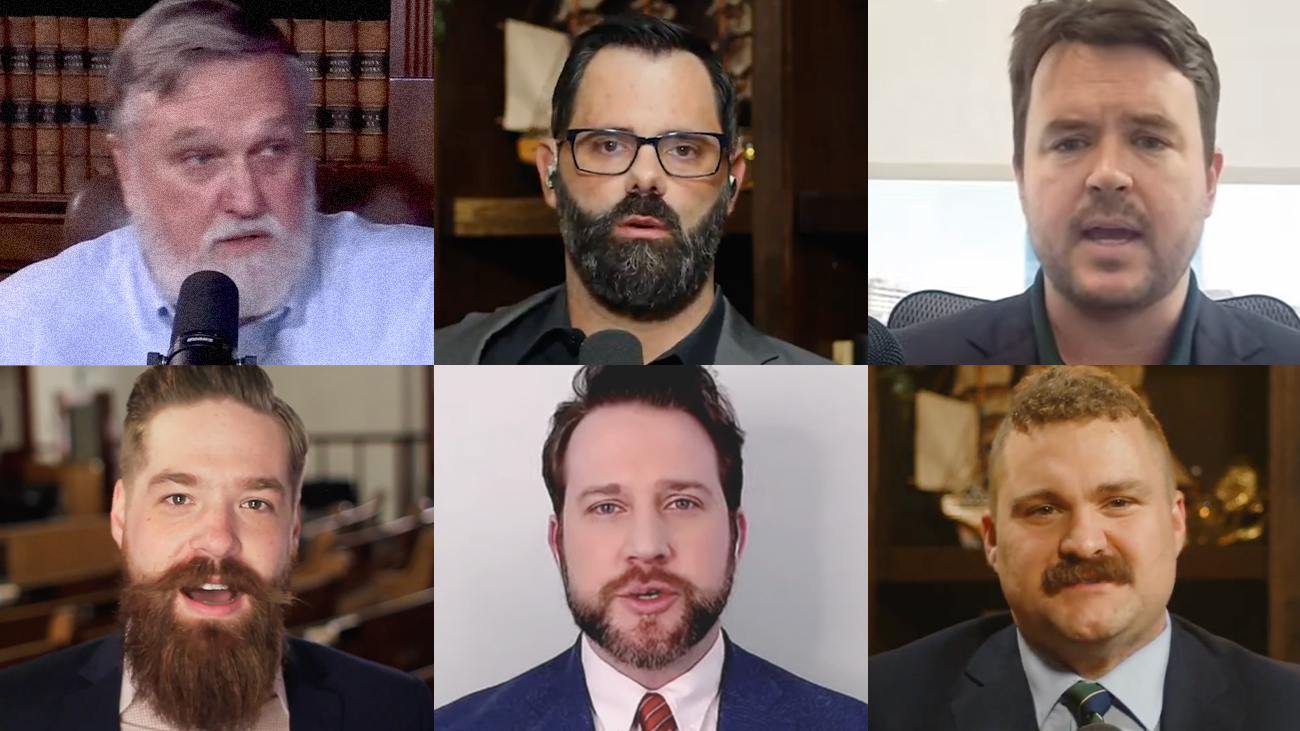 Clockwise from top-left: Douglas Wilson, Joel Webbon, Josh Abbotoy, Andrew Isker, William Wolfe, and Brian SauvéYouTube
With no meetings, website, or an explicit statement of faith that unifies their beliefs, the TheoBros are not an official organization. They identify with 16th-century French theologian John Calvin, who spawned a rigid and deterministic form of Protestantism. Julie Ingersoll, a University of North Florida religion scholar, traces the current movement back to R.J. Rushdoony, an Armenian American philosopher who popularized the idea of Christian nationalism (and homeschooling) in the early 1970s.
Out of Rushdoony’s movement emerged two camps: the charismatic Christians, now known as the New Apostolic Reformation, and the reformed Protestants, which include the TheoBros. They share the goal of creating a Christian nation, says Ingersoll, but differ on a key point of theology: Adherents of the New Apostolic Reformation believe that God is still speaking directly to people through pastors who have declared themselves apostles and prophets. The TheoBros, meanwhile, believe that God said all he needed to say in the Bible.
Many TheoBros are also proponents of postmillennialism, the idea that believers can hasten Jesus’ return by fighting against the satanic forces of liberal excess. TheoBro Aaron Renn, an Accenture consultant turned Christian pundit, has described our current era as a “negative world,” where Christians are persecuted for their beliefs. Andrew Isker, another Bro, calls it “trashworld.”
Like all self-respecting millennials, the TheoBros have little tolerance for boomers, with the exception of their patriarch, Douglas Wilson, a 71-year-old pastor in Moscow, Idaho. When he was younger, Wilson imagined himself going into the family business—Christian bookstores—but after a stint in the military, he moved to Moscow in 1975 to study philosophy at the University of Idaho, where he became involved with the Jesus People, a kind of mashup of evangelical and hippie culture. He helped found Christ Church, the congregation over which he still presides and that regularly draws crowds of 1,300.
Wilson has since turned the college town into his own Christian kingdom. He helped found New Saint Andrews College, the Canon Press publishing house, and Logos School, one of the nation’s first classical Christian schools, where students exclusively study the Western canon. Wilson embraced Calvinism in 1988 and remade his church from the freewheeling Jesus People hub into something far more sober and buttoned-up, where women couldn’t be church leaders and the only music allowed was hymns and psalms. In the early 1990s, Wilson helped launch the Association of Classical Christian Schools, which had 502 member institutions across the United States as of March 2023.
“The sexual act cannot be made into an egalitarian pleasuring party. A man penetrates, conquers, colonizes, plants. A woman receives, surrenders, accepts.”
His influence over Moscow has not been without controversy. In a 2021 Vice exposé, former members of Christ Church alleged that ministers had encouraged them to stay in abusive relationships. That tracks with Wilson’s 1999 book, Fidelity: How to Be a One-Woman Man, in which he wrote, “The sexual act cannot be made into an egalitarian pleasuring party. A man penetrates, conquers, colonizes, plants. A woman receives, surrenders, accepts.” For that reason, Wilson wrote, the dynamic of a dominant man and a submissive woman is “an erotic necessity.” (Wilson called allegations of the church urging women to stay in abusive relationships “categorically false.”)
Wilson has also promoted another form of dominance. In the 1996 book Southern Slavery: As It Was, Wilson and his co-author argued that the master-slave dynamic was “a relationship based upon mutual affection and confidence,” and “there has never been a multi-racial society which has existed with such mutual intimacy and harmony in the history of the world” as that of the antebellum South. (In a 2020 blog post, Wilson said he now allows that while “the benevolent master is not a myth, the idea of the horrific taskmaster is no abolitionist myth either.”) When I asked Wilson about his controversial statements, he likened himself to a chef who strategically deploys jalapeno peppers: “Then some of my enemies online have combed through my writings, have gathered up all the jalapenos and put them on one Ritz cracker.”
:In July, at the National Conservatism Conference in Washington, DC, Wilson shared the stage with Sens. Josh Hawley (R-Mo.), Ron Johnson (R-Wis.), and Mike Lee (R-Utah), as well as Vance, who auditioned his “America is a people” bit a week before his star turn at the GOP convention. Wilson agrees with Vance’s suggestion that children should be allotted votes, managed by their parents. “I would like to see elections where households vote,” he told me. Men, as the heads of households, would actually cast the votes. Though he believes that women’s suffrage was “a mistake,” he would allow a special exception for single mothers.}:
Wilson offered the crowd a few one-liners (“I’m a Presbyterian, not a Lesbyterian”), but mostly, he talked about the persecution of Christians. “It used to be that the sexually troubled had to keep their kinks hidden away in the closet,” he mused. “Now it is the conservative Christian who needs to keep his virtues hidden in the recesses of the closet.” After the National Conservatism Conference, Wilson appeared at the Believers’ Summit, which was headlined by Trump and hosted by the conservative political group Turning Point USA.
But it’s not just conferences and interviews with the likes of where Wilson promotes his ideas. He has a blog, a podcast, and a YouTube channel, thanks mostly to the urging of his children and younger colleagues. One example is that every year since 2018, Wilson has been celebrating what he calls No Quarter November: “The month where we say out loud what everyone is thinking.” In a, which was the brainchild of one of his sons, Wilson sits at a sumptuously appointed Thanksgiving table, surrounded by his children and grandchildren, and addresses the camera. “If you think of my blog as a shotgun,” he says, “this is the month when I saw off all my typical, careful qualifications and blast away with a double-barreled shorty.” His wife, clad in an apron, brings out a turkey and places it in front of him, and then the tranquil scene is interrupted by a blaring alarm and a glowing red “perimeter breach” sign. Wilson excuses himself, heads to his garage, and straps on a flamethrower. After using it to light a cigar, he aims the fire at cardboard cutouts of Disney princesses Elsa and Ariel, and the logos of Instagram, TikTok, Twitter, and Netflix.
Wilson’s willingness to make campy content sets him apart, says Rachel Tabachnick, an extremism researcher who has been studying Christian nationalism for decades. “Instead of a crotchety old guy talking about stoning people, he’s like, super cool,” she says. “He’s witty.”
In subsequent videos, Wilson tackled women’s culpability in rape, the dark side of empathy, and the virtues of “something called the patriarchy—that which, according to our soi-disant and lisping political theorists, must be smashed. Only they say something like ‘thmasth.’”
Melek Zertal
Wilson has used his platforms to anoint the next generation of ultraconservative reformed Christian pastors, all of whom happened to be men. Mefferd, the conservative Christian journalist, told me that Wolfe’s The Case for Christian Nationalism got traction in mainstream Christian circles in part “because Doug Wilson endorsed.” Another Wilson is Joel Webbon, a 38-year-old pastor who hosts a podcast and YouTube show, which he films from a wingback leather chair in a book-lined room.
Webbon wasn’t always reformed—he is an alumnus of a Bible school run by a New Apostolic Reformation affiliated outfit, which he now considers “straight-up heretical.” In his 20s, he broke from the group, moved to Texas, and started his own church. In a video from a few years ago, Webbon Wilson with emboldening him to say whatever he wanted—like telling a guest that the Founding Fathers weren’t responsible for the slave trade because Africans had done the actual kidnapping and enslaving.
“Kamala sees happy, large families and hates them. She wants them destroyed. She wants you to never be able to have this. She is a nasty, bitter harridan who hates all that is true, good, and beautiful.”
For Webbon, it was intensely liberating to watch Wilson speak in public without worrying about being canceled. “You stay in your little corner, you stay on your little leash, because you’re like, I don’t know what will happen,” Webbon said. “But when you see some other guy do it, and you’re like—that’s the worst thing that can happen? Vice writes an article about you? [Christianity Today editor-in-chief] Russell Moore won’t invite you to his birthday party anymore? Like, that’s it.” At a , he registered dismay over immigrants in his community. “It’s like full, straight-up Hindu garb at our neighborhood swimming pool, that my daughter is asking [about and] I’m trying to explain.”
In August, he remarked on his show that “a lot of people are gonna be surprised” when “you’re spending eternity worshipping Christ next to Stonewall Jackson and Robert E. Lee and Jonathan Edwards, and, you know, George Whitefield and Martin Luther King Jr.’s in hell.”
Webbon is so impressed by his own audacity that he maintains an online list of all the controversies in which he’s become embroiled. There, he explains why he called Christian men living in California “stupid” (they could just move to a red state); why he once ordered his wife to stop reading a book on theology (he didn’t want her exposed to beliefs that were different from his own); and why he believes in a patriarchal household structure (the Bible says so). Webbon, who is planning to host a conference in Texas next spring called “Christ Is King: How to Defeat Trashworld!” maintains that a “return to the Constitution is impossible” and that the only viable alternative is the Ten Commandments.
Some of Wilson’s other acolytes are attempting to create their own versions of Moscow, Idaho. Take Brian Sauvé, a 33-year-old Christian recording artist, podcaster, and pastor of Refuge Church in Ogden, Utah. Like Webbon, Sauvé wasn’t always reformed—Refuge began as a charismatic Christian church. After the lead pastor resigned in a scandal, the then-24-year-old Sauvé ascended to take his place, immersed himself in reformed theology, and moved the church in a new direction. Today, he presides over a Moscow-esque ecosystem: a publishing house called New Christendom Press, as well as St. Brendan’s Classical Christian Academy, modeled after those in Wilson’s network. “Can you feel it in the sails?” reads St. Brendan’s website. “The stiff breeze out of Moscow, Idaho? We can.”
On his three podcasts and to his more than 53,000 followers on X, Sauvé regularly states that women’s primary function is to bear children. In July, after Vance’s comments about “childless cat ladies who are miserable” began widely circulating, he posted: “It is desperately sad to think of all the intentionally barren women who will find themselves totally alone in their 50s, realizing their irreversible mistake. They will wish they could trade it all—money, vacations, independence, all of it—for children they can now never have.”
But unlike more mainstream conservatives, Sauvé does not even pretend to champion the idea of a Judeo-Christian nation. He posted in July, “[O]ur political system is heavily influenced by Jews who reject Christ and embrace all manner of evils.”
An even more well-connected Wilson emulator is Josh Abbotoy, executive director of American Reformer and managing partner of a venture capital fund and real estate firm called New Founding. A former fellow of the right-wing think tank the Claremont Institute, Abbotoy reported that he recently participated in a Project 2025 presidential transition “strategic planning session” hosted by the right-wing think tank the Heritage Foundation. Bucks County Beacon reporter Jennifer Cohn revealed venture capitalist Chris Buskirk was listed as the editor and publisher of American Reformer. (The publication’s cofounder, Nate Fischer, later clarified to Mother Jones that Buskirk’s listing in the filing had been a clerical error, and that he was actually a board member of American Reformer.) In 2022, Buskirk co-founded the Rockbridge Network, a collection of powerful Trump donors including Catholic judicial kingmaker Leonard Leo and Silicon Valley billionaire Peter Thiel. Another co-founder of the Rockbridge Network? None other than JD Vance.
Thiel, Vance’s mentor and former employer, is also a major funder of the National Conservatism movement. Obsessed with global birthrates, Thiel spent $10 million on his protégé’s successful 2022 Senate campaign. In July, shortly after Trump had announced Vance as his running mate, Cohn surfaced a tweet by New Founding’s network director, Josh Clemans: a photo of Vance with several New Founding staffers. The caption read “Our guy.”
New Founding lists as a partner the Society for American Civic Renewal, a secretive fraternal order founded by Indiana shampoo baron Charles Haywood, who describes himself as an aspiring Christian “warlord.” According to founder Nate Fischer, New Founding wants to “form the backbone of a renewed American regime” and that its members “understand the nature of authority and its legitimate forceful exercise.” But its main public-facing project appears to be turning tracts of land in Appalachia into Christian communities. Promotional materials describe a community of “unmatched seclusion” where “simple country faith” protects local culture from rainbow flags and crime. Potential buyers, he advises, should not delay. “Who’s going to grab the land? Is it going to be good, based people who want to build something inspiring, something authentic to the region’s history, or is it going to be Bill Gates and BlackRock and hippies from California?”
One eager customer is 38-year-old TheoBro Andrew Isker—the pastor who interned at Wilson’s church, studied divinity at New Saint Andrews, and co-wrote a book on Christian nationalism with Andrew Torba, the openly antisemitic CEO of the social media platform Gab. In July, Isker announced on X that he planned to move his family of seven to lead a church in a New Founding community in Tennessee. Life in his native Minnesota, he said, had become untenable because of permissive laws around trans rights and abortion, not to mention how hospitable the state has been to refugees. “Minnesota is one of the top destinations for resettling foreign people hostile to our way of life,” he said.
That month, Isker spoke at a Texas conference about the “war on white America” alongside Paul Gottfried, the mentor of prominent white nationalist Richard Spencer. The conference was hosted by the True Texas Project, a far-right group with ties to Sen. Ted Cruz (R-Texas) and Texas Attorney General Ken Paxton.
Like many TheoBros, Isker sees much to like in Vance. In early July, before Trump announced his running mate, Isker referred to him as “Senator JD Vance (R-Heritage America).” In late July, he posted a video of Vance and told his 29,000 followers, “You need to double down on childless cat lady discourse. Kamala sees happy, large families and hates them. She wants them destroyed. She wants you to never be able to have this. She is a nasty, bitter harridan who hates all that is true, good, and beautiful.”
One problem is that there simply are not enough TheoBros to populate Christian communities like the one Isker plans to move to. Enter William Wolfe, the founder of the Center for Baptist Leadership, which aims to persuade members of the Southern Baptist Convention that it, the largest of all Protestant denominations in the United States, has fallen prey to the corrupting forces of liberalism. Baptists are only the beginning. Wolfe wants to win over the entire evangelical mainstream, which he and other TheoBros refer to as “Big Eva.” In August, he posted on X, “Once you realize that Big Eva thinks it’s a bigger sin to desire to preserve the customs, heritage, values, and cultural homogeneity of your own nation than to kill the unborn in the womb, you can better understand their moral framework.”
Wolfe served in the Trump administration both as the deputy assistant secretary of defense and as director of House affairs at the Department of State. He is also an alumnus of Heritage Action, a sister organization of the Heritage Foundation, the arch-conservative think tank behind Project 2025, whose chief architect, Russell Vought, posted on X that he was “proud to work with @William_E_Wolfe on scoping out a sound Christian Nationalism.” A few months later, the Bucks County Beacon uncovered a lengthy online manifesto on the goals of Christian nationalists. The document, which listed Wolfe and Joel Webbon as contributing editors and Oklahoma Sen. Dusty Deevers as a co-author, called for “civil magistrates” to usher in “the establishment of the Ten Commandments as the foundational law of the nation.”
The manifesto doesn’t specify exactly how Christian nationalists should achieve these goals. As Tabachnick, the extremism researcher, interprets it, the TheoBros are imagining a utopia where “they are going to be free to be entrepreneurs in all different senses, including the tech world that they’re mixing with so freely.” The key, she said, is that authoritarianism “is required to have the utopian vision.”
Last year, the extremism watchdog group Right Wing Watch a video of Wolfe quoting a scripture passage. There are times when “even the God of peace proclaims by his providence, ‘to arms!’” he says. “If we have ever lived in a point of time in American history since then that we could argue that now is a time ‘to arms’ again, I think we are getting close.”
William Wolfe’s Christian nationalism manifesto made the rounds on social media, but in mainstream conservative outlets, it was Stephen Wolfe who brought TheoBro ideas to the wider world. In his book, which was praised by editors at the Federalist and theAmerican Conservative, Wolfe paints America as a “gynocracy” whose government and culture have been feminized by unhappy women leaders. (Sound familiar?) He has stated on X that women should not have the right to vote, and that “interethnic” marriage can be “sinful.”
Wolfe grew up in Napa, California, and his father was an admirer of the right-wing pundit and erstwhile GOP presidential candidate Pat Buchanan. After attending West Point and serving in the Army, Wolfe earned advanced degrees before leaving academia to “do the Wendell Berry thing” in North Carolina with his wife and four kids.
Over the summer, Wolfe, 41, agreed to speak with me on the condition that I refer to him as “Dr. Wolfe” and call him an “expert on Christian nationalism.” The Dr. Wolfe I spoke with was a more muted version of the firebrand I’d watched online. He said his ideal version of America would be led by a Caesar figure. Gay marriage would be strictly prohibited. Women would not be allowed to vote—instead, men would vote for their households.
When I brought up the bit from his book about heretics being killed, he grew annoyed. “I do think it’s permissible, in principle, for a state to suppress theological heresy, but that doesn’t mean that it’s prudent or proper, suitable in every circumstance or every tradition or way of life.” The Founding Fathers, he added, had encouraged religious liberty, so killing heretics would not be appropriate in the United States that we inhabit.
We turned to remarks he had made at a recent conference convened by Brian Sauvé: “I think we need to reflect on this idea of Judeo-Christianity, or Judeo-Christian worldview, or Judeo-Christian whatever, and really eradicate that from our thinking. Because if we say that America is a Judeo-Christian country, then it can’t be a Christian country, okay?” What role, I asked him, would Jews play? After a deep sigh, he told me that they would be allowed to “exercise their religion freely.”
“We need to reflect on this idea of Judeo-Christianity, or Judeo-Christian worldview, or Judeo-Christian whatever, and really eradicate that from our thinking. Because if we say that America is a Judeo-Christian country, then it can’t be a Christian country, okay?”
We spoke a week before Vance’s RNC speech, and Wolfe’s remarks helped me understand what the TheoBros heard in Vance’s phrase about America as a people. The founders, Wolfe noted, intended for their country to be “Anglo-Protestant with an American inflection.” America, he continued, is “a place of settlement and rootedness, but it’s an open ethnicity in which people can become one of us.” Which is to say that, like some others, Wolfe is not necessarily opposed to the idea of nonwhite people in America—as long as they agree to assimilate to the Anglo-Protestant dominant culture.
In this telling, America is not a pluralistic society at all, but rather one in which there exists an uneasy truce between Christians and those they reluctantly tolerate. Toward the end of our conversation, I asked Wolfe what motivated him. “I want Christians to be more assertive and to recognize the Christian heritage of the American way of life, and to seek to restore that,” he said. “This is a Christian country, and we’ve got to work to restore it to what it once was.”
In his keynote at Sauvé’s conference, titled “Why Multicultural Pluralism Fails and What to Build Instead,” Wolfe called the concept of America as a melting pot “an early 20th-century idea cooked up by a Jew in New York who despised the confident Anglo-Protestant establishment.” WASPs were the “distinct ethnicity” of America, he insisted, and America should only welcome those who aspired to assimilate. As he put it, “This is our homeland, and we welcome you on the condition of conformity.” Or, in the words of JD Vance, America “is a group of people.”
*Correction, September 19: An earlier version of this article inaccurately described Chris Buskirk’s role at American Reformer.
Update, January 14: After this story was published, Nate Fischer, CEO of New Founding and co-founder of American Reformer, clarified toMother Jonesthat Buskirk’s listing in tax filings as the editor and publisher ofAmerican Reformerhad been a “clerical error (presumably copying his bio fromAmerican Greatness, where he was editor and publisher)” and that Buskirk was actually a board member ofAmerican Reformer. The sentence has been revised.*
{Read our full investigation into the rise of Christian nationalism.*}:
---
---
an 12 24
The most serious allegations against Pete Hegseth, Donald Trump’s pick to head the U.S. Department of Defense, involve mismanagement, heavy drinking, infidelity, sexual harassment and even rape.
[vid]
Hegseth denies the allegations but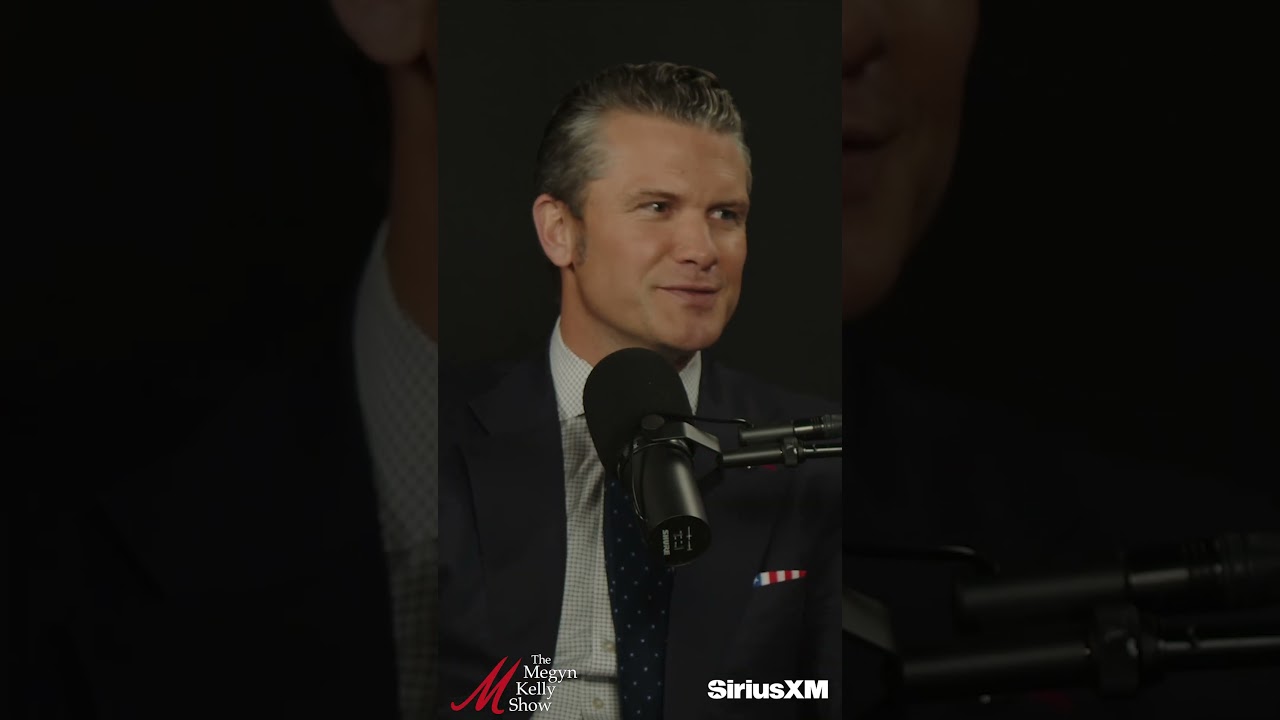 that because of Jesus he’s a “changed man.” The roots of Hegseth’s version of Christianity are worth a look as he heads into confirmation hearings before the U.S. Senate in January 2025.
 Pete Hegseth’s interview with Megyn Kelly.
In 2023, Hegseth moved from New Jersey to Tennessee to join a church and school community that arises from a 20th-century movement, called Christian Reconstruction. It holds deeply conservative views about the family, roles for women, and how religion and politics are related.
The followers of the movement seek to make America a Christian nation, by which they mean a nation built on biblical law, including its prohibitions and punishments.
Christian Reconstructionists want to dismantle public education and replace modern ideas about family with a patriarchal family model because they claim that biblical law requires both. They believe that Old Testament biblical law applies to today’s society and to everyone, whether or not they are Christian. For them, all of life is religious; there is no separation between religion and politics.
Though only a handful of people are formally tied to Christian Reconstructionism, its influence has been broader.
As a scholar of religion, I have studied Christian conservative movements, especially Christian Reconstructionism, for over 30 years, with six of those years explicitly devoted to the research on Christian Reconstruction. In my book “Building God’s Kingdom: Inside the World of Christian Reconstruction,” I trace the rise of this obscure theocratic version of Christianity.
When the Trump transition team announced in mid-November 2024 that Hegseth was the choice to serve as Secretary of Defense, his pastor posted on X that Hegseth and his family are members of Pilgrim Hill Reformed Fellowship, a church directly tied to this movement. I know through my research that the workings of the church he has joined make it quite impossible to dissociate and still remain a member in good standing.
History and influence
The movement’s origins go back to the late 1950s and the work of thinker, writer and theologian R.J. Rushdoony. His goal was to “reconstruct” all of society to fit how he understood the Bible. And as I explain in my book, one of his most important strategies for doing that was to eliminate public education and replace it with Christian education.
By establishing the Christian school and Christian home school movements, Christian Reconstructionists brought their version of a biblical worldview to generations of Christians who attended those schools, many of whom had no ties to Christian Reconstructionism itself. The schools taught, and still teach, a curriculum entirely infused with a Christian Reconstruction worldview based on a specific reading of the Bible. History classes become Christian history classes, science classes become the study of creationism, and the study of economics becomes Christian economics.
In the 1970s a Moscow, Idaho, Christian school founder named Doug Wilson, deeply shaped by Christian Reconstruction, expanded his school efforts to include a church, a college, a publishing house and a seminary.
Historian Crawford Gribben also connects Wilson to the earlier Christian Reconstructionist movement. Wilson has said he’s not a Christian Reconstructionist. Nonetheless, he shares their goals and strategies for remaking society according to the Bible.
Wilson also founded the Communion of Reformed Evangelicals, or CREC, and the Association of Classical Christian Schools, or ACCS. CREC is a group of affiliated churches, somewhat like a small denomination, while ACCS, according to its website, exists to “promote, establish, and equip member schools that are committed to a "classical approach” that emphasizes a “Christian worldview” built on Western philosophy and literature.
Wilson and his institutions send out men to start churches and schools modeled after Moscow. These churches and schools work to shape the larger society, according to their reading of the Bible, starting with the U.S., but the goal is to spread this across the world.
The members of Wilson’s community are known as “Kirkers” – based on the Scottish word for church – and include people who move to Moscow to join. Once there, they buy property and set up businesses. Some of the residents of the town, who are not members of the church, call it “an invasion.”
Wilson is an intentionally provocative and controversial figure who got attention early on for his 1996 book “Southern Slavery: As it Was,” which revives pre-Civil War arguments in favor of slavery. He has also been implicated in accusations of abuse, including abuses of power and sexual abuse. A new 2024 podcast, “Sons of Patriarchy,” explains the culture of Wilson’s world through interviews with scholars, other experts and survivors of abuse.
Church government structures ensure conformity
Hegseth hasn’t talked about Christian Reconstructionism directly, but when he talks about education he repeats their talking points. During an interview on a right-wing podcast, he used militaristic language and agreed with the host that “classical Christian schools” could be “boot camps” to provide “recruits” for an underground army that could eventually launch an “educational insurgency.” He laughingly added later the implications of violence in the larger quote are “metaphorical.” Even taken metaphorically, I believe that the comments show him supporting the goal of using Christian schools to make America a Christian nation.
In Tennessee, Hegseth sent his children to a specific Christian school; he then joined a nearby church, both of which are tied to Wilson’s CREC and ACCS.
The structures and informal workings that make up the CREC and ACCS are designed to ensure theological agreement and submission to church leadership, and protect churches from lawsuits when there are accusations of abuse. These aren’t just churches you can join by showing up.
From my research, I know the CREC churches embrace a style of church government where a candidate for membership must go before the elders – called a session – to show that their conversion was authentic and submit to thorough questioning of their theology. They then usually sign a covenant or make a public verbal covenant, submitting to church elders. These practices are common in old presbyterian and reformed style churches. They are less common today in mainline churches, but still exist in smaller Presbyterian denominations.
If people’s beliefs change after becoming members, they can be brought before church courts on heresy charges.
Members must bring any dispute they might have with members of “recognized churches” to these church courts, as opposed to taking them to “worldly” courts. This largely closes off other avenues for addressing grievances.
The governing bodies that comprise the sessions and the courts are all made up of elders. And only men can be elders, a fact that has become an issue in accusations of abuse.
No distinction between religious and political issues
The U.S. has a long tradition of protecting religion from public criticisms: The U.S. Constitution forbids a “religious test” for officeholders, civic groups often prohibit discussions about religion, and it is generally considered impolite to do so in social contexts.
Senators at Hegseth’s confirmation hearings will likely be reluctant to engage in questions about religion, yet in the religious community with which Hegseth has associated himself, there is no distinction between religious issues and political ones; there is no separation of church and state. Every area of life is to be governed by the Bible, and there is no secular sphere of authority that exists apart from religion.
Julie Ingersoll, Professor of Religious Studies, *University of North Florida
---
---
dad?
wiki
When William Volker died in 1947, Luhnow took control of William Volker & Co. and also became the head of the William Volker Charities Fund's board of directors.[3][15]
Under Luhnow's administration the fund shifted its focus away from charities in the Kansas City area and began pursuing a number of strategies for increasing the acceptance of Old Right and Austrian economics thought in the United States.[16][2] During this period, Luhnow read books like F.A. Hayek's The Road to Serfdom and became a proponent of classical liberalism.[16]
Luhnow was interested in theories of political economy that are generally called "libertarian" or "classical liberal," but at various times have been called "Conservative," "neoliberal," "right-wing radical," "eighteenth- and nineteenth-century liberal," or Straussian.[17] As Luhnow's commitment to these ideas grew, he used the Volker Fund to give sizable contributions to libertarian and conservative causes. The Fund was instrumental in bringing Friedrich Hayek to the University of Chicago.[18] It also helped support many other classical liberal scholars who at the time could not obtain positions in American universities, such as Ludwig von Mises and Aaron Director.[19] Through its subsidiary the National Book Foundation, the Volker Fund gave away books authored by libertarian and conservative academics to college libraries throughout the U.S.[2] The National Book Foundation distributed books by wide range of influential authors, including Eugen von Böhm-Bawerk, Gordon H. Clark, Hayek, Mises, Roscoe Pound, Leo Strauss, Eric Voegelin, and many others.
Under Luhnow's management, the fund helped the then small minority of Old Right scholars to meet, discuss, and exchange ideas. Milton Friedman's Capitalism and Freedom, Bruno Leoni's Freedom and the Law, and Hayek's Constitution of Liberty were all influenced by the ideas discussed at such meetings. Among its most significant contributions to such academic conferences, the fund supported North American participation at the first Mont Pèlerin Society meeting in 1947.[20]
Under the directorship of "master recruiter" F. A. Harper, the fund systematically recruited a number of young libertarian and conservative scholars.[16] These researchers and staffers eventually became important figures in American right-wing. Notable staffers included a young Murray Rothbard who began working for the Volker Fund in 1951 and wrote book reviews for the Fund until 1962. Rose Wilder Lane also contributed book reviews. Prominent Christian Right pioneers Rousas John Rushdoony and Gary North also gained early notoriety because of their association with the fund.
In addition to its own activities, the Volker Fund also helped support the formation of various complementary institutions, including the Intercollegiate Society of Individualists (ISI), which was later renamed Intercollegiate Studies Institute, and the Foundation for Economic Education (FEE). It also worked closely with similar charitable endeavors, such as the Earhart Foundation and the Relm Foundation.[2]
In the 1960s the Volker company and the Fund moved to Burlingame, California. The Fund was dissolved after Luhnow's death in 1978, and its assets distributed to local Kansas City charities and to the Hoover Institution of Stanford University.[21]
Controversy and collapse[
In the early 1960s, Luhnow's management of the fund became increasingly inconsistent, and in early 1963 he suddenly fired most of his staff, including Harper and Rothbard.[16][2] Harper continued the basic nature and spirit of his Volker Fund work by creating the Institute for Humane Studies. Luhnow hired Ivan R. Bierly, an ex-Foundation for Economic Education senior staffer. Luhnow reorganized the Volker Fund as theCenter for American Studiesand ended the fund's charitable commitments to Kansas City institutions.[2] Bierly recruited William T. Couch,R. J. Rushdoony, and David Leslie Hoggan to run the new center. Rushdoony hired his future son-in-law, Gary North, as a summer intern in 1963.
Immediately, Rushdoony and Hoggan became lightning rods for controversy. Rushdoony, a conservative Presbyterian minister, alienated many of the fund's secular and non-Protestant supporters and was fired by Bierly.[2] Hoggan was even more controversial for his explicitly pro-Hitler and pro-Nazi sympathies.[22] He was fired shortly after Rushdoony.
The Rushdoony/Hoggan controversy left Bierly and Couch scrambling to find support for the center even as Luhnow grew old and sick and was no longer able to support the organization. They courted Stanford University and the Hoover Institution with several million dollars in remaining Volker money only to be rebuffed. The center proved short lived and closed late in 1964 when Couch and Birely failed to secure the support of Stanford and Hoover.[2] A decade later, the remainder of the Volker Fund money, amounting to about seven million dollars, went to the Hoover Institution.[23][24] The Fund's files have disappeared.
References...
---
an 6 22
Supreme Court Justice Clarence Thomas on Monday appeared to agree it is a “blatant falsehood” that a far-right Christian ministry that has claimed “homosexuals say yes” to pedophilia and promotes anti-LGBTQ lies is a “hate group” that deserves to be placed on the same map and the KKK and neo-Nazis.
Justice Thomas’ rant appears asthe only opposition to the Court’s decision Monday to not take up a case that would effectively revisit the landmark First Amendment case New York Times v. Sullivan, which requires a plaintiff suing for defamation to prove “actual malice.”
Coral Ridge Ministries asked the Supreme Court to review its case, which it lost, against the Southern Poverty Law Center for designating it an anti-LGBTQ hate group. The case is not about whether or not the church is a hate group, but whether or not the Southern Poverty Law Center has the First Amendment right to say so. The court refused, but Thomas in an angry dissent wrote:
“SPLC’s ‘hate group’ designation lumped Coral Ridge’s Christian ministry with groups like the Ku Klux Klan and Neo-Nazis. It placed Coral Ridge on an interactive, online ‘Hate Map’ and caused Coral Ridge concrete financial injury by excluding it from the AmazonSmile donation program. Nonetheless, unable to satisfy the ‘almost impossible’ actual-malice standard this Court has imposed, Coral Ridge could not hold SPLC to account for what it maintains is a blatant falsehood.”
Thomas also writes:
"Coral Ridge maintained that although it 'opposes homosexual conduct' based on its religious beliefs, it is in no sense a 'hate group.' … To the contrary, it 'has nothing but love for people who engage in homosexual conduct' and 'has never attacked or maligned anyone on the basis of engaging in homosexual conduct.'"
That’s false.
In its iconic 2010 report, “18 Anti-Gay Groups and Their Propaganda,” the Southern Poverty Law Center explained that the “late Rev. D. James Kennedy started turning fundamentalist Coral Ridge Presbyterian into a mega-church in the 1960s.”
In an especially nasty 1989 edition of a CRM newsletter, Kennedy ran photographs of children along with the tagline, “Sex With Children? Homosexuals Say Yes!”
“Over the years,” the SPLC report adds, Rev. Kennedy “emphasized anti-gay rhetoric, particularly in his TV ministry. He recommended as ‘essential’ the virulent work of R.J. Rushdoony … who believed practicing gays should be executed.”
---
---
RONALD REAGAN: But I would think that some of the bills that have been suggested, such as not carrying a loaded weapon on a city street or in town, this might certainly be a good one. There is absolutely no reason why out on the street today civilians should be carrying a loaded weapon.
HAGEN: That bill, the Mulford Act, it passed. Reagan signed it. This was four years after President John F. Kennedy was assassinated. Gun control was on the march. Even the National Rifle Association of the time ultimately supported the federal Gun Control Act that would pass in 1968. This was just after the assassinations of Martin Luther King Jr. and Robert F. Kennedy.
HAXEL: Among other things, the new gun law restricted mail orders of rifles and shotguns and barred sales to felons, mentally ill people and anyone who is, quote, "an unlawful user of or addicted to marijuana."
(SOUNDBITE OF ARCHIVED RECORDING)
LYNDON B JOHNSON: But this bill, as big as this bill is, still falls short.
HAXEL: President Lyndon Johnson signed it and hoped more would come.
(SOUNDBITE OF ARCHIVED RECORDING)
JOHNSON: I ask for the national registration of all guns and the licenses of those who carry those guns, for the fact of life is that there are over 160 million guns in this country - more firearms than families.
HAXEL: At the time, some in NRA leadership were considering pulling the group out of politics altogether. But that was about to change.
(SOUNDBITE OF MUSIC)
HAGEN: A major shift was brewing inside the NRA and across the gun rights world.
HAXEL: We said earlier in the podcast that the Dorrs are just one faction in a whole movement. And just as the NRA was having its inner turmoil - the Cincinnati revolt - a new competitor popped up.
HAGEN: Gun Owners of America, the original no-compromise gun group.
HAXEL:Remember R.J. Rushdoony, father of Reconstructionism, the slavery wasn't so bad guy? Well, he had this friend.
(SOUNDBITE OF ARCHIVED RECORDING)
RUSHDOONY: Friend of mine who is a state senator in California, a very fine Christian, thoroughly reformed. He's running for U.S. Senate.
HAXEL: Rushdoony calls him Bill. He also went bySen. H.L. Richardson. They talked a lot more.
(SOUNDBITE OF ARCHIVED RECORDING)
RUSHDOONY: I was chatting with Bill Richardson, our state senator.
Bill Richardson was in Sacramento. He called me up one day. He'd had a long session with feminists who were there in his office.
(SOUNDBITE OF MUSIC)
HAGEN: Rushdoony's pal H.L. Richardson was not happy with the gun control sweeping through California and the rest of the country. In 1975 when his fellow state lawmakers tried to ban handguns, Richardson decided to start some gun groups of his own.
(SOUNDBITE OF ARCHIVED RECORDING)
RUSHDOONY: Gun Owners of America, Gun Owners of California, Law and Order Committee - all run by Bill Richardson.
HAGEN: Gun Owners of America - today, it's the second largest pro-gun group in the country, says it has 2 million members compared to the NRA's 5 million.Just like R.J. Rushdoony was the father of Christian Reconstructionism, Gun Owners of America - or GOA - is like the Johnny Appleseed of the whole no-compromise movement. Some 40 years after its founding, the seeds it planted are bearing fruit.
HAXEL: That talking point the Dorrs use about how the Second Amendment isn't about hunting...
(SOUNDBITE OF ARCHIVED RECORDING)
A DORR:Gun rights is not about hunting. It's not about sports, you know? It's about a response to tyrannical government.
HAXEL: Here's the longtime head of Gun Owners of America. You're going to want to remember this name, Larry Pratt.
(SOUNDBITE OF ARCHIVED RECORDING)
LARRY PRATT: Yes, our guns are in our hands for people like those in our government right now that think they want to go tyrannical on us. We got something for them. That's what it's all about. The Second Amendment is not about hunting. It's not about target shooting. It's about Democrats who want to take our rights.
HAXEL: Pratt's been saying that for decades. In the gun world, GOA is known as the more militant cousin of the National Rifle Association, which has a lot of appeal for anyone who's fed up with NRA Wayne LaPierre and his suits.
HAGEN: As we know by now...
---
omg npi
https://www.alternet.org/2021/10/extremist-christians/
paul r salon
progressive policies and positions are supposed to be rooted in reality and hard evidence. But that's not always the case when it comes to the culture wars that have such an enormous impact on our politics — especially not since the unexpected evangelical embrace of Donald Trump in 2016, culminating in the "pro-life" death cult of anti-vaccine, COVID-denying religious leaders. If this development perplexed many on the left, it was less surprising to a small group of researchers who have been studying the hardcore anti-democratic theology known as dominionism that lies behind the contemporary Christian right, and its far-reaching influence over the last several decades.
One leading figure within that small group, Rachel Tabachnick, was featured in a recent webinar hosted by the Religious Coalition for Reproductive Choice (archived on YouTube
Her presentation sheds important light on at least three things: First of all, the vigilante element of the Texas anti-abortion law SB 8. Second, the largerpattern of disrupting or undermining governance, including the "constitutional sheriffs" movement, the installation of overtly partisan election officials and the red-state revolt against national COVID public health policies. While Donald Trump has exploited that pattern ruthlessly, he did not create it. And third, the seemingly baffling fact that an anti-democratic minority feels entitled to accuse its opponents — including democratically elected officials — of "tyranny."
Some dominionist ideas — such as the biblical penalty of death by stoning — are so extreme they can easily be dismissed as fringe, others have been foundational to the modern religious right, and still more have become increasingly influential in recent years. Those latter two categories are what we need to understand most, say both Tabachnick and Jackson.
"One of the things that struck me, as a relative newcomer," said Jackson, a former Congregationalist minister, "was that there was not sufficient understanding about the theological frames used by many individuals who are opposed to abortion." She continued, "I'm a strategist in a lot of ways, and one important strategy, I believe, must be to understand what the teachings and the theological frames are" on the other side. Which links directly to the question of what progressive activists need to do differently in this changed environment.
This failure to understand the nature of dominionism has hampered activists, not just in the realm of reproductive justice, but across an entire spectrum of political issues, both cultural and economic.Jackson discussed her own background, raised within a conservative Christian worldview.
"I was taught a very individualistic approach," she said, "taught that we shouldn't pay taxes, because doing so enabled people who were not working, and enables people whose lifestyle we don't agree with." There's nothing new about such views, but dominionism provides believers with an even stronger foundation for them.
Jackson describes her current understanding of religious faith as highly intersectional: "We believe that to understand the attacks on abortion also invites us — or even requires us — to look at attacks on voting, to look at attacks on immigrants, attacks on prison reform, attacks on equal pay and on and on," she said. "It's all of the same cloth: They are all attacks on humans flourishing. That's my language. The God of my understanding wants all of us to flourish in who we are."
the language of dominionism is strikingly different, to put it mildly. In her webinar, Tabachnick played a clip of one of the movement's leading figures, C. Peter Wagner, providing a definition:
Dominion has to do with control. Dominion has to do with rulership. Dominion has to do with authority and subduing. And it relates to society — in other words what is talked about, what the values are in heaven [that] need to be made manifest here on earth. Dominion means being the head and not the tail. Dominion means ruling as kings. It says in Revelation chapter 1:6 that "he has made us kings and priests," and check the rest of that verse, it says "for dominion." So we are kings for dominion.
Later she provided a definition from Frederick Clarkson, author of the 1997 book, "Eternal Hostility: The Struggle Between Theocracy and Democracy":
Dominionism is the theocratic idea that regardless of theological view, means, or timetable, Christians are called by God to exercise dominion over every aspect of society by taking control of political and cultural institutions.
Wagner, who died in 2016, is known as the founding father of the New Apostolic Reformation (NAR), one of the two main branches of dominionism, which grew out of the Pentecostal and charismatic traditions within evangelical Christianity. Dominionists in the other branch, known as "Christian reconstructionism," come out of conservative Calvinism, with a focus on bringing government and society under biblical law. They tend to be more circumspect, often obfuscating their true intentions and avoiding the word "theocracy" in favor of "theonomy," for example. But not Wagner, as can be seen in the title of his 2011 book, "Dominion!: Your Role in Bringing Heaven to Earth." The NAR talks constantly about taking dominion over the "seven mountains" of society: education, religion, family, business, government, arts and the media.
But it's the other branch, the Christian reconstructionists, who have excelled at strategic organizing and providing blueprints across different right-wing constituencies for almost 50 years. They are the ones Tabachnick focused most of her presentation on, specifically two key figures: Rousas John Rushdoony, the movement's master theologian, and his son-in-law Gary North, a prolific strategist, propagandist and networker who was once a staffer for Rep. Ron Paul, the libertarian hero.[ayn radical indiv ~ jesus charity]
Christian reconstructionism, Tabachnick explained, is "about bringing government in all areas of life under biblical law, a continuation of the Mosaic law in the Old Testament, with some exceptions." This dispensation would include, "according to Gary North, public execution of women who have abortions and those who advise them to have an abortion."
In a recent private presentation, Frederick Clarkson asked a rhetorical question: "People have long said that there should be Christian government, but if you had one, what would it look like? What would it do? Rushdoony was the first to create a systematic theology of what Christian governance should be like, based on the Ten Commandments, and all of the judicial applications he could find in the Old Testament — including about 35 capital offenses."
But the "Handmaid's Tale"-style extremism of dominionists' ultimate vision shouldn't really be our focus, Tabachnick told Salon. "Nobody cares about the theocratic, draconian future envisioned by reconstructionists because they don't believe it will happen," she said.
What's happening right now, however, is that this ideology has had tremendous impact on more immediate politics. "Christian reconstructionism is the merger of a distinct brand of Calvinism with Austrian School economics," Tabachnick said. "In other words, it's an interpretation of the Bible grounded in property rights." The results have been far-reaching:
For more than 40 years, its prolific writers have provided the foundations and strategic blueprints for the attacks on liberation theology and the social gospel, as well as many other streams of Christianity which do not share the Reconstructionists' belief in unfettered capitalism as ordained by God and its fierce anti-statism.
The larger religious right's attack on public education, the social safety net and most government functions are largely grounded in the writings, strategies and tactics formulated by reconstructionist writers. Reconstructionism is not the only (and certainly not the first) source of interposition and nullification in this country. However, much of what is currently being taught today about using interposition to undermine the legitimacy of government is sourced in reconstructionism.
This idea of "interposition" comes through what's known as the doctrine of the "lesser magistrate," which we'll return to below. But its significance — especially in the post-2020 Republican Party — has only recently become apparent. Reconstructionism's initial appeal was more immediately, as Tabachnick explained in the seminar:
What Rushdoony provided is a package that included attacking what these fundamentalists hated and feared most in society, often expressed in terms of "This is communist. This is socialist." But Rushdoony provided a way to sacralize these ideas, and at the same time not just tear down the old order, but provide a blueprint for the new order.
Everyone didn't have to agree on the blueprint, she said: "Rushdoony's ideas went out in bits and pieces. The Christian right leaders took what they wanted and discarded what they didn't."
"Christian reconstructionism, as articulated by Rushdoony, provided a standard by which everyone else had to measure themselves," Clarkson told Salon. "Not everyone on the Christian right agreed with Rushdoony and his fellow Reconstructionist thinkers on, for example, the contemporary application of capital crimes listed in the Old Testament. And followers were often at pains to distinguish themselves."
Clarkson cites the case of conservative Presbyterian theologian Francis Schaeffer, who disagreed with Rushdoony on the applicability of biblical law, but became a driving force behind the anti-abortion activist movement Operation Rescue. That "militant Schaefferism," Clarkson said, "led activists to think: What's next, beyond political protest and stopping abortion? This is where the conversation has been in the Christian right for decades."
The doctrine of the "lesser magistrate," mentioned above, first emerged into public discourse out of Operation Rescue. But it did so as part of a larger, more complicated story.
There's a long history of right-wing opposition to federal authority, particularly grounded in the 19th-century defense of slavery and continuing in the defense of Jim Crow segregation. In his famous "I Have a Dream" speech, the Rev. Martin Luther King Jr. spoke specifically of the governor of Alabama "having his lips dripping with the words of interposition and nullification."
As detailed by Randall Balmer in "Bad Faith: Race and the Rise of the Religious Right," the religious right wasn't initially fueled by opposition to the Roe v. Wade decision in 1973, but by opposition to a lesser-known decision in 1971, Green v. Connally, which threatened the tax-exempt status of racially discriminatory institutions,most famously the evangelical stronghold Bob Jones University.
Anti-abortion activists have long sought not just to bury that past but to stand it on its head, somehow equating Roe v. Wade with the notorious Dred Scott decision of 1857 and claiming the moral heritage of abolitionism.
"Throughout these movements there is also an attempt to turn the tables on the claims of racism," Tabachnick said in her webinar. "This is one of the roles that anti-abortion activism as abolition plays. Also, there's a promotion of narratives that provide a different history and legal justifications for interposition, nullification and even secession. One of the things that Christian reconstructionism has added to this dialogue is the concept of the lower magistrate."
As Tabachnick explains it, the "lesser magistrate" is a heroic figure who "resists the tyranny of a higher authority" — defining "tyranny" in biblical terms, potentially including any number of popular or common-sense laws or policies. This notion first gained salience in the anti-abortion context in the 1980s and '90s, as Tabachnick went on to explain.
"Many violent anti-abortionists have justified their actions in reconstructionist teachings," she said. "One of these was Paul Hill, who studied under one of the major reconstructionist leaders and corresponded with others." Hill went on to murder Dr. John Britton, a physician who performed abortions, as well as Britton's personal bodyguard, in 1994. Hill was executed in 2003, but the reconstructionist movement sought to cast him out well before that.
"Gary North responded, after the murders had taken place, in a book called 'Lone Gunners for Jesus,'" Tabachnick said. His message to Hill was, "You're going to burn in hell, you've been excommunicated. This was because Paul Hill stepped outside the bounds of the guidelines set by the movement."
To explain this, she quoted a passage from another book by North that offered qualified support for Operation Rescue: "We need a statement that under no circumstances will Operation Rescue or any of its official representatives call for armed resistance to civil authority without public support from a lesser magistrate."
"On the basis of their belief of what the law or the word of God is, they are allowed — on the advice, on the interposition, of a lesser magistrate — to commit acts of violence," Tabachnick continued. North was seeking to control or curb anti-abortion terrorism, but without rejecting it in principle. Murdering abortion providers — or even murdering women seeking abortions — could be morally justified, with the blessing of a lesser magistrate.
This is relevant to SB 8 in Texas in at least two ways. That bill bans abortions after six weeks and is enforced not by state officials, but by deputizing private individuals to sue anyone who performs the procedure or "aids and abets" it. First of all, giving private individuals these vigilante-style rights seems a lot like making them into "lesser magistrates," however narrowly constrained.
Second, the Supreme Court's refusal to stay the law — which clearly violates the Constitution and existing precedent, as Justice Sonia Sotomayor argued in her dissent — can be seen as an example of the doctrine in action. In more normal circumstances, the court would have stayed the law pending consideration on the merits, even if a majority of justices intended to overturn precedent. That's how common law has worked for centuries.
But biblical law isn't common law, especially as reconstructionists understand it. Under the doctrine of the "lesser magistrate," Roe is not precedent but an instance of tyranny — and the justices have aduty to Godto resist it. Of course, not even Amy Coney Barrett or Clarence Thomas has said anything like that, but it's entirely consistent with their behavior — as well as with their silence, since openly making such an argument would clarify just how radicalized they have become.But adherents of the doctrine of the lesser magistrate must surely appreciate the drift in direction.
Nor is the doctrine limited to abortion cases, as already noted. Matthew Trewhella is a pastor who was a prominent leader of violence-prone wing of the anti-abortion movement in 1990s, and author of the 2013 book, "The Doctrine of the Lesser Magistrates," which greatly heightened its visibility.
"Trewhella is now all over radio and the internet," Tabachnick said in her webinar, "claiming to meet with state legislators and attorney generals at the moment, with the cause of fighting the 'tyranny of mask mandates' and vaccination for COVID. So you can see how this is a concept that is not just limited to abortion. It is a concept that can be used in resistance of government authority all over the country in all different kinds of ways — FEMA, EPA, Bureau of Land Management and so forth."
Trewhella isn't breaking new ground here. Clarkson's 1997 book "Eternal Hostility" describes him making similar arguments in a speech to an anti-tax group in Wisconsin. He was just one figure among many spreading the seeds of reconstructionist resistance to federal authority among militia members, "freemen" and anti-abortion activists at the time.
"This movement believes that rights come from God and not from any government," Tabachnick told Salon. "Therefore, any 'rights' that conflict with their interpretation of God's law are not actually rights. They are 'humanist' or a product of man's laws and not God's laws. This theme of 'human rights' versus inalienable rights from God has been at the center of the Christian Reconstructionist movement since its beginnings."
She pointed to "What's Wrong With Human Rights," an excerpt from a book of the same name by the Rev. T. Robert Ingram published in "The Theology of Christian Resistance," a collection edited by North. Ingram sweeps aside the Bill of Rights as "a statement of sovereign powers of states withheld from the federal authority of the Union," and turns instead to the Virginia Declaration of Rights, authored by George Mason in 1776.
The first section of the Virginia Declaration, beginning "That all Men are by Nature equally free and independent, and have certain inherent Rights," is dismissed by Ingram for omitting any mention of God, as an "error of unbelief which falsifies all the rest that is said about human life." The second, beginning "That all power is vested in, and consequently derived from the People; that Magistrates are their Trustees and Servants, and at all Times amenable to them," he dismisses as well: "The meaning could not be more clear, nor more opposite Biblical thought. The ruling proposition of Scripture and Christian doctrine is that 'power belongeth unto God.'" In short, there are no human rights.
The connection to the doctrine of the lesser magistrate is clear: Power comes from God, not the people. Whatever the people want is irrelevant. Whatever laws they may pass are irrelevant, too, if they go against God. "Tyranny" is whatever the Christian reconstructionist decides he doesn't like.
Elsewhere, Ingram denigrates freedom of speech and the press:
Freedom of speech and freedom of press are, in fact, applied seriously only to giving government protection to instigators of riot and rebellion, as well as those who would undermine human order by more subtle attacks on morals and customs.
As for the right to dissent, he calls it "not a lawful claim to own or to do something, which is the true right," but "a turning upside down of right and wrong, calling good evil and evil good." Similarly, there is no scriptural right to "resist authority," only that granted by the false doctrine of "human rights."
Ingram's interpretation of the Civil War is that "Yankee radicals inflamed the Northern peoples to mount the Civil War in the name of a 'human right'to be free ... if they did not destroy the whole Southern Order, they did at least dismantle its vast and efficient plantation economy." The civil rights movement, unsurprisingly, is understood as a defiance of "Tradition, law, and custom, which preserved public peace and order in the bi-racial state of the union, both North and South," and became "the target of the right to resist in the 60's, the supposed human rights justifying the violent means."
Tabachnick didn't dig into this text in her webinar, but it serves to illustrate her central principle: "This attack on the very concept of 'human rights' can be found throughout today's religious right."
Jackson told Salon that the most important part of Tabachnick's presentation came "when she talked about humanism and the humanistic frame, from the Constitution and the Bill of Rights. Those who are within the dominionist camp see that as contrary to God. I read those same documents and I say, this is pointing us toward the direction that God wants for us. They look at it and see that as counter to God, because humanism from their perspective is something very contrary to God."
If we take such arguments seriously, then we understand why for dominionists there is nothing wrong with breaking any law at all, so long as "God wills it" and you have the blessing of a so-called lesser magistrate. This is the reconstructionist argument supporting a whole range of chaotic right-wing activity today, including baseless claims that the 2020 election was a fraud. After all, the fundamental reconstructionist argument is that all such democratic government is illegitimate.
"The goal of reconstructionism is to tear down the existing order and reconstruct a new society based on biblical law," Tabachnick said. "Even if we assume that this vision of a theocratic America will never come to fruition, it's important to recognize the movement's impact on the ideas, strategies and tactics of the larger religious right and its role in sacralizing the actions of other anti-statist fellow travelers.
"As I wrote almost a decade ago, the theocratic libertarianism of Christian reconstructionism has been surprisingly seductive to Tea Partiers and young libertarians— many of whom may not realize what is supposed to happen after the government is stripped of its regulatory powers."
FROM YOUR SITE ARTICLES
- How the coronavirus pandemic shows that Christian white ... ›
- Christian extremist says 'righteous anger' made him confront women ... ›
- How 'confrontational Christian nationalists' are pushing anti-vaxxer ... ›
RELATED ARTICLES AROUND THE WEB
- Holy Hate: The Far Right's Radicalization of Religion | Southern ... ›
- Christian terrorism - Wikipedia ›
- It's Time to Talk About Violent Christian Extremism - POLITICO ›
---
---
https://www.alternet.org/2021/08/conservative-christian-constructionists/
thconv
by Crawford Gribben, Queen's University Belfast
Evangelical groups in the U.S. have for years faced dwindling numbers. And a messy cultural fight over the direction of the movement might serve to drive further defections.
But while some of the largest Protestant denominations in America, such as Southern Baptists, continue to hemorrhage members, one small group of conservative evangelicals appears to be bucking the trend – despite numbering only around 1,300 or so.
For the past 30 years, believers from across the United States and beyond have been gathering inMoscow, a city in northern Idahowith a population of around 25,000. Here, as part of the Christ Church congregation, they have set their face against the cultures of American modernity. Guided by a controversial social theory known as “Christian Reconstruction," which holds that biblical law should apply in today's setting, they look to the Bible to understand how they believe American institutions should be reformed. Followers believe that abortion rights and same-sex marriage, among other evidences of what they would see as moral decline, will eventually be repealed. Their goal is simple – the conversion of the people of Moscow to their way of thinking as the first step toward the conversion of the world.
This hope might appear to be unrealistic. But as a scholar who has charted the rise of the movement in my book “Survival and Resistance in Evangelical America," I know that these believers have already made steps toward that goal.
Growing influence
In Moscow, the community has established churches, a classical Christian school, a liberal arts college, a music conservatory, a publishing house, and the makings of a media empire. With books published by major trade and academic presses, and a talk show on Amazon Prime, the community is setting the agenda for a theologically vigorous and politically reactionary evangelical revival.
These believers are led by conservative pastor Douglas Wilson,whose views on gender, marriage and many other topics are controversial, even among the most conservative Christians. For over 30 years, Wilson has been campaigning against the influence of everything from atheism to feminism.
In so doing, he has attracted some significant critical attention – not least from the late journalist and prominent atheist Christopher Hitchens, with whom he debated whether Christianity was good for the world in a series of exchanges that was later turned into a book.
The community that Wilson leads in Moscow is still small. It is hard to obtain figures for the growth of Christ Church in terms of numbers, but my research and conversations with members of the congregation suggest it is expanding. What is clear is that in little more than three decades, Christ Church has gone from being a little-known congregation to one generating media attention and getting attention from senior political figures.
The community has established a K-12 school, a member of an association of hundreds of classical Christian schools heavily influenced by the educational beliefs of Wilson. In a testament to the political reach of the group, in 2019 Republican Sen. Ben Sasse of Nebraska was one of the speakers at the association's annual convention.
As I note in my book, the community's liberal arts college sends students into doctoral programs in various disciplines at Ivy League and leading European universities – it isn't an insular educational world. Its small and closely connected group of authors has worked with publishers such as Random House and Oxford University Press.
And then there is the talk show on Amazon Prime.
This talk show, “Man Rampant," gives an indication of why this community is growing in influence despite the evangelical decline. Wilson, as its host, uses the platform to set out the ideas that undergird his vision of Christian renewal – developing an agenda drawn explicitly from the Bible about the revival of traditional masculinity.
As its title suggests, “Man Rampant" promotes an extremely muscular Christianity. Forget Jesus as well-meaning, meek and mild; the first episode condemned the 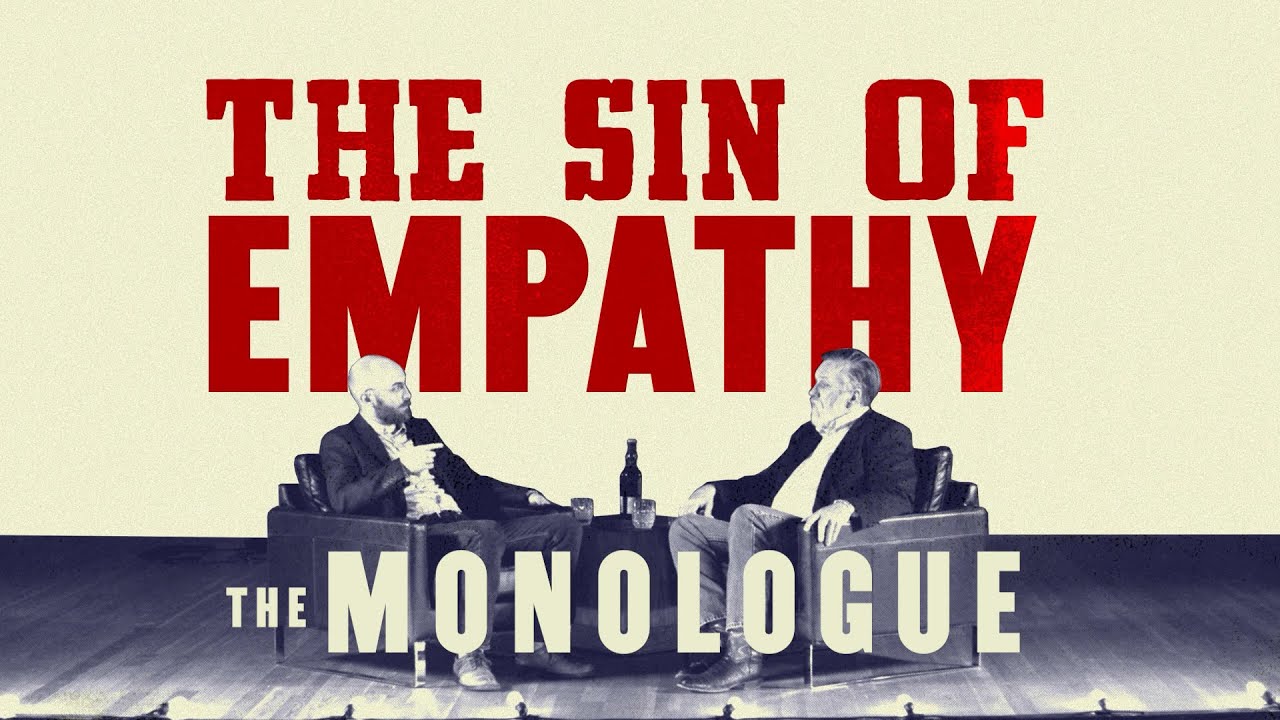 ." Empathy, says Wilson, “is not a good thing."
The “Man Rampant" agenda is reinforced on Wilson's website, which draws upon the creative people living in the Moscow community to turn his arguments into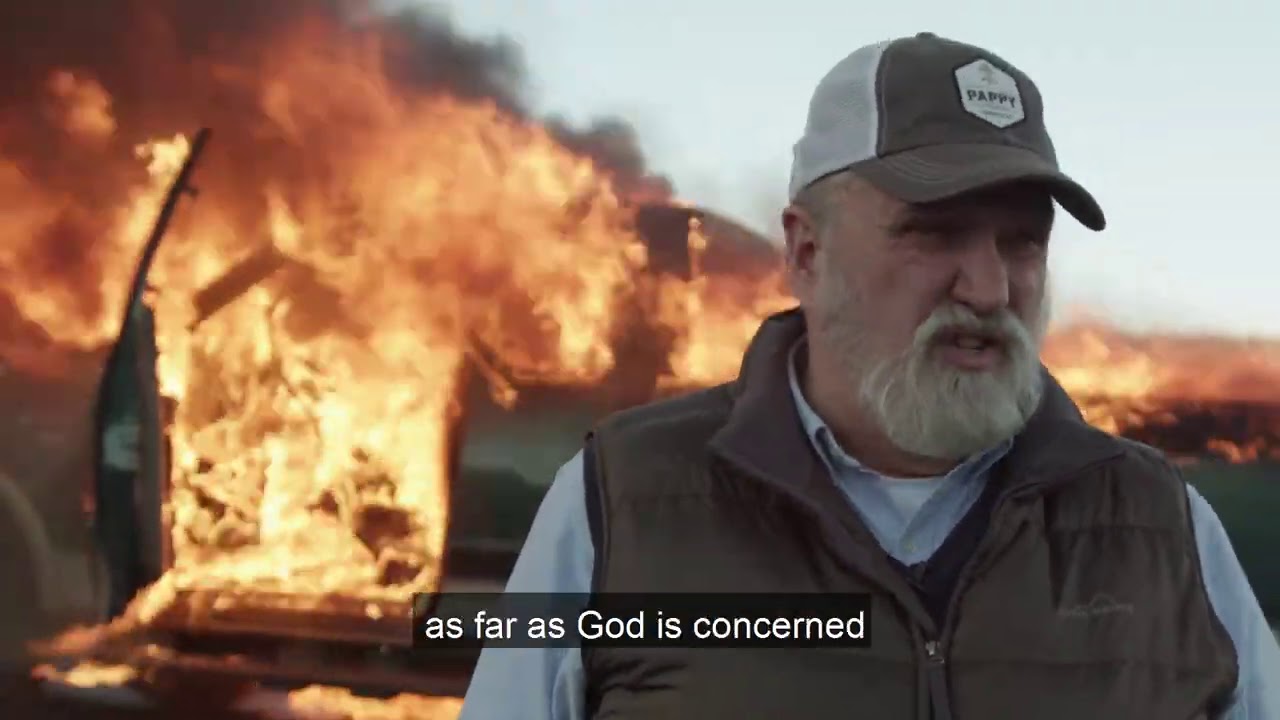 , and where, while dismissing racism, he argues that
 ."
Going local to convert America
In America's crowded religious marketplace, Wilson's message is clearly distinct.
One of Wilson's most important influences is the late R.J. Rushdoony, an Armenian-American Presbyterian theologian who was driven by protecting Protestants in the U.S. from suffering the kind of genocide from which his parents escaped. Frustrated by the other-worldliness of many American Christian denominations, whose adherents he feared preached more about heaven than earth, and their complacency in what he perceived to be a hostile liberal culture, Rushdoony set about developing biblical principles for how society should be organized.
The Ten Commandments were no longer to be considered as an artifact in the history of morality, Rushdoony argued. Instead, they should be understood as setting out the core principles for the running of the modern state. “Thou shalt not steal" ruled out the possibility of inflation, which Rushdoony argued devalued monetary assets and was therefore was a form of theft. And “Thou shalt have no other gods besides me" ruled out any possibility of religious pluralism.
Rushdoony promoted these ideals in titles such as 1973's “Institutes of Biblical Law" – a 1,000-page exposition of the Ten Commandments that argued for both the abolition of the prison system and a massive extension of capital punishment.
Christians would be secure in American society only when it was shaped by their religious values, he argued. But the Christian America that he anticipated would not be secured through revolution or any form of top-down political change – only by the transformation of individual lives, families, towns and states.
This strategy of promoting beliefs at the local level explains why Christian Reconstructionists, like those led by Wilson, prefer to focus energies in small towns. The Reconstructionists in Moscow believe that they can achieve much more significant cultural impact if they can secure significant demographic change, either by the conversion of existing inhabitants or by encouraging others to move to the area.
Eschewing the existential crisis
The stated goal of Wilson's congregation is to make Moscow a Christian town; at present only around a third of Moscow residents identify as “religious," according to a 2019 report.
But it is Wilson's attitude about public health measures during the pandemic that has most recently brought him and his church back to the attention of political leaders. Throughout the pandemic, he has argued that mask requirements reveal the hypocrisy of government. In September 2020, Wilson led his congregation in the illegal hymn-sing in front of City Hall that led to the arrests of several church members – footage of which was retweeted by President Trump, who suggested that the Moscow congregation's arrests were emblematic of what would happen to evangelicals if Democrats took control. “DEMS WANT TO SHUT YOUR CHURCHES DOWN, PERMANENTLY," the former president tweeted in all caps.
And yet, whatever the former president's fears, Wilson's congregation is growing. While large denominations, like the Southern Baptists, divide in the debate about critical race theory, Wilson's church shows how some congregations could respond to evangelicalism's existential crisis – and possibly thrive.
3 media outlets, 1 religion newsletter. [Get stories from The Conversation, AP and RNS.]
This article is republished from The Conversation under a Creative Commons license. Read the original article.
RELATED ARTICLES AROUND THE WEB
- A twisted history of sexuality | Mark Vernon | The Guardian ›
- The Social Construction of Racism in the United States | Manhattan ... ›
- "Religion's Influence on Environmental Concern: U.S. Evangelicals ... ›
---
---
https://www.**nytimes**.com/2017/07/31/opinion/donald-trump-school-choice-criticism.html
no lnx
Opinion
OP-ED CONTRIBUTOR
What the ‘Government Schools’ Critics Really Mean
By Katherine Stewart
July 31, 2017
SANTA BARBARA, Calif. — When President Trump recently proposed his budget for “school choice,” which would cut more than $9 billion in overall education spending but put more resources into charter schools and voucher programs, he promised to take a sledgehammer to what he has called “failing government schools.”That is harsh language for the places most of us call public schools, and where nearly 90 percent of American children get their education.But in certain conservative circles, the phrase “government schools” has become as ubiquitous as it is contemptuous.
What most people probably hear in this is the unmistakable refrain of American libertarianism, for which all government is big and bad. The point of calling public schools “government schools” is to conjure the specter of pathologically inefficient, power-mad bureaucrats. Accordingly, right-wing think tanks like the Mackinac Center for Public Policy, the Heartland Institute and the Acton Institute have in recent years published screeds denouncing “the command and control mentality” of “government schools” that are “prisons for poor children.” All of these have received major funding from the family of the education secretary, Betsy DeVos, either directly or via a donor group.
The libertarian tradition is indebted, above all, to the Chicago economist Milton Friedman, who published a hugely influential 1955 paper, “The Role of Government in Education.” A true believer in the power of free markets to solve all of humanity’s problems, Friedman argued that “government schools” are intrinsically inefficient and unjustified. He proposed that taxpayers should give money to parents and allow them to choose where to spend education dollars in a marketplace of freely competing private providers. This is the intellectual foundation of Ms. DeVos’s voucher proposals.
But the attacks on “government schools” have a much older, darker heritage. They have their roots in American slavery, Jim Crow-era segregation, anti-Catholic sentiment and a particular form of Christian fundamentalism — and those roots are still visible today.
Before the Civil War, the South was largely free of public schools. That changed during Reconstruction, and when it did, a former Confederate Army chaplain and a leader of the Southern Presbyterian Church, Robert Lewis Dabney, was not happy about it.An avid defender of the biblical “righteousness” of slavery, Dabney railed against the new public schools. In the 1870s, he inveighed against the unrighteousness of taxing his “oppressed” white brethren to provide “pretended education to the brats of black paupers.” For Dabney, the root of the evil in “the Yankee theory of popular state education” was democratic government itself, which interfered with the liberty of the slaver South.
One of the first usages of the phrase “government schools” occurs in the work of an avid admirer of Dabney’s, the Presbyterian theologian A. A. Hodge. Less concerned with black paupers than with immigrant papist hordes, Hodge decided that the problem lay with public schools’ secular culture. In 1887, he published an influential essay painting“government schools” as “the most appalling enginery for the propagation of anti-Christian and atheistic unbelief, and of antisocial nihilistic ethics, individual, social and political, which this sin-rent world has ever seen.”
But it would be a mistake to see this strand of critique of “government schools” as a curiosity of America’s sectarian religious history. In fact, it was present at the creation of the modern conservative movement, when opponents of the New Deal welded free-market economics onto Bible-based hostility to the secular-democratic state. The key figure was an enterprising Congregationalist minister, James W. Fifield Jr., who resolved during the Depression to show that Christianity itself proved “big government” was the enemy of progress.
Drawing heavily on donations from oil, chemical and automotive tycoons, Fifield was a founder of a conservative free-market organization, Spiritual Mobilization, that brought together right-wing economists and conservative religious voices — created a template for conservative think tanks. Fifield published the work of midcentury libertarian thinkers Ludwig von Mises and his disciple Murray Rothbard and set about convincing America’s Protestant clergy that America was a Christian nation inwhich government must be kept from interfering with the expression of God’s will in market economics.
Someone who found great inspiration in Fifield’s work, and who contributed to his flagship publication, Faith and Freedom, was the Calvinist theologian Rousas J.Rushdoony. An admirer, too, of both Hodge and Dabney, Rushdoony began to advocate a return to “biblical” law in America, or “theonomy,” in which power would rest only on a spiritual aristocracy with a direct line to God — and a clear understanding of God’s libertarian economic vision.
Rushdoony took the attack on modern democratic government right to the schoolhouse door. His 1963 [CRM see buchanan chains] book, “The Messianic Character of American Education,” argued that the “government school” represented “primitivism” and “chaos.” Public education, he said, “basically trains women to be men”and “has leveled its guns at God and family.”
These were not merely abstract academic debates. The critique of “government schools” passed through a defining moment in the aftermath of the Brown v. Board of Education decision of 1954, when orders to desegregate schools in the South encountered heavy resistance from white Americans. Some districts shut down public schools altogether; others promoted private “segregation academies” for whites, often with religious programming, to be subsidized with tuition grants and voucher schemes. Dabney would surely have approved.
Many of Friedman’s successors in the libertarian tradition have forgotten or distanced themselves from the midcentury moment when they formed common cause with the Christian right. As for Friedman himself, the great theoretician of vouchers, he took pains to insist that he abhorred racism and opposed race-based segregation laws — though he also opposed federal laws that prohibited discrimination.
Among the supporters of the Trump administration, the rhetoric of “government schools” has less to do with economic libertarianism than with religious fundamentalism. It is about the empowerment of a rearmed Christian right by the election of a man whom the Rev. Jerry Falwell Jr. calls evangelicals’ “dream president.” We owe the new currency of the phrase to the likes of Tony Perkins of the Family Research Council — also bankrolled in its early years by the DeVos family — who, in response to the Supreme Court’s ruling allowing same-sex marriage, accused “government schools” of indoctrinating students “in immoral sexuality.” Or the president of the groupLiberty Counsel, Anita Staver, who couldn’t even bring herself to call them “schools,” preferring instead to bemoan “government indoctrination camps” that “threaten our nation’s very survival.” // Rush
When these people talk about “government schools,” they want you to think of an alien force, and not an expression of democratic purpose. And when they say “freedom,” they mean freedom from democracy itself.
---
---
https://www.alternet.org/2020/03/the-strange-truth-about-the-pro-slavery-origins-of-christian-nationalism-in-the-united-states/
no lnx
The strange truth about the pro-slavery origins of Christian nationalism in the United States
Written byHistory News Network March 14, 2020
Right around the time the House began its impeachment inquiry, the homepage of the U.S. Department of State featured a talk by Secretary of State Mike Pompeo titled “Being a Christian Leader.” Only a few weeks had passed since Attorney General William Barr told students at Notre Dame Law School that “secularists” are to blame for “moral chaos” and “immense suffering, wreckage, and misery,” and that “Judeo-Christian moral standards are the ultimate utilitarian rules for human conduct.” Then, at a January campaign rally at a Miami megachurch, President Donald Trump told the largely evangelical crowd that God is “on our side.”
Most of us have a sense that this kind of religious-nationalist rhetoric and behavior got its start with the revolution that Reagan brought to power. A decisive moment was in August 1980, at the Reunion Arena in Dallas, Texas, when Reagan addressed 15,000 thousand pastors and religious activists. “I know that you can’t endorse me,” but “I want you to know that I endorse you and what you are doing,” he said, to wild applause.
Reagan’s speech at the Reunion Arena marked a sea change in the role of conservative religion in American politics. But some of those who had helped organize the event were concerned that the one individual who deserved the most credit for the transformation of the interface of politics and religion was not on the podium. “We agreed that it was unfortunate that Rousas Rushdoonywas not speaking,” radical theologian Gary North later observed, recalling an exchange with Robert Billings, a Reagan campaign staffer who had previously served as executive director of Jerry Falwell’s Moral Majority organization. Billings responded, “If it weren’t for his books none of us would be here.” “Nobody in the audience understands that,” North countered. “True, but we do,” Billings reportedly replied.
Howard Phillips, a former Nixon administration aide who was also present at the Reunion Arena, called Rushdoony the “most influential man of the 21st century.” As he confided to author and religious studies professor Julie Ingersoll in 2007, “The whole Christian conservative political movement had its genesis in Rush.”
Rousas John Rushdoony was born in 1916 to Armenian immigrants who had narrowly escaped the genocide, in which as many as 1.5 million Armenians were murdered by Turks of the Ottoman Empire. Rushdoony’s father, who founded the Armenian Martyrs Presbyterian Church in Kingsburg, California, ministered to a community of fellow Armenian refugees, who agonized and grieved as letters from relatives back home came to a standstill. “In Armenia, there was no neutral ground between Islam and Christianity,” Rushdoony wrote in 1997. “And I came to realize there is no neutral ground anywhere.”
Rushdoony left his family home and made his way to college at the University of California, Berkeley. He did not fit in.Advised to read the classics, Rushdoony later called this “the ugliest experience of my life.” He pronounced the works of Shakespeare, Homer and the rest of the canon “classics of degenerate cultures. What they offer at their best is evil.”
Rushdoony emerged from Berkeley with all the distinctive features of his intellectual persona in place: a resolutely binary form of thought that classified all things into one of two absolutes; a craving for order; and a loathing of the secular world.
Rushdoony began to advocate for a return to “biblical law” in America. The Bible, Rushdoony said, commands Christians to exercise dominion over the earth and all its inhabitants. Women are destined by God to be subordinate to men; men are destined to be ruled by a spiritual aristocracy of right-thinking Christian leaders, and public education is a threat to civilization for it promotes a “secular world-view.” In over thirty books and publications, including The Messianic Character of American Education and The Institutes of Biblical Law – often hailed as his magnum opus and recommended as one of the Choice Evangelical Books of 1973 by evangelical flagship journal Christianity Today — Rushdoony laid it all out in a program he called Christian Reconstruction.
There is little mystery about the historical sources from which Rushdoony drew his own inspiration. He laid out all the details in his works. Setting aside the hardline Dutch Reformed theologians who supplied the backbone of his thought,Rushdoony drew on two traditions that would prove essential in understanding the genesis of today’s Christian nationalist movement. The first was the proslavery theology of America’s antebellum preachers. The second was the economic libertarianism that took root in reaction to the New Deal.
Among apologists for Christian nationalism today, the favored myth is that the movement represents an extension of the abolitionism of the nineteenth century and perhaps of the civil rights movement of the twentieth century, too. Many antiabortion activists self-consciously refer to themselves as the new abolitionists. Mainstream conservatives who lament that the evangelicals who form Trump’s most fervent supporters have “lost their way” suggest that they have betrayed their roots in the movements that fought for the abolition of slavery and the end of discrimination.But the truth is that today’s Christian nationalism did not emerge out of the movement that opposed such rigid hierarchies. It came from the one that endorsed them.
Rushdoony understood this well. Not long after escaping the horror of Berkeley, he took an interest in the work of Robert Lewis Dabney, a defender of slavery before the Civil War and who also supported patriarchy and the American form of apartheid after the war.
Rushdoony reprinted and disseminated some of Dabney’s works through his Vallecito, California-based Chalcedon Foundation, as well as through his publishing company, Ross House Books. He found himself agreeing with Dabney that the Union victory was a defeat for Christian orthodoxy. In Rushdoony’s mind, Dabney’s great adversaries, the abolitionists, were the archetypes of the anti-Christian rebels – liberals, communists, secularists, and advocates of women’s rights – who continued to wreak havoc on the modern world. As Rushdoony’s fellow Reconstructionist C. Gregg Singer put it, proslavery theologians including Dabney, Thornwell and their contemporaries “properly read abolitionism as a revolt against the biblical conception of society and a revolt against divine sovereignty in human affairs.” Rushdoony himself concluded, “Abolitionist leaders showed more hate than love on the whole.” The defeat of the orthodox side in the Civil War, Rushdoony asserted, paved the way for the rise of an unorthodox Social Gospel.
Rushdoony’s admiration for southern religious orthodoxy was such that he adopted a forgiving attitude toward certain forms of slavery. In books such as Politics of Guilt and Pity and The Institutes of Biblical Law, which is essentially an 890-page disquisition on “the heresy of democracy” and the first of a three-volume series under the same title, he makes the case that “the move from Africa to America was a vast increase of freedom for the Negro, materially and spiritually as well as personally.”
“Some people are by nature slaves and will always be so,” Rushdoony muses, and the law requires that a slave “recognize his position and accept it with grace.”
One of Dabney’s pet peeves was the provision of public education to Black children, whom he referred to as “the brats of black paupers,”which required unjust (in his view) taxation of “oppressed” “white bretheren.” Rushdoony sympathized with Dabney’s point of view on public education, and here began to fuse his views with a small-government ideology. “State supported and controlled education is theft,” he wrote, and called the claim of ownership to the lives of citizens by a “humanist state” slavery, too.
Rushdoony did not agitate for the literal enslavement of Black Americans in his time. But his fascination with proslavery theology was no passing fancy. The idea that the United States is a Redeemer Nation, chosen by God; that it is tasked with becoming an orthodox Christian republic in which women are subordinate to men, education is in the hands of conservative Christians, and no one pays taxes to support Black people; that at some point in the past the nation deviated horribly from its mission and fell under the control of atheist, communist, and/or liberal elites—the stuff of proslavery theology was the life of Rushdoony’s political thought.
Rushdoony soon found an even greater source of inspiration in the libertarian economic thinkers who emerged to beat back the New Deal. He was very much taken with figures like James W. Fifield as well as members of the Austrian school of economics, and began to churn out works arguing that the modern welfare state was “organized larceny” and “capitalism is supremely a product of Christianity.”
In this Christian-libertarian vision, Rushdoony saw the foundation for a thoroughly religious – or better, theocratic – understanding of the American republic. In Rushdoony’s telling, it was not the intention of America’s founders to establish a nonsectarian representative democracy. The First Amendment, he argues, aimed to establish freedom “not from religion but for religion.” “The Constitution was designed to perpetuate a Christian order,” he wrote.
The idea that the United States is a “Christian nation” – not just in the sense that its population was originally mostly Christian but that it was intended to serve as part of a Christian world order – was Rushdoony’s central contribution to the religious right.
Rushdoony had many prominent admirers, among them evangelical leader D. James Kennedy, whose ministry received millions of dollars in donations from the DeVos family. Kennedy popularized Rushdoony’s ideas through multiple sermons and publications, exhorting attendees at a 2005 conference organized by his ministry to “exercise godly dominion” over “every aspect and institution of human society.” The ultraconservative Catholic leader Richard John Neuhaus, who worked to broker a conservative evangelical and conservative Catholic alliance, pointed out that Rushdoony’s “theonomy,” or the idea of a social and political order rooted in “biblical law,” has “insinuated itself in circles where people would be not at all comfortable to think of themselves as theonomists.” He also attested, in 1990, to “increasing encounters with ideas clearly derived from Christian Reconstructionistm even among conservatives in the mainline/oldline churches.”
Today, the ideas of Rushdoony and his fellow Reconstructionists have penetrated into evangelical and conservative Catholic circles that are, quite often, unaware of their original sources. “Though we hide their books under the bed, we read them just the same,” as one observer put it to Michael J. McVicar, author of Christian Reconstruction: R.J. Rushdoony and the American Religious Conservatism.To be clear, the Christian right is large and diverse in its specific theologies.
Many of its representatives know very little about R.J. Rushdoony and others take pains to distance themselves from him. Some of his extreme positions, such as the idea that homosexuals, blasphemers and adulterers are all worthy of the death penalty, have been loudly repudiated by conservative leaders. Yet it is difficult to understand the ideological origins and structure of Christian nationalism in America today without taking into account Rushdoony’s ideas.
Rushdoony’s work is touted today by some of the leading personalities and policy groups on the Christian right. Perhaps the most telling example comes fromDavid Barton,whose efforts to reframe our constitutional republic as a Christian nationalist enterprise are at the center of so many of the movement’s cultural and legislative initiatives. Though perhaps not in a formal sense a Reconstructionist, Barton dances around many of Rushdoony’s defining ideas, even on the question of slavery.
In a paper titled “The Bible, Slavery, and America’s Founders,” posted on the WallBuilders website, Barton cites Rushdoony extensively, and argues that “in light of the Scriptures, we cannot say that slavery, in a broad and general sense, is sin. But this brief look at the Biblical slave laws does reveal how fallen man’s example of slavery has violated God’s laws.”
Where Barton strikes out on his own, it is to take a swipe at modern, liberal government as a form of slavery,a gesture that Rushdoony surely would have endorsed. “Since sinful man tends to live in bondage, different forms of slavery have replaced the more obvious system of past centuries,” Barton explains. “The state has assumed the role of master for many, providing aid and assistance, and with it more and more control, to those unable to protect themselves.” In a 2018 blog post, Watchmen on the Wall, the Family Research Council’s alliance of an estimated 25,000 pastors, praised Rushdoony as a “powerful advocate for the Christian and homeschool movements across America” who “challenged Christian leaders of his day to stand on biblical truth in the public square.” Rushdoony is a foundational thinker whose ideas continue to speak, long after he has been silenced.
For a long time now, critics have viewed America’s religious right as a social or cultural movement. They assume that it represents a reaction to modern, secular culture, and that it speaks for a large mass of disaffected conservative evangelicals and others who are preoccupied with issues of concern to the family. But that simplistic interpretation is plausible only for those who do not actually listen to what its leaders have to say or trace its ideas to their primary sources. Christian nationalism today is a political movement, and its primary goal is power. Its ultimate aim is not just to win elections but to replace our modern constitutional Republic with a “biblical” order that derives its legitimacy not from the people but from God and the Bible – or, at least, the God and the Bible that men like Rushdoony claimed to know.
Katherine Stewart is an author and journalist. Her newly published book is The Power Worshippers: Inside the Dangerous Rise of Religious Nationalism (Bloomsbury, March 3, 2020).
Follow Katherine Stewart on Twitter: @kathsstewart.
This article was originally published at History News Network
---
---
transcript
https://time.com/5777857/state-of-the-union-transcript-2020/
---
ref seidel
https://religiondispatches.org/amid-reality-tv-gimmicks-and-xenophobic-rhetoric-trumps-sotu-appeals-to-evangelicals/
no lnx
since late December, 2019, when retiring editor-in-chief of Christianity Today Mark Galli published his infamous “Trump Should Be Removed from Office” editorial, there’s been a great deal of buzz in the pundit class over whether Trump, after a highly publicized impeachment trial, needs to be concerned with possible defections in his white evangelical base. From an analytical standpoint, the buzz is mere noise, horse race politics nonsense from people who don’t understand that most white evangelicals have long since come to regard CT as “too liberal.” As John Stoehr observed on RD back in December, “It’s not going to change much.”
And, what many failed to notice or recall, is that the editorial itself was entirely milquetoast, attacking only Trump’s “gross immorality and ethical incompetence,” while agreeing with Trump-supporting evangelicals that “his Supreme Court nominees, his defense of religious liberty, and his stewardship of the economy” are among “the president’s positives.”
Although this editorial was never going to make a dent in the unflagging support Trump counts on from his white evangelical base, he seems to have been scared enough by the furor around it to start ramping up his evangelical outreach. It’s probably no coincidence that Trump recently became the first U.S. president to address the radical anti-choice “March for Life” event in person.
Given that the vast majority of white evangelicals, America’s single most right-wing demographic, are Christian nationalists, we should have expected a substantial presence of Christian nationalist rhetoric in yesterday’s State of the Union Address, along with coded nods to specific evangelical concerns about abortion, schooling, and “religious freedom.”
Indeed, all these elements were present in a speech packed chock-full of “lies, damned lies, and statistics,” along with reality-show gimmicks including a surprise reunion of Trump guest Amy Williams and her husband, Sgt. 1st Class Townshend Williams, andawarding the Presidential Medal of Freedom to right-wing radio charlatan Rush Limbaugh, whose advanced lung cancer diagnosis does nothing to erase his substantial contributions to the destruction of America’s information ecosystem.
Trump’s appreciation for post-truth bluster and militarism are certainly among the characteristics that endear him to the Christian Right. And while he remains most in his element with the jingoistic rhetoric of borders, “heroes,” economic protectionism, and “criminal” immigrants, over the last few years Trump has become visibly more comfortable using language that more directly appeals to the conservative, mostly white evangelicals and radical traditionalist Catholics who represent his base, and with whom he has surrounded himself.
To those with “eyes to see,” Trump’s first clear appeal to the Christian Right came in his use of the phrase “failing government schools” in the midst of his calling for the expansion of “school choice” voucher policies. As a few observers on Twitter pointed out, notably religious studies professor Julie Ingersoll, the pejorative term “government schools” is a hallmark of Christian Reconstructionism,a radical theocratic ideology whose exponents believe that public education should be abolished in favor of homeschooling and/or Christian schools.
As Ingersoll’s research demonstrates, such ideas have been mainstreamed in evangelicalism precisely through the spread of Christian schooling and the deregulation of homeschooling, thanks to Christian Reconstructionist influence on curricula.
julie ingersoll
@julieingersoll
Trump calls public schools "government schools," a dog whistle to evangelicals and an indication of wide-ranging influence of Christian reconstructionism #SOTU @C_Stroop @profagagne
389
6:43 PM - Feb 4, 2020
Twitter Ads info and privacy
206 people are talking about this
Chrissy in the Dumbest Dystopia
?
@C_Stroop
- Feb 4, 2020
Replying to @cutrightest @julieingersoll
They’re not exactly the same thing but Christian Reconstructionism is very racist. But I guess the rhetoric is older:
https://t.co/3ng03XqUNY https://twitter.com/julieingersoll/status/1224899037117272065?s=21 …
julie ingersoll
@julieingersoll
I suspect #Rushdoony got it from J. Gresham Machen in the 20s. https://twitter.com/C_Stroop/status/1224898284491173888 …
julie ingersoll
@julieingersoll
I'd say that Rushdoony brought the language into modern popular Evangelical usage as he developed the "biblical" defense of Christian education and the rejection of public education.
15
7:40 PM - Feb 4, 2020
Twitter Ads info and privacy
See julie ingersoll's other Tweets
Trump’s subsequent appeals to his white evangelical base were more obvious.Right after touting the confirmation of new federal judges on his watch, including “two brilliant new Supreme Court Justices, Neil Gorsuch and Brett Kavanaugh,” the president boasted about his administration’s “defense of religious liberty, [which] includes the Constitutional right to pray in public schools.” While this right has never in fact been contested, it’s a longstanding evangelical tactic to disingenuously conflate the constitutional ban on school-sponsored prayer with the generic “prayer in schools,” which makes for a more effective rallying cry to agitate the faithful.
From here, Trump launched into a bizarrely manic description of what “we” do in America, rhetoric that reinforces the authoritarian urge to define “the nation” or “the people” in a way that excludes othered groups:
In America, we do not punish prayer. We do not tear down crosses. We do not ban symbols of faith. We do not muzzle preachers and pastors. In America, we celebrate faith. We cherish religion. We lift our voices in prayer, and we raise our sights to the Glory of God!
Few Americans would disagree with the first four sentences, all of which, with certain caveats, represent clearly protected First Amendment freedoms. (If, for example, the proverbial cross happens to be located in a public space that doesn’t permit equal representation to other faiths, then yes, the cross might be removed according to the Constitution.)
The last three sentences, however, are a different matter, as they’re clearly meant to define America as a religious nation to the exclusion of non-believers. And, given the proximity of these statements to Trump’s invocation of crosses, it’s no stretch to read these sentences as defining America as a specifically Christian nation.
Trump’s awkward transition from this Christian nationalist rhetoric to invoking the Second Amendment’s “right to keep and bear arms” may seem out of place to some observers. As I’ve argued previously, however, the coziness of God and guns makes perfect sense to Trump’s Christian Right base. Likewise, Trump’s subsequent lines on “manifest destiny,” “frontiers,” and defeating terrorism are red meat for Christian nationalists (if rather bizarrely thrown together with assertions that America will send the first woman to the moon and be the first nation to plant a flag on Mars).
Trump drove his speech to a close with more secularized and—despite references to Frederick Douglass and Harriet Tubman—racist nationalist appeals to “pioneers,” “settl[ing] the New World,” and “the beautiful, beautiful Alamo.” This language of “national greatness,” it’s worth noting, may be regarded as the expression of a type of political religion, an essentially secular expression that Christian nationalists nevertheless embrace enthusiastically. In the end, for those worried about attacks on the separation of church and state and about the unwavering support for Trump among white evangelicals, the 2020 State of the Union will do little to assuage these concerns.
Bio
Latest Posts
fake@gmail.com'
Chrissy Stroop
A prominent ex-evangelical writer, speaker, and advocate, Chrissy Stroop is (with Lauren O’Neal) coeditor of the essay anthology Empty the Pews: Stories of Leaving the Church. A senior correspondent for Religion Dispatches, her work has appeared in Dame Magazine, Foreign Policy, Playboy, Political Research Associates, and other outlets, including peer-reviewed academic journals. Holding a Ph.D. in modern Russian history from Stanford University, Stroop is a Senior Research Associate with the University of Innsbruck’s Postsecular Conflicts project. In 2019 Chrissy came out as a transgender woman and began her journey of medical transition. She resides in Portland, Oregon.
---
---
https://en.wikipedia.org/wiki/R._J._Rushdoony
Rousas John Rushdoony (April 25, 1916 – February 8, 2001) was a Calvinist philosopher, historian, and theologian and is widely credited as being the father of Christian Reconstructionism[3] and an inspiration for the modern Christian homeschool movement.[4][5] His followers and critics have argued that his thought exerts considerable influence on the evangelical Christian right.[6]
- 1Biography
- 2Philosophical and theological contributions
- 3Criticism
- 4Selected works
- 5References
- 6Further reading
- 7External links
Biography[edit]
Rushdoony was born in New York City, the son of recently arrived Armenian immigrants. Before his parents fled the Armenian Genocide of 1915, his ancestors had lived in a remote area near Mount Ararat.[7] There are claims that since the year 320, every generation of the Rushdoony family has produced a Christian priest or minister.[8]Rushdoony himself claimed that his ancestors "…would perpetually give a member of their family to be a priest to perform a kind of Aaronic priesthood as in the Old Testament, an hereditary priesthood. Whoever in the family felt called would become the priest. And our family did so. So from the early 300's until now there has always been someone in the ministry in the family."[9]
Within weeks of arriving in America, his parents moved to the small farming community of Kingsburg, California, in Fresno County, where a number of other Armenian families had relocated. There his father, Yegheazar Khachig Rushdoony,[10] founded a church, Armenian Martyrs Presbyterian. Rousas learned to read English by poring over the family's King James Bible: "By the time I reached my teens I had read the Bible through from cover to cover, over and over and over again". The family moved in 1925 for a short time to Detroit, where his father pastored another Armenian church. They returned to Kingsburg in 1931 and Rousas completed school in California.[11] His father was pastor of Bethel Armenian Presbyterian Church in San Francisco in 1942.[12] Rousas had a younger sister, Rose (named for their mother), and brother, Haig. His father died in Fresno in 1961.
Education[edit]
Rushdoony attended public schools where he learned English, though Armenian was the language spoken at home.[6][13] He continued his education at the University of California, Berkeley, where he earned a B.A. in English in 1938, a teaching credential in 1939 and an M.A. in Education in 1940. Rushdoony and Arda Gent married in San Francisco the week before Christmas, 1943.
Rushdoony went on to the Pacific School of Religion, a Congregational and Methodist seminary in Berkeley, California, from which he graduated in 1944. Through letters over the years he kept up his friendship with his Pacific School of Religion mentor, theology professor George Huntston Williams, who saw in him the "heir of a great national Christian heritage" who would "enunciate anew the Gospel which seems to have been forgotten for a season." In 1944 he was ordained by the Presbyterian Church in the United States of America.[6]
He was later awarded an honorary Ph.D. from Valley Christian University for his book, The Philosophy of the Christian Curriculum.[8]
Gary North stated that Rushdoony read at least one book a day, six days a week, for fifty years of his life, underlining sentences and making an index of its main ideas in the rear.[6]
Ministry[edit]
Rushdoony and his wife Arda served for eight and a half years as missionaries to the Shoshone and Paiute Indians on the remote Duck Valley Indian Reservation in northern Nevada. They lived in the reservation's primary town, Owyhee.[5][6][14] It was during their mission to the Native Americans that Rushdoony began writing.
Arda taught at the reservation school and at Sunday school, led a Girl Scout troop, coached the girls' basketball team, and visited with families. In 1945 they adopted Ronald, an orphaned baby from the reservation. Between 1947 and 1952 in Owyhee, four daughters were born to them. In late 1952 Rushdoony took a Presbyterian Church (USA) pastorate at Trinity Presbyterian Church in Santa Cruz, Californiaand the family left Duck Valley in January 1953. Their son Mark was born the next month in Santa Cruz.[13][15]

In Santa Cruz, Rushdoony became a reader of the Christian libertarian magazine *Faith and Freedom*, which advocated an "anti-tax, non-interventionist, anti-statist economic model" in opposition toFranklin D. Roosevelt's New Deal.[16] Faith and Freedom's views on government aligned with Rushdoony's fears of centralized government power, given the Rushdoony family's memories of the Armenian Genocide.[17] Rushdoony contributed articles to Faith and Freedom, including one describing his observations of the Duck Valley Indian Reservation, arguing that government support had reduced residents to "social and personal irresponsibility".[18][19]
The Rushdoonys separated in 1957 and later divorced. About this time, Rushdoony transferred his church membership from the Presbyterian Church (USA) to the Orthodox Presbyterian denomination. The Orthodox Presbyterian Church's newsletter, The Presbyterian Guardian, reported in July 1958 that "the Rev. Rousas J. Rushdoony… was received and a new Orthodox Presbyterian Church organized, consisting of [sixty-six charter members] who had separated from the Presbyterian Church in the U.S.A. in Santa Cruz." In their petition the group asked that Rushdoony be ordained as their pastor and stated, "[W]e cannot abide in any church which seeks to define righteousness or sin, salvation or sanctification, except in terms of the Word of God. We have witnessed, here in Santa Cruz, against modernism, man-made perfectionism, and church bureaucracy". The newsletter article goes on to report, "The Presbytery in receiving the church also examined Mr. Thomas Kirkwood and Mr. Kenneth Webb as prospective elders, and they with Mr. Rushdoony were constituted the session of the church," and announced the publication of Rushdoony's By What Standard? later that year.[20]
Later life[edit]
The May 1962 edition of The Presbyterian Guardian reported Rushdoony's resignation, noted as "reportedly to devote his time for his writing and lecturing."[21] Rushdoony also married his second wife, Dorothy Barbara Ross Kirkwood, in 1962. She died in 2003.[22]
Rushdoony moved to Los Angeles in 1965 and founded the Chalcedon Foundation; the monthly Chalcedon Report, which Rushdoony edited, began appearing that October.[6]His daughter Sharon later married Gary North, a Christian Reconstructionist writer and economic historian. North and Rushdoony became collaborators and their partnership lasted until 1981 when it was ended due to a dispute over the content of one of North's articles. Following the dispute, North and Chalcedon continued to independently promote each other's views, but they did not reach a "truce" until 1995.[3]
Under Rushdoony, the Chalcedon Foundation grew to twelve staff members with 25,000–40,000 people on their mailing lists during the 1980s. Chalcedon and Reconstructionism obtained the support of major Christian book publishers and endorsements from influential evangelical leaders including Pat Robertson, Jerry Falwell and Frank Schaeffer (who later repudiated the movement).[3]
RJ Rushdoony died in 2001 with his children at his side. Rushdoony's son, the Rev. Mark R Rushdoony, became and remains the president of the Chalcedon Foundation and editor of the Chalcedon Report.[6]
Philosophical and theological contributions[edit]
Michael J. McVicar summarized Rushdoony's theology and philosophy as follows:[17]
As a theologian Rushdoony saw human beings as primarily religious creatures bound to God, not as rational autonomous thinkers. While this may seem an esoteric theological point, it isn't. All of Rushdoony's influence on the Christian Right stems from this single, essential fact. Many critics of Christian Reconstructionism assume that Rushdoony's unique contribution to the Christian Right was his focus on theocracy. In fact, Rushdoony's primary innovation was his single-minded effort to popularize a pre-Enlightenment, medieval view of a God-centered world. By de-emphasizing humanity's ability to reason independently of God, Rushdoony attacked the assumptions most of us uncritically accept.
Rushdoony developed his philosophy as an extension of the work of Calvinist philosopher Cornelius Van Til. Van Til critiqued human knowledge in light of the Calvinist doctrine of total depravity. He argued that sin affected a person's ability to reason. In order to be rational, Van Til claimed, one must presuppose the existence of God and the inerrant, divine inspiration of the (Protestant) Bible.[17] Rushdoony attended to the implications – where Van Til held true knowledge came from God, Rushdoony asserted that "all non-Christian knowledge is sinful, invalid nonsense. The only valid knowledge that non-Christians possess is 'stolen' from 'Christian-theistic' sources."[17] In effect, Rushdoony extended Van Til's thinking from philosophy to "all of life and thought."[8]
Early writings[edit]
Rushdoony began popularizing, albeit densely, the works of Calvinist philosophers Cornelius Van Til and Herman Dooyeweerd into a short survey of contemporary humanism called By What Standard?. Arguing for a Calvinist system of thought, Rushdoony dealt with subjects as broad as epistemology and cognitive metaphysics and as narrow as the psychology of religion and predestination. He wrote a book, The One And The Many: Studies in the Philosophy of Order and Ultimacy, using Van Tillian presuppositional philosophy to critique various aspects of secular humanism. He also wrote many essays and book reviews, published in such venues as the Westminster Theological Journal.
Homeschooling
Rushdoony's next focus was on education, especially on behalf of homeschooling, which he saw as a way to combat the intentionally secular nature of the U.S. public school system. By the early 1960s he was active in the homeschooling movement, appearing as an expert witness in order to defend the rights of homeschoolers.[5] He vigorously attackedprogressive school reformers such as Horace Mann and John Dewey and argued for the dismantling of the state's influence on education in three works: Intellectual Schizophrenia (a general and concise study of education), The Messianic Character of American Education (a history and castigation of public education in the U.S.), and The Philosophy of the Christian Curriculum (a parent-oriented pedagogical statement).
History[edit]
Rushdoony then pursued history – of the world, of the United States, and of the church. He maintained that Calvinistic Christianity provided the intellectual roots for the American Revolution and thus had always had an influential impact in American history. The American Revolution, according to Rushdoony, was a "conservative counterrevolution" to preserve American liberties from British usurpation and it owed nothing to the Enlightenment. He further argued that the United States Constitution was a secular document in appearance only; it didn't need to establish Christianity as an official religion since the states were already Christian establishments.[5] Drawing on the work of theologian Robert Lewis Dabney, Rushdoony argued that the American Civil War "destroyed the early American Republic, which he envisioned as a decentralized Protestant feudal system and an orthodox Christian nation". Rushdoony saw the North's victory as a "defeat for Christian orthodoxy".[23] Some historians have argued that this aspect of Rushdoony's thought influenced some activists in the Neo-Confederate movement[23] and Southern conservatives such as J. Steven Wilkins.[24] He would further this study in his works on American ideology and historiography, This Independent Republic: Studies in the Nature and Meaning of American History and The Nature of the American System.
On the matter of Israel's place in history, he believed that the prophet Daniel "makes clear that God by-passed His chosen people in favor of four great monarchies...and then called forth a Fifth Monarchy which is by no means identified with Israel".[25][26]
Christian Reconstruction
See also: Dominionism and Christian Reconstructionism
Rushdoony's most important area of writing, however, was law and politics, as expressed in his small book of popular essays Law & Liberty and discussed in much greater detail in his three-volume, 1,894-page magnum opus, The Institutes of Biblical Law. With a title modeled after Calvin's Institutes of the Christian Religion, Rushdoony's Institutes was arguably his most influential work. In the book, he proposed that Old Testament law should be applied to modern society and that there should be a Christian theonomy, a concept developed in his colleague Greg Bahnsen's controversial book Theonomy in Christian Ethics, which Rushdoony heartily endorsed. In the Institutes, Rushdoony supported the reinstatement of the Mosaic law's penal sanctions. Under such a system, the list of civil crimes which carried a death sentence would include homosexuality, adultery, incest, lying about one's virginity, bestiality, witchcraft, idolatry or apostasy, public blasphemy, false prophesying, kidnapping, rape, and bearing false witness in a capital case.[27] Although he supported the separation of church and state at the national level, Rushdoony also believed that both institutions were under the rule of God,[28] and thus he conceived secularism as posing endless false dichotomies, which his massive work addresses in considerable detail. In short, he sought to cast a vision for the reconstruction of society based on Christian principles.[29] The book was critical of democracy. He wrote that "the heresy of democracy has since then worked havoc in church and state ... Christianity and democracy are inevitably enemies" because democracy asserts the will of man over the will of God.[8][30]
Rushdoony believed that a republic is a better form of civil government than a democracy. According to Rushdoony, a republic avoided mob rule and the rule of the "51%" of society; in other words "might does not make right" in a republic.[31] Rushdoony wrote that America's separation of powers between 3 branches of government is a far more neutral and better method of civil government than a direct democracy, stating "[t]he [American] Constitution was designed to perpetuate a Christian order". Rushdoony argues that the Constitution's purpose was to protect religion from the federal government and to preserve "states' rights."[32]
Rushdoony's work has been used by Dominion Theology advocates who attempt to implement a Christian government subject to Biblical law in the United States. Authority, behavioral boundaries, economics, penologyand the like would all be governed by biblical principles in Rushdoony's vision, but he also proposed a wide system of freedom, especially in the economic sphere, and claimed Ludwig von Mises as an intellectual mentor; he called himself a Christian libertarian.[17]
Rushdoony was the founder in 1965 of the Chalcedon Foundation and the editor of its monthly magazine, the Chalcedon Report. He also published the Journal of Christian Reconstruction and was an early board member of the Rutherford Institute, founded in 1982 by John W. Whitehead.
In 1972, Cornelius Van Til "disclaimed affiliation" with Rushdoony and the Christian Reconstructionist movement, writing "...I am frankly a little concerned about the political views of Mr. Rushdoony and Mr. North and particularly if I am correctly informed about some of the views Gary North has with respect to the application of Old Testament principles to our day. My only point is that I would hope and expect they would not claim such views are inherent in the principles I hold".[33]
Criticism
Rushdoony was, and remains, a controversial figure, as is the Christian Reconstructionist movement in which he was involved. Pointing to Rushdoony's support for the death penalty, the British Centre for Science Education decried his perceived dislike of democracy and tolerance.[8] Furthermore, Rushdoony has been accused of Holocaust denial and racism.[34] According to Frank Schaeffer, Rushdoony believed that interracial marriage, which he referred to as "unequal yoking", should be made illegal.[35] He also opposed "enforced integration", referred to Southern slavery as "benevolent", and said that "some people are by nature slaves".[36] Kerwin Lee Klein, however, argues that Rushdoony was not a "biological racialist" and that for him "racism founded on modern biology simply represented another pagan revival."[37]
In The Institutes of Biblical Law, he uses the 1967 work Judaism and the Vatican by Léon de Poncins as a source for Paul Rassinier's figure of 1.2 million Jewish deaths during the Holocaust, and the claim that Raul Hilberg calculated the number at 896,292, and further asserts that very many of these died of epidemics. He calls the charge of 6 million Jewish deaths "false witness" against Germany.[38][39] In 2000, Rushdoony stated concerning this passage in his Institutes: "It was not my purpose to enter a debate over numbers, whether millions were killed, or tens of millions, an area which must be left to others with expertise in such matters. My point then and now is that in all such matters what the Ninth Commandment requires is the truth, not exaggeration, irrespective of the cause one seeks to serve."[40] Carl R. Trueman, Professor of Historical Theology and Church History at Westminster Theological Seminary wrote in 2009 regarding the passage and Rushdoony's Holocaust denial:
His sources are atrocious, secondhand, and unverified; that he held this position speaks volumes about his appalling incompetence as a historian, and one can only speculate as to why he held the position from a moral perspective… He deals with the matter under the issue of the ninth commandment and, ironically breaches it himself in his presentation of the matter.[41]
Selected work
---
Christian reconstructionism is a fundamentalist[1] Reformed theonomic movement that developed under the ideas of Rousas Rushdoony, Greg Bahnsen and Gary North;[2] it has had an important influence on the Christian Right in the United States.[3][4] In keeping with the cultural mandate, reconstructionists advocate theonomy and the restoration of certain biblical laws said to have continuing applicability.[5] The movement declined in the 1990s and was declared dead in a 2008 Church History journal article,[6] although Christian reconstructionist organizations such as the Chalcedon Foundation and American Vision are active today.[7][8][9] Christian reconstructionists are usually postmillennialists and followers of the presuppositional apologetics of Cornelius Van Til.[10]
A Christian denomination that advocates the view of Christian reconstructionism is the Reformed Presbyterian Church in the United States.[11] Most Reformed Christians, however, disavow Christian reconstructionism and hold to classical covenant theology, the traditional Reformed view of the relationship between the Old Covenant and Christianity.[12]
==