NSA nat'l security agy
---
NO MERRI
see NoSchAgy
see belated clapper
see intelligence agy
thiel palantir?
SEE LOMER
===
---
AN 1 26
The National Security Agency (NSA) has ended "months of ongoing leadership vacuums" with the appointment of a new deputy director after Laura Loomer, a far-right activist seen by many as a "Trump whisperer," managed to get a previous nominee thrown out.
Government Executive reported that Tom Kosiba, who has prior experience with both the NSA and the FBI, had been named deputy director at the NSA, filling the agency's second-highest-ranked leadership position. As the outlet noted, he "will likely have to contend with declining morale inside the spy agency, as well as significant workforce cuts that were influenced by Trump 2.0 efforts to reduce government bloat and spending waste."
Kosiba's appointment also comes after significant interference in filling the position from Loomer. Joe Francescon, who was on the National Security Council during Donald Trump’s first term as president, was previously set to be nominated to the position, but Loomer voiced opposition to his appointment due to past donations to a Democratic candidate who was involved in one of Trump's impeachment trials. She also alleged that Francescon's wife had ties to China.
"FEC records reveal that Francescon donated to an anti-Trump Democrat Congressman named [Jason Crow of Wisconsin]," Loomer posted to X in August. "During his first term in Congress, Crow was an impeachment manager for President Donald Trump's first impeachment trial. Concerning."
Loomer has been widely noted for her close access to the president and influence over his decision-making, especially as it concerns appointments. Following her criticisms of National Security Adviser Mike Waltz and his deputies, he was gone from the office. Government Executive also previously reported that she was believed to have been involved in the firing of former NSA and Cyber Command leader Gen. Timothy Haugh, taking a meeting with Trump at the White House shortly before he was fired. An anonymous source told the outlet that the timing "couldn’t be coincidental."
Sources inside the Trump administration have expressed frustration over her continued influence over Trump, with some alleging that she has become motivated by outside interests as opposed to MAGA loyalty.
"She used to pretty much just amplify the MAGA line, but now it’s pretty clear that she has her own agenda," one source told the Free Press.
“There is widespread understanding here that she’s not guided entirely by loyalties to the president, but external business interests," another source added.
---
mojo dc 4 25
When Tulsi Gabbard, the director of national intelligence, went looking for someone to head the National Counterterrorism Center, she landed on Joe Kent, a former Green Beret, past CIA officer, and twice-failed MAGA congressional candidate in Washington state, who, as the Associated Press reported, “stands out for the breadth of his ties to a deep-seated extremist fringe.” During his first campaign in 2022, Kent consulted with white nationalist Nick Fuentes on social-media strategy. He also had a member of the Proud Boys on his campaign staff, and he embraced as a supporter and ally Joey Gibson, the leader of Patriot Prayer, a Christian nationalist group.
But his associations with far-right extremists began prior to his attempt to win a congressional seat. In 2020, Kent helped boost the organizing message of a new right-wing paramilitary outfit that called itself the 1st Amendment Praetorian.
On September 20, 2020, Robert Patrick Lewis, a former Green Beret and QAnon supporter, posted a long thread on Twitter (now X) that announced the formation of the group. Lewis declared that a band of “military, law enforcement & intel community veterans” had come together to protect the First Amendment rights of conservatives. He presented a harsh, conspiratorial, and paranoid view, claiming, “There are Marxist & leftist politicians aiming to lock down total control over our populace.” He asserted, “Their tyrannical, Marxist subversive groups such as ANTIFA & BLM demand total subservience to and adulation of their specific view of the world.” And he maintained the “corrupted Main Stream Media does their best to tarnish the reputation and destroy the lives of any public or private citizen who dares step up to them or fight back against their narrative.”
Lewis called on “military, law enforcement or intelligence community” veterans to join 1AP and fight back. In an apparent sign of support, Kent reposted this thread.
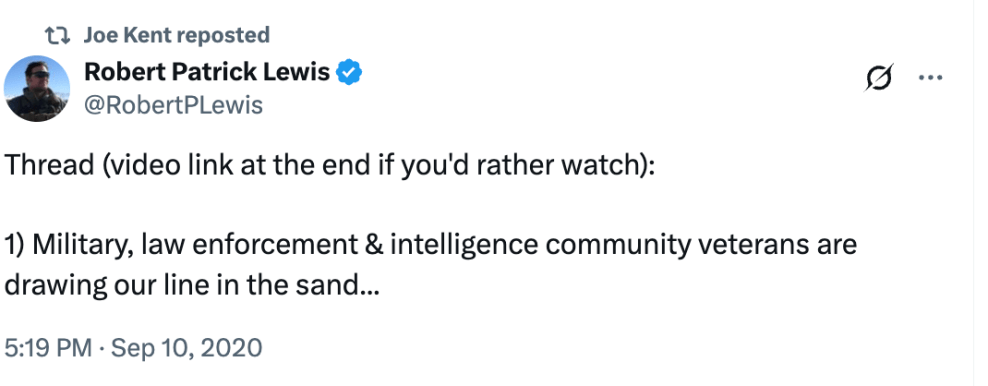
Lewis noted that 1AP would be providing security services for right-wing rallies and marches, including those “with a large number of high-profile, conservative VIPs speaking & attending.” For one event, he said he needed veterans to provide “physical security, intelligence/surveillance and to serve as team leaders for small security & intelligence and intelligence cells.” He promised, “we will keep your names confidential and our personnel records & communications will be encrypted.” He added, “This group was formed to protect attendees at President Trump’s campaign rallies.”
Soon after forming 1Ap, Lewis presented it not only as a security service for the right but as an intelligence operation. He told Fox News, “Our intelligence shows that no matter who wins the election, they [Antifa] are planning a massive ‘Antifa Tet Offensive,’ bent on destroying the global order they are not beholden to any one party. Their sole purpose is to create havoc, fear, and intimidation.” (No such uprising occurred.) After the election, 1AP claimed it was collecting evidence of fraud. On January 6, as the riot began at the Capitol, Lewis tweeted, “Today is the day the true battles begin.” (He later said he was at the Willard Hotel, not Capitol Hill, that day.)
Lewis’ 1AP did provide security at various events featuring far-right extremists. According to the final report of the House January 6 committee, during a December 12, 2020, rally of pro-Trump election deniers in Washington, DC, Stewart Rhodes, the leader of the Oath Keepers, a right-wing, anti-government militia, “coordinated” with 1AP “to guard VIPs, including retired Lieutenant General Michael Flynn and Patrick Byrne.” (Both Flynn and Byrne were prominent promoters of the crackpot conspiracy theory holding that the 2020 election was stolen form Trump.) Months later, Lewis and 1AP provided security at a QAnon conference in Dallas, where Flynn essentially called for a military coup in the United States.
On social media, Kent has often boosted posts from Lewis. At one point each complimented the other for a podcast appearance. When Kent ran for Congress, Lewis expressed his support for him on social media. Ina 2022 Telegram post, Lewis said that he knew Kent “personally” and “wish I could personally vote for him.” In January, 1AP posted on Telegram that there were “mumblings” that Kent could be appointed to lead the National Counterterrorism Center and that this “would be a very good thing. I could not support this more strongly.”
Mother Jones sent Kent, the Office of the Director of National Intelligence, and the National Counterterrorism Center a list of questions about Kent’s support for 1AP and his relationship with Lewis. Neither Kent nor the agencies responded.
Kent has an established record as an extremist and promoter of conspiracy theories. During his 2022 run, he called for charging Dr. Anthony Fauci with murder to hold him “accountable” for the “scam that is Covid.” He promoted Trump’s Big Lie that the 2020 election was rigged against him. He backed the idea the January 6 riot was orchestrated by the Deep State to discredit Trump and his supporters. He referred to the J6 rioters as “political prisoners.” He pushed the notion that billionaire Bill Gates was seeking to “control the food supply” and “control housing” to force people to “live in the pod eat the bugs.”
Like Gabbard, Kent has no experience in leading a large intelligence organization. (After serving in the Army, he was a field operative for the CIA for a short time.) Both Kent and Gabbard were on the infamous Signalgate chat. As head of the NCTC, Kent will have the responsibility for monitoring and preventing both foreign and domestic terrorism. But his past as a conspiracy theorist and his association with far-right extremists raise questions about his analytical abilities and his capacity to assess threats of domestic terrorism that arise from the right. His association with 1AP and Lewis is just one more reason to wonder about his judgment.
---
---
judd
2 10
today, the National Security Agency (NSA) is planning a "Big Delete" of websites and internal network content that contain any of 27 banned words, including "privilege," "bias," and "inclusion." The "Big Delete," according to an NSA source and internal correspondence reviewed by Popular Information, is creating unintended consequences. Although the websites and other content are purportedly being deleted to comply with President Trump's executive orders targeting diversity, equity, and inclusion, or "DEI," the dragnet is taking down "mission-related" work. According to the NSA source, who spoke on the condition of anonymity because they are not authorized to speak to the media, the process is "very chaotic," but is plowing ahead anyway.
A memo distributed by NSA leadership to its staff says that on February 10, all NSA websites and internal network pages that contain banned words will be deleted. This is the list of 27 banned words distributed to NSA staff:
Anti-Racism
Racism
Allyship
Bias
DEI
Diversity
Diverse
Confirmation Bias
Equity
Equitableness
Feminism
Gender
Gender Identity
Inclusion
Inclusive
All-Inclusive
Inclusivity
Injustice
Intersectionality
Prejudice
Privilege
Racial Identity
Sexuality
Stereotypes
Pronouns
Transgender
Equality
The memo acknowledges that the list includes many terms that are used by the NSA in contexts that have nothing to do with DEI. For example, the term "privilege" is used by the NSA in the context of "privilege escalation." In the intelligence world, privilege escalation refers to "techniques that adversaries use to gain higher-level permissions on a system or network."
The purge extends beyond public-facing websites to pages on the NSA's internal network, including project management software like Jira and Confluence.
The NSA is trying to identify mission-related sites before the "Big Delete" is executed but appears to lack the personnel to do so. The NSA's internal network has existed since the 1990s, and a manual review of the content is impractical. Instead, the NSA is working with "Data Science Development Program interns" to "understand the false-positive use cases" and "help generate query options that can better minimize false-positives." Nevertheless, the NSA is anticipating "unintended downtime" of "mission-related" websites.
While Trump's executive order claims to target "illegal and immoral discrimination programs," the NSA's banned-word list demonstrates that the implementation is far broader. The Trump administration is attempting to prohibit any acknowledgment that racism, stereotypes, and bias exist. The ban is so sweeping that "confirmation bias" — the tendency of people "to accept or notice information if it appears to support what they already believe or expect" — is included, even though it has nothing to do with race or gender.
The government memory hole
Since Trump took office, thousands of web pages across various federal agencies have been altered or removed entirely. Federal agencies have taken down or edited resources about HIV, contraceptives, LGBTQ+ health, abortion, and climate change. Some web pages have later come back online “without clarity on what had been changed or removed.”
An analysis by the Washington Post of 8,000 federal web pages “found 662 examples of deletions and additions” since Trump took office. The analysis found that words like diversity, equity, and inclusion were removed at least 231 times from the websites of federal agencies, including the Department of Labor, the Department of Education, the Department of Health and Human Services, and the Department of Transportation.
One example included a job listing page for the Department of Homeland Security that removed language about maintaining an “inclusive environment.” The Post also found examples of words being removed that had nothing to do with DEI, such as a page on the Department of the Interior’s website that boasted of its museums' “diverse collections,” removing the word “diverse.”
Following Trump’s executive orders targeting transgender individuals, multiple federal websites have removed transgender and intersex people from the acronym “LGBTQI,” NBC News reported. On the State Department website, a web page that used to provide resources for “LGBTQI Travelers” now addresses “LGB Travelers.” The Social Security Administration has made similar changes, with a page heading now reading “Social Security for LGBQ People.” Some agencies, including the Department of Education, have removed web pages with LGBTQ resources altogether.
On X, Elon Musk's United States DOGE Service is celebrating the deletions:

Federal agencies have also been scrubbing websites for mentions of climate change, which Trump has called a “hoax.” The Department of Agriculture’s Office of Communications issued a directive to “archive or unpublish any landing pages focused on climate change,” the Guardian reported. Resources on the Forest Service website, including the Climate Change Resource Center and the Climate Action Tracker, appear to still be unavailable. The Department of Transportation website replaced the phrase “climate change” with “climate resilience.”
Among the agencies with the most deleted web pages is the Centers for Disease Control and Prevention (CDC), which took down over “3,000 pages,” according to the New York Times. In one example, data from the CDC’s Youth Risk Behavior Survey, which tracks important health metrics, was temporarily unavailable, only to come back online later with “at least one of the gender columns missing and its data documentation removed.” A banner on the top of the CDC website states it is “being modified to comply with President Trump’s Executive Orders.”
Last week, the Trump administration was sued by Doctors for America, a physicians' group, for removing health resources and data from government websites, arguing that it "deprived clinicians and researchers of tools necessary to treat patients.”
---
ggl 2 25
[### The NSA's "Big Delete"

Popular Information | Judd Legum
https://popular.info › the-nsas-big-delete](https://popular.info/p/the-nsas-big-delete)
Feb 10, 2025 — The analysis found that words like diversity, equity, and inclusion were removed at least 231 times from the websites of federal agencies, ...
[### Federal list of forbidden words may jeopardize research at ...

KPBS
https://www.kpbs.org › news › economy › 2025/02/07](https://www.kpbs.org/news/economy/2025/02/07/federal-list-of-forbidden-words-may-jeopardize-research-at-ucsd)
Feb 7, 2025 — The banned words include: women, disability, bias, status, trauma, Black, Hispanic communities, as well as socioeconomic, ethnicity and ...
no lnx twt vid an
Tucker Carlson sounds increasingly frantic as Fox News refuses to corroborate his claim about the NSA
Cody Fenwick June 30, 2021
Fox News host Tucker Carlson dropped a bombshell allegation on his Monday night show: The National Security Agency, he said, was "monitoring our electronic communications and is planning to leak them in an attempt to take this show off the air."
He added: "We have confirmed that."
Has it, in fact, been confirmed? Throughout the day Tuesday, many observers noted that the serious accusation seemed surprisingly absent from the dominant narratives on the rest of Fox News, even though it would seem to be a major story of interest beyond just the single hour Carlson hosts if it were true. But it appeared the news division of the network — traditionally considered separate from opinion shows like Carlson's — couldn't back up the claim.
On Fox News' website, an article repeated Carlson's allegations. Yet it didn't provide any new reporting, it just printed a transcript of Carlson's show. The headline on the article simply attributed the claims about the NSA to Carlson himself, though the front page of the website seemed to promote his claim as true with a different headline: "Tucker Carlson blasts Biden's NSA for spying on him to get show off the air."
And then on Tuesday evening, the NSA itself directly contradicted Carlson's central claim:
After that statement was posted, Carlson responded on air, sounding increasingly frantic about the situation, calling it "beyond Orwellian":
Carlson noted that the statement didn't specifically deny that the NSA had read his emails. On Monday, he suggested that he had confirmed the claim that NSA read his private messages because the whistleblower had "repeated back to us information about a story that we are working on that could have only come directly from my texts and emails." Of course, that wasn't all he said — he had alleged, and claimed he had confirmed, that the NSA was planning to leak his communications to force him off the air. That's what the NSA denied, and it's not clear if Carlson is retracting that claim.
Reached for comment, Fox News did not answer questions about whether the news section had corroborated Carlson's claim about the NSA or whether Fox News stood by his allegations in light of the NSA's denial. Instead, a spokesperson directed AlterNet to Carlson's comment about the matter on his Tuesday night show.
It is possible that, despite not being a target for intelligence collection, Carlson's correspondences were picked up by the NSA because he was communicating with another person who is being lawfully surveilled by the NSA, likely someone outside the U.S. (This wouldn't even necessarily implicate Carlson in any wrongdoing at all — members of news organizations have a legitimate interest in speaking with people who may attract the U.S. government's surveillance.) There are procedural safeguards in place designed to protect U.S. citizens who end up picked up in lawful surveillance in this manner, though critics argue that these safeguards are insufficient to protect civil liberties.
It's not clear if Carlson is still standing by his claim that the NSA is monitoring his communications and planning to reveal them in order to push him out of his job. That's an extreme claim and would be an egregious abuse of power. On Tuesday, Carlson was more focused on the simple allegation that the NSA had read his emails, or at least was refusing to deny that they had, and he compared the experience to "living in China." He accused the Biden administration of overreach by targeting right-wing terrorism.
But while it's convenient for Carlson to try to blame Biden, the nature and power of the U.S. national security state are products of bipartisan agreement. They've developed in large part in the aftermath of 9/11 when conservatives like Carlson cheered the power of the state. Republicans could have worked to roll back these powers when they had greater control in Washington, D.C. under Donald Trump, but they never did, even when they were rhetorically outraged about government surveillance, because they like having these powers.
FROM YOUR SITE ARTICLES
Tucker Carlson slammed after calling top US general 'stupid' and 'a ... ›
Conservative pundit slams Tucker Carlson as a 'pampered man ... ›
Fox News' Tucker Carlson horrifies viewers with a message ... ›
RELATED ARTICLES AROUND THE WEB
Tucker Carlson claimed the NSA is spying on him. Even his own ... ›
Opinion | Fox News doesn't believe Tucker Carlson - The ... ›
Tucker Carlson Calls Journalists 'Animals.' He's Also Their Best ... ›
https://theintercept.com/2017/02/22/how-peter-thiels-palantir-helped-the-nsa-spy-on-the-whole-world/
many lnx graph/pix
HOW PETER THIEL’S PALANTIR HELPED THE NSA SPY ON THE WHOLE WORLD
Documents provided by NSA whistleblower Edward Snowden reveal Palantir’s role in creating the U.S. government’s international spy machine.
Sam Biddle
February 22 2017
DONALD TRUMP HAS inherited the most powerful machine for spying ever devised. How this petty, vengeful man might wield and expand the sprawling American spy apparatus, already vulnerable to abuse, is disturbing enough on its own. But the outlook is even worse considering Trump’s vast preference for private sector expertise and new strategic friendship with Silicon Valley billionaire investor Peter Thiel, whose controversial (and opaque) company Palantir has long sought to sell governments an unmatched power to sift and exploit information of any kind. Thiel represents a perfect nexus of government clout with the kind of corporate swagger Trump loves. The Intercept can now reveal that Palantir has worked for years to boost the global dragnet of the NSA and its international partners, and was in fact co-created with American spies.
Peter Thiel became one of the American political mainstream’s most notorious figures in 2016 (when it emerged he was bankrolling a lawsuit against Gawker Media, my former employer) even before he won a direct line to the White House. Now he brings to his role as presidential adviser decades of experience as kingly investor and token nonliberal on Facebook’s board of directors, a Rolodex of software luminaries, and a decidedly Trumpian devotion to controversy and contrarianism. But perhaps the most appealing asset Thiel can offer our bewildered new president will be Palantir Technologies, which Thiel founded with Alex Karp and Joe Lonsdale in 2004.
Palantir has never masked its ambitions, in particular the desire to sell its services to the U.S. government — the CIA itself was an early investor in the startup through In-Q-Tel, the agency’s venture capital branch. But Palantir refuses to discuss or even name its government clientele, despite landing “at least $1.2 billion” in federal contracts since 2009, according to an August 2016 report in Politico. The company was last valued at $20 billion and is expected to pursue an IPO in the near future. In a 2012 interview with TechCrunch, while boasting of ties to the intelligence community, Karp said nondisclosure contracts prevent him from speaking about Palantir’s government work.
[pix: Alexander "Alex" Karp, co-founder and chief executive officer of Palantir Technologies Inc., speaks during the WSJDLive Global Technology Conference in Laguna Beach, California, U.S., on Wednesday, Oct. 26, 2016. The conference brings together an unmatched group of top CEOs, founders, pioneers, investors and luminaries to explore tech opportunities emerging around the world. Photographer: Patrick T. Fallon/Bloomberg via Getty ImagesAlex Karp, co-founder and CEO of Palantir Technologies, speaks during the WSJDLive Global Technology Conference in Laguna Beach, Calif., on Oct. 26, 2016. Photo: Patrick T. Fallon/Bloomberg/Getty Images]
“Palantir” is generally used interchangeably to refer to both Thiel and Karp’s company and the software that company creates. Its two main products are Palantir Gotham and Palantir Metropolis, more geeky winks from a company whose Tolkien namesake is a type of magical sphere used by the evil lord Sauron to surveil, trick, and threaten his enemies across Middle Earth. While Palantir Metropolis is pegged to quantitative analysis for Wall Street banks and hedge funds, Gotham (formerly Palantir Government) is designed for the needs of intelligence, law enforcement, and homeland security customers.
Gotham works by importing large reams of “structured” data (like spreadsheets) and “unstructured” data (like images) into one centralized database, where all of the information can be visualized and analyzed in one workspace. For example, a 2010 demo showed how Palantir Government could be used to chart the flow of weapons throughout the Middle East by importing disparate data sources like equipment lot numbers, manufacturer data, and the locations of Hezbollah training camps. Palantir’s chief appeal is that it’s not designed to do any single thing in particular, but is flexible and powerful enough to accommodate the requirements of any organization that needs to process large amounts of both personal and abstract data.
A Palantir promotional video.
Despite all the grandstanding about lucrative, shadowy government contracts, co-founder Karp does not shy away from taking a stand in the debate over government surveillance. In a Forbes profile in 2013, he played privacy lamb, saying, “I didn’t sign up for the government to know when I smoke a joint or have an affair. … We have to find places that we protect away from government so that we can all be the unique and interesting and, in my case, somewhat deviant people we’d like to be.” In that same article, Thiel lays out Palantir’s mission with privacy in mind: to “reduce terrorism while preserving civil liberties.” After the first wave of revelations spurred by the whistleblower Edward Snowden, Palantir was quick to deny that it had any connection to the NSA spy program known as PRISM, which shared an unfortunate code name with one of its own software products. The current iteration of Palantir’s website includes an entire section dedicated to “Privacy & Civil Liberties,” proclaiming the company’s support of both:
Palantir Technologies is a mission-driven company, and a core component of that mission is protecting our fundamental rights to privacy and civil liberties. …
Some argue that society must “balance” freedom and safety, and that in order to better protect ourselves from those who would do us harm, we have to give up some of our liberties. We believe that this is a false choice in many areas. Particularly in the world of data analysis, liberty does not have to be sacrificed to enhance security. Palantir is constantly looking for ways to protect privacy and individual liberty through its technology while enabling the powerful analysis necessary to generate the actionable intelligence that our law enforcement and intelligence agencies need to fulfill their missions.
It’s hard to square this purported commitment to privacy with proof, garnered from documents provided by Edward Snowden, that Palantir has helped expand and accelerate the NSA’s global spy network, which is jointly administered with allied foreign agencies around the world. Notably, the partnership has included building software specifically to facilitate, augment, and accelerate the use of XKEYSCORE, one of the most expansive and potentially intrusive tools in the NSA’s arsenal. According to Snowden documents published by The Guardian in 2013, XKEYSCORE is by the NSA’s own admission its “widest reaching” program, capturing “nearly everything a typical user does on the internet.”
A subsequent report by The Intercept showed that XKEYSCORE’s “collected communications not only include emails, chats, and web-browsing traffic, but also pictures, documents, voice calls, webcam photos, web searches, advertising analytics traffic, social media traffic, botnet traffic, logged keystrokes, computer network exploitation targeting, intercepted username and password pairs, file uploads to online services, Skype sessions, and more.” For the NSA and its global partners, XKEYSCORE makes all of this as searchable as a hotel reservation site.
But how do you make so much data comprehensible for human spies? As the additional documents published with this article demonstrate, Palantir sold its services to make one of the most powerful surveillance systems ever devised even more powerful, bringing clarity and slick visuals to an ocean of surveillance data.
[An office building occupied by the technology firm Palantir in McLean, Virginia on October 11, 2014. Photo Credit: Kristoffer Tripplaar/ Sipa USAAn office building occupied by the technology firm Palantir in McLean, Va., on Oct. 11, 2014. Photo: Kristoffer Tripplaar/Sipa USA/AP]
PALANTIR’S RELATIONSHIP WITH government spy agencies appears to date back to at least 2008, when representatives from the U.K.’s signals intelligence agency, Government Communications Headquarters, joined their American peers at VisWeek, an annual data visualization and computing conference organized by the Institute of Electrical and Electronics Engineers and the U.S. National Institute of Standards and Technology. Attendees from throughout government and academia gather to network with members of the private sector at the event, where they compete in teams to solve hypothetical data-based puzzles as part of the Visual Analytics Science and Technology (VAST) Challenge. As described in a document saved by GCHQ, Palantir fielded a team in 2008 and tackled one such scenario using its own software. It was a powerful marketing opportunity at a conference filled with potential buyers.
In the demo, Palantir engineers showed how their software could be used to identify Wikipedia users who belonged to a fictional radical religious sect and graph their social relationships. In Palantir’s pitch, its approach to the VAST Challenge involved using software to enable “many analysts working together [to] truly leverage their collective mind.” The fake scenario’s target, a cartoonishly sinister religious sect called “the Paraiso Movement,” was suspected of a terrorist bombing, but the unmentioned and obvious subtext of the experiment was the fact that such techniques could be applied to de-anonymize and track members of any political or ideological group. Among a litany of other conclusions, Palantir determined the group was prone to violence because its “Manifesto’s intellectual influences include ‘Pancho Villa, Che Guevara, Leon Trotsky, [and] Cuban revolutionary Jose Martí,’ a list of military commanders and revolutionaries with a history of violent actions.”
The delegation from GCHQ returned from VisWeek excited and impressed. In a classified report from those who attended, Palantir’s potential for aiding the spy agency was described in breathless terms. “Palantir are a relatively new Silicon Valley startup who are sponsored by the CIA,” the report began. “They claim to have significant involvement with the US intelligence community, although none yet at NSA.” GCHQ noted that Palantir “has been developed closely internally with intelligence community users (unspecified, but likely to be the CIA given the funding).” The report described Palantir’s demo as “so significant” that it warranted its own entry in GCHQ’s classified internal wiki, calling the software “extremely sophisticated and mature. … We were very impressed. You need to see it to believe it.”
The report conceded, however, that “it would take an enormous effort for an in-house developed GCHQ system to get to the same level of sophistication” as Palantir. The GCHQ briefers also expressed hesitation over the price tag, noting that “adoption would have [a] huge monetary … cost,” and over the implications of essentially outsourcing intelligence analysis software to the private sector, thus making the agency “utterly dependent on a commercial product.” Finally, the report added that “it is possible there may be concerns over security — the company have published a lot of information on their website about how their product is used in intelligence analysis, some of which we feel very uncomfortable about.”
A page from Palantir’s “Executive Summary” document, provided to government clients.
However anxious British intelligence was about Palantir’s self-promotion, the worry must not have lasted very long. Within two years, documents show that at least three members of the “Five Eyes” spy alliance between the United States, the U.K., Australia, New Zealand, and Canada were employing Palantir to help gather and process data from around the world. Palantir excels at making connections between enormous, separate databases, pulling big buckets of information (call records, IP addresses, financial transactions, names, conversations, travel records) into one centralized heap and visualizing them coherently, thus solving one of the persistent problems of modern intelligence gathering: data overload.
A GCHQ wiki page titled “Visualisation,” outlining different ways “to provide insight into some set of data,” puts succinctly Palantir’s intelligence value:
Palantir is an information management platform for analysis developed by Palantir Technologies. It integrates structured and unstructured data, provides search and discovery capabilities, knowledge management, and collaborative features. The goal is to offer the infrastructure, or ‘full stack,’ that intelligence organizations require for analysis.
Bullet-pointed features of note included a “Graph View,” “Timelining capabilities,” and “Geo View.”
A GCHQ diagram indicates how Palantir could be used as part of a computer network attack.
Under the Five Eyes arrangement, member countries collect and pool enormous streams of data and metadata collected through tools like XKEYSCORE, amounting to tens of billions of records. The alliance is constantly devising (or attempting) new, experimental methods of prying data out of closed and private sources, including by hacking into computers and networks in non-Five Eyes countries and infecting them with malware.
A 2011 PowerPoint presentation from GCHQ’s Network Defence Intelligence & Security Team (NDIST) — which, as The Intercept has previously reported, “worked to subvert anti-virus and other security software in order to track users and infiltrate networks” — mentioned Palantir as a tool for processing data gathered in the course of its malware-oriented work. Palantir’s software was described as an “analyst workspace [for] pulling together disparate information and displaying it in novel ways,” and was used closely in conjunction with other intelligence software tools, like the NSA’s notorious XKEYSCORE search system. The novel ways of using Palantir for spying seemed open-ended, even imaginative: A 2010 presentation on the joint NSA-GCHQ “Mastering the Internet” surveillance program mentioned the prospect of running Palantir software on “Android handsets” as part of a SIGINT-based “augmented reality” experience. It’s unclear what exactly this means or could even look like.
Above all, these documents depict Palantir’s software as a sort of consolidating agent, allowing Five Eyes analysts to make sense of tremendous amounts of data that might have been otherwise unintelligible or highly time-consuming to digest. In a 2011 presentation to the NSA, classified top secret, an NDIST operative noted the “good collection” of personal data among the Five Eyes alliance but lamented the “poor analytics,” and described the attempt to find new tools for SIGINT analysis, in which it “conducted a review of 14 different systems that might work.” The review considered services from Lockheed Martin and Detica (a subsidiary of BAE Systems) but decided on the up-and-comer from Palo Alto.
Palantir is described as having been funded not only by In-Q-Tel, the CIA’s venture capital branch, but furthermore created “through [an] iterative collaboration between Palantir computer scientists and analysts from various intelligence agencies over the course of nearly three years.” While it’s long been known that Palantir got on its feet with the intelligence community’s money, it has not been previously reported that the intelligence community actually helped build the software. The continuous praise seen in these documents shows that the collaboration paid off. Under the new “Palantir Model,” “data can come from anywhere” and can be “asked whatever the analyst wants.”
Along with Palantir’s ability to pull in “direct XKS Results,” the presentation boasted that the software was already connected to 10 other secret Five Eyes and GCHQ programs and was highly popular among analysts. It even offered testimonials (TWO FACE appears to be a code name for the implementation of Palantir):
[Palantir] is the best tool I have ever worked with. It’s intuitive, i.e. idiot-proof, and can do a lot you never even dreamt of doing.
This morning, using TWO FACE rather than XKS to review the activity of the last 3 days. It reduced the initial analysis time by at least 50%.
Enthusiasm runs throughout the PowerPoint: A slide titled “Unexpected Benefits” reads like a marketing brochure, exclaiming that Palantir “interacts with anything!” including Google Earth, and “You can even use it on a iphone or laptop.” The next slide, on “Potential Downsides,” is really more praise in disguise: Palantir “Looks expensive” but “isn’t as expensive as expected.” The answer to “What can’t it do?” is revealing: “However we ask, Palantir answer,” indicating that the collaboration between spies and startup didn’t end with Palantir’s CIA-funded origins, but that the company was willing to create new features for the intelligence community by request.
On GCHQ’s internal wiki page for TWO FACE, analysts were offered a “how to” guide for incorporating Palantir into their daily routine, covering introductory topics like “How do I … Get Data from XKS in Palantir,” “How do I … Run a bulk search,” and “How do I … Run bulk operations over my objects in Palantir.” For anyone in need of a hand, “training is currently offered as 1-2-1 desk based training with a Palantir trainer. This gives you the opportunity to quickly apply Palantir to your current work task.” Palantir often sends “forward deployed engineers,” or FDEs, to work alongside clients at their offices and provide assistance and engineering services, though the typical client does not have access to the world’s largest troves of personal information. For analysts interested in tinkering with Palantir, there was even a dedicated instant message chat room open to anyone for “informally” discussing the software.
The GCHQ wiki includes links to classified webpages describing Palantir’s use by the Australian Defence Signals Directorate (now called the Australian Signals Directorate) and to a Palantir entry on the NSA’s internal “Intellipedia,” though The Intercept does not have access to copies of the linked sites. However, embedded within Intellipedia HTML files available to The Intercept are references to a variety of NSA-Palantir programs, including “Palantir Classification Helper,” “[Target Knowledge Base] to Palantir PXML,” and “PalantirAuthService.” (Internal Palantir documents obtained by TechCrunch in 2013 provide additional confirmation of the NSA’s relationship with the company.)
One Palantir program used by GCHQ, a software plug-in named “Kite,” was preserved almost in its entirety among documents provided to The Intercept. An analysis of Kite’s source code shows just how much flexibility the company afforded Five Eyes spies. Developers and analysts could ingest data locally using either Palantir’s “Workspace” application or Kite. When they were satisfied the process was working properly, they could push it into a Palantir data repository where other Workspace users could also access it, almost akin to a Google Spreadsheets collaboration. When analysts were at their Palantir workstation, they could perform simple imports of static data, but when they wanted to perform more complicated tasks like import databases or set up recurring automatic imports, they turned to Kite.
Kite worked by importing intelligence data and converting it into an XML file that could be loaded into a Palantir data repository. Out of the box, Kite was able to handle a variety of types of data (including dates, images, geolocations, etc.), but GCHQ was free to extend it by writing custom fields for complicated types of data the agency might need to analyze. The import tools were designed to handle a variety of use cases, including static data sets, databases that were updated frequently, and data stores controlled by third parties to which GCHQ was able to gain access.
This collaborative environment also produced a piece of software called “XKEYSCORE Helper,” a tool programmed with Palantir (and thoroughly stamped with its logo) that allowed analysts to essentially import data from the NSA’s pipeline, investigate and visualize it through Palantir, and then presumably pass it to fellow analysts or Five Eyes intelligence partners. One of XKEYSCORE’s only apparent failings is that it’s so incredibly powerful, so effective at vacuuming personal metadata from the entire internet, that the volume of information it extracts can be overwhelming. Imagine trying to search your Gmail account, only the results are pulled from every Gmail inbox in the world.
MAKING XKEYSCORE MORE intelligible — and thus much more effective — appears to have been one of Palantir’s chief successes. The helper tool, documented in a GCHQ PDF guide, provided a means of transferring data captured by the NSA’s XKEYSCORE directly into Palantir, where presumably it would be far easier to analyze for, say, specific people and places. An analyst using XKEYSCORE could pull every IP address in Moscow and Tehran that visited a given website or made a Skype call at 14:15 Eastern Time, for example, and then import the resulting data set into Palantir in order to identify additional connections between the addresses or plot their positions using Google Earth.
Palantir was also used as part of a GCHQ project code-named LOVELY HORSE, which sought to improve the agency’s ability to collect so-called open source intelligence — data available on the public internet, like tweets, blog posts, and news articles. Given the “unstructured” nature of this kind of data, Palantir was cited as “an enrichment to existing [LOVELY HORSE] investigations … the content should then be viewable in a human readable format within Palantir.”
Palantir’s impressive data-mining abilities are well-documented, but so too is the potential for misuse. Palantir software is designed to make it easy to sift through piles of information that would be completely inscrutable to a human alone, but the human driving the computer is still responsible for making judgments, good or bad.
A 2011 document by GCHQ’s SIGINT Development Steering Group, a staff committee dedicated to implementing new spy methods, listed some of these worries. In a table listing “risks & challenges,” the SDSG expressed a “concern that [Palantir] gives the analyst greater potential for going down too many analytical paths which could distract from the intelligence requirement.” What it could mean for analysts to distract themselves by going down extraneous “paths” while browsing the world’s most advanced spy machine is left unsaid. But Palantir’s data-mining abilities were such that the SDSG wondered if its spies should be blocked from having full access right off the bat and suggested configuring Palantir software so that parts would “unlock … based on analysts skill level, hiding buttons and features until needed and capable of utilising.” If Palantir succeeded in fixing the intelligence problem of being overwhelmed with data, it may have created a problem of over-analysis — the company’s software offers such a multitude of ways to visualize and explore massive data sets that analysts could get lost in the funhouse of infographics, rather than simply being overwhelmed by the scale of their task.
If Palantir’s potential for misuse occurred to the company’s spy clients, surely it must have occurred to Palantir itself, especially given the company’s aforementioned “commitment” to privacy and civil liberties. Sure enough, in 2012 the company announced the formation of the Palantir Council of Advisors on Privacy and Civil Liberties, a committee of academics and consultants with expertise in those fields. Palantir claimed that convening the PCAP had “provided us with invaluable guidance as we try to responsibly navigate the often ill-defined legal, political, technological, and ethical frameworks that sometimes govern the various activities of our customers,” and continued to discuss the privacy and civil liberties “implications of product developments and to suggest potential ways to mitigate any negative effects.” Still, Palantir made clear that the “PCAP is advisory only — any decisions that we make after consulting with the PCAP are entirely our own.”
What would a privacy-minded conversation about privacy-breaching software look like? How had a privacy and civil liberties council navigated the fact that Palantir’s clientele had directly engaged in one of the greatest privacy and civil liberties breaches of all time? It’s hard to find an answer.
Palantir wrote that it structured the nondisclosure agreement signed by PCAP members so that they “will be free to discuss anything that they learn in working with us unless we clearly designate information as proprietary or otherwise confidential (something that we have rarely found necessary except on very limited occasions).” But despite this assurance of transparency, all but one of the PCAP’s former and current members either did not return a request for comment for this article or declined to comment citing the NDA.
The former PCAP member who did respond, Stanford privacy scholar Omer Tene, told The Intercept that he was unaware of “any specific relationship, agreement, or project that you’re referring to,” and said he was not permitted to answer whether Palantir’s work with the intelligence community was ever a source of tension with the PCAP. He declined to comment on either the NSA or GCHQ specifically. “In general,” Tene said, “the role of the PCAP was to hear about client engagement or new products and offerings that the company was about to launch, and to opine as to the way they should be set up or delivered in order to minimize privacy and civil liberties concerns.” But without any further detail, it’s unclear whether the PCAP was ever briefed on the company’s work for spy agencies, or whether such work was a matter of debate.
There’s little detail to be found on archived versions of Palantir’s privacy and civil liberties-focused blog, which appears to have been deleted sometime after the PCAP was formed. Palantir spokesperson Matt Long told The Intercept to contact the Palantir media team for questions regarding the vanished blog at the same email address used to reach Long in the first place. Palantir did not respond to additional repeated requests for comment and clarification.
A GCHQ spokesperson provided a boilerplate statement reiterating the agency’s “longstanding policy” against commenting on intelligence matters and asserted that all its activities are “carried out in accordance with a strict legal and policy framework.” The NSA did not provide a response.
Anyone worried that the most powerful spy agencies on Earth might use Palantir software to violate the privacy or civil rights of the vast number of people under constant surveillance may derive some cold comfort in a portion of the user agreement language Palantir provided for the Kite plug-in, which stipulates that the user will not violate “any applicable law” or the privacy or the rights “of any third party.” The world will just have to hope Palantir’s most powerful customers follow the rules.
Documents published with this article:
GCHQ VisWeek 2008 Conference Report
Palantir Executive Summary
NDIST Cyber Defence
Mastering the Internet
The Tale of Two Sources
TWO FACE on GCHQ Wiki
XKEYSCORE Helper Notes
SDSG Integrated Analytics Workshop
Listen to Jeremy Scahill’s interview with Sam Biddle on Episode 4 of Intercepted (begins at 32:05).
https://www.alternet.org/2020/02/white-house-targeting-of-truth-tellers-is-turning-the-intelligence-community-into-a-crowd-of-cowards/
revenge witch hunt authoritarian // wm barr mueller probe collusion
FAIL?
an 220
https://www.alternet.org/2020/02/bombshell-report-finds-iraqi-officials-doubt-trumps-basis-for-escalating-to-the-brink-of-war/
no lnx
‘Bombshell’ report finds Iraqi officials doubt Trump’s basis for escalating to the brink of war
President Donald J. Trump, joined by Vice President Mike Pence, senior White House advisors and senior military personnel, delivers remarks during a national televised address Wednesday, Jan. 8, 2020, from the Cross Hall of the White House, responding to the retaliatory missile strikes against U.S. military and coalition forces in Iraq on Tuesday by the Islamic Republic of Iran. (Official White House Photo by Shealah Craighead)
Written by Jake Johnson / Common Dreams February 7, 2020
In a “bombshell” revelation that calls into question one of the Trump administration’s stated justifications for assassinating Iranian Gen. Qasem Soleimani—a move that nearly sparked a region-wide military conflict—Iraqi intelligence officials told the New York Times that they believe ISIS, not an Iran-linked militia, was likely responsible for the Dec. 27 rocket attack that killed an American contractor at an airbase near Kirkuk, Iraq.
The Times reported Thursday that “Iraqi military and intelligence officials have raised doubts about who fired the rockets… saying they believe it is unlikely that the militia the United States blamed for the attack” was responsible.
“All the indications are that it was Daesh,” Brigadier General Ahmed Adnan, the Iraqi chief of intelligence for the federal police at the K-1 air base, told the Times, using the Arabic acronym for ISIS. “We know Daesh’s movements.”
The Trump administration has not released a single piece of evidence showing that the Iraqi militia Khataib Hezbollah, which has ties to Iran, was responsible for the attack on K-1. The group has denied carrying out the attack.
The U.S. responded to the rocket attack days later with deadly airstrikes on Khataib Hezbollah targets in Iraq and Syria, setting off a dangerous escalatory spiral that brought Iran and the U.S. to the brink of war.
On Jan. 2, the U.S. assassinated Soleimani with a drone strike in Baghdad ordered by President Donald Trump. Following the assassination, which was widely condemned as an act of war, the U.S. Department of Defense issued a statement claiming without evidence that Soleimani “orchestrated attacks on coalition bases in Iraq over the last several months—including the attack on December 27th—culminating in the death and wounding of additional American and Iraqi personnel.”
But Iraqi officials told the Times that “based on circumstantial evidence and long experience in the area where the attack took place,” there is good reason to be skeptical about U.S. claims that Khataib Hezbollah was behind it.
As the Times reported:
The rockets were launched from a Sunni Muslim part of Kirkuk Province notorious for attacks by the Islamic State, a Sunni terrorist group, which would have made the area hostile territory for a Shiite militia like Khataib Hezbollah.
Khataib Hezbollah has not had a presence in Kirkuk Province since 2014.
The Islamic State, however, had carried out three attacks relatively close to the base in the 10 days before the attack on K-1. Iraqi intelligence officials sent reports to the Americans in November and December warning that ISIS intended to target K-1, an Iraqi air base in Kirkuk Province that is also used by American forces…
These facts all point to the Islamic State, Iraqi officials say....
https://www.alternet.org/2020/01/nsa-cia-are-now-attempting-to-withhold-documents-potentially-relevant-to-impeachment-house-intel-chairman
no lnx
NSA, CIA are now attempting to withhold documents ‘potentially relevant’ to impeachment: House Intel chairman
Written by Daily Kos January 19, 2020
On ABC’s This Week, House Intelligence Committee Chairman Adam Schiff confirmed a grim report that surface last week: The nation’s top intelligence officials are pushing Congress to cancel the year’s usual testimony to Congress on the nation’s top national security threats because they don’t want to publicly contradict Donald Trump’s false intelligence claims.
“Unfortunately, I think those reports are all too accurate. The intelligence community is reluctant to have an open hearing, something that we had done every year prior to the Trump administration, because they’re worried about angering the president,” Schiff responded.
It isn’t an idle concern, from intelligence officials. Director of National Intelligence Dan Coats was forced out of his position shortly after confirming to Congress that despite Trump’s claims to the contrary, the U.S. had no evidence Iran had an active nuclear weapons program.Trump had a public meltdown, which is a now-daily occurrence, and Coats was given the boot; in the latest degradation of this nation into a kleptocratic and autocratic state, government officials are now reluctant to testify in public about the true dangers facing the nation because if their pronouncements do not match Dear Leader’s political claims, Dear Leader will mark them as personal enemies.
Schiff’s follow-up was, if possible, worse: He also asserted that this nation’s intelligence agencies are now also withholding documents pertaining to the impeachment charges now filed against Trump.
“And I’ll say something even more concerning to me, and that is the intelligence community is beginning to withhold documents from Congress on the issue of Ukraine. The NSA, in particular, is withholding what are potentially relevant documents to our oversight responsibilities on Ukraine, but also withholding documents potentially relevant that the senators might want to see during the trial. There are signs that the CIA may be on the same tragic course.”
While Rep. Schiff was intentionally opaque on what Ukraine-related documents were being withheld from lawmakers, there does seem to be a new effort to withhold documents that the agencies had originally been expected to produce. Politico reports an unnamed Intelligence Committee “official” as saying: “Both the NSA and CIA initially pledged cooperation, and it appears now that the White House has interceded before production of documents could begin.”
We had long been told that Congress had, in cases of impeachment, necessarily sweeping oversight powers. Again we are learning that these powers can simply be taken away, so long as sufficient numbers in a president’s own party are willing to sign their own names to that act.
==
==
wiki portal
| Disclosures |
|---|
| Systems |
| Agencies |
| People |
| Places |
| Laws |
| Proposed changes |
| Concepts |
| Related topics |

DNI daN COATS 180 ON AGW
wapo
no lnx
Health & Science
White House prepares to scrutinize intelligence agencies’ finding that climate change threatens national security
The proposed Presidential Committee on Climate Security is being spearheaded by William Happer, a National Security Council senior director. (Jabin Botsford/The Washington Post)
By Juliet Eilperin and
Missy Ryan February 20
The White House is working to assemble a panel to assess whether climate change poses a national security threat, according to documents obtained by The Washington Post, a conclusion that federal intelligence agencies have affirmed several times since President Trump took office.
The proposed Presidential Committee on Climate Security, which would be established by executive order, is being spearheaded by William Happer, a National Security Council senior director. Happer, an emeritus professor of physics at Princeton University, has said that carbon emissions linked to climate change should be viewed as an asset rather than a pollutant.
The initiative represents the Trump administration’s most recent attempt to question the findings of federal scientists and experts on climate change and comes less than three weeks after Director of National Intelligence Daniel Coats delivered a worldwide threat assessment that identified it as a significant security risk.
In late November, Trump dismissed a government report finding that global warming is intensifying and poses a major threat the U.S. economy, saying, “I don’t see it.” Last month, his nominee to head the Environmental Protection Agency, acting administrator Andrew Wheeler, testified that he did not see climate change as one of the world’s pressing challenges.
According to the NSC discussion paper, the order would create a federal advisory committee “to advise the President on scientific understanding of today’s climate, how the climate might change in the future under natural and human influences, and how a changing climate could affect the security of the United States.”
The document notes that the government has issued several major reports under Trump identifying climate change as a serious threat. “However, these scientific and national security judgments have not undergone a rigorous independent and adversarial scientific peer review to examine the certainties and uncertainties of climate science, as well as implications for national security,” it said.
Francesco Femia, chief executive of the Council on Strategic Risks and co-founder of the Center for Climate and Security, said in an interview that the plan appeared to be an effort to undermine the consensus within the national intelligence community that climate change needs to be addressed to avert serious consequences.
“This is the equivalent of setting up a committee on nuclear-weapons proliferation and having someone lead it who doesn’t think nuclear weapons exist,” he said. “It’s honestly a blunt-force political tool designed to shut the national security community up on climate change.”
[Trump administration report says climate damage is ‘intensifying’ in U.S.]
It is unclear how much support Happer’s initiative has inside the administration: Deputies from more than a dozen agencies have been invited to attend a meeting on the topic on Friday in the White House Situation Room.
Several agencies declined to comment on the matter this week, including the NSC, the Pentagon, White House Office of Science and Technology Policy, and Office of theDirector of National Intelligence.
Happer, who worked at the Energy Department under George H.W. Bush and joined the White House in September to work on “emerging technologies,” is not formally trained as a climate scientist. He developed a national reputation for his work on laser technology used in missile defense and on the interactions between light and atoms.
He has sat on the boards of two advocacy groups that have questioned whether global warming poses a serious risk, the CO2 Coalition and the George C. Marshall Institute. Last March, when asked in connection with court proceedings whether he had received money from the fossil fuel industry, Happer said he had been given somewhere between $10,000 and $15,000 fromPeabody Coalto testify before a Minnesota Public Utilities Commission hearing.
During a December 2016 energy and climate policy summit sponsored by the conservative Heritage Foundation, Happer explained that the CO2 Coalition aimed to counter the idea that carbon dioxide is a pollutant because it is the primary driver of recent climate change.
“I like to call this the CO2 anti-defamation league,” he said, gesturing to a slide, “because there is the CO2 molecule, and it has undergone decade after decade of abuse, for no reason.
“We’re doing our best to try and counter this myth that CO2 is a dangerous pollutant,” he said. “It’s not a pollutant at all. .?.?. We should be telling the scientific truth, that more CO2 is actually a benefit to the earth.”
Most scientists have taken a different view, concluding that the world must curb its carbon output dramatically in the next few decades or risk dire consequences. Global temperatures have risen roughly 1 degree Celsius, or 1.8 degrees Fahrenheit, from preindustrial levels. A U.N. report issued in October said the world has to cut its emissions by more than 1 billion tons each year over the next decade to keep the rise from exceeding 1.5 degrees Celsius.
The Trump administration, however, has accelerated domestic fossil fuel production and sought to reverse most of the curbs on greenhouse gas emissions adopted under President Barack Obama. Last year the National Highway Traffic Safety Administration published an analysis predicting that global temperature rise could reach 4 degrees Celsius, or 7 degrees Fahrenheit, by 2100 under the government’s current trajectory.
While several Trump appointees have argued that climate change does not pose a significant risk to the nation’s defense capabilities, the Pentagon and intelligence agencies have reached the opposite conclusion.
[Trump grows frustrated with Coats, leading some to fear he might be fired]
The assessment Coats submitted on Jan. 29 to the Senate Intelligence Committee, for example, states, “Global environmental and ecological degradation, as well as climate change, are likely to fuel competition for resources, economic distress, and social discontent through 2019 and beyond.
The Defense Department said in a report submitted to Congress in mid-January that several dozen military installations around the nation already are experiencing climate impacts. The assessment, which called climate change “a national security issue,” said rising seas, wildfires and other such disasters are likely to create more severe problems for the military in the coming years.
Juliet Eilperin
Juliet Eilperin is The Washington Post's senior national affairs correspondent, covering how the new administration is transforming a range of U.S. policies and the federal government itself. She is the author of two books — one on sharks and another on Congress, not to be confused with each other — and has worked for The Post since 1998. Follow
==
https://insideclimatenews.org/news/30012019/worldwide-threat-assessment-climate-change-intelligence-agencies-national-security
The nation's intelligence community warned in its annual assessment of worldwide threats that climate change and other kinds of environmental degradation pose risks to global stability because they are "likely to fuel competition for resources, economic distress, and social discontent through 2019 and beyond."
Released Tuesday, the Worldwide Threat Assessment prepared by the Director of National Intelligence added to a swelling chorus of scientific and national security voices in pointing out the ways climate change fuels widespread insecurity and erodes America's ability to respond to it.
"Climate hazards such as extreme weather, higher temperatures, droughts, floods, wildfires, storms, sea level rise, soil degradation, and acidifying oceans are intensifying, threatening infrastructure, health, and water and food security," said the report, which represents the consensus view among top intelligence officials. "Irreversible damage to ecosystems and habitats will undermine the economic benefits they provide, worsened by air, soil, water, and marine pollution.
In just the past two weeks, the Pentagon sent a report to Congress describing extreme weather and climate risks to dozens of critical military installations. (House leaders on Wednesday asked for more details, including an assessment of the 10 bases in each service most vulnerable to climate change.) The Government Accountability Office also recommended the State Department resume providing guidance to U.S. diplomats about climate change and migration. Last week, ascientific paper concluded that drought driven by climate change and the subsequent fights over water resources increased the likelihood of armed conflict in the Middle East from 2011–2015, which in turn triggered waves refugees.
The United Nations Security Council also held a discussion on Friday devoted to understanding and responding to how climate change acts as a "threat multiplier" in countries where governance is already fragile and resources are sparse.
Robert Mardini, the permanent observer to the UN from the International Committee of the Red Cross, said his group's fieldwork confirms the "double impact" of climate change and war.
"Climate change exacerbates vulnerabilities and inequalities, especially in situations of armed conflict, where countries, communities and populations are the least prepared and the least able to protect themselves and adapt," Mardinitold the Security Council, according to his published remarks. "Conflicts harm the structures and systems that are necessary to facilitate adaptation to climate change."
In Contrast with the U.S. President
The formal threat assessment is also the latest federal survey of climate change to clash with President Donald Trump's adamant denial of the established consensus. In late November, the administration issued the Fourth National Climate Assessment, based on the work of 300 scientists and 13 federal agencies, which concluded that climate change threatened human life, ecosystems and the American economy. Trump dismissed the report, saying he did not believe its central findings.
Trump has pushed the message of climate denial through federal agencies, such as the Environmental Protection Agency, mainly by working to halt rules and research to address climate change. But so far, the White House has not reined in the national security community when its leaders have acknowledged climate change or its agencies have explored its implications.
Further, members of Congress from both parties have provided the Pentagon, at least, with cover, instructing it in late 2017 to analyze the threats climate change poses to American military readiness.
Regions to Watch for Climate-Related Risks
The 2019 Worldwide Threat Assessment echoes the findings of versions from previous years that highlight climate change as a threat to what's called "human security" in a list that includes terrorism, cyber crimes and weapons of mass destruction. Among the situations and places it cites as being of particular concern are:
- Urban coastal areas of South Asia, Southeast Asia and the Western Hemisphere that could be battered by extreme weather and aggravated by rising sea levels. It says "damage to communication, energy, and transportation infrastructure could affect low-lying military bases, inflict economic costs, and cause human displacement and loss of life." (Last year, Hurricane Michael inflicted an estimated $5 billion in damage on Tyndall Air Force Base in Florida.)
- Countries such as Egypt, Ethiopia, Jordan and Iraq, which are at increasing risk of social unrest and cross-border tension because "changes in the frequency and variability of heat waves, droughts, and floods—combined with poor governance practices—are increasing water and food insecurity."
- The Arctic, where receding sea ice "may increase competition—particularly with Russia and China— over access to sea routes and natural resources."
PUBLISHED UNDER:
==
https://www.projectcensored.org/climate-change-and-national-security-through-the-lens-of-key-federal-publications
Susan Maret for Project Censored
...
:{2016 annual:(style="box-sizing:border-box;outline:none;margin:0px;padding:0px"):}: volume (ODNI Clapper), the Assessment dramatically shifts in its discussion in connecting
extreme weather, climate change, environmental degradation, related rising demands for food and water, poor policy responses, and inadequate critical infrastructure will probably exacerbate and – and potentially spark – political instability, adverse health conditions, and humanitarian crises in 2016....
==
https://www.alternet.org/most-important-surveillance-story-you-will-see-years-report-reveals-how-att-buildings-serve-secret
jake johnson
"The most important surveillance story you will see for years just went online, revealing how AT&T became the internet's biggest enemy, secretly collaborating against its customers and partners to destroy your privacy."
That was how whistleblower and privacy advocate Edward Snowden reacted to the publication of an explosive story by The Intercept on Monday, which reveals for the first time how "fortress-like" AT&T buildings located in eight major American cities have played a central role in a massive National Security Agency (NSA) spying program "that has for years monitored billions of emails, phone calls, and online chats passing across U.S. territory."
"It's eye-opening and ominous the extent to which this is happening right here on American soil," Elizabeth Goitein, co-director of the Liberty and National Security Program at the Brennan Center for Justice, told The Intercept in an interview. "It puts a face on surveillance that we could never think of before in terms of actual buildings and actual facilities in our own cities, in our own backyards.. The Intercept's detailed report—based on a large body of evidence that includes public records, classified NSA documents, and interviews with former AT&T employees—shows how the telecom giant has willingly helped the NSA collect the data of its own customers and those of other companies, thanks to its "unique relationships with other phone and internet providers."
According to Intercept reporters Ryan Gallagher and Henrik Moltke, who bylined Monday's story, eight AT&T facilities—known as "peering sites"—in Atlanta, Chicago, Dallas, Los Angeles, New York City, San Francisco, Seattle, and Washington, D.C. "serve a specific function, processing AT&T customers' data and also carrying large quantities of data from other internet providers."
"The eight locations are featured on a top-secret NSA map, which depicts U.S. facilities that the agency relies upon for one of its largest surveillance programs, code-named FAIRVIEW," Gallagher and Moltke write. "AT&T is the only company involved in FAIRVIEW, which was first established in 1985, according to NSA documents, and involves tapping into international telecommunications cables, routers, and switches."
The report continues:
In 2003, the NSA launched new internet mass surveillance methods, which were pioneered under the FAIRVIEW program. The methods were used by the agency to collect—within a few months—some 400 billion records about people's internet communications and activity, the New York Timespreviously reported. FAIRVIEW was also forwarding more than one million emails every day to a "keyword selection system" at the NSA's Fort Meade headquarters.
Central to the internet spying are eight "peering link router complex" sites, which are pinpointed on the top-secret NSA map. The locations of the sites mirror maps of AT&T’s networks, obtained by The Intercept from public records
.
Fight for the Future (FFTF), an open internet advocacy group, reacted with alarm to The Intercept's reporting on Monday, writing on Twitter, "AT&T has bent over backwards to help the U.S. government spy on essentially all internet traffic."
"Giant telecom companies aren't just "anti-consumer," they're actively helping authoritarian governments and pushing for policies that endanger free expression," FFTF concluded.
==
==
http://littlesis.org/maps/372-nsa-in-the-private-sector
:{
}:
http://littlesis.org/person/82108/Keith_B_Alexander/interlocks
==
clapper
https://www.alternet.org/news-amp-politics/they-swung-election-trump-win-msnbcs-maddow-stunned-ex-intel-directors-revelation
teaser? trms? 5/18
==
==
https://insideclimatenews.org/news/13022018/climate-change-conflict-disasters-worldwide-threat-assessment-intelligence-agencies-refugees
n their annual summary of global threats, the nation's intelligence agencies warned on Tuesday that climate change and other environmental trends "are likely to fuel economic and social discontent—and possibly upheaval—through 2018."
While there may not be indications of an abrupt and cataclysmic event on the immediate horizon, the trends are already visible, they said in a statement presented to the Senate Intelligence Committee at a hearingwhere the Trump administration's top intelligence officials testified.
The statement was matter-of-fact and brief, but unambiguous. Normally, conclusions like these might not deserve much notice. But in an administration where top officials, including some with intelligence responsibilities, have repeatedly questioned the basic science of global warming, such a frank confirmation of the mainstream consensus was striking.
The intelligence agencies' Worldwide Threat Assessment contrasted with two other recent documents issued by the Trump administration: the National Defense Strategy published in January and the National Security Strategy published in December. Both of those broke from the pattern of recent years and omitted climate change as a significant concern.
The intelligence community, instead, aligned itself with science agencies. The report's views reflect those in the thoroughly peer-reviewed interagency National Climate Assessment issued last year, and the facts consistently reported by major scientific agencies like NOAA and NASA.
"Extreme weather events in a warmer world have the potential for greater impacts and can compound with other drivers to raise the risk of humanitarian disasters, conflict, water and food shortages, population migration, labor shortfalls, price shocks, and power outages," the intelligence threat assessment said. It was presented as the written testimony of Dan Coats, the director of national intelligence appointed by President Donald Trump.
"Worsening air pollution from forest burning, agricultural waste incineration, urbanization, and rapid industrialization—with increasing public awareness—might drive protests against authorities, such as those recently in China, India, and Iran," the assessment said.
"Accelerating biodiversity and species loss—driven by pollution, warming, unsustainable fishing, and acidifying oceans—will jeopardize vital ecosystems that support critical human systems. Recent estimates suggest that the current extinction rate is 100 to 1,000 times the natural extinction rate."
Water scarcity and disease outbreaks, two problems related to climate change, also pose risks, it said.
So does the most striking sign of the upheaval, waves of refugees displaced by complex stresses of climate, disease, poverty and other destabilizing factors, the report warned.
"Challenges from urbanization and migration will persist, while the effects of air pollution, inadequate water, and climate change on human health and livelihood will become more noticeable," the assessment said. "Domestic policy responses to such issues will become more difficult—especially for democracies—as publics become less trusting of authoritative information sources."
PUBLISHED UNDER:
==
http://www.democracynow.org/2015/8/18/snowden_documents_reveal_at_ts_extreme
Documents from NSA whistleblower Edward Snowden have exposed how extensively the NSA relied on telecommunications giant AT&T for its vast spying operations. Records described by The New York Times and ProPublica laud AT&T’s "extreme willingness to help" the NSA’s spying efforts. According to the piece, the company supplied access to billions of emails flowing across its domestic networks and technical aid in carrying out a secret order allowing the wiretapping of all Internet communications at the headquarters of the United Nations — an AT&T customer. In 2013, the NSA’s top-secret budget for its partnership with AT&T was reportedly more than twice that of the next largest such program.
TRANSCRIPT
This is a rush transcript. Copy may not be in its final form.
AMY GOODMAN: Documents from NSA whistleblower Edward Snowden have exposed how extensively the NSA relied on telecommunications giant AT&T for its vast spying operations. Records described by The New York Times and ProPublica laud AT&T’s "extreme willingness to help" the NSA’s spying efforts. According to thepiece, the company supplied access to billions of emails flowing across its domestic networks and technical aid in carrying out a secret order allowing the wiretapping of all Internet communications at the headquarters of the United Nations—an AT&T customer. In 2013, the NSA’s top-secret budget for its partnership with AT&T was reportedly more than twice that of the next largest program.
Democracy Now! asked an AT&T representative to join us on the program, but they declined. An AT&T spokesperson sent us a note saying, quote, "We do not provide information to any investigating authorities without a court order or other mandatory process other than if a person’s life is in danger and time is of the essence. For example, in a kidnapping situation we could provide help tracking down called numbers to assist law enforcement," unquote.
Well, to talk more about the significance of these latest revelations, we’re joined by two guests. In San Francisco, Mark Klein is with us, a technician with AT&T for 22 years. In 2006, he blew the whistle on AT&T’s cooperation with the National Security Agency by leaking internal documents that revealed the company had set up a secret room in its San Francisco office to give the NSA access to its fiber-optic Internet cables. Here in New York, we’re joined by Jeff Larson, data editor at ProPublica. He co-authored the New York Times/ProPublica piece headlined "AT&T Helped U.S. Spy on Internet on a Vast Scale."
We welcome you both to Democracy Now! Jeff, let’s start with you. Explain what you found in the Snowden documents.
JEFF LARSON: So what we found is we found a partnership between AT&T andNSA that was extremely close, highly collaborative, and characterized by the partner AT&T’s extreme willingness to help.
AMY GOODMAN: So, go further into that. What exactly did you find?
JEFF LARSON: So, basically, we found that—through a bit of sleuthing, we found that AT&T provides the NSA with access to at least 17 of its Internet access hubs on U.S. soil. So that includes things like cable landings, where transoceanic cables come out of the ocean, to different facilities within the United States. And they provide theNSA with large amounts of data, not only foreign-to-foreign, but also foreign-to-domestic and purely domestic data including cellphone records.
AMY GOODMAN: Explain why U.S. companies and the cables that they lay are so significant all over the world. It’s not just a U.S. operation.
JEFF LARSON: Right, exactly. So, the Internet is largely operated through the U.S., right? It was originally the ARPANET, right? So it’s all of the infrastructures in the U.S. So, an email that maybe is going from France to Germany has a good chance of traversing the United States. And this is where AT&T comes in. AT&T operates—is a tier-1 provider, operates the big fat pipes that make up the Internet. And what AT&T gave the NSA was access to what they call their "Common Backbone," which was in—was part of the Mark Klein declaration.
AMY GOODMAN: And why single out AT&T? What do the documents show?
JEFF LARSON: So, it shows that the Fairview partnership, which is the codename between—for the partnership between the NSA and AT&T, is much larger than the second-largest program, which is Stormbrew, which includes Verizon. So that only has a handful of access points. What we see in the Fairview documents is we see this extreme willingness to help. We see them handing over, you know, internal plans for the United Nations’ network. We see them—they’re often the first ones to boot up new spying capabilities for the NSA. And also, in some cases, they even check the work for Stormbrew, which includes Verizon.
AMY GOODMAN: And Fairview, they’re using a codename?
JEFF LARSON: Yeah, that’s a codename.
AMY GOODMAN: This is NSA, is using a codename?
JEFF LARSON: Yes, this is NSA’s codename for the relationship between AT&T and the NSA.
AMY GOODMAN: So, how did you figure it out? How do you know? Did they ever say directly AT&T?
JEFF LARSON: They never said directly AT&T in the documents. We were able to work back from a number of highly technical, jargony words and acronyms to the fact that those acronyms are only used at AT&T. We also were able to correlate real-world events, like a fiber-optic cable going down during the Japanese earthquake, to the fact that AT&T operates those facilities. In Verizon’s case, for Stormbrew, we were able to look at FCC records to confirm that Verizon operates those particular undersea cables.
AMY GOODMAN: Are they still doing it?
JEFF LARSON: It’s hard to tell. The documents cover the period from 2003 to 2013. And after 2013, with the Snowden revelations, we know a couple things have changed. So there was the USA FREEDOM Act, which, in November, will put an end to the bulk calling records, like the cellphone records. We don’t know if it’s continuing apace as it was in 2013, but it stands to reason that such a massive apparatus wouldn’t just be turned off overnight.
AMY GOODMAN: And talk about the kind of wording. You refer to directions of how NSA, government workers should go into AT&T plants or facilities.
JEFF LARSON: Right. So what characterizes the Fairview program is that it’s a collaboration. They call it a collaboration. They remind NSA employees that if they are going into AT&T facilities, to be mindful of the fact that this is a contractual relationship, not—I mean, this is not a contractual relationship, this is a partnership. Right? So it’s a partnership between AT&T and NSA. In the U.N. case, again, they’re working hand in hand to decode data, to help NSA enable spying of them.
AMY GOODMAN: So let’s talk about the United Nations. Where does it fit into this picture?
JEFF LARSON: So, the NSA got a court order to basically spy on every bit of traffic going through the United Nations. The NSA engineers had a little bit of trouble decoding that data, so AT&T engineers helped, worked in concert with NSA engineers to decode that data. And it’s a large amount of data. It’s basically everything, a full-take access to everything flying around the United Nations.
AMY GOODMAN: Who gave this order?
JEFF LARSON: It’s unclear from the documents. They got a court order. I would assume that it’s the—like all things court order-related when you’re talking about theNSA, it’s the secret intelligence court, the Foreign Intelligence Surveillance Court, which only hears the government’s arguments, and all of their court decisions are secret.
AMY GOODMAN: So, AT&T is helping the NSA spy on every person in the U.N. headquarters, reading email. How far does it go? Listening in on phone conversations?
JEFF LARSON: It had come out before that they’re also looking at the video conference systems at the United Nations. In 2013, Barack Obama did publicly announce that he would stop spying on the United Nations. We don’t know—like everything else, because the documents end at 2013, we don’t know whether or not that actually happened.
AMY GOODMAN: We’re talking with Jeff Larson, who’s with ProPublica, who is one of the co-authors of the big piece in The New York Times called "AT&T Helped U.S. Spy on Internet on a Vast Scale."
https://www.propublica.org/article/heres-why-the-close-collaboration-between-the-nsa-and-att-matters
8/15
==
===
http://www.alternet.org/print/civil-liberties/nsa-collected-data-millions-americans-just-investigate-248-people
:{The Guardian:(style="color:#000000"):}: [1] / By :{Spencer Ackerman:(style="color:#000000"):}: [2]
NSA Collected Data on Millions of Americans Just to Investigate 248 People
June 28, 2014 |
The National Security Agency was interested in the phone data of fewer than 250 people believed to be in the United States in 2013, despite collecting the phone records of nearly every American.
As acknowledged in the NSA's first-ever disclosure of statistics about how it uses its broad surveillance authorities, :{released Friday:(style="color:#000000"):}: [3], the NSA performed queries of its massive phone records troves for 248 "known or presumed US persons" in 2013.
During that year, it submitted 178 applications for the data to the Fisa court during that period, which, as :{first revealed by the Guardian:(style="color:#000000"):}: [4] thanks to leaks from Edward Snowden, permitted the ongoing, daily collection of practically all US phone records.
The number of "selectors" NSA queried from that data trove, a term referring to an account and not necessarily an individual user, was 423 in 2013, an increase from the "less than 300 times" it searched through the data trove in 2012, according to :{former deputy NSA director John Inglis:(style="color:#000000"):}: [5].
"This transparency report is significant because it shows for the first time on an annual basis both targets of business-record orders and the number of US persons specifically targeted with these metadata queries," said Alan Butler, a lawyer with the Electronic Privacy Information Center.
"These are critical numbers to review when talking about a program that sweeps in the records of hundreds of millions of Americans."
The pressure that resulted from revelations of that bulk collection has prompted the NSA and the Obama administration to divest itself of collecting US phone data in bulk, opting instead :{under pending legislation:(style="color:#000000"):}: [6] to take chains of connected "call data records" from the phone companies based on judicial orders. Since thousands of such records can be obtained based on a single order, civil libertarians in and outside Congress doubt that the shift ends "bulk collection" as commonly understood; the NSA disagree.
That pressure also prompted the Office of the Director of National Intelligence to release the long-awaited statistics, as a transparency measure.
While the surveillance statistics report provides only limited detail, it reveals that under a single order in 2013 pursuant to a 2008 law permitting NSA to obtain Americans' international calls without individually specified warrants, some 89,138 "targets" had their data collected.
But those "targets" are not necessarily 89,138 people.
For the purposes of the relevant surveillance power, known as Section 702 of the Fisa Amendments Act of 2008, a target could be "an individual person, a group or an organization composed of multiple individuals or a foreign power," the report explained. Such targets are counted once in the report although the NSA might be able to siphon data from "multiple communications facilities" used by the target.
Nor did the NSA disclose how many times in 2013 it has warrantlessly searched those collected communications for Americans' data, something intelligence officials have pledged to disclose to Senator Ron Wyden, Democrat of Oregon.
The controversial queries, dubbed colloquially the "backdoor search" by Wyden, received a drubbing last week from :{a House amendment to defund it,:(style="color:#000000"):}: [7] and next week, a government privacy board plans to release the results of its investigation into the practice.
Similarly, a new accounting of a kind of nonjudicial subpoena for records used by the Federal Bureau of Investigation, known as a National Security Letter, declined to specify the number of Americans whose data was impacted. Instead, the report revealed that the FBI issued 19,212 national security letters in 2013, entailing 38,832 "requests for information."
The report said greater granularity would not be technically possible to provide.
"The FBI's systems are configured to comply with Congressional reporting requirements, which do not require the FBI to track the number of individuals or organizations that are the subject of an NSL," it said, further explaining that the "subscriber accounts" it receives in response from companies do not necessarily correspond to single individuals.
Some privacy advocates expressed scepticism about how genuine and accurate an account of NSA surveillance the report actually provides.
"The ODNI report calls itself into question by saying they're providing numbers, but immediately saying those numbers are only true to the extent the intelligence community believes it can release them without compromising sensitive information," said Amie Stepanovich of the digital rights group Access.
"The numbers could be much greater, and made to look smaller because of what the intelligence community calls preserving intelligence programs.
Butler considered the report an improvement, but "we'd still like to see more comprehensive reports," more akin to the :{detailed wiretap reports:(style="color:#000000"):}: [8]issued by the administrative office of the US courts.
:{nsa:(style="color:#000000"):}: [10],
:{metadata:(style="color:#000000"):}: [11],
:{surveillance:(style="color:#000000"):}: [12]
Links::{
[1] http://www.guardian.co.uk/environment/
[2] http://www.alternet.org/authors/spencer-ackerman-0
[3] http://icontherecord.tumblr.com/transparency/odni_transparencyreport_cy2013
[4] http://www.theguardian.com/world/2013/jun/06/nsa-phone-records-verizon-court-order
[5] http://www.npr.org/templates/transcript/transcript.php?storyId=261079074
[6] http://www.theguardian.com/world/2014/jun/05/nsa-reform-bill-senate-intelligence-powers-privacy
[7] http://www.theguardian.com/world/2014/jun/20/house-bans-nsa-backdoor-search-surveillance
[8] http://www.uscourts.gov/Statistics/WiretapReports/wiretap-report-2012.aspx
[9] mailto:corrections@alternet.org?Subject=Typo on NSA Collected Data on Millions of Americans Just to Investigate 248 People
[10] http://www.alternet.org/tags/nsa
[11] http://www.alternet.org/tags/metadata
[12] http://www.alternet.org/tags/surveillance
[13] http://www.alternet.org/%2Bnew_src%2B}:
===
The Supreme Court has just given the government (and the NSA’s defenders) :{a little more breathing room on the issue of the legality of the agency’s surveillance programs:(style="color:#000000"):}:.
In a case very similar to a lawsuit brought by the American Civil Liberties Union (ACLU) against warrantless surveillance made “legal” by the FISA Amendments Act (FAA) of 2008, which the Supreme Court :{declined to grant “standing”:(style="color:#000000"):}: in February 2013, the Center for Constitutional Rights (CCR) announced the Court had rejected their lawsuit against Bush-era warrantless surveillance.
“The Supreme Court’s refusal to review this case guarantees that the federal courts will never address a fundamental question: Was the warrantless surveillance program the NSA carried out on President Bush’s orders legal? The Court’s decision also guarantees that the Obama administration, which has for the last five years refused to take any position on that question, will now never have to answer either,” CCR declared.
This refusal will give those who claim the :{programs are “legal”:(style="color:#000000"):}: another notch on the rhetoric belt, as if not discussing the legality (or illegality) of the program was the equivalent to being found legal by the highest court in the land. If the courts are unwilling to entertain surveillance-related cases, either by refusal to grant standing or refusal to hear the case at all, the defenders can continue to claim the programs are legal.
CCR has what would seem to be a pretty solid legal stake in challenging the legality of these programs, especially considering the recent revelations that the :{NSA signed off:(style="color:#000000"):}: on the collection of privileged attorney-client communications. CCR is representing “hundreds” of Guantanamo Bay detainees, charged as “enemy combatants” and held indefinitely, each of which could be “legally” surveilled as they hold supposedly privileged conversations with their legal representation...