memory hole WWW
estb 2 25 PRIMARY 1 26 ON JAN 6 WH BS
SEE FASCISM CENSOR 3 ~ EXPERT-ISE
SEE LIE GASLT REVISIONIST
SEE SMITHSON KENNEDY CTR CULT CAPTURE
mostly about federal WWW docs servers
SEE DEI DOD homophobe hegseth
OMB VOUGHT IG INSP GENL
VOUGHT CLI SCI NCAR NOAA
SEE JRNL FAIL MEDIA COVERAGE CLIMATE AGW
---
DEP OF ED STATS DEPT CUT SO WE CANNOT SEE HOW FAST IT GOES BAD
---
MMA
Federal disaster reports under the Trump administration leave journalists to source climate explanations elsewhere
NASA and NOAA analyses still provide detailed meteorology, trends, and preparedness information while omitting explanations of human-caused warming that earlier federal accounts included
*Special* ProgramsClimate & Energy
Written by Evlondo Cooper
Published 09/16/26
On September 9, the National Oceanic and Atmospheric Administration announced that the contiguous United States had experienced its hottest summer in 132 years of records. Its public summary provided readers, including journalists, with detailed information about record temperatures and expanding drought, but it did not explain how human-caused warming contributed to the conditions it described.
The same pattern appears in NASA’s report on July’s western heat wave and NOAA’s analysis of the July 2025 Texas floods. Across these examples, federal agencies continued to provide detailed information about the meteorology, broken records, damage, and in some cases worsening long-term trends without explaining how climate change had increased those risks.
These omissions are not isolated. The Trump administration has also disrupted other federal sources of information the public relies on to understand climate risk. In April 2025, it terminated the contract supporting the coordinating office of the U.S. Global Change Research Program, which produces the National Climate Assessment. NOAA also stopped updating its billion-dollar disaster database, and Climate.gov stopped publishing after its entire staff was laid off.
Journalists have used that research to explain extreme weather. In October 2024, MSNOW’s (then-MSNBC’s) All In with Chris Hayes referenced NOAA’s billion-dollar disaster data during an interview with agency climatologist Adam Smith. Smith explained that billion-dollar disasters had become much more frequent since the 1980s. He described how climate change adds heat to the ocean and atmosphere, contributing to extreme weather — including heavier rainfall — and noted that communities’ exposure and vulnerability compound the damage.
The billion-dollar database, Climate.gov, and the assessment program are gone. The analyses that remain are as detailed as ever — what the reports examined here no longer explain is why.
Federal climate analyses can shape reporting even when they do not appear in a published story or on-air segment. Journalists may consult them to understand an event, prepare for interviews, identify relevant questions, or check their own understanding before writing or going on air. When those accounts do not explain how climate change is contributing to the extreme weather they describe, reporters have to find that explanation elsewhere, and it may never make it into the published story.
NASA’s 2026 heat-wave analysis omitted the climate explanation previously included in its 2024 analysis
The western heat wave described in NASA’s July 15 report struck when a heat dome settled over the northern Rockies. NASA reported all-time temperature records at sites in Montana, Wyoming, and Utah, along with a tenfold increase in the rate of heat-related emergency department visits across the Mountain states during the July heat.
NASA explained how the high-pressure system trapped hot air and suppressed clouds and precipitation. Its account also placed the event within a longer-term trend, noting that “heat waves like this one have become more frequent in the United States in recent decades” and that summer heat waves “roughly doubled in number between 1980 and 2023, increasing from an average of two to four per month.”
NASA omitted the climate explanation despite contemporaneous analyses linking the same mid-July 2026 heat wave to human-caused warming. Climate Central found that human-caused climate change made the extreme heat “at least three times more likely” across large parts of the western and northern United States from July 13 through July 15, affecting more than 118 million people west of the Mississippi.
Climate Central later found that nearly half of the contiguous United States experienced temperatures “made at least five times more likely by climate change” during the mid-July heat wave.
The omission was not limited to 2026. In its June 26, 2025, account of a heat wave across the Midwest and Northeast, NASA likewise described the heat dome, broken temperature records, dangerous humidity, and widespread heat warnings, but it did not explain how global warming contributed to the extreme heat.
During a comparable eastern heat wave in June 2024, NASA combined descriptions of the meteorology, broken records, health effects, and long-term heat trends with a direct climate explanation. The agency noted at the time that the “frequency and intensity of heatwaves have increased in recent decades because of the rising concentrations of greenhouse gases in the atmosphere. They expect these increases to continue in the future.”
NOAA’s 2025 Texas flood analysis did not address how warming is changing extreme rainfall
In July 2025, catastrophic flash floods swept through the Texas Hill Country, including communities along the Guadalupe River. By July 23, the reported death toll from the floods was at least 137 people.
NOAA’s analysis, first published on August 11, 2025, described the conditions that set the stage for the flooding, including prolonged drought and an influx of tropical moisture, before detailing the intense rainfall and damage that followed. The report did not connect the extreme rainfall to human-caused climate change.
But that climate connection was well established when the Texas floods struck in 2025. In a July 9, 2025, article about the floods published by The Texas Tribune, University of South Carolina climate scientist Claudia Benitez-Nelson explained that warmer air holds more moisture, enabling heavier rainfall. “Climate change is turning ordinary weather into these disasters,” she said. Climate Central also explained how global warming contributes heavier rainfall.
Earlier federal accounts of extreme flooding did make that connection, though. In an August 3, 2022, report on catastrophic flooding in St. Louis and eastern Kentucky, NASA explained that “once-rare events are becoming more likely as Earth’s atmosphere warms and can hold more moisture.”
Journalists are left to supply the climate context federal accounts omit
From June 29 through July 26, 2026, ABC, CBS, and NBC aired 194 segments about three major heat events without mentioning climate change, according to a Media Matters analysis. These events included the mid-July heat dome described by NASA. Viewers received forecasts, warnings, public health information, and reports of broken records without an explanation of how human-caused warming was intensifying heat.
Federal climate information has previously helped journalists provide that missing context.
During the July 12, 2023, episode of CNN’s Early Start, a correspondent report used the National Climate Assessment to explain how extreme flooding events are becoming more frequent and devastating. A few months later, a November 14 CBS Evening News segment about the National Climate Assessment discussed why the effects of climate change in the United States were “far-reaching and worsening,” highlighted the growing frequency of billion-dollar weather disasters, and connected U.S. greenhouse gas emissions primarily to the burning of fossil fuels.
Journalists can obtain climate explanations from other sources, including attribution researchers who provide rapid, event-specific analysis about how global warming is driving extreme weather. But that work does not replace climate context in federal accounts that reporters may already be consulting as authoritative background. When those accounts leave the connection out, more of the explanatory work shifts to newsrooms, where journalists must first recognize the gap before seeking out additional research and integrating it into their reporting.
If that additional reporting does not happen, audiences can receive detailed coverage of worsening heat, floods, and other disasters without understanding why those risks are increasing. The event, the damage, and even the worsening trend can remain visible while the human cause disappears.
//
08/06/26
08/28/26
06/29/26
-=-=
---
Trump Dismantled climate.gov. This Former NOAA Employee Rebuilt It | Amanpour and Company
36,859 views Aug 14, 2026 #amanpourpbs
The U.K. Is experiencing yet another heatwave, the fifth of the season to hit Europe, and the world's oceans reached their highest temperatures ever recorded for July. Now more than ever, people need reliable information. In the United States, the federal government's climate.gov website was long considered one of the most trusted sources of climate information — until the Trump administration shut it down. The site's manager, Rebecca Lindsey, was laid off along with all of her colleagues. She joins the show to lay out the stakes.
---
rww 7 26
Steven Beschloss @ America, America: Pressing Delete Won’t Eliminate the Truth
From ICE agent crimes to climate change, Jan. 6 and hunger in America, the Trump regime is working to deny the public knowledge to confront its crimes and failures.
---
AN 7 26
If you wanted to save some money by learning how to check your home for air leaks, poor insulation, and power-hungry lightbulbs, the Department of Energy’s website was ready to help. And if you needed an expert, the site guided you to another page for help lining up a professional energy assessment, a well-established first step to cut utility bills and curb pollution at the same time.
That is, until this summer, when both of those resources vanished from the agency’s site, each now redirecting to “Page not found.” They were taken down by July 3, around the same time that the Department of Energy deleted more than 1,600 pages from the Energy Saver section of its site, gutting a resource for people looking to conserve energy and lower bills.
“I can’t remember another time that, with DOE specifically, we’ve seen an entire domain go down the way that [it] has been reported on now,” said Izzy Pacenza, who monitors government websites for the Environmental Data and Governance Initiative.
Over a 30-day span this summer, as swaths of the country suffered under heat waves, more than 300 of the webpages had received 160,000 page views, according to an analysis from The Guardian.
The news coverage of the missing websites has focused on the disappearance of one recommendation in particular. Ahead of a heat wave that roasted New York City with 100-degree temperatures earlier this month, Mayor Zohran Mamdani asked businesses and residents to set their AC to 78 degrees to conserve energy, drawing the ire of Republicans who mocked the restrictions as “socialism.” Internet sleuths were quick to notice that similar guidance had vanished from the Department of Energy’s website, which used to direct people to keep their thermostat between 75 and 78 degrees. The timing suggested that the agency might have removed the pages as a rebuke to Mamdani’s advice.
The purge looked suspiciously timed for another reason: On July 2, the Energy Department announced a proposed rule to make it harder for future administrations to approve energy efficiency standards for household appliances, saying it would “permanently end Green New Scam appliance mandates.” The move was part of the Trump administration’s broader attack on energy efficiency requirements.
The Environmental Data and Governance Initiative has argued that Trump’s federal agencies tend to remove information from their websites related to regulatory changes they just announced, which limits access to information people could use to oppose agency proposals during the legally required public comment period. But the facts that would be most relevant here — the agency’s information about its Appliance and Equipment Standards Program — remain on the site, pointed out Andrew deLaski, the executive director of the Appliance Standards Awareness Project. “I haven’t seen things come down that are directly related to the appliance standards program,” he said.
The Department of Energy did not respond to questions about why it removed the webpages. But the purge could be understood as part of a broader pattern of removing the most accessible, actionable public information about climate change from federal government websites. Last summer brought an abrupt end to the government website that hosted the National Climate Assessment, a series of congressionally mandated reports that broke down how climate change affects the regions where people live. Around the same time, Climate.gov, the widely used site that translated the National Oceanic and Atmospheric Administration’s research into easy-to-understand resources, vanished too.
Energy Saver provided a similar service, distilling technical knowledge about conserving energy into advice for ordinary people: shopping for efficient appliances, installing “cool roofs,” and do-it-yourself guides to saving energy and money.
“These things are seen as authoritative resources and tools given to us by the government for us to think about how climate change interacts with our daily lives,” Pacenza said. “And now that interaction, and that relationship, is being broken or interrupted.”
This kind of consumer advice on how to save energy clashes with President Donald Trump’s “energy dominance” framing. The administration has promoted a narrative that energy use, powered by fossil fuels, “is a tenet of American values and of our identity,” Pacenza said. Telling people to be aware of their energy use is in tension with this narrative. Even if the DOE’s website purge wasn’t driven by Mamdani’s statements about conserving energy, a similar impulse may lie behind the decision.
The debate over asking Americans to adjust their thermostats to save energy is actually decades old: During a fuel shortage in the summer of 1979, President Jimmy Carter required retail stores, restaurants, and other public and commercial buildings to keep the thermostat no warmer than 65 degrees in winter and no cooler than 78 degrees in summer (sound familiar?). President Ronald Reagan reversed those restrictions in 1981, calling them “an excessive regulatory burden.”
In general, though, energy efficiency measures used to be in the realm of bipartisan agreement. Reagan went on to sign the National Appliance Energy Conservation Act of 1987 into law, establishing minimum efficiency standards for refrigerators, freezers, and other household equipment. But recent years have seen air conditioners, laundry machines, shower heads, and other items get roped into the culture wars. Republicans have argued that government efficiency standards interfere with “consumer choice” and have been undoing regulations passed by Democratic administrations.
“This administration isn’t doing anything to improve efficiency standards — they’re only trying to go backwards,” deLaski said.
---
The EPA website got the basics of climate science right. Until last week. | Grist dec 2025
Story}:
The EPA website got the basics of climate science right. Until last week.
If you want to know what’s causing climate change and how it affects where you live, don’t turn to the Environmental Protection Agency for answers. The government agency purged basic facts about global warming from its website last week — including references to how human activity releases planet-heating carbon dioxide into the atmosphere.
The EPA’s page explaining the causes of climate change now focuses on how “natural processes,” like variations in Earth’s orbit and in solar activity, influence the climate.
“Human causes are not even on the list, which is simply misinformation. It’s false,” said Daniel Swain, a climate scientist at the University of California Agriculture and Natural Resources. “And moreover, it’s clearly deliberate, because a week ago, that page correctly reflected the scientific understanding of climate change.”
At least 80 pages related to climate change vanished from the EPA’s site in early December. It’s one of the most far-reaching removals of climate change information from government websites since President Donald Trump took office in January. “Up till now, we really had not seen hardly any changes on EPA pages,” said Gretchen Gehrke, who monitors federal websites with the Environmental Data and Governance Initiative.
While important resources have already disappeared from other government sites — including the National Climate Assessments, a series of congressionally mandated climate reports translated for public consumption — many of the previous changes were language swaps, replacing “climate change” with more innocuous phrases like “future conditions” or “extreme weather.” The EPA’s most recent overhaul represents a more radical rejection of mainstream science.
“Yes, there’s been climate information coming down, but so far it hasn’t actually necessarily been the nuts-and-bolts climate science information,” Swain said. “This is pretty fundamental physical science.” The resources on the EPA’s site were used by teachers, businesses, and local and tribal governments, as well as the public, since they translated the jargon-filled language of scientific reports into something more useful and accessible.
For example, the agency deleted a resource explaining the signals of a warming world — everything from rising temperatures and melting ice sheets to the damage toll on wildlife and human health — with more than 100 charts and maps. Also gone is a website quantifying the physical and economic risks. The effect is to isolate climate change from the issues that affect people’s lives, Gehrke said: “It’s specifically targeting the information about why we should care.”
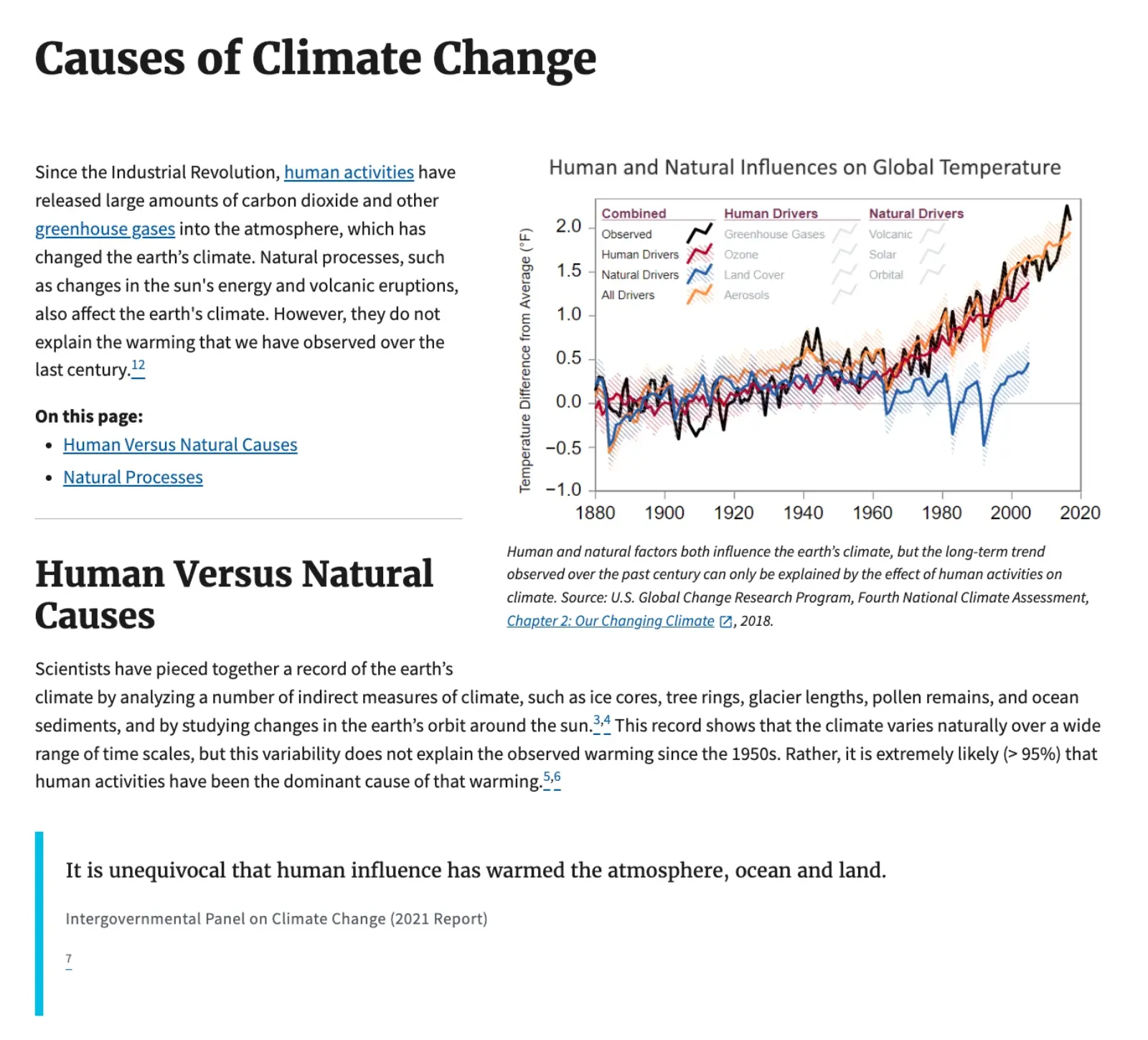
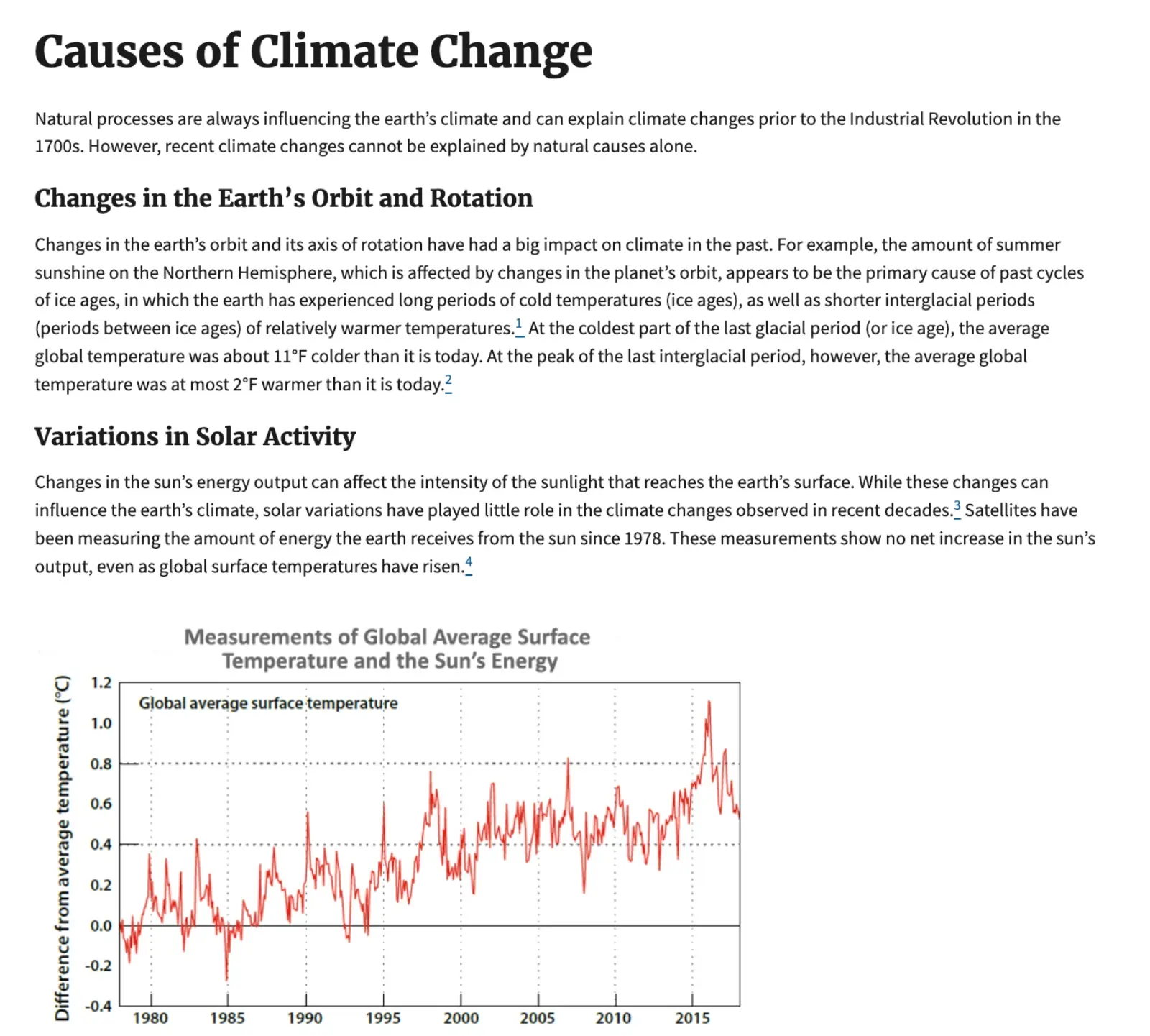
From left: An archive of an EPA webpage from October highlights how humans have contributed to climate change. By December, the EPA had updated its page on climate change to remove references to human activity. *Courtesy Internet Archive; courtesy epa.gov
In response to questions about why the EPA’s climate change resources were removed, the agency said it was upholding “gold-standard science.”
“Unlike the previous administration, the Trump EPA is focused on protecting human health and the environment while Powering the Great American Comeback, not left-wing political agendas,” an EPA spokesperson said in a statement. “As such, this agency no longer takes marching orders from the climate cult.”
Swain said the changes could be a way for the EPA to bring its public-facing information in line with the proposal to reverse the agency’s own “endangerment finding,” the scientific basis that allows the EPA to regulate carbon emissions. The agency is expected to finalize the repeal soon, in what EPA Administrator Lee Zeldin has promised to be “the largest deregulatory action in the history of the United States.”
Read Next
Why the federal government is making climate data disappear
The changes to the EPA’s site are reminiscent of a report the Department of Energy released this summer, written by a group of five climate contrarians, arguing that climate change wasn’t as bad as mainstream scientists say. It can give people the impression that there’s a “debate” that climate change is a serious problem, when in fact there’s not, Swain said. If anything, the last several years suggest that the consequences of the warming that’s already arrived are worse than many scientists expected.
Official government websites used to be a source of unbiased information, but as federal agencies have altered them to align with the Trump administration’s talking points, some are becoming unreliable. The Centers for Disease Control and Prevention recently changed its stance on the relationship between vaccines and autism, with a new page saying that a link between the two can’t be ruled out — horrifying current staffers, who said their employer was spreading misinformation. Most information on government sites remains trustworthy, though. The National Weather Service, for instance, is still putting out accurate weather reports.
“Until very recently, despite all of the damage that has been done to trust in government institutions over the last several years, I would say that the government websites, agency websites, still were among the most trusted sources,” Gehrke said. “And I do worry that that is really slipping away very quickly.”
The result is that the public is left to navigate a landscape where some government agencies are sharing credible facts, while others are generating misinformation. At the same time, quality, unbiased information just isn’t as easy to access as it used to be. Search results increasingly turn up AI-generated slop, while social media algorithms serve up posts targeted to individual preferences, giving people an off-kilter picture of reality.
“Siloed information is really tearing apart society,” Gehrke said. “People are making logical choices and logical analyses based on the information they have, but they are working with completely different sets of information. And that is a real problem.”
---
https://www.youtube.com/watch?v=bB0FFHw3laU
laje bs ; left vio, # wrong
complete memory
30k kia
Al Jazeera is funded in whole or in part by the Qatari government. Wikipedia
9,532 views Jun 29, 2026 #aljazeeraenglish #politics #news
As right-wing populists take power across Latin America, they have waged a ‘cultural battle’ to reclaim the past. In Argentina, President Javier Milei – and a legion of supportive influencers and YouTubers – are revising how the country’s history of military dictatorship is remembered and debated.
Reporter: Tariq Nafi
Producer: Ella Willis
Featuring:
Agustín Laje – President, Fundación Faro; YouTuber
Sol Montero – Professor, National University of San Martín
4:044 minutes, 4 secondsA movement advocating for the so-called complete memory of the events [music] of the dictatorship. One that reframed the
4:114 minutes, 11 secondsrepression of that time as part of a dirty war between two sides.
4:264 minutes, 26 secondsWhat the complete memory narrative seeks to do is incorporate a historical truth that had been denied from the outset.
4:334 minutes, 33 secondsThose who attack the complete memory narrative are the ones denying a portion of history that for reasons of political, ideological, and economic
4:404 minutes, 40 secondsconvenience, they choose to leave out of the picture. It means recognizing that gerilla and terrorist groups existed and
4:484 minutes, 48 secondsthat they too systematically violated human rights against the civilian population.
4:584 minutes, 58 secondsIt's true that a few years ago it was inconceivable to talk of a dirty war or question the figure of 30,000
5:055 minutes, 5 secondsdisappeared. And those limits have been pushed. What's acceptable speech has shifted with the arrival of this new radical right-wing in power.
5:205 minutes, 20 secondsToday, you can find content on prime time news channels or online that trivializes or relativizes the seriousness of the dictatorship's crimes for a young audience.
jm 2023, cut forensics; school denounced; hu rts gp cit corrupt; univ left indoc; voice have been excluded
sol Montero prof
defensora patria tshirt workout w/ name
---
AN 6 26
President Donald Trump reportedly wants to seize the Smithsonian Institution, one of America’s most prestigious collection of museums, and to use them to whitewash the United States’ history on issues like slavery.
“When President Trump summoned Lonnie Bunch, the secretary of the Smithsonian Institution, for lunch at the White House on August 28 of last year, Bunch’s advisers assumed that the end was near,” The Atlantic’s Clint Smith wrote on Monday. “Trump had spent months threatening the Smithsonian’s independence; just nine days earlier, he’d written on Truth Social that ‘the Smithsonian is OUT OF CONTROL, where everything discussed is how horrible our Country is, how bad Slavery was, and how unaccomplished the downtrodden have been.’”
Bunch, who unambiguously believes that slavery was a negative for America, was also the founding director of the Smithsonian’s National Museum of African American History and Culture. He is known to have pushed back against attempts by Vice President JD Vance and Rep. Carlos Giménez (R-FL), who sits on the Smithsonian’s Board of Regents, as well as others in the Trump administration to scrub so-called “woke” ideas in the museum that they described as a “divisive ideology.” Trump also tried to fire the director of the Smithsonian’s National Portrait Gallery, even though the Smithsonian is meant to be independent of the government.
Despite these challenges, Bunch was able to avoid winding up in the administration’s crosshairs, at least for a while. Yet as various key personnel step down from the museums’ boards, Smith anticipates that Trump may ultimately get his wish of hiring loyalists who will reshape the museum to his liking.
“The current and looming vacancies, and the need for congressional and presidential approval, raise the possibility that Trump could attempt to install new board members who are loyal to his agenda,” Smith wrote. “(Trump’s March 2025 executive order said that the White House would work with officials ‘to seek the appointment of citizen members to the Smithsonian Board of Regents committed to advancing the policy of this order.’)”
Smith added, “In April, The New York Times reported that the regents had agreed on nominations for some of the replacements, but the House committee responsible for reviewing and vetting the nominees before they move to the full legislature for approval had yet to receive the names under consideration—intrigue that suggests some manner of strategy, although it’s far from clear whose. Minutes from board meetings earlier this year show that the regents have voted to give existing members additional duties because of the current and expected vacancies.”
Despite these pressures, Bunch vowed in an internal memo to staff that “we remain steadfast in our mission to bring history, science, education, research and the arts to all Americans. We will continue to showcase world-class exhibits, collections and objects, rooted in expertise and accuracy.”
Earlier this month, federal Judge Angel Kelly ruled against Trump’s attempts to remove historic content that is featured at national parks. Trump specifically targeted content that discussed America’s history of racism, including slavery.
"To establish a likelihood of success on the merits, Defendants must do more than express disagreement with the Court’s prior ruling; they must make a strong showing that they are likely to prevail on appeal," Kelley explained in response to the administration’s objection to being forced to allow the National Parks Service to accurately represent American history.
She added, "To establish irreparable harm, Defendants bear the burden of demonstrating that, absent a stay, they will suffer irreparable injury that is substantial, certain, and inadequately remedied by monetary damages or later appellate relief. ... Here, Defendants raise three theories: (1) the Injunction Order hampers government speech by preventing the National Park Service (“NPS”) from proffering its preferred narrative at National Parks; (2) implementation of the Injunction Order is practically infeasible and costly; and (3) the Injunction Order conflicts with a recent order issued by the U.S. Court of Appeals for the Third Circuit regarding Independence National Historical Park in Philadelphia, PA, thus subjecting Defendants to inconsistent obligations with respect to that site. The Court is unpersuaded by these arguments and explains why."
---
---
~ // PREZ HSE PHILLY CT WIN
AN 3 26
Republicans are attempting to rewrite the narrative of the Jan. 6 attack on the U.S. Capitol, but Virginia is not letting that narrative permeate public classrooms.
The Washington Post reported Friday that the Virginia state governor will likely sign a measure that was passed by the state House of Delegates and Senate that bars any public schools from teaching that the attack was a "peaceful" protest. President Donald Trump has long maintained that the violence was peaceful. Other Republicans have referred to it as nothing more than a "tourist visit."
One lawmaker complained that the White House webpage calls January 6 "a peaceful protest, and people who instigated it were the police and National Guard,” said Delegate Dan Helmer (D).
“This is a preventative measure against a massive disinformation campaign on the part of the White House," he added.
Republicans are calling it "mind control," the report said.
"It tells us what we’re not allowed to say, and it tells us what we must say,” complained Del. Tom Garrett (R) in a floor speech. He said that the bill was "evil" and akin to "Nazi Germany" and "Soviet Russia."
In 2022, Virginia's Republican Gov. Glenn Youngkin proposed new teaching requirements for those discussing the history of the U.S. around slavery and the Native Americans. Laws in Germany today bar expressions of Holocaust denialism in public.
Trump pardoned 1,500 people charged with crimes related to Jan. 6, even if they accepted their guilt.
---
---
AN 1 26
Smithsonian removes text referencing Trump’s 2 impeachments that 'upset' White House
Sarah K. Burris
---
AN 2 26
SEE GHOSTS OF MISS
Mississippi Today reports that President Donald Trump’s National Park Service (NPS) is replacing visitor brochures from the Medgar & Myrlie Evers Home National Monument, in Jackson, Mississippi.
Among the anticipated changes? No longer calling his murderer a “racist.”
“Edits to the brochure have removed that reference to Byron De La Beckwith, according to NPS officials, who asked not to be named for fear of retribution. Other edits include eliminating the reference to Medgar Evers lying in a pool of blood after being shot,” reports Mississippi Today writer Jerry Mitchell.
In 1963, Beckwith shot civil rights leader Medgar Evers in the back as he stood in the driveway of the Evers family home in northwest Jackson. His children were inside the home awaiting their father at the time of his death, and they saw him bleeding out in the front yard.
The original brochures pulled from the home described Beckwith as “a member of the racist and segregationist White Citizens’ Council.” That council, according to history author Stephanie Rolph, “believed in the natural superiority of the Aryan race.”
“They even went so far as to say that civilizations failed because of racial amalgamation,” Rolph added.
Mississippi Today reports Beckwith also belonged to the nation’s most violent white supremacist group, the White Knights of the Ku Klux Klan, responsible for at least 10 killings in Mississippi.
“You can’t call Beckwith a racist?” said Jeff Steinberg, founder of Sojourn to the Past, which regularly provides civil rights tours to the home. “If you opened a picture dictionary and turned to the definition for ‘racist,’ you’d probably find a picture of Byron De La Beckwith.”
Mississippi Today reports NPS' decision comes in the wake of Trump’s March 2025 executive order, “Restoring Truth and Sanity to American History,” which accused the Biden administration of a “widespread effort to rewrite our Nation’s history, replacing objective facts with a distorted narrative driven by ideology rather than truth.”
Furthermore, the order demanded the Secretary of the Interior “ensure” that all public monuments and properties within its jurisdiction “do not contain descriptions, depictions, or other content that inappropriately disparage Americans past or living.”
This apparently includes race-based assassins.
Mississippi Today adds that Trump initially hailed Evers, a World War II veteran, as a “great American hero” at the opening of the Mississippi Civil Rights Museum in 2017. But after his 2025 executive order, his U.S. Army removed Evers, and the names of other Black heroes, from a section on the Arlington National Cemetery website that honored non-white Americans who fought in the nation’s wars.
January 6: One year later, Americans still view the Capitol takeover with dismay | YouGov}:
---
nyt
Trump Still Pushing Conspiracies
False Narrative Posted
A Day of Rage
Presidential Rally Turned Rampage
Pardoned Rioters Rally
White House Posts False Jan. 6 Narrative on Riot’s 5th Anniversary
A new web page on the official White House site blames the Capitol Police and Democrats for the pro-Trump mob riot, absolving the president of responsibility and calling participants “innocent.”
Rioters enter the capitol building in riot gear.
Rioters walking through the Capitol on Jan. 6, 2021.Credit...Erin Schaff/The New York Times
Luke BroadwaterAlan Feuer
By Luke Broadwater and Alan Feuer
Luke Broadwater is a White House reporter who helped cover the Jan. 6 riot. Alan Feuer has reported on the hundreds of criminal cases stemming from the riot.
Jan. 6, 2026
On the fifth anniversary of the pro-Trump mob attack on the Capitol, the Trump administration created a new page on the official White House website that represented the president’s most brazen bid yet to rewrite the history of the Jan. 6 riot with false claims aimed at absolving him of responsibility.
The site blames Capitol Police officers, who defended lawmakers that day, for starting the assault; Democrats, who were the rioters’ main targets, for failing to prevent it; and former Vice President Mike Pence, who rejected falsehoods about the 2020 election, for allowing the results to be certified.
Mr. Trump has long sought to whitewash the violence and vandalism committed on Jan. 6, 2021, and reject responsibility for having instigated it. But the webpage, promoted on government social media accounts, put the official imprimatur of the White House on an astonishingly misleading account of the Capitol attack.
In one section, the webpage mentions several members of the pro-Trump mob who died during or in connection with the assault, identifying them by name. But it excises altogether any reference to the nearly 140 police officers who were injured when they were assaulted that day with weapons that included bear spray, stun guns, hockey sticks, fireworks, broken pieces of furniture and at least one flagpole flying the American flag. Nor does the page mention any of the officers who died in its aftermath. In fact, at one point, the timeline asserts: “Zero law enforcement officers lost their lives.”
Image
Demonstrators and police officers both pull at a guard rail. People in the background are waving Trump and American flags.
The violent rampage that unfolded over nearly five hours on that day caused injuries to roughly 140 police officers and left five people dead.Credit...Kenny Holston for The New York Times
Image
A door with its windows damaged. Rioters are gathered on the other side.
The attackers used a wide variety of weapons: bear spray, stun guns, hockey sticks, fireworks, broken pieces of furniture and even a flagpole holding a U.S. flag.Credit...Erin Schaff/The New York Times
The webpage includes a timeline of events on Jan. 6 that accuses the Capitol Police, who were attacked by the rioters for hours, of instigating the violence, and blames Mr. Pence for refusing to subvert the will of the voters to keep Mr. Trump in power.
“Vice President Mike Pence, who had the opportunity to return disputed electoral slates to state legislatures for review and decertification under the United States Constitution, chooses not to exercise that power in an act of cowardice and sabotage,” the webpage states.
“Stolen Election Certified,” another section says.
In a breathtaking reversal of reality, the site accuses Democrats of creating a “gaslighting narrative” about Jan. 6 in their efforts to certify “a fraud-ridden election” and to “persecute innocent Americans,” though those who were prosecuted for storming the Capitol were caught on video taken either by surveillance cameras or by other participants.
Instead, it is the White House account that twists the facts of the riot.
The timeline asserts, for example, that Mr. Trump invited his followers to come to Washington on Jan. 6 for “a peaceful and historic protest” over the 2020 election. It fails to mention that he also tweeted, “Be there, will be wild!” — a presidential imperative that, within hours of its posting, prompted scores of his supporters to issue calls for violence, even to post online images of the weapons, including assault rifles, that they said they planned to bring to the rally.
Image
President Donald J. Trump speaking to a crowd. The White House is behind him.
President Trump spoke at a rally in the Ellipse on the morning of the riot. Credit...Pete Marovich for The New York Times
Image
A man with his face masked with a U.S. flag and holding a pole with a flag, stands by the Capitol as others clamber up one of its walls.
The riot began after those at the rally streamed from the Ellipse to the Capitol. The violent attack lasted for hours. Credit...Jason Andrew for The New York Times
The White House’s timeline also fails to take note of how far-right extremist groups, like the Proud Boys and the Oath Keepers militia, reacted to Mr. Trump’s summons: quickly setting up encrypted communications channels, acquiring protective gear and, in one instance, preparing heavily armed “quick reaction forces” to be staged outside Washington. Many later took the lead in attacking officers and breaching police security lines.
A separate section of the timeline, beginning at 1:10 p.m., asserts that the Capitol Police “aggressively” fired tear gas and other crowd control munitions at the crowd, suggesting falsely that the authorities had acted without cause and saying they “turned a peaceful demonstration into chaos.” But that account leaves out entirely what happened in the minutes leading up to the police response.
Shortly before 1 p.m. that day, a small group of pro-Trump protesters confronted and attacked police officers at metal barricades set up at an area outside the Capitol known as the Peace Circle. Once the barricades fell, thousands of protesters trampled over them and were able to gain access to a plaza where they massed, greatly outnumbering the police officers defending the building.
The webpage also contains blatant falsehoods about the Justice Department’s efforts to hold the rioters accountable. In a section the timeline titled, “Mass Arrests of Patriotic Protesters,” it says that the “Biden DOJ” began “a coordinated nationwide dragnet” leading to the arrest of more than 1,500 rioters.
In fact, the arrests began well before Mr. Trump left office on Jan. 20, 2021, and the investigation was carried out for weeks by Justice Department leaders that he had put in place.
Moreover, the webpage claims that hundreds of Jan. 6 defendants were held as “political prisoners for years” and were given “lengthy sentences.” In reality, far fewer rioters were held in pretrial detention than in cases brought against drug or immigration violation defendants, and the median sentence for the rioters was about 60 days in prison.
Mr. Trump, in one of the first official acts of his second term, issued a sweeping grant of clemency to all of the nearly 1,600 people charged.
Luke Broadwater covers the White House for The Times.
Alan Feuer covers extremism and political violence for The Times, focusing on the criminal cases involving the Jan. 6 attack on the Capitol and against former President Donald J. Trump.
See more on: Donald Trump, United States Capitol Police
Share full article
---
---
AN 1 26
National Public Radio reported that an investigation uncovered President Donald Trump's efforts to eliminate all information and intelligence related to the Jan. 6 attack on the U.S. Capitol.
According to the audio report by Tom Dreisbach and Ayesha Rascoe, they have responded by creating a public archiveof all videos, audio files, photos and other information available about the Jan. 6 attack, and they will make it searchable.
Dreisbach explained that the Trump administration is "actively trying to rewrite this history." He recalled that when it all unfolded a few years ago, the public, along with Republicans, agreed that Jan. 6 was illegal and reprehensible.
Even Sen. Ted Cruz (R-Texas) called it "an act of domestic terrorism."
Five years later, everyone involved received a blanket pardon, including "great patriots" who attacked police. In a statement played by the reporters, Trump claimed they were not violent.
"The Justice Department has deleted records of those cases. It has scrubbed references to Jan. 6 as a riot. They fired dozens of prosecutors who worked on those cases. They even hired a former Jan. 6 defendant at the Justice Department, a guy who called cops Nazis and loudly yelled that the rioters should kill the cops," said Dreisbach.
Once the details began to disappear, Chief Justice James Boasberg of the D.C. district court ordered the government to stop any and all removal of court records related to Jan. 6. It's unclear whether that order has been followed, however.
"So, with all those actions to rewrite this history, we thought it was really important to just ground people in the facts," he continued.
The 1,500 court cases included photos, videos and information that Dreisbach said most Americans haven't seen. So, they took the "massive trove of evidence" to catalogue and ensure it is publicly available.
The full archive can be found here.
---
---
an 12 25
Visitors to an American military cemetery in the Netherlands are pushing back following the removal of plaques honoring Black veterans of World War II, according to an NBC News report, seemingly done as part of Donald Trump's anti-diversity crusade.
Per the report, "visitors have filled the guestbook with objections" since the plaques came down earlier this year at the visitor center for the American Cemetery in Margraten, Netherlands. The two displays honored Black soldiers who took part in the war effort and helped liberate Europe from Nazi control. Operated by the American Battle Monuments Commission, the cemetery is the final resting place for around 8,300 American soldiers.
As NBC noted, the cemetery's graves themselves were dug by an all-Black contingent of soldiers.
"One display told the story of 23-year-old George H. Pruitt, a Black soldier buried at the cemetery, who died attempting to rescue a comrade from drowning in 1945," the report explained. The other described the U.S. policy of racial segregation in place during World War II. Some 1 million Black soldiers enlisted in the U.S. military during the war, serving in separate units, mostly doing menial tasks but also fighting in some combat missions. An all-Black unit dug the thousands of graves in Margraten during the brutal 1944-45 season of famine in the German-occupied Netherlands known as the Hunger Winter."
Emails obtained by the Jewish Telegraphic Agency (JTA) and Dutch News confirmed that the decision to remove the plaques was in direct response to Trump's executive order targeting "diversity, equity and inclusion" programs, an order which has since impacted a wide array of displays, memorials and programs honoring African-American history.
US Ambassador to the Netherlands Joe Popolo -- one of the many wealthy businesspeople and GOP megadonors named to European diplomatic roles by Trump -- spoke out in support of the removal, arguing that the "signs at Margraten are not intended to promote an agenda that criticizes America."
The displays were reportedly removed without any public notice, prompting anger from visiting Americans, as well as local officials and residents. One local who spoke out against the removal to NBC News was 79-year-old Cor Linssen, the son of a Black US soldier and a Dutch mother. Linssen, along with a group of other children of Black US soldiers, visited the cemetery to view the plaques together back in February.
“It’s an important part of history,” Linssen said. “They should put the panels back.”
---
OMFG
MOJO
This story was originally published by theGuardian and is reproduced here as part of the*Climate Desk*collaboration.}:
The Trump administration is breaking up a research center praised as a “crown jewel” of climate research after accusing it of spreading “alarmism” about climate change.
Russell Vought, the director of the White House’s office and management budget, said the National Center for Atmospheric Research (NCAR) in Boulder, Colorado, would be dismantled under the supervision of the National Science Foundation.
“This facility is one of the largest sources of climate alarmism in the country,” he wrote in a social media post. “A comprehensive review is underway & any vital activities such as weather research will be moved to another entity or location.”
The announcement was the latest in a series of climate-skeptic moves by the administration, which has vowed to eliminate what it calls “green new scam research activities.”
It drew fierce condemnation from climate experts, who said the Colorado center was renowned for advances in the study of weather patterns, including tropical cyclones.
Roger Pielke Jr, a senior fellow at the American Enterprise Institute thinktank, told *USA Today*, which first reported the story, that the facility was “a crown jewel of the US scientific enterprise and deserves to be improved not shuttered.”
He added: “If the US is going to be a global leader in the atmospheric sciences, then it cannot afford to make petty and vindictive decisions based on the hot politics of climate change.”
The move was also criticized by Colorado’s governor, Jared Polis, who said it put “public safety at risk.”
“Climate change is real, but the work of NCAR goes far beyond climate science,” he said. “NCAR delivers data around severe weather events like fires and floods that help our country save lives and property, and prevent devastation for families.”
The center employs approximately 830 staff and includes the Mesa Laboratory in Boulder, which Vought said would be shut. It also operates two aircraft for atmospheric research and manages a government-owned supercomputing facility in Wyoming.
The decision to dismantle it is consistent with Donald Trump’s frequent characterisations of climate change as a “con job” or a “hoax.”
The White House has accused the centre of following a “woke direction” and identified several projects that administration officials say are wasteful and frivolous, USA Today reported.
These include a Rising Voices Center for Indigenous and Earth Sciences that seeks to “make the sciences more welcoming, inclusive, and justice-centered,” as well as research into wind turbines, an innovation that Trump has repeatedly denounced.
The administration has already proposed a 30 percent cut to the funding of the National Oceanic and Atmospheric Administration, slashing spending on its climate, weather and ocean laboratories, which work to improve forecasting and better understand weather patterns.
---
---
AN 11 25
HARPERS FERRY, W.Va. — Despite concerns about attempted historical erasure at Harpers Ferry National Historical Park due to new Trump administration policies being unfounded, some historians worry other attempts across the country may have a detrimental impact on historical preservation in the U.S.
ABC 7 News first reported that Harpers Ferry was forced to remove items located in its slavery exhibit due to the Trump Administration’s March 27 executive order, “Restoring Truth and Sanity to American History.” According to the report, the order would force “the National Park Service [to] remove or cover up signs or displays that have been determined by the Trump administration to disproportionally emphasize negative aspects of American history or historical figures.”
However, Alan Spears, the senior director for cultural resources at the National Parks Conservation Association, said a citizen watchdog group created to protect and enhance America’s national parks found the story to be false. As a historian, Spears’ work in the association is focused on protecting and promoting historic and cultural resources tied to the federal parks department.
According to him and other historians, concern is still being raised about how this order is affecting national parks and important historical exhibits across the country.
According to the order, it intends to “restore Federal sites dedicated to history, including parks and museums, to solemn and uplifting public monuments that remind Americans of our extraordinary heritage, consistent progress toward becoming a more perfect Union, and unmatched record of advancing liberty, prosperity and human flourishing.”
Two months after the initial order was released, on May 20, the Secretary of the Interior released an additional order, SO 3431, which essentially “operationalized” the order for the United States Parks Service, according to Spears.
The order did three things. First, it set up QR codes that allowed parkgoers to enter comments about the location. Spears said he believes that the administration was looking for people to “tattle on the National Park service to say, ‘We don’t really like this interpretation. It’s too liberal, it’s too woke, it’s too DEI, it’s too anti-American.’”
However, what the Secretary of the Interior found instead was that many parkgoers had either positive things to say about the historical interpretation of these sites or that these sites actually needed more work when defining issues like slavery, women’s rights, labor rights, and Native and Indigenous history.
Next, the parks were ordered to submit lists of any interpretive materials that might fall into what SO 3431 is trying to remove. Finally, the Secretary of the Interior sorted through these lists and sent out letters of noncompliance.
According to Spears, not all parks submitted lists for review, and not all parks were sent letters from the Interior. Ultimately, Harpers Ferry was not included in either set.
There are some images that could trigger a letter of noncompliance, according to Spears, such as photographs from their “Protests in America” display of a man being arrested at an AIDS protest, a group protesting the Vietnam War and the National Women’s Party that protested for women’s suffrage, for example. However, the park has not received orders to remove them, and Spears said that as far as he is aware, they do not plan to.
However, he said he does believe that the administration is not running an entirely transparent process. Despite Harpers Ferry not being on the list, several other facilities in the country were told to scrub their historical sites and landmarks.
Signs about climate change at Acadia National Park in Maine have been taken down, an LGBTQ display at a Rosie the Riveter site in Oakland, California, was taken down and then put back after concern was raised, and references to transgender activism at the Stonewall Inn in New York City have been removed.
“The truth of the matter is that nobody really is talking publicly about what’s been on the target list,” Spears said.
The language of the order itself has also caused concern, with the focus framed on “the greatness of the achievements and progress of the American people or, with respect to natural features, the beauty, abundance, and grandeur of the American landscape,” instead of outright saying it will enforce bans on historical knowledge focused on marginalized groups.
Another historian and graduate student, Peter D’Arpa, said he believes the wording is built to give it plausible deniability.
“[The administration] can’t, right now, just do stuff. They have to keep people happy, where we’re at right now.”
He compared this language to fascist states like Nazi Germany, in which Nazis would “build consensus amongst your population of who belongs and who doesn’t,” “get them angry at certain groups,” and only then, once they were used to ostracize members of the group, could they move on to their removal or inflict violence on them.
Spears said what’s happening now is an issue of “whether or not this country wants to come to grips with the lingering effects” of difficult parts of American history, including slavery.
In his perspective, some do and some don’t — and that is one of the crises at the heart of the historical erasure, he said.
“I think it’s important that efforts to soften, sanitize, erase this history is critically important,” Spears said. “If you don’t want to learn about slavery and its lingering impacts on this country, that’s your choice. I think it’s a bad choice, but it’s your choice.”
In the end, he said he does not want that choice to be taken away from those who actively want to seek out these stories and learn from them.
“I do believe that if we… want to bring people together, that we have to see each other and understand a little bit more about where we’ve come from. That means our history — that shared national narrative of ours — has to include the ugly parts as well as the beautiful parts,” Spears said.
D’Arpa has also raised concerns about the order and how it points to division within the country. According to him, the division and historical erasure happening now are a result of citizens being angry and scared that they are being forgotten by those in power.
“They hear that the Democrats say they want to take care of a specific group of people, but they don’t hear the Democrats say they want to take care of all Americans, and that scares people that are in rural America that might like American policies,” he said. “They don’t want to be forgotten, they don’t want to feel like they’re being forced to accept a certain ideology that they don’t agree with.”
Politically, D’Arpa said he believes the order to be anti-American. He said that it points to the president taking power away from the people and the states, using the power of the federal government to force the people and the states “to basically think the way the government wants them to think.”
The historical preservation and documentation that took place during this time also inspired the Citizen Historians for the Smithsonian, an organization in which volunteers photograph and film different exhibits in the Smithsonian, should anything be removed or changed. The Smithsonian museums located in D.C. have been sent letters of noncompliance, but as of right now, nothing has changed.
Historically, similar censorship has happened in Communist China, according to historian and professor at Georgetown University and co-founder of the citizen historians group Citizens Historians for the Smithsonian James Millward.
After the Tiananmen Square massacre of 1989, the Chinese Communist Party worked very hard over decades to ensure people didn’t know the full story of what happened.
“They created their own version of what it was, and made it impossible to write about or talk about,” Millward said.
The historical preservation and documentation that took place during this time also inspired the Citizen Historians for the Smithsonian, an organization in which volunteers photograph and film different exhibits in the Smithsonian, should anything be removed or changed. The Smithsonian museums located in D.C. have been sent letters of noncompliance, but as of right now, nothing has changed.
Lizzie Watts, who worked in the National Parks Service for 49 years, said she feels the order makes it harder to tell a complete story. She said she believes people work hard to preserve historical sites like Harpers Ferry because they tell an inclusive story of our history.
“All stories are not happy, all stories don’t end on a good note, but they’re history,” she said. “If we ever want to get back to a moderate world where everyone gets along and understands each other and works for the betterment of the United States, then we have to be inclusive. You can’t leave people out, you can’t avoid the sad things to just “try to save the positive parts of history.”
Ultimately, all these historians say that the order is unique to the United States in this moment, and although it is not clear what the future of it will look like, they worry about the preservation of the nation’s history for future generations.
---
---
lonnie bunch
XO 14253
aug 19th ts out of control unaccomplished downtrodden have been
woke is broke we have the hottest cty in the world that everyone talks about
smithson not exec branch a fed trust 17 member bd
citizen historians for the smithsonian, docced 1/2 .org
Citizen Historians for the Smithsonian | Protect History
Citizen Historians for the Smithsonian Is Creating a Digital Archive of Exhibits | Library Journal
teach-in nate dimeo linktree history teach in memory palace
Standing up for history on "the nation's front yard." | MetaFilter
---
---
AN 10 25
“Waste, fraud, and abuse.”
It’s President Donald Trump’s battle cry as he dismantles federal agencies, fires hundreds of thousands of employees, and demoralizes the workers who remain. It’s also another of his false flag operations.
Rather than ferreting out corruption, waste, fraud, abuse, and mismanagement in the federal government, Trump has undermined the very professionals who have that job: inspectors general.
The Role of the IGs
In the wake of procurement scandals and President Richard Nixon’s corrupt abuse of executive power for personal ends, Congress passed the Inspector General Act of 1978 to establish formally the duties and responsibilities of the office. Inspectors general pursue their missions with nonpartisan objectives and have a central role in holding government accountable.
Approximately half of the 70-plus inspectors general are appointed by the president, subject to Senate confirmation. They are the only independent offices within federal agencies designed to protect taxpayer money and root out corruption, fraud, waste, and mismanagement. IGs also investigate whistleblowers’ confidential claims.
Over the almost 50 years of their statutory existence, they have saved taxpayers billions of dollars.
Trump’s Escalating War on Independent IGs
For Trump and his allies, independent inspectors general have been a nuisance and worse. Following acquittal in his first impeachment, he replaced IGs for the intelligence community, State Department, Defense Department, Health and Human Services, and Transportation Department.
In his second term, Trump has moved more broadly and more rapidly. Typically, IGs remained in place when new presidents took office, underscoring their nonpartisan roles. But in violation of the statutory 30-day notice and “for cause” requirements for termination, Trump fired 17 of them during the first week of his second term. He had appointed several of them during his first term.
So the next time Trump and his allies say they’re eliminating “waste, fraud, and abuse” in the federal government, remember that Trump is actually doing the opposite: clearing away key guardrails of accountability.
During post-termination interviews with the New York Times, the fired IGs said that their biggest concern was the “chilling effect” that their abrupt, unlawful, and unjustified terminations would have on others. Professor Timothy Snyder calls it “obeying in advance.” The inspectors general used similar language to describe their fears:
“Self-censorship”
“Why would you want to write a report that will get you fired?”
“Installing someone who has more loyalty to one person than to the mission of the office.”
“If you do the work that you’re intended to do and it’s not popular, then you will be punished.”
“Who will speak truth to power?”
The concerns were justified. Trump doesn’t want anyone speaking truth to his power.
On Tuesday, February 11, the inspector general for the United States Agency for International Development (USAID), Paul Martin, issued a report criticizing Trump’s proposed dismantling of that agency and outlining the disastrous consequences. The next day, Trump fired him.
Final Act of Destruction
On September 28, 2025, Trump’s Office of Management and Budget (OMB) announced that effective October 1 it was defunding the Council of the Inspectors General on Integrity and Efficiency. It was a strategic kill shot because the council is the umbrella agency supporting all of the inspectors general offices.
Beginning on October 1, what had been the website for the council stated only:
Due to a lack of apportionment of funds, this website is currently unavailable.
The same line appeared at numerous Office of Inspector General websites, including the Departments of Agriculture, Education, Justice, Interior and Veterans Affairs, and by those of AmeriCorps, Export-Import Bank of the United States, Federal Trade Commission, International Trade Commission, National Archives and Records Administration, Nuclear Regulatory Commission, Office of Personnel Management, Smithsonian Institution, and Treasury Inspector General for Tax Administration.
Contacting the watchdog website for the National Labor Relations Board’s OIG page resulted in a “404 error.” The Architect of the Capitol’s IG page said “Not found”; another new page offered only hotline information and blamed the change on a “funding issue impacting Oversight.gov functions.”
The council also runs Oversight.gov, which houses over 34,000 reports from most of the OIGs, and operates 28 OIG websites that host legally required hotlines for whistleblowers to report suspected cases of government corruption, waste, fraud, abuse, and mismanagement. That site was down too. The council site’s link to the “Inspectors General directory” stated only: “Not Found—the requested URL was not found on this server.”
Not a Funding Issue
But the so-called “lack of funds” asserted on the inoperative council website was not the result of the simultaneous government shutdown. The council’s budget did not require additional congressional authorization.
Rather, the OMB under the leadership of Director Russell Vought decided not to fund it. Vought, a self-described Christian nationalist, was a primary architect of Project 2025—a 900-page blueprint for expanding executive power (“the unitary executive”) and imposing an ultraconservative social vision. During the 2024 campaign, Project 2025 was so toxic that Trump repeatedly disavowed and claimed to know nothing about it; as president, he’s boasting about working with Vought to implement it.
Asked about its defunding decision, the OMB asserted without evidence that it shut down the IGs because they had “become corrupt, partisan, and in some cases, have lied to the public.”
Republicans Are Concerned?!
Even Senate Republicans were outraged. Sens. Susan Collins (R-Maine), the chairwoman of the Appropriations Committee, and Chuck Grassley (R-Iowa) chairman of the Judiciary Committee, called on the White House to release the funding immediately.
So far, it hasn’t.
So the next time Trump and his allies say they’re eliminating “waste, fraud, and abuse” in the federal government, remember that Trump is actually doing the opposite: clearing away key guardrails of accountability.
And remember that when Republicans in Congress say they are “outraged” at some action Trump has taken, don’t expect them to do anything about it.
---
politico 9 25
Most Read
- How House Republicans plan to rewrite history of Jan. 6
- China weaponizes ag imports to target Trump and US farmers
- Energy Dept. adds ‘climate change’ and ‘emissions’ to banned words list
- ‘Laughter Can’t Be Put on Trial’: Why Donald Trump Is Afraid of Jimmy Kimmel
- Why Donald Trump is obsessed with Portland
---
---
AN 9 25
U.S. President Donald Trump's administration earned condemnation from Amnesty International on Thursday over its leaked plans to downplay human rights violations in countries favored by the American government.
News of the plan was originally reported on Wednesday by The Washington Post, which documented how the administration has been revising State Department reports on human rights in El Salvador, Israel, and Russia to "strike all references to LGBTQ+ individuals or crimes against them." The Post also added that "the descriptions of government abuses that do remain have been softened."
In the case of El Salvador, where the administration earlier this year began lawlessly shipping immigrants deported from the United States, the administration's report stated that were "no credible reports of significant human rights abuses" there, even though a State Department report under former President Joe Biden's administration issued last year documented "significant human rights issues" in the country.
Human rights violations against LGBTQ+ people were deleted from the State Department's report on Russia, while the report on Israel deleted references to Israeli Prime Minister Benjamin Netanyahu's corruption trial and to his government's threats to the country's independent judiciary.
Amanda Klasing, Amnesty International USA's national director of government relations and advocacy, ripped the administration for selectively whitewashing human rights records of nations favored by the president.
"The leaked chapters of the latest Annual Human Rights Report reveal a disturbing effort by the Trump administration to purposefully fail to fully capture the alarming and growing attacks on human rights in certain countries around the globe," she said. "Alarmingly, we understand that the mandate from Secretary Rubio was... to go back and wipe out portions of the reports that had already been written—to delete stories from survivors of human rights violations."
Klasing went on to accuse the administration of turning the human rights report "into yet another tool to obscure facts to push forward anti-rights policy choices."
She also emphasized that "it would be a travesty and subversion of congressional intent to downplay or ignore human rights violations faced by marginalized populations including refugees and asylum seekers, women and girls, Indigenous people, ethnic and religious minorities, and LGBTQI+ people throughout the world."
An unnamed State Department official this week told the Post that the administration was merely simplifying the human rights reports to make them more "readable."
"The 2024 Human Rights report has been restructured in a way that removes redundancies, increases report readability, and is more responsive to the legislative mandate that underpins the report," the official said. "The human rights report focuses on core issues."
NOW READ:DOJ memo reveals Trump’s dark plan for a new Red Scare — and it may be perfectly legal
---
AN 9 25
404 Media reports the Department of Justice has taken down a study showing white supremacist and far-right violence outpaces “all other types of terrorism and domestic violent extremism” in the United States.
The DOJ website hosted the study, conducted by the National Institute of Justice, until September 12, 2025.
In its place is the message: “The Department of Justice's Office of Justice Programs is currently reviewing its websites and materials in accordance with recent Executive Orders and related guidance. During this review, some pages and publications will be unavailable. We apologize for any inconvenience this may cause.”
READ MORE: 'Increasingly senile wackjob': Expert says Trump too broken to destroy democracy on his own
The report What NIJ Research Tells Us About Domestic Terrorism revealed “Militant, nationalistic, white supremacist violent extremism has increased in the United States. In fact, the number of far-right attacks continues to outpace all other types of terrorism and domestic violent extremism.”
The document reports “far-right extremists have committed far more ideologically motivated homicides than far-left or radical Islamist extremists,” since 1990, “including 227 events that took more than 520 lives.”
In this same period, the report claimed, “far-left extremists committed 42 ideologically motivated attacks that took 78 lives.”
“We don’t know why the study about far-right extremist violence was removed recently,” writes 404 Media reporter Emanuel Maiberg, “but it comes immediately after the assassination of conservative personality Charlie Kirk, accusations from the administration that the left is responsible for most of the political violence in the country, and a renewed commitment from the administration to crack down on the ‘radical left.’”
READ MORE: 'Something is wrong': MAGA pundits say Trump is 'lying to us' about Charlie Kirk shooting
The DOJ did not respond to 404 Media’s request for comment.
Read the 404 Media report at this link.
---
---
AN 9 25
Senior Trump administration officials on Monday made fresh threats to crack down on a nonexistent left-wing “domestic terror movement” following last week’s assassination of Charlie Kirk—a move that critics called an attempt to exploit the far-right firebrand’s murder to advance an authoritarian agenda targeting nonviolent opposition.
Even as investigators work to determine the motive of Kirk’s killer, members of Trump’s inner circle and supporters have amplified an unfounded narrative of a coordinated leftist movement targeting conservatives.
According to The New York Times:
On Monday, two senior administration officials, who spoke anonymously to describe the internal planning, said that Cabinet secretaries and federal department heads were working to identify organizations that funded or supported violence against conservatives. The goal, they said, was to categorize left-wing activity that led to violence as domestic terrorism, an escalation that critics said could lay the groundwork for crushing anti-conservative dissent more broadly.
Appearing on the latest episode of “The Charlie Kirk Show” podcast—which was guest hosted by US Vice President JD Vance—White House Deputy Chief of Staff Stephen Miller said that “we are going to use every resource we have at the Department of Justice, Homeland Security, and throughout this government to identify, disrupt, dismantle, and destroy these networks and make America safe again for the American people.”
“It will happen, and we will do it in Charlie’s name,” Miller vowed.
Vance said during the podcast that he wanted to explore “all of the ways that we’re trying to figure out how to prevent this festering violence that you see on the far left from becoming even more and more mainstream.”
“You have the crazies on the far left who are saying, ‘Oh, Stephen Miller and JD Vance, they’re going to go after constitutionally protected speech,‘” the vice president said. “We’re going to go after the network that foments, facilitates, and engages in violence.”
Vance, who like Trump and numerous supporters claim to champion free speech, also took aim at “people who are celebrating” Kirk’s killing.
Another unnamed administration official told the Times Monday that government agencies would be investigating people, including those accused of vandalizing Tesla electric vehicles and dealerships and allegedly assaulting federal immigration agents, in an effort to implicate US leftists in political violence.
Vance and Miller’s threats ignored right-wing violence—which statistically outpaces left-wing attacks—including the recent assassinations of Democratic Minnesota House Speaker Melissa Hortman and her husband Mark Hortman, who were murdered in June by a right-wing masked gunman disguised as a police officer.
Investigative reporter Jason Paladino reported last week that the US Department of Justice apparently removed an academic study previously published on the National Institute for Justice’s online library showing that “since 1990, far-right extremists have committed far more ideologically motivated homicides than far-left or radical Islamist extremists, including 227 events that took more than 520 lives” versus “42 ideologically motivated attacks that took 78 lives” committed by “far-left extremists.”
Responding to Miller’s remarks, New Republic staff writer Greg Sargent noted on social media that “Stephen Miller was directly involved in one of the largest acts of organized domestic political violence the United States has seen in modern times, the January 6 [2021] insurrection.”
Congresswoman Diana DeGette (D-Colo.) weighed in Monday on Miller’s attempt to exploit Kirk’s murder, writing on the social media site Bluesky that “it’s never acceptable to kill someone for their political beliefs. But the Trump [administration] exploiting the shooting of Charlie Kirk to follow their authoritarian instincts and crack down on the left is incredibly disturbing.”
“We must end any form of political violence—and reject those who try to exploit it,” she added.
Democratic California Gov. Gavin Newsom noted Monday on social media that Miller “has already publicly labeled the Democratic Party as a terrorist organization.”
“This isn’t about crime and safety,” Newsom added. “It’s about dismantling our democratic institutions. We cannot allow acts of political violence to be weaponized and used to threaten tens of millions of Americans.”
The progressive Working Families Party (WFP) said Monday on social media that “JD Vance and Stephen Miller want to use the horrifying murder of Charlie Kirk to target and dismantle pro-democracy groups.”
“Their comments call to mind some of the darkest periods in US history,” WFP continued. “They’re dividing people based on what box we ticked on our voter registration.”
Vance and Miller “want to stoke fear and resentment to justify their un-American crackdowns on free speech, mass abductions of working people, and military takeovers of our cities,” WFP added. “This isn’t going to fly. We’ve survived crises like this before as a country, and we can choose to live in a place where our political freedoms are protected, where we settle disagreements with words not weapons, and where no one has to fear losing a loved one to gun violence.”
:{---
an 8? 25
'Makes all of America look bad': Historian slams Trump's efforts to 'whitewash' slavery
---
the conv an 8 25
When people use the term “Orwellian,” it’s not a good sign.
It usually characterizes an action, an individual or a society that is suppressing freedom, particularly the freedom of expression. It can also describe something perverted by tyrannical power.
It’s a term used primarily to describe the present, but whose implications inevitably connect to both the future and the past.
In his second term, President Donald Trump has revealed his ambitions to rewrite America’s official history to, in the words of the Organization of American Historians, “reflect a glorified narrative … while suppressing the voices of historically excluded groups.”
This ambition was manifested in efforts by the Department of Education to eradicate a “DEI agenda” from school curricula. It also included a high-profile assault on what detractors saw as “woke” universities, which culminated in Columbia University’s agreement to submit to a review of the faculty and curriculum of its Middle Eastern Studies department, with the aim of eradicating alleged pro-Palestinian bias.
Now, the administration has shifted its sights from formal educational institutions to one of the key sites of public history-making: the Smithsonian, a collection of 21 museums, the National Zoo and associated research centers, principally centered on the National Mall in Washington, D.C.
On Aug. 12, 2025, the Smithsonian’s director, Lonnie Bunch III, received a letter from the White House announcing its intent to carry out a systematic review of the institution’s holdings and exhibitions in the advance of the nation’s 250th anniversary in 2026.
The review’s stated aim is to ensure that museum content adequately reflects “Americanism” through a commitment to “celebrate American exceptionalism, [and] remove divisive or partisan narratives.”
On Aug. 19, 2025, Trump escalated his attack on the Smithsonian. “The Smithsonian is OUT OF CONTROL, where everything discussed is how horrible our Country is, how bad Slavery was…” he wrote in a Truth Social post. “Nothing about Success, nothing about Brightness, nothing about the Future. We are not going to allow this to happen.”
Such ambitions may sound benign, but they are deeply Orwellian. Here’s how.
Winners write the history
Author George Orwell believed in objective, historical truth. Writing in 1946, he attributed his youthful desire to become an author in part to a “historical impulse,” or “the desire to see things as they are, to find out true facts and store them up for the use of posterity.”
But while Orwell believed in the existence of an objective truth about history, he did not necessarily believe that truth would prevail.
Truth, Orwell recognized, was best served by free speech and dialogue. Yet absolute power, Orwell appreciated, allowed those who possessed it to silence or censor opposing narratives, quashing the possibility of productive dialogue about history that could ultimately allow truth to come out.
As Orwell wrote in “1984,” his final, dystopian novel, “Who controls the past controls the future. Who controls the present controls the past.”
Historian Malgorzata Rymsza-Pawlowska has written about America’s bicentennial celebrations that took place in 1976. Then, she says, “Americans across the nation helped contribute to a pluralistic and inclusive commemoration … using it as a moment to question who had been left out of the legacies of the American Revolution, to tell more inclusive stories about the history of the United States.”
This was an example of the kind of productive dialogue encouraged in a free society. “By contrast,” writes Rymsza-Pawlowska, “the 250th is shaping up to be a top-down affair that advances a relatively narrow and celebratory idea of Americanism.” The newly announced Smithsonian review aims to purge counternarratives that challenge that celebratory idea.
The Ministry of Truth
The desire to eradicate counternarratives drives Winston Smith’s job at the ironically named Ministry of Truth in “1984.”
The novel is set in Oceania, a geographical entity covering North America and the British Isles and which governs much of the Global South.
Oceania is an absolute tyranny governed by Big Brother, the leader of a political party whose only goal is the perpetuation of its own power. In this society, truth is what Big Brother and the party say it is.
The regime imposes near total censorship so that not only dissident speech but subversive private reflection, or “thought crime,” is viciously prosecuted. In this way, it controls the present.
But it also controls the past. As the party’s protean policy evolves, Smith and his colleagues are tasked with systematically destroying any historical records that conflict with the current version of history. Smith literally disposes of artifacts of inexpedient history by throwing them down “memory holes,” where they are “wiped … out of existence and out of memory.”
At a key point in the novel, Smith recalls briefly holding on to a newspaper clipping that proved that an enemy of the regime had not actually committed the crime he had been accused of. Smith recognizes the power over the regime that this clipping gives him, but he simultaneously fears that power will make him a target. In the end, fear of retaliation leads him to drop the slip of newsprint down a memory hole.
The contemporary U.S. is a far cry from Orwell’s Oceania. Yet the Trump administration is doing its best to exert control over the present and the past.
Down the memory hole
Even before the Trump administration announced its review of the Smithsonian, officials in departments across government had taken unprecedented steps to rewrite the nation’s official history, attempting to purge parts of the historical narrative down Orwellian memory holes.
Comically, those efforts included the temporary removal from government websites of information about the Enola Gay, the plane that dropped the atomic bomb over Hiroshima. The plane was unwittingly caught up in a mass purge of references to “gay” and LGBTQ+ content on government websites.
Other erasures have included the deletion of content on government sites related to the life ofHarriet Tubman, the Maryland woman who escaped slavery and then played a pioneering role as a conductor of the Underground Railroad, helping enslaved people escape to freedom.
Public outcry led to the restoration of most of the deleted content.
Over at the Smithsonian, which earlier in the year had been criticized by Trump for its “divisive, race-centered ideology,” staff removed a temporary placard with references to President Trump’s two impeachment trials from a display case on impeachment that formed part of the National Museum of American History exhibition on the American presidency. The references to Trump’s two impeachments were modified, with some details removed, in a newly installed placard in the updated display.
Responding to questions, the Smithsonian stated that the placard’s removal was not in response to political pressure: “The placard, which was meant to be a temporary addition to a 25-year-old exhibition, did not meet the museum’s standards in appearance, location, timeline, and overall presentation.”
Repressing thought
Orwell’s “1984” ends with an appendix on the history of “Newspeak,” Oceania’s official language, which, while it had not yet superseded “Oldspeak” or standard English, was rapidly gaining ground as both a written and spoken dialect.
According to the appendix, “The purpose of Newspeak was not only to provide a medium of expression for the worldview and mental habits proper to the devotees of [the Party], but to make all other modes of thought impossible.”
Orwell, as so often in his writing, makes the abstract theory concrete: “The word free still existed in Newspeak, but it could only be used in such statements as ‘This dog is free from lice’ or ‘This field is free from weeds.’ … political and intellectual freedom no longer existed even as concepts.”
The goal of this language streamlining was total control over past, present and future.
If it is illegal to even speak of systemic racism, for example, let alone discuss its causes and possible remedies, it constrains the potential for, even prohibits, social change.
It has become a cliché that those who do not understand history are bound to repeat it.
As George Orwell appreciated, the correlate is that social and historical progress require an awareness of, and receptivity to, both historical fact and competing historical narratives.
*This story is an updated version of an article originally published on June 9, 2025.
*The Smithsonian is a member of The Conversation U.S.
Laura Beers, Professor of History, American University
This article is republished from The Conversation under a Creative Commons license. Read the original article.
---
AN 8 25
The Wall Street Journal reports the White House will conduct a sweeping review of Smithsonian museum exhibitions, materials and operations to align it with President Donald Trump’s interpretation of American history.
Three top White House officials, said the Journal, sent a letter to Lonnie Bunch, the secretary of the Smithsonian Institution, claiming they want to ensure the museums’ “unity, progress, and enduring values” reflect President Donald Trump’s executive order calling for “Restoring Truth and Sanity to American History.”
The White House intends to inspect and adjust public-facing exhibition text and online content. It also wants to have a say in future exhibition planning, as well as the use of collections and artist grants, say Journal reporters.
READ MORE: Trump's worst crimes and destructions haven't even happened yet
“This initiative aims to ensure alignment with the president’s directive to celebrate American exceptionalism, remove divisive or partisan narratives, and restore confidence in our shared cultural institutions,” states the Aug. 12 letter.
Critics railed against Trump’s January executive order demanding a Trump-approved version of U.S. history that erases chapters that fail to align with Trump’s vision of American greatness, reports the Guardian.
“He’s ignorant of economic history, he’s ignorant of political history. And his idea for the 250 [anniversary] is to use it as a way to celebrate him,” said Jonathan Alter, a historian and biographer to the Guardian. “We don’t know yet exactly how he’ll hijack that event next year, but he will certainly try to do so.”
The Journal reports Trump singled out the Smithsonian Institution in his executive order, claiming the Smithsonian had “come under the influence of a divisive, race-centered ideology” that promotes “narratives that portray American and Western values as inherently harmful and oppressive.”
READ MORE: 'Not plausible': Trump-appointed judge hands him major loss in court
The Smithsonian’s Board of Regents had already agreed to conduct a thorough review of its museum and zoo content to eliminate political influence and bias, according to the Journal.
This may not be the first time the White House has tinkered with museum exhibits. After outcry, the Smithsonian’s National Museum of American History restored references to Trump after removing them from a presidential impeachment display in late July.
Read the full Wall Street Report at this link.
---
7 25 trump smithsonian impeach removed
READ MORE: 'Nobody believes you': Library of Congress blames missing Constitution sections on 'coding error'
---
---}:
an 8 25
Archive searches suggest the White House has scrubbed Sections 9 and 10 pertaining to Habeas Corpus and judicial review of unlawful detention from the official congressional website on the Constitution.
“Does this regime think that by editing the website they can delete these basic rights, or do they just want to make it harder to read about them?” demanded one commenter on Resistbot.
A quick scan of the site's constitutional summaries from Aug. 6 do not match more thorough archived shots of the same page from May. Among missing texts are summaries for Sections 9 and 10. Section 9 contains language pertaining to Habeas Corpus, including: “The Privilege of the Writ of Habeas Corpus shall not be suspended, unless when in Cases of Rebellion or Invasion the public Safety may require it.”
READ MORE: 'Living in a fantasy world': Critics pounce as Trump interview goes off-the-rails
Section 10 outlines the rights (and limitations of rights) of states regarding organizing, particularly organizing against the federal government. “No State shall, without the Consent of Congress, lay any Duty of Tonnage, keep Troops, or Ships of War in time of Peace, enter into any Agreement or Compact with another State, or with a foreign Power, or engage in War, unless actually invaded, or in such imminent Danger as will not admit of delay."
In addition to missing summaries of these Constitutional sections are detailed pages on Section 9 and Section 10. The page for Section 10, on July 15, for example, contained individual notes and entries on that section, including clauses. Today, a user visiting that same address will get a portrait of George Washington and a: “Page Not Found. Sorry, the page you're looking for does not exist” and a link back to the homepage. The same goes for the dedicated page for Section 9. Searches indicate the government site was modified July 17.
“That is not a good sign,” posted one commenter on Blue Sky.
“I don't have enough variations on 'f——' to express my feelings about this. Please help,” said another Blue Sky user.
READ MORE: This new report is a mortal threat to a desperate Trump
Critics say the Trump administration has run up against the Section 9 portion of the Constitution and its Habeas corpus inclusion. Originally imported to the Constitution from English common law, the language was used to ensure the king of England released prisoners when the law did not justify confining them.
Homeland Security Secretary Kristi Noem has claimed during a committee hearing that the constitutional provision is a tool the administration can use in its broader crackdown at the U.S.-Mexico border, claiming it to be “a constitutional right that the president has to be able to remove people from this country and suspend their rights.”
“That’s incorrect,” said Sen. Maggie Hassan (D-N.H), an attorney, who then explained to Noem that it is actually a “legal principle that requires that the government provide a public reason for detaining and imprisoning people.”
VID]
Hassan as “the foundational right that separates free societies like America from police states like North Korea.”
Read more: 'Open civil war': Retired federal judge calls Trump a 'tyrant' and MAGA 'anti-rule of law'
The White House did not immediately respond to emails.
---
READ MORE: ‘Vindictive Erasure’: Hegseth Ripped for Pride Month Order to Rename USNS Harvey Milk
First Jackie Robinson. Now Harriet Tubman. The Erasure of Black History in Real Time

Driving Change, Delivering Results, Disrupting Inequity/Impulsar el Cambio, Lograr Resultados, Eliminar la Inequidad
April 7, 2025
In March 2025, I raised an alarm on Cloaking Inequity when tributes to Jackie Robinson—one of the most iconic figures in American history—were quietly removed from Department of Defense webpages. That post, The Erasure of Black History in the Name of an Assault on DEI, chronicled a disturbing moment: the U.S. government not only failed to honor a pioneer but actively participated in rewriting the narrative of his service.
What started as an isolated “technical error,” supposedly the work of artificial intelligence, is actually a part of a broader, purposeful pattern of historical whitewashing. Robinson’s military heroism was intentionally erased, only to be hastily reinstated following public backlash (see When Loyalty Replaces Qualifications: The Cost to Democracy—and How We Push Back).
And now, we’re here again.
This time, they’ve come for Harriet Tubman.
The Whitewashing of Harriet Tubman
The National Park Service, under the direction of the Trump administration, has updated its official webpage on the Underground Railroad. Gone is the striking portrait of Tubman. Gone is her own voice, where she once described herself as “the conductor of the Underground Railroad for eight years.” Gone, too, are the clear references to slavery, the Fugitive Slave Act of 1850, and the resistance of enslaved Black Americans seeking freedom.
In place of these truths is a sanitized narrative that emphasizes “Black/White cooperation.” A collage of postal stamps featuring abolitionists—Black and white—is now the banner image. The site now opens with this line: “The Underground Railroad is one of the most significant expressions of the American civil rights movement.” No mention of bondage. No mention of violent escape. No mention of the hundreds of lives Tubman helped free.
This isn’t just a simple redesign. It’s historical revisionism at the highest levels of federal government—an intentional reframing of resistance as cooperation, of oppression as a shared challenge, and of Harriet Tubman as a footnote instead of the central figure.
A Dangerous Pattern Emerges
This latest act is part of a growing and dangerous movement to erase the narratives that center Black advocacy and truth in the American story. Since returning to office, Trump has issued a series of executive orders designed to dismantle diversity, equity, and inclusion (DEI) across federal agencies and public education.
We are seeing the consequences play out in real time:
- The Smithsonian Institution has been barred from hosting exhibits that “divide Americans based on race.”
- Webpages honoring Black soldiers in the Revolutionary War have been scrubbed.
- Mentions of slavery and systemic racism have disappeared from federal historic sites.
- Teacher training grants with equity components are being slashed under the guise of eliminating “wokeness.”
- And now, Harriet Tubman’s erasure from the National Park Service is the clearest signal yet: Black stories of resistance are under attack.
Today I detailed these threats inPublic Education in Danger: The Five Executive Orders You Need to Know About. These policies don’t just shift rhetoric—they reshape what future generations will learn, honor, and internalize as the truth.
If Tubman’s story can be reframed, who’s next? Frederick Douglass? Ida B. Wells? Martin Luther King Jr.?
Memory as Power, History as Liberation
Harriet Tubman was not a symbol of cooperation. She was a symbol of defiance, of liberation, and of radical love. She led enslaved people through forests and across rivers, often at night, with nothing but courage and a relentless commitment to freedom.
Erasing that story, softening its language, and repositioning her legacy in the background of “cooperation” is more than disrespect. It is an attempt to strip power from the Black radical tradition—a tradition that challenges American myth-making and forces us to confront uncomfortable truths.
History is not just what we remember. It is what we teach. And if our schools, our national parks, and our public institutions begin to erase those who resisted, we risk raising generations that don’t understand what freedom truly cost—or who paid the price.
Public Education Is the Next Battleground
These attacks are not confined to historical websites. They are being codified into law through executive orders that:
- Ban DEI in teacher prep programs
- Defund multicultural education
- Target libraries and museums with “anti-American” labels
- Scrutinize AP African American Studies and ethnic studies programs
- Limit how race, gender, and inequality are discussed in public schools
Educators are being forced to choose between telling the truth and keeping their jobs. Students are being denied the right to learn their own histories. And communities are being gaslit into believing that “unity” requires forgetting the very struggles that made progress possible.
The Stakes Are Too High to Stay Silent
We cannot afford to be passive. We cannot allow our heroes to be erased from memory and replaced with palatable, whitewashed narratives. We must resist every executive order, every curriculum restriction, and every attempt to rewrite the past in favor of a myth.
“Every great dream begins with a dreamer.” — Harriet Tubman
Let us dream—and act—boldly.
Let us teach the truth in our classrooms. Tell it in our art. Demand it from our elected officials. And protect it in our institutions....
VOX
NO LNX
Podcasts /
Today, Explained podcast
How Trump is rewriting American history
Yale professor David W. Blight explains why Trump is far from the first to try to rewrite the record.
by Amanda Lewellyn
:{Apr 23, 2025,
Protestors Rally At Stonewall Nat’l Monument After NPS Removes Trans References
Spencer Platt/Getty Images
Amanda Lewellyn is a tech-focused Today, Explained producer.
History has been disappearing from government websites.
First, it was Stonewall. The word “transgender” was removed from the National Park Service page commemorating the 1969 Stonewall Uprising, at which trans activists Marsha P. Johnson and Sylvia Rivera played a central role. The acronym LGBTQ was also changed to just “LGB.”
Then, Harriet Tubman was erased from a page about the Underground Railroad, and the language changed to highlight “Black/white cooperation.” A page about Jackie Robinson’s Army service was taken down from the Pentagon’s website. (Both pages were later restored after public criticism.) A Washington Post investigation also found that at least half a dozen pages referencing the Little Rock Nine, the Black students who integrated an Arkansas high school in the 1950s, previously said the students had “opened doors” for those seeking “equality and education.” Now, the pages say the students were just seeking “education.”
The edits come amid the Trump administration’s push to end DEI and “restore truth and sanity” to American history, an effort causing alarm among historians like Yale professor David W. Blight.
In an interview with Noel King on Today, Explained, Blight says the changes amount to a brazen attempt to rewrite our past — but that America is no stranger to revisionist history. The country has rewritten and re-saved and re-pushed its narrative of events so many times that it might as well look like the filename of a high schooler’s final project.
Below is an excerpt of the conversation, edited for length and clarity. There’s much more in the full podcast, so listen to Today, Explained wherever you get podcasts, including Apple Podcasts, Spotify, or wherever else you get your podcasts.
Reporters will often say, “Donald Trump is unprecedented. The things that he does are unprecedented.” But I imagine you would tell me that the United States has tried to rewrite its own history, at certain points.
Many times, yes.
Give me some examples of the times we’ve tried to do this.
During World War II, the United States created a massive propaganda machine called the Office of War Information. That’s what governments do during wartime. That organization did indeed engage in a lot of propaganda, selling stories to keep Americans patriotic.
Moving ahead from that to McCarthyism: Anti-communism was a very deep phenomenon in America — and not without some reason in the ’30s and ’40s. But McCarthyism caused a wave of attempts of trying to control what writers wrote, what historians could teach, who could teach anything.
Let’s take the Civil War. In 1865 to 1870, there was an organization in the South called the Southern Historical Society. That was originally made up mostly of former Confederate officers who were determined to try to control the story of what the war had been about, what they had actually fought for, what their crusade meant, what the Confederacy actually was.
On the Right The ideas and trends driving the conservative movement, from senior correspondent Zack Beauchamp.
:{
What was the story they were trying to sell?
They told a story that we’ve come to know as the “Confederate Lost Cause.” Namely, they were arguing early on that they did not really lose the war on the battlefield, they only lost to superior numbers and resources. They said they lost only to “the leviathan of northern industrialization.” There’s some truth in that, but that’s not the full explanation.
They also argued that the war was not really about slavery. It was really about state sovereignty and states’ rights. It was really about resisting the federal interference with their lives and their civilization and their morays and folkways…
Can I jump in and tell you something?
Sure.
I’m from central New York. I went to public school. That was what I learned.
Wow.
Why did I learn something that wasn’t true in public school?
Because over time, in culture, schooling, politics, and rituals from the 1870s and ’80s well on into the 20th century — and still surviving in a textbook you were learning from in the 1990s, I am sorry to hear — was this idea that the United States divided had this all-out horrific war. But it had to put itself back together again.
How do you put back together something so horrifically divided? You’re going to have to find mutuality. You’re going to have to find some kind of unified narrative. Well, one of the unified narratives they did develop in the 19th century — and there’s reality to this — is that you unify around the valor of soldiers. But if we admire valor without ever looking at the cause for which they fought, it’s of course limited.
“Our greatness is in the amazing strivings and triumphs of all kinds of people in the past who challenged power.”
Now, the typical and powerful belief was that everybody in that war fought for the cause they believed in. And if you fought for the cause you believed in with great valor, you fought for the right [reasons]. Everybody was equal in valor. The causes had to be muted, put aside. Well, you know, that’s a part of human relations as well: How do you keep a family together? Well, there’s some things you don’t talk about.
But for nations and whole peoples and cultures, the danger in this is that the stories you take on, the stories that you develop that define the identity of your nation — the identity of your past and now your future — is going to leave somebody out. In fact, it may end up allowing you to reconcile on the backs of those who most suffered from the conflict you are trying to reconcile. Obviously, in America, that meant Black Americans. It meant their civil and political rights, which were created and then slowly but surely abandoned and then crushed in the Jim Crow system of the South.
Now, the point of all of this is that the Confederate Lost Cause, which said the South fought for noble ends, they fought for their homes, they fought for their sovereignty, they fought for their integrity. … It eventually becomes, though, not a story of loss at all. It becomes, by the 1890s and into the 20th century, a victory narrative.
This was an age of a lot of sentimental literature. Americans came to love stories of the Old South. Of course, it’s there in Gone With the Wind, still, maybe the most famous movie ever made. So the Lost Cause was both a political movement and it was a literary movement. But it was at its core a racial ideology, and it lasted a very long time.
Related What comes after the DEI backlash?
Let’s compare to what we’re seeing today. What you’re talking about with these popular books and Gone With the Wind, that seems to me more subtle than the president saying, “You delete that information about Jackie Robinson’s military service from the website.” Will what Trump is doing succeed because it is so unsubtle?
That’s a very good question and my instinctive answer — and it’s partly my wishful answer — is that no he won’t. It is not subtle, you’re right: They’re wiping out websites. They are explicitly saying, “Professional history, whether it’s in our greatest museums or our greatest university, has been teaching us all the wrong ways. They’ve been dividing us.” This is the word they love to use: The history we write has been divisive, divisive, divisive.
Well, no, it’s not. It’s simply informative. Sometimes it gets people riled up and sometimes it gets them arguing and sometimes fighting. But what the Trumpists are doing is telling us that they know better — policy people at the Heritage Foundation or pseudo-historians who think that studying all this stuff about race, gender, all the ethnicities that make us up, all this pluralism, is just taking away from “American greatness.” They use that term a lot: “We’re no longer teaching our youth about American greatness.”
Yes we are! We’re teaching our youth that our greatness is in the pluralism. Our greatness is in the amazing strivings and triumphs of all kinds of people in the past who challenged power.
What will you know about World War I if you try to find nothing but greatness? What will you know about the history of imperialism and expansion if all you wanna know is about greatness? What will you actually know about Native American history if all you look for is greatness?
It defies the intelligence of anyone with an education, and a whole lot of people who don’t have a lot of formal education. I’m not very optimistic right now about what’s going on, but I do have a certain faith that people just aren’t going to buy this.
See More:
Donald Trump
Podcasts
Politics
Today, Explained podcast
===
---
an 4 25
Doctors, policy analysts and members of the media reacted badly to President Donald Trump's administration replacing the pivotal Covid.gov government website with what critics described as an ill-conceived movie poster.
“The United States has, it seems, lost the plot,” wrote Loughborough University professor Duncan Robertson.
University of Washington biology professor Carl T. Bergstrom posted, “One person's ‘in a shameful effort to coerce and control the American people’s health decisions’ is another person's attempt to deal with a president who suggests treating COVID by injected bleach or sticking a UV light up someone's a--."
READ MORE:Defense Secretary mistakenly shares screenshot of article contradicting his self-praise
Christina Pagel, a professor at University College London’s Clinical Operational Research Unit, lamented: “US govt are disinfo kings. Covid.gov website a week ago was pretty normal info about staying up to date with covid vaccines and now [it’s] some bizarre amalgam of Trump and lab leak theories.”
At the height of the Covid pandemic, Covid.gov provided U.S. residents means to access life-saving information about vaccines and treatment options. It also educated visitors on how to recognize the damaging, sometimes fatal, secondary illnesses and infections that COVID can herald, and it offered a resource for receiving free virus tests.
Today, however, anybody clicking “Covid.gov” will be redirected to a website with the U.S. president front and center on the landing page with the text: "LAB LEAK."
The site includes intense criticism of Dr Anthony Fauci, who helmed the nation’s Covid response policy under not only Joe Biden, but also Donald Trump in his first term. Many Trump voters and MAGA devotees, however, resented Fauci’s recommendations to wear masks in public and his advocacy for the evolving line of vaccines developed to combat the ever-evolving virus that killed more than 1.1 million Americans.
READ MORE:'Rapid erosion': Trump's FEMA cuts put hurricane-prone states in a 'really bad situation'
The site also pushes the hotly contested “Wuhan virus” theory describing the virus as created in a Chinese lab, over the more widely accepted theory (and more common occurrence) of the virus emerging from species crossover exposure.
“The White House has turned covid.gov into a conspiracy theory page,” wrote Gizmodo tech reporter Matt Novak.
Washington Post* White House reporter Dan Diamond pointed out the website’s claim is disputed by U.S. intelligence agencies, and “appears to rest entirely on a House GOP report that no Democrats signed.”
Read the Guardian article here.
READ MORE:(Opinion) Trump has finally met his match as he fights 3 unwinnable wars
---
aha sorta not me
takes a long time and effort to build stuff incl trust, but can be trashed fast; doge coup chiansaw gets rid of DATA, instiit memory
---
rww
04/07/2025
by
- Tom Durante @ Mediaite: Trump Tells Americans to Stop Panicking as Markets Plunge: ‘Don’t Be Weak! Don’t Be Stupid!’
President Donald Trump promised that his controversial new tariff policy will produce “GREATNESS,” and warned naysayers not to be “weak” and “stupid” as fears of a recession grip financial markets worldwide.
- Teddy Rosenbluth and Lucinda Holt @ The New York Times: Kennedy Attends Funeral of Texas Girl Who Died of Measles
The health secretary has faced harsh criticism for his handling of the outbreak, embrace of alternative treatments and tepid endorsement of vaccination.
- Julia Ornedo @ The Daily Beast: ‘60 Minutes’ Calls BS on Trump’s Reason for Dystopian Deportations
The president said “horrible criminals” were transported to El Salvador—but records suggest otherwise.
- Malcolm Ferguson @ The New Republic: Trump’s Anti-DEI Purge Hits Harriet Tubman and Underground Railroad
Harriet Tubman is now DEI, apparently.
- Tom Sherwood @ Washington City Paper: Trump Will Get His Showy (And Likely Expensive) Military Parade in D.C.
Trump’s 2018 plans for a parade of military tanks and planes down Pennsylvania Avenue NW were scuttled. But this year no one will stop him.
- Dan McClellan: The Bible did not give us the due process clause
That's not how parables work.
---
AN 3 25 JACKIE ROBINSON CODE TALKERS
Army erases WWII vet Medgar Evers from Arlington National Cemetery website
---
---
2 25 BIRD FLU KIA HIDDEN FOR 3 WKS ?!
'We are blind': Urgent data on influenza and bird flu revealed missing as outbreaks escalate
---
AN 3 25
:{:{Thousands of informational government webpages have been taken down so far in the second Trump administration, including on public health, scientific research and LGBTQ rights. Amid this mass erasure of public information, the Internet Archive is racing to save copies of those deleted resources.}:
The San Francisco-based nonprofit operates the Wayback Machine, a popular tool that saves snapshots of websites that may otherwise be lost forever, and it has archived federal government websites at each presidential transition since 2004. While it’s normal for a new administration to overhaul some of its online resources, the Trump administration’s pace of destruction has shocked many archivists. “There have been thousands and thousands of pages removed,” says Mark Graham, director of the Wayback Machine, who notes that even a page about the U.S. Constitution was scrubbed from the White House website}:
AMY GOODMAN: This is Democracy Now!, democracynow.org. I’m Amy Goodman.
We end today’s show with Mark Graham, director of the Wayback Machine at the Internet Archive, to look at efforts to preserve thousands of government webpages being deleted by the Trump administration.
In this first part of our interview that we do, Mark, if you can tell us what exactly is happening?
MARK GRAHAM: Sure. Let me first give a little bit of context. The Internet Archive is a nonprofit digital library with a mission of universal access to all knowledge. About 28 years ago, the founder of the Internet Archive, Brewster Kahle, pressed record on a new media called the web. And we’ve been working very hard every day since getting better at doing just that: archiving much of the public web. We archive more than the web. We archive books and television news and microfiche and microfilm and academic papers, and I could go on and on. But the bread and butter of the operation here, and through the Wayback Machine, is archiving the public web.
What I think we want to focus on today is efforts around archiving and making available material from the U.S. government. So, in 2004, and every four years since, we have, in collaboration with others, focused on archiving much of what is published by the U.S. government before and after each presidential election. This is referred to as the End of Term Archive. You can read more about this by going to EOTArchive.org. So, every four years, we do a deep dive on tens of thousands of government websites and millions and millions of pages.
So, this last time around, we endeavored to do this. We compiled a list of webpages and websites in collaboration with the Library of Congress, the National Archives and Records Administration and the U.S. Government Publishing Office. So we had this big list. And before the election, we went through and we worked to archive as much of that material as we could. That was phase one. We did a second phase after the election, and we’re now involved in a third phase of this work, which we started post-inauguration.
AMY GOODMAN: So, can you tell us about what you understand the Trump administration is doing right now, removing thousands of pages related to what?
MARK GRAHAM: Yeah.
AMY GOODMAN: Diversity and gender ideology, as they say, as well as targeted —
MARK GRAHAM: Yeah.
AMY GOODMAN: — scientific research and environmental justice data?
MARK GRAHAM: Yeah, absolutely. There have been thousands and thousands of pages removed, many websites. For example, the USAID site, if you go to it right now, it just basically tells you how you can get your materials if you had been an employee there. A site called ReproductiveRights.gov. I could go on. Many, many sites are just gone. And then, like I said, at least 8,000 — we don’t actually know the number at this time — webpages have been removed. These are webpages that deal with topics like education and health issues, climate change, aviation, weather. There was even a webpage on the White House website about U.S. Constitution that’s not there anymore.
And so, the good news is that we’ve gotten pretty good at this effort. We, as I said, had done a very thorough job of archiving this material. I should also say that we do this work in collaboration with many other organizations. This End of Term Archive is a team effort. We work with Harvard’s Library Innovation Lab, the University of North Texas, Stanford Libraries, the Common Crawl Foundation and EDGI, Environmental Data and Governance Initiative. And I want to highlight the work of EDGI, because what they have historically done is, after the fact, after a change of presidential administration, they’ve gone in and tried to analyze what, in fact, had changed when the new administration came in. So they’re deep doing that work now. We also, at the Internet Archive —
AMY GOODMAN: We have 20 seconds for the segment, Mark.
MARK GRAHAM: Excellent, OK. So, you know, I’d say the Wayback Machine is available to anyone. It’s a free public service at web.archive.org.
AMY GOODMAN: Will it stay up? Will it be — will it stay up?
MARK GRAHAM: It’s stayed up for 28 years, and we’re pretty sure it’s going to stay up for at least 28 more. Absolutely.
AMY GOODMAN: So, Mark, we want you to stay with us. This is all too important. Mark Graham is the director of the Wayback Machine at the Internet Archive, also part of the End of Term Archive for federal websites. We’ll do Part 2, web exclusive, post it online. I’m Amy Goodman. Thanks so much for joining us.
---
politico
Agriculture Department employees have been ordered to delete landing pages discussing climate change across agency websites and document climate change references for further review, according to an internal email obtained by POLITICO.
The directive from USDA’s office of communications, whose authenticity was validated by three people, could affect information across dozens of programs including climate-smart agriculture initiatives, USDA climate hubs and Forest Service information regarding wildfires, the frequency and severity of which scientists have linked to hotter, drier conditions fueled by climate change. And it is reminiscent of moves made during the first Trump administration to remove references to climate change from federal government websites.
The email sent Thursday afternoon calls on website managers to “Identify and archive or unpublish any landing pages focused on climate change” and “Identify all web content related to climate change and document it in a spreadsheet” for the office to review. It set a Friday deadline for handing over titles, links and “your recommendation on how the content should be handled.”
The action comes as funds for clean energy and agriculture programs remain in limbo amid a federal spending review ordered by the Office of Management and Budget. The Trump administration has pushed to halt and reverse spending from the Inflation Reduction Act and Infrastructure Investment and Jobs Act, which provided billions of dollars for wildfire management, clean energy investments and credits to store carbon dioxide that benefit rural communities USDA serves.
A spokesperson for USDA did not immediately respond to a request for comment.
In the first Trump administration, officials buried government-funded research that showed the impacts of climate change on American farmers, including issues like volatile weather and increased levels of carbon dioxide in the atmosphere. In 2019, USDA also refused to release a multiagency plan to help farmers respond and adapt to a changing climate.
As of Friday, some landing pages remained active, such as for USDA Climate Hubs, a cross-agency effort to address and adapt to climate change. Others already appeared mothballed, like a page on USDA’s Partnerships for Climate-Smart Commodities.
Extreme weather events just in the last few years have devastated the entire peach crop in Georgia, flooded farms in North Carolina and a disease called citrus greening — made worse by climate change — has led to sharp declines in Florida’s famed citrus crop. Smoke from wildfires in the West have ruined fields of grapes, and drought has forced ranchers to shrink their cattle herds.
The USDA instructions also come as California recovers from wildfires that could amount to the costliest natural disaster in U.S. history, which scientists said climate change exacerbated. The U.S. Forest Service is the primary federal agency for preparing for and mitigating wildfires.
Under former President Joe Biden’s Agriculture Secretary Tom Vilsack, USDA spent $3.1 billion on the Partnerships for Climate-Smart Commodities, working with private food companies, nonprofits and universities to research ways for farmers to reduce their carbon footprint, develop more resilient crops and restore land. But Trump’s executive order targeting climate spending in the IRA forced officials at USDA to temporarily pause funding disbursements through the program.
Under the IRA, Congress directed USDA to pay billions of dollars to farmers for conservation practices, including some that address climate change. But Trump’s Day 1 executive order aims to halt agency payments for major climate, energy and infrastructure projects — and could jeopardize billions in payments as farmers prepare for planting season.
---
---
an 2 25
A secret group of government workers calling themselves #AltGov is trying to fight the Trump administration from within, the Guardian reported Wednesday.
The network is aiming to “expose harmful policies, defend public institutions and equip citizens with tools to push back against authoritarianism,” Lynn Stahl, a contractor for the Department of Veterans Affairs and member of the group, told the Guardian.
The workers have created 40 Bluesky accounts such as Rogue NASA and Alt DHS aiming to share information with the public and combat propaganda. “Promoting health and science and resistance against pseudoscience, disinformation, and fascism,” reads the bio for Alt Health and Human Services. Alt CDC (they/them) is the largest account with 96,000 followers.
READ MORE: WSJ blasts Trump for threatening swing state's economy with tariffs
“#AltGov dates from the firstTrump administration, but it’s even more needed now,” said an anonymous employee of the Federal Emergency Management Agency. She recently created an #AltGov FEMA account.
When the workers got the news that Elon Musk would be asking federal employees to list five things they did the week before, they met on an encrypted app to discuss next steps.
“Within hours the network had agreed on a recommended response: break up the oath federal employees take when hired into five bullet points and send them back in an email: ‘1. I supported and defended the Constitution of the United States against all enemies, foreign and domestic.’ ‘2. I bore true faith and allegiance to the same,’ and so on,” writes journalist Timothy Pratt.
“Every federal employee takes an oath,” the FEMA employee said. “When I did it, I teared up.” She decided to take part in the movement because “information [from the federal government] is so compromised right now. Everything is going on behind closed doors.”
READ MORE: Revealed: Musk attacked Trump with a profane rant behind his back in the White House
The #AltGov movement began on Twitter during the first Trump administration. The original accounts worked on “sharing information about what was happening inside government – which usually doesn’t get covered as much, because it usually works,” said journalist Amanda Sturgill, author ofWe Are #AltGov: Social Media Resistance From the Inside.
She said they worked together to “provide services the government wasn’t providing,” such as organizing relief for people affected by hurricanes and distributing masks to help protect people from Covid.
The first iteration of #AltGov was “interesting … [because] it kind of stood up a different way of governing by putting it in direct contact with people – a ‘government with the people’. Whether this [version] can take it further depends on how much of the government is left,” Sturgill said.
The group has since moved from X, which is owned by Musk, to Bluesky. “It’s not safe to organize [on X] anymore,” Stahl said.
READ MORE: Republican gets cornered on CNN after insisting budget doesn't include Medicaid cuts
---
judd
2 10
today, the National Security Agency (NSA) is planning a "Big Delete" of websites and internal network content that contain any of 27 banned words, including "privilege," "bias," and "inclusion." The "Big Delete," according to an NSA source and internal correspondence reviewed by Popular Information, is creating unintended consequences. Although the websites and other content are purportedly being deleted to comply with President Trump's executive orders targeting diversity, equity, and inclusion, or "DEI," the dragnet is taking down "mission-related" work. According to the NSA source, who spoke on the condition of anonymity because they are not authorized to speak to the media, the process is "very chaotic," but is plowing ahead anyway.
A memo distributed by NSA leadership to its staff says that on February 10, all NSA websites and internal network pages that contain banned words will be deleted. This is the list of 27 banned words distributed to NSA staff:
Anti-Racism
Racism
Allyship
Bias
DEI
Diversity
Diverse
Confirmation Bias
Equity
Equitableness
Feminism
Gender
Gender Identity
Inclusion
Inclusive
All-Inclusive
Inclusivity
Injustice
Intersectionality
Prejudice
Privilege
Racial Identity
Sexuality
Stereotypes
Pronouns
Transgender
Equality
The memo acknowledges that the list includes many terms that are used by the NSA in contexts that have nothing to do with DEI. For example, the term "privilege" is used by the NSA in the context of "privilege escalation." In the intelligence world, privilege escalation refers to "techniques that adversaries use to gain higher-level permissions on a system or network."
The purge extends beyond public-facing websites to pages on the NSA's internal network, including project management software like Jira and Confluence.
The NSA is trying to identify mission-related sites before the "Big Delete" is executed but appears to lack the personnel to do so. The NSA's internal network has existed since the 1990s, and a manual review of the content is impractical. Instead, the NSA is working with "Data Science Development Program interns" to "understand the false-positive use cases" and "help generate query options that can better minimize false-positives." Nevertheless, the NSA is anticipating "unintended downtime" of "mission-related" websites.
While Trump's executive order claims to target "illegal and immoral discrimination programs," the NSA's banned-word list demonstrates that the implementation is far broader. The Trump administration is attempting to prohibit any acknowledgment that racism, stereotypes, and bias exist. The ban is so sweeping that "confirmation bias" — the tendency of people "to accept or notice information if it appears to support what they already believe or expect" — is included, even though it has nothing to do with race or gender.
The government memory hole
Since Trump took office, thousands of web pages across various federal agencies have been altered or removed entirely. Federal agencies have taken down or edited resources about HIV, contraceptives, LGBTQ+ health, abortion, and climate change. Some web pages have later come back online “without clarity on what had been changed or removed.”
An analysis by the Washington Post of 8,000 federal web pages “found 662 examples of deletions and additions” since Trump took office. The analysis found that words like diversity, equity, and inclusion were removed at least 231 times from the websites of federal agencies, including the Department of Labor, the Department of Education, the Department of Health and Human Services, and the Department of Transportation.
One example included a job listing page for the Department of Homeland Security that removed language about maintaining an “inclusive environment.” The Post also found examples of words being removed that had nothing to do with DEI, such as a page on the Department of the Interior’s website that boasted of its museums' “diverse collections,” removing the word “diverse.”
Following Trump’s executive orders targeting transgender individuals, multiple federal websites have removed transgender and intersex people from the acronym “LGBTQI,” NBC News reported. On the State Department website, a web page that used to provide resources for “LGBTQI Travelers” now addresses “LGB Travelers.” The Social Security Administration has made similar changes, with a page heading now reading “Social Security for LGBQ People.” Some agencies, including the Department of Education, have removed web pages with LGBTQ resources altogether.
On X, Elon Musk's United States DOGE Service is celebrating the deletions:

Federal agencies have also been scrubbing websites for mentions of climate change, which Trump has called a “hoax.” The Department of Agriculture’s Office of Communications issued a directive to “archive or unpublish any landing pages focused on climate change,” the Guardian reported. Resources on the Forest Service website, including the Climate Change Resource Center and the Climate Action Tracker, appear to still be unavailable. The Department of Transportation website replaced the phrase “climate change” with “climate resilience.”
Among the agencies with the most deleted web pages is the Centers for Disease Control and Prevention (CDC), which took down over “3,000 pages,” according to the New York Times. In one example, data from the CDC’s Youth Risk Behavior Survey, which tracks important health metrics, was temporarily unavailable, only to come back online later with “at least one of the gender columns missing and its data documentation removed.” A banner on the top of the CDC website states it is “being modified to comply with President Trump’s Executive Orders.”
Last week, the Trump administration was sued by Doctors for America, a physicians' group, for removing health resources and data from government websites, arguing that it "deprived clinicians and researchers of tools necessary to treat patients.”
---
ggl 2 25
[### The NSA's "Big Delete"

Popular Information | Judd Legum
https://popular.info › the-nsas-big-delete](https://popular.info/p/the-nsas-big-delete)
Feb 10, 2025 — The analysis found that words like diversity, equity, and inclusion were removed at least 231 times from the websites of federal agencies, ...
[### Federal list of forbidden words may jeopardize research at ...

KPBS
https://www.kpbs.org › news › economy › 2025/02/07](https://www.kpbs.org/news/economy/2025/02/07/federal-list-of-forbidden-words-may-jeopardize-research-at-ucsd)
Feb 7, 2025 — The banned words include: women, disability, bias, status, trauma, Black, Hispanic communities, as well as socioeconomic, ethnicity and ...
AN 2 25
Information on the internet might seem like it’s there forever, but it’s only as permanent as people choose to make it.
That’s apparent as the second Trump administration “floods the zone” with efforts to dismantle science agencies and the data and websites they use to communicate with the public. The targets range from public health and demographics to climate science.
We are a research librarian and policy scholar who belong to a network called the Public Environmental Data Partners, a coalition of nonprofits, archivists and researchers who rely on federal data in our analysis, advocacy and litigation and are working to ensure that data remains available to the public.
In just the first three weeks of Trump’s term, we saw agencies remove access to at least a dozen climate and environmental justice analysis tools. The new administration also scrubbed the phrase “climate change” from government websites, as well as terms like “resilience.”
Here’s why and how Public Environmental Data Partners and others are making sure that the climate science the public depends on is available forever:
Why government websites and data matter
The internet and the availability of data are necessary for innovation, research and daily life.
Climate scientists analyze NASA satellite observations and National Oceanic and Atmospheric Administration weather records to understand changes underway in the Earth system, what’s causing them and how to protect the climates that economies were built on. Other researchers use these sources alongside Census Bureau data to understand who is most affected by climate change. And every day, people around the world log onto the Environmental Protection Agency’s website to learn how to protect themselves from hazards — and to find out what the government is or isn’t doing to help.
If the data and tools used to understand complex data are abruptly taken off the internet, the work of scientists, civil society organizations and government officials themselves can grind to a halt. The generation of scientific data and analysis by government scientists is also crucial. Many state governments run environmental protection and public health programs that depend on science and data collected by federal agencies.
Removing information from government websites also makes it harder for the public to effectively participate in key processes of democracy, including changes to regulations. When an agency proposes to repeal a rule, for example, it is required to solicit comments from the public, who often depend on government websites to find information relevant to the rule.
And when web resources are altered or taken offline, it breeds mistrust in both government and science. Government agencies have collected climate data, conducted complex analyses, provided funding and hosted data in a publicly accessible manner for years. People around the word understand climate change in large part because of U.S. federal data. Removing it deprives everyone of important information about their world.
Bye-bye data?
The first Trump administration removed discussions of climate change and climate policies widely across government websites. However, in our research with the Environmental Data and Governance Initiative over those first four years, we didn’t find evidence that datasets had been permanently deleted.
The second Trump administration seems different, with more rapid and pervasive removal of information.
In response, groups involved in Public Environmental Data Partners have been archiving climate datasets our community has prioritized, uploading copies to public repositories and cataloging where and how to find them if they go missing from government websites.
:{[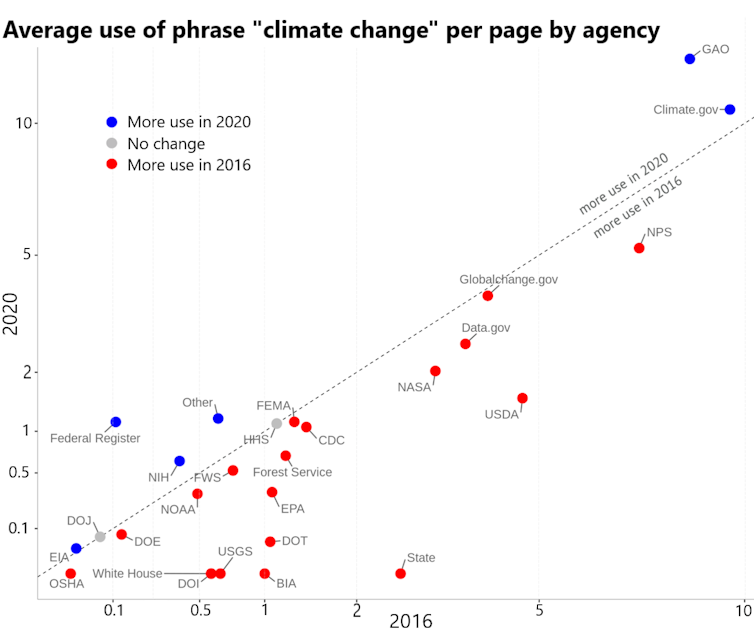 ]
(https://images.theconversation.com/files/648995/original/file-20250213-15-wtlp3y.png?ixlib=rb-4.1.0&q=45&auto=format&w=1000&fit=clip)
Most federal agencies decreased their use of the phrase ‘climate change’ on websites during the first Trump administration, 2017-2020.Eric Nost, et al., 2021, CC BY}:
As of Feb. 13, 2025, we hadn’t seen the destruction of climate science records. Many of these data collection programs, such as those at NOAA or EPA’s Greenhouse Gas Reporting Program, are required by Congress. However, the administration had limited or eliminated access to a lot of data.
Maintaining tools for understanding climate change
We’ve seen a targeted effort to systematically remove tools like dashboards that summarize and visualize the social dimensions of climate change. For instance, the Climate and Economic Justice Screening Tool mapped low-income and other marginalized communities that are expected to experience severe climate changes, such as crop losses and wildfires. The mapping tool was taken offline shortly after Trump’s first set of executive orders.
Most of the original data behind the mapping tool, like the wildfire risk predictions, is still available, but is now harder to find and access. But because the mapping tool was developed as an open-source project, we were able to recreate it.
Preserving websites for the future
In some cases, entire webpages are offline. For instance, the page for the 25-year-old Climate Change Center at the Department of Transportation doesn’t exist anymore. The link just sends visitors back to the department’s homepage.
Other pages have limited access. For instance, EPA hasn’t yet removed its climate change pages, but it has removed “climate change” from its navigation menu, making it harder to find those pages.
:{[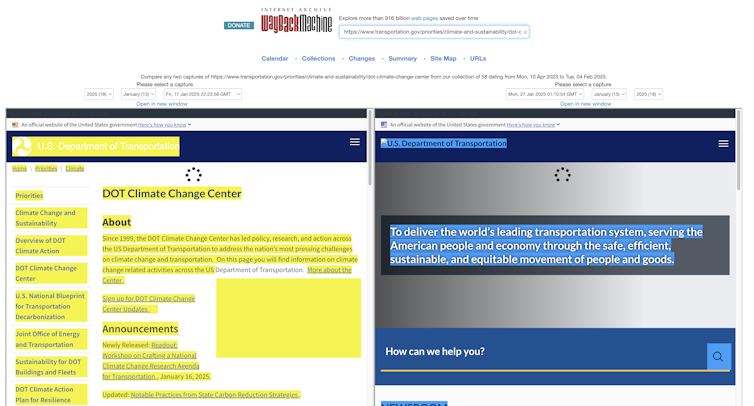 ]
(https://images.theconversation.com/files/648951/original/file-20250213-15-qbqprp.png?ixlib=rb-4.1.0&q=45&auto=format&w=1000&fit=clip)During Donald Trump’s first week back in office, the Department of Transportation removed its Climate Change Center webpage.Internet Archive Wayback Machine}:
Fortunately, our partners at the End of Term Web Archive have captured snapshots of millions of government webpages and made them accessible through the Internet Archive’s Wayback Machine. The group has done this after each administration since 2008.
If you’re looking at a webpage and you think it should include a discussion of climate change, use the “changes” tool“ in the Wayback Machine to check if the language has been altered over time, or navigate to the site’s snapshots of the page before Trump’s inauguration.
What you can do
You can also find archived climate and environmental justice datasets and tools on the Public Environmental Data Partners website. Other groups are archiving datasets linked in the Data.gov data portal and making them findable in other locations.
Individual researchers are also uploading datasets in searchable repositories like OSF, run by the Center for Open Science.
If you are worried that certain data currently still available might disappear, consult this checklist from MIT Libraries. It provides steps for how you can help safeguard federal data.
Narrowing the knowledge sphere
What’s unclear is how far the administration will push its attempts to remove, block or hide climate data and science, and how successful it will be.
Already, a federal district court judge has ruled that the Centers for Disease Control and Prevention’s removal of access to public health resources that doctors rely on was harmful and arbitrary. These were put back online thanks to that ruling.
We worry that more data and information removals will narrow public understanding of climate change, leaving people, communities and economies unprepared and at greater risk. While data archiving efforts can stem the tide of removals to some extent, there is no replacement for the government research infrastructures that produce and share climate data.
Eric Nost, Associate Professor of Geography, University of Guelph and Alejandro Paz, Energy and Environment Librarian, Massachusetts Institute of Technology (MIT)
===
RWW
02/14/2025
by
- Charisma Madarang @ Rolling Stone: Trump Appointee Quits Instead of Dropping Eric Adams Charges, Alleges Quid Pro Quo
After New York City Mayor Eric Adams was indicted on federal criminal charges in September, the man soon embraced Donald Trump in an overt attempt to get the president to overturn his case. As Manhattan federal prosecutors readied to bring the bombshell indictment charging the mayor with destroying evidence and instructing people to lie to the FBI, Trump’s Justice Department issued an order to drop the case, a letter obtained by The New York Times reveals.
- Edith Olmsted @ The New Republic: Trump’s Border Czar Openly Threatens Eric Adams Over Dropped Charges
The Department of Justice allegedly dropped the charges against Adams in exchange for his cooperation in Donald Trump’s immigration plans.
- Amanda Marcotte @ Salon: "What the Lord established": Elon Musk is camouflaging a Christian nationalist takeover
Project 2025 was clear: First, purge federal workers. Then replace them with theocrats and fanatics.
- [Alec MacGillis @ ProPublica](https://www.propublica.org/article/january-6-erasure-doj-database-trump-history "(opens in a new window)"): Memory-Holing Jan. 6: What Happens When You Try to Make History Vanish?
The Trump administration’s decision to delete a DOJ database of cases against Capitol riot defendants places those who seek to preserve the historical record in direct opposition to their own government.
- Alex Griffing @ Mediaite: Pete Hegseth Reportedly Invited Conspiracy Theorist Who Vowed to ‘Overthrow’ Democracy On First Overseas Trip
Secretary of Defense Pete Hegseth invited conspiracy theorist Jack Posobiec to travel with him on his first overseas trip this week to visit European allies, scooped the Washington Post on Thursday.
- Dean Narciso @ The Columbus Dispatch: Ex-members decry New Albany's Faith Life Church's fundraising focus amid sex abuse case
Faith Life Church began as a small basement Bible study 30 years ago led by founders Gary and Drenda Keesee. It opened its New Albany megachurch in 2008, according to the Faith Life website. It is now part of a criminal investigation into accusations of sexual abuse.
---
---
an 2 25
The National Security Agency (NSA), a largely clandestine global intelligence-gathering and counterintelligence organization that “prevents and eradicates threats to U.S. national security systems,” is reportedly undergoing a massive “purge” on its public and private websites and internal network, eliminating any site that contains any of a list of 27 words — despite possibly including mission-related work. The operation is an effort to comply with President Donald Trump’s order to eliminate any so-called “DEI” programs or language.
Trump has called DEI — diversity, equity, and inclusion — “illegal,” and in his January 21 executive order alleged that DEI “policies not only violate the text and spirit of our longstanding Federal civil-rights laws, they also undermine our national unity, as they deny, discredit, and undermine the traditional American values of hard work, excellence, and individual achievement in favor of an unlawful, corrosive, and pernicious identity-based spoils system. Hardworking Americans who deserve a shot at the American Dream should not be stigmatized, demeaned, or shut out of opportunities because of their race or sex.”
According to Popular Information, on Monday the NSA, which is under the U.S. Department of Defense, “is planning a ‘Big Delete’ of websites and internal network content that contain any of 27 banned words, including ‘privilege,’ ‘bias,’ and ‘inclusion.’ The ‘Big Delete,’ according to an NSA source and internal correspondence reviewed by Popular Information, is creating unintended consequences.
READ MORE: ‘Stomach Turning’: Trump Defends His J6 Pardons as ‘Great for Humanity’
Popular Information’s Judd Legum and Rebecca Crosby report that “the dragnet is taking down ‘mission-related’ work. According to the NSA source, who spoke on the condition of anonymity because they are not authorized to speak to the media, the process is ‘very chaotic,’ but is plowing ahead anyway.”
A memo announcing the 27 banned words “acknowledges that the list includes many terms that are used by the NSA in contexts that have nothing to do with DEI. For example, the term ‘privilege is used by the NSA in the context of ‘privilege escalation.’ In the intelligence world, privilege escalation refers to ‘techniques that adversaries use to gain higher-level permissions on a system or network.'”
Efforts to comply with Trump’s anti-DEI orders are not limited to the NSA.
“Since Trump took office, thousands of web pages across various federal agencies have been altered or removed entirely. Federal agencies have taken down or edited resources about HIV, contraceptives, LGBTQ+ health, abortion, and climate change. Some web pages have later come back online ‘without clarity on what had been changed or removed.” Popular Information also reported.
“An analysis by the Washington Post of 8,000 federal web pages ‘found 662 examples of deletions and additions’ since Trump took office. The analysis found that words like diversity, equity, and inclusion were removed at least 231 times from the websites of federal agencies, including the Department of Labor, the Department of Education, the Department of Health and Human Services, and the Department of Transportation.”
READ MORE: ‘People Are Really Angry’: Fury Over Musk and DOGE Triggers Spike in Calls to Congress
A quick search of the NSA’s public website for the word “transgender” came up with only one hit, a page titled, “50 Years of Pride: Celebrating NSA’s Committment {sic] to Promoting Respect, Individuality, Diversity, and Equality.” That link led to an error page that stated: “The page you are looking for might have been moved, renamed, or may be temporarily unavailable.”
But a search for pages with the words “Diversity,” “Privilege,” and “Pronouns” resulted in numerous positive hits.
Legum posted the list of 27 banned words to social media. They include, Anti-Racism, Racism, Allyship, Bias, DEI, Diversity, Confirmation Bias, Equity, Feminism, Gender, Gender Identity Inclusion, Inclusive, and All-Inclusive, among others.
===
---
AN 2 25 MEM HOLE PRO PUB
on Jan. 10, the U.S. Department of Justice released a 123-page report on the 1921 racial massacre in Tulsa, Oklahoma, which claimed several hundred lives and left the thriving Black neighborhood of Greenwood in smoldering ruins. The department’s investigation determined that the attack was “so systematic and coordinated that it transcended mere mob violence.” While it conceded that “no avenue of prosecution now exists for these crimes,” the department hailed the findings as the “federal government’s first thorough reckoning with this devastating event,” which “officially acknowledges, illuminates, and preserves for history the horrible ordeals of the massacre’s victims.”}:
“Until this day, the Justice Department has not spoken publicly about the race massacre or officially accounted for the horrific events that transpired in Tulsa,” said Kristen Clarke, the assistant attorney general for civil rights, in announcing the report. “This report breaks that silence through a rigorous examination and a full accounting of one of the darkest episodes of our nation’s past. This report reflects our commitment to the pursuit of justice and truth, even in the face of insurmountable obstacles.”
Only two weeks later, the department took a strikingly different action regarding the historical record of a violent riot: It removed from its website the searchable database of all cases stemming from the Jan. 6, 2021, assault on the Capitol that were prosecuted by the U.S. attorney for the District of Columbia.
These jarringly discordant actions were, of course, separated by a transfer of power: the inauguration of President Donald Trump, who swiftly moved to issue pardons, commute prison sentences and request case dismissals for all of the 1,500-plus people charged with crimes on Jan. 6, including seditious conspiracy and assaulting police officers. That sweeping clemency order — “Fuck it, release ’em all,” Trump said, according to Axios — prompted a wave of outrage, and criticism even from some Republicans. “I’ve always said that when you pardon people who attack police officers, you’re sending the wrong signal to the public at large,” said South Carolina Sen. Lindsey Graham.
The removal of the database happened more quietly, but it is worthy of notice in its own right. It signals the Trump administration’s intention to not only spare the president’s supporters any further consequences for their role in the riot, but to erase the event from the record — to cast it into the fog of confusion and forgetting in which the Greenwood massacre had existed for so long.
As some have noted, this push to whitewash recent history carries a disconcerting echo of countless autocratic regimes, from the Chinese Communist Party’s memory-holing of the Tiananmen Square massacre to the Argentine military junta’s “disappearing” of dissidents in the 1970s. It comes at the same time as the administration is also seeking to whitewash the teaching of American history, more generally: Trump issued an executive order on Jan. 29 titled “Ending Radical Indoctrination in K-12 Schooling” that threatens to withhold federal funds from schools that teach that the country is “fundamentally racist, sexist or otherwise discriminatory” and instructs the government to “prioritize federal resources, consistent with applicable law, to promote patriotic education.” One wonders: Would teaching the Tulsa massacre be allowed?
But the removal of the database is troubling for another reason, too: It undermines our ability to consider the events of Jan. 6 in all their complexity and particularity.
I was made aware of that complexity when I spent several days after the riot immersing myself in the more than 500 smartphone videos that participants had shared on the Parler social-media app, for an essay accompanying ProPublica’s compilation of the video trove. What struck me perhaps more than anything else about the videos was the sheer diversity of the motivations, profiles and actions that they put on display. Yes, seen from afar, the mob seemed to assume the unity of purpose of a single, organized mass bent on destruction.
:{But seen in the close-up of the videos, heterogeneity emerged. There were young women with puffy jackets and pompom hats, middle-aged women who could have been coming straight from a business lunch, young men furtively removing their black tactical gear under the cover of a tree to pull on red MAGA sweatshirts to pass as mere Trump supporters.
There were people viciously attacking police officers and denigrating them (“You should be ashamed, fucking pansies”), others pleading with them not to (“Do not throw shit at the police!” “Do not hurt the cops!”) and still others thanking the cops who were arriving on the scene (“Back the blue! We love you!”). There were people smashing in windows and others decrying them for doing so (“Oh, God no. Stop! Stop!” “What the fuck is wrong with him?” “He’s Antifa!”) There were people who, in a matter of moments, swung from being pitchfork-carrying marauders to wide-eyed tourists, as they deferentially asked a Capitol police officer for directions or swung their cameras up to capture the inside of the dome. (“This is the state Capitol,” an awestruck man says to his young female companion.)}:
...
Memory-holing Jan. 6: What happens when you try to make history vanish? - Alternet.org
This was the great, necessary undertaking of the four-year effort by the Department of Justice: to draw distinctions for the sake of allocating individual accountability. By poring over countless such videos and other evidence, investigators zeroed in on the hundreds of people who could be identified as engaging in and instigating the most violence. There was Daniel Rodriguez, who could be seen on camera driving a stun gun into the neck of Officer Michael Fanone; he was sentenced to more than 12 years. There was Thomas Webster, a former New York City police officer and member of the Marine Corps who swung a metal flagpole at an officer; he got 10 years. There was Peter Schwartz, a Pennsylvania welder who attacked the police with a chair and chemical spray; he got 14 years.
Inevitably, some of the outcomes were ripe for second-guessing. Kerstin Kohlenberg, the former U.S. correspondent for Germany’s Die Zeit newspaper, reported recently on the case of Stephen Randolph, a 34-year-old Kentucky man who received an eight-year sentence for his role in pushing over one of the metal security barriers on the Capitol grounds, injuring a police officer in the process; others in the same group received much milder sentences. Trump and his allies could have chosen to comb through cases and pardon only the defendants who they could argue had been painted with too broad a brush.
But that’s not what Trump did. Instead, he himself took up the broadest brush possible and wiped it all clear. In doing so, he let the defendants off the hook. But in another sense, with the mass pardon and deletion of the database, he deprived all of the Jan. 6 participants of individual agency, of individuality, period. In a sense, he rendered them just what the most ardent castigation on the other side had cast them as from the outset: a mindless mob.
As chance has it, at the end of Trump’s first week in office, I was in Tulsa. I went to the Greenwood Rising museum, which tells the story of the rise of the neighborhood and its sudden destruction. It is a powerful presentation despite the dearth of documentation of the violence: snatches of oral history from survivors play over a video simulation of gunfire and arson; before and after photos capture the near-total obliteration of the neighborhood’s prospering commercial core by first the attack and later urban renewal.
One of the museum’s central preoccupations is the attempt by Tulsa authorities and leading white denizens to downplay the massacre, by framing it as a “Negro uprising”; only a couple decades afterward, the museum notes, many in Tulsa were barely aware it happened at all. This cover-up came with lasting consequences for Greenwood survivors, who were denied insurance claims for their destroyed homes, not to mention any form of civic restitution.
Even now, many Black residents of Tulsa are left wondering why the reckoning represented by the Department of Justice investigation is not joined by substantive reparations of any sort. The last two living survivors of the massacre, Lessie Benningfield Randle and Viola Fletcher, said in a statement responding to the report, “The DOJ confirms the government’s role in the slaughter of our Greenwood neighbors but refuses to hold the institutions accountable under federal law.” Still, they said, “We are relieved to see one of the biggest coverups in American history come crashing down.”
And now, back in Washington, the federal government has embarked on an entirely new cover-up of another day of enormous violence. The erasure will not be nearly as successful this time around. There are, after all, all those videos, which live on ProPublica’s website, among other places, while much of the deleted database can be found on the Internet Archive’s Wayback Machine. (And ProPublica is one of 10 media organizations that have jointly sued the federal government, seeking to obtain 14,000 hours of Jan. 6 surveillance footage.)
But for the time being, at least, those seeking to preserve the record of one of the darkest days in recent U.S. history will be doing so, like the survivors of Greenwood and other outbursts of violence around the world, in direct opposition to their own government.
Alex Mierjeski and Agnel Philip contributed research.
===