Global Warming Legislation
NOTE that this includes bills that help and hurt global warming
and other green issues
120 bak
---
TRADE GROUPS KEY IN BEATING CLIMATE BILLS? EG LIEBERMAN-MARKEY 2008
Case Study: Koch Organizations Instrumental in Dissemination of ACCF/NAM Claims
The Koch web is playing a role in promoting studies that exaggerate the costs of climate policy. In 2008, the Koch-web-funded American Council on Capital Formation (ACCF) teamed up with the National Association of Manufacturers (NAM) to sponsor and disseminate a study of the economic impact of the Lieberman-Warner Climate Security Act. Every step of the way, Koch-funded anti-clean energy groups played a key role in moving the NAM/ACCF study in the media and at the grassroots level.
- ACCF funded and co-released the study withNAM.
- ACCF disseminated the results in presentations at over a dozen "Climate Dialogues" organized by the U.S. Chamber's Alliance for Energy and Economic Growth (AEEG). ALSO API
- The AEEG "climate dialogues" involved other organizations funded through the Koch web, including:
- The Heritage Foundation which provided speakers for some events;
- Frontiers of Freedom staff and scholars participated in some of the dialogues.
https://www.ucsusa.org/about/news/fossil-fuel-new-evidence-sb-1161
New Evidence of Fossil Fuel Industry Climate Science Deception Underscores Need for SB 1161 (Allen), “California Climate Science Truth and Accountability Act”
Statement by Adrienne Alvord, California and Western States Director, Union of Concerned Scientists
Published Apr 13, 2016
OAKLAND, Calif. (April 13, 2016)— A trove of documents released today by the Center for International Environmental Law (CIEL) reveals that the oil industry was well aware of the potential climate risks of fossil fuels decades earlier than was widely believed. The uncovered industry communications, scientific papers and oral histories demonstrate that the petroleum industry was conducting climate research as early as 1957 and knew about the potential for catastrophic climate risks by 1968 at the latest.
The documents include a 1957 study, “Radiocarbon Evidence on the Dilution of Atmospheric and Oceanic Carbon by Carbon from Fossil Fuels,” published by scientists working for Humble Oil, a precursor of ExxonMobil. The study looked at how carbon dioxide from fossil fuel combustion accumulates in the atmosphere and oceans and indicates that scientists affiliated with the fossil fuel industry were not just aware of what happens to the climate when we burn fossil fuels, but were at the leading edge of our understanding of it.
Below is a statement by Adrienne Alvord, California and Western States Director, Union of Concerned Scientists:
“It is shocking and disheartening to see that the fossil fuel industry apparently had knowledge of climate risks from the burning of fossil fuels even earlier than previously believed. Their subsequent public deception campaign in the interest of profit has led to confusion and uncertainty about the consequences of burning oil, gas and coal.
Meanwhile, concentrations of greenhouse gases have doubled over the past three decades, exacerbating the costly, damaging effects of climate change that California already is experiencing. The California Climate Science Truth and Accountability Act would help ensure that California can hold fossil fuel companies fully accountable for their decades of deception and the damages they have caused to public health, property and the environment in California. We need to ensure that fossil fuel companies won’t be let off the hook for their decades-long campaign of intentional deception about the harmful effects of their products.”
==
https://blog.ucsusa.org/jason-barbose/climate-science-truth-and-accountability-act-sb-1161
Five Reasons to Pass the Climate Science Truth and Accountability Act (SB 1161)
JASON BARBOSE, WESTERN STATES POLICY MANAGER | MARCH 29, 2016,
Sometimes the truth hurts. And when it does, it can be tempting to try to cover up the facts. But ultimately it’s better to face them honestly because eventually the facts catch up to you. While I learned that lesson a long time ago, the fossil fuel industry seemingly has not.
After all, they have spent millions over decades to convince the public that consumption of their product would not lead to dire consequences for the planet. To date, they have yet to fully reckon with that, but I’m hopeful that the truth is catching up to the fossil fuel industry and 2016 will be a turning point.
This year there is an opportunity for the California Legislature to help redress this long-standing deception by passing the Climate Science Truth and Accountability Act of 2016 (SB 1161). This legislation, authored by Senator Ben Allen (D-Santa Monica) and sponsored by the Union of Concerned Scientists, help law enforcement hold fossil fuel companies accountable for their actions. Specifically, it would extend the statute of limitations of California’s Unfair Competition Law to 30 years for deceptive behavior relating to the scientific evidence of climate change.
Why should the California legislature pass this bill? Here are my top five reasons:
1) Some fossil fuel companies have long known about the risks of climate change.
Recent reports by Inside Climate News and the Los Angeles Times show that by the 1980s the fossil fuel industry was well aware of the emerging scientific consensus that emissions from the burning of fossil fuels were increasing global temperature.
In fact, many companies engaged in their own climate change research and shared some of this research with others in the industry. Exxon’s own climate scientists, for example, conducted cutting-edge climate change research in the late 1970s and early 1980s.
There is also evidence that companies began factoring projected climate change into their own business decisions and operations, such as designing new infrastructure to withstand rising sea levels and increased storm severity. In short, fossil fuel companies have long known about the risks and likely consequences of processing and burning their products.
2) The fossil fuel industry has spent decades deceiving the public about the science of climate change.
The realization that use of your company’s product (i.e., oil, gas and coal) as intended (i.e., burning it) is affecting life on earth in profound and potentially catastrophic ways for centuries to come (i.e., climate change) is about as hard a truth a corporation can be forced to face.
But that is exactly what confronted fossil fuel companies as the science of global warming was gaining wide recognition in the scientific community and making front-page headlines in the late 1980s and the broader public began to seriously consider whether, and how, to respond to climate change.
Here is where things get ugly: rather than owning up to the scientific reality of global warming, fossil fuel companies decided to develop and participate in a concerted campaign to sow confusion in the public about the scientific evidence linking fossil fuel emissions to rising global temperatures.
How do we know? UCS scoured collections of internal company and trade association documents that have been leaked to the public, come to light through lawsuits, or been disclosed through Freedom of Information Act requests and complied a report on our findings called The Climate Deception Dossiers.
In the report we describe, for example, a memo leaked to the New York Times that shows how the American Petroleum Institute—the country’s largest oil trade association whose member companies include BP, Chevron, ConocoPhillips, ExxonMobil, and Shell—convened a team in 1998 to create a public communications plan with the goal of convincing average citizens that the realities of climate science were uncertain. Other examples are in plain sight, such as a series of newspaper ads that Exxon ran in the late 1990s and early 2000s that overemphasized the scientific uncertainties of climate change.

3) There are real costs to fossil fuel industry deception.
Since 1988—around the time that fossil fuel companies began to systematically undermine the public’s understanding of the scientific evidence of global warming—743 gigatons of carbon dioxide have been emitted to the atmosphere. This represents more than half of all industrial carbon pollution emitted over the last 250 years.
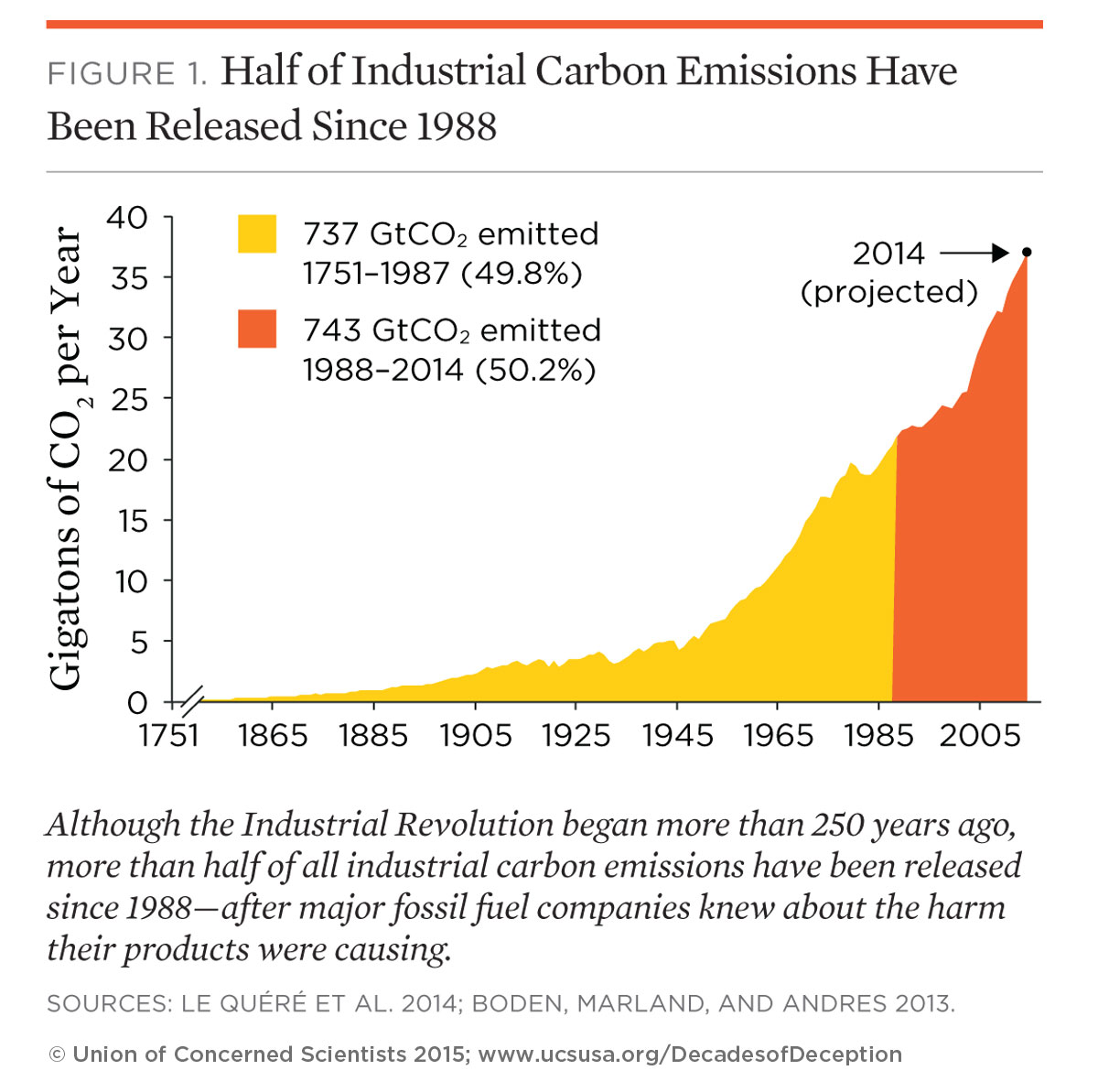
Imagine an alternate world where fossil fuel companies had faced the facts of climate change head on and invested heavily in transforming themselves to provide low carbon sources of energy, leaving most of the fossil fuels consumed over the last two decades in the ground. We would live in a world with a far safer climate and Californians would face fewer threats from wildfires, drought, heat waves, and coastal flooding.
4) Deceiving the public is morally wrong.
Most of us expect businesses to look out for their bottom lines ahead of the public good. But there are limits to acceptable corporate behavior, and there is a difference between being amoral and immoral.
By constructing a decades-long campaign to misinform the public about the scientific realities of climate change, the fossil fuel industry crossed a moral Rubicon. By lying to the public, the industry has distorted the truth, denying the public a complete picture of the risks associated with using their products.
Many others have recognized the fundamental impropriety of this behavior as well. Most recently, the Rockefeller Family Fund announced its intent to divest from fossil fuels, citing ExxonMobil’s “morally reprehensible conduct” to confuse the public about climate change. This action is all the more notable given that John D Rockefeller Sr. was a co-founder of Standard Oil, a precursor to ExxonMobil. And a ruling last week by federal regulators cleared the way for ExxonMobil shareholders to grapple for the first time with the moral and justice implications of climate change as it relates to the company’s business.
There should be consequences any time a company lies to the public, but particularly for deceiving the public systematically for decades about an issue as serious and consequential as global warming. This legislation is an important way to hold them accountable.
5) A movement is building. California can stay at the forefront.
If you have been following this issue in the news, then you know that a movement is building to more fully uncover the truth about the fossil fuel industry’s decades-long effort to deny and deceive the public about climate change—and to hold these companies accountable for their actions.
Following the release of Inside Climate News’ eight-month investigation of Exxon and new reporting from the Los Angeles Times, New York Attorney General Eric Schneiderman announced in November that his office was beginning an investigation of ExxonMobil to determine whether the company lied to the public and shareholders. This was quickly followed in January with reports that California Attorney General Kamala Harris was beginning to investigate ExxonMobil as well.
While attention to ExxonMobil’s history of misdeeds is welcome, it is important to remember that they were not alone in fomenting disinformation about climate change—and that the campaign of deception continues today. In light of the evidence that has emerged so far, California congressman Ted Lieu has requested the U.S. Attorney General to launch investigations of both Shell and ExxonMobil.
Whether these companies have actually broken the law is something for the courts to decide—SB 1161 is not making that judgment. What SB 1161 is doing is giving law enforcement the opportunity to ensure that justice is served for the full weight of any violations that may have been committed.
Wherever these investigations lead, it is important that the California legislature—and by extension, the people of California—signal their intent to hold the fossil fuel industry accountable for its many decades of spreading disinformation.
Learn more:
- Background Information on Fossil Fuel Industry Climate Science Deception (PDF)
- Background Information on Climate Change and Costly Damages in California:(style="background-color:#ffcc66ff"):}::{ (PDF)
Update (April 1, 4:15pm):A previous version of this post incorrectly stated that the bill would “give explicit authority to public prosecutors” to bring actions against those who have deceived with regards to climate change. The post has been updated to reflect the fact that the bill only extends the time period for bringing such actions based on existing law. The post also used the word “crimes,” but this is not a criminal statute. Instead, it is related to violations of California’s Unfair Competition Law, which is a civil statute.
Posted in: Global Warming Tags: California, Climate Science Truth and Accountability Act
==
https://www.exposedbycmd.org/2020/01/23/koch-spends-more-2019-stop-action-climate
don w
This week Koch Industries, the parent of the conglomerate owned by Charles Koch, reported it spent almost $11 million on lobbying the U.S. Congress in 2019, up ten percent from its spending in 2018.
Koch lobbied against Democratic initiatives on a “Green New Deal,” and against other renewable energy legislation and donor transparency, while continuing to lobby for eliminating the tax credit for electric cars, a trade agreement with Mexico and Canada, and limits on the President’s ability to levy tariffs, duties and other trade measures.
While lobbying reports to the Congress do not show how much time or money is spent on different issues, it is clear from the number of mentions on Koch’s lobbying report that taking the U.S. out of the Paris climate accord continued to be a priority.
The Climate Action Now Act, H.R. 9, which passed the U.S. House by Democrats, would prevent federal funds from being used to leave the climate treaty. Koch opposes the bill. In November of last year, Trump initiated the process to remove the U.S. from the accord.
Koch also fought against H.R. 330, the Climate Solutions Act of 2019, which has not yet passed the House, that would require the U.S. to “increase the percentage of electricity sold in the United States that is generated from renewable sources” to 100 percent by 2035.
With the Fairness for Drivers Act of 2019, introduced in the U.S. Senate as S. 343 Koch continues to oppose electric plug-in vehicles or vehicles using renewable resources, such as fuel cells. The bill, which will see no action in the House as long as it is controlled by Democrats, would eliminate the tax credit for electric plug-in vehicles, as well as impose a tax on vehicles using renewable energy.
On the flip side, Koch opposed H.R. 2256, the Driving America Forward Act, which would expand tax credits for plug-in electric vehicles and fuel cell vehicles. The bill has 138 co-sponsors, not surprisingly all Democrats, and none receiving any money from Koch Industries’ political action committee, KochPAC.
On the other hand, all four of the House Democrats that have received contributions from KochPAC for the last three election cycles have not co-sponsored the bill: Collin Peterson (MN), Henry Cuellar (TX), Jim Costa (CA), and Kurt Schrader (OR).
As already reported by the Center for Media and Democracy (CMD), Koch also spent money trying to pass H.R. 531, which would repeal the Corporate Average Fuel Economy, or CAFE, fuel efficiency standards for cars and light trucks first set by Congress in 1975. The bill was introduced in the House, where it is blocked by Democrats, by Rep. Roger Williams (R-Texas). Williams has received $16,000 since 2014 from KochPAC and close to $1 million from the oil and gas industry during his career in Congress, according to the Center for Responsive Politics.
Koch continues to oppose a carbon pricing tax as well, last year in the form of opposition to H.R. 763, the Energy Innovation and Carbon Dividend Act of 2019. Koch’s lobbying against the bill was reinforced by a group sign-on campaign led by Grover Norquist’s Americans for Tax Reform, which has received money from front groups created by Koch and foundations controlled by Charles Koch.
Saying that a carbon tax “increases the power, cost, and intrusiveness of the government in our lives,” the letter was signed by 75 groups, many of which receive funding from Koch or the Koch-preferred funding vehicle, DonorsTrust, such as the Capital Research Center, 60 Plus Association, American Legislative Exchange Council, and state affiliates of the right-wing State Policy Network (SPN).
In 2019, as in decades past, Koch supported anything that maintains a reliance by the U.S. on oil and gas, and fought against any renewable energy or energy efficiency measure that would threaten its profits as the country’s tenth largest oil refiner, as well as one of the largest owners of oil and gas reserves and pipelines.
==
https://www.c2es.org/content/congress-climate-history/
Congress has debated climate change for nearly 30 years with varying results. Laws and congressionally approved funding have led to new programs to reduce emissions and incentives to speed the deployment of clean energy. Other efforts to address climate change more holistically, including by using market-based approaches, have not advanced.
Some major milestones on climate in Congress include:
1992: Senate approves U.N. Framework Convention on Climate Change. The process of designing a global agreement to tackle climate change began in the early 1990s. In 1992, President George H.W. Bush signed the United Nations Framework Convention on Climate Change (UNFCCC), which committed all nations to take action and laid the foundation for future agreements. At the time, President Bush declared, “The United States fully intends to be the world’s pre-eminent leader in protecting the global environment.” The U.S. Senate gave its advice and consent to the treaty in October 1992.
1992: Renewable energy gets a boost. To help support the fledgling wind industry, Sen. Chuck Grassley (R-IA) added the renewable energy production tax credit to the 1992 Energy Policy Act, which has been critical in the rapid expansion of the wind energy industry. The tax credit has been extended in short stints – with occasional lapses – since then. An investment tax credit for solar energy installations was later added to the tax code through the Energy Policy Act of 2005.
1997: Senate pre-empts Kyoto Protocol. In June 1997, six months ahead of a U.N. climate conference in Kyoto, Japan, the Senate adopted a nonbinding resolution introduced by Senator Robert C. Byrd (D-WV), with Sen. Chuck Hagel (R-NE) and 44 other cosponsors, stating that the United States should not enter into any international climate agreement that did not include comparable emissions commitments by developing countries or that “would result in serious harm to the economy of the United States…” The Clinton Administration proceeded to negotiate and sign the Kyoto Protocol, which set emission targets for developed countries only. But the agreement was never submitted to the Senate for advice and consent, and in 2001, President George W. Bush declared that the United States would not join it.
2003-2007: Bipartisan bills in the Senate. By the 108th Congress (2003-2004) significant bipartisan efforts to reduce U.S. greenhouse gas emissions started to gain traction. Among other bills in 2003, Sen.John McCain (R-AZ) and Sen. Joe Lieberman (D-CT) offered The Climate Stewardship Act of 2003 to institute a cap-and-trade program to reduce emissions from electricity, manufacturing, commercial, and transportation sectors of the economy (representing 85 percent of U.S. emissions). The bill had a House companion and was reintroduced in the 109th and 110th Congresses.
2007: [b2?!] Congress mandates emissions reporting. As part of the Fiscal Year 2008 Consolidated Appropriations Act, signed into law in 2007, the U.S. Environmental Protection Agency (EPA) was ordered to publish a rule requiring public reporting of greenhouse gas emissions from large sources. The Greenhouse Gas Reporting Program database provides comprehensive nationwide greenhouse gas emissions data (electric power companies were already reporting their carbon dioxide emissions under the Clean Air Act Amendments of 1990). Over 40 source categories are now covered by the reporting program.
2008-2010: Cap-and-trade legislation passes the House. Shortly after being elected, President-elect Barack Obama declared a comprehensive climate and energy bill among his top legislative priorities. The U.S. House of Representatives passed the American Clean Energy and Security Act of 2009 by a vote of 219 to 212 in June 2009. The legislation, written by Rep. Henry Waxman (D-CA) and Rep. Edward Markey(D-MA), would have established an economy-wide greenhouse gas cap-and-trade system and critical complementary measures. The Senate failed to pass its own comprehensive climate and energy bill, and the measure died.
Other major climate legislation was proposed during this period:
- The American Clean Energy Leadership Act of 2009 would have established a renewable energy standardand addressed several other energy-related issues.
- John Kerry (D-MA), Joseph Lieberman (I-CT), and Lindsey Graham (R-SC)worked outside of the committee process in an attempt to broaden the base of support for climate legislation within the Senate. Kerry and Lieberman released a draft discussion of their American Power Act in May 2010 that would have established a cap-and-trade system for utilities and industry, and a fee for transportation fuels.
- Maria Cantwell (D-WA) and Susan Collins (R-ME) introduced a Carbon Limits and Energy for America’s Renewal Act, which would have capped carbon dioxide emissions while allowing very limited emissions trading, and rebating the revenue from this system directly back to the public on a per capita basis.
- Jeff Bingaman (D-NM) introduced the Clean Energy Standard Act to enact a tradeable energy standard to reduce emissions in the power sector.
- Richard Lugar (R-IN) and Lisa Murkowski (R-AK) introduced the Practical Energy and Climate Plan, intended to reduce oil imports, improve and create new efficiency standards, and establish a clean energy standard.
Senate Majority Leader Harry Reid (D-NV) was expected to combine elements of the climate and energy legislative proposals into a comprehensive climate bill. Citing a lack of bipartisan support in the Senate, however, Reid announced in July 2010 that upcoming energy legislation would not include a cap on greenhouse emissions. This effectively ended action on climate legislation for the 111th Congress.
2012: Shoring up flood protection. Funding the National Flood Insurance Program, established in 1968, is important for the many communities likely to face increased flooding from sea level-rise and more frequent and extreme downpours. In May 2012, Congress passed the National Flood Insurance Program Extension Act reauthorizing the program for five years, ending a series of short-term extensions. The bill was a major step toward actuarial pricing and full accounting of climate risk, ensuring that climate impact projections are factored into future calculations of flood risk. Although the word “climate” does not appear in the text, the bill directed the Federal Emergency Management Agency to use “the best available science regarding future changes in sea levels, precipitation, and intensity of hurricanes” – likely projected impacts of climate change – as it updates flood maps and sets insurance premiums.
2015: Extension/phasedown of renewable energy tax credits. After more than 20 years of regular extensions of the production tax credit for wind power and investment tax credit for solar power, Congress agreed in late 2015 on a multi-year extension and ultimate phase-out of the incentives. The tax credits have been critical in making renewable energy cost-competitive and continue to help reduce carbon emissions from power sector in the absence of federal regulations. The production tax credit will phase out through 2019. The investment tax credit for solar will end in 2021.
2016: Formation of the Climate Solutions Caucus. In February 2016, Rep. Carlos Curbelo (R-FL) and Rep. Ted Deutch (D-FL) launched the bipartisan Climate Solutions Caucus in the House of Representatives. The caucus describes its mission as educating members on “economically-viable options to reduce climate risk and protect our nation’s economy, security, infrastructure, agriculture, water supply and public safety.” The caucus has been adding dozens of members in Republican-Democratic pairs.
American Power Act: Senators Kerry and Lieberman Release ...
https://fedsoc.org › publications › detail › american-power-act-senators-ker...
1.
:{:(style="background-color:#ffffff;"):}:
Kerry-Lieberman climate bill: The details | Grist
https://grist.org › article › kerry-lieberman-climate-bill-the-details › full
1.
Progressives are urging federal lawmakers to pursue a "real solution" to theclimate crisis while House Democrats gear up for a vote this week on a bill to block President Donald Trump from ditching the Paris agreement.
"This action from the House is better than no action at all, but not much better," Food & Water Watch executive director Wenonah Hauter said in a statement Wednesday. "Given all that's known about the severity of the climate crisis we face, and the urgent, aggressive action required to stem it, this legislation is merely symbolic."
The legislation in question, the Climate Action Now Act (H.R. 9), was introduced in late March by Rep. Kathy Castor (D-Fla.).
In June of 2017, Trump vowed to withdraw from the Paris agreement — but he can't officially take action until November of next year.
H.R. 9 would prevent the president from bailing on the accord — which is backed by every other country on the planet — and require his administration to develop a public plan detailing how the U.S. "will achieve an economy-wide target of reducing its greenhouse gas emissions by 26 to 28 percent below its 2005 level by 2025."
Although a primary priority of the bill is keeping the country signed on to the agreement that coordinates global efforts to combat the climate crisis, E&E News reported Wednesday that "during a closed-door caucus meeting yesterday ahead of floor action today on H.R. 9, leaders told the rank and file to focus on the economic benefits of climate action and not 'some international standards.'"
"It's all about unleashing the clean economy here in America," said Castor, who chairs the Select Committee on the Climate Crisis. "That agreement would allow countries to create their own goals — America did and it has already created a wave of green jobs."
The bill's co-sponsors include Speaker Nancy Pelosi (D-Calif.), who created the climate committee late last year, after Democrats took control the House in the midterms. Some progressives criticized the committee as a "weak" response to mounting demands for ambitious action on the scale of scientists' warnings about looming climate catastrophe — and they leveled similar criticism at H.R. 9 this week.
"Simply put, it's the junior varsity bill," RL Miller, chairman of the California Democratic Party's environmental caucus and co-founder of the political action committee Climate Hawks Vote, told Bloomberg. "It's nice but extremely insufficient."
Bloomberg reported Wednesday that "Pelosi is trying to head off her party's restive progressive caucus by invoking the legacy of President Barack Obama to build support for a climate change bill that falls well short of the ambitions of the Green New Deal," a resolution sponsored in the House by Rep. Alexandria Ocasio-Cortez (D-N.Y.).
Ocasio-Cortez told the outlet "there is no harm in passing" H.R. 9, but lawmakers can't stop there. "The idea that we can just reintroduce 2009 policies is not reflective of action that is necessary for now in the world of today," she said, reiterating the need for a Green New Deal.
The resolution that Ocasio-Cortez unveiled in February with Sen. Ed Markey (D-Mass.) calls for transitioning the American energy system away from fossil fuels to 100 percent renewable sources over a decade, creating millions of green jobs, and providing for vulnerable communities impacted by the climate crisis.
The Green New Deal, backed by a youth-led grassroots movement, goes beyond the goals of the Paris agreement and more closely aligns with the demands of scientists and climate campaigners.
"The latest science is clear: In order to adequately address deepening climate chaos, we must transition completely to clean, renewable energy generation in little more than a decade," said Food & Water Watch's Hauter. "The terms of the Paris accord aren't low-hanging fruit, they're fruit that has fallen to the ground and begun to rot."
The House kicked off debate on H.R. 9 Wednesday, and is expected to pass the bill as early as Thursday. However, the Republican-controlled Senate is unlikely to send the legislation to Trump's desk — and even if it does, the White House already issued a veto threat.
Despite the bill's legislative barriers and the Paris agreement's limitations, as Alden Meyer wrote for the Union of Concerned Scientists Tuesday, the House's upcoming vote "will provide some hope to international observers that the United States may soon return to the fold of countries committed to climate action."
But symbolic gestures aren't enough for Hauter, who called on lawmakers to actually address the problem.
"Any meaningful response from Congress to the climate crisis we face must include a quick halt to new fossil fuel development, including bans on oil and gas exports, and drilling and fracking on federal lands," she said. "Anything less cannot be considered part of a real solution."
...
==
==
4/16
==
https://www.commondreams.org/news/2019/03/27/what-climate-leadership-looks-democrats-bill-would-stop-trump-ditching-paris-accord
House Democrats Wednesday introduced legislation to bar President Donald Trump from ditching the Paris climate accord and force the White House to submit a plan to slash carbon emissions, drawing praise from environmental groups.
"Donald Trump's attempt to withdraw the United States from this landmark agreement is one of his most egregious steps to weaken our country's international standing."
—Michael Brune, Sierra Club
"The Climate Action Now Act sends a powerful message to the rest of the world that when it comes to climate change and the Paris agreement, President Trump is out of step with the strong majority of Americans who want the U.S. to be a global leader, not a rogue nation," Alden Meyer, director of strategy and policy at the Union of Concerned Scientists, said in a statement.
The bill (pdf), also known as H.R. 9, comes nearly two years after Trump sparked global outrage by declaring his intent to withdraw from the Paris deal. Under the terms of the agreement, the earliest possible withdrawal date is November 4, 2020.
If passed, the Democrats' legislation would block Trump from using federal funds to pull the U.S. from the Paris deal and require the president to develop a plan to meet the accord's emissions targets.
The bill was unveiled at a press conference Wednesday byHouse Speaker Nancy Pelosi (D-Calif.), Rep. Kathy Castor (D-Fla.), Rep. Frank Pallone (D-N.J.), and other House Democrats...
==
https://www.ecowatch.com/biggest-attack-marine-mammals-2509135255.html
Congress: Biggest Attack on Marine Mammals in Decades
By Michael Jasny
On Thursday, the House Natural Resources Committee passed a bill, called the "SECURE American Energy Act" (H.R. 4239), that can only be described as an oil industry wish-list. The bill's purpose is to mow down environmental concerns that stand in the way of the complete exploitation of fossil fuels in this country. For the oceans, this would mean an end to national monument designation and to some of those pesky safety regulations that were put in place after the Deepwater spill, among other things. And although it hasn't received much attention—yet—one late addition to the bill targets marine mammals in a very big way.
H.R. 4239 would eviscerate one of the core provisions of the Marine Mammal Protection Act (MMPA), the law that for more than 45 years has been the bulwark of conservation for many of our most iconic ocean species. The Protection Act works by placing safeguards on human activities, like offshore oil exploration, that harm whales, dolphins and other marine mammals. Simply put, H.R. 4239 would gut a whole lot of those safeguards.
What would this mean for marine mammal protection? For starters:
- H.R. 4239 would allow industry to harm huge numbers of marine mammals, by killing the safeguard limiting its impacts to "small numbers."
- It would eliminate the requirement that activities have the "least practicable impact" on marine mammals, allowing industry to proceed without attempting to minimize harm.
- It would prevent the wildlife agencies from requiring industry to monitor the long-term consequences of its actions.
- It would establish an impossibly short timeline for the wildlife agencies to review industry activities for their marine mammal impacts, and automatically permit those activities if the agencies fail to meet it.
- And, having turned much of our marine mammal law into a dead letter, it would exempt industry from having to comply with Endangered Species Act protections for marine mammals as well.
Destroying the Marine Mammal Protection Act would pave the way for seismic blasting—the first big step in oil and gas development—off the East Coast. As my colleagues and I have written, the industry's blasting is known to seriously compromise marine life from zooplankton to fish to the great baleen whales, and scientists have warned of "significant, long-lasting and widespread impacts" on entire species and populations if the oil industry gets the green light. Blasting the Atlantic is broadly opposed by more than 120 coastal communities from southern New Jersey to Florida, by more than 40,000 coastal businesses, by fishing associations, Chambers of Commerce, and more. But the oil industry doesn't care what the coast thinks.
Nor, of course, does it care about the love that people in this country have for whales and other marine mammals. In a recent poll, some 76 percent of Americans said they want to protect marine mammals from threats, including from offshore oil and gas exploration, and 73 percent said they support the Marine Mammal Protection Act. When the Committee released its bill, there was no mention of its bid to gut the Act in its press release, and that's not surprising. If I were them, I wouldn't want to let folks know what I was doing here either.
The "SECURE American Energy Act" (H.R. 4239) may come to a vote on the House floor this week. Please demand that your representatives strongly oppose this legislation and its attack on marine mammals. You can sign our petition here; and you can go here to find the office number of your Congressional representative and give them a call.
==
tool
http://www.outdooralliance.org/legislative-tracking/
==
random update related issues: On September 27, 2017, the EPW committee held a hearing on “Forest Management to Mitigate Wildfires: Legislative Solutions.” The hearing examined three pieces of legislation: S. 605, the Litigation Relief for Forest Management Projects Act; S.1417, the Sage-Grouse and Mule Deer Habitat Conservation and Restoration Act of 201; and S.1731, the Forest Management Improvement Act of 2017.
https://www.ecowatch.com/off-act-congresswomen-2502316531.html
Congresswomen and Environmental Groups Urge Congress to Pass the OFF Act to Combat Climate Change
Reps. Tulsi Gabbard (HI-02), Barbara Lee (CA-13) and Nanette Diaz Barragán (CA-44) joined Food & Water Watch, first responders, non-profit organizations and local government officials to urge Congress to pass H.R. 3671, the OFF Fossil Fuels for a Better Future Act (OFF Act) to transition the U.S. to a 100 percent clean energy economy by 2035.
"Our country cannot passively standby while we watch the climate crisis devastate our planet and the livelihoods of working families across the country and the world," said Gabbard, who introduced the bill. "It is our obligation to protect the most vulnerable in our society, to protect our planet, to grow the economy and rebuild America's infrastructure with a stable, domestic clean energy economy."
Gabbard's bill prioritizes the health and wellbeing of the country and the future of the planet by tackling the climate change crisis head on and building on the progress of states like Hawaii.
The OFF Act sets an ambitious timeline to end America's reliance on fossil fuels and avert the catastrophic effects of climate change that have exacerbated natural disasters like the recent hurricanes that devastated Texas, Louisiana, Florida, Puerto Rico, and the U.S. Virgin Islands and deadly wildfires in California.
Without urgent action, climate change will continue to intensify and accelerate the pace of extreme weatherevents that devastate coastal and low-lying communities causing widespread unemployment, wage stagnation and deadly health problems, which disproportionately affect low-income, minority, Native Hawaiian and Native American families.
This legislation protects the country's most vulnerable populations from the harmful effects of carbon emissions and toxic chemicals that pollute America's air, land and waterways by strengthening civil rights protections, creating clean energy jobs, and prioritizing the safety and security of the planet above profits for major corporations and the fossil fuels industry.
"We cannot afford any more delays or half-measures in this climate crisis. It's time for bold action to address this emergency and save our planet, before it's too late," said Lee. "This bill is a critical roadmap for climate justice in Congress at the moment we need it the most."
Passing the OFF Act will increase America's global competitiveness by creating domestic clean technologies, jobs and training programs. In addition, this legislation will improve the health and wellbeing of the American people and our planet from toxic pollutants, asthma and respiratory illnesses, and environmental degradation.
"Our dependence on fossil fuels has created a public health crisis. In my district, children exposed to smoke and chemicals from oil and gas drilling operations are wearing asthma inhalers around their necks. It's heartbreaking to see," said Barragán. "This bill is about moving America forward and embracing the energy sources of the future. Getting off fossil fuels and moving to 100 percent renewable energy will help end this public health crisis and can create millions of good jobs."
The OFF Act has been cosponsored by 14 Members of Congress and has been endorsed by nearly four hundred clean energy, climate change and environmental justice organizations.
"The science is clear," said Wenonah Hauter, executive director of Food & Water Watch. "In order to avoid the most catastrophic effects of deepening climate chaos, we must break our foolish dependence on fossil fuels, and we must do it now. Fortunately, we have a solution. The OFF Act is the key to a livable future for all of us, and we are mobilizing from coast to coast to make it the law of the land."
==
==
https://www.ecowatch.com/off-act-tulsi-gabbard-2479880368.html
9/17
Rep.Tulsi Gabbard (D-HI) introduced the Off Fossil Fuels for a Better Future Act (OFF Act) last week. This visionary bill comes as the nation bears witness to the devastation being brought by the climate change-super charged storm Harvey to Texas and Louisiana and braces for Irma's impacts. Storms like this and other extreme weather events will become all the more frequent and intense unless bold action is taken. Gabbard's bill—the strongest yet introduced in Congress—will put us on a path towards avoiding increased climate chaos: It will place a moratorium on new fossil fuel projects and move the country to 100 percent renewable energy by 2035, with a focus on a rapid transition in the next ten years. The bill is co-sponsored by Representatives Nanette Barragan (D-CA), Barbara Lee (D-CA), Ted Lieu (D-CA), Jamie Raskin (D-MD), Keith Ellison (D-MN) and Jan Schakowsky (D-IL).
==
2015 schatz whitehouse carbon tax floated at aei
Senator Barbara Boxer (CA) wrote an op-ed discussing her new bill, the Climate Change Adapt America Bond Act, to help fight climate change through issuing bonds. The bill is based on the World War II war bonds program and would give the Treasury Department the authority to issue up to $200 million each year in Climate Change Bonds which Americans can buy. She wrote another op-ed with Representative Doris Matsui (CA-6) supporting larger investments throughout the country in clean energy to strengthen the economy and combat climate change.
==
hr 8 veto threat
https://www.whitehouse.gov/sites/default/files/omb/legislative/sap/114/saphr8r_20151130.pdf
// sen https://www.govtrack.us/congress/bills/114/s2012 fred likes sen
https://www.congress.gov/bill/114th-congress/house-bill/8
congr makes gas and coal export ez?
==
==
9/15
http://ecowatch.com/2015/09/22/climate-change-bill/
Senate Democrats Unveil Energy Bill to Signal ‘Full-Throated Support’ of Obama’s ‘Aggressive’ Climate Plan
**ecowatch.com**/2015/09/22/climate-change-bill/
Cole Mellino
A group of Senate Democrats unveiled an energy bill today, which follows a proposal that came out of the House Energy and Commerce Committee in July. The bill aims to end some subsidies for fossil fuels and close some oil and gas tax loopholes, incentivize renewable energy such as solar and wind through grant programs and tax incentives, and encourage carbon capture and sequestration, nuclear and biofuels, according to the nonprofit Friends of the Earth.
The *New York Times* reports, though the bill “has no chance of passage in the Republican-controlled Congress,” it’s “intended to signal [Democrat’s] full-throated support of President Obama’s aggressive climate change agenda to 2016 voters and to the rest of the world.”The bill, announced by Senate Democratic party leaders and the energy committee’s top Democrat, Sen. Maria Cantwell, “laid out the party’s vision for cutting emissions at least 34 percent by 2025,” according to Reuters. That’s a cut even larger than the target set by the Obama administration.
“Congress must put forward a vision for how we can transition to a clean energy economy,” said Friends of the Earth Climate and Energy Director Ben Schreiber. “Our country must lead the world in the fight against climate change. Unfortunately, the time has passed for half-measures. Extending subsidies for renewables and ending Big Oil giveaways are important steps, but we cannot afford to throw our tax dollars after false solutions.”
“If Congress is interested in a responsible energy plan for American families that cuts carbon pollution, invests in the booming clean energy economy and finally tackles the challenge posed by global climate disruption, they should start with this bill,” said Sierra Club legislative director Melinda Pierce.
“This legislation offers a bold, ambitious vision for growing our clean energy economy and tackling the climate crisis, and the Sierra Club commends Senator Cantwell and Senate Democratic leadership for their dedication to bringing this legislation to the American people. While there is much left to do, this bill constitutes a powerful step toward an America powered by safer energy choices that will create jobs, keep our air and water clean and take action to help curb the climate crisis.”
YOU MIGHT ALSO LIKE
Climate Deniers Attack ‘Rock Star’ Pope as ‘Nature-Worshipping Pagan’ Amid U.S. Visit
http://grist.org/politics/the-problem-wasnt-the-green-groups-what-skocpol-gets-wrong-about-the-climate-bill-fight/joe romm
The problem wasn’t the green groups: What Skocpol gets wrong about the climate bill fight
By Joseph Romm
Cross-posted from Climate Progress
19 Jan 2013
--
see pooley climate wars
and http://www.scholarsstrategynetwork.org/sites/default/files/rff_final_report_bartosiewicz_miley.pdf
THE TOO POLITE REVOLUTION
Why the Recent Campaign to Pass Comprehensive Climate Legislation in the United States Failed
Petra Bartosiewicz & Marissa Miley January 2013
:{Prepared for the Symposium on
THE POLITICS OF AMERICA’S FIGHT
AGAINST GLOBAL WARMING
Co-sponsored by the
Columbia School of Journalism and the Scholars Strategy Network February 14, 2013 4-6 pm
Tsai Auditorium, Harvard University }:
==
our last effect climate bill was clean air act, passed in 1963, not intended to be? till epa ghg linked
The United States is the second-worst polluter in the world, after China, and its only "flagship" climate change law is more than 50 years old, according to the Globe Climate Legislation Study released Thursday. Meanwhile, 60 of the 66 other top-polluting nations have passed flagship climate change laws since 2000.
The study, coauthored by Globe International and the London School of Economics, defines flagship climate change laws as those that include more than one approach, such as pricing carbon, curbing energy demand or spurring energy efficiency. According to the report, the United Kingdom, Mexico, South Korea and the European Union lead with climate change legislation.
==
http://dirtyenergymoney.com/votes
budget bill 1/14
The $1.1 trillion catch-all spending bill negotiated by Congressional leaders and published on Monday night shaves away at several of the Obama administration's climate priorities, propping up fossil fuels at the expense of clean energy programs.
But the administration avoided devastating cuts to its agenda in the "omnibus" appropriations bill, a compromise between the Democrats who control the Senate and the Republicans who dominate the House of Representatives. The bill does not go as far toward hamstringing the administration as the forces opposed to climate action wanted. And the administration retains considerable leeway in its own campaign to exert as much influence over climate policy as it can without Congressional legislation.
According to a memo from Rep. Hal Rogers, the Republican chairman of the House Appropriations Committee, the overall intention of the bill's $10.2 billion for energy spending, was "to support energy programs that encourage U.S. economic competitiveness and help advance the nation's goal of an all-of-the-above solution to energy independence." That language, with no mention of climate change objectives, signaled the success of House Republicans in steering the energy budget more toward fossil fuels than the administration would have preferred.
The Department of Energy's main green technology effort, its Energy Efficiency and Renewable Energy program, gets $1.9 billion in the current fiscal year—$182 million more than in 2013 but nearly a third less than what President Obama had sought. Among other things, the program pays for innovations in biofuels, clean cars, and manufacturing, and for home weatherization grants. The administration will not be able to do nearly as much as it wanted in several areas, but it escaped the more devastating reductions that the House had recommended several months ago.
The bill will direct more of the DOE's research money into coal, oil and natural gas, according to summaries posted by the House and Senate appropriations committees.
Here, verbatim, is how the Rogers memo described the Energy Department's marching orders:
►$562 million for research and development to advance coal, natural gas, oil, and other fossil energy technologies, an increase of $28 million (5.3%) above the fiscal year 2013 enacted level and $141 million (34%) above the President's request, to help the country make better use of our domestic resources and reduce energy costs;
►$889 million for nuclear energy research and development, an increase of $36 million (5%) above the fiscal year 2013 enacted level and $154 million (21%) above the President’s request, to further the next generation of nuclear power while ensuring the safety and longevity of our current plants;
►$1.9 billion for energy efficiency and renewable energy programs—placing priority on advanced manufacturing and weatherization assistance. This funding will make responsible investments in effective and proven programs, while holding the line on irresponsible increases in other areas. This total is $874 million—or 32%—below the President’s request.
In a favor to coal interests, Congress restricted enforcement by the Export-Import Bank and the Overseas Private Investment Corporation of a new policy blocking loans for building coal-fired power plants around the world. The Obama administration has joined other international development organizations in trying to cut back on this kind of lending.
If Obama is intent on using executive actions to advance his climate agenda, it appeared that some members of Congress are just as determined to use the power of the purse to stymie some of his plans.
But in the greater context of a far-reaching spending compromise that avoided the kind of deadlock that shut the government down when the fiscal year began on Oct. 1, the restrictions imposed by the bill were relatively few and somewhat innocuous. There was nothing like an order to approve the controversial Keystone XL pipeline, for instance, or to open up oil drilling in the Arctic refuge.
"As with any compromise, not everyone will like everything in this bill," Rogers said in a joint statement with Sen. Barbara Mikulski, the Democrat who chairs the Senate Appropriations Committee. "But in a divided government a critical bill such as this simply cannot reflect the wants of only one party."
Some of the restrictions on climate-related policies were mainly symbolic, such as prohibiting the administration from requiring old-fashioned incandescent light bulbs from being phased out and replaced by modern, efficient bulbs.
There's also a prohibition on requiring any emissions permits under Title V of the Clean Air Act to control greenhouse gas emissions from the "biological processes" of livestock, as the bill somewhat delicately puts it. The Environmental Protection Agency has made it clear that its priorities lie elsewhere, especially in its proposed regulations on carbon dioxide emissions from coal plants, and pro-coal lawmakers did not block those rules.
The bill also demands that the administration provide, within 120 days of submitting its budget request for the next fiscal year, a comprehensive report with a complete tally of all spending related in any way to climate change—agency by agency, program by program, and line by line, in 2013 and 2014.
That could be a sign that Congress wants to eliminate any programs it deems to be duplicative, overlapping or unnecessary. Or, looked at another way, it could mean that Congress truly wants to get back to what legislators call "regular order," a process in which committees actually draft and mark up detailed appropriations bills over the course of each spring and summer, and get them to the president's desk for signature by September, avoiding the helter-skelter approach that produced this omnibus legislation.
markey American Renewable Energy and Efficiency Act oct 2013
http://www.markey.senate.gov/record.cfm?id=346975
==
This bipartisan energy-efficiency bill might actually be able to pass Congress
By Lisa Hymas
U.S. SenateA Democrat and a Republican, working together. Weird.
Sens. Jeanne Shaheen (D-N.H.) and Rob Portman (R-Ohio) have come up with an energy-efficiency bill that they think has a real chance of passing the U.S. Senate. And then the U.S. House. In this Congress. Really!
The legislation, known as the Energy Savings and Industrial Competitiveness Act, focuses on improving energy efficiency in commercial buildings, the manufacturing sector and the federal government.
Among other things, the bill strengthens building codes to make new homes and buildings more efficient, creates a new Energy Department program called SupplySTAR to improve the efficiency of companies’ supply chains and requires the federal government — the country’s largest energy user — to adopt strategies to conserve the electricity used for computers.
It's a scaled-back version of a bill they introduced last year. To preempt conservative objections, it drops a provision that would have expanded a Department of Energy loan program. After Solyndra, "Department of Energy loan program" is not a phrase Republicans are warm to.
A bipartisan duo -- Reps. David McKinley (R-W.Va.) and Peter Welch (D-Vt.) -- will be pushing a similar bill in the House.
==
http://www.sourcewatch.org/index.php/U.S._congressional_action_on_climate_change
The problem wasn��t the green groups: What Skocpol gets wrong about the climate bill fight
By Joseph Romm
Cross-posted from Climate Progress
A lengthy new study opinion piece aims to pin the blame for the failure of the climate bill on the environmental community. It has already resulted in head-exploding headlines like this one in *The Guardian*:

First, if we’re going to truly learn from this epic failure, let’s frame the issue fully, something Harvard political scientist Theda Skocpol fails to do in her incredibly long but oddly incomplete essay ���Naming the Problem: What It Will Take to Counter Extremism and Engage Americans in the Fight against Global Warming” [PDF].
As readers know, I think the opponents of action — the fossil fuel companies, the disinformers, the right-wing media, and the anti-science, pro-pollution ideologuesin the Senate — deserve 60 percent of the blame. The lame-stream media gets 30 percent for its generally enabling coverage — see ���How the status quo media failed on climate change” and ����The media’s decision to play the stenographer role helped opponents of climate action stifle progress.��� Then the “think small” centrists and lukewarmers get 5 percent for helping to shrink the political space in the debate (see here and here).
So we are divvying up the remaining 5 percent of blame between team Obama and environmental groups (along with Senate Democrats, scientists, progressives, and everyone else, including me). I’m not sure how much can be learned from the climate bill failure if your main focus is the elite environmental community. Skocpol does spend a lot of time discussing the Tea Party-driven extremism of the GOP, but, I think, drawing the wrong lessons.
Second, for that last 5 percent of blame, the lion’s share has to go to Obama (see “The failed presidency of Barack Obama, Part 2“). He is the agenda-shaper. He has the biggest megaphone by far. He made most of the decisive blunders (see below). But not according to Skocpol. She asserts:
....
http://www.sourcewatch.org/index.php?title=U.S._congressional_action_on_climate_change
for updates see hill heat http://hillheat.com/
Anti-Climate Amendments Under Senate Consideration: McConnell, Rockefeller, Baucus, Stabenow
Posted by Brad Johnson on Wednesday, March 30, 2011
The small business legislation SBIR/STTR Reauthorization Act of 2011 (S. 493), introduced by Sen. MaryLandrieu (D-La.), is being used as a vehicle for senators who wish to prevent regulation of greenhouse pollution from oil refineries, coal-fired power plants, heavy industry, and other major emitters. Four amendments, varying from the Upton-Inhofe legislation to prevent any and all action by the Environmental Protection Agency against climate change, to a two-year suspension of climate rules from Sen. Jay Rockefeller (D-W.V.), have been introduced. Votes on some combination of the amendments are expected to take place as early as Thursday afternoon.
Sen. Mitch McConnell (R-Ky.) has introduced amendment 183, the Energy Tax Prevention Act of 2011, first introduced by Sen. Jim Inhofe (R-Okla.). The amendment is cosponsored by Sens. Joe Manchin (D-W.V.), Orrin Hatch (R-Utah), Pat Toomey (R-Penn.), John Cornyn (R-Texas), Mike Johanns (R-Neb.), Rob Portman (R-Ohio), and Johnny Isakson (R-Ga.). The amendment calls for:
- The permanent prohibition on Clean Air Act regulation of greenhouse gases, other than the existing motor vehicle rules
- Repeal of the greenhouse gas endangerment finding and reporting requirements
- Preventing any future California waiver for tailpipe greenhouse emissions
Sen. Jay Rockefeller (D-W.V.) has introduced amendment 215, the EPA Stationary Source Regulations Suspension Act, co-sponsored by Sen. Jim Webb (D-Va.), Sen. Joe Manchin (D-W.V.), Sen. Claire McCaskill (D-Mo.), Sen. Tim Johnson (D-S.D.), and Sen. Kent Conrad (D-N.D.). The amendment calls for:
- A two-year suspension of stationary source regulations of carbon dioxide and methane
Sen. Max Baucus(D-Mont.) has introduced amendment 236, which has three elements:
- Forbidding regulation of greenhouse gases from a emitter that doesn’t also produce other regulated air pollution
- Codification of the EPA tailoring rule that establishes a 75,000 ton CO2e/year threshold for regulation
- Excluding regulation of biofuel emissions related to land-use changes, or any other agricultural activities whatsover
Sen. Debbie Stabenow (D-Mich.) has introduced amendment 265, which has four elements:
- A two-year suspension of stationary source greenhouse gas regulations
- Preventing any future California waiver for tailpipe greenhouse emissions
- Excluding regulation of biofuel emissions related to land-use changes, or any other agricultural activities whatsover
- Allocating $5 billion to the Advanced Energy Project tax credit
- Posted in Legislation
- Tags Baucus, McConnell, Rockefeller, Stabenow, Upton-Inhofe
- Meta no comments, permalink, rss, atom
| Summary | Summary |
|---|---|
Current Status: Following the Democratic takeover of both the House and Senate in the 110th Congress, the issue of climate change became a hot topic in the U.S. Congress. While numerous bills aimed at reducing earth-warming emissions were introduced and considered, the only legislation progressing in the Senate is the America's Climate Security Act, introduced by Sens. Joe Lieberman and John Warner on October 18, 2007. Like several of the other bills introduced in 2007, the Lieberman-Warner bill would install a cap on carbon emissions. Specifically, the legislation requires a 70 percent reduction of emissions (based on 2005 levels) by 2050. The act also provides billions of dollars in transition assistance to families, and additional funding for low-carbon technology investments for electric utility, transportation, and manufacturing companies. On November 1, the bill was reported to the full Senate Committee on Environment and Public Works where it is awaiting consideration. Main article: America's Climate Security Act of 2007 |
��
Action in the 110th Congress
Senate
During the 110th Congress, the Senate considered many bills relating to climate change. In June 2007, the Senate passed the CLEAN Energy Act of 2007, a version of which also passed the House, and which now awaits a conference committee. The Climate Stewardship and Innovation Act, Global Warming Pollution Reduction Act, Electric Utility Cap and Trade Act, and Global Warming Reduction Act have all been introduced, but no subsequent action has been taken. Details on both the content of these bills and support and opposition regarding them can be found below.
Climate Stewardship and Innovation Act (CSIA) of 2007 (S.280)
Sens. Joe Lieberman (I-Conn.), John McCain (R-Ariz.), Barack Obama (D-Ill.), Olympia Snowe (R-Maine), Blanche Lincoln (D-Ark.), and Susan Collins (R-Maine) introduced the Climate Stewardship and Innovation Act (CSIA) of 2007 (S.280) on January 12, 2007. It was referred to the Senate Committee on Environment and Public Works.[1]
It is the Senate version of the House's Climate Stewardship Act (H.R.620) (see below). The bill would establish an emissions "cap and trade" system to go into effect in 2012, requiring a decrease in greenhouse gas emissions of 15 percent by 2020 and 65 percent by 2050. Its mandates would cover electric power production and petroleum for the industrial, commercial, and transportation sectors. The measure would also set up the Climate Change Credit Corporation to reduce the resulting costs to consumers; provide R&D funding for advanced coal, renewable electricity, energy efficiency, advanced technology vehicles, transportation fuels, carbon sequestration and storage, and nuclear reactor technologies; and require the Under Secretary of Commerce for Oceans and Atmosphere to make periodic evaluations to determine whether emissions targets are adequate.[2]
Support, opposition and critiques
Environmental Defense, a non-profit group committed to "developing constructive alternatives" to solve the most serious environmental problems, commended the bill, citing it as "aggressive in the short term and responsible over the long term." Stricter than the previous version introduced during the 109th Congress, the Climate Stewardship and Innovation Act of 2007 would establish emission reduction requirements of 2004 levels by 2012, 1990 levels by 2020, and sixty percent below 1990 by 2050. Along with the cap would be a "market to trade emissions allowances, allowing the needed reductions to be achieved in the most efficient way possible." Environmental Defense praised the measure for putting a cap on pollution and allowing the free market to find the best solutions to fixing climate change, modeled after the hugely successful acid rain program established under President George H.W. Bush. The bill would also provide "transitional support for low carbon alternative fuels, including nuclear power." Environmental Defense also supported these provisions for research into nuclear power as an alternative fuel source, a rather unusual position for an environmental group, stating that despite there being "some very serious issues to work out with nuclear power," the "challenge of global warming is so urgent we can’t afford to take anything off the table." The organization was also reassured by the fact that funding would not go directly to new nuclear power plant construction, but would only fund research for innovations in nuclear power, such as in areas like waste disposal and security.[3]
Greenpeace was considerably less supportive of the bill. The organization, while acknowledging that the bill indicated that the "center of gravity in Congress is shifting toward significant long-term reductions in global warming pollution," argued that it remained flawed. Their criticisms included[4]:
- The target emissions reductions in the bill fall considerably short of what scientists say is necessary to avoid catastrophic climate change.
- The bill includes subsidies for nuclear energy, which is inherently dangerous and provides no "real solution" to global warming. In addition, subsidies to nuclear companies in the form of loan-guarantees, according to the Congressional Budget Office (CBO), have a good chance (over 50 percent) of not being repaid.[5]
Global Warming Pollution Reduction Act of 2007 (S.309)
On January 15, 2007, Sens. Bernie Sanders (I-Vt.) and Barbara Boxer (D-Calif.) introduced the Global Warming Pollution Reduction Act of 2007 (S.309). It was referred to the Senate Committee on Environment and Public Works.[6]
The measure was intended to increase performance standards for electricity generation and motor vehicles with the option of an emissions "cap and trade" system. The emissions cap would begin in 2010 with the aim of reducing greenhouse gas emissions by 15 percent by 2020 and 83 percent by 2050. The legislation would also provide funding for R&D on geologic sequestration, among other projects; set emissions standards for new vehicles and a renewable fuels requirement for gasoline beginning in 2016; establish energy efficiency and renewable portfolio standards beginning in 2008 and low-carbon electric generation standards beginning in 2016 for electric utilities; and require periodic evaluations by the National Academy of Sciences to determine whether emissions targets are adequate.[7]
Support, opposition and critiques
Environmental Defense called the bill one that "could jump start the needed emissions cuts" in the U.S., and commented that it would "cap and reduce tons of heat-trapping gases, and would do so at the levels and within the time frames demanded by the science." It added, however, that like all bills, it has its pluses and minuses.[8]
The measure was supported by a variety of other environmental groups, including Greenpeace, the Sierra Club, the National Audubon Society and the Union of Concerned Scientists.[9]
The Sierra Club emphasized that reducing greenhouse gas emissions by 80% below 1990 levels by 2050 would greatly help stabilize global temperatures and contain carbon dioxide atmospheric concentrations.[10]
Electric Utility Cap and Trade Act of 2007 (S.317)
Sens. Dianne Feinstein (D-Calif.) and Tom Carper (D-Del.) introduced the Electric Utility Cap and Trade Act of 2007 (S.317) on January 17, 2007 to "to amend the Clean Air Act to establish a program to regulate the emission of greenhouse gases from electric utilities." It was referred to the Senate Committee on Environment and Public Works.[11]
The legislation would set an emissions "cap and trade" system for electric utilities only. The cap would begin in 2011 and require a decrease in greenhouse gas emissions from electric utilities of 8 percent by 2020 and 41 percent by 2050. The bill would also establish a Climate Science Advisory Board to inform the administration and Congress of the state of climate science, and make recommendations to achieve climate stabilization; provide R&D funding for low- and zero-emitting carbon technologies, clean coal technologies, and energy efficient technologies relevant to the utilities industry; and require periodic evaluations by the Environmental Protection Agency to determine whether emissions targets are adequate.[12]
Support, opposition and critiques
Global Warming Reduction Act of 2007 (S.485)
The Global Warming Reduction Act of 2007 (S.485) was introduced on February 1, 2007 by Sens. John Kerry (D-Mass.) and Olympia Snowe (R-Maine) to "to amend the Clean Air Act to establish an economy-wide global warming pollution emission cap-and-trade program to assist the economy in transitioning to new clean energy technologies, to protect employees and affected communities, to protect companies and consumers from significant increases in energy costs, and for other purposes." The bill was referred to the Senate Committee on Finance and also gained Sen. Edward Kennedy (D-Mass.) as a co-sponsor.[13]
The legislation sets up an emissions "cap and trade" system and raises performance standards. It also requires the establishment by 2014 of passenger vehicle standards no less stringent than California's; gives consumer tax credits for advanced vehicle technologies like fuel cells and plug-in hybrids; mandates the use of 60 billion gallons of renewable fuels by 2030; requires the installation of E-85 pumps at certain gas stations; and requires periodic evaluations by the National Academy of Sciences to determine whether emissions targets are adequate.[14]
Support, opposition and critiques
CLEAN Energy Act of 2007
In June 2007, the Senate debated a comprehensive energy bill, a combination of the CLEAN Energy Act (H.R.6) as passed in the House and the Senate's own energy bill, S.1419. The Senate bill was eventually considered under the name "CLEAN Energy Act of 2007" just as in the House. The measure, sponsored by Senate Majority Leader Harry Reid (D-Nev.), would be intended to "move the United States toward greater energy independence and security, to increase the production of clean renewable fuels, to protect consumers from price gouging, to increase the energy efficiency of products, buildings and vehicles, to promote research on and deploy greenhouse gas capture and storage options, and to improve the energy performance of the Federal Government."[15] The Senate passed the legislation on June 21, 2007, with the bill then pending consideration by a conference committee since the Senate passed an amended version of the House-passed measure.
Main article: CLEAN Energy Act of 2007
Support, opposition and critiques
As the bill was being debated in the Senate, the Center for American Progress (CAP) called the bill ��a good start” to solving the nation’s climate crisis, noting that it included valuable provisions on biofuels, energy efficiency, “green” federal buildings, research on carbon capture and storage, and development of a “smart grid.���� The organization stressed that several provisions which would be introduced as amendments were important to strengthening the bill. These included:
- A proposal by Sen. Jeff Bingaman (D-N.M.) to mandate that fifteen percent of electricity provided by 2020 be renewable energy. CAP argued that twenty four states already had renewable electricity standards that required up to twenty-five percent of their electricity to come from solar, wind, geothermal, and other clean alternative energy technologies. They argued the federal requirement would have a negligible impact on electricity prices, and would significantly lower natural gas bills for residential, commercial, and industrial consumers.
- An amendment to close loopholes in fuel economy standards, and oppose efforts to delay or weaken requirements.
- An amendment to support a Renewable Fuels Standard of 25 percent by 2025, which would further reduce consumption of oil and global warming pollution.
- An amendment, offered by Sens. Bernie Sanders (I-Vt.) and Hillary Clinton (D-N.Y.), to develop an Energy Efficiency and Renewable Energy Workforce Training program. These newly trained workers could enlist in the growth industries of wind and solar power, and “could include veterans, those displaced due to energy industry changes, and others looking for a ticket to the middle class.”[16]
Ultimately, the final bill reflected some, but not all, of CAP’s goals. The Bingaman amendment was defeated by a Republican-led filibuster. Fuel-economy requirements for new light-duty vehicles were raised to 35 miles/gallon by 2020, and an existing loophole that had made standards for SUVs and trucks less stringent than cars was eliminated. Both the renewable fuels standard, which required that the use of bio-fuels rise to 36 billion gallons by 2022, and the Clinton-Sanders amendment regarding a workforce training program, were approved as part of the final bill.[17]
The Sierra Club also had mixed views on the bill, and ultimately supported it with reservations. Noting that fuel economy standards had remained relatively constant for decades, Dan Becker, Sierra's Director of the Global Warming Program, was pleased that the bill called for increases to it. He held out hope, however, that the House could help strengthen the requirement in conference, stating "For the first time in three decades, a majority of Senators are poised to tell automakers: enough delay, enough gas guzzlers, enough pollution and enough failure. Now we look to the House to strengthen this compromise to guarantee that it accomplishes enough to be meaningful."
Becker had hoped that the bill would include the renewable electricity standard proposed by Sen. Jeff Bingaman (D-N.M.). After it was filibustered, he stated "It is extremely disappointing that this bill will not include a Renewable Electricity Standard--a provision that enjoys the support of a super-majority in the Senate, and which 23 states have already adopted. We look forward to working with the leadership in the Senate to bring this issue up for a vote as soon as possible."[18]
In addition, the bill fell short of the Sierra Club's call for an emissions reduction of 80 percent by 2050, which they argued was a necessary and achievable reduction.[19]
Potential legislation
Bingaman bill
In January 2007, Sen. Jeff Bingaman (D-N.M.) began drafting a bill that would establish an emissions intensity "cap and trade" system starting in 2010 for petroleum refineries, coal mines, natural gas processors, electricity generators, and carbon-intensive manufacturing. Requirements for greenhouse gas emission reduction would start at 2.6 percent per year between 2012 and 2021 and rise to 3 percent per year after 2022. The provisions would include a safety valve, or price cap, of $7 on the cost of carbon emissions. The bill would also provide R&D funding for zero or low-carbon energy technologies (e.g., high efficiency consumer products), advanced coal technologies, cellulosic biomass, and advanced technology vehicles.[20]
On July 11, 2007, Bingaman unveiled a draft of his energy and environment bill. The bill, which had yet to be officially introduced, already had garnered significant support from noteworthy members, including Sens. Tom Harkin (D-Iowa), Daniel Akaka (D-Hawaii), Ted Stevens (R-Alaska), Lisa Murkowski (R-Alaska), and Arlen Specter (R-Pa.), who is cosponsoring the bill with Bingaman. Several key lobbying organizations also endorsed the draft legislation, including American Electric Power, Exelon Corp., Duke Energy Corp., the AFL-CIO, the United Mine Workers of America, the United Auto Workers, and a variety of hunting, fishing and other wildlife conservation groups. However, many environmental groups opposed the measure "because it would be less stringent than some of the other climate-change proposals introduced in this Congress."
New details on the potential legislation revealed that it would establish a "cap and trade" for greenhouse gas emissions with a cap on how much the emissions allowances would cost. The controversial “technology accelerator payment” would give companies the option of buying allowances at a fixed cost of $12 per ton of emissions. That price would rise at an annual rate of 5 percent above inflation. The funds resulting from the payments would be used for the development and utilization of environmentally-friendly technologies. Also included was a provision that "could effectively place tariffs on imported goods from countries that were not addressing the climate issue." Greenhouse gas levels would be restricted nationwide at 2006 levels by 2020 and 1990 levels by 2030.[21]
Sen. Barbara Boxer (D-Calif.), chair of the Senate Committee on Environment and Public Works, said it was likely that the committee would consider the bill. Despite hesitation over it not being stringent enough, she expressed interest in several of the bills provisions.[22]
Support, opposition and critiques
The bill gained bipartisan support from several key senators and outside lobby organizations, including unions, energy companies, and conservation groups. Supporters say the legislation represents the best political compromise that strikes a balance between lower emissions and economic growth. Bingaman acknowledged criticism, stating, "I understand there are those who would like a more aggressive set of targets, but what we’re trying to do is put together legislation that can be passed." Sen. Lisa Murkowski (R-Alaska) called the bill “a rational response that isn’t going to sink our economy.”[23]
Critics, including many environmental groups, stated, however, that the bill was not stringent enough for combating climate change. They particularly derided the ceiling on the cost of emission allowances, claiming that such price caps limit incentives for businesses to invest in cutting-edge technology aimed at lowering greenhouse gas emissions.[24]
Emily Figdor, the Global Warming director for U.S. Public Interest Research Group (PIRG), argued that the bill was not strong enough. She stated:
“We commend Senator Bingaman for working to build support for action on global warming. Unfortunately, his new bill fails to deliver the pollution reductions science shows are needed in the next 10 years to stave off the most dangerous impacts of global warming for future generations.
Senator Bingaman’s weak pollution-reduction targets fly in the face of the sobering conclusions reached by the U.N. Intergovernmental Panel on Climate Change and leading U.S. scientists about how to prevent the worst impacts of global warming from becoming unstoppable.
The science demands ambitious goals, and meeting these goals won’t be easy. But they are the minimum acceptable response to the threat posed by global warming. To protect our environment, our economy, and future generations, we can’t settle for less."[25]
House
During the 110th Congress, the House of Representatives considered many bills relating to climate change. As of June 2007, the House had passed the CLEAN Energy Act, the H-Prize Act, and the Green Energy Education Act. The Climate Stewardship Act, DRIVE Act, and Safe Climate Act had been introduced to the House but no subsequent action had been taken. The H-Prize Act and DRIVE Act are awaiting consideration by the Senate, while the CLEAN Energy Act, a version of which passed the Senate, awaits a conference committee. Just before the August 2007 congressional recess, the House passed comprehensive energy legislation (H.R.3221), which consisted largely of several other measures previously passed or considered during the 110th and 109th Congresses. The bill must now be reconciled with legislation passed in the Senate.
Creation of House Select Committee on Energy Independence and Global Warming
In late 2006, Speaker Nancy Pelosi (D-Calif.) announced the creation of a special House Select Committee on Energy Independence and Global Warming, invoking the ire of incoming House Committee on Energy and Commerce Chair John Dingell (D-Mich.), whose committee would have had partial jurisdiction on global warming legislation. After a three-week turf battle, Pelosi, Dingell and Rep. Henry Waxman (D-Calif.) reached an agreement that would give the standing committees the first crack at producing legislation and calling witnesses on the condition that Dingell produce a bill by June 2007. The committee was created on March 8, 2007 and is chaired by Rep. Edward Markey (D-Mass.).[26]
Main article: House Select Committee on Energy Independence and Global Warming
Activity in the House Energy and Commerce Committee
In March 2007, Dingell held several hearings in the Energy and Commerce Committee's Subcommittee on Energy and Air Quality, which included appearances by former Vice President Al Gore, scientists and representatives from the automobile industry and state and local governments.[27]
Main article: House Committee on Energy and Commerce#Climate change hearings
CLEAN Energy Act of 2007 (H.R.6)
As part of the House Democrats' "first 100 hours" agenda, they passed the CLEAN Energy Act of 2007. The act would eliminate certain tax breaks previously afforded to the oil and gas industries, as well as impose new fees on them. Doing so, Democrats said, would encourage investment in, and provide funds for, alternative sources of energy. The bill passed the House on January 18, 2007 and was sent to the Senate. On June 21, 2007, the Senate passed their version of the bill, as amended including provisions of the Senate's own energy legislation, S.1419.[28]
Main article: CLEAN Energy Act of 2007
Support, opposition and critiques
The Sierra Club praised the House's passage of the bill, arguing that it was an "important first step" in leading to a more secure energy future. Melinda Pierce, the Club's director of National Campaigns, stated "By supporting this part of the 100 Hours Agenda, the new Congress upholds the pledge made during the election to end corruption, bring about change and bring America closer to a cleaner, safer energy future." She argued that while American families had been forced to deal with skyrocketing energy costs, oil companies were recording record profits partly because of the generous giveaways the federal government had been providing.[29]
Climate Stewardship Act of 2007 (H.R.620)
Reps. John Olver (D-Mass.) and Wayne Gilchrest (R-Md.) introduced the Climate Stewardship Act of 2007 (H.R.620) on January 22, 2007 to "accelerate the reduction of greenhouse gas emissions in the United States by establishing a market-driven system of greenhouse gas tradeable allowances that will limit greenhouse gas emissions in the United States, reduce dependence upon foreign oil, and ensure benefits to consumers from the trading in such allowances, and for other purposes." It was the House version of the Senate's Climate Stewardship and Innovation Act (CSIA) of 2007 (S.280). It attracted 128 cosponsors[30] (as of June 2007), and was referred to the House Committee on Energy and Commerce, House Committee on Science and Technology and House Committee on Natural Resources.[31]
The bill would establish an emissions "cap and trade" system, set to start in 2012, and require a cut in greenhouse gas emissions of 15 percent by 2020 and 75 percent by 2050 (focusing on electric power production and petroleum use in the industrial, commercial, and transportation sectors). It would also establish a Climate Change Credit Corporation to reduce costs to consumers resulting from this act, set higher energy efficiency and renewable portfolio standards beginning in 2008 and set low-carbon electric generation standards for electric utilities beginning in 2016. In addition, it would require periodic evaluations by the Under Secretary of Commerce for Oceans and Atmosphere to determine whether emissions targets are adequate.[32]
Support, opposition and critiques
The organization Environmental Defense supported the provisions of the Olver-Gilchrest bill, which was first introduced by different sponsors in the Senate. For information on their commendation of the legislation, please see Climate Stewardship and Innovation Act (CSIA) of 2007 (S.280) above.
Greenpeace was considerably less supportive of the bill's provisions, as was indicated by their comments on the Senate version (see above). Their criticisms focused on the bill's emission reduction requirements and subsidies for nuclear energy.[33]
DRIVE Act of 2007 (H.R.670)
On January 24, 2007, Rep. Eliot Engel (D-N.Y.) introduced the Dependence Reduction through Innovation in Vehicles and Energy Act – the DRIVE Act of 2007 ���� (H.R.670) to "promote the national security and stability of the United States economy by reducing the dependence of the United States on foreign oil through the use of alternative fuels and new vehicle technologies, and for other purposes." The bill attracted 82 cosponsors[34] (as of June 2007), including Rep. Jack Kingston (R-Ga.) and several other Republicans. It was referred to the House Committee on Energy and Commerce, House Committee on Science and Technology, House Committee on Ways and Means, House Committee on Transportation and Infrastructure and House Committee on Oversight and Government Reform. [35] In the 109th Congress, the bill was known as the Fuel Choices for American Security Act of 2005 (H.R.4409), and was sponsored by Rep. Kingston and 87 cosponsors.[36]
Fuel Economy Reform Act (H.R.1506)
On March 13, 2007, Reps. Ed Markey (D-Mass.) and Todd Platts (R-Pa.), along with a bipartisan group of 21 Democratic and 19 Republican original cosponsors, introduced the Fuel Economy Reform Act (H.R.1506). The bill would increase the Corporate Average Fuel Economy (CAFE) standards for cars and light trucks.[37] The bill was referred to the House Committee on Energy and Commerce.
��
Support, opposition and critiques
The Sierra Club applauded the bill, stating:
"The Sierra Club applauds Reps. Markey and Platts for moving forward with a bill that will make our environment, economy, and the nation as a whole safer and more secure. Making our cars and light trucks go farther on a gallon of gas is the single biggest step we can take toward saving American families money at the pump, ending our dangerous addiction to oil, and curbing global warming.”[38]
The group called the measure ambitious, yet realistic, noting that it had bipartisan support. They noted that in fifteen years, the bill could save the U.S. as much oil as it (at the time) imported from the Persian Gulf. In supporting the measure, the club issued a challenge to American automakers, stating:
"It is time for automakers to get off their tailpipe and get into gear to do their fair share to curb global warming and our oil addiction. They need to take the technology gathering dust on Detroit’s shelves and put it to work to help America tackle some of its most urgent problems. Requiring the American auto industry to make more fuel-efficient vehicles is auto mechanics, not rocket science. It will force them to compete with foreign automakers like Honda and Toyota who have used hybrids and other efficient vehicles to remake their brands and cruise to record profits while the Big Three teeter on the brink of insolvency." [39]
Safe Climate Act of 2007 (H.R.1590)
On March 20, 2007, Rep. Henry Waxman (D-Calif.) introduced the Safe Climate Act of 2007 (H.R.1590) to "reduce greenhouse gas emissions and protect the climate." It was referred to the House Committee on Energy and Commerce and to the House Committee on Foreign Affairs, and received 139 co-sponsors (as of June 2007).[40]
The bill would establish an emissions "cap and trade" system to start in 2010, requiring a reduction in greenhouse gas emissions of 15 percent by 2020 and 83 percent by 2050. It would also establish passenger vehicle standards no less stringent than California's by 2014; set up a national renewable energy standard in 2009 that 20 percent of electric energy generation must be from renewable sources by 2020; create a national energy efficiency standard; and require periodic evaluations by the National Academy of Sciences to determine whether emissions targets are adequate.[41]
Support, opposition and critiques
Environmental Defense called the bill one that "could jump start the needed emissions cuts" in the U.S., and commended that it would "cap and reduce tons of heat-trapping gases, and would do so at the levels and within the time frames demanded by the science." It added, however, that like all bills, it has its pluses and minuses.[42]
The following organizations also expressed their support for the bill in a letter:
- U.S. Public Interest Research Group (PIRG)
- National Audubon Society
- League of Conservation Voters
- Sierra Club
- Natural Resources Defense Council
- National Wildlife Federation
- Union of Concerned Scientists
- National Environmental Trust
- Greenpeace
- Defenders of Wildlife
- Earthjustice
- Physicians for Social Responsibility
- Environmental and Energy Study Institute
- Friends of the Earth
- Clean Water Action
- Environmental Action
- Earth Day Network
The groups cited the bill’s aggressive call to reduce carbon emissions to 1990 levels by 2020 and to 80% below 1990 levels by 2050. They also praised the bill for requiring improvements in energy efficiency to meet the goal, as well as provisions designed to help companies meet the goal through a carbon “cap-and-trade” program. The policies put forth by the bill, according to the groups, would “reduce U.S. dependence on oil, improve air quality, protect pristine places from oil drilling, and have other far-reaching benefits.”[43]
The Sierra Club referred to the bill as "the most aggressive global warming legislation introduced in the House." The group praised its call for aggressive strategies to reduce greenhouse gas emissions, while also protecting state regulations and initiatives to reduce their own greenhouse gas emissions.[44]
U.S. PIRG praised the bill, calling it "a science-based approach to prevent the worst impacts of global warming." The group actively asked members to contact their representatives and ask them to support the legislation.[45]
Green Energy Education Act (H.R.1716)
On June 5, 2007, the House considered a bill (H.R.1716), sponsored by Rep. Michael McCaul (R-Texas), which would authorize higher education curriculum development and graduate training in advanced energy and green building technologies.[46]
Specifically, the Secretary of Energy would be required to provide funds to the National Science Foundation for an Integrated Graduate Education Research Traineeship program to support graduate students pursuing energy projects. Advanced energy technology research, development and demonstration and then commercial application would then be facilitated with further grant funds to NSF.[47]
The grants would also aim to improve interdisciplinary engineering and architecture education related to design and construction of high performance buildings and to improve the ability of engineers, architects and planners to work together on incorporating advanced energy technologies in the design and construction of high performance buildings.[48]
The bill passed, 416-0.[49]
Support, opposition and critiques
H-Prize Act of 2007 (H.R. 632)
On June 6, 2007, the House passed the H-Prize Act of 2007, 408-8. It would establish a series of cash rewards for innovation in hydrogen energy technology. The measure sought to bring hydrogen-fueled vehicles closer to reality through government-sponsored competition. $1 million awards would be given every two years in the categories of production, storage, distribution and utilization, with one $4 million prize for a hydrogen vehicle and a final $10 million grand prize for a “transformational advance in hydrogen energy technology.”[50]
Support, opposition and critiques
Comprehensive energy bill
On August 4, 2007, the House passed comprehensive energy legislation after extending their session into the weekend prior to the August 2007 recess. The legislation was split between two bills, one containing the new energy measures (H.R.3221) and one containing a corresponding tax package (H.R.2776) to pay for the programs included in the bill.[51] The legislation included many measures already considered or passed in the House from both the 109th and 110th Congresses, passing them under one overarching bill intended to promote alternative energy sources, ease pollution and climate change, and improve the energy infrastructure.[52]
Provisions included a mandate that 15 percent of retail electricity come from renewable energy sources by 2020.[53] The bill would also fund programs to research and develop alternative sources of energy, including bio-fuels, forest and marine biomass, geothermal sources, wind, and solar power. Projects geared toward carbon capture, transportation, and storage would also be funded. The bill would fund planning into the development of a national infrastructure for the transport of renewable fuels to the pump for use in automobiles and other modes of transportation. The national electricity grid would be made more reliable through the development of a "Smart Grid" system to better manage the distribution and flow of electricity. Energy efficient building construction would be promoted at the residential, commercial, industrial, and government levels, with detailed requirements to increase energy efficiency for numerous consumer products from toasters to washing machines to air conditioners. The government would be required to purchase these more energy efficient devices.
The bill also included provisions regarding international energy policy, including the creation of an Office on Global Climate Change in the State Department, and the establishment of US foreign policy "to promote United States and global security through leadership in cooperation with other nations of the global effort to reduce and stabilize global greenhouse gas emissions and stabilize atmospheric concentration of such gases.” Grants and loans for developing countries to use more efficient and less pollutant energy sources were also included. The government would also be prohibited from entering into contracts with companies "for exploration of oil and gas in the Gulf of Mexico until those companies agree to revise earlier contracts that inadvertently limited the amount of revenues they owed on extracting the commodities."[54] In order to pay for these provisions, the tax package included significant tax increases on the gas and oil industries.[55]
The bill did not include provisions for improved fuel efficiency standards for automobiles, as did a similar bill passed in the Senate. When Congress returns following the August recess, the House and Senate bills will have to be reconciled, and issues such as renewable-fuels mandates and fuel economy standards will be debated. Despite a commitment to improved mileage standards and alternative fuels mandates, the White House has threatened to veto the legislation, primarily over increased taxes on the oil industry.[56]
The initial energy bill passed the House in a 241-172 vote.
The associated tax package passed in a 221-289 vote.
Support, opposition and critiques
Environmentalist praised the legislation as a significant step in the right direction, while the oil industry criticized the increased taxes it would face.[57]
Supreme Court
Supreme Court faults E.P.A. inaction on emissions
In 2007, the Supreme Court rebuked the Bush administration for refusing to regulate greenhouse gas emissions, siding with environmentalists in the Roberts' court's first examination of the phenomenon of global warming. The court ruled 5-4 that the Environmental Protection Agency (E.P.A.) violated the Clean Air Act by improperly declining to regulate new-vehicle emissions standards to control the pollutants that scientists say contribute to global warming.[58]
"Greening the Capitol" report
On June 21, 2007, Dan Beard, chief administrative officer of the House, released the "Greening the Capitol" report, making recommendations for how to make the House carbon-neutral by the end of the 110th Congress.
House Speaker Nancy Pelosi (D-Calif.) applauded the report, commenting, "Global warming and climate change are formidable issues that the entire world is confronting, and the United States Congress must lead by example. This plan is an essential first step."
The report called for the Architect of the Capitol to purchase renewable power, the Capitol Power Plant to use natural gas instead of coal and for the leaders to purchase carbon offsets from the Chicago Climate Exchange.
Senate Majority Leader Harry Reid (D-Nev.) commented, "This complex has 10,000 employees. Should we be a model? The answer is yes."[59]
Past legislative action
109th Congress
Rep. Joe Barton (R-Texas) – the ranking Republican member and former chair of the Energy and Commerce Committee – and Rep. Dennis Hastert (R-Ill.) – the ranking member and former chair of its subcommittee on Energy and Air Quality – had blocked previous climate change legislation that had come through their jurisdictions. [60]
On January 18, 2005, Rep. Jack Kingston (R-Ga.) introduced the Fuel Choices for American Security Act of 2005 (H.R.4409), which received 87 cosponsors, but no action was taken.[61] It was the same bill as the DRIVE Act of 2007 (see above), introduced in the 110th Congress.
On March 29, 2006, Rep. Tom Udall (R-N.M.) introduced the Keep America Competitive Global Warming Policy Act of 2006 (H.R.5049) "to establish a market-based system to regulate greenhouse gas emissions and to promote advanced energy research and technology development and deployment, and for other purposes." The bill was referred to the Energy and Commerce Committee's Subcommittee on Energy and Air Quality, the Science Committee's Subcommittee on Energy and Subcommittee on Environment, Technology, and Standards; the International Relations Committee; and the Labor and the Workforce Committee's Subcommittee on 21st Century Competitiveness and Subcommittee on Education Reform. The bill only received one cosponsor, Rep. Thomas Petri (R-Wis.), and never received action in committee. [62]
In October 2006, however, Rep. Tom Udall (D-N.M.) tried without success to get Rep. John Dingell (D-Mich.) to look at his bill on global warming. "If I thought it was a good idea, I would have already done it," Dingell said. [63]
Articles and resources
Related SourceWatch articles
- House Select Committee on Energy Independence and Global Warming
- House Committee on Energy and Commerce
- CLEAN Energy Act of 2007
- Climate Action Partnership
- climate change
- global warming
- Kyoto Protocol
����
SW page:
http://www.sourcewatch.org/index.php?title=U.S._congressional_action_on_climate_change
11/11 efforts to quash:
Sen. Debbie Stabenow (D-Mich.) has joined the pro-polluter frenzy sweeping the U.S. Senate, introducing legislation to permanently cripple Clean Air Act rules on global warming pollution. The small business legislation, the SBIR/STTR Reauthorization Act of 2011 (S. 493), introduced by Sen. Mary Landrieu (D-La.), is being used as a vehicle for senators who wish to prevent regulation of greenhouse pollution from oil refineries, coal-fired power plants, heavy industry, and other major emitters. Stabenow has added her amendment to three others intended to hamstring the Environmental Protection Agency on behalf of carbon polluters.
Sen. Mitch McConnell (R-Ky.) has introduced amendment 183 [PDF], the Energy Tax Prevention Act of 2011, first introduced by Sen. Jim Inhofe (R-Okla.). The amendment is cosponsored by Sens. Joe Manchin (D-W.Va.), Orrin Hatch (R-Utah), Pat Toomey (R-Pa.), John Cornyn (R-Texas), Mike Johanns (R-Neb.), Rob Portman (R-Ohio), and Johnny Isakson (R-Ga.). The amendment calls for:
- The permanent prohibition on Clean Air Act regulation of greenhouse gases, other than the existing motor vehicle rules
- Repeal of the greenhouse gas endangerment finding and reporting requirements
- Preventing any future California waiver for tailpipe greenhouse emissions
Sen. Jay Rockefeller (D-W.Va.) has introduced amendment 215 [PDF], the EPA Stationary Source Regulations Suspension Act, cosponsored by Sens. Jim Webb (D-Va.), Joe Manchin (D-W.Va.), Claire McCaskill (D-Mo.), Tim Johnson (D-S.D.), and Kent Conrad (D-N.D.). The amendment calls for:
- A two-year suspension of stationary source regulations of carbon dioxide and methane.
Sen. Max Baucus (D-Mont.) has introduced amendment 236 [PDF], which has three elements:
- Forbidding regulation of greenhouse gases from a emitter that doesn't also produce other regulated air pollution
- Codification of the EPA tailoring rule that establishes a 75,000 ton CO2e/year threshold for regulation
- Excluding regulation of biofuel greenhouse emissions related to land-use changes, or of any greenhouse emissions from other agricultural activities
Sen. Debbie Stabenow (D-Mich.) has introduced amendment 265 [PDF], which has four elements:
- A two-year suspension of stationary source greenhouse gas regulations
- Preventing any future California waiver for tailpipe greenhouse emissions
- Excluding regulation of biofuel greenhouse emissions related to land-use changes, or of any greenhouse emissions from other agricultural activities
- Allocating $5 billion to the Advanced Energy Project tax credit
Votes on some combination of these amendments is expected as early as Thursday afternoon.
http://www.grist.org/clean-air/2011-03-31-sen-debbie-stabenow-jumps-on-climate-denial-train
Rio 1992
BTU tax 1993
Kyoto 1997 (Byrd-Hagel)
McCain-Liberman 2003
Waxman-Lieberman 2007 no such bill?
Waxman Markey : American Clean Energy and Security Act (opposed by energy citizens)
Kerry-Lieberman 2010
Copenhagen
Cancun Cop16
Upton-Inhofe bill (H.R. 910)
http://www.grist.org/climate-policy/2011-04-07-climate-hawks-fight-gop-efforts-to-shut-down-the-clean-energy
The politics of global warming is played out at a state and federal level in the United States.
Contents[hide] |
Federal government
See also: Energy policy of the United States and Environmental policy of the United States
The United States, although a signatory to the Kyoto Protocol, has neither ratified nor withdrawn from the protocol. In 2001, former National Security Adviser Condoleezza Rice, stated that the Protocol "is not acceptable to the Administration or Congress".[1]
The protocol is non-binding over the United States unless ratified. Former US President, George W. Bush, did not submit the treaty for ratification, believing the treaty would strain the economy and emphasized the uncertainties in the global warming (the current climate change) issue.[2][disputed ^–^ discuss][unreliable source?]
In October 2003, the Pentagon published a report titled An Abrupt Climate Change Scenario and Its Implications for United States National Security by Peter Schwartz and Doug Randall. The authors conclude by stating that "this report suggests that, because of the potentially dire consequences, the risk of abrupt climate change, although uncertain and quite possibly small, should be elevated beyond a scientific debate to a U.S. national security concern."[3]
From 1989 to 2005, oil and gas industries gave $179.5 million to U.S. federal candidates and parties.[4] In October 2003 and again in June 2005, the McCain-Lieberman Climate Stewardship Act failed a vote in the US Senate.[5] In the 2005 vote, Republicans opposed the Bill 49-6, while Democrats supported it 37-10.[6]
In January 2007, Democratic House Speaker Nancy Pelosi announced she would form a United States Congress subcommittee to examine global warming.[7] The US government announced that it was withdrawing funding from the lobby groups it had been supporting that aimed to discount the evidence for global warming.[citation needed] Sen. Joe Lieberman said, "I'm hot to get something done. It's hard not to conclude that the politics of global warming has changed and a new consensus for action is emerging and it is a bipartisan consensus." [8]
See also: Asia-Pacific Partnership for Clean Development and Climate
The Global Warming Pollution Reduction Act of 2007 was introduced by Senators Bernie Sanders (I-VT) and Barbara Boxer (D-CA) on January 15, 2007. The measure would provide funding for R&D on geologic sequestration of carbon dioxide, set emissions standards for new vehicles and a renewable fuels requirement for gasoline beginning in 2016, establish energy efficiency and renewable portfolio standards beginning in 2008 and low-carbon electric generation standards beginning in 2016 for electric utilities, and require periodic evaluations by the National Academy of Sciences to determine whether emissions targets are adequate.[9] However, the bill died in committee.
The American Clean Energy and Security Act of 2009 (ACES) was approved by the House of Representatives on June 26, 2009, by a vote of 219-212, but has not yet been approved by the Senate.[10][11]
[edit] Bush Administration
See also: Presidency of George W. Bush
In June 2005, US State Department papers showed the Bush administration thanking Exxon executives for the company's "active involvement" in helping to determine climate change policy, including the U.S. stance on Kyoto. Input from the business lobby group Global Climate Coalition was also a factor.[12]
The Bush administration implemented an industry-formulated disinformation campaign designed to actively mislead the American public on global warming and to forestall limits on "climate polluters," according to a report in Rolling Stone magazine which reviews hundreds of internal government documents and former government officials.[13]
"'They've got a political clientele that does not want to be regulated,' says Rick Piltz, a former Bush climate official who blew the whistle on White House censorship of global-warming documents in 2005. 'Any honest discussion of the science would stimulate public pressure for a stronger policy. They're not stupid.'
"Bush's do-nothing policy on global warming began almost as soon as he took office. By pursuing a carefully orchestrated policy of delay, the White House blocked even the most modest reforms and replaced them with token investments in futuristic solutions like hydrogen cars. 'It's a charade,' says Jeremy Symons, who represented the EPA on Cheney's energy task force, the industry-studded group that met in secret to craft the administration's energy policy. 'They have a single-minded determination to do nothing���while making it look like they are doing something.' . . .
"The CEQ became Cheney's shadow EPA, with industry calling the shots. To head up the council, Cheney installed James Connaughton, a former lobbyist for industrial polluters, who once worked to help General Electric and ARCO skirt responsibility for their Superfund waste sites. "two weeks after Bush took office - ExxonMobil's top lobbyist, Randy Randol, demanded a housecleaning of the scientists in charge of studying global warming. . . .Exxon's wish was the CEQ's command.[14]
Also, the White House removed key portions of a Centers for Disease Control and Prevention (CDC) report given to the U.S. Senate Environment and Public Works Committee about the dangers to human health of global warming.[15] According to one CDC official familiar with both the CDC version and the version given to the Senate, the version given to the Senate was "eviscerated." The White House prevented the Senate and thus the public from receiving key CDC estimates in the report about diseases likely to flourish in a warmer climate, increased injuries and deaths from severe weather such as hurricanes, more respiratory problems from drought-driven air pollution, an increase in waterborne diseases including cholera, increases in vector-borne diseases including malaria and hantavirus, mental health problems such as depression and post-traumatic stress, and how many people might be adversely affected because of increased warming.
Also according to testimony taken by the U.S. House of Representatives, the Bush White House pressured American scientists to suppress discussion of global warming[16][17]
"High-quality science" was "struggling to get out," as the Bush administration pressured scientists to tailor their writings on global warming to fit the Bush administration's skepticism, in some cases at the behest of an ex-oil industry lobbyist. "Nearly half of all respondents perceived or personally experienced pressure to eliminate the words 'climate change,' 'global warming' or other similar terms from a variety of communications."
Similarly, according to the testimony of senior officers of the Government Accountability Project, the White House attempted to bury the report "National Assessment of the Potential Consequences of Climate Variability and Change," produced by U.S. scientists pursuant to U.S. law.[18] Some U.S. scientists resigned their jobs rather than give in to White House pressure to underreport global warming.[16]
[edit] Political pressure on scientists
See also: Politics and science in the United States
US officials, such as Philip Cooney, have repeatedly edited scientific reports from US government scientists, [19] many of whom, such as Thomas Knutson, have been ordered to refrain from discussing climate change and related topics.[20][21][22]
Climate scientist James E. Hansen, director of NASA's Goddard Institute for Space Studies, claimed in a widely cited New York Times article [23] in 2006 that his superiors at the agency were trying to "censor" information "going out to the public." NASA denied this, saying that it was merely requiring that scientists make a distinction between personal, and official government, views in interviews conducted as part of work done at the agency. Several scientists working at the National Oceanic and Atmospheric Administration have made similar complaints;[24] once again, government officials said they were enforcing long-standing policies requiring government scientists to clearly identify personal opinions as such when participating in public interviews and forums.
The BBC's long-running current affairs series Panorama recently investigated the issue, and was told that "scientific reports about global warming have been systematically changed and suppressed."[25]
According to an Associated Press release on January 30, 2007,
"Climate scientists at seven government agencies say they have been subjected to political pressure aimed at downplaying the threat of global warming."The groups presented a survey that shows two in five of the 279 climate scientists who responded to a questionnaire complained that some of their scientific papers had been edited in a way that changed their meaning. Nearly half of the 279 said in response to another question that at some point they had been told to delete reference to "global warming" or "climate change" from a report."[26]
Critics writing in the Wall Street Journal editorial page claim that the survey [27] was itself unscientific.[28]
Attempts to suppress scientific information on global warming and other issues have been described by Chris Mooney as constituting a Republican War on Science.
[edit] Allegations of attempts to mislead the public
The book Hell and High Water asserts that there has been a disingenuous, concerted and effective campaign to convince Americans that the science is not proven, or that global warming is the result of natural cycles, and that there needs to be more research. The book claims that, to delay action, industry and government spokesmen suggest falsely that "technology breakthroughs" will eventually save us with hydrogen cars and other fixes. It calls on voters to demand immediate government action to curb emissions. Tyler Hamilton, in his review of the book for The Toronto Star, wrote that the book offers "alarming detail on how the U.S. public was being misled by [the Bush administration] (backed by conservative political forces) that is intent on inaction, and that's also on a mission to derail international efforts to curb emissions."[29]
Papers presented at an International Scientific Congress on Climate Change, held in 2009 under the sponsorship of the University of Copenhagen in cooperation with nine other universities in the International Alliance of Research Universities (IARU), maintained that the climate-change skepticism which is so prevalent in the USA[30] "was largely generated and kept alive by a small number of conservative think tanks, often with direct funding from industries having special interests in delaying or avoiding the regulation of greenhouse gas emissions".[31]
In Merchants of Doubt (2010) Naomi Oreskes and Erik M. Conway, both American science historians, argue that Fred Seitz, Fred Singer, and a few other contrarian scientists joined forces with conservative think tanks and private corporations to challenge the scientific consensus on climate change, by spreading doubt and confusion.[32][33]
In Requiem for a Species (2010), Clive Hamilton suggests that the roots of climate change denial lie in the reaction of American conservatism to the collapse of the Soviet Union in 1991. He argues that as the "red menace" receded, conservatives who had put energy into opposing communism sought other outlets. Hamilton contends that the conservative backlash against climate science was led by three prominent physicists -- Frederick Seitz, Robert Jastrow, and William Nierenberg.[34]
[edit] Litigation
Several lawsuits have been filed over global warming. For example, Massachusetts v. Environmental Protection Agency before the Supreme Court of the United States forced the US government to regulate greenhouse gases under the Clean Air Act. A similar approach was taken by California Attorney General Bill Lockyer who filed a lawsuit California v. General Motors Corp. to force car manufacturers to reduce vehicles' emissions of carbon dioxide. A third case, Comer v. Murphy Oil, was filed by Gerald Maples, a trial attorney in Mississippi, in an effort to force fossil fuel and chemical companies to pay for damages caused by global warming.[35]
[edit] Attempts to undermine U.S. and state efforts
The Bush Administration worked to undermine state efforts to mitigate global warming. Mary Peters, the Transportation Secretary at that, time personally directed US efforts to urge governors and dozens of members of the House of Representatives to block California’s first-in-the-nation limits on greenhouse gases from cars and trucks, according to e-mails obtained by Congress.[36]
 | This article's factual accuracy is disputed. Please see the relevant discussion on the talk page. (November 2010) |
In the August 2010 The New Yorker, Jane Mayer writes that "As their fortunes grew, Charles and David H. Koch (of the privately held company Koch Industries) became the primary underwriters of hard-line libertarian politics in America."[37][relevant? ^–^ discuss] Also, in the Wichita Eagle, she wrote an article about the political spending of David and Charles G. Koch.[38][unreliable source?] The articles state the Koch brothers are major funders of the U.S. Tea Party movement, giving money to organizations disabling mitigation of global warming legislation, and underwriting a vast network of foundations, think tanks, and groups mounting opposition campaigns against Obama Administration policies. The movement is associated with active climate change denial through Koch family's Koch Industries funding.[39][not ^in ^citation given] The editorial cites Charles Lewis, the founder of the Center for Public Integrity as saying, "The Kochs are on a whole different level. There’s no one else who has spent this much money. The sheer dimension of it is what sets them apart. They have a pattern of lawbreaking, political manipulation, and obfuscation. I’ve been in Washington since Watergate, and I��ve never seen anything like it. They are the Standard Oil of our times."
[edit] Obama Administration
See also: White House Office of Energy and Climate Change Policy
See also: Foreign_policy_of_the_Barack_Obama_administration#Climate_change
President Barack Obama said in September 2009 that if the international community would not act swiftly to deal with climate change that "we risk consigning future generations to an irreversible catastrophe...The security and stability of each nation and all peoples—our prosperity, our health, and our safety—are in jeopardy, and the time we have to reverse this tide is running out." [40]
 | This section requires expansion. |
[edit] State and local governments
195 US cities representing more than 50 million Americans - have committed to reducing carbon emissions to 7% below 1990 levels. In 2005, California (the world's sixth largest economy) committed to reducing emissions to 2000 levels by 2010, 1990 levels by 2020, and 80% below 1990 levels by 2050. Measures to meet these targets include tighter automotive emissions standards, and requirements for renewable energy as a proportion of electricity production. The Union of Concerned Scientists has calculated that by 2020, drivers would save $26 billion per year if California’s automotive standards were implemented nationally. [1]
On August 31, 2006, the California leaders of both political parties agreed to terms in the California Global Warming Solutions Act. When this legislation goes into effect it will limit the state’s global warming emissions to 1990 levels by 2020, and institute a mandatory emissions reporting system to monitor compliance. The legislation will also allow for market mechanisms to provide incentives to businesses to reduce emissions while safeguarding local communities. [2] The bill was signed into law on September 27, 2006, by Governor Arnold Schwarzenegger, who declared, "We simply must do everything we can in our power to slow down global warming before it is too late... The science is clear. The global warming debate is over."
Gov. Schwarzenegger also announced he would seek to work with Prime Minister Tony Blair of Great Britain, and various other international efforts to address global warming, independently of the federal government.[41]
On September 8, 2006, Arizona Governor Janet Napolitano signed an executive order calling on the state to create initiatives to cut greenhouse gas emissions to the 2000 level by the year 2020 and to 50 percent below the 2000 level by 2040.[3]
[edit] Regional Greenhouse Gas Initiative
Main article: Regional Greenhouse Gas Initiative
Ten Northeastern US states are involved in the Regional Greenhouse Gas Initiative,[42] It is believed that the state-level program will apply pressure on the federal government to support Kyoto Protocol.[citation needed]
The Regional Greenhouse Gas Initiative (RGGI) is a cap and trade system for CO2 emissions from power plants in the member states. Emission permit auctioning began in September 2008, and the first three-year compliance period began on January 1, 2009.[43] Proceeds will be used to promote energy conservation and renewable energy.[44] The system affects fossil fuel power plants with 25 MW or greater generating capacity ("compliance entities").[43]
- Participating states: Maine, New Hampshire, Vermont, Connecticut, New York, New Jersey, Delaware, Massachusetts, Maryland, Rhode Island
- Observer states and regions: Pennsylvania, District of Columbia, Quebec, New Brunswick, Ontario.[45]
[edit] Political position of major parties and political movements
[edit] Conservative viewpoints
The corporations which produce fossil fuels have for years engaged in public relations work promoting their products and attempting to raise doubts about the need or sensibility of alternatives. They have funded institutions and websites which produce reports which support their viewpoint. According to the Center for American Progress Action Fund since 2009 they have spent $500 million lobbying against climate change legislation and opposing or supporting candidates with respect to their interests. They are supported in their effort by conservative talk show hosts and opinion leaders.[46]
According to FreedomWorks:
Any effort to make electricity and fuel more expensive or to cap or regulate CO2 will only exacerbate an already critical situation and cause tremendous economic damage[46]
[edit] Republican Party
19 of the 20 Republican senate candidates in the 2010 midterm elections according to a survey by National Journal have taken positions opposed to legislation which would mitigate global warming. The exception is Mark Steven Kirk, the senate candidate in Illinois, who as a member of the House was one of the few representatives who supported "Cap and Trade". One of the other Republican House members who voted for Cap and Trade, Michael N. Castle of Delaware, was defeated in the Senate primary by a Tea Party candidate.[46] According to the Miami Herald coverage of these elections, "some Republican candidates also are denying that man-made climate change is real".[47] A New York Times analysis of the election results found that "Voters ousted a wide swath of cap-and-trade supporters from Virginia to New Mexico, leaving behind a House highly polarized on energy." However, the candidates' position on cap-and-trade alone was not found to be a determining factor for these results.[48]
[edit] Tea Party movement
Main article: Tea Party movement
The 2010 midterm elections demonstrated considerable skepticism within the Tea Party movement with respect to the dangers and even the reality of global warming. A New York Times/CBS News Poll during the election revealed that only a small percentage of Tea Party supporters considered global warming a serious problem, much less than the portion of the general public that does. Opposition is particularly strong to Cap and Trade with Tea Party supporters vilifying Democratic office holders who supported efforts to mitigate climate change by emissions trading which would encourage use of fuels which emitted less carbon dioxide.[46]
[edit] See also
- Climate change in the United States
- Politics of the United States
- U.S. Climate Change Science Program
- Greenhouse gas emissions by the United States
- The Climate Registry
- Western Climate Initiative
- Midwestern Greenhouse Gas Accord
[edit] Resources
- "The Climate War" (2010) by Eric Pooley deputy editor of Bloomberg Businessweek ISBN 978-1401323264
[edit] References
- ^ Kluger, Jeffrey (2001-04-01). "A Climate Of Despair". Time Magazine. http://www.time.com/time/magazine/article/0,9171,104596,00.html. Retrieved 2010-01-30.
- ^ Corn, David (2001-06-19). "George W. Bush: The Un-science Guy". AlterNet (www.alternet.org). http://www.alternet.org/story/11054/. Retrieved 2010-01-24.
- ^ Peter Schwartz and Doug Randall (October 2003). "An Abrupt Climate Change Scenario and Its Implications for United States National Security" (PDF). http://www.environmentaldefense.org/documents/3566_AbruptClimateChange.pdf. Retrieved 2007-09-08.
- ^ http://en.wikipedia.org/w/index.php?title=Global_warming&diff=122610581&oldid=122607192
- ^ http://www.nwf.org/globalwarming/senateVoteJune05.cfm
- ^ A breakdown of the Senate vote on the Climate Stewardship Act | Grist | Muckraker | 05 Nov 2003
- ^ Pelosi creates global warming committee, Associated Press, 1/18/07.
- ^ http://www.washtimes.com/national/20070131-121250-1632r_page2.htm
- ^ Climate Change Bills of the 110th Congress Environmental Defense, May 29, 2007.
- ^ Broder, John (2009-06-26). "House Passes Bill to Address Threat of Climate Change". New York Times. http://www.nytimes.com/2009/06/27/us/politics/27climate.html?_r=1&hp. Retrieved 2009-06-27.
- ^ House Passes Climate Bill, JUNE 27, 2009; http://online.wsj.com/article/SB124610499176664899.html
- ^ Vidal, John (2005-06-08). "Revealed: how oil giant influenced Bush". The Guardian. http://www.guardian.co.uk/news/2005/jun/08/usnews.climatechange. Retrieved 2010-01-24.
- ^ Dickinson, Tim (2007-06-08). "The Secret Campaign of President Bush's Administration To Deny Global Warming". Rolling Stone. http://www.rollingstone.com/politics/story/15148655/the_secret_campaign_of_president_george_bushs_administration_to_deny_global. Retrieved 2010-01-24.
- ^ The Washington Post, June 21, 2007 "http://www.washingtonpost.com/wp-dyn/content/blog/2007/06/21/BL2007062101075_2.html?nav=hcmodule , citing the Rolling Stone investigative report published 2007/6/13
- ^ Associated Press, Oct. 24, 2007, http://hosted.ap.org/dynamic/stories/G/GLOBAL_WARMING_HEALTH?SITE=NVREN&SECTION=HOME&TEMPLATE=DEFAULT; also archived at http://www.commondreams.org/archive/2007/10/24/4772/
- ^ a(http://en.wikipedia.org/wiki/Politics_of_global_warming%28United_States%29#cite_ref-autogenerated1_15-0) b(http://en.wikipedia.org/wiki/Politics_of_global_warming%28United_States%29#cite_ref-autogenerated1_15-1) Reuters, January 30, 2007, free archived version at http://www.commondreams.org/headlines07/0130-10.htm, last visited Jan. 30, '07
- ^ Written testimony of Dr. Grifo before the Committee on Oversight and Government Reform of the U.S. House of Representatives on January 30, 2007, archived at http://oversight.house.gov/Documents/20070130113153-55829.pdf
- ^ written testimony of Rick Piltz before the Committee on Oversight and Government Reform of the U.S. House of Representatives on January 30, 2007, archived at http://oversight.house.gov/Documents/20070130113813-92288.pdf last visited Jan. 30, 07
- ^ Campbell, D. (June 20, 2003) "White House cuts global warming from report" Guardian Unlimited
- ^ Donaghy, T., et al. (2007) "Atmosphere of Pressure:" a report of the Government Accountability Project (Cambridge, Mass.: UCS Publications)
- ^ Rule, E. (2005) "Possible media attention" Email to NOAA staff, July 27. Obtained via FOIA request on July 31, 2006. and Teet, J. (2005) "DOC Interview Policy" Email to NOAA staff, September 29. Originally published by Alexandrovna, L. (2005) "Commerce Department tells National Weather Service media contacts must be pre-approved" The Raw Story, October 4. Accessed December 22, 2006
- ^ Zabarenko, D. (2007) "'Don't discuss polar bears:' memo to scientists" Reuters
- ^ Revkin, Andrew C. (January 29, 2006). "Climate Expert Says NASA Tried to Silence Him". The New York Times. http://www.nytimes.com/2006/01/29/science/earth/29climate.html?ei=5088&en=28e236da0977ee7f&ex=1296190800&pagewanted=all. Retrieved 2007-04-14.
- ^ Eilperin, Julie (2006-04-06). "Climate Researchers Feeling Heat From White House". The Washington Post. http://www.washingtonpost.com/wp-dyn/content/article/2006/04/05/AR2006040502150_pf.html. Retrieved 2010-01-24.
- ^ "Climate chaos: Bush's climate of fear". BBC Panorama. June 1, 2006. http://news.bbc.co.uk/1/hi/programmes/panorama/5005994.stm. Retrieved 2007-04-14.
- ^ "Groups Say Scientists Pressured On Warming". CBS News and Associated Press. January 30, 2007. http://www.cbsnews.com/stories/2007/01/30/politics/main2413400.shtml. Retrieved 2007-04-14.
- ^ Donaghy, Timothy; Jennifer Freeman, Francesca Grifo, Karly Kaufman, Tarek Maassarani, Lexi Shultz (February 2007). "Appendix A: UCS Climate Scientist Survey Text and Responses (Federal)" (PDF). *Atmosphere of Pressure ��� Political Interference in Federal Climate Science*. Union of Concerned Scientists & Government Accountability Project. http://www.ucsusa.org/assets/documents/scientific_integrity/Full-survey-instrument-with-responses.pdf. Retrieved 2007-04-14.
- ^ Taranto, James (February 1, 2007). "They Call This Science?". OpinionJournal.com. http://www.opinionjournal.com/best/?id=110009609. Retrieved 2007-04-14.
- ^ Hamilton, Tyler (2007-01-01). "Fresh alarm over global warming". The Toronto Star. http://www.thestar.com/article/166819. Retrieved 2010-01-30.��
- ^ Riley Dunlap, "Why climate-change skepticism is so prevalent in the USA: the success of conservative think tanks in promoting skepticism via the media," Climate Change: Global Risks, Challenges and Decisions, IOP Conf. Series: Earth and Environmental Science 6 (2009) 532010 doi:10.1088/1755-1307/6/3/532010
- ^ William Freudenburg, "The effects of journalistic imbalance on scientific imbalance: special interests, scientific consensus and global climate disruption," Climate Change: Global Risks, Challenges and Decisions, IOP Conf. Series: Earth and Environmental Science 6 (2009) 532011 doi:10.1088/1755-1307/6/3/532011
- ^ Mike Steketee. Some sceptics make it a habit to be wrong The Australian, November 20, 2010.
- ^ Naomi Oreskes and Erik M. Conway (2010). Merchants of Doubt, Bloomsbury Press, p. 6.
- ^ Clive Hamilton (2010). Requiem for a Species , pp. 98-103.
- ^ Pidot, Justin R. (2006). "Global Warming in the Courts - An Overview of Current Litigation and Common Legal Issues" (PDF). Georgetown University Law Center. Archived from the original on 2007-06-04. http://web.archive.org/web/20070604183808/http://www.law.stanford.edu/program/centers/enrlp/pdf/GlobalWarmingLit_CourtsReport.pdf. Retrieved 2007-04-13.
- ^ "How the White House Worked to Scuttle California’s Climate Law", San Francisco Chronicle, September 25, 2007 http://www.commondreams.org/archive/2007/09/25/4099/
- ^ Jane Mayer. "Covert Operations: The billionaire brothers who are waging a war against Obama". The New Yorker. http://www.newyorker.com/reporting/2010/08/30/100830fa_fact_mayer. Retrieved 2010-09-07.
- ^ Brownlee, Phillip (2010-08-30). "Koch article a talker". The Wichita Eagle. http://blogs.kansas.com/weblog/2010/08/koch-article-a-talker/. Retrieved 2010-08-30.
- ^ Mayer, Jane (August 30, 2010). "Covert Operations: The billionaire brothers who are waging a war against Obama". The New Yorker. http://www.newyorker.com/reporting/2010/08/30/100830fa_fact_mayer.
- ^ Phelps, Jordyn. "President Obama Says Global Warming is Putting Our Safety in Jeopardy". ABC News. http://blogs.abcnews.com/politicalpunch/2009/09/president-obama-says-global-warming-is-putting-our-safety-in-jeopardy-.html. Retrieved 2010-03-14.
- ^ Blair, Schwarzenegger announce global warming research pact, Associated Press, 7/31/06.
- ^ Regional Greenhouse Gas Initiative
- ^ a(http://en.wikipedia.org/wiki/Politics_of_global_warming%28United_States%29#cite_ref-rggi1_42-0) b(http://en.wikipedia.org/wiki/Politics_of_global_warming%28United_States%29#cite_ref-rggi1_42-1) "Overview of RGGI CO2 Budget Trading Program". Regional Greenhouse Gas Initiative, Inc.. 2007-10. http://www.rggi.org/docs/program_summary_10_07.pdf. Retrieved 2010-01-24.
- ^ "RGGI States Announce Preliminary Release of Auction Application Materials". Regional Greenhouse Gas Initiative, Inc.. 2008-07-11. http://www.rggi.org/docs/20080711news_release.pdf. Retrieved 2010-01-24.
- ^ Regional Greenhouse Gas Initiative (RGGI) - Participating States, Regional Greenhouse Gas Initiative, Inc.
- ^ a(http://en.wikipedia.org/wiki/Politics_of_global_warming%28United_States%29#cite_ref-NYT_45-0) b(http://en.wikipedia.org/wiki/Politics_of_global_warming%28United_States%29#cite_ref-NYT_45-1) c(http://en.wikipedia.org/wiki/Politics_of_global_warming%28United_States%29#cite_ref-NYT_45-2) d(http://en.wikipedia.org/wiki/Politics_of_global_warming%28United_States%29#cite_ref-NYT_45-3) "Climate Change Doubt Is Tea Party Article of Faith" article by John M. Broder in [[The New York Times]] October 20, 2010, access October 21, 2010
- ^ http://www.miamiherald.com/2010/10/29/1898182/gop-senate-candidates-among-global.html
- ^ http://www.nytimes.com/cwire/2010/11/03/03climatewire-house-goes-republican-enviros-brace-for-clim-93751.html
|
:{v:(style="border:medium none"):}: • :{d:(style="border:medium none"):}: • :{e:(style="border:medium none"):}: |
Temperatures | �� | Instrumental record · Satellite record �� Past 1,000 years · Since 1880 · Geologic record · Historical climatology · Paleoclimatology |
Causes | Anthropogenic | Attribution of recent climate change ��· Aviation · Biofuel · Carbon dioxide · Earth's energy budget · Earth's radiation balance · Fossil fuel · Global dimming · Global warming potential��· Greenhouse effect · Greenhouse gases · Land use and forestry · Radiative forcing��· Urban heat island | Natural | Albedo · Bond events��· Cloud forcing · Feedbacks · Glaciation · Global cooling��· Ocean variability (AMO · ENSO · IOD · PDO) · Orbital variations · Orbital forcing �� Solar variation���� Volcanism | Models | Global climate model |
|
:{v:(style="border:medium none"):}: ��� :{d:(style="border:medium none"):}: • :{e:(style="border:medium none"):}: | Agricultural · Climate change��· Domestic (Reagan, G.W. Bush) �� Drug · Economic (G.W. Bush, Obama) · Energy (Obama) · Environmental · Fiscal · Foreign (History, Criticism, Reagan, Clinton, G.W. Bush, Obama) �� Gun control (Clinton) · Monetary · Science����· Social (Obama) · Space · Stem cell����· Telecommunications · Trade |
Retrieved from "http://en.wikipedia.org/wiki/Politics_of_global_warming_(United_States)"
Categories: Climate change in the United States | Politics of the United States | Climate change policy
There is an international interest in issues surrounding global warming (the current climate change) in the United States due to the U.S. position in world affairs and the U.S.'s high level of greenhouse gas emissions per capita.
Contents[hide] |
[edit] Kyoto Protocol
Main article: Kyoto Protocol
The United States, along with Kazakhstan, have not ratified the Kyoto Protocol.[citation needed]
[edit] Policy
Main article: Politics of global warming (United States)
The politics of global warming is played out at a state and federal level in the United States. Attempts to draw up climate change policy are being made at a state level to a greater extent than at a federal level.
[edit] Bush Administration
In March 2001, the Bush Administration announced that it would not implement the Kyoto Protocol, an international treaty signed in 1997 in Kyoto, Japan that would require nations to reduce their greenhouse gas emissions, claiming that ratifying the treaty would create economic setbacks in the U.S. and does not put enough pressure to limit emissions from developing nations.[1] In February 2002, Bush announced his alternative to the Kyoto Protocol, by bringing forth a plan to reduce the intensity of greenhouse gasses by 18 percent over 10 years. The intensity of greenhouse gasses specifically is the ratio of greenhouse gas emissions and economic output, meaning that under this plan, emissions would still continue to grow, but at a slower pace. Bush stated that this plan would prevent the release of 500 million metric tons of greenhouse gases, which is about the equivalent of 70 million cars from the road. This target would achieve this goal by providing tax credits to businesses that use renewable energy sources.[2]
=
[edit] Our Changing Planet
Since 1989, the U.S. Global Change Research Program has issued Our Changing Planet, an annual report summarizing "recent achievements, near term plans, and progress in implementing long term goals." (http://globalchange.gov/publications/our-changing-planet-ocp) The most recent report, for fiscal year 2010, was issued on October 28, 2009.
Measurement and modeling of climate systems have both improved dramatically in the last three decades, with measurements providing the hard data to calibrate the simulations, which in turn lead to improved understanding of the various systems and feedbacks and indicate areas where more and more detailed observations are needed. Recent developments in ensemble methods have improved understanding of and reduced uncertainty in hydrologic forcing by incoming radiation, particularly in areas with a complex topology. Multiple complementary model-validated proxy reconstructions indicate that recent warmth in the northern hemisphere is anomalous over at least the last 1300 years; using tree ring data, this conclusion can be extended somewhat less certainly to at least 1700 years. Improved measurement and analysis techniques have reconciled certain discrepancies between observed and projected trends in tropical surface and tropospheric temperatures: corrected buoy and satellite surface temperatures are slightly cooler and corrected satellite and radiosonde measurements of the tropical troposphere are slightly warmer.
Various forcing factors, including greenhouse gases, land cover change, volcanoes, air pollution and aerosols, and solar variability, have far ranging effects throughout the coupled ocean-atmosphere-land climate system. In the short term, impacts from ozone, black carbon, organic carbon, and sulfate on radiative forcing are predicted to nearly cancel, but long term projection of changing emissions patterns indicate that the warming impact of black carbon will outweigh the cooling impact of sulphates. By 2100, the projected global average increase to radiative forcing is approximately 1 W/m2.
Human activities influence climate and related systems through, among other mechanisms, land usage, water management, and earlier and more significant melting of snow cover due to greenhouse effect warming. In the southwestern United States, 60% of climate-related trends in river flow, winter air temperature, and snowpack between 1950 and 1999 were human induced. In this region, conversion of abandoned farmland to pine forests is projected to have a slight surface cooling effect, with evapotranspiration outweighing decreased albedo.
[edit] Greenhouse gas emissions by the United States

Per capita anthropogenic greenhouse gas emissions by country for the year 2000 including land-use change.
Main article: Greenhouse gas emissions by the United States
Until recently the United States for the country as a whole was the largest emitter of carbon dioxide but as of 2006 China has become the largest emitter. However per capita emission figures of China are still about one quarter of those of the US population.[3] On a per capita basis the U.S. is ranked the seventh highest emitter of greenhouse gases and fourteenth when land use changes are taken into account.
The Environmental Protection Agency's Personal Emissions Calculator[4] is a tool for measuring the impact that individual choices (often money saving) can have.
[edit] United States federal register of greenhouse gas emissions
Main article: United States federal register of greenhouse gas emissions
[edit] Emissions trading
Main article: Emissions trading
In 2003, New York State proposed and attained commitments from nine Northeast states to form a cap and trade carbon dioxide emissions program for power generators, called the Regional Greenhouse Gas Initiative (RGGI). This program launched on January 1, 2009 with the aim to reduce the carbon "budget" of each state's electricity generation sector to 10 percent below their 2009 allowances by 2018.[5]
Also in 2003, U.S. corporations were able to trade CO2 emission allowances on the Chicago Climate Exchange under a voluntary scheme. In August 2007, the Exchange announced a mechanism to create emission offsets for projects within the United States that cleanly destroy ozone-depleting substances.[6]
In 2007, the California Legislature passed the California Global Warming Solutions Act, AB-32, which was signed into law by Governor Arnold Schwarzenegger. Thus far, flexible mechanisms in the form of project based offsets have been suggested for five main project types. A carbon project would create offsets by showing that it has reduced carbon dioxide and equivalent gases. The project types include: manure management, forestry, building energy, SF6, and landfill gas capture.
Since February 2007, seven U.S. states and four Canadian provinces have joined together to create the Western Climate Initiative, a regional greenhouse gas emissions trading system.[7]
On November 17, 2008 President-elect Barack Obama clarified, in a talk recorded for YouTube, that the US will enter a cap and trade system to limit global warming (the current climate change).[8]
The 2010 United States federal budget proposes to support clean energy development with a 10-year investment of US $15 billion per year, generated from the sale of greenhouse gas (GHG) emissions credits. Under the proposed cap-and-trade program, all GHG emissions credits would be auctioned off, generating an estimated $78.7 billion in additional revenue in FY 2012, steadily increasing to $83 billion by FY 2019.[9]
American Clean Energy and Security Act, a cap and trade bill was passed on June 26, 2009 in the House of Representatives.
[edit] Regional initiatives
Across the country, regional organizations, states, and cities are achieving real emissions reductions and gaining valuable policy experience as they take action on climate change. These actions include increasing renewable energy generation, selling agricultural carbon sequestration credits, and encouraging efficient energy use.[10] The U.S. Climate Change Science Program is a joint program of over twenty U.S. cabinet departments and federal agencies, all working together to investigate climate change. In June 2008, a report issued by the program stated that weather would become more extreme, due to climate change.[11][12]
States and municipalities often function as "policy laboratories", developing initiatives that serve as models for federal action. This has been especially true with environmental regulation���most federal environmental laws have been based on state models. In addition, state actions can have a significant impact on emissions, because many individual states emit high levels of greenhouse gases. Texas, for example, emits more than France, while California's emissions exceed those of Brazil.[13] State actions are also important because states have primary jurisdiction over many areas—such as electric generation, agriculture, and land use--that are critical to addressing climate change.
It is important to understand that states have limited resources to devote to the climate issue, and their strict budget requirements can put long-term climate policies in jeopardy. States also lack certain powers that would be crucial to a comprehensive climate change policy, such as the authority to enter into international agreements. Finally, when states take individual approaches on the issue, a "patchwork quilt" of policies can result across the nation. This patchwork of policies may be inefficient for complying business and may result in some states duplicating the work done in other states. While some states are delivering real reductions of GHG emissions only in a few cases do the reduction targets commensurate with what will be needed on a global scale.
Comprehensive climate plans combined with enforecable GHG emissions targets provide the highest certainty of significant emission reductions. Twenty-eight states have climate action plans and nine have state-wide emission targets. The states of California and New Mexico have committed most recently to emission reductions targets, joining New Jersey, Maine, Massachusetts, Connecticut, New York, Washington and Oregon.

States that have declared GHG mitigation strategies or hold action plans
Regional initiatives can be more efficient than programs at the state level, as they encompass a broader geographical area, eliminate duplication of work, and create more uniform regulatory environments. Over the past few years, a number of regional initiatives have begun developing systems to reduce carbon dioxide emissions from power plants, increase renewable energy generation, track renewable energy credits, and research and establish baselines for carbon sequestration.
[edit] Regional Greenhouse Gas Initiative
In December 2005, the governors of seven Northeastern and Mid-Atlantic states agreed to the Regional Greenhouse Gas Initiative (RGGI), a cap-and-trade system covering carbon dioxide (CO2) emissions from regional power plants. Currently (at the time of this edit), Connecticut, Delaware, Maine, New Hampshire, New Jersey, New York, and Vermont have signed, and Maryland Governor Robert Ehrlich signed legislation in March 2006 that commits Maryland to join RGGI by 2007. To facilitate compliance with reduction targets, RGGI will provide flexibility mechanisms that include credits for emissions reductions achieved outside of the electricity sector. The successful implementation of the RGGI model will set the stage for other states to join or form their own regional cap and trade systems and may encourage the program to expand to other greenhouse gases and other sectors.[14] RGGI states, along with Pennsylvania, Massachusetts, and Rhode Island, are also developing a GHG registry called the Eastern Climate Registry.
[edit] The Western Governors' Association
The Western Governors' Association (WGA) Clean and Diversified Energy Initiative, including 18 western states, has begun investigating strategies to increase efficiency and renewable energy sources in their electricity systems. Governors Richardson (NM), Schwarzenegger (CA), Freudenthal (WY) & Hoeven (ND) serve as lead Governors on this initiative. To meet its goals, the Initiative's advisory committee (CDEAC) appointed eight technical task forces to develop recommendations based on reviews of specific clean energy and efficiency options. The CDEAC made final recommendations to the Western Governors' Association on June 11, 2006. [1] Additionally, the WGA and the California Energy Commission are creating the Western Renewable Energy Generation Information State (WREGIS). WREGIS is a voluntary system for renewable energy credits and tracks renewable energy credits (RECs) across 11 western states in order to facilitate trading to meet renewable energy portfolio standards.
[edit] Other regional initiatives
The governors of Arizona and New Mexico signed an agreement to create the Southwest Climate Change Initiative in February 2006. The two states collaborated to assess greenhouse gas emissions and address the impacts of climate change in the Southwest [2] and on September 8, 2006, Arizona Governor Janet Napolitano issued an executive order to implement recommendations included in the Climate Change Advisory Group's Climate Action Plan. [3] The West Coast states—Washington, Oregon, and California—are cooperating on a strategy to reduce GHG emissions, known as the Western Coast Governors' Global Warming Initiative. Finally, on February 26, 2007, these five Western states (Washington, Oregon, California, Arizona, and New Mexico) agreed to combine their efforts to develop regional targets for reducing greenhouse emissions, creating the Western Regional Climate Action Initiative. [4]
In 2001 six New England states committed to the New England Governors and Eastern Canadian Premiers (NEG-ECP) climate action plan, including short and long-term GHG emission reduction goals. Powering the Plains, launched in 2002, is a regional effort involving participants from the Dakotas, Minnesota, Iowa, Wisconsin and the Canadian Province of Manitoba. This initiative aims to develop strategies, policies, and demonstration projects for alternative energy sources and technology and climate-friendly agricultural development. [5]
[edit] ICLEI
In 1993, at the invitation of ICLEI, municipal leaders met at the United Nations in New York and adopted a declaration that called for the establishment of a worldwide movement of local governments to reduce greenhouse gas emissions, improve air quality, and enhance urban sustainability. The result was the Cities for Climate Protection (CCP) Campaign. Since its inception, the CCP Campaign has grown to involve more than 650 local governments worldwide that are integrating climate change mitigation into their decision-making processes. [6]
[edit] U.S. Mayors' Climate Protection Agreement
On February 16, 2005, Seattle Mayor Greg Nickels launched an initiative to advance the goals of the Kyoto Protocol through leadership and action by at least 141 American cities, and as of October, 2006, 319 mayors representing over 51.4 million Americans had accepted the challenge. [7] Under the terms of the Mayors Climate Protection Center, cities must commit to three actions in striving to meet the Kyoto Protocol in their own communities. [8] These actions include:
- Strive to meet or beat the Kyoto Protocol targets in their own communities, through actions ranging from anti-sprawl land-use policies to urban forest restoration projects to public information campaigns;
- Urge their state governments, and the federal government, to enact policies and programs to meet or beat the greenhouse gas emission reduction target suggested for the United States in the Kyoto Protocol—7% reduction from 1990 levels by 2012; and
- Urge the U.S. Congress to pass the bipartisan greenhouse gas reduction legislation, which would establish a national emission trading system.
[edit] California
California has long been seen as the state-level pioneer in environmental issues related to global warming and has shown some impressive leadership in the last four years. On July 22, 2002, Governor Gray Davis approved AB 1493, a bill directing the California Air Resources Board to develop standards to achieve the maximum feasible and cost-effective reduction of greenhouse gases from motor vehicles. Now the California Vehicle Global Warming law, it requires automakers to reduce emissions by 30% by 2016. Although it has been challenged in the courts by the automakers, support for the law is growing as other states have adopted similar legislation. On September 7, 2002 Governor Davis approved a bill requiring the California Climate Action Registry to adopt procedures and protocols for project reporting and carbon sequestration in forests. (SB 812. Approved by Governor Davis on September 7, 2002) California has convened an interagency task force, housed at the California Energy Commission, to develop these procedures and protocols. Staff are currently seeking input on a host of technical questions.
On June 2005 Gov. Schwarzenegger signed an executive order [9] calling for the following reductions in state greenhouse gas emissions: 11 percent by 2010, 25 percent by 2020 and 80 percent by 2050. Most recently, on August 30, 2006, Schwarzenegger and the California Legislature reached an agreement on AB32, the Global Warming Solutions Act, and on September 27, 2006, signed it into law at an official ceremony. The Act caps California's greenhouse gas emissions at 1990 levels by 2020. This agreement represents the first enforceable state-wide program in the U.S. to cap all GHG emissions from major industries that includes penalties for non-compliance. This requires the State Air Resources Board to establish a program for statewide greenhouse gas emissions reporting and to monitor and enforce compliance with this program. The bill authorizes the state board to adopt market-based compliance mechanisms including cap-and-trade, and allows a one-year extension of the targets under extraordinary circumstances. [10] Additionally, on September 26 Governor Schwarzenegger signed SB 107, which requires California's three major biggest utilities �� Pacific Gas & Electric, Southern California Edison, and San Diego Gas & Electric – to produce at least 20% of their electricity using renewable sources by 2010. This shortens the time span originally enacted by Gov. Davis in September 2002 to increase utility renewable energy sales 1% annually to 20% by 2017.
[edit] Connecticut
The state of Connecticut passed a number of bills on global warming in the early to mid 1990s, including—in 1990—the first state global warming law to require specific actions for reducing CO2. Connecticut is one of the states that agreed, under the auspices of the New England Governors and Eastern Canadian Premiers (NEG/ECP), to a voluntary short-term goal of reducing regional greenhouse gas emissions to 1990 levels by 2010 and by 10 percent below 1990 levels by 2020. The NEG/ECP long-term goal is to reduce emissions to a level that eliminates any dangerous threats to the climate—a goal scientists suggest will require reductions 75 to 85 percent below current levels [11]. These goals were announced in August 2001. The state has also acted to require incremental additions in renewable electric generation by 2009. [12]
[edit] Campus-level action
Many colleges and universities have taken steps in recent years to offset or curb their greenhouse gas emissions in relation to campus activities. On October 5, 2006, New York University announced that it plans to purchase 118 million kilowatt hours of wind power, more wind power than any college or university in the country. dead link Later in the same month, the small campus of College of the Atlantic in Maine became the first to vow to offset all of its greenhouse gas emissions by cutting GHG emissions and investing in emissions-cutting projects elsewhere.[15] In May 2007, the trustees of Middlebury College voted in support of a student-written proposal [13] to reduce campus emissions as much as possible, and then offset the rest such that the campus is carbon neutral by 2016. [14] As of November 2007, 434 campuses have institutionalized their commitment to climate neutrality by signing the American College and University Presidents Climate Commitment. [15] On November 2-5th, 2007, thousands of young adults converged in Washington D.C. for Power Shift 2007, the first national youth summit to address the climate crisis. [16] The Power Shift 2007 conference was a project of the Energy Action Coalition [17].[16]
[edit] Public perceptions
In Europe, the notion of human influence on climate gained wide acceptance more rapidly than in many other parts of the world, most notably the United States.[17][18] There is growing awareness in the US, such as with 350.org (based in the US) and the International Day of Climate Action.[19]
The table below shows how public perceptions about the existence and importance of global warming have changed in the U.S. and elsewhere.[20][21][22][23]
| Statement | Agreement (World) | Agreement (US) |
|---|---|---|
| Global warming is probably occurring. | 85% (2006) 80% (1998) | |
| Human activity is a significant cause of climate change. | 79% (2007) | 71% (2007) |
| Climate change is a serious problem. | 90% (2006) 78% (2003) | 76% (2006) |
| It's necessary to take major steps starting very soon. | 65% (2007) | 59% (2007) |
Historical support for environmental protection has been relatively non-partisan. Republican Theodore Roosevelt established national parks whereas Democrat Franklin Delano Roosevelt established the Soil Conservation Service. This non-partisanship began to change during the 1980s when the Reagan administration stated that environmental protection was an economic burden. Views over global warming began to seriously diverge among Democrats and Republicans during Kyoto in 1998. Gaps in opinions among the general public are often amplified among the political elites, such as members of Congress, who tend to be more polarized.[24]
[edit] See also
[ ](http://en.wikipedia.org/wiki/File:Devils_Punchbowl_Waterfall,_New_Zealand.jpg) | Environment portal |
- U.S. Climate Change Science Program
- Climate change in the European Union
- Coal in the United States
- Energy conservation in the United States
- Environmental issues in the United States
- Major Economies Forum on Energy and Climate
- Regional Clean Air Incentives Market (RECLAIM, an emission trading scheme in California)
- Renewable energy in the United States
- List of countries by greenhouse gas emissions per capita
[edit] References
- ^ Alex Kirby, US blow to Kyoto hopes, 2001-03-28, BBC News (online).
- ^ Bush unveils voluntary plan to reduce global warming, CNN.com, 2002-02-14.
- ^ Audra Ang (June 20, 2007). "Group: China tops world in CO~2 emissions". USA Today. http://www.usatoday.com/tech/science/2007-06-20-124188869_x.htm. Retrieved 2008-10-01.
- ^ "Personal Emissions Calculator - Climate Change - What You Can Do". United States Environmental Protection Agency. http://www.epa.gov/climatechange/wycd/calculator/ind_calculator.html. Retrieved 2007-07-07.
- ^ Memorandum of Understanding - Regional Greenhouse Gas Initiative
- ^ Beyond the Kyoto six Carbon Finance 7 March 2008
- ^ WCI Design Documents
- ^ 17 novembre 2008. "YouTube - A New Chapter on Climate Change". It.youtube.com. http://it.youtube.com/watch?v=hvG2XptIEJk. Retrieved 2009-04-03.
- ^ "President's Budget Draws Clean Energy Funds from Climate Measure". Renewable Energy World. http://www.renewableenergyworld.com/rea/news/article/2009/03/presidents-budget-draws-clean-energy-funds-from-climate-measure?cmpid=WNL-Friday-March6-2009. Retrieved 2009-04-03.��
- ^ Engel, Kirsten and Barak Orbach (2008). *Micro-Motives for State and Local Climate Change Initiatives*. Harvard Law & Policy Review, Vol. 2, pp. 119-137. http://papers.ssrn.com/sol3/papers.cfm?abstract_id=1014749. Retrieved 2008-05-18.
- ^ Schmid, Randolph E. (June 19, 2008). "Extreme weather to increase with climate change". Associated Press. http://news.yahoo.com/s/ap/20080619/ap_on_go_ot/sci_weather_extremes;_ylt=ApgxLfjbrNsYCTb0l7Xyx6ZI2ocA.
- ^ "U.S. experts: Forecast is more extreme weather". MSNBC. June 19, 2008. http://www.msnbc.msn.com/id/25268181/.:{ }:
- ^ Pew Center Climate change reports.
- ^ "Regional Greenhouse Gas Initiative (RGGI) CO~2 Budget Trading Program - Welcome". www.rggi.org. http://www.rggi.org/home. Retrieved 2010-01-30.
- ^ Eilperin, Juliet (2006-10-10). "Maine College Makes Green Pledge". The Washington Post. http://www.washingtonpost.com/wp-dyn/content/article/2006/10/09/AR2006100901096.html. Retrieved 2010-01-30.
- ^ Kamenetz, Anya. (2007) Climate Change Power Shift. The Nation.
- ^ Crampton, Thomas (4 January 2007). "More in Europe worry about climate than in U.S., poll shows". International Herald Tribune. http://www.iht.com/articles/2007/01/04/news/poll.php. Retrieved 2007-04-14.
- ^ "Little Consensus on Global Warming – Partisanship Drives Opinion – Summary of Findings". Pew Research Center for the People and the Press. 12 July 2006. http://people-press.org/reports/display.php3?ReportID=280. Retrieved 2007-04-14.
- ^ http://www.350.org
- ^ Weart, Spencer (2006). "The Public and Climate Change". In Weart, Spencer. *The Discovery of Global Warming*. American Institute of Physics. http://www.aip.org/history/climate/Public.htm. Retrieved 2007-04-14
- ^ Langer, Gary (March 26, 2006). "Poll: Public Concern on Warming Gains Intensity". ABC News. http://abcnews.go.com/Technology/GlobalWarming/story?id=1750492&page=1. Retrieved 2007-04-12.
- ^ GlobeScan and the Program on International Policy Attitudes at University of Maryland (September 25, 2007). "Man causing climate change - poll". BBC World Service. http://news.bbc.co.uk/1/hi/in_depth/7010522.stm. Retrieved 2007-09-25.
- ^ Program on International Policy Attitudes (April 5, 2006). "30-Country Poll Finds Worldwide Consensus that Climate Change is a Serious Problem". Program on International Policy Attitudes. http://www.worldpublicopinion.org/pipa/articles/btenvironmentra/187.php?nid=&id=&pnt=187. Retrieved 2007-04-20.
- ^ Dunlap, Riley E. (29 May 2009). "Climate-Change Views: Republican-Democratic Gaps Expand". Gallup. http://www.gallup.com/poll/107569/ClimateChange-Views-RepublicanDemocratic-Gaps-Expand.aspx. Retrieved 22 Dec 2009.
[edit] External links
- Global Climate Change Impacts in the United States Edited by Tom Karl National Oceanic and Atmospheric Administration, Asheville, North Carolina, Jerry Melillo Marine Biological Laboratory, Woods Hole, Thomas Peterson National Oceanic and Atmospheric Administration, Asheville, North Carolin, and Susan Joy Hassol Climate Communication, Basalt, Colorado. Summarizes the science of climate change and impacts on the United States, for the public and policymakers. ISBN 978-0-521-14407-0
- United States Environmental Protection Agency - climate change page
- Fourth U.S. Climate Action Report to the UN Framework Convention on Climate Change.
- U.S. Climate Report Details Energy, Agriculture Harm
- "Personal Emissions Calculator - Climate Change - What You Can Do". United States Environmental Protection Agency. http://www.epa.gov/climatechange/wycd/calculator/ind_calculator.html. Retrieved 2007-07-07.
Retrieved from "http://en.wikipedia.org/wiki/Climate_change_in_the_United_States"
Categories: Climate change in the United States
Sourcewatch
| Summary | Summary |
|---|---|
Current Status: Following the Democratic takeover of both the House and Senate in the 110th Congress, the issue of climate change became a hot topic in the U.S. Congress. While numerous bills aimed at reducing earth-warming emissions were introduced and considered, the only legislation progressing in the Senate is the America's Climate Security Act, introduced by Sens. Joe Lieberman and John Warner on October 18, 2007. Like several of the other bills introduced in 2007, the Lieberman-Warner bill would install a cap on carbon emissions. Specifically, the legislation requires a 70 percent reduction of emissions (based on 2005 levels) by 2050. The act also provides billions of dollars in transition assistance to families, and additional funding for low-carbon technology investments for electric utility, transportation, and manufacturing companies. On November 1, the bill was reported to the full Senate Committee on Environment and Public Works where it is awaiting consideration. Main article: America's Climate Security Act of 2007 |
Action in the 110th Congress
Senate
During the 110th Congress, the Senate considered many bills relating to climate change. In June 2007, the Senate passed the CLEAN Energy Act of 2007, a version of which also passed the House, and which now awaits a conference committee. The Climate Stewardship and Innovation Act, Global Warming Pollution Reduction Act, Electric Utility Cap and Trade Act, and Global Warming Reduction Act have all been introduced, but no subsequent action has been taken. Details on both the content of these bills and support and opposition regarding them can be found below.
Climate Stewardship and Innovation Act (CSIA) of 2007 (S.280)
Sens. Joe Lieberman (I-Conn.), John McCain (R-Ariz.), Barack Obama (D-Ill.), Olympia Snowe (R-Maine), Blanche Lincoln (D-Ark.), and Susan Collins (R-Maine) introduced the Climate Stewardship and Innovation Act (CSIA) of 2007 (S.280) on January 12, 2007. It was referred to the Senate Committee on Environment and Public Works.[1]
It is the Senate version of the House's Climate Stewardship Act (H.R.620) (see below). The bill would establish an emissions "cap and trade" system to go into effect in 2012, requiring a decrease in greenhouse gas emissions of 15 percent by 2020 and 65 percent by 2050. Its mandates would cover electric power production and petroleum for the industrial, commercial, and transportation sectors. The measure would also set up the Climate Change Credit Corporation to reduce the resulting costs to consumers; provide R&D funding for advanced coal, renewable electricity, energy efficiency, advanced technology vehicles, transportation fuels, carbon sequestration and storage, and nuclear reactor technologies; and require the Under Secretary of Commerce for Oceans and Atmosphere to make periodic evaluations to determine whether emissions targets are adequate.[2]
��
Support, opposition and critiques
Environmental Defense, a non-profit group committed to "developing constructive alternatives" to solve the most serious environmental problems, commended the bill, citing it as "aggressive in the short term and responsible over the long term." Stricter than the previous version introduced during the 109th Congress, the Climate Stewardship and Innovation Act of 2007 would establish emission reduction requirements of 2004 levels by 2012, 1990 levels by 2020, and sixty percent below 1990 by 2050. Along with the cap would be a "market to trade emissions allowances, allowing the needed reductions to be achieved in the most efficient way possible." Environmental Defense praised the measure for putting a cap on pollution and allowing the free market to find the best solutions to fixing climate change, modeled after the hugely successful acid rain program established under President George H.W. Bush. The bill would also provide "transitional support for low carbon alternative fuels, including nuclear power." Environmental Defense also supported these provisions for research into nuclear power as an alternative fuel source, a rather unusual position for an environmental group, stating that despite there being "some very serious issues to work out with nuclear power," the "challenge of global warming is so urgent we can’t afford to take anything off the table." The organization was also reassured by the fact that funding would not go directly to new nuclear power plant construction, but would only fund research for innovations in nuclear power, such as in areas like waste disposal and security.[3]
Greenpeace was considerably less supportive of the bill. The organization, while acknowledging that the bill indicated that the "center of gravity in Congress is shifting toward significant long-term reductions in global warming pollution," argued that it remained flawed. Their criticisms included[4]:
- The target emissions reductions in the bill fall considerably short of what scientists say is necessary to avoid catastrophic climate change.
- The bill includes subsidies for nuclear energy, which is inherently dangerous and provides no "real solution" to global warming. In addition, subsidies to nuclear companies in the form of loan-guarantees, according to the Congressional Budget Office (CBO), have a good chance (over 50 percent) of not being repaid.[5]
Global Warming Pollution Reduction Act of 2007 (S.309)
On January 15, 2007, Sens. Bernie Sanders (I-Vt.) and Barbara Boxer (D-Calif.) introduced the Global Warming Pollution Reduction Act of 2007 (S.309). It was referred to the Senate Committee on Environment and Public Works.[6]
The measure was intended to increase performance standards for electricity generation and motor vehicles with the option of an emissions "cap and trade" system. The emissions cap would begin in 2010 with the aim of reducing greenhouse gas emissions by 15 percent by 2020 and 83 percent by 2050. The legislation would also provide funding for R&D on geologic sequestration, among other projects; set emissions standards for new vehicles and a renewable fuels requirement for gasoline beginning in 2016; establish energy efficiency and renewable portfolio standards beginning in 2008 and low-carbon electric generation standards beginning in 2016 for electric utilities; and require periodic evaluations by the National Academy of Sciences to determine whether emissions targets are adequate.[7]
Support, opposition and critiques
Environmental Defense called the bill one that "could jump start the needed emissions cuts" in the U.S., and commented that it would "cap and reduce tons of heat-trapping gases, and would do so at the levels and within the time frames demanded by the science." It added, however, that like all bills, it has its pluses and minuses.[8]
The measure was supported by a variety of other environmental groups, including Greenpeace, the Sierra Club, the National Audubon Society and the Union of Concerned Scientists.[9]
The Sierra Club emphasized that reducing greenhouse gas emissions by 80% below 1990 levels by 2050 would greatly help stabilize global temperatures and contain carbon dioxide atmospheric concentrations.[10]
Electric Utility Cap and Trade Act of 2007 (S.317)
Sens. Dianne Feinstein (D-Calif.) and Tom Carper (D-Del.) introduced the Electric Utility Cap and Trade Act of 2007 (S.317) on January 17, 2007 to "to amend the Clean Air Act to establish a program to regulate the emission of greenhouse gases from electric utilities." It was referred to the Senate Committee on Environment and Public Works.[11]
The legislation would set an emissions "cap and trade" system for electric utilities only. The cap would begin in 2011 and require a decrease in greenhouse gas emissions from electric utilities of 8 percent by 2020 and 41 percent by 2050. The bill would also establish a Climate Science Advisory Board to inform the administration and Congress of the state of climate science, and make recommendations to achieve climate stabilization; provide R&D funding for low- and zero-emitting carbon technologies, clean coal technologies, and energy efficient technologies relevant to the utilities industry; and require periodic evaluations by the Environmental Protection Agency to determine whether emissions targets are adequate.[12]
Support, opposition and critiques
Global Warming Reduction Act of 2007 (S.485)
The Global Warming Reduction Act of 2007 (S.485) was introduced on February 1, 2007 by Sens. John Kerry (D-Mass.) and Olympia Snowe (R-Maine) to "to amend the Clean Air Act to establish an economy-wide global warming pollution emission cap-and-trade program to assist the economy in transitioning to new clean energy technologies, to protect employees and affected communities, to protect companies and consumers from significant increases in energy costs, and for other purposes." The bill was referred to the Senate Committee on Finance and also gained Sen. Edward Kennedy (D-Mass.) as a co-sponsor.[13]
The legislation sets up an emissions "cap and trade" system and raises performance standards. It also requires the establishment by 2014 of passenger vehicle standards no less stringent than California's; gives consumer tax credits for advanced vehicle technologies like fuel cells and plug-in hybrids; mandates the use of 60 billion gallons of renewable fuels by 2030; requires the installation of E-85 pumps at certain gas stations; and requires periodic evaluations by the National Academy of Sciences to determine whether emissions targets are adequate.[14]
Support, opposition and critiques
CLEAN Energy Act of 2007
In June 2007, the Senate debated a comprehensive energy bill, a combination of the CLEAN Energy Act (H.R.6) as passed in the House and the Senate's own energy bill, S.1419. The Senate bill was eventually considered under the name "CLEAN Energy Act of 2007" just as in the House. The measure, sponsored by Senate Majority Leader Harry Reid (D-Nev.), would be intended to "move the United States toward greater energy independence and security, to increase the production of clean renewable fuels, to protect consumers from price gouging, to increase the energy efficiency of products, buildings and vehicles, to promote research on and deploy greenhouse gas capture and storage options, and to improve the energy performance of the Federal Government."[15] The Senate passed the legislation on June 21, 2007, with the bill then pending consideration by a conference committee since the Senate passed an amended version of the House-passed measure.
Main article: CLEAN Energy Act of 2007
Support, opposition and critiques
As the bill was being debated in the Senate, the Center for American Progress (CAP) called the bill ��a good start” to solving the nation’s climate crisis, noting that it included valuable provisions on biofuels, energy efficiency, “green” federal buildings, research on carbon capture and storage, and development of a “smart grid.” The organization stressed that several provisions which would be introduced as amendments were important to strengthening the bill. These included:
- A proposal by Sen. Jeff Bingaman (D-N.M.) to mandate that fifteen percent of electricity provided by 2020 be renewable energy. CAP argued that twenty four states already had renewable electricity standards that required up to twenty-five percent of their electricity to come from solar, wind, geothermal, and other clean alternative energy technologies. They argued the federal requirement would have a negligible impact on electricity prices, and would significantly lower natural gas bills for residential, commercial, and industrial consumers.
- An amendment to close loopholes in fuel economy standards, and oppose efforts to delay or weaken requirements.
- An amendment to support a Renewable Fuels Standard of 25 percent by 2025, which would further reduce consumption of oil and global warming pollution.
- An amendment, offered by Sens. Bernie Sanders (I-Vt.) and Hillary Clinton (D-N.Y.), to develop an Energy Efficiency and Renewable Energy Workforce Training program. These newly trained workers could enlist in the growth industries of wind and solar power, and “could include veterans, those displaced due to energy industry changes, and others looking for a ticket to the middle class.��[16]
Ultimately, the final bill reflected some, but not all, of CAP���s goals. The Bingaman amendment was defeated by a Republican-led filibuster. Fuel-economy requirements for new light-duty vehicles were raised to 35 miles/gallon by 2020, and an existing loophole that had made standards for SUVs and trucks less stringent than cars was eliminated. Both the renewable fuels standard, which required that the use of bio-fuels rise to 36 billion gallons by 2022, and the Clinton-Sanders amendment regarding a workforce training program, were approved as part of the final bill.[17]
The Sierra Club also had mixed views on the bill, and ultimately supported it with reservations. Noting that fuel economy standards had remained relatively constant for decades, Dan Becker, Sierra's Director of the Global Warming Program, was pleased that the bill called for increases to it. He held out hope, however, that the House could help strengthen the requirement in conference, stating "For the first time in three decades, a majority of Senators are poised to tell automakers: enough delay, enough gas guzzlers, enough pollution and enough failure. Now we look to the House to strengthen this compromise to guarantee that it accomplishes enough to be meaningful."
Becker had hoped that the bill would include the renewable electricity standard proposed by Sen. Jeff Bingaman (D-N.M.). After it was filibustered, he stated "It is extremely disappointing that this bill will not include a Renewable Electricity Standard--a provision that enjoys the support of a super-majority in the Senate, and which 23 states have already adopted. We look forward to working with the leadership in the Senate to bring this issue up for a vote as soon as possible."[18]
In addition, the bill fell short of the Sierra Club's call for an emissions reduction of 80 percent by 2050, which they argued was a necessary and achievable reduction.[19]
Potential legislation
Bingaman bill
In January 2007, Sen. Jeff Bingaman (D-N.M.) began drafting a bill that would establish an emissions intensity "cap and trade" system starting in 2010 for petroleum refineries, coal mines, natural gas processors, electricity generators, and carbon-intensive manufacturing. Requirements for greenhouse gas emission reduction would start at 2.6 percent per year between 2012 and 2021 and rise to 3 percent per year after 2022. The provisions would include a safety valve, or price cap, of $7 on the cost of carbon emissions. The bill would also provide R&D funding for zero or low-carbon energy technologies (e.g., high efficiency consumer products), advanced coal technologies, cellulosic biomass, and advanced technology vehicles.[20]
On July 11, 2007, Bingaman unveiled a draft of his energy and environment bill. The bill, which had yet to be officially introduced, already had garnered significant support from noteworthy members, including Sens. Tom Harkin (D-Iowa), Daniel Akaka (D-Hawaii), Ted Stevens (R-Alaska), Lisa Murkowski (R-Alaska), and Arlen Specter (R-Pa.), who is cosponsoring the bill with Bingaman. Several key lobbying organizations also endorsed the draft legislation, including American Electric Power, Exelon Corp., Duke Energy Corp., the AFL-CIO, the United Mine Workers of America, the United Auto Workers, and a variety of hunting, fishing and other wildlife conservation groups. However, many environmental groups opposed the measure "because it would be less stringent than some of the other climate-change proposals introduced in this Congress."
New details on the potential legislation revealed that it would establish a "cap and trade" for greenhouse gas emissions with a cap on how much the emissions allowances would cost. The controversial ���technology accelerator payment” would give companies the option of buying allowances at a fixed cost of $12 per ton of emissions. That price would rise at an annual rate of 5 percent above inflation. The funds resulting from the payments would be used for the development and utilization of environmentally-friendly technologies. Also included was a provision that "could effectively place tariffs on imported goods from countries that were not addressing the climate issue." Greenhouse gas levels would be restricted nationwide at 2006 levels by 2020 and 1990 levels by 2030.[21]
Sen. Barbara Boxer (D-Calif.), chair of the Senate Committee on Environment and Public Works, said it was likely that the committee would consider the bill. Despite hesitation over it not being stringent enough, she expressed interest in several of the bills provisions.[22]
Support, opposition and critiques
The bill gained bipartisan support from several key senators and outside lobby organizations, including unions, energy companies, and conservation groups. Supporters say the legislation represents the best political compromise that strikes a balance between lower emissions and economic growth. Bingaman acknowledged criticism, stating, "I understand there are those who would like a more aggressive set of targets, but what we’re trying to do is put together legislation that can be passed." Sen. Lisa Murkowski (R-Alaska) called the bill “a rational response that isn���t going to sink our economy.��[23]
Critics, including many environmental groups, stated, however, that the bill was not stringent enough for combating climate change. They particularly derided the ceiling on the cost of emission allowances, claiming that such price caps limit incentives for businesses to invest in cutting-edge technology aimed at lowering greenhouse gas emissions.[24]
Emily Figdor, the Global Warming director for U.S. Public Interest Research Group (PIRG), argued that the bill was not strong enough. She stated:
“We commend Senator Bingaman for working to build support for action on global warming. Unfortunately, his new bill fails to deliver the pollution reductions science shows are needed in the next 10 years to stave off the most dangerous impacts of global warming for future generations.
Senator Bingaman’s weak pollution-reduction targets fly in the face of the sobering conclusions reached by the U.N. Intergovernmental Panel on Climate Change and leading U.S. scientists about how to prevent the worst impacts of global warming from becoming unstoppable.
The science demands ambitious goals, and meeting these goals won’t be easy. But they are the minimum acceptable response to the threat posed by global warming. To protect our environment, our economy, and future generations, we can’t settle for less."[25]
House
During the 110th Congress, the House of Representatives considered many bills relating to climate change. As of June 2007, the House had passed the CLEAN Energy Act, the H-Prize Act, and the Green Energy Education Act. The Climate Stewardship Act, DRIVE Act, and Safe Climate Act had been introduced to the House but no subsequent action had been taken. The H-Prize Act and DRIVE Act are awaiting consideration by the Senate, while the CLEAN Energy Act, a version of which passed the Senate, awaits a conference committee. Just before the August 2007 congressional recess, the House passed comprehensive energy legislation (H.R.3221), which consisted largely of several other measures previously passed or considered during the 110th and 109th Congresses. The bill must now be reconciled with legislation passed in the Senate.
Creation of House Select Committee on Energy Independence and Global Warming
In late 2006, Speaker Nancy Pelosi (D-Calif.) announced the creation of a special House Select Committee on Energy Independence and Global Warming, invoking the ire of incoming House Committee on Energy and Commerce Chair John Dingell (D-Mich.), whose committee would have had partial jurisdiction on global warming legislation. After a three-week turf battle, Pelosi, Dingell and Rep. Henry Waxman (D-Calif.) reached an agreement that would give the standing committees the first crack at producing legislation and calling witnesses on the condition that Dingell produce a bill by June 2007. The committee was created on March 8, 2007 and is chaired by Rep. Edward Markey (D-Mass.).[26]
Main article: House Select Committee on Energy Independence and Global Warming
Activity in the House Energy and Commerce Committee
In March 2007, Dingell held several hearings in the Energy and Commerce Committee's Subcommittee on Energy and Air Quality, which included appearances by former Vice President Al Gore, scientists and representatives from the automobile industry and state and local governments.[27]
Main article: House Committee on Energy and Commerce#Climate change hearings
CLEAN Energy Act of 2007 (H.R.6)
As part of the House Democrats' "first 100 hours" agenda, they passed the CLEAN Energy Act of 2007. The act would eliminate certain tax breaks previously afforded to the oil and gas industries, as well as impose new fees on them. Doing so, Democrats said, would encourage investment in, and provide funds for, alternative sources of energy. The bill passed the House on January 18, 2007 and was sent to the Senate. On June 21, 2007, the Senate passed their version of the bill, as amended including provisions of the Senate's own energy legislation, S.1419.[28]
Main article: CLEAN Energy Act of 2007
��
Support, opposition and critiques
The Sierra Club praised the House's passage of the bill, arguing that it was an "important first step" in leading to a more secure energy future. Melinda Pierce, the Club's director of National Campaigns, stated "By supporting this part of the 100 Hours Agenda, the new Congress upholds the pledge made during the election to end corruption, bring about change and bring America closer to a cleaner, safer energy future." She argued that while American families had been forced to deal with skyrocketing energy costs, oil companies were recording record profits partly because of the generous giveaways the federal government had been providing.[29]
Climate Stewardship Act of 2007 (H.R.620)
Reps. John Olver (D-Mass.) and Wayne Gilchrest (R-Md.) introduced the Climate Stewardship Act of 2007 (H.R.620) on January 22, 2007 to "accelerate the reduction of greenhouse gas emissions in the United States by establishing a market-driven system of greenhouse gas tradeable allowances that will limit greenhouse gas emissions in the United States, reduce dependence upon foreign oil, and ensure benefits to consumers from the trading in such allowances, and for other purposes." It was the House version of the Senate's Climate Stewardship and Innovation Act (CSIA) of 2007 (S.280). It attracted 128 cosponsors[30] (as of June 2007), and was referred to the House Committee on Energy and Commerce, House Committee on Science and Technology and House Committee on Natural Resources.[31]
The bill would establish an emissions "cap and trade" system, set to start in 2012, and require a cut in greenhouse gas emissions of 15 percent by 2020 and 75 percent by 2050 (focusing on electric power production and petroleum use in the industrial, commercial, and transportation sectors). It would also establish a Climate Change Credit Corporation to reduce costs to consumers resulting from this act, set higher energy efficiency and renewable portfolio standards beginning in 2008 and set low-carbon electric generation standards for electric utilities beginning in 2016. In addition, it would require periodic evaluations by the Under Secretary of Commerce for Oceans and Atmosphere to determine whether emissions targets are adequate.[32]
Support, opposition and critiques
The organization Environmental Defense supported the provisions of the Olver-Gilchrest bill, which was first introduced by different sponsors in the Senate. For information on their commendation of the legislation, please see Climate Stewardship and Innovation Act (CSIA) of 2007 (S.280) above.
Greenpeace was considerably less supportive of the bill's provisions, as was indicated by their comments on the Senate version (see above). Their criticisms focused on the bill's emission reduction requirements and subsidies for nuclear energy.[33]
��
DRIVE Act of 2007 (H.R.670)
On January 24, 2007, Rep. Eliot Engel (D-N.Y.) introduced the Dependence Reduction through Innovation in Vehicles and Energy Act – the DRIVE Act of 2007 – (H.R.670) to "promote the national security and stability of the United States economy by reducing the dependence of the United States on foreign oil through the use of alternative fuels and new vehicle technologies, and for other purposes." The bill attracted 82 cosponsors[34] (as of June 2007), including Rep. Jack Kingston (R-Ga.) and several other Republicans. It was referred to the House Committee on Energy and Commerce, House Committee on Science and Technology, House Committee on Ways and Means, House Committee on Transportation and Infrastructure and House Committee on Oversight and Government Reform. [35] In the 109th Congress, the bill was known as the Fuel Choices for American Security Act of 2005 (H.R.4409), and was sponsored by Rep. Kingston and 87 cosponsors.[36]
Fuel Economy Reform Act (H.R.1506)
On March 13, 2007, Reps. Ed Markey (D-Mass.) and Todd Platts (R-Pa.), along with a bipartisan group of 21 Democratic and 19 Republican original cosponsors, introduced the Fuel Economy Reform Act (H.R.1506). The bill would increase the Corporate Average Fuel Economy (CAFE) standards for cars and light trucks.[37] The bill was referred to the House Committee on Energy and Commerce.
Support, opposition and critiques
The Sierra Club applauded the bill, stating:
"The Sierra Club applauds Reps. Markey and Platts for moving forward with a bill that will make our environment, economy, and the nation as a whole safer and more secure. Making our cars and light trucks go farther on a gallon of gas is the single biggest step we can take toward saving American families money at the pump, ending our dangerous addiction to oil, and curbing global warming.”[38]
The group called the measure ambitious, yet realistic, noting that it had bipartisan support. They noted that in fifteen years, the bill could save the U.S. as much oil as it (at the time) imported from the Persian Gulf. In supporting the measure, the club issued a challenge to American automakers, stating:
"It is time for automakers to get off their tailpipe and get into gear to do their fair share to curb global warming and our oil addiction. They need to take the technology gathering dust on Detroit’s shelves and put it to work to help America tackle some of its most urgent problems. Requiring the American auto industry to make more fuel-efficient vehicles is auto mechanics, not rocket science. It will force them to compete with foreign automakers like Honda and Toyota who have used hybrids and other efficient vehicles to remake their brands and cruise to record profits while the Big Three teeter on the brink of insolvency." [39]
Safe Climate Act of 2007 (H.R.1590)
On March 20, 2007, Rep. Henry Waxman (D-Calif.) introduced the Safe Climate Act of 2007 (H.R.1590) to "reduce greenhouse gas emissions and protect the climate." It was referred to the House Committee on Energy and Commerce and to the House Committee on Foreign Affairs, and received 139 co-sponsors (as of June 2007).[40]
The bill would establish an emissions "cap and trade" system to start in 2010, requiring a reduction in greenhouse gas emissions of 15 percent by 2020 and 83 percent by 2050. It would also establish passenger vehicle standards no less stringent than California's by 2014; set up a national renewable energy standard in 2009 that 20 percent of electric energy generation must be from renewable sources by 2020; create a national energy efficiency standard; and require periodic evaluations by the National Academy of Sciences to determine whether emissions targets are adequate.[41]
Support, opposition and critiques
Environmental Defense called the bill one that "could jump start the needed emissions cuts" in the U.S., and commended that it would "cap and reduce tons of heat-trapping gases, and would do so at the levels and within the time frames demanded by the science." It added, however, that like all bills, it has its pluses and minuses.[42]
The following organizations also expressed their support for the bill in a letter:
- U.S. Public Interest Research Group (PIRG)
- National Audubon Society
- League of Conservation Voters
- Sierra Club
- Natural Resources Defense Council
- National Wildlife Federation
- Union of Concerned Scientists
- National Environmental Trust
- Greenpeace
- Defenders of Wildlife
- Earthjustice
- Physicians for Social Responsibility
- Environmental and Energy Study Institute
- Friends of the Earth
- Clean Water Action
- Environmental Action
- Earth Day Network
The groups cited the bill’s aggressive call to reduce carbon emissions to 1990 levels by 2020 and to 80% below 1990 levels by 2050. They also praised the bill for requiring improvements in energy efficiency to meet the goal, as well as provisions designed to help companies meet the goal through a carbon “cap-and-trade�� program. The policies put forth by the bill, according to the groups, would “reduce U.S. dependence on oil, improve air quality, protect pristine places from oil drilling, and have other far-reaching benefits.”[43]
The Sierra Club referred to the bill as "the most aggressive global warming legislation introduced in the House." The group praised its call for aggressive strategies to reduce greenhouse gas emissions, while also protecting state regulations and initiatives to reduce their own greenhouse gas emissions.[44]
U.S. PIRG praised the bill, calling it "a science-based approach to prevent the worst impacts of global warming." The group actively asked members to contact their representatives and ask them to support the legislation.[45]
Green Energy Education Act (H.R.1716)
On June 5, 2007, the House considered a bill (H.R.1716), sponsored by Rep. Michael McCaul (R-Texas), which would authorize higher education curriculum development and graduate training in advanced energy and green building technologies.[46]
Specifically, the Secretary of Energy would be required to provide funds to the National Science Foundation for an Integrated Graduate Education Research Traineeship program to support graduate students pursuing energy projects. Advanced energy technology research, development and demonstration and then commercial application would then be facilitated with further grant funds to NSF.[47]
The grants would also aim to improve interdisciplinary engineering and architecture education related to design and construction of high performance buildings and to improve the ability of engineers, architects and planners to work together on incorporating advanced energy technologies in the design and construction of high performance buildings.[48]
The bill passed, 416-0.[49]
Support, opposition and critiques
H-Prize Act of 2007 (H.R. 632)
On June 6, 2007, the House passed the H-Prize Act of 2007, 408-8. It would establish a series of cash rewards for innovation in hydrogen energy technology. The measure sought to bring hydrogen-fueled vehicles closer to reality through government-sponsored competition. $1 million awards would be given every two years in the categories of production, storage, distribution and utilization, with one $4 million prize for a hydrogen vehicle and a final $10 million grand prize for a “transformational advance in hydrogen energy technology.���[50]
Support, opposition and critiques
Comprehensive energy bill
On August 4, 2007, the House passed comprehensive energy legislation after extending their session into the weekend prior to the August 2007 recess. The legislation was split between two bills, one containing the new energy measures (H.R.3221) and one containing a corresponding tax package (H.R.2776) to pay for the programs included in the bill.[51] The legislation included many measures already considered or passed in the House from both the 109th and 110th Congresses, passing them under one overarching bill intended to promote alternative energy sources, ease pollution and climate change, and improve the energy infrastructure.[52]
Provisions included a mandate that 15 percent of retail electricity come from renewable energy sources by 2020.[53] The bill would also fund programs to research and develop alternative sources of energy, including bio-fuels, forest and marine biomass, geothermal sources, wind, and solar power. Projects geared toward carbon capture, transportation, and storage would also be funded. The bill would fund planning into the development of a national infrastructure for the transport of renewable fuels to the pump for use in automobiles and other modes of transportation. The national electricity grid would be made more reliable through the development of a "Smart Grid" system to better manage the distribution and flow of electricity. Energy efficient building construction would be promoted at the residential, commercial, industrial, and government levels, with detailed requirements to increase energy efficiency for numerous consumer products from toasters to washing machines to air conditioners. The government would be required to purchase these more energy efficient devices.
The bill also included provisions regarding international energy policy, including the creation of an Office on Global Climate Change in the State Department, and the establishment of US foreign policy "to promote United States and global security through leadership in cooperation with other nations of the global effort to reduce and stabilize global greenhouse gas emissions and stabilize atmospheric concentration of such gases.” Grants and loans for developing countries to use more efficient and less pollutant energy sources were also included. The government would also be prohibited from entering into contracts with companies "for exploration of oil and gas in the Gulf of Mexico until those companies agree to revise earlier contracts that inadvertently limited the amount of revenues they owed on extracting the commodities."[54] In order to pay for these provisions, the tax package included significant tax increases on the gas and oil industries.[55]
The bill did not include provisions for improved fuel efficiency standards for automobiles, as did a similar bill passed in the Senate. When Congress returns following the August recess, the House and Senate bills will have to be reconciled, and issues such as renewable-fuels mandates and fuel economy standards will be debated. Despite a commitment to improved mileage standards and alternative fuels mandates, the White House has threatened to veto the legislation, primarily over increased taxes on the oil industry.[56]
The initial energy bill passed the House in a 241-172 vote.
The associated tax package passed in a 221-289 vote.
Support, opposition and critiques
Environmentalist praised the legislation as a significant step in the right direction, while the oil industry criticized the increased taxes it would face.[57]
Supreme Court
Supreme Court faults E.P.A. inaction on emissions
In 2007, the Supreme Court rebuked the Bush administration for refusing to regulate greenhouse gas emissions, siding with environmentalists in the Roberts' court's first examination of the phenomenon of global warming. The court ruled 5-4 that the Environmental Protection Agency (E.P.A.) violated the Clean Air Act by improperly declining to regulate new-vehicle emissions standards to control the pollutants that scientists say contribute to global warming.[58]
"Greening the Capitol" report
On June 21, 2007, Dan Beard, chief administrative officer of the House, released the "Greening the Capitol" report, making recommendations for how to make the House carbon-neutral by the end of the 110th Congress.
House Speaker Nancy Pelosi (D-Calif.) applauded the report, commenting, "Global warming and climate change are formidable issues that the entire world is confronting, and the United States Congress must lead by example. This plan is an essential first step."
The report called for the Architect of the Capitol to purchase renewable power, the Capitol Power Plant to use natural gas instead of coal and for the leaders to purchase carbon offsets from the Chicago Climate Exchange.
Senate Majority Leader Harry Reid (D-Nev.) commented, "This complex has 10,000 employees. Should we be a model? The answer is yes."[59]
Past legislative action
109th Congress
Rep. Joe Barton (R-Texas) – the ranking Republican member and former chair of the Energy and Commerce Committee – and Rep. Dennis Hastert (R-Ill.) – the ranking member and former chair of its subcommittee on Energy and Air Quality – had blocked previous climate change legislation that had come through their jurisdictions. [60]
On January 18, 2005, Rep. Jack Kingston (R-Ga.) introduced the Fuel Choices for American Security Act of 2005 (H.R.4409), which received 87 cosponsors, but no action was taken.[61] It was the same bill as the DRIVE Act of 2007 (see above), introduced in the 110th Congress.
On March 29, 2006, Rep. Tom Udall (R-N.M.) introduced the Keep America Competitive Global Warming Policy Act of 2006 (H.R.5049) "to establish a market-based system to regulate greenhouse gas emissions and to promote advanced energy research and technology development and deployment, and for other purposes." The bill was referred to the Energy and Commerce Committee's Subcommittee on Energy and Air Quality, the Science Committee's Subcommittee on Energy and Subcommittee on Environment, Technology, and Standards; the International Relations Committee; and the Labor and the Workforce Committee's Subcommittee on 21st Century Competitiveness and Subcommittee on Education Reform. The bill only received one cosponsor, Rep. Thomas Petri (R-Wis.), and never received action in committee. [62]
In October 2006, however, Rep. Tom Udall (D-N.M.) tried without success to get Rep. John Dingell (D-Mich.) to look at his bill on global warming. "If I thought it was a good idea, I would have already done it," Dingell said. [63]
Articles and resources
Related SourceWatch articles
- House Select Committee on Energy Independence and Global Warming
- House Committee on Energy and Commerce
- CLEAN Energy Act of 2007
- Climate Action Partnership
- climate change
- global warming
- Kyoto Protocol
Sources
- ↑ OpenCongress: S.280
- ↑ Climate Change Bills of the 110th Congress Environmental Defense, May 29, 2007.
- ↑ Press Release: Environmental Defense Welcomes Strengthened Lieberman-McCain Global Warming Bill, Environmental Defense, January 12, 2007.
- ↑ Greenpeace press release on the Climate Stewardship and Innovation Act
- ↑ Greenpeace press release on the Climate Stewardship and Innovation Act
- �� OpenCongress: S.309
- ↑ Climate Change Bills of the 110th Congress Environmental Defense, May 29, 2007.
- ↑ "Four principles for successful climate policy," Environmental Defense, 2007.
- ↑ "Sanders, Leahy re-introduce Jeffords global warming bill," Associated Press (delivered by Boston.com), January 15, 2007.
- ↑ "Energy: Global Warming Pollution Reduction Act," Sierra Club positon on S.309, 2007.
- ↑ OpenCongress: S.317
- ↑ Climate Change Bills of the 110th Congress Environmental Defense, May 29, 2007.
- ↑ OpenCongress: S.485
- ↑ Climate Change Bills of the 110th Congress Environmental Defense, May 29, 2007.
- ↑ THOMAS page on S.1419
- ↑ John Podesta, Daniel J. Weiss, and Kit Batten, "Memo on Pending Energy Legislation," Center for American Progress, June 11, 2007.
- ↑ Sholnn Freeman, ��Senate Passes Energy Bill,” Washington Post, June 21, 2007.
- ↑ "Senate Shifts into Drive on Fuel Economy, Ending Debate," Sierra Club. June 21, 2007.
- ↑ "Sierra Club Launches Ad Campaign," Sierra Club, June 6, 2007.
- ↑ Climate Change Bills of the 110th Congress Environmental Defense, May 29, 2007.
- ��� Avery Palmer, "Boxer Cites Positive Provisions of Bingaman��s Climate-Change Measure," CQ, July 11, 2007.
- ↑ Avery Palmer, "Boxer Cites Positive Provisions of Bingaman’s Climate-Change Measure," CQ, July 11, 2007.
- ↑ Avery Palmer, "Boxer Cites Positive Provisions of Bingaman’s Climate-Change Measure," CQ, July 11, 2007.
- ↑ Avery Palmer, "Boxer Cites Positive Provisions of Bingaman’s Climate-Change Measure," CQ, July 11, 2007.
- ↑ "Bingaman Climate Bill Fails To Deliver Needed Pollution Reductions," U.S. PIRG, July 11, 2007.
- ↑ Jim Abrams."House Creates Global Warming Committee,"The Associated Press. March 8, 2007.
- ↑ "Committee on Energy and Commerce -- Schedule," House Committee on Energy and Commerce.
- ↑ "THOMAS page on H.R.6," THOMAS.
- ↑ "Sierra Club praises House for shifting priorities from big oil to cleaner energy," Sierra Club, January 18, 2007.
- ↑ "THOMAS page on H.R.620 cosponsors," THOMAS.
- ↑ THOMAS page on H.R.620 (110th Congress), Library of Congress.
- ↑ Climate Change Bills of the 110th Congress Environmental Defense, May 29, 2007.
- ��� Greenpeace press release on the Climate Stewardship and Innovation Act
- ↑ "THOMAS page on H.R.670 cosponsors," THOMAS.
- ↑ THOMAS page on H.R.670 (110th Congress), Library of Congress.
- ↑ THOMAS page on H.R.4409 (109th Congress), Library of Congress.
- ↑ “Bipartisan Group in House Pushes Forward on Fuel Economy,” Sierra Club, March 13, 2007.
- ↑ “Bipartisan Group in House Pushes Forward on Fuel Economy,” Sierra Club, March 13, 2007.
- ↑ “Bipartisan Group in House Pushes Forward on Fuel Economy,” Sierra Club, March 13, 2007.
- �� OpenCongress: H.R.1590
- ↑ Climate Change Bills of the 110th Congress Environmental Defense, May 29, 2007.
- ↑ "Four principles for successful climate policy," Environmental Defense, 2007.
- ↑ Letter signed by 17 organizations in support of the Safe Climate Act of 2007
- ↑ "Energy: The Safe Climate Act," Sierra Club, 2007.
- ↑ "Call To Support Global Warming Solutions," U.S. PIRG, 2007.
- ↑ Robert McElroy, "Managing America: Education," TheWeekInCongress, June 8, 2007.
- ↑ Robert McElroy, "Managing America: Education," TheWeekInCongress, June 8, 2007.
- ↑ Robert McElroy, "Managing America: Education," TheWeekInCongress, June 8, 2007.
- ↑ Robert McElroy, "Managing America: Education," TheWeekInCongress, June 8, 2007.
- ↑ Kathryn A. Wolfe, "House Passes ��H-Prize�� Bill for Energy Research" CQ, June 6, 2007.
- ↑ Richard Rubin and Jeff Tollefson, [http://www.cq.com/display.do?docid=2567345&sourcetype=6 "House Passes Energy Bill Despite Discord on Taxes, Renewable Sources," CQ, August 4, 2007.
- ↑ Robert McElroy, "Managing America: Energy," The Week In Congress, August 3, 2007.
- ↑ Richard Rubin and Jeff Tollefson, [http://www.cq.com/display.do?docid=2567345&sourcetype=6 "House Passes Energy Bill Despite Discord on Taxes, Renewable Sources," CQ, August 4, 2007.
- ↑ Robert McElroy, "Managing America: Energy," The Week In Congress, August 3, 2007.
- ↑ Richard Rubin and Jeff Tollefson, [http://www.cq.com/display.do?docid=2567345&sourcetype=6 "House Passes Energy Bill Despite Discord on Taxes, Renewable Sources," CQ, August 4, 2007.
- ↑ Richard Rubin and Jeff Tollefson, [http://www.cq.com/display.do?docid=2567345&sourcetype=6 "House Passes Energy Bill Despite Discord on Taxes, Renewable Sources," CQ, August 4, 2007.
- ��� Richard Rubin and Jeff Tollefson, [http://www.cq.com/display.do?docid=2567345&sourcetype=6 "House Passes Energy Bill Despite Discord on Taxes, Renewable Sources," CQ, August 4, 2007.
- ↑ Robert Barnes and Juliet Eilperin, "High Court Faults EPA Inaction on Emissions," The Washington Post. April 3, 2007.
- ↑ Kelly McCormack. "Dems applaud greening report, vow to lead by example," The Hill, June 21, 2007.
- ↑ Juliet Eilperin and Michael Grunwald, "Internal Rifts Cloud Democrats' Opportunity on Warming," Washington Post, Decemeber 23, 2007.
- ↑ THOMAS page on H.R.4409 (109th Congress), Library of Congress.
- ↑ THOMAS page on H.R.5049 (109th Congress), Library of Congress.
- ↑ Juliet Eilperin and Michael Grunwald, "Internal Rifts Cloud Democrats' Opportunity on Warming," Washington Post, Decemeber 23, 2007.
External resources
External articles
- Jonathan E. Kaplan, "Pelosi, Dingell reach deal," The Hill, February 6, 2007.
- Robert Barnes and Juliet Eilperin “High Court Faults EPA Inaction on Emissions,” The Washington Post, April 3, 2007.
��
Retrieved from "http://www.sourcewatch.org/index.php?title=U.S._congressional_action_on_climate_change"
Categories: Climate change | Energy and Environment Policy (U.S.) | U.S. legislation | Congresspedia