bears ears monument Am Ant Act
primary 9 26 rename aaa
belated, proxy for all monuments 1906 antiq act teddy
SEE BERNHARDT ZINKE TRUMP
IER RANDY SIMMONS KENNY STEIN
CONSOVOY MCC
HERITAGE 2025 PENDEJO
MIKE FUCKING LEE
---
https://theconversation.com/biden-restores-protection-for-national-monuments-trump-shrank-5-essential-reads-169573
---
swamp coi
---
PJT 2025
William Perry Pendley
Authored the section about: Section 3.7: Department of the Interior
Served in the Trump Administration: Yes. Pendley served as the acting director of the Bureau of Land Management from 2019 until 2021.
In His Own Words
Wants to repeal the Antiquities Act40, which protects federal lands and national monuments. From the above article: “Pendley opposes the set-aside of national monuments — under the Antiquities Act, presidents can designate existing public lands to protect areas of cultural, historic or scientific interest — because it can restrict future extractive industry or other activities on multiple-use lands. He describes monuments as “outrageous, unilateral withdrawals from public use.”
Full Bio
The Far-Right Campaign to Destroy Our National Monuments | The Nation
The Far-Right Campaign to Destroy Our National Monuments
The attack on Bears Ears was just the first successful salvo of a robust offensive backed by dark money and powerful allies in Washington.
Jimmy Tobias
Bears Ears dark money
A billboard outside Blanding, Utah, stating opposition to the Bears Ears Monument designation. ODD SPARSE RW AND BLUE HASHTAG FLAG
(Reuters / Andrew Cullen)
On December 4, Donald Trump swaggered onto a stage in Utah’s sprawling granite capitol building and declared before an adoring crowd of local politicians and conservative activists that he would radically shrink two national monuments in the state’s wild and arid southeastern region.
“I don’t think it is controversial, actually,” he told his audience, without irony. “I think it is so sensible.”
The audience laughed and clapped and cheered. Then the president sat down and signed an order that dismembered both the 1.3 million-acre Bears Ears National Monument and the 1.8 million-acre Grand Staircase–Escalante National Monument. Designated for protection by President Obama and President Clinton respectively, the two monuments were meant to preserve red-rock landscapes rich in intricate topography, ancient artifacts, and Native American sacred sites. They were meant to protect forever federal land owned by all Americans. But with a stroke of his pen Trump eradicated those protections, shrinking the monuments by a collective 2 million acres and raising the prospect that the terrain they occupied may someday be open to uranium mining, coal extraction, or oil and gas drilling.
As the ink on his presidential order dried, Trump mingled onstage with prominent county commissioners, Utah’s congressional delegation, and the governor. The Rolling Stones’ “You Can’t Always Get What You Want” blared over loud speakers in the background.
The Salt Lake Tribune, in a blistering editorial later that week, called the gleeful event “downright sickening.” It was, according to the Tribune, a “disgraceful display of hubris” that showed Utah “at its very worst.”
But the conservative operatives and politicians onstage were apparently too pleased to care about optics—and not without reason. Trump’s attack on the two national monuments, after all, wasn’t just a lucky break, a gift that fell from the sky. Rather, it was the result of a savvy, multiyear campaign by a network of far-right organizations with powerful friends in Washington and financial backing from dark-money funds tied to the billionaire Koch brothers and their political kin.
Led by organizations like Utah’s Sutherland Institute, the American Legislative Exchange Council (ALEC), the Heritage Foundation, and an array of allies, this network has labored assiduously over the last few years to undermine the legitimacy of federal lands across the American West. It has done this, in part, by working to erode public support for key conservation laws and institutions, including the Antiquities Act of 1906. And it has had great success.
Trump’s trip to Utah, his decision to destroy the Bears Ears and Grand Staircase–Escalante monuments, is a consequence of that deeper, long-game campaign to chip away at America’s conservation system.
The Antiquities Act is one of this country’s oldest conservation statutes. It empowers the executive branch to unilaterally protect “objects of historic or scientific interest” on public land by declaring them national monuments. Theodore Roosevelt signed it into law in 1906, and since then every president save Ronald Reagan and George H.W. Bush have used it to designate national monuments on federal lands across the country. The act was instrumental in establishing the progressive conservation paradigm that later gave birth to public-interest laws like the Wilderness Act, the Endangered Species Act, and the National Environmental Policy Act. And in this era of intractable partisan polarization, the act has been one of the few reliable tools presidents can use to preserve portions of this nation’s vast public estate.
This is precisely what President Obama did when he established the Bears Ears National Monument on December 28, 2016, after months of deliberation and a campaign by a coalition of Native American nations. The monument preserved public access and prohibited most commercial activity on more than 1.3 million acres of Bureau of Land Management and Forest Service land in southeastern Utah.
“The protection of the Bears Ears cultural landscape is powerful medicine for healing—of the land, of plants and animals, and for all people,” wrote a coalition of tribal governments, including the Hopi, Navajo, Ute, and Zuni Nations, at the time of the designation. “The Bears Ears National Monument will also ensure continued access to tribal ceremonies, firewood and herb collection, hunting, grazing and outdoor recreation.”
But even as the tribes were celebrating their historic achievement, conservative groups in Utah and Washington were gearing up to roll back the designation, tapping into a long tradition of trying to rip monument protections from the public domain. From the beginning, the Antiquities Act—and the monuments it protects—has had powerful enemies: When Teddy Roosevelt used the law in 1908 to protect more than 800,000 acres of the Grand Canyon, mining, cattle, and other commercial interests were enraged; the prospector turned US Senator Ralph Cameron fought the federal government for control over portions of the canyon for years, ultimately losing the battle when the Supreme Court ruled against him in 1920.
Trump's decision to destroy the Bears Ears and Grand Escalante monuments is a consequence of a deep, long-game campaign to chip away at America's conservation system.
In the century since, the struggle between commercial interests and conservationists has never really ceased. Our country’s 640 million acres of federal land are a titanic repository of natural wealth and scenic splendor—a grand, albeit imperfect, social-democratic experiment. Laws like the Antiquities Act constrain the ability of powerful interests to do as they please on these lands. By banning or limiting activities like mining, drilling, and grazing in order to promote conservation values, they enshrine the notion that the public interest takes precedence over private and even local concerns.
As a result, both the public lands and the conservation laws that protect them are constantly under attack. From the Sagebrush Rebellion in the 1970s and ’80s to the militant occupation of Malheur National Wildlife Refuge early last year to the many local lawmakers and activists today who seek to transfer federal lands to state and local control, the dedicated foes of the federal domain have always been with us. The attack on the Antiquities Act is just the latest iteration of this anti–public land legacy. This iteration, though, has had astonishing success—and powerful supporters.
The state of Utah, with its world-renowned canyons, is the ground zero of the anti–public land movement today. Since at least 2012, right-wing politicians and activists there have been leaders of the so-called land-transfer movement, an effort across the West to force the federal government to relinquish ownership over the public lands to state and local governments. And the state has also been the site of vigorous and ongoing anti-monument activity. So it’s not altogether surprising that it was in Utah that a well-connected far-right think tank called the Sutherland Institute largely led the charge against both the Bears Ears National Monument and the Antiquities Act itself.
From its headquarters in Salt Lake City, Sutherland launched a flagship website called rescindbearsears.org, filling it with a constant squall of anti-monument content. It produced an array of video clips that cultivated and amplified the voices of local residents opposed to the monument, including the local county commission and members of the Aneth Chapter of the Navajo Nation. It maintained a constant social-media presence, organized a petition drive, and sent staffers to Capitol Hill to rally against the proposed monument. Its operatives flooded news outlets with op-eds, publishing regularly in The Hill, The Salt Lake Tribune, and Deseret News, among other places.
“What would you think if you found out that one individual could take away your home, ruin your livelihood and destroy your culture—all in the name of securing his legacy and furthering his political agenda?” wrote Matthew Anderson, director of the Sutherland Institute’s Coalition for Self-Government in the West, of the Antiquities Act in a November 2016 Daily Caller op-ed. “Such a proposition seems impossible in the land of the free and the home of the brave. But an antiquated law makes this a reality for countless Americans every day.”
The Institute also worked in the Utah State Legislature. According to e-mails obtained by the Western Values Project, Sutherland’s Matthew Anderson actually wrote the draft language of a controversial resolution the Utah Legislature passed in February 2017 that called on President Trump to rescind the Bears Ears National Monument designation.
The Sutherland Institute’s campaign was a multifaceted and far-reaching attempt to shape the public narrative about Bears Ears, and the group had the influence to pull it off. The Institute’s president, Boyd Matheson is the former chief of staff to Utah’s junior US senator, Mike Lee, and an oft-mentioned prospect for high office himself. (In October, he met with Steve Bannon and Citizens United President David Bossie to discuss a potential challenge to Utah Senator Orrin Hatch, but ultimately decided to pass on the chance.)
According to tax filings, the Institute has also received at least $1.3 million between 2010 and 2015 from Donors Trust and Donors Capital Fund, two dark-money funds that have taken millions of dollars from the billionaire fossil-fuel tycoons Charles and David Koch and their network of corporate magnates and conservative donors. Mother Jones has described the two entities as the “dark money ATM of the conservative movement”—multimillion-dollar donor-advised funds that strive to conceal the identity of their benefactors.
The Sutherland Institute is also a member of the State Policy Network, or SPN, an association of state-based think tanks and advocacy groups that the Center for Media and Democracy describes as “the tip of the spear” of a “nationally funded policy agenda in the states that undergirds extremists in the Republican Party.” SPN and its member groups have together received large cash contributions over the years from corporate interests and conservative billionaires, including the Donors Trust, Donors Capital Fund, the Bradley Foundation, and the Scaife Foundations.
Sutherland did not respond to multiple requests for comment, but, in a written statement last May, a spokesperson told me that the group “has not received any out-of-state funds for research or communications related to the Bears Ears issue.” According to tax filings, however, many of the donations the group typically receives from Donors Trust and Donors Capital Fund are earmarked for “general operations.”
By spring, it was clear that Sutherland’s message, and that of its allies, had been well received in Washington, DC. Their efforts were shepherded along by Utah’s congressional delegation, including Senator Orrin Hatch, who once described Obama’s Bears Ears designation as a “massive land grab,” and Representative Mike Lee, who has taken a pro-environment stance on just 9 percent of his congressional votes, according to the League of Conservation Voters. Representative Rob Bishop, the powerful chair of the House Natural Resources Committee and a longtime opponent of environmental laws and regulations, also played a crucial role in stoking animosity toward the Antiquities Act and Bears Ears in particular.
On April 26, Trump held a press conference at the Interior Department headquarters in Washington, DC, where he announced that his administration planned to “review” and possibly resize or rescind dozens of national monuments across the West, including Bears Ears and Grand Staircase-Escalante. During the conference, Trump singled out Utah’s senior senator, Orrin Hatch, for praise.
“Believe me, he’s tough,” said Trump of Hatch, who is perhaps Utah’s most powerful political figure, a man that has taken more than $870,000 in career campaign contributions from the fossil-fuel industries. “He would call me and call me and say, ‘You got to do this.’” And Trump did it.
Upon news of the White House’s national-monument review, staffers at the Sutherland Institute rejoiced. From a chic office building, the Institute’s Matthew Anderson celebrated the announcement in a video broadcast over the group’s website and social-media accounts.
“As the dust settles from President Trump’s executive order calling for review of national monuments, Western rural communities wake up to a brighter and more hopeful future,” he said. In May, when Secretary of the Interior Ryan Zinke traveled to the Bears Ears National Monument as part of his review, photos of the event showed Anderson by his side.
As the Sutherland Institute continued its anti-monument campaign over the summer and fall of 2017, it had a notable assortment of allies at the local, regional, and national level.
In Utah, a group called Strata Policy stands out. A research institution that takes a “liberty-minded” approach to the issues of “the environment, energy, and public lands,” the group has published a number of anti-monument op-eds and submitted a lengthy public comment to the Interior Department opposing Bears Ears. In November, it unveiled a slick, professionally produced 14-minute documentary that features local opponents of the monument and frames the Bears Ears designation as a tyrannical imposition.
As with Sutherland, Strata has close ties to what is often described as the Koch network. The group has received more than $500,000 in recent years from Donors Trust. It also received a $310,000 grant from the Charles Koch Foundation in 2015 for general operating support, and a $1.1 million grant in 2014. Strata’s co-founder and president, Randy Simmons, is a professor at Utah State University (USU), where he served as the Charles G. Koch Professor of Political Economy from 2008 to 2012, according to LinkedIn. Simmons also runs USU’s Koch-funded Institute of Political Economy. (After a number of requests for comment, Strata informed The Nation that its president was away on holiday.)
The Property and Environment Research Center (PERC), in Bozeman, Montana, which describes itself as “the home of free market environmentalism,” has also been a stalwart voice against the Antiquities Act. Its many fellows have churned out a regular stream of anti-monument op-eds this year. In late September, a PERC adjunct fellow and Pacific Legal Foundation lawyer named Jonathan Wood published an opinion piece in The Washington Post arguing that Trump has a legal right to shrink Bears Ears and other monuments like it. And in May the House Committee on Natural Resources, which is chaired by the powerful Utah Republican Representative Rob Bishop, posted on its website an op-ed published in Montana newspapers in which PERC staffer Shawn Regan calls for the “modernization” (i.e., dismantling) of the Antiquities Act.
PERC, meanwhile, received more than $130,000 from Donors Trust between 2010 and 2015 alone. It also gets support from the Charles Koch Foundation, which gave it a $150,000 grant for general operating support in 2015. PERC’s executive director, Reed Watson, worked as an associate at the Charles G. Koch Charitable Foundation between 2008 and 2009. One of the members of its board of directors, Kimberly Dennis, is also chairman of the board of Donors Trust and vice chairman of the board of Donors Capital Fund. And PERC counts among its many fellows Randy Simmons, the director of Strata Policy in Utah.
This close-knit network of anti-monument activists, however, is not confined to the western side of the 100th meridian. Powerful people with close Koch ties have also been agitating passionately against the Antiquities Act in Washington, DC.
Related Article
The Nation
This Is How the Trump Administration Gives Big Oil the Keys to Public Lands
Adam Federman
The American Legislative Exchange Council, a network of state elected officials and private sector operatives that receives consistent funding from Donors Trust and Donors Capital Fund, has long had its gun sight set on the Antiquities Act. In 2000, the group approved a model bill that legislators could use to denounce potential national monuments within their state’s borders. ALEC reapproved that bill in 2013. The model bill has a similar objective, if different language, as a resolution passed by the Utah legislature in 2016 that urged President Obama not to designate the Bears Ears National Monument and called on Congress to prevent future presidents from independently designating national monuments in the state. Meanwhile, the floor sponsor of the legislature’s February 2017 anti–Bear’s Ears resolution—the one that the Sutherland Institute helped draft—was a state senator named Wayne Niederhauser. Niederhauser is the second vice chair on ALEC’s board of directors. ALEC, meanwhile, received $500,000 from the Charles Koch Foundation in the years 2014 and 2015 alone.
The Heritage Foundation—that 100-pound gorilla of far-right policy-making—is also out to destroy the Antiquities Act. With its bank accounts flush with funding from a wide variety of corporate entities and wealthy individuals, it has enormous sway in Washington, DC. At least three of its former employees currently work at the highest levels of the Interior Department. According to her LinkedIn page, Elinor Renner, a special assistant to the Interior secretary, worked in a variety of roles at the Heritage Foundation from December 2012 until July 2017, when she took a job in the federal government. Lori Mashburn, who began serving as Interior’s White House liaison in May, has worked on and off for Heritage since 2011.
The foundation’s influence is indisputable. And it has used that influence to rail against Bears Ears as well as other national monuments. In 2015, for instance, it published a report called “The Antiquated Act,” in which it called on Congress to repeal the executive branch’s ability to independently designate national monuments. And in October of this year, it partnered with the Sutherland Institute to hold a summit in Washington called “National Monuments and The Communities They Impact.” The event featured speeches by Representative Rob Bishop of Utah, Senator Mike Lee of Utah, Hannah Downey of PERC, and the Sutherland Institute’s Boyd Matheson and Matthew Anderson, who also formerly worked in Congressman Bishop’s office. The gathering’s central message was simple: Obama and others have abused the Antiquities Act’s intent and so it must be abolished in its current form.
When The Nation reached out to Heritage to inquire about its involvement in the campaign to shrink Bears Ears, as well as its connection to groups like the Sutherland Institute and ALEC, a Heritage spokesperson responded with a statement saying that the organization’s “experts have long-argued that antiquities designations strip economic opportunities away from local communities, with often little-to-no input from them. For far too long these designations have exceeded their statutory limitations and President Trump is right to shrink this abuse of power.”
Other Koch-backed groups that have militated against national monuments in recent months include Americans for Prosperity, the Cato Institute and the Competitive Enterprise Institute. Many of these organizations, from the Sutherland Institute and ALEC to Heritage and Cato, are also major proponents of transferring federal land to state and local government, thereby depriving millions of Americans of their stake in the public domain.
In June, almost every single one of the groups named above came together to send a letter to President Trump. They called on the White House to “reduce or rescind egregious national monuments where local support exists to do so.” The letter’s signatories included the Sutherland Institute, Strata Policy, ALEC, Heritage Action for America, Americans for Prosperity, the Competitive Enterprise Institute, numerous members of the State Policy Network, and the American Energy Alliance.
On August 24, 2017, after many months of lobbying and agitation, these groups finally got their way: Interior Secretary Ryan Zinke completed his national monument review and recommended that the president shrink or otherwise alter a slew of national monuments across the country. Just three months later, during that gloating rally in December, Trump made his first move on those recommendations, shrinking Bears Ears by 85 percent and shrinking Grand Escalante by nearly 50 percent. It was the largest cutback of land conservation protections in American history. And the president will likely modify or shrink a half dozen other sites in the months ahead, including the Cascade-Siskiyou National Monument in southern Oregon.
More From Jimmy Tobias
The Return of the Nuclear Threat
May 19, 2025
How Wisconsin Lost Control of the Strange Disease Killing Its Deer
November 18, 2024
At the NIH, a Scandal Grows Around an Official’s Evasion of Public Records Law
May 28, 2024
The billionaire-backed far right was not the only faction opposed to Bears Ears and the Antiquities Act, of course. As The Washington Post reported this month, a Canadian-owned uranium subsidiary called Energy Fuels Resources waged a lobbying effort to roll back the boundaries of the Bears Ears National Monument. The Post also published a map showing that some of the parcels cut out of Bears Ears and Grand-Escalante contain significant reserves of coal and uranium as well as moderate-to-high oil and gas development potential.
Secretary of Interior Ryan Zinke has publicly denied that the monument review had anything to do with promoting the desires of corporate entities or conservative ideologues. Indeed, in a recent CNN op-ed he argues that the Trump administration’s anti-monument actions are about listening “to the voices of the people, not Washington D.C. special interests.”
The White House’s attack on national monuments, though, is deeply unpopular. In a 2017 poll of voters in seven Western states, Colorado College found that 80 percent of respondents favor keeping national-monument designations in place. The Trump administration’s Bears Ears decision, meanwhile, has been met with protest, including a recent rally on the steps of the Utah State Capitol in which thousands of people denounced the move. Dozens of groups, including the Bears Ears Inter-Tribal Coalition that advocated for the monument, have filed suit to block President Trump’s rollback of the designation. And over the summer, the country’s largest outdoor-industry trade show, a massive biannual affair that features products from companies like Patagonia, REI, and The North Face, decided to leave its home in Salt Lake City to protest the state government’s attack on federal land. Future trade shows, which generate tens of millions of dollars in local economic activity, will take place in Denver.
Even in the midst of this passionate public backlash, however, the conservative machine that destroyed two national monuments in Utah is clamoring for more. The Sutherland Institute and its allies have quickly expanded their aims and are supporting action in Congress to effectively gut the 111-year-old Antiquities law.
In early October, Representative Rob Bishop of Utah, who has taken more than $400,000 in career campaign cash from the fossil-fuel industries, introduced a bill that would enable future presidents to shrink national monuments. (The executive branch’s ability to roll back national monuments has never been tested in court, and so Trump’s move remains legally dubious.) Bishop’s bill would also sharply limit the amount of acreage the executive branch can protect under the act. The legislation is working its way through the House Committee on Natural Resources.
In her book Dark Money: The Hidden History of the Billionaires Behind the Rise of the Radical Right, Jane Mayer says that billionaire donors like the Koch brothers and their allies in the fossil-fuel and other industries harbor an agenda that argues for “‘limited government,’ drastically lower corporate and personal taxes, minimal social services for the needy, and much less oversight of industry, particularly in the environmental arena. They said they were driven by principle, but their positions dovetailed seamlessly with their personal financial interests.”
With their lush forests, their grasslands, mountains, and mineral deposits, our public lands contain an astonishing accumulation of natural riches. It’s no wonder that the wealthy and the powerful covet control over these lands, or that they labor relentlessly to remove the legal obstacles that hamper their acquisitive aims.
Ultimately, though, the public domain does not belong to the 1 percent and its political representatives. Their beauty and biodiversity and general abundance represent a kind of collective wealth that earlier generations recognized and fought to conserve. The land belongs to all Americans—and laws like the Antiquities Act are meant to keep it that way.
---
DESMOG MANY PIX
What America Still Stands to Lose as Zinke Leaves Interior and Ex-Oil Lobbyist David Bernhardt Stands by

onDec 16, 2018
PIX TRUMP LIES
With the resignation of Interior Secretary Ryan Zinke, environmental and public lands advocates are asking: Will the new leader be any better for the environment than the previous one? And from their perspective, the answer is a resounding, “No.”
David Bernhardt, the current Deputy Interior Secretary, a former oil industry lobbyist, is likely to become Acting Secretary when Zinke leaves at the end of the year. He shares the same types of conflicts of interest his boss does. The Western Values Project (WVP), a pro-public lands group, has documented Bernhardt’s many conflicts, illustrating how his work helps special interest groups — including some of his former clients — in advancing agendas that often undermine protections for public lands and wildlife.
“Ryan Zinke’s tenure at the Department of Interior was a disaster for public lands of historic proportions,” WVP’s executive director Chris Saeger wrote in a recent statement. “The public and Congress should continue their commitment to vigilant oversight over the ongoing ethical abuses at Interior in order to repair its reputation.”
Saeger finds little to celebrate with the latest turnover in the Trump administration: “The musical chairs that have become the hallmark of this administration mean that at least in the interim, Trump is just replacing one scandal-plagued Secretary with the ultimate DC swamp creature and ex-lobbyist David Bernhardt.”
David Bernhardt: ‘Too conflicted to even be Acting Secretary’
As the second in command at the Department of Interior (DOI), Bernhardt can step in as the Acting Secretary when his boss leaves, overseeing the department for 210 days without action by the President.
Though it isn’t certain President Trump will pick him, Bernhardt’s deep understanding of how the Interior Department works has helped Zinke accomplish the fossil fuel industry-friendly policy moves that Trump continues to praise, from cutting public lands protections for Bears Ears and Staircase-Escalante national monuments to diminishing the Endangered Species Act.
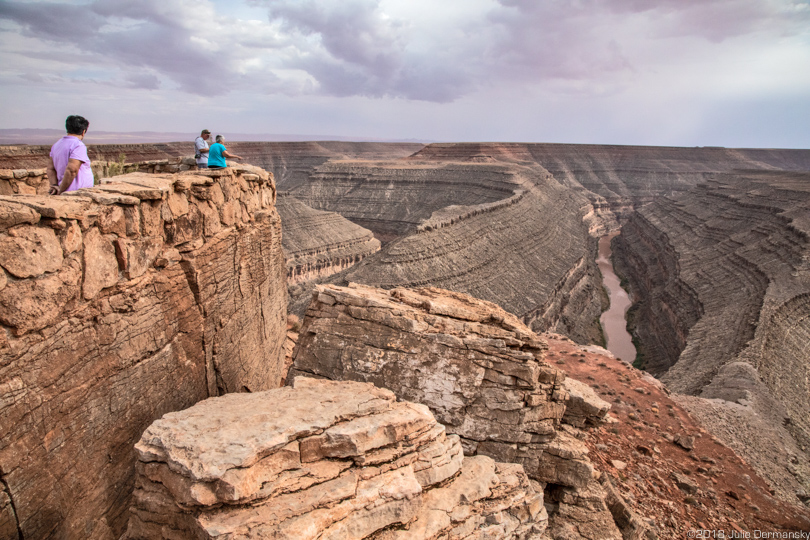
Visitors at an overlook of Gooseneck Bend, an area of Bears Ears National Monument which loses protection under the Trump administration’s proposal to shrink the monument.
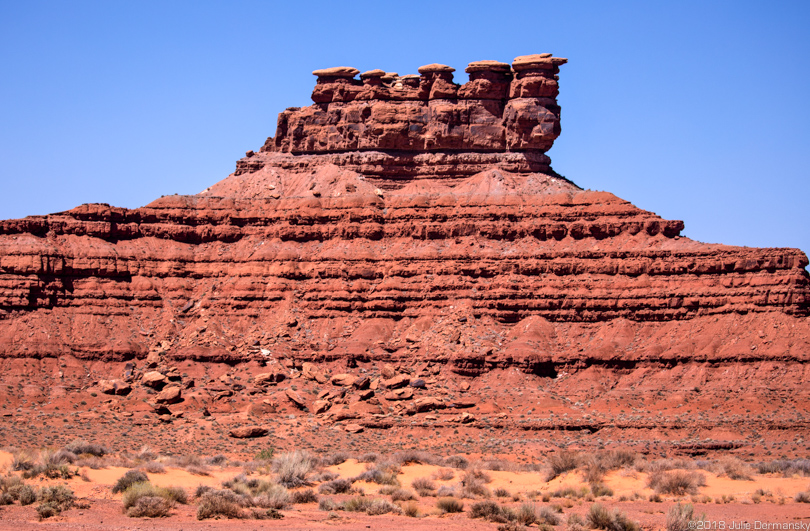
Valley of the Gods in Bears Ears, part of the national monument that will no longer be protected if President Trump’s proclamation to reduce the size of it stands.
Jonathan B. Jarvis, 18th director of the National Park Service, says Bernhardt is to Zinke what ex-coal lobbyist Andrew Wheeler is to the similarly scandal-ridden Scott Pruitt, who resigned as head of the Environmental Protection Agency (EPA) in July, calling him “smart, shrewd, low-profile, and effective.”
As Mother Jones reported in October, “some of the most radical changes under Trump have come from the many behind-the-scenes appointees, the government insiders, who have come out of the swamp the president pledged to drain. At Interior, that’s been Bernhardt and his allies.”
Saeger’s group had called for Zinke’s resignation for his potential conflicts of interest and sees Bernhardt through the same lens. He warns, “The bottom line is that Bernhardt is too conflicted to even be Acting Secretary.”
Together Zinke and Bernhardt started the largest rollback of federal land protections in U.S. history and prepared the largest U.S. offshore oil and gas lease sale (which ended as a flop in August).
In addition, they have instructed the Bureau of Land Management, which is in the Interior Department, to revise its rules on methane emissions from natural gas drilling on public lands, pushed for more roads in wilderness areas, canceled a study examining the health impacts of coal mining, and dismissed violations committed by coal companies.
Warning From Scientist Who Worked Under Zinke
“I’m delighted to see Ryan Zinke get his comeuppance. He was corrupt and arrogant in his disdain for science and public lands,” Joel Clement, a former senior scientist and policy expert with the Interior Department, wrote in an email following the news of Zinke’s resignation, “but his number two at Interior is equally corrupt and far more circumspect-beware.”
Clement, who filed for whistleblower protection and ultimately resigned while working under Zinke, is now a senior fellow with the Center for Science and Democracy with the Union of Concerned Scientists (UCS). He currently works to expose political interference in science and fight attacks on federal science from the Trump administration and Congress.
Under Secretary Zinke, Clement, a biologist, was removed as a top climate expert at the Interior Department and moved into an accounting position within the Office of Natural Resources Revenue, a job he lacked expertise for and which collects royalties from oil companies operating on federal lands. Clement claimed he was reassigned in retaliation for his work on the impacts of climate change on Native Alaskan communities.
“America’s public lands, and the natural and cultural resources they contain, belong to all of us,” Clement recently wrote in a Scientific American editorial. In the editorial, he rolled out the UCS report, “Science Under Siege at the Department of the Interior,” documenting what Clement describes as the “most egregious and anti-science policies and practices at the DOI under Secretary Zinke.”
The report outlines how the DOI under Secretary Zinke and his political team, including Bernhardt, attack science “from sidelining the work of the agency’s own scientists to systematically refusing to acknowledge or act on climate change.” According to the report, “these actions have far-reaching and serious implications for our health, the environment, and the future of our public lands.”
America’s Public Lands in the Crosshairs
In August I visited areas in Utah’s Bears Ears and Grand Staircase-Escalante national monuments that Trump left unprotected after he slashed both monuments’ boundaries. Multiple Native American tribes, including the Utah Diné (Navajo), Hopi, Zuni, and Ute, hold Bears Ears, in particular, as culturally and historically important land.
President Trump’s proclamation splitting Grand Staircase-Escalante into three monuments reduced the national monument by 46 percent and his proclamation splitting Bears Ears into two monuments reduced the lands under protection by 85 percent. Legal challenges against the proclamations are ongoing.
Here are photos I shot of those public lands in southern Utah on both monuments, which, under Trump and Zinke’s watch, have lost protection from oil, gas, mining, and other extractive activities:
Lands Cut From Grand Staircase-Escalante National Monument
-=-=
-=-=
npr utah
KUER 90.1 | By David Condos
Published July 17, 2026
A boundary sign on US191 near Bluff, Utah, marks the entrance to Bears Ears National Monument, April 24, 2024.
When President Donald Trump drastically cut the sizes of Utah’s Bears Ears and Grand Staircase-Escalante national monuments, it was not only the second time he’d done that, it was also the latest episode in a decadeslong tug of war over presidential power and public lands.
The debate hinges on a law from 1906.
“The Antiquities Act is such a small piece of legislation, but it's really powerful,” said Erika Allen Wolters, an associate professor with Oregon State University’s School of Public Policy.
The act says presidents can single-handedly designate monuments to protect objects of historic or scientific interest. They’ve used it on everything from ancient structures to forests. President Teddy Roosevelt even set aside 818,560 acres for Grand Canyon National Monument with a proclamation in 1908.
President Donald Trump holds a signed executive order in the Oval Office of the White House, July 13, 2026, in Washington.
But the act’s language leaves some key points a bit hazy. Of particular interest to the Trump admin, it does not explicitly say presidents can undo monument designations. It also doesn’t specify how much land they can set aside.
“Because that really wasn't detailed out in the Antiquities Act, it leaves a little bit of a gray area about what exactly — and to what extent — the presidential authority is,” Wolters said.
That gray area drives much of the recent back-and-forth that has tossed around southern Utah landscapes like flags in the wind.
Trump dramatically shrunk both Grand Staircase-Escalante and Bears Ears during his first term, reversing moves of Democratic presidents Bill Clinton in 1996 and Barack Obama in 2016, respectively.
When Joe Biden helped Democrats retake the White House, he restored Grand Staircase and Bears Ears in 2021. Trump’s latest actions scrapped the Biden-era maps and reduced both monuments even more than he did in 2017. Each monument has now been cut by around 90%.
President Joe Biden hands pen to Interior Secretary Deb Haaland as he signs a proclamation on the North Lawn at the White House in Washington, Friday, Oct. 8, 2021, during an event announcing that his administration is restoring protections for two sprawling national monuments in Utah that have been at the center of a long-running public lands dispute, and a separate marine conservation area in New England that recently has been used for commercial fishing.
That whiplash of instability can have tangible impacts on landscapes, local economies, Indigenous tribes and the American public, Wolters said.
Still, the U.S. doesn’t seem close to stopping the pendulum from swinging. Lawsuits against Trump’s previous monument cuts and Biden’s restorations have lingered in court for years, unresolved.
No federal judge has ever overturned a presidential proclamation creating a national monument, said Chris Winter, a public lands attorney who directs the Getches-Wilkinson Center at the University of Colorado Boulder. They also don’t seem eager to weigh in on the Antiquities Act’s finer points.
Congress didn’t define a clear role for the courts in reviewing these presidential proclamations, he said, which puts judges in a tough spot.
“I think that creates a lot of uncertainty as to whether we're going to get clarity from the federal courts over time,” Winter said.
In his view, the starting point to look at this issue should be the Constitution, which gives Congress authority over all federal public lands. When lawmakers passed the Antiquities Act, they carved out some of that power and gave it to the president.
Because the act doesn’t say presidents can undo monuments, he believes that means they shouldn’t have the authority to do what Trump just did.
“It's not there in the plain language of the act. The words aren't on the paper,” Winter said. “So, President Trump is basically trying to read that into the act as a matter of interpretation.”
A sign identifying the Grand Staircase-Escalante National Monument along State Route 12 in southern Utah, Aug. 21, 2024.
Other examples of legislation from the era also point in that direction, said Nick Bryner, professor of law at Louisiana State University who specializes in natural resources law.
The Pickett Act of 1910 and the Forest Service Organic Act of 1897 explicitly give the president power to withdraw land designations, he said, while the Antiquities Act is silent on that point.
“From all of that, we concluded that the best reading of the Antiquities Act is that Congress intended it to provide a one-way system where presidents would designate national monuments for protection, but it would be up to Congress to revoke those designations,” Bryner said.
When Congress overhauled land law with the Federal Land Policy and Management Act of 1976, Bryner said they had the chance to amend the Antiquities Act. They could have made it clear that presidents can undo monument designations or even removed this power from the executive branch toolkit altogether. But they did not.
On one hand, he said that seems to indicate Congress was OK with how the Antiquities Act had been understood up to that point. But it also left the door open for the years of dispute that followed.
“Until you get either some kind of congressional solution or a binding judicial opinion as to what the president's authority is, then we get the unfortunate result of having things bounce back and forth,” Bryner said.
Eventually, Winter said it would be better for Congress to step in and ratify more permanent boundaries for places like Bears Ears and Grand Staircase.
There’s historical precedent for that. Many national monuments created by presidential proclamations eventually became national parks established by Congress. Utah’s most-visited parks — Zion, Arches, Capitol Reef and Bryce Canyon — all started as monuments and followed that path.
If there’s a monument that the public doesn’t like, Winter said the solution should also be to have Congress — not a future president — act to undo it.
In U.S. history, 11 national monuments created by proclamation were later abolished by lawmakers. Local backlash to monuments in Wyoming and Alaska also led to congressional compromises that limited a future president’s authority to set aside land as a monument there.
That’s a model Megan Jenkins would like to see applied nationally.
“I think that's really the right way to go about it, if we want to protect a vast landscape,” said the Logan-based strategic research director with Pacific Legal Foundation. “We should have Congress getting involved so that it's not just one person's decision.”
FILE - In this Sept. 18, 1996, file photo, Vice President Al Gore applauds after President Bill Clinton signs a bill designating about 1.7 million acres of land in southern Utah's red-rock cliff as the Grand Staircase-Escalante National Monument, at the Grand Canyon National Park, in Arizona.
She believes Clinton, Obama and Biden’s monument designations represented abuse and that Congress should set a size limit to prevent similar presidential action in the future.
“I think that would be really positive,” Jenkins said. “Both sides of the aisle get upset with the ping-pong back and forth, and so I think there could be bipartisan support for this type of change.”
In the meantime, lawyers stay busy.
Following Trump’s latest actions, conservation groups have signaled they plan to fight back with litigation.
Steve Bloch, legal director with the conservation group Southern Utah Wilderness Alliance, said the federal lawsuits his group brought against Trump’s 2017 monument reductions remain on the books. So, they’re still deciding whether the best path will be reviving existing litigation or filing something new.
Either way, he said the argument is the same — that the Antiquities Act gives the president the power to create, not the power to destroy — and his group intends to do what’s necessary to overturn Trump’s actions.
“We're going to challenge these in court, and we expect to win,” Bloch said. “So, what the president did on Monday is in no way going to be the last word for the protections of these remarkable federal lands.”
Suits from the opposing side of the debate may not be over, either.
The state of Utah, plus Garfield and Kane counties and the BlueRibbon Coalition, a recreation access advocacy group, sued after Biden restored Bears Ears and Grand Staircase in 2021, arguing his actions exceeded the scope of the Antiquities Act.
Hikers on the toadstool hoodoos hiking trail in the southern part of Grand Staircase-Escalante National Monument in southern Utah, Oct. 5, 2025.
That lawsuit was not resolved before Trump’s recent proclamations, but a federal appeals court revived it in June and said a district court does have authority to hear the case. The appeals court ruling also affirmed the lower court’s decision to remove BlueRibbon Coalition from the suit because the group lacked standing.
Executive Director Ben Burr said the coalition expects to get back on the lawsuit and see it through to resolution. While he appreciates Trump’s recent decision, he said it doesn’t change their ultimate goal of reining in the Antiquities Act.
“Because a future president could reverse President Trump’s designations, the district court retains jurisdiction to decide whether President Biden’s expansions were ever lawful,” Burr said in a statement to KUER. “They were not, and we look forward to carrying our case forward in the courts.”
Utah Attorney General Derek Brown also applauded Trump’s actions, while saying the state will continue pressing to make Antiquities Act limits a reality.
Disclosure: Southern Utah Wilderness Alliance is a financial supporter of KUER
-=-=
...MEMbers were appointed to the Bears Ears National Monument Advisory Committee by the
Secretary of the Interior, David Bernhardt, on April 11, 2019. Initial terms are staggered so they do not
expire at the same time. Open periods for new nominations will be announced in the federal register.
Representative Category Member Term expires
Local Elected Official Bruce Adams April 11, 2021
State Government Gordon Larsen April 11, 2021
Paleontology Brooks Britt April 11, 2020
Archaeology Lee Bennett April 11, 2022
Conservation Miles Moretti April 11, 2020
Livestock Grazers/Permittees Gail Johnson April 11, 2022
Tribal Concerns Alfred Ben April 11, 2022
Ryan Benally April 11, 2021
Developed Recreation Jared Berrett April 11, 2021
Dustin Randall April 11, 2022
Dispersed Recreation Danny Flannery April 11, 2022
Private Landowners Zeb Dalton April 11, 2020
Local Business Owners Adam Redd April 11, 2020
Public at Large Jami Bayles April 11, 2021
Kelly Pehrson April 11, 2020
-=-=
-=-=
9 26 https://globalextremism.org/post/project-2025-comes-for-public-lands/
No Accident: Project 2025 Comes for Public Lands
September 23, 2026
William Perry Pendley wrote the Interior Department chapter of Project 2025. Doug Burgum now runs the Interior Department, and he is carrying it out. Endangered species, America’s public lands, and the sacred places on them are paying the price.
Key Takeaways
Project 2025 wanted wild horses disposed of. The government sold 3,700 of them last year, many for as little as $25, through a loophole that for some ends at a slaughter plant.
Project 2025 complained that Trump’s first-term monument cuts didn’t go far enough. He has now cut Bears Ears and Grand Staircase-Escalante national monuments, both in Utah, by about 90 percent each.
Project 2025 wanted the Endangered Species Act kept out of the way of “economic development.” The wildlife agencies didn’t wait for Congress. They rewrote the rules, and 20 states and the District of Columbia sued on September 9. Five days later, Fish and Wildlife told its field offices that killing an endangered animal breaks no law unless the killing was the point.
Project 2025 called for “aggressively building the border wall system on America’s southern border.” Homeland Security has waived cultural and environmental laws to build it, and crews are blasting Kuuchamaa, a Kumeyaay sacred mountain on the U.S.-Mexico border.
The mustangs had waited years in an Idaho feedlot, penned there since helicopters ran them down off the range. In March, the Bureau of Land Management finally shipped 68 of them out. The trailers went 1,800 miles east to Brandon Jones, an Ohio livestock trader who had paid the government $25 a head. Around midnight the next day, two double-decker cattle trucks came for the horses. Jones won’t say where they went.
Jones told The New York Times, which ran the investigation on its front page in August, that he has nothing to do with Fred Bauer. Bauer is one of the largest exporters of slaughter horses to Canada, where they are processed into meat for human consumption and sold abroad.
William Perry Pendley, who wrote Project 2025’s Interior chapter, once ran the bureau now selling those horses. A federal judge ruled in 2020 that he had served unlawfully as its acting director for 424 days. His chapter asked Congress to repeal the Antiquities Act and to rein in the Endangered Species Act. Congress has done neither. Interior, under Secretary Doug Burgum, has found other ways, and the horses show how.
Project 2025’s section on wild horses ends by telling Congress to pass a law letting the bureau “dispose humanely of these animals.” Congress never did, and it still bars the bureau from spending money to kill healthy wild horses. A 2017 survey of 556 registered voters, commissioned by wild horse advocates, found 80 percent of respondents, including 86 percent of Trump voters, opposed killing them.
Livestock inspection records show some of the government’s mustangs on trucks bound for Canadian slaughter plants.
The bureau posts wild horses on its online adoption site, and after three one-week listings with no takers, it labels a horse unadoptable and can sell it. Once sold, the horse loses its protections. The buyer promises in writing not to slaughter it or knowingly sell it to someone who will. The middleman signs nothing, and the horses go to Canada. The government can spend more than $3,000 to capture a mustang and bring it to market, then sell it for $25.
Slaughter plants pay up to $750 per horse.
Clare Staples runs Skydog Sanctuary, a rescue for wild horses and burros with ranches in California and Oregon. She wrote to Burgum the day the Times story ran, demanding the sales program be shut down. She had spent more than a year combing the bureau’s own sales records and standing at the kill pens. Her count runs 19 months, a longer stretch than the government’s one-year figure: 6,331 wild horses sold, against a historic average of about 1,200 a year. More than half were one to four years old, prime adoption age, and nearly three-quarters sold for $25 or less. Staples has tracked 333 wild horses and burros into kill pens this year alone. Selling protected animals for $25 to be butchered abroad, she said, is “a betrayal of the law and the American people.”
Sacred Lands
Trump signed the monument orders in the Oval Office on July 13, 2026, with Utah’s senators, Mike Lee and John Curtis, Gov. Spencer Cox, and state House Speaker Mike Schultz lined up behind him. The proclamations took effect September 11, and Bears Ears was reduced from 1.36 million acres to 121,000, a 91 percent cut. Grand Staircase-Escalante lost about the same share. Conservation groups sued on September 2.
The proclamation itself acknowledges the twin buttes known as the Bears Ears, “which are considered sacred by the Native American tribes that call this area their ancestral home.” The same document lists “critical minerals such as silver, copper, molybdenum, lead, uranium, vanadium, and zinc.”
The proclamation also ended the Bears Ears Commission (BEC), through which the Hopi Tribe, the Navajo Nation, the Ute Mountain Ute Tribe, the Ute Indian Tribe of the Uintah and Ouray Reservation, and the Pueblo of Zuni had co-managed the monument with the federal government. In its place is an advisory committee whose named seats number 15: five for the tribes, four for San Juan County and its towns, and six for people recommended by Utah’s governor. The secretaries of the Interior and Agriculture now have no “obligation to engage, consult, or coordinate with the BEC or a comparable entity,” the proclamation states, though it still requires them to consult tribes under other laws.
Pendley has fought over sacred ground before. In 1996, Mountain States Legal Foundation, the Denver firm he then led, sued the Park Service over a voluntary June climbing ban at Devils Tower in Wyoming, a site many Northern Plains tribes hold sacred. A federal appeals court tossed the case in 1999, ruling that the climbers had no standing to sue.
In his Project 2025 chapter, Pendley wrote that Trump’s first-term review had been “insufficient” because only two Utah monuments were cut. The next administration, the chapter says, “must seek repeal of the Antiquities Act of 1906.” The law protects “cultural and natural resources of historic or scientific interest on federal lands,” and it confines each monument to the “smallest area compatible with proper care and management of the objects to be protected.” Whether that clause lets a president carve down a monument a predecessor created is the question the conservation groups have asked a federal court to answer.
The day the cuts took effect, mining companies filed 16 new claims on land stripped from Bears Ears.
What Counts as Harm
Since 1975, wrecking an animal’s habitat has counted as harming the animal. The Fish and Wildlife Service and the National Marine Fisheries Service deleted that definition in a rule published July 14, 2026, and wrote nothing to replace it. The rescission took effect September 14. Logging the last of an owl’s nesting ground no longer harms the owl. Two more rules followed a week later. Newly listed threatened species lost their automatic protection. Critical habitat can now be trimmed when a company makes a credible case about the cost of preserving it.
Twenty states and the District of Columbia sued in federal court in California on September 9, five days before the harm rescission was due to take effect. The rules “are wrong on the merits, the morals and the law,” Washington Attorney General Nick Brown said. The complaint calls the harm rescission “a reversal of staggering proportions.” The rescission’s own preamble invites companies holding “take” permits to hand them back “in order to not have to continue spending resources to mitigate.”
Brian Nesvik, director of the Fish and Wildlife Service, signed the memo on September 14 and sent it to every one of the agency’s field offices. The New York Times obtained a copy. It turns on one word. Until now, “take” has covered killing or injuring a listed animal whether or not anyone meant to. Now it covers only the killings someone intended. Wildlife advocates say that lets a logging company knowingly cut down a forest full of endangered bats, as long as it was after the timber.
Most endangered animals that die at human hands are killed by accident, in the course of somebody’s business, the Times reported. Because those deaths have counted as take, developers seek permission first. A builder who wants to put houses where an endangered salamander lives traditionally applies for an incidental take permit promising to protect a few of them, or pays to conserve some elsewhere, and the government forgives the rest. The memo appears to upend that arrangement. If an accidental death breaks no law, nobody needs the permit.
Andrew Mergen argued endangered species cases for the Justice Department and teaches law at Harvard now. Everyone has understood the act to mean one thing, he told the Times: “Don’t kill endangered species.” The memo drains it of that meaning. People are held responsible all the time for harm they never intended but should have seen coming, Mergen said.
Interior’s press office wouldn’t say why it adopted the new reading, or whether the memo is already in force, and sent an unsigned statement saying the act “continues to prohibit take of endangered wildlife.” Stateline reported on September 21 that the memo’s instructions to staff take effect immediately.
Pendley’s chapter asks Congress to keep the Endangered Species Act from being used to “seize private property, prevent economic development, and interfere with the rights of states.” Interior got there with a rule and a memo. Pendley cheered the result. The new reading, he told Cowboy State Daily, “will shield innocent people from litigation by the country’s largest law firm, the Department of Justice.”
The Border
Kuuchamaa, a 3,885-foot peak that straddles the border near Tecate, is sacred to the Kumeyaay. In their creation story, a shaman became the mountain. It has been on the National Register of Historic Places since 1992, and the listing itself states that disturbing its natural state would be sacrilegious. Contractors have been blasting it anyway, and the explosions send rock tumbling down its Mexican side.
From a park in Tecate, Baja California, about half a mile away, Norma Meza Calles can hear the crews breaking boulders. Kumeyaay from both sides of the border have climbed the mountain for generations to sit on those boulders, Meza Calles, a Kumeyaay leader who works as a guide, told KPBS. “They’re destroying it,” she said in Spanish. “No one ever consented or supported the use of dynamite on the mountain,” Emily Burgueno, a Kumeyaay Nation member in California, told the Associated Press. The Department of Homeland Security waived cultural and environmental laws to speed the work.
Project 2025’s Homeland Security chapter directs the Pentagon to “assist in aggressively building the border wall system on America’s southern border.” Congress has since put more than $46 billion behind construction. The waiver power Homeland Security is using comes from a 1996 immigration law that Congress broadened in 2005, long before Project 2025 existed.
In Southern Arizona, the wall has reached O’odham country, which straddles the border. In April, a Homeland Security contractor damaged the Las Playas Intaglio, a 1,000-year-old fish-shaped geoglyph in the Cabeza Prieta National Wildlife Refuge that pointed toward the Gulf of California. The Tohono O’odham Nation sued Homeland Security in June to stop a 30-foot wall in three places along the stretch of border that crosses its reservation. Tribal leaders posted No Trespassing signs on August 7. U.S. District Judge Richard J. Leon denied the Nation’s request to halt construction a week later. On August 25, according to the Nation, contractors entered the reservation with about 20 masked, armed Border Patrol agents. Homeland Security says the work sits inside the Roosevelt Reservation, a 60-foot federal strip along the border. The Nation appealed on August 26.
About 30 miles west of the reservation, a second fence is planned 150 feet from the existing wall through Organ Pipe Cactus National Monument. Crews have already cleared ground a few miles east of Quitobaquito Springs, a desert oasis where O’odham families have held ceremonies for generations and where the endangered Quitobaquito pupfish and the Sonoyta mud turtle live. Lorraine Marquez Eiler, a Hia-Ced O’odham elder whose great-great-grandparents walked about 50 miles through the Sonoran Desert to the springs, called the wall “another slap in the face” to her ancestors. “This is not ours to own. It is ours to protect,” Verlon Jose, chairman of the Tohono O’odham Nation, said at the springs.
Nobody Home
The National Historic Preservation Act requires federal agencies to weigh what a project will do to historic places, and to consult tribes, before they build. Pendley’s chapter asked Interior to revive a first-term order “clarifying” those reviews. Hiring rules under the Trump administration cap the agencies at one new employee for every four who leave, so most vacancies stay open.
Landscape Architecture Magazine combed Office of Personnel Management data and counted about 6,700 Park Service departures, close to three in 10 of the people who worked there in 2024.
The White House wanted deeper cuts. Its 2026 budget asked Congress to take nearly $4 billion from the land agencies. Appropriators balked and held Park Service funding roughly level, but a budget line can’t rehire a ranger who took the buyout. This year’s request targets the Historic Preservation Fund, which pays for state and tribal historic preservation offices. It would cut the fund by 95 percent.
What Hasn’t Happened Yet
Pendley’s complaint about Trump’s first term was that the cuts to protected lands stopped at the Utah line. The new list doesn’t. In April 2025, a senior Interior official told E&E News the department was weighing cuts to at least six monuments: Bears Ears, Grand Staircase-Escalante, Ironwood Forest, Chuckwalla, Organ Mountains-Desert Peaks, and Baaj Nwaavjo I’tah Kukveni-Ancestral Footprints of the Grand Canyon. Burgum said the monuments were under review but “not a top priority of the administration.” Two are done. Baaj Nwaavjo I’tah Kukveni covers 917,618 acres around Grand Canyon National Park, takes in Red Butte and land the 13 tribes of the Grand Canyon Tribal Coalition fought to protect, and keeps new uranium mining out. It is still on the list.
The horses never needed a vote. The ban on killing them rides in the spending bill nearly every year, and the White House left it out of its 2027 budget request, as it did the year before. Congress put it back last time.
-=-=
-=-=
ThinkProgress
Scandals mount under David Bernhardt just two weeks after being ...
But Zinke's policy legacy is also living on under Bernhardt. One of the former secretary's most controversial actions as secretary remains the decision to dramatically shrink Bears Ears and Grand Staircase-Escalante, two Utah national monuments, the largest reduction in U.S. history.
Scandals mount under David Bernhardt just two weeks after being confirmed to lead Interior
Ethics probes are still in full swing.
E.A. CrundenApr 25, 2019,
David Bernhardt, President Donald Trump's nominee to be Interior Secretary, arrives before testifying during a Senate Energy and Natural Resources Committee confirmation hearing on March 28, 2019 in Washington, DC. CREDIT: Zach
It’s been just two weeks since David Bernhardt was confirmed as head of the Interior Department (DOI), and already his tenure is mired in at least four controversies.
From the day he was confirmed earlier this month — despite uproar from Democrats over his conflicts of interest and a prior career as an oil and gas lobbyist — Bernhardt has faced a wave of scandals.
The Interior Department’s watchdog is currently investigating Bernhardt over ethics concerns, along with a half-dozen other DOI senior officials. Those investigations come as the department faces renewed scrutiny over its decisions regarding Bears Ears, the Utah national monument dramatically reduced by Bernhardt’s equally scandal-ridden predecessor, Ryan Zinke.
And on Thursday, Citizens for Responsibility and Ethics in Washington (CREW) called for yet another investigation, this time into the department’s record-keeping, arguing Bernhardt’s daily schedule is not being fully documented and that controversial meetings are “intentionally” being left off the calendar.
“Under Bernhardt, the command appears to be granting favors to extractive industries, science be damned, while fighting tooth and nail to keep the public in the dark,” said Jesse Prentice-Dunn, policy director for the Center for Western Priorities, in an email to ThinkProgress on Thursday.
Earlier this week, the department’s Office of Inspector General (OIG) confirmed an investigation into potential ethics violations by six senior DOI officials. The decision came in response to a request by the nonpartisan watchdog group Campaign Legal Center, which requested in February that certain DOI staffers face a probe over potentially violating an ethics pledge due to interactions with former employers and clients.
The deputy inspector for the OIG, Mary L. Kendall, said that her office will look into “potential ethics violations committed by multiple Department of Interior senior executives.” The Campaign Legal Center named current Interior officials Benjamin Cassidy, Lori Mashburn, Doug Domenech, Todd Wynn, and Timothy Williams in its complaint. Vincent DeVito, a sixth person named, left the department in August and joined an offshore oil and gas company.
Despite bipartisan uproar over offshore drilling, coastal Republicans back Trump Interior pick
The complaints against the six officials vary, but all relate to their former employers. Cassidy, a former National Rifle Association (NRA) lobbyist, has been called out for his ongoing work on gun-related issues, including on projects backed by the NRA. Mashburn, a former employee of the right-wing Heritage Foundation, is criticized for staying in close touch with the think tank since leaving. Meanwhile, exchanges show Domenech met with representatives from the Texas Public Policy Foundation (TPPF), another think tank that has actively downplayed climate change.
Domenech, who is currently assistant secretary for insular and international affairs, previously worked for the Koch-backed right-wing think tank, which has notched political victories under the Trump administration. DeVito and Wynn similarly engaged with former employers or clients while acting in their capacity as DOI officials.
Senior political appointees are largely limited in the interactions they are allowed with former employers under an ethics pledge imposed by President Donald Trump. The investigation into the DOI staffers will examine whether they are in violation of those limitations.
Bernhardt is similarly accused of breaching that ethics pledge. The Interior secretary, known for carrying around a card listing all of his conflicts of interest, is under investigation in relation to at least seven different complaints, according to an OIG letter sent April 15 to Sen. Ron Wyden (D-OR). That probe was launched four days after the Senate voted to confirm Bernhardt, 56 to 41, largely along party lines.
It is unclear what the full scope of the complaints entail, but Wyden and Sen. Mazie Hirono (D-HI) had both pushed for an investigation into Bernhardt’s role in blocking an assessment examining the impact of pesticides on certain endangered species. Bernhardt has previously lobbied on behalf of agribusiness and against endangered species protections.
Recent disclosures have also shown that Bernhardt continued working on policies at DOI that would help his former lobbying clients, despite the Trump administration’s ethics pledge. That work includes shaping certain water policies despite lobbying on them previously while working for California farmers.
He has similarly strayed from the practice of maintaining a detailed daily calendar, instead having staff overwrite a Google document daily, erasing its previous content in the process, which watchdog organizations have worried is eroding transparency.
CREW wrote to Deputy Inspector General Kendall on April 25 urging an investigation. In its complaint, the watchdog group noted that there may be a possible link between the already-opened ethics investigation and the apparently deliberate record-keeping violations, “which appear designed in part to shield from public view and congressional scrutiny his contacts with industry lobbyists.”
DOI has argued that Bernhardt “is in complete compliance with his ethics agreement” and has followed department policy. But Democratic lawmakers and environmental groups are skeptical of the Interior secretary, as well as other senior-level officials at DOI.
“The fish rots from the head,” wrote Wyden in a tweet this week responding to the two investigations.
Chris Saeger, executive director for the nonprofit Western Values Project, told ThinkProgress on Thursday that Bernhardt’s “special interest conflicts are longer than a CVS receipt” and that his leadership at DOI has already been disconcerting for public lands advocates.
“Preventing the rot of corruption within America’s largest land managing agency will clearly require vigilant oversight and enforcement outside of the department’s leadership,” Saeger said, arguing that ongoing scandals and ethics lapses at DOI have come “at the expense of America’s outdoor heritage.”
Bernhardt’s critics are drawing comparisons to Zinke, who announced his exit from the department in December in the midst of more than a dozen scandals relating to spending and ethics violations.
But Zinke’s policy legacy is also living on under Bernhardt. One of the former secretary’s most controversial actions as secretary remains the decision to dramatically shrink Bears Ears and Grand Staircase-Escalante, two Utah national monuments, the largest reduction in U.S. history. Documents obtained under the Freedom of Information Act (FOIA) have shown that oil and gas drilling opportunities played a major role in the decision to reduce the monuments.
The decision was widely panned by indigenous tribes, along with environmental groups and public lands advocates. But their opposition remains unnoticed by DOI. Last Friday, the department’s Bureau of Land Management (BLM), released the names of the 15 committee members selected to provide guidance on managing Bears Ears — the list included only critics of the monument.
Trump administration plan to mine near popular Minnesota wilderness area sparks multiple lawsuits
That move has been slammed as “political” by tribal groups, who say the Trump administration is willfully ignoring the wishes of native communities. Supporters of Bears Ears applied, but none were chosen.
Bernhardt’s critics have pointed to that development as yet another indicator that the new secretary will be much like his predecessor, in policy as much as in scandal. Prentice-Dunn argued that Bernhardt has “established a track record of helping his former clients in the drilling and mining industries,” in keeping with the legacy set by Zinke.
Moreover, Prentice-Dunn said, with investigations mounting so early in his tenure, Bernhardt “is already on track to be as scandal-plagued as his predecessor… if not more so.”
#Bears Ears, #Climate, #David Bernhardt, #Government Ethics, #Interior Department, #Politics
ref
Emails reveal oil and gas drilling was a key incentive to shrink national monuments
Emails reveal oil and gas drilling was a key incentive to shrink national monuments
Ryan Zinke also directed Interior staff to study coal reserves at Grand Staircase-Escalante national monument.
Mark HandMar 2, 2018,
The Department of the Interior focused on the potential for oil and gas exploration at the Bears Ears National Monument during its 2017 review of national monuments. CREDIT: George Frey/Getty Images
From the start of the Trump administration’s review of national monuments, agency officials were directing staff at the U.S. Department of the Interior to figure out how much coal, oil, and natural gas had been placed off limits by the Bears Ears’ National Monument designation.
Environmental activists and public lands advocates feared Trump was pushing to reduce the size of national monuments to give mineral extractive industries easier access to drill or mine in the protected areas. But they didn’t have any evidence or a smoking gun to prove their theory. Now they do.
According to documents obtained by the New York Times, long before Interior Secretary Ryan Zinke recommended a major reduction in the size of the Bears Ears monument in southeastern Utah, the administration was already eyeing the potential for oil and gas exploration at the site.
Last March, an aide to Sen. Orrin Hatch (R-UT), asked a senior official at the Department of the Interior to consider reduced boundaries for the Bears Ears monument to remove land from protection that contained oil and natural gas deposits, The New York Times reported Friday.
Hatch’s office sent an email to the Interior Department on March 15, 2017 that included a map depicting a boundary change that would “resolve all known mineral conflicts,” referring to oil and gas sites on the land that the state’s public schools wanted to lease out to increase state funds.
Trump decimates two national monuments in ‘historic action’
It's the largest-ever reduction in U.S. history.
More than 100 years ago, the federal government granted so-called trust lands to support state institutions, like public schools, given that nearly 70 percent of the state is federally controlled land. Bears Ears included about 110,000 acres of these trust lands, eliminating the potential for resource sales, Utah officials said.
John Andrews, associate director of the Utah School and Institutional Trust Lands Administration, which oversees the lands designated for school funding, told The New York Times that the new Bears Ears boundaries approved by Trump reflected his group’s request to exclude its trust lands.
The newspaper obtained emails and other documents about the shrinking of national monuments from the Interior Department after it sued the agency in federal court.
“We’ve long known that Trump and Zinke put polluter profits ahead of our clean air, clean water, public health and coastal economies. This is more proof,” League of Conservation Voters Deputy Legislative Director Alex Taurel said Friday in a statement. “On Zinke’s one year anniversary as secretary, the evidence of just how embedded Trump and Zinke are with the dirty energy of the past could not be clearer.”
The Interior Department had not responded to a request for comment from ThinkProgress on these emails and documents at the time this article was published.[twt]
Bears Ears wasn’t the only national monument being evaluated for its potential fossil fuel reserves. In one memo, an Interior official asked department staff to prepare a report on each national monument under review in the United States, with an emphasis on the areas of national monuments with “annual production of coal, oil, gas, and renewable energy sources.”
During his review, Zinke also looked closely at the potential coal reserves at the Grand Staircase-Escalante National Monument, also located in Utah.
Interior Department staff developed a series of estimates on the value of coal that could be mined from a section of Grand Staircase-Escalante. When Trump announced in December that he would be reducing Grand Staircase-Escalante to nearly half its original size, those sections with coal reserves were included in the areas that would no longer be protected, according to the New York Times.
The reductions of the two national monuments located in Utah came after an Interior Department review, initiated in April, which looked at all national monuments created since 1996. Trump, at the time, said that the review would put an end to “egregious abuse of federal power” that has resulted in a “massive federal land grab.”
Grand Staircase-Escalante was designated by President Bill Clinton in 1996. Bears Ears was designated by President Barack Obama in December of 2016, as one of his final major designations as president. Environmentalists and indigenous groups have fought for years to protect Bears Ears, arguing that the area holds numerous sites of historical, cultural, and ecological significance.
-=-=

Courthouse News Service
The United States District Court District of Utah
This action stems from two cases: Consolidated Plaintiffs against President Biden, the Secretary of the Interior, the Director of the Bureau of Land Management, the Secretary of Agriculture, the Chief of the Forest Service, the Department of the Interior, the Bureau of Land 15 Id. at 981. 16 Dalton v. Specter, 511 U.S. 462, 476 (1994).
freerangereport.com
Husband of "Old Broad" enviro pleads "no contest" to charges stemming ...
The end of a long and convoluted legal battle, the brief trial brought great relief to Zane Odell, who was with Zeb Dalton in the Monticello courtroom at the time Franklin took the plea deal.
Husband of “Old Broad” enviro pleads “no contest” to charges stemming from attempted cattle destruction
by editor | Posted on April 2, 2019
Through pleading “no contest” to the Class A and Class B misdemeanor charges of “trespassing on State Trust Lands [with the intent to do harm]” Franklin was able dodge the more serious felony charges. The court ordered him to pay a $1,000 and, per the terms of his probation, he is barred from entering Utah State Trust Lands for one year.
by Marjorie Haun
Mark Franklin, husband of Rose Chilcoat, a radical environmentalist who carries out anti-grazing activities in Colorado and Utah, plead “no contest” on Monday, April 1, to charges related to their attempt to harm cattle two years ago today. Franklin plead “no contest,” which is the equivalent of a guilty plea, in a Monticello, Utah courtroom while accompanied by Chilcoat, who abetted his 2017 crimes but against whom all felony charges were dropped several months ago.
The pair originally faced several felony charges related to their repeated attempts to harm cattle in southern Utah’s Lime Ridge area. On April 1, 2017, they drove to a corral belonging to rancher Zane Odell, and closed the gate to his cattle’s water source inside the corral. Odell, suspecting that the gate was closed with malicious intent then mounted a game cam along the road to the corral. Franklin and Chilcoat returned a couple of days later, where they were detained by Odell, and Zeb Dalton, who was working on a well at the corral, until a sheriff’s deputy arrived at the scene. With evidence showing that the pair was in the same car earlier captured by the game cam, they were charged with “attempted wanton destruction of livestock,” a felony, along with “trespassing on Utah State Trust Lands.” Chilcoat, who then attempted to get the Bureau of Land Management (BLM) to review grazing permits held by Odell and Dalton, was later charged with “attempted retaliation against a witness.”
Through pleading “no contest” to the Class A and Class B misdemeanor charges of “trespassing on State Trust Lands [with the intent to do harm]” Franklin was able dodge the more serious felony charges. The court ordered him to pay a $1,000 and, per the terms of his probation, he is barred from entering Utah State Trust Lands for one year.
Chilcoat is closely associated with Friends of Cedar Mesa, an environmentalist group headquartered in Bluff, Utah, and once served as director for the Great Old Broads for Wilderness. She is well-known in southeastern Utah for her bizarre anti-grazing antics and endless efforts to get cattle off the range. Despite the plea of “no contest,” Franklin continues to assert that he was out sightseeing at the time he closed the gate, and that he did so because he felt threatened by Odell’s cows. The Salt Lake Tribune quotes Franklin:
“I pulled off the highway to relieve myself on public land near a prominent, overbuilt corral and turned my vehicle and trailer around in front of an open wire gate,” he said. “When leaving, an unusually large tire in the corral caught my eye….As I walked towards the trough, one of the cows turned and gave me the ‘stink eye.’ At the same time, two other cows began to move behind me,” Franklin said. “That made me concerned, so I pulled the unlatched pipe gate closed to prevent them from surrounding me. I did this for my personal safety and the safety of my vehicle and trailer, and to avoid any conflict with the cows.”
The evidence gathered by Odell and Dalton, as well as the San Juan County Sheriff’s Department, contradicts Franklin’s story, and his plea of “no contest,” reinforces the notion that when he and Chilcoat entered the corral area, they were up to no good.
The end of a long and convoluted legal battle, the brief trial brought great relief to Zane Odell, who was with Zeb Dalton in the Monticello courtroom at the time Franklin took the plea deal. Odell told Free Range Report, “At first it didn’t really sink in what happened today.” And he continued, “I’m happy. I can’t remember being this happy for a long time. We won.”
NRDC
In the United States District Court for The District of Utah - Nrdc
Just consider the 100-plus pages of (single-spaced) NEPA filings that have already been put together for Zeb's request to build some water wells and fences.111And now, as Zeb has explained—and ...
Bizapedia
https://www.bizapedia.com › ut › dark-canyon-range-land-llc.html
DARK CANYON RANGE LAND, LLC in Blanding, UT - Bizapedia
The Registered Agent on file is Zeb Dalton, located at 543 E 500 S Blanding, UT 84511. Tiffany Dalton is the sole principal on record and serves as Manager and is associated with an address at P.O. Box 72 Blanding, UT 84511. The entity is scheduled to expire on October 31, 2024.
Bizapedia
https://www.bizapedia.com › ut › t-y-cattle-company-llc.html
T Y CATTLE COMPANY, LLC in Blanding, UT - Bizapedia
The Registered Agent on file is Zeb Dalton, located at 543 E 500 S Blanding, UT 84511. The company's leadership includes Tiffany Dalton, who serves as Manager and is associated with an address at P.O. Box 72 Blanding, UT 84511 and Zeb Dalton, who serves as Manager and is associated with an address at P.O. Box 72 Blanding, UT 84511.

canyonechojournal.com
Conservationist Rose Chilcoat Sues San Juan County Attorney and a ...
The couple was stopped by Odell and fellow rancher Zeb Dalton on April 3, 2017, two days after the gate closure, and was detained on a county road until a sheriff's deputy arrived. Later that month, Laws filed a number of misdemeanor and felony charges against both Franklin and Chilcoat.
Conservationist Rose Chilcoat Sues San Juan County Attorney and a Rancher for Pressing Charges in Gategate Case
Gategate continues. On Apri 1, Mark Franklin, a Colorado-based biologist and historian, pled “no contest” to two misdemeanor charges related to closing a cattle gate on state land in San Juan County in 2017, ending a two-year-long saga.
But on Wednesday, a new suit was filed, this time by Franklin’s wife and former associate director of the Great Old Broads for Wilderness, Rose Chilcoat, who announced she is bringing a lawsuit against rancher Zane Odell and San Juan County Attorney Kendall Laws.
“The lawsuit alleges that Chilcoat was illegally detained and falsely accused of attempting to kill cattle by defendant Zane Odell, and that San Juan County Attorney Kendall Laws made intentional factual misstatements in order to obtain a bind over of baseless witness retaliation felony charges against her,” Chilcoat’s attorney said in a statement.
The case, known locally as Gategate, dragged on for two years before Franklin took the plea deal in Monticello’s 7th District Court last week. Franklin admitted to closing the gate but maintained that he never attempted to harm Odell’s livestock.
The couple was stopped by Odell and fellow rancher Zeb Dalton on April 3, 2017, two days after the gate closure, and was detained on a county road until a sheriff’s deputy arrived. Later that month, Laws filed a number of misdemeanor and felony** charges against both Franklin and Chilcoat.
Laws slapped Chilcoat with a felony “retaliation against a witness” charge after she sent a letter to the BLM about grazing improvements near Valley of the Gods in what was then Bears Ears National Monument. The charges against her were dismissed in 2018, and Chilcoat has long claimed that they were filed in retaliation for her activism related to Bears Ears and her work with Great Old Broads in Utah.
The suit seeks damages related to the $130,000 in legal fees incurred by the couple and a slew of threats posted on social media over the last two years.
Last week, the San Juan County Commissioner Kenneth Maryboy introduced an unrelated resolution to sue Laws for failing to comply with directives handed down by the county commission related, in part, to Bears Ears National Monument.
— Read more about the lawsuit in the Salt Lake Tribune.
freerangereport.com
Anti-grazing enviros charged with cattle endangerment accuse ranchers ...
Last week Zeb Dalton and Zane Odell received a subpoena from Kendall Laws the San Juan County District Attorney ordering them to appear on December 3, 2018 for an Evidentiary Hearing as witnesses in the case of State of Utah vs, Mark Kevin Franklin. In April of 2017, Chilcoat and her husband were caught endangering livestock.
MyLife.com
https://www.mylife.com › zebediah-dalton › e156171340422
Zebediah G Dalton, 47 - Blanding, UT - Reputation & Contact Details
View FREE Public Profile & Reputation for Zebediah Dalton in Blanding, UT - Court Records | Photos | Address, Email & Phone | Reviews | $30 - $39,999 Net Worth

Courthouse News Service
DOCUMENTS.pdf - Courthouse News Service
The Supreme Court described the public domain as the land owned by the Government, mostly in the West, that was available for sale, entry, and settlement under the homestead laws, or other disposition under the general body of land laws.
The Salt Lake Tribune
https://archive.sltrib.com › article.php?id=5423662&itype=CMSID
New felony charges added in gate-closing case against Utah activist
The confrontation with the ranchers, Odell and Zeb Dalton, occurred three days after the fence closing, when Chilcoat and Franklin stopped by the corral on their way home from a weekend trip to Valley of the Gods. Odell recognized their truck and used his vehicle to block them, while police were called.
Generate answer for Private Landowner Zeb Dalton
New felony charges added in gate-closing case against Utah activist
San Juan County • Activist Rose Chilcoat and her husband say criminal charges are politically motivated payback for conservation work.
By Brian Maffly The Salt Lake Tribune
· June 22, 2017
This is an archived article that was published on sltrib.com in 2017, and information in the article may be outdated. It is provided only for personal research purposes and may not be reprinted.
A prominent environmental activist and her husband appeared Monday in court to answer new felony charges arising from a confrontation with two San Juan County ranchers who allege the couple imperiled cattle by closing a gate.
Rose Chilcoat and Mark Franklin, of Durango, Colo., were assigned an Aug. 22 preliminary hearing before Judge Lyle Anderson in Monticello's 7th District Court. Initially charged with misdemeanors, trespassing on state trust land and providing false information, Chilcoat now faces two new felony counts of retaliating against a witness and "attempted wanton destruction of livestock."
The basis for the new charges against Chilcoat are not specified in the court record, but according to a county commissioner's Facebook post, the witness retaliation charge stems from complaints Chilcoat sent to the Bureau of Land Management asking the agency to re-examine the two ranchers' grazing permits.
Chilcoat and her colleagues with Great Old Broads for Wilderness contend the charges are groundless and are being pursued in retaliation for her efforts to keep all-terrain vehicles out of Recapture Canyon and other advocacy efforts aimed at protecting San Juan County's wild landscapes.
Her work has provoked the wrath of area residents who blame her and other out-of-town environmentalists for last year's designation of the Bears Ears National Monument and restrictions on motorized access to public lands.
The San Juan County sheriff claims Franklin admitted closing a gate at a corral on Lime Ridge, just off U.S. Highway 163, on April 1. The act allegedly prevented Zane Odell's cattle from reaching a water source inside the corral.
While the charges had her enemies gloating on social media, Chilcoat vowed to fight the charges, which she described as bullying by San Juan County's ranching community.
"At no time did either of us do anything to harass or endanger livestock and livestock had full access to water at all times," Chilcoat wrote on a web page set up to raise money for her and Franklin's legal defense. "I stand up for what I believe in, for clean air and water, healthy lands, and permanent protections for the public lands that belong to all Americans — not just the local community that would prefer to use and abuse the land for their personal gain."
In the first two days the page was up, 82 people pledged nearly $8,000 toward the $50,000 the couple estimates it needs. Excess funds raised will go to conservation groups active in southern Utah.
According to the couple's supporters, part of the corral's fence's was down at the time so it didn't matter if the gate was open or closed.
County Attorney Kendall Laws declined to comment.
Chilcoat, 59, is the retired associate director at Great Old Broads for Wilderness, a former National Park Service ranger and founding board member of Friends of Cedar Meas, a Bluff-based stewardship group. Franklin is a biologist who specializes in interpretation and owns a Durango graphic design business.
The confrontation with the ranchers, Odell and Zeb Dalton, occurred three days after the fence closing, when Chilcoat and Franklin stopped by the corral on their way home from a weekend trip to Valley of the Gods. Odell recognized their truck and used his vehicle to block them, while police were called.
The responding sheriff's deputy, Chilcoat wrote in her post, told them no crime had been committed and allowed them to leave.
Chilcoat's critics tell a different story, describing the gate incident as an "act of environmental terrorism." The local blog The Petroglyph claimed Chicoat was "throwing a fit" when the ranchers detained the couple.
"Apparently, Rose Chilcoat forgot about being civil when she and her husband locked cows out of their water source last weekend, endangering and cruelly harassing Mr. Odell's livestock," states the blog, run by Monticello resident Monte Wells, who was convicted with San Juan County Commissioner Phil Lyman on conspiracy charges arising from a 2014 Recapture Canyon ride.
On a June 9 Facebook post of a video shot at Odell's corral, Lyman said Chilcoat's alleged act "was blatant sabotage."
"I think the whole objective of the gate closing was to either kill the cows or come back and take some pictures of very thirsty, emaciated cows and send them to the BLM to try to get him off his permit," Lyman said on the video. "Rose Chilcoat later emailed the BLM asking for special evaluation of Zane Odell and Zeb Dalton's permits in a vindictive way which earned her another criminal charge."
Brian Maffly covers public lands for The Salt Lake Tribune. Brian Maffly can be reached at bmaffly@sltrib.com or 801-257-8713.
Twitter: @brianmaffly
-=-=

Democracy Forward
Requesting Interior IG investigate Bernhardt's decision to stack Bears ...
Interior Secretary Bernhardt stacked the Bears Ears National Monument Advisory Committee with individuals determined to strip territory and critical protections from the Utah monument.
ThinkProgress
Scandals mount under David Bernhardt just two weeks after being ...
But Zinke's policy legacy is also living on under Bernhardt. One of the former secretary's most controversial actions as secretary remains the decision to dramatically shrink Bears Ears and Grand Staircase-Escalante, two Utah national monuments, the largest reduction in U.S. history.

Democracy Forward
Democracy Forward Requests Interior IG Investigate Bernhardt's Decision ...
Washington, D.C. — Today, Democracy Forward requested that the Inspector General of the Department of the Interior investigate whether Secretary David Bernhardt violated federal law by stacking the Bears Ears National Monument Advisory Committee with individuals determined to strip territory and critical
-=-=
-=-=
-=-=
E AND E 2 21
The Interior Department is stocking up on top lawyers with a record of opposing the Trump administration’s shrinking of the Bears Ears National Monument.
The appointments could foreshadow some legal U-turns even as the Interior secretary nominee, Rep. Deb Haaland (D-N.M.), awaits confirmation.
President Biden last month ordered Interior to commence a 60-day review of the southeastern Utah monument’s "boundaries and conditions" and to consider whether to restore it and other reduced sites to their states before President Trump took office (Greenwire, Jan. 20).
Trump removed protections from more than 85% of the original monument in 2017, slashing the 1.35-million-acre site to about 202,000 acres in late 2017. Interior finalized a management plan in early 2020 to open the excised lands to drilling, mining and grazing (Greenwire, Feb. 6, 2020).
Natalie Landreth, newly hired as Interior’s deputy solicitor for land, has previously argued in a court brief that Trump "exceeded the limited authority delegated to his office, and violated the Antiquities Act and the separation of powers established in the Constitution" in slashing the Utah monument’s size.
Landreth spent 17 years at the Native American Rights Fund, which joined in a December 2017 lawsuit challenging the Trump administration’s actions.
"Many Native Americans and Native Nations … have profound historic, cultural, and spiritual ties to Bears Ears and the more than 100,000 historic landmarks, structures, and historic and scientific objects located within Bears Ears," the opening brief signed by Landreth and others noted.
Landreth withdrew from the still-ongoing lawsuit in the U.S. District Court for the District of Columbia last month, prior to her joining the Biden administration. Her new boss, acting Solicitor Robert Anderson, has likewise disputed Trump’s use of the Antiquities Act.
"The Act does not include a grant of power to modify or eliminate monuments … now a matter of intense controversy and litigation," Anderson stated in a 2018 Ecology Law Quarterly article, citing the Bears Ears lawsuit.
Anderson added that "Congress retains and exercises plenary power to adjust designations and uses of public lands counsels in favor of interpreting the statute consistently with … a limited Executive power to [designate] lands, but not to revoke or modify prior designations."
Formerly the Oneida Indian Nation visiting professor of law at Harvard Law School, Anderson is an enrolled member of the Bois Forte Band of the Minnesota Chippewa Tribe. His expertise hints at some of the broader changes ahead for Interior (Greenwire, Jan. 21).
Interior’s acting deputy solicitor for energy and mineral resources, Travis Annatoyn, likewise claims experience in challenging the Trump administration’s Bears Ears management.
In early 2019, Annatoyn, then senior counsel for the Democracy Forward Foundation, accused then-Interior Secretary David Bernhardt of violating federal law by stacking the Bears Ears National Monument Advisory Council with proponents of the site’s reduction (Greenwire, April 25, 2019).
"The Bears Ears Committee was designed to protect a treasure of the American West and stacking it with opponents of the monument could violate federal law," Annatoyn said in a statement at the time.
The Trump administration had a different take on the president’s authority within the Antiquities Act. In an October 2018 brief, the Justice Department countered that since enactment of the Antiquities Act, presidents have eliminated lands from national monuments on at least 18 occasions.
"A 1947 Interior Solicitor’s Opinion concluded, relying on a 1935 Solicitor’s Opinion, that the President is ‘authorized to reduce the area of a national monument,’" the brief noted.
The 1947 opinion attributed this authority to a provision of the law "authorizing the establishment of national monuments, which states that their limits … ‘shall be confined to the smallest area compatible with the proper care and management other objects to be protected.’"
Changing minds
Interior solicitors’ opinions, though, can change, as can the federal government’s courtroom posture.
During the Trump administration, the Interior solicitor’s office withdrew at least a dozen prior legal opinions.
Federal Judge Tanya Chutkan, an Obama appointee, ordered participants in a lawsuit challenging the reductions to Bears Ears — as well as a separate case on Trump-era cuts to the Grand Staircase-Escalante National Monument — to address whether the lawsuits have been nullified by Biden’s order (Greenwire, Feb. 3).
Participants in both cases are required to submit a joint status report by March 5.
Arguments and responses in both cases were completed last summer, but Chutkan has not ruled in either lawsuit (Greenwire, July 29, 2020).
Under Biden’s executive order, the Justice Department is directed to seek a stay for any litigation or "other appropriate relief" depending on the outcome of the 60-day review, which will expire in late March.
While Biden could opt to use the Antiquities Act of 1906 to quickly reset the monument boundaries — the law allows presidents to set aside public land to protect areas of cultural, scientific or historic interest — some conservation advocates assert that any action must also address whether Trump violated the law when he shrank the monuments (Greenwire, Nov. 3, 2020).
-=-=
---
818 nrdc
The Trump administration sparked public outrage with its 2017 decision to reduce the size of the Bears Ears National Monument by 85 percent. Now the Bureau of Land Management has released a new plan to eliminate all protections for the remaining 15 percent—more than 80,000 acres of wilderness—from drilling and mining for coal, oil, gas, and other minerals. While we continue to fight the administration in court, you can help by calling on Interior Secretary David Bernhardt to abandon this rushed and reckless management plan.
==
---
BUFFER
https://www.ecowatch.com/trump-national-monuments-2645060606.html
The Trump administration finalized plans Thursday to open public lands in Utah to the fossil fuel industry.
The move completes a process begun in 2017 when the administration announced the largest rollback of land protection in U,S. history: It shrank Utah's Bears Ears National Monument by 85 percent and its Grand Staircase-Escalante National Monument by nearly half. Now, the Interior Department is releasing a land-use blueprint that would allow oil, gas and coal companies to lease land for drilling and mining on around 861,974 acres that were once part of Grand Staircase-Escalante, The New York Times reported.
"These plans are atrocious, and entirely predictable," Natural Resources Defense Council (NRDC) Senior Director for Lands Sharon Buccino said in a statement emailed to EcoWatch. "They are the latest in a series of insults to these magnificent lands by the Trump administration that began when Trump illegally dismantled Bears Ears and Grand Staircase at the behest of corporate interests two years ago."
...
==
==
...his push to open up the monument is right in line with the Trump administration's devastating management plans which would gut the remaining 15% of the monument — more than 80,000 acres of spectacular landscape filled with historic and cultural sites — ignoring the will of tribal communities in the region and handing over huge tracts of land to Big Polluters to mine and drill.
Allowing uranium, oil, and gas production on these lands could open sacred sites to desecration, and irreparably damage pristine natural and cultural landscapes.
Here's how we fight back:Rep. Ruben Gallego (AZ-07) has introduced the Bears Ears Expansion and Respect for Sovereignty (BEARS) Act in the House, which would protect the original Bears Ears monument designated by President Obama and expand the monument to the full 1.9 million acres that tribal communities have worked to protect.
If this bill passes, Trump would be barred from selling off this sacred, untouched land to the highest bidder. To make that happen, we're mobilizing 15,000 LCVt
==
818 nrdc
The Trump administration sparked public outrage with its 2017 decision to reduce the size of the Bears Ears National Monument by 85 percent. Now the Bureau of Land Management has released a new plan to eliminate all protections for the remaining 15 percent—more than 80,000 acres of wilderness—from drilling and mining for coal, oil, gas, and other minerals. While we continue to fight the administration in court, you can help by calling on Interior Secretary David Bernhardt to abandon this rushed and reckless management plan.
==
https://www.ecowatch.com/bears-ears-monument-controversy-2530487057.html
many lnz
'Outrageous' Gold Rush-Style Grab of Public Lands to Begin Friday
by Jessica Corbett
Despite protests from conservationists, local tribe leaders, Democratic lawmakers and even the United Nations' expert on Indigenous rights, at 6 a.m. on Friday the Trump administration will allow citizens and companies to start staking claims on sections of the Bears Ears and Grand Staircase-Escalante national monuments in Utah so the new stakeholders can conduct hard rock mining on the formerly protected lands.
"It is outrageous to witness the dismantling of the Bears Ears national monument, in what constitutes a serious attack on Indigenous peoples' rights in the United States," said Victoria Tauli-Corpuz, UN Special Rapporteur on the rights of Indigenous peoples.
Tauli-Corpuz noted that the previous administration's decision to create the monument "protected thousands of sacred sites which are central to the preservation of regional Native culture." He warned that Trump's decision to reduce Bears Ears by about 85 percent "exposes thousands of acres of sacred lands and archaeological sites to the threats of desecration, contamination and permanent destruction."
Critics have turned to social media to denounce the "modern land run."
In response to the attacks on public lands and a proposal from Rep. John Curtis (R-Utah) that purports to give management control of the remaining land to Indigenous leaders—who said the measure "is tribal in name only"—a group of Democratic senators has introduced a bill to fight back against Trump and Republicans in Congress:
In spite of widespread opposition, the Trump administration's Bureau of Land Management (BLM) plans to move forward with allowing stakeholders to claim plots of land on Friday, and has determined the process will be governed by the General Mining Law of 1872, which covers mining for metals such as copper, gold, silver and uranium (but not coal and petroleum).
"The process for staking a claim remains much as it did during the Gold Rush," Reuters reported:
A prospector hammers four poles into the ground corresponding to the four points of a parcel that can be as big as 20 acres, and attaches a written description of the claim onto one of them. A prospector then has 30 days to record the claim at the local BLM office ...
The costs of claiming are low: a $212 filing fee, and an annual maintenance fee of $150. Unlike laws governing petroleum extraction, there are no environmental guidelines specific to hard rock mining, and no requirement to pay a royalty. The claims provide prospectors mineral rights but not ownership of the land.
Lauren Pagel, the policy director of the nonprofit Earthworks, criticized the law as outdated, telling Reuters, "It's really the last law still on the books from that Manifest Destiny era encouraging a resources free-for-all."
Reposted with permission from our media associate Common Dreams.
RELATED ARTICLES AROUND THE WEB
Trump says he will shrink Bears Ears National Monument, a sacred ... ›
Bears Ears National Monument Is Shrinking. Here's What Is Being Cut. ›
How Trump's Dismemberment of Bears Ears Was Driven by Racism ... ›
---
https://www.ecowatch.com/interior-adviser-national-monuments-bp-2599866546.html
Interior Adviser to Join BP After Pushing to Open National Monuments to Fossil Fuel Development
:{:{:{}:
A Department of the Interior (DOI) official who played an important role in opening public lands to fossil fuelinterests has left the federal government to accept a job at BP, The Washington Post reported Monday.
Former DOI Deputy Chief of Staff Downey Magallanes led the review that resulted in Secretary of the Interior Ryan Zinke's plan to shrink the Bears Ears and Grand Staircase-Escalante National Monuments in Utah by 85 and 46 percent respectively, Think Progress pointed out.
"Her prior work on behalf of oil, gas and coal, her family's ties to the coal industry, and the fact that she is headed to BP all point in one direction: that she came to Interior with an agenda to promote fossil fuel development over the interest of the American public," Southern Utah Wilderness Alliance legal director Stephen Bloch told The Washington Post in an email.
Documents made public in March and June confirmed that allowing access to coal, oil and gas reserves was a large part of the decision to reduce the monuments' size, as was enabling mining, Think Progress reported.
Magallanes also worked on regulatory reform and offshore oil drilling, according to The Washington Post.Her father worked as a lobbyist for Peabody Energy Corp. for 14 years, according to The Hill.
The Trump administration's ethics pledge bans former employees from lobbying either their former agencies or anyone in the executive branch for five years after departure, but anonymous sources told The Washington Post that Magallanes will work with Congress. BP has confirmed she will be part of its government affairs team.
Magallanes met three times with BP officials between Jan. 30 and Aug. 31, 2017 while working for DOI, according to an official calendar obtained using the Freedom of Information Act.
On March 16, 2017 she met with BP government and regulatory affairs division officials and on April 25 she met with both BP Exploration (Alaska) and members of the Western Energy Alliance including Colorado-based BP government affairs official Sam Knaizer.
Magallanes' departure was announced by E&E news Aug. 24, according to Think Progress.
"Downey was an incredible asset and I trusted her to carry out some of the Administration's highest priority projects," Zinke said in a statement reported by The Washington Post. "She will be missed in our office and I wish her all the best."
Magallanes also spoke with excitement about her work at BP, which will begin after Labor Day.
"I am grateful to Secretary Zinke and President Trump for giving me the chance to serve in the Department of the Interior," she said in an email to The Washington Post. "I look forward to this incredible new opportunity with BP."
Meanwhile, Native American and environmental groups are fighting in court to reverse the shrinking of the Utah monuments.
"We'll be working to undo that mischief long after she's gone," Bloch told The Washington Post.
[twit]
RELATED ARTICLES AROUND THE WEB
- Zinke and Alexander: Pillaging National Parks for Fossil Fuels Is ... ›
- Uranium Company Urged Trump To Carve Up Bears Ears, Then He ... ›
- The Plot to Loot America's Wilderness | The Nation ›
- As Interior Secretary Swaggers Through Parks, His Staff Rolls Back ... ›
-=-=
DC REPT
Bureau of Land Management Stacks the Deck Against Preserving the Shrunken Protected Area
Federal law requires our government to consult with Native American tribes about the Bears Ears monument in southern Utah. But Donald Trump is only giving lip service at best to attempts to consult the Navajo, Hopi and others about what was once the second-largest national monument in the lower 48 states before Trump shrunk it by 85%.
Now, the public has less than a week to file public comments on Interior Secretary David Bernhardt’s plan that could turn could add more ATV trails and approve cell phone towers and utility lines to what are now two smaller monuments. Bernhardt has appointed an advisory committee that doesn’t include anyone who supported creating the monument in the first place.
“The BLM and the Forest Service are asking people who don’t think the monument should exist for advice on how to manage it,” said Josh Ewing, executive director of Friends of Cedar Mesa.
ACTION BOX/What You Can Do About It
File a protest with the BLM director about plans for Bears Ears by Aug. 26. To review the documentation and to file a protest, go here and follow the directions highlighted in yellow. General instructions for filing a protest are online.
Contact Friends of Cedar Mesa at 435-414-0343 or online.
Bears Ears, named after twin peaks that look like the ears of a bear, has about 9,000 recorded archaeological sites, including petroglyphs, woven cloth, human remains and ancient roads.
Former Interior Secretary Ryan Zinke trimmed Bears Ears from 1.35 million acres to 201,876 acres, eliminating Cedar Mesa with its cliff ruins and rock art. He also took out Grand Gulch, a canyon, and other places that five native American tribes wanted protected when they urged former President Barack Obama to create the monument.
The management plan would allow “chaining,” a practice favored by Utah ranchers to clear land for cattle grazing.
“Bears Ears is not the kind of place for chaining thousands of acres of forest or stringing up utility lines,” said Heidi McIntosh of Earthjustice, one of the parties involved in the Indian tribes’ federal lawsuit against the Trump administration over shrinking Bears Ears.
Bernhardt appointed rancher Gail Johnson who holds a grazing allotment that was entirely within the original monument to a Bears Ears advisory group. Johnson and her husband, Sandy, have intervened in the lawsuits challenging Trump’s shrinking Bears Ears, arguing that a larger monument would put them out of business.
Bernhardt also appointed San Juan County Commissioner Bruce Adams and Ryan Benally, the son of former County Commissioner Rebecca Benally to the panel. San Juan County, the poorest county in Utah, paid $485,600 to a Louisiana law firm to oppose Bears Ears being named a national monument and then to lobby for reducing it.
Bernhardt did not appoint any of the seven people recommended by Rupert Steele, the chairman of the Utah Tribal Leaders Association. Steele’s picks included Navajo medicine man Jonah Yellowman and Kevin Madalena, a paleontologist from the Pueblo of Jemez, N.M.
Author

- Sarah Okeson
- Sarah Okeson is correspondent for DCReport, reporting on the environment, gun control and the COVID pandemic. She is a former staff reporter for the Springfield News-Leader, Joplin Global and Florida Today. Her work has also been featured in Salon, Miami Herald, Washington Times, Barron's and more.
---
LI SAFARI CLUB
https://www.linkedin.com/in/benjamin-cassidy-ga/
Partnering with public, private, and philanthropic leaders to deliver impact where it matters most.
1yr •
Follow
What’s the deal with Bears Ears? There are no better experts to ask than the 53rd Secretary of the Interior David Bernhardt and Congressman John Curtis (UT03/U.S. Senate candidate).
Safari Club International sat down with them to learn more.
Watch the full conversation today at 5pm ET only on YouTube. Enjoy!
---
... huffpo
sob
Trump’s proclamation removed large sections of the plateau from the monument. Extractive industries have targeted the area for development in the past. In the 1990s, Andalex Resources, Inc. proposed the Smoky Hollow Mine — a giant operation that sought to remove some 72 million tons of coal worth an estimated $1.4 billion over a 30-year period.
Palmer — who spent 37 years in the coal industry, 14 years of them as the senior vice president of government relations at Peabody — said he doubts that the presence of coal influenced the agency’s decision on Grand Staircase-Escalante.
“Hell man, there’s coal everywhere. That’s why we use it,” he said. “That Grand Staircase coal, I’ve never looked at those reserves. And I’ve never heard anybody talking about developing the reserves.”
The monument rollbacks were about maintaining public land for a variety of uses, including but not limited to mining, Palmer said. He noted that there is also grazing ground and uranium on the land.
“This was not some deep secret coal deal,” he said of Trump’s monument decision. “It’s a multiple-use issue.”
Others, however, see it as yet another giveaway to energy interests from an administration stacked with industry lobbyists and climate change skeptics, and which is working feverishly to boost fossil fuel production in an effort to achieve what it calls “energy dominance.”
Land Tawney, president and chief executive of the Montana-based nonprofit Backcountry Hunters and Anglers, told Politico this month that the administration’s decision on Grand Staircase-Escalante was particularly “troubling.” He called it a “carve-out for the coal industry” that threatens important habitat for bighorn sheep.
Public lands advocates say Magallanes’ ties to the coal industry should raise questions about her involvement in the monuments review and Zinke’s recommendations to Trump.
Greg Zimmerman, deputy director of the Center for Western Priorities, a Colorado-based conservation and advocacy group, told HuffPost that like many Interior officials under Zinke or in his inner circle, Magallanes “seems happily committed to carrying out a far-right agenda for public lands: increasing access for private corporations, while cutting out the public from our lands.”
“The national monument review is Exhibit A,” he said.
As part of the review, Magallanes also met extensively with members of Utah’s Republican congressional delegation and their staffers, as well as several other state and local officials opposed to the monuments, her schedule shows. She participated in calls with numerous Republican lawmakers in other states with monuments impacted by the review. And she met with several industry representatives, including the vice president of operations at Energy Fuels Resources, a uranium company that lobbied Trump to carve up Bears Ears so that it could access the area’s uranium deposits, as The Washington Post first reported.[whls up bears ears]
===
https://www.rollcall.com/2019/03/04/seeking-to-shrink-bears-ears-uranium-firm-met-with-interior-before-review/
A meeting between an Interior Department official and a company tied to mineral interests in the Bears Ears National Monument area — almost a month before President Donald Trump requested a review that substantially reduced its boundaries — may end up in the crosshairs of House Natural Resources Chairman Raúl M. Grijalva.
Documents show that Energy Fuels Resources (USA) Inc., a subsidiary of a Canadian energy firm, met with a top Interior official who would be involved with the review before Trump requested it.
When President Barack Obama designated the monument in December 2016, its boundaries encompassed or abutted over 350 uranium claims tied to the company. Its uranium processing mill, the only such facility in the United States, was located mere miles from the monument. Proximity to a national monument can lead to additional regulatory scrutiny.
In December 2017, Trump, following recommendations by Interior Secretary Ryan Zinke that were developed during the review, significantly reduced the size of Bears Ears and Grand Staircase-Escalante national monuments.
Trump’s revamped boundaries for Bears Ears also likely removed all of more than 100 uranium claims tied to Energy Fuels.
The Natural Resources Committee is scheduled to hold its first oversight hearing on the monuments review on March 13, said Adam Sarvana, communications director for the panel’s Democrats.
The committee has invited Zinke, who resigned and left last December amid corruption charges, to attend. But he declined, according to Sarvana.
Grijalva, an Arizona Democrat, plans to investigate the monuments review.
He said if an individual involved with the review met with Energy Fuels before the review began, “all my suspicions as to the motivation behind the shrinkage would be validated.”
“I think it would make our need to get at the bottom of it. … It would make it even more significant,” he said.
In statements, both Interior and Energy Fuels Resources confirmed the meeting on April 5, 2017. Interior’s monument review began April 26.
Curtis Moore, Energy Fuels Resources vice president of marketing and corporate development, said in a Feb. 26 email, “Our recollection is that the April meeting was very brief, but we did inquire about the possibility of minor boundary adjustments to move the boundaries away from our existing operations.”
“Nonetheless, our official request was for minor boundary adjustments that would have reduced the area of the monument by a maximum of 2.6 percent. The President reduced the monument by 85 percent. We didn’t ask for that,” Moore said.
Critics don’t believe Energy Fuels’ account, pointing to a comment letter filed during the review suggesting there could be many uranium deposits within the boundaries of the monument that could provide “valuable energy and mineral resources in the future.”
They say the meeting is proof Interior’s 2017 assessment had a predetermined outcome of shrinking Bears Ears to benefit the uranium sector generally and Energy Fuels Resources specifically.
“The Trump Administration’s agenda has always been sell out our public lands first and manufacture a rationale — predicated on false information — afterwards. This latest revelation shows yet again they don’t even care to hide their dangerous motives so long as they can please the corporate polluters that have directed their every move,” Sierra Club Executive Director Michael Brune said in a statement.
Emails released in two different Freedom of Information Act lawsuits filed by the Sierra Club against Interior and the EPA also show Andrew Wheeler, confirmed Feb. 28 as the new EPA administrator, was integral to getting Energy Fuels Resources’ foot in the door before the review.
Citing his prior work on the Trump presidential campaign, Wheeler reached out to set up the meeting and attended it. His contacts with Interior during that period are not included in his lobbying disclosures. The firm he was working for, Faegre Baker Daniels, said it is reviewing those disclosures.
In a statement, EPA spokesman Michael Abboud said the matter had nothing to do with Wheeler’s role at the agency.
“[He] has been very transparent concerning his work with Energy Fuels Resources, even discussing this during his confirmation process. He has consistently worked to comply with the Lobbying Disclosure Act; this particular matter involving Energy Fuels Resources and Bears Ears National Monument does not impact his work at EPA as this is not an agency-related issue,” Abboud said.
Uranium prospects
Previous reports by The Washington Post and The New York Times have outlined how coal, oil and other fossil fuel interests may have factored into the decisions made during the monuments review.
But Zinke, when he visited Bears Ears during the review, rejected the oil and gas argument.
“We … have a pretty good idea of the oil and gas potential, so Bears Ears really isn’t about oil and gas at all,” Zinke told reporters in May 2017 while touring Bears Ears. “There is some uranium. [I’m] more concerned about the present mill and the proximity to it.”
Energy Fuels owns that mill, known as White Mesa. Bears Ears’ original boundaries came within six miles of the site, the only operational uranium processing mill in the United States. The monument was also 15 miles from its Daneros Mine, which is not operating but may reopen if the price of uranium rises.
A national monument, as well as any subsequent changes to federal regulations, could “significantly adversely impact” those projects and “could have a material adverse impact on the company,” Energy Fuels’ corporate filings stated.
During the monuments review, the company raised several concerns. It noted the monument included a portion of road used for accessing the mine and encompassed air and water quality monitoring sites required under federal regulations.
Energy Fuels Resources also complained that the Bureau of Land Management’s environmental review had stalled expansion of Daneros and could affect future operations at White Mesa. If the Daneros expansion could be held up, the company wrote, the boundaries “could have a chilling effect on future land uses not only within but also near the monument.”
The company has at least 235 active claims on uranium deposits near both Daneros and White Mesa, according to a review of Bureau of Land Management data by Grand Canyon Trust, a public lands advocacy and watchdog group.
The trust’s review showed that over 100 claims within the original monument boundaries are held by Tigris Uranium Corporation, a subsidiary of enCore Energy Corporation, which it received after it sold those claims to the company in 2015. According to Energy Fuels’ annual corporate filings, it owns at least a 12.8 percent stake in enCore.
When Trump shrank the monument in December 2017 from 1.35 million acres to a little over 200,000 acres, the new boundaries excluded all of those claims, according to Grand Canyon Trust.
Those deposits aren’t worth much now because the price of uranium is so low. The company has said some of its mines, like Daneros, are on standby for this reason.
However, the Trump administration is weighing whether it will set tariffs on cheaper foreign imports of uranium. That effort, spurred by a petition to the Commerce Department by the firm and another company involved in uranium mining, Ur-Energy, could result in reactivating Daneros.
In its comment letter filed during the monument review, Energy Fuels noted “many other known uranium and vanadium deposits located within the newly created BENM that could provide valuable energy and mineral resources in the future.”
It requested “any boundary revision provide an adequate buffer between the White Mesa mill, the Daneros mine and all valid existing mineral rights such that there will be no impact to our lawful existing or future operations.”
In an email, Moore said that the company only asked for “very minor boundary adjustments” and that it supports a mining ban on the lands formerly within the monument that Trump removed. He provided two maps which he said were what they suggested to Interior during the review, each showing only minor reductions near the White Mesa and Daneros properties.
“We didn’t ask for a larger reduction. All along, we were simply seeking minor boundary adjustments to create buffers between our existing operations and the monument,” Moore said. “I’m not sure how we can be more clear, we have no interest in mining inside of BENM.”
Groups supportive of the monument’s original boundaries are not convinced.
“You want to take people at their word, but the comment letter is pretty clear,” said Tim Peterson, cultural landscapes program director for Grand Canyon Trust.
‘Preordained’ decision?
When Energy Fuels first reached out to Interior, it only mentioned the mill and the mine.
“I worked on energy and environmental policy for Mr. Trump during the campaign. I have a client that I would like to get before the Secretary, Energy Fuels,” Wheeler wrote in a March 27 email to Amanda Kaster, at the time one of Zinke’s aides.
“They have two uranium facilities bordering each side of Bears Ears national monument in Utah. They can come to DC at any time. What is the best way for me to request a meeting with the Secretary? I’m just not sure who I should reach out to,” Wheeler said.
On April 5, Wheeler, Energy Fuels executive William Paul Goranson, and Darrin Munoz, another lobbyist at Faegre Baker Daniels, met with Kathleen Benedetto, at the time a senior adviser to Zinke, according to visitor logs and Benedetto’s schedule. Her schedule was first obtained by independent journalist Jimmy Tobias via a public records request.
Through an Interior spokeswoman, Benedetto said she alone took the meeting and Zinke did not participate. Zinke’s personal schedule has an hourlong period, 30 minutes after the meeting began, during which his whereabouts are unaccounted for.
In a statement, Benedetto said she didn’t recallthe meeting with the “same specificity” as the uranium firm. She did note she recalled “passing along some information that the company provided that included a map of its facilities relative to the Bears Ears boundary.”
According to an Interior spokeswoman, she likely relayed that information to Downey Magallanes, who was at the time a special assistant to Zinke and would become a point person on the eventual monuments review. Magallanes and Benedetto’s schedules both show they had a one-on-one meeting later that day.
Energy Fuels Resources was not the only party to lobby for reducing Bears Ears. Its designation was staunchly opposed by the Utah congressional delegation, most prominently former GOP Sen. Orrin G. Hatch, and state politicians. They said oil and gas deposits within the monument’s boundaries could have been used for raising money for public schools and feared losing such a revenue source.
However, Aaron Weiss, deputy director for the Center for Western Priorities, said Interior confirming it held a meeting to discuss cuts to Bears Ears before the review began in earnest is “admitting that they were already going after monument boundaries even before the president ordered the review.”
“This monument review was a sham, and the outcome was preordained,” said Weiss, whose public lands advocacy group is a frequent critic of the Trump administration’s policies.
When asked about suggestions the monument’s review was predetermined, the Interior Department declined to comment.
===
roll call
Mar 4, 2019 - A meeting between an Interior Department official and a company tied to mineral ... Trump's revamped boundaries for Bears Ears also likely removed all of more than ... The committee has invited Zinke, who resigned and left last ... Secretary of the Interior David Bernhardt at a Senate Energy and Natural ...
Uranium firm urged Trump officials to shrink Bears Ears National
www.washingtonpost.com › health-science › 2017/12/08
1.
Missing: bernhardt | Must include:bernhardt
What America Still Stands to Lose as Zinke Leaves Interior ...
www.desmogblog.com › 2018/12/16 › bears-ears-gran...
1.
The Trump administration's plan to dramatically increase ...
medium.com › westwise › the-trump-administrations-pl...
1.
The Case Against Ryan Zinke | NRDC
www.nrdc.org › case-against-ryan-zinke
1.
Mining for Access at the Interior Department
www.pogo.org › investigation › 2019/09 › mining-for-...
1.
And when Trump and Zinke traveled to Salt Lake City earlier this month to announce their decision on Bears Ears and Grand Staircase-Escalante, Magallanes joined them aboard Air Force One, her father told HuffPost.
In addition to reducing the Utah sites, Zinke has recommended that Trump shrink the boundaries of two land monuments, Nevada’s Gold Butte and Cascade-Siskiyou in Oregon and California, as well as consider reducing the size of a pair of marine national monuments ― Pacific Remote Islands and Rose Atoll. His report also calls for sweeping changes in how these protected sites are managed, including allowing for drilling, mining, grazing, logging and commercial fishing.
Trump has described the monument designations of his predecessors, specifically President Barack Obama, as an “egregious abuse of federal power” that locks up federal land and threatens local economies. But many conservationists see the Trump administration’sreview of monument designationsas an illegal attack on the unilateral powers the Antiquities Act of 1906 grants to presidents. Sixteen presidents, both Republicans and Democrats, have used the law to designate 157 monuments. And there is no legal precedent that establishes the president’s authority to abolish, shrink or otherwise weaken national monuments.
Zinke — who at Trump’s proclamation signing this month said “no one loves public land more than I” — has swung back at accusations that the administration is rolling back public lands protections on behalf of the fossil fuel industry. And he has attacked Patagonia, an outspoken critic of the monuments review, dismissing the outdoor retail company as a “special interest” that makes its products in China.
“Not one square inch of land has been transferred or sold,” Zinke told reporters a day after Trump’s announcement in Utah, as The Oregonian reported. “This is not about energy. There is no oil and gas assets.”
But in his final report to the White House, Zinke acknowledged the potential for mining coal in Grand Staircase-Escalante.
“Areas encompassed within [Grand Staircase-Escalante National Monument] contain an estimatedseveral billion tons of coal,” the report reads.
Since assuming the helm at Interior, Zinke has repeatedly stressed that he and Trump don’t pick winners and losers, but rather favor “an all-of-the-above energy strategy.” But he’s met privately with a slew of oil and gas executives, spoken at industry conferences and a trade group’s board meeting, and prioritizes energy development over conservation. He’s done all of this while virtually turning a cold shoulder to solar, wind and other renewables.
In early April, just over a month into Zinke’s tenure, the Interior Department came under fire when it temporarily changed the banner image on the Bureau of Land Management’s website from a picture of two boys enjoying nature to a towering coal seam at Peabody’s North Antelope Rochelle Mine in Wyoming.
---