Jerome Powell the fed
===
SEE PIRRO DOJ 3 TARGET PAOLETTA
trump appt
target pending cut rates 9 24 tp help harris BS
===
---
---
an 4 26
Trump’s crusade against Federal Reserve Chairman Jerome Powell is motivated by Powell’s refusal to lower interest rate for Trump — and yet, as one economics expert pointed out, Trump’s vendetta is keeping inflation high.
“The person that Donald Trump wants to appoint to succeed Jerome Powell is this guy, Kevin Warsh, who his entire career was known as an inflation hawk, basically wanted tighter monetary policy,” economics journalist Catherine Rampell told conservative website The Bulwark’s Andrew Egger on Wednesday. “But lo and behold, [he] has changed his tune just in time to accept this nomination. And now he wants looser monetary policy, i.e. the lower interest rates that Donald Trump just coincidentally also happens to want.”
Rampell added, “He normally would sail through this confirmation process no problem, except for the fact that Thom Tillis, the senator from North Carolina who is retiring, has said: I like Kevin Warsh, but I will not allow any Fed appointment to go through … until Donald Trump drops this bogus investigation of Jerome Powell.”
Yet because Trump will not stop his politically-motivated prosecution of Powell, whose term expires in roughly a month anyway, he is undermining his own economic agenda. Trump’s war on Powell matches his attempt to fire other members of the Fed, Lisa Cook — a move that is also working its way through the Supreme Court, Rampell added.
The courts and Wall Street are not oblivious to his behavior, said Rampell, and it is undermining their faith in America’s financial institutions.
“This is really bad for inflation — the one thing that Donald Trump claimed he would deliver,” Rampell explained. “By trying to politicize the Fed, he is likely to, in the long run, make the Fed's ability to promote price stability and low inflation much worse.”
Pro-Trump entertainers like Fox Business network’s Maria Bartiromo tried to spin the level of inflation as good by arguing “the price shocks from crude oil are transitory.”
“It could have been a lot worse," Bartiromo said.
But spin like this is not working, and Trump’s hopes of prosecuting Powell are floundering in the “most basic steps of criminal investigations," according to the New York Times.
"The latest setback in the president's retribution campaign came on Friday when Judge James E. Boasberg of Federal District Court in Washington quashed grand jury subpoenas to the central bank for information about the renovations underway at its headquarters and Mr. Powell's testimony to Congress about them," reports the Times.
---
---
MMA
01/15/26
---
---
AN 1 26
Inflation is on the rise thanks to President Donald Trump, and his own voters are about to get hit with the worst of it.
The New Statesman reported Thursday that MAGA world will be the ones that face the misery of a faltering economy.
Trump's war with the Federal Reserve kicked in to high gear over the weekend after Chairman Jerome Powell revealed he'd been subpoenaed by a grand jury for an investigation. The probe threatens "a criminal indictment," Powell said in a video statement.
The Fed's "rate-setting board alone employs several hundred researchers, almost all of whom have a PhD in economics," business reporter Will Dunn explained. "Their job is to come up with one of the world’s most important numbers: the Fed funds rate, which is effectively the price of money in the world’s most powerful economy, and which affects the prices of commodities and financial instruments around the world."
However, Trump wants to replace the "multi-billion-dollar system of data collection and careful economic modeling" with his own individual economic whims.
Powell has threatened, "we’re going to probably bring a lawsuit against him."
The chairman's term ends in May, but he will remain on the board of governors until Jan. 2028. Trump has already attempted to fire a previously appointed Democratic nominee. Her position is now being decided by the Supreme Court, said Dunn.
While lower rates could help promote business activity and boost stock markets, the problem is that economic populism can be expensive, the report says.
"The price for juicing the US economy enough to give Trump continued control of Congress at the end of the year will be paid, in the years that follow, by his own voters. Having stimulated demand in the US economy – by making debt cheaper and handing out free money – the US can expect to experience inflation," the piece promises.
The problem for Trump is that his team sees inflation in the "abstract." All of their money is in property, cash and other assets and there is so much of it that their spending barely impacts their lives. That's not the case for Trump voters, the report explained.
"The people who feel inflation most seriously are the people who have the least disposable income – in the US, the bottom quartile of earners. The majority of low-income households in the US voted for Trump in 2024," wrote the Statesman.
The report closed by promising that Trump "is preparing not only to dupe these low-income voters with the illusion of a functioning economy, but to make them pay for it.
---
MMA
01/12/26
01/12/26
01/12/26
01/12/26
01/12/26 10:46 AM EST
---
AN 1 26
President Donald Trump is rapidly losing faith in one of his most senior-level Cabinet members, and his complaints about her have lately become more frequent.
That's according to a Monday article in the *Wall Street Journal, which reported that Trump views Attorney General Pam Bondi as "weak and an ineffective enforcer of his agenda." The *Journal cited unnamed administration officials and others close to the president in reporting that Trump is angling for Bondi to be more aggressive in using the Department of Justice (DOJ) to pursue his political enemies.
The Journal further reported that Trump is now considering naming various special counsels to handle investigations into his opponents, as he is unhappy with the pace of Bondi's DOJ in filing criminal charges against his chief rivals. The president is reportedly upset with how the DOJ has handled the investigations of former FBI Director James Comey and New York Attorney General Letitia James (D) in the Eastern District of Virginia.
The cases against Comey and James were ultimately dismissed after Lindsey Halligan — who Trump appointed to the replace U.S. Attorney Erik Siebert after he was pressured to resign for saying there was insufficient evidence to bring cases — was found to have been improperly appointed.
Trump is also reportedly upset with Bondi over her handling of documents pertaining to convicted sex trafficker Jeffrey Epstein. According to the Journal, the president publicly agreed with White House chief of staff Susie Wiles when she told Vanity Fair that Bondi "completely whiffed" on the Epstein files and caused months of political consternation for Trump. The president is also reportedly upset that Bondi hasn't done more to investigate the 2020 election, which he lost to Democrat Joe Biden.
The complaints with Bondi also reportedly run deep within Trump's MAGA base. Former Trump White House chief strategist Steve Bannon claimed that Bondi was "bleeding support" from Trump's "most loyal troops" due to a perceived lack of urgency.
"Folks are desperate for action and just haven’t seen it," Bannon said.
The Journal's report comes on the heels of a recently announced DOJ investigation into Federal Reserve chairman Jerome Powell renovation of its Washington D.C. offices. Powell has maintained that the investigation is due to him refusing to accede to Trump's demand that the Fed lower interest rates. Despite the report, the White House is praising Bondi on the record, with Trump telling the outlet: "Pam is doing an excellent job. She has been my friend for many years. Tremendous progress is being made against radical left lunatics who are good at only one thing, cheating in elections and the crimes they commit."
Click here to read the Journal's full report (subscription required).
AN 1 26
U.S. Attorney Jeanine Pirro has been tasked with a new probe into Federal Reserve Chairman Jerome Powell, but one CNN commentator suggested she resign instead.
Pirro doesn't have a good track record of winning controversial cases in Washington, D.C., losing several grand jury cases against protesters who opposed federal agents.
Trump has been attacking Powell for years after Powell refused to cut interest rates.
Speaking to the morning show, S.E. Cupp said she hopes the opposition to Trump from Sen. Thom Tillis (R-N.C.) doesn't stop with him.
"Listen, the credibility of the DOJ under Trump was already hanging by a thread," Cupp said. "When you look at its activism, its political activism to Letitia James and James Comey, and then its failure to do its job on [Jeffrey] Epstein. It was already, already really hanging by a thread. If you want to destroy what shred of credibility the DOJ has left, go ahead and indict a Fed chair for failing to raise interest rates. I can't think of anything more preposterous."
"And if I worked at the DOJ in particular for Pirro, I would resign. I'd walk out to preserve what integrity I had left," Cupp suggested.
---
---
AN 1 26
THE FED IS HOLY TO FREE MKT?TRUMP NEEDS TO GOOSE THE ECON BEFORE MIDTERMS?
The bombshell revelations from Sunday that Donald Trump's Department of Justice is criminally probing the Federal Reserve have prompted heated pushbackfrom the president's allies in the GOP-controlled Congress, according to Politico, with one House member warning that the move "will haunt us all for a generation."
Trump spent much of his first year back in the White House pressing Jerome Powell, the man he appointed as chair of the Federal Reserve back in 2018, to lower interest rates. As Powell resisted, Trump escalated to threats, looking for grounds on which to fire the Fed chair. Trump's campaign against Powell alarmed many observers concerned about the independence of the Fed and its ability to keep the US economy stable.
On Sunday, news emerged that Trump's DOJ was moving forward with a criminal investigation into Powell over allegations that he misled Congress over the scope of a renovation to the Fed's D.C. office. The president is barred by law from removing the Fed chair for any reason, and can only do so in response to misconduct. In a rare public statement, Powell himself called the probe an effort by Trump to reshape the nature of the Fed and create a dynamic whereby the country's monetary policy is "directed by political pressure or intimidation."
Speaking to Politico, one anonymous senior House GOP member expressed considerable frustration over the probe, lashing out at the Trump administration's insistence on having everything "their way" and warning of the lasting repercussions it could cause.
“Will they stop at nothing to force their way on everything?” the anonymous lawmaker told Politico's Meredith Lee Hill. “The administration is setting a standard they cannot achieve themselves and will haunt us all for a generation.”
This comment added to the flames of conservative revolt against Trump's feud with Powell, coming on the heels of Sen. Thom Tillis, a North Carolina Republican and member of the Senate Banking Committee, threatening to withhold his support for Trump's pick to replace Powell over this probe. As Politico explained, if every Democrat on the committee voted against the nominee, Tillis' opposition would be enough to stall the process of appointing a new Fed chair.
“If there were any remaining doubt whether advisers within the Trump Administration are actively pushing to end the independence of the Federal Reserve, there should now be none,” Tillis said. “It is now the independence and credibility of the Department of Justice that are in question.”
Sen. Lisa Murkowski, a moderate Alaska Republican, took to social media on Monday to decry the probe as "an attempt at coercion."
"After speaking with Chair Powell this morning, it’s clear the administration’s investigation is nothing more than an attempt at coercion," Murkowski said in a post to X. "If the Department of Justice believes an investigation into Chair Powell is warranted based on project cost overruns,— which are not."
Notably, Powell's term as Fed chair is up in the spring, meaning Trump only needs to wait a few months to be able to replace him lawfully.
---
SORTA NEGLECTED
Republican draws ire for 'wild defense' of Trump’s 'trolling' - Alternet.org
AN 1 26
President Donald Trump's vendetta against Federal Reserve Chairman Jerome Powell escalated on Friday when the outgoing leader of the central bank was handed a Justice Department subpoena.
Trump's Justice Department claims that Powell lied under oath to Congress when he testified about the Federal Reserve's renovations of two historic buildings.
Kansas Republican Sen. Roger Marshall told Fox Business News that there were more important things to do than to worry about Trump trolling people.
Other Republicans appeared to take it more seriously.
Maria Bartiromo asked Marshall if Powell broke the law.
"Well, Maria, I think we'll let the system play through here," Marshall began. "I think there's other issues that we should be focused on. I think this is the president throwing out one more, uh, maybe he's even trolling here, as well. We got bigger issues to go after than this one though."
Marshall's tepid dismissal of Trump's attack on the independent Federal Reserve drew consternation from some.
KansasCity.com opinion columnist Joel Mathis wrote on BlueSky, "If Roger Marshall can’t stand up for Trump on this one, you know that it’s total bulls——. That endangers the American economy. But get the heck out of here with trolling. You don’t use the Department of Justice to troll. What a stupid, stupid comment."
CNN reporter Edward-Isaac Dovere commented, "Where we’re at: the Justice Department pursuing charges against a government official is 'the president almost trolling.'"
"On Democracy" podcast host Fred Wellman responded to Marshall's claims by saying, "Hahah. He’s just trolling with a Constitutional crisis. Trump is hilarious. What a prankster that guy is. The Republican Doormat Congress manages to find a new way to humiliate themselves daily."
Fiscal conservative Brad Polumbo was bothered by it too. He wrote on X, "'Just trolling' with the fate of the global economy is a wild defense."
Vanity Fair's Aidan McLaughlin said, "Criminal investigations are trolling now."
"Do these people want careers after Trump's term or what?" asked Tahra Hoops, director of economic analysis at the Chamber of Progress.
Professor Mark D. White noted he was "waiting for someone to say 'libs can't take a joke' about this."
New York media director Greg Krieg questioned, "When they shot Renee Good in the head, was that a cheeky troll too?"
CNN reporter Aaron Blake commented, "When even Roger Marshall chooses to downplay rather than defend..."
---
OMG SLAUGHTER CASE SCOTUS?
AN 12 25
President Donald Trump is considering naming Kevin Hassett to head the Federal Reserve after the end of Jerome Powell's tenure has ended.
CNBC reported Mondaythat while Hassett may have the president's ear, there is a risk that he'll be seen as in Trump's pocket and do whatever he asks.
Trump has spent the better part of his administration demanding that Powell reduce interest rates. When Powell finally did reduce interest rates, Trump continued to rail against .
CNBC cited Kalshi, the online betting site, for the 51 percent odds that Hassett is the nominee. However, that's down 29 percent from earlier in December. Former Fed Governor Kevin Warsh is currently ranked as a distant second at 44 percent odds. That's up from 11 percent earlier this month.
The concern, however, is whether someone like Hassett could cause a bond market "revolt over time."
"That view could end up having the opposite effect Trump wants, with long-term yields eventually rising on concern Hassett wouldn’t do enough to contain inflation should it ever rebound down the road," the report said.
CNBC speculated it could have been the reason that Hassett spoke to CBS News over the weekend about the independence of the Fed.
Trump “has very strong and well-founded views about what we ought to do. But in the end, the job of the Fed is to be independent and to work with the group of people that are on the Board of Governors, at the FOMC, to drive a group consensus on where interest rates should be,” said Hassett during an appearance on “Face the Nation,” a transcript said.
Hassett was asked whether Trump's views would carry the same weight as the voting members of the central bank.
“No, no, he would have no weight. It’s just his opinion matters if it’s good, you know, if it’s based on data," said Hassett.
Powell's term is officially up in May 2026.
Trump Fed appointee downplays rising grocery prices — even as inflation hits 3-year high an 9 25
August 26, 2025, edition of SiriusXM's The Megyn Kelly Show
MEGYN KELLY (HOST): If she [Lisa Cook] committed a felony and we normally wouldn't prosecute it, but the reason we're really prosecuting it is because we're done not -- we're done with the excess exercise of discretion that would have been in their favor, then that's fine by me.
I mean, we didn't prosecute Hillary Clinton. We did not go after her. We did not lock her up. We tried to take the high road. They didn't accept the olive branch. They tried to ruin Trump personally, Trump professionally, Trump's presidency, and many around him.
They're the ones who locked up Steve Bannon for contempt of Congress, Peter Navarro for contempt of Congress. We didn't try to lock up Merrick Garland when he committed it. It's time. I'm fucking done taking the high road. They have to suffer.
They have to have real skin in the game before they will accept reality, which is -- this move by them, repeated, repeated move by them is ruining our foundational basis. So until they know that on a visceral level, like the kind you get when you're looking between bars, they're not going to behave differently. So that's, I mean, in a nutshell, where I am on it.
mma
//
08/15/25 10:44 AM EDT
08/12/25 12:19 PM EDT
07/22/25
---
AN 8 25
Trump threatens to sue 'grossly incompetent' Fed leader over debunked numbers
---
an 5 25
told off by vet,
Fed chair calls out Trump’s Harvard attacks during bombshell Princeton speech
---
---
4 25 an eliz warren says firing wd tank economy
Trump’s pre-dawn post shook investors’ confidence on Thursday, as he railed against the Chairman of the Federal Reserve, and called for his “termination.” Hours later, the White House insisted the President was not suggesting he would be firing Jerome Powell, whom he installed during his first term, but the Treasury Secretary Scott Bessent reportedly is urging caution.
Pointing to news about the European Central Bank, Trump at 6:12 AM exploded:
“The ECB is expected to cut interest rates for the 7th time, and yet, ‘Too Late’ Jerome Powell of the Fed, who is always TOO LATE AND WRONG, yesterday issued a report which was another, and typical, complete ‘mess!'” Trump exclaimed.
“Oil prices are down, groceries (even eggs!) are down, and the USA is getting RICH ON TARIFFS,” he insisted, although some consumers may disagree. “Too Late should have lowered Interest Rates, like the ECB, long ago, but he should certainly lower them now.”
“Powell’s termination cannot come fast enough!” Trump concluded.
READ MORE: ‘Stunning Admission’: GOP Senator Says Colleagues ‘Are All Afraid’ of ‘Retaliation’
The White House quickly jumped in.
“A White House official tells me today this post should not be seen as a threat to fire Powell,” reported CNBC’s Megan Cassella. “It’s more of an airing, or re-airing, of grievances and frustrations with the central bank chair. And the President is looking forward to the scheduled end of Powell’s term.”
Reuters reported that Christopher Hodge, Chief US Economist for Natixis, said: “So previously I thought the odds were very much against Trump trying to remove Powell, but my confidence has faded. Trump seems more comfortable than expected with a slowing economy and equity volatility and the tariff policies are much more onerous than anticipated, even if they have been walked back a bit. The bottom line is the parameters of potential policy outcomes has widened and while I still think Powell will be retained until his term ends, I am less certain that I was previously.”
Journalist and author Charles Fishman called Trump’s post, “a frontal attack on Jay Powell, chairman of the Federal Reserve, whose independence is enshrined in law—and who is one of the few forces holding the US economy together in the face of White House tariff chaos.”
“Trump can’t fire Powell. But is shouting like he might try,” Fishman writes.
Trump may try, but some say he may need help from the U.S. Supreme Court.
Meanwhile, barely two weeks ago, reports stated Bessent was thinking of quitting.
“Treasury Secretary Scott Bessent may be planning to cut and run after Donald Trump’s disastrous ‘reciprocal tariff’ announcement earlier this week,” The New Republic reported. “During an appearance on MSNBC’s Morning Joe Friday, contributor Stephanie Ruhle reported that the key Cabinet member is already looking for an escape hatch.”
“My sources say that Scott Bessent is kind of the odd man out here and, in the inner circle that Trump has, he’s not even close to Scott Bessent or listening to him,” Ruhle said, TNR reported. “Some have said to me, he’s looking for an exit door to try to get himself to the Fed, because in the last few days he’s really hurting his own credibility and history in the markets.”
Last week, things apparently got more heated.
READ MORE: ‘Strategically Disastrous’: How JD Vance Is Harming America’s Foreign Relations
“Wall Street prizes stability, which is why Trump’s shambolic tariff rollout has wiped out trillions of dollars of market value,” Vanity Fair reported last week. “Executives say the on-again, off-again tariffs are evidence of a civil war engulfing Trump’s economic policy team. According to sources close to the White House, Treasury Secretary Scott Bessent and Commerce Secretary Howard Lutnick have been at odds over a tariff plan, with Bessent urging discipline and Lutnick encouraging Trump to go big. ‘The real war is between Howard and Scott,’ one of the sources said.”
And now, Bessent reportedly is urging caution on firing Powell.
According to a Politico report on Thursday, Bessent “has repeatedly cautioned White House officials that any attempt to fire Federal Reserve Chair Jerome Powell would risk destabilizing financial markets, according to two people close to the White House granted anonymity to share details of private discussions.”
Adding some insight, Politico notes that “Bessent’s private message reinforces what President Donald Trump already knows but comes as the president’s anger with the Fed chair is growing because Powell hasn’t shown signs that he will cut interest rates soon. It also comes against the backdrop of widespread market turmoil over the administration’s far-reaching trade war.”
Not only has Powell not cut interest rates — which he historically has been very caution on doing — but CNN Business reported Thursday afternoon that mortgage rates just saw “the largest one-week jump” min over a year, and are have now climbed to the “highest level in two months as Trump’s tariffs continue to rock markets.”
Responding to Politico’s report, hedge fund founder and chief investment officer Spencer Hakimian writes, “Bessent hating his new job of being a full time babysitter. Just cleaning up Trump, Lutnick, Navarro, etc. diaper all day long.”
READ MORE: ‘Willful Disregard’: Judge Finds ‘Probable Cause’ to Hold Trump Admin in Criminal Contempt
---
mma 9 24
September 18, 2024, edition of Fox News' Hannity
SEAN HANNITY (HOST): Doesn't Jerome Powell often talk about the independence of the Federal Reserve? And how convenient, for the first time in four years, just before -- weeks before an election, just as early voting begins in Pennsylvania now and around the country, let's drop interest rates and give people the impression that everything's better.
...
STEPHEN MOORE (GUEST): I think the Fed has gotten a lot of egg in their face today. I think a lot of Americans feel like the Fed has politically interfered with this election. I think Trump said something to that effect. And, so -- and you're right. Jerome Powell has said so many times, "Oh, we have to protect the Fed from political interference." But I'm here to tell you, I think this looks like political interference on the part of the Fed to help Kamala Harris over the goal line.
HANNITY: David Asman, your take?
DAVID ASMAN (GUEST): Steve is very diplomatic, I must say. I think it's a clear case of this guy putting his finger on the scale. I mean, that's what's happening. He could've waited till -- as Steve was saying, he's waited this long. He couldn't wait a month until the election is over to do this?
===
===
mma
Trump sycophants are trying to bully the Federal Reserve away from expected interest rate cuts
Fox Business host Larry Kudlow has been leading the right-wing charge to attack the Federal Reserve this year
Written by Zachary Pleat
Published 08/28/24
Former president and current Republican presidential nominee Donald Trump and his media allies have already begun laying the groundwork to intimidate the Federal Reserve away from expected interest rate cuts this September. Trump and one of his long-time advisers and allies in particular, Fox Business host Larry Kudlow, have specifically demanded that the Fed take no action before the election in November, accusing it of purposefully boosting the economy in the short-term in order to benefit Democrats.
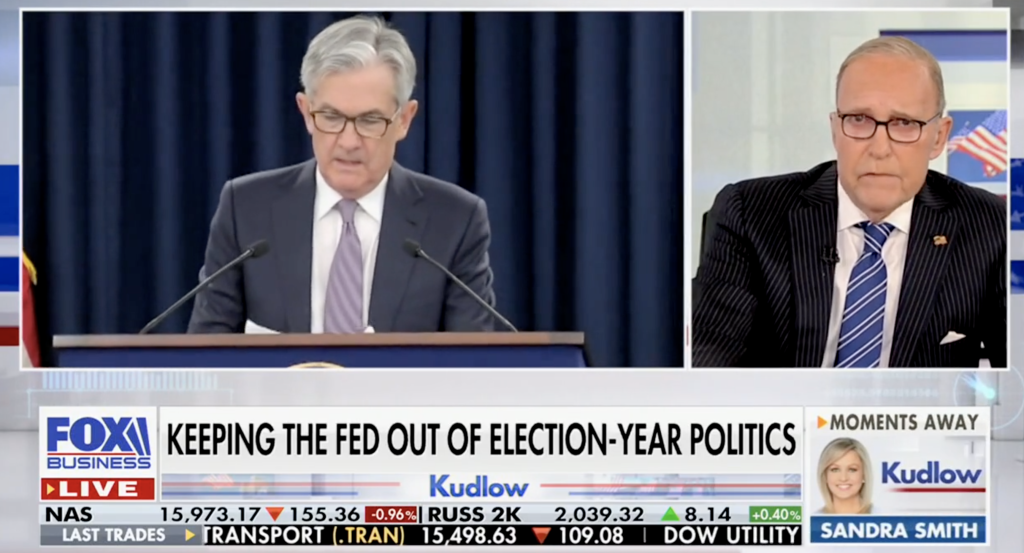
After employment statistics came in below expectations, including downward revisions for job creation in the previous year, and in light of increasingly stable inflation data, Federal Reserve Chairman Jerome Powell announced on August 23 that “the time has come” for interest rate cuts. Many economists had already been clamoring for the Fed to relieve pressure on the economy by lowering interest rates, with some citing an underwhelming July 2024 jobs report as evidence the Fed should have acted sooner.
The Fed is an independent agency and presidents traditionally do not interfere with its interest rate decisions. Trump broke with that tradition during his presidency as he appeared to sour on the independence of his own appointed chairman, Powell. As The Wall Street Journal reported, “beginning in the 1990s, presidents avoided publicly complaining about the Fed,” but as Trump’s “trade war unsettled markets, he steadily berated the Fed chair and called for lower rates.”
The Journal also reported that “Biden has mostly avoided discussing Fed policy, reverting to pre-Trump tradition.” (Biden re-appointed Powell to run the nonpartisan central bank for a second term in late 2021.) Additionally, Forbes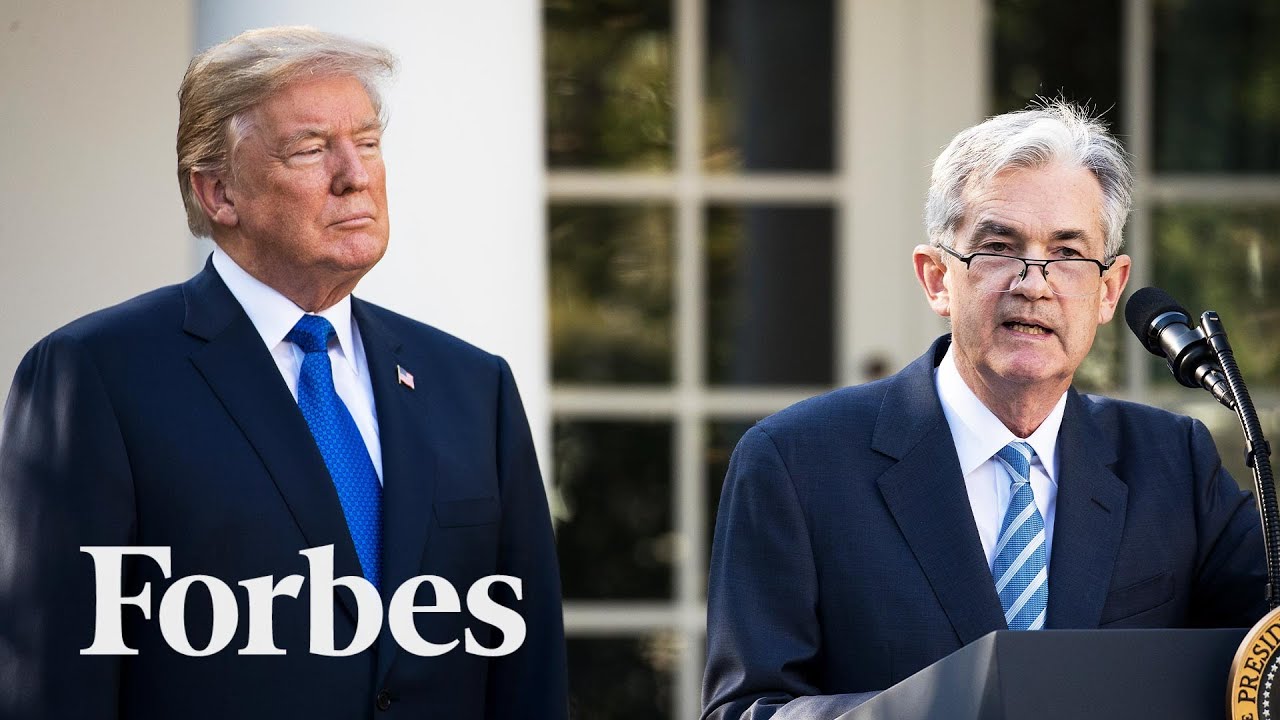 that according to former Trump Cabinet official Wilbur Ross’ upcoming memoir, in 2018, “Trump demanded his Commerce Secretary, Wilbur Ross, call the chair of the Federal Reserve … and demand that he cut interest rates.”
The Journal explained that it’s not unusual for the Fed to change interest rates during election years; it has previously done so in 2004, 2012, and 2020. Yet right-wing media began projecting politicization onto the upcoming rate cuts following recent economic reports, joining Fox Business host and former Trump economic adviser Larry Kudlow, who as far back as January began trying to bully the Fed out of cutting rates prior to the election.
Earlier this year, Trump and his allies preemptively attempted to bully the Federal Reserve away from cutting interest rates prior to the presidential election
- Trump and his allies warned the Fed against cutting interest rates prior to the election. The Wall Street Journal reported that in a June Bloomberg Businessweek interview, Trump said cutting interest rates before the election is something that Fed officials “know they shouldn’t be doing.” The story also quoted Michael Faulkender, chief economist at the Trump-aligned America First Policy Institute, who “said starting a rate-reduction campaign before the election would tarnish the Fed’s credibility.” The Wall Street Journal, [7/31/24]
- Fox Business host Larry Kudlow said the only reason for Powell to cut interest rates would be if the Fed “wants to completely politicize monetary policy, and slash interest rates in order to juice the economy and re-elect Biden.” Instead, Kudlow suggested that Powell “is an honorable man” who would not seek another term as Fed Chair regardless of the election result, and instead “establish his historical reputation” for getting inflation back to the target level. Fox Business, *Kudlow*, [1/17/24]
- Kudlow claimed that Biden’s prediction of lower interest rates meant, “The big guy wants a little juice from the Fed to get re-elected.” Kudlow then countered that “for all the cynical talk about how the Fed somehow must bend to the political whims of the president and his little minions, I actually think Powell is immune from that kind of thinking.” Fox Business, *Kudlow*, [3/15/24]
- Kudlow said the Fed would “just be creamed, reamed, destroyed,” and that Trump and Republicans would “correctly go after” it if there is an interest rate cut — unless it happened after the election. “Well, they could cut two times after the election, OK,” Kudlow said with a laugh. Fox News, *America Reports*, [4/5/24]
- Kudlow later imagined that Biden would be the one to attack the Fed for not cutting rates. During a panel discussion on his Fox Business show, Kudlow said: “Joe Biden forecasted rate cuts. He did it at least twice, maybe three times. He’s going to be very disappointed. Do you think he’ll attack the Fed?” Fox Business, *Kudlow*, [5/1/4]
- Kudlow declared, “The Fed can’t cut interest rates, because if they do, it’ll be so political.”Fox Business, The Big Money Show, [5/15/24]
- Right-wing legal activist Paul Ingrassia wrote that “the Federal Reserve needs to raise interest rates now” to prove that it’s independent. Ingrassia added: “But unfortunately we’re in the midst of a presidential election cycle, so they won’t raise rates because it’s not politically advantageous for Kamala Harris.” Twitter/X, [8/5/24]
Some conservatives fabricated a conspiracy theory that a routine revision of jobs reports was done specifically to push the Fed into cutting rates
- The Daily Wire’s Ben Shapiro pushed a conspiracy theory that the annual Bureau of Labor Statistics revision to jobs reports was deliberately timed “to jog the Federal Reserve to lower interest rates” in time for the election. Shapiro said: “You have to understand the game that's being played here. For the entirety of this year, the federal government has been radically overestimating the number of jobs created under the Biden administration so that he can go around bragging about jobs that he didn't create. OK, that revision is likely to be in the range of at least 600,000 jobs they say exist that do not exist in the Biden economy. Now why is that coming out right now?
- Because the goal is to jog the Federal Reserve to lower the interest rates and thus to blow more money into the economy, recapitulating inflation, and to do that off the basis of weak job growth. So that is the game. The game is: you hide the job failures until now. Then you let that news out of the bag just early enough that the Federal Reserve can lower the interest rate and then artificially boost spending in the economy.” (In fact, these revisions are scheduled at the same time every year as more accurate jobs data become available, and one previously showed a revision of -501,000 jobs in 2019 under Trump.) The Daily Wire, *The Ben Shapiro Show*, [8/21/24; Media Matters, 8/21/24]
- Shapiro also spread the conspiracy theory on X. On X, formerly known as Twitter, Shapiro wrote: “This is amazing for two reasons.1. They've been lying for a year about Biden job creation. 2. They're dumping this data just in time to justify a Federal Reserve interest rate decrease for the election.”Twitter/X, [8/21/24]
- Right-wing commentator Bill Mitchell pushed a similar conspiracy theory: “WE GOT PLAYED” on the BLS jobs report revision; “That was just cover to let the Feds cut interest rates before the election.” Twitter/X, [8/23/24]
Conservatives are increasingly accusing the Fed of cutting rates to help Democrats, or framing the cuts as political
- Fox host Sean Hannity: “Watch the Fed. Mark my words: September, they’re going to lower rates to help Kamala and Tim Walz.” Premiere Radio Networks, The Sean Hannity Show, [8/14/24]
- Shapiro: “They’re going to shove a Fed rate cut through as fast as humanly possible,” and “the idea that politics comes into their considerations not at all is ridiculous.” Shapiro added, “The notion of Federal Reserve independence is complete hogwash.” The Daily Wire, The Ben Shapiro Show, [8/15/24]
- Shapiro: “There is one sort of last hope for Joe Biden, and that is maybe Jerome Powell will save him” with interest rate cuts “just in time for the election, almost as if it’s on cue.” Shapiro continued: “It’s just so convenient. … We got to cut those interest rates just in time for the election and hopefully jog Joe Biden to victory. But don’t worry, it’s all apolitical.” The Daily Wire, The Ben Shapiro Show, [7/12/24]
- Right-wing X account End Wokeness posted: “If the Biden-Harris economy is so strong, why cut rates before the election? 🤔This announcement either means: 1. The economy is about to tank. 2. The federal reserve wants to artificially boost the economy before the election. 3. All of the above.” Twitter/X, [8/23/24]
- Conservative Substack author amuse: “ELECTION INTERFERENCE? Powell confirmed the Fed would be cutting rates between 25bps to 50bps in September depending on the August payroll report.” Twitter/X, [8/23/24]
- Gateway Pundit: “Fed Chair Announces Incoming Rate Cut… Just in Time to Boost Kamala Harris.” The Gateway Pundit, [8/23/24]
---
an 1 24 maya
with the Federal Reserve expected "to start reversing the sharp [interest] rate hikes it carried out beginning in March 2022," economist Paul Krugman predicts in a Monday, January 8 New York Times op-ed that "[Donald] Trumpist attacks on the Fed for cutting interest rates are coming."
"What I don’t know is whether the Fed is ready for the political firestorm it’s about to face, and whether it will stand up to the pressure to keep rates too high for too long. Because it’s a safe prediction that Donald Trump and his supporters will scream that the coming rate cuts are part of a deep-state conspiracy to re-elect President Biden," Krugman writes.
The longtime NYT opinion columnist notes, "In a recent dialogue with me about the economy, my colleague Peter Coy suggested that the Fed may be inhibited from cutting rates because it’ll fear accusations from Trump that it’s trying to help Biden. I hope Fed officials understand that they’ll be betraying their responsibilities if they let themselves be intimidated in this way."
He also emphasized, "I hope that forewarned is forearmed. MAGA attacks on the Fed are coming; they should be treated as the bad-faith bullying they are."
Krugman writes:
*I don’t know what the unemployment rate or the rate of economic growth will be in November, but because monetary policy works with a lag, what the Fed does in the next few months won’t have much effect on these numbers.
*Biden, however, is already presiding over a very good economy by normal standards, with solid job growth and plunging inflation. What he needs is for more Americans to accept the good news. And Fed rate cuts will help him with that. They will signal to the public that inflation really is under control; they will lead, other things being equal, to higher stock prices and lower mortgage rates.
*So we can expect howls from Trump and his allies that politics, not economics, is driving the coming rate cuts — even though Trump himself appointed Jerome Powell, the Fed’s chair.
"Trump and his allies constantly engage in projection, assuming that their opponents are doing or will do what they themselves would do or have done, like weaponizing the Justice Department for Trump’s own political ends," the distinguished professor at the City University of New York Graduate Center emphasizes. "And when it comes to interest rate policy, Trump has a track record of doing exactly what I’m sure he will accuse Biden of doing: trying to manipulate the Fed."
He writes, "Why do we know this will happen? Partly because paranoia is MAGAworld’s normal condition: It sees sinister conspiracies everywhere."
READ MORE:Paul Krugman: Why the economy 'may be better for Democrats' than pundits think
*Krugman's full op-ed is here (subscription required).
---
https://www.alternet.org/2022/06/gas-prices/
In the wake of new federal data showing that U.S. inflation rose again in May after decelerating slightly the previous month, progressive lawmakers, economists, and union leaders on Friday tried to hammer home their argument that corporate profiteering is a major driver of the price hikes that are eroding workers' modest wage gains and heightening economic pain nationwide.
"While families are feeling the sting of soaring energy costs, oil and gas companies are cheering the nearly $100 billion in profits they've already made this year off families' pain at the pump," said Dr. Rakeen Mabud, chief economist at the Groundwork Collaborative.
"It's past time for Congress to pass an excess profits tax to stop the outrageous war profiteering by Big Oil," Mabud added, referring to the benefits the U.S. fossil fuel industry has reaped from Russia's assault on Ukraine.
The narrative that corporate greed is one of the key culprits behind inflation, which is now at a 40-year high, resonates greatly with the U.S. public, according to recent survey data. A poll conducted last month by Data for Progress showed that 71% of all U.S. voters blame corporate profit-seeking for rising inflation.
But despite the argument's popularity—and alignment with data showing that record-high corporate profits are a disproportionate contributor to inflation—the Biden administration has been increasingly hesitant to deploy it in recent months even as inflationary pressures persist and businesses' net incomes grow exponentially in some sectors.
During an event hosted by The New York Times on Thursday, Treasury Secretary Janet Yellen outright rejected the notion that corporate greed is to blame for inflation, saying, "Demand and supply is largely driving inflation."
Federal Reserve Chair Jerome Powell, meanwhile, has openly suggested that wage increases are part of the problem, telling reporters during a press conference last month that the country needs to "get wages down" in order to tackle inflation.
While progressive economists have acknowledged that a number of factors, from supply chain issues caused by the pandemic to the war in Ukraine, are pushing inflation to levels not seen in decades, they have nevertheless maintained that corporate profiteering is a significant culprit.
"Corporations are using inflation as an excuse to raise their prices, hurting workers and consumers while they enjoy record profits," Robert Reich, the former secretary of the U.S. Labor Department, wrote last month. "Prices are surging—but let's be clear: corporations are not raising prices simply because of the increasing costs of supplies and labor. They could easily absorb these higher costs, but instead they are passing them on to consumers and even raising prices higher than those cost increases."
Mary Kay Henry, president of the Service Employees International Union, echoed Reich on Friday.
"Make no mistake: the same corporations that are making record profits while busting workers' unions are raising prices on working families," Henry wrote on Twitter. "If our nation's leaders are serious about addressing inflation, they'll hold these big corporations accountable for their price gouging."
In recent weeks, as inflation numbers have remained stubbornly high and corporate executives have continued boasting about their profits, congressional Democrats have put forth several proposals aimed at combating price gouging and reining in excess profits via taxation.
Led by Rep. Ro Khanna (D-Calif.) in the House and Sen. Sheldon Whitehouse (D-R.I.), a group of Democrats and Sen. Bernie Sanders (I-Vt.) introduced legislation in March that would hit large and highly profitable oil companies with "a per-barrel tax equal to 50% of the difference between the current price of a barrel of oil and the pre-pandemic average price per barrel between 2015 and 2019."
While the White House has signaled it would be willing to support a windfall profits tax on Big Oil, Democrats' bill has not received a vote in the House or Senate.
Last month, Sens. Elizabeth Warren (D-Mass.) and Tammy Baldwin (D-Wis.) along with Rep. Jan Schakowsky (D-Ill.) unveiled a measure that would empower federal regulators to crack down on corporate price gouging. Warren has specifically called out the meat industry for its pricing practices throughout the pandemic.
"Giant corporations are using inflation as a cover story to jack up prices and pad profits," Warren tweeted Friday. "Let's pass my bill to crack down on corporate price gouging. And let's pass our windfall profits tax on Big Oil, which includes rebate checks for Americans struggling with gas prices."
https://www.alternet.org/2022/06/economy-tanks-thank-ronald-reagan/
yesterday the Fed started something it hasn't done for quite a while. It started dumping bonds.
The Fed has been goosing the economy steadily since the Bush Crash of 2008, buying US and corporate bonds with money it creates out of thin air (only the Fed can "print money" like this by simply willing the dollars into existence).
By purchasing and holding those bonds over the past 14 years, the Fed has created and then flushed into our economy$8 trillion in liquid cash. This is how the Fed stimulates an economy in crisis: pouring newly-created money into the system.
As a result, our economy has been running on high-octane sugar-high stimulus (free money from the Fed, as you can see above) ever since 2008.
Several trillion of that came in the last year of the Trump presidency. While Republicans scream about spending for social needs that might also stimulate the economy, they and Trump were quite happy to see that money from the Fed.
But now the Fed and it's Trump-appointed Republican Chairman, Jerome Powell, are backing off.
Yesterday the Fed started selling those bonds, reversing the process after 14 years and now sucking money out. Instead of stimulating the economy, they're trying to slow it down in the hope that will cool off inflation.
When they receive the money back from those sales they'll simply drop it into the same Schrödinger's Cat-box from which it came: it'll vanish into the icy, dark depths of fiscal interstellar space, never to be seen again. What the Fed creates, the Fed can dissolve.
This month the Fed expects to "retire" $47.5 billion from its balance sheet — retire that amount from our economy — rising to $90 billion a month by the end of the summer.
While these aren't huge sums in the grand scheme of things, the very fact that the Fed has gone from pumping created-from-nothing money into the economy to pulling that money back out is a Very Big Deal.
Add that to its plan to continue increasing interest rates, which also slows the economy, and we're looking at a potential Category 5 event.
Thus, the Financial Times was the bearer of the predictable bad tidings yesterday. Just from that day's FT's (digital) front page's "Live News Updates" column, these were some of the headlines:
- Ford forecasts car industry consolidation as capital becomes constrained
- Treasuries and US stocks slip as investors gird for monetary policy tightening
- Bank of Canada prepared to 'act more forcefully' after latest rate rise
- European stocks enter June on a muted note after turbulent month
- German retail sales fell 5.4% in April
- UK house price growth slows in May
- China's manufacturing sector activity shrinks for third consecutive month
- Government bonds sell off as eurozone inflation hits record high
- JPMorgan chief says 'hurricane' is bearing down on economy
In that last article, JPMorgan CEO Jamie Dimon, who a week ago had predicted "storm clouds" on the economic horizon, became far more blunt yesterday.
'I said they're storm clouds, they're big storm clouds here,' Dimon said, adding, 'It's a hurricane.'
Elaborating that the war in Ukraine and Europe's disconnection from Russian fossil fuel markets could drive oil as high as $175 a barrel, Dimon worried out loud:
That hurricane is right out there down the road coming our way. We just don't know if it's a minor one or Superstorm Sandy . . . And you better brace yourself.
So, how did we get here?
Between the Republican Great Depression of 1929-1937 and Reagan's inauguration in 1981, the United States experienced a few recessions, but nothing as severe as Republican President Herbert Hoover oversaw back on Black Tuesday, October 29, 1929.
Hoover's crash was set up by the election of 1920, when Republican Warren Harding convinced Americans to abandon the trust-busting, high tax, progressive policies of Presidents Teddy Roosevelt, William Howard Taft, and Woodrow Wilson in favor of that generation's version of neoliberalism or what we today call Reaganomics.
Harding referred to it as "Horse and Sparrow Economics" — it was the early 20th century version of what Reagan later reinvented as "trickle-down economics."
If the horses (rich people and big business) were fed more oats (through deregulation and tax cuts), more of those oats would pass undigested into the horse manure that then littered the streets of American. The sparrows (working class Americans) could then pick the extra oats out of the manure.
In 1920, Warren Harding won the presidency on a campaign of "more industry in government, less government in industry" — privatize and deregulate — and "a return to normality," his promise to drop the top tax bracket from its then-91 percent rate down to 25 percent.
Harding kept both promises, putting the nation into a sugar-high spin called the Roaring '20s, where the rich got fabulously rich and working-class people were being beaten and murdered by industrialists when they tried to unionize. Harding, Coolidge, and Hoover (the three Republican presidents from 1920 to 1932) all cheered on the assaults, using phrases like "the right to work" to describe a union-free nation.
In the end, the result of the "horses and sparrows" economics advocated by Harding was the Republican Great Depression (yes, they called it that until after World War II).
FDR's response to Hoover's Depression was to raise the top income tax bracket back up to 91% and impose stiff regulations on banks and Wall Street, creating the Securities and Exchange Commission (SEC) and putting Joe Kennedy in charge of it.
Gloria Swanson, who knew Kennedy well and intensely disliked him (he'd robbed and exploited her), told me over one of our many dinners in her New York apartment that FDR knew, "It takes a crook to catch a crook." And FDR was going after the crooks.
High taxes on the morbidly rich and aggressive government enforcement of banking and securities rules prevented another large-scale crash for a half century until Reagan came along and repeated Harding's mistakes in the 1980s.
After Reagan finally dropped the top tax rate from the 74% he inherited when he came into office to 28% there was a one-day 22% stock market crash — Black Monday on October 27, 1987 — that rivaled 1929's Black Tuesday for the first time.
When Reagan deregulated the Savings & Loan industry the banksters stole so much money they crashed S&Ls across America, the first serious bank panic since the Republican Great Depression.
We're still living in Reagan's neoliberal deregulated economy. It brought us two financial crises while he was President, the dot-com bubble-bust of 1999/2000, the Bush Crash of 2008, and arguably the trillion-dollar-heist of 2020 when Trump passed out money to his fat-cat buddies without controls (we're still trying to figure out where all that money went).
Now, if Dimon is right, hang onto your hat for another "event."
The core tenet of both Harding's and Reagan's versions of neoliberalism is that the economy is essentially a force of nature. It's why Harding did away with regulations on stock speculation and why Reagan deregulated everything he could as fast as he could.
The economy "operates according to its own rules," they'd tell you, and anything government does to interfere with it will simply produce a bad outcome.
In actual fact, the opposite is true.
Players in the top reaches of finance, banking, and speculation are much like players in boxing or football: they're engaged in a competitive high-stakes game defined by very specific rules, and when they know they can get away with breaking those rules, they'll often do it.
The difference is that instead of winning or throwing a football game or boxing match, when bankers and speculators violate the rules they can take down the entire economy.
The financial speculators, of course are rarely injured in the process. We bailed out the banksters and speculators in the 1980s, 1999/2000, 2008, and 2020 to the tune of trillions of dollars. Senior executives and shareholders took home hundreds of billions of those dollars, looting the system they themselves had crashed.
Since 2008, most of that money was created out of thin air by the Fed. Now the Fed wants it back, but the banksters and speculators have already stashed it in their offshore tax havens. As a result, working class Americans and small- and medium-sized businesses will largely foot the bill.
Dimon and the purveyors of doom may be wrong about a crisis at this particular moment, but the system is still shaky and fraud is rife across banking, brokerage and finance, as Elizabeth Warren and Katie Porter continually remind us.
As I lay out in The Hidden History of Neoliberalism: How Reaganism Gutted America, it's probably going to take another 1929-type event to shake Americans up enough to reject Reagan's vision of a deregulated economy and put the nation back on the course of the stable and steady Keynesian growth that FDR gave us from 1933 to 1981.
Now, in addition to an economy held together with the baling-wire of Fed stimulus (that's coming to an end), both the US and the world are facing a wild spectrum of assaults that could have huge economic impacts.
And Republicans are committed to doing everything they can to cripple our economy, refusing to pass much of Biden's economic agenda, in their belief that a Crash will help them in the 2022 and 2024 elections.
Between the worldwide food and oil crises the Russian invasion of Ukraine are provoking, billions in climate change damage and millions of climate change refugees, Republican intransigence, and the Fed's claiming back that $8 trillion they gave our banksters and speculators, a real crisis may be at our doorstep sooner than any of us would like.
Brace yourself.
dump if BBB
https://www.alternet.org/2021/09/fed-chair-powell/
trump fired janet y b/c she did not fit central casting
==
https://www.alternet.org/2020/10/billionaires-rich/
igor salon
Billionaire wealth increased to $10.2 trillion through the end of July, setting a new record amid the coronavirus pandemic even as millions of unemployed people fall into poverty.
Wealth held by billionaires around the world rose to $10.2 trillion in July, up from the previous record of $8.9 trillion in 2017, according to an analysis by Swiss bank UBS and consulting firm PwC.
The number of billionaires also rose from 2,158 in 2017 to 2,189 this summer, according to the report.
Not all billionaires saw their wealth increase, though some saw their wealth rise by close to 50%. Health care billionaires, for example, saw their wealth increase by 50%. Technology billionaires saw their wealth rise by 42.5%. Billionaires in the entertainment, financial services, materials, and real estate sectors saw increases of 10% or less.
While the UBS analysis looked at billionaires around the world, a separate analysis by the Institute for Policy Studies and Americans for Tax Fairness found that billionaire wealth in the United States has grown by $792 billion, or 27%, since the beginning of coronavirus lockdowns in March. The combined wealth of American billionaires now tops $3.7 trillion.
Some prominent billionaires have done particularly well. Amazon CEO Jeff Bezos has seen his wealth rise more than 60% during the pandemic to $195 billion through late August, according to the analysis. Tesla CEO Elon Musk saw his wealth more than triple to $85 billion over that time frame.
The study pointed to President Donald Trump's 2017 tax cuts, which helped billionaires keep more of their earnings. The UBS study noted that Trump's desired capital gains tax cut, billed as a pandemic-related stimulus, would overwhelmingly favor the richest Americans.
"For billionaires, this is a heads-we win, tails-you-lose economy, boosted by Trump policies to funnel wealth to the top," Chuck Collins, the head of the Institute for Policy Studies' Program on Inequality, said in a news release.
"The pandemic profiteering of America's billionaires shows taxes on the wealthy must go up substantially to narrow the wealth gap and raise revenue vital for our big climb back from disaster," added Frank Clemente, executive director of Americans for Tax Fairness. "By demanding even more tax cuts for the rich at this crucial moment President Trump shows he is as out of touch with our nation's needs as America's billionaires are disconnected from our nation's misery."
Some executives, like Zoom CEO Eric Yuan and Bezos, have profited from a boom in business caused by the lockdowns. Others have profited directly from government aid distributed to their companies. But most billionaires saw their wealth increase due to rising investments, buoyed by a stock market surge propped up by government assistance.
The rising wealth amid an economically devastating pandemic threatens to deepen longstanding inequalities.
"Extreme wealth concentration is an ugly phenomenon from a moral perspective, but it's also economically and socially destructive," Luke Hilyard, the executive director of the High Pay Center, a think tank that focuses on excessive executive pay, told The Guardian.guk "Anyone accumulating riches on this scale could easily afford to raise the pay of the employees who generate their wealth, or contribute a great deal more in taxes to support vital public services, while remaining very well rewarded for whatever successes they've achieved. The findings from the UBS report showing that the super-rich are getting even richer are a sign that capitalism isn't working as it should."
UBS executive Josef Stadler also acknowledged that billionaires could face societal backlash over their growing wealth as many people face months if not years of struggles.
"We're at an inflection point," he told the outlet. "Wealth concentration is as high as in 1905, this is something billionaires are concerned about. The problem is the power of interest on interest – that makes big money bigger and, the question is to what extent is that sustainable and at what point will society intervene and strike back?"
But it's far from the first time that billionaires profited while millions suffered. The Institute for Policy Studies found that the wealthiest 400 billionaires in the US not only recovered from the 2008 recession within three years but increased their wealth by 80% over the following decade. By comparison, the bottom 80% of earners have still not recovered.
While government intervention has helped billionaires accumulate even more wealth, the lack of government action since the spring has resulted in an estimated 8 million Americans falling into poverty since May, according to a study from researchers at Columbia University. The lack of additional stimulus payments and the expiration of enhanced federal unemployment benefits has resulted in 6 million Americans falling into poverty over just the last three months, according to a study from researchers at the University of Chicago and Notre Dame.
The problem has been even worse globally. Between 88 million and 114 million people around the world have fallen into extreme poverty, defined as living on less than $1.90 per day, since the pandemic hit, according to the World Bank. There are now more than 700 million people living in extreme poverty and researchers expected that number to keep rising.
"This is the worst setback that we've witnessed in a generation," Carolina Sánchez-Páramo, the global director of the World Bank's Poverty and Equity Global Practice, told The Wall Street Journal.
World Bank Group President David Malpass argued in a speech this month that the problem is worse in developing economies because "rich countries" have the resources to expand sweeping "government spending programs" while poorer economies have few tools to mitigate the economic damage.
The US, by contrast, should be doing better if not for Republican reluctance to increased government relief.Federal Reserve Chairman Jerome Powellwarned Congress last month that inaction in the face of growing inequality would be highly damaging to the economic recovery.
"Those are things that hold back our economy," he said at a news conference. "If we want to have the highest potential output and the best output for our economy, we need that prosperity to be very broadly spread."
Many analysts have also faulted Powell and the Fed for contributing to the growing inequality with policies "disproportionately benefiting stockholders," according to the Associated Press.
Just as the coronavirus has exposed longstanding health disparities between the richest and poorest Americans, the growing inequality is largely the result of a "catastrophic failure to tackle inequality" well before the pandemic struck, according to a report from Oxfam International.
"Governments' catastrophic failure to tackle inequality meant the majority of the world's countries were critically ill-equipped to weather the pandemic," said Oxfam interim executive director Chema Vera. "No country on earth was trying hard enough to reduce inequality and ordinary people are bearing the brunt of this crisis as a result. Millions of people have been pushed into poverty and hunger and there have been countless unnecessary deaths."
FROM YOUR SITE ARTICLES
- Economist Thomas Piketty: Coronavirus pandemic has exposed the ... ›
- No, we're not all in this together — the super-rich are cheating America ›
- Trump is overseeing a historic transfer of wealth to the super-rich as ... ›
RELATED ARTICLES AROUND THE WEB
- Wealth of US billionaires rises by nearly a third during pandemic ... ›
- American billionaires got $434 billion richer during the pandemic ›
- Billionaires are getting even richer from the pandemic. Enough is ... ›
==
motherfrackers: not only got covid bailout but changed rules to pay down their DEBT
https://stateimpact.npr.org/pennsylvania/2020/05/11/oil-and-gas-companies-asked-then-received-changes-to-fed-coronavirus-stimulus-program/
oil and gas companies asked, then received changes to Fed coronavirus stimulus program
Help with refinancing debt could help shale companies in PA
- Reid Frazier
- mAY 11, 2020
Oil and gas companies in Pennsylvania could benefit from a change to a Federal Reserve stimulus program aimed at helping businesses during the coronavirus pandemic.
Critics have attacked the changes, calling them a “stealth bailout” for heavily indebted oil and gas companies.
The changes were made in late April to the Fed’s Main Street Lending program, part of the $2 trillion coronavirus :{relief bill:(style="box-sizing:border-box;font-weight:400"):}: passed by Congress in March. The :{$600 billion loan program:(style="box-sizing:border-box;font-weight:400"):}: is intended to help small- and medium-sized businesses that were in good financial shape before the pandemic struck.
When the Fed rolled out the program, it prohibited companies from using the loans to pay off debts.
Oil and gas companies and their advocates asked the central bank to loosen up those guidelines. One of their biggest asks: They wanted to be allowed to use the loans to pay off other debts, too.
The Fed’s final guidelines gave those companies their wish — companies could use the loans to pay off some types of debt. And the maximum loan size increased from $150 million to $200 million.
Oil-state Sens. Ted Cruz of Texas and Kevin Cramer of North Dakota praised the changes.
“It’s another arrow in the quiver” to help the oil industry in his state, Cramer said in a :{video statement:(style="box-sizing:border-box;font-weight:400"):}:.
Environmentalists questioned whether the government should be throwing a lifeline to the fossil fuel industry — one of the country’s biggest sources of greenhouse gases. Emissions must be cut dramatically, scientists say, if the world is to avoid the worst effects of climate change.
Others saw the Federal Reserve — an independent institution that is supposed to stay outside politics — giving preferential treatment to a powerful industry with substantial ties to the Trump administration.
“This is an oil bailout for a specific set of companies,” said Graham Steele, the director of the Corporations and Society Initiative at Stanford Graduate School of Business.
Steele, a former aide to Democratic Senator Sherrod Brown of Ohio, said the program is risky because climate change risks making these companies’ assets — oil and gas reserves — “:{stranded assets:(style="box-sizing:border-box"):}:” in the future, if governments tax carbon to avert runaway climate change.
He said the loans are also risky because many of the companies were doing poorly before the pandemic.
“(The Fed) had structured the program in a way so as not to lose taxpayers’ money. And now members of Congress and industry have lobbied them. And under that pressure, they have buckled. They have changed the program to help out a specific industry,” Steele said.
The Federal Reserve says changes to the program weren’t made with the oil industry in mind, and that other industries could benefit. Business groups like the U.S. Chamber of Commerce also lobbied for the changes.
But observers see the Fed’s revisions to its lending guidelines as a clear win for oil and gas companies.
David Livingston with Eurasia group, a risk management firm, said the changes are especially good for oil and gas companies because of the high amount of debt some have accumulated.
He said they’ve had to borrow because revenues from oil and gas alone have not been enough for them to cover their costs.
“They were sort of running on a treadmill and the entire shale enterprise was increasing its production month over month, year over year over year, in large part, thanks to the continued provision of relatively low cost capital,” Livingston said.
The idea behind the strategy was that prices for oil and gas would eventually rise and they’d be able to pay off their debts. But the opposite has happened, at least for oil. It :{plummeted into the negative range:(style="box-sizing:border-box;font-weight:400"):}: in April, though prices are recovering.
The loans could also help natural gas companies that operate in Pennsylvania.
A group of GOP senators from Pennsylvania and other Appalachian states :{wrote:(style="box-sizing:border-box"):}: in favor of the changes in April.
“Many producers will have debts come due before this health crisis is expected to subside,” the letter stated. “These companies would have been able to pay their debt obligations out of normal cash flows if not for the virus.”
Jeffrey Ventura, CEO of gas driller :{Range Resources:(style="box-sizing:border-box;font-weight:400"):}:, also lobbied the Fed to loosen its guidelines. A company spokesman did not respond to requests for comment.
The CEO of the :{Independent Petroleum Assocation of America:(style="box-sizing:border-box;font-weight:400"):}: :{wrote:(style="box-sizing:border-box;font-weight:400"):}: Fed Chair Jerome Powellin April that loosening the loan guidelines would “limit the number of defaults” in the industry.
“Oil and natural gas producers are not looking for a government handout; they are seeking a bridge to help survive this economic disruption,” the letter stated.
It’s unclear which companies would take advantage of the program. Spokesmen for CNX Resources and Cabot, two of Pennsylvania’s leading drillers, both said their companies would not apply for the loans. EQT and Range Resources did not respond to requests for comment.
The crash in oil prices may have actually helped some of these companies by inflating the price of natural gas.
Since oil wells also produce natural gas, when oil production slows, less natural gas comes onto the market, and the price for natural gas goes up. Gas futures for January 2021 are trading above $3 per million British Thermal Units, well above the current $1.84 price.
Still, some of these companies are holding debts they accumulated from leasing millions of acres of land during the fracking boom that began around 2008.
“For years, shale was all about grabbing land,” said Bill Holland, who covers the natural gas industry for S&P Global Market Intelligence. “So these companies spent big to lease big, big tracts of land in western Pennsylvania, West Virginia, Ohio, in the Utica and Marcellus shales — the land grab. And that debt is still on their books.”
One company that could benefit from the Fed’s new loan program is Chesapeake Energy, which has a big debt payment coming due this year. The company did not respond to a request for comment.
But Holland said it’s unclear whether Chesapeake could qualify for the loan. News outlets are reporting the company, saddled with over $9 billion in debt, :{is getting ready to file:(style="box-sizing:border-box;font-weight:400"):}: for bankruptcy.
220 cascade interactions between economic and climate collapse?
aha: recessions are periodic, fed no suffic buffer? trump keeps money free to goose stock mkt so can boast 401k; blew up fed deficit, household debt and student debt high; authoritarian growing everywhere, what effect of worldwide recession again? Greece?
what if we get hit by huge agw costs at the same time as worldwide recession? how wd such costs affect economies?
==
aha 2: related: debt is the opposite of a buffer? many/most american do not have 400$ for emergency? but debt is an asset on someone's books? tho in recession/depression or even a stock downturn, wealth evaporates?! fed chair may be fired for no negative interest rates?
we know that inequality is destabilizing, more likely to generate fails that system must cope with?!
==
==
https://www.nbcnews.com/business/economy/what-happens-fed-chair-jerome-powell-if-trump-gets-re-n1134796
220
Martha C. White
If President Donald Trump wins re-election in November, he could throw the economy into disarray with an assault on the Federal Reserve as he seeks to remake the central bank in his own image — and compliant with his whims.
"If Trump wins the election, he'll believe he has a mandate to fire" Federal Reserve Chairman Jerome Powell,said Mitchell Goldberg, president of ClientFirst Strategy.
Trump has threatened to dismiss Powell — whom he tapped in 2017 to head the Fed — but Powell has responded by saying that he believes he cannot be fired without cause and that he will not resign. Firing or demoting Powell would be legally fraught, and some suggest that Trump might not want to risk losing an almost inevitable court fight if he tried to fire Powell before his term as chairman is up in 2022.
"It would be very unpopular and difficult to fight in the courts, firing Powell. I think he would lean towards letting him finish out his term and pushing forward someone he has designated on the board to run it, with the hopes that he, as president, would have more influence on Fed policy going forward," said Danielle DiMartino Booth, CEO and chief strategist of Quill Intelligence.
Some suggest that Trump loyalist Judy Shelton could be a chairwoman-in-waiting. Shelton, a former Trump campaign adviser and outspoken critic of the Fed, is scheduled to meet with the Senate Banking Committee on Thursday.
Shelton has stirred concern by questioning the need for the Fed's independence, a stance that would align her with Trump but put her at odds with mainstream economists.
"It is encouraging to see that some members of the Senate are voicing skepticism about Judy Shelton," said Kenneth Kuttner, an economics professor at Williams College in Williamstown, Massachusetts. "That's slightly reassuring."
Kuttner characterized central bank independence as a critical firewall that lets policymakers focus on economic rather than political goals.
"The Fed is the one bright spot ... thank goodness. It's structurally very independent," he said.
The policymaking Federal Reserve Board of Governors is a seven-member body; two seats are vacant. Trump has appointed four of the current five members, including Powell.
Kuttner pointed to previous attempts by Trump to install loyalists with little background in economics or monetary policy. Nominees Stephen Moore and Herman Cain withdrew their names from consideration once Senate approval looked unlikely.
"I think the problem goes beyond just the rift with Powell," Kuttner said.
Trump's goal for a more compliant Fed is both clear and very, very risky, experts say, given the president's often-stated desire for interest rates at — or even below — zero percent.
"I think that Trump's dream would be to get somebody to impose negative interest rates in this country," DiMartino Booth said, calling such a move a "step into the abyss."
Negative interest rates in Japan and some Eurozone countries have contributed to economic stagnation and have left policymakers with no clear path to return to normal.
"Where we've seen negative interest rates before, I can't point to one example where it's actually worked," said Mitchell Goldberg, president of ClientFirst Strategy.
"Trump's dream would be to get somebody to impose negative interest rates in this country," said one analyst. But negative interest rates abroad have contributed to economic stagnation.
"For one thing, it would absolutely hurt all kinds of lending — business lending, consumer lending. Banks need to make money by making loans, and if there's no access to credit, companies can't borrow today for the future," Goldberg said.
Negative interest rates also are terrible for ordinary people, said Karen Shaw Petrou, managing partner of the consulting firm Federal Financial Analytics.
"I think negative interest rates are just about the worst things we could do for economic inequality, because they destroy savings, threaten retirements and evaporate pensions," Petrou said. "And if the economy is in a recession, which is blighting what Trump thinks of as his legacy, I think the results are far less predictable."
Goldberg said: "People will act based on what's in their best interest now, not in the long-term best interest of the U.S. economy."
"It could take a few years for poor policy decisions to be felt, but once they are felt, they could last for years, and then it's even harder to get things back on track," he said.
Jerome Powell - Wikipediaen.wikipedia.org › wiki › Jerome_Powell
Jerome Hayden "Jay" Powell (born February 4, 1953) is the 16th Chair of the Federal Reserve, serving in that office since February 2018. He was nominated to the Fed Chair position by President Donald Trump, and confirmed by the United States Senate.
Net worth?: ?$19-55 million
Political party?: ?
Republican
Education?: ?Princeton University? (?BA?); ?Georget... Children?: ?3
What happens to Fed Chairman Jerome Powell if Trump gets ...www.nbcnews.com › business › economy › what-happens-fed-chair-j...
5 days ago - "If Trump wins the election, he'll believe he has a mandate to fire" Federal Reserve Chairman Jerome Powell, said Mitchell Goldberg, president of ClientFirst Strategy. ... Shelton, a former Trump campaign adviser and outspoken critic of the Fed, is scheduled to meet with the Senate ...
Does Trump Have the Legal Authority to Demote the Federal ...www.nytimes.com › 2019/06/20 › politics › trump-fed-chairman-powell
Jun 20, 2019 - President Trump has been attacking the Federal Reserve and its chairman, Jerome H. Powell, because he is angry that the central bank's ...
Trump expresses fresh regret about his Fed chief: 'Oh well ...www.politico.com › story › 2019/09/06 › donald-trump-jerome-powe...
Sep 6, 2019 - President Donald Trump on Friday offered his latest broadside against his handpicked Federal Reserve chairman, as
Jerome Powell - Wikipedia
en.wikipedia.org › wiki › Jerome_Powell
1.
**Net worth**: $19-55 million
**Political party**: Republican
Education: Princeton University (BA); Georget...
Children: 3
What happens to Fed Chairman Jerome Powell if Trump gets ...
www.nbcnews.com › business › economy › what-happens-fed-chair-j...
1.
Does Trump Have the Legal Authority to Demote the Federal ...
www.nytimes.com › 2019/06/20 › politics › trump-fed-chairman-powell
Jun 20, 2019 - President Trump has been attacking the Federal Reserve and its chairman, Jerome H. Powell, because he is angry that the central bank's ...
Trump expresses fresh regret about his Fed chief: 'Oh well ...
www.politico.com › story › 2019/09/06 › donald-trump-jerome-powe...
1.