Post-trump reform progress
this was originally for program of reclamation after trump defeat, but as of 11/20 must include persistence of trump-ism; 1220 update i may skew this to positive reform/resistance, as i now has trump 12 post node
REBOOT TERM TWO 2 26
see GOP 4 on gop civil war liz cheney mcconn? vs gaetz greene
---
AN NEW REP 10 26
-=-=
AN 10 26
Once the "initial euphoria" wears off in the increasingly likely scenario that the midterms wipe away President Donald Trump's GOP in a blue wave, Democrats will have to tackle a "long and extremely urgent to-do list" lest the country "suffer deeply," one top political scholar warned for The New Republic.
Norman Ornstein is a veteran political scientist and scholar, best known for co-authoring the prescient book, It's Even Worse Than It Looks, about the growing partisan divide threatening the U.S. and jamming up Congress. On Sunday, he published his latest piece for The New Republic, warning that the "initial euphoria from everybody hoping to put a halt to the nihilism and march toward corrupt autocracy driven by the destructive narcissist Donald Trump and his minions" will quickly subside after the midterms, before the newly empowered Democratic Party is faced with a key question:
"What do we do now?"
Ornstein proceeded to lay out at least "three big challenges" the party will need to tackle if and when it retakes the majority in the House, and possibly the Senate as well.
"First, a lot of those who voted for Democrats are expecting action to improve their economic conditions," Ornstein explained. "Run on affordability, you better improve affordability. Second, and related, with Democrats holding a sizable piece of power in Washington, the failures of policy driven by the reckless Trump and his administration could be blamed on them—and it is a sure thing that hundreds of millions will be spent by Trump allies to try to pin the problems on the Democrats. Americans already think Washington isn’t working; if it looks like Democrats are a part of the problem and not of the solution, that could have brutal consequences in 2028."
He continued: "Third, it is clear that the Democratic Party base wants toughness and serious pushback against the corruption, misconduct, and mayhem that are the core of Trump’s presidency. Witness the negative reaction to the private meeting between House Democratic Leader Hakeem Jeffries and Trump son-in-law Jared Kushner, looking for areas of possible common ground after January 3. Rank-and-file Democrats want pushback, not compromise. Of course, compromise will be necessary to meet the first challenge of improving people’s economic circumstances. But if it is not led by Democrats using every tool at their disposal to name names, kick ass, and stop further destruction, there will be hell to pay with the base."
As for the immense task of actually addressing these issues, Ornstein further outlined six key tools that House Democrats should have at their disposal: lawmaking, the power of the purse, oversight investigations, the bully pulpit, advice/consent in the Senate and impeachment. In order to better enact laws without pushback from Republicans, he advised them to "consider reforming the Senate’s Rule XXII, not by eliminating the filibuster but by putting the onus on the minority by flipping the numbers—41 required to continue debate, not 60 required to end it." As for reclaiming the power of the purse, he urged Democrats to use Republicans' favored tool of reconciliation, "which requires only a majority in the Senate," and would allow them to "pass and send to Trump tough spending measures to right the balance toward decency and the rule of law"
"Third is investigations and oversight: to dig into wrongdoing, corruption, lawbreaking, and malfeasance inside and out of government, along with the failure to see that the laws are faithfully executed," Ornstein detailed further. "
Fourth, and related, is the bully pulpit: the ability to use debate on the floor and in committees, and the megaphone provided by the legitimacy of Congress, to report to the public what you are doing and to shed light on failures or gaps in norms, laws, and policy.
Fifth is advice and consent in the Senate: the power to examine the qualifications and character of presidential nominees for federal courts and executive positions, and to reject those unworthy of confirmation. Sixth is impeachment: the power in the House to hold miscreants to account and recommend their removal to the Senate."
---
an 4 26
Donald Trump has spent much of his second presidency running roughshod over the rules and regulations meant to rein in the White House post-Watergate. Now, a conservative writer has put forward the changes that must be made after his term to prevent "power-hungry" Trump wannabes from harming the country in the future.
Myra Adams is a conservative political commentator and columnist for The Hill, who previously worked on Republican presidential campaigns in 2004 and 2008. In her latest piece from Friday, she observed that Trump's "administration has figuratively bulldozed post-Watergate laws and norms while physically bulldozing the White House East Wing," and argued that "his I-am-above-the-law presidential overreach has reached critical mass."
"Daily headlines document power grabs, high-stakes international aggression, extreme weaponization of federal power, especially the judicial branch, and blatant, ongoing personal and family enrichment, earning billions," Adams wrote. "Therefore, post-Trump, no matter which party controls Capitol Hill or the White House, numerous pieces of bipartisan legislation must be enacted to protect constitutional integrity, prevent executive-branch abuses, and serve the national good."
Adams further urged the American leaders of the near future to take a page from the post-Watergate reforms and aggressively pursue reforms that will help prevent a similarly abusive leader from doing the same level of damage as Trump.
"First: The incumbent president should be prohibited from owning a public company," Adams wrote. "There are inherent conflicts of interest, ample profit-generating opportunities, potential for dirty dealing through access to power, and investor risk due to political volatility."
She continued: "Second: The incumbent president should be prohibited from owning a public or privately owned communication platform that channels official presidential messages."
Adams noted that, despite being president, Trump remains "the majority stockholder (52 percent) of Trump Media and Technology Group, which owns Truth Social (stock symbol DJT)," and is "the settlor and sole beneficiary of the Trust" set up to hold those shares, despite supposedly passing control of it to his family.
"Third: We must prohibit the president and his family members from owning stakes in companies engaged in cryptocurrency that could benefit from presidential policies," Adams continued. "We should also outlaw presidential family involvement with prediction market companies due to direct access to inside information. Fourth: The president, his closest family members and their spouses should be forbidden from engaging in foreign real estate transactions or any foreign investment valued over an amount set by Congress, on behalf of a company in which they own or are employed... The law must also include military weapons companies."
Adams added five more rules to her list of proposals: making it "mandatory" for presidents and vice presidents to disclose their taxes on April 15; restricting, to a degree she did not specify, the president's pardon powers; giving Congress the power to nullify executive orders if it both chambers do not pass a measure approving them within a set period of time; "establishing a bipartisan watchdog organization to review what appears to be politically motivated weaponization of any agency or Cabinet department that unleashes the power of the federal government"; and lastly, outlawing "licensing fees or any profit earned from the sale of merchandise that the president actively promotes, which degrades the office."
---
---
an 2 26
A stark report from one of the main independent European think tanks says there is no going back to any sort of pre-MAGA America, and warns that even after the Trump years, unless drastic action is taken, the “core fascist” political beliefs of the MAGA movement won’t quickly disappear.
“By the 2030s, the vulgarity, corruption, buffoonery, cult-like loyalty to Donald Trump and gratuitous cruelty of this regime may fade into history,” writes Lincoln Mitchell for the Institute for International and Strategic Affairs (IRIS). “As these most visible aspects of MAGA disappear many will choose to believe that the country has been reunified, but the core fascist political beliefs of the MAGA movement are unlikely to fade away so quickly.”
“As the Trump regime continues to sink into fascism and corruption, it is increasingly evident that the US will be forever changed by this era,” he continues. “If the US emerges from the Trump years as a functioning and cohesive, just in the legal sense, country, something that cannot be easily assumed, it will look very different than it did before Trump announced his candidacy in June of 2015 and almost immediately became the dominant figure in American political life.”
Mitchell, a political analyst, essayist, and lecturer at Columbia University, points to other times of crisis in American history, such as the Civil War or the 1960s and 1970s, and warns against those who “say that if we survived that, we can survive this.”
“That view cannot be ignored, but if we take it seriously, we must push back on the idea that the US simply survived those crises,” he writes. “The social movements that led to greater racial equality and expansions of rights for women, people of color, LGBT people and others-and the backlashes to all those movements that soon followed-still drive much of our political life and political conflicts.”
He says that even if, post-Trump, “the MAGA fervor cools a little,” it will be possible for Americans to reform the political system just enough to say to themselves that the fascist MAGA threat has passed — but they may be fooling themselves. The issues that spawned the MAGA movement will still be “central to our political life.”
Mitchell says it “should be clear” to all that now, more than a decade after Trump launched the MAGA movement, “there is no going back.”
He suggests that the question Americans need to answer is whether they want to return to “ineffective center-left administrations” or “fascist or fascist adjacent ones.”
Mitchell warns that to defeat MAGA, a few Democratic Party wins at the ballot box will not suffice.
“It will require an earnest rethinking not just of what American democracy can be, but of what the US is. It means accepting that the Constitution is no longer the core document that governs the US, so our political imaginations must not be bound by it.”
---
an 721
Biden applauded for executive order targeting 'insidious' anti-worker practices
Among the 72 initiatives packed into the far-reaching executive order President Joe Biden signed Friday are steps that labor advocates welcomed as important victories for U.S. workers, including a provision calling for the limitation of noncompete clauses that drive down wages by preventing employees from quitting for better-paying jobs.
Presented as an effort to promote competition in a...
think piece
https://www.alternet.org/2021/02/gop-history/
...A few minutes later, President and First Lady Biden arrived at the rotunda to pay their respects. MSNBC and CNN were there. OnFox, Laura Ingraham briefly acknowledged the Bidens' presencebut spent most of her airtime not honoring the slain policeman but trashing Dr. Anthony Fauci and beginning a story about homicides in Chicago with the phrase, "The BLM-fueled crime wave…" Black Lives Matter, you see, is just one more manifestation of the imaginary socialist plot to take over America. No wonder their viewers think the world's aflame, a cynical awful place where progressives plotting evil lurk at every corner pizzeria.
By the way, Officer Sicknick, a 12-year veteran of the force, was a Trump voter in 2016, although *The Washington Post* reports, "Those who encountered Sicknick said his political views did not align neatly with one political party." He was against impeachment but supported gun control.
There hasn't been an official explanation yet as to exactly how Sicknick died but he was attacked and killed while resisting the crazed crowd brainwashed by Trump
...Meanwhile, the rest of us are supposed to buy into the GOP's big con because, you know, unity. Every time truths are spoken that Republicans don't like, they claim that it's for sure dividing the country further.
So brazen are the attempts at manipulation of truth whether present or past, that in the last months of his term, President Trump and his sycophantic crew appointed a Presidential Advisory 1776 Committee, charged with creating "a definitive chronicle of the American founding." The report partly was a response to The New York Times' award-winning 1619 Project, charting the history of slavery in the United States and our continuing record of racial discrimination.
With little regard for the facts and not a single professional historian on the panel (but with plenty of conservative activists and educators), and with time quickly running out for the Trump White House, it was decided to release their findings on the Martin Luther King, Jr., holiday, months before the report was supposed to be completed and just two days before the Biden inauguration—timing that was either a stroke of haste, pure ignorance or malign spite—you make the call.
In any case, much of what the commission had to say was lost in the shuffle of last-minute Trump pardons and inauguration news but as per Sarah Ruiz-Grossman at The Huffington Post:
The 45-page report reads in places like a right-wing manifesto: It makes excuses for slavery and the Three-fifths Compromise that declared slaves counted as less than full humans. It decries socialism and "identity politics," celebrates the right to bear arms and calls the anti-abortion movement one of the nation's "great reforms…"
"The Trump commission's report also rails against socialism as leading people down a "dangerous path" of wealth redistribution and cites '"anti-Communism" and "the Pro-Life Movement"— or anti-abortion movement — as some of the "great reforms" of the country's history."
The report compares progressivism to fascism, seeking to "centralize power under the management of so-called experts." There are twice as many references to Christianity as of racism, no footnotes or citations, and not a single mention of Indigenous people, especially not the notion that upon our arrival, ninety percent of them quickly were wiped out by disease, murder, forced relocation, and other assorted territorial encroachments.
Many wondered what President Biden would do with the report. It didn't take long to find out. Within minutes of his swearing-in, an executive order wiped out the 1776 Committee. And shortly after, all evidence of its existence, including the panel's preposterous report, was removed from the White House website.
Via his Department of Education, the new president should lead an effort figuring out how to restore civics classes and revive the history curriculum that once taught young Americans how to be thoughtful, participating citizens by learning their past. This also should help them develop the kind of critical thinking that, when presented with the facts, responds with skepticism and debate but not in the belief of every crackpot version of reality that beckons to them from their televisions, radios and laptops. As we've seen, such an alternative truth—the real fake news as it were—can only lead to the violent end of American democracy.
For a party that used to preach responsibility and reason, the Republicans have devolved into an asylum for the proponents and hangers on of screwball revisionism fraudulent theories and the vicious overthrow of government. Don't know much about history but I do know that if the GOP have their way there will be little room for rational solutions that can help us...
https://www.alternet.org/2021/02/voter-suppression
comm dr
since former President Donald Trump failed to reverse the outcome of the 2020 presidential election, Republicans in more than two dozen states have introduced over 100 bills to restrict voting access, an alarming development that voting rights advocates have pointed to as yet another reason for Democrats to abolish the filibuster, an anti-democratic tool currently allowing the GOP minority to block the enactment of a suite of popular pro-democracy reforms.
Mother Jones journalist Ari Berman on Thursdayreported on the GOP's ongoing nationwide push to make voting more difficult—particularly for communities of color and other Democratic-leaning constituencies—and in some cases to empower state legislatures to overturn election results. He called state-level Republicans' efforts "a huge scandal that should be getting as much attention as Trump's plot to overturn the election."
Republicans across the country, Berman said, are "weaponizing Trump's lies" about fraud in an attempt to roll back voting rights after last year's historic turnout and expansion of mail-in ballots.
"Democrats have a clear choice," Berman continued. "They can get rid of the filibuster to pass the John Lewis Voting Rights Act and the For the People Act to stop GOP voter suppression, or they can allow the GOP to undermine democracy for the next decade."
"The stakes," Berman added, "couldn't be higher." That's because, according to an analysis conducted by the Brennan Center for Justice in late January, Republicans at the state level have introduced three times as many bills to chip away at voting rights compared to the same point last year.
Already this year, 106 bills have been introduced in 28 states—including 17 under complete GOP control, where passage is more likely—to undermine access to the franchise. According to the Brennan Center's report, "These proposals primarily seek to: (1) limit mail voting access; (2) impose stricter voter ID requirements; (3) limit successful pro-voter registration policies; and (4) enable more aggressive voter roll purges."
"These bills," the report argues, "are anunmistakable response to the unfounded and dangerous lies about fraud that followed the 2020 election."
106 bills introduced in 28 states already this year to restrict voting access finds @BrennanCenter That's 3x as h… https://t.co/o69lHRGgsd
— Ari Berman (@Ari Berman)1612459832.0
And this week, as CNN reported on Friday, "lawmakers in the Republican-controlled Georgia Senate added more. They include proposals that would eliminate no-excuse absentee voting for many state residents and end automatic voter registration when obtaining a driver's license."
According to Berman, the nine bills that Georgia Republicans introduced on February 1 would amount to "one of the worst voter suppression laws ever passed."
On first day of Black History Month Georgia Republicans introduced NINE bills to make it harder to vote, including… https://t.co/qwLmKWq6o7
— Ari Berman (@Ari Berman)1612458849.0
Not to be outdone, Arizona Republicans have since the start of 2021 introduced 34 bills to make voting harder, including reducing the number of polling places in Maricopa County from 100 to 15.
Arizona Republicans have introduced 34 BILLS to make it harder to vote, including ending mail voting, purging list… https://t.co/4kXh0wNIMT
— Ari Berman (@Ari Berman)1612459235.0
Georgia and Arizona are not alone; similar reactionary proposals are being pushed by Republicans in more than two dozen additional states.
The spike in anti-democracy bills represents an intensification of an existingtrend rather than a new development. As Common Dreamsreported last November, Trump ally Sen. Lindsey Graham (R-S.C.) admitted shortly after the election that making voting more accessible hurts the GOP's electoral prospects.
"If we don't do something about voting by mail, we're going to lose the ability to elect a Republican in this country," Graham told Fox News host Sean Hannity.
The GOP has been trying to undercut efforts to expand voting access for years. "A decade ago," Bermanwrote, "Republicans passed new voter ID laws and other efforts to curtail voting rights when they took power in the states following [former President] Barack Obama's election."
But now, he added, "Republicans are taking their assault on voting rights to the next level." Like the Brennan Center, Berman attributed the surge in anti-democracy legislation to Trump's failed bid to subvert the will of the people in last year's election.
According toBerman, the GOP is "trying to accomplish through legislation what Trump couldn't with litigation. All in all, these efforts amount to the most concerted attempts to roll back voting rights since the passage of the Voting Rights Act in 1965."...
https://www.alternet.org/2021/02/qanon-party/
rep. Marjorie Taylor Greene, the QAnon-loving construction heiress who recently won a deep-red congressional seat in Georgia, is getting quite a bit of attention for her nutty, violent, and racist views that she has long enjoyed sharing freely on social media. There is no doubt that she's a doozy, from her 2019 video demanding that her followers "flood the Capitol" and use violence "if we have to" to her 2018 Facebook post blaming wildfires on Jews with space lasers. Democrats in Congress have been making hay over Greene's committee assignments, using the presence of someone who stalked a school shooting survivor on the House Education and Labor Committee to embarrass House Minority Leader Kevin McCarthy and highlight the way that extremism has been mainstreamed in the GOP.
The whole situation is apparently too much for Senate Minority Leader Mitch McConnell, R-Ky., who started to insult Greene in public on Monday, in a belated bid to suggest that the QAnon faction is more fringe in the Republican Party than it actually is. "Loony lies and conspiracy theories are cancer for the Republican Party and our country," McConnell groused in a statement that did not name Greene explicitly. Sen. Todd C. Young of Indiana, a close colleague of McConnell's, picked up the baton on Tuesday, calling Greene "nutty" and "an embarrassment to our party."
It's tempting to be comforted by these words and to imagine that powerful Republicans are drawing a line in the sand when it comes to how far the party will go in catering to the extremist element. In reality, however, it's just a feint to make McConnell appear to be a reasonable person while he continues to empower and support the fascistic faction of the GOP. This is about looking good to the cable news pundits while not doing anything substantive that would actually curtail the power of the Trumpist right.
"[E]verything Greene has said, done and endorsed has been similarly said, done and endorsed by Donald Trump,"Josh Marshall of Talking Points Memo noted, arguing that Greene is a "scape goat some Republicans are trying to push off the cliff to expiate the sins of Donald Trump, who they can never cross."
As usual, this is a situation where it's more useful to look at what Republican leadership does, rather than what they say.
What Republicans are planning to do is let Trump off the hook for inciting a violent insurrection at the Capitol on January 6. Ninety percent of Senate Republicans voted against even holding a trial for Trump, using nonsense procedural objections, because they know full well that he's guilty and can't be defended on the merits.
There is no wiggle room here: Acquitting Trump is endorsing his insurrection. Trump himself made that clear by getting rid of a legal team that expressed queasiness about centering his lies about a "stolen" election. His new lawyers are more willing to make Trump's false claims about election fraud part of their defense.
Senate Republicans want to have it both ways. They want to encourage and benefit the kinds of conspiracy theorists that stormed the Capitol, because they think pandering to these people — and coddling their "god-emperor" Trump — is the way to win elections. But they also don't want to look like a bunch of loons and fascists, wanting to present themselves as eminent statesmen on the Sunday shows. That's why Senate Republicans are flipping out over the very idea that the House impeachment managers might bring forward actual evidence in Trump's impeachment trial next week. Sen. Lindsey Graham of South Carolina was so freaked out at the idea of hearing testimony from victims of the Capitol riot that he made a bunch of impotent and incoherent threats that he would retaliate by having "the FBI to come in" to talk about "the security footprint at the Capitol." (Not sure why this would bother Democrats, who have also criticized Capitol security and even forced the Capitol Police chief to resign.)
It's no mystery why Graham and other Republicans don't want Democrats airing live testimony from Capitol officers and congressional staff who were assaulted and terrorized by rabid Trump fans attempting to overturn an election. The severity of the injuries and the trauma will underscore how truly depraved it is of Senate Republicans to acquit Trump of his crime.
Greene makes an easy scapegoat for Republicans. For one thing, she's a woman, and it's always easier to make a spectacle of women in power than it is to do the same to men. Note that McConnell and his buddies aren't targeting Rep. Matt Gaetz of Florida, even though he was filmed cheering on the insurrectionists at the Capitol, or Rep. Madison Cawthorne of North Carolina, who keeps doing uncomfortably Nazi-friendly stuff.
For another thing, Greene relishes the attention, dramatically playing the victim of "career politicians" who "murdered babies with your tax dollars." Few, if any, people have ever been so excited and eager to step into the role of the bug-eyed lunatic here to make the rest of the caucus seem saner by comparison.
But it's all a charade.
Even if Republicans toss Greene on her duff, the larger problem — that the party is catering to a radical minority who supports the insurrection and has soured on democracy itself — remains in place. We know this because Republicans are doing everything they can to shield Trump from the consequences of inciting an insurrection. If Republicans really wanted to clean house, they'd start by convicting Trump and barring him from running for president again. Their unwillingness to do this shows that the GOP really is the party of QAnon now, regardless of what happens to their most obnoxious new congresswoman.
FROM YOUR SITE ARTICLES
- QAnon and evangelicals: Republicans baptized in crazy - Alternet.org ›
- The unhinged QAnon conspiracy cult has become a 'new ... ›
- GOP senator slams his party for 'winking at QAnon' — and sounds ... ›
RELATED ARTICLES AROUND THE WEB
- Column: Where QAnon goes, so goes the Republican Party - Los ... ›
- QAnon reshaped Trump's party and radicalized believers. The ... ›
- The QAnon Party? It's Not a Conspiracy Theory ›
https://www.alternet.org/2021/01/neoliberalism/
common dr
The threat of fascism will hardly disappear when Donald Trump moves out of the White House in two weeks. On Capitol Hill, the Republicans who've made clear their utter contempt for democracy will retain powerful leverage over the U.S. government. And they're securely entrenched because Trumpism continues to thrive in much of the country.
Yet, in 2021, progressives should mostly concentrate on challenging the neoliberalism of Democratic Party leaders. Why? Because the neoliberal governing model runs directly counter to the overarching responsibilities of the left—to defeat right-wing forces and to effectively fight for a decent, life-affirming society.
Neoliberalism can be defined as a political approach that "seeks to transfer the control of economic factors from the public sector to the private sector"—and strives to "place limits on government spending, government regulation, and public ownership." Neoliberalism can be described more candidly as vast, systemic, nonstop plunder.
The plunder is enmeshed in politics. In the real world, economic power is political power. And privatizing political power amounts to undermining democracy.
After four decades of neoliberal momentum, we can see the wreckage all around us: the cumulative effects, destroying uncounted human lives deprived of adequate healthcare, education, housing, economic security and existence free of predatory monetizing. While Republican politicians usually led the wrecking crews, their Democratic counterparts often served as enablers or initiated their own razing projects.
- As its policies gradually degrade the standard of living and quality of life for most people, neoliberalism provides a poisonous fuel for right-wing propaganda and demagoguery. Although corporate media outlets routinely assert that "moderate" Democrats are best positioned to block the right's advances, the corporate-oriented policies of those Democrats—including trade deals, deregulation, and privatization—have aided rather than impeded far-right faux populism.
In the long run, the realities of rampant income inequalities cannot be papered over—and neither can the despair and rage they engender. Phony and unhinged as it is, Trumpist extremism offers such rage a populist avenue, paved with a range of vile bigotries and cruelties. When Democrats fail to offer a competing populist avenue, their party is seen as aligned with the status quo. And in this era, the status quo is a political loser.
A myth of U.S. mainstream politics and corporate media is that the most effective way to counteract the political right is to compromise by ideologically moving rightward. When progressives internalize this myth, they defer to the kind of Democratic Party leadership that frequently ends up assisting instead of undermining the Republican Party.
That's what happened when, as incoming presidents, Bill Clinton and Barack Obama filled their administrations' top-tier positions with Wall Street movers and shakers, elite big-business consultants and the like. Those appointments foreshadowed major pro-corporate policies—such as Clinton's NAFTA trade pact, and Obama's lavish bailout for huge banks while millions of homeowners saw their houses sink under foreclosure water—policies that were economically unjust. And politically disastrous. Two years after Clinton and Obama entered the White House, Democrats lost control of Congress in the 1994 and 2010 midterm elections.
Now, there's scant evidence Joe Biden is looking toward significant structural changes that would disrupt the ongoing trends of soaring wealth for the very few and deepening financial distress or outright desperation for the many. Without massive pressure from progressives, it's foreseeable that Biden—like Clinton and Obama—will run his presidency as a corporate-friendly enterprise without seriously challenging the extreme disparities of economic injustice.
"The stock market is ending 2020 at record highs, even as the virus surges and millions go hungry," the Washington Post reported. Wall Street succeeded at "enriching the wealthy . . . despite a deadly pandemic that has killed more than 340,000 Americans."
The reporting came from a newspaper owned by the richest person on earth, Jeff Bezos (who currently has an estimated wealth of $190 billion that he can't take with him). In a world of so much suffering, the accumulation of such wealth is beyond pathology.
What's imperative for progressives is not to "speak truth to power" but to speak truth about power—and to drastically change an economic system that provides humongous wealth to a very few and worsening misery to the countless many.
FROM YOUR SITE ARTICLES
- The failure of militarized neoliberalism is laid bare in Iraq and Haiti ... ›
- Neoliberalism Is Destroying Almost Everybody's Lives - How Many ... ›
- Neoliberalism: Political success, economic failure - Alternet.org ›
RELATED ARTICLES AROUND THE WEB
- “Neoliberalism” isn't an empty epithet. It's a real, powerful set of ideas. ›
- How 'Neoliberalism' Became the Left's Favorite Insult ›
- Neoliberalism: Political Success, Economic Failure - The American ... ›
==
robt r 1220 an
Most of the 74,222,957 Americans who voted to reelect Donald Trump – 46.8 percent of the votes cast in the 2020 presidential election – don't hold Trump accountable for what he's done to America.
Their acceptance of Trump's behavior will be his vilest legacy.
Nearly forty years ago, political scientist James Q. Wilson and criminologist George Kelling observed that a broken window left unattended in a community signals that no one cares if windows are broken there. The broken window is thereby an invitation to throw more stones and break more windows. The message: Do whatever you want here because others have done it and got away with it.
The broken window theory has led to picayune and arbitrary law enforcement in poor communities. But America's most privileged and powerful have been breaking big windows with impunity.
In 2008, Wall Street nearly destroyed the economy. The Street got bailed out while millions of Americans lost their jobs, savings, and homes. Yet no major Wall Street executive ever went to jail.
In more recent years, top executives of Purdue Pharmaceuticals, along with the members of the Sackler family who own it, knew the dangers of OxyContin but did nothing. Executives at Wells Fargo Bank pushed bank employees to defraud customers. Executives at Boeing hid the results of tests showing its 737 Max Jetliner was unsafe. Police chiefs across America looked the other way as police under their command repeatedly killed innocent Black Americans.
Here, too, they've got away with it. These windows remain broken.
Trump has brought impunity to the highest office in the land, wielding a wrecking ball to the most precious windowpane of all – American democracy.
The message? A president can obstruct special counsels' investigations of his wrongdoing, push foreign officials to dig up dirt on political rivals, fire inspectors general who find corruption, order the entire executive branch to refuse congressional subpoenas, flood the Internet with fake information about his opponents, refuse to release his tax returns, accuse the press of being "fake media" and "enemies of the people," and make money off his presidency.
And he can get away with it. Almost half of the electorate will even vote for his reelection.
A president can also lie about the results of an election without a shred of evidence – and yet, according to polls, be believed by the vast majority of those who voted for him.
Trump's recent pardons have broken double-paned windows.
Not only has he shattered the norm for presidential pardons – usually granted because of a petitioner's good conduct after conviction and service of sentence – but he's pardoned people who themselves shattered windows. By pardoning them, he has rendered them unaccountable for their acts.
They include aides convicted of lying to the FBI and threatening potential witnesses in order to protect him; his son-in-law's father, who pleaded guilty to tax evasion, witness tampering, illegal campaign contributions, and lying to the Federal Election Commission; Blackwater security guards convicted of murdering Iraqi civilians, including women and children; Border Patrol agents convicted of assaulting or shooting unarmed suspects; and Republican lawmakers and their aides found guilty of fraud, obstruction of justice and campaign finance violations.
It's not simply the size of the broken window that undermines standards, according to Wilson and Kelling. It's the willingness of society to look the other way. If no one is held accountable, norms collapse.
Trump may face a barrage of lawsuits when he leaves office, possibly including criminal charges. But it's unlikely he'll go to jail. Presidential immunity or a self-pardon will protect him. Prosecutorial discretion would almost certainly argue against indictment, in any event. No former president has ever been convicted of a crime. The mere possibility of a criminal trial for Trump would ignite a partisan brawl across the nation.
Congress may try to limit the power of future presidents – strengthening congressional oversight, fortifying the independence of inspectors general, demanding more financial disclosure, increasing penalties on presidential aides who break laws, restricting the pardon process, and so on.
But Congress – a co-equal branch of government under the Constitution – cannot rein in rogue presidents. And the courts don't want to weigh in on political questions.
The appalling reality is that Trump may get away with it. And in getting away with it he will have changed and degraded the norms governing American presidents. The giant windows he's broken are invitations to a future president to break even more.
Nothing will correct this unless or until an overwhelming majority of Americans recognize and condemn what has occurred.
https://marker.medium.com/welcome-to-the-hunger-games-economy-7e44665d88e1
Welcome to the Hunger Games Economy
An exclusive excerpt from Scott Galloway’s new book, ‘Post Corona’
s
cott Galloway
Prof Marketing @NYUStern · Founder @L2_digital @redenvelope @prophetBrand · Contributor @bloombergtv ·
The logical alternative to capitalism is socialism, and on its face, there is a lot to like. Socialism is rooted in altruism and humanism; it seeks to build up community rather than the atomized individual. These are noble goals. But the sacrifice in productivity is immense, especially with the compounding effects of time. Capitalism creates dramatically many more spoils, so any of those noble goals have more to work with.
The toxic cocktail, however, is to combine the worst of both systems. For the last 40 years, we’ve been doing this in the United States. We have capitalism on the way up. If you can create value in this country, you can be rewarded with spoils vastly beyond anything comparable in history. If you can’t create value — if you’re born into the wrong family or you catch a bad break — you’ll likely live on the edge and pay dearly for your mistakes. A Hunger Games economy.
Should you reach the heights of wealth (or more likely, be born into them), circumstances change. Despite our rhetoric about personal responsibility and freedom, we’ve embraced socialism — at the top and on the way down. We don’t tolerate failure here in our socialist paradise. Rather than let companies fail — a defining and essential feature of capitalism — we have bailouts. But bailouts are hate crimes against future generations, sticking our children and grandchildren with the resulting debt.
Crisis after crisis, our rationales vary: After 9/11 it was national security. In 2008 it was liquidity, and in 2020 it was protecting the vulnerable. But our response is always the same. Protect the shareholder class, protect the executive class. Keep these firms on life support so their owners and managers don’t suffer. Pay for it with debt, a burden to be borne by middle-class taxpayers and, ultimately, by our children. However, history tells us, nearly every bailout, whether it’s Chrysler or Long-Term Capital Management, only creates a moral hazard that results in a bigger failure and a more costly bailout. Every time, we’re told “this is different, historic, and requires intervention” and that taxpayers should bail out shareholders.
Corporations are simply abstractions. They feed nobody, house nobody, educate nobody.
But so too is an 11-year bull market a historical event. Thatwas the unique event that accrued unprecedented wealth to a fraction of the population. And the corporations that benefited didn’t save for a rainy day — which always comes — or pay it out to their workers so they could build up a protective cushion of wealth, or invest in capital projects that would grow the economy. Instead, they poured it into dividends and stock buybacks, juicing executive compensation (from 2017 to 2019 the CEOs of Delta, American, United, and Carnival Cruises earned over $150 million in total compensation) and shareholder returns. Since 2000, U.S. airlines have declared bankruptcy 66 times. Despite the obvious vulnerability of the sector, boards and CEOs of the six largest airlines have spent 96% of their free cash flow on share buybacks. That bolstered the share price and compensation of management but left these companies dangerously exposed to a crisis.
Now that the crisis is upon us, this small population of rich people has found socialism, and they have their hand out. That hand should go back in their damn pocket.
The virtues of failure
Failure, and its consequences, is a necessary part of the system. Economic dislocation and crises have real costs, but they are also opportunities for renewal. Old relationships are severed, assets are freed up, and innovation demanded. A forest fire brings life as it destroys — so too, economic upheavals create light and air for innovation to flourish. The 1918 influenza epidemic was devastating, but it was followed by the Roaring ’20s. The strongest businesses are those that are started in lean times. Wages rise after disruptions like pandemics — ifthe natural cycles of disruption and renewal are allowed to function.
We’ve let ourselves confuse corporations with the things they own and the people they employ. Corporations are simply abstractions. They feed nobody, house nobody, educate nobody. When a corporation fails, those who have risked their capital to support it lose their investment, but the workers are still capable of work, the assets remain available, and whatever need the corporation was filling remains.

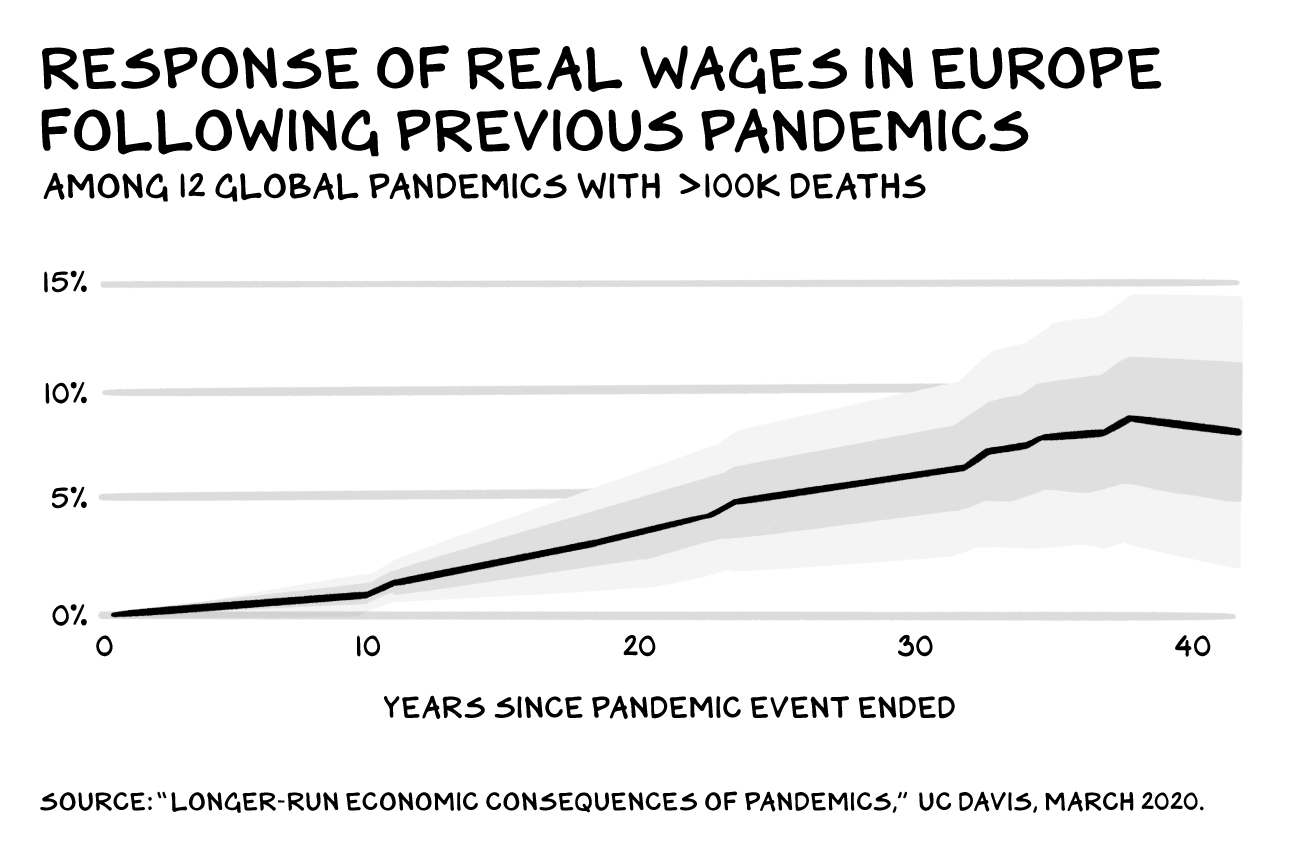
Letting firms fail and share prices fall to their market level also provides younger generations with the same opportunities we, Gen X and boomers, were given: a chance to buy Amazon at 50 (vs. 100) times earnings and Brooklyn real estate at $300 (vs. $1,500) per square foot. As Thomas Piketty has pointed out, the high growth recoveries that follow economic shocks are periods of real wage growth, whereas slow and steady growth tends to favor the wealthy.
Once the government gets into the business of propping up the losers, you can predict who will be first in line for the handouts: the people with the most political power — corporations and rich people. It’s not just a matter of their lobbyists and their lawyers and their press flacks, though that’s a big leg up. There’s also something more insidious: cronyism.
Cronies gonna crony
The federal government’s response to the pandemic has been true to form. Under the cloud cover of “protecting the most vulnerable,” we’ve handed trillions of dollars to the most powerful.
The only bipartisan action is reckless spending that benefits rich people while throwing some funds at the neediest for optics.
The $2 trillion relief package passed in March 2020 was a theft from future generations. Personal income was 7.3% higher in Q2 versus Q1 of 2020 because of stimulus payments and extra unemployment benefits. The personal savings rate hit a historic 33% in April, the highest by far since the department started tracking in the 1960s. The relief package included a $90 billion tax cut that benefited almost exclusively people making over $1 million per year. The richer you were, the more you gained. At the beginning of August, U.S. billionaires had increased their wealth by a total of $637 billion. It appears, as has been the case for decades, that the only bipartisan action is reckless spending that benefits rich people while throwing some funds at the neediest for optics.
Not every dollar will be wasted. Maybe a third of it will go to the needy. But the majority of the money we are asking our children to repay has done nothing but flatten the curve for rich people. Rich people have registered disproportionate benefit, their preexisting relationships with banks getting them to the front of the line. Look no further than the refusal of the administration to reveal who is getting the money — until after the election, of course.
Instead of letting market failures play out, we propped up the shareholder class using money stolen from the next generation. “We’re all in this together,” they tell us. Bullshit. The really ugly truth is this: For the wealthy, the pandemic means less commuting and emissions, more time with family, and more wealth, with markets at all-time highs.
Cronyism and inequality
The obscene $2.2 trillion Covid relief package was just a symptom of our cronyism. The systemic flaw is that our government is no longer keeping capitalism’s winners in check. Instead, it’s a co-conspirator in their entrenchment.
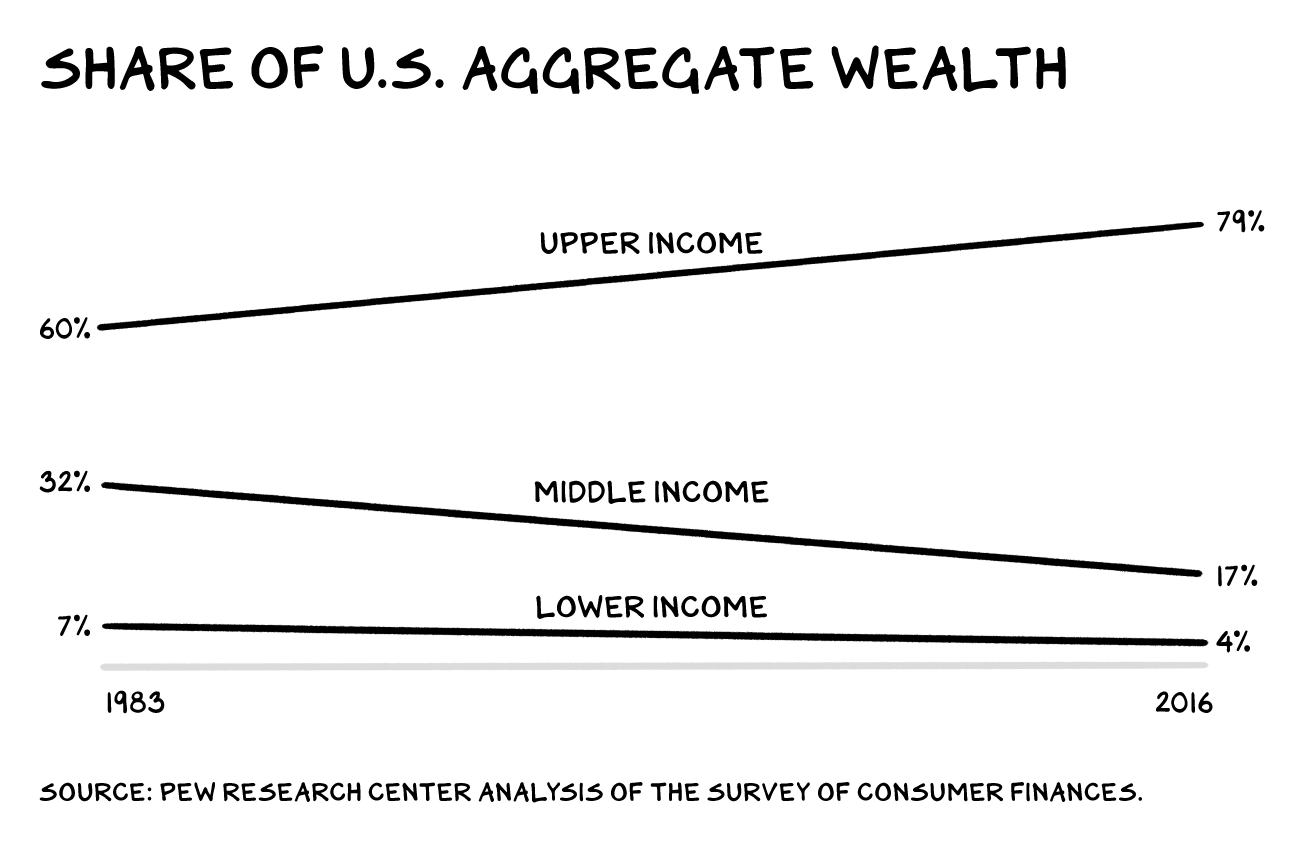
The wealthy have done well over the past few decades, in a supernova kind of way. A ton has been written on this because the data is abundant. There is shocking data at the extremes: The top 0.1% now own more of the nation’s wealth than the bottom 80%. The three richest Americans hold more wealth than the bottom 50%. And there is bad news in broad strokes as well: Since 1983, the share of national wealth owned by lower- and middle-income families has declined from 39% of the pie to 21%, while upper-income families have increased their share of national wealth from 60% to 79%.
No entrepreneur starts, or doesn’t start, a business because of the tax code.
For purposes of self-preservation, you’d think the rich would be concerned with this level of income inequality. At some point, the bottom half of the globe by income realizes they can double their wealth by taking the wealth of the richest eight families, who have more money than 3.6 billion people. Here in the U.S., the bottom 25% of households (31 million families) have a median net worth of $200. Most recently, a group of protesters built a guillotine outside the Manhattan home of Jeff Bezos to commemorate his wealth passing $200 billion.

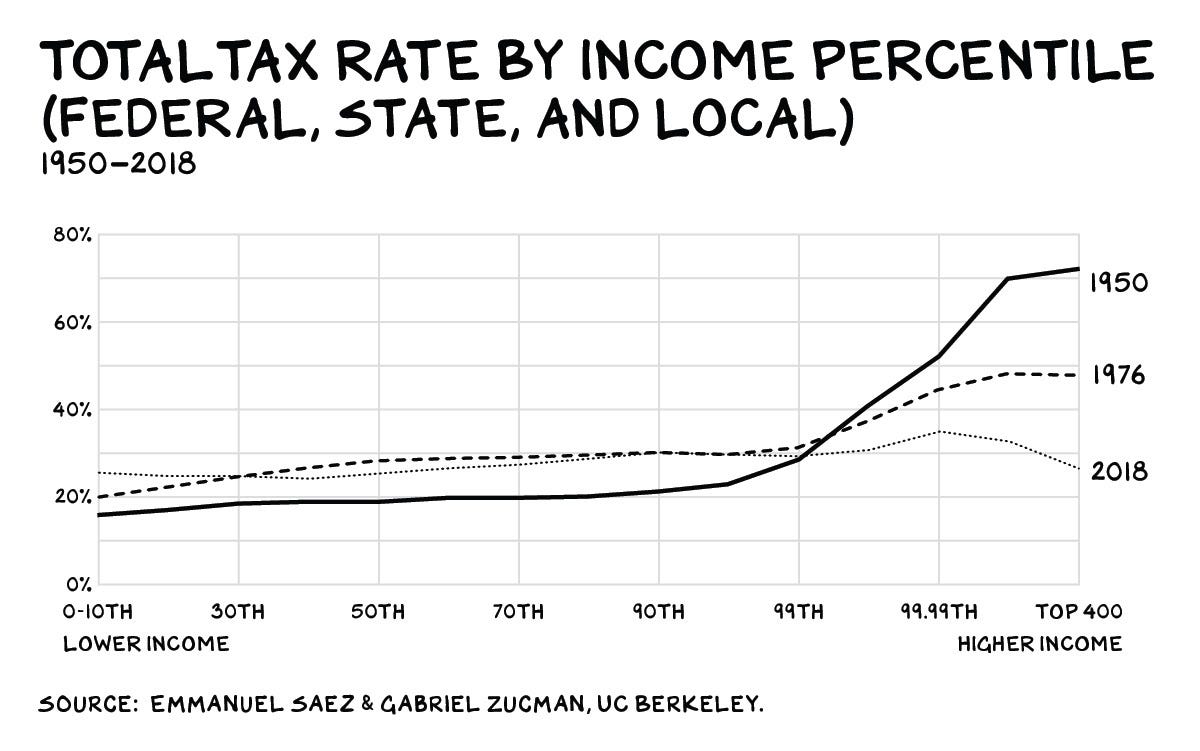
This trend is only getting worse. Once, we elected leaders who cut the tops of trees to ensure saplings get sunlight. Today there is less and less sunlight. A recent study of historical tax-return data concluded that the uber-wealthy paid a tax rate of 70% in the ’50s, 47% in the ’80s, and 23% at present — a lower tax rate than the middle class. Whereas poor and middle-class tax rates have largely stayed the same.

My own experience provides a case study in how the wealthy lock in their gains. When I sold my last company, L2, in 2017, I paid an effective tax rate of 17%–18%. I paid 22.8% federal, but the first $10 million were tax-free, thanks to Section 1202 of the tax code. Section 1202 is a tax break for early shareholders, meant to encourage startups. Only it’s nothing but a transfer of wealth from other taxpayers to venture capitalists and founders. No entrepreneur starts, or doesn’t start, a business because of the tax code. It takes a special kind of crazy to start a company and a lot of talent, work, and luck to build it to be something you can sell for millions of dollars. The decision has nothing to do with the tax code. Tax breaks for the successful are just another way we deepen inequality.
Once people make the jump to lightspeed, advantages like this let them pull away. Access to more resources, investment opportunities, lower taxes, tax specialists, political contacts, friends who can help your kid get into school, and the wheel spins. It’s never been easier to become a billionaire, or harder to become a millionaire.
trump undermines belief in elect thus democr
https://www.alternet.org/2020/12/2020-election/
==
hedges not a huge fan of biden picks: Trump may be gone soon, but he leaves behind a party that is openly authoritarian, dismissive of democratic norms, an enemy to science and fact-based discourse and which attempted a coup d'état. The next time around they won't be so disorganized and inept. This hostility to democracy by one of the two ruling parties, supported by millions of Americans, many of whom were betrayed by Biden and the leaders of the Democratic Party, will not dissipate but grow, especially as the hammer of economic dislocation, including the looming evictions of millions of Americans, pummels the country.
Thedecades-long corporate assault on culture, journalism, education, the arts, universities and critical thinking has left those who speak this truth marginalized and ignored. These Cassandras, locked out of the national debate, are dismissed as unhinged and depressingly apocalyptic. The country is consumed by a mania for hope, which our corporate masters lavishly provide, at the expense of truth. It is this delusional hope that will doom us.
==
an 1220 no lnx twt
How a post-election GOP 'civil war' could 'tear the party apart': reporter
Photo via Gage Skidmore.
Alex Henderson December 21, 2020
President Ronald Reagan, in the 1980s, famously said that he considered someone who agreed with him 70% of the time to be a 70% ally rather than a 30% enemy. But among President Donald Trump's diehard devotees, anything less than 100% agreement with the president is a sacrilege. And journalist Sasha Abramsky, in an article published by The Nation on December 18, examines post-election tensions between Republicans who are acknowledging Joe Biden as president-elect and Republicans who are encouraging Trump to keep fighting the election results.
With the Trump campaign's legal challenges to the election results having been rejected by one court after another and the Electoral College having certified Biden's victory, even Senate Majority Leader Mitch McConnell and outgoing Attorney General William Barr have said that they consider Biden president-elect. Some Trump devotees are now slamming McConnell and Barr as RINOs: Republicans in Name Only, which is ironic in light of how aggressive a defender of Trump Barr and McConnell have been. Now, even McConnell and Barr aren't MAGA enough.
"A civil war is now percolating within the Republican Party," Abramsky explains. "The Electoral College has met and confirmed Joe Biden's victory, Senate Majority Leader Mitch McConnell has finally agreed to call Biden the president-elect, Russian President Vladimir Putin has congratulated Biden on his victory — and yet, stateside, the Trump cultists continue to scheme and foment ever-more-fantastical assaults on democracy."
McConnell, journalist Jonathan Easley notes in an article for The Hill, is hoping to avoid a battle on the Senate floor on January 3, when Congress will vote to certify the Electoral College votes of December 14. The Senate majority leader has asked GOP senators not to join Rep. Mo Brooks of Alabama in resisting the election results, but Sen.-elect Tommy Tuberville is siding with Brooks rather than McConnell.
The "Trump cultists" Abramsky cites as especially unhinged include attorney Sidney Powell and long-time Trump loyalist Stephen Miller, who has declared that the campaign must keep fighting the election results right up until January 20, 2021.
"Not to be outdone in the crazy sweepstakes, Sidney Powell, the Trump campaign's recently departed attorney, retweeted a racist diatribe against McConnell's Taiwanese American wife," Abramsky notes.
According to Abramsky, "It's tempting to dismiss all of this as simply the noisy, irrational coda to a brutal election season. But it's more complex than that. Trump is desperately fighting for his personal survival, but McConnell has abandoned him; ergo, Trump must now turn his rhetorical guns against the Senate leader. For his part, McConnell has clearly concluded that it's in his political interest to cut his losses now and endure Trump's rants and his supporters' threats for the next few weeks, in order to maintain his political power into the Biden presidency."
Abramsky concludes the article by stressing that a post-election "civil war" among Republicans could inflict major damage on the GOP.
"Given Trump's despotic ambitions and his clear intent to maintain an iron grip on the GOP and its base in the coming years — and given the moral black hole so many GOP elected officials have managed to sink themselves into over the past four years — it's hard to see how this confrontation doesn't end up tearing the party apart," Abramsky writes. "I had hoped Trump's candidacy in 2016 would perform that vital role — that it would break a rotten party wide open for all to see the vacuum at its core. It didn't happen then. In these final weeks of 2020 and of Trump's rancid regime, it seems to be happening now."
FROM YOUR SITE ARTICLES
Longtime GOP consultant: This election 'is the most dangerous ... ›
The COVID-19 pandemic has exposed the GOP's soft Civil War ... ›
The Mason-Dixon line is psychological this time in the GOP's new ... ›
RELATED ARTICLES AROUND THE WEB
A GOP civil war rattles Georgia Republicans at inconvenient time ›
Teri Kanefield: Trump and Giuliani's Georgia election fraud farce ... ›
Lindsey Graham Blames Governor Kemp for GOP 'Civil War Brewing ... ›
aha2 covid plague not scourge of god for gay sex but chicomm.
aha CNP is everywhere in trump/ crazytown slide into polarization in this case dobson; satan usage getting pretty common/casual, it's manichean light/dark tribalism, you're with us or THEM; they are so evil/irrational only settle/cure with war; they hate america and freedom; armageddon is the final orgasmic punishment /vanquishing of coastal elite who looked down on us and called us crazy (ghost dance) aha3: this is the dark side of magical thinking vs prosperity gospel.
https://www.alternet.org/2020/12/trump-evangelicals-2649541067/
alexh
Christian Right is in mourning over President Donald Trump being voted out of office. Pat Robertson, the far-right evangelical who founded the Christian Broadcasting Network, has declared that the inauguration of President-elect Joe Biden on January 20, 2021 must be prevented, saying, "We will not give up this great country. And Satan, you cannot have it." But the irony is that the incoming president is much more religious than Trump, who has demonstrated how little he knows about Christianity and the Bible.
Although Trump was raised Presbyterian, religion was never a high priority in his life. But when he ran for president in 2016, Trump realized that the Christian Right was a prominent voting bloc in the GOP and went out of his way to pander to the far-right White evangelicals he had no connection to in the past. The Trump of the 1980s, 1990s and 2000s was more of a Blue Dog Democrat than a GOP culture warrior, and he spent a lot more time in casinos than in churches.
Journalist Ed Kilgore, in an article published by New York Magazine on December 17, notes Trump's history of butchering Biblical references during his speeches.
Kilgore explains, "Before Donald Trump became the very favorite politician of White conservative evangelicals, he was regularly a figure of sport for displaying exceptional ignorance in all matters religious. A particularly rich example of his clumsiness occurred when he was campaigning at evangelical stronghold Liberty University early in 2016 and tried to quote a Bible verse that was very familiar to the audience, since it's etched on several buildings there."
Kilgore adds that there were many other "religious gaffes Trump committed while stumping for votes" in 2016.
"On another occasion along the campaign trail," Kilgore recalls, "Trump was asked about his favorite line of scripture. He delivered a word salad for a while and finally tried to recall 'an eye for an eye,' not the sort of thing Christians of any variety consider normative for the faith of the Prince of Peace…... Just prior to the Iowa caucuses, Trump was in a Council Bluffs church when a plate came down the pews with communion bread on it. The billionaire misidentified it as a collection plate and put a couple of bills on it."
Kilgore also notes that in 2017, Trump met with two Presbyterian minsters and was surprised to learn that they didn't consider themselves evangelicals but rather, described themselves as "Mainline Protestants."
Of course, anyone with even a basic knowledge of Christianity realizes that Presbyterians aren't evangelicals any more than Episcopalians or Lutherans — two other examples of Mainline Protestants — are evangelicals. And there's no way that either Biden, a devout Catholic, or former President Barack Obama, a Mainline Protestant, would have made that mistake or confused a communion plate with a collection plate. Unlike Trump, Biden and Obama both have a long history of being churchgoing Christians and obviously have an extensive knowledge of the Bible.
[twt]
if Pat Robertson were to sit down with Biden or Obama, they could have an in-depth conversation about scripture. Yet Robertson, like much of the Christian Right, adores Trump while hating Biden and Obama — which underscores the deeply tribalist nature of the Christian Right.
The Christian Right has long been a hate movement, and it is as much about White nationalism and far-right identity politics as it is about Protestant fundamentalism. The late Rev. Jerry Falwell, Sr., founder of Liberty University and co-founder of the Moral Majority, was a notorious segregationist during the 1950s and 1960s, when he vigorously defended Jim Crow laws in the pulpit and argued that the Rev. Martin Luther King, Jr. was a not a true Christian because of his anti-segregation views. During the 1980s, Falwell defended the racist apartheid regime in South African and encouraged Christians to buy krugerrands to support it.
The late Republican Sen. Barry Goldwater, known for being an arch-conservative in his day, was vehemently critical of Falwell and the Christian Right during the 1980s — describing them as dangerous fanatics and warning that the GOP was making a huge mistake by allying itself with that movement. But many Republicans ignored Goldwater, much to the GOP's detriment.
To the Christian Right and far-right White evangelicals, the fact that Biden and Obama are more religious than Trump is irrelevant. Robertson, the Family Research Council's Tony Perkins, James Dobson (founder of Focus on the Family) and other evangelical Trump supporters are extreme tribalists, and they view Trump as part of their tribe — which is why Trump got a pass when, according to his former personal attorney Michael Cohen, he had extramarital affairs with a porn star (Stormy Daniels) and a Playboy model (Karen McDougal) and paid them hush money to keep quiet.
Trump repeatedly attacked Biden as anti-Christian during his 2020 presidential campaign. But in 2017, Trump didn't even know the difference between Presbyterians and evangelicals.
The Christian Right will miss Trump dearly when he leaves off on January 20, 2021. And no matter how much Biden goes to church or accurately quotes the Bible, it won't matter to the far-right evangelical extremists who value White identity politics above all else.
yikes bill tracker
https://projects.propublica.org/trump-midnight-regulations/
small eg# finalized 1220
Loosening Efficiency Standards for Clothes Washers and Dryers
This rule would loosen water and energy efficiency standards by creating a separate class of clothes washers and dryers based on how long they take to complete a load. More efficient washers use less water, and take longer, because they require more time for the soap to penetrate soiled clothes. Major manufacturers oppose the change, but small-government conservatives still want to slash regulation.
Department of Energy, Office of Energy Efficiency and Renewable Energy • Read more: regulations.gov
FINANCE
This rule has moved ahead since Election Day
Loosening Restrictions on Banks Acquiring Deposits Through Brokers
This rule would loosen restrictions on banks accumulating deposits by acquiring them from other banks through brokers. Financial reform advocates have raised concerns about allowing less well-capitalized banks to grow to an unsafe size.
Federal Deposit Insurance Corporation • Read more: fdic.gov
FINANCE
This rule has moved ahead since Election Day
Confining Retirement Fund Pressure on Corporations
This rule would constrain the ability of private retirement fund managers to vote on shareholder resolutions that influence the behavior of public companies. Critics such as Investor Advocates for Social Justice and the California State Teachers’ Retirement System say it will reduce corporate accountabiltiy and oversight.
Department of Labor, Employee Benefits Security Administration • Read more: regulations.gov
OTHER
This rule has moved ahead since Election Day
Bolstering the Position of Faith-Based Organizations in Government Grants
Multiple agencies implemented an executive order to strengthen the ability of religious organizations to compete for federal grants. The rule also shields the organizations from any funding conditions that could conflict with their religious practices. Supporters say the policy protects religious groups from discrimination, but critics say it empowers the groups to discriminate against others.
Department of Justice, Agency for International Development, Departments of Agriculture, Education, Health and Human Services, Homeland Security, Housing and Urban Development, Labor, and Veterans Affairs • Read more: regulations.gov
FINANCE
This rule has moved ahead since Election Day
Loosening Rules Governing Bank Mergers
This sweeping update to bank licensing procedures will ultimately make it easier for banks to acquire other banks. The Conference of State Bank Supervisors said the complex rulemaking was rushed, while the National Community Reinvestment Coalition said it would reduce community input into the availability of bank branches.
Office of the Comptroller of the Currency • Read more: federalregister.gov
FOOD & AGRICULTURE
This rule has moved ahead since Election Day
Loosening Scrutiny of Meatpackers' Dealings With Farmers
After a 15-year saga pitting farmers and ranchers against giant meatpacking companies, the U.S. Department of Agriculture issued "broad and flexible criteria" for assessing whether meatpackers are unfairly discriminating between livestock sellers. Meat industry groups cheered the changes, but small farmers say they are a blank check for massive processing companies to use their market power to exploit them....
1220 an raw story texas paxton plus 17? ag 100 plus congress
..."That's not what they think," Costa added. "He's not going away. There's a growing acceptance, while he may be at Mar-A-Lago in 2021, he will not run from the scene. He may prepare to run in 2024. Even if he doesn't, he's going to be meddling in primary races in 2022, so many of these Republicans are operating sometimes out of loyalty, sometimes to be sharing in the theatrics of the moment and sometimes out of fear."
Some of the lawmakers are making a cynical gamble, Costa said, but some of them seem to believe Trump has a path to victory.
"Some of it's cynical, but let's not forget that in some channels of the conservative media, there is a belief still that President Trump has an ability to win this election through going to the Supreme Court," Costa said. "President Trump is watching these media outlets, he's reading the media outlets [and] it's creating an echo chamber inside of the Republican Party. So the motives aren't all just to stand with President Trump in solidarity, to show voters who are frustrated with President Trump's defeat that they're doing that. It's about actually believing the cause, and that's where American politics is going. They are not shared facts at this moment."
https://www.alternet.org/2020/11/trump-anti-science/
alexh
Of more than 1.3 million deaths from COVID-19 worldwide, over 257,900 of them have been in the U.S., according to Johns Hopkins University in Baltimore — and the worst might be yet to come this winter. Dr. Irwin Redlener, founding director of the National Center for Disaster Preparedness, Columbia University, candidly discussed the United States' response to the pandemic during an interview with MSNBC's Nicolle Wallace and slammed President Donald Trump and his allies for the "anti-science" views that have been coming from the White House.
When Wallace asked Redlener where the U.S. is "heading" on its "current path" with COVID-19, the medical expert responded, "really, the trajectory is out of control right now and heading, basically, straight up. Many of us were predicting that we'll be seeing 200,000 cases per day by or before Thanksgiving, and I'm afraid that's where we're heading. The hospitalization rates are particularly important because these are reflecting the data that's suggesting that people are getting quite sick, going into ICUs, having to be admitted to the hospital. So, the immediate prospects are not good…. This is not going to be a good winter by any stretch of the imagination, Nicolle."
The 48-year-old Wallace — who served as White House communications director under President George W. Bush and is now a Never Trump conservative — brought up the parts of the U.S. that view the pandemic through a "partisan lens" and have rejected "simply and non-invasive" measures like "mask wearing and social distancing." And Redlener had a blunt response.
"I don't think any of us in public health would have imagined a year ago, even with Donald Trump at the helm, that this level of incompetency and toxic messaging that we've seen with Donald Trump over these last eight or nine months would have actually been possible under any president's leadership," Redlener told Wallace. "But here you have a president who's firmly opposed to science and evidence in developing policies to deal with this very deadly disease."
Redlener added that even after Trump leaves office in January, the type of "toxic messaging" he has pushed during the pandemic won't be going away.
"Donald Trump will not give up in promotion of horrible, erroneous, anti-factual, anti-science messages," Redlener told Wallace. "This has poisoned the atmosphere to a point where there's going to be a big job here for the new president and vice president and their administration to turn around narratives that the president has deliberately created that are completely erroneous and very, very dangerous. So, it's the science, of course, but it's also how this is articulated to people that's going to make a lot of difference."
FROM YOUR SITE ARTICLES
- Historian: Trump isn't fighting science — he's stealing its authority ... ›
- Paul Krugman's dismal diagnosis: America's 'anti-science' streak is ... ›
- New report reveals how Trump's anti-science views are warping ... ›
RELATED ARTICLES AROUND THE WEB
- 150 Attacks on Science and Counting: Trump Administration's Anti ... ›
- Trump has shown little respect for U.S. science. So why are some ... ›
- What caused the U.S.' anti-science trend? – Harvard Gazette ›
https://www.alternet.org/2020/11/conservatism/
HNN
On the Sunday after the November 3rd presidential election, Utah Senator Mitt Romney, the 2012 Republican presidential candidate, congratulated President-elect Joe Biden but insisted that the overall election was an endorsement of conservative principles. He pointed to the gains Republicans made in the House, though they are still in the minority, and the failure of the Democrats to capture control of the Senate, at least so far. Romney found further evidence in the Democrats' inability to flip GOP-controlled statehouses.
Romney, however, is mistaken in his basic assertion. First of all, Biden won by more than 5 million popular votes, nearly 4 percent more than Trump's total. The president-elect obtained the highest number of popular votes in the nation's history. Biden's margin of victory, contrary to Romney's claim, is not a mandate for conservatism. Rather, at the very least, the election was a referendum on President Trump's leadership, which of course Trump used to promote conservative ideas concerning tax cuts for the wealthy and the relaxation of business and environmental regulations.
No presidential election outcome reflects any single issue and it remains for the experts to crunch the numbers and analyze the ingredients that secured the Biden-Harris victory. Yet we already have sufficient evidence that the majority of the American people favor progressive positions on many issues. Surveys by Gallup, Pew, and other reliable organizations consistently show that a significant majority of Americans favor "Medicare for All," tighter gun safety restrictions, and the freedom of women to have abortions in most situations. A number of states, including Florida, have voted for the $15 minimum wage. Last but not least, polls show that a majority of Americans believe that racial discrimination continues to exist and should be addressed. These are progressive not conservative principles, and are sustained by the Biden-Harris victory.
Nevertheless, Romney is correct in one sense. In the United States what I call "systemic conservatism" continues to prevail. I draw this phrase from our reawakened realization of "systemic racism," and the two are related. By systemic conservatism I mean the institutional barriers created by the founding fathers to limit popular democracy. One obvious example is the Electoral College.Presidential candidates have to win a majority of electoral rather than popular votes. Had it been otherwise we would not have a President George W. Bush or Donald J. Trump. The Electoral College consists of the number of votes each state has in the U.S. House and Senate (except for the non-state of Washington D.C., which has three electors). The choice of an Electoral College to decide the presidency resulted from efforts of small state and slave state delegates at the Constitutional Convention to ensure their ongoing power. Most troubling, under the three-fifths compromise slave states increased their electoral votes. They did so by securing the constitutional right to count 60 percent of their enslaved people for purposes of representation in Congress and the Electoral College.
In addition, the Senate created rules to frustrate a majority of its members. Until the 1960s, southern senators used the filibuster rule, which allowed unlimited debate in the absence of a supermajority vote, to frustrate attempts to pass civil rights legislation. Republican Majority Leader Mitch McConnell has used this rule to thwart progressive legislation for the past ten years. Even if the Democrats wind up gaining two seats in Georgia, resulting in a Senate tie, they will need sixty votes to enact legislation unless the filibuster rule is changed. And if they manage to do so, a conservative majority on the Supreme Court can still overturn that legislation.
The federal system has often blocked the effects of progressive policies initiated at the national level, The post-Reconstruction Jim Crow era that lasted into the 1960s saw the southern states eviscerate the Fourteenth and Fifteenth Amendments in a variety of ways. Even when the Supreme Court struck down racial segregation in schools in 1954, southern states adopted so-called freedom of choice plans to sidestep the court's ruling for another two decades. President Franklin D. Roosevelt's New Deal legislation was instrumental in combating the Great Depression, but it had to be administered through the states. This gave states, particularly in the South, the opportunity to reinforce racial segregation within these programs and also ensure that agricultural subsidies benefitted plantation owners to the detriment of their tenant farmers and sharecroppers, a disproportionate percentage of whom were African American.
Progressive change does happen within our political system but it faces serious obstacles. The abolition of slavery and the extension of citizenship and voting rights to African Americans required a Civil War. It took the Great Depression to achieve Social Security, minimum wages, and anti-child labor laws. The Civil Rights Movement was necessary to re-enfranchise African Americans and people of color as was the Women's Suffrage Movement that extended the vote decades earlier mainly to white women. Democratic Party victories following the 2008 Great Recession provided for a short time the majorities needed to move incrementally toward universal health insurance.
There is also ample precedent within the federal system of states serving as laboratories for progressive policies, as was the case in Wisconsin during the early twentieth century. Under the leadership of Governor Robert M. LaFollette, Wisconsin joined government officials together with academic advisers to create a reform agenda that was copied throughout the nationIn the early 2000s, Massachusetts under the leadership of Governor Mitt Romney created a system of statewide health insurance that became the model of President Barack Obama's Affordable Care Act. However, in 2020, with most state legislatures in the hands of Republican majorities, the prospects for reform measures bubbling up from the bottom to the top of the political mainstream are dim.
Just as President-elect Biden will have to confront systemic racism he will also have to deal with systemic conservatism. It does not look like he will have the necessary legislative majority to achieve his programs. At best, incremental rather than sweeping change is more likely.
https://www.alternet.org/2020/11/trump-democrats/
monbiot build social movement
amanda
https://www.alternet.org/2020/11/trump-psychology/
Are we addicted to Donald Trump? It's a question that's haunting journalists and political commentators, most of whom hate Trump but cannot deny that his name drives traffic and ratings. Even though Trump lost the election and Joe Biden will be the next president, Trump continues to be the big attention draw for political websites and cable news networks.
Part of that is completely understandable. Trump is still big news. He literally spent the past few weeks attempting a coup. While he failed, that doesn't change the history-making fact that he even tried, or that he got so much support. Certainly Biden, whose main activity is finding boring-but-competent people to staff his administration, can't compete with that, and there's no real indication that he wants to. (Unlike Trump, Biden views governing as a job and not just an opportunity to get attention.)
But there is no doubt that the media remains flatly fascinated with Trump, in no small part because, as Salon's Andrew O'Hehir argued Monday, "our readers and viewers have enabled and encouraged us at every step" and stories about Trump "outperform every other category of reporting, commentary or analysis we can possibly offer."
As Philip Bump at the Washington Post documented Tuesday, since Trump first announced his run for president, he "is the political figure who garners the most search interest, cable news mentions or screen time each month since June 2015."
Because of all this, it's become quite fashionable in some circles to haughtily declare that all this interest is tawdry, and that if we simply ignored Trump, he would go away. Hardly a week goes by on social media where I don't get some reader who, sick of it all, will lash out at me personally and demand that I stop writing about, tweeting about or otherwise giving attention to Trump.
But the command to ignore him didn't make the bully disappear in junior high school and it certainly doesn't work with the president. Nor can Trump's importance in our politics be easily reduced to a pop psychology assumption that all fascination is inherently addiction and therefore bad.
The reality is that the Trump obsession isn't really about Trump himself anyway. It's about his followers.
Don't get me wrong. I confess some interest in his psychology, which our traffic shows is widely shared. But let's face it — even on the sociopath scale, Trump's not as interesting as more exotic specimens like Ted Bundy or Jeffrey Dahmer. As a person, Trump is little more than the aged version of the yuppie villain in an '80s comedy, with a sweater tied around his neck and a sneer for the scruffy heroes. He only has two emotional registers, whining and bullying. He's boring.
Bump's own numbers show this. Prior to his presidential campaign, Trump wasn't an object of widespread fascination, no matter how much he hustled for attention. Ratings for his reality show were in the toilet and most people didn't think about him at all. It was only when Trump started to get support from everyday voters that he became the focal point of American politics.
The reason that Trump captures so much attention, year in and year out, is because of his followers. How did this two-bit moron who can barely read manage to attract a loyal following — one that has apparently grown from the 63 million people voted for him in 2016 to the 74 million who turned out in 2020? These people adore him, so much so that a quarter-million Americans dead and millions more unemployed only made them more determined to give it all up for the orange guy in an ill-fitting suit who wants to end democracy as we know it. It's a legitimately fascinating mystery.
The devotion of the Red Hats is, if anything, more bizarrebecauseTrump is so tiresome. Going to one of his infamous rallies, for instance, is volunteering to be tortured, like being strapped to a chair while the biggest boor in the world rants incoherently at you for over an hour. Listening to him ping-pong endlessly between whining and bragging is a form of boredom that makes solitary confinement seem pleasant by comparison.
And it's not like his rally-goers felt differently. You could see it on the faces in the crowds, as his supporters would drift away, not really listening except to perk up to applaud at the mention of buzzwords ("Crooked Hillary," "build the wall", "Hunter Biden"), but never really paying much attention to what Trump was actually saying.
They weren't there for him, after all. They were there as a show of force, to let the hated liberals know that they had the numbers and the determination — so much so that they'd sacrifice a night of their preciously short lives listening to a braggart ramble on about windmills and and lie about his own vitality for an hour. Trump will never understand this, but it was never about him. He was there for them, a vehicle for their resentments and, critically, their will to power. He was the weapon they wielded in their war to exert dominance over American politics, even as their actual numbers dwindle.
This movement is what is interesting, because it's ultimately, about the rise of American fascism. It's a real threat, as demonstrated by Biden's uncomfortably close margins in the same swing states Hillary Clinton lost in 2016. Indeed, it's arguable that these forces still won in 2020, as they (probably) kept control of the Senate, gained seats in the House and have overtaken the federal courts, kneecapping the ability of the majority of American voters, who support the Democrats, to exert their political will.
That the most powerful country in the world is being held hostage by an authoritarian, racist minority drunk on conspiracy theories is the biggest story in politics. It's part of a larger story about the entire world in the grip of rising authoritarianism. Their power will define Joe Biden's presidency. Their ability to cripple him will matter more than any of his Cabinet picks or even his executive orders.
Trump is just the shorthand for this very real and ongoing problem. The reason it feels like we can't quit Trump is that we can't quit the people who elected him. As Bob Cesca argued this week at Salon, we shouldn't pander to those people or seek to placate them, but we also can't just ignore them. Not while they still control so many levers of power.
Nowadays, most educated people reject the "great man" theory of history. We understand, intellectually at least, that even legendary villains like Hitler or heroes like FDR were a product of their time and not acting out of some cosmic destiny.
But it's still hard not to reduce politics to personality. Our brains are hardwired to focus on individuals, who have agency and psychology that we can understand, rather than the more diffuse motivations of the crowd.
But Trump could keel over tomorrow, never to tweet again, and he wouldn't go away. He might even grow in power, made into a martyr now that he can no longer embarrass his followers with his routine bouts of public idiocy, such as when he suggested people inject Lysol. Trump the symbol was always far more important than Trump the man. And no matter what happens to Trump the man, the movement he represents remains a live threat to American democracy, and to the world.
FROM YOUR SITE ARTICLES
- 'Follow Trump off a cliff': Psychological analysis reveals 14 key traits ... ›
- This disturbing psychological analysis of Trump supporters has ... ›
- Here's what the media never grasped about the psychology of ... ›
RELATED ARTICLES AROUND THE WEB
- A Psychologist Analyzes Donald Trump's Personality - The Atlantic ›
- The Psychology of Donald Trump | Psychology Today ›
- Neuroscience and Psychology Suggest No Surprise Victory for ... ›
===
https://www.alternet.org/2020/11/gerrymandering/
whatever happened to BO and Holder on Gerry?
17 of 30 states that do it gop 11/20
https://www.alternet.org/2020/11/republicans-2020/
https://www.alternet.org/2020/11/paul-krugman-2649032621/
In his New York Times column as well as his newsletter and his Twitter threads, liberal economist Paul Krugman has warned that the United States is not immune to the types of economic or political problems that developing countries have faced. And this week in his newsletter, Krugman cites the Trump campaign's refusal to accept the 2020 presidential election results as a disturbing example of "banana-republic politics" coming to the U.S.
Krugman recalls that in his 2009 book, "The Return of Depression Economics and the Crisis of 2008," he argued that the U.S. had "indeed suffered the kind of economic crisis we used to identify with the Third World."
"What I didn't see coming was the political side," Krugman explains. "It's not just that America has been suffering from Third World-type economic crises. We've also been sliding into banana-republic politics, becoming the kind of country in which a president can refuse to acknowledge a clear election defeat — and be backed by most of his party."
President-elect Joe Biden has enjoyed a decisive victory, winning 306 electoral votes and defeating President Donald Trump by over 6 million in the popular vote. Regardless, Trump has refused to acknowledge Biden as president-elect, vowing to keep fighting the election results in court and claiming, without evidence, that he was the real winner in Pennsylvania, Michigan and other battleground states. A Trump campaign lawsuit that Judge Matthew Brann dismissed in Pennsylvania asked the courts to throw out millions of votes in the Keystone State and block Biden from receiving Pennsylvania's 20 electoral votes.
According to Krugman, the Trump campaign's refusal to accept the election results demonstrates that "our democracy is very close to failing." And the economist writes that there are three disturbing takeaways from Trump's response to the election results.
"First, don't dismiss it because the antics of the Trump team — Four Seasons Total Landscaping, melting Rudy Giuliani — are so ridiculous," Krugman warns. "Authoritarian rulers are often ludicrous, because their hangers-on won't tell them how silly they look. When the president of Turkmenistan erected a giant golden statue of himself on horseback, he didn't become a national laughingstock — because nobody in his nation would have dared to laugh.'[twt readi8nf aspqr]
the second takeaway, according to Krugman, is that Trump is hardly the only Republican who engages in this type of behavior.
"Second, don't make the mistake of thinking that this happened all of a sudden," Krugman writes. "Republicans have been systematically undermining democracy for years through voter suppression, gerrymandering that gives them control of state legislatures even when they lose the popular vote by large margins, stripping power from governors who happen to be Democrats, and trying to bring criminal charges against their opponents."
The third and final takeaway, Krugman adds, is, "Don't bothsides this."
"The decay of U.S. democracy isn't about 'politics'; it's about one party's turn away from democracy," Krugman explains. "Today's GOP is nothing like center-right parties in other advanced nations; it's more like Fidesz, which has turned Hungary into a one-party state, than it is like, say, Britain's Tories…. Joe Biden's inauguration won't be the end of the story." an 1120
an 1120
robt r
Joe Biden has decisively won the presidency. There is no way for Trump to overturn the results of the election, and his campaign's post-election lawsuits have gotten dismissed left and right.
That hasn't stopped him from launching an "Official Election Defense Fund" and bombarding his supporters with fundraising appeals to supposedly finance the campaign's ongoing litigation.
But the fine print tells a very different story.
60 percent of a donation to Trump's "Official Election Defense Fund" goes to Save America, Trump's new leadership Political Action Committee that he set up less than a week after the election. The other 40 percent goes to the Republican National Committee.
So if someone donates $500, Trump's PAC gets $300, the RNC gets the other $200, and not a cent actually goes to the election defense fund.
Donations only start going to that fund once Trump's PAC reaches the legal contribution limit of $5,000 – and the RNC gets $3,000.
This means a supporter would have to donate over $8,000 before any money goes to the fund they think they're supporting.
Apparently enriching himself on the taxpayer dime for the past four years wasn't enough for Trump. Now he's lining his pockets by attacking our elections and undermining our democracy – and swindling his supporters every step of the way.
Is this just a final grift before Trump leaves office? Or is there more at stake?
Trump certainly wants to keep the money flowing, and a leadership PAC is an easy way to do it. Trump's PAC can be used to fund a lavish post-presidency lifestyle,**:{as :(style="background-color:#ffff66;"):}::{leadership PAC:(style="background-color:#ffcc66;"):}::{s:(style="background-color:#ffff66;"):}:**:{ can use donors' funds for personal expenses, like personal travel and events at Trump properties, while campaign committees cannot.:(style="background-color:#ffff66;"):}:
But there's more at stake than just Trump's personal greed. Creating a PAC solidifies Trump's grip on the GOP, as he can distribute the funds to GOP candidates. It helps keep his base whipped up ahead of the Georgia runoffs. And the PAC allows him to start preparing for a potential 2024 run, an idea he's already floated to his inner circle.
In the grand scheme of things, Trump's PAC also fuels the GOP's cynical strategy to maintain power. The GOP has a permanent stake in stoking a cold civil war.
A deeply divided nation serves the party's biggest patrons, giving them unfettered access to the economy's gains while the bottom 90% of Americans fight each other for crumbs. That division will persist even with Trump out of the White House, thanks to his bonkers claim of a stolen election, and a base more riled up from racist appeals than ever.
We may have defeated Trump, but we haven't defeated Trumpism. We must work to push the Biden administration to tackle the systemic conditions that allowed Trump to seize power in the first place.
https://www.alternet.org/2020/11/qanon-trump
amanda
Trump's attempts to steal the election are fruitless. His legal theater is going nowhere, and it's becoming apparent that this is more about shaking down credulous supporters for cash than about actually overturning the election results. Michigan pounded another nail in Trump's coffin Tuesday, when two Republicans who were blocking the vote certification in Wayne County, which includes Detroit, relented in the face of public outrage. It's all over but the grifting, which will likely continue as long as Trump keeps getting people to give him money for his "legal defense" — money that is being funneled through a PAC and likely straight into Trump's pocket.
Yet the Republican establishment is still tiptoeing around Trump, coddling his fragile ego by refusing to admit he lost the election. Some are going a step further, such as South Carolina's Sen. Lindsey Graham, who has been exerting pressure on state officials to toss out legally-cast ballots. Why are all these Republicans so afraid of Trump, who will no longer be president in 63 days?
The main reason appears to be that Republicans really are worried about their electoral prospects after Trump. The record Democratic turnout in the 2020 election — President-elect Joe Biden turned out 14 million more voters than Hillary Clinton in 2016 — caused many Republicans down-ballot from Trump to sweat their re-election prospects. Luckily for them, however, Trump also turned out an eye-popping 10 million new voters, which was enough to save the skins of many GOP candidates, even as Trump lost by slender margins in swing states.
Trump is a turnout machine for Republicans, who have been desperately casting around for years now for a way to save their party despite demographic changes that make the Democrats more popular among voters. The question of whether there will be Trumpism after Trump now dogs both Republicans who want to replicate their electoral successes under the reality TV president and Democrats who dearly hope this whole disaster was an anomaly.
"[S]ome conservative opinion leaders are already looking forward to a post-Trump future where the viable things about the 45th president can be neatly separated from his troublesome persona," Ed Kilgore writes for New York.
He cites "a representative fantasy" by right-wing writer Kristin Tate at The Hill, who longs for a "Republican with the political positions of Trump, but without decades of tabloid fodder," proposing that candidate might avoid "the bandwagon effect of suburban voters eager to show their public disapproval of his latest action."
Kilgore explores the various hopes that Republicans have for a "new Trump." Will it be Sen. Josh Hawley of Missouri, a Bible-thumper straight out of "The Handmaid's Tale" who has some crossover appeal for his occasional swipes at corporate America (though mostly for its perceived degeneracy)? Or Sen. Tom Cotton of Arkansas, who brings the racism and militant neofascism of Trump, but without the gleeful sleaze of a shameless sexual assailant?
These choices expose why Republicans fear that there may be no way to have Trumpism without Trump. Those guys and other contenders are all missing the secret sauce that helped Trump recruit so heavily among non-voters and infrequent voters. And no, it's not his so-called charisma.
What Trump really has going for him is what I call the "crackpot factor." Trump speaks to voters who share the racism and sexism of typical GOP voters, but who often don't vote because they think politics is boring and are awash in conspiracy theories about how the system is "rigged." Those voters saw a kindred spirit in Trump, a man who speaks fluent conspiracy theory and who got his start in politics by promoting claims that Barack Obama wasn't a native-born U.S. citizen.
Before the 2020 election, the team at FiveThirtyEight took a deep dive on the views of people who vote infrequently or not at all. There's a lot of reasons for non-voting, such as a belief it doesn't matter or the obstacles that make voting difficult, but one important factor was a lack of trust in the system. For some voters, especially nonwhite voters or liberal-leaning voters, this is unfortunately a realistic assessment of the situation, where social progress often feels glacial and voting doesn't seem to make much difference.
But for right-leaning voters, I suspect a lot of this distrust flows from a conspiratorial mindset, born from a steady diet of misinformation that has been made all too readily available by the internet. These are the types that populate the audience for Joe Rogan and Alex Jones. These are people who hate Democrats but also feel alienated by the religiosity and elitism of mainstream Republicans, and turn to "alternative" sources of information that are thick with paranoid conspiracy theories. Trump, who indulged the same "alternative facts" that they enjoy, stirred something in them that other Republicans simply couldn't.
In 2014, Pew Research, using extensive data, developed a political typology that sorted Americans into six groups. Two of the Republican-leaning ones are incredibly familiar to political observers, the "steadfast conservatives" and "business conservatives," or, respectively, the religious right and the rich folks who are in it for the tax cuts.
But they also detected an emerging group, which they deemed "young outsiders," who "do not have a strong allegiance to the Republican Party" and, in fact, "tend to dislike both political parties." These voters registered as "socially liberal," insofar as they don't support bans on abortion or gay marriage and, importantly, aren't especially religious.
But the "young outsiders" do share the racism of traditional conservatives. They are easily riled up by the demonization of social spending programs like Obamacare or food stamps They approve of programs, like Medicare, that are viewed as benefiting white people. They're in favor legal marijuana but oppose gun control. And they vote far less often than other conservatives.
I personally believe that the Pew research failed to capture how sexist this group is. The usual proxy questions to measure sexism, such as attitudes towards abortion, simply aren't adequate in this context. I suspect this group, while not as opposed to abortion as other conservatives, is angry about other feminist concerns such as the #MeToo movement, where men's privilege to mistreat women are being attacked.
These are, I suspect, the Gamergaters and the alt-right types who flocked to Trump in the years after this survey. They gobble down internet conspiracy theories like QAnon, which creates engagement with right-wing politics for those who aren't religious conservatives or business elites. They like to imagine that embracing more authoritarian attitudes is an "edgy" revoltagainst liberalism. They are overwhelmingly white (though 14% are Hispanic), and under 50 years old. While more than half of those defined as "strong liberals" are college graduates, three-quarters of the "young outsiders" don't have college diplomas.
Trump got a whole lot of those people who don't usually vote to do so, turning out more non-college-educated white voters in 2016, for example, than Mitt Romney did in 2012. These voters overlooked his alliance with the religious right and were instead fixated on his playboy persona, his over-the-top sexism and racism and, of course, his sweeping embrace of nutbar conspiracy theories of all kinds.
Over the past four years, everything that Trump's opponents hate about him — his grossness, his cruelty to women and people of color, his rejection of the polite norms of D.C. politics and, of course, his conspiracy theories — likely generated even more enthusiasm from this subset of voters that other Republicans have had trouble capturing or motivating.
That's why it's reasonable to be skeptical about the likely success of the current crop of wannabe Trumps. Hawley's religiosity and culture-war rigidity won't play well with these Trump Republicans who are just fine with premarital sex and legal weed, even if they're not fond of women having the right to file sexual harassment complaints. Cotton may roll out fascist fantasies that appeal to the QAnoners and the alt-right, but he's a stiff and, I suspect, won't appeal to those who enjoy Trump's wrestling-heel gift for insulting and degrading people. Sen. Ted Cruz of Texas, who also wants to be the next Trump, has intense weenie energy that makes it hard for him to win these people over.
Trump speaks to the great American crackpot, especially the younger set that was otherwise more interested in perusing conspiracy theory websites or "pick-up artist" forums than in voting. These folks won't be moved by Hawley's promise of a handmaid in every bed or Cotton's promise of stormtroopers on the streets. In the face of the growing Democratic majority, Republicans need this subset of crank voters, who don't care about old-school culture-war fights over abortion or evolution, but sure do love QAnon. Without Trump's demented tweeting and his willingness to leave empirical reality behind, it's not clear how the GOP can keep the crank vote going.
FROM YOUR SITE ARTICLES
- Trump is the conspiracist-in-chief — but the culture that fuels QAnon ... ›
- Trump and his allies greet racist QAnon ally with warm embrace ... ›
- Trump campaign staffer went on a QAnon program to recruit ... ›
RELATED ARTICLES AROUND THE WEB
- QAnon's Dominion voter fraud conspiracy theory reaches the president ›
- QAnon conspiracy theory faces a post-Trump identity crisis - The ... ›
- Why Trump Won't Denounce QAnon - The Atlantic ›
11/19 AN sees many egs of gop djt going south, eg suburbs...
dem bills bottled by Mcconn
https://www.alternet.org/2020/11/joe-biden-agenda/
aoc? blk brn ppl saved your ass dems yet again, do not toss us again?
blue collar , don't go to ctr //chris H: trumpism here to stay; pseudo-pop support anyone who SEEMS to care for them
https://www.alternet.org/2020/11/trump-evangelicals
https://www.alternet.org/2020/10/heading-off-the-prospects-of-a-dark-and-tumultuous-future
quite long, quite good (sys?)
no lnx
Common Dreams October 14, 2020
by Luisa Deprez, John Dorrerhttps://scholars.org/scholar/john-dorrer jobs for the future
"This time, like all times, is a very good one if you but know what to do with it."
~Ralph Waldo Emerson
In the face of an international crisis, we make an appeal to those who hold the reins of power and move the levers of control. It will not be enough to simply reopen an economy. We must also confront the vulnerabilities and inequities that have haunted us for too long. This plea further extends an appeal to the generation that came of age in 50's, 60's and 70's to not leave behind a world in a state of social, economic and environmental decay. We can build something better.
The Pandemic of 2020 brought the country and the world to a complete stop. Economic systems have exploded, institutional structures have imploded, and individuals and families find themselves in dire straits. The fragility of our medical, social, economic, and environmental systems has been exposed. For many, there is grave uncertainty as to whether or not they will ever recover. The impact on individuals and families has been devastating; the impact on the economic infra-structure overwhelming; and the impact on local, federal, and national institutional structures has pushed them beyond their limits. It is a vicious circle.
And despite inspirational calls for national mobilization, we are not really all in this together.Racism, discrimination, inequality, economic instability, hunger, ill-health, housing insecurities, poverty and educational inadequacies that have plagued this society for generations keep us apart and isolated from each other. We see anew the price of victimization, the mythology of "us" and "them", marginalization, and the unfathomable consequences on individuals and families.
The generation before us endured the Great Depression and left us with Social Security, unemployment insurance and banking regulations that protected Main Street, not Wall Street. Out of World War II came the GI Bill: baby boomers were born into an economy where the working class had a stake and massive infrastructure investments were made to ensure a future. Science and technology not only improved living standards but also unleashed lofty aspirations to advance humanity. Today's crisis has accentuated the abandonment of these progressive approaches in lieu of political gain and profit.
We are now called on to achieve social cohesion, create a more fair and just economy and promote a healthy environment that will sustain humanity for the millennia. These are not unreachable dreams or elite policy agendas but are critical choices we must make now as time is quickly running out. The Civil Rights Movements of the 60s and 70s, the end of the Cold War in 1990, the events of 9/11 and the recession of 2008/2009 all offered opportunities for profound change to create a better America. All were missed.
We now find ourselves in an America few of us imagined twenty years ago. A split and ineffective U.S. Congress has ceded much of its power to an authoritarian-inclined president unqualified to lead the Nation. Across the political spectrum, a steady stream of voices rises up to speak out against the growing income inequality and the need to fix capitalism hoping they will finally be heard.
Challenges
As western leaders learnt in the Great Depression, and after the second world war, to demand collective sacrifice you must offer a social contract that benefits everyone. For too long we have deferred needed actions on climate change and income inequality leading to desperate migration streams and an unpreparedness for a global pandemic. This blatant neglect damns us to a dismal future. We no longer have the luxury of muddling along or settling for political stalemate. Before us are complex, intertwined global challenges that will no longer wait to unleash their fury.
Science, though, must be the basis of their amelioration. In today's world, disdain for it runs rampant. The line between science-based evidence and ideological zealousness and subjective judgments is erroneously crossed using rhetoric that effortlessly displays them as comparable units. When the science is inconvenient, it is ignored or defied. What remains is reckless decision-making and the exploitation of lands and peoples for the advancement of corporate insatiability.
The Trump administration's posturing and irresponsible disregard of verifiable truth has left the country, and the world, highly vulnerable to dangerous, long-lasting effects in almost every arena – medicine and public health, the environment, education. Lingering is a legacy of ruined environments and human beings.
Beyond defeating the disease, the great test all countries face is whether current feelings of common purpose will shape society after the crisis. Pleas abound from across the globe to do more than simply reopen economies but to address long-standing political, economic, social and environmental dysfunction. In its appeal for mobilization, the Financial Times' Editorial Board makes an urgent call to:
Build up and re-consider the social-care infrastructure to mirror the way people really live;
Encourage a deep structural transition to an economy that better values the work that is essential to sustain us as a country; and
Address the crises in healthcare, social, ecological and economic policies laid bare by the epidemic.
A return to normal is not an option. Normal did not work.
Plutocratic Capitalism and Inequality
The shared prosperity we enjoyed from 1950 to 1980 has evaporated. After 40 years of plutocratic capitalism, we have arrived at slow economic growth, unprecedented levels of income and wealth inequality, deteriorating infrastructure and environmental quality, staggering levels of national debt and a breakdown in civil discourse and the efficacy of our political institutions.
Left to persist, this inequality will surely sink us. Its origins are found in forceful and repetitious claims that cutting taxes for those at the top will unleash a torrent of job creation and prosperity; that inequality was simply a by-product of economic efficiency.On both sides of the ideological spectrum, there is a restless feeling that we are no longer on the right track as a progressive and confident civilization.
During the course of this pandemic, America's billionaires saw their wealth increase by $434 billion while 38 million people filed for unemployment – 47% of whom are unable to afford food for a month. At the same time, a new momentum for global capitalism, driven by the economic dogma of comparative advantage, relocated much of the production capacity that served the consumer economy now driving nearly 70 percent of GDP. In the process, thousands of regions across America, large and small, lost entire industries and millions of well-paying jobs.
:{
}:
Among the collateral damage was the diminished role of labor unions as wage negotiators and political advocates championing the cause of working Americans. An unrelenting march of technology innovation also contributed to the substitution of capital for labor giving scant attention to worker displacement and reemployment. In combination, these forces contributed to long-term wage stagnation for those in the middle and lower ends of the income distribution scale. As growing inequality was unfolding, we were never able to marshal a strong and sustained policy response with commensurate investments to support the casualties victimized by political and economic changes.
The most adverse impacts fell upon the young and the old, and on those who lacked education and skills. For others, trapped in regions where there was widespread economic collapse and community decline, there were few options to relocate and start fresh. Many Americans who once enjoyed middle-class lifestyles found themselves summarily marginalized. These new "communities of despair" across America joined the ranks of urban areas populated by racial and ethnic minorities that had been cut loose for some time, denied access to opportunities for economic advancement.
False binary choices have been peddled to the electorate for too long. Key among these:
Saving the environment and investing in communities will sacrifice economic growth and result in lost jobs.
Higher wages for workers will make a business less competitive while higher executive salaries are key to business success.
Investments in childcare are deemed unaffordable as arcane rules of capital depreciation which withhold billions from the U.S. Treasury are untouchable.
Taxation and regulatory policies, effectively harnessed to favor those at the top of the income distribution and the corporate entities, have shaped the new global capitalism.
Powerful industry lobbyists dominate the legislative process and write the regulations that define the rules of the market economy. These misappropriations and misallocations beg for correction.
Those in the middle and at the bottom of the income distribution scale have seen income and wealth stagnate for over 30 years. Most American families have lost ground in terms of their economic standing. Long before the pandemic, research found that 4 in 5 Americans would experience poverty or unemployment or need to turn to the safety net for at least one year during their working years. They have become more disillusioned and disconnected from civic culture. Their offspring face uncertain futures and the prospect of their being worse off than their parents is real. We have before us a political economy where those at the top have disproportionate influence to ensure their future while restricting the future of the rest.
Rise of Authoritarianism
The U.S., once a champion for free and open societies, now has a leader envious of the power held by autocrats in Russia, China, India, Turkey, the Philippines, Poland, Hungary and Brazil. A global tide, once moving towards democratic forms of governance, is in retreat. The Human Rights Foundation reported that the citizens of 94 countries suffer under non-democratic regimes covering 53 percent of the world population.
As U.S. citizens, we have prided ourselves on living in a country committed to democratic ideals, ideals that served as a beacon for the rest of the world. We steadfastly opposed and fought brutal dictators in World War II and led the free world in opposition to communism. At the same time, we also backed authoritarian regimes all over the world when it suited our economic and global interests. Now, with a weakened legislative branch and a judiciary inclined to indiscriminately uphold executive power, there is a growing fear of a president who disrespects American principles of democracy. His endorsement of dictators and political thugs across the world is unprecedented and dangerous. Their economies have fallen into ruin and are void of free expression and enterprise as we begin to see the distortion of accurate reporting and the repression of truth now on our soil.
Racism and Social Exclusion
Exclusion has long been a part of the fabric of American life: "No one had to decide that people of color should suffer. … We just had to stand by and allow the machinery built over centuries to operate as it always has" write the editors in the Portland (Maine) Press Herald. A system of policies, reputed to protect, support, and uplift people, instead intentionally marginalizes, stereotypes, and brands people of color and people who are poor as unworthy, undeserving and burdensome. The COVID-19 pandemic's disparate impacts on age, gender and most particularly race, reveals a national failing to shield people, especially during a national crisis, from the pervasive inequalities and biases embedded in every system in America.
What we have before us is a potent mixture of systemic, institutionalized racism and inequality which unveils long-standing discriminatory practices as the modus operandi in both government actions and the business of this country. Stark disparities in mortality rates between Black and white Americans – upwards of four times that of white Americans - are evident in every measure of health and social and economic wellbeing this pandemic has laid bare.
Over the past 70 years, no progress has been made in reducing income and wealth inequalities between Black and white households. While wealth has long been the means to a better life, the racial wealth gap today is about the same as it was in the 1950's. The economy was not working for the majority of people who were working for it. It is here where we see the "structural characteristics of the American economy, heavily infused at every point with both an inheritance of racism and the ongoing authority of white supremacy take hold."
Sustainable recovery will be possible only if the systems under which this country has operated for generations are dismantled and reconstructed with "justice for all" as the central tenet.
Environmental Calamity
Years of polluting the air and water in our quest for economic growth and corporate voracityhas left us with a planet no longer able to absorb the toxic bi-products we generate. Unrelenting global warming is heating up the planet, unleashing climactic forces which are negatively impacting the lives of millions of people and threatening our very existence.
Warnings by a consensus of scientists that rising greenhouse gas concentrations have resulted in increases in temperature, changes in precipitation, surges in the frequency and intensity of extreme weather events, and rising sea levels have gone unheeded. Volumes of studies that show the impacts of climate change on human well-being and how they interact with underlying health, demographic, and socioeconomic factors have been shelved.
The cascading influence of these factors exacerbates health threats creating alarming new public health challenges.While all citizens of the world are at risk, some populations are disproportionately vulnerable: those with low incomes, communities of color, immigrant groups, Indigenous peoples, children and pregnant women, older adults, vulnerable occupational groups, persons with disabilities, and persons with pre-existing or chronic medical conditions.
Even with this clear and present danger, the responses to these threats have been wholly inadequate. Under the Trump administration, long-standing environmental policies and programs have been neglected and more often gutted. An active business and industry lobby has successfully eliminated and reduced the force of environmental regulations that have long enjoyed bi-partisan support and made incremental differences in environmental quality. Efforts to reduce our carbon footprint, an essential strategy to save the planet, have been replaced by incentives that encourage a greater dependency on fossil fuels and relaxed air pollution standards. The United States, now withdrawn from important milestone global treaties on environmental protection, faces accelerating climate change of catastrophic proportions with no plan in place.
Indignities of Poverty and Economic Insecurity
A democratic society ensures that its citizens' basic human needs for food, shelter and health, education and work are met. Without these, the healthy civil society promised in the founding doctrines of this country is not sustainable. In the US, fundamental basic needs have never been assured.
This pandemic has laid bare the inequities, between, and within groupings of people and bluntly exposed to a national audience the dire circumstance under which millions of individuals and families live, trying to survive. Virus relief bills have testified to the inadequacy of in-place systems as they call for increases in monthly food stamp (SNAP) allocations; eviction bans and rent payment leniency; allocations of temporary financial aid to lower-income individuals and families; and a lifting of health insurance requirements on those needing immediate hospitalization and ICU care.
The recently released Social Progress Index ranks the US at 28th - down from 19th in 2011 - lagging behind less developed and significantly poorer countries in the world. "The data" says Harvard Business School Professor Michael Porter, "paint an alarming picture of the state of our nation … It's like we're a developing country" … "We are no longer the country we like to think we are".
Not since the Great Depression has the citizenry been so fragile. The virus has hit individuals and families living on the edge the hardest, particularly African-Americans. Decades of politically-motivated stereotypical imagery linking economic insecurity to notions of deservedness and worthiness has relegated millions of people to the margins of society regardless of their never-ending efforts to succeed.
Many Americans went into the nationwide lockdown with limited or no savings, despite market gains from a record-long economic expansion. Unprepared for the current financial challenges, a record seventy-seven percent (77%) of low- to moderate-income American households don't have enough assets to withstand 3 months without income. The number of people living in families with combined weekly earnings below the federal poverty line rose by 24 percent from February to May. Twelve million people eligible for their $1,200 "stimulus" check have not received it because they are too poor to have filled out a tax form or don't know how to claim it. As of May 30th, 35.4 million workers either received or applied for unemployment benefits, a hardship highly concentrated among low-wage earners.
Families are struggling, anxious that the basics – food, shelter, and health – are becoming farther out of reach. Those who lost hours or jobs found it "difficult to get by"; were not able to pay their bills; did not have enough to eat; and did not pay or deferred rent. Loss of housing is on the horizon. The portrait of the staggering cost of this pandemic to individuals and families is unfathomable.
Devalued Work and Workers
This year, an estimated 55 million workers are working at jobs now considered "essential". Jobs that are necessary for the country to function cover every industry: maintenance staff, firefighters, assisted care attendants, grocery workers, postal carriers, funeral attendants, delivery drivers, farmworkers, medical personnel and more. Beyond the doctors and nurses lauded for their relentless commitment and attempts to save people's lives, are a mass of people, most unrecognized, doing the same: working steadily over long hours and continuing to risk their lives at jobs that are underpaid and under-valued. Most only make the minimum wage; some make less than people getting unemployment benefits. And millions use federal food assistance and community food banks to feed their families. They work because they can't afford not to. Most cannot work from home.
The stratification among workers in these jobs - predominantly women and disproportionately people of color - didn't happen by chance but "is a direct result of systemic inequities that have pushed those with the least economic and political power to the margins, in jobs that, by virtue of who is performing them, are underpaid and undervalued in almost every way possible". Nearly 70% of essential workers do not have a college degree; 30% have some college, 29% a high school diploma and 1 in 10 have less than a high school diploma. Their jobs lack benefits and protections; workers rightly feel ignored or disrespected.
One of the hallmarks of a just economic system is the assurance that those who do the work are rewarded fairly. Under 21st century capitalism in the US, workers have suffered wage stagnation and a growing insecurity about their future as globalization and technology innovation have dominated and shaped employment. Homelessness, food insecurity and a tenuous hold on economic security now show themselves even more vividly alongside the excesses of luxurious living and outrageous wealth accumulation.
The Contours of the New Political and Sustainable Economy
The pandemic arrived suddenly and once again shocked us as we became vulnerable on a global scale with no on-the-shelf solution to save us. The nature of this threat captured our undivided attention and reawakened our fears of other neglected forces undermining our future. This is an urgent reminder that we can no longer defer the actions necessary to create a fair and just economy and a sustainable environment to save the planet and ourselves. Widely recognized scientific studies, grounded in universally-accepted criteria and methodology must provide the evidence so vital to making decisions about the world and its workings.
We are at a critical juncture. Maintain the current trajectory and we will certainly confront a dystopian futurewith social upheaval, economic collapse, and environmental degradation. We may not survive the calamity. We can, however, forge a new direction to fundamentally alter the nature of our economy, ensure social stability, and reclaim our environment with principles embedded in social and economic, and environmental justice.
Before us is "an unprecedented opportunity to not just hit the pause button and temporarily ease the pain, but to permanently change the rules so that untold millions of people aren't so vulnerable to begin with."
How must this opportunity be configured? What must it deliver?
Fixing Capitalism- Building A New Foundation
There is growing consensus that the current economic and political systems are broken. Social unrest is waging a battle against ages-old systemic racism and social exclusion and the absence of social, economic, and physical protections. Choices presented to us for too long have posited that for prosperity to blossom we could not have sustainability. We are told that to have efficiency, we had to sacrifice equity.But these are false choices.The blind worship of free markets and unabridged global trade have benefited only a few whilst exploiting many. A skewed relationship favoring the owners of capital over the many who labor on their behalf is an imbalance achieved and sustained through theextraordinary influence of money in politics. The nearly unlimited flow of private funds to support campaigns has left us with a form of plutocratic capitalism that must be reversed. We need to restore a political process and governmental institutions that work for all citizens. We must hold our elected officials accountable to the populations that elected them, not to those who bought them.
As a priority, campaign finance reforms and the role of lobbyists must be fundamentally changed to tip scales back so that our political economy is no longer shaped by a self-serving ruling class. As citizens, we can no longer remain complacent as elected representatives from both parties talk reform of campaign finance but continue to pocket the proceeds from corporations and political action committees. Excessive inequality and monopolistic concentrations are the only outcomes of a system of long-term political investments in the representatives that we elect (and continue to mostly re-elect). It is they who reap the rewards. America must reclaim a sense of trusteeship from its leaders
The structure of tax policies in the US is designed to favor those at the top. Those who argue that taxes are an impediment to growth fail to appreciate the vast gains in income and wealth for those at the very top of the income ladder while permitting mega-corporations to pay no taxes at all. A more progressive form of taxation with clear redistribution benefits and a restructuring of business taxes favoring socially desirable investments and productivity improvements must be undertaken to ensure a sustainable economy.
Regulatory institutions suffering from long-term neglect and underfunding, are often led by former industry leaders who come from the very institutions they are tasked to regulate. Corporations now have inordinate market power through vertical and horizontal integration, stifling the consumers voice. Furthermore, digital technologies and artificial intelligence have fundamentally restructured the economy and come to dominate commerce and trade. The new economy requires new and more appropriate regulatory functions and processes to protect consumers.
For too long, we have treated the long-term adverse impacts on environment and worker health and safety as "externalities" in our economic accounting. In the end, these costs have been ultimately shifted to the taxpayers while the profits earned over many years by abusive enterprises remain untouched. There is no free lunch. Government has an obligation to protect societal interests in the long run by incorporating, through pricing and taxes, the cost of these externalities. Consumers too must appreciate the reality that low prices often come at the expense of an exploited workforce or a damaged environment.
An economy that once produced investments leading to economic and social progress has been subverted, now rewarding short-term performance over more widely shared, long-term tangible results. We must overhaul rules for investments to ensure that they achieve more desirable social outcomes and true shared prosperity. We are in era whereeducation, knowledge development and social infrastructure investments are the primary drivers to achieving long-term economic well-being.To that end, we must more effectively align our public and private investments if we are to impact the enormous climatological and social challenges we face. Because the existential threats of climate change, pandemics and terrorism do not respect political boundaries, we must work through global alliances and partnerships if we expect to overcome these threats.
Government must accept a more active role in the economy: to see public service as an investment rather than liability; look for ways to make labor markets less insecure; attend to the privileges of the elderly and the wealthy; redistribute wealth and restructure services. The wealth that has dominated the shape and course of policymaking as acts of self-interest and greed must step aside so that a design for the common interest can prevail.
Seizing Opportunities to Create a Sustainable Environment
The world's economic systems - capitalist, communist and authoritarian alike - have inflicted massive environmental damage upon Planet Earth. We have reached a point where concerted action is required if we are to survive. The promising developments and proliferation of renewal energy generation including wind and solar represent a powerful alternative to deadly carbon-based energy sources. Widespread adoption of wind and solar energy generation will significantly reduce the warming of the planet, create cleaner air and reduce the environmental damage associated with the extraction of oils, gas and coal. Adopting electrification technology will have major impacts on reducing the pollutants in our atmosphere which, as has been shown over the course of the pandemic, will yield cleaner air and reduce respiratory diseases. Clear, measurable goals must be adopted and shared by government and industry to reduce our carbon footprint and move to renewable sources. We are beyond the posturing, empty talk and deception.
Commitments to decarbonize our economy will also yield new industries and employment opportunities. One of the limitations for moving in this direction faster has been the fear of job loss and economic collapse. But, a more coordinated strategy and planning between government and private industry can ensure an effective transition with the creation of new industries and opportunities for the reskilling of our labor force. Mutual reinforcement of public policies and investment incentives that reward environmental reclamation and technology transformation must not only be the goal but measurable progress must be demanded every year.
Building a sustainable economy must also focus on reversing the generations of waste from the industrial and consumer economy. We must deploy our scientific and technological resources to solve the global zero-waste challenge. Wasteful packaging must be banned. Dangerous pollutants discharged in the air or water supply must be captured. Plastics flooding our oceans can be harvested and reprocessed. We have the know-how but lack the resolve.
Ensuring work with dignity in both market work and public service
Record unemployment and skyrocketing economic insecurity permeates the country but receiving a paycheck isn't always enough to prevent hunger, homelessness and sickness. There will always be jobs that require different kinds of knowledge, training and skills, with differing wage levels, and varying levels of authority. But the stratification that has characterized jobs by virtue of who is performing them and how they are valued is the direct result of intentional systemic inequities that have pushed those with the least economic and political power to the bottom.
Bold, long-term policy actions must ensure that work is valued and properly rewarded and that inequalities are dismantled. At the forefront, institutionalized barriers that discriminate on the basis of race and gender must be curtained. Further, simplistic notions of supply and demand must be challenged to facilitate a move to a "dignity economy"; union affiliation options should be extended to private-sector workers whose bosses deny them the right to organize; compensation protocols must be analyzed and renegotiated to ensure a higher standing of living; ladders of opportunity must be put in place particularly for lower-wage job workers; and jobs at the bottom of the ladder should be evaluated and essential jobs re-defined. And in addition, family supports, such as family and sick leave policies, and access to quality daycare, must be integrated into standard business operating procedures and benefit packages. A just economy must include universal health insurance coverage so that no one is denied access to care.
Roosevelt, upon facing jobs in short supply and lines of hungry Americans, concluded that the best way to revive and sustain prosperity was not merely to pump money into the economy but to rewrite the rules of the marketplace. He foresaw that "Liberty requires opportunity to make a living – a living decent according to the standard of the time, a living which gives man (sic) not only enough to live by, but something to live for." This, among other initiatives, resulted in the right to collective bargaining, the imposition of strict rules and regulations on the financial industry, and the creation of Social Security to provide pensions for the elderly and long-term financial support for the disabled. These ingenuities can also be the foundational tenets of a new social contract for a new social order.
Securing Decency and Economic Security for all citizens
The growing gap between America's rich and everyone else is hardly new. But the extraordinarily rapid economic collapse catalyzed by COVID-19 has made the chasm deeper and wider. Since mid-March, over 40 million people have filed for unemployment—more than three times as many as lost their jobs during the two-year-long Great Recession. Ironically, after a steep but brief dip in March, the stock market has rallied. The richest and most well–connected are seeing their wealth reaccumulate, as if by magic, while middle- and working-class families drown in debt that deepens with every passing week.
This fragility among our populace is the product of deliberate actions. Policies in the early 20th century Progressive Era, the New Deal and the Great Society embodied a broad and muscular conception of liberty – that government should provide all Americans with the freedom that comes from a stable and prosperous life. A goal never realized. Since the late 1960s, government abandoned these intentions while the movement to diminish government's role as a guarantor of personal liberty and embrace a minimalist conception of government prevailed … with unimaginable consequences. As the world's largest economy, the US's unprecedented inequality has the potential to undermine democratic society and threaten global stability.
Government at all levels must work swiftly to alleviate the immediate suffering of millions, to ensure that people have the resources they need to stay safe, to get medical help, and care for family members. Future generations must be safeguarded from needless destruction.
For this nation to become fully functional it must also invest in its infrastructure. Not only roads, bridges, airports and advanced telecommunications capabilities but also in the social capital that provides for the well-being of individuals and families as under-performing systems expose neglect and lack of investment to securing a better future for millions.
As Americans strive to return to work, there remain major issues to address regarding health and health care access; disruptions in child care and K-12 education; and income and support for displaced workers unable to work due to health conditions, and for undocumented and informal workers. Meanwhile, many small business owners struggle both operationally and financially, unsure if they can keep their doors open which, if they cannot, means more unemployed workers. As these dynamics build and continue, lawmakers and private and social sector leaders must continue to evaluate the role and responsibility of government while developing creative and equitable policy solutions for the country's new normal.
Using the Parameters of Equity and Efficacy to Achieve the Right Balance
"If we are truly at the precipice of a transformative moment, the most tragic of outcomes would be that the demand be too timid and the resolution too small."
The social contract and the founding tenets of this country proclaimed the importance of facilitating a healthy civil society. But all systems have demonstrated an inability, as well as a reluctance and, under this administration, a refusal to protect the now staggering number of Americans without enough money to buy food, pay rent and sustain their businesses. None of this is new but this time it is different. The design of this caste system that privileges whiteness and tarnishes blackness has deep roots in this country's history. A moral reckoning is at hand. And radical reforms are required to forge a society that will work for all.
We can no longer afford to wait as climate changes, economic systems malfunction and enflamed social divisiveness bear down on humanity with unprecedented, irreversible consequences. Our political institutions and leadership infrastructure are no longer capable of effectively balancing competing demands with virtue and wisdom opting instead to divide and exploit crisis for self-gain. We are at great risk of heading to a dark and tumultuous future. The evidence is overwhelming and compelling. Yet, as a Nation, we remain divided on how we should proceed using ideological rather than rational guides in choosing a path forward.
Throughout the Cold War we avoided the drastic consequences of a nuclear annihilation by an abiding belief in mutually assured destruction. The crises confronting us now are no less powerful threats to our future.We all have a stake in mutual salvation. Let us begin to build the new political framework so that we may save ourselves from ourselves. While there is still time.
or the opposite:
an 420
What if Trump wins?
Written by The Washington Monthly April 10, 2020
For many people, the prospect of what might happen if Donald Trump wins a second term is too awful to contemplate. But, as we are witnessing with the coronavirus, not contemplating scenarios that have at least some chance of happening is a grave mistake. Indeed, it’s a mistake that helped elect Trump in the first place.
Ideally, the press corps would be hard at work exploring this question. Alas, it is not. In the thousands of presidential campaign stories that have been published this year, you will be hard pressed to find much reporting or informed speculation about what policies Trump might pursue if he’s reelected, or what the consequences might be if he were successful in enacting them. That’s not because such things aren’t knowable in advance. If that were the problem, political reporters wouldn’t have spent the last six months gaming out which candidates were, say, likely to win which primaries. The real reason campaign journalists don’t do this kind of work is that it’s not what they’re trained to do—and, perhaps, it’s not what most people want to read.
We think our readers are different. So we gathered a distinguished group of area experts and beat reporters. We told them to imagine that, come November of 2020, Trump wins the Electoral College and the balance of power in Congress remains unchanged; Republicans hold the Senate and Democrats hold the House. Then, we asked them to think through the hitherto unthinkable: What will Trump aim to do, and what could he realistically get away with, if given another four years in power? —The Editors
Can The Liberal World Order Survive Another Four Years of Trump?
Probably not. Here’s why.
What Would a Second Trump Term Do to the Federal Bureaucracy?
An EPA stocked with climate change deniers. A Surgeon general sympathetic to anti-vaxxers. It could get grim.
How Trump Could Take Away Obamacare With a Second Term
After packing the courts, the president’s use of executive authority will be more effective.
How Trump Would Gut the Social Safety Net With a Second Term
There’s a backdoor tactic the administration would use to weaken programs that help the poor.
How Trump Could Dismantle Workers’ Rights with Another Four Years
In just his first term, he’s been a fairly effective union buster.
Trump’s Second Term Immigration Agenda
Will anyone be allowed into America?
Can Civil Rights and Civil Liberties Survive a Second Trump Term?
It’s a proposition better left untested.
Why a Second Trump Term Will Not Be a Horror Movie
Let’s hope it doesn’t happen. But if it does, we won’t be helpless.
Support the Washington Monthly
==
https://www.alternet.org/2020/09/trump-and-his-cronies-must-be-brought-to-justice-but-more-will-be-required/
no lnx
trump and his cronies must be brought to justice — but more will be required
Written by Nancy LeTourneau / Washington Monthly September 15, 2020
Over the weekend, David Atkins wrote a piece titled, “To Save Democracy, Democrats Must Hold Trump Officials Accountable.” He ended by noting that “people have to go to jail for what has happened, or there probably won’t be a democracy worth saving for long.”
Reaching a similar conclusion, Jonathan Chait has a piece in the latest edition of New York Magazine titled, “Lock Him Up? For the Republic to survive Trump’s presidency, he must be tried for his crimes. Even if that sparks a constitutional crisis of its own.”
Trump’s reversals of Obama-era police reforms and his open contempt for the law send a signal about whom the law constrains and whom it protects. The fashioning of a more equal society means sending a different message: The rule of law must bind everyone, just as it protects everyone. A world where the power of the state can be brought to bear against a person who was once its most famous symbol of wealth is one where every American will more easily imagine a future in which we are all truly equal before the law.
Even with that conclusion, Chait raises important considerations. One of them is that, along with everything else, Trump has politicized crime. As Chait suggests, “crimes has ceased to denote violations of written law and become instead a catchall description for any anti-Trump activity.” That provides the kind of closure mechanism the president’s supporters use to not only wall themselves off from facts, but reinforces the narrative of Trump being the victim of lawbreakers out to get him. It must, therefore, be taken as a fact that approximately 40 percent of the population will view prosecution of Trump and members of his administration as political payback from the opposition, regardless of its grounding in evidence.
That leads to the major dilemma Chait outlined.
The prospect of an electorally defeated Trump, though glorious, would immediately set off a conflict between two fundamental democratic values: the rule of law and mutual toleration. The rule of law is a banal yet utterly foundational concept that the law is a set of rights and obligations, established in advance, that apply equally to everybody…
Mutual toleration means that political opponents must accept the legitimacy and legality of their opponents. If elected leaders can send their opponents to prison and otherwise discredit them, then leaders are afraid to relinquish power lest they be imprisoned themselves…
If the government is run by lawbreakers, though, the state faces a dilemma: Either the principle of equal treatment under the law or the tradition of a peaceful transition of power will be sacrificed. It’s hard to imagine any outcome under which the rule of law survives Trump unscathed.
This president’s criminality means that we will be forced to choose between two foundational principles of democracy: the rule of law or mutual toleration. Chait makes the case that protecting the rule of law is more important, recognizing the threat that poses to a peaceful transition of power.
What I appreciate about Chait’s analysis is that he takes what would otherwise be the unintended consequences of his position into consideration. Those are the kinds of difficult choices that, more often than not, don’t present us with clear options of right vs wrong or good vs evil.
But given that both Atkins and Chait frame their arguments in terms of what will be required to save democracy, it is important to also recognize that, should Biden win in November, prosecuting Trump and members of his administration will be necessary, but not sufficient to complete the task.
Many of the ways that Trump has corrupted our democracy don’t constitute crimes that can be prosecuted in court. Some of those could be addressed for the future by passing new laws, such as requiring presidential candidates to release their tax returns and a more complete requirement for divestment from business interests.
Others, however, involved the breaking of norms that have developed over decades and don’t lend themselves to legal remedies. As an example, one of the major contributors to the erosion of the rule of law is the breakdown of independence between the president and the attorney general. Even cases that could be prosecuted have been covered up by Bill Barr, such as Trump’s obstruction of justice in the Mueller investigation.
It becomes difficult to imagine how that wall can be constructed via legislation, and yet the way that expectation has been destroyed over the last few years threatens the rule of law even more profoundly than it would be if Trump isn’t prosecuted after leaving office. When the attorney general turns a blind eye to a president who violates the Constitution, this country is in serious jeopardy.
Of course, we might not even be having this discussion if Republican senators hadn’t dismissed the evidence against Trump that was produced during the impeachment trial. Having a major political party that is willing to embrace lawlessness in order to stay in power is perhaps the biggest threat to democracy that we face today. There is no easy remedy to that one.
The rather pessimistic conclusion therefore, is that, even if Biden wins and the Trump administration is held legally accountable, our democracy will remain imperiled. It always has been. It’s just that we can now see how.
==
https://www.alternet.org/2020/03/a-medieval-historian-explains-how-trump-is-trying-to-control-narratives-of-the-past-with-nostalgia-for-a-fabricated-vision-of-america/
no lnx
A medieval historian explains how Trump is trying to control narratives of the past with ‘nostalgia for a fabricated vision’ of America
Written by Chauncey DeVega / Salon March 17, 2020
Donald Trump has responded to a public health emergency affecting the entire American public with a startling combination of ignorance, arrogance and total incompetence. His two closest advisers, Stephen Miller and Jared Kushner, are a white supremacist and real-estate plutocrat, respectively, with no expertise in public health, viral biology or epidemiology.
Trump has commanded that scientists and other experts whom he deems insufficiently loyal should be systematically purged from the federal government. As part of his racist vendetta against Barack Obama’s administration, federal programs designed to help prevent pandemics and other diseases, both in America and around the world, were terminated. Because Donald Trump and other Republicans have no conception of the public good, the federal government has been hollowed out, leaving it crippled in its ability to respond to a large-scale public crisis such as the coronavirus pandemic.
Ultimately, lies are the connective tissue of the Trump regime’s ineffective and irresponsible response to the coronavirus pandemic.
To wit: CNN has documented at least 28 times when the Trump administration has imperiled the health and safety of the American people by lying about the coronavirus pandemic.
These lies are predictable. Authoritarian regimes lie in order to confuse the public and (in theory) to prevent or blunt resistance. Authoritarian leaders such as Donald Trump – who himself has publicly lied at least 16,000 times since becoming president – lie to soothe their malignant narcissism and other mental health problems. Lies also help authoritarians to maintain control over their servants and followers.
In a public health crisis, lies are lethal. The Trump administration’s lies about the coronavirus and related matters are likely to kill people, if they have not done so already.
I recently spoke with historian and journalist David Perry about the urgent question of how America recovers from Trump’s regime of lies. Perry’s work has appeared in many publications, including the Washington Post, The New York Times, The Atlantic, CNN.com, The Guardian, The Nation, Newsweek, Rolling Stone and others.
Perry explained why, in his view, the United States will ultimately need a truth commission to begin healing from the harm done to the country by the Trump administration’s lies and systematic abuses of the rule of law, not to mention its criminality, corruption and other assaults on democratic norms and values. Such a commission would also be a necessary first step in documenting the Trump regime’s crimes and assaults on truth, reality and America’s collective memory.
Perry also outlined how the Trump regime’s assault on the truth serves another agenda: enabling increasing cruelty against nonwhite Americans, black and brown immigrants and other “racial undesirables” through a campaign of “soft ethnic cleansing.”
How are you feeling in this fourth year of the Age of Trump?
Like everyone, I am a bit exhausted. Many of us are ready to figure out what the next phase of politics looks like. I know that every day I encounter people with whom I should be allies, and I get angry about something and we break up. We break up on social media and we block each other. There is a kind of exhausting fracturing that is happening in America right now. I believe much of that has to do with how authoritarianism breaks a person down.
What is the Age of Trump doing to America’s collective memory? Navigating this state of malignant reality and the Trump regime’s ongoing torrent of lies is not healthy.
In the context of history, there is nothing particularly unusual about Donald Trump in terms of 20th- and 21st-century authoritarianism. I’m a medieval historian. Thus, I can draw obvious analogies between Trump and kings and emperors and similar types of rulers in history. So yes, I think it helps us to think about Trump surrounded by a court, rather than a bureaucracy, with courtiers who are trying to please him. But ultimately Trump is governing in a very typical kind of 20th- and 21st-century authoritarian way. That includes the corruption, the manipulation of the judicial system, his media messaging, and also the psychological effects that Trump and his authoritarian regime have on the American people. To say that Trump is not unusual is not to diminish the challenge and threat he represents.
Trump’s presidency has forced many actual experts, such as historians, political scientists, sociologists, philosophers and others, to find a public voice. That is very unusual in America. These experts have been sounding the alarm about the Trump regime yet, for the most part, reporters and pundits are very late in explaining the truth about the harm that Trump and his agents have been doing to America. Why have so many traditional voices in the establishment news media been so slow to respond to what is so obvious to others?
We are in an amazing moment in terms of the public discourse and the prominent role of experts. There is a large group of powerful people in American society who would like to believe that Trump’s rise to power and the presidency are just some type of blip or outlier that will end. These same elites did not think that Trump would be elected, and they made a lot of bad bets based on that assumption. They assumed he would lose. Former FBI Director James Comey, the New York Times and others fall into that group.
These powerful voices thought that Trump would lose and America would just go right back to where we were in 2015, with a Democratic president who has to deal with a hostile Republican Congress. There are many people invested in that arrangement, who actually believe that is the best form of American government. Those people work in legacy news media — but more importantly, their bosses represent powerful interests who support the status quo, and Trump unsettled their priors.
I describe such people as “hope peddlers.” Do you believe they actually know the truth about Trump but are just choosing to downplay the crisis? Or do they really believe the overly hopeful fictions about American society they tell the public?
I try not to spend too much time getting into their heads. Instead I focus on what they are doing and saying, and the consequences of what they do and say. For example, I do not care what James Comey’s motivations were in his behavior. I care about the harm that he’s done to the country. There should in turn be consequences for Comey, in terms of how much his public voice and recommendations are trusted in the future. I apply that to racism as well. I’m not interested in how people feel in their hearts or whether they “have a racist bone in their body.” Racism is as much a thing as it is an action. Racism is a performance, and people perform racism every time they vote for Donald Trump.
If you were to craft a narrative about the Age of Trump, what would it look like?
We don’t know yet. For example, during Trump’s impeachment people kept saying, “History will show.” But that is not how history really works. I do take some hope from how every time the American people have voted [since 2016], they have voted resoundingly against Trump. He is not very popular. In a free and fair election, I believe Trump would lose by a huge margin. But the harsh truth is that we are not going to have a free and fair election in America. We are far away from having a full story about this moment with Trump as president. There are many things that are going to happen. That is especially true given how Donald Trump is now unleashed, knowing that, post-impeachment, there is no accountability. Donald Trump will start a war to try to win the 2020 election. He will order arrests of people if he thinks that his power is in jeopardy. We have also learned from Donald Trump’s presidency that America’s political institutions are much weaker than we were told previously.
As a historian, what do you see and understand about the Age of Trump that others may not?
I study the ways in which people change narratives about the past in order to serve their interests in the present and the future. There is much nostalgia at present on both the right and the left, among the pro-Trump forces and the anti-Trump forces.
There is Trump and his supporters’ nostalgia for a fabricated vision of 1950s America. This also includes an incorrect, nostalgia-colored vision of the American Civil War. The struggles of memory around the Civil War are critical to understanding Trumpism. On the other hand, there is also a type of nostalgia on the left, a belief that America is just fine, and that the institutions will be just fine after Trump is gone. The left believes that if we just convince people to vote, everything will be OK. The left also thinks that we as Americans can somehow vote our way back to freedom. But that narrative is not really holding up when confronted by the facts of Trumpism. We as Americans must be very alert to the types of stories about our past and present and future that are being told in this moment with Trump.
That is one of the reasons that America will need truth commissions after Donald Trump’s presidency, in order to gain clarity and really understand all that has happened under his rule.
One little-reported story is that the Trump administration has mandated neoclassicism as the official architectural style for federal buildings. That is also connected to how the Trump regime has been systematically lying and altering public records in the National Archives and elsewhere to literally rewrite history. How are those moves connected?
There is an attempt to ensure that all federal buildings will be built in a neoclassical style. No more modernism, no more subtle architectural innovation. This is ultimately about the idea of America and “Western civilization.” But that language, especially as used by the Trump administration, has a very specific white supremacist framing.“Western civilization” is a term that came into being in the age of European colonialism and imperialism as a way of creating a kind of past for European whiteness and then asserting it as the dominant and most advanced heritage on the planet. That logic helped to justify European imperialism.
Within that narrative, people cherry-pick. They take Egypt and they take Mesopotamia and they take only some parts of Persia and then they take Greece and Rome, and then they keep sliding out of the Mediterranean up into Northern Europe. They then proclaim that as the “true” European heritage. And in the United States there is the specific claim that America is based upon some type of “Judeo-Christian” Western tradition.
This neoclassical mandate is yet another example of Trumpism trying to assert control not only of the present, but also control of narratives about the past.
The global New Right is fighting a full spectrum battle to shape public memory. This even includes video games and other types of media which they believe should not depict a “diverse” European and American past. This literal whitewashing of history is prefaced on an assumption that so-called Western civilization is superior and the “best” in human history. How do you expose the incorrect assumptions and lies upon which those fantasies rest?
I do that work in several ways. I focus on accuracy and narrative. The accuracy is that there is no such thing as “the West.” The idea of a sealed Europe that’s a hegemonic, patriarchal white space is just false. That is just not true about the Middle Ages.
One cannot fact-check your way out of white supremacy. But that doesn’t mean one should not in fact intervene against white supremacy on a factual level. And then the other way is to try to make the story visible, and by doing so to talk about 18th-century books on the Anglo-Saxons. That is another place where there are big arguments at present about how the very language of “Anglo-Saxon” and “Nordic” reveal how modern notions of race were and are constructed.
This is connected to the recent controversy about the New York Times’ “1619 Project,” about the history of white-on-black chattel slavery.
The people, almost all white, who are marching to preserve early 20th-century cheap Confederate statues, and who say “Get over the past” to black Americans, are obviously either in denial or not very critical. Again, I do not care what is in their hearts. Their hypocrisy is obvious. It’s about hegemony. Conservatives are trying to erase difference. Therefore, in terms of the color line, they want to claim that there is only one true narrative about American history — and their story is the only one they want told. No one who participated in the 1619 Project was saying, “This is the only way to talk about American history”.
All those scholars were arguing is, “What we are discussing is true and it is a piece of a larger story that has not largely been told to the public.” Speaking as a historian there is nothing objectionable about such a mission.
You and others — myself included — have been arguing for truth and reconciliation commissions in America as a way of confronting the impact and harm done by the Trump regime. What would that look like in practice?
We’re in a moment in which the corruption of the government is running so deep and so wide and in so many different ways that there is not going to be any one pathway out of it. To look forward and not back will just enable people to continue to steal and will enable distrust in institutions.
In America, we need to have a system that is dedicated to exposing the truth. This process of truth-telling must be based upon some principles:“These are the things that happened. Here are the records. Here are the documents. Here are the things we know that have been altered, that we’ve been able to track down.” Consider how the Trump administration changed the photo of his 2016 inauguration. That was only discovered by happenstance.
How many other things have been changed that the American people and the world do not know about? And that they won’t know about unless dedicated resources and investigators go through receipts, go through emails, look at images and check for documents? How will we know? The American people and the world must know the truth.
What would this look like in practice? Past presidents have formed these commissions. The president sets the agenda at the beginning and gives them their powers and a budget. The 9/11 Commission is one example. There are many examples of truth commissions throughout America’s history.
I would prefer a truth commission that is really dedicated to looking at the functioning of the federal government. But this commission must be independent, with enforceable subpoena power and an ample budget for investigators who would go through documents, figure out where they needed to have testimony and bring people in. And all the testimony is available on public. The truth commission’s work should be streamed on C-SPAN and other media outlets. Their discoveries must be put on the record. Afterward, we as a country can fight about what it all means.
Any truth and reconciliation commission would also need to examine the human rights abuses and other crimes of the Trump regime.The commission should also try to explain why so many millions of white Americans were willing to support Trump’s authoritarianism, white supremacy, nativism, general cruelty and other evil. The Age of Trump is a moral crisis that must be exposed, so such a thing does not take place again.
I believe that a future president should order that: “I want every document that hasn’t been shredded, every email we can find, including the ones that have been deleted in which Steven Miller proposed the family separation policy. We are going to put them on the internet, We’re going to put these discoveries in archives. We’re going to put them in the Library of Congress.”
I do not know if a truth and reconciliation commission’s findings would result in Donald Trump being arrested for obstruction of justice or some other crimes. The impeachment records and related documents all need to be released. The Democrats need to campaign on a promise that all the evidence related to the Trump administration is going to be made public.
The result should be that we as a country can say, “Here’s the truth. Here’s the evidence that we know. Even though the argument about what it means and what should happen will be bitter, and the divisions in America will not be eased, at least there will be a shared narrative and facts.”
How does Trump’s proposed 2021 federal budget fit within your model of authoritarianism?
Presidential budgets are a statement of values.They never go into full effect, even when they have both houses of Congress in their pockets. Budgets are negotiating positions. Therefore, when we see a presidential budget do things such as take a billion dollars out of Medicaid, that is a preference for what Trump wants. The Trump administration also sees no role for the federal government to promote the spread of knowledge or the arts. Independent knowledge production is a threat to authoritarianism. When you empower scholars to be independent, that does not serve the authoritarian state. Authoritarians only want intellectuals and artists who are beholden to the state and involved in propaganda.
I use this language intentionally and with full knowledge of the weight of history that comes with it. When I look at Trump’s budget and the priorities and policies of the Republican Party more generally, it is clear to me that they want to “kill the useless eaters.” As a historian, is that framing appropriate?
Donald Trump’s and the Republican Party’s 2021 budget is going to kill people. There are people dying in cages right now. I am not sure if the Trump administration wants to kill off the “useless eaters” but they are for sure going to kill people. Certainly, since Reagan if not Goldwater, there’s been a narrative in America — especially among the right — of the “useless poor” versus the “worthy poor.” Of course that narrative involves race. The so-called deserving poor are white rural people. Black urban people are not deserving of assistance. Latino immigrant communities are also not deserving of help.
The Republican Party under Trump is going all-in on ethnic cleansing. Trump and the Republicans want to create a whiter America where white people are the majority and forever remain in power. Trump and the Republicans can accomplish that goal by incarcerating nonwhite people and then not letting them vote, but still counting them for the census. The goal of a white America can also be accomplished by deporting nonwhite people. It can happen by scaring nonwhite people into silence. It can be made real by impoverishing people so that they cannot be engaged in civic life. That includes marginalized groups in general, such as disabled people who rely on federal intervention for basic support.
“Ethnic cleansing” is a language that we as Americans should be using more. When I talk about ethnic cleansing and Trump and the Republicans and the right wing more generally, people tell me I am being too shrill, that there are no forced marches and the other horrors commonly associated with ethnic cleansing. In response, I tell those naysayers, “Well, not yet.”
==
https://theconversation.com/after-the-trials-over-president-trumps-impeachment-battles-could-determine-who-holds-real-power-in-the-us-government-129485
==
==
not hard to reverse, but just a small example of vast # of fixes required (in the face of structural deterrents to reform persisting?!]
aha, lessen power of one small aspect of democracy in cap'lism, structural incentive MAX profit [// Worster Dust Bowl maxims, extraction]
1219, CoC lobby
https://www.cnbc.com/2019/11/05/reuters-america-update-1-u-s-sec-proposes-rules-that-could-limit-shareholder-voices.html
Nov 5 (Reuters) - Wall Street’s top regulator on Tuesday proposed a pair of long-awaited rules that would set new limits on shareholders ability to call for corporate changes on thorny issues like climate change disclosures and executive compensation In one of the biggest wins for the corporate lobby under President Donald Trump, the U.S. Securities and Exchange Commission voted 3-2 along partisan lines to raise the re-submission thresholds for motions that shareholders file on company ballots and to put new requirements on firms guiding investors how to vote in corporate elections.
Both shareholder proposals and proxy advisory firms are cornerstones of corporate governance and how investors hold management accountable.
Both changes will be subject to public comment.
Democrats Rob Jackson and Allison Herren Lee voted against the rules, saying they tilted the playing field toward corporate management.
==
==
https://www.alternet.org/2019/12/were-living-through-a-multi-year-constitutional-crisis-fixing-it-will-require-a-mass-scale-detrumpification
no lnx
We’re living through a multi-year constitutional crisis — fixing it will require a mass-scale detrumpification
Written by Common Dreams December 12, 2019
by Ira Allen
Let’s think positive. I want to think good thoughts about the future.
Say, then, that the ideological purists of the centrist death cult lose the Democratic primary. A progressive presidential candidate and bold agenda draw millions of first-time and lapsed voters to the polls (this post isn’t about who that candidate would be). Democrats retake the White House and both houses of Congress with a huge popular mandate for progressive restructuring of society.
(Anything less, and you keep most of Trumpism: don’t kid yourself about this.)
Let’s say things go very well indeed this coming year.
(Anything less, and the future is no less dark than it presently is, since keeping Trumpism and installing a new head of state to oversee it gets you most of the same bad results for four years, and plenty of motion toward new bad results.)
This bright future lets us think detrumpification.
Think about it, now. Right this moment, you have hundreds—thousands, maybe tens of thousands—of government officials at all levels who have actively and/or publicly asserted, in their support of and complicity with Trump’s refusal to engage with a wide range of democratic checks and balances and institutions and so on, that they prefer Trumpism to an even thinly procedural, democratic “rule of law” based on constitutional principles.
You have, in short, a multi-year constitutional crisis. This consists in part of people asking each other, every five minutes or so, whether perhaps now what is happening is a constitutional crisis (most recently, with various Trump officials hewing to his administration’s stance that employees in the executive branch are, somehow, not required to comply with the constitutionally defined impeachment process).
In the wake of a long-term constitutional crisis in which large segments of the bureaucratic class are implicated, something like denazification will be necessary.
Detrumpification.
You can’t do it very readily with the elected officials, of course. People like Mitch McConnell and Lindsey Graham represent constituencies who themselves don’t believe in or particularly want to maintain institutions or work toward democracy. Both are heavily favored to win Senate reelection bids in 2020. There’s no real way around the fact that somewhere in the neighborhood of a third of Americans just do not give a shit about basic institutional norms (they like the word “Constitution,” obviously, but have zero interest in what’s in there except for the Second Amendment).
There’s a problem with the demos itself.
The bottom line there is that we need—as we have always needed—to become a more democratic demos. The fact that, as a populace, we’re only sort of committed to democracy in any strong sense is ugly and shitty, and more in-your-face than usual right now (especially if you are white and pretty privileged and hadn’t already noticed that a good portion of the demos is not much interested in democratic growth), but it’s not especially new (even if neoliberalism has made everything worse on this front).
Detrumpification isn’t about the demos, though.
It’s about government employees and contractors, from bureaucrats to soldiers to Capitol Hill staffers.
What is new, or new-old, or old but new again, or evergreen (think of anti-Reconstruction, or of all the staffers of the segregationists Joe Biden so proudly worked across the aisle with for so long, each of whom went on to their next roles unapologetically), is the extent to which not only elected but also appointed officials at all levels of government and civil society have more or less publicly announced themselves completely indifferent to basic institutional norms.
Don’t believe me? For one example among dozens and dozens and dozens, just check out the collection of bad actors in Trump’s census scandal.
Somehow, vast swathes of government have to be detrumpified.
If the United States is to ever begin again with democratizing, and if it is correct to think of Trumpism as antidemocratic at every level (as William Connolly writes, Trump is an aspirational fascist, and his administration’s response to impeachment has borne that moniker out as much as anything), then Trump the man and Trumpism the smorgasbord of erratically terrible policy are not all that must be overcome.
Detrumpification will mean democratic rehabilitation of some public servants and removal of others. By definition, this has to be a large-scale, far-reaching process. Thus far, the need for such a process has not been much broached.
To the contrary, you have people like Trump press secretary (and font of antisemitism)Sean Spicer and Trump campaign manager (and co-conspirator) Corey Lewandowski out teaching students at Harvard’s Kennedy School and dancing with the stars (at least briefly). Or, you have concerned centrists clucking about whether it is right or okay to call Sarah Huckabee Sanders a “liar,” since she really does not want to be called that, even though she routinely and boldfacedly lied about everything Trump asked her to in her capacity as press secretary. These are people whose activity on behalf of the vast criminal conspiracy that is the Trump administration was consistently and fundamentally opposed to the maintenance of even very basic sorts of democratic norms. And what of all these career officers in the DOJ or DHHS and so forth, who have cast their lot with aspirational fascism?
Do you think that when Trump leaves office—we should be so lucky!—they will magically commit themselves to democratic norms, to a constitutional order they’ve flouted and disregarded at every turn? Why would they?!
So, what would make detrumpification possible?
Anything less than an overwhelming popular mandate for progressive, fundamental restructuring of the institutions of society along democratic lines will be insufficient to even begin the process of detrumpification.
Can you imagine? You think you’ve got militia problems now!
Just wait until a Joe Biden figure announces, after scraping out a solid win by 6% in the electoral college and retaining control of the House for Democrats by a thin margin but losing the Senate because (to the surprise of no one paying attention, since this is literally the point of gerrymandering) “safe” districts don’t flip when the party they’re constructed to exclude wins over a few independents, announces that now is the time to begin a new era. There are two options then.
Option one: the new era is complete bullshit because it leaves most anti-democratic, constitution-flouting bureaucrats in place or makes new places for them, except maybe two or three who serve as scapegoats and thus focalizers for years of fruitless symbolic wrangling in Congress.
Option two: your Joe Biden figure faces armed rebellion by “patriots” who believe in neither democracy nor constitution (though they do love the words—almost as much as they love the idea of a new civil war), with no popular mandate to guide or legitimate his response.
So, no, if you want to be able to detrumpify—and if you give any shits about democratic norms or the constitutional order or any of that, you’d *better* want to be able to detrumpify government at all levels — then you’ve only got one pragmatic choice.
You have to bet on a broad popular mandate in this election.
You can’t afford not to. Playing it “safe” is losing, and not just because centrism is (witness the centrist Obama years’ radical erosion of Democrats’ ability to participate in governance) far from being a safe bet in the first place.
Playing it “safe” is losing now because what Democrats win with anything but a broad popular mandate would be a loss. Only a huge win in 2020 will make detrumpification possible. And only detrumpification reopens the door for American democratization. If you want a chance at detrumpification, if you care about the possibility of democracy, you can’t afford to place your bet anywhere but on the candidate who gives you the best odds of increasing voter participation enough to secure a real popular mandate. Every realistic person knows well enough who that is.
It turns out this was a post about the Democratic primary, after all, though I didn’t quite mean for it to be. What can I say? I guess I’m a pragmatist.
Ira Allen is an Assistant Professor of Rhetoric, Writing, and Digital Media Studies at Northern Arizona University.