price gouging windfall tax
===
see anti-commie BS
see inflation
see monopoly ant-trust
drill baby gas price
see big data AI for extraction
===
---
Fox News figures called price gouging investigations “communist.” Network figures are now praising Trump for proposing the same thing for meatpackers.
Written by Zachary Pleat
Published 11/10/25 mma
Multiple Fox hosts are joining President Donald Trump in blaming large meatpacking corporations for soaring beef prices, supporting his call for an investigation into the companies for price gouging even though the network dismissed former Democratic presidential nominee and Vice President Kamala Harris’ call to address these concerns by empowering investigations into price gouging as “communist,” “Soviet-style price control,” and “old school socialism.”
Additionally, Fox is supportive of Trump’s tariff and mass deportation policies that are contributing to higher beef prices.
Fox hosts support Trump calling for investigating of meatpacking companies over “price manipulation” amid soaring beef prices
- Trump: “I have asked the DOJ to immediately begin an investigation into the Meat Packing Companies who are driving up the price of Beef through Illicit Collusion, Price Fixing, and Price Manipulation.” In a Truth Social post, Trump wrote: “We will always protect our American Ranchers, and they are being blamed for what is being done by Majority Foreign Owned Meat Packers, who artificially inflate prices, and jeopardize the security of our Nation’s food supply. Action must be taken immediately to protect Consumers, combat Illegal Monopolies, and ensure these Corporations are not criminally profiting at the expense of the American People. I am asking the DOJ to act expeditiously.” Truth Social, [11/7/25]
- Fox Business host Dagen McDowell: “This is a huge problem in terms of the costs that are passed on to the American people by the oligopoly of meatpackers.” Her guest, Sen. Mike Rounds (R-SD), effusively thanked Trump for his announcement. Fox Business, *The Bottom Line*, [11/7/25]
- Fox & Friends Weekendco-host Griff Jenkins: “The president has a point. There are four meatpackers that dominate 85% of the beef market, and that’s why he’s leaning into it.” Co-host Rachel Campos-Duffy added: “Clearly, there might be a monopoly situation there, and that's why the DOJ and the Agriculture Department are looking into this.” Co-host Charles Hurt said that these four meatpacking corporations “have gotten in trouble in the past and been pursued in the past for price rigging among themselves, which is obviously illegal. And that's what President Trump wants his Department of Justice to look into.” Fox News, *Fox & Friends Weekend*, [11/8/25]
- Fox & Friends Weekendlater asked Trump Agriculture Secretary Brooke Rollins to “address what the president’s talking about — possible collusion or monopolies among the meatpackers.” During the interview, Rollins claimed that Trump’s announcement was about affordability and suggested that “we’ve got a national security issue on our hands” because of the meatpacking industry consolidation, adding: “If you can’t feed yourself, you’re not secure as a nation.” Fox News, *Fox & Friends Weekend*, [11/8/25]
- OnThe Big Weekend Show, Fox host Tomi Lahren interviewed a Republican senator about a question “that’s very close to my heart as a South Dakotan,” asking about Trump directing the DOJ “to start investigating meatpackers over high prices and accusations of collision, price-fixing, and price manipulation.” During the interview, Sen. Markwayne Mullin (R-OK) claimed Trump’s “entire goal was is to lower the price on our consumers’ table.” Fox News, *The Big Weekend Show*, [11/8/25]
- Fox & Friends Weekendalso interviewed a cattle rancher about Trump’s announcement, and he said meatpacking corporations “can manipulate that market pretty easily.” Fox News, *Fox & Friends Weekend*, [11/9/25]
- ## Fox derided the idea of investigating price gouging as “communist” “price controls” when it was proposed by VP Kamala Harris
- In August 2024, the Harris campaign detailed her plan to “advance the first-ever federal ban on price gouging on food and groceries,” citing the need for “independent meat processors to compete with the handful dominating the industry.” A press release on the proposal also stated that the regulatory and legal authority to investigate and enforce the new anti-price gouging rules would rest with “the FTC and state attorneys general.” Harris-Walz campaign press release, [8/16/24 via Popular Information; Twitter/X, 8/15/24]
- Fox host Sean Hannity warned against Harris “go[ing] the route of weaponizing the DOJ to go after food companies” while displaying a graphic that showed her with the caption: “The best I can do is communism.” Hannity also compared Harris’ plan to the Soviet Union. Fox News, *Hannity*, [8/15/24]
- Fox host Rachel Campos-Duffy: Harris’ “plan apparently involves a Soviet-style price control to stop inflation” and “blam[ing] corporate greed.” Campos-Duffy then aired video of Trump criticizing Harris’ plan, in which he said: “Kamala is reportedly proposing communist price controls. … If they worked, I’d go along with it too. But they don’t work, they actually have the exact opposite impact and effect.” Fox News, *Jesse Watters Primetime*, [8/15/24]
- Fox contributor Jason Chaffetz: Harris’ plan to ban corporate price gouging in the food industry “is what the communists would do, what socialists would do.” Chaffetz continued: “And that is the government’s going to come in and solve this. The government is going to dictate what prices are going to be. Is there anything more scary to the entrepreneurs in the business community than the government controlling your prices? Her solution for inflation and fixing the economy is for the government to take over? I don't think this is going to fly. I don't think it's going to come over very well. It’s never worked. That's not who we are as a country.” Fox News, *America Reports*, [8/15/24]
- Then-Fox contributor and Trump Transportation Secretary Sean Duffy decried Harris’ “set of commie policies”: “When she’s talking about price-gouging, the real policy prescription for that is price-fixing. They want to go old school socialism, fix prices.” Fox Business host Dagen McDowell said, “You will have bare shelves, so ‘Make America the Soviet Union’ should be the slogan there.” Fox News, *The Faulkner Focus*, [8/15/24]
- After a Democratic senator defended Harris’ policy by citing “consolidation, say, of the meatpacking industry where you only have four industries in the country,” Fox anchor John Roberts responded: “There are a lot of economists … who say this idea of price controls is just a silly idea.” Fox News, *America Reports*, [8/21/24]
- ## Trump policies supported by Fox are also contributing to higher beef prices
- Former director of economics at Yale’s Budget Lab Ernie Tedeschi: “The effective tariff rate on imported beef has risen from 4.2% in July 2024, and 2.3% as recently as January, to 10.7% this past July.” He added: “(There's more than tariffs going on with beef prices, e.g. droughts, but tariffs are an upward factor).” Twitter/X, [10/17/25]
- Director of Arkansas Center for Research in Economics Jeremy Horpedahl: “There are a number of factors driving beef prices higher, some of which are outside Trump's control (e.g., droughts). But one thing that is under his control? Tariffs. Such as the 76.4% tariff on Brazilian beef.” Twitter/X, [10/16/25]
- Fox has defended Trump’s tariffs and dismissed their contribution to increased prices. As economists this summer explained how Trump’s tariffs were beginning to show up in inflation data, Fox Business hosts Maria Bartiromo and Jackie DeAngelis, along with guest Art Laffer, denied any tariff impact on prices. Meanwhile, inflation as measured by the Consumer Price Index re-accelerated following Trump’s Fox-endorsed “Liberation Day” tariffs first announced in April. Media Matters, [7/15/25, 8/12/25, 4/1/25; U.S. Bureau of Labor Statistics via Federal Reserve Bank of St. Louis, accessed 11/5/25; CBS News, 4/9/25]
- Trump’s Labor Department says his mass deportation policies have resulted in “significant disruptions to production costs and threatening the stability of domestic food production and prices for U.S consumers.” Additionally, an opinion piece from Phil Kafarakis, CEO of the Food Away from Home Association stated: “The U.S. livestock and meat sectors are staring down a labor crisis. As federal immigration officials prepare to deport more than one million undocumented workers, meatpackers, dairies, poultry processors and cattle operations are bracing for severe workforce disruption. The impact will not be theoretical. It will show up on the line, in the barn and on the shelf.” He added: “The numbers speak for themselves. According to USDA data, undocumented laborers make up 42% of the total U.S. farm workforce. In meat and poultry processing, estimates run as high as 50% of frontline staff. That translates to as many as 270,000 workers who currently handle everything from live animal intake to cutting, trimming, packing and sanitation. Lose those workers and output slows immediately. Some facilities may shut down entirely, causing scarcity and likely increasing prices consumers will have to pay.” The American Prospect, [10/8/25; The Beef Site, 9/16/25]
- The Trump administration has launched raids at meatpacking plants to arrest immigrant workers and revoked legal protections that resulted in hundreds of meatpacking workers losing their jobs. These have included a June raid at a meat producer facility in Nebraska that left only 30% of its staff on the job, more than 200 workers at a JBS facility in Iowa losing their jobs due to their immigration protections being terminated, and hundreds more who lost their meatpacking jobs in an Illinois city for the same reason. Reuters, [6/12/25; NBC News, 7/30/25; Investigate Midwest, 9/3/25]
- Fox has also embraced Trump’s mass deportation agenda. Trump administration “border czar” Tom Homan has, as of early August, appeared nearly 100 times on Fox News and Fox Business this year, including softball interviews that glossed over the inhumane aspect of the Trump administration’s mass deportation policies and segments that supported the administration’s framing of immigrants as violent, a framing that is quite false. Media Matters, [8/7/25, 8/8/25]
// mma
11/06/25 11:10 AM EST
11/03/25 3:22 PM EST
11/07/25
---
an 3 25
New research suggests corporations are using bird flu as an excuse to jack up prices — and their profits rose before the disease even reached their flocks, the Guardian reported Tuesday.
The cost of a dozen large eggs reached a record high of almost $5 in January. Bird flu has certainly contributed to rising prices; about 12.7 million birds are affected by the disease, according to the U.S. Department of Agriculture. 166 million poultry have been culled since 2022. But bird flu is not the only reason for skyrocketing prices.
“Bird flu does not fully explain the sticker shock consumers experience in the egg aisle … corporate consolidation is a key culprit behind egg price spikes,” Amanda Starbuck told the Guardian. She is the lead author on a new report from Food and Water Watch.
READ MORE: 'Highly inappropriate': Concerns surround Joni Ernst’s relationships with top military officials
“Powerful corporations that control every step of the supply chain – from breeding hens to hatching eggs to processing and distributing eggs – are making windfall profits off this crisis, raising their prices above and beyond what is necessary to cover any rising costs,” she added.
“The egg production industry – like the retailer sector that producers mostly sell to – is highly concentrated," writes the Guardian’s Nina Lakhani. "This gives a handful of big corporations the opportunity to influence prices outside the impact of shocks like avian flu and the Covid 19 pandemic on supply and demand."
Cal-Maine, the largest egg producer in the U.S., saw gross profits increase by 7 between 2021 and 2023, shooting up to 1.2 billion. During this time, their flocks had not been hit by bird flu and their sales only increased by a small amount. They “issued shareholder dividends totaling $250m in fiscal year 2023 — 40 times more than the previous fiscal year. The Mississippi-based company sold 7% more eggs in 2024 compared to 2021 and tripled its profits over the same period, according to company filings,” Lakhani writes.
In some geographic areas, prices went up before bird flu reached them as well. For example, in the South, prices followed national increases, even though egg production rose and bird flu didn’t reach flocks until January.
There were more eggs, but higher prices, in 2023. “Between April and December 2023, national retail inventories of eggs each month exceeded the five-year average by as much as almost 13%. Yet the average egg price for consumers was higher than the five-year average each month,” Lakhani writes.
According to a study from the University of Arkansas, bird flu accounts for a 12-24 percent increase in prices.
Angela Huffman, co-founder of the nonpartisan group Farm Action, thinks the Federal Trade Commission and the Department of Justice should investigate egg prices. “Based on publicly available data, we’ve observed that egg price increases far exceed what would be expected based on hen losses and the industry has not increased the number of laying hens as expected during a period of high prices. This strongly suggests potential antitrust violations,” she said. “The FTC and DOJ have the authority to investigate beyond what is publicly available… we urge them to exercise this authority.”
“The working class is struggling to afford groceries while companies like Cal-Maine are raking in huge profits and rewarding their shareholders,” Rep. Ro Khanna (D-Calif.) told the Guardian. “The Trump administration has the power to lower grocery bills, but instead they are imposing blanket tariffs on allies, firing federal workers who are trying to prevent the bird flu, and putting billionaires over ordinary Americans.”
READ MORE: 'Horror movie': German tourist remains in ICE detention center after over a month
Meanwhile, the conditions at factory farms are ideal for the flu to spread. “These same companies exacerbate the bird flu outbreak by raising their birds on factory farms, crammed together in hundreds of thousands or millions, creating the perfect breeding ground for disease,” Starbuck said.
---
an 1 25
Federal Trade Commission Chair Lina Khan announced that the FTC released its findings from a study on "how companies track consumer behaviors to inform surveillance pricing."
"Last summer @FTC launched an inquiry into whether people's private data is being used to set the prices they pay & whether firms are charging different people different prices for the same good or service," Khan wrote via X. "Today @FTC published initial findings," she added, including a link to the report.
Max Fisher, co-host of the Crooked Media podcasts "Offline" and "How We Got Here," replied, "Jesus. FTC finds companies are exploiting your data – browsing history, location, buying patterns, even 'mouse movements on a webpage' – to gouge you with higher prices shown specifically to you. Just shocking."
READ MORE:**'Raking in billions': report shows Drug middlemen jack up prices by nearly 8,000%**
The FTC's report also noted:
*The staff perspective found that some 6(b) respondents can determine individualized and different pricing and discounts based on granular consumer data, like a cosmetics company targeting promotions to specific skin types and skin tones. The perspective also found that the intermediaries the FTC examined can show higher priced products based on consumers’ search and purchase activity. As one hypothetical outlined, a consumer who is profiled as a new parent may intentionally be shown higher priced baby thermometers on the first page of their search results.
"Should go without saying that charging higher prices based on 'skin tone' is not what you want to do," former George Washington Law Professor Rob Freund wrote via X.
READ MORE:['A gift to the oligarchs': Trump pick vowed to end 'war on mergers'
===
---
// fox BS
Watch an economist disrupt a misleading CNBC segment on Kamala Harris' policy against price gouging
After CNBC anchor Joe Kernen and Project 2025 contributor Veronique De Rugy repeatedly mislabeled the Harris plan as “price controls,” economist Justin Wolfers set them straight
Written by Craig Harrington
Published 08/28/24 mma
Democratic presidential nominee Kamala Harris' proposal to combat price gouging continues to be the subject of misleading accusations from ideological opponents in mainstream and right-wing media. The latest flare-up came from CNBC’s flagship morning news program, which repeatedly and falsely labeled the Harris proposal as a form of “price controls.”
One problem with that narrative, as University of Michigan economist Justin Wolfers noted, is “that’s actually not what Vice President Harris has suggested we do.”
On the August 28 edition of CNBC’s Squawk Box, MAGA co-anchor Joe Kernen introduced the segment by proclaiming that “VP Harris had a choice between telling Americans that they pay higher prices because of the inflation her administration helped create … or she could blame corporations, she chose the latter.”
Conservative columnist and economist Veronique De Rugy responded to Kernen’s softball setup by acknowledging that Harris' proposal was politically popular before dismissively comparing it to the sky-high tariff proposals being floated by convicted former President Donald Trump, which economists across the political spectrum (including De Rugy herself) widely suggest will result in increased consumer prices that may super charge inflation going forward. De Rugy continually labeled the Harris proposal as a form of “price control,” a misleading description she has recently reiterated in columns published by National Review. (De Rugy is often at odds with much of Trump's economic agenda, but she did co-author a chapter of the pro-Trump manifesto Project 2025, where she called for abolishing the Export–Import Bank of the United States.)
After almost three minutes denigrating the Harris proposal, the panel finally pivoted to commentary from Justin Wolfers, who noted an important aspect overlooked by Kernen and De Rugy: Kamala Harris did not propose price controls.
According to Wolfers, “Generally speaking, when markets are functioning well, price controls are a bad idea even though they are often a popular idea.” Quoting Harris, he added that the vice president’s proposal is focused on “opportunistic companies that exploit crises and break the rules” before concluding that “she's not talking about price controls, not once has she used that word.” Wolfers then reiterated that “economists as a tribe, we’re very upset whenever we think there’s price controls happening. We’ve got to look at the policy — that’s actually not what Vice President Harris has suggested we do.”
Faced with this simple fact, Kernen derailed the conversation by complaining that an initiative to fight price gouging ought not to have been among Harris’ first policy proposals while misleadingly boasting that “wages are still down from when her administration came into office.” (Real wages are higher now than they were pre-pandemic, but lower than they were in 2020 and 2021 due to the pandemic’s massive disruptions of the labor market and the government’s infusion of stimulus relief.)
Kernen falsely suggested that Harris was blaming price gouging for the systemic inflation witnessed in the United States over the past four years. Harris did not blame price gouging for inflation, centering blame for that phenomenon on disruptions caused by the global pandemic. (Inflation was also a truly global phenomenon, not one centered in the United States, and the U.S. currently enjoys one of the lowest inflation rates among developed countries.)
Wolfers later responded to Kernen’s outburst by recentering the conversation on the actual policies being forwarded by Harris, which he reiterated are not price controls, and contrasting them with the utter vapidity of Trump’s proposals to tackle higher costs of living.
CNBC is not alone among mainstream news outlets blasting the Harris campaign over nonexistent price controls, and much of the argument in this segment echoed misleading reporting and commentary published in The Washington Post last week, which was actually cited briefly at the end of the segment and has already become fodder for the right-wing media’s campaign to smear Harris.
Watch the full segment below:
---
---
8 24 mma
on August 15, Democratic presidential nominee Vice President Kamala Harris began outlining her economic agenda, which includes fighting excessive prices by enacting a federal ban on price gouging.
Most states already have some kind of law banning price gouging in at least some circumstances, but Harris’ new proposal would create the first ever federal ban on price gouging on groceries and empower the Federal Trade Commission to enforce these new consumer protections.
Yet Fox News and others in the media reacted by falsely mischaracterizing Harris’ proposal as setting price controls, denying that price gouging exists in the food industry, and ranting about communism.
- ## Harris’ plan specifically mentions anti-monopoly actions and enhanced authority for the FTC and state attorneys general to combat price fixing, not price controls
- Bloomberg White House reporter Josh Wingrove posted a Harris campaign email previewing her plan that makes no mention of price controls. What the announcement did mention was “authority for the FTC and state attorneys general to investigate and impose harsh penalties” on corporations engaging in price gouging, “resources for the federal government to identify and take on price-fixing and other anti-competitive practices” in the food industry, and support for small businesses to break into the food industry to take on monopolies. Twitter/X, [8/15/24]
- Washington Post economics reporter Jeff Stein posted another Harris campaign announcement that cited state price gouging laws and laid out plans to grant more authority to the FTC and state attorneys general and increase competition in the food industry. There was no mention of price controls. Twitter/X, [8/15/24]
- In a press release, the Harris-Walz campaign detailed its price gouging initiative to empower regulators and state attorneys general and to tackle predatory price gouging. In an August 16 press release fully detailing the Harris-Walz campaign’s broader economic agenda, the campaign reiterated that, if elected, Harris will work to “advance the first-ever federal ban on price gouging on food and groceries,” stipulating that these policies would be aimed at “big corporations” that “unfairly exploit consumers” and that the regulatory and legal authority to investigate and enforce the new anti-price gouging rules would rest with “the FTC and state attorneys general.” Harris-Walz campaign press release, [8/16/24 via Popular Information]
- Axios: Price controls are “just not how anti-price gouging policies work in the U.S.” Axios markets correspondent Emily Peck wrote that “critics are conflating the idea with Soviet-style price controls, and calling the plan ‘Kamunism.’” She explained that there’s been “wild speculation about what the plan could mean, including opinion pieces expressing fears that retailers won't be able to, say, set the price of a gallon of milk, and that it would lead to widespread shortages, black markets and hoarding,” but that “that's just not how anti-price gouging policies work in the U.S.,” pointing to a federal draft bill that “largely mirrors state laws” but is limited to larger companies “with at least $100 million in revenue.” Axios, [8/20/24]
- Nobel prize-winning economist Paul Krugman: “Kind of amazing how much of the commentariat went into a tizzy over Harris calling for price controls, when she did no such thing.” Twitter/X, [8/18/24]
- Economic writer Matthew Yglesias: “After all the tweets, I'm pretty sure Harris did not in fact propose price controls on groceries — just kind of vaguely said that antitrust enforcement is good (it is good).” Twitter/X, [8/16/24]
- ## Right-wing media falsely mischaracterized Harris’ proposal as setting price controls
- Multiple Fox News headlines claimed Harris’ proposal was a “price control” plan. An August 16 Fox News article critical of Harris was headlined “Dave Ramsey explains why Kamala Harris' price control plan will not curb inflation: ‘It's not sustainable.’” Several Fox headlines on August 17 labeled Harris’ plan as a “price control plan” or “price control proposal,” and another parroted Donald Trump’s accusation that Harris was pursuing “Soviet style” policies. Fox News, [8/16/24, 8/17/24, 8/17/24, 8/17/24]
- National Review: “Kamala Harris’s Price-Control Plan Is an Attempt to Rewrite History.” National Review Senior Editor Charles C.W. Cooke quoted from a New York Times article describing earlier Biden administration efforts “to target corporate consolidation and price gouging, including attempts to stoke more competition in the meat industry and the Federal Trade Commission’s lawsuit this year that seeks to block the merger of two large grocery retailers, Kroger and Albertsons.” None of that constitutes a “price-control plan.” National Review, [8/15/24]
- Washington Examiner: “Kamala Harris’s inflation ‘solution’: Nixon’s price controls and Trump’s tax policy.” Washington Examiner commentary writer Tiana Lowe Doescher claimed that Harris is “taking the tried and failed doctrine of price controls” from former President Richard Nixon. Washington Examiner, [8/16/24]
- Washington Free Beacon: “Kamala Harris Finally Has an Economic Plan: Price Controls on Food.” The Free Beacon referred to the plan as a “price control scheme.” Washington Free Beacon, [8/15/24]
- Fox host Dana Perino cited The Washington Post’s editorial board referring to Harris’ plan as a “gimmick” and called her plan “price controls.” The Post editorial likened Harris’ plan to “President Richard M. Nixon’s failed price controls from the 1970s.” Fox News, *America’s Newsroom*, [8/19/24; The Washington Post, 8/16/24]
* ## An FTC investigation revealed price gouging by major supermarket chains, and there have been many cases of price fixing in the food industry
- In March, the FTC released a report on grocery supply chain disruptions during the pandemic, which found that some supermarket corporations “seem to have used rising costs as an opportunity to further raise prices to increase their profits, which remain elevated today.” FTC chair Lina Khan said, “The FTC’s report examining U.S. grocery supply chains finds that dominant firms used this moment to come out ahead at the expense of their competitors and the communities they serve.” Federal Trade Commission, [3/21/24, 3/21/24]
- The Washington Post stated in early February that “the White House Council of Economic Advisers also found in a new report that grocery store profit margins remain higher than their pre-pandemic levels.” The Washington Post, [2/2/24]
- Former Labor Secretary Robert Reich: Consolidation in the food industry allows major corporations “to coordinate prices instead of compete on the basis of lower prices.” Reich explained: “Food prices remain high because there’s little to no competition across the entire food supply chain. This has allowed big corporations to engage in a price gouging free-for-all.” Robert Reich, [8/13/24]
- Reuters: Meat-packing company JBS “agreed to pay $25 million to commercial beef purchasers that accused the meat-packing company of conspiring with industry rivals to restrict market supply in order to keep prices artificially high.” Reuters, [4/17/23]
- Large pork corporations have paid multiple settlements totaling nearly $200 million for price-fixing schemes in recent years. Meat + Poultry magazine reported in July that “in the last few years, JBS USA and Smithfield Foods, other large pork processing companies in the United States, have reached settlements on other direct-purchaser pork pricing cases. In 2022, JBS USA reached a $20 million settlement, and Smithfield reached an $83 million settlement. The next year, Smithfield agreed to a $75 million settlement.” The Minnesota Star Tribune reported in April that “Hormel Foods will pay more than $11 million to settle class-action lawsuits alleging the company worked with other pork producers to illegally fix prices and overcharge customers.” Meat + Poultry, [7/9/24; The Minnesota Star Tribune, 4/11/24]
- Reuters: Chicken suppliers have paid out at least $284 million in multiple price-fixing lawsuits. Reuters reported that “consumers, direct purchasers of chicken and commercial plaintiffs such as restaurants and grocery stores in the coordinated cases accused” large chicken suppliers “of conspiring for years to keep prices artificially high by curbing production and sharing nonpublic data about supply and demand.” Reuters reported that “among some of the food distributors’ earlier settlements, Tyson agreed in 2021 to pay $80 million to the direct purchaser plaintiffs. Pilgrim’s Pride that year settled for $75 million. In 2023, Koch resolved claims against it for $47.5 million, and House of Raeford Farms paid $27.5 million.” Reuters, [3/1/24]
- Tuna company StarKist settled a canned tuna price fixing lawsuit in June. StarKist previously pleaded guilty to “charges of colluding to fix the price of canned tuna from late 2011 to late 2013.” Just Food, [6/27/24]
- A federal jury ordered egg producers to pay over $17 million in an antitrust case over price fixing dating back to the 2000s. The Associated Press reported that “the jury found that the egg suppliers exported eggs abroad to reduce the overall supply in the domestic market, as well as limited the number of chickens through means including cage space, early slaughter and flock reduction” to artificially raise the price of eggs. The Associated Press, [12/1/23]
- ## Fox denied that price gouging even exists in the food industry
- Fox business host Larry Kudlow claimed there is no evidence that corporations, especially food companies, engage in price gouging. Fox Business host Larry Kudlow criticized Harris’ then-upcoming speech, accusing her of “basically going to bash businesses” and claiming “there is no evidence of corporate price gouging.” Kudlow added: “The rate of return, the margins are very modest across the board. In fact, food price margins from grocery stores and food companies actually declined in July, and I don't know what they did in June. But that’s an old charge. It’s just what people on the left always blame, business.” Fox News, *America’s Newsroom*, [8/14/24]
- Fox & Friends co-host Brian Kilmeade said: “Their profit margin is so low. … Supermarkets are having trouble making ends meet. So they’re not the problem.” Kilmeade also defended these corporations, arguing that, “if Kamala Harris is going to run on, ‘I prosecuted corporations for price gouging,’” Republicans should defend corporations. Fox News, *Fox & Friends*, [8/14/24]
- Fox contributor Jason Chaffetz: “By the way, if you are in the grocery business, that is one of the tightest margin businesses that there is. Don't think that those are the people causing the problem.” Fox News, *America Reports*, [8/15/24]
- Fox & Friends co-host Ainsley Earhardt: “When she says my solution is to go after the price gougers — you’re going to go after grocery stores? Their margins are so low, they’re not making a lot of money.” Guest co-host Will Cain added: “The average margin for a business in America is 8.5%. That’s how much profit they’re making. The grocery business is making 1.2%.” Fox News, *Fox & Friends*, [8/16/24]
- ## Most states have some kind of law banning price gouging, and Republicans have taken legal action against price gouging
- The National Conference of State Legislatures has documented that “Thirty-seven states, Guam, Puerto Rico, the U.S. Virgin Islands and the District of Columbia have statutes or regulations that defining price gouging during a time of disaster or emergency.” The NCSL’s explanation continued: “In most states, price gouging is set as a violation of unfair or deceptive trade practices law. Most of these laws provide for civil penalties, as enforced by the state attorney general, while some state laws also enforce criminal penalties for price gouging violations.” National Conference of State Legislatures, [3/10/22]
- Former President Donald Trump used executive authority to ban price gouging of medical supplies during the COVID-19 pandemic. In March 2020, Reuters reported: “President Donald Trump signed an executive order on Monday to prevent hoarding and price gouging of crucial medical supplies needed to fight the deadly coronavirus, while Attorney General William Barr announced that the Justice Department has already launched hoarding investigations to carry out the order.” Reuters, [3/24/20]
- GOP-led states, including Texas and Florida, have sued corporations for price gouging in recent years, showing that such actions are common. Opposition researcher Tyson Brody made several posts on X (formerly Twitter) showing press releases from Texas Attorney General Ken Paxton announcing price gouging lawsuits, including against a food company. He also posted a news headline about Florida Attorney General Ashley Moody warning against price gouging during the recent hurricane season. Twitter/X, [8/16/24, 8/16/24, 8/16/24, 8/16/24]
- Multiple GOP senators asked the Justice Department “to investigate continued allegations of (“meat packer”) price fixing within the cattle market” in 2020. In their letter, Sens. Michael Rounds (R-SD), Kevin Cramer (R-ND), Steve Daines (R-MT), and John Hoeven (R-ND) cited the fact that “the four largest meat packing companies control approximately 80 percent of the beef processing in the United States,” and asked, “Does this concentration of market power amongst the four large packers create an unfair oligopoly in contradiction with U.S. Antitrust law?” The senators also cited a 20% price increase for “processed boxed beef” to show their concern. United States Senate, [3/19/20]
- ## Right-wing media called Harris’ plan “communism” and other such nonsense
- Fox contributor Jason Chaffetz: “Her first new policy to implement is what the communists would do, what socialists would do.”Chaffetz continued: “And that is the government’s going to come in and solve this. The government is going to dictate what prices are going to be. Is there anything more scary to the entrepreneurs in the business community than the government controlling your prices? Her solution for inflation and fixing the economy is for the government to take over? I don't think this is going to fly. I don't think it's going to come over very well. It’s never worked. That's not who we are as a country.” Fox News, *America Reports*, [8/15/24]
- Fox contributor Sean Duffy: This is a “set of commie policies. … They want to go old school socialism, fix prices.” Fox Business anchor Dagen McDowell said, “You will have bare shelves, so ‘Make America the Soviet Union’ should be the slogan there.” Fox News, *The Faulkner Focus*, [8/15/24]
{ Fox guest Kevin O’Leary:}: “It's been tried before in countries like the Soviet Union, North Korea, Cuba. Doesn't work. So obviously that's not going to happen.” Fox News, *The Story*, [8/15/24]
- Fox host Sean Hannity: “The best Kamala could come up with is, what? Marxism, socialism, statism — I don't know, basically communism.” Hannity also compared Harris’ plan to the Soviet Union. Fox News, *Hannity*, [8/15/24]
- Fox host Rachel Campos-Duffy: “The plan apparently involves a Soviet-style price control to stop inflation. … Socialism is never the answer.” She added: “This is always the plan of every tin-pot communist dictator. After they destroy the economy, the next step is always price control.” Fox News, *Jesse Watters Primetime*, [8/15/24]
- Fox host Laura Ingraham portrayed Harris as “Comrade Kamala” during a monologue bashing her policy proposal. Fox News, *The Ingraham Angle*, [8/16/24]
- Turning Point USA founder Charlie Kirk: “Communism is not coming to America. It’s already here.” Twitter/X, [8/15/24]
* Conspiracy theorist Alex Jones: “This has always been the plan. You will eat the bugs! Kamala Harris’ Proposed Price Controls May Lead to ‘Communism, Mass Starvation, End of America.’” Twitter/X, [8/18/24]
- A Fox report cited Washington Post opinion columnist Catherine Rampell, who falsely claimed that Harris proposed price controls that make her appear “communist.” Rampell’s column is titled, “When your opponent calls you ‘communist,’ maybe don’t propose price controls.” Fox News, *Your World with Neil Cavuto*, [8/16/24; The Washington Post, 8/15/24]
related
08/15/24 11:20 AM EDT
08/20/24 4:33 PM EDT
08/02/24
===
===
judd y mail 4 24no lnx grf
In the last three months of 2023, after-tax corporate profits reached an all-time high of $2.8 trillion. This is part of a long-term growth in corporate profits that began in the 1980s, picked up steam at the turn of the millennium, and exploded since 2020.
Notably, the surge in corporate profits since 2020 has been fueled, in part, by expanding corporate profit margins. Last year, corporate profit margins (excluding the financial sector) were over 15%, a level not seen since the 1950s. This is because the increases in prices for goods and services have outpaced the increase in costs — both labor and non-labor — for corporations.
According to an analysis from the Groundwork Collaborative, "corporate
profits drove 53 percent of inflation during the second and third quarters of 2023 and
more than one-third since the start of the pandemic." In the four decades prior to the pandemic, corporate profits contributed to just 11% of price increases.
Theoretically, this should not happen. Corporations should not be able to dramatically increase their profit margins by increasing prices because competitors should step in with lower prices and steal market share. So what's going on?
Greg Ip, who writes about economics for the Wall Street Journal, suggests that corporations are collectively taking advantage of consumer psychology. Supply shocks related to the pandemic created widespread cost increases that consumers accepted. Although those supply shocks have dissipated, many businesses have maintained higher prices anyway. "If people are paying $3 for a dozen eggs last week, they’ll pay $3 this week. And firms take advantage of that," Yale University economist Mike Sinkinson explained.
This kind of informal collusion works best in concentrated industries. The Groundwork Collective highlights the diaper industry, where "Procter & Gamble Co. (P&G) and Kimberly-Clark Corp. control 70 percent of the domestic market." Since the onset of the pandemic, "[d]iaper prices have increased by more than 30 percent" — from $16.50 per package to nearly $21. This was initially driven by an increase in the price of wood pulp, a key input for diapers but also paper towels and toilet paper. But since January 2023, prices for wood pulp have declined by 25%.
But P&G and Kimberly-Clark are not reducing diaper prices. Instead, they are bragging to investors about their massive profits. In July 2023, P&G "predicted $800 million in windfall profits because of declining input costs." In October 2023, Kimberly-Clark acknowledged that its input costs were coming down, but said that its products were still "priced appropriately."
Similar dynamics are playing out in many other industries, including "new and used cars, groceries, and housing."
How corporations are using their windfall
It's possible for corporate profits to be used productively to fuel innovation and growth. But that doesn't appear to be happening. Economist Christian Weller notes that corporations are using their record profits "mainly to pay dividends to their shareholders and building up their stockpiles of cash."
Between December 2019 and December 2023, non-financial corporations used almost half of their pre-tax profits (48.9%) to pay dividends to investors. That is the highest share of corporate profits devoted to dividends since the 1950s. The same group of corporations now has $7.2 trillion in cash, up from $6.1 trillion in 2019, adjusted for inflation. Meanwhile, capital expenditures — which is a key way corporations invest in the future — are at historic lows relative to profits.
The path forward
In light of these record corporate profits, the government has a few choices. It could choose to raise corporate tax rates and use the funds to help people in need, such as children in poverty. In March, President Biden released a proposal that would raise the corporate tax rate from 21% to 28%. Biden’s proposal also includes raising the minimum tax for corporations with $1 billion in profits or more from 15% to 21%.
The government could also choose to maintain the current corporate tax rate of 21 percent, which was established by the Trump Administration in 2017 in the Tax Cuts and Jobs Act. Trump wants voters to believe that if he is reelected, he will not prioritize corporate tax cuts. In January, Bloomberg reported that Trump plans to “keep[] corporate tax levels unchanged in an appeal to working and middle[-]class voters.” Stephen Moore, an economic advisor to Trump, told the Washington Post that Trump “said that he really wants to focus more on small businesses than corporations” and that “he’s fine with the corporate rate where it is.”
The government could also choose to cut the corporate tax rate even further and facilitate even larger corporate profits. Trump has expressed interest in lower corporate tax rates, perhaps as low as 15%. Project 2025, a blueprint for Trump created by the Heritage Foundation and a large coalition of conservative groups, suggests cutting the corporate income tax rate to 18%.
===
---
aha recall supply and demand reductionism koch free mkt bs, if gas costs too much drill baby
mma 3 24
in a March 13 segment on MSNBC’s Morning Joe, Senior Capitol Hill correspondent Garrett Haake explained how Trump’s use of the campaign slogan “drill, baby, drill” points to a nonexistent problem pushed by right-wing media, namely that the U.S. is not producing enough energy.
In the segment, Haake points out, “The United States is producing more oil and gas right now than any other country has in the history of the world. We are producing more. We are importing less.”
Video
CitationFrom the March 13, 2024, edition of MSNBC's Morning Joe
On March 11, Trump posted to his Truth Social account, “My first acts as your next President will be to Close the Border, DRILL, BABY, DRILL, and Free the January 6 Hostages being wrongfully imprisoned!”
This isn’t the first time Trump has listed oil and gas development as a top priority. As reported by The Washington Post, in February, Trump told Fox News host Laura Ingraham, “There are two things I’m going to do. Number one is drill, baby drill.”
But as Haake pointed out, Trump would not actually be inheriting an energy crisis, despite the messaging that both his party and right-wing media have espoused. Fox News personalities have falsely claimedthroughout the Biden administration that President Joe Biden’s policies are making the U.S. “energy dependent” on foreign countries — particularly when it comes to oil — and that the administration is cutting production of energy.
“I think it's an attempt to kind of connect the inflation issue to something that, you know, voters — Republican voters, base voters — have known for a long time, this desire to increase energy production going back to 2008, 2009, 2010,” Haake said of Trump’s fixation on “drill, baby, drill.”
The slogan originated in 2008, prior to the shale boom, and was used by Republican vice presidential nominee Sarah Palin. Sixteen years later, the energy landscape looks very different. The U.S. has been exporting more energy than it imports since 2019, though it still does, and likely always will, import some energy from abroad.
Scientists have said that in order to limit global warming to 1.5 degrees Celsius above pre-industrial levels, countries would have to start phasing out fossil fuels immediately. With current energy policies in place, global average temperatures are predicted to cross that threshold within the next decade.
//America is producing more energy than ever, but Fox News is attacking Biden over it anyway
03/07/24
03/11/22
==
===
mma 3 24
Earlier this week, right-wing media returned to their time honored tradition of publicly freaking out about the beloved educational program Sesame Street, charging that the Biden administration is using the comical over-eater Cookie Monster as part of a woke political agenda to attack innocent corporations — or even more bizarrely, that perhaps President Joe Biden is only responding to inflation in general, and a specific phenomenon known as “shrinkflation,” because of a public protest by the furry puppet character.
The latest iteration of conservatives’ bizarre anti-Sesame Street fixation seemingly began on March 4, when the official X account for everyone’s favorite gluttonous children’s character tweeted a complaint, “Me hate shrinkflation! Me cookies are getting smaller,” then followed up over an hour later, “Guess me going to have to eat double da cookies!” (Perhaps the lovable monster subscribes to his local newspaper, The New York Times, which just published a feature on “shrinkflation” on March 1.)
The White House’s own official account then responded later in the afternoon:
Then, at a White House event on March 5 about fighting corporate price gouging — another topic that has right-wing media attacking the president — Biden further chimed in on shrinking product sizes: “I’ll tell you what — I’ll tell you who did notice: the Cookie Monster. He pointed out cookies are — his cookies are getting smaller. He’s paying the same price. I was stunned when I found out that’s what actually happened.” The president also announced the launch of “a new Strike Force” targeting “Unfair and Illegal Pricing to crack down on companies who break the law while keeping prices high for American consumers.”
Yes, Cookie Monster, big companies are price-gouging
The aforementioned New York Times article on “shrinkflation” found that companies are still reducing package sizes despite inflation having cooled off: “After peaking at 9.1 percent in July 2022, it had eased to 3.1 percent as of January. And consumers might be less willing to accept shrinkflation now that firms are facing less severe cost pressures, especially because food company profits have been — and in many cases remain — high. They may simply feel ripped off.”
“Shrinkflation” is really one aspect of the overall inflation problem — and multiple analyses have found that “greedflation” was an exacerbating factor in inflation these past few years. Following supply chain disruptions as the global economy recovered from the pandemic and an increase in oil prices in 2022 following Russia’s invasion of Ukraine, companies took advantage of the public’s economic alarm to justify further price increases beyond just the increased costs of production.
A study last year by two progressive think tanks in Britain, reported in Fortune, found that corporate profits increased at a faster rate than costs did. Another study reported in Fortune, from the American think tank Groundwork Collaborative, found that profits drove 53% of inflation during the second and third quarters of 2023, and more than one-third overall since the start of the COVID-19 pandemic, and caused inflation to be 1 to 3 points higher than otherwise might’ve occurred.
Bloomberg recently reported on an analysis by Goldman Sachs finding that companies are quick to raise prices in the face of increased costs, but then slow to actually lower them again once their own costs go back down. An article in The Wall Street Journal in May 2023 actually made the argument for bilking consumers: “‘Greedflation’ Is Real — and Probably Good for the Economy.”
Conservatives breathlessly warn of conspiracy between Biden and Sesame Street to serve his “political agenda”
- During the daily White House press briefing, Fox Business correspondent Edward Lawrence accused the White House of only speaking up about inflation due to Cookie Monster’s post: “Why did it take the Cookie Monster to speak up, or an election year, for this strike force to go?”White House press secretary Karine Jean-Pierre balked at the notion, stating “If anything, it feels like the Cookie Monster is responding to us and what we’ve been saying about shrinkflation.” (Jean-Pierre also laughed at the absurdity of the whole question.) Fox Business, *Kudlow*, [3/5/24]
- Fox Business host Brian Brenberg claimed, “Apparently, Cookie Monster gets his [Biden’s] attention,” and exclaimed, “We’re being governed by these people — this is our economic policy, response to Cookie Monster?”Brenberg further claimed that legal costs to corporations from government actions would only further raise costs and prices, “and we’re going to have a worse situation than we have right now, because he wants to look like he’s doing something so Cookie Monster’s cookies don’t get smaller.” Fox News, *The Story with Martha MacCallum*, [3/5/24]
- On his radio show, Fox host Sean Hannity criticized Cookie Monster’s dismay at his cookies shrinking, stating “Well, then first off, you don't have to buy them. … If you feel that you're getting ripped off, then don't buy it.”Hannity continued, speculating that Biden will make shrinkflation an integral part of his State of the Union address or even invite Cookie Monster to speak during the speech. Premiere Radio Networks, *The Sean Hannity Show*, [3/5/24]
- RedState accused Democrats of using childhood icons like Cookie Monster to “spin at us” and “compromise for their political agenda.” The article also feigned shock at Biden speaking out against inflation while implying that he does not give the same attention to border security. RedState, [3/5/24]
- Appearing on Your World with Neil Cavuto, Wall Street Journal Editor-at-Large Gerry Baker accused the Biden administration of trying to deflect blame for the rate of inflation. Baker asserted, “Nobody buys this silly idea about shrinkflation and Cookie Monsters; it’s just an indication, again, of how desperate I think this administration is.” Fox News, Your World with Neil Cavuto, [3/5/24]
- Fox News anchor Dana Perino said that Fox host Jesse Watters should do “an investigation” into who operates and is “being political” with the Cookie Monster X account. Fox News, *The Five*, [3/5/24]
- CPAC Now host Mercedes Schlapp suggested that Cookie Monster is “now a Democrat.” Newsmax, *Eric Bolling: The Balance*, [3/5/24]
- On Fox News’ The Bottom Line, co-host Sean Duffy claimed that “Joe Biden will only respond to the Cookie Monster” on political issues.Duffy continued, questioning whether Cookie Monster should also post about immigration and crime because “maybe Joe Biden will go, ‘Oh these are real issues for the American people,’ because the Cookie Monster said so.” Fox Business, *The Bottom Line*, [3/5/24]
- Conservative outlet American Wire asserted that Cookie Monster’s tweet was a coordinated effort and the latest attempt of the Biden administration using entertainers for “gaslighting the American public” into blaming “corporate greed … for consumer woes.”American Wire, [3/6/24]
- A NewsBusters article also accused the Biden administration and ABC News’ Good Morning America of coordinating with Cookie Monster’s X account to promote an image of inflation being caused by “corporate greed,” which the article asserted as a “cartoonish image” and “a lazy answer.”NewsBusters, [3/5/24]
- Fox anchor Maria Bartiromo also accused the Biden administration of coordinating with Cookie Monster’s X account, declaring that “I’m not buying that the Cookie Monster is an independent.”Bartiromo also claimed that Biden is more focused on inflation than “migrants being apprehended and committing migrant crime.” Fox Business, *Mornings with Maria Bartiromo*, [3/7/24]
- Newsmax host Rob Schmitt claimed that the Cookie Monster account is “spewing Joe Biden’s political talking points.”Newsmax, *Rob Schmitt Tonight*, [3/6/24]
Right-wingers regularly attack Sesame Street, because they don’t get the whole point of the show
While right-wing media sees a political conspiracy in the Cookie Monster account’s latest pronouncements on current events, The Washington Post pointed out that the account previously “has appeared to post about Elon Musk’s takeover of Twitter, has spoken about therapy and has endorsed self-care,” while another recent post from the character Elmo’s account inadvertently started a public dialogue about mental health.
But even deeper than that, the show has always been dedicated to teaching children (and maybe some parents, too) how to get along in a diverse world. “Since 1969, children and adults alike have flocked to the place where multiethnic, multigenerational, and even multispecies residents coexist in harmony,” says a PBS site explaining what the show is all about. “The people on this very special street learn life's lessons together, provide viewers with strong role models, and teach children that everyone brings a special ability to the community. Here, children learn to use their imaginations, build social skills, and respect people's differences.”
All of which is to say, right-wing media has been attacking this cultural treasure of a program for many years.
- “I've always said that Elmo is a groomer”: Right-wing media figures did not appreciate “woke” Elmo teaching children that getting vaccinated against COVID-19 is safe and effective.Elmo and his dad Louie got vaccinated against COVID-19 in June 2022, with Elmo explaining to all of the children at home that he felt okay after “a little pinch” and his dad discussing questions that he talked about with his pediatrician before getting vaccinated. This sensible advice was met with abject paranoia from One America News’ Dan Ball and BlazeTV host Chad Prather.
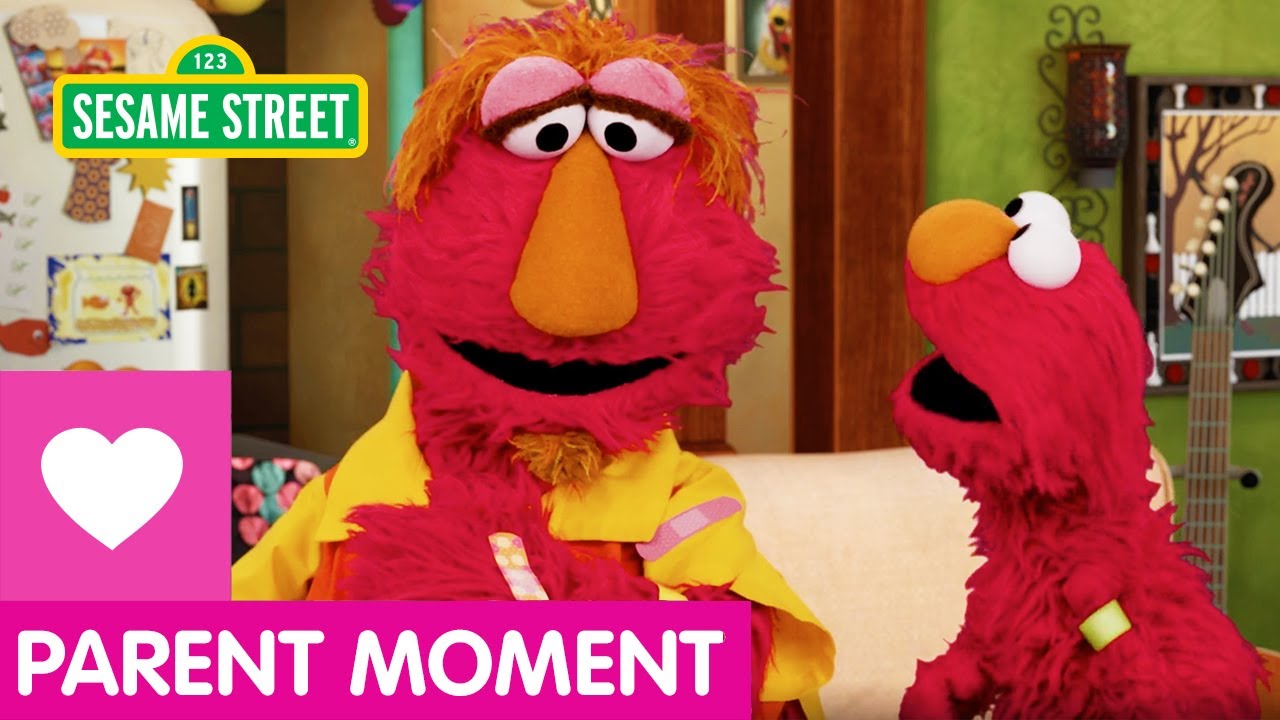
- Fox contributor Sean Duffy claimed that Sesame Street is “trying to indoctrinate your children” when discussing the episode where Elmo gets vaccinated. Fox News, *Fox & Friends First*, [6/29/22]
- While discussing the debut of Ji-Young, a Korean-American character, former Fox host Tucker Carlson ranted that “tribalism” has become a part of Sesame Street with the introduction of characters who have unique and identifiable ethnicities.Fox News, *Tucker Carlson Tonight*, [1/7/22]
During an earlier effort to increase public awareness about the
importance of vaccinations, co-hosts on Fox & Friends Weekend claimed that Sesame Street was feeding “propaganda” directly to children.Co-host Rachel Campos- Duffy claimed the programming “looks like a Big Pharma commercial on Sesame Street. It's so creepy.” Fox News, *Fox & Friends Weekend*, [11/7/21]
- Carlson devolved into an unhinged rant against Sesame Street’s special on 2020’s George Floyd protests discussing police brutality. On the now-canceled Tucker Carlson Tonight, Carlson accused those fighting against police brutality of “trying to take over your country” and “eliminate our centurieslong tradition of tolerance … and free expression.” Carlson also claimed that said protesters cause “weak leaders” to “reflexively bend to their demands, no matter what those demands are,” citing Sesame Street’s programming to claim that anti-American indoctrination “starts very young.” Fox News, *Tucker Carlson Tonight*, [6/9/20]
- Fox News’ Eric Bolling said Sesame Street spreads a “left-wing Communist diatribe,” while reporting on the 46th season of the hit show. Fox News, *The Five*, [1/14/16]
- After then-presidential nominee Mitt Romney called for ending federal money for public broadcasting, Fox News called Big Bird a “taker” of federal funding and said it was “time you flew the coop.” Fox News hosts and commentators also called the show a potential “multi-billion dollar goldmine” that “has made more money than a lot of Wall Street firms.” In fact, the Sesame Workshop’s expenses were higher than its revenues. Moreover, all federal funding to the Corporation for Public Broadcasting (not just this one show) made up just 0.012% of the federal budget. Media Matters, [10/10/12]
- Fox commentator Andrea Tantaros called Muppet programming, including Sesame Street, “brainwashing in the most obvious form.” Tantaros further complained: “I thought Sesame Street was supposed to be sharing and being nice to people, but over the years they've gotten more liberal.” Fox Business, *Follow the Money*, [12/2/11]
- Fox host Eric Bolling claimed that Sesame Street was getting “pretty political” and said that showcasing Lily, a character affected by poverty, is too harsh for children to see. Continuing, Bolling questioned whether the show will showcase an “evil Republican or Tea Party-er that they’re going to blame little Lily’s poverty on.” Fox Business, *Follow the Money*, [10/7/11]
- Right-wing blogs such as TheBlaze and The Gateway Pundit ridiculed Sesame Street’s new character whose family faced ongoing food insecurity. Lily’s introduction to the show was used by right-wing media as a cheap shot against former President Barack Obama and the rates of poverty during his administration. Media Matters, [10/6/11]
- Fox host Sean Hannity hosted a panel attacking Sesame Street for a segment that supported letting boys play with dolls and girls play with fire trucks. In response, right-wing commentator Ben Shapiro joked that he would like to “cap” Elmo, while former Ohio Secretary of State Ken Blackwell called it a “direct assault on this country's moral foundation.” Fox News, *Hannity*, [6/1/11]
//
03/05/24 3:18 PM EST
02/12/24 8:22 PM EST
03/06/24 4:26 PM EST
omg going on offense?! std/key API talking pt?
jj comm dr an 12 22
Fresh off posting the highest quarterly profit in its history, the U.S.-based fossil fuel giant ExxonMobil sued the European Union on Wednesday in an attempt to stop the bloc from imposing its recently approved windfall tax targeting major oil and gas companies.
The Financial Times, which first reported the new lawsuit, noted that the challenge takes aim at the European Council's "legal authority to impose the new tax—a power historically reserved for sovereign countries—and its use of emergency powers to secure member states' approval for the measure."
:{"The new tax is due to take effect from December 31 and will apply a levy of at least 33% on any taxable profits in 2022-23 that are 20% or more above average profits between 2018 and 2021," the newspaper explained.
}:
In a statement, Exxon spokesperson Casey Norton insisted the company recognizes that sky-high energy costs are "weighing heavily on families and businesses" but claimed the tax would "undermine investor confidence, discourage investment and increase reliance on imported energy."
Reuters reported Wednesday that Exxon's chief financial officer has estimated the E.U.'s windfall tax could cost the corporation around $2 billion through the end of next year—a fraction of the company's 2022 profits.
Approved in late September amid a mounting cost-of-living crisis across Europe, the windfall tax was presented as an effort to generate additional revenue to "provide financial support to households and companies" struggling with high energy costs.Oil and gas companies like Exxon have been accused of exploiting global energy market chaos spurred by Russia's war on Ukraine to hike prices and pad their bottom lines.
In late October, Exxon announced it brought in $19.7 billion in profits from July to September, its largest-ever quarterly haul. The company also announced it would raise its dividend and expand its share buyback program, rewarding wealthy investors as consumers continue to face elevated prices at the pump.
According to a recent filing, Exxon has also been rewarding its top executives,boosting the annual salary of CEO Darren Woods from $1.70 million to $1.88 million for the coming year.
===
comm dr jj 2 23 an
Sen. Elizabeth Warren and Rep. Katie Porter on Thursday demanded answers from the five largest egg producers in the United States over recent price surges that companies have blamed on an avian flu outbreak—a narrative that advocates view as an effort to distract attention from rampant profiteering in the industry.
Warren (D-Mass.) and Porter (D-Calif.) invoked that criticism in letters to Rose Acre Farms, Cal-Maine Foods, Hillandale Farms, Versova Management, and Daybreak Foods, writing that they are concerned by the "massive spike" in prices and "the extent to which egg producers may be using fears about avian flu and supply shocks as a cover to pad their own profits at the expense of American families."
"American families working to put food on the table deserve to know whether the increased prices they are paying for eggs represent a legitimate response to reduced supply or out-of-control corporate greed," the lawmakers wrote. "Although wholesale prices have decreased, consumers are still waiting for relief at the grocery checkout, which could take several more weeks."
Bureau of Labor Statistics data shows that the average price for a carton of a dozen large Grade A eggs was $4.80 in January, up from $1.93 a year earlier. Consumers in some states have been paying more than $7 per carton in recent weeks.
To explain the price surge—which has been eyebrow-raising even amid elevated inflation throughout the U.S. economy—egg-producing companies have pointed to a large avian flu outbreak that has impacted an estimated 58 million birds, including around 43 million egg-laying chickens.
But the advocacy group Farm Action has argued that the industry's explanations "don't stand up to the facts."
"Cal-Maine's net average selling price for a dozen conventional eggs increased by 150.5% from a year ago," the group observed last month. "The average size of egg-laying flocks never dropped more than six to eight percent lower than it was a year prior. Moreover, the effect of the loss of egg-laying hens on production was itself blunted by 'record-high' lay rates throughout the year."
"And there's one other critical piece missing from this industry narrative—Cal-Maine, which controls 20% of the egg market, hasn't reported a single case of avian flu at any of its facilities," Farm Action added.
In a recent letter to Federal Trade Commission Chair Lina Khan, Farm Action demanded an investigation into the highly concentrated industry, noting that top companies such as Cal-Maine "have a history of engaging in 'cartelistic conspiracies' to limit production, split markets, and increase prices for consumers."
===
ecowatch 12 22
More than 30 media organizations in more than 20 countries have come together with a simple but daring proposal: world leaders should tax big fossil fuel companies to help the most vulnerable nations respond to the climate crisis.
The editorial, spearheaded by The Guardian, was published in conjunction with the COP27 UN climate conference in Sharm el-Sheikh, Egypt, and has appeared in an international array of outlets including Hindu in India, Tempo in Indonesia, the Mail & Guardian in South Africa, Haaretz in Israel, Rolling Stone in the U.S., El Espectador in Colombia, La Repubblica in Italy and Libération in France.
“My hope is that in speaking with one voice, we remind people that this is a global crisis, threatening all of us,” head of environment at Guardian News and Media Natalie Hanman said in a Guardian article about the initiative. “It’s now imperative that world leaders listen, and act.”
[twt]
the editorial outlined the stakes of the moment. The most recent UN Environmental Programme Emissions Gap Report found that amped up national pledges following last year’s COP26 climate crisis still put the world on track for 2.4 to 2.6 degrees Celsius of warming by 2100. The editorial noted that this meant national pledges were delivering only one fiftieth of what is needed to reduce emissions in time to limit global warming to 1.5 degrees Celsius above pre-industrial levels and avoid the worst impacts of the climate crisis. At the same time, many nations are hurrying to start new fossil fuel projects in a short-sighted bid to wean themselves off Russian gas in the aftermath of its invasion of Ukraine.
“All this underlines that humanity has to end its addiction to fossil fuels,” the editorial said. “If renewable energy was the norm there would be no climate emergency.”
The editorial also highlighted the injustice of the climate crisis.
“Rich countries account for just one in eight people in the world today but are responsible for half of greenhouse gases,” the editorial said. “These nations have a clear moral responsibility to help. Developing nations should be given enough cash to address the dangerous conditions they did little to create — especially as a global recession looms.”
Yet so far this money has not materialized. In 2009, developed nations pledged $100 billion a year by 2020 to help developing nations both adapt to and mitigate the climate crisis, money that was never paid in full. Now, a new report published in conjunction with COP27 found that developing nations excluding China needed more than $2 trillion a year by 2030 to both reduce emissions, adapt to climate change and repair the inevitable loss and damage from the crisis.
One way to help with this gap between unmet needs and insufficient spending would be to tax the profits of major fossil fuel companies.
“As a bare minimum, a windfall tax on the combined profits of the largest oil and gas companies — estimated at almost $100bn in the first three months of the year — needs to be enacted,” the editorial authors wrote.
In this, they are echoing the words of UN Secretary-General António Guterres during his opening remarks to the UN General Assembly in September, who called for a windfall tax on fossil fuel prices to help both poorer nations reeling from the climate crisis and individuals everywhere struggling with the energy and cost of living crises.
“[T]he fossil fuel industry is feasting on hundreds of billions of dollars in subsidies and windfall profits while household budgets shrink and our planet burns,” Guterres said at the time.
Such a tax has also been endorsed by California Governor Gavin Newsom and U.S. President Joe Biden threatened such an act if oil and gas companies did not work to reduce prices.
The editorial said that a windfall tax should not replace climate finance from richer to poorer nations, but it was something that countries could pass on the national level without the need for an international deal. The authors also argued that the debts of developing countries recovering from extreme weather events should be forgiven.
Finally, the editorial called the climate crisis the “moonshot of our times” and argued for daring financial solutions such as the purchasing of government bonds undertaken by central banks in response to the coronavirus pandemic.
“This is no time for apathy or complacency; the urgency of the moment is upon us,” the editorial authors wrote.
The call to action comes as another report underscored the media’s failings on climate messaging, BusinessGreen noted. A six-nation Yougov poll commissioned by the Climate Action Against Disinformation (CAAD) and the Conscious Advertising Network (CAN) found that people who listened to, read or watched the news five times or more per week were more likely to believe common climate falsehoods — such as the idea that natural gas is a “greener” choice — than those who did not.
“This suggests that news outlets’ reporting regularly includes misinformation narratives, which are adversely influencing their readers’ opinions,” CAAD wrote in a press release.
The Guardian, however, has long been a leader in climate coverage. In 2019, for example, it updated its style guide to use the terms climate crisis, breakdown or emergency instead of climate change to accurately convey the urgency of the situation.
===
common dr an 12 22
With colder winter weather looming, a new analysis released Tuesday shows that the nine largest energy utility companies in the U.S. raked in nearly $14 billion in combined profits during the first three quarters of this year—and dished out roughly $11 billion to their wealthy shareholders—as tens of millions of U.S. households struggled to pay their utility bills due to soaring costs.
The watchdog group Accountable.US found thatNextEra Energy, Duke Energy, Southern Company, Dominion Energy, Constellation Energy, Eversource Energy, Entergy Corporation, DTE Energy, and CMS Energy Corporation brought in $13.8 billion in the first nine months of this fiscal year. The firms, the nine largest in the U.S. by market capitalization, returned over $11.2 billion to shareholders during that period in the form of dividends and stock buybacks.
The utility giants' massive profits have come at a cost to U.S. households, roughly 20 million of which are behind on their utility payments as providers continue to raise rates across the U.S., pushing home energy costs to unaffordable levels and prompting warnings of a "tsunami of shutoffs."
The Center for Biological Diversity recently estimated that utilities have shut off households' power 440,000 times across 15 states that have made their rates publicly available, a large increase from last year.
"Well-heeled utility company CEOs are holding consumers' feet to the fire with exorbitant energy prices," Liz Zelnick, director of Accountable.US' Economic Security and Corporate Power program, said in a statement Tuesday. "Not because they have to, judging by their own high profits and generous giveaways to wealthy investors—but because they can with colder weather on the horizon."
"To prey on families who use a necessary service with unreasonable and unjustified rate hikes is corporate greed at its worst," Zelnick added.
The Accountable.US analysis shows that the same large utility companies raking in huge profits and paying their executives massive compensation packages are driving price increases nationwide.
Southern Company's Georgia subsidiary, for instance, "had a near-12% rate hike approved in June 2022—and in August 2022, its Tennessee subsidiary was granted a rate hike that would result in typical monthly home heating bills rising by about 25%," the analysis notes.
[twt]
nbc reported in October that "nationwide, investor-owned utilities have requested rate increases amounting to nearly $12 billion from the beginning of the year through the end of August."
Zelnick argued that utility giants' price hikes are part of a broader trend of corporate price-gouging, a practice that companies frequently excuse by pointing to higher overall inflation throughout the economy.
"Like so many other industries during the pandemic, utility companies have chased higher and higher profits and enriched investors rather than keep prices stable for working families," said Zelnick. "While the economy is seeing signs of slowing inflation, it is clear corporate greed continues to be a primary driver of high costs on everything from groceries to heating bills—a problem that won't be solved by the Fed's one-track-minded policy of excessive interest rate hikes that threaten millions of jobs."
Utility firms' greedy behavior throughout the coronavirus pandemic has drawn the attention of progressive lawmakers such as Reps. Cori Bush (D-Mo.), Rashida Tlaib (D-Mich.), and Jamaal Bowman (D-N.Y.), who in September introduced a resolution that would recognize access to utilities such as electricity and heating as a basic human right.
The Resolution Recognizing the Human Rights to Utilities has not yet received a vote.
"Utilities are the foundation we build our lives upon," Tlaib said in a statement upon introduction of the measure. "In the richest country the world has ever known, it is an outrage that millions of Americans struggle with utility insecurity, substandard and dangerous services, and inhumane shutoffs."
"It's time to change the conversation around what we all deserve, take the profit motive out of providing the basics of a good life, and give every American the opportunity to thrive," Tlaib added.
===
===
an 12 22 comn dr an
Economic justice advocates on Wednesday responded to new U.S. government figures showing nonfinancial corporate profits soared to record levels during the third quarter of 2022 by urging congressional lawmakers—most of whom receive substantial corporate campaign contributions—to take action against the capitalist greed that progressive experts say is the main driver of inflation.
The U.S. Commerce Department's Bureau of Economic Analysis reported nonfinancial sector corporate profits of $2.08 trillion during the third quarter, up from just under $1.9 trillion during the same period last year, $1.6 trillion in Q3 2020, and $1.37 trillion from July-September 2019.
Wednesday's figures follow similar record second-quarter profits of $2.07 trillion, as well as a 15.5% increase in Q2 after-tax profits as a share of gross value added for non-financial corporations—the biggest margin since 1950.
"Today's record corporate profits mirror what we have been hearing on earnings call after earnings call: Corporations are gleefully reporting that their strategy to burden families with unnecessary price hikes is working," Rakeen Mabud, chief economist and managing director of policy and research at the Groundwork Collaborative,said in a statement. "Powerful corporations in concentrated industries will keep prices sky high until lawmakers rein them in."
[twt]
Numerous analyses, including a report released earlier this month by the U.S. House Subcommittee on Economic and Consumer Policy, have shown that corporations are using soaring inflation as a pretext for consumer price gouging.
Meanwhile, U.S. Federal Reserve Chair Jerome Powell said Wednesday that the Fed will continue to raise interest rates—albeit at a slower pace—in a continuation of the central bank's inflation-fighting strategy.
"Despite some promising developments, we have a long way to go in restoring price stability," Powell stated during an event at the Brookings Institution in Washington, D.C. "We will stay the course until the job is done."
Progressive economists and politicians stressed that corporate greed is the real culprit behind high prices, with former U.S. Labor Secretary Robert Reich tweeting Tuesday that "instead of raising interest rates and slowing the economy toward a recession, Congress and [President Joe] Biden should be taking aim at corporate price gouging.[twt]
Speaking earlier this month, U.S. Sen. Elizabeth Warren (D-Mass.) said, "Of course the Fed has a role to play in getting inflation under control, but there is a big difference between landing a plane and crashing a plane."
The watchdog group Accountable.USasserted Wednesday that "Corporate greed is driving inflation. As rising costs take a massive toll on American families, companies are raking in record profits and bragging about their sky-high prices."
The next Fed rate hike—which Powell said could come as soon as December—would be the seventh of the year. Earlier this month, the central bank raised interest rates by 0.75% for the fourth consecutive time.
New polling from Navigator Survey found that a majority of respondents believe that the government should focus on "cracking down on corporate greed and price gouging" over "stopping wasteful government spending and handouts"[twt]
"Our economic crisis isn't inflation, it's corporate greed," U.S. Sen. Bernie Sanders (I-Vt.)—who earlier this year introduced legislation that would impose a windfall corporate profit tax of up to 95% on companies with more than $500 million in annual revenue—argued earlier this month.
"You don't reduce inflation by giving tax breaks to billionaires and cutting benefits for the elderly, the sick, the children, and the poor," Sanders contended. "You combat inflation by taking on corporate greed and passing a windfall profits tax. You combat inflation by taking on the power of the insurance companies, the drug companies, the fossil fuel industry, the giant food companies and lowering the outrageously high costs of healthcare, prescription drugs, gas, and groceries."
===
an 11 22
Since early 2021, corporations that have played a major role in pushing inflation to a four-decade high in the United States have swarmed Capitol Hill with lobbyists to prevent Congress from passing legislation aimed at curbing companies' ability to price gouge consumers at will.
That's according to a report published Thursday by Public Citizen and the Groundwork Collaborative, which scoured federal lobbying disclosures to examine how trade groups and individual corporations have worked to shield their pricing power at the expense of the consumers.
The new report focuses specifically on 27 anti-price gouging and profiteering bills, none of which have fully passed and many of which failed to reach the floor for a vote after powerful corporate lobbying organizations—such as the drug industry's PhRMA and the Chamber of Commerce—"blanketed" the nation's capital with influence peddlers.
According to the Public Citizen and Groundwork's findings, "Corporations opposed to anti-price gouging and profiteering bills were responsible for more than 2,600 lobbyist engagements on Capitol Hill, while supporters of such legislation had fewer than 300: a 9-to-1 advantage for big business."
"H.R. 3, the Elijah E. Cummings' Lower Drug Costs Now Act (the signature drug pricing reform bill of the Democrats in the House) resulted in 1,157 lobbyist engagements, the most of any bill in this analysis," the report notes."Ninety-six percent of the engagements (1,110) came from corporations, trade groups, and non-profits opposed to the bill, giving the opposition a 24-to-1 advantage."
Though congressional Democrats ultimately passed scaled-back drug pricing reforms as part of their broader Inflation Reduction Act, Big Pharma has continued raising prices on lifesaving products and treatments after industry-backed lawmakers blocked bolder action. By one measure, the pharmaceutical industry has spent at least $147 million to obstruct efforts to bring down drug prices during the coronavirus pandemic.
"Corporate America deployed its overwhelming lobbying power to stop anti-price gouging and profiteering legislation to protect their record profits. It's all about money for them,"Mike Tanglis, a research director for Public Citizenand report co-author, said in a statement. "But for millions of Americans, it's about a lot more than just money. For those struggling to pay for prescription drugs, Big Pharma's price gouging can be a matter of life and death."
Corporate lobbyists have also targeted the Consumer Fuel Price Gouging Prevention Act, a bill that proposes giving the president the authority to prohibit oil and gas giants from increasing fuel prices to "unconscionably excessive" levels. The measure was fervently opposed by the Chamber of Commerce and the American Petroleum Institute, whose member list includes ExxonMobil and Chevron—fossil fuel behemoths that both reported sky-high profits last week.
The Consumer Fuel Price Gouging Prevention Act, which passed the Democratic-controlled House without any GOP support but stalled in the evenly divided Senate, has drawn 83 total lobbying engagements, nearly three-quarters of them from opponents of the bill, according to Public Citizen and Groundwork. Oil giants have also lobbied against a proposed windfall profits tax measure that has thus far failed to advance as prices at the pump remain elevated.
"This report highlights how the corporations fighting these bills have been the very ones responsible for jacking up prices on consumers and whose bottom line would be impacted the most if these bills were signed into law," said Michael Mitchell, Groundwork's director of policy and research and a co-author of the report. "Congress must rein in the unchecked and outsized power these megacorporations hold over our economy."
The report was released hours after the Federal Reserve announced yet another large interest rate hike despite growing warnings that its approach won't tackle the primary drivers of inflation, including ongoing supply chain issues and corporate profiteering. Fed Chair Jerome Powell didn't mention the latter factor during his statement to the press on Wednesday, and reporters neglected to ask him a single question about it.
Josh Bivens of the Economic Policy Institute estimated in September that "rising profit margins have accounted for roughly 40% of the rise in prices" since the second quarter of 2020.
In their new analysis, Public Citizen and Groundwork note that "booming corporate profits and fatter profit margins have not gone unnoticed."
"Consumers and policymakers alike have become increasingly aware that corporations are taking advantage of the moment and, in response, lawmakers have proposed various bills designed to hold corporations accountable and address rampant price gouging," the groups observe. "This report demonstrates that many of the same companies enjoying record profits— including household names such as Chevron, Johnson and Johnson, and Pfizer—are also deploying lobbyists to block these very proposals."
While welcoming recent passage of the Inflation Reduction Act as a step in the right direction, the report argues Congress must go much further to "address corporate concentration and rein in the unchecked power that these megacorporations exert on prices and our democracy."
"Policymakers should also consider enacting an excess profits tax to reduce the incentive for companies to engage in profiteering behavior," the report states. "To accomplish this, elected officials must push back against the lobbying onslaught by corporations very much invested in maintaining the status quo."
===
===
https://www.alternet.org/2022/10/gavin-newsom-windfall-tax-oil/
===
===
an 8 22
Pennsylvania U.S. Senate candidate John Fetterman made the case Sunday for prosecuting corporate executives as part of a broader government crackdown on unlawful price gouging and other business practices that have driven up the costs of medicine, groceries, and gas—padding company bottom lines at the expense of consumers.
"Take the massive oil companies, for example," the Democratic candidate wrote in an op-ed for the Pennsylvania Times Leader. "Chevron, Exxon, and Shell have seen their profits increase 200% since last year, but they're still charging us sky-high prices for gas. Companies like Tyson posted over a billion dollars in profits last quarter, while raising prices on meat products our families depend on."
"It's gross, and deeply unpatriotic, for the big corporations to be rolling around in cash while charging us record-high prices for gas and groceries," wrote Fetterman, who is currently Pennsylvania's lieutenant governor. "We'll crack down on this by prosecuting the executives of these huge corporations, including the Big Oil companies and meatpacking companies who are artificially driving up prices, gouging consumers at the pump and at the grocery store."
Fetterman's op-ed comes just over a week after he held his first major public event since suffering a stroke in mid-May, days before the Democratic primary contest that he won handily.
The Democrat's general election campaign in the critical battleground Pennsylvania—a state that could determine which party controls the U.S. Senate next year—currently enjoys a double-digit polling lead over his Republican opponent, the former celebrity television personality and ultra-millionaire Dr. Mehmet Oz.
Fetterman is looking to press his advantage by continuing to deploy populist messaging that presents Oz as a carpetbagger whose extreme wealth and ties to corporate interests such as Big Pharma render him unfit to deliver for the working class, whose earnings are being eroded by surging prescription drug prices, housing costs, and other inflationary trends.
According to one recent analysis, pharmaceutical companies in the U.S. have raised drug prices more than 1,100 times so far this year.
"Let's be clear: Dr. Oz just isn't connected to the struggles that Pennsylvanians are facing every day," Fetterman wrote in his new op-ed. "While he's been complaining about rising prices from his New Jersey Mansion, I've been meeting Pennsylvanians on grocery store runs, speaking with them about the challenges they're facing, and finding real policy solutions that get stuff done and make their lives better."
"Working Pennsylvanians are getting screwed," he continued. "While costs are rising and wages are failing to keep up, too many of our leaders in Washington simply aren't doing enough. Out-of-touch politicians got us into this mess, we can't trust an out-of-touch millionaire TV doctor to get us out of it."
In addition to prosecuting corporate executives for price-gouging and other abuses, Fetterman voices support for a range of policy solutions aimed at tackling rising costs and inequality, including:
- Enacting a financial transaction tax on trades of stocks, bonds, and derivatives;
- Ending the stranglehold of healthcare costs on American families by instituting a cap of a thousand dollars per year on out-of-pocket costs;
- Passing legislation to allow for the importation of lower-priced prescription drugs from other countries; and
- Putting a cap on prescription drug costs.
"If we start getting stuff done, starting with these priorities I've listed," Fetterman wrote, "we can make real change for the towns, cities, and people of Pennsylvania."
===
[[===
no lnx twt
Ron Johnson challenger says senator is 'bought and paid for' by Big Pharma
Elizabeth Preza August 17, 2022
The campaign of Wisconsin Lt. Gov. Mandela Barnes, who is running to unseat U.S. Sen. Ron Johnson, declared Tuesday that the Republican incumbent "is bought and paid for by Big Pharma."
:{
}:
That charge came in response to Johnson's Monday comments about Medicare negotiating the cost of certain prescription drugs, which is included in the Inflation Reduction Act that U.S. President Joe Biden signed into law Tuesday afternoon.
:{
}:
Appearing on "The Brian Kilmeade Show," Johnson told the Fox News host that "when you start punishing the pharmaceutical industry, you're gonna have less innovation; you're gonna have fewer lifesaving drugs. That's not a good thing."
:{
}:
Barnes—who won the Democratic primary last week—said Tuesday that "while Ron Johnson is worried about protecting the bottom lines of big pharmaceutical companies, I'm worried about working families across Wisconsin who are forced to choose between putting food on the table or affording the medication they need."
"For over a decade, Ron Johnson has put big corporations and his wealthy donors before the working people he was elected to represent," he asserted. "In the Senate, I'll hold Big Pharma accountable and ensure every Wisconsinite has a fair shot."
The progressive Democrat's campaign also highlighted recent reporting by The Cap Times that Johnson, while chairing the Senate Committee on Homeland Security and Governmental Affairs in 2018, "declined to subpoena Teva Pharmaceuticals as part of a Democrat-led investigation of the drugmaker's role in the opioid epidemic." In the months that followed, the company donated to both Johnson's campaign and an affiliated political action committee (PAC).
Johnson spokesperson Alexa Henning told the Madison-based newspaper that the "senator appreciates the support that people offer, but he doesn't personally track who gives what, and donations never impact his views on issues or how he votes." She added that asking about Teva's contributions "is another politically motivated hit job by the corporate media and cheered on by their allies in the Democrat Party."
Barnes' campaign, meanwhile, said Tuesday:
Ron Johnson has a long history of selling out Wisconsinites in favor of his large corporate donors. Earlier this year, Johnson justified sending 1,000 good-paying, family-sustaining jobs out of Wisconsin by claiming, "It's not like we don't have enough jobs here in Wisconsin." Reporting later showed the company shipping jobs out of state, Oshkosh Corp., "ranks seventh among Johnson's top career contributors."
Johnson, a businessman, was elected to the Senate in 2010 and won a second term in 2016.
In his bid to replace Johnson, Barnes has secured the support of various progressives groups across Wisconsin and the nation along with local, state, and federal elected officials, including Sens. Bernie Sanders (I-Vt.) and Elizabeth Warren (D-Mass.).
On the healthcare front, Barnes backs not only drug pricing reforms like those in the new law but also putting the United States on a path to universal healthcare by passing Medicare for All legislation at the federal level.
"In the richest nation in the world," the candidate says in a campaign video, "no one should be going bankrupt because of their medical bills."
===
===
Massive Lawsuit Says Big Pharma Is Price-Fixing Drugs
FEATURING PETER MAYBARDUK - The state of Connecticut is leading a nation-wide lawsuit against the world's biggest generic drug manufacturer Teva Pharmaceuticals and a number of other drug makers alleging a
]]
===
https://scorecard.lcv.org/roll-call-vote/2022-232-cracking-down-oil-industry-price-gouging
Cracking Down On Oil Industry Price Gouging
House Roll Call Vote 232
Issues: Dirty Energy, Drilling
Rep. Kim Schrier (D-WA) sponsored H.R. 7688, the Consumer Fuel Price Gouging Prevention Act, which takes important steps to protect families struggling with high gas and home heating fuel prices while Big Oil rakes in sky-high profits on the back of Putin’s brutal and unprovoked invasion of Ukraine. This legislation would crack down on oil and gas companies that are price gouging consumers, empowering the President to issue an Emergency Declaration to make it illegal to charge unconscionably excessive and exploitative prices for gasoline and home heating fuels. The bill would also empower the Federal Trade Commission to issue penalties on companies that are price gouging, with enforcement priority placed on large oil companies with total sales in excess of $500 million per year. The bill further protects low-income families most impacted by Big Oil’s price gouging by allocating the fines collected to a Consumer Relief Trust Fund, which can be used to fund the Low-Income Home Energy Assistance Program (LIHEAP) and the Weatherization Assistance Program (WAP), which invests in making low-income homes more energy efficient. On May 19, the House approved H.R. 7688 by a vote of 217-207 (House roll call vote 232). YES IS THE PRO-ENVIRONMENT VOTE.
===
https://www.alternet.org/2022/06/bernie-sanders-2657557605/
price gouging, windfall tax vs // biden fed gas tax 90 days
===
===
https://www.alternet.org/2022/06/gas-prices/
In the wake of new federal data showing that U.S. inflation rose again in May after decelerating slightly the previous month, progressive lawmakers, economists, and union leaders on Friday tried to hammer home their argument that corporate profiteering is a major driver of the price hikes that are eroding workers' modest wage gains and heightening economic pain nationwide.
"While families are feeling the sting of soaring energy costs, oil and gas companies are cheering the nearly $100 billion in profits they've already made this year off families' pain at the pump," said Dr. Rakeen Mabud, chief economist at the Groundwork Collaborative.
"It's past time for Congress to pass an excess profits tax to stop the outrageous war profiteering by Big Oil," Mabud added, referring to the benefits the U.S. fossil fuel industry has reaped from Russia's assault on Ukraine.
The narrative that corporate greed is one of the key culprits behind inflation, which is now at a 40-year high, resonates greatly with the U.S. public, according to recent survey data. A poll conducted last month by Data for Progress showed that 71% of all U.S. voters blame corporate profit-seeking for rising inflation.
But despite the argument's popularity—and alignment with data showing that record-high corporate profits are a disproportionate contributor to inflation—the Biden administration has been increasingly hesitant to deploy it in recent months even as inflationary pressures persist and businesses' net incomes grow exponentially in some sectors.
During an event hosted by The New York Times on Thursday, Treasury Secretary Janet Yellen outright rejected the notion that corporate greed is to blame for inflation, saying, "Demand and supply is largely driving inflation."
Federal Reserve Chair Jerome Powell, meanwhile, has openly suggested that wage increases are part of the problem, telling reporters during a press conference last month that the country needs to "get wages down" in order to tackle inflation.
While progressive economists have acknowledged that a number of factors, from supply chain issues caused by the pandemic to the war in Ukraine, are pushing inflation to levels not seen in decades, they have nevertheless maintained that corporate profiteering is a significant culprit.
"Corporations are using inflation as an excuse to raise their prices, hurting workers and consumers while they enjoy record profits," Robert Reich, the former secretary of the U.S. Labor Department, wrote last month. "Prices are surging—but let's be clear: corporations are not raising prices simply because of the increasing costs of supplies and labor. They could easily absorb these higher costs, but instead they are passing them on to consumers and even raising prices higher than those cost increases."
Mary Kay Henry, president of the Service Employees International Union, echoed Reich on Friday.
"Make no mistake: the same corporations that are making record profits while busting workers' unions are raising prices on working families," Henry wrote on Twitter. "If our nation's leaders are serious about addressing inflation, they'll hold these big corporations accountable for their price gouging."
In recent weeks, as inflation numbers have remained stubbornly high and corporate executives have continued boasting about their profits, congressional Democrats have put forth several proposals aimed at combating price gouging and reining in excess profits via taxation.
Led by Rep. Ro Khanna (D-Calif.) in the House and Sen. Sheldon Whitehouse (D-R.I.), a group of Democrats and Sen. Bernie Sanders (I-Vt.) introduced legislation in March that would hit large and highly profitable oil companies with "a per-barrel tax equal to 50% of the difference between the current price of a barrel of oil and the pre-pandemic average price per barrel between 2015 and 2019."
While the White House has signaled it would be willing to support a windfall profits tax on Big Oil, Democrats' bill has not received a vote in the House or Senate.
Last month, Sens. Elizabeth Warren (D-Mass.) and Tammy Baldwin (D-Wis.) along with Rep. Jan Schakowsky (D-Ill.) unveiled a measure that would empower federal regulators to crack down on corporate price gouging. Warren has specifically called out the meat industry for its pricing practices throughout the pandemic.
"Giant corporations are using inflation as a cover story to jack up prices and pad profits," Warren tweeted Friday. "Let's pass my bill to crack down on corporate price gouging. And let's pass our windfall profits tax on Big Oil, which includes rebate checks for Americans struggling with gas prices."
===
Entirely unsurprising': Merck slammed for 4,000% markup of taxpayer-funded Covid drug
The New Jersey-based pharmaceutical giant Merck is facing accusations of price gouging after it charged the U.S. over $700 per patient for a taxpayer-funded coronavirus treatment...
===