inflation BS
primary 3 24 sorta perennial BS big in 2024 campaign
7 25 INCLUDES LEGIT INFO ON INFLATION
SEE TARIFF TRADE WAR
SEE GNP ECONOMY
SEE PRICE GOUGING CORPS
mebbe belated
621 aha // to deficit bogeyman to prevent spending $ on ppl, infra, social safety net. educ see 2 santas BS
// gas price in that prez has little control but gets blamed, also reductionism problem (mult causes, lag time on reaction) plus numbers don’t matter as much as fox vibe / BS earth2 // violent crime
ironically Biden did work kinks out of supply chain, but corps kept jacking prices even after fixed
the fed is moderation, but for banks/corps?
aha recall supply and demand reductionism koch free mkt bs, if gas costs too much drill baby
note AGW climate chaos boosts insurance for homes AND CARS
see price gouging
see algorithm extraction rent prop mgmt
see disaster capitalism profiteering
TARIFF CHAOS DEPRESS OIL/GAS PRICES
---
-=-=
-=-=
MMA 10 26
-=-=
mma
-=-=
RICHARD WOLFF 5 26 INFL = [CORP] PRICE RISE PERIOD
---
com dr 5 26
‘Stinks of Rotting Meat’: Critics Warn Trump DOJ Settlement Would Legalize Price-Fixing
“Get ready for even higher prices for chicken, turkey, and pork,” said one antitrust attorney.
May 08, 2026
US President Donald Trump’s Justice Department moved Thursday to settle a Biden-era antitrust lawsuit against the analytics firm Agri Stats, proposing an agreement that critics say would effectively give the stamp of federal approval to meat industry price-fixing schemes.
The Justice Department—now headed by Acting Attorney General Todd Blanche, formerly Trump’s personal lawyer—hailed the proposed settlement as a “historic” win over a company whose “business model directly raised the price of chicken, turkey, and pork in local grocery stores across our nation.” But critics said the agreement, which must undergo review by a federal judge, would do nothing substantial to rein in price-fixing in the meat industry.
Lee Hepner, senior legal counsel for the American Economic Liberties Project, said the deal “stinks of rotting meat,” noting that the settlement was proposed just days before the case was set to go to trial.
“No way does it address the harms,” Hepner said of the 79-page settlement. “Agri Stats spent decades hiking prices on over 90% of processed meat in the country. Now they’re being told to exercise some discretion going forward.”
“It’s a gut punch to those who worked on this case for four years thinking it might actually deter these price fixing services from cropping up in every other industry,” Hepner added.
The Biden administration brought the antitrust lawsuit against Agri Stats in September 2023, accusing the company and its subsidiary EMI of “collecting, integrating, and distributing competitively sensitive information related to price, cost, and output among competing meat processors.”
“While distributing troves of competitively sensitive information among participating processors, Agri Stats withholds its reports from meat purchasers, workers and American consumers, resulting in an information asymmetry that further exacerbates the competitive harm of Agri Stats’ information exchanges,” the Biden DOJ said.
“This settlement legalizes meat price-fixing—it just says you have to bring the giant retailers and distributors in on the game.”
The Trump Justice Department’s settlement would require Agri Stats to “make the vast majority of information” it distributes “available to all interested domestic purchasers on reasonable and non-discriminatory terms,” along with several other conditions.
But the settlement states that EMI is not otherwise “prohibited... from continuing to provide EMI Price Reports in substantially the same manner as it did as of April 24, 2026.”
Agri Stats noted in a statement Thursday that it “denied all allegations” of illegal conduct and “has admitted no wrongdoing” as part of the settlement. Agri Stats’ lead counsel in the case called the deal “a win” for both the company and consumers—a claim that antitrust advocates rejected, calling the agreement blatantly one-sided in the corporation’s favor.
“This settlement legalizes meat price-fixing—it just says you have to bring the giant retailers and distributors in on the game,” wrote Basel Musharbash, managing attorney at Antimonopoly Counsel. “Get ready for even higher prices for chicken, turkey, and pork.”
The proposed Agri Stats settlement is the latest favorable deal that Trump’s Justice Department—which is in the grip of lobbyists with ties to the president—has cut with a major corporation accused of illegal price-fixing.
Last November, as Common Dreams reported, the Justice Department agreed to settle a Biden-era lawsuit filed against the real estate software company RealPage, which was accused of an “unlawful scheme to decrease competition among landlords in apartment pricing and to monopolize the market for commercial revenue management software.”
RealPage welcomed the settlement, noting that the agreement included “no financial penalties, damages, or findings or admissions of wrongdoing.”
---
---
AN 2 26
Earlier this week, President Donald Trump sat down with NBC News reporter Tony Llamas for a wide-ranging interview on multiple subjects. However, Llamas often let the president lie without pushing back. Now, CNN is taking Llamas to task for not doing his job — while debunking Trump's lies.
In a Thursday article, CNN's Daniel Dale did a point-by-point fact-check of Trump's biggest lies, and admonished Llamas for doing little to counter what he called Trump's "rapid-fire dishonesty." The CNN fact-checker observed that while NBC published a fact-check of Trump's claims after the interview, Llamas himself frequently responded to Trump's outright falsehoods with "right" or "yeah," and sometimes "didn’t acknowledge them at all."
"Llamas’ hands-off approach to the president’s falsehoods left people watching the interview on television and through social media clips without immediate corrective information on a variety of pressing subjects," Dale wrote. "An exchange about inflation, for example, was littered with a bunch of inaccurate Trump figures and assertions that Llamas let pass by with the word 'right.' And in one case, when Trump claimed it’s only 'very few' product prices that have stubbornly refused to fall during this presidency, Llamas initially responded with a comment that made it sound like he was endorsing the false claim: 'Yeah, very few. I get it.'"
When it came to Trump's insistence about presiding over an increase in prices of consumer goods, Trump insisted to Llamas that the increases are limited to "very few" items. But Dale wrote that the Consumer Price Index was actually 2.7 percent higher in December 2025 compared to December 2024, and many more products have become more expensive since Trump's second term began than have become cheaper.
Dale also disputed Trump's claim to Llamas that he "inherited the worst inflation in the history of our country." The all-time highest inflation rate of 23.7 percent was actually set in 1920. And while former President Joe Biden saw the inflation rate jump as high as 9.1 percent under his watch in 2022, that was a 48-year high. Dale credited Llamas for telling Trump that Biden had to contend with the Covid-19 pandemic, which was the chief cause of high inflation rates.
Trump also told the NBC reporter that gas prices were "$1.99 a gallon" in 2026, though Dale found that the average price for a gallon of gas was $2.89 per gallon according to data published by AAA. GasBuddy head of petroleum analysis Patrick De Haan told CNN that out of more than 150,000 gas stations, only 18 to 34 offered gas prices under $2 per gallon. Dale reminded readers that Llamas' only response to Trump's claim was "yeah."
"An average over those dates would be 28 stations over the course of the week, or 0.018% of all U.S. stations. I think I’d rather find the needle in the haystack at that point," De Haan said.
---
---
AN 1 26
Kicking off what is expected to be a weekly campaign-style tour of the nation to promote his agenda ahead of the November midterms, President Donald Trump engaged in what CNN fact-checker Daniel Dale described as an “alternative reality” of “piling lie upon lie” for his Iowa audience.
“You know, inflation we’ve solved; it’s done,” Trump told Fox News during the trip to Iowa. “We have it good where prices are coming way down. They were just saying, in Iowa the fuel is $1.95. Did you hear that? Somebody said $1.85. But it was $3.50, $4.50 just a year ago, a year and a half ago. You look at eggs, you look at groceries, it’s all down. Everything’s come down. Do you notice they don’t mention affordability anymore?”
According to Dale, it’s “true” that egg prices have fallen significantly, but the “rest of his narrative was thoroughly inaccurate.”
He continued his fact check: “Inflation is not over; prices continue to rise. Overall prices have gone up, not down. Overall grocery prices have gone up, not down. Iowa’s average gas price is much higher than $1.95. And Democrats have certainly not stopped mentioning affordability; in fact, it remains a key focus of their public remarks.”
Dale apparently wasn’t the only one fact-checking gas prices.
“In an unusual moment,” he writes, “Trump was fact-checked on this subject by an attendee at his Iowa speech on Tuesday. When he of gas in Iowa being $1.95 or $1.85 per gallon, someone in the crowd shouted, ‘No, $2.63,’ according to CNN’s Steve Contorno, who was on scene.”
According to Dale, “Overall consumer prices have increased during this presidential term; in December 2025, seasonally adjusted overall prices were 2.2% higher than they were in January 2025, and, again, 2.7% higher than they were in December 2024.”
He also noted that “It’s not true that ‘you look at groceries, it’s all down.’ In fact, the 0.7% increase in the Consumer Price Index for groceries between November 2025 and December 2025 was the biggest month-to-month jump reported in more than three years.”
And he added, “Iowa gas prices are generally much higher than Trump said.”
---
---
AN 1 26
Inflation is on the rise thanks to President Donald Trump, and his own voters are about to get hit with the worst of it.
The New Statesman reported Thursday that MAGA world will be the ones that face the misery of a faltering economy.
Trump's war with the Federal Reserve kicked in to high gear over the weekend after Chairman Jerome Powell revealed he'd been subpoenaed by a grand jury for an investigation. The probe threatens "a criminal indictment," Powell said in a video statement.
The Fed's "rate-setting board alone employs several hundred researchers, almost all of whom have a PhD in economics," business reporter Will Dunn explained. "Their job is to come up with one of the world’s most important numbers: the Fed funds rate, which is effectively the price of money in the world’s most powerful economy, and which affects the prices of commodities and financial instruments around the world."
However, Trump wants to replace the "multi-billion-dollar system of data collection and careful economic modeling" with his own individual economic whims.
Powell has threatened, "we’re going to probably bring a lawsuit against him."
The chairman's term ends in May, but he will remain on the board of governors until Jan. 2028. Trump has already attempted to fire a previously appointed Democratic nominee. Her position is now being decided by the Supreme Court, said Dunn.
While lower rates could help promote business activity and boost stock markets, the problem is that economic populism can be expensive, the report says.
"The price for juicing the US economy enough to give Trump continued control of Congress at the end of the year will be paid, in the years that follow, by his own voters. Having stimulated demand in the US economy – by making debt cheaper and handing out free money – the US can expect to experience inflation," the piece promises.
The problem for Trump is that his team sees inflation in the "abstract." All of their money is in property, cash and other assets and there is so much of it that their spending barely impacts their lives. That's not the case for Trump voters, the report explained.
"The people who feel inflation most seriously are the people who have the least disposable income – in the US, the bottom quartile of earners. The majority of low-income households in the US voted for Trump in 2024," wrote the Statesman.
The report closed by promising that Trump "is preparing not only to dupe these low-income voters with the illusion of a functioning economy, but to make them pay for it.
---
AN 12 25
On Friday, a nonprofit forced the Trump administration to unseal a damning complaint lodged by the Biden-era Federal Trade Commission against Pepsi for colluding with Walmart to raise food prices across the nation. New un-redacted information claims FTC Chair Ferguson and his colleague Mark Meador (both Trump appointees) were hiding the mechanics of Pepsi’s and Wal-Mart’s price fixing.
Pepsi is a “must-have” product for grocery stores, and Walmart is also massively powerful,” reports BIG Newsletter writer Matt Stoller. Critics say Pepsi allegedly engages in price discrimination to maintain the approval of Walmart, its biggest buyer — even going so far as to police prices at smaller rival stores. And it prepares reports for Walmart showing them their pricing advantages on Pepsi products.
When the “price gap” between Wal-Mart and its tiny rivals narrow too much, Pepsi tracks where consumers were buying Pepsi products outside of Walmart. It keeps logs on stores who would “self-fund” Pepsi product discounts, nicknaming them “offenders” and then raise their stock price, forcing them to carry those costs down to their customers.
“This dynamic is why independent grocery stores are dying,” said Stoller. “… It’s led to less competition, fewer local grocery stores, and higher prices. … To the end consumer, it creates an optimal illusion. Walmart appears to be a low-cost retailer, but that’s because it induces its suppliers to push prices up at rivals.”
Much of this information was redacted by Trump officials, however, including Ferguson and Meador. Normally, when the government files an antitrust case, the complaint gets redacted to protect confidential business information. Then the corporate defendant and the government haggle over what is genuinely confidential business information and complaints are eventually unsealed with some minor blacked out phrases, and the case goes on.
“In this case, however, … Ferguson abruptly dropped the case in February after Pepsi hired well-connected lobbyists,” said Stoller. “… Ferguson ended it the day before the government was supposed to go before the judge to manage the unsealing process. And that kept the complaint redacted. With the complaint kept secret, Ferguson, and … Meador, then publicly went on the attack.”
Ferguson released a “bitter and personal” statement against Biden-era FTC Chair Lina Khan — who had brought the complaint against Pepsi — implying that she was lawless and partisan, that there was “no evidence” to support key contentions, and that Ferguson had to “clean up the Biden-Harris FTC’s mess.” Fellow commissioner Mark Meador later echoed his comments on on X.
“And that was where it was supposed to stay, secret, with mean-spirited name-calling and invective camouflaging the real secret Ferguson was trying to conceal,” said Stoller. “That secret is something we all know, but this complaint helped prove that the center of the affordability crisis in food is market power. If that got out, then Ferguson would have to litigate this case or risk deep embarrassment. So, the strategy was to handwave about that mean Lina Khan to lobbyists, while keeping the evidence secret.”
But anti-monopoly group The Institute for Local Self-Reliance filed to make the full complaint public, and Judge Jesse Matthew Furman agreed to hear ILSR’s case, with the U.S. Chamber of Commerce and Pepsi bitterly opposed.
“Last week, Furman directed the FTC unseal the complaint. So we finally got to see what Ferguson and Meador were trying to hide,” Stoller said.
Read the full BIG report at this link
---
AN 11 25
Late credit card payments 'highest since Great Recession' this holiday: analyst
//
Trump claims quashed as he's accused of 'cherry-picking' affordability reports
---
---
AN 11 25
Consumer confidence in death spiral as Trump wrecks hope in the economy
//
White House says inflation is 'way down' — Americans aren’t buying it
---
AN 11 25
It’s not just President Donald Trump’s claims about Thanksgiving prices at Walmart that are under scrutiny. According to a new analysis from the*Los Angeles Times*, “faulty arithmetic” plagues the administrations claims about everything from inflation to mortgages to weight loss.
"On inflation, healthcare, mortgages and much more, the Trump administration offers bogus math," according to the Times.
In a new column from Tuesday, business columnist Michael Hiltzik cited numerous examples of “suspect” math and figures claimed by the Trump administration “deliberately aimed at portraying some condition as better than the real numbers show.” The first example was Medicare and Medicaid Administrator Mehmet Oz’s recent claim at a White House event this month that cuts to prescription costs for weight loss drugs would lead to an estimated 135 billion collective pounds lost in the U.S., a figure that would require every single person in the country to lose over 340 pounds.
The faulty math doesn’t stop there, and some of it hits much closer to home amid the current concerns around affordability. Trump recently touted the introduction of 50-year mortgages as a solution to the difficulty Americans have with buying homes. While such a policy would lower monthly payments compared to 30-year plans, many have pointed out the it would also drastically increase the amount of interest paid over the life of the mortgage.
Using a $400,000 home as an example, Hiltzik calculated that a 50-year plan would cost buyers $650,000 in total interest, up from $461,000 on a 30-year option. For all that, buyers would only save a little less than $300 on their monthly payments.
Back on the subject of prescriptions, Hiltzik also highlighted Trump’s tendency to exaggerate the amount that he’s allegedly cut their costs to impossible degrees. In August, the president claimed that he had helped cut drug prices by “by 1,200, 1,300 and 1,400, 1,500 percent,” even though cutting prices by any percentage over 100 percent would result in the company having to pay consumers to use their product.
All this wonky math comes amid surging concerns about affordability for everyday Americans. It’s an issue credited with helping get Trump reelected in 2024, but which also led to huge wins for Democrats in the 2025 elections.
In attempting to address the issue this month, Trump tried to claim that costs were dropping during his presidency, citing only a 25 percent drop in the cost of Walmart’s Thanksgiving basket. While the selection of items is cheaper this year compared to 2024, many have been quick to point out that this is because it contains 15 products, down from 22 last year, many of which were also swapped for Walmart-brand alternatives.
---
now 3 vs 9%? 11 25
---
mma
11/07/25 15 vs 29 items? no pecan pie, not name brands
---
---
AN 9 25
HIS 2ND TIME; AUD PRETTY APPALED?
On Tuesday, September 23, U.S. President Donald Trump gave a rambling speech before the United Nations General Assembly. And at times, he was vehemently critical of the UN for a variety of reasons, from their immigration policies to green energy.
Here are six of the wildest moments from Trump's UN speech.
1. Trump claimed that 'inflation has been defeated'
Trump aggressively attacked then-President Joe Biden and then-Vice President Kamala Harris on inflation during the United States' 2024 election. But during his UN speech eight months into his second presidency, Trump claimed that "inflation has been defeated" in the U.S. Many economists, however, are warning that Trump's steep new tariffs will cause much worse inflation than what the U.S. experienced during the Biden Administration.
2. Trump slammed UN for not living up to its potential
Trump told UN officials, "All I got from the United Nations was an escalator that stopped in the middle…. Those are the things I got from the United Nations: a bad escalator and a bad teleprompter…. The United Nations has tremendous, tremendous potential…. But it's not even coming close to that potential."
3. Trump attacked UN members for immigration policies
During his speech, Trump was highly critical of Biden's immigration policies, saying, "We were the laughing stock all over the world." But he also attacked UN members for their immigration policies and declared, "Immigration is destroying your country, and you have to do something about it…. Your countries are being ruined…. The UN is supposed to stop invasions, not create them…. Europe is in serious trouble. They've been invaded by a force of illegal aliens like no one has ever seen before…. Your countries are going to hell."
Trump also claimed European countries are in danger from Islamist "Shariah law," attacking London for having a "terrible, terrible mayor."
4. Trump insisted he deserves the Nobel Peace Prize
Trump told UN officials, "Everyone says I deserve the Nobel Peace Prize….. We've saved millions and millions of lives…. I'm going to give you the best of everything."
5. Trump chastised EU members for not imposing more tariffs
Trump promoted his trade policies during his UN speech, attacking European countries for having similar trade policies. The U.S. president told UN officials, "Join us in adopting the exact same measures…. Europe has to step it up…. They're buying oil and gas from Russia while they're fighting Russia…. Cease all energy purchases from Russia."
6. Trump ripped European countries for not using more fossil fuels
Trump expressed his disdain for green energy and "the global warming hoax," telling UN members, "Those windmills are so big and so bad…. Many European countries are on the brink of destruction because of the green agenda…. This is a disaster."
Trump praised "clean, beautiful coal" and denied the reality of climate change, claiming, "It's the greatest con job every perpetrated on the world, in my opinion…. If you don't get away from the green energy scam, your country is going to fail."
---
an 25
Trump Fed appointee downplays rising grocery prices — even as inflation hits 3-year high
an common dr 8 25
A leading inflation indicator surged much more than expected last month, just as the impact of U.S. President Donald Trump's tariffs started to weigh on American businesses and consumers.
New Producer Price Index (PPI) numbers released on Thursday showed that wholesale prices rose by 0.9% over the last month and by 3.3% over the last year. These numbers were significantly higher than economists' consensus estimates of a 0.2% monthly rise and a 2.5% yearly rise in producer prices.
PPI is a leading indicator of future readings of the Consumer Price Index, the most widely cited gauge of inflation, as increases in wholesalers' prices almost inevitably get passed on to consumers. Economists have been predicting for months that Trump's tariffs on imported goods, which at the moment are higher than at any point in nearly 100 years, would lead to a spike in inflation.
Reacting to the higher-than-expected PPI number, some economic experts pinned the blame directly on the president.
"So much for foreigners paying tariffs," commented Joseph Brusuelas, chief economist at tax consulting firm RSM US, on X. "If they did, PPI would be falling. Wholesale prices up 3.3% from a year ago and 3.7% in the core. The temperature is definitely rising in the core. This implies a hot PCE reading lies ahead."
Liz Pancotti, the managing director of policy and advocacy at the Groundwork Collaborative, took a deep dive into the numbers and found that Trump's tariffs were having an impact on a wide range of products.
"There is no mistaking it: President Trump's tariffs are hitting American farmers and driving up grocery prices for American families," she said. "Wholesale prices for grocery staples, like fresh vegetables (up 39% over the past month) and coffee (up 29% over the past year) are rising, squeezing American families even further in the checkout line."
Pancotti singled out the rise in milk prices as particularly worrisome for American families.
"Milk drove more than 30% of the increase in prices for unprocessed goods, rising by 9.1% in just the past month," she explained. "Tuesday's CPI print showed that milk prices rose by 1.9% in July, and this PPI data suggests further price hikes are on the way."
Betsey Stevenson, who served on former President Barack Obama's Council of Economic Advisers, also pointed the finger at Trump's policies.
"Tariffs will cause higher prices," she said. "Volatility and uncertainty will cause higher prices. The PPI jump is not a surprise, it was inevitable."
On his Bluesky account, CNBC's Carl Quintanilla flagged analysis from economic research firm High Frequency Economics stating that the new PPI numbers were "a kick in the teeth for anyone who thought that tariffs would not impact domestic prices in the United States economy."
The firm added that it "will not be a long journey for producers' prices to translate into consumer prices" in the coming months.
Liz Thomas, the head of investment strategy at finance company SoFi, argued that the hot PPI numbers could further frustrate Trump's goal of getting the Federal Reserve to lower interest rates given that doing so would almost certainly boost inflation further.
"The increase in PPI was driven by services, and there were increases in general services costs and in the Trade component (i.e., wholesale/retail margins)," she commented. "The Fed won't like this report."
Ross Hendricks, an analyst at economic research firm Porter & Co., described the new report as "scorching hot" and similarly speculated that it would stop the Federal Reserve from cutting rates.
"Good luck with them rate cuts!" he wrote. "Can't recall the last time we've seen a miss that big on a single monthly inflation number."
Hedge fund manager and author Jeff Macke jokingly speculated that the bad PPI print would cause Trump to fire yet another government statistician just as he fired Erika McEntarfer, the former commissioner of the Bureau of Labor Statistics.
"Whoever compiles the PPI needs to update their CV," he wrote.
Just as with the monthly jobs report, the Bureau of Labor Statistics collects and publishes PPI data.
---
AN 7 25
President Donald Trump’s policies and Congress’ de facto rubber stamping of his administration threaten the livelihoods of citizens in two major U.S. cities, those cities’ mayors said Sunday,
Arlington, TX Mayor Jim Ross and Lansing, MI Mayor Andy Schor spoke with MSNBC about rising costs facing their constituents, as well as the impact of the president’s immigration policies on crucial industries in their communities.
Schor told MSNBC his city is dealing with rising costs from Trump’s tariffs.
READ MORE: 'Here it comes': Outrage as leaked Trump admin memo suggests 'the worst we've been waiting for'
“We have tariffs — we have 25 percent, 35 percent with Canada,” Schor said. "Canada is our biggest trading partner. And now they’re looking at the potential of cars to be more expensive.”
Asked about a poll that revealed voters think Trump is negatively impacting the cost of living, Arlington's Mayor Ross said his city is “absolutely” feeling the impact of those policies.
“We feel the hit everywhere,” Ross said. “We're already feeling it in Texas. I'll give you a for instance. I’m a restaurateur, and the cost of our products that we’re buying for the restaurants are increasing already.”
“Unfortunately, that cost is passed down to the consumer,” Ross added.
READ MORE: 'Never seen this before': Prison consultant shocked by Maxwell receiving BOP waiver for transfer
The Arlington, TX mayor further analyzed Trump’s impact “from an immigration perspective.”
“50 percent of our workforce in construction in Texas are immigrants, and now what we're experiencing are a lot of those workers in construction fearful of going to the job sites and working and not showing up,” he explained.
“Well, when you don't have your workforce showing up to do the work that is needed you delay the project,” Ross said. “When you delay the project, you increase the cost of the project. And when you increase the cost of the project, it's again the end user that suffers the consequences.”
“There are smart people in Congress, and they need to start acting smart,” Ross later added. “I think we're all sick and tired of the bickering, the fighting, the following people blindly because they're fearful of what's going on. People need to stand up and do what's right for this country, do what's right for the communities.”
Watch the full video below or at this link.
---
an 7 25
Former Vox journalist Aaron Rupar noticed even Fox News reporting unexpected rising inflation on Thursday.
“The PCE price index: This is the number that the fed pegs its 2 percent inflation target to. It came in hotter than expected, rising for the second month 2.6 percent,” said an analyst on Fox News ‘Mornings with Maria’ with host Maria Bartiromo. “The expectation was 2.5 percent.”
Reuters similarly reported the PCE price index advancing 2.6 percent after increasing 2.4 percent in May. Economists suspected businesses were still “selling inventory accumulated before President Donald Trump's sweeping import duties came into effect.” However, they expected goods prices to rise in the second half, with businesses passing on higher costs from Trump’s tariffs to consumers.
READ MORE: 'You guys made this happen': Dems find a way to stick it to a furious GOP
Social media took the news bitterly, with one critic posting on X that “You didn’t have to show me these numbers for me to know that inflation is rising. Everything is getting more expensive.”
“We can feel it in our wallets, everything is more expensive and Trump is to blame for it,” said another commenter on X.
Virginia Democratic organization Arlington Democrats labeled the inflation hike “Trumpflation” and added that Trump’s tariff “are crushing Americans.”
“It’s almost as if electing a s————— businessman and letting him run roughshod over our economy was a really bad idea,” said another critic.
READ MORE: Behind the real reason Americans voted for Trump
A recent CBS News/YouGov poll revealed 50 percent of U.S. adults beleive Trump’s policies were affecting them financially, with only 18 percent of respondents saying they felt better off. Additionally, as inflation rises, MSNBC reports there are signs that people are holding Trump responsible for the increasing prices. The same CBS poll found a whopping 62% believe Trump’s policies are making food and groceries more expensive.
A recent Fox News poll found 62 percent of voters disapproving of Trump’s handling of inflation.
---
mma
Newspapers are — correctly — flagging the inflationary effect of Trump's tariff policies
07/18/25
---
MMA
Fox scrambles as Trump tariffs start to show up in prices and inflation accelerates
Written by Zachary Pleat
Published 07/15/25
Fox News is continuing its previous celebrations and defenses of President Donald Trump's destructive tariff impulses as evidence shows that prices are accelerating and a key inflation indicator jumped to its highest level in four months. Trump’s sycophants on Fox deny the tariffs have anything to do with the acceleration as his massive country-by-country tariffs are set to resume in just two weeks.
The June Consumer Price Index report, released July 15, showed that inflation increased at a monthly rate of 0.3% — well above the previous monthly rate of 0.1% in May — and increased at a 2.7% annual rate. According to CNBC, “the annual rate is the highest since February and still above the Federal Reserve’s 2% target.”
The report also noted that furniture and clothing prices increased last month, data points that economists have pointed out were likely impacted by Trump’s tariffs.
Ernie Tedeschi, the director of economics for Yale’s Budget Lab, explained: “The impact of tariffs is becoming more salient. Apparel, which had seen cool inflation the last 2 months, grew 0.4% in June. Household furnishings grew 1%. Video & audio electronics grew 1.1%.”
Center for Economic and Policy Research senior economist Dean Baker wrote, “Trump's Big Beautiful tariffs are showing up in the data. The index for household furnishing and supplies (appliances and other household goods) rose 1.0 percent in June.”
Bloomberg’s chief U.S. economist Anna Wong stated, “Clear signs that tariffs pass through to CPI has picked up in June.”
Harvard University professor and former Council of Economic Advisers Chair Jason Furman wrote: “You can see signs of tariffs in these numbers and that is only likely to grow.”
Meanwhile, Fox Business is denying that Trump’s tariffs are having any impact on price increases in its coverage of the inflation report. On Mornings with Maria, anchor Maria Bartiromo said, “You’ve got to look at this report as another victory for President Trump, who has focused on reigning in inflation, and that’s what we’re seeing from this report.” Former Trump CEA acting Chair Tomas Philipson responded, “What’s happening in this CPI has very little to do with tariffed markets, tariffed goods.”
Video
Citation
From the July 15, 2025, edition of Fox Business' Mornings with Maria
On Varney & Co., right-wing economist Art Laffer said tariffs are having “almost zero” impact on prices, and insisted that tariffs cause prices to decline rather than increase, citing the impact of the Smoot-Hawley tariffs enacted during the Great Depression. Laffer also argued that news reports explaining that Trump’s tariffs are contributing to accelerating inflation are wrong.
Fox’s praise for Trump amid an acceleration in the inflation rate stands in stark contrast to how the MAGA network covered inflation under former President Joe Biden, having specifically attacked the president over inflation even as it declined or remained flat.
Experts have long predicted that Trump’s agenda of universal tariffs and mass deportation would be inflationary, with 16 Nobel Prize-winning economists previously signing a letter warning that Trump would “reignite” inflation if he won the 2024 election. Indeed, the inflationary effect of Trump's tariffs may worsen as he continues threatening massive tariff increases on products from dozens of countries beginning August 1.
06/04/25 4:35 PM EDT
04/17/25 3:54 PM EDT
04/14/25
---
---
NOTE DOZENS OF DENIAL HE WD CUT MEDICAIRE, HE PIVOTS TO GAS PRICE BBS ALSO TARIFFS?
AN 5 25
Asked about Republican plans to cut food aid to low-income families, President Donald Trump gave what MSNBC producer Steve Benen described as “arambling and dishonest answer” that included the sentence: “Energy’s down … Gasoline? They’re now buying — they’re buying gasoline now for $1.99.”
This, according to Benen, was a lie — and an unnecessary one at that.
READ MORE: There's a hidden provision in that big ugly bill that makes Trump king
“The president doesn't have to lie about gas prices, but he apparently can't help himself. … In fact, in recent weeks, Trump has repeatedly claimed, in a variety of settings, that consumers in unnamed states are paying $1.98 per gallon,” said Benen, who cited Trump’s recent appearance on NBC News’ “Meet the Press” where the president told host Kristen Welker that gasoline prices are below “$2 a gallon. $1.98, $1.99, $1.97. ... I have it down to $1.98 in many states right now.”
“None of this was even close to being true,” said Benen, according to AAA’s price tracker, which puts the national average price for gasoline at $3.18 per gallon.
“Literally zero states have prices below $2.60 per gallon,” said Benen. “What’s more, when White House officials have been pressed for evidence to substantiate the president’s claims, they’ve offered nothing.”
While Trump lying is “hardly unusual,” Benen was similarly outraged at the pointlessness of the fabrication.
READ MORE:'Really irresponsible': Outrage as White House has disappeared almost every Trump transcript
Thanks to international fears of a recession due to Trump’s tariffs, and the market value of oil companies tumbling amid geopolitical tensions and a glut in oil supply, the price Americans pay for gasoline “has gone down since the president returned to the White House,” said Brenen.
“But as is too often the case, Trump isn’t satisfied with a flattering fact, instead preferring to peddle made-up nonsense that even his most loyal sycophants would struggle to believe.”
Read the full MSNBC blog here.
---
US inflation plummets to 'new three-year lows': WSJ
an 9 11 24
debate vph points out wharton school GS says he will boost infl and explode deficit
===
Fox News panel slams the Inflation Reduction Act with data that’s 2 years out of date
09/06/24 mma
Fox News panel slams the Inflation Reduction Act with data that’s 2 years out of date
Perhaps the team at Fox simply forgot what year it is?
Written by Craig Harrington
Research contributions from Zachary Pleat
Published 09/06/24
All five of the co-hosts of Fox News’ midday program Outnumbered got in on the action Friday of taking shots at one of the Biden-Harris administration’s signature legislative accomplishments: the Inflation Reduction Act.
In their criticisms of the law they seemed completely unaware of the dramatic reduction of inflation that has occurred over the past two years, and they dishonestly characterized the bill as a sort of Trojan horse for major climate legislation.
On the September 6 edition of Fox News’ Outnumbered, co-host and former Trump press secretary Kayleigh McEnany introduced the segment by slamming President Joe Biden for “admitting” that the Inflation Reduction Act “wasn't about inflation; it was really about his climate agenda.”
As the segment progressed, all of the co-hosts took turns deriding the “Inflation Explosion Act” for supposedly resulting in increased inflation and mocking President Joe Biden for his purported recent admission that the IRA was actually just a version of the Green New Deal.
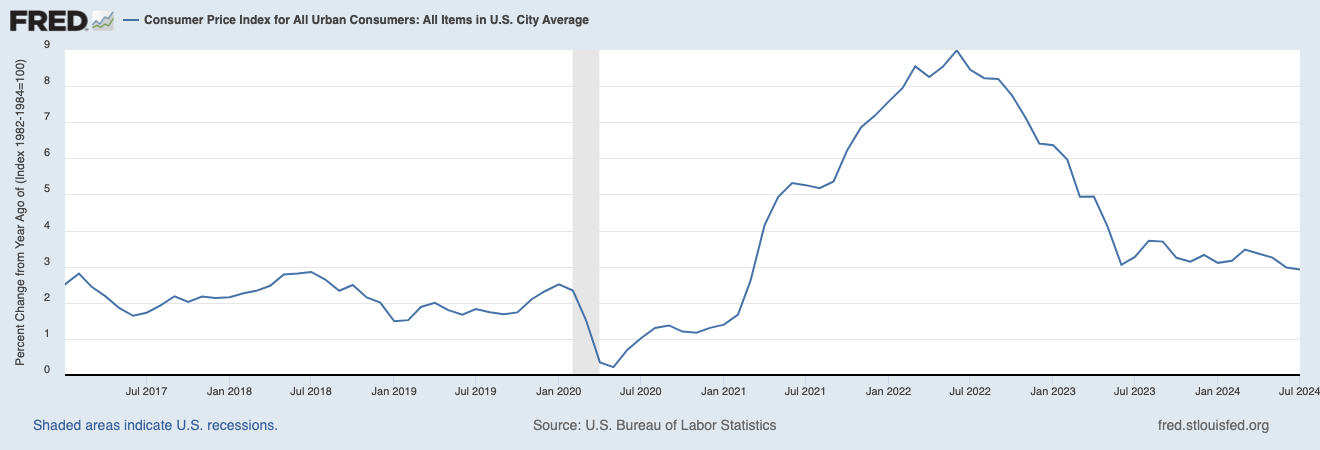
Fox News’ production team also paired the segment with a misleading on-screen graphic criticizing Biden for annualized inflation rising from 1.4% before he took office to 9.1% in June 2022.
Video
CitationFrom the September 6, 2024, edition of Fox News' Outnumbered
Both of Fox’s lines of attack are deeply misleading.
First, the Inflation Reduction Act is not simply a rebrand of the Green New Deal. Fox has been lying about this for years, and it has never been true.
The Biden administration has also not been secretive about the historic climate provisions included in the bill. As the bill was being negotiated in July 2022, The Washington Post touted that its provisions included “the nation’s biggest-ever climate bill.” CNN likewise described the law as “the largest climate investment in US history, and by far the biggest legislative win for the environmental movement since the Clean Air Act.” Last August, the White House marked the first anniversary of the passage of the IRA by releasing a fact sheet boasting that the IRA “is the most ambitious investment in combating the climate crisis in world history.”
Second, the inflationary peak the Fox personalities claimed to be so upset about occurred more than two years ago. The Inflation Reduction Act was negotiated in Congress and enacted into law amid that inflationary peak.
The IRA was enacted in August 2022 and, since it went into effect, all traditional measurements of inflation have improved considerably –– a fact McEnany glossed over.
Fox viewers were shown this graphic, which included only January 2021 (when the economy was still largely dampened by COVID) and June 2022 (peak of inflation). Fox could have easily shown its viewers more recent data, demonstrating that inflation has been stable for over a year and is now only slightly higher than pre-pandemic levels:
Fox personality Lisa Kennedy Montgomery slammed the administration, saying that working families “haven’t gotten a raise” and that the price of eggs has risen to “$10 a dozen,” but those statements are simply false.
In reality, average hourly wages are up, wage growth has outpaced inflation since May 2023, and the average egg price is $3 per dozen nationwide. Even with inflation, an analysis from the Center for American Progress shows that wage increases had surpassed price increases by November 2023.
related
07/11/24 4:31 PM EDT
05/15/24 1:53 PM EDT
02/13/24 4:34 PM EST
04/11/24 2:04 PM EDT
05/01/24 9:21 AM EDT
06/27/24
===
---
Car insurance has skyrocketed due to increased climate-fueled disasters
Special ProgramsClimate & Energy
Written by Allison Fisher
Published 08/28/24 mma
During the August 28 edition of Fox News’ America’s Newsroom, Fox Business correspondent Max Gordon reported on the skyrocketing cost of car insurance, another one of the “big issues coming up in the campaign” according to anchor Dana Perino. Gordon went on to connect this pocketbook issue to climate change, noting that the, “Increase in severe weather events has been one of the main drivers behind these increasing premiums. Climate events that cause a billion dollars or more in damage have been steadily on the rise, impacting how insurers set rates.”
Notably, the climate crisis is creating a housing insurance crisis as well. Climate change is making storms and wildfires more destructive. Last year, the U.S. experienced a record 28 disasters that cost more than a billion dollars each in damage. In response, some private insurers are raising premiums in areas frequently hit by extreme weather or pulling out of high-risk areas altogether, leaving homeowners uninsured.
Rising insurance costs are not the only economic impact of climate change. A study released early this year found that climate change is among the factors driving inflation which is “driving up the prices of food and other goods worldwide.” As Axios reported: “This is not the first study to note the economic toll of climate change, or even the inflationary pressures of increasing temperatures and extreme weather events.”
Video
CitationFrom the August 28, 2024, edition of Fox News' America's Newsroom
DANA PERINO (ANCHOR): We've been talking about all these big issues coming up in the campaign. Housing is one. Here is another one: The cost of car insurance is crushing drivers. Rates have spiked since President Biden took office, and they’re projected to surge even more this year. Fox Business' Max Gordon is live from Los Angeles with an explanation as to what is going on.
:{MAX GORDON (FOX BUSINESS CORRESPONDENT): Hey there Dana. Well, here in California, car insurance rates are expected to jump by more than 50% by the end of the year. It’s one of three states who are going to be seeing that. That’s also happening in Missouri and Minnesota.:{ The big reason for this — well, it's natural disasters. Severe weather}:. That's all according to a study from Insurify. That’s a company that provides information about the insurance market.
The average cost of full coverage in the U.S. rose by 15% in the first half of this year. And that number is expected to hit 22% by the end of this year. The report says that increase in severe weather events has been one of the main drivers behind these increasing premiums. Climate events that cause a billion dollars or more in damage have been steadily on the rise, impacting how insurers set rates. Hail-related claims were up to 11.8% of all comprehensive claims in 2023, according to the report, a 2.8% increase since 2020. Vehicle maintenance and repair costs have also increased by around 38% over the past five years, according to federal figures. These higher repair costs have led to more expensive claims, with insurance companies passing the cost to consumers in the way of higher premiums.}:
---
aha note insurance drives home price thus inflation
mma 8 24
strategy to control the narrative as the fossil fuel industry faces mounting scrutiny.
===
Former President Donald Trump's advisors are asking him to pivot away from personal attacks and to focus more on policy. But those policy discussions are frustratingly light on details, according to a Washington Post columnist.
In her latest essay, the Post's Catherine Rampell argued that the Republican presidential ticket is being unjustly rewarded by the media for claiming to discuss policy without actually delving into the meat and potatoes of how their proposed changes would be made. She lamented that the ex-president "has so degraded the state of policy discourse that few politicians are even trying to come up with real solutions anymore."
"The Republican presidential nominee often promises fantastical outcomes, without any plausible mechanism for how, as president, he would deliver them," she wrote. "Most recently, Trump promised to cut prices, with energy prices specifically falling by 50 percent. How? No explanation necessary. He simply declares it will happen, and the media and his allies amplify his claims."
READ MORE:**Trump's newest policy proposal would be 'huge tax increase' for the middle class: analysis**
When Vice President Kamala Harris became the sudden presumptive Democratic nominee following President Joe Biden's exit from the 2024 race, Trump immediately started belittling her and insulting her intelligence. This prompted some of his top advisors and surrogates to encourage him to "please stick to policy" in order to avoid looking like a bully. But during an Asheville speech supposedly focused on the economy, Trump quickly devolved into lobbing personal attacks on Harris and Minnesota Governor Tim Walz.
Rampell noted that when Trump does actually does discuss policy, it's usually accompanied by "bureaucratic pageantry." One example she cited was his promise to "sign an executive order directing every Cabinet secretary and agency head to use every tool and authority at their disposal to defeat inflation and bring consumer prices rapidly down," calling for "results within the first 100 days, or much sooner."
"[A] preposterous promise on a 100-day timeline is still preposterous. (Arguably more so.) Yet seemingly, the entire Republican Party — and much of the media — have chosen to treat such nonsense as though it were a Very Serious, Big-Brained policy treatise," she wrote.
One major obstacle toward talking about legislation on the campaign trail is the low popularity of traditional Republican policies. Rampell pointed out that the more GOP candidates talk about what ideas they would implemented once elected that "voters might realize just how bad they are."
READ MORE:**'I hate my opponent': Trump indignant as advisers urge him 'please stick to policy'**
:{:{"For instance, nearly all of Trump’s major economic policies would worsen inflation (mass deportations, devaluing the dollar, politicizing the Federal Reserve, imposing new global tariffs of 10 percent or higher),"}:
she wrote, adding that Trump embracing the Republican "policy bible" of Project 2025 is electoral kryptonite. "Of 28 major Trump proposals YouGov asked about in June (on both economic and noneconomic issues), only six were favored by most respondents. For example, 6 in 10 Americans oppose his proposals to cut corporate taxes and to abolish the Education Department."}:
Rampell didn't spare Harris from criticism either, observing that the Democratic nominee still doesn't have an "issues" or "policy" section in her campaign website. Though she attributed this to the media's general overall failure to hold Trump to a high enough standard regarding how he would actually govern in a second term.
"There’s always been a temptation for politicians to under-plan and overpromise, to pledge outcomes without detailing the inputs," she wrote. "But just as Trump has lowered the bar for politicians’ character and ethics, he’s degraded our expectations for governing, too."
Click here to read Rampell's column in full (subscription required).
READ MORE: [Paul Krugman: Trump’s 'crank economic doctrines' would make inflation much worse
===
---
// fox BS
Watch an economist disrupt a misleading CNBC segment on Kamala Harris' policy against price gouging
After CNBC anchor Joe Kernen and Project 2025 contributor Veronique De Rugy repeatedly mislabeled the Harris plan as “price controls,” economist Justin Wolfers set them straight
Written by Craig Harrington
Published 08/28/24 mma
Democratic presidential nominee Kamala Harris' proposal to combat price gouging continues to be the subject of misleading accusations from ideological opponents in mainstream and right-wing media. The latest flare-up came from CNBC’s flagship morning news program, which repeatedly and falsely labeled the Harris proposal as a form of “price controls.”
One problem with that narrative, as University of Michigan economist Justin Wolfers noted, is “that’s actually not what Vice President Harris has suggested we do.”
On the August 28 edition of CNBC’s Squawk Box, MAGA co-anchor Joe Kernen introduced the segment by proclaiming that “VP Harris had a choice between telling Americans that they pay higher prices because of the inflation her administration helped create … or she could blame corporations, she chose the latter.”
Conservative columnist and economist Veronique De Rugy responded to Kernen’s softball setup by acknowledging that Harris' proposal was politically popular before dismissively comparing it to the sky-high tariff proposals being floated by convicted former President Donald Trump, which economists across the political spectrum (including De Rugy herself) widely suggest will result in increased consumer prices that may super charge inflation going forward. De Rugy continually labeled the Harris proposal as a form of “price control,” a misleading description she has recently reiterated in columns published by National Review. (De Rugy is often at odds with much of Trump's economic agenda, but she did co-author a chapter of the pro-Trump manifesto Project 2025, where she called for abolishing the Export–Import Bank of the United States.)
After almost three minutes denigrating the Harris proposal, the panel finally pivoted to commentary from Justin Wolfers, who noted an important aspect overlooked by Kernen and De Rugy: Kamala Harris did not propose price controls.
According to Wolfers, “Generally speaking, when markets are functioning well, price controls are a bad idea even though they are often a popular idea.” Quoting Harris, he added that the vice president’s proposal is focused on “opportunistic companies that exploit crises and break the rules” before concluding that “she's not talking about price controls, not once has she used that word.” Wolfers then reiterated that “economists as a tribe, we’re very upset whenever we think there’s price controls happening. We’ve got to look at the policy — that’s actually not what Vice President Harris has suggested we do.”
Faced with this simple fact, Kernen derailed the conversation by complaining that an initiative to fight price gouging ought not to have been among Harris’ first policy proposals while misleadingly boasting that “wages are still down from when her administration came into office.” (Real wages are higher now than they were pre-pandemic, but lower than they were in 2020 and 2021 due to the pandemic’s massive disruptions of the labor market and the government’s infusion of stimulus relief.)
Kernen falsely suggested that Harris was blaming price gouging for the systemic inflation witnessed in the United States over the past four years. Harris did not blame price gouging for inflation, centering blame for that phenomenon on disruptions caused by the global pandemic. (Inflation was also a truly global phenomenon, not one centered in the United States, and the U.S. currently enjoys one of the lowest inflation rates among developed countries.)
Wolfers later responded to Kernen’s outburst by recentering the conversation on the actual policies being forwarded by Harris, which he reiterated are not price controls, and contrasting them with the utter vapidity of Trump’s proposals to tackle higher costs of living.
CNBC is not alone among mainstream news outlets blasting the Harris campaign over nonexistent price controls, and much of the argument in this segment echoed misleading reporting and commentary published in The Washington Post last week, which was actually cited briefly at the end of the segment and has already become fodder for the right-wing media’s campaign to smear Harris.
Watch the full segment below:
---
08/21/24 mma
---
8 24 mma
on August 15, Democratic presidential nominee Vice President Kamala Harris began outlining her economic agenda, which includes fighting excessive prices by enacting a federal ban on price gouging.
Most states already have some kind of law banning price gouging in at least some circumstances, but Harris’ new proposal would create the first ever federal ban on price gouging on groceries and empower the Federal Trade Commission to enforce these new consumer protections.
Yet Fox News and others in the media reacted by falsely mischaracterizing Harris’ proposal as setting price controls, denying that price gouging exists in the food industry, and ranting about communism.
- ## Harris’ plan specifically mentions anti-monopoly actions and enhanced authority for the FTC and state attorneys general to combat price fixing, not price controls
- Bloomberg White House reporter Josh Wingrove posted a Harris campaign email previewing her plan that makes no mention of price controls. What the announcement did mention was “authority for the FTC and state attorneys general to investigate and impose harsh penalties” on corporations engaging in price gouging, “resources for the federal government to identify and take on price-fixing and other anti-competitive practices” in the food industry, and support for small businesses to break into the food industry to take on monopolies. Twitter/X, [8/15/24]
- Washington Post economics reporter Jeff Stein posted another Harris campaign announcement that cited state price gouging laws and laid out plans to grant more authority to the FTC and state attorneys general and increase competition in the food industry. There was no mention of price controls. Twitter/X, [8/15/24]
- In a press release, the Harris-Walz campaign detailed its price gouging initiative to empower regulators and state attorneys general and to tackle predatory price gouging. In an August 16 press release fully detailing the Harris-Walz campaign’s broader economic agenda, the campaign reiterated that, if elected, Harris will work to “advance the first-ever federal ban on price gouging on food and groceries,” stipulating that these policies would be aimed at “big corporations” that “unfairly exploit consumers” and that the regulatory and legal authority to investigate and enforce the new anti-price gouging rules would rest with “the FTC and state attorneys general.” Harris-Walz campaign press release, [8/16/24 via Popular Information]
- Axios: Price controls are “just not how anti-price gouging policies work in the U.S.” Axios markets correspondent Emily Peck wrote that “critics are conflating the idea with Soviet-style price controls, and calling the plan ‘Kamunism.’” She explained that there’s been “wild speculation about what the plan could mean, including opinion pieces expressing fears that retailers won't be able to, say, set the price of a gallon of milk, and that it would lead to widespread shortages, black markets and hoarding,” but that “that's just not how anti-price gouging policies work in the U.S.,” pointing to a federal draft bill that “largely mirrors state laws” but is limited to larger companies “with at least $100 million in revenue.” Axios, [8/20/24]
- Nobel prize-winning economist Paul Krugman: “Kind of amazing how much of the commentariat went into a tizzy over Harris calling for price controls, when she did no such thing.” Twitter/X, [8/18/24]
- Economic writer Matthew Yglesias: “After all the tweets, I'm pretty sure Harris did not in fact propose price controls on groceries — just kind of vaguely said that antitrust enforcement is good (it is good).” Twitter/X, [8/16/24]
- ## Right-wing media falsely mischaracterized Harris’ proposal as setting price controls
- Multiple Fox News headlines claimed Harris’ proposal was a “price control” plan. An August 16 Fox News article critical of Harris was headlined “Dave Ramsey explains why Kamala Harris' price control plan will not curb inflation: ‘It's not sustainable.’” Several Fox headlines on August 17 labeled Harris’ plan as a “price control plan” or “price control proposal,” and another parroted Donald Trump’s accusation that Harris was pursuing “Soviet style” policies. Fox News, [8/16/24, 8/17/24, 8/17/24, 8/17/24]
- National Review: “Kamala Harris’s Price-Control Plan Is an Attempt to Rewrite History.” National Review Senior Editor Charles C.W. Cooke quoted from a New York Times article describing earlier Biden administration efforts “to target corporate consolidation and price gouging, including attempts to stoke more competition in the meat industry and the Federal Trade Commission’s lawsuit this year that seeks to block the merger of two large grocery retailers, Kroger and Albertsons.” None of that constitutes a “price-control plan.” National Review, [8/15/24]
- Washington Examiner: “Kamala Harris’s inflation ‘solution’: Nixon’s price controls and Trump’s tax policy.” Washington Examiner commentary writer Tiana Lowe Doescher claimed that Harris is “taking the tried and failed doctrine of price controls” from former President Richard Nixon. Washington Examiner, [8/16/24]
- Washington Free Beacon: “Kamala Harris Finally Has an Economic Plan: Price Controls on Food.” The Free Beacon referred to the plan as a “price control scheme.” Washington Free Beacon, [8/15/24]
- Fox host Dana Perino cited The Washington Post’s editorial board referring to Harris’ plan as a “gimmick” and called her plan “price controls.” The Post editorial likened Harris’ plan to “President Richard M. Nixon’s failed price controls from the 1970s.” Fox News, *America’s Newsroom*, [8/19/24; The Washington Post, 8/16/24]
* ## An FTC investigation revealed price gouging by major supermarket chains, and there have been many cases of price fixing in the food industry
- In March, the FTC released a report on grocery supply chain disruptions during the pandemic, which found that some supermarket corporations “seem to have used rising costs as an opportunity to further raise prices to increase their profits, which remain elevated today.” FTC chair Lina Khan said, “The FTC’s report examining U.S. grocery supply chains finds that dominant firms used this moment to come out ahead at the expense of their competitors and the communities they serve.” Federal Trade Commission, [3/21/24, 3/21/24]
- The Washington Post stated in early February that “the White House Council of Economic Advisers also found in a new report that grocery store profit margins remain higher than their pre-pandemic levels.” The Washington Post, [2/2/24]
- Former Labor Secretary Robert Reich: Consolidation in the food industry allows major corporations “to coordinate prices instead of compete on the basis of lower prices.” Reich explained: “Food prices remain high because there’s little to no competition across the entire food supply chain. This has allowed big corporations to engage in a price gouging free-for-all.” Robert Reich, [8/13/24]
- Reuters: Meat-packing company JBS “agreed to pay $25 million to commercial beef purchasers that accused the meat-packing company of conspiring with industry rivals to restrict market supply in order to keep prices artificially high.” Reuters, [4/17/23]
- Large pork corporations have paid multiple settlements totaling nearly $200 million for price-fixing schemes in recent years. Meat + Poultry magazine reported in July that “in the last few years, JBS USA and Smithfield Foods, other large pork processing companies in the United States, have reached settlements on other direct-purchaser pork pricing cases. In 2022, JBS USA reached a $20 million settlement, and Smithfield reached an $83 million settlement. The next year, Smithfield agreed to a $75 million settlement.” The Minnesota Star Tribune reported in April that “Hormel Foods will pay more than $11 million to settle class-action lawsuits alleging the company worked with other pork producers to illegally fix prices and overcharge customers.” Meat + Poultry, [7/9/24; The Minnesota Star Tribune, 4/11/24]
- Reuters: Chicken suppliers have paid out at least $284 million in multiple price-fixing lawsuits. Reuters reported that “consumers, direct purchasers of chicken and commercial plaintiffs such as restaurants and grocery stores in the coordinated cases accused” large chicken suppliers “of conspiring for years to keep prices artificially high by curbing production and sharing nonpublic data about supply and demand.” Reuters reported that “among some of the food distributors’ earlier settlements, Tyson agreed in 2021 to pay $80 million to the direct purchaser plaintiffs. Pilgrim’s Pride that year settled for $75 million. In 2023, Koch resolved claims against it for $47.5 million, and House of Raeford Farms paid $27.5 million.” Reuters, [3/1/24]
- Tuna company StarKist settled a canned tuna price fixing lawsuit in June. StarKist previously pleaded guilty to “charges of colluding to fix the price of canned tuna from late 2011 to late 2013.” Just Food, [6/27/24]
- A federal jury ordered egg producers to pay over $17 million in an antitrust case over price fixing dating back to the 2000s. The Associated Press reported that “the jury found that the egg suppliers exported eggs abroad to reduce the overall supply in the domestic market, as well as limited the number of chickens through means including cage space, early slaughter and flock reduction” to artificially raise the price of eggs. The Associated Press, [12/1/23]
- ## Fox denied that price gouging even exists in the food industry
- Fox business host Larry Kudlow claimed there is no evidence that corporations, especially food companies, engage in price gouging. Fox Business host Larry Kudlow criticized Harris’ then-upcoming speech, accusing her of “basically going to bash businesses” and claiming “there is no evidence of corporate price gouging.” Kudlow added: “The rate of return, the margins are very modest across the board. In fact, food price margins from grocery stores and food companies actually declined in July, and I don't know what they did in June. But that’s an old charge. It’s just what people on the left always blame, business.” Fox News, *America’s Newsroom*, [8/14/24]
- Fox & Friends co-host Brian Kilmeade said: “Their profit margin is so low. … Supermarkets are having trouble making ends meet. So they’re not the problem.” Kilmeade also defended these corporations, arguing that, “if Kamala Harris is going to run on, ‘I prosecuted corporations for price gouging,’” Republicans should defend corporations. Fox News, *Fox & Friends*, [8/14/24]
- Fox contributor Jason Chaffetz: “By the way, if you are in the grocery business, that is one of the tightest margin businesses that there is. Don't think that those are the people causing the problem.” Fox News, *America Reports*, [8/15/24]
- Fox & Friends co-host Ainsley Earhardt: “When she says my solution is to go after the price gougers — you’re going to go after grocery stores? Their margins are so low, they’re not making a lot of money.” Guest co-host Will Cain added: “The average margin for a business in America is 8.5%. That’s how much profit they’re making. The grocery business is making 1.2%.” Fox News, *Fox & Friends*, [8/16/24]
- ## Most states have some kind of law banning price gouging, and Republicans have taken legal action against price gouging
- The National Conference of State Legislatures has documented that “Thirty-seven states, Guam, Puerto Rico, the U.S. Virgin Islands and the District of Columbia have statutes or regulations that defining price gouging during a time of disaster or emergency.” The NCSL’s explanation continued: “In most states, price gouging is set as a violation of unfair or deceptive trade practices law. Most of these laws provide for civil penalties, as enforced by the state attorney general, while some state laws also enforce criminal penalties for price gouging violations.” National Conference of State Legislatures, [3/10/22]
- Former President Donald Trump used executive authority to ban price gouging of medical supplies during the COVID-19 pandemic. In March 2020, Reuters reported: “President Donald Trump signed an executive order on Monday to prevent hoarding and price gouging of crucial medical supplies needed to fight the deadly coronavirus, while Attorney General William Barr announced that the Justice Department has already launched hoarding investigations to carry out the order.” Reuters, [3/24/20]
- GOP-led states, including Texas and Florida, have sued corporations for price gouging in recent years, showing that such actions are common. Opposition researcher Tyson Brody made several posts on X (formerly Twitter) showing press releases from Texas Attorney General Ken Paxton announcing price gouging lawsuits, including against a food company. He also posted a news headline about Florida Attorney General Ashley Moody warning against price gouging during the recent hurricane season. Twitter/X, [8/16/24, 8/16/24, 8/16/24, 8/16/24]
- Multiple GOP senators asked the Justice Department “to investigate continued allegations of (“meat packer”) price fixing within the cattle market” in 2020. In their letter, Sens. Michael Rounds (R-SD), Kevin Cramer (R-ND), Steve Daines (R-MT), and John Hoeven (R-ND) cited the fact that “the four largest meat packing companies control approximately 80 percent of the beef processing in the United States,” and asked, “Does this concentration of market power amongst the four large packers create an unfair oligopoly in contradiction with U.S. Antitrust law?” The senators also cited a 20% price increase for “processed boxed beef” to show their concern. United States Senate, [3/19/20]
- ## Right-wing media called Harris’ plan “communism” and other such nonsense
- Fox contributor Jason Chaffetz: “Her first new policy to implement is what the communists would do, what socialists would do.”Chaffetz continued: “And that is the government’s going to come in and solve this. The government is going to dictate what prices are going to be. Is there anything more scary to the entrepreneurs in the business community than the government controlling your prices? Her solution for inflation and fixing the economy is for the government to take over? I don't think this is going to fly. I don't think it's going to come over very well. It’s never worked. That's not who we are as a country.” Fox News, *America Reports*, [8/15/24]
- Fox contributor Sean Duffy: This is a “set of commie policies. … They want to go old school socialism, fix prices.” Fox Business anchor Dagen McDowell said, “You will have bare shelves, so ‘Make America the Soviet Union’ should be the slogan there.” Fox News, *The Faulkner Focus*, [8/15/24]
{ Fox guest Kevin O’Leary: “It's been tried before in countries like the Soviet Union, North Korea, Cuba. Doesn't work. So obviously that's not going to happen.” Fox News, *The Story*, [8/15/24]}:
- Fox host Sean Hannity: “The best Kamala could come up with is, what? Marxism, socialism, statism — I don't know, basically communism.” Hannity also compared Harris’ plan to the Soviet Union. Fox News, *Hannity*, [8/15/24]
- Fox host Rachel Campos-Duffy: “The plan apparently involves a Soviet-style price control to stop inflation. … Socialism is never the answer.” She added: “This is always the plan of every tin-pot communist dictator. After they destroy the economy, the next step is always price control.” Fox News, *Jesse Watters Primetime*, [8/15/24]
- Fox host Laura Ingraham portrayed Harris as “Comrade Kamala” during a monologue bashing her policy proposal. Fox News, *The Ingraham Angle*, [8/16/24]
- Turning Point USA founder Charlie Kirk: “Communism is not coming to America. It’s already here.” Twitter/X, [8/15/24]
* Conspiracy theorist Alex Jones: “This has always been the plan. You will eat the bugs! Kamala Harris’ Proposed Price Controls May Lead to ‘Communism, Mass Starvation, End of America.’” Twitter/X, [8/18/24]
- A Fox report cited Washington Post opinion columnist Catherine Rampell, who falsely claimed that Harris proposed price controls that make her appear “communist.” Rampell’s column is titled, “When your opponent calls you ‘communist,’ maybe don’t propose price controls.” Fox News, *Your World with Neil Cavuto*, [8/16/24; The Washington Post, 8/15/24]
related
08/15/24 11:20 AM EDT
08/20/24 4:33 PM EDT
08/02/24
===
mma 8 24
News outlets reported that Vice President Kamala Harris proposed raising the corporate tax rate to 28% if she wins the presidency this November, partially rolling back the Trump-era tax cuts that slashed corporate taxes.
Even though corporate tax revenue plummeted in response to the Trump tax cuts, and American corporations are undertaxed relative to other developed economies in the OECD, conservative media began assailing Harris’ policy with false claims of immediate and “massive layoffs” and higher inflation.
As the Center on Budget and Policy Priorities has explained, Trump’s 2017 tax cut was skewed to the richest Americans, and the corporate tax cut even moreso, with the bottom 90% of workers gaining nothing from the corporate tax rate cut, while corporate executives earning nearly $1 million a year got an average $50,000 earnings boost. A leading reason that Trump's corporate tax changes benefited the wealthy was the imposition of a flat tax of 21% to replace what had been a graduated rate system, ranging from 15% to 35%.
And thanks to Trump’s tax cuts, even as corporate profits went up during most of his presidency, corporate tax revenue dropped until the pandemic and the years after. Corporate tax revenue as a share of the economy remains near historic lows at under 2% of gross domestic product, and it’s also near historic lows as a share of federal tax revenue. :{
Meanwhile, the Organisation for Economic Co-operations and Development (OECD) average showed corporate tax revenue in 2020 at just over 15% of total tax revenue, and 3% of GDP, showing that U.S. corporations have a very light tax burden in comparison. In 2023, the Institute of Taxation and Economic Policy estimated that raising the corporate tax rate to 28% would raise more than $1.3 trillion in revenue over 10 years.
Yet conservative media reacted to Harris’ proposal with hyperbolic doom and gloom. Citing an analysis from the Tax Foundation, Fox News personalities claimed that raising the corporate tax rate would lead to “massive layoffs” “right off the bat.” Yet the Tax Foundation’s analysis projected a loss of only 128,000 “full-time equivalent jobs” by 2034. This is a drop in the bucket of the millions of jobs projected to be created over the course of a decade. Other conservatives claimed that raising the corporate tax rate would be inflationary; in reality, tax increases are broadly considered deflationary.
- Fox Business’ Jackie DeAngelis falsely claimed that if Harris “raises the corporate tax rate to 28%, almost 150,000 people right off the bat are going to lose their jobs.” DeAngelis added: “Ultimately the corporations aren't these big, bad evil entities.” Fox News, *Fox & Friends*, [8/20/24]
- Fox & Friends co-host Lawrence Jones claimed that “you’re gonna have massive layoffs” if Harris raises the corporate tax rate to 28%. Co-host Brian Kilmeade defended the Trump-era rate, saying, “Corporations have people in it,” and claiming that it would make the U.S. uncompetitive with European countries with lower corporate tax rates. Fox News, *Fox & Friends*, [8/20/24]
- Fox Business host Charles Payne: Harris wants to “go to war with corporate America.” Payne then proclaimed Harris will “make the lives of workers harsher,” adding that “there will be fewer jobs.” Fox News, *The Faulkner Focus*, [8/20/24]
* Wash. Times columnist and Trump campaign staffer Tim Murtaugh: “She wants to tax job creators at a higher rate than Chinese communists do.” Murtaugh added: “Who do you think will pay for the tax increase? Do you suppose maybe it’s passed on to consumers like always? Harris is dangerous.” Twitter/X, [8/20/24]
- Fox contributor Jason Chaffetz: “Do you think a 30% increase in the corporate tax rate will increase the cost of your life? Yes, it will. Everything will cost more. That’s VP Harris’ plan. Believe her.” Twitter/X, [8/20/24]
- Right-wing commentator Bill Mitchell: Raising the corporate tax rate is inflationary. Mitchell posted that “corporations will pass costs onto consumers.” Twitter/X, [8/20/24]
related
08/15/24
08/09/24
08/02/24
===
an 7 24
MAGA fumes over report 4th of July gas prices lowest in 3 years: 'Why is CBS campaigning for Biden?'
===
6 24 ymail judd
over the last four years, rents have skyrocketed by an average of over 30% nationwide and are a major factor in the overall inflation rate. There are a variety of factors behind the increases, including an overall housing shortage. But the Department of Justice is investigating another potential cause: a massive criminal conspiracy among large landlords.
Last month, the FBI reportedly conducted an unannounced raid of Cortland Management, a major corporate landlord based in Atlanta. The surprise search appears to be part of a Department of Justice criminal investigation, first reported by Politico in March, into an alleged scheme among many corporate landlords to artificially increase rents through collusion.
The investigation centers around the use of RealPage, advanced property management software used by many corporate landlords. Following a 2022 exposé by ProPublica, RealPage and landlords that use the software have been named defendants in multiple class action lawsuits, as well as actions filed by the Attorneys General of Arizona and Washington, DC.
According to the lawsuit filed by the State of Arizona in February, landlords that are supposed to be in competition with each other "outsource daily pricing and ongoing revenue oversight" to RealPage. The company allegedly facilitates and encourages landlords to work cooperatively to increase rents. An e-book produced by RealPage says that the company allows corporate landlords who are “technically competitors” to "work together . . . to make us all more successful in our pricing." RealPage bragged that landlords that use its software “continually outpace the market in good times and bad.” In other words, RealPage helps landlords charge higher rates than they would in a truly competitive market. An executive for Camden Property Trust, a corporate landlord based in Houston, said deploying RealPage's software resulted in "pushing people out" with higher rents but ultimately increased revenue by $10 million.
How corporate landlords collude via algorithm
Corporate landlords that use RealPage software dominate the rental market in many metropolitan areas. In Phoenix, according to Arizona's lawsuit, "70% of multifamily apartment units listed in the Phoenix metropolitan area are owned, operated, or managed by companies that have contracted with RealPage." According to the lawsuit filed by DC, 60% of large multifamily buildings (50 units or more) set prices using RealPage's software.
RealPage's former CEO revealed that participating landlords share "occupancy rates, rents charged for each unit and each floorplan, lease terms, amenities, move-in dates, and move-out dates." After feeding in this highly-detailed information that would normally be kept proprietary, "landlords agree to outsource their pricing authority to RealPage—rather than competing with one another on price." RealPage even has a feature called "auto-pilot" that lets the software set rent prices without any human approval or intervention.
The system has resulted in large rent increases that were previously unthinkable, according to RealPage's own executives. “As a property manager, very few of us would be willing to actually raise rents double digits within a single month by doing it manually," RealPage executive Andrew Bowen said.
Arizona's lawsuit alleges that RealPage "puts significant pressure on participants to ensure they adopt RealPage’s prices." Specifically, RealPage employs "pricing advisors" who "meet with landlords to ensure that properties are implementing RealPage’s set rates." This is described by Arizona as "policing the conspiracy to make sure no one cheats by lowering prices and trying to gain market share." RealPage training materials, cited in the DC lawsuit, advise that landlords "should be compliant" with the software's pricing recommendations. The Arizona lawsuit claims that landlords "agree that if they fail to consistently implement RealPage’s set rates, their contract with RealPage will be terminated." Jeffrey Roper, who created the RealPage algorithm, explained that if "you have idiots undervaluing, it costs the whole system."
According to DC's lawsuit, this practice shows that "while RealPage sought to grow the cartel to maximize profits, it also understood the importance of universal adherence and was willing to expel an occasional cartel member to demonstrate its commitment to enforcement of the agreed-upon pricing scheme." While the RealPage software eliminates the need for competitors to meet in a smoke-filled room, Arizona asserts that it "is still illegal… for competitors to join together decision-making power to raise, depress, fix, or stabilize prices—no matter the technology used to effect a price-fixing agreement."
Why the feds are focusing on Atlanta
Why is the FBI specifically raiding a corporate landlord that uses RealPage in Atlanta? The agency is not commenting, but a class-action lawsuit revealed that landlords who use RealPage control a large number of properties in the Atlanta area. According to the plaintiffs, landlords using RealPage "account for over 53% of the multifamily rental market in the Atlanta Submarket." This is a map, included in the complaint, which shows properties using RealPage software in the Atlanta area.
...
The use of RealPage in the Atlanta area has coincided with a sharp increase in rental prices. Overall, rents in Atlanta are up 56% since 2016.
Where will the FBI conduct its next raid? They have plenty of choices. RealPage also controls a large share of the market in Baltimore, Charlotte, Houston, and Miami.
RealPage says this is all a big misunderstanding. After DC filed its lawsuit in November 2023, the company said its critics were incorrectly drawing "a causal connection between revenue management software like ours and increases in market-wide rents." It said the lawsuit was "wrong on both the facts and the law and we will vigorously defend against it."
Not everyone involved in the scheme is so confident. Earlier this year, two corporate landlords named in a class action lawsuit filed by tenants reached settlements with the plaintiffs. The terms were not disclosed.
===
Media outlets are blaring about nonexistent “stagflation.” Economic experts say they’re wrong.
05/01/24
no lnx gfx
top 5 newspapers continue to mostly ignore presumptive Republican presidential nominee Donald Trump’s inflationary policies
Newspaper coverage following the release of the February CPI report, which included the period after Trump clinched the GOP nomination, only mentioned his inflationary policies in 2 of 71 articles that discussed inflation
WRITTEN BY ZACHARY PLEAT
PUBLISHED 04/23/24
Media Matters’ analysis of print newspaper articles covering inflation during the period after the release of the February 2024 Consumer Price Index report again found almost no mention of the inflationary policies that former president and current presumptive GOP presidential nominee Donald Trump implemented during his term or has proposed for a second term should he win this fall. Media Matters found that Trump's inflationary policies were mentioned in just 2 out of 71 articles (3%) published during the review period. Previously, Trump’s inflationary policies were mentioned in only 6% of print articles following publication of the December 2023 CPI report and in zero print articles covering inflation following publication of the January 2024 CPI report.
These policies include proposals for the imposition of new across-the-board tariffs, mass deportation of undocumented immigrants, and more tax cuts for the wealthy and corporations. We looked at the top five U.S. newspapers by circulation — The New York Times, The Washington Post, The Wall Street Journal, USA Today, and the Los Angeles Times — from March 12 through April 9.
Trump's inflationary policies were mentioned in only 3% of inflation articles
Our analysis showed that for the period between March 12 and April 9, 2024 — which includes the period between the releases of the February and March 2024 CPI reports — only 2 out of 71 (or 3%) articles covering inflation mentioned that some of Trump's policy proposals for a second term, as well as his past policies as president — tariffs, mass deportations, and tax cuts for the wealthy and corporations — would worsen inflation.
A chart showing that for the period of March 12, 2024, through April 9, 2024 — covering the period from when the February 2024 CPI report was released to the release of the March CPI report — only 2 out of 71 (3%) articles covering inflation mentioned that some of Trump's policy proposals for a second term, and his past policies as president — tariffs, mass deportations, and tax cuts for the wealthy and corporations — would worsen inflation
Trump's attacks on Biden's record on inflation and the economy were quoted in 7% of print news articles about inflation during this time period
Our analysis showed that 5 out of 71 (7%) print news articles on inflation for the period between March 12 and April 9, 2024, included a quote from Trump attacking President Joe Biden's record on the economy and/or inflation, more than the number of articles that mentioned Trump’s own inflationary policies.
A chart showing that 5 out of 71 (4%) print news articles on inflation between February 13 and March 11 included a quote from Trump attacking President Joe Biden's record on the economy and/or inflation
Less than half of articles covering inflation during this time period mentioned positive indicators in the economy
Less than half of print newspaper articles on inflation for the period between March 12 and April 9, 2024, included context addressing recent gains in wages, job creation, and/or economic growth, with 30 of 71 (42%) articles mentioning the strength of the overall economy. This marks an overall decline from the beginning of the year. Between January 11 and February 13, 56% of articles mentioned positive economic indicators; this number dropped to 40% between February 14 and March 11.
A chart showing that that a slightly higher percentage of print newspaper articles on inflation included context of the current economic conditions between March 12 and April 9 compared to the previous month, with 30 of 71 (42%) articles mentioning the strength of the overall economy.
Experts have explained that several of Trump's policy proposals and past policies make inflation worse
Per reporting from The Washington Post, former chief economist for the Trump administration's Council of Economic Advisers Casey B. Mulligan “estimated in an interview that Trump’s 10 percent import tariff proposal would add an extra percentage point to inflation, or a quarter percent a year if spread out over four years.” [The Washington Post, 1/7/24]
Conservative economist Doug Holtz-Eakin suggested that Trump’s trade and immigration policies might lead to a “wage-price spiral,” a condition in which pay increases and prices push one another upward and thus cancel out any seeming benefit for workers. [The Washington Post, 1/7/24]
Conservative American Enterprise Institute economist Michael Strain also suggested that Trump's mass deportation policy “could spark a wage-price spiral, which would be inflationary.” [Politico, 3/7/24]
Center for Economic and Policy Research senior economist Dean Baker: “Trump is promising massive tax increases in the form of tariffs, which will send inflation soaring if he carries through with them.” [Twitter/X, 3/2/24]
Former Federal Reserve economist Claudia Sahm stated that Trump's plan of “jacking up tariffs and cutting off immigration are both inflationary." [Twitter/X, 2/29/24]
Adam Posen, president of the Peterson Institute for International Economics, explained that Trump's mass deportation plan “would lead to very sudden spikes in prices of key goods like fresh produce, hotel rooms, and housing repairs.” [The Washington Post, 1/7/24]
Economic Policy Institute chief economist Josh Bivens: “If a future Trump administration really did deport millions of workers, that would be inflationary.” [Politico, 3/7/24]
The U.S. International Trade Commission found that the Trump administration's tariffs on Chinese imports had the effect of “raising costs for American companies” and “increased prices of US products.” [Bloomberg, 3/16/23]
The Federal Reserve raised interest rates following Trump's tax cuts to counter their inflationary pressure. The Tax Policy Center explained that since Trump's tax cuts were “enacted at a time when unemployment was low and output was near its potential level,” “the increase in demand was offset by tighter monetary policy, as the Federal Reserve held interest rates higher than they otherwise would have been to prevent an increase in inflation.” [Tax Policy Center, January 2024]
Methodology...
===
judd y mail 4 24no lnx grf
In the last three months of 2023, after-tax corporate profits reached an all-time high of $2.8 trillion. This is part of a long-term growth in corporate profits that began in the 1980s, picked up steam at the turn of the millennium, and exploded since 2020.
Notably, the surge in corporate profits since 2020 has been fueled, in part, by expanding corporate profit margins. Last year, corporate profit margins (excluding the financial sector) were over 15%, a level not seen since the 1950s. This is because the increases in prices for goods and services have outpaced the increase in costs — both labor and non-labor — for corporations.
According to an analysis from the Groundwork Collaborative, "corporate
profits drove 53 percent of inflation during the second and third quarters of 2023 and
more than one-third since the start of the pandemic." In the four decades prior to the pandemic, corporate profits contributed to just 11% of price increases.
Theoretically, this should not happen. Corporations should not be able to dramatically increase their profit margins by increasing prices because competitors should step in with lower prices and steal market share. So what's going on?
Greg Ip, who writes about economics for the Wall Street Journal, suggests that corporations are collectively taking advantage of consumer psychology. Supply shocks related to the pandemic created widespread cost increases that consumers accepted. Although those supply shocks have dissipated, many businesses have maintained higher prices anyway. "If people are paying $3 for a dozen eggs last week, they’ll pay $3 this week. And firms take advantage of that," Yale University economist Mike Sinkinson explained.
This kind of informal collusion works best in concentrated industries. The Groundwork Collective highlights the diaper industry, where "Procter & Gamble Co. (P&G) and Kimberly-Clark Corp. control 70 percent of the domestic market." Since the onset of the pandemic, "[d]iaper prices have increased by more than 30 percent" — from $16.50 per package to nearly $21. This was initially driven by an increase in the price of wood pulp, a key input for diapers but also paper towels and toilet paper. But since January 2023, prices for wood pulp have declined by 25%.
But P&G and Kimberly-Clark are not reducing diaper prices. Instead, they are bragging to investors about their massive profits. In July 2023, P&G "predicted $800 million in windfall profits because of declining input costs." In October 2023, Kimberly-Clark acknowledged that its input costs were coming down, but said that its products were still "priced appropriately."
Similar dynamics are playing out in many other industries, including "new and used cars, groceries, and housing."
How corporations are using their windfall
It's possible for corporate profits to be used productively to fuel innovation and growth. But that doesn't appear to be happening. Economist Christian Weller notes that corporations are using their record profits "mainly to pay dividends to their shareholders and building up their stockpiles of cash."
Between December 2019 and December 2023, non-financial corporations used almost half of their pre-tax profits (48.9%) to pay dividends to investors. That is the highest share of corporate profits devoted to dividends since the 1950s. The same group of corporations now has $7.2 trillion in cash, up from $6.1 trillion in 2019, adjusted for inflation. Meanwhile, capital expenditures — which is a key way corporations invest in the future — are at historic lows relative to profits.
The path forward
In light of these record corporate profits, the government has a few choices. It could choose to raise corporate tax rates and use the funds to help people in need, such as children in poverty. In March, President Biden released a proposal that would raise the corporate tax rate from 21% to 28%. Biden’s proposal also includes raising the minimum tax for corporations with $1 billion in profits or more from 15% to 21%.
The government could also choose to maintain the current corporate tax rate of 21 percent, which was established by the Trump Administration in 2017 in the Tax Cuts and Jobs Act. Trump wants voters to believe that if he is reelected, he will not prioritize corporate tax cuts. In January, Bloomberg reported that Trump plans to “keep[] corporate tax levels unchanged in an appeal to working and middle[-]class voters.” Stephen Moore, an economic advisor to Trump, told the Washington Post that Trump “said that he really wants to focus more on small businesses than corporations” and that “he’s fine with the corporate rate where it is.”
The government could also choose to cut the corporate tax rate even further and facilitate even larger corporate profits. Trump has expressed interest in lower corporate tax rates, perhaps as low as 15%. Project 2025, a blueprint for Trump created by the Heritage Foundation and a large coalition of conservative groups, suggests cutting the corporate income tax rate to 18%.
===
pro pub algo Close oct 2022
on a summer day last year, a group of real estate tech executives gathered at a conference hall in Nashville to boast about one of their company’s signature products: software that uses a mysterious algorithm to help landlords push the highest possible rents on tenants.
“Never before have we seen these numbers,” said Jay Parsons, a vice president of RealPage, as conventiongoers wandered by. Apartment rents had recently shot up by as much as 14.5%, he said in a video touting the company’s services. Turning to his colleague, Parsons asked: What role had the software played?
“I think it’s driving it, quite honestly,” answered Andrew Bowen, another RealPage executive. “As a property manager, very few of us would be willing to actually raise rents double digits within a single month by doing it manually.”
The celebratory remarks were more than swagger. For years, RealPage has sold software that uses data analytics to suggest daily prices for open units. Property managers across the United States have gushed about how the company’s algorithm boosts profits.
“The beauty of YieldStar is that it pushes you to go places that you wouldn’t have gone if you weren’t using it,” said Kortney Balas, director of revenue management at JVM Realty, referring to RealPage’s software in a testimonial video on the company’s website.
The nation’s largest property management firm, Greystar, found that even in one downturn, its buildings using YieldStar “outperformed their markets by 4.8%,” a significant premium above competitors, RealPage said in materials on its website. Greystar uses RealPage’s software to price tens of thousands of apartments.
RealPage became the nation’s dominant provider of such rent-setting software after federal regulators approved a controversial merger in 2017, a ProPublica investigation found, greatly expanding the company’s influence over apartment prices. The move helped the Texas-based company push the client base for its array of real estate tech services past 31,700 customers.
The impact is stark in some markets.
In one neighborhood in Seattle, ProPublica found, 70% of apartments were overseen by just 10 property managers, every single one of which used pricing software sold by RealPage.
To arrive at a recommended rent, the software deploys an algorithm — a set of mathematical rules — to analyze a trove of data RealPage gathers from clients, including private information on what nearby competitors charge.
For tenants, the system upends the practice of negotiating with apartment building staff. RealPage discourages bargaining with renters and has even recommended that landlords in some cases accept a lower occupancy rate in order to raise rents and make more money.
One of the algorithm’s developers told ProPublica that leasing agents had “too much empathy” compared to computer generated pricing.
Apartment managers can reject the software’s suggestions, but as many as 90% are adopted, according to former RealPage employees.
The software’s design and growing reach have raised questions among real estate and legal experts about whether RealPage has birthed a new kind of cartel that allows the nation’s largest landlords to indirectly coordinate pricing, potentially in violation of federal law.
Experts say RealPage and its clients invite scrutiny from antitrust enforcers for several reasons, including their use of private data on what competitors charge in rent. In particular, RealPage’s creation of work groups that meet privately and include landlords who are otherwise rivals could be a red flag of potential collusion, a former federal prosecutor said.
At a minimum, critics said, the software’s algorithm may be artificially inflating rents and stifling competition.
“Machines quickly learn the only way to win is to push prices above competitive levels,” said University of Tennessee law professor Maurice Stucke, a former prosecutor in the Justice Department’s antitrust division.
RealPage acknowledged that it feeds its clients’ internal rent data into its pricing software, giving landlords an aggregated, anonymous look at what their competitors nearby are charging.
A company representative said in an email that RealPage “uses aggregated market data from a variety of sources in a legally compliant manner.”
The company noted that landlords who use employees to manually set prices “typically” conduct phone surveys to check competitors’ rents, which the company says could result in anti-competitive behavior.
“RealPage’s revenue management solutions prioritize a property’s own internal supply/demand dynamics over external factors such as competitors’ rents,” a company statement said, “and therefore help eliminate the risk of collusion that could occur with manual pricing.”
The statement said RealPage’s software also helps prevent rents from reaching unaffordable levels because it detects drops in demand, like those that happen seasonally, and can respond to them by lowering rents.
RealPage did not make Parsons, Bowen or the company’s current CEO, Dana Jones, available for interviews. Balas and a Greystar representative declined to comment on the record about YieldStar. The National Multifamily Housing Council, an industry group, also declined to comment.
Proponents say the software is not distorting the market. RealPage’s CEO told investors five years ago that the company wouldn’t be big enough to harm competition even after the merger. The CEO of one of YieldStar’s earliest users, Ric Campo of Camden Property Trust, told ProPublica that the apartment market in his company’s home city alone is so big and diverse that “it would be hard to argue there was some kind of price fixing.”
What role RealPage’s software has played in soaring rents — which in the decade before the pandemic nearly doubled in some cities — is hard to discern. Inadequate new construction and the tight market for homebuyers have exacerbated an existing housing shortage.
But by RealPage’s own admission, its algorithm is helping drive rents higher.
“Find out how YieldStar can help you outperform the market 3% to 7%,” RealPage urges potential clients on its website.
Few tenants know that such software, owned by a privately held company, has had a hand in rent increases across the country.
In Boston, renter Kaylee Hutchinson said she was puzzled when her landlord — unbeknownst to her, a RealPage client — told her days into the first pandemic lockdowns that her rent was going up. Building staff insisted that the market rate for her apartment was 6.5% higher than she was paying, despite her protests that people were fleeing the city.
Kaylee Hutchinson’s landlord, who uses RealPage’s pricing software, told her rent was going up at the start of the pandemic even as many people were fleeing the city. Credit:Philip Keith, special to ProPublica
A few weeks later, she and her fiancé saw a newly vacant unit in their building advertised online for less. One of their landlord’s policies permitted moving to another unit owned by the company, so they did.
Hutchinson, who is an analyst for the police department, wondered if a computer algorithm was behind building staff’s inflexibility. “It was pretty obvious they should have been dropping prices,” she said. “They were digging their heels in.”
Hutchinson said she watched apartments in her building sit vacant at prices that didn’t make sense to her.
“A normal mom-and-pop landlord, they’re worried about having a good tenant and protecting their interest in the agreement,” Hutchinson said. “These companies, they’ll just replace you.”
The Origins of YieldStar
One of YieldStar’s main architects was a business executive who had personal experience with an antitrust prosecution.
A genial, self-described “numbers nerd,” Jeffrey Roper was Alaska Airlines’ director of revenue management when it and other major airlines began developing price-setting software in the 1980s.
Competing airlines began using common software to share planned routes and prices with each other before they became public. The technology helped head off price wars that would have lowered ticket prices, the Department of Justice said.
The department said the arrangement may have artificially inflated airfares, estimating the cost to consumers at more than a billion dollars between 1988 and 1992. The government eventually reached settlements or consent decrees for price fixing with eight airlines, including Alaska Airlines, all of which agreed to change how they used the technology.
At one point, federal agents removed a computer and documents from Roper’s office at the airline. He said he and other creators of the software weren’t aware of the antitrust implications. “We all got called up before the Department of Justice in the early 1980s because we were colluding,” he said. “We had no idea.”
When Roper returned to the United States in the early 2000s after a stint in central and eastern Europe, he said, he discovered the apartment rental industry was so far behind technologically that it resembled the emerging markets he’d just left.
Apartment managers were “basically pricing their product on a paper napkin,” said Roper, who eventually formed his own company.
Old computers and manual recordkeeping were mainstays of the industry. Leasing agents gauged how their buildings compared by calling up competitors. “This was just a ripe business,” with lots of money and lots of opportunities for technological improvement, Roper said.
RealPage hired Roper as its principal scientist in 2004 to improve software it had bought from Camden Property Trust, a large investor-backed owner and manager of apartment buildings.
Roper quickly realized he required data — a lot of data — to get the algorithm working properly. He began building a “master data warehouse” that pulled in client data from other RealPage applications, such as those for leasing managers.
A proof-of-concept version of the software had performed well in tests at townhouses Camden offered for rent in its home city of Houston.
At the time, the street behind Camden’s townhouses was shut down while a grocery store was being built. Leasing staff wanted to discount rent for the townhouses because of the nuisance, said Kip Zacharias, who worked with Camden as a consultant.
Instead, YieldStar suggested boosting rents. “We were like, ‘Guys, just try it,’” Zacharias said.
The units ended up renting for significantly more than staff had expected, he said. “That was kind of the eureka moment,” Zacharias said. “If you’d listened to your gut, you would have lowered your price.”
The practice of lowering rent to fill a vacancy was a reflex for many in the apartment industry. Letting units sit empty could be costly and nerve-wracking for leasing agents.
Such agents sometimes hesitated to push rents higher. Roper said they were often peers of the people they were renting to. “We said there’s way too much empathy going on here,” he said. “This is one of the reasons we wanted to get pricing off-site.”
Unimpeded by human worries, YieldStar’s price increases sometimes led to more tenants leaving.
Camden’s turnover rates increased about 15 percentage points in 2006 after it implemented YieldStar, Campo, the company’s CEO, told a trade publication a few years later. But that wasn’t a problem for the firm: Despite having to replace more renters, its revenue grew by 7.4%.
“The net effect of driving revenue and pushing people out was $10 million in income,” Campo said. “I think that shows keeping the heads in the beds above all else is not always the best strategy.”
(Reminded of that quote, Campo told ProPublica it “sounds awful” and doesn’t reflect how he or Camden views renters today. “We fundamentally believe our customers are the most important part of our business,” he said. “We’re not about pushing people out.”)
Hiking rents at the same time benefited all landlords, the industry learned. “A rising tide lifts all boats,” one real estate executive and revenue management proponent told the industry publication Yield Pro in 2007.
One of the greatest threats to a landlord’s profit, according to Roper and other executives, was other firms setting rents too low at nearby properties. “If you have idiots undervaluing, it costs the whole system,” Roper said.
Jeffrey Roper helped develop YieldStar, which uses an algorithm to suggest prices for apartments across the country. Credit:Shelby Tauber for ProPublica
Roper wasn’t the only technologist working on an apartment pricing algorithm. Donald Davidoff, the primary developer of rival software called Lease Rent Options, or LRO, said he designed his program differently, to head off any concerns about collusion.
Instead of relying on a digital warehouse that includes competitor data, Davidoff used a complex formula and public market data to steer LRO’s algorithm. The system relied on incremental price shifts to manage demand for apartments, said Davidoff, an MIT-educated former rocket engineer. “That’s not dissimilar to changing a trajectory of a rocket through inflection of a nozzle,” he said — making small changes that can dramatically alter something’s course over time.
Davidoff said he was careful to avoid features that might run counter not only to anti-discrimination laws, such as the Fair Housing Act, but also those that bar competitors from conspiring to set prices.
“I had many conversations with attorneys to understand where the boundaries are,” he said. “Anybody who’s building one of these systems or is involved in these should care a lot about fair housing and should care a lot about price collusion to avoid both.”
Roper told ProPublica that when he was developing the YieldStar software more than a decade ago, he was concerned about avoiding both issues. He also said he didn’t want to misuse private data in pricing.
“I was highly sensitized to: You just don’t do it,” Roper said.
Despite differences in the software’s design, RealPage acquired LRO in 2017 after months of scrutiny by the antitrust division of the justice department. Federal regulators review mergers above a certain size — right now, it is transactions valued at $101 million — and typically allow them to proceed after only a preliminary review. But some are flagged for a more extensive look. The government can challenge a merger in court if it believes it could substantially harm competition.
RealPage’s purchase of LRO received such a second look, but the DOJ allowed it to proceed in late 2017. The department did not respond to requests for comment.
The approval allowed RealPage to acquire its only significant competitor, Roper said, adding, “I was surprised the DOJ let that go through.”
RealPage was pricing 1.5 million units, and the acquisition of LRO would double that, Steve Winn, RealPage’s then-CEO, said at a mid-2017 investor conference. “I don’t think there’s any concentration, enough concentration, of buying or pricing power here” to warrant DOJ concerns, he said. A third company had a substantial footprint in the market, Winn said, but property managers’ own manual pricing processes or proprietary systems were RealPage’s largest competitor.
“We expect our combined platform to drive accelerated, sustained revenue growth,” Winn said in a media release announcing the deal.
RealPage’s influence was burgeoning. That year, the firm’s target market — multifamily buildings with five or more units — made up about 19 million of the nation’s 45 million rental units. A growing share of those buildings were owned by firms backed by Wall Street investors, who were among the most eager adopters of pricing software.
RealPage renamed its combined pricing software AI Revenue Management. By the end of 2020, the firm was reporting in a Securities and Exchange Commission filing that its clients used its services and products to manage 19.7 million rental units of all types, including single-family homes. The private equity firm Thoma Bravo bought the public company a few months later for $10.2 billion.
Winn, whose net worth Forbes estimates at $1.7 billion, stepped aside. He did not respond to requests for comment.
A spokesperson for Thoma Bravo declined to comment.
Who Uses the Software and How It Works
Somewhere around 2016, according to one trade group, the industry’s use of the pricing software began to achieve “critical mass.”
The more property managers who sign on to RealPage services, the more data flows into the company’s repository. That in turn aids its pricing service, which the company says “leverages multifamily’s largest lease transaction database.”
RealPage’s clients include some of the largest property managers in the country. Many favor cities where rent has been rising rapidly, according to a ProPublica analysis of five of the country’s top 10 property managers as of 2020. All five use RealPage pricing software in at least some buildings, and together they control thousands of apartments in metro areas such as Denver, Nashville, Atlanta and Seattle, where rents for a typical two-bedroom apartment rose 30% or more between 2014 and 2019.
Greystar and FPI Management each control hundreds of buildings in metro areas where rents have risen steeply in recent years. And Equity Residential, Lincoln Property Company and Mid-America Apartment Communities each manage dozens of buildings in high-growth markets.
In contrast, these same companies control fewer buildings in metro areas such as Philadelphia, Tampa and Chicago, where rents have increased more slowly, the analysis found.[much more, see bak]
===
===
---
aha recall supply and demand reductionism koch free mkt bs, if gas costs too much drill baby
mma 3 24
in a March 13 segment on MSNBC’s Morning Joe, Senior Capitol Hill correspondent Garrett Haake explained how Trump’s use of the campaign slogan “drill, baby, drill” points to a nonexistent problem pushed by right-wing media, namely that the U.S. is not producing enough energy.
In the segment, Haake points out, “The United States is producing more oil and gas right now than any other country has in the history of the world. We are producing more. We are importing less.”
Video
CitationFrom the March 13, 2024, edition of MSNBC's Morning Joe
On March 11, Trump posted to his Truth Social account, “My first acts as your next President will be to Close the Border, DRILL, BABY, DRILL, and Free the January 6 Hostages being wrongfully imprisoned!”
This isn’t the first time Trump has listed oil and gas development as a top priority. As reported by The Washington Post, in February, Trump told Fox News host Laura Ingraham, “There are two things I’m going to do. Number one is drill, baby drill.”
But as Haake pointed out, Trump would not actually be inheriting an energy crisis, despite the messaging that both his party and right-wing media have espoused. Fox News personalities have falsely claimedthroughout the Biden administration that President Joe Biden’s policies are making the U.S. “energy dependent” on foreign countries — particularly when it comes to oil — and that the administration is cutting production of energy.
“I think it's an attempt to kind of connect the inflation issue to something that, you know, voters — Republican voters, base voters — have known for a long time, this desire to increase energy production going back to 2008, 2009, 2010,” Haake said of Trump’s fixation on “drill, baby, drill.”
The slogan originated in 2008, prior to the shale boom, and was used by Republican vice presidential nominee Sarah Palin. Sixteen years later, the energy landscape looks very different. The U.S. has been exporting more energy than it imports since 2019, though it still does, and likely always will, import some energy from abroad.
Scientists have said that in order to limit global warming to 1.5 degrees Celsius above pre-industrial levels, countries would have to start phasing out fossil fuels immediately. With current energy policies in place, global average temperatures are predicted to cross that threshold within the next decade.
//America is producing more energy than ever, but Fox News is attacking Biden over it anyway
03/07/24
03/11/22
==
===
mma 3 24
Earlier this week, right-wing media returned to their time honored tradition of publicly freaking out about the beloved educational program Sesame Street, charging that the Biden administration is using the comical over-eater Cookie Monster as part of a woke political agenda to attack innocent corporations — or even more bizarrely, that perhaps President Joe Biden is only responding to inflation in general, and a specific phenomenon known as “shrinkflation,” because of a public protest by the furry puppet character.
The latest iteration of conservatives’ bizarre anti-Sesame Street fixation seemingly began on March 4, when the official X account for everyone’s favorite gluttonous children’s character tweeted a complaint, “Me hate shrinkflation! Me cookies are getting smaller,” then followed up over an hour later, “Guess me going to have to eat double da cookies!” (Perhaps the lovable monster subscribes to his local newspaper, The New York Times, which just published a feature on “shrinkflation” on March 1.)
The White House’s own official account then responded later in the afternoon:
Then, at a White House event on March 5 about fighting corporate price gouging — another topic that has right-wing media attacking the president — Biden further chimed in on shrinking product sizes: “I’ll tell you what — I’ll tell you who did notice: the Cookie Monster. He pointed out cookies are — his cookies are getting smaller. He’s paying the same price. I was stunned when I found out that’s what actually happened.” The president also announced the launch of “a new Strike Force” targeting “Unfair and Illegal Pricing to crack down on companies who break the law while keeping prices high for American consumers.”
Yes, Cookie Monster, big companies are price-gouging
The aforementioned New York Times article on “shrinkflation” found that companies are still reducing package sizes despite inflation having cooled off: “After peaking at 9.1 percent in July 2022, it had eased to 3.1 percent as of January. And consumers might be less willing to accept shrinkflation now that firms are facing less severe cost pressures, especially because food company profits have been — and in many cases remain — high. They may simply feel ripped off.”
“Shrinkflation” is really one aspect of the overall inflation problem — and multiple analyses have found that “greedflation” was an exacerbating factor in inflation these past few years. Following supply chain disruptions as the global economy recovered from the pandemic and an increase in oil prices in 2022 following Russia’s invasion of Ukraine, companies took advantage of the public’s economic alarm to justify further price increases beyond just the increased costs of production.
A study last year by two progressive think tanks in Britain, reported in Fortune, found that corporate profits increased at a faster rate than costs did. Another study reported in Fortune, from the American think tank Groundwork Collaborative, found that profits drove 53% of inflation during the second and third quarters of 2023, and more than one-third overall since the start of the COVID-19 pandemic, and caused inflation to be 1 to 3 points higher than otherwise might’ve occurred.
Bloomberg recently reported on an analysis by Goldman Sachs finding that companies are quick to raise prices in the face of increased costs, but then slow to actually lower them again once their own costs go back down. An article in The Wall Street Journal in May 2023 actually made the argument for bilking consumers: “‘Greedflation’ Is Real — and Probably Good for the Economy.”
Conservatives breathlessly warn of conspiracy between Biden and Sesame Street to serve his “political agenda”
- During the daily White House press briefing, Fox Business correspondent Edward Lawrence accused the White House of only speaking up about inflation due to Cookie Monster’s post: “Why did it take the Cookie Monster to speak up, or an election year, for this strike force to go?”White House press secretary Karine Jean-Pierre balked at the notion, stating “If anything, it feels like the Cookie Monster is responding to us and what we’ve been saying about shrinkflation.” (Jean-Pierre also laughed at the absurdity of the whole question.) Fox Business, *Kudlow*, [3/5/24]
- Fox Business host Brian Brenberg claimed, “Apparently, Cookie Monster gets his [Biden’s] attention,” and exclaimed, “We’re being governed by these people — this is our economic policy, response to Cookie Monster?”Brenberg further claimed that legal costs to corporations from government actions would only further raise costs and prices, “and we’re going to have a worse situation than we have right now, because he wants to look like he’s doing something so Cookie Monster’s cookies don’t get smaller.” Fox News, *The Story with Martha MacCallum*, [3/5/24]
- On his radio show, Fox host Sean Hannity criticized Cookie Monster’s dismay at his cookies shrinking, stating “Well, then first off, you don't have to buy them. … If you feel that you're getting ripped off, then don't buy it.”Hannity continued, speculating that Biden will make shrinkflation an integral part of his State of the Union address or even invite Cookie Monster to speak during the speech. Premiere Radio Networks, *The Sean Hannity Show*, [3/5/24]
- RedState accused Democrats of using childhood icons like Cookie Monster to “spin at us” and “compromise for their political agenda.” The article also feigned shock at Biden speaking out against inflation while implying that he does not give the same attention to border security. RedState, [3/5/24]
- Appearing on Your World with Neil Cavuto, Wall Street Journal Editor-at-Large Gerry Baker accused the Biden administration of trying to deflect blame for the rate of inflation. Baker asserted, “Nobody buys this silly idea about shrinkflation and Cookie Monsters; it’s just an indication, again, of how desperate I think this administration is.” Fox News, Your World with Neil Cavuto, [3/5/24]
- Fox News anchor Dana Perino said that Fox host Jesse Watters should do “an investigation” into who operates and is “being political” with the Cookie Monster X account. Fox News, *The Five*, [3/5/24]
- CPAC Now host Mercedes Schlapp suggested that Cookie Monster is “now a Democrat.” Newsmax, *Eric Bolling: The Balance*, [3/5/24]
- On Fox News’ The Bottom Line, co-host Sean Duffy claimed that “Joe Biden will only respond to the Cookie Monster” on political issues.Duffy continued, questioning whether Cookie Monster should also post about immigration and crime because “maybe Joe Biden will go, ‘Oh these are real issues for the American people,’ because the Cookie Monster said so.” Fox Business, *The Bottom Line*, [3/5/24]
- Conservative outlet American Wire asserted that Cookie Monster’s tweet was a coordinated effort and the latest attempt of the Biden administration using entertainers for “gaslighting the American public” into blaming “corporate greed … for consumer woes.”American Wire, [3/6/24]
- A NewsBusters article also accused the Biden administration and ABC News’ Good Morning America of coordinating with Cookie Monster’s X account to promote an image of inflation being caused by “corporate greed,” which the article asserted as a “cartoonish image” and “a lazy answer.”NewsBusters, [3/5/24]
- Fox anchor Maria Bartiromo also accused the Biden administration of coordinating with Cookie Monster’s X account, declaring that “I’m not buying that the Cookie Monster is an independent.”Bartiromo also claimed that Biden is more focused on inflation than “migrants being apprehended and committing migrant crime.” Fox Business, *Mornings with Maria Bartiromo*, [3/7/24]
- Newsmax host Rob Schmitt claimed that the Cookie Monster account is “spewing Joe Biden’s political talking points.”Newsmax, *Rob Schmitt Tonight*, [3/6/24]
Right-wingers regularly attack Sesame Street, because they don’t get the whole point of the show
While right-wing media sees a political conspiracy in the Cookie Monster account’s latest pronouncements on current events, The Washington Post pointed out that the account previously “has appeared to post about Elon Musk’s takeover of Twitter, has spoken about therapy and has endorsed self-care,” while another recent post from the character Elmo’s account inadvertently started a public dialogue about mental health.
But even deeper than that, the show has always been dedicated to teaching children (and maybe some parents, too) how to get along in a diverse world. “Since 1969, children and adults alike have flocked to the place where multiethnic, multigenerational, and even multispecies residents coexist in harmony,” says a PBS site explaining what the show is all about. “The people on this very special street learn life's lessons together, provide viewers with strong role models, and teach children that everyone brings a special ability to the community. Here, children learn to use their imaginations, build social skills, and respect people's differences.”
All of which is to say, right-wing media has been attacking this cultural treasure of a program for many years.
- “I've always said that Elmo is a groomer”: Right-wing media figures did not appreciate “woke” Elmo teaching children that getting vaccinated against COVID-19 is safe and effective.Elmo and his dad Louie got vaccinated against COVID-19 in June 2022, with Elmo explaining to all of the children at home that he felt okay after “a little pinch” and his dad discussing questions that he talked about with his pediatrician before getting vaccinated. This sensible advice was met with abject paranoia from One America News’ Dan Ball and BlazeTV host Chad Prather.
- Fox contributor Sean Duffy claimed that Sesame Street is “trying to indoctrinate your children” when discussing the episode where Elmo gets vaccinated. Fox News, *Fox & Friends First*, [6/29/22]
- While discussing the debut of Ji-Young, a Korean-American character, former Fox host Tucker Carlson ranted that “tribalism” has become a part of Sesame Street with the introduction of characters who have unique and identifiable ethnicities.Fox News, *Tucker Carlson Tonight*, [1/7/22]
During an earlier effort to increase public awareness about the
importance of vaccinations, co-hosts on Fox & Friends Weekend claimed that Sesame Street was feeding “propaganda” directly to children.Co-host Rachel Campos- Duffy claimed the programming “looks like a Big Pharma commercial on Sesame Street. It's so creepy.” Fox News, *Fox & Friends Weekend*, [11/7/21]
- Carlson devolved into an unhinged rant against Sesame Street’s special on 2020’s George Floyd protests discussing police brutality. On the now-canceled Tucker Carlson Tonight, Carlson accused those fighting against police brutality of “trying to take over your country” and “eliminate our centurieslong tradition of tolerance … and free expression.” Carlson also claimed that said protesters cause “weak leaders” to “reflexively bend to their demands, no matter what those demands are,” citing Sesame Street’s programming to claim that anti-American indoctrination “starts very young.” Fox News, *Tucker Carlson Tonight*, [6/9/20]
- Fox News’ Eric Bolling said Sesame Street spreads a “left-wing Communist diatribe,” while reporting on the 46th season of the hit show. Fox News, *The Five*, [1/14/16]
- After then-presidential nominee Mitt Romney called for ending federal money for public broadcasting, Fox News called Big Bird a “taker” of federal funding and said it was “time you flew the coop.” Fox News hosts and commentators also called the show a potential “multi-billion dollar goldmine” that “has made more money than a lot of Wall Street firms.” In fact, the Sesame Workshop’s expenses were higher than its revenues. Moreover, all federal funding to the Corporation for Public Broadcasting (not just this one show) made up just 0.012% of the federal budget. Media Matters, [10/10/12]
- Fox commentator Andrea Tantaros called Muppet programming, including Sesame Street, “brainwashing in the most obvious form.” Tantaros further complained: “I thought Sesame Street was supposed to be sharing and being nice to people, but over the years they've gotten more liberal.” Fox Business, *Follow the Money*, [12/2/11]
- Fox host Eric Bolling claimed that Sesame Street was getting “pretty political” and said that showcasing Lily, a character affected by poverty, is too harsh for children to see. Continuing, Bolling questioned whether the show will showcase an “evil Republican or Tea Party-er that they’re going to blame little Lily’s poverty on.” Fox Business, *Follow the Money*, [10/7/11]
- Right-wing blogs such as TheBlaze and The Gateway Pundit ridiculed Sesame Street’s new character whose family faced ongoing food insecurity. Lily’s introduction to the show was used by right-wing media as a cheap shot against former President Barack Obama and the rates of poverty during his administration. Media Matters, [10/6/11]
- Fox host Sean Hannity hosted a panel attacking Sesame Street for a segment that supported letting boys play with dolls and girls play with fire trucks. In response, right-wing commentator Ben Shapiro joked that he would like to “cap” Elmo, while former Ohio Secretary of State Ken Blackwell called it a “direct assault on this country's moral foundation.” Fox News, *Hannity*, [6/1/11]
//
03/05/24 3:18 PM EST
02/12/24 8:22 PM EST
03/06/24 4:26 PM EST
---
an 2 24
Larry Kudlow, who served as director of the National Economic Council (NEC) in then-President Donald Trump's administration, recently acknowledged that President Joe Biden is overseeing a strong economy.
In a Fox Business appearance on Thursday, Kudlow pointed to the news that the US economy grew by 3.3% in the 4th quarter of 2023 as evidence of the strength of the economy heading into an election year. That increase is much higher than the projected 2% growth forecasted by the Bureau of Economic Analysis. While that level of growth could be partially attributed to higher than average spending in a holiday season, the fact that expectations were shattered is a byproduct of other positive factors, like higher wages, lower costs and a decrease in the rate of inflation.
"Yes, I'm an honest broker, he got a good 3.3% for the fourth quarter, following a good 4.9% in the third quarter, OK?" Kudlow said. "If I were he, I would be bragging about it too. And inflation has come down. All's fair in love, war and politics. Brag when you can. I get it. I've been there."
While his term began with a rocky start given the mass layoffs and broken global supply chains as a result of the Covid-19 pandemic, Biden has presided over a massive turnaround after his first three years in office. As NEC director Lael Brainerd stated in December, the US unemployment rate has remained under 4% for the longest stretch in more than five decades, and wage growth is outpacing inflation, meaning more workers have more money in their pockets.
Costs are also coming down for many Americans. Bloomberg reported on Monday that median rents — typically the biggest monthly expense for millions across the country — have declined for eight consecutive months. A gallon of gas costs roughly 34 cents less today than it did at this time last year. And while food prices have gone up, the rate at which they've increased is far lower. Nerdwallet found that while groceries went up in price by more than 2% between December of 2022 and December of 2023, that pales in comparison to the 10% increase that happened during that same window between 2021 and 2022.
The stock market has also fared well under Biden's leadership, in spite of Trump's October 2020 prediction that markets would crash. In fact, the S&P 500 closed at an all time high of over 4,839 last week. The Dow Jones Industrial Average closed above 38,000 this week for the first time in history. Biden's economic performance has also been touted by his fellow Democrats in the House of Representatives, who will be sharing a ballot line with him this November. Rep. Brendan Boyle (D-Pennsylvania) pointed out that a side-by-side comparison of the Trump and Biden economies shows Biden's has been more prosperous.
"The 3.3 percent GDP increase in [the fourth quarter] of 2023 caps off a year of exceptional growth for our economy," Boyle stated. "With last year’s numbers, average annual GDP growth for the first three years of the Biden administration comes in at 3.4 percent, far outpacing the 2.6 percent during the first three years of the Trump administration."
READ MORE:'Longest stretch in 50 years': Unemployment historically low despite experts' predictions
Watch the video of Kudlow's comments below, or byclicking this link.
---
AN 2 24
larry Kudlow, the Trump White House’s Director of the National Economic Council, on Thursday admitted on Fox News he was wrong about the Biden economy and all the predictions of an economic slowdown and impending recession that turned out to be false.
“Mea culpa,” said Kudlow, who has an extensive financial background including being the chief economist and senior managing director for Bear Sterns, the once powerful but now-defunct investment bank.
“I was wrong about the slowdown and the recession,” Kudlow continued. “So was the entire forecasting fraternity.”
“I don’t think you were wrong,” a Fox News on-air host responded.
“The Fed, everyone was wrong,” Kudlow insisted.
READ MORE: ‘You Bend the Knee to the Orange Jesus’: Democrat Blasts House Republicans in Fiery Takedown
For nearly two years many economists predicted a recession was imminent, and when it never came some continued the warnings.
But the United States never entered a recession under President Biden, and now economic experts have praised the U.S. economy as having performed the best post-COVID.
“The United States economy grew faster than any other large advanced economy last year — by a wide margin — and is on track to do so again in 2024,” Axios reported Wednesday. “America’s outperformance is rooted in its distinctive structural strengths, policy choices, and some luck. It reflects a fundamental resilience in the world’s largest economy that is easy to overlook amid the nation’s problems.”
“All countries were dealing with the same problems of post-pandemic inflation and high interest rates meant to combat it. But the U.S. managed to achieve solid growth in spite of those headwinds,” the report adds.
READ MORE: ‘Slave Trade’: House Republican Makes Wild Allegations Accusing Biden of ‘Traitorous’ Acts
Axios also notes that “White House economic adviser Lael Brainard, speaking to reporters last week, cited ‘strong policy actions that were designed to lead to a strong and broad-based recovery faster than we have seen previously in the U.S. — and faster than we saw in other countries.'”
Watch Kudlow’s remarks below or at this link.
---
---
— A new report finds half of the inflation America has experienced since the pandemic is caused by corporate price-gouging.A new report from the think tank Groundwork Collaborative documents how obscene corporate profits caused about 53% of the inflation we all suffered under during the second and third quarters of last year. While prices consumers paid last year went up 3.4%, for example, the “input costs” (raw materials, rent, electricity, wages, benefits) to big corporations only went up 1%, drawing from data supplied by the Bureau of Economic Analysis and National Income and Products Accounts.
This is happening because in 1983 Ronald Reagan instructed his DOJ, FTC, and SEC to stop enforcing the Sherman Anti-Trust and other anti-monopoly laws, leading to a decade of “Mergers & Acquisitions Mania” as was documented in Michael Douglas’ “greed is good” movie, Wall Street.
The first president since then to begin enforcing century-old anti-trust law is Joe Biden, although his administration has only put their toe in the water: they’re blocking new mergers, but have not yet begun breaking up giant companies like Roosevelt and Taft did at the turn of the 20th century and Gerald Ford did with AT&T in the 1970s. The only solution to this problem will be for Biden to get more aggressive and, by breaking up America’s corporate monoliths, restore some competition to the marketplace.
— Billionaires ask for higher income taxes and even a wealth tax: is anyone listening?A group of over 250 billionaires and multimillionaires presented an open letter to the attendees of the “Billionaire Woodstock” at Davos, Switzerland this week. Calling for higher taxes on the morbidly rich, these wealthy people wrote:
“Our request is simple: we ask you to tax us, the very richest in society. This will not fundamentally alter our standard of living, nor deprive our children, nor harm our nations’ economic growth. But it will turn extreme and unproductive private wealth into an investment for our common democratic future.”
Valerie Rockefeller and Abigail Disney led the charge, with a letter that was both blunt and concerned:
“We are also the people who benefit most from the status quo. But inequality has reached a tipping point, and its cost to our economic, societal and ecological stability risk is severe — and growing every day. In short, we need action now.”
The group Patriotic Millionaires published a new poll of rich people showing that fully 74% are in favor of higher taxes on their own class. An additional 58% supported a 2% wealth tax like Elizabeth Warren has supported for years, and 54% said straight out that extreme wealth is a threat to democracies around the world. Nonetheless, Republicans will go to the mat to protect or pass tax cuts for the morbidly rich, no matter how badly they damage our economy and the American middle class.
---
chris hayes 7/12/23 why ppl do not get econ improve (tech and media slump]
inflat 1/2 thead needle strong jobs
---
---
an1123
Fox News host’s claim he spent $90 on a Thanksgiving turkey is getting tremendous pushback and mockery as economists note the price of turkeys, gas, airplane travel, and even complete Thanksgiving Day dinners have all dropped in what one jovially declared a “Thanksgiving miracle.”
“We went to go buy a turkey today — it was $90 for a turkey,” former Republican U.S. Congressman turned Fox News host Jason Chaffetz said Monday (video below).”The price of stamps is up 32% in the last four years. But it’s all a choice by Joe Biden. That is what Bidenomics is.”
The first of a first class stamp today is 66 cents. Four years ago, in 2019, it was 55 cents — that’s a 20% increase. (For the record, here’s the price 0f stamps since 1885.)
Chaffetz was roundly mocked, with many posting ads from their local grocers showing the price of turkeys this Thanksgiving, which CNBC and others report is actually lower than last year.
“On average, Americans can expect to pay $35.40 for a 15-pound turkey this year — an average of $2.36 per pound,” FinanceBuzz reports. “At more than $50 per bird ($52.85), Hawaii has the highest average turkey prices of all the states. In the contiguous U.S., Minnesota and California tie for the highest average price at $41.85.”
READ MORE: Republicans Push to Gut Food Aid Program That Helps Feed Half of All Infants in US
“Almost everything on the Thanksgiving menu is lower – prices for cranberries have dropped 18%,” CNBC reports. “But the main reason for the decrease is due to the star of the show — the turkey. This year, a 16-pound turkey is averaging $27.35, down 5.6% from a year ago.”
Inflation dropped from 9.1% annually in June of last year to 3.2% annually last month — inflation in the month of October was zero.
Indeed, prices are dropping, in some cases tremendously. The price of eggs is down 22%, TVs down 9.4%, butter is down 3.7%, and gas prices are “tumbling,” possibly to under $3/gallon before the end of the year.
Professor of economics Justin Wolfers, who often provides information in a more interesting form than some, served up several charts declaring “turkey prices are crashing,” heralding “turkey deflation,” and celebrating the “Thanksgiving miracle” that “Airfares are plummeting just in time for the holidays.”
Last week Wolfers noted that “Real wages are above pre-pandemic levels.”
Meanwhile, the Chaffetz mockery continues.
“We just bought a ginormous fresh local turkey (a lot pricier than frozen store turkey) and it didn’t cost 90 bucks, so apparently Chaffetz is buying turkeys covered in bling,” wrote The Atlantic’s Tom Nichols. “Because, you know, turkey and Halloween candy are why we need an unhinged dictator in the White House.”
READ MORE: ‘DC Gulag’: Possible Trump AG Wants to ‘Denaturalize’ and ‘Deport’ MSNBC Host
“WHAT?” snarked writer and filmmaker Melissa Jo Peltier. “You mean @POTUS is going around to ALL the poultry farms AND ALL the grocery stores in America, ordering them how to mark up their turkey prices? Phew! That must be exhausting. I couldn’t keep up a schedule like that. Joe sure has stamina!” [many twt ~
---
'Inflation was literally zero': Economists thrilled with latest report - Alternet.org
---
https://www.alternet.org/biden-economy-2662267942/
'Incredible drop': Economists thrilled as inflation falls to lowest level in more than two years
David Badash The New Civil Rights Movement
https://www.alternet.org/send/biden-fox-news/
---
an 5 23
many right-wing pundits have been blaming President Joe Biden's economic policies for the inflation the United States has been suffering. But in reality, inflation is an international problem. And according to Investment Monitor, inflation is worse in some European countries than it is in the U.S., including Germany, Italy and the U.K.
Wall Street Journal reporter Paul Hannon, in an article published on May 3, offers some reasons why inflation persists in both Europe and the U.S. One reason, according to Hannon, could be that corporations are "opportunistically" raising their prices even though they would still be well in the black without doing so.
"Figures released Tuesday by the European Union's statistics agency showed consumer prices in the Eurozone were 7.0 percent higher than a year earlier in April — a pickup from March and more than three times the European Central Bank’s target," Hannon reports. "However, the core rate of inflation — which excludes food and energy prices — edged down to 5.6 percent in April from a record high of 5.7 percent in March. Inflation rates also remain uncomfortably high in the U.S. and many other parts of the world despite interest-rate rises that have gone further and been delivered more quickly than at any time since the 1980s."
READ MORE:U.S. inflation was even lower than expected in March: CPI
Hannon notes that there have been "good reasons for businesses to raise their prices in recent months," including "supply-chain disruptions caused by the COVID-19 pandemic" and the "energy, food and raw-material bottlenecks that followed Russia's invasion of Ukraine." The WSJ reporter adds, however, that "there are signs that companies are doing more than covering their costs."
"According to economists at the ECB," Hannon observes, "businesses have been padding their profits. That, they said, was a bigger factor in fueling inflation during the second half of last year than rising wages were."
Hannon points out, however, that "not all businesses are opportunistically boosting their margins" by raising prices. And Isabella Weber, an assistant economics professor at the University of Massachusetts, Amherst, "said that when some do, it can cause problems for others that are closer to the final consumer and are at greatest risk of facing a backlash."
---
12 22
https://www.alternet.org/economist-paul-krugman-why-the-latest-inflation-news-is-seriously-encouraging/
---
---
common dr an 12 22
With colder winter weather looming, a new analysis released Tuesday shows that the nine largest energy utility companies in the U.S. raked in nearly $14 billion in combined profits during the first three quarters of this year—and dished out roughly $11 billion to their wealthy shareholders—as tens of millions of U.S. households struggled to pay their utility bills due to soaring costs.
The watchdog group Accountable.US found thatNextEra Energy, Duke Energy, Southern Company, Dominion Energy, Constellation Energy, Eversource Energy, Entergy Corporation, DTE Energy, and CMS Energy Corporation brought in $13.8 billion in the first nine months of this fiscal year. The firms, the nine largest in the U.S. by market capitalization, returned over $11.2 billion to shareholders during that period in the form of dividends and stock buybacks.
The utility giants' massive profits have come at a cost to U.S. households, roughly 20 million of which are behind on their utility payments as providers continue to raise rates across the U.S., pushing home energy costs to unaffordable levels and prompting warnings of a "tsunami of shutoffs."
The Center for Biological Diversity recently estimated that utilities have shut off households' power 440,000 times across 15 states that have made their rates publicly available, a large increase from last year.
"Well-heeled utility company CEOs are holding consumers' feet to the fire with exorbitant energy prices," Liz Zelnick, director of Accountable.US' Economic Security and Corporate Power program, said in a statement Tuesday. "Not because they have to, judging by their own high profits and generous giveaways to wealthy investors—but because they can with colder weather on the horizon."
"To prey on families who use a necessary service with unreasonable and unjustified rate hikes is corporate greed at its worst," Zelnick added.
The Accountable.US analysis shows that the same large utility companies raking in huge profits and paying their executives massive compensation packages are driving price increases nationwide.
Southern Company's Georgia subsidiary, for instance, "had a near-12% rate hike approved in June 2022—and in August 2022, its Tennessee subsidiary was granted a rate hike that would result in typical monthly home heating bills rising by about 25%," the analysis notes.
[twt]
nbc reported in October that "nationwide, investor-owned utilities have requested rate increases amounting to nearly $12 billion from the beginning of the year through the end of August."
Zelnick argued that utility giants' price hikes are part of a broader trend of corporate price-gouging, a practice that companies frequently excuse by pointing to higher overall inflation throughout the economy.
"Like so many other industries during the pandemic, utility companies have chased higher and higher profits and enriched investors rather than keep prices stable for working families," said Zelnick. "While the economy is seeing signs of slowing inflation, it is clear corporate greed continues to be a primary driver of high costs on everything from groceries to heating bills—a problem that won't be solved by the Fed's one-track-minded policy of excessive interest rate hikes that threaten millions of jobs."
Utility firms' greedy behavior throughout the coronavirus pandemic has drawn the attention of progressive lawmakers such as Reps. Cori Bush (D-Mo.), Rashida Tlaib (D-Mich.), and Jamaal Bowman (D-N.Y.), who in September introduced a resolution that would recognize access to utilities such as electricity and heating as a basic human right.
The Resolution Recognizing the Human Rights to Utilities has not yet received a vote.
"Utilities are the foundation we build our lives upon," Tlaib said in a statement upon introduction of the measure. "In the richest country the world has ever known, it is an outrage that millions of Americans struggle with utility insecurity, substandard and dangerous services, and inhumane shutoffs."
"It's time to change the conversation around what we all deserve, take the profit motive out of providing the basics of a good life, and give every American the opportunity to thrive," Tlaib added.
---
---
an me 10 22
Democratic leaders and lawmakers are being urged to place an emphasis on exposing the real Republican agenda as midterm elections approach.
In a new op-ed published by The Hill, former acting Democratic National Committee Chair Donna Brazile explains, "Republicans today are trying to pull the wool over the eyes of Americans again, just as Nixon did, only this time by falsely claiming they have a plan to slow inflation."
She went on to detail what Democratic lawmakers need to do to ensure the party wins big in November. "Multiple state and local polls show that inflation is the top concern of voters in the midterm elections," she noted. "In order to win, Democratic candidates need to talk about their very real plans to get rising prices under control and to help Americans cope with price hikes that have hit them hard."
READ MORE: How GOP extremism may boost Democrats' midterms prospects
Brazile acknowledged that Republican lawmakers will attempt to associate Democratic candidates with President Joe Biden, and argues that Democrats have an obligation to explain to American voters how the president's work is rebuilding the country's infrastructure.
"Republicans will tie Democratic candidates to the president," she wrote. "Hey Democrats, you don’t have to agree with everything President Biden has done or failed to do, you just need to respond by saying Biden is using his political capital to help rebuild America’s infrastructure and invest in both the short- and long-haul."
"Voters need to be reminded that the Biden administration and congressional Democrats pumped trillions of dollars into the economy with the American Rescue Plan, the Infrastructure Investment and Jobs Act and the Inflation Reduction Act," she continued. "These and other Democratic measures were a lifeline for millions of Americans as COVID-19 swept across the world."
Brazile also offered a suggestion to Democrats regarding what their central message should be:
"The Democratic economic message to voters in the next few final days of the campaign needs to be this: We can build on what we’ve done for you and give inflation a knock-out punch in the next two years if you give us continued majority control of the House and Senate. Giving us just two more seats in the Senate, so we have 52 votes, could enable us to modify the filibuster rule that requires 60 votes for the passage of most legislation in the Senate. That would let us do a lot more to improve your lives and focus on our future."
READ MORE: A 'MAGA hangover' may improve Democrats' midterms prospects: journalist
She added, "Democrats need to make clear to voters that the 'secret plan' Republicans are offering to defeat inflation will be as ineffective and ultimately nonexistent as Nixon’s 'secret plan' to defeat North Vietnam."
Although Brazile noted that Senate Majority Leader Mitch McConnell (R-Ky.) does not believe voters deserve to know the full extent of the Republican agenda, the writer argues otherwise.
"The truth is that the Republicans’ 'secret plan' to fight inflation isn’t so secret, because some in the GOP have already spoken about it, much to McConnell’s chagrin," she wrote. "The truth is that Republicans want to fight inflation by inflicting severe economic pain on the American people that would make our problems even worse."
READ MORE: Why Democrats are not doomed in the midterms
---
https://www.alternet.org/2022/10/katie-porter-corporate-greed-inflation/
charts
:{:{}:
---
7 22
https://www.alternet.org/2022/07/monopolies-slowly-killing-rural-america/
}:
Former United States Labor Secretary Robert Reich released a new video on Thursday blasting agricultural conglomerates for decimating American farming.
"Just four firms control 85% of all beef, 66% of all pork, and 54% of all poultry. This degree of monopolization is hurting farmers — andyou. "Monopolists control nearly every part of the food production process, from selling feed to farmers, to packaging the meat and poultry for supermarkets. Half of all chicken farmers report having just one or two processors to sell to."
Local food producers are trapped in a cycle of corporate dominance.
"Farmers are essentially forced to buy from and sell to monopolies at whatever price the corporation wants – often taking on crushing debt to do so. They are trapped in long-term binding contracts, with no way out but losing their livelihood altogether," Reich explained. "Meatpackers used to compete at cattle auctions for what ranchers produced – which helped ranchers get a reasonable return on their investment. Now, with so few buyers, ranchers have no choice but to sign contracts with meatpackers, and sell their cattle for a lower price than if the market were truly competitive."
Subsides that traditionally benefited small farms have been gobbled up by industrial giants.
"In 1980, 62 cents of every dollar consumers spent on beef went to ranchers. Today, only 37 cents do. Most of the profits are going into the pockets of the monopolists," Reich pointed out. "And here’s the kicker: Even though farmers are getting squeezed, the ag monopolists are also charging youhigher prices. During the pandemic, beef prices rose nearly 16% — and the four biggest beef companies’ profits rose more than 300 percent."
That, in turn, has resulted in severe price gouging.
READ MORE: Watch: Robert Reich dismantles the 'rubbish' behind minimum wage myths
"These corporations are using their monopoly power to fix prices. Just recently, beef giant JBS settled — without admitting guilt, of course — a beef price-fixing casefor $52.5 million," Reich said. "Monopolization is happening across the food sector. In corn, soybeans, dairy, pesticides, a*nd* farm machinery. The result is the same: lower pay to farmers, bigger profits for the monopolists, higher prices for you."
Reich concluded that breaking up big agriculture is what is best for the country and its struggling farmers, a handful of whom he quoted:
I'm here to tell the powers at be to enforce the antitrust laws for the world of agriculture.
The laws are on the books. We have to strengthen those laws and do what Teddy Roosevelt did to break up the monopolies.
Don't let these boys who come to Washington with pockets of money set there and bribe our congressman year after year after year.
Who will stand up for me if you don't?
Watch below or at this link.
---
---
https://www.alternet.org/2022/07/republicans-have-conveniently-ignored-jobs/
yell about gas and inflation, which pres has little control and has acted
trump boasted about tho due to BO policies? AA?
---
---
https://www.alternet.org/2022/06/bernie-sanders-2657557605/
price gouging, windfall tax vs // biden fed gas tax 90 days
---
---
aha sytemic reductionism fail; biden approval # low, esp on economy (mid 20's?)
but prez has little control of gas price or inflation; even opening public land has a lag built in, longer than US short term memory; as w conspiracy, ppl want to think do X/silver bullet will get Y result. oil is worldwide commodity, so no guar it will stay in US; other countries have similaar inflation, and it started before biden [set up by bad trump policies?)
edit b 6 22 longish
...These polls are a picture of systemic displeasure with a president who isn’t doing enough to bring down the price of gas, food, housing and more. Evidently, Joe Biden should have considered inflation before going off half-cocked in allied defense of Ukraine’s national sovereignty.
Democracy is great and all, but seriously.
Is it more important than cheap gas?
No, said Ohio Congressman Jim Jordan: “Real America [white people] doesn’t care about the January 6 committee. Gas is over $5 per gallon!”
To which we liberals say: no. Real Americans are all Americans, because all Americans have a stake in the continuation of this democratic republic.
---
---
https://www.alternet.org/2022/06/gas-prices/
In the wake of new federal data showing that U.S. inflation rose again in May after decelerating slightly the previous month, progressive lawmakers, economists, and union leaders on Friday tried to hammer home their argument that corporate profiteering is a major driver of the price hikes that are eroding workers' modest wage gains and heightening economic pain nationwide.
"While families are feeling the sting of soaring energy costs, oil and gas companies are cheering the nearly $100 billion in profits they've already made this year off families' pain at the pump," said Dr. Rakeen Mabud, chief economist at the Groundwork Collaborative.
"It's past time for Congress to pass an excess profits tax to stop the outrageous war profiteering by Big Oil," Mabud added, referring to the benefits the U.S. fossil fuel industry has reaped from Russia's assault on Ukraine.
The narrative that corporate greed is one of the key culprits behind inflation, which is now at a 40-year high, resonates greatly with the U.S. public, according to recent survey data. A poll conducted last month by Data for Progress showed that 71% of all U.S. voters blame corporate profit-seeking for rising inflation.
But despite the argument's popularity—and alignment with data showing that record-high corporate profits are a disproportionate contributor to inflation—the Biden administration has been increasingly hesitant to deploy it in recent months even as inflationary pressures persist and businesses' net incomes grow exponentially in some sectors.
During an event hosted by The New York Times on Thursday, Treasury Secretary Janet Yellen outright rejected the notion that corporate greed is to blame for inflation, saying, "Demand and supply is largely driving inflation."
Federal Reserve Chair Jerome Powell, meanwhile, has openly suggested that wage increases are part of the problem, telling reporters during a press conference last month that the country needs to "get wages down" in order to tackle inflation.
While progressive economists have acknowledged that a number of factors, from supply chain issues caused by the pandemic to the war in Ukraine, are pushing inflation to levels not seen in decades, they have nevertheless maintained that corporate profiteering is a significant culprit.
"Corporations are using inflation as an excuse to raise their prices, hurting workers and consumers while they enjoy record profits," Robert Reich, the former secretary of the U.S. Labor Department, wrote last month. "Prices are surging—but let's be clear: corporations are not raising prices simply because of the increasing costs of supplies and labor. They could easily absorb these higher costs, but instead they are passing them on to consumers and even raising prices higher than those cost increases."
Mary Kay Henry, president of the Service Employees International Union, echoed Reich on Friday.
"Make no mistake: the same corporations that are making record profits while busting workers' unions are raising prices on working families," Henry wrote on Twitter. "If our nation's leaders are serious about addressing inflation, they'll hold these big corporations accountable for their price gouging."
In recent weeks, as inflation numbers have remained stubbornly high and corporate executives have continued boasting about their profits, congressional Democrats have put forth several proposals aimed at combating price gouging and reining in excess profits via taxation.
Led by Rep. Ro Khanna (D-Calif.) in the House and Sen. Sheldon Whitehouse (D-R.I.), a group of Democrats and Sen. Bernie Sanders (I-Vt.) introduced legislation in March that would hit large and highly profitable oil companies with "a per-barrel tax equal to 50% of the difference between the current price of a barrel of oil and the pre-pandemic average price per barrel between 2015 and 2019."
While the White House has signaled it would be willing to support a windfall profits tax on Big Oil, Democrats' bill has not received a vote in the House or Senate.
Last month, Sens. Elizabeth Warren (D-Mass.) and Tammy Baldwin (D-Wis.) along with Rep. Jan Schakowsky (D-Ill.) unveiled a measure that would empower federal regulators to crack down on corporate price gouging. Warren has specifically called out the meat industry for its pricing practices throughout the pandemic.
"Giant corporations are using inflation as a cover story to jack up prices and pad profits," Warren tweeted Friday. "Let's pass my bill to crack down on corporate price gouging. And let's pass our windfall profits tax on Big Oil, which includes rebate checks for Americans struggling with gas prices."
---
---
https://www.alternet.org/2022/06/economy-tanks-thank-ronald-reagan/
yesterday the Fed started something it hasn't done for quite a while. It started dumping bonds.
The Fed has been goosing the economy steadily since the Bush Crash of 2008, buying US and corporate bonds with money it creates out of thin air (only the Fed can "print money" like this by simply willing the dollars into existence).
By purchasing and holding those bonds over the past 14 years, the Fed has created and then flushed into our economy$8 trillion in liquid cash. This is how the Fed stimulates an economy in crisis: pouring newly-created money into the system.
As a result, our economy has been running on high-octane sugar-high stimulus (free money from the Fed, as you can see above) ever since 2008.
Several trillion of that came in the last year of the Trump presidency. While Republicans scream about spending for social needs that might also stimulate the economy, they and Trump were quite happy to see that money from the Fed.
But now the Fed and it's Trump-appointed Republican Chairman, Jerome Powell, are backing off.
Yesterday the Fed started selling those bonds, reversing the process after 14 years and now sucking money out. Instead of stimulating the economy, they're trying to slow it down in the hope that will cool off inflation.
When they receive the money back from those sales they'll simply drop it into the same Schrödinger's Cat-box from which it came: it'll vanish into the icy, dark depths of fiscal interstellar space, never to be seen again. What the Fed creates, the Fed can dissolve.
This month the Fed expects to "retire" $47.5 billion from its balance sheet — retire that amount from our economy — rising to $90 billion a month by the end of the summer.
While these aren't huge sums in the grand scheme of things, the very fact that the Fed has gone from pumping created-from-nothing money into the economy to pulling that money back out is a Very Big Deal.
Add that to its plan to continue increasing interest rates, which also slows the economy, and we're looking at a potential Category 5 event.
Thus, the Financial Times was the bearer of the predictable bad tidings yesterday. Just from that day's FT's (digital) front page's "Live News Updates" column, these were some of the headlines:
- Ford forecasts car industry consolidation as capital becomes constrained
- Treasuries and US stocks slip as investors gird for monetary policy tightening
- Bank of Canada prepared to 'act more forcefully' after latest rate rise
- European stocks enter June on a muted note after turbulent month
- German retail sales fell 5.4% in April
- UK house price growth slows in May
- China's manufacturing sector activity shrinks for third consecutive month
- Government bonds sell off as eurozone inflation hits record high
- JPMorgan chief says 'hurricane' is bearing down on economy
In that last article, JPMorgan CEO Jamie Dimon, who a week ago had predicted "storm clouds" on the economic horizon, became far more blunt yesterday.
'I said they're storm clouds, they're big storm clouds here,' Dimon said, adding, 'It's a hurricane.'
Elaborating that the war in Ukraine and Europe's disconnection from Russian fossil fuel markets could drive oil as high as $175 a barrel, Dimon worried out loud:
That hurricane is right out there down the road coming our way. We just don't know if it's a minor one or Superstorm Sandy . . . And you better brace yourself.
So, how did we get here?
Between the Republican Great Depression of 1929-1937 and Reagan's inauguration in 1981, the United States experienced a few recessions, but nothing as severe as Republican President Herbert Hoover oversaw back on Black Tuesday, October 29, 1929.
Hoover's crash was set up by the election of 1920, when Republican Warren Harding convinced Americans to abandon the trust-busting, high tax, progressive policies of Presidents Teddy Roosevelt, William Howard Taft, and Woodrow Wilson in favor of that generation's version of neoliberalism or what we today call Reaganomics.
Harding referred to it as "Horse and Sparrow Economics" — it was the early 20th century version of what Reagan later reinvented as "trickle-down economics."
If the horses (rich people and big business) were fed more oats (through deregulation and tax cuts), more of those oats would pass undigested into the horse manure that then littered the streets of American. The sparrows (working class Americans) could then pick the extra oats out of the manure.
In 1920, Warren Harding won the presidency on a campaign of "more industry in government, less government in industry" — privatize and deregulate — and "a return to normality," his promise to drop the top tax bracket from its then-91 percent rate down to 25 percent.
Harding kept both promises, putting the nation into a sugar-high spin called the Roaring '20s, where the rich got fabulously rich and working-class people were being beaten and murdered by industrialists when they tried to unionize. Harding, Coolidge, and Hoover (the three Republican presidents from 1920 to 1932) all cheered on the assaults, using phrases like "the right to work" to describe a union-free nation.
In the end, the result of the "horses and sparrows" economics advocated by Harding was the Republican Great Depression (yes, they called it that until after World War II).
FDR's response to Hoover's Depression was to raise the top income tax bracket back up to 91% and impose stiff regulations on banks and Wall Street, creating the Securities and Exchange Commission (SEC) and putting Joe Kennedy in charge of it.
Gloria Swanson, who knew Kennedy well and intensely disliked him (he'd robbed and exploited her), told me over one of our many dinners in her New York apartment that FDR knew, "It takes a crook to catch a crook." And FDR was going after the crooks.
High taxes on the morbidly rich and aggressive government enforcement of banking and securities rules prevented another large-scale crash for a half century until Reagan came along and repeated Harding's mistakes in the 1980s.
After Reagan finally dropped the top tax rate from the 74% he inherited when he came into office to 28% there was a one-day 22% stock market crash — Black Monday on October 27, 1987 — that rivaled 1929's Black Tuesday for the first time.
When Reagan deregulated the Savings & Loan industry the banksters stole so much money they crashed S&Ls across America, the first serious bank panic since the Republican Great Depression.
We're still living in Reagan's neoliberal deregulated economy. It brought us two financial crises while he was President, the dot-com bubble-bust of 1999/2000, the Bush Crash of 2008, and arguably the trillion-dollar-heist of 2020 when Trump passed out money to his fat-cat buddies without controls (we're still trying to figure out where all that money went).
Now, if Dimon is right, hang onto your hat for another "event."
The core tenet of both Harding's and Reagan's versions of neoliberalism is that the economy is essentially a force of nature. It's why Harding did away with regulations on stock speculation and why Reagan deregulated everything he could as fast as he could.
The economy "operates according to its own rules," they'd tell you, and anything government does to interfere with it will simply produce a bad outcome.
In actual fact, the opposite is true.
Players in the top reaches of finance, banking, and speculation are much like players in boxing or football: they're engaged in a competitive high-stakes game defined by very specific rules, and when they know they can get away with breaking those rules, they'll often do it.
The difference is that instead of winning or throwing a football game or boxing match, when bankers and speculators violate the rules they can take down the entire economy.
The financial speculators, of course are rarely injured in the process. We bailed out the banksters and speculators in the 1980s, 1999/2000, 2008, and 2020 to the tune of trillions of dollars. Senior executives and shareholders took home hundreds of billions of those dollars, looting the system they themselves had crashed.
Since 2008, most of that money was created out of thin air by the Fed. Now the Fed wants it back, but the banksters and speculators have already stashed it in their offshore tax havens. As a result, working class Americans and small- and medium-sized businesses will largely foot the bill.
Dimon and the purveyors of doom may be wrong about a crisis at this particular moment, but the system is still shaky and fraud is rife across banking, brokerage and finance, as Elizabeth Warren and Katie Porter continually remind us.
As I lay out in The Hidden History of Neoliberalism: How Reaganism Gutted America, it's probably going to take another 1929-type event to shake Americans up enough to reject Reagan's vision of a deregulated economy and put the nation back on the course of the stable and steady Keynesian growth that FDR gave us from 1933 to 1981.
Now, in addition to an economy held together with the baling-wire of Fed stimulus (that's coming to an end), both the US and the world are facing a wild spectrum of assaults that could have huge economic impacts.
And Republicans are committed to doing everything they can to cripple our economy, refusing to pass much of Biden's economic agenda, in their belief that a Crash will help them in the 2022 and 2024 elections.
Between the worldwide food and oil crises the Russian invasion of Ukraine are provoking, billions in climate change damage and millions of climate change refugees, Republican intransigence, and the Fed's claiming back that $8 trillion they gave our banksters and speculators, a real crisis may be at our doorstep sooner than any of us would like.
Brace yourself.
---
---
an 5 22
Republicans just voted against two bills to ease the baby formula shortage they have spent weeks falsely trying to pin on President Joe Biden.
:{In tweets and in floor speeches, Republicans have been attacking President Biden for the nationwide baby formula shortage caused by one manufacturer’s recall and closure of its plant for bacterial infection after two infants died.:{The shortage has been exacerbated by }:a trade agreement signed by then-President Donald Trump:{ that makes it extremely difficult and expensive to import formula from other countries, and the fact that 90 percent of baby formula in the U.S. is }:manufactured by just four companies:{. Also, hoarding, and :(style="background-color:#ffff66ff"):}:**price-gouging.}:
Last week President Biden sat down with manufacturers and retailers to map out a plan to get more formula onto store shelves immediately and directed the Food and Drug Administration to help get the plant reopened. This week he went two steps further: he invoked the Defense Production Act to force manufacturers to produce more formula and produce it ahead of other products and created a program to use federal planes to import baby formula from other countries.
House Democrats last week also opened an investigation into the baby formula shortage.
On Wednesday the House voted on two emergency bills to further ease the shortage.
One example of Republicans falsely attacking President Biden and the left is House GOP Caucus chair Elise Stefanik‘s now-infamous tweet accusing Democrats of having “no plan” as she labeled them “pedo grifters.”...
one bill would give FDA $28 million to add staff, work to help get more formula to consumers, and create a long-term strategy, including increased safety inspections so this cannot happen again. The second would dramatically increase supply from foreign sources to consumers using the federal Women, Infants and Children (WIC) Program.
192 House Republicans voted against giving FDA $28 million to help fix the crisis and ensure it does not happen again.
Nine House Republicans voted against making it easier for WIC customers to get access to baby formula.
Many Americans are becoming outraged as the news from last night’s votes is spreading online.
[Here’s the list of 9 members of Congress (all Republicans)who voted NO:
Marjorie Taylor Greene Matt Gaetz Louie Gohmert Lauren Boebert Paul Gosar Thomas Massie Andy Biggs Clay Higgins Chip Roy.]
---
---
https://www.alternet.org/2022/04/sanders/ hearings
---
Bernie Sanders is right: 'Corporate greed' and 'price-gouging' are driving inflation
---
---
cory d
@Doctorow: Fight inflation with a windfall profits tax - "Corporate profiteering has costs the average American household $276/month, with the majority of it coming from the energy sector."@RepRoKhanna
@SenWhitehouse
https://redgreenandblue.org/…/cory-doctorow-fight-inflatio…/
---
https://www.alternet.org/2022/02/inflation-2656762251/
no lnx twt
Bernie Sanders is right: 'Corporate greed' and 'price-gouging' are driving inflation
Alex Henderson February 21, 2022
Liberal economist Paul Krugman, in his New York Times column, has been arguing that President Joe Biden needs to do a much better job selling the positive aspects of the U.S. economy — unemployment way down from what it was in 2020, millions of new jobs added — while speaking candidly and frankly about inflation. It’s no secret that prices for a variety of items have been soaring during the COVID-19 pandemic.
A key factor in the pandemic-era inflation problem, many economists have said, is the supply chain. Because of the pandemic, goods have a harder time getting from Point A to Point B. But TheNation’s John Nichols, in an article published on February 21, argues that a major factor with inflation — one that isn’t being discussed enough — is corporate greed and price-gouging.
:{:{}:
}:
Liberal Sen. Elizabeth Warren of Massachusetts, according to Nichols, “put the pieces together” when Federal Reserve Chairman Jerome Powell appeared before the Senate Banking Committee in January.
“They’re raising prices because they can, and they’re not being competed down,” Warren told Powell during that hearing. “You know, market concentration has allowed giant corporations to hide behind claims of increased costs to fatten their profit margins. So, the consumer pays more both because the corporation faces higher costs and because, as you put it, because the corporation can increase prices. The reason I raise this is that higher prices have many causes, and we can’t overlook the role that concentrated corporate power has played in creating the conditions for price gouging.”
Warren, according to Nichols, “made the vital connection that all Democrats should be making as debates about the causes of inflation heat up.”
Nichols writes, “Instead of letting Wall Street apologists create the impression that inflation is simply the result of supply chain kinks and pent-up consumer demand after two years of pandemic lockdowns, and instead of letting Republicans suggest that federal and state investments in health care and housing are the problem, Democrats should be speaking like Warren — and like former Ohio State Senator Nina Turner.”
On February 17, Turner tweeted, “It’s not ‘inflation,’ it’s price-gouging. Exxon and other Big Oil corporations are price-gouging us at the gas pump. Grocery chains are making record profits price-gouging us at the register. Corporations are bleeding working people dry. Enough.”
Sen. Bernie Sanders of Vermont has also slammed corporations for “price gouging” and “corporate greed” during the pandemic.
Sanders and Warren have much in common but have their differences as well. While Sanders considers himself a “democratic socialist” along the lines of left-wing politicians in Sweden, Norway and Denmark, Warren has described herself as a “capitalist to my bones” — and the Massachusetts Democrat has emphasized that while free market capitalism needs robust competition to be healthy, many corporations have done everything they can to avoid competition and become monopolies.
“There are still plenty of Democrats who are cautious about calling out corporate greed,” Nichols observes. “A failure to be blunt about profiteering leaves a void that will ill serve their party in 2022.”
Nichols continues, “History makes it clear that midterm elections are tough for the party that controls the White House and Congress. Voters take out their frustrations on those who are in positions of power. And that is doubly true in moments of economic turbulence, as Jimmy Carter and the Democrats learned in 1978, as Ronald Reagan and the Republicans learned in 1986, as Barack Obama and the Democrats learned in 2010.”
Nichols recalls that in the 1934 midterms, President Franklin Delano Roosevelt’s willingness to call out corporations served him well.
“Throughout 1934, FDR never let up when it came to calling out speculators, monopolists, and price gougers,” Nichols explains. “He promised that New Deal Democrats with increased congressional majorities would hold the bad actors to account. Voters approved. In November, they gave Democrats nine more seats in the House and nine more in the Senate, where the party achieved a rare supermajority.”
Nichols wraps up his article by emphasizing that Democrats should pay close attention to what Sanders has been saying about inflation.
The Vermont senator tweeted, “The problem is not that a low-income worker got a 50 cent raise two weeks ago and a $1400 check last year. The problem is that corporations are using ‘inflation’ as an excuse to jack up prices so that they can make record-breaking profits to enrich CEOs and wealthy shareholders.”
---
2 22 an jon s salon
White House is reportedly split on why American consumers are facing record inflation, with numerous officials apparently reticent to blame corporate greed despite remarks made by executives indicating that Corporate America is raising prices higher than it needs to.
According to The Washington Post, congressional testimony of asenior administration official was reportedly altered in recent weeks to omit claims linking inflation to monopoly power.The subtle move underscores the apparent tensions between officials in the White House around how to balance sound political messaging with what some see as hard economic realities.
"It's been the war of the 'track changes' inside the administration over how much the White House can lean in on the extent to which competition and greed are driving inflation," one official told the Post. ("Track changes" refers to a feature built into Microsoft Word that allows users to see who made what edits to a shareable document.)
In recent weeks, Democratic politicians and progressive groups have condemned Corporate America's role in driving inflation, which reached 7% by the end of 2021 – the largest 12-month increase since 1982.
"Giant corporations are making record profits by increasing prices, and CEOs are saying the quiet part out loud: they're happy to help drive inflation," Warren tweeted on Monday. "American families pay higher prices and corporate executives get fatter bonuses."
Warren highlighted remarks made by several executives at food and grocery companies like Kroger, Tyson, Procter & Gamble, who have openly crowed about inflation being good for business despite consumers feeling squeezed. According to the Bureau of Labor Statistics, the prices ofmeat, poultry, fish and eggs collectively shot up by 12.5% throughout last year. Meanwhile, meatpackers' profit margins skyrocketed by 300% during the pandemic, according to Reuters.
In recent months, the White House has made commitments to cracking down on meat producers, particularly when it comes to price-fixing. Back in September, Biden announced a broad vowed to heighten enforcement of antitrust laws and improve transparency in labeling.
Still, the administration has come short of blaming Big Business as the chief culprit for inflation on the whole.
"I think they've tried to be honest about the economic situation, and I, for one, appreciate that," liberal economist Dean Baker told the Post. "They have to make a political call about whether that's the right decision, but I think it's best for them to be honest and I think they've done that."
Officials in the Council of Economic Advisers have reportedly advised that financial opportunism only accounts for one component of the recent price increase, the Post reported. But according to a joint missive penned by American Economic Liberties Project and the Groundwork Collaborative, corporate consolidation costs the average American household $5,000 annually.
"There is now overwhelming evidence that large corporations with significant market power are exploiting the broader supply chain crisis to raise prices," the letter stated, "even when no bottleneck or shortage seems to exist."
---
gop has no problem w/ corp price gouging on even during pandemic constantly historically evoking bogeyman on inflation and national debt for anyhting Dems want to spend $ on social safety net, education, healthcare vs military
don't want to focus on supply chain aspect b/c shows dependence on china (tho they love sino bash?)
corps like free Fed $ so do not want ant-inflation action?
---
https://www.mediamatters.org/fox-news/fox-news-gutfeld-blames-inflation-wokeism-and-virtue-signaling
---
https://www.mediamatters.org/sinclair-broadcast-group/sinclair-infrastructure-coverage-centers-corporate-front-groups-pushing
zach p
Sinclair Broadcast Group has in recent days aired misleading criticism of President Joe Biden’s infrastructure proposals from organizations that are corporate front groups or push an anti-spending austerity agenda. But the facts and commentary from economists and other experts show that much of this criticism is disingenuous.
Sinclair sought commentary from pro-austerity organizations funded by corporations and right-wing donors
On March 30, Sinclair’s morning program The National Desk -- which airs on 68 Sinclair-owned or -operated local television stations -- interviewed Manhattan Institute senior fellow Brian Riedl, who opposed spending trillions of dollars on infrastructure and was critical of including spending to combat climate change. Anchor Jan Jeffcoat chose not to disclose the Manhattan Institute’s funding from the fossil fuel industry and other corporate interests.
- Greenpeace has tallied more than $3 million in donations from Koch foundations to the Manhattan Institute between 1997 and 2017.
- The Manhattan Institute received millions of dollars from oil interests, including at least $800,000 from ExxonMobil and $1.9 million from the Claude R. Lambe Charitable Foundation, which was one of the family foundations of the oil billionaire Koch brothers.
- The Manhattan Institute employed a senior fellow named Robert Bryce who used his perch often to publicly question the reality of climate change.
Also on March 30, Sinclair chief political correspondent Scott Thuman included commentary in his report from Elaine Parker, chief communications officer of the Job Creators Network, which aired on dozens of Sinclair TV stationsbefore re-airing on The National Desk the next morning. Thuman failed to disclose that Job Creators Network is a conservative organization and a corporate front group for wealthy donors.
- According to Sludge, a news outlet that reports on lobbying and money in politics, the Job Creators Network is “a front group for the interests of wealthy business executives. The nonprofit is linked to and funded by several wealthy corporate leaders who are also Republican political megadonors and oppose workers’ rights, including collective bargaining.”
- Eyes on the Ties, which advocates for more transparency in how corporate power shapes policy, published in 2019 an article titled “The billionaire Trump donors behind the ‘Job Creators Network.’” It listed the right-wing Mercer family, Trump donor Bernie Marcus, and conservative billionaire Philip Anschutz as major donors to the organization. It also described the Job Creators Network as “part of a network of other astroturf groups that all fight tooth-and-nail to defend elite interests against progressive efforts to regulate corporate power.”
On April 1, Sinclair national correspondent James Rosen included commentary from Adam Posen of the Peterson Institute for International Economics in his report on Biden’s infrastructure plan, which also aired on dozens of Sinclair stations before re-airing on The National Desk. But Rosen failed to mention the pro-austerity nature of the organization and its namesake.
- Peter G. Peterson, who founded the institute, had a long history of supporting austerity. In 2013, an editorial from The Nation explored Peterson’s Campaign to Fix the Debt, which it described as a “$60 million push to sell corporate America’s ruthless austerity agenda” and his “latest incarnation” of a “long campaign to get Congress and the White House to cut Social Security, Medicare and Medicaid while providing tax breaks for corporations and the wealthy.”
- As the Center for Media and Democracy’s PRWatch reported in 2013, economists employed by the institute authored an error-riddled study that was used by governments around the world to justify harmful spending cuts and high unemployment.
These pro-corporate Sinclair guests’ commentary on Biden’s infrastructure bill was misleading or lacked full context
The Manhattan Institute’s Brian Riedl claimed the price tag for Biden’s infrastructure plan is “just too big” to pay for and that Biden’s plan to rate the corporate tax rate from 21% to 28% “would return us to the highest corporate tax rate in the OECD,” referring to the Organisation for Economic Cooperation and Development. He also said: “The bill will simply not be paid for. Like a lot of what we’ve had with the stimulus, a lot of it's just going to go on the national credit card. So whether you think the infrastructure is helpful or not helpful, it’s probably going to be paid for mostly on the national debt if it’s enacted.” But Riedl’s comments are misleading at best and flat-out wrong at worst.
- Biden’s planned increase of the corporate tax rate to 28% will keep the U.S. corporate tax rate below numerous other OECD countries, including Australia, France, and Portugal.
- Federal revenue from corporations is near record lows according to data from the Tax Policy Center.
- A new report from the Institute on Taxation and Economic Policy explained that “at least 55 of the largest corporations in America paid no federal corporate income taxes in their most recent fiscal year despite enjoying substantial pretax profits in the United States. This continues a decades-long trend of corporate tax avoidance by the biggest U.S. corporations.”
- The White House said that the proposed corporate tax increases would, over the course of 15 years, fully pay for the proposed spending.
- Even if the spending were fully deficit-financed, economists say that the current fiscal environment makes that acceptable. Jason Furman, former chairman of the White House Council of Economic Advisers, said: “Given that interest rates are still too low … $2T in *unpaid for* well-designed investments, some temporary, would be beneficial. As such I don't think this should all or even mostly be paid for.” Nobel Prize-winning economist Paul Krugman argued that in the fiscal environment the U.S. is facing, “sustained deficit spending on investment is actually good.”
Job Creators Network’s Elaine Parker hid the context of the business tax deduction she warned about removing when she said: “This is actually going to hit right at the heart of small businesses with that repeal of that 20% tax deduction. … That is the very tax deduction that helps the smallest of the small businesses, the heart of the middle class, and the employees who work for them.”
- Parker didn’t specify what tax deduction she was talking about, but it appears to be one that didn’t exist until Trump’s tax cut, which mostly benefited corporations and the wealthy. CNBC’s reporting suggested many business owners were not even aware of the tax deduction until recently.
- CNBC’s reporting also explained that tax deduction was temporary and is currently set to expire in 2025.
And the Peterson Institute’s Adam Posen left out necessary context when he warned: “This is the first truly credible inflation threat in decades.” But senior economists have pushed back against this kind of fearmongering over inflation.
- As Business Insider reported, Federal Reserve Chairman Jerome Powell said in a February speech that “inflation has been much lower and more stable over the past three decades than in earlier times.”
- San Francisco Federal Reserve President Mary Daly told Axios that Biden’s infrastructure plan is unlikely to lead to what Axios termed “out-of-control price increases.”
- Nobel Prize-winning economist Joseph Stiglitz also told Axios he supported Biden’s infrastructure proposal. Axios summed up Sitglitz’s view as that the plan “could break the U.S. out of the low-growth, low-inflation environment that has existed for the past 20 years.”
Economists and other experts agree Biden’s infrastructure spending plan is needed and beneficial
The fact is, massive investments in infrastructure are badly needed. An April 2 New York Times article explained: “Roadways and bridges are still in use decades after the end of their projected life spans. Sewer and water systems are aged and decaying. And a changing climate threatens to worsen old vulnerabilities and expose new ones.”
Reuters reported that the American Society of Civil Engineers said that “surface transportation, water systems, and schools are the most in need of help,” and that the U.S. “needs to spend $2.59 trillion in the next 10 years to fix existing infrastructure.” Biden’s infrastructure plan includes money for both existing and new infrastructure, such as energy and housing.
Economists from financial analysis firms have predicted that Biden’s infrastructure plan will create millions of jobs over a period of several years. Axios reported that S&P Global “predicts Biden's infrastructure plan will create 2.3 million jobs by 2024” and “raise per-capita income by $2,400.” And as USA Today reported, Moody’s Analytics expects Biden’s infrastructure plan to be more beneficial in the long term:
Mark Zandi, chief economist of Moody’s Analytics, says the projects won't begin in earnest until 2023. He expects the economy to grow just 1.3% from the fourth quarter of 2021 to the fourth quarter of 2022, with the Biden plan adding nothing to the gains.
…
Over a longer period, Biden’s plan would be a big positive, economists say. Zandi expects it to add about half a percentage point to growth in 2023 and 1.6 percentage points the following year. The blueprint, he reckons, would add about 1.4 million jobs in 2024 and 1 million jobs in 2025.
By 2030, the economy would be about $700 billion, or nearly 3%, larger than it would be without the upgrades and an additional 2.7 million Americans would be working, Moody's figures show.
---