CALIF v big5+API
see wod4:TheBrain
SEE CA CAFE WAIVER
SEE AB 32 CAP & TRADE
SEE CARB AQMD
SEE HIGH SPEED RAIL
SEE LEED ENERGY EFFICIENCY
Contact: (916) 210-6000, agpressoffice@doj.ca.gov
---
kd cci People of the State of California v. Big Oil | California Governor
Topics discussed
- California’s lawsuit against Big Oil
- Wall Street Journal investigation
Additional resources from CCI:
- Background and information on climate accountability lawsuits
- Sign up for #ExxonKnews
- Follow us on X/Twitter @climatecosts
Additional resources from UCS:
- Fossil Fuel Accountability page and opportunity to sign up for updates
- Science Hub for Climate Litigation for scientists and experts
- Blog post about California’s lawsuit
- Follow us @climateucs
Other information and resources shared on the call:
- A letter led by Representative Lieu and Senator Blumenthal and another led by Senator Sanders urging the DOJ to investigate Big Oil’s climate lies
- Law Students for Climate Accountability
- Scientist Rebellion is a good resource for nonviolent civil resistance
- Communities for a Better Environment
- Richmond Listening Project
- Climate justice education in Minnesota
- Sierra Club of Hawai’i climate work
Join the California Attorney General’s Office for a deep dive conversation about California’s climate accountability lawsuit against Big Oil companies, hosted by the Center for Climate Integrity, the kassie siegel atty Center for Biological Diversity, and Corporate Accountability....
Heather Lewis ca doj
Jessica Gordon AG spl...
Briefing on California's suit v. the oil majors: Wednesday at noon Pacific/3 pm Eastern
On Wednesday, October 18, at noon Pacific/3 pm Eastern, California's Attorney General's office will brief climate activists on the wide-ranging lawsuit California filed in September against Exxon, Chevron, Shell, BP, ConocoPhilips, and the American Petroleum Institute. This will be an unusual opportunity to learn about the California suit, the abatement account it aims to establish, and what the action means for states and municipalities that are already suing—and those that are not. The briefing has been organized by our partners at Center for Climate Integrity, Earth Justice, Center for Biodiversity, and Climate Accountability. Registration is required -- please sign up! In the meantime, read the AG's description of the lawsuit.
And for more about the lawsuit and the two big climate disclosure laws now signed by Governor Newsom, watch this webinar/Q+A sponsored by the Peninsula Peace and Justice Center last week, featuring...me!
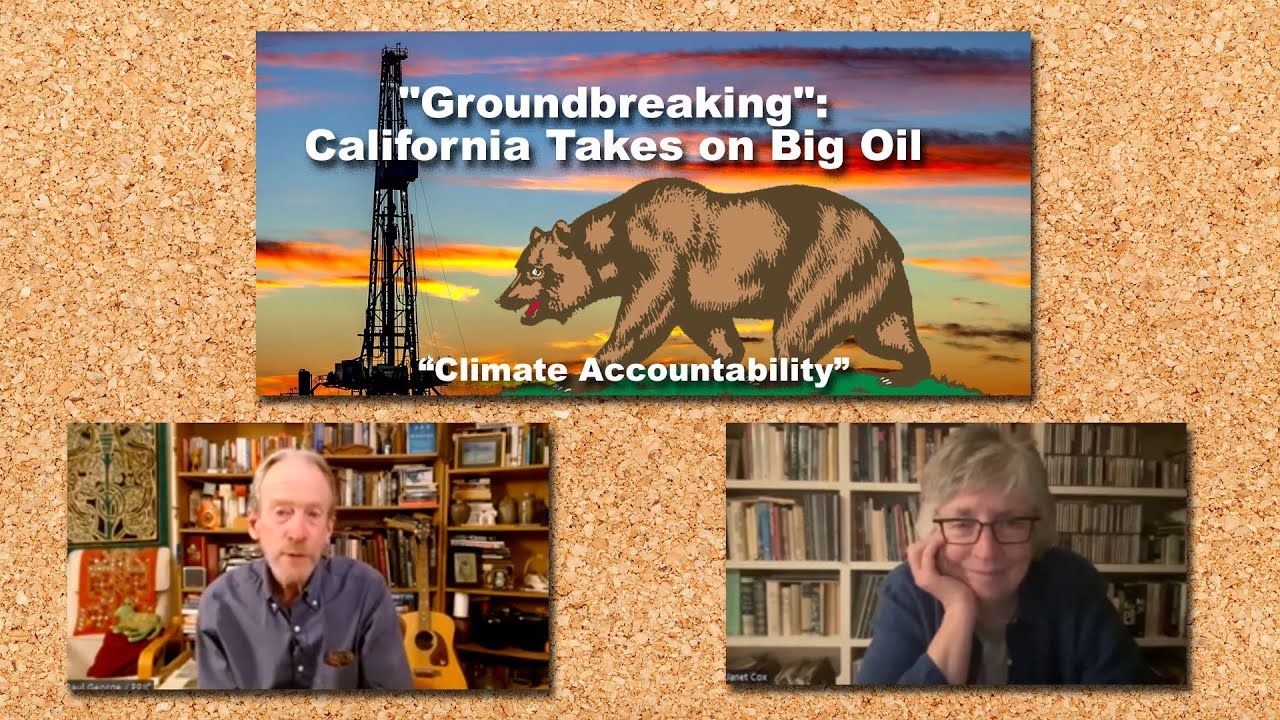
14 views Oct 13, 2023
“Climate Accountability” Propels California Lawsuit and New Legislation Aimed at Exposing Greenwashing A conversation with JANET COX, Climate Action California
Hosted by PAUL GEORGE, Director, Peninsula Peace and Justice Center
ref report
despite 'Splashy' Net-Zero Vows, Big Banks Dumping Trillions Into Fossil Fuels
"With Wall Street banks leading the charge, these financial institutions are directly complicit in undermining a climate-stable future for us all."
March 30, 2022
Flouting their public vows to put themselves and their clients on a path to net-zero greenhouse gas emissions, the world's 60 largest private banks have provided a total of $4.6 trillion in financing for the fossil fuel industry since the Paris Agreement entered into force in 2016.
That's according to the latest edition of Banking on Climate Chaos, an annual report that tracks the banking industry's funding of oil and gas initiatives that are threatening global hopes of reining in carbon pollution and averting climate disaster.
In 2021 alone, the report finds, the world's biggest private-sector banks financed oil and gas to the tune of $742 billion. That year, the 60 banks featured in the new analysis poured $185.5 billion into the 100 companies doing the most to expand the fossil-fuel sector worldwide through offshore drilling, fracking, coal mining, liquefied natural gas infrastructure, and more. Authored by Oil Change International, the Rainforest Action Network, the Indigenous Environmental Network, and other groups and endorsed by hundreds of organizations from around the world, the report published Wednesday spotlights the marked contrast between banks' public commitments to net-zero emissions targets and their actions, which reflect a continued stake in fossil fuel development.
The worst offenders in the banking industry, according to the report, are the U.S. financial behemoths JPMorgan Chase, Citi, Wells Fargo, and Bank of America,which together accounted for 25% of all fossil fuel financing identified over the past six years.
The report highlights a number of specific projects, including the Mountain Valley Pipeline (funded by JPMorgan Chase, Wells Fargo, and Bank of America), drilling in offshore Guyana (funded by JPMorgan Chase, Citi, and Bank of America), and the Line 3 Pipeline (funded by TD, Scotiabank, and the Bank of Montreal), efforts that have drawn fierce resistance from Indigenous communities.
"Indigenous peoples have long been leading the fight for the sacredness of the land, water, and Earth," Mea Johnson, divestment campaign coordinator with the Indigenous Environmental Network, said in a statement Wednesday. "Mother Earth has always given us what we need to thrive. We will not back down until our natural balance is restored and anyone helping fund the extractive destruction of our communities will be held accountable."
Alison Kirsch, research and policy manager at the Rainforest Action Network, added that "any further expansion of fossil fuels risks locking humanity into generations of climate catastrophe, yet the top fossil clients of the world's largest banks are still being showered with tens of billions of dollars even as they actively expand drilling, mining, fracking, and other fossil fuel development unabated."
"With Wall Street banks leading the charge," Kirsch added, "these financial institutions are directly complicit in undermining a climate-stable future for us all and must immediately end their support of any further fossil fuel infrastructure expansion."
The banks' financing decisions fly in the face of their own pledges to bring their policies into line with critical climate goals, such as achieving net-zero greenhouse gas emissions by 2050, a benchmark that 44 of the 60 banks profiled in the new report have backed.
"But global banks have massively supported the companies doing the most to open new oil and gas fields," notes the new report. "Banks with net-zero commitments last year... financed the top 20 upstream oil and gas expansion companies, potentially helping to lock the planet into decades of climate-warming emissions." According to the International Energy Agency, reaching net-zero emissions by 2050 would mean ensuring "no new oil and gas fields."
Adele Shraiman, a representative for theSierra Club's Fossil-Free Finance campaign, said Wednesday that the analysis "makes it clear that banks must clean up their act and stop funding the expansion of dirty fossil fuel projects like fracked gas exports, tar sands pipelines, and offshore drilling in order to align with what the science demands and what their own commitments require."
"Despite their splashy climate pledges, big banks have largely continued with business-as-usual and actually increased their overall fossil fuel financing since the Paris Agreement," said Shraiman. "As we look ahead to shareholder season, we'll be keeping up the pressure on the banks and their investors to take these critical reforms seriously and stop bankrolling the fossil fuel industry's reckless expansion plans."
from 4
gmail 9 23 see amy w
announcement came last night that California is launching a wide-ranging suit against Exxon, Chevron, Shell, BP, ConocoPhillips, and the American Petroleum Institute.
With thanks to everyone who signed Climate Action California's petition to the Governor and the Attorney General, asking them to sue the oil companies—We're CELEBRATING! (And for the record, we're not taking credit for this monumental development...even after more than six years of meeting with state officials and conspiring with with allies around the country to make this happen.)
Quoting from the Attorney General's press release, the suit is based on
- Public nuisance: Under California law, a “nuisance” is “anything which is injurious to health,” and a “public nuisance” is “one which affects at the same time an entire community or neighborhood, or any considerable number of persons.” The complaint alleges that all the defendants, by their deceptions, acts, and omissions, have created, contributed to, and assisted in creating harmful climate-related conditions throughout California.
- Damage to natural resources: California law authorizes the Attorney General to take legal action to protect the state’s natural resources “from pollution, impairment, or destruction.” The complaint alleges that the misconduct by all the defendants has served to exacerbate the climate crisis in California, and has led to the pollution, impairment, and destruction of California’s natural resources.
- False advertising: California law prohibits untrue and misleading advertising in connection with the disposition of property or services. The complaint alleges that all defendants, with the intent to induce members of the public to purchase and utilize fossil fuel products, made misleading statements concerning fossil fuels.
- Misleading environmental marketing: Under California law, “[i]t is unlawful for a person to make an untruthful, deceptive, or misleading environmental marketing claim, whether explicit or implied.” The complaint alleges that all defendants have made environmental marketing claims that are untruthful, deceptive, and/or misleading, whether explicitly or implicitly.
- Unlawful, unfair, and fraudulent business practices: California law prohibits unlawful, unfair, or fraudulent business acts or practices. The complaint alleges that all defendants committed unlawful acts by, among other things, deceiving the public about climate change and affirmatively promoting the use of fossil fuels while knowing that fossil fuels would lead to devastating consequences to the climate, including in California.
- Products liability (strict and negligent): The complaint alleges that, as a result of the defendants’ failure to warn about the climate-related harms related to the use of their products, California has sustained a plethora of injuries and damages, including to state property, state infrastructure, and its natural resources.
Unlike most of the other suits filed around the country, California is asking for establishment of an abatement fund to pay for mitigation and adaptation to climate change damage and future harms, with a focus on the vulnerable communities that are hurt first and worst, In our state and everywhere else. And we're big enough to pull it off.
Here's excellent background info from Amy Westervelt; and my favorite explainer/press release so far, from Union of Concerned Scientists
HOWEVER, this big announcement planned for tomorrow's Climate Week opening (sign up here for the livestream at 10 Pacific, 1 Eastern) must not eclipse Newsom's signing of SB 253 and SB 261, California's essential climate disclosure bills now on his desk.Please keep using CAEnvirovoters' social media tool kit to keep the pressure on to sign the bills, and comment to the Governor through his online comment portal for bill advocacy. Use the dropdown menu to reach the comment screens for SB 253, and SB 261.
Thank you! It's a gift to be doing this work in California, but we need the rest of the nation backing us up!
Janet Cox, CEO
Climate Action California
---
===
cavff5
Attorney General Bonta Announces Lawsuit Against Oil and Gas Companies for Misleading Public About Climate Change
Press Release Attorney General Bonta Announces Lawsuit Against Oil and Gas…
Saturday, September 16, 2023
Contact: (916) 210-6000, agpressoffice@doj.ca.gov
California becomes the largest geographic area and the largest economy to sue giant oil companies
OAKLAND — Joined by California Governor Newsom, California Attorney General Rob Bonta today announced the filing of a lawsuit against five of the largest oil and gas companies in the world — Exxon Mobil, Shell, Chevron, ConocoPhillips, and BP — and the American Petroleum Institute (API) for allegedly engaging in a decades-long campaign of deception and creating statewide climate change-related harms in California. Filed in San Francisco County Superior Court, the complaint asserts that although the companies have known since at least the 1960s that the burning of fossil fuels would warm the planet and change our climate, they denied or downplayed climate change in public statements and marketing.
As detailed in the complaint, California has spent tens of billions of dollars to adapt to climate change and address the damages climate change has caused so far, and the state will need to spend multiples of that in the years to come. Attorney General Bonta, on behalf of the people of California, is seeking nuisance abatement through the creation of a fund to finance climate mitigation and adaptation efforts; injunctive relief to both protect California’s natural resources from pollution, impairment, and destruction as well as to prevent the companies from making any further false or misleading statements about the contribution of fossil fuel combustion to climate change; damages; and penalties.
“Oil and gas companies have privately known the truth for decades — that the burning of fossil fuels leads to climate change — but have fed us lies and mistruths to further their record-breaking profits at the expense of our environment. Enough is enough,” said Attorney General Rob Bonta. “With our lawsuit, California becomes the largest geographic area and the largest economy to take these giant oil companies to court. From extreme heat to drought and water shortages, the climate crisis they have caused is undeniable. It is time they pay to abate the harm they have caused. We will meet the moment and fight tirelessly on behalf of all Californians, in particular those who live in environmental justice communities.”
“For more than 50 years, Big Oil has been lying to us — covering up the fact that they’ve long known how dangerous the fossil fuels they produce are for our planet,” said Governor Gavin Newsom. “California taxpayers shouldn’t have to foot the bill for billions of dollars in damages — wildfires wiping out entire communities, toxic smoke clogging our air, deadly heat waves, record-breaking droughts parching our wells. With this lawsuit, California is taking action to hold big polluters accountable and deliver the justice our people deserve.”
The complaint contains extensive evidence demonstrating that the defendants have long known about the catastrophic results caused by the use of fossil fuels. For instance, in 1968, API and its members received a report from the Stanford Research Institute, which it had hired to assess the state of research on environmental pollutants, including carbon dioxide. The report stated: “Significant temperature changes are almost certain to occur by the year 2000, and . . . there seems to be no doubt that the potential damage to our environment could be severe.” In 1978, an internal Exxon memo stated that “[p]resent thinking holds that man has a time window of five to ten years before the need for hard decisions regarding changes in energy strategies might become critical.” More recently, the defendants have deceptively portrayed themselves and their products as part of the climate solution. For example, Shell claims online that it aims to become a net-zero emissions energy business by 2050, and that it is “tackling climate change.” However, Shell’s CEO told the BBC on July 6, 2023 that cutting oil and gas production would be “dangerous and irresponsible.”
The complaint includes the following causes of action:
Public nuisance: Under California law, a “nuisance” is “anything which is injurious to health,” and a “public nuisance” is “one which affects at the same time an entire community or neighborhood, or any considerable number of persons.” The complaint alleges that all the defendants, by their deceptions, acts, and omissions, have created, contributed to, and assisted in creating harmful climate-related conditions throughout California.
Damage to natural resources: California law authorizes the Attorney General to take legal action to protect the state’s natural resources “from pollution, impairment, or destruction.” The complaint alleges that the misconduct by all the defendants has served to exacerbate the climate crisis in California, and has led to the pollution, impairment, and destruction of California’s natural resources.
False advertising: California law prohibits untrue and misleading advertising in connection with the disposition of property or services. The complaint alleges that all defendants, with the intent to induce members of the public to purchase and utilize fossil fuel products, made misleading statements concerning fossil fuels.
Misleading environmental marketing: Under California law, “[i]t is unlawful for a person to make an untruthful, deceptive, or misleading environmental marketing claim, whether explicit or implied.” The complaint alleges that all defendants have made environmental marketing claims that are untruthful, deceptive, and/or misleading, whether explicitly or implicitly.
Unlawful, unfair, and fraudulent business practices: California law prohibits unlawful, unfair, or fraudulent business acts or practices. The complaint alleges that all defendants committed unlawful acts by, among other things, deceiving the public about climate change and affirmatively promoting the use of fossil fuels while knowing that fossil fuels would lead to devastating consequences to the climate, including in California.
Products liability (strict and negligent): The complaint alleges that, as a result of the defendants’ failure to warn about the climate-related harms related to the use of their products, California has sustained a plethora of injuries and damages, including to state property, state infrastructure, and its natural resources.
In addition to filing the lawsuit announced today, Attorney General Bonta has supported states and municipalities that have filed their own complaints to hold major fossil fuel-producing companies accountable for their campaign of deception that has worsened the climate crisis. In August and September 2021, Attorney General Bonta filed amicus briefs supporting such efforts by the City of Honolulu and the County of Maui; the City of Baltimore; the state of Rhode Island; and the State of Minnesota. On April 7, 2023, he filed an amicus brief in the District of Columbia Court of Appeals in support of the District of Columbia's efforts. On May 12, 2023, he led a multistate coalition in filing an amicus brief in the Ninth Circuit Court of Appeals supporting the efforts by the City of Oakland as well as the City and County of San Francisco.
Since taking office in 2021, Attorney General Bonta has been a national leader in efforts to protect the environment. On April 28, 2021, he announced an expansion of the California Department of Justice’s Bureau of Environmental Justice – the first of its kind in a state attorney general’s office. On April 28, 2022, he announced an investigation into the fossil fuel and petrochemical industries for their role in causing and exacerbating the global plastics pollution crisis. On November 10, 2022, he announced a lawsuit against major manufacturers of per- and polyfluoroalkyl substances — commonly referred to as PFAS or toxic "forever chemicals” — for endangering public health, causing irreparable harm to the state's natural resources, and engaging in a widespread campaign to deceive the public.
A copy of the lawsuit can be found here.
no lnx
===
California opens the floodgates on Big Oil
Attorney General Rob Bonta’s lawsuit against ExxonMobil and other oil giants signals a new era for climate accountability.
EXXONKNEWS
SEP 18, 2023
Emily Sanders is the Center for Climate Integrity’s editorial lead. Catch up with her on Twitter here.
Graphic design by Tess Abbot
The state of California just launched a game-changing climate lawsuit against oil majors, bringing the weight of one of the world’s largest economies and the most populous state in the nation to bear against some of the biggest fossil fuel companies on earth.
California’s size and political influence — and its position as the first major oil producing state to take the industry to court — give the lawsuit distinction as likely the most powerful action to date to hold Big Oil companies accountable for lying about their products’ role in climate change. The Golden State’s action could very likely open the floodgates for other states that might have been waiting to make their own moves; while Attorney General Rob Bonta is the ninth attorney general to sue Big Oil, 16 attorneys general signed on to the latest legal brief in support of a climate accountability case.
Both Bonta and Governor Gavin Newsom indicated as much while speaking at Climate Week NYC on Sunday. Bonta said he hopes California’s move “will be an inspiration to other states and other entities to get involved and join us, to sue and be part of the effort to hold the industry accountable.”
“I just met with another governor a moment ago,” Newsom said, shortly before posting a photo with Governor Wes Moore of Maryland, where three municipalities are already suing Big Oil. “We want to see this spread, we want more and more jurisdictions, the United Nations and more countries to move in this direction.”
The lawsuit, filed late Friday in California state court, argues that ExxonMobil, BP, Chevron, ConocoPhillips, Shell, and the American Petroleum Institute “aggressive[ly] promot[ed] the use of fossil fuel products” while “misrepresenting and concealing the hazards of those products to deceive consumers and the public.” As a result, climate action was delayed for decades, the case argues, and Californians now face a regular onslaught of disasters — from deadly wildfires and droughts to dangerous heat waves, hurricanes, and floods.
“Californians and their families, communities, and small businesses should not have to bear all the costs of climate change alone,” reads the complaint, citing the billions of dollars residents have and will spend to recover from such disasters. “This lawsuit seeks to hold those companies accountable for the lies they have told and the damage they have caused.”
In a first for state climate lawsuits, California’s case looks to create an abatement fund that fossil fuel defendants would pay into to help residents foot the bill for adaptation and recovery. That remedy is based on a strong California law, which was successfully used to create a $305 million abatement fund for lead paint.
Here are some other things to know about California’s case:
Bonta’s lawsuit builds on cases filed by eight California municipalities.
In 2017 and 2018, eight California municipalities — San Francisco, Oakland, Santa Cruz, Richmond, Imperial Beach, and the counties of San Mateo, San Marin, and Santa Cruz — filed some of the earliest climate liability lawsuits against the fossil fuel industry. According to the attorney general’s complaint, the state’s lawsuit won’t supersede any of those pending local actions, which are expected to reach trial first.
The latest of those cases was filed in Richmond, the site of a major Chevron oil refinery known for its chronic pollution, explosions, and fires. The city, mostly made up of people of color, is also home to soaring rates of cancer, cardiovascular disease, and childhood asthma.
But many residents say Chevron, which funds the city’s newspaper (which it uses as a PR platform) and is its largest employer, continues to mislead the public about its operations and push for false climate solutions that will worsen environmental justice harms and continue its oil and gas business in the community. Since the company built a much-touted hydrogen plant at its “modernized” Richmond refinery in 2018, emissions flaring incidents have skyrocketed.
Screenshot from a post on Chevron’s website last year.]
“There’s a daily effort to create this misinformation campaign while we’re fighting to survive,” said Katt Ramos, Managing Director at the Richmond Our Power coalition. “What [Chevron is] actually doing is prolonging their life while causing us harm with unproven technology.”
Chevron and the other oil companies’ ongoing misinformation and greenwashing plays a major role in California’s claims.
California’s complaint puts a spotlight on the companies’ modern deception.
California’s complaint documents Big Oil’s modern greenwashing and deception about the environmental benefits of its operations.
“Through recent advertising campaigns and public statements in California and/or intended to reach California, including but not limited to online advertisements and social media posts, Defendants falsely and misleadingly portray these products as ‘green,’ and the Fossil Fuel Defendants portray themselves as climate-friendly energy companies that are deeply engaged in finding solutions to climate change,” reads the complaint.
Among many claims familiar to other climate accountability suits, including public nuisance, false advertising, fraud, and negligence, the case also brings a new cause of action under California law: misleading environmental marketing. California argues the companies are violating the state’s law meant to protect consumers against greenwashing.
According to the complaint, the companies deceptively promoted natural gas as a climate solution; deceptively marketed fossil fuel products as “low carbon,” “emissions-reducing,” “clean” and/or “green,” just as tobacco companies promoted “low-tar” or “light” cigarettes as healthy alternatives to giving up smoking; marketed their businesses as contributing to “climate solutions” despite their negligible investments in clean energy as opposed to their increasing production of oil and gas; and claimed to be in alignment with international climate goals, all while protecting and growing their business in fossil fuels.
Just last week, the Wall Street Journal reported never-before-seen documentation of Exxon’s deception under the reign of former CEO Rex Tillerson, who pledged the company’s support for climate actions like the Paris Agreement while working to cast doubt on climate science behind the scenes. Exxon is the lead defendant in California’s case.
California’s case is the latest sign of the evolving politics of taking on Big Oil.
Both Bonta, who filed the suit and has said he is “seriously considering” a run for governor, and Newsom, who is expected to be preparing for a future presidential run, are clearly embracing this issue.
“The scale and scope of what the state of California can do we think can move the needle,” Newsom told David Gelles of the New York Times at the opening ceremony of Climate Week NYC. “We cannot address [climate change] unless we get serious about addressing the issue. And the issue is fossil fuels, the issue is the deceit from these companies.”
It’s the latest sign that politicians see taking on Big Oil as an increasingly popular move, as we saw during last year’s midterm elections.
[A sign at Sunday’s March to End Fossil Fuels in New York City.
It’s a tipping point for the legal fight for climate accountability.
California is the first state to file since the Supreme Court cleared the way for climate accountability suits against Big Oil to proceed toward trial in state courts. On Sunday, Bonta told reporters that the Supreme Court’s ruling “allows us to get to where we want to go, to the merits, to hold them accountable for their deceit.”
The industry’s attempts to delay and derail the cases have persistently failed, and now California’s in the game, with all signs pointing to more lawsuits against Big Oil to come.
https://www.exxonknews.org/p/california-opens-the-floodgates-on
==
California Attorney General Rob Bonta and 15 other attorneys general filed an amicus brief in federal appeals court supporting Oakland and San Francisco's climate change lawsuit against five fossil fuel companies.
In their consolidated case, city of Oakland v. BP et al, the California cities claim the fossil fuel companies mislead the public about the known dangers of fossil fuel combustion and exacerbated the effects of climate change. The cities are seeking damages to remedy the impact of sea level rise and similar harms.
"Our state and local governments have a duty to protect the welfare of our residents, and for decades, Big Oil has relied on deceptive tactics to mislead consumers about the harms of fossil fuel use," Bonta said in a statement.
....
===
Forbes
https://www.forbes.com › sites › rrapier › 2023/09/17
Sep 17, 2023 — The lawsuit, filed by California Attorney General Rob Bonta, alleges the companies knowingly deceived the public about the risks of fossil ...
---
California Joins States Suing Big Oil for Its Role in the ...
DeSmog
https://www.desmog.com › 2023/09/16 › california-su...
Sep 16, 2023 — ... climate crisis. On Friday, California Attorney General Rob Bonta filed a lawsuit against five oil and gas majors including ExxonMobil ...
===
San Francisco Examiner
https://www.sfexaminer.com › news › why-california-cli...
Sep 26, 2023 — Expert say California Attorney General Rob Bonta's lawsuit against leading oil and gas companies could be a landmark case in the decadeslong ..
---
The New York Times
https://www.nytimes.com › california-oil-lawsuit-newsom
Sep 15, 2023 — California Attorney General Rob Bonta.Credit ... The lawsuit also details the growing damage that climate change is inflicting on California ...
===
https://www.eenews.net/articles/watershed-moment-california-enters-climate-litigation-fray/
no lnx
‘Watershed moment’: California enters climate litigation fray
By Lesley Clark | 09/18/2023 07:01 AM EDT
California Attorney General Rob Bonta (D) fields questions during an Aug. 28 news conference in Los Angeles. Marcio Jose Sanchez/AP Photo
California, a top oil-producing state, is suing the oil majors and an influential ally — making it the latest and largest player among a growing number of local governments looking to hold fossil fuel companies financially accountable for the effects of climate change.
The lawsuit, filed Friday in the Superior Court of California in San Francisco, accuses five of the world’s largest oil companies and their subsidiaries, along with the industry trade association the American Petroleum Institute, of waging a campaign to mislead the public about the dangers of burning fossil fuels.
“Oil and gas companies have privately known the truth for decades — that the burning of fossil fuels leads to climate change — but have fed us lies and mistruths to further their record-breaking profits at the expense of our environment,” said California Attorney General Rob Bonta (D). “Enough is enough.”
The move immediately vaults California to the top of a group of mostly Democratic-led states, including New Jersey, Massachusetts and Minnesota, that have filed lawsuits against the oil giants, as have two dozen local counties and cities.
Gov. Gavin Newsom (D), who was to use a press conference Sunday kicking off the United Nations climate summit and New York City’s Climate Week to tout the state’s involvement, argued the industry has lied about its contribution to global climate change for more than 50 years.
“It has been decades of damage and deception,” Newsom said. “Wildfires wiping out entire communities, toxic smoke clogging our air, deadly heat waves, record-breaking droughts parching our wells. California taxpayers shouldn’t have to foot the bill.”
The industry argued the lawsuit will do “nothing to advance meaningful solutions to climate change.”
“The challenge of our time is developing technologies and public policies so that the world can produce and use energy in ways that are affordable for people and sustainable for the planet,” said Phil Goldberg, special counsel to the Manufacturers’ Accountability Project, an initiative of the National Association of Manufacturers. “It should not be figuring out how to creatively plead lawsuits that seek to monetize climate change and provide no solutions.”
A spokesperson for San Ramon, Calif.-based Chevron Corp., which is one of the five companies being sued, noted the Golden State long has promoted oil and gas development and said its courts “have no constructive or constitutionally permissible role in crafting global energy policy.”
Ryan Meyers, general counsel at API, said the industry has shown over the past two decades that it can deliver reliable energy while “substantially reducing emissions” and its environmental footprint.
“This ongoing, coordinated campaign to wage meritless, politicized lawsuits against a foundational American industry and its workers is nothing more than a distraction from important national conversations and an enormous waste of California taxpayer resources,” Meyers said, calling climate policy something for Congress “to debate and decide, not the court system.”
The suit comes as the Supreme Court earlier this year boosted a raft of similar cases by rejecting the oil industry’s latest efforts to derail them. Those rulings could pave the way for a flood of lawsuits against the industry to be heard in state courts from Maryland to Hawaii.
The lawsuits still have a long way to go, but if they are successful, the challenges could force the oil industry — like tobacco and opioid manufacturers before it — to pay hundreds of billions of dollars for harming the public.
The Center for Climate Integrity, which has supported local governments suing the companies, hailed the lawsuit as a “watershed moment” in the movement to take on the industry.
“California’s move is an unmistakable sign that the wave of climate lawsuits against Big Oil will keep growing and that these polluters’ days of escaping accountability for their lies are numbered,” said the center’s president, Richard Wiles. “Just like tobacco and opioid companies, the oil and gas industry will have to face the evidence of its deception in court.”
The environmental group Fossil Free Media, which has been involved in several anti-fossil-fuel campaigns, said it would launch a new effort to build support for the climate lawsuits — hailing the Golden State’s entry as a game changer.
“California just kicked open the door for every city and state to sue the fossil fuel industry for climate damages,” said the group’s director, Jamie Henn. “After this summer of brutal heat waves and climate disasters, I think the public is hungry for a way to hold the fossil fuel industry accountable for the damage they’ve done.”
New revelations
California’s lawsuit notes the state in 2023 alone has experienced both extreme drought and widespread flooding, along with wildfires, historic storms, and an unusually cold spring and record-hot summer.
The 135-page lawsuit, complete with graphics pointing to fossil fuel emissions as the dominant source of increases in atmospheric carbon dioxide, largely mirrors the other lawsuits that have been filed from Hoboken, N.J., to Hawaii.
It claims that oil giants knew for years that their products were contributing to global warming, but violated state nuisance and consumer protection laws by running a disinformation campaign to hide those facts from the public.
Some legal analysts have questioned whether the cases can show that the companies are still engaged in deceptive action. But new revelations have continued to emerge.
The Wall Street Journal last week published new internal documents from Exxon Mobil Corp. that showed the company sought to allay concerns about global warming in 2006 even as it argued publicly that the risks justified global action. The documents were part of an investigation by New York’s attorney general.
The industry has waged a yearslong, hypertechnical jurisdictional battle to move the cases from the state courts where they were filed to federal court, where the challenges are believed more likely to falter under the Clean Air Act.
The Supreme Court in 2021 ruled in a climate liability case led by Baltimore that federal judges must consider the industry’s full range of arguments in favor of moving the lawsuits. Though the ruling came after former President Donald Trump had left office, his Department of Justice filed a half-dozen friend of the court briefs in support of the companies’ position.
Multiple federal courts, however, were unimpressed with the arguments, and the industry turned once again to the Supreme Court for relief. President Joe Biden, who on the 2020 campaign trail had pledged to support the litigation, reversed the Trump administration’s position, telling the justices they should decline the companies’ plea.
The court, which only takes a fraction of the cases it is asked to hear, agreed, and in April and May turned down seven industry requests to intervene in the lawsuits.
One case is still pending before the high court: API, Exxon and others in August urged the court to intervene in Minnesota’s case against the industry, warning then that without Supreme Court review, such cases “will continue to proliferate.”
Trump has vowed to block the lawsuits if reelected, pledging in an energy plan he released earlier this month to “stop the wave of frivolous litigation from environmental extremists.”
The former president’s plan did not identify which climate lawsuits he would seek to target, but cited a blog post from an advocacy campaign run by the Independent Petroleum Association of America that accuses the Rockefeller Foundation of encouraging municipalities to take oil companies to court.
Since the end of the Trump presidency in January 2021, four more governments — including California — have filed lawsuits against the industry.
The most recent lawsuit was filed in June by Multnomah County, Ore., where 69 people died in a 2021 heat wave. New Jersey and Puerto Rico filed suits in 2022.
Puerto Rico’s lawsuit added a new claim against the industry, accusing it of violating the Racketeer Influenced and Corrupt Organizations Act, which is designed to take down organized crime.
West Coast states until now had been an outlier in the climate litigation.
Long anticipated legal bid
California had been expected to be among the first to file a lawsuit when the Los Angeles Times reported in 2016 that Vice President Kamala Harris, then California’s attorney general, had opened an investigation into Exxon for potentially misleading investors about climate change risks.
No lawsuit resulted under Harris or her previous successor, Xavier Becerra, though Harris claimed on the campaign trail in 2019 that she had taken the company to court.
“They have to be held accountable,” Harris, who was seeking the Democratic nomination for president at the time, said at a CNN town hall. “These are bad behaviors; they are causing harm and death in communities.”
Oregon and Washington, two other left-leaning West Coast states, have not pursued litigation, despite gentle nudging by allies who say the liability lawsuits are an important tool to hold companies accountable for greenhouse gas emissions.
Municipalities in California, however, have been active in the litigation with five California cities, including San Francisco and Oakland, and three counties, including San Mateo, filing some of the first climate lawsuits against fossil fuel companies in 2017 and 2018.
The lawsuit represents the latest climate move for Newsom, who has sought to create a role for the Golden State as a climate policy power broker.
The state last month signed an agreement with the Chinese province of Hainan to work together on phasing out fossil fuel vehicles, improving energy efficiency in buildings, and enforcing air pollution and greenhouse gas rules.
That memo came on the heels of another agreement Newsom signed in April renewing a Jerry Brown-era partnership with China’s Ministry of Ecology and Environment to encourage policy and academic exchanges.
In addition to Chevron and API, the California lawsuit names Exxon, Shell USA Inc., ConocoPhillips Co. and BP America Inc.
The suit asks the court to order the companies to pay for climate change costs and to establish a fund to help pay for future climate disasters.
It also calls for financial penalties for lying and punitive damages.
It brings seven causes of action, accusing the companies of violating state nuisance and product liability laws, as well as destroying natural resources, producing untrue or misleading advertising, and engaging in unlawful business practices.
This story also appears in Energywire.
===
https://www.forbes.com/sites/rrapier/2023/09/17/californias-misguided-lawsuit-against-oil-firms/?sh=752675d64637
FORBESBUSINESSENERGY
California's Misguided Lawsuit Against Oil Firms
Robert Rapier
Senior Contributor
I am a chemical engineer covering the energy sector.
Follow
4
Sep 17, 2023,08:00am EDT
Climate California Lawsuit
FILE - California Gov. Gavin Newsom speaks to reporters outside the California Natural Resources ... [+]COPYRIGHT 2022 THE ASSOCIATED PRESS. ALL RIGHTS RESERVED
“The search for a scapegoat is the easiest of all hunting expeditions.” — Dwight D. Eisenhower
The state of California is suing five major oil companies - BP, ExxonMobilXOM -0.4%, ChevronCVX -0.1%, Shell, and ConocoPhillipsCOP -1.2% - as well as their trade group, the American Petroleum Institute.
The lawsuit, filed by California Attorney General Rob Bonta, alleges the companies knowingly deceived the public about the risks of fossil fuels, causing harm to communities and the environment. California Governor Gavin Newsom claimed "Big Oil has been lying to us for over 50 years."
Specifically, the lawsuit points to internal company memos and reports as evidence the oil firms understood the severe consequences but continued expanding fossil fuel extraction. California alleges that this deception exacerbated climate change effects like wildfires, pollution, heat waves, and drought in California, costing billions in damage.
But this lawsuit is misguided for several reasons.
California Knew the Risks
Climate science has been clear on fossil fuel dangers for decades. California can't claim ignorance based on oil company messaging. Oil companies may have debated or disputed the data, but the consensus risks have been mainstream since at least the 1990s.
Al Gore argued for action in 1992 in Earth in the Balance, and numerous scientific papers had made the case prior to that. California had that information then, but how did they respond? What responsibility do they take for not acting with urgency 30-40 years ago?
Today California uses more gasoline than any state but Texas. California is more dependent on foreign oil than any other state. California is still heavily dependent on oil and oil products and has profited handsomely from extracting oil and gas in the state. Why? Because the oil companies lied to them? Really?
Fossil fuels are used heavily all over the world because they're cheap and convenient, not because of deception. We have known about the risks for a very long time, but we continue to use them anyway.
So, the lawsuit is misguided because there has been ample evidence for decades that rising carbon emissions were a risk. California has never trusted Big Oil. The state can’t credibly claim that it didn’t act with urgency because it was relying on the word of Big Oil.
The Real Reason Emissions are Rising
Moreover, the leading contributor of atmospheric carbon emissions is coal, not oil. Asia — especially China — dominates coal consumption. California's lawsuit narrowly targets predominantly U.S. oil companies when the global challenge is far broader.
How responsible is China's coal consumption in the overall scheme? How about overall Asia Pacific emissions, which dwarf those of the U.S. and EU?
Regional CO2
Regional CO2 Emissions 1965 through 2022.ROBERT RAPIER
The reason that graphic looks like that is coal burning in Asia, not lies from Big Oil. Note that emissions in the U.S. aren’t a lot higher than they were 50 years ago, and emissions from oil are a subset of overall emissions. Where, exactly, is Big Oil’s culpability in this graphic?
Serious Solutions Needed
Some of the world’s emissions are from oil. But OPEC and Russia have supplied most of the world’s oil over the past 50 years. The companies California singled out represent a small fraction of total oil consumption. This undercuts claims of their outsized culpability.
Climate change needs serious solutions through innovation and policy change, not politicized lawsuits. I expect the oil companies will litigate this strenuously. Don’t expect them to settle. Expect them to highlight the hypocrisy of those who sued, by highlighting all of the fossil fuel consumption in their lives. Expect them to point out that they do this despite knowing the risks of climate change — because of the benefits they realize by doing so. And of course, it will be pointed out how much California benefitted financially from oil extraction there for decades.
Pointing the finger at Big Oil may be good politics in California, but this is political theater rather than constructive action on a complex issue.
Follow me on Twitter or LinkedIn. Check out my website or some of my other work here.
Robert Rapier is a chemical engineer in the energy industry. Robert has 25 years of international engineering experience in the chemicals, oil and gas, and renewable energy industries, and holds several patents related to his work. He has worked in the areas of oil refining, oil production, synthetic fuels, biomass to energy, and alcohol production. He is author of Utility Forecaster at Investing Daily, and of the book Power Plays: Energy Options in the Age of Peak Oil. Robert has appeared on 60 Minutes, The History Channel, CNBC, Business News Network, CBC, and PBS, and his energy-themed articles have appeared in numerous media outlets, including the Wall Street Journal, Washington Post, Christian Science Monitor, and The Economist. Read Less
1,858 views | Oct 8, 2023
Doubters Beware: U.S. Oil Production Is Setting New Records
U.S. oil production is running at an all-time high, and on pace to set a new annual production record this year.
7,307 views | Oct 1, 2023
Hannity Versus Newsom: Debunking The Energy Independence Controversy
Fox News host Sean Hannity and California Gov. Gavin Newsom recently squabbled over U.S. energy independence. Today I explain the reality of the situation.
2,021 views | Sep 20, 2023
What’s Driving The Rally Toward $100 Oil?
After falling below $70 a barrel earlier this year, oil prices have marched steadily higher. In this article, I discuss the reasons why, and whether $100 oil is inevitable.
2,613 views | Sep 17, 2023
California's Misguided Lawsuit Against Oil Firms
California has known about the risks of climate change for decades. Yet the state continued its dependence on oil, and it continued to profit from oil extraction. Now it needs a scapegoat.
1,889 views | Sep 15, 2023
Renewable Energy Milestone: Wind And Solar Trump Hydropower
The double-digit growth rate of wind and solar power has finally pushed it ahead of hydropower for the first time. In this article, I cover global renewable energy trends.
===
https://eidclimate.org/energy-starved-california-files-climate-lawsuit-against-u-s-oil-and-natural-gas-companies-heres-what-to-know/
ENERGY-STARVED CALIFORNIA FILES CLIMATE LAWSUIT AGAINST U.S. OIL AND NATURAL GAS COMPANIES: HERE’S WHAT TO KNOW
SEPTEMBER 16, 2023 | MANDI RISKO
Four years after the climate lawsuit pushed by the New York Attorney General’s office was dealt a comprehensive defeat, California is putting forward its own case based on the same debunked theory that completely fell apart for Eric Schneiderman all those years ago – ironically, on New York’s turf and apparently ignorant that the Empire State’s loss even happened.
California’s lawsuit, filed by Attorney General Rob Bonta, follows a pump fake by former AG Kamala Harris and a decade-long pressure campaign from wealthy donors, academics, and fringe activist groups to file litigation. Ironically, the lawsuit filing comes against a backdrop of Californians paying some of the highest prices in the country for gasoline and electricity.
Now, with California joining the flailing nationally-coordinated climate litigation campaign, and Gov. Gavin Newsom set to discuss the case during the opening ceremony of NYC Climate Week, here’s what you need to know:
California’s case is a repeat of the failed and “hyperbolic” New York climate lawsuit, based on a legal premise that went nowhere in a case that was wholly defeated by the New York State Supreme Court.
California is the birthplace of the nationally coordinated, Hollywood-and-foreign-billionaire-funded litigation campaign. Sher Edling, the law firm that bases its entire business around representing plaintiffs in lawsuits against the oil and gas industry, including the three California municipalities that filed the very first climate suits in 2017, is based in San Francisco.
Litigation would only worsen the state’s already backwards energy policies – the energy-starved state already pays 88 percent more for a kilowatt hour of electricity than the national average and almost $2 more for a gallon of gasoline.
California is literally biting the hand that feeds it: from enabling agriculture, to fueling drivers on the freeway, to powering the state’s fragile grid, California relies on oil and natural gas to stay afloat. In fact, it is the largest consumer of jet fuel and second-largest consumer of motor gasoline in the nation. The state also decided to expand a large natural gas storage facility in Aliso Canyon just a few weeks ago.
Governor Gavin Newsom has praised the climate lawsuit and is set to speak more about it tomorrow. However, he’s previously acknowledged the irony of restricting oil production in the United States while increasing reliance on foreign imports, stating: “we’re making up for a lack of domestic production from Saudi Arabia, Ecuador, and Colombia, and that’s hardly an environmental solution when you look globally.”
Catch up more below:
New York’s Case Defeated and Widely Ridiculed
California Attorney General Bonta’s complaint alleges that the U.S. oil and natural gas industry “misled consumers and the public about climate change.” However, that’s the same theory that former New York Attorney General Eric Schneiderman used all the way back in 2015 as the basis for a years-long investigation that he was eventually forced to abandon after several high-profile shifts in legal strategy.
At the start of his failed climate lawsuit, AG Schneiderman first alleged that the defendant had failed to disclose the risk that some of its assets may become “stranded,” or uneconomical to produce under possible future climate policies. Then, in 2017, Schneiderman changed the state’s complaint to examine whether the company misled investors by failing to apply a “proxy cost of carbon” to its business operations.
The complete departure from the original theory even prompted the Washington Post to declare, “New York Attorney General Eric Schneiderman has gotten very far away from where he started in his office’s investigation.”
By the time the case finally went to trial in 2019, Schneiderman was long gone, and his predecessor was handed a total defeat in what New York State Supreme Court Judge Barry Ostrager called a “hyperbolic” lawsuit.
It All Goes Back to La Jolla
California’s lawsuit, New York’s failed case, and the entire climate litigation campaign, were born in the small Pacific beach town of La Jolla, which in 2012 hosted an infamous gathering of academics, attorneys, and activists that plotted the legal, political, and PR playbook for these lawsuits.
The conference was sponsored by the Union of Concerned Scientists, the Rockefeller-funded Climate Accountability Institute, and Harvard researcher Naomi Oreskes, who the New York Times reported to have “conceived” the meeting and was later revealed to be on retainer with Sher Edling, the plaintiffs’ law firm representing climate cases around the country.
One of the key developments from the La Jolla conference was the conclusion that recruiting a “single sympathetic attorney general” would be a key goal of the climate litigation campaign. To that end, activists found their sympathetic chief enforcement officer in then-New York Attorney General Eric Schneiderman, who launched the first climate change investigation in 2015.
Schneiderman and the activists propping up his case recruited other attorneys general to join the cause. In 2016, Schneiderman held a press conference with Vice President Al Gore and other attorneys general announcing the “AGs United for Clean Power” coalition, of which then-California Attorney General Kamala Harris was a member.
Through this group – termed the “Green 20” – state attorneys general including AG Harris strategized about how to investigate and ultimately sue energy companies for damages attributed to the effects of climate change.
The coalition conducted backdoor strategy sessions with activists leading up to the launch. Public records showed that attorney Matt Pawa, who worked hand-in-hand with activists and donors to launch several climate lawsuits against oil and gas producers, briefed the members of the Green 20 the day before the coalition was publicly announced and then was instructed to conceal his involvement from journalists. Pawa also gave an April 2016 presentation to Attorney General Harris and other state attorneys general in April 2016 on “What Exxon Knew – And What It Did Anyway.”
Importantly, AG Harris and many of the other Green 20 members also signed a Common Interest Agreement to keep their legal strategy secret and hide their conversations about climate change litigation from the public. Reuters called it a “previously unknown level of coordination with outside advisers” before the arrangement was revealed through an open records request.
Despite the heavy-handed support from activists, the Green 20 fell apart within months, and subpoenas were quickly withdrawn. In 2016, the Los Angeles Times reported that AG Harris’ office had launched an #ExxonKnew investigation, though her office never confirmed it and nothing seemingly came from the investigation. Three years later, at a Democratic presidential debate, Harris tried to out-activist other candidates on the stage by falsely stating, “I have sued ExxonMobil,” revealing that her investigation was nothing more than a political gesture all along.
In the end, Schneiderman was the only Green 20 AG to have actually filed a lawsuit – which decisively failed – although the office spent over three years rifling through more than four million pages of corporate internal documents.
The State Remains a Hotbed of Litigation Activity
Beyond La Jolla, academics, activists, and plaintiffs’ attorneys have long used California as a home base to finance and coordinate climate lawsuits in the state and across the country.
It was the Los Angeles Times that helped kick start the climate litigation campaign back in 2015 with a series of articles on the energy industry’s understanding of climate change. Later, a funding trail revealed that the newspaper had failed to disclose that the stories were paid for by the Rockefeller Family Fund, presumably to bolster attorney generals’ investigations, prompting a scolding on journalistic ethics from the Columbia Journalism Review.
While the New York Attorney General’s investigation floundered and the Green 20 collapsed, activists honed in on several California municipalities, which became the very first plaintiffs to file public nuisance lawsuits against energy companies in July 2017. Reporting from the Daily Mail later revealed that the strategy behind the San Francisco and Oakland lawsuits was authored and pitched by activist attorney Matt Pawa and paid for by billionaire environmentalist Tom Steyer.
The California municipalities ended up switching attorneys from Pawa’s firm to Sher Edling, a San Francisco based law firm now representing more than a dozen states and municipalities around the country in their climate lawsuits. Although Sher Edling represents states and municipalities on a contingency fee basis where it stands to make tens of millions on any given suit, it also has received millions in dark-money grants to fund its lawsuits against energy companies.
Last year, reporting from Fox News Digital revealed that Hollywood star Leonardo DiCaprio and other wealthy left-wing donors have been funneling money to Sher Edling through non-profit pass-throughs since at least 2017. This funding system was partially orchestrated by Ann Carlson, former UCLA law professor and Biden administration official, and Dan Emmett, a Los Angeles real estate mogul who funds the UCLA program that employed Carlson. News of Carlson’s role in the scheme and her support for radical climate policies ultimately forced the White House to pull her nomination to lead the National Highway Traffic Safety Administration.
A Blow to Californian Workers and Consumers, But a Gift to OPEC
By attacking American energy companies, California AG Bonta’s new lawsuit adds to the slew of policies enacted by California’s legislature that literally starve the state of energy and hamper the economy. Californians already pay 88 percent more for a kilowatt hour of electricity than the national average and almost $2 more for a gallon of gasoline. Additionally, the oil and gas industry provides approximately 366,000 jobs in the state and contributes $152.3 billion in total economic output. Lawsuits like California’s will just diminish the role of American energy on the national and global stage and raise costs for consumers.
Shrinking the role of American energy doesn’t hurt everyone, though; OPEC+ should be thrilled. Because California will still need oil and natural gas, exemplified by the state’s decision to expand a large natural gas storage facility in Aliso Canyon just a few weeks ago, it will simply continue to rely on foreign imports, [we do not import frackked gas; we do import canadian tar sands to sf?] primarily from OPEC+ nations. Over the past 40 years, California’s oil consumption has remained steady, but the state has gone from relying primarily on U.S. production to depending on foreign imports from state-owned oil companies. Governor Newsom, who has praised AG Bonta’s climate lawsuit, has previously acknowledged the irony of cutting oil production in the United States while increasing reliance on foreign imports:
“We’re making up for a lack of domestic production from Saudi Arabia, Ecuador, and Colombia, and that’s hardly an environmental solution when you look globally.” (emphasis added)
To the Governor’s point, climate litigation does nothing to promote environmental progress. Phil Goldberg, Special Counsel to the Manufacturers Accountability Project pointed out this contradiction in response to California’s filing:
“The challenge of our time is developing technologies and public policies so that the world can produce and use energy in ways that are affordable for people and sustainable for the planet. It should not be figuring out how to creatively plead lawsuits that seek to monetize climate change and provide no solutions.” (emphasis added)
Bottom line: As California continues to be the largest consumer of jet fuel and second-largest consumer of motor gasoline in the nation, this new lawsuit couldn’t be more hypocritical. Rather than giving in to activist groups behind these lawsuits and shaming the industry that powers homes and vehicles, policymakers in the state should be reversing their slew of policies that impede on consumers’ ability to access reliable and safe energy.
Read the full piece on EIDClimate.org.
TAGS: Climate Litigation, climate week
LINKS
eNERGY-STARVED CALIFORNIA FILES CLIMATE LAWSUIT AGAINST U.S. OIL AND NATURAL GAS COMPANIES: HERE’S WHAT TO KNOW
SEPTEMBER 16, 2023 | MANDI RISKO
Four years after the climate lawsuit pushed by the New York Attorney General’s office was dealt a comprehensive defeat, California is putting forward its own case based on the same debunked theory that completely fell apart for Eric Schneiderman all those years ago – ironically, on New York’s turf and apparently ignorant that the Empire State’s loss even happened.
California’s lawsuit, filed by Attorney General Rob Bonta, follows a pump fake by former AG Kamala Harris and a decade-long pressure campaign from wealthy donors, academics, and fringe activist groups to file litigation. Ironically, the lawsuit filing comes against a backdrop of Californians paying some of the highest prices in the country for gasoline and electricity.
Now, with California joining the flailing nationally-coordinated climate litigation campaign, and Gov. Gavin Newsom set to discuss the case during the opening ceremony of NYC Climate Week, here’s what you need to know:
- California’s case is a repeat of the failed and “hyperbolic” New York climate lawsuit, based on a legal premise that went nowhere in a case that was wholly defeated by the New York State Supreme Court.
- California is the birthplace of the nationally coordinated, Hollywood-and-foreign-billionaire-funded litigation campaign. Sher Edling, the law firm that bases its entire business around representing plaintiffs in lawsuits against the oil and gas industry, including the three California municipalities that filed the very first climate suits in 2017, is based in San Francisco.
- Litigation would only worsen the state’s already backwards energy policies – the energy-starved state already pays 88 percent more for a kilowatt hour of electricity than the national average and almost $2 more for a gallon of gasoline.
- California is literally biting the hand that feeds it: from enabling agriculture, to fueling drivers on the freeway, to powering the state’s fragile grid, California relies on oil and natural gas to stay afloat. In fact, it is the largest consumer of jet fuel and second-largest consumer of motor gasoline in the nation. The state also decided to expand a large natural gas storage facility in Aliso Canyon just a few weeks ago.
- Governor Gavin Newsom has praised the climate lawsuit and is set to speak more about it tomorrow. However, he’s previously
 the irony of restricting oil production in the United States while increasing reliance on foreign imports, stating: “we’re making up for a lack of domestic production from Saudi Arabia, Ecuador, and Colombia, and that’s hardly an environmental solution when you look globally.”
Catch up more below:
New York’s Case Defeated and Widely Ridiculed
California Attorney General Bonta’s complaint alleges that the U.S. oil and natural gas industry “misled consumers and the public about climate change.” However, that’s the same theory that former New York Attorney General Eric Schneiderman used all the way back in 2015 as the basis for a years-long investigation that he was eventually forced to abandon after several high-profile shifts in legal strategy.
At the start of his failed climate lawsuit, AG Schneiderman first alleged that the defendant had failed to disclose the risk that some of its assets may become “stranded,” or uneconomical to produce under possible future climate policies. Then, in 2017, Schneiderman changed the state’s complaint to examine whether the company misled investors by failing to apply a “proxy cost of carbon” to its business operations.
The complete departure from the original theory even prompted the Washington Post to declare, “New York Attorney General Eric Schneiderman has gotten very far away from where he started in his office’s investigation.”
By the time the case finally went to trial in 2019, Schneiderman was long gone, and his predecessor was handed a total defeat in what New York State Supreme Court Judge Barry Ostrager called a “hyperbolic” lawsuit.
It All Goes Back to La Jolla
California’s lawsuit, New York’s failed case, and the entire climate litigation campaign, were born in the small Pacific beach town of La Jolla, which in 2012 hosted an infamous gathering of academics, attorneys, and activists that plotted the legal, political, and PR playbook for these lawsuits.
The conference was sponsored by the Union of Concerned Scientists, the Rockefeller-funded Climate Accountability Institute, and Harvard researcher Naomi Oreskes, who the New York Times reported to have “conceived” the meeting and was later revealed to be on retainer with Sher Edling, the plaintiffs’ law firm representing climate cases around the country.
One of the key developments from the La Jolla conference was the conclusion that recruiting a “single sympathetic attorney general” would be a key goal of the climate litigation campaign. To that end, activists found their sympathetic chief enforcement officer in then-New York Attorney General Eric Schneiderman, who launched the first climate change investigation in 2015.
Schneiderman and the activists propping up his case recruited other attorneys general to join the cause. In 2016, Schneiderman held a press conference with Vice President Al Gore and other attorneys general announcing the “AGs United for Clean Power” coalition, of which then-California Attorney General Kamala Harris was a member.
Through this group – termed the “Green 20” – state attorneys general including AG Harris strategized about how to investigate and ultimately sue energy companies for damages attributed to the effects of climate change.
The coalition conducted backdoor strategy sessions with activists leading up to the launch. Public records showed that attorney Matt Pawa, who worked hand-in-hand with activists and donors to launch several climate lawsuits against oil and gas producers, briefed the members of the Green 20 the day before the coalition was publicly announced and then was instructed to conceal his involvement from journalists. Pawa also gave an April 2016 presentation to Attorney General Harris and other state attorneys general in April 2016 on “What Exxon Knew – And What It Did Anyway.”
Importantly, AG Harris and many of the other Green 20 members also signed a Common Interest Agreement to keep their legal strategy secret and hide their conversations about climate change litigation from the public. Reuters called it a “previously unknown level of coordination with outside advisers” before the arrangement was revealed through an open records request.
Despite the heavy-handed support from activists, the Green 20 fell apart within months, and subpoenas were quickly withdrawn. In 2016, the Los Angeles Times reported that AG Harris’ office had launched an #ExxonKnew investigation, though her office never confirmed it and nothing seemingly came from the investigation. Three years later, at a Democratic presidential debate, Harris tried to out-activist other candidates on the stage by falsely stating, “I have sued ExxonMobil,” revealing that her investigation was nothing more than a political gesture all along.
In the end, Schneiderman was the only Green 20 AG to have actually filed a lawsuit – which decisively failed – although the office spent over three years rifling through more than four million pages of corporate internal documents.
The State Remains a Hotbed of Litigation Activity
Beyond La Jolla, academics, activists, and plaintiffs’ attorneys have long used California as a home base to finance and coordinate climate lawsuits in the state and across the country.
It was the Los Angeles Times that helped kick start the climate litigation campaign back in 2015 with a series of articles on the energy industry’s understanding of climate change. Later, a funding trail revealed that the newspaper had failed to disclose that the stories were paid for by the Rockefeller Family Fund, presumably to bolster attorney generals’ investigations, prompting a scolding on journalistic ethics from the Columbia Journalism Review.
While the New York Attorney General’s investigation floundered and the Green 20 collapsed, activists honed in on several California municipalities, which became the very first plaintiffs to file public nuisance lawsuits against energy companies in July 2017. Reporting from the Daily Mail later revealed that the strategy behind the San Francisco and Oakland lawsuits was authored and pitched by activist attorney Matt Pawa and paid for by billionaire environmentalist Tom Steyer.
The California municipalities ended up switching attorneys from Pawa’s firm to Sher Edling, a San Francisco based law firm now representing more than a dozen states and municipalities around the country in their climate lawsuits. Although Sher Edling represents states and municipalities on a contingency fee basis where it stands to make tens of millions on any given suit, it also has received millions in dark-money grants to fund its lawsuits against energy companies.
Last year, reporting from Fox News Digital revealed that Hollywood star Leonardo DiCaprio and other wealthy left-wing donors have been funneling money to Sher Edling through non-profit pass-throughs since at least 2017. This funding system was partially orchestrated by Ann Carlson, former UCLA law professor and Biden administration official, and Dan Emmett, a Los Angeles real estate mogul who funds the UCLA program that employed Carlson. News of Carlson’s role in the scheme and her support for radical climate policies ultimately forced the White House to pull her nomination to lead the National Highway Traffic Safety Administration.
A Blow to Californian Workers and Consumers, But a Gift to OPEC
By attacking American energy companies, California AG Bonta’s new lawsuit adds to the slew of policies enacted by California’s legislature that literally starve the state of energy and hamper the economy. Californians already pay 88 percent more for a kilowatt hour of electricity than the national average and almost $2 more for a gallon of gasoline. Additionally, the oil and gas industry provides approximately 366,000 jobs in the state and contributes $152.3 billion in total economic output. Lawsuits like California’s will just diminish the role of American energy on the national and global stage and raise costs for consumers.
Shrinking the role of American energy doesn’t hurt everyone, though; OPEC+ should be thrilled. Because California will still need oil and natural gas, exemplified by the state’s decision to expand a large natural gas storage facility in Aliso Canyon just a few weeks ago, it will simply continue to rely on foreign imports, primarily from OPEC+ nations. Over the past 40 years, California’s oil consumption has remained steady, but the state has gone from relying primarily on U.S. production to depending on foreign imports from state-owned oil companies. Governor Newsom, who has praised AG Bonta’s climate lawsuit, has previously the irony of cutting oil production in the United States while increasing reliance on foreign imports:
“We’re making up for a lack of domestic production from Saudi Arabia, Ecuador, and Colombia, and that’s hardly an environmental solution when you look globally.”(emphasis added)
To the Governor’s point, climate litigation does nothing to promote environmental progress. Phil Goldberg, Special Counsel to the Manufacturers Accountability Project pointed out this contradiction in response to California’s filing:
“The challenge of our time is developing technologies and public policies so that the world can produce and use energy in ways that are affordable for people and sustainable for the planet. It should not be figuring out how to creatively plead lawsuits that seek to monetize climate change and provide no solutions.” (emphasis added)
Bottom line:As California continues to be the largest consumer of jet fuel and second-largest consumer of motor gasoline in the nation, this new lawsuit couldn’t be more hypocritical. Rather than giving in to activist groups behind these lawsuits and shaming the industry that powers homes and vehicles, policymakers in the state should be reversing their slew of policies that impede on consumers’ ability to access reliable and safe energy.
https://www.foxbusiness.com/politics/california-goes-war-oil-gas-giants-climate-change-deception
no lnx
:{CALIFORNIA Published September 16, 2023
California goes to war with oil and gas giants over climate change 'deception'
Oil and gas industry representatives slammed California's lawsuit and said climate policy should be made by Congress, not courts
Comments
By Chris Pandolfo , Emily Robertson FOXBusiness
'Absurd' policies could send oil costs over $100 per barrel: Veteran trader
TJM Institutional Services Director James Iuorio looks ahead at a big week of inflation data, including the latest numbers out of China.
California Gov. Gavin Newsom slammed oil and gas companies Saturday, accusing industry leaders of "misleading the public" about climate change, according to a court filing.
Newsom and state Attorney General Rob Bonta announced a new lawsuit targeting Exxon Mobil, Shell, Chevron, ConocoPhillips, BP and the American Petroleum Institute (API) for allegedly "engaging in a decades-long campaign of deception and creating statewide climate change-related harms in California."
"For more than 50 years, Big Oil has been lying to us — covering up the fact that they’ve long known how dangerous the fossil fuels they produce are for our planet," Newsom said in a statement. "California taxpayers shouldn’t have to foot the bill for billions of dollars in damages — wildfires wiping out entire communities, toxic smoke clogging our air, deadly heat waves, record-breaking droughts parching our wells.
"With this lawsuit, California is taking action to hold big polluters accountable and deliver the justice our people deserve."
MCDONALD'S FRANCHISE GROUP SLAMS CALIFORNIA FAST-FOOD LAW AS ‘DRACONIAN’
| Ticker | Security | Last | Change | Change % |
|---|---|---|---|---|
| XOM | EXXON MOBIL CORP. | 110.46 | -0.39 | -0.35% |
| SHEL | SHELL PLC | 66.48 | +0.35 | +0.53% |
| CVX | CHEVRON CORP. | 166.56 | -0.19 | -0.11% |
| COP | CONOCOPHILLIPS | 120.41 | -1.45 | -1.19% |
| BP | BP PLC | 38.61 | +0.22 | +0.57% |
Powered By
The complaint filed in San Francisco court Friday alleges big oil and gas companies have caused tens of billions of dollars in damage to California by deceiving the public.
California Gov. Gavin Newsom
California Gov. Gavin Newsom speaks during a press conference Oct. 6, 2022, in San Francisco. (Justin Sullivan/Getty Images / Getty Images)
California has sought the creation of an abatement fund to pay for future damages caused by climate-related disasters in the state, the filing showed.
API, an industry trade group, said climate policy is for Congress to debate and decide, not the court system.
"The record of the past two decades demonstrates that the industry has achieved its goal of providing affordable, reliable American energy to U.S. consumers while substantially reducing emissions and our environmental footprint," an API spokesman told Fox Business.
CA MAYOR WARNS CRIME, DEMOCRAT-LED ‘MORAL CRISIS’ ARE ‘COMING HOME TO THE SUBURBS’
Oil drilling equipment on federal land
Oil drilling equipment on federal land near Fellows, Calif., April 15, 2023. (REUTERS/Nichola Groom/File Photo / Reuters Photos)
"This ongoing, coordinated campaign to wage meritless, politicized lawsuits against a foundational American industry and its workers is nothing more than a distraction from important national conversations and an enormous waste of California taxpayer resources."
Shell, in an emailed statement, said the company supports "the need for society to transition to a lower-carbon future."
"Addressing climate change requires a collaborative, society-wide approach. We do not believe the courtroom is the right venue to address climate change, but that smart policy from government and action from all sectors is the appropriate way to reach solutions and drive progress," a Shell spokesperson said.
CITY NYC HEADQUARTERS BLOCKED BY CLIMATE PROTESTERS; POLICE ARREST OVER 20 PEOPLE
FOX Business host Larry Kudlow shreds President Biden's energy policies on 'Kudlow.'video
Biden killed oil and gas drilling in Alaska: Larry Kudlow
FOX Business host Larry Kudlow shreds President Biden's energy policies on 'Kudlow.'
Bonta said oil and gas companies have fed "lies and mistruths" to the public for decades in pursuit of profit.
"With our lawsuit, California becomes the largest geographic area and the largest economy to take these giant oil companies to court. From extreme heat to drought and water shortages, the climate crisis they have caused is undeniable," Bonta said.
"It is time they pay to abate the harm they have caused. We will meet the moment and fight tirelessly on behalf of all Californians, in particular those who live in environmental justice communities."
GET FOX BUSINESS ON THE GO BY CLICKING HERE
The legal action follows dozens of lawsuits filed in recent years against the fossil fuel industry by states and municipalities across the United States, broadly alleging harms from climate impacts, including extreme weather.
Chevron, BP and Conoco Phillips did not immediately respond to requests for comment from Fox Business. Exxon Mobil could not be immediately reached for comment.
Reuters contributed to this report.
===
===
===