city CLIMATE lawsuit Nuisance
RENAME PRIMARY 2 24 W CHICAGO
includes county eg OR
MERRI OK
SEE LEGAL SUPPRESSION MAM MAP HORNER
SEE TED BOUTROUS GIBSON DUNNSEE LA JOLLA SUMMIT
SEE IMPERIAL BEACH SANTA CRUZ
see duke 2
5 22 belated disambig
10 23 generic for all city suits
---
===
Mayor Barbara Foushee and city council members from the town of 21,000 located immediately west of Chapel Hill and the University of North Carolina’s flagship campus pointed fingers at Duke Energy for knowing about the dangers associated with climate change but failing to reduce its greenhouse gas emissions.
This marks the first lawsuit of its kind, in which a town is seeking action against a utility company in this manner, Foushee said. It was filed in Orange County Superior Court in Hillsborough. The state of Vermont passed law earlier this year that requires fossil fuel companies to pay a share of the damage caused by climate change.
“We’re bringing this lawsuit because taking care of our town, each other, and our climate is at the center of everything we do here in Carrboro,” Foushee said. “The climate crisis is causing tremendous harm to our community’s health and well-being.”
The suit seeks “compensation for the damages (both past and future) that it is incurring as a direct and proximate result of Duke’s campaign of deception and resulting exacerbation of the climate crisis” — damages that the suit estimates will total in the millions of dollars.
In a statement released on Wednesday, Duke Energy said, “We are in the process of reviewing the complaint. Duke Energy is committed to its customers and communities and will continue working with policymakers and regulators to deliver reliable and increasingly clean energy while keeping rates as low as possible.”
Suppressing a long-known truth
Top executives at Duke Energy have known about the risks of fossil fuels for more than 50 years, according to the lawsuit. But that didn’t stop the company from a “widespread campaign” to misinform the public about its effects on the environment, the complaint argues.
An example of this deception occurred when one of Duke’s predecessor entities, Cinergy, released an annual report in 2004 claiming there was “an unresolved but robust debate on the ‘science’ of global warming.” The lawsuit points out how “science” is placed in quotation marks even though Cinergy and Duke were aware of the causes and consequences of climate change.
The lawsuit points out that “North Carolina has just suffered its hottest year on record, and temperatures for the region may increase as much as 6°-10°F by the end of the century.”
Climate change, it states, has also contributed to extreme weather events, like Hurricane Helene, which wreaked catastrophic damage across communities in western North Carolina earlier this year.
“For far too long, corporations like Duke Energy have prioritized their executives’ personal fortunes at the expense of our communities, our planet and our collective well-being,” Mayor Pro Tem Danny Nowell said.
Based in Charlotte, Duke Energy provides electricity to more than eight million customers in six states and natural gas to around two million customers in five states. With a near-monopoly in North Carolina, the company is one of the country’s largest operators of coal and natural gas power plants.
The Political Economy Research Institute at the University of Massachusetts Amherst ranked Duke Energy as the nation’s third-biggest emitter of gases responsible for climate change on the Greenhouse 100 Polluters Index.
Taxpayers aren’t funding the lawsuit, Foushee said. A nonprofit organization is covering the legal fees.
Council member Randee Haven-O’Donnell said Carrboro has made efforts to mitigate climate change since the 1970s, aiming to protect the area’s natural surroundings and ecosystems.
The actions of Duke Energy, however, have set that process backwards.
“We’ve been working hard and in earnest to protect our climate, and the giant utility has been deceiving us,” she said. “Duke Energy’s deceptive public information campaign has been working against us, erasing the progress we’ve urgently been striving to make to address climate change.”
Echoing findings of a recent nonprofit’s exposé
The allegations in the lawsuit about the knowledge that Duke and its predecessors possessed decades ago and then subsequently suppressed, echo findings detailed in a lengthy report prepared by Sue Sturgis, Research and Communications Manager for the nonprofit Energy and Policy Institute entitled “Duke Energy Knew: Documenting the Utility’s Early Knowledge and Ongoing Deception About Climate Change.”
According to the report, which was released in November, warnings about greenhouse-gas-induced climate change from Duke’s corporate predecessors date as far back as 1968 and were regularly touted in the 1970’s as justification for efforts to expand nuclear power.
Later on, Sturgis wrote — particularly in the 1980’s and 90’s as nuclear power fell from favor — warnings about CO2 emission and climate change became muted or disappeared.
In an interview with NC Newsline for an upcoming edition of the radio show/podcast, News & Views, Sturgis described the sequence events:
“And then, when the consensus around the science really came together in the late 1980’s we saw both the Duke utilities and also the industry associations that they were involved in pivot at that point, in order to protect their business model. They realized that if they were saying that…the climate problem was going to cause difficulties for their business model…they moved away from that message. Rather than change their business model, they said, ‘well, maybe we’re not so certain about the science, after all.” And so that’s really when we saw them selling the denial.”
Click here to explore Sturgis’ report. Read the Carrboro lawsuit below:
NC Newsline is part of States Newsroom, a nonprofit news network supported by grants and a coalition of donors as a 501c(3) public charity. NC Newsline maintains editorial independence. Contact Editor Rob Schofield for questions: info@ncnewsline.com. Follow NC Newsline on Facebook and X.
===
10 24
for the first time, a gas utility could be on the hook for its role in deceiving the public about the climate crisis. Multnomah, Oregon, has added NW Natural — Oregon’s oldest and largest supplier of “natural” gas, also known as fossil or methane gas — to the list of defendants in a lawsuit that seeks to make fossil fuel companies pay $52 billion for their role in the deadly 2021 Pacific Northwest heat dome.
NW Natural “has routinely misrepresented” the climate harms of gas while undermining the energy transition “in an effort to frighten customers and discourage policy makers from using their authority to protect the public,” according to the county’s amended complaint. The company has portrayed gas as “safe, clean, and environmentally friendly,” despite the fact that methane, its primary component, is 80 times more potent as a greenhouse gas than carbon dioxide.
In its original complaint, Oregon’s most populous county argued that oil and gas companies’ decades-long climate deception helped lead to the heat dome that killed 69 people in Multnomah — an event scientists said would have been “virtually impossible” without climate change. The 2023 lawsuit seeks to recover costs incurred from other extreme weather events and make Exxon, Chevron, McKinsey, and other defendants pay for a range of adaptation measures to protect residents from future ones. The updated complaint now adds that NW Natural “engaged in an enterprise of misrepresentation about the effects its products would have on the climate, and that the use of its products could cause an extreme heat event to occur.”
That enterprise has reportedly ramped up in recent years as the company fights a growing push for policies to limit emissions and phase out their product. The utility has run advertising campaigns touting “renewable natural gas,” targeted children through school books depicting gas as safe and clean, and created front groups posing as local grassroots advocates to fight electrification and promote “consumer choice,” according to evidence cited by the complaint and further detailed in additional reporting, investigations, and challenges to state regulators.
“As we learned in this country when we took on big tobacco, this is not an easy step or one I take lightly but I do believe it’s our best way to fight for our community and protect our future,” Multnomah County Chair Jessica Vega Pederson said in a press release.
Like many fossil fuel and petrochemical companies, NW Natural sponsors sporting events, concerts, and small nonprofits in the region reliant on external funding. The utility’s embedded presence in the community makes it all the more important for the county to “highlight the insidious nature of their communications,” said Carra Sahler, a Multnomah County resident and Director and Staff Attorney at the Green Energy Institute at Lewis & Clark Law School, which has represented advocacy groups in cases against NW Natural for customer rate hikes.
Sept 13, 2024 via X
“People want to trust that their utility is doing the right thing, that the utility is providing the information necessary for them to make choices about their energy use,” Sahler said. “It feels like we’ve crossed into a new era where there is no way forward but to stop [NW Natural] from spreading misinformation.”
“Renewable natural gas”
On a “low carbon energy future” page on its website, NW Natural claims it “has an important role to play in helping our region move to a lower-carbon, renewable energy future in a more resilient and affordable way.” The company goes on to boast its investments in so-called “renewable natural gas,” or gas acquired from decomposing organic matter at livestock operations and landfills.
For years, the utility has used customers’ money to fund ad campaigns promoting “renewable natural gas,” blasting out the slogan “Less We Can,” and insinuating that the company is already providing the “renewable” energy source to Oregon homes. The utility calls RNG a “carbon neutral resource,” but its own filings with Oregon regulators show that’s not true: two of its extraction sites at Tyson slaughterhouses in Nebraska, for example, have a climate footprint.
The company also appears to overstate its use of RNG in its operations. At the Tyson slaughterhouses, the Nebraska-sourced gas is piped mainly to Nebraska customers rather than Oregonians, ProPublica reporters found. And according to the company’s reports, RNG makes up less than 1% of the total gas acquired by NW Natural — a statistic the company blames on “uncertain support from policy makers and regulators, coupled with ongoing barriers created by certain climate advocates.”
According to ads and internal powerpoints scrutinized by DeSmog and documents revealed by ProPublica, the RNG ad campaigns were part of a strategy to beat back the growing “anti-fossil fuel chorus.” That strategy also involved convincing the state legislature to greenlight a state-produced inventory of Oregon’s “technical potential” for “RNG,” and using the highest possible estimates — the amount of RNG Oregon could produce if it had unlimited money — to successfully lobby for another bill to make ratepayers cover the added costs of the biogas, and establish voluntary goals for its use, which the utility would then use to battle regulation.
Targeting schools
NW Natural’s campaign to “promote the continued use and consumption of fossil fuel gas by influencing public opinion” also “targets the next generation through children,” according to Multnomah’s complaint, which cites “gas-related” activity workbooks sent by NW Natural to schools. The books, which target children as young as kindergartners, use puzzles, word games, cartoons, and other activities depicting fossil gas as safe, clean, and beneficial for society, reporting from DeSmog found.
Screenshot from formal testimony to the PUC on April 22, 2022, cited in Multnomah’s complaint.
A group funded by the utility, called Bonneville Environmental Foundation, also planned an event for teachers — which was ultimately canceled after students planned to protest— called “Clean Energy Teacher Training: Exploring Renewable Gas.” The utility promised each teacher who attended the session in Portland a $200 stipend, plus reimbursement for mileage if they traveled more than 50 miles.
In 2022, a coalition of nonprofits and state representatives sent a letter calling on Oregon Attorney General Ellen Rosenblum to investigate the utility’s “misleading advertising,” stating that “it is particularly concerning that school children are being subjected to misinformation from corporate entities of any kind, but especially by a fossil fuel corporation selling a product that is harmful to children’s health.” In 2023, the group once again called on the AG to “investigate and sue NW Natural if appropriate.”
In response to concerns raised by a coalition of local environmental and consumer advocates, the state Public Utility Commission ruled in April that NW Natural can no longer charge ratepayers for pro-gas advertising targeting schoolchildren.
Battling climate action
NW Natural hasn’t just advertised fossil gas as a cleaner, “renewable” fuel — it has also fought policies to reduce emissions and shift toward electrification. Reports show the utility hired a scientist to oppose bans on gas in new construction, worked with a public relations firm and its front group to “defeat policies detrimental to the natural gas industry,” and sued the Oregon Environmental Quality Commission over the state’s landmark Climate Protection Program that aimed to reduce emissions.
The company even posed as a local grassroots group to oppose a partial ban on new natural gas construction by Eugene’s City Council in 2023. Just days after the ban was passed, “Eugene Residents for Energy Choice” was registered with the Oregon Secretary of State. Funded by NW Natural to the tune of nearly $950,000 in a span of two weeks, the group collected signatures to revoke the ban — which was ultimately repealed by the city council.
Recently, state regulators accused NW Natural of misleading consumers about Oregon’s carbon crediting program after the utility claimed in a newsletter that the program would raise rates without reducing greenhouse gas emissions.
NW Natural’s actions are part of a much larger push by the gas industry to fight regulations, including longstanding campaigns by the American Gas Association — an industry trade group of which it is a member, and where its CEO, David Anderson, [sits on the board]
https://substack.com/redirect/29c56708-84aa-4364-b1fc-3a6c46f36cba?j=eyJ1IjoiN3ltancifQ.i0HJl3aVWG8sHp566T-pebMssFGKcgvxVOFLuZyEDpw
. As more communities pass laws to tighten standards for appliances and limit new construction of gas pipelines to homes and businesses, the group’s campaigns to counter scientific evidence that using gas stoves is harmful to human health have resurfaced.
Another new defendant
Multnomah County’s amended complaint adds one more new defendant to the case: the Oregon Institute of Science and Medicine. The nonprofit ran the 1998 “Oregon Petition,” which claimed to capture signatures from 17,000 scientists who agreed there was “no convincing scientific evidence that human release of greenhouse gasses is causing or will, in the foreseeable future, cause catastrophic heating of the Earth’s atmosphere and disruption of the Earth’s climate.”
In reality, the petition was not signed by 17,000 scientists, but included fictitious names, deceased persons, and celebrities, according to the complaint. The project was designed to look as though it was approved by the National Academy of Scientists, but was actually authored by Fred Seitz, cofounder of the Exxon-backed think tank GMI.
“A signal to the gas industry”
In June, the county won a procedural victory when a federal courtruled that its lawsuit could move forward in state court.
Pat Parenteau, an environmental law professor and senior fellow at Vermont Law School, said the evidence of the utility’s deception cited in the complaint fell short of the “massive” amount of evidence plaintiffs have cited against oil companies. Further evidence of NW Natural’s deception could expand through the course of discovery and additional reporting, he added.
Michael Gerrard, director of the Sabin Center for Climate Change Law at Columbia University, agreed that gas utilities’ “histories of climate deception have not been as thoroughly mined as those of the oil companies,” but noted that additional evidence could land more utilities in court for climate deception.
“It does send a signal to the gas industry that these sorts of plaintiffs are looking at them more closely than they have in the past,” Gerrard said.
===
===
JUNE 2020 CCI
Exxon can’t depose California communities suing them, Texas Court of Appeals rules
On the heels of a major victory for California communities that can now advance their lawsuits to hold Exxon and other Big Oil companies accountable for their share of the billions of dollars in climate change costs, a Texas appeals court last week handed the world’s largest oil company yet another defeat in its efforts to escape accountability.
Exxon’s request, that it be allowed to leaf through documents from officials of the California cities and counties taking the company to court, was reviewed by a court on its home turf in Texas, where the company says its constitutional rights were violated.
Three justices of the Second Appellate District of Texas concluded that despite their personal inclinations, the law was clear and Texas courts do not have jurisdiction over the California communities: "We confess to an impulse to safeguard an industry that is vital to Texas's economic well-being … [but] our reading of the law simply does not permit us to agree with Exxon’s contention.”
The justices overturned a lower court’s decision that would have given Exxon the green light to demand records and files from municipalities it claims have targeted them in a “conspiracy” to scapegoat them for climate change. The only real conspiracy, of course, is found in the hundreds of internal industry documents that clearly demonstrate a multi-billion dollar campaign to deceive the public on climate change — the basis upon which communities across the country have sued the industry to recover immense climate damages.
This defeat of Exxon’s latest ploy to stall, intimidate and harass those who seek to bring it to justice is not the first, and it certainly won’t be the last. In 2016, the company attempted to depose Massachusetts Attorney General Maura Healey after she launched an investigation into whether the company had defrauded consumers and investors; that deposition was nixed by a Texas federal judge after Healey filed an appeal.
It is especially telling that even judges who are politically aligned with Big Oil can be a bulwark against the industry’s overreach. The message is clear: not even Exxon is above the law — and soon, it will have to reckon with the cost of its misdeeds.
===
February 14, 2018
CITY
Exxon blames California, New York in ‘conspiracy’ countersuit | Fox Business
Brittany De Lea **FOXBusiness
The world’s largest oil and gas company, ExxonMobil (NYSE:XOM), is taking the offensive against activists suing it over climate change by filing a countersuit.
The state of New York, multiple cities, including San Francisco and Santa Cruz, Calif., along with other California counties, are suing Exxon. Many allege it and other companies in the industry, have known about – and tried to obscure – the damaging effects of climate change from burning the fossil fuels the industry brings to market.
But Exxon says that lawyers have conspired against it to further political agendas, even citing a coordinated strategy known as the “La Jolla playbook,” which it says was developed at a conference in the namesake city and carried out by multiple attorneys general “to restrict the scope of permissible public debate about climate change.”
Exxon’s suit alleges abuse of process, civil conspiracy and violations of its constitutional rights.
“A collection of special interests and opportunistic politicians are abusing law enforcement authority and legal process to impose their viewpoint on climate change,” Exxon’s lawsuit reads. “This conspiracy emerged out of frustration in New York, Massachusetts, and California with voters in other parts of the country and with the federal government for failing to adopt their preferred policies on climate change … ExxonMobil finds itself directly in that conspiracy’s crosshairs.”
The company is also a target of investigations by the attorneys general of both New York and Massachusetts, who are looking into whether Exxon misled shareholders about how its operations impact the environment. The attorney general from Texas withdrew a subpoena when legally challenged by Exxon.
“This move by ExxonMobil is very unusual, and demonstrates how far the company is willing to go in order to push back on allegations it somehow engaged in an environmental cover up,” Seth Berenzweig, founding and managing partner of law firm Berenzweig Leonard, told FOX Business. “There is ordinarily nothing wrong with concerned citizens coming together at a meeting in San Diego to talk about legal strategies on countering climate control, unless they reach an agreed plan to commit abuse of legal process, which is unlikely here. ExxonMobil has a huge hurdle to climb in order to win its legal claims.”
Meanwhile, the oil industry is facing pressure from mounting concerns over the environment. Earlier this month, ExxonMobil said it expects global oil demand to drop 0.4% each year through 2040 if further regulations aimed at curbing the effects of greenhouse gases are implemented. Overall, that would amount to a 25% decrease in demand compared with current levels. In this report, the company did not say how its business would be impacted under those circumstances.
President Donald Trump pulled out of the Paris Climate Accord in June 2017, though the White House has said it would consider re-entering under different terms. Many states and cities have said they would still comply with regulations set forth in the global agreement.
ExxonMobil recently announced plans to spend $50 billion on U.S. projects over the coming five years as a result of the GOP’s Tax Cuts and Jobs Act, which reduced the corporate tax rate by 14 percentage points and aims to ease the regulatory burden on U.S. companies.
The company did not immediately respond to FOX Business’ request for comment regarding its lawsuit.
How Exxon Uses The Courts To Silence Opponents
3 years agoSteve Hanley78 Comments
CleanTechnica
---
This is a simple story. Imperial Beach, California, is a small, working class community near San Diego that is experiencing more frequent flooding as sea levels rise and more powerful storms push ocean water inland. According to The Guardian, without extensive mitigation measures that will cost tens of millions of dollars, rising sea levels will eventually swamp some of the city’s neighborhoods, routinely flood its two schools, and overwhelm its drainage system.
An analysis of the city’s vulnerability to rising sea levels has determined that nearly 700 homes and businesses valued at more than $100 million in Imperial City are threatened. It said that flooding will hit about 40% of the city’s roads, including some that will be under water for long periods. Two elementary schools will have to be moved. The city’s beach, regarded as one of the best sites for surfing on the California coast, is being eroded by about a foot a year.
The mayor of Imperial City is Serge Dedina, a laid back surfer dude who looks like he could have played a part in the movie The Big Lebowski. But he is no pushover. In July, 2017, Imperial City sued Exxon and 30 other oil companies seeking compensation that would help it pay to protect itself from rising sea levels. The city’s suit alleges the oil giants committed fraud by covering up research showing that burning fossil fuels destroys the environment. The industry then lied about the evidence for climate change for decades, deliberately delaying efforts to curb carbon emissions.
Imperial City’s annual budget is $20 million. It doesn’t have the money to prepare for the ravages of a warming planet. “We don’t have a pot to piss in in this city. So why not go after the oil companies?” Dedina says. “The lawsuit is a pragmatic approach to making the people that caused sea level rise pay for the impacts it has on our city.”
The Empire Strikes Back
Exxon has responded to the suit by unleashing an infestation of Gucci shod lawyers upon the city. It claims Imperial Beach and several other communities are engaging in a giant conspiracy to extort money from it and its fossil fuel buddies. The root of the conspiracy is a meeting that took place 9 years ago at the Scripps Institution of Oceanography in La Jolla that was organised by the Climate Accountability Institute and the Union of Concerned Scientists. That meeting produced a report outlining how legal strategies used by US states against the tobacco industry thirty years earlier could be used to bring lawsuits against fossil fuel companies.
“A collection of special interests and opportunistic politicians are abusing law enforcement authority and legal process to impose their viewpoint on climate change. ExxonMobil finds itself directly in that conspiracy’s cross hairs,” Exxon says.
Exxon is attempting to use a Texas law that allows corporations to go on a phishing expedition for incriminating evidence before any legal action is filed against them. The company is trying to force Dedina, two other members of Imperial Beach’s government, and officials from other jurisdictions to submit to questioning on the grounds they had joined in a conspiracy against the oil industry.
Chutzpah
Chutzpah is a Hebrew word that is used to describe someone who has overstepped the boundaries of accepted behavior. According to Wikipedia, “in traditional usage, the word expresses a strong sense of disapproval, condemnation and outrage.” In legal circles, they like to describe chutzpah as a person who murders both parents and then begs the court for mercy because he is an orphan. No matter how you define it, Exxon and its fellow climate killing comrades have it in abundance.
The conspiracy, if there is one, is the agreement made between the oil companies 40 or more years ago when their own scientists warned them that rising carbon emissions would lead to a warming planet. The industry took those warnings and shoved them under the rug, telling the public there was nothing to worry about while keeping the truth a secret. They have engaged in a massive conspiracy to convince the public *they* are responsible for global heating, not the oil industry.
Pipeline Protests
Exxon’s tactics are a mirror of those used by Energy Transfer Partners to harass protesters involved in the Standing Rock movement. ETF filed a lawsuit alleging Greenpeace and its partners are engaged in a criminal network of fraud and misinformation. The complaint includes references to “wolfpacks of corrupt” environmental nongovernmental organizations.
Here’s where it gets really weird. The suit is based on the Racketeer Influenced and Corrupt Organizations act of 1070 that targeted organized crime. It also relies on defamation law to wage a scorched earth campaign against nonprofits that dared spoke out against the pipeline’s construction near the Standing Rock Sioux Reservation in North Dakota according to the ACLU.
More recently, hundreds of people were arrested in Minnesota for daring to protest the Line 3 pipeline being built by Enbridge. A report by The Guardian reveals that Enbridge paid police $2.4 million to arrest and conduct surveillance on hundreds of those demonstrators. If there are conspiracies afoot, it is fossil fuel companies who are engaging in them.
How is this any different that Andrew Carnegie sending the Pinkertons to beat and murder workers who dared try to organize a union at his Homestead Mill in 1892? The people who should be arrested are not the protesters who are trying to stop the destruction of the environment but the corporate leaders who are engaging in a concerted, coordinated campaign to commit crimes against humanity for personal gain.
Keep On Keepin’ On
Serge Dedina is not intimidated by the legal guns trained upon him by Big Oil. “The only conspiracy is [that] a bunch of suits and fossil fuel companies decided to pollute the earth and make climate change worse, and then lie about it,” he says. “People ask, how did you go against the world’s largest fossil fuel companies? Isn’t that scary? No. What’s scary is coastal flooding and the idea that whole cities would be under water. Honestly, bring it on. I can’t wait to make our case. I can’t wait to take the fight to them because we have nothing to lose.”
In the words of Haile Sellasie, “Throughout history, it has been the inaction of those who could have acted, the indifference of those who should have known better, the silence of the voice of justice when it mattered most, that has made it possible for evil to triumph.”
We as a society owe a debt of gratitude to people like Serge Dedina, and the protesters at Standing Rock and in Minnesota who refuse to be intimated by the oil barons and their highly paid legal prostitutes. We should all have such courage.
exxon-texas-courts-critics-climate-crimes
guard uk
exxonMobil is attempting to use an unusual Texas law to target and intimidate its critics, claiming that lawsuits against the company over its long history of downplaying and denying the climate crisis violate the US constitution’s guarantees of free speech.
The US’s largest oil firm is asking the Texas supreme court to allow it to use the law, known as rule 202, to pursue legal action against more than a dozen California municipal officials. Exxon claims that in filing lawsuits against the company over its role in the climate crisis, the officials are orchestrating a conspiracy against the firm’s first amendment rights.
A US small-town mayor sued the oil industry. Then Exxon went after him
Read more](https://www.theguardian.com/environment/2021/oct/16/imperial-beach-california-exxon-mobil-climate-crisis)
The oil giant also makes the curious claim that legal action in the California courts is an infringement of the sovereignty of Texas, where the company is headquartered.
Eight California cities and counties have accused Exxon and other oil firms of breaking state laws by misrepresenting and burying evidence, including from its own scientists, of the threat posed by rising temperatures. The municipalities are seeking billions of dollars in compensation for damage caused by wildfires, flooding and other extreme weather events, and to meet the cost of building new infrastructure to prepare for the consequences of rising global temperatures.
Rule 202 in effect allows corporations to go on a fishing expedition for incriminating evidence. They are able to question individuals under oath and demand access to documents even before any legal action is filed against them.
Exxon wants to use the provision to force the California officials to travel to Texas to be questioned by the firm’s lawyers about what the company describes as “lawfare” – the misuse of the legal system for political ends.
Exxon claims in a petition to the Texas supreme court that it is entitled to question the officials in order to collect evidence of “potential violations of ExxonMobil’s rights in Texas to exercise its first amendment privileges” to say what it likes about climate science.
“The potential defendants’ lawfare is aimed at chilling the speech of not just ExxonMobil, but of other prominent members of the Texas energy sector on issues of public debate, in this case, climate change,” the company claims in its petition.
The oil giant’s critics say Exxon’s attempt to use claims of free speech to curtail the first amendment rights of others follows a pattern of harassment toward those who challenge the company’s claims about the climate crisis.
Patrick Parenteau, a law professor and former director of the Environmental Law Center at Vermont law school, has described the company’s move as “intimidation” intended to make “it cost a lot and be painful to take on Exxon” whether or not the company wins its case.
Greg Abbott made the unusual move of writing to the state supreme court to advocate on the behalf of Exxon. Photograph: Bob Daemmrich/Zuma Wire/Rex/Shutterstock
In a highly unusual move, Texas’s governor, Greg Abbott, has written to the all-Republican court – half of whose members he appointed – in support of Exxon. He accused the California litigants of attempting “to suppress the speech of eighteen Texas-based energy companies on the subject of climate and energy policies”.
“When out-of-state officials try to project their power across our border, as respondents have done by broadly targeting the speech of an industry crucial to Texas, they cannot use personal jurisdiction to scamper out of our courts and retreat across state lines,” Abbott wrote.
In backing its claim, Exxon’s petition to the Texas supreme court gives the example of the Oakland city attorney, Barbara Parker, who in 2017 “issued a press release seeking to stifle the speech of the Texas energy sector or, as she likes to refer to it, ‘BIG OIL’”.
The press release said: “It is past time to debate or question the reality of global warming … Just like BIG TOBACCO, BIG OIL knew the truth long ago and peddled misinformation to con their customers and the American public.”
Big oil and gas kept a dirty secret for decades. Now they may pay the price
Read more](https://www.theguardian.com/environment/2021/jun/30/climate-crimes-oil-and-gas-environment)
The company also names the then San Francisco city attorney, Dennis Herrera, because he accused fossil fuel companies of launching a “disinformation campaign to deny and discredit” the reality of global heating, and pledged to hold the companies responsible “to account”.
Exxon has, in addition, targeted an environmental lawyer in Boston, Matthew Pawa, who represents some of the California municipalities. The firm describes him as “an outspoken advocate of misusing government power to limit free speech” and alleges that Pawa “recruited” the California cities and counties to sue Exxon.
“Those lawsuits are an affront to the first amendment,” the company claims.
Naomi Oreskes, a Harvard professor and co-author of Merchants of Doubt: How a Handful of Scientists Obscured the Truth on Issues from Tobacco Smoke to Global Warming, said Exxon had a long history of attempting to bully its critics into silence.
“Now that the arguments have moved into the legal sphere, this feels to me like an extension of the sort of harassment, bullying and intimidation that we’ve seen in the scientific sphere for the last two decades,” she said.
Oreskes said that the legal strategy is also part of a broader public relations campaign to paint the company as a victim of radical environmentalists and opportunistic politicians when Exxon argues that it should be heralded for its efforts to combat the climate crisis.
“Exxon Mobil has for a long time now tried to make themselves out to be the victim, as if somehow they’re the innocent party here,” she said.
The Texas supreme court is considering the case after a lower court backed Exxon’s attempts to use rule 202 against the California officials. The ruling was later overturned on appeal.
The appeal court sympathised with Exxon by acknowledging “an impulse to safeguard an industry that is vital to Texas’s economic well-being” and saying that “lawfare is an ugly tool by which to seek the environmental policy changes” pursued by California municipalities. But the appeal court said the defendants did not have sufficient direct connection to Texas for the case to be heard in the state.
Exxon has ‘a track record of promoting half truths, misrepresentations and in some cases outright lies’
Naomi Oreskes
Exxon has tried to head off climate litigation before with lawsuits claiming that the attorney generals of Massachusetts and New York were violating the company’s rights by investigating it. Those moves were blocked by the Massachusetts supreme court and by a federal court.
If the Texas supreme court allows its rule 202 bid to proceed, Exxon might expect a more sympathetic hearing for its claims in a state court system that has shown deference to big oil.
Exxon is facing a barrage of other lawsuits across the US. A number accuse the company and other fossil fuel firms of breaching consumer protection laws by propagating misinformation about climate science.
Oreskes said Exxon went further than most other oil companies in seeking to hide the evidence of its own scientists collected about global heating and in running a disinformation campaign.
“They’re pushing their freedom of speech as an issue because more than any other company, it’s been proven by people like me and others that they have a track record of promoting half truths, misrepresentations and in some cases outright lies in the public sphere,” she said.
“This is so well documented that unless they can come up with some strategy to defend it, they’re in potentially pretty serious trouble.”
This story is published as part of Covering Climate Now, a global collaboration of news outlets strengthening coverage of the climate story
===
ref
a US small-town mayor sued the oil industry. Then Exxon went after him
This article is more than 2 years old
The mayor of Imperial Beach, California, says big oil wants him to drop the lawsuit demanding the industry pay for the climate crisis
Chris McGreal in Imperial Beach, California
Sat 16 Oct 2021
Serge Dedina is a surfer, environmentalist and mayor of Imperial Beach, a small working-class city on the California coast.
He is also, if the fossil fuel industry is to be believed, at the heart of a conspiracy to shake down big oil for hundreds of millions of dollars.
ExxonMobil and its allies have accused Dedina of colluding with other public officials across California to extort money from the fossil-fuel industry. Lawyers even searched his phone and computer for evidence he plotted with officials from Santa Cruz, a city located nearly 500 miles north of Imperial Beach.
The problem is, Dedina had never heard of a Santa Cruz conspiracy. Few people had.
“The only thing from Santa Cruz on my phone was videos of my kids surfing there,” Dedina said. “I love the fact that some lawyer in a really expensive suit, sitting in some horrible office trying to find evidence that we were in some kind of conspiracy with Santa Cruz, had to look at videos of my kids surfing.”
That’s where the laughter stopped.
The lawyers found no evidence to back up their claim. But that did not stop the industry from continuing to use its legal muscle to try to intimidate Dedina, who leads one of the poorest small cities in the region.
The mayor became a target after Imperial Beach filed a lawsuit against ExxonMobil, Chevron, BP and more than 30 other fossil-fuel companies demanding they pay the huge costs of defending the city from rising seas caused by the climate crisis.
Homes along the final stretch of Imperial Beach coast before reaching the border with Mexico. Photograph: John Francis Peters/The Guardian
Imperial Beach’s lawsuit alleges the oil giants committed fraud by covering up research showing that burning fossil fuels destroys the environment. The industry then lied about the evidence for climate change for decades, deliberately delaying efforts to curb carbon emissions.
The city’s lawsuit was among the first of a wave of litigation filed by two dozen municipalities and states across the US that could cost the fossil-fuel industry billions of dollars in compensation for the environmental devastation and the deception.
Dedina says his minority majority community of about 27,000 cannot begin to afford the tens of millions of dollars it will cost to keep at bay the waters bordering three sides of his financially strapped city. Th.. have turned Imperial Beach into an island.
One assessment calculated that, without expensive mitigation measures, rising sea levels will eventually swamp some of the city’s neighbourhoods, routinely flood its two schools and overwhelm its drainage system.
Imperial Beach’s annual budget is $20m. Exxon’s chief executive, Darren Woods, was paid more than $15m last year.
“We don’t have a pot to piss in in this city. So why not go after the oil companies?” he said. “The lawsuit is a pragmatic approach to making the people that caused sea level rise pay for the impacts it has on our city.”
That’s not how Exxon, the US’s largest oil company, saw it. Its lawyers noted that Imperial Beach filed its case in July 2017, at the same time as two California counties, Marin and San Mateo. The county and city of Santa Cruz followed six months later with similar suits seeking compensation to cope with increasing wildfires and drought caused by global heating.
Exxon alleged that the sudden burst of litigation, and the fact that the municipalities shared a law firm specialising in environmental cases, Sher Edling, was evidence of collusion.
Exxon filed lawsuits claiming the municipalities conspired to extort money from the company by following a strategy developed during an environmental conference at the Scripps Institution of Oceanography in La Jolla, 25 miles north of Imperial Beach, nine years ago.
The meeting, organised by the Climate Accountability Institute and the Union of Concerned Scientists, produceda report outlining how legal strategies used by US states against the tobacco industry in the 1990s could be applied to cases against fossil fuel companies.
Dedina was also targeted by one of the US’s biggest business groups at the forefront of industry resistance to increased regulation to reduce greenhouse gases, the National Association of Manufacturers, and a rightwing thinktank, the Energy & Environment Legal Institute.

Mayor Dedina looks out to sea. Photograph: John Francis Peters/The Guardian
The manufacturing trade group was behind the efforts to obtain data from Dedina’s phone and documents in 2018. In its public disclosure request to the mayor’s office, NAM called Imperial Beach’s lawsuit “litigation based on political or ideological objections more appropriately addressed through the political process”.
Exxon is attempting to use a Texas law that allows corporations to go on a fishing expedition for incriminating evidence by questioning individuals under oath even before any legal action is filed against them. The company is trying to force Dedina, two other members of Imperial Beach’s government, and officials from other jurisdictions, to submit to questioning on the grounds they were joined in a conspiracy against the oil industry.
“A collection of special interests and opportunistic politicians are abusing law enforcement authority and legal process to impose their viewpoint on climate change,”the oil firm claimed. “ExxonMobil finds itself directly in that conspiracy’s crosshairs.”
[
How cities and states could finally hold fossil fuel companies accountable
Read more](https://www.theguardian.com/environment/ng-interactive/2021/jun/30/climate-crimes-fossil-fuels-cities-states-interactive)
A Texas district judge approved the request to depose Dedina, but then a court of appeals overturned the decision last year. The state supreme court is considering whether to take up the case.
The target on Dedina is part of a wider pattern of retaliation against those suing Exxon and other oil companies.
In an unusual move in 2016, Exxon persuaded a Texas judge to order the attorney general of Massachusetts, Maura Healey, to travel to Dallas to be deposed about her motives for investigating the company for alleged fraud for suppressing evidence on climate change. The judge also ordered that New York’s attorney general, Eric Schneiderman, be “available” in Dallas on the same day in case Exxon wanted to question him about a similar investigation.
Healey accused Exxon of trying to “squash the prerogative of state attorneys general to do their jobs”. The judge reversed the deposition order a month later and Healey filed a lawsuit against the company in 2019, which is still awaiting trial.
But similar tactics persuaded the US Virgin Islands attorney general to shut down his investigation of the oil giant.
Patrick Parenteau, a law professor and former director of the Environmental Law Center at Vermont law school, said the attempt to question Dedina and other officials is part of a broader strategy by the oil industry to counter lawsuits with its own litigation.
“These cases are frivolous and vexatious. Intimidation is the goal. Just making it cost a lot and be painful to take on Exxon. They think that if they make the case painful enough, Imperial Beach will quit,” he said.
The city’s lawsuit claims it faces a ‘significant and dangerous sea-level rise’. Photograph: John Francis Peters/The Guardian
If the intent is to kill off the litigation against the oil industry, it’s not working. Officials from other municipalities have called Exxon’s move “repugnant”, “a sham” and “outrageous”, and have vowed to press on with their lawsuits.
Dedina described the action as a “bullying tactic” by the oil industry to avoid accountability.
“The only conspiracy is [that] a bunch of suits and fossil-fuel companies decided to pollute the earth and make climate change worse, and then lie about it,” he said. “They make more money than our entire city has in a year.”
The city’s lawsuit claims it faces a “significant and dangerous sea-level rise” through the rest of this century that threatens its existence. Imperial Beachcommissioned an analysis of its vulnerability to rising sea levels which concluded that nearly 700 homes and businesses were threatened at a cost of more than $100m. It said that flooding will hit about 40% of the city’s roads, including some that will be under water for long periods. Two elementary schools will have to be moved. The city’s beach, regarded as one of the best sites for surfing on the California coast, is being eroded by about a foot a year.
Imperial Beach sits at the southern end of San Diego bay. Under one worst-case scenario, the bay could merge with the Tijuana River estuary to the south and permanently submerge much of the city’s housing and roads.
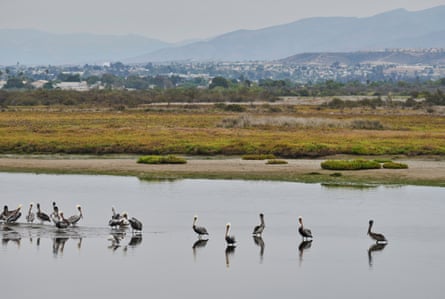
A view of the Tijuana River estuary. Photograph: John Francis Peters/The Guardian
The city has received some help with creating natural climate barriers. The Fish and Wildlife Service restored 400 acres of wetland next to the city as a national wildlife refuge which also acts as a barrier to flooding, and is expected to restore other wetlands together with the Port of San Diego. A grant is paying for improved equipment to warn of floods.
But that still leaves the huge costs of building new schools and drainage systems, and adapting other infrastructure. Dedina said that without the oil companies stumping up, it won’t happen.
“People ask, how did you go against the world’s largest fossil fuel companies? Isn’t that scary? No. What’s scary is coastal flooding and the idea that whole cities would be under water,” said the mayor.
“Honestly, bring it on. I can’t wait to make our case. I can’t wait to take the fight to them because we have nothing to lose.”
===
Exxon’s Conspiracy Charges Aim To Derail Climate Lawsuits - DeSmog
by David Halperin, crossposted from Republic Report
Oil giant ExxonMobil is engaged in unprecedented efforts to sue and harass in court the very people who are investigating and suing the company over global warming. Faced with determined efforts by states and localities to hold it and other fossil fuel companies accountable for contributing to, and concealing the evidence of, climate change, Exxon is crying foul, contending that it’s the victim of politically- and financially-motivated conspiracies.
But in reality there are no improper schemes behind the cases against Exxon. Instead, what’s troubling is an apparent effort by Exxon, one of the world’s wealthiest corporations, and its powerhouse corporate lawyers, to avoid a courtroom reckoning by making specious legal arguments and outspending their foes in the legal arena.
Through its attorneys at New York’s Paul Weiss Rifkin Wharton and Garrison, and Texas-based firms Haynes & Boone and Cantey Hanger, ExxonMobil has sued the attorneys general of Massachusetts, New York, and the U.S. Virgin Islands. And the company has recently targeted for depositions and document subpoenas, and threats of more lawsuits, numerous state officials, private attorneys, and advocates.
Exxon’s legal counterattack began after the Massachusetts, New York, and Virgin Islands AGs started investigating whether Exxon misled consumers and investors about the dangers of global warming and the potential impact of those dangers on the company’s bottom line. Investigative reporting in 2015 showed that Exxon scientists have known, and told Exxon management for decades, that burning fossil fuels was heating up the planet, but rather than educate the public on the dangers and change its business strategy, Exxon instead spent millions supporting efforts to question and deny the science of climate change. The state AGs also started investigating whether ExxonMobil has properly accounted for its oil reserves in the wake of global price drops and evidence of global warming.
The Massachusetts AG, Maura Healey, has explained that her investigation focuses “on whether Exxon may have misled consumers and/or investors with respect to the impact of fossil fuels on climate change, and climate change-driven risks to Exxon’s business,” in marketing energy products and in marketing Exxon securities, in violation of the state consumer protection law.
Similarly, New York’s AG, Eric Schneiderman, has indicated that he is investigating whether ExxonMobil’s public statements about climate change conflicted with its internal research, which could have led to “state law violations, including under the Martin Act,” the New York law that prohibits financial deception and fraud. (The New York AG reached settlements with Xcel Energy and Dynegy, Inc. in 2008 and with AES Corp. in 2009 based on those companies’ failures to disclose climate change risks in securities filings.)
In 2016, Exxon launched its response, suing Healey, Schneiderman, and U.S. Virgin Islands attorney general Claude Earl Walker in federal courts in its home region of Dallas-Fort Worth. The suit against Walker succeeded when his small office halted its investigation of the oil titan, but the other two AGs persisted.
U.S. District Judge Ed Kinkeade approved Exxon’s demand that Healey and Schneiderman submit to depositions by Exxon lawyers — an unwarranted, and virtually unprecedented move, as prosecutors aren’t normally required to face cross examination by people whom they’re investigating. Healey and Schneiderman fought back, seeking an unusual mid-case appeal to the 5th Circuit U.S. Court of Appeals, after which Kinkeade backed down, cancelled the depositions, and transferred the case to a federal court in New York.
As Exxon continues its efforts to convince a Manhattan federal judge to allow it to depose the two state AGs and, ultimately, to block their probes, it faces a new wave of lawsuits: since September 2017, eight cities and counties in California, plus New York City, have sued Exxon and other fossil fuel companies, alleging harm to their communities from climate change.
Related DeSmog investigation: “There is no doubt”: Exxon Knew CO2 Pollution Was A Global Threat By Late 1970s
The new lawsuits brought by California cities and counties — the cities of San Francisco, Oakland, Santa Cruz, Richmond, and Imperial Beach, plus Santa Cruz, San Mateo, and Marin counties — could pack a powerful punch. The suits allege that ExxonMobil, Chevron, ConocoPhillips, BP, Royal Dutch Shell, and others knew for decades that fossil fuel-driven global warming and rising seas threatened human life, but continued to expand their production, while deceiving consumers about the risks. Asserting that this conduct violates various state tort rules — public nuisance, failure to warn, design defect, negligence, and trespass — the suits demand that the companies pay for the costs of environmental harms like damages to seawalls, and dangers from severe weather, droughts, and fires.
These new lawsuits have a stronger chance of success than a 2008 case filed against fossil fuel companies by the small Alaskan community of Kivalina, seeking to recover the cost of relocating their village, which was threatened by rising sea levels. A federal judge dismissed that case, concluding that the village could not trace its injuries to any particular defendant. But today there is much more evidence that global warming is real, accelerating, and caused by burning fossil fuels, and that oil companies knew such information, suppressed it, and sought to counter it. Also, lawyers for the California cities and counties believe that recent scientific advances will make it easier to prove that the specific defendants’ activities harmed or threaten their client communities.
Faced with these mounting challenges to its conduct, ExxonMobil is relentlessly trying to change the subject.
In legal papers and public communications attacking the New York and Massachusetts attorney general investigations, Exxon has charged that various meetings among lawyers, advocates, and charitable foundation officials to discuss climate change liability issues, and communications between such people and attorneys general offices, are evidence of an untoward conspiracy against the company. Exxon further alleges that the AG probes attack the company’s First Amendment rights. “The attorneys general have violated Exxon Mobil’s right to participate in the national conversation about how to address the risks presented by climate change,” Dan Toal, one of Exxon’s lawyers at the Paul Weiss firm told Bloomberg.
Now Exxon and its allies are aiming to tie the new California lawsuits into this alleged conspiracy. The company is seeking to depose more than a dozen California officials, plus private attorney Matt Pawa, in anticipation of a threatened lawsuit alleging violation of the company’s free speech and other constitutional rights. In a January 8 Texas court petition seeking the depositions, Exxon charges, “A collection of special interests and opportunistic politicians are abusing law enforcement authority and legal process to impose their viewpoint on climate change.”
A recent op-ed by New York business consultant John Burnett attacked some of the California cities and counties for hiring outside lawyers to sue Exxon and paying them on a contingent basis — meaning they get paid if and only if Exxon loses in court or settles — even though this consultant acknowledges that the cities and counties couldn’t afford to pay the lawyers any other way. He calls the arrangement “a perilous new frontier in the world of ambulance-chasing by elected officials.” Similarly, Linda Kelly, general counsel for the National Manufacturers Association, told a reporter, “From Richmond, California, to New York City, activist-driven lawsuits are being filed to undermine manufacturers in America without regard to the facts.”
But these counterattacks on those pursuing Exxon are themselves fueled by false information and unwarranted charges.
I’ve worked for many years in association with some of the people Exxon has claimed are part of the alleged conspiracy. They aren’t conspirators. They generally do their work and make their cases out in the open. A 2012 meeting in La Jolla, California, among private lawyers and climate experts that Exxon repeatedly cites as the birthplace of the secret plot was meticulously documented and photographed by the participants themselves.
There’s also nothing sinister or unusual about scientists, private lawyers, other experts, or simply concerned citizens providing evidence and arguments to state attorney general offices regarding potential legal violations, including, indeed especially, in complex matters involving powerful actors. There’s nothing wrong with state and local law enforcement officials working in parallel on probing a common issue or target — it happens frequently. Nor are public statements by officials regarding those probes proof of political bias or an impingement on Exxon’s First Amendment rights. And nor is it unusual or improper for local governments to hire private lawyers to protect their residents’ interests in court.
The AGs and local officials are doing their jobs — pursuing evidence of law-breaking. If Exxon believes it has behaved properly with respect to climate change, it should use its expensive and talented lawyers to defend itself on the merits, rather than harassing others over invented conspiracy theories.
===
===
gmail 2 24
Maryland communities move one step closer to putting Big Oil on trial following appeals court ruling.
Communities in Maryland are closer than ever to putting Big Oil on trial after a federal appeals court this week once again rejected industry attempts to escape facing accountability for their climate lies. The ruling continues the unbroken string of judicial wins for local governments seeking to hold fossil fuel companies accountable for their decades-long campaign of climate deception in state court.
The U.S. Court of Appeals for the Fourth Circuit unanimously rejected oil majors’ — including ExxonMobil, BP, Chevron, and the American Petroleum Institute — attempts to stop cases in Annapolis and Anne Arundel County, Maryland, from moving forward in state court, where they were originally filed. The Fourth Circuit issued a similar ruling in favor of the City of Baltimore’s climate accountability lawsuit in 2022.
Oil and gas companies have attempted to remove many of the climate accountability lawsuits they’re facing from state court, only to be repeatedly shut down by courts time and again.
Federal district courts across the nation have now rejected these same oil industry arguments a total of 17 times, including in Vermont, Minnesota, D.C., California, Hawai’i, Connecticut, Massachusetts, Rhode Island, New Jersey, Delaware, South Carolina, and Colorado. Those rulings have been affirmed 11 times by eight separate federal appeals courts.
“The companies have sought—over and over and over—to remove the cases to federal court,” wrote Judge Toby Heytens in the unanimous ruling for Annapolis and Anne Arundel County. “By our count, that gambit has failed in at least ten cases already. The eleventh time is not the charm.”
In 2021, U.S. District Judge Derrick Watson wrote that Big Oil’s arguments for federal jurisdiction in accountability lawsuits brought by state and local governments have “a batting average of .000.” More than two years later, that’s still the case.
===
YMAIL 2 24 ExxonKnews
Chicago last week brought the newest lawsuit against Big Oil companies for spreading disinformation about the climate-warming hazards of burning fossil fuels — adding the third largest city in the U.S. to the growing list of state and local governments pushing for oil and gas majors to be held accountable in court.
The case charges BP, Chevron, ExxonMobil, Shell, ConocoPhillips, and the American Petroleum Institute with conspiring together and through front groups to run “tobacco-industry-style campaigns to deceive and mislead the public about the damaging nature of their fossil fuel products.” The fallout of those campaigns, according to the complaint, was a long delay in climate action that has come at an increasingly unbearable cost to Chicago residents — particularly in its low income neighborhoods and communities of color.
City officials say their legal action is necessary for the city to help shift the financial burden of adapting to climate disasters away from those communities and back onto the companies most responsible.
“There is no justice without accountability,” said Mayor Brandon Johnson in a statement. “From the unprecedented poor air quality that we experienced last summer to the basement floodings that our residents on the West Side experienced, the consequences of this crisis are severe, as are the costs of surviving them. That is why we are seeking to hold these Defendants accountable.”
Ted Boutrous of law firm Gibson, Dunn and Crutcher, an attorney for Chevron and chief architect of Big Oil's legal arguments in these cases, said in a statement that “addressing climate change requires a coordinated international policy response, not meritless local litigation over lawful and essential energy production.”
The city is charging the companies with 10 counts of failure to warn, negligence, fraud, conspiracy, and public nuisance, and it asks for compensatory damages and the disgorgement of profits made in the course of the industry’s fraud, among other remedies. The lawsuit, filed Tuesday in Cook County court, also requests a jury trial, where the companies could face more evidence of their deception gained through the discovery process.
That deception, Chicago argues, includes the oil majors’ ongoing campaigns to “falsely present themselves as corporate leaders in the fight against climate change, claiming to invest substantially in low-emission technologies and zero-emission energy sources, while their business continues to be overwhelmingly focused on fossil fuel production and sales.”
As one example, the complaint cites a recent BP ad targeting Illinois Facebook users that claims “We agree - the world needs fewer emissions. That's why we're working to make all forms of energy cleaner and better.” BP is simultaneously reneging on its climate pledges and increasing its production of oil and gas.
“At the end of the day, the climate crisis that we’re enduring was known by fossil fuel companies — they were warned decades ago by their own scientists of the potentially severe or even catastrophic consequences of their approach,” said Chicago Alderman Matt Martin, who applauded city leaders’ decision to file suit. “These companies should no longer be allowed to shift the burden of paying for the impacts resulting from that conduct onto Chicagoans.”
The harm to Chicago from climate change
It might be difficult to imagine what climate change looks like for a Midwestern city far from rising seas and hurricanes — but Chicago is susceptible to a spate of climate threats.
Chicago’s complaint cites more frequent and intense storms, flooding, droughts, shoreline erosion, toxic algae blooms in Lake Michigan, and extreme heat events like a four-day heat wave in 1995 that killed more than 700 Chicagoans.
The 1995 heat wave was a “watershed moment,” said Daniel Horton, who leads the Climate Change Research Group at Northwestern University. “Since that time the city has done a number of things to improve community resilience, but we expect more heatwaves in the future as the world continues to warm — so we have to constantly update our policies and prepare for extreme heat,” he added.
Many victims of that heat wave were elderly, low-income, and Black, residing in apartments without air conditioning. Those groups are still most at risk from extreme heat and air pollution in Chicago, which can coincide to produce “profound public health consequences,” said Horton, like they did when wildfire smoke from Canada gave the city the worst air quality in the world in June. The same demographics were also hit hardest during a severe rain event in July, which wreaked havoc on Chicago’s West Side, and are most susceptible to the city’s more-regular flooding.
“When you’re talking about the legacy of environmental racism all across the city, too often with regard to both severe weather and other aspects of the climate crisis, the communities bearing the brunt of that devastation are lower income communities of color,” said Alderman Martin.
Chicago is an “incredibly segregated city,” explained Horton, where Black and Hispanic communities are far more likely to live in places that are hotter, have poorer air quality, and are most flood-prone. The city can make decisions to ease the burden on those communities — like figuring out “where to increase our green infrastructure, building more of a green canopy and reducing the heat island effect, deciding where to build cooling centers in neighborhoods that have more vulnerable citizens or people without access to air conditioning or the ability to pay for it,” he said. The more the city invests in community adaptation, the higher the price tag — in its complaint, the city said it is already spending $188 million on climate projects in low-income communities — and that’s the kind of thing Chicago wants oil companies to help pay for.
“There’s surviving, and then there’s thriving,” Horton said. “I like to think surviving isn’t the goal.”
“Another powerful player”
More than 25% of all Americans are now represented by governments taking oil companies to court for climate deception. Chicago’s lawsuit brings “another powerful player into the game,” remarked Pat Parenteau, an environmental law professor at Vermont Law School.
“There’s strength in numbers, and the more entities like Chicago and California that have the resources to do battle, the better, from the plaintiffs’ side of it,” Parenteau said.
Chicago is suing as similar cases across the country move toward trial in state court. Massachusetts' consumer fraud case against Exxon is currently in the pre-trial discovery phase, and the City and County of Honolulu is in the process of agreeing what discovery will look like once it starts. Delaware is requesting that the state’s Supreme Court review a lower court’s ruling regarding which parts of its case can be heard at trial. In Italy, the trial for twelve Italian citizens’ lawsuit against oil giant Eni just kicked off.
Parenteau had a long list of reasons why new communities like Chicago would choose to sue now — growing evidence of what the companies knew and how they lied, more attribution science linking specific companies’ emissions to specific damages, the state of California filing suit, plaintiffs winning the fight to keep their lawsuits in state court, and other legal successes against oil majors across the world.
Or it could be simpler than all that. “These cities are beginning to realize just how much money they’re facing to deal with climate effects, and the recalcitrance of the oil companies that are sitting on piles of money and making more every year,” he said. “Maybe it’s too much for them to ignore.”
Thanks for reading ExxonKnews!
===
===
cases CCI list
no graphics
Each of these cases has been brought under one or more of the following legal theories:
The polluter pays principle is the underlying basis for the common law torts claims of nuisance, trespass and negligence alleged in several suits. This principle maintains that those who produce pollution should bear the costs of the damage to human health or the environment. In other words, the fossil fuel industry should pay for their fair share of the climate damages that they have caused.
Claims for design defect or failure to warn consumers arise when a producer or manufacturer knew or should have known that the normal use of its product would cause harm and fails to act on this knowledge. The fossil fuel industry put its products into the stream of commerce with full knowledge of the catastrophic climate consequences, and therefore should be liable for the harms.
“Climate fraud” lawsuits seek to hold fossil fuel companies and their trade associations (strictly) liable for misleading and deceptive marketing and promotion of fossil fuels. State consumer protection statutes have proven to be an effective tool in holding corporate actors accountable for their lies and deception. These statutes were at the heart of the successful Attorney General-led tobacco litigation in the 1990s, as well as the recent wave of opioid litigation.
The Racketeer Influenced and Corrupt Organizations (RICO) Act is a U.S. federal law that allows for the prosecution of individuals, companies, associations and more that have coordinated and conspired to conduct unlawful and fraudulent activities that have caused harm to another’s business or property. Many states have similar laws as well.
Climate Liability Litigation
Climate Damages (Cost Recovery) & Climate Fraud (Consumer Protection)
Climate Fraud (Consumer Protection)
Climate Damages (Cost Recovery)
Racketeering
Other Legal Actions to Protect Communities
---
may 2023
honolulu has lost more than 5 miles of its famous beaches to sea level rise and storm surges. Sunny-day flooding during high tides makes many city roads impassable, and water mains for the public drinking water system are corroding from saltwater because of sea level rise.}:
The damage has left the city and county spending millions of dollars on repairs and infrastructure to try to adapt to the rising risks.
Future costs will almost certainly be higher. More than US$19 billion in property value, at today’s dollars, is at risk by 2100 from projected sea level rise, driven by greenhouse gas emissions largely from the burning of fossil fuels. Elsewhere in Honolulu County, which covers all of Oahu, many coastal communities will be cut off or uninhabitable.
Unwilling to have their taxpayers bear the full brunt of these costs, the city and county sued Sunoco LP, Exxon Mobil Corp. and other big oil companies in 2020.
Their case – one of more than two dozen involving U.S. cities, counties and states suing the oil industry over climate change – just got a break from the U.S. Supreme Court. That has significantly increased their odds of succeeding.
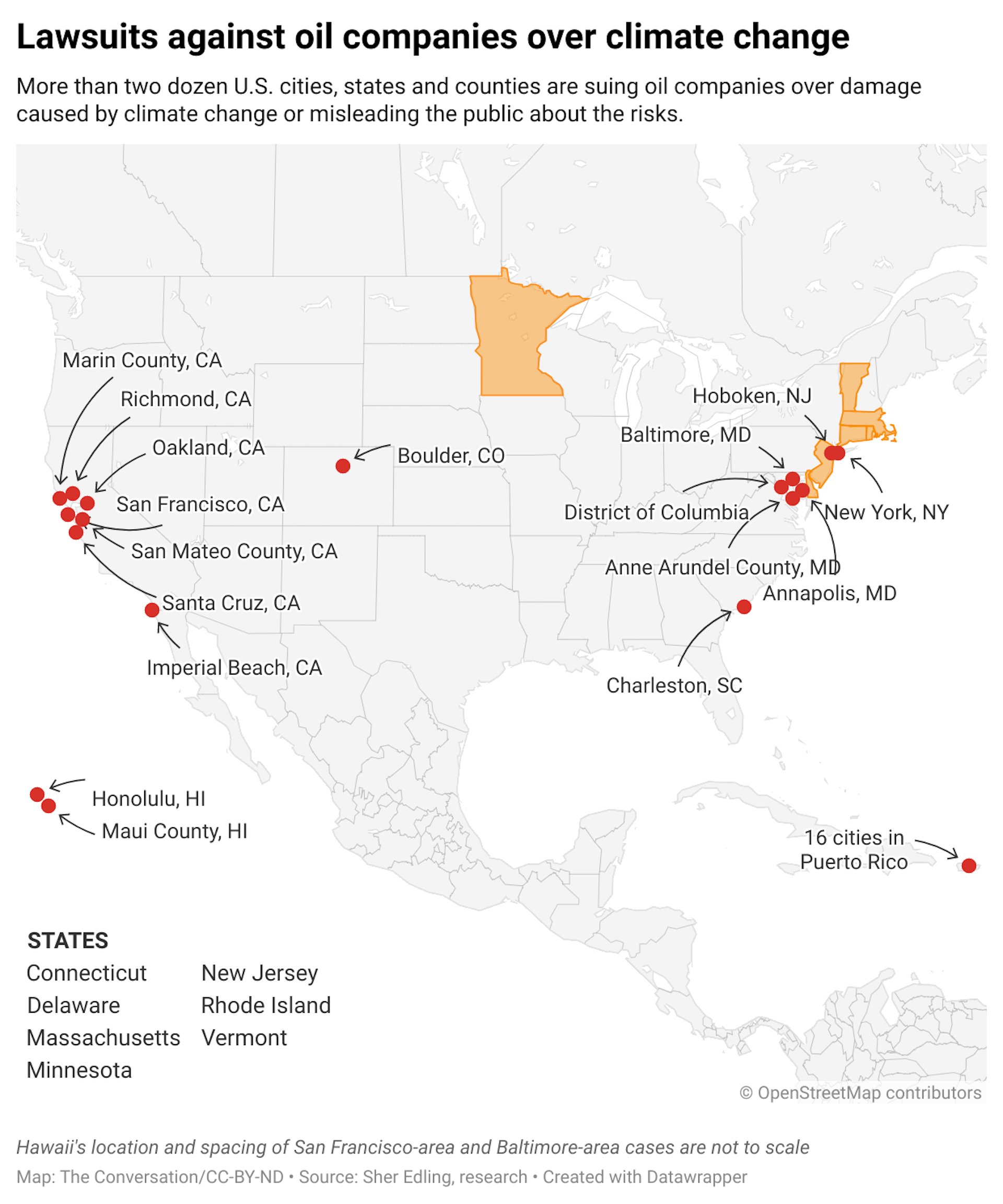
Suing over the cost of climate change
At stake in all of these cases is who pays for the staggering cost of a changing climate.
Local and state governments that are suing want to hold the major oil companies responsible for the costs of responding to disasters that scientists are increasingly able to attribute to climate disruption and tie back to the fossil fuel industry. Several of the plaintiffs accuse the companies of lying to the public about their products’ risks in violation of state or local consumer protection laws that prohibit false advertising.
IFrame Content nice map
The governments in the Honolulu case allege that the oil companies “are directly responsible” for a substantial rise in carbon dioxide emissions that have been driving climate change. They say the companies should contribute their fair share to defray some of the costs.
The gist of Honolulu’s complaint is that the big oil companies have known for decades that their products cause climate change, yet their public statements continued to sow doubts about what was known, and they failed to warn their customers, investors and the public about the dangers posed by their products.
Were it not for this deception, the lawsuit says, the city and county would not be facing mounting costs of abating the damage from climate change.
Importantly, the complaint is based on state – not federal – law. It alleges that the defendants have violated established common law rules long recognized by the courts involving nuisance, failure to warn and trespass.
The city and county want the companies to help fund climate adaptation measures – everything from building seawalls and raising buildings to buying flood-prone properties and restoring beaches and dunes.
Supreme Court could have killed these cases
Not surprisingly, the oil companies have thrown their vast legal resources into fighting these cases.
On April 24, however, they lost one of their most powerful arguments.
The U.S. Supreme Court declined to hear challenges in the Hawaii case and four others involving the seemingly technical question of which court should hear these cases: state or federal.
The oil companies had “removed” the cases from state court to federal court, arguing that damage lawsuits for climate change go beyond the limits of state law and are governed by federal law.
That theory would have derailed all five cases – because there is no federal common law for greenhouse gases.
The court made that position clear in 2011 in American Electric Power Co. v. Connecticut. Several state and local governments had sued five major power companies for violating the federal common law of interstate nuisance and asked for a court order forcing these companies to reduce their emissions. The Supreme Court refused, holding that the federal Clean Air Act displaced federal common law for these gases.
In Native Village of Kivalina v. Exxon Mobil Corp., a federal court of appeals extended that holding to also bar claims for monetary damages based on federal common law.

Several coastal communities, including in Honolulu County, facing increasing erosion want oil companies to help pay for protective infrastructure. AP Photo/Audrey McAvoy
To avoid this fate, Honolulu and the other plaintiffs focused on violations of state law, not federal law. Without exception, the federal courts of appeals sided with them and sent the cases back to state court.
What happens next?
The Honolulu case leads the pack at this point.
In 2022, the 1st Circuit Court in Hawaii denied the oil companies’ motion to dismiss the case based on the argument that the Clean Air Act also preempts state common law. This could open the door for discovery to begin sometime this year.
In discovery, senior corporate officers – perhaps including former Exxon Mobil CEO Rex Tillerson, who was secretary of state under Donald Trump – will be required to answer questions under oath about what the companies knew about climate change versus what they disclosed to the public.

In 2019, former Exxon Mobil CEO Rex Tillerson testified in a securities fraud lawsuit brought by the New York attorney general’s office. The judge ruled in Exxon’s favor. AP Photo/Seth Wenig
Evidence from Exxon documents, described in a recent study by science historians Naomi Oreskes and Geoffrey Supran, shows that the company’s own scientists “knew as much as academic and government scientists knew” about climate change going back decades. But instead of communicating what they knew, “Exxon worked to deny it,” Supran and Oreskes write. The company overemphasized uncertainties and cast doubt on climate models.
This is the kind of evidence that could sway a jury. The standard of proof in a civil case like Honolulu’s is “preponderance of the evidence,” which roughly translates to 51%. Ten of the 12 jurors must agree on a verdict.
Any verdict likely would be appealed, perhaps all the way to the U.S. Supreme Court, and it could be years before the Honolulu case is resolved.
Lawsuits don’t begin to cover the damage
It is unlikely that even substantial verdicts in these cases will come close to covering the full costs of damage from climate change.
According to the National Oceanic and Atmospheric Administration, in 2022 alone the U.S. sustained 18 weather and climate disasters that each exceeded $1 billion in damage. Together, they cost over $165 billion.
But for many of the communities most at risk from these disasters, every penny counts. We believe establishing the oil companies’ responsibility may also discourage further investments in fossil fuel production by banks and brokerage houses already nervous about the financial risks of climate disruption.
- Climate change
- Adaptation
- Erosion
- New York
- Consumer protection
- Extreme weather
- US Supreme Court
- Climate science
- ExxonMobil
- Coastal erosion
- Hawaii
- Minnesota
- US courts
- Baltimore
- Civil law
- Fossil fuel industry
- Big Oil
- Lawsuits
- Nuisance laws
- Climate change law
- Civil lawsuits
- storm damage
- Climate misinformation
- Extreme storms
---
The civil case, filed in superior court in San Francisco, is the latest and most significant lawsuit to target oil, gas and coal companies over their role in causing climate change. It seeks creation of an abatement fund to pay for the future damages caused by climate related disasters in the state.Sep 15, 2023
### California Sues Oil Giants, Claiming Decades of Deception
---
horner clw gao

---
https://thehill.com/opinion/energy-environment/417416-suing-americas-manufacturers-calling-them-a-public-nuisance-wont/
Across the country, the jobs of manufacturing workers are being threatened by trial attorneys and politicians targeting manufacturers with baseless lawsuits based on the legal theory of “public nuisance,” attempting to hold manufacturers responsible for harms that are often far outside of their control. While trial lawyers have pursued such lawsuits for years, there has been a dramatic increase over the past year, as lawyers team up with states, cities and counties to sue manufacturers over climate change. This is why, one year ago, the National Association of Manufacturers (NAM) launched the Manufacturers’ Accountability Project (MAP) to help bring attention to the coordinated campaign behind these lawsuits and has made it clear that they will do nothing to improve the environment but could do serious damage to our legal system and our manufacturing industry.
California Manufacturers and Technology AssociationPresident Dorothy Rothrock has said the law firms are in it for the money. Indeed, the private attorneys representing the municipalities stand to earn hundreds of millions of dollars if they get a favorable ruling in court.
To date, 14 municipalities and one state have filed such litigation against dozens of energy manufacturers.{mosads}:
So far, each lawsuit that has been considered in federal court has been dismissed, with the judges finding several flaws in the municipalities’ arguments. In dismissing the cases brought by San Francisco and Oakland, U.S. District Judge William Alsup rightly told the plaintiffs that the court is not the proper branch of government to address the issue of climate change:
“The problem deserves a solution on a more vast scale than can be supplied by a district judge or jury in a public nuisance case,” Judge Alsup wrote in his opinion. “The Court will stay its hand in favor of solutions by the legislative and executive branches.”
U.S. District Judge John Keenan agreed with Judge Alsup’s logic, dismissing New York City’s climate lawsuit against five of the country’s largest energy companies in July. Another fatal flaw in New York City’s argument, Keenan found, was that the plaintiff was attempting to hold only manufacturers accountable for climate change when it is a problem to which everyone contributes. “Aren’t the plaintiffs using the product?” Judge Keenan asked the city’s outside counsel. “Does the city have clean hands?”
These dismissals are an encouraging sign that the outstanding lawsuits against manufacturers — filed by Rhode Island, Baltimore, Boulder and others — will face a similar fate in the coming months.
It is also encouraging that a growing number of public officials are speaking out against the litigation. For example, in Colorado, the state’s newly elected attorney general Phil Weiser recently criticized the climate lawsuit filed by three municipalities in his state, saying he is “uncomfortable with the litigation because the case for it hasn’t been made.”
Oklahoma Attorney General Mike Hunterhas also commented on the lawsuits, saying, “In short, the courts are no place to determine national environmental policy. And public nuisance is not a theory the judges should employ in these kind of cases.”
Louisiana Solicitor General Liz Murrill said these suits “commandeer the rightful role of Congress to pass policy for the nation and are improper in terms of trying to legislate extraterritorial economic policy from the states in which they originate.”
We will continue to fight on behalf of manufacturing workers whose jobs are at stake. Manufacturing is too critical to the American economy to allow this threat to go unanswered.
NOTE: This post has been updated from the original to correct Judge Keenan’s first name and to clarify the lawsuits that have been dismissed.
Lindsey de la Torre is the Executive Director of the Manufacturers’ Accountability Project, a project of the National Association of Manufacturers’ Center for Legal Action. She previously served in the office of Presidential Personnel in the George W. Bush White House and in the Office of Associate Attorney General at the U.S. Dept. of Justice.
TAGS ABUSE OF THE LEGAL SYSTEMCLIMATE CHANGELAWSUITSNUISANCE
---
oakland
| FILING DATE | TYPE | FILE | ACTION TAKEN | SUMMARY |
|---|---|---|---|---|
| 06/14/2021 | Order List | Download | Certiorari denied. | Supreme Court Declined to Review Ninth Circuit Reversal of Denial of Remand in Oakland and San Francisco Climate Cases. On June 14, 2021, the U.S. Supreme Court denied fossil fuel companies’ petition for writ of certiorari seeking review of the Ninth Circuit’s decision reversing the district court’s 2018 denial of Oakland’s and San Francisco’s motions to remand their climate change nuisance cases to California state court. The petition had requested that the Court consider the questions of “[w]hether putative state-law tort claims alleging harm from global climate change are removable because they arise under federal law” and “[w]hether a plaintiff is barred from challenging removal on appeal after curing any jurisdictional defect and litigating the case to final judgment.” The cities’ renewed motion for remand is currently pending in the district court, with the cities arguing against the companies’ remaining grounds for removal: federal-officer removal, Outer Continental Shelf Lands Act, enclave jurisdiction, and bankruptcy removal. The cities also have filed a motion to amend their complaints to withdraw federal common law public nuisance claims that they added after the district court denied remand. |
| 05/24/2021 | Reply | Download | Reply brief filed by petitioners. | Briefing was completed on the fossil fuel companies’ petition for writ of certiorari, and briefs were distributed for the justices’ June 10, 2021 conference. |
| 05/10/2021 | Brief | Download | Brief filed by respondents in opposition to petition for a writ of certiorari. | In their brief opposing certiorari, the cities framed the questions presented as “[w]hether a California state law public nuisance claim alleging wrongful and deceptive promotion of hazardous consumer goods ‘arises under’ a congressionally displaced body of federal common law regarding interstate air pollution for purposes of removal jurisdiction” and “[w]hether respondents waived their right to appeal an erroneously denied remand motion by filing an amended complaint to conform to that erroneous ruling while expressly preserving their appellate rights, and then opposing petitioners’ motion to dismiss that amended complaint.” The cities argued that no existing federal common law “governs” their claims under the California representative public nuisance law, and that the Ninth Circuit’s application of the well-pleaded complaint rule did not warrant review. The cities also contended that the Ninth Circuit’s application of the Court’s precedent concerning whether post-removal amendment of complaints waived objections did not warrant review. In addition, the cities argued that the questions were not “certworthy” because they “arise in only a tiny category of cases” and because the petition was a “poor vehicle” to review the questions since there had been no final determination on the jurisdictional issue raised. |
| 03/11/2021 | Amicus Brief | Download | Brief filed by American Petroleum Institute as amicus curiae supporting petitioners. | |
| 03/11/2021 | Amicus Brief | Download | Brief filed by Chamber of Commerce of the United States of America as amicus curiae in support of petitioners. | |
| 03/11/2021 | Amicus Brief | Download | Brief filed by Indiana and 16 other states as amici curiae in support of petitioners. | |
| 03/11/2021 | Amicus Brief | Download | Brief filed by National Association of Manufacturers as amicus curiae in support of petitioners. | |
| 02/22/2021 | Order | Motion to extend time to file response granted. | In the Supreme Court, the cities’ response to the certiorari petition is due on May 10, 2021, after they requested an extension of the deadline. | |
| 01/08/2021 | Petition for Writ of Certiorari | Download | Petition for writ of certiorari filed by defendants. | Certiorari Petition Filed in San Francisco and Oakland Case. On January 8, 2021, fossil fuel companies filed a petition for writ of certiorari seeking review of the Ninth Circuit’s May 2020 reversal of the district court’s 2018 denial of Oakland’s and San Francisco’s motions to remand their climate change nuisance cases to California state court. The petition requested that the Court consider the questions of “[w]hether putative state-law tort claims alleging harm from global climate change are removable because they arise under federal law” and “[w]hether a plaintiff is barred from challenging removal on appeal after curing any jurisdictional defect and litigating the case to final judgment.” (The cities added federal nuisance claims to their complaints after the district court denied the remand motions.) |
---
Supreme Court of the United States __ CHEVRON CORPORATION, et al., Petitioners, v. CITY OF OAKLAND, et al., Respondents. __ On Petition for a Writ of Certiorari to the United States Court of Appeals for the Ninth Circuit __ BRIEF OF INDIANA, ALABAMA, ALASKA, ARKANSAS, GEORGIA, KANSAS, KENTUCKY, LOUISIANA, MISSISSIPPI, MISSOURI, MONTANA, NEBRASKA, OKLAHOMA, SOUTH CAROLINA, SOUTH DAKOTA, TEXAS, UTAH, AND WYOMING AS AMICI CURIAE IN SUPPORT OF PETITIONERS __ Office of the Attorney General 302 W. Washington St. Indianapolis, IN 46204 (317) 232-6255 Tom.Fisher@atg.in.gov *Counsel of Record THEODORE E. ROKITA Attorney General THOMAS M. FISHER* Solicitor General KIAN J. HUDSON Deputy Solicitor General JULIA C. PAYNE Deputy Attorney General Counsel for Amici States Additional counsel listed with signature blocks
---
ggl 10 23
[### City of New York v. BP p.l.c. - Climate Change Litigation

Climate Change Litigation Databases
https://climatecasechart.com › Case Bundles](https://climatecasechart.com/case/city-new-york-v-bp-plc/)
Description: Action brought by New York City against fossil fuel companies seeking damages for climate change-related injuries. City of New York v. BP p.l.c..
[### City of New York v. Exxon Mobil Corp.

Climate Change Litigation Databases
https://climatecasechart.com › Case Bundles](https://climatecasechart.com/case/city-of-new-york-v-exxon-mobil-corp/)
Description: Lawsuit against oil and gas companies and trade group alleging they systematically and intentionally misleading consumers about their products' ...
[### U.S. Cities & States Are Suing Big Oil Over Climate Change

PBS
https://www.pbs.org › ... › Climate and Environment](https://www.pbs.org/wgbh/frontline/article/us-cities-states-sue-big-oil-climate-change-lawsuits/)
Aug 1, 2022 — At least 20 pending lawsuits filed by U.S. cities and states claim Big Oil misled the public on climate change. Here's where the suits ...
[### 'Watershed moment': California enters climate litigation fray

eenews.net
https://www.eenews.net › Articles](https://www.eenews.net/articles/watershed-moment-california-enters-climate-litigation-fray/)
Sep 18, 2023 — California, a top oil-producing state, is suing the oil majors and an influential ally — making it the latest and largest player among a ...
[### More than two dozen cities and states are suing Big Oil ...

The Conversation
https://theconversation.com › more-than-two-dozen-...](https://theconversation.com/more-than-two-dozen-cities-and-states-are-suing-big-oil-over-climate-change-they-just-got-a-boost-from-the-us-supreme-court-205009)
May 23, 2023 — Honolulu, Baltimore, Charleston, S.C. and several other cities harmed by rising seas and extreme weather are suing the oil industry.
[### Supreme Court deals blow to oil companies by turning ...

NBC News
https://www.nbcnews.com › politics › supreme-court](https://www.nbcnews.com/politics/supreme-court/supreme-court-rejects-oil-companies-appeals-climate-change-disputes-rcna49823)
Apr 24, 2023 — The court turned away oil company appeals in five cases involving claims brought by cities and municipalities in Colorado, Maryland, California, ...
[### Climate Change Complaint.pdf

Baltimore City Law Department (.gov)
https://law.baltimorecity.gov › default › files](https://law.baltimorecity.gov/sites/default/files/Climate%20Change%20Complaint.pdf)
This dramatic increase in atmospheric CO2 and other greenhouse gases is the main driver of the gravely dangerous changes occurring to the global climate. 3.
137 pages
[### California cities, counties can sue oil companies over ...

San Francisco Chronicle
https://www.sfchronicle.com › Politics](https://www.sfchronicle.com/politics/article/supreme-court-oil-companies-climate-17915300.php)
Apr 24, 2023 — The plaintiffs are San Mateo, Marin and Santa Cruz counties and the cities of Richmond, Santa Cruz and Imperial Beach (San Diego County). In a ...
[### Judge throws out New York City's climate change lawsuit ...

CNBC
https://www.cnbc.com › 2018/07/19 › judge-tosses-nycs-...](https://www.cnbc.com/2018/07/19/judge-tosses-nycs-climate-change-lawsuit-against-5-big-oil-companies.html)
Jul 19, 2018 — A federal judge on Thursday threw out a lawsuit brought by New York City against Exxon Mobil, Chevron and other oil companies for their role ...
- A federal judge dismissed New York’s lawsuit against five big oil and gas companies for their role in climate change.
- New York argued the companies should compensate the city for the cost of mitigating the effects of global warming.
- U.S. District Court Judge John F. Keenan ruled that problems associated with climate change should be tackled by Congress and the executive branch.
[### experts hail decision to let US climate lawsuits advance

The Guardian
https://www.theguardian.com › environment › apr](https://www.theguardian.com/environment/2023/apr/25/experts-hail-decision-us-climate-lawsuits-advance)
Apr 25, 2023 — Cities bringing climate litigation against oil majors welcome US supreme court's decision to rebuff appeal to move cases to federal courts.
[### New York City Sues ExxonMobil, Shell, BP, and The ...

NYC.gov
https://www.nyc.gov › office-of-the-mayor › news › n...](https://www.nyc.gov/office-of-the-mayor/news/293-21/new-york-city-sues-exxonmobil-shell-bp-the-american-petroleum-institute-systematically)
Apr 22, 2021 — NEW YORK —Today, on Earth Day, Mayor Bill de Blasio and Corporation Counsel James E. Johnson announced the filing of a lawsuit against Exxon, ...
[### Baltimore's climate change lawsuit returns to city court after ...

Maryland Daily Record
https://thedailyrecord.com › ...](https://thedailyrecord.com/?p=679550)
Aug 4, 2023 — A multimillion-dollar lawsuit that accuses oil companies of misleading the public about fossil fuels' effects on the climate is back in ...
[### New York City sues Big Oil for allegedly misleading ...

CNN.com
https://www.cnn.com › 2021/04/22 › business › oil-co...](https://www.cnn.com/2021/04/22/business/oil-companies-new-york-city-lawsuits/index.html)
Apr 22, 2021 — A spokesperson for ExxonMobil pointed out that New York City recently had another climate lawsuit dismissed and that such actions “have no ...
[### Judge Tosses City Climate Change Lawsuits Against Big Oil

Bloomberg
https://www.bloomberg.com › news › articles › city-cl...](https://www.bloomberg.com/news/articles/2018-06-26/city-climate-change-suits-against-big-oil-tossed-by-u-s-judge)
Jun 26, 2018 — Litigation by local governments in the U.S. including New York City, Boulder, Colorado, and eight California cities and counties is a new front ...
---