drought heat 2
new category, 8/14 belated
7/15 added heat wave but could grow to sep cats
this refers to esp Western US drought 2010-
bak 420 html /southwests
see texas
see jet stream EL NINO OCEAN WARMING CONVEYOR BELT GLACIERS
SEE FAMINE
see global weirding/chaos
see also water, hunger
---
-=-=
AN 8 26 // RECORD HEAT EU DROUGHT WILDFIRES
Trump has long craved Greenland, a large island in the North Atlantic controlled by Denmark. He has played a game of chicken by threatening to conquer the island and even vowed at a July NATO summit in Ankara to take Greenland for the United States. He has repeatedly posted a meme of his face acquisitively looming over a Greenlandic village with the slogan “Hello Greenland!”
Now Greenland Energy, a company created by Trump supporter Larry Swets of Texas last year in the midst of Trump’s imperialist rhetoric toward the island, has started moving drilling equipment to East Greenland’s Arctic basin. They claim they will mine $1 trillion in crude oil beneath the Jameson Land region. Both Denmark and Greenland are protesting. And, as one prominent TV news anchor pointed out, America may have in effect begun to invade Greenland.
“The minister in charge of mineral resources in the Greenland government did a local interview in Greenland in which he said he was absolutely sure this American oil company would never break the law and try to start this drilling project without permission,” MS NOW’s Rachel Maddow explained. “Should that happen, he said, Greenland has the means to stop their actions. He said, ‘This is a society governed by the rule of law, so I have some broad-shouldered men in black uniforms in the first instance who can help me deal with some illegal activities if I ask for them’ — by which he means, I think, the Greenlandic police. Then he said, ‘Ultimately, I'm sure that the Arctic Command will also contribute’ — by which he means the Danish military would also, he believes, intervene to stop this American oil company from trying to drill for oil in Greenland without any permission to do so.”
Maddow added, “So you put all this together: this Trump-aligned oil company based in Texas saying, ‘We're going to drill for oil in Greenland.’ Greenland saying, ‘Oh, no, you're not.’ The company going ahead and dropping off their drilling equipment anyway. Local residents saying, ‘We'll fight tooth and nail.’ The local government saying, ‘We'll use the police, we'll use the Danish military.’ You put it all together, and it kind of seems like we're invading Greenland. I mean, this company has somehow hornswoggled itself into a partnership with Dr. Phil to make what sure looks like propaganda TV shows about this ‘heroic and exciting’ oil-drilling project — which the government of Greenland says is illegal, and which they don't have permission to carry out.”
Ultimately she asked, “Honestly — is this how we invade Greenland? With Dr. Phil doing a ride-along, like he did with ICE [which Greenland Energy says they are going to do]? All because a Trump donor billionaire says he needs to drill this oil, and who cares what this little country says?”
If America invades Greenland, the European Union could activate its Anti-Coercion Instrument, a series of boycotts and trade restrictions that would effectively devastate America’s economy in retaliation for violating the sovereignty of European nations.
"The EU’s single market counts roughly 450 million consumers," wrote the German Marshall Fund's Antonia Wunnerlich and Georgina Wright in February. "As a result, these tools can have significant extraterritorial impact, even targeting foreign businesses without European subsidiaries. US and Chinese services firms are particularly exposed because their home countries run sizeable services surpluses with the EU."
Additionally, Greenland’s ice sheet is melting as a result of man-made climate change, which is destabilizing the Atlantic Meridional Overturning Circulation. If the situation worsens, it could lead to rising sea levels, widespread floods, severe storms and other extreme weather events.
“That rate of Greenland melt is approaching or exceeding rates of melt during natural warming periods over the past 12,000 years is not surprising,” Michael Mann, at the time a professor of atmospheric science at Penn State University, told this journalist for Salon in 2020. “It’s what I would expect given the evidence we have already.” He also said that one of his studies found “evidence of the freshening of the sub-polar North Atlantic that we would expect as Greenland continues to melt. That freshening is reducing the stratification of the ocean and likely slowing down the ‘conveyor belt’ ocean circulation (the real-world equivalent of the ‘The Day After Tomorrow’ scenario) showing how these potentially threshold-like climate responses are potentially linked.”
Mann added, “As I am fond of saying, uncertainty is not our friend. It’s cutting against us, not in our favor, as we see and learn more.”
---
CONTEXT AN TC 5 26
Talk of a “super El Niño” developing in 2026 is gaining momentum, with concerns rising that this climate pattern could bring extreme rainfall, heat, drought and destructive flooding around the world.
The signals appear to be in place: The tropical Pacific is warming along the equator, and computer models point toward extreme conditions by the end of the year.
However, forecasting El Niño is not like predicting next week’s weather. Forecasts for El Niño typically aren’t reliable before late spring – not because scientists don’t understand the system, but because we understand its limits.
As an ocean-atmospheric scientist who studies El Niño, I spend a lot of time thinking about what scientists can forecast confidently – and what remains uncertain. Here’s what we know about the current event, what we still don’t, and why many regions should begin preparing now, even if a strong, or “super,” El Niño never fully materializes.
Why is El Niño hard to forecast in spring
The starting point for any El Niño forecast is the heat stored beneath the surface of the eastern equatorial Pacific Ocean. Computer models use data about those conditions to simulate how ocean temperatures will evolve over the coming months, and how they affect weather patterns around the world.
Right now, an exceptionally large reservoir of warm water sits beneath the surface there. In principle, this ocean heat should be a reliable signal of El Niño developing. In practice, what happens next depends heavily on what the atmosphere does.
The warm reservoir was shaped by a burst of wind activity in early 2026. Normally, the Pacific trade winds blow from east to west along the equator, pushing warm water toward Asia and leaving cooler water near South America. But in April, a pair of cyclones straddling the equator caused the wind direction to reverse. This short-lived reversal triggered a downwelling Kelvin wave – a pulse of energy beneath the ocean surface moving eastward along the equator.
That subsurface pulse has now reached the eastern Pacific, helping fuel intense warming off South America. At the ocean surface, this can resemble the early stages of a strong El Niño.
But there is a catch.
For El Niño to develop fully, the ocean and atmosphere need to lock into a feedback loop: Warmer surface waters weaken the trade winds, triggering more downwelling Kelvin waves that push warm water eastward and reinforce the warming. But that loop doesn’t engage automatically. It requires repeated bursts of eastward winds to sustain the process.
Until that feedback loop takes hold, the ocean-atmosphere system is in an unpredictable phase. It might tip into a super El Niño. It might not.
Spring is precisely when forecasts are most uncertain. Impressive early signals can fade if the winds don’t cooperate.
There’s a further complication: When models detect strong subsurface warming, they can simulate a stronger feedback loop than actually develops.
The result is that models can look too confident – even alarming – despite the system not being locked in. As of mid-May 2026, the wind patterns needed to amplify the warming have not clearly emerged.
We’ve seen this scenario play out before. In both 2014 and 2017, forecast models were pointing toward strong El Niño conditions by midyear. In both cases, the anticipated wind patterns never fully materialized and El Niño either stayed weak or returned to a neutral state. The early signals were real, but the expected follow-through didn’t happen.
So what do the forecasts suggest?
The current forecasts for 2026-27 still span a wide range in mid-May – from expecting weak to strong El Niño conditions.
How the winds behave in the coming weeks will determine what develops. If trade winds weaken again at the right moment, it could tip the system into self-sustaining warming – the kind that’s hard to stop.
As of mid-May, long-range weather forecasts weren’t showing strong eastward wind bursts on the horizon that could strengthen El Niño. In fact, quite the opposite was expected for the second half of May: a burst of winds blowing in the opposite direction. A full month without major eastward wind activity would be a meaningful brake on ocean warming.
The Pacific has loaded the dice for El Niño, and the National Oceanic and Atmospheric Administration’s May outlook reflects elevated odds of El Niño developing and potentially strengthening later in the year. By NOAA’s mid-June update, the picture should be substantially clearer.
El Niño intensity matters for weather worldwide
The difference between a weak El Niño and an extreme one is not subtle. It reshapes climate patterns across the globe – and with them, real-world risks.
If El Niño intensifies into a strong or “super” event, it can drive drought in the Amazon, fires in Indonesia, flooding in Peru and heavy rainfall in parts of California and southern South America. These effects could materialize by the Northern Hemisphere winter, when El Niño typically peaks.
In some regions, the stakes are immediate.
In India, the monsoon rains, which support agriculture and water supplies for hundreds of millions of people, have historically weakened during strong El Niño events. Even modest shifts in monsoon strength can bring food and water shortages, and harm economies.
At the same time, when El Niño is strong, hurricane activity in the Atlantic is typically suppressed – a rare upside – while the eastern Pacific often becomes more active with storms.
El Niño can even push global temperatures temporarily higher, as changes in cloud cover and the amount of heat the ocean releases alter the planet’s energy balance.
In contrast, a weak El Niño produces far more muted effects. This is why predicting intensity matters.
Using uncertain forecasts in real-world decisions
Because El Niño forecasts deal in probabilities, deciding how to prepare for the seasons ahead should be based on managing risk – not waiting for certainty.
El Niño’s impact does not occur everywhere at once. Some effects emerge quickly. Its impact on the Indian monsoon and Atlantic hurricane activity unfold over the summer and early fall.
Other impacts arrive later, toward the end of the year when El Niño peaks, bringing extreme rainfall to parts of South America between November and January. In Southeast Asia, scorching heatwaves often emerge even later, in April of the following year.
In regions like India, decisions about how to respond to El Niño risks cannot wait for more certainty. Communities need to prepare their water infrastructure now in case El Niño means the monsoon season brings too little rain.
Even where forecasts suggest reduced risks – such as a quieter Atlantic hurricane season – it would be a mistake to assume safety. Destructive hurricanes still hit in otherwise quiet years.
Pedro DiNezio, Associate Research Professor in Climate Modeling, *University of Colorado Boulder
This article is republished from The Conversation under a Creative Commons license. Read the original article.
---
===}:
icn gmail 1 265
Iran’s Regime Has Survived War, Sanctions and Uprising. Environmental Crises May Bring It Down.
BY KATIE SURMA
Decades of water depletion, dam building and repression of scientists and environmentalists have driven Iran toward ecological crises that are fueling protests rocking the country.
---
GMAIL 11 25
Extreme heat events may be deadlier than previously projected, a new study finds. The study authors write that “while mitigating further global warming can reduce heat mortality, mass mortality events remain plausible at near-future temperatures despite current adaptations to heat.”
---
10 25 an
Drought is quietly pushing American cities toward a fiscal cliff
---
an 6 25
The 1973 dystopian sci-fi movie "Soylent Green "— which starred Charlton Heston and Edward G. Robinson and took place in 2022 — depicted a hellish world in which widespread pollution and global warming had led to severe food and water shortages as well as widespread hunger and desperation. Now, in 2025, a newly released study finds that severe weather is threatening crops in a major way — and that the production of some key crops in the United States could decrease by as much as 50 percent by the end of the 21st Century.
The study was published by Nature.com on Wednesday, June 19 and was, according to CNN's Laura Paddison, "eight years in the making." It was conducted by a group of scientists, including Solomon Hsiang of the Stanford Doerr School of Sustainability, and illustrates the link between food supply and climate change.
"Of the many impacts of the fossil fuel-driven climate crisis," Paddison reports in an article published by CNN that day, "damage to the global food system is one of the most terrifying. But the overall impact of climate change on crops — and how much it can be offset by farmers' adaptations — has been hard to establish and hotly debated…. The scientists analyzed six crops — maize, soybeans, rice, wheat, cassava and sorghum — in more than 12,000 regions across 54 countries.Together, these crops provide more than two thirds of humanity's calories."
READ MORE:Trump's new greed deal the ultimate act of destruction the prophets have predicted
The CNN reporter continues, "They also measured how real-world farmers are adapting to climate change, from changing crop varieties to adjusting irrigation, to calculate the overall impact of global warming. Their findings are stark."
Paddison notes that according to the study, "every 1 degree Celsius the world warms above pre-industrial levels will drag down global food production by an average of 120 calories per person per day." Hsiang warns that this will increase food prices.
Hsiang told CNN, "If the climate warms by 3 degrees, that's basically like everyone on the planet giving up breakfast…. This is a major problem. It's incredibly expensive. As a species, we have never confronted anything like this."
Paddison reports, "Wheat, soy and maize — high value crops for a lot of the world — will be especially badly affected, the study found. If humans keep burning large amounts of fossil fuels, maize production could fall by 40 percent in the grain belt of the U.S., eastern China, central Asia, southern Africa and the Middle East; wheat production could fall by 40 percent in the U.S., China, Russia and Canada; and soybean yields could fall 50 percent in the U.S."
READ MORE:'Catastrophe': Trump uses 'phony energy emergency' to 'illegally' destroy state laws
The CNN journalist adds, "The only staple crop that might be able to avoid substantial losses is rice, which can benefit from warmer nighttime temperatures…. Global warming will be particularly devastating for the U.S., where it's projected to reduce yields by 40 percent to 50 percent for all staple crops except rice, Hsiang said."
READ MORE:How climate change could upend the American Dream
*Read the study at Nature.com and find CNN's coverage here.
---
an common dr
as the Midwestern and Eastern U.S. braced for what could be the longest heatwave in decades for some locations, a wildfire near Los Angeles forced more than 1,000 people to evacuate over Father's Day weekend.
The climate crisis caused primarily by the burning of fossil fuels is making both heatwaves and wildfires more frequent and extreme, and politicians and environmental advocates pointed out the role that state and national policy can play in fueling extreme weather.
"Each of the last 12 months have been the hottest on record," Sen. Bernie Sanders (I-Vt.) wrote on social media on Sunday. "This week, cities across the country will see record-high temperatures. A vote for Donald Trump is a vote to surrender the fight against the devastation of climate change. We cannot let that happen."
"Politicians making bad policy decisions (like killing congestion pricing) is the number one cause of climate change, which makes heatwaves like this one worse."
Former U.S. President Donald Trump reportedly told oil and gas executives this spring that donating $1 billion to his campaign would be a "deal" for them because he would dismantle the Biden administration's climate regulations.
Sanders' remarks came as the National Weather Service (NWS) Weather Prediction Center forecast that "record-breaking heat" would "expand from the Midwest and Great Lakes to the Northeast this week, potentially lingering through early next week."
NWS said the heatwave would be the "first significant" heatwave of the season and could break daily temperature records and some monthly June temperature records for the portion of the country stretching from the Ohio Valley to the Northeast between Monday and next Saturday.
"The longevity of dangerous heat forecasted for some locations has not been experienced in decades," NWS said.
The heat index could come close to 105°F in many places, and nighttime temperatures of around 75°F mean that those without cooling infrastructure will see "little to no relief."
The high temperatures could impact millions of people from Michigan to Maine. As of Saturday, 22.6 million people were under extreme heat warnings, watches, or advisories, according toThe New York Times.
University of California, Los Angeles, climate scientist Daniel Swain told the Timesthat the heat would "affect a bunch of highly populated areas where there hasn't been quite as many stories about extreme heat recently," adding, "Now, it's New England's turn."
The NWS warned, "With the intense heat and high humidity it is important to take precautions to protect one's health, particularly those without effective cooling and/or adequate hydration."
New York Gov. Kathy Hochul issued a warning on social media on Saturday, pointing out that extreme heat is the leading weather-related cause of death in the U.S.
However, climate advocates criticized Hochul for exacerbating the root cause of more extreme heatwaves with her last-minute cancellation of a New York City congestion pricing plan earlier this month.
"Politicians making bad policy decisions (like killing congestion pricing) is the number one cause of climate change, which makes heatwaves like this one worse," the Sunrise Movement wrote in response to Hochul's post.
Long-time climate advocate and author Bill McKibben said: "This governor just blocked congestion pricing, one of the most important climate policy advances possible. She's redefining trolling."
Climate Central noted that, "while heatwaves are common in summer, this early season excessive, likely record-breaking heat is made as much as two times to five times MORE likely to occur in mid-June due to human-caused climate change (particularly overnight warmth)."
Meanwhile, on the West Coast, the Post Fire ignited at around 1:45 pm on Saturday local time in Los Angeles County, California, about 65 miles from downtown Los Angeles, The Washington Postreported.
As of Sunday afternoon, it had spread 12,265 acres and was 2% contained, according to California Department of Forestry and Fire Protection (Cal Fire). Fire officials said the blaze was fanned by heat, low humidity, and wind and had damaged two structures.
"Currently crews are working to construct perimeter fire lines around the flakes of the fire. Aircraft are working to stop forward progress but have limited visibility," Cal Fire wrote on Sunday, adding that "the fire is pushing up into Hungry Valley Park. California State Park Services have evacuated 1,200 people from Hungry Valley Park. Pyramid Lake is closed because of the threat of the Post Fire."
One of those evacuated was 33-year-old Oscar Flores, who was visiting Hungry Valley Park with his 12-year-old son on Saturday.
"It looked like it was the last day of the world," Flores told the Los Angeles Times. "People were loading quickly and merging out, driving fast. The ranger said you have 10 minutes [to get] whatever you can pack."
===
===
howler monkeys mex
mma 6 24
The recent extreme heat event that swept across the U.S. Southwest in early June — the first major heat wave of the year, which was made three times more likely because of climate change — served as a stark reminder of the escalating climate crisis. It also demonstrated the urgent need for national TV news coverage that consistently connects extreme weather to human-caused climate change.
Yet corporate broadcast and cable news shows largely ignored the climate connection in their coverage, and they missed other crucial opportunities as well: to connect the heat wave to recent climate attribution studies, to spotlight extreme heat’s impact on vulnerable populations, and to inform viewers about the climate implications of the 2024 election.
- ## Topline findings
- A Media Matters review of national TV news coverage of the extreme heat wave from June 4-9 found:
- National TV news networks covered the extreme heat event for 167 minutes across 97 segments. Climate change was mentioned in only 12% (12) segments.
- Cable news networks — CNN, Fox News, and MSNBC — aired a combined 114 minutes across 54 segments about the extreme heat event. Climate change was mentioned in 5 segments.
- Corporate broadcast TV networks — ABC, CBS, and NBC — aired a combined 54 minutes across 43 segments about the extreme heat event. Climate change was mentioned in 7 segments.
- CBS performed the best among all networks, airing as many segments that connected the heat to climate change as the three cable news networks combined. Nearly half of its total segments (12) included a mention of climate change (5).
- Only 4 climate segments also included a mention of how the extreme heat event could impact a socially marginalized population.
ICN 10 23
Under a 1944 treaty, Mexico must share water from the Rio Conchos and other tributaries of the Rio Grande with the United States in five-year cycles.
With the clock ticking toward an inexorable treaty deadline, the U.S. and Mexico are under pressure to find a solution without setting off a local rebellion. And climate change and drought, not to mention provocations from Texas politicians, are complicating the challenge.
Many in Chihuahua state are pleading with the Mexican federal government to find another way to comply with the treaty while saving the reservoir water for local farmers.
The government “should take a close look at the situation, at why farmers are opposed to them taking the water,” said Jaime Ramírez Carrasco, municipal president of the town of San Francisco de Conchos, an hour’s drive south of Delicias. “We can’t let life in our region be extinguished just to give life to another region.”
More of our coverage of the biggest story on the planet:
The U.S. Fish and Wildlife Service will consider tightening protections on the West Indian manatee after concluding that a petition demanding that the animal’s endangered status be restored presented substantial scientific evidence.
September’s stunning rise of the average global temperature is all but certain to make 2023 the warmest year on record, and 2024 is likely to be even hotter.
Solar projects are surging nationwide. But keeping solar cells out of the dump requires a market for recycled solar materials that is much more robust than what currently exists.
Tensions Rise in the Rio Grande Basin as Mexico Lags in Water Deliveries to the U.S.
BY MARTHA PSKOWSKI, INSIDE CLIMATE NEWS, AND PHOTOS BY OMAR ORNELAS, EL PASO TIMES
In 2020, rebellious Mexican farmers occupied a dam in parched Chihuahua state to prevent the federal government from sending its reservoir water to Texas under a 1944 treaty. With the clock ticking toward another treaty deadline, the two sides are struggling for a solution.
OMG
https://www.mediamatters.org/climate-deniers/15-nonsensical-comments-made-right-wing-media-during-2023s-summer-climate-fueled
15 nonsensical comments made by right-wing media during 2023’s summer of climate-fueled extreme weather events
Special PROGRAMS
CLIMATE & ENERGY
WRITTEN BY ALLISON FISHER
PUBLISHED 08/07/23
July 2023 was the earth’s hottest month on record, punctuated by record-shattering extreme heat events, catastrophic floods, and historic wildfires. While major media outlets sounded the alarm on the climate crisis, climate denial and downplay reached a fever pitch among right-wing media outlets and influencers.
Many in the right-wing media have downplayed the record heat — suggesting that it’s normal summer weather, despite clear evidence that the intensity of this summer’s heat waves would not have been possible without climate change — or dismissed its lethal impact by arguing that more people die of cold than heat. Others have said those linking July’s extreme weather to climate change are weaponizing these events to push a radical climate agenda or call for climate lockdowns.
Here are 15 other examples that illustrate the lengths to which right-wing media are going — often deploying nonsensical arguments or outright lies that attempt to ignore the fact that there is scientific consensus that carbon emissions are heating our planet— to maintain climate denial in the face of climate-fueled catastrophes:
1 in
- response to extreme weather that grounded planes in the Northeast, Fox host Rachel Campos-Duffy said the left is “trying to control the weather” and “trying to be God.” Fox News, :{Fox & Friends:(style="box-sizing:border-box"):}:, [7/3/23]
- Responding to calls for climate action, Newsmax host Eric Bolling denied that human activity is responsible for warming: “Real scientists, meaning those not purchased by the kings of propaganda, well, they’ll tell you there is actually no such thing as climate change.” Newsmax, :{Eric Bolling The Balance:(style="box-sizing:border-box"):}:, [7/11/23]
- Fossil fuel shill Steve Milloy on Newsmax’s Rob Schmitt Tonight: “The Earth is greener than ever before. Have we affected the planet and wildlife? Yeah, sure. But you know, in the end, it's been, I think, positive. The Earth is carrying more life now than ever before thanks to warming, thanks to CO2, thanks to fossil fuel use.” Newsmax, :{Rob Schmitt Tonight:(style="box-sizing:border-box"):}:, [7/11/23]
- Newsmax host Greg Kelly said that “LGBTQ+IA whatever has been kind of pushed so relentlessly. … I think climate change and the whole phony debate about it has something to do with it,” suggesting the goal is to decrease population in order to reduce climate impacts. Newsmax, :{Greg Kelly Reports:(style="box-sizing:border-box"):}:, [7/11/23]
- Fox host Jesse Watters suggested that U.S. special presidential envoy for climateJohn Kerry made it “impossible” to believe in climate change because according to Watters he lied about using a private plane. Fox News, :{Jesse Watters Primetime:(style="box-sizing:border-box"):}:, [7/13/23]
- Conservative radio and Fox News host Mark Levin on his radio show said climate change is a religion not based on science: “This is a religion. This is an ideology. This isn’t science. ...Don't you see how hot it is in Nevada? In the middle of the damn summer?It's what we have air conditioning for.”Westwood One, :{The Mark Levin Show:(style="box-sizing:border-box"):}:, [7/13/23]
- Far-right media host Steven Crowder claims that carbon dioxide is not pollution because plants use it: “Is carbon dioxide the — basically, you know, the neurotoxin atmospheric poison that people make it out to be? Because you just pointed out plants thrive on it.” Rumble, :{Louder with Crowder:(style="box-sizing:border-box"):}:, [7/15/23]
- Fox host Greg Gutfeld attempted to downplay the record-breaking heat with bizarre logic: “The problem with using weather — like saying, ‘This place broke records’ — how many states,how many countries didn't break records? Nobody ever provides you the context. They’re going, ‘Three countries had record-breaking heat waves.’ It’s like, well, how many countries are there?” Fox News, :{The Five:(style="box-sizing:border-box"):}:, [7/17/23]
- The Daily Wire’s Matt Walsh claimed that the record heat is not a result of human activity but the sun: “The sun … that’s what calls the shots on Earth. It determines the temperature. It determines everything in terms of weather. … And until you can figure out a way to literally control the sun, there is basically nothing we can do to intentionally and significantly raise, lower, or otherwise affect the temperature on Earth.” The Daily Wire, :{The Matt Walsh Show:(style="box-sizing:border-box"):}:, [7/18/23]
- The Daily Wire’s Ben Shapiro: “Thank God we have this thing called air conditioning. … You know what’s a great cure for being super-duper hot outside? Being a first world country.” The Daily Wire, :{The Ben Shapiro Show:(style="box-sizing:border-box"):}:, [7/20/23]
- Fox Business host Larry Kudlow on America Reports: “This is not an overly hot July. ... Hot weather happens in some places; cooler weather happens in other places. We do not have a climate catastrophe.” Fox News, :{America Reports:(style="box-sizing:border-box"):}:, [7/21/23]
- Turning Point USA founder Charlie Kirk on climate science and why carbon dioxide is not pollution: “The science is not solid. The science is debated. They look at science as if it is religious, irrefutable dogma.” Kirk added, “The built-in premise of the climate hoax is carbon is bad. OK, well, carbon is life, actually. … Don’t plants thrive on carbon dioxide?” Real America’s Voice, :{The Charlie Kirk Show:(style="box-sizing:border-box"):}:, [7/24/23]
- On The Ingraham Angle, American Majority founder Ned Ryun called climate change a “hoax”: “It is nothing more than an attempt to manipulate people into a state of fear to have them give more control over to a ruling elitewho would take this hoax and enforce it through a whole host of means.” Fox News, :{The Ingraham Angle:(style="box-sizing:border-box"):}:, [7/27/23]
- On America’s Newsroom, fossil fuel shill Daniel Turner deliberately conflated weather with climate: “And if you look at the weather forecast for this great city, where I’m born and raised, next Friday is mid-70s. So we are in what's called a heat wave.” Fox News, :{America’s Newsroom:(style="box-sizing:border-box"):}:, [7/28/23]
- Climate denier Marc Morano on Jesse Watters Primetime blamed global wildfires on arsonists, dismissing the role of climate change: “This is a global problem of people starting this. Now, is it climate change? Well, this would be the equivalent of blowing up a dam or sabotaging a dam and allowing a valley to flood and then saying, oh, look, climate change is causing more floods.” Fox News, :{Jesse Watters Primetime:(style="box-sizing:border-box"):}:, [7/28/23]
…
Next page
Related
Right-wing media deny climate change in face of deadly and record-breaking extreme weather event
07/20/23
Right-wing media downplay the hottest day in modern history with the help of Twitter’s community notes feature
07/11/23
Only 5% of national TV news segments on the record-shattering heat wave that scorched Texas mentioned climate change
07/03/23
an 8 23
David Stanway
SINGAPORE (Reuters) -Human-induced climate change has played an "absolutely overwhelming" role in the extreme heatwaves that have swept across North America, Europe and China this month, according to an assessment by scientists published on Tuesday.
Throughout July, extreme weather has caused havoc across the planet, with temperatures breaking records in China, the United States and southern Europe, sparking forest fires, water shortages and a rise in heat-related hospital admissions.
Over the weekend, thousands of tourists were evacuated from the Greek island of Rhodes to escape wildfires caused by a record-breaking heatwave.
Without human-induced climate change, the events this month would have been "extremely rare", according to a study by World Weather Attribution, a global team of scientists that examines the role played by climate change in extreme weather.
"European and North American temperatures would have been virtually impossible without the effects of climate change," said Izidine Pinto of the Royal Netherlands Meteorological Institute, one of the study's authors, during a briefing with journalists."In China it was around 50 times more likely to happen compared to the past."
The World Weather Attribution team estimated that risinggreenhouse gas concentrations made the European heatwave 2.5 Celsius (4.5 Fahrenheit) hotter than it would otherwise have been. They also drove up the North American heatwave by 2C and the one in China by 1C.
As well as directly impacting human health, the heat has caused large-scale crop damage and livestock losses, the scientists said, with U.S. corn and soybean crops, Mexican cattle, southern European olives as well as Chinese cotton all severely affected.
El Nino probably contributed to the additional heat in some regions, but rising greenhouse gases were the major factor, the scientists said, and heatwaves will become increasingly likely if emissions are not slashed.
They estimated that prolonged periods of extreme heat were likely to hit every two to five years if average global temperatures rise 2C above pre-industrial levels. Average temperatures are currently estimated to have risen more than 1.1C.
"The events we have looked at are not rare in today's climate," said Friederike Otto, a scientist with the Grantham Institute for Climate Change in London, speaking at the briefing. "It's not surprising from a climatological point of view, that these events are happening at the same time."
"As long as we keep burning fossil fuels we will see more and more of these extremes," she said. "I don't think there's any stronger evidence that any science has ever presented for a scientific question."
(This story has been refiled to fix link in paragraph 1)
(Reporting by David Stanway; editing by Miral Fahmy)
https://www.alternet.org/extreme-texas-heat-9-billion/ $ biz
more heat dome, greece US midwest
jeff goodell bk kpfa 7/26/23 upfront
salmon o2, grain crops, heat katrina grid fail no AC
heart cools but then a heat source (tip pt)
https://www.alternet.org/ocean-temps/
100 degree fla, coral bleach
//
https://www.alternet.org/weve-fallen-off-a-cliff/
no lnx twt an 7 23
'We’ve fallen off a cliff': Scientists warn Atlantic currents could collapse as early as 2025
Brett Wilkinsand Common DreamsJuly 26, 2023
"It is very plausible that we've fallen off a cliff already and don't know it," said one researcher.
The system of Atlantic Ocean currents that drive warm water from the tropics toward Europe is at risk of collapsing in the coming decades, an analysis of 150 years of temperature data published Tuesday concluded.
"The Atlantic Meridional Overturning Circulation (AMOC), which includes the Gulf Stream, is a major tipping element in the climate system and a future collapse would have severe impacts on the climate in the North Atlantic region," states the study, which was published in the scientific journal Nature Communications.
Although the analysis notes that "assessments by the Intergovernmental Panel on Climate Change (IPCC), based on the Climate Model Intercomparison Project (CMIP) model simulations suggest that a full collapse is unlikely within the 21st century," the study's authors "estimate a collapse of the AMOC to occur around mid-century under the current scenario of future emissions."
"We show that a transition of the AMOC is most likely to occur around 2025-2095," the paper states with "95% confidence."
University of Copenhagen professor Peter Ditlevsen, who led the study, told The Guardian: "I think we should be very worried. This would be a very, very large change. The AMOC has not been shut off for 12,000 years."
Bill McKibben, co-founder of the climate action group 350.org, tweeted that "Gulf Stream collapse used to be viewed as a far-off and remote possibility... Less so now."
Meteorologist and climate journalist Eric Holthaus called the study's findings "incredibly worrying."
The Washington Post reports:
The new study adds to a growing body of evidence that this crucial ocean system is in peril. Since 2004, observations from a network of ocean buoys [have shown] the AMOC getting weaker—though the limited time frame of that data set makes it hard to establish a trend. Scientists have also analyzed multiple "proxy" indicators of the current's strength, including microscopic organisms and tiny sediments from the seafloor, to show the system is in its weakest state in more than 1,000 years.
For thousands of years, the Gulf Stream has carried warm waters from the Gulf of Mexico northward along the eastern North American seaboard and across the Atlantic to Europe. As human-caused global heating melts the Greenland ice sheet, massive quantities of fresh water are released into the North Atlantic, cooling the AMOC—which delivers the bulk of the Gulf Stream's heat—toward a "tipping point" that could stop the current in its tracks.
According to The Guardian:
A collapse of AMOC would have disastrous consequences around the world, severely disrupting the rains that billions of people depend on for food in India, South America, and West Africa. It would increase storms and drop temperatures in Europe, and lead to a rising sea level on the eastern coast of North America. It would also further endanger the Amazon rainforest and Antarctic ice sheets.
"It is very plausible that we've fallen off a cliff already and don't know it," Hali Kilbourne, an associate research professor at the University of Maryland Center for Environmental Science, toldThe New York Times. "I fear, honestly, that by the time any of this is settled science, it's way too late to act."
Other studies—including one published in March and another in 2021—have also concluded that the AMOC is at risk of collapsing this century.
Meanwhile in the Southern Hemisphere, Antarctic currents that enrich 40% of Earth's deep oceans with oxygen and nutrients essential for marine life have slowed dangerously in recent decades and could also collapse by mid-century, an Australian study released in May showed.
FROM YOUR SITE ARTICLES
New evidence that an extraterrestrial collision 12,800 years ago triggered an abrupt climate change for Earth ›
What was the 'catastrophic implosion' of the Titan submersible? An expert explains ›
Atlantic Salmon Is Basically Extinct: You’re Eating a Genetically Eroded Version ›
RELATED ARTICLES AROUND THE WEB
A major Atlantic current is at a critical transition point | NOVA | PBS ›
Is Atlantic Ocean current near collapse? Could be sooner than ... ›
A Stagnant Jet Stream Is Fueling Intense Heat Worldwide. Could ... ›
aha: recall heartland rev engr if AGW is real, req gobal action thus not real
aha2 note that action esp climate /enviro by ANY branch, even the agency in charge of it is being called overreach = tyranny/loss of FFFRrrreeeeeedumb!
aha 3: jeez they call US alarmists, but purpose of fox / infowars is hype /attack Dems
london protests 7 22 break glass in emergency so they did
wow omg ingraham? 1100 dead
an 7 22
with thousands dying from extreme global heat in recent days, and as President Joe Biden announced new executive actions to address the climate crisis, right-wing media figures and climate deniers are downplaying the heat wave and the threat from human-caused climate change.
In Europe, extreme “red” heat warnings were issued in the United Kingdom for the first time, and Wales recorded its highest-ever temperature. Railroad lines, major highways, and airport runways in the U.K. buckled under the extreme heat. Multiple regions of Germany also set all-time highs, as did at least part of Denmark. Over 2,000people have died in Spain and Portugal due to the extreme heat, which has fueled wildfires there and in parts of France. These record-setting events are not contained to Europe. Parts of the U.S. and Central Asia are suffering from extreme heat as well.
Even though the extreme heat event in Europe is truly exceptional, and its connections to the climate crisis are unquestionable, multiple right-wing media figures used the extreme heat event to downplay and criticize any possible action to address the climate crisis.
Right-wing media also attacked Biden for considering declaring a climate emergency during this deadly heat wave. Instead Biden unveiled much more modest steps to address climate impacts, such as putting $2.3 billion toward community resilience and infrastructure and bolstering offshore wind development. The Federalist falsely declared that “Biden has no right to declare a ‘national climate emergency,’' though The Washington Post explained that such a move would “tap a variety of long-standing emergency authorities under the National Emergencies Act and other laws.” LifeSiteNews fearmongered thatthe emergency powers would result in “climate lockdowns.” And other right-wing media suggested that there is no crisis at all.
Right-wing media denied the existence of the climate emergency
Fox News host Dan Bongino questioned whether the planet is getting warmer and whether humanity played a role in it, asking: “What kind of a dunce believes that? Come on. Is it [the planet] getting warmer? The answer is maybe. … The question isn’t is it getting warmer; the question is what’s human beings' role in it.” Fox News, *Hannity*, [7/19/22]
Judicial Watch president Tom Fitton wrote on Twitter: “There is obviously no ‘climate emergency'.” Twitter, [7/19/22]
Fox host Tucker Carlson devoted a monologue to undermining the existence of climate change, reducing climate predictions to: “It’s gonna be hot and then it’s gonna rain hard.” “No one really believes in global warming,” he continued, “and that’s why all of the liberals in the United States live on the coasts – because they don’t believe it… The entire theory is absurd and they know it. … The whole thing is a joke.” Fox News, *Tucker Carlson Tonight*, [7/20/22]
On Fox, conservative British political commentator Douglas Murray dismissed the urgency of the climate crisis, saying, “Whenever there is not an absolutely vital recent emergency, we can always fall back on – oh and the climate emergency.” Fox News, *Fox & Friends*, [7/20/22]
Fox anchor Dana Perino asked: “What has changed with the science that would lead a president to need to declare an emergency?” Fox News, *America’s Newsroom*[, 7/20/22]
Fox host Todd Piro said that climate impacts, particularly the ones affecting the most vulnerable communities, did not meet his criteria for an emergency: “While we all love clean air and clean water — I, in fact, use both … this is not an emergency that we need to focus on today. We got a lot of other problems in the world.” Fox News, *Outnumbered*, [7/20/22]
Fox host Sean Hannity responded to new actions by the Biden administration to address climate change by dismissing the role of human influence over global warming saying, “I think these might be acts of nature, and God, and way out of the realm of something that human beings can prevent.” Fox News, *Hannity*, [7/20/22]
Conservatives also downplayed the deadly extreme heat
Climate change denying author Bjorn Lomborg dismissed the dangerous extreme heat event, writing on Twitter: “Standard climate scare.” Twitter, [7/17/22]
Climate denier Steven Milloy on Twitter dismissed a Washington Post article linking the Europe heat wave to climate change, writing: “Hot in some places. Cool in others. Just weather. Not climate.” Twitter, [7/19/22]
Fox & Friends co-host Brian Kilmeade dismissed the dangers extreme heat poses to human health, saying: “Don’t panic. It is summer. If it was December and this was happening, then I would say, this is a little weird. But it's just a little bit hotter than usual.” Fox News, *Fox & Friends*, [7/20/22]
Daily Wire founder Ben Shapiro said on his radio show that the heat wave and wildfires were being reported so fervently because “you always know that it’s the slow season newswise when you start getting weather reports from Europe. … The thing that they will never tell you, the media, is that more people die of cold every year than die of heat every year, but the cold narrative doesn’t tend to play into the climate change narrative that they wish to progmulate.” The Daily Wire, *The Ben Shapiro Show*,[7/19/22]
Fox host Jesse Watters dismissed the extreme heat event as regular seasonal weather, saying: “Joe Biden has seen more seasons than a lot of us. He knows that it gets cold in January and hot in July.” Fox News, *Jesse Watters Primetime*, [7/20/22
Watters followed this up with an interview during which an on-screen graphic read: “Dems worried about weather, not real problems.” Fox News, *Jesse Watters Primetime*, [7/20/22]
Fox host Greg Gutfeld said: “We are in a full-blown heat wave hysteria.” He said that while he does believe “it’s getting warmer,” climate advocates should “think about the opportunity cost of all the zealotry. You know? Panic didn’t work.” Fox News, *The Five*, [7/20/22]
Right-wing media also attacked the Biden administration for considering a climate emergency declaration
Conspiracy theorist Alex Jones claimed on his Infowars show that a climate emergency would be orchestrated by a “scientific global dictatorship whose aim is 90% world depopulation,” and that it would lead to a “dystopia”: “You’re gonna live in a 200-square-foot coffin apartment, you’re gonna be given forced inoculations five, six times a year, you’re gonna be sterilized, you’re gonna be killed.” Infowars, *The Alex Jones Show*,[7/20/22]
The Wall Street Journal editorial board called a possible emergency declaration “a serious abuse of power.” The Wall Street Journal, [7/19/22]
Kilmeade called Biden’s executive orders tone-deaf and “agenda-driven,” insisting that they “will do nothing but hurt the price of oil and gas.” Fox News, *Fox & Friends*,[7/19/22]
Hannity quoted climate denier Joe Bastardi, saying on his radio show that Democrats’ response to climate change is the“systemic dismantling of the American way of life.It’s not a rational response to a climate crisis.” Premiere Radio Networks, *The Sean Hannity Show*, [7/19/22]
Hosts of Fox’s Outnumbered claimed a possible climate emergency declaration from Biden “could cause a global depression,” is “suicide,” and is “going to kill the economy.” Fox News, *Outnumbered*, [7/19/22]
related: Tucker Carlson tells idiotic lie that “no one really believes in global warming”
07/20/22
Fox contributor calls for more coal plants as a solution to extreme heat
07/20/22
National TV networks mention climate change in 32% of segments on global extreme heat
07/19/22
FT 7 22
the deadly heatwaves that have fuelled blazes and caused transport disruptions in Europe, the US and China this month have one thing in common: a peculiar shape in the jet stream dubbed “wavenumber 5”.
Scientists are racing to understand whether the band of fast-moving air that controls weather in the mid-latitudes is changing in a way that makes heatwaves more frequent and persistent.
“The jet stream is the leading driver of our weather,” explains Paul Williams, professor of atmospheric science at the University of Reading. “The jet stream is like a conveyor belt, delivering storms to us one after the other.”
It can also generate heatwaves when it forms into a U-bend shape, called an “omega block” because it resembles the shape of the Greek letter omega.
Right now, a global pattern of five big waves is circling the world, leading to simultaneous heatwaves across continents. This pattern, known as wavenumber 5, can persist for weeks, causing hot areas to stay hot for a long time.
In China, more than 900m people are experiencing heatwaves, and more than 70 weather stations have broken records this month. In the US, Texas and Oklahoma are experiencing record-high daily temperatures, and more than 20 states have issued heat warnings.
The UK also recorded its highest-ever temperature this week — 40.3C — while France and Spain have been battling wildfires after an extreme heatwave that has lasted for weeks and set temperature records.
“As often happens in the atmosphere, it is connected: if we see an extreme event in one place, it can be connected to extreme events in another,” says Stephen Belcher, chief scientist at the UK Met Office. “The Met Office forecasters are looking very, very closely at this wavenumber 5 pattern to see how long it persists,” he added.
Belcher says three factors contributed to the heatwave over Europe: the wavenumber 5 pattern in the jet stream; the increase in global average temperatures; and the dry soils, particularly around the Mediterranean, resulting from prolonged hot weather.
Dim Coumou, a climate scientist at VU Amsterdam, says there aretwo important patterns in the jet stream in summer — with five waves, or with seven waves — that tend to remain in the same place when they form. “If such wave patterns become stagnant and persist over longer periods, then we typically see simultaneous heatwaves.”
A growing body of research is trying to answer the question of how exactly the jet stream is being changed by global warming and what this means for future weather patterns. Temperatures have already risen by about 1.1C since pre-industrial times due to human activity.
The jet stream itself appears to be changing its behaviour over the long term and slowing down in summer — which can make the “omega block” pattern more likely.
Jennifer Francis, an atmospheric scientist at Woodwell Climate Research Center, says the rapid warming of the Arctic region appears to be the cause of this slowdown.
“There is a general decrease in the winds in summer,” says Francis. “The reason there is a jet stream at all, is because it is cold to the north, and warm to the south, and that temperature difference creates [the condition for the jet stream],” she said.
Because the Arctic is warming much faster than the rest of the planet, there is less temperature difference between those air masses now.
Some of the jet stream behaviour is still unexplained: “Over the Atlantic, the jet has shifted south in summer,” says Tim Woollings, author of Jet Stream and professor of atmospheric physics at Oxford. “Whereas we were expecting it to shift north in response to climate change.”
The heatwave that the UK recently experienced is “just a little taster” of what the rest of Europe experienced, says Woollings. “The real event is over Spain and France,” he says.
The UK experienced two days of extremely high temperatures on Monday and Tuesday before the weather cooled off; Spain and France have seen elevated temperatures for weeks.
As global average temperatures increase, climate models show that heatwaves will get hotter. However, it could be years before researchers know precisely how global warming is influencing these patterns of the jet stream.
“We need a very long record of observation,” says Williams. “It might be decades, or even a century, before we convincingly detect any changes.”
biden put up $ sez emergency 4x? but will not declare; XO
Europe is experiencing a major heatwave with more than 1000 deaths reported throughout Spain, Portugal and England. According to AccuWeather, Europe is expected to see afternoon record-shattering temperatures in excess of 100F on Tuesday, July 19. The Galicia region of Northwestern Spain, for example, is suffering devastating wildfires.
Extreme weather events serve as reminders of the imminent threat that climate change poses. In an opinion column published by the New York Times on July 18, journalist David Leonhardt explains that the U.S. government needs to be addressing more the crisis much more aggressively.
“In France, Greece, Spain and other parts of Europe,” Leonhardt observes, “the same heat wave has sparked dozens of wildfires. In the U.S., parts of the Southwest and the Central Plains are bracing for temperatures that could reach 110 degrees this week. Already, the city of Tulsa has experienced more days above 100 degrees this summer than it historically has in an entire summer on average.”
READ MORE: Climate change is robbing France of its Dijon mustard
To make matters worse, Leonhardt notes, theU.S. Supreme Court recently “restricted the Environmental Protection Agency’s authority to reduce pollution at power plants.”
The federal government, Leonhardt laments, is “seeming to withdraw from the fight.” But Leonhardt points out that some individual states have taken steps to combat climate change, including California. And he is hoping that others will follow their example.
“California is on the verge of requiring that all new cars sold there be electric or zero-emission by 2035,” Leonhardt writes. “Colorado and New York have sharply cut their electricity emissions in recent years. About 20 other states have also taken aggressive steps to slow global warming, as have some local governments and companies.”
READ MORE:**Extreme flooding inundates Sydney, Australia as climate change rages on**
france wildfires?! UK records 7 22
https://www.alternet.org/2022/07/climate-change-france-dijon-mustard/
2022 6 22 an
international delegates left Germany Friday following the Bonn Climate Change Conference, climate campaigners called the talks, which lasted 10 days this month, an "utter failure" for neglecting to establish plans to support the Global South in adapting to the planetary crisis—months after developing countries demanded aid at the United Nations Climate Change Conference in Scotland.
"It is unconscionable that developed countries continue to kick the issue of financing for loss and damage down the road—first COP26, now Bonn," saidJeni Miller, executive director of the Global Climate and Health Alliance, referring to the impacts of the climate crisis which developing nations have already suffered and demanding that the issue get badly-needed attention at upcoming talks.
"Such financing would enable countries to deal with the impacts on their people’s lives and livelihoods, homes and health systems, and must be a core component of the COP27 agenda," Miller added.
deepening campaigners' anger was the fact that European countries present at the Bonn conference are currently boosting fossil fuel imports to replace the gas shipments they previously received from Russia, which were largely discontinued after Russian President Vladimir Putin invaded Ukraine earlier this year.
"The E.U. completely misses the point of what it is to be a climate leader," said Chiara Martinelli, director of Climate Action Network Europe. "European countries also urgently need to massively ramp up their climate and energy targets, rather than displace oil and gas from Russia with those from developing countries, further locking them into fossil fuels. That's what climate leaders should do."
Focusing on sourcing new fossil fuels from overseas while "consistently" blocking discussions about loss and damage financing in Bonn "exposed [the E.U.'s] hypocritical stance," saidHarjeet Singh, the group's senior climate impacts advisor.
Patricia Espinosa, the outgoing executive secretary of the United Nations Framework Convention on Climate Change (UNFCCC), claimed the talks in Bonn took steps "in several technical areas" including a "global stocktake" mechanism, which will allow officials to assess international progress toward the target of limiting planetary heating to 1.5°C above pre-industrial levels.
That view,said Aurore Mathieu, international policy coordinator for Climate Action Network France, highlights "the huge disconnect between the urgency of the climate crisis and the inability to progress on concrete outcomes to respond to it."
"Climate impacts are worsening throughout the world, hitting the most marginalized communities, and rich countries are still refusing to acknowledge their climate debt by providing finance for loss and damage," said Mathieu.
Wealthy countries, added Sara Shaw of Friends of the Earth International, are "sleepwalking us all into catastrophe," noting that the Intergovernmental Panel on Climate Change (IPCC) has warned that the world only has three years at most to reach peak carbon emissions before they must begin reducing them.
"The disconnect between the accelerating climate crisisoutside the conference halls and the lack of concrete action inside is palpable," saidShaw. "Developed countries refuse to even discuss long owed and vital loss and damage finance. Instead of taking action, rich countries are trying to shift responsibility for action to developing countries, while expanding their own plans to extract fossil fuels and chasing unproven technofixes."
"We know the solution is a rapid and equitable phase out of fossil fuels and a shift to people-centered renewables," she added.
The climate talks took place as Delhi, India faced a severe heatwavein which meteorologists have recorded temperatures of 107°F and above for 25 days since the summer began.
Indian delegates were among those who demanded in Bonn that wealthy countries help provide "massive funding so the government can prepare for extreme weather events by building early warning systems."
The climate emergency has also pushed Madagascar toward the planet's first climate-fueled famine and is expected by 2050 to internally displace 86 million people in Sub-Saharan Africa, 40 million in South Asia, 19 million in North Africa, and 17 million in Latin America.
"One out of five people in Africa are suffering from hunger, and this is just one of countless ways the climate crisis is spurring devastation that is ripping through our communities," said Hellen Neima, Africa climate director for Corporate Accountability International. "We have had enough of rich, polluting countries silencing those trying to fight for justice."
"We have had enough of you offering crumbs with one hand while you starve the world with the other," Neima added. "We have had enough of our lives being valued as less worthy than Big Polluters' profits... Your empty words cannot fill our stomachs or protect our homelands. People in Africa are rising up and will continue to rise up, until the justice that is owed is delivered at COP27."
https://www.alternet.org/2022/06/paul-krugman-great-salt-lake/
6 22 EU heat wave
an
The climate crisis continues to bite in the U.S. this week with nearly one-third of people in the country living under heat advisories and warnings on Tuesday as high temperatures were reported from the Gulf Coast to the Upper Midwest and across the Southeast.
More than 107 million people are being advised to stay indoors as possible to avoid record-setting heatwaves that have been reported across the country in recent days, moving eastward and expected to continue for at least the next two weeks.
The National Weather Service (NWS) posted a map showing the maximum temperature forecast for the next week, with South Texas and Georgia residents expected to face 102°F heat and temperatures reaching 105° in parts of South Carolina and Nebraska.
[map vid]
"Dangerous, record-setting heat to continue from the Upper Midwest to the Southeast through midweek," the NWS said.
The warning was indicative of "the new normal" created by the climate crisis, tweetedthe progressive advocacy group Roots Action.
As Common Dreams reported on Tuesday, the heatwave comes as the Yellowstone National Park area faces catastrophic floodingwhich swept at least one home into the Yellowstone River on Monday.
Last summer, a record-breaking heatwave waslinked to nearly 500 "sudden and unexpected" deaths in British Columbia as well as dozens of deaths in the United States' Pacific Northwest region.
Meteorologist Ryan Maue of Atlanta likened the coming extreme heat to a hurricane, which climate experts would watch closely as it was forming.
"Confidence/certainty is increasing for a brutal heatwave into next week," he tweeted. "Category 5 heatwave."
[twt]
humidity is also expected to make already-high temperatures feel five to 15° hotter.
Chicago officials began opening cooling centers Tuesday as a 105° heat index was expected in the coming days.
With the federal government continuing to support the fossil fuel industry and Republicans and right-wing Democrats refusing to pass far-reaching climate legislation, scientists including Peter Kalmus of NASA have expressed concern that heatwaves and other extreme weather events will continue to get worse each year.
"Dangerous heatwaves are getting worse and more frequent due to climate change," said Rep. Raja Krishnamoorthi (D-Ill.) on Tuesday. "We must act now to combat rising temperatures and extreme weather events."
yikes high temps 50 degrees?
https://www.alternet.org/2022/03/polar/
an 4 22
The historic drought plaguing California and other Western states is showing no signs of letting up. Record high temperatures and erratic precipitation patterns have put millions of Americans at risk of running out of fresh water, and the longer that elected leaders stall on curbing the nation's dependence on fossil fuels, the risks to lives and livelihoods increase dramatically with each passing year.
The data is alarming, Dr. Andrew Schwartz, the lead scientist at the Central Sierra Snow Lab's station center at the University of California Berkeley, wrote in Monday's New York Times.
'This past week, I joined teams of other scientists gathering the most important measurements of the Sierra Nevada snowpack from over 265 sites throughout the state. Typically, this measurement marks the transition from snow accumulation season to the melt season and contains the most snow of any measurement throughout the year," Schwartz said in his editorial. "The 2022 results, however, confirmed what those of us monitoring the state’s drought had feared: California’s snowpack is now at 39 percent of its average, or 23 percent lower than at the same point last year. This signals a deepening of the drought — already the worst in the western United States in 1,200 years — and another potentially catastrophic fire season for much of the West."
Normally, Schwartz said, droughts are defined by prolonged periods without rain or snow. But the current situation is different, he noted, because of the impact of human-caused climate change.
"As more frequent and large wildfires and extended dry periods batter the land, our most important tools for managing water are becoming less and less accurate. At the same time, our reliance on these models to try to make the most of the little water we have is becoming more and more problematic," he pointed out.
Those ballooning discrepancies mean that residents of affected regions lack the necessary means to adequately prepare.
"Droughts may last for several years or even over a decade with varying degrees of severity. During these types of extended droughts, soil can become so dry that it soaks up all new water, which reduces runoff to streams and reservoirs. Soil can also become so dry that the surface becomes hard and repels water, which can cause rainwater to pour off the land quickly and cause flooding. This means we no longer can rely on relatively short periods of rain or snow to completely relieve drought conditions the way we did with past droughts," wrote Schwartz.
"Many storms with near record-breaking amounts of rain or snow would be required in a single year to make a significant dent in drought conditions," he continued. "October was the second snowiest and December was the snowiest month on record at the snow lab since 1970 thanks to two atmospheric rivers that hit California. But the exceptionally dry November and January to March periods have left us with another year of below-average snowpack, rain and runoff conditions."
As the planet becomes ever warmer, "this type of feast-or-famine winter with big storms and long, severe dry periods is expected to increase," Schwartz added, noting that "as a result, we’ll need multiple above-average rain and snow years to make up the difference rather than consecutive large events in a single year."
But chronically dry conditions are only half of the equation. Wildfires – which have escalated in frequency, intensity, and size – also have profound effects on the relationship between water and soil.
Those infernos, Schwartz explained, "cause distinct changes in the way that snow melts and that water, including rain, runs off the landscape. The loss of forest canopy from fires can result in greater wind speeds and temperatures, which increase evaporation and decrease the amount of snow water reaching reservoirs."
Fire 'also alters soil properties and can create flash flooding during intense periods of rain. These landscape changes, feast-or-famine precipitation patterns and increased demand on the water supply are making water management in the West a precarious and difficult task," he stressed.
Consequently, the "simplistic" models employed by government agencies "such as the National Weather Service’s Office of Hydrologic Development, the Army Corps of Engineers and the California Department of Water Resources" are perilously outdated and insufficient for tackling today's growing regional weather crises, Schwartz said. "Land surfaces, snowmelt patterns and the climate have all changed since many of these models were developed, which means they’re missing crucial pieces of today’s water puzzle. What’s prevented updates to the models for decades is shrinking funding for science and engineering."
This means that bracing for water shortages will be extremely challenging, calling into question the future habitability of large areas of the United States.
"We are looking down the barrel of a loaded gun with our water resources in the West," warned Schwartz. "Rather than investing in body armor, we’ve been hoping that the trigger won’t be pulled. The current water monitoring and modeling strategies aren’t sufficient to support the increasing number of people that need water. I’m worried about the next week, month, year, and about new problems that we’ll inevitably face as climate change continues and water becomes more unpredictable."
Schwartz then called upon lawmakers to "invest in updating our water models rather than maintaining the status quo and hoping for the best. Large-scale investment in the agencies that maintain and develop these models is paramount to preparing for the future of water in the West."
Like water, time is a precious resource that is quickly diminishing.
"Better water models ultimately mean more accurate management of water, and that will lead to greater water security and availability for the millions of people who now depend on the changing water supply. It is an investment in our future and, further, an investment in our continued ability to inhabit the water-scarce regions in the West," Schwartz concluded. "It’s the only way to ensure that we’re prepared when the trigger is pulled."
Read Schwartz's full editorial here (subscription required).
3 22
**Extreme Drought Is Crashing Food Production Whether Russia Invades or Not**, byMark Hertzgaard. “In a world increasingly feeling the effects of climate change, the media must examine the role climate can play in igniting and inflaming conflicts. [On Feb. 11], as speculation that Russia was preparing to invade Ukraine mounted, ABC News reported that ‘the specter of a military confrontation’ was ‘pumping fresh life into the debate over whether president Joe Biden’s climate agenda is brushing up against difficult geopolitical realities.’ The story, which was produced by the network’s newly formed climate unit and ABC’s investigative team, was perhaps the first in the US media to examine the climate angle of the Ukraine conflict. It should not be the last. Even as newsrooms provide steady updates on the most immediate elements concerning Ukraine, from military maneuvers to diplomatic negotiations, they must help audiences understand the Ukraine conflict in its broader context.”
==
2 22
new big scary study on PBS, alternet
Dangerous urban heat exposure has tripled since the 1980s, with the poor most at risk
Cascade Tuholske, Columbia University; Chris Funk, University of California Santa Barbara, and Kathryn Grace, University of Minnesota
Hot, humid population centers are becoming epicenters of heat risk as climate changes worsens. It’s calling into question the conventional wisdom that urbanization uniformly reduces poverty....
===
affects sharks CA
https://science.howstuffworks.com/environmental/earth/oceanography/amoc-news.htm
Imagine a world where North America is locked in snow. Winter storms ravage Europe, while Australia bakes in permanent drought. This isn't just the plot of Roland Emmerich's 2004 disaster flick "The Day After Tomorrow." It's also what could happen if a crucial network of currents in the Atlantic Ocean were to shut down.
Unfortunately, research published Aug. 5, 2021 in Nature Climate Change suggests that these currents are weakening due to manmade climate change. And if nothing is done to prevent it, they may collapse completely.
The Pulse of the Ocean
The Atlantic Meridional Overturning Circulation, or AMOC, plays an essential role in regulating ocean temperatures. It is composed of a network of currents branching throughout the Atlantic Ocean like veins and arteries — some scientists compare it to the ocean's pulse.
The AMOC works like a perpetually turning conveyor belt. As water warms in the tropics, it "upwells," or rises to the surface, becoming more buoyant and less salty. This warm upwell rushes northward towards the polar regions, where it cools, becoming denser and saltier, before sinking once more. The cold, dense water is then whisked back to the tropics to start the cycle anew.
"The crucial ingredient is a positive feedback loop," says Niklas Boers, a researcher at the Potsdam Institute for Climate Impact Research in Germany. Salt water's density keeps the AMOC churning. However, "this also means that when large amounts of freshwater are added to the North Atlantic," Boers says, "the positive feedback might collapse."
Such an event is known as a "tipping point," a kind of ecological threshold that, once crossed, can take centuries or even millennia to stabilize. And evidence suggests that the tipping point is edging closer. In a 2019 report, the Intergovernmental Panel on Climate Change (IPCC) deemed the AMOC "very likely" to continue weakening under climate change.
The AMOC Run Amok
So, what would a world with a collapsed AMOC look like?
Since the AMOC has been "on" for all of recorded human history, it's difficult to say for sure. But Earth's ancient past offers some clues.
The last time the AMOC shut down was during a period known as the Younger Dryas, some 14,500 years ago. The most recent ice age was coming to an end; as temperatures rose, massive glacial melt off the North American landmass flooded into the Atlantic, disrupting the flow of oceanic currents. Then something strange happened: without a current to carry tropical waters to higher latitudes, the north polar warming trend reversed. The Northern Hemisphere was plunged into near-glacial conditions for the next 3,000 years.
If this were to happen again, Boers says, "we'll see much cooler temperatures in northern Europe." Certain regions could cool by as much as 14 degrees Fahrenheit (8 degrees Celsius). Unlike the Younger Dryas period, some of this freezing may be offset by global warming trends; however,AMOC collapse plus a warmer planet would permanently flood some cities along the United States' eastern seaboard.
In contrast, the Southern Hemisphere would experience even more warming, particularly around Antarctica. Many parts of Europe would also experience severe flooding and winter storms. "For Western Africa," Boers says, "it has been suggested that an AMOC collapse could lead to permanent drought conditions."
So, with that in mind, how close are we to "The Day After Tomorrow"?
A Real-life Disaster Movie?
Theoretically, the AMOC could be shut down by another massive influx of freshwater from a melted glacier the size of, say, Greenland. And the accelerated rate of glacial melt in that region does make this possibility alarming, to say the least.
That said, the effects wouldn't be as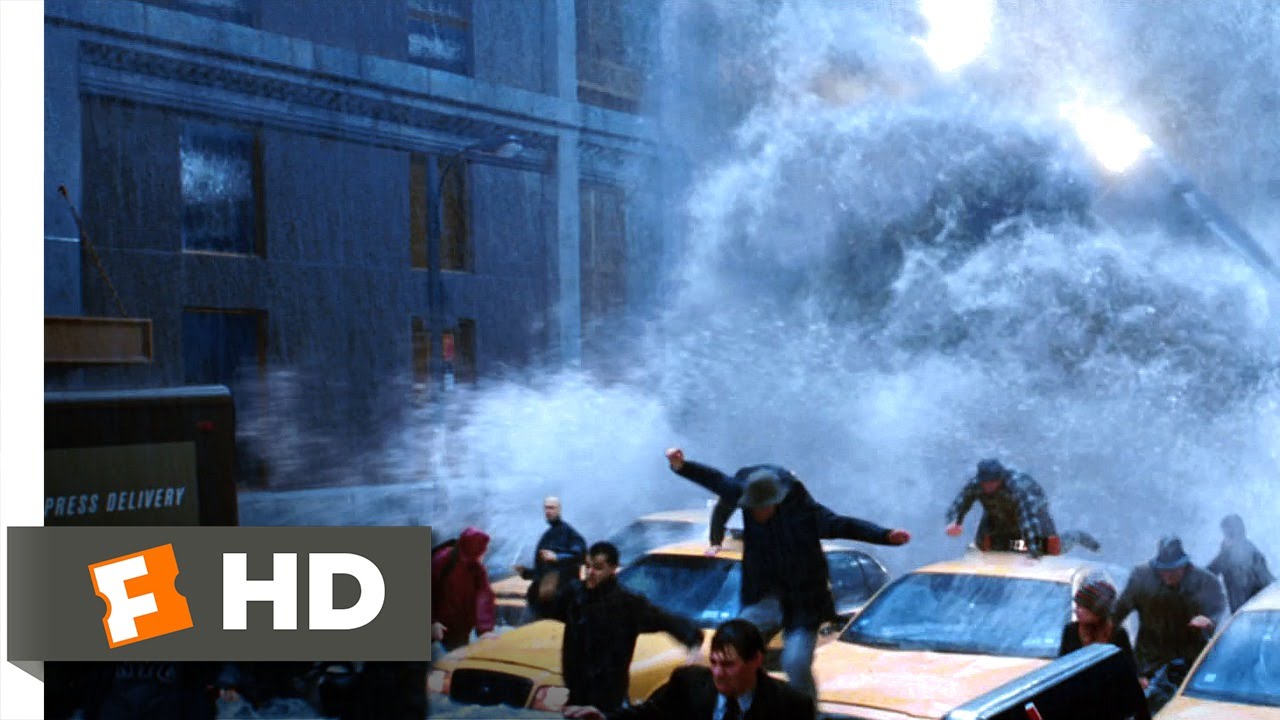 or
 as disaster movies portray. Many comprehensive climate models don't predict a total AMOC shut down for another 250-300 years under current emissions, though they predict a bevy of negative consequences as the currents slowly slide toward collapse.
Climate catastrophe is a slow-burn issue — but it's one that has a clear solution. "Avoid emitting greenhouse gases," says Boers. We live at a tipping point in Earth's history, one where our species faces a choice: We can either be the hero of the movie, or the disaster.
an 621
As what the National Weather Service described as "dangerous and record-breaking heat" affects 50 million people across the Western United States even before the first day of summer, climate experts and activists are using the hot conditions to reiterate warnings and calls for policy change as scientists are seeing their dire predictions come true.
"The current heatwave and drought leave no doubt, we are living the dangerous effects of the climate crisis," activist and former Democratic presidential candidate Tom Steyer tweeted Friday. "Action is urgently needed."
Steyer shared a Thursday New York Times report on the extreme heat that also caught the attention of Campaign for Nature director Brian O'Donnell, who warned that in the absence of bold action to address the climate emergency, "this will all get much worse."...
"It's a climate catastrophe': Most of the salmon in California's 2nd largest river dead or dying
June 15, 2021
The Klamath flows from Oregon into Northern California. The second largest river in California is home to marine life like salmon and trout and has served as the life force for many communities around its more...
https://www.alternet.org/2021/05/bundy/ nor ca water
far-right anti-government activist Ammon Bundy has made national news on multiple occasions, from leading an armed occupation of the Malheur National Wildlife Refuge in Oregon to anti-mask standoffs in Idaho that resulted in extremists converging on a state judge's home.
Now, according to The Sacramento Bee, Bundy and his followers could be about to get involved in another confrontation with the government — this time over water shutoffs in Northern California.
"In the summer of 2001, local farmers and other activists armed with saws and blowtorches breached a chain-link fence and opened the headgates of a federal canal that supplies farmland in Oregon and far Northern California," reported Ryan Sabalow. "Local farmer Grant Knoll was among the activists there that year. The protesters forced the gates open three times but were eventually blocked by U.S. marshals. Now, with a drought just as severe as two decades ago — and with farmers' water again cut off — he's prepared to fight again."
"This spring, he and another farmer, Dan Nielsen, bought the property next to the headgates in Klamath Falls, Ore.," said the report. "They erected a red and white tent surrounded by American flags and protest signs, and they're holding regular gatherings. And they're working with a group with close ties to anti-government activist Ammon Bundy."
According to the report, "Federal water managers have for years struggled to strike a balance between supplying water for farmers while still leaving enough water in Oregon's Upper Klamath Lake to keep two species of endangered suckers from going extinct." However, the government also is obligated to send spurts of water down the canals known as "flushing flows" to maintain the health of local salmon populations local tribes depend on, and amid a drought, they lack the water for even that, let alone to supply farmers with everything they are asking for.
Farmers, however, don't buy the government's explanation, claiming water levels are higher than would exist in a drought.
"Knoll said the Bundy family's fight with the federal government has proven that if activists push back forcefully, the feds will back down," said the report. "Members of the Bundy family and their supporters have been acquitted or mistrials were declared after armed standoffs with federal authorities in Oregon and in Nevada."
You can read more here.
https://www.alternet.org/2021/05/western-fires/
many graf
The Western U.S. appears headed for another dangerous fire season, and a new study shows that even high mountain areas once considered too wet to burn are at increasing risk as the climate warms.
Nearly two-thirds of the U.S. West is in severe to exceptional drought right now, including large parts of the Rocky Mountains, Cascades and Sierra Nevada. The situation is so severe that the Colorado River basin is on the verge of its first official water shortage declaration, and forecasts suggest another hot, dry summer is on the way.
Warm and dry conditions like these are a recipe for wildfire disaster.
In a new study published May 24, 2021, our team of fire and climate scientists and engineers found that forest fires are now reaching higher, normally wetter elevations. And they are burning there at rates unprecedented in recent fire history.
While some people focus on historical fire suppression and other forest management practices as reasons for the West's worsening fire problem, these high-elevation forests have had little human intervention. The results provide a clear indication that climate change is enabling these normally wet forests to burn.
As wildfires creep higher up mountains, another tenth of the West's forest area is now at risk, according to our study. That creates new hazards for mountain communities, with impacts on downstream water supplies and the plants and wildlife that call these forests home.
Map showing how high-elevation forest fires advanced uphill.
Forest fires advanced to higher elevations as the climate dried from 1984 to 2017. Every 200 meters equals 656 feet.
Mojtaba Sadegh, CC BY-ND
Rising fire risk in the high mountains
In the new study, we analyzed records of all fires larger than 1,000 acres (405 hectares) in the mountainous regions of the contiguous Western U.S. between 1984 and 2017.
The amount of land that burned increased across all elevations during that period, but the largest increase occurred above 8,200 feet (2,500 meters). To put that elevation into perspective, Denver – the mile-high city – sits at 5,280 feet, and Aspen, Colorado, is at 8,000 feet. These high-elevation areas are largely remote mountains and forests with some small communities and ski areas.
The area burning above 8,200 feet more than tripled in 2001-2017 compared with 1984-2000.
One of Colorado's largest wildfires, 2020's East Troublesome Fire, crossed the Continental Divide and was burning at elevations around 9,000 feet in October, when snow normally would have been falling.
AP Photo/David Zalubowski
Our results show that climate warming has diminished the high-elevation flammability barrier – the point where forests historically were too wet to burn regularly because the snow normally lingered well into summer and started falling again early in the fall. Fires advanced about 826 feet (252 meters) uphill in the Western mountains over those three decades.
The Cameron Peak Fire in Colorado in 2020 was the state's largest fire in its history, burning over 208,000 acres (84,200 hectares) and is a prime example of a high-elevation forest fire. The fire burned in forests extending to 12,000 feet (3,650 meters) and reached the upper tree line of the Rocky Mountains.
We found that rising temperatures in the past 34 years have helped to extend the fire territory in the West to an additional 31,470 square miles (81,500 square kilometers) of high-elevation forests. That means a staggering 11% of all Western U.S. forests – an area similar in size to South Carolina – are susceptible to fire now that weren't three decades ago.
Can't blame fire suppression here
In lower-elevation forests, several factors contribute to fire activity, including the presence of more people in wildland areas and a history of fire suppression.
In the early 1900s, Congress commissioned the U.S. Forest Service to manage forest fires, which resulted in a focus on suppressing fires – a policy that continued through the 1970s. This caused flammable underbrush that would normally be cleared out by occasional natural blazes to accumulate. The increase in biomass in many lower elevation forests across the West has been associated with increases in high-severity fires and megafires. At the same time, climate warming has dried out forests in the Western U.S., making them more prone to large fires.
On average, fires have spread 826 feet (252 meters) higher into the mountains in recent decades, exposing an additional 31,400 square miles (81,500 square kilometers) of forests to fire.
Mojtaba Sadegh, CC BY-ND
By focusing on high-elevation fires, in areas with little history of fire suppression, we can more clearly see the influence of climate change.
Most high-elevation forests haven't been subjected to much fire suppression, logging or other human activities, and because trees at these high elevations are in wetter forests, they historically have long return intervals between fires, typically a century or more. Yet they experienced the highest rate of increase in fire activity in the past 34 years. We found that the increase is strongly correlated with the observed warming.
High mountain fires create new problems
High-elevation fires have implications for natural and human systems.
High mountains are natural water towers that normally provide a sustained source of water to millions of people in dry summer months in the Western U.S. The scars that wildfires leave behind – known as burn scars – affect how much snow can accumulate at high elevations. This can influence the timing, quality and quantity of water that reaches reservoirs and rivers downstream.
High-elevation fires also remove standing trees that act as anchor points that normally stabilize the snowpack, raising the risk of avalanches.
The loss of tree canopy also exposes mountain streams to the Sun, increasing water temperatures in the cold headwater streams. Increasing stream temperatures can harm fish and the larger wildlife and predators that rely on them.
Climate change is increasing fire risk in many regions across the globe, and studies show that this trend will continue as the planet warms. The increase in fires in the high mountains is another warning to the U.S. West and elsewhere of the risks ahead as the climate changes.
Mojtaba Sadegh, Assistant Professor of Civil Engineering, Boise State University; John Abatzoglou, Associate Professor of Engineering, University of California, Merced, and Mohammad Reza Alizadeh, Ph.D. Student in Engineering, McGill University
This article is republished from The Conversation under a Creative Commons license. Read the original article.
FROM YOUR SITE ARTICLES
The lasting impact of the 2020 Oregon wildfires - Alternet.org ›
How Californians came together to deal with wildfires during the ... ›
'Antifa arson' hoax rumors spread faster than wildfires in besieged ... ›
RELATED ARTICLES AROUND THE WEB
Six trends to know about fire season in the western U.S. – Climate ... ›
California and the West face severe wildfire season - The ... ›
Trump largely silent on historically devastating Western fires ... ›
https://www.alternet.org/2021/05/well-water
many lnx grafs
Water wells are at risk of going dry in the US and worldwide
Image via Shutterstock.
The Conversation May 10, 2021
Debra Perrone, University of California Santa Barbara and Scott Jasechko, University of California Santa Barbara
As the drought outlook for the Western U.S. becomes increasingly bleak, attention is turning once again to groundwater – literally, water stored in the ground. It is Earth's most widespread and reliable source of fresh water, but it's not limitless.
Wells that people drill to access groundwater supply nearly half the water used for irrigated agriculture in the U.S. and provide over 100 million Americans with drinking water. Unfortunately, pervasive pumping is causing groundwater levels to decline in some areas, including much of California's San Joaquin Valley and Kansas' High Plains.
We are a water resources engineer with training in water law and a water scientist and large-data analyst. In a recent study, we mapped the locations and depths of wells in 40 countries around the world and found that millions of wells could run dry if groundwater levels decline by only a few meters. While solutions vary from place to place, we believe that what's most important for protecting wells from running dry is managing groundwater sustainably – especially in nations like the U.S. that use a lot of it.
About 75% of global groundwater pumping occurs in India, the U.S., China, Pakistan, Iran, Mexico and Saudi Arabia.
The U.S. has one of the highest national groundwater use rates in the world.
Jasechko and Perrone, 2021, CC BY-ND
Groundwater use today
Humans have been digging wells for water for thousands of years. Examples include 7,400-year-old wells in the Czech Republic and Germany, 8,000-year-old wells in the eastern Mediterranean, and 10,000-year-old wells in Cyprus. Today wells supply 40% of water used for irrigation worldwide and provide billions of people with drinking water.
Groundwater flows through tiny spaces within sediments and their underlying bedrock. At some points, called discharge areas, groundwater rises to the surface, moving into lakes, rivers and streams. At other points, known as recharge areas, water percolates deep into the ground, either through precipitation or leakage from rivers, lakes and streams.
Pumping can remove groundwater from underground faster than it recharges.
Groundwater can remain underground for days to millennia, depending on how deep it sinks, how readily it moves through rock around it and how fast humans pump it to the surface.
USGS
Groundwater declines can have many undesirable consequences. Land surfaces sink as underground clay layers are compacted. Seawater intrusion can contaminate groundwater reserves and make them too salty to use without energy-intensive treatment. River water can leak down to underground aquifers, leaving less water available at the surface.
Leaky streams are widespread across the United States.
Groundwater depletion can also cause wells to run dry when the top surface of the groundwater – known as the water table – drops so far that the well isn't deep enough to reach it, leaving the well literally high and dry. Yet until recently, little was known about how vulnerable global wells are to running dry because of declining groundwater levels.
There is no global database of wells, so over six years we compiled 134 unique well construction databases spanning 40 different countries. In total, we analyzed nearly 39 million well construction records, including each well's location, the reason it was constructed and its depth.
Our results show that wells are vital to human livelihoods – and recording well depths helped us see how vulnerable wells are to running dry.
Millions of wells at risk
Our analysis led to two main findings. First, up to 20% of wells around the world extend no more than 16 feet (5 meters) below the water table. That means these wells will run dry if groundwater levels decline by just a few feet.
Groundwater wells are at risk of running dry around the globe.
Second, we found that newer wells are not being dug significantly deeper than older wells in some places where groundwater levels are declining. In some areas, such as eastern New Mexico, newer wells are not drilled deeper than older wells because the deeper rock layers are impermeable and contain saline water. New wells are at least as likely to run dry as older wells in these areas.
Wells are already going dry in some locations, including parts of the U.S. West. In previous studies we estimated that as many as 1 in 30 wells were running dry in the western U.S., and as many as 1 in 5 in some areas in the southern portion of California's Central Valley.
Households already are running out of well water in the Central Valley and southeastern Arizona. Beyond the Southwest, wells have been running dry in states as diverse as Maine, Illinois and Oregon.
What to do when the well gives out
How can households adapt when their well runs dry? Here are five strategies, all of which have drawbacks.
– Dig a new, deeper well. This is an option only if fresh groundwater exists at deeper depths. In many aquifers deeper groundwater tends to be more saline than shallower groundwater, so deeper drilling is no more than a stopgap solution. And since new wells are expensive, this approach favors wealthier groundwater users and raises equity concerns.
– Sell the property. This is often considered if constructing a new well is unaffordable. Drilling a new household well in the U.S. Southwest can cost tens of thousands of dollars. But selling a property that lacks access to a reliable and convenient water supply can be challenging.
– Divert or haul water from alternative sources, such as nearby rivers or lakes. This approach is feasible only if surface water resources are not already reserved for other users or too far away. Even if nearby surface waters are available, treating their quality to make them safe to drink can be harder than treating well water.
– Reduce water use to slow or stop groundwater level declines. This could mean switching to crops that are less water-intensive, or adopting irrigation systems that reduce water losses. Such approaches may reduce farmers' profits or require upfront investments in new technologies.
[Over 100,000 readers rely on The Conversation's newsletter to understand the world. Sign up today.]
– Limit or abandon activities that require lots of water, such as irrigation. This strategy can be challenging if irrigated land provides higher crop yields than unirrigated land. Recent research suggests that some land in the central U.S. is not suitable for unirrigated “dryland" farming.
Households and communities can take proactive steps to protect wells from running dry. For example, one of us is working closely with Rebecca Nelson of Melbourne Law School in Australia to map groundwater withdrawal permitting – the process of seeking permission to withdraw groundwater – across the U.S. West.
State and local agencies can distribute groundwater permits in ways that help stabilize falling groundwater levels over the long run, or in ways that prioritize certain water users. Enacting and enforcing policies designed to limit groundwater depletion can help protect wells from running dry. While it can be difficult to limit use of a resource as essential as water, we believe that in most cases, simply drilling deeper is not a sustainable path forward.The Conversation
Debra Perrone, Assistant Professor of Environmental Studies, University of California Santa Barbara and Scott Jasechko, Assistant Professor of Water Resources, University of California Santa Barbara
This article is republished from The Conversation under a Creative Commons license. Read the original article.
FROM YOUR SITE ARTICLES
Rapidly growing Utah desert community fights to keep up with water ... ›
Why Water Privatization Is a Bad Idea for People and the Planet ... ›
Tap Water Is Clearly Better Than Bottled Water - Here's Why ... ›
===
icn 1020
Droughts That Start Over the Ocean? They’re Often Worse Than Those That Form Over Land
:{BY: BOB BERWYN
New research on ‘landfalling’ droughts could help provide early warnings for vulnerable communities.}:
:{
}:
1020 tom d records 121 LA 130 deaTH VLY
In an all-too-literal fashion, The Donald is indeed proving to be history's "fire and fury" president.
And don't for a moment think that there was no warning about the over-the-top burning now underway in this country. After all, in 2019, parts of Australia were singed to a crisp in a way never before seen, killing at least 25 humans and possibly more than a billion animals. And that country, too, was headed by a climate-change denier, a man who once brought a piece of coal to parliament and handed it around while soothingly telling other legislators, "Don't be afraid, don't be scared."
https://yyy.theguardian.com/australia-news/2017/feb/09/scott-morrison-brings-coal-to-question-time-what-fresh-idiocy-is-this
In addition, in recent years, the Arctic (of all places) has been smoking and burning in an unprecedented fashion, heating its permafrost and releasing staggering amounts of greenhouse gases into the atmosphere. Oh, and this June, the temperature in a small town in Siberia crossed the 100-degree mark for the first time.
By the way, Russia, too, is run by a leader who until recently was a climate denier.I mean, what is it about the urge of so many of us in such a crisis to support those dedicated to quite literally destroying this planet as a livable place for... well, us? (Hey there, Jair Bolsonaro!)
dn 720
New Report: Communities of Color in U.S. Will Be Hardest Hit by Extreme Heat
720 ew
the record-breaking heat in the Arctic saw temperatures soar above 100 degrees for the first time in recorded history. Now, a new analysis has put to rest any notion that the heat was caused by natural temperature fluctuations.
Read More
==
==
new
ew 720
Puerto Rico's governor declared a state of emergency on Monday after a severe drought on the island left 140,000 people without access to running water, despite the necessary role that hand washing and hygiene plays in stopping the novel coronavirus, as The Independent reported.
===
https://yyy.theguardian.com/environment/2020/may/29/megadrought-us-south-west-fires-water-research
US south-west in grip of historic 'megadrought', research finds
Intensified by climate change, the current 20-year arid period is one of the worst on record, with wide-ranging effects
Samuel Gilbert
@samuelgilbert1
Fri 29 May 2020 05.30 EDTLast modified on Fri 29 May 2020 08.31 EDT
The Enterprise Bridge passes over a section of Lake Oroville that is nearly dry on 19 August 2014 in Oroville, California. The region is in the grip of a 20-year megadrought, research suggests.
When Ken Pimlott began fighting US wildfires at the age of 17, they seemed to him to be a brutal but manageable natural phenomenon.
Dust bowl conditions of 1930s US now more than twice as likely to reoccur
Read more
“We had periodic [fire] sieges in the 80s, but there were breaks in between,” said Pimlott, the former head of the California department of forestry and fire protection. But no longer. “That doesn’t really happen any more. Now you can’t even blink” between fires, he said. “We’re seeing the kinds of fires we have never seen before.”
A recent study published in the journal Science helps explains why, revealing that the south-western US is in the grip of a 20-year megadrought – a period of severe aridity that is stoking fires, depleting reservoirs and putting a strain on water supplies to the states of the region.
“You see impacts everywhere, in snowpacks, reservoir levels, agriculture, groundwater and tree mortality,” said co-author Benjamin Cook, of Columbia University’s Lamont Doherty Earth Observatory. “Droughts are these amazingly disruptive events. Water sits at the foundation of everything.”
Researchers compared soil moisture records from 2000-2019 to other drought events from the past 1,200 years. They found that the current period is worse than all but one of five megadroughts identified in the record.
Unlike past megadroughts – brought on by natural fluctuations in the Earth’s climate – this current drought has been heavily influenced by human-induced climate change, “pushing what would have been a moderate drought in south-western North America into megadrought territory”, according to the study.
“Global warming has made the drought much worse than it otherwise would have been,” said Cook. “We estimate 30-50% is attributed to climate change.”
According to Nasa, 19 of the 20 warmest years on record have occurred since 2001. Climate change, if unchecked, will hit the American south-west particularly hard.
A major concern is the megadrought’s impact on water supplies in the region. It has experienced explosive growth – half of the nation’s fastest-growing states are in the south-west – made possible by elaborate river diversion projects and massive reservoirs.
Over the past two decades, drought-depleted rivers, and population growth has led to steep declines in two of the nation’s largest reservoirs, Lake Mead and Lake Powell, on which which tens of millions of people depend.
Water deliveries from the Colorado River are also being rationed this year, for the first time.
For Pimlott, this drought has manifested itself in 21st-century fires unlike any he had previously witnessed. In 2018, a fire tornado destroyed part of one northern California town, and almost the entire community of Paradise, California, was wiped out by a blaze that claimed 85 victims.
“Were seeing more intense fires, with longer durations,” he said.
===
==
icn 5/20
50 Years From Now, Many Densely Populated Parts of the World Could be Too Hot for Humans
BY: BOB BERWYN
Unless steps are taken to check global warming, up to 3 billion people will find themselves in areas too warm for human comfort, a new study finds.
==
https://www.alternet.org/2020/04/emerging-climate-fueled-megadrought-in-western-us-rivals-any-in-past-1200-years-study/
the western United States is likely being gripped by an “emerging” megadrought partly fueled by the climate crisis, says a study published Friday.
Researchers claim the region’s 19-year drought, from 2000–2018, already rivals that of any over the past 1,200 years. “We’re no longer looking at projections, but at where we are now,” said lead author Park Williams, a bioclimatologist at Columbia University’s Lamont-Doherty Earth Observatory, in a statement. “We now have enough observations of current drought and tree-ring records of past drought to say that we’re on the same trajectory as the worst prehistoric droughts.”
For the study, published in the journal *Science*, Williams and the other researchers looked at nine U.S. states, stretching from Oregon and Montana at the northern and southward through California and New Mexico. The researchers also included a portion of northern Mexico in the study....
https://www.ecowatch.com/southwest-drought-climate-crisis-2645742986.html
A severe drought that has engulfed the American Southwest since the year 2000 is likely to soon be the most severe drought since the 800s, according to a new study published in Science.
"This appears to be just the beginning of a more extreme trend toward megadrought as global warming continues," the authors wrote in the study.
A team of researchers from Columbia University conducted the study. They described the ongoing dry spell, which has helped intensify wildfire seasons and threatened water supplies for people and agriculture, as an "emerging megadrought," according to The New York Times.
Of course, nothing is guaranteed. By comparison to the previous 19 years, 2019 was actually a fairly wet year. Unpredictable climate variability may also bring enough rain to the region to end the drought, but global warming boosts the chances that the drought will endure.
"We know that this drought has been encouraged by the global warming process," said lead author A. Park Williams, a bioclimatologist at Lamont-Doherty Earth Observatory at Columbia University, as The New York Times reported. "As we go forward in time it's going to take more and more good luck to pull us out of this."
Scientists have suspected for a while that that the dryness is evolving into a megadrought. The new research not only confirms their suspicion, but also concludes this megadrought may be as bad or worse than anything known before.
"We now have enough observations of current drought and tree-ring records of past drought to say that we're on the same trajectory as the worst prehistoric droughts," said Williams, in a statement, as USA Today reported. This is "a drought bigger than what modern society has seen."
The researchers say that man-made global warming caused about half of this drought. Changes in the climate have contributed to dwindling reservoirs and harsher wildfire seasons.
It all could get much worse.
"Anthropogenic global warming and its drying influence in (southwestern North America) are likely still in their infancy," the study warns, as CNN reported. "Themagnitude of future droughts in North America and elsewhere will depend greatly on future rates of anthropogenic greenhouse gas emissions globally."
...
Without a drastic reduction in greenhouse gas emissions, these droughts are just the beginning.
"The effects of future droughts on humans will be further dependent on sustainable resource use because buffering mechanisms such as ground water and reservoir storage are at risk of being depleted during dry times," the study continues, according to CNN.
To conduct the study, the researchers performed a comprehensive long-term analysis of thousands of square miles, stretching across nine states from Oregon and Montana down through California, Arizona, New Mexico and part of northern Mexico. They looked at 1,200 years of tree ring data, modern weather observations and dozens of climate models, according to CBS News.
The tree rings allow scientist to gauge soil moisture dating back centuries. Williams and his team identified dozens of droughts across the region, starting in 800 AD. Four of those stand out as megadroughts — with extreme dryness that lasted for decades — in the late 800s, mid-1100s, the 1200s and the late 1500s.
The team then compared the ancient megadroughts to soil moisture records from the years 2000 to 2018. The current drought ranked as the second-driest, already outdoing the three earliest ones and on par with the fourth period which spanned from 1575 to 1603, as CBS News reported.
The warmer air during this drought is pulling more moisture from the ground, intensifying dry soils. Furthermore, temperatures in the West are expected to keep rising, meaning this trend is likely to continue.
"Because the background is getting warmer, the dice are increasingly loaded toward longer and more severe droughts," said Williams, as CBS News reported.
-
drought extreme weather climate change science wildfires
===
https://insideclimatenews.org/news/07042020/global-warming-ecosystem-biodiversity-rising-heat-species
Global warming is about to tear big holes into Earth's delicate web of life, pushing temperatures beyond the tolerance of thousands of animals at the same time. As some key species go extinct, entire ecosystems like coral reefs and forests will crumble, and some will collapse abruptly, starting as soon as this decade, a new study in the journal Nature warns.
Many scientists see recent climate-related mass die-offs, including the coral bleaching of the Great Barrier Reef and widespread seabird and marine mammal mortality in the Northeastern Pacific linked to a marine heat wave, as warning signs of impending biodiversity collapse, said lead author Alex Pigot, a biodiversity researcher at University College, London. The new study shows that nowhere on Earth will escape the impacts.
"In the U.S., the southern states from Texas to Florida, the Appalachians and the West Coast are projected to be at particularly high risk, with between 20 and 40 percent of species facing conditions beyond anything they have previously experienced," Pigot said.
In those regions many species live in small geographic areas under a narrow range of climatic conditions. As global warming heats their habitat to the point that it is intolerable, many species have no place to go. Some will go extinct, with a domino effect that affects scores of other species. If it gets too hot for bumblebees, for example, it affects the reproduction of plants. If it gets too warm for insects and reptiles, it affects food supplies for birds and mammals.
"I hope our predictions are wrong. But increasingly, what we're observing around us are the signs of this happening," Pigot said, referring to research showing how global warming affects individual species. "I think these studies are showing that many species are already living very near their thermal limits. Our results suggest that these losses are likely to involve multiple species near simultaneously rather than happening gradually, one species at a time," he said.
At the current rate of warming, abrupt exposure events in tropical oceans will begin before 2030 and spread to tropical forests and higher latitudes by 2050. The risks decrease and arrive more slowly if global warming is capped at less than 3.6 degrees Fahrenheit, as per the goals of the 2015 Paris climate agreement, the study concluded.
"If we can avert the worst of the warming we can buy extra time," Pigot said. "Even if we can get a few extra decades, it gives us time to work on expanding protected areas, or deciding on whether to try things like assisted migration and assisted evolution."
Even an immediate curb on greenhouse gas emissions doesn't preclude warming of up to 7 degrees Fahrenheit by the end of the century because the current amount of warming could be magnified by big increases of heat-trapping methane in the Arctic or by changes to cloud processes, he said.
Jennifer Sunday, a research biologist at McGill University, said the new study for the first time shows when species will be faced with warmer temperatures than they've ever experienced for five years in a row. And it turns out that a surprising number of animals within various ecosystems will hit those climate thresholds at the same time, which can lead to widespread ecosystem disruptions or collapse, said Sunday, who was not involved in the research.
"We did not know about the time-course of events. We have lots of models that compare species ranges today to those at a future date, but we did not know when most of the changes were going to happen," she said. The research also makes it clear that global warming's impacts on ecosystems could arrive very suddenly.
"I think we often and maybe subconsciously expect climate change to be a gradual process, but this helps to illustrate that the impacts may be in fits and spurts," she said. "As we know today, our human adaptive systems are not great at dealing with synchronous events," she said, referring to the global response to the coronavirus pandemic. The findings show that some climate impacts could be as sudden and widespread as the pandemic, challenging our adaptive management systems.
Species in Tropics, Polar Regions, Will be Hardest Hit
In the study, Pigot's team assessed temperatures ranges for more than 30,000 land and sea species—birds, mammals, reptiles, amphibians, fish and other marine animals and plants—to estimate when they will start experiencing unprecedented temperature conditions. Capping global warming at 2.7 degrees Fahrenheit would decrease the risk of ecosystem failures significantly, but allowing global warming to continue unchecked would lead to widespread biodiversity decline quickly, they found.
Ecological communities in tropical regions near the equators will be hard hit because many species there are already living near the upper end of their heat tolerance spectrum. In high latitudes, toward the poles, communities of species will struggle because those areas are warming about twice as fast as the global average, giving them even less time to adapt, he said....
==
Hottest Places in a City Are Often Low-Income Neighborhoods
==
new Study Projects Severe Water Shortages in the Colorado River Basin
BY: BOB BERWYN
:{
The loss of the reflective snowpack drives evaporation and reduces the flow of water, the study found. Read More}:
==
==
it's not just the threat of heat stress that is escalating. Our new research shows thatrising temperatures due to climate change are making some pesticides up to 100 times as toxic.Current laws leave farmworkers at grave risk of injury and death—but we can help change that.
Urge your US representative to cosponsor the Asunción Valdivia Heat Illness and Fatality Prevention Act
==
[talkies 1/2/20 2010 drought russia lost 1/3 wht crop --> arab spring?! food scarce africa and ME, food #1 expebnse in poor ppl budget --> anger at elites, libya, syria WAR, threat multiplier]
==
==
https://www.ecowatch.com/sydney-water-shortage-2641353372.html
1119 icn
Military Bases Face Increasingly Dangerous Heat as Climate Changes
BY: DAVID HASEMYER
By mid-century, troops could face an extra month of extreme heat days if nothing is done to lower greenhouse gas emissions, a new report shows. Some training bases will see much worse.
==
57 Dead, 18,000 Hospitalized in Japan Heat Wave
Aug 07
==
India Set to Lower ‘Normal Rain’ Baseline as Droughts Bite
icn 719
Ravaged by Drought, a Honduran Village Faces a Choice: Pray for Rain or Migrate
https://insideclimatenews.org/news/08072019/climate-change-migration-honduras-drought-crop-failure-farming-deforestation-guatemala-trump
==
==
HEAT DEATH
150 million trees died in California’s drought, and worse is to come
==
6/25/19 dn indian city 4 dry reservoirs, wells not safe
==
2 mil migrant workers in san joachin vly
RR did immigration reform that included acctability for hiring illlegals, never implemented b/c big ag did not want it
UN study drought --> hunger centr am 1 tortilla/day! 2.1 mill hungry
bath riots texas ft carmelita louse bath every day, naked pix posted in bars. latx rosa parks
hunter sr got border wall built san diego, forced ppl in desert who died; bro rocket sci studied routes and started water stations
history pete w behind 20 pts kathleen brown, prop 187 boosted polls
https://kpfa.org/episode/letters-and-politics-june-25-2019/
john carlos frey sp bk sand and blood
==
==
ew 619
Taking action to stop the mercury from rising is a matter of life and death in the U.S., according to a new study published in the journal Science Advances.
==
ew spike?
Tens of Thousands Flee Extreme Heatwave in India as Temperatures Topping 120°F Kill Dozens Across Country
==
36 Die in India Heat Wave, Delhi Records Its Highest All-Time Temperature
==
619 dailly kos
Rare and strange’: Clash over water kills 15 monkeys in India during brutal heatwave
=
In India, WhatsApp is a weapon of antisocial hatred
Rohit Chopra, Santa Clara University
India's parliamentary elections, now underway, will show how social media is affecting Indian society and government.
==
AGW //INEQUALITY (and increases?)
reverse matthew: poor get poorer/ EJ 1st and worst, tho did not cause
https://insideclimatenews.org/news/22042019/climate-change-inequality-gdp-equator-africa-russia-norway-canada
A few countries in cold climates, including Canada, Norway and Russia, likely benefited economically from global warming in past decades, while poorer countries closer to the equator suffered economic losses, a new study says.
The findings suggest that climate change exacerbated global inequality, causing the most economic harm to those who did the least to cause it.
But what the future will look like is less clear. Research has shown that over the long term, just about every part of the world will suffer as global temperatures rise.
The study looked at each country's per capita GDP—the per-person value of the country's economic activity—over several decades from as early as 1961 to 2010, and then used climate models to estimate what each country's GDP would have been without the influence of global warming.
"India, for example, has approximately 30 percent lower per capita GDP today than if global warming had not occurred," said Noah Diffenbaugh, the study's lead author and an earth sciences professor at Stanford University. "In India there are hundreds of millions of people living below $2 a day. A 30 percent reduction in per capita GDP is substantial. That is the order of magnitude of the economic impacts during the Great Depression here in the United States."
When the authors compared their findings across countries, they found the greatest harm to GDP in poorer countries closer to the equator, while a few northern countries showed a GDP gain compared to the model of a world without global warming. The study looked at changes from 1961 to 2010 for those countries with available data, and also from 1991 to 2010 when more national data was available. The United States showed a loss of less than 1 percent, according to the study. [map graf]....
==
https://insideclimatenews.org/news/31012019/colorado-river-water-crisis-climate-science-state-conservation-plans
Beyond Drought: 7 States Rebalance Their Colorado River Use as Global Warming Dries the Region
As major reservoirs shrink with the changing climate, seven states seek a sustainable future for the critical regional water source.
==
 STORYNOV 27, 2018
How a Climate Change-Fueled Drought & U.S.-Fed Violence Are Driving Thousands from Central America
==
http://religioner.no/wp-content/uploads/2015/08/religioner.no_wcas-d-13-00059.pdf
Water, Drought, Climate Change, and Conflict in Syria
PETER H. GLEICK Pacific Institute, Oakland, California
abstract: The devastating civil war that began in Syria in March 2011 is the result of complex interrelated factors. The focus of the conflict is regime change, but the triggers include a broad set of religious and sociopolitical factors, the erosion of the economic health of the country, a wave of political reform sweeping over the Middle East and North Africa (MENA) and Levant region, and challenges associated with climate variability and change and the availability and use of freshwater.
As described here, water and climatic conditions have played a direct role in the deterioration of Syria’s economic conditions. There is a long history of conflicts over water in these regions because of the natural water scarcity, the early development of irrigated agriculture, and complex religious and ethnic diversity. In recent years, there has been an increase in incidences of water-related violence around the world at the subnational level attributable to the role that water plays in development disputes and economic activities. Because conflicts are rarely, if ever, attributable to single causes, conflict analysis and concomitant efforts at reducing the risks of conflict must consider a multitude of complex relationships and contributing factors. This paper assesses the complicated connections between water and conflict in Syria, looks more broadly at future climate-related risks for water systems, and offers some water management strategies for reducing those risks.
https://www.ecowatch.com/nestle-water-california-2582073595.html
U.S. Allows Nestlé to Keep Piping Water From Drought-Ridden Southern California
The U.S. Forest Service offered Nestlé a three-year permit on Wednesday to keep taking millions of gallons of water from the San Bernardino National Forest in California, the Associated Press reported.
The offer has certain restrictions. Nestlé, which sells bottled water under the Arrowhead brand, can continue piping from the Strawberry Creek watershed "when there is water available consistent with the forest's Land Management Plan," according to the AP, citing the Forest Service offer. The watershed is currently rated as "impaired."
...California has suffered from years of recurring drought. Last year's record-breaking rains in the state's north brought some relief, but large swaths of the south—where the forest is located—remain in "severe" drought, according to the latest data from the U.S. Drought Monitor.
===
https://www.ecowatch.com/india-water-crisis-2579202142.html
==
https://www.ecowatch.com/humidity-climate-change-2520059578.html
Humidity Is the Real Heatwave Threat
By Alex Kirby
When the mercury climbs to extreme levels, it's the dangerous humidity produced by heat reacting with water-sodden air that can spell death, not just the heat alone.
U.S. researchers have warned yet again of the need to beware the risks of this combination. With fierce heat waves expected to become more common as the climate warms, they say humidity can greatly intensify the effects of the heat by itself.
They report in the journal Environmental Research Letters that during this century the drastic effects of high humidity in many areas will increase significantly. At times, they may overtake people's ability to work outdoors or, in some cases, even to survive.
Health and economies would suffer, especially in regions where people work outside and have little access to air conditioning. Potentially affected regions include large swathes of the already muggy Southeastern U.S., the Amazon, Western and Central Africa; Southern areas of the Middle East, including the Arabian peninsula; northern India; and eastern China.
"The conditions we're talking about basically never occur now—people in most places have never experienced them," said lead author Ethan Coffel, a graduate student at Columbia University's Lamont-Doherty Earth Observatory. "But they're projected to occur close to the end of the century."
The warming climate is projected to make many now-dry areas dryer, in part by changing precipitation patterns. But, as global temperatures rise, the atmosphere can hold more water vapor. That means chronically humid areas may only get more humid.
Muggy heat is more oppressive than the "dry" kind, because humans and other mammals cool down by sweating; sweat evaporates off the skin into the air, taking the excess heat with it. That works well in a desert. But when the air is already laden with moisture, evaporation off the skin slows down and eventually becomes impossible.
When this cooling process stops, a creature's core body temperature rises beyond the narrow tolerable range. Without air conditioning, organs strain and then start to fail, leading to lethargy, sickness and possibly death.
Using global climate models, the researchers mapped current and projected future "wet-bulb" temperatures, which reflect the combined effects of heat and humidity (the measurement is made by draping a water-saturated cloth over the bulb of a conventional thermometer; it does not correspond directly to air temperature alone).
The study found that by the 2070s, high wet-bulb readings that now occur perhaps only once a year could stretch to 100 to 250 days annually in some parts of the tropics. In the Southeastern U.S., wet-bulb temperatures now sometimes reach 29 or 30°C; by the 2070s or 2080s, such weather could occur 25 to 40 days each year, say the researchers....
==
https://www.ecowatch.com/california-droughts-arctic-ice-2516568052.html
Receding ice cover in the Arctic ocean could produce more droughts in California, according to a new study.
Published last week in Nature Communications, the study found that sea ice loss in the Arctic—of the proportion expected in coming years—could set off an atmospheric effect that will steer precipitation away from California. Notably, the study linked Arctic sea ice loss with the development of an atmospheric ridging system that also played a central role in the state's 2012-2016 drought.
==
az phoenix airport closed
===
7/16 new report out
http://www.alternet.org/environment/lethal-heat-waves-will-threaten-majority-humankind-centurys-end
By 2100, if nations continue to burn fossil fuels at the current rates, three out of four people will be at risk from lethal heat waves.
And even if the governments of the world act on promises they made in 2015 and drastically reduce greenhouse gas emissions, almost one in two could face the risk of sickness and death by intolerable heat.
That is because, as the temperatures rise, heat and humidity begin to challenge human physiology. Humans are adapted to body temperatures of around 37°C. If humidity—the levels of water vapour in the air—go up with the thermometer, then people caught in a zone of extreme heat cannot adjust body temperatures by perspiration.
And with every 1°C rise in temperatures, the capacity of the air to hold moisture goes up by 7 percent. People with no access to air conditioning or a cool breeze become at high risk.
It happened in Europe in 2003, when an estimated 70,000 died. A heat wave in Moscow in 2010 killed around 10,000. And researchers warned years ago that under global warming predictions, more such extremes of heat would become inevitable by 2020.
“We are running out of choices for the future,” said Camilo Mora, a geographer at the University of Hawaii at Manoa, who led the study.
“For heat waves, our options are now between bad or terrible. Many people around the world are already paying the ultimate price of heat waves, and while models suggest that this is likely to continue, it could be much worse if emissions are not considerably reduced.
“The human body can only function within a narrow range of core body temperatures around 37°C. Heat waves pose a considerable risk to human life because hot weather, aggravated with high humidity, can raise body temperature, leading to life-threatening conditions.”
Dr. Mora and colleagues warned years ago that by 2016 climate would change inexorably in at least some regions of the globe. More recently he and colleagues calculated that the relentless increase in carbon dioxide levels in the atmosphere could limit the growing season and pose a threat to world food security. History has yet to deliver a verdict on either prediction.
Uninhabitable
But the warning about heat waves starts from facts already available. One scientific group has calculated the humidity and temperature hazards and predicted that at least one climate zone—the Gulf between Iran and the Arabian Peninsula—could become murderously hot by the century’s end.
A second study of heat waves over recent decades in India has established a link between extremes of heat, climate change and mass death.
Dr. Mora and colleagues in the U.S. and Britain report in Nature Climate Change that they found evidence on a global scale. They began with 30,000 relevant publications and identified 911 scientific papers with data on 1,949 case studies of cities or regions where deaths were associated with high temperatures.
From this mass of information they found 783 lethal heat waves in 164 cities across 36 countries, with most cases recorded in developed countries at mid-latitudes since 1980: in cities such as New York, Washington, Los Angeles, Chicago, Toronto, London, Beijing, Tokyo, Sydney and São Paulo.
Risk mapped
From this data, they found a common threshold at which temperatures and humidities became lethal: that is, as relative humidity climbed, even lower temperatures could kill. And then they devised a world map of those cities and regions most at risk.
Right now, one human in three lives in a climate zone in which death by extreme heat is or could be possible. The area in which such conditions are liable to happen on at least 20 days a year is predicted to grow.
By 2100 New York could have around 50 days in which conditions could be potentially lethal. In Sydney, Australia the number of such deadly days could be 20, for Los Angeles 30.
For Orlando, Florida, and Houston, Texas, the entire summer could exceed the thresholds at which people have been known to die.
“People are talking about the future when it comes down to climate change, but what we found from this paper is that this is already happening. In fact since 1980 we found close to 2,000 cases of these places and cities when people died from this, and this is obviously going to get a lot worse,” Dr. Mora said.
U.S. walk-out
Notoriously, President Trump has announced that he will withdraw the U.S. from the Paris Agreement of 2015 to contain average global warming to well below 2°C by the century’s end.
The implication of the Hawaiian research is that if nations act in a concerted way to reduce fossil fuel emissions, an estimated 48 percent of the human population could be at risk of summer extremes. And if they do not, this hazard rises to 74 percent.
“Climate change has put humanity on a path that will become increasingly dangerous and difficult to reverse if greenhouse gas emissions are not taken much more seriously,” Dr. Mora said.
“Action like the withdrawal from the Paris Agreement is a step in the wrong direction that will inevitably delay fixing a problem for which there is simply no time to waste.”
==
http://www.alternet.org/environment/forced-endure-extreme-heat-prisoners-are-casualties-texas-climate-denial-documents-show
==
https://www.ecowatch.com/deadly-heatwaves-climate-change-2444467851.html
==
http://www.alternet.org/environment/what-would-happen-if-several-worlds-biggest-food-crops-failed-same-time
Less than one-quarter of Earth’s total cropland produces nearly three-quarters of the staple crops that feed the world’s population – especially corn, wheat and rice, the most important cereal crops. These areas are our planet’s major breadbaskets.
Historically, when a crop failed in one of these breadbaskets, only nearby areas had to contend with shortages and rising prices. Now, however, major crops are traded on global markets, which means that production failures can have far-reaching impacts. Moreover, climate change is expected to generate heat waves and drought that could cause crop losses in most of the world’s breadbaskets. Indeed, failures could occur simultaneously in several of these key regions....
==
[http://www.ecowatch.com/wildfires-drought-southeast-2094301912.html Record-Breaking Drought and Wildfires Plague Southeast] 11/16.
California’s Drought Policy Serves Corporations First, People Second
California is suffering a historic drought with no relief in sight. According to the latest report from NASA, California has less than a year’s supply of surface water left. In an executive order, Governor Jerry Brown, a self-proclaimed climate leader, imposed a 25% reduction on the state’s local water supply agencies, which serve 90% of California’s residents. Everyday citizens are being asked to cut down on shower times and lawn watering. While these are worthy efforts, they are mere drops in the bucket considering that residential and municipal use of water in CA account for less than 20% of water consumption. Instead of getting at the root of the problem and targeting water-guzzling agribusiness and the oil and gas industry, Governor Brown’s climate policy is pro-corporate, irresponsible and unsustainable.
Despite the growing water crisis, there are no provisions in Brown’s water reduction plan to halt fracking, an extreme method of oil and gas extraction requiring high-pressure injection of millions of gallons of chemical-laced water and sand into deep rock setting free oil or natural gas unavailable through conventional drilling. Last year fracking production in the state used 70 million gallons of water,1 the equivalent of 514 households annually.2 Although proponents of fracking may claim that the combined water use of 514 households is not that high, water used in fracking is highly contaminated and not returned to the annual water cycle, unlike household wastewater.
It was recently learned that California officials allowed oil and gas companies to dump this contaminated water into federally protected aquifers that could have been used for drinking and irrigation purposes.3 Illustrating the corporate control of regulatory agencies, 46 percent of the state permits authorizing these practices were granted in the last four years, the same four years during which the EPA warned California regulators they were not doing enough to protect underground water reserves.
In the Central Valley, many Latina/o farmworkers are struggling for their livelihoods due to years of drought. As a result of last year’s extreme weather, 17,000 farmworker jobs and 400,000 acres of farmland were lost.4 Other Californians are living entirely without running water. In East Porterville, for example, people are turning to costly and environmentally destructive bottled water to meet household needs.5
We can also look at Nestle Corporation’s privatization of our water to further understand how corporate rule is impacting every Californian. In Sacramento, tens of millions of gallons of Sacramento municipal water are being withdrawn by a local Nestle plant. Nestle uses and bottles thousands of acre-feet of California water. An acre-foot, roughly speaking, equals 326,000 gallons, enough to supply a family’s yearly needs.
Nestle and other bottling companies buy water at a pittance and sell it back to the public at exorbitantly high rates. As California’s water disappears, the investment portfolios of some of the nation’s most profitable corporations are being flooded.
In a recent interview Nestle CEO Tim Brown was asked if halting waster extraction was in the company’s plans. Brown responded: “Absolutely not. In fact, if I could increase it, I would. …If I stop bottling water tomorrow, people would buy another brand of bottled water. ...It’s driven by consumer demand, it’s driven by an on-the-go society that needs to hydrate.” 6
Is it possible that CEO Brown never heard of a reusable drinking water bottle?
Out of this Nestle Corporation debacle, the “Crunch Nestle Alliance” formed. The group has singled out Sacramento City Hall, saying Nestle’s privatization was made possible through a “corporate welfare giveaway.” Nestle pays Sacramento $186.00 per 215,000 gallons of water taken from the area aquifers. Those 215,000 gallons bring the Nestle Corporation a whopping $2.1 million in profit.7 The Crunch Nestle Alliance has successfully blockaded a Sacramento Nestle plant several times, raising awareness that water is a human right not a commodity to sell on the open markets.
Notes
1 http://www.reuters.com/article/2015/04/03/us-california-drought-fracking-exclusive-idUSKBN0MU01M20150403
http://www.huffingtonpost.com/2015/04/02/fracking-california-water_n_6997324.html
2 http://thinkprogress.org/climate/2015/04/06/3643184/california-70-million-gallons-fracking/
3 http://losangeles.cbslocal.com/2015/02/05/ap-oil-drilling-waste-dumped-into-calif-aquifers-used-for-irrigation-drinking-water/
4 http://fusion.net/story/114463/as-california-goes-dry-latinos-suffer-disproportionately/
5 http://www.theguardian.com/us-news/2015/apr/20/east-porterville-california-drought-bottled-water-showers-toilets
6 "Starbucks Moves Ethos Water from California after Drought-shaming" The Washington Post, May 12, 2015
7 https://criticl.me/post/crunchnestle-alliance-1179
==
==
smoking gun?
http://insideclimatenews.org/news/11032016/global-warming-climate-change-extreme-weather-drought-attribution-study
A new study shows it's now possible for scientists to confidently measure the influence of climate change on some extreme weather events, such as heat waves.
In this first-ever assessment of the emerging field of climate science attribution, researchers from the National Academies of Sciences, Engineering and Medicine are setting the record straight on how well scientists can currently tease out the climate-change fingerprints of different types of extreme weather.
In 2015, the United States was hit by myriad extreme weather events: record snowfall in the Northeast; flooding in North Carolina, Texas and Oklahoma; an ongoing drought in California. And America wasn't alone. India experienced a heat wave that killed more than 2,300 people, and the strongest ever tropical cyclone was observed in the Pacific Ocean last year.
Following these events, climate scientists were repeatedly asked the same question by politicians, the public, even the media: Was that event caused by climate change?
"In the past, a typical scientist's response to questions about climate change's role in any given weather event was, 'We cannot attribute any single event to climate change,'" scientists on the National Academies' Committee on Extreme Weather Events and Climate Change wrote in a report published Friday. "The science has advanced to the point that this is no longer true as an unqualified statement."
So when does such a noncommittal answer no longer hold up?
According to the report, scientists have the most confidence in their ability to discern climate change impacts on temperature extremes—whether they are warmer than usual, or not as cold as usual. For these two types of weather events, scientists have a lot of historical data, a strong understanding of how climate change influences the physics of them, and climate models that can accurately replicate past events.
This doesn't mean every heat wave should be assumed to be strongly tied to climate change, clarified J. Marshall Shepherd, a study author and climate researcher at the University of Georgia. Nor does it mean climate change is always influencing extreme weather events in the same way, making them stronger or weaker, more frequent or less frequent, Shepherd told InsideClimate News. It just means that scientists now have the tools to figure out how climate change is impacting notable weather events.
This isn't true for all extreme weather. The study explains that researchers have only moderate confidence in their ability to pin down the link for droughts and extreme rainfall; wildfire is another example of an event that is harder to attribute to climate change, since so many human factors may be involved.
And scientists have even less confidence in their ability to conduct such an analysis for snowstorms, tropical cyclones and extratropical cyclones.
Finally, the report clarified that scientists are currently unable to run such studies for isolated thunderstorms because there's too little data and too many questions about their link to climate change.
Climate Change Is Impacting the Weather. Period.
According to Shepherd, it's time to stop asking whether events are caused by climate change.
"We can essentially lay it to rest, put the tombstone on it," Shepherd said during a press conference following the report's release.
Scientists are in agreement that "climate change is impacting the weather,"Martin Hoerling, a scientist at the National Oceanic and Atmospheric Administration, told InsideClimate News.
What's more important—and the focus of this study—is figuring out by how much and in what way climate change is influencing these events, Hoerling said. Specifically, whether climate change influences the frequency and/or the intensity of such events.
The study did not assess the climate influence of any particular event, such as the ongoing drought in California, or grade the findings of past attribution studies.
The 163-page report did review the approaches of attribution studies in the past. Those studies relied primarily on historical data, or on climate models, or some combination of the two. The most reliable studies used both observational data and modeling, the study said.
A key goal of this work is to be able to predict extreme weather events,David Titley, chair of the committee that conducted the study, said at the press conference. "If we could predict them and verify them...it's pretty hard to argue these things aren't happening" or that climate change isn't influencing them, said Titley, director of the Center for Solutions to Weather and Climate Risk at Penn State University.
More important, he said, is how extreme weather prediction can be used for risk assessment. "If we can help people understand how those risks are changing and why those risks are changing, that is a very powerful tool in a toolbox" for city managers, emergency planners and company owners, Titley said.
Sheila V Kumar contributed to this report.
==
==
http://www.globalpossibilities.org/the-drought-you-havent-heard-about-is-causing-crisis-in-africa/
south zimbabwe
==
http://ecowatch.com/2015/07/06/pakistan-heatwave-climate-change/
Pakistan’s lack of preparedness in the face of increasingly intense weather events is being blamed for a growing death toll following what has been one of the most sustained heatwaves in the country since records began.
And weather experts say that the extreme heat—which lasted for much of the second half ofJune, and was felt most in the southern province of Sindh—is linked to climate change.
:{ :(style="box-sizing:border-box;margin:0px;padding:0px;display:block;max-width:650px;max-height:471px"):}:Fetching water on another scorching hot day in Pakistan’s Sindh province. Photo credit: Vicki Francis/DFID / Wikimedia Commons

Ghulam Rasul, director general of the Pakistan Meteorological Department (PMD), told Climate News Network that the intense heat was caused by an unusually persistent area of low pressure over the Arabian Sea off Pakistan’s coast.
“Usually, in summer, cool winds blow from the sea to land, and in winter the situation is the opposite,” he said. “This moderates temperatures in the port city of Karachi, but this summer, this didn’t happen.”
Climate Task Force
Pervaiz Amir, formerly a member of a special task force on climate change set up by Nawaz Sharif, Pakistan’s prime minister, said: “The mortality from heatstroke could have been avoided had the Sindh provincial government responded to a heatwave forecast issued by the Pakistan Meteorological Department.”
Karachi, a city of nearly 20 million, was worst hit, with bodies piling up in the city’s morgues, and hospitals crammed with people suffering from severe heatstroke as daytime temperatures climbed to well over 40°C for extended periods.
About 65,000 heatstroke patients were treated at the city’s hospitals, and the death toll in southern Pakistan climbed above 1,200.
Chronic energy shortages—a common occurrence in Pakistan—added to the problem, and the heatwave came during Ramadan, the Muslim fasting period when people do not eat or drink during daylight hours.
Experts say Karachi has also suffered from what’s known as the urban heat island effect, with poor urban planning and a lack of green spaces making conditions even hotter.
Social workers say the majority of those who have died have been the poor and homeless. At one stage, Karachi’s cemeteries ran out of space for burying the dead.
Mohsin Iqbal, a climate scientist at the state-owned Global Change Impact Study Centre in Islamabad, says temperature increases in Pakistan are above the rise in average global temperatures.
Extreme Events
“This is leading to more extreme weather events, with floods and heatwaves becoming more intense and frequent in recent years,” he says.
Climate experts say weather patterns throughout the Asian sub-continent are changing, with more intense periods of heat, delays in the monsoon season and a greater incidence of drought conditions.
In April and May this year, many parts of India were hit by an intense heatwave, causing the death of more than 2,000 people.
AccuWeather, a global forecasting service, says delays in the arrival of monsoon rains and further hot periods are likely to exacerbate drought conditions in Pakistan and northwest India in July and August, threatening crop production across a wide swathe of land.
YOU MIGHT ALSO LIKE
June 2015 Smashes Heat and Rainfall Records in U.S.
Think Today’s Refugee Crisis is Bad? Climate Change Will Make it a Lot Worse
8 Major Cities Running Out of Water
==
http://ecowatch.com/2015/07/02/cities-running-out-of-water/
WHAT WILL HAPPEN TO A SINKING CALIFORNIA? JUST ASK SAN LUIS OBISPO
http://www.globalpossibilities.org/what-will-happen-to-a-sinking-california-just-ask-san-luis-obispo/
==
http://www.motherjones.com/environment/2014/08/bottled-water-california-drought
Bottled-water drinkers, we have a problem: There's a good chance that your water comes from California, a state experiencing the third-driest year on record.
The details of where and how bottling companies get their water are often quite murky, but generally speaking, bottled water falls into two categories. The first is "spring water," or groundwater that's collected, according to the EPA, "at the point where water flows naturally to the earth's surface or from a borehole that taps into the underground source." About 55 percent of bottled water in the United States is spring water, including Crystal Geyser and Arrowhead.
The other 45 percent comes from the municipal water supply, meaning that companies, including Aquafina and Dasani, simply treat tap water—the same stuff that comes out of your faucet at home—and bottle it up. (Weird, right?)
But regardless of whether companies bottle from springs or the tap, lots of them are using water in exactly the areas that need it most right now.
The map above shows the sources of water for four big-name companies that bottle in California. Aquafina and Dasani "sources" are the facilities where tap water is treated and bottled, whereas Crystal Geyser and Arrowhead "sources" refer to the springs themselves.
In the grand scheme of things, the amount of water used for bottling in California is only a tiny fraction of the amount of water used for food and beverage production—plenty of other bottled drinks use California's water, and a whopping 80 percent of the state's water supply goes toward agriculture. But still, the question remains: Why are Americans across the country drinking bottled water from drought-ridden California?
One reason is simply that California happens to be where some bottled water brands have set up shop. "You have to remember this is a 120-year-old brand," said Jane Lazgin, a representative for Arrowhead. "Some of these sources have long, long been associated with the brand." Lazgin acknowledges that, from an environmental perspective, "tap water is always the winner," but says that the company tries to manage its springs sustainably. The water inside the bottle isn't the only water that bottling companies require: Coca-Cola bottling plants, which produce Dasani, use 1.63 liters of water for every liter of beverage produced in California, according to Coca-Cola representative Dora Wong. "Our California facilities continue to seek ways to reduce overall water use," she wrote in an email.
Then there's the aforementioned murkiness of the industry: Companies aren't required to publicly disclose exactly where their sources are or how much water each facility bottles. Peter Gleick, author of Bottled and Sold: The Story Behind Our Obsession With Bottled Water, says, "I don't think people have a clue—no one knows" where their bottled water comes from. (Fun facts he's discovered in his research: Everest water comes from Texas, Glacier Mountain comes from Ohio, and only about a third of Poland Springs water comes from the actual Poland Spring, in Maine.)
A recent *Desert Sun* investigation reported that the Nestle Waters, the company that owns Arrowhead, has been transporting water out of the San Bernadino National Forest using a permit that expired in 1988. The Forest Service hadn't examined the impacts of the bottled water industry on the region. Since the investigation, Forest Service representatives have said that examining the permit is a "priority," and Lazgin wrote that Arrowhead plans to comply with the permit renewal process.
Despite the fact that almost all US tap water is better regulated and monitored than bottled, and despite the hefty environmental footprint of the bottled water industry, perhaps the biggest reason that bottling companies are using water in drought zones is simply because we're still providing a demand for it: In 2012 in the United States alone, the industry produced about 10 billion gallons of bottled water, with sales revenues at $12 billion.
As Gleick wrote, "This industry has very successfully turned a public resource into a private commodity." And consumers—well, we're drinking it up.
RS
As the West Dries Up, This Hedge Fund Pioneer Stands to Make a Killing
A sneak peek at "Windfall," a smart new book on the business of climate change.
By Michael Mechanic | Thu Jan. 23, 2014 7:00 AM EST
Most writings on climate are tedious or polemical. Windfall [1], journalist McKenzie Funk [2]'s fabulous new book on the business of climate change, is neither. Funk's reporting takes him all over the globe. We meet investors who are buying up land in Africa and water rights in Australia and the American West, and are wagering hundreds of millions of dollars that climate-related drought and food shortages will earn them a fortune.
Funk visits Greenland secessionists who imagine the mineral wealth made accessible by a thawing tundra will bankroll their cause, as well as Israeli snow makers, Dutch seawall developers, geoengineering patent trolls, private firefighters, Big Oil scenario planners, and the scientists deploying mutant mosquitoes [3] against dengue fever—a horrific tropical disease that's crept into Florida of late.
In one particularly surreal chapter, he finds himself in Senegal meeting with African military officials overseeing the first phase of a quixotic 4,700-mile-long foliage barrier against the encroaching Sahara. In short, rather than waste our time on a settled question (duh, it's real!), Funk offers an up-close-and-personal glimpse of climate change's potential winners—and inevitable losers. The book is as fascinating and readable as it is unsettling.
In the excerpt below, a greatly trimmed version of Funk's chapter "Uphill to Money," we meet a fund manager for whom the recent predictions [4] of severe drought in the West can only be good for business. After that, we'll circle back for a chat with the author [5].
****
The following was published by arrangement with The Penguin Press, a member of Penguin Group (USA) LLC, a Penguin Random House Company. Copyright McKenzie Funk, 2014.
****
Where water Runs when it runs out
The offices of the world's first water-focused hedge fund overlook a parking lot in a subdivided landscape developers call the Golden Triangle. The neighborhood gets its water from the Alvarado Water Treatment Plant, run by San Diego's Public Utilities Department, which gets its water from the San Diego County Water Authority, which gets its water from the larger Los Angeles–dominated Metropolitan Water District, which gets much of its water—in greater proportions during California's droughts—from the 242-mile Colorado River Aqueduct, which gets its water from a reservoir straddling the Arizona border, Lake Havasu, which gets its water from the 1,400-mile Colorado River, which gets its dwindling water from thousands of streams, snowfields, lakes, and springs in a drainage basin covering nearly 250,000 square miles across seven western states. Without imported water, the 2.7-million-person San Diego metropolis, like much of Southern California, would be no more capable of supporting people than the coastal desert it once was. During my visit, at the height of a hot summer in 2010, I got my water one morning from a secretary, who handed me a tiny plastic bottle—Poland Spring, was it?—from the fridge.
"At the risk of being alarmist," Goldman Sachs said in a 2008 report, "we see parallels with Malthusian economics."
:{
}:
The man I'd come to meet was John Dickerson, the founder and CEO of Summit Global Management, a former CIA analyst, and the buyer of billions of gallons of water in two vital, desiccating river systems: the Colorado and Australia's Murray-Darling. Both systems had recently experienced severe droughts that scientists tied to climate change. Financial managers like Dickerson, meanwhile, had experienced the opposite: a flood of money. Summit had launched its first water fund in 1999, but "for a long time," he told me, "I was a voice in the wilderness. We couldn't get anybody to buy our fund. Then came Al Gore and his stuff, the whole global-warming thing, droughts. Water became the go-to idea."
For the climate investor, water was the obvious thing. Carbon emissions are invisible. But melting ice, empty reservoirs, and torrential rainstorms are tangible—the face of climate change. Water made it real. After An Inconvenient Truth, during 2007's record melt in the Arctic, at least 15 water mutual funds launched globally; in two years, the amount of money under management ballooned tenfold to $13 billion. Credit Suisse, UBS, and Goldman Sachs hired water analysts, the latter calling water "the petroleum of the next century"—"At the risk of being alarmist," Goldman said in a 2008 report, "we see parallels with Malthusian economics."
Dickerson, in his late 60s, sat in a leather chair, and I sat across his desk from him. His bookshelf had three copies of An Inconvenient Truth and two of Cadillac Desert, Marc Reisner's seminal 1986 book on water and political power in the American West. "It's the most necessary of all commodities," Dickerson told me. "There's no substitute for it at any price. And we cannot make water. Did you ever think about that, really? Hydrogen and oxygen. You can't grow it."
"I've watched water rights go up and up," Dickerson said, lifting a hand into the air. "Just tick, tick, tick, tick."
Already, global warming was creating shortages as the ratio of saltwater to freshwater increased. "The maldistribution of freshwater is getting much more severe," Dickerson said. The supply/demand imbalance—fueled by population growth, accelerated by carbon emissions—was growing. It was a situation ripe for speculation, except there was no easy way for investors to get in. Summit's first water fund, with $600 million under management, had navigated this roadblock by picking stocks within the $400 billion "hydrocommerce" sector—the business of storing, treating, and delivering water for use in households, manufacturing, and agriculture.
But Dickerson had decided that hydrocommerce wasn't enough. He wanted actual "wet water"—the thing itself. In June 2008, he opened a second hedge fund, the Summit Water Development Group, to amass water rights in Australia and the American West. Already it had attracted hundreds of millions of dollars. "I've watched water rights go up and up," he told me, lifting a hand into the air. "Just tick, tick, tick, tick."
In the eastern United States, Dickerson explained, water could not be stripped from the land and sold as a separate commodity. The courts there followed English common law. "If you have 10 hectares of land, you get x liters from the Thames," he said. "If you have 100 hectares, you get 10 times x from the Thames."
The West was different. The Homestead Acts let pioneers win deeds to federal land if they lived on it for a period and made improvements. In dry years, common law could not stop farmers living upstream from using up all the water before it reached the others, since none of them owned the land. The law became essentially first come, first served. So long as the water was put to "beneficial use," not hoarded, the oldest rights were the most valuable—and they could be freely traded.
Up and down the Colorado River system, Dickerson's fund was buying stakes in private reservoirs, in ditches dug 150 years ago by pioneering ranchers—spending $500,000 here, $1 million there—whose water he hoped to package and sell to suburban boomtowns within the basin.
Most models predicted permanent drought in the Southwest by 2050, with conditions suggesting a new Dust Bowl in the making.
Since the dawn of the new millennium and the onset of the worst Colorado River drought in recent memory, country dwellers had migrated to cities and the rural-to-urban flow of water had doubled. There were now more people to eat food, and fewer to grow it, even as 18 of the 19 major scientific models predicted permanent drought in the Southwest by 2050, with conditions suggesting a new Dust Bowl in the making. The West's fracking boom was putting new strains on the system; according to one study, energy companies controlled more than a quarter of the flow in the upper Colorado basin. In drought-plagued Texas, ranchers and cities already were being priced out of the water market by oil and gas interests. For the Summit Water Development Group, all of this was very good news.
As we said our goodbyes, Dickerson graciously loaded me up with books and reports. On top of the stack was Water for Sale: How Business and the Market Can Resolve the World's Water Crisis, a 2005 book from the Koch brothers-funded Cato Institute. "Some people don't like it," my host conceded. "But this is what's coming."
****
Click here to read our interview [5] with McKenzie Funk.
==
The April 1 snowpack assessment in California, which set an all-time record for lowest snowpack levels in the state’s history, finally spurred Governor Brown’s office to issue an executive order to residents and non-agricultural businesses to cut water use by 25 percent in the first mandatory statewide reduction in the state’s history.
But some groups have been exempted from the water restrictions, specifically big agriculture, which uses about 80 percent of California’s water, and oil companies. *Democracy Now!* discussed on their show today the new mandates and the implications of exempting some of the biggest water users in the state.
Food & Water Watch California is one of the groups critical of Governor Brown for failing to cap water usage by oil companies and corporate farms, which grow water-intensive crops like almonds and pistachios, most of which are exported out of state or overseas, reports Nermeen Shaikh
of Democracy Now! “In the midst of a severe drought, the governor continues to allow corporate farms and oil interests to deplete and pollute our precious groundwater resources,” says Adam Scow of Food & Water Watch California.
Shaikh and fellow reporter, Amy Goodman, then turn to Mark Hertsgaard, author of a new book, Hot: Living Through the Next Fifty Years on Earth,and whose latest story is “How Growers Gamed California’s Drought.” Hertsgaard, an expert on big agriculture and the drought in California, discusses how the price of water is far too low and how we’re still wasting far too much water. “If we priced [water] properly, which means a little bit higher, there’s enormous strides California could be taking with water efficiency,” says Hertsgaard. “We could essentially wipe out the effects of the drought.”
But right now we have billionaire farmers like Stewart Resnick bragging about record profits and record production in water-intensive crops like pistachios, almonds and alfalfa, while poorer communities where farmworkers live “don’t have water coming out of their taps anymore,” says Hertsgaard.
Watch the full clip here:
YOU MIGHT ALSO LIKE
Consuming 80 percent of California’s developed water but accounting for only 2 percent of the state’s GDP, agriculture thrives while everyone else is parched.
“I’ve been smiling all the way to the bank,” said pistachio farmer John Dean at a conference hosted this month by Paramount Farms, the mega-operation owned by Stewart Resnick, a Beverly Hills billionaire known for his sprawling agricultural holdings, controversial water dealings, and millions of dollars in campaign contributions to high-powered California politicians including Governor Jerry Brown, former governors Arnold Schwarzenegger and Gray Davis, and U.S. Senator Dianne Feinstein.
The record drought now entering its fourth year in California has alarmed the public, left a number of rural communities without drinking water, and triggered calls for mandatory rationing. There’s no relief in sight: The winter rainy season, which was a bust again this year, officially ends on April 15. Nevertheless, some large-scale farmers are enjoying extraordinary profits despite the drought, thanks in part to infusions of what experts call dangerously under-priced water.
esnick, whose legendary marketing flair included hiring Stephen Colbert to star in a 2014 Super Bowl commercial, told the conference that pistachios generated an average net return of $3,519 per acre in 2014, based on a record wholesale price of $3.53 a pound. Almonds, an even “thirstier” crop, averaged $1,431 per acre. Andy Anzaldo, a vice president for Resnick’s company, Wonderful Pistachios, celebrated by showing the assembled growers a clip from the movieJerry Maguire in which Tom Cruise shouts, “Show me the money,” reported theWestern Farm Press, a trade publication. At the end of the day, conference attendees filed out to the sounds of Louis Armstrong singing, “It’s a Wonderful World.”
Agriculture is the heart of California’s worsening water crisis, and the stakes extend far beyond the state’s borders. Not only is California the world’s eighth largest economy, it is an agricultural superpower. It produces roughly half of all the fruits, nuts, and vegetables consumed in the United States—and more than 90 percent of the almonds, tomatoes, strawberries, broccoli and other specialty crops—while exporting vast amounts to China and other overseas customers.
But agriculture consumes a staggering 80 percent of California’s developed water, even as it accounts for only 2 percent of the state’s gross domestic product. Most crops and livestock are produced in the Central Valley, which is, geologically speaking, a desert. The soil is very fertile but crops there can thrive only if massive amounts of irrigation water are applied.
Although no secret, agriculture’s 80 percent share of state water use is rarely mentioned in media discussions of California’s drought. Instead, news coverage concentrates on the drought’s implications for people in cities and suburbs, which is where most journalists and their audiences live. Thus recent headlines warned that state regulators have ordered restaurants to serve water only if customers explicitly request it and directed homeowners to water lawns no more than twice a week. The San Jose Mercury News pointed out that these restrictions
...
During a historic drought, surely the sector that’s responsible for 80 percent of water consumption—agriculture—should be the main focus of public attention and policy.
The other great unmentionable of California’s water crisis is that water is still priced more cheaply than it should be, which encourages over-consumption. “Water in California is still relatively inexpensive,” Heather Cooley, director of the water program at the world-renowned Pacific Institute in Oakland, told The Daily Beast.
One reason is that much of the state’s water is provided by federal and state agencies at prices that taxpayers subsidize. A second factor that encourages waste is the “use it or lose it” feature in California’s arcane system of water rights. Under current rules, if a property owner does not use all the water to which he is legally entitled, he relinquishes his future rights to the unused water, which may then get allocated to the next farmer in line.
awmakers have begun, gingerly, to reform the water system, but experts say that much remains to be done. For years, California was the only state in the arid West that set no limits on how much groundwater a property owner could extract from a private well. Thus nearly everyone and their neighbors in the Central Valley have been drilling deeper and deeper wells in recent years, seeking to offset reductions in state and federal water deliveries. This agricultural version of an arms race not only favors big corporate enterprises over smaller farmers, it threatens to collapse the aquifers whose groundwater is keeping California alive during this drought and will be needed to endure future droughts. (Groundwater supplies about 40 percent of the state’s water in years of normal precipitation but closer to 60 percent in dry years.)
Last fall, the legislature passed and Governor Brown signed a bill to regulate groundwater extraction. But the political touchiness of the issue—agricultural interests lobbied hard against it—resulted in a leisurely implementation timetable. Although communities must complete plans for sustainable water management by 2020, not until 2040 must sustainability actually be achieved. The Central Valley could be a dust bowl by then under current trends.
There are practical solutions to California’s drought, but the lack of realistic water prices and other incentives has slowed their adoption. A shift to more efficient irrigation methods could reduce agricultural water use by 22 percent, an amount equivalent to all the surface water Central Valley farmers lacked because of drought last year, according to an analysis that Cooley of the Pacific Institute co-authored with Robert Wilkinson, a professor at the University of California Santa Barbara, and Kate Poole, a senior attorney at the Natural Resources Defense Council.
The Brown administration has endorsed better water efficiency—and put a small amount of money where its mouth is. Conservation is the No. 1 priority in the governor’s Water Action Plan, and the drought measures he advanced in 2014 included $10 million to help farmers implement more efficient water management. An additional $10 million was allocated as part of the $1.1 billion drought spending plan Brown and bipartisan legislators unveiled last week. Already more than 50 percent of California’s farmers use drip or micro irrigation, said Steve Lyle, the director of public affairs at the California Department of Food and Agriculture; the new monies will encourage further adoptions.
Meanwhile, underpriced water has enabled continued production of such water-intensive crops as alfalfa, much of which is exported to China. Rice, perhaps the thirstiest of major crops, saw its production area decrease by 25 percent in 2014. But pasture grass, which is used to fatten livestock, and many nut and fruit products have seen their acreage actually increase. Resnick told the Paramount Farms conference that the acreage devoted to pistachios had grown by 118 percent over the last 10 years; for almonds and walnuts the growth rates were 47 and 30 percent, respectively.
One striking aspect of California’s water emergency is how few voices in positions of authority have been willing to state the obvious. To plant increasing amounts of water-intensive crops in a desert would be questionable in the best of times. To continue doing so in the middle of a historic drought, even as scientists warn that climate change will increase the frequency and severity of future droughts, seems nothing less than reckless.
Yet even a politician as gutsy and scientifically informed as Jerry Brown tiptoes around such questions. The Daily Beast asked Brown if in this time of record drought California should begin pricing water more realistically and discouraging water-intensive crops. Responding on the governor’s behalf, spokesman Lyle simply skipped the water pricing question. On crop choices, he cited a reply Brown recently offered to a similar query: “Growing a walnut or an almond takes water, having a new house with a bunch of toilets and showers takes water. So how do we balance use efficiency with the kind of life that people want in California? … We’re all going to have to pull together.”
“California Has One Year of Water Left, Will You Ration Now?” asked the headline of a widely discussed opinion piece NASA scientist Jay Famiglietti published in the Los Angeles Times on March 16. The headline overstated the situation somewhat, and editors soon corrected it to clarify that California has one remaining year of stored water, not one year of total water. As Famiglietti was careful to state, California’s reservoirs today contain enough water to supply a year of average consumption.
So if California endures a fourth year of drought, the only way to keep household taps and farmers’ irrigation lines flowing will be to summon to the surface still greater volumes of groundwater. But that strategy can’t work forever; worse, the longer it is pursued, the bigger the risk that it collapses aquifers, rendering them irretrievably barren. Aquifers can be replenished—if rainwater and snowmelt are allowed to sink into the ground and humans don’t keep raiding the supply—and that is the expressed goal of California’s forthcoming groundwater regulations. The process takes many decades, however, and extended relief from further droughts.
California is caught between the lessons of its history and the habits of its political economy. Droughts of 10 years duration and longer have been a recurring feature in the region for thousands of years, yet a modern capitalist economy values a given commodity only as much as the price of that commodity. Current pricing structures enrich a handful of interests, but they are ushering the state as a whole toward a parched and perilous future.
The price of water, however, is not determined by inalterable market forces; it is primarily a function of government policies and the social forces that shape them. Elected officials may dodge the question for now, but the price of water seems destined to become an unavoidable issue in California politics. “As our water supply gets more variable and scarce in the future, we’re going to have to look at how we price water so it gets used more efficiently,” said Cooley of the Pacific Institute. “In some ways we’ve come a long way in California’s water policy and practices over the past 20 years. But if you look into a future of climate change and continued [economic] development, we can and need to do much better.”
Mark Hertsgaard has reported on politics, culture and the environment from more than 20 countries and has authored six books, including :{HOT: Living Through the Next Fifty Years on Earth:(style="box-sizing:border-box;outline:0px;margin:0px;padding:0px;border:0px;vertical-align:baseline;text-rendering:optimizelegibility;font-variant:inherit;font-weight:inherit;font-stretch:inherit"):}:, which will appear in paperback April 17
[http://www.motherjones.com/tom-philpott/2014/08/southwests-water-crunch-even-worse-we-thought 40 Million People Depend on the Colorado River. Now It's Drying Up] 8/14.