Wildfires
new 6/15 ?!
congrats primary 819 amazon, siberia
new normal CA?
SEE bak 1219
see disaster capitalism eg ashbritt
https://www.alternet.org/2021/05/western-fires/
many graf
The Western U.S. appears headed for another dangerous fire season, and a new study shows that even high mountain areas once considered too wet to burn are at increasing risk as the climate warms.
Nearly two-thirds of the U.S. West is in severe to exceptional drought right now,including large parts of the Rocky Mountains, Cascades and Sierra Nevada. The situation is so severe that the Colorado River basin is on the verge of its first official water shortage declaration, and forecasts suggest another hot, dry summer is on the way.
Warm and dry conditions like these are a recipe for wildfire disaster.
In a new study published May 24, 2021, our team of fire and climate scientists and engineers found that forest fires are now reaching higher, normally wetter elevations. And they are burning there at rates unprecedented in recent fire history.
While some people focus on historical fire suppression and other forest management practices as reasons for the West's worsening fire problem, these high-elevation forests have had little human intervention. The results provide a clear indication that climate change is enabling these normally wet forests to burn.
As wildfires creep higher up mountains, another tenth of the West's forest area is now at risk, according to our study. That creates new hazards for mountain communities, with impacts on downstream water supplies and the plants and wildlife that call these forests home.
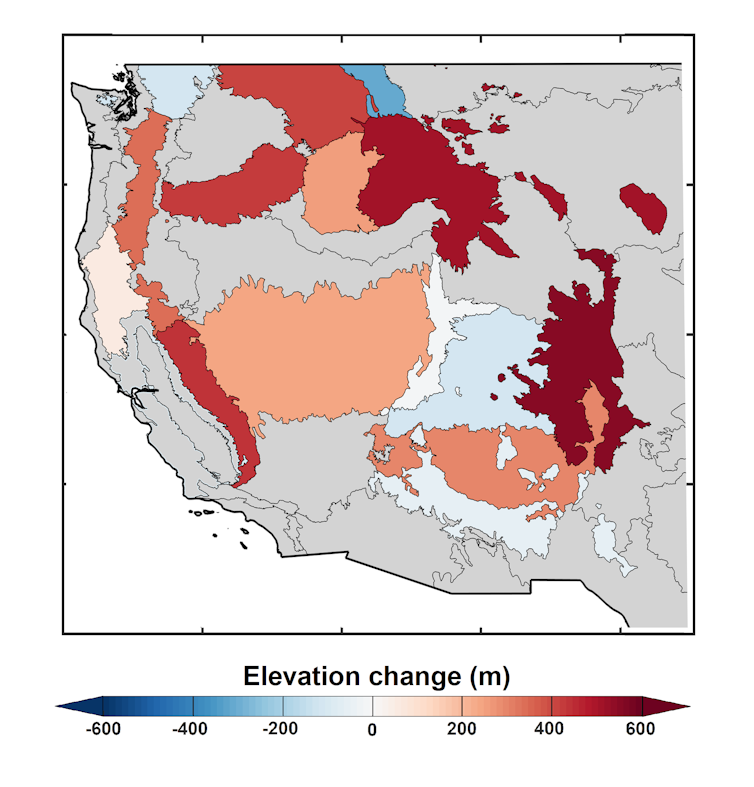
Forest fires advanced to higher elevations as the climate dried from 1984 to 2017. Every 200 meters equals 656 feet.
Mojtaba Sadegh, CC BY-ND
Rising fire risk in the high mountains
In the new study, we analyzed records of all fires larger than 1,000 acres (405 hectares) in the mountainous regions of the contiguous Western U.S. between 1984 and 2017.
The amount of land that burned increased across all elevations during that period, but the largest increase occurred above 8,200 feet (2,500 meters). To put that elevation into perspective, Denver – the mile-high city – sits at 5,280 feet, and Aspen, Colorado, is at 8,000 feet. These high-elevation areas are largely remote mountains and forests with some small communities and ski areas.
The area burning above 8,200 feet more than tripled in 2001-2017 compared with 1984-2000.
One of Colorado's largest wildfires, 2020's East Troublesome Fire, crossed the Continental Divide and was burning at elevations around 9,000 feet in October, when snow normally would have been falling.
Our results show that climate warming has diminished the high-elevation flammability barrier – the point where forests historically were too wet to burn regularly because the snow normally lingered well into summer and started falling again early in the fall. Fires advanced about 826 feet (252 meters) uphill in the Western mountains over those three decades.
The Cameron Peak Fire in Colorado in 2020 was the state's largest fire in its history, burning over 208,000 acres (84,200 hectares) and is a prime example of a high-elevation forest fire. The fire burned in forests extending to 12,000 feet (3,650 meters) and reached the upper tree line of the Rocky Mountains.
We found that rising temperatures in the past 34 years have helped to extend the fire territory in the West to an additional 31,470 square miles (81,500 square kilometers) of high-elevation forests. That means a staggering 11% of all Western U.S. forests – an area similar in size to South Carolina – are susceptible to fire now that weren't three decades ago.
Can't blame fire suppression here
In lower-elevation forests, several factors contribute to fire activity, including the presence of more people in wildland areas and a history of fire suppression.
In the early 1900s, Congress commissioned the U.S. Forest Service to manage forest fires, which resulted in a focus on suppressing fires – a policy that continued through the 1970s. This caused flammable underbrush that would normally be cleared out by occasional natural blazes to accumulate. The increase in biomass in many lower elevation forests across the West has been associated with increases in high-severity fires and megafires. At the same time, climate warming has dried out forests in the Western U.S., making them more prone to large fires.
On average, fires have spread 826 feet (252 meters) higher into the mountains in recent decades, exposing an additional 31,400 square miles (81,500 square kilometers) of forests to fire.
Mojtaba Sadegh, CC BY-ND
By focusing on high-elevation fires, in areas with little history of fire suppression, we can more clearly see the influence of climate change.
Most high-elevation forests haven't been subjected to much fire suppression, logging or other human activities, and because trees at these high elevations are in wetter forests, they historically have long return intervals between fires, typically a century or more. Yet they experienced the highest rate of increase in fire activity in the past 34 years. We found that the increase is strongly correlated with the observed warming.
High mountain fires create new problems
High-elevation fires have implications for natural and human systems.
High mountains are natural water towers that normally provide a sustained source of water to millions of people in dry summer months in the Western U.S. The scars that wildfires leave behind – known as burn scars – affect how much snow can accumulate at high elevations. This can influence the timing, quality and quantity of water that reaches reservoirs and rivers downstream.
High-elevation fires also remove standing trees that act as anchor points that normally stabilize the snowpack, raising the risk of avalanches.
The loss of tree canopy also exposes mountain streams to the Sun, increasing water temperatures in the cold headwater streams. Increasing stream temperatures can harm fish and the larger wildlife and predators that rely on them.
Climate change is increasing fire risk in many regions across the globe, and studies show that this trend will continue as the planet warms. The increase in fires in the high mountains is another warning to the U.S. West and elsewhere of the risks ahead as the climate changes.
Mojtaba Sadegh, Assistant Professor of Civil Engineering, Boise State University; John Abatzoglou, Associate Professor of Engineering, University of California, Merced, and Mohammad Reza Alizadeh, Ph.D. Student in Engineering, McGill University
This article is republished from The Conversation under a Creative Commons license. Read the original article.
FROM YOUR SITE ARTICLES
- The lasting impact of the 2020 Oregon wildfires - Alternet.org ›
- How Californians came together to deal with wildfires during the ... ›
- 'Antifa arson' hoax rumors spread faster than wildfires in besieged ... ›
RELATED ARTICLES AROUND THE WEB
- Six trends to know about fire season in the western U.S. – Climate ... ›
- California and the West face severe wildfire season - The ... ›
- Trump largely silent on historically devastating Western fires ... ›
===
https://yyy.theguardian.com/environment/2020/may/29/megadrought-us-south-west-fires-water-research
US south-west in grip of historic 'megadrought', research finds
Intensified by climate change, the current 20-year arid period is one of the worst on record, with wide-ranging effects
Samuel Gilbert
@samuelgilbert1
Fri 29 May 2020 05.30 EDTLast modified on Fri 29 May 2020 08.31 EDT
The Enterprise Bridge passes over a section of Lake Oroville that is nearly dry on 19 August 2014 in Oroville, California. The region is in the grip of a 20-year megadrought, research suggests.
When Ken Pimlott began fighting US wildfires at the age of 17, they seemed to him to be a brutal but manageable natural phenomenon.
Dust bowl conditions of 1930s US now more than twice as likely to reoccur
Read more
“We had periodic [fire] sieges in the 80s, but there were breaks in between,” said Pimlott, the former head of the California department of forestry and fire protection. But no longer. “That doesn’t really happen any more. Now you can’t even blink” between fires, he said. “We’re seeing the kinds of fires we have never seen before.”
A recent study published in the journal Science helps explains why, revealing that the south-western US is in the grip of a 20-year megadrought – a period of severe aridity that is stoking fires, depleting reservoirs and putting a strain on water supplies to the states of the region.
“You see impacts everywhere, in snowpacks, reservoir levels, agriculture, groundwater and tree mortality,” said co-author Benjamin Cook, of Columbia University’s Lamont Doherty Earth Observatory. “Droughts are these amazingly disruptive events. Water sits at the foundation of everything.”
Researchers compared soil moisture records from 2000-2019 to other drought events from the past 1,200 years. They found that the current period is worse than all but one of five megadroughts identified in the record.
Unlike past megadroughts – brought on by natural fluctuations in the Earth’s climate – this current drought has been heavily influenced by human-induced climate change, “pushing what would have been a moderate drought in south-western North America into megadrought territory”, according to the study.
“Global warming has made the drought much worse than it otherwise would have been,” said Cook. “We estimate 30-50% is attributed to climate change.”
According to Nasa, 19 of the 20 warmest years on record have occurred since 2001. Climate change, if unchecked, will hit the American south-west particularly hard.
A major concern is the megadrought’s impact on water supplies in the region. It has experienced explosive growth – half of the nation’s fastest-growing states are in the south-west – made possible by elaborate river diversion projects and massive reservoirs.
Over the past two decades, drought-depleted rivers, and population growth has led to steep declines in two of the nation’s largest reservoirs, Lake Mead and Lake Powell, on which which tens of millions of people depend.
Water deliveries from the Colorado River are also being rationed this year, for the first time.
For Pimlott, this drought has manifested itself in 21st-century fires unlike any he had previously witnessed. In 2018, a fire tornado destroyed part of one northern California town, and almost the entire community of Paradise, California, was wiped out by a blaze that claimed 85 victims.
“Were seeing more intense fires, with longer durations,” he said.
===
==
jet stream oscillation dry out CA --> wildfire?
Australia welcomes in 2020 — and shows the world the devastating effects of the climate crisis
Many times on New Year’s Eve, people in the United States are treated to pictures of revelry in Australia as the peculiarities of the International Date Line officially usher in the next year many hours in advance of the ball drop in Times Square.
==
==
jet stream:
icn 1219
...It played out in real time on TV and in newspaper headlines about droughts, floods, heat extremes and wildfires—an "unprecedented hemisphere-wide pattern," Mann said. "It played a key role in the large-scale jet pattern we saw in late July, associated with deep stagnant high pressure centers over California and Europe."
That brought blazing temperatures and wildfire conditions to California, flooding over the Eastern U.S. and unprecedented heat to the Scandinavian Arctic region, as well as a six-month heat wave and drought across parts of Central Europe, all events showing a clear global warming fingerprint, according to scientists.
The new study focuses on summer extremes, while other research has looked at how global warming affects the jet stream in winter.
What Happens in the Arctic Doesn't Stay There
Daniel Swain, a climate scientist at UCLA and the National Center for Atmospheric Research who was not involved with the new research, said the study has some "compelling new evidence on the link between amplified Arctic warming and extreme mid-latitude weather during the summer months."
What happens in the Arctic doesn't stay there. Increased melting of reflective sea ice in summer exposes more dark-colored ocean to absorb heat, and that heats the surrounding land. As Arctic warming races ahead of the rest of the global average, the temperature contrasts that drive the jet stream are reduced, and the river of wind more frequently twists into sharp and slow-moving or stationary waves.
"When the jet stream enters this wavy state, extreme weather tends to occur on either side of the amplified ridges and troughs as the storm track becomes locked in place," Swain said. Then, specific regions experience long periods of cool and stormy or, contrarily, hot and dry weather, he added.
https://www.alternet.org/2019/12/everything-is-burning-australian-inferno-continues-choking-access-to-cities-across-the-country/
getting worse, ppl evac by water!
==
https://www.ecowatch.com/wildfire-recovery-efforts-hurting-biodiversity-2641601458.html
==
https://theintercept.com/2019/11/07/california-wildfires-green-new-deal/
Naomi Klein
==
11/21
https://time.com/5735660/sydney-bushfires/
TIME
As Smoke From Bush Fires Chokes Sydney, Australian
Prime Minister Dodges on Climate Change
Australia's Prime Minister refused to admit a direct link between the bushfires in Sydney and climate change. Here's what scientists say.
hazardous smoke from raging bushfires blanket Sydney’s landmarks on Thursday, the Australian Prime Minister refused to admit a direct link between the fires and the country’s carbon emissions, which are among the highest per capita in the world.
Health officials have issued warnings over “hazardous” air pollution levels as Sydney’s Opera House was shrouded with smoke. The smoke around Sydney and the north-coast is set to settle and remain in the area for the rest of Thursday, fire officials said. Members of the public, especially those with respiratory health issues, are advised to avoid all outdoor physical activities.
Fires have devastated large areas of the country since Oct. 20. New South Wales has seen the most severe and dangerous fires, with six people killed and around 1.7 million hectares burned. Climate Change has played a key role in the bushfires, Australia’s Bureau of Meteorology has said. They said: “Climate change is influencing the frequency and severity of dangerous bushfire conditions in Australia and other regions of the world.”
However, amid the bushfire crisis, Scott Morrison, Australia’s Prime Minister has argued that there is no direct link between Australia’s greenhouse gas emissions and the severity of the fires burning across the country. He told ABC AU during a radio interview on Thursday that there was no “credible scientific evidence” that cutting carbon emissions could reduce the severity of the fires.
==
https://www.ecowatch.com/sydney-water-shortage-2641353372.html
==
https://www.ecowatch.com/sydney-water-shortage-2641353372.html
==
1119 many oz aus
https://yyy.theguardian.com/australia-news/2019/nov/11/dear-michael-mccormack-the-only-raving-lunatics-are-those-not-worrying-about-climate-change
==
ew 919
While more than 130 wildfires are raging across two states in eastern Australia — Queensland and New South Wales — at an unusually early part of the spring, taxing the water supplies of the drought-stricken country, the country's federal appointee for handling disasters expressed doubts that humans are causing the climate crisis. Then, the next day he made a head scratching about face and said he believes in climate science and always has, according to guk
==
https://insideclimatenews.org/news/23082018/extreme-wildfires-climate-change-global-warming-air-pollution-fire-management-black-carbon-co2
complex interactions
https://www.alternet.org/2019/08/parts-of-california-are-too-wildfire-prone-to-insure
no lnx
Parts of California are too wildfire-prone to insure
Written by Nathanael Johnson / Grist.Org August 24, 2019
California is facing yet another real estate-related crisis, but we’re not talking about its sky-high home prices. According to newly released data, it’s simply become too risky to insure houses in big swaths of the wildfire-prone state.
This post originally appeared on Grist.
Last winter when we wrote about home insurance rates possibly going up in the wake of California’s massive, deadly fires, the insurance industry representatives we interviewed were skeptical. They noted that the stories circulating in the media about people in forested areas losing their homeowners’ insurance was based on anecdotes, not data. But now, the data is in and it’s really happening: Insurance companies aren’t renewing policies areas climate scientists say are likely to burn in giant wildfires in coming years.
Insurance companies dropped more than 340,000 homeowners from wildfire areas in just four years. Between 2015 and 2018, the 10 California counties with the most homes in flammable forests saw a 177 percent increase in homeowners turning to an expensive state-backed insurance program because they could not find private insurance.
In some ways, this news is not surprising. According to a recent survey of insurance actuaries (the people who calculate insurance risks and premiums based on available data), the industry ranked climate change as the top risk for 2019, beating out concerns over cyber damages, financial instability, and terrorism. While having insurance companies on board with climate science is a good thing for, say, requiring cities to invest in more sustainable infrastructure, it’s bad news for homeowners who can’t simply pick up their lodgings and move elsewhere.
“We are seeing an increasing trend across California where people at risk of wildfires are being non-renewed by their insurer,” said California Insurance Commissioner Ricardo Lara in a statement. “This data should be a wake-up call for state and local policymakers that without action to reduce the risk from extreme wildfires and preserve the insurance market we could see communities unraveling.”
A similar dynamic is likely unfolding across many other Western states, according to reporting from the New York Times.
To understand the data coming out of California we can use my own family as an example: A few months after Grist published a story about how my parent’s neighborhood is trying to fortify itself against future forest fires, my mom’s insurer informed her and my stepfather that they’d need to get home insurance elsewhere. For two months they called one insurer after another, but no company would take their premiums. So they turned to the state program as the insurer of last resort — which costs about three times more than they’d been spending under their previous, private insurer.
My folks have spent a lot of money clearing trees and brush from around their house. They’ve covered the walls in hard-to-burn cement panels, and the roof with metal. But insurance risk maps don’t adjust for these improvements. Instead, insurance companies seem to have made the call that the changing climate, along with years of fire suppression, have made houses in the midst of California’s dry forests a bad bet, and therefore uninsurable.
“For us, because we’ve done good financial planning and our house is paid off, it’s just an extra expense,” said my mom, Gail Johnson Vaughan. “But we have friends who have no choice but to leave.”
==
==
819 fires in siberia, last mo everglades, now brazil:
==
aha-let: separation allows demonization: X hate America; dems are trying to destroy the cty and then:
Brazil's right-wing President Jair Bolsonaro is giving President Trump a run for his money in the alternative facts department.
Responding to international outrage following the news that there are record numbers of wildfires burning in the Amazon rainforest, Bolsonaro tried to shift the blame away from his pro-business administration and onto an unlikely culprit: non-governmental organizations.
"Everything indicates" that NGOs were planning to set fires to the forest, Bolsonaro said on Facebook Live Wednesday, as Reuters reported. When asked if he had proof, he could not provide any, answering that he had "no written plan."
Later the same day, he repeated the claims at a steel industry congress in Brasilia, The Guardian reported.
"On the question of burning in the Amazon, which in my opinion may have been initiated by NGOs because they lost money, what is the intention? To bring problems to Brazil," he said.
Environmental groups, however, say that the fires are a result of deforestation encouraged by Bolsonaro's policies. He has promised to open the Amazon to mining and agriculture, and that has encouraged farmers to start illegal fires in order to clear land. Local papers report that farmers emboldened by weaker enforcement are even organizing "fire days" in some regions, according to The Guardian.
:{
}:
"This is a sick statement, a pitiful statement," Greenpeace Brazil Public Policy Coordinator Marcio Astrini told Reuters of Bolsonaro's remarks. "Increased deforestation and burning are the result of his anti-environmental policy."
:{
}:
The fires came to global attention this week when Brazil's space agency announced that the number of fires burning in the year since Bolsonaro took office were up more than 80 percent when compared with the year before. On Wednesday, the hashtag #PrayforAmazonas was the No. 1 trending topic on Twitter worldwide.
Experts attribute the fires to deforestation because this year has not been particularly dry.
"In the previous years [wildfires] were very much related to the lack of rain, but it has been quite moist this year," ecologist Adriane Muelbert told National Geographic. "That leads us to think that this is deforestation-driven fire."
Farmers and ranchers start fires to clear forest for soy or grazing land, but the fires then catch and spread. If this continues, ecologist and National Geographic Explorer-at-Large Thomas Lovejoy explained to the nature magazine that it could have devastating consequences for the rainforest, and for the world:
Lovejoy describes a cyclical system in which deforestation fuels forest loss, making the region drier, spurring even more deforestation. Much of the rain in the Amazon is generated by the rainforest itself, but as trees disappear, rainfall declines. Experts worry that this downward spiral could increasingly dry out the forest and push it to a point of no return, where it more resembles savannah than rainforest.
"The Amazon has this tipping point because it makes half of its own rainfall," says Lovejoy. That's why, he says, "the Amazon has to be managed as a system."
Not only would such a change endanger the 40,000 species of plants, 1,300 species of birds, 430 mammals and 400 to 500 indigenous communities that call the Amazon home, it would also make it harder to fight the climate crisis. The world's largest tropical rainforest is an important store of carbon, absorbing millions of tons of emissions per year.
Given the global stakes, it's no wonder that Bolsonaro has come under international scrutiny for his policies, as The Guardian explained. Both Germany and Norway recently suspended donations to the Amazon Fund, and there is pressure for the EU to block a trade agreement with Brazil and other countries in South America.
==
==
Peter Frumhoff, at the Union of Concerned Scientists, has also conducted research in this realm. He's looked at the correlation between climate change and human mortality related to extreme heatwaves. Ironically, the success of the oil companies' social influence campaigns are a real strength to these cases.[00:05:12]
Marco Simons with Earth Rights International is representing a group of cities and counties in Colorado that are suing oil companies to cover the costs of fighting increasingly intense wildfires and other impacts of climate change.Marco Simons:[00:05:23]They did such a good job that the public is more skeptical of climate change now than the oil companies are.[00:05:31]
...ep 8?
...California's ever-extending fire season saw the state burn through its annual budget for 2018—$442.8 million—by September. Fire agencies estimated they needed an additional $234 million to continue combating fires, and that was before yet another devastating complex of fires hit in November. If you want to talk to someone who knows for sure that climate change is happening,talk to a California firefighter. Here's Cal Fire Chief Ken Pimlott on Good Morning L.A. earlier this year.
Ken Pimlott:[00:04:19]It really is going to get worse. The last several years have just shown us every year it continues to progress and things are changing. If you ask career firefighters out on the fire line who've been doing this 30, 35 years, these are not the kinds of fires and weather conditions we were facing you know just a few decades ago. Climate change is real and it's happening everywhere. We're seeing again more intense fires fires are burning more rapidly and they're getting larger. That 100000 acre or more fire used to be the exception to the rule. We might get one of those every few years. Now we're getting multiple one hundred thousand acre fires each year.[00:04:56]
Last year Pimlott told me that one new thing that's made firefighting harder is that it's not getting reliable cooler and wetter at night anymore.Night Time was historically when firefighters would get ahead of a fire. But recent data indicates that nights are warming faster than days. We're seeing record-breaking natural disasters all the time now not just once a decade. And they do seem to be breaking through the noise a bit.
It gets a lot harder to say climate change isn't happening when people can see for themselves that heat waves are hotter and longer or that storms seem bigger and more regular than in decades past. In the last year or so, climate change has regularly made the covers of magazines and the front pages of newspapers as it did back in the 90s. And That's a positive step forward because for decades the industry successfully blocked the first critical step toward taking action on climate: acknowledgement.[00:06:20]
According to most of the literature on human psychology, in order to move past our general tendency to freeze when we're facing huge and scary challenges or big losses is toacknowledgethat the problem is there and that it's tough to deal with.[00:06:38]Instead, the industry put the American public on a pathway to denial. They did so knowingly and with purpose.
...
==
An area of 3.2 million hectares (7.9 million acres) was engulfed by forest fires in remote regions of Russiaon Monday. In comparison, the total surface of the nation of Belgium is 3.07 million hectares.
With fires raging for days, immense clouds of smoke reached large population centers, including Russia's third biggest city, Novosibirsk. Authorities declared emergencies in several regions.
"The smoke is horrible," pensioner Raisa Brovkina told state television after being hospitalized in Novosibirsk.
"I am choking and dizzy," she added.
No Money to Put out Fires
Siberia regularly faces immense wildfires, but the impact this year had been boosted by strong wind and unusually dry weather. The blazes have been allowed to spread as cash-strapped local authorities usually ignore fires in remote regions.
Talking to Siberian Times, an emergency pilot in Krasnoyarski Krai said he had spent days waiting to fly his firefighting plane, but received no order to do so.
"Every day the whole team and I are on duty. There are four aircraft," he said in an article published on Monday.
"Since the beginning of the fires, not a single specialized [plane] has been lifted into the air."
"They say it is expensive to extinguish and if part of the forest burns down — it is not scary," the unnamed pilot said.
Greenpeace Steps in
Separately, the region's officials said that cost of the firefighting effort is sometimes "ten times larger than the possible damage" caused by the fire.
But the pilot slammed the calculation as "absurd."
"Of course, now, probably it will be expensive to extinguish everything that burns," he said.
"But why was there no order to fly out earlier, when the fire had just begun to spread?"
The Russian charter of Greenpeace had launched a petition to force the government to move against wildfires in Siberia, which was signed by some 245,000 by Tuesday evening.
Burning in the Sun
The wildfires "have long stopped being a local problem" and have "transformed into an ecological disaster with consequences for the entire country," Greenpeace said.
Greenpeace expert Grigory Kuksin said thesoot and ashes accelerate the melting of the Arctic ice and permafrost, which in turns releases even more greenhouse gases into the atmosphere.
"It is comparable to the emissions of major cities," he told the AFP news agency. "The more fires affect the climate, the more conditions are created for new dangerous fires."
The group said almost 12 million hectares have already burned this year, destroying forests that absorb carbon dioxide.
Siberia was almost 10 degrees Celsius (18 Fahrenheit) warmer than the long-term average in June, according to the World Meteorological Organization.
Reposted with permission from our media associate DW.
- The Vicious Climate-Wildfire Cycle - EcoWatch ›
- The Arctic Is Burning: Wildfires Rage from Sweden to Alaska ... ›
RELATED ARTICLES AROUND THE WEB
- Siberia wildfires in Russia a potential "disaster" for climate as they ... ›
- Russians demand vast wildfires consuming Siberia be extinguished ... ›
- Wildfires Engulf Siberia, Sparking Online Pleas for Help - The ... ›
==
HEAT DEATH
150 million trees died in California’s drought, and worse is to come
==
http://rachelcarson-wiki.lt.ucsc.edu/wiki/Category:Fire#Wildfires
c8 wiki
==
Planned burns can reduce wildfire risks, but expanding use of ‘good fire’ isn’t easy
Courtney Schultz, Colorado State University; Cassandra Moseley, University of Oregon, and Heidi Huber-Stearns, University of Oregon
Decades of wildfire suppression have allowed flammable fuels to pile up in US forests. Scientists and managers say careful use of planned fires can reduce risks of large, out-of-control burns.
https://insideclimatenews.org/news/11032019/forest-wildfire-climate-change-tipping-point-study-douglas-fir-ponderosa-pines-west
Climate change in the American West may be crossing an ominous threshold, making parts of the region inhospitable for some native pine and fir forests to regrow after wildfires, new research suggests.
As temperatures rise, the hotter, drier air and drier soil conditions are increasingly unsuitable for young Douglas firs and ponderosa pines to take root and thrive in some of the region's low-elevation forests, scientists write in a study published Monday in the Proceedings of the National Academy of Sciences. Wildfiresin these areas could lead to abrupt ecosystem changes, from forest to non-forest, that would otherwise take decades to centuries, the study says.
"Once a certain threshold was crossed, then the probability of tree establishment decreased rapidly," said Kimberley Davis, a researcher at the University of Montana and lead author of the study. "The climate conditions are just a lot less suitable for regeneration."
The two iconic species are important to both the region's forest ecology and its economy, particularly its timber industry.
Davis and her colleagues looked at growth rings of nearly 3,000 young trees in 33 fire-damaged areas of California, Colorado, the Northern Rockies and the southwestern United States to see when the forests recovered after fires over the past 30 years. Analyzing climate data over the same period, they found certain thresholds involving summer humidity for ponderosa pine, surface temperature for Douglas fir, and soil moisture for both species, beyond which there was a sharp decline in forest regrowth.
The warmer, drier air isn't harming mature trees, but it is preventing future generations from growing, Davis said.
"There could be a lot of areas where there is currently forest but if we have a fire we might not see regeneration," she said.
Thresholds 'Show How Much Is at Stake'
Davis and her colleagues found that most of the sites they looked at had crossed the temperature and humidity threshold at some point in the last 20 years.
They targeted the driest and warmest sites in the region to see if climate change was already beginning to affect forests. The researchers now plan to assess the extent to which regeneration is affected in relatively cooler, wetter sites in the region.
Several factors influence a forest's regrowth after a wildfire, such as the severity of the fire, regional drought and how the trees produce seeds. The researchers noted that as the region sees fewer years with climate conditions suitable for seedlings to grow, the nature of the trees' seed production, with heavy crops of cones only every few years, will further limit new growth.
Last year, wildfires burned more than 8.7 million acres nationwide, 32 percent higher than the 10-year average according to an annual report by the National Interagency Coordination Center released last week. More than 1.8 million of those acres were in California, the highest in recorded state history, according to state fire officials.

The inability of forests to bounce back from such fires is cause for concern, said Joe Fargione, science director for the Nature Conservancy's North America region.
"The thresholds identified here show how much is at stake—losing forests because trees can't grow back—if we don't accelerate the switch to clean energy and invest more in natural climate solutions," Fargione said. "This study will help land managers identify forests at the greatest risk of not regenerating post-fire."
Fargione said such high-risk forests can be targeted for selective thinning to reduce the risk of forest fires and for restoration efforts to improve the success of forest regeneration.
Trees Play a Critical Climate Role
Protecting forests is important for slowing climate change because of their ability to pull carbon dioxide out of the atmosphere and store the carbon in their trunks, branches and roots.
A study Fargione and others published last fall found better forest, farm and land management practices offer natural climate solutions that could mitigate 21 percent of the United States' annual greenhouse gas emissions.
"It really highlights the fact that we need to begin a national and international conversation about how we can enhance the resiliency of our global forests," Anthony Swift, director of the Natural Resources Defense Council's Canada Project, said of the current study.
Swift said intensive logging, road building and cutting trees to make room for transmission lines weakens the ability of forests to deal with added stressors like climate change.
"We don't need to stop all activity in global forests, but it does raise the need to reconsider how and where we extract timber and engage in other industrial activities in forests," he said.
A report last month by NRDC looked at how clear cutting boreal forests in Canada by some U.S. toilet paper manufacturersimperils forests and could hasten climate change.The report called for alternatives, like using recycled paper, that don't lead to the fragmentation and clear cutting of intact forests. Leaving forests more intact could also help protect Douglas fir and ponderosa pine forests in the American West, Swift said.
"Whether we are looking at wildfires or industrial activities, concerns that in a changing climate regeneration is going to be more difficult to achieve is an issue that we all need to be looking at more carefully because of the roll our forests have to play for the global climate," he said.
PUBLISHED UNDER:
==
==
Heartbreaking & Devastating Camp Fire Was World's Costliest Catastrophe of 2018
In terms of natural disasters, 2018 was a really bad year. Communities in the United States and around the world were devastated by record-breaking wildfires, hurricanes, earthquakes, floods and other catastrophes.
Lamentably, these weather and geophysical events caused 10,400 human deaths and $160 billion in estimated damages last year, reinsurance company Munich Re said on Tuesday.
Keep reading...
Heartbreaking & Devastating Camp Fire Was World's Costliest Catastrophe of 2018
In terms of natural disasters, 2018 was a really bad year. Communities in the United States and around the world were devastated by record-breaking wildfires, hurricanes, earthquakes, floods and other catastrophes.
Lamentably, these weather and geophysical events caused 10,400 human deaths and $160 billion in estimated damages last year, reinsurance company Munich Re said on Tuesday.
The deadliest disaster of 2018 was the horrific earthquake-tsunami combo that struck the Indonesian city of Palu in September, where 2,100 lives perished, according to the German firm.
The year's top three most expensive natural disasters all occurred in the U.S. The Camp Fire—the deadliest and most destructive fire in California history—topped Munich Re's list with overall losses of $16.5 billion and insured losses of $12.5 billion. Eighty-six people died and thousands of homes and buildings were incinerated during the November fire in Butte County.
Hurricanes Michael ($16 billion) and Florence ($14 billion) round out the top three. Florence in September and Michael in October were part of an unusually active 2018 Atlantic hurricane season.
In fourth place on this dubious list is Typhoon Jebi, which struck Japan and Taiwan in September, and cost $12.5 billion; and in fifth place is Japan's historic flooding-landslide events in July and cost $9.5 billion, USA TODAY reported from the German analysis.
What's even more daunting, experts say these disasters will become more severe as temperatures keep rising around the planet.
"Our data shows that the losses from wildfires in California have risen dramatically in recent years," Ernst Rauch, head of Climate and Geosciences at Munich Re, said in a press release. "At the same time, we have experienced a significant increase in hot, dry summers, which has been a major factor in the formation of wildfires. Many scientists see a link between these developments and advancing climate change."
While the 2018 sum total of $160 billion is much lower than 2017's extremely high losses of $350 billion caused mostly by hurricane damages, it is above the 30-year average of $140 billion, Munich Re said. About half of 2018's losses were insured.
"2018 saw several major natural catastrophes with high insured losses," Munich Re board member Torsten Jeworrek said in the press release. "These included the unusual phenomenon of severe tropical cyclones occurring both in the U.S. and Japan while autumn wildfires devastated parts of California. Such massive wildfires appear to be occurring more frequently as a result of climate change."
Jeworrek continued, "Action is urgently needed on building codes and land use to help prevent losses. Given the greater frequency of unusual loss events and the possible links between them, insurers need to examine whether the events of 2018 were already on their models' radar or whether they need to realign their risk management and underwriting strategies."
In November, the U.S. government released a daunting report that warned climate change could kill thousands of Americans each year and slash the GDP by more than 10 percent by 2100.
President Donald Trump infamously dismissed his own government's study, saying "I don't believe it."
RELATED ARTICLES AROUND THE WEB
- What You Need to Know: Butte County's Camp Fire | The California ... ›
- 42 Dead in California's Camp Fire, Deadliest in State History ›
- 63 Dead, 631 Missing in Deadliest, Most Destructive Fire in ... ›
- 1,000+ American Brewers Brew Special Beer to Raise Funds for ... ›
- 'We Were Engulfed in Flames': Rapid Wildfire Devastates Entire ... ›
- Camp Fire ›
==
==
https://www.ecowatch.com/trump-admin-takes-advantage-of-california-fires-2594248442.html
Trump Admin. Takes Advantage of California Fires to Funnel More Water From Endangered Fish to Agriculture, Critics Say
The Commerce Department seemed to take its direction from President Donald Trump's Twitter account on Wednesday when it issued a directive to the National Marine Fisheries Service (NMFS) to prioritize fighting wildfires over protecting endangered species when allocating California's water resources, The Huffington Post reported.
The directive comes days after Trump tweeted blaming California's raging wildfires on "bad environmental laws which aren't allowing massive amount of readily available water to be properly utilized."
Firefighters disagreed with Trump's assessment.
"We have plenty of water to fight these wildfires," Deputy Chief of the California Department of Forestry and Fire Protection Scott McLean told The Huffington Post on Monday. "It is our changing climate that is leading to more severe and destructive fires."
But that didn't stop Commerce Secretary Wilbur Ross from using an emergency provision of the Endangered Species Act to direct water towards the fires.
"Today, I direct NOAA's National Marine Fisheries Service to make clear to all its Federal agency partners that the protection of life and property takes precedence over any current agreements regarding the use of water in the areas of California affected by wildfires," Ross wrote.
Environmentalists are concerned this move isn't about the fires at all, but rather an attempt to use the disaster to intervene in a longstanding disagreement between agriculture, the fishing industry and environmentalists over whether more water should be used to irrigate crops or should be left in rivers to preserve fish species like delta smelt and Chinook salmon.
Ross's directive comes one month after the California Water Resources Control Board proposed diverting less water towards cities and farms in an attempt to save the two endangered species.
"Secretary Ross's directive is nothing more than a smokescreen designed to weaken these protections that NMFS's scientists determined are necessary to keep these native fish from going extinct. It's almost like the extinction of these creatures is their real goal, so that they no longer have to leave any water in rivers, but can divert it all to corporate agribusiness. The people of California won't stand for Trump destroying our precious resources to line the pockets of his corporate buddies," senior director of the water division for the Natural Resources Defense Council Kate Poole said in a statement reported by ABC News.
Around 80 percent of all water in California currently goes to agriculture, according to The Huffington Post, but, for Trump allies in the state like Republican CongressmanDevin Nunes, that is not enough.
Nunes even went so far as to blame the drought that devastated California from 2011 to 2017 on a misallocation of water resources.
"There was plenty of water," he told The New York Times in 2014, according to The Huffington Post. "This has nothing to do with drought. They can blame global warming all they want, but this is about mathematics and engineering."
Meanwhile, another department head also seemed to take his cue on the wildfires from a different argument in the same Trump tweet, in which the president said the state "must also tree clear to stop fire from spreading!"
On Wednesday, Interior Secretary Ryan Zinke wrote an opinion piece for USA Today in which he blamed the fires in part on a buildup of fuels in forests.
He called for more active forest management through logging, controlled burns and "mechanical thinning" and blamed environmentalists for preventing this kind of action.
"Yet, when action comes, and we try to thin forests of dead and dying timber, or we try to sustainably harvest timber from dense and fire-prone areas, we are attacked with frivolous litigation from radical environmentalists who would rather see forests and communities burn than see a logger in the woods," he wrote.
However, his OpEd doesn't appear to signal any imminent policy change, ABC News reported.
Zinke issued a directive last year calling on land managers to be more "aggressive" in clearing dead trees or brush, but Interior Department spokesperson Heather Swift told ABC News that there were no changes in the works this year.
==
==
18 in 8/18. biggest in hist wine cty
mann sierra club mike b
https://www.democracynow.org/2018/8/9/experts_if_we_don_t_stop
https://www.alternet.org/news-amp-politics/heres-how-climate-change-impacts-risk-wildfires
Once again, the summer of 2018 in the Northern Hemisphere has brought us an epidemic of major wildfires.
These burn forests, houses and other structures, displace thousands of people and animals, and cause major disruptions in people’s lives. The huge burden of simply firefighting has become a year-round task costing billions of dollars, let alone the cost of the destruction. The smoke veil can extend hundreds or even thousands of miles, affecting air quality and visibility. To many people, it has become very clear that human-induced climate change plays a major role by greatly increasing the risk of wildfire.
Yet it seems the role of climate change is seldom mentioned in many or even most news stories about the multitude of fires and heat waves. In part this is because the issue of attribution is not usually clear. The argument is that there have always been wildfires, and how can we attribute any particular wildfire to climate change.
As a climate scientist, I can say this is the wrong framing of the problem. Global warming does not cause wildfires. The proximate cause is often human carelessness (cigarette butts, camp fires not extinguished properly, etc.), or natural, from “dry lightning” whereby a thunderstorm produces lightning but little rain. Rather, global warming exacerbates the conditions and raises the risk of wildfire.
Even so, there is huge complexity and variability from one fire to the next, and hence the attribution can become complex. Instead, the way to think about this is from the standpoint of basic science – in this case, physics.
Global warming is happening
To understand the interplay between global warming and wildfires, consider what’s happening to our planet.
The composition of the atmosphere is changing from human activities: There has been over a 40 percent increase in carbon dioxide, mainly from fossil fuel burning since the 1800s, and over half of the increase is since 1985. Other heat-trapping gases (methane, nitrous oxide, etc.) are also increasing in concentration in the atmosphere from human activities. The rates are accelerating, not declining (as hoped for with the Paris agreement).
This leads to an energy imbalance for the planet.
Heat-trapping gases in the atmosphere act as a blanket and inhibit the infrared radiation – that is, heat from the Earth – from escaping back into space to offset the continual radiation coming from the sun. As these gases build up, more of this energy, mostly in the form of heat, remains in our atmosphere. The energy raises the temperature of the land, oceans and atmosphere, melts ice, thaws permafrost, and fuels the water cycle through evaporation.
Moreover, we can estimate Earth’s energy imbalance quite well: It amounts to about 1 watt per square meter, or about 500 terawatts globally.
While this factor is small compared with the natural flow of energy through the system, which is 240 watts per square meter, it is large compared with all other direct effects of human activities. For instance, the electrical power generation in the U.S. last year averaged 0.46 terawatts.
The extra heat is always the same sign and it is spread across the globe. Accordingly, where this energy accumulates matters.
Tracking the Earth’s energy imbalance
The heat mostly accumulates ultimately in the ocean – over 90 percent. This added heat means the ocean expands and sea level rises.
Heat also accumulates in melting ice, causing melting Arctic sea ice and glacier losses in Greenland and Antarctica. This adds water to the ocean, and so the sea level rises from this as well, rising at a rate of over 3 milimeters year, or over a foot per century.
On land, the effects of the energy imbalance are complicated by water. If water is present, the heat mainly goes into evaporation and drying, and that feeds moisture into storms, which produce heavier rain. But the effects do not accumulate provided that it rains on and off.
However, in a dry spell or drought, the heat accumulates. Firstly, it dries things out, and then secondly it raises temperatures. Of course, “it never rains in southern California” according to the , at least in the summer half year.
So water acts as the air conditioner of the planet. In the absence of water, the excess heat effects accumulate on land both by drying everything out and wilting plants, and by raising temperatures. In turn, this leads to heat waves and increased risk of wildfire. These factors apply in regions in the western U.S. and in regions with Mediterranean climates. Indeed many of the recent wildfires have occurred not only in the West in the United States, but also in Portugal, Spain, Greece, and other parts of the Mediterranean.
The conditions can also develop in other parts of the world when strong high pressure weather domes (anticyclones) stagnate, [jet stream weaker, so stall of no or hvy rain?]as can happen in part by chance, or with increased odds in some weather patterns such as those established by either La Niña or El Niño events (in different places). It is expected that these dry spots move around from year to year, but that their abundance increases over time, as is clearly happening.
How big is the energy imbalance effect over land? Well, 1 Watt per square meter over a month, if accumulated, is equivalent to 720 Watts per square meter over one hour. 720 Watts is equivalent to full power in a small microwave oven. One square meter is about 10 square feet. Hence, after one month this is equivalent to: one microwave oven at full power every square foot for six minutes. No wonder things catch on fire!
Attribution science
Coming back to the original question of wildfires and global warming, this explains the argument: there is extra heat available from climate change and the above indicates just how large it is.
In reality there is moisture in the soil, and plants have root systems that tap soil moisture and delay the effects before they begin to wilt, so that it typically takes over two months for the effects to be large enough to fully set the stage for wildfires. On a day to day basis, the effect is small enough to be lost in the normal weather variability. But after a dry spell of over a month, the risk is noticeably higher. And of course the global mean surface temperature is also going up.
“We can’t attribute a single event to climate change” has been a mantra of climate scientists for a long time. It has recently changed, however.
As in the wildfires example, there has been a realization that climate scientists may be able to make useful statements by assuming that the weather events themselves are relatively unaffected by climate change. This is a good assumption.
Also, climate scientists cannot say that extreme events are due to global warming, because that is a poorly posed question. However, we can say it is highly likely that they would not have had such extreme impacts without global warming. Indeed, all weather events are affected by climate change because the environment in which they occur is warmer and moister than it used to be.
 In particular, by focusing on Earth’s Energy Imbalance, new research is expected to advance the understanding of what is happening, and why, and what it implies for the future.
Kevin Trenberth, Distinguished Senior Scientist, National Center for Atmospheric Research
==
==
Calif. — Californians are stunned at President Donald’s Trump’s latest tweets on the state‘s catastrophic wildfires — and his insistence that the state is burning because leaders are letting too much fresh water flow into the Pacific Ocean.
Trump tweeted Monday that California “Governor Jerry Brown must allow the Free Flow of the vast amounts of water coming from the North and foolishly being diverted into the Pacific Ocean. Can be used for fires, farming and everything else. Think of California with plenty of Water - Nice! Fast Federal govt. approvals.”
That tweet — on the heels of a Sunday tweet that referenced California’s “bad environmental laws” as a cause of the state’s current raging wildfires — drew an immediate reaction from veteran California GOP strategist Rob Stutzman, who responded via Twitter: “This is nuts’’ and also “low water IQ.” Stutzman has advised former Gov. Arnold Schwarzenegger and a host of national and state GOP candidates.
@realDonaldTrump
California wildfires are being magnified & made so much worse by the bad environmental laws which aren’t allowing massive amounts of readily available water to be properly utilized. It is being diverted into the Pacific Ocean. Must also tree clear to stop fire from spreading!
2:53 PM - Aug 6, 2018
57.5K
36.6K people are talking about this
Trump’s comments may be referencing an unrelated dispute between Brown's administration and California Republicans over how much of the state's water can be diverted to Southern California farms and cities and how much must be allowed to flow naturally to benefit endangered and threatened fish species.
Wildfires around California have killed nine people, but firefighters have not raised concerns about the available water supplies.
“The notion that somehow more water would be mitigating or better in fighting these fires is just mind-boggling,’’ Stutzman told POLITICO on Monday. “I don’t watch 'Fox & Friends,' but it would seem that someone has put the idea in his head. It doesn’t even show an elementary understanding of water policy.’’
Fox & Friends had aired a segment about the California fires nearly five hours before Trump‘s Monday tweet but didn’t discuss water issues as part of the segment.
Stutzman called the president’s recent tweets on California fires and water policy “frightening,” saying that “water has nothing to do with why these places are tinder boxes. It’s very exasperating. ... It’s a statement from the president that shows no understanding of hydrology.”
He said he would advise Brown, a Democrat, to “not take the bait” and react to such uninformed views.
Indeed, Evan Westrup, the spokesman for Brown, told POLITICO that “this does not merit a response.” But he also added via email: “It’s a sad state of affairs when journalism is reduced to chasing the uninformed, unsupervised tweets of the president.”
Some Democrats seized on the latest tweet. Rhys Williams, spokesman for Democratic gubernatorial candidate Gavin Newsom, tweeted: “Has anybody seen the baby’s pacifier? He dropped it again.”
Donald Trump is pictured. | AP Photo
Trump endorses Kobach for Kansas governor]
In a purely political sense, Trump’s tweets reflected his alignment with California Republicans who have long complained that the state unfairly prioritizes environmental uses for water over the state’s sprawling agricultural industry. Putting “fish over farms” is a popular formulation that has been invoked by Trump allies from California’s agricultural heartland, such as Reps. Devin Nunes and Kevin McCarthy.
“Forests should be managed properly and water should be allowed for farmers to grow food to feed people,” Nunes wrote on Twitter in response to Trump’s Sunday tweet, cheering the president "for bringing much needed attention to our flawed environmental policies!"
Trump has courted the Republican-leaning Farm Bureau heavily.California’s water wars are a huge issue for the group. Trump addressed the annual Farm Bureau convention in January, becoming the first president in more than two decades to do so. He also raised the issue during a campaign stop in Fresno in 2016.
But experts who make their living studying California’s water system reacted for the second consecutive day with a communal groan of exasperation. Peter Gleick of the Pacific Institute, one of the state’s foremost experts on how the state manages its water, issued a tweet calling Trump’s latest missive “nuts” after labeling the president’s initial tweet “gobbledygook bullsh--.”
In an email to POLITICO, Gleick noted that the water that flows from California’s rivers into the ocean is what remains after cities and farms take their gulp — and that those flows are critical to shoring up ecosystems that, in some parts of the state, are teetering on the brink of collapse.
“Trump's tweets last night and today show a profound misunderstanding about water, fires, California environmental policy, and of course, climate change,” Gleick said, adding that the “idea that somehow state water policies are leading to a shortage of water for fighting the fires is too stupid to rebut.”
==
new temp 'hood
fire tornado, siege, move in all directions as if 40-50 mph santa ana
https://www.sacbee.com/news/politics-government/capitol-alert/article215852940.html
...Brown said Wednesday that the state will spend what it must to attack the fires.
“There is money in this year’s budget,” he said. “In a year or slightly longer, that money will start to diminish. … Things will get much tighter in the next five years as the business cycle turns negative and the fires continue.”
He suggested California has been caught off-guard by the current demands.
“No one expected a fire tornado,” Brown said. “We’re getting a new phenomenon and that new phenomenon is we’re in a new climate weather era and so we have to learn.”
Brown since 2015 has directed more than $800 million in one-time budget funds for fire prevention, including the removal of dead trees and other vegetation that fuel fires.
In May, he outlined in an executive order a $96 million plan to expand vegetation thinning, controlled fires and reforestation on up to 500,000 acres of land. He also spent $160 million in cap-and-trade revenue to support forest improvements and fire protection.
The plan also seeks to make it easier for private landowners to thin vegetation on their properties by streamlining the approvals process for permits needed to do so.
Some say the state’s efforts to date don’t go far enough.
Republican gubernatorial candidate John Cox blasted state lawmakers for not adequately funding fire prevention. He downplayed concerns voiced by his Democratic opponent, Lt. Gov. Gavin Newsom, and Brown about climate change and the increasing threat of disastrous wildfires.
Cox, who toured the fire zone in Shasta County this week with Republican lawmakers, said “I don’t know” if climate change is human-caused.
“Politicians like Mr. Brown and Mr. Newsom are distracting people,” Cox said. “What’s really going on here is they’re blaming this on climate change to cover up for the fact that they haven’t devoted the time and the resources and the planning to actually doing something about forestry management.”
Cox also backs the thinning of forests, saying the state should be investing in “fire breaks, controlled burns and clearing out dead and diseased trees.”
He said the state also needs to invest more heavily in boosting the ranks of firefighters, training and equipment.
“We’re going to find the money, believe me,” Cox said.
Newsom spokesman Nathan Click said “Cox’s Trumpian climate change denials, in the face of overwhelming scientific evidence, only undermine what little credibility remains in his campaign.”
Newsom outlined a detailed approach for how he’d address the looming wildfire threat to California. He said the state must improve vegetation management, boost funding for fire prevention and containment, bolster resources for fire departments across the state, invest in weather monitoring technology and a statewide early warning system and more aggressively lower greenhouse gas emissions to put the state on a path to 100 percent renewable energy.
“The science is clear — increased fire threat due to climate change is becoming a fact of life in our state,” Newsom said in a statement. “We need a comprehensive strategy and more resources to address this growing crisis.”
...
==
https://www.ecowatch.com/climate-change-wildfires-2573967514.html
https://www.ecowatch.com/climate-change-forest-ecosystem-2564720055.html
Climate Change Threatens Unique West Coast Forest Region
The Klamath is a unique region in Northern California and Southwest Oregon. In addition to being a haven for biodiversity— hosting plants that only live in its mountainous landscape and 29 different species of conifers—it also stores carbon in its diverse array of tall trees.
But those iconic trees, and their carbon-storing power, are under threat from climate change, a study published Monday in Scientific Reports found.
Using a landscape simulation model, researchers at Harvard University, Portland State University and the Smithsonian Conservation Biology Institute looked at five different potential climate change scenarios and found that, even under a continuation of current climate conditions, up to one third of theconifer landscape could be replaced by less-carbon-absorbing shrubs and hardwood this century.
This change in vegetation is largely driven by the impact of climate change on wildfires. Conifers are adapted to withstand fires, but climate change reduces the time between fires, called the "fire rotation period," and increases their size and severity.
Researchers found that every climate change scenario also increased drought in the summers, which made it harder for all plant species to re-establish themselves after fires. This effect was worse for conifers, whose ability to regrow decreased from 26 to 39 percent depending on the climate scenario, while shrubs declined by 7 to 20 percent.
"If the fire-free interval is too short or if the growing conditions are too dry, the shrubs can persist indefinitely, and the iconic conifers are squeezed out," study co-author and Harvard senior ecologist Jonathan Thompson said in a Harvard press release published by Phys.org.
While the conifer-dominated area was reduced even under current climate conditions, that area further decreased in the climate change scenarios.
"As the climate continues to warm, big severe wildfires will be more frequent, and the dry conditions that follow will increasingly favor shrubs over conifers. The combination will mean less of the conifer forest that make the Klamath so distinct," Thompson said.
The findings corresponded with other studies that have observed larger fires in Western forests due to climate change. The two warmest climate scenarios predicted forest fires that would break the record for largest fire in the area, currently held by the Biscuit Fire of 2002.
The researchers hypothesized that vegetation shifted from conifers to shrubs even under current climate conditions in part because climate change has already begun and in part because of 20th-century fire suppression that gave conifers an advantage.
...
==
https://www.alternet.org/environment/how-californias-fires-are-linked-climate-chaos-soil-health-and-food-choices
==
https://www.ecowatch.com/los-angeles-wildfire-2481746122.html
fire jumped columbia river as trump says we feel for vics celebrate dapl, during hurricane harvey pre irma
http://www.ecowatch.com/wildfires-drought-southeast-2094301912.html
==
8/15/16
Lake cty poorest, but 1/2 of fire $
habitat for hum burned
==
http://www.globalpossibilities.org/a-scorching-earth-threatens-u-s-agriculture/
LONDON—A deadly mix of prolonged drought and wildfire, driven by climate change, could do more than just lay waste to crops and woodland in the western US. It could scorch the earth and trigger ever greater levels of soil erosion.
Joel Sankey a researcher at the US Geological Survey, told the Geological Society of America’s annual meeting in Baltimore, Maryland, that by 2050 an increase in wildfires may double soil erosion in some western states. As a consequence, soil would blow or be washed into water courses.
He and his colleagues used computer models to see what projected increases in wildfire could do throughout the West in the first half of this century.
Researchers have already warned that California’s present sustained drought is an indicator of things to come, and that rising average temperatures and more frequent heat waves must mean greater wildfire hazards.
Rich mix
But the scientists looked beyond the drought and fire to see the consequences for soil erosion.
Topsoil is a rich mix of weathered rock, minerals, trace elements and decaying vegetation that supports a huge community of tiny living things that recycle nutrients. It is the natural substrate that absorbs and holds water and nourishes all green growth. Topsoil also underwrites the wealth of the US, a great agricultural power.
But fire can change the nature of the soil, turning it into hot, charred dust that can blow away in the wind, or—equally dangerously—baking its surface so that falling rain or melting snow runs off directly, rather than percolating into the sediment. Either way, the topsoil can end up in the nearest creek, to choke rivers or muddy the reservoirs.
:{
}:
==
http://grist.org/climate-energy/indonesias-huge-fires-might-be-the-worst-climate-change-crisis-on-earth-right-now/
6/15
http://ecowatch.com/2015/06/19/alaska-fires-glaciers-melting
==
Wildfires See also Forests
Bark Beetles Are Decimating Our Forests. That Might Actually Be a Good Thing. 3/15.
Yosemite fire 9/14.
Washington Wildfire Season One Of The Most Destructive On Record, Officials Say 9/14.
Explained in 90 Seconds: How Climate Change Fuels Wildfires: Higher temperatures, prolonged drought, and fire suppression policy combine to make fires worse. video.
Thanks to climate change, the world is going to need a lot more firefighters 12/13.
Colorado plan 11/13.
Yosemite Is Burning...Here's How Climate Change Makes Wildfires Worse 8/13. virtual flythrough
Nation on Fire: Climate Change and the Burning of America 8/13.
U.S. Wildfire Interactive Shows Rising Temperatures, Less Snowfall Are Leading To More Fires infographic 7/13.
Wildfire Activity Is Heating Up In The Yukon Flats Of Alaska
Actual fire and forests (will be an effect of global warming). See Scorched Earth.
Tar balls from wildfires worsening global warming 7/13
Climate Change And Wildfires: Bigger, Fiercer Blazes Expected In West 7/13 not unrelated, 19 brave hotshots die. context on how fires have changed (op-ed).
Wildfire season is 2 months longer, two times more destructive now than in the 1970s due to global warming.
U.S. Wildfires: Burn Area Expected To Double By 2050 12/12.
NASA images and info [global tour video].
Native American use of wildfire (audio).
Life in fire country (audio). 2013.