Katherine Stewart pwr worshippers
===
AN 11 25
Do you ever wonder why Republican propaganda appears to be everywhere while solid, informative news keeps going belly-up? It’s all about money, author Katherine Stewart tells Bulwark. Republican propaganda has it and news does not.
Fox News channels and amplifies rage at a carefully curated target, which never appears to be the Republican Party and that channeling “has worked overwhelmingly to the advantage of the authoritarian right wing,” Stewart said.
You can try to blame it on new technology, or the kind of reporters working in the industry, or the theory that the media has simply come to reflect the biases and polarization of the public. But it all really comes back to money and the moneyed interests who value driving the argument.
“Today … 40 percent of all local TV news stations are under the control of the three largest broadcast conglomerates: Sinclair Broadcast Group, Gray Television, and Nexstar Media Group,” said Stewart. “Their stations — each company now owns about 100 affiliated with ABC, CBS, FOX, or NBC — operate in more than 80 percent of U.S. media markets. A conglomerate with a distinct and well-documented right-wing bias, such as Sinclair, has an outsize footprint on our information ecosystem.”
And under the Trump administration, the concentration of the media business has accelerated.
“Consider that Trump cleared the way for [“Trumpy billionaire Larry Ellison, and his son, David”] to merge their Skydance Media company with Paramount in order to gain control of CBS News. Thanks to this preferential treatment, the Ellisons’ new media giant is now in the running to purchase Warner Bros. Discovery, which includes the crown jewel of the media marketplace: CNN,” said Stewart. “Other companies adapt swiftly to the new cronyistic landscape. Comcast, which previously drew scrutiny from the Trump administration for its own efforts to purchase Warner Bros. Discovery, recently donated up to $10 million to fund Trump’s White House “renovation.”
These major media executives feel little need to satisfy any mission to genuinely inform the public, said Stewart. What they want is profits, and hate-based rage-bait is generally more profitable than information.
“Fox News blazed the trail when it reconceived the product that cable news produces: Instead of the straight story, information became fodder for entertainment, persuasion, and grievance. Under the direction of Roger Ailes, the outlet applied all the tricks of demagoguery to expand and consolidate its reach, including a hand-in-glove coordination with the GOP,” Stewart said.
These same companies “protect their turf” by protecting governments that decline to regulate their anti-competitive moves.
A similar drive toward oligopoly profits is at play in the tech industry, Stewart warned. When a government grants and enforces an effective monopoly to some technologist, they are “likely to use just as much misinformation and manipulation as they can get away with to protect their privileged position.”
The corporations that own the tech industry are also in the hands of plutocrats, who generally favor right-wing governments “because they want to keep as much of their money as possible—and prevent the little people from telling them what to do with it, said Stewart.
“Consider Peter Thiel, who identifies those who wish to end tax exemptions for the super-rich as possible representatives of ‘the antichrist,’” said Stewart. “Or consider Jeff Bezos, who is undermining The Washington Post’s long tradition of exemplary journalism by turning the Opinion section into an regime-friendly advocate for ‘personal liberties.’”
There’s no pretending this can all be overcome “simply by reducing partisan divides and promoting civility,” said Stweart. “… We need to confront and challenge media and tech oligopolies and establish a system that produces journalism committed to the goal of any free press, which is to inform the public and promote the truth.”
Read the New Republic report at this link.
REF
On a recent trip through Florida, my Uber driver was intent on letting me know just how truly evil Nancy Pelosi is. I attempted to deflect, as I often do in such circumstances, but he persisted. Didn’t I think it was outrageous that Democrats want to raise rich people’s taxes? What about “abolishing the police”?
“A lot of people want something for nothing,” he said. “They want to get things for free. I don’t believe in that. I say if you don’t work, don’t come looking for handouts.”
He continued in this vein, sprinkling his anger and frustration with right-wing talking points on the scourge of immigrant criminals and the Biden crime family.
“Where did you hear that?” I finally asked when he got around to his spiel on open borders.
“They were talking about it on Fox News,” he said.
With unobtrusive questioning, I learned that he had worked in health care and was recently laid off. He was extremely concerned with keeping his car free of smudges and scuff marks because, as he told me, he found it very expensive to clean and maintain. When he wasn’t venting at the Democrats, he was bashing Uber. “They’re taking more and more from us drivers,” he said. “It’s impossible to make a living.”
It’s a tale as old as time. A skewed economic system delivers stress and frustration to a large group of people who previously imagined that they had a path to a decent life, and somehow all that rage gets channeled into a reactionary brand of politics.
It’s the “channeling” part of the story that interests me here. Rage is natural, but it isn’t a constant. It can be amplified—and it can be directed. That is pretty much what has been happening for the past two decades. And the channeling, while hardly monolithic, has worked overwhelmingly to the advantage of the authoritarian right wing. It is impossible to overstate the damage to American political culture of a rising right-wing media ecosystem, centered on Fox News. The question is not whether this is happening but why.
There was once a simple theory about media bias. It said that the problem with media is all about the kind of people who enter the profession of journalism. This has mostly been a cherished theory of the right, because the usual story is that journalists are, by nature, liberal types in an Amtrak corridor who view “real Americans” with contempt. But there is a left-wing version, which says that professional journalists are all “establishment” types militantly committed to perpetuating the status quo.
A second theory holds that the media has simply come to reflect the biases and polarization of the public. This story is usually accompanied with hoary truisms, like “for every Fox, there’s an MSNBC.” It’s the notion that media caters to partisans on left and right with equal fervor, dishing up whatever red or blue meat they would like.
A third idea blames it all on new technology, with the premise that social media and handheld devices, by their very nature, mess with people’s minds and produce a distorted media landscape.
These theories are incomplete at best. First, they fail to acknowledge that right-wing and left-wing media spheres are not equal and opposite poles of a symmetrical system. This fact has been proven in careful studies of reporting patterns across many years.
“The right is more insular, it is more extreme, and it is more partisan,” said the director of research at the Berkman Klein Center, which conducted one such study. Indeed, while both left- and right-wing media spread false stories, a summary of the research from the Harvard Kennedy School’s Shorenstein Center on Media, Politics and Public Policy notes, “Misinformation is currently predominantly a pathology of the right.” A study out of the University of Amsterdam, published earlier this year, asserts that far-right populist parties undermine democracy with misinformation as a matter of political strategy.
Importantly, the political impact of these two media spheres is not remotely comparable. One study, examining voting patterns among viewers in regions where Fox was off the air for technical reasons for certain periods indicates that Fox alone may have shifted between 3 percent and 6 percent of the votes in recent elections.
But perhaps the most important feature of the media landscape today comes down to money. Specifically, the endless, flowing river of oligarchic monopoly money.
Well-functioning media systems have generally included some kind of public constraint or oversight that keeps journalism from veering too far from its fundamental mission of informing the public. This public involvement can take the form of regulation (through broadcast licenses, for example), through support for large public broadcasting corporations (the BBC in the U.K., CBC in Canada), or through a variety of other mechanisms (like the old Fairness Doctrine in the United States).
In the U.S., public constraint on media has largely evaporated. But that doesn’t mean that the system has been handed over to “the market.” Today, for example, 40 percent of all local TV news stations are under the control of the three largest broadcast conglomerates: Sinclair Broadcast Group, Gray Television, and Nexstar Media Group. Their stations—each company now owns about 100 affiliated with ABC, CBS, FOX, or NBC—operate in more than 80 percent of U.S. media markets. A conglomerate with a distinct and well-documented right-wing bias, such as Sinclair, has an outsize footprint on our information ecosystem.
Under the Trump administration, the concentration of the media business has accelerated. And the administration has made it abundantly clear that the pathway to further consolidation involves pleasing (and funneling money to) the regime and its ruler. The news cycle related to Jimmy Kimmel’s exclusion and subsequent reinstatement has come and gone, but the real story endures. It was always fundamentally about securing regulatory approval for the CBS merger as a stepping stone to the CBS-Warner merger, which will leave us with a media behemoth under the thumb of Trumpy billionaire Larry Ellison, and his son, David.
Consider that Trump cleared the way for the Ellisons to merge their Skydance Media company with Paramount in order to gain control of CBS News. Thanks to this preferential treatment, the Ellisons’ new media giant is now in the running to purchase Warner Bros. Discovery, which includes the crown jewel of the media marketplace: CNN. Other companies adapt swiftly to the new cronyistic landscape. Comcast, which previously drew scrutiny from the Trump administration for its own efforts to purchase Warner Bros. Discovery, recently donated up to $10 million to fund Trump’s White House “renovation.”
It appears that these major media executives feel little need to satisfy any mission to genuinely inform the public. They want profits. And at least since the dawn of yellow journalism in the late nineteenth century, hate-based rage-bait has been seen as generally more profitable than information. The idea that such outlets are news organizations is increasingly quaint. Fox News blazed the trail when it reconceived the product that cable news produces: Instead of the straight story, information became fodder for entertainment, persuasion, and grievance. Under the direction of Roger Ailes, the outlet applied all the tricks of demagoguery to expand and consolidate its reach, including a hand-in-glove coordination with the GOP. This explains part—but only part—of the right-wing tilt in the media system.
The other part has to do with the kind of profits involved. The major media corporations in the U.S. aim for the kind of oligopoly profits that economists call “rents.” They make money by protecting their turf. The best way to protect their turf is to have governments that decline to regulate their anti-competitive moves—or, as in the present, that actively encourage anti-competitive outcomes that favor the regime. In short, they accumulate these rents by locking themselves into the economic and political structure.
One could argue that the mainstream media is not the only kid in town, and that the rise of social media, bloggers, and a thousand points of light on the internet have created a new landscape. But the role of the majors in anchoring the center and edges of national conversations should not be underestimated. My Florida Uber driver illustrates the point well. He was clearly picking up misinformation from a wide range of sources. But when it came to justifying his positions to me, he cited Fox News as holy writ.
A similar drive toward oligopoly profits is at play in the tech industry. The tech determinist narrative says that evil is built into the social media machine and its various hardware devices. But this just isn’t true. There is no natural law that says that social media, or any other technology, must be used for misinformation and manipulation. However, when you grant and enforce an effective monopoly to some technologist, they are likely to use just as much misinformation and manipulation as they can get away with to protect their privileged position.
One could still ask why a system that is so corrupted with money and regulatory policy would necessarily tilt to the right. The obvious answer is that the money that controls these corporations is in the hands of plutocrats, who generally favor right-wing governments because they want to keep as much of their money as possible—and prevent the little people from telling them what to do with it. Consider Peter Thiel, who identifies those who wish to end tax exemptions for the super-rich as possible representatives of “the antichrist.” Or consider Jeff Bezos, who is undermining The Washington Post’s long tradition of exemplary journalism by turning the Opinion section into an regime-friendly advocate for “personal liberties.”
But there’s a more subtle reason why these systems tilt away from progress and democracy. It’s because they are inherently corrupt and unreasonable. The last thing our tech, media, and corporate oligopolies want is an informed public, carrying on a rational debate about how we should govern ourselves. Their aim is to create dependence, and they succeed in doing so by filling up Uber drivers and others with narratives that appeal to resentment and frustration. The best way to control people, after all, is to get them to control themselves.
The main solutions, I hope, are clear. Let’s not pretend this can all be overcome simply by reducing partisan divides and promoting civility. And let’s set aside the idea that a few new apps to limit screen time or tame the worst bits of social media will have much of an effect. The fundamental problem is money and control. We need to confront and challenge media and tech oligopolies and establish a system that produces journalism committed to the goal of any free press, which is to inform the public and promote the truth.
---
john fuselg sp xian worship power not jc CA
---
ICE attroc, argent connected, doj weaponiz
o know antifa not an org bc i do not get 15 $ msg a day
~ rwi war on the truth, ppl not see how bad screwed [and by?]
cannot give up [bannon 2020 POd women]
exl judic, instit captured not evil, 3 restore process
Katherine Stewart: Inside the Movement to Destroy American Democracy | FFRF Convention 2025
Oct 30, 2025 MYRTLE BEACH
Freedom From Religion Foundation
Journalist and author Katherine Stewart returns to the Freedom From Religion Foundation to discuss her new book, "Money, Lies, and God: Inside the Movement to Destroy American Democracy." Stewart traces how Christian nationalism, corporate greed and disinformation have merged into a coordinated campaign to undermine democratic institutions and concentrate power in the hands of a few. Stewart connects the dots between political corruption, religious extremism, the erosion of truth and calls on all citizens to unite in defense of democracy before it’s too late.
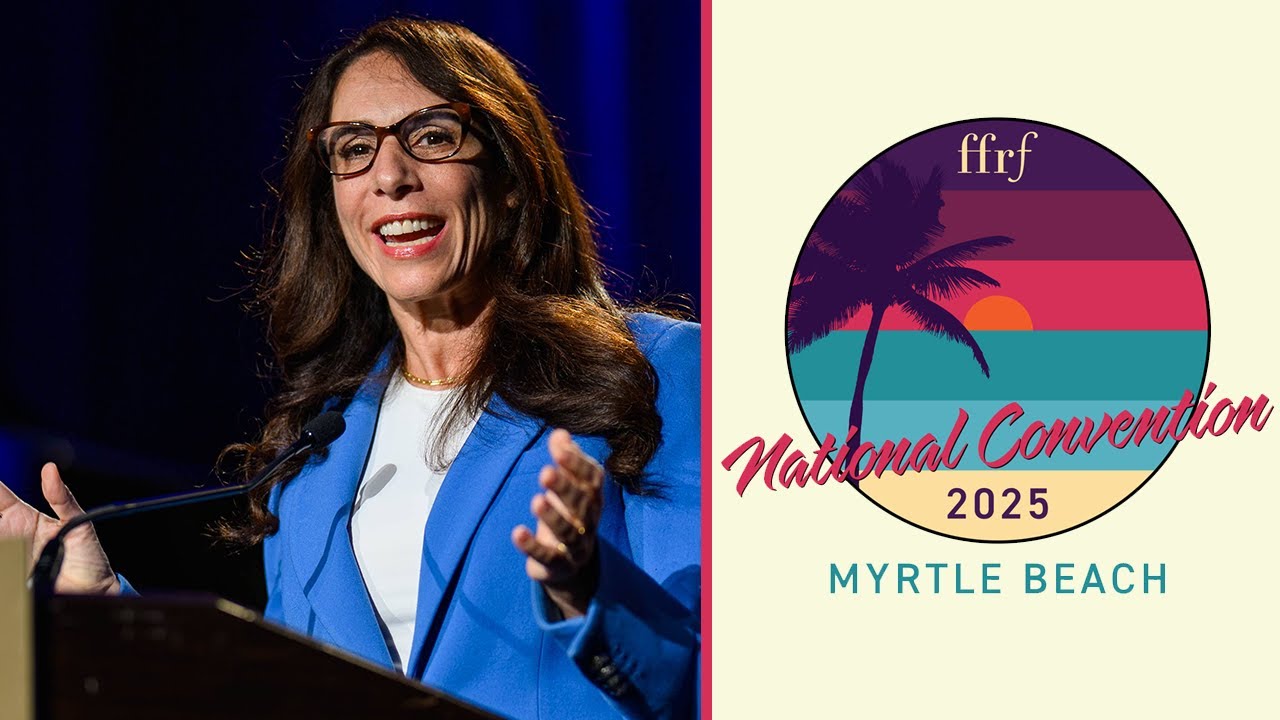
...
24:49
Now is not the time to curl up in despair. You know who I heard that from? I heard
24:55
that from Steve Bannon. I heard that after the 2024 election.
25:02
And this was I was at a gathering, 20,000 uh, hardcore MAGA supporters at the
25:08
Phoenix Convention Center. This was the angriest group of winners I've ever
seen. Steve Bannon gets up there and he said, "When you lost in 2020, you didn't get to into bed and suck your thumbs.
You got out there and you decided to fight." And he's right. You know, I mean, they did things we would never
25:25
want to do. We would never want to inspire or organize political violence,
25:30
engage in political violence. We would never want to spread disinformation and lies. But there's a lot we can do and I
25:37
think we would do well to take note of their determination. So here's where we go next. We've got
25:44
institutions to protect, pro-democracy organizations to support, lawsuits to
25:51
pursue, corruption to expose, and midterm elections in about a year's
time. The same forces that brought us the anti-democratic movement have succeeded in undermining our key
institutions. So we need to fight for them. We need to explain to people the importance of the judiciary, the
26:09
integrity of religious institutions and the fact that they've many of them been turned into partisan political cells. Um
26:17
we need to they've eroded the guard rails of one of our two political parties. We need to learn how these
26:23
institutions have been undermined and then communicate to others um that how they've been undermined and
26:30
commit ourselves to the process of restoring them. So it takes time for the autocrat to
26:37
consolidate control. I like to someone once described this to me. They said the the concrete has been poured or is being
26:43
poured but it hasn't hardened yet. It's really important. So it takes time for the uh you know we're still free to have
26:50
conversations in gatherings like these for instance. So it's important to focus on strategic and broad-based actions. We
26:59
need to turn out the base. I think the reason why frankly um the 2024 election
27:07
worked out the way it did is because of disproportionate voting on um one one
side of the political aisle and and uh under represented voting on the other.
two, it's really important to work with like-minded organizations even if you don't agree on everything. This is}:
27:25
really important, you know, to to paraphrase the father of Ron Reagan,
27:32
the the person who agrees with you 80% of the time is your 80% friend, not your
27:39
20% enemy. We would do well to heed that advice because they do. They say there's
27:44
no victory without unity. You know, we we can and should collaborate with those who share at
27:50
least a majority of our goals. None of us are going to get everything we want, but if we can agree on more
27:57
than we disagree on, we can and we should work together.
28:02
Number three, you know, some basic democratic principles. We can and should work together. So, we need to build the
28:09
infrastructure of a pro-democracy movement at all levels. There are things we can do as individuals like vote and
28:17
create circles, democracy circles where we engage in uh activities where we
28:22
encourage others to vote and get active and things that we can do better together when we join with others.
28:30
Four, we need to work with um to to educate others about the forces at work.
A lot of this filters to the local level. So, it's really important to be locally engaged um to build networks of
28:42
support and kindness and mutual aid to get involved in local governance uh school boards, public libraries, etc.
28:50
There's no one-sizefits-all solution, but there is no shortage of avenues for productive engagement. And six, finally,
28:58
you know, in conclusion, I want to say there is nothing more meaningful than being part of a struggle for democracy.
29:04
It is action that gives us hope. America can survive the next years. If we can
29:13
get get ourselves active and, you know, just step it up a little bit and and
29:19
stand up for our country, it really won't be easy. And there are no guarantees.
29:25
Freedom isn't a guarantee when you look at the sweep of history. But I bet every
29:32
single one of you in this room can um think maybe you don't know them, but I
29:39
bet every single one of you or or most of you have an ancestor who in some
29:44
point in the world at some in some part of the world at some time in history
29:49
in some way had to struggle for their freedom against the odds. If they could
29:55
do it, we must try. And we owe it not just to ourselves but to future
30:00
generations. Thank you so much.
---
RWI 7 25 -->
NO LNX
How US Christian nationalists are exporting their agenda to Europe
(RNS) — A new report follows the money as it moves from reactionary advocacy groups and think tanks to groups waging war on women’s equality and related causes.
}:
Katherine Stewart
July 7, 2025
(RNS) — A report on the state of reproductive rights presented to journalists, policy wonks and activists in Brussels on June 26 begins with a quote from the 15th-century general and military theorist Raimondo Montecuccoli: “To wage war, you need first of all money; second, you need money; and third, you also need money.”
The 158-page report, “The Next Wave: How Religious Extremism Is Reclaiming Power,” follows in meticulous detail the flow of money as it moves from reactionary advocacy groups, think tanks and strategic litigators masquerading as philanthropies — the modern equivalents of the wealthy royal houses and their priestly hierarchies of Montecuccoli’s day — into groups waging war on women’s equality and related causes.
RELATED: At Turning Point USA’s AmFest, Charlie Kirk takes a victory lap for Trump election
Compiled by the researcher Neil Datta and his team of experts at the European Parliamentary Forum on Sexual and Reproductive Rights, a network of European lawmakers committed to advancing gender equality and sexual and reproductive health, the study follows similar reports published in 2018 and 2021. It shows substantial growth over a relatively short span of time in a broad-based movement opposing not only sexual and reproductive rights, but access to comprehensive health education and LGBTQ+ rights.
Between 2019 and 2023, the report finds, the equivalent of $1.18 billion flowed into 275 frontline groups on the attack. The EU countries contributing the largest amounts were Hungary ($172.7 million), France ($165.7 million), the United Kingdom ($156 million), Poland ($90.7 million) and Spain ($66.4 million). In addition, funding from Russia effectively doubled from $42.9 million in 2019 to $86.7 million in 2022; spending in Europe by U.S. Christian right groups averaged $22 million per year.
“The Next Wave: How Religious Extremism Is Reclaiming Power” report cover. (Courtesy image)
Much of the money flowing into the movement came from private sources, but some represents a transfer of public funding into sectarian groups. About half of the money went into advocacy and messaging organizations. The rest went into what the report labels “anti-gender” services — work done by grant-making groups, think tanks, legal advocacy and miscellaneous other campaigns.
As the EPF report notes, Russia’s principal strategic goal in supporting these causes is to infiltrate right-wing political parties and movements in Europe and then to steer their activism in ways favorable to Russian state interests. The Russian regime also helps right-wing European actors reinforce its own brand of Christian nationalism in their countries.
Its report cites a document, identified as a Mandate, that emerged from an influential March 2024 gathering of the XXV World Russian People’s Council (WRPC) titled “The Present and Future of the Russian World.” Overseen by Moscow’s Patriarch Kirill, the leader of the Russian Orthodox Church’s leader, the gathering aims to guide Russia’s political class as well as the Russian Orthodox Church on policy issues. The new Mandate “referred to Russia’s international role as ‘the ‘Restrainer,’ protecting the world from evil and from the ‘onslaught of globalism and the victory of the West, which has fallen into Satanism,’” the EPF report said.
The Mandate also “refers to the Russian aggression against Ukraine as a ‘Holy War,’’ and states that the borders of the ‘Russian world’ are ‘much wider than the state borders of both the present-day Russian federation,’” according to the report.
According to the EPF report, the Mandate also declared that “the fight against abortion should be placed at the center of all state policy” along with the “cleans(ing) of the destructive ideological concepts and attitudes, primarily Western ones.”
By 2024, according to the EPF report, nearly all Orthodox churches, particularly those with ties to the ROC, had become active in anti-rights mobilization.
The American groups that turned up in the report due to their involvement in Europe are some of the same ones that have aggressively pushed Christian nationalist ideology on the home front. The Alliance Defending Freedom, which played a key role in overturning Roe v. Wade and defended discrimination against a gay couple in the Masterpiece Cake Shop v. Colorado Civil Rights Commission case, has become a major player in European litigation, crafting “freedom of speech” cases, for instance, out of the harassment of women outside reproductive health clinics in the U.K.
Other U.S. groups active in Europe include 40 Days of Life, which stages anti-abortion harassment activities; the Heritage Foundation, which forges partnerships with conservative European think tanks; and Heartbeat International, whose “crisis pregnancy centers” offer some forms of support for pregnant women while dissuading them from seeking abortions.
RELATED: Ukraine strips Orthodox leader of citizenship, alleging links to Moscow
The funding for most U.S. activism in Europe, according to the report, can be traced to a handful of hyper-wealthy individuals and families, such as members of the DeVos and Prince families, the Walters family, the Uihlein family, the Green family, the Eldred family and the Koch brothers.
However, as Datta noted in Brussels, “We can’t just blame Americans. A lot of money is coming from European sources.”
Much of this support, the report notes, is from a cadre built from old European money and titles. “Dozens of archdukes, countesses, princes, and princesses appear as avid supporters of religious extremist causes which may at first appear exotic until one understands that this involvement demonstrates a continuity going back to a past almost forgotten in 21st century Europe,” Datta writes.
These aristocrats bring “a generalized distain for democracy and liberal values, a worldview based on religious legitimation for inherited social, political, and economic inequality; and being part of a vast, transnational and endogamous network,” which Datta describes as an “Aristo-clerical network.”
In France, private foundations controlled by Catholic families with generational wealth invest heavily in anti-abortion and other conservative political causes. Similar patterns are evident in Germany, Spain, Hungary, Austria and the U.K. Though lacking a native aristocracy, the U.S. has the next best thing in Leonard Leo and Supreme Court Justice Samuel Alito, both of whom have connections with far-right European aristocrats such as Princess Gloria von Thurn und Taxis, the widow of one of the largest landowners in Germany who has close connections with former Trump adviser Steve Bannon.
Stacks of currency. (Photo by Mufid Majnun/Unsplash/Creative Commons)
But in recent years, a nouveau riche elite has emerged in the technology sector. “Tech bros” such as Elon Musk and Peter Thiel, along with Fredrik Wester in Sweden and Marek Spanel in the Czech Republic, have become significant funders of conservative activism, along with other oligarchic business leaders such as Lőrinc Mészáros, who owns Hungary’s MHB bank and is a longtime associate of Viktor Orbán, and Guillaume de Thieulloy, whose organization, Fonds de dotation GT Editions, finances digital infrastructure for ultra-conservative Catholic media in France, along with far-right political parties.
Some reactionary groups have learned to siphon money from public sources as well, typically from sympathetic illiberal national and regional governments. This state money goes to favored think tanks, advocacy groups and service providers that in turn bolster their own political legitimacy. Hungary and Poland were leaders in this sector, but regional governments in Spain and elsewhere have developed the same patronage model.
Facilitating this fusion of reactionary political parties with reactionary religion has been the rise of what Datta calls “ChONGOs,”—church-based non-governmental organizations. These groups typically pretend that they are offering scientific or fact-based information and services, though in reality their aims are to promote a certain theological vision of the proper order of society.
RELATED:
OMB’s Russell Vought, the Christian ‘nation-ist’ driving Project 2025 and DOGE
Honed to a sharp edge in the U.S. and Russia, the illiberal ideas and methods deployed across Europe are also being exported to Africa and beyond. What is most disturbing, perhaps, is the use of massive propagandistic operations of the sort pioneered by America’s authoritarian movement.
“This isn’t a backlash or a culture war,” Datta states in the report. “It’s a strategy.”
(Katherine Stewart writes about the intersection of faith and politics. Her latest book is “Money, Lies and God.” The views expressed in this commentary do not necessarily reflect those of Religion News Service.)
---
TNR
Few Americans, if any, had ever heard of John Eastman before the events of January 6, 2021. The legal architect of Donald Trump’s attempts to overturn the 2020 election was hardly a high-profile name, even for those steeped in covering American politics. He was, in many ways, an unknown, pulled by the events and the aftermath of January 6 into the riptides of American history.}:
A handful of analysts and investigators tracing the contours of the American far right, however, knew of Eastman’s work long before the events of January 6, and of the kind of churning, burning illiberalism that brought him into Trump’s orbit. One of those was Katherine Stewart, whose new book, Money, Lies, and God, threads the diffuse movements that have congealed into the authoritarianism at the core of Trumpism.
Money, Lies, and God: Inside the Movement to Destroy American Democracy
By Katherine Stewart
Bloomsbury Publishing, 352 pp., $29.99
Stewart first intersected with Eastman not in the aftermath of Trump’s failed insurrection but in 2019, when she tracked him to a tony, rarefied conclave in, of all places, Verona, Italy. Eastman was speaking at the annual conference of the World Congress of Families—a far-right, Russian-American organization dedicated to the abolition of abortion and the buttressing of so-called “traditional values”—regaling his audience with tales of “how secularism, liberalism, and gender confusion are destroying everything good in the world.” The speech, as Stewart writes, revealed Eastman to be “a committed ally of the theocrats.” But there was also “some foundation other than biblical literalism,” Stewart sensed, propelling him and cementing the kinds of illiberal alliances crucial to Trump’s reign.
The search for the broader foundations of Eastman’s and his allies’ beliefs is at the center of Money, Lies, and God, the follow-up to Stewart’s critically acclaimed 2020 The Power Worshippers.That book explored the dogmatism at the core of the American religious right, and how such forces drew American evangelicals further and further into the illiberal abyss. It was, at the time, a signal flare of just how willingly such professedly godly groups could embrace a figure like Trump.
Stewart’s newest book is a continuation of that theme. But after the events of January 6, it was clear that the right had changed. This movement—with all the ideological allies, deep-pocketed donors, and misogynists massing around Eastman, joining him in this antidemocratic fight—presents a new face of the American far right. And it is that edifice that Stewart masterfully details in her new book, explaining not only why these pro-Trump forces have already attempted to drive a stake through the heart of American democracy, but how they will try to do so once again.
Part on-the-ground conversations, part sociological analysis, Money, Lies, and Godis a convincing tour of the mutually reinforcing elements of American reaction:
“apostles” of Jesus, atheist billionaires, reactionary Catholic theologians, pseudo-Platonic intellectuals, woman-hating opponents of “the gynocracy,” high-powered evangelical networkers, Jewish devotees of Ayn Rand, pronatalists preoccupied with a dearth of (white) babies, COVID truthers, and battalions of “spirit warriors” who appear to be inventing a new style of religion even as they set about undermining democracy at its foundations.
:{:{Trumpism is hardly one thing, even if it is overly reliant on Trump himself. Instead, Stewart uses her deep familiarity with the American far right to chart out what are, by the mid-2020s, the major elements of Trump’s political project, which she describes as the Funders, Power Players, Infantry, Sergeants, and Thinkers. The “Funders” are those within the billionaire class bankrolling the forces below them, using access to effectively bottomless pots of wealth to guide American politics. Some of these names are increasingly familiar, like Leonard Leo, the benefactor who helped steer the Supreme Court picks during Trump’s first term, building out Trumpist allies on the highest court of the land and helping rule in favor of things like all-encompassing presidential immunity, a position once ridiculed when espoused by figures like disgraced Richard Nixon.}:
Leo serves as the chair of CRC Advisors, which, as Stewart writes, “directs over $1 billion in right-wing funding toward reactionary causes.” Nor is Leo alone. There is Carl Anderson, head of the Knights of Columbus, who helps bankroll think tanks and media outlets. There are even organizations like Opus Dei, a far-right Catholic group that does not publicize its membership rolls. All of them together have access to, and help direct, a greater pile of money than anything hard-right forces in America have ever known. “The decisive development in the first decades of the 21st century was not the alliance between Team Money and Team God but the simple fact that, thanks to escalating inequality, the big money got a lot bigger,” Stewart notes. “What was new was the number of zeroes in the checks—and the extremism of the thinking guiding the money people.”}:
Elsewhere, the “Power Players” Stewart identifies are those just underneath the “Funders,” helping direct some of the ocean of money flooding pro-Trump, pro-authoritarian movements. These managerial types comprise a “tiny elite” who “amass tremendous personal power by mobilizing others around their agendas.” Many of these are well-established figures, “super-lobbyists” like the Faith and Freedom Coalition’s Ralph Reed or Family Research Council’s Tony Perkins, who act as both organizers and mouthpieces for pro-Trump policies. These, Stewart says, are the “operational masterminds of the antidemocratic movement,” putting the funding into action through sponsoring conferences, conclaves, and publications. They are, in effect, middlemen—a kind of managerial class directing America’s antidemocratic turn.
The “Infantry,” meanwhile, is made up of the rank-and-file Trump voters who lap up the kinds of antidemocratic rhetoric spilling out of everything from conspiratorial social media feeds to, now, the White House itself. These are the militias, the Tea Party turned Trumpers, and the assorted flotsam of Trump supporters who launched an attempted insurrection on January 6—and who were all recently pardoned by Trump. They are those who Stewart writes about meeting in Las Vegas in 2023. Alongside a German documentary crew, Stewart joins a swell of Trump backers at the ReAwaken America Tour, a pro-Trump conference-cum-revival that gathers an audience of QAnon supporters, antivaxxers, racists, and conspiracy theorists. Stewart finds the crowd descending into increasing mania, with speakers not only regurgitating the most malign conspiracies they can find but even calling for “Nuremberg trials” for Trump’s enemies, leaving one of the German team members to ask Stewart, “Are we safe here?” }:}:
For those tracing America’s descent into authoritarianism, some of these faces are well known; figures like Reed and Perkins have both been peddling illiberal policies for years, long predating the rise of Trump, and it’s hardly news that Trump’s base is comprised of conspiratorial racists. In that sense, Stewart’s book is treading familiar ground. But it sets itself apart in describing the two remaining groups—the “Sergeants” and the “Thinkers”—and how these two now buttress not just Trump but modern Christian nationalism itself.}:
The “Sergeants” are primarily pastors and related church officials, many of whom have accelerated their rightward lurch in recent years. These groups have ominous, vaguely militaristic names, including things like the Black Robe Regiment and the Watchmen on the Wall. These are the followers of the vengeful God of the Old Testament, believers in the efficacy of retribution. “There is little room for the old ‘Love the sinner, hate the sin’ trope here,” Stewart writes. Instead, they embody a Christian nationalism that “is not a policy program; it is perhaps best understood as a political mindset.” It is a political proclivity that “includes four basic dispositions: catastrophism; a persecution complex; identitarianism; and an authoritarian reflex.” All of it comprises the kind of kindling from which opposition to democracy, and even support for fascism, can emerge.
Many of these “spirit warriors” found their way to the so-called “Jericho March” in Washington on January 5, 2021. A “combination of nationalism, conspiracism, and demon obsession,” according to Stewart, the rally featured a range of pastors trying to outdo one another in their antediluvian rhetoric. One, Greg Bramlage, claimed they were engaged in a “spiritual battle,” while another, Bishop Leon Benjamin, called for followers to “kill” unspecified “demons.” Another pastor, the Reverend Kevin Jessip, described the rally as a “strategic gathering of men in this hour to dispel the Kingdom of Darkness.” Twenty-four hours later, as Stewart notes, many who prayed under these “Sergeants” took up arms and took the fight directly to the Capitol itself—bringing with them a “large wooden cross,” a separate “flag with a cross,” and banners blaring, “Jesus Saves.”
It is the Claremont Institute where the “erstwhile reverence for America’s founders has been transfigured, with the help of political theorists purloined from Germany’s fascist period, into material support” for Trumpism.
It is the final group, the “Thinkers,” that presents arguably Stewart’s most insightful sections. These are the figures like Eastman and his allies who posit themselves as the ideological, intellectual class crafting the contours of Trumpism—and identifying the kinds of legal cover Trump can use to dismantle American democracy. Much of this cohort can trace directly back to the Claremont Institute, the California-based organization where Eastman remains a senior fellow. As Stewart points out, it is the Claremont Institute where the “erstwhile reverence for America’s founders has been transfigured, with the help of political theorists purloined from Germany’s fascist period, into material support” for Trumpism.
The institute’s modus vivendi centers on the “Straussian man in action”—the man who bends history to his own ends, regardless of the consequence and regardless of democratic legitimacy. Stewart writes:
His mission is to save the republic. He must tell a few lies, yet he is nonetheless a noble liar, at least in his own mind. He acts in the political world, where natural right reigns, and not merely in the legal world where lawyers are supposed to toil. Aware of the crooked timber from which humanity is made, he is prepared to break off whatever branches are needed for the bonfire of liberty.
This core Claremont belief leads to the yearning for a so-called “Red Caesar”—a masculine leader untrammeled by anything like democratic oversight or political pushback, grabbing a society by the throat and forcing it back into a world in which men, and especially white men, are once more restored to the top of America’s sociopolitical hierarchy. Indeed, there is an almost obsessive approach at Claremont to restoring supposed masculinity within American society. Stewart traces this belief system at Claremont—where, she says, all of the board members “appear to be male”—to Harvey C. Mansfield Jr., who wrote a 2006 book called Manlinessand “counts as nobility among Claremont’s extended family.” As Mansfield argued, “gender stereotypes are all true”—including, bizarrely, that women would make bad soldiers because “they fear spiders.”
As Stewart details, Mansfield was “far too sophisticated to openly argue for stripping American women of the rights they have fought for over the past two centuries—but in the private sphere, “those highly accurate stereotypes should reign triumphant.” This belief has seeped into Claremont’s bones and manifested itself at Claremont many times over. There is a 2020 alumnus of their Lincoln fellowship named Jack Murphy who once said that “feminists need rape.”* There was another Claremont official who gave a talk titled, “Does Feminism Undermine the Nation?” There is the promotion of work by an author named Coston Alamariu—better known by his nom de plume “Bronze Age Pervert”—who oozes undiluted misogyny and rails against “the gynocracy.” As Alamariu wrote, “It took 100 years of women in public life for them to almost totally destroy a civilization”—and the only way forward is to “use Trump as a model of success.”
These Claremont-based “Thinkers” also include figures like Curtis Yarvin, who has contributed to the Claremont publication American Mindand “appeared as an honored guest on Claremont podcasts.” Yarvin’s affections for despotism have been widely reported elsewhere, but it is his historical ignorance that highlights just how shallow the Claremont men’s pretensions at intellectualism truly are. Not only does Yarvin preposterously believe that “European civilization” wasn’t responsible for any genocides before the Holocaust—as if genocides in places like the Africa, North America, or even Ireland and Ukraine never existed—but he further maintains that America now needs to collapse into dictatorship in order to rebuild.
The “men of Claremont frame their not-so-hidden longing for revenge as a series of ruminations about the rise of an American Caesar,” Stewart writes. “And when that ‘Red Caesar’ arrives, he can thank the oligarchs for funding his rise, and he can thank the rank and file of the movement for supporting him in the name of ‘authenticity.’ But he would owe at least as large a debt of gratitude to the unhappy men of Claremont, those spurned would-be members of the intellectual elite … for explaining just who he is, and why he should go ahead and blow the whole place up.”
Taken together, Money, Lies, and God paints not only a devastating picture of the state of American democracy (as if one was needed) but one that also contributes texture and context to understanding the current American political moment. The book convincingly argues that, when it comes to figures like Eastman or Leo or any of the men affiliated with the Claremont Institute, calls for dialogue and civility are futile. “In earlier times this may have been sage advice,” Stewart writes. “Today it is a delusion. American democracy is failing because it is under direct attack, and the attack is not coming equally from both sides. The movement described in this book isn’t looking for a seat at the noisy table of American democracy; it wants to burn down the house.” American democracy isn’t simply dying. It is, as Stewart observes, being murdered.
Another revelation from the book, however, is not nearly as ominous. Because the movement comprises so many moving parts, there’s no guarantee that such a constellation of forces can last. Trump remains the glue that holds such a coalition together, with each group—the billionaires and the bullies in the pulpits, the keyboard conspiracists and the misogynists trying to put an intellectual sheen on it all—each seeing, and often getting, what they want with him. But once Trump goes, there’s every reason to suspect that such a coalition will splinter, undone by competing claims. Wide cleavages remain on subjects from China to health care to tax cuts, bridged only through Trump’s person and persona.
This is cold comfort for those hoping for a resuscitation of American democracy anytime soon. Trump has spent the first months in his second term sprinting toward a constitutional crisis, cheered on by the allies he’s found along the way—not least the supposed “Thinkers” claiming intellectual leadership of the movement. For figures like Eastman, it’s not an executive run amok that presents a threat to the core of American democracy but, rather, those who would stand in Trump’s way. The Democratic Party, Eastman said in 2023, is “an existential threat to the very survivability, not just of our nation, but of the example that our nation, properly understood, provides to the world. That’s the stakes.” From his lips to God’s—or at least Trump’s—ears.
---
AN 2 25
Trump was able to be elected president a second time partly by mobilizing his base of Christian nationalists. This anti-Democratic group has an “us vs. them” mentality, believing that America is on the verge of an apocalypse and that they are being persecuted. In her new book, "Money, Lies, and God: Inside the Movement to Destroy American Democracy," journalist Katherine Stewart investigates this voter base. Salon published an interview with her Tuesday.
This subculture, Stewart argues, believes America should move past democracy. “They believe the U.S. is not founded on principles, but on a specific religious and cultural heritage,” she said. “They argue America is on the brink of an apocalypse, owing to the rise of equality and what they call ‘wokeness.’ They argue democracy, as a system, isn't sufficient to meet the ‘challenges’ of feminism and equality. They believe the democratic rules no longer apply, because we're facing this absolute apocalypse of equality. They want an authoritarian leader who puts himself above the law, who's going to seize the reins of power and scrap the rule of law in favor of the iron fist.”
One of the three major tenants of this mindset is the belief that the country is nearing an apocalypse.
READ MORE:'A lot of MAGA': 20 million Americans could lose health coverage under new GOP bill
“This is what authoritarian leaders do,” she explained. “Christian nationalism is not just an ideology. It's also not just a political movement. It's a mindset… First is ‘us versus them’ or ‘pure versus the impure,’ or those who properly ‘belong’ in the country, and those who do not. Second, there's a sense of persecution. They claim white conservative Christians are being persecuted more than any other group in society. Third is the sense that we're facing an apocalypse. They share this view with the new right. It's always, ‘If we don't win this election, we're gonna go under the control of the Illuminati and the devil's gonna be controlling us for hundreds of years. So it's any means necessary to ‘save’ us from this terrible fate.”
“Those three ideas,” she continued, “clear the way for the acceptance of an authoritarian leader, someone who doesn't respect the rules, who will punish their enemies, and who will suspend the rule of law. If you look at what's happening in our politics today, you can see it playing out before our eyes. In the first weeks of the Trump presidency, we're seeing a version of Project 2025. They've been telling us for a long time they're going to smash the institutions that safeguard our democracy. That's what they're doing.”
But the members of this group have been “colossally misinformed.”
“Many of these supporters don't recognize that American democracy might be destroyed. Some don't care. They think it's more important to put a strong man in power to demolish the supposedly dangerous radical left. But whether they don't care or don't know, it's because they've been colossally misinformed. That's how they rationalize their choices at the ballot box. And I would have to say this is not just about Trump. Authoritarianism loves a misinformed public. The anti-democratic movement has funded this massive propaganda campaign that has led us to where we are today,” she said.
READ MORE:'Revoltingly un-American': Internet erupts after Trump posts photo crowning himself 'king'
Here is an excerpt from the book, published by Rolling Stone:
“Power has not softened the base of this movement. It’s not just blood that they’re after; they want a show. This is the thing that Trump surely understands best. Policy simply doesn’t matter. You can kill off grandma through vaccine denial, take away health insurance, bust unions, drive up inflation, and reward your billionaire friends with policies that benefit their bloated bottom lines. None of that matters as long as you give the people the pleasure of a good performance, where they can project their frustrations and resentments on the targets they have been trained to hate.”
---
an 125
Journalist/author Katherine Stewart is known for her in-depth reporting on the Religious Right, which she has been highly critical of over the years. The titles of her books — among them, "The Good News Club: The Christian Right's Stealth Assault on America's Children" and "The Power Worshippers: Inside the Dangerous Rise of Religious Nationalism" — underscore her view that far-right white evangelicals and Christian nationalists pose a major threat to religious freedom in the United States.
In her book, "Money, Lies, and God: Inside the Movement to Destroy American Democracy" — which has a February 18 release date on Amazon — Stewart warns that an alliance between Christian nationalists and billionaire oligarchs is pushing "an end to pluralistic democracy."
The Guardian's Adam Gabbatt examines the book in an article published on January 19.
Stewart, according to Gabbatt, warns, "Money is a huge part of the story, meaning that huge concentrations of wealth have destabilized the political system. Second, lies, or conscious disinformation, is a huge feature of this movement. And third, God, because the most important ideological framework for the largest part of this movement is Christian nationalism."
Gabbatt notes that although "billionaire oligarchs" and Christian nationalists "may not seem to have much in common," the "aim" of their "unholy alliance" is "the same: bringing an end to democracy in the U.S. as we know it."
According to Stewart, "The best label I can find for the phenomenon — and I do not pretend it is a fully satisfactory label — is 'reactionary nihilism.' It is reactionary in the sense that it expresses itself as mortal opposition to a perceived catastrophic change in the political order; it is nihilistic because its deepest premise is that the actual world is devoid of value, impervious to reason, and governable only through brutal acts of will."
Stewart adds, "It stands for a kind of unraveling of the American political mind — a madness that now afflicts one side of nearly every political debate."
Gabbatt points out, however, that Stewart, in her book, "insists the situation is not hopeless."
READ MORE:Biden preemptively pardons members of January 6 panel and other Trump targets
Stewart argues, "There's no feature as of yet in the American political system that would ensure that the MAGA movement is going to rule indefinitely. And frankly, I take heart from the fact that those of us who believe in democracy and its core principles probably represent a majority and not a minority of the population. I continue to believe more Americans support a democratic political system over some sort of cronyistic, kleptocratic and theocratic system that has authoritarian features."
---
rww 1 25 new bk coming
01/15/2025
by
RWW: Your last book, “Power Worshippers,” focused on the rise of Christian nationalism as a dominant political force in the U.S. Describe the trajectory that led you from that book to “Money, Lies, and God.”
Money, Lies and God grew fairly organically from my reporting. When you go to a diverse conference of pastors in Virginia and they are suddenly talking about election fraud, and they are funded by a California billionaire, you start to think that the story doesn’t fit within a simple frame about white evangelicals or demographic change, for example.
As I kept researching Christian nationalism, I realized that the topic was bigger than I had imagined. I came to see that we can’t talk about Christian nationalist ideology without investigating the role it plays in the political economy. It started to look like one part of this bigger story, and that’s how my focus shifted. And as I was researching the international side of religious nationalism, I also came to the view that this is not nearly as uniquely American as some of the narratives suggest.
It struck me that one line from Money, Lies and God - “Christian nationalism and the New Right are the power couple of American fascism” – could function as a thesis statement for the book. Is that the main point you want to help people understand?
It may be the main point on the intellectual or ideological side of the story, but we cannot overlook the economic side. The new American authoritarianism is like the old fascism in that it relies on the capitulation of economic elites. That said, the New Right is the main intellectual vehicle for the most aggressive wing of this sector of financial oligarchs. So yes, maybe on second thought, that sentence can serve as an entry point into the argument of the book.
Big Money Fuels the Far Right
For years, religious-right leaders in the U.S. have preached that unregulated capitalism is God’s model, supporting the restructuring of our economy in ways that impoverished the poor, hollowed out the middle class, and funneled an increasing share of our national wealth to the very few at the top. Your book documents how that intensifying concentration of wealth is being used to fund the antidemocratic movement, as a “force multiplier” among right-wing Catholics as well as evangelicals. How does that play out in our political system right now?
Overall, the economic right has been phenomenally successful in convincing working and middle-income Americans that getting government out of the way of billionaires is going to benefit their own pocketbooks. Maybe the most interesting and saddest part of the story is that in order to achieve this perverse support for policies that work very much against the economic interests of most Americans, the leaders of the antidemocratic movement have successfully promoted a certain blend of politics and religion. It’s a type of ideology that says that only the wealthy are truly blessed, that empathy and helping the less fortunate is weakness, and that working together for the common good through a democratic government is somehow a bad thing to do.
The Farce of the Billionaire Populists
I was stuck by your description of Virginia Gov. Glenn Youngkin, who made his fortune in private equity and now helps Trump take advantage of the economic dislocation and alienation that is the result of predatory capitalism. You write, “What could be better for the Funder class he represents than a population that no longer believes in democratic government as a means to constrain the oligarchy?” How do you explain the ability of moguls like Elon Musk, Vivek Ramaswamy, and Donald Trump and others you call “jet-setting populists” to successfully posture as champions of the people?
Rather than face the reality about certain flaws in the system in which they live, Americans in this situation sometimes cling more tightly to some rather preposterous myths. They believe that those with extraordinary wealth have made all their money with their bare hands -- or at least the good ones have. They believe that Musk and Ramaswamy and the rest are self-made men. They completely overlook or ignore the fact that many of these “self-made men,” inherited huge head starts in life, as did Trump and Musk, or cornered unregulated monopolies, or made money in deeply parasitic and unethical ways.
But I think there may be something deeper at work here. In systems that are disproportionately unfair and oppressive, many people come to believe that success in life comes from domination. The basic lesson they take in is that life is cruel and only the brutal survive. So when they see a particularly vicious or immoral yet successful or wealthy person, many people regard that person as someone who has done well and is worthy of emulation or at least admiration. And the culture often lauds such people while ignoring their exploitive business practices or corrupt dealmaking or the people they exploited on their way up.
MAGA’s War on Government's Ability to Check Corporate Power
Trump has not only come up with cabinet nominees who are opposed to the mission of the agencies they’re being charged with leading, he has also empowered Elon Musk and Vivek Ramaswamy to create justifications for decimating the federal government’s ability to regulate corporate behavior. I think your book has the best succinct definition I have seen of the right’s long-term war on the administrative state: “the destruction of public administration and its replacement with a privately controlled, corporate-managed state.” How do we unpack that for people who will be hurt under that kind of regime?
I wish I knew how to unpack it because it’s happening in broad daylight, and if more people could see what was going on they wouldn’t support it. Unfortunately, this is where the “Lies,” in my title, fits in. There’s been a tremendous propaganda campaign against “government.” When Americans are surveyed about the level of waste and fraud in government, they always come back with ludicrously exaggerated estimates. That’s not to say that waste and fraud in government agencies doesn’t happen; there’s often room for improvement, just as there is in the private sector. But people need to be reminded of the very good things that government does, along with the many bad things that happen in countries with kleptocratic and cronyistic government, or those with an absence effective of government.
According to the free-market fundamentalists who are funding the movement, business is always amazing, infinitely better than government. But at the same time, many Americans know very well that many of these corporate leaders are simply out to fleece them while rewarding themselves and their people at the top with massive payouts. The health insurance industry isn’t the only one that is widely despised. So we need some more truth-telling on that front, too.
This is a movement that is constantly harkening back to the supposed glory days of the 1950s. But in those halcyon days the top tax rate was about double what it is today, while CEOs were content to make several dozen times the earnings of their average worker, not hundreds of times larger, which is what we see today.
The War on Truth
Trump family members and MAGA insiders have backed the traveling road show of conspiracy theories and extremism known as the ReAwaken America tour. You write that at another time ReAwaken America “could have been laughed off as just another festival of snake oil hucksterism in the long American tradition of separating suckers from their money through entrepreneurial grifting. But this group isn’t fringe; it is representative of what one of the nation’s two major parties has become. Majorities of Republican voters live in the same fear-filled, fact-free world.” Scholars of authoritarianism describe the destruction of the very idea of truth as a key control mechanism. You describe it as demolishing the very possibility of reasonable discussion. How does that work?
We have underestimated the importance of fact-based discourse on a functioning democracy. And we have failed to appreciate the many institutions and mechanisms that our society has developed over time to make this kind of reasonable democratic discourse possible. I know we all like to complain about the media, about “the academy,” about public schools, about the judicial system and all the rest. But these institutions and their practices have played, and must continue to play, a crucial role in making it possible for our society to deliberate on matters of public concern on the basis of fact and evidence, and not superstition or fantasy or brute power.
All of that apparatus of reasonable discourse stands in the way of would-be demagogues, or those who seek to protect unreasonable power and oligarchy. So the anti-democratic reaction has set about trying to destroy it, and tragically they are having some success.
The Trump years have brought us brazen lying, increasingly aggressive Christian nationalism, an unashamed trashing of the rule of law while mouthing support for the Constitution. As you note, some MAGA leaders like Chris Rufo seem openly proud of using deceit to advance their goals. Do you think the collapse of journalism’s business model and the rise of right-wing media and social media has enabled this open war on truth?
Absolutely. To be sure, the old media system, with its Fairness Doctrine and quasi cartel-like structure, was far from perfect. It was hardly designed to entirely promote the truth and only truth. However, it did a better job than the present system, which has produced a colossally disinformed sector of the public. The old system relied on a disguised set of subsidies, such as newspaper advertising, and unfortunately, when these subsidies were taken away, there were far fewer resources out there to sustain journalism as a public good.
Alongside the institutional changes there has also been a very damaging cultural shift away from truth. The New Right is in some ways reaping the harvest that the post-modern, deconstructionist left sowed over the past half-century. Maybe it felt good at the time to say that all claims to knowledge are just an expression of power, or that reason is a partisan project. Except now it is the New Right who seem to be saying that truth is in the hands of he who wins power, and reason is just a woke plot. People like Christopher Rufo appear to have taken up with gusto the deconstructionist idea that all truth is relative, and if you repeat a lie often enough it will count as truth.
Politics as Spiritual Warfare
Do you see the dominionist Christian-right activists you describe as “spirit warriors” representing a different kind of Christian-right activist? An ascendant part of the broader movement? Something different?
I think it’s an evolving picture, one with many different pieces. There’s no question that American religion is changing; it has never been static. One of the fastest growing features of our religious landscape today is this spirit warrior-type of religion, which is often (but not always) associated with Pentecostal or neo-charismatic movements such as the New Apostolic Reformation. Such movements are themselves politically diverse, but are vulnerable to exploitation in service of hard right politics.
It seems to me that when forms of deep injustice arise, and the world feels out-of-whack, many people become alienated from the idea that we can work together, across our differences, through human institutions that are accountable to reason and justice. Forms of religion that take as their starting point the idea that people can respect one another in spite of their differences, and work together to improve the common good, lose their appeal. Instead, they may yearn for the return of the “strong gods,” or at least a strongman, who promises to solve all their problems.
A related and important shift is the intense politicization of some sectors of religion to the point where, for a significant part of the American right, politics is the real religion, and the rest is optional or for show. One of the more intriguing developments over the past eight years is that support for Trump turned out to be a predictor of people self-identifying as evangelical Christian even if they rarely or never attend church. So just as some number of people abandoned evangelical Christianity and other forms of reactionary religion because they saw it as too closely tied to Trump and his agenda, others began to identify with those religious movements for the very same reason.
The Religious and Political War on Public Education
Your first book focused on Christian-right groups’ efforts to proselytize in public schools. Today we see those efforts coming directly from Christian nationalist politicians who are working at the same time to funnel public education funds into unaccountable religious schools, and to turn public school classrooms into virtual Sunday Schools. How do you see these two forces—the privatizers and proselytizers, as you call them—operating together to achieve the authoritarians’ goals?
When I started researching this movement sixteen years ago, the privatizers and proselytizers were more discreet about their aims. Only a few crazies were out there admitting that the end game was to starve the “beast” of public education and redirect the flow of taxpayer cash to private and religious/ideologically right-wing schools. But now they are quite up-front about it.
The important thing to understand, as you suggest, is that the two groups of actors very much need each other. The profit-making contingent needs to delegitimize public education in order to soften the ground for privatization initiatives. The proselytizers provide invaluable help by ginning up culture wars to attack public education as inherently corrupted and evil. The proselytizers likewise need the help of the privatizers to achieve their goals; they love all the talk about charters, voucher systems, and other forms of removing schools from direct government oversight because that, of course, is the way in which they hope to gain religious oversight at these schools, and to obtain direct taxpayer funding for religious schools and institutions.
You write that “The assault on public education…is about raising a population compliant with authoritarianism.” This assault has been under way for decades. Are they on the verge of succeeding?
I think it depends to some degree on where you live. The strength and the weakness of the public education system is that it is fragmented. So you have very robust systems in some school districts around the country, while other districts are teetering.
One phrase in your book that jumped out at me was that when it comes to the right’s war on public education, “it doesn’t matter who the enemy is, you just need to find one.” Their list is long: teachers unions, CRT, DEI, SEL, all matter of “wokeness.” And here’s another longer quote: “Too many Americans have trouble acknowledging the extremism that has sprung up in our midst. And here was one of America’s self-appointed holy rich men making clear that yes, indeed, the goal is to demolish the system of nonsectarian public education that powered America’s rise to middle class prosperity…and replace it with an eminently corruptive network of privatized religious and right-wing academics operating with public funds for the ultimate benefit of a sanctimonious oligarchy.” As someone who has been reporting on this authoritarian threat for years, why do you think it’s so hard for Americans to acknowledge this extremism?
Old habits die hard! We had a long run where the assumption was that the center would always hold. Post-war America grew up on the idea that there’s a magic pendulum in the sky that will swing one way or the other, but always in the end come down in the middle. That assumption just isn’t valid now -- if it ever was – but it takes time for people to shake it.
It’s also hard to write about the exploitation of religion for politics and power without people thinking you’re taking aim at religion itself. The anti-democratic right knows that very well, which is why they seek to dismiss the growing number of those writing and speaking about these issues as “angry atheists.” Which is ironic, because so many of these supposed religion-haters are themselves pastors and faith leaders.
Billionaire Whisperers
You write that “the reactionary right no longer feels the need to disguise their pursuit of totalitarian power.” I thought about your book when I saw that Donald Trump recently brought Italy’s neo-fascist prime minister to the screening of a new movie praising John Eastman, one of the lawyers who pushed Mike Pence to join Trump’s illegal scheme to stay in power. You quote conservative Steve Schmidt calling the Claremont Institute “becoming like the West Point of American fascism.” What role do places like Claremont (and Hillsdale College if you see them in a similar light) play in spreading this American authoritarianism?
The Claremont Institute, along with related institutions, play a critical role. In fact, they have two underappreciated roles. The first is that they are part of an extended welfare system for the reactionary cadre that will be staffing a new authoritarian-oriented administration. They identify people with the supposedly correct ideological orientation, and who possess some other skills, and then offer them support and networking opportunities so that they know they can build their careers and secure their economic futures in this movement.
> A second underappreciated role that these institutions play is what I would call “billionaire whispering.” The rich people who are investing in the destruction of democracy, including funders I discuss in Money, Lies, and God, aren’t always as smart as they or anyone else thinks they are. They need to be validated, they need to be guided, and that’s what some of the Claremont Institute people and their fellow travelers do.
Misogyny, Manliness, and Authoritarianism
You write about the cult of “manliness” and identify anxiety about gender roles and hierarchies as “the rocket fuel of the new American authoritarianism.” MAGA political leaders seem intent on continuing to ramp up attacks on trans people as a political strategy. Can you say more about how the focus on gender roles and hierarchies fuels the broader goals of the authoritarian movement?
> Authoritarian movements have always been associated with a certain type of “hyper-masculinity,” for lack of a better term. Part of it actually has to do with the disempowerment of most males that emerges in very unequal societies from which authoritarianism tends to rise. And part of it has to do with the ways in which authoritarians seek to distract people from legitimate frustrations and material concerns that might otherwise lead them to support other movements and leaders.
So authoritarian leaders manufacture and then appeal to a sense of persecution. Women are always a convenient target. There’s no man so low on the totem pole that he can’t “big himself up” by putting women down.
> But there are plenty of women who support this movement, too. For those who have been failed or mistreated by the real men in their lives, or who fear that they will be failed by them, they are offered the reassurance that a “real man” will stick by his family, support his children, and fulfill his fatherly duties, and then everything will be okay. I recently read a quote from Dr. Jilly Kay, a professor at Loughborough University in England which I will share here: “It’s important to understand a long lineage of women, especially middle-class white women, making a calculation that they might be able to individually find a foothold within patriarchy by accommodating themselves to a certain set of disciplines in exchange for provisional protection, while throwing other women under the bus.”
Religious Nationalism as Cover for Kleptocracy
You have a line that I think helps explain how the amoral, self-serving, truth-debasing Donald Trump managed to come back into power thanks to the Christian nationalists and their funders, operatives and enablers: Religious nationalist countries, you write, are often “theocratic in a certain fake sense – that is, they are regimes that endorse a particular religion and attempt to impose that religion and its homophobic and patriarchal values on society. But they are more often best described as cronyistic kleptocracies with strong militaristic features and absolute suppression of free speech and political opposition.” Is that about to be us/the US?
If MAGA gets their way, then yes, and we have a role model in Russia, which is a good Christian country by its own reckoning, but is a corrupt, kleptocratic oligarchy with a sad economy. That’s the direction in which the Trump/Musk administration appears to be taking us. Whether we go there depends on whether we have a collective will to fight for a better future.
A Need for Clear Eyes and Strategic Resolve
You call the MAGA movement the most serious threat to American democracy since the Civil War, and you write that “American democracy is failing because it is under direct attack.” Your book was written before the 2024 election; Donald Trump’s victory makes your warning even more urgent. Given that Trump and his allies are about to take power, how do you think understanding the alliance that brought them to power can help us resist this powerful authoritarian movement? Can we take advantage of the internal contradictions to slow or stop our descent into fascism?
We can’t fight something unless we recognize it for what it is. We need to understand how it works, and details matter. So that’s a crucial first step -- a clear-eyed assessment of the strengths and the weaknesses of this movement that brought us to this point. And yes, this movement is full of contradictions and divisions, and we need to expose and exploit them. I do think it’s important here to not overestimate the movement’s strengths. Yes, Trump won an election, but he did so by a very narrow margin. He won primarily not because the country “turned MAGA,” but because of clever and sustained voter turnout operations on their side, coupled with a lack of enthusiasm among the political opposition. Those of us who wish to preserve our democracy wouldn’t wish to emulate MAGA’s most craven tactics, but we would do well to learn from their strategic resolve.
---
rww February 15, 2024
“God & Country,” a new documentary about Christian nationalism, is set to be released this week. Produced by Rob Reiner and based on Katherine Stewart’s book “The Power Worshippers: Inside the Dangerous Rise of Religious Nationalism,” the film explores that ways in which far-right Christian activists use and misuse religion and the Bible for political purposes and the role that Christian nationalism played in the Jan. 6 insurrection at the U.S. Capitol.
The roster of right-wing figures featured on the film reads like a who’s who of Right Wing Watch posts over the years; the film’s credits include thanks to Right Wing Watch for providing source material. In anticipation of the film’s release, we have put together his a quick overview of just who these activists are to help viewers understand their views and roles within the larger Christian nationalist movement.
- Greg Locke is a radical right-wing pastor and fervent conspiracy theorist who pastors Global Vision Bible Church in Mt Juliet, Tennessee. Locke has incessantly refused to accept that President Joe Biden won the 2020 election and he was among the speakers at rally in Washington, DC, the night before the insurrection. Locke’s sermons frequently consist of him screaming conspiracy theories from the pulpit.
---
https://www.foiaresearch.net/organization/united-purpose
no lnx many
United in Purpose1 is a shadowy right-wing Christian organization, bringing together major donors, political operatives and (evangelical) Christian leaders. The organization has been involved in a massive effort to map the US voter constituency, as well as priming sympathizing church leaders in spreading political propaganda, in order to persuade people to vote for the Republican party. Besides the potential illegality of United in Purpose’s large-scale data accumulation and exploitation endeavors, its major efforts towards a politization of churches raises serious issues about the separation of powers in the U.S.
United in Purpose is headed by the convicted felon William "Bill" Dallas,2 "who was sent to prison for two years for embezzlement of funds from his previous business, the real-estate company Lucas-Dallas, back in the early 1990s," according to a Forbes article.3 The activities of Dallas and United in Purpose are described in detail in chapter 8 of Katherine Stewart’s important publication on the rise of the religious Right, The Power Worshippers: Inside the Dangerous Rise of Religious Nationalism.4
Profile of United in Purpose on GuideStar.
Image Source
https://www.guidestar.org/profile/26-2495973
In a piece in The Guardian Stewart described how during his prison term Dallas became devoted to Christian politicking5:
As Dallas became acclimated to life in prison, and with the assistance of some of the “lifers” he met there, he deepened his connection to God. He got a job at the prison’s TV station, working his way up to being a producer and on-air host.
When he left prison, he says, he was in the best mental, physical and spiritual shape of his life. But he still hadn’t paid his debts. Dallas owed multiple fines and taxes – one fine alone was close to $750,000. He immediately looked for ways to make a living.
In March 1998, Dallas had a holy visitation, telling him to start a satellite network delivering ministry training programs to churches around the country. And he did – conceiving of a national network of evangelical pastors and other church leaders. As it turns out, this was exactly what the growing Christian nationalist movement needed.
With the help of Silicon Valley businessmen including Reid Rutherford and venture capitalist John Mumford, Dallas’s Church Communication Network grew with exponential velocity.
But Dallas had a bolder vision. Working with thousands of pastors allowed him to reach literally millions of congregants – and potentially millions of voters. With marketing and communications increasingly driven by data mining, he knew there had to be a better way to mobilize the nation’s conservative Christians.
Dallas soon established a fruitful partnership with George Barna, the California–based evangelical pollster. It was a match made in heaven. Dallas realized his vast network could collect data and use it to create more effective messaging. And now he had the resources to make it happen.
That was when United in Purpose, based in Southlake, Texas, came into play. The organization, whose principal officer is Dallas, was founded in 2009 "by two Silicon Valley venture capitalists, Reid Rutherford and Ken Eldred, and registered with the IRS as a tax-exempt 'non-partisan organization that actively supports Christian involvement in the civic arena,'" according to Anne Nelson, author of The Shadow Network: Media, Money, and the Secret Hub of the Radical Right.6
By 2012 United in Purpose had compiled information on ca. 180 million Americans in a database, including psychometric data, allegedly by strategically buying existing constituent lists from unknown sources and synchronizing the data therein, according to a 2012 NPR report, among other reasons to identify non-voters, particularly non-voting Christians.7 Apparently United in Purpose also graded its constituents on the basis of relevant psychometric characteristics in order to single them out for targeting. According to NPR7:
You get points if you're on an anti-abortion list or a traditional marriage list. You get a point if you regularly attend church or home-school your kids. You get points if you like NASCAR or fishing. “If [your score] totaled over 600 points, then we realized you were very serious about your faith,” [William] Dallas says. “Then we run that person against the voter registration database. ... If they were not registered, that became one of the key people we were going to target to go after.”
The digital security specialist Chris Vickery discovered data from United in Purpose being accessible on a cloud storage in December 2015, basically every registered US voter (191 million voter records). “300GB of voter data, which includes names, home addresses, phone numbers, dates of birth, party affiliations, and logs of whether or not they had voted in primary or general elections. The data appears to date back to 2000.”8 It has been speculated by Vickery and others familiar with the matter that this data set found its way into theRepublican database, called Data Trust Voter Vault, as reported by a seminal 2020 documentary about the religious right and big data in the US, People You May Know, by Charles Kriel and Katharina Gellein Viken.9 According to Chris Vickery in People You May Know10:
There’s a company named Data Trust that is very close to the Republican Party, the GOP in America, so much to the point that I would say they could be considered the same entity. And then they add state voter files to, I assume, corroborate what’s in the RNC database. Then they add consumer purchasable data, such as from Experian. … Then they add lists that the candidate -- the campaign itself gives to them.
Sean Eib of Graphika, who had been analyzing Vickery’s evidence, stated in the documentary11:
Are these records the same as the GOP data trust? This is supposed to be the GOP’s central location for all their data. If you look at their total number of profiles, they’re pretty much neck and neck. Well, you went up by five million, you went up by five million. You’re not acknowledging a connection, but it seems like you guys sure do seem to get records all at the same time. It does not seem like it makes a whole lot of sense that an evangelical group would need 191 million profiles. There aren’t that many evangelicals in America. I think it's somewhere a quarter of Americans identify as evangelical, which would be like 75 million. So there’s definitely a lot of people that are in there that didn’t sign up for it.
Propaganda pastors
Besides the massive data gathering and psychometric grading efforts, reaching out to pastors and getting them to spread political messages has also become a major part of William Dallas' undertakings. According to a piece by Katherine Nelson in The New York Times, quoting Dallas12:
In a 2016 interview on Daystar TV, Mr. Dallas was even clearer: “We have a ministry consultant who will work with each church to help them get their people out to vote on Election Day.”
Furthermore, "United In Purpose is working with volunteers from organizations such as the Family Research Council to make calls and knock on doors," called "champions," according to NPR, presumably on the base of the data both organizations have gathered.7
Erik Prince's father Edgar Prince (1931-1995) had co-founded the Family Research Council, an ultra-reactionary anti-choice and anti-LGBTIQ hate group and lobby organization,13 together with the evangelical Christian leader James Dobson in 1983,where young Erik subsequently became an intern.14 The Family Research Council is currently headed by the ordained Southern Baptist pastor Tony Perkins, who is closely affiliated with former US Vice President Mike Pence, and had previously led the "plutotheocratic" supergroup Council for National Policy (CNP),6 an umbrella organization and networking group for high-level right-wing to far-right operatives. Bill Dallas, from 2014 to at least April 2020, was first a normal CNP member and then a "Gold Member."15
The CNP was co-founded by Paul Weyrich, from the 1970s until the 2000s arguably the most important éminence grise in the project to merge the secular and religious right in order to take over the Republican Party. The CNP is a big tent structure that consolidates many disparate elements of the secular and religious right and organizes meetings periodically to synchronize their various programs. A former Republican congressman, Bob McEwen, who also sits on the board of United in Purpose, is currently the president of the CNP.16
Trump era
In the Trump era, Dallas became a key figure in rallying U.S. evangelical churches behind the future president and the MAGA campaign. According to Katherine Stewart17:
[Bill] Dallas has also become a behind-the-scenes power player; he took a lead role in organizing the June 21, 2016, closed-door gathering between then presidential hopeful Donald Trump and more than 1,000 evangelical leaders from around the country. That gathering, which took place at a hotel in Midtown Manhattan, marked a turning point in Trump’s political fortunes.
The author Anne Nelson specified in People You May Know18:
On June 21, 2016, they invited a thousand fundamentalist leaders to New York City to meet Trump on his home ground, and they cut a deal. And the deal was pretty transparently that they would lend their ground troops, their data operations, which were very advanced, and their strategists to the Trump campaign in exchange for three vital elements. One was allowing them to fully participate in the selection of federal judges. One was an evangelical council that was dominated by members of the Council for National Policy.
Katherine Stewart furthermore revealed that once Trump had won the presidential race, Dallas became a member of the steering team of Project Blitz, a massive effort to change legislation across the U.S. towards a right-wing Christian direction.19
In the run-up to the 2021 presidential campaign, The Intercept reported in 2020 that16
... United in Purpose received $75,000 from the Wellspring Committee, the same mysterious nonprofit that financed the television advertising campaign to confirm Judge Brett Kavanaugh to the Supreme Court. Another major donor to UIP is Maj. Gen. Vernon B. Lewis Jr., who retired from the military to foundMPRI, a defense contractor sold to L-3 Communications, and another defense consulting firm called Cypress International.
All the negative press did not deter United in Purpose from its activities, however it further obfuscated its already opaque existence. As of 2021, United in Purpose is still active, although its two websites show only a single front page, without any content or information being accessible. The domain unitedinpurpose.events leads to a website with a front page stating simply:The Ziklag Group.20 [Thanks to @hiporadic for this clue.]
According toThe Intercept, United in Purpose16:
... was crucial in connecting Trump to evangelical leaders in 2016, and it promises to be one of the most vital weapons in Trump’s reelection arsenal this year. At first, the effort may seem like a throwback. Participants in the group include televangelist preachers and anti-gay activists. David Barton, a historian that serves on the board of UIP, sells box sets of DVDs arguing that America was founded as a fundamentalist Christian nation with no separation of church and state. But the group, whose supporters include major donors to conservative causes, pastors, and political operatives with decades of winning elections, is serious about serving as the tip of the spear to maintain control of the White House. UIP’s 2020 election plan — which it calls “Ziklag,” a town referenced in the Bible — is a multipronged effort to connect Trump with evangelical leaders and increase support among minority voters through appeals to faith-based messages and church outreach.
Front page of unitedinpurpose.events as of 2021.
Image Source
https://unitedinpurpose.events/
Links
United in Purpose, https://www.unitedinpurpose.org.
United in Purpose, https://unitedinpurpose.events/
1.United in Purpose, https://www.unitedinpurpose.org.
2.“United in Purpose,” GuideStar, https://www.guidestar.org/profile/26-2495973.
3.Thomas Brewster, “Right-Wing Company Of Convicted Embezzler Turned Christian Linked To Huge Leaks Of US Voter Records,” Forbes, January 4, 2016, https://www.forbes.com/sites/thomasbrewster/2016/01/04/191-million-leak-bill-dallas-christian-anti-abortion/.
4.Katherine Stewart, The Power Worshippers: Inside the Dangerous Rise of Religious Nationalism (Bloomsbury, 2020), https://www.google.co.uk/books/edition/The_Power_Worshippers/Vd2yDwAAQBAJ?hl=en&gbpv=0.
5.Katherine Stewart, “How a data-backed Christian nationalist machine helped Trump to power,” The Guardian, March 3, 2020, https://www.theguardian.com/us-news/2020/mar/03/bill-dallas-christian-nationalist-right-donald-trump.
6.a. b. Anne Nelson, The Shadow Network: Media, Money, and the Secret Hub of the Radical Right (Bloomsbury, 2019). (unpaged digital edition).
7.a. b. c. Barbara Bradley Hagerty, “To Get Out The Vote, Evangelicals Try Data Mining,” NPR, February 27, 2012, https://www.npr.org/2012/02/27/147504999/to-get-out-the-vote-evangelicals-try-data-mining.
8.Thomas Brewster, “191 Million US Voter Registration Records Leaked In Mystery Database,” Forbes, December 28, 2015, https://www.forbes.com/sites/thomasbrewster/2015/12/28/us-voter-database-leak/.
9.Charles Kriel & Katharina Gellein Viken, People You May Know, Documentary, UK, 2020, https://www.imdb.com/title/tt12606876/?ref_=fn_al_tt_3. [ca. 0:13:46].
10.Kriel & Gellein Viken, People You May Know, [ca. 0:13:48].
11.Kriel & Gellein Viken, People You May Know, [ca. 0:21:00].
12.Katherine Stewart, "God’s Red Army," November 2, 2018, https://www.nytimes.com/2018/11/02/opinion/midterms-christian-right-election-day.html.
13.Catherine Brown and Ulrich Boser, "The DeVos Dynasty: A Family of Extremists," Center for American Progress, January 23, 2017, https://www.americanprogress.org/issues/default/news/2017/01/23/296947/the-devos-dynasty-a-family-of-extremists/.
14.“Erik Prince,” Militarist Monitor, https://militarist-monitor.org/profile/erik-prince/.
15."April 2020 Membership Directory," Council for National Policy, https://assets.documentcloud.org/documents/7241474/CNP-Membership-Directory-April-2020.pdf.
16.a. b. c. Lee Fang, “Inside the Influential Evangelical Group Mobilizing to Reelect Trump,” The Intercept, May 23, 2020, https://theintercept.com/2020/05/23/coronavirus-evangelical-megachurch-trump/.
17.Stewart, The Power Worshippers, https://www.google.co.uk/books/edition/The_Power_Worshippers/Vd2yDwAAQBAJ?hl=en&gbpv=1&dq=%22more+than+1,000+evangelical+leaders+from+around+the+country%22&pg=PT159&printsec=frontcover.
18.Kriel & Gellein Viken, People You May Know, [ca. 1:02:40].
19.Katherine Stewart, “A Christian Nationalist Blitz,” The New York Times, May 26, 2018, https://www.nytimes.com/2018/05/26/opinion/project-blitz-christian-nationalists.html.
20."The Ziklag Group," https://unitedinpurpose.events/.