Javier Milei prez arg
===
CHRISTO-TECHNO-FASCIST?! STATE OF EXCEPTION JUD “REFORM” STURZNEGGER
BESSANT THIEL DIALOG 20B$
THIEL MUSK
AI RUN CORP -->SUB-COUNTRY?
TRUMP CPAC BESSANT
ACTIV SUPPRESS
merri ok
see lie memory hole dirty war // holocaust denial
LIBTARD ROTHBARD THIEL LAFFER KUDLOW BLAKE Masters VIVEK AUSTERITY VOODOO
MUSK CHAINSAW
BUKELE CONCENTRATION CAMPS RENTA BOLSONARO
STONE BANNON
MORANO
JNZ
KIRK
TUCKER
GROVER NORQUIST
---
Milei’s calls himself an anarcho-capitalist following M.N. Rothbard, but his actions seem more in line with Hayek’s classical liberalism

Wikipedia
https://en.wikipedia.org › wiki › Anarcho-capitalism
Anarcho-capitalism - Wikipedia
Anarcho-capitalists oppose the state and seek to privatize government services such as education, infrastructure, or law enforcement. [61][62] They see capitalism and the free market as the basis for a free and prosperous society. Murray Rothbard states that the difference between free-market capitalism and state capitalism is the difference between "peaceful, voluntary exchange" and a ...

Wikipedia
https://en.wikipedia.org › wiki › Murray_Rothbard
Murray Newton Rothbard (US: / ˈrɔːθbɑːrd /; March 2, 1926 - January 7, 1995) was an American economist [1] of the Austrian School, [2][3][4] economic historian, [5][6] political theorist, [7] and activist. Rothbard was a central figure in the 20th-century American libertarian movement, particularly its right-wing strands, and was a founder and leading theoretician of anarcho-capitalism ...
propertyandfreedom.org
Feldman, The thinkers of liberalism - Murray Rothbard and anarcho ...
May 10, 2026Murray N. Rothbard (1926-1995) was an American economist. A student of Ludwig von Mises and a university professor, he radicalized the Austrian School towards anarcho-capitalism, becoming its leading proponent.
https://www.youtube.com/watch?v=bB0FFHw3laU
laje bs ; left vio, # wrong
complete memory
30k kia
Al Jazeera is funded in whole or in part by the Qatari government. Wikipedia
9,532 views Jun 29, 2026 #aljazeeraenglish #politics #news
As right-wing populists take power across Latin America, they have waged a ‘cultural battle’ to reclaim the past. In Argentina, President Javier Milei – and a legion of supportive influencers and YouTubers – are revising how the country’s history of military dictatorship is remembered and debated.
Reporter: Tariq Nafi
Producer: Ella Willis
Featuring:
Agustín Laje – President, Fundación Faro; YouTuber
Sol Montero – Professor, National University of San Martín
4:044 minutes, 4 secondsA movement advocating for the so-called complete memory of the events [music] of the dictatorship. One that reframed the
4:114 minutes, 11 secondsrepression of that time as part of a dirty war between two sides.
4:264 minutes, 26 secondsWhat the complete memory narrative seeks to do is incorporate a historical truth that had been denied from the outset.
4:334 minutes, 33 secondsThose who attack the complete memory narrative are the ones denying a portion of history that for reasons of political, ideological, and economic
4:404 minutes, 40 secondsconvenience, they choose to leave out of the picture. It means recognizing that gerilla and terrorist groups existed and
4:484 minutes, 48 secondsthat they too systematically violated human rights against the civilian population.
4:584 minutes, 58 secondsIt's true that a few years ago it was inconceivable to talk of a dirty war or question the figure of 30,000
5:055 minutes, 5 secondsdisappeared. And those limits have been pushed. What's acceptable speech has shifted with the arrival of this new radical right-wing in power.
5:205 minutes, 20 secondsToday, you can find content on prime time news channels or online that trivializes or relativizes the seriousness of the dictatorship's crimes for a young audience.
jm 2023, cut forensics; school denounced; hu rts gp cit corrupt; univ left indoc; voice have been excluded
sol Montero prof
defensora patria tshirt workout w/ name
---
JAN 2024
BUENOS AIRES—With his wild hair, flashing eyes and lashing tongue Argentina’s new libertarian president Javier Milei is fast becoming the world’s fourth instantly-recognizable Argentine revolutionary icon after Ché Guevara with his Cuban cigar and red-star emblazoned beret, Eva Perón with her outspread welcoming arms and tight bun of blonde hair, and Pope Francis with his white robes, deep humility and constant commitment to social justice.
The big difference of course is that Milei is a revolutionary of the reactionary right, not a progressive like his forebears, for he seeks not to champion social justice, but to be its fiery nemesis. On the campaign trail for congress in 2020 Milei called Francis a “communist turd” and  ” for the pope’s support of social justice, which Milei loathes.
Now, into the second month of his presidency, Milei has extended the pope a courteous invitation to visit his home country. This reversal could be a good sign if it is a harbinger of a softer, gentler Milei to come. So far this seems unlikely.
Milei’s twentieth-century predecessors in their different ways, “el Ché” by creating a socialist utopia, “Evita” by fashioning a worker’s paradise, wished for the less-fortunate many to partake in the accumulated wealth of the few. Pope Francis, over three decades older than Milei, is also a product of the previous equality-conscious century.
But Milei, his feet firmly anchored in an increasingly selfish present, is as much a child of his era as “el Ché,” “Evita” and “Francisco” were of theirs, and therefore envisions a world where the fortunate few can multiply their wealth without hindrance or compassion, and without having to feel guilty about sharing their bounty only with themselves.
It’s a message that has won Milei powerful new friends. Chief among them is Elon Musk, richest man in the world, owner of X (formerly Twitter), Tesla and SpaceX. Musk was so impressed by Milei’s paean to capitalism at the World Economic Forum in Davos on January 17 that he shared the full 23-minute video of Milei’s speech twice on his X account, once translated into English by the WEF official translator and a “better version” dubbed into English by AI replicating Milei’s own voice.
Musk was so eager to transmit his excitement for Milei’s speech that he posted a picture of a couple having sex, the woman astride the man with her back to the camera, while the man (who bears a reasonable likeness to Musk) is fixated not on the woman above him but on a laptop resting on his stomach transmitting Milei’s speech, with the caption: “So hot”.
Musk and Milei share more than the first initial of their last names, they are both born and raised in the southern hemisphere, Musk in South Africa, and are almost the same age (Musk was born in 1971, Milei in 1970). Milei has said that Musk called him to express interest in Argentina’s lithium deposits and mentioned Musk’s satellite internet service Starlink in an important speech announcing his broad deregulation program and they have frequently commented on each other’s X posts.
Milei’s Davos speech appealed to other billionaires in his same age group such as Marc Andreessen, born 1971, co-founder of Netscape, who posted on X: “President Javier Milei, techno-optimist,” over a video of Milei declaring himself an adherent to Andreessen’s techno-optimist creed.
Listening to his words at Davos, Milei’s appeal to billionaires is not difficult to understand. “Let no one tell you that your ambition is immoral. If you make money, it’s because you offer a better product at a better price, thereby contributing to general wellbeing,” Milei said in preacher-like tones. “You are the true protagonists of this story and rest assured that as from today, Argentina is your staunch and unconditional ally.”
Milei’s almost holy crusade against taxation and social justice seems to be music to the ears of billionaires such as Musk and Andreessen. “The problem is that social justice is not just, and it doesn’t contribute to general well-being. Quite the contrary, it’s an intrinsically unfair idea because it’s violent. It’s unjust because the state is financed through tax and taxes are collected coercively.”
It is a deeply-held belief. “Social justice is an aberration, fuelled by envy, which is a sin, and financed by taxes, which is theft, another sin,” Milei has said on other ocassions. The president claims his ultra-capitalist philosophy is backed by “the Forces of Heaven,” which he salutes in each of his presidential speeches.
To remove any doubt where those forces reside, he has claimed, bursting into tears on television at the thought, that he is not important, that it is his sister Karina who is Moses, the real purveyor of the law made word, while he is merely Aaron, brother and spokesperson of the true prophet. If it sounds like something out of Monty Python, then you’re getting the right impression of Milei, rather than the pasteurized version being sold to, and sometimes sold by, the financial press.
Karina Milei is now the facto First Lady to her never-married 53-year-old brother, plus presidential secretary with broad thumps up, thumbs down power over cabinet appointments. Milei’s first act as president was signing a decree overturning the rule prohibiting presidents from naming close kin in office to appoint his sister.
He calls her “The Boss.” Three years ago, she was a Tarot reader on Instagram and a medium who helped clients communicate with their dead pets. Her top client? Her brother, who it has been widely reported receives political and economic advice from his dead dog Conan. Far from denying he talks to God through his dead dog, Milei jokes about it in interviews. Shortly after being elected president Milei posted an AI-generated image of himself with his dead dog Conan and the four clones he had made out of Conan’s cells on his Instagram account with the caption “family album.”
Milei’s philosophy is not only tailor made for billionaires. Indeed, Milei for eighteen years was a trusted aide of one of Argentina’s richest men, Eduardo Eurnekian, owner of airports and television concessions, who launched Milei’s political career on his flagship television channel A24 in 2018. If ours is an age of narcissistic billionaires, Milei holds the key for their guiltless exploration and exploitation of our, or rather, their age.
Milei has often been compared to Donald Trump, their physical attributes, that indescribable hair and that frazzled unkempt look, lend themselves to this journalistic shorthand, but he is upon closer look another beast entirely.
Not only because Milei is a product of Argentine culture, having more in common with other South American caudillos, or strongmen, than with Trump, but because Milei is a man of deep faith, a theological warrior, a born-again Rothbardian economist willing to rip his country asunder to rebuild it along the principles of American economist Murray Rothbard, who died in 1995. This libertarian-reactionary outcast with a cult-like following in the US (but regarded askance by academia) is Milei’s intellectual and spiritual guide.
Milei is a born-again Rothabardian since an epiphany he had in 2013 reading Rothabrd’s 1962 book Man, Economy and State. “I had been teaching microeconomics for more than 20 years,” Milei said in one interview. “But when I finished reading Rothbard, I said, ‘Everything I taught about market structures is wrong. It’s wrong!’”
Milei turned Rothbard dogma such as “Tax Is Theft” and the abolition of the Central Bank into presidential campaign slogans. He went as far as saying in media interviews that he would be in favour of not only the sale of body organs but also, in time, the sale of children by their parents, referring to Rothbard’s “The Ethics of Liberty” in which this idea is proposed. Three times he was asked by his interviewer if the answer to “could parents sell their children?” shouldn’t be “no”. Three times he deflected giving “no” as an answer.
In another interview, asked if he believed in democracy, Milei replied: “Are you familiar with Arrow’s impossibility theorem?” Asked again and again, his answer remained that he couldn’t answer the question unless he was first allowed to explain the theorem by 1972 Nobel economics prize winner Kenneth Arrow, a social-choice paradox that posits that no voting system is flawless and identifies the shortcomings in each. The interviewer gave up.
His frequent references to Rothbard tend to fly over the head of most interviewers, ignorant of the fact that Rothbard, inventor of anarcho-capitalism, is to economics what Trump was to medicine when he suggested injecting people with disinfectant—at best a quack, at worst a malignant if unintentional sect leader.
But bankers and business leaders are not about to quibble over such irrelevant details when it comes to Milei. They hear only his siren song of deregulation and reduction of state interference in their affairs. With such a carrot dangling before them, any questioning of Milei’s spiritual world or his devotion to Rothbard, who flirted with Holocaust denialism and racial segregation, is consigned to irrelevance by business and finance leaders.
The world’s eighth-largest nation is at a crossroads that even stronger democracies would have trouble navigating. Milei, if he cannot be first stopped by those of his allies who perceive the danger inherent in his holy quest, plans nothing less than turning Argentina into Liberland, a quasi-fictional libertarian paradise that actually exists as an unrecognized micronation in Southeast Europe.
This he in the early days of his political campaign dressed head to toe in a shiny caped black and yellow Captain AnCap costume. Get it? Black for anarchism and yellow for the gold of capitalism. “I have come to announce the creation of Liberland,” Captain AnCap explained to the camera, bursting into song as he rendered Liberland’s national anthem.
In Milei’s fictional Liberland there is no state and there are no laws. Free and unfettered capitalism creates a peaceful and harmonious society. In his zeal to reshape Argentina along the lines of this quack intellectual utopia, Milei if unchecked could become almost the Pol Pot of capitalism.
As his boldest act of government shows, the president wishes to destroy every vestige of the old Argentina, which Milei confusedly assigns as the handiwork of socialist design. To this effect he has sent a mega-package to Congress, a combined bill of law and a presidential decree that jointly contain 1649 articles that overturn or modify labor, environmental, gender, education, consumer, business, finance, culture and health system laws that over more than 100 years have made Argentina the country it is today, with free public education right up to university level, free public health, and a hodgepodge of a social welfare system that is a far cry from being the populist, socialist free-for-all Milei makes it out to be. For all the bluster about Argentina as a populist social paradise, it is really quite a tame capitalist nation, in which even the despised Peronists bow to the IMF.
In fact, some of the “socialist” reforms Milei seeks to undo, free public education chief among them, were the creation of Argentina’s 19th century conservative leaders who decided Argentines required a leg-up if they wished to compete with their northerly capitalist competitor, the United States.
Argentina is, despite its bad rap as a populist disaster area, by far one of the most livable Latin American nations, a magnet for immigrants from its less fortunate neighbors, as well as a constant stream from Europe, and also Russia since Putin’s invasion of Ukraine, with enviable education and health indices, with progressive social policies, the first major Latin American country to introduce abortion and same-sex marriage, all despite an appalling economic record, not just today, but stretching back to its independence from Spain in 1816.
Massive overspending coupled with incessant state borrowing and rampant corruption, leading to inflation, half-hearted dollarization programs, social instability, nine foreign defaults, is not a thing of today or the birthchild of Peronism, as Milei claims and journalists repeat. This calamitous, but evidently survivable, state of affairs stretches back into the early nineteenth century.
The first convertibility program was introduced in the 1860s, the second in the 1880s. Even Charles Darwin in his Voyage of the Beagle, passing through Argentina in the 1830s, comments on the rampant corruption and quirky ways of Argentina’s politics, with prescient words still applicable today. Darwin admired Argentina’s gauchos, ranch hands usually of mestizo origin equivalent to US cowboys, but was not impressed by the country’s ruling class. “The character of the higher and more educated classes who reside in the towns, partakes, but perhaps in a lesser degree, of the good parts of the gaucho, but is, I fear, stained by many vices of which he is free. sensuality, mockery of all religion, and the grossest corruption, are far from uncommon. nearly every public officer can be bribed. The head man in the post-office sold forged government franks. the governor and prime minister openly combined to plunder the state. Justice, where gold came into play, was hardly expected by any one,” Darwin wrote.
Additionally, and here’s the scary part, Milei is asking Congress to delegate its law-making prerogative to him personally, so that the world’s first Rothbardian president can draft new laws or repeal old ones at whim by a mere stroke of his presidential pen. That is more power than any democratically-elected president, and even some of Argentina’s many nasty dictators, who always set up some makeshift form of Congress to legislate, has ever had.
This unprecedented power would include, as he has recently warned us via Twitter, the ability “to reduce or eliminate the power of the state.” This from a man whose hatred of the state is such that during his campaign, on daytime television, he creepily compared the state to “a pedophile in a kindergarten, with the children in chains, and coated in vaseline,” a disturbing step beyond Rothbard’s definition of the state as a mere criminal enterprise. Congress seems to be willing to cede Milei’s wish to emasculate the perceived aggressor.
It would be tempting to interpret the surrender of Argentina’s legislators to Milei (he got 56% in the presidential second electoral round in November) as a sign of Argentina’s sudden conversion to libertarianism. But it would also be mistaken, akin to walking in the Argentine rain without getting wet because you don’t know where the raindrops are.
As mentioned before, Milei cannot be judged by US or European standards. He is almost exclusively a product of his country’s and South America’s history, a history deeply steeped in “caudillismo,” strongman politics, in which true democracy has been the exception and dictatorship, or severely limited democracy, the rule.
Argentina has responded to Milei more as a strongman than as a man of ideas. His ideas take second place to the sheer energy of his electric personality. A Messianic flock has found again its Messiah, as it did in the 1940s with that other strong duo Juan and Eva Perón, as it did in the 19th century with dictator Juan Manuel de Rosas and his influential daughter Manuelita, in more recent years with that other power couple, Néstor and Cristina Kirchner, as Brazil has with Lula, as Venezuela did with Hugo Chávez, who also promoted a personality cult around himself. Indeed, despite inhabiting opposite ends of the political spectrum, Milei has a lot in common with Chávez, including a complete disregard for democratic norms, the demand for enabling acts assigning himself virtual one-man rule, and their undisputed roles as regional paradigm-shifters, in the case of Chávez as leader of South America’s “pink tide”, in the case of Milei as a new prophet of capitalism.
Milei is seen as someone who can take charge of not only the reins of power but also wield the whip needed to control the untamable horses of Argentina’s unruly political actors. Democracy, grafted upon former former Spanish and Portuguese colonies by an enlightened group of 19th-century liberals, never fully took hold in South America, as its long history of internal strife, feuding 19th-century warlords and 20th-century military dictatorships attests. Caudillismo, strongman rule, the organic South American alternative, has been a much better fit.
What’s vital to Argentina is not what Milei believes but simply that he is. Congress is surrendering all power to him not because its legislators have been awakened from their proverbial stupor by the clear tones of Rothbard’s voice but because they instinctively react to a caudillo/president on a mystical quest, because he proclaims in his every speech to act in the name of “the forces of heaven,” because he listens to no one, except his sister Karina, because he wants all power for himself, because he is willing to assume full personal responsibility for putting order in a country of forty-seven million kings and no subjects that is in a perpetual unholy mess since 1816.
As the fugitive Belgian Nazi collaborationist Pierre Daye, who met with General Juan Perón in Buenos Aires to organize the Nazi escape, wrote in his memoirs in the early 1950s: “Argentina is a country of fascists who don’t obey orders.”
In a strongman society Milei’s personal attributes are more powerful motivators than his political or economic ideology. The proof is that Congress is not attaching any conditions for Milei to march right or left or head safely down the middle. Just give him the power and let him guide us out of this mess whoever he deems best, is their message.
The 40 years since the collapse of Argentina’s last military dictatorship in 1983 have been the longest democratic interlude in our country’s history. The only similar long period of relative political stability was the Conservative Republic that, thanks to fraudulent elections and military presidents, lasted 42 years between 1874 and 1916. This is the period Milei seeks to emulate, mistakenly painting it as an era of unhindered capitalist-driven growth when Argentina rivalled Canada, Australia and much of Europe in terms of GDP growth.
Except that this growth was not driven by real capitalism nor stopped by the “socialist” governments that followed, which were socialist only in the feverish imaginings of Milei and his followers.
The economy of Milei’s golden age was an era of recurring social, economic and debt crises. Argentina’s economy grew thanks not only to its fertile Pampas region, but also to excessive and unpayable private and state borrowing. And it then collapsed driven by that same excessive borrowing, plus the rampant graft, corruption and tax evasion of the country’s absentee landlords, who poured the profits of Argentina’s booming agricultural exports not into reinvesting in the land that they quickly abandoned as soon as it made them rich, but into building the gaudy Parisian palaces that they made their semi-permanent homes.
The almost entire land-owning class of the two generations of Argentina’s Conservative Republic grew up speaking French, not Spanish. Argentina’s failure to become Canada or Australia is because Argentina borrowed too much and failed to reinvest its profits at home. Instead, export earnings in gold francs were smuggled back to Europe hidden in cheese export shipments, to be spent there by its absentee landlord class.
Capital flight is an age-old problem in Argentina. As countless other “saviors” in the past, Milei plans to issue yet another tax pardon to the wealthy evaders willing to repatriate their offshore plunder, perpetuating a two-century-old cycle of evasion and tax pardons that have made it impossible to balance state accounts. This age-old magic trick, an almost inside joke between the country’s business community and the political class, is camouflaged by blaming the deficit instead solely on socialist overspending. But it’s hard to balance any budget if the big tax creditors can postpone payment until the next fiscal pardon.
Oblivious to all these real reasons for Milei’s electoral triumph, especially also to the fact that Brazil’s reelected president Lula da Silva is achieving far better economic results than Milei by applying diametrically opposed policies, right-wingers in the US are celebrating that Milei is the first libertarian president elected to office in world history, a fact that is being hailed as paradigm-changing.
“Rothbardian Javier Milei Takes Control of a Major Country,” hailed one US libertarian media after his election, comparing Milei’s “revolution” to the triumph of Marxism in the 1917 Russian revolution.
Not only cult-like Rothbardians are depositing perhaps ill-advised positive expectations on Milei, so are the IMF and the banking world. What are the implications of this? If, as may yet happen, Milei’s experiment ends in a fiasco of hyper-inflation and social chaos, as the similar 2000-2001 economic policies of then-president Fernando de la Rua did, it will be a tremendous setback for real democratic free-market reforms in Argentina.
De La Rua was forced to abandon the presidential palace in a helicopter to avoid being physically ripped to pieces by an irate middle-class population that had taken to the streets after their savings were confiscated by banks that not only closed their doors but boarded them up with wooden planks.
The fact that De La Rua’s labor minister and economy vice-minister, Patricia Bullrich and Federico Sturzeneger, are Milei’s two main political allies behind his Napoleonic redrafting of Argentina’s entire legal canon, does not bode well.
If Milei turns out to be nothing more than a flash in the pan of libertarianism, while “populist” Lula continues to report economic advances, the libertarian dream could conceivably be finished, at least in Argentina.
If instead Milei pulls even a small, sickly rabbit out of his Rothbardian top hat, it will be a true game-changer. Historical precedent is against him. Previous shocks attempts to cut welfare subsidies, privatize state companies and tie the peso to the dollar failed spectacularly during the 1976-83 dictatorship and again in the 1990s, applied incongruously by a right-wing Peronist, Carlos Menem, that last time.
But even a half-way scenario with monthly single-digit inflation, if he manages to tame December’s 25.5% spike, and only sporadic street protests, could pave the way for a formidable North-South axis of authoritarian presidents if Donald Trump wins the US elections.
Moved by Milei’s socialism-bashing Davos speech, Trump posted on his Truth Social site that he is looking forward to aiding his southern emulator. “The new President of Argentina, Javier Milei, who truly loves his country, is working hard and, according to many in the “know,” MAKING GREAT PROGRESS! He inherited a “total mess,” but he is MAGA (MAKE ARGENTINA GREAT AGAIN!), working very hard and, against long odds, will succeed. I look forward to helping him in the future!”
It was not Trump’s first energetic endorsement of Milei. After his electoral victory in November, he posted a video message saying: “The whole word was watching, i am very proud of you, you will turn your country around.”
If that happens, the histories of the US and Argentina may become so intertwined that any prediction today would be nothing short of a fantastical shot in the dark. Especially if through some feedback loop Trump pulls that joker card out of the Argentine president’s authoritarian pack and confers upon himself Milei-like power to enact legislation single-handedly bypassing the US congress.
---
GGL 6 26
AI Overview
Argentine President Javier Milei and Silicon Valley venture capitalist Marc Andreessen are aligned in their shared enthusiasm for technological acceleration and free-market policies. Andreessen has publicly praised Milei’s economic reforms—often referred to as his "chainsaw revolution"—referring to him as a "Techno-Optimist". [1, 2, 3, 4, 5]
Key intersections between Andreessen’s philosophy and Milei's Argentina:
- The "Techno-Optimist" Connection: Andreessen, author of the Techno-Optimist Manifesto, found an ideological ally in Milei. In late 2024, Andreessen hosted a widely viewed conversation with Javier Milei to discuss his economic transformation of Argentina. [1, 2]
- Low-Regulation AI Hub: Both share the belief that AI will heavily drive human prosperity. Milei has specifically invited tech companies to bypass heavy Western regulations and use Argentina as a low-regulation AI hub. , 2, 4, 5]
- Foreign Tech Investment: Milei's government has actively courted leaders from Andreessen's Andreessen Horowitz portfolio, including OpenAI's Sam Altman, to secure large data center investments in the region. [1, 2]
To explore the critical reception of these tech-utopian ambitions in Latin America, you can read the analysis in The Ideas Letter. [1]
---
nyt
no lnx
The Far Right’s Love-Hate Relationship With Globalization
A new book by the historian Quinn Slobodian examines right-wing figures who have positioned themselves as populist critics of neoliberalism while weaponizing some of its founders’ ideas.
:{:{Elon Musk brandishes a chain saw given to him by President Javier Milei of Argentina, to his right, at the Conservative Political Action Conference in Maryland in February.}:
By Jennifer Szalai
Published April 9, 2025
Updated May 12, 2025
HAYEK’S BASTARDS: Race, Gold, IQ, and the Capitalism of the Far Right, by Quinn Slobodian
Argentina’s mutton-chopped president, Javier Milei, doesn’t exactly come across as a placid figure. A self-described “anarcho-capitalist,” he rails against “sick wokeism” and gleefully brandishes a chain saw to mimic his evisceration of government spending. (At the Conservative Political Action Conference in February, he gave a shiny red one to Elon Musk.) But standing before the world’s elite at Davos last year, Milei offered some soothing reassurance to the businesspeople in his audience. “You are social benefactors, you’re heroes,” he said. “Let no one tell you that your ambition is immoral. If you make money, it’s because you offer a better product at a better price, thereby contributing to general well-being.”
:{:{The combination of emollient platitudes, economic shock therapy and strongman authoritarianism is why Milei features prominently in the concluding chapter of Quinn Slobodian’s bracingly original new book, “Hayek’s Bastards.” Slobodian, a historian at Boston University, traces how right-wing figures across the world have positioned themselves as populist critics of “neoliberal policies” even while they pay frequent homage to Austrian economists like Friedrich Hayek and Ludwig von Mises, who laid the foundations for the neoliberal tradition, with its gospel of free markets.}:
This so-called New Right has adopted the furious nostalgia of a backlash to what Milei has called a “global hegemony” while embracing radical deregulation. At Davos, Slobodian writes, “Milei spoke less as a defector from the global capitalist order than its latest photogenic cheerleader.”}:
:{:{Slobodian locates a hinge moment in the end of the Cold War. For hardcore believers in the primacy of free markets, the collapse of communism was a surprisingly scary time. Instead of the end-of-history triumphalism emanating from more mainstream quarters, thinkers on the far right warned about the persistence of big states and public spending. Socialism hadn’t been left for dead, they insisted; it had “simply mutated,” as one writer put it.}:
“The social movements of the 1960s and 1970s had injected the poison of civil rights, feminism, affirmative action and ecological consciousness into the veins of the body politic,” Slobodian writes, paraphrasing the reactionary strain of neoliberal thinking at the time. According to this besieged worldview, egalitarian demands led inexorably to “victimology” and bloated states. “Neoliberals needed an antidote.”}:
Image
The cover of “Hayek’s Bastards,” by Quinn Slobodian
:{:{Against centrists’ soft-focus visions of incremental reforms and an expanding pie, a number of thinkers on the right turned to severe, zero-sum assertions of what Slobodian calls the three “hards”: hard borders, hard-wired human difference and hard money. (President Trump’s antagonistic trade war is the reductio ad absurdum of this brutal worldview.)}:
They argued by making appeals to nature (though not the idea that nature that imposes limits on economic growth). Slobodian vividly shows how far-right intellectuals took to promoting racial homogeneity, an obsession with I.Q. and gold as the ultimate currency. They presented themselves as faithful followers of Hayek and Mises, who traded their early calls for the free movement of labor for an acceptance of closed borders, especially to keep out nonwhite migrants.}:
The title of Slobodian’s book is an explicit echo of “Voltaire’s Bastards” (1992), John Ralston Saul’s bravura work of intellectual history. Saul posited that technocratic elites had fetishized the Enlightenment ideal of rationality to the point of extremism. Slobodian sees a similar dynamic at play with the ideas of Hayek and Mises, and the “intellectual free-for-all” among their epigones on the far right. Hayek, for instance, claimed that in his critiques of immigration he was assuming not innate differences in people’s genes but, rather, cultural differences — a notion that his “bastards” would stretch, warp and deform. “The point is not to salvage the honor of the Austrian school sages,” Slobodian writes, “but to show how ideas are instrumentalized, adapted and weaponized.”
“Hayek’s Bastards” demonstrates how a history of ideas can be riveting. Slobodian grounds intellectual abstractions in the lives of the people who espoused them. The cast of hard-right thinkers in this book include the economist Murray Rothbard; the financial writer Peter Brimelow, who founded the anti-immigration website VDARE; the political scientist Charles Murray and the psychologist Richard Herrnstein, who together wrote “The Bell Curve” (1994), the notorious treatise on race and I.Q. that described affirmative action as “leaking a poison into the American soul.”
Rothbard was adamant that “biology stands like a rock in the face of egalitarian fantasies.” Like the other figures in this book, he presumed that hierarchy and inequality were entirely natural. As Herrnstein put it in a letter to another like-minded psychologist, “It continually amazes me that even biologists deny having eugenic sentiments, as if they were shameful.”
The economic ideas that are predicated on such a worldview are inevitably ruthless and cutthroat. In a universe based on hierarchy and inequality, cruelty can never be eliminated, only ameliorated. The same year that “The Bell Curve” was published, Rothbard pointed to the wars in the former Yugoslavia as proof that “national heterogeneity simply does not work.” The year after that, he lauded Patrick J. Buchanan’s presidential campaign as “a revolution of white Euro-males.” According to Rothbard, segregation was good. He said that South Africa needed not less apartheid but more.
But for the hard right, even such preferred forms of government could never be trusted. Slobodian lays out how, for right-wingers fearful of a spendthrift government “debauching” the currency, gold became the objective standard of value. Some “goldbugs” actually welcomed the prospect of a currency collapse, anticipating the “twin pleasures” of vindication and financial enrichment. Before the internet, they stoked fear and excitement in what Slobodian calls the “profane space” of the newsletter and advice manual. The key was to portray a collapse as imminent and inevitable: “An essential part of the goldbug formula was instilling a basic mistrust in the utterances of public authorities.”
It’s a formula that has been turbocharged in the digital age. A similar mix of gullibility and paranoia fuels today’s rush for the “new gold” of cryptocurrency, in which suspicions of central banks meet credulous frenzies for memecoins. Slobodian’s book offers an illuminating history to our current bewildering moment, as right-wing populists join forces with billionaire oligarchs to take a chain saw to the foundations of public life, until there’s nothing left to stand on.
HAYEK’S BASTARDS: Race, Gold, IQ, and the Capitalism of the Far Right | By Quinn Slobodian | Zone Books | 279 pp. | $29.95
Jennifer Szalai is the nonfiction book critic for The Times.
A version of this article appears in print on April 10, 2025, Section C, Page 2 of the New York edition with the headline: Entangled in a Love-Hate Relationship With Globalization.
---
---
Over the past few months, Peter Thiel has become fully infatuated with Argentina. He bought a house there, enrolled his kids in school, has been attending local soccer matches, playing chess with locals, and the Argentine government is exploring offering the billionaire permanent residence and citizenship.
But why Argentina? Why now? ... taylor lorenz NYT's Ryan Mac joins me to break down Peter Thiel's Argentina obsession, his secret cult, and more.
$ https://www.usermag.co/p/what-is-peter-thiel-doing-in-argentina
---
Why Peter Thiel Is Decamping to the End of the World
The billionaire’s new roots in Argentina are said to be partly motivated by concerns about the future of the United States and shared beliefs with Argentina’s right-wing leader.
Peter Thiel, right, arriving for a meeting with President Javier Milei at the Casa Rosada Presidential Palace in Buenos Aires in April.Credit...Matias Baglietto/Reuters
By Emma Bubola and Ryan Mac
Emma Bubola reported from Buenos Aires, and Ryan Mac from Los Angeles.
Published May 28, 2026Updated June 2, 2026
See more of our coverage in your search results.Add The New York Times on Google
The Saturday tournament at the Buenos Aires chess club hosted its usual lineup of players, including an accountant, a college student and schoolchildren. But this time, hunched over the club’s tiny wooden tables with them, was a new entrant: Peter Thiel, the right-wing tech billionaire and Trump donor.
Mr. Thiel — who, according to one of the participants, “did not play badly” and came in third — had recently decamped from his homes in Los Angeles and Miami to establish a foothold thousands of miles away in Argentina’s capital.
Over the past two months, Mr. Thiel has met with the country’s president, Javier Milei, and his ministers; purchased a mansion in one of Buenos Aires’ most exclusive neighborhoods; and hosted a dinner with local economists where he discussed the Antichrist, one of his favorite conversation topics, according to Argentine officials and people familiar with Mr. Thiel’s activities.
Mr. Thiel, who has a history of collecting backup countries as he hedges his bets against the United States, is considering making Argentina another Plan B, according to two people familiar with his thinking. Born in Germany and raised in the United States, he received citizenship in New Zealand in 2011, and applied for a passport in Malta in 2022.
His new roots in Argentina are partly motivated by his concerns about the direction of the United States, the people familiar with his thinking say, particularly California, where an initiative on November’s ballot could lead to a significant tax on billionaires.
Argentina, a nation relatively insulated from potential conflicts in the Northern Hemisphere, also fits as a potential escape hatch from other risks that Mr. Thiel has publicly warned about — nuclear war and runaway artificial intelligence.
But Mr. Thiel has also been energized by what he’s discovered in Argentina, finding harmony with Mr. Milei’s libertarian slash-and-burn governance and becoming enamored with Buenos Aires’ vibrancy, the people said. They, and others familiar with the billionaire’s activities and discussions about the country, spoke on condition of anonymity to share private conversations.
Mr. Thiel did not respond to a request for comment.
Underscoring his belief in the country, Mr. Thiel, 58, has temporarily relocated his family to Argentina and enrolled his children in a local school, two of the people said. The Argentine government has also explored offering the billionaire permanent residence or even citizenship, a person familiar with Mr. Thiel’s plans said, though it’s currently unclear whether he would accept.
A spokesman for Mr. Milei denied such an offer had been considered. The Argentine government is currently working to establish a “golden passport” program that would allow people who make large investments in the country to obtain citizenship.
“All billionaires of the world who want to flee countries increasingly regulated, with higher taxes and governments that persecute their citizens, are welcome in the Argentine republic, the new land of freedom,” Manuel Adorni, Mr. Milei’s cabinet chief, said last month before congress, answering a question about Mr. Thiel.
Mr. Thiel, he added, was “interested in the deep reforms that we are bringing forward.”
An ideological ally
Argentina may be an unlikely place for a billionaire looking for stability. The country has careened through nearly a century of instability, marred by military coups and spectacular financial collapses epitomized by triple-digit inflation.
But in Mr. Milei, Mr. Thiel has an ideological ally. The two men share an aversion for taxes, socialism and “wokeness” — a negative label critics use to describe progressive politics.
Since becoming president in 2023, Mr. Milei has sought to overhaul Argentina’s economy, pushing sweeping deregulation and government spending cuts. He has sought to attract foreign investment in the country’s natural resources, including oil, lithium and rare earth minerals.
Image

President Javier Milei of Argentina in Buenos Aires on Monday. A top aide said billionaires, like Mr. Thiel, are welcome in Argentina.Credit...Natacha Pisarenko/Associated Press
Mr. Thiel and Mr. Milei first met in person in 2024 in a meeting brokered by Alec Oxenford, a former tech entrepreneur who is now Argentina’s ambassador to the United States, according to a person familiar with the meeting who requested anonymity to share private details publicly.
Mr. Oxenford, whose online marketplace company, OLX, received funding from Mr. Thiel’s venture capital firm more than 15 years ago, had been encouraging the then-new Argentine president to meet with influential American business people.
Mr. Thiel, who has vehemently opposed taxes in the United States, grew more interested in Argentina after California political groups began discussing a voter initiative that would apply a 5 percent tax on the assets of the state’s billionaires. By the end of last year, Mr. Thiel was considering cutting ties with the Golden State, and started exploring living outside California.
Mr. Thiel first started seriously considering Argentina as a place to live, at least temporarily, about a year ago and began looking at Buenos Aires real estate, the two people familiar with his thinking said. They said he also hired a local art dealer to furnish his home.
Since arriving in Buenos Aires in April, Mr. Thiel and his husband, Matt Danzeisen, have dined at the home of Argentina’s deregulation minister, Federico Sturzenegger, a person familiar with the dinner said. Mr. Thiel met separately with the economy minister, Luis Caputo.
The billionaire and an associate from his venture capital firm, Founders Fund, also spent time with Mr. Milei last month at the presidential house. In an interview with a streaming channel following that meeting, Mr. Milei said that the meeting was one of two like-minded individuals and that Mr. Thiel asked how he would ensure that libertarianism endures in Argentina beyond his presidency.
“It was an anarcho-capitalist who met another anarcho-capitalist who is bringing things to life,” Mr. Milei said.
A backup country
Mr. Thiel’s interest in Argentina is not solely because of his alignment with Mr. Milei’s policies.
Mr. Thiel also appears to be enjoying Argentine life. He attended Argentina’s most storied soccer game — between Buenos Aires rivals River Plate and Boca Juniors — and traveled to Bariloche, a lakeside mountain resort in Patagonia.
Last month at a candlelit dinner at Mr. Thiel’s Buenos Aires mansion, influential economists and Argentine intellectuals gathered with the billionaire to discuss the country’s history and economy, before the conversation turned to the Antichrist, according to three people familiar with the gathering.
Some in attendance were unsure of what to make of their host’s apocalyptic musings, on an entity which he has warned in lectures could establish a totalitarian world government, but they listened intently.
The chess tournament this month in the Buenos Aires neighborhood of Almagro was a more upbeat affair. Mr. Thiel, who was the highest-rated player in the competition, posed for photos while wearing his third-place medal and stayed to play chess with a child, said Rafael Jabie, a therapist, who finished second.
Mr. Milei and his supporters have been quick to embrace the billionaire as one of their own.
“He is already more Argentine” than left-wingers, Juan Pablo Carreira, who runs the Argentine presidency’s digital communications, wrote on X, using an offensive term for his political opponents.
Daniel Parisini, a right-wing pundit close to Mr. Milei, posted an A.I.-generated picture of Mr. Thiel sitting in front of a parrilla, the quintessential Argentine barbecue, while others online created images of Mr. Thiel eating milanesa, a traditional breaded meat cutlet, inside an Argentine home.
In a polarized nation, rapidly changing under Mr. Milei, Mr. Thiel’s presence has been viewed starkly differently across the political spectrum. Government supporters see the venture capitalist’s presence as proof that Mr. Milei is successfully turning Argentina into a haven for foreign investors. Mr. Milei’s critics, however, see it as another example of the country being sold out to unbridled capitalism.
“What Peter Thiel is doing is terrible,” Elisa Lilita Carrió, an Argentine politician, wrote on X, mentioning Palantir, the big-data firm he co-founded and now chairs. “His settling in Argentina is even worse,” she added.
Others have spread theories that he was coming to meddle in next year’s presidential elections, build large data centers or seize Argentines’ personal data with Palantir, which has deep relationships with the U.S. government.
Mr. Thiel’s only known investment so far has been in personal real estate. Aside from the Buenos Aires home, across the street from a house owned by one of Argentina’s most famous actresses, Mr. Thiel has also bought a plot of land in neighboring Uruguay, a person familiar with the purchase said.
The Uruguayan property, on sprawling grasslands studded with ranches, is near Punta del Este, a glamorous tourist destination on the Atlantic Ocean that people call the Hamptons of South America. Some observers have speculated that it could include a bunker to shelter from nuclear apocalypse.
He would not be the first member of the global elite to think about the southern cone as a place to shelter from nuclear Armageddon. Martin Varsavsky, a Spanish-Argentine tech entrepreneur close to Mr. Thiel, has built a ranch in the Argentine city of Mendoza, which he has said he sees as a potential shelter in case of World War III.
Mr. Varsavsky has hypothesized that Argentina would be completely unaffected if the northern hemisphere were wiped out by nuclear war.
“The moment China takes Taiwan or Russia takes Lithuania, I’m in Buenos Aires,” he said. “It’s good to have a Plan B for civilization.”
Lucía Cholakian Herrera contributed reporting.
Emma Bubola is a Times reporter covering Argentina. She is based in Buenos Aires.
Ryan Mac is a Times reporter who covers corporate accountability across the global technology industry.
---
SEDER 6 22 26
14:34
14 minutes, 34 seconds
Peter Thiel's been collecting passports for decades. He's also a citizen of New Zealand. I think he's pursued a passport in Malta. He really feels the need to
have multiple passports. And this traces back to a 1997 book called The Sovereign Individual, which is which Tal regards as prophecy, this sort of conspiracy
theory doom book that said that in the 21st century, technology would overthrow nation states and that these cognitive elites, a term taken from eugenics,
would be able to profit from this by using uh something called cyber currency to evade government uh uh power and
authority and by having basically by shopping for jurisdictions where they could move between different countries.
that would cater to them by giving them no taxes and no regulations and laws.
15:17
15 minutes, 17 seconds
Specifically, the book recommended New Zealand and Argentina among the handful of countries where one should pursue these passports. So, as my book spells
15:26
15 minutes, 26 seconds
out, Peter Thiel is obsessed with the sovereign individual and it explains a lot of what he's doing. But people were wondering about the the Argentina move.
15:34
15 minutes, 34 seconds
Obviously, they have a president, Javier Mille, who's an anarcho capitalist, totally aligned with these venture capitalist guys, even though his policies have failed and we had to send
them $20 billion to basically bail them out. But what happened uh two weeks ago that really clarified what Peter Thiel's doing is MLE wrote a piece in the
15:49
15 minutes, 49 seconds
Financial Times, an op-ed that said that Argentina was going to introduce a law to ban AI regulation and keep law uh
15:57
15 minutes, 57 seconds
taxes very low for venture capital and tech and also allow for the creation of nonhuman corporations. basically AI
corporations where no human would be liable for the outcomes of this. So this is some far out radical experimental stuff. Clearly Peter Thiel had a heads
16:13
16 minutes, 13 seconds
up on that. And once again, he's trying to model behavior and show people, let's put down roots in Argentina, which just
like the sovereign individual said is now going to allow a menu of options for us to escape from rules and laws we don't like. You know, in the fantasy,
Argentina would now become the trillionaire fortress of AI future and become a powerful country where the
oligarchs rule. But the positive part of this is that Peter Thiel seems to be betting against the Trump regime. He's very nervous. And Curtis Yarvin, his
16:45
16 minutes, 45 seconds
little political guru, has been weeping openly in interviews and saying people need to leave the United States because Trump's going to fail and there's going
16:52
16 minutes, 52 seconds
to be retribution for all the stuff we did right now. So, in a way, you know, it's always a mix of things with Teal.
...
ggl 626
AI Overview
Argentina’s government submitted legislation to Congress to legalize "non-human corporations"—a new corporate category where Artificial Intelligence systems can autonomously run companies, execute contracts, and manage funds without human owners or executives. [1, 2, 3]
The Legislation's Core Pillars
The legal framework is designed to position Argentina as a premier global hub for AI development by fostering a highly competitive environment: [1, 2]
- Non-Human Legal Status: Establishes corporations operated entirely by AI agents or robots. Human shareholders are permitted but not legally required. [1, 2]
- Zero AI Regulation: Operates on a firm commitment to keep AI unregulated so autonomous systems can thrive freely. [1, 2]
- Fiscal Incentives: Offers highly competitive, low corporate tax rates and preferential conditions designed to attract massive tech infrastructure, such as large-scale data centers. [1, 2]
Motivations
- Economic Growth: President Javier Milei argues that freeing corporations from the constraints of the "human brain" will push productivity to unprecedented levels. [1, 2]
- The "New Amsterdam": The government explicitly aims to turn Argentina's legal and fiscal climate for AI into what Amsterdam was for the 17th-century age of sail. [1, 2]
Criticisms & Concerns
- Accountability: Critics and legal experts have warned that these entities could result in "programmed impunity," where the responsibility for social harm or legal breaches cannot be traced back to a human. [1, 2]
- Public Debate: Prominent figures—including historian Yuval Noah Harari—have clashed with the Milei administration, arguing that autonomous AI entities present unprecedented challenges for human oversight and regulatory enforcement. [1]
---
remaining five was also named Conan and the other four after economists Milei admires: Milton for Milton Friedman, Murray for Murray Rothbard and Robert and Lucas, after Robert Lucas.
The book also claims the wild-haired Milei consults all his dogs – dead and alive – with the help of a medium specialised in "interspecies communication."
González believes the future president's attachment to his pooches is telling of loneliness.
"He is someone who didn't develop social skills. His inner circle is very small," the author told AFP.
In 2019, Milei had to have stitches to an arm after getting in the middle of a fight between two of his dogs.
The 53-year-old has on occasion dressed up as superhero alter-ego "Captain Ancap" – short for anarcho-capitalist, and repeatedly wielded a live chainsaw as an illustration of the deep cuts he wants to make to state spending.
Javier, Conan and the clones: Milei doggedly devoted to cloned pooches | Buenos Aires Times
---
Robert Emerson Lucas Jr. (September 15, 1937 – May 15, 2023) was an American economist at the University of Chicago. Widely regarded as the central figure in the development of the new classical approach to macroeconomics,[1] he received the Nobel Memorial Prize in Economic Sciences in 1995 "for having developed and applied the hypothesis of rational expectations, and thereby having transformed macroeconomic analysis and deepened our understanding of economic policy".[2][3] N. Gregory Mankiw characterized him as "the most influential macroeconomist of the last quarter of the 20th century".[4] In 2020, he ranked as the 10th most cited economist in the world.[5]
In 2003, he stated, about five years before the Great Recession, that the "central problem of depression-prevention has been solved, for all practical purposes, and has in fact been solved for many decades."[28]
---
Politics / December 15, 2023
The 2 Murrays and the Age of Pretend Anarchy
The strange global influence of anarcho-capitalism.
Jeet Heer
Murray Bookchin (left) and Murray Rothbard.
Murray Bookchin and Murray Rothbard are both examples of how formerly obscure thinkers can rise to posthumous fame—at home, and in faraway places. They follow a trajectory similar to that of Jeremy Bentham as described by William Hazlitt in an essay in The Spirit of the Age (1815), written while the utilitarian philosopher was still alive. According to Hazlitt, Bentham’s “reputation lies at the circumference; and the lights of his understanding are reflected, with increasing lustre, on the other side of the globe. His name is little known in England, better in Europe, best of all in the plains of Chile and the mines of Mexico. He has offered constitutions for the New World, and legislated for future times.”
Bookchin was born in 1921 and died in 2006, Rothbard’s dates are from 1926 to 1995. Both were relatively obscure figures in their lifetime, known to readers of small journals and followers of fringe political factions, but hardly makers of front-page news. Writing in The Baffler in 2017, John Ganz described Rothbard as “the forgotten man.” Yet it’s increasingly evident that their political philosophies, often disdained by the mainstream arbiters of the left and right, have had a lasting impact. Like Bentham, they legislated for future times.
Bookchin’s vision of decentralized political radicalism has left its mark on movements like Occupy Wall Street and antifa. Even more consequentially, Bookchin’s brand of libertarian socialism has become one of the animating ideologies of Kurdish nationalism, informing the government of Rojava (a region of Syria under Kurdish control) and the Kurdish political movement in southeastern Turkey.
Rothbard, a firebrand who created an extreme version of libertarianism called anarcho-capitalism, also has a restless and far-traveling ghost. As Ganz convincingly shows, Rothbard was a crucial precursor to Trumpism. In the 1980s, Rothbard married the traditional anarcho-capitalist desire to dismantle the state with the racial resentment of paleoconservatives such as Pat Buchanan, creating a synthesis that had robustness and reach. The newly elected president of Argentina, Javier Milei, styles himself an anarcho-capitalist. Milei owns five cloned dogs whom he calls his “four-legged children” and often turns to for political advice. Each dog is named after a libertarian economist. One is called Murray, after Rothbard.
Despite sharing the same first name, both styling themselves as anarchists and sharing other similarities, in life Bookchin and Rothbard didn’t get along. As Brian Doherty writes in his 2007 book, Radicals for Capitalism: A Freewheeling History of the Modern American Libertarian Movement, “Anarcho-left theorist Murray Bookchin became an occasional visitor to the famous Rothbard living room—until Rothbard one day angrily kicked him out of the house.” Later, Bookchin would resent the fact that Rothbard falsely accused him of being a Marxist.
The spat between the two Murrays was not just the typical sectarian squabble found in radical politics but based on a fundamental disagreement. Bookchin’s libertarianism was authentic: He really wanted not just a decentralized state but also the breakdown of the hierarchies of class, race, and gender that are foundational to oppression. By contrast, Rothbard’s anarchism was a pretend ideology with anti-statist rhetoric hiding the desire to create a much more rigidly hierarchical society.
....
As historian Quinn Slobodian writes in his recent study Crack-Up Capitalism, Rothbard “had no tolerance for government of any kind…. In his ideal world, government would be eliminated altogether. Security, utilities, infrastructure, health care: all would be bought through the market with no safety net for those unable to pay.”
Working through anarcho-capitalist thinking in his book Ethics of Liberty (1982), Rothbard argued that parents have the right to starve their children to death. The flavor of Rothbard’s reasoning is caught in this passage:
Applying our theory to parents and children, this means that a parent does not have the right to aggress against his children, but also that the parent should not have a legal obligation to feed, clothe, or educate his children, since such obligations would entail positive acts coerced upon the parent and depriving the parent of his rights. The parent therefore may not murder or mutilate his child, and the law properly outlaws a parent from doing so. But the parent should have the legal right not to feed the child, i.e., to allow it to die.
Popular
The Banality of Peter Thiel’s EvilThe Banality of Peter Thiel’s Evil
Chris Lehmann
The American Fantasy of CubaThe American Fantasy of Cuba
Jafari Sinclaire Allen
The Battle for Black BrooklynThe Battle for Black Brooklyn
Mark Winston Griffith
Alexander Hamilton, the Wrong FounderAlexander Hamilton, the Wrong Founder
Feature / William Hogeland
In the same spirit, Javier Melei has proposed legalizing the sale of children.
This conception of parental rights is characteristic of Rothbard’s defense of extreme hierarchy, which can also be seen in his advocacy of racial separatism. In the 1960s, as Slobodian notes, Rothbard “believed that Black secession from the United States was achievable; indeed, communities should respect the principle of racial separation. He became frustrated by the cross-racial collaboration of white and Black radicals. Blacks should work with Blacks, he thought, just as it was ‘the responsibility of whites to build the white movement.’”
Rothbard’s rejection of anti-racism and feminism was the pivot point in his intellectual journey and foreclosed any alliances he might have made with Bookchin or others on the left. Slobodian observes that “the deviation of the New Left from his preferred script of racial exit turned Rothbard violently against it by the early 1970s. Their dogged egalitarianism was an affront to his belief in the biologically hardwired hierarchy of talent and ability in both individuals and groups.”
Turning away from the New Left, Rothbard helped found the Charles Koch Foundation in 1974, rechristened the Cato Institute in 1974. Although Rothbard briefly found genuine influence as the éminence grise of the Koch brothers’ network, he bristled at what he saw as their compromised vision of liberty. They merely wanted to cut back the state, whereas he wanted to destroy the state altogether.
In 1982 Rothbard helped launch a new think tank, the Ludwig von Mises Institute for Austrian Economics, housed in Auburn, Ala. His ally in this enterprise was a neo-Confederate libertarian named Llewellyn Rockwell Jr., described by Slobodian as “both a radical libertarian and an advocate of racial separatism ever since his first position at the conservative publisher Arlington House (named, with little subtlety, after the last residence of Confederate general Robert E. Lee).” In a 1970 letter, Rockwell said he supported “de facto segregation for the majority of both races.”
This partnership with Rockwell inaugurated Rothbard’s final and most lastingly influential phase. He now called himself a paleo-libertarian (to distinguish himself from New Left–influenced libertarians who were socially liberal). Under that rubric, Rothbard worked to forge an alliance with figures like Pat Buchanan and Samuel T. Francis, who were rebranding themselves as paleoconservatives (to distinguish their politics from the then-dominant neoconservatism of Norman Podhoretz and Irving Kristol). According to Rockwell in a 1990 essay for “The Rockwell-Rothbard Report” (a newsletter put out by the team), the task was to purge the “hippies, druggies, and militantly anti-Christian atheists” from the libertarian movement. In a 1992 article for “The Rockwell-Rothbard Report,” Rothbard upheld David Duke as a model for the politics of the new right-wing populism that he felt was necessary.
In that article, Rothbard showed how far he had abandoned any pretence of anarchist anti-statism. On the issue of crime he wrote, “Take Back the Streets: Crush Criminals. And by this I mean, of course, not ‘white collar criminals’ or ‘inside traders’ but violent street criminals—robbers, muggers, rapists, murderers. Cops must be unleashed, and allowed to administer instant punishment, subject of course to liability when they are in error.” He added, “Take Back the Streets: Get Rid of the Bums. Again: unleash the cops to clear the streets of bums and vagrants. Where will they go? Who cares?”
On Friday, David Adler of the Progressive International reported on X: “President Javier Milei announces a total crackdown on Argentine civil society, calling on armed forces to break strikes, arrest protestors, ‘protect’ children from families that bring them to demos, and form a new national registry of all agitating organisations.” The naïve will say that Milei is betraying the spirit of libertarianism and anarchism. But in truth, the brutal use of state power to repress free speech and activism is central to the anarcho-capitalist agenda.
This vision of society is not anarchist. Nor is it even libertarian. It is authoritarian. No wonder Murray Rothbard couldn’t get along with Murray Bookchin. Nor is it surprising—as the political right grows more authoritarian around the world—that Rothbard is the Murray of the moment.
- June 2024: Milei traveled to El Salvador to attend Bukele’s second presidential inauguration. [1]
- September 2024: Bukele visited Argentina to meet with Milei at the Casa Rosada, discussing cooperative efforts in nuclear energy, security, and commerce.
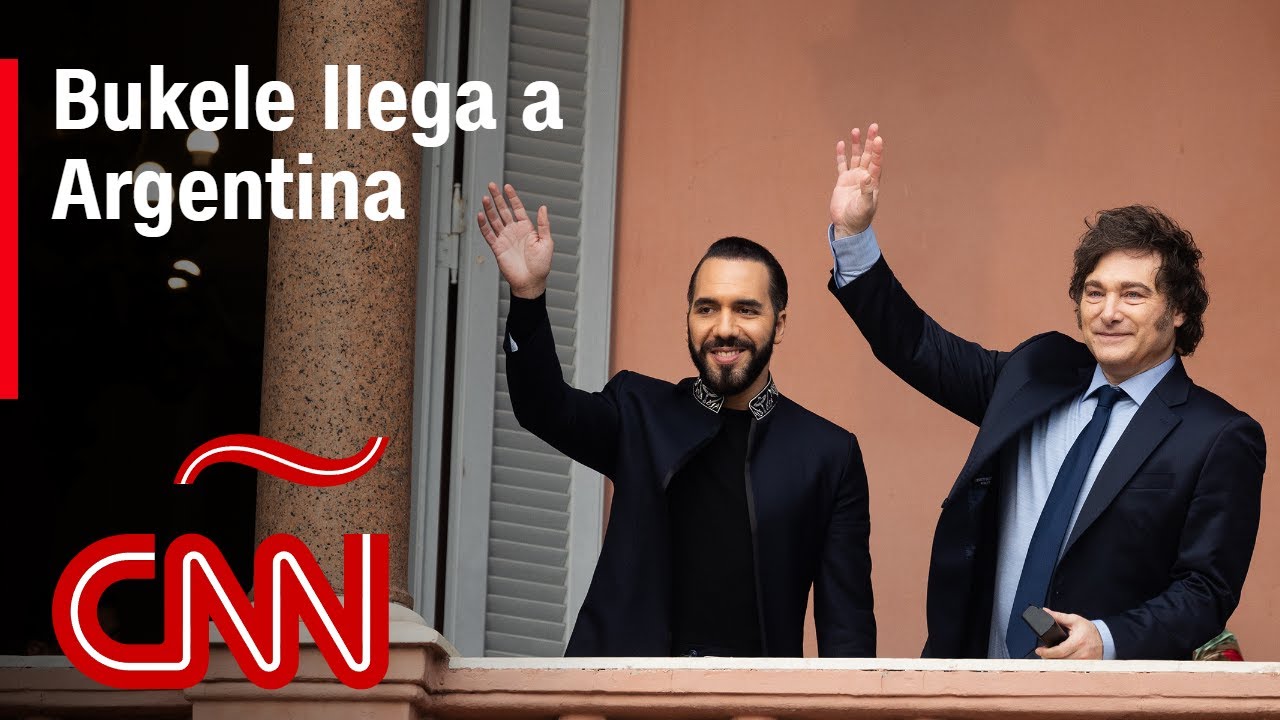 ,, 3]
- International Alliances: Both leaders are influential figures in the broader conservative movement, frequently participating alongside U.S. leadership in international summits to combat org
---
DISSENT
The Ideology Behind Trump’s Favorite President
Following the teachings of Murray Rothbard, Javier Milei wants to dismantle the state while also using it to consolidate his power.
Pablo StefanoniMarch 4, 2025
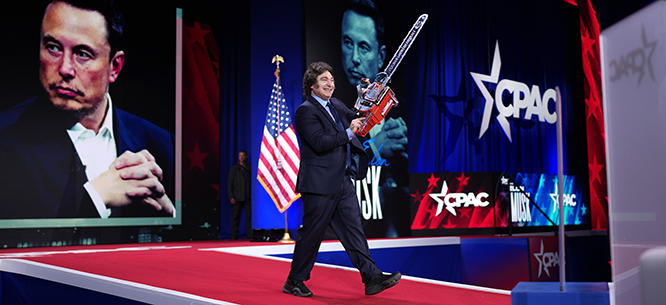
Argentinian President Javier Milei wields a chainsaw as he arrives on stage at the Conservative Political Action Conference on February 20, 2025. (Andrew Harnik/Getty Images)
Shortly after Donald Trump was elected in November 2024, he placed a call to Argentina’s Javier Milei. “You are my favorite president,” Trump told Milei. “The end.” The two had met briefly at the Conservative Political Action Conference (CPAC) last February, where Milei revealed he was a Trump fan. Milei uses the chainsaw as a symbol to indicate his approach to cutting the size of the Argentine state. This approach has been a reference for Elon Musk’s Department of Government Efficiency (DOGE); Musk has consulted with Milei’s specially appointed Minister of Deregulation, and, like Milei, he plans a 30 percent reduction in the U.S. federal budget.
Milei is a neoliberal of the Austrian school—a believer that the private market offers true freedom, while the state offers only repression. He is a particular admirer of Murray Rothbard, the Ludwig von Mises disciple and once-fringe libertarian whose thinking has become increasingly influential on the right. One of Milei’s five cloned dogs is named Murray. “We are fulfilling [Murray] Rothbard’s dream,” Milei announced in April 2024, while speaking about deficit reduction at a dinner hosted by the Fundación Libertad in Buenos Aires.
Rothbard, as Melinda Cooper and John Ganz have argued, helps bridge the gap between the libertarian and authoritarian elements of the contemporary right. Back in 1992, he prefigured the Trumpist rhetorical strategy:
The reality of the current system is that it constitutes an unholy alliance of “corporate liberal” Big Business and media elites, who, through big government, have privileged and caused to rise up a parasitic Underclass, who, among them all, are looting and oppressing the bulk of the middle and working classes in America. Therefore, the proper strategy of libertarians and paleos is a strategy of “right-wing populism,” that is: to expose and denounce this unholy alliance, and to call for getting this preppie-underclass-liberal media alliance off the backs of the rest of us.
Rothbard remains a fringe figure in the United States, but one linked to a minority current in a country where distrust of the state has been a consistent theme. In many ways, his ideas seem more out of place in Argentina. Though Argentina also has a federal system, there is no culture of states’ rights, nor are there the radical religious groups or militias that consider the central government the source of all evil. When Milei began to publicly preach the virtues of an anarcho-capitalist utopia, he appeared as a solitary prophet.
But some young post-adolescents began to be attracted to Milei’s rhetoric and foul language. These young people started to create WhatsApp groups to take part in events organized by Milei—including public classes on Austrian economics in city squares, book presentations, and plays—and to respond to Milei’s television appearances on social networks. In 2019, I conducted a series of interviews with these young libertarians. One of them (who had an image of Trump on his phone’s home screen) told me that Rothbard was the theoretical inspiration of the Argentine libertarian movement. He and his companions (more men than women, at least then) were reading the New York theorist, several of whose texts were being published in Spanish for the first time.
Rothbard’s ideas may seem like an unstable philosophy for a president, given that he seeks to abolish state authority. And Milei doesn’t shy away from this position. “I am a mole who came to destroy the state from within,” he repeats. But Rothbard’s work also provides a basis for Milei’s alliances with other reactionary groups—and the convergence between libertarians and far-right groups taking place in a number of countries. Milei really wants to abolish the state, but he also uses it to consolidate his power.
Born in 1926 in the Bronx, Rothbard came from a family of Russian and Polish Jews. Although many members and acquaintances of his family belonged to the Communist Party, his father had remained closer to the right. Rothbard first developed anti-statist feelings during his time in public school—“the most unhappy period of my life.” In the 1950s, he earned a doctorate in economics from Columbia University. Rothbard also felt close from a young age to the old right, rooted in an interpretation of the ideas of Thomas Jefferson: distrust of the central government, isolationism, and pacifism. Libertarianism led Rothbard—who was one of the founders of the Libertarian Party in 1971—to common action with the left in various areas, especially against the Vietnam War.
Later in life, Rothbard grew critical of the marginality of the Libertarian Party and developed an agenda he described as “paleolibertarian.” He reconnected with reactionary positions that he had never in fact abandoned and advocated “right-wing populism” as a political strategy.
Lew H. Rockwell Jr., a disciple of Rothbard, wrote a manifesto titled “The Case for Paleo-Libertarianism” in 1990. The text was full of contempt for the drift of the Libertarian Party toward countercultural positions on drugs and sex work. “Conservatives have always argued that political freedom is a necessary but not sufficient condition for the good society,” he wrote,
and they’re right. Neither is it sufficient for the free society. We also need social institutions and standards that encourage public virtue, and protect the individual from the State. Unfortunately, many libertarians—especially those in the Libertarian Party—see freedom as necessary and sufficient for all purposes. Worse, they equate freedom from State oppression with freedom from cultural norms, religion, bourgeois morality, and social authority.
Rockwell later added that the party “may never have gotten 1% in a national election, but it has smeared the most glorious political idea in human history with libertine muck.” Paleolibertarians, by contrast, believed that one must not confuse “natural authority” (which arises from “voluntary” social structures like families, businesses, and churches) with the authority imposed by the state. From their perspective, the Libertarian Party had transformed into a group of anti-authority hippies isolated from the American people and their beliefs.
When it came to civil rights, the paleos rejected them outright. “State-enforced segregation, which also violated property rights, was wrong,” Rockwell wrote, “but so is State-enforced integration.” For Rockwell, forced segregation was not wrong in itself, but because it was a state imposition; communities, however, were free to make their own rules. The same went for restrictions favored by others on the right, like anti-abortion laws. These types of positions allowed libertarians to form alliances with various sectors on the right, from fundamentalist Christians to the Ku Klux Klan, in the name of freedom, autonomy, and the rejection of federal power.
Although paleolibertarianism did not prosper as a political movement in the strict sense, Rothbard accurately perceived the crisis brewing in traditional conservatism and the rebellion gathering at the base of the Republican Party. These energies eventually produced the Tea Party and then Trumpism, which took on a number of elements of the paleo program.
Milei, who trained as an economist at the University of Belgrano, was converted to the Austrian school of economics around 2013, after reading Rothbard’s “Monopoly and Competition”—a text that made him revise all his previous convictions. After this point, Milei began to appear on television programs, gaining popularity for his eccentric performances, which would veer from Austrian economics to tantric sex. He grew adept at generating attention through controversy, a talent he put in service of his new cause: the anarcho-capitalism professed by Rothbard. He would call Keynes’s The General Theory of Employment, Interest and Money “general garbage,” and make declarations like, “between the mafia and the state, I prefer the mafia,” because “the mafia has morals, the mafia fulfills, the mafia doesn’t lie, the mafia competes.” He defined himself, in language incomprehensible outside certain niches, as “minarchist in static terms and ANCAP [anarcho-capitalist] in dynamic terms.” In other words: the minimum program is minarchism, the minimum state; the maximum program is its abolition.
As a public figure, Milei made an enemy not just of the eclectically center left-wing Peronist party but also the center-right party of then-President Mauricio Macri. To Milei, the center-right party represented a “yellow socialism.” In El consultorio de Milei—a ramshackle 2019 theatrical work in which Milei delivers monologues on economics—Milei attacked the moderate wing of Macri’s administration as the enemy of freedom, while the public insulted his ministers. The work ended with Milei crudely destroying a prop Central Bank with a baseball bat.
Milei saw himself as engaged in a cultural battle for a country that he believed was dominated by leftists. He combined Rothbard’s ideas with the epic vision of capitalism found in the novels of Ayn Rand, all seasoned with the post-democratic sensibilities germinating in Silicon Valley. In his earlier TV appearances, the “economist with weird hair” (as the newspaper Clarín called him) dodged direct political questions, taking shelter in the notion that he only knew about economics. As he began to move from a cultural battle to a political-electoral one, he sought answers in the ideas of the alt-right. Milei shaped an Argentine version of MAGA ideology—the local translation of a more global zeitgeist—and made common cause with other reactionary forces, united in their shared contempt for “progressivism.”
Milei’s intellectual consigliere is the far-right writer Agustín Laje, who provides readymade arguments for the “anti-woke” battle. Laje, who is popular in right-wing networks throughout Latin America, discovered Rothbard when asked by the Unión publishing house to write the prologue to a 2019 Spanish translation of Rothbard’s Egalitarianism as a Revolt Against Nature. In it, Laje vindicates the “right-wing Rothbard,” who “foresees the cultural struggles that we endure and resist today.” Rothbard is, according to Laje, a breath of fresh air in the face of so much political correctness. He provided justification for the central idea that libertarianism “not only has to recognize existing inequality; it has to defend that if that inequality is the result of free and voluntary interactions, it must endure over time.”
Prior to Milei’s presidential campaign, the name Murray Rothbard was unknown to the public. But a number of controversies have brought him to public consciousness. At one event on the campaign trail, a journalist asked Milei about Rothbard’s defense of markets in children. Milei responded that it was “not the time” for that discussion, because “society is not ready.” Patricia Bullrich, the rival candidate from the more traditional right-wing coalition (who now serves as Milei’s security minister), tried to use Milei’s affinity for Rothbard to disqualify him, saying Milei wants “a society where you can let your children starve to death.” But for many of the voters who launched Milei into office, fed up with years of devastating inflation overseen by establishment parties, the provocation was the point.
During an interview on the campaign trail, he was asked a simple question: “Do you believe in democracy?” Milei countered: “Do you know Arrow’s paradox?” He was appealing to a model made by an American economist on inconsistencies between individual and social preferences to express his objections to liberal democracy. But Arrow’s paradox has little to do with Milei’s distaste for democracy. Liberal democracy requires parties, and parliamentary politics, which are interdependent with the state—the “pedophile in the kindergarten,” as he once defined it. Milei also despises democratic deliberation as a waste of time and parliamentary deliberation as an expression of the politicking of the political caste.
In his disillusionment with democracy, Milei resembles many of the libertarians who swarm around Silicon Valley, like Peter Thiel, who said that he “no longer believes that freedom and democracy are compatible.” (Thiel visited Milei in Argentina last May.) There is also the obvious affinity with Elon Musk, Thiel’s former partner. Milei has paid homage to him on a number of occasions; at the most recent CPAC, Musk wielded a chainsaw given to him by Milei. For these libertarians, freedom is compatible with an authoritarian regime like the one proposed by neo-reactionary Curtis Yarvin, who has expressed that the United States “must lose its phobia of dictators” and to whom radicalized sectors of the Republican Party now listen attentively.
In the government, Milei has had to deal with the absence of Rothbardian cadres. As a result, he has had to appoint former officials from Macri’s government and the administration of Carlos Menem (the president in the 1990s who symbolized the neoliberalism of that era). Even so, the governmental dynamics are far from continuous with the past. The unusually minoritarian character of his administration (his party, La Libertad Avanza, is new and has little representation in Congress) has reinforced his right-wing populist discourse, in the form of anti-parliamentarianism and a direct rhetorical relationship with “the people.” Milei has aroused a growing cult of personality among his followers. They mix old forms of exaltation with new technologies (like the AI-constructed memes where he appears as a lion) and languages (he is often compared to a comic book superhero).
Milei boasts of his global influence. He loves attending the international summits of the far right. At the same time, he seems bored by day-to-day administration. He delegates much of his job to trusted officials, including his sister Karina Milei, known as “The Boss,” and his advisor Santiago Caputo; management, negotiation, and administration would attenuate his utopian perspective. Meanwhile, at the international events, he can deploy his maximalist discourse and messianic vision of politics (he has compared himself to Moses)—no longer a mere president but a “world leader of freedom.”
Paleolibertarianism allows for broader alliances with far-right groups. But it also sets limits that Milei has transgressed. Rothbard was always anti-militarist, since the armed forces are the heart of the state. Milei, however, supports authoritarian governments abroad, such as those of Nayib Bukele in El Salvador and Viktor Orbán in Hungary, and seeks to reinforce the military and intelligence apparatus in Argentina. (He is also a staunch ally of Israel and Benjamin Netanyahu, despite Rothbard’s comments on the “uniquely pernicious” nature of the Zionist project.)
Because there are so few true paleolibertarian believers in Argentina, Milei’s adherence to Rothbard is only shared by a handful of militants in government. The effect has been a duality between a hydroponic anarcho-capitalism without real roots in society (or the state) and an authoritarian neoliberalism that mobilizes anti-progressive perspectives on the cultural terrain.
Nevertheless, Milei has essentially retained the support of those who voted for him—approximately half of the electorate—because the “shock treatment” he has applied has been successful in curbing inflation. Milei pushed through a series of spending cuts—especially in public works—and has stifled universities with his warnings about “cultural Marxism,” but he has avoided cutting social assistance for fear of causing unrest. (The second Trump administration and DOGE inherited very different conditions, and voters in the United States might not respond the same way to shock treatment applied to a relatively healthy patient.)
Perhaps that will not last. Rothbard inveighed endlessly against the power of central banks and “fiat currency.” But if Rothbard preferred gold, his descendants today favor cryptocurrency. Trump made billions from a useless memecoin as he was taking office, which has since lost much of its value. In February 2025, Milei endorsed a different memecoin called $LIBRA from his personal account on X. As fears grew that the coin would engage in a “rug pull”—destroying its value while enriching its creator—he deleted the post. The coin’s creator has claimed he controls Milei, texting: “I send $$ to his sister and he signs whatever I say and does what I want.” The boundaries of the scandal are expanding quickly in Argentina. His fate may show that extremism, whatever its momentary appeal, exacts a heavy cost in the end. The rug pull is on all of us.
Translated by Patrick Iber.*
Pablo Stefanoni is a journalist and historian. He is the author of ¿La rebeldía se volvió de derecha?And the editor-in-chief of the journal Nueva Sociedad.
---
OMFG
buenosairesherald.com
Milei's proposal to allow 'non-human corporations' run by AI causes ...
Jun 5, 2026Politicians and tech experts expressed concern over the implications of President Javier Milei's proposal to allow "non-human corporations" run by artificial intelligence (AI) to operate in Argentina, with no regulations and low taxes. On Thursday, renowned British outlet Financial Times published an opinion article written by Milei — with the help of Deregulation Minister Federico ...
EL PAÍS English
June 5, 2026
Politicians and tech experts expressed concern over the implications of President Javier Milei’s proposal to allow “non-human corporations” run by artificial intelligence (AI) to operate in Argentina, with no regulations and low taxes.
On Thursday, renowned British outlet Financial Times published an opinion article written by Milei — with the help of Deregulation Minister Federico Sturzenegger — under the headline “Argentina invites AI to free itself.”
In it, he stated that AI must remain free of state regulation to prosper.
The libertarian leader said his government was looking to attract AI companies by proposing a change in legislation that would establish “a dedicated legal framework for the deployment of AI.”
The three pillars of this framework are “a commitment to keep AI unregulated”, “the creation of a new corporate category in Argentine law: the non-human corporation”, and a “low corporate tax rate”.
“We are open for business,” he wrote, stressing that this is “an invitation.”
Critics say this could open the doors to “programmed impunity” and that it may even turn Argentina into a “catastrophic experiment.”
AI revolution
The article compared the development of AI as a technology with the industrial revolution and the creation of limited liability companies, saying that an unregulated framework is required to unleash their full potential.
“As much as the industrial revolution freed us from the constraints of the human muscle, AI will free us from the constraints of the human brain, pushing productivity beyond our wildest dreams,” Milei said in the article.
Milei said he is committed to keep AI unregulated “so that it is free to be developed without the deadly hand of premature and poorly understood regulation.”
He also proposed the creation of “a new corporate category in Argentine law: the non-human corporation,” which would be operated by AI agents or robots. Human participation as shareholders would be possible, but not required.
“Where these systems exercise independent judgment in unpredictable environments, their actions entail real risks. Limited liability is not a luxury for such entities; it is a precondition for their existence,” the president said.
Those entities would benefit from a low corporate tax rate, and shareholders would be able to choose their form of corporate governance law, although final beneficiaries would have to be disclosed.
“Argentina has no interest in becoming a haven for illicit capital — but for all legitimate commercial activity our framework will offer unmatched terms,” he said.
Super RIGI
According to Milei, the proposals are part of a broader investment incentive regime known as RIGI, which the government submitted to Congress last week to attract businesses through tax breaks and other benefits.
However, the initiative — dubbed “Super RIGI” — does not mention the concept of “non-human corporations” or establish a deregulated framework for AI companies.
The proposal is primarily aimed at attracting companies interested in building large-scale AI data centers in Argentina, offering lower taxes, preferential foreign-exchange conditions and exemptions from export duties.
The incentives, however, are not limited to the AI sector.
“In the spirit of the Dutch merchants who made Amsterdam the financial capital of the 17th century, we intend to offer the most attractive legal and fiscal environment for the AI companies that will define the 21st century,” Milei wrote.
Sam Altman and Peter Thiel
In October, OpenAI — the company behind ChatGPT — and Argentine firm Sur Energy signed a letter of intent to develop a large-scale AI data center in Patagonia.
Patagonia, a sparsely populated region in southern Argentina known for its abundant natural resources and cool, dry climate, is widely seen as an attractive location for large data centers.
The project, known as Stargate Argentina, would be the first initiative of its kind in Latin America. The investment has been estimated at between US$20 billion and US$25 billion, although the project has yet to be formally launched.
OpenAI CEO Sam Altman said the initiative would help bring Milei’s vision of “how AI could drive Argentina’s growth and creativity” to life.
Milei has also announced a “social digital twin” program, which would use publicly available citizen data to create simulations intended to inform public policy decisions.
The concept bears similarities to services offered by Palantir, the data analytics company co-founded by tech investor Peter Thiel.
Thiel met with Milei in April and has spent the past months living in Argentina. The government has denied that Palantir — or any other private company — is involved in the digital twin initiative, which has yet to be launched.
Palantir has faced criticism from civil liberties groups over its work with U.S. government agencies, including contracts related to immigration enforcement and surveillance programs.
Thiel has also been linked to Próspera, a controversial semi-autonomous development project in Honduras designed to attract investment through a separate regulatory and governance framework.
Criticisms
Former lawmaker and Coalición Cívica leader Elisa “Lilita” Carrió said Milei’s article “confirms his full support for Peter Thiel, his philosophy, his beliefs and his economic power.”
According to Carrió, the proposal would turn Argentina into “a catastrophic experiment for human dignity” and move the country toward the “complete private totalitarianism” she believes Thiel advocates.
“Argentina has been chosen as the site of a social experiment with terrible consequences for human freedom,” Carrió said.
She argued that a lack of regulation for AI would mean “the dissolution of all moral and legal constraints, the end of the state, and the privatization of military and police power in the hands of private groups.”
Former Defense Minister Agustín Rossi said the Super RIGI initiative appeared to be “tailor-made for Javier Milei’s friends” and questioned why Economy Ministry officials had declined to clarify whether Palantir had lobbied in favor of the proposal.
Meanwhile, electronics engineer and AI specialist Ariel Garbarz argued in a post on X that the ideas of non-human corporations and the full deregulation of AI would create a system of “programmed impunity: human gains, social harm and responsibility shifted onto machines.”
“The ideological trick is to call the state’s decision to stop protecting its people ‘innovation,'” he warned.
Tech magnate Peter Thiel strengthens ties with Milei in Buenos Aires
Apr 23, 2026Tech magnate Peter Thiel strengthens ties with Milei in Buenos Aires The founder of Palantir, the data processing company, arrives in Argentina after his visit to Rome to talk about the Antichrist

La Derecha Diario
Peter Thiel moves to Argentina motivated by the reforms of Milei's ...
May 28, 2026The tech billionaire Peter Thiel will relocate to live in Argentina, enchanted by Argentina and the policies of the Government of Javier Milei, reflecting the growing international appeal of the libertarian direction.

YouTube
##
Jun 5, 2026We Found Out Peter Thiel's Sick Experiment On Argentina Dangerously Informed with Evie 147K subscribers Subscribed 5.4K
Created by:Dangerously Informed with Evie67K views14 min
New York Times
https://www.nytimes.com › 2026 › 05 › 28 › world › americas › peter-thiel-argentina.html
In Argentina, U.S. Tech Billionaire Peter Thiel Finds An Escape - The ...
May 28, 2026The billionaire's new roots in Argentina are said to be partly motivated by concerns about the future of the United States and shared beliefs with Argentina's right-wing leader.
[
The Washington Post
What's really behind Peter Thiel's panicked move to Argentina
Jun 4, 2026What's really behind Peter Thiel's panicked move to Argentina Some tech observers think that the Palantir overlord sees the end times coming, but his real motivation is likely much more ...

Raw Story
https://www.rawstory.com › peter-thiel-2676971006
Billionaire Trump ally's 'chilling' move out of US sparks panic: 'About ...
May 29, 2026Tech billionaire Peter Thiel, an outspoken supporter of President Donald Trump, has recently set "new roots" in Argentina as a potential "Plan B," The New York Times reported, fueling ...
[thenerdreich.com
https://www.thenerdreich.com › the-sovereign-individual-thiel-argentina-and-the-network-state
The Sovereign Individual: Thiel, Argentina and the Network State
Jun 1, 2026As I mentioned in my April piece, The Sovereign Individual specifically listed Argentina and New Zealand as choice locations for bunker-mentality billionaires. Thiel obtained New Zealand citizenship in 2011, and the NYT reports that he is exploring the possibility of an Argentine passport as well.

The Nation
What's Really Behind Peter Thiel's Panicked Move to Argentina
Jun 3, 2026The big question raised by Thiel's panicked peregrinations is why one of our country's richest and most politically influential tech investors has decided to do a runner, as Ronnie Biggs might ...

Democratic Underground
https://www.democraticunderground.com › 1322117722
We Found Out Peter Thiel's Sick Experiment On Argentina - Democratic ...
Jun 7, 2026We Found Out Peter Thiel's Sick Experiment On Argentina We Found Out Peter Thiel's Sick Plan For Argentina Dangerously Informed with Evie Watch on Info Bookmark Add this thread to your Bookmarks (My DU » Bookmarks)

The Rio Times
Tech Billionaire Peter Thiel Moves His Family to Milei's Buenos Aires
May 29, 2026Key Facts — The headline: The Peter Thiel Argentina move involves a temporary family relocation to Buenos Aires and a 12 million dollar property purchase, according to a New York Times report cited by global outlets this week. — The drivers: Sources cited by the Times pointed to Thiel's concerns about California's proposed billionaire tax and a stronger ideological alignment with ...

UnHerd
https://unherd.com › newsroom › peter-thiel-wont-find-a-safe-haven-in-argentina
Peter Thiel won't find a safe haven in Argentina - UnHerd
May 30, 2026Peter Thiel is known for making and landing counterintuitive bets. But relocating to Argentina, his "escape hatch" from the risks of political turmoil in the developed world, may be his most confounding wager yet.
New York Post
Peter Thiel moves family to Argentina to flee taxes, AI meltdown ...
May 29, 2026The billionaire investor reportedly moved his family to Buenos Aires as a refuge from high taxes, political turmoil and potential catastrophes like nuclear war and an AI meltdown.
---
MMA
10/16/25
---
MOORE BS
[### How Trump Can Help Accelerate Argentina's Economic ...

AMAC - The Association of Mature American Citizens
https://amac.us › newsline › economy › how-trump-can...](https://amac.us/newsline/economy/how-trump-can-help-accelerate-argentinas-economic-comeback/)
Dec 9, 2025 — Stephen Moore is a former Trump senior economic adviser and the cofounder of Unleash Prosperity, which advocates for education freedom for ...Read more
AI Overview


+1
Stephen Moore is a prominent American conservative economist and senior policy adviser who has become a vocal advocate and strategic ally for the free-market "shock therapy" economic reforms implemented by Argentine President Javier Milei.
 The Bakersfield Californian +1
Areas of Alignment and Collaboration
- Fiscal "Shock Therapy": Moore has frequently praised Milei’s efforts to reduce bloated government bureaucracies, privatize state assets, and slash taxes, holding up the Milei experiment as a global blueprint for free-market capitalism.
 The Bakersfield Californian +1
- Trump Administration Ties: As an adviser to Donald Trump, Moore has advocated for the United States to actively assist Argentina—such as through financial lifelines—to ensure that Milei’s libertarian reforms are politically and economically successful.
 The Bakersfield Californian +2
- Economic Analysis: Moore has argued in commentary that Milei's path of restoring sound money and taking a chainsaw to state regulations is working to bring macroeconomic stabilization and investment back to Argentina.
 The Bakersfield Californian +1
[### Argentina's opposition has threatened to hold an ...

Reddit · r/worldnews
260+ comments · 1 year ago](https://www.reddit.com/r/worldnews/comments/1iqgi8f/argentinas_opposition_has_threatened_to_hold_an/)
tl;dlr milei promoted an “investment” in argentine companies that was just a crypto rug pull. the most credible info is that it's not his, ...Read more
Missing: STEPHEN | Show results with: STEPHEN
[### The new figure is a warning sign for the libertarian ...

Facebook · Financial Times
700+ reactions · 1 year ago](https://www.facebook.com/financialtimes/posts/the-new-figure-is-a-warning-sign-for-the-libertarian-president-and-his-governmen/917379243768787/)
The new figure is a warning sign for the libertarian president and his government's austerity programme, as his popularity begins to falter.
[### Argentinian President Javier Milei's economic reforms are ...

Facebook · TRT World
30+ reactions · 1 year ago](https://www.facebook.com/trtworld/posts/argentinian-president-javier-mileis-economic-reforms-are-showing-some-results-bu/1128677739294466/)
Argentinian President Javier Milei's economic reforms are showing some results, but for many, rising living costs and social unrest paint a different picture.Read more
Missing: STEPHEN | Show results with: STEPHEN
[### Rent Control Ended in Argentina and Housing Supply ...

Unleash Prosperity
https://committeetounleashprosperity.com › Hotlines](https://committeetounleashprosperity.com/hotlines/rent-control-ended-in-argentina-and-housing-supply-surged/)
Aug 14, 2024 — President Javier Milei repealed Argentina's rent control law at the end of 2023, but the Law of Supply remains in universal effect.Read more
Missing: STEPHEN | Show results with: STEPHEN
[### Steve Deace's post

Facebook · Steve Deace
390+ reactions · 2 years ago](https://www.facebook.com/stevedeace/posts/id-really-like-to-get-in-on-all-the-excitement-about-argentinas-new-president-bu/878974473592012/)
... Javier Millei. He is the most improbable head of state – a libertarian economist with a wild mop of hair and mutton chop sideburns who ran ...Read more
[### Argentina President Javier Milei doing the “Trump dance” ...

Facebook · MeidasTouch
4.9K+ reactions · 7 months ago](https://www.facebook.com/meidastouch/videos/argentina-president-javier-milei-doing-the-trump-dance-at-mar-a-lago-after-getti/1369555624610887/)
Argentina President Javier Milei doing the “Trump dance” at Mar-a-Lago after getting an $40 billion bailout. Meanwhile, Trump won't renew ...
Missing: STEPHEN MILLEI
---
AI Overview 6 26 GGL
Federico Sturzenegger has a long-standing academic history with Harvard University. He notably served as a visiting professor of public policy at the John F. Kennedy School of Government from 2005 to 2007. [1]
Beyond this specific tenure, he has frequently held the title of Adjunct Professor of Public Policy at the Harvard Kennedy School. He has balanced this role alongside other notable academic and government positions, including serving as an economics professor at the University of San Andrés in Buenos Aires and UCLA. [1, 2, , 4, 5]
For a deeper look into his academic background and research, you can explore his personal Academic Biography. You can also find additional information about his career trajectory on his Wikipedia Profile. [1, 2]
At the end of 2023, when Patricia Bullrich lost the presidential election against Javier Milei, Sturzenegger and the PRO candidate offered the winning candidate a study that had reviewed the 4000 laws of Argentina, a job that had taken 2 years together with a team of 150 people. This compendium was later reflected in the Ley Bases and Decree 70/23 two initial initiatives of the Milei administration. In July he assumed the position of Minister of Deregulation and State Transformation, especially dedicated to reducing public spending, and simplifying the rules that affect the development of the private sector
[### Federico Sturzenegger Chainsaw and Deregulation

Princeton University Department of Economics
https://economics.princeton.edu › 2025/01 › 202...](https://economics.princeton.edu/wp-content/uploads/2025/01/2025.01.23-MA-Federico-Sturzenegger.pdf)
Jan 23, 2025 — He is the. Minister of Deregulation and State Transformation of the Argentine Republic, he teaches at the University of San Andrés in Buenos ...Read more
5 pages
AI Overview


+15
Federico Sturzenegger is an Argentine economist, currently serving as Argentina's Minister of Deregulation and State Transformation. A prominent free-market architect, he is also an Adjunct Professor of Public Policy at Harvard University's Kennedy School, heavily influenced by the Austrian school of economics, including the classical liberal theories of Friedrich Hayek.
 David Rockefeller Center for Latin American Studies +3
Academic and Professional Background
- Harvard Ties: Sturzenegger has taught at Harvard's Kennedy School as an Adjunct Professor, where his academic research spanned international finance, macroeconomic policy, and exchange rate regimes.
 David Rockefeller Center for Latin American Studies +3
- Policy Roles: Before joining Javier Milei's cabinet, he served as the President of the Central Bank of Argentina (2015–2018) and as a National Congressman.
:{
YouTube·Institute of Politics Harvard Kennedy School +2}:
- Current Administration: Appointed as Minister in 2024, he acts as the intellectual engine of the administration's sweeping deregulation agenda (often called the "chainsaw" approach), aimed at slashing thousands of state regulations and reducing public expenditure.
:{
YouTube·Markus' Academy +1}:
The Hayekian Influence
- Spontaneous Order vs. State Planning: Sturzenegger’s approach to public policy is deeply rooted in Hayek's critique of central planning. Like Friedrich Hayek, he argues that state monopolies and heavy bureaucratization stifle innovation, whereas decentralized, free-market interactions (like allowing the private sector to manage IP rights or dismantling import monopolies) create a much more productive and efficient "spontaneous order."
:{
YouTube·IWP | Institut für Schweizer Wirtschaftspolitik +3}:
- Information Asymmetry: Aligning with Hayek's concept that local knowledge is impossible for a central planner to aggregate, Sturzenegger approaches reform by questioning the necessity of government laws. He operates on the premise that bureaucrats lack the necessary localized information to manage competitive industries efficiently.
 YouTube·Agenda Austria +2
To read more about his academic work or explore his ongoing Harvard-affiliated policy research, visit the Harvard DRCLAS Event Archive or his Personal Biography.
---
AN 10 25
SUBSIDY SOYBEAN TO CHINA, us ZIP
ADMITS MONEY ONLY TO INFL ELECTION, PROP UP LOSER, IF SOCIALIST ELECTED, TAKE BACK
BESSANT BUDIES ARE INVESTED?!
Even MAGA is fuming as Trump official raises pledge to 'total of $40 billion for Argentina'
On Tuesday afternoon, October 14, U.S. President Donald Trump met with visiting Argentina President Javier Milei at the White House. Trump is offering the South American country, which has suffered major problems with its currency, a $20 billion bailout.
Trump, talking to reporters, made it clear that the bailout money is conditional on the right-wing Milei staying in office.
Trump told reporters, "If he loses, we are not going to be generous with Argentina… I think he’s going to win. And if he wins, we're staying with him — and if he doesn’t win, we're gone."
$20 billion, however, may not be all the money Argentina receives from the U.S. According to Treasury Secretary Scott Bessent, Argentina may receive as much as $40 billion from the U.S. when all is said and done.
As Semafor's Eleanor Mueller reports, "The Trump administration is 'working on a $20B facility that would be adjacent to our swap line' for Argentina, Bessent [told] reporters Wednesday.
"That would be a total of $40B for Argentina," Bessent added, according to Mueller.
The $40 billion figure and Bessent's comments are getting a lot of reactions on X, formerly Twitter.
MeidasTouch's Ron Filipkowski posted, "Now we are up to $40 billion for Argentina. Can anyone stop Bessent from unilaterally sending unlimited amounts of our money to South America? And Republicans won’t even negotiate with the Democrats on health care for Americans. Where is Congress?"
X user Jordan wrote, "America First is slashing SNAP funding for hungry American families while sending $40 billion to Argentina.
Another X user, Scott, commented, "Why doesn't congress have to approve 40 billion of our tax [money] going to Argentina? Can Bessent legally send our tax [money] there?"
Rep. Melanie Stansbury (D-New Mexico) tweeted, "Breaking news! 15 days into a government shutdown, and Trump has promised a $40 billion bailout to the Argentinian government on the backs of the American people using YOUR taxpayer dollars, while threatening to cut off food assistance to American families."
Self-described "straight, white alpha male" Politics Sloth wrote, "MAGA — 'We need to stop sending money overseas [and] use the money on Americans!' Support cutting government programs — bailing out a foreign country."
Some MAGA Republicans are speaking out as well, arguing that giving $40 billion to Argentina is inconsistent with the America First agenda.
America First proponent Kwasny posted, "Wow. Yesterday, it was $20 billion. Today, it is $40 billion? Sounds like you are pulling numbers from your rear end."
White House Xray wrote, "The Monroe Doctrine 2.0: Dollar Diplomacy edition. Trump's admin rebrands imperialism as 'philosophical charity' -—where foreign aid becomes a loyalty test administered through ATMs. They’ve tied $40 [billion] to Milei’s Oct 26 election, Trump admitting 'we don’t have to do it' (10/15). Yet during America’s 15th day of shutdown, farmers beg for relief while Medicaid gets $1 [trillion] cuts. Bessent calls this 'strategic interest' as Argentina’s market drops 30percent YTD - but US workers? 'Gone,' per Trump’s playbook. Priorities: ideological crusades abroad, austerity at home."
---
mma
Right-wing media touted Milei’s austerity schemes. Now Argentina might need a US bailout.
Treasury Secretary Scott Bessent floated a financial lifeline for the right-wing leader even as Trump cuts lifesaving foreign aid across the globe
Written by John Knefel
Published 09/26/25
Right-wing media figures have long embraced Argentina President Javier Milei and his extreme austerity and privatization measures, which have now plunged his country into chaos and even triggered the possibility of a bailout from President Donald Trump.
Conservative pundits have consistently celebrated Milei’s drastic cuts to pension programs and social services, sometimes offering them as a template for domestic policy. When Milei took office in late 2023, he implemented a suite of right-wing economic policies — deregulation, privatization, slashing public sector employment — and took steps to artificially bolster Argentina’s currency to bring down inflation. His government saw temporary success in taming inflation, but his policies created widespread misery and he’s now facing a political backlash that threatens to compound Argentina’s troubles.
With the Argentinian economy in free fall, U.S. Treasury Secretary Scott Bessent assured global markets that the Trump administration would consider extending a series of extraordinary bailout measures to help Milei’s beleaguered government. On September 24, Bessent went as far as to admit the Trump administration’s goal was to provide Milei support to “bridge him to the election.”
For all the support Milei has gotten over the years from conservative media, Fox News and others in right-wing media have barely mentioned the potential bailout at all.
- ### Right-wing media praise Milei’s austerity program
Conservative pundits have embraced Milei — some even prior to his victory in November 2023 — and have repeatedly pointed to his social spending cuts as a model for Trump’s administration.
- A day after Milei was elected, conservative economist Art Laffer argued Milei was “not a kook” or “far-right-winger” and bet he would make Argentina “the outstanding, pro-growth economy of Central and South America” as president. Fox host Larry Kudlow concurred, adding that “the socialism they’ve been flirting with almost all over the continent hasn’t worked. … This guy might turn that around.” Fox Business, *Kudlow*, [11/20/23]
- In June 2024, Newsmax’s Rob Schmitt praised Milei over a chyron that read: “Argentina's Milei shows gov't reduction can be done.” Schmitt said: “When Milei came in to this government, and he’s just ripping up all these different agencies he wants to defund, cut government — cut, cut, cut, cut, cut — and now we see this week, the first time in 30 years they’ve had no inflation on food.” He added: “This is how it has to be done.” Former and current Trump adviser Sebastian Gorka, then out of government, concurred, arguing that Milei understands “the bigger the government, the smaller the citizen.” Newsmax, *Rob Schmitt Tonight*, [6/26/24]
- That September, Fox Business anchor Maria Bartiromo said: “I love that guy, Javier Milei. He's done such a great job.” Bartiromo continued: “It's really amazing to see the kind of change that he has spurred in Argentina.” Earlier in the segment her guest praised Milei because he had “cut half the government.” Fox Business, *Mornings With Maria Bartiromo*, [9/23/24]
- On January 15, as Trump was preparing for his second term, a frequent guest on Steve Bannon’sWar Roompodcast said, “Look at what Milei has achieved in Argentina in such a short space of time.” The guest, Phillip Patrick, continued: “He cut government spending significantly, gutted useless government departments.” Patrick added: “The people are suffering shorter term, but longer term, the economy is looking much healthier. We need that same aggressive move today for the U.S. economy because we’re at the point of no return.” Patrick is a spokesperson for Birch Gold, which is a sponsor of War Room. Real America’s Voice, *War Room*, [1/15/25; Fudgie, accessed 9/26/25; Birch Gold, accessed 9/26/25, 9/26/25]
- In February, Fox News host Will Cain discussed the Trump administration’s early efforts to gut the federal workforce and referred to Argentina as a “source of inspiration.” Milei “came in with meat cleaver, cutting away government waste and spending,” Cain said, later concluding: “The success for America could have been modeled in Argentina.” Fox News, *The Will Cain Show*, [2/18/25]
- Also in February, as the Trump administration was cutting hundreds of thousands of federal jobs, Fox News host Brian Kilmeade defended the administration’s actions by arguing, “Argentina is doing it.” ABC News, [2/24/25; Fox News, Fox & Friends, 2/25/25]
- In March, Schmitt again praised Milei, claiming he had “slashed a bloated government in a country that had terrible inflation and a cratering economy, and he's managing to turn his country around.” His guest, John Stossel, also celebrated Milei’s breakneck deregulation rate and said of the Trump administration: “If they do that, it would be great in America. But I doubt that will happen.” Newsmax, *Rob Schmitt Tonight*, [3/11/25]
- In March, a Brazilian journalist on Bannon’sWar Roomsaid conservatives in the U.S. “are thrilled with Millei in Argentina — we all are. We love Argentina.” Real America’s Voice, *War Room*, [3/31/25]
- As congressional Republicans advanced their One Big Beautiful Bill, Fox News host Will Cain presented a video of Milei promising to eliminate vast swaths of the Argentine government and suggested it was a template that the United States could follow. “It can be done,” Cain said, repeating Milei’s own phrasing. “It’s been done in Argentina. Can it be done here in the United States?” He added: “If you’re going to make government cuts like they did in Argentina, you would think you have to start with Medicaid.” Fox News, *The Will Cain Show*, [6/11/25]
- As recently as July, Bannon argued onWar Roomthat “Argentina is on a tear right now.” Real America’s Voice, *War Room*, [7/22/25]
The promised lifeline to Milei comes amid Trump’s escalating military campaign against Venezuela, which has included extrajudicial strikes on several boats in the Caribbean, and what The Associated Press terms “a unilateral wave of attacks from the Trump administration against Brazil” after former President Jair Bolsonaro, a Trump ally, was sent to prison for attempting a coup. Those attacks have included blistering, retaliatory tariffs on Brazil as punishment for Bolsonaro's prosecution. The bifurcated approach — a carrot for Trump’s allies, a stick for his enemies — illustrates MAGA’s broader goals in Latin America.
- ### MAGA-endorsed austerity has impoverished Argentina
Trump’s supposed beneficence to Argentina stands in stark contrast to his unprecedented cuts to foreign humanitarian aid and reveals his commitment to defending anti-left-wing politicians and market fundamentalism.
The move may have come as a surprise to some, given Trump's dismantling of the government’s foreign aid capacity, but what’s on offer to Argentina isn’t life-saving food and medicine to those in extreme poverty. Instead, it’s a lifeline to a far-right government hell-bent on eliminating social services and exposing its citizens to the discipline of the market. It’s a project shared by Trump, the Republican Party, and their right-wing media allies. In other words, Milei is too big to fail.
In December, The New York Times reported that Milei’s slash-and-burn approach has plunged more than 5 million people in the country into poverty. Although some financial elites praised his efforts to trim inflation, the effects for working class Argentines have been disastrous. Public sector wages cratered by 15 percent as Milei has forced workers into precarious gig and contract labor, part of his larger plan to privatize large sectors of the economy.
Unfortunately for Argentinians, Milei’s bloodletting has failed to cure the patient. Unemployment hit its highest level in four years in the first quarter of 2025, ticking down only slightly in the second quarter, largely due to jobs added in the informal economy. The economic downturn helped drive a loss by Milei’s party in recent local elections in Buenos Aires, which then spurred a run on the peso and a stock market collapse. Milei is facing legislative elections next month, further adding to the political crisis engulfing his administration.
Milei responded to his recent electoral loss by promising to “deepen and accelerate” his regulatory and privatization schemes. That level of commitment to right-wing economic orthodoxy may help explain why Trump recently Milei, at a bilateral meeting during the United Nations General Assembly, as having “done a fantastic job.”
:{---
vox
Meet two of the hot speakers at this year’s Conservative Political Action Conference (CPAC): Presidents Nayib Bukele of El Salvador and Javier Milei of Argentina, two of Latin America’s most flamboyant right-wing populists.
CPAC started in 1974 as an annual gathering of conservatives; over the years it has turned into a days-long, livestreamed far-right spectacle. Policy is discussed and refined while movement luminaries like former President Donald Trump and House GOP Chair Elise Stefanik are given the opportunity to share their ideas with a receptive audience.
It might be a little sleepier than usual this year, but the conference still reveals where American conservatism is headed. And the two Latin American leaders’ presence underscores the right’s continued affinity for populist and even illiberal leadership — particularly when combined with modern personal brands built online.
They aren’t the first extremist leaders to speak at CPAC: Viktor Orbán of Hungary and Jair Bolsonaro of Brazil have featured in past years. Like Orbán and Bolsonaro, Bukele and Milei are staunch populists who have proposed radical solutions to serious problems in their countries.
The American right finds those radical proposals attractive, even if the policies likely couldn’t — or shouldn’t — be instituted in the US. Bukele has, seemingly, mitigated El Salvador’s serious gang violence problem through mass arrests and incarceration, while Milei’s economic policies are supposed to right Argentina’s inflation-plagued economy.
Trump, the presumptive Republican nominee for president, has praised both men; though he has yet to meet Milei, the former president enjoyed a friendly relationship with Bukele. Other conservative figures, including Rep. Chip Roy (R-TX) of the Freedom Caucus, have praised Milei’s push for “limited” government.
The two leaders are important voices at CPAC as conservatives work to draw in Latin American voters before the election in November; Bukele in particular is popular among Salvadorans living in the US. But their presence at the conference is about more than trying to win votes, Erica Frantz, a professor of political science at Michigan State University, told Vox — it’s about creating a particular type of international far-right ideology.
“Linking Milei and Bukele with the Trump movement is advantageous for all parties involved,” she said. “For Milei and Bukele, it gives them the opportunity to strengthen an alliance with the potential presidential candidate most likely to be sympathetic to their authoritarian ambitions.” For Trump and his supporters, “it is a chance to send a message to supporters that its style of politics is gaining steam outside US borders.”
Bukele and Milei were elected to tackle big issues
Bukele has had a long relationship with the pro-Trump right since his first presidential election in 2019. That relationship started online, among cryptocurrency enthusiasts. The ideology underlying cryptocurrency is decidedly libertarian, with many adherents calling for the abolition of treasuries and central banks.
Bukele’s profile rose when El Salvador began accepting bitcoin as legal tender, and he’s remained popular despite the damage it’s done to the country’s economy following the cryptocurrency crash of 2022. But the leader’s crypto fixation — which is affecting the country’s ability to secure international financing — is almost quaint in the face of his authoritarian turn, ostensibly to address the country’s serious crime problem.
Gangs controlled most aspects of life in the country, which was once known for having the highest murder rate in the world. With a campaign of mass arrests, Bukele has indeed tackled El Salvador’s crime problem. But that has come at a steep cost, as I explained last year:
Successive presidential administrations have taken different approaches — many have adopted the mano dura, or “iron hand” tack, instituting harsh crackdowns to mitigate the violence. But Bukele is on an entirely different level; his administration has imprisoned tens of thousands, many arbitrarily, repeatedly extended a state of emergency severely curtailing the rights of ordinary citizens, and attacked and even detained his critics in the press.
The country now instead boasts the highest incarceration rate in the world.
Despite the human rights violations, Bukele’s policies have been popular in El Salvador. Given the astounding level of violence that ordinary people have suffered under the gangs’ power — and the rapidity with which the violence decreased — it’s not ultimately that surprising that Bukele won a second term in office, despite the fact that he has dismantled parts of El Salvador’s democracy, manipulating institutions from the country’s Constitutional Courtto its legislature, to do so.
Though the policy appears to be working in the immediate term, critics argue it isn’t sustainable for two major reasons. The first is that Bukele has made no effort to build a long-term social or economic infrastructure as an alternative to gang violence. The second is that the sense of security people currently feel requires sacrificing other forms of security, such as the rule of law. “[Bukele’s] popularity is built on illegality and undemocratic actions,” Noah Bullock, the executive director of the human rights organization Cristosal, told Vox. “There is no historic precedent where the use of state violence has produced lasting peace.”
That didn’t stop Bukele from suggesting the US ought to learn from his policies during his CPAC speech on Thursday. “We can clearly see the signs of a declining society because our own hit rock bottom decades ago,” he told the cheering audience. He urged Americans to look at “big cities in decline like Baltimore, Portland, New York, just to name a few places where crime and drugs have become the daily norm.”
Milei has only been in office for a couple of months, so he’s had less time to implement his libertarian economic policies. And he might not be able to do that much; already in his brief tenure, the congress voted down his party’s omnibus bill, which included fiscal measures aimed at managing inflation as well as an attempt to secure emergency legislative powers for, potentially, his entire four-year term. Along with deregulation and privatization efforts, the omnibus bill hinted at Milei’s social agenda: It would have reduced prenatal parental leave for women and slashed environmental protections in favor of business interests.
Milei will speak at the conference Saturday, most likely about his efforts to privatize state enterprises and cut down on regulations — both topics with great appeal to CPAC’s audience.
US conservatives benefit from Bukele and Milei’s illiberal policies
Bukele and Milei were each granted a mandate by presenting extreme solutions to serious problems in their countries that have long frustrated citizens. But they have clear ideologies and proclivities toward illiberalism that emerge within those contexts, too.
“They are able to articulate a real problem in society and propose solutions,” Daniel Rothschild, executive director of the Mercatus Center at George Mason University, told Vox. When people are truly struggling, they respond to those policies, “even if they are illiberal.”
In his speech on Thursday evening, Bukele warned that the US was headed for the same kind of violent, gang-plagued system that defined El Salvador. But he, like Trump and other conservatives, exaggerates the problem the US faces. Trump and his allies have argued that cities (especially those in Democratic-controlled states) are full of violence, and they have also made a bogeyman out of the gang Mara Salvatrucha, or MS13, which has terrorized El Salvador along with Barrio 18.
It is true that MS13 actually started in the US and has had a presence here. It is also true that violent crime, including homicide, increased during the social upheaval of the pandemic, and that certain kinds of property crimes have increased. But violent crime is now at pre-pandemic levels and has trended downward overall since the 1990s. In other words, there’s simply no parallel to the violence and terror wrought by gang violence in El Salvador.
It’s not hard to see why Trump and others at CPAC would want to champion someone like Bukele. He exemplifies “tough on crime” rhetoric and, to their minds, proves that the only way to avoid the “American carnage” Trump warned of in his 2017 inauguration speech is to restrict human and civil rights and undo democratic norms and institutions.
Milei, despite having struggled to pass his policies, similarly embodies conservative ideals. His efforts to curb government spending and significantly reduce the size of the government echo the Republican party’s rhetoric of limited government and tighter belts — but the US isn’t dealing with 140 percent inflation or a57 percent poverty rate.
It’s still early in Milei’s tenure, but it is important to note that he and Bukele — like Trump — exemplifies what Frantz and others call a “personalist” leader. “The party that supports them is intricately linked to their persona rather than a clear policy platform,” Frantz explained.
Social media is an important tool in the personalist leader’s playbook that Milei, Bukele, and Trump have all used to their advantage — they don’t have to go through establishment channels that might soften their policies or their rhetoric.
That social media following has created a wave of “millennial authoritarianism,” as researcher Manuel Meléndez-Sánchez termed the phenomenon, which brands these leaders as iconoclasts who reject the “establishment.”
“With personalist parties,” Frantz said, “leaders pretty much have a free rein to behave as they please, and — particularly when their party gains majority legislative representation — the door is wide open for democracy to deteriorate.”
Even if Milei is struggling to pass his policies in Argentina, he’s still able to paint himself as a warrior in the fight against socialism, as he apparently will do in his CPAC speech. That will solidify his ideological link to US conservatives and show “a very clear picture” of how far-right politicians “learn from each other, how they are connected with each other, and they are sharing an agenda that, far from being local, is a global network,” Paula Avila-Guillen, a human rights lawyer and executive director of the Women’s Equality Center, told Vox.
Ultimately, US conservatives like Bukele and Milei because they are hardliners who are using extreme tactics to deal with society’s problems — and are willing to thumb their noses at institutions to get there. As Frantz told Vox, their presence at CPAC is “an effort to cue the conservative base to see authoritarian rhetoric as ‘normal’ and strongman rule as the only solution to society’s problems.” In other words, the message is that not only is there nothing to fear from Trump’s more anti-democratic tendencies, but there’s much to gain from them.
See More:
---
===
an 11 24
The two right-wing billionaires President-elect Donald Trump has tasked with spearheading a new "government efficiency" commission outlined their vision Wednesday for the mass firing of federal employees, large-scale deregulation, and major spending cuts that could impact antipoverty programs, drug research and development, and more.
For the first time since Trump announced plans to create the Department on Government Efficiency (DOGE)—which, despite its name, would be an advisory commission rather than an actual federal department—Tesla CEO Elon Musk and biotech entrepreneur Vivek Ramaswamy offered a detailed look at how they plan to achieve their stated objective of taking a "chainsaw" to federal operations.
"We are assisting the Trump transition team to identify and hire a lean team of small-government crusaders, including some of the sharpest technical and legal minds in America," the pair wrote in an op-ed in The Wall Street Journal. "The two of us will advise DOGE at every step to pursue three major kinds of reform: regulatory rescissions, administrative reductions, and cost savings. We will focus particularly on driving change through executive action based on existing legislation rather than by passing new laws."
Decrying rules crafted by "unelected bureaucrats," Musk and Ramaswamy—unelected outside advisers—wrote that they intend to present to Trump "a list of regulations" they believe should be eliminated. The culling of regulations would, they argued, provide the justification for "mass headcount reductions"—corporate-speak for sweeping firings—across federal agencies, a plan the two wrote would not be deterred by civil service protections.
Watchdogs have noted that the regulatory cuts envisioned by the commission's co-leaders would likely benefit Musk's companies, at least three of which are currently under scrutiny from nine federal agencies.
"Based on Elon Musk's comments, the so-called Department of Government Efficiency is poised to make far-reaching recommendations that could have a devastating impact on Americans and enormously benefit insiders, starting with Musk himself," Public Citizen co-president Robert Weissman said Wednesday.
"A second Trump term will undoubtedly see a multipronged attack on any institution that seeks to constrain big business, and DOGE will lead the charge."
Musk and Ramaswamy also laid out a plan under which Trump would evade existing federal statutes such as the Impoundment Control Act to cut spending already allocated by Congress.
"DOGE will help end federal overspending by taking aim at the $500 billion-plus in annual federal expenditures that are unauthorized by Congress or being used in ways that Congress never intended, from $535 million a year to the Corporation for Public Broadcasting and $1.5 billion for grants to international organizations to nearly $300 million to progressive groups like Planned Parenthood," they wrote.
As The Washington Post's Jacob Bogage recently observed, the federal programs "without separate spending authorization" that Musk and Ramaswamy are targeting "represent more than $516 billion" and encompass key areas including veterans' healthcare, education spending, housing assistance, childcare aid, student loan programs, Head Start, opioid addiction treatment, and NASA.
Musk, a megadonor to Trump's 2024 presidential bid, claimed on the campaign trail that he would be able to identify "at least $2 trillion" in possible cuts to federal spending.
Casey Wetherbee, an Argentina-based writer, warned Wednesday that "Musk and Ramaswamy's admiration of Argentine president Javier Milei offers us a glimpse into their ideal end state."
"Ramaswamy tweeted on November 18: 'A reasonable formula to fix the U.S. government: Milei-style cuts, on steroids,'" Wetherbee wrote for Jacobin. "When Milei assumed office last year, he declared that conditions would worsen before things would get better; Musk similarly warned that DOGE’s recommendations may cause 'temporary hardship.' Meanwhile, in Argentina, Milei's austerity measures have targeted the country's social safety net, causing the poverty rate to skyrocket while only lowering taxes for the country's wealthiest citizens, a troubling outlook for a second Trump administration if DOGE's advice is ever implemented."
"A second Trump term will undoubtedly see a multipronged attack on any institution that seeks to constrain big business, and DOGE will lead the charge," Wetherbee added. "After all, in DOGE's public call for collaborators, it seeks 'super high-IQ small-government revolutionaries'; that's how they see themselves. We can only hope that, by virtue of how evidently insufferable they are, DOGE's relationship with the Trump adm
---
an 2 24
critics are blasting CPAC (https://www.thenewcivilrightsmovement.com/?s=CPAC), the Conservative Political Action Conference, as the embattled head of the organization that puts together and hosts the event, Matt Schlapp (https://www.thenewcivilrightsmovement.com/?s=Matt+Schlapp), is attacking NBC News (https://www.nbcnews.com/news/us-news/nazis-mingle-openly-cpac-spreading-antisemitic-conspiracy-theories-fin-rcna140335) over its report that states: “Nazis mingle openly at CPAC, spreading antisemitic conspiracy theories and finding allies.”
“Nazis appeared to find a friendly reception at the Conservative Political Action Conference this year,” writes Ben Goggin, NBC News Digital deputy editor for technology. “Throughout the conference, racist extremists, some of whom had secured official CPAC badges, openly mingled with conference attendees and espoused antisemitic conspiracy theories.”
“The presence of these individuals has been a persistent issue at CPAC. In previous years, conference organizers have ejected well-known Nazis and white supremacists such as Nick Fuentes,” NBC News also reported. “But this year, racist conspiracy theorists didn’t meet any perceptible resistance at the conference where Donald Trump has been the keynote speaker since 2017.”
Schlapp is the head of the American Conservative Union. He and his wife Mercedes Schlapp (https://www.thenewcivilrightsmovement.com/?s=Mercedes+Schlapp) were once described as the “Trump-Era ‘It Couple’ (https://www.nytimes.com/2018/04/30/us/politics/schlapp-trump.html).” Now he is facing a $9 million lawsuit (https://www.thenewcivilrightsmovement.com/2023/01/male-staffer-sues-matt-schlapp-for-9-million-lawsuit-alleges-sexual-battery-after-aggressively-fondling-groin-area/) over alleged sexual assault, including “aggressive fondling,” after Republican strategist Carlton Huffman, a staffer at the time for the failed Herschel Walker senatorial campaign, says Matt Schlapp groped him in January of 2023.
READ MORE: Democrats Discredit GOP Claims on IVF as Republicans Try to Regain Ground After Fallout (https://www.thenewcivilrightsmovement.com/2024/02/democrats-discredit-gop-claims-on-ivf-as-republicans-try-to-regain-ground-after-fallout/)
CPAC’s list of speakers last week included the far-right ultra-conservative (https://www.npr.org/2023/11/19/1214092698/javier-milei-a-radical-libertarian-populist-elected-president-of-argentina#::text=BUENOS%20AIRES%2C%20Argentina%20%E2%80%94%20Argentines%20have,by%20more%20than%2010%20points.) president of Argentina, Javier Milei, who “gave Donald Trump on Saturday an ecstatic hug,” the AP (https://apnews.com/article/trump-milei-cpac-argentina-biden-f8e97d401a13318f8cc55faf29021030) reported. Donald Trump (https://www.thenewcivilrightsmovement.com/?s=Donald+Trump), calling himself a “proud political dissident (https://www.cnn.com/2024/02/24/politics/cpac-speech-trump/index.html),” delivered the keynote address at CPAC on Saturday. CNN (https://www.cnn.com/2024/02/24/politics/fact-check-trump-delivers-another-lie-filled-cpac-speech/index.html) described it as “lie-filled.”
Schlapp was both furious and dismissive of NBC News’ report.
“NBC’s claim that there was a Nazi presence at CPAC 2024 is false, misleading, and grossly manipulative—especially coming from a writer who has carried the water for Hamas in much of his reporting on the Israel-Gaza war,” Schlapp wrote (https://twitter.com/CPAC/status/1761805247331090911) in a statement posted by CPAC to X. “When we come across someone at CPAC peddling any kind of anti-semitism, we deal with them immediately. Knowing this, NBC weaved together lies and fabrications to create a false perception, and we won’t stand by idly while NBC engages in willful misinformation.”
In a separate post, Schlapp also wrote (https://twitter.com/mschlapp/status/1761804394012479597):
“Yawn. This is a tired old cliche. The Neo-Nazis in our midst are the ones controlling our college campuses and major institutions and grossly populate the newsrooms of corporate media, calling for an Israeli surrender.”
READ MORE: ‘Insultingly Stupid’: Trump’s Move to Toss Out Classified Docs Case Torn Apart by Experts (https://www.thenewcivilrightsmovement.com/2024/02/insultingly-stupid-trumps-move-to-toss-out-classified-docs-case-torn-apart-by-experts/)
NBC’s Goggin responded (https://twitter.com/BenjaminGoggin/status/1761912963315781966):
“The Nazis introduced themselves to me at a mixer and said they were national socialists, started talking about skull measurements and pushing the conspiracy theory that all races were being controlled Jewish people. They were posting about their presence at CPAC online.”
He also provided photos and video:
IFrame Content (https://platform.twitter.com/embed/Tweet.html?dnt=false&embedId=twitter-widget-0&features=eyJ0ZndfdGltZWxpbmVfbGlzdCI6eyJidWNrZXQiOltdLCJ2ZXJzaW9uIjpudWxsfSwidGZ3X2ZvbGxvd2VyX2NvdW50X3N1bnNldCI6eyJidWNrZXQiOnRydWUsInZlcnNpb24iOm51bGx9LCJ0ZndfdHdlZXRfZWRpdF9iYWNrZW5kIjp7ImJ1Y2tldCI6Im9uIiwidmVyc2lvbiI6bnVsbH0sInRmd19yZWZzcmNfc2Vzc2lvbiI6eyJidWNrZXQiOiJvbiIsInZlcnNpb24iOm51bGx9LCJ0ZndfZm9zbnJfc29mdF9pbnRlcnZlbnRpb25zX2VuYWJsZWQiOnsiYnVja2V0Ijoib24iLCJ2ZXJzaW9uIjpudWxsfSwidGZ3X21peGVkX21lZGlhXzE1ODk3Ijp7ImJ1Y2tldCI6InRyZWF0bWVudCIsInZlcnNpb24iOm51bGx9LCJ0ZndfZXhwZXJpbWVudHNfY29va2llX2V4cGlyYXRpb24iOnsiYnVja2V0IjoxMjA5NjAwLCJ2ZXJzaW9uIjpudWxsfSwidGZ3X3Nob3dfYmlyZHdhdGNoX3Bpdm90c19lbmFibGVkIjp7ImJ1Y2tldCI6Im9uIiwidmVyc2lvbiI6bnVsbH0sInRmd19kdXBsaWNhdGVfc2NyaWJlc190b19zZXR0aW5ncyI6eyJidWNrZXQiOiJvbiIsInZlcnNpb24iOm51bGx9LCJ0ZndfdXNlX3Byb2ZpbGVfaW1hZ2Vfc2hhcGVfZW5hYmxlZCI6eyJidWNrZXQiOiJvbiIsInZlcnNpb24iOm51bGx9LCJ0ZndfdmlkZW9faGxzX2R5bmFtaWNfbWFuaWZlc3RzXzE1MDgyIjp7ImJ1Y2tldCI6InRydWVfYml0cmF0ZSIsInZlcnNpb24iOm51bGx9LCJ0ZndfbGVnYWN5X3RpbWVsaW5lX3N1bnNldCI6eyJidWNrZXQiOnRydWUsInZlcnNpb24iOm51bGx9LCJ0ZndfdHdlZXRfZWRpdF9mcm9udGVuZCI6eyJidWNrZXQiOiJvbiIsInZlcnNpb24iOm51bGx9fQ%3D%3D&frame=false&hideCard=false&hideThread=false&id=1761913925665198542&lang=en&origin=https%3A%2F%2Fwww.alternet.org%2Fnews-politics%2Fmatt-schlapp-cpac%2F&partner=rebelmouse&sessionId=896614fd8cbc9bf9b04e1b22c8c9881cc1ede343&theme=light&widgetsVersion=2615f7e52b7e0%3A1702314776716&width=550px)
IFrame Content (https://platform.twitter.com/embed/Tweet.html?dnt=false&embedId=twitter-widget-1&features=eyJ0ZndfdGltZWxpbmVfbGlzdCI6eyJidWNrZXQiOltdLCJ2ZXJzaW9uIjpudWxsfSwidGZ3X2ZvbGxvd2VyX2NvdW50X3N1bnNldCI6eyJidWNrZXQiOnRydWUsInZlcnNpb24iOm51bGx9LCJ0ZndfdHdlZXRfZWRpdF9iYWNrZW5kIjp7ImJ1Y2tldCI6Im9uIiwidmVyc2lvbiI6bnVsbH0sInRmd19yZWZzcmNfc2Vzc2lvbiI6eyJidWNrZXQiOiJvbiIsInZlcnNpb24iOm51bGx9LCJ0ZndfZm9zbnJfc29mdF9pbnRlcnZlbnRpb25zX2VuYWJsZWQiOnsiYnVja2V0Ijoib24iLCJ2ZXJzaW9uIjpudWxsfSwidGZ3X21peGVkX21lZGlhXzE1ODk3Ijp7ImJ1Y2tldCI6InRyZWF0bWVudCIsInZlcnNpb24iOm51bGx9LCJ0ZndfZXhwZXJpbWVudHNfY29va2llX2V4cGlyYXRpb24iOnsiYnVja2V0IjoxMjA5NjAwLCJ2ZXJzaW9uIjpudWxsfSwidGZ3X3Nob3dfYmlyZHdhdGNoX3Bpdm90c19lbmFibGVkIjp7ImJ1Y2tldCI6Im9uIiwidmVyc2lvbiI6bnVsbH0sInRmd19kdXBsaWNhdGVfc2NyaWJlc190b19zZXR0aW5ncyI6eyJidWNrZXQiOiJvbiIsInZlcnNpb24iOm51bGx9LCJ0ZndfdXNlX3Byb2ZpbGVfaW1hZ2Vfc2hhcGVfZW5hYmxlZCI6eyJidWNrZXQiOiJvbiIsInZlcnNpb24iOm51bGx9LCJ0ZndfdmlkZW9faGxzX2R5bmFtaWNfbWFuaWZlc3RzXzE1MDgyIjp7ImJ1Y2tldCI6InRydWVfYml0cmF0ZSIsInZlcnNpb24iOm51bGx9LCJ0ZndfbGVnYWN5X3RpbWVsaW5lX3N1bnNldCI6eyJidWNrZXQiOnRydWUsInZlcnNpb24iOm51bGx9LCJ0ZndfdHdlZXRfZWRpdF9mcm9udGVuZCI6eyJidWNrZXQiOiJvbiIsInZlcnNpb24iOm51bGx9fQ%3D%3D&frame=false&hideCard=false&hideThread=false&id=1761924576236253448&lang=en&origin=https%3A%2F%2Fwww.alternet.org%2Fnews-politics%2Fmatt-schlapp-cpac%2F&partner=rebelmouse&sessionId=896614fd8cbc9bf9b04e1b22c8c9881cc1ede343&theme=light&widgetsVersion=2615f7e52b7e0%3A1702314776716&width=550px)
IFrame Content (https://platform.twitter.com/embed/Tweet.html?dnt=false&embedId=twitter-widget-2&features=eyJ0ZndfdGltZWxpbmVfbGlzdCI6eyJidWNrZXQiOltdLCJ2ZXJzaW9uIjpudWxsfSwidGZ3X2ZvbGxvd2VyX2NvdW50X3N1bnNldCI6eyJidWNrZXQiOnRydWUsInZlcnNpb24iOm51bGx9LCJ0ZndfdHdlZXRfZWRpdF9iYWNrZW5kIjp7ImJ1Y2tldCI6Im9uIiwidmVyc2lvbiI6bnVsbH0sInRmd19yZWZzcmNfc2Vzc2lvbiI6eyJidWNrZXQiOiJvbiIsInZlcnNpb24iOm51bGx9LCJ0ZndfZm9zbnJfc29mdF9pbnRlcnZlbnRpb25zX2VuYWJsZWQiOnsiYnVja2V0Ijoib24iLCJ2ZXJzaW9uIjpudWxsfSwidGZ3X21peGVkX21lZGlhXzE1ODk3Ijp7ImJ1Y2tldCI6InRyZWF0bWVudCIsInZlcnNpb24iOm51bGx9LCJ0ZndfZXhwZXJpbWVudHNfY29va2llX2V4cGlyYXRpb24iOnsiYnVja2V0IjoxMjA5NjAwLCJ2ZXJzaW9uIjpudWxsfSwidGZ3X3Nob3dfYmlyZHdhdGNoX3Bpdm90c19lbmFibGVkIjp7ImJ1Y2tldCI6Im9uIiwidmVyc2lvbiI6bnVsbH0sInRmd19kdXBsaWNhdGVfc2NyaWJlc190b19zZXR0aW5ncyI6eyJidWNrZXQiOiJvbiIsInZlcnNpb24iOm51bGx9LCJ0ZndfdXNlX3Byb2ZpbGVfaW1hZ2Vfc2hhcGVfZW5hYmxlZCI6eyJidWNrZXQiOiJvbiIsInZlcnNpb24iOm51bGx9LCJ0ZndfdmlkZW9faGxzX2R5bmFtaWNfbWFuaWZlc3RzXzE1MDgyIjp7ImJ1Y2tldCI6InRydWVfYml0cmF0ZSIsInZlcnNpb24iOm51bGx9LCJ0ZndfbGVnYWN5X3RpbWVsaW5lX3N1bnNldCI6eyJidWNrZXQiOnRydWUsInZlcnNpb24iOm51bGx9LCJ0ZndfdHdlZXRfZWRpdF9mcm9udGVuZCI6eyJidWNrZXQiOiJvbiIsInZlcnNpb24iOm51bGx9fQ%3D%3D&frame=false&hideCard=false&hideThread=false&id=1761412873098596843&lang=en&origin=https%3A%2F%2Fwww.alternet.org%2Fnews-politics%2Fmatt-schlapp-cpac%2F&partner=rebelmouse&sessionId=896614fd8cbc9bf9b04e1b22c8c9881cc1ede343&theme=light&widgetsVersion=2615f7e52b7e0%3A1702314776716&width=550px)
“Either CPAC is lying about having no idea about this, or they simply don’t have a grasp on who they approved to come to their conference…,” Goggin added (https://twitter.com/BenjaminGoggin/status/1761916216896094322).
READ MORE: Smirnov Scandal: Experts Call for Investigations, Warn GOP of Possible Conspiracy Charges (https://www.thenewcivilrightsmovement.com/2024/02/smirnov-scandal-experts-call-for-investigations-warn-gop-of-possible-conspiracy-charges/)
“Nazis, antisemitism, the great replacement theory, [white supremacist Nick] Fuentes, have become so common among conservatives that I think attendees, even journalists, didn’t think too deeply about them being at CPAC. There was very much an ‘oh them’ attitude about the nazis.”
“It really illustrated how successfully extremists have shifted the Overton window. This year, they were expected, and their presence was tolerated,” he added (https://twitter.com/BenjaminGoggin/status/1761522234005369108).
Critics blasted CPAC.
“At CPAC, avowed Nazis mingled openly & spread antisemitic conspiracy theories, as speakers welcomed the ‘end of democracy.’ They are all saying the quiet part out loud. And most GOP lawmakers are silent (or cheering). This is how extremism is normalized,” warned (https://twitter.com/amyspitalnick/status/1761742552246505933) Amy Spitalnick, CEO of the Jewish Council for Public Affairs. Spitalnick “led a group that won a $25 million judgment against the neo-Nazis who organized the deadly 2017 Charlottesville march in Virginia,” The Times of Israel (https://www.timesofisrael.com/amy-spitalnick-who-fought-neo-nazis-in-court-to-lead-leftist-group-bend-the-arc/) reported in 2022.
“Seriously, read this @BenjaminGoggin piece and tell me those of us ringing the alarm bells on increasingly mainstreamed Nazism are being hyperbolic,” Spitalnick added (https://twitter.com/amyspitalnick/status/1761744100003393806).
“CPAC denies the presence of Nazis at their conference this year, but when I reported that @cpac was teeming with white nationalists in 2022 there wasn’t a peep from Matt Schlapp about it,” wrote (https://twitter.com/stevanzetti/status/1761914884248293431) Texas Observer special investigative correspondent Steven Monacelli.
IFrame Content (https://platform.twitter.com/embed/Tweet.html?dnt=false&embedId=twitter-widget-3&features=eyJ0ZndfdGltZWxpbmVfbGlzdCI6eyJidWNrZXQiOltdLCJ2ZXJzaW9uIjpudWxsfSwidGZ3X2ZvbGxvd2VyX2NvdW50X3N1bnNldCI6eyJidWNrZXQiOnRydWUsInZlcnNpb24iOm51bGx9LCJ0ZndfdHdlZXRfZWRpdF9iYWNrZW5kIjp7ImJ1Y2tldCI6Im9uIiwidmVyc2lvbiI6bnVsbH0sInRmd19yZWZzcmNfc2Vzc2lvbiI6eyJidWNrZXQiOiJvbiIsInZlcnNpb24iOm51bGx9LCJ0ZndfZm9zbnJfc29mdF9pbnRlcnZlbnRpb25zX2VuYWJsZWQiOnsiYnVja2V0Ijoib24iLCJ2ZXJzaW9uIjpudWxsfSwidGZ3X21peGVkX21lZGlhXzE1ODk3Ijp7ImJ1Y2tldCI6InRyZWF0bWVudCIsInZlcnNpb24iOm51bGx9LCJ0ZndfZXhwZXJpbWVudHNfY29va2llX2V4cGlyYXRpb24iOnsiYnVja2V0IjoxMjA5NjAwLCJ2ZXJzaW9uIjpudWxsfSwidGZ3X3Nob3dfYmlyZHdhdGNoX3Bpdm90c19lbmFibGVkIjp7ImJ1Y2tldCI6Im9uIiwidmVyc2lvbiI6bnVsbH0sInRmd19kdXBsaWNhdGVfc2NyaWJlc190b19zZXR0aW5ncyI6eyJidWNrZXQiOiJvbiIsInZlcnNpb24iOm51bGx9LCJ0ZndfdXNlX3Byb2ZpbGVfaW1hZ2Vfc2hhcGVfZW5hYmxlZCI6eyJidWNrZXQiOiJvbiIsInZlcnNpb24iOm51bGx9LCJ0ZndfdmlkZW9faGxzX2R5bmFtaWNfbWFuaWZlc3RzXzE1MDgyIjp7ImJ1Y2tldCI6InRydWVfYml0cmF0ZSIsInZlcnNpb24iOm51bGx9LCJ0ZndfbGVnYWN5X3RpbWVsaW5lX3N1bnNldCI6eyJidWNrZXQiOnRydWUsInZlcnNpb24iOm51bGx9LCJ0ZndfdHdlZXRfZWRpdF9mcm9udGVuZCI6eyJidWNrZXQiOiJvbiIsInZlcnNpb24iOm51bGx9fQ%3D%3D&frame=false&hideCard=false&hideThread=false&id=1761914884248293431&lang=en&origin=https%3A%2F%2Fwww.alternet.org%2Fnews-politics%2Fmatt-schlapp-cpac%2F&partner=rebelmouse&sessionId=896614fd8cbc9bf9b04e1b22c8c9881cc1ede343&theme=light&widgetsVersion=2615f7e52b7e0%3A1702314776716&width=550px)
Former U.S. Rep. Mondaire Jones (D-NY), currently a candidate for Congress running to unseat U.S. Rep. Mike Lawler (R-NY), said (https://twitter.com/MondaireJones/status/1762140215596962164): “I am appalled that Nazis were allowed to attend CPAC—an event Donald Trump headlined again this year. Make no mistake: the Republican Party and Trump have empowered white nationalists for years.”
Responding to the NBC News article, former U.S. government official Mike Walker wrote (https://twitter.com/New_Narrative/status/1761552234880417837) on X: “This is not Munich, 1933. This is Washington, DC, 2024.”
See the photos and video above or at this link (https://www.thenewcivilrightsmovement.com/2024/02/how-extremism-is-normalized-schlapp-furious-as-critics-slam-cpac-over-report-of-nazis/).
---
11 23 ihope I’m wrong, but I think I just saw the future of America if Republicans manage to sweep the 2024 elections, Trump or no Trump.
Argentina just embarked on a Grand Experiment, untried before in any developed country in the world; it’s one that multiple American billionaires have been pushing in the US ever since David Koch ran for VP on the Libertarian ticket in 1980.
When I arrived at the airport in Buenos Aires on Sunday morning this week, Election Day, I asked my cab driver who he’d be voting for and why.
“Javier Milei,” he said without hesitation. “The current government hasn’t done what they need to do about inflation.”
I asked him about the Libertarian Congressman’s (and now newly elected president’s) plans to replace the national “Medicare for All” type of healthcare system Argentina has with American-style private, for-profit health insurance plans that people must finance out of their paychecks (if they have a job, otherwise they’re SOL); to end the nation’s free colleges; and his plan to turn all the nation’s public schools and prisons over to “entrepreneurs” to run for profit.
And what about his promise to end all government support for average people, including disability payments, unemployment insurance, and all forms of welfare? His saying that abortion is murder and he’ll re-criminalize it, along with ending women’s and queer rights?
He shrugged.
“Things can’t get any worse,” was his terse reply, adding that he’s driving an airport car as a second job because inflation has wiped out the income from his regular job. This working two and three jobs, he said, has become common across the country.
Argentina has been suffering from an ongoing economic crisis for decades, but it got really bad when the “currency crisis” hit the nation in 2018 after they complied with IMF demands, wiping out half the purchasing power of the peso virtually overnight.
Much like the United States, up until the 1960s Argentina had a top income tax bracket of 90%, which stabilized the economy and prevented massive wealth inequality. Subsequent administrations, including the military dictatorship, cut that down to 35%, like today’s US, with enough loopholes that, like America, most billionaires pay virtually nothing.
Like the US, they also cut taxation on capital gains (although they’ve taken them all the way down to zero), giving a huge boost to Argentina’s morbidly rich and stripping massive amounts of revenue from the federal government.
Their draconian tax cuts, like Reagan’s, drove huge federal deficits. Right wingers, citing the deficits, demanded cuts in social programs, but, until now, weren’t successful in gutting Social Security and other social programs in either country.
In part, because the US dollar is the world’s reserve currency, we can sell debt (treasuries) to finance our deficits; Argentina has a much harder time, because nobody else uses the peso and international investors are wary, so they’ve been pursuing a policy of printing money and borrowing from the IMF, which has debased their currency leading, in part, to today’s massive inflation.
Inflation this year has been over 100%, exacerbated by previous presidents experimenting with neoliberalism as demanded by the IMF, irresponsible borrowing, along with several years of climate change-induced droughtwhich have badly damaged Argentina’s agricultural production, driving up food prices.
Milei’s opponent in Sunday’s runoff election was the nation’s finance minister, so he took much of the blame for the state of things while Milei — often referred to as “Argentina’s Trump” because he’s a wealthy former TV star, tantric sex instructor, and crackpot economist with no governmental experience other than his first year in parliament — promised to dump the rapidly devaluing peso and replace it with the US dollar. (He campaigned carrying around a chainsaw, saying he was going to take it to “welfare,” the “deep state,” and the nation’s social programs.)
When Milei won the top slot in the runoff election a few months ago, his victory caused the peso to fall further, as markets anticipated mass chaos resulting from the possible implementation of his plan to abandon the Argentinian currency if he won the general election. (It’s going to require huge cooperation from the IMF, and they don’t seem inclined to want to help.)
His primary win set off a run on the peso and produced a further currency devaluation (inflation is at 143% today) which, in turn, caused greater voter discontent. Ironically, that funneled more votes to Milei, who overwhelmingly (55%) won Sunday’s election.
The Libertarianism that Milei and American politicians like Rand Paul and Mike Lee embrace, as I’ve noted previously, is a political/economic system that was invented and named in the 1950s by a front group for the real estate lobby to rationalize their opposition to rent control, which was then spreading out of New York City and across America.
It basically argues, as Koch did in his 1980 campaign, that the only “commons” (things publicly owned and administered) a country can legitimately claim are the police and the courts.
They, in turn, have the primary job of making sure that property rights of wealthy people supersede all other rights, including the rights to healthcare, education, clean air and water, protection from abuse by employers, housing, and anti-poverty programs (including Social Security). All of these, Libertarians will tell you, are simply vestigial forms of socialism (or communism) and should be turned over to billionaires or giant corporations.
Libertarians’ key rationalization for this is that “private industry is always more efficient than government,” an argument that, while false, anybody who’s ever stood in line for an hour at the DMV can understand.
Ever since the 1980s, when Reagan embraced the libertarian worldview claiming that, “The nine most frightening words in the English language are, ‘I’m from the government and I’m here to help,’” the GOP has increasingly embraced Libertarian policies. Republican presidential candidates now compete for who can gut or shut down the most federal government agencies, from the EPA to the DOE to, well, ask Rick Perry.
Milei haș taken it so far as to say that poor people should feel free to sell their body parts, children, and organs to wealthy people on private, unregulated exchanges to pay their rent and medical expenses.
Billionaires and big corporations love Libertarianism because they end up with all the formerly-government-run sectors that they can then turn into profit centers to rip off the public. And shutting down regulatory agencies like the EPA, Interior, and USDA means they no longer have to pay for pollution controls, food safety systems, and other pesky protections for the “little people.”
Probably the example most Americans would recognize is Medicare Advantage, a privatized health insurance scam for seniors that makes billions in profits every week for our largest insurance companies while routinely refusing to pay for doctor’s visits, procedures, and even hospitalizations. It’s literally killing people by denying them care.
Milei ran on the promise of shutting down 10 of Argentina’s 18 federal agencies, throwing most of his countrymen, women, and children into the arms of the nation’s largest and richest corporations and the billionaires who own them.
He’s also a climate change denier, winning him — like Trump — the support of the nation’s fossil fuel industry, claiming the country’s drought and wildfire problems are part of natural climate variations.
Mileitold the nation about global warming:
“It’s another one of the lies of socialism.” He’added, “There is a cycle of temperatures … a cyclical behavior … and therefore all the policies that blame humans for climate change are false.”
Economist Mark Weisbrot, Co-Director of the Center for Economic and Policy Research, noted:
“No one so extremist on economic issues has been elected president of a South American country.
“His extremist views and values go far beyond macroeconomic policy — he hardly acknowledges any legitimate role for government in some of the most important policies that most people have come to see as necessary for a democratic, humane, and stable society.”
Proving Weisbrot’s point, Milei recently told Tucker Carlson:
“Every time the state intervenes, it’s a violent action that harms the right to private property and in the end, limits our freedom.”
As Weisbrot notes, Milei claims that any attempts to “fix the problem of hunger” or “fix the problem of poverty,” or even deal with unemployment is “communism or socialism”; all of these problems should be left to billionaires and giant corporations to solve through private charity or minimum wage work.
Programs like public schools, the free college system that Argentina has that allows any capable student to become a doctor or lawyer at no cost, their national healthcare system, housing supports, Social Security, and even a minimum wage and unemployment insurance are from rich people”:... Milei says. He claims that “social justice” is simply another word for “[theft
“It’s stealing the fruits of one person’s labor and giving it to someone else. So it means two things. First, it’s stealing. The problem with that is that one of the Ten Commandments is ‘thou shalt not steal.’ To support social justice is to support stealing. So one problem is that it violates the Ten Commandments.”
Milei has referred to Pope Francis as “a fucking communist,” saying that because the Pope champions social justice and the plight of the poor he is “the representative of the evil one on Earth.” (Apparently Milei has never read Matthew 25.)
When asked about Milei, (who is not associated with any political party, but, like Trump, has essentially taken over and destroyed Argentina‘s right wing movements) the Pontiff, the former Archbishop of Buenos Aires, told a television interviewer:
“The extreme right always reconstructs itself; it is the triumph of selfishness over communitarianism. … I am terrified of saviors of the nation without a political party history.”
Milei’s victory has America’s rightwingers positively giddy. Marjorie Taylor Greene, for example, tweeted a celebratory video of him promising to “destroy” the Ministry of the Environment and Sustainable Development, along with the Ministry of Women, Genders and Diversity.
Republicans are loving him,particularly his hate of racial and religious minorities. US Congresswoman María Elvira Salazar (R-Florida) endorsed him on Twitter, saying “We want [Argentina] to be one of the best countries in the world, because it’s what they deserve. A country that has everything. It has soy, it has meat, it has minerals, it has land, it has water, and it has only one culture, only one religion and only one race, completely homogenous.”
Yeah, “one race.” White people control virtually 100% of the levers of political and economic power and Argentina. He’s been embraced across the GOP.
And his campaign appears to be the world’s first to make extensive use of artificial intelligence generated images and memes. It was very effective, portraying him as a superhero and his opponent as a Cuban army style socialist; expect to see Republicans use this in next year‘s election.
Trump posted to his vanity Nazi-infested social media site, “MAKE ARGENTINA GREAT AGAIN!” while Vivek Ramaswamy tweeted, “May the spirits of {neoliberalism’s founders] Mises & Hayek be with you.”
Rightwing influencer and failed Arizona senate candidate Blake Masters posted a video of Milei screaming in Spanish:
“Leftist sons of bitches, be afraid!” He added, “Now, Argentina electing Javier Milei foreshadows Trump’s return in 2024.”
I spent several hours Monday with a politically knowledgeable Argentinian friend-of-a-friend walking around Buenos Aires, and he was blunt:
“Milei is a very smart man, but he is also insane. Really. We call him ‘Loco Milei.’ Nobody knows exactly what he’s going to do or how far he will go, but the current situation is so intolerable that Argentinians will vote for a lunatic if he will simply change the economic course of the country. Poverty has gone from 25% to over 40% in the past two decades, which is a disaster: people are in a lot of pain.”
I asked about Milie‘s plans to criminalize abortion and gay marriage (Argentina was the first South American country to legalize gay marriage back in the 2010; abortion in 2010) and he shrugged:
“Maybe it’s just talk and maybe it’s not. We shall see.”
Because Milei doesn’t have a parliamentary majority, it’s unlikely any effort to replace the peso with the dollar will to go anywhere, but all bets are off on his reconfiguring the federal government to trash the poor, gut social services, and privatize the nation’s schools, colleges, and medical system. Converting the country to dollars, however, would require a massive stock of the US currency that is simply unavailable within the country; the World Bank is suggesting they are unlikely to finance necessary reserves.
Thus, he’s already moving the goalposts, saying his economic reforms won’t kick in until 2025 at the earliest, even though he takes office next month. Meanwhile, he’s ramping up the victim-blaming rhetoric, attacking “lazy” poor people, progressives, and pursuing what he calls a “culture war” similar to the one that led to the murder of over 30,000 people during the military dictatorship of 1978-1983.
Millie refers to the “LGBT lobby” and Argentina’s women’s rights movement as arms of the hated “socialist agenda” that he says must be “stamped out”: the first step he has promised will be ending legal protections for women and queer people by dismantling the Ministry of Women, Gender and Diversity and the legal rights they protect.
Like America’s far right groups attacking public schools and libraries that carry books about civil rights movements, MLK, and Rosa Parks, Milei is all in:
“Gender ideology, native peoples, ecology and inclusive language [taught in Argentina‘s public schools] destroy the values of society”.
His victory is an international marker, of sorts, for America’s billionaires and largest corporations who share Milei’s desire to end liberal democracy and the so-called “welfare state” both in Argentina and around the world.
In its wake, expect to see the GOP double down on Milei-like language and policies as they try to drive America back toward their own libertarian ideal, which hundreds of years ago in Europe was simply known as “feudalism.”
---
argentine President-elect Javier Milei is becoming a right-wing media darling in the U.S. due to his austere proposed economic policies and conservative ideology. Right-wing media figures have reacted to Milei’s electoral success by praising him, comparing him to former President Donald Trump, and attacking mainstream media for their critical reporting.}:
- ## Argentina's new far-right president has aligned himself with U.S. right-wing politics
- Milei, a self-described “anarcho-capitalist libertarian,” has aggressively pushed conservative positions on issues such as abortion while also promising to gut government ministries relating to issues like education, diversity, and science. Milei also proposed holding a referendum aimed at overturning Argentina’s right to abortion. Rolling Stone, [11/20/23]
- One of Milei’s defining political positions is “dollarisation,” a form of economic shock treatment, to combat Argentina’s rising inflation and ongoing financial woes.Dollarisation involves getting rid of the Argentine peso and replacing it with the U.S. dollar. Mark Weisbrot, the co-director of the Center for Economic and Policy Research, has labeled this as a “crazed, economically suicidal approach” which could majorly backfire for Argentine people. The Guardian, [11/20/23]
- Milei’s mirroring of Trump’s right-wing populist messaging — down to “Make Argentina Great Again” hats and preemptive voter fraud conspiracy theories — has led to direct praise from the former president.After Milei’s victory, Trump personally congratulated him on Truth Social, posting, “The whole world was watching! I am very proud of you. You will turn your Country around and truly Make Argentina Great Again!" The Guardian, [11/17/23; Rolling Stone, 11/20/23]
- Milei has also been linked to infamous anti-tax lobbyist Grover Norquist. In 2021, Milei promised the Argentine Taxpayers Association, sister organization to Norquist’s Americans for Tax Reform, that he would “cut off [his] own arm” if he raised taxes. Norquist has also gotten many Republican politicians to make similar promises by getting them to sign his organization’s “Taxpayer Protection Pledge.” The Nation, [7/21/2011; Semafor, 11/21/23; ABC News, 11/26/12]
- Mainstream media have responded to Milei’s election by pointing out his similarities to Trump and the implications his victory could have in neighboring countries.The New York Times referred to his election as “Argentina’s Donald Trump moment.” The Washington Post, [11/19/23; The New York Times, 11/20/23]
- ## Right-wing media reacted to Milei’s victory by praising him, comparing him to Trump, spreading voter fraud conspiracy theories, and attacking mainstream media for their coverage of him
- Conspiracy theorist Alex Jones called Milei “an anti-globalist through and through” and claimed he was an Infowars listener. Jones also praised Milei as “a follower” of former Fox host Tucker Carlson and argued his election was evidence that “people are seeing through the globalist lies at every front.” Infowars, *The Alex Jones Show*, [11/20/23]
- Newsmax host Rob Schmitt celebrated Milei, praising him for “fighting an ideology that is destroying the world one country at a time.”Schmitt argued Milei was “fighting the same disease that our nation is fighting” and “isn’t afraid to eviscerate the cancerous tumor that is the socialist politician.” Newsmax, *Rob Schmitt Tonight,* [11/20/23]
- Turning Point USA founder Charlie Kirk claimed that Milei’s victory was a “stimulus of hope” for the chances of Trump winning the presidency in 2024. Kirk portrayed the election as evidence that “the Western world is starting to push back against forced globalism” supposedly orchestrated by “a smaller and smaller radical group of people.” Kirk argued, “If Javier Milei can win by 11 points … Donald Trump can win next November.” Salem Media Group, *The Charlie Kirk Show*, [11/20/23]
- Fox News contributor Sara Carter posted that she “love[s] Javier Milei.” Carter posted in response to a video of Milei ripping tags off a whiteboard with the names of various governmental departments, including the Ministry of Education and Ministry of Health. Twitter/X, [11/20/23]
- Right-wing YouTuber Steven Crowder referred to Milei as “the madman geopolitics deserves.” He also called on Milei to “make Argentina great again.” Twitter/X, [11/20/23]
- Fox Business host Charles Payne called Milei’s election “huge and super encouraging on several fronts.” Payne also alleged that “powerful global forces'' tried to prevent Milei’s victory from “happening.” Twitter/X, [11/20/23]
- Right-wing economist Art Laffer argued Milei was “not a kook” or “far-right winger” and bet he would make Argentina “the outstanding, pro-growth economy of Central and South America” as president. Fox host Larry Kudlow concurred, adding that “the socialism they’ve been flirting with almost all over the continent hasn’t worked. … This guy might turn that around.” Fox Business, *Kudlow*, [11/20/23]
- Right-wing X account End Wokeness complained that “Argentina hand-counted all of their ballots in a few hours, but the big blue areas in our swing states take several days with machines?” Twitter/X, [11/20/23]
- Neo-Nazi collaborator Jack Posobiec claimed that the reason Argentina knew “the election result so fast” was because it “banned electronic voting machines.” Posobiec failed to mention that only Buenos Aires City residents were required to use paper ballots, and that was due to “significant delays” during the primary elections because of technical issues with the machines. Twitter/X, [11/20/23; Buenos Aires Herald, 10/21/23]
- Right-wing political operative Roger Stone praised Argentina for voting “with 100% paper ballots unlike, say, Brazil.” Twitter/X, [11/19/23]
- The Daily Wire’s Ben Shapiro bemoaned the “garbage press” for their coverage of Milei, calling them “international Leftist trash.” Shapiro also touted Milei’s economic policies, claiming Milei is planning to “slash spending and restore fiscal responsibility.” Twitter/X, [11/20/23]
- Conservative blog Red State also decried the press “freak-out” over Milei, claiming mainstream media “love it when far-left socialists take power."The “fairly Libertarian” Milei, the author claimed, could not be compared to Trump, and “the press attempt to tie the two together” was therefore “transparent.” Red State, [11/19/23]
- Stone also posted that it was “really enjoyable watching the elitist pukes at the Washington Post and the New York Times melt down over the election of pro-Freedom Anti-Globalist Javier Milei.” Twitter/X, [11/20/23]
---