ariel nat gas compress
===
raga 2017 under 2 names
==
LISA GRAVES ALLUDES TO? 4 26 KRIGMAN
---
GGL 4 26
AI Overview
Ariel Corporation is the world's largest manufacturer of separable reciprocating gas compressors, essential for extracting, transporting, and storing natural gas. The company's leadership, specifically Chairman Karen Buchwald Wright and her spouse Thomas Rastin, are prominent Republican donors who have contributed millions of dollars to political committees supporting Donald Trump and J.D. Vance.
 Energy and Policy Institute +3
Key Details
- Company Role: Ariel Corporation manufactures compressors used across the natural gas industry, including in upstream extraction (such as fracking), midstream transport, and downstream processing.
- Political Contributions: Between 2016 and 2020, Wright and Rastin contributed over $2 million to the Trump Victory fund and America First Action. They have also supported other Republican figures, including J.D. Vance.
- Leadership: Karen Buchwald Wright served as CEO until 2021 and remains the company's Chairman. The company is based in Mount Vernon, Ohio.
- Industry Stance: The company's leadership has historically opposed certain renewable energy projects, such as solar farms in Ohio, while advocating for the natural gas industry.
 ariel-corp +7
Ariel's equipment is vital to the "shale gas boom" and operates globally to move natural gas from the wellhead to end-users.
 NBAA - National Business Aviation Association +2
---
LEVER JACOBIN
The Gas Industry Is Redefining Methane as “Clean Energy”
...A Wave of bills in state legislatures across the country aim to classify climate-heating methane gas as a source of “green” or “clean” energy to prevent communities from transitioning away from fossil fuels — and secretive dark money groups connected to the gas industry are behind the effort.
The legislation could threaten the enforcement of climate policies across the country, allowing gas to stand in for clean energy in states’ renewable energy portfolios or otherwise thwarting local efforts to phase out reliance on fossil fuels. As methane emissions increasingly drive climate change, the bills would disguise the devastating environmental impacts of the powerful greenhouse gas — while the Trump administration caters to fossil fuel-backed donors on federal gas policy.
State officials say the bills are necessary to protect local economic development tied to a major local source of energy. But the legislators didn’t come up with the idea on their own: the rebrand originated from model legislation introduced by the American Legislative Exchange Council (ALEC), a conservative lobbying network funded by large corporations. And in at least one case, the effort is being pushed by the gas industry itself to further entrench states’ dependence on gas.
ALEC has a reputation for providing pro-corporate model legislation to legislators, including many bills designed to obstruct climate action. In recent years, the group has drafted bills to blacklist companies that boycott the fossil fuel industry and criminalize protests of fossil fuel infrastructure.
While the group’s donors have largely been hidden from the public, its second-largest known donor is fossil fuel mogul Charles Koch, an investigation by the Center for Media and Democracy found.
A version of the methane gas rebranding bill first passed in Ohio in 2023 after it was floated by the Empowerment Alliance, a dark money gas advocacy group helmed by Trump megadonor and former gas industry executive couple Tom Rastin and Karen Buchwald Wright. According to documents obtained by the watchdog Energy and Policy Institute and first reported by the Washington Post, the Empowerment Alliance worked with Ohio state legislators on the idea, while ALEC provided a model bill and talking points for officials.
ALEC denied its involvement in Ohio’s law after the Washington Post published its story. But last summer, ALEC posted a markedly similar model bill on its website.
The model bill, titled “The Affordable, Reliable, and Clean Energy Security Act,” states that “‘Green energy’ will be redefined as meaning any energy generated by using an energy resource in which the emissions are equivalent to the standard set by pipeline-quality natural gas, (e.g. those emitted by residential gas stoves).”
Since that model bill was published, a new swath of states — including Indiana, Tennessee, Mississippi, and Louisiana — have introduced similar legislation declaring gas a “clean” or “green” source of energy. Indiana and Tennessee’s bills passed into law in April. Mississippi’s bill died in committee in February. But Louisiana’s bill — whose first iteration included exact language from the ALEC model legislation — passed in the state’s House of Representatives on June 2 and is now being considered by its Senate.
The Empowerment Alliance promotes the proliferation of ALEC’s model bill on its website. “We define American natural gas as green and clean energy,” the site reads. “We encourage all 50 states to pass legislation using the ARC Energy Security model as a starting point to unleash energy prosperity for every household and business.” Other allied fossil fuel-funded think tanks, like the Heartland Institute and the Institute for Energy Research, have also backed the model legislation.
 Screenshot from the Empowerment Alliance website.
But clean energy advocates and experts say the bills are a clear attempt by the fossil fuel industry to preempt any local transition away from their products, which pose severe threats to local air quality and the climate.
“It’s simply a grand effort at greenwashing a dirty energy source,” said Gabe Filippelli, executive director of the Environmental Resilience Institute and professor of earth sciences at Indiana University.
Methane, the main component in “natural” gas, is more than twenty-eight times as potent as carbon dioxide at trapping heat in the atmosphere, and more than eighty times as potent over the first two decades of its release. Methane emissions are rising faster than ever, even as technologies for documenting and monitoring leaks have advanced.
Yet despite knowing the risks it poses to the climate, major fossil fuel producers have campaigned to promote gas as a cleaner alternative to other fossil fuels, according to internal documents made public by Congress last year.
The legislation moving through statehouses across the country would take those industry campaigns a step further, using the rebranding of gas to facilitate the continued buildout and use of fossil fuels, even if new climate and clean energy requirements are introduced.
Sabotage, State by State
Twenty-nine states and DC have passed renewable portfolio standards, which require a certain portion of the state’s electricity to be met with renewable energy sources like wind and solar. Some states have clean electricity standards that allow state utilities to include nuclear and other forms of energy not typically defined as renewable as “clean” energy sources. Even in states without such standards, some municipal governments have passed or considered clean energy standards at the local level.
The new bills could drastically weaken those standards by forcing state and municipal governments to include methane gas — a fossil fuel — as a source of “clean” or “renewable” energy.
Tennessee, for example, passed a law clarifying that “a political subdivision that imposes requirements or expectations related to the type of clean or green, or renewable, energy used by a public utility in an ordinance, resolution, or other regulation must include certain sources of energy” — including gas. Effectively, the law could prevent municipalities in the state with renewable energy requirements — like Nashville, which has committed to using 100 percent renewable energy by 2041 — from excluding gas in its efforts.
Tennessee initially passed a less specific law defining gas as “clean energy” in 2023, shortly after Ohio’s. According to a leaked presentation and audio, the Tennessee Gas Association — the state’s industry trade association and lobbying group — took credit for passing that bill.
“We were able to pass a bill that classified natural gas as a clean energy,” said Jim Spears, then a lobbyist for the Tennessee Gas Association at the group’s annual meeting in Orlando that summer, suggesting that he and major fossil fuel executives in the state “all worked on it together.”
The new bills could drastically weaken those standards by forcing state and municipal governments to include methane gas — a fossil fuel — as a source of ‘clean’ or ‘renewable’ energy.
“Fossil fuels are under attack,” Spears continued. “It’s a nationwide issue. . . . We have great relationships with the legislature. So that’s how we get bills passed that protect us.”
The Tennessee Valley Authority, the country’s largest public utility, is currently embarking on one of the largest gas expansions of any utility nationwide.
In Louisiana, the new bill redefining gas as green energy would go even further, declaring that the state’s Department of Energy and Natural Resources should work with the Public Service Commission to “use energy generated by hydrocarbons as a resource.” Hydrocarbons are strictly defined by Louisiana statute as being “oil and gas occurring naturally in the earth and any other valuable liquid or gaseous substance found and produced in association with them.”
According to Jackson Voss, the climate policy coordinator for the Louisiana advocacy group Alliance for Affordable Energy, the bill could be used to “preempt the development of renewables by giving political cover to our regulators” to allow the expansion of gas projects in the state.
Louisiana utilities are engaged in a public process to determine how they will meet the state’s energy demands. The state’s utilities will present their plans to the Louisiana Public Service Commission, where regulators take more campaign cash from power companies and fossil fuel interests than almost any other state.
A much narrower bill in Michigan, which is now before the state Senate, would designate two existing gas-fired power plants as clean energy. If enacted, the bill would allow the plants to continue running under the state’s energy laws, which set a standard for 100 percent clean energy by 2040 with some exceptions.
Indiana’s law — which also defines petroleum-based propane as a “clean energy,” a rebrand first promoted by the propane industry — opens gas and propane up to “any state or federal program that provides funds” originally intended for wind, solar, and other renewable energy projects.
The Empowerment Alliance celebrated Indiana’s bill in its “Common Sense” newsletter earlier this year, before it became law. “We encourage legislators in other states to examine what Ohio, Tennessee, and Indiana have done,” the newsletter reads. “Adopting a Natural Gas is Green law will lead to a clean, green, energy future.”
The Empowerment Alliance, ALEC, and the Tennessee Gas Association did not respond to requests for comment.
Kill Renewable, Unleash Gas
The methane gas rebranding appears to be one of many tactics in a yearslong industry backlash against local actions to address climate emissions from gas and calls for stricter environmental, social, and governance (ESG) practices.
At a 2019 executive committee meeting of the American Gas Association, the gas lobbying and utility trade group presented a strategy for gas companies, local trade associations, and pro-gas groups and campaigns — including the Empowerment Alliance — to block state-level public policy initiatives to ban new gas infrastructure and use in homes and buildings.
One of the lobbying group’s major 2020 priorities would be to “intensif[y] our efforts at the state and local levels on a variety of tracks in order to ensure consumers have energy choices that include clean, affordable natural gas,” according to minutes from the meeting obtained by the Energy and Policy Institute.
The move to codify gas as clean coincides with other state and federal efforts to undermine renewable energy projects while removing restrictions on the fossil fuel industry.
In Ohio, Tom Rastin, who leads the Empowerment Alliance and was until recently an executive of Ariel Corporation, one of the world’s biggest manufacturers of methane gas compressors, worked with Ohio legislators to pass its legislation labeling gas as “green.”
Rastin is also a powerful figure behind a local anti-renewable crusade in the state. According to reporting by ProPublica and Floodlight, Rastin is a major funder of Knox Smart Development — an anti-solar energy group that brands itself as a grassroots advocate — which helped provoke opposition to a large Ohio solar project. The group ran anti-solar ads in a pay-to-play “local newspaper” run by Metric Media, a Koch-linked network of partisan websites, which also featured a weekly column by the Empowerment Alliance promoting gas.
The move to codify gas as clean coincides with other state and federal efforts to undermine renewable energy projects while removing restrictions on the fossil fuel industry.
In Michigan, meanwhile, Rastin contributed $10,000 to Citizens for Local Choice, a ballot campaign that aimed to curb wind and solar projects.
The effort to block renewable development while unleashing fossil fuels is also coming from the Trump administration, which has made those policies a cornerstone of its agenda.
The federal government has rescinded nearly $4 billion in clean energy grants, attempted to “stop the enforcement” of state climate laws, and worked to kill pollution restrictions and long-standing emissions reporting requirements. The US Interior Department is planning to fast-track permitting for oil and gas projects to a maximum of twenty-fight days, and Trump has promised to revive “America’s beautiful clean coal industry.”
What’s more, Trump’s budget bill would repeal methane pollution limits under the Clean Air Act while allowing gas companies to purchase an expedited permitting process for a one-time $10 million fee, or pay $1 million to the Department of Energy to deem a gas import or export facility to be “in the public interest.”
The latest Yale Climate Opinion survey found that 66 percent of Americans support a transition from fossil fuels to clean energy by 2050. But advocates say state and federal debates over energy policy may reflect more about the fossil fuel industry’s influence than the desires of the public.
In Louisiana, Voss at the Alliance for Affordable Energy fears that industry is about to push through a gas greenwashing law that will not bode well for the state. Louisiana residents pay far higher electric bills than most of the country and have one of the least reliable grids.
More gas would “make our grid here in Louisiana even less reliable and certainly less affordable and more damaging to public health and the environment,” said Voss. “There really is no upside for anybody other than the corporate utilities, who are going to maximize profits to the extent that they can.”
This article was first published by the Lever, an award-winning independent investigative newsroom.
This piece was copublished with ExxonKnews, a reporting project covering the fossil fuel industry and climate accountability.
---
GGL 4 26
Trump and Vance PACs raked in millions from gas industry ...

Energy and Policy Institute
https://energyandpolicy.org › trump-vance-gas-industry...](https://energyandpolicy.org/trump-vance-gas-industry-contributions/)
Aug 14, 2024 — Gas industry megadonor couple Karen Buchwald Wright and Thomas Rastin together contributed at least $2.4 million to political committees that supported Donald ...Read more
[### 'Self-Funded' Trump Now Propped Up by Super PAC ...

Public Citizen
https://www.citizen.org › news › self-funded-trump-now...](https://www.citizen.org/news/self-funded-trump-now-propped-up-by-super-pac-megadonors-2/)
Dec 20, 2018 — Dozens of megadonors have contributed $54.4 million to six groups backing President Donald Trump's agenda, his reelection and Republican candidates for office.Read more
[### Recording Shows That the Swamp Has Not Been Drained

The New York Times
https://www.nytimes.com › U.S. › Politics](https://www.nytimes.com/2020/01/26/us/politics/trump-recording-donors.html)
Jul 6, 2020 — The recording of a dinner President Trump held with big-dollar donors in 2018 demonstrates just how alive and well special-interest access ...
Missing: GOP | Show results with: GOP
[### Trump Gives Super PAC Donors the Inside Scoop on ...

Truthout
https://truthout.org › Articles › News](https://truthout.org/articles/trump-gives-super-pac-donors-the-inside-scoop-on-policy-plans/)
Feb 4, 2020 — This was not the first time big-dollar donors gained special access to the Trump administration.
[### Ohio couple, Nicklaus grandson attended Trump dinner in ...

Cincinnati Enquirer
https://www.cincinnati.com › story › news › 2020/01/27](https://www.cincinnati.com/story/news/2020/01/27/ohio-couple-nicklaus-grandson-attended-trump-dinner-secret-recording/4592194002/)
Jan 27, 2020 — The secret recording that caught President Donald Trump calling for the ouster of the U.S. ambassador to Ukraine also rolled out connections ...
Missing: GOP FUNDER
[### The Gas Industry Is Redefining Methane as “Clean Energy”

Jacobin
https://jacobin.com › 2025/06 › methane-clean-energy-...](https://jacobin.com/2025/06/methane-clean-energy-dark-money)
Jun 10, 2025 — A wave of bills in state legislatures across the US is seeking to classify climate-heating methane gas as a source of “green” or “clean” energy.Read more
===
Fossil fuel interests are working to kill solar in one Ohio county. The hometown newspaper is helping.
A retired gas industry executive, a shadowy 'grassroots' group and a controversial media company are spreading misinformation while turning residents against a proposed solar farm — and each other
Miranda Green/Floodlight, Jennifer Smith Richards/ProPublica, Priyanjana Bengani/Tow Center for Digital Journalism
Oct 8, 2024 — 17 min read
Rich Piar farms soybeans in Knox County, Ohio. “We try to be good stewards of the ground,” he said. The solar project he hopes will be built on his land, “from my research, is a decent thing. We have electric power plants shutting down, coal fire plants. We need energy.” (Sarahbeth Maney / ProPublica)
Co-published withProPublica, a nonprofit newsroom that investigates abuses of power.Sign up for Dispatches, a newsletter that spotlights wrongdoing around the country, to receive our stories in your inbox every week.
Word tends to spread fast in rural Knox County, Ohio. But misinformation has spread faster.
The first article in the Mount Vernon News last fall about a planned solar farm simply noted that residents were “expressing their concern.” But soon the county’s only newspaper was packed with stories about solar energy that almost uniformly criticized the project and quoted its opponents.
Then a new “grassroots” organization materialized and invited locals to an elaborate event billed as a town hall, with a keynote speaker who denied that humans cause climate change.
Someone sent text messages to residents urging them to “stop the solar invasion” and elect two county commission candidates who opposed the solar farm. And one day this past March, residents received an unfamiliar newspaper that contained only articles attacking Frasier Solar, a large project that would replace hundreds of acres of corn and soybeans with the equivalent of 630 football fields of solar panels.
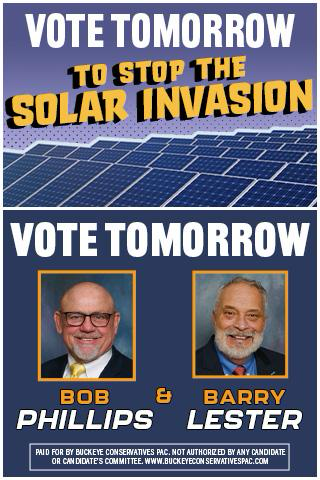 An anti-solar group sent text messages to residents of Knox County, Ohio urging them to “stop the solar invasion.”
To many in the deep-red central Ohio community, it seemed that solar had become the focus of news and politics. They were right. Fossil fuel interests were secretly working to shape the conversation in Knox County.
Floodlight is a nonprofit newsroom that investigates the powers stalling climate action.
Subscribe
Each cog in the anti-solar machine — the opposition group, the texts, the newspaper, the energy publication — was linked to the others through finances and overlapping agendas, an investigation by Floodlight, ProPublica and The Tow Center for Digital Journalism found.
The campaign against solar power benefited from a confluence of two powerful forces funded by oil and gas interests. A former executive at Ariel Corporation, the county’s largest employer and one of the world’s biggest manufacturers of methane gas compressors, was working behind the scenes. And helping in a more public way is the Mount Vernon News, a newspaper now in the hands of Metric Media, which operates websites that reportedly engage in pay-to-play coverage.
Rural Knox County, Ohio, is home to extensive farmland and has deep ties to the gas industry. (Sarahbeth Maney / ProPublica).
Ariel and the former executive did not respond to requests for comment. Metric Media’s leader did not answer questions for this story; he has previously denied that his news outlets are partisan.
Across the country, the oil and gas industry and power companies have exploited a struggling news industry and a fraught political process to fight the transition to clean energy and maximize profits, Floodlight and its partners have reported. In Florida, two power companies paid a consulting firm to hire newspapers to attack a pro-solar politician. In Alabama, the state’s largest monopoly electric company purchased a historic Black newspaper, then didn’t write about soaring power bills. In California, Chevron launched its own newsroom when other papers shuttered; it doesn’t cover itself critically.
In Mount Vernon, a city of 17,000 where the local university named its new sports complex CH4 after the chemical formula for methane, a variety of tactics have been deployed simultaneously, creating an anti-solar echo chamber.
Mount Vernon Nazarene University’s CH4 Stadium was partially funded by Ariel Foundation, the philanthropic arm of Ariel Corporation, one of the world’s biggest manufacturers of methane gas compressors.(Sarahbeth Maney / ProPublica).
Residents are bombarded with dubious claims: Solar panels are toxic. Their construction depletes the soil and floods fields and depresses home values. China is using them to invade. The campaign has stoked their skepticism and ignited their passions. It intensified the debate in a conservative county that prizes its roots in the gas industry.
Bright yellow “No Industrial Solar” yard signs have sprung up everywhere, competing with a smattering of green “Yes Solar” ones. Citizens packed local government meetings. More than 4,000 public comments, both for and against, were filed with the state regulator that will decide if the solar project can be built — triple the number for any previous solar project in Ohio. And all those opinions have drowned out the voices of the nine landowners, mostly farmers, who’ve signed leases with Frasier’s developer and for whom a total of about $60 million is at stake.
“People are so radicalized and they’re not thinking clearly,” said Rich Piar, a third-generation farmer who hopes to secure his financial future by leasing a portion of his 1,650 acres to Open Road Renewables, the Texas-based company developing the Frasier Solar project.
A plaque on the Mount Vernon Nazarene University’s CH4 Stadium explains that, like the chemical bonds in methane, the bond between the university and Ariel is strong. (Sarahbeth Maney / ProPublica).
Politicians who didn’t forcefully denounce the solar project were attacked in Mount Vernon News stories. Thom Collier, a long-serving Republican on the county commission who thinks landowners should be able to choose whether to use their property for solar infrastructure, ultimately lost his reelection bid after a barrage of misleading coverage about his stance on solar.
“I pin this on one or two people from Ariel and some close friends that they have,” Collier said of the anti-solar offensive. “They determined it didn’t matter how much money it would take, they were going to fight this and make it ugly, and they have.”
The Yellowbud Solar project in Pickaway County, Ohio, shown in 2022, became operational last year. It is about 90 miles southwest of Knox County. (Dan Gearino / Inside Climate News)
‘They want everybody to buy gas’
Just 20 days after Knox Smart Development was registered as an LLC in Ohio, the anti-solar group hosted a town hall at a historic Georgian revival theater in Mount Vernon with 1,000 red velvet seats. Attendees were offered free food and alcohol.
The November 2023 event centered on a presentation from Steve Goreham, who argues global warming is natural and who is the author of several books, including “The Mad, Mad, Mad World of Climatism: Mankind and Climate Change Mania.”
The Mount Vernon News’ new owners opened an office in the Woodward Opera House, a historic downtown building that the Ariel Foundation helped renovate. (Sarahbeth Maney / ProPublica)
“When I think of a town hall meeting, I think of a meeting where everybody from the community can go, everybody has their say. That’s not how their meeting was,” said Kathy Gamble, who said organizers only reluctantly agreed to let her in. She’s pro-solar and not quiet about it.
The town hall established Knox Smart Development as a leading voice against the Frasier Solar project. The group calls itself a simple grassroots defender of Knox County.
It isn’t.
The man who registered the group as a business — and who is its sole member and spokesperson — was an Ariel Corporation employee two decades ago and remained an acquaintance of a top executive there, Tom Rastin. The group’s website was owned for a time by a woman working as an executive assistant at Ariel.
And one of Knox Smart Development’s larger funders is Rastin, a Republican megadonor and a retired executive vice president at Ariel, according to records and sworn testimony. Rastin’s father-in-law founded Ariel and, until recently, Rastin and his wife, Karen Buchwald Wright, led the company. Wright is still the chairman, and her son operates it now. Rastin and Wright did not respond to questions for this story.
Ariel Corporation expanded in 2017, adding a training center for employees and customers near its headquarters in Mount Vernon, Ohio. (Sarahbeth Maney / ProPublica).
The group’s founder, Jared Yost, said in an email that Rastin has not tried to steer its activism. “As a local resident, I believe he should be allowed to donate to whatever cause he aligns with, regardless of his former employment, and to state otherwise is to suggest Mr. Rastin should be censored,” Yost wrote in an email. He said the group relies on volunteers and “our intentions are genuine.”
He added: “The oil and gas industry is not involved in our fight.”
Jared Yost, founder of Knox Smart Development, testifies in August during an Ohio Power Siting Board hearing about his group’s opposition to the Frasier Solar project.(Sarahbeth Maney / ProPublica).
The town hall event headliner, Goreham, said he appeared as a favor to Rastin and Wright. In 2019, he had dinner with the couple when Goreham and his wife were passing through town from Illinois on a road trip to their second home in Virginia Beach. Goreham said that he and Rastin connected over their mutual feelings on the benefits of gas. He said he was glad to accept the invitation to speak at the anti-Frasier Solar event.
“First off, it’s in his county there. Mount Vernon is his city where he lives and where they are based,” said Goreham. “They’re pretty much opposed to renewables and they want everybody to buy gas. That’s their business.”
Goreham says he wasn’t paid to speak, but Wright bought 200 copies of his latest book, “Green Breakdown: The Coming Renewable Energy Failure,” which warns about a net-zero-emissions agenda that will cause energy grids to fail. Local officials were given copies of the book that included a personal note from Wright: “Hello! Given the significant misinformation surrounding solar and wind arrays, I bought you this book that really lays out the facts.” She signed the note “Karen Wright, Chairman — Ariel Corporation.”
Shortly after the group was formed, Knox Smart Development’s “No Solar” ads became a fixture on the Mount Vernon News website and in the paper.
‘You believe people’
The Mount Vernon News had been owned by the same family since 1939, and for decades it chronicled local doings from city council meetings to the county fair.
At its height in the early 2000s, before newspapers started hemorrhaging advertising revenue and readers, the News employed about 15 full-time local reporters. An orange Maine coon cat named Scoop roamed the newsroom.
But by 2020, the News was barely hanging on. Its reporters were still using clunky 20-year-old computers. The back wall of the building was falling down and needed $250,000 in repairs. Kay Culbertson, who owned both the paper and the building, said that she knew it was time to sell. Paying for the repairs would be impossible; even making payroll was a stretch.
The former Mount Vernon News building, home to the paper since 1939, sits empty. (Sarahbeth Maney / ProPublica)
An acquaintance of Culberston’s connected her with Metric Media, part of an eight-company network operating more than 1,100 online local news sites. These sites have been described by media researchers and journalists as “pink slime,” named for a filler in processed meat. The final product looks natural, but it’s been tampered with.
A Syracuse University researcher concluded in a journal article published in February that sites like Metric’s “that seem like original news outlets and that appeal to local identity are filling the void” left by the decline of local news. And The Washington Post reported last year that Republican campaigns requested customized news stories that appeared on Metric-owned sites.
Both conservative and liberal pink slime sites exist. But Metric is run by Brian Timpone, an Illinois-based former broadcast reporter who has contributed tens of thousands of dollars to conservative campaigns and causes. Timpone’s ventures have been criticized for using foreign-based writers to produce material. Some also have been accused of plagiarism and fabricating quotes. Timpone has blamed the problems on foreign writers providing content, and he apologized to readers.
Metric Media’s nonprofit arm has received $1.4 million “for general operations” from DonorsTrust, a dark-money group that has received significant funding from Charles and David Koch, who made their billions in oil pipelines and refineries. The eight-company network that Metric is part of also has ties to conservative billionaires, including oil-and-gas-industry titan Tim Dunn, shipping magnate Richard Uihlein and PayPal co-founder Peter Thiel. (Political groups that organize as nonprofits do not have to disclose donors, which is why they’re called “dark money.”)
DonorsTrust CEO and President Lawson R. Bader said in an email that the organization makes about 4,000 grants a year and that it does not dictate how those donations are spent.
Timpone responded to a request for an interview by writing, “We at the Mount Vernon News are now also working on a story — about Pro Publica and Floodlight’s efforts to promote taxpayer-funded ‘solar energy’ businesses in Central Ohio.” He did not respond to detailed questions.
But in interviews, he has said his business keeps local news alive when many outlets are scaling back or shutting down. Timpone told the Deseret News in Utah that his sites have no political leaning and are “data-driven and fact-centric.”
Research and news investigations have found that Timpone’s publications tend to champion conservative causes and politicians; they often are linked to mysterious newspapers distributed during key elections.
Culbertson and assistant publisher Liz Lutwick said in an interview that they knew little about Metric Media before the sale. But the company’s promises sounded good and, Lutwick said, “You believe people.”
“They were going to keep everything the same for a while. Lo and behold, they didn’t,” Culbertson said.
Metric paid at least $1 million for the Mount Vernon News, the first time it had purchased an established news organization printing a local paper. When the new owners visited the paper after the sale, they told the staff they’d stop printing every day and would no longer provide benefits; instead, employees would become contractors. Half the staff quit on the spot.
“It was awful. You feel like you’ve betrayed people,” Culbertson said.
‘We call it the Solar Times’
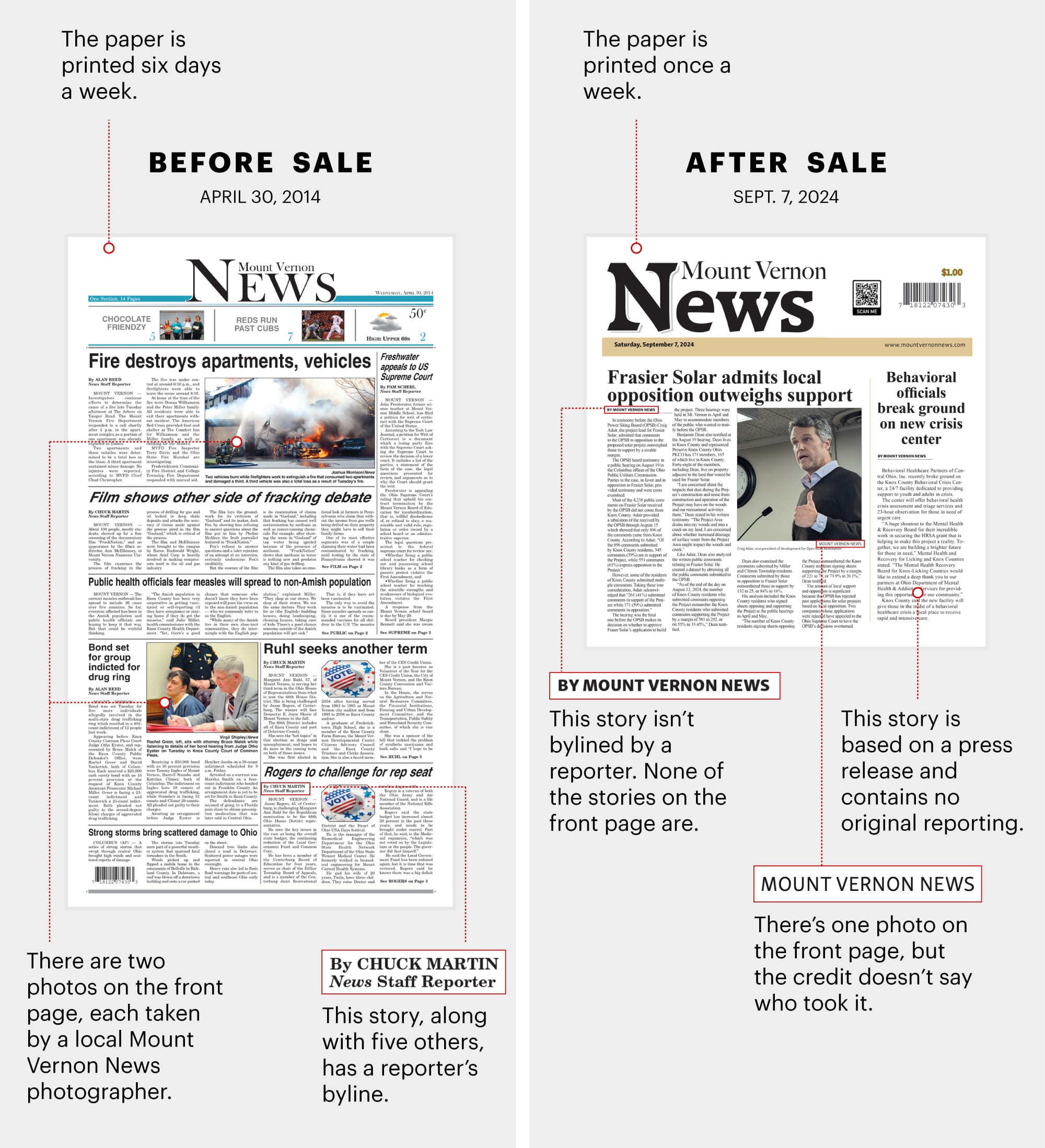
Today, the Mount Vernon News only publishes once a week and has no local reporters or photographers.
“It’s obvious when you read the stories, either they’re AI-generated or they’re written by somebody who’s sitting in an office in Chicago who has never been here,” said Bill Davis, a sports editor who said he worked at the paper from 2010 to 2019.
Since Metric took over, only 11% of stories credited the work to authors working for Metric or its sister companies. Most of what it publishes are press releases or content submitted by companies and community groups, according to an analysis by the Tow Center, ProPublica and Floodlight.
After the sale, residents said they could no longer get timely obituaries — people were buried by the time funeral announcements were published — but they could read a lot about endangered farmland and concerns that the sun’s reflection off solar panels could blind nearby pilots.
Even Mount Vernon’s mayor, who was once a sports reporter at the paper, said he stopped reading it. Tanner Salyers, a former Mount Vernon city council member who now oversees public safety for the city, said quality dropped after the sale. “Then Frasier kicked up and they were like, ‘No more news.’ We call it the Solar Times.”
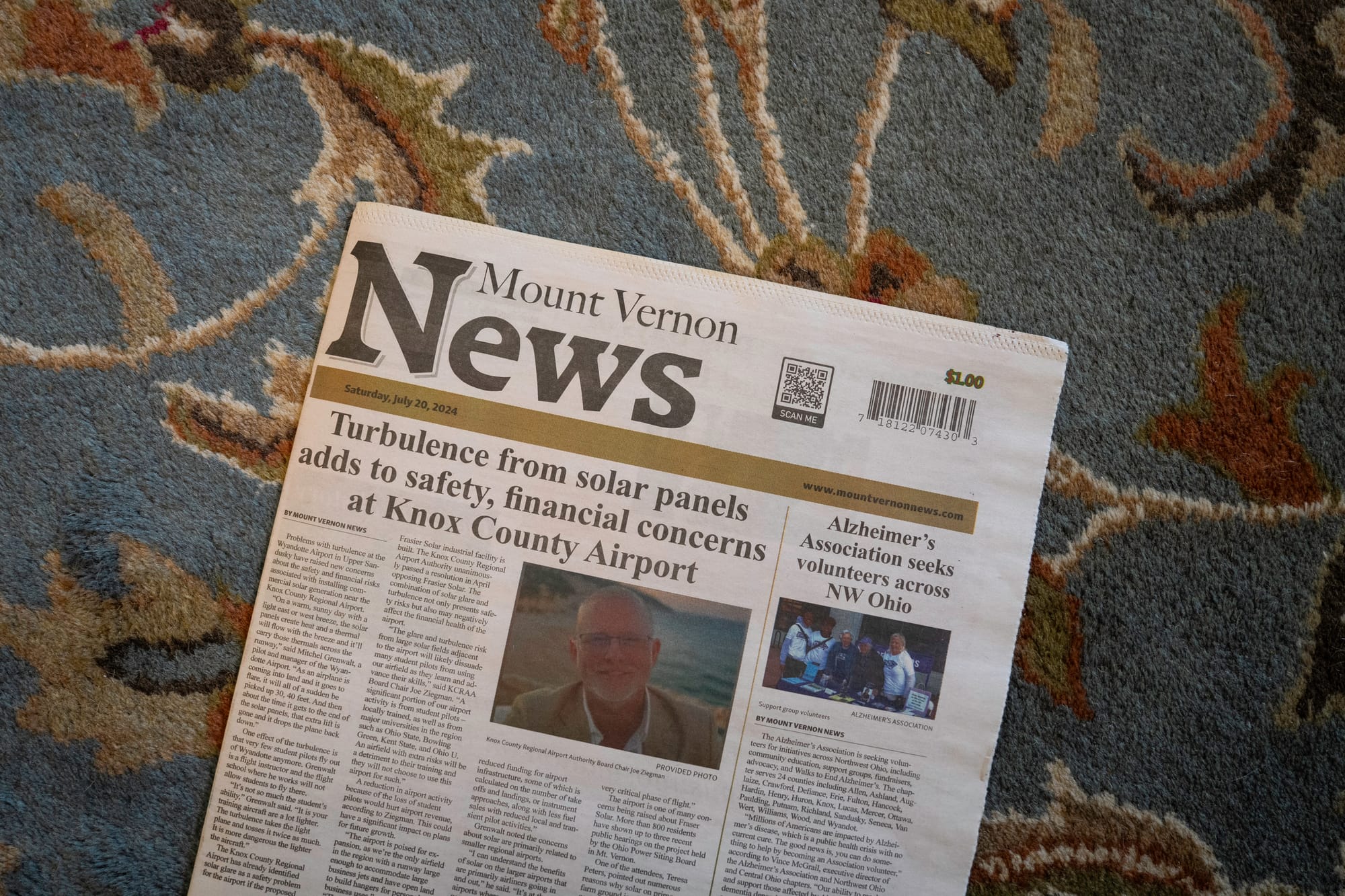 A summer issue of the Mount Vernon News on the floor of the paper’s business office, where one local employee now works. There are no local reporters or photographers. (Sarahbeth Maney / ProPublica).
Over the last 12 months, the paper has published at least 52 online news stories on solar energy — 42 of them about the Frasier proposal, the analysis found. Of the 40 print editions published this year, 17 have featured front-page stories about solar. And though the paper has occasionally run a pro-solar letter to the editor, nearly all of the stories slanted anti-solar, according to an analysis of coverage by Floodlight, ProPublica and the Tow Center.
The paper began publishing a weekly opinion column called “Afternoon TEA” — TEA being an acronym for The Empowerment Alliance, a dark-money gas advocacy group Rastin leads.
The columns extolled the superiority of gas as a fuel source.
It isn’t clear if The Empowerment Alliance paid the Mount Vernon News to run the “Afternoon TEA” columns.
But tax filings show that since 2020 The Empowerment Alliance has spent at least $6.3 million on a “public education campaign,” which included publishing “Afternoon TEA.” The goal was to promote “the importance of natural gas to the economy and national energy independence.”
One of The Empowerment Alliance’s stated goals is “fighting the nonsense of turning corn fields into solar fields.” It has financed online advertisements attacking President Joe Biden’s energy policies and spearheaded an Ohio bill that defined gas as a “green” fuel source.
Half of the Frasier stories published in the Mount Vernon News over the past year have mentioned Knox Smart Development, the anti-solar group linked to Rastin. Articles often quoted people or cited work from a Koch-backed think tank, The Buckeye Institute, but did not interview Frasier or farmers willing to lease land to it.
The Buckeye Institute is part of the State Policy Network, a group of think tanks that has received millions in funding from organizations connected to the Koch family. Rastin’s wife has served as a director on the State Policy Network board, and in 2019 she gave it $700,000, according to a tax record that typically would’ve been redacted but was posted to a government site.
The Mount Vernon News and pro-gas political groups also were working to influence local elections. The text messages that boosted anti-solar candidates were from a conservative Ohio PAC tied to a group that ran a pro-gas campaign.
And, leading up to the primary, a newspaper called the Ohio Energy Reporter was mailed to Knox County homes. The 8-page paper reprinted several Mount Vernon News stories on solar and featured other articles with headlines including “Ohio’s coming ‘solar trash wave’ ” and “Could the Texas Power Crisis happen in Ohio?”
The publication did not disclose its owners. The Floodlight, ProPublica and Tow Center investigation used source code from the website, its IP address and business mailing addresses to confirm that it is a product of the wider Metric Media network.
The stories the Mount Vernon News published began undermining politicians who were seen as insufficiently anti-solar and boosting the profiles of solar power’s outspoken critics.
In one article, the News accused Mount Vernon Mayor Matthew Starr of bowing to “energy activists” and pledging to try to remove natural gas from the city. It was not true. Starr was furious and asked the editors to take down the article, but they would not.
And in nearly a dozen stories that mentioned Collier, the county commissioner who was later ousted, the paper consistently misused a comment he’d given about newly placed solar panels at the county jail to falsely insinuate he supported the Frasier project.
Collier was never interviewed for those stories. Yet the paper ran a story devoted entirely to anti-solar commissioner candidate Drenda Keesee, a megachurch pastor who’d never run for office before; the article said she had “emerged as a vocal opponent of solar projects encroaching on the community.” Keesee, whose property would border a portion of the solar site, was the only source in the story.
She won the primary against Collier and is unopposed in the November general election.
Drenda Keesee, right, is a pastor at Faith Life Church and a candidate for a seat on the Knox County Commission. Keesee, who’s running on an anti-solar platform, attended a Ohio Power Siting Board hearing in Columbus in August. (Sarahbeth Maney / ProPublica)
‘You can’t eat solar panels’
For the community, the debate over solar has been passionate and persistent. What it hasn’t always been is civil. Yard signs have been stolen. Insults hurled. Middle fingers extended. Friendships frayed.
“Other than solar, we don’t have any problems with each other,” said Kathy Gamble, who runs the pro-solar group Knox County For Responsible Solar.
Many people in the community say they don’t view the debate through the lens of climate science or fossil fuels; they care about land rights and preserving rural life. Members of Preserve Knox County, an anti-solar group with several members whose land borders the proposed solar arrays, said they worry the solar project will scare off the sandhill cranes and bald eagles that visit their backyards.
Many members are distrustful of Biden’s renewable energy initiatives; they are staunch supporters of former President Donald Trump, who questions the scientific consensus that the climate is undergoing dangerous changes. They also don’t trust the solar developer’s promises to plant enough trees to block the panels from view. And they don’t want to lose the farmland that gives the area its agricultural identity.
Knox County residents Connie and Jim Boeshart, who live next to property where solar panels would be built if the Frasier Solar project is approved, attend an Ohio Power Siting Board hearing in August. (Sarahbeth Maney / ProPublica)
“You can’t eat solar panels,” said Jim Boeshart, whose home would be adjacent to solar arrays.
Keith Strait, a farmer who lives not far from Boeshart, agreed: “Let’s face it,” he said, pointing at the ground, “They’re not making any more of this. There will be a time when there won’t be any farm left. Where’re you going to get your food from?”
Keith Strait, a farmer in Knox County, said, “I don’t like it,” of the solar proposal. “They’re taking away a lot of farm ground.” (Sarahbeth Maney / ProPublica)
The farmers who want to lease their land feel their voices have been lost in the debate. For them, a 40-year land contract with Frasier Solar would be steady income. One farmer said he could make four times as much money per acre leasing to the solar project as he’d make renting to another farmer.
Rich Piar, the third-generation farmer, is looking to the solar panels as a retirement plan. He said he has no one to take over the operation when he retires, and he doesn’t think anyone should dictate what he does with his land or when he stops farming.
“Most farmers’ exit strategy is their health,” Piar said. “I don’t want to have that kind of predetermined exit strategy.” He went to one of the public meetings about Frasier but said it was so packed he didn’t get to speak until almost midnight.
Rich Piar stands near his cornfield in Knox County, Ohio. He is one of the local farmers who plans to lease his land for the Frasier Solar project. (Sarahbeth Maney / ProPublica)
In August, the Ohio Power Siting Board, which will rule on whether the project can be built, held a final hearing to accept evidence from both sides. One of the attorneys who spoke on behalf of a farmer who is leasing land for the project was from the Sabin Center for Climate Change Law at Columbia University. (The Tow Center also is based at Columbia, but its work is separate.)
Frasier lawyers cross-examined Knox Smart Development spokesperson Jared Yost at the hearing, where he testified that Rastin, the retired Ariel executive, was one of the group’s biggest donors. To Open Road Renewables’ vice president of development, Craig Adair, the confirmation pierced the veil.
Everything changed, Adair said in an interview, “when The Empowerment Alliance decided to use its vast financial resources” to shape the debate in Knox County and in the Mount Vernon News.
Craig Adair, vice president of development at Open Road Renewables, the company developing the Frasier Solar project, testifies at the Ohio Power Siting Board hearing on the project in August. (Sarahbeth Maney / ProPublica),
The News published two stories on the hearing but did not mention the public admission of Knox Smart Development’s ties to Rastin, the Ariel Corporation and The Empowerment Alliance.
The board’s decision is likely to take months.
In the meantime, construction has started at the old Mount Vernon News building, which is being turned into an academic hub for a local university. The building will be named after Rastin’s stepson, a former president of Ariel Corporation.
Floodlight*is a nonprofit newsroom that investigates the powerful interests stalling climate action.
===
Tom Rastin is vice president of marketing and engineering at Ariel Corporation and serves on the board of directors at the Ariel Foundation. He was acknowledged at the privately held Koch seminar in June 2011 in Vail, Colorado for donating at least $1 million to Koch-related causes. ^[1]
References
Gavin Aronsen, Exclusive: The Koch Brothers' Million-Dollar Donor Club, Mother Jones, September 6, 2011
===
ohio small seems benign but
Koch-Funded Oil Rally Calls Global Warming A ‘Hoax,’ Dismisses Oil Spill, And Attacks Democrats
Beginning last week, the oil industry launched a national astroturfing effort called “Rally for Jobs.” The events, which are being held across the nation, are backed by right-wing billionaire brothers Charles and David Koch. They launched a nearly identical campaign last summer that was widely mocked for its obvious astroturfing after it was revealed that 15 of the 21 Energy Citizens events were actually planned by oil industry lobbyists.
ThinkProgress attended one of the rallies yesterday in Canton, Ohio. What was billed as an organic grassroots jobs rally quickly descended into attacks on three things the Kochs most oppose: global warming science, oil safety regulations, and Democrats. One of the speakers, Sgt. Dennis Bartow, called global warming a “hoax.” He was joined by Karen Wright, CEO of the gas company Ariel Corporation, who ridiculed climate change as “questionable science” and referred to pollutants as “so-called carbon dioxide emissions.” Wright went on to rail against “so-called green jobs” that were “dubious” and “phony.”
Other speakers later dismissed attacks on the oil industry’s safety record, particularly in the wake of the Gulf oil spill. Radio host Matt Patrick called the deepwater drilling moratorium “ridiculous” and compared it to a ban on building houses because one caught on fire. Wright “did a quick Google search” on the oil industry’s safety record and openly wondered why Congress doesn’t ban cars because the number of auto accident deaths far exceeds the number of oil industry deaths. Wright also gleefully proclaimed that the oil spill is “all gone,” a claim that is easily dispelled with a quick Google search.
==
https://en.wikipedia.org/wiki/J-W_Energy_Company
frackers
==