NUCLEAR POWER 2
ESTB 6 26
BOOST FROM AI DATACENTERS
LUTNICK FAILSONS
seGUNDO BROS ABUNDANCE 1A6 THIEL
KOCH CHARLES?
PERRY TOBY NEUGEBERGER CRUZ?
- June 2024: Milei traveled to El Salvador to attend Bukele’s second presidential inauguration. [1]
- September 2024: Bukele visited Argentina to meet with Milei at the Casa Rosada, discussing cooperative efforts in nuclear energy, security, and commerce.
-=-=
CRC BS
8 26 RANDOM YT RECOMM
Who Funds That? EP 17: Against Nuclear Energy, Against Humanity
Who Funds That? EP 17: Against Nuclear Energy, Against Humanity
64 views Aug 12, 2026 Who Funds That?
Do environmentalists—and the rest of the progressive left that includes combating climate change as part of its “Omnicause”—care more about saving the planet or replacing market capitalism, private property, and pluralist living arrangements with socialist tower-blocks connected by overcrowded light rail (on which there will be no enforcement of fare payment, naturally)? There’s a tell—opposing nuclear-powered electric generation, which emits no point-source carbon emissions whatsoever. And my colleague Ken Braun, author of Capital Research Center’s comprehensive report on the environmentalist movement’s “Enemies of Energy,” has updated his extensive list of left-wing groups opposed to nuclear energy—the ones that clearly privilege making a New Soviet Man over making the Earth better for people. Links: https://capitalresearch.org/article/o...https://www.influencewatch.org/influe...https://capitalresearch.org/article/t...https://capitalresearch.org/article/n...
opponents: Opposition to Nuclear Energy - Influence Watch
0:09
Hello, I'm Michael Watson and this is
0:10
Capital Research C Center's Who Funds
0:12
That podcast. Do environmentalists and
0:15
the rest of the progressive left that
0:16
includes combating climate change as
0:18
part of its omni cause care more about
0:20
saving the planet or replacing market
0:22
capitalism, private property, and
0:24
pluralist living arrangements with
0:25
socialist tower blocks connected by
0:27
overcrowded light rail on which there
0:29
will be no enforcement of fair payment.
0:30
Naturally, there's a tell opposing
0:33
nuclearpowered electric generation which
0:35
emits no point source carbon emissions
0:37
whatsoever. My colleague Ken Brun,
0:40
author of Capital Research Center's
0:41
comprehensive report on the
0:42
environmentalist movements enemies of
0:44
energy, has updated his extensive list
0:46
of left-wing groups opposed to nuclear
0:47
energy, the ones that clearly privilege
0:49
making a new Soviet man over making the
0:52
Earth better for people. Uh, Ken,
0:54
welcome back.
0:55
I'm glad to be here. That's a heck of an
0:57
introduction. I loved it. [laughter]
1:00
I may have engaged in some mild red
1:02
baiting in that introduction, but it has
1:06
a point, right? I You know, nuclear
1:08
energy is nuclear energy is a pretty
1:10
unfettered good unless you're a
1:13
communist and specifically not a French
1:15
communist because they don't mind the
1:16
fact that their state-run energy company
1:18
has nuclear energy.
1:20
There's actually a good joke on that. Um
1:22
there was a what's the difference
1:24
between why did the French get like 60%
1:28
of their electricity or more from a
1:29
nuclear power and the the Americans
1:31
don't? And uh the answer which is hardly
1:34
a joke says well you have to understand
1:36
two two points. number one that uh in
1:39
France they have you know 700 varieties
1:42
of cheese and only one nuclear reactor
1:46
design. In the United States we have one
1:48
variety of cheese and 700 nuclear
1:50
reactor designs. Each one is built brand
1:52
new as if it's a new work of art. And
1:54
also in France the communists see it as
1:57
a jobs program. So uh they're actually
1:59
in favor of it. [laughter] So having
2:02
established that French communists are
2:04
in favor of nuclear energy, who's
2:06
against it and why?
2:08
Well, in the United States, uh it's what
2:10
you have written as the uh everything
2:13
left leftism omnicause. Um it's there's
2:17
at least $3.5 billion is the new number.
2:20
3 billion5 billion dollars of annual
2:23
revenue if you combine it. This isn't
2:25
just all of the what I call the
2:26
anti-energy groups, the groups that like
2:28
to call themselves climate nonprofits.
2:30
You know, the environmental defense fund
2:32
is at the top of this list, but all the
2:34
way down to, you know, the League of
2:37
Women Voters has an anti- an opposition
2:40
to nuclear energy going back decades. U
2:43
NAACP, you can name them all. So, it's
2:46
not just EDF.
2:47
What's the There's a there's a law of
2:49
politics named after somebody. I want
2:51
want to say it's O Sullivan's that all
...
HATE AM PROSPERITY, ROCKY MTN
series
Who Funds That? EP 17: Against Nuclear Energy, Against Humanity
Capital Research Center
64 views
Opposition to Nuclear Energy - Influence Watch
Some of the largest nonprofits opposing nuclear energy, as measured by the revenue reported in their most recent filings with the IRS (as of January 2025) included the World Wildlife Fund, the World Resources Institute (WRI), the Environmental Defense Fund (EDF), the Sierra Club, the Rocky Mountain Institute, Grid Alternatives, and the League of Conservation Voters (LCV).
Some of the largest known contributors to the anti-nuclear-energy groups have included Bloomberg Philanthropies, ^5 the Foundation for the Carolinas (FFTC) / Fred Stanback, ^6 ^7 ^8 the John D. and Catherine T. MacArthur Foundation, ^9 the Gordon E. and Betty I. Moore Foundation ^10 the Sixteen Thirty Fund (1630 Fund) / Arabella Advisors ^11 and the Tides Foundation. ^12
Nuclear power plants produce no carbon dioxide or other greenhouse gas emissions, and from 1990 until 2021 accounted for 20 percent of American electricity production—the largest source of zero carbon electricity in the United States. ^13 An October 2018 proposal from The Nature Conservancy noted that zero-carbon nuclear plants produced 7.8 percent of total world energy output and recommended reducing carbon emissions by increasing nuclear capacity to 33 percent of total world energy output. ^14 A 2020 analysis from Our World in Data reported that nuclear energy “results in 99.9% fewer deaths than brown coal; 99.8% fewer than coal; 99.7% fewer than oil; and 97.6% fewer than gas,” making it “just as safe” as wind and solar power production. ^15 The U.S. Department of Energy has concluded that “nuclear energy produces more electricity on less land than any other clean-air source” and that it would require “more than 3 million solar panels to produce the same amount of power as a typical commercial reactor or more than 430 wind turbines.” ^16
Background on U.S. Nuclear Energy
Nuclear power plants produce no carbon dioxide or other greenhouse gas emissions, and from 1990 until 2021 accounted for 20 percent of American electricity production—the largest source of zero carbon electricity in the United States. ^13 An October 2018 proposal from The Nature Conservancy noted that zero-carbon nuclear plants produced 7.8 percent of total world energy output and recommended reducing carbon emissions by increasing nuclear capacity to 33 percent of total world energy output. ^14 France obtained 63 percent of its electricity from nuclear fuel in 2022, and an average of more than 75 percent of French electricity came from nuclear during the period from 1989 through 2016. ^17
A March 2021 analysis posted on the U.S. Department of Energy’s web page concluded that “nuclear energy produces more electricity on less land than any other clean-air source.” ^16
“To put that in perspective,” claimed the Department of Energy report, “you would need more than 3 million solar panels to produce the same amount of power as a typical commercial reactor or more than 430 wind turbines (capacity factor not included).” ^16
An April 2021 analysis from Bloomberg News estimated that a “conventional 1-gigawatt reactor operating on 1,000 acres produces the same amount of energy as a wind farm spanning 100,000 acres.” Land use of 1,000 acres is equivalent to 1.56 square miles, while 100,000 acres is equal to 156 square miles, or 18 square miles larger than the land area within the city borders of Detroit, Michigan. ^18 ^19
A 2020 analysis from Our World in Data reported that nuclear energy “results in 99.9% fewer deaths than brown coal; 99.8% fewer than coal; 99.7% fewer than oil; and 97.6% fewer than gas,” making it “just as safe” as wind and solar power production. ^15
Uranium is currently the most widely used fuel in nuclear reactors. According to the U.S. Department of Energy, it “a common metal found in rocks all over the world.” ^20
A 2009 analysis of nuclear fuel supplies posted by Scientific American estimated that the “economically accessible uranium resources” known to the U.S. Nuclear Energy Agency (NEA) at that time would have been enough to run all of the nuclear reactors on Earth for “more than 200 years at current rates of consumption.” The report also predicted that “exploration and improvements in extraction technology are likely to at least double this estimate over time.” ^21
“Two technologies could greatly extend the uranium supply itself,” concluded the Scientific American analysis. “Neither is economical now, but both could be in the future if the price of uranium increases substantially. First, the extraction of uranium from seawater would make available 4.5 billion metric tons of uranium—a 60,000-year supply at present rates. Second, fuel-recycling fast-breeder reactors, which generate more fuel than they consume, would use less than 1 percent of the uranium needed for current LWRs [light water nuclear reactors]. Breeder reactors could match today’s nuclear output for 30,000 years using only the NEA-estimated supplies.” ^21
A 2021 U.S. Department of Energy tutorial on nuclear power production reported that nuclear energy “produces minimal waste” and that all of the spent nuclear fuel “produced by the U.S. nuclear energy industry over the last 60 years could fit on a football field at a depth of less than 10 yards!” The tutorial also noted that nuclear waste “can also be reprocessed and recycled, although the United States does not currently do this” and that “some advanced reactors designs being developed could operate on used fuel.” ^16
Group Petitions Against Nuclear Energy
Nonprofits and other groups opposed to the use of nuclear energy have jointly endorsed open letters and other statements expressing their position.
Letter to House and Senate Democratic Leadership (August 2022)
There were 650 signatories on an August 2022 letter organized by People vs Fossil Fuels that was addressed to the “Democratic Leadership” in Congress. The letter was titled: “Opposition to Fossil Fuel Project Approvals and Permitting Reforms Conditioned on the Inflation Reduction Act.” ^22
The letter portrayed as “false solutions” carbon sequestration, carbon-free nuclear energy and all sources of energy not approved as “renewable” by the signatories: “Relying only on large scale investments in renewable energy and environmental justice alone will not stave off climate disaster if Congress simultaneously puts its legislative foot on the gas to expand fossil fuel production and false solutions like carbon capture, hydrogen, biomass, biofuels, factory farm gas, and nuclear power.” ^22
Signatories included Church World Service, California Environmental Justice Alliance, Oxfam America, CASA, NDN Collective, Center for Climate Integrity, Bend the Arc, the Clean Air Council, and New York Lawyers for Public Interest.
Letter to U.S. Senate Regarding Build Back Better Act (December 2021)
In December 2021, more than 100 groups co-signed an open letter opposing the nuclear power production tax credits offered in HR 5376, the House of Representatives draft of the Build Back Better Act. The groups identified nuclear power as a one of several “unproven and unnecessary technologies” and “harmful energy sources” that “would extend demand for fossil fuels.” ^23
The letter urged the Senate to remove nuclear power from the list of energy sources eligible for the tax credits. The cosigners included the Asian Pacific Environmental Network, Grassroots Global Justice Alliance, the Gulf Coast Center for Law & Policy, Center for Economic Democracy, the New Economy Coalition, UPROSE, GreenFaith, Just Transition Alliance, MADRE, Nevada Nuclear Waste Task Force, Gender And Radiation Impact Project, Oil & Gas Action Network, Women’s Environment and Development Organization, Citizens Awareness Network, the Eco-Justice Collaborative, the Ecological Options Network, Florida Rising, Flint Rising, the Romero Institute, the Native Movement, and the Sane Energy Project. ^24
Opposition to EU defining nuclear as sustainable energy (2021)
A proposal by the European Commission to allow nuclear energy to count as a “sustainable” energy option within its “net zero” goals was opposed by both the World Wildlife Fund and the Carbon Disclosure Project (CDP).
In April 2021 WWF registered its opposition to a final draft of proposed rules regarding what the European Union would consider “green taxonomy” energy investments. The World Wildlife Fund statement declared that “fossil fuels and nuclear power are unsustainable” and that the final rules needed “to make clear that gas and nuclear will not be part of the green taxonomy once and for all.” ^25
In July 2022, CDP issued a news release that opposed a decision by the parliament of the European Union to allow nuclear energy to be counted as acceptable within the EU’s net-zero carbon emissions taxonomy. The CDP news release said the EU decision “risks the integrity of the EU’s sustainable finance action plan, its obligations under the Paris Agreement and will severely hinder Europe’s efforts to adhere to its own European Climate Law, which sets a legally binding target of net-zero greenhouse gas emissions by 2050.” ^26
Letter to President Joseph R. Biden (April 2021)
An April 2021 letter to President Joe Biden from more than 250 nonprofits and other groups asked the administration to promote weather dependent wind and solar power systems and “end the fossil fuel era.” The letter also advised the president to “Phase out nuclear energy as an inherently dirty, dangerous and costly energy source.” Signatories included the Center for Biological Diversity, the California Teachers Association, Polar Bears International, the Center for Environmental Health, Health Care for All, the Resource Renewal Institute, the Bank Information Center and the Alliance for Affordable Energy. ^27
Petition for Renewable Energy Standard (May 2021)
In May of 2021, 715 groups and businesses cosigned on a letter to the leadership of the U.S. House and Senate that referred to nuclear energy as a “dirty” form of energy production and a “significant” source of pollution. The letter asked federal lawmakers to reduce carbon emissions by creating a “renewable electricity standard” that promoted production of weather dependent power sources such as wind turbines and solar panels. ^1
Some examples of the co-signers included representatives from the Center for Biological Diversity, Greenpeace, the Black Lives Matter Global Network Foundation, Oil Change International, the Center for Popular Democracy, the Environmental Working Group, the NAACP, Riverkeeper, Waterkeeper Alliance, 350.org (plus many state and local affiliates such as 350 Philadelphia), Free Press Action and the Blue Ridge Environmental Defense League. ^1
American Nuclear Infrastructure Act of 2020 (November 2020)
More than 100 co-signatories endorsed a November 2020 letter to the U.S. Senate that expressed opposition to S. 4897, the “American Nuclear Infrastructure Act of 2020.” The letter stated that nuclear power “amplifies and expands the dangers of climate change” and denounced it as an example of “false solutions to the climate crisis that perpetuate our reliance on dirty energy industries.” ^2
Some examples of the co-signers included representatives from the Nuclear Information and Resource Service, the League of Conservation Voters, Public Citizen, Beyond Extreme Energy, the Institute for Policy Studies, Physicians for Social Responsibility, Friends of the Earth, Food and Water Watch, and Clean Water Action. ^2
Legislation to Address the Urgent Threat of Climate Change (January 2019)
More than 600 co-signing organizations endorsed a January 2019 open letter to Congress titled “Legislation to Address the Urgent Threat of Climate Change.” The signatories declared their support for new laws to bring about “100 percent decarbonization” of the transportation sector but denounced nuclear power as an example of “dirty energy” that should not be included in any legislation promoting the use of so-called “renewable energy.” ^28
Some examples of the co-signers included representatives from the League of Women Voters, CODEPINK, CREDO, Extinction Rebellion (XR), GRID Alternatives, Hip Hop Caucus, Rainforest Action Network, Sunrise Movement, the Sustainable Economies Law Center, and Surfrider Foundation. ^28
Largest Anti-Nuclear Nonprofits
A July 2025 analysis from the Capital Research Center examined more than 300 nonprofits that opposed nuclear energy and conservatively estimated that the total combined annual revenue of the American opponents of nuclear power exceeded $3.3 billion. ^4
As of July 2025, the most recent reported annual revenue of 21 nonprofits known to oppose nuclear energy exceeded $30 million.
World Wildlife Fund ($374.8 million) ^29
World Resources Institute ($357.8 million) ^30
Church World Service ($283.8 million) ^31
Environmental Defense Fund ($247 million) ^32
California Teachers Association ($220.7 million) ^33
Sierra Club ($173.4 million) ^34
Rocky Mountain Institute ($164.7 million) ^35
Oxfam America ($83.1 million) ^36
League of Conservation Voters ($67.5 million) ^37
GRID Alternatives ($63.3 million) ^38
Southern Environmental Law Center ($62.8 million) ^39
American Friends Service Committee ($48.2 million) ^40
National Association for the Advancement of Colored People ($43.6 million) ^41
Greenpeace ($40.2 million) ^42
Carbon Disclosure Project – CDP ($38.4 million) ^43
National Parks Conservation Association ($35.1 million) ^44
Center for Biological Diversity ($34.5 million) ^45
Taproot Earth ($32.8 million) ^46
Movement Strategy Center ($32.3 million) ^47
Earth Island Institute ($30.9 million) ^48
Major Donors to Nuclear Energy Opponents
Large left-leaning donor foundations have been some of the major supporters of groups that oppose the use of nuclear energy.
Bloomberg Philanthropies
From 2020 through 2023, Bloomberg Philanthropies (also known as the Bloomberg Family Foundation) gave at least $80 million in grants to nonprofit groups that have opposed the use of nuclear energy. Recipients during the period included the Sierra Club Foundation, the NRDC, the Rocky Mountain Institute, the World Resources Institute, the World Wildlife Fund, the Hip Hop Caucus, 350.org, the Environmental Integrity Project and Earthworks. The tabulation was made using FoundationSearch records as posted through August 2023. (Foundation Search is a database that compiles philanthropic giving from the IRS 990 forms submitted by 501c3 and 501c4 donor nonprofits). ^5
Bloomberg Philanthropies is a giving vehicle for left-leaning billionaire Michael Bloomberg, the former mayor New York City and a former candidate for the 2020 Democratic presidential nomination.
Fred Stanback (Foundation for the Carolinas)
From 2020 through 2023, the Foundation for the Carolinas (FFTC) gave at least $80 million in grants to nonprofit groups that have opposed the use of nuclear energy. The tabulation was made using FoundationSearch records as posted through August 2023. (Foundation Search is a database that compiles philanthropic giving from the IRS 990 forms submitted by 501c3 and 501c4 donor nonprofits). ^6
FFTC is a donor-advised fund that manages funds for 2,700 separate charitable individuals, families and organizations. ^49 One of FFTC’s largest known account holders has been North Carolina billionaire Fred Stanback. ^8 Stanback was characterized in an April 2018 Knoxville News report as a “known proponent of anti-humanist environmentalism [. . .] the belief that protecting the environment hinges on population control.” ^50 Thirty-nine percent of FFTC’s donations from 1999-2017 ($825 million) were given to organizations favoring the Stanback policy agenda: left-leaning environmentalism, abortion, population control, or immigration restrictionism. ^51
Stanback’s total commitment to his FFTC account through all years is not known, but the Los Angeles Times reported a single $397 million donation from Stanback to FFTC that took place in 2014. ^8 A September 2020 report from the Washington Free Beacon revealed that just one of the anti-nuclear nonprofits, the Southern Environmental Law Center, had received more than $200 million from Stanback, through FFTC, during the preceding two decades. ^52 Stanback has regularly been thanked for six and seven-figure annual donations in annual reports and other public documents put out by the Sierra Club Foundation, the National Parks Conservation Association, the Rocky Mountain Institute (RMI), the Environmental Defense Fund, the Environmental Working Group, the Center for Biological Diversity, and the Waterkeeper Alliance. ^53 Annual reports from some of these groups, such as RMI, have also credited Stanback’s son and daughter-in-law with comparable-sized donations. ^7
During the 2020-2023 period, FFTC donations to left leaning groups that opposed nuclear energy exceeded $80 million and included the Southern Environmental Law Center, the Rocky Mountain Institute, the NRDC, the League of Conservation Voters Education Fund, the Environmental Working Group, the Southern Alliance for Clean Energy, North Carolina Waste Awareness and Reduction Network (NC-WARN), the Dogwood Alliance, the Waterkeeper Alliance, the Sierra Club Foundation, the Center for Biological Diversity, the Rachel Carson Council, the Environmental Defense Fund, Greenpeace, the Rainforest Action Network, and the Blue Ridge Environmental Defense League. ^6
MacArthur Foundation
From 2020 through 2023, the John D. and Catherine T. MacArthur Foundation (MacArthur Foundation) gave at least $60 million in grants to nonprofit groups that have opposed the use of nuclear energy. Recipients included the Environmental Defense Fund, the Sierra Club Foundation, the League of Conservation Voters Education Fund, the World Resources Institute, Earthworks, the Rocky Mountain Institute, the Carbon Disclosure Project (CDP North America), the NRDC, the U.S. Climate Action Network (US-CAN), and Voices for a Sustainable Future (a project of the Labor Network for Sustainability). The tabulation was made using FoundationSearch records as posted through August 2023. (Foundation Search is a database that compiles philanthropic giving from the IRS 990 forms submitted by 501c3 and 501c4 donor nonprofits). ^9
Gordon and Betty Moore Foundation
From 2020 through 2023, the Gordon E. and Betty I. Moore Foundation gave at least $45 million in grants to nonprofit groups that have opposed the use of nuclear energy. Recipients included the World Wildlife Fund, the World Resources Institute, the NRDC, Friends of the Earth, and the Environmental Defense Fund. The tabulation was made using FoundationSearch records as posted through August 2023. (Foundation Search is a database that compiles philanthropic giving from the IRS 990 forms submitted by 501c3 and 501c4 donor nonprofits). ^10
Gordon Moore is the founder of Intel.
Sixteen Thirty Fund (1630 Fund)
From 2020 through 2023 the Sixteen Thirty Fund (1630 Fund) gave at least $29 million in grants to groups that have opposed the use of nuclear energy. Recipients included the League of Conservation Voters, the Environmental Defense Action Fund, the NRDC Action Fund, the Center for Popular Democracy Action Fund, the League of Women Voters, the Sunrise PAC (a political committee aligned with the Sunrise Movement), People’s Action, and the People’s Action Institute. The tabulation was made using FoundationSearch records as posted through August 2023. (Foundation Search is a database that compiles philanthropic giving from the IRS 990 forms submitted by 501c3 and 501c4 donor nonprofits). ^11
Sixteen Thirty is part of a group of left-of-center lobbying and advocacy organizations administered by Arabella Advisors. In 2020, Arabella’s nonprofit network boasted total revenues exceeding $1.67 billion and total expenditures of $1.26 billion, and paid out $896 million in grants largely to other left-leaning and politically active nonprofits. ^54 Identifying specific contributions to specific donors within the Arabella network is challenging. According to FoundationSearch records, Sixteen Thirty received at least $141.7 million in support from public foundations during the 2020-2023 period, of which $113.5 million came from the New Venture Fund—another nonprofit run through Arabella. ^55 FoundationSearch records show that New Venture received more than $1.4 billion in support from public foundations during the period, with at least $333 million of that coming from donor advised funds that do not generally publicly identify the names of contributors. ^56 A November 2021 profile in The Atlantic identified Arabella as a “massive progressive dark-money group you’ve never heard of” and Sixteen Thirty as “the indisputable heavyweight of Democratic dark money” which funneled “roughly $61 million of effectively untraceable money to progressive causes,” making it the “second-largest super-PAC donor in 2020.” ^57 Similarly, a May 2021 New York Times analysis identified Sixteen Thirty as one of the “leading dark money spenders on the Left.” ^58
Tides Foundation
From 2020 through 2023 the Tides Foundation gave at least $27 million in grants to groups that have opposed the use of nuclear energy. Recipients included the NRDC, the World Wildlife Fund, the Sierra Club Foundation, the NAACP, Public Citizen, Public Citizen Foundation, Amazon Watch, People’s Action, the People’s Action Institute, the Center for Popular Democracy, the NRDC Action Fund, Green America, Dream Corps, the Rocky Mountain Institute, the Movement Strategy Center, and the Sunrise Movement Education Fund. The tabulation was made using FoundationSearch records as posted through August 2023. (Foundation Search is a database that compiles philanthropic giving from the IRS 990 forms submitted by 501c3 and 501c4 donor nonprofits). ^12
The Tides Foundation is a center-left grantmaker and a pass-through funder to left-leaning nonprofits. FoundationSearch records show that the Tides Foundation received more than $351.5 million in support from public foundations during the 2020-2023 period, with $40 million coming from the Tides Center (another nonprofit aligned with the Tides Foundation), and an additional $133 million from four donor advised funds that do not generally publicly identify the names of contributors. ^59
Alphabetical List of Anti-Nuclear Groups
...
-=-=
-=-=
RELATED? 8 26 GUK
What is the US-Saudi Arabia nuclear deal and why is it causing concern?
The US and Saudi Arabia have agreed a landmark deal that would use American technology and expertise to establish a civilian nuclear program in the Gulf country, a move that has caused alarm across the Middle East and through the corridors of power in Washington.
Much of the deal remains unclear, but concerns centre on whether Saudi Arabia would have the capability to enrich uranium domestically, and what that means for nuclear proliferation.
What is the nuclear deal that’s agreed?
The 30-year deal is designed to meet the “energy needs” of oil-rich Saudi Arabia, according to a statement from US energy secretary Chris Wright.
Under Crown Prince Mohammed bin Salman’s economic plan, Saudi Arabia aims to use nuclear power for some electricity generation, thereby boosting oil sales by freeing up more supplies for export. The deal would make American companies central in the development of the country’s nuclear infrastructure, while denying competitors like China and Russia a foothold in the country.
The deal is thought to be worth tens of billions of dollars, and is the continuation of a plan first conceived during the Biden administration. That deal would have seen the US agree to nuclear cooperation in exchange for Saudi Arabia establishing formal ties with Israel.
The prospect of normalisation between Israel and Riyadh has been derailed by the 7 October attack by Hamas, and the resulting years-long war in Gaza. The Trump administration has chosen to push the deal through without the wider agreement with Israel.
Will Saudi Arabia be able to enrich uranium on its soil?
The deal reportedly paves the way for the building of a uranium enrichment facility in Saudi Arabia, but this would be contingent on a joint US-Saudi study determining such a facility is necessary.
The study would run for two years, potentially leaving Donald Trump’s successor in the White House with the decision on whether to sign off on allowing domestic enrichment in Saudi Arabia.
Many countries with nuclear energy industries do not enrich uranium domestically – a process which could theoretically produce highly enriched uranium for a nuclear weapon. They instead rely on importing the fuel for reactors.
Part of the US justification for going through with the deal, is that Washington would have oversight of any enriched uranium and spent fuel from reactors, ensuring they could not be reused to make a bomb.
Why is it controversial?
Nuclear nonproliferation groups have warned for years that such a deal could set Saudi Arabia on the path to develop a nuclear weapon. Riyadh has in the past said it would need a nuclear weapon if its regional rival, Iran, acquired one.
The US is engaged in a war with Iran that is in part being fought to prevent Tehran from acquiring a nuclear bomb or enriching uranium to weapons-grade level.
US secretary of state Marco Rubio has dismissed concerns about the Saudi deal, saying the US is “not going to reach any agreement with any country in the world that leads to the risk of proliferation”.
The Trump administration’s nuclear cooperation agreement was signed alongside a separate “bilateral safeguards agreement” which it said would provide for adequate monitoring.
But experts have expressed alarm that Wednesday’s deal lacks the oversight and guardrails of previous nuclear agreements. Saudi Arabia will reportedly not be subject to the most rigorous monitoring from the UN nuclear watchdog, the International Atomic Energy Agency (IAEA).
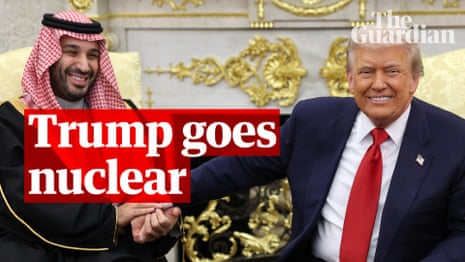
24:00
Trump gifts Saudi Arabia a nuclear win | Politics Weekly America
The IAEA’s “Additional Protocol” has been implemented by dozens of countries, and was one of the requirements of the Obama-era nuclear deal with Iran from which Trump withdrew in 2018. It involves inspection and verification to ensure that countries are using nuclear material solely for peaceful purposes.
When the US struck a similar deal with the United Arab Emirates, the UAE agreed not to seek enrichment or process spent atomic fuel, a measure that became known as the “gold standard” for nations wanting atomic power. The Saudi-US agreement reportedly does not include this gold standard.
Can this deal be blocked?
Opponents have long argued that providing Saudi Arabia with a domestic nuclear program will set off a race across the Middle East for other countries to pursue similar capabilities. Israel – which is known to have a secretive nuclear weapons program – has reportedly raised concerns that the deal could launch a regional arms race.
Democrats in Congress have expressed similar concerns. Senator Chris Murphy said the agreement would “set off a nuclear race in the region, further disincentivizing Iran from limiting its own program”.
However, Murphy and his colleagues in Congress will probably have difficulty blocking the deal. The deal is expected to be submitted to Congress for approval in the coming days, but to block the agreement, Congress would need to pass a joint resolution and have a two-thirds majority to override the president’s veto.
-=-=
---
[### Family Affair: Commerce Secretary's Sons Cash In on A.I. ...

The New York Times
https://www.nytimes.com › U.S. › Politics](https://www.nytimes.com/2025/11/20/us/politics/howard-lutnick-family-ai.html)
Nov 20, 2025 — Neugebauer turned to Kyle and Brandon Lutnick to help Fermi raise $107.6 million as an early step in plans to build the President Donald J.Read more
Family Affair: Commerce Secretary’s Sons Cash In on A.I. Frenzy
Howard Lutnick is helping push data center projects. His family companies are profiting from them.
A mammoth data center is rising in Amarillo, Texas. Firms controlled by the Lutnick family have helped finance it, banking millions in fees in the process.Credit...Paul Ratje for The New York Times
By Eric LiptonMichael RothfeldDavid Yaffe-Bellany and Ana Swanson
Eric Lipton reported from Miami; Michael Rothfeld from New York; David Yaffe-Bellany from Lugano, Switzerland; and Ana Swanson from Washington.
Nov. 20, 2025
Kyle Lutnick, the 29-year-old scion of his family’s real estate business, traveled in July to Amarillo, Texas, to walk a dusty tract of land with the head of an artificial intelligence start-up called Fermi America.
He was touring the site of a future data center with Toby Neugebauer, a billionaire who is building one of the behemoth facilities that will power the next generation of A.I. Mr. Lutnick’s company was helping raise capital for the center, banking millions in fees in the process.
“Polite young man,” Mr. Neugebauer said in an interview.
A month later, Kyle’s father, Howard Lutnick, was photographed with Mr. Neugebauer at an event near the White House that celebrated Fermi’s partnership with a South Korean company on the same data center project.
This sequence of events — a son making money on a project his father is boosting as a federal official — has come up repeatedly since President Trump tapped Howard Lutnick to head the Commerce Department, according to an investigation by The New York Times.
In that role, Mr. Lutnick has twisted the arms of American allies, dangling policy favors in exchange for investments in U.S. industrial projects. At times, these tactics have created opportunities for his family’s clients to gain access to much-needed foreign capital, The Times found.
Mr. Lutnick, for example, demanded that the South Korean government invest billions of dollars in U.S. industry to reduce tariffs. Mr. Neugebauer is vying for a share of those investment dollars to build the data center that Mr. Lutnick’s family is also helping to finance.
The job of commerce secretary has always been to promote American industry through deal-making at home and abroad, and the position has traditionally been populated with titans of industry who were expected to bring a business sensibility to meetings filled with career government workers.
But never in modern U.S. history has the office intersected so broadly and deeply with the financial interests of the commerce secretary’s own family, according to interviews with ethics lawyers and historians.
Since February, Kyle Lutnick and his younger brother Brandon, 27, have helped run a network of companies under the corporate umbrella of Cantor Fitzgerald L.P. The companies, led by their father until this year, include the Wall Street investment firm Cantor, the securities brokerage BGC Group and the real estate company Newmark Group.
Brandon is the chairman of Cantor Fitzgerald L.P., and Kyle is the executive vice chairman. The sons and their two younger siblings have a controlling ownership stake in all three companies in the network.
The family’s companies operate in a wide range of industries, from cryptocurrencies to data centers, that overlap with Mr. Lutnick’s work in government, raising concerns even among high-level staff members in the Commerce Department, according to five current and former officials and others familiar with the matter.
It is a blurring of lines that has become a defining characteristic of Mr. Trump’s second term, where top officials and their family members have retained major stakes in industries the government oversees. For months, the president’s two older sons and the sons of his Middle East adviser, Steve Witkoff, have traveled the world pursuing deals that have generated hundreds of millions in profits, at least on paper.
As for Mr. Lutnick, The Times did not find evidence that he had intervened in policy discussions with the intention of driving business to his family. But as he promoted data center construction, business has boomed at the Lutnick companies.
Newmark recently announced that it had completed more than $25 billion of data center deals in the past 12 months, taking a small cut in fees on each transaction. “We are having our best year ever,” Brandon Lutnick said in October at a conference in Switzerland.
Image
Brandon Lutnick speaking at a crypto conference in Lugano, Switzerland, last month. The family’s companies operate in a wide range of industries that overlap with Howard Lutnick’s work in government.Credit...Maurizio Fiorino for The New York Times
The White House and the Commerce Department said in statements that Mr. Lutnick had fulfilled his ethics requirements and took them seriously.
“The fact of the matter is that the only special interest guiding Secretary Lutnick and the rest of the Trump administration’s decision-making is the best interest of the American people,” said Kush Desai, a White House spokesman.
Representatives for Cantor and Newmark said the firms had business expertise and relationships that long predated Mr. Lutnick’s role in the administration.
Newmark’s chief executive, Barry Gosin, said in a statement that the company was the industry leader in raising capital and leasing for data centers.
“Newmark’s data center advisory work is independent of governmental and other private activities,” Mr. Gosin said. “Our success in this sector reflects the optimal outcomes we deliver for our clients.”
‘Enough Money’
Howard Lutnick first drew international attention in 2001, when 658 employees of Cantor, including his younger brother, were killed in the attacks on the World Trade Center. Mr. Lutnick was not at work that morning because he was dropping off Kyle for the first day of kindergarten.
Over the next two decades, he rebuilt the business in the wake of the tragedy. It now has more than 13,000 employees, and has expanded into new areas of the finance world, after acquiring Newmark in 2011.
At times, Mr. Lutnick has pushed boundaries and found his companies in the cross hairs of law enforcement. Cantor and affiliates agreed to pay more than $50 million over the last decade to settle at least eight separate investigations of illegal gambling and money laundering, incomplete, false or misleading statements in financial filings, and other issues, enforcement records show. In some cases, the firms settled without admitting or denying wrongdoing.
When Mr. Trump nominated him to lead the Commerce Department, Mr. Lutnick noted that at the age of 63, he wanted to serve the nation. “I’ve made enough money in my life,” he said at his confirmation hearing.
Mr. Lutnick has said he eliminated any ethics issues by turning over his ownership stake of the companies to his children, a process he announced in May, with an agreement that excluded him from any profits or losses after that date.
He has also claimed that he does not speak to his sons about their work. “I would love to talk to them about it, but I’m not allowed,” Mr. Lutnick said on a podcast in March.
The actual transfer of his ownership stake was not completed until early October, meaning he continued to have a financial interest in parts of the family’s business while he was commerce secretary, with his name on filings in full view of any client.
Until his divestment was completed, the Trump administration granted Mr. Lutnick an ethics waiver. That permitted him to participate in certain policy matters that might benefit the firms, while prohibiting him from working on specific deals in which they were involved.
Three ethics lawyers interviewed by The Times said it was not clear whether Mr. Lutnick had violated federal ethics rules or the terms of his waiver. But they said the Lutnick family’s connections to the same deals in both government and private spheres — like its involvement on different sides of Fermi’s data center project — raised questions about whether Mr. Lutnick was doing enough to distance himself from possible ethical conflicts.
“If there is a cloud of distrust over whether the action of that official is aimed at the public interest versus their family’s own interest, that’s a problem,” Kedric Payne, general counsel at the nonpartisan Campaign Legal Center, an ethics group, said after reviewing documents at the request of The Times. “You’re going to create a risk that the public will just start to really lose trust in the government.”
Pressuring the Emiratis
Artificial intelligence has become a vital engine of the U.S. economy in recent years, drawing hundreds of billions of dollars in investment from around the world. Much of that money has flowed into data centers — sprawling facilities that sit on vast swaths of land and run industrial-grade computers that power A.I.
So it is no surprise that major commercial real estate brokers like Newmark were attracted to the sector.
In 2023, when Mr. Lutnick was the company’s chairman, Newmark expanded its team of investment bankers specializing in data centers. The company helps select land for these colossal projects, find power supplies and line up billions of dollars worth of loans and other financing.
The data center boom is “a modern-day gold rush,” Chad Lavender, a top Newmark executive, said in a podcast interview in September, shortly before the company reported record earnings for the quarter. “We’re seeing a ton of activity.”
Now Mr. Lutnick is helping foster that activity from Washington. The Commerce Department is seeking to accelerate data center construction with tax breaks, grants and permits to build new power sources to fuel the facilities.
Mr. Lutnick has also repeatedly pressed foreign nations to send chunks of their own money to help build data center projects in the United States, at the same time that his family’s company serves as one of the data center industry’s leading deal makers, earning tens of millions in fees.
Image
Mr. Lutnick at an announcement of new tariffs in April. A blurring of lines has become a defining characteristic of President Trump’s second term, where top officials and their family members have retained major stakes in industries the government oversees.Credit...Haiyun Jiang for The New York Times
Among the nations that Mr. Lutnick has pressured is the United Arab Emirates.
This spring, the Emiratis approached the Trump White House, requesting access to advanced U.S.-made computer chips, which are crucial to the Emirates’ ambitions of dominating the A.I. industry.
It was a controversial ask.
During the Biden administration, the United States had established strict controls to limit access to the chips, fearing that the Emiratis might share them with China and allow the Chinese to create sophisticated weapons that could be turned on U.S. soldiers. Even some within Mr. Trump’s administration were reluctant to give the Emirates unfettered access to the most advanced chips.
Mr. Lutnick was open to exporting chips, with the right safeguards in place. But his position gave him the power to say “no” and the Emiratis knew it. That is because the Commerce Department oversees the nation’s export licenses.
So he made clear that he wanted the Emiratis to commit billions of dollars to the construction of data centers in the United States in return for the chips, according to administration officials involved in the process.
“You will invest in America and build data centers in America for an equal amount of chips,” Mr. Lutnick said, describing the terms of the deal with the Emiratis during Senate testimony in June.
Eventually the chips deal was approved. Newmark’s clients are one of the possible beneficiaries.
Early this year, the Emirates agreed to commit money to help build the U.S. portion of a global network of data centers. The flagship site of this network, named after the 1994 sci-fi movie “Stargate,” is rising in Abilene, Texas.
Newmark has helped finance construction of the Abilene facility, soon to become one of the largest data centers in the country. The firm brokered more than $9.4 billion in loans this year for a partnership working on the project.
The Emirati money ultimately might not be used on the Abilene data center, executives involved in the effort said. But it is already helping finance other Stargate sites.
Deals have also been struck with Saudi Arabia to invest at least $20 billion in energy and data center projects in the United States, helping bring yet more business to the real estate brokers who structure financing for these projects, though there is no indication whether it will benefit Newmark specifically.
A Commerce Department spokesman said Mr. Lutnick did not pressure Middle East partners to fund specific projects, just to spend money on data centers somewhere in the United States.
A similar instance of overlaps played out again in July.
That month, Mr. Lutnick joined Mr. Trump in Pittsburgh, boasting about the billions of dollars that private companies are spending on a slate of data centers, including a giant project in Lancaster, Pa.
“The A.I. revolution will change the way the world works, and we cannot lose,” Mr. Lutnick said at the event. “The Trump administration will not let us lose.”
What he did not mention was that Newmark was involved in the Lancaster project. A few weeks after Mr. Lutnick’s appearance in Pennsylvania, the company announced it had brokered a $4 billion joint venture to build a “state-of-the-art A.I. data center campus” there.
A Commerce Department spokesman said Mr. Lutnick had no role in any of the individual deals that he promoted in Pennsylvania, and attended the event simply to support the industry.
Pressuring the Koreans
Toby Neugebauer, who is building the Fermi data center that will power the next generation of artificial intelligence, said he chose Newmark because of the expertise of its staff, not its connection to the commerce secretary.Credit...Paul Ratje for The New York Times
The intersection of Mr. Lutnick’s work as commerce secretary and his sons’ as data center deal makers is most apparent in the Fermi America project in Amarillo.
Fermi was co-founded in January by Rick Perry, the former Texas governor who was Mr. Trump’s first-term energy secretary, and Mr. Neugebauer, a major Republican donor who has supported Mr. Trump. The company has not yet generated any revenue.
This year, Mr. Neugebauer turned to Kyle and Brandon Lutnick to help Fermi raise $107.6 million as an early step in plans to build the President Donald J. Trump Advanced Energy and Intelligence Campus, which would be powered in part by nuclear energy.
Mr. Neugebauer said he chose Newmark because of the expertise of its staff, not its connection to the commerce secretary. He said he knew that seeking favors would most likely backfire.
“Was never going to help me,” he said. “Makes it harder.”
In July, Mr. Neugebauer gave a tour of the Texas construction site to Kyle Lutnick, a Stanford graduate who has worked as a D.J. under the stage name Kxtz. Mr. Neugebauer said that he gave Kyle and other visitors Fermi-branded cowboy hats, and that Kyle later texted a picture of himself with the hat.
Soon Mr. Neugebauer was also engaging with Kyle’s father. Shortly after the Texas tour, Mr. Lutnick announced that South Korea had agreed to a trade deal that would funnel $350 billion into the United States.
Mr. Neugebauer coveted a piece of those investments.
His plan was to get the South Korean government, with the support of the Trump administration, to help finance a nuclear power plant to fuel his Amarillo data center. Components for the plant would be supplied by Doosan Enerbility, a South Korean industrial giant.
In August, Mr. Lutnick appeared alongside Mr. Neugebauer during a U.S.-Korean business summit at the historic Willard InterContinental hotel, where Fermi and Doosan announced plans to collaborate.
Mr. Neugebauer and his Doosan counterpart posed for a photo holding their memorandum of understanding, flanked by Mr. Lutnick and a Korean government official.
“You’re going to see a national and economic security fund built with the Japanese money, the Korean money and other countries’ money,” Mr. Lutnick said on CNBC the day after the event.
Image
A photo distributed in a news release by Fermi America showing Mr. Lutnick with Kim Jung-kwan, South Korea’s trade minister; Jongdoo Kim, the president of Doosan Enerbility Nuclear Power Plant BG; and Mr. Neugebauer.
Days after the Doosan announcement, Fermi unveiled its financing deal for the Amarillo project, with both Newmark and Cantor listed as advisers. The companies were paid $6 million for this work, according to a financial filing.
In a bigger coup for the Lutnick companies, Cantor jointly managed an initial public offering of Fermi’s stock in early October that valued the company at more than $12.5 billion. Millions of dollars in additional fees flowed to Cantor.
“Honored to co-lead the I.P.O. for such an innovative and inspiring company Fermi America,” Kyle Lutnick posted on social media at the closing of that deal.
Ben Kass, a Commerce Department spokesman, said no decision had been made on where to allocate the funds South Korea had agreed to spend in the United States. So far, he said, the department is planning to use part of the money to promote U.S. shipbuilding, rather than nuclear power.
Still, Mr. Kass added, the final terms of the trade deal remain under negotiation.
Image
Rick Perry, the former Texas governor who was Mr. Trump’s first-term energy secretary, co-founded Fermi with Mr. Neugebauer.Credit...Paul Ratje for The New York Times
At a recent meeting in Washington, Mr. Neugebauer pressed Deputy Commerce Secretary Paul Dabbar to direct money from the Korean trade deal toward Fermi’s nuclear plant.
Mr. Neugebauer has an important ally in Senator Ted Cruz, Republican of Texas and the chairman of the Senate Commerce Committee. Fermi is also seeking low-interest financing from the Energy Department, which is offering billions of dollars in nuclear-energy loans.
“Toby has been a close friend of mine for 20 years,” Mr. Cruz said last week, at a Cantor-sponsored conference at the Ritz-Carlton in Miami Beach, after he wrapped Mr. Neugebauer in a bear hug by the pool. “It is a powerful proposal to bring billions of investments to Texas and create a whole lot of jobs.”
Mr. Neugebauer remains optimistic that the Commerce Department will help him get the Korean funding.
“Do I think it probably gets done?” Mr. Neugebauer said. “Yes.”
He added, “We got no special treatment.”
Image
The site where a natural gas facility is being built to help power the Fermi data center. Artificial intelligence has become a vital engine of the U.S. economy in recent years, drawing hundreds of billions of dollars in investment from around the world.Credit...Paul Ratje for The New York Times
Cade Metz contributed reporting. Susan C. Beachy, Kitty Bennett and Laine Cibulskis contributed research.
Eric Lipton is a Times investigative reporter, who digs into a broad range of topics from Pentagon spending to toxic chemicals.
Michael Rothfeld is an investigative reporter in New York, writing in-depth stories focused on the city’s government, business and personalities.
David Yaffe-Bellany writes about the crypto industry from New York. He can be reached at davidyb@nytimes.com.
Ana Swanson covers trade and international economics for The Times and is based in Washington. She has been a journalist for more than a decade.
A version of this article appears in print on , Section A, Page 1 of the New York edition with the headline: Sons of Commerce Chief Cash In as He Pushes A.I.. Order Reprints
---