Emergent Ventures
see tyler cowan
-=-=
GIL BK
PRAXIS dryden BROWN COWAN EMERG V; sri
pronomos cap pt; altman, sbf, a16 winkel lonsdale, coinbase
GAZA
MARK LUTTER GMU VENEZ EMERG V
...
-=-=
-=-=
---
ggl 6 26
Thiel Foundation: The initiative originally launched in 2018 with a $1 million grant from tech entrepreneur Peter Thiel, and the Thiel Foundation has continued to support the program's expansion. [1, 2]
AI Overview


+8
Emergent Ventures is a low-overhead fellowship and grant program launched in 2018 and housed at George Mason University (GMU). Administered by renowned economist Tyler Cowen, it supports "zero to one" societal improvements and entrepreneurial ideas. Backed by foundations like the Charles Koch Foundation, it distributes millions in rapid, high-risk/high-reward funding. [1, 2, 3, 4, 5]
Core Focus & Impact
- The Mission: The project funds entrepreneurs, brilliant minds, and unique thinkers working on highly scalable solutions.
- Key Areas: The program strongly prioritizes research on AI innovation and safety, along with broader science and technology ventures.
- Fast Grants: Originally spun out to combat the pandemic, this offshoot provides swift capital to scientists within 48 hours to bypass standard bureaucratic delays. [1, 2, 3, 4]
The Institutional Ecosystem
- George Mason University (GMU): The academic home of Emergent Ventures. The program operates out of GMU's Mercatus Center, a free-market-oriented research think tank where Cowen serves as faculty director. [1, 2, 3]
- Tyler Cowen: An economist, GMU alumnus, and author. For his disruptive philanthropic approach, he was recognized in the inaugural TIME100 Philanthropy List. [1, 2, 3]
- Charles Koch Foundation: One of the prominent philanthropic backers supporting the initiative's "dare to be different" approach. [1]
How the Process Works
- Grant Size: Awards typically range between $10,000 and $500,000.
- Speed: The program is celebrated for its low overhead; funding decisions and disbursements are often made on a rolling basis within a matter of days or weeks.
- Application: You can review past awardees or learn about applying directly via the official Emergent Ventures page. [1, 2, 3]
---
EVIL BUT
In response to the Covid-19 pandemic, Emergent Ventures launched Fast Grants, an expedited grantmaking program to fund solutions and research for the pandemic. Fast Grants has received funding from several major left-of-center philanthropists, including Mark Zuckerberg and Priscilla Chan, Jack Dorsey, and Mackenzie Scott-Bezos. ^3 ^4
Background
In 2018, the Mercatus Center at George Mason University launched Emergent Ventures, a fellowship and grant program that provides funding for entrepreneurs seeking to solve social issues. ^1 The Mercatus Center is a free-market research institution housed at George Mason University in Northern Virginia that states that it researches how free markets can solve social and economic problems. ^2
Emergent Ventures was started with a $1 million grant from the Thiel Foundation, seeking to fund for-profit solutions that are “not yet proven but promising.” Thiel stated that the purpose of the fund is to eliminate barriers to entry for entrepreneurs who have potential solutions. Emergent Ventures does not limit its grantmaking to any single cause as long as it is providing scalable solutions to “meaningfully improving society.” ^1
Grantmaking
Emergent Ventures’ application page states that it awards grants to applicants that have ideas on ways to advance prosperity, opportunity, liberty, and well-being. It states that it seeks to fund ideas that are “moonshots” or ideas that are far from proving effective or possible but could have an astronomically positive effect on society. Additionally, it argues that for a project to be effective and scalable, profitability is the best way to achieve success. ^5
In March 2020, Emergent Ventures creator and Mercatus Center Faculty Director Tyler Cowen revealed that Emergent Ventures would be distributing $1 million in prizes for work related to the COVID-19 pandemic. The awards and prize amounts were $50,000 for best investigative journalism on coronavirus, $100,000 for best blog or social media tracking/analysis of the virus, $50,000 for best “justified” coronavirus policy writing, $500,000 for best effort to find a good treatment rapidly, $100,000 for best innovation in social distancing, and $100,000 for most important innovation or improvement for India. ^6
In response to COVID-19 pandemic, Emergent Ventures launched Fast Grants to create an expedited process for funding projects leading to tangible solutions or urgent research regarding the pandemic. The grants range from $10,000 to $500,000, and its website states it makes decisions within 14 days of applying. ^3
Fast Grants has received donations from billionaire Tesla founder Elon Musk, Twitter and Square founder Jack Dorsey, and left-of-center philanthropist MacKenzie Scott. Left-of-center foundations, including Arnold Ventures, the Chan Zuckerberg Initiative, and Schmidt Futures, have also provided funding for the project. ^4
Emily Oster is an economist at Brown University and received a grant from Fast Grants for her study on COVID transmission in schools. Met with controversy, the study published findings that schools produce extremely low levels of COVID transmission and argued for that reason students should go back to school. The project also hosts a data hub that tracks COVID transmission within schools. ^4
The Argument
As of August 2025, Emergent Ventures was listed as one of the investors into The Argument, a left-of-center publication started by former Atlantic writer Jerusalem Demsas with staff from media sites Vox and Semafor to write on “what liberalism is for, rather than just what it’s against.” ^7 The new publication raised $4 million “at a $20 million valuation,” while in a statement Demsas argued “To move out of this post-liberal, populist moment towards a better future…will require our government, culture, politics, and people to recommit ourselves to liberal values.” ^7 Others listed as investors include Arnold Ventures, Open Philanthropy, Gaurav Kapadia, Susan Mandel, Rachel Pritzker, Simone Coxe, John Wolthuis, and Patrick Collison. ^7
Leadership
Tyler Cowen is the chair of economics at George Mason University, faculty director for the Mercatus Center, and created Emergent Ventures in 2018. He is a coauthor of the economics blog Marginal Revolution and cofounded Marginal Revolution University, offering free online education. ^8
---
---
tnr
In early February, Axios reported that “Ezra Klein’s Abundance movement is getting some backup” in the form of a new group: Next American Era, headed by former Democratic Congressional Campaign Committee head, Illinois congresswoman, and longtime Washington insider Cheri Bustos. Bustos’s group, per the report, would be committed to “‘pro-growth,’ deregulatory policies.” This is hardly surprising; for the past several years Bustos has been a literal corporate lobbyist at the extremely Trump-connected outfit Mercury Partners. Mercury saw its profits more than double in 2025 as it sold access to the Trump throne room.
Over the course of the three years for which we have lobbying disclosures, Bustos branched out from lobbying overwhelmingly on behalf of agriculture firms and municipal governments to work for energy firms and software behemoths, as well. In particular, Bustos registered as a lobbyist for OpenAI and Larry Ellison’s Oracle, two of the most central companies in the bubblish AI industry that is becoming increasingly omnipresent in our politics, economy, and daily lives. The two firms were also the biggest clients in Bustos’s portfolio; Oracle’s 2025 lobbying expenditures totaled over $11 million, while OpenAI’s were just under $3 million. Bustos’s next-largest clients in 2025 were Korea Zinc and battery manufacturer Gotion, both with around $2.5 million in total lobbying.
Facially, it seems odd for someone like Bustos, fresh off a stint of AI lobbying, to launch a centrist 501c(4) and immediately align with the abundance agenda, which generally represents itself as a movement focused on housing and utility transmission permitting. In reality, it’s of a kind with a deep techno-optimist, pro-AI undercurrent that has permeated abundance thought since before Derek Thompson coined the phrase “abundance agenda” in 2022.
In the spring of 2025, Thompson and Klein’s tome, Abundance, launched to a firestorm of discourse, both praise and criticism. Nearly a year later, the blaze has lessened—Trumpian destruction of the economy and democracy tends to take the wind out of the sails of cockeyed optimists, after all—but tensions in what writers on both sides (namely, Jonathan Chait and David Sirota) have called the “Democrats’ Civil War” continue to simmer.
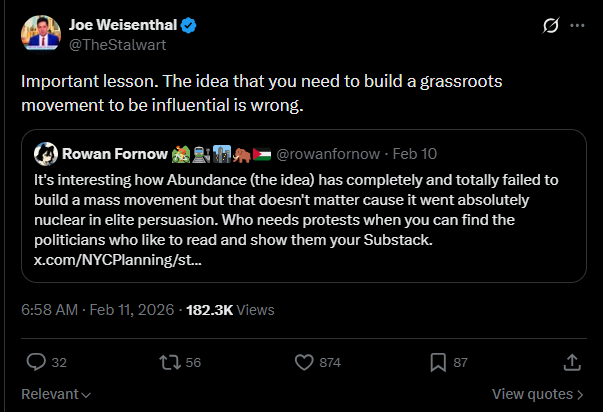
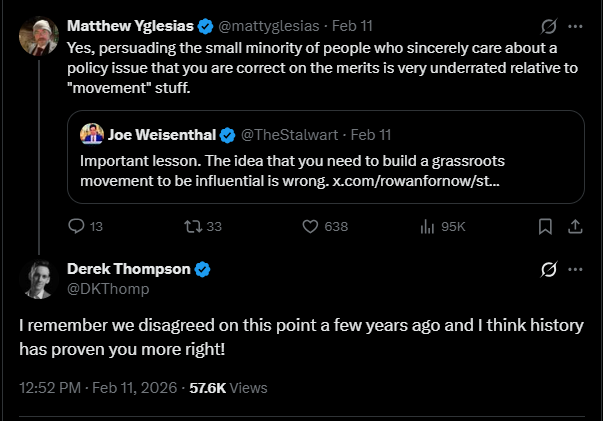
The abundance ecosystem has tried to develop a “grass-tops” movement, which parlays an elite influence campaign into building a mass constituency. Abundance world has certainly been successful at the first part; with hundreds of millions of dollars (this figure is meant literally, not figuratively) flowing into abundance organizations and Klein playing an intellectual power-broker role within Democratic politics—to the point that it raised eyebrows internally at The New York Times, according to reporting from Axios. But with sitting mayors and governors explicitly name-checking the book and its authors, abundance has thoroughly permeated the political class. It has not, however, been as successful at building a broad-base constituency. (It is perhaps difficult to focus on a gauzy future of plenty when fascist shock troops are loose on the streets, acting with impunity.)
Despite Abundance making theNew York Times bestseller list (tech tycoon Reid Hoffman sending copies to everyone he knows probably didn’t hurt), Democratic voters have been notably leery about the abundance framework. Polling has shown that the base is far more interested in tackling corporate greed than it is in municipal red tape, and Klein’s attempts to cast himself as a bipartisan mediator in the wake of the Charlie Kirk assassination have undermined his status as a leading light on the left.
At the Abundance 2025 conference, prominent abundance think tanker Alex Trembath of the Breakthrough Institute stood up to forcefully decry any allegations that the movement had been organized by elites, claiming that “abundance is not this astroturfed conspiracy. In fact, just the opposite: Abundance is emergent. Abundance is bottom-up.” He followed this declaration with the romantic sentiment that it was not donors who brought this movement together but fate, saying, “We were not herded and orchestrated: We found each other. The people and ideas in this ballroom pull on strands from multiple fields—think tanks, activists, organizers, elected officials, journalists, philanthropists, technologists, and entrepreneurs and investors.”
That is, notably, not what a bottom-up movement is. Grassroots movements are built on a foundation of organizing and mobilizing a mass membership. What Trembath actually described is very clearly a grass-tops strategy. Many people within abundance circles recognize, sometimes even celebrate, this dynamic. It was this very strategy that the Niskanen Center spelled out in its June 2024 manifesto charting how to build a so-called “abundance faction.”
The push for a bipartisan grand coalition, also laid out in Niskanen’s manifesto, has not succeeded either. The right flank of the abundance ecosystem has openly embraced some of the most vile parts of Trumpism. In the lead-up to Abundance 2025, the Manhattan Institute’s Charles Lehman, one of the speakers at the conference, called for “deportation abundance.”
Even Utah Governor Spencer Cox, who headlined alongside Klein and Thompson, and has a long-standing reputation as a (relatively) compassionate moderate who wants us all to “disagree better,” has veered toward rank partisanship and entrenching the power of an ever more authoritarian Republican Party. Cox moved to pack the Utah Supreme Court in order to gerrymander Salt Lake City, in what was an awfully aggressive approach for anyone who isn’t dead set on preserving the MAGA regime. The gerrymander would have only picked up one seat. But Cox has embraced a cosmic view of politics, where Donald Trump’s survival from an assassination attempt in 2024 was “miraculous,” spinning a borderline messianic interpretation of Trump’s candidacy and saying to Trump, “You, and only you, can be [the] kind of leader” it will take to repair the country.
Meanwhile, the Trump officials who were praised by abundance advocates as sage and reasonable, particularly Energy Secretary Chris Wright and Interior Secretary Doug Burgum, have been anything but. Wright has raised concerns that he is using his post to advance the business interests of the nuclear energy firm Oklo, where he was previously a board member, and is taking point on the American colonial takeover of the Venezuelan oil industry. Burgum is keeping busy cheerleading threats to annex Greenland, ignoring natural disasters in the actual interior, explicitly serving the oil and gas industry, and whitewashing American history by scrubbing any discussion of climate change, colonial violence toward Native Americans, and other stains on our heritage from national parks and monuments. Oh, lest we forget, he also oversaw the removal of the word “transgender” from the Stonewall monument, where his Interior Department recently abortively removed the Pride flag itself.
Curtis Yarvin, whom prominent abundance intellectual Steve Teles links to in this piece as the far-right edge of abundance, is considered central to the “new right,” which James Pogue described as “a project to overthrow the thrust of progress, at least such as liberals understand the word.” Yarvin, an antidemocracy nutball who wants to replace the republican system of government with a dictatorship or monarchy, also believes white people are innately more intelligent than other races, and has minimized slavery.
Despite this movement being studded by such miscreants and autocratic enablers, abundance is poised to exert significant influence in the near term, especially through a donor class that absolutely loves it and inside organizing like Ezra Klein’s appearance at a major Senate Democratic retreat. But if abundance liberals are to avoid missing the moment and find durable standing within center-left politics, they have to confront a glaring contradiction: their relationship to the AI industry.
AI skepticism and populist anger at data centers are surging. But abundance groups are increasingly aligning with deeply unpopular tech-titan pet projects like California Forever, an attempt by Silicon Valley bigwigs to build their own city from scratch between Sacramento and San Francisco. Housing policy group California YIMBY endorsed the plan, which led to California state Senator Christopher Cabaldon expressing confusion at a recent conference. California Forever also sponsored a recent “Festival of Progressive Abundance” in Los Angeles. The Charter Cities Institute, which advocates for the creation of autonomous cities unbound by existing legal code and envisioned as techno-optimist Meccas, sent an open letter to the Trump administration in support of Freedom Cities, alongside researchers at the American Enterprise Institute, or AEI, which is considered an abundance organization in the list maintained by Inclusive Abundance, the ecosystem’s main organizing arm.
On top of AEI, there is a host of other broadly pro-tech libertarian think tanks included in the Inclusive Abundance list, such as the (Koch-aligned) Cato Institute, the Cicero Institute (chaired by Palantir co-founder Joe Lonsdale), primary Charles Koch influence operation Americans for Prosperity, and the Federation for American Innovation. FAI alum Michael Kratsios, now the head of the White House Office of Science and Technology, has been an aggressive AI booster and was central to Texas Senator Ted Cruz’s legislation that attempted to create a mechanism to functionally exempt the AI industry from any and all federal regulation.
Don’t just take it from me that abundance sometimes is awfully close to tech-libertarians; the Cato Institute itself has said so, and it is generally expert at what libertarianism means.
Abundance has been marketed as a movement focused on solving the crisis of housing affordability, but there has always been a distinct techno-optimist bent to the movement that looks favorably on AI and Silicon Valley. In the opening utopian vignette of Abundance, Klein and Thompson identify widely distributed wealth from artificial intelligence as the internal mechanism that enables our supposedly impending sci-fi-flavored future. Klein, in particular, was quite vocal that a major driver of his side of the project was about repairing the frayed relationship between progressives and technology—both the concept itself and the tech industry centered around Silicon Valley.
The Abundance 2025 conference, judging by its schedule, had as much programming around AI as it did around housing (there was more directly focusing on energy policy than either, though energy and AI are deeply interconnected). The author of President Trump’s AI Action Plan, Dean Ball (now at FAI), was a featured speaker at the conference, as was NVIDIA’s director of infrastructure policy and multiple other champions of AI.
Moreover, much, if not most, of the funding flowing into abundance organizing is closely linked to powerful Silicon Valley figures. Following the release of Klein and Thompson’s book, Open Philanthropy (another sponsor of the abundance conferences, since rechristened Coefficient Giving), which was launched by Facebook co-founder Dustin Moskovitz, unveiled a $120 million fund focused on advancing abundance ideas. Half of the fund—$60 million—came from Stripe’s Patrick Collison. Arnold Ventures is a frequent abundance funder, which launched the Abundance Academic Network and a new abundance-flavored Vox vertical, among others. John Arnold made his fortune in energy trading and more recently joined the board of Meta specifically to serve as an energy adviser for data-center buildout. When welcoming Arnold to the board, Mark Zuckerberg said that, “as we focus on building AGI,” Arnold’s “deep experience” in “energy infrastructure will help us execute our long-term vision.”
Ever wonder why AI advocates downplay the climate implications of natural gas–fueled AI data centers? Consider Renaissance Philanthropy, an early pro-abundance foundation, which was created with money from former Google CEO Eric Schmidt. Schmidt has publicly stated that humans will never manage to control climate change, and that our best bet is to pour near-unlimited resources into developing an AI that can solve the issue for us. And Schmidt’s views are hardly niche within the realm of our would-be AI oligarchs.
In the most on-the-nose example, Abundance 2025 also had two literal trade associations that represent major tech firms among its sponsors: Chamber of Progress and the New American Industrial Alliance. The former of these is funded by literally every prominent AI firm in the game, from Marc Andreessen’s a16z to Amazon, Apple, Google, OpenAI, NVIDIA, Midjourney, and others.
None of this is an aberration: Silicon Valley has been at the forefront of developing abundance thought since its inception. Among the earliest proto-abundance treatises was an essay in The Atlantic co-authored by Patrick Collison and Tyler Cowen that called for the launch of a new science dedicated to studying how to achieve progress, which they creatively dubbed “progress studies.” In the seven years since their essay, progress studies has intermingled with other movements, such as effective altruism and rationalism, mainline Koch-style libertarianism, and supply-side progressivism, with a dash of technofascism comprising what Steve Teles has christened the “Dark Abundance” subfaction. The amalgamation of all these strands led to what we now would call the abundance movement (or ecosystem).
Cowen, in turn, runs key abundance funder Emergent Ventures, which was launched with a grant from Palantir’s Peter Thiel. Patrick Collison has marshaled part of his fortune to organize an annual retreat for abundance diehards in Sevastopol, California, where those invested in the success of the movement can gather, commiserate, and plan future efforts. Venture capitalist Marc Andreessen, whose a16z invests heavily in AI, fintech, and crypto, wrote his own call for abundance in 2023, titled “The Techno Optimist Manifesto,” with a whole chapter on “abundance.” Notably, one of Ezra Klein’s early proto-abundance columns built on another viral Andreessen essay.
Now, it should be noted that there are some in the abundance ecosystem who have been critical of AI in recent years. Thompson, while an enthusiastic fan of AI, who has been explicit about wanting to convince skeptics, has written about the technology’s downsides; fledgling abundance magazine The Argument (itself frequently techno-optimist and replete with Silicon Valley funding from Arnold, Collison, Open Philanthropy, and Emergent Ventures) has published several good articles that scrutinize the more boondogglish side of Silicon Valley’s latest obsession.
Even beyond the array of pro-AI interests lining up behind the abundance agenda, though, the AI industry and the data-center construction boom raise what should be uncomfortable questions for abundance advocates.
The movement’s central premise is that we can’t build and that we have created too many veto points that let parochial interests block important construction projects. But the data-center boom clearly shows that we can build. Or at least that mega corporations can when they put their minds to it. Granted, the sets of restrictions that apply to multifamily housing, energy transmission infrastructure, and industrial-scale data centers are all different, but frequently abundance proponents target the exact types of procedural bottlenecks that communities that don’t want data centers are using to block or delay tens of billions of dollars’ worth of them from popping up. In particular, community input meetings, air quality standards, and public interest lawsuits are frequent boogeymen of the abundance framework. But they are now the chief means by which communities are fighting back.
The data-center buildout also creates acute examples of why the types of bottlenecks that abundists decry are both absolutely necessary and, sometimes, still too weak. Examples of massive data-center projects being built against the wishes of their neighbors have become commonplace, to the point that foisting nondisclosure agreements upon elected officials over the details of the terms local government is giving to AI companies to build in their communities for economic development is becoming something of an industry standard.
Abundance tells us that we struggle to build and that procedural measures like public interest lawsuits, zoning restrictions, and community input meetings are blocking essential public goods. But then, at the same time, it has so far offered no comment on the reality that we are building plenty of data centers, often even while overcoming those democratic processes.
In Memphis, when Elon Musk’s xAI started operating without going through the permitting process—potentially illegally—we got a taste of how things work without the “bottlenecks” that figures like Thompson and Klein decry. The data center spewed toxic gas over a community that already bore significant air pollution, and did it without the public even knowing about it; more than a dozen local officials signed NDAs, which led to even some City Council members being completely in the dark about xAI’s operations in the city.
Perhaps Musk’s “Colossus” data center couldn’t have been built or would have taken much longer if it hadn’t pulled the wool over the eyes of residents and their government and had actually followed the law. But the flip side is that the progress that those costs have borne is a chatbot that, while it does sometimes fact-check kooky conspiracy claims, declared itself “MechaHitler,” provided planning assistance for a home invasion, removed clothes from people’s pictures on X without their consent, and generated thousands upon thousands of images of child pornography. Thankfully, the only cost for creating such an innovative piece of technology was an entire community being bombarded with toxic emissions that cause cancer and respiratory disease. Data-center expansion is already causing tens of billions of dollars in additional public health costs annually, disproportionately in poor, minority-majority areas like South Memphis.
Moreover this type of “behind-the-meter” energy supply is extremely common and trending up. More than three-fourths of the on-site power currently being brought online at data centers is natural gas, which, while its fumes are less toxic than coal’s, still emits large amounts of carcinogenic and toxic pollutants. Even worse, many data centers have diesel backup generators, which are far more detrimental to the health of people living nearby, particularly because of higher levels of nitrogen oxide and PM2.5 particles.
Public sentiment is also clearly turning against data centers. While polling indicates that voters are largely agnostic on data-center buildout as a hypothetical, there is a large body of evidence on the underlying elements that shows deep hostility toward the AI industry.
Politico and Public First recently found that 37 percent of respondents supported data centers to 28 percent opposed, with another 28 percent neither supporting or opposing, though with a major split along party lines; Democrats narrowly opposed, 36 percent to 33 (27 percent for neither), while Republicans had fairly strong support, 45 percent to 26 (24 percent for neither). This is similar to what NBC found in the summer of 2025, with 44 percent of respondents thinking AI would improve their family’s future versus 42 percent who thought it would make it worse. News site Heatmap found that only 44 percent of respondents supported a data center being built, even less than other types of energy infrastructure, including gas-fired power plants and nuclear reactors. There is also a substantial polling literature that shows Americans are deeply apprehensive of AI generally, although with very different views along gender lines—men tend to be positive about AI, while women are skeptical.
While apathy may be the prevailing mood nationally, with most voters having heard nothing at all about data-center construction, nearly every state or county-level case study available shows massive backlash brewing. Most tellingly, in the places where people have heard about data centers, they detest them. Virginia Democrats vocally ran against data centers last year and scored impressive wins. The 30th district, which includes data-center capital of the world Loudoun County, saw the incumbent Republican ousted by John McAuliff, who worked overtime to tie his opponent to the data centers. Similarly, 2025 saw two statewide spots on the Georgia Public Service Commission flip to Democrats over anger about data-center-fueled energy price hikes, the first statewide races the party had won in decades. State-level polling has shown antipathy in the ever-crucial swing states of Pennsylvania, Wisconsin, and Michigan.
A growing number of localities have also instituted a pause on new data-center construction, including Prince George’s County in Maryland; St. Charles, Missouri; several Atlanta-area counties; and several counties in Indiana. State-level restrictions and moratoria are being debated across the country, from New York to Georgia to California. Given all of that, it’s hardly surprising that Morning Consult has shown that support for banning data-center construction has been surging; just between October and November 2025, the policy went from down by two points to up by five. It is becoming increasingly clear that this moment calls for campaigning on AI skepticism.
Abundance proponents, however, seem determined to swim against the current of public opinion. For some, as Eric Levitz implies in Vox, it’s a matter of the muddled picture of public opinion we have. For others, though, abandoning data centers would be like surrendering their raison d’être. Particularly for the groups that emerged out of the “progress studies” movement kick-started by Collison and Cowen’s Atlantic essay, part of the point of abundance has always been to foster a sense of techno-optimism.
There is nothing inherent to abundance thought that necessitates AI boosterism. Indeed on a recent podcast, Marshall Kosloff, who emceed Abundance 2025, recalled responding to a question about what the abundance line on AI is: “We want nothing to do with that.” As Austin Ahlman of the Open Markets Institute, one of Kosloff’s guests for the episode, pointed out, such sentiment is “nowhere close to where the status quo is,” where Silicon Valley elites clearly “view this as an easy vehicle for the regulatory structures that they need to very quickly do the AI buildout without any democratic discipline or oversight.”
In fact, in its “Abundance Landscape” report, Inclusive Abundance identifies artificial intelligence as one of the five core policy areas. Notably, transit, one of the most common talking points for abundance punditry, is excluded, though IA said it would include it in its 2026 report. Even outside of AI’s own dedicated policy area, the report also includes AI as one of the “opportunities” for abundance energy policy, saying “AI industry leaders and experts agree that this technology will need a tremendous amount of energy going forward. AI and energy experts must collaborate in order to meet the need for more energy.” A similar argument was made by Trembath in an article with Josh Smith of the Abundance Institute. The Abundance Institute itself has also pushed AI very aggressively, including encouraging the White House to attempt to preempt all state-level regulation via executive order.
In a bit of profound irony, data-center construction has broken free of the choke points decried by abundance to the point that it is now bidding up land value and resulting in further constraints on the supply of housing, according to reporting from The Wall Street Journal. Now the data-center buildout, as well as being deeply unpopular and undermining the intellectual case for abundance, is directly jeopardizing what is supposed to be the movement’s central animating goal.
Elements of abundance raise important questions, particularly about how to build state capacity and the importance of government efficiency to public buy-in for ambitious governance (articulated well in this podcast by Mayor Zohran Mamdani speaking to Derek Thompson). But the framing of these questions is also saddled with an association with the excesses of ambition of Silicon Valley moguls—and their dark, antidemocratic leanings. If it’s hard to get people to say yes to an apartment building in their backyard, it’s doubly so to convince them to site a giant warehouse spewing toxic emissions and spiking their electrical bills in their backyard—especially if the best non-bubblish case for the data center is that it will increase the odds they will be unemployed.
Dylan Gyauch-Lewis is a researcher at the Revolving Door Project.
Read More:
Politics, Abundance, Ai, Data Centers, Economy, Technology, Silicon Valley, Artificial Intelligence
---
ref1 am prosp
The Revolving Door Project, aProspect*partner, scrutinizes the executive branch and presidential power. Follow them at therevolvingdoorproject.org.
The past few years have seen a widespread move away from free-market dogma, as policymakers search for new economic perspectives. The election of Joe Biden in 2020 proved to be a crossroads for economic orthodoxy. For the first time in more than a quarter-century, a Democratic administration did not entrust its economic policy exclusively to adherents of Robert Rubin’s philosophy, for whom the solution to any economic issue was usually “Be less of a Democrat.”
Instead, the Biden-Harris administration trusted progressives as a coalition partner, rather than an electoral faction that had to be dealt with, not worked with. The Biden administration attempted true industrial policy for the first time in over a generation, rekindled enforcement of the Sherman Antitrust Act, and didn’t shy away from stimulating the economy when it was foundering. And while Biden’s term has been a rousing success on most macroeconomic measures—the electoral loss turned in part on global inflation and the rollback of the temporary pandemic safety net—progressives’ increasing power within Democratic politics has caused some moderates to become enraged that they’re now expected to settle for the position of senior partner, and denied near-total control.
Enter the “abundance agenda,” an attempt to generate new messaging for a new political era in which neoliberalism has fallen rapidly out of favor. The term has been floating around for years, but has more recently become a rallying cry for a whole array of deregulatory causes. The abundance agenda has also offered shelter to effective altruists, who have been searching for a flag to rally around that isn’t associated with one of the largest frauds in world history. The Biden administration has started to usher in a post-neoliberalism, with more heterodox ideas competing for acceptance. Abundance is neoliberalism repackaged for a post-neoliberal world.
*Read more from the Revolving Door Project
What exactly abundance adherents believe varies, of course, but there are a number of broad precepts: building more housing, producing more energy, and fostering more technological innovation. None of these are objectionable goals; the differences with progressives arise, largely, in how to get there. Abundance starts from a “growth above all” mindset. The agenda’s advocates hate residential zoning laws—which, contrary to what they frequently imply, is something they have in common with us and most progressives—but also detest the National Environmental Policy Act, support fracking, oppose tenant protections, and are often deferential to the policy preferences of Big Tech.
While there are efforts to create abundance-oriented factions within both parties—in effect recreating the Republican and Democratic establishments that dominated politics throughout the 1990s and 2000s—the near-term focus is the Democratic Party. And, in their move to stake out partisan influence, abundance is explicitly seeking to weaken progressives. With that in mind, it’s worth understanding who exactly makes up the abundance movement.
The coalition includes many prominent centrist organizations, but also corporate interests and conservatives that MAGA pushed out of power within the Republican Party. Many components of this faction have financial ties to crypto, AI, Big Tech, and oil.
In October 2024, a number of organizations held the Abundance 2024 conference. The event was sponsored by Arnold Ventures, Open Philanthropy, Renaissance Philanthropy, and Stand Together.
- While at times heterodox, Arnold Ventures funds a sizable network of neoliberal think tanks, including $3 million to the libertarian Reason Foundation and at least $1 million to the pro–pension privatization Retirement Security Initiative, which has led to founder John Arnold (a former Enron executive) comparing himself to the Kochs. Arnold serves on the board of Meta. The Arnold Foundation has also spent hundreds of millions of dollars pushing for school privatization.
- Open Philanthropy was co-created by Facebook co-founder Dustin Moskovitz. It has close ties to AI firm Anthropic, which was founded by Daniela Amodei, the wife of Open Philanthropy co-founder Holden Karnofsky. Open Philanthropy is also closely associated with effective altruism, donating millions to Sam Bankman-Fried’s favorite philosopher Will MacAskill.
- Renaissance Philanthropy was founded by Tom Kalil with money from former Google CEO Eric Schmidt. It was started with an explicit focus on AI, and Kalil himself is on the board of Sherpa.ai. Schmidt is also on the board of multiple AI companies and has invested in crypto. He believes that, rather than try to mitigate the damage of climate change, policy should double down on AI in the hopes that it will come up with a solution. Renaissance is extremely close with Schmidt Futures, Eric and Wendy Schmidt’s own foundation. Many Renaissance staff come from Schmidt Futures, including Kalil and their Economic Mobility Fund program director, partnerships manager, chief of staff, operations manager, and head of strategy and partnerships.
- Stand Together is one of the primary institutions within the Koch network, and was created by Charles Koch. Like Arnold Ventures, Stand Together funds the Reason Foundation. It funds a wide range of conservative nonprofits, including the anti-LGBTQ Alliance Defending Freedom, which the Southern Poverty Law Center classifies as a hate group. Its current CEO, Brian Hooks, is concurrently the president of the Charles Koch Foundation and previously was the executive director of the libertarian Mercatus Center.
---
---
A site to discuss education and democracy
« Ron DeSantis Inaugurated, Promises to Protect Florida from Drag Queens
Chalkbeat: NYC Public Schools Ban ChatGPT »
Why Do Rightwing Foundations Fund Emily Oster’s Work on COVID and Parenting?
Early in the pandemic, an economist at Brown University named Emily Oster gained extraordinary media attention for the advice she offered. She wrote multiple articles declaring that it was safe to open schools even without the funds needed to pay for extra safety precautions. She wrote, she was written about, she became the go-to person with “evidence” that schools were safe from COVID.
Oster’s research is funded by leading rightwing and libertarian foundations, organizations, and individuals. As the linked article by epidemiologists Abigail Cartus and Justin Feldman explains, Oster’s emphasis on individualism and personal choice ring sweetly in the ears of the rightwing philanthropists.
They write:
Oster’s influence on the discourse around COVID in schools is difficult to overstate. She has been quoted in hundreds of articles about school pandemic precautions and interviewed as a guest on dozens of news shows. Officials from both parties have used her work as justification for lifting public health measures. Florida Governor Ron DeSantis cited her study while announcing an executive order banning school mask mandates, while CDC Director Rochelle Walenksy referenced Oster’s research in anticipation of relaxing classroom social distancing guidelines. Oster also co-authored an influential school reopening guidance document that was released in early 2021.*
But despite its prominence, Oster’s work on COVID in schools has attracted little scrutiny—even though it has been funded since last summer by organizations that, without exception, have explicit commitments to opposing teacher’s unions, supporting charter schools, and expanding corporate freedom. In addition to grantsfrom the Chan Zuckerberg Initiative, the Walton Family Foundation, and Arnold Ventures, Oster has received funding from far-right billionaire Peter Thiel. The Thiel grant awarded to Oster was administered by the Mercatus Center, the think tank founded and financed by the Koch family.*
Although she claimed that her work was evidence-based, the authors show that her evidence was never as conclusive as she argued.
Cartus and Feldman draw a straight line between Oster’s views about COVID and the billionaire-funded attack on public schools. It is no accident that the same people who support charter schools and vouchers also support Oster.
What’s in it for the billionaires? Oster spreads the gospel of choice, they write, a philosophy of looking out for #1, and ignoring social responsibility.
They write:
{Oster is far from the only person to apply an economic style of reasoning to the U.S. education sector. There exists an entire ecosystem of “education reform” organizations that have spent decades attempting to subject schools to market conditions, promoting “school choice”, (i.e., charter schools, some of which are for-profit). This necessitates, among other stances, taking a harder line against organized labor. When the pandemic arrived, billionaires and right-wing interests invested in neoliberal “education reform” saw an opportunity to advance their interests: breaking unions, promoting charter schools, and undermining public education.
Oster’s preference for individualism, the rhetoric of choice, and economic reasoning over structural and collective justice-based conceptions made her—as an impeccably credentialed and high-profile economist prior to the pandemic—a valuable “expert” ally in their crusade to reshape U.S. education. Indeed, when the pandemic began, these groups promptly expressed interest in funding her work on COVID in schools….*}:
Throughout the pandemic, Oster’s advocacy has helped make the “data-driven” case for peeling away successive layers of COVID mitigations: first ending remote instructionin favor of hybrid learning, then ending hybrid learning in favor of a full return to in-person instruction, then eliminating quarantine for those exposed to the virus. The direction of her vision for schooling during the pandemic ultimately involves abandoning universal publichealth measures altogether, turning masking and vaccination into individual, personal choices that can be decided through cost-benefit calculations.*}:
The irony of the Rightwingers’ support for Oster and her “data-driven” approach to COVID is that it stands in sharp contrast to their total disregard for data or evidence about charter schools and voucher schools. The evidence favoring charter schools over district schools is scanty; the evidence of the failure of vouchers is overwhelming. But the funders don’t care.
The bitter struggle over COVID in schools, conducted with the rhetoric of “choice,” opened up space for an alliance between affluent white liberal parents and a right-wing propaganda infrastructure devoted to destroying unions and public schools. For instance, John Arnold, the former Enron executive behind the eponymous Arnold Ventures (which funds Oster), has used the pandemic to attack teacher’s unions and further his goal of dismantling public pension funding, much of which is allocated to unionized public school teachers. The pandemic also provided an opportunity to increase charter school usageat the expense of public school enrollment. It gave plutocrats like the Waltons yet another chance to attack teachers’ unions by painting their demands for safer working conditions as irrational. By advocating reopening in (another Walton grantee) during a period when the Chicago Teachers Union was campaigning for stronger COVID rules, Oster helped the Waltons do precisely that.*}:
To see all the links and read the full article, open the link.
Diane Ravitch's Blog
John Thompson: Emily Oster Was Wrong About the PandemicJanuary 15, 2023In "Accountability"
Rachel Cohen: Emily Oster Was Too Optimistic about Children and COVIDOctober 29, 2020In "Accountability"
Emily Oster: Schools Are Not Super-Speaders of COVIDOctober 10, 2020In "Health"
CategoriesAccountability, Charter Schools, Economics, Funding, Health, School Choice, Science, Walton Foundation
CITED BY ATLAN MO AND NPR NYT?
---
PROTEAN
OF the numerous political battles sparked by the coronavirus pandemic, some of the most bitterly contested have taken place over K-12 education. Schools have been a site of decisive struggles over the norms, values, and policies of the U.S. response to the public health crisis. While teachers collectively fought for stronger COVID mitigation measures, a small but vocal minority of parents confronted school boards in acrimoniousmeetings, demanding an end to remote instruction and mask mandates. These local skirmishes took place against the backdrop of successive COVID surges and a national media narrative that cast doubt on the usefulness of public health measures. It is impossible to understand the failed U.S. pandemic response, which has left over one million people dead, without understanding the role that schools have played as sites of political contestation. And it is impossible to understand the school reopening debate without understanding one of its main interlocutors: academic economist Emily Oster.
Oster’s influence on the discourse around COVID in schools is difficult to overstate. She has been quoted in hundreds of articles about school pandemic precautions and interviewed as a guest on dozens of news shows. Officials from both parties have used her work as justification for lifting public health measures. Florida Governor Ron DeSantis cited her study while announcing an executive order banning school mask mandates, while CDC Director Rochelle Walenksy referenced Oster’s research in anticipation of relaxing classroom social distancing guidelines. Oster also co-authored an influential school reopening guidance document that was released in early 2021.
But despite its prominence, Oster’s work on COVID in schools has attracted little scrutiny—even though it has been funded since last summer by organizations that, without exception, have explicit commitments to opposing teacher’s unions, supporting charter schools, and expanding corporate freedom. In addition to grants from the Chan Zuckerberg Initiative, the Walton Family Foundation, and Arnold Ventures, Oster has received funding from far-right billionaire Peter Thiel. The Thiel grant awarded to Oster was administered by the Mercatus Center, the think tank founded and financed by the Koch family.
Oster is a professor of economics and international and public affairs at Brown University. But prior to COVID, she was better known to the public as the author of popular books on pregnancy and parenting. These include Expecting Better (2013), Cribsheet (2019), and The Family Firm (written partially during the pandemic and published in 2021). The unifying theme across all three books is that conventional parenting advice—from experts in medicine, public health, education, and child development—is often wrong, and is based on irrational and overly cautious decisionmaking processes. In each book, she encourages readers to apply the analytical tools of economics to the multitude of choices that arise during pregnancy and parenting. Oster typically criticizes the quality of a few peer-reviewed studies that justify conventional advice, then offers her own recommendations on a range of topics—from eating deli meats in pregnancy (all are acceptable, other than turkey) to whether to send children to public schools (charters are often better in urban areas).
If it’s not already obvious, Oster’s readership skews female, white, affluent, and liberal. Some in this audience might be surprised that her books, which to a casual reader appear chipper and apolitical, have been roundly embraced by right-wing think tanks, including the Manhattan Institute, the Competitive Enterprise Institute, and the Cato Institute. (Oster was even invited to speak about Cribsheetat Cato’s Washington headquarters in 2019.) Why might a book about parenting appeal to the Cato Institute? One answer is that Oster’s books popularize what Elizabeth Popp Berman calls an “economic style of reasoning,” which emphasizes individualism, market-based choice, and efficiency, while deprioritizing concerns related to injustice or collective well-being. Since the dawn of the neoliberal era in the 1970s, the economic style of reasoning has been an important ideological tool in the effort to expand corporate power; its propagation is the raison d’être of groups like the Cato and Manhattan Institutes.
The economic style of reasoning has attained considerable cultural influence, extending far beyond the cloistered, technocratic corners of policy analysis. Some of this influence can be traced to the 2005 publication of Freakonomics, by Stephen J. Dubner and Steven Levitt, which applied economic reasoning to social phenomena. Freakonomicswas extraordinarily successful, selling 4 million copies. (It was also, critics charge, rife with errors and misrepresentations.) Levitt was instrumental in launching Oster’s career as an author of popular economics books, using his massive platform to publicize her work.
Oster is a clear successor to Levitt: in her books, she extends the economic style of reasoning to pregnancy and parenting. These are two areas of contemporary life that are shrouded in superstition, anxiety, and mistrust, and are dominated by (usually male) medical authority: areas in which a lot of women are desperate for reasonable-sounding advice. The books are narrow in scope, and they emphasize the primacy of individual choice, hewing closely to normative attitudes and corporate-rationalist modes of thinking. The Family Firm, for instance, addresses household interpersonal dynamics by asking readers to consider familial relationships as a business manager would. The books employ language familiar to their target market: affluent cisgender women of reproductive age, a lucrative reader demographic with an enormous appetite for practical self-help guidance.
Oster’s books all utilize atype of cost-benefit analysis that rejects theprecautionary principle. Long embraced by environmentalists, trade unionists, and public health experts, the precautionary principle comes into play in scenarios of scientific uncertainty about risks of harm; it holds that decisionmakers should err on the side of minimizing or eliminating a potential hazard, even if this might prove to have been an overreaction once more research becomes available. Business interest groups, in seeking to expand corporate freedoms, use and promote the exact opposite interpretation of uncertainty. For example, industry groups might argue for permitting a novel pesticide to enter the market while evidence of its carcinogenic potential is still being collected. There is a bias towards interpreting uncertain and inconclusive research findings about health risks as evidence of no risk—a glaring fallacy that serves the needs of profit.
The general tone of Oster’s books is that pregnancy and parenting advice that is based on the precautionary principle is oppressive to mothers, as it imposes needless worry and restricts their choices as individuals. One particularly controversial example from Expecting Better involves guidance on drinking alcohol during pregnancy. Oster’s treatment of this topic starkly illustrates just how central the rejection of the precautionary principle is to her thinking.
Pregnancy is difficult to study epidemiologically; accordingly, it’s difficult to ascertain the effects of alcohol on pregnancy outcomes. Oster tells her readers—correctly—that the epidemiologic studies connecting light drinking to fetal alcohol spectrum disorders and other adverse outcomes are of relatively low quality. Oster interprets the inconclusive state of the science as evidence of no risk—and, on this basis, gives her readers permission to consume up to two drinks per week in the first trimester, and one drink per day later in pregnancy. Contra Oster, various professional associations, including the American College of Obstetricians and Gynecologists, also correctly claim that no amount of alcohol has been proven safe to consume during pregnancy. Oster is openly critical of these messages, sensing a note of paternalism in the recommendations: “I’m not crazy about the implication that pregnant women are incapable of deciding for themselves—that you have to manipulate our beliefs so we do the right thing.”
The underlying message that Oster imparts to women—that learning to make the right choices is the key to resolving their overwhelm and anxiety—is perhaps so resonant with her affluent readership because it gives them the illusion of control over the fate of their children in an increasingly precarious and brutal world. There are millions of people in the U.S. who are highly economically and socially privileged, but not so privileged as to guarantee their children a future spot in the upper echelons of the social hierarchy, as Richard Reeves points out in his analysis of Americans in the top 20% of income distribution. The intergenerational transmission of class status (or the work of ensuring that their children “make it”), falls, like most parenting responsibilities, disproportionately on women. Upper-middle class mothers are doubly burdened; they face pressure to ascend a career ladder of their own while also performing the extensive and unpaid social reproductive labor of raising children and preparing them for future success. (Though some of the less glamorous aspects of this care work may be outsourced to working-class women, often women of color.)
Beyond imparting a sense of control, the rhetoric of “make smarter choices” accords with a version of feminism to which many already subscribe. The abortion discourse since Roe v. Wadehas conditioned many Americans (and this demographic of women in particular) to equate choice and its exercise with freedom, justice, progress and, critically, empowerment. Elizabeth Lanphier has written about how the pro-choice slogan “my body, my choice” conceptualizes bodily autonomy as a kind of private property right. Sophisticated critiques of this mainstream “choice” rhetoric have been advanced by Marxist feminists, Black feminists, and other feminists of color in the reproductive justice movement. They emphasize its too-narrow focus on the legal right to choose abortion over the entirety of conditions affecting reproduction, its exclusionary failure to meet (or even apprehend) the needs of poor women and women of color, and its overreliance on legal strategies rather than movement-building. In contrast to the economic style of reasoning, reproductive justice articulates a collective concept of freedom, requiring attentive engagement and struggle over questions of power, resources, and material redistribution.
Oster represents the inverse of this systemic, structural critique. In The Family Firm, her treatment of K-12 education, she once again appeals to the paradigm of individual, market-based choice. It’s simply a choice, in her framework, whether to enroll one’s children into a private, charter, or public school. In an interview to promote the book, writer Gail Cornwall asked Oster how justice considerations fit into her framework for decisionmaking—for example, whether it’s fair to send children to well-resourced private schools when integration into a public school system may yield substantial societal benefits. Cornwall corrected Oster’s rejoinder that there is no research on the effects of school integration by pointing to a largebody of research that, in fact, identifies considerable benefits.
Oster responded by invoking the language of econometrics. “Your delta on that is small,” she says—claiming, in other words, that the decision of any lone (white and affluent) family choosing to matriculate their child in a less-resourced public school will be of negligible effect. The implication is that they should be allowed to defer to individual choice, as if individual choices are immaterial to the surrounding community. Yet while the individualism central to this style of reasoning prevents Oster from even acknowledging the concept of a collective benefit, the parents in her books’ white, liberal target demographics have no difficulty engaging in collective action—for example, when they organize political campaigns against policies that would racially integrate schools.
Oster is far from the only person to apply an economic style of reasoning to the U.S. education sector. There exists an entire ecosystem of “education reform” organizations that have spent decades attempting to subject schools to market conditions, promoting “school choice”, (i.e., charter schools, some of which are for-profit). This necessitates, among other stances, taking a harder line against organized labor. When the pandemic arrived, billionaires and right-wing interests invested in neoliberal “education reform” saw an opportunity to advance their interests: breaking unions, promoting charter schools, and undermining public education. Oster’s preference for individualism, the rhetoric of choice, and economic reasoning over structural and collective justice-based conceptions made her—as an impeccably credentialed and high-profile economist prior to the pandemic—a valuable “expert” ally in their crusade to reshape U.S. education. Indeed, when the pandemic began, these groups promptly expressed interest in funding her work on COVID in schools.
Oster’s pandemic-era work on schools is a natural extension of her larger intellectual project. Even before the appearance of her billionaire benefactors, very early in the pandemic, Oster was publishing op-eds inThe Washington Post andThe New York Times downplaying the risks of COVID to children, in school settings and in general. She began with a May 2020 piece in the Post (“Opening schools might be safer than you think”), in which she argued that the benefits of in-person instruction are high, while the costs—based on a small number of preliminary studies of coronavirus transmission in schools—are low. In another op-ed in August 2020, Oster proposed the creation of a data dashboard to track information on how K-12 schools nationwide were responding to the pandemic. Oster argued that not only would this system gather vital data that was not being collected by the federal government, but also that this data-driven approach to assessing risk would allay parents’ and teachers’ irrational, anecdote-based fears of in-person instruction during the pandemic.
A month later, in September 2020, Oster launched the National COVID-19 School Response Dashboard, with funding support from several right-wing and “education reform” organizations. Oster has claimed that the funders exert no influence on the data collection process or on any of the research on which it’s based, and there is no reason to doubt her claim. However, the eagerness of these groups to support the Dashboard—and Oster’s willingness to accept their money—is a telling indicator of the incentives at play, and the connections that Oster has forged with right-wing ideological projects. Accepting this funding also forced Oster to navigate dual roles: as both a social scientist, putatively committed to rigorous data analysis, and as a well-connected advocate, committed to a particular set of policy preferences.
Oster threaded this needle in an interview with *Bloomberg News* in October 2020. Asked about the potential for adverse consequences of school reopening, she answered, “If the result of having done that is that the policy direction I pushed was not right, at least I got the data to show that.” In other words: she could still serve a useful role as a purveyor of data even if her advocacy against COVID precautions in schools proved incorrect—or had harmful consequences. However, even in the face of a rapidly expanding evidence base and changing indications in the data, Oster’s arguments have consistently remained aligned with her initial policy preferences. Her preferences happen to mirror those of her donors, who have gone on to employ her research in their advocacy for school reopening and a loosening of viral control measures. (For example, this pro-reopening report from the Walton Family Foundation—a major funder of Oster’s work—draws heavily from several of her analyses.)
This brings us to the cornerstone of the economic style of reasoning: the data. The evangelists for the economic style of reasoning exhort their audience to “follow the data”—the alternative being, it is implied, to capitulate to the irrational demons of fear and anxiety. In this narrative, they are the logical, clear-eyed rationalists; those who advocate attentiveness to the precautionary principle—based on well-founded concerns about their own and other people’s safety—are pejoratively associated with emotional, fallacious reasoning. It is emotional and irrational, for example, to be concerned that a novel pesticide could be a carcinogen, at least until “the data” is in.
Such claims to superior logic and reason can be a convenient mask for ideological assumptions. Appeals to “following the data” do not always reflect a scientific consensus; rather, “the data” is a rhetorical device used to grant narrative authority to certain quantitative analyses—those that confirm preconceived ideas. Meanwhile, those analyses can (and often do) have important limitations like weak study designs, arbitrary assumptions, or erroneous math that should alert readers to interpret the findings cautiously. The intent is to shame people for straying from the experts’ superior rationality, and ultimately to portray any demand for change to the status quo as fringe, conspiratorial, and anti-scientific.
The imprimatur of scientific objectivity is often used to substantiate ideological claims, as has been made abundantly clear by the prevalence of other industry-funded or ideologically motivated research—on tobacco, on processed food, on carbon emissions, and on charter schools alike. Normative assumptions and predetermined conclusions can make their way into “scientific” findings with surprising ease. (Consider, for example, the arbitrary values assigned to human life in cost-benefit analyses.) This process of mustering weak evidence to support a previously determined course of action has been called “policy-based evidence making:” the deeply unscientific process of (consciously or unconsciously) massaging data to conform to a preconceived conclusion.
Oster’s work on COVID and schools is rife with examples of policy-based evidence making. In one early instance, Oster relied on alarmingly low-quality, incomplete data from the School COVID-19 Response Dashboard to confidently declare that schools were low-risk environments for viral spread. In an October 2020 article in The Atlantic,“Schools Aren’t Super-Spreaders,” Oster assured readers in no uncertain terms that COVID transmission simply did not occur in schools at a rate that would necessitate closures.
But the analysis underlying the piece drew on a sample of miniscule size—a mere two weeks of school data, reported in the second half of September 2020. (The sample was also biased by the fact that it was collected only from schools voluntarily participating in the Dashboard.) The second half of September 2020 coincided with the very beginning of a national uptick in cases that would eventually become the punishing surge of winter 2020-21—making estimates from this limited timeframe a poor approximation of the risk for the entire semester or year. More importantly, at the time of the op-ed, the Dashboard displayed zero COVID cases in a large majority of schools, giving the appearance that there was no correlation between case rates in schools and their surrounding communities. This scenario—a data set full of missing and zero values—is highly implausible for “real world” data collection.
The apparent low quality of these data raised important questions about the quality of the schools’ data collection and case reporting procedures. These issues should have also raised red flags about the bold and consequential claims Oster made based on the data. But that didn’t happen. Instead, it became an article of faith that the laws of physics governing viral transmission don’t apply to schools, even as evidence of in-school viral transmission has mounted throughout the pandemic.
Oster’s signature style is approaching research claims with skepticism. Yet she failed to state the critical limitations of her data in her Atlantic op-ed—except the limitations that biased the analyses in ways that reinforced her policy preferences. (For example, she is careful to note that a positive case reported to a school district may have been picked up elsewhere, not in school.) Months later, the Dashboard team would implicitly acknowledge these data quality issues, pointing out that in some jurisdictions (initially, Texas and New York, with several states added in later), state governments coordinated data collection, resulting in more consistent case reporting. However, Oster’s bold—and broadly influential—claim had already been made.

[GRF]
Data from the National School COVID-19 Dashboard on October 10th, 2020 showed a large majority of schools reporting zero confirmed or suspected cases, and no correlation between school and county case rates.*
By the spring of 2021, a nationwide push to end hybrid learning (where about half of students are physically present in the classroom at any given time) and return to full in-person instruction for all students was underway. This effort had begun even before vaccines were available to most education workers, or any children. As more schools began contemplating bringing students back for in-person classes with varying levels of COVID precautions in place, a new challenge emerged. Many schools didn’t have the square footage to accommodate all of their students at once while maintaining six feet of distance between them, per CDC guidelines at the time.
Fortunately for proponents of reopening, Oster was ready with a timely intervention. She co-authored a study (with other vocal reopening advocates) investigating whether district-level policies requiring six feet of distance were associated with reduced COVID transmission in schools, compared to schools with policies that allowed just three feet of distance. The study concluded that policies permitting shorter distances were not associated with increased COVID transmission. Subsequently, it was cited by both Anthony Fauci and Rochelle Walensky as an assurance that the return to daily in-person instruction could be made safely. The CDC promptly changed its distancing guidance—for schools only.
In reality, however, the study was far from conclusive. The results found that six-foot distance policies were compatible with anywhere between a 40% decrease and a 34% increase in the COVID case rate for students. It is not appropriate to use findings with such a high degree of imprecision as the basis for any health and safety policy. Oster and her colleagues’ conclusion was based on a common misinterpretation of statistical results that treats an imprecise effect estimate as conclusive evidence of no effect. Moreover, two unaffiliated researchers later identified errors in the Massachusetts school attendance data used in the study. This prompted Oster and her co-authors to issue a correction, in which they acknowledged the data quality issues but maintained that the errors did not change their conclusions.
However, those independent researchers also* found that even the slightest change to an arbitrary threshold used to define whether a school was fully remote on a particular week did indeed change the study results—to show a benefit of greater distancing. It is also noteworthy that the study was accepted and published in the prestigious journal *Clinical Infectious Diseases within 15 days of submission—much shorter than the typical peer review timeline, raising questions about whether it was appropriately scrutinized prior to publication. In contrast, the results of the independent review were not made public until nearly a full year after the study came out. By this time, true to pattern, the study had already influenced policy so profoundly that the correction was no longer relevant to important questions about school operations during the pandemic.
Throughout the pandemic, Oster’s advocacy has helped make the “data-driven” case for peeling away successive layers of COVID mitigations: first ending remote instruction in favor of hybrid learning, then ending hybrid learning in favor of a full return to in-person instruction, then eliminating quarantine for those exposed to the virus. The direction of her vision for schooling during the pandemic ultimately involves abandoning universal publichealthmeasures altogether, turning masking and vaccination into individual, personal choices that can be decided through cost-benefit calculations.
Oster, however, says she has been reluctant to loudly promote this vision, due to fears of public backlash. Contemplating an end to mask mandates, Oster resolved to her Twitter audience, “I will admit I have been reluctant to talk about this, in part due to fear of being yelled at. This wasn’t brave. I will try to be braver.” On vaccines (which she has rarely discussed, after one particular comment she made in March 2021 provoked considerable criticism), she told the Walton Family Foundation, “It is a very, very different cost benefit analysis for vaccination of a four-year-old than it is for an 85-year-old… I think we’re going to have to accept that vaccination rates in little kids are going to be lower than vaccination rates in adults, and that’s probably okay from the standpoint of the virus.”
The markedly reduced severity of COVID infection in young children relative to older adults does not mean that vaccination should be optional or just one particularly cautious choice, among many, that parents can make. The American Academy of Pediatrics (AAP) recommends vaccinating all eligible children (five and up) against COVID-19. When a vaccine for children under five is approved by the FDA, the AAP will likely issue the same recommendation for very young children. Oster is not casting doubt on the vaccines outright—just on their usefulness for children.
Sociologist Jessica Calarco has argued, based on qualitative interviews with mothers of young children, that messages from health authorities and media (including Oster) about the relative mildness of COVID-19 have contributed to the development of a “moral calm” around children and COVID infection—suggesting one reason for stagnating childhood vaccination is the pervasiveness and credibility of the message that COVID is not dangerous for children. This message is not evidence-based: we now know that COVID can cause substantial harm to children. The more infections we permit, the higher the absolute numbers of these bad outcomes. As of mid-March 2022, 1,341 children under 18 had died of COVID in the U.S. The rarity of severe outcomes for children is not an argument to abandon the precautionary principle, or mitigation policies to protect children.
 Emily Oster responds to a question about vaccinating children on Turn the Page Project, a Walton Family Foundation website launched in June 2021.*
Temporarily closing school buildings—quintessential high-risk indoor environments—was a straightforward application of the precautionary principle, especially in the early days of the pandemic, when information about COVID risks and mitigation practices was scarce and provisional. Despite the fact that closures were indeed supremely disruptive to children, parents, and communities, polling data across both years of the pandemic shows consistently high levels of support among parents for public health measures, including mask mandates. During times of high spread, like the January 2022 Omicron wave, parents also supported temporary closures or shifts to hybrid instruction modes.
But the demographic that is least supportive of public health measures in schools—higher-income and predominantly white parents—overlaps with Oster’s readership. This is likely informed by various factors, including that wealthier schools have more resources and can better limit spread through measures like ventilation upgrades and asymptomatic surveillance testing. The difficulty of performing white-collar jobs from home with children present may have also been an influence. Parents, particularly mothers, needed in-person instruction to continue so that they could work effectively at home; many also likely felt intense pressure to keep their children progressing through a sequence of assessments and benchmarks to remain competitive for college. It also bears repeating that not everyone has experienced the same pandemic. White people, particularly affluent white people, face an objectively lower disease risk. Children of color have been far more likely to experience severe illness or lose a parent to COVID, mirroring nationwide racial and ethnic disparities in COVID impact.
The bitter struggle over COVID in schools, conducted with the rhetoric of “choice,” opened up space for an alliance between affluent white liberal parents and a right-wing propaganda infrastructure devoted to destroying unions and public schools. For instance, John Arnold, the former Enron executive behind the eponymous Arnold Ventures (which funds Oster), has used the pandemic to attack teacher’s unions and further his goal of dismantling public pension funding, much of which is allocated to unionized public school teachers. The pandemic also provided an opportunity to increase charter school usage at the expense of public school enrollment. It gave plutocrats like the Waltons yet another chance to attack teachers’ unions by painting their demands for safer working conditions as irrational. By advocating reopening in VID](another Walton grantee) during a period when the Chicago Teachers Union was campaigning for stronger COVID rules, Oster helped the Waltons do precisely that.
Under the Trump and Biden administrations alike, the architects of the U.S. pandemic response have failed all parents and children. (To say nothing of society at large.) They failed to prioritize closing non-essential businesses to make it safer to open schools, and they failed to provide schools with resources to ensure a minimum level of public health measures. Interestingly, neither Oster nor the inchoate “school reopener” movement that coalesced around her work ever called on the federal government to ensure a higher level of safety by, say, appropriating more money for universal in-school testing.
Nowadays, school reopening advocates repeatedly insist their conclusions have been vindicated, writing articles with titles like “We Opened Schools and… It was Fine” in The Atlantic. Their declarations of victory ignore a growing body of research that has found schools contribute substantially to community coronavirus transmission, especially in the absence of adequate mitigation. Child vaccination rates also remain abysmally low, with just over a quarter of children ages 5 to 11 fully vaccinated. More than 7,000 people have died of COVID in the U.S. every single week since September 2021: the tragic but predictable outcome of adherence to the warped logic of individual choice in a crisis that is, fundamentally, collective.
As of this writing, what remained of public health measures has largely been abandoned in the wake of the White House’s rhetorical pivot to a “new normal” (and their failure to secure additional COVID funding). Residual fights over masking and vaccine mandates persist; Emily Oster continues to apply her individualized cost-benefit analysis framework to express skepticism of both. COVID is still flourishing, and new variants threaten future surges. Yet the pro-charter and anti-union corporate interests with which Oster and her work are aligned have reason to rejoice. They have succeeded in marshaling data and deeply ingrained cultural attachments to individual choice in service of deregulatory ideology, to everyone’s detriment. They have succeeded in exploiting the politics of schools and education to challenge unions and other impediments to profit. And, along with the rest of the ownership class, they have largely succeeded in normalizing mass death, foreclosing better futures.
Schools, as important sites of social reproduction, a safety net for children and parents, and public institutions with organized workforces, proved to be the perfect laboratory for experimenting with pushback on COVID mitigations. Just as crucially, they have been a site of the development of a rhetoric around COVID, which has been deployed to justify the cavalier abandonment of public health measures. When schools dropped masking requirements, supporters appealed to the concept of parents’ *choice.*But individual choice is a disastrously inadequate framework for addressing collective problems like a respiratory virus. Allowing some people the “choice” to reject COVID safety measures precludes the safety and well-being of others.
Placing a premium on “individual choice” as a lens for making decisions in an intrinsically interlinked social world is limited at best, and often utterly nonsensical. It ought to be self-evident that our choices affect other people, especially when it comes to airborne viral transmission. Yet the paradigm of individual choice pervades social life in the U.S.—in the fields of reproductive and educational politics, and many others besides. “Choice” in the abstract is made to stand in for justice and fairness, and to substitute for the material resources that would make the capacity for choice meaningful. Choice, however illusory, also preempts critique—if one was offered a choice, what could their grievance possibly be?
Our grievance is that the choice between severely constrained, suboptimal alternatives is an impoverished basis for a philosophy of freedom, including individual freedom. As we have seen time and time again during the pandemic, fierce fights over these lesser alternatives have all but displaced public debate over the broader contours of the pandemic response. Having given up on slowing transmission, the debates now circle around how to live some kind of modicum of “normal” life amidst rates of mass illness and death that are unprecedented in modern times.
Emily Oster’s pitch is that she’s offering relief: relief to parents, to moms much like her. The pandemic has revealed how useful Oster’s way of thinking, expert pedigree, broad popularity, and media access have been to profit-seeking interests. It has also underscored how the “choice” that she justifies is really the “choice” to cast off obligations to others: the permission she offers affluent parents to disengage from the social contract. While the privileged seek a return to normalcy—or some sicker, poorer approximation of it—COVID will continue to infect and kill the working class and people of color at disproportionate rates.
Our failed pandemic response, which has resulted in a million deaths so far, has been predicated on the total replacement of shared moral or ethical values with individualistic assumptions about risks, benefits, and value. The realities of an infectious disease outbreak have proven deeply inconvenient for the privileged, the interests of capital, and the right-wing ideologues who work to justify those hierarchies. The rest of us must look to collective action and solidarity as the essential preconditions for meeting social needs, confronting planetary crises, and working towards a world that does not sacrifice the social good on the altar of self-interest.
Abigail Cartus, Ph.D, MPH is an epidemiologist at Brown University. She focuses on perinatal health and overdose prevention in her work at The People, Place & Health Collective, a Brown School of Public Health research laboratory. Justin Feldman, Ph.D, MPH is an epidemiologist and a Health and Human Rights Fellow at the Harvard FXB Center for Health and Human Rights.
---
A list of all winners of the Emergent Ventures program
Emergent Ventures is a program from the Mercatus Center at George Mason University run by Tyler Cowen, who is a professor of economics at GMU and an author of the blog Marginal Revolution.
(The India arm of Emergent Ventures is lead by Shruti Rajagopalan, herself an EV winner)
The mission of Emergent Ventures is to “jumpstart high-risk, high-reward ideas that advance prosperity, opportunity, and wellbeing” and in pursuit of that mission the program has supported a great variety of projects ranging from career development grants to board games to online publications advancing the idea of progress to the studies of nuclear fusion and biology, with the grants ranging in size from just a few hundred dollars to tens of thousands of dollars.
The bottom line is: if you have a project that will somehow (even very indirectly) help you advance humanity and you’re okay with the program being partly funded by Thiel Foundation, you should apply – the application has just three questions and should only take several hours – and it might just change your life.
In his new essay, Petri Bio’s Tony Kulesa explains why he believes that “Tyler Cowen is the best curator of talent in the world”.
Given that Emergent Ventures was the first and the second and the third funder of Alexey’s research into the structures of science that eventually resulted in him starting New Science, we read Tony’s essay with great interest and decided to supplement it with a database of all winners of Emergent Ventures announced by Tyler on Marginal Revolution – presented below.
The entire database is also available as a Google Sheet and all of the Emergent Ventures winners announcements are listed in an appendix. Twitter list of all winners is available here.
Let us know if you have any suggestions for the data to add and feel free to add suggestions directly to the spreadsheet if you see missing data.
2021
---
Emergent Ventures winners, 15th cohort
by Tyler Cowen June 13, 2021 at 12:41 am
Emily Oster, Brown University, in support of her COVID-19 School Response Dashboard and the related “Data Hub” proposal, to ease and improve school reopenings, project here.
Kathleen Harward, to write and market a series of children’s books based on classical liberal values.
William Zhang, a high school junior on Long Island, NY, for general career development and to popularize machine learning and computation.
Kyle Schiller, to study possibilities for nuclear fusion.
Aaryan Harshith, 15 year old in Ontario, for general career development and “LightIR is the world’s first device that can instantly detect cancer cells during cancer surgery, preventing the disease from coming back and keeping patients healthier for longer.”
Anna Harvey, New York University and Social Science Research Council, to bring evidence-based law and economics research to practitioners in police departments and legal systems.
EconomistsWritingEveryDay blog, here is one recent good Michael Makowsky post.
Richard Hanania, Center for the Study of Partisanship and Ideology, to pursue their new mission.
Jeremy Horpedahl, for his work on social media to combat misinformation, including (but not only) Covid misinformation.
Congratulations! Here are previous Emergent Ventures winners.
---
GGL 6 26
Emergent Ventures | Mercatus Center
Launched in 2018, Emergent Ventures is a low-overhead fellowship and grant program that supports entrepreneurs and brilliant minds...


Mercatus Center
GMU's Emergent Ventures Project Dares to be Different
Oct 21, 2021 — The Emergent Ventures program at George Mason University's Mercatus Center funds projects that disrupt traditional philanthropic s...


Charles Koch Foundation
[### Tyler Cowen & The Economics of Everything

Charles Koch Foundation
https://charleskochfoundation.org › stories › tyler-cowe...](https://charleskochfoundation.org/stories/tyler-cowen-the-economics-of-everything/)
Nov 15, 2018 — Mercatus recently announced that Cowen will lead a new fellowship and grant program called Emergent Ventures to fund and support entrepreneurs ...Read more
Missing: cowan | Show results with: cowan
[### Tyler Cowen's Free-Market Think Tank Takes Innovative ...

Chronicle of Philanthropy
https://www.philanthropy.com › news › tyler-cowens-fr...](https://www.philanthropy.com/news/tyler-cowens-free-market-think-tank-takes-innovative-approach-to-tech-grants/)
May 6, 2019 — Cowen said Emergent Ventures has raised more than $4.25 million — including a $1 million gift from tech entrepreneur Peter Thiel through his ...Read more
[### Emergent Ventures (2026)

Granted AI
https://grantedai.com › Grants](https://grantedai.com/grants/emergent-ventures-mercatus-center-9180afe3)
Emergent Ventures is a fellowship and grant program funded by the Mercatus Center at George Mason University, led by economist Tyler Cowen. The program ...Read more
Missing: koch | Show results with: koch
---
A Cohort Perspective on Latin America’s Fertility Transition
by Tyler Cowen June 17, 2026
Latin America’s momentous fertility transition is now in the domain of history, allowing a cohort perspective on the decline of completed fertility. Using census microdata from 17 Latin American countries, we track female birth cohorts from the 1920s to the 1970s by subnational region to document the extent to which cohort fertility decline coincided with other demographic and socioeconomic processes. Across cohorts within subnational regions, children ever born fell one-for-one with mortality decline. Expansions in urbanization, multigenerational living, women’s and husbands’ education, women’s employment, and the non-agricultural sector all predicted declines in ever-born and surviving fertility, but women’s education and sectoral composition were the dominant forces after covariate adjustment. Fertility decline was not systematically linked with improvements in children’s outcomes, including school enrollment, literacy, primary completion, and non-employment. These cohort facts challenge theories of fertility decline centered on women’s work and children’s education but support others emphasizing women’s education.
I fear that means the women think they are finding better and more fun things to do? Which is hardly bad per se, but…
That is from a new NBER working paper by Regina Calles and Tom Vogl.
Emergent Ventures winners, 54th cohort
by Tyler Cowen May 25, 2026 at 12:20 am in
Kenny Guo, Krish Chhajer,Luthira Abeykoon Mudiyansela, Toronto, quantum computing.
Jolie Gan, Calgary/SF, a publication on science and meta-science.
Hudson Mitchell-Pullman, 16, San Diego, how users interact with LLMs to learn.
Adnan Manna, 17, Amman, Jordan, finding exoplanets.
Heloise Hoffman, Stanford, biomedical research to cure her own rare disease.
M.F. Libano-Monteiro, Portugal/LSE, economics education through video.
Scott Ellis, Mississauga, Ontario, making movies with AI.
Adrian Martinez, 17, Mission Viejo, CA, math, education.
Aadil Ali, San Francisco, biographies of young achievers.
Chandler Reilly, Denver, Substack on Denver and its economics.
Jeremy Kingsley, London, AI, podcasting and Substack.
Michelle Lin, 15, Mclean, VA, curved-surface stitching on deformable materials, and algorithms.
Brunella Tipismana, general career support, writing, Peru/New Haven/NYC.
Theo Cross-Zamirski, Cambridge, UK, platform to power math education.
Beatrice Erkers, Stockholm, progress ideas in Sweden.
Emergent Ventures India, 16th cohort
by Tyler Cowen April 18, 2026 at 12:11 am in
Roumak Das, a grade 11 student from West Bengal, and Samik Goyal, a 12th grader from Patiala, received their grants to travel to the International Olympiad in Artificial Intelligence 2025 in Beijing, where Roumak won a gold medal and Samik a silver medal. Roumak’s grant also supports his college applications, and Samik’s grant supports SPOI, dedicated to teaching informatics to school students.
Ishaan Gangwani, 17, received his grant to develop InkVell, an AI-native LaTeX editor, and to support his travel to the International Olympiad in Artificial Intelligence 2025 in Beijing.
Ronald Abraham received a career development grant for Veeraa, to build a crowdfunding and growth platform for India’s community leaders.
Tristan Wagner received his grant to explore low-cost autoinjectors for treating anaphylaxis and snakebite envenoming in India.
Michael Grasa received his grant to test a transparent, falsifiability-first approach to decoding the Indus Valley script, releasing versioned overlays and open datasets for replication or refutation.
Jasraj Budigam, 16, received his grant to develop CapNav-Lite, an adaptive AI navigation system that personalizes power-wheelchair control to each user within minutes on everyday hardware.
Mannat Kaur, 17, freshman at Stanford University, received her grant to continue developing research on wastewater recycling and its integration into the built environment and low-carbon housing.
Vineela Upadhyayula, Hari Krishna Upadhyayula, and Phani Madhav Upadhyayula received their grant for NeuraEase, to build a wearable-driven AI detection and management of acute dysregulation events in neurodivergence and neurological disorders, including autistic meltdowns.
Arnav Kumar and Gavneesh, cofounders of Vyobha Aerospace, received their grant to build regional eVTOL aircraft with fractional ownership at the cost of a car.
Aditya Raj Chopra, a high school senior, received a general career development grant.
Ansh Mishra, 17, received his grant to build reliable and accessible bionic prosthetic hands.
Vasu Dubey, 22, received his grant to build a machine-learning-based medical device for speech restoration in laryngectomy patients.
Snehadeep Kumar, 21, received his grant for Nebula Space Organisation, to build ultra-low-cost Earth-imaging CubeSats and a global imagery platform that makes space data accessible to everyone.
Uttam Singh and Ayush Das received their grant for Nakshatra Maps, to help people navigate indoor and outdoor public spaces with dynamic hyperlocal interactive maps, AR navigation, and smart emergency evacuation.
Mankaran Singh received his grant to build frictionless human-robot interaction for machines operating in human-centric environments.
Sommaiya Angrish, 21, an alt Hindi-pop musician, received his grant to work on his third album, rooted in his personal healing journey.
Achyut Tiwari, 24, received his grant for GeoLiquefy, an AI system forecasting earthquake-related soil liquefaction from geotechnical data for engineers, insurers, and risk assessors.
Devayan Das, 19, a biotech undergraduate, received his grant to develop dissolvable tissue culture nutrient blocks that simplify lab workflows and turn lab prep into a plug-and-play process.
Ayush Kale, a materials engineer, received his grant for EarthSprint Solutions, to transform agricultural waste into low-carbon, high-performance cement blocks.
Mohd Fahad Eqbal, 24, received his grant for Chakraswap, to scale an affordable battery swap network for e-rickshaw drivers.
Satyamedh Hulyalkar received his grant to develop a LoRa-based self-healing mesh network for agricultural and monitoring use cases.
Shivam Parashar received his grant for GreenScore, to build an industrial effluent monitoring system combining machine learning and IoT to keep Indian rivers clean.
Anand Unni received his grant for Nayaneethi Policy Collective, to develop a public policy curriculum and a community of public policy thinkers and analysts in Kerala, and strengthen the demand side of public policy.
Those unfamiliar with Emergent Ventures can learn more here and here. The EV India announcement is here. More about the winners of EV India second, third, fourth, fifth, sixth, seventh, eighth, ninth, tenth, eleventh, twelfth, thirteenth, fourteenth, and fifteenth cohorts. To apply for EV India, use the EV application, click the “Apply Now” button and select India from the “My Project Will Affect” drop-down menu.
And here is Nabeel’s AI engine for other EV winners. Here are the other EV cohorts.
If you are interested in supporting the India tranche of Emergent Ventures, please write to me or to Shruti at srajagopalan@mercatus.gmu.edu.
TC: This post is from Shruti, and I thank her for her amazing work on this!
Emergent Ventures winners, 53rd cohort
by Tyler Cowen April 5, 2026 at 12:52 am in
Elif Ozdemir, Ankara, align satellites.
Lily Zuckerman, University of Austin (and NYC), painting and general career support.
Benjamin Unger, NYC, AI to measure the performance of New York governments.
Maarten Boudry, Brussels, to write a book on who is really for progress, or not.
Allan Wandia, San Francisco, foundation models that learn directly from raw experimental data.
Richard Ng, London, AI agents.
Jordan Unokesan, London, trust scoring for government contractors.
Alexander Griffiths, London, infrastructure policy and decisions.
Pio Borgelt, 17, Osnabruck, AI.
Vedant Agarwal, 18, Cambridge UK, biosciences.
Chris Lee, Murietta, 18, CA, police recruitment.
Broderick Cotter, Austin, 17, finding the best materials for 3-D printing.
Jehan Azad, San Francisco, radar and UAPs.
Marius Drozdzewski, with collaborators, Berlin, German liberal periodical Aevum.
Ethan Galloway, London, 16, AI algorithms.
Keelan O’Carroll, Florida, happiness podcast.
Emergent Ventures winners, 52nd cohort
by Tyler Cowen February 26, 2026 at 12:51 am in
Prabhdeep Singh, 18, Ontario, works on AI.
Jiratt Keeratipatarakarn, Hamburg, international prospects for drug approval reform.
Brandon Rutagamirwa, London, robots to repair satellites.
Eli Elster, UC Davis, anthropology, general career support.
Liam Aranda-Michel, MIT/San Francisco, a minimally invasive, injectable microvascular therapy.
Tanish Mantri, sophomore in high school, Jackson, Miss., AI for diagnosis.
Andrea Giuri, Stanford, developing closed-loop environments for high-throughput polymer discovery.
Clara Collier, Oakland, Asterisk magazine.
Simon Grimm, WDC/Germany, “what Germany should do.
Stephen Davies, UK, networks and mentoring.
Shani Zhang, San Francisco, to artistically capture SF.
Mia Albert, 17, Miami, an app for sharing events.
Rayne Wallace, 18, Ontario, the origins of life.
Jonathan Sheinman, London/Israel, AI and real estate regulation.
Louis Elton, London, The British Craeft Prize, to improve aesthetics.
Peter Mukovskiy, 19, Zurich, quantum computing, to visit MIT.
Rutger Nagel, Leiden, 17, AI and operating systems
Smrithi Sunil, Ann Arbor, Michigan, science and meta-science writing.
Honey Louise, London, to be a “defense influencer.”
Arhum Ahmed, Los Angeles area, quantum-protected systems.
Here are previous EV cohorts.
Emergent Ventures winners, 51st cohort
by Tyler Cowen January 24, 2026 at 12:40 am in
Joseph Schmid, Princeton philosophy, and co-authors. To write up new and better arguments for the existence of god.
Monica Lewis, Sydney, Australia, center-right podcast.
Ashwin Somu, 17, Ontario, payments systems.
Sam Kahn, Kyrgyzstan, digital publication, Republic of Letters.
Nelson Jing, Seattle, decentralized AI systems.
Anubhav Nigam, Cornell, underwater charging stations.
Jordan McGillis, San Diego, the economics and politics of Alaska.
Juan Navarrete, Madrid, Cervantes and liberalism.
Jeff Stine, Chicago, matching scientists and donors.
Syrine Ben Driss, San Francisco/Tunisia, biology start-up for AI-powered bio.
Shakti Mb, NYC, how people use AI boyfriends and girlfriends.
Sonia Litwin, London, robotics and emotions.
Alby Churven, 14, Sydney, Clovr, an AI tool.
Mikhail Khotyakov and Igor Kogan, Munich, Aimathic, personal math tutoring.
Archaeology cohort, sponsored by Yonatan Ben Shimon.
Bryce Hoenigman, Chicago, archaeology, linguistics, and AI.
Benjamin Arbuckle, Chapel Hill, archaeology and ancient DNA.
Emergent Ventures India, 15th cohort
by Tyler Cowen December 26, 2025 at 12:14 am in
Adnan Abbasi, 25, founder of Thothica, received his grant to add an archive reader to make rare historical texts accessible using AI-powered translation. Also check out his AI generated debate between Nehru and Hayek.
Dheemanth Reddy, co-founder of Maya Research, received his grant to build Veena – cutting-edge speech models for English and Indian languages as naturally spoken by Indians.
Ritisha Sethi, 16, a high schooler from Lucknow, received her grant to develop Qubit Quest, her solution to help learn quantum computing through gamification.
Jnanendra K S received his grant to convert vintage cars to EVs in his automotive mechanic shop.
Sankalp Shrivastava, 21, self-taught developer and entrepreneur from Bhopal, received his grant for general career development.
Bharath H G received his grant to build a robotic system safely cleaning manholes remotely.
Sarthak Pandit, an engineering student, received his grant for building a wireless drone recharging system to eliminate manual battery swaps.
Namrata Rajagopal received her grant for Exception Raised – a grants program to enable India’s AI research ecosystem through funding, community, and mentorship. Check out their .
CEDA (Center for Economic Data and Analysis) at Ashoka University, received a grant to build the Economic Enterprises Tool, to integrate datasets delivering harmonized indicators across India’s enterprises.
Saransh Duharia received his grant for Garudakshak, to build a smart drone detection and neutralization system for civil use.
Aditya Gupta, 21, received his grant to develop a breath diagnostics tool screening for complex gut disorders non-invasively.
Farraz Mir received his grant for a bioinformatics automation project saving researchers time and lowering barriers to entry.
Yasmin Qureshi, 20, received her grant for travel and career development.
Jainul Abedin received his grant to scale Abyom SpaceTech, and develop India’s first reusable rocket and commercial rocket engine testing facility.
Kunjpreet Arora, 27, received his grant for Angirus, to transform plastic and industrial waste into waterproof, low-carbon bricks.
Vrinda Borkar, 30, received her grant for Wingrow Agritech, to develop agricultural markets for small farmers.
Those unfamiliar with Emergent Ventures can learn more here and here. The EV India announcement is here. More about the winners of EV India second, third, fourth, fifth, sixth, seventh, eighth, ninth, tenth, eleventh, twelfth, thirteenth, and fourteenth cohorts. To apply for EV India, use the EV application, click the “Apply Now” button and select India from the “My Project Will Affect” drop-down menu.
And here is Nabeel’s AI engine for other EV winners. Here are the other EV cohorts.
If you are interested in supporting the India tranche of Emergent Ventures, please write to me or to Shruti at srajagopalan@mercatus.gmu.edu.
Emergent Ventures India, 14th cohort
by Tyler Cowen December 16, 2025 at 12:30 am in
Avani Agarwal, 18, high school senior, received her grant for Synthera, to accelerate personalized medicine using AI-powered drug discovery.
Sushan Bhattarai received his grant to map archaeological sites linked to the Khasa-Malla kingdom across the Himalayas.
Utkrisht Singh Chauhan, 19, and Yash Chavan, 22, received their grant for InTacht, to speed up and reduce costs for edge and private AI systems.
Tanuj Pandya, 20, received his grant to build gloves bringing realistic touch to XR devices.
Dhanush Bakthavatchalam, 24, received his grant to build fully automated AI-driven factories for metal fabrication.
Rashi Bhavsar received her grant for Algaevity, to develop an all-natural, zero-electricity mosquito-killing bio-device.
Rounak Banerjee received his grant to develop affordable technology for converting standard wheelchairs into electric wheelchairs.
Vasisht Dilip received his grant for Seric Steel, to turn iron ore mining waste and crop residue into steel without fossil fuels.
Mohammad Mahean Hasan, 22, studying at Minerva university, received his grant for travel and general career development.
Syed Irfan Ahmed received his grant to develop non-invasive devices monitoring posture in real time.
Kumari Anushka, 20, received her grant for RAD-Scan, to build a citizen-led biomarker testing system for radiation and heavy metal exposure.
Prince Rawat, 19, received his grant for Falken Aerospace, to build autonomous cargo UAVs for logistics.
Joy Agrawal, 19, sophomore at University of Chicago, received his grant for general career development.
Nikhil Kashyap, 20-year-old high school dropout, received his grant to build an affordable robotics kit and visual coding platform making STEM education accessible across India.
Ansh Saxena, 21, received his grant for Aquanode, to build an AI-native cloud helping teams deploy and train models with lower costs.
Mateo Escalante, 24, received his grant for Horus Prosthetics, to develop machine learning models generating perfectly fitting prosthetic leg sockets.
Dhruv Bathla, founder of Ezbeat, received his grant to build a copilot preventing cardiovascular disease through early risk identification.
Rishi Rathi, 25, received his grant to develop a marine carbon dioxide removal solution.
Those unfamiliar with Emergent Ventures can learn more here and here. The EV India announcement is here. More about the winners of EV India second, third, fourth, fifth, sixth, seventh, eighth, ninth, tenth, eleventh, twelfth, and thirteenth cohorts. To apply for EV India, use the EV application, click the “Apply Now” button and select India from the “My Project Will Affect” drop-down menu.
And here is Nabeel’s AI engine for other EV winners. Here are the other EV cohorts.
If you are interested in supporting the India tranche of Emergent Ventures, please write to me or to Shruti at srajagopalan@mercatus.gmu.edu.
Emergent Ventures winners, 50th cohort
by Tyler Cowen December 5, 2025 at 12:16 am in
Geby Jaff, Berkeley, publication medium for AI-generated science.
Laura Ryan, London, data for the AIs.
Tara Rezaei, MIT, general career support/AI/o1.
Mihir Rao, Princeton, bio and AI.
Lorna MacLean, London, AI medical diagnosis of endometriosis.
David Yu, Waterloo, Ontario/Taiwan, fellowship program for agentic Taiwanese college students.
Aniket Panjwani, Lombard, Illinois, EconNow, AI-based software for economics.
Zixuan (Eric) Ma, GMU, to write about China.
Ivan Khalamendyk, Lviv, “I’m an independent Ukrainian physicist developing a ψ-field model of the universe – a single real wave ψ(x,t) that reproduces quantum matter, forces and gravity.”
José Luis Sabau, Mexico City, Perpetuo, Substack for Mexico.
Soleil Wizman, Yale University, longevity.
Emergent Ventures Africa and the Caribbean, 7th cohort
by Tyler Cowen November 30, 2025 at 12:46 am in
Leila Character, Assistant Prof. at Texas A&M, for a project using hyperspectral-imaging drones for archaeological research in Belize.
Nour Bou Malhab, Lebanon, for promoting classical liberal thought throughout Lebanon and across the Maghreb.
Isaac Akintaro, Nigeria/England, computer science PhD Candidate, for travel to San Francisco
Nikita Greenidge, St. Lucia/England, PhD in Surgical Robotics, for a startup using AI to improve surgical techniques in the Caribbean.
Michael Konu, Ghana/USA, for bioengineering research on virtual cells and for career development.
Waldo Krugell, South Africa, Prof. at North West University, for a project improving economics education for South African high-school students.
Edmund Trueman, to develop a digital archive to showcase Congolese comics.
Justin Sooknanan, Trinidad & Tobago, undergrad electrical engineering, travel grant to UK and for career development.
Temitope Johnson, Nigeria/South Africa, for designing a phototherapy device for neonatal jaundice treatment.
Mmesomachi Nwachukwu, Nigeria, for running a national training program preparing students for the International Mathematical Olympiad.
Jibrin Jaafaru, Nigeria, PhD candidate, for travel to the United States to pursue a bioinformatics fellowship
Ollie Sayeed, PhD UPenn, historical linguist, for research evaluating the effectiveness of malaria interventions in Africa
Shreya Hegde, for drone-mapping and route-optimization work in Kenya.
Jan Grzymski, Assistant Professor at Lazarski University, to run a summer program introducing Caribbean scholars to Poland’s transition from communist rule to a market-driven economy.
Arun Shanmuganathan, Rwanda, to support mathematics training at the African Olympiad Academy.
Samiya Allen, Barbados, undergrad electronics, travel grant to UK for robotics training and career development.
Rose Mutiso, Kenya, PhD UPenn in materials science, to create the African Tech Futures Lab, to improve policymaking on energy technologies.
Darren Ramsook, Trinidad & Tobago, Postdoc at Trinity College Dublin, for research on AI-driven video compression.
Cheyenne Polius, St. Lucia, for work on astro-tourism and space education in the Caribbean.
I thank Rasheed Griffith for his excellent work on this, and again Nabeel has created excellent software to help organize the list of winners, using AI.
Those unfamiliar with Emergent Ventures can learn more here and here. The EV African and the Caribbean announcement is here and you can see previous cohorts here. If you are interested in supporting this tranche of Emergent Ventures, please write to me or to Rasheed.
Emergent Ventures India, 13th cohort
by Tyler Cowen November 26, 2025 at 12:04 am
Khyathi Komalan, sophomore at Caltech majoring in math, received her grant for career development, and to support her research applying category theory to everything from quantum physics to social relationships.
Soumil Nema, cofounder of NeoVes, received his grant to develop stem cell therapies treating neurological disorders like stroke and neuropathy.
Anushka Punukollu, 17, a high school student in Canada, received her grant for SucroSoil, to repurpose sugarcane waste into hydrogels combating soil erosion in rural India.
Deev Mehta, 17, received his grant to develop a rover making farming autonomous.
Adithya Sakaray, Steve Aldrin, and Aadhithya D received their grant for Recruitr AI, to automate video interviews using AI.
Samarth K J, 20, civil engineering student at IIT madras, received a general career development grant.
Prakyath Gowda, 25, received his grant to develop a lightweight and efficient electric vehicle battery.
Aaron Rego received his grant for Rightful, to help Indian families recover unclaimed financial assets.
Vatsal Hariramani, 21, engineering student, received his grant to develop a smart and affordable neonatal incubator for remote terrain.
Rushab M received his grant to develop a jacket controlling body temperature for outdoor workers.
Sajal Deolikar, received his grant to develop hybrid powertrains for commercial vehicles improving mileage and reducing emissions.
Mihir Maroju, received his grant for Open Blood, to build an open-source blood donation platform connecting blood banks nationwide.
Habel Anwar, 13, middle-schooler in Kerala, for furthering his physics Olympiad preparation, and working on advancing his physics knowledge and research.
Yash Darji, 20, engineering student, received his grant to kickstart an experimental rocketry community in Ahmedabad.
Uddhav Gupta, 15, received his grant to develop a speech therapy application for children with special needs.
Krupal Virani, 19, received his grant for general career development.
Shwapno Rahman, 17, received his grant to develop low-cost computers for people living below the poverty line.
Sudhir Sarnobat and Rajendra Bagwe received their grant for HowFrameworks, to help Indian SMEs unlock sustainable growth through a learning portal.
Those unfamiliar with Emergent Ventures can learn more here and here. The EV India announcement is here. More about the winners of EV India second, third, fourth, fifth, sixth, seventh, eighth, ninth, tenth, eleventh, and twelfth cohorts. To apply for EV India, use the EV application, click the “Apply Now” button and select India from the “My Project Will Affect” drop-down menu.
And here is Nabeel’s AI engine for other EV winners. Here are the other EV cohorts.
If you are interested in supporting the India tranche of Emergent Ventures, please write to me or to Shruti at srajagopalan@mercatus.gmu.edu.
Emergent Ventures winners, 49th cohort
by Tyler Cowen November 23, 2025 at 12:54 am in
David Yang, 14, Vancouver, robotics.
Alex Araki, London, to improve clinical trials.
Ivan Skripnik, Moldova/LA, physics and the nature of space.
Mihai Codreanu, Stanford economics Ph.D, industrial parks and the origins of innovation.
Salvador Duarte, Lisbon/Nebraska, 17, podcast in economics and philosophy.
Aras Zirgulis, Vilnius, short economics videos.
Ava McGurk, 17, Belfast, therapy and other services company and general career support.
Anusha Agarwal, Thomas Jefferson High School, NoVa, space/Orbitum.
Cohen Pert, 16, Sewanee, Georgia, running several businesses.
Jin Wang, University of Arizona, Economics Ph.D, AI and the history of Chinese economic growth.
Janelle Yapp, high school senior, KL Malaysia, general career support.
Justin Kuiper, Bay Area, Progress Studies ideas for video.
Mariia ]Masha] Baidachna, Glasgow/Ukraine, quantum computing.
Beatriz Gietner, Dublin, Substack on econometrics.
Roman Lopatynskyi, Kyiv, romantic piano music.
Emergent Ventures winners 48th cohort
by Tyler Cowen November 16, 2025 at 1:07 am in
Minh Nguyen, Dallas, 16, to address problems of space debris.
Serena Chen and Valerie Wu, Taipei and Los Angeles, better blood transportation.
Griffin Li, Boston, 19, general career support, issues in market pricing on apps.
Jamie Croucher, London, for a new scientific society, Society for Technological Advancement.
Sri Anumakonda, Carnegie Mellon, robotic hands.
Ben James, London, lowering the price of electricity.
Lucio Aurelio Moreira Menezes, Fortaleza and Stanford, computational biology.
Lauren Gilbert, London, a progress-oriented magazine for the developing world?
Annika Baberwal, Dubai, 8th grade, helping race cars run faster.
Bernardo Melotti, Bologna/Stanford, equipment to speed biological advances.
Elyas Sepahi, London, mathematics and machine learning.
Harishvin Sasikumar, Vancouver, 17, brain interfaces.
Emergent Ventures India, 12th cohort
by Tyler Cowen November 8, 2025 at 1:07 am in
Harish Ashok, 16, received his grant to build a multi-purpose rover.
Dev Patel, economist, received his grant to expand his method combining machine learning and geophysics to detect and forecast floods across Indian villages.
Saurabh Chandra, Pranay Kotasthane, and Khyati Pathak received their grant for Puliyabaazi Hindi Podcast, to expand and develop articles and video formats in simple, conversational Hindi.
Vishrant Dave, Ayush Ranjan and Prateesh Awasthi received their grant for Armatrix, hyper-redundant robotic arms for inspection and maintenance in hard-to-reach and hazardous industrial environments.
Akhil Reddy K received his grant for Livestockify, to develop solar-powered IoT sensors for real-time poultry disease and health monitoring.
Mohil Ahuja, 19, received his grant to develop a low-cost algae-based air purification system addressing indoor pollution.
Reivanth Kanagaraj received his grant for ColourCryption, to create low-cost anti-counterfeiting solutions using fluorescent inks.
Kaviraj Prithvi, 23, received his grant for uDot, to build a tactile display enabling blind students to study STEM.
Tawheed Rahman, highschooler, received his grant to build a low-cost prosthetic robotic arm.
Keya Shah, 22, received her grant to develop a prosthetics solution in Bangalore.
Sanjay Ganguli received his grant to acquire equipment for documenting wildlife stories from India.
Avhijit Nair, 26, received his grant for HydroPlas Tech, to produce graphene from waste plastic.
Rain Rejius received his grant for TRIPd, to develop a wearable revolutionizing personal temperature control through thermoreceptors.
Pragyaan Gaur, 18, received his grant to build technology reducing industrial sulfur dioxide emissions.
Wajih ur Rehman received his grant to develop an aerosol-technology-based solution to curb air pollution in Pakistan.
Rakshith Aloori, 25, received his grant to build desalination machines solving the water crisis.
Prashansa Tripathi, doctoral student at IIT Jodhpur, received travel and conference support to attend the cognitive neuroscience skills training program at Cambridge University.
Those unfamiliar with Emergent Ventures can learn more here and here. The EV India announcement is here. More about the winners of EV India second, third, fourth, fifth, sixth, seventh, eighth, ninth, tenth, and eleventh cohorts. To apply for EV India, use the EV application, click the “Apply Now” button and select India from the “My Project Will Affect” drop-down menu.
And here is Nabeel’s AI engine for other EV winners. Here are the other EV cohorts.
If you are interested in supporting the India tranche of Emergent Ventures, please write to me or to Shruti at srajagopalan@mercatus.gmu.edu.
TC again: I thank Shruti for preparing this blog post, and for all the work behind it!
Emergent Ventures India, 11th cohort
by Tyler Cowen October 25, 2025 at 12:04 am in
Saket Sinha is an accomplished bansuri virtuoso with more than seventy students worldwide. His grant enables a move to Mumbai.
Riddhi Jain, 17, received her grant to build an AI-powered mental health system addressing unaffordable and stigmatized therapy.
Advik Kapoor, 16, received his grant for Exerton, to help builders get started with their dream projects.
Vibhuti Bafna, Aliya Mamadfozilova, Julian Drotkiewicz and Enya Dumitru are high-schoolers in four different countries. They received their grant for Waste2o, turning agricultural waste into potable water.
Ishan Khire, 18, received his grant for Rural Analytics, to make rural development data more accessible for researchers.
Nikitaa Sivaakumar received her grant to develop interactive visual aids for high school science teachers.
Jhillika Trisal (with Falguni Shrivastava and Souvik Ghosh) received her grant for building Cognitii, an AI‑plus‑human learning platform for children with special needs; the grant scales pilots and the personalization engine.
Piyush Jha, 18, founder of Vasudeva Innovations, received his grant to turn wastewater into clean energy while earning carbon credits.
Ambreen Deol is an aspiring surgeon who has rotated at Cleveland Clinic, Stanford, Mount Sinai and UAB, received her grant for travel and general career support.
Anjali Jayaraman, 14, received her grant for Repay Smart, to help young adults make smarter financial decisions using gamification.
Arjun Khemani received his grant for the Arjun Khemani Podcast, and work on his writing. His latest book Lords of the Cosmos (With Logal Chipkin) is out now.
Adwait Dandwate received his grant for Vardhishnu, to create learning spaces for children from vulnerable backgrounds.
Amruth Ravindranath is a neuroscience researcher, and received his grant to develop cognitive assessments and AI models that personalize mental health chatbots to each person’s unique cognitive fingerprint.
Shaunak Agarkhedkar is a novelist, and received his grant to write novels challenging myths about stray animals.
Kaustubh Bankapure received his grant to create an online learning model of applied theatre education for Indian educators.
Kavish Garg, 18, a sophomore studying math and philosophy at Stanford, received his grant for conference and travel support.
Ria Khurana and Tanmaya Gulati, both 22 and studying medicine, and founders of RNT Health Insights, received their grant to develop medical devices detecting early-stage gastrointestinal cancers.
Those unfamiliar with Emergent Ventures can learn more here and here. The EV India announcement is here. More about the winners of EV India second cohort, third cohort, fourth cohort, fifth cohort, sixth cohort, seventh cohort, eighth cohort, ninth cohort, and tenth cohort. To apply for EV India, use the EV application, click the “Apply Now” button and select India from the “My Project Will Affect” drop-down menu.
And here is Nabeel’s AI engine for other EV winners. Here are the other EV cohorts.
If you are interested in supporting the India tranche of Emergent Ventures, please write to me or to Shruti at srajagopalan@mercatus.gmu.edu.
TC again: I thank Shruti for writing this post for me.
---
NEW SCI
A list of all winners of the Emergent Ventures program
Emergent Ventures is a program from the Mercatus Center at George Mason University run by Tyler Cowen, who is a professor of economics at GMU and an author of the blog Marginal Revolution.
(The India arm of Emergent Ventures is lead by Shruti Rajagopalan, herself an EV winner)
The mission of Emergent Ventures is to “jumpstart high-risk, high-reward ideas that advance prosperity, opportunity, and wellbeing” and in pursuit of that mission the program has supported a great variety of projects ranging from career development grants to board games to online publications advancing the idea of progress to the studies of nuclear fusion and biology, with the grants ranging in size from just a few hundred dollars to tens of thousands of dollars.
The bottom line is: if you have a project that will somehow (even very indirectly) help you advance humanity and you’re okay with the program being partly funded by Thiel Foundation, you should apply – the application has just three questions and should only take several hours – and it might just change your life.
In his new essay, Petri Bio’s Tony Kulesa explains why he believes that “Tyler Cowen is the best curator of talent in the world”.
Given that Emergent Ventures was the first and the second and the third funder of Alexey’s research into the structures of science that eventually resulted in him starting New Science, we read Tony’s essay with great interest and decided to supplement it with a database of all winners of Emergent Ventures announced by Tyler on Marginal Revolution – presented below.
The entire database is also available as a Google Sheet and all of the Emergent Ventures winners announcements are listed in an appendix. Twitter list of all winners is available here.
Let us know if you have any suggestions for the data to add and feel free to add suggestions directly to the spreadsheet if you see missing data.
2021 SOME NOT INDIA?
t updated: 2021-09-13
| # | Name | Batch | Announced | Batch announcement link | Award description | Project links | Type of a grant | Grant area | Person links (site, twi, li) | Personal information | Marginal Revolution posts referencing the person |
|---|---|---|---|---|---|---|---|---|---|---|---|
| 1 | Anonymous | 1 | 2018-11-07 | marginalrevolution.com/marginalrevolution/2018/11/emergent-ventures-grant-recipients.html | Anonymous grant for writing in Eastern Europe. | - | writing | - | - | - | |
| 2 | Topos House | 1 | 2018-11-07 | marginalrevolution.com/marginalrevolution/2018/11/emergent-ventures-grant-recipients.html | Pledged grant to San Francisco’s Topos House, conditional on finding a “social science prodigy” to live in the house for a while and interact with the other Topos fellows. | retreat.topos.house/ | general | social sciences | - | - | - |
| 3 | 18-year-old economics prodigy | 1 | 2018-11-07 | marginalrevolution.com/marginalrevolution/2018/11/emergent-ventures-grant-recipients.html | Travel grant made to 18-year-old economics prodigy, to travel to San Francisco to meet with members of the “rationality community.” | - | travel | economics | - | - | - |
| 4 | Mark Lutter and his Center for Innovative Governance Research | 1 | 2018-11-07 | marginalrevolution.com/marginalrevolution/2018/11/emergent-ventures-grant-recipients.html | Grant to support the work of Mark Lutter and his Center for Innovative Governance Research, on charter cities and also an attempt to create a new charter city. | marklutter.com/ | general | charter cities | linkedin.com/in/mark-lutter-a23a7669/ | linkedin.com/in/mark-lutter-a23a7669/ | linkedin.com/in/mark-lutter-a23a7669/ |
| twitter.com/MarkLutter | Washington | Washington | Washington | Washington | Washington | Washington | Washington | Washington | Washington | Washington | Washington |
Founder and Executive Director at Charter Cities Institute
| chartercitiesinstitute.org/ |
marginalrevolution.com/marginalrevolution/2020/07/mark-lutter-on-hong-kong-in-ireland.html
marginalrevolution.com/marginalrevolution/2018/10/17-minute-tyler-cowen-talk-charter-cities.html
| 5 | Harshita Arora | 1 | 2018-11-07 | marginalrevolution.com/marginalrevolution/2018/11/emergent-ventures-grant-recipients.html | Grant to Harshita Arora to help her pursue work in brain science, including brain-computer interfaces to help disabled people manipulate and move objects. | harshitaarora.com/ | research | bioengineering | twitter.com/aroraharshita33 |
linkedin.com/in/harshita-arora11/
San-Francisco, California
Co-founder of AtoB, a technology startup in the Bay Area building Stripe for Trucking
atob.com/
| harshita@atob.com |
marginalrevolution.com/marginalrevolution/2020/04/emergent-ventures-india.html
| 6 | Leonard Bogdonoff | 1 | 2018-11-07 | marginalrevolution.com/marginalrevolution/2018/11/emergent-ventures-grant-recipients.html | Leonard Bogdonoff has a project to scrape Instagram and create a searchable concordance of street art around the world. | rememberlenny.com/ |
|---|---|---|---|---|---|---|
| medium.com/@rememberlenny | general | art | linkedin.com/in/rememberlenny/ | linkedin.com/in/rememberlenny/ | linkedin.com/in/rememberlenny/ | linkedin.com/in/rememberlenny/ |
| twitter.com/rememberlenny | New York | New York | New York | New York | New York | New York |
Co-founder of Milk, Milk Video unites teams managing, editing, and sharing video assets so everyone can produce better content, faster.
| milkvideo.com/ | - | - | - | - | - | - | - | - | - |
|---|---|---|---|---|---|---|---|---|---|
| 7 | Juan Pablo Villarino | 1 | 2018-11-07 | marginalrevolution.com/marginalrevolution/2018/11/emergent-ventures-grant-recipients.html | Travel and conference grant to Juan Pablo Villarino, from Argentina, sometimes called “the world’s greatest hitchhiker.” | medium.com/conversations-with-tyler/tyler-cowen-juan-villarino-travel-hitchhiking-culture-c4e69e38d622 | travel and conference | hitchhiking | linkedin.com/in/juan-pablo-villarino-b3ab4920/?originalSubdomain=ar |
| twitter.com/losacrobatas | Argentina | Argentina | Argentina | Argentina | Argentina | Argentina | Argentina | Argentina | Argentina |
| Author of acrobatadelcamino.com Argentina’s first travel blog and “Hitchhiking in the Axis of Evil – By thumb in Iraq, Iran and Afghanistan”. |
marginalrevolution.com/marginalrevolution/2018/07/conversation-juan-pablo-villarino.html
marginalrevolution.com/marginalrevolution/2019/09/karachi-and-the-greater-violence-of-new-world-cities.html
| 8 | Ben Southwood | 1 | 2018-11-07 | marginalrevolution.com/marginalrevolution/2018/11/emergent-ventures-grant-recipients.html | Ben Southwood, public intellectual from England, support for his writing and research on why progress in science has slowed down. | - | writing and research | progress studies | twitter.com/bswud |
|---|---|---|---|---|---|---|---|---|---|
| linkedin.com/in/ben-southwood-805824b6/?originalSubdomain=uk | UK, Camden | UK, Camden | UK, Camden | UK, Camden | UK, Camden | UK, Camden | UK, Camden | UK, Camden | UK, Camden |
Head of Housing, Transport & Urban Space Policy Exchange policyexchange.org.uk/
Editor, worksinprogress.co
| Co-founder straightuplondon.com/ |
marginalrevolution.com/marginalrevolution/2019/11/problems-with-the-tfp-concept-from-my-new-paper-with-ben-southwood.html
marginalrevolution.com/marginalrevolution/2019/11/is-the-rate-of-scientific-progress-slowing-down.html
| 9 | Eric Lofgren | 1 | 2018-11-07 | marginalrevolution.com/marginalrevolution/2018/11/emergent-ventures-grant-recipients.html | Eric Lofgren has worked at the Pentagon for seven years and now will spend a year at Mercatus/George Mason to develop the skills, including blogging and podcasting, to become the nation’s leading public intellectual on defense procurement. | acquisitiontalk.com/2018/11/remember-days-when-congress-didnt-html/ | career defelopment | defense procurement | linkedin.com/in/elofgren/ |
|---|---|---|---|---|---|---|---|---|---|
| twitter.com/acqtalk/ | Washington | Washington | Washington | Washington | Washington | Washington | Washington | Washington | Washington |
Blogger/podcaster | Mason GovCon researcher | Defense acquisition
| acquisitiontalk.com/wp-login.php?redirect_to=https%3A%2F%2Facquisitiontalk.com%2Fwp-admin%2F&reauth=1 |
marginalrevolution.com/marginalrevolution/2021/02/the-rot-is-deep.html
| 10 | Gaurav Venkataraman | 1 | 2018-11-07 | marginalrevolution.com/marginalrevolution/2018/11/emergent-ventures-grant-recipients.html | A two-year pledge to Gaurav Venkataraman, at University College of London, to support his doctoral work on the idea of RNA-based memory. | - | research | biology | linkedin.com/in/gaurav-venkataraman-197581108/?originalSubdomain=uk |
|---|---|---|---|---|---|---|---|---|---|
| twitter.com/gaurav_ven | London | London | London | London | London | London | London | London | London |
| Scientist at University of Cambridge, Sociology enthusiast. Cofounder of Trisk Bio, working on manufacturing infrastructure for biology, in London. |
marginalrevolution.com/marginalrevolution/2020/04/it-is-better-to-do-lots-of-tests-even-if-they-are-not-entirely-accurate.html
| 11 | Joy Buchanan | 1 | 2018-11-07 | marginalrevolution.com/marginalrevolution/2018/11/emergent-ventures-grant-recipients.html | Joy Buchanan, economist, a grant to conduct research on why people become entrepreneurs and initiate start-ups, using the methods of experimental economics. | sites.google.com/site/joyabuchanan/ | research | economics | linkedin.com/in/joy-buchanan-36126b7/ |
|---|---|---|---|---|---|---|---|---|---|
| twitter.com/aboutjoy | USA | USA | USA | USA | USA | USA | USA | USA | USA |
Assistant Professor of Quantitative Analysis and Economics
Brock School of Business
| economnomnomics.com/ |
marginalrevolution.com/marginalrevolution/2020/02/willingness-to-be-paid-who-trains-for-tech-jobs.html
| 12 | Michael Sonnenschein | 1 | 2018-11-07 | marginalrevolution.com/marginalrevolution/2018/11/emergent-ventures-grant-recipients.html | Michael Sonnenschein, Masters student at MIT in development economics (and a television screenwriter) a grant for research to reform and improve the Haitian lottery system, and turn it into a means to combat poverty. | zocalopublicsquare.org/2013/12/02/how-to-dress-like-a-tv-writer/ideas/nexus/ | research | economics | twitter.com/michaelsonnensc?ref_src=twsrc%5Egoogle%7Ctwcamp%5Eserp%7Ctwgr%5Eauthor | Los-Angeles |
TV writer, Emergent Ventures fellow for economic development in Haiti
| mercatus.org/emergent-ventures |
marginalrevolution.com/marginalrevolution/2019/02/conversations-with-tyler-bleg.html
| 13 | Stefan Roots | 1 | 2018-11-07 | marginalrevolution.com/marginalrevolution/2018/11/emergent-ventures-grant-recipients.html | Stefan Roots is writing and editing an on-line and also paper newspaper to cover local news in Chester, Pennsylvania, aimed at the African-American community. | rootsforchester.com/ | general | social | twitter.com/SeRoots?ref_src=twsrc%5Egoogle%7Ctwcamp%5Eserp%7Ctwgr%5Eauthor |
|---|---|---|---|---|---|---|---|---|---|
| linkedin.com/in/stefanroots/ | Chester, Pennsylvania | Chester, Pennsylvania | Chester, Pennsylvania | Chester, Pennsylvania | Chester, Pennsylvania | Chester, Pennsylvania | Chester, Pennsylvania | Chester, Pennsylvania | Chester, Pennsylvania |
Author, engineer, and community journalist in Chester PA
| rootsforchester.com/ | - | - | - | - | - | - | - | - | - |
|---|---|---|---|---|---|---|---|---|---|
| 14 | Jeffrey Clemens | 1 | 2018-11-07 | marginalrevolution.com/marginalrevolution/2018/11/emergent-ventures-grant-recipients.html | Jeffrey Clemens, professor at UC San Diego, a grant to help him develop his on-line writing in economics. | econweb.ucsd.edu/j1clemens/ | writing | economics | linkedin.com/in/jeffrey-clemens-62775439/ |
| twitter.com/jeffreypclemens | San Diego | San Diego | San Diego | San Diego | San Diego | San Diego | San Diego | San Diego | San Diego |
Associate Professor of Economics at University of California San Diego
marginalrevolution.com/marginalrevolution/2016/01/the-minimum-wage-and-the-great-recession.html
marginalrevolution.com/marginalrevolution/2009/10/opium-in-afghanistan.html
| 15 | Kelly Smith | 1 | 2018-11-07 | marginalrevolution.com/marginalrevolution/2018/11/emergent-ventures-grant-recipients.html | Kelly Smith has a project to further extend and organize a parent-run charter school system in Arizona, Prenda, using Uber-like coordinating apps and “minimalist” educational methods. | prendaschool.com/ | general | education | linkedin.com/in/kellysmith35/ |
|---|---|---|---|---|---|---|---|---|---|
| facebook.com/people/Kelly-Smith/1421494579 | Mesa, Arizona | Mesa, Arizona | Mesa, Arizona | Mesa, Arizona | Mesa, Arizona | Mesa, Arizona | Mesa, Arizona | Mesa, Arizona | Mesa, Arizona |
Founder and CEO at Prenda
| prenda.com/ |
marginalrevolution.com/marginalrevolution/2018/12/second-cohort-emergent-ventures-winners.html
marginalrevolution.com/marginalrevolution/2019/11/the-cwt-repackaging-of-my-conversation-with-zuckerberg-and-collison.html
| 16 | David Perell | 1 | 2018-11-07 | marginalrevolution.com/marginalrevolution/2018/11/emergent-ventures-grant-recipients.html | David Perell, to encourage and support his work in podcasting and social media. | perell.com/ | career development | linkedin.com/in/davidperell/ | |
|---|---|---|---|---|---|---|---|---|---|
| twitter.com/david_perell | Austin, Texas | Austin, Texas | Austin, Texas | Austin, Texas | Austin, Texas | Austin, Texas | Austin, Texas | Austin, Texas | Austin, Texas |
Founder: Write of Passage
| writeofpassage.school/ |
marginalrevolution.com/marginalrevolution/2020/07/my-podcast-with-david-perell-on-the-tyler-cowen-production-function.html
| 17 | Kelly Smith | 2 | 2018-12-14 | marginalrevolution.com/marginalrevolution/2018/12/second-cohort-emergent-ventures-winners.html | Kelly Smith has a for-profit project to further extend a parent-run charter school system in Arizona, using Uber-like coordinating apps and “minimalist” OER methods. | prendalearn.medium.com/im-not-a-teacher-but-i-opened-a-school-278ddef1ca70 | general | education | linkedin.com/in/kellysmith35/ | Mesa, Arizona |
Founder and CEO at Prenda
| prenda.com/ | - | - | - | - | - | - | - | - | - |
|---|---|---|---|---|---|---|---|---|---|
| 18 | Andrew L. Roberts | 2 | 2018-12-14 | marginalrevolution.com/marginalrevolution/2018/12/second-cohort-emergent-ventures-winners.html | Andrew L. Roberts, Northwestern University, a small grant to further his work on how sports relates to politics. | polisci.northwestern.edu/people/core-faculty/andrew-roberts.html | research | sports/politics | linkedin.com/in/andrew-roberts-9336565/ |
Evanston
Associate Professor and Associate Chair
| sites.google.com/site/robertspolisci/ |
marginalrevolution.com/marginalrevolution/2015/11/best-non-fiction-books-of-2015.html
| 19 | Stefan de Villiers | 2 | 2018-12-14 | marginalrevolution.com/marginalrevolution/2018/12/second-cohort-emergent-ventures-winners.html | Stefan de Villiers, high school student, to create podcasts on the decisions of other high school students and how/why they become successful. | - | podcast | social | linkedin.com/in/stefandevilliers/ | linkedin.com/in/stefandevilliers/ | linkedin.com/in/stefandevilliers/ |
|---|---|---|---|---|---|---|---|---|---|---|---|
| twitter.com/stefdevilliers | sdevilliers.com/ | - | - | - | - | - | - | - | - | - | - |
| 20 | Brian Burns | 2 | 2018-12-14 | marginalrevolution.com/marginalrevolution/2018/12/second-cohort-emergent-ventures-winners.html | Brian Burns is working (with Samo Burja) on the history of mathematics and career networks, with special attention to the blossoming of innovation in 18th century Göttingen: “The secret to producing flourishing mathematical and scientific traditions may lie in a careful study of institutions. I will undertake this investigation and in the process uncover lost mathematical knowledge.” Gauss, Riemann, and Hilbert! | - | research | progress studies | linkedin.com/in/brian-burns-8b7748b4/ | - | - |
| 21 | Can Olcer | 2 | 2018-12-14 | marginalrevolution.com/marginalrevolution/2018/12/second-cohort-emergent-ventures-winners.html | Can Olcer is one of the two entrepreneurs behind Kosmos School, a K-12 school that exists only in virtual reality, a for-profit enterprise with an emphasis on science education. | kosmosschool.com/ | general | education | - | - | - |
| 22 | Anonymous | 2 | 2018-12-14 | marginalrevolution.com/marginalrevolution/2018/12/second-cohort-emergent-ventures-winners.html | Anonymous, working on a board game for ten years, aimed at teaching basic economics, including supply and demand and the core ideas of Ronald Coase. The grant is for marketing the game. | - | marketing | economics | - | - | - |
| 23 | Sophie Sandor | 2 | 2018-12-14 | marginalrevolution.com/marginalrevolution/2018/12/second-cohort-emergent-ventures-winners.html | Sophie Sandor is a 23-year-old Scottish film-maker making films with “noticeable themes [of] rational optimism, ambition and a rejection of the victimhood notion that millennials are prone to. | 1828uk.com/author/sophiesandor/ | general | film | twitter.com/SophieSandor?ref_src=twsrc%5Egoogle%7Ctwcamp%5Eserp%7Ctwgr%5Eauthor | Liverpool, England | Liverpool, England |
| uncouthchicfilms.uk/ | - | - | - | - | - | - | - | - | - | - | - |
| 24 | Nicholas Dunk | 2 | 2018-12-14 | marginalrevolution.com/marginalrevolution/2018/12/second-cohort-emergent-ventures-winners.html | Nicholas Dunk has a for-profit to bring voice recognition/machine transcription to the daily tasks of doctors. The goal is to solve paperwork problems, free up doctor time, encourage better record-keeping, and improve accuracy, all toward the end of higher quality and less expensive health care. | - | general | medicine/technology | linkedin.com/in/nicholas-dunk-8b9891182/ | - | - |
| 25 | Lama Al Rajih | 2 | 2018-12-14 | marginalrevolution.com/marginalrevolution/2018/12/second-cohort-emergent-ventures-winners.html | Lama Al Rajih, a young Saudi CS student, building Therma, among other projects, she received a travel grant to visit potential mentors. | twitter.com/lamaalrajih?lang=en | twitter.com/lamaalrajih?lang=en | twitter.com/lamaalrajih?lang=en | twitter.com/lamaalrajih?lang=en | twitter.com/lamaalrajih?lang=en | twitter.com/lamaalrajih?lang=en |
| medium.com/@LamaAlRajih/therma-d2a98d44062a | travel | computer science | https://www.linkedin.com/in/lamaalrajih/ | - | - | - | - | - | - | - | - |
| 26 | Jordan Schneider | 3 | 2019-03-11 | marginalrevolution.com/marginalrevolution/2019/03/the-third-cohort-of-emergent-ventures-recipients.html | Jordan Schneider, for newsletter and podcast and writing work “explaining the rise of Chinese tech and its global ramifications.” | chinaecontalk.substack.com/ | chinaecontalk.substack.com/ | chinaecontalk.substack.com/ | chinaecontalk.substack.com/ | chinaecontalk.substack.com/ | chinaecontalk.substack.com/ |
| podcasts.apple.com/us/podcast/chinatalk/id1289062927?mt=2 | newsletter/podcast/writing | china | linkedin.com/in/jorschneider/ | linkedin.com/in/jorschneider/ | linkedin.com/in/jorschneider/ | linkedin.com/in/jorschneider/ | linkedin.com/in/jorschneider/ | linkedin.com/in/jorschneider/ | linkedin.com/in/jorschneider/ | linkedin.com/in/jorschneider/ | linkedin.com/in/jorschneider/ |
| twitter.com/jordanschnyc?s=20 | New York, USA | New York, USA | New York, USA | New York, USA | New York, USA | New York, USA | New York, USA | New York, USA | New York, USA | New York, USA | New York, USA |
Senior Analyst at Rhodium Group, Host of the ChinaTalk Podcast and Newsletter, Fellow at CNAS
chinatalk.substack.com
rhg.com
| cnas.org |
marginalrevolution.com/marginalrevolution/2020/08/sunday-assorted-links-278.html
marginalrevolution.com/marginalrevolution/2021/07/friday-assorted-links-317.html
marginalrevolution.com/marginalrevolution/2020/06/wednesday-assorted-links-250.html
marginalrevolution.com/marginalrevolution/2020/10/thursday-assorted-links-279.html
marginalrevolution.com/marginalrevolution/2021/04/sunday-assorted-links-310.html
| 27 | Michelle Rorich | 3 | 2019-03-11 | marginalrevolution.com/marginalrevolution/2019/03/the-third-cohort-of-emergent-ventures-recipients.html | Michelle Rorich, for her work in economic development and Africa, to be furthered by a bike trip Cairo to Capetown. | ourafricapolepole.org/our-africa-1?fbclid=IwAR2FqNW0WatvlK8m64HHu-zOodMJg8pNcoo46AyvwY-NKsxRDk7oDSDK7Mk | research, travel | economics | linkedin.com/in/michelle-rorich-106b21104/ |
|---|---|---|---|---|---|---|---|---|---|
| facebook.com/michelle.rorich.5 | - | - | - | - | - | - | - | - | - |
| 28 | Craig Palsson, Market Power | 3 | 2019-03-11 | marginalrevolution.com/marginalrevolution/2019/03/the-third-cohort-of-emergent-ventures-recipients.html | Craig Palsson, Market Power, a new YouTube channel for economics. | dinkes.lomboktengahkab.go.id/wp-content/uploads/2021/06/pkvgames.html | dinkes.lomboktengahkab.go.id/wp-content/uploads/2021/06/pkvgames.html | dinkes.lomboktengahkab.go.id/wp-content/uploads/2021/06/pkvgames.html | dinkes.lomboktengahkab.go.id/wp-content/uploads/2021/06/pkvgames.html |
| twitter.com/MarketPowerYT?lang=en | youtube | economics | twitter.com/MarketPowerYT?s=20 | twitter.com/MarketPowerYT?s=20 | twitter.com/MarketPowerYT?s=20 | twitter.com/MarketPowerYT?s=20 | twitter.com/MarketPowerYT?s=20 | twitter.com/MarketPowerYT?s=20 | twitter.com/MarketPowerYT?s=20 |
| linkedin.com/in/craigpalsson/ | Logan, USA | Logan, USA | Logan, USA | Logan, USA | Logan, USA | Logan, USA | Logan, USA | Logan, USA | Logan, USA |
youtube.com/channel/UC9a_V7YbGGmWphAzk8_4LFQ
| craigpalsson.com |
marginalrevolution.com/marginalrevolution/2019/01/craig-palsson-does-economics-on-youtube-market-power.html
| 29 | Jeffrey C. Huber | 3 | 2019-03-11 | marginalrevolution.com/marginalrevolution/2019/03/the-third-cohort-of-emergent-ventures-recipients.html | Jeffrey C. Huber, to write a book on tech and economic progress from a Christian point of view. | - | book | progress studies/christianity | twitter.com/jeffreyhuber | - | - |
|---|---|---|---|---|---|---|---|---|---|---|---|
| 30 | Mayowa Osibodu | 3 | 2019-03-11 | marginalrevolution.com/marginalrevolution/2019/03/the-third-cohort-of-emergent-ventures-recipients.html | Mayowa Osibodu, building AI programs to preserve endangered languages. | aditu.tech | general | social | linkedin.com/in/mayowa-osibodu-77830a1b3/ | linkedin.com/in/mayowa-osibodu-77830a1b3/ | linkedin.com/in/mayowa-osibodu-77830a1b3/ |
twitter.com/mayowa_osibodu
| facebook.com/me.mayowa.osibodu | Pedra de Lume, Cape Verde |
Cross-Disciplinary Research and Implementation at Aditu
| linkedin.com/company/aditutech/ | - | - | - | - | - | - | - | - | - |
|---|---|---|---|---|---|---|---|---|---|
| 31 | David Forscey | 3 | 2019-03-11 | marginalrevolution.com/marginalrevolution/2019/03/the-third-cohort-of-emergent-ventures-recipients.html | David Forscey, travel grant to look into issues and careers surrounding protection against election fraud. | - | travel | politics | linkedin.com/in/david-forscey-a4354374/ |
twitter.com/david4c1
| facebook.com/david.forscey | Washington, DC, USA |
|---|---|
| aspeninstitute.org/our-people/david-forscey/ |
marginalrevolution.com/marginalrevolution/category/religion/page/6
| 32 | Jennifer Doleac | 3 | 2019-03-11 | marginalrevolution.com/marginalrevolution/2019/03/the-third-cohort-of-emergent-ventures-recipients.html | Jennifer Doleac, Texas A&M, to develop an evidence-based law and economics, crime and punishment podcast. | jenniferdoleac.com/ | podcast | law/economics | twitter.com/jenniferdoleac?ref_src=twsrc%5Egoogle%7Ctwcamp%5Eserp%7Ctwgr%5Eauthor |
linkedin.com/in/jdoleac/
jenniferdoleac.com
| facebook.com/jennifer.doleac | Austin, Texas |
Director of twitter.com/JusticeTechLab
Host of twitter.com/ProbCausation
| Co-director of twitter.com/CJExpertPanel |
marginalrevolution.com/marginalrevolution/2020/06/jennifer-doleac-thread-on-what-works-to-improve-policing.html
marginalrevolution.com/marginalrevolution/2019/08/gun-policy-suggestions-from-jennifer-doleac.html
| 33 | Fergus McCullough | 3 | 2019-03-11 | marginalrevolution.com/marginalrevolution/2019/03/the-third-cohort-of-emergent-ventures-recipients.html | Fergus McCullough, University of St. Andrews, travel grant to help build a career in law/history/politics/public affairs. | twitter.com/F_McCullough | travel/career | law/history/politics/public affairs | linkedin.com/in/fergus-mccullough-575356144/ |
|---|---|---|---|---|---|---|---|---|---|
| twitter.com/f_mccullough | Blog: fergus-mccullough.com/index.php/posts/ | Blog: fergus-mccullough.com/index.php/posts/ | Blog: fergus-mccullough.com/index.php/posts/ | Blog: fergus-mccullough.com/index.php/posts/ | Blog: fergus-mccullough.com/index.php/posts/ | Blog: fergus-mccullough.com/index.php/posts/ | Blog: fergus-mccullough.com/index.php/posts/ | Blog: fergus-mccullough.com/index.php/posts/ | Blog: fergus-mccullough.com/index.php/posts/ |
| fergusm.substack.com |
marginalrevolution.com/marginalrevolution/2021/06/monday-assorted-links-309.html
| 34 | Justin Zheng | 3 | 2019-03-11 | marginalrevolution.com/marginalrevolution/2019/03/the-third-cohort-of-emergent-ventures-recipients.html | Justin Zheng, a high school student working on biometrics for cryptocurrency. | - | general | crypto | linkedin.com/in/zhengjustin/ |
|---|---|---|---|---|---|---|---|---|---|
| twitter.com/jzlegion | Founder at Matrix | Founder at Matrix | Founder at Matrix | Founder at Matrix | Founder at Matrix | Founder at Matrix | Founder at Matrix | Founder at Matrix | Founder at Matrix |
mtx.gg
| twitter.com/YouAreMatrix |
marginalrevolution.com/marginalrevolution/2019/03/the-best-sentence-i-read-today-2.html
| 35 | Matthew Teichman | 3 | 2019-03-11 | marginalrevolution.com/marginalrevolution/2019/03/the-third-cohort-of-emergent-ventures-recipients.html | Matthew Teichman at the University of Chicago, for his work in philosophy podcasting. | home.uchicago.edu/teichman/podcast.html |
|---|---|---|---|---|---|---|
| home.uchicago.edu/teichman/about.html | podcast | philosophy | linkedin.com/in/matt-teichman-26646817a/ | linkedin.com/in/matt-teichman-26646817a/ | linkedin.com/in/matt-teichman-26646817a/ | linkedin.com/in/matt-teichman-26646817a/ |
| home.uchicago.edu/teichman/about.html/ | Programming Specialist at Digital Library Development Center, University of Chicago |
marginalrevolution.com/marginalrevolution/2019/09/saturday-assorted-links-226.html
marginalrevolution.com/marginalrevolution/2019/10/tuesday-assorted-links-234.html
| 36 | Kyle Eschen | 3 | 2019-03-11 | marginalrevolution.com/marginalrevolution/2019/03/the-third-cohort-of-emergent-ventures-recipients.html | Kyle Eschen, comedian and magician and entertainer, to work on an initiative for the concept of “steelmanning” arguments. | google.com/search?source=hp&ei=yYCCXPawPIuZ_QbX4J_ACQ&q=kyle+eschen&btnK=Google+Search&oq=kyle+eschen&gs_l=psy-ab.3..0l10.520.1727..2054...0.0..0.527.1175.11j5-1....2..0....1..gws-wiz.....0..35i39j0i131j0i131i67j0i67.G3RB6XRJIKY | general | decision-making | twitter.com/kyleeschen | - | - |
|---|---|---|---|---|---|---|---|---|---|---|---|
| 37 | Kadeem and Savannah Noray | 4 | 2019-05-02 | marginalrevolution.com/marginalrevolution/2019/05/emergent-ventures-fourth-cohort-of-award-recipients.html | Kadeem and Savannah Noray, graduate students at Harvard, economics and HKS, general support and also to study how to identify undervalued, high potential K-12 students. | sites.google.com/view/savannahnoray | sites.google.com/view/savannahnoray | sites.google.com/view/savannahnoray | sites.google.com/view/savannahnoray | sites.google.com/view/savannahnoray | sites.google.com/view/savannahnoray |
| scholar.harvard.edu/kadeem/home | general/research | social | twitter.com/knoray23 | kadeemnoray.com/ | - | - | - | - | - | - | - |
| 38 | José Luis Ricón | 4 | 2019-05-02 | marginalrevolution.com/marginalrevolution/2019/05/emergent-ventures-fourth-cohort-of-award-recipients.html | José Luis Ricón, for blogging and to develop further platforms for information dissemination. | artirj.github.io/ | writing/general | tech | twitter.com/ArtirKel | artirj.github.io/ |
marginalrevolution.com/marginalrevolution/2018/10/speed-skyscraper-construction-declining.html
marginalrevolution.com/marginalrevolution/2019/09/special-emergent-ventures-tranche-to-study-the-nature-and-causes-of-progress.html
| 39 | Arun Johnson | 4 | 2019-05-02 | marginalrevolution.com/marginalrevolution/2019/05/emergent-ventures-fourth-cohort-of-award-recipients.html | Arun Johnson, high school student in the Bay Area, to advance his work in physics, chemistry, nuclear fusion, and for general career development. | - | career development | physics/chemistry | linkedin.com/in/arun-j-aa742516/ | - | - |
|---|---|---|---|---|---|---|---|---|---|---|---|
| 40 | Thomas McCarthy | 4 | 2019-05-02 | marginalrevolution.com/marginalrevolution/2019/05/emergent-ventures-fourth-cohort-of-award-recipients.html | Thomas McCarthy, undergraduate at Dublin, Trinity College, travel grant to the Bay Area, and for his work on nuclear fusion and running start-up programs to cultivate young Irish entrepreneurs. | tommccarthyprojects.com/blog/ | travel/general | physics/tech | twitter.com/fusorfusion | tommccarthyprojects.com/ | - |
| 41 | Natalya Naumenko | 4 | 2019-05-02 | marginalrevolution.com/marginalrevolution/2019/05/emergent-ventures-fourth-cohort-of-award-recipients.html | Natalya Naumenko, economist, incoming faculty at George Mason University, to study the long-term impact of nuclear explosions on health, and also more broadly to study the history of health in the Soviet Union and afterwards. | natalyanaumenko.com/ | research | economics/medicine | - | natalyanaumenko.com/ | marginalrevolution.com/marginalrevolution/2021/08/the-political-economic-causes-of-the-soviet-great-famine-1932-33.html |
| 42 | Paul Novosad | 4 | 2019-05-02 | marginalrevolution.com/marginalrevolution/2019/05/emergent-ventures-fourth-cohort-of-award-recipients.html | Paul Novosad, with Sam Asher, assistant professor at Dartmouth, to enable the construction of a scalable platform for the integration and dissemination of socioeconomic data in India, ideally to cover every town and village, toward the end of informing actionable improvements. | dartmouth.edu/novosad/ | general | economics/india | linkedin.com/in/paul-novosad-4b3a8746/ | Assistant Professor of Economics at Dartmouth College | marginalrevolution.com/marginalrevolution/2021/06/north-vs-south-india.html |
marginalrevolution.com/marginalrevolution/2021/05/where-next-forecasting-covid-in-india.html
marginalrevolution.com/marginalrevolution/2021/08/markets-in-everything-65.html
marginalrevolution.com/marginalrevolution/2019/09/the-shrug-platform-is-now-open.html
marginalrevolution.com/marginalrevolution/2019/09/how-much-does-advertising-matter-anyway.html
marginalrevolution.com/marginalrevolution/2020/04/emergent-ventures-india.html
marginalrevolution.com/marginalrevolution/2020/06/should-departments-own-and-control-journals.html
marginalrevolution.com/marginalrevolution/2019/08/mortality-change-among-less-educated-americans.html
marginalrevolution.com/marginalrevolution/2020/05/why-the-fda-is-banning-the-gates-connected-testing-kits.html
| 43 | Alexey Guzey | 4 | 2019-05-02 | marginalrevolution.com/marginalrevolution/2019/05/emergent-ventures-fourth-cohort-of-award-recipients.html | Alexey Guzey, travel grant to the Bay Area, for blogging and internet writing, plus for working on systems for improving scientific patronage. | guzey.com/ | writing/research | science | twitter.com/alexeyguzey |
facebook.com/alexeyguzey
vk.com/alexeyguzey
Studied Economics and Mathematics at National Research University – Higher School of Economics
Site:
guzey.com/
marginalrevolution.com/marginalrevolution/2019/08/alexey-guzey-on-progress-in-the-life-sciences.html
marginalrevolution.com/marginalrevolution/2019/11/saturday-assorted-links-234.html
marginalrevolution.com/marginalrevolution/2021/05/friday-assorted-links-311.html
marginalrevolution.com/marginalrevolution/2019/04/thursday-assorted-links-201.html
marginalrevolution.com/marginalrevolution/2018/10/thursday-assorted-links-180.html
| 44 | Dylan DelliSanti | 4 | 2019-05-02 | marginalrevolution.com/marginalrevolution/2019/05/emergent-ventures-fourth-cohort-of-award-recipients.html | Dylan DelliSanti, to teach an economics class to prisoners, and also to explore how that activity might be done on a larger scale. | dylandellisanti.com/ | general | social/economics | linkedin.com/in/dylan-dellisanti-28126228/ | Washington, Washington, United States of America. GMU Econ PhD '19 | - |
|---|---|---|---|---|---|---|---|---|---|---|---|
| 45 | Neil Deshmukh | 4 | 2019-05-02 | marginalrevolution.com/marginalrevolution/2019/05/emergent-ventures-fourth-cohort-of-award-recipients.html | Neil Deshmukh, high school student in Pennsylvania, for general career support and also his work with apps to help Indian farmers identify crop disease and to help the blind interpret images. | plantum.ai/ | career development/general | tech/india | twitter.com/NeilDeshmukh | twitter.com/NeilDeshmukh | twitter.com/NeilDeshmukh |
linkedin.com/in/neildeshmukh/