saudi 2 bak
==
see mbs bin salman (jared kushner fed intel?!)
CRYPTO?
NUKE PWR 8 26
congrats primary on yemen, trump, denier? evil pending 12/18
see sportswashing trump golf
funded musk buying twitter
merri ok
1219 bak
---
-=-=
mbs asked mil aid houti?
an 9 26
Phone call between Trump and billionaire monarchs ends in embarrassment
-=-=
-=-=
RELATED? 8 26 GUK
What is the US-Saudi Arabia nuclear deal and why is it causing concern?
The US and Saudi Arabia have agreed a landmark deal that would use American technology and expertise to establish a civilian nuclear program in the Gulf country, a move that has caused alarm across the Middle East and through the corridors of power in Washington.
Much of the deal remains unclear, but concerns centre on whether Saudi Arabia would have the capability to enrich uranium domestically, and what that means for nuclear proliferation.
What is the nuclear deal that’s agreed?
The 30-year deal is designed to meet the “energy needs” of oil-rich Saudi Arabia, according to a statement from US energy secretary Chris Wright.
Under Crown Prince Mohammed bin Salman’s economic plan, Saudi Arabia aims to use nuclear power for some electricity generation, thereby boosting oil sales by freeing up more supplies for export. The deal would make American companies central in the development of the country’s nuclear infrastructure, while denying competitors like China and Russia a foothold in the country.
The deal is thought to be worth tens of billions of dollars, and is the continuation of a plan first conceived during the Biden administration. That deal would have seen the US agree to nuclear cooperation in exchange for Saudi Arabia establishing formal ties with Israel.
The prospect of normalisation between Israel and Riyadh has been derailed by the 7 October attack by Hamas, and the resulting years-long war in Gaza. The Trump administration has chosen to push the deal through without the wider agreement with Israel.
Will Saudi Arabia be able to enrich uranium on its soil?
The deal reportedly paves the way for the building of a uranium enrichment facility in Saudi Arabia, but this would be contingent on a joint US-Saudi study determining such a facility is necessary.
The study would run for two years, potentially leaving Donald Trump’s successor in the White House with the decision on whether to sign off on allowing domestic enrichment in Saudi Arabia.
Many countries with nuclear energy industries do not enrich uranium domestically – a process which could theoretically produce highly enriched uranium for a nuclear weapon. They instead rely on importing the fuel for reactors.
Part of the US justification for going through with the deal, is that Washington would have oversight of any enriched uranium and spent fuel from reactors, ensuring they could not be reused to make a bomb.
Why is it controversial?
Nuclear nonproliferation groups have warned for years that such a deal could set Saudi Arabia on the path to develop a nuclear weapon. Riyadh has in the past said it would need a nuclear weapon if its regional rival, Iran, acquired one.
The US is engaged in a war with Iran that is in part being fought to prevent Tehran from acquiring a nuclear bomb or enriching uranium to weapons-grade level.
US secretary of state Marco Rubio has dismissed concerns about the Saudi deal, saying the US is “not going to reach any agreement with any country in the world that leads to the risk of proliferation”.
The Trump administration’s nuclear cooperation agreement was signed alongside a separate “bilateral safeguards agreement” which it said would provide for adequate monitoring.
But experts have expressed alarm that Wednesday’s deal lacks the oversight and guardrails of previous nuclear agreements. Saudi Arabia will reportedly not be subject to the most rigorous monitoring from the UN nuclear watchdog, the International Atomic Energy Agency (IAEA).
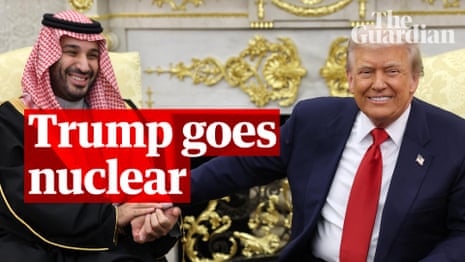
24:00
Trump gifts Saudi Arabia a nuclear win | Politics Weekly America
The IAEA’s “Additional Protocol” has been implemented by dozens of countries, and was one of the requirements of the Obama-era nuclear deal with Iran from which Trump withdrew in 2018. It involves inspection and verification to ensure that countries are using nuclear material solely for peaceful purposes.
When the US struck a similar deal with the United Arab Emirates, the UAE agreed not to seek enrichment or process spent atomic fuel, a measure that became known as the “gold standard” for nations wanting atomic power. The Saudi-US agreement reportedly does not include this gold standard.
Can this deal be blocked?
Opponents have long argued that providing Saudi Arabia with a domestic nuclear program will set off a race across the Middle East for other countries to pursue similar capabilities. Israel – which is known to have a secretive nuclear weapons program – has reportedly raised concerns that the deal could launch a regional arms race.
Democrats in Congress have expressed similar concerns. Senator Chris Murphy said the agreement would “set off a nuclear race in the region, further disincentivizing Iran from limiting its own program”.
However, Murphy and his colleagues in Congress will probably have difficulty blocking the deal. The deal is expected to be submitted to Congress for approval in the coming days, but to block the agreement, Congress would need to pass a joint resolution and have a two-thirds majority to override the president’s veto.
-=-=
-=-=
'Just a matter of time' before Trump family business seals Saudi deal
an 12 25
GGL 11 25
AI Overview
Saudi Arabia maintains a
cautious and risk-averse stance toward cryptocurrencies, which lack formal legal recognition and are not regulated by official financial institutions. The Saudi Central Bank (SAMA) and the Capital Market Authority (CMA) have issued warnings about the significant risks involved.
Regulatory Status
- Lack of Recognition: As of late 2024/early 2025, Saudi Arabia has not enacted specific legislation to govern cryptocurrencies, and they lack formal legal tender status.
- Official Warnings: The Standing Committee for Awareness on Dealing in Securities Activities in the Unauthorized Foreign Exchange Market, which includes SAMA and the Ministry of Finance, has warned against dealing in or investing in virtual currencies due to the absence of government supervision.
- AML/CFT Laws: While not explicitly mentioned, the broad definitions of "funds" in the Anti-Money Laundering (AML) and Combating the Financing of Terrorism (CFT) laws are understood to include digital assets, subjecting them to these stringent regulations.
Industry Developments & Future Outlook
Despite the lack of official recognition for public cryptocurrencies like Bitcoin, the Kingdom is actively exploring blockchain technology and the potential for a state-backed digital currency:
- Central Bank Digital Currency (CBDC): The Saudi Central Bank has joined Project mBridge, a central bank digital currency (CBDC) collaboration with the Bank for International Settlements (BIS) and the central banks of China, the UAE, and Thailand, to explore wholesale CBDC transactions.
- Fintech & Stablecoins: Saudi officials have indicated a growing interest in the fintech sector and are looking into the potential launch of regulated stablecoins to enhance the financial system's speed and efficiency.
- Private Sector Engagement: Saudi entities, such as the real estate developer Dar Global (an arm of Dar Al Arkan), are involved in projects that use crypto-like funding mechanisms, such as tokenizing real estate developments for investors.
- Growing User Base: Despite regulatory caution, there is a growing interest in cryptocurrencies among the Saudi populace, with a projected user base of over 7 million by 2026, and a variety of crypto apps see significant download and active user rates.
Legality for Individuals
While financial institutions are officially barred from dealing in cryptocurrencies, individual ownership and trading are not explicitly banned under law, though they are conducted at the individual's own risk and outside of the formal financial system. Some global exchanges offer services to users in Saudi Arabia using various payment methods, but local banks may caution customers against such transactions.
Islamic Finance Perspective
The question of whether cryptocurrency is "halal" (permissible) or "haram" (forbidden) under Islamic law is a subject of debate among Islamic scholars, with varying opinions based on the specific use cases and adherence to principles like avoiding interest (Riba), excessive uncertainty (Gharar), and gambling (Maysir).
GGL 11 25
[### Next Trump Project Opens More Doors for New Investors

The New York Times
https://www.nytimes.com › U.S. › Politics](https://www.nytimes.com/2025/11/17/us/politics/trump-saudi-arabia-deals-cryptocurrency.html)
1 day ago — The Trump family business and its Saudi-based development partner, Dar Al Arkan, have a new project drawing on two of the family's most ...
[### Saudi Arabia: A crypto sleeping giant is cautiously waking up Shorthandstories.com
https://i-mena.shorthandstories.com › saudi-arabia-crypto...](https://i-mena.shorthandstories.com/saudi-arabia-crypto-chief-or-cbdc-at-scale/)
Saudi regulators are making moves to cautiously usher crypto into the Kingdom, but it might not be at Saudi's Central Bank.
[### Saudi developer wants to sell Trump hotel tokens to US ...

Yahoo Finance
https://finance.yahoo.com › news › saudi-developer-wa...](https://finance.yahoo.com/news/saudi-developer-wants-sell-trump-154852061.html)
6 hours ago — Saudi developer wants to sell Trump hotel tokens to US retail investors. Ziad El Chaar, Chief Excutive Officer of DarGlobal, attends an ...
---
AN 11 25
Trump 'just giving the Saudis everything': former CIA counter-terrorism expert
AN BADASH
Despite his own CIA’s investigation that found that Crown Prince Mohammed bin Salman approved the operation that resulted in the brutal murder of Washington Post journalist Jamal Khashoggi, President Donald Trump defended MBS and sharply criticized a reporter asking the crown prince about the killing.
“He’s done a phenomenal job,” President Trump told ABC News Chief White House Correspondent Mary Bruce when she asked about the murder.
“You’re mentioning somebody that was extremely controversial,” Trump said of Khashoggi, whose gruesome 2018 killing was investigated by the CIA in a report declassified in February 2021, just after President Joe Biden took office.
READ MORE: Trump Blasted After Drawing Line in the Sand in High-Stakes Health Care Clash
“A lot of people didn’t like that gentleman that you’re talking about, whether you like him or didn’t like him,” Trump said.
“Things happen, but he knew nothing about it,” the president insisted, defending the crown prince who is the de facto ruler of Saudi Arabia, as The Washington Post reported.
“And we can leave it at that. You don’t have to embarrass our guest by asking a question like that.”
CNN White House reporter Alayna Treene described Trump as “furious,” and stated that he “tried to shut down questions” from Bruce “about US intelligence (the CIA assessment was done during Trump’s first term) having concluded that MBS likely ordered the brutal murder of journalist Jamal Khashoggi.”
CNN Chief White House Correspondent Kaitlan Collins called it “a stunning moment in the Oval Office,” and also noted that “the CIA — under Trump, in his first term — found that the crown prince ordered it.”
The declassified CIA report stated, “We assess that Saudi Arabia’s Crown Prince Muhammad bin Salman approved an operation in Istanbul, Turkey to capture or kill Saudi journalist Jamal Khashoggi.”
READ MORE: GOP Fractures Reveal Fierce Internal Fight Over Post-Trump Identity
“We base this assessment on the Crown Prince’s control of decisionmaking in the Kingdom, the direct involvement of a key adviser and members of Muhammad bin Salman’s protective detail in the operation, and the Crown Prince’s support for using violent measures to silence dissidents abroad, including Khashoggi,” the report continued.
“Since 2017, the Crown Prince has had absolute control of the Kingdom’s security and intelligence organizations, making it highly unlikely that Saudi officials would have carried out an operation of this nature without the Crown Prince’s authorization.”
In 2018, The Washington Post reported, “The CIA has concluded that Saudi Crown Prince Mohammed bin Salman ordered the assassination of journalist Jamal Khashoggi in Istanbul last month, contradicting the Saudi government’s claims that he was not involved in the killing, according to people familiar with the matter.”
---
---}:
an 5 25
Donald Trump insists that he is maintaining a strict distance between his presidency and his business interests, and he maintains that he is avoiding conflicts of interest by letting his son, Eric Trump, handle the Trump Organization.
But in an article published by the New York Times on May 5, journalists Eric Lipton and David Yaffe-Bellany report that during Trump's presidency, his business is making more foreign deals than ever.
The deals, according to Lipton and Yaffe-Bellany, are being orchestrated by Eric Trump and his older brother, Donald Trump Jr.
READ MORE:George Washington would have thrown up
"It is a rush to cash in that involves billions of dollars with few precedents in American history," the Times reporters explain. "A luxury hotel in Dubai. A second high-end residential tower in Jeddah, Saudi Arabia. Two cryptocurrency ventures based in the United States. A new golf course and villa complex in Qatar. And a new private club in Washington. In many cases, these new deals promoted over the last week will personally benefit not only Eric Trump and Donald Trump Jr., but also, President Trump himself."
This "marathon of deal making," according to Lipton and Yaffe-Bellany, "has been so rapid that many elements have drawn limited public attention in the United States, despite most of it being out in the open."
Trump White House spokesperson Anna Kelly told the Times, "The president's assets are in a trust managed by his children. There are no conflicts of interest."
But author Douglas Brinkley, a history professor at Rice University in Houston, said of the Trump family's foreign deals, "There’s nothing like it."
READ MORE:'Fundamentally dishonest': Liz Cheney reemerges to blast Trump and 'personality cult' GOP
*Read the full New York Times article at this link (subscription required).
==
===
no lnx
alternet-
Americans are doubling down on the thing that hurts them the most
Thom Hartmann January 07, 2025
Yesterday, Congress certified the electoral vote count making a billionaire president again, starting after he’s sworn in on January 20th.
Yes, we chose a billionaire. Again. After other billionaires spent billions to convince us to make that choice.
As you’re reading these words, billionaires from America and around the world are making pilgrimages to his shabby golf motel to kiss our upcoming billionaire president’s ass and hand him envelopes with $1 million checks that represent a few hours (at most) of income for most of them or their companies.
Meanwhile, our billionaire president-in-waiting is packing his cabinet — the heads of all of the most important federal agencies — with even more billionaires. This is all being celebrated over on billionaire-owned Fox “News” and on billionaire-owned hate radio networks, as well as in the billionaire-owned Washington Post, LA Times, and the roughly half of American local newspapers owned by billionaire hedge funds.
Other countries enjoy benefits like free healthcare and college; modern mass transit; and affordable housing, food, and drugs.
They also have inexpensive internet and phone service without companies listening in and selling their information, schools that don’t even need to mention school shooters, and streets and parks filled with pedestrians and children instead of tents for the homeless.
Additionally, they benefit from renewable electricity that gets cheaper every year while cleaning their environment.
We, on the other hand, have the world‘s largest collection of billionaires.
Most Americans probably didn’t realize this was the choice they were making in the election of 1980 when Reagan and Bush promised “Morning In America.”
We’d been battered by that generation’s version of the Covid shock: when Arab nations got together to punish us for taking Israel’s side and cut off our oil supply in 1973, it threw us into a decade-long period of “stagflation” (high unemployment and inflation).
Nixon couldn’t handle it; odd/even days at the gas pumps merely infuriated drivers.
Jerry Ford couldn’t handle it; his “WIN” (Whip Inflation Now) buttons were a sad joke that guaranteed he’d become a one-term president.
Jimmy Carter made some good progress — particularly with his plan for a “national solar bank” that would provide 20% of the country’s energy by 2000 — but Reagan’s campaign cut a deal with Iran to hold the American hostages until after the 1980 election, ending Jimmy’s hopes for a second term.
By the time Reagan ran for office in 1980, inflation was still a problem; it was an echo of the 1973 oil embargo, amplified by a second oil shock resulting from the 1979 Iranian revolution, again exploding American gasoline prices and cutting economic growth.
By that time, as I detail in The Hidden History of the American Dream, we were desperate.
Reagan — an even more talented actor than Trump (who NBC spent millions training to act for TV cameras) — convinced us he had it all figured out. At first, his promises were vague; something about supply-side economics, “trickle down,” and Laffer Curves that nobody really understood (and George HW Bush initially called “Voodoo Economics”).
Once he took office, America watched with hope and some trepidation as Reagan turned our economy inside-out, massively cut taxes on the country’s thirteen billionaires, repeatedly raised taxes on millions of working-class people, cut and taxed Social Security, stopped enforcing our anti-monopoly laws, gutted federal funds for education, killed off two-thirds of the country’s unions, and, negotiating the GATT and NAFTA agreements, beginning the process of offshoring over 60,000 factories.
Reagan never got inflation below 4 percent and he almost tripled the national debt (from $800 billion to roughly $2.2 trillion), but throwing around those trillions in borrowed money made it seem like the economy was getting better even as wages were frozen by monopolists and a lack of union representation.
And that’s how we got the billionaires.
Back in 1980, nobody in America was rich enough to shoot himself into space on a penis-shaped rocket, and superyachts were a fantasy. The nation’s richest man was shipping magnate Daniel Ludwig, whose net worth — at just a bit below $2 billion — wouldn’t even qualify him for today’s Forbes 500 list; he lived a low-key life and, like most wealthy men of that era, didn’t much involve himself in politics (there were laws back then against rich people subsidizing federal judges or politicians).
But Reagan’s changes in the tax code and destruction of unions led to a 50,000 billion dollar ($50 trillion) transfer of wealth from the pensions, homes, incomes, and bank accounts of middle class Americans into the money bins of the morbidly rich between 1981 and today.
We had only 13 billionaires from 1980 to 1986 but — with Reagan’s final tax cut which took the rate on multimillion-dollar incomes from over 70% down to 28% — that number began to explode. By 1990, there were 99 billionaires in America; today there are over 800 of them, representing a more-than-50-fold increase in just four decades.
Not content with simply grabbing much of America’s wealth for themselves, a handful of our billionaires next reached out for control of our government.
They created media empires, think tanks, and policy centers, both writing and then pushing their own legislation that was dutifully carried into law by politicians they’d bought off. They outright purchased the entire GOP, along with a large handful of elected “problem solver” Democrats.
They set up institutions to seize control of our independent judiciary; five corrupt Republicans on the Supreme Court returned the favor by fully legalizing billionaires buying elections with their Citizens United decision in 2010.
Total spending on federal elections — for president, the House, and the Senate combined — was $92 million in 1980, $103 million in 1984, and $324 million in 1988. How quaint!
Just one billionaire — Elon Musk — spent over a quarter billion dollars putting Trump into office this past fall. Other billionaires jumped in, pushing total 2024 spending over $7 billion (and that doesn’t count dark money, which is almost certainly billions more).
Saudi billionaires jumped in to help billionaire Musk purchase Twitter for $44 billion, turning it, along with an alleged army of Russian-billionaire-funded trolls pretending to be Americans, into a massive megaphone to elect billionaire-friendly Republicans including billionaire Trump.
They’re now building “conservative” colleges and primary schools, funded with state tax money thanks to bought-off politicians, that will educate the generation coming up that billionaires are a necessary and benevolent force in the world.
And we don’t talk about our nation’s billionaire problem because billionaires own or control so many of the nation’s channels of news and discussion from social media to television networks to newspapers.
Even simple, traditional political endorsements get censored; G-d forbid somebody (who won a Pulitzer!) should draw a cartoon showing media billionaires bowing down to our new billionaire president. Or speak out on billionaire-owned social media.
Maybe one day America will join the other 37 OECD “rich” nations in offering to our average- and low-income people nearly-free college and healthcare, removing guns from our streets and schools, housing the homeless, and building modern mass transit.
Maybe our middle class will again become socially and economically mobile, we’ll rid ourselves of over $2 trillion in student debt, and we’ll never again be the only developed country in the world where people lose everything to bankruptcy because somebody in the family got sick.
For at least the next four years, however, we must content ourselves with the proud knowledge that we have more billionaires than any other country in the world. That they now run out government, with their top 1 percent owning fully 40.5 percent of our nation’s entire wealth ($43.45 trillion). As the Forbes “Capitalist Tool” headline gloats: “The 3 Richest Americans Hold More Wealth Than Bottom 50% Of The Country.”
Yep, sure enough: We’re number one! And Trump and the GOP promise to do everything they can to keep it that way.
NOW READ: The criminals will soon be in charge: How Joe Biden helps normalize evil
===
Inside the Saudi scheme for screwing Biden's election hopes - Alternet.org
an 3 24
Trump's administration had plenty of turnover during his four years in the White House, but one person who stayed with Trump throughout most of his term was investment banker Steve Mnuchin. The former treasury secretary arrived in February 2017 — the month after Trump was sworn in as president — and stayed with him until January 2021.
Since leaving the White House, Mnuchin, now 61, has kept busy in the private sector — including, according to Bloomberg News reporters Hannah Levitt and Bre Bradham, a major banking deal in 2024.
Mnuchin, they report, has been "mining profits from a struggling U.S. bank": New York Community Bancorp (NYCB).
Levitt and Bradham explain, "Mnuchin's Liberty Strategic Capital led a group of investors that injected more than $1 billion into New York Community Bancorp while effectively taking control of the ailing lender to apartment landlords. The deal, announced Wednesday, (March 6), installed former Comptroller of the Currency Joseph Otting as chief executive officer."
That "intervention," according to Levitt and Bradham, "sent the troubled lender's stock soaring, giving their coalition an instant paper profit and a shot at earning billions more."
The reporters note that Mnuchin and Otting have "a track record of stirring up controversy as they chase returns."
"Before their posts in Trump's administration," according to the Bloomberg News journalists, "Mnuchin led an investor group that bought failed mortgage lender IndyMac after the 2008 financial crisis and, rebranding it OneWest, installed Otting as CEO. By the time they cashed out at more than double their purchase price, the lender was beset with accusations it had hurt communities as a 'foreclosure machine.'"
READ MORE:'That is the question': Trump ally admits campaign not sure how to attack Biden on economy
Levitt and Bradham add that Mnuchin "later irked his critics again after leaving the Treasury and raising money for Liberty from sovereign wealth funds in the Middle East, including Saudi Arabia's Public Investment Fund."
"Now, his firm has landed this year's highest-profile U.S. regional bank deal," they report. "Unlike IndyMac, which got into trouble making residential mortgages, NYCB's woes stemmed from financing office buildings and apartment complexes. Last week, the lender's disclosure of 'material weaknesses' in its monitoring of loans pushed down its shares and credit ratings even further. As news emerged Wednesday that NYCB was seeking fresh equity, the stock dipped to $1.70 — from more than $13 last year."
READ MORE:Why Jamie Dimon loves Trump's policies
*Read Bloomberg's full report at this link (subscription needed).
---
https://www.alternet.org/alternet-exclusives/investigate-mtg/
---
accusations are confession/ projection:
an 1 24
badash
while serving as President of the United States, Donald Trump’s businesses accepted millions of dollars from numerous foreign governments, including China and Saudi Arabia – the very acts House Republicans have baselessly alleged Joe Biden performed as Vice President and as a private citizen before being elected President, despite having provided no actual proof.
“Donald J. Trump’s businesses received at least $7.8 million from 20 foreign governments during his presidency, according to new documents released by House Democrats on Thursday that show how much he received from overseas transactions while he was in the White House, most of it from China,” The New York Times reported Thursday. The paper calls it “concrete evidence that the former president engaged in the kind of conduct that House Republicans have labored, so far unsuccessfully, to prove that President Biden did as they work to build an impeachment case against him.”
The Wall Street Journal adds that the “report, underpinned by documents provided to House investigators by the accounting firm Mazars USA, offers a fuller picture of how Trump’s businesses benefited during his presidency as foreign officials may have tried to curry favor with Trump.”
In a break with tradition, as President, Donald Trump’s first foreign trip was to Saudi Arabia (video below), in May of 2017. One month earlier, Trump met with China’s President Xi at Mar-a-Lago. Ivanka Trump received patents from China that same day.
READ MORE: CNN Host Debunks Mike Johnson’s False Hundreds of ‘Known Terrorists’ Claim in Real Time
The 156-page report, “White House for Sale: How Princes, Prime Ministers, and Premiers Paid Off President Trump,” was produced by the House Democrats on the Oversight Committee under Ranking Member Jamie Raskin (D-MD), a former constitutional law professor. He calls the findings and conclusions in the report “astounding,” and says “they demand urgent action by the Congress and by the American people.”
The Journal offers staggering details from the report.
“Hundreds of pages of expenses seen by the Journal include at least $210,000 in real estate and lodging fees by Saudi Arabia in 2018, the same year Trump publicly doubted U.S. intelligence assessments that Saudi Crown Prince Mohammad bin Salman ordered the murder and dismemberment of Washington Post columnist Jamal Khashoggi,” the WSJ writes. “And a few months earlier, a Saudi delegation paid $2,000 for coffee table flowers and towers of cookies at the same hotel.”
“Newly disclosed receipts also show that Hainan Airlines Holding, which then had connections to China’s leadership, incurred $195,662 in charges at the Trump International Hotel in Las Vegas during a 14-month period beginning days before Trump was elected in 2016,” the Journal adds. “Malaysia paid for a $10,000-per-night suite in Trump’s Washington hotel in September 2017 for then-Prime Minister Najib Razak while he was under a U.S. investigation for his role in a multibillion-dollar corruption scandal that ultimately helped topple his government. Malaysia’s spending caused a 70% jump in average nightly room revenue at Trump’s Washington hotel compared with other nights that month, the report said.”
READ MORE: ‘Outlandish and Feral’: Trump Plans to Turn DC Trial Into Conspiracy-Fueled Reality TV Show
Ranking Member Raskin writes in the report: “By elevating his personal financial interests and the policy priorities of corrupt foreign powers over the American public interest, former President Trump violated both the clear commands of the Constitution and the careful precedent set and observed by every previous Commander-in-Chief.”
“Article I, Section 9, Clause 8 of the Constitution forbids the President to accept money payments or gifts ‘of any kind whatever’ from foreign governments and monarchs unless he obtains ‘the Consent of the Congress’ to do so,” he observes. “Yet Donald Trump, while holding the office of president, used his business entities to pocket millions of dollars from foreign states and royalty and never once went to Congress to seek its consent. This report sets forth the records showing foreign government money—and all the spoils from royals we can find—pouring into hotels and buildings that the President continued to own during his presidency, all in direct violation of the Constitutional prohibition.”
Watch video of Trump being honored by Saudi Arabia during his first foreign trip below or at this link.
---
---
massacre
https://www.alternet.org/like-fields-report-says-saudi-border-guards-killed-hundreds-of-migrants/
---
'I’ve never seen anything like it': Economic analyst breaks down origin of Jared Kushner’s $3 billion profit
Maya BoddieAugust 14, 2023
During Monday's segment of MSNBC's Morning Joe, economic analyst Steve Rattner left panelists astounded after providing an in-depth look into the root of ex-President Donald Trump's son-in-law Jared Kushner's "$3.1 billion cash haul."
Rattner shared a chart displaying a breakdown of the sources of Kushner's money via Twitter Monday, writing, "Jared Kushner spent much of his White House tenure cozying up to MBS [Mortgage-Backed Securities] & Saudi Arabia. Six months after leaving Washington, his private equity firm landed $2 billion in investments from the Saudi sovereign wealth fund."
During the show segment, MSNBC host Jonathan Lemire noted howKushner's "background in real estate" does not exactly qualify him "as a hedge fund magnate or peace broker in the Middle East."
"You're right, Jonathan. Jared Kushner did work in the White House," Rattner said. "He worked very hard. It's becoming less clear what he worked hard at, because after he left the White House, he went out and raised $3.1 billion -- that's billion with a 'b' -- for a private equity fund and he's not a private equity guy, he is a real estate guy. So where does the money come from? Some of it we know from filing. Some from press reports.What we know for a fact is that he raised $3.1 billion and only about $30 million of it actually came from investors in the United States all the rest of it is foreign money. And of that foreign money, $2 billion came from the Saudis."
The analyst emphasized, "I've been in this business 40 years. I've never seen somebody get two-thirds of their money from a single investor. Usually a single investor might be a few percent of the fund, might be 5 percent, occasionally 10 percent — I've never seen this. Another $200 million we believe came from Qatar and another $200 million from the United Arab Emirates and then the $625 million from foreign investors that we don't even know who they are. So what was Jared Kushner doing in the White House? And, by the way as a fun fact, on January 6, the famous January 6, Jared Kushner was in the Middle East."
Morning Joe panelist Elise Jordan then asked Rattner, "There's not much out there on how Jared has actually been able to execute his funding. He has all this money, but his background is not in private equity andI've seen only one news report of a small European investment. He's sitting on all this money. Are the Saudis investing with him just to hedge their bets politically in case Trump comes back into office?"
Rattner emphasized, "We haven't seen him do a lot with this money. He has hired some people, I do know that. I've seen nothing else about what he's actually done with the money. It is normal to invest this money over a period of several years, so I don't think we can draw a firm conclusion yet. But, again, we're going back to a guy who's a real estate guy, and frankly not a particularly good one at that, who's suddenly got $3 billion trying to do private equity deals competing against people who've been in this business for a long time. And I wouldn't, if I were the Saudis, count on making a lot of money from this any time soon."
Rattner concluded, "U.S. private equity firms still raise the vast bulk of their money from U.S. investors. This is extraordinary — unprecedented — I've never seen anything like it."
READ MORE: Bombshell testimony links Jared Kushner to stop-the-steal fundraising cash: legal analyst
Watch the video below or at this link.
READ MORE: 'Gonna end this family grift': Christie hits Trump over Kushner-Saudi relationship
FROM YOUR SITE ARTICLES
Here's why Jared Kushner's plan for widespread COVID-19 testing ‘just went poof into thin air’ ›
Watch: Jared Kushner reveals what Donald Trump tried to omit from his post-insurrection address ›
Ivanka Trump and Jared Kushner no longer affiliated with Donald Trump's political endeavors: report ›
RELATED ARTICLES AROUND THE WEB
Who Is Jared Kushner? | The New Yorker ›
Saudi Crown Prince Boasted That Jared Kushner Was “In His Pocket” ›
Jared Kushner Named Senior White House Adviser to Donald ... ›
---
---
https://www.alternet.org/saudi-farming-water-crops-arizona/
---
---
WTF?!
an 1 23
:{This is unacceptable': Mike Pompeo uses new book to criticize murdered journalist Jamal Khashoggi:(style="font-family:Merriweather"):}:
January 24, 2023
Former Secretary of State and potential 2024 presidential candidate Mike Pompeo heavily criticized Jamal Khashoggi in his upcoming book, NBC reports.
Khashoggi, who was based in the U.S., was known to...
---
---
judd legum 11 22
...former U.S. President Donald Trump and Yasir al-Rumayyan, head of the sovereign wealth fund of Saudi Arabia (Photo by Cliff Hawkins/Getty Images)
On Tuesday night, Trump announced he was running for president for the third time. The coverage of his announcement was broadly critical, focusing on the poor results of the candidates he endorsed in the 2022 midterms. Reports also noted some other issues complicating Trump's run, including his role in fomenting an insurrection and the federal criminal investigation into his handling of classified documents.
These stories virtually ignored one of the most significant developments since Trump left the White House: his expanding financial relationship with Saudi Arabia. Since Trump left office, entities controlled by the Saudi government, a repressive regime responsible for the murder of U.S.-based journalist Jamal Khashoggi, have sent billions to Trump and his family members.
Trump's candidacy for president raises the prospect of a major party nominee that is on the payroll of a foreign government.
The Saudi Public Investment Fund (PIF) has spent billions creating LIV, a new golf tour. Two of LIV's eight tournaments in 2022 were held at Trump-owned golf courses, including the season-ending championship at Trump Doral in Florida. At one event, Trump participated in the pro-am tournament with two of LIV's highest-profile players — Dustin Johnson and Bryson DeChambeau — and Yasir Al-Rumayyan, the governor of PIF.
PIF also funds the AramcoTeam Series on the Ladies European Tour. In October 2022, the series held an event at Trump's Ferry Point Golf Course in New York. Another LIV event will reportedly be held at Trump's golf course in Virginia in May 2023. The tournaments at Trump's courses doubled as political events, with right-wing luminaries like Tucker Carlson and Congresswoman Marjorie Taylor Greene (R-GA) in attendance.[twt vid]
these Saudi-financed tournaments were a critical injection of money and exposure for Trump's courses. The PGA Tour ended its annual tournament at Trump Doral in 2017 and moved 2022 PGA Championship from Trump Bedminister in New Jersey after the attack on the Capitol on January 6, 2021.
The Saudis, through PIF, paid Trump an undisclosed sum for the use of his courses. Trump, for his part, was very happy about the deal. "It’s big time and it’s big-time money," Trump said in October. "It’s unlimited money. They love golf, and the Saudis have done a fantastic job." Trump also casually dismissed Saudi Arabia's record of human rights abuses. "We have human rights issues in this country, too," Trump said.
Due to the widespread perception that LIV is an effort to"sports wash" Saudi Arabia's reputation, LIV has struggled to find a TV network willing to broadcast its tournaments. In August, the Sports Business Journal reported that Trump's son-in-law, Jared Kushner, was making calls "to try to help the controversial Saudi-backed LIV Golf tour secure a media-rights deal." Kushner reportedly "called one of the top execs at Paramount, which owns CBS, to try to jump-start negotiations."
The financial dependence of Trump and his family on Saudi Arabia extends far beyond LIV.
The $2 billion payback
After leaving the White House, Kushner sought investors for a $7 billion private equity fund. Kushner had no prior experience managing private equity. Prior to entering the White House, his most significant business experience was nearly bankrupting his family real estate company by purchasing an aging office building in New York for $1.8 billion.
Kushner pitched the Saudi PIF. The committee at the PIF responsible for vetting investments recommended rejecting Kushner. An internal document, published by the New York Times, summarized the objections:
[O]bjections included: “the inexperience of the Affinity Fund management”; the possibility that the kingdom would be responsible for “the bulk of the investment and risk”; due diligence on the fledgling firm’s operations that found them “unsatisfactory in all aspects”; a proposed asset management fee that “seems excessive”; and “public relations risks” from Mr. Kushner’s prior role as a senior adviser to his father-in-law, former President Donald J. Trump, according to minutes of the panel’s meeting last June 30.
The full board of PIF, led by Saudi Crown Prince Mohammed bin Salman, overruled the committee's recommendation and decided to invest $2 billion. Under the deal, Kushner will receive a $25 million annual management fee, plus a percentage of any profits.
Some members of the PIF board recommended reducing the size of the investment to limit the risk. But that proposal was rejected because the purpose of the investment, according to internal documents, was "to form a strategic relationship with the Affinity Partners Fund and its founder, Jared Kushner." Making a smaller investment, "may negatively or fundamentally affect the framework of the agreed strategic and commercial relationship."
Ivanka Trump did not attend her father's campaign announcement at Mar-a-Lago. Afterward, she released a statement, saying she is prioritizing "my young children and the private life we are creating as a family." She said that she will no longer "be involved in politics." Kushner, Ivanka's husband, was in attendance.
Another Trump ally, former Treasury Secretary Steven Mnuchin, started his own private equity fund and raised $2.5 billion, including a large investment by PIF. Mnuchin was "one of the first Western government officials to meet with Saudi Crown Prince Mohammed Bin Salman, chair of the [PIF], in the wake of the murder of journalist Jamal Khashoggi."
Branding a $1.6 billion real estate development
Earlier this week, Trump "struck a deal with a Saudi-based real estate company to license its name to a housing and golf complex that will be built in Oman." The agreement was made "with Dar Al Arkan, one of Saudi Arabia’s largest real estate companies, for the project." Under the arrangement, Trump will receive "a cut of condo sales or golf course revenue in exchange for allowing its name to be used." The proceeds could be considerable since the project is estimated to cost $1.6 billion and "will include an estimated 3,500 residential units, luxury retail and 450 rooms at the hotels."
While Dar Al Arkan is technically a private company, it is closely associated with the Saudi government. The first page of its annual report features the Saudi King and Crown Prince. Robert Weissman, the president of Public Citizen, called the arrangement "another in a series of sweetheart deals from the Saudi government to the Trump family."
---
---
---
https://www.azcentral.com/story/opinion/op-ed/2022/09/28/saudi-firm-isnt-only-investor-draining-rural-arizona-water/8124438001/
Arizona Republic recently reported about the bipartisan outrage regarding foreign investors exploiting, or arguably squandering, Arizona’s water resources (“Arizona AG, governor candidates call for Saudi Arabian water leases investigation,” Aug. 30).
The anger is justified, but it is important to remember that this problem extends far beyond a single corporation growing alfalfa.
It is a statewide concern.
Though it is easy to focus on foreign actors, aggressive investor-owned outfits have been threatening water resources all over Arizona.
Equity firms, cities could drain rural Arizona
In Cochise County, for example, intensive drilling for corporate agriculture has jeopardized the livelihood of residents and imperiled small farms.
On the opposite corner of the state in Mohave County, so much water has been withdrawn for investor-owned large-scale farming operations that the future economic development of the region is in doubt.
Meanwhile, in La Paz County, a private equity firm is buying up land for the sole purpose of selling the water rights to a suburb of Phoenix.
This last example brings up another point. Fondomonte, the corporation which is the target of the candidates’ outrage, is using an aquifer that, according to the article, could be tapped “as a future water source for metro Phoenix and other urban areas.”
The controversy:Inside Arizona's sweet deal to a Saudi farm
The implication here is that the concern is not for the residents of La Paz County, but for a suburban town more than 150 miles away over mountains and desert valleys.
The residents of La Paz County have their own needs and their own vision of their future as a community, and these deserve at least some consideration in the discussion of water. The wells will be just as dry whether local water resources are monopolized by corporate farms or are redirected elsewhere.
Rural areas need the power to manage their water
The emphasis on foreign boogeymen and the needs of one metro area tends to ignore the larger problems here, chiefly the fact that the use of groundwater is largely unregulated in much of the state.
Rural communities are even limited in their capacity for land-use planning. Local governments in rural areas do not have the same tools for comprehensive planning available to them that those in Arizona’s urban counties do, so measures to control water use by limiting certain development are not feasible.
An effort to address this shortcoming in the last legislative session by creating a system of “rural management areas” to oversee local regulation of groundwater use stalled in spite of broad bipartisan support.
It calls for action on the issue from elected officials and community leaders across the state.
An appropriation of $440 million for conservation and water reliability projects, passed in the waning hours of the session, is a significant step. But a more comprehensive approach, including planning and regulation, is necessary to sustain whatever progress we can make.
This conversation must continue, and as Arizona revisits the way it manages this precious resource, we must include the empowerment of local communities to determine their water future.
Arizona native Tom Prezelski is a program manager for Rural Arizona Action, a nonprofit organization based in Coolidge that works to boost voter empowerment and civic engagement. He is a former state lawmaker. On Twitter: @tomprezelski.
---
---
thom an 8 22
...
It adds, detailing Trump’s specific obstruction of justice crimes:
These actions ranged from efforts to remove the Special Counsel and to reverse the effect of the Attorney General’s recusal; to the attempted use of official power to limit the scope of the investigation; to direct and indirect contacts with witnesses with the potential to influence their testimony.
Viewing the acts collectively can help to illuminate their significance. For example, the President’s direction to McGahn to have the Special Counsel removed was followed almost immediately by his direction to Lewandowski to tell the Attorney General to limit the scope of the Russia investigation to prospective election-interference only—a temporal connection that suggests that both acts were taken with a related purpose with respect to the investigation.
There are, after all, credible assertions that when Trump was elected, members of Russian intelligence and Putin’s inner circle were literally partying in Moscow, explicitly celebrating a victory they truly believed they helped make happen.
In his first months in office, Trump outed an Israeli spy to the Russian Ambassador, resulting in MOSAD having to “burn” (relocate, change identity of) that spy. That, in turn, prompted the CIA to worry that a longtime US spy buried deep in the Kremlin was similarly vulnerable to Trump handing him over to Putin.
As CNN noted when the story leaked two years later:
The source was considered the highest level source for the US inside the Kremlin, high up in the national security infrastructure, according to the source familiar with the matter and a former senior intelligence official.
According to CNN’s sources, the spy had access to Putin and could even provide images of documents on the Russian leader’s desk.
The CIA concluded that the risk Trump had burned the spy was so great that, at massive loss to US intelligence abilities that may have helped forestall the invasion of Ukraine, we pulled the spy out of Russia in 2017.
Similarly, when they met in Helsinki, Trump and Putin talked in private for several hours and Trump ordered his translators’ notes destroyed; there is also concern that much of their conversation was done out of the hearing of the US’s translator (Putin is alsofluent in English and German) who may have been relegated to a distant part of the rather large room in which they met.
Things were picking up in 2019, as Putin was planning his invasion of Ukraine while Trump was preparing for the 2020 election.
- On July 31, Trump had another private conversation with Putin. The White House told Congress and the press that they discussed “wildfires” and “trade between the nations.” No droids in this car…
- The following week, on August 2nd, The Daily Beast’sBetsy Swan reported that Trump had just asked the Office of the Director of National Intelligence for a list of all its employees (including all our “spies”) who had worked there more than 90 days, and the request had intelligence officials experiencing “disquiet.”
- Within a year, The New York Timesran a story with the headline: “Captured, Killed or Compromised: C.I.A. Admits to Losing Dozens of Informants.” The CIA then alerted spies around the world that their identities had probably been compromised, apparently by Donald Trump himself.
Also in 2019, when the international press verified that Putin was paying the Taliban a bounty to kill American service members in Afghanistan (and 4 had died as a result), Trump refused to demand the practice stop, a possible sign that Putin ran him, not the other way around.
As The New York Times noted at the time:
Mr. Trump defended himself by denying the Times report that he had been briefed on the intelligence... But leading congressional Democrats and some Republicans demanded a response to Russia that, according to officials, the administration has yet to authorize.
Instead of stopping Putin, Trump shut down every US airbase in Afghanistan except one (there were about a dozen), crippling incoming President Biden’s ability to extract US assets from the country in an orderly fashion.
In July 2019, Trump had conversations with five foreign leaders during and just before a visit to Mar-a-Lago; they included Putin and the Emir of Qatar.
In one of those conversations, according to a high-level US Intelligence source, Trump made “promises” to a “world leader” that were so alarming it provoked a national security scramble across multiple agencies.
As The Washington Post noted in an article titled “Trump’s communications with foreign leader are part of whistleblower complaint that spurred standoff between spy chief and Congress":
Intelligence Community Inspector General Michael Atkinson determined that the complaint [against Trump] was credible and troubling enough to be considered a matter of ‘urgent concern,’ a legal threshold that requires notification of congressional oversight committees.
Along his journey toward converting America into a full-blown oligarchy (as I detail in *_{The Hidden History of American Oligarchy: Reclaiming Our Democracy from the Ruling Class}_*), Trump has picked up quite a few democracy-skeptical allies.
As early as 2018, for example, Senator Rand Paul made a solo trip to Moscow to personally hand-deliver a private note from Trump to Putin. Its contents are still unknown.
Senator Paul has also consistently taken Trump’s side with regard to the 2020 election and, when the FBI searched Mar-a-Lago this month, responded with a call for the repeal of the Espionage Act. Perhaps he had ambitious plans for a role in the Trump administration after the planned end of American democracy?
With that backstory, consider more contemporary events to see if they fit together.
In January of last year Trump stole and moved to Florida information that, multiple sources assert, would reveal the identities of many of our spies, as well as our nuclear plans and capabilities.
Three months later, in March of 2021, Jared Kushner filed papers showing that his brand new investment company — against the advice of the Saudi government but at MBS’s order — had received over $2 billion from the Kingdom.
It’s still unknown if or how much money the Kingdom gave to Trump himself, presumably through the dark offshore accounts common among billionaires like Trump.
This was not the first time Kushner had apparently altered US foreign policy or shared valuable US secrets with Middle East players in exchange for large quantities of cash that flowed directly to him or other members of the Trump family.
Kushner was struggling with the ticking time bomb of a $1.8 billion mortgage on 666 Fifth Avenue that would come due in February of 2019—a debt no domestic buyer was interested in. Not even the Chinese or Qataris wanted it. … Kushner desperately needed a bail-out for his troubled building…and the clock was ticking.
Then, in the spring of 2018, two things happened within weeks. First, the U.S. withdrew their support of the blockade of Qatar, leading the Saudis and Emiratis to lift it.
Then, Brookfield, a Canadian real estate investment trust whose largest outside shareholder is the Qatari government, bailed out the Kushners in a deal that has real estate moguls rolling their eyes to this day: A 99-year lease paid upfront on a building that was bleeding money.
Which brings us back, again, to last year, just after Trump’s failed January 6th attempt to overthrow the US government.
About six months after the Saudis gave Kushner that second batch of billions, we learned that for several months “dozens” of American spies and agents had been “captured or killed” around the world. As The Washington Post reported on October 5, 2021:
Top American counterintelligence officials warned every C.I.A. station and base around the world last week about troubling numbers of informants recruited from other countries to spy for the United States being captured or killed, people familiar with the matter said.
Is it possible that all these different data points are part of one whole?
- That Trump had a plan, worked out with Putin, MBS, a few dozen high administration officials, and a large handful of Republicans in the House and Senate, to overthrow our government and establish an oligarchic system like what is currently in place in Russia and that Fox “News” showcased in Hungary? ...
---
---
https://www.alternet.org/2022/08/donald-trump-sportswashing-saudi-arabia/
---
---
On Wednesday, a key congressional ally of former President Donald Trump broke with him over the legitimacy of the Saudi-sponsored golf tournament he is hosting on his Trump National Bedminster property in New Jersey.
The argument came after Nick Adams, a pro-Trump social media influencer, took to Twitter to complain that the golfers participating in the tournament weren't getting top billing. "I really have no interest in the PGA Tour FedEx Cup Playoffs without the top LIV Tour golfers being included," he wrote. "Brooks Koepka, Dustin Johnson, Bryson DeChambeau, Patrick Reed, and Jason Kokrak should ALL be playing."
Rep. Chip Roy (R-TX), however, disagreed.
"I have no interest in watching these guys play after selling their souls to the highest bidder when that bidder is a foreign country known to have financed 9-11 and other terrorist activity," wrote Roy. "But whatever… somehow this is MAGA or something."
Fifteen of the 19 hijackers involved in the coordinated attacks on New York and Washington were Saudi nationals. An FBI memo released last year hinted at official Saudi involvement.
Trump himself claimed in 2016 while he was running for president that Saudi Arabia was responsible, without providing any evidence.
"(Now) he chooses to host the kingdom at his course in the backyard where 750 people were blown away," said Brett Eagleson, who was 15 when his dad died in the rubble of the World Trade Center, referencing the number of New Jersey residents killed on 9/11.
"It's incredibly infuriating," he said.
Bankrolled by Saudi Arabia's Public Investment Fund, LIV has sought to lure top golfers from the establishment PGA and DP World tours with contracts that have run into the hundreds of millions of dollars.
Human Rights groups say the venture is a "sportswashing" exercise being used to boost Saudi Arabia's international reputation. Organizers insist their intention is to boost golf's popularity worldwide.
Trump has come under heavy criticism, particularly from the families of 9/11 victims, for agreeing to host the Saudi-backed golf tournament, with many openly protesting the tournament.
For Tim Frolich, who was injured on 9/11, the tournament has reopened old wounds.
"I had trouble sleeping last night, just the anger," the 58-year-old told AFP.
Trump, for his part, has defended Saudi Arabia's involvement in the tournament, claiming to reporters that "nobody's gotten to the bottom of 9/11."
With additional reporting by AFP
---
---
reverse teflon? 8 22 a n
Experts are weighing in on Monday evening’s historic news that under the direction of President Joe Biden Americans have killed the top leader of al-Qaeda, the top terrorist who succeeded Osama bin Laden and was a top architect of the 9/11 terror attacks.
“A CIA drone strike has killed al-Qaida leader Ayman al-Zawahri in Afghanistan, according to five people familiar with the matter,” the Associated Press reports. “Current and former officials began hearing Sunday afternoon that al-Zawahri had been killed in a drone strike, but the administration delayed releasing the information until his death could be confirmed, according to one person, who spoke on the condition of anonymity to discuss the matter.”
The killing of the top terrorist is said to validate President Joe Biden’s decision to withdraw U.S. troops from Afghanistan, which he received tremendous criticism for more than one year ago.
RELATED: Watch Live: Biden to Address Nation on Counterterrorism Operation Killing Top al-Qaeda Leader
“To kill Americans and their allies — civilian and military — is an individual duty for every Muslim who can do it in every country in which it is possible to do it,” The Washington Post reports “Zawahiri wrote in a 1998 manifesto.”
“Three years later, he would put words into action by helping to plan the Sept. 11, 2001, attacks on the World Trade Center and the Pentagon.”
“My first reaction: tears of relief,” said counterterrorism expert, former Republican, and former Trump administration DHS official Elizabeth Neumann. “Justice for 9/11 families and all of the many men and women that have been fighting since to keep us safe at home and abroad. The threat remains. But tonight we can be soberly grateful for justice.”
Neumann served in several roles at the Trump DHS including as Deputy Chief of Staff to DHS Secretary John Kelly and Acting DHS Secretary Elaine Duke, and DHS Assistant Secretary for Threat Prevention and Security Policy to their successors.
National security attorney Bradley Moss tweeted, “Trump was taking Saudi blood money to host a golf outing this weekend. Biden was killing terrorists.”
Former DOJ spokesperson under Eric Holder and special advisor to the National Security Council at the Biden White House, and MSNBC analyst Matthew Miller wrote, “Build Back Better is alive and Ayman al-Zawahiri is dead.”
“This is a success,” says CNN national security analyst Juliette Kayyem, a former U.S. Assistant Secretary of Homeland Security who has an extensive background on terrorism and national security, “both because of the target, al-Zawahiri, but also because the Biden Administration had claimed that leaving Afghanistan would not impact counterterrorism efforts. They still would have ‘over the horizon’ capability. That appears to be true.”
SiriusXM Progress host Dean Obeidallah, an attorney, journalist, and contributor to CNN and MSNBC writes, “”Most people who get Covid quarantine quietly by watching TV or reading books. President Biden spent his Covid quarantine killing the leader of Al Qaeda, Ayman al-Zawahri!”
---
---
see ben santer 1996 ipcc 2nd? madrid? 12 words vs 2nd summary doubt
---
4 22 an
after his father-in-law left the White House, Jared Kushner got a $2 billion golden parachute—from the crown prince of Saudi Arabia. Kushner predictably started a private equity firm despite his lack of experience in private equity, and went to the main Saudi sovereign wealth fund, the Public Investment Fund (PIF), asking for an “investment.”
The professionals in charge of screening possible investments for the PIF raised a series of objections only to be overruled days later by the fund’s board, which is led by Crown Prince Mohammed bin Salman, with whom Kushner became close during his time as a senior White House adviser.
The objections to investing in Kushner’s private equity firm, Affinity Partners, included “’the inexperience of the Affinity Fund management’; the possibility that the kingdom would be responsible for ‘the bulk of the investment and risk’; due diligence on the fledgling firm’s operations that found them ‘unsatisfactory in all aspects’; a proposed asset management fee that ‘seems excessive’; and ‘public relations risks’ from Mr. Kushner’s prior role as a senior adviser to his father-in-law, former President Donald J. Trump, according to minutes of the panel’s meeting last June 30,” *The New York Times*reports.
The reason given internally was that Kushner was worth the risk despite his inexperience and potential public relations problems, in order to “capitalize on the capabilities of Affinity’s founders’ deep understanding of different government policies and geopolitical systems.” That’s a lot of words when you could just say “buying access and influence.”
As a measure of how much the eventual bin Salman-led decision to hand over $2 billion to Kushner was driven by relationships, Steven Mnuchin, the former Trump treasury secretary, also started aprivate equity firm and went to Saudi Arabia asking for money.He got $1 billion despite having relevant experience in the field. Kushner is also getting a higher asset management fee from the PIF than Mnuchin is.
Few other investors have bought what Kushner was selling. According to public filings, the main fund at Affinity Partners had just $2.5 billion invested. It sounds like he’s basically owned by Saudi Arabia at this point. But then, he did a lot to earn this kind of loyalty when he was in a position to do so.
In a side note on the brokenness of the traditional media, check out this framing: “Ethics experts say that such a deal creates the appearance of potential payback for Mr. Kushner’s actions in the White House — or of a bid for future favor if Mr. Trump seeks and wins another presidential term in 2024.”
Guys. You really don’t need ethics experts to tell you that. Everyone can see it. Nor do you need to include the waffling “the appearance of.” It’s blatantly corrupt, even if we don’t know if it’s more of a thank you for Jared’s help providing cover on the murder and dismemberment of journalist Jamal Khashoggi, or more of a down payment on future services should Trump make it back to the White House. And it’s business as usual for all of Team Trump.
---
---
mahdi
cheney secdef 1990 got b41 to go after saddam in kuwait b/c of oil; aei kazakstan caspian pipeline operated by chevron, hallib built refineries Tengiz; azerbajan --> hallib ceo oct 1995 (he had good rel w/ saudis as secdef] 1994-2001 rev up 127%
===
---
https://www.alternet.org/2020/10/kingdom-of-silence-2-years-after-khashoggi-murder-new-film-explores-deadly-us-saudi-alliance/
==
---
an 920
house Foreign Affairs chairman slams Trump’s State Department for its ‘indifference to civilian casualties’ in Gulf arms deal
Alex Henderson September 16, 2020
In May 2019, President Donald Trump made an emergency declaration in order to complete the sale of more than $8 million worth of weapons to Saudi Arabia, the United Arab…
---
==
jim h
https://www.alternet.org/2020/07/meet-the-true-trump-loyalists-influence-peddlers-practicing-the-dark-art-of-bending-government-power/
the Donald is in a funk. He’s been outsmarted by an inert virus. His poll numbers are tanking, and even his demagogic pep rallies are falling flat.
So, who to turn to for political comfort? Why, of course, Trump’s true loyalists: his diehard cadre of Washington’s corporate lobbyists. I don’t merely mean those elites of K-Street and Wall Street who dominate his Cabinet, constituting the official Trump government of, by, and for corporate greed. He also has a “kitchen cabinet.” Operating out of public view, it’s an unofficial collection of highly paid influence peddlers who’re still practicing the dark art of bending government power to the wishes of selfish corporate interests. Each of them is paid hundreds of thousands of dollars a year by brand-name clients — from Amazon to Walgreens — to get favors from Trump. In turn, these little-known lobbyists have now adopted The Donald as their chief client, funneling millions of special-interest dollars into his reelection campaign with the understanding that he’ll keep channeling tax breaks, regulatory exemptions and public dollars to the corporate donors. It’s the Washington money-go-round, merrily corrupting our government.
Who are these no-name corrupters?David Urban is one, considered the best-connected corporate huckster in the Trump swamp. He’s an old college pal of both Pentagon chief Mark Esper and Secretary of State Mike Pompeo. Moreover, he’s become such a close buddy of Donald himself that he’s known as a “Trump Whisperer,” able to work around the furies that rage in that strange orange head.
Such cozy ties to the top mean Urban gets his calls returned, an invaluable asset for his favor-seeking clientele, including Raytheon, Goldman Sachs, Bayer, Nike and Toyota. They, in turn, have made Urban rich, paying the once-obscure lobbyist more than $25 million since the Trumpeteers took office. And why wouldn’t they? For example, in 2019 the giant weapons maker Raytheon wanted to sell several billion dollars’ worth of missiles to Saudi Arabia’s royal rulers, but there was a congressional ban on such sales. No problem: (1) Raytheon enlisted Urban as their fixer; (2) he asked his pal Pompeo to meet with Raytheon’s CEO; and (3) voila! — the arms dealer promptly got a state department waiver to make the sale.
So, Washington lobbyists like Urban are now the top strategists and fundraisers for Trump 2020, hoping to get another four-year ride on the corrupt money-go-round.
During today’s COVID-19 crisis, the PR departments of every brand-name corporation are running slick ads nobly proclaiming: “We’re all in this together!”
Simultaneously, the corporate lobbying departments are ignobly using the public’s focus on the health crisis as cover for selfishly grabbing government favors for the corporation — everyone else be damned. And Trump’s totally corporate White House has been their corrupt cohort, serving as a front-end loader for everything from more corporate tax giveaways to jiggered labor rules that stiff workers.
One of the grabbiest special interests are well-off corporate and parochial private schools, where students from some of America’s wealthiest families get their education. For years, the nonpublic entities have been lobbying relentlessly to make taxpayers finance their schools, even though the schools are not open to all and usually have a narrow ideological or religious curriculum — including some extremist courses teaching that public schools should be eliminated.
That extremist nook is where Betsy DeVos resides. She’s a multibillionaire heiress and long-time funder of far-right causes. Chosen by Trump to run America’s education department, she’s been trying — by hook or crook — to run our schools straight into private hands… but with no success. Along came the COVID-19 federal relief package, including funds to help meet the education needs of low-income students in hard-hit public schools.
Hallelujah! shouted DeVos, grabbing the coronavirus as a way to advance her ideological agenda. In May, she issued an edict from on high requiring local public school districts to divert millions of the relief dollars from their disadvantaged students, forcing them to share their allotment with even the richest private schools. Astonishingly, Trump’s haughty education secretary rationalized her directive as a matter of economic fairness, piously informing locals that they must not “discriminate” against the rich.
DeVos’ “share-with-the-rich” dictum can be a bit imbalanced. Officials in New Orleans, for example, note that under her formula, 77% of its allotment would end up in private hands. Luckily, her “order” does not have the force of law, and public schools are fighting back. For information and action, go to the National Coalition for Public Education: NCPEcoalition.org.
==
==
oil policy frack bust mbs
https://www.alternet.org/2020/04/why-the-oil-and-gas-industry-will-never-be-the-same/
---
---
https://www.npr.org/2020/03/14/815039722/trump-steps-in-to-help-oil-industry-facing-its-own-coronavirus-crisis
he tired to play it like shrew bottom feed strat but actually bailout to frakkers?
npr 3/14?
...Oil prices bounced back a bit after President Trump said the Department of Energy would buy crude for the nation's strategic petroleum reserve.
"We're going to fill it right to the top," Trump said Friday in a wide-ranging news conference at the White House. He said it will save taxpayers "billions and billions of dollars" while helping an industry that's been reeling.
While oil prices increased nearly 5% after Friday's announcement, that was just a fraction of the amount they lost earlier in the week.
In South Texas, Rudy Martinez immediately experienced the effects of the past week's collapse in crude oil prices.
"I actually have a little man camp and these guys are on the way out because they lost contracts," says Martinez, who has eight rooms he rents to out-of-town oilfield workers in Karnes City, Texas.
"The workers get their per-diem and I charge them $100 a person [per week]. Actually I'd like to charge them a little more than that, but now that it's tapered off, it's hard to charge them that because they can't pay it," he says.
The Coronavirus Crisis
Back when the oil business was really booming in Karnes City, Martinez says he could charge up to $2000 a week per person.
This is one small example of what declining oil prices mean for the rural communities that depend on the oil business. And there's a lot at stake for the U.S., the world's largest producer of crude oil.
Oil prices had been falling out of fears the coronavirus epidemic threatened world economic growth. Demand was also down as large gatherings were canceled and people started staying home to avoid getting sick.
Then prices plunged after Saudi Arabia and Russia failed to agree on production cuts and instead entered a price war last Sunday. In a stunning reversal, Saudi Arabia said it would actually boost oil production and offer a massive discount for its customers.
U.S. oil companies, especially smaller ones, are now looking to make deep cuts. Industry analysts warn of possible bankruptcies, especially if oil remains where it's fallen to, in the $30 per barrel range. Companies operating in Texas's Eagle Ford Shale need prices between $40 to $60 a barrel to remain profitable....
==
==
new bk on mbs npr? kpfa 3/11/20
---
an 320
Medea Benjamin, Ariel Gold / Independent Media
==
saudis targeting russian, frackers collateral damage!?
NB DESMOG TRACKING IMPENDING BANKRUPTCY? KEPT AFLOAT BY BANKS?
aha ish // disaster cap'l, never waste a crisis to dustoff wishlist
Will an oil tycoon who donated $500,000 to support Trump’s re-election get bailed out by his administration?
https://www.alternet.org/2020/03/will-an-oil-tycoon-who-donated-500000-to-support-trumps-re-election-get-bailed-out-by-his-administration
no lnx
Will an oil tycoon who donated $500,000 to support Trump’s re-election get bailed out by his administration?
Written by Igor Derysh / Salon March 12, 2020
With oil prices plunging during the coronavirus outbreak, the Trump administration is weighing a federal bailout for oil and natural gas companies, according to a new report.
President Donald Trump has repeatedly touted a fracking boom under his administration, but oil and gas companies have seen profits drop amid an oil price war between Russia and Saudi Arabia.
“Alarmed” by the prospect that some of these companies, many of which are already in debt, [see desmog]could go out of business, White House officials have pushed for a federal bailout in the form of low-interest government loans, The Washington Post reported.
Among those pushing for the bailout is Harold Hamm, a billionaire Trump adviser who owns Continental Resources, an energy companywhich lost half of its market value Monday.
Hamm told The Post that although he had not made “direct” contact with the president, he advised the administration to consider “any action that the administration might take to protect and preserve American interests at this time from being unfairly disadvantaged.”
Hamm has given more than $500,000 to support Trump’s re-election effort since 2017, the government watchdog group Citizens for Ethics and Responsibility in Washington noted.
Some Trump advisers told The Post that the administration was eyeing “targeted assistance” for the companies. Though under consideration, another official warned that “political blowback over the idea may eventually lead campaign advisers and others in [the] administration to talk Trump out of it.”
Chris Rupkey, the chief economist at MUFG Union Bank, told the outlet that he expects significant political backlash.
“It’s difficult when governments selectively target individual industries,” he said. “And there’s going to be pushback on it, because it’s political and may be tied to the administration’s contacts and the people it knows.”
Cornell University professor Robert Hockett, who has advised Sen. Bernie Sanders, I-Vt., and Sen. Elizabeth Warren, D-Mass., on economic policy, added that it was ridiculous to look out for big fracking companies while millions need relief.
“We are in the midst of a crisis where people are literally having to skip work and may miss paychecks or face medical debt,” he said. “The idea you would look to help out shale companies now is like something out of a satire or a bad movie. It’s absurd.”
Trump also said that he was looking at bailing out airlines, cruise lines and the hospitality industryTuesday, as they reel from the impact of COVID-19, the disease spread by the novel coronavirus. But the bailout proposals have received public pushback from Republicans.
“They can take care of themselves,” Sen. Mike Braun, R-Ind., told The Washington Examiner. “Why do you overreact just when there’s a little pain? That doesn’t make sense.”
Nick Loris, an economist at the right-wing Heritage Foundation, said such a bailout “would not sit well” with fiscal conservatives.
“Not only would it potentially put taxpayers on the hook for future potential losses and bankruptcies, it would distort the risk-taking process that is so critical in making these investments,” he told the outlet. “We’ve seen the resiliency in the industry before, and I believe we’ll see it again.”
However, Alex Doukas, the lead analyst for advocacy group Oil Change International, predicted that Trump’s big-money donors would heavily pressure the administration to ignore the criticism.
“With oil prices in free fall, expect oil companies to turn to their age-old tactic of bullying governments for even more subsidies on top of the hundreds of billions they benefit from annually,” Doukas said. “Instead of more handouts to polluters, governments should make big investments in high-quality green jobs that will put people to work and ultimately end our dependence on the volatile fossil fuels that create climate chaos.”
Journalist David Cay Johnson described the lobbying effort as “corporate socialists” seeking “welfare from the Trump administration.”
“Bailing out the oil industry won’t help the workers who have to choose between their health and their paychecks. It won’t help the people who could go into medical debt from COVID-19,” Rep. Ro Khanna, D-Calif., tweeted. “We need paid family leave and Medicare expanded to every American.”
“The American people are worried about missing paychecks, affording coronavirus tests, & being able to afford healthcare period. But [Trump] wants to bail out the oil industry?” Rep. Mark Pocan, D-Wis., added. “Leave it to Trump to prioritize his friends over the American people.”
Igor Derysh is a staff writer at Salon. His work has also appeared in the Los Angeles Times, Chicago Tribune, Boston Herald and Baltimore Sun.
==
==
mtg wh secret
QS was going to mtg at behest of saudis?!
https://www.alternet.org/2020/01/disturbing-reporters-slam-white-house-for-not-disclosing-meeting-with-saudi-defense-minister/
...the looming U.S. war with Iran, which became more likely last week after Trump’s ordered assassination of Iranian military commander Qasem Soleimani, was likely on the minister’s mind; Iran and Saudi Arabia have been in a low-level conflict for decades, including a long-running proxy war in Yemen
---
https://www.alternet.org/2019/12/trumps-national-security-adviser-pensacola-shooting-appears-to-be-a-terrorist-attack/
trump’s national security adviser: Pensacola shooting ‘appears to be a terrorist attack’
During an appearance on the CBS program “Face the Nation” on Sunday, White House national security adviser Robert O’Brien said that at a shooting at a naval base in Pensacola
... the shooting is to believed to have been perpetrated by Mohammed Alshamrani, 21, a second lieutenant in the Royal Saudi Air Force and student naval flight officer at the Naval Aviation Schools Command. Theshooting left three service members deadand eight others injured. The fatalities included Airman Mohammed Hathaim, 19, from St. Petersburg, Fla., Ensign Joshua Kaleb Watson, 23, from Coffee, Ala. and Airman Apprentice Cameron Scott Walters, 21, from Richmond Hill, Ga.
==
==
https://www.alternet.org/2019/12/trump-sounded-like-press-secretary-at-the-saudi-embassy-after-pensacola-shooting-conservative-columnist/
==
---
aha: arabs saudi corrupt murderous monarchy, extreme unequal, bad to women and immigrant labor, slaughter civilians in yemen, and burning down the world, chummy with trump and all bushes, bandar bush, poppy gulf 1 nahyirah, gulf 2 wmd bush shrub.
extract oil from ground, then extract $ from US
"resource curse" leads to consolodation of power and then corruption; in saudi monarchy already consolidated, tho sometime you gotta get rid of excess princes.
---
no lnx wapo
Disgrace in the desert: The shameless return of business and government leaders to Saudi Arabia
Treasury Secretary Steven Mnuchin during the Future Investment Initiative conference in Riyadh, Saudi Arabia, on Wednesday. (Hamad I Mohammed/Reuters)
By Ali AlAhmed
October 31, 2019
Ali AlAhmed is founder and director of the Institute for Gulf Affairs.
This week, many of the world’s business and government leaders have convened in Riyadh, Saudi Arabia, for the 2019 Future Investment Initiative, the Saudi regime’s annual money fest to promote doing business with the kingdom. Instead of the romanticized moniker “Davos in the Desert,” it would be better to call it a “Disgrace in the Desert.”
Last year’s event was shunned by most leading financiers due to disgust over the shocking murder and dismemberment of Jamal Khashoggi, the Saudi-born critic and Post contributing columnist.
:{:{}:
}:
So, what has changed this year to entice President Trump’s son-in-law and senior adviser Jared Kushner, Treasury Secretary Steven Mnuchin and top executives of BlackRock, Blackstone and Goldman Sachs to show up?
:{:{}:
}:
Well, here’s what hasn’t changed: The CIA’s finding that Crown Prince Mohammed bin Salman, the kingdom’s effective ruler, was the one who ordered Khashoggi’s brutal execution in Istanbul. To date, none of those implicated has faced any serious punishment or accountability.
What has also not changed: Saudi Arabia remains not only a rogue state by most international standards — it also makes an unstable strategic partner for the United States and others, fundamentally incompatible with Western business practices. The entire kingdom is now controlled by a ruthless 30-something whose first instinct is to imprison, torture, expropriate and murder.
---
---
trump said he wants to stop ‘ridiculous endless wars’ — now the Pentagon is sending thousands to Saudi Arabia
Alex HendersonOctober 11, 2019
Almost a month has passed since the September 14 attack on Saudi Arabia’s oil facilities, which members of both President Donald Trump’s administration and the Saudi government have blamed on…
==
==
will Americans let Trump trigger World War III for Saudi Arabia and Israel?
Medea Benjamin, Nicolas J. S. Davies / Independent Media Institute
On Saturday, September 14, two oil refineries and other oil infrastructure in Saudi Arabia were hit and set ablaze by 18 drones and 7 cruise missiles
==
---
drone attacks on maduro and saudi oil (iran shot down one of our disputed airspace)
https://www.alternet.org/2019/09/this-not-the-price-of-oil-is-the-real-threat-to-prosperity/
---
---
guk 819
Oil built Saudi Arabia – will a lack of water destroy it?
---
==
https://www.alternet.org/2019/08/this-will-end-badly-us-troops-are-back-in-saudi-arabia/
no lnx
This will end badly: US troops are back in Saudi Arabia
Written by Danny Sjursen / Truthdig August 1, 2019
It was big news. U.S. military forces streamed into Saudi Arabia in response to a supposedly serious threat to the kingdom’s eastern region. The American troops were invited by nervous Saudi royals; it wasn’t an American invasion per se. Everything unfolded smoothly at first; still, the consequences would be severe for the United States. Pick up the latest Military Times, or any other news source, and the story will seem recent, if not worthy of any special attention or alarm. Indeed, U.S. troops are headed into Saudi Arabia right now, but that’s not the situation described above.
No, that happened in August 1990, in response to the invasion of Kuwait by Saddam Hussein’s Iraq—a nation, few remembered, that the U.S. had previously backed in its aggressive war with Iran (1980-88). The kingdom then served as a launch point for the U.S.-led Persian Gulf War (1991) which drove the Iraqis from tiny Kuwait. American soldiers pulled out of Saudi Arabia just over a decade later, in 2003. Now they’re rolling back in. History, as it’s said to do, seems to be repeating itself.
This time, however, the ostensible threat to Saudi Arabia comes from naughty Iran, the American national security state’s current favorite exaggerated villain. And, of course, Iran—unlike our onetime “partners” in Iraq—hasn’t invaded anybody. Thus, the U.S. troop infusion is more preemptive than reactive. It’s no matter; few Americans (or even most media/political elites) seem to notice.
Besides, what could go wrong? After all, the U.S. stations its military personnel all over the Middle East, so why not in “friendly” Saudi Arabia too? After all, Jared Kushner, the son-in-law in chief, maintains a well-known bromance with his pen pal, Saudi Crown Prince Mohammed bin Salman (MBS), and President Trump revels in the profits from massive arms sales to the kingdom. Still, the answer to the question is a stark one: Quite a lot can go wrong, actually. It has before.
Sadly, given the apathy, short memory span and ignorance of much of the American populace, a brief (if dark) recent history lesson is in order. The year was, again, 1990. The Cold War was winding down; the U.S. confidently glowed in its new, powerful status as a unipolar hegemonic power. Except, Washington had set a few time bombs for itself—and boy would they explode.
First, the U.S. government backed a megalomaniacal dictator in Iraq during his eight-year invasion of Iran. After that war ended in a draw, Saddam Husseinthought perhaps he’d test his American support and gobble up small, but oil-rich, Kuwait. When Riyadh panicked, feared for its own bordering oil fields and invited in the U.S. military, the Saudi royals angered and alienated the other significant American time bomb: Osama bin Laden—the wealthy Islamist Saudi jihadi that Washington had backed (during the 1980s) in his fight with the Soviets in Afghanistan.
See, bin Laden believed his own legend: That his fellow foreign volunteers, known as “Afghan Arabs,” had turned the tide and driven the Soviets from Afghanistan. In reality, it was mostly native Afghan rebels, buoyed by generous American and Gulf States military aid, that had won the war—but that mattered little to bin Laden, the dogmatic, privileged son of a Saudi construction magnate. When Iraq swallowed Kuwait and threatened Saudi Arabia in 1990, the prodigal son offered to return, raise a new army of jihadis and defend the kingdom against Hussein’s forces. Rebuked by the Saudi king and overshadowed by the massive U.S. military, bin Laden developed a lifelong animus toward both the kingdom and America. The vendetta would prove extremely pivotal, a history-altering event.
After their swift victory in the Persian Gulf War, U.S. service members stuck around in Saudi Arabia for quite some time. It’s what the American empire does. Trouble was that not only Bin Laden, but an entire generation of Arab regional jihadis resented the U.S. military presence in the kingdom—especially in the vicinity of the Islamic holy sites of Mecca and Medina.
Nineteen American troops were killed in the 1996 terrorist bombing of the Air Force’s Khobar towers barracks in Dhahran, Saudi Arabia. Not long after, in February 1998, America’s former “freedom fighter” bin Laden went so far as to declare war on the United States. The first of three justifications he listed involved the American military presence in Saudi Arabia. Specifically, he wrote:
For over seven years the United States has been occupying the lands of Islam in the holiest of places, the Arabian Peninsula, plundering its riches, dictating to its rulers, humiliating its people, terrorizing its neighbors, and turning its bases in the Peninsula into a spearhead through which to fight the neighboring Muslim peoples.
Bin Laden was a veritable monster, but, well, he had a point.
The rest, as they say, was history. The bombing of two American embassies in Africa (1998), the bombing of the USS Cole at the port of Aden, in Yemen (2000), and, most tragically, the events of Sept. 11, 2001. Thousands of Americans died in the combined attacks; President Bush the Younger started a war that’s yet to end and can’t be won. It’s been going for nearly 18 years. The total cost (so far): 7,000 American troops dead, at least 244,000 foreign civilians killed and a cool $5.9 trillion in U.S. tax dollars wasted.
Perhaps American policymakers, pundits and the people at large ought to remember this tragic course of events, what the great author Chalmers Johnson referred to as “blowback.” If they did, it’d be clear that today’s fresh infusion of U.S. troops back into the vicinity of the Islamic holy places is a major event with potentially devastating consequences for the U.S. military—and perhaps even the American homeland.
It seems this latest move into Saudi Arabia is all risk and no reward. What can the U.S. possibly achieve in the kingdom: protecting a venal Saudi theocracy that can defend itself quite easily from the inflated threat of sanctions-laden Iran? The risks, on the other hand, are many, and bear striking resemblance to what did unfold the last time Washington thought it prudent to garrison Saudi Arabia.
Maybe the U.S. will get lucky and suffer only a few terror attacks on its troops in the kingdom. Then again, Washington might just blunder into an unnecessary, unwinnable, unethical war with the Islamic Republic of Iran, a nation of 80 million, and further destabilize an already precarious region. The nightmare, but totally possible, scenario would be the radicalization of new Saudi and transnational jihadis who then take the fight to New York or Los Angeles.
It’s happened before, back when America was far less unpopular in the Mideast and the Muslim world than it is today. Don’t count it out.
Danny Sjursen is a retired U.S. Army major and regular contributor to Truthdig. His work has also appeared in Harper’s, The L.A. Times, The Nation, Tom Dispatch, The Huffington Post, and The Hill. He served combat tours with reconnaissance units in Iraq and Afghanistan and later taught history at his alma mater, West Point. He is the author of a memoir and critical analysis of the Iraq War, “Ghostriders of Baghdad: Soldiers, Civilians, and the Myth of the Surge.” He co-hosts the progressive veterans’ podcast “Fortress on a Hill.” Follow him on Twitter at @SkepticalVet.
---
https://www.alternet.org/2019/07/trumps-2016-america-first-energy-speech-was-edited-and-preapproved-by-saudi-arabia-and-uae/
no lnx
Trump’s 2016 ‘America First’ energy speech was edited and pre-approved by Saudi Arabia and UAE
President Donald Trump walks with Saudi Arabia’s Deputy Crown Prince, Mohammed bin Salman, along the West Colonnade of the White House, Tuesday, March 14, 2017. (Official White House Photo by Shealah Craighead)]
Written by Mark Sumner / Daily Kos July 30, 2019
During the 2016 campaign, Donald Trump was set to do a speech on energy in which he was going to start pitching the phrase “America First,” but before he went onstage to talk about his plans for American energy production, one of Trump’s advisers ran the speech past officials from the United Arab Emirates. And then copies were sent to Saudi Arabia. So it was America first—so long as the UAE and Saudis are okay with that. When he finally got around to sharing the speech with Americans, some of the language in Trump’s “America First” speech actually came from the UAE.
According to ABC News, it was Trump adviser Thomas Barrack who arranged to give representatives from the UAE a preview of the speech two weeks before Trump delivered it. An associate of Barrack’s provided the speech to both Saudi and UAE representatives, still before Trump had delivered it to Americans. Finally, Barrack worked with Trump campaign chair Paul Manafort to insert revisions made by the UAE into the speech that Trump actually delivered. Manafort wrote back to Barrack confirming that the final version of the speech included the language requested by the UAE.
Why is this coming to light now? Because investigators for theHouse Oversight Committee—the committee chaired by Rep. Elijah Cummings—have unearthed a trove of communications featuring Manafort, Barrack, and representatives from the UAE and Saudi Arabia. Though Trump’s attack on Rep. Cummings appears to have been tied to a Fox News hit piece, the idea of going after the Oversight Committee chair might very much have already been on Trump’s mind.
The recommended language from Barrack’s UAE contact at one point included suggesting that Trump directly mention Saudi Crown Prince Mohammad bin Salman, but that apparently didn’t mesh too well with the screw-the-world tone of the speech that included Trump’s declaration that he would withdraw from the Paris agreement. The final speech included a toned-down version of the text requested by the UAE that said that Trump wanted to “work with our Gulf allies to develop a positive energy relationship as part of our anti-terrorism strategy.”
Barrack seemed to realize that this communication between the Trump campaign and a foreign government over the future of U.S. energy policy was problematic at best. In an exchange with Manafort, he noted that the language he was proposing to add to the speech was “probably as close as I can get without crossing a lot of lines.” Whether he’s concerned about crossing U.S. law, or crossing Mohammed bin Salman, isn’t clear.
Investigators for the Oversight Committee have collected more than 60,000 documents showing “intermingling of private interests and public policy decisions” by Trump both before and after the election. Some of this information was released in a report on Monday, and follows similar information released by the House in February after whistleblowers discussed these connections between the Trump White House and foreign governments.
The request to mention Saudi Crown Prince Mohammad bin Salman, along with the crown prince of the Emirate of Abu Dhabi, Sheikh Mohammed bin Zayed Al Nahyan, is of great interest. At the time of Trump’s speech, Mohammed bin Salman was not the crown prince. He wouldn’t assume that position until an internal “mini-coup” in 2017, immediately following Trump’s visit to Saudi Arabia. Since then, Jared Kushner has made multiple trips to visit him, delivering to him classified information to use against his enemies. Trump has issued two vetoes of bills designed to halt arms sales used in Mohammed bin Salman’s expansive war in Yemen.
==
---
https://en.wikipedia.org/wiki/United_States_withdrawal_from_Saudi_Arabia
Beginning during Operation Desert Shield in August 1990, while preparing for the Gulf War, the United States sent a large troop contingent to Saudi Arabia. After the war, remnant troops, primarily U.S. Air Force personnel, augmented by a smaller number of coordinating and training personnel from the U.S. Navy, U.S. Army and U.S. Marine Corps remained in Saudi Arabia under the aegis of Joint Task Force Southwest Asia(JTF-SWA), as part of Operation Southern Watch (OSW). The United Kingdom and France also maintained a small contingent of Royal Air Force and French Air Force training personnel.
Operation Southern Watch patrolled by the U.S. Fifth Fleet, based in Bahrain enforced the Iraqi no-fly zones over southern Iraq set up after 1991, and the country's oil exports through the shipping lanes of the Persian Gulf.
In 2003, the United States withdrew remaining non-training troops or armament purchase support from Saudi Arabia, with 200 of these support personnel remaining, primarily at Eskan Village, a base which is owned by the Saudi Arabian government itself, in support of the US Military Training Mission (USMTM) in Saudi Arabia and the US Office of Program Management for the Saudi Arabian National Guard (OPM-SANG).
Overview
Since Saudi Arabia houses the holiest sites in Islam (Mecca and Medina), a number of Muslims, including Bin Laden and his supporters, were outraged at the permanent presence of non-Muslim U.S., British and French military personnel. The continued presence of U.S. troops after the Gulf War in Saudi Arabia was also one of the stated motivations behind the September 11th terrorist attacks[1] and the Khobar Towers bombing. The date of the 1998 United States embassy bombings was eight years to the day (August 7) that American troops were sent to Saudi Arabia.[2] [3]^
Opinion polls conducted by Gallup from 2006–2008, found that many in Muslim majority countries strongly objected to U.S. military bases in Saudi Arabia.52% of Saudis agreed that removing military bases from Saudi Arabia would very significantly improve their opinion of the United States. Also, 60% of Egyptians, 39% of Jordanians, 40% of Syrians and Palestinians, 55% of Tunisians, 13% of Iranians, 29% of Turks, 40% of Lebanese, and 30% of Algerians gave that opinion, too.[4]^
The U.S. had rejected the characterization of its presence as an "occupation", noting that the government of Saudi Arabia consented to the presence of troops.
Withdrawal
On April 29, 2003, Donald Rumsfeld announced that he would be withdrawing remaining U.S. troops from the country. Deputy Secretary of Defense Paul Wolfowitz had earlier said that the continuing large U.S. presence in the kingdom was putting American lives in danger. The announcement came one day after the Combined Air Operations Center (CAOC) was shifted from Prince Sultan Air Base to Al Udeid Air Base in Qatar.
Non-combat Defense assistance activities include United States Military Training Mission (USMTM) staff and the Office of the Program Manager, Saudi Arabian National Guard Modernization Program (OPM-SANG) at the Eskan Village, a Saudi owned complex outside of Riyadh.
U.S. officials transferred control of Prince Sultan Air Base to Saudi officials at a ceremony on August 26, 2003. The base had been home to up to60,000 US personnel at one time.
Current U.S. units
- United States Military Training Mission Saudi Arabia (USMTM)
- Office of the Program Manager, Saudi Arabian National Guard Modernization Program (OPM-SANG)
- Office of the Program Manager - Facilities Security Force (OPM-FSF)
See also
---
==
modern saudi history (2nd hour?)
buying US arms one way to spend oil $ but did not have ppl to use it, lost, arab spring shock led to buildup and get saudi ppl to fight.
iran better at proxy eg hezbollah (and sort of houti in yemen) than saudis
uae also trying (// saudis) to professionalize army; grabbing territotoy in yemen, not really in coordination w/ SA, their interests may diverge?
overton chattam house
https://kpfa.org/episode/upfront-june-24-2019/
==
Saudi Arabia May Execute Teenager for His Protests — Including When He Was 10
---
---
---
new
https://www.alternet.org/2019/05/saudi-arabia-beheaded-37-dissidents-last-month-and-u-s-media-called-them-terrorists/
Saudi Arabia executed 37 men on April 23, as it announced in a press release in its official gazette. The first line of the release read, “Saudi Arabia said it executed 37 citizens last Tuesday after they were convicted of terrorism.”
A cursory Google search would have shown that this assertion was completely false. But many in the U.S. press dutifully stenographed this claim into a headline: