Munich Swiss Re
---
mod?
this refers to beneficial acts by insurance in general, but mostly re b/c they are on the hook for bigger losses and who have resources to do long range?
2/20 i am broadening to any group that looks at macro risk in terms of biz
see risk asses
---
9 25
Time to Wake Up 301: The Four Phases of Climate Denial
---
https://www.eenews.net/articles/growing-storms-push-shrinking-la-insurers-into-failure/
---
I kinda forgot about this until
https://kpfa.org/episode/upfront-june-22-2022/ nordhaus fraction of % gdp 2100 now 14%/yr much earlier, he got nobel
https://www.youtube.com/watch?v=2qkpBizCFYo apr 2022 commonwealth
Fire and Flood: A People’s History of Climate Change, from 1979 to the Present
https://www.harvard.com/book/fire_and_flood/
Eugene Linden wrote his first story on climate change, for Time magazine, in 1988; it was just the beginning of his investigative work, exploring all ramifications of this impending disaster. Fire and Flood represents his definitive case for the prosecution as to how and why we have arrived at our current dire pass, closing with his argument that the same forces that have confused the public’s mind and slowed the policy response are poised to pivot with astonishing speed, as long-term risks have become present-day realities and the cliff’s edge is now within view.
Starting with the 1980s, Linden tells the story, decade by decade, by looking at four clocks that move at different speeds: the reality of climate change itself; the scientific consensus about it, which always lags reality; public opinion and political will, which lag further still; and, perhaps most important, business and finance. Reality marches on at its own pace, but the public will and even the science are downstream from the money, and Fire and Flood shows how devilishly effective moneyed climate-change deniers have been at slowing and even reversing the progress of our collective awakening. When a threat means certain but future disaster, but addressing it means losing present-tense profit, capitalism’s response has been sadly predictable.
Now, however, the seasons of fire and flood have crossed the threshold into plain view. Linden focuses on the insurance industryas one loud canary in the coal mine: fire and flood zones in Florida and California, among other regions, are now seeing what many call “climate redlining.” The whole system is teetering on the brink, and the odds of another housing collapse, for starters, are much higher than most people understand. There is a path back from the cliff, but we must pick up the pace. Fire and Flood shows us why, and how.
---
---
https://www.alternet.org/2021/06/climate-crisis-2653267213/
comm dr
New research by global insurance giant Swiss RE warns that the looming devastation of runaway greenhouse gas emissions and the climate crisis could result in economic retractions twice as potent as the global recession unleashed by Covid-19—a calamity, unlike the pandemic, which could go on for many years without end.
Analyzing the figures compiled in a research report (pdf) by Zurich-based Swiss RE, Oxfam International said while the world's poorest nations will be hardest hit, even the rich nations—like those of the G7 meeting this week in the United Kingdom—will not be spared from the economic pain that will come if world temperatures rise by 2.6ºC that some scenarios predict.
According to Oxfam, economies of the G7 nations could see an average loss of 8.5 percent annually by the middle of the century―equivalent to $4.8 trillion―if more urgent action to address global warming is not taken immediately.
The international aid and anti-poverty group said this potential drop in GDP is double that of the coronavirus pandemic, which resulted in an average 4.2% reduction among G7 nations, recessions that resulted "in staggering job losses and some of the largest economic stimulus packages ever seen." But, Oxfam added, "economies are expected to bounce back from the short-term effects of the pandemic, the effects of climate change will be seen every year."
The devastation for poor nations would be enormous.
"The economic turmoil projected in wealthy G7 countries is only the tip of the iceberg: many poorer parts of the world will see increasing deaths, hunger and poverty as a result of extreme weather," said Max Lawson, head of Inequality Policy at Oxfam, in a statement. "This year could be a turning point if governments grasp the challenge to create a safer more liveable planet for all."
As the group's analysis notes:
- India could lose 27% from its economy.
- Australia, South Africa and South Korea are projected to lose 12.5, 17.8 and 9.7% respectively.
- The Philippines is projected to lose 35%
- Colombia is projected to lose 16.7%
Jerome Haegeli, a chief economist at Swiss Re involved with the research, told the Guardian that: "Climate change is the long-term number one risk to the global economy, and staying where we are is not an option—we need more progress by the G7. That means not just obligations on cutting CO2 but helping developing countries too, that's super-important."
The research from Swiss RE, as Oxfam details,
modelled the economic impacts of climate change on 48 countries in four different temperature paths and used different impact scenarios to account for the large parameter uncertainty and missing climate impact channels usually present in the climate economics literature. The projections used in this press release assume high stress factors and global warming of 2.6°C by mid-century, which is a level of warming that could be reached based on current policies and climate pledges from all countries. All figures relate to real GDP. The GDP projections compare a warmer world with a world unaffected by climate change.
Ahead of the G7 summit in the U.K., global climate campaigners have continued to urge the world's richest and most powerful nations—also its largest emitters—to not only commit to stronger pledges on reducing fossil fuel pollution, but to increase their financial pledges to the developing world that have contributed far less to the climate crisis but continue to face its most devastating impacts.
From Your Site Articles
- Climate crisis is the primary cause of 98% of dead Florida coral reef ... ›
- Slashing methane emissions must play larger role in fighting climate ... ›
- Climate crisis and negligent policymakers blamed for 'record ... ›
---
---
https://www.alternet.org/2020/02/extreme-weather-could-spark-an-economic-recession-the-likes-of-which-weve-never-seen-before/
no lnx
Extreme weather could spark an economic crisis the ‘likes of which we’ve never seen before’
Written by Jake Johnson / Common Dreams February 18, 2020
New research published Monday warns that extreme weather driven by the climate crisis could bring about an economic recession “the likes of which we’ve never seen before” if markets don’t do a better job assessing climate risks.
Paul Griffin, an accounting professor at the University of California, Davis Graduate School of Management, wrote in a paper for Nature Energy that financial markets have not sufficiently accounted for the major economic risks posed by the global climate crisis, even as extreme weather—from destructive hurricanes to prolonged drought—wreaks havoc across the globe.
“Unpriced risk was the main cause of the Great Recession in 2007-2008,” Griffin wrote. “Right now, energy companies shoulder much of that risk. The market needs to better assess risk, and factor a risk of extreme weather into securities prices… Without better knowledge of this risk, the average energy investor can only hope that the next extreme event will not trigger a sudden correction to the market values of energy firms.”
Griffin continued:
This past summer, the United States and Europe experienced record-breaking heat. Now linked reliably to climate change, excessive high temperature is among the deadliest of weather extremes. Not only can it disrupt agriculture, harm human health, and stunt economic growth, it can also overwhelm—and temporarily shut down—large parts of a state’s or a nation’s energy system, as in the case of the Pacific Gas and Electric Company (PG&E) in California.
Extreme heat events can create uncertain and longer duration power outages, threaten critical infrastructure, exacerbate energy supply and demand imbalances, and trigger significant legal liability for energy firms. Newer reports of an increase in the frequency and severity of extreme weather events, moreover, amplify those risks for energy firms.
Despite these obvious risks, investors and asset managers have been conspicuously slow to connect physical climate risk from extreme weather events to company market valuations.
Griffin is not the first financial expert to raise alarm about the potentially calamitous economic impacts of the climate crisis—which would come in addition to the emergency’s incalculable effects on humans, animals, plants, insects, and the planet as a whole.
The Switzerland-based Bank for International Settlements warned in a 115-page report (pdf) last month that the “increase in the frequency and intensity of extreme weather events could trigger non-linear and irreversible financial losses.”
“Climate change poses unprecedented challenges to human societies,” the report stated, “and our community of central banks and supervisors cannot consider itself immune to the risks ahead of us.”
---
==
Heartbreaking & Devastating Camp Fire Was World's Costliest Catastrophe of 2018
In terms of natural disasters, 2018 was a really bad year. Communities in the United States and around the world were devastated by record-breaking wildfires, hurricanes, earthquakes, floods and other catastrophes.
Lamentably, these weather and geophysical events caused 10,400 human deaths and $160 billion in estimated damages last year, reinsurance company Munich Re said on Tuesday.
Keep reading...
Heartbreaking & Devastating Camp Fire Was World's Costliest Catastrophe of 2018
In terms of natural disasters, 2018 was a really bad year. Communities in the United States and around the world were devastated by record-breaking wildfires, hurricanes, earthquakes, floods and other catastrophes.
Lamentably, these weather and geophysical events caused 10,400 human deaths and $160 billion in estimated damages last year, reinsurance company Munich Re said on Tuesday.
The deadliest disaster of 2018 was the horrific earthquake-tsunami combo that struck the Indonesian city of Palu in September, where 2,100 lives perished, according to the German firm.
The year's top three most expensive natural disasters all occurred in the U.S. The Camp Fire—the deadliest and most destructive fire in California history—topped Munich Re's list with overall losses of $16.5 billion and insured losses of $12.5 billion. Eighty-six people died and thousands of homes and buildings were incinerated during the November fire in Butte County.
Hurricanes Michael ($16 billion) and Florence ($14 billion) round out the top three. Florence in September and Michael in October were part of an unusually active 2018 Atlantic hurricane season.
In fourth place on this dubious list is Typhoon Jebi, which struck Japan and Taiwan in September, and cost $12.5 billion; and in fifth place is Japan's historic flooding-landslide events in July and cost $9.5 billion, USA TODAY reported from the German analysis.
What's even more daunting, experts say these disasters will become more severe as temperatures keep rising around the planet.
"Our data shows that the losses from wildfires in California have risen dramatically in recent years," Ernst Rauch, head of Climate and Geosciences at Munich Re, said in a press release. "At the same time, we have experienced a significant increase in hot, dry summers, which has been a major factor in the formation of wildfires. Many scientists see a link between these developments and advancing climate change."
While the 2018 sum total of $160 billion is much lower than 2017's extremely high losses of $350 billion caused mostly by hurricane damages, it is above the 30-year average of $140 billion, Munich Re said. About half of 2018's losses were insured.
"2018 saw several major natural catastrophes with high insured losses," Munich Re board member Torsten Jeworrek said in the press release. "These included the unusual phenomenon of severe tropical cyclones occurring both in the U.S. and Japan while autumn wildfires devastated parts of California. Such massive wildfires appear to be occurring more frequently as a result of climate change."
Jeworrek continued, "Action is urgently needed on building codes and land use to help prevent losses. Given the greater frequency of unusual loss events and the possible links between them, insurers need to examine whether the events of 2018 were already on their models' radar or whether they need to realign their risk management and underwriting strategies."
In November, the U.S. government released a daunting report that warned climate change could kill thousands of Americans each year and slash the GDP by more than 10 percent by 2100.
President Donald Trump infamously dismissed his own government's study, saying "I don't believe it."
RELATED ARTICLES AROUND THE WEB
- What You Need to Know: Butte County's Camp Fire | The California ... ›
- 42 Dead in California's Camp Fire, Deadliest in State History ›
- 63 Dead, 631 Missing in Deadliest, Most Destructive Fire in ... ›
- 1,000+ American Brewers Brew Special Beer to Raise Funds for ... ›
- 'We Were Engulfed in Flames': Rapid Wildfire Devastates Entire ... ›
- Camp Fire ›
==
5/16
http://ecowatch.com/2016/05/02/buffett-rejects-climate-change-report/
Warren Buffett‘s Berkshire Hathaway shareholders voted overwhelmingly against a shareholder proposal to create a report citing the climate change risks for its insurance companies.
Buffett, the so-called “Seer of Omaha” for his company’s S&P beating returns, said he doesn’t think climate change creates serious risks for Berkshire’s insurance business and also refused to make a public statement in favor of reducing fossil fuel use.
A study by Asset Owners Disclosure Project (AODP) recently found that nearly half of the world’s top 500 investors are doing nothing to mitigate climate risks in their investments. AODP CEO Julian Polter said pension funds and insurers that ignore climate change were “gambling with the savings and financial security of hundreds of millions of people.”
Warren Buffet's advice to shareholders at annual meeting: Avoid envy and costly fees. https://t.co/4A7q40ezAu
— The Associated Press (@AP) April 30, 2016
For a deeper dive:
News: AP, Reuters, Daily Caller, Bloomberg
Commentary: Christian Science Monitor, Christina Beck analysis; CleanTechnica, James Ayre analysis
---
http://www.huffingtonpost.com/entry/warren-buffett-climate-change_us_56d36cade4b03260bf773563
huffpo
Warren Buffett doesn't want you to know how his empire is preparing to deal with the disastrous effects of climate change. In fact, he said in a letter released Saturday, he isn't exactly sure this whole "climate change" thing is real, anyway.
In his annual letter to investors in his conglomerate Berkshire Hathaway, the billionaire investor fought back against a proposed shareholder resolutiondemanding his insurance subsidiaries measure and disclose the risks that climate change poses to their business and how the company is responding to the threat. Buffett compared fears over climate change to the brouhaha around apocalyptic Y2K predictions.
“It seems highly likely to me that climate change poses a major problem for the planet,” the 85-year-old wrote in the letter, released Saturday morning. “I say ‘highly likely’ rather than ‘certain’ because I have no scientific aptitude and remember well the dire predictions of most ‘experts’ about Y2K.”
Insurance companies take on losses after major weather disasters (think droughts, Hurricane Katrina and other big storms), so it makes sense they'd be concerned about climate change. If that's true, why would Buffett say he's not so sure this is real? Because skepticism is better business.
Buffett isn’t denying climate change, but rather using language climate deniers feel comfortable with and will likely cite in future attempts to derail environmental policy. Climate change affects Buffett's business: He owns a Nevada utility that has fought and won against solar development in that state, and his railroad, Burlington Northern, in large part depends on the demand for coal and oil.
Buffett argues in favor of seeing climate change as a likely risk to the world, but against the need for more oversight, transparency or regulation of his companies. It’s a position he’s taken before -- Buffett argued against designating reinsurers, of which he owns the world’s fifth-largest, as too-big-to-fail institutions. Though he said he never spoke directly to regulators about the issue, he made his views public. Regulators, thus far, have agreed.
Why Buffett's Words Matter
Markets, governments and companies aren’t properly pricing the risk of climate change. For instance, are beachfront homes in low-lying areas as valuable as their owners believe? Experts reckon that only once markets and others attach a price to the threat of climate change will the rest of the world finally move to limit the potential consequences. If insurers -- which must grow their assets in order to make good on their guarantees -- measure the potential losses they could incur as a result of climate change, they can then price that risk. Then everyone else could follow.
Buffett's views against disclosure put him in sharp disagreement with Bank of England Governor Mark Carney, who has said that financial markets can help limit the effects of climate change, but only if companies -- such as insurers -- supply the kind of information that Buffett doesn't want to disclose.
In September remarks to the insurance industry, the chief overseer of the world’s third-largest insurance sector warned about the numerous economic and financial risks posed by climate change. Carney urged companies, particularly insurers, to start taking seriously their responsibility to measure their potential losses. Their own solvency could be at stake, Carney warned.
Insurance companies invest their money in places like the stock market. But “stranded" oil, gas and coal reserves, left in the ground due to the world’s commitment to halt rising temperatures, could render related financial assets worthless. Or the disruption of trade resulting from an extreme weather event could affect related investments.
Cynthia McHale, director of the insurance program for Ceres, a nonprofit group that pushes investors to pay attention to the financial risks of climate change, said in an interview earlier this month that neither insurers nor their government overseers have a good handle on the risks that climate change poses to insurers’ various financial assets.
McHale compared the situation to the one faced by big banks in 2008, when few sufficiently realized the magnitude of potential losses from the U.S. property bust.
Weathering Heights
Buffett's case against the resolution boils down to this: “Thinking only as a shareholder of a major insurer, climate change should not be on your list of worries.”
First, he said, his company can handle any possible losses thanks to rising premiums. Because insurance policies are typically written for one year and repriced annually, Buffett's company can hike premiums to better account for the heightened risk of climate change-driven losses.
Second, Buffett asserts that climate change has produced neither “more frequent nor more costly hurricanes nor other weather-related events covered by insurance.”
But eight of the 10 costliest hurricanes in U.S. history, in terms of insured losses, have occurred since 2000, according to the Insurance Information Institute. Nine of the 10 costliest floods in U.S. history, when measured by payouts from the federal government’s National Flood Insurance Program, also have occurred since 2000, according to the insurance group.
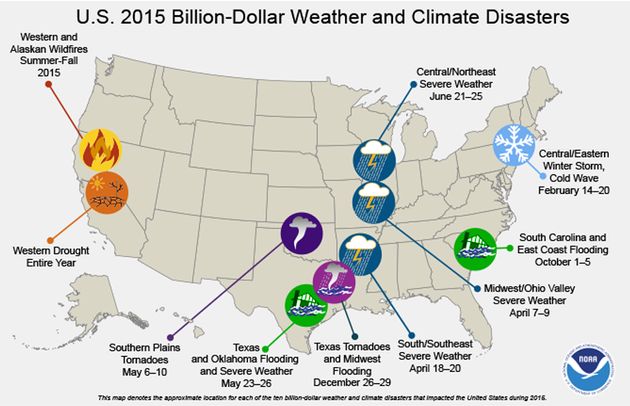 NOAAThe U.S. experienced five different types of extreme weather last year.
Munich Re, the world’s biggest reinsurer, estimated that extreme weather events led to $510 billion in insured losses from 1980 to 2011.
Carney said that according to Lloyd’s of London, the world’s oldest insurance market, the roughly 8-inch rise in sea level at the tip of Manhattan since the 1950s increased the insured losses from Hurricane Sandy by 30 percent in New York alone.
A house in Staten Island, New York, hit in Hurricane Sandy. Scientists say we should prepare for more weather events like the massive storm.
Insurance companies should care about climate change from a selfish perspective if they want to stay in business. Carney has warned that insurers that jack up premiums or exit markets after realizing the potential losses associated with climate change could unwittingly cause the value of their own assets to shrink.
He also warned about potential losses from claims on policies written by insurers. For example, insurance companies could be forced to make massive payouts if victims of climate change successfully hold accountable companies that contributed to it. He likened the situation to the one faced by U.S. insurers stung by tens of billions of dollars in losses from asbestos claims.
In fact, Carney said that as a result of recent weather trends, some now estimate that insurers are undervaluing their potential losses by as much as 50 percent.
Insurance companies caught unprepared for the effects of climate change could cause problems for government officials and put taxpayers at risk.
For example, governments may have to cover markets that insurers dump as a direct result of climate change, the Bank of England chief said, putting taxpayers on the hook.
...Mark Carney, the U.K.'s top central banker, says insurers may be undervaluing their potential risks by 50 percent.
What Could Change If Insurers Opened Up About This Risk
Disclosing climate change information would improve policymaking, Carney said. It could make climate policy more like monetary policy, where officials who set interest rates often tinker with their stance based on markets’ reactions.
The Financial Stability Board, a global group of the world’s financial regulators, wants financial companies to disclose their risks, too.
Some state insurance regulators in the U.S. are demanding insurers take the threat posed by climate change into account when investing their customers’ money and underwriting insurance policies. Washington state’s insurance regulator, Mike Kreidler, has criticized some insurers for failing to take climate change risks seriously, arguing their own solvency was at risk.
Buffett sounded more alarmed by the prospect of climate change in 2007, when scientific evidence of the impacts of climate change was less well-understood. In his annual letter that year, Buffett wondered aloud whether the deadly and expensive hurricanes of 2004 and 2005 marked the first warning of a new type of climate.
“It would be a huge mistake to bet that evolving atmospheric changes are benign in their implications for insurers,” Buffett wrote in his letter.
He warned that it was “naïve” to think of Hurricane Katrina -- the costliest hurricane in U.S. history -- “as anything close to a worst-case event.”
“These could rock the insurance industry,” Buffett added.
==
==
http://www.globalpossibilities.org/south-african-insurance-company-backs-tree-planting-effort-to-reduce-effects-of-drought/
...Rather than sit idly by and watch farmers lose untold acreage of croplands, Santam is working to actively reduce drought risk for its customers by funding Living Lands, an international nonprofit that has been active in South Africa since 2008. Working with government agencies, community organizations, and individual farmers, the project has planted more than 3.7 million trees so far in an effort to stop land degradation and restore the compromised water catchment system. All of this falls under a larger project intended to create “a living landscape” in the Baviaanskloof.
“This is a business imperative for us, the likelihood of our sustainability is highly dependent on this,” Ray-Ann Sedres, head of integrated sustainability at Santam, told The Guardian. She explained Santam recognizes how climate change is impacting businesses, and feels projects like this tree-planting effort are crucial for the company’s survival.
The city of Port Elizabeth, now home to 1.4 million residents, hopes to reap direct benefits from the tree-planting program. The city has doubled in size since 1997 and endured water restrictions on and off since 2007. Baviaanskloof area farmers report the rate of topsoil loss has slowed, indicating the runoff which causes erosion has been reduced. With any luck, Port Elizabeth’s water supply will also stabilize as the result of this unique approach to risk management.
==
---
:{www.nytimes.com/.../insurers-stray-from-the-conserv...:{}:
The New York Times
}:
May 14, 2013 - “The rise in sea level caused by climate change will further increase the ... While some big European reinsurers like Munich Re and Swiss Re ...
science.time.com/.../data-shows-that-extreme-weather-was-unextre...
-
www.theglobeandmail.com › ... › Magazine
-
www.spiegel.de › English Site › World › Climate Change
-
- BS
- :{[:{ ## The Disaster Business: Scientists Denounce Dubious Climate Study by Insurer}:
](https://www.google.com/search?es_sm=122&q=related:www.spiegel.de/international/world/scientists-denounce-dubious-climate-study-by-insurer-munich-re-a-862857.html+munich+re+climate+change&tbo=1&sa=X&ei=ZX46VbrkBsa3oQSUnYDwAg&ved=0CE8QHzAH)}:
Whether it's hurricanes, thunderstorms or tornadoes, extreme weather is big business for insurers. Now German re-insurer Munich Re claims to have found proof that man-made climate change is causing more weather catastrophes in North America. Scientists are outraged.
- ...
- eanwhile, Munich Re, the world's largest re-insurer of insurance companies in the event of extreme damage payments, has also announced an important finding: Natural disasters over the past 30 years have already shown the initial "footprint" of man-made climate change in North America, the German company claims. Many media outlets promptly ran last week's press release as news, stating that a prominent insurance company had warned of an increase in the number of natural disasters. But scientists have criticized the re-insurer for rushing to reach its conclusions.
The truth is that the United Nations Intergovernmental Panel on Climate Change (IPCC) has in fact been warning of an increase in heat waves, torrential rains and floods. But in most cases, it has not been proven that climate change has made the weather any more extreme. In some instances there are facts to suggest this, but in most these conclusions are driven by perceptions. It is not a foregone conclusion that things will necessarily get worse. According to an IPCC report, there may be fewer cold weather disasters and storms in the future in some places.
Most Disaster Premiums Come from the US
Although it is considered a fact that humans are warming the climate through emissions, when it comes to assessments about extreme weather, the experts at the UN climate council are reserved. They argue that it could take decades before the new climate is palpable. With all the natural fluctuations in the climate, it generally only becomes apparent in the later stages that the frequency of extreme conditions is increasing. By then, of course, it may also be too late to limit climate change.
The main problem is the rarity of extreme events -- and a lack of data about them. That alone makes it difficult to assess the situation. Vast amounts of data are required in order to determine whether an increasing greenhouse gas effect has already changed the frequency of extreme weather in past decades.
But Munich Re appears to feel it is in the best position to provide such answers. The company, whose most important market is in the United States, claims to have the "world's most comprehensive database on natural disasters."
"Well over half of the natural disaster premiums come from the USA," says Munich Re board member Peter Röder, who is responsible for the North American market.
'A Strong Chain of Evidence'
Röder said the company is "highly exposed" in the US, particularly in the area of hurricane insurance. At a recent talk with journalists in Munich, Röder said the company is "very satisfied" with its premiums covering weather disasters in the United States. He said the company had already factored in expectations for more intense hurricanes.
And new data from Munich Re also seems to support this strategy. Since 1980, the property damage caused by weather disasters has quintupled, Munich Re has reported. "Nowhere in the world is the rising number of natural catastrophes more evident than in North America," said Munich Re's head of GeoRisk Research, Peter Höppe, in a company video. "Previously, there had not been such a strong chain of evidence."
'No Such Claims'
But scientists claim there is a lack of evidence. "The press release suggests that a 'footprint' of climate change has been found in loss data," said environmental researcher Roger Pielke Jr. of the University of Colorado in Boulder. "But the report has no such claims."
Clifford Mass, a professor of atmospheric sciences at the University of Washington in Seattle, added: "Most of it makes no sense and is contradictory to observed trends."
According to the Munich Re study, total damages from weather-related disasters in North America from 1980 to 2011 amounted to $1.6 trillion, of which $510 billion was covered by insurance. Around 30,000 people died. The most expensive disaster so far was Hurricane Katrina in New Orleans in 2005.
Höppe believes that the warming of oceans has precipitated hurricanes. "The higher the (sea) surface temperatures are, the higher the risk of high-intensity hurricanes. We have seen globally, but also in the northern Atlantic Ocean, that these sea surface temperatures have increased significantly already due to global warming," he added in the video. Of course, other forces can also hinder tropical cyclones, including wind shears and dust clouds.
The Mystery of Tropical Cyclones
==