Severino, Carrie JCN
---
KIND OF FADED VS ROGER? --> MOLLIE H
JCN
see wellspring
see Leo
SUSAN COLLINS MAINE SEN?
see roger husband HHS trump
see opus dei
~ aca obamacare
see JCN 3
see concord fdn jcn 3
carrie severino clerk clarence thomas, clarence staffer mafia w/ ginni
---
LI 4 26
Carrie Severino - Regnery Publishing | LinkedIn
Co-author of Justice on Trial: The Kavanaugh Confirmation and the Future of the Supreme Court at Regnery Publishing
New Alexandria, Virginia, United States
·

Regnery Publishing

Harvard Law School
393
connections
Activity
553 followers
Follow
Carrie has no recent posts
Recent posts Carrie shares will be displayed here.
Experience

[Co-author of Justice on Trial: The Kavanaugh Confirmation and the Future of the Supreme Court Regnery Publishing
Jan 2019 - Present · 7 yrs 4 mos](https://www.linkedin.com/company/11325099/)
Justice on Trial is the story of what really happened during last year's national drama, including never-before-released details of every aspect of the confirmation process from Justice Kennedy's retirement to the explosive hearing with Christine Blasey Ford. Hemingway and Severino are two insiders with unparalleled access who have conducted over 100 interviews with major players--including the president, several Supreme Court justices, and dozens of senators--for this highly anticipated book. On sale starting July 9, 2019, and available for pre-order now! … more
Chief Counsel and Policy Director
Judicial Crisis Network
Mar 2010 - Present · 16 yrs 2 mos
The Judicial Crisis Network is dedicated to strengthening liberty and justice in America through advocating for judges who will uphold the Constitution and the rule of law.

Georgetown University Law Center 1 yr 9 mos
- Dean's Visiting Scholar Aug 2009 - Apr 2010 · 9 mos
- Olin/Searle Fellow Aug 2008 - Aug 2009 · 1 yr 1 mo
[law clerk Supreme Court of the United States
Jul 2007 - Jul 2008 · 1 yr 1 mo](https://www.linkedin.com/company/85523/)

[law clerk The Becket Fund for Religious Liberty
2005 - 2006 · 1 yr](https://www.linkedin.com/company/95538/)
Education

[Harvard Law School Doctor of Law (JD)
2001 – 2004](https://www.linkedin.com/school/1654/)

[Michigan State University M.A., Linguistics
1999 – 2001](https://www.linkedin.com/school/4695/)
Skills (12)
---
BOOK Justice on Trial: The Kavanaugh Confirmation and the Future of the Supreme Court: Hemingway, Mollie, Severino, Carrie: 9781621579830: Amazon.com: Books
BRET LOOKING TOUGH PIX
Justice on Trial: The Kavanaugh Confirmation and the Future of the Supreme Court Hardcover – July 9, 2019
by Mollie Hemingway (Author), Carrie Severino (Author)
4.8 *4.8 out of 5 stars* (2,789)
#1 NATIONAL BESTSELLER!
Justice Anthony Kennedy slipped out of the Supreme Court building on June 27, 2018, and traveled incognito to the White House to inform President Donald Trump that he was retiring, setting in motion a political process that his successor, Brett Kavanaugh, would denounce three months later as a “national disgrace” and a “circus.”
Justice on Trial, the definitive insider’s account of Kavanaugh’s appointment to the Supreme Court, is based on extraordinary access to more than one hundred key figures—including the president, justices, and senators—in that ferocious political drama.
The Trump presidency opened with the appointment of Neil Gorsuch to succeed the late Antonin Scalia on the Supreme Court. But the following year, when Trump drew from the same list of candidates for his nomination of Brett Kavanaugh, the justice being replaced was the swing vote on abortion, and all hell broke loose.
The judicial confirmation process, on the point of breakdown for thirty years, now proved utterly dysfunctional. Unverified accusations of sexual assault became weapons in a ruthless campaign of personal destruction, culminating in the melodramatic hearings in which Kavanaugh’s impassioned defense resuscitated a nomination that seemed beyond saving.
The Supreme Court has become the arbiter of our nation’s most vexing and divisive disputes. With the stakes of each vacancy incalculably high, the incentive to destroy a nominee is nearly irresistible. The next time a nomination promises to change the balance of the Court, Hemingway and Severino warn, the confirmation fight will be even uglier than Kavanaugh’s.
A good person might accept that nomination in the naïve belief that what happened to Kavanaugh won’t happen to him because he is a good person. But it can happen, it does happen, and it just happened. The question is whether America will let it happen again.
AMZ
Review
#1 Publisher’s Weekly, Hardcover Nonfiction
#1 Amazon Best-Sellers, Nonfiction
#1 WSJ Nonfiction eBooks
#2 WSJ Nonfiction combined print and ebooks
#2 Wall Street Journal Best-Sellers, Hardcover Nonfiction
#2 Barnes and Noble, Hardcover Nonfiction
#2 Apple Books, Nonfiction
#3 USA Today, Overall Books
“It is to be hoped that this fine, even-handed book will help to bring an end to the political savagery that has characterized all too many Supreme Court confirmation hearings.” -- MARY ANN GLENDON, Learned Hand Professor of Law, Harvard University
“Justice on Trial reads like a John Grisham novel, filled with intrigue and well-paced plot development that’s a roller-coaster ride even if we know how it ends. This is destined to become the definitive account of a crucial episode in American life.” -- ILYA SHAPIRO, Cato Institute
“A riveting inside look at the nasty politics of character assassination that have plagued the confirmation process going back to my father, Robert H. Bork.” -- ROBERT H. BORK JR., president, Bork Communication Group
“Even if you closely followed the confirmation hearings, you will learn a lot from this real-life legal thriller.” -- JOSH BLACKMAN, South Texas College of Law, author of Unraveled
“An amazingly well-sourced, behind-the-scenes chronicle of a Supreme Court nomination process that became a national circus. Everyone concerned with how broken the judicial confirmation process has become needs to read this riveting blow-by-blow account.” -- RANDY E. BARNETT, Georgetown Law School, author of Our Republican Constitution
“The authors’ deep knowledge of the players and the constitutional stakes shines throughout the book and makes for a thrilling and revealing read.” -- EDWIN MEESE III, 75th U.S. Attorney General
"[A] brand new smash book with enormous amounts of actual real reporting, interviews, behind-the-scenes fact-digging and analysis… You won’t get it anywhere else unless you get this book.” -- Laura Ingraham, Fox News
About the Author
Mollie Hemingway, one of America's most respected journalists, is a senior editor at The Federalist, a contributor to Fox News, and the co-author of the #1 national bestseller Justice on Trial: The Kavanaugh Confirmation and the Future of the Supreme Court. Her work has appeared in the Wall Street Journal, USA Today, the Washington Post, and many other outlets.
[
Top](https://www.amazon.com/Justice-Trial-Kavanaugh-Confirmation-Supreme/dp/1621579832#)About this itemSimilarFrom the AuthorQuestionsReviews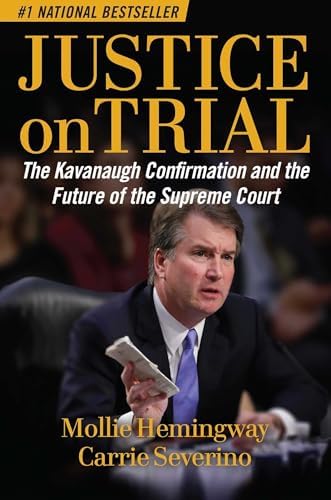 Justice on Trial: The Kavanaugh Confirmation and the Future of the Supreme Court
Product details
- Publisher : Regnery
Customers also bought or read
Similar books
by Mollie Ziegler Hemingway
Supreme Court
Judicial Branch
Rigged: How the Media, Big Tech, and the Democrats Seized Our Elections
Rigged: How the Media, Big Tech, and the Democrats Seized Our Elections
4.8
Rage and the Republic: The Unfinished Story of the American Revolution
Rage and the Republic: The Unfinished Story of the American Revolution
4.9
Lawless: The Miseducation of America’s Elites – An Insider's Account of Institutional Weakness and the Transformation of Law Schools
4.4
Listening to the Law: Reflections on the Court and Constitution
838
Hardcover
$1350$13.50
The Essential Scalia: On the Constitution, the Courts, and the Rule of Law
Laptop from Hell: Hunter Biden, Big Tech, and the Dirty Secrets the President Tried to Hide
FREE delivery Sun, Apr 19
Supreme Ambition: Brett Kavanaugh and the Conservative Takeover
Supreme Disorder: Judicial Nominations and the Politics of America's Highest Court
Supreme Disorder: Judicial Nominations and the Politics of America's Highest Court
4.6
About

Judicial Crisis Network
https://judicialnetwork.com › about](https://judicialnetwork.com/about/)
CARRIE SEVERINO. Carrie Campbell Severino is the president of JCN, and co-author with Mollie Hemingway of the bestselling book Justice on Trial: The ...Read more
[### Carrie Severino (@JCNSeverino) / Posts / X

X · JCNSeverino
38.9K+ followers](https://x.com/JCNSeverino)
Carrie Severino✓ ... President of JCN ( @judicialnetwork). Co-Author of Justice on Trial. RT ≠ endorsement. I probably should include something witty here.Read more
[### Carrie Severino

Acton Institute
https://www.acton.org › about › author › carrie-severino](https://www.acton.org/about/author/carrie-severino)
Carrie Campbell Severino is the chief counsel and policy director of the Judicial Crisis Network. and co-author with Mollie Hemingway of the bestselling book ...Read more
[### Carrie Campbell Severino

The Federalist Society
https://fedsoc.org › bio › carrie-severino](https://fedsoc.org/bio/carrie-severino)
Carrie Campbell Severino is the president of the JCN, and co-author with Mollie Hemingway of the bestselling book Justice on Trial: The Kavanaugh ...
[### Carrie Campbell Severino Bio

Founding Freedoms Law Center
https://www.foundingfreedomslaw.org › carrie-severino...](https://www.foundingfreedomslaw.org/carrie-severino-bio)
Carrie Campbell Severino is President of the Judicial Crisis Network and co-author, with Mollie Hemingway, of the bestselling book Justice on Trial: The ...Read more
Latest posts from Carrie Campbell Severino
[
0:29](https://x.com/JCNSeverino/status/2044520466686128215?ref_src=twsrc%5Egoogle%7Ctwcamp%5Eserp%7Ctwgr%5Etweet)
This week, Justice Jackson shared her thoughts on the current state of the emergency docket: “Ultimately, the justices need to return to acting like the final court of review that the Supreme Court holds itself out to be. This is not a novel concept. Our predecessors called it
20+ likes ·
37 minutes ago
[

JCNSeverino
X](https://x.com/JCNSeverino?ref_src=twsrc%5Egoogle%7Ctwcamp%5Eserp%7Ctwgr%5Eauthor)
[
 ](https://x.com/JCNSeverino/status/2044503524617470225?ref_src=twsrc%5Egoogle%7Ctwcamp%5Eserp%7Ctwgr%5Etweet)
Why did the FJC think it was appropriate to include a climate science chapter, written by the climate lobby, in what is supposed to be a neutral reference guide for our nation’s judges? @SenTedCruz, @SenEricSchmitt, @SenMikeLee, and Sen. @MarshaBlackburn rightfully sent a
70+ likes ·
2 hours ago
[

JCNSeverino
X](https://x.com/JCNSeverino?ref_src=twsrc%5Egoogle%7Ctwcamp%5Eserp%7Ctwgr%5Eauthor)
Fewer institutions are engaging in unconstitutional race-based admissions following the Court’s ruling in SFFA v. Harvard, but that’s not stopping others from using loopholes to get around it. 👇🏻 “Rates of admission at most schools still suggest that blacks and Hispanics are
10+ likes ·
3 hours ago
[

JCNSeverino
X](https://x.com/JCNSeverino?ref_src=twsrc%5Egoogle%7Ctwcamp%5Eserp%7Ctwgr%5Eauthor)
“What is it with Democrats going after Catholic nuns performing works of mercy? .… If New York were wiser, it would explain this as a misunderstanding and that it won’t subject the nuns to HR training in gender studies or unconscious bias.” - @WSJ www.wsj.com/opinion/dom…
20+ likes ·
2 days ago
[

JCNSeverino
X](https://x.com/JCNSeverino?ref_src=twsrc%5Egoogle%7Ctwcamp%5Eserp%7Ctwgr%5Eauthor)
The front page of today’s Washington Post has the headline “Big losses for civil rights at high court.” Really? Dig in, and it’s clear that the Post’s analysis rests on raw ideology. The article’s treatment of religious liberty and racial discrimination cases is telling. It
40+ likes ·
4 days ago
[

JCNSeverino
X](https://x.com/JCNSeverino?ref_src=twsrc%5Egoogle%7Ctwcamp%5Eserp%7Ctwgr%5Eauthor)
[
It Takes Raw Ideological Spin to Disparage the Supreme Court’s Record on Civil Rights
4 days ago

Carrie Campbell Severino
National Review](https://www.nationalreview.com/bench-memos/it-takes-raw-ideological-spin-to-disparage-the-supreme-courts-record-on-civil-rights/)
How many times must people of faith defend their sincerely held beliefs against government overreach? From Burwell v. Hobby Lobby Stores, Inc. to Little Sisters of the Poor Saints Peter and Paul Home v. Pennsylvania, the Court has struck down government mandates that violate
70+ likes ·
5 days ago
[

JCNSeverino
X](https://x.com/JCNSeverino?ref_src=twsrc%5Egoogle%7Ctwcamp%5Eserp%7Ctwgr%5Eauthor)
Historic defeats for civil rights, women, and minorities? Only if you don’t count religious freedom or freedom from “reverse” racial discrimination as a civil right. (They most certainly are.) Remember Little Sisters of the Poor? How about Mahmoud v. Taylor? How about the Asian
160+ likes ·
6 days ago
[

JCNSeverino
X](https://x.com/JCNSeverino?ref_src=twsrc%5Egoogle%7Ctwcamp%5Eserp%7Ctwgr%5Eauthor)
The American Medical Association Foundation is not above the law. From SFFA v. Harvard to Bob Jones University v. United States, the Supreme Court has affirmed that race-based discrimination is unconstitutional. www.washingtonexaminer.…
10+ likes ·
6 days ago
[

JCNSeverino
X](https://x.com/JCNSeverino?ref_src=twsrc%5Egoogle%7Ctwcamp%5Eserp%7Ctwgr%5Eauthor)
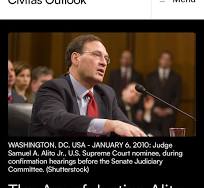
“For many legal conservatives, the defeat of Roe v. Wade was the great white whale. Both the academic critique of Roe as the ultimate example of judicial overreach and the political backing of the anti-abortion movement were crucial to the success of the conservative legal
210+ likes ·
1 week ago
[

JCNSeverino
X](https://x.com/JCNSeverino?ref_src=twsrc%5Egoogle%7Ctwcamp%5Eserp%7Ctwgr%5Eauthor)
Videos
[Carrie Campbell Severino joined a FedSoc webinar YouTube · The Federalist Society
Oct 10, 2025](https://www.youtube.com/shorts/gJHkTHhSxoo)
YouTube · The Federalist Society

1:29
We've seen the concerted uh efforts to attack the integrity of the court in the media to try to uh you know push down favorability ratings.
[User Clip: Carrie Severino on not disclosing the Judicial Crisis ... C-SPAN · C-SPAN
Aug 12, 2025](https://www.c-span.org/clip/newsmakers/user-clip-carrie-severino-on-not-disclosing-the-judicial-crisis-networks-donors/4738920)
C-SPAN · C-SPAN
[
0:54](https://www.c-span.org/clip/newsmakers/user-clip-carrie-severino-on-not-disclosing-the-judicial-crisis-networks-donors/4738920)
[Mollie Hemingway and Carrie Severino, "Justice on Trial" YouTube · C-SPAN
Apr 3, 2024](https://www.youtube.com/watch?v=5bUk3_H3bYg)
YouTube · C-SPAN

54:38
[Judicial Crisis Network's Carrie Severino Says Supreme Court ... YouTube · CBN News
Apr 19, 2023](https://www.youtube.com/watch?v=xmRgMfmlddw)
YouTube · CBN News

This case gives the Supreme Court an opportunity to erase one of its mistakes.
[### Carrie Severino - Regnery Publishing

LinkedIn · Carrie Severino
550+ followers](https://www.linkedin.com/in/carrie-severino-55ab474)
New Alexandria, Virginia, United States · Regnery Publishing
Experience: Regnery Publishing · Education: Harvard Law School · Location: New Alexandria · 397 connections on LinkedIn. View Carrie Severino's profile on ...
[### Carrie Severino

C-SPAN
https://www.c-span.org › person › carrie-severino](https://www.c-span.org/person/carrie-severino/9273066/)
On the C-SPAN Networks: Carrie Severino is a President for the Judicial Crisis Network with 27 videos in the C-SPAN Video Library; the first appearance was a ...Read more
[### Carrie Severino

Fox News
https://www.foxnews.com › person › carrie-severino](https://www.foxnews.com/person/s/carrie-severino)
Carrie Campbell Severino is president of JCN. The Kavanaugh assassination plot deserved far more than 8 years. October 10. The Kavanaugh assassination plot ...Read more
---
https://www.theatlantic.com/politics/archive/2019/07/clarence-thomas-trump/593596/
no lnx
The Clarence Thomas Effect
The notoriously quiet Supreme Court justice has had a far-reaching influence on the personnel of the Trump administration, which may be his most lasting legacy.
By Emma Green
JULY 10, 2019
Clarence Thomas is the longest-serving justice currently sitting on the Supreme Court. For much of his tenure, court watchers and critics have dismissed his jurisprudence as largely irrelevant, demoting him to the late Justice Antonin Scalia’s judicial sidekick. In the public imagination, he is most remembered for his worst moment. Last fall’s confirmation hearings for Justice Brett Kavanaugh resurrected the debate over Anita Hill, the woman who famously accused Thomas of sexual harassment during his 1991 confirmation hearings.
And yet, during his time on the Court, Thomas has written prolifically and introduced ideas that have gradually gained influence among other justices. Of all the Supreme Court justices, Thomas takes an approach to the law that is arguably the purest embodiment of the conservative judicial philosophies known astextualism, which holds that the plain meaning of the text of a law is all that matters in judicial interpretation, and originalism, which holds that the Constitution should be interpreted only as its authors intended.
The most significant part of Thomas’s legacy, however, may take shape long after he has stopped writing opinions.Personnel is policy. Thomas’s vast network, more than that of any other justice, has defined President Donald Trump’s administration and the federal judiciary Trump has built. Through his clerks and mentees, the notoriously silent justice may end up with an outsize voice in the legal system for years to come.
Numbers are the first evidence of the sizable Thomas effect. He has had more of his former clerks nominated to federal judgeships under Trump than any other justice, past or present: 10, compared with Anthony Kennedy’s seven and Scalia’s five. Roughly one-fifth of Thomas’s former clerks either are in the Trump administration or have been nominated to the federal bench by the president. The clerks whom Thomas trained, has mentored, and actively stays in touch with are taking up lifetime appointments, and on the whole, they are quite young: Allison Jones Rushing, who now sits on the Fourth Circuit Court of Appeals, is just in her mid-30s.
[Read: Conservative women are leading the defense of Kavanaugh]
These relatively small numbers offer insight into the broad influence Thomas has had on the Trump-era legal establishment. Even clerks who aren’t in formal positions of public service have gained prominence under Trump: Laura Ingraham, the conservative commentator who clerked for Thomas during his early years on the bench, has hosted one of the top-rated programs on Fox News since October 2017 and is an outspoken supporter of the president. Another former clerk, Carrie Severino, the chief counsel and policy director of the Judicial Crisis Network, has been one of the most vocal advocates for Trump’s judicial nominees, including Kavanaugh.
The Thomas effect started taking shape early on in the Trump administration. As Slate’s Dahlia Lithwick and Mark Joseph Stern noted as early as mid-2017, when the pattern was still nascent, “Everywhere you turn in Trumpland, you’ll find a slew of Thomas’ former clerks in high places.” In part, this effect may have been driven by the people making the hires. Gregory Katsas, who clerked for Thomas on the D.C. Circuit and the Supreme Court, joined the Trump administration right after the inauguration as a deputy assistant to the president and deputy counsel. Later, when Katsas was nominated to his own judgeship on the D.C. Circuit Court, he told U.S. senators that he had been involved in “interviewing and recommending candidates for various executive and judicial appointments.”
At least three other people who have worked in Trump’s White House counsel’s office are also former Thomas clerks: John Eisenberg, David Morrell, and Kate Todd. When the Trump administration released its list of potential Supreme Court nominees in November 2017, four former Thomas clerks were included: Thomas Lee, Margaret Ryan, David Stras, and Allison Eid.
Any new administration has a huge number of positions to fill across the executive branch. When Trump took office, he also faced significant judicial vacancies—142 empty seats, according to data from the American Bar Association. By comparison, when Barack Obama took office in 2008, there were only 53 federal judicial vacancies. These jobs are filled like any other: through personal networks and recommendations. Under Trump, the most influential source of potential candidates for these vacancies has been the Federalist Society,a professional network for conservative and libertarian lawyers. “It happens that a lot of the people in the White House counsel’s office are Federalist Society members, and as a result of having been Federalist Society members, they have their own set of contacts,” said John Malcolm, who works on judicial issues at the Heritage Foundation and is chairman of the Federalist Society’s criminal-law practice group. The organization’s executive vice president, Leonard Leo, has had an influential role in advising the Trump administration on possible nominees.
Although stories about the Federalist Society often focus on the intellectual role and legacy of the late Justice Scalia, who was an early faculty adviser to the group at the University of Chicago, Thomas is a central figure in the Federalist Society universe.William Eskridge, a law professor at Yale known for his work on LGBTQ legal issues, told me the Federalist Society is “a social circle. It’s a professional circle. It’s a circle that gives [the justices] law clerks. It’s a circle that gives them positive publicity.” And, he added, “Thomas is at the center of that.”
[Read: The Supreme Court hands a victory to the pro-life movement]
Scalia famously described himself as a “fainthearted originalist,” although he later repudiated that label. By contrast, Thomas’s originalism has been “unflinching,” as one conservative law professor wrote in a recent column for The New York Times.Scalia himself told a Thomas biographer that Thomas does not believe in the legal principle of generally following settled precedent. “Among Federalist Society members, he probably would be their No. 1 favorite justice of anyone on the Court,” Severino told me. “As wonderful as Justice Scalia is, Thomas is someone who has inspired a lot of young lawyers.”
The Thomas effect may be due to more than just the power of networks, however. Thomas has been on the Supreme Court bench since 1991, and his clerks are entering their professional peaks during a Republican administration. Several former clerks told me Thomas goes out of his way to stay in touch with his clerks and cultivate their careers; they have monthly lunches and regularly get together for intergenerational reunions. Each year, Thomas takes his clerks on a field trip to the site of the deadliest battle in the Civil War. “I want them to go to Gettysburgand to think about … the price that was paid for this country to exist,” he said in an interview with the appeals-court judge Diane Sykes at a Federalist Society event in 2013. “I love my law clerks,” Thomas added. “These kids are my family.”
Thomas’s clerks tend to fit a particular profile. They come from all over the country, including law schools outside the Ivy League, which makes them particularly suitable candidates for federal judgeships. “Judges have to have ties to the local area typically,” said Saikrishna Prakash, a former Thomas clerk and professor of law at the University of Virginia. “The Thomas clerks, because they come from more regions in the country, and certainly go to law schools all over the country, are more apt to go outside of the I-95 corridor.” After their clerkships, these lawyers often go into public service, taking up positions in U.S. attorneys’ offices or as professors, which means they don’t mind the pay cut that often comes with a move to the federal bench. (A federal district-court judge can expect to make slightly more than $200,000 a year; by comparison, partners at top-tier law firms can earn multimillion-dollar salaries.)And, like Thomas, they tend to be very conservative, committed originalists and textualists. As Eskridge put it, they are true believers.
The Trump administration’s most marked achievement in terms of shifting the federal judiciary has come through Circuit Courts of Appeals.Trump has far outpaced his recent predecessors, with 42 confirmed appointments to these courts over the past two and a half years; by comparison, Obama had gotten less than half as many appeals-court judges confirmed by this point in his first term. These seats are where Thomas clerks will have the most influence—and are outpacing the former clerks for conservative justices. Former Thomas clerks have now been confirmed to the Fourth, Fifth, Eighth, Ninth, and Tenth Circuits, along with two judges confirmed to the D.C. Circuit Court of Appeals—Katsas and Neomi Rao, the former head of Trump’s Office of Information and Regulatory Affairs. The D.C. Circuit is particularly influential, because it is responsible for reviewing the actions of federal agencies; in recent years, it has issued important decisions on topics ranging from Obamacare to gun rights.
Thomas is famously silent during oral arguments. But as a writer, he has been prolific:He wrote the most concurrences, dissents, and opinions of any justice during each of the past five terms, according to data from SCOTUSblog. Over time, his work has significantly shifted the window of acceptable legal opinions on various issues, said John Yoo, a former Thomas clerk and law professor at UC Berkeley who is best known for his work on the George W. Bush administration’s torture memos. “When I clerked for him, he published some opinions I thought were really radical, and the legal profession would never be interested,” Yoo told me. “Now those opinions are heavily debated in law schools and are very influential.” He specifically mentioned Thomas’s concurrence in a 1995 case on affirmative action, Adarand v. Peña, and another concurrence in a case on the Constitution’s commerce clause, United States v. Lopez.
On the Court, Thomas’s purist approach may cost him the ability to convince his fellow justices on controversial cases. “He’s less of a traditional politician,” Yoo told me. “I think he’s more interested in saying, ‘This is the correct view of the Constitution,’ rather than assembling five votes. And that’s a trade-off.” Thomas’s views often come out in dissents or concurrences, offered solo or joined by just one or two other justices.“He has not, until recently, written any of the blockbuster majority opinions,” Yoo said, “because to do that, you have to horse-trade to get votes.” (Notable majority opinions by Thomas include a 2001 case concerning the rights of a religious student group, Good News Club v. Milford Central School, and a 2018 First Amendment case involving a crisis-pregnancy center, NIFLA v. Becerra.)
This is all the more reason the rise of Thomas’s former clerks is important. His approach to controversial legal questions—generally opposing affirmative action, favoring limited power for federal agencies, defending gun rights, and more—has been developed and popularized over his decades on the bench, and will be carried forward by a new generation of judges. He openly defies what he sees as bad precedent—just last month, Thomas wrote in a concurrence that “the Constitution itself is silent on abortion.”
[Adam Cohen: Clarence Thomas knows nothing of my work]
Other conservative justices’ clerks have had a significant footprint in the Trump administration. Two of former Justice Anthony Kennedy’s clerks, Neil Gorsuch and Brett Kavanaugh, now sit on the Supreme Court. Trump’s secretary of health and human services, Alex Azar, and his solicitor general, Noel Francisco, both clerked for Scalia, as did the White House counselor Emmet Flood and the recently confirmed Seventh Circuit judge, Amy Coney Barrett, who is widely thought to be on Trump’s short list for any potential future Supreme Court slots.
Thomas’s influence, however, is particularly broad, reaching from the Department of Justice to the White House to the federal bench. Thomas is now 71 years old. If he follows the path of his colleagues Stephen Breyer and Ruth Bader Ginsburg, who are both in their 80s, he could easily have a decade or more to go on the Supreme Court. His greatest legacy, however, may be in the intellectual seeds he has planted in the generation of lawyers who came up studying his work.
Olivia Paschal contributed reporting to this article.
Emma Green is a former staff writer at The Atlantic.
---
---
GMAIL 10 25
pORTLAND, Maine*– Leonard Leo, the conservative operative who built Donald Trump’s radical right-wing supermajority on the Supreme Court, is spending big money to make it harder to vote in Maine, ahead of Susan Collins’s crucial reelection fight next year.
Leo is already a divisive figure in the Pine Tree State: His mansion in the Bar Harbor area has been the site of frequent protests ever since the high court’s conservatives overturned Roe v. Wade, eliminating the federal right to an abortion. Neighbors and visitors regularly decry Leo’s influence on US politics and the judiciary, much of which flows through his historic $1.6 billion dark-money slush fund.
Serving as Trump’s first-term judicial adviser, Leo helped select three conservative justices, while his dark money network spent millions on PR campaigns supporting them. Those justices were essential in overturning Roe.
As Maine prepares for a competitive and likely ultra-expensive Senate race next year, in which Democrats will again try to unseat Collins, Maine’s Republican senator, Leo’s dark money network and his allies are bankrolling the main donor behind Question 1, a ballot measure that would change how many Maine residents participate in that election.
Maine Secretary of State Shenna Bellows, a Democrat, tells Zeteo that Question 1 was “written by people that don’t fully understand Maine elections,” and would create “irregularities” that conflict with how elections are currently administered. “It indicates the influence of dark money and out-of-state interests in drafting the statutory changes,” she says.
‘The Core Leo Playbook’...
---
---
an 8 23
:{:{ former United States Department of Justice trial attorney under ex-President Bill Clinton is probing Republican billionaire and ex-President Donald Trump donor Leonard Leo along with "his network of nonprofit groups," POLITICO exclusively reports.}:
}:
Washington, D.C. Attorney General Brian Schwalb's investigation comes after the GOP billionaire and Federalist Society leader's trust fund, Marble Freedom Trust's latest Internal Revenue Service (IRS) filing revealed in June Leo's mission to control right-wing politics, according to a Truthout report.
Truthout notes the IRS filing obtained by progressive watchdog Accountable.US "shows the Federalist Society leader 'has dumped at least $411 million into fueling right-wing infrastructure in the U.S. since mid-2020.'"
POLL: Should Trump be allowed to hold office again?"
According to POLITICO, the probe also "comes after POLITICO reported in March that one of Leo's nonprofits — registered as a charity — paid his for-profit company tens of millions of dollars in the two years since he joined the company.'
The news outlet notes that "a few weeks later, a progressive watchdog group filed a complaint with the D.C. attorney general and the IRS requesting a probe into what services were provided and whether Leo was in violation of laws against using charities for personal enrichment."
POLITICO reports:
Best known as Donald Trump's White House 'court whisperer,' Leo played a behind-the-scenes role in the nominations of all three of the former president's Supreme Court justices and promoted them through his multi-billion-dollar network of nonprofits. Trump chose his three Supreme Court picks, Neil Gorsuch, Brett Kavanaugh and Amy Coney Barrett, from a list drawn up by Leo. More recently, Leo was the beneficiary of a $1.6 billion contribution, believed to be the biggest political donation in U.S. history.
"There are questions as to whether Leo-affiliated nonprofits have diverted substantial portions of their income and assets, directly or indirectly, to the personal benefit of Leonard Leo," the Campaign for Accountability's complaint said. "Such payments were generally listed as made in exchange for alleged consulting, research, public relations, or similar services. However CFA has reasonable questions about whether those alleged services were actually rendered at all or, if services were rendered, whether the payments made were substantially in excess of fair market value."
READ MORE:How a Republican megadonor is 'playing fast and loose' to push 'dangerous, extreme agenda': watchdog
Per the report, "The news of the investigation comes as the nonprofit that was a subject of the complaint quietly relocated in recent weeks from the capital area to Texas, according to paperwork filed in Virginia and Texas," after "for nearly 20 years the nonprofit, now known as The 85 Fund, had been incorporated in Virginia."
The news outlet notes:
The Leo-aligned nonprofit The 85 Fund — which is registered as a tax-exempt charity — paid tens of millions of dollars to a public relations firm in Virginia which he co-chairs in the two years since he joined the firm, known as CRC Advisors. The watchdog complaintalleges the total amount of money that flowed from Leo-aligned nonprofits to his for-profit firms was $73 million over six years beginning in 2016.
According to POLITICO, attorney David B. Rivkin Jr., who represents the parties in the probe, "said in a statement that the complaint 'is sloppy, deceptive and legally flawed and we are addressing this fully with the DC Attorney General's office.'"
Politico's full report is available at this link.
HEIDI PRZYBYLA
08/22/2023
Washington
D.C. Attorney General Brian Schwalb is investigating judicial activist Leonard Leo and his network of nonprofit groups, according to a person with direct knowledge of the probe.
The scope of the investigation is unclear. But it comes after POLITICO reported in March that one of Leo’s nonprofits — registered as a charity — paid his for-profit company tens of millions of dollars in the two years since he joined the company. A few weeks later, a progressive watchdog group filed a complaint with the D.C. attorney general and the IRS requesting a probe into what services were provided and whether Leo was in violation of laws against using charities for personal enrichment.
David B. Rivkin Jr., an attorney for the parties in the investigation, said in a statement that the complaint “is sloppy, deceptive and legally flawed and we are addressing this fully with the DC Attorney General’s office.”
The news of the investigation comes as the nonprofit that was a subject of the complaint quietly relocated in recent weeks from the capital area to Texas, according to paperwork filed in Virginia and Texas. For nearly 20 years the nonprofit, now known as The 85 Fund, had been incorporated in Virginia.
Gabe Shoglow-Rubenstein, Schwalb’s communications director, declined to confirm or deny the existence of the probe, including whether the attorney general took any action in response to the complaint.
Schwalb, who took office in January, has a background in tax law and served as a trial attorney in the tax division of the Department of Justice under President Bill Clinton.
Best known as Donald Trump’s White House “court whisperer,” Leo played a behind-the-scenes role in the nominations of all three of the former president’s Supreme Court justices and promoted them through his multi-billion-dollar network of nonprofits. Trump chose his three Supreme Court picks, Neil Gorsuch, Brett Kavanaugh and Amy Coney Barrett, from a list drawn up by Leo. More recently, Leo was the beneficiary of a $1.6 billion contribution, believed to be the biggest political donation in U.S. history.
He is also the co-chair of the Federalist Society, the academic arm of the conservative legal movement, for which he worked in various capacities for decades while building his donor base.
While Leo grants few interviews, in mid-July he was featured in a two-part podcast with the Maine Wire, a conservative news organization. Asked why he’s become a “lightening rod for criticism,” Leo cited his commitment to “defend the Constitution” and spoke about the “long history” of dark money in U.S. politics.
“It’s not to hide in the shadows,” he said. “It’s because we want ideas judged by their own moral and intellectual force.”
He did not address any allegations of potential misuse of nonprofit tax law.
Real estate and other public records illustrate that the lifestyle of Leo and a handful of his allies took a lavish turn in the course of the making of the current ultraconservative court, beginning in 2016, the year he was tapped as an unpaid adviser to Trump. Citing the report, a progressive watchdog group called on the IRSand D.C. Attorney General a few weeks later to investigate whether the groups may be violating their tax-exempt status by “siphoning” assets or income for personal use.
Anthony Burke, a public affairs specialist with the IRS, declined to comment. “Under the federal tax law, federal employees cannot disclose tax return information,” he said.
The Leo-aligned nonprofit The 85 Fund — which is registered as a tax-exempt charity — paid tens of millions of dollars to a public relations firm in Virginia which he co-chairs in the two years since he joined the firm, known as CRC Advisors.
The watchdog complaintalleges the total amount of money that flowed from Leo-aligned nonprofits to his for-profit firms was $73 million over six years beginning in 2016.
“There are questions as to whether Leo-affiliated nonprofits have diverted substantial portions of their income and assets, directly or indirectly, to the personal benefit of Leonard Leo,” read the Campaign for Accountability’s complaint.
“Such payments were generally listed as made in exchange for alleged consulting, research, public relations, or similar services. However CFA has reasonable questions about whether those alleged services were actually rendered at all or, if services were rendered, whether the payments made were substantially in excess of fair market value,” said the complaint, which covers the period between 2016 and 2020.
POLITICO reported that a total of $43 million flowed to Leo’s company over two years and that the bulk of it came from The 85 Fund, a nonprofit run by his allies which has spent tens of millions of dollars over the past decade to promote Trump’s Supreme Court picks, file briefs before the court and, more recently, used an alias to push for voting restrictions and of cheating in the 2020 election.
It is now run by Carrie Severino, an attorney and former clerk for Justice Clarence Thomas listed as director in the group’s most recent IRS paperwork and is collecting massive amounts of anonymous funds: $117 million in 2021.
In discontinuing the group in the state of Virginia, the new address Severino listed is a virtual office suite in Fort Worth, Texas, shared by a “Two Men and a Truck”franchise. The office building advertises virtual and coworking spaces.
Further complicating the picture: in Texas, a new registration for “The 85 Fund” was filed on June 27 under yet a different address in a different city than the one listed on the Virginia paperwork. It is also registered in Texas as a for-profit entity.
This location is a UPS store in a strip mall next door to a restaurant called the “Snooty Pig Cafe.” As POLITICO previously reported, The 85 Fund had been using a UPS drop box in DC’s Georgetown neighborhood as its principal office address.
Beginning in 2016, Leo formed or helped reorganize two for-profit businesses — CRC Advisors and BH Group — to perform millions of dollars in services for his aligned nonprofits.
In those five years, BH Group brought in $15 million from the nonprofits. Yet unlike CRC, BH Group doesn’t appear to have advertised itself as a consulting or public relations firm, or even have had a website. During some of that time, Leo was employed full-time as a vice president at the nonprofit Federalist Society, raising questions about how he could have reasonably generated millions of dollars in consulting fees at the same time, the complaint says.
The 85 Fund’s switch to the Fort Worth office building came days after POLITICO inquired, on June 30, about certain Leo allies who may have personally benefited from millions in anonymous donations that moved through the 85 Fund over the past decade.
A number of the groups that receive contributions from Leo’s “dark money” network, in turn, hold sizable contracts with his firm, CRC Advisors. This includes the Federalist Society, the nation’s preeminent conservative debating society where Leo was executive vice president and still serves as co-chairman. Among payments the complaint flagged to the IRS and DC attorney general is $3.1 million which the Federalist Society paid to CRC between 2020 and 2021 for “media training.”
On July 7, a Leo spokesperson offered an initial response to inquiries POLITICO had made about The 85 Fund, previously known as the Judicial Education Project. That was the day paperwork with Severino’s signature was filed “surrendering” The 85 Fund’s charter in Virginia.
In the paperwork, Severino stated the plan to move to Texas was adopted by a majority of the board of directors on Dec. 8, 2022. It has three board members. In addition to Severino, they include treasurer Gary Marx and chair Todd Graves, according to the latest IRS paperwork available.
It’s not the only major conservative nonprofit to have moved to Texas in recent years. The National Rifle Association, contesting multiple lawsuits from attorneys general in New York state and Washington, D.C., alleging violations of nonprofit law, announced in early 2021 that it would relocate to Texas.
Yael Fuchs, who was a senior lawyer on the New York case against the NRA, said Texas has limited regulation over charities, making it a more attractive legal environment for nonprofits.
“This gambit isn’t going to deprive the regulator [DC] of jurisdiction over past wrongdoing but it could create some hurdles,” she said. They include complications in gaining injunctive relief or obtaining evidence, “but there are ways of getting over those,” said Fuchs, former head of charities enforcement in the New York attorney general’s office.
It’s also not the first time a Leo-aligned group has shifted operations after media scrutiny.
A separate Leo-aligned group that appears to have been involved in the 2017 sale of GOP pollster Kellyanne Conway’s company was dissolved last fall,three days after POLITICO inquired about whether it helped to facilitate the multi-million-dollar deal while she was advising Trump on judicial candidates.
In his statement, Rivkin, the lawyer for the groups targeted in the CFA complaint, said CFA was connected to Arabella Advisors, a firm that was founded by former Bill Clinton appointee Eric Kessler. Leo has long compared his business practices to those of Arabella.
Both Michelle Kuppersmith, CFA executive director, and Steve Sampson, Arabella spokesperson, said their groups have no financial relationship. However, CFA was originally part of the Hopewell Fund, a nonprofit for which Arabella provides administrative support. CFA spun off from Hopewell in 2017, both groups confirmed.
Arabella is a for-profit company that provides administrative, HR and accounting services to largely philanthropic nonprofits which are largely independently run.
- FILED UNDER:
- U.S. SUPREME COURT,
- U.S. SUPREME COURT,
- FEDERALIST SOCIETY,
---
---
an 7 23 no lnx tet
Heritage Foundation and its vice president, Roger Severino, are praising the Supreme Court’s decision last week favoring the First Amendment rights of a Colorado business owner and designer over the Equal Protection rights of the LGBTQ community as a “victory for tolerance.”
Heritage, the once-vaunted right-wing think tank that has melded into pro-Trump MAGA right-wing extremism, just weeks ago attacked President Joe Biden and his historic White House Pride Month celebration, declaring: “The ‘Pride Flag’ does not represent anything good and it certainly does not represent America. It should have never disgraced the South Portico of the White House.”
Now it is using the Supreme Court decision in 303 Creative v. Elenis to continue its anti-LGBTQ attack.
“The LGBT Left says they just want to live like everybody else. That’s a lie,” Heritage on Monday wrote. “If you don’t compromise your beliefs and kowtow to their demands, they’ll make an enemy out of you.The 303 Creative decision rejects their efforts to make Americans pledge allegiance to their flag.”
Roger Severino is a former Trump administration official who served as the head of the Department of Health and Human Services’ Office of Civil Rights. He used that position as a sword to attack the LGBTQ community.
READ MORE: ‘Treacherous March of Normalization’: ABC News Slammed for ‘Puff Piece’ Profile on Moms for Liberty
In 2019, Severino was the Trump administration’s top official behind a new regulation offering special religious rights to medical providers while harming LGBT people.
“Patients want doctors who match their values,” he said, defending the policy, which would allow medical professionals to deny service to anyone for reasons of conscience.
In 2020, Severino, as The New York Times reported, “finalized a regulation that will erase protections for transgender patients against discrimination by doctors, hospitals and health insurance companies, a move announced on the four-year anniversary of the massacre at a gay nightclub in Orlando and in the middle of Pride Month.”
In an interview with Newsmaxposted on Monday, Severino called the Supreme Court ruling in 303 Creative v. Elenis, “a tremendous victory for free speech and tolerance and pluralism.”
“The Supreme Court opinion focused a lot on West Virginia v. Barnette, which is a case from World War II,” Severino said. “That said Americans cannot be forced to pledge allegiance to the flag. Now this opinion elaborated and essentially saying, you can’t force Americans to pledge allegiance to the pride flag as well.”
There is no indication anyone of any authority has ever tried to “force Americans to pledge allegiance to the pride flag.”
Watch below or at this link.
FROM YOUR SITE ARTICLES
'Nuclear hypocrisy': Legal experts stunned by SCOTUS’ 'weird' ruling in LGBTQ rights case ›
SCOTUS rules in favor of anti-LGBTQ business owner ›
Biden blasts SCOTUS decision allowing anti-LGBTQ discrimination ›
RELATED ARTICLES AROUND THE WEB
LGBTQ protections: Supreme Court says certain businesses can ... ›
How Americans view freedom of speech and LGBT rights amid ... ›
Supreme Court sides with Colorado web designer in blow to LGBTQ ... ›
---
---
rww 8 22 leo got 1.6b$ last year
[pix JCN President Carrie Severino criticized the Supreme Court nomination of Ketanji Brown Jackson in a March 2022 Fox News appearance.
Just days after FBI agents carried out a search warrant for secret documents wrongly being held at former President Donald Trump’s Florida home, a right-wing dark-money group that helped secure a far-right majority on the Supreme Court launched a $1 million digital and cable ad campaign attacking Attorney General Merrick Garland.
The Judicial Crisis Network has been at the core of the massive and secretly funded dark-money campaign by right-wing funders and groups like the Federalist Society to secure ideological domination of the Supreme Court and federal judiciary. The group backed former Senate Majority Leader Mitch McConnell’s abuse of power to prevent the Senate from considering former President Barack Obama’s nomination of Garland to the Supreme Court, and then spent tens of millions promoting confirmation of Trump’s nominees. More recently, JCN led attacks on the nomination of Supreme Court Justice Ketanji Brown Jackson and dishonest smears against several of President Joe Biden’s Justice Department nominees.
The new JCN ad seeks to undermine Garland’s credibility, accusing him of “cowering to the woke mob.” A press release announcing the ad buy claimed that Garland has “consistently bowed to the radical left’s agenda.” In a statement, the group’s president Carrie Severino repeated a false right-wing talking point accusing Garland of “calling concerned parents ‘domestic terrorists.’”
The ad also claims that Garland has betrayed his former judicial colleague Brett Kavanaugh by not stopping activists from protesting outside the Supreme Court justice’s home. As CNN noted, the rarely enforced law that JCN and right-wing politicians are demanding Garland use against protesters could also be interpreted to forbid the kind of protests at the Supreme Court that anti-abortion groups mobilized for years. The JCN ad notably does not mention that Garland supported recent legislation to beef up security for Supreme Court justices and their families.
Right-wing media outlets have given JCN’s campaign a boost, with Fox News reporting JCN’s assertion that the Garland ad is part of a broader $10 million campaign attacking Democrats over the court that will include “paid advertising, earned media, research, grassroots activity, and a coalition enterprise.”
Tags: Carrie Severino Donald Trump Donald Trump Supreme Court Judicial Crisis Network
---
==
https://www.nationofchange.org**/2022/07**/07/opus-dei-supreme-indecency-extreme-deceit/
the current Supreme Court majority that just denied women a legal right to abortion (Dobbs vs. Jackson) consists of religious fanatics whose careers have been fast-tracked (so that young Justices can serve for decades) by ultra-wealthy, like-minded lobbyists and political operatives. The nexus of this activity lies with a powerful arch-conservative organization within the Catholic Church, Opus Dei, that in the U.S. operates out of the Catholic Information Center in Washington D.C.
I am not targeting Catholics but rather the Church’s reactionary, fundamentalist wing. Many Catholic organizations are dedicated to upholding the rights and lives of minorities (and majorities, such as women), victims of pedophilic priests, gays, the poor, immigrants, etc. The fundamentalist wing of any religion has more in common with other creeds’ fundamentalisms than with many of its own co-religionists, whom they often regard as enemies. Catholic fundamentalism is obviously not the only “brand” influencing American politics, but it is the one with a dominant insidious influence on the judiciary.
Opus Dei and its partner organizations have poured tens of millions of dollars into promoting the careers and appointments of Chief Justice Roberts and the five Justices who overturned Roe: Thomas, Alito, Kavanaugh, Gorsuch, and Barrett (Roberts, an arch-conservative, nonetheless dissented on the abortion case).
Opus Dei was founded in Spain by Escriva de Balaguer in 1928 and grew in power, wealth, and influence during the Fascist dictatorship of Francisco Franco who, with significant military help from Nazi Germany, overthrew the legitimate Spanish government and ruled over a police state from 1939-1975.The group extended its power throughout Latin America, supporting Pinochet’s murderous regime in Chile and other terrorizing dictatorships. It consistently opposes gay, sexual, and reproductive rights, and the Catholic liberation movements that champion the poor in Latin America. It has been involved in the Vatican’s banking scandals but still wields enormous influence over Vatican finances, as detailed by Robert Hutchison in his book, Their Kingdom Come.
Opus Dei’s assets as of 2008 were $2.8 billion, but they have undoubtedly grown since. Popes John Paul II and Francisboth elevated Opus Dei officials to the highest Church offices. One of Opus Dei’s core principles, as articulated by its founder, is to engage in “the sphere of public life”, not because they are human or Catholic rights but because “they are God’s rights…May such ‘fanaticism’ for the Faith…become stronger every day.” Opus Dei is not simply a conservative religious group, it is openly dedicated to wielding political and financial power in nations throughout the world. And that often means promoting and aligning itself with the most violent, reactionary regimes and acting in the shadow realms of political influence.
Opus Dei members were prominent in Trump’s White House, including Attorney General William Barr and Pat Cipollone, Trump’s former White House counsel. Opus Dei had access to Trump’s budgetdirector,Mick Mulvaney, along with other noted right-wing lobbyists (Heritage Foundation, Koch Industries), meetings the Trump administrationtried to keep secret. Member Larry Kudlow was Trump’s director of the National Economic Council. It may well be the most powerful political lobby in the world and yet its explicit political agenda is absolutely subservient to its extreme, authoritarian religious agenda.
A key fixer in this effort is Leonard Leo. Leo is on the board of directors of the Catholic Information Center (William Barr was a past director) and Executive Vice Presidentof the Federalist Society, a lobbying group that adheres to an “originalist” interpretation of the Constitution (more on this below). The two organizations are close political allies, as Leo’s dual role suggests. As Trump’s close advisor during his presidency, Leo was responsible for selecting and guiding the Supreme Court nominations of Alito, Barrett, Kavanaugh, and Gorsuch and was instrumental in riddling the lower Federal courts with Trump appointees.
Meanwhile, members of both Opus Dei and The Federalist Society include Alito, Clarence Thomas, and the late Justice Antonin Scalia. Chief Justice Roberts is a Federalist Society member and the Society’s members and supporters are prominent in many of nation’s top law schools and most powerful law firms, which allows it to have an untoward influence over judicial selections. When Clarence Thomas headlined a 2013 Federalist Society fundraiser, guests were seated in proximity to him according to the size of their donations. In effect, the Federalist Society and Opus Dei have become the Supreme Court of the land.
Much of Opus Dei’s influence was exerted via the Wellspring Committee, established and run by Opus Dei members Ann and Neil Corkery in 2008. The Koch brothers were instrumental in providing Wellspring with its first $10 million in seed money. According to Robert Maguire of Citizens for Responsibility and Ethics in Washington, the Corkerys “have been the overseers of massive amounts of money that have gone into federal judicial races.”
Wellspring closed down in 2018 but not before passing its mantle to theJudicial Crisis Network (JCN); in 2017 Wellspring transferred $14,814, 998.00, or 94% of its donations that year, to JCN. JCN was formerly directed by Leonard Leo and now byCarrie Severino, who served as Thomas’s law clerk. (Opus Dei’s Roger Severino, Carrie’s husband, was Director of Trump’s Office for Civil Rights). JCN is a 501(c)(4) organization so its donors can remain secret. JCN poured millions into supporting Bush and Trump’s Supreme Court nominees (Roberts, Alito, Kavanaugh, Gorsuch, and Barrett) and millions blockingObama’s Court nominee, Merrick Garland.
Given Opus Dei’s absolute anti-choice ideology, global power, and influence over the Supreme Court, it is clear the Court’s anti-choice decision was not driven by legal arguments over the right to privacy, strict or “originalist” interpretations of the Constitution, or states rights. These were all just window dressing. The Supreme Court—and much of our judiciary—has been taken over by fanatics with a strictly theologicalagenda: to replace “separation of Church and State” with “the Church runs the state”. It is a narrow, fanatical religious ideology that decided the case.
The so-called “originalist” theory of interpreting the Constitution claims the Constitution only protects rights explicitly mentioned in the text. The Constitution itself rejects the “originalist” idea so central to conservative ideology. The Ninth Amendment reads, “The enumeration in the Constitution, of certain rights, shall not be construed to deny or disparage others retained by the people.” This clearly states that interpreting the Constitution is a living, evolving process, for how else can those “other[s]” rights be “retained by the people”? The Ninth is also a safety valve: “If we left out any important rights, sorry, our bad, it doesn’t mean those rights aren’t protected as well.” The Ninth has been used to uphold such diverse rights as teaching non-English languages, sending kids to private schools, protecting against forced sterilization, and the 1965 Griswold decision overturning bans on contraception, in which privacy was deemed a “penumbra” (also called “unenumerated”) right. The penumbra concept was then applied to abortion in 1973’s Roe decision.
Justice Harry Blackmun wrote the majority decision in Roe v. Wade, citing both the Ninth and Fourteenth Amendments:“This right of privacy, whether it be founded in the Fourteenth Amendment’s concept of personal liberty and restrictions upon state action, as we feel it is, or…in the Ninth Amendment’s reservation of rights to the people, is broad enough to encompass a woman’s decision whether or not to terminate her pregnancy. The detriment that the State would impose upon the pregnant woman by denying this choice altogether is apparent.” The Court also recognized that “When those trained in the respective disciplines of medicine, philosophy, and theology are unable to arrive at any consensus, the judiciary…is not in a position to speculate as to the answer.” Blackmun’s decision includes an overview of the dramatic shifts in cultural and legal attitudes towards abortion, though most views differentiated abortions in the first 12-16 weeks (before the baby is usually felt moving inside the womb) from those occurring later.
The “sanctity of the foetus”, that is, viewing abortion at any stage of pregnancy as equivalent to murder, is the linchpin of the anti-choice position and its driving emotional trigger. However, even the Catholic Church’s historical opposition to abortion had nothing to do with the sanctity of the foetus; it was aimed at the “sin” of sexual pleasure. Church policy varied over the centuries but the foetus’s life was either absent as an issue or secondary to sexual sin and other theological concerns. St. Thomas Aquinas asserted that in its earlier stages a foetus is in a “vegetal” and then “animal” state before achieving person-hood at some point, most likely at the end of the third month.It wasn’t until 1965 that the Church banned abortion on the basis of sanctity of life rather than sexual sin.However, the Bible passages used to justify this claim 1) do not really address abortion (the BIble is much more direct in advising that adulterers be stoned to death); 2) are drawn mostly from the Old Testament, a Jewish document, significant since the Jewish religion allows abortion; and 3) are in the Bible, which has no legal standing in the United States. Or didn’t.
The Court’s decision in Dobbs v. Jacksonis only the beginning, as anti-abortion activists and GOP-led extremists mobilize to assault a wide range of rights. The anti-choice movement was never only about abortion. Abortion was used as the emotional catalyst for a broad attack on the values of tolerance and social commitment embodied in Federal guarantees backed by Constitutional authority. The well-being of Americans and our system of government is now in the hands of religious fanatics on a crusade against all those who do not believe in their degraded, medieval version of truth. They are welcome to their beliefs but are not welcome to impose those beliefs on the rest of us, nor to challenge the fundamental values of the United States, which holds the value of human beings above adherence to extreme and rigid political or religious ideologies.
===
https://www.commondreams.org/views/2019/05/26/secret-money-behind-push-ban-abortion
carrie Severino leads the Judicial Crisis Network, a 501(c)(4) secret-money "social welfare" nonprofit that has spent millions of dollars promoting conservative judges and plays a key role in the campaign to ban legal abortion in the U.S. The image is a still from a 2018 C-SPAN interview in which Severino defends her group's refusal to disclose its donors.
The Secret Money Behind the Push to Ban Abortion
An indexfrom the Institute for Southern Studies

May 26, 2019by Facing South
Rank of Brett Kavanaugh's 2018 appointment to the U.S. Supreme Court among the reasons there's a new push to ban abortion in state legislatures across the South and elsewhere: 1
In the fiscal year before it spearheaded Kavanaugh's confirmation, amount the Judicial Crisis Network (JCN) — a secret-money 501(c)(4) "social welfare" nonprofit that promotes conservative judges — received in anonymous donations, according to a tax return recently obtained by campaign finance watchdogs: $22 million
Size of a single anonymous donation JCN got during the period between July 2017 and June 2018, when abortion rights-protecting Justice Anthony Kennedy resigned, opening the door to Kavanaugh, who was backed by anti-abortion groups: $17 million
Number of other anonymous donations JCN got that year, all of them at least six-figure: 9
JCN's spending in 2017 to support the confirmation of President Trump's other Supreme Court nominee, Neil Gorsuch, who has also shown hostility to the Court's 1973 Roe v. Wade decision legalizing abortion: $10 million
Year in which Carrie Severino — a former law clerk for Supreme Court Justice Clarence Thomas and spouse of Catholic anti-abortion lawyer Roger Severino, who now runs the Department of Health and Human Services' Office of Civil Rights and opposes contraceptive access under the Affordable Care Act — took the helm of JCN: 2014
Among JCN's top funders, rank of the Wellspring Committee, a secretive nonprofit that serves as a conduit for anonymous contributions to conservative causes and is led by hard-line Opus Dei Catholic Ann Corkery and her husband, Neil Corkery, who has served as JCN's treasurer: 1
Amount Wellspring funneled to JCN between 2010 and 2018: more than $54.2 million
According to the newly released tax return, amount JCN paid that fiscal year to the BH Group, a Virginia limited liability company connected to Trump advisor Leonard Leo, who's also the executive vice president of the Federalist Society, an influential conservative legal organization whose current or former members include five sitting Supreme Court justices: $241,000
Decades for which Leo — also reportedly an Opus Dei member who plays a key role in hiring at George Mason University's law school in Virginia — has worked to push the judiciary to the right in order to enable an abortion crackdown: 3
According to conservative commentator Ed Whelan, number of people "more dedicated to the enterprise of building a Supreme Court that will overturn Roe v. Wade" than Leo: 0
Month in which Leo told a gathering of conservative activists in Florida that they had to mobilize in "very unprecedented ways" to finish their transformation of the U.S. Supreme Court: 2/2019
Between 2014 and 2017 alone, amount Leo and his allies raised for JCN and other secret-money nonprofits to carry out their court-transforming agenda: more than $250 million
Year since JCN has also been funneling millions of dollars to state supreme court races, money that has bought misleading or even libelous ads: 2012
https://www.facingsouth.org/2021/01/gop-state-attorneys-general-spread-election-lies-fueled-capitol-riot
after its nonprofit subsidiary promoted lies about election fraud and made a robocall ahead of the Capitol riot urging Trump supporters to march there to "stop the steal," the Republican Attorneys General Association (RAGA) — a political spending group that promotes the election of GOP state AGs — is under fire for its role in the campaign to block certification of the presidential election.
On Jan. 11, five days after the bloody, feces-strewn riot that left four protesters and one Capitol police officer dead, RAGA Executive Director Adam Piper resigned his post, a move RAGA announced without explanation. Since then, a number of companies and other organizations have said they will suspend or reconsider their donations to the group.
Piper, who held leadership roles in South Carolina Attorney General Alan Wilson's office from 2011 to 2017, previously served as RAGA's policy director. He also formerly served as president and executive director of RAGA's Rule of Law Defense Fund (RLDF), a 501(c)(4) secret-money nonprofit whose most recently available IRS filing says its mission is to "share best practices among state attorneys general." The day before the riot, RLDF sent robocalls announcing, "At 1 p.m., we will march to the Capitol building and call on Congress to stop the steal," according to reporting by Documented, a watchdog group that investigates corporate influence. That hour coincided with the planned timing of the election certification vote.
RAGA's RLDF was also a sponsor of the rally preceding the riot, where President Trump fired up the crowd with false allegations of election theft while U.S. Rep. Mo Brooks of Alabama told protesters, "Today is the day that American patriots start taking down names and kicking ass" — for which he faces House censure. (Brooks, a lawyer and former Tuscaloosa assistant district attorney, has since incorrectly blamed the riot on "antifa.") Beside RLDF, the rally's other sponsoring groups were the Black Conservatives Fund, Eighty Percent Coalition, Moms for America, Peaceably Gather, Phyllis Schafly Eagles, Stop the Steal, Tea Party Patriots, Turning Point Action, WildProtest.com, and Women for America First, as Document reported.
Following the ensuing riot — which led to the injury and eventual death of Capitol Police Officer Brian D. Sicknick, the suicide of another Capitol police officer, the injuries of at least 58 D.C. police officers, and the shooting death of a protester by Capitol police — Piper and other RAGA leaders issued a statement condemning what they called "anarchy." However, RAGA did not acknowledge its role in fueling Trump supporters' ire by sharing repeatedly debunked lies about the outcome of the presidential election, which was certified by all 50 states, Republican- and Democrat-led alike, and called "the most secure in American history" by the U.S. Cybersecurity and Infrastructure Security Agency.
Alabama AG Steve Marshall took over the leadership of the RLDF from Utah AG Sean Reyes in November; Marshall also serves as RAGA's policy chair. He told the Montgomery Advertiser that he was unaware of RLDF's involvement in the anti-certification rally and blamed staff. Marshall was appointed AG by former Gov. Robert Bentley (R) in 2017 to replace Luther Strange, who filled Jeff Sessions' U.S. Senate seat when he became Trump's attorney general. A former Democrat who switched to the GOP in 2011, Marshall's statement on the pro-Trump mob's violence at the Capitol drew a distinction between what he called the "passionate but peaceful protestors" who had gathered as lawmakers certified the election and "those who chose to engage in violence and anarchy" — who, he said, "should and will be held accountable under the law." A month before he took the RLDF's reins, Marshall led a successful challenge to the U.S. Supreme Court that struck down a federal court order allowing curbside voting in Alabama for voters worried about contracting COVID-19.
Besides Marshall and Reyes, other members of RAGA's 2021 executive committee are AGs Chris Carr of Georgia and Eric Schmitt of Missouri, chair and vice chair respectively, and members Daniel Cameron of Kentucky, Mike Hunter of Oklahoma, Jeff Landry of Louisiana, Ashley Moody of Florida, and South Carolina's Wilson. Landry chaired the group last year, which RAGA called a "historic year" in which Republicans "enforced law and order amid nationwide anarchy and violence." Among RAGA's fundraising campaigns in 2020, a year that saw a nationwide uprising against police brutality and racial injustice, was one called "Lawless Liberals," featuring videos titled "Our America vs. Their America," "Antifa Is an Organization" (restricted as "inappropriate for some users"), and "This Is Getting Scary." In addition, RAGA sent out tweets before and after the election promoting false conspiracy theories that the Democrats were conspiring to "steal" it, as Popular Information reported.
RAGA leaders were also involved in Texas AG Ken Paxton's lawsuit filed last month in the U.S. Supreme Court challenging the presidential election results in the battleground states of Georgia, Michigan, Pennsylvania, and Wisconsin, claiming changes made to accommodate voters in the COVID-19 pandemic were unlawful. Among those signing on to the suit were RAGA's Hunter, Landry, Marshall, Moody, Reyes, Schmitt and Wilson, as well as the Republican AGs of Arkansas, Indiana, Kansas, Mississippi, Montana, Nebraska, North Dakota, South Dakota, Tennessee, and West Virginia.
The Supreme Court ruled that Texas lacked standing to bring the case, one of more than 60 lawsuits challenging the presidential election results that were rejected by state and federal courts. But the judiciary's rejection of the legal gambit did not stop RAGA's RLDF from continuing to falsely claim in its Jan. 5 robocall that the 2020 presidential election was "stolen."
RAGA funders reconsider
RAGA was formed in 1999 by conservatives including former Texas Attorney General John Cornyn seeking to curb lawsuits against corporate wrongdoers. (Three years later, Cornyn would be elected to the U.S. Senate, where's he's now his state's senior senator; he split with junior Sen. Ted Cruz over certifying the 2020 presidential election, saying that "allegations alone will not suffice" and "evidence is required.") Three years later when the Republican State Leadership Committee was launched, RAGA operated as its subsidiary until becoming independent in 2014. At the time of RAGA's founding there were 12 Republican attorneys general nationwide; today there are 26, including in 11 of the 13 Southern states.
RAGA is organized as a 527 nonprofit under IRS rules. Such groups are permitted to raise unlimited funds from individuals, corporations or labor unions but must register with the IRS and disclose contributions and expenditures. They can work to influence issues, policies, appointments, or elections but are not supposed to coordinate with candidates' campaigns. 527s can be dominant forces in elections, however: In the 2016 AG race in West Virginia, for example, RAGA bought $6.8 million in ads supporting the re-election of Republican Patrick Morrisey, outspending both his and his opponent's campaigns. Morrisey, who served as RAGA's chair in 2017, has declined to comment on the group's role in the Capitol riot.
Facing South reviewed the three quarterly disclosures RAGA filed with the IRS in 2020 (first, second, and third) as well as the post-election filing covering the period up to Nov. 23. During that period the group raised over $18.3 million — much of it from corporate interests.
The group's biggest donor by far, giving over $2.7 million, is The Concord Fund of Washington, D.C. Known until recently as the Judicial Crisis Network, this far-right secret-money network has been working with President Trump to get allies appointed to the federal judiciary; it also pushed voting restrictions before the 2020 election, according to reporting by OpenSecrets.org and The Guardian. It's run by Carrie Severino, a former clerk for Supreme Court Justice Clarence Thomas, whose wife, Ginni Thomas, took down her Facebook page after reports surfaced about her promotion of the Jan. 6 anti-certification rally.
Among the other donors who have given RAGA at least six-figure contributions in 2020 were the U.S. Chamber Institute for Legal Reform ($750,000); Karen Wright and Thomas Rastin of Ohio gas compressor manufacturer Ariel Corp. ($500,000 each); multinational conglomerate Koch Industries ($375,000); multilevel marketing company Melaleuca ($290,000); Virginia tobacco giant Altria ($275,000); index-fund pioneer Rex Sinquefield of Missouri ($250,000); telecomm firm Comcast ($210,315); attorney and former U.S. diplomat C. Boyden Gray ($200,000); pharma company Pfizer ($150,930); Ronald Cameron, owner of Arkansas poultry giant Mountaire Farms ($150,000); Cherokee Nation Businesses of Oklahoma ($150,000); billionaire Home Depot founder Bernard Marcus of Atlanta ($150,000); Wal-Mart Stores ($140,000); Home Depot ($130,957); Anthem, the largest for-profit managed care company in the Blue Cross Blue Shield Association ($130,000); Lowe's home improvement company ($125,775); Ace Cash Express ($125,000); AT&T ($125,000); financial services firm AWL Inc. ($125,000); Anschutz Corp., owner of Coachella Music Festival ($125,000); home health company Caremark ($125,000); health care insurer subsidiary Centene Management ($125,000); Fears Nachawati, a personal injury law firm in Dallas ($125,000); media and internet holding company InterActiveCorp, ($125,000); e-cigarette maker JUUL ($125,000); home health services company LHC Group of Lafayette, Louisiana ($125,000); online dating company Match Group ($125,000); pharma company Horizon Therapeutics ($100,265); retail giant Amazon ($100,000); brewer Anheuser-Busch ($100,000); retired banking executive Leslie Baker of Winston-Salem, North Carolina ($100,000); electricity company Entergy of Louisiana ($100,000); General Motors ($100,000); billionaire venture capitalist Peter Thiel ($100,000); and Uber Technologies ($100,000).
RAGA's disclosure reports show the group also has a number of major donors in Southern states. They include numerous energy interests: NextEra Energy of Juno Beach, Florida ($75,000); Valero Energy of San Antonio, Texas ($50,350); Dominion Energy of Richmond, Virginia ($50,000); Texas-based oil giant ExxonMobil ($50,000); Texas gas driller Range Resources ($50,000); Southern Company of Atlanta ($42,500); CenterPoint Energy of Houston ($25,000); Florida Power & Light ($25,000); Georgia Power ($25,000); Diversified Gas and Oil of Birmingham, Alabama ($15,000); and Duke Energy, headquartered in North Carolina ($10,000). RAGA's Southern donors also include health care interests: Fresenius Medical Care of Metairie, Louisiana ($50,800); Blue Cross Blue Shield of South Carolina ($50,000); Nashville, Tennessee-based HCA ($50,000); Ochsner Clinic Foundation of New Orleans ($50,000); Smile Direct teledentistry company of Nashville, Tennessee ($40,000); Sensiva Health of New Orleans ($25,000); and Tenet Healthcare of Dallas ($25,000). Others major Southern donors are Atlanta-based Coca-Cola ($50,000); software giant SAS Institute of Cary, North Carolina ($50,000); Sazerac, an alcoholic beverage company with offices in Kentucky and Louisiana ($50,000); Smithfield Foods of Virginia ($50,000); Tyson Foods of Arkansas ($40,000); Reynolds American tobacco of North Carolina ($30,000); home construction giant Lennar Corp. of Miami ($15,000); and U.S. Sugar of Lewiston, Florida.
Other prominent companies and organizations that made major donations to RAGA last year are the National Rifle Association ($85,000), Cigna Health and Life Insurance ($80,350), Caesar's Entertainment ($75,350), Facebook ($75,000), TikTok ($75,000), Charter Communications ($50,645), University of Phoenix ($50,400), American Petroleum Institute ($50,000), Johnson & Johnson ($50,350), Fox Corp. ($50,000), Monsanto ($50,000), American Gas Association ($40,000), Microsoft ($36,622), Toyota ($35,000), National Beer Wholesalers Association ($25,750), DoorDash ($25,000), JPMorgan Chase PAC ($25,000), PepsiCo ($25,000), Walgreens ($25,000), Yelp ($15,375), and Lyft ($15,000).
Taking a longer perspective, ProPublica's Nonprofit Explorer shows RAGA's industry-level funders from 2012 to 2019. Among the biggest are the Alliance of Automobile Manufacturers, Blue Cross and Blue Shield Association, Distilled Spirits Council, Recording Industry Association of America (RIAA), and the U.S. Chamber of Commerce. RAGA also received significant funding from numerous energy industry groups including the American Fuel and Petrochemical Manufacturers, American Natural Gas Alliance, and the Edison Electric Institute. Not surprisingly, RAGA has been involved in efforts to block state action on climate change, as DeSmogBlog has reported. Climate change, like the 2020 election, has been a target of a corporate-backeddisinformation campaign that has involved RAGA donors, including ExxonMobil and the American Petroleum Institute.
The public outrage over the riot at the U.S. Capitol is hurting RAGA's fundraising. Popular Information reports that the University of Phoenix is demanding its $50,400 donation back, while DoorDash, Edison Electric Institute, Facebook, Lyft, RIAA, and Smithfield Foods said they are suspending further contributions to RAGA. The Cherokee Nation has also announced it's withdrawing its $150,000 donation to the group. And Eli Lilly, Johnson & Johnson, Microsoft, and Smile Direct told Popular Information they're reviewing their contribution policies in light of RAGA's messaging.
RAGA has not released any additional statements on the riot or its funders' decision to walk away. But at least one leader is distancing from the organization, at least in a small way: The Tampa Bay Times reported that Florida AG Moody erased the RLDF, on whose board she served, from her online biography.
==
https://www.exposedbycmd.org/2020/10/13/senator-whitehouse-calls-out-dark-money-networks-behind-amy-coney-barretts-scotus-nomination
no lnx grafs
Senator Whitehouse Calls Out Dark-Money Networks Behind Amy Coney Barrett’s SCOTUS Nomination
By ExposedByCMD Editors | October 13th, 2020
Bradley Files, Democracy, Featured Investigations, Koch, News, RAGA, Trump7 Comments
Editor’s Note: The following is a transcript of remarks made by Sen. Sheldon Whitehouse (D-RI) in the October 13, 2020, Senate Judiciary Committee hearing on the nomination of Judge Amy Coney Barrett to the U.S. Supreme Court.
Thank you, Chairman, Judge Barrett. You can take a bit of a breather on your return to the committee, because what I want to do is go through with the people who are watching this now the conversation that you and I had when we spoke on the telephone. You were kind enough to hear out a presentation that I made, and I intend to ask some questions in that area, but it doesn’t make sense to ask questions if I haven’t laid the predicate, particularly for viewers who are watching this.
So, I guess the reason that I want to do this is because people who are watching this need to understand that this small hearing room and the little TV box that you are looking at, the little screen that you are looking at, are a little bit like the frame of a puppet theater, and if you only look at what’s going on in the puppet theater you’re not going to understand the whole story. You are not going to understand the real dynamic what is going on here, and you are certainly not going to understand forces outside of this room who are pulling strings and pushing sticks and causing the puppet theater to react.
So first, let me say, why do I think outside forces are here pulling strings?Well, part of it is behavior. We have colleagues here who supported you, this nominee, before there was a nominee. That’s a little unusual.
We have the political ram job that we have already complained of driving this process through at breakneck speed in the middle of a pandemic while the Senate is closed for safety reasons and while we are doing nothing about the COVID epidemic around us. We have some very awkward 180s from colleagues. Mr. Chairman, you figure in this. Our leader said back when it was Garland versus Gorsuch, that of course, of course, the American people should have a say in the Court’s direction. Of course, of course, said Mitch McConnell. That’s long gone.
Senator Grassley said the American people shouldn’t be denied a voice. That’s long gone. Senator Cruz said you don’t do this in an election year. That’s long gone. And our chairman made his famous hold-the-tape promise if an opening comes in the last year of President Trump’s term we’ll wait until the next election. That’s gone too.
So there is a lot of hard-to-explain hypocrisy and rush taking place right now, and my experience around politics is that when you find hypocrisy in the daylight, look for power in the shadows. Now people say well, what does all this matter? This is a political parlor game; it’s no big deal. Well, there are some pretty high stakes here that we have been talking about here on our side, and I will tell you three of them right here.
Roe v. Wade, Obergefell, and the Obamacare cases. Here’s the GOP platform, the Republican platform, the platform of my colleagues on the other side of this aisle say that a Republican president willappoint judges who will reverse Roe, Obergefell, and the Obamacare cases. So if you have a family member with an interest in some autonomy over their body under Roe v. Wade, the ability to have a marriage, have friends marry, have a niece or a daughter or a son marry someone of their same-sex they have – you’ve got a stake, and if you are one of the millions and millions of Americans who depend on the affordable care act you’ve got a stake.
It’s not just the platform. Over and over again, let’s start by talking about the Affordable Care Act. Here is the president talking about this litigation that we are gearing up this nominee for for November 10. In this litigation, he said we want to terminate healthcare under Obamacare.
That is the president’s statement, so when we react to that, don’t act as if we are making this stuff up. This is what President Trump said. This is what your party platform says: reverse the Obamacare cases. Senator after senator, including many in this committee, filed briefs saying that the Affordable Care Act should be thrown out by courts. Why is it surprising for us to be concerned that you want this nominee to do what you want nominees to do?
One quick stop on NFIB v. Sebelius, because a lot of this has to do with money. This is an interesting comparison. National Federation of Independent Businesses, until it filed the NFIB v. Sebelius case, had its biggest donation ever of $21,000. In the year that it went to work on the Affordable Care Act, ten wealthy donors gave $10 million. Somebody deserves a thank you.
So let’s go on to Roe v. Wade. Same thing. Same thing. The president has said that reversing Roe v. Wade will happen automatically because he is putting pro-life justices on the Court. Why would we not take him at his word? The Republican Party platform says it will reverse Roe. Why would we not comment on that and take you at your word?
Senators here, including Senator Hawley, have said I will vote only for nominees who acknowledge that Roe v. Wade is wrongly decided, and their pledge to vote for this nominee. Do the math. That’s a really simple equation to run.
The Republican brief in June Medical said Roe should be overruled, so don’t act surprised when we ask questions about whether that’s what you are up to here. And finally, out in the ad world that you have spared yourself wisely Judge Barrett, the Susan B Anthony Foundation is running advertisements right now saying that you are set, you are set to give our pro-life country a Court that it deserves.
Here is the ad with the voiceover. She said – she said. And then Roe, Obamacare cases and Obergefell, gay marriages. National Organization for Marriage, the big group that opposes same-sex marriage, says in this proceeding, all our issues are at stake. The Republican platform says it wants to reverse Obergefell. And the Republican brief filed in the case said same-sex relationships don’t fall within any constitutional protection, so when we say the stakes are high on this, it’s because you have said the stakes are high on this. You have said that is what you want to do. So how are people going about doing it? What is the scheme here?
Let me start with this one. In all cases, there’s big anonymous money behind various lanes of activity. One lane of activity is through the conduit of the Federalist Society. It is managed by a guy – was managed by – a guy named Leonard Leo, and it has taken over the selection of judicial nominees. How do we know that to be the case? Because Trump has said so over and over again. His White House counsel said so. So we have an anonymously funded group controlling judicial selection run by this guy Leonard Leo.
Then in another lane, we have again anonymous funders running through something called the Judicial Crisis Network, which is run by Carrie Severino, and it is doing PR and campaign ads for Republican judicial nominees. It got $17 million – a single $17 million donation in the Garland-Gorsuch contest. It got another single $17 million donation to support Kavanaugh. Somebody, perhaps the same person, spent $35 million to influence the United States Supreme Court. Tell me that’s good.
And then over here you have a whole array of legal groups, also funded by dark money, which have a different role. They bring cases to the Court. They don’t wind their way to the Court, your Honor, they get shoved to the Court to by these legal groups, many of which ask to lose below so they can get quickly to the Court to get their business done there. And then they turn up in a chorus, an orchestrated chorus of amici.
Now I’ve had a chance to have a look at this. And I was in a case, actually, as an amicus myself, the Consumer Financial Protection Board case. And in that case there were 1, 2, 3, 4, 5, 6, 7, 8, 9, 10, 11 amicus briefs filed, and every single one of them was a group funded by something called DonorsTrust.
DonorsTrust is a gigantic identity-scrubbing device for the right wing so that it says DonorsTrust is the donor without whoever the real donor is. It doesn’t have a business. It doesn’t have a business plan. It doesn’t do anything. It’s just an identity scrubber.
And this group here, the Bradley Foundation, funded eight out of the 11 briefs. That seems weird to me when you have amicus briefs coming in little flotillas that are funded by the same groups but nominally separate in the court.
So I actually attached this to my brief as an appendix. Center for Media and Democracy saw it, and they did better work. They went on to say which foundations funded the brief writers in that CFPB case. Here is the Bradley Foundation for $5.6 million to those groups. Here’s DonorsTrust, $23 million to those brief writing groups. The grand total across all the donor groups was $68 million to the groups that were filing amicus briefs, pretending that they were different groups.
Right-Wing Foundations Fund Anti-Consumer Protection Groups, 2014-present
Sixteen right-wing foundations gave nearly $69 million to groups urging the Supreme Court to abolish the Consumer Financial Protection Bureau since 2014.
Donor Amount
DonorsTrust $23,460,705
Charles Koch Foundation $12,986,462
Sarah Scaife Foundation $7,550,000
L&H Bradley Foundation $5,579,500
Searle Freedom Trust $4,550,000
Dunn Foundation $4,450,000
Donors Capital Fund $2,522,680
John William Pope Foundation $1,895,175
Bradley Impact Fund $1,363,000
Mercer Family Foundation $1,200,000
Adolph Coors Foundation $1,155,000
F.M. Kirby Foundation $672,500
Charles Koch Institute $517,134
Ed Uihlein Family Foundation $408,000
Pierre F. and Enid Goodrich Foundation $395,000
William H. Donner Foundation $167,000
TOTAL $68,872,156
And it’s not just in the Consumer Financial Protection Board case. You might say well that was just a one-off. Here’s Janus, the anti-labor case that had a long trail through the Court, through Friedrichs, and through Knox, and through other decisions.
And SourceWatch and ProPublica did some work about this. Here’s DonorsTrust and Donors Capital Fund. And here’s the Bradley Foundation. And they totaled giving $45 million to the 1, 2, 3, 4, 5, 6, 7, 8, 9, 10, 11, 12, 13, 14, 15groups that filed amicus briefs, pretending to be different groups, and both of the lawyer groups in the case, funded by DonorsTrust, funded by Bradley Foundation in Janus.
This is happening over and over and over again, and it goes beyond just the briefs. It goes beyond just the amicus presentations.The Federalist Society– remember this group that is acting as the conduit and that Donald Trump has said is doing his judicial selection? They’re getting money from the same foundations, from DonorsTrust, $16.7 million and the Bradley Foundation, $1.37 million. From the same group of foundations total, $33 million.
Donors to the Federalist Society, 2014-present
The same 16 foundations that fund the amicus brief filers all give to the Federalist Society
donor Amount
DonorsTrust $16,733,100
Mercer Family Foundation $4,850,000
Donors Capital Fund $4,231,120
Charles Koch Foundation $2,419,264
Searle Freedom Trust $1,551,000
Lynde and Harry Bradley Foundation $1,375,000
Ed Uihlein Family Foundation $1,000,000
John William Pope Foundation $250,000
Adolph Coors Foundation $230,000
Pierre F. and Enid Goodrich Foundation $210,000
Dunn Foundation $150,000
F.M. Kirby Foundation $120,000
William H. Donner Foundation $45,000
Bradley Impact Fund $15,250
Charles Koch Institute $6,400
TOTAL $33,286,134
So you can start to look at these, and you can start to tie them together. The legal groups, all the same funders over and over again, bringing the cases and providing us orchestrated, orchestrated chorus of amici. Then the same group also funds the Federalist Society over here. The Washington Post wrote a big expose about this, and that made Leonard Leo a little hot, a little bit like a burned agent. So he had to jump out. And he went off to go do anonymously-funded voter suppression work. Guess who jumped in to take over the selection process in this case for Judge Barrett? Carrie Severino made the hop. So once again, ties right in together.
So, Center for Media and Democracy did a little bit more research. Here’s aBradley Foundation memo that they’ve published. The Bradley Foundation is reviewing a grant application asking for money for this orchestrated amicus process, and what do they say in the staff recommendation? It is important to orchestrate – their word, not mine – important to orchestrate high-caliber amicus efforts before the Court.
Page 3 of 2015 Bradley Summary Judicial Education Project Proposal 150K
Contributed to DocumentCloud by Staff 18 of Documented • View document or read text
They also note that Bradley has done previous philanthropic investments in the actual underlying legal actions. So Bradley is funding – what do they call – philanthropically investing in, the underlying legal action and then giving money to groups to show up in the orchestrated chorus of amici. That can’t be good.
And it goes on, because they also found this email. This email comes from an individual at the Bradley Foundation, and it asks our friend, Leonard Leo, who used to run the selection process, is there a 501(c)(3) nonprofit to which Bradley could direct any support of the two Supreme Court amicus projects other than DonorsTrust? I don’t know why they wanted to avoid the reliable identity-scrubber DonorsTrust, but for some reason they did.
Page 6 of 2014 Bradley Leonard Leo Neil Corkery Carrie Severino Judicial+Education+Project
Contributed to DocumentCloud by Staff 18 of Documented • View document or read text]
So Leonard Leo writes back on Federalist Society address – so don’t tell me that it isn’t Federal Society business – on Federalist Society, on his address, he writes back, yes, send it to the Judicial Education Project, which could take and allocate the money. And guess who works for the Judicial Education Project? Carrie Severino, who also helped select this nominee, running the Trump Federalist Society selection process.
So the connections abound. In the Washington Post article, they point out that the Judicial Crisis Network’s office is on the same hallway in the same building as the Federalist Society, and when they sent their reporter to talk to somebody at the Judicial Crisis Network, somebody from the Federalist Society came down to let them up.
This more and more looks like it’s not three schemes, but it’s one scheme with the same funders selecting judges, funding campaigns for the judges, and then showing up in court in these orchestrated amicus flotillas to tell the judges what to do.
On the Judicial Crisis Network, you’ve got the Leonard Leo connection, obviously. She hopped in to take over for him with the Federalist Society. You’ve got the campaigns that I’ve talked about, where they take $17 million contributions. That’s a big check to write, $17 million, to campaign for Supreme Court nominees. No idea who that is or what they got for it. You’ve got briefs that she wrote. The Republican senators filed briefs in that NFIB case signed by Ms. Severino.
The woman who helped choose this nominee has written briefs for Republican senators attacking the ACA. Don’t say the ACA is not an issue here. And by the way, the Judicial Crisis Network funds the Republican attorneys general. It funds RAGA, the Republican Attorneys General Association, and it funds individual Republican attorneys general. And guess who the plaintiffs are in the Affordable Care Act case? Republican attorneys general.
Trump joined them because he didn’t want to defend, so he’s in with the Republican attorneys general. But here’s the Judicial Crisis Network campaigning for Supreme Court nominees, writing briefs for senators against the Affordable Care Act, supporting the Republicans who are bringing this case, and leading the selection process for this nominee.
Here is the page off the brief. Here is where they are. Mitch McConnell, and on through the list, Senator Collins, Senator Cornyn, Senator Hoeven, Senator — who’s still here? Marco Rubio. It’s a huge assortment of Republican senators who Carrie Severino wrote a brief for against the Affordable Care Act. So this is a, to me, pretty big deal. I’ve never seen this around any court that I’ve ever been involved with, where there’s this much dark money and this much influence being used.
Here’s how the Washington Post summed it up. This is “a conservative activist behind-the-scenes campaign to remake the nation’s courts,” and it’s a $250 million dark money operation. $250 million is a lot of money to spend if you’re not getting anything for it. So that raises the question, what are they getting for it?
Well, I showed the slide earlier on the Affordable Care Act. And on Obergefell and on Roe v. Wade, that’s where they lost. But with another judge, that could change. That’s where the contest is. That’s where The Republican Party platform tells us to look at how they want judges to rule, to reverse Roe, to reverse the Obamacare cases, and to reverse Obergefell and take away gay marriage. That is their stated objective and plan. Why not take them at their word?
But there is another piece of it, and that is not what’s ahead of us, but what’s behind us. What’s behind us is now 80 cases, Mr. Chairman, 80 cases under Chief Justice Roberts that have these characteristics. One, they were decided five to four by a bare majority. Two, the five-to-four majority was partisan in the sense that not one Democratic appointee joined the five. I refer to that group as the “Roberts Five.”
It changes a little bit as–with Justice Scalia’s death, for instance – but there’s been a steady “Roberts Five” that has delivered now 80 of these decisions.And the last characteristic of them is that there is an identifiable Republican donor interest in those cases, and in every single case, that donor interest won. It was an 80 to zero, 5 to 4 partisan rout, ransacking.
And it’s important to look at where those cases went, because they’re not about big, public issues like getting rid of the Affordable Care Act, undoing Roe v. Wade, and undoing same sex marriage.They’re about power. And if you look at those 80 decisions, they fall into four categories over and over and over again. One, unlimited and dark money and politics.Citizens United is the famous one, but it’s continued since with McCutcheon and we’ve got one coming up now. Always the five for unlimited money in politics. Never protecting against money dark money in politics, despite the fact that they said it was going to be transparent.
And who wins when you allow unlimited dark money in politics? A very small group. The ones who have unlimited money to spend and a motive to spend it in politics. They win. Everybody else loses. And if you’re looking at who might be behind this, let’s talk about people with unlimited money to spend and a motive to do it. We’ll see how that goes.
Next, knock the civil jury down. Whittle it down to a nub. The civil jury was in the Constitution, in the Bill of Rights, in our darn Declaration of Independence, but it’s annoying to big corporate powers because you can swagger your way as a big corporate power through Congress. You can go and tell the president you put money into to elect what to do. He will put your stooges at the EPA. It’s all great until you get to the civil jury, because they have an obligation, as you know, Judge Barrett, they have an obligation under the law to be fair to both parties irrespective of their size.
You can’t bribe them. You’re not allowed to. It’s a crime to tamper with the jury. It’s standard practice to tamper with Congress. And they make decisions based on the law. If you’re used to being the boss and swaggering your way around the political side, you don’t want to be answerable before a jury. And so one after another, these 80 5-to-4 decisions have knocked down, whittled away at, the civil jury, a great American institution.
Third – first was unlimited dark money, second was demean and diminish the civil jury – third is weaken regulatory agencies. A lot of this money, I’m convinced, is polluter money. The Koch Industries is a polluter, the fossil fuel industry is a polluter. Who else would be putting buckets of money into this and wanting to hide who they are behind DonorsTrust or other schemes?
And what are – if you’re a big polluter – what do you want? You want weak regulatory agencies. You want ones that you can box up and run over to Congress and get your friends to fix things for you in Congress. Over and over and over again, these decisions are targeted at regulatory agencies to weaken their independence and weaken their strength. And if you’re a big polluter, a weak regulatory agency is your idea of a good day.
And the last thing is in politics. In voting. Why on earth the Court made the decision, a factual decision – not something appellate courts are ordinarily supposed to make, as I understand it Judge Barrett – the factual decision that nobody needed to worry about minority voters in preclearance states being discriminated against, or that legislators would try to knock back their ability to vote. These five made that finding in Shelby County against bipartisan legislation from both houses of Congress, hugely passed, on no factual record.
They just decided that that was a problem that was over, on no record with no basis, because it got them to the result that we then saw. What followed? State after state after state passed voter suppression laws. One so badly targeting African Americans that two courts said it was surgically, surgically tailored to get after minority voters.
And gerrymandering, the other great control. Bulk gerrymandering where you go into a state, like the Red Map project did in Ohio and Pennsylvania, and you pack Democrats so tightly into a few districts that all the others become Republican majority districts. And in those states, you send a delegation to Congress that has a huge majority of Republican members, like 13 to 5, as I recall, in a state where the five, the party of the five actually won the popular vote.
You’ve sent a delegation to Congress that is out of step with the popular vote of that state and court after court figured out how to solve that, and the Supreme Court said nope. 5 to 4 again. Nope. We’re not going to take an interest in that question. In all these areas where it’s about political power for big special interests, and people who want to fund campaigns, and people who want to get their way through politics without actually showing up, doing it behind DonorsTrust and other groups, doing it through these schemes over and over and over again, you see the same thing.
80 decisions, Judge Barrett. 80 decisions. An 80-to-0 sweep. I don’t think you’ve tried cases, but some cases, the issue is bias and discrimination. And if you’re making a bias case as a trial lawyer – Lindsey Graham is a hell of a good trial lawyer. If he wanted to make a bias case – Dick Durbin is a hell of a good trial lawyer. If they wanted to make a bias case and they could show an 80-to-0 pattern, A, that’s admissible, and B, I’d love to make that argument to the jury. I’d be really hard pressed to be the lawyer saying no, 80-to-0 is just a bunch of flukes.
All five-four. all partisan, all this way.So something is not right around the Court. And dark money has a lot to do with it. Special interests have a lot to do with it. DonorsTrust and whoever is hiding behind DonorsTrust has a lot to do with it, and the Bradley Foundation orchestrating its amici over at the Court has a lot to do with it.
So I thank you, Judge Barrett, for listening to me now a second time and I think this gives you a chance for you and I to tee up an interesting conversation tomorrow. And I thank my colleagues for hearing me out.
---
===
an 1020
...LISA GRAVES: It is the case that the Republicans have really politicized the courts in that way, while they claim that the Democrats have. The court that they complained so much about, the one historically complained about, was the Warren court. That was led by Chief Justice Earl Warren. And that court in my view, really did a tremendously valuable job for the country, because what it actually did was to read the Constitution to apply its terms to ordinary people. So equal protection of the law—
BILL MOYERS: What do you mean?
LISA GRAVES: Using that phrase in our 14th Amendment that people will not be denied equal protection to ensure that Americans could not be segregated in our schools through racial segregation. That was attacked vociferously on the right as an inappropriate and outrageous decision. It was following the plain language of the Constitution. The Warren Court ruled that when the Constitution says you have a right to counsel in the case of Gideon v. Wainwright, that you actually have a right to counsel. And so, there were a number of decisions in the '50s and '60s that the right wing, they called themselves conservatives or libertarians, opposed.
And in the aftermath of those decisions the Republicans really began running on a claim with Richard Nixon of supposed law and order. Part of that law and order campaign was about the courts and trying to pack the courts with people who he thought would reverse those rulings that gave meaning to people's rights that were listed and written in the Constitution.
And then Ronald Reagan went a measure further. He decided to say that he, through his attorney general Edwin Meese, at the time, was going to have a litmus test about abortion, that he would only appoint someone to the Supreme Court who would overturn Roe v. Wade. With Reagan, there was a specific determination, to appoint people basically pretty far to the right at the time. They did manage to get Justice Scalia on the court, and they did manage to put William Rehnquist [as Chief Justice] on the court, who'd been an advisor to President Nixon.
And then it was 12 years of real court packing by Ronald Reagan and George Herbert Walker Bush. And when Clinton came into office in the early 1990s the path he chose was one to say that litmus test was wrong and that we needed fair judges. And so, the effort was articulated as trying to put people of moderation on the court. I personally think it's important to talk to the American people about the courts and what's at stake. And talk about how people are being put on the courts by the right, by the Republicans, in order to overturn precedent. In order to overturn our rights. I think that that case needs to be made not just to not fight about the courts but to basically tell the American people quite plainly how important the courts are. And this movement that's underway to overturn those rights. I would say to you one of the things that came out in an investigation by THE WASHINGTON POST last May by Robert O'Harrow and Shawn Boburg was that Leonard Leo, who's been working on helping to pack the courts for, almost two decades or more now—
BILL MOYERS: Leonard Leo, tell me who he is.
LISA GRAVES: Leonard Leo, for many years served as the vice president of the Federalist Society. And he is still an advisor to the Federalist Society. He has been the architect for the last few decades of this long-term effort to put far right judges on the Supreme Court and the federal courts and other courts in order to change the law by changing what decisions are being issued by those very judges. And he has created basically a big dark money operation that THE WASHINGTON POST tallied at more than $250 million to influence who gets installed on the Supreme Court. And those people are being chosen from his own lists. And they are having an utterly disproportionate influence on who gets confirmed to the U.S. Supreme Court.Leonard Leo gave a speech last year to a group called the Council for National Policy, which is made up of fundraisers on the far right.
People who are funding this effort to capture our courts, as Sheldon Whitehouse has described it. And in that speech, he said that we, America, and the people in that room, were standing on the precipice of what he called the revival of what he described as the quote, "Structural Constitution," that would roll back 100 years of precedents in America. And that the appointments that Trump was making were in design to do just that, to remove the rights of people to organize in labor unions. The rights of people to petition their government for social security and programs that help protect us from the extremes of our economy. To protect our lives. Efforts to protect our environment and protect us from pollution from corporations that aren't restrained or regulated. That was really a shocking speech about the level of judicial activism that the right wing is pushing. And this new nomination by President Trump of Amy Coney Barrett is in that mold to try to use the courts to reverse Americans' rights.
BILL MOYERS: We learned after Brett Kavanaugh's confirmation that some very rich people had put up millions of dollars to quote, "Sell" his nomination to the public. Will those people do the same thing for the Barrett nomination?
LISA GRAVES: It's already under way. One of the main groups that Leonard Leo has helped to orchestrate is called the Judicial Crisis Network, JCN. And it's already running ads in swing states, states where senators are facing close election to try to promote this judge. And Leonard Leo is the one who's helping to orchestrate for the campaign to use dark money to put these judges in position to rule on our rights and to remove our rights. I know there are groups on the right and left who spend money on nominations. But this circumstance is really extraordinary, because you have unknown billionaires or multi-millionaires who are secretly giving to a group that gives to a group. During Kavanaugh, it was the Wellspring Committee giving to Judicial Crisis Network.
BILL MOYERS: Who's in this Judicial Network you're talking about? Can you name some names? Organizations? Individuals? And where's the money coming from?
"If this court rules that our federal government cannot pass measures to regulate carbon, it's an existential consequence of who's being put on the court. And we know that people like Charles Koch have been spending big money to try to capture the courts because he wants to have people on the court who will limit our ability to regulate corporations."
LISA GRAVES: Yes. So, the Judicial Crisis Network is formally led by Carrie Severino, along with the assistance of Gary Marx, a longtime political ally, of Leonard Leo. Leonard Leo is the former vice president of the Federalist Society. And he now leads a dark money network, along with a guy named Greg Mueller. He and Leo have a group called CRC Advisors that is devoted to capturing both the U.S. Supreme Court and federal courts, as well as state Supreme Courts. Carrie Severino's a former clerk of Justice Thomas. And Gary Marx is someone who has been working on judicial nominations with Leo really for the last two decades through all the fights to try to pack the courts.
Their funders are unknown. We do know that there was one huge donation to the Wellspring Committee. That huge donation was almost entirely given to Judicial Crisis Network. Judicial Crisis Network spent some of that money and then gave some money to other groups in the network, like the so-called Independent Women's Forum that was created back around the Clarence Thomas nomination. That's where they got their start was in judicial nominations. But who is that original donor? We don't know. There's no disclosure of who that one donor was who spent these millions and millions of dollars to capture the court. Who was that? Who was that donor? Who were those people? And they were boasting about how successful their efforts were in trying to rally their base, the base of Republicans, to try to come out in the 2018 election. That fight over Brett Kavanaugh actually had the effect of bringing a lot of people out who were progressives and moderates who thought we shouldn't have someone like Brett Kavanaugh on the Supreme Court.
But to JCN and the Independent Women's Forum and their network, they believe judicial nominations help motivate the base because even though they will tell the press and the public that this person is a rule of law judge or a law and order judge or a judge who's going to follow precedent– now they're calling Amy Coney Barrett a so-called Constitutionalist, or original interpretivist in the mold of Justice Scalia. These are all just catchphrases that they try to use. They're not appointing her because they think she'll be fair. She's been chosen because they are convinced she will be unfair. They are convinced that she will decide in their favor to overturn people's rights on a host of issues. That's why they're investing.
They're not investing to get a fair judge. If you are trying to appoint a fair judiciary you may not put a lot of political capital in that because it's not seen as a political appointment. Instead, if one party is trying the pack the courts and seize the courts as pawns in their political war. And so, they're willing to invest enormous funds in order to get those people in place so that they can change the law to advance the agenda of those people who are funding it. On the left or in the middle what you have is a subset of people who believe courts should be fair and they shouldn't be political partisans. And so, you're not going to spend political capital to talk about that very much or to make your case. Because they're not seen as partisan. And then you have some progressives who have said, "No." You've got to stand up to what's happening.
This is a total capture and takeover and it's going to undermine our ability to do almost anything a modern society would do. For example, undermine our ability to have rules that try to mitigate climate change. If this court rules that our federal government cannot pass measures to regulate carbon, it's an existential consequence of who's being put on the court. And we know that people like Charles Koch have been spending big money to try to capture the courts because he wants to have people on the court who will limit our ability to regulate corporations. And we know that Leonard Leo and Carrie Severino and their team are trying to put people on the court for that reason, as well as to limit women's reproductive rights, and more. And so, you have this confluence on the right where they are choosing people and trying to put them in place because they don't think they'll be fair. Because they're convinced that they will rule in their favor, which is the opposite of what you expect from a judge, to be fair and impartial.
"They're not appointing her because they think she'll be fair. She's been chosen because they are convinced she will be unfair. They are convinced that she will decide in their favor to overturn people's rights on a host of issues."
BILL MOYERS: Let me read you what Josh Marshall wrote about this. He's founder and editor in chief of TalkingPointsMemo.com and a terrific journalistic watchdog when it comes to the judiciary. He says, and I'm quoting, "I don't know a lot about Amy Coney Barrett. But I know she's accepting the nomination from a president actively trying to subvert a national election and threatening to hold onto power by force, an attack on the Constitution unparalleled in American history. Do I need to know more?"
LISA GRAVES: I think he's exactly right. It would be an honor to be nominated to be a Supreme Court justice, but under these circumstances, I think it reveals a lack of devotion to the Constitution to be a willing party to what's unfolding. Where you have a president who has said expressly that he wants you on the court in order to rule in his favor in this election to keep him in power, a president who has said expressly that if they can stop the ballots, there we be will be no transition. It will just be a continuation of his power. When you have a president that has made lie after lie about some sort of massive voter fraud in America, when in fact, the statistics and evidence show that that's not the case. So, you have someone who's willing to take that nomination, take that baton from this president, I think that is damning in its own way.
BILL MOYERS: Is it possible, Lisa, that she doesn't know that the fix is in and that she's the fix?
LISA GRAVES: Anything is possible. I don't think it's probable. And the reason I don't think it's probable is because if you look at her decisions as a judge in the very brief time that she's been a judge, as well as her actions before then, you can see someone who has a very agenda-driven view of the law. One in which she has expressly articulated that she doesn't feel bound by precedent.
She doesn't believe the Constitution requires judges to follow precedent. In fact, she thinks it does not require judges to follow precedent, which is the definition of being an activist, that you're someone who wants to impose your own views of the law, regardless of the precedent that people are relying on in this country. I don't think that she is unwitting. In this circumstance, you have this election that is happening as we speak, and litigation around that election that is happening as we speak, and a president who has said quite clearly, he's going to use the courts to try to win a victory in this election no matter what the ballots say, and to try to stop them from being counted.
And you have an attorney general in Bill Barr, who has shown time and again that he's more the president's lawyer than acting in the office of the attorney general, though he's using the office of the attorney general of the United States, advancing the partisan interests of this president and the lies of this president around voting. And has indicated that he's going to aid in those claims by this president. And now you have a judicial nominee who has willingly stepped into this role of potentially being a deciding vote on the Supreme Court in cases that will affect the outcome of this election. And I certainly hope, if she has a hearing, which is slated this month, that she will commit unequivocally to recuse from any such litigation. I don't believe she will, though. I don't believe she'll commit to recuse to anything.
BILL MOYERS: Are you suggesting that she is fully aware that she is also a political operative and a political force in this scenario you just outlined?
LISA GRAVES: I believe that she is. There's no doubt that she's smart. There are a lot of smart people out there. They're not all fair. There're a lot of people who are more advocates than judges. I think when you look at Amy Coney Barrett's record, what you see is someone who has been groomed for this position. She clerked for one of the very sort of activist right-wing judges on the D.C. circuit. She then clerked for Justice Scalia, who often wrote his opinions more like he was writing an op-ed column than writing an opinion of the United States Supreme Court. He was determined to move the law, to change the law, to advance his original point of view, although he cloaked it in originalism but it really managed to be miraculously aligned, for the most part, with his personal views.
And she's also been someone who's been an activist in attacking the Affordable Care Act. She has written and spoken about a lot of these issues in ways that show that she has a very specific point of view. And I don't think she's been on the bench long enough to know that she can actually set aside her personal views. In fact, I think it seems pretty clear from her decisions, in the brief time she's been a judge, that she has tried to impose her personal point of view on the law. I don't think she's unwitting in this effort. I think she is embraced by the Judicial Crisis Network, by the Leonard Leo operation, by the president as someone who they think is a sure thing. A sure vote for them and for their right-wing agenda.
BILL MOYERS: There's been a lotta talk about her hardline ideology in the last few days, that she will be opposed to women's reproductive freedom, to affirmative action, to voting rights for minorities, to environmental regulations. Even worker safety rules. What I've seen of her record suggests also a very strong bias on behalf of corporate power. The last decision or rule she issued was that workers, gig workers, can't file for a class-action lawsuit against their employer.That's going to be a real blow to workers in what is an expanding gig economy.
LISA GRAVES: I think that decision is very troubling. Jeffrey Toobin pointed out in his piece about the impact of the Federalist Society on our courts and on our law, thatshe is straight from that mold set forth by Lewis Powell before he became a Justice of the Supreme Court. Lewis Powell had been a tobacco lawyer. Before he really was known widely as a tobacco lawyer, he was the main person involved in the Richmond schools, as it was fighting the efforts of Brown v. Board of Education to get those schools integrated. So, you have this tobacco lawyer who represents a segregated school district, who is asked by the United States Chamber of Commerce to write a memo about where the law could go. And he wrote a memo which is known now as the Powell Memo. And that memo basically said that in his view, no one in America had less influence on policy than business people. And they needed to dramatically change that through changing the courts and changing the way businesses fund think tanks at the federal and state level. As well as the way businesses support universities. And so that Powell blueprint from the early 1970s to really push for courts that were going to be pro-corporation and I think she very clearly represents that perspective. Her decisions show that she does, but regardless of her background, I think this would be an illegitimate nomination, and illegitimate to proceed. It's fundamentally unjust for anyone, no matter their background, to be put on the court under these circumstances with this election pending. I think it's really a disaster for our country, for this nomination to be proceeding.
BILL MOYERS: Do you really think, Lisa, that a Democrat as president would pass up this opportunity to name a Supreme Court justice if he were in the place or she were in the place that Trump is right now?
LISA GRAVES: Well, I don't know that a president would not nominate someone under these circumstances. Although typically, you know, there's usually, like, 30-40 days between a vacancy and a nomination to do an F.B.I. background investigation, to do a thorough vetting of a candidate before someone is even named. In this case, it's super accelerated. As you said, there's no Constitutional restriction by time from doing so. But I do think that the president's prerogative in naming someone is not the same as that person that getting confirmed, as we've seen. The Senate's role is to thoroughly examine a nominee's record. And to allow for there to be time for the American people to understand the record of a person who's being chosen for a lifetime job on the court. Is this the best person? Is this the right person? Is this someone who we trust, who we would entrust with our lives, who we believe absolutely without reservation will be fair? This process, where the president's named someone this weekend, the nomination will have arrived in the Senate at the very end of September. The Senate is racing to have a hearing in two weeks. That hasn't happened in the modern era, someone has received a hearing that quickly. And that Mitch McConnell has vowed to use the rules of the Senate to try to get a vote before the end of October. It's extraordinary. And it's a real railroading of not just this nomination but of the American people.
BILL MOYERS: Trump obviously believes that she will be a wedge to help him win a second term. And that's the issue.
LISA GRAVES: I have never seen a president in my lifetime that has disavowed the results of the election before they've even happened. That has basically vowed to try to stop people from voting. Who's vowed to unleash tens of thousands of people to go to polling places to try to, in my view, intimidate them. Is now doing fundraising to enlist a quote army to defend his results in this election. We've never been in a circumstance where we have had a president so unmoored from the law, so reckless in his disregard of the Constitution. And to have that person choosing his own jury in a case that he's determined to bring to this court is outlandish and outrageous.
BILL MOYERS: Tell me what's right and what's wrong about this scenario. Trump keeps repeating that vote by mail is rife with fraud. So Republican lawyers will try to get a large number of mailed ballots thrown out after the election as Trump declares himself the winner on the basis of the ballots that had been cast and counted before and on Election Day. He has refused to commit to leaving office if he loses. And he will challenge those ballots that have not been counted to try to get them thrown out. It's there and on other procedural points that he will need the Supreme Court majority to take his side, including the justice he is putting on the court. So, isn't he sending a message to the world that he expects the court and its new nominee to rule for him and nail down a second term? Is that the strategy?
LISA GRAVES: I believe that's precisely the strategy. This president is trying to secure for himself an illegitimate victory in this election. He has said he is going to win on in-person voting. And that any ballots that come in or that are counted afterward are somehow illegitimate, that they have to be thrown out. And he has said, quite clearly, he's going to take this to the Supreme Court. The court is actually problematic in a number of ways. First of all, you have someone like Justice Thomas who has expressed personal antipathy toward Joe Biden from his time as the chairman of the Senate Judiciary Committee presiding over Thomas' nomination. Justice Thomas' wife has been very active in electoral politics and was active during Bush v. Gore and was on the transition team for George W. Bush. As that case was coming through the court, she then became part of the transition team for the victor. You have a Justice of the Supreme Court in John Roberts who advised on the Bush v. Gore case. You have another recently confirmed justice in Justice Kavanaugh who was an attorney on one of the original cases that resulted in the decision in Bush v. Gore. And now you have a nominee who also worked on the Bush v. Gore case in Amy Coney Barrett.
BILL MOYERS: So if she's confirmed three members of the nine-member court will have worked to get the Supreme Court to deliver the presidency to George W. Bush.
LISA GRAVES: That's correct. One third. And you would have a court that has also demonstrably been trying to limit people's voting rights. Justice Roberts was part of the decision to really restrict the power of the Voting Rights Act. So, you already have a court that a reasonable person would question whether that court could or would fairly rule in this election, or whether it would again put its thumb on the scale of justice in favor of the party of the president that nominated them, put them on the bench. And this president saying that he's choosing someone specifically to help him win that ninth vote on that Supreme Court, and someone who also participated in the litigation that resulted in that extraordinary decision that installed George W. Bush as president by stopping the counting of ballots. And once the ballots were counted, the actual count showed that Al Gore would have won the electoral college. And would have been president but for that intervention by the U.S. Supreme Court.
BILL MOYERS: We've had two of the last four presidents elected by minority vote. They got the electoral college, but they lost the popular vote. And they turn around and appoint Supreme Court justices who perpetuate the pattern.
LISA GRAVES: Yes, it's very troubling. John Roberts and Justice Alito arguably might not have been confirmed had Bush not been the incumbent, by virtue of this decision in Bush v. Gore. Justice Sandra Day O'Connor disavowed and regretted enormously that she had participated in that five/four decision in which the only justices who ruled in favor of Bush were justices appointed by presidents of his political party.
Then you had President Obama who had three vacancies, including one in February of 2016 that could've been filled anytime during that entire year. And there would've been plenty of time for people to weigh in and express any reservations they had about Merrick Garland. Almost none were expressed because he'd been a judge for a long time and had a reputation for being a fair judge. And that third nomination of President Obama was blocked. That meant that the Supreme Court was able to have a five/four majority of Republican appointees, rather than a five/four majority of Democratic appointees.
President Trump, who has appointed two justices. And that's why, right now, you have a court that is five Republican appointees and three Democratic appointees. And they're trying to make it six Republican appointees and three Democratic appointees. The Republicans have certainly gamed the system and they're going to come out with a bunch of ads saying how nice Amy Coney Barrett is or how good of a neighbor she is or how nice she is as a colleague or as a teacher. There are a lot of nice people. That doesn't mean they're fair people. That doesn't mean they're people that you would trust to decide impartially in a case involving your rights. And in fact, everything we know about this process, from President Trump, from Leonard Leo, from the Federalist Society, from the Judicial Crisis Network that's backing them, is that she's been chosen with the very hope and belief that she won't be fair, that she will rule in their favor.
BILL MOYERS: Her very nomination under these circumstances is going to cast another long shadow on the court's integrity and on Amy Coney Barrett's, quite frankly. You wonder why someone who's on the record for being a person of faith and a moral person wouldn't say thank you, Mr. President, but let's wait a week or two or three and then we'll both come out better in the judgment of history.
LISA GRAVES: If you are a person who believes in the integrity of the judiciary, in the independence of the judiciary, if you're someone who believes that the court's core power stems from the public esteem and regard for it as an independent and fair institution, I really can't see how you could be a willing participant in this sort of railroading of a nomination through the court on the eve of an election. I think a person who had such high value of the court and the importance of the courts as an independent tribunal in our country would call herself for this nomination to be delayed until after the people have a chance to say.
BILL MOYERS: Let me– let me interrupt there if I can. I'm not sure that waiting for the people to speak, so to speak, in an election is an appropriate way to measure the worthiness of a Supreme Court nominee.
LISA GRAVES: Well, it's a complicated issue. I don't think that we should be in this position in the first place because I think with an election so close that a nomination should probably not have been put forward, because of the very way in which it is being politicized and will be politicized.
BILL MOYERS: I agree with that.
LISA GRAVES: –and could affect the outcome of the election, one way or the other.
BILL MOYERS: Let's take an example. The court is scheduled to hear a big health care case a week after the election. And conservatives are openly counting on Barrett to help throw out the entire Affordable Care Act, once and for all. Pandemic or no pandemic, they want to get rid of the Affordable Care Act. Should the senators interrogating her at the hearings come right out and ask her stance on that vote?
LISA GRAVES: I don't think she'll give an answer. But the issue of the Affordable Care Act is one in which this president has campaigned on trying to destroy it, has attempted to stop it legislatively and through a number of machinations, through executive orders, to make it harder for the health care exchanges to work. And while some are now trying to claim that that decision from the 5th Circuit that's coming up to the Supreme Court, people shouldn't worry about it, I would say that's what the right-wing is trying to say to try to minimize that case. The reality is that it's been teed up for this moment, for the ACA to be overruled, and with it, the provisions that protect people with preexisting conditions. And now, we have millions more Americans who have preexisting conditions due to this pandemic. And you also have some serious deceptiveness by this president on this point in particular, where after Justice Ginsberg died and he made the decision to move forward with a nomination immediately knowing that the Affordable Care Act was going to be an issue, he suddenly issued an executive order claiming that it's the policy of the federal government to protect people with preexisting conditions.
That executive order does not replace the actual statute if it's overturned. It's a talking point, that he and his advisors have cooked up to try to use in this Supreme Court battle and in this election to claim that even though he's determined to overturn the Affordable Care Act, that suddenly he now cares about this. They're going to be using that talking point to try to defend this nominee about her determination to overrule the Affordable Care Act. And she, both as a judge and before she was a judge, has attacked the Affordable Care Act. And so, I think that, as they say, when people tell you who they are, you should believe them, we should believe very much that she's someone who's hostile to the Affordable Care Act, and that this president's hostile to the Affordable Care Act, and that could affect the lives and health of millions and millions of Americans. And it will.
BILL MOYERS: What will you be watching for during the confirmation hearings?
LISA GRAVES: That's a great question.
BILL MOYERS: I mean, I, myself, am sick and tired of these hearings that really are charades. The senator asks a question and, on the pretext of not revealing a position or prejudging—
LISA GRAVES: Yeah.
BILL MOYERS: –the nominee says bull. Pleasantly, elegantly, sometimes, but it's bull.
LISA GRAVES: Yeah.
BILL MOYERS: And the public moves on.
LISA GRAVES: It can be very frustrating watching those hearings because these nominees of this president have been so prepared to try to avoid answering any meaningful questions for the American people under this guise that they can't answer or they would be prejudging when, in fact, they've been chosen on some of these issues because they have, in fact, prejudged them. What's been happening with this president's nominees on these questions is so deeply troubling because they have refused to commit to the importance of longstanding precedents, including Brown v. Board of Education, a precedent that's been on the books for nearly 70 years in this country, they will not agree that that's good precedent.
They will only agree that that is, quote, "Precedent," which is meaningless when you have a nominee like Amy Coney Barrett who said that precedent, in her view, violates due process. I'm sure we're going to see what some people call Kabuki theatre or theatrics at that hearing in which she declaims about her fairness and her impartiality and, therefore, she won't discuss any substantive issue about how she might rule, when the reality is that her record about how she favors corporations over individuals, how she favors corporations, including in cases involving discrimination– racial discrimination, LGBTQ discrimination and more how her record shows that she has an agenda and that she is desirous of using that agenda, propelling it forward with the force of law. So, I think that, when you have someone who wants to impose their personal views as law, in essence by judicial fiat (not through the legislative process), but imposed their views and disavows the value of precedent, refuses to say that core, bedrock cases like Brown are good precedent that must be followed, I think you have someone who will be behaving disingenuously in a theatrical way to try to deceive the American people.
BILL MOYERS: Would you concede that she might see this in the context of what she said to the commencement at Notre Dame when she said that there was a larger purpose to being a lawyer than being a lawyer, and I'm paraphrasing, that it was a way to help build the kingdom of God and implying, therefore, that there are times when you do justify the means by the ends, and that she actually thinks as a sincere, faithful Christian that she is helping to build with this man who is anything but virtuous– the kingdom of God by going on that court under these questionable circumstances so that she can accomplish what some of what it takes to build the kingdom of God here on earth?
LISA GRAVES: Yeah. You know, it is the case that we've seen, from the Falwell world and other worlds, a real willingness to turn a blind eye to the many ways in which this president has transgressed the basic moral code on a daily basis. You know, I'm not even going to get into THE NEW YORK TIMES report about the failing to pay taxes or potential tax fraud and what that means in terms of theft from the public treasury. You have a president who has been more aggressive in violating those moral norms than I think any president, probably since Nixon; maybe much worse than Nixon. And you have him embraced by the religious right. Not all people of faith. There are progressive and moderate evangelicals and people from the Catholic faiths who do not embrace this president as a moral leader. But you do have people in this country like Leonard Leo and William Barr and the Judicial Crisis Network that are willing to advance this president's agenda because it helps them win changes in Supreme Court doctrine, including in particular on Roe v. Wade, but also on gay rights, on the rights of LGBTQ Americans and more.
In terms of Amy Coney Barrett, all people are entitled to their faith and to make decisions about their conscience and what their faith means to them and how it enriches their lives. I think the challenge is that the United States Constitution expressly forbids a religious test for office. But the corollary of that is that the United States is not a theocracy. People are not given positions of trust in our government in order to impose their religious views on millions and millions of Americans without their consent. But the fact is we see already in communications by the right-wing about this nomination that they believe that she will rule in their favor on these religious issues. They probably are not wrong, given what we've seen of her statements in the record. But I think the broader issue is I think if you're going to be put on our highest court, you ought to be someone who's not just young and smart and a right-wing advocate but someone who has a lengthy record of a willingness to set aside personal views in order to follow the law, and to administer the law fairly for all people.
BILL MOYERS: But if you're sitting there with the President of the United States and if you're informed and knowledgeable and aware, you know that this is the man who told the nation that COVID-19 was a hoax, even as he was telling Robert Woodward it was deadly stuff. And if he's giving you the bull about why you should be on the court– I don't want to be unfair to her, but because she has spoken openly and honestly, I think, about her faith she has presented us with questions like this. What's happening in the country is not all Donald Trump. He's being enabled. Look at the people who have surrounded him at the moment to enable her nomination. She's enabling him by accepting it under these circumstances. And so, it raises questions as to how do we stop such things if so many participate in them and benefit from them.
LISA GRAVES: I don't know if I would call it the conundrum but it's one of the very uncomfortable circumstances of both this administration's approach to the law and the news cycle and public policy where it's so transactional that these two things can coexist.
BILL MOYERS: By transactional, you mean–
LISA GRAVES: Transactional in the sense that they have a meeting at the Rose Garden that's all love about this nomination and its greatness that exists separate from the president's statements in which he said that he wants this nomination in order to basically take the election by legal force, by judicial fiat, which exists in the context of a president who I think it was only two weeks ago that the story broke that he knew exactly how contagious this disease was, how deadly it was, months and months ago, and that he deliberately downplayed it to the American people and deceived them. And so, all these things are happening as if they're separate things. Like, that Rose Garden ceremony of introducing her happens as if there's this normalcy. We're in a normal presidency. This is a normal America. And this is all just business as usual to have this ceremonial embrace of this nominee and this nomination as being something that's about the rule of law in America and is exalting the law. When outside of that Rose Garden, you have a scenario in which you have a president that has thumbed his nose at the law, who has violated the law in a number of ways that have been documented, and who has attacked the integrity of our very democracy, and has impugned the integrity of the Supreme Court by how he has described the judges who've been put on it as "his judges," and has described why he wants this judge confirmed to it, to rule in his favor.
And so, the people who are joining with him in these different endeavors, it's as if they're able to put on blinders and ignore the reality, the full record of what's transpiring before our very eyes, which is an assault on the rule of law, an assault on our actual Constitution, an assault on our very institutions both in the executive branch at the Justice Department and other agencies, the way they've been so distorted (and grotesquely distorted) by partisan, right-wing people who Trump has put in power, who have distorted health policy that has resulted in the death of hundreds of thousands of Americans and the infection of millions of Americans, due to the fundamentally immoral actions by this president and by the people he has put in place to distort public opinion, to distort the record about a deadly disease.
It's extraordinary to have the Senate in Mitch McConnell and these Judicial Crisis Network people supporting her, the ones that are running ads in support of her at that White House ceremony announcing her, to be acting as if this is just a normal transition of the Supreme Court when, in fact, it's a capture of the Supreme Court and a further deployment of the Supreme Court as a weapon for the far-right to use to impose its narrow views on the rest of America, and to destroy core regulation of businesses in this country, including businesses that have harmed our climate. It is extraordinary to me that these things all seem to happen in these silos from the standpoint of coverage when, in fact, they're inseparable. And the assault on the Supreme Court, this effort to capture it and move it as far to the right as possible for ten, 20, 30, possibly 40 years. And to do it in defiance of the American people's desire to have a fair say is also grotesque. It's another manifestation of the dysfunction of our democracy. And it's not just the president, it's that he has a number of enablers in the administration, and outside the administration, that are willing to turn a blind eye to almost everything he does in order to advance a very narrow and regressive agenda.
BILL MOYERS: It's clear that Chief Justice John Roberts wants people to think that the Supreme Court is a nonpolitical institution, that it's not beholden to the Republican party. But with this new nomination and likely confirmation, it's going to become just the opposite. Beholden to the Trump presidency and to the Republican party.
LISA GRAVES: I think that's right. If Coney Barrett is confirmed to the Supreme Court, it will cast a cloud over every decision that she makes, every decision that this court makes; that this court has been manipulated, has been captured, is designed to be unfair, is designed to put the thumb of the far-right and the corporate right-wing on decisions of this court. And that fundamentally undermines the idea of an independent court, what is happening to it right now....
===
===
https://www.alternet.org/2020/06/cry-me-a-river-head-of-right-wing-group-that-spent-millions-on-gorsuch-mocked-for-fury-over-lgbtq-rights-opinion/
head of a far right wing activist group is furious conservative Justice Neil Gorsuch wrote Monday’s majority Supreme Court opinion that finds discriminating against LGBTQ workers is illegal.
Judicial Crisis Network, a “powerful dark money group pushing [the] court to right,” ran a $10 million campaign in 2017 to force Gorsuch onto the bench. He is President Donald Trump’s first Supreme Court nominee. The group also spent $1 million to block President Barack Obama from putting Merrick Garland on the bench.
In a series of tweets Carrie Severino blasted Justice Gorsuch and the five others who sided with his opinion. She even claims they are merely trying to appeal to college students by finding that Title VII of the Civil Rights Act of 1964 protects LGBTQ workers from discrimination.
Gorsuch, a textualist who replaced Justice Antonin Scalia on the bench, decided that as written, the actual words of the Civil Rights Act make clear that discriminating on the basis of sex is illegal.
severino, who also happens to be married to the Roger Severino, a far right wing religious activist who heads the Dept. of Health and Human Services Office of Civil Rights under Trump, is furious....
===
http://www.rightwingwatch.org/post/trumps-religious-right-team-schemes-to-legally-erase-trans-identity
New York Times reported on Sunday that the Trump administration is considering a proposal by one of the administration’s highest-ranking Religious Right activists to virtually erase transgender people from legal recognition and protection by the federal government. The memo proposing the change is just the latest indication of just how completely the Religious Right has come to dominate policy-making in the administration of Donald Trump.
The push by the Department of Health and Human Services to impose a trans-denying definition of “sex” onto federal civil rights law “would essentially eradicate federal recognition” of an estimated 1.4 million transgender Americans, according to the Times story.
The effort is being led by Roger Severino, who has taken the anti-LGBT agenda of his former employer, the Heritage Foundation, into the Trump administration as director of the civil rights division at HHS. When he was named to that position, a dozen U.S. senators objected, citing Severino’s “long history of making bigoted statements toward lesbian, gay, bisexual, and transgender people and attacking women’s access to health care services and reproductive rights.”
One of Severino’s former colleagues at the Heritage Foundation, Ryan Anderson, is at the forefront of the Religious Right’s anti-trans crusade. Anderson’s latest book is “When Harry Became Sally: Responding to the Transgender Moment.” Anderson argues that gender cannot be severed from biological sex, and that “taking our sexual embodiment seriously in public policy is not discriminatory.”
That language is strikingly similar to Anderson’s approach to sexual orientation, suggesting that if Religious Right activists in the Trump administration are successful in wiping out legal recognition based on gender identity, they may be willing to try the same with regard to sexual orientation.
Anderson is not a conservative willing to seek “compromise” in the form of religious exemptions to non-discrimination laws. He says that “sexual orientation and gender identity (SOGI) laws” are “bad public policy” and argues against legal protection for LGBTQ people from discrimination:
Sexual orientation and gender identity refers not only to thoughts and inclinations, but also to behavior, and it is reasonable for citizens to make distinctions based on actions. However, SOGI laws would prohibit reasonable decisions made in response to behaviors that are fraught with moral weight.
Indeed, Religious Right groups like the Family Research Council, which has also placed staff in positions in the Trump administration, deny the very existence of gay identity as well as transgender identity.
The Family Research Council’s Peter Sprigg argues that the idea of a gay identity is “empirically false” and urges religious conservatives not to use terms like gay, lesbian, bisexual, or transgender, preferring constructs like “people who engage in homosexual conduct” or “people who identify as homosexual.” This echoes the practice of the Catholic and Mormon hierarchies, which use terms such as “people with same-sex attractions.” Sprigg and FRC similarly argue that transgender identity is “an objective falsehood—which no law should force others to affirm.”
Sprigg was one of the speakers in a session on “gender ideology” at the World Congress of Families global summit held in Moldova in September. His talking points included a denial that discrimination on the basis of gender identity is a form of sex discrimination. The session was moderated by Australian Patrick Byrne, author of a new book, “Transgender: One Shade of Gray.” Byrne said that laws against anti-trans discrimination are “authoritarian” and said the solution is to write the definition of man and woman into law, saying, “if you do that, you block the whole agenda.” That is precisely what Severino seems to be trying to accomplish via executive action.
The National Center for Transgender Equality denounced the “terrifying memo” being circulated within the Trump administration, calling it “a direct attack on trans people.” But Severino cannot unilaterally reverse federal court precedents, noted NCTE:
You should know that this rule will not eliminate the precedents set by dozens of federal courts over the last two decades affirming the full rights and identities of transgender people. It will not undo the consensus of the medical providers and scientists across the globe who see transgender people, know transgender people, and urge everyone to accept us for who we are. And no rule—no administration—can erase the experiences of transgender people and our families.
As a presidential candidate, Trump once held up a rainbow flag, and some of his apologists claimed that he would be the most pro-gay president ever. In truth, the anti-LGBTQ writing was on the wall once Trump decided that his route to the White House depended on a strategic alliance with the Religious Right. In return for his promises to give them the Supreme Court of their dreams and make them more politically powerful by removing legal restrictions on politicking by churches, Religious Right leaders helped generate a massive pro-Trump vote among white evangelicals. Since his election Trump has been returning the favor, giving the Religious Right whatever it wants, and reversing Obama administration pro-LGBTQ policies. In return, religious conservatives have remained his most ferocious defenders, regularly denouncing his opponents as evil, even Satanic.
Tags: Roger Severino Ryan AndersonAnti-GayAnti-LGBTtransgender rightsTrump Administration
===
==
https://YYY.theguardian.com/commentisfree/2018/jul/02/justice-clarence-thomas-us-supreme-court
==
off bs
roger Severino focuses on religious liberty, marriage, and life issues as director of the DeVos Center for Religion and Civil Society at The Heritage Foundation.
Before joining Heritage in 2015, Severino was a trial attorney in the Department of Justice’s Civil Rights Division. He worked in the Housing and Civil Enforcement Section on dozens of district and appellate court matters, including issues involving the Fair Housing Act and the Religious Land Use and Institutionalized Persons Act.
Severino previously was chief operations officer and legal counsel for the Becket Fund for Religious Liberty, where he argued for the rights of religious believers and houses of worship to be free from discrimination and unjustified government burdens.
While at the Becket Fund, he led an international coalition in blocking proposed laws in Sri Lanka against converting to Christianity and won asylum for a family facing a death sentence in Iran for doing so. A dissenting opinion from the Supreme Court cited his amicus brief in the Kelo v. New London property rights case.
Severino has contributed commentary on church and state issues to The Wall Street Journal, The Washington Times, and New Republic Online, and has been interviewed on news topics byCNN, PBS, and C-SPAN, among others.
His publications include “Or for Poorer? How Same-Sex Marriage Threatens Religious Liberty” in the Harvard Journal of Law & Public Policy and “Improving Public Education Through Strengthened Local Control” for the Federal Reserve Bank of Cleveland.
Severino holds a J.D. from Harvard Law School, where he was president of the Society for Law, Life, and Religion. He also received a master’s degree in public policy, with highest distinction, from Carnegie Mellon University and a bachelor’s degree in business from University of Southern California, where he was a National Merit Scholar.
Read Full Bio
===
Heritage Foundation Alum Critical of Transgender Rights to Lead HHS Civil Rights Office
Roger Severino, the new head of the Office for Civil Rights within Health and Human Services, has opposed transgender patients’ rights, same-sex marriage and Planned Parenthood. Read the story.
https://www.propublica.org/article/heritage-foundation-critical-transgender-rights-HHS-civil-rights-office
The Trump administration has quietly appointed a Heritage Foundation staffer who has railed against civil rights protections for transgender patients as director of the federal agency charged with protecting the civil rights of all patients.
Though the administration did not issue a formal announcement, Roger Severino is now listed on the website of the U.S. Department of Health and Human Services as director of the Office for Civil Rights. His prior position was as director of the DeVos Center for Religion and Civil Society at the Heritage Foundation, where he focused on “religious liberty, marriage and life issues.” (The DeVos Center is named for the in-laws of Education Secretary Betsy DeVos.)
The civil rights office is in charge of enforcing patient privacy protections and ensuring that patients’ civil rights are protected, that they are free from discrimination and that they have access to services such as interpreters.
Asked for comment, HHS forwarded a link to Severino’s title and biography. In a statement, Heritage spokeswoman Marguerite Bowling said, “Roger Severino has a distinguished record of fighting for the civil rights and freedoms of all Americans. We have no doubt that Roger in his new role at HHS will protect the civil rights of all Americans.”
Severino’s position does not require Senate confirmation.
Based on his prior writings, Severino will likely take the agency in a different direction than it had under the Obama administration. Last year, the agency issued rules banning discrimination against transgender patients, carrying out provisions of the Affordable Care Act. (A federal judge put those rules on hold on Dec. 31, siding with a Catholic hospital system, other religious health providers and five states that challenged them. The Trump administration has not sought to overturn the injunction.)
When those rules were proposed, Severino and a Heritage colleague wrote a scathing critique, saying they jeopardized the religious liberty and freedom of conscience of health care providers.
“By prohibiting differential treatment on the basis of ‘gender identity’ in health services, these regulations propose to penalize medical professionals and health care organizations that, as a matter of faith, moral conviction, or professional medical judgment, believe that maleness and femaleness are biological realities to be respected and affirmed, not altered or treated as diseases,” Severino wrote with colleague Ryan Anderson.
In a column for the conservative website Daily Signal, Severino and Anderson wrote that the HHS rule would force doctors to perform sex reassignment surgeries. “They would effectively require controversial procedures, such as ‘sex-reassignment’ surgery, that respected medical professionals argue have not been proven effective in treating serious mental health conditions.”
Despite the column’s assertions, federal rules cannot force doctors to perform procedures for which they are not trained or competent. Moreover, professional societies support coverage for gender transition treatments.
A coalition of progressive groups criticized Severino’s appointment.In another column for the Daily Signal, from September 2016, Severino argued that Congress should not give money to Planned Parenthood. “Instead of allowing Planned Parenthood access to new federal funding streams, Congress should be closing the spigot entirely,” he wrote. “Such a move would reflect the simple fact [that] Planned Parenthood has long since disqualified itself from taxpayer money because of its callous disregard for innocent human life.”
“I could not think of a more dangerous person to head up the Office of Civil Rights at HHS,” JoDee Winterhof, senior vice president of policy and political affairs of the Human Rights Campaign, said in a statement. “Once again, Donald Trump is declaring war against our community by appointing anti-LGBTQ people at all levels of his administration.”
The Leadership Conference on Civil and Human Rights also expressed its dismay. “This appointment, made without fanfare, is part of disturbing trend by the Trump administration of naming people who disagree or outright oppose the mission or role of an agency or office to leadership positions within those entities,” the group said in a statement.
Before Heritage, Severino worked from 2008 to 2015 as a trial attorney in the Department of Justice’s civil rights division, where he handled cases involving the Fair Housing Act, the Religious Land Use and Institutionalized Persons Act, and the Civil Rights Act of 1964, according to his HHS biography. Before that, he worked as legal counsel for the Becket Fund for Religious Liberty.
Severino is the latest Heritage employee to join the Trump administration. Earlier this month, ProPublica reported that Heritage staffers were among 400 employees the administration has quietly installed across the government, including at HHS. Separately, a recent piece by In These Times chronicled the far-reaching influenceHeritage has achieved in the new administration.
---
While a free-market agenda and the desire to place judges who will be more skeptical of federal and state regulations is a driving force, several central players in the group are also motivated by intense religious beliefs.
“We can have an incredible impact,” said Carrie Severino, chief counsel of the Judicial Crisis Network. Ms. Severino counts among her clients Sisters of Mary, Mother of the Eucharist, a group of Catholic nuns who participated in a lawsuit that reached the Supreme Court alleging that Obamacare limited their religious freedom.
With my client Mother Assumpta in front of the Supreme Court - tons of nuns supporting religious freedom! pic.twitter.com/sIxJ0TqZgp
— Carrie Severino (@JCNSeverino) March 23, 2016
Judge Gorsuch, 49, is their first test case, with his confirmation hearing set to begin on Monday — but the conservative activists say more is at stake than just the Supreme Court.
“Make no mistake,” Mr. Leo said in a speech last month at the Ronald Reagan Dinner at the Conservative Political Action Conference. “How we deal with this vacancy now, the strength that we as the pro-Constitution movement demonstrate in this fight, will determine the extent to which we are able to both nominate and confirm pro-Constitution judges as we move forward.”
Document
The Money Behind Conservative Legal Movement
Tens of millions of dollars flow each year to a collection of non profit groups — from the Federalist Society to the Judicial Crisis Network — that are trying to reshape the federal and state judicial systems. Most of the money moves anonymously, other is disclosed. Here we take a look.
OPEN Document
Mr. Trump already has 124 judgeships to fill — a backlog created by Senate Republicans who blocked the confirmation of many of President Barack Obama’s nominees. That includes 19 vacancies on the federal appeals courts.
Because of the age of many judges today, the White House expects between 70 to 90 appeals court positions to open up over the next four years. That would give Mr. Trump the opportunity to fill anywhere from one-third to half of all appellate seats — a profound impact considering that those courts are often the final word on thousands of cases that never reach the Supreme Court.
The scale and sophistication of the right’s judicial confirmation efforts would seem to portend a dark period ahead for the left, which, despite having made great strides under Mr. Obama, finds itself outmaneuvered.
“The right wing, very purposely and methodically, has built a stable of nominees that fit their ideological profile, and it’s been a national movement, well organized and strategized,” said Senator Richard Blumenthal, a Connecticut Democrat, who serves on the Judiciary Committee. “Frankly, I think the progressives of the Democratic Party have been less vigilant and vigorous than the right.”
Hitching to Trump
There was little question to whom Mr. Trump would turn when he was putting together his list of possible Supreme Court nominees last year: Mr. Leo, who has spent almost his entire legal career at the Federalist Society, after graduating from Cornell Law School in 1989.
Photo
A bookshelf in Mr. Leo’s office displays trinkets related to Supreme Court justices. Credit Lexey Swall for The New York Times
The father of seven children and fond of speaking in biblical allusions, he rose to prominence more than a decade ago as the Republican Party’s co-chairman of Catholic outreach. At Justice Antonin Scalia’s funeral last year, he read from the Old Testament.
When President George W. Bush made his two nominations to the Supreme Court in 2005, picking Chief Justice John G. Roberts Jr. and Justice Samuel A. Alito Jr., Mr. Leo assumed the responsibility of coordinating outside campaigns to buttress their Senate confirmations. It is a role — which he has described as analogous to running a political campaign — that he has reprised with the Gorsuch confirmation.
Mr. Leo has an exalted reputation among conservatives, including Scott Pruitt, the former Oklahoma attorney general who is now head of the Environmental Protection Agency. Mr. Pruitt recalled in a speech last year at the conservative bastion Hillsdale College how he was in Washington for a Federalist Society meeting in 2013. Mr. Leo asked him to stay an extra night for dinner, without giving a hint of who might show up.
“Any time that Leonard asks you to go to dinner, you stay, because he feeds you well,” Mr. Pruitt said. But it was not only the menu that was impressive. Mr. Pruitt arrived to see Justices Scalia and Clarence Thomas at the table.
“We spent three hours talking about the Constitution and things that we were involved in as attorneys general,” Mr. Pruitt recalled. “It was a fabulous time.”
Graphic
Older Judges and Vacant Seats Give Trump Huge Power to Shape American Courts
Mr. Trump could soon find himself responsible for appointing a greater share of federal court judges than any first-term president in 40 years.
OPEN Graphic
Mr. Leo has been at the center of Mr. Trump’s judicial selection process since last spring, when Donald F. McGahn II, Mr. Trump’s campaign lawyer and now the White House counsel, introduced them. It helped enormously that Mr. Leo came to the campaign at a critical time of need.
Mr. Trump’s relationship with the conservative moment was tenuous at best. Last March, a prominent group of Catholic leaders in the United States, including several with close ties to Mr. Leo, published an open letter in National Review, a conservative magazine, declaring Mr. Trump “manifestly unfit to be president of the United States.” It was the type of rejection that was becoming all too worrisome for Mr. Trump. At the same time, a faction of delegates threatened to block his nomination.
==
In Reagan's administration, Attorney General Meese heavily influenced judicial selection. In Reagan's second term, Stephen J. Markman, now a member of a Federalist Society majority on the Michigan Supreme Court, was the assistant attorney general in charge of the office that screened judicial candidates. In the administration of George H.W. Bush, the person principally responsible for screening nominees for judicial appointments was the White House counsel, C. Boyden Gray, now a member of the Federalist Society's board of directors. Gray's most important staff member with respect to judicial nominees was the Federalist Society founder Lee Liberman.
During the administration of President George W. Bush, the Federalist Society brought its full weight to bear on the judicial-selection process. In addition to two Supreme Court Justices, Roberts and Alito, nearly half of the appeals-court judges Bush appointed were society members. The most important staff lawyers for judicial selection during the crucial first two years of this administration were society members. Brett M. Kavanaugh was the associate White House counsel working under Alberto Gonzales, until the president nominated Kavanaugh himself to the D.C. Circuit Court of Appeals. Assistant Attorney General Viet Dinh was head of the Office of Legal Policy in the Justice Department. When Gonzales resigned, in mid-2007, Michael B. Mukasey, now a member of the Federalist Society's Board of Directors, became attorney general. During George W. Bush's second term, two of the key players with respect to judicial selection were Kate Comerford Todd and Rachel Brand, important Federalist Society members.
In addition, judicial selection advice was provided by society members outside the administration, including those known as the "four horsemen": Gray, Jay Sekulow, Leonard Leo, and Meese. In 2005, Leo took a leave of absence from his position as executive vice president of the society to devote more time to advising the president on judicial selection. In addition to providing direct advice to the president, society members were active in a highly organized public campaign to support conservative judicial nominees.
In February 2005, Leo, Meese, and Gray assembled a group of grassroots organizers, public-relations specialists, and legal strategists to prepare for vacancies that might occur on the Supreme Court. They worked through the Judicial Confirmation Network, a group that had been set up to assist Bush judicial nominees. For five years, the chief counsel of the network wasWendy E. Long, a former law clerk to Justice Thomas and Judge Ralph K. Winter. She attempted to pre-empt criticism of Roberts's membership in the Federalist Society in a "Bench Memo" in Online, asking derisively which senators might be "goaded" at his nomination hearing into asking, "Judge Roberts, are you now, or have you ever been, a member of the Federalist Society?" Another group that lobbied publicly for the president's judicial nominees was the Committee for Justice, which Gray headed. In 2006, Spencer Abraham, one of the founders of the Federalist Society, became the committee's chairman.
Federalist Society members are also active with respect to judicial nominations when the president is a Democrat. In 2010, once President Obama began nominating judges, the Judicial Confirmation Network changed its name to the Judicial Crisis Network. Carrie Severino, a former clerk for Justice Thomas, took over as chief counsel. Severino is a Federalist Society member and a member of its Northern Virginia Women's Caucus.
---
off bs
Carrie Severino is chief counsel and policy director of the Judicial Crisis Network. In that capacity she has testified before Congress on assorted constitutional issues and briefed Senators on judicial nominations. Mrs. Severino has been extensively quoted in the media and regularly appeared on television, including MSNBC, FOX, CNN, C-SPAN and ABC’s This Week. She has written and spoken on a wide range of judicial issues, particularly the constitutional limits on government, the federal nomination process, and state judicial selection. Mrs. Severino regularly files briefs in high-profile Supreme Court cases. In the 2015 term she has filed amicus curiae briefs in Evenwel v. Abbott, Fisher v. Texas, Friedrichs v. California Teachers Association, Little Sisters of the Poor v. Burwell, and United States v. Texas.
Until March 2010, Mrs. Severino was an Olin/Searle Fellow and a Dean's Visiting Scholar at Georgetown University Law Center. She was previously a law clerk to U.S. Supreme Court Justice Clarence Thomas and to Judge David B. Sentelle of the U.S. Court of Appeals for the D.C. Circuit. She is a graduate of Harvard Law School, cum laude, of Duke University, and holds a Master’s degree in Linguistics from Michigan State University.
---
wiki
Carrie Severino is an American lawyer. She serves as chief counsel and policy director at the Judicial Crisis Network, a conservative legal organization.[3][4] She was previously a law clerk to United States Supreme Court Justice Clarence Thomas and to Judge David B. Sentelle of the United States Court of Appeals for the District of Columbia Circuit.[5] She is a contributor to National Review.[6][7]
Severino received her J.D. from Harvard Law School, where she was a student of Elena Kagan's.[8] Severino has been involved with constitutional challenges to the Affordable Care Act.[9][10]
References
- Jump up Good, Chris (May 7, 2010). "Kagan Could Be Hard to Hit". The Atlantic. Retrieved 10 March 2015.
- Jump up Blum, Jordan (June 16, 2014). "Louisiana expected to be a battleground in 2014 U.S. Senate race". The Acadiana Advocate. Archived from the original on 2 April 2015. Retrieved 10 March 2015.
- Jump up Bauman, Michelle (February 6, 2013). "Legal Scholar Deplores Media Confusion Over HHS Mandate". National Catholic Register. Retrieved 10 March 2015.
- Jump up Greenhouse, Linda (August 20, 2014). "By Any Means Necessary". The New York Times. Retrieved 10 March 2015.
- Jump up "Carrie Severino". Judicial Crisis Network. Retrieved 10 March 2015.
- Jump up "Carrie Severino". National Review. Retrieved 10 March 2015.
- Jump up Mears, Bill (February 12, 2014). "Analysis: Justice Thomas comments spark fresh debate on race". CNN. Retrieved 10 March 2015.
- Jump up Totenberg, Nina (May 18, 2010). "At Harvard, Kagan Won More Fans Than Foes". NPR. Retrieved 10 March 2015.
- Jump up Meinecke, Elisabeth (February 7, 2012). "ObamaCare at the Supreme Court: What to Expect". Townhall. Retrieved 10 March 2015.
- Jump up de Vogue, Ariane (April 14, 2014). "Little-Known Legal Challenge That Could Torpedo Obamacare". ABC News. Retrieved 10 March 2015.
External links
- American women lawyers
- Angier B. Duke Scholars
- Duke University alumni
- Harvard Law School alumni
- Law clerks of the Supreme Court of the United States
- Living people
---
Carrie Severino - Judicial Crisis Network
judicialnetwork.com/about-jcn/carrie-severino/
Carrie Severino is chief counsel and policy director of the Judicial Crisis Network. In that capacity she has testified before Congress on assorted constitutional ...
Carrie Severino - Wikipedia
https://en.wikipedia.org/wiki/**Carrie**_**Severino**
Carrie Severino is an American lawyer. She serves as chief counsel and policy director at the Judicial Crisis Network, a conservative legal organization.
Carrie Severino (@JCNSeverino) | Twitter
https://twitter.com/jcn**severino**?lang=en
The latest Tweets from Carrie Severino (@JCNSeverino): "Thank you @SenateMajLdr and @ChuckGrassley for giving the people a voice in who will fill Justice ...
Carrie Severino : Experts : The Federalist Society
www.fed-soc.org/experts/detail/carrie-severino
Carrie Severino is chief counsel and policy director to the Judicial Crisis Network. In that capacity she has briefed Senators and Congressmen on judicial ...
Carrie Severino | National Review
www.nationalreview.com/author/carrie-severino
Carrie Severino is chief counsel and policy director to the Judicial Crisis Network. Until March 2010, she was an Olin/Searle Fellow and a Dean's Visiting ...
Justice Thomas Is A Good Man | National Review
www.nationalreview.com/bench-memos/441502/justice-thomas-good-man
by Carrie Severino October 27, 2016 12:22 PM. I clerked for Justice Thomas in 2007-2008, and he remains one of the most important role models and mentors ...
Thank You, Donald Trump | National Review
www.nationalreview.com/bench-memos/442523/thank-you-donald-trump
by Carrie Severino November 28, 2016 4:14 PM. On Sunday my organization, the Judicial Crisis Network, launched a new ad campaign thanking ...
Carrie Severino | Right Wing Watch
www.rightwingwatch.org/people/carrie-severino/
To our readers: A Donald Trump presidency threatens to empower dangerous elements of the Radical Right that have, until recently, been relegated to the ...
That Awkward Moment When The GOP's Top Judicial Attack Dog ...
https://thinkprogress.org/that-awkward-moment-when-the-gops-top-judicial-attack-do...
Mar 16, 2016 - Carrie Severino is the GOP's blind attack dog on judicial nominations. The last time President Obama nominated someone to serve on the ...
Carrie Severino | Media Matters for America
https://mediamatters.org/people/**carrie**-**severino**
The Post promoted the notion of JCN's success in an interview with chief counsel Carrie Severino, who was given a platform to rehash debunked smears about ...
==
hubby
Roger Severino | The Heritage Foundation
www.heritage.org/staff/roger-severino
1.
Carrie Severino - Wikipedia
https://en.wikipedia.org/wiki/Carrie_Severino
2.
Carrie Severino - Judicial Crisis Network
https://judicialnetwork.com/about-jcn/carrie-severino/
1.
Carrie Severino : Experts : The Federalist Society
www.fed-soc.org/experts/detail/carrie-severino
2.
Roger T Severino - Falls Church, VA | Intelius
https://www.intelius.com/people/Roger-Severino/Falls%20Church.../06GS0SWA722
1.
Carrie Severino (@JCNSeverino) | Twitter
https://twitter.com/jcnseverino?lang=en
2.
'Is SCOTUS a good reason to support Trump?' - The Washington Post
https://www.washingtonpost.com/news/.../is-scotus-a-good-reason-to-support-trump/
Aug 1, 2016 - (Jonathan Adler, Alan Gura, Orin Kerr, Roger Pilon and Timothy Sandefur). Two of the ... (David Kopel, Glenn Reynolds and Carrie Severino).
Carrie Severino | LinkedIn
https://www.linkedin.com/in/carrie-severino-55ab474
Washington D.C. Metro Area - Chief Counsel and Policy Director at Judicial Crisis Network - Judicial Crisis Network
View Carrie Severino's professional profile on LinkedIn. LinkedIn is the world's largest business network, helping professionals like Carrie Severino discover ...
JCN's Carrie Severino summarizes the... - Judicial Crisis Network ...
eo-eo.facebook.com/JudicialNetwork/posts/162603703784335
1.
Carrie Severino | Right Wing Watch
www.rightwingwatch.org/people/carrie-severino/
1.
rww 11/16
- OCTOBER 27, 2016 12:15 PM
Facing White House Loss, Conservative Groups Dig In On Judicial Obstruction
- SEPTEMBER 12, 2016 12:01 PM
Conservative Groups Urge Maximum Obstruction Of Hillary Clinton’s Judicial Nominees
- JUNE 24, 2016 3:50 PM
Conservative Legal Leader: Thank McConnell And Grassley’s Obstruction For DAPA Ruling
- MAY 10, 2016 2:31 PM
GOP Senator Disputes ‘People Ought To Decide’ Message On Supreme Court Blockade
- APRIL 18, 2016 1:16 PM
Tea Party Group Draws Crowd Of Tens To Protest Supreme Court Confirmation
- APRIL 1, 2016 11:55 AM
Courting Extremism: Donald Trump’s Supreme Court And Chuck Grassley’s Revisionist History
- MARCH 28, 2016 1:00 PM
The Judicial Crisis Network Conveniently Forgets Its Own History
- MARCH 25, 2016 11:35 AM
Courting Extremism: Gun Activist Warns Garland While Other Conservatives Reach For New Bogus Attacks
- MARCH 23, 2016 3:42 PM
JCN Laughably Changes Course In Attempt To Paint Merrick Garland As A ‘Liberal Extremist’
- MARCH 11, 2016 7:00 PM
Courting Extremism: The Week The GOP Admitted Its Supreme Court Blockade Is Based On A Lie
==