sheldon Whitehouse Sen kickass
whitehouseSen1019
2 nodes, 2 bak?
see main
SEE ETHICS SCOTUS
endorse hjr 54 4 /24
---
senator kickass:
TY channel: 
XO thaT wind and solar are not energy
jb clark omb social cost carbon 86 memo 150 to 190
700 billion subsidy
EPA carbon not pollut; us ff plants more than all but 6 cty
jerome powell fed shut dn our partic in int’l crntrlal banks 180 members gp: 4 min in disband task for on climate risk others refused; 86 own climate risk gp at fed;
yergin orzag 5k word manifsto for aff energy pragmatism; never mentions risk cost
ro kickass top 10 https://www.youtube.com/watch?v=Rbi1kef0WM8
7 26
---
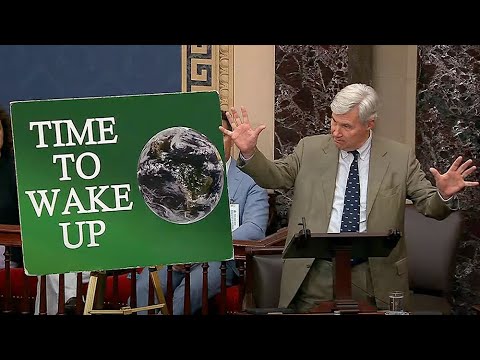
6 26 Time to Wake Up #308: 40 Years After Chafee’s Warning
Back before the Republican Party was corrupted by special interests, Senator John Chafee urged Congress to address climate change.
:00
on the Senate floor and asked my colleagues to wake up to the realities of climate change.
0:09
9 seconds
This also marks 308 times that my Republican colleagues have ignored my call to wake up.
0:18
18 seconds
They even refuse to acknowledge the simple truths that the climate is changing.
0:26
26 seconds
Oceans are warming.
0:29
29 seconds
Sea levels are rising and our fossil fuel emissions are the principal cause.
0:39
39 seconds
In the last several weeks, Republicans have sent someone to the floor to object
0:46
46 seconds
each time I sought unanimous consent to pass a resolution affirming these very simple truths.
0:57
57 seconds
The Senate's record of failure profoundly disappoints me.
1:04
1 minute, 4 seconds
In fact, it angers me.
1:07
1 minute, 7 seconds
I'm angry on behalf of the homeowners in Florida, Louisiana, back home in Rhode Island, and across
1:16
1 minute, 16 seconds
the country who are paying double or triple what they used to for property insurance
1:22
1 minute, 22 seconds
because climate risk is making floods, storms, and wildfires more frequent and severe.
1:34
1 minute, 34 seconds
I'm angry that these same families are paying more than ever for groceries due to increasingly frequent and severe
1:42
1 minute, 42 seconds
droughts, heat waves, floods, and storms.
1:50
1 minute, 50 seconds
This is a tragedy, but worse, it is a preventable
1:56
1 minute, 56 seconds
tragedy. Ignoring it will not make climate change go away.
2:04
2 minutes, 4 seconds
It will leave Americans poorer and American communities more vulnerable and less prepared.
2:13
2 minutes, 13 seconds
America can do big things. Our history shows that. And I believe a challenge of the magnitude of climate change justifies congressional action.
2:26
2 minutes, 26 seconds
So here I still am speaking because I still believe in the power of
2:34
2 minutes, 34 seconds
this body to take action to serve the people whom we took an oath to serve
2:43
2 minutes, 43 seconds
and to use the awesome power that our constituents have granted us to solve the greatest problems facing our country today.
2:54
2 minutes, 54 seconds
This is a significant anniversary.
3:02
3 minutes, 2 seconds
Republican Senator John Chaffy, whose distinguished career in the Senate spanned from 1976 to 1999,
3:12
3 minutes, 12 seconds
who also served as governor of my state and Secretary of the Navy, shared my belief.
3:24
3 minutes, 24 seconds
On a note of personal disclosure, when he and my father both came back from World War II as Marines from the
3:33
3 minutes, 33 seconds
Pacific Theater, they ended up as roommates in college.
3:40
3 minutes, 40 seconds
So, there's some personal family affection there as well as professional appreciation.
3:49
3 minutes, 49 seconds
Well, exactly 40 years ago this week, while serving as chair of the Senate
3:57
3 minutes, 57 seconds
Environment Public Works Subcommittee on Environmental Pollution, Senator Chaffy convened a two-day
4:05
4 minutes, 5 seconds
fivepanel hearing on the greenhouse effect, climate change, and on ozone depletion.
4:15
4 minutes, 15 seconds
Senator Chaffi believed Congress had a role in addressing both the hole in the ozone layer and the rising temperatures
4:24
4 minutes, 24 seconds
and global disruptions caused by climate change.
4:28
4 minutes, 28 seconds
The 1986 Chaffi hearing witnesses
4:37
4 minutes, 37 seconds
included scientists and policy makers among them Dr. James Hansen,
4:44
4 minutes, 44 seconds
who went on to become a leading advocate for decisive climate action and served NASA with great distinction.
4:53
4 minutes, 53 seconds
Dr. Michael Oppenheimer, later an intergovernmental panel on climate change participant and Nobel
5:00
5 minutes
Prize recipient, and even then Senator Al Gore of Tennessee.
5:08
5 minutes, 8 seconds
Also testifying were President Reagan's EPA administrator Lee Thomas and his commerce deputy secretary Clarence Brown.
5:19
5 minutes, 19 seconds
In Senator Chaffi's opening remarks, he warned of what he called two critical problems facing the world. First was the
5:28
5 minutes, 28 seconds
growing use of man-made chemicals that were significantly depleting the ozone layer. And second was the quote
5:38
5 minutes, 38 seconds
buildup of greenhouse gases which threatened to warm the earth to unprecedented levels unquote.
5:49
5 minutes, 49 seconds
Those problems had to be addressed, Senator Chaffy warned 40 years ago because, and I'll continue with his
5:56
5 minutes, 56 seconds
words here, there is a very real possibility that man, through ignorance or indifference
6:06
6 minutes, 6 seconds
or both, is irreversibly altering the ability of our atmosphere to perform basic life
6:14
6 minutes, 14 seconds
support functions for the planet.
6:19
6 minutes, 19 seconds
He asked the scientists to educate the public on the scientific consensus on ozone depletion and climate change.
6:29
6 minutes, 29 seconds
And he urged the government officials to take immediate action to, as he said, put the brakes on
6:38
6 minutes, 38 seconds
these looming crises and ensure a livable planet for future generations.
6:46
6 minutes, 46 seconds
Notably, Ronald Reagan's appointees acknowledged the climate crisis and agreed to take action.
6:57
6 minutes, 57 seconds
This is not the first time I have brought this graph to the Senate floor. This is the
7:05
7 minutes, 5 seconds
so-called Keeling curve, well known in science circles.
7:13
7 minutes, 13 seconds
This chart shows the change in carbon dioxide concentration in the Earth's atmosphere.
7:22
7 minutes, 22 seconds
As you can see, it has accelerated rapidly since 1950.
7:31
7 minutes, 31 seconds
Last month, the member who the Republicans sent to
7:38
7 minutes, 38 seconds
the floor to object to my statement of the science
7:46
7 minutes, 46 seconds
made the point that CO2 levels have naturally fluctuated over many, many years of geologic time. Well, yeah,
7:56
7 minutes, 56 seconds
that's true. Here's what that looks like.
8:02
8 minutes, 2 seconds
This is 800,000 years ago.
8:10
8 minutes, 10 seconds
800,000 years ago. For the last 800,000 years, the carbon concentration in the
8:18
8 minutes, 18 seconds
atmosphere has never gone above 300 parts per million. It has varied up and down.
8:29
8 minutes, 29 seconds
But something very very different happened when our industrial revolution began and we started emitting massive
8:38
8 minutes, 38 seconds
amounts of carbon dioxide and other greenhouse gases like methane into the atmosphere.
8:51
8 minutes, 51 seconds
There it is up like a rocket. The notion that this can be explained by that is just plain preposterous.
9:04
9 minutes, 4 seconds
This is also not the first time I've come to the floor to speak about the 1986 Chaffi hearings.
9:12
9 minutes, 12 seconds
I did so 10 years ago in 2016 to mark those hearings 30th anniversary.
9:22
9 minutes, 22 seconds
Then as now, I reflected not only on the reality of
9:31
9 minutes, 31 seconds
climate science, which is virtually undisputed except among those on fossil fuels
9:39
9 minutes, 39 seconds
payroll and the climate costs that have occurred since 1986.
9:48
9 minutes, 48 seconds
But I also spoke about the shocking transformation of the Republican party from the 1980s to today.
10:01
10 minutes, 1 second
In June of 1986, a Republican senator concerned by the
10:08
10 minutes, 8 seconds
same data that I'm sharing with you now committed to immediate and urgent action.
10:19
10 minutes, 19 seconds
He directed a panel of Ronald Reagan appointed officials to outline their plans to address the
10:27
10 minutes, 27 seconds
crisis and they did so.
10:32
10 minutes, 32 seconds
At that time the concentration of CO2 in the atmosphere was approximately
10:39
10 minutes, 39 seconds
348 parts per million.
10:48
10 minutes, 48 seconds
In June of 2016, when I recognized the 30th anniversary of this hearing, the fossil fuel billionaire backed
Supreme Court had just stayed the clean power plan. EPA's first ever attempt to
11:03
11 minutes, 3 seconds
regulate greenhouse gas emissions from power plants.
11:09
11 minutes, 9 seconds
Then candidate Donald Trump promised to resend the clean power plan when he got into office.
11:16
11 minutes, 16 seconds
and the United States House of Representatives voted to officially denounce a carbon price.
11:24
11 minutes, 24 seconds
They went to bat to protect the freedom to pollute of their fossil fuel donors.
11:34
11 minutes, 34 seconds
In 2016, the concentration of CO2 had climbed from 348 parts per million to
11:42
11 minutes, 42 seconds
404 parts per million. These are measurements, by the way, not opinions.
Today, President Trump, approaching the halfway point of his second term, calls climate change a hoax.
12:01
12 minutes, 1 second
Hoax.
12:04
12 minutes, 4 seconds
His EPA administrator, Lee Zeldon, rescended EPA's greenhouse gas endangerment finding, an action flatly
12:13
12 minutes, 13 seconds
at odds with known science and with the law, and then celebrated what he called
12:20
12 minutes, 20 seconds
driving a dagger straight into the heart of the climate change religion. Really?
12:29
12 minutes, 29 seconds
And to bring things full circle, earlier this spring, 40 years after a senior
12:36
12 minutes, 36 seconds
Reagan administration commerce official, acknowledged the reality of climate change, today's commerce secretary, Howard
12:45
12 minutes, 45 seconds
Letic, a strident opponent of affordable renewable energy, denies the science.
12:57
12 minutes, 57 seconds
The Republican party steps backward.
13:03
13 minutes, 3 seconds
Today, as I speak, the concentration of CO2 in the atmosphere is north of 430
13:09
13 minutes, 9 seconds
parts per million. 348 up to 404, now up to 430.
13:17
13 minutes, 17 seconds
In just four decades, atmospheric CO2 concentration has increased by nearly 25%.
13:27
13 minutes, 27 seconds
due to fossil fuel combustion.
13:32
13 minutes, 32 seconds
As climate deniers are fond of pointing out, CO2 doesn't harm or kill people.
13:41
13 minutes, 41 seconds
What it does is trap heat in the atmosphere.
13:47
13 minutes, 47 seconds
Enormous amounts of heat.
13:53
13 minutes, 53 seconds
And it is that heated atmosphere that harms and kills people through more
14:00
14 minutes
violent extreme weather events, wildfires, and rising seas.
14:09
14 minutes, 9 seconds
Here you see global average temperatures.
14:18
14 minutes, 18 seconds
Back in 1986, they were 0.46
14:24
14 minutes, 24 seconds
degrees Celsius above the pre-industrial norm.
14:30
14 minutes, 30 seconds
Now they're 1.4 degrees above that pre-industrial norm.
14:39
14 minutes, 39 seconds
That difference nearly a full degree has already had profound consequences
14:46
14 minutes, 46 seconds
for our planet.
14:51
14 minutes, 51 seconds
For one, our oceans are heating every year by the zetta jewel.
14:59
14 minutes, 59 seconds
If you don't know what a zeta jewel is, let me tell you. It has 21 zeros after it.
15:05
15 minutes, 5 seconds
You can either call it a billion trillions or a trillion billions.
15:12
15 minutes, 12 seconds
It's an enormous number. The entire production and consumption of energy by the human species on planet earth is
15:19
15 minutes, 19 seconds
half a zetoule. And because of the heating generated by the greenhouse gases,
15:30
15 minutes, 30 seconds
more than 24 zetoules of excess heat go into the ocean every year.
15:40
15 minutes, 40 seconds
A multiple of our total energy consumption as a species is absorbed by the oceans. If you want
15:48
15 minutes, 48 seconds
to know why they're warming, if you want to know why reefs are dying, if you want to know why fisheries are moving around, if you want to know why seas are rising, if you want to know why storms are
15:56
15 minutes, 56 seconds
worsening, there's your answer. Zeta of excess heat into the oceans caused by fossil fuel.
16:06
16 minutes, 6 seconds
And all of that has economic costs.
16:12
16 minutes, 12 seconds
in this building. I've grown, I suppose, accustomed to the fact that nobody cares about anything that can't be monetized.
16:19
16 minutes, 19 seconds
And they only care about it to the extent that it is monetized.
16:24
16 minutes, 24 seconds
So, here's the monetization of what all that means.
In 1986 here, there were three
one two three three billion dollar disasters in the United States. Last year,
there were 23 billion dollar disasters.
16:50
16 minutes, 50 seconds
The recent LA wildfire alone destroyed thousands of homes and did tens of billions of dollars in damage.
17:01
17 minutes, 1 second
And guess what happens
17:08
17 minutes, 8 seconds
when that kind of damage soarses, insurance moves with it.
17:16
17 minutes, 16 seconds
You actually don't have to be directly affected by a climate change-driven extreme
17:23
17 minutes, 23 seconds
weather event, a hurricane, or wildfire to be paying the price for climate change.
Back in 1986, when Senator Chaffy held his hearings, homeowners insurance premiums averaged about $150 annually.
In today's money, they averaged $470 roughly.
Today, today, premiums average almost $2500.
And no surprise, the largest increases are in the highest climate risk areas.
18:08
18 minutes, 8 seconds
In Florida and Louisiana, homeowners insurance premiums average
18:14
18 minutes, 14 seconds
more than $10,000 and they're predicted to increase,
18:22
18 minutes, 22 seconds
doubling, even tripling off the proverbial charts.
18:29
18 minutes, 29 seconds
Climate change is no longer tomorrow's problem and it has moved from the science department into the economics
18:37
18 minutes, 37 seconds
department. It is here today and whether my colleagues care to admit
it or not, we are all already paying for it.
Economists estimate that it costs every household an average of around $500
per year in heightened climate cost. And that's a conservative estimate. In many
coastal and wildfire exposed parts of the country, that average annual cost is already north
of a thousand dollar for household costs.
...
CU ff funded armada of ft groups
17:59
17 minutes, 59 seconds
And no surprise, the largest increases are in the highest climate risk areas.
18:08
18 minutes, 8 seconds
In Florida and Louisiana, homeowners insurance premiums average
18:14
18 minutes, 14 seconds
more than $10,000 and they're predicted to increase,
18:22
18 minutes, 22 seconds
doubling, even tripling off the proverbial charts.
18:29
18 minutes, 29 seconds
Climate change is no longer tomorrow's problem and it has moved from the science department into the economics
18:37
18 minutes, 37 seconds
department. It is here today and whether my colleagues care to admit
18:44
18 minutes, 44 seconds
it or not, we are all already paying for it.
18:51
18 minutes, 51 seconds
Economists estimate that it costs every household an average of around $500
18:59
18 minutes, 59 seconds
per year in heightened climate cost. And that's a conservative estimate. In many
19:06
19 minutes, 6 seconds
coastal and wildfire exposed parts of the country, that average annual cost is already north
19:14
19 minutes, 14 seconds
of a thousand dollar for household costs.
19:19
19 minutes, 19 seconds
And that hidden climate tax brought to you by the fossil fuel industry
19:27
19 minutes, 27 seconds
is steadily rising year after year.
19:33
19 minutes, 33 seconds
This is what 40 years of inaction and obstruction
19:40
19 minutes, 40 seconds
following the Chaffi hearings has wrought.
19:45
19 minutes, 45 seconds
huge costs and increasing economic dislocation.
19:51
19 minutes, 51 seconds
What was once a scientific issue, a prediction, is now knocking at our door
20:01
20 minutes, 1 second
and causing immediate economic harm. And then there's the politics.
20:10
20 minutes, 10 seconds
In 1986, the hope and determination to tackle climate change was a bipartisan thing.
20:21
20 minutes, 21 seconds
Today, climate change has been replaced in the Republican party by climate denial.
20:33
20 minutes, 33 seconds
When I got here in 2007, climate change was still a bipartisan concern.
20:42
20 minutes, 42 seconds
We had major climate legislation in this body. Four different measures that I
20:50
20 minutes, 50 seconds
recall, each significant, each that would have changed the trajectory that these pages will face in their lifetimes.
21:02
21 minutes, 2 seconds
But then then the 2010 Citizens United decision came down.
That decision unleashed a vast fossil fuelfunded armada of front
groups that spread around climate disinformation.
perhaps the biggest fraudulent operation in the country's history and unlimited dark money into our
politics, perhaps the largest corruption enterprise in American history.
Back in 1986, Senator Chaffi did not face a politics a wash in fossil fuel
dark money and the armada of climate denial front groups did not exist.
And so the Senate was able to focus more on the public interest and less on fossil fuels special interests.
Today, objecting to my calls to this body to recognize the reality of climate
change. The objector sent here accused me of, and I'll quote him, subscribing
to chicken little scare tactics. That's 2026 Republican position. RON JOHN?
Back in 1986, Republican John Chaffy before this became the House of Mammon
opened his climate change by hearing some by saying something very different.
He said, "This is not a matter of Chicken Little telling us the sky is
falling." 40 years of fossil fuel influence has made a sickening difference.
The 1986 Chaffy hearing is also illustrative of the power of Congress when uncorrupted by a powerful special interest. It acts decisively in favor of the public.
At the time of the Jaffy hearing, depletion of the Earth's protective ozone layer was allowing dangerous levels of solar radiation to penetrate
the atmosphere. Twin holes in the ozone layer had formed around the north and south poles, and the ozone holes were
growing. Scientists worried that absent immediate action, the holes would grow big enough to threaten the survival of
life on Earth. That fear is ancient history now. Why? Not because we mocked the scientists for fear-mongering,
but because we did as the science advised and phased out the use of ozone depleting chlorofhluocarbons.
In 1990, just four years after the Jaffy hearings, Congress passed the 1990 amendments to the Clean Air Act, which
required this phase out. No surprise, the scientists were right, and the phase out worked.
Chlorofhluocarbons stay in the atmosphere for decades. So it took years to see the effects of the ban. But
beginning in the 2000s, the ozone hole stabilized, then began to shrink. And if current policies remain in place,
scientists expect a return to pre-1980s level, a healing of the ozone holes within the next four decades.
...24:39
24 minutes, 39 seconds
We could still do the same for climate change. Follow the science. Pass a law to implement policies that would reduce
24:47
24 minutes, 47 seconds
and eventually eliminate carbon pollution.
24:52
24 minutes, 52 seconds
Remove the already emitted carbon dioxide from the atmosphere and restore our climate's natural health.
25:01
25 minutes, 1 second
halt and eventually reverse dangerous sea level rise in the dangerous cycle of ever worsening storms and wildfires
25:10
25 minutes, 10 seconds
and fend off the insurance collapse that this trajectory
25:23
25 minutes, 23 seconds
portends.
25:31
25 minutes, 31 seconds
Many of us watched the recent Aremis 2 mission with awe, with awe of the astronauts who traveled
25:38
25 minutes, 38 seconds
farther than any human has gone before and with awe for NASA's ingenuity to be able to send them there. Astronaut
Christina Ko, speaking from over 200,000 miles away from Earth, spoke to future generations.
25:55
25 minutes, 55 seconds
We will explore, she said. We will build. We will visit again. We will construct science outposts. We will found companies. We will bolster
26:04
26 minutes, 4 seconds
industry. We will inspire. But ultimately, we will always choose Earth. We will always choose each other.
26:14
26 minutes, 14 seconds
Her closing words would resonate, I think, with Senator John Chaffy.
26:20
26 minutes, 20 seconds
40 years ago. He said, "It seems that the problems man creates for our planet are never ending, but we have found
solutions for prior difficulties, and we will for these as well." With those words of his, I salute the
26:37
26 minutes, 37 seconds
memory of Senator John ChaffEE, whose seat I now hold. He was an inspiring and far-sighted public servant. We need more
26:46
26 minutes, 46 seconds
of them. I should add that the NASA scientists who made that remarkable
26:54
26 minutes, 54 seconds
Artemis voyage possible have no doubts about the climate science.
those climate doubts, that fake climate denial
is precisely co-extensive with the reach of the fossil fuel industry's corrupt political influence.
There are two paths that emerged from Senator Chaffi's hearing.
One was the path of science to success against ozone depletion.
The other, the one we have unfortunately chosen is the path of climate denial fraud and dark money political corruption that leads to failure. We can do better, but only if we wake up. I yield the floor.
---
WH reo ocean warming yt 5 13/26
Oceans Are Warming? Senate Republicans Disagree.

alarm chicken lil not denier, i am envrnist want clean water air and ---- same spiel as last time on sea level rise; 8 classes at u wIsc on climATE
---
---
Time to Wake Up #307: The Mischief Continues
The creepy billionaires’ plot: keep control of government, maintain free-to-pollute business model, and keep gouging you on costs.
---
The Simple Truth: Sea Levels are Rising
ocean heat content zetajules
consent resol
13,993 views Apr 29, 2026
April 29 | Senator Whitehouse takes to the Senate Floor to ask if his colleagues can agree on this one, simple truth: sea levels are rising. The reality of climate change is made up of many, many simple truths. Today’s simple truth: sea levels are rising. Can we agree on that?

8
is a graph showing the increase in ocean
1:32
heat content.
1:35
It's measured in zeta jewels.
1:38
Zeta jewels is a very big number. Uh
1:42
zeta means it has 18 zeros.
1:45
It's a billion trillions or a trillion
1:47
billions depending on which way you want
1:49
to go about it. To put it at a more
1:54
practical scale, the entire production
1:58
of energy by the human species on all of
2:00
planet Earth adds up to 1/2 of a
2:04
zedigjle.
2:06
The price we pay for the fossil fuel
2:08
component of that half zedle of energy
2:12
is an ocean whose temperature is
2:15
increasing by around 15 zedles a year.
2:20
It's a 30 times magnifier
2:24
because of the effect of fossil fuel
2:28
emissions.
---
SCHIFF CU AMEND 9 25
September 17, 2025
NEWS: Sen. Schiff, Reps. Neguse, McGovern, and Lee Introduce Constitutional Amendment to Overturn Citizens United
On Constitution Day, lawmakers resume push to ensure Congress and states can set reasonable limitations on political spending and influence by corporations on U.S. elections
Washington, D.C. — Today, U.S. Senator Adam Schiff (D-Calif.) and U.S. Representatives Joe Neguse (D-Colo.-02), Jim McGovern (D-Mass.-02), and Summer Lee (D-Pa.-12) introduced the Citizens Over Corporations Amendment, a proposed amendment to the U.S. Constitution that would overturn Citizens United v. FECand limit corporate influence and spending in American politics.
“The Supreme Court’s decision in Citizens United opened the door for corporations to pour billions of dollars of dark money into elections. This anonymous and unrestricted spending cripples transparency in the political process and weakens our democracy. Our amendment will keep big money out of politics and restore power where it should belong — with the American people,” said Senator Schiff.
“The time to confront political corruption and clean up government is now,” said Congressman Neguse.“The Citizens Over Corporations Amendment works to renew people’s faith in our democracy by ensuring transparency through campaign finance reform and preventing unrestrained spending and dark money in elections.”
“Elon Musk poured millions into electing Donald Trump and then used the influence he bought to fire federal workers, dismantle USAID, and strip health care from millions,” said Congressman McGovern. “Citizens United gives billionaires like Musk even more power to rig the system for the well-off and well-connected. That’s not a democracy—it’s an auction. I’m proud to support the Citizens Over Corporations Amendment, which will overturn Citizens United, get big money out of politics, and put power back where it belongs—in the hands of the people.”
“Some say the beginning of the collapse of our democracy was when the Supreme Court ruled in favor of Citizens United, giving the green light to corporations and billionaires to pour hundreds of millions into our elections and drown out the voices of everyday people. At the root of why we cannot make progress on so many urgent policies is a system where money speaks louder than people. The Citizens Over Corporations Amendment is about changing that. It is about putting power back where it belongs, with the people, so we can build a government that works for all of us, not just the wealthy few and their corporate interests,”said Congresswoman Lee.
Senator Schiff has introduced his constitutional amendment in the U.S. House of Representatives to overturn Citizens Unitedsince 2013 and has been a strong proponent of fixing America’s broken campaign finance system since he was first elected in 2000, after a race that was at the time the most expensive in the history of the House of Representatives. The first bill he cosponsored in Congress was the bipartisan McCain-Feingold Act to regulate the financing of political campaigns, which was later passed and signed into law.
The proposed Constitutional amendment will:
- Make clear the Constitution does not restrict the ability of Congress or states to set reasonable, viewpoint-neutral limitations on the raising and spending of money by candidates and others to influence elections
- Distinguishes between natural persons, corporations, or other artificial entities, including by allowing Congress or the State to prohibit such entities from spending money to influence elections
- Allow public financing of campaigns when states choose to enact such laws, which can restrict the influence of corporate or private wealth = public fund election
- Take further steps to protect the freedom of the press in the case of future campaign finance-related legislation
Earlier today, Senator Schiff and lawmakers rallied for Constitution Day to underscore the need to protect our democracy and curb influence by special interests on American politics. At the rally, Schiff highlighted his proposed amendment reversing the 2010 Supreme Court ruling that ended restrictions on corporate campaign spending, eliminating decades of legal precedent.
The Senator’s full remarks at the rally can be viewed.Schiff’s remarks can be downloaded here.
The bill is co-sponsored by U.S. Senators Jeanne Shaheen (D-N.H), Angus King (I-Maine), Peter Welch (D-Vt.), Sheldon Whitehouse (D-R.I.), Andy Kim (D-N.J.), and Cory Booker (D-N.J.).
The bill is endorsed by Citizens for Responsibility and Ethics in Washington, Democracy Defenders Action, Public Citizen, End Citizens United, People for the American Way, Common Cause, and Free Speech For People.
“Since the Supreme Court’s decision in Citizens United v FEC 15 years ago, unlimited and untraceable money has flowed from the pockets of corporations and the ultra-wealthy into political campaigns”,said Stuart McPhail, Director of Campaign Finance Litigation, Citizens for Responsibility and Ethics in Washington (CREW). “In the 2024 federal election cycle alone, over $2.7 billion was funneled through super PACs to various political campaigns. This dark money corrodes our democracy by allowing corporations and billionaires to hide their identities while greatly influencing elections and policy. CREW is proud to endorse the constitutional amendment introduced by Senator Schiff and Representatives Neguse, McGovern, and Lee to overturn Citizens United and ensure that the voices of average citizens are not drowned out by moneyed interests.”
“Democracy Defenders Action wholeheartedly endorses Sen. Adam Schiff and Reps. Joe Neguse, Jim McGovern, and Summer Lee’s constitutional amendment to overturn Citizens United,” said Virginia Canter, Ethics and Anticorruption Chief Counsel and Director, Democracy Defenders Action. “This crucial step will ensure that all Americans, not just the super-rich and corporations, have an equal voice in our elections–and true representation in our democracy.”
“Citizens United has turned our democracy into a government that serves the ultra-wealthy. Political spending by billionaires has surged an astonishing 160-fold since the 2010 Supreme Court decision, and working families are paying the price like never before as self-enriching politicians bankroll tax breaks for their biggest donors. Senator Schiff’s amendment is a bold and commonsense step to reclaim government for the people. We applaud his leadership to challenge the billionaire class, fight corruption in Washington, and get Big Money out of politics,” said Tiffany Muller, President, End Citizens United.
“Citizens United destroyed our nation’s safeguards against the undue influence of money in politics. For 15 years now, dark money has flowed freely, allowing the rich and powerful even more influence over our elections. This amendment is essential to preventing that continuing assault on the integrity of our elections. People For the American Way is proud to support this amendment as we work toward building a democracy truly of, by, and for the people,” said Svante Myrick, President, People For the American Way.
“The vast majority of Americans want the real voices of real people to matter more than the money that corporations and the super-rich funnel into our political system. The devastating Citizens United decision 15 years ago dramatically altered the landscape of our politics—unleashing a flood of cash and deepening the outrage that regular people feel at the inequities baked into our democracy. We must overturn this decision. Senator Schiff, and Reps. Joe Neguse, Jim McGovern, and Summer Lee have remained focused and continue pushing for a constitutional amendment to do just that. Public Citizen strongly supports their efforts,” said Lisa Gilbert, Co-President, Public Citizen.
A fact sheet on the legislation can be foundhere.
Full text of the bill is availablehere.
---
CPP SHADOW DOCKET; LEO 3 ACTUALLY KOCH?!
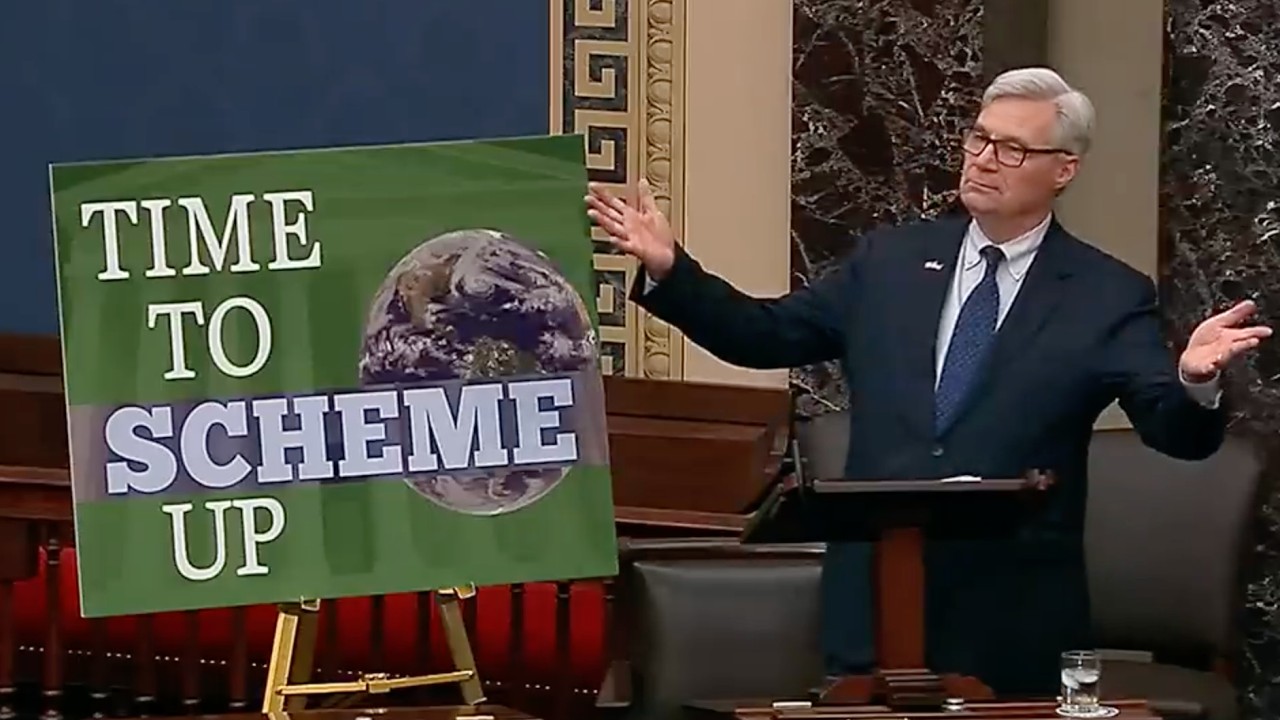
The Scheme Time to Wake Up | Senator Whitehouse's Speeches Converge
Apr 23, 2026
April 22 | Senator Sheldon Whitehouse (D-RI) delivers his 306th speech in his Time to Wake Up series, converging with his 36th Scheme speech. The billionaire-backed scheme to capture and control the Supreme Court was developed largely to protect the fossil fuel industry’s free-to-pollute business model. Here’s the proof.
//
LEO
- Whitehouse.senate.gov
https://www.whitehouse.senate.gov › news › speeches › scheme-18_leonard-leos-16-billion-payday
Scheme 18: Leonard Leo's $1.6 Billion Payday - Senator Sheldon Whitehouse
During Donald Trump's time in office, Leonard Leo brokered the scheme to have the Federalist Society or— more accurately—the big secret donors behind the Federalist Society handpick Trump's Supreme Court nominees. Remember that list we all heard about?
Esquire
Sheldon Whitehouse Calls Out Republican Scheme to Control ... - Esquire
Senator Sheldon Whitehouse is never going to lack for material, not as long as Leonard Leo's wallet holds out, anyway. Whitehouse's laser-focus on the ongoing corruption— both ideological and ...
AI images: show
3 26 see zelden transcript
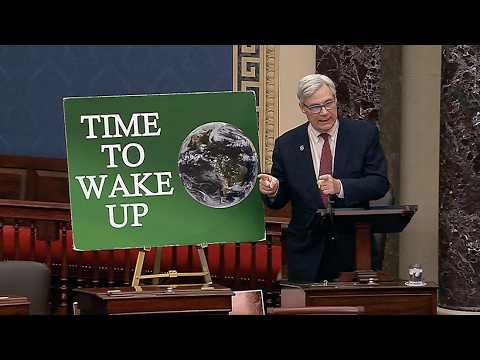
Time to Wake Up #305: Lyin’ Lee Zeldin

20,934 views Mar 26, 2026
March 26 | Senator Sheldon Whitehouse (D-RI) delivers his 305th speech in his Time to Wake Up series, this time on Trump's EPA Administrator, Lee Zeldin. Sheldon Whitehouse represents Rhode Island in the U.S. Senate, where he champions policies to uphold American leadership in the world, protect our planet in a changing climate, and hold the powerful accountable.
0:11
11 seconds
MR. WHITEHOUSE: I'M HERE AGAIN WITH MY TIME TO WAKE UP CHART TO WARN THIS CHAMBER ABOUT A CORRUPT DANGER TO OUR COUNTRY, A
0:20
20 seconds
DANGER POWERED BY FOSSIL FUEL INDUSTRY MONEY, ORCHESTRATED BY
0:26
26 seconds
DARK MONEY FRONT GROUPS AND NOW EXECUTED AT THE HIGHEST LEVELS OF A CORRUPT EXECUTIVE BRANCH.
0:35
35 seconds
IN PREVIOUS SPEEES, I DESCRIBED THE FOUR PHASES OF PHASE ONE WAS BURY THE EVIDENCE.
0:46
46 seconds
SCIENTISTS TOLD THEM WHAT THE SCIENCE WAS, THEY IGNORED IT AND BURIED IT.
0:52
52 seconds
PHASE TWO IS LIE ABOUT THE EVIDENCE, PRETEND IT'S NOT TRUE AS THE REST OF THE SCIENTIFIC
1:01
1 minute, 1 second
ESTABLISHMENT CAME ON BOARD WITH WHAT THEY TOLD THEM.
1:06
1 minute, 6 seconds
PHASE THREE, PROTECT THE FOSSIL FUEL EE POLLUTE FOR FREE
1:12
1 minute, 12 seconds
BUSINESS MODEL AFTER CITIZENS UNITED OUTPOURED THE MONEY. WE ARE ENTERING INTO PHASE FOUR,
1:20
1 minute, 20 seconds
THE MOST DANGEROUS PHASE YET, WEAPONIZING THE GOVERNMENT ITSELF TO ATTACK CLEAN ENERGY, PROTECT POLLUTERS AND STEAMROLL LAWFUL GOVERNMENT PROCESS.
1:32
1 minute, 32 seconds
TODAY'S SPEECH IS ABOUT A LIE.
1:35
1 minute, 35 seconds
WE ARE NOW SOEEP IN PHASE FOUR, THAT HEADS OF EXECUTIVE ENCIES FEEL ENTITLED TO LIE TO
1:42
1 minute, 42 seconds
CONGRESS IF IT HELPS CARRY OUT PRESIDENT TRUMP'S FOSSIL FUEL CAPTURED AGENDA.
1:49
1 minute, 49 seconds
NOTICE WHAT DISTINGUISHES PHASE FOUR.
1:52
1 minute, 52 seconds
PHASE ONE INVOLVED BURIED EVIDENCE KEPT SECRET.
1:57
1 minute, 57 seconds
PHASE TWO INVOLVED LIES FILTERED THROUGH THINK TANK REPORTS WITH
2:04
2 minutes, 4 seconds
PLAUSIBLE DENIAL ABILITY -- DENIABILITY FOR FOSSIL FUEL FRONT GROUPS, PHASE THREE WAS
2:15
2 minutes, 15 seconds
UNANIMOUS MONEY THROUGH FRONT GROUPS, ALL HIDDEN. BUT PHASE FOUR, USING THE GOVERNMENT ITSELF TO EXECUTE THE
2:24
2 minutes, 24 seconds
POLLUTERS AGENDA AGAINST THE LAW, AGAINST CONGRESS, AND AGAINST THE COURTS, THAT MUST BE
2:30
2 minutes, 30 seconds
DONE OUT LOUD, UNDER OATH, BEFORE JUDGES, AND BEFORE THIS BODY.
2:37
2 minutes, 37 seconds
IN PHASE FOUR THE LION BECOMES FEDERAL, BRAZEN, ON THE RECORD.
2:43
2 minutes, 43 seconds
THERE ONCE WAS A TIME WHEN LYING TO CONGRESS MATTERED, WHEN SWEARING AN OATH TO TELL THE
2:50
2 minutes, 50 seconds
TRUTH, THE WHOLE TRUTH AND NOTHING BUT THE TRUTH MEANT EXACTLY THAT.
2:55
2 minutes, 55 seconds
WHEN, IF SOMEONE LIED TO CONGRESS, EVEN MEMBER'S OF THE LIAR'S OWN PARTY WOULD HOLD THEM TO ACCOUNT.
3:04
3 minutes, 4 seconds
UNFORTUNATELY THOSE DAYS ARE GONE, BUT TRUTH SHOULD STILL SO THIS EVENING, I PRESENT TO
3:12
3 minutes, 12 seconds
YOU THE STORY OF LYING LEE LDIN....
epstein russia 3 26 lincoln square?
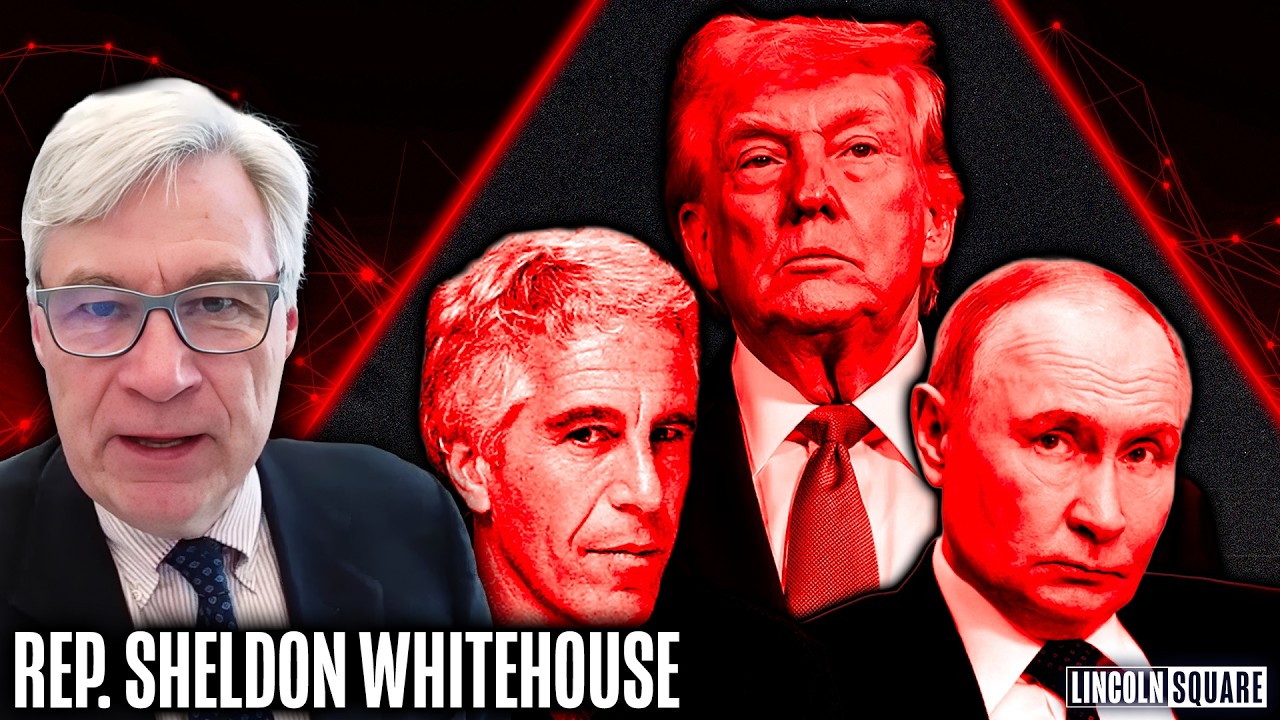
Sen. Whitehouse on the Trump / Russia / Epstein Triangle | The Frank Figliuzzi Show
trump submissive only to putin; bondi turned off corrupt/crypto cyber alarms/agy
cop 30 brazil 11 25
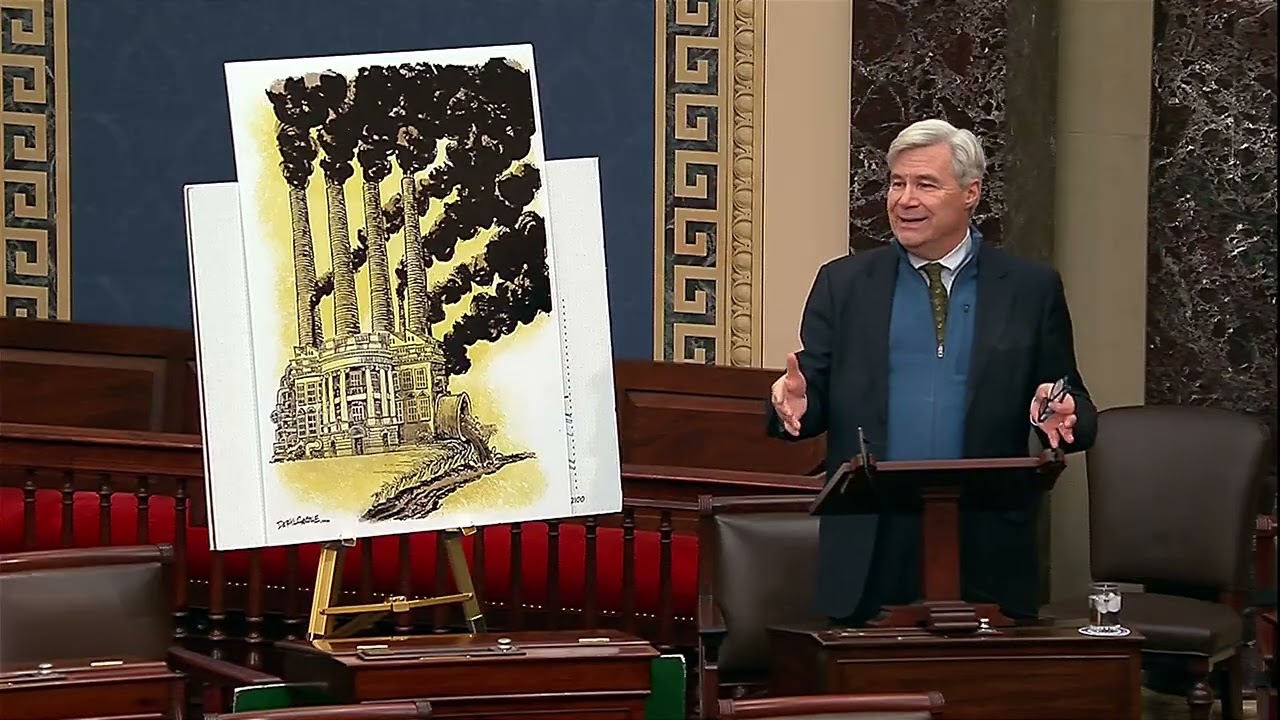
2014 cccm graf
Time to wake up to the Climate Denial Beast 2010 brulle
// john locke fdn?
===
whitehouse 9 25 95% new energy sun wind and battery?!
4 phases of denial
9 25
---
7 25 see TTWU 300 transcript
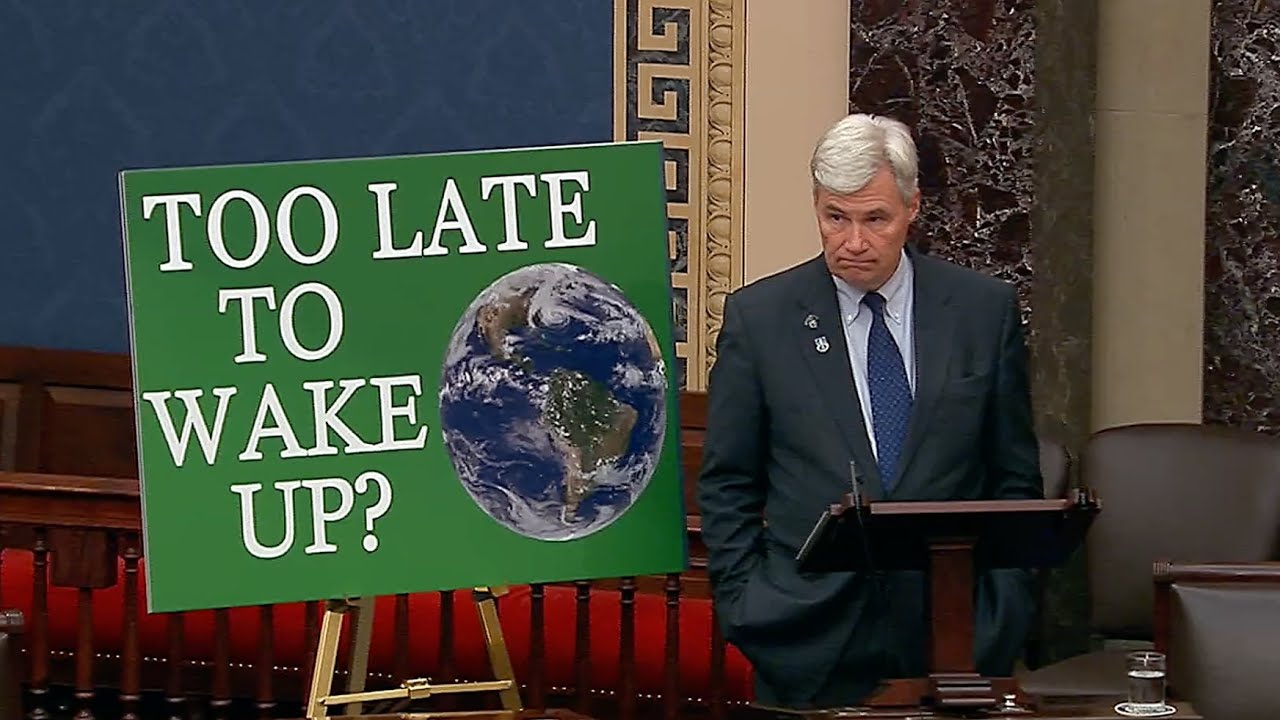
THE THREE
MOST CONSEQUENTIAL DISASTERS FOR AMERICA IN OUR LIFETIMES WERE
THE CAPTURE OF THE SUPREME COURT BY RIGHT-WING BILLIONAIRES, THE INFLUX INTO OUR ELECTIONS OF
FLOODS OF CORRUPTING SPECIAL INTEREST DARK MONEY, AND THE SUCCESS OF THE FOSSIL FUEL
CLIMATE DENIAL OPERATION AT BLOCKADING SOLUTIONS TO THE FOSSIL FUEL EMISSIONS CRISIS.
IT IS ENTIRELY POSSIBLE THAT FOSSIL FUEL INTERESTS WERE THE DRIVING FORCE BEHIND ALL THREE
---
31:29
BILLIONAIRES DEPENDS ON SECRECY TO WORK ITS EVILS. WE DON'T HAVE TO MATCH FOSSIL FUEL FRONT GROUP FOR FRONT
31:36
GROUP. PROPAGANDA MOUTHPIECE FOR PROPPA GRANDA MOUTHPIECE, LIE FOR LIE,
31:44
EVEN DOLLAR FOR DOLLAR, IT DOESN'T HAVE TO TAKE $7 BILLION ON OUR SIDE. OUR CAUSE CAN WIN BY SHINNING A
31:50
BRIGHT LIGHT ON THEIR MISCHIEF AND THEIR MOTIVES.
31:56
AMERICAN LOVE SOLVING MYSTERIES LOVE TO HEAR WHAT PAUL HARVEY CALLED THE END OF THE STORY.
32:04
FOSSIL FUEL HAS TO LIE AND HIDE BEHIND MASKS AND WIN.
32:10
BEAM DON'T LIKE BEING LIED TO. -- PEOPLE DON'T LIKE BEING LIED TO, THE TRUTH, THAT'S OUR
32:16
SUPERPOWER, EVEN WITH THAT SUPERPOWER, IT'S NOT GOING TO BE EASY, WE HAVE TO FACE THERE IS
32:21
SOME REAL WORK AHEAD OF US. I WAS A PROSECUTOR. YOU'VE SEEN THE TV SHOWS,
32:28
PROSECUTORS SHOW ALL OF THE GANG MEMBERS, SHOW WHO IS REPORTING TO AND WHAT PHONE NUMBERS AND
32:34
ADDRESSES WE HAVE AND WHERE THEY GET THEIR GUNS AND DISTRIBUTE
32:40
GUNS, ALL OF THAT GOES UP ON THE WORK BOARD BECAUSE YOU HAVE TO KNOW YOUR ADVERSARY.
32:47
INTELLIGENCE AGENCIES DO DEEP RESEARCH INTO THE PERSONNEL OF OPPOSING SERVICES, KNOW YOUR ADVERSARY WILLIAM WE DON'T.
32:54
-- ADVERSARY. WE DON'T. UNTIL RECENTLY FEW DEMOCRATS KNEW WHO LEONARD LEO WAS, THE
33:01
TOP OPERATIVE OF THE COURT CAPTURE SCHEME.
33:07
MOST COULDN'T FACE -- THAT'S NOT THE FAULT OF INDIVIDUAL MEMBERS OF CONGRESS, WE JUST HAD NO WAR ROOM TO ORGANIZE THE INFORMATION. NO OFFENSE COORDINATOR TO PLAN STRATEGY. NO BATTERS BOOK TO TELL US WHO
33:21
CAN'T HIT INSIDE PITCHES, NO CORK BOARD TO PIN UP THE GANG
INFORMATION. CORPORATIONS DO BETTER RESEARCH ON RIVALS WHEN PREPPING A CORPORATE TAKEOVER THAN WE DID
TRYING TO DEFEND OUR COUNTRY FROM THIS POLITICAL TAKEOVER. THE IDEA OF A REAL-TIME
ANTIFRAUD CLIMATE CLEANUP OPERATION CENTER, CALLING OUT THE LIES, FOLLOWING THE MONEY
33:47
AND SPOTTING WHO'S BEHIND THE FRONT GROUPS MAY SEE BEYOND OUR REACH, BUT IT'S NOT.
33:54
THE MILITARY'S HAD OP CENTERS FOR YEARS, YOU HAVE SEEN THE
SATELLITE FEEDS AND THE DRONE FEEDS COMING IN, THE RAF, BACK IN WORLD WAR II, HAD A SIMPLER
ONE DURING THE BATTLE OF BRITAIN WITH THE PLANE MODELS PUSHED
AROUND WITH THE LONG STICKS ON THE BIG MAP TABLE.
RADAR TOLD THE WAR ROOM WHEN TO SCRAMBLE THE SPIT FIRES AND
TO SEND THEM. WE DON'T HAVE THAT. NO RADAR, NO SPIT FIRES, NO WAR
ROOM IN LONDON MANY BUT WE CAN. REMEMBER THOSE THREE EVILS, THE FOSSIL FUEL INDUSTRY'S CLIMATE
DENIAL FRAUD, THE CAPTURE OF THE SUPREME COURT, THAT DARK MONEY
INFILTRATION OF OUR POLITICS. THEY DIDN'T HAPPEN. THEY WERE ALL DONE VERY DELIBERATELY, USING AN ARMADA OF FRONT GROUPS AND
34:55
CAREFULLY SCRIPTED FAKERY. IT IS BEST TO THINK OF IT ALL AS A SINGLE BEAST, A BEAST THAT IS
NOW BuROUwED IN AND IS RUNNING THE GOVERNMENT FOR TRUMP.
IT'S A TAKEOVER BY A SHADOW GOVERNMENT WORKING FOR
RIGHT-WING EXTREMIST AND FOSSIL FUEL POLLUTERS. IF WE DON'T SEE IT FOR WHAT IT
IS AND CALL IT OUT FOR WHAT IT IS, HOW CAN WE WARN PEOPLE OF WHAT'S HAPPENING?
AND IF WE DON'T WARN PEOPLE OF WHAT'S HAPPENING, HOW CAN WE
BELIEVE WE'VE DONE OUR DUTY IN THIS MOMENT OF PERIL?
CLIMATE CHANGE MAKES THIS A BATTLE WITH A RATCHET.
THERE'S SOME THINGS YOU JUST CAN'T COME BACK FROM.
35:49
THE RATCHET HAS CLICKED AND THERE'S NO RETURN. SO IT IS URGENT, IT IS TIME FOR...
btb ref in thinktank episode 4 24
---
---
an 3 26
Sen. Sheldon Whitehouse (D-R.I.) walked through all of the details that connect trafficker Jeffrey Epstein and Russian intelligence. Those connections also link President Donald Trump.
According to Whitehouse, the pathway goes through Ghislaine Maxwell's father, which the senator read from his MI6 file that Robert Maxwell was "a thoroughly bad character and almost certainly financed by Russia."
Whitehouse walked through all of the relationships that Epstein had with international assets, including Israeli and U.S. intelligence. Recently released files prompted Polish Prime Minister Donald Tusk to announce they would do a wide-ranging investigation into Epstein's possible links to Russian intelligence.
One of those was Epstein's relationship with Oleg Deripaska, who also had a close relationship with Trump's campaign chairman Paul Manafort.
The Senator walked through a number of documents and emails in the Epstein files showing that Russian girls were part of his recruitment for the men that he sought to manipulate.
Whitehouse cited one communication from French model scout Jean-Luc Brunel to Epstein saying he found "a teacher" to help Epstein with his Russian. "She is 2 times 8 years old and not blond," he said.
JPMorgan Chase & Co. identified more than $1 billion in suspicious transactions that it flagged to the U.S. government. The big bank identified about 4,700 transactions, saying that "they were potentially related to reports of human trafficking involving Mr. Epstein," reported The New York Times.
It also mentioned Epstein’s wire transfers to Russian banks, even referencing “his relationships with two U.S. presidents.”
Epstein also maintained connections with Saudi Arabia's Crown Prince Mohammed bin Salman (MBS), a close friend of Trump and his son-in-law Jared Kushner.
"After Epstein's arrest in 2019, officials also discovered that he held an expired Austrian passport from the 1980s with his picture and a false name, which listed his residence as Saudi Arabia," CBS News and the New York Times reported.
Whitehouse cited one ex-girlfriend who recalled Epstein telling her, "I collect people. I own people. I can damage people."
Virginia Giuffre wrote in her book that Epstein had a "huge library of videotapes and a room in his home where monitors displayed in real time surveillance footage from his properties."
"He explicitly talked about using me and what I'd been forced to do with certain men as a form of blackmail so these men would owe him favors," she wrote.
She also recalled one instance in which he walked through his mansion and pointed out where all of the pinhole-sized cameras were. Epstein boasted that they recorded everything.
Florida police found two small cameras in clocks in his Palm Beach home, Whitehouse said.
He also said that former prosecutor Alex Acosta was quoted as saying that Epstein "belonged to intelligence" and that the decision to let him off easy in 2008 was made "above his pay grade."
Epstein's mentor, Steven Hoffenberg, told The National Enquirerin an account published three years after his death, "Wherever Epstein was entertaining, he and Ghislaine were taping." The report was released in the summer of 2025, alleging that more than two dozen people connected to Epstein have died under mysterious circumstances.
The Enquirer said that Epstein was running a honey-trap, taping videos of sleazy VIPs with underage girls for blackmailing them.
The same assessment came from an intelligence source who spoke to the Daily Mail, saying the operation was "the world's largest honeytrap operation" run for the KGB. Epstein would "procure" young women for his associates and then film their interactions.
He added that Epstein was a liar and a criminal who would exaggerate his own power and influence.
"The Epstein files need to be viewed through that lens," said Whitehouse.
There are still many unanswered questions, he said, but there are many very powerful men who were "very mixed up with Epstein at various times, and Epstein was very mixed up with Russia."
He closed by blasting the Justice Department and its ongoing efforts to conceal connections between these powerful men and Epstein.
---
---:{
yt
The Scheme 33: The Undoing of the Modern Regulatory State
Jul 11, 2024
July 11 | Senator Sheldon Whitehouse (D-RI), Chairman of the Senate Judiciary Courts Subcommittee, delivers the thirty-third in a series of speeches titled “The Scheme,” exposing the machinations by right-wing donor interests to capture the Supreme Court and achieve through the Court what they cannot through the elected branches of government. Whitehouse break downs four recent Supreme Court decisions – Ohio v. EPA, SEC v. Jarkesy, Loper Bright Enterprises v. Raimondo, and Corner Post v. Federal Reserve – that are the latest in a line of rulings designed to gut the government’s ability to protect Americans from big polluters, corporate fraudsters, and self-interested employers. These decisions are part of an ongoing scheme by right-wing billionaires to capture and control the Supreme Court.

Opinion
Photographer Captures Pam Bondi’s Notes—and They’re a Doozy
Edith Olmsted
Wed, October 8, 2025
U.S. Attorney General Pam Bondi needed a cheat sheet of attacks to dodge Senator Sheldon Whitehouse’s tough questions.
While sitting before the Senate Judiciary Committee Tuesday, Bondi repeatedly refused to answer questions from the Rhode Island Democrat about what happened to the $50,000 cash bribe border czar Tom Homan received from undercover FBI agents in 2024.
Reuters photographer Jonathan Ernst captured an image of the inside of a folder of notes Bondi referred to during questioning by Whitehouse. But her notes had nothing to do with her work as leader of the Department of Justice, or even the embattled border czar. Rather, Bondi had collected screenshots of social media posts, prewritten comebacks, and handwritten notes she hoped could give her a good “gotcha” moment.
The top of the folder showed a July X post from Whitehouse in which he’d called for an investigation into Supreme Court Justice Clarence Thomas. “No government official should be above the law,” he wrote.
Also included in the folder was a bulleted list of comebacks. Apparently, Bondi needed to prepare the remark “You are a total hypocrite” in advance.
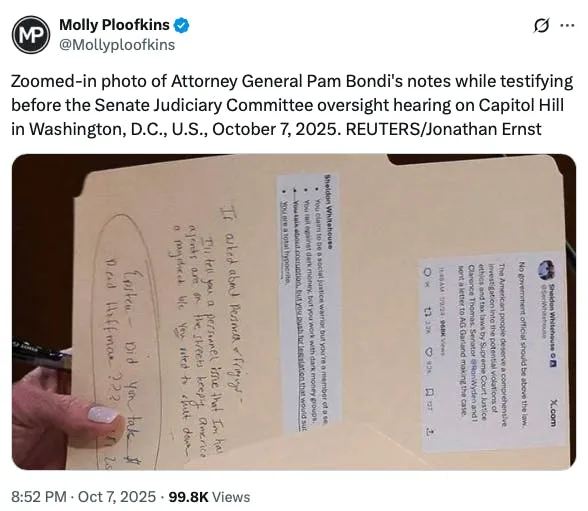
Screenshot of a tweet
She employed another one of her prewritten attacks when asked about Homan’s tax returns. “Senator, I would be more concerned if I were you when you talk about corruption and money, when you pushed for legislation that subsidized your wife’s company!” Bondi sneered.
“The questions here are actually pretty specific,” Whitehouse replied, undeterred. “So, having you respond with completely irrelevant far-right internet talking points is really not very helpful here.”
Below her catalog of clapbacks, Bondi had written a handwritten note “On Epstein” positing whether Whitehouse had ever accepted money from Reid Hoffman, who once invited Epstein to dinner. She used the tidbit to deflect from a question about whether the FBI had seized photos of President Donald Trump with half-naked young women from the safe at Epstein’s estate, as reported by author Michael Wolff.
“Do you know if the FBI found those photographs in their search of Jeffrey Epstein’s safe or premises or otherwise? Have you seen any such thing?” Whitehouse asked.
“You know, Senator Whitehouse, you sit here and make salacious remarks, once again trying to slander President Trump left and right, when you’re the one who was taking money from one of Epstein’s closest confidants, Reid Hoffman,” Bondi replied.
Again, Whitehouse continued unbothered. “The question is, did the FBI find those photographs that have been discussed publicly by a witness who claimed Jeffrey Epstein showed them to him. You don’t know anything about that?” he asked, and Bondi fell silent, having exhausted her scant notes.
It’s disturbing, but not surprising, that Bondi didn’t make actual preparations to answer tough questions from senators. It appears that the attorney general felt no obligation to be accountable to the American people about alleged efforts to cover up for Trump or his underlings, believing them all to be above the law.
---
abrego garcia ltr
Re: Protected Whistleblower Disclosure of Erez Reuveni Regarding Violation of Laws,
Rules & Regulations, Abuse of Authority, and Substantial and Specific Danger to
Health and Safety at the Department of Justice
Dear All:
We, the Government Accountability Project and Gilbert Employment Law, P.C., represent
Mr. Erez Reuveni, formerly the Acting Deputy Director for the Office of Immigration Litigation
(OIL) of the Department of Justice (DOJ), and a whistleblower. Mr. Reuveni presents the
following disclosures to your attention for your respective offices to take appropriate oversight
action.
Between March 14, 2025, and April 5, 2025, Mr. Reuveni, almost immediately after
receiving notice of his promotion to serve as Acting Deputy Director of OIL, became aware of the
plans of DOJ leadership to resist court orders that would impede potentially illegal efforts to deport
noncitizens, and further became aware of the details to execute those plans.
On April 4, 2025, after raising concerns internally to his chain of command for nearly three
weeks regarding the government’s compliance with court orders and candor to the courts, Mr.
Reuveni appeared before Judge Paula Xinis, United States District Court Judge in the District of
Maryland, on behalf of the government in the case of Mr. Kilmar Abrego Garcia. During that
appearance, Mr. Reuveni candidly and truthfully informed the court, based on the evidentiary
record, that Mr. Abrego Garcia’s removal from the United States was a mistake. Later that evening,
Mr. Reuveni refused directions from his superiors to file a brief misrepresenting those facts to the...
---
7 25 GMAIL
Read our_full blog post_on our website.
An attempt to defund the District of Columbia’s consumer protection lawsuit against Big Oil is part of a wider attack on climate accountability lawsuits
As Big Oil and its allies lobby to shield the fossil fuel industry from a growing number of climate deception lawsuits, Congress is now taking aim at a case filed by the nation’s capital.
Recently proposed legislation would prohibit the District of Columbia from using any funds to enforce its consumer protection laws “against oil and gas companies for environmental claims” — a clear attack on D.C.’s ongoing lawsuit against ExxonMobil, Chevron, BP, and Shell.
“The fossil fuel industry and its allies are trying to kill any and all lawsuits that would hold Big Oil companies accountable for their climate lies and the damage they’ve caused — and this assault on D.C.’s ability to enforce its own consumer protection laws is part of their playbook,” said CCI President Richard Wiles.
Read our full blog post on our website:
July 24, 2025
As Big Oil and its allies lobby to shield the fossil fuel industry from a growing number of climate deception lawsuits, Congress is now taking aim at a case filed by the nation’s capital.
Under a newly released appropriations bill, Congress would prohibit the District of Columbia from using any funds to enforce its consumer protection laws “against oil and gas companies for environmental claims.” The legislation clearly targets D.C.’s ongoing lawsuit against ExxonMobil, Chevron, BP, and Shell, which argues the companies violated D.C.’s consumer protection law by engaging in misleading acts and practices around the marketing, promotion, and sale of fossil fuel products. In April, a D.C. court rejected the Big Oil companies’ motions to dismiss the case, bringing it one step closer to trial.
“The fossil fuel industry and its allies are trying to kill any and all lawsuits that would hold Big Oil companies accountable for their climate lies and the damage they’ve caused — and this assault on D.C.’s ability to enforce its own consumer protection laws is part of their playbook,” said CCI President Richard Wiles.
The attack on D.C.’s case comes after 16 Republican attorneys general asked U.S. Attorney General Pam Bondi to help erect a “liability shield” for fossil fuel companies against climate lawsuits. Among its tactics, the attorneys general recommended that the federal government restrict funding for state and local governments that seek to make fossil fuel companies pay for climate damages.
:{:{CCI and nearly 200 other groups have urged Congress to support climate accountability and oppose immunity for Big Oil. Now a growing number of public officials are joining those calls. U.S. Delegate Eleanor Holmes Norton, who represents D.C. in Congress, vowed to fight the attack on D.C.’s lawsuit. The National Association of Counties, representing thousands of county officials across the U.S., is urgingCongress to reject any legislation that “would limit or preempt counties’ access to courts or give companies immunity from lawsuits over damages and costs.” }:
And Oregon’s congressional representatives called for President Trump to rescind an order that targeted state climate actions. “Governments, residents, businesses, and others must have access to legal and legislative remedies in order to hold fossil fuel companies accountable, seek justice, and make polluters pay for the damage they have caused,” they wrote.}:
“No industry should be above the law, especially one as powerful and harmful as Big Oil,” said CCI’s Wiles. “Members of Congress must reject this underhanded attempt to help Big Oil escape accountability and protect access to the courts for every community.”
REF 1 CCI
June 26, 2025
As communities across the country get closer than ever to putting Big Oil companies on trial for decades of climate lies, fossil fuel industry allies are ramping up their efforts to secure blanket immunity for the industry and protect oil companies from facing accountability for their harmful deception.
In a letter to U.S. Attorney General Pam Bondi, more than a dozen Republican attorneys general this month called on the Department of Justice to recommend legislation aimed at barring the courthouse doors for dozens of communities’ fighting to hold fossil fuel companies accountable for their ongoing climate deception and the harm it has caused. Earlier this year, the U.S. Supreme Court rejected a “desperate” and “highly unusual” request from many of the same attorneys general that sought to block states from suing Big Oil. Having failed to escape accountability in court, Big Oil lobbyists have reportedly been urging members of Congress to pass legal protections for the companies.
The new letter includes a laundry list of legislative recommendations, including creating a “liability shield” for fossil fuel companies “similar to the Protection of Lawful Commerce in Arms Act of 2005,” (PLCAA) — the notorious law that gave broad immunity to gun manufacturers and sellers from lawsuits for injuries “resulting from the criminal or unlawful misuse” of a firearm. Victims of gun violence and their families have said that PLCAA has taken away their constitutional right to be heard in court and has shut down avenues for accountability and the healing it can bring.
"This is simply the latest in a long line of desperate maneuvers to help the fossil fuel industry escape accountability in court for their well-documented climate deception and the astronomical damage it has caused,” said CCI President Richard Wiles about the letter. “They want dishonest and polluting corporations to be completely above the law, and if they get their way they would block access to the courts for communities, businesses, and their own constituents who have been harmed by Big Oil."
During a farcical Senate subcommittee hearing yesterday that sought to cast doubt on climate accountability cases, one of those attorneys general, Kris Kobach from Kansas, was pressed by U.S. Senator Richard Blumenthal about his opposition to lawsuits against Big Oil. Blumenthal pointed out that Connecticut and other states are suing ExxonMobil for lying about the harms of its products — just as Kansas is suing Pfizer for, in Kobach’s words, making “certain representations about their product that turned out to be contrary to the information they had.”
Under questioning, Kobach conceded that "I'm not saying the claims [against Big Oil] are wrongly brought." But when he tried to blame individuals for their fossil fuel use, Blumenthal, who successfully sued tobacco companies as Connecticut Attorney General, pointed out the flaw in that logic.
“I could take the words exactly that you’ve just uttered and substitute ‘tobacco,’ and they would be identical to what the tobacco industry was saying about our lawsuit at the time,” Blumenthal commented.
At the top of the hearing, Ranking Member Senator Sheldon Whitehouse of Rhode Island explained that climate accountability lawsuits come down to a simple question: Who should pay for climate damages? Taxpayers, or the fossil fuel companies responsible for the climate crisis?
KICKASS
Earlier this year, nearly two hundred groups, including CCI, called on members of Congress to oppose any efforts to shield Big Oil companies from legal accountability.
REF 2
July 23, 2025
Members of Oregon’s congressional delegation are urging President Trump to repeal an “unprecedented and illegal” executive order that aims to block local governments’ attempts to hold Big Oil companies accountable for climate deception and damages. The letter, signed by U.S. Senators Jeff Merkley and Ron Wyden along with five of Oregon’s six House representatives, comes as oil companies and their allies have ramped up their attempts to escape the growing number of climate accountability lawsuits filed against them.
“Our communities across the country are suffering grave threats to our public health, safety, and economic security as a result of Big Oil’s climate deception and pollution,” the letter says. “Governments, residents, businesses, and others must have access to legal and legislative remedies in order to hold fossil fuel companies accountable, seek justice, and make polluters pay for the damage they have caused.”
The administration’s April executive order called on U.S. Attorney General Pam Bondi to “expeditiously take all appropriate action” to stop climate accountability lawsuits that “could result in crippling damages” for fossil fuel companies. In response, the Justice Department sued Hawai’i and Michigan in an attempt to block those states from filing previously announced lawsuits against fossil fuel companies. In response, Hawai’i officially filed its climate deception lawsuit against Big Oil and Michigan Attorney General Dana Nessel vowed to move forward with her plan to sue fossil fuel companies, calling the Justice Department’s lawsuit “at best frivolous and arguably sanctionable.”
The Oregon letter also questions the legality of the administration’s actions, arguing that the executive order “threatens the ability of states and localities to hold polluters responsible for the costs of their actions.”
“Extreme weather events are already harming households across the country, and the impacts are only going to get worse,” the letter says. “Trillions of dollars will be needed for our country to adapt to the climate future, as well as to help people rebuild in the face of natural disasters. The question is who is going to be responsible for paying those costs: taxpayers, or the oil and gas companies that have profited from the crisis?”
More than one in four Americans live in a community suing oil companies for their climate deception. Oregon’s most populous county, Multnomah County, is suing ExxonMobil, Chevron, Shell, and other fossil fuel companies for knowingly fueling extreme weather events like the 2021 Pacific Northwest heat dome, which killed 69 county residents. In recent court filings, experts noted that Multnomah County was unaware that the heat dome was even possible because of the “misinformation fossil fuel producers have long used to deny or downplay the magnitude and timing of harmful climate change.”
“As members of Oregon’s congressional delegation, we will not stand idly by while this Administration attempts to undercut efforts to combat climate chaos,” Oregon’s congressional delegation letter states. “The Administration cannot only respect the principle of states' rights when it thinks the state is right. We urge you to repeal your executive order so that states are able to protect their citizens as they see fit.”
Oregon’s letter is signed by U.S. Senators Ron Wyden and Jeff Merkley, and U.S. Representatives Suzanne Bonamici, Maxie Dexter, Janelle Bynum, Val Hoyle, and Andrea Salinas.
---
---
master plan 11 4 24
immed after ruling hockey stick dk money? politics by extortion?
montana amicus brief said 2 claims demo BS bullock whitehouse w/ mccain
11-1179-Senators-Whitehouse-and-McCain-Cert-Amicus
sep by other reps
---
master plan CU bopp
evidence white paper:
Whitehouse-Knights-Errant-Fact-Finding-FINAL
---
an 12 24
Senator Sheldon Whitehouse (D-RI) is calling on his colleagues to develop a "battle strategy" against Republican "attacks", as the Democrats to select a new party chair, according to Politico.
Following Vice President Kamala Harris' loss to President-elect Donald Trump — in addition to a slew of Democratic House and Senate race losses — Politico reports the Rhode Island lawmaker argues the party needs an "institutional and centralized setup to attack the GOP, writing Republicans 'rapidly and effectively deploy false narratives, while we struggle to bring true ones to bear.'"
To fight back against the right-wing lawmakers, Whitehouse wrote in a letter to party chairs on Monday that building a "war machine" is the only way.
READ MORE:New DNC chair candidate vows to 'fight for working people'
The Democratic leader wrote, "We in Congress customarily say we’re 'fighting' for things when we really mean working or toiling."```
He added, "A fight means a defined adversary, a battle strategy, and actual punches thrown. Done well, it involves exposing and degrading your adversary’s machinery of warfare."
With several contenders in the running — including spiritual adviser and former presidential candidate Marianne Williamson, and former Maryland Governor Martin O'Malley — The Democrats are expected to select the new Democratic National Committee chair in February.
READ MORE:['Fetish for losing elections': Marianne Williamson slammed over latest announ``cement
---
===
an 12 24
badash
In 2005, President George W. Bush’s nominee, John Roberts, became Chief Justice of the Supreme Court. Five years later, just over one quarter of the country (27%) disapproved of him. By last year, that disapproval number had risen to nearly half the nation: 46%.
Since 2021, Gallup reports, the Supreme Court’s disapproval rating has consistently remained in the mid to upper 50s—a roughly ten-point increase compared to the previous decade. The majority of Americans have an apparent growing dissatisfaction with a court that wields ultimate authority while becoming increasingly secretive and activist on some of the nation’s most consequential issues.
While the Supreme Court’s job is not to make decisions based on popularity contests, it relies on the other two branches of the federal government to enforce its rulings. And when the Supreme Court’s credibility falls into question, some warn, our institutions may be at risk.
In October, Bloomberg Opinion’s Noah Feldman warned the Supreme Court’s “legitimacy crisis is getting worse.”
READ MORE: ‘Two Things Could Be True’: White House Reveals Why Hunter Pardon Might Not Have Happened
“Democrats’ faith in the court began to fail after the 2000 Bush v. Gore decision, then went into freefall over the last couple of years,” Feldman wrote. “They worry the justices aren’t sufficiently ethical. They deplore the eagerness of the court’s conservative majority to overturn 50 years of precedent on issues like abortion and affirmative action. They are appalled at the court’s defiance of originalism — the idea that Constitutional law should rest on the document’s original meaning — to grant criminal immunity to former President Donald Trump for official acts while president.”
Nearly two years ago the Alliance for Justice (AFJ), a progressive coalition of nearly 140 organizations “advocating for a fair and independent justice system,” published a piece warning that the Supreme Court was “destroying its own legitimacy.”
“The Court’s wounds are entirely self-inflicted,” William W. Taylor, III, wrote at the AFJ. “It has a far-right agenda and the scholarship informing its decisions is often questionable. Worse, new details have come to light of relationships some justices have had with wealthy ideological soulmates, including those with interest in cases before the Court. The Court’s credibility and the public’s acceptance of its decisions depends upon trust that it is not subject to outside influence. While lobbying may be common and acceptable in the legislative and executive branches, it is not — nor ought not to be — conceivable in our courts.”
The New York Times on Tuesday took a deep dive into the behind-the-scenes conversations at the end of the summer of 2023 among the Supreme Court justices as they weighed whether or not to establish a code of ethics, amid a nation angered by numerous reports of what many see as blatant corruption.
“Last year, pressure on the court and the chief justice intensified. Journalists revealed that Justice Thomas had accepted far more largess from Harlan Crow, a conservative donor, than he had disclosed, including decades of travel on private jets and a superyacht, and boarding school tuition for his grandnephew. The public uproar also reflected another concern: Virginia Thomas, his wife, had been involved in Mr. Trump’s efforts to overturn the 2020 election,” The Times reports.
“Faced with ethics controversies and a plunge in public trust, they were debating rules for their own conduct, according to people familiar with the process,” The Times adds, revealing that “behind the scenes, the court had divided over whether the justices’ new rules could — or should — ever be enforced.”
In the end, the justices all signed onto a new code of ethics for the nation’s highest court, but one that “had no means of enforcement.”
It was quickly criticized.
READ MORE: Why the Hunter Biden Pardon Is ‘Justified’ According to Legal Experts
Liberals on the court have since gone public with their apparent frustration that although there is finally a code of ethics, there is no way to enforce it.
“All three liberals — Justices Sotomayor, Kagan and Jackson — supported enforcement, The Times reports.
“Rules usually have enforcement mechanisms attached to them, and this one — this set of rules — does not,” Justice Elena Kagan said in July.
“I haven’t seen a good reason why the ethics code that the Supreme Court adopted shouldn’t be enforceable,” Justice Ketanji Brown Jackson said. “Other justices have posited certain ways in which it could be made enforceable but we have not yet determined or decided to do that.”
By contrast, at least some of the majority right-wing justices appear opposed to any code, certainly one that would have methods of enforcement.
“In the private exchanges, Justice Clarence Thomas, whose decision not to disclose decades of gifts and luxury vacations from wealthy benefactors had sparked the ethics controversy, and Justice Samuel A. Alito Jr. wrote off the court’s critics as politically motivated and unappeasable,” The Times revealed. “Justice Gorsuch was especially vocal in opposing any enforcement mechanism beyond voluntary compliance, arguing that additional measures could undermine the court. The justices’ strength was their independence, he said, and he vowed to have no part in diminishing it.”
The Times also reveals that the justices “seemed to codify their own preferences” when they drafted, or signed off on the code of ethics.
Those preferences appear largely financial.
The justices “gave themselves no firm restrictions on gifts, travel or real estate deals. Nothing in the new rules appears aimed directly at the trips and gifts Justice Thomas accepted. The code says only that justices should uphold the dignity of the office and comply with existing gift guidelines, in separate federal rules, which make allowances for ‘personal hospitality.’ Justice Thomas has maintained that his nondisclosure of gifts and free travel did not violate those rules,” according to The Times. Other legal experts disagree, with some saying he broke the law.
Since signing the new code of ethics, “questions about the justices’ behavior have continued. The Times revealed that two provocative flags associated with the Jan. 6 riot had flown at the homes of Justice Alito and his wife. The second was displayed at his New Jersey beach house just as the justices were considering the new ethics rules. That summer, he also accepted concert tickets from a far-right German princess. He later disclosed those, but in keeping with the new rules, said nothing about his free stay at her 500-room Bavarian palace.”
Last month, U.S. Senator Sheldon Whitehouse (D-RI), among the Senate’s top proponents of Supreme Court reform, wrote: “As long as the Court maintains a secretive billionaire gifts program for justices and unique immunity from ethics scrutiny for itself, and as long as its decisions predictably align with those billionaire interests, its reputation will continue to crash.”
---
===
AN 9 24
alternet NO LNX
From moderate to manipulator: Behind the unmasking of John Roberts
WASHINGTON — John Roberts may have a robe. Still, the Chief Justice of the Supreme Court has no clothes, according to Democrats who are outraged to bewildered by new reporting that paints the nation’s most potent jurist as a masterful MAGA manipulator.
Congressional Democrats are accusing Roberts of bending, twisting and contorting the Supreme Court — along with the Constitution he swore an oath to — to fit former President Donald Trump and the allegedly illegal actions he took that have kept him tied up in state and federal courts alike since he left the White House four years ago.
New illustrious, behind-the-scenes reporting from the New York Times reveals Roberts personally directed the court’s three historic Jan. 6, 2021 rulings, including the one granting presidents sweeping immunity from criminal prosecution for their “official acts.”
Democrats are now redoubling their efforts to make the high court a centerpiece of this year’s elections as they continue their uphill battle to pass meaningful ethics reforms to try and rein the high court in.
“Chief Justice Roberts exudes much more of an establishment aura about him, but he really has been a crucial force behind the degradation of constitutional jurisprudence on the Supreme Court,” Rep, Jamie Raskin (D-MD) — a Constitutional lawyer and law professor by trade — told Raw Story after digesting the illuminating new reporting.
According to the scoop-strewn NYT piece by Jodi Kantor and Adam Liptak, Roberts authored a Feb. 22 memo to his eight colleagues “that radiated frustration and certainty” regarding the monumental cases winding through lower courts centered on efforts to overturn the 2020 election.
While revelatory, sadly, the new reporting on the Roberts Court isn’t surprising to Raskin.
ALSO READ: The simple yet powerful way Tim Walz just exposed Donald Trump
“It's what anybody can see in reading their decisions. We know what's going on there. They're not textualists — they completely ignored the text of Section 3 of the 14th Amendment,” Raskin said. “They're not originalists — nobody even made an originalist argument about why the president of the United States should be immune from criminal prosecution for felonies he commits under the cloak of office. And, you know, they have really drifted a long way from any recognizable constitutional jurisprudence of interpretation.”
The carefully manicured image of Roberts as a moderate is now melting away. It’s left Democrats on Capitol Hill debating how to restore public confidence in a Supreme Court many in the party and the public have lost faith in.
“Very short-term thinking”
It’s more than just Chief Justice Roberts moving in the shadows to orchestrate this year’s three seemingly pro-Trump Jan. 6 rulings. Accusations of corruption are also in the air.
Coupled with the estimated $4.2 million in gifts Justice Clarence Thomas reportedly openly accepted from Republican megadonors over the years, as first reported by ProPublica, many Democrats now fear this Supreme Court has been weaponized by the far-right.
“His court's going to go down as the most corrupt in history and, honestly, the most political in history, too,” Rep. Don Beyer (D-VA) — a former U.S. ambassador to Switzerland and Liechtenstein — told Raw Story on the Capitol steps this week.
Then there’s the luxurious all-expense paid fishing trip Justice Samuel Alito accepted from billionaire Paul Singer, which he publicly defended in the op-ed pages of The Wall Street Journal.
Not to mention the politicking. There’s the upside-down American flag that proudly flew outside the Alito’s Northern Virginia home in the wake of the 2021 attack on the Capitol and the “Appeal to Heaven” flag flapping in the ocean breeze outside the Alito’s New Jersey beach house, both of which the justice blames on his wife, Martha-Ann.
As for Thomas, he refused to recuse himself from the monumental J6 cases even after his wife Ginni — and the string of conspiratorial text messages she sent to then-White House Chief of Staff Mark Meadows — was found to be central to Trump’s efforts to overturn the last presidential election.
“It might not be illegal, but it certainly should scare the hell out of every American that somebody with that kind of access and power and proximity to a Supreme Court justice can be pushing that type of nonsense," former Rep. Denver Riggleman (R-VA) — who served as a technical advisor to the select Jan. 6 committee — told Raw Story back in 2022. “The text messages validate that many elected officials believed it.”
Critics are left questioning where the high court ends and the RNC begins.
“I'm naive. I was raised to think that the justices were there to look at the Constitution and the law and work together to find the best decision for the American people. Now they're a function of the Republican Party, which the court never was before,” Don Beyer said. “Very short-term thinking. If we look at our 40-some-odd presidents, only one would it apply to.”
The five-term congressman says Supreme Court justices — especially the chief justice — need to open their eyes because, to him and an expanding chorus of critics, there’s nothing partisan about Democrat’s fears.
“There's no other Republican president I would have worried about,” Beyer said. “Not George Herbert Walker Bush or Ronald Reagan or Gerald Ford — certainly none of our Democratic presidents — but this one. It isn't like he's conferring an advantage on the next Democratic president who will do whatever he wants — no.”
The nakedly political and grossly unethical turn of the Roberts Court weighs on the 74-year-old.
“Incredibly discouraging. I've been discouraged by Justice Roberts for a long time,” Beyer said. “I know the judiciary’s independent — I don't ever want to interfere — but the fact that he could let the ethical abuses go on and on, no treatment whatsoever, which is, I mean, the greatest discouragement.”
Last year, after months of punishing press coverage, Roberts reversed himself and signed off on a new, if unenforced, Supreme Court Code of Conduct. It was unanimous.
These days, the signatures of all nine Supreme Court justices also make the document almost worthless, at least to many lawmakers across the street at the Capitol.
Citizens United v. Federal Election Commission
Throughout this session of Congress, Democrats on the Judiciary Committee in the Senate have relentlessly tried to impose mandatory and enforceable ethics rules on Supreme Court justices—basically, the same ones that apply to every other federal judge in the nation. Republicans have been united in blocking every such effort.
Senate Republicans have the back of the conservative majority on the Roberts Court, much like Roberts has advanced the agenda of congressional Republicans.
“If you go back and look at the most anti-democratic decisions of the Supreme Court — the immunity decision being one, but the little array of insurrection decisions, of which it was a part of in the threesome that's in this article — you see a lot of backstage maneuvering by the chief justice,” Sen. Sheldon Whitehouse (D-RI) told Raw Story as he walked through the basement of the Capitol. “It reminds me of the backstage maneuvering by the chief justice that brought us Citizens United.”
The former Rhode Island attorney general and U.S. attorney is the second highest ranking Democrat on the Senate Judiciary Committee where he’s been pushing the SCERT — or Supreme Court Ethics, Recusal and Transparency — Act, which would place a binding code of conduct and mandatory disclosure requirements on the justices.
Ethics reform is one thing. Unlimited corporate funding is another corrosive element of contemporary American politics altogether.
Democrats are still smarting from Citizens United and the floodgates of political spending it unleashed. The chief justice also deftly moved behind the scenes to manipulate that 2010 ruling, Whitehouse readily recalls.
“Remember, [Roberts] had to restructure the case. He changed the question presented. He set up the case so that there would be no record — actual record,” Whitehouse recalled. “He changed the standard.”
That was a bipartisan complaint in that Senate of a bygone, if recent, era. The ruling led then-Sen. John McCain (R-AZ) — who co-authored the McCain-Feingold law that Citizens United decimated — to publicly and personally call out Chief Justice Roberts.
"I am more disappointed in him than any of the other four that voted to overturn McCain-Feingold," McCain said back in 2012.
Republicans beg to differ
Roberts indeed has allies. Lots of them. Powerful ones. And they’re laughing in Democrat’s faces.
Republican Party leaders, like former Senate Whip John Cornyn (R-TX) — who’s running to replace Senate Minority Leader Mitch McConnell — basically just avoid critics and critical reporting, like the New York Times just dropped, these days.
“I think I saw the headline — that's about all,” Cornyn told Raw Story while hopping a tram under the Capitol.
Before arriving in Washington in 2002, Cornyn served on the Texas Supreme Court. He says Roberts shouldn’t even entertain what his senatorial critics have to say.
“He's got lifetime tenure,” Cornyn said through a laugh. “I wouldn't be taking advice from members of Congress on how to do my job if I was him, either.”
Just as they have with Justices Thomas and Alito — no matter the latest eye-popping revelation — today’s Republicans have united around the Chief Justice, as if they are one.
“Even without having read it, I think extremely highly of him and believe him to be a person with the utmost integrity and dedicated to the independence of the courts,” Sen. Susan Collins (R-ME) told Raw Story as she walked through the Capitol Wednesday.
Collins must not have gotten the memo from her Democratic colleagues.
The ‘court packing’ myth
Many pundits hailed Roberts for opposing the overturning of Roe v. Wade, but in the Dobbs decision, he lost out to the five Republican appointees on ‘his’ court who are seemingly even further right than he is.
Many progressives weren’t buying the righteous, caring and politically aloof version of himself Roberts portrayed back then, and they say this latest reporting shows they were right.
“That's interesting how there's sort of this story out there that Roberts was like a moderate and mediator. And the [NYT] story would suggest that’s not really necessarily the case,” Sen. Tina Smith (D-MN) told Raw Story after voting on the Senate floor this week.
While Republican rhetoric paints all elected Democrats — from the top of the party’s presidential ticket on down — as wanting to expand, or ‘pack,’ the court, only three Senate Democrats have formally endorsed a progressive measure to expand the size of the court, as Raw Story reported last month.
Smith and Massachusetts Democratic Sens. Ed Markey and Elizabeth Warren are the three who’ve publicly endorsed Markey’s measure to expand the size of the Supreme Court. That’s it.
Even with all the negative press, Smith says other Senate Democrats haven’t approached them about their measure to expand the size of the court.
“I haven't heard any,” Smith said.
That doesn’t mean her colleagues aren’t discussing the Roberts Court.
“There's a lot of conversation about the court and challenges to the court,” Smith said. “Once we get through this election and we have a better understanding of what the landscape is, we'll talk more about it.”
Or maybe they won’t.
“We're not going to get expansion”
Some Democrats have already basically, shut the door on the conversation of expanding the court. Many just don’t see it as a practical solution.
“We're not going to get expansion,” Sen. Peter Welch (D-VT) told Raw Story on his way to a vote in the Capitol Wednesday. “There's a lot of downside to expansion — we expand, they expand — and it politicizes it.”
As President Joe Biden proposed back in July, Welch and most congressional Democrats now support instituting an 18-year term limit for the nation’s justices.
“First of all, that's a very substantial term, and they're inside, so they have the benefit of protections,” Welch argued. “And then number two, every president is going to have an opportunity to appoint two members, so that means the American people get to weigh in indirectly by choosing the president. I think it would really take the extreme politics out of the court.”
As for Roberts, Welch is no fan of the jurist he’s predicting historians will frown upon.
“He’s very skillful and, unfortunately, a driving force, I think, in the radical redirection of the court,” Welch bemoaned to Raw Story. “The court has got an extreme radical majority. It's lost public respect.”
---
---
an 7 24
Two Senate Democrats have published a list of roughly three dozen lavish gifts Supreme Court Associate Justice Clarence Thomas received from right-wing billionaires during his time on the Court.
On the eve of the Independence Day holiday, Sens. Sheldon Whitehouse (D-Rhode Island) and Ron Wyden (D-Oregon) called on Attorney General Merrick Garland to appoint a special counsel to investigate Thomas for "possible violations of ethics and tax laws" in his "repeated and willful omissions" of gifts from wealthy benefactors.
"The scale of the potential ethics violations by Justice Thomas, and the willful pattern of disregard for ethics laws, exceeds the conduct of other government officials investigated by the Department of Justice for similar violations," Whitehouse and Wyden wrote. "The breadth of the omissions uncovered to date, and the serious possibility of additional tax fraud and false statement violations by Justice Thomas and his associates, warrant the appointment of a Special Counsel to investigate this misconduct."
READ MORE:Expert: Clarence Thomas could face 'criminal prosecution' by not paying taxes on gifts
On page 14 of the PDF Whitehouse posted to his Senate website, there are two lists of gifts to Thomas. The first list describes gifts from far-right real estate magnate Harlan Crow, and the second list shows gifts from other wealthy sponsors, like entrepreneur Anthony Welters — who "loaned" Thomas a luxury RV and then later forgave the loan — and billionaire Wayne Huizenga.
The gifts from Crow date back to 2003, and list excursions like "Yacht trip to Russia and the Baltics" and Helicopter to Yusipov Palace, St. Petersburg." Out of the roughly two dozen gifts Crow gave to Thomas, four are private school tuition payments for his grand-nephew. Many of Crow's other gifts were private jet flights and yacht cruises, including one Sens. Whitehouse and Wyden described as "around Greek islands."
And out of the gifts on the second list, three were from Huizenga, two were from Welters, and five were from former Berkshire Hathaway board member David Sokol. Billionaire Warren Buffett, who owns Berkshire Hathaway, forced Sokol out in 2011 after he learned that Sokol bought a stake in a company he later convinced Buffett's company to buy. Buffett called Sokol's actions "inexplicable" and "inexcusable."
"No government official should be above the law. Supreme Court justices are properly expected to obey laws designed to prevent conflicts of interest and the appearance of impropriety and to comply with the federal tax code," the senators wrote. "We therefore request that you appoint a Special Counsel authorized to investigate potential criminal violations by Justice Thomas under the disclosure, false statement, and tax laws; pursue leads of related criminal violations by donors, lenders and intermediate corporate entities; and determine whether any such loans and gifts were provided pursuant to a coordinated enterprise or plan."
READ MORE:Clarence Thomas cut off contact with man he raised 'as a son' — now he faces decades in prison
In 2023, Pulitzer Prize-winning investigative reporter Davide Cay Johnston commented that it was possible Thomas could face "criminal prosecution" by not paying taxes on the previously undisclosed gifts from Crow and others. He opined that any lower-level court judge would not be able to avoid the charges if they failed to pay taxes on gifts worth millions of dollars.
"What Clarence Thomas has done would result in not only any judges in America being removed from the bench, but there is a good chance it would result in criminal prosecution for income tax fraud and for false filings in his mandatory financial ethics disclosure statements," Johnston said in December.
Last month, anti-corruption watchdog group Fix the Court totaled Thomas' gifts and found that the conservative jurist had received approximately $4 million in gifts dating back to 2004 – far more than any other justice on the Supreme Court. And of the 193 gifts Thomas received, he only listed 27 on his required financial disclosure reports.
Click here to read Whitehouse and Wyden's full letter to Garland.
---
---
joe conason an 5 24
nobody likes Big Oil, a monopolistic and heavily polluting industry with a legendary history of abusing its excessive power that can be traced back over the past hundred years.
But Donald Trump has promised to be the oil industry's best friend -- if its bosses give him a billion dollars.
In the latest instance of the former president's mind-blowing corruption, he is reported to have entertained a group of two dozen top U.S. oil company executives at Mar-a-Lago. Over dinner at his Palm Beach sanctum, Trump is quoted as telling the chiefs of Chevron, Exxon, and Occidental Petroleum and their colleagues that if they collectively coughed up $1 billion to ensure his reelection, he would take very good care of their corporate needs.
According to The Washington Post, he promised to toss out all of President Joe Biden's efforts to mitigate climate changes, including new rules aimed at reducing automotive exhaust and promoting electric vehicles. For that measly billion bucks, he vowed to increase oil drilling in the Gulf of Mexico, where we have already seen catastrophic well blowouts, rescind restrictions on drilling in the Alaskan wilderness, pull down the windmills that he hates, and cancel the recent White House decision to pause new natural gas export permits.
"You'll get it on the first day," said Trump, according to someone who was present and blabbed to the Post. Speaking as crudely as any gangster, he informed the oilmen that they and their companies can easily raise that kind of money, and that paying him off would be "a deal" because of the high return on their investment.
No doubt they found it hard to argue with Trump's logic, since oil lobbyists are already writing dozens of executive orders that they want him to rubber-stamp if and when he returns to the Oval Office.
So is anybody surprised?
Only perhaps by the audacity of Trump explicitly soliciting a gigantic bribe, before a large group of witnesses, at a time when he is in fact on trial for campaign finance offenses and facing scores of additional criminal charges. But he has never felt abashed in displaying his venality. He lives in a world of miscreants who behave much the same way, from his son-in-law Jared Kushner, who sought and obtained an even bigger payoff from the Saudi dictator, to his adviser Steve Bannon, who will face criminal charges next fall for swindling the dopey donors to his fake "We Build the Wall" outfit.
As the eminent journalist Laurie Garrett observed on social media, Trump's attempt to extort the oil industry echoes one of the greatest government scandals in American history, under another Republican president owned by corporate power. Beginning in 1921, the Teapot Dome affair implicated officials of President Warren G. Harding's administration in the crooked leasing of public lands for oil exploration. Harding's Interior secretary Albert B. Fall ultimately went to prison for bribery, although none of the oilmen who paid him off did any time.
What we can expect from a second Trump administration is the most naked orgy of swindling and boodling that this country has ever seen. He thoroughly exploited the presidency during his first term, as outlined in my forthcoming book, "The Longest Con." But his second term, should such a disaster occur, would be the conman's last big chance to score, and he can be expected to enrich himself to the maximum -- at ruinous cost to the rest of us.
---
an 5 24
former President Donald Trump recently made a controversial proposal to a gathering of oil executives and lobbyists at his Mar-a-Lago residence in Florida: Favorable policy in exchange for $1 billion in campaign cash. Now, it looks as if the U.S. Senate may launch an official inquiry into the ex-president.
That's according to the New Republic's Greg Sargent, who spoke to Sen. Sheldon Whitehouse (D-Rhode Island) about Trump's recent entreaty to the oil industry. Whitehouse said it was "highly likely" that the Senate Budget Committee would investigate the former president over his brazen offer.
"The phrase that instantly came to mind as I was reading the story was ‘quid pro quo,’" Whitehouse said, adding that he was also concerned about a series of proposed executive orders oil lobbyists drafted for Trump and to have ready to sign on day one should he win a second term in November. "Put those things together and it starts to look mighty damn corrupt."
READ MORE:'Undisguised corruption': Critics slam Trump for 'selling the White House' to Big Oil
Billionaire oil magnate Harold Hamm arranged the Mar-a-Lago event, which the Washington Post reported was designed to allow for the fossil fuel industry to be able to bring concerns over environmental regulations directly to Trump. At the meeting, Trump reportedly promised to overhaul President Joe Biden's policies relating to electric vehicles and wind energy.
"The contrast between the two candidates on climate policy could not be more stark. Biden has called global warming an 'existential threat,' and over the last three years, his administration has finalized more than 100 new environmental regulations aimed at cutting air pollution and greenhouse gas emissions, restricting toxic chemicals, and conserving public lands and waters," wrote the Post's Josh Dawsey and Maxine Joselow. "In comparison, Trump has called climate change a 'hoax,' and his administration weakened or wiped out more than 125 environmental rules and policies over four years."
Whitehouse, who chairs the Budget Committee, said Trump's proposal to oil executives was "practically an invitation to ask more questions." He added that the inquiry would hopefully shed light on the myriad ways in which industries like Big Oil exploit the campaign finance system and find ways to make the system more transparent and accountable. Noah Bookbinder, who is president of the anti-corruption watchdog group Citizens for Responsibility and Ethics in Washington (CREW), said that while Trump's offer was technically legal, there is still plenty of work to do in cleaning up the grey areas in federal campaign finance laws.
"There’s a clear legislative purpose in determining what happened at the meeting,” Bookbinder told Sargent. "If this really constituted “an attempt to link significant campaign contributions with specific policy promises, that suggests a huge loophole that needs to be closed.”
READ MORE:'Corrupt': Jared Kushner's business deals under fire as Trump runs for president
Many of the environmental policies Trump suggested he would do away with in a second term are in the Inflation Reduction Act, which was the $485 billion bill Biden signed into law in 2022 that included a swath of clean energy infrastructure initiatives and incentives for electric vehicle development. Economists projected the clean energy development grants could generate roughly $1.5 trillion in new economic activity, and could reduce carbon dioxide emissions by five billion tons before the next decade.
Conversely, some of the executive orders the oil industry has prepared for Trump would undo the progress on climate Biden has made since taking office. Politico reported that some of the orders would lift Biden's pause on new natural gas export permits, open up new protected federal lands for more oil drilling and allow for more offshore oil drilling leases.
Trump casting Biden as an opponent of Big Oil is somewhat confusing, given that the United States officially hit record-high domestic oil production levels earlier this year. The U.S. Energy Information Administration found that in 2023, the U.S. produced 13 million barrels of oil per day on average, making the United States the world's largest oil producer.
Click here to read Sargent's full essay in the New Republic (subscription required).
---
---
04.30.24
New Joint Bicameral Staff Report Reveals Big Oil’s Campaign of Climate Denial, Disinformation, and Doublespeak
New Documents Expose the Fossil Fuel Industry’s Deceptive Commitments to Reduce Emissions, Misleading Statements About the Alleged Climate Safety of Natural Gas, False Promises on New Technologies, and Obstruction of Investigation
Washington, D.C. (April 30, 2024)—Today, Rep. Jamie Raskin, Ranking Member of the House Committee on Oversight and Accountability, and Sen. Sheldon Whitehouse, Chairman of the Senate Budget Committee, released a joint staff report, entitled “Denial, Disinformation, and Doublespeak: Big Oil’s Evolving Efforts to Avoid Accountability for Climate Change.” Today’s report marks a major milestone in a multi-year investigation—initiated by House Oversight Committee Democrats and now a joint investigation with the Senate Budget Committee—and unveils new documents exposing the fossil fuel industry’s role in spreading climate disinformation and preventing action on climate change.
“The Budget Committee has heard warnings from credible experts about climate-caused economic shocks—many of which are already raising costs for families—and our joint investigation with the House Oversight Committee Democrats reveals new details about the disinformation campaign Big Oil is waging to obstruct action on climate safety,” said Chairman Whitehouse. “For decades, the fossil fuel industry has known about the economic and climate harms of its products but has deceived the American public to keep collecting more than $600 billion each year in subsidies while raking in record-breaking profits. As this joint report makes clear, the industry’s outright denial of climate change has evolved into a green-seeming cover for its ongoing covert operation—a campaign of deception, disinformation, and doublespeak waged using dark money, phony front groups, false economics, and relentless exertion of political influence—to block climate progress.”
“The evidence uncovered by Oversight Committee Democrats shows that Big Oil has run campaigns to confuse and mislead the public while working unceasingly to lock down a fossil fuel future,” said Ranking Member Raskin. “The climate crisis is now a civilizational emergency. Today’s joint report demonstrates that Big Oil continues to conceal the facts about their business model and obscure the actual dangers of fossil fuels, including natural gas, in order to block the climate action we need. Despite knowing about the devastating effects of their oil and gas products on the planet for decades, the industry has always prioritized its bottom line and chosen low-road PR tactics over a high-road commitment to addressing the crisis.”
The joint report makes the following key findings:
- Internal documents obtained by this investigation demonstrate, for the first time, that fossil fuel companies do not dispute that they have known for more than 60 years that burning fossil fuels causes climate change—yet have worked for decades to undermine public understanding and to deny the underlying science. In fall 2015, blockbuster reporting by Inside Climate News and the Los Angeles Times revealed that Big Oil companies, such as ExxonMobil Corporation (Exxon), knew that burning fossil fuels was a major contributor to climate change. Companies publicly rejected the reporting at the time—an early draft of Exxon’s response accused reporters of “journalistic malpractice”—but new documents show that fossil fuel companies internally did not dispute the findings.
- For example, a December 2015 email from an Exxon communications advisor indicated that the company agreed with the reporting, writing that Exxon didn’t “actually... dispute much of what these stories report.”
- Big Oil’s deception campaign evolved from explicit denial of the basic science underlying climate change to deception, disinformation, and doublespeak. The fossil fuel industry evolved from denying climate science to spreading disinformation and perpetuating doublespeak about the safety of natural gas and the industry’s commitment to reducing greenhouse gas emissions. New documents demonstrate that Big Oil companies:
- Seek to ensure the long-term use of fossil fuels, like natural gas, promoting natural gas as a “bridge fuel,” and eventually even a safe “destination fuel.” For example, a 2017 BP America Inc. (BP) email asserted that “promoting and protecting the role of gas as an increasing part of our energy mix is a paramount priority. We need to be ready to speak to this wherever there is a credible effort to dis-incentivize gas.”
- Seek to portray natural gas as a green, climate-friendly fuel, while internally acknowledging that there is significant scientific evidence that the lifecycle emissions from natural gas are as harmful to the climate as coal and are incompatible with scientific emissions reduction targets. For example, the American Petroleum Institute (API) developed a 2016 draft print ad showing people engaging in outdoor activities, like skydiving, soaring on a playground swing, and playing basketball that states: “Natural gas doesn’t just cook dinner. Thanks to natural gas the air up here is cleaner than it’s been in 25 years.”
- Make public pledges to support the Paris Agreement and to achieve net zero emissions while internally recognizing that they could not achieve those goals or referring to them as outside of their business plans. For example, Chevron Corporation (Chevron) first announced its support for the Paris Agreement in 2016, calling it a “good first step,” but internal documents suggest that Chevron was either never truly committed to the Paris Agreement or quickly changed its position to curry favor with the Trump Administration.
- Privately lobby—either directly or through their trade associations—against pro-climate legislation and regulations that they publicly claimed to support. For example, two key documents reveal BP’s comprehensive campaign in Washington state, in collaboration with Western States Petroleum Association (WSPA), to oppose state and local policies that would have cut climate-warming emissions in 2018. For example, BP planned to spend between $2.5 and $4.5 million in the state for “hard persuasion” tactics, such as television advertising; $2.5 million to construct a salmon hatchery to associate BP with “robust sea life;” and $300,000 for “soft persuasion” to grow support that “will be helpful with elected officials.”
- Publicly celebrate carbon capture technologies to help reduce harmful emissions, while privately acknowledging that the technology is expensive and claiming that it cannot be scaled without federal government investment. For example, a 2016 internal presentation by BP contains no fewer than eight statements contradicting BP’s own public ad campaigns. The presentation reveals that Carbon Capture, Utilization, and Storage (CCUS) at scale is not economically viable against a free-to-pollute business model and that a “robust carbon price [would be] needed to stimulate CCUS deployment.” In sum, “[d]espite its importance and ambition to meet decarbonization goals, CCUS has stalled and commercial deployment is very limited.”
- Publicly promoted algae-based biofuels as an innovative low-carbon technology while investing little in its research and development and then canceling the programs entirely. For example, an internal Exxon document titled “Algae Biofuels Program Talking Points” explicitly states that the investment in algae biofuels was potentially prohibitive: “ExxonMobil’s analysis has concluded that final development and broad deployment of algae-based biofuels by the company would require future investments of billions of dollars.”
- The fossil fuel industry relies on trade associations to spread confusing and misleading narratives and to lobby against climate action. Fossil fuel companies use trade associations, think tanks, and other nonprofits to influence public policy proposals and messaging, including API and the U.S. Chamber of Commerce (Chamber), as well as the Oil and Gas Climate Initiative (OGCI), Natural Gas Supply Association, and WSPA. New emails between fossil fuel executives and these groups demonstrate how the companies influence and leverage the associations and other organizations to amplify Big Oil’s messaging and lobby for unpopular proposals the industry does not want to be associated with.
- For example, documents illuminate how Exxon, after joining the OGCI, provided “critical edits” for OGCI materials that included striking references to the Paris Agreement and any language that “potentially commits members to enhanced climate-related governance, strategy, risk management, and performance metrics and targets.”
- In another example, internal BP documents directly undermine BP’s public support for methane regulations. In a 2019 email that references then-EPA Administrator Andrew Wheeler’s proposed plan to roll back methane emissions regulations, a BP executive stated: “Wheeler outlined the legal theory to for [sic] rolling back direct regulation of methane. This is aligned with our thinking but probably the first time it was said in public?” However, when EPA’s methane rollback was finalized the following year, BP, along with other fossil fuel companies, including Shell and Exxon, claimed to oppose the rollback, stating it “respectfully disagree[d]” with the Trump Administration’s decision.
- For example, Exxon produced the National Petroleum Council’s (NPC) “Topic Paper #1, Role of Natural Gas in a Low-Carbon Economy” and in later versions of this document, edits sent around by Southwestern Energy, a fossil fuel company, removed all references to natural gas’s “potential greater use to displace higher carbon intensive fossil fuels,” such as coal and oil.
- The fossil fuel industry strategically partners with universities to lend an aura of credibility to its deception campaigns while also silencing opposition voices. Fossil fuel companies establish funded partnerships with academic institutions to enhance their credibility, shape academic research programs to provide studies supportive of a prolonged life for oil and gas, leverage the resulting research to their advantage, and bolster access to policymakers. New documents reveal previously unknown funding levels and show how companies condition their funding on academics’ cooperation and alignment with companies’ business needs. Additional documents demonstrate that companies actively tracked individuals and organizations critical of the industry and monitored their social media.
- For example, Shell Oil Company’s (Shell) Global Methane Communications Plan describes an academic-industry partnership at the Imperial College London as providing “thought leadership and research into technology that could underpin role for gas.” In the same email, an official described Shell’s plan to “‘embed’ Shell scientists” at the University of California (UC), Berkeley. Shell funds the Energy Biosciences Institute at UC Berkley and spent $25 million over five years on the program.
- For example, a 2016 internal document from BP reveals how company officials recommended cutting the budget for its Harvard and Tufts research partnerships after determining those partnerships did not provide enough “value” to the company. Officials also recommended marginalizing researchers with whom BP worked less well and propping up those who were more favorable to BP.
- All six entities—Exxon, Chevron, Shell, BP, API, and the Chamber—obstructed and delayed the Committees’ investigation. Despite valid subpoenas, the entities refused to fully comply with the investigation, making baseless legal arguments and flouting longstanding congressional practices and norms for investigations. The companies further obstructed the investigation by significantly redacting or entirely withholding more than 4,000 documents without any valid basis.
- Despite the clear legal framework upholding Congress’s broad latitude to conduct investigations and requiring private sector entities to comply with congressional subpoenas, companies heavily redacted or entirely withheld documents even after repeated objections by House Oversight Committee staff. The most egregious example of failing to fully comply with the Oversight Committee’s investigation was by the Chamber, which produced only 24 documents that were responsive to the subpoena.
Background
- On October 23, 2019, Rep. Jamie Raskin, then-Chairman of the Subcommittee on Civil Rights and Civil Liberties of the House Oversight Committee, held the first congressional hearing about climate denialism, “Examining the Oil Industry’s Efforts to Suppress the Truth About Climate Change.”
- On September 16, 2021, then- Oversight Chairwoman Carolyn B. Maloney and Rep. Ro Khanna launched an investigation into the fossil fuel industry after sending letters to the top executives at Exxon, BP, Chevron, Shell, API, and the Chamber, requesting documents on the role of the fossil fuel industry in a long-running, industry-wide campaign to spread disinformation about the role of fossil fuels in causing global warming.
- On October 21, 2021, then-Chairwoman Maloney held a landmark hearing to examine the fossil fuel industry’s long-running, industry-wide campaign to spread disinformation about the role of fossil fuels in causing global warming.
- On October 28, 2021, Oversight Democrats issued a staff memo analyzing lobbying data from Exxon, Chevron, Shell, BP, and API. The memo indicates that the oil industry’s public support for climate reforms has not been matched by meaningful action to advance these policy results and that the industry may be using support for reforms to bolster its public image while continuing to produce and invest in fossil fuels—actions that are making the climate crisis worse.
- On November 2, 2021, then-Chairwoman Maloney issued subpoenas to Exxon, Chevron, BP, Shell, API, and the Chamber for key documents they failed to produce in the Committee’s investigation into the fossil fuel industry’s climate disinformation campaign.
- On February 2, 2022, Oversight Democrats held a hearing to examine whether climate pledges made by fossil fuel companies Exxon, Chevron, Shell, and BP were adequate to address global warming.
- On September 14, 2022, Oversight Democrats released a memo of initial findings of the Committee’s investigation into the fossil fuel industry’s campaign to mislead the American people about the industry’s role in climate change.
- On December 9, 2022, Oversight Democrats released a memo and documents showing how the fossil fuel industry engages in “greenwashing” to obscure its massive long-term investments in fossil fuels and failure to meaningfully reduce emissions.
- On June 21, 2023, the Senate Budget Committee held a hearing to investigate the systemic threats fossil fuel- funded dark money organizations pose to the climate and to the federal budget.
New Materials
- Click here for today’s joint staff report.
- Click here for documents from API.
- Click here for documents from BP.
- Click here for documents from the Chamber.
- Click here for documents from Chevron.
- Click here for documents from Exxon.
- Click here for documents from Shell.
---
Through his daughter Harriet, he was the grandfather of Mary Crocker Alexander (1895–1986), who married diplomat Sheldon Whitehouse.[33] Their son was Charles Sheldon Whitehouse (1921–2001), the United States Ambassador to Laos and Thailand,[34] and their grandson, Crocker's great-great-grandson, is U.S. Senator Sheldon Whitehouse of Rhode Island.[34]
---
thom ref
kickass
How Citizens United Altered the Climate Debate
07.25.14
HOW CITIZENS UNITED ALTERED THE CLIMATE DEBATE
As delivered on the Senate floor
Thank you, Madam President, this is my seventy-fifth “Time to Wake Up” speech,something of a minor benchmark, I suppose. I come here urging my colleagues to wake up to the threat of climate change. I do this every week that we are in session, hoping that someday spark will hit tinder. But even as the evidence of climate change deepens, the dialogue here in Washington remains one-sided.
Climate change was once a bipartisan concern. In recent years, something changed. I think I know what changed, and I will get to that. But first, let’s reminisce about the bipartisanship.
If we take a look back, in this body we have Republican colleagues who once openly acknowledged the existence of carbon-driven climate change, and, and who called for real legislative action to cut carbon emissions. Imagine that. It wasn’t that long ago.
We have a former Republican presidential nominee,amongst us, who campaigned for the presidency on addressing climate change.
We have Republicans who have spoken favorably about charging a fee on carbon, including an original Republican cosponsor of a bipartisan Senate carbon fee bill.
We have a Republican colleague who cosponsored carbon fee legislation in the House, and another who voted for the Waxman-Markey “cap and trade” bill when he was in the House.
For years,for years there was a steady, healthy heartbeat of Republican support for major U.S. legislation to address carbon pollution. Let me be specific.
In 2003, Senator John McCain was the lead cosponsor of Democrat Joe Lieberman’s Climate Stewardship Act, which would have created a market-based emissions cap and trading program to reduce carbon dioxide and other heat-trapping pollutants from the biggest U.S. sources.
Here is what Senator McCain said at the time: I’ll quote him, “While we cannot say with 100 percent confidence what will happen in the future, we do know the emission of greenhouse gases is not healthy for the environment. As many of the top scientists through the world have stated, the sooner we start to reduce these emissions, the better off we will be in the future.”
His Climate Stewardship Act actually got a vote. Imagine that!
And when it did not prevail, Senator McCain reintroduced the measure himself in the following Congress. Republican Senators Olympia Snowe of Maine and Lincoln Chafee of Rhode Island—my predecessor—were among that bill’s cosponsors.
Other Republicans got behind other cap-and-trade proposals: Senator Tom Carper’s “Clean Air Planning Act”, at one time or another, counted Senator Lamar Alexander of Tennessee, Senator Lyndsey Graham of South Carolina and Senator Susan Collins of Maine among its supporters.
In 2007, Republican Senator Olympia Snowe was a lead cosponsor of then-Senator Kerry’s “Global Warming Reduction Act.” Senators Murkowski and Stevens from Alaska, and Senator Specter of Pennsylvania, then a Republican, were original cosponsors of the Bingaman “Low Carbon Economy Act.” And that same year, Senator Alexander introduced the “Clean Air/Climate Change Act.” Each of these bills sought to reduce carbon emissions through a cap-and-trade mechanism. Said Senator Alexander, and I’ll quote him, “It is also time to acknowledge that climate change is real, human activity is a big part of the problem, and it is up to us to act.”- 2007
That bipartisan heartbeat remained strong in 2009. Senator Mark Kirk of Illinois, while he served in the House of Representatives, was one of eight Republicans to vote for the Waxman-Markey cap-and-trade proposal.
In that same year, 2009, Senator Jeff Flake of Arizona, then representing Arizona in the House, was an original cosponsor of the “Raise Wages, Cut Carbon Act,” to reduce payroll taxes for employers and employees in exchange for equal revenue from a carbon tax. On the House Floor, then-Representative Flake argued the virtues of this approach. Here’s what he said:
If we want to be honest about helping the environment, then just impose a carbon tax and make it revenue neutral, give commensurate tax relief on the other side. Myself and another Republican colleague have introduced that legislation to do just that. Let’s have an honest debate about whether or not we want to help the environment by actually having something that is revenue neutral where you tax consumption as opposed to income.
Was a good idea then, and it is still a good idea now. Those words were echoed that year in the Senate by Senator Collins, a lead cosponsor of the “Carbon Limits and Energy for America’s Renewal Act,” Senator Cantwell’s carbon fee bill. “In the United States alone,” said Senator Collins, “emissions of the primary greenhouse gas carbon dioxide have risen more than 20 percent since 1990. Clearly climate change is a daunting environmental challenge,she said, but we must develop solutions that do not impose a heavy burden on our economy, particularly during these difficult economic times.”
2009, Think of it—there was once, not too long ago, clear and forceful acknowledgement, from leading Republican voices, of the real danger posed by climate change, and of Congress’s responsibility to act.
[Heartbeat Graph]
So what happened? Why did this heartbeat of Republican climate action suddenly flatline?
Madam President, I believe we lost the ability to address climate change in a bipartisan way because of the evils of the Supreme Court’s Citizens Uniteddecision. Our present failure to address climate change is a symptom of things gone awry in our democracy due to Citizens United.That decision did not enhance speech in our democracy; it has allowed bullying, wealthy special interests to suppress real debate.
I’ve spoken before on the Senate Floor about the Supreme Court’s Citizens United decision—one of the most disgraceful decisions by any Supreme Court; destined ultimately, I believe, to follow cases like Lochner v. New Yorkonto the ash heap of judicial infamy.
But we’re stuck with it for now.
In a nutshell, the Citizens United decision says this: corporations are people; money is speech; so there can be no limit to corporate money influencing American elections. If that doesn’t seem right, it’s because it’s not.
Phony and improper fact-finding by the five conservative activists on the Supreme Court concluded that corporate spending could not ever corrupt elections, just couldn’t do it.By some magic, it’s pure. That’s a bad enough finding on its face, but they also didn’t get that limitless, untraceable political money doesn’t have to be spent to damage our democracy. Unlimited corporate spending in politics can corrupt, not just through floods of anonymous attack advertisements; it can corrupt, secretly and more dangerously, through the mere threat of that spending, through private threats and promises. The presiding officer was the Attorney General of her state, and she well knows how much mischief can be done in backrooms by threats and promises, that’s what Attorney Generals see when they go out and investigate.
And as we’re evaluating the effect of Citizens United on our climate change debate, let’s remember one thing; a lot of this special interest money has been spent against Republicans. I’ve had Republican friends tell me, “what are you complaining about?” They’re spending more against us, than against you. There have been times when that has been true. When the Koch Brothers’ polluter money can come in and bombard you in a small primary election, that’s pretty scary. And when the paid-for right-wing attack machine can be cranked up against you in your Republican primary, that’s pretty scary, too. And what the polluters can do with political spending, they can threaten or promise to do, in ways that the public will never see or know—but the candidate will know. The candidate will know, for sure.
So, I wrote a “friend of the Court” brief to the Supreme Court with Senator McCain to highlight for the justices some of the failings and pitfalls of their shameful Citizens United decision. “The dominating influence of super PACs,” we wrote, “makes it all the easier for those seeking legislative favors and results to discreetly threaten such expenditures if Members of Congress do not accede to their demands.” I think we were right.
So how does this bear on climate change?
All that bipartisan activity I talked about preceded Citizens United. After that, polluter attacks funded by Citizens United money, and the threat of those polluter attacks,perhaps promises not to make those attacks, if you behave cast a dark shadow over Republicans who might work with Democrats on curbing carbon pollution. Tens, perhaps even hundreds of millions of dark-money dollars are being spent by polluters and their front organizations, and God only knows what private threats and promises have been made.
The timing is telling. Before Citizens United, there was an active heartbeat of Republican activity on climate change. Since then, the evidence has only become stronger. But after Citizens United uncorked all that big, dark money, and allowed it to cast its bullying shadow of intimidation over our democracy, Republicans—other than those few who parrot the polluter party line that climate change is just a big old hoax— they have all walked back from any major climate legislation.
We have Senators here who represent historic native villages, now washing into the sea and needing relocation because of climate change and sea-level rise. We have Senators who represent great American coastal cities, now overwashed by high tides because of climate change. We have Senators representing states swept by drought and wildfire. We have Senators whose home-state forests—by the hundreds of square miles—are being killed by the marauding pine beetle. We have Senators whose home states’ glaciers are disappearing before their very eyes. We have Senators whose states are having to raise offshore bridges and highways before rising seas. We have Senators whose emblematic home state species are dying off, like the New Hampshire moose, for instance swarmed by ticks, by the tens of thousands that snows no longer kill.
Yet almost none will work on a major climate bill. It’s not safe to, ever since Citizens United allowed the bullying, polluting special interests to bombard our elections, and threaten and promise to bombard our elections, with their attack ads.
Well, despite all the dark money, despite the threats and intimidation, I still believe this can be a courageous time. We simply need conscientious Republicans and Democrats to work together, in good faith, on a common platform of facts and common sense, to protect the American people and the American economy from the looming effects of climate change in our atmosphere, on our lands, in our oceans. We simply need to shed the shackles of corrupting influence and rise to our duty.
In courageous times, Americans have done far more than that. It’s not asking much to ask this generation to stand up to a pack polluters, just because they have big checkbooks. In previous generations, Americans have put at risk their very lives, fortunes and sacred honor—to serve the higher interests of this great republic. We know it can be done, because it’s been done.
We do not have to be the generation that failed at our duty. We are headed down a road to infamy now, but it doesn’t have to be that way. We can leave a legacy that will echo down the corridors of history, so that those who follow us will be proud of our efforts. But sitting here, doing nothing, yielding to the special-interest bullies and their Citizens United money, pretending the problem isn’t real, that won’t accomplish that.
As I have said before seventy-four times, and as I say tonight for the seventy-fifth time, it is time for us to wake up.
I yield the floor. I thank the presiding officer.
---
---
9 23 an no lnx few
Ethics complaint accuses Justice Alito of scheme to thwart congress
Jake Johnson
September 05, 2023
Democratic Sen. Sheldon Whitehouse filed an ethics complaint against Supreme Court Justice Samuel Alito on Tuesday, accusing the right-wing judge of improperly interfering with congressional efforts to reform the scandal-plagued high court.
The complaint points to Alito's comments in a recent Wall Street Journal interview conducted in part by David Rivkin, an attorney for notorious Federalist Society co-chair Leonard Leo. Rivkin is also representing the plaintiffs in a case that could preemptively ban lawmakers from enacting a wealth tax.
In their write-up of the Alito interview, Rivkin and Journal editor James Taranto specifically mention Whitehouse's Supreme Court ethics legislation, which passed out of the Senate Judiciary Committee in a party-line vote in July. The bill, which has not yet received a vote in the full Senate, would require the Supreme Court to adopt a binding code of ethics—something every other federal court in the U.S. has done.
Rivkin and Taranto follow their brief summary of the legislation with a quote from Alito, who said, "No provision in the Constitution gives [Congress] the authority to regulate the Supreme Court—period."
Whitehouse argued in his new ethics complaint that Alito's "decision to opine publicly on the constitutionality of that bill may well embolden legal challenges to the bill should it become law."
The complaint, which was sent to Chief Justice John Roberts, continues:
Justice Alito's opining will also fuel obstruction of our Senate investigations into these matters. To inform its work on my bill and other judicial ethics legislation, and oversee the performance of the statutory Judicial Conference in this arena, the Senate Judiciary Committee is investigating multiple reports that Supreme Court justices have accepted and failed to disclose lavish gifts from billionaire benefactors. Separately, the Senate Finance Committee is investigating the federal tax considerations surrounding the billionaires' undisclosed gifts to Supreme Court justices. Both committees' inquiries have been stymied by individuals asserting that Congress has no constitutional authority to legislate in this area, hence no authority to investigate. Justice Alito's public comments prop up these theories.
Alito's comment about Congress' supposed powerlessness to regulate the high court prompted outrage and rebuttals at the time, with New York Times columnist Jamelle Bouie calling it "a categorical statement of judicial supremacy that also stands as a glimpse into the arrogance of one justice on a court that falsely sees itself as the only and final authority on what the Constitution means."
Whitehouse's complaint emphasizes that Alito's comment was made to an individual who is representing Leo—a key architect of the right-wing takeover of the Supreme Court—as the Senate investigates him over "actions to facilitate gifts of free transportation and lodging that Justice Alito accepted from Paul Singer and Robin Arkley II in 2008."
As ProPublica reported in June, Leo "helped organize" the undisclosed luxury fishing vacation that Alito took with Singer, a billionaire hedge fund tycoon who later had business before the Supreme Court. Singer also had financial ties to supporters of legal challenges filed against President Joe Biden's initial student debt cancellation plan, which Alito and the rest of the high court's conservative supermajority struck down in June.
"The timing of Justice Alito’s opining suggests that he intervened to give his friend and political ally [Leo] support in his effort to block congressional inquiries," Whitehouse's complaint states.
The complaint also points to the "unpleasant fact" that "Alito's opining apparently at the behest of his friend and ally's lawyer, props up an argument being used to block inquiry into undisclosed gifts and travel received by Justice Alito."
"In the worst case facts may reveal, Justice Alito was involved in an organized campaign to block congressional action with regard to a matter in which he has a personal stake," the complaint reads. "Whether Justice Alito was unwittingly used to provide fodder for such interference, or intentionally participated, is a question whose answer requires additional facts. The heart of any due process is a fair determination of the facts. Uniquely in the whole of government, the Supreme Court has insulated its justices from any semblance of fair fact-finding."
"The obstructive campaign run by Mr. Rivkin and Mr. Leo, fueled by Justice Alito's opining, appears intended to prevent Congress from gathering precisely those facts," the complaint adds. "The Supreme Court should not be helpless when it comes to policing its own members' ethical obligations. But it is necessarily helpless if there is no process of fair fact-finding, nor independent decisionmaking. I request that you as chief justice, or through the Judicial Conference, take whatever steps are necessary to investigate this affair and provide the public with prompt and trustworthy answers."
From Your Site Articles
'This was a lie': Another fact in the anti-LGBTQ Supreme Court wedding website case was false ›
Whistleblower raises alarm over John Roberts' wife making $10.3 million in legal commissions ›
Justice Samuel Alito took luxury fishing vacation with GOP billionaire who later had cases before the court ›
'That has to change': Law professor rips Supreme Court’s 'hollow rationalizations' of ethics concerns ›
Related Articles Around the Web
Opinion | Does Justice Alito Hear Himself? - The New York Times ›
Alito 'stunningly wrong' that Senate can't impose supreme court ... ›
Alito Took Unreported Luxury Trip With GOP Donor Paul Singer ... ›
Justice Alito rejects Congress' power on ethics in public break from ... ›
Samuel Alito didn't violate ethics standards, Supreme Court counsel ... ›
---
---
no lnx
'Dead as fried chicken': Senate Republicans lash out after Supreme Court ethics bill clears committee
https://www.alternet.org/as-fried-chicken-senate/
Brandon GageJuly 20, 2023
The United States Senate Judiciary Committee on Thursday in an 11-10 vote along party lines advanced The Supreme Court Ethics, Recusal, and Transparency Act for a floor debate in the upper congressional chamber. According to its sponsor, Senator Sheldon Whitehouse (D-Rhode Island), the bill "would require Supreme Court justices to adopt a code of conduct, create a mechanism to investigate alleged violations of the code of conduct and other laws, improve disclosure and transparency when a justice has a connection to a party or amicus before the Court, and require justices to explain their recusal decisions to the public."
But as Politico reports, the measure faces almost certain defeat in the House of Representatives, which just like in the Senate, Republicans view "as an erosion of separation of powers and an attack on the conservative court."
Thursday's hearing lasted more than three hours, Politico notes, wherein lawmakers "struck down more than a half dozen Republican amendments, on topics such as the size of the court, punishing leakers and further regulating stock trades by lawmakers. But GOP committee members never called up the vast majority of the more than 60 amendments they said they planned to offer."
READ MORE: Democrats 'don’t like democracy' claims Ted Cruz, who voted against certifying the 2020 election
According to Politico, "The Whitehouse proposal would give the court 180 days to adopt and publish a code of conduct and allow the public to submit ethics complaints that would be reviewed by a randomly selected panel of lower court judges. It also would establish more stringent rules for disclosure of gifts and travel. Justices would also be subject to clearer rules on recusing themselves from cases where they may have a conflict of interest, or an appearance of one."
Multiple jurists on the High Court — most notably Associate Justice Clarence Thomas — are under intense scrutiny for receiving gifts and having personal financial relationships with individuals who had stakes in the outcomes of cases that came before the Court. Nonetheless, Republicans were less than cordial about the legislation.
"You're going to fail miserably. This bill is going nowhere," said Senator Lindsey Graham (R-South Carolina), while Senator John Kennedy (R-Louisiana) voiced similar, albeit more colorful criticism.
:{:{}:
}:
"You don't have to be Oliver Wendell Scalia to figure out that this legislation is meant to be a court-killing machine," Kennedy quipped. "This thing's dead as fried chicken on the Senate floor and it's dead as fried chicken in the House."
READ MORE: Expand the Supreme Court? Activists livid Senate Democrats are holding out
Meanwhile, Whitehousepushed back against the GOP's claims that Democrats are attempting to "pack" the Court:
:{:{}:
}:
I would like to make a few points as we wrap this up. The first is I would react to the comments that some of my colleagues said Democrats wanna pack the court. My sense is the court has already been packed. It has been packed as the result of a very long and expensive effort run by a handful of secretive right-wing billionaires through a bunch of front groups.
:{:{}:
}:
The tally of the cost of the operation has risen from the original $250 million estimate of The Washington Post to now $580 million spent on trying to make sure that those billionaires succeeded in what has been characterized in this room as the long effort to make this a conservative court.
Watch Whitehouse's statement below via The Recount or at this link.
READ MORE: How the Supreme Court pulled a right-wing doctrine 'out of thin air' to 'invalidate' Biden’s policies
Politico's analysis continues here.
FROM YOUR SITE ARTICLES
Refusal by Roberts to testify over Supreme Court ethics scandals called 'untenable' ›
'Shady and corrupt': Barrett real estate deal added to list of Supreme Court ethics scandals ›
Scathing parody mocks Supreme Court justices’ excuses for dodging ethics code ›
RELATED ARTICLES AROUND THE WEB
Outside groups take a first stab at a Supreme Court ethics code : NPR ›
Dems start Round One in Supreme Court ethics 'boxing match ... ›
Senate probes Supreme Court ethics after questionable financial ... ›
---
---
https://www.alternet.org/watch-senate-grand-old-partiers/
https://www.youtube.com/watch?v=O4bfSveAYXY&t=13s 90 min
600b$ subsidy (world?)
cato heritage cei and --- 1/2 b$ FF
the fossil fuel industry's disinformation campaign has penetrated right into this committee room
4:35
via Witnesses from organizations like the Cato Institute the Heritage Foundation the American Enterprise
4:41
Institute and the competitive Enterprise Institute which through 2021 have collectively received over half a
4:48
billion dollars half a billion dollars from fossil fuel
4:54
related interests and that's only the money that we know about we're here today because fossil fuel
...
...
I lived this I worked on bipartisan climate legislation from 2007 through 2009.
until inJanuary 2010 the citizens united decision set loose on limited political spending by the fossil fuel
industry worse the decision allowed that spending to be anonymous
the fossil fuel industry was ready not only with unlimited dark money but also with the secret threats and promises
that unlimited dark money permits and it immediately snuffed out bipartisanship
on serious climate legislation it's been a big operation
collectively fossil fuel aligned trade organizations and dark money groups have spent tens of billions of dollars again
just that we know of on ads lobbying campaign contributions and dark money front groups
the delay in action that those billions bought directly caused the economic perils that
our hearings have spotlighted fossil fuel spending has done direct
damage to our nation's fiscal future not just to our environment
lawsuits abound against major oil and gas corporations for deceiving the public about the climate damages that
they knew their products would cause the house oversight committee started its own investigation into fossil fuel
deception an investigation I intend to see through to hold accountable the players in
Industries spreading the disinformation that will rock the very foundations of
our economic well-being we will pay a terrible economic and
human price if the campaign is not exposed and disabled with that I'll turn this over to my
...
distinguished ranking member Senator Grassley for his opening remarks and I went a minute over so feel free to go a
minute over Mr German Senator Grassley thank you thank you Mr chairman today
marks the 10th airing on climate change at the budget committee
and our 14th missed opportunity to work together on a responsible budgetall for the sake of the American people we're once again here to discuss an
alleged scheme involving fossil fuel overlords
from the banks to the insurance companies to those they call friends on my side of the aisle
Democrats accuse those they disagree with of wrongdoing
they equate a simple difference of opinion to collusion and of course to
corruption this is not the type of discussion that encourages bipartisanship or promotes the
development of valuable legislation it's a perfect example of why Congress
has deteriorated since I came here many years ago and it's contributed to the extreme
division within our society today throughout these climate hearings
Democrats have claimed that climate change will cause catastrophic economic
collapse due to devastating natural disasters they've also attributed a republican
rejection of extreme climate policy to an alleged fossil fuel disinformation
conspiracy to defraud the public this premise either insults the
integrity or the intelligence of Republican legislators that diligently
serve their constituents as well as our constituents
not only does it assume catastrophe without clear scientific
backing but also it ignores the simple fact that most Americans don't want
expensive in burdensome climate regulations but Democrats think that you're too dumb
to think for yourselves they somehow think that all knowledge resides here in Washington DC
when in fact Washington is an island surrounded by reality
Democrats argue that Americans only despise top-down climate policy because
of disinformation they think Americans have been easily fooled into rejecting the Democrat
Narrative of climate destruction I don't agree and most Americans don't
either Iowans can clearly see that President Biden's war on fossil fuels
has been disastrous for our economy and terrible for consumers remember five
dollar gas last year I've always said that sunlight is the
best disinfectant when it comes to the people's business but for sunlight sunlight to work it needs to shine more
than in just politically convenient places we've heard
of apocalyptic uh claims and alarming statistics in
these climate hearings but we've yet to have a real conversation about the source of these
assertions because it doesn't help the Democratic agenda the Congress has had multiple hearings
regarding so-called dark money but I've yet to hear a clear definition of what dark money is since Democrats
receive much more secret or dark money than Republicans is clearly a partisan
definition so all we get to today I'm looking forward to hearing Mr
Walters explanation of this Democratic disinformation strategy he's been the
president of capital Research Center for seven years and investigative think tank that connects the dots between left-wing
politicians lobbying groups labor unions foundations and other non-profits if
we're going to discuss climate disinformation it seems to me that we should take a balanced and analytical
approach this means we must first affirm the validity of information
what the science actually says before making a claim of disinformation
objective climate scientists are best suited to do this which is why I'm
excited to welcome Dr Pilkey the only climate scientists on the panel Dr
pelkey is a professor of Environmental Studies at the University of Colorado teaching and writing on the intersection
of climate politics prior to his 22 years at Colorado he was a scientist at
the national Center for atmospheric research I'm cobson that he will shed
much needed science driven light upon real climate disinformation I would also
like to welcome the Democratic Witnesses who come from a diverse array of non-climate science backgrounds to
testify on climate disinformation one is a filmmaker another a historian
and the latter a democratic farmer labor politician I look forward to listening to their
testimonies and hope that they'll even be even-handed in their assessments and
fourth rate about their professional relationships with dark money groups
we've seen Democratic Witnesses who've been receiving funding from secret dark
money groups it would behoove all of us to be honest about the prevalence of
so-called dark money on both sides of the aisle I yield
we have five witnesses today first we have Dr Naomi oreski's
she is the Henry Charles Lee professor of the history of Science and Affiliated
professor of Earth and planetary Sciences at Harvard University
's is the author or co-author of nine books and over 150 articles essays and
opinion pieces and her best-selling book merchants of doubt studied how and to what extent large Industries manufacture
doubt about the state of the science for their own benefit Dr oreskis thank you
for being here our second witness is Christine Arena she is the founder and producer at
generous films an award-winning production company that brings cinematic storytelling to the social impact space
before that however she was a 20-year veteran of the communications industry
and served as Executive Vice President at the public relations firm Edelman
thank you Ms arena for bringing that experience here to share today
next we have Richard painter the S Walter Ritchie professor of corporate law at the University of Minnesota law
school and former associate counsel to the president in the White House counsel's office as the chief ethics
lawyer to President George W bush he was previously a board member and...
Oreskes, clean creatives?
no lnx
Watch: Senate Grand Old Partiers pacify planet polluters at climate change cover-up hearing
Brandon Gage June 22, 2023
United States Senator Chuck Grassley (R-Iowa) played defense for planet-polluting petrochemical producers in his opening statement at Wednesday's Senate Budget Committee hearing on the fossil fuel industry's shadowy propaganda.
At the heart of the Dollars and Degrees: Investigating Fossil Fuel Dark Money's Systemic Threats to Climate and the Federal Budget
https://www.budget.senate.gov/hearings/dollars-and-degrees-investigating-fossil-fuel-dark-moneys-systemic-threats-to-climate-and-the-federal-budget
proceeding was Big Oil's deliberate decades-long cover-up of their own studies that unequivocally established that the burning of hydrocarbons will lead to an increase in average global temperatures through the atmospheric accumulation of heat-trapping gases: water vapor, nitrous oxide, methane, carbon monoxide, and worst of all, carbon dioxide.
Chairman Sheldon Whitehouse (D-Rhode Island) spoke first, teeing up ninety-ish minutes of blistering expert testimony dissecting how the trillion-dollar extra-national energy enterprises have subjugated human civilization for fifty years.
READ MORE: 'I don't know what's going on': Chuck Grassley begs for donations as Democratic challenger closes in
The data collected since the latter half of the Nineteenth Century is an elementary example of the greenhouse effect beyond a reasonable doubt. Still, Republicans constitute the only major conservative party in the world that in its platform disputes said consensus.
But million-dollar-federal-family-farm-subsidy-benficiary Grassley did not just dispute the science — he also accused Democrats of being the recipients of "funding from secret dark money groups" and waging political warfare against contrarians.
Other GOP senators played goalie in their own ways.
:{:{}:
}:
Ron Johnson of Wisconsin, for instance, claimed that it can be "hard to discern the truth" about climate change because progressive environmental organizations outspend their right-wing counterparts. But those campaigns pale in comparison to the breadth of the fraud conducted by companies such as Exxon-Mobil.
READ MORE: Climate activists are parading a Ron Johnson 'scatue' around Milwaukee: report
Meanwhile, John Kennedy of Louisiana berated former President George W. Bush's White House ethics czar, Richard Painter, on trivialities that had no clear connection with the topic at hand.
:{:{}:
}:
Painter was not, however, having it.
:{:{}:
}:
"So I will just say the one thing that I learned in high school debate," Painter recalled. "When you have no argument, change the subject."
Please watch the proceeding in its entirety below or at this link.
Republicans And Dems Spar At Senate Budget Committee Hearing Over Fossil Fuel Dark Money
www.youtube.com
READ MORE: Republican senator: Mexico 'would be eating cat food' without the United States
LNX
...At the heart of the Dollars and Degrees: Investigating Fossil Fuel Dark Money's Systemic Threats to Climate and the Federal Budget proceeding was Big Oil's deliberate decades-long cover-up of their own studies that unequivocally established that the burning of hydrocarbons will lead to an increase in average global temperatures through the atmospheric accumulation of heat-trapping gases: water vapor, nitrous oxide, methane, carbon monoxide, and worst of all, carbon dioxide.
Chairman Sheldon Whitehouse (D-Rhode Island) spoke first, teeing up ninety-ish minutes of blistering expert testimony dissecting how the trillion-dollar extra-national energy enterprises have subjugated human civilization for fifty years.
READ MORE: 'I don't know what's going on': Chuck Grassley begs for donations as Democratic challenger closes in
The data collected since the latter half of the Nineteenth Century is an elementary example of the greenhouse effect beyond a reasonable doubt. Still, Republicans constitute the only major conservative party in the world that in its platform disputes said consensus.
But million-dollar-federal-family-farm-subsidy-benficiary Grassley did not just dispute the science — he also accused Democrats of being the recipients of "funding from secret dark money groups" and waging political warfare against contrarians.
Other GOP senators played goalie in their own ways.
Ron Johnson of Wisconsin, for instance, claimed that it can be "hard to discern the truth" about climate change because progressive environmental organizations outspend their right-wing counterparts. But those campaigns pale in comparison to the breadth of the fraud conducted by companies such as Exxon-Mobil.'''
FROM YOUR SITE ARTICLES
'Greedy, selfish, self-serving': Ron Johnson blasted for 'taking comfort' in global warming ›
'What happened to these people?' Illinois Republican scolded for claiming 'we're not having a climate crisis' ›
'What a weirdo': Twitter shreds 'cartoon character' Republican for declaring 'there is no climate change' ›
RELATED ARTICLES AROUND THE WEB
Where the GOP Presidential Candidates Stand on Climate Change ... ›
No Republican senator supported a climate plan – where is the ... ›
Republicans have large generation gap on climate change, poll finds ›
---
---
bait and switch fox BS
zinger in quiver // MTG?
https://www.yahoo.com/lifestyle/heritage-foundation-economist-turns-tables-180831936.html
4 23
heritage Foundation scholar Diana Furchtgott-Roth called out Sen. Sheldon Whitehouse, D-R.I., for his membership at a reported all-White beach club and his family fortune's ties to the fossil fuel industry in response to the senator's attacks.
6 in freq flyer always gop
cap gains, roberts on wown, ed reform paycheck fair medical nakt, samoan fishery ACA, ACA, dereg coal, wxl ccs, tax, am rescue plam tell employ not show up for work
6 bks 100's aftl chif econ labor ...api, 4 yrs aei 4 yrs, all funded by FF minnessota gas biz united gas herit is a club anyone not just white ppl every state of US
2021 indiv 82% 5 mil koch fdn since 96
donors trust and donors 2 m$, 75oK exxon since 98
19 if 117 other 98 mill
renealble forbes increase plants cial fired plants in china wind turbine, pro nuke dense emission nuke pwr;
humans not cause of climate 2015 wsj stand by it? yes un settled by steve koonin BO MIT holds up bk uncertain how much hu end hearing this is what gop stands by
---
api hudson manhat heritage
fam fortune
not just white ppl top 5 1% fdn 12% heritage 5 mil koch fdn exxon, 2019 direct mail 19 of 178
---
get the book:
https://www.whitehouse.senate.gov/news/speeches/the-scheme-2-powell-on-the-court}:
---
an 2 23
In January, former FBI agent Charles McGonigal was arrested on federal charges that included money laundering and violating U.S. sanctions against Russia. The charges pertained to his connection to Russian billionaire Oleg Deripaska.
Federal prosecutors, according to ABC News, had accused McGonigal of "receiving payments through shell companies and forging signatures in order to keep it a secret that Deripaska was paying" him. In court, McGonigal pleaded "not guilty" to all charges.
Now, Sen. Sheldon Whitehouse, the Rhode Island Democrat who chairs a Senate Judiciary subcommittee, is reaching out to U.S. Attorney General Merrick Garland regarding the issues that McGonigal’s case raises about Russia and the United States' 2016 presidential election. McGonigal reportedly worked on the FBI’s Trump/Russia probe that year.
In a letter to Garland, Whitehouse wrote, "McGonigal’s arrest raises the potential for a plea and the possibility of a debrief. In the event that debrief occurs, I would like your assurance that someone independent of the FBI will be involved."
In his letter to Garland, Whitehouse CC’d Michael E. Horowitz, inspector general of the U.S. Department of Justice.
Whitehouse went on to express concerns that because of his work in the FBI’s New York Field Office in 2016, McGonigal "may have knowledge of or have participated in political activities to damage then-candidate Hillary Clinton and help then-candidate Donald Trump."
"The situation is even more troubling given that McGonigal was arrested for, among other things, allegedly working with Russian oligarch Oleg Deripaska, whom McGonigal was assigned to investigate while working for the FBI," Whitehouse told Garland. "Deripaska, a known associate of Trump 2016 campaign chairman Paul Manafort, was sanctioned for interfering with the 2016 presidential election to help Donald Trump."
READ MORE:Did Charles McGonigal sabotage the 2016 election?
In the letter, the Rhode Island Democrat told Garland it was "vital" that "any plea" in McGonigal’s case "be accompanied by a full debrief."
Whitehouse, a former federal prosecutor, served as Rhode Island’s state attorney general before being elected to the U.S. Senate in 2006 and unseating moderate Republican Sen. Lincoln Chaffee.
---
yt vids 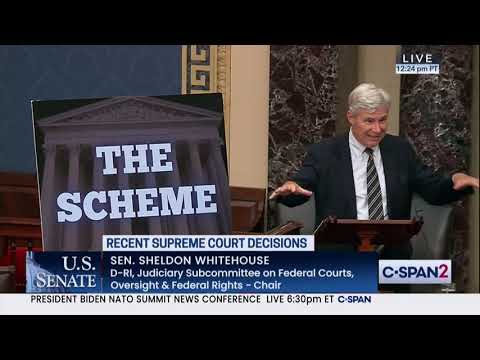
The Scheme 33: The Undoing of the Modern Regulatory State
https://www.amazon.com/Scheme-Right-Money-Capture-Supreme/dp/1620977389
a senior member of the Senate Judiciary Committee recounts how anonymous donors seized control of the U.S. Judiciary, including the Supreme Court
“An absolute must-read.” —Congressman Ro Khanna (CA-17)
Following his book Captured on corporate capture of regulatory and government agencies, and his years of experience as a prosecutor, Senator Sheldon Whitehouse here turns his attention to the right-wing scheme to capture the courts, and how it influenced the Trump administration’s appointment of over 230 “business-friendly” judges, including the last three justices of the United States Supreme Court.}:
Whitehouse traces the motive to control the court system back to Lewis Powell’s notorious memo, which gave a road map for corporate influence to target the judiciary, and chronicles a hidden-money campaign using an armada of front groups and helped by the infamous Citizens United Supreme Court decision. The scheme utilized the Federalist Society as an appointments turnstile, spent secret millions to support the nominees, orchestrated an “amicus brief” signaling apparatus, and propped up front-group litigants to “fast-lane” strategic test cases to the friendly justices.
Whitehouse finds the same small handful of right-wing billionaires and corporations running operations that he likens to “covert ops,” ultimately enticing the Senate to break rules, norms, and precedents to confirm wildly inappropriate nominees who would advance the anti- government agenda of a small number of corporate oligarchs.
The world got a glimpse of this story when the Senator’s presentation at the Amy Coney Barrett hearing went viral. Now, full of unique insights and inside stories, The Scheme pulls back the curtain on a powerful and hidden apparatus that has spent years trying to corrupt our politics, control our courts, and degrade our democracy.
---
SEE AMICUS
https://www.yalelawjournal.org/pdf/F7.WhitehouseFinalDraftWeb_v4zwakx5.pdf
kickass yale law
...
B. Donors Funding Amici and Litigants in the Same Case
Thanks to the work of investigative reporters, in recent years we have been
able to observe the rise in high-profile, politically charged cases that are financed
directly by ideological foundations.113 Often the same foundations that fund the
litigation also exploit the courts’ lenient amicus-funding-disclosure rules to
anonymously fund flotillas of amicus briefs that support their preferred out-
comes.
For example, in the orchestrated challenge to union agency-shop fees first
initiated in Friedrichs v. California Teachers Association,:{:{114}::{ }::{one organization bank-}:
rolled not only the nonprofit law firm bringing the case, but also eleven different
organizations that filed amicus briefs supporting the plaintiffs.115 That organi-
zation was the Lynde and Harry Bradley Foundation—a conservative organiza-}:
tion that has long sought to weaken labor rights, including by financing impact
litigation.116 If the disclosure rule were operating to its intended effect, the Court
and parties would have been made aware of that funding. Yet none of those ami-
cus filers disclosed the Bradley Foundation as a source of its funding for the brief
under Rule 37.6, and none of those briefs were rejected by the Court for lack of
disclosure.
The Bradley Foundation’s coordinated and undisclosed funding of the liti-
gants and amici in Friedrichs was not a one-off. In Janus v. AFSCME, the follow-
up to Friedrichs, investigative reporters found that the Bradley Foundationagain
...
163
:{:{funded both of the two groups representing the plaintiffs, as well as a dozen}:
groups that filed amicus briefs.117 Similarly, the two groups representing the Ja-
nus plaintiffs, plus thirteen amicus filers, all received funding from Donors Trust,
mentioned above.118
}:
:{:{}:
}:
None of this common funding was disclosed to the Court.
:{:{}:
}:
:{:{Finally, in}::{ }::{Seila Law LLC v. Consumer Financial Protection Bureau}::{, eleven amici}:
aligned with the petitioner Seila Law received financial support from the sameentities, which also fund the Federalist Society.119 The Center for Media and De-
mocracy subsequently found that “16 right-wing foundations,” including the
Bradley Foundation and DonorsTrust, “have donated a total of nearly $69 mil-
lion to 11 groups that filed amicus briefs in favor of scrapping the CFPB.”120 None
of this information was disclosed to the Court under its current reading of the
Rule.}:
:{:{}:
}:
C. Donors Anonymously Orchestrating Amicus “Projects”
:{:{}:
}:
Recently released documents reveal how donors like the Bradley Foundation
use tax-exempt money to coordinate amicus “projects,” in which they influence
court results by funding an array of groups in the same legal network as the Fed-
:{eralist Society, as presumably occurred in Seila Law.121 :{}:
}:
:{:{}:
}:
:{:{In 2015, a representative}:
:{of the:{Bradley Foundation emailed Leonard Leo, then Executive Vice President}::{}:
of the Federalist Society, to ask if there was “a 501(c)(3) nonprofit to which Brad-
ley could direct any support of the two Supreme Court amicus projects other
}:than Donors Trust.”122 Leo replied, “Yes, Judicial Education Projectcould take
and allocate.”123 In turn, Judicial Education Project (JEP), a 501(c)(3) tax-ex-
empt organization that does not disclose its donors, submitted a grant proposal
to Bradley seeking $200,000 to coordinate and develop amicus briefs in two po-
litically charged (but otherwise completely unrelated) cases: the aforementioned}:
...
164
Friedrichs and King v. Burwell,124 a challenge to the Affordable Care Act. The
Bradley Foundation estimated that “each of the two amicus-brief efforts costs
approximately $250,000, for a total of $500,000,” and the Bradleystaff recom-
mended a $150,000 grant be given to JEP to support this work.125 The Bradley
staffer explained the strategy behind this investment as follows:
At this highest of legal levels, it is often very important to orchestrate
high-caliber amicus efforts that showcase respected high-profile parties
who are represented by the very best lawyers with strong ties to the
Court. Such is the case here, with King and Friedrichs, even given Bradley’s
previous philanthropic investments in the actual, underlying legal actions.126
In King and Friedrichs, none of the amici supporting the Bradley-funded litigants
disclosed their Bradley Foundation funding under Rule 37.6—or any of their
funding sources for that matter. This nondisclosure resulted from interpreting
the Rule narrowly to require disclosure only of funds intended to cover the costs
of formatting, printing, and delivering the briefs.127
....
:{:{}:
}:
:{:{...}:
The negative effects that these new amicus campaigns have on our democ-
racy are twofold. The wealthy few fund the campaigns, excluding the majority
of Americans from the process and exacerbating preexisting countermajoritarian
and inequality concerns. And without a mechanism for disclosure, the general
public currently does not, and cannot, know how judicial reasoning is influenced
by masked private actors.
...
Donors have reaped enormous returns on their investments. As I have doc-
umented, the Roberts Court has handed down over eighty partisan Republican
5-4 decisions87 that benefit an easily identifiable Republican Party-donor inter-
est.88
These include decisions that remove constraints on anonymous giving
(e.g., Citizens United v. FEC,89 Americans for Prosperity Foundation v. Bonta90), as
well as decisions that weaken the power of countervailing institutions like labor
unions (e.g., Janus v. American Federation of State, City & Municipal Employees,
158
Council 3191), regulatory agencies (e.g., Seila Law v. Consumer Financial Protection
Bureau92), and the civil jury (e.g., Epic Systems Corp. v. Lewis93).
The effects of this litigation strategy on our democracy are frightening: the
courts are becoming an arena for enacting policies by judicial decree that are too
unpopular to pass through democratically elected legislatures. These coordi-
nated efforts warp the judiciary toward anonymous, ultrawealthy donor inter-
ests, all without the public ever learning about the role of dark-money interests
in shaping the law. The Supreme Court was already, by its nature, an avenue for
countermajoritarian ideas and policies to prosper.
But as Barry Friedman ex-
plains, especially when the Court is acting during a period of judicial suprem-
acy—as it arguably is now—the countermajoritarian aspect of the institution will
flourish.94 Alongside those concerns, the emergence of the dark-money amicus
machine increases the probability that the Court’s rulings will run counter to the
will of the American people (i.e., counter to democracy), and instead for the
benefit of the hidden interests that had a secret hand in putting Justices on the
Court and then filed masked amicus briefs...
..https://www.yalelawjournal.org/pdf/F7.WhitehouseFinalDraftWeb_v4zwakx5.pdf
}:
---
---
an ah 8 22
https://www.alternet.org/2022/08/anonymous-dark-money-destructive-influemce/
when the U.S. Supreme Court handed down its controversial 5-4 ruling in Citizens United v. Federal Election Commission in 2009, critics of the decision — including dissenters on the High Court — predicted that elections in the United States would be inundated with a flood of dark money. In his dissent, the late Justice John Paul Stevens, a Gerald R. Ford nominee, stressed that the ruling “threatens to undermine the integrity of elected institutions across the Nation” and warned, “A democracy cannot function effectively when its constituent members believe laws are being bought and sold.”
Thirteen years later, critics of the Citizens United decision continued to argue that Republican Stephens was spot on in his dissent. Articles on the influence of dark money have appeared in major publications, and New York Times reporters Kenneth P. Vogel and Shane Goldmacher, on August 22, reported that the largest political donation in U.S. history had come from “electronics manufacturing mogul” Barre Seid — who gave $1.6 billion to a group led by GOP activist and Federalist Society Co-Chairman Leonard A. Leo.
Journalists David Sirota and Joel Warner examine the influence of dark money in an op-ed published byThe Guardian GUKon August 29, citing Seid’s secretive donation as an especially blatant example.
“This week, the Lever, ProPublica and the New York Times discovered the largest known political advocacy donation in American history,” Sirota and Warner explain. “We exposed a reclusive billionaire’s secret transfer of $1.6bn to a political group controlled by the Republican operative Leonard Leo, who spearheaded the construction of a conservative Supreme Court supermajority to end abortion, block government regulations, stymie the fight against climate change and limit voting rights. This anonymous donation — which flowed to a tax-exempt trust that was never disclosed in any public record or database — was probably completely legal.”
Sirota and Warner continue, “Whether you support or abhor Leo’s crusade, we should be able to agree on one larger non-partisan principle: such enormous sums of money should not be able to influence elections, lawmakers, judicial nominations and public policy in secret. And we should not have to rely on a rare leak to learn basic campaign finance facts that should be freely available to anyone. Unfortunately, thanks to our outdated laws, those facts are now hidden behind anonymity, shell companies and shadowy political groups. America is long overdue for an overhaul of its political disclosure laws — and news organizations in particular should be leading the charge for reform.”
According to Sirota and Warner, dark money’s negative influence on U.S. politics is only “getting worse.”
“In 2020 alone, more than $1bn worth of dark money flooded around weak disclosure rules and into America’s elections, financing Super PACs, ad blitzes, mailers and door-knocking campaigns,” Sirota and Warner warn. “As millions of votes were swayed, reporters and the public had no knowledge of the money sources, or what policies they were buying. Heading into the 2022 election, the situation is getting worse. The two parties’ major Senate and House Super PACs are all being funded by anonymous dark money groups that are not required to disclose their donors.”
Sirota and Warner, however, do offer some “good news,” pointing out that the Disclose Act — a bill sponsored by Democratic Sen. Sheldon Whitehouse of Rhode Island — would “force dark money groups to disclose any of their donors who give more than $10,000, require shell companies spending money on elections to disclose their owners, and mandate that election ads list their sponsors’ major contributors.” And a separate Whitehouse-sponsored bill, they add, “would additionally require donor disclosure from shadowy groups lobbying the Supreme Court throughamicus briefs designed to tilt judicial rulings without letting the public know which billionaire or CEO’s thumb is on the scale.”
“In the landmark Citizens United ruling that unleashed the modern era of big money politics,” Sirota and Warner write, “the majority noted that while it was unwilling to permit political spending restrictions,it still held that ‘government may regulate corporate political speech through disclaimer and disclosure requirements.’ Those requirements are so desperately needed now — for the free press to play its vital role, and for voters to make informed decisions when they go to the polls.”
READ MORE:New report details Clarence Thomas’ 'shady ties to sprawling network of dark money'
---
---
https://www.thedailybeast.com/how-right-wing-dark-money-is-trying-to-kneecap-the-biden-doj
NO LNX
OPINION
How Right-Wing Dark Money Is Trying to Kneecap the Biden DOJ
TIME TO FIGHT
A shadowy group is fighting DOJ appointees Vanita Gupta and Kristen Clarke. Their crime? Their desire to use their skills to defend Americans’ right to vote.
Sheldon Whitehouse
Published Mar. 22, 2021
OPINION
Someone is targeting Biden Justice Department nominees Vanita Gupta and Kristen Clarke with attacks. Why? Both nominees hold exceptional records as litigators and civils rights activists. The respect they’ve earned extends beyond the civil rights movement and progressives to law enforcement and leading conservatives. They ought to be consensus picks.
But pull back the curtain, and strategy and motive take shape. Gupta and Clarke are poised to use their skills to defend Americans’ right to vote, just as the Republican Party is going all in on voter suppression as its path to political victory in 2022.
Unraveling the strategy starts with the dark-money group running the ads: the so-calledJudicial Crisis Network (JCN).This group’s ordinary work has been to translate big donors’ money into political attack ads in the “Court capture” mission that set out to remake the Supreme Court to the donors’ advantage. JCN has placed more than 10,000 ads since 2012 in pursuit of that mission, and they’ve kept secret the identity of those big donors.
[Biden’s AG’s the Perfect Person to Clean Up Trump’s Cesspool
CLEANUP IN AISLE 5
Jay Michaelson]
In Donald Trump and Mitch McConnell’s court-packing machine, this Judicial Crisis Network spent $7 million to oppose President Obama’s Supreme Court nominee Merrick Garland, and then spent another $10 million to boost Trump’s nominee Neil Gorsuch. JCN pledged $10 million or more for Brett Kavanaugh’s nomination. It spent $10 million in under two months to support Amy Coney Barrett’s bid. These campaigns were funded with tens of millions of anonymous dollars, primarily through four separate donations of at least $15 million. Those donations may well have been the same donor.
Eye-popping as that is, those millions are a tiny slice of the funding behind the overall dark-money operation. A 2019 Washington Post investigation revealed JCN is one of a web of front groups coordinated by Leonard Leo, the long-time executive vice president of the Federalist Society. The Post tracked more than $250 million in dark money flowing through Leo’s groups.
The groups see to the grooming and selection of reliable nominees, the lobbyists needed to shepherd nominees through confirmation, and the attack ads to motivate the confirmation votes. Then, more groups lobby the selected judges through amicus curiae briefs, signaling how their donors want the judges to rule.
The dark-money network has won an avalanche of victories for its donors. There are 80 partisan, 5-4 Supreme Court decisions that limit workers’ rights and access to reproductive health care, erode environmental protections, block commonsense gun safety laws, undermine civil rights, and protect corporations from courtrooms. It is an astounding 80-0 rout for big right-wing donors.
After The Washington Post exposed the $250 million operation, Leo stepped back from his Federalist Society role and turned up at a new organization improbably named the Honest Elections Project. This project began voter suppression work in political swing states like Florida, Nevada, Wisconsin, and Michigan that included: negative ads against Democrats; threatening letters to election officials challenging voter rolls; and a barrage of lawsuits seeking voting restrictions for November’s election.
“Trump’s cronies at the Justice Department showed dark-money donors the value of a captive Department that would look away from voter suppression schemes. ”
The media soon uncovered that the Honest Elections Project was a rebrand of the Judicial Education Project—which shared connections, donors, and aims with its sister group — yes, the Judicial Crisis Network. As a reporter for The Guardian observed, the Honest Elections Project melds two goals of the right-wing dark-money operation: first, pack the federal judiciary; and second, bring voting rights cases before the packed courts. Rigging elections through the courts is now a Republican judicial priority.
This brings us back to Gupta and Clarke. Gupta once ran the Civil Rights Division. She prosecuted hate crimes and human trafficking, promoted disability and LGBTQ rights, and fought discrimination in education, housing, employment, lending, and religious exercise. But most important, she challenged voter suppression. Gupta, if confirmed as assistant attorney general, will supervise the Civil Rights Division she once ran.
Accomplished civil rights attorney Clarke will fill Gupta’s former role running the Division and enforcing voting rights. The Honest Elections Project, kin to the Judicial Crisis Network, wants no part of these two women, because they will be strong, motivated leaders against unlawful voter suppression. They preferred Trump’s Civil Rights Division, which didn’t bring one single Voting Rights Act case until late May of 2020.
That’s the motive. The donor-approved Republican appointees to the Supreme Court may handcuff the Civil Rights Division with further judicial assaults on voting rights. But Trump’s cronies at the Justice Department showed dark-money donors the value of a captive Department that would look away from voter suppression schemes. As Republicans hinge their election strategy on keeping Americans from voting, an active Civil Rights Division is a deadly threat.
I get it. If I were a right-wing special interest group, the last thing I would want is these two experienced lawyers wielding the power of the Justice Department to defend voting rights. But for everybody else, these women are two appointments to applaud.
[TONY ORTEGA
Even Trump Can’t Make Sense of His Own Dark-Money Maze
---
---
cory d
@Doctorow: Fight inflation with a windfall profits tax - "Corporate profiteering has costs the average American household $276/month, with the majority of it coming from the energy sector."@RepRoKhanna
@SenWhitehouse
https://redgreenandblue.org/…/cory-doctorow-fight-inflatio…/
--
must be getting traction: realclear investigations:
https://pjmedia.com/news-and-politics/robert-spencer/2021/11/03/washington-post-wants-facebook-to-shut-down-pj-media-and-others-for-climate-denial-n1529542
pj media r spencer
no lnx [banner about silence rt so give us $ radical agenda bs?]
while the Washington Post piously reminds us that “democracy dies in darkness,” it’s busy shooting out the lights: On Tuesday it published a lengthy call to Facebook to shut down dissident media, including PJ Media, because, you see, the non-Leftist publications are daring to spread “climate change denial” on the platform. Not just democracy, but also the freedom of speech will die in darkness if the Post gets its way.
The Post article focuses upon a newly published study from one of the endless stream of far-Left advocacy groups masquerading as think tanks, the Center for Countering Digital Hate (CCDH), which the Post hastens to assure us is a nonprofit. Of course. What else could it possibly be called?
Disagree with the Leftist establishment about the causes of and/or remedies for climate change, and what else could possibly be your motivation but “hate”? You don’t want to see your country voluntarily impoverish itself and empower the People’s Republic of China in service of unproven assumptions and selective application of accountability? Come on, man! You’re just a bigot!
The CCDH study supposedly shows that “10 publishers, including RT and the Federalist Papers, are responsible for nearly 70 percent of interactions with climate change misinformation on the platform.”The CCDH has labeled these publishers the “Toxic Ten,” and they comprise virtually all of the major dissident platforms operating today: Breitbart, the Western Journal, Newsmax, the Media Research Center, the Washington Times, the Federalist Papers, the Daily Wire, and the Patriot Post, along with Russian State Media (what’s a Leftist conspiracy theory these days without the Russians) and of course Townhall Media, including PJ Media, Townhall, Red State, and Twitchy.
These publications, the Post claims, put out “a broad range of climate disinformation, including articles that undermine the existence or impacts of climate change or misrepresent data in ways that might erode trust in climate science experts.” They’re out there exercising the freedom of speech, utterly heedless of the looming apocalypse: “The study comes amid increasing political concern about the catastrophic impact of climate change, as global leaders gather in Glasgow for the United Nations-brokered COP26, described as the last chance for nations to hammer out a unified plan to significantly cut greenhouse gases.”
The Post hopes that the CCDH report will put an end to all that and bring about still more ideological conformity on Facebook: “While the report doesn’t provide a comprehensive look at all misleading climate change content promoted on Facebook, it has the potential to inspire political action as the CCDH has historically captured policymakers’ attention.”
It notes that the CCDH’s earlier report, which targeted the “disinformation dozen” who supposedly spread “anti-vaccine content,” was repeatedly cited by the White House along with numerous lawmakers in Congress, and it was used as a proxy for questions about the role of social media in aggravating vaccine hesitancy.”
Related: Lefty Website Calling for Canceling Conservatives Is Stunned When YouTube Comes for Them]
:{:{}:
}:
The need to act is urgent, or so the CCDH and the Post would have you believe. CCDH chief Imran Ahmed wants you to know that he is thoroughly petrified: “When you put it all together, you’ve got these two industries, Big Oil and Big Tech, and they are the two industries that pose the greatest threat to the survival of our species.”
Facebook, however, is not being cooperative, and not exercising enough censorship: “Earlier this year, Facebook promised to start adding informational labels to some climate posts, much like it does with election or coronavirus posts. But CCDH researchers found that of the posts they surveyed containing climate misinformation, just 8% carried Facebook’s informational label.” Nor does it look as if this is going to change anytime soon.
Facebook spokesman Andy Stone called the methodology of the CCDH study “flawed.” Facebook previously, according to the Post, “pushed back on the structure of the CCDH’s disinformation dozen report, arguing it was based on ‘narrow data’ that wasn’t representative of the hundreds of millions of posts that people shared about coronavirus vaccines on Facebook.”
That’s not to say that Facebook doesn’t interfere in climate change discussions at all. Nick Clegg, the social media giant’s vice president for global affairs and communications, noted that Facebook “reduces distribution of posts that its third-party fact-checkers say are false.” That’s not enough, as far as Sen. Sheldon Whitehouse (D-Gestapo)is concerned. “Facebook and other social media companies make money when they send users down rabbit holes of climate change denial,” Whitehouse thundered. “That’s a very dangerous business model for the future of the planet. It’s hard to tell which is more disgusting: Facebook propagating this disinformation, or the fossil fuel industry funding it.”
So far Facebook isn’t cooperating, but fascists such as Whitehouse and the Post editors aren’t going to give up their efforts to silence all dissent and destroy the freedom of speech. As Paula Bolyard noted the other day regarding another controversial issue where PJ Media is telling truths that others fear to enunciate, “In 21st-century America, truth is considered a revolutionary idea….We’ve sacrificed a lot of revenue over the last few years because we refuse to cave to the social-media censors, but we will continue to tell the truth. If you want to support us in this mission, please consider becoming a VIP member. For the price of a cup of coffee per day, you can partner with us to make sure the Left isn’t the only voice out there.”
The Left is working hard to make sure it is the only voice out there. That’s why we must raise our voices all the louder.[$ ask]
---
---
CRC!
Sheldon Whitehouse Enemies List
During July 2016, Heritage was one of 32 free-market policy organizations that were denounced on the floor of the U.S. Senate by 19 Democratic senators. Led by Sen. Sheldon Whitehouse (D-RI), the campaign was aimed at passage of a Congressional resolution that would have called on the non-profit groups to cooperate with “active or future investigations” of their climate-policy positions that might be launched against them by federal or state law enforcement officials. Whitehouse accused Heritage and the other organizations of work that was creating a “filthy thing in our democracy.” [192] [193]
Whitehouse’s proposed resolution was adding onto the work he had begun in a May 2015 opinion piece in the Washington Post, wherein he advocated for a federal lawsuit against the energy industry using the Racketeer Influenced and Corrupt Organizations (RICO) Act. Originally designed for and used in criminal cases to prosecute the mafia, RICO has a civil-lawsuit component that has since been applied to corporate targets such as cigarette manufacturers. Whitehouse admitted in the opinion piece that he did not “have enough information” to know whether “racketeering activity” had occurred with the energy industry but speculated the civil discovery in a RICO lawsuit might uncover the evidence he was seeking. In March 2016, then-U.S. Attorney General Loretta Lynch announced she had referred Whitehouse’s RICO concern to the FBI. [194] [195]
During the early summer of2016, the Attorney General of the U.S. Virgin Islands sent a subpoena to the libertarian think tank Competitive Enterprise Institute (CEI),demanding private internal research records, communications, and donor information. Two weeks later, Whitehouse and the 18 Democratic senators launched their program demanding that Heritage and other free-market organizations fully cooperate with investigations of this type. [196]
The CEI president responded, saying Whitehouse had become the “new Sen. Joe McCarthy,” and that it “is unhealthy for democracy and abusive when members of Congress create an enemies list based on policy positions.” [197] And a joint letter sent to all of the Democratic Senators from Heritage and 22 free-market think tanks stated: “Your threat is clear: There is a heavy and inconvenient cost to disagreeing with you. Calls for debate will be met with political retribution. That’s called tyranny. And, we reject it.” [198]
References [long]
SELECTED
Richardson, Valerie. “Democrats’ campaign against climate change skeptics compared to McCarthyism.” Washington Times. July 12, 2016. Accessed February 25, 2021. https://www.washingtontimes.com/news/2016/jul/12/web-of-denial-turns-senate-floor-into-democrats-pu/ ^
“SENATORS CALL OUT WEB OF DENIAL BLOCKING ACTION ON CLIMATE CHANGE.” Senator Sheldon Whitehouse. U.S. Senate. July 15, 2016. Accessed February 25, 2021. https://www.whitehouse.senate.gov/news/release/senators-call-out-web-of-denial-blocking-action-on-climate-change ^
https://www.whitehouse.senate.gov/news/release/senators-call-out-web-of-denial-blocking-action-on-climate-change
7.15.16
SENATORS CALL OUT WEB OF DENIAL BLOCKING ACTION ON CLIMATE CHANGE
Nineteen Senators expose fossil fuel-funded groups involved in a campaign to deny climate facts and stymie climate legislation
Washington, D.C. – Throughout the week on the Senate floor, Senate Democrats called out various trade associations, foundations, and organizations for perpetrating a sprawling web of misdirection and disinformation to block action on climate change. The Senators’ remarks detailed the concerted campaign waged by the Koch brothers, major fossil fuel companies, identity-scrubbing groups like Donors Trust and Donors Capital, and their allies to manipulate the public’s perception of the climate crisis and curtail legislative action to address it.
Participating senatorsincluded Harry Reid (D-NV), Barbara Boxer (D-CA), Richard Durbin (D-IL), Jack Reed (D-RI), Chuck Schumer (D-NY), Ben Cardin (D-MD), Sheldon Whitehouse (D-RI), Tom Udall (D-NM), Jeanne Shaheen (D-NH), Jeff Merkley (D-OR), Al Franken (D-MN), Chris Coons (D-DE), Richard Blumenthal (D-CT), Brian Schatz (D-HI), Martin Heinrich (D-NM), Tim Kaine (D-VA), Elizabeth Warren (D-MA), Edward Markey (D-MA), and Gary Peters (D-MI).
Despite polling that shows over 80 percent of Americans favor action to reduce carbon pollution, Congress has failed to pass comprehensive climate legislation. The 19 Senators delivered over five and half hours of remarks describing the activities, backers, and affiliates of32 denier groups. Each Senator called out one or more organizations, including
the Advancement of Sound Science Center; the Acton Institute; Americans for Prosperity; American Legislative Exchange Council; the American Petroleum Institute; the Annapolis Center for Science-Based Public Policy;
the Cato Institute; the Center for Study of Carbon Dioxide and Global Change; the U.S. Chamber of Commerce; theCompetitive Enterprise Institute; the Cornwall Alliance for the Stewardship of Creation;
the Franklin Centerfor Government and Public Integrity; the George C. Marshall Institute; the Global Climate Coalition; the Heartland Institute; the Heritage Foundation; the Hoover Institution; the HudsonInstitute; the James Madison Institute;
the John Locke Foundation; the Lexington Institute; the Locke Institute; the Manhattan Institute; the Mercatus Center;the Nevada Policy Research Institute; the Pacific Research Institute; the Reason Foundation;
the Science and Public Policy Institute; the Thomas Jefferson Institute for Public Policy; the Virginia Institute for Public Policy; and theWestern Fuels Association.
Senator Whitehouse, who organized the web of denial floor speeches, said during his remarks that he and his colleagues sought to “shine a little light on the web of climate denial and spotlight the bad actors in the web, who are polluting our American discourse with phony climate denial. This web of denial, formed over decades, has been built and provisioned by the deep-pocketed Koch brothers, by ExxonMobil, by Peabody coal, and by other fossil fuel interests. It is a grim shadow over our democracy in that it includes an electioneering effort that spends hundreds of millions of dollars in a single election cycle and threatens any Republican who steps up to address the global threat of climate change. . . . [I]t is long past time we shed some light on the perpetrators of this web of denial and expose their filthy grip on our political process. It is a disgrace, and our grandchildren will look back at this as a dirty time in America’s political history because of their work.”
“It is clear that no country can avoid the impacts of climate change, and no country can meet this challenge alone,” said Senator Reid. “As a nation that has contributed more than a quarter of all global carbon pollution, it is our responsibility to lead, not to deny. As a nation already feeling the effects and costs of climate change, it is also in our national interest to do so. As we have seen time and again, other countries would join us if America leads the way – not by denial, but by dedication to pragmatic solutions that can be achieved.”
“It’s getting harder and harder to stop these outside groups from spreading their smear campaigns. These groups have an interest in making sure Congress never gets anything done to prevent climate change. And they are using our broken campaign finance system as a tool to keep it that way,” Senator Udall said in his remarks. “We need to fix the system. Poll after poll shows that our constituents – across the political spectrum – want reforms, tackling climate change, eliminating dark money from our politics, and standing up to groups that distort public perceptions. It’s time we listened. Our democracy and our environment are at stake.”
During his remarks, Senator Markey said, “Even as the science of climate change has become almost incontrovertible, climate policies have gotten trapped in a web of denial. Exxon, the Koch brothers, Peabody coal and their fossil fuel cronies whose profits might suffer under rules to reduce carbon pollution have had a vested interest in stopping climate action and have engaged in a decades-long campaign of deceit. But no matter what lies and misinformation the climate deniers try to peddle, the facts, the moral authority and the economic opportunities are with us. We can and will create a clean energy revolution that increases jobs as it cuts pollution.”
“We can and must pass legislative solutions to address global climate change,” said Senator Peters. “Transitioning away from fossil fuels and investing in renewable energy will create sustainable, good-paying jobs here in the United States. Taking bold action on climate change will strengthen our public health, our economy, and our national security. We must wake up and realize that those attempting to mislead and confuse must not be successful.”
Watch Senator Whitehouse’s remarks ,
 , and
 .
Watch Senator Reid’s remarks .
Watch Senator Boxer’s remarks .
Watch Senator Durbin’s remarks .
Watch Senator Reed’s remarks .
Watch Senator Schumer’s remarks .
Watch Senator Cardin’s remarks .
Watch Senator Udall’s remarks .
Watch Senator Shaheen’s remarks .
Watch Senator Merkley’s remarks .
Watch Senator Franken’s remarks .
Watch Senator Coons’s remarks
Watch Senator Blumenthal’s remarks .
Watch Senator Schatz’s remarks .
Watch Senator Heinrich’s remarks .
Watch Senator Kaine’s remarks .
Watch Senator Warren’s remarks :
Watch Senator Markey’s remarks .
Watch Senator Peters’s remarks .
As part of their effort to draw attention to the web of denial, Senators Whitehouse, Markey, Schatz, Boxer, Merkley, Warren, Franken, and Bernard Sanders (I-VT) also introduced a resolution describing and condemning the efforts of corporations and groups to mislead the public about the harmful effects of tobacco, lead, and climate change. The resolution urges fossil fuel corporations and their allies to cooperate with investigations into their climate-related activities. Congressman Ted Lieu (D-CA) introduced the resolution in the House, which is cosponsored by Congressman Jim Langevin (D-RI) and 13 colleagues.
---
not sane as web above
April 23, 2018
The AEA, represented by Thomas Pyle, was among 22 groups signed on to an open letter asking President Trump to ignore recent criticism of EPA Administrator Scott Pruitt. [65]
In a speech to the U.S. Senate, a group of Democratic senators identified the organizations as front groups for the Koch Brothers and other wealthy donors, nicknamed the “Web of Deceit.” The senators outlined how, in addition to funding from the Koch network, many of the groups use untraceable “dark money” funneled through groups like Donors Capital Fund and Donors Trust to influence legislation, particularly with regards to climate and pollution.
Senator Whitehouse outlined it as “a web of deceit conceived and bankrolled by the Koch brothers and other self-interested billionaires to advocate for very selfish and unpatriotic policies.” Whitehouse added: “This web of deceit has infiltrated and populated the Trump administration, and it is swamping the interests of everyday Americans. [66]
The full list of pro-Pruitt signatories and their respective organizations is as follows:
- Saulius “Saul” Anuzius – 60 Plus Association
- Fred Birnbaum – Idaho Freedom Foundation
- L. Brent Bozell III– Media Research Center
- Amy Oliver Cooke – Independence Institute
- Wesley Denton – Conservative Partnership Institute
- Viv Forbes – The Carbon Sense Coalition
- Frank J Gaffney – Center for Security Policy
- Steve Goreham –Climate Science Coalition of America
- Phil Kerpen – American Commitment
- Andrew Langer – Institute for Liberty
- Lisa B. Nelson – American Legislative Exchange Council
- Rick Manning – Americans for Limited Government
- Jenny Beth Martin – Tea Party Patriots Citizens Fund
- William Perry Pendley – Mountain States Legal Foundation
- Thoma**s Pyle– American Energy Alliance
- George Rasley – ConservativeHQ.com
- Sandy Rios – American Family Association
- Craig Richardson – Energy & Environment Legal Institute
- Craig Rucker – Committee for a Constructive Tomorrow (**CFACT)
- Dr Jameson Taylor – Missisippi Center for Public Policy
- Kyle Wingfield – Georgia Public Policy Foundation
---
Whitehouse, Sheldon. “The fossil-fuel industry’s campaign to mislead the American people.” The Washington Post. May 29, 2015. Accessed February 25, 2021. https://www.washingtonpost.com/opinions/the-fossil-fuel-industrys-campaign-to-mislead-the-american-people/2015/05/29/04a2c448-0574-11e5-8bda-c7b4e9a8f7ac_story.html?utm_term=.b8180d2844f2
Arter, Melanie. “AG Lynch: DOJ Has Discussed Whether to Pursue Civil Action Against Climate Change Deniers.” CNS News. March 9, 2016. Accessed February 25, 2021. https://www.cnsnews.com/news/article/melanie-hunter/ag-lynch-doj-has-discussed-whether-pursue-legal-action-against-climate
Richardson, Valerie. “Democrats’ campaign against climate change skeptics compared to McCarthyism.” Washington Times. July 12, 2016. Accessed February 25, 2021. https://www.washingtontimes.com/news/2016/jul/12/web-of-denial-turns-senate-floor-into-democrats-pu/ ^
no lnx
‘Web of Denial’ turns Senate floor into Democrats’ pulpit against climate change skeptics
STORY TOPICS
POLITICS
ENVIRONMENT
CLAUDE E. WALKER
U.S. VIRGIN ISLANDS
COMPETITIVE ENTERPRISE INSTITUTE
Sen. Sheldon Whitehouse (left) of Rhode Island, shown here with Sen. Charles E. Schumer of New York, kicked off the Democrats' two-day campaign in the Senate by saying, "Welcome to the 'Web of Denial.' And thank you to those who are working to expose it. It is a filthy thing in our democracy." (Associated Press/File)
Sen. Sheldon Whitehouse (left) of Rhode Island, shown here with Sen. Charles E. Schumer of New York, kicked off the Democrats’ two-day campaign in the Senate by saying, “Welcome to the ‘Web of Denial.’ And thank you to those who ... more >
By Valerie Richardson - The Washington Times - Tuesday, July 12, 2016
Congressional Democrats are riding to the rescue of the climate change movement after last week’s embarrassing subpoena retreat, but the two-day campaign to vilify climate skeptics on the Senate floor has drawn comparisons to McCarthyism.
Under the banner “Web of Denial,” the effort kicked off Monday as Senate Democrats took to the floor and accused more than a dozen individuals and free market organizations of deliberately casting doubt on the climate catastrophe narrative.
“Welcome to the ‘Web of Denial.’ And thank you to those who are working to expose it,” said Sen. Sheldon Whitehouse, Rhode Island Democrat. “It is a filthy thing in our democracy.”
The campaign, scheduled to wrap up Tuesday night, began two weeks after Virgin Islands Attorney General Claude E. Walker agreed to withdraw subpoenas against Exxon Mobil Corp. and the Competitive Enterprise Institute, a widely publicized setback for the coalition of 17 Democrat-led attorneys general pursuing fraud charges against climate change skeptics.
:{:{}:
}:
CEI President Kent Lassman slammed the Senate speeches as a “McCarthy-style attempt to shut down the democratic process and publicized the names on their climate policy enemies list.”
“Apparently, Sen. Sheldon Whitehouse is the new Sen. Joe McCarthy and green is the new blacklist,” Mr. Lassman said in a statement. “It is unhealthy for democracy and abusive when members of Congress create an enemies list based on policy positions. All Americans have the right to support causes they believe in without fear of threats from overzealous government officials.”
Democrats also unveiled Monday a joint concurrent resolution accusing fossil fuel companies and their supporters of deliberately casting doubt on climate change and calling for them to cooperate with “active or future investigations.”
“The actions taken by Exxon Mobil and other big oil companies may have imperiled all of humanity through their massive campaign of deception to confuse the public and lawmakers as to the truth of climate science,” said Rep. Ted Lieu, the California Democrat who sponsored the resolution with Mr. Whitehouse. “Any actors who knowingly confuse the public as to the harm of their products, whether it be lead, tobacco or oil, should be condemned and investigated.”
Nineteen Democrats are scheduled to take to the Senate floor over two days in support of AGs United for Clean Power, a coalition of attorneys general who accuse fossil fuel companies and their free market allies of misleading the public about the dangers of climate change.
California, Massachusetts and New York, in addition to the Virgin Islands, have begun investigations into Exxon.
Exxon spokesman Alan T. Jeffers said Tuesday that the petroleum company continues to “reject attempts to portray legitimate scientific observations and differences on policy approaches as climate denial.”
“To suggest that we had reached definitive conclusions, decades before the world’s experts and while climate science was in an early stage of development, is not credible,” Mr. Jeffers said. “The great irony is that we’ve acknowledged the risks of climate change for more than a decade, have supported a carbon tax as the better policy option and spent more than $7 billion on research and technologies to reduce emissions.”
Although Exxon has been the campaign’s primary target, each of the Democrats who spoke Monday named at least one company, think tank or person challenging climate disaster scenarios.
Sen. Elizabeth Warren of Massachusetts cited the Heartland Institute’s Science & Public Policy Institute, and Sen. Tom Udall of New Mexico named the Greening Earth Society and Information Council on the Environment.
“Dozens of shadowy organizations are waging a campaign to mislead the public and undermine American leadership on climate change, the Paris climate agreement and clean energy initiatives across the country,” Senate Minority Leader Harry Reid, Nevada Democrat, said in his prepared remarks. “All of these shadowy, dark entities — such as the U.S. Chamber of Commerce, the Heartland Institute and the Cato Institute — are all fronts for the Koch brothers.”
Mr. Reid for years has used the Senate floor to blast Charles and David Koch, who are top Republican funders.
A memo circulated by Mr. Whitehouse’s staff before the speeches showed that each Democrat had been assigned a specific free market nonprofit to incorporate into their remarks, according to the Washington Free Beacon.
Democrats hosted a screening Monday of the 2014 documentary “Merchants of Doubt,” which accuses a group of scientists of obscuring “the truth on issues from tobacco smoke to global warming.”
The multilateral effort won praise from climate change advocacy groups such as NextGen Climate and 350.org, whose founder, Bill McKibben, called Mr. Whitehouse “a hero, straight up” on Twitter.
“The senators will each deliver remarks detailing how interconnected groups — funded by the Koch brothers, major fossil fuel companies like Exxon Mobil and Peabody Coal, identity-scrubbing groups like Donors Trust and Donors Capital, and their allies — developed and executed a massive campaign to deceive the public about climate change to halt climate action and protect their bottom lines,” 350.org said in a statement before the speeches.
Four environmental groups posted a petition Monday urging supporters to sign on as “citizen co-sponsors” in order to “stop polluters from misleading the public about the threat of climate change.”
Mr. Whitehouse has led the call to pursue fossil fuel companies and their allies on accusations of federal racketeering. Critics of the effort have decried it as a violation of free speech.
Two weeks ago, Mr. Walker agreed to pull a subpoena that named more than 100 academics, universities and think tanks as part of his probe of Exxon Mobil. The list has since become something of a badge of honor for free market groups.
Jon Caldara, president of the Independence Institute in Denver, said he was offended to have been left off the subpoena, which he attributed to confusion with the Independent Institute in Oakland, California.
“AGs! Here I am! I’ve been subpoenaed many times,” Mr. Caldara said on his Colorado Public Broadcasting show “Devil’s Advocate.” “Bring it on!”
Mr. Walker said in a statement that the Exxon litigation had become a distraction. He also has pulled two subpoenas against the Competitive Enterprise Institute, which now is suing him for sanctions.
“I intend to continue to work with our state partners to advance our common investigation while preserving our limited resources to address the many other issues that face the Virgin Islands and its residents,” Mr. Walker said.
• Valerie Richardson can be reached at vrichardson@washingtontimes.com.
---
Richardson, Valerie. “Democrats’ campaign against climate change skeptics compared to McCarthyism.” Washington Times. July 12, 2016. Accessed February 25, 2021. https://www.washingtontimes.com/news/2016/jul/12/web-of-denial-turns-senate-floor-into-democrats-pu/ ^
Letter: Americans for Tax Reform, et al., to U.S. Sen. Harry Reid, et al. July 12, 2016. Accessed January 25, 2019. https://www.whitehouse.senate.gov/imo/media/doc/2016-07-12-Coalition-Letter-Senate-Web-of-Denial-Resolution.pdf ^
---
---
https://yyy.theguardian.com/business/**2020/jan/**08/oil-companies-climate-crisis-pr-spending
no lnx nice gfx brulle
How the oil industry has spent billions to control the climate change conversation
‘From my perspective every indication of this evidence is once that closet door gets blown open, the skeletons are going to come tumbling out,’ said Geoffrey Supran.
Activists say Democratic climate proposals won’t be able to pass until lawmakers put a stop to oil companies trying to rebrand themselves
Emily Holden in Washington
Wed 8 Jan 2020
America’s oil companies are trying to rebrand themselves as part of the solution to the climate crisis, launching a campaign to counter top Democrats’ proposals to rapidly cut pollution from the power plants and cars that run on the industry’s petroleum and natural gas.
They say natural gas – a fossil fuel that emits heat-trapping carbon dioxide – is helping to slow climate disruption by providing an alternative to coal.
How vested interests tried to turn the world against climate science
Read more]
“We’re taking our message of energy progress to every corner of the country to show just what’s at stake in Washington and in state capitols around the country,” said Mike Sommers, CEO of the oil trade group the American Petroleum Institute (API), on a press call announcing the plan.
The campaign is part of a strategy in which the oil industry has funneled billions of dollars into its defense, threatening to outpace climate action advocates, say frustrated environmental activists who are increasingly calling on Democrats in Congress to take a tougher line on the sector.
:{:{}:
}:
But Sommers depicted a dark future if a presidential candidate who wants to ban fracking for natural gas wins the 2020 election: millions of jobs lost, hundreds of billions of dollars more for household energy costs and a global recession.
However, opponents of the industry say the only path to significant US climate action is through legislation and that lawmakers won’t be able to legislate unless they reveal how the industry has controlled the public dialogue around climate change and put a stop to its misdeeds.
Geoffrey Supran, a research associate who studies global warming politics at Harvard University, is urging House committees to demand more information from oil companies about their influence over public policy.Supran said obtaining corporate documents is “one of the most important actions Congress could take to address the climate crisis”.
“The reality is that as much as we know about fossil fuel interests’ denial and delay, we’ve really found those skeletons in the closet just by looking through a tiny keyhole – everything we know is based on just a few hundred documents scrounged from various sources,” Supran said. “From my perspective every indication of this evidence is once that closet door gets blown open, the skeletons are going to come tumbling out.”
Walking through Washington’s national airport this holiday season, travelers saw a type of advertisement that is becoming more mainstream – it pops up on social media, in commercial breaks for streaming video services, in newspapers and on the radio.A friendly-looking older woman in a hard hat beams at the camera. “Thanks to natural gas, the US is leading the way in reducing emissions,” the sign reads.
The ad campaign, called We’re On It, is sponsored by API – which represents the oil companies that have contributed significantly to the climate crisis.
While it’s true that US climate pollution is declining in large part because of the switch from coal to natural gas, scientists say far more drastic action is needed to slow climate change. And forecasts show natural gas threatening continued progress.
As the American public has become more aware of the climate crisis, oil companies have fought back.
:{:{}:
}:
Over roughly the last three decades, five major US oil companies have spent a total of at least $3.6bn on advertisements – not counting their investments in public relations programs like sponsored beach clean-ups, or their influence through trade associations, dark money groups and campaign donations.
Activists gather with signs outside the American Petroleum Institute during the global climate action week in Washington DC, on 23 September 2019.]
Advertising spending has increased as politicians have paid more attention to climate change and API’s campaign comes as progressive candidates bidding for the White House, such as the US senators Bernie Sanders and Elizabeth Warren, propose to ban fracking – a drilling method that has unlocked huge supplies of natural gas and driven down the cost of the fuel.
Any renewed investigation from Congress could reveal more about how the industry has tried to sway public opinion.
Investigative reporting has already shown that Exxon has known since at least the 1960s that its products were causing global warming. But Exxon has fought back, saying it is the victim of “a coordinated campaign perpetuated by activist groups with the aim of stigmatizing ExxonMobil”.
Exxon touts itself instead as an answer to the climate crisis. The top advertisement on Exxon’s YouTube page touts research on making biofuels from algae in order to cut climate pollution, but the technique is currently prohibitively expensive, and the research represents a tiny portion of Exxon’s budget.
In response to questions from the Guardian, an Exxon spokesman, Casey Norton, said Exxon is “committed to doing our part”.
“The world faces a dual challenge: meeting growing demand for energy while also reducing environmental impacts, including the risks of climate change,” Norton said.
Norton maintains that “all forms of energy are needed”, including natural gas and renewables, although scientists have concluded humans will have to stop using fossil fuels entirely to stem the crisis.
In the call with reporters, API’s CEO took a similar stance. He acknowledged the industry has a responsibility to help slow emissions that are causing rising temperatures, but he said the demand for affordable energy is growing and American fossil fuel companies will meet it.
Pressed to commit to any significant goal to curb emissions, Sommers said API could back some bipartisan legislation to incentivize technology that would capture carbon dioxide so that it cannot enter the atmosphere.[big pilot subsidized clean coal boondoggle just concert to anga]
“That’s legislation that’s supported by far-right Republicans and far-left Democrats, but it’s some place in the middle where we think we can meet and we can work together on this key priority,” Sommers said.
Critics of the oil industry say the Democrat-led House should be aggressive in seeking to counter the industry’s narrative. Some want Democrats to call executives into hearings and subpoena internal records about their influence campaigns – one of the most powerful tools available to Congress.
But that hasn’t happened. Instead of going directly for the oil companies, House committees have instead been holding dozens of hearings and introducing legislation about ways to cut pollution and help people affected by the climate crisis.
“Our oversight staff decided that OK, rather than kind of punching an industry that’s already pretty down in the public image, there are plenty of other things they also needed and wanted to pursue, so subpoenaing big oil just didn’t really rise to the top of the heap,” the staffer said.
Supran, who works with Harvard climate politics expert Naomi Oreskes, says they have a collection of information that could help Democrats determine which questions to ask and which documents to demand.
“Historical record points to a number of individuals, documents, and questions that could help Congress get to the bottom of how the fossil fuel regime misled America,” Supran said.
The other route – which Democrats are already pursuing – is state lawsuits against companies. But those challenges could take much longer and aren’t guaranteed to succeed.
Robert Brulle, a visiting professor of environmental sociology at Brown University who co-authored the research tallying oil spending on ads, said the findings are just the tip of the iceberg. Brulle has previously found that more than $2bn was spent lobbying Congress on climate legislation between 2000 and 2016.
He says lawmakers should investigate the oil industry the way the former congressman Henry Waxman took on tobacco companies in the 1990s.
“I think what we’ll find is that the fossil fuel campaigns are going to dwarf what the tobacco industry did. It’s an order of magnitude larger,” Brulle said.
Some accuse Democrats of fearing a backlash from the oil industry – which still donates to Democratic campaigns. They say moderate Democrats might be trying to stay civil with major companies because it will be easier to pass climate legislation with their support.
But it’s hard to imagine the industry backing substantial action that would limit oil production and use – which scientists say is required to avoid catastrophe.
I think what we’ll find is that the fossil fuel campaigns are going to dwarf what the tobacco industry did
Robert Brulle
So far, congressional efforts have only scratched the surface of the sector’s influence. In October, the oversight committee reviewed evidence of how much Exxon has known about the climate crisis and for how long. The Democrat-only climate committee in the Senate also held a hearing on dark money and climate change. The Rhode Island senator Sheldon Whitehouse urged his colleagues in the House to use their majority to get tougher with oil companies – subpoenaing their records if necessary.
“When we catch the fossil fuel industry spending money in these campaigns, we’re only seeing a sliver of the total operation,” Whitehouse said in a more recent interview with the Guardian. “I think it’s hard to counter their message effectively because remember – they have a $600bn annual subsidy that they’re defending, according to the [International Monetary Fund].
“The idea that some other entity, particularly some struggling charitable organization, is going to be able to go toe-to-toe in spending and outspend them is not really feasible.”
Despite fossil fuel companies massive spending, they have continued to lose public support. Elected officials just haven’t followed the shift.
:{:{}:
}:
A majority – 60% of Americans – want to “dramatically reduce” fossil fuel use in 10 or 20 years, according to Gallup. And between 2013 and 2019, the percentage of people who wanted to emphasize oil production has dropped from 46% to 28%.
“If you take climate change seriously, then you have to think about what your path is to getting a serious climate bill,” Whitehouse said. “And the path to a serious climate bill requires disabling the fossil fuel industry’s obstruction apparatus that has been the thing that has prevented that from happening.”
---
---
KYRSTEN SINEMA USED THE WINERY WHERE SHE INTERNED TO FUNDRAISE WITH PRIVATE EQUITY
The Arizona senator, who is blocking tax increases on the rich, spent the summer courting donors who stand to lose under major tax reform.
Daniel BoguslawDaniel Boguslaw
September 26 2021,
THE DEMOCRATIC SENATOR threatening to block the party’s ambitious social policy agenda in order to preserve former President Donald Trump’s tax cuts for corporations and for the wealthy spent last summer interning at a winery owned by the private equity baron Bill Price.
In the summer of 2020, Sen. Kyrsten Sinema, D-Ariz., interned at Three Sticks, a winery in Sonoma, California, owned by Bill Price, co-founder of the private equity leviathan TPG Capital. According to the job description, interns “assist in all facets of harvest work including cleaning and sanitizing equipment, sorting fruit, punchdowns, making basic additions and managing fermentations according to winemaker instructions, barrel work, and other winery-related tasks.”
Sinema’s personal financial disclosures show that she was paid $1,117.40 in wages for her work. But an ensuing fundraiser at Three Sticks, held in August, netted her campaign coffers much more.
Sinema has told Democratic colleagues, according to the New York Times, that she will oppose any tax increases on either corporate or personal rates, essential pillars of the legislation. Her opposition to tax hikes on the rich comes amid a major spending blitz to encourage her to stand against any tax increases on private equity executives or hedge funds.
The same summer that Sinema completed her internship, Three Sticks was one of three stops on a weekend fundraising tour. Tickets to the fundraiser cost $5,000 per guest, with contributions going toward both her own campaign committee and the Getting Things Done political action committee, a leadership PAC used to support fellow congressional moderates such as New Jersey Rep. Josh Gottheimer. Sinema courted major donors that summer, including Lyft CEO Logan Green, Microsoft founder Bill Gates, and of course Price himself, who contributed $5,000.
In the past two years, Sinema has received tens of thousands of dollars in maxed out donations from private equity partners like Price and investment firm CEOs.Now, many of those same senior firm executives stand to lose millions to the IRS if a bill targeting the carried interest tax loophole is included as part of the Senate’s budget reconciliation process. Those executive donors include senior directors at TPG and billionaire Blackstone CEO Jonathan Gray.
Sponsored by Sens. Ron Wyden andSheldon Whitehouse, the Ending the Carried Interest Loophole Act would require hedge fund managers and private equity executives to pay taxes on their income at the same rates as other workers, ending favored treatment for such executives. Right now, their compensation is not considered income. It is instead classified as a tax deferrable capital gain, subject to far lower rates, despite its near-identical function.
In June, the private equity industry lobby launched a pressure campaign targeting Sinema and fellow Arizona Sen. Mark Kelly to leave the carried interest tax loophole intact.
The Joint Committee on Taxation estimates the bill would raise more than $63 billion over 10 years, serving as an important part of the pay for — the taxes used to offset new spending — in Democrats’ proposed $3.5 trillion budget reconciliation plan. Sinema has repeatedly described the plan as too expensive.
Multiple congressional aides who spoke to The Intercept on the condition of anonymity said that Sinema’s office has been silent on whether or not she will support closing the loophole, despite her concern over the price tag of her party’s budget reconciliation bill and the vast sums the carried interest tax could raise.
BEFORE OPENING HIS winery, Price co-founded TPG, one of the largest private equity firms in the world, in 1992. Despite announcing his departure from TPG in 2006, Price listed TPG as his employer on a 2020 Federal Election Commission filing with the title of “partner emeritus.” A spokesperson for Price told The Intercept, “Bill Price no longer has any affiliation with TPG and has not for a decade.” When shown a copy of the FEC filing, the same spokesperson did not respond for further comment. In 2019, during the college admissions pay-to-play scandal, Price’s connection to the firm resurfaced when he defended Bill McGlashan, the husband of his wife’s sister and a senior TPG partner he brought to the firm in 2004. TPG did not respond to multiple requests for comment.
Last week, Sinema announced explicit opposition to yet another critical budget reconciliation revenue mechanism:Democrats’ drug pricing plan,which various estimates say could save the government between $450 and $700 billion over 10 years. In July, Sen. Mitch McConnell called Sinema’s rejection of the budget reconciliation price tag “very courageous.”
As The Daily Poster first reported, Sinema, who has raised over $500,000 from the pharmaceutical and health products industry, was featured in ads by a pharma-funded dark-money group just before she went public with her opposition to drug pricing legislation. Data from the Center for Responsive Politics shows that since entering Congress, Sinema has also grossed well over $6 million in donations from the finance, insurance, and real estate industry.
Earlier this month, the Chamber of Commerce put out a report claiming that closing the carried interest tax loophole would cost almost 5 million jobs and create billions in tax shortfalls.
“The carried interest loophole rewards one narrow class of workers, fund managers, whose compensation already is in the stratosphere compared to almost everyone else, with a deeply discounted income tax rate. It’s indefensible,” Bob Lord, tax counsel at Americans for Tax Fairness, told The Intercept.
“Carried interest also allows fund managers to defer tax on their compensation until the fund’s investments are sold. The rest of us pay tax on our labor income currently, not years later,” Lord said. “Apologists at the Chamber of Commerce justify this travesty with claims the country would lose jobs if fund managers paid tax at the same rate as the rest of us. By that logic, why wouldn’t we reduce their rate to zero? More jobs, right? Or perhaps the IRS should pay them? Even more jobs, right? How any member of Congress would take the Chamber of Commerce seriously here mystifies me.”
COMPARED TO HER Democratic colleagues and corporate donors, Sinema’s personal financial disclosures are sparse. Her 2020 filing lists two retirement plans, adormant consulting business, and income generated from a teaching job at Arizona State University alongside her paltry internship income. This places Sinema’s personal finances in sharp contrast to the income generated by congressional allies like Joe Manchin, who has grossed millions from his coal interests over the course of the past decade.
When it comes to raising campaign cash though, few outmatch Sinema’s zeal for fundraisers and phone banking. According to multiple Democrats who served with Sinema in the House, she was the only member who seemed to actively love being in the Democratic Congressional Campaign Committee call center, claiming a couch for her sole personal use and complaining to other members when they had to leave to vote.
In 2020, she delivered a keynote speech followed by a fundraiser at SFVegas, the lavish securities conference held at the Aria Resort and Casino in Las Vegas and featured in the film “The Big Short.” Former British Prime Minister Theresa May headlined last year’s conference.
Sinema gave a keynote address at a Women in Securitization event before a fundraising reception sponsored by the Structured Finance PAC, which has donated tens of thousands of dollars to powerful members of the House Financial Services Committee such as Reps. Gregory Meeks and Carolyn Maloney. Sinema’s recent votes and public posturing suggest that the cash and advertising blitz launched by financial industry lobbyists may have achieved their intended effect.
In August, Sinema was the only Democrat to vote against an amendment to “establish a reserve fund relating to protecting family farms, ranches, and small businesses while ensuring the wealthy pay their fair share.” A day later, she voted against “a reserve fund relating to increasing the progressivity of the tax code.”
Sinema’s dramatic rightward shift toward the barons of finance and pharmaceuticals at the cost of progressive tax reform stands in sharp contrast to her childhood origin story, in which she talks about having grown up in an abandoned gas station without electricity or running water, at one point living out of a car.
In response to a colleague’s expression of support after anNPR story detailing her family’s struggles with financial hardship, Sinema, then a representative, speaking to colleagues in the Democratic cloakroom just off the House floor, deadpanned: “Yeah, voters love that stupid shit. They eat it up.”
---
---
sv 350 921
Last month’s release of the IPCC Sixth Assessment Report was the first ever to include a chapter on methane and other short-lived pollutants. Even so, experts argue the treatment of this "short-lived climate pollutant" was wholly insufficient, especially in light of a May 2021 UN report that said a reduction in human-caused methane emissions is “one of the most cost-effective strategies to rapidly reduce the rate of warming and...limit temperature rise to 1.5°C.” Methane’s global warming potential is about 101 times that of carbon dioxide over methane's 12 year lifespan in the atmosphere (this is often reported as 86 times more potent a greenhouse gas over 20 years); if unabated, the gas could be responsible for 30 percent of global warming by 2050.
Much of the focus on Congress this year has been on these emissions from the oil and gas industry. The $1.2 trillion bipartisan infrastructure package passed by the Senate last month would allocate $21 million to cleaning up abandoned mines and superfund sites, and plugging old oil and gas wells, which are estimated to produce 280,000 metric tons of methane per year. The reconciliation bill, now under construction, is expected to include a “**methane polluter fee”based on legislation introduced by Sen. Sheldon Whitehouse (D-RI) in March. Whitehouse’s plan proposes levying a $1,800/ton fee on methane emissions from oil and gas facilities, beginning in 2023. One issue? Recent research indicates that the EPA has been underestimating methane emissions from the oil and gas industry by as much as fifty percent.
Short-lived climate pollutants will likely be a top priority of 350 Silicon Valley’s policy advocacy through the 2022 legislative session. Please join the Legislative team at our regular meeting on Tuesday, September 28, 7pm PT, when we’ll be reviewing our list of priority bills for the next session and planning our strategy for the coming months. Previous agendas and the zoom link for the meeting are here.
---
---
https://www.alternet.org/2021/05/dark-money/
salon
More than a decade ago, the U.S. Supreme Court issued its historic ruling in Citizens United v. FEC, opening the door for corporations to spend unlimited amounts of money on political causes (although not directly to political candidates). As corrosive as that decision was to democracy, it came with a slight proviso. As Justice Anthony Kennedy wrote: while "the Government may not suppress [corporate] speech altogether," it may "regulate corporate political speech through disclaimer and disclosure requirements." Citizens United found, in other words, that corporations could spend without limit, but government had a right to force public disclosure that spending to the public.
Since then, it's become abundantly clear that money in politics takes numerous forms, far beyond the obvious subterfuge of a corporation donating to a political action committee that then funds a political candidate. In the nonprofit world, big-money donors pump hundreds of millions into politically-motivated 501(c) organizations, which are not required to disclose their donors. Those groups then funnel this money into patently political ventures, even though they are technically forbidden from engaging in significant lobbying. That two-step process describes the phenomenon known as "dark money," which allows wealthy individuals and corporations to exert enormous influence on the political system behind a veil of anonymity.
Last year alone, more than $1 billion in dark money was spent in the 2020 election, a record high. Contrary to some people's assumptions, "both sides" actually do it — dark money flows to and from Democrats as well as Republicans. In truth, anonymous money has been part of America's political bloodstream for decades now, but not until relatively recently has the debate around it rose to a national level. Last month, in the firs major case of its kind since Citizens United, the issue of nonprofit donor disclosure returned to the highest court in the land.
In this case, Americans for Prosperity Foundation** v. Bonta (consolidated with another, functionally identical case, Thomas More Law Center**v. Bonta) the Supreme Court will decide whether political nonprofits can be compelled to disclose who their largest donors are. This case in question specifically concerns donor disclosure rules in California, but its implications are unmistakably nationwide. And while the Koch-funded Americans for Prosperity and the Christian-oriented Thomas More Center are distinctly right-wing in ideological terms, they have some surprising allies before the high court.
As things work now, the IRS annually collects from every nonprofit a form called Schedule B, which lists the personal information of each nonprofit's largest donors. The stated legal purpose is to regulate or prevent various financial crimes like fraud and money laundering. California is unique in requiring nonprofits to submit their Schedule B forms to the state attorney general's office — if they want to keep on raising tax-deductible donations.
To be clear, California collects the information, but does not release it to the public. But this seemingly innocuous bureaucratic regulation has sent shockwaves throughout the conservative nonprofit world — not to mention a number of liberal-leaning or civil-libertarian nonprofits as well, including the NAACP Legal Defense and Educational Fund, the ACLU and the Human Rights Campaign.
Broadly speaking, the strange coalition of plaintiffs in the Americans for Prosperity argue that the state's interest in collecting Schedule B's — which, once again, would not be made publicly accessible — does not outweigh the burden that the law would impose upon them. They further argue that this burden may be acute for nonprofits that advocate for or against controversial causes, like abortion. Furthermore, the plaintiffs have argued that if their donors are unmasked — by means of a hack or leak, for instance — these donors could be at risk of severe reprisal, causing a chilling effect on future donations.
John Bursch, vice president of appellate advocacy at Alliance Defending Freedom, a conservative-libertarian group, told Salon in an interview he sees this as "a free association problem."
"Whether it's a conservative organization or a liberal or progressive organization," Bursch said, "they all recognize that publicly exposing donors to groups that engage in public advocacy risks chilling — causing people to not donate, or to donate below thresholds where they won't appear on a Schedule B."
Bursch currently represents the Thomas More Law Center,a Christian conservative legal nonprofit that briefly embraced Donald Trump's efforts to overturn the presidential election and is now battling on behalf of donor privacy. He alleges that there have been several cases when donors have felt threatened because of their connections to Americans for Prosperity Foundation or Thomas More. Court documents detail purported instances of doxing, death threats and even assassination attempts. It's worth noting that the plaintiffs also fear "economic reprisal," such as boycotts or criticism of their businesses, activities that are clearly legal and constitutionally protected expressions of free speech.
To make their case, the plaintiffs draw upon an unlikely parallel: the Supreme Court's seminal 1958 ruling in NAACP v. Alabama, where the justices found that Alabama officials could not force the NAACP to turn over its membership list due to the possibility of violent public retaliation against its members.
At the time of that decision, Justice John Marshall Harlan wrote that the NAACP had made "an uncontroverted showing" that the "revelation of the identity of its rank-and-file members has exposed these members to economic reprisal, loss of employment, threat of physical coercion, and other manifestations of public hostility." Alabama's effort to expose NAACP members was largely understood by racial justice advocates as a clear attempt to dismantle the civil-rights group through the use of racial terror.
Bursch acknowledged that the historical circumstances around NAACP do not resemble those of the current case, but insisted, "To think that [Thomas More] donors might not face life or death is not really accurate."
Unsurprisingly, many critics of the corrosive force of money in politics reject any comparison between the cases. In a statement to Salon, Sen. Sheldon Whitehouse, D-R.I., drily observed "an enormous gap between the Supreme Court case cited by petitioners — a civil rights-era decision where NAACP members had reason to fear state-sanctioned bombings, assassinations and other violence — and theproblem of billionaires secretly running dark-money-funded political covert ops in our country."
Daniel Weiner, deputy director of the Brennan Center's Election Reform Program, echoed that analysis in an interview with Salon: "I always pause at any contemporary actor analogizing themselves to the NAACP in the South in 1958. And that includes folks on the right and left. AFP, whether or not it is right on the merits, represents some of the most powerful interests in the country. This is not comparable to the NAACP in the South prior to the civil rights movement."
There's another important difference between the two cases: While the plaintiffs in the Americans for Prosperity case are alleging a largely hypothetical risk of reprisal, they are demanding a result that in goes further than in the NAACP decision. As Vox's Ian Millhiser explained, "the plaintiffs insist that they are entitled to facial relief — meaning that the state's disclosure rule must be tossed out for all nonprofits, regardless of whether donors to those nonprofits face harassment, or even if they want to keep their donations secret."
Weiner said that a universal ban on mandatory donor disclosures is not warranted, arguing that the plaintiffs' case goes no further than claiming "that the law should not be applied to them. It's hard to see how all this adds up to 'the law is facially invalid,' which is a really sweeping position to take in light of a couple incidents."
Bursch responded that Americans for Prosperity "is precisely the type of case where a facial ruling would be appropriate," saying, "It's almost nonsensical to suggest that thousands of charities should have to individually sue California to keep their donor information confidential."
Even though California has no plans to release "dark money" donors' names, Bursch argues there is still likely to be a chilling effect, claiming that the state does not maintain a secure record-keeping system and leaves an "open door" for hackers. It's true that in 2012, a Schedule B for Planned Parenthood was leaked in California, potentially revealing hundreds of donors' names and addresses. But such occurrences have been rare.
As mentioned above, nonprofit donor disclosure is a particularly hot topic when it comes to dark money, which typically moves through 501(c)(4) nonprofits, or "social welfare organizations," which collect money from anonymous donors and then spend it on campaigns or candidates on said donors' behalf.
Americans for Prosperity Foundation, however, is a (501)(c)(3), meaning that in order to preserve its tax-exempt status, it's supposed to designate its funds for "charitable, religious, educational, scientific, literary, testing for public safety, fostering national or international amateur sports competition, and preventing cruelty to children or animals," according to IRS rules. However, Americans for Prosperity, the group's sister organization, is a 501(c)(4), meaning that it can more significantly engage in political advocacy and lobbying — largely in favor of reduced taxes, deregulation and other business-friendly policies — and has done so vigorously.
Bursch claimed earnestly that dark money has "nothing" to do with the current Supreme Court case, reminding this reporter that 501(c)(3) charities like AFPF are barred by federal law "from participating in any political advocacy, which is where the dark money issue arises." Explaining the relationship between Americans for Prosperity and its affiliated foundation, he said, "My understanding is that the 501(c)(3) can't fund the 501(c)(4). So, although they share a name and perhaps some common goals, the work they engage in is completely different. You can't cross those lines."
AFP did not respond to Salon's request to comment on its relationship with AFPF, which has been known to cross some lines.In 2010, the Democratic Congressional Campaign Committeeaccused AFPF of financing blatantly political commercials that criticized the Obama administration, alleging that the ads "made the Americans for Prosperity Foundation a de facto political action group in violation of the federal tax code," according to the New York Times.
Bursch said that he believed or understood that AFP and AFPF had a "different office, different directors, different employees and different purposes." In fact, a comparison of AFP and AFPF's 2018 tax filings shows that a significant number of officers, directors, trustees and key employees work at both entities, including Nancy Pfotenhauer, Mark Holden, Robert Heaton, Emily Seidel, Slade O'Brien and various others.
Supplemental information on AFPF's filings also states that "certain employees of Americans for Prosperity Foundation may perform services for Americans for Prosperity, a related organization, through a service contract between the organizations." (This relationship also goes the other way.) AFPF is additionally listed as AFP's "direct controlling entity," a designation whose legal meaning is not entirely clear but certainly suggests an intimate relationship.
Not all contributors to political nonprofits count as "dark money donors," to be sure. Some are ordinary citizens, no doubt, genuinely interested in contributing to what they believe are nonpartisan endeavors. But it's precisely the lack of donor disclosure that makes the whole process opaque.
Rep. Hank Johnson, D-Ga., a staunch critic of money in politics, affirmed the need for more effective disclosure in light of the AFP and AFPF's purposefully mysterious relationship. "Because we're dealing with dark money, we don't really know the relationship between AFPF and AFP," he said. "When a 501(c)(3) gives money to a 501(c)(4) to engage in electioneering activities, that's what dark money is all about." (Salon could not find clear evidence that money has flowed from AFPF to AFP, let alone how it might have been used.)
"The Federalist Society and the Federalist Society Foundation both share the same goals and aspirations," Johnson expressed. "People are trying to exert influence. That's the reason why they contribute to these organizations that have a political agenda."
FROM YOUR SITE ARTICLES
- Sen. Warren calls for investigation into 'dark money' used to fund US ... ›
- CVS Health quietly donated a staggering amount to a dark money ... ›
- Justice Amy Coney Barrett called on to recuse in big dark money ... ›
RELATED ARTICLES AROUND THE WEB
- "Dark Money" Funds Climate Change Denial Effort - Scientific ... ›
- What is political 'dark money' — and is it bad? – Center for Public ... ›
---
---
https://www.mediamatters.org/2020-supreme-court-nomination/right-wing-media-lash-out-after-sen-sheldon-whitehouse-exposes-dark
right-wing media lash out after Sen. Sheldon Whitehouse exposes the dark money network in the courts
Their response is to call him a conspiracy theorist — while trying to connect him to George Soros
WRITTEN BY ERIC KLEEFELD
PUBLISHED 10/13/20
During Tuesday’s Senate Judiciary Committee hearing on Judge Amy Coney Barrett’s nomination to the Supreme Court, Sen. Sheldon Whitehouse (D-RI) delivered a presentation on the undisclosed dark money groups coordinating to push a partisan Republican agenda through the court system, including past and present efforts to throw out the Affordable Care Act. In response, right-wing personalities on Twitter dismissed Whitehouse as a conspiracy theorist — with this critique coming from notorious conspiracy theorists themselves.
Whitehouse described how multiple groups will file amicus briefs in Supreme Court cases — though they are actually funded by the same outlets, including a group called Donors Trust that Whitehouse called “a gigantic identity-scrubbing device for the right wing.”
Whitehouse’s speech relied heavily on a 2019 Washington Post report which outlined the links between right-wing legal organization the Federalist Society and the right-wing political organization Judicial Crisis Network via fundraiser Leonard Leo — with the nominally separate organizations actually based out of the same hallway of a building in downtown Washington, D.C.
“This more and more looks like it's not three schemes — but it's one scheme,” said Whitehouse, ”with the same funders selecting judges, funding campaigns for the judges, and then showing up in court in these orchestrated amicus flotillas to tell the judges what to do."
[vid?
one of the most prominent right-wing media figures to criticize Whitehouse was Mollie Hemingway, a Fox News contributor and senior editor at the right-wing online outlet The Federalist — an organization which is itself famously opaque on its own funding.
Hemingway is hardly the ideal person, however, to be calling somebody else a conspiracy theorist. When multiple sources corroborate a story damaging to President Donald Trump, she has a pattern of often declaring that this corroboration is really the result of a coordinated conspiracy by those sources to be lying in synchronization with each other.
Hemingway thus saw a conspiratorial connection of her own, connecting Whitehouse’s speech to a recent opinion piece in The Washington Post that was critical of the Federalist Society:
Hemingway also sought to turn the rhetorical tables, posting an image that alleged a nefarious web of connection between Whitehouse, as a progressive U.S. senator, and activist groups that promote issues such as women’s health care, environmental conservation, and LGBTQ rights. However, Hemingway missed a major point that publicly disclosed campaign donations to an elected U.S. senator are not the same as a network of financial support that pushes for lawsuits and judicial appointments designed to achieve policy aims in the courts on behalf of its undisclosed donors.
And while Hemingway’s featured illustration also contained passing mention of liberal philanthropist George Soros — a Holocaust survivor who is often the target of anti-Semitic conspiracy theories — Sen. Marsha Blackburn (R-TN) just went straight to the point:
Tom Fitton of Judicial Watch, which also has a record of making conspiratorial smears against Soros, similarly skipped the middle man:
The Daily Wire founderBen Shapiro, himself no stranger to Soros conspiracy theories, talk of Trojan horses inside of Trojan horses, or killer progressives just around the corner, also mocked Whitehouse’s presentation:
---
https://www.exposedbycmd.org/2020/10/13/senator-whitehouse-calls-out-dark-money-networks-behind-amy-coney-barretts-scotus-nomination
no lnx grafs
Senator Whitehouse Calls Out Dark-Money Networks Behind Amy Coney Barrett’s SCOTUS Nomination
By ExposedByCMD Editors | October 13th, 2020
Bradley Files, Democracy, Featured Investigations, Koch, News, RAGA, Trump7 Comments
Editor’s Note: The following is a transcript of remarks made by Sen. Sheldon Whitehouse (D-RI) in the October 13, 2020, Senate Judiciary Committee hearing on the nomination of Judge Amy Coney Barrett to the U.S. Supreme Court.
Thank you, Chairman, Judge Barrett. You can take a bit of a breather on your return to the committee, because what I want to do is go through with the people who are watching this now the conversation that you and I had when we spoke on the telephone. You were kind enough to hear out a presentation that I made, and I intend to ask some questions in that area, but it doesn’t make sense to ask questions if I haven’t laid the predicate, particularly for viewers who are watching this.
So, I guess the reason that I want to do this is because people who are watching this need to understand that this small hearing room and the little TV box that you are looking at, the little screen that you are looking at, are a little bit like the frame of a puppet theater, and if you only look at what’s going on in the puppet theater you’re not going to understand the whole story. You are not going to understand the real dynamic what is going on here, and you are certainly not going to understand forces outside of this room who are pulling strings and pushing sticks and causing the puppet theater to react.
So first, let me say, why do I think outside forces are here pulling strings?Well, part of it is behavior. We have colleagues here who supported you, this nominee, before there was a nominee. That’s a little unusual.
We have the political ram job that we have already complained of driving this process through at breakneck speed in the middle of a pandemic while the Senate is closed for safety reasons and while we are doing nothing about the COVID epidemic around us. We have some very awkward 180s from colleagues. Mr. Chairman, you figure in this. Our leader said back when it was Garland versus Gorsuch, that of course, of course, the American people should have a say in the Court’s direction. Of course, of course, said Mitch McConnell. That’s long gone.
Senator Grassley said the American people shouldn’t be denied a voice. That’s long gone. Senator Cruz said you don’t do this in an election year. That’s long gone. And our chairman made his famous hold-the-tape promise if an opening comes in the last year of President Trump’s term we’ll wait until the next election. That’s gone too.
So there is a lot of hard-to-explain hypocrisy and rush taking place right now, and my experience around politics is that when you find hypocrisy in the daylight, look for power in the shadows. Now people say well, what does all this matter? This is a political parlor game; it’s no big deal. Well, there are some pretty high stakes here that we have been talking about here on our side, and I will tell you three of them right here.
Roe v. Wade, Obergefell, and the Obamacare cases. Here’s the GOP platform, the Republican platform, the platform of my colleagues on the other side of this aisle say that a Republican president willappoint judges who will reverse Roe, Obergefell, and the Obamacare cases. So if you have a family member with an interest in some autonomy over their body under Roe v. Wade, the ability to have a marriage, have friends marry, have a niece or a daughter or a son marry someone of their same-sex they have – you’ve got a stake, and if you are one of the millions and millions of Americans who depend on the affordable care act you’ve got a stake.
It’s not just the platform. Over and over again, let’s start by talking about the Affordable Care Act. Here is the president talking about this litigation that we are gearing up this nominee for for November 10. In this litigation, he said we want to terminate healthcare under Obamacare.
That is the president’s statement, so when we react to that, don’t act as if we are making this stuff up. This is what President Trump said. This is what your party platform says: reverse the Obamacare cases. Senator after senator, including many in this committee, filed briefs saying that the Affordable Care Act should be thrown out by courts. Why is it surprising for us to be concerned that you want this nominee to do what you want nominees to do?
One quick stop on NFIB v. Sebelius, because a lot of this has to do with money. This is an interesting comparison. National Federation of Independent Businesses, until it filed the NFIB v. Sebelius case, had its biggest donation ever of $21,000. In the year that it went to work on the Affordable Care Act, ten wealthy donors gave $10 million. Somebody deserves a thank you.
So let’s go on to Roe v. Wade. Same thing. Same thing. The president has said that reversing Roe v. Wade will happen automatically because he is putting pro-life justices on the Court. Why would we not take him at his word? The Republican Party platform says it will reverse Roe. Why would we not comment on that and take you at your word?
Senators here, including Senator Hawley, have said I will vote only for nominees who acknowledge that Roe v. Wade is wrongly decided, and their pledge to vote for this nominee. Do the math. That’s a really simple equation to run.
The Republican brief in June Medical said Roe should be overruled, so don’t act surprised when we ask questions about whether that’s what you are up to here. And finally, out in the ad world that you have spared yourself wisely Judge Barrett, the Susan B Anthony Foundation is running advertisements right now saying that you are set, you are set to give our pro-life country a Court that it deserves.
Here is the ad with the voiceover. She said – she said. And then Roe, Obamacare cases and Obergefell, gay marriages. National Organization for Marriage, the big group that opposes same-sex marriage, says in this proceeding, all our issues are at stake. The Republican platform says it wants to reverse Obergefell. And the Republican brief filed in the case said same-sex relationships don’t fall within any constitutional protection, so when we say the stakes are high on this, it’s because you have said the stakes are high on this. You have said that is what you want to do. So how are people going about doing it? What is the scheme here?
Let me start with this one. In all cases, there’s big anonymous money behind various lanes of activity. One lane of activity is through the conduit of the Federalist Society. It is managed by a guy – was managed by – a guy named Leonard Leo, and it has taken over the selection of judicial nominees. How do we know that to be the case? Because Trump has said so over and over again. His White House counsel said so. So we have an anonymously funded group controlling judicial selection run by this guy Leonard Leo.
Then in another lane, we have again anonymous funders running through something called the Judicial Crisis Network, which is run by Carrie Severino, and it is doing PR and campaign ads for Republican judicial nominees. It got $17 million – a single $17 million donation in the Garland-Gorsuch contest. It got another single $17 million donation to support Kavanaugh. Somebody, perhaps the same person, spent $35 million to influence the United States Supreme Court. Tell me that’s good.
And then over here you have a whole array of legal groups, also funded by dark money, which have a different role. They bring cases to the Court. They don’t wind their way to the Court, your Honor, they get shoved to the Court to by these legal groups, many of which ask to lose below so they can get quickly to the Court to get their business done there. And then they turn up in a chorus, an orchestrated chorus of amici.
Now I’ve had a chance to have a look at this. And I was in a case, actually, as an amicus myself, the Consumer Financial Protection Board case. And in that case there were 1, 2, 3, 4, 5, 6, 7, 8, 9, 10, 11 amicus briefs filed, and every single one of them was a group funded by something called DonorsTrust.
DonorsTrust is a gigantic identity-scrubbing device for the right wing so that it says DonorsTrust is the donor without whoever the real donor is. It doesn’t have a business. It doesn’t have a business plan. It doesn’t do anything. It’s just an identity scrubber.
And this group here, the Bradley Foundation, funded eight out of the 11 briefs. That seems weird to me when you have amicus briefs coming in little flotillas that are funded by the same groups but nominally separate in the court.
So I actually attached this to my brief as an appendix. Center for Media and Democracy saw it, and they did better work. They went on to say which foundations funded the brief writers in that CFPB case. Here is the Bradley Foundation for $5.6 million to those groups. Here’s DonorsTrust, $23 million to those brief writing groups. The grand total across all the donor groups was $68 million to the groups that were filing amicus briefs, pretending that they were different groups.
Right-Wing Foundations Fund Anti-Consumer Protection Groups, 2014-present
Sixteen right-wing foundations gave nearly $69 million to groups urging the Supreme Court to abolish the Consumer Financial Protection Bureau since 2014.
Donor Amount
DonorsTrust $23,460,705
Charles Koch Foundation $12,986,462
Sarah Scaife Foundation $7,550,000
L&H Bradley Foundation $5,579,500
Searle Freedom Trust $4,550,000
Dunn Foundation $4,450,000
Donors Capital Fund $2,522,680
John William Pope Foundation $1,895,175
Bradley Impact Fund $1,363,000
Mercer Family Foundation $1,200,000
Adolph Coors Foundation $1,155,000
F.M. Kirby Foundation $672,500
Charles Koch Institute $517,134
Ed Uihlein Family Foundation $408,000
Pierre F. and Enid Goodrich Foundation $395,000
William H. Donner Foundation $167,000
TOTAL $68,872,156
And it’s not just in the Consumer Financial Protection Board case. You might say well that was just a one-off. Here’s Janus, the anti-labor case that had a long trail through the Court, through Friedrichs, and through Knox, and through other decisions.
And SourceWatch and ProPublica did some work about this. Here’s DonorsTrust and Donors Capital Fund. And here’s the Bradley Foundation. And they totaled giving $45 million to the 1, 2, 3, 4, 5, 6, 7, 8, 9, 10, 11, 12, 13, 14, 15groups that filed amicus briefs, pretending to be different groups, and both of the lawyer groups in the case, funded by DonorsTrust, funded by Bradley Foundation in Janus.
This is happening over and over and over again, and it goes beyond just the briefs. It goes beyond just the amicus presentations.The Federalist Society– remember this group that is acting as the conduit and that Donald Trump has said is doing his judicial selection? They’re getting money from the same foundations, from DonorsTrust, $16.7 million and the Bradley Foundation, $1.37 million. From the same group of foundations total, $33 million.
Donors to the Federalist Society, 2014-present
The same 16 foundations that fund the amicus brief filers all give to the Federalist Society
donor Amount
DonorsTrust $16,733,100
Mercer Family Foundation $4,850,000
Donors Capital Fund $4,231,120
Charles Koch Foundation $2,419,264
Searle Freedom Trust $1,551,000
Lynde and Harry Bradley Foundation $1,375,000
Ed Uihlein Family Foundation $1,000,000
John William Pope Foundation $250,000
Adolph Coors Foundation $230,000
Pierre F. and Enid Goodrich Foundation $210,000
Dunn Foundation $150,000
F.M. Kirby Foundation $120,000
William H. Donner Foundation $45,000
Bradley Impact Fund $15,250
Charles Koch Institute $6,400
TOTAL $33,286,134
So you can start to look at these, and you can start to tie them together. The legal groups, all the same funders over and over again, bringing the cases and providing us orchestrated, orchestrated chorus of amici. Then the same group also funds the Federalist Society over here. The Washington Post wrote a big expose about this, and that made Leonard Leo a little hot, a little bit like a burned agent. So he had to jump out. And he went off to go do anonymously-funded voter suppression work. Guess who jumped in to take over the selection process in this case for Judge Barrett? Carrie Severino made the hop.So once again, ties right in together.
So, Center for Media and Democracy did a little bit more research. Here’s aBradley Foundation memo that they’ve published. The Bradley Foundation is reviewing a grant application asking for money for this orchestrated amicus process, and what do they say in the staff recommendation? It is important to orchestrate – their word, not mine – important to orchestrate high-caliber amicus efforts before the Court.
Page 3 of 2015 Bradley Summary Judicial Education Project Proposal 150K
Contributed to DocumentCloud by Staff 18 of Documented • View document or read text
They also note that Bradley has done previous philanthropic investments in the actual underlying legal actions. So Bradley is funding – what do they call – philanthropically investing in, the underlying legal action and then giving money to groups to show up in the orchestrated chorus of amici. That can’t be good.
And it goes on, because they also found this email. This email comes from an individual at the Bradley Foundation, and it asks our friend, Leonard Leo, who used to run the selection process, is there a 501(c)(3) nonprofit to which Bradley could direct any support of the two Supreme Court amicus projects other than DonorsTrust? I don’t know why they wanted to avoid the reliable identity-scrubber DonorsTrust, but for some reason they did.
Page 6 of 2014 Bradley Leonard Leo Neil Corkery Carrie Severino Judicial+Education+Project
Contributed to DocumentCloud by Staff 18 of Documented • View document or read text]
So Leonard Leo writes back on Federalist Society address – so don’t tell me that it isn’t Federal Society business – on Federalist Society, on his address, he writes back, yes, send it to the Judicial Education Project, which could take and allocate the money. And guess who works for the Judicial Education Project? Carrie Severino,who also helped select this nominee, running the Trump Federalist Society selection process.
So the connections abound. In the Washington Post article, they point out that the Judicial Crisis Network’s office is on the same hallway in the same building as the Federalist Society, and when they sent their reporter to talk to somebody at the Judicial Crisis Network, somebody from the Federalist Society came down to let them up.
This more and more looks like it’s not three schemes, but it’s one scheme with the same funders selecting judges, funding campaigns for the judges, and then showing up in court in these orchestrated amicus flotillas to tell the judges what to do.
On the Judicial Crisis Network, you’ve got the Leonard Leo connection, obviously. She hopped in to take over for him with the Federalist Society. You’ve got the campaigns that I’ve talked about, where they take $17 million contributions. That’s a big check to write, $17 million, to campaign for Supreme Court nominees. No idea who that is or what they got for it. You’ve got briefs that she wrote. The Republican senators filed briefs in that NFIB case signed by Ms. Severino.
:{:{}:
}:
The woman who helped choose this nominee has written briefs for Republican senators attacking the ACA. Don’t say the ACA is not an issue here. And by the way, the Judicial Crisis Network funds the Republican attorneys general. It funds RAGA, the Republican Attorneys General Association, and it funds individual Republican attorneys general. And guess who the plaintiffs are in the Affordable Care Act case? Republican attorneys general.
Trump joined them because he didn’t want to defend, so he’s in with the Republican attorneys general. But here’s the Judicial Crisis Network campaigning for Supreme Court nominees, writing briefs for senators against the Affordable Care Act, supporting the Republicans who are bringing this case, and leading the selection process for this nominee.
Here is the page off the brief. Here is where they are. Mitch McConnell, and on through the list, Senator Collins, Senator Cornyn, Senator Hoeven, Senator — who’s still here? Marco Rubio. It’s a huge assortment of Republican senators who Carrie Severino wrote a brief for against the Affordable Care Act. So this is a, to me, pretty big deal. I’ve never seen this around any court that I’ve ever been involved with, where there’s this much dark money and this much influence being used.
Here’s how the Washington Post summed it up. This is “a conservative activist behind-the-scenes campaign to remake the nation’s courts,” and it’s a $250 million dark money operation. $250 million is a lot of money to spend if you’re not getting anything for it. So that raises the question, what are they getting for it?
Well, I showed the slide earlier on the Affordable Care Act. And on Obergefell and on Roe v. Wade, that’s where they lost. But with another judge, that could change. That’s where the contest is. That’s where The Republican Party platform tells us to look at how they want judges to rule, to reverse Roe, to reverse the Obamacare cases, and to reverse Obergefell and take away gay marriage. That is their stated objective and plan. Why not take them at their word?
But there is another piece of it, and that is not what’s ahead of us, but what’s behind us. What’s behind us is now 80 cases, Mr. Chairman, 80 cases under Chief Justice Roberts that have these characteristics. One, they were decided five to four by a bare majority. Two, the five-to-four majority was partisan in the sense that not one Democratic appointee joined the five. I refer to that group as the “Roberts Five.”
It changes a little bit as–with Justice Scalia’s death, for instance – but there’s been a steady “Roberts Five” that has delivered now 80 of these decisions.And the last characteristic of them is that there is an identifiable Republican donor interest in those cases, and in every single case, that donor interest won. It was an 80 to zero, 5 to 4 partisan rout, ransacking.
And it’s important to look at where those cases went, because they’re not about big, public issues like getting rid of the Affordable Care Act, undoing Roe v. Wade, and undoing same sex marriage.They’re about power. And if you look at those 80 decisions, they fall into four categories over and over and over again. One, unlimited and dark money and politics.Citizens United is the famous one, but it’s continued since with McCutcheon and we’ve got one coming up now. Always the five for unlimited money in politics. Never protecting against money dark money in politics, despite the fact that they said it was going to be transparent.
And who wins when you allow unlimited dark money in politics? A very small group. The ones who have unlimited money to spend and a motive to spend it in politics. They win. Everybody else loses. And if you’re looking at who might be behind this, let’s talk about people with unlimited money to spend and a motive to do it. We’ll see how that goes.
Next, knock the civil jury down. Whittle it down to a nub. The civil jury was in the Constitution, in the Bill of Rights, in our darn Declaration of Independence, but it’s annoying to big corporate powers because you can swagger your way as a big corporate power through Congress. You can go and tell the president you put money into to elect what to do. He will put your stooges at the EPA. It’s all great until you get to the civil jury, because they have an obligation, as you know, Judge Barrett, they have an obligation under the law to be fair to both parties irrespective of their size.
You can’t bribe them. You’re not allowed to. It’s a crime to tamper with the jury. It’s standard practice to tamper with Congress. And they make decisions based on the law. If you’re used to being the boss and swaggering your way around the political side, you don’t want to be answerable before a jury. And so one after another, these 80 5-to-4 decisions have knocked down, whittled away at, the civil jury, a great American institution.
Third – first was unlimited dark money, second was demean and diminish the civil jury – third is weaken regulatory agencies. A lot of this money, I’m convinced, is polluter money. The Koch Industries is a polluter, the fossil fuel industry is a polluter. Who else would be putting buckets of money into this and wanting to hide who they are behind DonorsTrust or other schemes?
And what are – if you’re a big polluter – what do you want? You want weak regulatory agencies. You want ones that you can box up and run over to Congress and get your friends to fix things for you in Congress. Over and over and over again, these decisions are targeted at regulatory agencies to weaken their independence and weaken their strength. And if you’re a big polluter, a weak regulatory agency is your idea of a good day.
And the last thing is in politics. In voting. Why on earth the Court made the decision, a factual decision – not something appellate courts are ordinarily supposed to make, as I understand it Judge Barrett – the factual decision that nobody needed to worry about minority voters in preclearance states being discriminated against, or that legislators would try to knock back their ability to vote. These five made that finding in Shelby County against bipartisan legislation from both houses of Congress, hugely passed, on no factual record.
They just decided that that was a problem that was over, on no record with no basis, because it got them to the result that we then saw. What followed? State after state after state passed voter suppression laws. One so badly targeting African Americans that two courts said it was surgically, surgically tailored to get after minority voters.
And gerrymandering, the other great control. Bulk gerrymandering where you go into a state, like the Red Map project did in Ohio and Pennsylvania, and you pack Democrats so tightly into a few districts that all the others become Republican majority districts. And in those states, you send a delegation to Congress that has a huge majority of Republican members, like 13 to 5, as I recall, in a state where the five, the party of the five actually won the popular vote.
You’ve sent a delegation to Congress that is out of step with the popular vote of that state and court after court figured out how to solve that, and the Supreme Court said nope. 5 to 4 again. Nope. We’re not going to take an interest in that question. In all these areas where it’s about political power for big special interests, and people who want to fund campaigns, and people who want to get their way through politics without actually showing up, doing it behind DonorsTrust and other groups, doing it through these schemes over and over and over again, you see the same thing.
80 decisions, Judge Barrett. 80 decisions. An 80-to-0 sweep. I don’t think you’ve tried cases, but some cases, the issue is bias and discrimination. And if you’re making a bias case as a trial lawyer – Lindsey Graham is a hell of a good trial lawyer. If he wanted to make a bias case – Dick Durbin is a hell of a good trial lawyer. If they wanted to make a bias case and they could show an 80-to-0 pattern, A, that’s admissible, and B, I’d love to make that argument to the jury. I’d be really hard pressed to be the lawyer saying no, 80-to-0 is just a bunch of flukes.
All five-four. all partisan, all this way.So something is not right around the Court. And dark money has a lot to do with it. Special interests have a lot to do with it. DonorsTrust and whoever is hiding behind DonorsTrust has a lot to do with it, and the Bradley Foundation orchestrating its amici over at the Court has a lot to do with it.
So I thank you, Judge Barrett, for listening to me now a second time and I think this gives you a chance for you and I to tee up an interesting conversation tomorrow. And I thank my colleagues for hearing me out.
---
---
The Smithsonian has asked its inspector general to review Soon's ethical conduct. In addition, three U.S. senators -- Edward Markey (D-Mass.), Barbara Boxer (D-Calif.) and Sheldon Whitehouse (D-R.I.) -- sent 100 letters to fossil fuel companies including Southern, trade groups and other industry organizations seeking to unearth the extent of what they call "climate denial-for-hire programs."
"We've known for many years that the tobacco industry supported phony science claiming that smoking does not cause cancer," said Boxer, ranking member of the Environment and Public Works Committee. "Now it's time for the fossil fuel industry to come clean about funding climate change deniers."
---
ref ltr
WASHINGTON (February 25, 2015) – Senators Edward J. Markey (D-Mass.), Barbara Boxer (D-Calif.) and Sheldon Whitehouse (D-R.I.) today sent letters to 100 fossil fuel companies, trade groups, and other organizations to determine whether they are funding scientific studies designed to confuse the public and avoid taking action to cut carbon pollution, and whether the funded scientists fail to disclose the sources of their funding in scientific publications or in testimony to legislators.
This investigation follows the revelations regarding one of the chief climate denial researchers, Wei-Hock “Willie” Soon, from documents released by Greenpeace showing that Soon received more than $1 million from ExxonMobil, Southern Company, and others to produce what he termed “deliverables” to push back on climate science or carbon-cutting policies in papers or Congressional testimony. Soon did not disclose this funding to peer-reviewed scientific journals that require such disclosure.
...The news about Willie Soon is further confirmation that the fossil fuel industry has taken a page out of the tobacco playbook by bankrolling scientists to cast false doubt on the existence of climate change,” said Senator Whitehouse, Ranking Member of the Fisheries, Wildlife and Water Subcommittee on the Environment and Public Works Committee. “The American people deserve to know more about this self-serving effort to distort the facts and prevent action on this issue, and I hope these letters will help.”
Full list of recipients:
ACCCE (American Coalition for Clean Coal Electricity)
Alliance Resource Operating Partners LP
Alliance to Save Energy
Alpha Natural Resources LLC
Ameren
American Coal Foundation
American Electric
American Energy Alliance
American Enterprise Institute
American Fuel & Petrochemical Manufacturers
American Gas Association
American Legislative Exchange Council
Americans for Prosperity Foundation
America’s Natural Gas Alliance: ANGA
Anadarko Petroleum Corporation
Apache Corporation
API (American Petroleum Institute)
Arch Coal Inc.
Armstrong Energy Inc.
Atlas Network (previously Atlas Economic Research Foundation)
Boich Group LLC
Bowie Resource Holdings LLC
BP
Cato Institute
Chamber of Commerce of the USA
Charles G. Koch Charitable Foundation
Chesapeake Energy Corporation
Chevron Corporation
Cloud Peak Energy
CNOOC (Nexen Petroleum U.S.A. Inc.)
Competitive Enterprise Institute
ConocoPhillips
CONSOL Energy Inc.
Consolidated Edison
Continental Resources Inc.
Denbury Resources, Inc.
Devon Energy Corporation
Dominion Resources
Donors Capital
Donors Trust
DTE Energy
Duke Energy
Ecopetrol America Inc
Edison Electric Institute
Edison International
Energy Future Holdings Corp
Eni U.S. Operating Co.
Entergy
EOG Resources, Inc.
Eversource
Exelon
Exxon Mobil Corporation
FirstEnergy
George C Marshall Institute
Hallador Energy Co
Hess Corporation
Hoover Institution
Hudson Institute
Independent Petroleum Association of America
Institute for Energy Research (IER)
John Locke Foundation
John Williams Pope Foundation
Koch Industries
Linn Energy, LLC
Lynde and Harry Bradley Foundation
Manhattan Institute for Policy Research
Marathon Oil Corporation
Murphy Oil Corporation
Murray Energy Corp
NACCO Industries Inc.
National Association of Manufacturers
National Mining Association
National Ocean Industries Association (NOIA)
National Rural Electric Cooperative Association
NextEra Energy
Noble Energy Inc.
NRG Energy
Occidental Petroleum Corporation
PacifiCorp
Patriot Coal Corp
Peabody Energy Corp
Peter Kiewit Sons Inc.
Petrobras America Inc.
PG&E
Pioneer Natural Resources Company
PPL
PSEG Public Service Enterprise
Rio Tinto Group
Searle Freedom Trust
Shell
Southern Company
Statoil
The Heartland Institute
The Heritage Foundation
Valero Energy
Walter Energy Inc.
Western Fuels Association Inc.
Westmoreland Coal Co
Wisconsin Energy
Xcel Energy
==
===
https://lawandcrime.com/judiciary/senate-dems-investigating-former-federalist-society-leaders-influence-over-trump-admins-judicial-nominees/
Senate Judiciary Committee Democrats are seeking information on the role former Federalist Society leader Leonard Leo played in in choosing the jurists President Donald Trump has nominated to lifetime appointments as federal judges. In letters sent to Attorney General William Barr and White House counsel Pat Cipollone on Wednesday, the senators said they were specifically looking into the potential conflicts of interest presented by Leo’s advising the president on judicial selections while leading a group that is anonymously funded, “likely from entities that have interests before the federal courts.”
“Mr. Leo’s prominent role in the Trump Administration’s judicial selection and nominations process while maintaining a financial interest in advocacy efforts related to this process has raised questions regarding his potential status as a federal employee and compliance with accompanying laws and regulations,” the letter to Barr stated.
The senators emphasized that by advising the Trump administration on its selection of federal judges, Leo’s conduct raised significant questions as to whether he was performing the duties of a federal government employee without proper authority, thereby violating federal ethics law.
“By outward appearances, Mr. Leo may have engaged in the performance of a federal function that must be conducted by government employees authorized to act on behalf of the United States by leading the Administration’s efforts to identify and select judicial nominees, and press for their confirmation,” they wrote. “As a federal employee, Mr. Leo would have been responsible for complying with federal records retention and financial disclosure requirements, as well as the criminal financial conflict of interest statute.”
Led by Sen. Sheldon Whitehouse (D-RI), the Democratic senators who signed the letters were attempting to shed light on the process that has allowed the Trump White House and GOP-led Senate to confirm an unprecedented number of judges (nearly 200) in just over three years.
The senators assert that knowing the specifics of Leo’s involvement in the selection process is vital to ensuring the process remains untainted.
“Mr. Leo’s personal financial interest in advocacy efforts related to the judicial selection and nominations process raises serious concerns regarding potential conflicts of interest and the independence of the federal judiciary, given Mr. Leo’s leadership role in the Trump Administration’s work on the issue,” they wrote, before listing a number of questions relating to Leo’s role in the selection process.
As previously reported by Law&Crime, Leo stepped away from the Federalist Society earlier this year to helm a massive effort aimed at securing Trump’s re-election by highlighting the 45th president’s record on appointing conservative judges.
See below for the full letter sent to AG Barr:
===
---
https://www.alternet.org/2019/10/another-betrayal-trump-promised-to-bring-offshore-profits-home-but-hes-doing-the-opposite/
an 1019
'Another betrayal’: Trump promised to bring offshore profits home — but he’s doing the opposite
Igor Derysh / Salon
The Trump administration is considering a rule change that would make it easier for American companies to stash money offshore to avoid U.S. taxes, despite the president’s repeated campaign promises…
no lnx
‘Another betrayal’: Trump promised to bring offshore profits home — but he’s doing the opposite
Written by Igor Derysh / Salon October 11, 2019
The Trump administration is considering a rule change that would make it easier for American companies to stash money offshore to avoid U.S. taxes, despite the president’s repeated campaign promises to bring offshore cash back home.
The Treasury Department is looking to weaken or eliminate Obama-era regulations aimed at preventing companies from moving their income to their overseas branches to lower their U.S. tax bill, Bloomberg reports. Treasury Secretary Steven Mnuchin, a former Goldman Sachs executive, instead wants to replace the existing rules with “something more business friendly.”
The move would be a boon to large corporations, who already saw their taxes permanently slashed by the Republicans’ 2017 tax cuts, which overwhelmingly benefited companies at the expense of individual taxpayers.
Prior to the 2016 rule, companies were able to move money to their offshore branches that they could then lend to their American branches, while deducting the interest from the tax bill. The Obama-era rule allowed the IRS to consider these inter-company loans as equity, which eliminated a key incentive for companies to move profits overseas.
Democrats slammed the administration for trying to weaken rules that allow tax avoidance when it should be creating tougher ones.
“One of the Trump administration’s top priorities has been making it as easy as possible for the wealthiest Americans and corporations to cheat and avoid taxes,” Sen. Ron Wyden of Oregon, the top Democrat on the Senate Finance Committee, said in a statement. “Rules preventing the offshoring of corporate profits should be strengthened — not weakened.”
Critics of the rule say it is no longer necessary because the tax cuts made these inter-company loans less attractive, according to Bloomberg.
Mark Mazur, Obama’s former assistant secretary for tax policy at Treasury when the rule was created, disputed that claim.
“On the face, they do slightly different things and so it’s hard to believe that the Tax Cuts and Jobs Act took care of every one of those dimensions,“ he told Bloomberg.
On its face, Republican criticism of the rule simply doesn’t align with reality. Trump had earlier claimed that the 2017 tax cuts would bring back $4 trillion in offshore profits that had been stashed overseas. Through the end of 2018, his claim fell about $3.3 trillion short, Bloomberg reported earlier this year.
The tax law slashed the rate on repatriated profits from 35 percent to a onetime 15.5 percent tax rate on cash and an 8 percent tax on non-cash assets. Trump claimed that the change would bring back $4 trillion in offshore profits, even though banks estimated that only about $1.5 trillion to $2.5 trillion was held offshore by U.S. companies. Corporations brought back less than $670 billion from the time the tax law was enacted until the end of 2018.
Researchers also rejected Trump’s claim that the repatriated profits would boost investment in the U.S.
“Policy changes have a relatively small impact on hiring and investment decisions if firms have relatively easy access to credit markets,” said a 2018 report from researchers at the University of Richmond and Claremont McKenna College.
Instead, companies have been using their tax savings for stock buybacks, in which companies buy back their own stock to return more money to shareholders.
A report from Citigroup found that companies in the S&P 500 spent more than $800 billion on stock buybacks in 2018, far more than the total amount spent on investing in new equipment or the total amount of repatriated cash.
Last year, Sen. Sheldon Whitehouse, D-R.I., and Rep. Lloyd Doggett, D-Texas, introduced a bill that would close loopholes in the tax law to equalize tax rates on domestic and foreign profits.
“President Trump promised the American people he’d end the march of jobs and profits overseas,” Whitehouse said in a statement at the time. “Instead, he’s doled out massive new tax breaks that reward offshoring.”
Democrats again called out Trump for trying to help major corporations rather than workers.
“Another betrayal by President Trump — choosing corporations over American workers,” wrote Sen. Sherrod Brown, D-Ohio. “Shameful.”
==
---
sci mag 2015
https://www.sciencemag.org/news/2015/10/climate-scientist-requesting-federal-investigation-feels-heat-house-republicans
Climate scientist requesting federal investigation feels heat from House Republicans
By Warren CornwallOct. 5, 2015 , 3:30 PM
A scientist who helped organize a call for a federal investigation of the fossil fuel industry—for allegedly orchestrating a cover-up of climate change dangers—has himself become the target of a congressional probe.
Last week, Representative Lamar Smith (R–TX), the chairman of the science panel of the House of Representatives, announced plans to investigate a nonprofit research group led by climate scientist Jagadish Shukla of George Mason University in Fairfax, Virginia. He is the lead signer of a letter to White House officials that urges the use of an antiracketeering law to crack down on energy firms that have funded efforts to raise doubts about climate science.
In a 1 October letter, Smith asked Shukla, who is director of the independent Institute of Global Environment and Society (IGES) in Rockville, Maryland, to preserve all of the “email, electronic documents, and data” that the institute has created since 2009. Smith’s panel soon may be asking for those documents, the letter suggests.
The flap has its origins in calls from some climate advocates for the federal government to investigate industry-funded groups that have challenged climate science. Senator Sheldon Whitehouse (D–RI) discussed the idea this past May in an opinion piece for The Washington Post. He noted that federal prosecutors had used the federal Racketeer Influenced and Corrupt Organizations Act (RICO)—originally developed to combat organized crime and corrupt unions—to sue the tobacco industry for covering up the health effects of smoking. And he suggested they could do the same to investigate fossil fuel firms that he charged were “funding a massive and sophisticated campaign to mislead the American people about the environmental harm caused by carbon pollution.”
Last month, 20 climate scientists, led by Shukla, picked up on the idea of using RICO. In a 1 September letter to President Barack Obama, Attorney General Loretta Lynch, and White House science adviser John Holdren, they wrote that “if corporations in the fossil fuel industry and their supporters are guilty of the misdeeds that have been documented in book and journal articles, it is imperative that these misdeeds be stopped as soon as possible.”
Other signers of the RICO letter include climate researchers from George Mason as well as the University of Washington, Seattle; Rutgers University in New Jersey; the University of Maryland, College Park; and Columbia University.
Shukla, a professor at George Mason, is an expert in the seasonal variability of climate, as well as how land surfaces influence climate. He helped found IGES, which has housed research projects funded with grants from the National Science Foundation, the National Oceanic and Atmospheric Administration, and NASA, according to the group’s website.
The RICO letter was “inadvertently” posted on the IGES website, according to a statement posted on the institute’s domain (which also notes that “[a]ll projects by IGES were completed in July 2015, and the IGES web site is in the process of being decommissioned”). The letter eventually came to the attention of outsiders, including science policy specialist Roger Pielke, Jr., of the University of Colorado, Boulder. Pielke, an active voice in debates over climate science and policy, called attention to the letter on Twitter, and also raised questions about IGES’s finances. Soon, journalists, including several associated with conservative news outlets, were writing about the letter and IGES. The Daily Caller, for example, noted that “climate scientists asking Obama to prosecute skeptics got millions from U.S. taxpayers,” in a 21 September story.
Smith cites that story and others in his letter, which notes that “IGES appears to be almost fully funded by taxpayer money while simultaneously participating in partisan political activity by requesting a RICO investigation of companies and organizations that disagree with the Obama administration on climate change.” Smith notes his letter was prompted, in part, by the removal of the RICO letter from IGES’s website. Smith gives Shukla until 8 October to confirm that he is conforming to the letter’s request, as well as provide his committee with a list of IGES’s current and former employees.
Shukla could not be reached for an interview, but in an email to ScienceInsider expressed surprise at the storm the RICO letter has caused. “We can not believe the viciousness of attacks because we signed a letter as our civic duty with the ultimate goal of repairing our planet,” he wrote.
It’s not clear what exactly Smith’s committee will be investigating. A committee spokeswoman, Laura Crist, declined to say whether the panel was looking at whether public funds were misused for political purposes, or whether IGES might have violated its nonprofit status with political activity. [OMFG vs c4's?!]
The committee’s ranking Democrat, Representative Eddie Bernice Johnson (D–TX), said in a statement to ScienceInsider that, “since the letter contains no specific allegations, I am puzzled as to the Chairman’s intent in writing it. To be clear about my own position, I would resist any attempt to stifle the constitutionally protected right of any citizen, including the nation’s scientists, to engage in free speech without interference.”
The RICO letter has also drawn the attention of Christopher Horner, an attorney and senior fellow at the Competitive Enterprise Institute, a Washington, D.C.–based libertarian think tank that has criticized climate change research. Horner recently filed public records requests with several public universities that employ authors of the RICO letter. In a letter to the University of Texas, Austin, Horner asks for any emails over a roughly 4-month period from or to Robert Dickinson, one of the letter’s signers, containing the words “‘RICO’, racketeer, racketeering, DOJ, prosecute or prosecution.”
Horner has previously tangled with scientists over records requests for their emails. He was at the center of an unsuccessful effort several years ago to obtain the correspondence of climate scientist Michael Mann during his time at the University of Virginia in Charlottesville.
Horner says he filed the requests to see how the scientists, as employees at public universities, were involved. “If they believe this is part of their job, we will not dispute that, but instead would like to see how the institutions were used in this innovative application of public education resources,” he wrote in an email.
Dickinson, a climate modeler who studies how land surfaces interact with climate, says the RICO letter isn’t seeking to squelch individuals who question the science of climate change. His intended target is corporations.
“I heard energy industry scientists talking about global warming 30 years ago. And they disappeared and the lobbyists popped up,” Dickinson says. “I don’t know if anything can be done. But it seemed to me that there's been an obvious cover-up.”
The Department of Justice did not respond to a request for comment. The RICO letter scientists did get a letter back from Holdren, who wrote that although such legal matters were up to the Justice Department, “the Administration shares the concern expressed in the letter about the seriousness of the threat posed by climate change.”
==
==
Dana Drugmand
The U.S. Chamber of Commerce, which historically has worked to block climate policy and undermine international action, has proposed sweeping new rules to help fossil fuel companies fend off liability lawsuits seeking to hold them accountable for costly climate impacts.
The Chamber’s Institute for Legal Reform released a pair of reports in March that sharply criticize public nuisance and municipal lawsuits against large corporations including fossil fuel producers. One of the reports contains a list of “solutions” that include barring local governments from bringing liability suits, restricting which industries can be targeted in suits and restricting state courts’ authority to hear certain claims or their ability to order certain remedies. That report was written by three former state attorneys with long histories of defending fossil fuel interests.
“The Chamber’s real concern with municipal climate litigation is to protect its polluter funders from having to cough up the real documents and truthful testimony required by court proceedings,” Sen. Sheldon Whitehouse, who previously served as Rhode Island’s attorney general, told Climate Liability News.
“Municipalities are independent corporate entities that have every right to sue in their own names. Municipal litigation in no way prevents states from pursuing legal action, nor does it usurp state authority.”
The Chamber’s argument is that the fossil fuel industry should be insulated from litigation because climate change is a political issue best handled by the legislative and executive branches of government. Fossil fuel companies have already used that argument to convince two federal judges to dismiss suits against them by the cities of San Francisco, Oakland and New York, although those dismissals are being appealed.
Patrick Parenteau, a professor at Vermont Law School, said the Chamber’s proposals are little more than a red herring as public nuisance cases do not threaten the authority of the other branches of government. “Indeed, municipalities have been forced to turn to the courts for relief due to the failure of the other branches to take decisive corrective action and in the case of the Trump administration, to take actions designed to propel the country off the climate cliff,” Parenteau said. “Courts are understandably cautious about not overstepping their authorities but they are also constitutionally bound to adjudicate the rights and responsibilities of the parties that come before them.
“In our system of justice, it is up to a jury to decide questions of causation, damage, and liability,” he added. “Of course that is the last thing that the oil companies or the Chamber of Commerce want to see happen, and why they are so intent on throwing these cases out of court or shielding them from liability.”
According to Catherine M. Sharkey, a New York University law professor and an expert in torts, products liability and administrative law, the claims in these climate suits are nothing extraordinary. In her amicus brief supporting New York City in its appeal, she wrote, “nuisance liability plays a potentially positive and economically justified role in forcing actors to internalize the harms that their activities cause.”
The Chamber has written friend-of-the-court briefs supporting the companies in that litigation. The pair of reports released in March attempt to extend those arguments to forestall future suits.
One report, titled “Waking the Litigation Monster: The Misuse of Public Nuisance,” reviews the history of public nuisance as a tort, arguing that it was improperly expanded beyond its narrow origin to address hazards resulting from industrial activities like chemical dumping and asbestos use and the sale of dangerous products such as tobacco and lead paint.
The report claims that “public nuisance is not needed to fill gaps” that the political branches already occupy. But as Karen Sokol, associate professor of law at Loyola University College of Law in New Orleans, wrote in an op-ed for the Center for Progressive reform, the courts do have a role because the political branches have failed to address the climate crisis.
“State tort law is urgently needed to address the myriad climate change harms exacerbated by the federal government’s inaction,” she wrote. “This is the gap-filling role that state tort law has been serving for this country’s citizens for decades.”
The other report, “Mitigating Municipality Litigation: Scope and Solutions,” proposes ways to prevent more of these suits from being filed.
“The feeding frenzy of municipal lawsuits not only stands in the way of justice by making it harder to resolve cases, but also undermines states’ authority,” Harold Kim, chief operating officer of the Chamber’s Institute for Legal Reform, said in a press release.
The Chamber’s report outlines strategies for states to quash municipal lawsuits, including:
Eliminate the power of local governments to bring suits altogether, or substantially limit it by requiring state approval of municipal suits. Another possibility is to prohibit the hiring of outside counsel by municipalities.
Limit the defendants that can be sued; in other words, provide immunity for certain industries or companies.
Limit what constitutes a public nuisance.
Deprive municipal plaintiffs a forum to sue by restricting state courts’ authority to hear certain claims or their ability to order certain remedies.
Parenteau called these recommendations “preposterous” and said the reports serve as “just more right wing arm-waving to divert attention from the very real environmental and economic damage that climate change is doing to communities all across the country.”
“Innocent people don’t need immunity,” he said.
Who is Behind The Reports?
To produce the report outlining ways to stop municipal suits, the Chamber turned to a roster of players with a history of defending fossil fuel companies and promoting industry interests.
They include former Washington State Attorney General Rob McKenna, former Maine Attorney General Drew Ketterer, and former West Virginia Solicitor General Elbert Lin.
McKenna, who served two terms as AG from 2005-13, now works with the firm Orrick Herrington & Sutcliffe, where he co-chairs its public policy group and represents corporate clients such as Microsoft and Chevron. He is listed as an attorney for Chevron in the King County, Wash., climate suit against several oil companies, and last year appeared in ads opposing Washington’s carbon fee ballot initiative.
Ketterer was the attorney general of Maine from 1995-2001 and is a founding partner of Ketterer & Ketterer law firm. According to the firm’s website, the firm “represents national and multi-national corporations that are regulated or sued by state Attorneys General in all 50 states. The law firm formerly or currently represents for-profit colleges, the firearms industry, pharmaceutical companies, automobile manufacturers and petroleum companies.” Ketterer also wrote an op-ed for a Maine newspaper last year opposing climate liability suits.
Lin was Solicitor General in West Virginia from 2013-17, when he led West Virginia’s legal challenge (along with other states) to the Obama administration’s Clean Power Plan. He is currently at a law firm based in Richmond, Va.
The “Waking the Litigation Monster” report was prepared by Joshua K. Payne and Jess R. Nix, attorneys with the Alabama-based law firm Spotswood Samson & Sansbury. The firm specializes in representing large corporate clients such as energy companies and financial firms.
The Chamber’s Institute for Legal Reform (ILR) touts itself as “the most influential legal reform organization in the country.” Founded in 1998, its purpose is to mitigate liability risks to businesses. ILR advocates for legal reforms through research, communications campaigns and aggressive lobbying. The organization, which does not disclose its funders, spent an average of $25.44 million annually on lobbying between 2015-18, according to data from OpenSecrets. According to Chamber Watch, a watchdog site run by the organization Public Citizen, the “ILR’s primary mission is to lobby to make it harder to for consumers, workers, and small businesses to go to court to hold corporations accountable for wrongdoing.”
The Chamber’s History of Opposing Climate Action
The Chamber of Commerce, which represents more than 3 million corporations but does not disclose its members, has a long history of fighting against consumer and environmental protections and regulations. The Chamber was a founding member of the Global Climate Coalition, an industry front group that actively worked to undermineclimate science and to influence the UN’s climate negotiations. The Global Climate Coalition disbanded in 2002, but the Chamber continued to circulate climate denial talking points and lobby against climate policies. The Chamber successfully opposed the Waxman-Markey cap-and-trade bill in 2008, and more recently has challenged the Clean Power Plan in court and funded a study vastly overstating the potential costs of the Paris Agreement, which President Trump cited in justifying his decision to withdraw the U.S. from the global climate accord. That study was debunked by numerous climate experts.
Just as Big Oil has toned down its outright denial of climate change, the Chamber has also shifted its public stance. The Chamber’s website acknowledges that humans contribute to climate change and that “inaction is not an option.” However, the Chamber continues to lobby against climate legislation while arguing that courts should leave the issue to those branches.
“The Chamber has consistently used deception, campaign spending, and bullying to fight any serious climate policy in the political branches,” said David Arkush, managing director of Public Citizen’s climate program. “It’s beyond disingenuous to argue that the political branches should solve a problem when you’re fighting hard to make sure they don’t.”
Whitehouse called out the Chamber’s behavior in an amicus brief supporting a set of California cities and counties suing fossil fuel producers. The suits are currently under appeal in the Ninth Circuit Court of Appeals.
“The fossil fuel industry and its ally the U.S. Chamber have used political pressures to block executive and legislative action on climate change. They then turn around and argue in court that climate change is an issue to be addressed by the political branches of government they have blocked,” he said. “In fact, it’s the job of courts and juries to provide a forum where the politically mighty stand as equals with those they have harmed. It’s no surprise that the Chamber as the agent of the polluters would prefer the forum they have rigged.”
Whitehouse’s brief concludes with the request that the court recognize the Chamber’s arguments as “rent-seeking, self-interested pleas to complete inaction.”
---
https://www.nytimes.com/2016/12/21/opinion/to-slow-global-warming-we-need-nuclear-power.html
If 20 fire marshals came around and told us our houses were about to burn down, we’d buy some fire insurance. So when the leading science academies in 20 developed countries, along with several major American corporations and the national security community, all tell us that burning fossil fuels is causing dangerous changes to the climate, we think it’s time for the United States to get serious about clean energy. It also means supporting safely operating nuclear power plants that produce carbon-free electricity.
Already, 60 percent of our carbon-free electricity comes from the 99 nuclear reactors that dot the nation’s map, from Avila Beach, Calif., to Seabrook, N.H. These reactors provide low-cost, reliable electricity for the United States, which uses nearly 20 percent of the world’s electricity. But over the next decade, at least eight of these reactors are scheduled to shut down. That will push up carbon emissions from the American electricity sector by nearly 3 percent, according to the United States Energy Information Administration.
In California, the closing of the San Onofre Nuclear Generating Station in 2012 contributed to a 24 percent increase in carbon emissions from the electricity sector, according to data from the California Environmental Protection Agency Air Resources Board. Carbon emissions from the electricity sector in New England rose 5 percent in 2015, the first year-to-year increase since 2010, largely because of the closing of the Vermont Yankee Nuclear Power Station in December 2014, according to ISO New England, the region’s grid operator.
In roughly two decades, the United States could lose about half its reactors. That’s because, by 2038, 50 reactors will be at least 60 years old, and will face having to close, representing nearly half of the nuclear generating capacity in the United States. Without them, or enough new reactors to replace them, it will be much harder to reduce carbon emissions that contribute to climate change.
Unfortunately, some of our federal policies to encourage clean energy, such as the Clean Energy Incentive Program within President Obama’s Clean Power Plan, do not explicitly include or incentivize nuclear power. Likewise, some states have chosen to adopt policies, such as renewable portfolio standards, that do not include or incentivize nuclear power.
At the same time, our energy markets do not currently account for the value of carbon-free power, a failure that puts nuclear power at an unfair and economically inefficient disadvantage to fossil fuels like coal and natural gas.
We come from different political parties, but we agree on the overall goal of leveling the playing field for nuclear power, and the need to find a bipartisan solution to achieve it. This matters because the investments we make today, in new plants and transmission infrastructure, will be around for decades. Every time new fossil energy replaces nuclear, we’re locking ourselves in to a more carbon-heavy energy mix for years to come.
Some states and utilities are working to reduce carbon emissions with the understanding that nuclear power can be part of the solution. In the Southeast, there are four new reactors under construction that will provide 4,470 megawatts of carbon-free electricity — enough for 3.3 million homes. New York established a clean-energy standard in August that might help the state’s reactors stay open, including one that had been announced as closing. Gov. Andrew M. Cuomo’s office explained that “maintaining zero-emission nuclear power is a critical element to achieving New York’s ambitious climate goals.” And the private sector is pitching in, too: According to Energy Secretary Ernest J. Moniz, there are dozens of entrepreneurs focusing on ways to improve and expand the nuclear power industry.
The federal government should support these efforts.
For one thing, we should extend existing reactor licenses from 60 to 80 years, in cases where the Nuclear Regulatory Commission says it is safe to do so.
We should also invest more in research to develop advanced nuclear reactors, including small modular reactors and accident-tolerant fuels. Advanced reactor designs may substantially reduce the threat of a meltdown. Many new, modular designs are much smaller than their predecessors, meaning they can be built in factories at lower cost and plugged into the grid as needed.
Some of these new reactor technologies could actually use waste from traditional reactors as fuel, helping to alleviate a major challenge facing the industry. The Nuclear Regulatory Commission licensing framework, developed to support the last generation of reactors, should be updated to encourage and promote new investment in the next wave of advanced nuclear technology. And finally, we need to resolve the stalemate over where to store used nuclear reactor fuel.
If we want to clean the air and reduce carbon emissions to deal with climate change, we need a stronger, not weaker, nuclear energy sector. Congress, federal agencies and the Nuclear Regulatory Commission must work with utilities to preserve our existing reactors in the safest possible way, and to develop the next generation of reactors that will provide cheaper, reliable, carbon-free electricity.
Senator Lamar Alexander, Republican of Tennessee, is the chairman of the Senate Appropriations Subcommittee on Energy and Water Development. Senator Sheldon Whitehouse is a Democrat from Rhode Island.
==
https://www.motherjones.com/politics/2018/08/exclusive-senators-are-demanding-information-about-giulianis-opioid-lobbying/
many docs
More than a decade ago, OxyContin maker Purdue Pharma approached Rudy Giuliani, then fresh off a stint as the lauded mayor of New York City, asking for help: The little-known pharmaceutical company needed a trusted lawyer to help fight growing public relations and legal battles. It was 2002, and Purdue was facing its first lawsuits accusing the company of underplaying the addictive effects of its signature drug. By the time Purdue sought Giuliani’s guidance, he was reportedly helping raise money for a museum dedicated to the Drug Enforcement Administration and his consulting firm, Giuliani Partners, was consulting the Justice Department on reorganizing its major drug investigations.
Recent developments cast a new light on the arrangement: Today, Giuliani serves as President Donald Trump’s lawyer, and Purdue Pharma is largely viewed as responsible for helping sow the seeds of the current overdose epidemic, which killed roughly 72,000 Americans last year. Purdue employed Giuliani Partners for years, clad with its founder’s shiny post-9/11 reputation and political connections. When a federal investigation in the mid-2000s threatened company executives with the prospect of felonies and jail time, the firm helped Purdue’s top brass get off with misdemeanor “misbranding” convictions and community service in 2007. Purdue Pharma’s parent company, Purdue Frederick, pleaded guilty to a misbranding felony that cost it $600 million, but Giuliani helped strike a deal that enabled Purdue Pharma to continue selling its blockbuster painkiller OxyContin. “Among Mr. Giuliani’s missions was the job of convincing public officials that they could trust Purdue because they could trust him,” as the New York Times put it that year.
On Wednesday, Sen. Maggie Hassan (D-N.H.) and Sheldon Whitehouse (D-R.I.) sent letters to the Department of Justice and the Drug Enforcement Administration requesting information on the respective agencies’ contact with Giuliani Partners. The letters, shared with Mother Jones, draw heavily on a recent New York Times investigation finding that federal prosecutors knew about OxyContin’s widespread abuse and originally recommended that Purdue executives be charged with felonies, including conspiracy to defraud the United States. But top Justice Department officials in the George W. Bush administration pushed back—deciding instead to settle the case in 2007 rather than take it to trial. The letters also cite investigations suggesting that Giuliani used his political connections to influence the relatively lenient outcome of the federal suit, as well as the lax approach the Drug Enforcement Administration took in curbing misuse of the drug.
In addition to asking for documentation of communications between the federal agencies and Giuliani Partners, the letters ask pointed questions about Giuliani himself, such as “What steps were taken to ensure that Giuliani’s other relationships with DOJ and its components did not improperly influence plea negotiations?”
In recent years, dozens of states and municipalities have filed lawsuits against opioid makers and distributors including Purdue, alleging that the overdose epidemic has caused a strain on public resources. Last week, Trump asked Attorney General Jeff Sessions to bring a separate, “major lawsuit” against opioid companies.
“Given that Mr. Giuliani has emerged as one of the President’s closest advisors, it’s important that we determine whether his past work on behalf of Purdue, a company that misled prescribers and patients alike about the addictive nature of its drug OxyContin, will influence this administration’s actions in terms of holding Purdue accountable for the devastating impact of its aggressive marketing of this drug,” wrote Ricki Eshman, Hassan’s press secretary.
Read the full letters below:...
==
==
icn
Environmental Protection Agency Administrator Scott Pruitt, facing a complaint that he had violated the law restricting political activity by federal officials, will not attend an Oklahoma GOP fundraising gala where he was slated to be keynote speaker, an administration official told InsideClimate News on Thursday.
The decision came after Sen. Sheldon Whitehouse, D-R.I., filed a complaint with the U.S. Office of Special Counsel over an invitation for a $100-a-plate May 5 Oklahoma Republican Party gala that promoted the chance to see Pruitt as it solicited "sponsorships" of $2,000 to $5,000.
"You do not want to miss Pruitt at this year's OKGOP Gala, as he discusses his plans to slash regulations, bring back jobs to Oklahoma, and decrease the size of the EPA!" the invitation said. "Make sure to purchase your Gala tickets so you don't miss out on Administrator Pruitt's future plans and how he will continue to Drain the Swamp! This is a once in a lifetime opportunity, so buy your tickets before they sell out."
EPA Administrator Scott Pruitt received top billing on the gala's promotional materials.
EPA Administrator Scott Pruitt received top billing on the GOP fundraiser's promotional materials.
Whitehouse argued it was a violation of the Hatch Act, the 1939 law that prevents federal officials from using their office for political purposes. He said the "unmistakable impression" from the invitation was that by purchasing a ticket or sponsorship, the attendee would have special access to a federal employee discussing planned and pending official actions. "Anything short of prohibiting his attendance will not change, in the public's perception, that the OKGOP's Gala is a 'pay-to-play' event with a federal Cabinet official," Whitehouse's complaint said.
The administration official said the decision for Pruitt not to attend the event on Tuesday night was made after realizing that the flyer for the event had been distributed by the Oklahoma GOP without an opportunity for Pruitt's office to review it. Pruitt's office worked with EPA's ethics office to ensure that attendance at the event would comply with the law, and one of the rules had been that EPA be able to review the invitation in advance, the official said....
==
https://www.c-span.org/video/?423902-2/words-senator-sheldon-whitehouse
==
Led by Senators Sheldon Whitehouse (RI), Ed Markey (MA), Brian Schatz (HI), and Barbara Boxer (CA), our Climate Champions are introducing new legislation TODAY to STOP Koch brother-backed climate denial “research” from interfering with action on climate change.
==
http://www.whitehouse.senate.gov/download/?id=14B7203D-50FE-4BA9-82FC-B76756B70503&download=1
Nineteen U.S. Senators who understand the need to clear the PR pollution that continues to block overdue climate policy spoke out on the Senate floor Monday in support of the Senate Web of Denial Resolution calling out the destructive forces of fossil fuel industry-funded climate denial.
no lnx
‘Another betrayal’: Trump promised to bring offshore profits home — but he’s doing the opposite
Written by Igor Derysh / Salon October 11, 2019
The Trump administration is considering a rule change that would make it easier for American companies to stash money offshore to avoid U.S. taxes, despite the president’s repeated campaign promises to bring offshore cash back home.
The Treasury Department is looking to weaken or eliminate Obama-era regulations aimed at preventing companies from moving their income to their overseas branches to lower their U.S. tax bill, Bloomberg reports. Treasury Secretary Steven Mnuchin, a former Goldman Sachs executive, instead wants to replace the existing rules with “something more business friendly.”
The move would be a boon to large corporations, who already saw their taxes permanently slashed by the Republicans’ 2017 tax cuts, which overwhelmingly benefited companies at the expense of individual taxpayers.
Prior to the 2016 rule, companies were able to move money to their offshore branches that they could then lend to their American branches, while deducting the interest from the tax bill. The Obama-era rule allowed the IRS to consider these inter-company loans as equity, which eliminated a key incentive for companies to move profits overseas.
Democrats slammed the administration for trying to weaken rules that allow tax avoidance when it should be creating tougher ones.
“One of the Trump administration’s top priorities has been making it as easy as possible for the wealthiest Americans and corporations to cheat and avoid taxes,” Sen. Ron Wyden of Oregon, the top Democrat on the Senate Finance Committee, said in a statement. “Rules preventing the offshoring of corporate profits should be strengthened — not weakened.”
Critics of the rule say it is no longer necessary because the tax cuts made these inter-company loans less attractive, according to Bloomberg.
Mark Mazur, Obama’s former assistant secretary for tax policy at Treasury when the rule was created, disputed that claim.
“On the face, they do slightly different things and so it’s hard to believe that the Tax Cuts and Jobs Act took care of every one of those dimensions,“ he told Bloomberg.
On its face, Republican criticism of the rule simply doesn’t align with reality. Trump had earlier claimed that the 2017 tax cuts would bring back $4 trillion in offshore profits that had been stashed overseas. Through the end of 2018, his claim fell about $3.3 trillion short, Bloomberg reported earlier this year.
The tax law slashed the rate on repatriated profits from 35 percent to a onetime 15.5 percent tax rate on cash and an 8 percent tax on non-cash assets. Trump claimed that the change would bring back $4 trillion in offshore profits, even though banks estimated that only about $1.5 trillion to $2.5 trillion was held offshore by U.S. companies. Corporations brought back less than $670 billion from the time the tax law was enacted until the end of 2018.
Researchers also rejected Trump’s claim that the repatriated profits would boost investment in the U.S.
“Policy changes have a relatively small impact on hiring and investment decisions if firms have relatively easy access to credit markets,” said a 2018 report from researchers at the University of Richmond and Claremont McKenna College.
Instead, companies have been using their tax savings for stock buybacks, in which companies buy back their own stock to return more money to shareholders.
A report from Citigroup found that companies in the S&P 500 spent more than $800 billion on stock buybacks in 2018, far more than the total amount spent on investing in new equipment or the total amount of repatriated cash.
Last year, Sen. Sheldon Whitehouse, D-R.I., and Rep. Lloyd Doggett, D-Texas, introduced a bill that would close loopholes in the tax law to equalize tax rates on domestic and foreign profits.
“President Trump promised the American people he’d end the march of jobs and profits overseas,” Whitehouse said in a statement at the time. “Instead, he’s doled out massive new tax breaks that reward offshoring.”
Democrats again called out Trump for trying to help major corporations rather than workers.
“Another betrayal by President Trump — choosing corporations over American workers,” wrote Sen. Sherrod Brown, D-Ohio. “Shameful.”