B3 Big Beaut Bill
tent belated 5 25
SEE MIKE JOHNSON 3
SEE FAIL
drill baby? energy indep?
judiciary lose contempt?
see fox and fox biz
SEE OIL CEO BRIBERY DEREG TAX BRK
big bad betrayal
see town hall
kid killer pending
SEE BITE ASS MAGA // SWIM POOL FILLED
SOCIAL SAFETY MEDICARE, ACA SNAP HUNGER
SEE FAIL
SEE RURAL HOSP WORK REQUIREMENT
SEE CHARTER VOUCHER PAROCHIAL
PROTO BILL MUSK KILLED?
killed in senate? jason ut some corp bene in later bill
in January 2025, Ways and Means Chair Jason Smith (R‑MO 8th), the lead negotiator of the Tax Relief for American Families and Workers Act of 2024, implied that most corporate tax provisions in the bill would be included in the upcoming reconciliation package in the 119th Congress.[15] BIG UGLY BILL?
Tax Relief for American Families and Workers Act - Wikipedia
---
-=-=
-=-=
-=-=
AN 10 26
Fox News reveals Trump crisis caused wave of bankruptcies
'Food or rent': Families face agonizing choices as health coverage vanishes
-=-=
AN 10 26
CONTEXT?
'Straight-up bribery': Insider tears apart Trump 'plan' to loot Social Security
Matthew RozsaOctober 08, 2026 |
Editor's Note: After this article was published, AlterNet received the following email from the White House.
“The doomers and naysayers have consistently doubted President Trump: when he pledged to create the historic Trump Accounts, lowered prescription prices with Most Favored Nations, secured the border with no crossings, cleaned up our streets, ended taxes on tips, grew real wages, renegotiated broken trade deals, and reshored key manufacturing back to the United States," White House spokesperson Davis Ingle told AlterNet. "President Trump has consistently proven his doubters wrong, drawing a clear contrast with the Democrats’ record of historic inflation, unfettered illegal immigration, skyrocketing crime, and weakness on the world stage. With the continued support of the American people, President Trump will keep delivering real results.”
President Donald Trump and his closest advisers, including Secretary of the Treasury Scott Bessent and the world's richest man Elon Musk, claim they want to fix waste in America's biggest and most important social safety net.
Their critics say they are simply coming up with excuses to loot Social Security.
America's $2.56 trillion worth of Social Security funds are a constant point of contention in current political debate. Liberals want to protect the program and accuse conservatives of using terms like "reform" and "modernize" as codes for cutting benefits and ultimately privatizing it into institutions they can access.
To address these issues Trump is sending $90 checks to senior citizens, although those checks are of mysterious propriety. He is also offering to pay every American adult $5,000 if Republicans retain control of Congress during the midterm elections.
Democrats, by contrast, are trying to save the program. Democratic Senate candidates like Josh Turek of Iowa, James Talarico of Texas and Troy Jackson of Maine have argued that any serious financial issues facing Social Security can be addressed by simply forcing the rich to pay their fair share. Specifically, to keep the funds solvent past 2032, raise the current cap that says recipients are only taxed on earnings up to $184,500.
To learn more about the political dilemma facing Social Security, AlterNet spoke with President Joe Biden's Social Security Commissioner, Martin O'Malley.
This interview has been lightly edited for clarity, context and length.
ROZSA: I’m reading from NBC News. "A swath of Senate candidates across blue and red states are campaigning on raising Social Security taxes on higher incomes to prevent a benefit cut from taking effect in less than six years. Currently, Americans are taxed on earnings up to $184,500 to fund Social Security. These candidates, most of them Democrats, are calling for lifting that cap to boost revenues ahead of a fast-approaching 2032 deadline for insolvency." What are your thoughts on that?
O'MALLEY: Well, it’s the most straightforward way to strengthen Social Security for the far future, as well as increased benefits here and now. Right now, a person making a billion dollars pays nothing more into Social Security than a family making $184,000. So most Americans think that’s unfair, and that wealthier people should pay the same Social Security tax rate that all of the rest of us do, or rather the most wealthy people in America should pay the same Social Security tax rate that all of the rest of us do.
ROZSA: What do you expect the political backlash to this to be? Where do you think it will come from?
O'MALLEY: Ooh, I think if there’s any pushback from it, it’ll come from the 6% of Americans who make more than $250,000 or more than $400,000, depending on where Congress decides to scrap the cap. So people like Donald Trump have always hated Social Security. They feel like employers pay into it, but employers don’t get anything back from it like individual workers do. And that’s been true from the beginning of the program. But in terms of organized opposition, there aren’t many small businesses that are paying salaries in excess of $184,000. So I actually think as people come to understand the solution and what’s at stake as that cliff gets closer and closer, I think you’re going to find broad public support for requiring that the wealthiest of Americans pay the same Social Security tax rate that all of the rest of us do.
ROZSA: Trump is saying that he will pay every American adult $5,000 if Republicans retain the midterms, which to me sounds like socialism, but then they say that Social Security is socialism. And so my argument is there seems to be an inconsistency, a, dare I say, expediency to what is or is not defined as socialism. Does that make sense?
O'MALLEY: Yeah, but look, I don’t think that’s socialism or capitalism, that’s bribery. That’s paying people to vote a certain way. If he stood outside a polling place in Baltimore and around the corner from it was offering to give people $5,000 to vote for him, they’d put handcuffs on him, if he were a citizen. So that’s not capitalism or socialism, that’s just straight-up bribery.
ROZSA: All right. So overall, what are your thoughts on what needs to be done to keep Social Security solvent?
O'MALLEY: Yeah, the solution is very straightforward. The reason Social Security’s Baby Boomer surplus is being depleted sooner than they thought way back in the ’80s is because of income inequality. It’s because of the fact that as it’s currently structured, the wealthiest people in America pay almost nothing into Social Security, and they need to pay the same Social Security tax rate on their earnings that all of the rest of us do. And whether you’re an Independent or Republican or a Democrat, every American wants to see Social Security strengthened except for people like Donald Trump or Elon Musk or Vivek Ramaswamy or these other multimillionaires and billionaires who are the folks who have resented the program ever since its beginning.
ROZSA: I’ve never understood that resentment. I don’t understand why the people who have so much money are so upset about people who have less money receiving a little bit of extra help.
O'MALLEY: Yeah. Well, if they don’t have money to spend, they’re not gonna— If we go back to the days when millions of seniors died in poverty, when orphan kids had to sell themselves on the streets, that’s not very good for anybody’s profits in America. So, yeah, it’s the age of gilded greed, and with a lot of shades of eugenicist philosophy.
The notion that some people are useless, as Elon Musk said, non-character players. That guy, he said that empathy is the greatest weakness in the Western mind. The rest of the world, though, thought that empathy is what allowed us to create this land of opportunity, the strongest democracy once upon a time in the world, and the strongest economy, and the post-World War II era, up until the present, as hard as they worked to undermine it and its currency. Yeah, so the reason Elon Musk doesn’t like Social Security is not because he was able to find any gross inefficiencies and waste or even single prosecution of an illegal immigrant receiving benefits. No, he dislikes the program because he thinks that some human beings are waste. People that are too disabled to work in his economy are waste, just elderly. They’re waste.
ROZSA: I’m now going to bring up a personal observation here. Elon Musk, like me, is autistic. Donald Trump, although he has never been diagnosed, shows signs of ADD, which means if he is ADD, he’s also on the neurodiversity spectrum. I find it galling that they view disabled people as wastes when they are themselves disabled, and if they hadn’t been born rich, could also have been viewed as wastes. What are your thoughts on that observation?
O'MALLEY: Yeah. The biggest waste of money in America is the buckets and buckets of tax breaks that we continue to shower on the wealthiest of individuals and corporations. That’s the biggest waste in America.
ROZSA: I agree. So again, is there anything else you’d like to say before I close the interview?
O'MALLEY: Given how many Americans have earned their Social Security benefits and how much support there is for the program, it’s surprising to me, not that some candidates are saying that wealthier people should pay the same tax rate as the rest of us, but what’s surprising to me is knowing that people like Ken Paxton and Vivek Ramaswamy and Ashley Hinson are still talking about cutting it or privatizing it. That’s what surprises me. It’s not that people would want the fairness of the same tax rate for wealthier people, for the wealthiest people, but that some of these politicians, Republicans, are still talking about privatizing and cutting it. I don’t get that.
-=-=
AN 10 26
Rural West Virginia town voted 76 percent for Trump — now it’s starving
BITE ASS
The Republicans' "One Big Beautiful Bill" ushered in such significant budget cuts that one rural West Virginia town is experiencing a hunger crisis.
Dunlow, West Virginia, has been hit particularly hard by cuts to two programs: the Supplemental Nutrition Assistance Program (SNAP) and federal food-purchasing cuts.
The GOP's budget bill mandated new eligibility and work-reporting requirements that have been particularly difficult in rural coal country, where jobs and training programs are scarce. While Trump claimed he'd bring back coal jobs during the 2024 campaign, he hasn't delivered. So, those who counted on those jobs are still struggling. Then Congress cut whatever safety net was left.
NBC reported Friday that approximately 24,000 West Virginians, including 8,000 children, have lost food-stamp benefits since last summer. Those are statewide figures, not counts specific to Dunlow or Matewan, but GOP Rep. Carol Miller, who covers that district, voted in support of the cuts. The state's senators, Jim Justice (R) and Shelley Moore Capito (R), also supported the legislation.
In fact, Wayne County, where Dunlow is located, voted 76 percent for President Donald Trump in 2024.
The second problem comes from the food-purchasing cuts. The GOP eliminated a $400 million program that purchased food from local farmers and put it in food banks to ensure that the needy could have access to healthy food. It also helped American farmers. The hit was twofold, hurting the food banks and farmers, who are also now suffering under tariffs and high diesel prices.
Facing Hunger told NBC News that its federal food supply has fallen by one-third. In Dunlow, that means the food pantry only has 2.5 pounds of USDA food per household in the entire month of August, said Bill Likens, who runs the pantry. A few years ago, that number was closer to 20 pounds a month.
The report noted that it isn't entirely the fault of the federal officials, however. Separate reporting by Mountain State Spotlight reported that West Virginia’s state allocation for food banks fell from $10 million annually under a previous funding to just $1.4 million in the current budget.
At a time when folks have less money for groceries because fuel costs and grocery prices have spiked, families are also losing programs designed to support them.
Speaking with residents, NBC News highlighted Washington D.C.'s distance from these kinds of communities and the struggles that they face. Dr. Mehmet Oz fumed at Molly Martinez of Gray Media's Washington News Bureau in an interview this week when she cited sweeping Medicaid spending cuts totaling $911 billion over the next 10 years. That includes $137 billion for rural America.
Now that hospitals and clinics are starting to close, the government is rushing to throw in $50 billion, but it hardly makes up for the $87 billion shortfall. The only response from the celebrity doctor was to allege the reporter was "deliberately duplicitous."
Retired school bus driver Bonnie Newsome told NBC News she remains affectionate toward Trump but admitted he has disappointed her. Without the food pantry, she said, couldn't survive.
Joanne Girvin, 73, told NBC that she has lost 20 pounds so far because she cannot afford enough food. She has started relying on eggs from backyard chickens and deer meat.
In an economically depleted region with limited jobs, significant disability and persistent child poverty, neighbors are sharing milk and redistributing pantry supplies.
White House spokesperson Anna Kelly claimed, “President Trump is strengthening SNAP for the Americans who need it by ensuring these programs are sustainable for future generations." Thanks to him, she said, they can "crack down on waste, fraud and abuse.”
===
-=-=
BITE ASS 3 SO STATES
AN 8 26
Officials in Trump-voting North Carolina say new requirements under President Donald Trump’s Big Beautiful bill will place significant financial and administrative burdens on local SNAP operations, reports WTVD. The new strain arrives as state staff work desperately with growing demand and limited resources.
A provision of Trump’s law — that state Republicans did not like to talk about during its passage out of the Republican-controlled U.S. House and Senate — will increase costs associated with administering the state’s SNAP program beginning in October 2026.
“County officials said the federal government's share of those administrative costs will be reduced, leaving states responsible for a larger portion. North Carolina is passing those costs on to counties,” reports WTVD. “Those costs are estimated at $69 million annually for counties statewide.”
"We won't have the funds to do that," said Latoya Chambers, assistant director of the Family Economic Independence Division.
Chambers added that state concerns extend beyond expanded administrative costs. Beginning in October 2027, states with SNAP payment error rates of 6 percent or higher will be required to pay a portion of benefit costs.
To fund the extension of Trump’s controversial tax cuts, H.R. 1 punishes states for accounting errors, even if the errors are not intended. County staff must also implement new beneficiary requirements and policies under H.R. 1. The changes include expanded work requirements, changes to noncitizen eligibility, and additional eligibility checks and recertifications.
"We've seen an influx of people coming in applying for services," said Chambers, adding that the department does not have enough workers to meet current or new demands required by the Trump administration.
"We should have about 14 to 15 application workers, I only have nine workers determining eligibility for all residents in Durham County," she said.
Worse, if N.C. and other minimally staffed Southern states fail to process cases accurately, they could lose their SNAP program entirely because the payment error rate is going to also be attached to the administrative costs, Chambers said.
WTVD reports upwards of 500,000 children across the state could lose the ability to eat the only meal that they have to survive on each and every day, if that happens.
"It's going to be severely devastating,” warned 4th Congressional District U.S. Rep. Valerie Foushee, one of only three Democrats representing the state. “We know that counties don't have the funding to provide for the number of people who will need that kind of assistance. And so to push the responsibility down to states who are now pushing that responsibility down to the counties, it is not going to work. And Congress needs to act and it needs to provide that funding that we know the states and the counties can not do.”
Gov. Josh Stein, a Democrat, called the megabill — supported by every congressional Republican from North Carolina with the exception of U.S. Sen. Thom Tillis — a “disgrace.” And now facing the ruin of a major social safety net, Republican legislators in many Trump-voting states are desperately trying to delay or navigate Trump’s rule change.
No North Carolina Congressional Republicans commented for this story.
-=-=
-=-=
RWW
08/18/2026
by
Dominionist and MAGA activist Jim Garlow devoted his World Prayer Network call Sunday night to an attack on public education. One of the speakers, Liberty University Vice President of Strategic Partnerships and Alliances Rev. Glenn Clary, described how Liberty is planning to take advantage of a provision in the Republicans’ “big, beautiful bill” designed to funnel tax dollars into Christian schools.
Hostility toward public education is a defining characteristic of the Christian right political movement, which has fought for years to funnel public education funds into religious schools and the conservative-dominated homeschooling movement.
Televangelist Jerry Falwell, founder of Liberty University, wrote in 1979, “I hope I live to see the day when, as in the early days of our country, we won’t have any public schools. The churches will have taken them over again and Christians will be running them. What a happy day that will be!”
Garlow began Sunday’s broadcast by telling his prayer warriors, “We want to help you understand why you've got to help your children, your nephews, your nieces, and your grandkids get out of the public school.” He described public education as “rotten to the core,” and said 75 to 80 percent of students raised in the church lose their faith when they go to college because they had not been “properly grounded.”
Clary, the Liberty vice president and a former chair of the Alaska GOP, described public schools as “anti-God indoctrination centers.” He claimed that public schools are controlled by the National Education Association, an educators’ union that he said he calls the “National Evil Association,” adding, “And so I just think that we need to get the kids out of these public schools.”
An important background to this story is the history of Liberty’s rise to become a billion-dollar behemoth in among conservative Christian colleges. That wasn’t achieved by founder Falwell, but by his now-discredited son Jerry Jr., who saw early on the potential financial windfall of online education, which allowed Liberty to take tuition dollars—much of it funded by taxpayers indirectly through federal student loans—from a huge number of students that didn’t require a lot of physical infrastructure. Liberty devoted millions to high-pressure call centers to recruit tens of thousands of online students.
Liberty University Online Academy, which Clary was promoting on Garlow’s call, is the university’s online K-12 school. Clary says more than 75,000 students have gone through its program. Clary described his current mission as recruiting pastors to turn their church’s used space during the week into classrooms for students taking (and paying for) Liberty’s online classes. It’s a way, he said, for churches to create Christian schools without having to worry about hiring and managing teachers. Students who graduate from the online high school can get 50 percent off their tuition if they become a residential college student at Liberty.
For pastors who might be asking, “How would I pay for this?” Clary suggested that parents and grandparents can contribute. B
The 2025 legislation set up a scheme that allows any taxpayer to get a dollar-for-dollar reduction in taxes for any contribution up to $1,700 to a scholarship granting organization (SGO) beginning on Jan.1, 2027. The SGO in turn can use those dollars to provide “scholarships” or vouchers to pay for tuition at a private school. There is no cap on the program, which the National Center for Public Education has noted could direct “tens of billions of dollars annually towards private school education.”
Clary was enthusiastic about what this could mean for money flowing into Christian schools like Liberty's online academy:
So if you and your wife did your taxes and you owe $2,000 and you contributed $1,700 to an SGO, scholarship granting organization, you could take that $1,700 off your tax bill and you would pay $300 to the government and you have directed your tax dollars to a Christian school organization in order for a child to have a Christian education.
Clary said that Liberty is going to “stand up” its own SGO. “Liberty is going to have this and make it available to the students that come to Liberty and any of the pastors that stand up affiliate schools,” he said.
It’s worth noting that earlier this year, Sens. Mark Kelly (D-AZ) and Mazie Hirono (D-HI) introduced the Keep Public Funds in Public Schools Act, legislation that would repeal the SGO tax credit, which is essentially a federal private school voucher program. The bill was co-sponsored by 28 other Democratic senators.
After Clary spoke, Garlow turned to his next guest, Dr. Lisa Dunne, who has a similar contempt for the “anti-Christian” public education system, calling it “anti-faith, anti-family, anti-freedom—a system that hates our God, hates us, and hates our nation.”
We say education is formation and unfortunately, as you heard from Doctor Clary and you heard from Doctor Garlow, we're wasting a lot of time in the in the educational systems today forming children in a non-biblical worldview. I would say we're raising up atheist armies, and I would say that is not an--that's not hyperbolistic, that’s not an exaggeration in any way.
Dunne, who founded a Christian college and network of Christian schools, is pursuing her vision of replacing public education with church-run schools:
We've done the stats in California, and if 75% of our churches in the state of California would open their doors to 250 students, we would shut down the dysfunctional public school system in our state.
Many religious-right activists have adopted part of the worldview taught by Christian Reconstructionists that there is no biblical basis for public education because God assigned that responsibility to the family and church. Dunne made the same claim, citing Kevin Novak, a right-wing attorney who promotes the abolition of the “civil government school system,” which he calls a “tyrannical mechanism that commands our youth to think in anti-Christian terms.” Dunne called Novak a friend and said he is about to start at her Chula Vista Christian University.
And he goes through biblically, he goes through all of the Word and shows that the government, the secular pagan government, has no jurisdiction to educate our children. None. Zero. The mantle of responsibility is on our shoulders as parents. Now we can choose to partner with a trusted agency like our local church, but it is our responsibility. We will stand before the Lord for how we raised or did not raise our children.
While some religious-right activists call for the abandonment of the public school system, others are using political muscle to try to turn public schools into places to proselytize students or use charter school systems to promote taxpayer funded religious indoctrination.
And while anti-public education religious-right voices may have bigger media platforms, it’s also important to recognize that there are many Christian teachers and administrators in public schools, and many pastors and Christian parents who support the mission of public education.
On the Watchlist
Jim Garlow
-=-=
-=-=
an 8 26
From dismantling the Affordable Care Act to supporting Republican lawmakers’ attacks on Medicare and Medicaid, President Donald Trump has made it much more difficult for people to receive health care during his second term. Now a new report reveals how millions of Americans will literally die because of these policies — that is, once their votes for Trump are in the bag.
“When the Republican Congress enacted Trump’s One Big Beautiful Bill in July 2025, it included massive cuts in the Medicaid program, totaling around $1 trillion over 10 years—but made sure to postpone them until 2027, conveniently after the midterm elections,” wrote The New Republic's Norman J. Ornstein on Sunday. “The cuts focused on adding onerous work and paperwork requirements, all designed to force recipients off the rolls, and will remove somewhere between 10 and 15 million people from the program, leaving them without any health coverage. That is in addition to the millions losing coverage or facing huge premium increases with the erasure of subsidies for the Affordable Care Act.”
Ornstein added, “But the impact will go far beyond those directly losing their health insurance. Medicaid money does not go to Medicaid recipients. It goes to the providers. The loss of a major chunk of the money going out to them will have big reverberations.”
After detailing how the cuts will harm hospitals and nursing homes in essential ways, Ornstein characterized the consequences as devastating to American patients. For example, when it comes to the hospital cuts, ERs will be overtaxed while hundreds of necessary workers will be thrown into unemployment. Patients will find it more difficult to receive care, even as health workers struggle to make ends meet.
“As for the nursing homes, some will close; others will cut staff and staff pay,” Ornstein wrote. “The ratio of residents to staff will decline, meaning residents unable to secure help when they need it for such vital tasks as getting medications when they require them, getting help going to the bathroom, getting help in bed to prevent bedsores or worse, having responsive care during a health trauma or emergency. More unqualified staff could mean more abuse of the residents.”
He concluded, “There will be more effects seen throughout the country, for everyone who is a part of our intertwined health care system, from those working in it to those using it. No wonder Republicans made sure none of the Medicaid cuts would happen before voters experienced the impact.”
Referring to America as a “kakistocracy,” or government run by the least competent and most corrupt, Ornstein opined that “it turns out that kakistocracy is not just a funny word, but a reality with horrific consequences.”
-=-=
-=-=-
mma
On the One Big Beautiful Bill's anniversary, Fox elided the energy story
Fox spent years blaming Biden's clean energy investments for higher costs, but around the anniversary of Trump's signature law, which rolled back those investments, Fox and Fox Business had little to say about the bill's energy consequences
*Special* ProgramsClimate & Energy
Written by Evlondo Cooper
Published 07/16/26
On July 4, 2025, President Donald Trump signed the One Big Beautiful Bill Act, a sprawling tax and spending law that also rewrote federal energy policy. It rescinded most of former President Joe Biden’s Inflation Reduction Act grant and loan programs and accelerated the phaseout of its wind and solar tax credits.
A year later, a Media Matters analysis finds that Fox News and Fox Business aired 10 segments on the law around its anniversary, from June 28 through July 12, with only 3 mentioning its climate or energy provisions.
Fox’s coverage elided how the One Big Beautiful Bill and Inflation Reduction Act have interacted. And while IRA-era investments have continued to support clean energy growth since the OBBBA’s passage, softening the rollback’s immediate harmful impacts, energy experts still expect Trump’s signature law to slow future wind and solar development and raise electricity prices.
The Inflation Reduction Act softened the One Big Beautiful Bill Act’s immediate harmful impacts
- Though Trump’s One Big Beautiful Bill Act sunsetted the tax incentives supporting clean energy development, some projects already in the works have still been able to take advantage of them — provided that developers “have already hit certain construction benchmarks,” according to Canary Media. The outlet also reported that “more than 90% of the power plants brought online in America in 2025 were solar, wind, or battery farms,” and the Energy Information Administration expects “clean resources will account for 93% of new additions to the power grid” in 2026.
- This new wind and solar capacity helped the grid meet record-high demand during the anniversary period, when a heat wave pushed electricity demand to new highs. Solar supplied more than 30% of Texas’ record-high July peak, while new offshore wind helped New England burn less oil than it had during a comparable heat wave last year.
The One Big Beautiful Bill weakened the outlook for new energy
- That near-term resilience in part reflects projects that were already in the pipeline before the OBBBA’s passage. However, by restricting the tax credits that supported renewables, the bill has weakened the future outlook for clean energy. A July 2026 report from MIT’s Center for Energy and Environmental Policy Research found that restricting the credits will contribute to “higher energy prices, project cancellations, job losses, and less energy added to the grid.” And, according to Axios, BloombergNEF has cut its forecast for new wind capacity through 2035 by 42% from its pre-OBBBA outlook and has also reduced its solar forecast.
Fox’s anniversary coverage largely omitted the One Big Beautiful Bill’s energy provisions
- Fox News and Fox Business each aired 5 segments around the One Big Beautiful Bill’s anniversary period, from June 28 through July 12, for a total of 10 segments. Of those 10, 7 segments failed to mention the law’s climate or energy provisions, while 3 segments briefly referenced the elimination of Biden-era clean energy subsidies without examining how this affected electricity supply or pricing. During the June 28 episode of *Fox News Live, Rep. Chip Roy (R-TX) said that the law replaced “green new scam” subsidies. And, during the June 30 episode of Fox Business’ *Kudlow, conservative economist Stephen Moore bragged, “We got rid of the Green New Deal.”
- The remaining segment aired during the July 10 episode of Fox Business’ *Mornings with Maria*. Republican strategist Chris Jackson noted, “We got rid of a lot of the Inflation Reduction Act’s tax credits, but we have not seen a slowdown in clean energy growth.” He credited the One Big Beautiful Bill and Trump’s permitting agenda for energy abundance while treating continued clean energy growth as evidence that repealing Biden-era tax credits had not harmed the energy landscape. But he ignored how much that growth is still being carried by the IRA-era project pipeline, remaining clean energy policy, and market momentum that Fox spent years dismissing as a costly “Green New Deal.”
- In contrast to the few climate and energy mentions Fox made during its OBBBA coverage, the network made energy policy central when covering the Inflation Reduction Act. During the two-week window around the IRA’s first anniversary, August 9 through August 23, 2023, Fox News mentioned the law 153 times, while its climate and energy provisions got 25 mentions. Fox’s coverage has frequently attacked the law using false and misleading claims.
- By not applying the same scrutiny to Trump’s One Big Beautiful Bill Act, Fox is ignoring how the Trump administration has made new wind and solar projects harder to build and reduced the energy available to meet rising demand. This will allow the network to continue to blame future price increases and grid strain on climate and clean energy policies rather than on the law that is constraining new supply. As a result, viewers will be less equipped to understand rising bills, assess threats to grid reliability, or hold accountable the officials who shaped those outcomes.
Methodology....
stern wrong:
Much has been written about the One Big Beautiful Bill Act since it was signed into law last summer, but one of its more interesting provisions has been somewhat overlooked: the expansion of charitable contribution benefits for all taxpayers, which allows all Americans to potentially lower their tax bills by giving to qualified organizations.
This provision underscores how free-market capitalism and philanthropy complement one another, reminding us that conservative governance can foster both prosperity and generosity.
Historically, only taxpayers who itemized could take advantage of charitable contributions, which in recent years has included only about 10 percent of taxpayers on average. Furthermore, these itemizers tend to be the most well-off Americans.
For many Americans who opt for the standard deduction, donations have yielded no tax advantages. The new law changes this dynamic. Taxpayers who take the standard deduction can now claim an “above-the-line” adjustment for charitable contributions up to $1,000 for single filers and $2,000 for married filing jointly. This means that everyday acts of generosity, like giving to a veterans’ support organization or funding environmental conservation efforts through a nonprofit, can now reduce taxable income and potentially turn a tax bill into a refund.
The bill also added a floor on charitable deductions for (typically high-income) itemizers. Specifically, to qualify for the deduction, an itemizer’s annual giving must be at least 0.5 percent of their income. For example, an itemizer earning $1 million in income can only deduct charitable giving exceeding $5,000. Previously, high-earners giving modest amounts could claim tax deductions, while charitable deductions were denied to most low-and moderate-earners giving the same amount.
The above-the-line charitable deduction provision is a triumph for conservative principles. As influential economists like Milton Friedman, Adam Smith, and Thomas Sowell have emphasized, free-market capitalism flourishes through voluntary cooperation and exchange, prioritizing individual choice over coercive mandates.
By offering a modest “above-the-line” deduction for charitable contributions, this legislation encourages philanthropy without direct wealth redistribution or new government spending programs, allowing more taxpayers to potentially reduce their tax liabilities through personal and voluntary generosity. Ultimately, it’s a policy that avoids taking from one group to benefit another, instead enabling Americans to retain more of their earnings while supporting causes they value.
Beyond that, we should not underestimate the positive impact this reform may have on our culture. By extending this advantage to all tax filers, it will promote the act of charity. Increasing the focus on the nonprofit sector will highlight the value of these nongovernmental initiatives and the work of the passionate and talented entrepreneurs that are harnessing charity to improve quality of life. The value of fostering a culture that supports and idealizes this kind of work may pay cultural, as well as financial, dividends long into the future.
...At a time when government overreach seems too much, the One Big Beautiful Bill Act stands out as a beacon of principled reform. It’s a testament to the Trump administration’s focus on helping all Americans, not just the wealthy. The change in the treatment of charitable contributions is a clever provision, standing as a reminder that conservative governance can foster both prosperity and generosity.
Richard Stern is acting director of the Roe Institute for Economic Policy Studies at the Heritage Foundation and director of its Grover M. Hermann Center for the Federal Budget. Spencer Skalleberg is a member of Heritage’s Young Leaders Program.
nope wrong, well less giving
indiana u
Less Charitable Giving, More Givers Likely with OBBB Tax Changes Compared to Previous Law, Study Finds
Tuesday, March 17, 2026
Future U.S. charitable giving is expected to be lower under new tax provisions included in the One Big Beautiful Bill (OBBB) law enacted in 2025 than it otherwise would have been under previous law, according to a new research report researched and written by the Indiana University Lilly Family School of Philanthropy and presented by CCS Fundraising. The study also estimates that more households will give to charity than previously gave.
The report, Philanthropy Outlook: Estimating Effects on Charitable Giving from the One Big Beautiful Bill,estimates how specific policy changes in the new law (also known as 2025 H.R. 1 and Public Law 119-21) will affect both household and corporate giving, as well as the combined effects on giving. The research provides estimates of the anticipated shift in giving behavior resulting from each of the policy changes, holding everything else constant (e.g., income, wealth, GDP, the stock market, and other factors). It thus represents long-run annual effects of the policy changes, rather than predictions for any particular year.
What to Know
- Overall, the OBBB is estimated to lower charitable giving by about $5.69 billion per year compared to previous law. That is roughly equivalent to about 1% of all U.S. giving.
- The number of U.S. households who give is estimated to increase by about 8 million.
- Total corporate giving is estimated to be approximately $1.55 billion lower, or -3.5% of total corporate giving.
- The above effects may not be fully seen in the first year the law is in effect, as it may take some time for taxpayers to become aware of and adapt to the new policies.
“Tax policy changes shape charitable giving, and their effects vary across different policies, types of donors and ways of giving,” said Patrick M. Rooney, Ph.D., professor emeritus of philanthropic studies and economics at the Lilly Family School of Philanthropy. “Changes that affect high-income households and large corporate donors have the greatest influence on total giving levels. Policies that broaden incentives to give, such as the newly enacted universal charitable deduction, are likely to increase the number of people who give.”
Why this Matters
- Different nonprofits may experience the decrease differently. The overall estimated decrease in giving is fairly slight relative to total U.S. giving; however, some nonprofits may feel it more acutely. Organizations whose giving comes disproportionately from households in the top 37% tax bracket or that rely heavily on corporate giving could see a larger impact.
- Nonprofits that alert their potential donor base to new opportunities may see more giving in the short term. An increase in giving tied to new the universal charitable deduction (UCD) for people who don’t itemize on their income taxes will come from households who realize that they now have this opportunity.
- Nonprofits may experience shifts in the timing and structure of some gifts as households and especially corporations who are close to the deduction floor on their taxes annually may “bunch” their gifts and instead give and deduct biennially. This may affect how nonprofits solicit and receive gifts.
- More smaller-dollar donors are likely to contribute to nonprofits due to the introduction of a UCD. Some types of charitable organizations, such as those providing basic human services, rely more heavily on smaller contributions.
- Most corporations no longer have a tax incentive to donate. Charities will need to make their case based on philanthropic and community-based values, as well as enhancing the brand and image of the corporations to consumers, employees and shareholders.
“Changes to tax policy can introduce new complexities for charitable giving, and they can also create opportunities for more donors to engage meaningfully in philanthropy,” says Greg Hagin, Managing Partner at CCS Fundraising. “This is a moment for nonprofits to adapt with clarity by educating supporters and refining strategies that welcome both major contributions and the cumulative strength of smaller gifts. At CCS, we view shifts like these as catalysts for more resilient fundraising.”
Diving Deeper
- The report examines three provisions included in the OBBB that affect household charitable giving in different ways:
- The capped UCD for households who don’t itemize on their taxes is estimated to increase total charitable giving by approximately $4.39 billion annually – a 1.1% increase in household giving. The UCD is also estimated to increase the number of households that give.
- The 0.5% floor for giving (meaning that only charitable giving that exceeds 0.5% of income can be deducted) for households who itemize is estimated to reduce household giving by approximately $2.43 billion, or 0.6% of total household giving.
- The 35% cap on all deductions, including gifts to charities, for households in the 37% income tax bracket is estimated to decrease household giving by $6.1 billion, or 1.6% of total household giving.
- The 1% floor on corporate charitable deductions is estimated to decrease total corporate giving by approximately $1.55 billion annually.
_Methodology:_ Using the most up-to-date data and policy research, the researchers developed frameworks to estimate the impact of each of the policy changes in detail, holding everything else constant, and presenting a range of plausible options for each estimate under different possible patterns of behavior. The estimated plausible ranges and the full methodology are in the full report.
About the Indiana University Lilly Family School of Philanthropy
The Lilly Family School of Philanthropy is dedicated to improving philanthropy and the world by training and empowering students and professionals to be innovators and leaders who create positive and lasting change
an kaiser 5 26
...
The biggest win for patients has likely been the Trump administration’s quiet continuation of a Biden administration program: Medicare drug price negotiation for expensive drugs. The negotiated discounts on the initial 10 drugs — from blood thinners to insulins to medicines for inflammatory disorders — went into effect Jan. 1. With reductions in price of well over 50% on some products, the estimated $6 billion in annual savings allowed the program to cap Medicare patients’ out-of-pocket spending on Part D prescription drugs at $2,000 for 2025 and beyond.
An additional 15 high-priced drugs — including popular weight loss and cancer drugs — were subject to negotiation in 2025, with discounted Medicare prices taking effect next year. And 15 more high-priced drugs are set for negotiation this year. All told, the 40 negotiated drug prices are expected to save Medicare well over $20 billion a year.
Even as these discounts take effect, drug industry lobbyists have been working to limit the impact, with some success. For example, the One Big Beautiful Bill Act exempts drugs for rare diseases from negotiations.
Still, “this is historic because it’s the first time the United States has negotiated prices, like every other developed country,” Kesselheim said. “And guess what? Innovation didn’t stop.”
---
MPU 4 26
*Donald Shaw and David Moore, Sludge
As the Republican Congress was putting together the multi-trillion-dollar “megabill,” corporate America was hard at work to stuff it with their favorite handouts, tax cuts and loopholes. Lobbyists flooded Capitol Hill, spending tens of millions of dollars to make sure the package would come out in their favor.
Corporate-funded groups blanketed swing states with ads, while billionaire GOP donors popped up in op-ed pages to sell the policymakers on provisions that would impact their bottom lines. Now, with a razor-thin Republican majority managing to push it through the Senate, the bill is packed with favors for powerful interests—from private equity barons and fossil fuel giants to weapons companies and pharmaceutical manufacturers.
While the bill will make life harder for millions of current Medicaid recipients and low-income families, a wide swath of corporate America came out as big winners. Here’s a look at the industries that won in the “One Big Beautiful Bill,” and one that didn’t quite get everything it wanted.
Winner: Big Business
The megabill restores 100% bonus depreciation, allowing companies to fully and immediately write off the cost of investments like machinery, vehicles, and other pieces of equipment. First enacted by the Trump tax cuts package of 2017, the provision has been phasing out and is set to sunset completely under current law. But big business lobbying groups like the U.S. Chamber of Commerce and the National Association of Manufacturers mounted a major pressure campaign to bring it back. It’s a massive tax break that overwhelmingly benefits the largest corporations in sectors like manufacturing, fossil fuels, and construction. According to the tax experts at the Institute on Taxation and Economic Policy, some of the companies that benefited the most from the tax break when it was originally in effect from 2018-22 include Facebook, Verizon, and Edison International. In early June, billionaire GOP donor Jeff Yass and David McIntosh, president of the conservative Club for Growth, penned an op-ed in the Wall Street Journal touting the policy’s effects and lamenting that it had begun to sunset.
Winner: Big Pharma
Drug companies successfully pushed for the bill to include the ORPHAN Cures Act, which exempts more drugs from being subject to price negotiations with Medicare. The legislation is promoted by its pharmaceutical industry-funded sponsors as a way to protect treatments for rare diseases, but in practice it expands a loophole that companies can use to protect their high-priced drugs from cost controls. Under current law, drugs that are used exclusively to treat one rare disease are protected from price negotiations, an exception that was designed to ensure companies are incentivized to develop drugs that would serve a small number of patients. This provision will shield drugs with multiple orphan indications, even if they are already on the market and highly profitable. The pharmaceutical industry’s major trade groups PhRMA and BIO pushed hard to get this in the bill, and they could breathe a sigh of relief late Monday night when the Senate parliamentarian ruled the measure could remain in the package.
Winner: Metallurgical Coal Companies
One bizarre provision in the reconciliation bill will expand an advanced manufacturing production tax credit, originally meant for clean energy projects, to include metallurgical coal. Met coal is used in steelmaking and is treated differently than thermal coal by being processed into coke, but it is still a major source of carbon pollution. The provision redefines what qualifies as a “critical mineral” used in clean energy components, a term that was originally meant for substances like lithium, cobalt, and rare earth elements that are used in solar panels and electric vehicle batteries. The change will benefit met coal producers, possibly including a firm controlled by the family of West Virginia Republican Sen. Jim Justice called Bluestone Resources, a major met coal producer. According to his financial disclosure, Justice has a stake worth more than $50 million in the company.
Winner: Oil And Gas Drillers
In a major victory for the fossil fuel industry, the Senate version of the One Big Beautiful Bill will shield some oil and gas companies from the corporate alternative minimum tax, potentially eliminating outright the tax bills of some of the country’s largest and most profitable drillers. The language directs the IRS to factor “intangible drilling costs” related to the exploration and development of oil and gas when determining corporate alternative minimum tax liabilities. It will significantly lower the “book profits” used to assess if a company owes the 15% minimum corporate tax, effectively gutting it for oil and gas producers. The tax carveout has been a top priority of the American Petroleum Institute, a massive industry lobbying group with member companies including giants like ExxonMobil and Chevron. It was inserted into the Senate version of the reconciliation bill by Sen. James Lankford (R-Okla.), a longtime ally of the industry whose top career industry donor is oil and gas, according to OpenSecrets. The language mirrors a bill Lankford proposed in January called the Promoting Domestic Energy Production Act, which has been the subject of favorable lobbying by API, the American Exploration and Production Council, Ovintiv, Civitas Resources, and ConocoPhillips, according to Senate records.
Winner: Billionaire Space Company Owners
Tucked into the latest Senate version of the bill is a new tax break for the space industry that allows spaceports to qualify for tax-exempt “exempt facility bonds,” a public financing tool generally used for public infrastructure projects like airports. Spaceports are defined as facilities close to a launch site that are used to manufacture, assemble, or repair spacecraft, or used for flight control operations. The provision will allow companies like Elon Musk’s SpaceX and Jeff Bezos’ Blue Origin to benefit from tax-exempt municipal bonds, essentially giving them access to subsidized public finance for private space projects.
Winner: Private Prisons
Private prison operators will get a $45 billion funding boost for Immigration and Customs Enforcement detention centers over four years under the bill. The money will flow to private contractors like GEO Group and CoreCivic, both major donors to Trump’s inauguration and the GOP. In an earnings call last year, GEO Group President Wayne Calabrese said the company had been communicating to ICE that it was prepared to quickly expand its detention capacity if given the funding. “We have assured ICE of our capability to rapidly scale up our capabilities to monitor and oversee several hundreds of thousands, or even several millions of individuals in order to achieve the federal government's immigration law compliance objectives," Calabrese reportedly said.
Winner: Gun and Silencer Manufacturers
One strange provision in the bill is the elimination of the $200 federal tax to purchase firearm silencers and short-barrel rifles under the 1934 National Firearms Act. Both silencers and short-barrel rifles are regulated under the law because of how they make firearms more concealable and harder to trace, making them useful for certain types of crime. The move has been a top priority for gun rights groups and firearm manufacturers, who have lobbied through the National Shooting Sports Foundation and the American Suppressor Association to roll back the restrictions. In the Senate, the measure was pushed by Sen. John Cornyn (R-Texas), who secured its inclusion after benefiting from nearly $400,000 of NRA Victory Fund spending during his most recent election. Cornyn has also received at least $345,000 in campaign contributions from gun rights interests, making him the fourth-highest recipient in Congress as of a 2022 OpenSecrets analysis.
Winner: Wall Street Investment Firms
Section 899 of both the House and Senate versions of the bill, dubbed the “revenge tax,” would have raised taxes on inbound foreign investment from countries that tax U.S. companies unfairly, but it was scrapped last month after a Wall Street lobbying push. The Investment Company Institute, a Wall Street lobbying group representing firms like PIMCO and T. Rowe Price, argued it would scare off foreign investments in U.S. markets. Ultimately, the Wall Street voices won and Treasury Secretary Scott Bessent cut a deal with OECD countries to keep a global tax agreement, prompting Republican congressional leaders to cut it.
Winner: The Defense Industry
The bill includes a more than $150 billion boost in defense spending, much of which will go to giant defense contractors like Lockheed Martin and Northrop Grumman, including $25 billion for Trump’s “Golden Dome” space-based missile defense system. SpaceX, Palantir, and Anduril—companies run by powerful Trump supporters—are reportedly the frontrunners to win contracts to build out the system. The “Golden Dome” project’s potential for skyrocketing costs led it to be slammed as a “gold-plated boondoggle” by Sen. Ed Markey (D-Mass.), and the Congressional Budget Office put one initial estimate at $831 billion for the system over two decades.
Winner: The Semiconductor Industry
The Senate version of the bill ramps up support for semiconductor companies by expanding the Advanced Manufacturing Investment Tax Credit, an incentive created by the 2022 CHIPS and Science Act, from 25% to 30% for qualified investments in advanced manufacturing facilities. Major fabless chip designers like Intel, Micron, and Global Foundries stand to benefit from this expansion, which is intended to solidify the dominance of American chip manufacturers.
Winner: Hedge Fund and Private Equity Managers
Back in February, Trump said that he wanted to end a tax loophole for private equity and hedge fund investment managers known as the “carried interest loophole” that lets them pay the same lower capital gains rates on their compensation that actual investors pay. But even though congressional Republicans were scrounging for revenue to offset the costs of the megabill, both the House and Senate versions did not address the “carried interest” preferential tax treatment. The CBO projected that leaving the loophole in place would increase the deficit by $13 billion over ten years; just one high-powered industry trade group, the American Investment Council, spent nearly three quarters of a million dollars in the first quarter lobbying on carried interest and other topics.
Loser: Big Tech and A.I. Industry
Tech giants Amazon, Google, Microsoft, and Meta lobbied in favor of a controversial provision in the House-passed version of the megabill that would have prohibited state attempts to regulate A.I. for a decade, according to the Financial Times. A group called the A.I. Competition Center, formed last year by a Big Tech-funded trade group, argued to lawmakers that regulation would cause the U.S. to be outpaced by China. Trump megadonor Marc Andreessen, joined by artificial intelligence firms OpenAI and Anduril, also lobbied intensely for the A.I. moratorium that the House included in its legislative package. In the Senate, though, the provision was struck in a 99-1 overnight vote before the chamber passed the reconciliation bill.
To push the megabill through the Senate, deep-pocketed conservative advocacy groups spread out at least $8.2 million in ad buys across congressional districts, according to research last month from the watchdog group AccountableUS. At the end of May, the U.S. Chamber of Commerce announced a “comprehensive advocacy blitz” promoting the bill’s tax policies after the House passed its version, and the “dark money” group American Action Network planned a $4.2 million ad buy after being bankrolled with millions of dollars from lobbying groups like PhRMA in recent years. Those campaigns are on top of the nearly $19.8 million that the Chamber spent lobbying the government in the first quarter of this year, making it the top overall lobbying spender in Washington, D.C. The group’s disclosures mentioned lobbying on the expiration of tax provisions from the 2017 Tax Cuts and Jobs Act among scores of other issues.
More Perfect Union
---
an 12 25
President Donald Trump continues to suffer low approval ratings in poll after poll. An NPR/PBS/Marist poll released in late December, for example, finds his approval at only 36 percent.
Nonetheless, Trump is still popular among his hardcore MAGA base, which views him as someone who isn't afraid to tackle elites on his behalf. But in an in-depth opinion column/essay published on December 23, the New York Times' Thomas B. Edsall lays out some reasons why Trump's policies will hurt his MAGA base more than anyone.
"The Trump Administration (has) adopted policies condemning a sizable group of its core MAGA supporters — miners, firemen, manufacturing workers — to slow deaths from diseases that cut off their ability to breathe," Edsall explains. "President Trump’s attacks on the regulation of toxic chemicals in the air and water, on strong vaccination policies, on rules restricting power plant pollution are part and parcel of what amounts to a killing spree cloaked as deregulation."
Trump's "deregulation policies," Edsall warns, will lead to "rising numbers of preventable deaths in the United States from increased rates of respiratory disease, illnesses of the unvaccinated and elevated exposure to toxic chemicals and lethal pollutants emanating from coal-powered plants."
According to Harvard University economics professor David M. Cutler, Trump's Big, Beautiful Bill Act of 2025 "will lead to less insurance coverage and consequently health losses."
Cutler told Edsall, "The most recent estimates are 10 million uninsured. The (Affordable Care Act) subsidies, if not extended, are projected to reduce insurance coverage by another four million."
Harvard professor Benjamin Sommers, who focuses on health care economics, told Edsall, "The Trump Administration is aggressively rolling back decades of progress in expanding health insurance and improving prevention through vaccination, which will lead to financial strain, barriers to care, and preventable deaths for many Americans."
According to the Times, the Trump Administration's MAHA (Make American Healthy Again) agenda is a "pipe dream" that will only cause major suffering among MAGA voters.
"One thing stands out in Trump's loosening of regulations of toxic chemicals, his anti-vaccination policies and his health care cuts," Edsall laments. "He is inflicting a disproportionate share of the worst kind of harms on the families of the men and women who love him the most: white working-class voters, especially those living in the industrial Midwest and Appalachia."
*Thomas B. Edsall's full column/essay for The New York Times is available at this link (subscription required).
---
---
b3 medicare cuts will hurt/close rural hosp and NURSING HOMES
make healthcare more dificult and expensive FOR EVERYONE
TAX CUT $6K FOR RICHER sR TEMP?!
---
---
an 8 25
NPR reports Republicans facing fury back home over their Big Beautiful bill appear to be hiding behind a placard of conservative talking points when confronted with the facts — that is if they let themselves get confronted at all.
"The playbook is simple: focus on Republicans' efforts to improve voters' everyday lives and show the contrast with out of touch Democrats," according to a memo released by the National Republican Congressional Committee (NRCC).
But earlier this year, the NRCC also urged GOP lawmakers to avoid town halls altogether, and NPR reports Republicans took the message well. Out of 219 House Republicans, roughly 37 hosted some kind of townhall so far during the August recess, according to an NPR tally. Of those, approximately 16 hosted at least one in-person event.
READ MORE: 'Reckless': Lifelong diplomats are 'stunned' by Trump's 'obnoxious' new appointee
And those that do venture into a crowd appear ready with the NRCC list of issues that polled well to deflect recrimination.
“How can you justify taking health care away from 78,000 Nebraskans?" asked one attendee at an Aug. 4 town hall for Rep. Mike Flood (R-Neb.).
“Flood's responses to the hasty questions often followed a formula,” reports NPR. “He would state something positive about the policy while propping up a conservative talking point.”
"You have an additional $700 million coming into the state of Nebraska for Nebraska hospitals," responded Flood to the question. "If you are able to work and you're 28 years old and you choose not to work, you don't get free health care in America."
READ MORE: 'Completely lost the leverage': Big law firms that cut deals with Trump now ignoring him
Rep. Dan Newhouse (R-Wash.) followed a similar script at a townhall in July.
"The (Big Beautiful) bill also cuts out $700 billion from Medicaid and millions of people are going to lose their insurance coverage,” demanded one of Newhouse’s constituents. “So what leads you to believe that this is good?"
"We're going to encourage work in this country, which used to be a good thing. Work ethic is something that we value. If somebody is going to be benefiting from the American taxpayer and they're able to work, then they should," responded Newhouse, aping Flood’s vetted ‘everyone should work’ message.
Other talking points the NRCC suggested Republicans pivot to are the “no tax on tips” and “no tax on overtime” aspects of Trump’s bill.
READ MORE: 'Cry more!' Fox host mercilessly mocked after complaining about Newsom's dig at Texas gov
But political scientist Jim Curry told NPR that Republican incumbents visiting back home are going to have a difficult time selling their behavior to voter.
"I don't think the Republicans messaging on the bill is particularly strong or effective, in part because it's not very clear cut," said Curry. “… What almost invariably happens is a party sweeps into power. They're given control of everything, and then they overreach.”
Read the full NPR report at this link.
---
AN 7 25
RALROAD OVERTIME
President Donald Trump's new massive tax and spending law is under fire after workers who put in significant overtime hours are discovering bureaucratic barriers locking them out of a provision meant for them.
The Wall Street Journal reported Thursday that "fine print" in the "no tax on overtime" section of Trump's law (which he ran on in 2024) excludes workers in many sectors that require lots of overtime work, like railroad workers. Because the Fair Labor Standards Act (FLSA) requires employers pay time-and-a-half for all hours over 40 per week, the new law makes that "half" tax-free. But because rail industry workers aren't covered under the FLSA, they won't qualify (rail workers' overtime hours are under the jurisdiction of the Railway Labor Act).
"It’s a legislative blunder and a political blunder," Transport Workers Union (TWU) international president John Samuelsen told the Journal. "This will become a huge political issue, particularly for the Republicans, if it’s not fixed."
READ MORE:'This is a good one right?' Epstein victim recalled being introduced to Trump at age 14
Massachusetts-based TWU member Chris Comeau piled on, telling the Journal that he supported Trump specifically because of his "no tax on overtime" proposal. Comeau — who works between 20 and 30 hours of overtime each week cleaning commuter trains — said he hoped to save thousands of dollars in taxes each year, and was disappointed that he wouldn't qualify for the benefit.
"You don’t get more middle class than guys that are fixing trains and riding on trains and cleaners," Comeau said.
According to the Journal, Sen. Roger Marshall (R-Kan.) had submitted an earlier proposal for "no tax on overtime" to have a broader definition in order to include more workers from other sectors. However, the Senate ultimately decided to limit it to workers covered by the FLSA as it was a "known federal standard that could be implemented" and would lessen "revenue consequences." The American Association of Railroads is reportedly pushing Congress to amend the law to include rail workers.
The "no tax on overtime" provision is retroactive to the beginning of 2025, and is capped at $12,500 for individuals and $25,000 for couples filing jointly. The break is scaled back for single filers who earn more than $150,000 and married filers who earn more than $300,000. The Treasury Department aims to issue guidance to employers and workers on how to claim the deduction, though attorney Thomas Cryan told the Journal that he predicted "lots of gray areas" given the "constant litigation" over which workers will qualify for the tax break.
READ MORE:'All the fake gold': Outrage follows new plan to 'turn the White House into a Trump resort'
---
an 7 25 sn
Retired professor Larry White says the email message he got on July 4 from the Social Security Administration was unlike any he’s ever seen from the agency.
“The Social Security Administration (SSA) is celebrating the passage of the One Big, Beautiful Bill,” the email message began — using the official name of the massive legislation signed by President Donald Trump that cuts taxes and also slashes spending on Medicaid and SNAP, along with making numerous other policy changes.
White, 71, who lives in Middleton, Wisconsin, has been getting Social Security Administration email since he retired from the Beloit College psychology faculty in 2019. But until the July 4 message, he said, every single one has been straightforward, factual — and nonpolitical.
The message included a misleading description of one provision in the new law. The Social Security Administration later published a correction.
That alone angered White. But that the message was sent at all was just as irritating, he told the Wisconsin Examiner.
The email, including a quote from Social Security Commissioner Frank Bisignano, “appeared to value currying favor with the president over telling Americans the truth,” White said. “I want our federal agencies to be independent, nonpartisan offices that act with integrity and serve the public, not the president.”
The Social Security message claims that the legislation “ensures that nearly 90% of Social Security beneficiaries will no longer pay federal income taxes on their benefits…”
“This is a historic step forward for America’s seniors,” Social Security Commissioner Frank Bisignano stated.
A screenshot of the Social Security Administration message sent to the agency’s email list early July 4, 2025.
As was soon widely reported, however, the message itself was off the mark.
“I was surprised to see SSA send this out as an email to such a large list since this seems more about politics than anything specific to the program,” said J. Michael Collins, a household economics expert at the University of Wisconsin. Collins directed a Social Security research center at the UW until the Trump administration shut it down earlier this year.
The actual change that the message refers to is to income taxes paid by all people 65 or older with incomes $75,000 a year or less for single filers and $150,000 a year or less for couples — regardless of whether they’re collecting Social Security or not, Collins explained.
While the message appears to single out Social Security income, “there is no new exemption of SSA income from federal income taxes, just a new deduction for all people 65+ regardless of income source,” Collins told the Wisconsin Examiner in an email message.
For people who are 64 or younger and who get income from Social Security, there’s no comparable tax cut, he added.
To be sure, the reduction does give some help to taxpayers 65 or older who collect Social Security.
A 2022 IRS tax tip explains that half of Social Security income is taxable for a single person whose income is $25,000 to $34,000 and for a married couple filing jointly whose income is $32,000 to $44,000.
For a single person with income over $34,000 or a married couple with income over $44,000, 85% of their Social Security income is taxable.
Social Security beneficiaries with incomes below the $75,000 or $150,000 ceiling will get relief from those tax bills — along with everyone else 65 or older whose income also falls below those limits.
The tax break also lasts just a few years, ending in 2028 — stretching the claim that qualifying beneficiaries “will no longer” pay income taxes.
The email message produced a sharp blowback.
“I was appalled — it was really unprecedented,” Nancy Altman, president of the advocacy group Social Security Works, told the Wisconsin Examiner in a phone interview. “They’ve taken an agency that’s supposed to be above politics and made it an arm of propaganda.”
Altman recalled thatwhen Social Security checks were mailed in October 1972, President Richard Nixon suggested including an insert in which he could take credit for a benefit increase — even though he had initially opposed it. The commissioner at the time, Robert Ball, threatened to resign if Nixon followed through, and Nixon backed off, Altman said.
As originally worded, the email message appeared to suggest two separate tax cut provisions — one for Social Security recipients 65 and older and one for others:
“The new law includes a provision that eliminates federal income taxes on Social Security benefits for most beneficiaries, providing relief to individuals and couples. Additionally, it provides an enhanced deduction for taxpayers aged 65 and older, ensuring that retirees can keep more of what they have earned.”
On July 7, the Social Security Administration added a correction and changed the second sentence in that paragraph to, “It does so by providing an enhanced deduction for taxpayers aged 65 and older…”
The correction waspreviously reported by HuffPost reporter Arthur Delaney.
The morning that he received the Social Security message, White, the retired Beloit professor, wrote back to Bisignano directly — guessing at a direct email address for the Trump-appointed Social Security Commissioner.
“Commissioner Bisignano, When did the Social Security Administration become so blatantly political? I thought government agencies like the USPS were supposed to just go about their business from one administration to the next, but clearly that’s not the case with the SSA. You have become an unabashed mouthpiece for Trump. Shame on you!”
“I was upset that the head of a major federal agency would act in a way that undermines the public’s trust,” White told the Wisconsin Examiner.
“For years, Trump has expressed contempt for America’s once-revered institutions — courts, universities, the press, medical experts, climate scientists, long-time allies abroad … the list is a long one,” White added. “Trump wants to diminish any group or individual who questions his aims or methods.”
The email message appears to play directly to that characteristic of the president, he said, and White fears that will diminish the agency in the public eye.
“What upsets me is that the commissioner of the SSA foolishly wrote a letter that will prompt millions of Americans to question the integrity of the SSA,” White said. “It takes years for an organization to build up a good reputation, but it can be fatally damaged almost overnight.”
Wisconsin Examiner is part of States Newsroom, a nonprofit news network supported by grants and a coalition of donors as a 501c(3) public charity. Wisconsin Examiner maintains editorial independence. Contact Editor Ruth Conniff for questions: info@wisconsinexaminer.com.
---
an 7 25
'Retaliation is real': Why senators who stood up to Trump caved to his 'needlessly cruel agenda'
---
ink
no lnx graphs
Budget bill passes Senate and House, heading for Trump’s desk on July 4.
The GOP’s highly controversial budget megabill passed both chambers of Congress this week as Trump and Republican leadership whipped the remaining holdouts to get the bill through the Senate and House by narrow margins. The Senate passed a procedural vote to begin floor debate late Saturday, June 28, after a vociferous objection from Republican Sen. Thom Tillis of North Carolina over the inclusion of more than $1 trillion in Medicaid cuts that resulted in both public and private confrontations with the president. Tillis, after refusing to budge on his ‘no’ vote, announced he would not be seeking re-election in 2026. The Senate held its ‘vote-a-rama’ session for over 24 hours on Sunday and Monday, making its way through 209 proposed amendments.
By Monday night, Sen. Lisa Murkowski remained as the lone holdout vote with the bill looking to head toward a narrow defeat. But after discussions with Senate Majority Leader Thune, Finance Chair Mike Crapo, and Senate Majority Whip John Barrasso, Murkowski emerged around 4 A.M. Tuesday to make an ‘agonizing’ ‘yes’ vote after striking a deal on carve-outs for Alaska and four other states. On Tuesday, July 1, the Senate passed the bill by the narrowest of margins, 51-50, with Vice President JD Vance casting the tie-breaking vote. The Washington Post breaks down the vote, with all Democrats and two Republicans in dissent; as the New York Times weighs the political consequences of the vote for GOP senators. The bill passed back to the House of Representatives with some GOP House members reportedly incensed by the Senate changes. Despite their threats to stymie the bill, the GOP holdouts eventually caved after a day of closed door meetings on Capitol Hill and the White House, with all but one Republican voting to advance the bill to a floor vote at around 3:30 AM Thursday morning. Senate Minority leader Hakeem Jeffries used the ‘Magic Minute’ rule, which allows party leadership to speak for as long as they want on the floor before a vote, as a type of filibuster, delaying the vote for nearly nine hours and breaking the House record for floor speeches. Ultimately, Jeffries’ attempt was unsuccessful, as Speaker Johnson and the GOP passed the bill minutes later by 218-214, a greater margin than the original House bill. All but two Republicans voted for the bill, following a familiar pattern of caving to party consensus after making deals with the Trump Administration on contentious issues and, apparently, getting some free Trump merchandise. Another GOP dissenter, Rep. Don Bacon, also announced he would not seek re-election after the vote. The bill, which Trump plans to sign in a lavish signing ceremony on Friday, July 4, is estimated by the CBO to add $3.4 trillion to the federal deficit, and is considered by critics to be a ‘reverse Robin Hood’ bill that costs poorer U.S. households at least $1,600 per year while benefiting the richest 130,000 households by at least $300,000 per year.
Major impacts of the budget bill threaten healthcare, social services for millions of middle- and working-class Americans while giving ICE a $170 billion boost.
Trump’s ‘big, beautiful’ budget bill, despite now being passed by both houses of Congress, is deeply unpopular among voters across the political spectrum and is, in the words of some critics, the “worst bill in history.” The bill was slammed by Democrats after the vote as one of the “most catastrophic bills passed in modern history,” with the Washington Center for Equitable Growth showing how it is one of the most regressive bills passed in the last 40 years. The New York Times provides a full breakdown of the bill and its impacts on social spending, healthcare, and tax cuts for the rich that will greatly increase wealth inequality; and shows in ten charts how the ‘beautiful’ bill will result in ugly impacts to the majority of the U.S. population.
The biggest blow in the bill is the over $1 trillion of cuts to Medicaid and ACA benefits, which are estimated to throw at least 17 million people off of healthcare and dramatically curtail funding for healthcare services especially in rural areas. Senator Ed Markey’s office released a report this week showing how over 330 rural hospitals will be at risk of closing due to the bill’s cuts to Medicaid and provider taxes. The bill will also cut critical SNAP benefits to millions of Americans, cutting off food assistance to up to 20% of the 42 million Americans currently dependent on the program, including 2 million children. Axios provides a map of where SNAP cuts will hit the hardest, including several red states. The New York Times provides further detail on how the poorest quintiles of the U.S. population will suffer declines in quality of life under the bill, despite small tax breaks for tips and increases in the child tax credit; especially over time, as deferred benefit cuts take effect. Talking Points Memo notes how, like previous Trump Administration funding decisions, states would be expected to cover shortfalls in social spending, which will be a struggle given the magnitude of the historic cuts.
Outrage also erupted over the bill’s inclusion of nearly $170 billion in increased funding for immigration enforcement, which will ‘supercharge’ mass deportations and make ICE the largest federal law enforcement agency in the history of the country, larger than many of the world’s militaries, and opens the door to build what many critics fear will be a ‘police state’ in the United States. The bill also undoes many clean-energy and infrastructure incentives implemented through the Biden Administration’s Inflation Reduction Act, impacting red states and slowing economic growth. Economists blasted the bill’s massive increase to the federal debt, calling it an ‘economy killer’ for its fiscal profligacy and exacerbating inequality and instability in an already-struggling economy. Former Treasury officials slammed the bill in an op-ed for the New York Times, calling it a “path to fiscal destruction.”
Several commentators also note the potentially massive political fallout from the bill’s passage for the GOP, and speculate that the bill’s rushed process was done precisely to mask over the bill’s worst betrayals of the electorate, including cuts to Medicaid long considered a political ‘third rail’ by both parties. Many of the most deeply unpopular policies were deemed necessary to achieve Trump’s ultimate goal with the ‘Big, Beautiful Bill,’ which is the permanent extension of Trump’s 2017 tax cuts for the rich, with additional provisions for ‘pass-through’ business taxes overwhelmingly benefiting the top 1 percent. CNN provides an explainer of the bill’s major provisions, and the Economist shows in ten charts the bill’s potential impact on the wider economy.
---
an 1/3/25
Eight Republican lawmakers buckled under mounting pressure and ultimately supported President Donald Trump's sweeping reconciliation package — despite previously voicing sharp criticism of its content, according to a report.
Among those who initially opposed the bill — Sens. Josh Hawley (R-Mo.) and Lisa Murkowski (R-Alaska), as well as Reps. Keith Self (R-Texas), Andy Harris (R-Md.), Andy Ogles (R-Tenn.), David Valadao (R-Calif.), Chip Roy (R-Texas), and Ralph Norman (R-S.C.) — ultimately voted in favor of its passage.
After months of politicking, drafting policy and burning the midnight oil, the reconciliation measure was officially approved Thursday afternoon.
READ MORE:What MAGA really means to Americans
A report from NOTUS published Thursday highlight that that same day, several GOP critics who had vocally condemned the plan voted in favor.
Harris, chair of the conservative House Freedom Caucus, who had blasted the $3.3 trillion bill as “not ready for prime time,” still voted yes. Ogles had introduced an amendment to strip out all Senate changes and labeled the measure “Frankenstein." He ultimately supported it.
Valadao, who represents a Central Valley district heavily reliant on Medicaid, vehemently opposed the deeper Medicaid cuts. He had said “no” to reductions beyond the House-approved $793 billion budget — yet still backed the final bill.
Murkowski, who fought to protect Alaska from extreme Medicaid and food aid cuts and declared the bill “not good enough for the rest of our nation." She also voted affirmatively.
Hawley, who authored a New York Times op‑ed decrying the centrality of Medicaid cuts in the plan as “morally wrong and politically suicidal,” also sided with the reconciliation package.
And in the House, Self called the legislation “broken." Roy said it was “a travesty” and Norman thought it was "mortgaging our future." All expressed dire warnings — only to cast votes to advance it.
The NOTUS article notes: "If there was any doubt, Trump has cemented himself as the unquestioned boss of the Republican Party, unfazed about bullying even the most stubborn Republican lawmakers, threatening them with a primary challenge."
It added: "Moderate and conservative Republicans alike cowed under the pressure."
READ MORE:GOP rep who voted for Medicaid cuts dumps stock in company that provides Medicaid coverage
---
an 1/3/25
Amid chants of "USA, USA," President Donald Trump's massive budget bill passed the Republican-controlled House of Representatives after a dramatic overnight session. The bill will now be sent to the president for his signature.
The development is being described as a major legislative win for Trump that would enable him to implement his domestic agenda.
The bill passed with 218 yeas and 214 nays, with two Republicans voting against the legislation.
READ MORE:GOP insiders 'worried' about Trump’s 'physical and mental health' — but afraid to say it publicly
Two GOP lawmakers, Reps. Thomas Massie (R-Ky.) and Brian Fitzpatrick (R-Pa.) — teamed up with Democrats to oppose the bill. Massie said in a statement moments before the bill's passage that it was "not beautiful enough" for him to vote for it.
Speaker Mike Johnson (R-La.), speaking on the House floor prior to the vote, declared: “With one big, beautiful bill, we are gonna make this country stronger, safer and more prosperous than ever before, and every American is going to benefit from that.”
He added that the vote “lays a key cornerstone of America’s new golden age.”
Meanwhile, moderate Republicans who initially opposed the bill but ended up voting for it in the end are being criticized on social media.
READ MORE:Democratic strategist warns Trump could try to impose martial law before 2026 midterms
"Remember how Murkowski said she voted for the bill so it'd get changed in the House," wrote the account Polling USA on the social platform X, referencing Sen. Lisa Murkowski's (R-Alaska) remarks that the House should rework the bill because it is "not there yet."
Murkowski voted for the bill in the Senate but later told reporters it needs more reforms, hoping that the House would amend it. Journalist Mike Rothschild said: "Murkowski should resign in disgrace, and spend the rest of her life apologizing for what she's done. But Trump will send her a signed hat, and it'll be fine."
A post from Justice Democrats on X said: "If you're a family, senior, worker, parent, child, farmer, immigrant, working class, middle class, disabled, unemployed, sick, hungry, Republican, Democrat, Independent, this bill was written to harm you. And if you're a billionaire, this bill is great for you, and you only."
"So now what does Lisa Murkowski say, since the house isn’t sending the bill back to the senate for changes?? Someone please ask her!" wrote another X user.
READ MORE:What MAGA really means to Americans
Democratic activist Benjamin Rosenblatt wrote: "Any reporters want to ask Sen. Murkowski about her 'I'm voting for the bill so that the House doesn't pass it as-is' plan?"
---
don bacon nebraska bail?
'Betrayed': GOP rep torched after hospital in his district shuts down due to Medicaid cuts
---
hu agenda 7/2/25 swing left
Call the 3 vulnerable California Republicans on the list:
David Valadao CD-22 T: (202) 225-4695
Young Kim CD-40 T: (202) 225-4111
Ken Calvert CD-41 T: (202) 225-1986
---
7 25 pass sentate tie jdv murkowski cut side deal? tillis bails
---
How Fox News is hiding the GOP’s brutal Medicaid cuts
06/26/25
---
see fox bs //
mma
Right-wing media push Trump’s Big Beautiful Bill as estimates find over 11,000 could die annually from loss of Medicaid
When all aspects of the bill are considered, one study estimated it could lead to 51,000 excess deaths per year
Written by John Knefel
Published 06/24/25
Two analyses of the House of Representatives’ version of President Donald Trump’s “Big Beautiful Bill” found that its deep Medicaid cuts — which right-wing media figures have supported for months — would result in more than 11,000 preventable deaths annually. When all aspects of the legislation are included, according to one of the analyses, the bill could cause an estimated 51,000 preventable deaths per year.
Right-wing media figures, however, have repeatedly claimed that people who “deserve” to be on Medicaid won’t be affected by the bill. Instead, they falsely argue that Medicaid will be strengthened for “the people that actually need it,” as Fox News’ Sean Hannity put it recently.
It remains to be seen exactly how much congressional Republicans will end up slashing Medicaid, as the House legislation passed on May 22 and the Senate is currently finalizing its own version.
The House version of the bill finances massive tax benefits for the extremely wealthy with its steep Medicaid cuts, which include the harshest Medicaid work requirements Congress has ever put forward.
The bill would also limit states’ ability to access federal funding by freezing what’s known as provider taxes, and punish states that use their own money to offer health insurance to immigrants.
The Senate’s proposed Medicaid cuts are even deeper than those in the House bill.
Researchers estimate Medicaid cuts in GOP bill could result in over 11,000 deaths annually
The two studies that examined the House’s legislation came to similar conclusions, though one focused primarily on the bill’s Medicaid provisions while the other took a look at the legislation as a whole.
The more recent study, from the Annals of Internal Medicine, was published June 17 and examined the House GOP’s proposed Medicaid cuts.
“Enactment of the House bill advanced in May would increase the number of uninsured persons by 7.6 million and the number of deaths by 16 642 annually, according to a mid-range estimate,” the authors write.
The authors stress that even this estimate could be an undercount, as their figures “exclude harms from lowering provider payments and shrinking benefits, as well as possible repercussions from states increasing taxes or shifting expenditures from other needs to make up for shortfalls in federal Medicaid funding.”
They also acknowledge that they and the Congressional Budget Office — which offers analysis of federal spending — made an “assumption that many of those losing Medicaid coverage would find alternative coverage,” which “may be overly optimistic.”
Conservative pundits have frequently pushed the false narrative that the Republican legislation won’t harm people who “deserve” health insurance
Previously, analysis from KFF found that the proposed bill would decimate hospitals that provide care to large numbers of Medicaid recipients, especially in rural areas, which would likely compound the harms of the legislation.
The other research into the Big Beautiful Bill’s effects, published June 3, was conducted by experts at the Yale School of Public Health, and was commissioned by two Senate committees working on their chambers’ version of the bill.
The Yale experts estimated that 7.7 million people would lose insurance as a result of the House bill, which would “result in an estimated 11,300 additional deaths annually due to lost access to Medicaid or ACA Marketplace coverage.”
The stark number increases dramatically when other aspects of the bill are included. The proposed legislation would end support for Medicare Savings Programs — cost sharing programs that allow Medicaid to pay Medicare premiums — leading to an estimated 1.38 million low-income Medicare beneficiaries losing their coverage. The authors write that the bill “would increase mortality by 18,200 per year due to reduced access to subsidized prescriptions.”
The House version also repeals nursing home staffing standards — which could lead to an estimated 13,000 deaths annually — and fails to extend the Affordable Care Act premium tax credit, which the authors write “is expected to push another 5 million Americans into uninsurance, resulting in 8,811 more deaths each year.”
In all, the authors estimate that the Big Beautiful Bill could result in more than 51,000 preventable deaths every year.
Right-wing media insists those who “deserve” coverage won’t be affected by the bill
These credible estimates are virtually absent from right-wing media coverage of the bill. To the contrary, conservative pundits have supported many of the most draconian aspects of the Big Beautiful Bill, including its burdensome and unnecessary work requirements — one of the key mechanisms in the legislation to kick people off of Medicaid.
Conservative pundits have also frequently pushed the false narrative that the Republican legislation won’t harm people who “deserve” health insurance, whether that’s Medicaid or private plans purchased through the ACA.
- Fox News host Sean Hannity dismissed the Yale study’s conclusions, repeating that the cuts to Medicaid were “nonexistent.” He added that his reading of the bill was that “the only thing that would be cut are those people that don't belong on the rolls that have given fraudulent information that will be weeded out of services they never deserved in the first place.” Fox News, *Hannity*, [6/5/25]
- On his radio show, Hannity said the bill’s so-called Medicaid reforms would only target “able-bodied” people running “scams,” who “are sources of legitimate savings without reducing benefits to the people that actually need it.” Premiere Radio Network, *The Sean Hannity Show*, [6/6/25]
- The Daily Wire’s Michael Knowles claimed that the bill “is not taking health care funding away from the people who deserve it,” but rather, “it’s taking Medicaid funding away from the 1.4 million illegals who are on Medicaid.” Knowles added, “It's taking Medicaid funding away from people who are abusing the system, who are not legally entitled to it, people who refuse to work, people who don't meet even basic requirements to avail themselves of health care and welfare.” [The Daily Wire, The Michael Knowles Show, 6/4/25]
- On Hannity, former House speaker and current Fox contributor Newt Gingrich argued that the proposed Medicaid cuts will not “take anybody deserving of help off the Medicaid rolls,” but will impact “illegal immigrants … people who refuse to work and … people who are crooks.” He went on, saying, “Why the Democratic party would want to be the party of illegal immigrants, crooks, and people who refuse to work is beyond me.” [Fox News, Hannity, 6/3/25]
- Fox News anchor Martha MacCallum said that Medicaid “expanded greatly over Covid — people got used to a lot of these benefits and they don’t want to give them up,” but that cuts are necessary so “that people who deserve these benefits can get them.” Her guest, Fox Business host Charles Payne, previously said, “Those who can work and are getting these benefits, they should work.” Fox News, *The Story With Martha MacCallum*, [5/20/25]
- On hisWar Roompodcast, former Trump adviser Steve Bannon said that “we don’t want to cut Medicaid to the folks that need it” adding that “25% of MAGA is on Medicaid … but it’s got to be very restrictive.” He continued: “Two and a half million illegal aliens have all to go,” and suggested that work requirements should be for “80 hours a week,” rather than 80 hours a month, as the House bill mandates. Real America’s Voice, *War Room*, [5/19/25; Center on Budget and Policy Priorities, 6/12/25]
- On Fox News, former congressional adviser Emily Domenech said, “When it comes to Medicaid, we’re looking at opportunities to cut back on the waste, fraud, and abuse that make the programs cost too much and take away from the people who really deserve them.” Fox News, *The Faulkner Focus*, [5/16/25]
---
---
Broadcast nightly news ignores Senate's proposed cuts to Medicaid
06/20/25 MMA
ONLY NOT JRL FAIL
TV news barely covered Trump's Big Oil “quid pro quo” last year. Now that it's come to fruition, networks should give the scandal the attention it deserves.
Big Oil lands $1 billion tax break in Trump’s “One Big Beautiful Bill” as EPA staff are to “pause” oil and gas enforcement
Special ProgramsClimate & Energy
Written by Allison Fisher
:{:{Published 06/20/25}:
Last May, The Washington Post published an exclusive story on a dinner at Mar-a-Lago in which Donald Trump promised to reverse then-President Joe Biden's actions on climate change as he asked Big Oil executives to fundraise $1 billion for his presidential campaign, assuring that they would be getting a “deal” due to the “taxation and regulation they would avoid thanks to him.” Reportedly, oil and gas executives did make “significant contributions to the Trump campaign.”
Over a four-day period, MSNBC was the only major TV network to cover the story, which All In host Chris Hayes described as “a political quid pro quo.”
Now, two new stories emerged this week that give more context to the promised “deal” the oil and gas industry is getting under Trump’s second term. National TV networks should inform their audience about how Big Oil is benefitting under Trump.
Bloomberg reported on June 17 that the Senate version of Trump’s “One Big Beautiful Bill” now includes a tax break for the oil and gas industry “estimated to be worth more than $1 billion.”
The provision would allow energy companies subject to a 15% corporate alternative minimum tax to deduct certain drilling costs when calculating their taxable income. Companies including ConocoPhillips, Ovintiv Inc. and Civitas Resources, Inc. lobbied in favor of it.
The change was included in the legislation released Monday by Republicans on the Senate tax writing committee, which would slash tax credits for wind, solar, electric vehicles and hydrogen.
…
Other supporters of the measure, which wasn’t included in the House version of the bill, include the Domestic Energy Producers Alliance, founded by oil billionaire and Trump donor Harold Hamm.
The same legislation would repeal tax credits for the clean power industry, which would threaten more than 800,000 jobs and raise energy prices for consumers.
In fact, clean energy technologies constituted93% of new power generation capacity added to the grid last year alone, and the climate provisions in the Inflation Reduction Actwhich Trump wants repealed, “have spurred the highest levels of factory construction in American history, with more than 400,000 new jobs announced across the country.”
Meanwhile, CNN reported on June 16 that “the Environmental Protection Agency has told staff overseeing the country’s industrialized Midwest — a region plagued by a legacy of pollution — to stop enforcing violations against fossil fuel companies.”
Four sources with knowledge of the situation at the EPA’s Region 5 office, which oversees six Midwestern states, told CNN that enforcement officials were informed that “there is a pause on oil and gas enforcement” at staff meetings.
“That is how our regional management is interpreting signals from the president,” the EPA enforcement staffer said.
Officers stopped being able to issue notices of violation or send information requests to fossil fuel companies suspected of polluting, the sources told CNN. A violation notice is a prerequisite for taking a company to court for alleged violations of environmental laws.
These instructions are on top of other administration efforts to radically reduce safeguards that protect Americans from fossil fuel-related pollution and open up more land for oil and gas drilling.
Earlier this month, for example, the EPA announced plans to eliminate Biden-era regulations limiting the amount of carbon emissions and other pollution released into the atmosphere by fossil fuel-fired power plants. CBS reported the rule the EPA seeks to revoke “is projected to reduce 1.38 billion metric tons of carbon dioxide from entering the atmosphere by 2047, as well as eliminate tens of thousands of tons of other harmful air pollutants that are dangerous to public health” — an amount of pollution “equivalent to driving more than 320 million gas-powered cars for a year, according to an EPA estimate.”
The new CNN report also notes:
An early snapshot of enforcement data from Trump’s start of his second term shows the overall number of EPA enforcement cases initiated or closed across sectors has dropped by 32% compared with the first three months of the Biden administration, according to publicly available EPA data analyzed for CNN by environmental watchdog Environmental Integrity Project. The same data shows nearly 60% fewer cases have been initiated or closed compared with the first three months of Trump’s first term.
Taken together, these reductions in taxes, regulations, and enforcement for the fossil fuel industry are essentially what Trump promised to deliver for Big Oil in exchange for backing his 2024 campaign.
At the time, The Atlantic’s David A. Graham described the proposition as “undeniably scandalous.” Now that these gifts to Big Oil are being delivered, TV networks should inform their audience about the dirty “deal” between Trump and Big Oil playing out at the expense of the booming clean energy industry, our health, and our climate.
//
05/14/24 5:01 PM EDT
05/17/24 2:58 PM EDT
06/23/25
---
---
not sure this is b3
:{:{06/05/25 mma}:
---
an 6 25
Busted: Republicans quietly slip 'religious freedom' clause into funding bill
---
an 6 25
Revealed: The 'Big Beautiful Bill' contains an ugly favor for one of Florida’s top industries
---
mma
Right-wing media solidify around “able-bodied” myth as Senate GOP weighs Medicaid cuts
Congressional Republicans are set to kick millions off of Medicaid by implementing work requirements, which conservative pundits falsely claim will strengthen the health insurance program
Written by John Knefel
Research contributions from Sophie Lawton
:{:{Published 06/04/25}:
As Republicans in Congress negotiate a budget expected to deliver massive tax cuts to the wealthy while decimating the social safety net, right-wing media figures are perpetuating the myth that large numbers of Medicaid recipients are able-bodied people who refuse to work and therefore should be removed from the program.
The messaging from conservative pundits echoes rhetoric from the Trump administration, which denies that its proposals will kick millions of people off of Medicaid. Instead, the White House is arguing that those who will lose Medicaid coverage “didn’t deserve it in the first place,” according to Politico, which further reports that the administration’s goal is to win passage for the bill “by redefining what qualifies as a cut.”
House Republicans passed their version of the bill on May 22. It has now been taken up by the Senate.
- ### Congressional Republicans push bill to slash Medicaid and deliver windfall to the rich
- On May 22, The New York Times reported that the “work requirement in the bill that just passed the House represents the strictest version Republicans in Congress have ever put forward.” The bill “would require childless adults without disabilities who want Medicaid coverage to prove that they had worked, volunteered or attended school for 80 hours in the month before enrollment.” Medicaid enrollees who failed to meet the requirement would also be barred from buying insurance through the Affordable Care Act’s exchanges. The New York Times, [5/22/25]
- The Congressional Budget Office, which offers nonpartisan analysis of federal spending, determined that an earlier version of the bill would cause at least 7.6 million people to become uninsured, with 10.3 million fewer Medicaid enrollees. According to an analysis from liberal think tank the Center on Budget and Policy Priorities, when other aspects of the House bill’s changes are included — such as cuts to subsidies for people on ACA plans — “roughly 15 million low- and moderate-income people would lose health coverage and become uninsured under the House Republicans’ sweeping and draconian health care agenda.” Politico, [5/13/25; Center on Budget and Policy Priorities, 5/29/25]
- Research from KFF, formerly the Kaiser Family Foundation, determined that 92% of Medicaid enrollees are either working full- or part-time, or could qualify for a work requirement exemption — such as being enrolled in school, having a disability, or performing caretaking duties. A separate study from the University of Massachusetts Boston found that of able-bodied people who would not qualify for an exemption, 79% are women who likely live in rural areas, are taking care of elderly parents or adult children, and have recently left the workforce. KFF, [5/20/25; University of Massachusetts Boston, 5/2025]
- CNBC reported that the Medicaid-slashing bill will deliver its biggest financial windfalls to “to the wealthiest Americans, courtesy of tax-cutting measures such as those for business owners, investors and homeowners in high-tax areas.” Further analysis from the Center on Budget and Policy Priorities found that “the top 1 percent of people would receive tax cuts three times the size of those for people with incomes in the bottom 60 percent, measured as a share of after-tax income.” CNBC, [5/23/25; Center on Budget and Policy Priorities, 5/22/25]
- ### Right-wing media figures push myth that Medicaid is overwhelmed by able-bodied people who refuse to work
- On Newsmax, former Trump campaign press secretary Hogan Gidley said the bill “strengthens Medicaid by making sure 1.4 illegal aliens aren't on the program stealing from American citizens. It makes sure that able-bodied Americans, those who can work but refuse to work — also cheating from the system — are no longer covered under this.” Newsmax, *Wake Up America*, [6/3/25]
- Fox News host Laura Ingraham lamented the rise of “stay-at-home sons,” and her guest, Fox contributor Tomi Lahren, suggested that they “may be deadbeat folks on Medicaid.” Fox News, *The Ingraham Angle*, [5/29/25]
- Fox News contributor James Freeman criticized the Affordable Care Act’s Medicaid expansion for opening up the program to “able-bodied, working age people.” The ACA’s expansion has allowed more than 20 million people across 40 states and the District of Columbia to access the health care program. Freeman urged Republican senators to go after the Medicaid expansion, saying, “I think they need to be bolder in the Senate.” He continued: “For example, one big change that Barack Obama made was extending Medicaid, which used to be for disabled people and poor children, to able-bodied working age people. That needs to be rolled back.” He praised the House bill for including work requirements, but argued the entire expansion should be “rescinded, if they want to change the trajectory of federal spending.” Fox News, *America’s Newsroom*, [5/29/25; KFF, “State Health Facts,” accessed 6/2/25; KFF, “Status of State Medicaid Expansion Decisions,” 5/9/25]
- Fox News host Greg Gutfeld: “In terms of cutting Medicaid, let’s be honest about the Medicaid cuts — this is about able-bodied young men and illegal immigrants.” Fox News, *The Five*, [5/28/25]
- The Daily Wire’s Ben Shapiro: “Of course, if you are able-bodied and just poor, you should have to work in order to receive Medicaid.” He added that “80 hours a month, again, that’s 20 hours a week, that’s four hours a workday — my kids are in school for like twice that length of time.” Shapiro previously argued that for able-bodied people who aren’t working, it’s “not because of lack of job opportunity,” and told Medicaid recipients to “get off your butt and work.” Despite Shapiro’s blithe dismissals, when Arkansas implemented its work requirements, roughly 1 in 4 Medicaid recipients statewide lost their coverage even though 95% of the targeted population met the requirements or qualified for an exemption. The Daily Wire, *The Ben Shapiro Show*, [5/22/25, 5/15/25; KFF, “5 Key Facts About Work Requirements,” 2/18/25; New England Journal of Medicine, 6/19/19]
- On the morning the House bill passed, Fox national correspondent Aishah Hasnie said that some Republicans were “worried there were going to be massive cuts,” but that “really, Republicans wanted to go after illegal immigrants that were using Medicaid and able-bodied men that were on Medicaid.” She added: “They wanted to add work requirements, and those work requirements now will start in 2026. It’s a huge win for fiscal conservatives.” Fox News, *Fox & Friends*, [5/22/29]
- Fox News anchor Martha MacCallum claimed that “Medicaid was designed for low-income families with children, pregnant women, the elderly, people with disabilities, and people in need of long-term care. It was not designed for able-bodied people who can work and aren't working.” She added that the government should make sure only “people who deserve these benefits can get them.” Fox News, *The Story With Martha MacCallum*, [5/20/25]
- Fox News host Jesse Watters said, “If you're a young, able-bodied, healthy American man — 26 years old, you don't even want to go to work — you can get on Medicaid.” He added: “You can live at your parents’ house, play softball on the weekend, sell ecstasy on the side, not even look for a job — and you can get free health care. That’s what they’re doing. They’re just closing that lazy loophole.” Fox News, *The Five*, [5/19/25]
- Fox News host Charlie Hurt falsely argued that work requirements would strengthen Medicaid. “A major Democrat attack on the bill is they claim it cuts Medicaid,” Hurt said on May 19. “What it actually does is it saves Medicaid by not paying, first of all, people who are ineligible for it, but also because it doesn’t — it puts in work requirements for, you know, 30-year-old, able-bodied males without dependents, and it says, you know, if you are going to get welfare from the government, you're going to need to work, and that seems like a really low standard to a regular person.” Fox News, *Fox & Friends*, [5/19/25]
- Former Trump adviser Steve Bannon has simultaneously attempted to portray himself as a defender of Medicaid — by acknowledging that many of President Donald Trump’s voters use the program — while also arguing for harsh work requirements. “We don't have great jobs, and that’s why a lot of MAGA is on Medicaid,” Bannon said. He added: “An able-bodied seaman ought to be putting in, I don’t know, 40-60 hours? If it’s a month they ought to just rack it up.” (Bannon is a former Navy officer and frequently speaks in military slang.) “If you’re able-bodied, you’ve got to show that you’ve got work requirements, minimum,” he concluded. Real America’s Voice, *War Room*, [5/13/25; Media Matters, 3/4/25]
---
MAGA media parrot GOP lie about looming Medicaid cuts
Analysts predict millions of Americans will lose Medicaid coverage to fund Republican tax cuts for the rich
Written by Zachary Pleat
Published 06/03/25 mma
Trump administration officials and Republican lawmakers are getting help from their MAGA media allies to deny the effects of their “One Big Beautiful Bill,” which passed the GOP-controlled House last month and is expected to kick millions of Americans off their Medicaid coverage while cutting taxes for the rich. Journalists and experts are calling out these Republicans for their lies that their bill won’t cut Medicaid.
Following this criticism, the administration is reportedly shifting its argument to falsely claim that the only people who will lose Medicaid coverage will be those who don’t deserve it, specifically “people who are here illegally” and “capable and able-bodied men who refuse to work.” This too, is a lie.
The vast majority (92%) of people on Medicaid already work or engage in caregiving or have disabilities or other statuses that would exempt them from a work requirement. The remaining 8% of the population is overwhelmingly made up of women, not the hypothetical “capable and able-bodied men who refuse to work.” And furthermore, federal Medicaid funding already cannot be used to pay for coverage of undocumented immigrants; states that currently provide analogous health care coverage to undocumented immigrants do so with their own tax dollars.
- ## Republican officials denied Medicaid cuts will result in enrollment losses
- House Speaker Rep. Mike Johnson (R-LA) said on NBC’sMeet the Pressthat “4.8 million people will not lose their Medicaid unless they choose to do so.” Johnson was defending the work requirements the GOP legislation is adding to Medicaid. NBC News, [_{6/1/25}_]
- Trump Office of Management and Budget Director Russ Vought on CNN’sState of the Union: “No one will lose coverage as a result of this bill.” Vought also defended the new Medicaid work requirements, stating: “We have able-bodied working adults that don’t have a work requirement that they would have in TANF or even SNAP. And those are something that’s very important to institute. That’s what this bill does.” Politico, [_{6/1/25}_]
- Trump Centers for Medicare and Medicaid Services Administrator Dr. Mehmet Oz said in a Politico interview, “We’re not cutting Medicaid.” Later in the interview, Oz agreed when interviewer Dasha Burns said that work requirements are “the biggest part of” how Republicans “want to kind of cut and cull” Medicaid. Politico, [_{6/1/25}_]
- Sen. Markwayne Mullin (R-OK) on CNBC’sSquawk Box: “There’s a lot of confusion that Democrats have lied about. They went out there, Joe, and said that we’re cutting Medicaid benefits.” CNBC, *Squawk Box*, [_{6/2/25}_]
- Sen. Joni Ernst (R-IA) told a constituent that “we are all going to die” in response to complaints about the GOP bill stripping Americans of Medicaid coverage. This comment followed her claim that only people ineligible for Medicaid would lose coverage. NPR, [_{5/31/25}_]
- ## Right-wing media have amplified these Republican lies that their bill will not lead to losses in Medicaid coverage
- Breitbart: “Speaker Johnson: ‘No Medicaid cuts in the big beautiful bill.’”Breitbart, [_{6/1/25}_]
- The Post Millennial posted clips of Johnson claiming “we’re not cutting Medicaid,” defending Medicaid work requirements, and framing those requirements as “strengthening the program.” Twitter/X, [_{6/1/25}_, 6/1/25]
- Daily Caller: “‘We’re not cutting Medicaid’: Dr. Oz seems to confirm Trump’s ‘Big, Beautiful Bill’ will not cut program.” Daily Caller, [_{5/30/25}_]
- Pro-Trump CNBC host Joe Kernen joined Mullin in denying that Republicans are cutting Medicaid, stating: “No one believes that.” CNBC, *Squawk Box*, [_{6/2/25}_; Mediaite, 12/5/24]
- Fox Business host Dagen McDowell: “Anybody on the left, Josh Hawley, anybody crying about Medicaid cuts, there are no cuts. Shut up.” Fox Business, *The Big Money Show*, [_{6/2/25}_]
- Newsmax chyron: “Dems lie about Trump’s ‘big beautiful bill.'” Newsmax host Carl Higbie aired clips of Democrats calling out Republican cuts to Medicaid and said, “They are not exactly telling the truth.” His guest, Rep. Derrick Van Orden (R-WI), said, “Medicaid, Medicare, Social Security are not getting touched,” after Higbie said: “So no cuts there.” Newsmax, *Carl Higbie Frontline*, [_{5/29/25}_]
- Newsmax host Marc Lotter cited a Trump post claiming there will be “NO CUTS” to Medicaid when asking a guest, “Do you think, finally, Americans can actually separate the fact from fiction here?” Lotter added: “Democrats use this same rhetoric every time they oppose Republicans.” Newsmax, *Wake Up America*, [_{6/3/25}_]
- ## Media and issue experts call out Republicans for lies about the bill cutting Medicaid coverage
- Rolling Stone: “Mike Johnson and Russ Vought continue to lie about Medicaid cuts.” The Rolling Stone article noted that Vought vastly exaggerated the rate of “improper” Medicaid payments, and falsely claimed that undocumented immigrants are “on the program.” Rolling Stone then cited multiple estimates showing millions of people losing Medicaid coverage if the GOP bill becomes law. A second Rolling Stone article on this topic declared, “Republicans are flat-out lying about their Medicaid cuts.” Rolling Stone, [_{6/1/25}_, 6/2/25]
- Washington Post economics columnist Catherine Rampell mocked the Republican dissembling about Medicaid coverage losses from their bill. Rampell wrote: “OP response to credible estimates that ~8m people will lose insurance due to Medicaid cuts: 1) no one will lose coverage 2) only the freeloaders and bums will lose coverage (not deserving people like you!) 3) look we're all going to die anyway.” Twitter/X, [_{6/1/25}_]
- Public Notice’s Aaron Rupar: “Vought blatantly lies about Medicaid cuts on CNN, claiming ‘no one will lose coverage as a result of this bill.’” Twitter/X, [_{6/1/25}_]
- Rupar: “Mike Johnson blatantly lies on Meet the Press: ‘You can underscore what I'm about to tell you -- there are no Medicaid cuts in the big beautiful bill.’”Twitter/X, [_{6/1/25}_]
- Rupar: “CNBC allows Markwayne Mullin to lie with impunity that Republicans aren't cutting Medicaid benefits (they are cutting Medicaid benefits).” Twitter/X, [_{6/2/25}_]
- Chamber of Progress director of economic analysis Tahra Hoops: “This is incredibly false. Millions would lose their coverage under this bill, there is no other result should this pass.” Twitter/X, [_{6/1/25}_]
- KFF executive vice president for health policy Larry Levitt: “You can’t argue that cuts to Medicaid of over $700 billion over a decade won’t result in people losing coverage.”Twitter/X, [_{6/1/25}_]
- The Atlantic contributing writer James Surowiecki: “If no one will lose Medicaid coverage as a result of the budget bill, then Republicans are telling extraordinary lies about the spending cuts in the bill.” Twitter/X, [_{6/2/25}_]
- Bloomberg columnist Matthew Yglesias: “The CBO says that approximately 7,600,000 people will lose coverage as a result of the bill’s Medicaid cuts.” Yglesias was responding to a clip of Vought denying losses of Medicaid coverage in his CNN interview. Twitter/X, [_{6/1/25}_]
- ## Independent estimates predict millions of Americans will lose their Medicaid coverage if the bill passes
- Center on Budget and Policy Priorities: Republicans’ tax bill would cut $1.1 trillion from Medicaid, the Affordable Care Act, and SNAP to fund tax cuts for people earning more than $500,000 annually. Center on Budget and Policy Priorities, [_{5/16/25}_]
- Politico: The Congressional Budget Office estimated that “the Medicaid portions of the GOP megabill would lead to 10.3 million people losing coverage under the health safety net program and 7.6 million people going uninsured.” According to Politico, this was a partial estimate released by Republicans. Politico, [_{5/13/25}_]
- CBPP: “Roughly 15 million people could lose coverage and become uninsured under House Republican plan.” The CBPP added the expected 7.6 million uninsured from the Medicaid cuts alone to estimates of coverage losses from the House GOP bill’s failure to extend premium tax credits and other cuts to the Affordable Care Act. Center on Budget and Policy Priorities, [_{5/29/25}_]
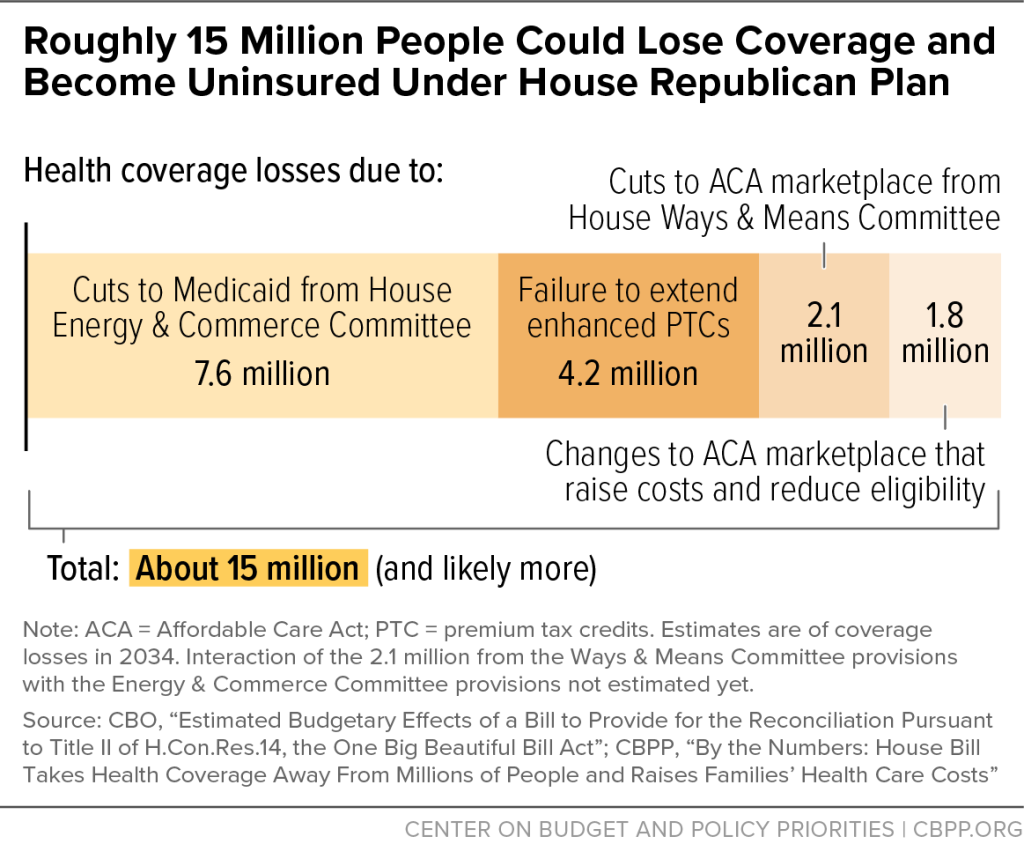
- KFF: Forty states and the District of Columbia could see at least 13% of their Medicaid recipients kicked off their insurance, with rates of loss as high as 32%. This is a high-end estimate of state-by-state Medicaid coverage losses from KFF. KFF, [_{5/16/25}_]
- Center on Budget and Policy Priorities: New work requirements alone could put “9.7 million to 14.4 million people at risk of losing Medicaid coverage in 2034.” CBPP explained, “Evidence shows that much of the coverage loss due to work requirements would occur among people who work or should qualify for an exemption but nevertheless would lose coverage due to red tape.” Center on Budget and Policy Priorities, [_{5/13/25}_]
- Economic Policy Institute: “Work requirements effectively function like a cut to programs.” EPI explained that “while work requirements do not reliably increase employment, they do significantly increase the administrative burden and costs of applying for safety net programs. This increased administrative burden, in turn, reduces access and take-up.” EPI further explained, “In many cases, the sheer amount of additional administrative burdens levied on adults seeking benefits, and on case workers screening to ensure that work requirements are met, is a major driver in the decline in participation.” Economic Policy Institute, [_{1/24/25}_]
//
:{:{05/20/25}:
:{:{06/03/25}:
05/28/25
---
an
no lnx
Expert warns 'gaslighting' Republican plan does 'much more harm' than just gutting Medicare
John Stoehr June 04, 2025
---
MMA VIDS
Even Fox & Friends can't completely deny that the GOP's “Big, Beautiful Bill” is set to blow up the deficit
Written by Matt Gertz
Published 06/02/25
Reality crept into Fox News’ coverage of the Republican tax bill on Monday when a Fox & Friends co-host acknowledged that the legislation will increase the budget deficit because the GOP Congress is prioritizing President Donald Trump’s tax cut agenda.
The White House and House Republican leaders seem to have adopted a strategy of flatly lying about the deficit implications of their “Big, Beautiful Bill.” Office of Management and Budget Director Russ Vought falsely claimed that the bill “doesn’t increase the deficit or hurt the debt” while House Speaker Mike Johnson (R-LA) falsely claimed it is “not going to add to the debt” in June 1 appearances on Sunday morning political talk shows.
But Fox & Friends' Ainsley Earhardt acknowledged the following morning that the bill will cause the deficit to increase due to its tax cuts — though she minimized by how much.
“I don't think anyone wants the deficit to go up,” Earhardt said. “But more importantly, it was the permanent tax cuts, it was no tax on tips, no tax on overtime, no tax on Social Security, that’s more important to the American people than seeing the deficit go up a little bit.”
“No one wants that, but they prefer to have these other things,” she added.
June 2, 2025, edition of Fox News' Fox & Friends
While Earhardt claimed that the bill would cause the deficit to rise only “a little bit,” nonpartisan budget analysts say it would “balloon federal deficits by well over $1 trillion.” The Congressional Budget Office, for example, found that the legislation’s “tax provisions would increase the federal deficit by $3.8 trillion over the decade, while the changes to Medicaid, food stamps and other services would tally $1 trillion in reduced spending,” for an overall increase in the debt of over $3 trillion over 10 years.
The legislation’s proposed spending cuts — while much too small to make the bill deficit-neutral given the mammoth size of the tax cuts — would nonetheless be devastating to millions of Americans. The bill would “reduce federal spending on Medicaid by at least $600 billion over a decade and reduce enrollment by about 10.3 million people,” according to the CBO, and “take food assistance away from millions of low-income families” through the “deepest cut” to food stamps “in history,” the Center on Budget and Policy Priorities found.
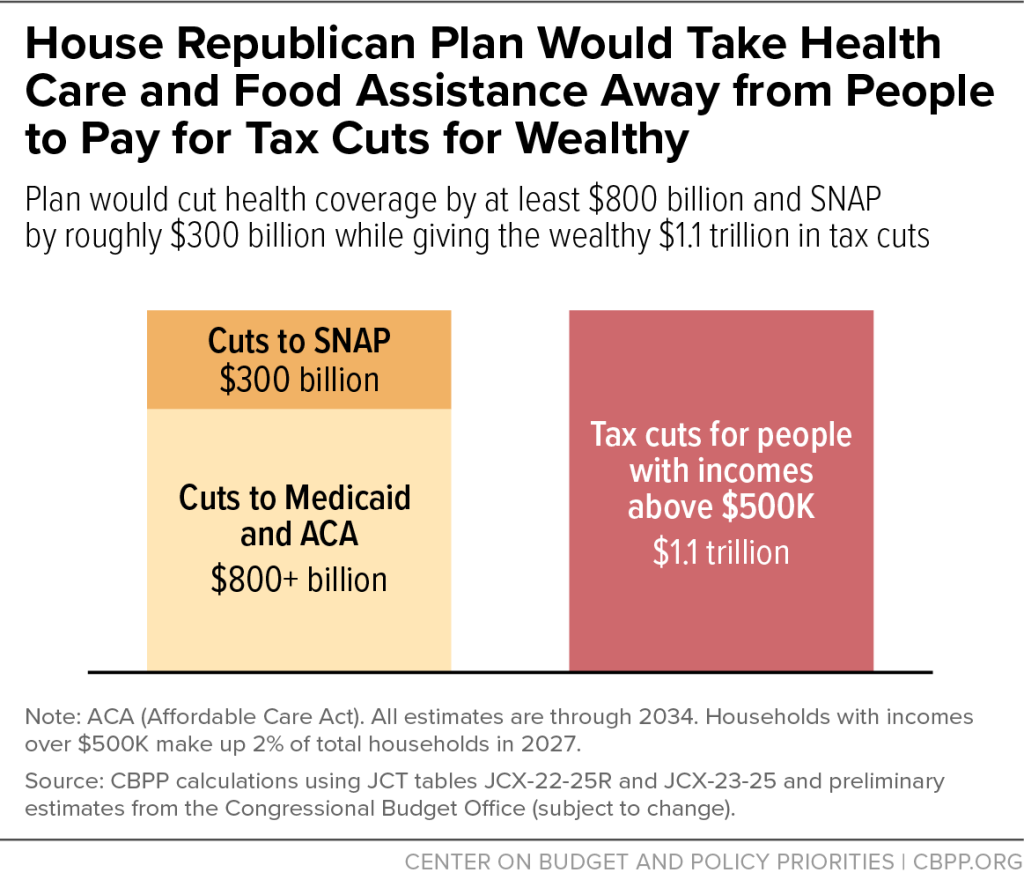
And while Earhardt directed attention to Trump’s campaign promises about cutting taxes on tipped income, overtime income, and Social Security, those account for a tiny fraction of the bill’s tax cuts. The bulk of the deficit increase is caused by the bill’s extension of Trump’s 2017 tax cuts, which disproportionately benefit the wealthiest Americans.
The CBO combined the impact of the tax and spending portions of the bill and found that it would reduce resources for the poorest households while increasing them for the richest.
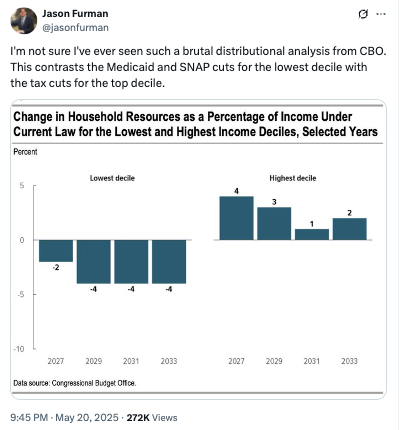
At the same time, the bill is projected to fuel little economic growth and could trigger a bond market meltdown that could raise interest rates for consumers, increase borrowing costs, and threaten the broader economy.
As Earhardt might say, “no one wants that, but they prefer to have” tax cuts for the wealthiest Americans.
//
Fox’s Maria Bartiromo whips Republican support for devastating Medicaid cuts
05/20/25 5:58 PM EDT
05/21/25 5:09 PM EDT
- ### Contrary to right-wing media claims, the GOP's Medicaid cuts are for far more than “able-bodied men”
05/22/25
---
mma
Fox contributor Newt Gingrich organizes MAGA attacks against Congressional Budget Office
New CBO estimates show the GOP's “One, Big, Beautiful Bill” will add trillions to the debt, fund tax cuts for the rich on the backs of the poorest Americans
Written by Zachary Pleat
Published 05/21/25 5:09 PM EDT
Congressional reporter Mychael Schnell from The Hill revealed on May 19 that House Republicans were sharing talking points drafted by Fox News contributor Newt Gingrich in anticipation of the Congressional Budget Office’s scoring of the “One, Big, Beautiful Bill” tax cut extension promoted by President Donald Trump.
The CBO analysis released on May 20 shows that the Trump tax cuts will add trillions to the debt and redistribute money from the poorest Americans in the form of massive tax cuts for the wealthy. A May 20 column by Gingrich, the draft of which was apparently shared in advance with GOP lawmakers, called the CBO “one of President Trump’s most powerful opponents,” which has a “pro spending and anti tax cut bias” — criticisms which Gingrich has repeatedly aimed at the CBO during the second Trump administration. Multiple Fox personalities and GOP guests took up Gingrich’s charge against the CBO, a nonpartisan agency tasked with giving Congress an objective cost analysis of proposed legislation, with one Fox Business host uttering some of Gingrich’s exact words from his column.
:{:{MAGA supporters of Trump’s tax legislation also specifically criticized the accuracy of the CBO’s revenue projections of Trump’s 2017 Tax Cuts and Jobs Act, even though budget and tax experts point out that the CBO’s long-term revenue projections from the 2017 tax law were highly accurate. They also took issue with the CBO’s economic projections of 1.8% annual GDP growth through 2035 and baselessly claimed annual growth of 3% was more realistic.}:
(Republican politicians and right-wing media have frequently promised GDP growth in excess of 3% stemming from their policies, but annual economic growth never reached that point during the first Trump administration when many of the same tax policies were enacted.) Additionally, dozens of economic forecasters have revised their growth predictions under Trump downward.}:
The CBO predictions show massive debt accumulation, income losses among the poorest to give more tax cuts to the rich
- The CBO’s most recent cost estimate of the “One, Big, Beautiful Bill” shows that it will add at least $2.3 trillion to deficits through 2035.Additionally, the Committee for a Responsible Federal Budget added its own estimates from various versions of the bill and interest costs, finding that it would add nearly $3.1 trillion in deficits. Committee for a Responsible Federal Budget, [_{5/21/25}_]
- A distributional analysis of the bill from the CBO showed that it would reduce income for the poorest 10% of Americans by 4% by 2029, while increasing the incomes of the top 10%. Former Council of Economic Advisers Chairman Jason Furman commented, “I'm not sure I've ever seen such a brutal distributional analysis from CBO. This contrasts the Medicaid and SNAP cuts for the lowest decile with the tax cuts for the top decile.” Congressional Budget Office, [_{5/20/25}_; Twitter/X, 5/20/25]
- Other analyses show that the GOP tax bill will take money from the poor to give to the rich and strip millions of Medicaid coverage. Analyses from the Center on Budget and Policy Priorities, Institute on Taxation and Economic Policy, Penn Wharton Budget Model, and Yale’s Budget Lab all agree that the bill will reduce benefits and/or income for the poorest Americans while delivering most of its benefits to the richest. Media Matters, [_{5/20/25}_]
- ## Fox contributor Newt Gingrich has repeatedly attacked the CBO during the second Trump administration
- Gingrich’s column circulated by House Republicans: “Congressional Budget Office vs President Trump.” Gingrich called the CBO “one of President Donald J. Trump’s most powerful opponents” for his tax legislation, accusing it of having “a long history of opposition to conservative reforms.” He additionally said that the CBO “consistently underestimated the growth impact of the conservative tax cuts” and has a “pro-spending, anti-tax cut bias,” while further complaining about the CBO’s economic growth projections. Gingrich claimed: “With an honest CBO, the Make America Affordable Again Act would sail through Congress.” He concluded that “the CBO should be replaced.” Gingrich 360, [_{5/20/25}_]
- Gingrich: “Why the Congressional Budget Office should be replaced as it seeks to kill President Trump’s Big Beautiful Bill: the Make America Affordable Again Act.” Gingrich quoted Trump National Economic Council Director Kevin Hassett complaining about the CBO’s growth assumptions for GDP (even after the first quarter of the Trump administration ended in an economic contraction) and added: “With an honest CBO the bill would sail through Congress.” Twitter/X, [_{5/17/25}_]
- Gingrich complained that the CBO halved a GOP estimate of savings from banning Medicaid from covering gender-affirming treatments for minors. Twitter/X, [_{5/19/25}_]
- Gingrich on Fox Business: “Not counting the Democrats in Congress, there are three great centers of resistance: The fake news, the district judges, … and then the Congressional Budget Office. All three are bastions of left-wing thinking, all three are going to try to undermine the president.” Fox Business, *Mornings with Maria*, [_{4/29/25}_]
- Gingrich: “Now that the left lost the American people in the House, Senate and Presidency the last three centers defending the corrupt old order are fake news, fake Congressional Budget Office and unconstitutional district judges pretending to be presidents.” Gingrich added: “All 3 will fail.” Twitter/X, [_{4/28/25}_]
- ## Fox hosts and Republican guests took up Gingrich’s attacks on the CBO as his column was shared among the GOP
- Fox Business host Elizabeth MacDonald directly echoed Gingrich’s column, saying: “We don’t have an honest CBO. If we had one, this bill would sail through Congress.” MacDonald also said the CBO is “off the rails” for scoring the bill with “GDP growth of only 1.8%.” Council of Economic Advisers Chairman Stephen Miran agreed and also complained about the CBO’s prediction of growth. Fox Business, *The Evening Edit*, [_{5/19/25}_]
- Sen. Bill Hagerty (R-TN) onVarney & Co.criticized the CBO for projecting a revenue decrease from the 2017 Trump tax cuts. Hagerty said: “A lot of the projections, a lot of the prognosticators, are pointing to a growth in the deficit, revenue shortfalls, etc. I’ll take us back to 2017. If you think about what the Congressional Budget Office was saying, they were looking at a revenue decrease from President Trump's 2017 Tax Cuts and Jobs Act. What happened? We actually had a revenue increase.” In reality, multiple independent analyses of the 2017 TCJA show that actual federal revenue declined as a result of the tax cuts. Fox Business, *Varney & Co.*, [_{5/20/25}_; Tax Policy Center, January 2024; Center for American Progress, 4/30/24; Tax Foundation, 7/10/24; Chicago Booth Review, 12/18/24]
- Fox Business host Larry Kudlow and former Trump economic adviser Stephen Moore trashed CBO projections while discussing the GOP tax bill. Moore said: “The Congressional Budget Office does not take into account any of the growth estimates.” He added: “Why do they always make these mistakes? How long have you and I talked about this? For 35 years. The Congressional Budget Office has a cracked crystal ball, they make forecasts that don’t work, they were $1.5 trillion wrong on the 2017 bill.” Kudlow chimed in: “We’re going to bring in — Newt Gingrich is coming in, because he wants to end the CBO as it exists now, and that’s a really good idea, as you’ve been saying.” Fox Business, *Kudlow*, [_{5/19/25}_]
- Kudlow: “I want Trump to come down and maul … gang up on the Congressional Budget Office, the CBO. They are villainous.” Kudlow continued: “They are underestimating growth, they do it all the time. … The point is, they have a 1.8% growth rate. … They ought to have a 3% growth rate.” He added: “The CBO is stubbornly holding this back, and essentially, they are robbing this reconciliation process of over $4 trillion of revenues.” He later concluded: “Now, this is a killer. … There should be a campaign. They have been thwarting Republicans for all these years. This career staff’s all Democrat. Something’s got to be done about the” CBO. Fox contributor Katie Pavlich then joined in on the criticism. Fox Business, *Kudlow*, [_{5/19/25}_]
- Pavlich on the tax bill’s CBO score: “You should throw that out the window because it doesn’t calculate extra taxes that are paid once you get more of your money back and you put it back into the economy.” Fox News, *The Five*, [_{5/19/25}_]
- Former Trump National Economic Council chief economist Joe Lavorgna on Fox Business: “CBO’s forecasts have always been poor.”Fox Business, *Making Money*, [_{5/19/25}_]
- Kevin Hassett complained about the CBO’s GDP forecast on Fox Business. Hassett said: “Put it this way, Maria, right now the CBO’s projecting that we're going to have anemic growth, despite all of these big policy wins, of only about 1.8% in the long run. If you go to 3% growth, which I think is a lowball estimate given all the productivity we’re getting out of artificial intelligence, and then the boon from dereg and tax cuts, we get the 3% growth, then revenue goes up by about $4 trillion. That’s the cost of the tax bill that they’re talking about right now. Three percent growth and you're home free.” Fox Business, *Mornings with Maria*, [_{5/19/25}_]
- Fox & Friendsco-host Brian Kilmeade: “What they don’t take into account is — I think two-thirds of those that work for the CBO are Democrats.” Kilmeade then echoed others by complaining about the CBO’s GDP forecast for the legislation. Earlier on the program, Kilmeade dismissed the CBO’s estimate for how the bill would add to the national debt, referring to the office as “the CBO, the so-called nonpartisan, which seems to be partisan.” Fox News, *Fox & Friends*, [_{5/19/25}_, 5/19/25]
//
Fox’s Maria Bartiromo whips Republican support for devastating Medicaid cuts
05/20/25 5:58 PM EDT
05/01/25 11:18 AM EDT
05/02/25
---
gmail
5 25
no lnx
TRUMP TRACKER:
Administration Actions
House passes ‘big, beautiful’ budget bill after overnight deals with Republican holdouts; on track for largest Medicaid cuts in history.
Early on Thursday morning, May 22, the House voted 215-214 to pass the domestic budget megabill after intense opposition from within Republican ranks was quashed this week by a combination of concessions from Speaker Mike Johnson and strong-arming from Trump. The bill still seemed doomed as late as Tuesday, May 20, when it failed to pass the House Budget Committee, as moderate Republicans decried cuts to Medicaid, hard-right Republicans did not think spending cuts went far enough, and deficit hawks balked at the nearly $3.8 billion addition to the federal debt. Trump visited Capitol Hill late Tuesday to push the remaining GOP dissenters into supporting the bill. A marathon session in the Rules Committee on Wednesday resulted in Johnson making key concessions to Republican holdouts, including pushing up the deadline for new Medicaid requirements from 2029 to 2026, raising the cap for state and local tax deductions to placate blue-state Republicans, and a faster phaseout of clean energy tax credits. Two Republicans, Reps. Thomas Massie of Kentucky and Warren Davidson of Ohio, broke with the party line to vote no on the bill, which Massie described as a ‘ticking debt bomb.’ The centerpiece of Trump’s ‘big, beautiful’ budget bill is the extension of approximately $4.9 trillion in tax cuts for the wealthy, which is offset by the largest cuts to Medicaid and SNAP food assistance in history, with over $792 billion in Medicaid cuts and new work requirements which the CBO estimates will kick nearly 10 million people off health insurance over the next 10 years. The CBO report released this week noted that the bill will also necessitate cuts to Medicare, long considered a political third rail by both parties, which can hurt Republican chances to retain their House majority in the 2026 midterm elections.
Critics say the budget bill represents a massive transfer of wealth to the top 10 percent, which according to the CBO report will see a roughly 4 percent increase in net worth, while the lowest 10 percent will see a nearly 4 percent cut to their real incomes as a result of benefit cuts. A parallel analysis done by the University of Pennsylvania finds that the lowest quintile of Americans will see their incomes decline by an average of $1,035, while the highest quintile will take home an additional $389,000. The bill also ends pandemic-era premium credits for low-income workers, which the CBO estimates will throw an additional 4 million people off of health insurance over the next 10 years; and the New Republic notes that Medicaid cuts would provoke a rural unemployment crisis throughout the United States. The bill also includes at least $150 billion in new defense spending, plus billions in new spending for Trump’s anti-immigration programs. The bill now heads to the Senate, where Majority Leader John Thune has promised ‘substantial changes’ as Senate Republicans chase different priorities for spending cuts, leaving the centerpiece of Trump’s tax cuts intact. The Lever reports on the ‘secret history’ of the conservative movement for tax cuts now being realized in the budget bill.
Provisions in budget bill undermine democracy, expand executive power and strip federal protections.
Included in the over 1,000 page budget bill passed narrowly by the House on Thursday, May 22 are several provisions that have raised alarms for democracy and community advocates. Although the notorious ‘nonprofit-killer’ provision was removed from the bill sometime before its passage on Thursday, tucked into the bill was a small provision prohibiting the courts from enforcing contempt charges unless a bond is posted by the plaintiffs. This provision would effectively enable the Trump Administration to ignore any court ruling it wishes to ignore, including those issued by the Supreme Court, which is highly significant given that the over 170 court rulings against Trump Administration actions have been the most significant bulwark against the Administration’s aggressive use of executive power to implement Trump’s agenda. Democratic Rep. Joe Neguse ripped GOP Rep. Jim Jordan on Wednesday over the provision at a House Rules Committee hearing on Wednesday morning. The bill also strips states’ ability to regulate AI, including the use of AI in political campaigns and elections, which 20 states have already enacted laws to curb given the role of AI in spreading political misinformation. The bill also gives the Justice Department power to prosecute those who leak tax information to the public, a provision seemingly designed to retaliate against recent disclosures of Trump’s and Elon Musk’s tax information that have led to controversy and legal issues for them and other wealthy Americans. While provisions to sell off over 500,000 acres of public lands were scrapped at the last minute thanks to efforts by Rep. Ryan Zinke, one of the Republican holdouts for the bill, the bill will still significantly undermine environmental protection on public lands as well as reduce staffing for national parks, which many consider to be a precursor to privatization. Federal workers are alarmed by provisions that cut federal employee retirement benefits by over 4 percent unless workers agree to shed job protections and become ‘at-will’ employees. Community advocates are also warning of two ‘devastating’ provisions to health care in the bill, one that will quietly defund Planned Parenthood with implications for womens’ health care, as well as a provision that prohibits ACA-based coverage for gender-affirming care in a blow to LGBTQIA+ communities.
United States’ credit rating downgraded by Moody’s as tax bill, tariff, debt concerns rock economy.
On Friday, May 16, Moody’s’ credit rating for the United States was downgraded for the first time in a century, from its AAA ‘perfect’ credit rating to AA1. Moody’s cited the soaring federal debt as the reason for the change, as it became clear from reports that Trump’s tax bill would increase the federal deficit by at least $2.5 trillion. While the United States’ AA1 Moody’s rating does not portray the country as a credit risk, largely due to the stabilizing force of the ‘independent Federal Reserve,’ the rating can affect higher lending rates, which could be passed down to consumers. The White House criticized the credit downgrade over the weekend, blaming the Biden Administration for its deficit woes. Consumer sentiment hit an all-time low this week according to new reports, citing concerns about tariffs raising consumer prices as Walmart warned that tariffs could begin to cause product prices to spike in a few weeks’ time. Trump attempted to publicly browbeat Walmart this weekend into absorbing the tariffs rather than passing the cost onto consumers. The Guardian also reported on Sunday, May 18 that the White House is seeking legislation to make it easier to fire civil servants who produce economic data that appears unfavorable to the administration, under the pretext of ‘intentionally subverting presidential directives.’ Experts warn that this provision could enable the Administration to hire yes-men that would ‘cook the books’ to keep the illusion of a strong economy, fueling market uncertainty. Stocks opened lower on Monday on the news that the budget bill would increase the federal deficit, as the bond market experienced a sell-off and the dollar weakened significantly on the news of the country’s downgraded credit and the passage of the budget bill. Investors are increasingly embracing the movement to ‘sell America’ or, as some are calling it, ‘ABUSA’ (‘Anything But USA’), which is contributing to a weakening U.S. economic forecast. As Trump increasingly seeks a controlling role over the economy, concern over tariffs and currency issues are at the top of the economic agenda going into the G7 meeting, as well as bilateral talks between the United States and Japan which have been announced for next week. Reuters reports that companies are scrambling to make warehouses ‘tariff-free’ zones in order to subvert Trump’s new tariff regime.
Trump Administration blocks Harvard from hosting international students.
On Thursday, May 22, Homeland Security secretary Kristi Noem ordered the DHS to revoke Harvard’s Student and Exchange Visitor Program certification, banning the university from hosting international students in an escalation of the Trump Administration’s attack on the elite university. Nearly 6,800 international students currently at Harvard, comprising 27% of its student population, have suddenly found themselves in limbo, including several hundred Chinese and Indian students as well as the future queen of Belgium. Among the international students from around the world studying at Harvard, over 20% are students from China, who feel as if they have been especially targeted in the government crackdown. The order will force over six thousand Harvard students to transfer to other universities immediately or risk their legal status in the United States. Hours after the news broke, Harvard announced that it would open a second lawsuit against the Trump Administration over the order, seeking an injunction to keep their students on campus. Deans and faculty at the university expressed support for international students in the Harvard Crimson, as devastated students faced fear and confusion over the sudden threat to their legal status, left wondering if they will be targeted as with other international students who have been detained by ICE over the past several weeks. DHS secretary Kristi Noem called the order a ‘warning’ for other universities in the United States that ‘harbor’ student protests, especially in support of Palestine. As the news rocked institutions around the world, China quickly responded, saying the move would tarnish the U.S. image in the world and that China would do all it can to safeguard the rights and interests of its overseas scholars; and Hong Kong University opened its doors to potentially displaced Harvard students with ‘unconditional offers’ of enrollment. International student tuitions are a key source of revenue for private universities such as Harvard; and AP reports that several of Harvard’s sports teams could be ‘wiped out’ if the ban takes effect. Inside Higher Ed discusses the implications of the Harvard order, and Al Jazeera provides a timeline of the escalating confrontation between Harvard and the Trump Administration. Early Friday, Harvard President Alan Garber issued a personal statement in response to the Trump Administration’s actions and Harvard’s pending lawsuit. The Guardian is providing live updates as the story develops.
DOJ charges Congresswoman LaMonica McIver after confrontation at ICE facility.
Interim U.S. Attorney Alina Habba announced on Monday, May 19 that the Justice Department is charging New Jersey Rep. LaMonica McIver with two counts of assaulting, resisting and impeding officers over a confrontation at the Delaney Hall ICE facility during which Newark Mayor Ras Baraka was arrested. The charge came on the same day that the DOJ dropped charges against Baraka after being chided by a magistrate judge against the ‘severe action’ taken against elected officials conducting oversight. Habba claimed that “no one is above the law - politicians or otherwise” in a statement defending the charges, which former HUD secretary Julian Castro called “hypocrisy of the highest order” given that the Trump Administration has violated court orders. Following the charges, McIver alleged that the charges are “purely political” and “are meant to criminalize and deter legislative oversight.” The Washington Post published a video analysis of the approximately 30-second confrontation as ICE agents arrested Baraka at the facility, showing that McIver “made contact” with at least 2 agents but noted that it was “difficult to discern the force of the contact and to what extent it was intentional or a result of the chaotic moment.” McIver also claimed the charges were ‘absurd’ and noted that “it’s in our job description to have oversight over the facility, and the entire situation was escalated by ICE.” Rep. Jasmine Crockett posted a statement in solidarity with McIver as Democratic supporters rallied around her and legal scholars claim the charges are an attempt to “intimidate potential critics” of the Trump Administration; eleven former Republican lawmakers also spoke out against the charges, calling them “extreme” and “outrageous.” A New Jersey federal judge released McIver on her own recognizance on Wednesday, May 21 as she awaits further hearings; Republican Rep. Nancy Mace also filed a resolution on Wednesday to expel McIver from Congress as Republicans ‘moved to punish’ her and other Democratic lawmakers for their role in events at the facility.
Immigration Updates: Noem’s Hunger Games, migrants in South Sudan limbo, ICE agents stalking immigration courts.
Reports surfaced this week that Department of Homeland Security officials are working with Canadian-born “Duck Dynasty” producer Rob Worsoff to pitch a reality show in which immigrants would compete in a series of challenges for U.S. citizenship. The show immediately drew comparisons to the film trilogy ‘The Hunger Games’, which Worsoff dismissed, saying his concept was to “celebrate what it means to be an American” and is based on his own experience of immigration to the United States. A marked difference between Worsoff’s experience and that of immigrants currently seeking citizenship is the presence of ICE agents ‘camped’ outside immigration courts, waiting to arrest people immediately after judges dismiss immigration cases; reports of ICE arrests have been seen at courthouses in Chicago, Seattle, San Diego, and Mississippi, where a Danish father of four and Trump supporter was arrested after his citizenship hearing. The Cato Institute released a report this week showing that over 50 of the Venezuelans deported to El Salvador had come to the U.S. legally and never violated immigration law, as new emails surfaced indicating how a top aide to National Security Adviser Tulsi Gabbard pushed analysts to rewrite an assessment to insulate the Administration from criticism over its claims that the Venezuelan migrants were tied to the Tren de Agua gang. The Supreme Court this week allowed Trump to lift temporary protected status for Venezuelan migrants, stoking criticism of differential treatment between Venezuelans and Afrikaners from South Africa who were recently welcomed by the Trump Administration. The case of Kilmar Abrego Garcia, the Salvadoran man mistakenly deported to El Salvador, remains in limbo as officials debate his placement and a federal judge expressed ‘utter frustration’ over the Administration’s invocation of ‘state secrets’ as an excuse to keep him at the CECOT prison. A federal judge also rebuked the Trump Administration for violating court orders in a deportation flight conveying Asian immigrants to South Sudan; Judge Brian Murphy ordered the U.S. to retain official custody of the migrants, including keeping them on the plane, saying “if they want to turn the plane around, they can.” A new report from Human Rights Watch condemned the Trump Administration for deporting several non-Costa Ricans to Costa Rica without giving them the opportunity for an asylum screening review. The Trump Administration also challenged laws in 19 states allowing undocumented immigrants to obtain drivers’ licenses, which critics claim is an attempt to grab the data of undocumented people to mark them for arrest. At a Senate hearing this week, DHS Secretary Kristi Noem was asked to define the term ‘habeas corpus,’ to which she incorrectly answered that it gave the president “the right to remove people.” White House adviser Stephen Miller and other Trump Administration officials have been promoting the idea of suspending habeas corpus, which according to the correct definition, is the right of people to contest their detention and can only be revoked by Congress.
---
no lnx
Republicans and the biggest political con of the last century
Thom Hartmann May 24, 2025
Neal deGrasse Tyson makes a very relevant point this week:
“If a foreign adversary snuck into our Federal budget and cut science research and education the way we’re cutting it ourselves — strategically undermining America’s long-term health, wealth, and security — we would likely consider it an act of war.”
Donald Trump’s administration just said you can’t get the Covid vaccine unless you’re over 65 or sick, setting up America for more death and disease. As Noah Berlatsky notes in his great Substack newsletter:
“This is the latest effort by Trump to try to kick start a major US pandemic and degrade the health and welfare of the country. Trump as also rolled back food testing, including testing for bacteria in infant formula. He’s made major cuts at the FAA, leading to fears for airline safety—and a number of dramatic airline safety failures already may be related to the destruction of capacity. Cuts at the NOAA may diminish the ability to warn about dangerous weather events. The Republican proposals for Medicaid cuts are likely to lead to tens of thousands of deaths. And of course Trump’s senseless tariffs are increasing inflation, destroying jobs, and could still easily end us in a recession.“
But why? What the hell is going on here?
Almost two-thirds of us Americans can’t afford the basic necessities of life, according to a new report from the Ludwig Institute for Shared Economic Prosperity (LISEP) reported by CBS News. They point out that if unemployment numbers included the underemployed and those stuck in “poverty-wage jobs,” it would be around 24%, not the 4.2% recently reported, leading to an acknowledgement of a widespread misery that’s largely hidden by the way we currently calculate unemployment.
Income for the bottom 60% of Americans, for example, actually declined by 4% in the years 2001 to 2023 while costs — particularly for healthcare, housing, food, and education (college tuition, for example, is up 122% since 2001) — have exploded.
Before the pandemic, half of all homes on the market were affordable to a family earning $75,000 a year; today it’s only one out of five houses that such a family could afford to purchase.
The initial result of this post-Reagan Revolution economy was to kneecap the middle class and working class; now Republicans are using the same strategy they employed to destroy our middle class to dismantle our nation’s government and its core functions to leave us vulnerable to the predation of foreign nations, vulture capitalists, and the morbidly rich.
And nobody’s sure why.
The history of how we got here is shocking. And the place it’s taking us — gutting government functions while handing our role in the world over to China and Russia — is downright scandalous.
At first, it was simply a political strategy to claim the mantle of Santa Claus from the Democrats by “gifting” America with tax breaks. Then it became a program to force Dems to kill off their own social programs by driving up the national debt. And now it’s being used to disassemble the American government itself, abandoning what’s left of the middle class while handing America’s dominant role in the world to China and Russia.
You could call it treason, except that it’s become so normalized and institutionalized that most Americans wouldn’t even understand the reason for the label.
Republican policy weirdness that brought us to this moment began around the national debt in 1981.
The U.S. was significantly in debt following our Revolutionary War, the Civil War, World War I, and World War II. Following the philosophy that a large national debt should only exist during a time of national emergency, in each case, after the end of each war, we began a serious effort to pay down that debt.
Andrew Jackson finished paying off the entire debt from the Revolutionary War in the 1830s. We’d largely paid off the debt from the Civil War by the end of the 19th century, and, as the Treasury Department notes on its debt history site, our “government ended the century with its finances in very good order.”
We paid the national debt for WWI down to a mere $17 billion by the time the Republican Great Depression hit, but between the cost of the New Deal and World War II, we entered the post-WWII era in 1946 with a debt equal to 106% of GDP, a ratio we hit again in 2015.
Republicans and Democrats quickly united around the idea of paying off our national debt in the post-war years, driving it down to a mere $800 billion ($0.8 trillion) between 1945 and 1981 when Reagan came into office.
And then, following Jude Wanniski’s “Two Santas” plan, the GOP embarked on an experiment that had never been intentionally tried in the U.S. or any other developed country in world history: drive up the national debt as high as possible with massive tax breaks for the very richest among us.
Reagan did this for two reasons:
— First, deficit spending with trillions in borrowed money (he ran the debt up to $2.4 trillion in a mere 8 years) stimulates the economy, so people thought Reagan had produced good times. (Give me a $2 trillion credit card, and I’ll show you what it looks like to live large, too!)
— Second, the rising debt gave Republicans the perfect excuse to follow Wanniski’s advice to force the Democrats to “shoot their Santa [of programs like Social Security and Medicaid] in the face.” Whenever a Republican is in the White House, Wanniski argued, Republicans should run up the debt as hard and fast as possible, so when a Democrat is in the White House they can squeal about “the debt our children will inherit! Oh, the humanity!”
The GOP has stuck to this strategy for 44 years now, running up $36 trillion in debt (and our entire Gross Domestic Product was a mere $27.7 trillion last year) and now, finally, we’ve reached the point where this unsustainable debt is not only costing us a trillion dollars a year in debt service (interest payments) but has led to a downgrade of our nation’s credit score.
At first, the main effect of the Two Santas strategy was merely to make the morbidly rich among us fabulously richer, while extracting much of that wealth from the homes, retirement plans, and savings of the middle class. It was, quite simply, a planned and successful transfer of roughly $50 trillion into the money bins of the rich, almost all of it coming out of the hides and lives of the rest of us.
When Reagan came into office in 1981, about two-thirds of Americans were solidly middle class with a single paycheck being able to buy a home, a car, raise a family, put the kids through school, and provide for a decent retirement.
Today, that same standard of living requires a bit more than two full-time jobs, and only about 47% of us are in the middle class (with two wage earners instead of just one in 1981).
“‘The middle class has been declining — we just haven't recognized it fully,’ LISEP Chairman Gene Ludwig told CBS MoneyWatch. ‘It’s really dangerous because it’s the kind of thing that leads to social unrest, and it’s not fair. The American dream is not that it’s given to you — it’s that if you work hard, you have a chance to get ahead and achieve the things in life that you want to achieve. It’s not living in a tent, not having to steal.”
But now Trump, Musk, Vance, and congressional Republicans — having first crushed the American middle class — are doing everything they can to destroy America’s preeminent position in the world along with our social safety net.
— Instead of investing in education and science, they’re making it harder for students to get an education.
— Instead of promoting democracy around the world, they’re embracing murderous dictators while broadcasting rightwing neofascist propaganda on Voice of America.
— Instead of lifting up Americans by helping our veterans and providing food, healthcare, and shelter to the poor and disabled, they’re gutting the VA and the social safety net.
As a result, today nearly half of American children (45% or 34 million kids) rely on food and medical programs that are now targeted by “Christian” Mike Johnson’s House Republicans in their Big Brutal Bill providing trillions in tax breaks to billionaires. The proposed cuts to SNAP (food stamps) and Medicaid, for example, would be the largest in the history of the U.S.
Reagan’s Two Santas strategy has done serious harm to America, collapsing the economic futures of two entire generations.
And now they’re going after our government itself.
But, why? Nobody’s sure.
— Did Vladimir Putin, Xi Jinping, or both tell Trump and/or Elon Musk to destroy America?
— Are our country’s billionaires so psychopathically greedy that they’re willing to sell us all out for another few billion dollars in tax breaks?
— Do Trump’s allies believe that if they can impoverish Americans we’ll be more willing to go along with their authoritarian agenda the way Germans did after being immiserated by the Republican Great Depression of the 1930s?
— Are they following the “Dark Enlightenment” philosophers of Silicon Valley who argue that democracy is outdated and “we need to get over our dictator phobia” and let the tech giants run the country?
Nobody knows for sure. Nobody can really explain it.
Republicans are aren’t even pretending anymore; they’re not even bothering to proclaim BS like “trickle down” or the “need to support the job creators.“
Most distressing, there’s virtually no discussion of any of this in the mainstream press.
— The Two Santas strategy is easily documented, but never mentioned.
— The explosion of our national debt is all over economists’ websites, but when the American media mentions it, it’s always in the context of Democrats needing to “reduce spending” rather than the fact that virtually 100% of our debt today was put there exclusively by Reagan, Bush, and Trump tax cuts and Bush’s two illegal wars.
— Nobody, it seems, is speculating about why Trump and Musk would want to kill off USAID or kneecap the FAA and the National Weather Service. Qui bono (who benefits?) other than Putin and Xi? The savings are a drop in the billionaire’s bucket; there must be a larger agenda than just funding tax cuts for billionaires.
— And, they’re now holding their votes in the middle of the night; I think we all know what they are hiding and the credulous press is letting pass.
I don’t know why Republicans have been so enthusiastic about first destroying the American middle class and now our government itself, but the consequences have driven the explosion of rightwing anger, racism, and misogyny that’s been sweeping the nation since Trump’s appearance on the scene in 2015.
And now they’re threatening our position in the world, as well as possibly leading us all into a third world war.
Why do you think this is happening?
NOW READ: 'Trump's tactics are in fact communist': Former Tea Party congressman busts MAGA for what it is
---
---
NO LNX AN 525
How Republicans snuck hidden, last minute provisions into their horrendous budget bill
Michael Signorile, The Signorile ReportMay 22, 2025 | 12:28PM ET
BeLoud Share
The GOP, following the orders of their despotic leader Donald Trump, passed the budget bill that throws millions off of Medicaid, funds Trump’s mass deportations and cuts taxes for the wealthiest Americans. No matter the draconian cuts, the massive debt—more than we’ve seen in any budget bill by any president—has the bond markets shuddering, coming on top of the tariff chaos.
Then there are the hidden last-minute provisions in the bill, which, if debated at all, were only discussed in committee hearings and on the floor overnight so the GOP would not have the American people see what was happening. I’m just going to focus on three that have surfaced, but you know there’s more in a bill that is over 1000 pages and rushed through.
Democratic Congressman Joe Neguse of Colorado exposed the stunning provision that would allow Donald Trump to defy court orders, and he eviscerated Rep. Jim Jordan about it. Yes, tucked in the bill is a paragraph limiting a court's ability to make the government follow its rulings.
“This is a deep deviation from existing federal law," Neguse said. "And I find it astounding ... I imagine there will be a lot of limited government advocates who will find deep reasons to be concerned about this type of provision because as you can imagine it will preclude folks from being able to vindicate their constitutional rights."
Jordan huffed and puffed about looking at it again, somewhat feigning ignorance, but it’s in the bill, per Newsweek:
A provision "hidden" in the sweeping budget bill that passed the U.S. House on Thursday seeks to limit the ability of courts—including the U.S. Supreme Court—from enforcing their orders.
"No court of the United States may use appropriated funds to enforce a contempt citation for failure to comply with an injunction or temporary restraining order if no security was given when the injunction or order was issued," the provision in the bill, which is more than 1,000 pages long, says.
The provision would prohibit courts from enforcing contempt citations for violations of injunctions or temporary restraining orders—the main types of rulings that have been used to rein in President Donald Trump's administration—unless the plaintiffs have paid a bond, something that rarely happens when someone sues the government.
Democrats also this week asked the Congressional Budget Office to score the impact of the bill on Medicare in addition to Medicaid. And lo-and-behold, the GOP had another surprise. They knew that significantly raising the debt would automatically trigger cuts to Medicare.
The Congressional Budget Office found that the bill would increase the national debt so much that, according to The Washington Post, “it could force nearly $500 billion in cuts to Medicare.” Some of those cuts would could come next year, as the bill would force officials “to mandate across-the-board spending cuts over that window that would hit the federal health insurance program for seniors and people with disabilities.”:
When legislation significantly adds to the national debt, which already exceeds $36.2 trillion, it triggers ‘sequestration,’ or compulsory budgetary reductions. In that scenario, Medicare cuts would be capped at 4 percent annually, or $490 billion over 10 years, the CBO reported in response to a request from Rep. Brendan Boyle (Pennsylvania), the top Democrat on the Budget Committee.
Then, well past midnight last night, the anti-trans provisions were added, as The Advocate reports:
In the early hours of Thursday morning, while much of the country slept or was waking up, House Republicans rammed through a sweeping multi-trillion-dollar domestic policy package that slashes Medicaid, restricts food assistance, and — in a stunning escalation — bans federally funded health care for transgender people of all ages.
The heartless bigots added two provisions, one of which strips health care from the Affordable Care Act. The initial mark-up of the Medicaid provision said it applied to minors—and then “minors” was stricken, so it then applied to all trans people.
One strips all Medicaid and CHIP (the Children’s Health Insurance Program) funding for gender-affirming care, including puberty blockers, hormone therapy, and surgeries, not just for youth but for trans people of any age. A second bans coverage for those same services under the Affordable Care Act by excluding them from the definition of “essential health benefits.”
Again, these are just three horrendous provisions added to the bill, which was forced through by Mike Johnson and Trump and passed last night with no Democrats supporting it. The bill still has to pass the Senate and there have been Republicans skittish about the Medicaid cuts. But you know Trump will make threats and they will fall in line. So I’m not hopeful that any of these hidden provisions—and more that we don’t even know about—will come out.
Let’s remember though that the GOP always overplays, and then gets completely slammed. So, as Democrats focus on the all out assault on the safety net, as Americans see it and feel it, we’ve got to make sure the GOP pays for it in the mid-terms.
---
2 gop vote no, head cock present, massie caved
an 5 25
:{:{During the House’s marathon markup of President Donald Trump’s historic budget bill, the Chairwoman of the powerful Rules Committee lashed out at Democrats for plainly describing the legislation’s sweeping consequences. Officially dubbed the “One Big, Beautiful Bill Act,” the measure narrowly passed in the early hours of Thursday by a 215–214 vote. }:
It removes $800 billion in funding from Medicaid, would lead to $535 billion in cuts to Medicare, and is projected to cause an estimated 8.6 to 13.7 million Americans to lose their health care. It will also add $3 trillion to the federal deficit—fueled by tax breaks heavily tilted toward the wealthy and the nation’s first-ever $1 trillion defense budget.}:
“I am concerned about what has been said about this bill and what it’s going to do,” Chairwoman Virginia Foxx (R-NC) told the members of her committee Wednesday night. “The extreme comments that have been made about it, and how I believe that it is scaring people out there in the country unnecessarily.”
“The words I’ve heard, particularly today, are ‘cut,’ ‘rip,’ ‘gut,’ ‘kill,’ ‘cruel,’ ‘stealing food,’ ‘losing coverage,’ ‘jammed through,’ ‘biggest transfer of wealth from vulnerable to wealthy people,’ ‘irresponsible’.”
“That is not the way we ought to be talking about this bill.”
READ MORE: ‘Sovereignly Appointed’: Trump Praised in Pentagon Prayer Event Led by Hegseth and Pastor
Many appear to disagree.
MSNBC columnist Michael A. Cohen, just after the bill passed Thursday morning, wrote: “What we do know about the legislation the GOP is calling the ‘One Big Beautiful Bill Act’ is genuinely terrifying.”
“What makes this situation even worse is that Republicans, from the president on down, are consistently lying about what the bill would do,” Cohen charged.
“The House Republican budget plan would eviscerate Medicaid and food assistance and shift resources toward the wealthiest Americans,” the Center for American Progress (CAP) warned ten days ago, adding that it “would implement the largest cuts to both Medicaid and the Supplemental Nutrition Assistance Program (SNAP) in history—kicking millions of Americans off their health insurance and taking food away from hungry children.”
“It would raise household electricity costs while trapping most middle-class and poor students in greater student loan debt to afford a higher education,” CAP’s Bobby Kogan, Senior Director for Federal Budget Policy wrote. “And it would make all these changes as a means to partially offset tax breaks that disproportionately go to the richest Americans, giving households in the top 0.1 percent a multihundred-thousand-dollar tax break on average while increasing deficits by trillions of dollars. Taken as a whole, the bill would add trillions of dollars to structural deficits despite these enormous cuts to critical services.”
“If enacted,” Kogan warned, “this would be the largest transfer of wealth from the poor to the rich in a single law in U.S. history.”
READ MORE: ‘Get Out of Here’: Trump Erupts, Calls for NBC Probe After Reporter Asks About Qatari Jet
“Taken as a whole, this bill would harm Americans—particularly the most vulnerable people—and leave the country worse off. It would lead to preventable deaths by taking health care away from millions of people. It would worsen food insecurity by taking food away from the hungry, particularly kids.”
“Budgets showcase our morality because they force governments to decide how to prioritize limited resources. The House Republican budget plan would shift funding away from the sick and hungry and, instead, toward the wealthiest Americans.”
U.S. Rep. Veronica Escobar (D-TX) responded to Foxx, saying, “In other words, ‘please don’t call this bill what it is or say what it does’.”
Watch the video below or at this link.
---
---
an 5 25
When President Donald Trump visited Capitol Hill on Tuesday, May 20, he pressured GOP lawmakers to go ahead and pass a "big, beautiful bill" that will combine his legislative priorities. And one of the Republicans he singled out for attack was Rep. Thomas Massie (R-Kentucky), a hardcore budget hawk who opposes the current U.S. House version of the bill.
Attacking Massie as a "grandstander," Trump told reporters the Kentucky congressman "should be voted out of office."
Trump said of Massie, "If you ask him a couple of questions, he never gives you an answer. He just says 'I'm a no.' He thinks he's going to get publicity, and you have that. You have that."
But Massie is using the attack as a fundraising opportunity.
In a May 20 post on X, formerly Twitter, Massie posted, "I need your help. For having the audacity to say this bill does NOT repeal the green new deal, but DOES increase the deficit and debt substantially, I was threatened by Trump today. Can you contribute to my reelection at this link?"
Although Massie isn't a Never Trumper, he has, at times, criticized Trump for not being fiscally conservative enough. And he doubled down on his messaging during a May 20 appearance on CNN.
Massie pushed back against Trump's claim that his "big, beautiful bill" will not add to the federal deficit, telling CNN's Manu Raju, "Now, that's a joke. We're going to add $20 trillion to the debt over the next 10 years, which is three and a half to $5 trillion more than would have been added otherwise."
READ MORE: 'Cruelty is the point': Trump’s Capitol Hill rant panned as MAGA warns 'Johnson hasn’t done his job'
---
---
no lnx GRX
big b bill
5 25
if you need to show what it means to have a government bought and paid for by Big Oil, look no further than President Donald Trump’s "one big, beautiful bill (https://substack.com/redirect/05bb94b9-b421-4f30-ab5c-9635d2dfa4db?j=eyJ1IjoiMW42ZTYifQ.vyvZ_z0oLghKX6Zag1WJ71bIfqAlxqUD_SD6A_ZPsUM)."
The giant tax and spending legislation Republicans are advancing through Congressis basically a copy-paste of a secret oil industry wish-list HEATED reported on five months ago (https://substack.com/redirect/09cc63e0-b969-45f8-8cb4-c4dd8294c3bb?j=eyJ1IjoiMW42ZTYifQ.vyvZ_z0oLghKX6Zag1WJ71bIfqAlxqUD_SD6A_ZPsUM) with the investigative outlet Field Notes (https://substack.com/redirect/b4dbc73b-7bad-4206-9788-c7677dc1a04e?j=eyJ1IjoiMW42ZTYifQ.vyvZ_z0oLghKX6Zag1WJ71bIfqAlxqUD_SD6A_ZPsUM).
In that wish-list, the American Exploration & Production Council (AXPC)—a large oil industry trade group—asked the Trump administration for two major things:
To stop taxing excess emissions of methane (https://substack.com/redirect/9a439e0a-b566-4ba7-9f89-29454f2cbc9c?j=eyJ1IjoiMW42ZTYifQ.vyvZ_z0oLghKX6Zag1WJ71bIfqAlxqUD_SD6A_ZPsUM), a powerful pollutant responsible for nearly a third of climate change.
To limit environmental reviews for new fossil fuel projects to endure their speedy approval.
Those wishes—and many others—would be granted by the One Big Beautiful Bill Act (https://substack.com/redirect/f1f4cf03-cde5-4ccb-be77-75ff6f8cdbaa?j=eyJ1IjoiMW42ZTYifQ.vyvZ_z0oLghKX6Zag1WJ71bIfqAlxqUD_SD6A_ZPsUM), which advanced out of the House Budget Committee in an unusual late-night vote Sunday. Trump is now urging Republicans in Congress to unite and pass it (https://substack.com/redirect/70be2a5e-22ec-45fd-a911-fc2d3493017e?j=eyJ1IjoiMW42ZTYifQ.vyvZ_z0oLghKX6Zag1WJ71bIfqAlxqUD_SD6A_ZPsUM).
If passed, the bill (https://substack.com/redirect/8b597e45-4905-4d5f-bb04-115d585d4e09?j=eyJ1IjoiMW42ZTYifQ.vyvZ_z0oLghKX6Zag1WJ71bIfqAlxqUD_SD6A_ZPsUM) would repeal a portion of the Clean Air Act which sets methane pollution limits for oil and gas facilities. Currently, that section states (https://substack.com/redirect/6ea67d34-baa5-45dd-9375-0ab3fbee1aae?j=eyJ1IjoiMW42ZTYifQ.vyvZ_z0oLghKX6Zag1WJ71bIfqAlxqUD_SD6A_ZPsUM) that oil and gas facilities must pay the EPA a fee on methane pollution that exceeds certain amounts.
Under Trump’s budget reconciliation bill, the methane fee would technically be retained, but altered so that the fee is not collected until ten years from now.
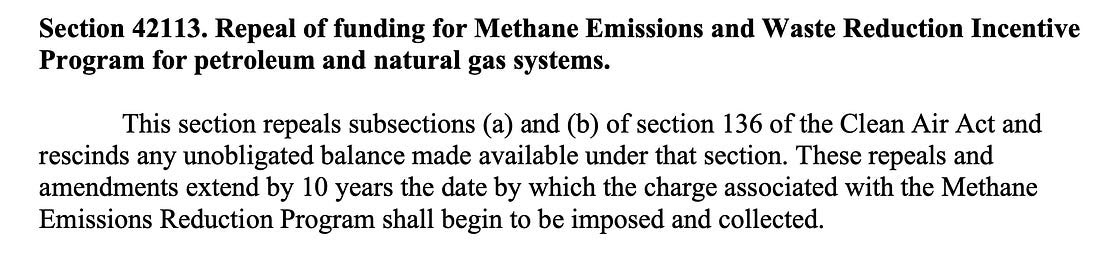 (https://substack.com/redirect/3d16e45b-ef72-4a23-9c4c-93177779ea9e?j=eyJ1IjoiMW42ZTYifQ.vyvZ_z0oLghKX6Zag1WJ71bIfqAlxqUD_SD6A_ZPsUM)
Source: bill text (https://substack.com/redirect/8b597e45-4905-4d5f-bb04-115d585d4e09?j=eyJ1IjoiMW42ZTYifQ.vyvZ_z0oLghKX6Zag1WJ71bIfqAlxqUD_SD6A_ZPsUM).
In addition, the bill (https://substack.com/redirect/6d9197d4-a22e-4d7e-a3e8-2ddfd2f3342d?j=eyJ1IjoiMW42ZTYifQ.vyvZ_z0oLghKX6Zag1WJ71bIfqAlxqUD_SD6A_ZPsUM) would allow gas pipeline developers to pay a $10 million fee to bypass the normal permitting process. It would also allow fossil fuels companies to pay the Department of Energy a $1 million free to determine that a proposed methane gas export facility is in the “public interest.”
“This makes a farce of our permitting process and essentially legalizes corruption with a pay-to-play privilege for gas pipelines,” writes the climate group Evergreen Action (https://substack.com/redirect/4d47730f-efce-4e88-b8e6-fe57d2a90f4c?j=eyJ1IjoiMW42ZTYifQ.vyvZ_z0oLghKX6Zag1WJ71bIfqAlxqUD_SD6A_ZPsUM). “Americans will be severely impacted by gas pipelines built through their communities.”
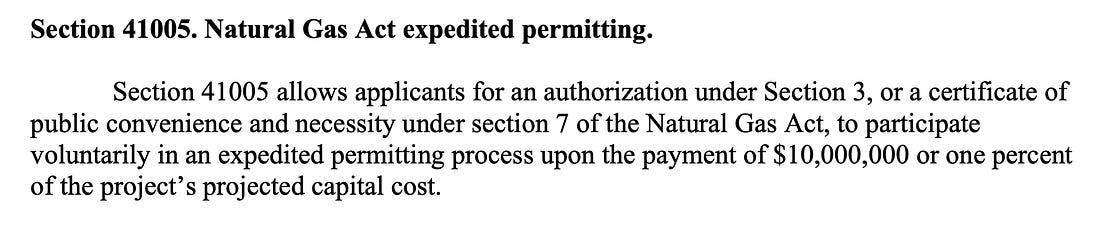 (https://substack.com/redirect/880381a7-fa49-4d00-8a7a-d20bddfd3da1?j=eyJ1IjoiMW42ZTYifQ.vyvZ_z0oLghKX6Zag1WJ71bIfqAlxqUD_SD6A_ZPsUM)
Source: bill text (https://substack.com/redirect/8b597e45-4905-4d5f-bb04-115d585d4e09?j=eyJ1IjoiMW42ZTYifQ.vyvZ_z0oLghKX6Zag1WJ71bIfqAlxqUD_SD6A_ZPsUM)
Killing the clean energy competition
The White House isn’t trying to hide its close relationship with Big Oil, which directly donated $96 million (https://substack.com/redirect/5f0fa7bc-4be2-45e5-8147-06a3baa6e033?j=eyJ1IjoiMW42ZTYifQ.vyvZ_z0oLghKX6Zag1WJ71bIfqAlxqUD_SD6A_ZPsUM) directly to Trump’s campaign and spent $80 million on political advertising (https://substack.com/redirect/5f0fa7bc-4be2-45e5-8147-06a3baa6e033?j=eyJ1IjoiMW42ZTYifQ.vyvZ_z0oLghKX6Zag1WJ71bIfqAlxqUD_SD6A_ZPsUM). On Monday, the White House released a list of organizations applauding the bill, and the very first statement was from AXPC (https://substack.com/redirect/7cb0b937-520d-46b2-a93c-1bfa43688bcb?j=eyJ1IjoiMW42ZTYifQ.vyvZ_z0oLghKX6Zag1WJ71bIfqAlxqUD_SD6A_ZPsUM).
But the White House, oil industry, and Congressional Republicans are trying to confuse Americans about the purpose of their partnership with Big Oil. They claim their intent is to “improve our nation’s energy landscape.” In reality, their intent is to improve the nation’s fossil fuel landscape. These are two very different things.
While Trump’s “big, beautiful bill” aims to speed up the development of fossil fuels in America, it aims to actively harm every other competing form of energy, including nuclear.
For example, the bill would “effectively eliminate \tax] credits for new nuclear — in particular, the clean electricity investment and production tax credits, known as the ‘technology-neutral’ credits,” the [Washington Post (https://substack.com/redirect/e3150ebd-0bcc-47ea-aa4d-59482b17a002?j=eyJ1IjoiMW42ZTYifQ.vyvZ_z0oLghKX6Zag1WJ71bIfqAlxqUD_SD6A_ZPsUM) reported on Thursday.
The bill would also phase out tax credits for production and investments in solar, wind, and batter storage products; end tax credits for home energy efficiency and heat pumps; and end tax credits for rooftop solar and batteries, among many other things (https://substack.com/redirect/28abebf3-5b8b-403f-bad2-31c213493317?j=eyJ1IjoiMW42ZTYifQ.vyvZ_z0oLghKX6Zag1WJ71bIfqAlxqUD_SD6A_ZPsUM).
The changes would have “far-reaching implications across the clean energy sector,” according to a Thursday release from energy analytics firm Wood Mackenzie (https://substack.com/redirect/e5a4b5eb-97d6-447f-ae55-44cb99b5d71c?j=eyJ1IjoiMW42ZTYifQ.vyvZ_z0oLghKX6Zag1WJ71bIfqAlxqUD_SD6A_ZPsUM). “The overall outlook for the industry appears challenging.”
Harming clean energy = harming the economy
Contrary to what the Trump administration’s narrative, fossil fuel jobs are not the only energy jobs in the United States. Renewable energy jobs comprise more than 40 percent (https://substack.com/redirect/b863ff4f-6e3c-4063-ac3b-bc40c45b0fe1?j=eyJ1IjoiMW42ZTYifQ.vyvZ_z0oLghKX6Zag1WJ71bIfqAlxqUD_SD6A_ZPsUM) of the country’s 8.35 million energy positions. Worldwide, clean energy workers outnumber fossil fuel workers (https://substack.com/redirect/772d74e8-a04e-459c-bba5-edcec9be3936?j=eyJ1IjoiMW42ZTYifQ.vyvZ_z0oLghKX6Zag1WJ71bIfqAlxqUD_SD6A_ZPsUM).
Many of those jobs are in the solar and battery storage industries—and both would be catastrophically harmed if the budget reconciliation bill passes. In an analysis (https://substack.com/redirect/60ec87d5-c841-4d9d-bc65-f217e117fa67?j=eyJ1IjoiMW42ZTYifQ.vyvZ_z0oLghKX6Zag1WJ71bIfqAlxqUD_SD6A_ZPsUM) released Tuesday, the Solar Energy Industries Association warned that if enacted, Trump’s budget bill “could result in nearly 300,000 current and future American jobs to be lost, including 86,000 in solar manufacturing.”
“If this proposal becomes law, nearly 300 U.S. factories—mostly in red states—could close or never open, and we simply won’t have the energy we need to power American innovation in AI and data centers,” SEIA president and CEO Abigail Ross Hopper said in a statement (https://substack.com/redirect/60ec87d5-c841-4d9d-bc65-f217e117fa67?j=eyJ1IjoiMW42ZTYifQ.vyvZ_z0oLghKX6Zag1WJ71bIfqAlxqUD_SD6A_ZPsUM).
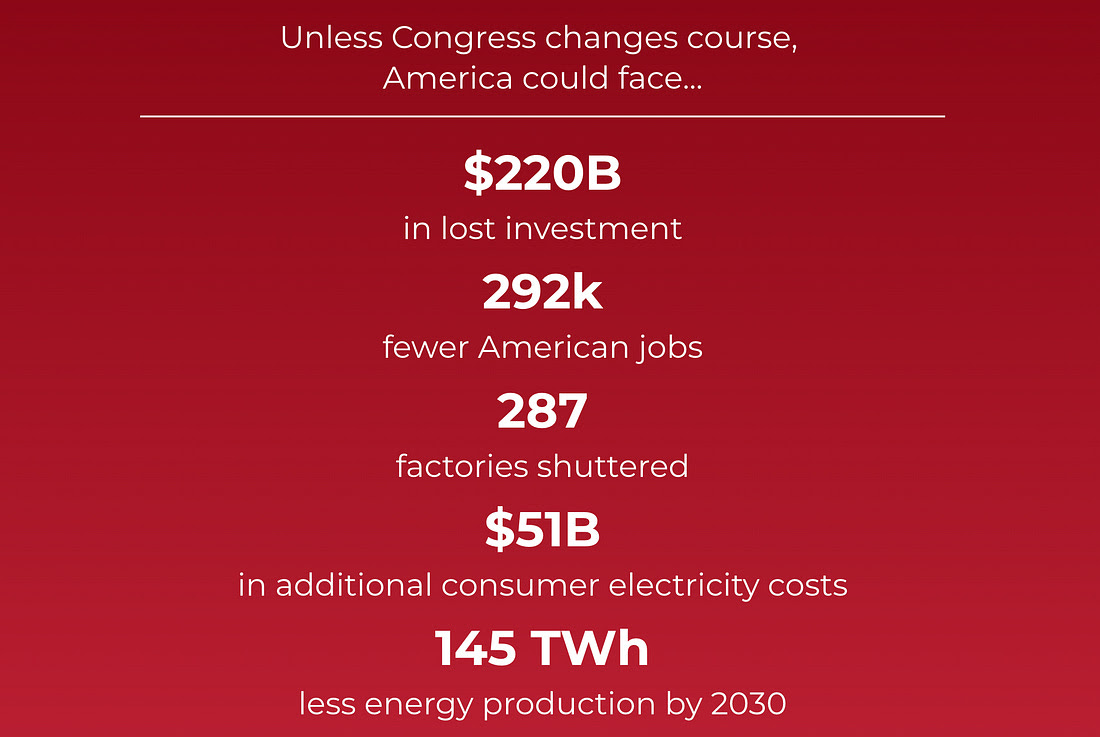 (https://substack.com/redirect/97856401-705d-4f47-8fdc-6864ac3ee37a?j=eyJ1IjoiMW42ZTYifQ.vyvZ_z0oLghKX6Zag1WJ71bIfqAlxqUD_SD6A_ZPsUM)
A screenshot from the SEIA’s analysis of the One Big Beautiful Bill Act (https://substack.com/redirect/79de8ca0-6695-4177-b2ae-269597cd811c?j=eyJ1IjoiMW42ZTYifQ.vyvZ_z0oLghKX6Zag1WJ71bIfqAlxqUD_SD6A_ZPsUM)
Indeed, several groups have warned that hampering the renewable energy sector’s growth will result in higher electricity bills for the average American consumer. ConservAmerica, a conservative environmental group, has estimated (https://substack.com/redirect/0b2f48f3-9697-4fc2-ac79-73501e53378a?j=eyJ1IjoiMW42ZTYifQ.vyvZ_z0oLghKX6Zag1WJ71bIfqAlxqUD_SD6A_ZPsUM) that repealing renewable energy tax credits could cause U.S. electricity costs to rise by $51 billion per year by 2035.
According to a preliminary analysis from Rhodium Group (https://substack.com/redirect/f6544257-a8b1-41f5-ba38-46d808d09b64?j=eyJ1IjoiMW42ZTYifQ.vyvZ_z0oLghKX6Zag1WJ71bIfqAlxqUD_SD6A_ZPsUM), the anti-clean energy provisions in the One Big Beautiful Bill Act would“raise energy costs for American households by as much as 7 percent in 2035, stifle energy technology innovation, increase pollution, and could put a meaningful portion of half a trillion dollars of new manufacturing, industrial, and clean electricity investments across the country at risk.”
And the Clean Energy Buyers Association, which represents big tech companies that use a ton of energy for data centers and AI, also warned in a recent report (https://substack.com/redirect/37c4c12d-61c4-4aa2-93e6-ec622c32c4a6?j=eyJ1IjoiMW42ZTYifQ.vyvZ_z0oLghKX6Zag1WJ71bIfqAlxqUD_SD6A_ZPsUM) that repealing clean energy tax credits would raise the cost of energy for consumers.
“Let’s not mince words: Republicans are trying to raise your energy bills and destroy thousands of American jobs—simply to pad the pockets of billionaires, fossil fuel executives, and their top corporate backers with massive tax cuts,” Evergreen Action said in a statement (https://substack.com/redirect/4d47730f-efce-4e88-b8e6-fe57d2a90f4c?j=eyJ1IjoiMW42ZTYifQ.vyvZ_z0oLghKX6Zag1WJ71bIfqAlxqUD_SD6A_ZPsUM).
Have a news tip? Contact me securely via Signal at emorwee.06
---
MMA
Fox’s Maria Bartiromo whips Republican support for devastating Medicaid cuts
Republicans plan to slash Medicaid to fund Trump’s next tax giveaway to the rich
Written by Zachary Pleat
Published 05/20/25
House Republicans are working on legislation dubbed “One, Big, Beautiful Bill” to finance a permanent extension of President Donald Trump’s 2017 tax giveaway to the rich by slashing Medicaid, which will result in millions of Americans losing their health insurance. Supporters of the legislation have also singled out Medicare and the Supplemental Nutritional Assistance Program for additional cuts. Analyses show that the vast majority of the tax cuts will go to the rich, while lower-income Americans stand to lose money due to the massive cuts to health care coverage and other benefits.
Fox Business anchor Maria Bartiromo, an obsequious booster and right-wing media ally of Trump, has used her Mornings with Maria program to whip Republican lawmakers for support of the bill and especially to shore up its Medicaid cuts. During these frequent Fox Business appearances, Bartiromo, her guests, and even her guest host have advocated for useless work requirements and spread false claims that federal Medicaid funds are paying for coverage of undocumented immigrants or that the cuts are targeting supposedly massive “waste, fraud, and abuse” in the program. After more than a week of Bartiromo's effort to manufacture consent for these Medicaid cuts, Trump reportedly told Republicans “don't fuck around with Medicaid.”
Republican lawmakers frequented Mornings with Maria to promote Medicaid cuts for their tax legislation
- Bartiromo urged Sen. Jim Justice (R-WV) to get Republicans to “unify on Medicaid reform” by Memorial Day weekend. Fox Business, *Mornings with Maria*, [_{5/16/25}_]
- Bartiromo to Rep. Jason Smith (R-MO): “Where are practical areas to cut Medicaid and Medicare, but not the benefits and muscle of the programs?” Fox Business, *Mornings with Maria*, [_{5/16/25}_]
- Rep. Dan Crenshaw (R-TX) to Bartiromo: “We're being yelled at about taking away people's Medicaid. That's not really true.” Later, Crenshaw admitted to Bartiromo: “The person we’re taking it away from is the able-bodied adult with no children who refuses to work.” He added: “If they would just get a job, they could keep their Medicaid.” During the interview, Bartiromo complained that Democrats weren’t assisting Republicans in cutting Medicaid. Fox Business, *Mornings with Maria*, [_{5/16/25}_]
- Bartiromo to Rep. Earl Carter (R-GA): “Thank you for your work on the House Energy and Commerce Committee. Everybody was rooting you on, you advanced the biggest Medicaid rewrite in the program’s 60-year history.” Bartiromo then invited Carter to defend Republicans from Democrats’ statements that the legislation will kick people off Medicaid. Fox Business, *Mornings with Maria*, [_{5/15/25}_]
- Bartiromo to Sen. Roger Marshall (R-KS): “That sounds great, and I love the idea that you can identify $2 trillion in cuts,” including from Medicaid. Fox Business, *Mornings with Maria*, [_{5/14/25}_]
- Rep. Andy Harris (R-MD) on Medicaid cuts: “I do hope that we find more reductions.” Fox Business, *Mornings with Maria*, [_{5/12/25}_]
- Rep. Russell Fry (R-SC) falsely claimed California’s coverage of undocumented immigrants in its state Medicaid program “is a tremendous cost to the federal taxpayer because we are subsidizing this in these states.” In fact, California was covering those costs with state funds. Fox Business, *Mornings with Maria*, [_{5/12/25}_; The Associated Press, 5/14/25]
- Rep. Riley Moore (R-WV) touted “over $900 billion savings coming out of” Medicaid and other programs overseen by the House Energy and Commerce Committee. Fox Business, *Mornings with Maria*, [_{5/12/25}_]
- Discussing the tax cut bill onMornings with Maria, Rep. Carlos Gimenez (R-FL) said states that didn’t expand Medicaid were “fiscally responsible” because “they knew what was coming.” Fox Business, *Mornings with Maria*, [_{5/9/25}_]
- Sen. Rand Paul (R-KY) encouraged Republicans to “take the entitlements away — Social Security, Medicare, Medicaid, food stamps” — to reduce the national debt. Fox Business, *Mornings with Maria*, [_{5/8/25}_]
- Bartiromo interviewed Rep. Andy Ogles (R-TN) about his effort to pass work requirements for Medicaid recipients. During the interview, Ogles likened this effort to “rooting out waste, fraud, and abuse.” Fox Business, *Mornings with Maria*, [_{5/8/25}_]
- Bartiromo encouraged Rep. Lance Gooden (R-TX) to explain how Republicans will cut “Medicaid or Medicare” to “get around paying for the Trump agenda.” During the interview, Gooden said: “I think we’re all in agreement that work requirements should be increased” adding, “We all agree that able-bodied men in their 20s should be working and not getting paid to sit on the couch.” Fox Business, *Mornings with Maria*, [_{5/7/25}_]
- ## The Republican bill slashes benefits from the poor to fund tax cuts for the rich
- Center on Budget and Policy Priorities: Republicans’ tax bill would cut $1.1 trillion from Medicaid, the Affordable Care Act, and SNAP to fund tax cuts for people earning more than $500,000 annually. Center on Budget and Policy Priorities, [_{5/16/25}_]
{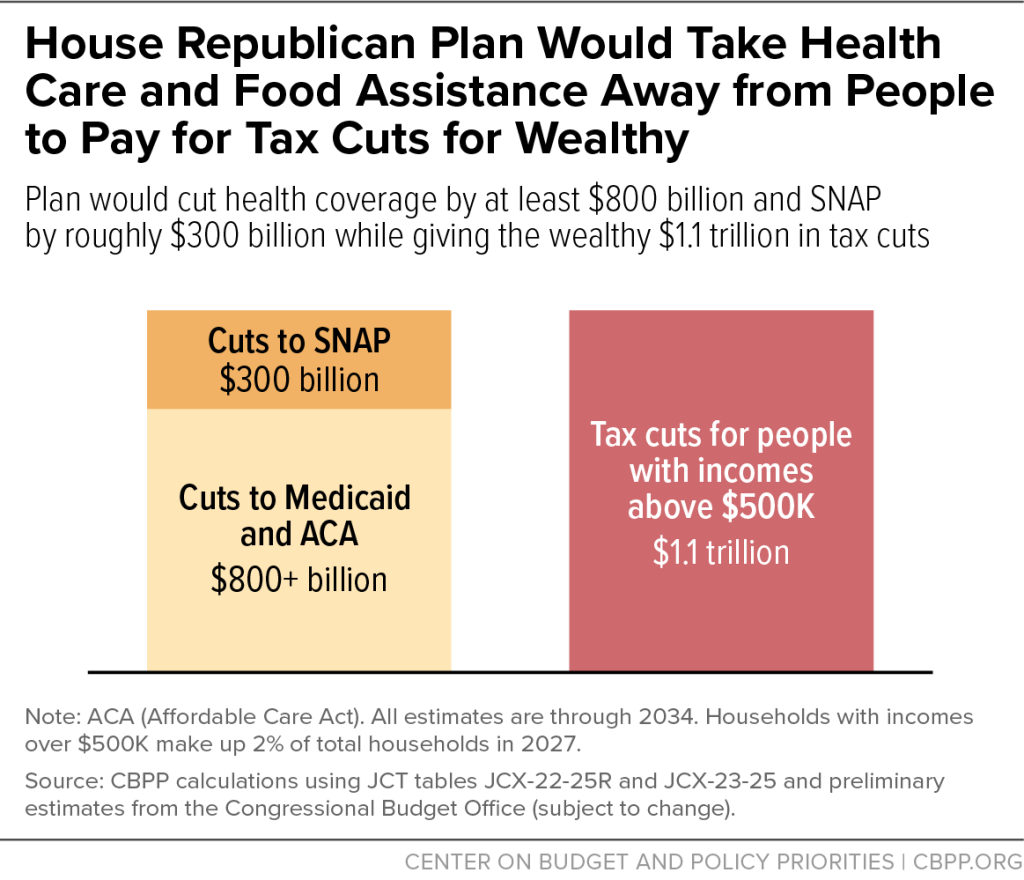
- CBPP director of federal tax policy Kris Cox: House Republican bill gives $500 more per child to wealthy families but leaves the low-income families of 17 million children out of the maximum Child Tax Credit. According to the CBPP, this affects “roughly 1 in 4 children … who currently receive less than the full credit or no credit at all because their families’ incomes are too low.” Bluesky, [_{5/12/25}_, Center on Budget and Policy Priorities, 2/5/25]
- Institute on Taxation and Economic Policy: “Two-thirds of the tax cuts offered in 2027 would go to the top 20 percent of families, and 41 percent would flow to just the top 5 percent of families.” ITEP further explained how regressive the GOP tax bill is: “While working-class families (defined here loosely as the bottom 40 percent of earners) could expect an average tax cut of $361 in 2027, the nation’s highest-income families (defined as the top 0.1 percent) would receive an average tax cut of at least $255,670 in that year.” Institute on Taxation and Economic Policy, [_{5/16/25}_]
- The New York Times: “Economists found that many Americans who make less than $51,000 a year would see their after-tax income fall as a result of the Republican proposal beginning in 2026.” The New York Times reported on an analysis of the GOP tax bill from the Penn Wharton Budget Model, which found that “computing the effects of the tax cuts as well as the plan to pay for them by slashing federal spending on other programs, including Medicaid and food stamps” results in lower-income Americans losing money from the tax cuts. Specifically, “people making between about $51,000 and $17,000 could lose about $700 on average in after-tax income beginning in 2026. … People reporting less than $17,000 in income would see a reduction closer to $1,000, on average, also increasing over time, a shortfall that underscores their reliance on federal benefits.” The New York Times, [_{5/16/25}_]
- CBPP senior director for federal fiscal policy Brendan Duke: “The House GOP tax bill gives large tax cuts to millionaires and paltry tax cuts to the working-class--tax cuts that will be wiped away by the cuts to health care and nutrition in the same freaking bill.” Twitter/X, [_{5/14/25}_]
- Yale’s Budget Lab: “Changes proposed by the House budget resolution would result in a decline of almost 4 percent (over $800) to income for the bottom quintile, but an increase of over 4 percent (nearly $70,000) for the top 1 percent.” The Budget Lab analysis added: “Even assuming that states make up some of the cuts, the bottom quintile would see an income loss of about 2 percent ($345 dollars).” The Budget Lab, [_{5/19/25}_]
- ## The GOP bill would kick millions off Medicaid while adding trillions to the national debt
- Politico: The Congressional Budget Office estimated that “the Medicaid portions of the GOP megabill would lead to 10.3 million people losing coverage under the health safety net program and 7.6 million people going uninsured.” According to Politico, this was a partial estimate released by Republicans. Politico, [_{5/13/25}_]
- KFF: Forty states and the District of Columbia could see at least 13% of their Medicaid recipients kicked off their insurance, with rates of loss as high as 32%. This is a high-end estimate of state-by-state Medicaid coverage losses from KFF. KFF, [_{5/16/25}_]
- Committee for a Responsible Federal Budget: The House GOP bill would “increase debt by $3.3 trillion, or $5.2 trillion if made permanent.”According to the CRFB, it would also “increase annual deficits to $2.9 trillion (6.9 percent of Gross Domestic Product), or $3.3 trillion (7.8 percent of GDP)”; “Increase yearly interest costs to $1.8 trillion (4.2 percent of GDP), or $1.9 trillion (4.4 percent of GDP)”; and “increase debt to 125 percent of GDP, or 129 percent of GDP if made permanent.” Committee for a Responsible Federal Budget, [_{5/14/25}_]
- Tax Foundation: The House GOP’s “One, Big, Beautiful Bill” will reduce federal tax revenue by $3.3-4.1 trillion in return for miniscule economic benefits spread over a decade. The Tax Foundation estimated that GDP growth would be boosted by a mere 0.6% over 10 years and only 794,000 additional jobs would be created, averaging out to less than 8,000 additional jobs per year. Tax Foundation, [_{5/13/25}_]
- ## The GOP's Medicaid work requirements would likely kick millions off Medicaid without increasing employment
- Center on Budget and Policy Priorities: New work requirements alone could put “9.7 million to 14.4 million people at risk of losing Medicaid coverage in 2034.” CBPP explained, “Evidence shows that much of the coverage loss due to work requirements would occur among people who work or should qualify for an exemption but nevertheless would lose coverage due to red tape.” Center on Budget and Policy Priorities, [_{5/13/25}_]
- KFF: As of 2023, nearly two-thirds of non-disabled and non-elderly adults on Medicaid were already working.Analysis from KFF of current population survey data showed that in 2023, “Among adults under age 65 with Medicaid who do not receive benefits from the Social Security disability programs, Supplemental Security Income (SSI) and Social Security Disability Insurance (SSDI), and who are not also covered by Medicare (referred to hereafter as “Medicaid adults”), 92% were working full or part-time (64%), or not working due to caregiving responsibilities, illness or disability, or school attendance. The remaining 8% of Medicaid adults reported that they are retired, unable to find work, or were not working for another reason.” KFF, [_{2/4/25}_]
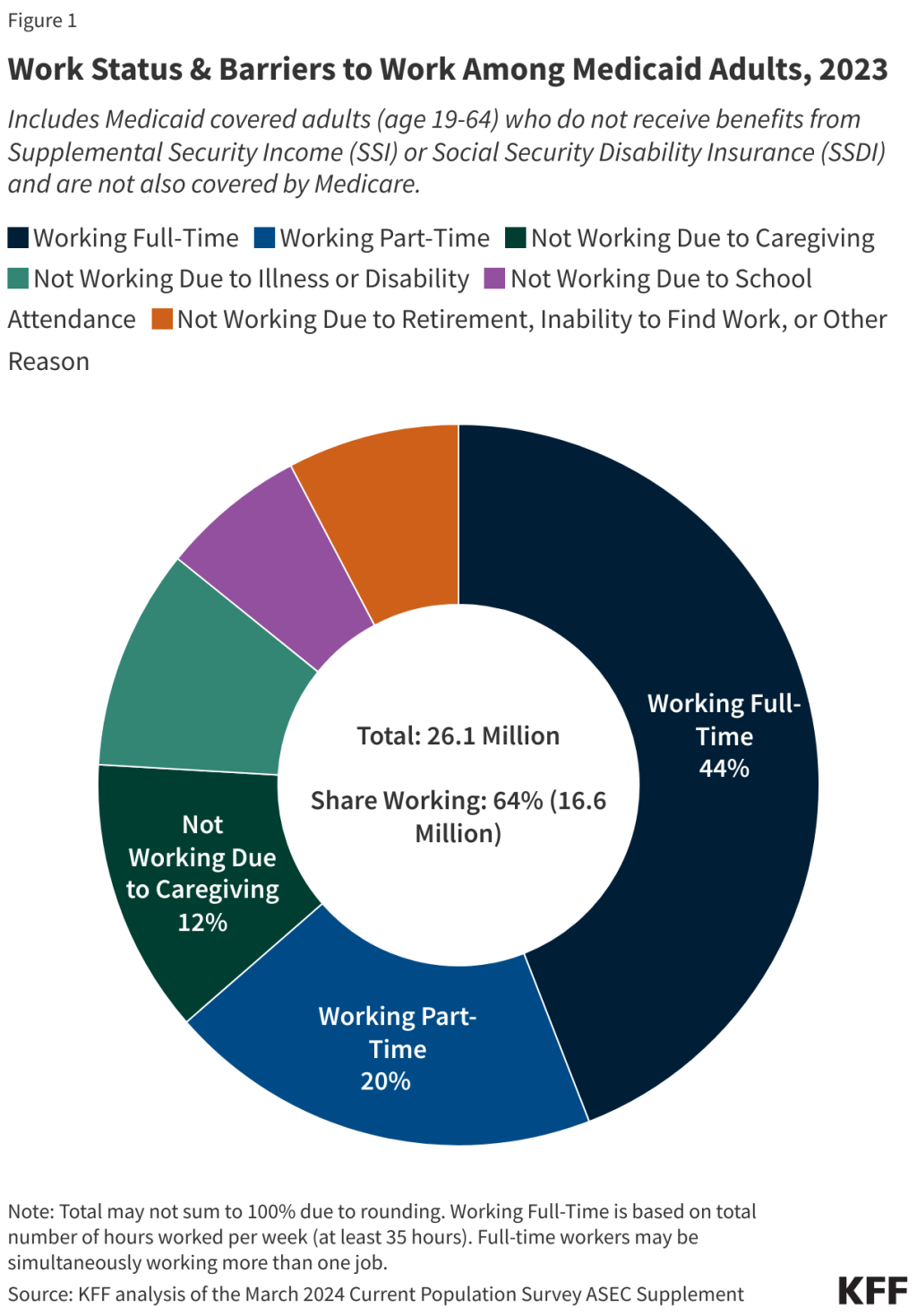
- KFF: Most Medicaid enrollees who work are working full-time. KFF’s analysis showed that “among Medicaid adults who work, nearly seven in ten (69%) worked full-time and half worked full-time for the entire year (at least 50 weeks) (Appendix Table 2). Many Medicaid adults who work part-time (31% of all workers) cited that reasons for working part-time include work limits like shorter work weeks (less than 35 hours per week) (16%), slack work/business conditions (12%), or inability to find full-time work (7%) (Figure 4). Part-time workers also pointed to childcare problems (9%) and other family or personal obligations (22%).” KFF, [_{2/4/25}_]
- Economic Policy Institute: “Work requirements effectively function like a cut to programs.” EPI explained that “while work requirements do not reliably increase employment, they do significantly increase the administrative burden and costs of applying for safety net programs. This increased administrative burden, in turn, reduces access and take-up.” EPI further explained, “In many cases, the sheer amount of additional administrative burdens levied on adults seeking benefits, and on case workers screening to ensure that work requirements are met, is a major driver in the decline in participation.” Economic Policy Institute, [_{1/24/25}_]
- A Congressional Budget Office estimate of a 2023 GOP bill that would have instituted Medicaid work requirements stated, “The agency concludes that the amendment would have a negligible effect on employment status or hours worked by people who would be subject to the work requirements.” Congressional Budget Office, [_{4/26/23}_]
- People’s Policy Project founder Matt Bruenig in The New York Times: “There is not an epidemic of non-working able-bodied adults living high on Medicaid, despite such claims from the Trump administration. Medicaid work requirements are a solution to a problem that doesn’t exist.” After accounting for Medicaid enrollees who work, are retired, are children, or are disabled, Bruenig explained in his op-ed: “Only 6 percent of working-age enrollees are not engaged in work long term, which is just 3 percent of the entire Medicaid population.” The New York Times, [_{5/16/25}_]
- CBPP: Arkansas’ Medicaid work requirements resulted in 25% of enrollees losing insurance. From a February CBPP report: “In Arkansas, about 1 in 4 enrollees subject to the requirements — some 18,000 people — lost coverage in only seven months in 2018 before a federal court halted the program. A large share of the enrollees who lost coverage in 2018 should have been eligible to retain coverage but did not reapply, according to data as of early March 2019, shortly before the program was halted.” Center on Budget and Policy Priorities, [_{2/5/25}_]
- A study published in The New England Journal of Medicine found that Arkansas’ work requirements were “associated with significant losses in health insurance coverage in the policy’s initial six months but no significant change in employment.” The study continued: “Lack of awareness and confusion about the reporting requirements were common, which may explain why thousands of individuals lost coverage even though more than 95% of the target population appeared to meet the requirements or qualify for an exemption.” Vox, [_{6/19/19}_]
- An analysis from The Commonwealth Fund found that Arkansas’s Medicaid work requirements “did not increase employment among 30-to-49-year-old Arkansans (the age group targeted by the policy) and did result in significant coverage losses while the requirements were in effect in 2018.” The Commonwealth Fund, [_{9/15/20}_]
- CBPP: New Hampshire’s Medicaid work requirements were halted in just two months, after they risked disenrolling two-thirds of people subject to the requirements. CBPP noted that this occurred even “with the express intention of avoiding Arkansas’ failures by allowing more flexibility in reporting requirements and pursuing broader, more robust outreach efforts.” Center on Budget and Policy Priorities, [_{2/5/25}_]
- CBPP: Georgia’s attempt to apply work requirements to new Medicaid enrollees resulted in just a fraction of the eligible population getting coverage and wasted two-thirds of its spending on administrative costs. CBPP explained that “18 months after the program began, only about 6,500 people were covered, far below the 240,000 uninsured people estimated to be potentially eligible. Meanwhile, the program cost about $13,360 per enrollee through the end of the first year, with only about one-third of the spending on health care and the rest on systems modifications to implement work reporting, additional staff, and other administrative expenses. That’s far more than the roughly $2,490 per enrollee the program was initially estimated to cost in the first year.” Center on Budget and Policy Priorities, [_{2/5/25}_]
//
Fox News chyron: Medicaid “reforms” or cuts? Answer: both
05/12/25 8:28 PM EDT
05/07/25 1:00 PM EDT
05/05/2
---
MMA
May 20, 2025, edition of Premiere Radio Networks' The Sean Hannity Show
SEAN HANNITY (HOST): This bill is so critical. Now, I may need to deputize many of you. We did this during the election, and we put up the Kamala files and the Walz files, and we asked you, you know, to send it to your friends and your family and your neighbors and your coworkers and anybody that you knew, and put it up on social media. And many of you responded. We only had 106 days to vet Kamala Harris. It was critical that so many of you get involved.
And if we are getting the names of people that might be getting in the way, because again, this bill will help build out the next generation of weaponry. This bill will provide for border security and deportations. This bill will make the tax cuts permanent. It will eliminate taxes on tips, Social Security, and overtime. This bill will also begin the process of moving America towards energy dominance, which will help make this country rich, on top of the $10 trillion in commitments of manufacturing, especially in areas that we need for national security reasons, like pharmaceuticals and semiconductors and automobiles. I mean, this will be hopefully the golden age.