Legal Suppression
new 519 category in honor of donziger
VERY LONG SO MUST BE BAK? kind of gen cat?
no merri
primary 7/20 on DHS
NOTE slap tag
this will get worse b/c of trump/ fedsoc leo ct pack stack // fasc
SEE SLAPP 3 OFFENSE etp ~ Greenpeace
SEE CLIMATE LAWSUITS}:
trump lawfare against law firms, media corps
see activ suppress ACAD SUPPRESS FOIA HORNER NOT GAO
SEE LAW FIRMS RETALIATION
see PRESS SUPPRESS trump sUed abc stepANOPOLUS WON 15 MILLION
see critical infra eco- econo- terrorism
see voter suppression
SEE RICO
SEE MILLER4 AM1ST LEGAL SANCTUARY RICO BS
see ESG raga
SEE sio ATTACK DISINFO LANDRY AG la MISSOU BAILEY TRUMP JUDGE 5TH --> SCOTUS
see team red RAGA paxton
see They don't want you to know
anti-abortion scotus RAGA team red
includes foia, slapp, eco-terror?
see retaliation DOJ 3 BONDI TODD BLANCHE ED FUCKING MARTIN PULTE /intimidation eg trump campaign ~ WI? TV stations}:
SEE 2 VERSIONS OF LAWFARE DEFAM
see defamation libel}:
see musk
see rule of law concept
---
-=-=
FIT?
AN 9 26
Critics of President Donald Trump often accuse him of blatantly violating federal and state laws in an effort to increase his power. But according to The New Republic's Matt Ford, a major part of Trump's ongoing power grab is using a different tactic: unearthing "moribund" laws and looking for ways to weaponize them.
The "moribund" laws that Trump and his legal team are digging up, Ford reports in The New Republic, are still on the books — and they are finding ways to exploit them.
"Congress has spent the last two centuries passing laws," Ford explains. "These laws often remain on the books, so to speak, long after their purpose has been fulfilled until lawmakers repeal them. Occasionally, the Trump administration finds something buried within this back catalogue that it can wield for its own purposes — and to no good end."
Ford continues, "This summer, for example, the Trump administration has moved to revive two different courts that are authorized by Congress but have laid moribund for decades or even centuries.
One of them is the Alien Terrorist Removal Court, or ATRC, which the Justice Department plans to use to deport certain applicable immigrants in classified settings…. Earlier this week, the department also began moving towards reviving prize courts, which allow the U.S. government to seize foreign vessels captured during war — more specifically, any Iranian oil tankers captured during the ongoing illegal war with Iran. Under federal law, these prize courts operate within the existing federal district courts to hear cases on the legality of a ship's capture and pave the way for the vessel's eventual sale, as well as the sale of any goods on board."
Ford argues that Congress should respond to the Trump administration's "enthusiasm for reviving moribund laws to accomplish its policy goals" by "repealing or revising them."
"Trump and his allies have inflicted plenty of harm through violating federal laws during his second term," Ford warns. "Another important problem is when he abuses and misuses existing laws…. It is telling that the federal government had never before used the ATRC to deport someone, even at the height of the War on Terror under the George W. Bush administration."
According to Ford, Congress "has a pernicious habit of leaving loaded guns lying around in the United States Code" — and the Trump administration is taking advantage of these "moribund" laws.
"Just because past presidents haven't picked them up and abused them doesn't mean Trump and his successors should be able to do so," Ford observes. "One of Trump's first experiments with moribund laws this time was to invoke the Alien Enemies Act of 1798 last year against Venezuelan nationals living inside the United States who it claims are members of Tren de Aragua, a Venezuelan gang. History students may remember the law as one component of the Alien and Sedition Acts, a package of controversial and constitutionally dubious laws enacted by the John Adams administration in the late 1790s. The Alien Enemies Act was the only one that wasn't repealed, though it remained largely unused until recently."
-=-=
==
trump allies warn California leaders they could go to prison...

https://sacramento.newsreview.com › News
By Wendy Fry and Jeanne Kuang for CalMatters
California's southern border, long ‘ground zero' in the fight between federal and local officials over immigration policy, is now at the center of renewed controversy over how far local leaders can go to protect people from deportation.
After San Diego County took steps earlier this month to strengthen safeguards for undocumented residents, an organization led by President-elect Donald Trump's adviser Stephen Miller sent a letter warning that elected leaders and employees of “sanctuary” jurisdictions could be “criminally liable” if they impede federal immigration enforcement.
In the Dec. 23 letter, America First Legal Foundation wrote: “We have identified San Diego County as a sanctuary jurisdiction that is violating federal law.”
The conservative legal nonprofit that day announced that it had identified 249 elected officials in sanctuary jurisdictions who it said could face “legal consequences” over immigration policies. The California Attorney General's office and Los Angeles Mayor Karen Bass were sent similar letters.
The letter also suggests sanctuary city officials could be civilly liable under federal anti-racketeering laws.
With Trump pledging to carry out the “largest mass deportation campaign in U.S. history,” San Diego's board of supervisors enacted a policy on Dec. 12 prohibiting local law enforcement from communicating with immigration authorities about undocumented people in local jails without a judicial warrant.
San Diego's newly enacted ordinance goes a step further than California's existing state “sanctuary” law, which only limits cooperation between local law enforcement and the federal Immigration and Customs Enforcement (ICE). The law prevents jailers from notifying ICE about non-citizen inmates who are about to be released from local criminal custody unless they committed one of about 800 serious crimes. State prison officials regularly communicate with ICE about people in their custody, including U.S. citizens, public records show.
San Diego County's action faced immediate pushback, with the county's top law enforcement official, Sheriff Kelly Martinez, saying she would not follow the new policy and would continue allowing immigration authorities access to the jail inmates.
American First Legal Foundation sent its letter to the chair of San Diego County's Board of Supervisors, Nora Vargas, who stepped down from her position on Friday citing security concerns just weeks after being elected to a second term.
“Federal law is clear: aliens unlawfully present in the United States are subject to removal from the country, and it is a crime to conceal, harbor, or shield them. It is also a crime to prevent federal officials from enforcing immigration law,” states the letter, dated three days after the resignation.
Vargas, who was born in Tijuana, has long championed rights for asylum seekers and immigrants. She was the first immigrant and Latina to serve on San Diego's board of supervisors. She was elected to the board in 2020, flipping the seat from Republican to Democrat for the first time in decades.
Vargas said the new board policy was developed through “rigorous legal review and stands in full compliance with federal, state and local laws.”
“This nation's foundation was built on the strength and contributions of immigrants,” she posted on social media. “Now it's time to turn our focus to honoring the humanity of those who help make this country the beacon of hope it continues to be.”
Spokespersons for Trump's transition team did not immediately respond to inquiries about whether the administration plans to prosecute local officials in sanctuary cities. Trump has named Miller to be his deputy chief of staff for policy and homeland security advisor.
California preparing legal battles with Trump administration
State officials have asked the Legislature, in a special session called by Gov. Gavin Newsom last month, for $25 million for legal fights with the incoming administration on issues including immigration.
“This is a scare tactic, plain and simple,” read a statement from the Attorney General Rob Bonta's office, in response to the America First letter. “While we are unable to comment on the specifics of the letter, we want to be clear: SB 54 was upheld by the courts during the first Trump administration, and it prevents the use of state and local resources for federal immigration enforcement with certain narrow exceptions. SB 54 does nothing, however, to block federal agencies from conducting immigration enforcement themselves. California will continue to comply with all applicable state and federal laws, and we expect all local law enforcement agencies to do the same.”
Democratic state Senate leader Mike McGuire, of Healdsburg, in response to the letters called the incoming administration's proposed immigration policies “draconian” and damaging to California's economy.
“The previous Trump administration came at California before on a variety of legal fronts and the majority of the time, lost,” said McGuire, whose office did not receive a letter. “Mark my word, we'll be prepared again.”
The state is home to several major cities with policies limiting cooperation between local police and federal immigration authorities. Proponents say such policies make immigrants less fearful of deportation when reporting crimes to or cooperating with the police. Los Angeles adopted a sanctuary city ordinance in November, fast-tracking the policy after Trump's election.
Asked for comment on the America First letter, Zach Seidl, a spokesperson for Los Angeles Mayor Karen Bass, called it “wrong on public safety and wrong on the law.”
“Sanctuary policies are against the law, make a mockery of America's democratic principles, and demonstrate a shocking disrespect for our Constitution and our citizens. The officials in charge of sanctuary jurisdictions have no excuse and must be held accountable,” read a statement from James Rogers, a senior counsel with America First Legal.
Trump targeted California sanctuary cities before
The state's own sanctuary law, signed by then-Gov. Jerry Brown in 2017, curbs local sheriffs' transfers of detainees to federal immigration custody and also prohibits police from asking people about their immigration status. That law, Senate Bill 54, contains an exception for state prisons, which regularly transfer ex-inmates who have completed their sentences to Immigration and Customs Enforcement for deportation proceedings.
Trump advisers, including Miller, have been considering using federal pressure, such as withholding federal funds, against jurisdictions that won't cooperate with federal immigration authorities. The last Trump administration tried to get the California sanctuary law overturned in federal court, but the Supreme Court in 2020 declined to hear its petition. And in 2018, Trump's Department of Homeland Security floated criminal charges against politicians of cities that enact sanctuary policies. It did not file charges.
“So-called ‘sanctuary' jurisdictions that forbid compliance with federal immigration law and cooperation with the officials who enforce it are, therefore, breaking the law. Moreover, sanctuary jurisdictions are strictly prohibited from requiring their employees to violate federal immigration law,” the America First letter states.
But Ahilan Arulanantham, co-director of the Center for Immigration Law and Policy at the UCLA School of Law, said the letter's reasoning that sanctuary policies amount to “harboring” or concealing federal fugitives is flawed.
“Not inquiring about someone's status is not harboring. Neither is declining to share such information,” Arulanantham said in a text message Friday. “I'm not aware of any criminal protections based on such conduct, and the letter fails to cite any.”
To carry out his plan to deport more people than any other president, Trump will need the cooperation of local officials. Immigrant Legal Resource Center, a national nonprofit that provides legal training and does pro-immigrant policy work in California and Texas, estimates 70 to 75% of ICE arrests in the interior of the U.S. are handoffs from another law enforcement agency, such as local jails or state or federal prisons. Since 2019, California's state prison system has delivered more than 5,700 formerly incarcerated immigrants to ICE, federal data shows.
San Diego was the epicenter of a surge of unauthorized crossings earlier this year, straining local resources. In April, 37,370 people crossed between ports of entry in the San Diego sector, with the majority surrendering to Border Patrol to claim asylum. This made it the top spot for crossings in the country for a few weeks in 2024, according to federal data. The number of unauthorized crossings dropped sharply after the Biden administration implemented new asylum restrictions in June.
---
OMFG
AN 7 26
On Tuesday, NBC News confirmed that the Justice Department has sent threatening letters to election officials spanning every state and Washington, D.C., asserting that they could “face criminal prosecution over noncitizen voting.” According to NBC, the letters are the latest move in President Donald Trump’s effort to promote his false claims of widespread noncitizen voting and “assert more federal control over state elections.”
As NBC explains, “The letters, signed by Assistant Attorney General Harmeet Dhillon, who heads up the department’s Civil Rights Division, give states five days to explain how they will comply with federal voter eligibility laws and how they will maintain ‘clean voter lists.’” And as NBC notes, noncitizen voting is so rare it’s almost nonexistent, “but Trump and his administration have falsely portrayed it as a widespread issue.”
The DOJ letters assert that state election officials “could be criminally prosecuted for aiding and abetting” any noncitizen voting. They also emphasize that any election officer who knowingly retains noncitizens on a voting registration list or who helps noncitizens receive and cast ballots in any way could be subject to criminal liability, and that “an intentional act that is aimed at diluting the votes of citizens could also constitute a violation.”
WHAT DOES THAT MEAN?
According to Utah Lt. Gov. Deidre Henderson, a Republican election official who received one of the letters, the threats amounted to “truly bizarre behavior.”
Posting on social media, she revealed, “Got another love letter this morning from the DOJ sprinkled throughout with threats of criminal prosecution. I’m sure I’m not the only chief election officer of a state who is being targeted for following state and federal laws by resisting DOJ’s demands for private voter data that have thus far been ruled illegal by at least a dozen courts. This is truly bizarre behavior by the federal agency that is supposed to be protecting civil rights.”
Per NBC, “While some states have complied with the administration’s demands that they hand over voter roll data, the Justice Department has sued 30 states and Washington, D.C., for resisting. So far, 11 different federal courts have dismissed the Justice Department’s efforts to seize voter rolls.”
---
ro khanna crit doge 6 26 lever shd be in prison; subpoena him oversight epstein files
threat lawsuit [german media?]
lancet ucla
---
2007 GORE INC TRUTH
4 26
Dimmock v Secretary of State for Education and Skills - Wikipedia
Dimmock v Secretary of State for Education and Skills was a case heard in September–October 2007 in the High Court of Justice of England and Wales, concerning the permissibility of the government providing Al Gore's climate change documentary An Inconvenient Truth to English state schools as a teaching aid.
The case was brought by Stewart Dimmock, a lorry (HGV) driver and school governor from Kent, England, a father of two sons who attend a state school. Dimmock has twice stood as a local election candidate[1] for the New Party and received backing for the case from Viscount Monckton, the author of the New Party's manifesto.[2] Monckton, one of the UK's most prominent climate change deniers, launched an advertising campaign against Al Gore in March 2007 challenging Gore to a public debate on climate change.[3] Monckton has received funding from a Washington-based conservative think tank of which he is chief policy adviser, the Science and Public Policy Institute (SPPI), to create a film, Apocalypse No, which will parody Gore, showing Monckton presenting a slide show making an attack on climate change science.[2]///
---
WAPO SAME DAY NO LNX
The oil industry takes its critics to court
The oil and gas industry is ramping up its attacks on climate Superfund laws.
March 27, 2025
Jodi Kelly and her husband, Dan Kelly, use a canoe to remove surgical supplies from a flooded area in Montpelier, Vermont, on July 11, 2023. (Steven Senne/AP)
By Maxine Joselow and Anna Phillips
At the White House last week, the nation’s top oil executives asked President Donald Trump for help fighting state laws that seek billions of dollars from fossil fuel companies.
In Michigan, a group with ties to the fossil fuel industry is suing to obtain the emails of a professor who supports these laws.
And in North Dakota, the oil company that operates the Dakota Access pipeline last week won a $667 million defamation judgment in its lawsuit against an environmental group.
Across the country, fossil fuel firms are ramping up a decades-long fight against policymakers, academics and activists who have sought to make them pay for their role in causing climate change. They are taking particular aim at “climate Superfund laws,” which seek billions of dollars from oil companies to help cover the costs of coping with stronger storms, rising seas and other weather disasters fueled by rising global temperatures.
“I’m seeing a tectonic shift in the way the fossil fuel industry is now going on the offense,” said Pat Parenteau, an emeritus professor and senior fellow for climate policy at Vermont Law School.
Follow Trump’s second term
New York and Vermont have each enacted climate Superfund laws modeled after the 1980 federal Superfund law, which requires polluting companies to pay for cleaning up hazardous waste sites. At least seven other Democratic-led states are considering similar bills, according to the Federalist Society, a conservative legal group.
Vermont became the first state to pass a climate Superfund law in June — nearly a year after catastrophic flooding caused millions of dollars in damage to roads, bridges, homes and businesses. Scientists have said global warming increased the likelihood of the extreme rainfall that triggered the flooding, since a warmer atmosphere holds more moisture.
Vermont’s measure, which Republican Gov. Phil Scott allowed to become law without his signature, charges fossil fuel firms for the greenhouse gas emissions they produced between 1995 and 2024. It doesn’t specify how much money should be paid. Instead, it tasks the state treasurer with calculating the costs of responding to past climate damage and preparing for future climate disasters. The final tally is expected to be comprehensive, factoring in possible expenses such as lower worker productivity amid extreme heat.
In contrast, the climate Superfund law signed by New York Gov. Kathy Hochul (D) in December would fine the largest greenhouse gas emitters $3 billion annually for the next 25 years. The charges would be based on the companies’ contributions to overall emissions between 2000 and 2018.
Seeking Trump’s support
As Trump sat with the nation’s top oil and gas executives at the White House last week, he asked what was on their minds.
In response, the executives asked for help battling climate Superfund laws, according to two oil industry representatives who spoke on the condition of anonymity to describe a private conversation. The Wall Street Journal first reported this request.
Executives also complained about dozens of climate lawsuits brought by state and local governments against oil companies, the two industry representatives said. The lawsuits accuse the companies of deceiving the public for decades about the harms they knew their petroleum products would cause — an allegation the industry rejects.
Interior Secretary Doug Burgum, left, and Energy Secretary Chris Wright deliver remarks outside the White House after meeting with oil executives on March 19. (Kevin Dietsch/Getty Images)
After listening to the executives’ concerns, Trump told a White House staffer to look for ways the administration could help, the two industry representatives said. The president did not commit to taking any specific actions, they said.
Some industry executives want the Justice Department to sue New York and Vermont over their climate Superfund laws. The American Petroleum Institute (API), the U.S. oil and gas industry’s top lobbying arm, has already sued over Vermont’s law, alleging that it encroaches on the federal government’s power to regulate greenhouse gas emissions.
The U.S. Chamber of Commerce, the nation’s biggest business lobby, joined the lawsuit filed in December. The two groups argued that Vermont lacked the authority to impose penalties on greenhouse gas emissions beyond its borders — an authority, they said, that the Clean Air Act reserves for the federal government.
“This partisan legislation illegally and retroactively penalizes U.S. oil and natural gas producers for delivering the energy consumers need, and that should be a concern for our leaders in Washington,” Justin Prendergast, an API spokesman, said in an email. “We are exploring all options to correct this overreach by certain states.”
Representatives for several executives who attended last week’s meeting — including the CEOs of Chevron, ConocoPhillips, ExxonMobil and Phillips 66 — declined to comment or did not return requests for comment. A White House official said the meeting focused on boosting oil production on federal lands in red states.
:Republican-led states are also coming to the industry’s defense. A coalition of 22 red states, led by West Virginia, sued New York over its climate Superfund law in February, arguing that it would put coal and oil producers out of business.
Critics of climate Superfund laws also argue that they unfairly punish oil companies instead of consumers who use fossil fuels, whether to drive their cars or heat their homes.
“It’s actually not the companies’ production of fossil fuels that created the emissions — it’s the use of the fuels,” said Jeff Holmstead, a partner at the law and lobbying firm Bracewell LLP, which represents energy industry clients. “You can’t have one without the other.”
Proponents of these laws counter that they would raise funds desperately needed for withstanding the worsening effects of warming. They argue this money is already coming out of the pockets of taxpayers, who might not be able to afford it — and who have produced far fewer emissions than fossil fuel firms.
“The idea that the companies who bear responsibility are now scheming with the president in order to avoid being held accountable is sickening,” said Paul Burns, executive director of the Vermont Public Interest Research Group, an advocacy group that supported Vermont’s law. “For those whose homes were washed away, whose farms were destroyed, it’s the worst kind of insult to injury.”
Targeting an academic
The industry’s allies have targeted climate Superfund laws, as well as an academic who has advocated for them.
In May, the nonprofit Government Accountability and Oversight sued the University of Michigan in an effort to obtain emails between Rachel Rothschild, an assistant law professor, and a collection of environmental advocacy groups in 2023. The group accused the university, which is subject to state public records requests, of refusing to search for the emails before ultimately denying its request.
While Government Accountability and Oversight does not disclose its funding sources, bankruptcy filings show that it received $300,000 from Murray Energy, a coal company now operating under the name American Consolidated Natural Resources. When the group was incorporated in D.C. in 2018, business filings also listed its CEO as Chris Horner, a lawyer who previously worked for the coal company Alpha Natural Resources.
The group later followed up with a second public records request, this time for correspondence related to a “Climate Superfund Act Memorandum” that Rothschild had written. Zach Larsen, a lawyer for Government Accountability and Oversight, said the group should be able to view such correspondence because Rothschild is a public employee.
“This suit seeks to enforce the Legislature’s promise of transparency by sorting out whether Professor Rothschild’s work on Climate Superfund Acts, about which she regularly speaks, advocates, and publishes scholarship all using her University title … is related to her official duties as a public employee such that the public has a right to know about it,” Larsen said in an email.
Rothschild has testified in support of climate Superfund legislation in several states, including Vermont. In her work, she has examined potential flaws in the oil industry’s legal arguments against these measures. She has raised doubts about the industry’s claim that, under the Constitution, federal law preempts states from passing statutes that seek to hold fossil fuel companies accountable for damage linked to climate change.
“Part of the reason that I think these companies are going to President Trump with their concerns is because the preemption argument right now is fairly weak,” Rothschild said in an interview.
Rothschild declined to comment on the lawsuit, which is pending in state court. Horner and a lawyer for the University of Michigan did not respond to requests for comment.
Ann Carlson, an environmental law professor at the UCLA School of Law, said the same group had previously targeted her, her colleagues and law school donors with more than a dozen public records requests seeking emails related to climate lawsuits against fossil fuel companies. After the university released the records, Carlson said a conservative dark-money group used them to attack her nomination to lead the National Highway Traffic Safety Administration. In the end, with her Senate confirmation in doubt, President Joe Biden named her acting administrator of the agency.
Carlson said the campaign against her had a chilling effect.
“It absolutely gives people pause about what they’re willing to work on,” she said. “It may chill outside groups, like nonprofits, and their willingness to work with academics at public institutions.”
---
AN 2 26
President Donald Trump's Department of Homeland Security is employing a "secretive legal weapon" to target and surveil Americans, according to a new report.
The Washington Post on Tuesday relaying the story of a retiree who found himself on the receiving end of it after speaking out against the deportation case against an Afghan asylum seeker.
"He had decided that the America he believed in would not make it if people like him didn’t speak up, so on a cool, rainy morning in the suburbs of Philadelphia, Jon, 67 and recently retired, marched up to his study and began to type," the Post's report detailed. "He had just read about the U.S. Department of Homeland Security’s case against an Afghan it was trying to deport. The immigrant, identified in The Washington Post’s Oct. 30 investigation as H, had begged federal officials to reconsider, telling them the Taliban would kill him if he was returned to Afghanistan."
The retiree told the Post that he found the story "unconscionable," and after a quick Google search, he was able to find the email address of Joseph Dernbach, the lead prosecutor in H's case, named in the original story.
“Mr. Dernbach, don’t play Russian roulette with H’s life,” he wrote in an email. “Err on the side of caution. There’s a reason the US government along with many other governments don’t recognise the Taliban. Apply principles of common sense and decency.”
A little over five hours later, he received an email alert from Google notifying him that it had "received legal process from a Law Enforcement authority compelling the release of information related to your Google Account," listing the process as a subpoena and the authority as DHS. Not long after that alert, "men with badges" were at his door.
This was an example of an administrative subpoena – a tool that the federal government under Trump is increasingly leaning on — as they do not require authorizations from a judge or grand jury. "Tech experts and former agency staff" told the Post that thousands of these subpoenas are issued each year, potentially tens of thousands. They are "not subject to independent review, they can take just minutes to write up and, former staff say, officials throughout the agency, even in mid-level roles, have been given the authority to approve them."
"Though the U.S. government had been accused under previous administrations of overstepping laws and guidelines that restrict the subpoenas’ use, privacy and civil rights groups say that, under President Donald Trump, Homeland Security has weaponized the tool to strangle free speech," the report explained. "For many Americans, the anonymous ICE officer, masked and armed, represents Homeland Security’s most intimidating instrument, but the agency often targets people in a far more secretive way."
“There’s no oversight ahead of time, and there’s no ramifications for having abused it after the fact,” Jennifer Granick, an attorney for the American Civil Liberties Union, told the outlet. “As we are increasingly in a world where unmasking critics is important to the administration, this type of legal process is ripe for that kind of abuse.”
In a post to X, Drew Harwell, a technology reporter for the Post, decried these subpoenas as "a Kafkaesque form of domestic surveillance, intimidating Americans for lawful speech."
---
===
// sue wsj for biday card
an 10 25
Trump reportedly appears to be demanding the U.S. Department of Justice pay him $230 million in compensation after multiple investigations during his presidential campaign.
"The situation has no parallel in American history, as Mr. Trump, a presidential candidate, was pursued by federal law enforcement and eventually won the election, taking over the very government that must now review his claims," The New York Times, citing people familiar with the matter, reported.
Noting that President Trump has installed his former personal lawyers at the top of the DOJ, the Times called it "the starkest example yet of potential ethical conflicts."
Trump, according to the Times, in 2023, submitted a claim that "seeks damages for a number of purported violations of his rights, including the F.B.I. and special counsel investigation into Russian election tampering and possible connections to the 2016 Trump campaign, according to people familiar with the matter."
READ MORE: Not a ‘Gut-Wrenching’ Problem: Ron Johnson Shrugs Off Millions Losing Subsidies
Another complaint, filed the following year, "accuses the F.B.I. of violating Mr. Trump’s privacy by searching Mar-a-Lago, his club and residence in Florida, in 2022 for classified documents."
Bennett L. Gershman, an ethics professor at Pace University, told the Times it was "a travesty."
“The ethical conflict is just so basic and fundamental, you don’t need a law professor to explain it,” Gershmann said. "And then to have people in the Justice Department decide whether his claim should be successful or not, and these are the people who serve him deciding whether he wins or loses. It’s bizarre and almost too outlandish to believe.”
READ MORE: ‘Sick’: Jeffries Torches Trump’s ‘Out of Control’ Press Secretary
---
---
LEGAL/JUDICIAL SUPPRESSION?
NOTE CORNYN SIC FBI ON THEM; REPS LOCKED IN BLDG, DOGGED BY DPS TO GO TO CVS FOR TOOTHBRUSH, PERMISSION SLIPS LIKE hs
AN 8 25
One Democratic state representative in Texas speaking out against the Republican effort to redraw congressional district boundaries was just threatened with a felony charge for speaking to journalists.
That's according to a Wednesday article in the Houston Chronicle, which reported that Rep. Nicole Collier (D) had to abruptly end a press conference she joined from a bathroom at the Texas State Capitol. A video of the moment posted to X shows Collier being interrupted mid-speech while on a Democratic National Committee video stream with California Governor Gavin Newsom (D) and Sen. Cory Booker (D-N.J.) while speaking to police.
"Sorry, I have to leave. They said it's a felony for me to do this," Collier said. "Apparently I can't be on the floor or in the bathroom — well, you told me I had to be here in the bathroom — no, hang on. Bye, everybody. I've gotta go."
READ MORE:'Baby out with the bathwater': Red state Trump voters speaking out against this key policy
After Collier left the call, Sen. Booker called it "outrageous" that the Texas Democrat was being forced to stop talking to the media.
"First of all, let me tell you something. Representative Collier in the bathroom has more dignity than Donald Trump in the Oval Office," Booker said. "...What they're trying to do right there is silence an American leader. Silence a Black woman. And that is outrageous. I hope everybody took note of that."
"The fact that she can't even let her voice be heard is freakin' outrageous. And this is what we're fighting for," he continued. "This is ultimately what this is about. What we just witnessed: Them trying to shut her down and say it's illegal for her to be in the bathroom and on this call? This is the lengths that they're going to in Texas."
Watch the video of the moment below, or byclicking this link.
READ MORE:Aides sat 'helpless' as 'incoherent' Trump
---
---
omg
an 8 25
"Ken Paxton asks judge to jail Beto O’Rourke for fundraising Texas Dems' walkout" was first published by The Texas Tribune, a nonprofit, nonpartisan media organization that informs Texans — and engages with them — about public policy, politics, government and statewide issues.
*Sign up for The Brief, The Texas Tribune’s daily newsletter that keeps readers up to speed on the most essential Texas news.
*Editor's note: This story contains profanity.
Texas Attorney General Ken Paxton on Tuesday asked a Tarrant County judgeto jail former U.S. Rep. Beto O’Rourke, in another escalation in Republicans’ broader effort to put an end to Texas Democrats’ walkout over a new congressional map.
Paxton sued O’Rourke and his political group, Powered by People, last week, arguing that the group was deceptively fundraising for and illegally supporting Texas Democrats’ walkout. Tarrant County District Judge Megan Fahey quickly granted Paxton’s request to temporarily block O’Rourke and Powered by People from fundraising for Democrats or spending money to cover their expenses.
On Tuesday, Paxton claimed that O’Rourke had violated that temporary injunction at a Fort Worth rally Saturday, when he told the crowd, “There are no refs in this game, f—— the rules.”
According to a video of the event, O’Rourke appeared to say that phrase after urging the crowd to support retaliatory redistricting in other blue states — not in relation to the injunction.
Paxton’s motion also cited social media posts by O’Rourke after the injunction came down, in which the Democrat said he was “still raising and rallying to stop the steal of 5 congressional seats in Texas,” and included a donation link.
The attorney general said O’Rourke “repeatedly solicited donations” at the Fort Worth rally by urging the crowd to text “FIGHT” to a number that would automatically respond with a link to a donation platform.
Paxton’s motion asks the judge to imprison O’Rourke for the duration of the lawsuit, and to fine the Democrat $500 for each violation of the injunction.
Paxton’s lawsuit against O’Rourke and his group is part of an aggressive effort by Republican state leaders to break the impasse caused by Democrats’ exodus. Gov. Greg Abbott and Paxton have asked the all-Republican Texas Supreme Court to expel House Democrats, and Paxton, along with House Speaker Dustin Burrows, are turning to GOP-friendly Illinois courts to try to extradite the lawmakers taking refuge there.
Democrats left the state en masse last week, leaving the House without the minimum number of members to conduct business, to stall adoption of a new congressional map designed to give the GOP five additional seats in the U.S. House in next year’s midterm election.
Powered by People has been a top funder covering the costs of Democrats’ decampment, the expenses for which are mounting quickly. Democrats are on the hook for lodging, meals, travel and the $500-per-day fines accrued each day of the session they miss. They will also be responsible for thousands of dollars spent trying to compel their attendance, Burrows said Tuesday. He previously said they would not be able to receive their paycheck except in person, and that their office budgets would be slashed until they return.
O’Rourke filed his own lawsuit against Paxton Friday in El Paso district court, alleging that the attorney general was engaging in a “fishing expedition, constitutional rights be damned,” and asking the judge to block Paxton’s investigation into the organization’s practices.
“Paxton is trying to shut down Powered by People, one of the largest voter registration organizations in the country, because our volunteers fight for voting rights and free elections, the kind of work that threatens the hold that Paxton, [President Donald] Trump and Abbott have on power in Texas,” O’Rourke said in a statement responding to Friday’s injunction.
A spokesperson for O’Rourke did not immediately return a request for comment.
---
---}:
PRECURSOR? NJ MAYOR, MOC MCIVER, NADLER STAFFER, 2 JUDGE ARREST
ANY PROTESTER DC ARMY PARADE BIRTHDAY MET WITH BIG FORCE
AN 6 25
XO ~ PERKINS COIE 3 25
ymail donz 3 14 25
The First Amendment is under a shocking level of attack right now in the United States.
From the illegal arrest of a Columbia University student leader to the $300 million harassment lawsuit filed by the Energy Transfer pipeline company against Greenpeace, our right to free speech is under greater threat than ever before.
As you know, Steven has joined a group of prominent civil rights attorneys and citizens who traveled to North Dakota to monitor Energy Transfer’s SLAPP harassment lawsuit against the environmental group Greenpeace. The lawsuit is being funded by Trump ally and right-wing billionaire Kelcy Warren, who once said all activists “should be removed from the gene pool.”
*Warren’s lawsuit is actually a direct assault on Indigenous peoples, the climate movement, and free speech. Steven is out there helping to resist this unconstitutional weaponization of the law to silence activists.
We wanted to make sure you saw this firsthand update from Steven on the trial against Greenpeace in North Dakota:
*To be clear: the lawsuit against Greenpeace is rigged.
The lawsuit is not only an intimidation play to target the entire climate movement, it’s also a slap in the face to the Standing Rock Sioux and dozens of other Indigenous nations who led the historic protests against the company’s Dakota Access Pipeline in 2016.
Energy Transfer and Warren are attacking Greenpeace on the preposterous theory that the group is responsible for all “damages” related to construction delays of pipeline caused by the Indigenous-led protests, even though Greenpeace had virtually nothing to do with the protests.
Energy Transfer recently admitted to dozens of criminal violations of environmental laws in Pennsylvania. Credible reports in the North Dakota trial suggest up to 1 million gallons of drilling fluids have been discharged into waterways that millions of people rely on for their drinking water.
Evidence from Greenpeace also indicates the pipeline traverses Sioux ancestral lands and has desecrated sacred cultural sites, both in violation of the law. Yet the pipeline is operating anyway, while Greenpeace faces bankruptcy.
This trial is being structured so Greenpeace loses; the jury clearly is not impartial, with the majority having ties to the fossil fuel industry and no Native American or person of color seated on the panel. This is part of the “dark art” of a corporate SLAPP s...
===
---
ymail 6 25 donziger
Greenpeace recently was hit with an outrageous $669 million court verdict in North Dakota. The trial – which I attended with several prominent attorneys – was widely condemned as a SLAPP harassment case designed to silence the environmental movement.
The verdict could be a financial death sentence against Greenpeace – unless we stop it.
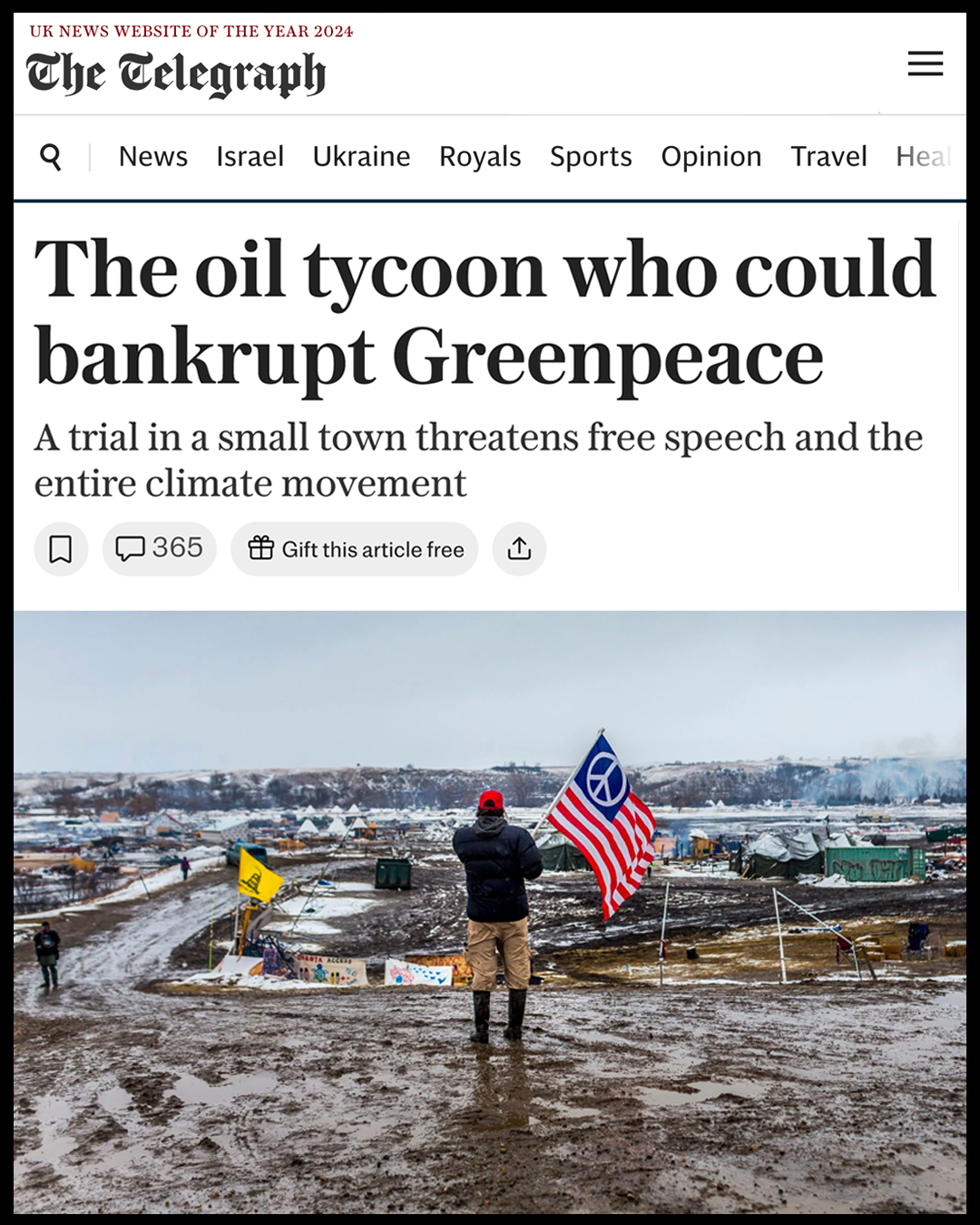
That’s why I’m reaching out for help.
This is the deal: the targeting of Greenpeace was financed by one of the most notorious fossil fuel oligarchs in the world. This man, Kelcy Warren, amassed a net worth of $7 billion by building a network of planet-destroying pipelines in every region of our country.
Warren’s company, Energy Transfer, is so awful that it was convicted of multiple acts of criminality in Pennsylvania because a pipeline leaked toxic waste into waterways. Warren is so hateful he once said all climate activists “should be removed from the gene pool.”
Luckily, there’s a viable plan to stop Warren’s vile attacks.
Greenpeace recently filed an innovative claim in the courts of Amsterdam against Warren’s company. The claim uses a new anti-SLAPP law in the European Union that allows activists to sue the corporations that abuse them.
The case in Amsterdam can turn the tables on Warren and force him to pay damages to Greenpeace rather than the other way around.
This would be a huge victory for the climate movement.
Before I get to what we are going to do about it, I want to tell you about another dirty trick Warren has up his sleeve.
Warren is pressuring the trial judge in North Dakota to require Greenpeace to post a $75 million bond just to appealthe $669 million verdict. If granted, this enormous “bond” is likely to be a financial death sentence.
Warren went after Greenpeace after the group helped support the Indigenous-led protests at Standing Rock against the Dakota Access Pipeline.When 100,000 people turned up to block Warren from building his pipeline across Indigenous territory, he went ballistic.
Warren also personally donated at least $5 million to Trump for his two presidential campaigns. Trump then helped Warren get permits for his leaky pipeline.
The support of the public for this campaign is critical. Without it, we simply cannot do this work.
Our goal is to raise $20,000 before the end of the month. That means we have to raise approximately $12,000 in the next few days.
---
mma
Steve Bannon calls for imprisoning Gov. JB Pritzker and Chicago Mayor Brandon Johnson
01/27/25 12:45 PM EST
01/27/25
---
kash 50 on enemies list in book, cassidy lots of trump admin
NOTE 12 24 BIDEN CONTEMPLATED BLAMKET PARDONS, ANOTHER APPROACH LEGAL DEF FUND:
During his Monday, December 16 press conference at Mar-a-Lago, President-elect Donald Trump doubled down on his threat to aggressively attack journalists with defamation lawsuits. And he specifically mentioned Iowa pollster Ann Seltzer and the Des Moines Register.
Seltzer's final poll before the 2024 presidential election showed him trailing Democratic nominee Kamala Harris by 3 percent in Iowa, a state he ended up winning by 13 percent. Although her poll was off by 16 percent, many experts on media law have been slamming Trump's lawsuit as frivolous and stressing that a flawed poll hardly constitutes defamation as defined in the U.S. Supreme Court's landmark New York Times v. Sullivan ruling of 1964.
Talking Points Memo's Josh Marshall discussed Trump's threat to use the legal system against his foes — from journalists to members of Congress to judges — during an appearance on The New Republic's podcast. And he offered a way to fight back: a giant, well-funded legal fund to help Trump's targets.
READ MORE: 'Prone to crises': Trump’s 'sweeping policy changes' could make economy dangerously unstable
Marshall told Sargent, "The idea is that you create some organization, probably a 501(c)(3), that can collect money, both small-donor money and big checks, and create a big pile of cash so that people who are threatened by Trump — whether it's his private lawsuits or Kash Patel harassing people with the FBI, whichever those things are — do not have to face ruinous legal bills, let alone potentially going to prison."
The Talking Points Memo reporter continued, "A lot of people have proposed something like that, and I think it's a great idea. …. You start with an idea that there is resources — legal resources, money resources — that for each person who gets targeted, this organization can swoop in and say, 'Hey, don’t worry about the legal bills. We got it. We're all over this. We've got unlimited money. We're going to fight this, etc. There's a lot of people who've talked about that great idea."
Marshall argued that one of the defense fund's goals could be to "embarrass" lawyers who file "baseless" lawsuits on Trump's behalf.
"That's the language they understand," Marshall told Sargent. "Outrage and very normal and understandable reactions, that’s what they’re looking for."
READ MORE:'Open season': Experts slam Trump’s 'disgusting' lawsuit against Iowa newspaper and pollster
*Listen to the full New Republic podcast at this link or read the transcript here.
---
an 12 24
During a press conference at Mar-a-Lago on Monday, December 16, President-elect Donald Trump told reporters that he plans to sue pollster Ann Selzer and the Des Moines Register because of a poll that turned out be way off.
Seltzer's final Des Moines Register poll before the United States' 2024 presidential election showed Vice President Kamala Harris leading Trump in Iowa by 3 percent. But Trump won Iowa by 13 percent, meaning that the poll was off by 16 percent.
Trump, at Mar-a-Lago, told reporters that Selzer was a "very good pollster" who "got me right all the time" — until that final pre-election poll. And he went on to say, "In my opinion, it was fraud, and it was election interference."
READ MORE:'Trump ’28': Bannon calls for third term
Trump's announcement is receiving a lot of responses on X, formerly Twitter.
When journalist Aaron Rupar tweeted video of Trump announcing his plan to sue Seltzer, conservative Trump critic Gil Loder responded, "I am completely content with Trump wasting his money on frivolous lawsuits as long as he spends his own money on them and not mine. He needs to keep his hands off the government treasury."
Republicans Against Trump tweeted, "Trump just said he plans to sue pollster Ann Selzer and the Iowa newspaper for publishing an inaccurate poll a few days before the election. The most thin-skinned insecure little man on planet Earth."
X user Brian Knotts posted, "Can someone explain the legal theory behind Trump suing the Des Moines Register/Ann Selzer? It seems to me that they are free to publish whatever they want and present it as a poll or whatever. I don't see any law that is broken, even if they make it up 100%.... Is the idea that the allegedly fraudulent (as opposed to merely inaccurate) poll constitutes defamation? That seems like a stretch, to say the least."
READ MORE:[Who are the Arizona voters without proof of citizenship? The answer may surprise you
PBS reporter Lisa Desjardins wrote, "Trump: I am going to be bringing a defamation lawsuit against the ppl in Iowa, they had a pollster who said I was going to lose by 3-4 points. (He means Ann Selzer, a polling legend whose final poll [SHE RETIRED]
---
an 12 24
On Thursday, December 4, conservative Republican Olivia Troye — a former national security aide to ex-Vice President Mike Pence who supported Kamala Harris in the 2024 election — reported, on X, that she had received a letter from Kash Patel's attorney threatening her with legal action and demanding that she retract her "comments on MSNBC about his unfitness to serve as FBI director." But Troye declared, "I stand by my statements."
Patel is among the Trump allies journalist Ross Rosenfeld discusses in an article published by The New Republic the following day. From Patel to "War Room" host Steve Bannon to anti-vaxxer Robert F. Kennedy Jr., Rosenfeld warns, President-elect Donald Trump's second term will have little or no tolerance for dissent.
"Trumpworld stands ready to stamp out dissent," Rosenfeld argues. "Not just the dissent itself, but the dissenters: those heretics who refute the Gospel of Trump and insist that his second coming, and his second administration, stands to deliver nothing but ill to the United States. Those with differing opinions are set to run afoul of those coming to power."
READ MORE:Republicans quietly admit Trump policies could 'prove disastrous' in their areas
Rosenfeld quotes Patel's own words, noting that during an appearance on Bannon's "War Room," he threatened, "We will go out and find the conspirators, not just in government but in the media. Yes, we're going to come after the people in the media who lied about American citizens who helped Joe Biden rig presidential elections."
But Patel, Rosenfeld stresses, is hardly the only Trump ally who has no tolerance for criticism of "King Donald."
Trump has nominated RFK Jr. to head the U.S. Department of Health and Human Services (HHS).
"Robert Kennedy Jr. fits snugly within this movement," according to Rosenfeld. "Like Patel, RFK Jr. has promised to clean house when approved for his new position as secretary of health and human services. He's said he'd likely fire around 600 employees at the National Institutes of Health who don't see his vision."
READ MORE:'It's a joke': Trump appointee Ramaswamy's economic plan blasted by expert
Rosenfeld adds, "He's also promised to fire, on Day One, 'every nutritional scientist at (the Food and Drug Administration) because all of them are corrupt — all of them are complicit in the poisoning of our children."
READ MORE: 'Nothing at all historic': Mehdi Hasan debunks false claim that Trump won by a 'landslide'
*Ross Rosenfeld's full article for The New Republic is available at this link.
===}:
Sierra Club’s Response to ExxonMobil’s Countersuit
January 7, 2025
Contact
Jonathon Berman, jonathon.berman@sierraclub.org
Beaumont, Texas – On Monday, ExxonMobil filed a countersuit against the Sierra Club, California Attorney General Robert Bonta, and others in the Eastern District of Texas. This comes in response to a lawsuit the groups filed in September against the company, which is the world’s largest producer of single-use plastic polymers. The original complaint, which was filed in San Francisco County Superior Court, alleges violations of California nuisance law and California unfair competition law and alleges ExxonMobil concealed the harms caused by plastics.
In response, Sierra Club spokesperson Jonathon Berman issued the following statement:
“Exxon is clearly confused about the difference between defamation and accountability. This lawsuit is a shameless attempt at intimidation by a multibillion dollar polluter corporation that covered up its climate change denial for decades. The Sierra Club will not sit back as ExxonMobil attempts to use their billions to bully those standing up for the health of working families.”
===
[### Profit Over Planet: Exxon Sued for Hiding the Truth About ...

Sierra Club
https://www.sierraclub.org › press-releases › 2024/09 › p...](https://www.sierraclub.org/press-releases/2024/09/profit-over-planet-exxon-sued-hiding-truth-about-plastic-harms)
Sep 23, 2024 — ... Sierra Club, Surfrider Foundation, Heal the Bay, and San Francisco Baykeeper, filed a lawsuit against ExxonMobil (“Exxon”), the world's ...
Sierra Club's Response to ExxonMobil's Countersuit

Sierra Club
https://www.sierraclub.org › press-releases › 2025/01 › si...](https://www.sierraclub.org/press-releases/2025/01/sierra-club-s-response-exxonmobil-s-countersuit)
Jan 7, 2025 — The Sierra Club will not sit back as ExxonMobil attempts to use their billions to bully those standing up for the health of working families.”.
[### ExxonMobil Lied About Plastics Recycling, Lawsuits Claim

Sierra Club
https://www.sierraclub.org › sierra › exxonmobil-lied-ab...](https://www.sierraclub.org/sierra/exxonmobil-lied-about-plastics-recycling-lawsuits-california-sierra-club-claim)
Sep 24, 2024 — The State of California and environmental groups including the Sierra Club say the petrochemical giant always knew recycling wouldn't work.
[### Sierra Club v. ExxonMobil Corp.

Climate Change Litigation Databases
https://climatecasechart.com › Case Bundles](https://climatecasechart.com/case/sierra-club-v-exxon-mobil-corp/)
Environmental organizations filed a complaint against Exxon Mobil Corporation asserting nuisance and violation of California's Unfair Competition Law in ...
[### Surfrider, the Sierra Club, Heal the Bay, and San Francisco ...

Cotchett, Pitre & McCarthy, LLP
https://www.cpmlegal.com › news-Surfrider-the-Sierra-...](https://www.cpmlegal.com/news-Surfrider-the-Sierra-Club-Heal-the-Bay-and-San-Francisco-Baykeeper-Sue-Exxon-for-Hiding-the-Truth-About-Plastic-Harms)
Sep 23, 2024 — Surfrider, the Sierra Club, Heal the Bay, and San Francisco Baykeeper Sue Exxon for Hiding the Truth About Plastic Harms.
[### Environment Texas, Sierra Club v. ExxonMobil

National Environmental Law Center
https://www.nelc.org › Cases](https://www.nelc.org/cases/environment-texas-sierra-club-v-exxonmobil/)
Following trial and appeal, ExxonMobil ordered to pay record $19.95 million civil penalty; penalty provisionally reduced to $14.25 million, pending final ...
[### CalPERS must hold ExxonMobil accountable

Sierra Club
https://www.sierraclub.org › articles › 2024/03 › calpers-...](https://www.sierraclub.org/articles/2024/03/calpers-must-hold-exxonmobil-accountable)
Mar 22, 2024 — Investors who want to preserve their shareholder rights must hold the oil major accountable. And we need CalPERS to lead the way.
---
---
AN 12 24
Rick Wilson, the former GOP political operative turned critic of Donald Trump and MAGA, has defeated a defamation suit filed by Michael Flynn, briefly Trump’s national security adviser, involving social media posts tying Flynn to Russia and the Qanon conspiracy theory.
Following a January trial, a Sarasota County trial judge ruled that Flynn, also a retired lieutenant general, failed to prove that Lincoln Project co-founder and Tallahassee resident Wilson had defamed him.
On Wednesday, the Florida Second District Court of Appeal affirmed the decision.
Wilson argued that his messages were protected by the First Amendment as opinion or rhetorical hyperbole; the trial and appeals courts agreed.
“We have the privilege of living in a country with a ‘profound national commitment to the principle that debate on public issues should be uninhibited, robust, and wide-open, and that it may well include vehement, caustic, and sometimes unpleasantly sharp attacks,’” Judge Susan Rothstein-Youakim wrote for a panel also including judges Darryl Casanueva and Laurence Silberman.
“Like it or not, such attacks are a characteristic feature of our democracy — regardless of the political persuasion of the speaker and regardless of the political persuasion of the public figure on the receiving end of that speech,” the opinion continues. “As the trial court noted, Wilson’s tweets may not have been polite, and they may not have been fair. But the First Amendment required neither, and so we affirm.”
Flynn sought $50 million in damages and an order for Wilson to stop “defaming” him. Instead, he has been ordered by the court to pay Wilson’s appellate fees — which, Wilson wrote, amount to “Many zeroes. Six figures.”
“Their decision wasn’t just a win for me — it was a powerful affirmation of free speech,” Wilson said in his newsletter. “Not the warped, Elon-flavored ‘The Nazis had some good points’ free speech MAGA Twitter loves to celebrate, but actual free speech: my right to call out Mike Flynn’s character, conduct, and record.”
Ukraine invasion
Wilson’s tweets came in response to Flynn’s reaction following Russia’s invasion of Ukraine in February 2022.
“My ‘offense?’ I tweeted ‘Putin Employee Mike Flynn’ after he tried some shameless Vladwashing of Russia’s invasion of Ukraine. And their second ‘pillar’ — and I use that word as loosely as possible — was that I retweeted Jim Stewardson, who (in part) referred to Flynn as ‘Q’ of QAnon fame,” Wilson wrote Thursday in his Substack newsletter. “I kept imagining the legal implications if a retweet could be found to be defamatory. The world would be in some deep legal waters.”
Flynn has had a number of connections to Russia. He served 22 days as national security adviser but Trump fired him after concluding Flynn had lied to the FBI and Vice President Mike Pence about discussing U.S. sanctions placed by Barack Obama on Russia with the Russian government before taking office. Additionally, Flynn accepted a speaking engagement with RT, Russia Today, in Moscow in 2015, receiving $45,000, NBC reported.
Plain meaning
Flynn’s arguments focused on the plain meanings of the words Wilson used but the appellate judges replied that the context was crucial.
“And stripped from the rest of the tweet, Wilson’s statement may indeed appear to be making a factual claim about Flynn’s economic relationship with Putin,” the opinion reads. “But that is not what a reasonable reader of Wilson’s Twitter feed would think Wilson was trying to communicate. Rather, whether Flynn gets a regular paycheck from the Russian Federation — like Putin’s secretary perhaps — just isn’t Wilson’s point.”
The court said Flynn provided no evidence that Wilson acted with legal malice, nor could the Qanon statement be proven true or false.
“We agree with the trial court that no reasonable jury could find that Wilson defamed Flynn through the retweet of ‘FYI, Mike Flynn is Q,'” the judges wrote.
‘Lawfare’
Wilson wrote that the case exemplified the use of “lawfare” by the MAGA movement to intimidate critics.
“Flynn’s crusade against me is just one stitch in the broader MAGA tapestry of lawfare. Whether it’s their suits against the Federal Government, NBC, CNN, Nicolle Wallace, Andrew Weissmann, Fred Wellman, MeidasTouch, Jim Stewardson, or anyone else who dares to speak the truth, the strategy is clear: silence the critics of Trump World by any means necessary, ” he wrote.
“Thankfully, the lower court — and now the DCA — disagreed. Free speech isn’t a one-way street, no matter how hard Flynn and his ilk try to rewrite the rules.”
Florida Phoenix is part of States Newsroom, a nonprofit news network supported by grants and a coalition of donors as a 501c(3) public charity. Florida Phoenix maintains editorial independence. Contact Editor Michael Moline for questions: info@floridaphoenix.com.
===
fascism rule of law concept by admin:
an raw 7 24
former President Donald Trump's allies are working to reshape American law into a weapon to be used against their political enemies, wrote Jesse Wegman in a scathing editorial for The New York Times.
Trump's pick of Sen. J.D. Vance (R-OH) underscores this, he wrote, because Vance embodies the far-right's commitment to a key goal of the controversial Project 2025 plan to transform the government into an authoritarian loyalty cult to the GOP.
Vance, wrote Wegman, "predicted ... that the former president, who had been recently disgraced by his insurrectionary attempt to overturn the 2020 election, would nevertheless run again in 2024. Should Mr. Trump win, Mr. Vance said, he had some advice: 'Fire every single midlevel bureaucrat, every civil servant in the administrative state, replace them with our people.' And if the courts ruled against him? No problem, Mr. Vance said: Just blow them off."
This is already happening, wrote Wegman — and another of Trump's appointees, District Judge Aileen Cannon, is showing how it will work in her move to dismiss the Mar-a-Lago classified documents case, which special counsel Jack Smith is already moving to appeal.
In her decision, Cannon concluded Smith, "Was not validly appointed to his post because no federal law authorizes the appointment of someone from outside the Justice Department to perform that task," wrote Wegman, noting she based this entirely on a non-majority concurrence from Justice Clarence Thomas in the case granting Trump a presumption of immunity in a separate case.
ALSO READ:'Keep lying': Late night Trump rant about Harris quickly turns against him
"As a matter of law and fact, this is not merely wrong, it is flagrantly, embarrassingly wrong ... It is not a close or complicated legal question" — indeed, the Supreme Court ruled the law allows this in 1974, and Cannon pretends they didn't.
These sorts of machinations by Vance and Cannon are exactly what to expect the whole government to become should Trump get his way, Wegman concluded ominously.
"This is what a second Trump term would look like," he wrote. "Ambitious judges who may not have been Trump loyalists at first will watch what’s been happening in recent days and get the message about what it takes to advance their careers. In this way, Judge Cannon embodies the future that Mr. Vance described in 2021. She is part of a legal elite raised on Trumpism that will use their perches in the judiciary and legal world to enforce a one-sided version of law that is about power and outcomes over any liberal principle."
In other words, he said, this is a reality where "the rule of law is for suckers or, worse, only for specific people. Our people."
---
drilled 2025 epa mandy
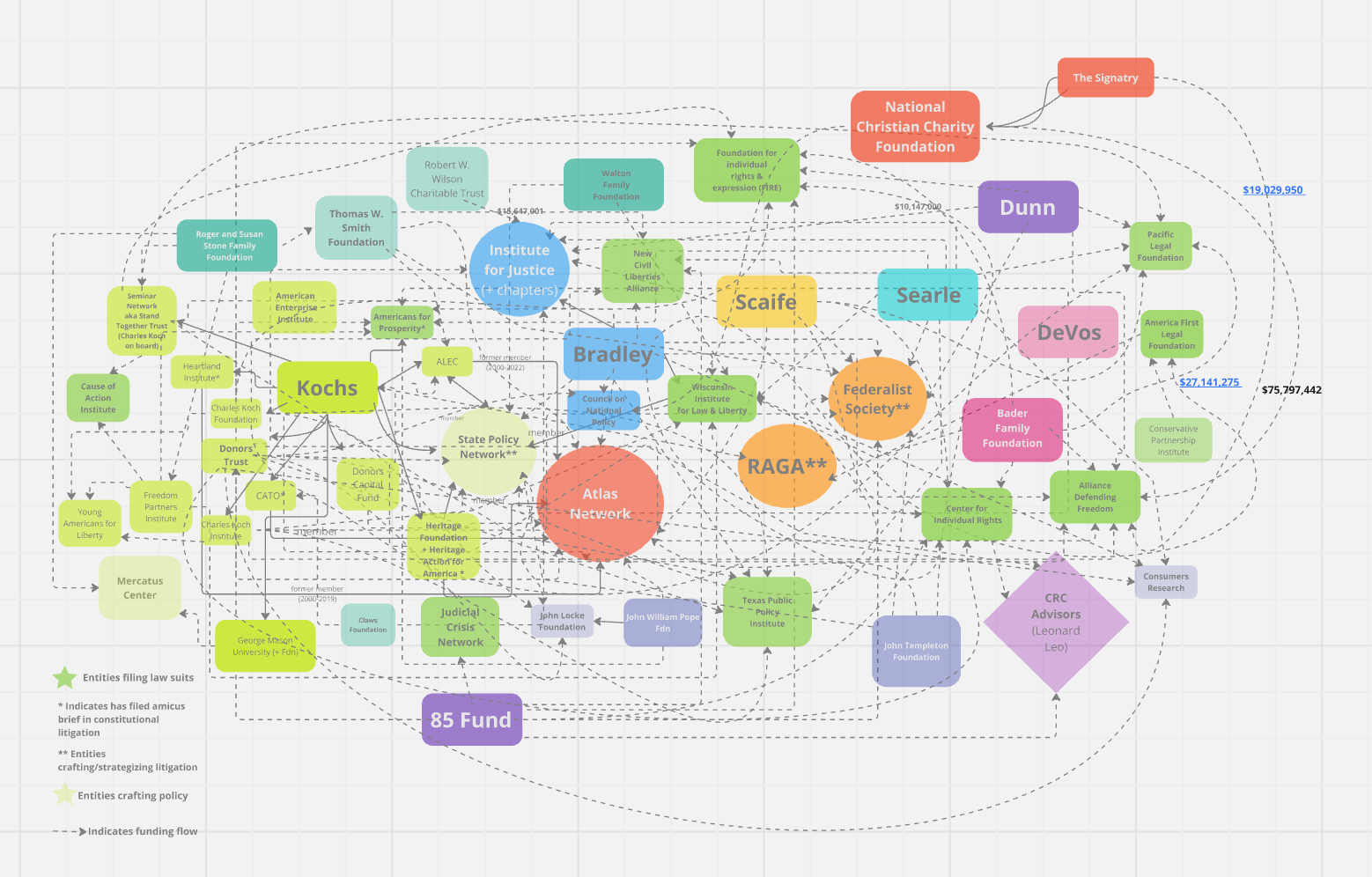
chart money
---
aha hmnn: this is a mixed bag because the law can be used in a variety of ways for good or bad by diff groups; grassroots activists civil rights used law as leverage/ equalizer? eg brown v bd short lived liberal scotus? but then corps and gov’t? saw that they could convert money into power with lawyers. --> SLAPP; Defam caN be used against pols (beto) or activists, but smartmaTIC, LADY RUBY VS RUDY.
---
a US small-town mayor sued the oil industry. Then Exxon went after him
This article is more than 2 years old
The mayor of Imperial Beach, California, says big oil wants him to drop the lawsuit demanding the industry pay for the climate crisis
Chris McGreal in Imperial Beach, California
Sat 16 Oct 2021
Serge Dedina is a surfer, environmentalist and mayor of Imperial Beach, a small working-class city on the California coast.
He is also, if the fossil fuel industry is to be believed, at the heart of a conspiracy to shake down big oil for hundreds of millions of dollars.
ExxonMobil and its allies have accused Dedina of colluding with other public officials across California to extort money from the fossil-fuel industry. Lawyers even searched his phone and computer for evidence he plotted with officials from Santa Cruz, a city located nearly 500 miles north of Imperial Beach.
The problem is, Dedina had never heard of a Santa Cruz conspiracy. Few people had.
“The only thing from Santa Cruz on my phone was videos of my kids surfing there,” Dedina said. “I love the fact that some lawyer in a really expensive suit, sitting in some horrible office trying to find evidence that we were in some kind of conspiracy with Santa Cruz, had to look at videos of my kids surfing.”
That’s where the laughter stopped.
The lawyers found no evidence to back up their claim. But that did not stop the industry from continuing to use its legal muscle to try to intimidate Dedina, who leads one of the poorest small cities in the region.
The mayor became a target after Imperial Beach filed a lawsuit against ExxonMobil, Chevron, BP and more than 30 other fossil-fuel companies demanding they pay the huge costs of defending the city from rising seas caused by the climate crisis.
Homes along the final stretch of Imperial Beach coast before reaching the border with Mexico. Photograph: John Francis Peters/The Guardian
Imperial Beach’s lawsuit alleges the oil giants committed fraud by covering up research showing that burning fossil fuels destroys the environment. The industry then lied about the evidence for climate change for decades, deliberately delaying efforts to curb carbon emissions.
The city’s lawsuit was among the first of a wave of litigation filed by two dozen municipalities and states across the US that could cost the fossil-fuel industry billions of dollars in compensation for the environmental devastation and the deception.
Dedina says his minority majority community of about 27,000 cannot begin to afford the tens of millions of dollars it will cost to keep at bay the waters bordering three sides of his financially strapped city. Th.. have turned Imperial Beach into an island.
One assessment calculated that, without expensive mitigation measures, rising sea levels will eventually swamp some of the city’s neighbourhoods, routinely flood its two schools and overwhelm its drainage system.
Imperial Beach’s annual budget is $20m. Exxon’s chief executive, Darren Woods, was paid more than $15m last year.
“We don’t have a pot to piss in in this city. So why not go after the oil companies?” he said. “The lawsuit is a pragmatic approach to making the people that caused sea level rise pay for the impacts it has on our city.”
That’s not how Exxon, the US’s largest oil company, saw it. Its lawyers noted that Imperial Beach filed its case in July 2017, at the same time as two California counties, Marin and San Mateo. The county and city of Santa Cruz followed six months later with similar suits seeking compensation to cope with increasing wildfires and drought caused by global heating.
Exxon alleged that the sudden burst of litigation, and the fact that the municipalities shared a law firm specialising in environmental cases, Sher Edling, was evidence of collusion.
Exxon filed lawsuits claiming the municipalities conspired to extort money from the company by following a strategy developed during an environmental conference at the Scripps Institution of Oceanography in La Jolla, 25 miles north of Imperial Beach, nine years ago.
The meeting, organised by the Climate Accountability Institute and the Union of Concerned Scientists, produceda report outlining how legal strategies used by US states against the tobacco industry in the 1990s could be applied to cases against fossil fuel companies.
Dedina was also targeted by one of the US’s biggest business groups at the forefront of industry resistance to increased regulation to reduce greenhouse gases, the National Association of Manufacturers, and a rightwing thinktank, the Energy & Environment Legal Institute.
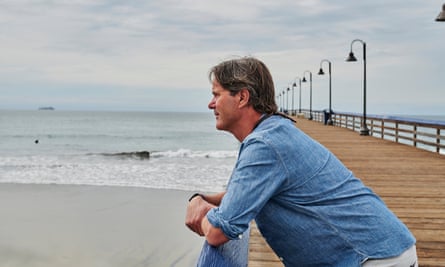
Mayor Dedina looks out to sea. Photograph: John Francis Peters/The Guardian
The manufacturing trade group was behind the efforts to obtain data from Dedina’s phone and documents in 2018. In its public disclosure request to the mayor’s office, NAM called Imperial Beach’s lawsuit “litigation based on political or ideological objections more appropriately addressed through the political process”.
Exxon is attempting to use a Texas law that allows corporations to go on a fishing expedition for incriminating evidence by questioning individuals under oath even before any legal action is filed against them. The company is trying to force Dedina, two other members of Imperial Beach’s government, and officials from other jurisdictions, to submit to questioning on the grounds they were joined in a conspiracy against the oil industry.
“A collection of special interests and opportunistic politicians are abusing law enforcement authority and legal process to impose their viewpoint on climate change,”the oil firm claimed. “ExxonMobil finds itself directly in that conspiracy’s crosshairs.”
[
How cities and states could finally hold fossil fuel companies accountable
Read more](https://www.theguardian.com/environment/ng-interactive/2021/jun/30/climate-crimes-fossil-fuels-cities-states-interactive)
A Texas district judge approved the request to depose Dedina, but then a court of appeals overturned the decision last year. The state supreme court is considering whether to take up the case.
The target on Dedina is part of a wider pattern of retaliation against those suing Exxon and other oil companies.
In an unusual move in 2016, Exxon persuaded a Texas judge to order the attorney general of Massachusetts, Maura Healey, to travel to Dallas to be deposed about her motives for investigating the company for alleged fraud for suppressing evidence on climate change. The judge also ordered that New York’s attorney general, Eric Schneiderman, be “available” in Dallas on the same day in case Exxon wanted to question him about a similar investigation.
Healey accused Exxon of trying to “squash the prerogative of state attorneys general to do their jobs”. The judge reversed the deposition order a month later and Healey filed a lawsuit against the company in 2019, which is still awaiting trial.
But similar tactics persuaded the US Virgin Islands attorney general to shut down his investigation of the oil giant.
Patrick Parenteau, a law professor and former director of the Environmental Law Center at Vermont law school, said the attempt to question Dedina and other officials is part of a broader strategy by the oil industry to counter lawsuits with its own litigation.
“These cases are frivolous and vexatious. Intimidation is the goal. Just making it cost a lot and be painful to take on Exxon. They think that if they make the case painful enough, Imperial Beach will quit,” he said.
The city’s lawsuit claims it faces a ‘significant and dangerous sea-level rise’. Photograph: John Francis Peters/The Guardian
If the intent is to kill off the litigation against the oil industry, it’s not working. Officials from other municipalities have called Exxon’s move “repugnant”, “a sham” and “outrageous”, and have vowed to press on with their lawsuits.
Dedina described the action as a “bullying tactic” by the oil industry to avoid accountability.
“The only conspiracy is [that] a bunch of suits and fossil-fuel companies decided to pollute the earth and make climate change worse, and then lie about it,” he said. “They make more money than our entire city has in a year.”
The city’s lawsuit claims it faces a “significant and dangerous sea-level rise” through the rest of this century that threatens its existence. Imperial Beachcommissioned an analysis of its vulnerability to rising sea levels which concluded that nearly 700 homes and businesses were threatened at a cost of more than $100m. It said that flooding will hit about 40% of the city’s roads, including some that will be under water for long periods. Two elementary schools will have to be moved. The city’s beach, regarded as one of the best sites for surfing on the California coast, is being eroded by about a foot a year.
Imperial Beach sits at the southern end of San Diego bay. Under one worst-case scenario, the bay could merge with the Tijuana River estuary to the south and permanently submerge much of the city’s housing and roads.
A view of the Tijuana River estuary. Photograph: John Francis Peters/The Guardian
The city has received some help with creating natural climate barriers. The Fish and Wildlife Service restored 400 acres of wetland next to the city as a national wildlife refuge which also acts as a barrier to flooding, and is expected to restore other wetlands together with the Port of San Diego. A grant is paying for improved equipment to warn of floods.
But that still leaves the huge costs of building new schools and drainage systems, and adapting other infrastructure. Dedina said that without the oil companies stumping up, it won’t happen.
“People ask, how did you go against the world’s largest fossil fuel companies? Isn’t that scary? No. What’s scary is coastal flooding and the idea that whole cities would be under water,” said the mayor.
“Honestly, bring it on. I can’t wait to make our case. I can’t wait to take the fight to them because we have nothing to lose.”
===
===
7 Things You Need to Know About ETP’s Lawsuit Against Greenpeace - Greenpeace USA
12 2017
Learn how an abusive lawsuit is part of a dangerous trend of companies trying to silence dissent.
Energy Transfer Partners (ETP) – the company behind the Dakota Access Pipeline – has filed a lawsuit against Greenpeace and others, in its latest attempt to silence advocacy work and attack the fundamental right to free speech.
In response to the powerful alliance of Indigenous communities and climate activists who stood in opposition to the Dakota Access pipeline at Standing Rock, ETP has filed this SLAPP lawsuit claiming nearly a billion dollars in damages. on behalf of Energy Transfer. Here’s what you need to know about the suit.

A phalanx of National Guard and police advance toward water protectors in Standing Rock.
1. What is a ‘SLAPP’ suit?
SLAPP stands for “Strategic Lawsuit Against Public Participation.” As the name implies, corporations, using this tactic are trying to shut down public participation. SLAPPs are generally filed without any kind of legal merit. The purpose of a SLAPP is to censor, intimidate, and silence critics by burdening them with legal claims and costs until they’re forced to abandon their criticism or opposition.
2. Why is ETP using a SLAPP?
ETP is SLAPPing its critics in an attempt to shut them up – or even better, to shut them down. ETP is suing Greenpeace for at least USD $900million. The corporation’s hope is that the prospect of having to pay this – or at least of spending a lot of time and legal costs on fighting the lawsuit – will intimidate Greenpeace and others into silence.
The goal of this suit is to silence opposition by misrepresenting what happened on the ground at Standing Rock — making outrageous and racist claims that big environmental organizations like Greenpeace orchestrated the Indigenous-led movement at Standing Rock.
3. This is a worrying trend
In 2016, Canadian company Resolute filed a SLAPP suit against Greenpeace, which was dismissed in full by a US federal judge. But the use of this dirty tactic by corporations is on the rise. As we face an upswing in a new global right-wing agenda, governments and corporations around the world are attempting to chip away at free speech. And it’s not just about environmental groups, either. The SLAPP suit is designed to send a loud message so that any activist or public-interest advocacy group that takes on giant corporations will have to think twice before standing up for what they believe in.
4. Who’s behind this suit
Just like the Resolute case, this one was filed by Michael Bowe. Bowe is also a member of Trump’s personal legal team, and part of the law firm Kasowitz Benson Torres – founded and run by Marc E. Kasowitz, Trump’s personal lawyer. The Times once described Kasowitz as “the Donald Trump of lawyering”. Bowe has publicly stated that he’s in conversations with other corporations considering filing their own SLAPPs against Greenpeace – suggesting this bullying and anti-democratic tactic is being shopped around to the highest bidder.
5. This is not a one-off.
There are many, many examples of SLAPP suits, here are a couple you may have heard of.
Earlier this year, coal magnate Bob Murray sued John Oliver after*Last Week Tonight*ran a segment on Coal – which prominently featured Murray. In the last 15 years, Murray and/or his company have also sued various other journalists.
The ACLU represented individuals in Uniontown, Alabama — a poor town predominantly made up of people of color — who were sued by Green Group Holdings for $30 million for standing up to a coal ash landfill in their town. The company revealed its motives when its lawyers approached the individuals in an attempt to cut a deal – if they agreed to give Green Group access to their electronic devices, access to their future social media postings, and extensive details about their group’s membership, advocacy and communications with other environmental groups.
Due to public outcry and the support of the ACLU, the residents reached a settlement in February and Green Group Holdings agreed to better environmental protections — but they shouldn’t have had to deal with this corporate bullying in the first place. There are hundreds of others across America and beyond who won’t be so lucky.
People march in support of the Standing Rock Nation at the Civic Center Plaza of San Francisco. The protest was one of many in a global day of action against the Dakota Access Pipeline (DAPL) calling on the U.S. Army Corps of Engineers to cancel the permit for the project.
6. They’re clutching at straws… [vid]
Just like in the , ETP is using the Racketeering Influenced and Corrupt Organizations Act (RICO) – a law which was originally created to prosecute the mafia – to claim treble damages and inflate the amount of money it is able to demand. In their lawsuit, ETP claims thatGreenpeace led a corrupt environmentalist enterprise that “cynically planted radical, violent eco-terrorists on the ground amongst the protesters, and directly funded their operations” – a baseless attempt to mislabel legal advocacy as criminal conduct through the use of these racketeering laws, and present constitutionally-protected free speech as defamatory. It’s as ridiculous as it sounds…
7. We can fight this
ETP and other corporate bullies are blatantly trying to stifle free speech and our right to peacefully protest. So let’s show them that that’s not going to happen: Refuse to be silent. Defend free speech. And let’s continue standing up for what is right.
You can take action against this SLAPP here and find more information about how you can fight back against SLAPPs generally.
===
===
Exxon’s Conspiracy Charges Aim To Derail Climate Lawsuits - DeSmog
by David Halperin, crossposted from Republic Report
Oil giant ExxonMobil is engaged in unprecedented efforts to sue and harass in court the very people who are investigating and suing the company over global warming. Faced with determined efforts by states and localities to hold it and other fossil fuel companies accountable for contributing to, and concealing the evidence of, climate change, Exxon is crying foul, contending that it’s the victim of politically- and financially-motivated conspiracies.
But in reality there are no improper schemes behind the cases against Exxon. Instead, what’s troubling is an apparent effort by Exxon, one of the world’s wealthiest corporations, and its powerhouse corporate lawyers, to avoid a courtroom reckoning by making specious legal arguments and outspending their foes in the legal arena.
Through its attorneys at New York’s Paul Weiss Rifkin Wharton and Garrison, and Texas-based firms Haynes & Boone and Cantey Hanger, ExxonMobil has sued the attorneys general of Massachusetts, New York, and the U.S. Virgin Islands. And the company has recently targeted for depositions and document subpoenas, and threats of more lawsuits, numerous state officials, private attorneys, and advocates.
Exxon’s legal counterattack began after the Massachusetts, New York, and Virgin Islands AGs started investigating whether Exxon misled consumers and investors about the dangers of global warming and the potential impact of those dangers on the company’s bottom line. Investigative reporting in 2015 showed that Exxon scientists have known, and told Exxon management for decades, that burning fossil fuels was heating up the planet, but rather than educate the public on the dangers and change its business strategy, Exxon instead spent millions supporting efforts to question and deny the science of climate change. The state AGs also started investigating whether ExxonMobil has properly accounted for its oil reserves in the wake of global price drops and evidence of global warming.
The Massachusetts AG, Maura Healey, has explained that her investigation focuses “on whether Exxon may have misled consumers and/or investors with respect to the impact of fossil fuels on climate change, and climate change-driven risks to Exxon’s business,” in marketing energy products and in marketing Exxon securities, in violation of the state consumer protection law.
Similarly, New York’s AG, Eric Schneiderman, has indicated that he is investigating whether ExxonMobil’s public statements about climate change conflicted with its internal research, which could have led to “state law violations, including under the Martin Act,” the New York law that prohibits financial deception and fraud. (The New York AG reached settlements with Xcel Energy and Dynegy, Inc. in 2008 and with AES Corp. in 2009 based on those companies’ failures to disclose climate change risks in securities filings.)
In 2016, Exxon launched its response, suing Healey, Schneiderman, and U.S. Virgin Islands attorney general Claude Earl Walker in federal courts in its home region of Dallas-Fort Worth. The suit against Walker succeeded when his small office halted its investigation of the oil titan, but the other two AGs persisted.
U.S. District Judge Ed Kinkeade approved Exxon’s demand that Healey and Schneiderman submit to depositions by Exxon lawyers — an unwarranted, and virtually unprecedented move, as prosecutors aren’t normally required to face cross examination by people whom they’re investigating. Healey and Schneiderman fought back, seeking an unusual mid-case appeal to the 5th Circuit U.S. Court of Appeals, after which Kinkeade backed down, cancelled the depositions, and transferred the case to a federal court in New York.
As Exxon continues its efforts to convince a Manhattan federal judge to allow it to depose the two state AGs and, ultimately, to block their probes, it faces a new wave of lawsuits: since September 2017, eight cities and counties in California, plus New York City, have sued Exxon and other fossil fuel companies, alleging harm to their communities from climate change.
Related DeSmog investigation: “There is no doubt”: Exxon Knew CO2 Pollution Was A Global Threat By Late 1970s
The new lawsuits brought by California cities and counties — the cities of San Francisco, Oakland, Santa Cruz, Richmond, and Imperial Beach, plus Santa Cruz, San Mateo, and Marin counties — could pack a powerful punch. The suits allege that ExxonMobil, Chevron, ConocoPhillips, BP, Royal Dutch Shell, and others knew for decades that fossil fuel-driven global warming and rising seas threatened human life, but continued to expand their production, while deceiving consumers about the risks. Asserting that this conduct violates various state tort rules — public nuisance, failure to warn, design defect, negligence, and trespass — the suits demand that the companies pay for the costs of environmental harms like damages to seawalls, and dangers from severe weather, droughts, and fires.
These new lawsuits have a stronger chance of success than a 2008 case filed against fossil fuel companies by the small Alaskan community of Kivalina, seeking to recover the cost of relocating their village, which was threatened by rising sea levels. A federal judge dismissed that case, concluding that the village could not trace its injuries to any particular defendant. But today there is much more evidence that global warming is real, accelerating, and caused by burning fossil fuels, and that oil companies knew such information, suppressed it, and sought to counter it. Also, lawyers for the California cities and counties believe that recent scientific advances will make it easier to prove that the specific defendants’ activities harmed or threaten their client communities.
Faced with these mounting challenges to its conduct, ExxonMobil is relentlessly trying to change the subject.
In legal papers and public communications attacking the New York and Massachusetts attorney general investigations, Exxon has charged that various meetings among lawyers, advocates, and charitable foundation officials to discuss climate change liability issues, and communications between such people and attorneys general offices, are evidence of an untoward conspiracy against the company. Exxon further alleges that the AG probes attack the company’s First Amendment rights. “The attorneys general have violated Exxon Mobil’s right to participate in the national conversation about how to address the risks presented by climate change,” Dan Toal, one of Exxon’s lawyers at the Paul Weiss firm told Bloomberg.
Now Exxon and its allies are aiming to tie the new California lawsuits into this alleged conspiracy. The company is seeking to depose more than a dozen California officials, plus private attorney Matt Pawa, in anticipation of a threatened lawsuit alleging violation of the company’s free speech and other constitutional rights. In a January 8 Texas court petition seeking the depositions, Exxon charges, “A collection of special interests and opportunistic politicians are abusing law enforcement authority and legal process to impose their viewpoint on climate change.”
A recent op-ed by New York business consultant John Burnett attacked some of the California cities and counties for hiring outside lawyers to sue Exxon and paying them on a contingent basis — meaning they get paid if and only if Exxon loses in court or settles — even though this consultant acknowledges that the cities and counties couldn’t afford to pay the lawyers any other way. He calls the arrangement “a perilous new frontier in the world of ambulance-chasing by elected officials.” Similarly, Linda Kelly, general counsel for the National Manufacturers Association, told a reporter, “From Richmond, California, to New York City, activist-driven lawsuits are being filed to undermine manufacturers in America without regard to the facts.”
But these counterattacks on those pursuing Exxon are themselves fueled by false information and unwarranted charges.
I’ve worked for many years in association with some of the people Exxon has claimed are part of the alleged conspiracy. They aren’t conspirators. They generally do their work and make their cases out in the open. A 2012 meeting in La Jolla, California, among private lawyers and climate experts that Exxon repeatedly cites as the birthplace of the secret plot was meticulously documented and photographed by the participants themselves.
There’s also nothing sinister or unusual about scientists, private lawyers, other experts, or simply concerned citizens providing evidence and arguments to state attorney general offices regarding potential legal violations, including, indeed especially, in complex matters involving powerful actors. There’s nothing wrong with state and local law enforcement officials working in parallel on probing a common issue or target — it happens frequently. Nor are public statements by officials regarding those probes proof of political bias or an impingement on Exxon’s First Amendment rights. And nor is it unusual or improper for local governments to hire private lawyers to protect their residents’ interests in court.
The AGs and local officials are doing their jobs — pursuing evidence of law-breaking. If Exxon believes it has behaved properly with respect to climate change, it should use its expensive and talented lawyers to defend itself on the merits, rather than harassing others over invented conspiracy theories.
--
ref
...With Exxon CEO In Trump Spotlight, A Primer On The Company's Climate Court Fight
[
By David Halperin, Contributor
Attorney, advocate, writer at RepublicReport.org
Dec 12, 2016, 05:24 PM EST
|Updated Dec 13, 2017
This post was published on the now-closed HuffPost Contributor platform. Contributors control their own work and posted freely to our site. If you need to flag this entry as abusive, send us an email.
Donald Trump's public contemplation of picking ExxonMobil CEO Rex Tillerson to be U.S. Secretary of State raises a range of controversies, including Tillerson's dealmaking with Russia and close ties to Vladimir Putin. It also intensifies attention on ExxonMobil's escalating court battle with the attorneys general of New York and Massachusetts over the question of whether the company improperly concealed information about climate change.
Just today, a federal judge in Texas, Ed Kinkeade, cancelled his controversial order directing the Massachusetts AG, Maura Healey, to come to his Dallas courtroom tomorrow morning to be questioned by ExxonMobil's lawyers.
Here's a summary of ExxonMobil's legal dispute with the attorneys general, so far:
Investigative reporting in the past year demonstratedthat Exxon scientists have known and had told Exxon management for decades that burning fossil fuels was heating up the planet. But rather than educate the public on the dangers and change its business strategy, Exxon instead spent millions supporting efforts to question and deny the science of climate change. There also are questions as to whether ExxonMobil has properly accounted for its oil reserves in the wake of global price drops and evidence of global warming.
Responding to those reports and other evidence, New York attorney general Eric Schneiderman issued a subpoena to ExxonMobil in November 2015. ExxonMobil has produced more than 700,000 pages of documents to Schneiderman in response to his subpoena. On October 26, 2016, a New York judge ordered ExxonMobil and its auditor, PwC, to comply with a subpoena issued by Schneiderman seeking additional information regarding PwC's auditing of the oil company.
A group of state attorneys general met in New York on March 29, 2016, and consulted with several outside lawyers and experts on climate change issues. Following the meeting, the AGs, along with former Vice President Al Gore, held a press conference under the banner "AGs United for Clean Power" and announced they had formed a coalition to investigate ExxonMobil's conduct. The coalition included the attorneys general of California, Connecticut, Illinois, Iowa, Maine, Maryland, Massachusetts, Minnesota, New Mexico, New York, Oregon, Rhode Island, Virginia, Vermont, Washington, the District Of Columbia, and the U.S. Virgin Islands.
Soon after, in April 2016, Massachusetts attorney general Maura Healey issued a civil investigative demand (CID) to ExxonMobil. U.S. Virgin Islands attorney general Claude Walker issued a subpoena to the company the same month.
ExxonMobil promptly sued Walker in Texas state court in Fort Worth to block the Virgin Islands subpoena.
Then, on June 15, 2016, ExxonMobil sued Healey in federal court in Dallas to block her civil investigative demand.
On June 29, Walker, facing expensive litigation against ExxonMobil's legal team, agreed to withdraw his subpoena, and Exxon dropped its suit. Walker said then that he planned to continue to investigate ExxonMobil and would keep his eye on Healey's effort.
ExxonMobil argues in its suit against Healey that the Massachusetts AG is acting out of political motivation, and there is no legitimate basis for the AG probes, and that the First Amendment shields the company from scrutiny for its public statements -- a claim that leading constitutional law experts sharply dispute, because it is a settled legal principle that the First Amendment doesn't protect fraud.
In August 2016, fourteen attorneys general -- from Maryland, New York, Illinois, Iowa, Maine, Minnesota, Mississippi, New Mexico, Oregon, Rhode Island, Vermont, Washington, the District of Columbia, and Virgin Islands -- filed a friend-of-the-court brief supporting Healey, while eleven AGs -- Texas, Louisiana, South Carolina, Alabama, Michigan, Arizona, Wisconsin, Nebraska, Oklahoma, Utah, and Nevada -- filed a brief supporting ExxonMobil.
On October 13, citing ExxonMobil's arguments, U.S. District Judge Ed Kinkeade issued an order permitting ExxonMobil to take limited discovery regarding attorney general Healey's comments and actions, in order to examine whether Healey served the CID in bad faith. Armed with this ruling, ExxonMobil, on October 24, served on attorney general Healey more than a hundred discovery requests.
Exxon also asked Judge Kinkeade for permission to add New York attorney general Schneiderman as a defendant in the case, a motion the judge granted. On November 4, ExxonMobil sought depositions of Healey, Schneiderman, and two assistant attorneys general in each of their offices.
On November 17, Judge Kinkeade issued an order directing Healey and Schneiderman to come to his courtroom in Dallas on December 13 to face depositions from ExxonMobil's legal team.
On November 29, Exxon withdrew its deposition notice for Schneiderman; it continues to seek other discovery from Schneiderman's office, including depositions of two top environmental enforcement officials in that office.
ExxonMobil also has subpoenaed in the Texas lawsuit some of the non-profit organizations and lawyers who have provided Healey and Schneiderman with information and expertise regarding the matter.
Healey said she would "vigorously oppose" Judge Kinkeade's order for her to be deposed. "Our position in this ligation is that the authorities in Texas, and specifically the federal court down there, has no jurisdiction over state attorneys general and the work of their offices," Healey told reporters in Boston on November 21. "It's been disappointing to see Exxon fight the request for basic information. Our job as attorneys general is to be able to ask questions."
Healey filed amotion asking the judge to reconsider his rulings. On December 6, 2016, Healey petitioned the United States Court of Appeals for the 5th Circuit for a writ of mandamus to reverse the order.
Schneiderman, as well as the outside groups and lawyers, are also opposing Exxon's efforts to take discovery in the Texas case. (Disclosure: I have advised some of these groups.)
On December 9, Judge Kinkeade denied Healey's motion to suspend Exxon's discovery in the case pending review by the 5th Circuit and also denied Schneiderman's motion to quash discovery.
On December 9, Schneiderman filed a motion with Judge Kinkeade to stay discovery against him pending appellate review -- the same type of motion that Kinkeade had denied Healey earlier that same day. In his papers, Schneiderman said that he intended to seek mandamus before the 5th Circuit on December 12.
On December 12, Judge Kinkeade issued a one-line order cancelling his prior order that Healey be deposed on December 13. The judge did not block any other discovery or indicate whether or when he would revisit the issue of deposing Healey.
ExxonMobil's lawsuit is a virtually unprecedented effort by a corporation to sue and investigate state prosecutors who are conducting an investigation of that corporation. Although Judge Kinkeade stated that he found sufficient grounds for ExxonMobil to investigate whether the AGs had acted in bad faith, in fact the AGs have been engaged in activities that are commonplace and entirely appropriate for state prosecutors: (1) cooperating with AGs from other states, (2) consulting with experts about possible unlawful activity, (3) seeking documents to investigate that activity, and (4) speaking in public about the matters under review.
To the extent that ExxonMobil has substantive and procedural objections to the attorneys general demands for information, it has every right to raise those objections in the Massachusetts and New York state courts, and indeed ExxonMobil is already doing just that.
ExxonMobil now also faces an investigation from the U.S. Securities and Exchange Commission, initiated in August 2016, examining a similar set of issues. In addition, in January 2016, the U.S. Department of Justice, responding to a congressional request to investigate ExxonMobil, referred the matter to the FBI.
Meanwhile, U.S. Representative Lamar Smith (R-TX), chairman of the House Science Committee, has subpoenaed documents from Healey, Schneiderman, and other state attorneys general, as well as lawyers and outside groups connected to the ExxonMobil matter. Over the summer, Smith held a committee hearing regarding his demands. For the most part, the AGs, groups, and attorneys have declined to provide any information in response to the subpoenas.
UPDATE 12-14-16: The U.S. Court of Appeals for the 5th Circuit yesterday dismissed Healey's mandamus petition and motion for a stay of Judge Kinkeade's orders as moot, meaning overtaken by events. It's unclear how the 5th Circuit judges think Healey's claims are moot, when all Judge Kinkeade did was cancel the deposition of Healey set for December 13; he didn't expressly stop all the other discovery that was part of Healey's motion. However, when he cancelled the Healey deposition, Judge Kinkeade issued a separate order directing all parties to submit new briefs by January 4 on the issue of whether his court has personal jurisdiction over the two AGs -- suggesting he might be reconsidering issues in the case.
UPDATE 12-15-16: This morning Judge Kinkeade has issued a one-line order: "The Court hereby stays all discovery pending further order from this Court." Coupled with his order Monday cancelling Exxon's deposition of Attorney General Healey, this represents a dramatic reversal by Judge Kinkeade of his unusual prior rulings favoring ExxonMobil. The reversal came after Healey had petitioned the U.S. Court of Appeals to block Kinkeade's orders (and of course after Trump's nomination of Tillerson increased public scrutiny of the matter). But this could be only a temporary reversal while Judge Kinkeade reconsiders some of the legal issues, including whether he has jurisdiction over the AGs in the first place.
*This article also appears on Republic Report.
===
===
GGL 7 24
[### Big Oil says government climate change lawsuits are ... - Quartz

qz.com
https://qz.com › exxonmobile-says-government-climate...](https://qz.com/1177685/exxonmobile-says-government-climate-change-lawsuits-are-a-conspiracy-against-the-company)
Jan 12, 2018 — 9 Texas state court filing that “a collection of special interests and opportunistic politicians are abusing law enforcement authority and ...
[### New York City's suit against oil companies sparks mixed reaction

新华网
http://www.xinhuanet.com › english](http://www.xinhuanet.com/english/2018-01/13/c_136893184.htm)
Exxon said Monday that "a collection of special interests and opportunistic politicians are abusing law enforcement authority and legal process to impose ...
[### Another Candidate For Stupidest Litigation In The Country

Manhattan Contrarian
https://www.manhattancontrarian.com › blog › another-...](https://www.manhattancontrarian.com/blog/2018/1/24/another-candidate-for-stupidest-litigation-in-the-country)
Jan 24, 2018 — A collection of special interests and opportunistic politicians are abusing law enforcement authority and legal process to impose their ...
[### A US small-town mayor sued the oil industry. Then Exxon ...

The Guardian
https://www.theguardian.com › environment › oct › im...](https://www.theguardian.com/environment/2021/oct/16/imperial-beach-california-exxon-mobil-climate-crisis)
Oct 16, 2021 — “A collection of special interests and opportunistic politicians are abusing law enforcement authority and legal process to impose their ...
[### Exxon's Conspiracy Charges Aim To Derail Climate Lawsuits

DeSmog
https://www.desmog.com › 2018/02/20 › exxon-s-cons...](https://www.desmog.com/2018/02/20/exxon-s-conspiracy-charges-aim-derail-climate-lawsuits/)
Feb 20, 2018 — ... A collection of special interests and opportunistic politicians are abusing law enforcement authority and legal process to impose their ...
[### Exxon blames California, New York in 'conspiracy ...

Fox Business
https://www.foxbusiness.com › politics › exxon-blames-...](https://www.foxbusiness.com/politics/exxon-blames-california-new-york-in-conspiracy-countersuit)
Feb 14, 2018 — “A collection of special interests and opportunistic politicians are abusing law enforcement authority and legal process to impose their ...
[### How Exxon Uses The Courts To Silence Opponents

CleanTechnica
https://cleantechnica.com › 2021/10/18 › how-exxon-us...](https://cleantechnica.com/2021/10/18/how-exxon-uses-the-courts-to-silence-opponents/)
Oct 18, 2021 — “A collection of special interests and opportunistic politicians are abusing law enforcement authority and legal process to impose their ...
[### Exxomobil petition for pre-suit deposition of 16 individuals

Business & Human Rights Resource Centre
https://www.business-humanrights.org › latest-news › e...](https://www.business-humanrights.org/en/latest-news/exxomobil-petition-for-pre-suit-deposition-of-16-individuals/)
A collection of special interests and opportunistic politicians are abusing law enforcement authority and legal process to impose their viewpoint on climate ...
[### NYC's suit against oil companies sparks mixed reaction

Business Standard
https://www.business-standard.com › India News](https://www.business-standard.com/article/news-ians/nyc-s-suit-against-oil-companies-sparks-mixed-reaction-118011300504_1.html)
Exxon said on Monday that "a collection of special interests and opportunistic politicians are abusing law enforcement authority and legal process to impose ...
[### Yes, Exxon Is Accusing Local Governments of Misleading ...

DeSmog
https://www.desmog.com › 2018/03/10 › exxon-accuse...](https://www.desmog.com/2018/03/10/exxon-accuses-california-cities-misleading-investors-climate-change/)
Mar 10, 2018 — ... A collection of special interests and opportunistic politicians are abusing law enforcement authority and legal process to impose their ...
:===
an 7 24
Iowa Attorney General Brenna Bird filed an amicus brief Wednesday calling for the U.S. Supreme Court to take up Missouri Attorney General Andrew Bailey’s challenge of former President Donald Trump’s prosecution in the New York hush-money trial.
Bailey, a Missouri Republican, filed a lawsuit earlier in July against the state of New York, seeking to lift the gag order imposed on Trump during the trial where he was found guilty on 34 felony counts of falsifying business records to cover up hush-money payments during the 2016 presidential campaign season.
The lawsuit seeks to delay sentencing for Trump’s conviction in the case until after the November election, where the former president faces a rematch with President Joe Biden.
While Trump was found guilty in the New York criminal trial, the Supreme Court ruled in July that U.S. presidents have full immunity from criminal charges for official “core constitutional” acts while in office, but not for unofficial acts. The decision sent Trump’s election interference case, where he stands accused of scheming to overturn the 2020 presidential results, back to the lower courts.
The Missouri lawsuit, filed one day after the ruling on presidential immunity, claims the state of New York violated Missourians’ First Amendment rights by issuing a gag order in Trump’s criminal case and preventing voters from hearing the views of a presidential candidate in the 2024 election.
“This lawfare is poisonous to American democracy,” Bailey wrote in the lawsuit. “The American people ought to be able to participate in a presidential election free from New York’s interference. Any gag order and sentence should be stayed until after the election.”
Bird and Florida Attorney General Ashley Moody filed a brief supporting the Missouri lawsuit on Wednesday. Joined by Alaska and Montana, the state attorneys general argued that Trump is the “target of a prosecution by a New York County district attorney” in the hush-money case.
In a news release, Bird claimed New York District Attorney Alvin Bragg, a Democrat, has used the trial for political gain, citing a New York Times article on his statements about Trump.
“As a prosecutor, I know that politics has no place in criminal prosecutions,” Bird said. “I am calling on the U.S. Supreme Court to hear the case against New York’s political prosecution, gag order, and sentencing of President Trump that interfere with the presidential election. We must protect free and fair elections and the rule of law.”
The sentencing in the New York case has been delayed until Sept. 18 by New York Justice Juan Merchan, who oversaw the case, so the court has time to hear arguments about how the U.S. Supreme Court’s decision impacts state-level convictions.
Iowa Capital Dispatch is part of States Newsroom, a nonprofit news network supported by grants and a coalition of donors as a 501c(3) public charity. Iowa Capital Dispatch maintains editorial independence. Contact Editor Kathie Obradovich for questions: info@iowacapitaldispatch.com. Follow Iowa Capital Dispatch on Facebook and X.
---
NPR?
An election partnership that Wilcox helps lead has even stopped advertising a service that allows local officials to report false voting information online, for fear of conservative backlash — a sign of broader concerns of those who work to safeguard elections as America nears another round of presidential voting.
Experts say a campaign of legal and political pressure from the right has cast efforts to combat rumors and conspiracy theories as censorship. And as a result, they say, the tools and partnerships that tried to flag and tamp down on falsehoods in recent election cycles have been scaled back or dismantled. That's even as threats loom from foreign governments and artificial intelligence, and as former President Donald Trump, who still falsely claims to have won the 2020 contest, is likely to use the same tactics again as he pursues the White House in 2024.
Added Wilcox: "Everybody is gun-shy."
"Open season"
As Nina Jankowicz sees it, the opening salvo came in the spring of 2022, when a right-wing campaign quickly snuffed out a Department of Homeland Security initiative called the Disinformation Governance Board.
POLITICS
She joined DHS to fight disinformation. She says she was halted by... disinformation
Jankowicz, who has written books about Russian information operations and online harassment, was tapped to lead the board. The federal government described it as a working group, without "any operational authority or capability," tasked with coordinating efforts to identify false and misleading claims and share facts about security concerns, from elections to natural disasters.
But the combination of the board's ominous-sounding name and DHS's poor efforts to communicate its purpose made it catnip for right-wing influencers, who quickly seized on the board and Jankowicz herself as avatars of a nefarious plot to censor Americans.
"The Biden Administration's decision to stand up a 'Ministry of Truth,' is dystopian in design," said now-House Speaker Mike Johnson, R-La., shortly after the board was announced. "The government has no role whatsoever in determining what constitutes truth or acceptable speech."
Supporters of former President Donald Trump look at merchandise ahead of his rally in Hialeah, Fla., this week. Trump continues to falsely claim he won the 2020 election, fueling conspiracy theories around the voting process.
Ricardo Ardeuengo/AFP via Getty Images
After a barrage of death threats and abuse, Jankowicz resigned, and DHS scrapped the board altogether. Jankowicz told NPR that the timid effort by the federal government to defend her or push back against the allegations sent a clear message.
"That showed ... that it was open season on researchers, on civil servants, on anyone who was working in this space," Jankowicz said.
Amid that furor, in May 2022, the Republican attorneys general of Missouri and Louisiana filed a lawsuit accusing the Biden administration of colluding with social media companies to censor conservative speech, by pressing platforms to take action on misleading posts about COVID-19 and elections.
Supreme Court to hear court ban on government contact with social media companies
This July, a Trump-appointed federal judge ruled the government had likely violated the First Amendment and issued a sweeping injunction blocking agencies' communications with platforms about most content. The injunction was narrowed by an appeals court, before being put on hold last month by the Supreme Court, which is slated to hear the case this term.
Pressure is coming from Congress as well, where the House Judiciary Committee's Select Subcommittee on the Weaponization of the Federal Government, led by GOP Rep. Jim Jordan of Ohio, a Trump ally, is conducting its own probe into alleged collusion between the Biden administration and tech companies to unconstitutionally shut down political speech.
===
bully = macho dictator
an 6 24
elon Musk and convicted felon Donald Trump have been in contact several times a month since their private meeting in March at the home of billionaire investor Nelson Peltz, according to The Wall Street Journal.They’re discussing an advisory role for Musk if Trump wins back the White House in November — potentially giving Musk influence over economic policy.
Musk has already briefed Trump about his plans to invest in a data-driven project to prevent voter fraud (which, as I noted yesterday, is almost nonexistent).
And Musk has committed his social media platform, X, to host live video town halls with Trump ahead of the election.
Musk is also using X to spread conspiracy theories that Democrats are intentionally “importing” millions of undocumented immigrants to vote in elections.
READ:**Buckle up for Trump's 'October Surprise'**
Musk has accused Biden of “treason” and claimed that if Democrats win control of the White House and Congress in November, America “will become a permanent one-party deep socialist state.”
What’s Musk’s motive? Not simply more money. Hell, he’s the second-richest man on the planet. He wants more power. Unaccountablepower.One route to unaccountable power is to hitch his fortune to convicted felon Trump.
Musk has been emulating Trump for years.
Consider Trump’s MO of treating underlings like dung. In 2022, Musk fired half of Twitter’s 7,500 employees, including teams devoted to combating election misinformation — and did it so haphazardly and arbitrarily that most had no idea they were fired until their email accounts were shut off.
This was after Musk fired Twitter’s executives “with cause” to avoid paying them the golden parachutes they were owed. And after he taunted Twitter and the law firm it worked with in its lawsuit against him, suggesting he would sue all of them.
Musk’s concern about the dwindling number of people seeing his tweets prompted him to convene a group of engineers to discover why his engagement numbers were tanking. When one of the company’s two remaining principal engineers explained it was likely due to waning public interest in Musk’s antics, Musk fired the engineer.
A few weeks ago, Musk laid off 14,000 Tesla workers. They discovered they no longer had jobs only when their keys to the parking lot no longer worked. In order to receive severance, they had to agree not to participate in any lawsuit or mass arbitration against the company or publicly defame Tesla.
Musk has also been copying Trump’s bombastic ridicule of anyone who gets in his way. When the British diver Vernon Unsworth rejected his help rescuing youth football players trapped in a cave in Thailand, Musk described him as “pedo guy.”
When the Securities and Exchange Commission went after Musk, he tweeted that the “E” in the SEC stands for “Elon’s.” (You can guess what the “S” and “C” stand for.)
Musk has copied Trump’s disregard for the law. During the pandemic, when public health authorities refused Musk permission to reopen his Tesla factory, he did it anyway.
Musk has been just as shameless as Trump when it comes to padding his pockets. In 2018, Musk got the richest pay package in U.S. corporate history, then worth around $56 billion. Earlier this year, a Delaware court voided that pay package, finding that the process to decide on it was “deeply flawed” because Tesla’s board hadn’t properly disclosed it to investors and had “barely” negotiated it with Musk.
In response to the Delaware court’s finding, Tesla’s board (that is, Musk) said it would ask shareholders to vote again on that same pay package at its annual meeting on June 13. In a letter to shareholders, Robyn Denholm, Tesla’s chair, wrote that the Delaware Court’s decision was “fundamentally unfair, and inconsistent with the will of stockholders who voted for it.”
Fundamentally unfair that Musk hadn’t been paid the exorbitant pay package that a court found to be illegal?
In effect, Musk got the giant multibillion-dollar package by extorting Tesla — implying that if the board refused to sign off on it, he’d devote even more of his time to his other businesses, like SpaceX or his xAI startup. The Delaware judge cited a meeting at which the board planned to ask Musk to commit a minimum level of time to Tesla but chickened out because, according to one participant, “‘that would have been like saying goodbye to Elon.’”
Treating employees like dung. Taunting and ridiculing opponents. Refusing to be held accountable or be bound by norms or even laws. Bullying adversaries. Demeaning critics. Craving attention. Self-promoting. Making gobs of money. Impetuous. Unpredictable. Autocratic. Vindictive. Utterly lacking in empathy.
Musk and Trump are different generations, of course. They possess different skills and occupy different roles in the bizarre firmament of America’s billionaire class. But both represent the emergence of a particularly ruthless and dangerous American power monger: the wildly disruptive narcissist.
Their singular goal is to imprint their giant egos on everyone else — to exercise raw power over people. To make others grovel.
They disdain democracy. Their politics might be called, instead, thugocracy.
They demean America with their brazen assertions of untrammeled power to dominate and force others to submit.
We used to call such behavior shameless. Now it’s just what Trump, Musk, and a few other super-rich (Peter Thiel, Bill Ackman, Stephen A. Schwarzman) do. It’s the new norm of the brazenly wealthy.
Shame once reenforced the common good. Through most of human history, survival depended on extended families, clans, and tribes. To be ostracized often meant death.
Charles Darwin, in his book The Expression of the Emotions in Man and Animals, thought shame may have evolved as a way to maintain social trust necessary for the survival of a group and, therefore, of its members.
In a 2012 paper, psychologists Matthew Feinberg and Dacher Keltner and sociologist Robb Willer found evidence that shame and embarrassment function as a kind of “nonverbal apology” for having done something that violates social norms. A display of embarrassment shows others that the embarrassed person is still aware of the group’s expectations and is still committed to the group’s well-being.
“Ignominy is universally acknowledged to be a worse punishment than death,” wrote Benjamin Rush, a signer of the Declaration of Independence who also sought to put an end to public stocks and whipping posts.
But shamelessness has gained a certain elan. Audacity, insolence, and impudence are welcomed. Irreverence is celebrated. Many Americans love Musk’s and Trump’s loutishness.
***
Why are so many Americans enthralled with Musk and Trump? What’s attractive about their thugocracy? Why are billionaires who violate the common good treated like Wild West outlaw heroes?
The answer, I believe, has a lot to do with America’s shameful degree of inequality.
A large portion of the American public projects its needs and fantasies on these billionaire thugs. People who have been bullied their whole lives wantsuperbullies capable of bullying everyone who’s been bullying them.
Read:[Buckle up for Trump's 'October Surprise'
*Robert Reich is a professor at Berkeley and was secretary of labor under Bill Clinton. You can find his writing at https://robertreich.substack.com/.
===
an 3 24
former President Donald Trump will face his first of four criminal trials later this month, and his legal team is now making moves to dissuade the prosecution's top witness from testifying.
Newsweek reported Tuesday that Trump attorney Todd Blanche warned Manhattan District Attorney Alvin Bragg that he would face "serious legal and ethical consequences" if Michael Cohen — who worked as Trump's lawyer and "fixer" for years — takes the witness stand in Manhattan. He also contrasted Bragg's treatment of former Trump Organization chief financial officer Allen Weisselberg (who pleaded guilty to perjury in the civil fraud trial) with his treatment of Cohen.
In his letter to Bragg's office, Blanche accused Cohen of perjury, saying that during his testimony in the civil fraud trial in Judge Arthur Engoron's courtroom, Cohen lied on the stand when asked about whether Trump told him to artificially inflate the values of his properties. Cohen initially said that Trump instructed him to commit fraud, but when defense lawyers cross-examined him, Cohen stated that Trump never actually gave him specific instructions to lie to regulators, but instead strongly insinuated that he do so, like "a mob boss" who "tells you what he wants without specifically telling you."
READ MORE:Michael Cohen predicts Trump will be found 'guilty on all charges' in Manhattan trial
"[The District Attorney's office's] conscious choice to ignore obvious and admitted criminal conduct by Cohen and to instead deploy unethical, strong-armed tactics against an innocent man in his late 70s underscores the irresponsibility of your conduct in office," Blanche wrote. "This dereliction of duty renders you fully unfit to serve as District Attorney, and exposes innocent citizens, like Mr. Weisselberg, to irreparable and life-altering harm."
Weisselberg agreed this week to a plea deal with Bragg's office for perjuring himself both in a 2020 deposition and in Engoron's courtroom in late 2023, regarding false statements he made under oath attempting to distance himself from the former president's fraud scheme. At the time, Forbes reported that Weisselberg said on the stand that he had nothing to do with Trump lying about the size of his Manhattan penthouse apartment at the top of Trump Tower, which was 10,996 square feet but had a valuation based on 30,000 square feet, which was a fabricated figure. But Forbes' review of documents found that Weisselberg was directly involved with the fabrication.
"In 2015, Trump hosted three Forbesjournalists inside Trump Tower, with Weisselberg by his side," Forbes recalled in October of 2023. “'This is the entire floor of Trump Tower, just so you understand,' Trump said, showing off his penthouse. 'Now, this wraps all around the building. All around the elevators. And I have three times three. So there’s like 11,000 feet on a floor. So I have three. So 33,000—and I have the roof.'”
Blanche's effort to cast doubt on Cohen's credibility is likely due to the importance of Cohen's testimony in proving Trump's guilt. In 2018, Cohen was sentenced to three years in federal prison for carrying out the hush money scheme Bragg is now prosecuting Trump for allegedly orchestrating. A DOJ press release about Cohen's sentencing explained how he facilitated hush money payments to adult film star Stormy Daniels in exchange for her silence about the affair she had with then-candidate Trump shortly after his wife, Melania, gave birth to their son, Barron.
READ MORE:Why 'Michael Cohen issue is a concern' in latest Trump gag request: legal expert
"COHEN made a $130,000 payment to [Daniels] through an LLC he incorporated for the purpose of making the payment. COHEN was reimbursed for the latter payment in monthly installments disguised as payments for legal services performed pursuant to a retainer, when in fact no such retainer existed," the press release read. "COHEN made or caused both of these payments in order to influence the 2016 election and did so in coordination with one or more members of the campaign."
The DOJ stating that Cohen made those payments for the express purpose of influencing the 2016 election is a key element of Bragg's prosecution. Typically, falsification of business records is only a misdemeanor in New York. However, Bragg has escalated the charges against Trump to felonies under the premise that the alleged falsification of business records related to the Daniels payment constituted a campaign finance violation, as it was done to advance his presidential campaign. A contribution amounting to $130,000 is well above the maximum allowable individual donation.
Trump's Manhattan trial is scheduled to begin on March 25. If he's found guilty of any of the 34 felony charges he's facing in New York, he would be unable to pardon himself if elected president in November, as his pardon powers only extend to federal crimes.
READ MORE:Michael Cohen: Trump's 'embarrassing' financial woes are shredding his 'ego'
---
===
newsweek has fairness meter/poll?]
billionaire Dan Snyder thought he was funding a movie that would portray former President Donald Trump in a positive light, but he is now reportedly fuming to learn the opposite is true.
The former owner of NFL team Washington Commanders invested in the film The Apprentice, in which Sebastian Stan portrays a young Trump.
The Apprenticepremiered this week at the Cannes Film Festival in France to a reported 11-minute standing ovation, and Snyder was one of the few people who had insight into the plot before its launch.
He is said to be furious at the portrayal of Trump, according to Variety.
Snyder has been a major donor to Trump's presidential campaigns, contributing more than $1.1 million in 2016 and $100,000 in 2020. It is unclear if he has donated to Trump's 2024 campaign.
The movie tells the story of Trump's younger years, including his relationship with political fixer Roy Cohn (Jeremy Strong) and his marriage to his first wife, Ivana (Maria Bakalova).
But a Snyder-backed company called Kinetics has gone to war with The Apprentice'sfilmmakers, including director Ali Abbasi, in hopes of changing the film.
Kinetics' boss, Emanuel Nuñez, told Variety that the conflict over the film was entirely between it and the filmmakers and that Snyder was not involved.
"All creative and business decisions involving The Apprentice have always been and continue to be solely made by Kinematics. Mark and I run our company without the involvement of any other third parties," he said.
READ MORE Donald Trump
Joe Rogan Fact Checks Himself Over His Hillary Clinton Remark
- ### Bill Maher Gets Into Awkward Spat With Megyn Kelly
- ### Jimmy Kimmel Roasts Donald Trump 'Unified Reich' Video
- ### Joe Exotic Says He's 'More Real' Than Trump, Biden Amid Presidential Bid
Newsweek reached out to Snyder and Trump via email for comment.
According to the media report, sources close to the drama said the film includes a scene where Trump sexually assaults his wife, Ivana, describing it as "violent" and "uncomfortable."
Ivana, who passed away in 2022, previously claimed during a deposition for their divorce that Trump had raped her while they were married. But she told CNN in a 2015 statement that, "The story is totally without merit. Donald and I are the best of friends and together have raised three children that we love and are very proud of."
Washington Commanders owner Dan Snyder at a game in in Landover, Maryland, on November 16, 2014. Snyder, a Donald Trump donor, has been mocked for funding an anti-Trump movie. PATRICK MCDERMOTT/GETTY IMAGES
Snyder was mocked on X, formerly Twitter, after the news broke.
"BREAKING: A billionaire Donald Trump donor humiliates himself on the world stage as he realizes far too late that the movie he funded is actually anti-Trump — and then tries to scuttle it. This is just too funny..." wrote the official Occupy Democrats account, adding, "Apparently, Snyder mistakenly believed that he was funding a pro-Trump propaganda film."
"An insider told Variety that Snyder is furious about the film and has his lawyers working to block its release with desperate cease-and-desist letters and might skip the premiere," the post continued.
"Unfortunately for Snyder (and Trump), they have no control over the movie at this point. It will be released as planned."
Andy Barr, the managing director of Uplift, a media firm for Democratic campaigns and progressive political organizations, according to its website, posted, "Dan Snyder is an unintentional comedic genius."
But some defended Snyder and Trump, arguing it does not matter how a fictional film portrays the former president.
"Let's put it this way we do not give a dam about flattering etc we want a strong president with guts and that is Trump," wrote @Carol96208870.
"Dan Snyder probably isn't the only investor who financially supported a movie, then was surprised how different the finished movie was from what he expected," said @starwolf_oakley.
Snyder is not the only person unhappy with the movie. Trump plans to sue the filmmakers.
"We will be filing a lawsuit to address the blatantly false assertions from these pretend filmmakers," Trump's spokesperson, Steven Cheung, told Variety.
"This garbage is pure fiction which sensationalizes lies that have been long debunked. As with the illegal Biden Trials, this is election interference by Hollywood elites, who know that President Trump will retake the White House and beat their candidate of choice because nothing they have done has worked."
===
===
an 5 24
attorneys representing former President Donald Trump have sent a cease-and-desist letter to the producers of the fictionalized biopic The Apprentice, which depicts a younger Trump in an unflattering manner.
Variety reported Friday that the independently produced film, which premiered at the Cannes Film Festival, drew the attention of the Trump legal team due to one scene in particular. That scene reportedly shows Trump sexually assaulting his first wife, Ivana, based on an account she gave in a 1990 divorce deposition that she later retracted in 2015. The cease-and-desist letter warned filmmakers to not seek theatrical distribution in the U.S.
"This ‘film’ is pure malicious defamation, should not see the light of day, and doesn’t even deserve a place in the straight-to-DVD section of a bargain bin at a soon-to-be-closed discount movie store, it belongs in a dumpster fire," said Trump campaign spokesman Steven Cheung.
READ MORE:[Ivana Trump's Bedminster burial site might be a secret tax windfall, experts say
In an official statement, the producers of The Apprentice insisted that "the film is a fair and balanced portrait of the former president."
"We want everyone to see it and then decide," filmmakers said in response to the cease-and-desist letter.
According to Variety, the film also shows Trump taking amphetamines to lose weight, undergoing plastic surgery and liposuction as well as cutting deals with the mafia to build his real estate empire. Sebastian Stan plays Trump, and Jeremy Strong — known for his Kendall Roy character on the HBO show "Succession" — plays his mob-connected attorney, Roy Cohn.
The film's script was written by Vanity Fair special correspondent Gabriel Sherman, who covered the Trump administration for the outlet. During a press conference at Cannes, Director Ali Abbasi shrugged off the cease-and-desist letter, and added that he doesn't "necessarily think this is a film [Trump] would dislike."
READ MORE:['Awful day for the defense': tty says Trump lawyers 'struck out' with Costello testimony
"Everybody talks about [Trump] suing a lot of people — they don’t talk about his success rate though, you know," Abbasi said.
In addition to the former president's legal team, billionaire Dan Snyder — who helped fund production of the movie assuming it would be a flattering portrayal of Trump — is reportedly "furious" about the final result after a screening in February.
Currently, there is no set date for the film's release in the U.S., and there are no distribution deals in place. However, TIME reported that Abbasi hopes to have the film in American theaters by September, just before early voting begins in the 2024 election.
"We have a promotional event coming up called the U.S. election that’s going to help us with the movie," Abbasi said.
READ MORE:**(Opinion) America in the final stage of a 40-year transition**
Click here to read Variety's report in full.
===
2 24 trump fail vs steele dossier
---
Critics slam Jim Jordan’s Fani Willis subpoena: 'Frivolous waste of time' - Alternet.org
---
an 2 24
four House Republicans have sent a letter to Department of Justice special counsel Jack Smith challenging his standing to prosecute former President Donald Trump.
The letter — which was co-signed by Reps. Eric Burlison (R- Missouri), Michael Cloud (R-Texas), Marjorie Taylor Greene (R-Georgia) and Anna Paulina Luna (R-Florida) — asserts that there has not been appropriate congressional oversight of Smith's office or his investigation into Trump. The letter's signatories are asking Smith to provide them with "all documents and communications concerning your authority" to empanel grand juries in the two federal court districts where he's prosecuting the former president, as well as Smith's authority to have those grand juries return indictments, and his authority to offer immunity in exchange for testimony as well as documents pertaining to DOJ oversight.
"We respectfully request a response from you on or before 1pm [on] February 9, 2024," Burlison, Cloud, Greene and Luna wrote.
:{:{Conservatives have argued that because Smith was not formally appointed by the president of the United States and confirmed by the US Senate, he is merely a private citizen and does not have the Constitutional authority to prosecute Trump.}:
Ed Meese, who was attorney general under President Ronald Reagan, filed an amicus curiae ("friend of the court") brief before the DC Circuit Court of Appeals last month arguing that Smith's appointment was improper and that his prosecution of Trump is therefore null and void.:}:
"Not properly clothed in the authority of the federal government, Smith is a modern example of the naked emperor," Meese's brief read. "Illegally appointed, he has no more authority to represent the United States in this Court, or in the underlying prosecution, than Tom Brady, Warren Buffett, or Beyoncé."
Meese further argued that the statutory authority Attorney General Merrick Garland claimed gave him the power to appoint Smith as special counsel did not authorize "the appointment by the Attorney General of a private citizen to receive extraordinary criminal law enforcement power under the title of Special Counsel," adding that "there is no statute specifically authorizing the Attorney General, rather than the President by and with the advice and consent of the Senate, to appoint such a Special Counsel."
However, the DC Circuit is unlikely to take that argument seriously, as there have been three special counsel appointments not confirmed by the US Senate. In 1999, then-Attorney General Janet Reno appointed John Danforth as special counsel to investigate the siege of cult leader David Koresh's compound in Waco, Texas. Then in 2003, then-Deputy Attorney General James Comey — following the recusal of Attorney General John Ashcroft — appointed Patrick Fitzgerald as special counsel to oversee the Valerie Plame affair. And in 2017, Robert Mueller was appointed special counsel by then-Deputy Attorney General Rod Rosenstein to look into alleged Russian interference in the 2016 presidential election after Attorney General Jeff Sessions recused himself.
READ MORE:Jack Smith just tore apart Trump's 'startling' absolute immunity argument
---
defamation?
musk slapp suit legal suppression; macho libtard requires retaliation, punish - money [ sorta explains musk FU to corps that pulled ads after anti sem and now pizzagate reboot?
Media Matters for America names counsel in X Corp. v. Media Matters for America
:{:{WASHINGTON, D.C. – Today, Media Matters for America named Elias Law Group as counsel in the case of *X Corp. v. Media Matters for America}:
On Monday, November 20, X Corp. sued Media Matters for America following publication of a report which revealed that ads for major brands appeared on X next to content that touts Adolf Hitler and his Nazi Party, despite CEO Linda Yaccarino’s claims that brands are “protected from the risk of being next to” toxic posts on the platform.
Media Matters President Angelo Carusone said, “Media Matters stands by its reporting. This case is not only significant for us, but has major First Amendment implications for all. With Elias Law Group, we look forward to continuing our work unabated and ultimately winning in court."
Abha Khanna, Partner, Elias Law Group, added, “Elias Law Group is proud to represent Media Matters for America in this case. X Corp.’s lawsuit against MMFA is a clear attempt to bully and silence anyone who dares to hold them accountable. X Corp. has fallen far short of its commitment to protect its users and advertisers from hateful, extremist content. We look forward to ensuring that MMFA is able to continue its important work."
Media Matters for America is a nonprofit media watchdog dedicated to monitoring and exposing conservative misinformation. Through real-time monitoring, comprehensive research and analysis, and rapid response work, Media Matters combats lies, propaganda, and extremism to ensure that all Americans have access to truthful information.
---
---
---
1 24 trump fail
---
belated/doh?
https://boingboing.net/2023/03/06/walgreens-wont-sell-abortion-pills-in-red-states-even-where-it-is-legal.html}:
---
---
// SLAPP
https://podtail.com/en/podcast/drilled/the-anti-esg-campaign-gets-a-boost-from-raga/
no lnx
The Anti-ESG Campaign Gets a Boost from RAGA - Transcripts
June 13, 2023
Ever since the Securities and Exchange Commission announced its intention to make Environmental Social and Governance metrics actually mean something to investors, polluting industries have suddenly turned on ESG. Now that fight has a legal strategy, being carried out by the Republican Attorneys General Association.
Transcript: https://www.steno.ai/drilled/the-anti-esg-campaign-gets-a-boost-from-raga
Hello and welcome back to Drilled, I'm Amy Westervelt. We've talked before on this show about the growing backlash against taking environmental, social, and governance, or ESG, factors into consideration when it comes to investing. The watchdog group Documented first revealed last year that state treasurers were getting in on the action, kicking woke investment firms likeBlackRock out of their states. Back then I wondered when the attorneys general would show up to join the fray, and now sure enough, they are here. The Republican Attorneys General Association, RAGA, our old favorite, has come to play in the anti-ESG space. But first, a quick reminder, why all this upset about ESG all of a sudden in the first place? Good question. For a really long time, oil companies actually kind of loved ESG. It was all very loose and self-reported, and it gave them a way to unlock so-called green capital. But in 2021, the Securities and Exchange Commission, the SEC, looked around and went, huh, there are all these different SEG ratings, and some of them seem a little scammy, and no one knows what these disclosures even really mean. These are the kinds of things it's our job to clean up. So we are going to provide formal guidance on climate risk disclosure.
And that is when you start to see corporate interests, fossil fuel companies, and right-wing politicians lose their minds over ESG. Because all of a sudden, they couldn't just write whatever they wanted to in a report, they might have to actually disclose what their real climate risks are.
Speaker 5 00:02:16
Here is Jesse Coleman withDocumented. I think that a lot of this, both the legislative side, this legal strategy, the strategy of using state treasurers to pressure asset managers into attack climate disclosure, all of this is really mostly aimed at SEC scope three emissions disclosure requirements coming, you know, supposedly coming soon
Speaker 4 00:02:43
in the next couple of months, even. Wait, sorry, I'm gonna pause to define scope three. That means how your product's actually being used, not how you're making it, which is a big deal for especially heavy polluting industries
Speaker 5 00:02:58
like oil and gas companies, for example. Yeah, yeah, it's a really big deal. Whereas ESG, having a non-standardized ESG disclosure is no big deal to a major company. The SEC coming and saying, how much carbon emissions are you really responsible for? Not just, you know, what you're claiming you're responsible for, but if you're an oil company, for example, how much carbon are you actually putting in the atmosphere from everything that you've gotten from underground? What is your real impact? And that is a really big deal. It's probably one of the biggest climate policy issues in play right now. So, you know, in my opinion, a lot of this anti-ESG stuff, which doesn't make a lot of sense on its face, you know, these state bills that have passed in some states and been introduced in a ton of states, the actual thing that those bills are gonna do, they're not gonna have a really big impact. And sort of this antitrust stuff is very similar in the sense that, you know, the claims are kind of weak and it's hard to say exactly what the impact is gonna be specifically. But at the same time, it's building up all of this pressure and it's building up all of this political inertia that is all aimed at opposing, disclosing climate emissions. And that's what this SEC rule would do when it comes out, is that it would require publicly traded companies to disclose those emissions.
So, you know, in my opinion,
that's the real goal, is to keep that from happening. You may have heard Jesse mention there the words antitrust. That is where the Republican Attorney's General Association comes into the picture. Back in June, 2021, a guy named Jason Isaac, who spearheads the Texas Public Policy Foundation's work on energy, went to a meeting of the American Legislative Exchange Council, ALEC, with an idea for a legal strategy that he thought could take ESG down.
Speaker 7 00:05:04
Documented shared audio from that meeting with us. Yes, so earlier, a couple months ago,our state affairs committee voted nine to nothing. So, broad bipartisan support, every single member voted in support to give the committee subpoena authority.
Speaker 6 00:05:16
So, they have sent out a couple months ago,
Speaker 7 00:05:24
our state some paper documents to find out where this collusion is happening. We anticipate truckloads of documents being delivered. And so, we look forward to the Texas Public Policy Foundation to going through those meticulously, because we believe that there is, and we actually partner with C. Boyden Gray, Boyden Gray Associates law firm out of Washington, D.C. Corporate collusion, liability risk for the ESG agenda to charge higher fees and rig the market. We believe that there's antitrust violations. This is really kind of geared towards our attorneys general to lay the foundation for antitrust violations on this corporate collusion. Find out the connections with the Glasgow Financial Alliance for net zero, which has over, I think, $100 trillion under managed assets in there. And there are the connections with the glad zero, this Paris Accord, which is net zero. So, I hope our committee gets a ton of paper back
Speaker 1 00:06:23
from these large financial institutions.
Speaker 7 00:06:28
Hope our committee gets in the courts and our attorneys generalaround the country filed antitrust violations.
Speaker 4 00:06:34
So, yeah, cartels colluding for decarbonization.What the hell is he talking about here?We're gonna try to answer that question right after this quick break. And we're back. So, after COP26 in Glasgow, insurers and asset managers, both formed groups focused on ESG. In both cases, these firms were saying, look, all sorts of environmental and social factors can impact our bottom line, and we would like to know what those risks might be so we can factor that into our decision-making around what to ensure and what to invest in. But according to Isaac, these firms talking to each other, issuing joint statements about what kind of information they'd like to see from companies, that's colluding to rig the market. In the wake of that 2021 ALEC meeting you heard Isaac talking at before, not only did Texas continue with the investigation Isaac mentioned, but Arizona Attorney General, Mark Bernovich, opened an investigation into ESG investing. And Raga coordinated a letter to various asset managers and politicians with more than a dozen attorneys general signed on, stating their concern that ESG investing might actually be an antitrust violation.
Speaker 5 00:08:13
Here's Jesse Coleman again. We started to see some of the bright lights of the Republican Attorneys General Association file various kinds of legal attacks on ESG issues, whether that's going directly after asset managers and asking them questions about their net zero commitments, or that's going directly after ratings agencies
Speaker 4 00:08:38
and saying that you're boycotting fossil fuels. And they seem to have coalesced around this idea of painting ESG as some sort of corporate collusion, you know, building an antitrust case. Can you explain what the thinking is there,
what they're trying to prove?
The allegation is that a lot of large asset managers get together in a shadowy cabal and they plan to collude to reduce carbon emissions. The reason these groups are alleging antitrust violations is that antitrust violations are very scary to companies. If a jury finds you guilty of an antitrust violation, it's very expensive. And it's a pretty hard bar to meet. And most experts are saying that the antitrust allegations that are coming from these people that are opposing climate policy, they probably don't have a leg to stand on, but a lot like slap suits and other kinds of legal tools that are used to silence people, just defending against the antitrust allegation is very, very expensive. So, you know, you see companies really backing away from participation in these kind of global groups that are trying to address climate emissions and trying to address investment
10:08
in the fossil fuel industry by large asset managers. In 2022, Alec once again held a meeting with a session on how to handle ESG at the state level. And again, the antitrust strategy was front and center. This time, Isaac was in the room cheering on new proponents of the strategy, including Will Hild with Consumers Research, which is funded by former Federalist Society President Leonard Leo, Paul Watkins, who used to work in the Arizona Attorney General's office and now runs an outfit called Fusion Law, advising on these sorts of strategies. Andy Puzder, former CEO of the Food Conglomerate that is home to Wendy's and Hardee's, and Catherine Gonzalez with the Heritage Foundation. Puzder kicked things off by comparing ESG investors
11:03
to, not kidding here, the Nazis. I wanna tell you, ESG investing is socialism in sheep's clothing. I mean, this is the challenge of your generation. My father's generation's challenge was the Nazis, who, by the way, were, of course, very proud socialists. The challenge of my generation was the communists, who were, of course, very committed socialists. The challenge of your generation is ESG investing, and it's more insidious than communism or the Nazis. It's the thing they're doing it. So ESG, Environmental Social and Governance. Like, how bad could that be, right? It sounds so innocuous, but it's a ruse. It's a ruse to conceal the fact that it's a direct threat to our founding principles.
11:53
It's a threat to our democracy. How bad could that be, right?
Speaker 4 00:11:55
It's a threat to our democracy.
Speaker 6 00:12:02
Hild and Watkins kept it focused on the litigation strategy. They get in rooms and they talk about they're gonna set a policy across the market. Now, it's been a while since I was in law school,
but when I was there, that was antitrust 101. And that's why you see U.S. senators saying this is potentially criminal antitrust liability.
Speaker 4 00:12:22
You see AG saying that they're going to investigate. And again,I have yet to speak with a single legal expert who thinks that this strategy could actually win in court. But like we said before, that is not necessarily the point. It's already having a chilling effect on investment firms and insurance companies in these net zero groups. And now that Republicans have control of the House, it's the focus of a series of oversight committee hearings too. The first one happened back in May and featured the attorneys general of Utah and Alabama as witnesses.
Speaker 1 00:13:00
Here'sSean Reyes, attorney general of Utah. But ever since the signing of the Paris Agreement, there's been anopen conspiracy to bypass Congress using the power of horizontal agreements by key players in our financial system. Some of these groups are Climate Action 100, the Glasgow Alliance for Net Zero, which include the largest asset managers, banks and insurance companies globally. These horizontal organizations seek to use their collective market power over tens of trillions in assets
to force burdensome changes on American companies.
amy: The Democrats witnessed during this hearing, Illinois State Treasurer Michael Frerichs gave a great and completely non-climate related example
of where ESG can safeguard profits. The more data we as investors have, the better informed our decisions are when selecting investments over the long term. ESG is about looking at a wider range of risks and value opportunities that could have a material financial impact on investment performance. For example, if you're investing in apharmaceutical company, it's thinking about whether that company has exposure to massive lawsuits because of its role in the opioid epidemic. Our approach is to integrate material ESG factors into investment decisions along with many other considerations. We are not ignoring traditional financial factors like profitability and credit worthiness. We are integrating more data into our decisions
to give us a better idea of risk and growth prospects. Frerichs also pointed out that limiting the information investors can get about the companies they're investing in
is the exact opposite of a free market idea. This pushback is anti-free market and anti-investor. It is misleading and it is harmful. It harms retirement savers, pensioners, working people, businesses, and it harms America. This coordinated campaign is focused on ESG investing. Most people don't know what ESG is. ESG is data. ESG is simply additional information that investment professionals use to assess risk and return prospects. It is about value, not about values. In order to maximize returns, an investor must be able to manage and mitigate risk. The more data we as investors have, the better informed our decisions are when selecting investments over the long term. ESG is about looking at a wider range of risks and value opportunities.
It could have a material financial impact
on investment performance. Last week, the House Oversight Committee held its second hearing on this subject,
calling on none other than Jason Isaac himself to testify. I'm Jason Isaac. I'm the director of LifePowered, a national initiative of the Texas Public Policy Foundation to raise America's energy IQ. And I live a high carbon lifestyle. And I think the rest of the world should too. That's why I refer to the ESG agenda as the China ESG agenda. It does very little to help Americans. It does everything to help the Chinese Communist Party. And again, making energy expensive, scarce and government controlled. This body, the United States Congress has not ratified the Paris Treaty. It is not the law of the land here in the United States, butto force an American entrepreneur to admit that his company will comply with that
is just mind blowing to me.
Whether the committee will hold a third hearing remains to be seen. I'm not sure the anti-ESG bench of experts rolls that deep. Plus, while these ideas might get folks at an ALEC meeting riled up, they're remarkably unpopular with American voters, including the majority of Republican voters. New Mexico rep Melanie Stansberry
made that point at last week's hearing. What I find particularly strange about this conversation is that over 63% of American voters actually oppose, directly oppose, any kind of government interference in investing strategies. And the vast majority of Republicans oppose it as well. And when you look at the bigger picture, when you look at what the American people are actually asking Congress to do, asking businesses in the private sector to do, almost 70% of Americans are in support of actions to address climate change,
to transition to a clean energy economy. Whether the SEC will be swayed by the antitrust argument remains to be seen.
That's it for this week. Thanks for listening, and we'll see you next time. Drilled is an original critical frequency production. Our producer is Sarah Ventre. Sound design, mixing, and mastering are by Peter Duff, who also wrote our original score. Our first amendment attorney is James Wheatman at the First Amendment Project. And the show is reported, written, and hosted by me, Amy Westervelt.
==
https://newrepublic.com/article/172636/esg-house-oversight-conspiracy}:
may 11 no lnx
QANON REBOOT
Republicans Are Truly Losing Their Minds Over ESG
Right-wingers at a House Oversight Committee hearing Tuesday insisted this boring investment strategy is some kind of global conspiracy.
Steve Marshall speaks at a podium in front of the Supreme Court building.
Alabama Attorney General Steve Marshall, who testified at Tuesday’s hearing on ESG, speaks to members of the press in October 2022.
On Tuesday, the House Oversight Committee convened a hearing on environmental, social, and governance, or ESG, investing criteria. For over a year now, Republicans have been trying to turn this obscure three-letter acronym into a full-fledged culture war.So far, the right has expressed its complaints about ESG via a word salad whose components don’t share much of a relationship either to reality or one another. This pattern persisted on Tuesday, when the word “cabal” was used at least three times in reference to allegedly “woke” investors.
ESG criteria, in reality, refer to the broad set of data that investors look at to determine a company’s impact on the world and the impact the world might have on it. In other words, it’s not just about whether a company is “good” according to some abstract set of values. It represents another way of factoring risk exposure into investment—something financiers have been doing for centuries.
“Elites from around the globe have formed alliances to coordinate together to implement woke climate policy.”
The two witnesses Republicans summoned to this week’s committee hearing weren’t economists or investment professionals, who might be familiar with these criteria or risk assessment in general, but attorneys general from Utah and Alabama, respectively: Sean Reyes and Steve Marshall. Whatever ESG actually means, to them and other anti-ESG crusaders, is mostly irrelevant. For those trying to understand their crusade, the hearing showed that it’s best to think of ESG as a canvas onto which the right projects its own plans and anxieties.
If you’ve heard of Marshall, it may well be because he’s spent considerable time since 2020 trying to overturn the results of that year’s presidential election, and shield other Republicans from accountability for spreading lies about it. Both he and Marshall joined fellow red states attorneys general in filing a brief with the Supreme Court supporting Trump’s claims about election fraud. Marshall, for his part, was serving as head of the Rule of Law Defense Fund that year, which sent out robocalls encouraging Trump supporters to flock to the Capitol on January 6.RLDF—whose donors include the Edison Electric Institution and the Judicial Crisis Network—is also a sister organization of the Republican Attorneys General Association, or RAGA, which Marshall was appointed chair of after continuing to deny, in 2022, that Joe Biden won the 2020 election.
Generous RAGA donors have included Koch Industries, Chevron, Exxon, Fox, andTikTok. ProPublica recently reported that companies that initially withdrew funds from RAGA over its role in the January 6 attack are back, including Amazon, Walmart, and JPMorgan Chase’s PAC. Overall, RAGA revenues jumped 68 percent in 2022.
In his testimony, Marshall—who chairs a secretive organization pushing a clandestine political agenda through undemocratic means—accused a “cabal of global elites” of being “clearly connected through various alliances” to try to force an ESG agenda onto an unwilling public. Reyes similarly accused “woke investors” like Blackrock of being part of an “organized syndicate of pressure” that is engaged in an “open conspiracy to bypass Congress.” Answering big policy questions like decarbonization, he argued, “is the role of the people’s elected representatives in a democracy—including each of you in Congress, state elected officials, and local leaders—not unelected bureaucrats or foreign governments.”
In other words, someone who’s spent the last several years attempting to overturn the results of a democratic election took to the Capitol on Tuesday to accuse an ill-defined set of actors of trying to sidestep democracy by asking companies if climate-fueled droughts, floods, and fires (for instance) might have some impact on their operations.And while claiming only to want investors to adhere to fiduciary duty, Republicans failed to mention that much of Wall Street’s wariness around investing in new fossil fuel production has nothing to do with a “woke” agenda: Before the pandemic, energy companies on the S&P 500 were underperforming every other sector on that index, and had spent a decade lagging behind as they binged cash on rapid drilling through the shale boom. Its fortunes have changed in recent years, but investors and oil and gas industry managers themselves are urging modesty on exploration and production precisely so that they can make more money.
“People don’t like men. People don’t like people with a European background, that sort of thing.”
“Elites from around the globe have formed alliances to coordinate together to implement woke climate policy,” Marshall said in his opening statement. “These schemes undermine our system of government because unelected elites are making policy decisions outside of democratic processes.” The footnote on that sentence in his pre-written testimony references Consumers Research, which is funded by millions of dollars in undisclosed donations and advised by right-wing legal guru Leonard Leo.
Republicans on the committee responded enthusiastically to this opening salvo. Wisconsin Republican Glenn Grothman asked Marshall whether “ESG” might influence decisions over who companies hire or put on corporate boards. “Right now there’s certain disfavored groups in our society,” Grothman mused. “People don’t like men. People don’t like people with a European background, that sort of thing. Could this be something where you’re encouraging businesses not to hire or promote people from certain unfavored groups.” In a moment dripping with irony, Texas Representative Pete Sessions decried “activist government making decisions on behalf of free people” in service of his larger point, supporting efforts to limit financial institutions’ decision-making power—and even what kind of data can be made available to them—in order to curb the spread of ESG.
It would be a fool’s errand to try to find much coherence in the right’s screeds against supposedly woke investors—who don’t really seem to exist. But today’s Oversight hearing might have accidentally illustrateda good rule of thumb: Whatever Republicans accuse the “ESG movement” of doing is something they’re probably already doing themselves.
Kate Aronoff @KateAronoff
Kate Aronoff is a staff writer at The New Republic.
---
---
// ~ judicial suppression of exec branch?
https://www.alternet.org/chevron-doctrine/
no lnx twt
'Judicial power grabs': US Supreme Court puts Chevron doctrine 'squarely in the crosshairs'
Brett Wilkins and Common DreamsMay 01, 2023
The U.S. Supreme Court said Monday it will hear a challenge to a nearly 40-year administrative law precedent under which judges defer to federal agencies' interpretation of ambiguous statutes—a case that legal experts warn could result in judicial power grabs and the gutting of environmental and other regulations.
The Supreme Court said it will take up Loper Bright Enterprises v. Raimondo—a case in which fishing companies are seeking to strike down the Chevron doctrine, named after the landmark 1984 Chevron USA v. Natural Resources Defense Council ruling that conservatives have long sought to overturn. The case is one of the most cited precedents in administrative law.
The Chevron doctrine involves a two-step process in which a court first determines whether Congress expressed its intent in legislation, and if so, whether or not that intent is ambiguous.
James Goodwin, a senior policy analyst at the Center for Progressive Reform, toldPolitico that Loper v. Raimondo has "the potential of being one of the most destabilizing decisions that this court has issued."
President Joe Biden's "environmental and energy agencies were already facing a heavily tilted playing field in the federal judiciary," Goodwin added. "I think eliminating Chevron... would make the prospects of surviving judicial review all the more daunting."
At issue in Loper v. Raimondo is whether the federal government can force herring fishers to fund a National Marine Fisheries Service program used to monitor their work. Two fishing companies argue that while the Magnuson-Stevens Act requires owners of fishing vessels to accommodate federal monitors onboard, the proprietors are not required "to pay the salaries of government-mandated monitors who take up valuable space on their vessels and oversee their operations."
The Biden administration's argument in favor of the Chevron doctrine leans heavily upon precedent.
"Federal courts have invoked Chevron in thousands of reported decisions, and Congress has repeatedly legislated against its backdrop," a brief filed by U.S. Solicitor General Elizabeth Prelogar and other officials in support of the doctrine notes. The brief adds that the Chevron doctrine "promotes political accountability, national uniformity, and predictability, and it respects the expertise agencies can bring to bear in administering complex statutory schemes."
In 2020, Justice Clarence Thomas wrote in Howard v. United States that "Chevron is in serious tension with the Constitution," while Justice Neil Gorsuch opined last year in Buffington v. McDonough that the doctrine "deserves a tombstone no one can miss."
"Overruling the Chevron doctrine, and undermining agencies and regulatory authority more broadly, has long been a hobbyhorse of Neil Gorsuch and other conservatives," legal journalist Christian Farias tweeted. "In a sense, the outcome of this case is foreordained. It's part of a continuing agenda."
Liberal Justice Kentanji Brown Jackson has recused herselffrom Loper v. Raimondo, explaining that she sat on the circuit court that initially heard the case.
"I still want to know how Ketanji Brown Jackson feels about all of this," Farias wrote. "Her insights are valuable: She was the vice chair of the U.S. Sentencing Commission, an agency that is given Chevron-like deference in some contexts. Making her sit this one out won't help."
RELATED ARTICLES AROUND THE WEB
Judicial deference and the future of regulation ›
Supreme Court to consider overruling Chevron doctrine | The Hill ›
Kavanaugh And The “Chevron Doctrine” - Legal Aggregate ... ›
---
---
// bounty hunter law?
https://www.alternet.org/texas-wrongful-death-lawsuit-abortion/
no lnx an 3 23
'Absurd and inflammatory': TX activists condemn 'outrageous' wrongful death lawsuit over abortion medication
Maya Boddie March 11, 2023
A Texas man has filed a wrongful death lawsuit against three women for allegedly assisting his now-ex-wife with acquiring abortion medication, and activists are calling the move "outrageous," The Associated Press (AP) reports.
Per AP, Marcus Silva of Galveston County "alleges assisting in a self-administered abortion is tantamount to aiding a murder," and is pursuing a $1 million settlement.
In favor of Silva's legal action, Texas GOP Rep. Briscoe Cain, said, "Anyone involved in distributing or manufacturing abortion pills will be sued into oblivion."
READ MORE: Women denied abortions sue Texas to affirm exceptions to the laws
The Texas Tribune reports:
Joanna Grossman, a law professor at SMU Dedman School of Law, said this lawsuit is 'absurd and inflammatory.' Since the pregnant patient is protected from prosecution, there is no underlying cause of action to bring a wrongful death suit in a self-managed abortion, she said.
"But this is going to cause such fear and chilling that it doesn’t matter whether [Mitchell] is right," Grossman said. "Who is going to want to help a friend find an abortion if there is some chance that their text messages are going to end up in the news?
She continued, "And maybe they're going to get sued, and maybe they’re going to get arrested, and it’s going to get dropped eventually, but in the meantime, they will have been terrified."
AP reports:
Lawsuits challenging abortion restrictions have arisen across the U.S. as clinics have shuttered in Republican-dominated states. Earlier this week in Texas — which has one of the strictest bans in the country, outlawing the procedure in nearly every case with the exception of medical emergencies — five women who said they were denied abortions even when pregnancy endangered their lives sued the state.
READ MORE: GOP senator vows to 'make abortion unthinkable'
"This is an outrageous attempt to scare people from getting abortion care and intimidate those who support their friends, family, and community in their time of need," Autumn Katz, a Center for Reproductive Rights lawyer, said. "The extremists behind this lawsuit are twisting the law and judicial system to threaten and harass people seeking essential care and those who help them."
READ MORE: Federal judge says there may still be a constitutional right to abortion: report
Associated Press' full report is available at this link. Texas Tribune's full report is here.
FROM YOUR SITE ARTICLES
'No basis in medical science': 12 states sue FDA over abortion pill restrictions ›
How 'the most lawless jurist in the country' could ban medical abortions 'in all 50 states': journalists ›
Women denied abortions sue Texas to affirm exceptions to the laws ›
RELATED ARTICLES AROUND THE WEB
Five Women Sue Texas Over the State's Abortion Ban - The New ... ›
A Preview of the Dangerous Future of Abortion Bans — Texas ... ›
Texas trigger law making abortion a felony goes into effect | The ... ›
Report typos and corrections to: feedback@alternet.org.
---
---
an 1 23 maya
Billionaire Kelcy Warren is suing former Texas Democratic gubernatorial candidate Beto O’Rourke for defamation after he publicly denounced Warren’s $1 million donation to Texas Governor Greg Abbott’s 2021 campaign, Truthout reports.
Truthout reporters Andy Lee Roth and Steve Macek analyzed the pending lawsuit — which was originally reported by Jordan Uhl at Lever News — and what the legal action means for the future of the relationship between money and political campaigns.
The donation was reported by the Texas Ethic Commission and Federal Election Commission to be the “single largest donation” towards any political campaign — both state and federal.
READ MORE:How Donald Trump's massive 'dark money machine' is 'designed to confuse': report
The former Texas congressman has called out Governor Abbott in the past for not holding the Texas oil and gas companies from which Warren’s company, Energy Transfer Partners, makes a billion-dollar profit.
Despite Warren’s claim that O’Rourke's public criticism is defamation because hesuffered “mental anguish,”Lee Roth and Macek offer three reasons why the lawsuit likely won’t go anywhere:
- First, truth often prevails in defamation cases. And the assertion that Warren’s top-dollar donation influenced the campaign outcome is “likely true.”
- Lee Roth and Macek highlight that subjective opinions “are not generally actionable.” And O’Rourke’s criticism is based on his opinion of the billionaire’s contribution, but his critique also sits on “factual evidence”.
- Warren, who is worth $5 billion, is considered a “public figure” by the Supreme Court’s definition: someone with “general fame or notoriety in the community and pervasive involvement in ordering the affairs of society.” There’s proof that Warren has donated to a long list of political candidates across the country, to political actions committees, proving his “pervasive involvement” in campaigns. Therefore, it would be difficult to prove that O’Rourke exhibited “malice” or “knowingly uttered falsehoods or, at least, acted in reckless disregard of the truth — in order to claim any damages.”
READ MORE:How 'dark money' funded the far-right campaign against Gretchen Whitmer’s COVID-19 policies: report
Nonetheless, as Uhl wrote, the legal action against O’Rourke still “could send an intimidating message to political candidates across the country: if you suggest billionaire donors buy political influence, you could face severe punishment.”
Additionally, Lee Roth and Macek assert that the lawsuit is an example of a strategic lawsuit against public participation (SLAPP), which are defined as “attempts to use civil tort action to stifle political expression.”
And although SLAPPs are not legal in Texas, the lawsuit also exemplifies use “of the legal tactic to deter critical speech,” Uhl reports.
Nonetheless, The Texas Citizen Participation Act (TCPA) says that people like O’Rourke who are “defendants of frivolous SLAPP actions” — and being sued for exercising the freedom of speech — can request that the case be dismissed.
In their conclusion, Lee Roth and Macek warn this specific lawsuit is a direct reflection of dark money groups' influence on political campaigns. The writers also pointed to a recentProject Censored report that found GOP lawmakers continue to push legislation that makes "it more difficult, if not impossible, to identify the sources of dark money contributions, ultimately shielding them from public scrutiny.”
Read the full report at Truthout.
READ MORE: Dark money groups pump nearly $90 million into "independent state legislature" case
---
https://www.alternet.org/trump/trump-bob-woodward/
sues tapes
---
---
an 1 23
no lnx
Corrupt, fixable and usable': Why Trump’s 'decades-old playbook' is finally losing its appeal
Maya Boddie
January 31, 2023
While former President Donald Trump pursues a third presidential run amid a flurry of criminal investigations, it’s clear that the effectiveness of his typical tactics of “defiance and counterattacks” is starting to dwindle, Maggie Haberman at the New York Times reports.
Haberman named nearly six current investigations facing Trump — from his pending classified documents case, rape accusations, potential indictment in Georgia following allegations that he attempted to overturn the 2020 election and more.
New York Attorney General Letitia James recently filed a $250 million lawsuit against Trump for “widespread financial fraud.”
READ MORE: Trump hits Bob Woodward with $50 million lawsuit for releasing audio of interviews
Sources close to Trump, Haberman reports, say the former president’s main worry is the potential of facing criminal charges, which “he has worked to avoid since the late 1970s,” under the guidance of his former attorney, the late Roy M. Cohn.
In an attempt to distract officials from pending litigation, Trump has kept Cohn's legacy alive by attempting to ambush the legal system while finessing his way around potential consequences.
“Always distraction, and apparent scorched earth and counterattacks at the start, and after much passage of time, settlement as quietly as possible,” First Amendment attorney and New York Democratic activist Victor A. Kovner said. “And the counterattacks as scurrilous as possible. Mostly from the Roy Cohn playbook.”
Trump has continuously engaged in harmful tactics such as calling Black prosecutors like Fulton County District Attorney Fani Willis “radical, vicious and racist,” or accusing the Department of Justice of partisanship.
[READ MORE: How a Kansas mayor pulled off a 'coup' using Trump-like tactics: report
As lawsuits come for Trump, he has proceeded to file a few lawsuits himself — most recently against Washington Post journalist Bob Woodward.
:{:{}:
But former attorney and FBI official, Chuck Rosenberg, told Haberman that this approach is losing its power.
“You can wear down a private party if they do not have the same resources as you, or you can settle a civil case and make it go away, but criminal cases are not about money,” Rosenberg said. “Criminal cases are about liberty and justice, and it is really rather difficult — if not impossible — to wear down federal prosecutors and the F.B.I. and make them go away.”}:
:{:{}:
Rosenberg continued, “I think he thinks that everything can be bought or fought. And that is just not true.”}:
[READ MORE: 'Acting in bad faith': Trump lawyer in 'judge’s sights' over courtroom stunts and 'frivolous' claims
In the past, and still, according to former Trump Organization employee Alan Marcus, “Trump views the judicial system as he sees everything else: corrupt, ‘fixable’ and usable as a bullying tactic.”
Marcus mentioned that when he worked under Trump in the 1990's, he noticed that Trump would quickly dismiss cases against him as a “waste of time and money” but proceed to search for a “friendlier” judge to take on the case.
Judge Donald M. Middlebrooks of South Florida, who fined Trump $1 million this month for his 2016 “frivolous lawsuit” against Hillary Clinton, likely would not be considered a “friendly” judges in Trump’s eyes.
“Mr. Trump is a prolific and sophisticated litigant who is repeatedly using the courts to seek revenge on political adversaries,” Middlebrooks said. “He is the mastermind of strategic abuse of the judicial process, and he cannot be seen as a litigant blindly following the advice of a lawyer.”
Trump dropped his lawsuit against Letitia James as a result of the $1 million fine, proving Haberman's point that Trump's “decades-old playbook” is becoming worn and torn.
READ MORE: Questions raised about former US attorney who knew the DOJ was protecting Trump
Trump hits Bob Woodward with $50 million lawsuit for releasing audio of interviews ›
Ex-prosecutor: Donald Trump keeps handing investigators 'incriminating evidence from heaven' ›
'He’s done. He’s over': Ann Coulter declares an end to Donald Trump's political reign ›
Related Articles Around the Web
Judge rejects as 'absurd' Trump bid to dismiss rape accuser's lawsuit ›
Donald Trump's tactics are disturbingly similar to those of actual ... ›
Analysis: Donald Trump's classic delay and divert legal strategy is ... ›
---
DAPL RICO
https://www.desmog.com/2022/10/07/slapp-lawsuits-exxon-chemrisk-dapl-climate-change-raskin/}:
Emily Sanders
In 2018, Krystal Two Bulls received notice that she was being sued for criminal conspiracy.
Two Bulls, who is Oglala Lakota and North Cheyenne, has been organizing for environmental justice for much of her life. She was raised on the North Cheyenne Indian Reservation of Lame Deer, Montana, part of a community that had resisted coal developments for nearly 40 years. In 2016, she helped defeat Arch Coal’s plans to build a massive strip mining operation on the reservation’s border. The project would’ve been one of the largest coal mines in the United States.
Later that same year, Two Bulls received an urgent call for assistance from land and water protectors at Standing Rock, North Dakota, who were working to oppose the construction of the Dakota Access pipeline, which transports crude oil from North Dakota to Illinois.
When Two Bulls arrived, the conflict between protestors and local police was escalating. Her auntie, Dr. Sara Jumping Eagle, had recently been arrested after standing in the path of a bulldozer set to dig up human remains at an ancestral burial site. Two Bulls spent three-and-a-half months supporting and sustaining the camp — handling basic logistics like providing protestors with food, warm clothing, and other necessities — all in the face of violence by state police. She then helped to launch the No DAPL Solidarity Campaign, a global movement to back the Indigenous opposition to the pipeline.
It wasn’t until a year after camp was shut down that Two Bulls, who came to North Dakota on her own dime and left in debt, found out she was being sued for millions of dollars by the pipeline developer, Energy Transfer Partners. The charges were brought under the Racketeering Influenced Corrupt Practices (RICO) Act, a law originally designed to prosecute the mafia. The company claimed that through her “calls to action,” including a statement on Greenpeace’s website asking “all people from around the world to take action” and “come stand with us” against the Dakota Access pipeline, Two Bulls and others had conspired to interfere with Energy Transfer’s business operations and engaged in organized crime. The individuals and groups’ opposition, the company claimed, was defamatory and cost key investments in its pipeline.
In 2017, The Intercept reported on documents leaked from former personnel at an international security firm, TigerSwan, revealing that Energy Transfer had paid the firm to use military-style surveillance and infiltration tactics to gather information that could be deployed in a RICO lawsuit against the anti-pipeline activists.
Two Bulls is just one of many victims of the fossil fuel industry’s use of SLAPPs— strategic lawsuits against public participation — to silence and intimidate its critics. A report released last month by legal advocacy nonprofit EarthRights International identified 152 instances of legal and judicial harassment by fossil fuel corporations to suppress dissent in the United States over the past 10 years, including 93 SLAPP lawsuits.
Just this week, a California oil industry trade association paid nearly $650,000 in fees to the city of Los Angeles and several environmental advocacy groups the company had targeted in court for years following the city’s implementation of new environmental safety requirements for drilling applicants. After declaring bankruptcy, the California Independent Petroleum Association was allowed to pay only a fraction of a judgment initially awarded to the city and groups by a trial court that ruled the lawsuit was a SLAPP.
“With the strengthening of our movements, the revelation of how long the fossil fuel industry has been aware of how their practices impact and contribute to climate change, and the rise of legal cases against oil and gas corporations, these companies are becoming more desperate to silence the voices of their critics,” said Deepa Padmanabha, deputy general counsel at Greenpeace USA.
A wide range of concerned groups, from community organizers to members of Congress, are taking up the fight against SLAPPs. Last month, the House Oversight Subcommittee on Civil Rights and Civil Liberties held a hearing to expose the fossil fuel industry’s use of SLAPPs and its backing of bills to criminalize protest. The committee’s witnesses, including Padmanabha and others, explained that corporations were using these tactics to suppress activists’ ability to freely voice dissent.
The day after the hearing, Rep. Jamie Raskin (D-MD), the subcommittee chairman, introduced the SLAPP Protection Act of 2022 — the first federal legislation that would “establish a procedure to dismiss, punish, and deter strategic lawsuits against public participation.” Advocates say the bill could create a sorely needed protection for individuals and community groups who speak out against fossil fuel infrastructure, and an important safeguard for free speech at large.
According to EarthRights International, the proposed legislation would provide a federal mechanism for SLAPP suits to be quickly identified and dismissed while balancing the rights of plaintiffs and defendants. The bill would also force those bringing SLAPP suits to pay their opponents’ legal fees if the lawsuit is proven to have abusive intent.
Advocacy organizations are also tackling the issue. EarthRights is a member of the Protect the Protest coalition, an initiative created in response to the rise of SLAPP suits. “If a corporation can sue a nonprofit organization out of business for criticizing its activities, then that’s extremely dangerous,” Kirk Herbertson, senior policy advisor at EarthRights International, said.
About a year after Energy Transfer filed its lawsuit against Two Bulls and others, a district court judge in North Dakota dismissed the case, denying the RICO claims with prejudice — meaning the company could not refile those claims.
RICO claims, which can triple the amount of damages sought in a SLAPP suit, can be financially devastating — even for a larger, well-resourced organization like Greenpeace USA, which was named in the original suit. While Energy Transfer’s RICO claims against the organization have been dismissed, the pipeline company filed a second lawsuit in North Dakota state court, which is scheduled for trial in June 2023. In its current case, which also names Two Bulls as a defendant, Energy Transfer argues that Greenpeace USA conspired with others to defame, trespass, and interfere with business relationships, among many other charges.
Energy Transfer did not respond to a request for comment.
“Companies are becoming more desperate to silence
the voices of their critics”
– Deepa Padmanabha
Fighting these lawsuits not only takes vast amounts of money, but also time and energy. Padmanabha said that since mid-2016, her career has been almost entirely dedicated to advocating against corporate lawfare — corporations’ use of the legal system to attack opponents — preventing her from engaging more in the dire work needed to prevent climate catastrophe.
“The next decade is so critical in our fight against climate change. And if we didn’t have to deal with these lawsuits, we would really be putting every penny and every minute we have into fighting the existential threat of climate change,” Padmanabha said, adding that they are also intended to intimidate and deter individuals and lesser-resourced, smaller groups from speaking out.
Karen Savage was working in Massachusetts as a middle-school math teacher when she got hit with a SLAPP suit. In 2013, she and another environmental activist, Cherri Foytlin, wrote an unpaid article for the Huffington Post about a so-called independent study fromscientific consulting firm ChemRisk. The study had claimed that there was no connection between chemicals released during the BP Deepwater Horizon oil spill and the serious health problems reported by cleanup workers and coastal residents in its aftermath.
As their reporting revealed, ChemRisk — a company with a long history of working with polluters, including defendant PG&E in the infamous Erin Brockovich case — produced “science” on behalf of BP that the oil major could use to defend itself from liability in court.
After the article was published, the Huffington Post received an immediate request from the company to retract it, which they forwarded on to Cherri Foytlin. (In a note on her Facebook page, Foytlin told ChemRisk to “kiss my derriere.”)
Foytlin’s Facebook post, along with many other social media posts from the two writers, appeared in a defamation suit filed against them by ChemRisk in New York state. The company claimed their article contained falsehoods — though, according to Savage, ChemRisk couldn’t explain what those falsehoods were — and that as long as it was kept online, the article would “continue to do substantial harm to ChemRisk’s reputation.”
“Basically what they wanted to do was shut us up,” Savage told me. “It was an intimidation tactic.”
With pro-bono representation, Savage and Foytlin were able to get the suit dismissed in New York. Within two weeks, the company refiled in Massachusetts, where Savage lived. At one point, she said, the company’s lawyers even attempted to serve her in her classroom while she was teaching.
Cardno ChemRisk, the parent company of ChemRisk, did not respond to a request for comment.
The case was eventually dismissed under the state’s anti-SLAPP laws, and ChemRisk was forced to pay Savage and Foytlin’s attorney’s fees. Savage said she believes that ChemRisk never sued them in Louisiana, where Foytlin lived, because of the three states, Louisiana’s anti-SLAPP laws were the strongest, and the suit would’ve been dismissed faster and with greater consequences for the company.
That tactic of searching for the most favorable court, called forum shopping, is something Raskin’s anti-SLAPP statute would address by creating a standard applicable across the United States. At present, 32 states and the District of Columbia have anti-SLAPP laws, yet they have varying degrees of efficacy. And while the fate of a federal bill could depend on the outcome of midterm elections, most state anti-SLAPP laws have passed with bipartisan support.
Savage — who has since become a journalist and haswritten for DeSmog about being arrested by pipeline security while reporting — said she hopes Raskin’s bill would help put an end to this tactic. “If you know the truth, and you’ve got factual backup, and someone comes at you, you can’t back down on that,” Savage said. “The whole reason they’re coming at you is because they also know that you have the truth.”
While the fossil fuel industry works to stamp out the speech of environmental advocates on the one hand, it is now arguing that its climate denial is protected speech on the other. At the same time that Raskin held his hearing into the fossil fuel industry’s assault on the First Amendment, the House Natural Resources Oversight and Investigations Subcommittee held a separate hearing to examine how public relations firms market climate disinformation and delay action on behalf of Big Oil. In that hearing, chaired by Rep. Katie Porter (D-CA), Republicans and their witness argued that the committee was attacking the corporations’ right to free speech.
“Taken together, the two [hearings] are a perfect illustration of the industry’s First Amendment strategy: expand free speech for corporations, curb it for citizens,” Amy Westervelt recently wrote in The Intercept. The fossil fuel industry, she explained, has been developing the argument that its public statements on climate policy are protected speech since the late 1960s, all while working to expand the right of corporations to buy influence over politics behind the scenes.
In a paradoxical twist, fossil fuel companies are even attempting to wield existing anti-SLAPP laws to shield themselves from legal accountability. After a Massachusetts court ruled that Attorney General Maura Healey’s climate fraud lawsuit against Exxon could proceed in state court, the oil giant told the state’s supreme court that the case was actually a conspiracy to silence Exxon’s views on climate policy in violation of the state’s anti-SLAPP statute.But so far, the idea that Exxon’s fraud is protected free speech has not gone over well with judges.
“We have seen that the industry is trying to build up this argument around a conspiracy against them, and it’s coming up in things like anti-SLAPP motions in courts. But they have continued to fail in that effort so far,” Herbertson of EarthRights International said. Raskin’s newly proposed federal legislation, he said, is clearly and explicitly designed to be used by real peopleand organizations that have been victim to SLAPP suits,and will be harder for corporations to use in their own defense.
But if you ask Padmanabha of Greenpeace, the industry’s tactics are on thin ice. “There is this recognition and an increasing awareness that speech should not be bought,” she said. “And I think that the [Oversight Civil Rights and Civil Liberties] hearing and the bill that followed it are really just emblematic examples of how these attempts to control the narrative are crumbling.”
Emily Sanders writes ExxonKnews, a newsletter covering climate accountability and the oil and gas industry. She is editorial lead at the Center for Climate Integrity, and is based in New York City. This piece was co-published by DeSmog and ExxonKnews, a project of the Center for Climate Integrity.
---
DONZIGER
wiki 10 22
While presiding over the environmental case brought by Ecuadorian Native groups against Texaco-Chevron, Judge Lewis A. Kaplan appointed Seward & Kissel to prosecute environmental lawyer Steven Donziger.[7] Seward & Kissel partner Rita Glavin claimed that the firm did not have a conflict of interest with regards to the case, even though it has worked directly with Chevron at least twice, including as recently as 2018.[8] This resulted in a law student boycott against Seward & Kissel. The boycott began in February 2021 and involves around 300 law students from around 50 law schools. In a letter, the students state that the firm has a conflict of interest in prosecuting Steven Donziger, saying: "We, the undersigned law students, refuse to consider employment with the firm until it withdraws from its conflicted position as Chevron's private prosecutor".[9][10]
---
https://theintercept.com/2021/04/07/chevron-steven-donziger-law-gibson-dunn-boycott/
no lnx
LAW STUDENTS DENOUNCE CHEVRON’S LAW FIRM OVER STEVEN DONZIGER CASE
Gibson Dunn’s extreme tactics against environmental attorney Steven Donziger spark a backlash.
Sharon LernerSharon Lerner
April 7 2021
ON DAY 608 of his house arrest, Steven Donziger was pacing in his kitchen. Spring was springing outside the window of his Upper West Side apartment, where the temperature had just shot up into the 60s. Nearby, Central Park was filling with picnickers and people tossing Frisbees. But Donziger, the attorney who won an $8.6 billion judgement against Chevron over toxic oil waste in Ecuador, wouldn’t be joining them. Although the criminal contempt charge for which he will soon face trial — which stems from his refusal to hand his computer and cellphone over to the court in 2019 — is a misdemeanor that carries a maximum sentence of six months and Donziger has already spent almost 20 months confined, he still cannot leave his apartment.
“I’m a prisoner in my own home,” he said, as he toasted himself a pumpernickel bagel for lunch. “There has never been a lawyer without a criminal record in the federal system who has been detained for even a day pretrial for a misdemeanor.” Donziger said that his left ankle, on which an electronic monitor has been strapped since August 2019, is chafed, and that his family members, including his 14-year-old son, have suffered immeasurably from the ordeal. “I remember the very first day he came home and I had to tell him,” he said. “And I remember saying this is only going to be a couple of weeks until I can sort this out.”
[Related
How the Environmental Lawyer Who Won a Massive Judgment Against Chevron Lost Everything]
Donziger wasn’t being naive to think his house arrest wouldn’t last. No other lawyer had been subjected to this treatment before. And the Southern District of New York had already declined to prosecute the contempt case against him. The decision of the judge, a former corporate lawyer whom many of Donziger’s supporters have accused of being biased in favor of Chevron, to appoint a private firm to prosecute the case already seemed extraordinarily harsh and punitive. Yet almost two years later, the device remains affixed to his body and foremost in his mind. “It sort of permeates my existence, sleeping, eating bathing,” he said.“It’s designed to psychologically demoralize.”
As this latest installment in the bitter battle between Donziger and Chevron drags on, it can seem that the oil giant has succeeded in its long-term goal of demonizing the human rights lawyer, which the company and its allies laid out in 2009. The 2011 judgment of the Ecuadorian court over pollution of the Lago Agrio region of country might have finally put an end to what was already an epic legal struggle.But Chevron refused to pay the judgment or clean up the toxic mess in Ecuador — and instead removed its assets from the country.
Chevron, which is valued at more than $200 billion, also invested some of its massive resources in a legal counteroffensive against Donziger. Led by the law firm Gibson Dunn, the company’s hot pursuit of the attorney has involved hiring private investigators to track him, creating a publication to smear him, and creating a team of hundreds of lawyers to fight him. As a result, Donziger, who spent decades fighting for Indigenous communities and farmers grappling with the pollution resulting from oil extraction, now faces exorbitant fines and legal costs. He has also lost his passport, his income, his law license (though he’s fighting the decision), and his freedom. And, depending on what happens at a trial scheduled for May 10, he may face up to six months in prison.
[Steven Donziger sits for a portrait at his home in Manhattan, NY, where is on house arrest for his work with Amazon, Wednesday, January 15, 2020. ( Annie Tritt for The Intercept)Steven Donziger shows his ankle monitor at his home in New York on January 15, 2020. Photo: Annie Tritt for The Intercept]
Yet the campaign against Donziger is so brutal and unusual it may ultimately backfire on both the oil giant and the law firms that represent it. The pointed attacks on an individual who was fighting against environmental injustice have drawn the attention of attorneys, scholars, human rights organizations, and climate activists, who are discovering not only Chevron’s penchant for revenge but also its history of refusing to take responsibility for the environmental devastation wrought during oil extraction. The irony is not lost on Donziger.
“Because of their behavior, the support I’ve gotten around the world has expanded explosively,” he said. “Millions of people are now learning about this case and Chevron’s abuse of the Ecuadorians who otherwise would not have known about it.”
Tim Hirschel-Burns, a second-year student at Yale Law School, is one of them. Hirschel-Burns, a member of Law Students for Climate Accountability, found out about Donziger’s house arrest in an article that ran in The Intercept in January 2020. “I remember reading that and thinking this can’t be true,” he said. But his research into the case confirmed that Chevron and Gibson Dunn had personally targeted the lawyer after Donziger’s team won in Ecuadorian court. “I found it wild that Chevron could withdraw its assets from Ecuador and not pay anything.”
Now he and others in the group are launching a campaign to get law students around the country to renounce Gibson Dunn for its representation of Chevron in Ecuador and in the litigation against Donziger, as well as for its larger role in the climate crisis.“Gibson Dunn does fossil fuel work on a ton of extremely objectionable projects,” said Hirschel-Burns, who pointed to the law firm’s work on 18 legal cases in which they represent climate polluters or clients who otherwise exacerbate climate change, such as Dakota Access LLC, the company behind the Dakota Access pipeline. Based on that litigation and the firm’s lobbying on behalf of Koch Industries, the student group gave Gibson Dunn an “F” on its climate change scorecard it issued in March.
[NEW YORK, NY - OCTOBER 15: Following an $18 billion judgment against Chevron from a court in Ecuador, protesters, some in traditional dress and with black hands representing oil, demonstrate in front of a United States courthouse against the Chevron Corp on October 15, 2013 in New York City. This week Chevron, an American multinational energy corporation, will try to persuade a U.S. judge that Ecuadorean villagers supported by their U.S. lawyer used bribery to win an $18 billion settlement. The contentious environmental case stems from disputes over contamination between 1964 and 1992 at an oil field in northeastern Ecuador operated by Texaco, which Chevron bought in 2001. (Photo by Spencer Platt/Getty Images)Protesters, some in traditional Ecuadorian dress and with black hands representing oil, demonstrate against the Chevron Corporation in front of a U.S. courthouse in New York, N.Y., on Oct. 15, 2013. Photo: Spencer Platt/Getty Images]
Today, Law Students for Climate Accountability sent Gibson Dunn a letter asking it to commit to a publicly available ethical standard for its fossil fuel work. “They need to tell us what they would not do for profit,” said Hirschel-Burns. “What is the line they would not cross?”
The law students are also calling out Gibson Dunn’s strategy of shifting its firepower from the environmental case to the individual lawyer presenting it — a tactic that has the power to chill their own ability to represent corporate polluters in the future. “Gibson Dunn’s strategy says we’re going to ruthlessly and frivolously beat down any community or lawyer representing a company that has the gall to take on our clients,” said Aaron Regunberg, another member of Law Students for Climate Accountability. “This suggests that, as lawyers, we can be opening ourselves up to attack.”
Regunberg, who is in his second year at Harvard Law School, noted that the company doesn’t highlight this part of its work when trying to hire young applicants. “When Gibson Dunn does a recruitment event, on their PowerPoint, they’re not talking about, ‘Oh, we masterminded this strategy of going after our opponent’s counsel,’” he said. “They talk about the tiny slice of the pro bono stuff they do. They make it sound like a prestigious thing that’s in line with whatever your worldview is.”
Regunberg hopes that bringing the firm’s objectionable behavior into the light will taint Gibson Dunn to the point where attorneys will be ashamed to work there — a stigma he likens to one that gradually became attached to law firms that work with tobacco companies. “There was a process of that social license being removed,” said Regunberg. “It became less and less OK to say, ‘I’m a prestigious lawyer, a good person, and representing Big Tobacco.”
[Climate Crimes
Read Our Complete Coverage
Climate Crimes]
The group’s campaign, which launches today with the hashtag #DoneWithDunn, follows its past targeting of Paul, Weiss Rifkind, Wharton & Garrison, which represents Exxon Mobil and other fossil fuel companies. It also comes on the heels of a recent law student boycott of another firm tied up in the Donziger litigation,Seward & Kissel. Despite having multiple ties to Chevron, that firm is now prosecuting Donziger for his contempt charge. In a successful bid to prolong his detention, the firm labeled him a flight risk.
In a February letter sent to partners in the firm, hundreds of law students took issue with the firm. “The unethical behavior of Seward & Kissel’s Chevron-linked prosecutors opens the door to future cases in which judges give private law firms the authority to prosecute the critics of multinational corporations,” the students wrote, going on to pledge that they wouldn’t consider working for the firm “until it withdraws from its conflicted position as Chevron’s private prosecutor.”
Seward & Kissel and Gibson Dunn did not respond to requests for comment.In an email, a spokesperson for Chevron, James Craig, denied that the company has anything to do with Donziger’s prosecution.“Chevron is not a party to the criminal case, did not initiate the criminal charges, and played no role in the court’s decision to charge Donziger with criminal contempt of court. The criminal charges were brought by a federal District Court,” Craig wrote in the email, and said that “advocates for human rights do not advance human rights by violating them.” Craig also denied that Chevron withdrew its assets from Ecuador. “They were taken over by Petroecuador, which has operated the fields for nearly 30 years with an abysmal environmental record.”
Meanwhile, the relevance of Donziger’s story to the larger climate crisis has been expounded upon in a growing number of news outlets.Climate activist Greta Thunberg tweeted about Donziger’s plight. And 55 Nobel laureates have demanded that he be released from home detention and have the charges against him dropped.
Some of his numerous supporters have recently reached out to Merrick Garland, the new U.S. attorney general, to request that the Department of Justice review Chevron’s attacks on Donziger. “These attacks … have led to a state of affairs widely viewed by the international human rights and environmental community as one of the most serious ongoing human rights abuses for which the United States has yet to answer,” Bob Goodfeld, the interim executive director of Amnesty International USA, and other human rights leaders wrote to Garland in February.
Despite the growing support, Donziger said he fears that he will be convicted and jailed after hisMay trial, which will be held without a jury.“That’s the Chevron plan. They’re going to falsely imprison me,” he said, as he was winding down yet another day inside his apartment. “It will be bad for me. And it could just make things worse for them.”
---
---
an me 9 22
---
:{A legal analyst recently explained why Americans should not expect much VID 404
from judges currently on the 11th Circuit Court of Appeals that were appointed by former President Donald Trump.}:
On Saturday, September 17, attorney and legal analyst Elie Mystal appeared on MSNBC News' "The Cross Connection" where she weighed in on the U.S. Department of Justice's investigation into Trump and the documents confiscated from his Mar-a-Lago estate by the Federal Bureau of Investigations (FBI).
Since Florida Judge Aileen Cannon's appointment of a special master to review the confiscated documents, Myskal insists the possible outcome still appears to be a mystery due to six of the judges being appointed by the former president.
READ MORE: Political analysts explain why Trump may believe a 2024 presidential run could quell his legal woes
During the interview, Myskal spoke with MSNBC's Tiffany Cross, Trump may have the advantage of achieving favorable outcomes in each case being overseen by judges he appointed.
"The DOJ is no longer appealing fighting a special master and they are only asking for a small stay for part of the order. What do you think the DOJ's play is here? What is the reasoning behind that?," host Cross asked.
"They're realizing that the 11th circuit is also infected with Trump judges, right?" Mystal exclaimed. "Aileen Cannon, this district judge was making these horrible, biased corrupt decisions, she was appointed by Trump and confirmed nine days after he lost the election."
He went on to explain why the sitting judges are problematic. "The six judges on the 11th Circuit are Trump judges," he continued. "That is a huge problem. A third of the Supreme Court was appointed by Donald Trump. Every one of the 234 or so judges that Trump appointed is suspect."
According to Myskal, the judicial makeup Trump left behind serves as a threat to the United States' democracy.
"We have to start understanding that these are 234 land mines that Trump left behind in order to potentially blow up our democracy down the road," he explained. "These people serve for life. I have said on this program and many programs that one of the key reasons that Trump is not already in jail is that he keeps finding people who are willing to lie, cheat, and debase themselves for him."
"Aileen Cannon is just the latest person who is willing to debase herself, her profession,and her office in service of Donald Trump," Mystal insisted. "So he found another one. And he might find some more on the 11th Circuit. he might find some more on the Supreme Court."
"The DOJis trying to navigate that reality and all I'm trying to say is to get people to understand that reality; that is not new. People who now say the 11th Circuit may be more reasonable, again, you can't count on that. You have to treat every single Trump appointee as suspect until proven otherwise."
Watch the full discussion below or at this link.
---
---
voter suppr plus legal suppr
jeez
https://www.alternet.org/2022/03/florida-gop-ban-legal-assistance/ to election officials
---
Gobercaller, EID walrath etc go after kert Davies CIC on foia fees
==
BS
REF SEP complaint
CLIMATE LAWSUIT PROMOTERS DINGED FOR FLOUTING STATE LAWS
AUGUST 22, 2019 | SPENCER WALRATH
THE ORGANIZATION BEHIND CLIMATE LIABILITY NEWS (CLN), A DARK MONEY ANTI-OIL AND GAS ACTIVIST WEBSITE SET UP TO PROMOTE CLIMATE LAWSUITS, MAY BE VIOLATING MARYLAND STATE LAW, ACCORDING TO THE DAILY CALLER. A COMPLAINT FILED BY ATTORNEY CLETA MITCHELL ALLEGES THAT CLN’S PARENT ORGANIZATION FAILED TO REGISTER WITH ITS HOME STATE AND ASKS STATE OFFICIALS TO INVESTIGATE THE ORGANIZATION AND CONSIDER FINING THE GROUP AND ITS DIRECTORS FOR VIOLATING STATE LAW.
Climate Liability News is a project of Climate Communications and Law (CCL), a non-profit incorporated in Washington, D.C., onApril 26, 2017. The complaint provides evidence that CCL’s corporate status was revoked by D.C. as of May 19, 2019, but says CCL filed to have its status reinstated earlier this month after the revocation was brought to its attention.
Though CCL is incorporated in D.C., its business address is located in Frederick, Maryland, and a November 2018 filing with the IRS states that it conducts business in Maryland. Mitchell notes in her complaint: 49 pp https://cdn01.dailycaller.com/wp-content/uploads/2019/08/20190820095056.pdf
“Maryland law requires all business entities, including non-stock corporations, doing business in the state of Maryland to register with the Department of Assessments and Taxation…Any corporation formed under the laws of a jurisdiction other than Maryland must register as a foreign business in the state of Maryland prior to doing any interstate or foreign business in Maryland…No such registration has been filed by Climate Communications & Law.” (emphasis added)
The complaint calls on the Maryland Secretary of State and the Director of the Maryland State Department of Assessments and Taxation tofine CCL for failing to register and to “initiate proceedings for misdemeanor violations of Maryland law against the individual directors of the organization, Kert Davies, Richard Wiles, and Alyssa Johl,” which could result in individual fines.
Davies, Wiles, and Johl are all central figures of the climate liability campaign against energy companies through CCL and affiliated groups. Davies, for instance, runs the shadowyClimate Investigations Center and has spent over 20 years digging through energy company files in hopes of finding evidence of something that could lead to legal action. Davies also participated in the infamous January 2016 strategy session hosted by the Rockefellers where activists laid out their plans to expand the #ExxonKnew controversy into legal action against the broader oil and gas sector.
Wiles and Johl are the leaders of the Center for Climate Integrity, another shadowy group that has engaged in a massive PR campaign to promote climate liability litigation. The Rockefeller-funded group has hosted panels promoting the lawsuits, released a report designed to pressure coastal cities into suing energy companies, purchased billboards advocating for climate litigation, and produced a podcast to amplify activists (including Kert Davies).
Wiles also hired a lobbyist in Florida to arrange meetings between public officials and the lawyers seeking additional plaintiffs for their climate lawsuits. The lobbyist told Ft. Lauderdale city officials that his client, Wiles, “was trying to collaborate with” the lawyers representing other cities in their climate liability lawsuits, according to emails obtained by the Florida Record. Neither Wiles nor any representatives of his organizations are recorded attending any of the meetings arranged by the lobbyist. The lobbyist did not reply to the Florida Record’s multiple requests for comment on the discrepancy of being hired by one group to lobby for another.
The complaint against CCL is not the first evidence that has surfaced of climate litigation activists appearing to sidestep state laws. The Washington Free Beacon reported last year that a representative ofSher Edling,a law firm representing multiple plaintiffs in climate liability lawsuits against energy producers, asked Miami Beach officials to move their conversations offline, specifically to prevent their communications from being made public.
Emails obtained [FOIA? FEES?] by the Free Beacon show Sher Edling’s Charles Savitt emailing two Miami Beach officials to schedule an appointment, adding, “Given state law, let’s talk rather than me send you anything.” That email was followed by an even more explicit message: “Given public records laws it is much better for us to talk on the phone.”
---
complaint 49 pp
https://cdn01.dailycaller.com/wp-content/uploads/2019/08/20190820095056.pdf
fail to reg as foreign, charitable, demand enforecemEnt action
F&G ltrhead
---
---
https://www.climatedocket.com/2018/04/13/nam-sec-climate-lawsuits-liability/
apr 2018
Wang
An industry trade group waging a campaign against communities pursuing climate lawsuits against oil companies said Thursday it has asked the Securities and Exchange Commission to investigate those municipalities.
In a letter to the SEC, the National Association of Manufacturers (NAM) said those cities and counties might be misleading investors when they stated in bond offerings that they couldn’t predict the impacts of climate change. In their lawsuits against the fossil fuel industry, the group said, those communities included projections of some of the potential impacts, such as the frequency of severe flooding, and the rising costs to adapt to them.
The complaint targets eight municipalities in California that have filed lawsuits, as well as New York City. The tactics are similar to those industry used against legal campaigns to hold companies accountable for the health impacts of tobacco, asbestos and lead paint. This time the industry group is claiming the cities pursuing the suits are the ones hiding or misrepresenting facts about climate change, not oil companies.
“These claims have no merit,” said Matthew Edling, a partner at Sher Edling, the law firm representing several California communities. “If NAM were honest about its interest in accuracy and truth, it would be asking the SEC to investigate fossil fuel companies for suppressing what they knew about climate risks for nearly 30 years. But instead it continues to do the fossil fuel industry’s dirty work.”
A spokesman for New York City said the city stands by the statements it made in bond offerings.He added, “This is yet another bogus attempt to mislead the public about Big Oil’s responsibility for climate change. We are continuing to take climate action to protect New Yorkers from the risks of rising seas, stronger storms, and hotter temperatures, and that includes holding Big Oil accountable for its role in causing climate change while hiding behind a decades-long campaign of deception and denial.”
The letter to the SEC reflects the deepening worry by the group and other supporters of fossil fuel companies over the growing number of climate lawsuits. NAM announced late last year it had launched an initiative called the Manufacturers’ Accountability Project (MAP) specifically to oppose the lawsuits and the investigations of ExxonMobil by the attorneys general of New York and Massachusetts. It claims the lawsuits and investigations are politically motivated and seek to enrich lawyers at the expense of American business.
Several California cities and counties, including Marin County and Imperial Beach,first filed suit last summer.More communities, such as San Francisco, Oakland and Richmond, followed suit. New York Citysued in January.
In February, NAM saidit was submitting public records requests to the cities and counties to seek documents, including contracts with law firms and correspondences, that involved the lawsuits.
NAM’s letter to the SEC followed a similar effortby the Competitive Enterprise Institute in February. ExxonMobil made the same claims ina January petition to a state court in Texas. That was part of Exxon’s larger effort to fight the climate lawsuits as well as the state investigations. In the petition, Exxon is seeking to depose California city and county officials.[IN TEXAS?!]
An SEC spokeswoman declined to comment on the letter. Michael Gerrard, faculty director of the Sabin Center for Climate Change Law at Columbia University,told Bloomberg that the SEC is unlikely to launch an investigation over the climate risk language in municipal bond documents, noting the agency’s typicallylax enforcement of the climate disclosure requirement.
---
---
Karen Savage
In its fight to stave off a wave of climate change-related lawsuits, the fossil fuel industry has found a vocal and unapologetic ally in the National Association of Manufacturers (NAM). The 123-year old trade group represents a wide range of the nation’s manufacturing companies, but it has frequently gone to bat for select segments of its membership during major liability battles. Currently, it is Big Oil’s staunchest defender.
The group has filed briefs defending oil companies in liability lawsuits, launched campaigns to discredit the communities filing them, and has worked to stop shareholders from pressing the oil companies to disclose climate risks. In these roles, NAM has put itself front and center in the effort to keep fossil fuel companies from being held liable for their role in climate change, and from paying for the related damages that will run in the hundreds of billions of dollars to communities across the country.
“Taxpayer resources should not be used for baseless lawsuits that are designed to enrich trial lawyers and grab headlines for politicians,” Lindsey de la Torre, executive director of NAM’s spinoff group, the Manufacturers’ Accountability Project (MAP), said in a statement after Rhode Island filed one of the climate liability lawsuits last year. NAM launched MAP in 2017 as a response to the increasing number of climate liability suits.
Those suits, according to NAM, are a result of a coordinated campaign by activists “to disparage U.S. manufacturers with a focus on America’s largest energy manufacturers.”
MAP is now attempting to convince the American public—as well as judges who might hear those liability cases—that attempts to hold companies accountable for their role in climate change will harm business, said Richard Daynard, president of Northeastern University Law School’sPublic Health Advocacy Institute and chair of its Tobacco Products Liability Project.
“This is essentially the PR front for the defendants in climate litigation,” Daynard said, adding that MAP is also working to discourage municipalities from filing future suits.
“This is all part of a long history of tort reform propaganda,” he said, adding that NAM has worked for decades to reign in all types of liability litigation, including against the tobacco industry.
So perhaps it’s not surprising that NAM’s defense of fossil fuel companies has begun to look increasingly like its support for the tobacco industry in the 1980s. Similar tactics were used when tobacco companies were facing hundreds of lawsuits and were charged with racketeering by the federal government for deceiving the public about the catastrophic health hazards of smoking. NAM has even hired the same law firm that defended the tobacco industry to launch an assault on the climate liability lawsuits.
NAM recently named Phil Goldberg, a former coal lobbyist as special counsel for MAP. Goldberg is a managing partner in the Washington office of Shook, Hardy & Bacon, which gained notoriety for defending the tobacco industry, and is the co-chair of the firm’s public policy group.
Some say Shook, Hardy & Bacon went beyond defending tobacco companies, actively coordinating efforts by its clients to deliberately deceive the public about the ruinous health effects of smoking.
Judge Gladys Kessler, of the U.S. District Court for the District of Columbia, who found 10 tobacco companies guilty of violating racketeering laws in 2006, said the company’s lawyers “played an absolute central role in the creation and perpetuation” of the companies’ “fraudulent schemes,” calling it a “sad and disquieting chapter” in the legal profession.
Even before Goldberg was hired, MAP had launched an offensive against climate suits, filing friend-of-the-court briefs and intervening in a landmark constitutional suit brought by 21 young people against the U.S. government. MAP has also submitted public recordsrequests and coordinated apublic relationscampaign todiscredit the municipalities behind the liability lawsuits.
Sharon Eubanks, a former Department of Justice lawyer who led the government’s racketeering case against the tobacco industry, said MAP is launching a direct attack on climate litigation suits.
“It’s very similar what they’re doing, only the tobacco industry at least didn’t come right out and say ‘We’re going to target these lawsuits directly,’” Eubanks said. “They did so indirectly. But NAM and MAP, they’re like, ‘We’re targeting the lawsuits.’”
Michael Barnett, a professor of management & global business at Rutgers Business School who has studied trade associations, said groups like NAM exist to defend the interests of their industry.
“It’s sort of an outsourced arm of those firms, rather than doing it all on their own, there’s strength in numbers,” Barnett said.“There’s some efficiency to having one centralized legal defense that attacks on behalf of the whole industry in addition to each of the individual firms taking on these issues.”
No Stranger to the Liability Battlefield
:{:{The addition of Goldberg to MAP’s legal team indicates a continuing commitment to defending NAM’s fossil fuel defendants. In addition to being the go-to law firm for tobacco companies,}::{ Shook, Hardy & Bacon has a long history with NAM, partnering as far back as 2007 to support firms facing product liability suits. The firm worked so closely with the tobacco industry to attack the science showing the dangers of smoking it was named in several cases along with their clients, charging them with deceiving the public by fraudulently concealing the health effects of smoking.Oklahoma’s attorney general called Shook, Hardy & Bacon an “aider and abettor” of fraud in one suit.}:
}:
“[The Department of Justice] considered suing them and making them defendants because they were so much a part of the RICO violations we alleged,” Eubanks said.
“They’re not even hiding from anything, they’re just saying ‘we want to influence what’s happening in these cases the best way that we can.’”
She said she’s seen no evidence that MAP’s tactics are illegal, but they are similar to some of what was alleged in the tobacco cases.
Goldberg did not respond to a request for comment. In a NAM press release he said, “The NAM and its Manufacturers’ Accountability Project are the tip of the spear in the fight against the wave of unfounded public nuisance lawsuits targeting America’s manufacturers.”
Goldberg said climate liability suits get in the way of finding real solutions and “are more about politics than addressing the global challenge of climate change.” He did not elaborate on what the solutions are or how municipalities will pay for the infrastructure needed to protect their residents, costs that are projected to run into the hundreds of billions of dollars nationwide.
A History of Advocating for Fossil Fuel Members
NAM, which was founded in 1895, describes itself as the largest manufacturing association in the United States. It doesn’t publicly disclose its membership list, but its board includes some of the oil and gas industry’s most powerful executives.
Exxon senior vice president and management committee member Neil Chapman joined NAM’s executive committee in 2015, taking over the position vacated by current Exxon chief executive Darren Woods. Chapman, who donated $10,000 to NAM’s political action committee during the 2018 election cycle, also serves as NAM’s southwest regional vice chair.
Chapman and Exxon did not respond to a request for comment.
For decades, the association has promoted climate denial, founding the Global Climate Coalition in 1989 and sharing offices until 1992 while the Global Climate Coalition and its members—primarily energy companies and automobile manufacturers—worked to cast doubt on what was fast becoming overwhelming scientific evidence that the burning of fossil fuels drives climate change. The goal was to change the public’s perception and cast doubt on climate science.
The Global Climate Coalition was disbanded in 2002 after several of its largest corporate members pulled out under public pressure to accept that climate change—and the projected catastrophic effects—was an undeniable global threat.
More recently, NAM’s focus has shifted from promoting climate deception to defending member companies from efforts to hold them accountable for years of deceiving the public and damaging the climate.
Along with the American Petroleum Institute and American Fuel & Petrochemical Manufacturers, NAM in 2015 joined the landmark youth climate lawsuit Juliana v. United States as an intervenor on side of the federal government.
Calling the suit a “direct threat to businesses,” the trade associations said the “significant reduction in [greenhouse gas] emissions would cause a significant negative effect on [their] members by constraining the sale of the product they have specialized in developing and selling.” When the court asked intervenors to explain their views on climate change, NAM quickly backed out.
When the liability lawsuits began—and now total more than a dozen from communities across the country and one state (Rhode Island)—NAM responded by launching MAP to “set the record straight and highlight foundations and other activists who have sought to undermine and weaken manufacturing in the United States” by engaging in climate change-related litigation.
MAP came out swinging, claiming that then-New York attorney general Eric Schneiderman’s use of the Martin Act to investigate Exxon for possible climate change-related fraud was “politically motivated.” It demanded New York Mayor Bill de Blasio apologize to New Yorkers for using an outside firm to file its suit against five major oil companies and launched a campaign to highlight what it called de Blasio’s “politically-motivated attacks on manufacturers.”
Eubanks said that rhetoric doesn’t add up.
“Lawsuits are to enforce the law, to ensure that people are following the law and it takes you out of a political process and puts you before a neutral person, a judge,” she said, adding that Shook, Hardy & Bacon also does a good bit of political lobbying.
“They say, ‘We think these matters should be handled by legislation, not litigation, and by regulations that will come out of any statutes that are enacted,” she said. “Then they fight real hard to make sure there are no statutes that come down the pike because regulations come out of regulatory authority, so it sounds real good, but that’s wholly inconsistent with their approach.”
NAM and MAP have made a big deal out of the potential for future RICO charges against the fossil fuel industry—the same racketeering laws that ultimately ensnared the tobacco industry—and contend that a conspiracy is being waged on the other side by a “group of politically motivated activists” who are “trying to take down America’s energy manufacturers.”
“Right now, there are groups of trial lawyers slinking around the country tantalizing elected officials in cities and states with unrealistic promises of jackpot justice if they will only agree to sue energy manufacturers over climate change,” saidNAM president and chief executive Jay Timmons in NAM’s State of Manufacturing Address last week in Houston. “These lawyers—they want to get rich at the expense of manufacturing workers.”
Daynard said this type of messaging is used in an effort to control the narrative around— and media coverage of—climate litigation.
“They have this notion that if they can get continue to get news coverage and establish themselves, they can make sure when cases are filed journalists will look go to them and they can then get in some comment on how this is all worthless crazy stuff stirred up by ‘greedy lawyers’ or ‘ideologically driven NGO’s,’” Daynard said.
To try and substantiate its view that litigation is part of a vast conspiracy—and in what some say is an attempt to have a chilling effect on municipalities that file lawsuits—MAP has also submitted extensive public record requests to plaintiffs in the suits, seeking documents and communication between the municipalities and their attorneys, prior records requests that include those attorneys, certain communication regarding the defendant companies and communication between the municipalities and billionaire Tom Steyer, founder of NextGen, a progressive organization working to stem the risks of climate change for future generations.
When Rhode Island Attorney General Peter Kilmartin filed the first state-level suit last July, MAP denounced it.
Eubanks said ensuring manufacturers abide by state law is exactly what attorneys general should do.
“We have consumer protection statutes, we have consumer protection agencies, that’s part of what makes this country great,” Eubanks said. “You can’t just come in and roll over people with deceptive and unfair methods of competition, you can’t just lie about things without consequences and we have organizations to protect that. That’s what I find so alarming about this—the whole idea that there’s something wrong with enforcing the law.”
NAM did not respond to a request for comment. De la Torre, could not be reached for comment.
Perhaps NAM’s biggest attack on liability suits thus far has been its accusations against several California municipalities.
Not long after the suits were filed, Exxon went on the offensive, accusing plaintiffs of failing to disclose climate risks to their bond investors.
To try to bolster that allegation, NAM—along with the industry ally Competitive Enterprise Institute—asked the Securities and Exchange Commission to investigate whether several cities and counties that filed climate suits misled investors when they stated in bond offerings that they couldn’t predict the impacts of climate change.
A report by the former chief of the Securities and Exchange Commission’s municipal bonds division later found the municipalities did not mislead potential investors.
In another instance, NAM partnered with the Chamber of Commerce to back Exxon, filing a friend-of-the-court brief in the oil giant’s quest to stop investigations by the attorneys general of Massachusetts and New York.
New York has since filed a lawsuit against Exxon based on that investigation, alleging the oil giant for years deceived investors by deliberately downplaying the climate risks to its business and long-term financial health. The Supreme Court recently ruled against Exxon’s attempt to stop Massachusetts’ investigation, which now continues.
This is the first in a series of articles on the trade group coordinating opposition to climate liability suits.
This story has been update to more accurately describe the review which found California municipalities did not mislead potential investors.
NEXT UP:
Targeting Investor Activism to Hold Big Oil Accountable
---
actual try at legal suppression or just a troll stunt to boost fundraising from the afflicted?
all purpose get out of jail card for libtard assholes?
FRREEEEEDUUUUUMMMB!
an 3 22
federal judge dismissed an anti-mask lawsuit against Speaker of the House Nancy Pelosi on Wednesday, brought last year by three far-right-wing members of Congress, including Rep. Marjorie Taylor Greene.The three extremist Republicans argued that the mask mandate, instituted to protect their fellow members of Congress and their staffs, was a violation of the First and the Twenty-Seventh Amendments.
The judge disagreed:
U.S. Reps. Marjorie Taylor Greene (R-GA), Thomas Massie (R-KY), and Ralph Norman (R-SC) “said they were fined for entering the House to vote without wearing masks in May 2021,” Bloomberg Law reports.They were initially fined $500, but Congresswoman Greene has since racked up thousands of dollars in fines since last May.
“The representatives said they wanted to engage in a ‘protest against the double standard being enforced,’ and to demonstrate ‘the well-founded beliefs’ they shared that mask wearing ‘is not scientifically based’ and ‘not necessary for the vaccinated or naturally immune.'”
It was clear during oral arguments in December thatSenior U.S. District Judge Reggie Walton, a Bush 43 appointee, disagreed.
“Maybe if we took this pandemic seriously we wouldn’t have so many Americans in the grave,” Judge Walton said at the time, admonishing the three extremists.
In his ruling, Judge Walton was also dismissive of their victimization claim of being discriminated against for what the three called, “contrary viewpoint-based symbolic speech.”
Judge Walton also rejected their false claim of “recent scientific findings that the use of face coverings has no appreciable effect on slowing or halting the spread of COVID-19.”
Walton “said the consensus within the scientific community is clear that masks—and, in particular, well-fitting, protective masks—are effective in slowing the spread of the Covid-19 virus.”
A large part of their argument was the 27th Amendment makes it unconstitutional for them to be fined, which they claimed is a reduction in salary. The judge also tossed out that argument.
Here’s Congressman Massie complaining on Fox Business last year. “We’re ready to take this all the way to the Supreme Court,” he declared.[twt vid]
---
FROM MARCELLUS SHALE FRACK
In 2017, while the Trump administration absorbed media attention with its cries of “fake news,” the oil and gas industry was busy launching private legal actions across the U.S., attacking critics who presented information and opinions to the public.
Those lesser-noticed legal maneuvers, if successful in 2018, could create chilling new precedents, keeping important facts away from the public eye and making it more expensive and risky to talk about the fossil fuel industry's real and potential impacts on human health and the air, land, and water.
The past year brought some of the most aggressive lawsuits by the oil and gas industry against environmentalists in recent decades. They included legal moves aimed at preventing researchers from discussing their findings, motions painting political movements as for-profit conspiracies, and even a $5 million dollar lawsuit brought against a cancer patient whose tap water, state investigators determined years ago, was contaminated by gas drilling — by the company that is now suing him.
That lawsuit, filed by a shale gas drilling company, claims that a Pennsylvania landowner violated a non-disclosure agreement by talking to the press about his fouled drinking water, his home's plummeting property value, the impacts of truck traffic on his community, the poor air quality around his home since drilling and fracking began in the area, or other problems he believes the company itself caused.
These oil and gas industry cases — involvingnovel uses of conspiracy, defamation, and even wire fraud laws— represent new and concerted efforts by large corporations to make individuals and groups pay for presenting information and opinions to the public.
Cancer Patient Gagged
Dimock, Pennsylvania, landowner Ray Kemble, who was diagnosed with bladder cancer in March 2017, was sued in August by Cabot Oil and Gas, which drilled a series ofMarcellus shalewells in Kemble's hometown.
Back in 2010 state environmental regulators concluded that Cabot Oil and Gas's drilling operations had contaminated the area's groundwater and ordered the company to cough up $4.6 million. In May 2016, federal health officials concluded that the drinking water in Dimock was indeed unsafe, and in December 2016, the U.S. Environmental Protection Agency's (EPA) long-awaited national study warned that hydraulic fracturing (fracking) has contaminated drinking water supplies across the U.S. (without directly commenting on Kemble's situation).
Cabot signed settlements with virtually all of the families drawing water from the contaminated Pennsylvania aquifer, though the precise terms of those agreements remain secret. A separate federal lawsuit, brought by two families down the road from Kemble, the Elys and the Huberts, was settled in September for an undisclosed amount, a sign that the Ely and Hubert settlement also includes a non-disclosure clause.
Cabot's new lawsuit argues that a 2012 settlement bars Kemble from “disparaging” the companyby discussing any harm he believes the company caused him — or even talking about things the company did after the settlement was reached.
But good luck finding out what exactly a settlement agreement between Kemble and the company might have said: In December, Cabot argued in court that it didn't need to provide the document at the heart of the case to the attorneys representing Kemble's co-defendents, nevermind the public.
Non-disparagement and non-disclosure agreements have been in the public spotlight lately amid the #MeToo scandals, after it came to light that powerful sexual harassers and assaulters frequently used the clauses to prevent those they assaulted from talking publicly.
Critics argue that non-disclosure and non-disparagement agreements (NDAs) should also not be used in cases where the public health could be at risk, warning that NDAs could, for example, keep someone sickened after drinking bad water from warning their neighbors about the danger.
Legal experts have questioned whether courts would ever actually enforce such an order — so the case brought by Cabot against Kemble could set a significant precedent.
Cabot also sued Kemble's attorneys and the law firms where they work for representing Kemble in his earlier lawsuit against Cabot, which Kemble withdrew a few months after his cancer diagnosis (Kemble's attorneys have cited unspecified “new information” in explaining the decision to drop the case). Kemble's supporters say they fear that by including Kemble's attorneys in the lawsuit, Cabot is trying to make it harder for those harmed by powerful companies to find representation.
On December 21, 2017, Susquehanna County Judge Jason J. Legg allowed Cabot's claims against the attorneys to go forward, while admonishing Cabot for breaking Pennsylvania's Rules of Civil Procedure by claiming $5 million in damages, even though the rules forbade Cabot to name a specific figure higher than $50,000 in their complaint. The judge noted that the claiming damages of $5 million “may have been designed to attract media attention” and “likely” served no legitimate legal purpose.
To Kemble, the lesson is clear. “This is just a way to shut the people up of the county and of the state, and I just don’t think it’s right,” Kemble said, according to NPR's State Impact. “We the people have the right to talk.”
Stop Citing Working Paper, Gas Supplier Demands
In a December 11, 2017 letter, natural gas supplier Eversource Energy demanded that environmental advocacy group Environmental Defense Fund (EDF) stop citing a study that found evidence that Eversource and another utility legally manipulated natural gas pipeline markets in ways that caused astronomical gas price spikes during cold snaps from mid-2013 to mid-2016.
That analysis found that Eversource and Avangrid booked pipeline capacity and then left it unused, driving down New England's natural gas supplies while demand was high, costing New England's power customers over $3.6 billion. This working paper, prepared by a group of researchers including an EDF economist, emphasized that researchers hadn't found that anything the company's did was illegal, but suggested that the laws might need reform.
Those price spikes have been heavily touted by pipeline builders, who say they prove that New England needs to build more pipelines to carry fracked natural gas to the northern states in winter. The new study calls into question whether gas shortages were caused by a lack of pipelines or a failure to fully use the ones already built.
“Limited pipeline capacity is indeed partly responsible for these extreme prices,” the researchers wrote. “But we also find strong evidence that two firms that held significant shares of the contracts to flow gas on the Algonquin Gas Transmission Pipeline — one of the two major pipelines serving New England — regularly restricted capacity to the region by scheduling deliveries without actually flowing gas.”
The cease and desist letter warns EDF that Eversource could sue the environmental group if it continues to cite claims the company describes as “unsupported by fact.”
EDF told DeSmog that the study has been presented for peer review, the method the scientific and academic communities use to ensure research is rigorous. “The Working Paper is going through the process for academic publication in a peer-review journal,” EDF spokesperson Jon Coifman told DeSmog. “Versions have been presented at several academic conferences and workshops.”
Cease and desist letters are often sought in defamation cases, which allow people and companies to sue when someone harms their reputation by deliberately spreading false factual claims — which means it's unusual to see a cease and desist letter sent over scientific analysis.
The study was authored by Levi Marks, PhD candidate at the University of California, Santa Barbara and Charles Mason, Chair in Petroleum and Natural Gas Economics at the University of Wyoming, along with EDF researcher Kristina Mohlin, and Matthew Zaragoza-Watkins, Assistant Professor of Economics at Vanderbilt.
In November, Eversource and Avangrid were hit with a class action lawsuit over the same general allegations made in the study. The class action argues that the companies violated consumer protection and anti-trust laws, and unjustly enriched themselves by driving up power prices by 20 percent.
EDF has rebuffed the cease and desist demand. “We stand by the analysis and reject this obvious attempt to intimidate and chill legitimate public inquiry,” Coifman told UtilityDive shortly after receiving Eversource's letter.
Suing the Grassroots
In August, Dakota Access pipeline builderEnergy Transfer Partners (ETP) filed a major lawsuit alleging racketeering and conspiracy by the grassroots environmental movement Earth First!, along with environmental groupsGreenpeace and Banktrack.
The lawsuit accuses the non-profits of seeking to profit through environmental activism. “Maximizing donations, not saving the environment, is Greenpeace's true objective,” ETP's complaint alleges, while accusing pipeline opponents of violating anti-racketeering laws (meant to protect against mafia-style organized crime) and characterizing emails and tweets sent by Dakota Access pipeline (DAPL) critics as wire fraud.
The lawsuit claims that ETP suffered nearly a billion dollars in damages and seeks to legally bar defendants from engaging in political protests. But civil rights advocates have taken issue with the coporation's approach.
“Defendants employed time-honored, lawful means to advance their views, protected by core constitutional rights of free speech and association,” the American Civil Liberties Union (ACLU) wrote in a friend-of-the-court brief objecting to ETP's claims of racketeering, defamation, and conspiracy. “Under ETP’s theories, ordinary political speech that runs counter to a corporation’s business interests could expose the speaker to enormous, unwarranted liability.”
In December, attorneys for Earth First Journal, a publication whose name echoes the name of the activist group Earth First!, arrived in federal court to argue that Earth First! is a social movement based on a shared set of ideas, and not a legal entity like a corporation, and therefore isn't a thing that you can sue.
Earth First!, the journal's attorney said, lacks the sorts of characteristics you'd find at something like a corporation, like a leadership structure, employees, or even members.
Even if the oil industry's 2017 lawsuits don't make it very far, the specter of defending multi-million dollar legal claims could make non-profits and social movements nervous about publicly criticizing powerful corporations.
And that, opponents say, is exactly the point.
“Defending major lawsuits like these against deep-pocketed corporations is extremely expensive, time consuming, and stressful, particularly for cash strapped non-profits,” ACLU staff attorney Brian Hauss wrote in a December 6, 2017 post aboutETP's 231-page lawsuit. “If the courts have any sense, this case won’t get to trial. But ETP doesn’t need to win in court to do major damage.”
---
---
wow a blast from the past: NOTE HOW LEGAL AND SCI SUPPR OVERLAP: AND PRESS?
2X TABLE SEE ANNO BELOW
522 - Political Science, November 28, 1996
Science is a process that allows people to reach agreement about the nature of reality, no matter what culture they come from. If I describe how to make a thermometer and you follow the recipe, you and I will end up agreeing that, at sea level, water boils at 212 degrees Fahrenheit (100 degrees Celsius). Not all of reality is accessible to the scientific method but for those parts that are, science allows us to reach agreement. Thus the scientific method has enormous power for getting people together.
We read about 30 scientific and medical journals on a regular basis. In recent years, a remarkable quantity of bad news for humans and the environment has appeared in these and other peer-reviewed journals. Because these results were gathered by the scientific method, they are pretty convincing. On the basis of this work, it seems safe to say that our civilization is pulling the rug out from under itself. Business as usual is relentlessly destroying the community of creatures and ecosystems upon which our survival depends. On the other hand, business as usual is enormously profitable for a small group of people, who fiercely defend what they are doing and who now sponsor an entire industry dedicated to denying that trouble lies ahead.
According to the NEW YORK TIMES, the business community has developed a specific wish list for the new Congress: they want less environmental regulation, and they want to curb the rights of citizens to bring lawsuits against corporations for harms.[1]
It seems apparent that the long-term strategy for achieving both goals is to diminish the power of science. The aim seems to be to bring science out of the laboratory and turn it into more of a street fight where the most powerful and ruthless adversary has the best chance of winning. By this means, it seems apparent, corporations intend to undercut the credibility (and therefore the power) of scientific findings.
In these two arenas --the courts, and government regulations -- contradictory tactics are being pursued.
In the courts, corporations (and the representatives they paid to install in Congress) are trying to limit scientific evidence by excluding views they claim are outside the mainstream. For example, the Republican Party's 1996 Platform contains a section called "Restoring Justice to the Courts," which proposes to "eliminate the use of 'junk science'... by requiring courts to verify that the science of those called as expert witnesses is reasonably acceptable within the scientific community..."[2] In other words, testimony by expert witnesses would be disallowed unless it represented the views of the scientific mainstream. Scientists with new research findings and new information about cause-and-effect would be effectively excluded from the courts until their work had been absorbed into the mainstream of science --a process that might take years or even decades.
On the other hand, in the arena of environmental regulation, the same corporations (and their same representatives in Congress) are working hard to undermine the credibility of mainstream scientific views. In this arena, their goal is to boost the standing and credibility of the scientific fringe --the handful of dissidents who say that global warming is not harmful and may even be beneficial; that the ozone hole is natural or has perhaps been faked; and thatdioxin is not nearly as poisonous as most scientists say it is --and it may even be good for you.
The thread that ties these contradictory views together is the goal of making science into something that confuses people and thus drives people apart, instead of something that helps people reach agreement about the nature of reality.
The effort to make science more political has been gathering momentum since the election of 1994 when self-styled "conservatives" gained control of Congress. During 1995, the House Subcommittee on Energy and Environment held three public hearings, one devoted to depletion of the ozone layer, one to global warming, and one to the powerfully poisonous industrial byproduct, dioxin. According to a recent analysis of the hearing transcripts, a common theme emerged from the three hearings:
(1) Research funded by the federal government is not sound science because scientists have an economic incentive to exaggerate the importance of their work ("to shill for the apocalypse," as one witness, Patrick Michaels,phrased it);
(2) Consensus science derived from peer review is not sound science because it represents a conspiracy by the scientific establishment to suppress dissenting views;
(3) Science which contains uncertainties in its conclusions is not sound science;
(4) Science that is not strictly empirical (meaning based on observations and not based on theories or models derived from observations) is not sound science.[3]
Clearly, if these definitions of "sound science" were accepted, most environmental science could not be considered sound, and nearly all studies linking human health to environmental degradation would be declared unsound. There is --and always will be --uncertainty in our understanding of complex domains, such as the environment and human health. Models are used in all complex scientific studies--purely "empirical" studies, without reference to theoretical constructs, are rare. Peer review is how scientists find errors; without it, science could not proceed. And much environmental science must be funded by public agencies because the private sector has no interest in funding it (and, indeed, often has a strong interest in seeing that it is NOT funded.).
Theeffort to politicize science is proceeding outside the halls of Congress as well. Individual scientists, science writers, and scientific societies, are being intimidated by lawsuits and the threat of lawsuits. Examples:
Last August, Bette Hileman, a veteran science writer for CHEMICAL & ENGINEERING NEWS (C&EN;), which is published by the American Chemical Society, wrote an opinion piece titled, "Global warming is target of disinformation campaign."[4] In it, Hileman described "a systematic campaign of disinformation" being conducted by a small group of scientists calling themselves the Global Climate Coalition (GCC) whose work is funded by coal, oil, utility, automobile, and chemical companies --the corporations whose profits might decline if Congress took global warming seriously.
A prominent member of GCC is Patrick Michaels, a faculty member at the University of Virginia and a fellow of the libertarian Cato Institute in Washington, D.C. Michaels often publishes commentaries covering everything from global warming to the free market and tax policy in the Reverend Sun Myung Moon's newspaper, the WASHINGTON TIMES.[5]In recent months, Michaels has been attacking the work of Benjamin D. Santer of Lawrence Livermore National Laboratory in California. Santer wrote the final draft of Chapter 8 of the latest report from the IPCC (United Nations Intergovernmental Panel on Climate Change). Chapter 8 concluded that "the balance of scientific evidence suggests a discernible human influence on global climate" --a conclusion fully supported by the IPCC but one that the coal and oil industries cannot leave unchallenged. Hileman evaluates Michaels's attack on Santer's work, concluding, "... [E]ither Michaels does not understand Santer's work or he is deliberately distorting it." In the normal course of scientific debate, such criticisms are routine.
But no longer. Now S. Fred Singer--a former colleague of Michaels and a frequent author in the Reverend Moon's WASHINGTON TIMES --has threatened a lawsuit against the American Chemical Society: "The American Chemical Society may well be courting one or more libel suits," Singer writes in the Moonie TIMES November 13, 1996, referring to Hileman's opinion piece.[6]
Singer is himself one of the fringe scientists who appeared as a witness (as did Michaels) at the 1995 Congressional ozone hearing described above. During the hearing, Singer tried to establish his ozone credentials by claiming to have published several peer-reviewed papers in which he presented his current theories about why the continent-sized ozone hole over the South Pole isn't a problem. However, when Congressional staff checked his references, they found that Singer's only published work on ozone depletion during the past 20 years had beenone letter to the editor of SCIENCE magazine, and two articles in magazines that are not peer reviewed.[7] And of course his many articles in the Moonie WASHINGTON TIMES, where Singer is a regular blowhard columnist--the scientific equivalent of Rush Limbaugh. In fact, Limbaugh says he gets his information about the ozone depletion nonproblem from sources that have been traced back to Singer.[8]
The assault on science doesn't stop with threats aimed at intimidating journalists. The LOS ANGELES TIMES reported (Nov. 22, pg. A3) that U.S. Ecology --a corporation trying to build a huge nuclear waste dump at Ward Valley in the California desert --has threatened to sue two scientists who were commissioned by the U.S. Department of the Interior to study the safety of the proposed dump.In a letter to the two scientists, U.S. Ecology wrote, "Should you continue your participation in Interior's ill-advised project, please do so based on the knowledge that U.S. Ecology intends to seek compensation from any persons or entities whose conduct wrongfully injures its interests in this manner."
The two scientists --hydrogeologists Martin Mifflin and Scott W. Tyler --are employees of the Lawrence Livermore National Laboratory and are both members of the National Academy of Science's panel on Ward Valley.
TheU.S. Ecology tactic is working. The two scientists have said they must stop work on Ward Valley until the federal government agrees to pay their legal costs, if they are sued. A Department of Interior official called U.S. Ecology's tactic "disgusting" but said under law the government cannot indemnify contractors, so the Ward Valley safety analysis has been put on hold.
The message is unmistakable: if science is standing in the way of corporate goals, then the methods of science will be discredited, modified or discarded, and individual science writers and scientists, and even scientific societies like the American Chemical Society, will be threatened and intimidated.
It seems clear that the root cause of these problems is a corporate form run amuck. This legal form, which limits corporate owners' liability yet provides full Constitutional protections for corporate actions, is providing legal cover and nearly unbounded resources for continuing unprincipled attacks on our most important social institutions, including courts, elections, and the scientific method itself. Now would be an appropriate time to examine the corporate form, and modify it as necessary, to make corporations once again subordinate to the will, and the general welfare, of the American people.
--Peter Montague (National Writers Union, UAW Local 1981/AFL-CIO)
[1] Robert D. Hershey, Jr., "The Election Changes Little; Business Can Live With That," NEW YORK TIMES November 15, 1996, pg. D1.
[2] Republican platform quoted in Representative George E. Brown, Jr., ENVIRONMENTAL SCIENCE UNDER SIEGE: FRINGE SCIENCE AND THE 104TH CONGRESS (Washington, D.C.: Office of Representative George E. Brown, Jr., October 23, 1996), pg. 7, note 16. Brown is the ranking Democrat on the House Committee on Science.
[3] George E. Brown, Jr., report cited above in note 2, pg. 15; see also the rest of Brown's report, including the appendices.
[4] Bette Hileman, "Global warming is target of disinformation campaign," C&EN; August 19, 1996, pg. 33.
[5] Michaels writes regularly in the Reverend Moon's WASHINGTON TIMES; see, for example, March 30, 1994, pg. A14; October 18, 1993, pg. A16; March 17, 1993, pg. G3; February 5, 1993, pg. F1; and December 15, 1992, pg. F1. The WASHINGTON TIMES was founded, and has been subsidized to the tune of a billion dollars since its founding, by the Reverend Sun Myung Moon. See Daniel Junas, "The Washington Times: Who Pays the Bills for the Right's Daily Paper?" EXTRA! (March/April, 1995), pgs. 15-16. EXTRA! is published by Fairness and Accuracy in Reporting, 130 West 25th Street, NY, NY 10001; phone: (212) 633-6700.
[6] S. Fred Singer, "Disinformation about global warming?" WASHINGTON TIMES November 13, 1996, pg. A15.
[7] George E. Brown, Jr., report cited above in note 2, pg. 11, note 26, evaluates Singer's recent publications.
[8] See Paul R. Ehrlich and Anne H. Ehrlich, BETRAYAL OF SCIENCE AND REASON (Washington, DC: Island Press, 1996), pg. 41.
522 - Political Science, November 28, 1996
Science is a process that allows people to reach agreement about the nature of reality, no matter what culture they come from. If I describe how to make a thermometer and you follow the recipe, you and I will end up agreeing that, at sea level, water boils at 212 degrees Fahrenheit (100 degrees Celsius). Not all of reality is accessible to the scientific method but for those parts that are, science allows us to reach agreement. Thus the scientific method has enormous power for getting people together. We read about 30 scientific and medical journals on a regular basis. In recent years, a remarkable quantity of bad news for humans and the environment has appeared in these and other peer-reviewed journals. Because these results were gathered by the scientific method, they are pretty convincing. On the basis of this work, it seems safe to say that our civilization is pulling the rug out from under itself. Business as usual is relentlessly destroying the community of creatures and ecosystems upon which our survival depends. On the other hand, business as usual is enormously profitable for a small group of people, who fiercely defend what they are doing and who now sponsor an entire industry dedicated to denying that trouble lies ahead. According to the NEW YORK TIMES, the business community has developed a specific wish list for the new Congress: they want less environmental regulation, and they want to curb the rights of citizens to bring lawsuits against corporations for harms.[1] It seems apparent that the long-term strategy for achieving both goals is to diminish the power of science. The aim seems to be to bring science out of the laboratory and turn it into more of a street fight where the most powerful and ruthless adversary has the best chance of winning. By this means, it seems apparent, corporations intend to undercut the credibility (and therefore the power) of scientific findings. In these two arenas --the courts, and government regulations -- contradictory tactics are being pursued. In the courts, corporations (and the representatives they paid to install in Congress) are trying to limit scientific evidence by excluding views they claim are outside the mainstream. For example, the Republican Party's 1996 Platform contains a section called "Restoring Justice to the Courts," which proposes to "eliminate the use of 'junk science'... by requiring courts to verify that the science of those called as expert witnesses is reasonably acceptable within the scientific community..."[2] In other words, testimony by expert witnesses would be disallowed unless it represented the views of the scientific mainstream. Scientists with new research findings and new information about cause-and-effect would be effectively excluded from the courts until their work had been absorbed into the mainstream of science --a process that might take years or even decades. On the other hand, in the arena of environmental regulation, the same corporations (and their same representatives in Congress) are working hard to undermine the credibility of mainstream scientific views. In this arena, their goal is to boost the standing and credibility of the scientific fringe --the handful of dissidents who say that global warming is not harmful and may even be beneficial; that the ozone hole is natural or has perhaps been faked; and thatdioxin is not nearly as poisonous as most scientists say it is --and it may even be good for you. The thread that ties these contradictory views together is the goal of making science into something that confuses people and thus drives people apart, instead of something that helps people reach agreement about the nature of reality. The effort to make science more political has been gathering momentum since the election of 1994 when self-styled "conservatives" gained control of Congress. During 1995, the House Subcommittee on Energy and Environment held three public hearings, one devoted to depletion of the ozone layer, one to global warming, and one to the powerfully poisonous industrial byproduct, dioxin. According to a recent analysis of the hearing transcripts, a common theme emerged from the three hearings: (1) Research funded by the federal government is not sound science because scientists have an economic incentive to exaggerate the importance of their work ("to shill for the apocalypse," as one witness, Patrick Michaels,phrased it); (2) Consensus science derived from peer review is not sound science because it represents a conspiracy by the scientific establishment to suppress dissenting views; (3) Science which contains uncertainties in its conclusions is not sound science; (4) Science that is not strictly empirical (meaning based on observations and not based on theories or models derived from observations) is not sound science.[3] Clearly, if these definitions of "sound science" were accepted, most environmental science could not be considered sound, and nearly all studies linking human health to environmental degradation would be declared unsound. There is --and always will be --uncertainty in our understanding of complex domains, such as the environment and human health. Models are used in all complex scientific studies--purely "empirical" studies, without reference to theoretical constructs, are rare. Peer review is how scientists find errors; without it, science could not proceed. And much environmental science must be funded by public agencies because the private sector has no interest in funding it (and, indeed, often has a strong interest in seeing that it is NOT funded.). Theeffort to politicize science is proceeding outside the halls of Congress as well. Individual scientists, science writers, and scientific societies, are being intimidated by lawsuits and the threat of lawsuits. Examples: Last August, Bette Hileman, a veteran science writer for CHEMICAL & ENGINEERING NEWS (C&EN;), which is published by the American Chemical Society, wrote an opinion piece titled, "Global warming is target of disinformation campaign."[4] In it, Hileman described "a systematic campaign of disinformation" being conducted by a small group of scientists calling themselves the Global Climate Coalition (GCC) whose work is funded by coal, oil, utility, automobile, and chemical companies --the corporations whose profits might decline if Congress took global warming seriously. A prominent member of GCC is Patrick Michaels, a faculty member at the University of Virginia and a fellow of the libertarian Cato Institute in Washington, D.C. Michaels often publishes commentaries covering everything from global warming to the free market and tax policy in the Reverend Sun Myung Moon's newspaper, the WASHINGTON TIMES.[5]In recent months, Michaels has been attacking the work of Benjamin D. Santer of Lawrence Livermore National Laboratory in California. Santer wrote the final draft of Chapter 8 of the latest report from the IPCC (United Nations Intergovernmental Panel on Climate Change). Chapter 8 concluded that "the balance of scientific evidence suggests a discernible human influence on global climate" --a conclusion fully supported by the IPCC but one that the coal and oil industries cannot leave unchallenged. Hileman evaluates Michaels's attack on Santer's work, concluding, "... [E]ither Michaels does not understand Santer's work or he is deliberately distorting it." In the normal course of scientific debate, such criticisms are routine. But no longer. Now S. Fred Singer--a former colleague of Michaels and a frequent author in the Reverend Moon's WASHINGTON TIMES --has threatened a lawsuit against the American Chemical Society: "The American Chemical Society may well be courting one or more libel suits," Singer writes in the Moonie TIMES November 13, 1996, referring to Hileman's opinion piece.[6] Singer is himself one of the fringe scientists who appeared as a witness (as did Michaels) at the 1995 Congressional ozone hearing described above. During the hearing, Singer tried to establish his ozone credentials by claiming to have published several peer-reviewed papers in which he presented his current theories about why the continent-sized ozone hole over the South Pole isn't a problem. However, when Congressional staff checked his references, they found that Singer's only published work on ozone depletion during the past 20 years had beenone letter to the editor of SCIENCE magazine, and two articles in magazines that are not peer reviewed.[7] And of course his many articles in the Moonie WASHINGTON TIMES, where Singer is a regular blowhard columnist--the scientific equivalent of Rush Limbaugh. In fact, Limbaugh says he gets his information about the ozone depletion nonproblem from sources that have been traced back to Singer.[8] The assault on science doesn't stop with threats aimed at intimidating journalists. The LOS ANGELES TIMES reported (Nov. 22, pg. A3) that U.S. Ecology --a corporation trying to build a huge nuclear waste dump at Ward Valley in the California desert --has threatened to sue two scientists who were commissioned by the U.S. Department of the Interior to study the safety of the proposed dump.In a letter to the two scientists, U.S. Ecology wrote, "Should you continue your participation in Interior's ill-advised project, please do so based on the knowledge that U.S. Ecology intends to seek compensation from any persons or entities whose conduct wrongfully injures its interests in this manner." The two scientists --hydrogeologists Martin Mifflin and Scott W. Tyler --are employees of the Lawrence Livermore National Laboratory and are both members of the National Academy of Science's panel on Ward Valley. TheU.S. Ecology tactic is working. The two scientists have said they must stop work on Ward Valley until the federal government agrees to pay their legal costs, if they are sued. A Department of Interior official called U.S. Ecology's tactic "disgusting" but said under law the government cannot indemnify contractors, so the Ward Valley safety analysis has been put on hold. The message is unmistakable: if science is standing in the way of corporate goals, then the methods of science will be discredited, modified or discarded, and individual science writers and scientists, and even scientific societies like the American Chemical Society, will be threatened and intimidated. It seems clear that the root cause of these problems is a corporate form run amuck. This legal form, which limits corporate owners' liability yet provides full Constitutional protections for corporate actions, is providing legal cover and nearly unbounded resources for continuing unprincipled attacks on our most important social institutions, including courts, elections, and the scientific method itself. Now would be an appropriate time to examine the corporate form, and modify it as necessary, to make corporations once again subordinate to the will, and the general welfare, of the American people. --Peter Montague (National Writers Union, UAW Local 1981/AFL-CIO) [1] Robert D. Hershey, Jr., "The Election Changes Little; Business Can Live With That," NEW YORK TIMES November 15, 1996, pg. D1. [2] Republican platform quoted in Representative George E. Brown, Jr., ENVIRONMENTAL SCIENCE UNDER SIEGE: FRINGE SCIENCE AND THE 104TH CONGRESS (Washington, D.C.: Office of Representative George E. Brown, Jr., October 23, 1996), pg. 7, note 16. Brown is the ranking Democrat on the House Committee on Science. [3] George E. Brown, Jr., report cited above in note 2, pg. 15; see also the rest of Brown's report, including the appendices. [4] Bette Hileman, "Global warming is target of disinformation campaign," C&EN; August 19, 1996, pg. 33. [5] Michaels writes regularly in the Reverend Moon's WASHINGTON TIMES; see, for example, March 30, 1994, pg. A14; October 18, 1993, pg. A16; March 17, 1993, pg. G3; February 5, 1993, pg. F1; and December 15, 1992, pg. F1. The WASHINGTON TIMES was founded, and has been subsidized to the tune of a billion dollars since its founding, by the Reverend Sun Myung Moon. See Daniel Junas, "The Washington Times: Who Pays the Bills for the Right's Daily Paper?" EXTRA! (March/April, 1995), pgs. 15-16. EXTRA! is published by Fairness and Accuracy in Reporting, 130 West 25th Street, NY, NY 10001; phone: (212) 633-6700. [6] S. Fred Singer, "Disinformation about global warming?" WASHINGTON TIMES November 13, 1996, pg. A15. [7] George E. Brown, Jr., report cited above in note 2, pg. 11, note 26, evaluates Singer's recent publications. [8] See Paul R. Ehrlich and Anne H. Ehrlich, BETRAYAL OF SCIENCE AND REASON (Washington, DC: Island Press, 1996), pg. 41. |
===
https://www.motherjones.com/politics/2012/05/tobacco-book-golden-holocaust-robert-proctor/
“Golden Holocaust” is the Book Big Tobacco Doesn’t Want You to Read
Stanford historian Robert Proctor breaks down an industry that still kills more than 400,000 Americans a year.
Mike Mechanic
MICHAEL MECHANIC
Senior Editor
Proctor shows off his collection of tobacco paraphernalia]
Amid the impressive collection of cactuses outside his modern two-story abode on the Stanford University campus, science historian Robert Proctor points to a few sad-looking tobacco plants that he’s growing just for the hell of it. “They’re not thriving here,” he tells me offhandedly.
They obviously know their enemy. “I like to write about the history of the unseen and the untold,” he explains. “Of controversy, but also of evil. Of abuse of science. Of science used for horrific purposes.” Proctor’s wide-ranging scholarly interests include Charles Darwin, the politics of gemstones, and Nazi doctors. But his magnum opus is Golden Holocaust, a devastating new compendium of the tobacco industry’s sins that lays out in head-shaking detail how a handful of companies painstakingly designed, produced, and mass-marketed the most lethal product on the planet.
Knowing that Proctor’s book was coming, RJ Reynolds subpoenaed his unfinished manuscript in 2009. Though his lawyers beat back the attempt, it cost him $50,000, not to mention days of depositions.
“They didn’t want this book to come out,” says Louis Kyriakoudes, an associate professor at the University of Southern Mississippi and one of just three historians, including Proctor, who have testified against the tobacco industry in court. (More than 70 of their historian colleagues have quietly collected millions testifying and consulting on the industry’s behalf.) “I suspect that if they were successful subpoenaing the work in progress, they could try to discredit it and diminish its impact,” says Kyriakoudes.
“You can put things in cigarettes you can’t put in dog food,” Proctor says.
By his own estimate, Proctor spent a decade poring over more than 100,000 tobacco industry documents unearthing details such as a primer on how to reach “young starters” and a 1970 Lorillard memo suggesting that “Negroes” smoke menthols to “mask” their “real/mythical odor.” The 57-year-old prof is a walking encyclopedia of tobacco arcana, apt to mention things like “beaver,” a rodent anal secretion sometimes added to cigarettes, perhaps to enhance “pack aroma.” Or that as much as 90 percent of America’s licorice supply is used as a cigarette sweetener. (Honey, chocolate, and sugar are also employed to make cigarette smoke more inhalable—and thus more addictive.) Or that around 4 percent of a cigarette’s weight is made up of humectants like propylene glycol—basically antifreeze.* “You can put things in cigarettes you can’t put in dog food,” Proctor says.
Yucky Strikes
If nicotine wasn’t bad enough: 10 weird cigarette ingredients.
Beeswax
Butter
Caffeine
Chocolate
Maple Syrup
Patchouli
Pine Oil
Prune Juice
Rum
Urea
Even though tobacco companies have assumed a lower profile since the massive lawsuits of the ’90s, Proctor’s work shows that their influence has not waned. Since 2008 they have spent more than $87 million on lobbying and have doled out more than $7 million to members of Congress. The results are obvious: In 2009, the industry convinced Congress to prohibit the Food and Drug Administration from ordering the removal of nicotine or banning cigarettes entirely. When lawmakers outlawed kid-friendly tobacco flavorings such as grape, vanilla, and strawberry in the same year, they didn’t touch menthol, which cigarette makers have long used for its cooling, anesthetic effects. Congress passed a law in 1993 requiring all Navy ships to sell tobacco, directly contradicting the goal of a “smoke-free Navy” by 2000. Smoking was eventually banned in submarines only—in 2010.
It’s easy to see why plaintiff lawyers have hired Proctor as an expert witness in dozens of cases—and why tobacco lawyers keep close tabs on him, even attending his talks incognito. He recounts confronting one mole who showed up at a conference cluelessly wearing “leather pants and shirt, all slit, the way an undergraduate might look if you were trying to copy what an undergraduate looks like.” The same law firm that went after Proctor’s book persuaded a Florida judge to let it troll his private emails in hopes of unearthing messages that would disqualify him as an expert witness. In the end, the judge didn’t buy it; Proctor had simply asked another historian whether the grad students hired by her industry-funded colleague knew who they were working for.
One of the most pervasive myths about smoking is that it’s history: “It’s still two jumbo jets crashing every day,” Proctor says.
One of the most pervasive myths about smoking, Proctor says, is that it’s history. “Americans still smoke 350 billion cigarettes a year. It’s still the leading cause of death. It still kills over 400,000 Americans per year. It’s still two jumbo jets crashing every day.” The six trillion cigarettes smoked annually around the world “are enough to go from the earth to the sun and back with enough left over for several round trips to Mars.” For every $10,000 in profits the industry earns, he calculates, another smoker dies.
Proctor recalls his recent courtroom examination by lawyers from Lorillard, whose brands include Newport, the nation’s top-selling menthol, and Kent, whose Micronite filters were once made withasbestos. “They said, ‘You want Lorillard to go out of business, don’t you?’ I said, ‘No, I just want them to make a product that doesn’t kill millions of people.'”
===
DONZIGER POSTER?!
https://www.alternet.org/2021/10/capital/
Judge Loretta Preska, an advisor to the conservative Federalist Society, to which Chevron is a major donor, sentenced human rights attorney and Chevron nemesis Steven Donziger to six months in prison Friday for misdemeanor contempt of court after he had already spent 787 days under house arrest in New York.
This article originally appeared on ScheerPost.]
Preska's caustic outbursts — she said at the sentencing, "It seems that only the proverbial two-by-four between the eyes will instill in him any respect for the law"— capped a judicial farce worthy of the antics of Vasiliy Vasilievich, the presiding judge at the major show trials of the Great Purges in the Soviet Union, and the Nazi judge Roland Freisler who once shouted at a defendant,"You really are a lousy piece of trash!"
Donziger, a graduate of Harvard Law School, has been fighting against polluting American oil companies for nearly three decades on behalf of indigenous communities and peasant farmers in Ecuador. His only "crime" was winning a $9.5 billion judgment in 2011 against Chevron for thousands of plaintiffs. The oil giant had bought Texaco oil company holdings in Ecuador, inheriting a lawsuit alleging it deliberately discharged 16 billion gallons of toxic waste from its oil sites into rivers, groundwater, and farmland. Since the verdict, Chevron has come after him, weaponizing litigation to destroy him economically, professionally, and personally.
The sentencing came a day after Donziger petitioned the court to consider an opinion by the United Nations human rights council that found his house arrest a violation of international human rights law. The U.N human rights council said his house arrest counted as detention under international law and it was therefore illegal for Judge Preska to demand an additional six months in jail. Amnesty International also called for Donziger's immediate release.
Donziger and his lawyers have two weeks to appeal the judge's order that Donziger be sent immediately to jail. Preska denied Donziger bail claiming he is a flight risk. If the Federal Court of Appeals turns down Donziger's appeal he will go to jail for six months. The irony, not lost on Donziger and his lawyers, is that the higher court may overturn Preska's ruling against him, but by the time that decision is made he will potentially have already spent six months in jail.
"What Judge Preska is trying to do is force me to serve the entirety of my sentence before the appellate court can rule," Donziger told me by phone on Monday. "If the appellate court rules in my favor, I will still have served my sentence, although I am innocent in the eyes of the law."
Donziger, his lawyers have pointed out, is the first person under U.S. law charged with a "B" misdemeanor to be placed on home confinement, prior to trial, with an ankle monitor. He is the first person charged with any misdemeanor to be held under home confinement for over two years. He is the first attorney ever to be charged with criminal contempt over a discovery dispute in a civil case where the attorney went into voluntary contempt to pursue an appeal. He is the first person to be prosecuted under Rule 42 (criminal contempt) by a private prosecutor with financial ties to the entity and industry that was a litigantin the underlying civil dispute that gave rise to the orders. He is the first person tried by a private prosecutor who had ex parte communications with the charging judge while that judge remained (and remains) unrecused on the criminal case.
"No lawyer in New York for my level of offense ever has served more than 90 days and that was in home confinement," Donziger told the court. "I have now been in home confinement eight times that period of time. I have been disbarred without a hearing where I have been unable to present factual evidence; thus, I am unable to earn an income in my profession. I have no passport. I can't travel; can't do human rights work the normal way which I believe I am reasonably good at; can't see my clients in Ecuador; can't visit the affected communities to hear the latest news of cancer deaths or struggles to maintain life in face of constant exposure to oil pollution.
In addition, and this is little known, Judge [Lewis A.] Kaplan has imposed millions and millions of dollars of fines and courts costs on me. [Kaplan is the judge for Chevron's lawsuit against Donziger; Preska is his handpicked judge for the contempt charges.] He has ordered me to pay millions to Chevron to cover their legal fees in attacking me, and then he let Chevron go into my bank accounts and take all my life's savings because I did not have the funds to cover these costs. Chevron still has a pending motion to order me to pay them an additional $32 [million] in legal fees. That's where things stand today. I ask you humbly: might that be enough punishment already for a Class B misdemeanor?"
Judge Preska was unmoved.
"Mr. Donziger has spent the last seven years thumbing his nose at the U.S. judicial system," Preska said at his sentencing hearing. "Now it's time to pay the piper."
The six-month sentence was the maximum the judge was allowed to impose;she ruled that his house arrest cannot be counted as part of his detention. From start to finish, this has been a burlesque. It is emblematic of a court system that has been turned over to lackies of corporate power, who use the veneer of jurisprudence, decorum, and civility to make a mockery of the rule of law.
When the law is neutered, judges become the enforcers of injustice. These corporate judges, who epitomize what Hannah Arendt called the banality of evil, now routinely make war on workers, civil liberties, unions, and environmental regulations.
Preska sent Jeremy Hammond to prison for a decade for hacking into the computers of a private security firmthat works on behalf of the government, including the Department of Homeland Security, and corporations such as Dow Chemical. In 2011, Hammond released to the website WikiLeaks and Rolling Stone and other publications some three million emails from the Texas-based company Strategic Forecasting Inc., or Stratfor. The sentence was one of the longest in U.S. history for hacking and the maximum Preska could impose under a plea agreement in the case. I sat through the . I watched Preska spew her bile and contempt at Hammond from the bench with the same vitriol she used to attack Donziger.
Preska is also infamous for her long judicial crusade to force New York public schools to provide tax-subsidized free space for evangelical churches based on blatantly illogical readings of the Constitution.
The persecution of Donziger fits a pattern familiar to millions of poor Americans who are coerced into accepting plea deals, many for crimes they did not commit, and sent to prison for decades. It fits the pattern of the judicial lynching and prolonged psychological torture of Julian Assange and Chelsea Manning. It fits the pattern of those denied habeas corpus and due process at Guantánamo Bay or in CIA black sites. It fits the pattern of those charged under terrorism laws, many held at the federal Metropolitan Correctional Center (MCC) in Lower Manhattan, who cannot see the evidence used to indict them. It fits the pattern of the widespread use of Special Administrative Measures, known as SAMs, imposed to prevent or severely restrict communication with other prisoners, attorneys, family, the media, and people outside the jail. It fits the pattern of the extreme sensory deprivation and prolonged isolation used on those in our black sites and prisons, a form of psychological torture,the refinement of torture as science. By the time a "terrorist" is dragged into our secretive courts the bewildered suspect no longer has the mental and psychological capability to defend themselves. If they can do this legally to the demonized they can, and one day will, do it to the rest of us. The Donziger case is an ominous warning that the American legal system is broken.
Ralph Nader, who graduated from Harvard Law School, has long decried the capture of the courts and law schools by corporate power, calling the nation's attorneys and judges "lucrative cogs in the corporate wheel." He notes that law school curriculums are "built around corporate law, and corporate power, and corporate perpetration, and corporate defense."
Victor Klemperer, who was dismissed from his post as a professor of Romance languages at the University of Dresden in 1935 because of his Jewish ancestry, astutely noted how at first theNazis "changed the values, the frequency of words, [and] made them into common property, words that had previously been used by individuals or tiny troupes. They confiscated words for the party, saturated words and phrases and sentence forms with their poison. They made language serve their terrible system. They conquered words and made them into their strongest advertising tools [Werebemittle], at once the most public and most secret." And, Klemperer noted, as the redefinition of old concepts took place the public was oblivious.
This redefinition of words and concepts has, as Klemperer witnessed during the rise of fascism, allowed the courts to twist the law into an instrument of injustice, revoking our rights by judicial fiat. It has seen the courts permit unlimited dark money into political campaigns under Citizens United, defending our money-saturated elections as the right to petition the government and a form of free speech. The courts have revoked our right to privacy and legalized wholesale government surveillance in the name of national security. The courts grant corporations the rights of individuals, while rarely holding the individuals who run the corporations accountable for corporate crimes.
Very few of the legal rulings that benefit corporate power have popular support. The corporate disemboweling of the country, therefore, is increasingly given cover by Christian fascists, who energize their base around abortion, prayer in schools, guns and breaking down the separation of church and state. These issues are rarely addressed in cases before federal courts. But they distract the base from the slew of pro-corporate rulings that dominate most court dockets.
Corporations such as Tyson Foods, Purdue, Walmart, and Sam's Warehouse have poured millions into institutions that indoctrinate these Christian fascists, including Liberty University and Patrick Henry Law School. They fund the Judicial Crisis Network and the U.S. Chamber of Commerce, which campaigned for Amy Coney Barrett's appointment to the Supreme Court. Barrett opposes abortion and belongs to People of Praise, a far-right Catholic cult that practices "speaking in tongues." She and the other far-right ideologues are hostile to LGBTQ rights. But this is not why she is so beloved by corporations, who are not interested in abortion, LGBTQ equality or gun rights.
Barrett and the Christian fascists embrace an ideology that believes that God will take care of the righteous. Those who are poor, those who are sick, those who go to prison, those who are unemployed, those who cannot succeed in society do so because they have failed to please God. In this worldview there is no need for unions, universal health care, a social safety net or prison reform. Barrett has ruled consistently in favor of corporations to cheat gig workers out of overtime, green-light fossil fuel extraction and pollution and strip consumers of protection from corporate fraud. The watchdog group Accountable.US found that as a circuit court judge,Barrett "faced at least 55 cases in which citizens took on corporate entities in front of her court and 76% of the time she sided with the corporations."
The Christian fascists, allied with organizations such as the Federalist Society, under the Trump administration gave lifetime appointments to nearly 200 judges, roughly 23 percent of all federal judgeships. That included 53 to the nation's appellate courts, the court immediately under the Supreme Court. The American Bar Association, the country's largest nonpartisan coalition of lawyers, has rated many of these appointments as unqualified. There are currently six Federalist Society Supreme Court justices, including Amy Coney Barrett, Neil Gorsuch, and Brett Kavanaugh, who Nader calls "a corporation masquerading as a human being." Two Federalist Society Supreme Court justices, Clarence Thomas and the late Antonin Scalia, who was an original faculty advisor to the organization founded by conservative law students in 1982, were supported in the nomination process by Joe Biden.
The stacking of the courts with corporate puppets, however, began long before Trump. It was carried out by both Republican and Democratic administrations. Preska was appointed by Republican President G.W. Bush. However, the judge who preceded Preska in the Donziger case, Judge Lewis A. Kaplan, a former lawyer for the tobacco industry who had undisclosed investments in funds with Chevron holdings, according to his public financial disclosure statement, was appointed by Democratic President Clinton.
The targeting of the courts was one of the key goals of Lewis Powell, a corporate lawyer later elevated to the Supreme Court by President Nixon. In Powell's 1971 memo to the Chamber of Commerce, a blueprint for the slow-motion corporate coup that has taken place,he called on business interests to pack the judiciary with corporate-friendly judges.
The courts in all tyrannies are dominated by mediocrities and buffoons. They make up for their intellectual and moral vacuity with a zealous subservience to power. They turn courtroom trials into opera buffa, at least until the victim is shackled and pushed out the door to a prison cell. They fulminate in caustic tirades at the condemned, whose sentence is never in doubt and whose guilt is never in question.
"It started when Texaco went into Ecuador in the Amazon in the 1960s and cut a sweetheart deal with the military government then ruling Ecuador," Donziger told me for a column I wrote about his case a year ago. "Over the next 25 years, Texaco was the exclusive operator of a very large area of the Amazon that had several oil fields within this area, 1500 square miles. They drilled hundreds of wells. They created thousands of open-air, unlined toxic waste pits where they dumped the heavy metals and toxins that came up from the ground when they drilled. They ran pipes from the pits into rivers and streams that local people relied on for their drinking water, their fishing, and their sustenance. They poisoned this pristine ecosystem, in which lived five indigenous peoples, as well as a lot of other nonindigenous rural communities. There was a mass industrial poisoning."
"The verdict came down, about $18 billion in favor of the affected communities, which is what it would take at a minimum to clean up the actual damage and compensate the people for some of their injuries," Donziger told me. "That eventually got reduced on appeal in Ecuador to $9.5 billion, but it was affirmed by three appellate courts, including the highest court of Ecuador. It was affirmed by the Canadian Supreme Court, where the Ecuadorians went to enforce their judgment in a unanimous opinion in 2015."
Chevron promptly sold its assets and left Ecuador. It refused to pay the fees to clean up its environmental damage. It invested an estimated $2 million to destroy Danziger. Chevron sued him, using a civil courts portion of the federal law famous for breaking the New York Mafia in the 1970s, theRacketeer Influenced and Corrupt Organizations, or RICO Act. Chevron, which has more than $260 billion in assets, hired an estimated 2,000 lawyers from 60 law firms to carry out its campaign, according to court documents. But the oil giant, which did not want a jury to hear the case, dropped its demand for financial damages, which would have allowed Donziger to request a jury trial. This allowed Judge Kaplan to decide the RICO case against Donziger alone. He found credible a witness named Alberto Guerra, an Ecuadorian judge, relocated to the US by Chevron at a cost of some $2 million, who claimed the verdict in Ecuador was the product of a bribe. Kaplan used Guerra's testimony as primary evidence for the racketeering charge, although Guerra, a former judge, later admitted to an international tribunal that he had falsified his testimony.
John Keker of San Francisco, one of Donziger's lawyers on that case, said he was up against 160 lawyers for Chevron and during the trial he felt "like a goat tethered to a stake." He called the court proceedings under Kaplan "a Dickensian farce" and a "show trial."
In the end, Kaplan ruled that the judgment in the Ecuadorean court against Chevron was the result of fraud. He also ordered Donziger to turn over decades of all client communication to Chevron, in effect eradicating attorney-client privilege, a backbone of the Anglo-American legal system with roots dating to ancient Rome. Donziger appealed what was, according to legal experts following the case, an unprecedented and illegal order. While Donziger's appeal was pending, Kaplan charged him with misdemeanor criminal contempt for this principled stance — carrying a maximum sentence of six months — as well as his refusal to turn over his passport, his personal electronics and to refrain from seeking the collection of the original award against Chevron. When the U.S. attorney's office declined for five years to prosecute his criminal contempt charges against the environmental lawyer, Kaplan, using an exceedingly rare judicial maneuver, appointed the private law firm of Seward & Kissel, to act in the name of the government to prosecute Donziger. Neither the judge nor the law firm disclosed that Chevron has been a client of Seward & Kissel.
Kaplan also violated the established random case assignment protocol to personally assign Preska, who had served on an advisory board of the Federalist Society, a group to which Chevron has been a lavish donor, to hear the case. Kaplan had Preska demand Donziger post an $800,000 bond on the misdemeanor charge. Preska placed him under house arrest and confiscated his passport, which he has used to meet with attorneys around the world attempting to enforce the judgment against Chevron.Kaplan managed to have Donziger disbarred. He allowed Chevron to freeze Donziger's bank accounts, slapped Donziger with millions in fines without allowing him a jury, forced him to wear an ankle monitor 24 hours a day and effectively shut down his ability to earn a living. Kaplan allowed Chevron to impose a lien on Donziger's apartment in Manhattan where he lives with his wife and teenage son.
[KILL STEP?]
None of this would surprise those targeted by the tyrannies of the past. What would be surprising, perhaps, to many Americans is how advanced our own corporate tyranny has become. Donziger never stood a chance. Neither does Julian Assange. These judges are not, in the end, focused on Donziger or Assange, but on us. The show trials they preside over are meant to be transparently biased. They are designed to send a message. All who defy corporate power and the national security state will be lynched. There will be no reprieve because there is no justice.
---
bogus study to head off regulations ($) andlawsuits ($)
see benzene leukemia API FF corps
...Representatives of BP, Chevron and ConocoPhillips all declined to comment for this article, referring questions to the API, which did not respond to repeated interview requests. In a one-paragraph statement, Shell said the company’s financial “support for the study reflects our ongoing commitment to health, safety, and product stewardship,” stressing that “the study was wholly independent of Shell.”
ExxonMobil, whose scientists participated in the Shanghai study, said in a written statement that it “supports scientific research through funding and technical support,” painting its involvement in this project — as well as a 2012 ExxonMobil-sponsored study of benzene-exposed workers showing adverse health effects at levels below legal occupational limits — as part of a longstanding corporate commitment to better understanding the chemical. The 2012 results in particular prompted ExxonMobil to “voluntarily reduce allowable benzene exposure limits to one-half of OSHA legal limits” at its workplaces, it said — or 0.5 ppmfor an eight-hour shift.
By contrast, the National Institute for Occupational Safety and Health (NIOSH), part of the Centers for Disease Control and Prevention, recommends that workers limit their benzene exposure to an average of0.1 ppm during a shift.
“Our conservative approach to setting workplace benzene exposure limits is influenced by the most up-to-date scientific evidence, which includes the 2012 study,” ExxonMobil said, noting that its short-term limit is five times lower than OSHA’s.
As the Shanghai findings seep into the scientific literature and, ultimately, the courts, the petrochemical industry generally admits that benzene causes AML and MDS at higher doses. But other blood and bone marrow cancers continue to kill — at lower and lower exposures to the chemical.
Michael Boley in April, 1994. Courtesy of the Boley family
On February 27, 2012, Michael Boley, 68, died of a disease Shanghai researchers say can’t be tied to benzene: chronic myelomonocytic leukemia, a form of MDS, combined with another bone-marrow condition known as “myeloproliferative disease.”
Strong and industrious, with a knack for avoiding even the flu, Boley spent 23 years at a Goodyear Tire & Rubber plant in St. Marys, Ohio, site of a seminal benzene study by NIOSH in the 1970s. The research quantified for the first time the leukemia risk for workers exposed to the chemical in the plant’s Pliofilm unit, prompting OSHA to work on the benzene standard that took effect in 1987.
Michael Boley worked at a Goodyear plant in St. Mary's, Ohio, for 23 years. His 15th anniversary with the company appeared in Goodyear's newsletter. Courtesy of the Boley family
Boley didn’t make the benzene-soaked rubber film for which the unit was named; rather, he was a plant electrician, supervisor and engineer who worked there for an hour or two daily. Still, he knew benzene was in the air: While in the unit he noticed “Authorized Personnel Only” signs for Pliofilm workers who, he testified in a deposition, “were monitored on a regular basis.” At times, he complained about the unit’s “sweeter-than-gasoline” smell. Once, Boley asked a supervisor if he could have the same blood test the company administered to Pliofilm workers.
“His comment was, no, we wouldn’t require monitoring,” Boley testified. “Our levels would be safe.”
Four decades later, after enduring the fatigue, feebleness and shortness of breath accompanying a diagnosis of chronic monomyelocytic leukemia, or CMML, Boley sued Goodyear and its benzene suppliers, including ExxonMobil. “He wanted them to know what had happened to him,” said his widow, Cheryl. But the suit went nowhere: In 2011, Boley settled the litigation in a confidential mediation. His still-pending workers’ compensation claim has seen little traction.
“He couldn’t prove it,” Cheryl said, alluding to the companies’ claims that benzene couldn’t have caused her husband’s illness. Those claims were supported by Irons and other scientists affiliated with the Shanghai study, who reported in a journal article last year that “benzene exposure does not appear to be a significant predictor of CMML.”
Mounting evidence against benzene:
1928
First case
The first case of benzene-induced leukemia is reported.
1948
Only safe concentration is zero
The American Petroleum Institute concludes that “the only absolutely safe concentration for benzene is zero.”
1977
Goodyear study
The National Institute for Occupational Safety and Health launches a study of two Goodyear plants in Ohio where workers are exposed to benzene at high levels — 10 parts per million to 100 ppm. Responding to the study, theOccupational Safety and Health Administration issues an emergency temporary standard for benzene of 1 ppm, down from 10 ppm....
---
---
this is also LEGAL suppression:
i'm sure FIRE is on the case; accred by who?
an 1 22
Baker College, one of the largest private schools in Michigan, is threatening legal action against a former faculty member who spoke to ProPublica and the Detroit Free Press for an investigation published this month.
Jacqueline Tessmer, who taught digital media for 14 years at Baker’s campus in Auburn Hills, told the news organizations that students often came to the nonprofit college unprepared to succeed and exited without degrees or good jobs but with heavy debt from loans. “Baker College has ruined a lot of people’s lives,” she said in the story.
A Jan. 19 letter to Tessmer — sent by the law firm Plunkett Cooney on behalf of Baker — demanded she retract her statements, which it described as “false and defamatory.” It did not specify what, if anything, was false. Arguing that Tessmer was in violation of a nondisparagement clausein a settlement she reached with Baker in an employment dispute, attorney Courtney L. Nichols also demanded that she “agree voluntarily to remit payment to Baker College for the damages it has suffered as a result of your violation(s), including attorney fees.” The letter did not include a dollar amount.
Since publication, Baker has not contacted either news organization to contest the validity of her statements. Before publication, the Free Press and ProPublica informed Baker that Tessmer would be quoted and shared her comments. Baker did not specifically address those quotes or Tessmer’s time at the college.
Baker’s letter to her after publication gave her seven days to respond. Tessmer said in an interview this week she stands by her comments and will not meet the college’s demands.
She said she didn’t see how it would be possible to make a retraction even if she wanted to, given that she expressed her opinion “based on what I did in service to the college” and her comments were only “a couple of sentences in a giant article.”
“I could be quiet, but is it really going to matter at this point?” she added.
The story on Baker examined the college’s low graduation rates, its aggressive marketing and the oversight of a Board of Trustees that has included former presidents of the school.
In addition to the letter to Tessmer, Baker responded to the article by emailing students, writing a letter to the editor in the Free Press, and placing a statement on its website that disparaged the story and touted the school’s achievements. Officials have defended the 111-year-old college as an affordable open enrollment school whose practices are reviewed by regulators and accreditors.
Neither Baker nor its lawyer has responded to a request for comment on the legal threat.
Tessmer’s relationship with Baker ended in a lawsuit she filed for breach of contract and retaliation. The school disputed her claims in a countersuit, and the case ended in a settlement in 2014. The letter from Baker’s lawyer also suggested that if Tessmer had spoken about the settlement, she would be in violation of it.
“This is what they do,” said Tessmer, now self-employed. “They scare. They huff and they puff, and it works a lot of the time. I mean, it’s worked on me.”
The letter to Tessmer said that if she did not comply, “Baker College will consider its available recourse.”
As of Thursday evening, Tessmer had not heard again from the law firm.
---
---
rico CRITICAL INFRA?
...Connor Gibson: It…the plot thickens, Amy, because in the bill that’s currently being considered in Kansas and it has already passed the Senate in Kansas, it actually has a hearing in the House tomorrow, which is March 17th. That bill includes a RICO provision and what I believe is the first overlap between corporations using racketeering, anti mafia laws to go after their critics or attorneys representing plaintiffs that inconvenience them or whatever it might be, an anti protest, the fossil fuel anti protest laws specifically, I believe RICO is also starting to creep into the broader trend of riot redefinition and protesting laws where you find the lowest common the common denominator way to accuse somebody of rioting and then you get to charge them with very, very serious felonies. And if some of these states succeed, potentially racketeering implication, as well as if civil disobedience is organized crime.
Amy Westervelt: In very simple terms, that is the attempt that’s underway: it’s to redefine civil disobedience as organized crime. And people should know that the RICO laws were created to to deal with the mob.
Connor Gibson: Yeah, I’m sorry. Just like the more extreme. And I don’t even want to use that word because there’s no explosions or violence or threats involved. But like an activist cutting a fence or throwing a carpet over the razor wire and trespassing or even shutting off a pipeline valve, I’m sorry. That’s not like walking into somebody’s store and breaking their kneecaps for not paying their dues that month or even nearly as threatening about that.
Amy Westervelt: Do you have a count of how many states have enacted these laws and then how many are sort of in play right now?
Connor Gibson: I do. OK, there are a total of 14 states that have so far passed the fossil fuel infrastructure, anti protest bills since twenty seventeen. The most recent one was in two thousand twenty one. But the the fight actually started years previous, and that’s Ohio. They just passed a law in January. That bill carried over from the previous year. After that, we’ve seen bills pop up in Minnesota for a grand total of six bills. I don’t know, they’re just really disorganized or what. Some of them are concurrent. So it’s really it’s basically four legislative packages in Minnesota in the form of six bills.
---
donz
prosec by chevron, almost 2 yrs house arrest, disbarred, no one ever jailled for misdemeanor; he cd still do 6 mos in actual jail on top
rudy pal mastro, she was assigned case by pal louis hon vs law random assign
read paper during trial, all objections but one denied; only one question, did you disobey kaplan order?
aoc etc ltr but no action by AG garland
https://kpfa.org/episode/a-rude-awakening-june-4-2021/
---
hmmn, sandy hook and seth rich families good, but this is a good sized corp (admitedly going after bigger anti social corp)
an 221
after spending months pushing conspiracy theories about voter fraud, Lou Dobbs is reportedly out of a job.
"Fox News has canceled 'Lou Dobbs Tonight,' the program hosted by television's staunchest supporter of Donald Trump and of his assertions of voter fraud in the 2020 election, The Times has learned. Dobbs' program, which airs twice nightly at 5 and 7 p.m. Eastern on the Fox Business Network, will have its final airing Friday, according to a Fox News representative who confirmed the cancellation," the Los Angeles Times reported Friday.
"Dobbs, 75, remains under contract at Fox News but he will in all likelihood not appear on the company's networks again. In addition to his Fox Business Network program, he occasionally turned up on the Fox News Channel as a commentator," the LA Times reported. "The cancellation comes a day after voting software company Smartmatic filed a $2.7 billion defamation suit against Fox News and three of its hosts — Dobbs, Maria Bartiromo and Jeanine Pirro. The company claims the hosts perpetuated lies and disinformation about Smartmatic's role in the election, damaging its business and reputation."
Read the full report.
FROM YOUR SITE ARTICLES
- Fox host Lou Dobbs attacks George Soros using infamous Nazi-era ... ›
- Trump hypes Lou Dobbs of Fox News for feeding his mad lust for ... ›
- Watch: Lou Dobbs meltdown at Stephen Miller highlights cracks in ... ›
- Fox's Lou Dobbs goes off the rails and accuses Bill Barr of joining ... ›
---
Exxon Knew 3 blends legal suppression (slap back on CEI subpoenas) with sci suppress (secret sci, tit for tat escalation on Hack exposed Soon, Happer? Grijalva and Sen Kickass --> Hughes/Overpeck Az)
---
---
elite strike force tried to take over va HQ morning after twt;
---
https://www.alternet.org/2020/09/trump-campaign-and-republicans-have-now-spent-nearly-60-million-on-lawyers-for-the-president/
---
---
aha roy cohyn used cts as weapon, Deutsche bank got ctr-sued on bad debt so they had to re-up?!
https://www.alternet.org/2020/11/republicans-trump-2648997598/
11/21/20
Donald Trump and his, uh,lawyer Rudy Giuliani are moving into the next phase of Trump's attempted coup, which entertainingly involves Giuliani sweating out the previous day's martinis into his hair dye while barking incomprehensible conspiracy theories at bewildered reporters.
Unfortunately, the less amusing and more worrisome aspect of the whole ordeal involves Trump's efforts to lean on Republican-run state legislatures to appoint pro-Trump electors in states where Joe Biden clearly won.
Like most people reading this, I, too, wish I had a crystal ball and could look into the future at Jan. 20, 2021, to see how this all shakes out. In the meantime, the main point of concern is that nearly all Republican politicians are, to one degree or another, supporting Trump's efforts. Some, like Sen. Lindsey Graham of South Carolina, are flirting with openly seditious behavior by actively trying to get legal ballots thrown in the trash. Most, including Senate Majority Leader Mitch McConnell, are playing word games to avoid saying who they think will be or should be sworn as president in two months. The only Republican senator to speak out so far is Mitt Romney of Utah, who was also the only Republican senator who voted to convict Trump after his impeachment trial earlier this year.
The common theory in the political class is that this silence is borne out of fear of Trump and his tweeting fingers. Former President Barack Obama, who has been blunt in his concerns about the threat Trump represents to our democracy, characterized the GOP's passive consent to this coup exactly this way.
"I'm more troubled that you're seeing a lot of Republican officials go along with it, not because they actually believe it, but because they feel intimidated by it,"Obama** told MSNBC's Jonathan Capehart on Thursday.
Obama is right on two out of three counts. It's true that Republican officials don't believe a word of Giuliani's sweaty conspiracy theories, which Heather Digby Parton has described as "going full Infowars." It's also true that this GOP compliance is the real problem here. As I explain in the latest Standing Room Only newsletter, successful coups rely on various bureaucrats and lower level politicians who go along. If Trump pulls this off, it will be entirely because he has the tacit support of both state and congressional Republicans all along the way.
But Obama is wrong on the third front: Republicans aren't doing this because they're scared of Trump. They're doing this because most of them, on one level or another, want him to succeed. And even if he fails, they appreciate him advancing the idea that voters in certain areas — notably, cities where Black people outnumber white people — shouldn't really have the right to vote.
Let's face it: The reason Trump has gotten this far is that he's building on decades of Republican antipathy to democracy, an antipathy borne out of resentment that people they deem as "less" American than themselves — people of color, urban people, people who know what "tempeh" is — have the right to vote at all.
For instance, look at this 2016 article from Heritage Foundation writer John Merline, who argued that Hillary Clinton's popular-vote lead in that election didn't really matter, because if "you take California out of the popular vote equation, then Trump wins the rest of the country."
Breitbart writer Joel Pollak made a similar argument regarding this year's election, claiming on Twitter, "Biden won the popular vote — unless you exclude California." He went on to say that "you shouldn't" exclude California, but implied that this alleged fact is "worth noting," which is only true if you believe California voters are somehow less American than other voters. (For the record, this isn't even true. Biden's overall popular-vote lead now exceeds his 5 million-vote lead in the Golden State.)
This belief of Republicans that some voters shouldn't really be voters is especially evident in their enthusiasm for voter suppression, which has kicked into high gear ever since 2013, when Supreme Court Chief Justice John Roberts, a George W. Bush appointee, gutted the Voting Rights Act of 1965. This kicked off a flood of GOP-sponsored efforts clearly aimed at stopping as many people of color as possible from exercising their right to vote.
While it's become routine these days for pundits to lament Giuliani's supposed fall from grace, the reality is the man was always a virulent racist. As Radley Balko reminded readers of the Washington Post in 2016, Giuliani kicked off his 1993 New York mayoral campaign by helping to incite a racist police riot aimed at denying that elected Black leaders should have any authority over the NYPD. Giuliani led the drunken and armed crowd of cops as they blocked traffic on the Brooklyn Bridge, waving signs with racist cartoons of then-Mayor David Dinkins, and calling Black elected officials the n-word. The cops also physically terrorized two Black city council members.
Trump and Giuliani's official arguments for why Trump deserves to invalidate the election are a bunch of incoherent and baseless conspiracy theories. The actual argument underlying all that, however, is simple: The coalition Joe Biden built is composed of people who don't deserve the right to vote.
The reason the larger Republican Party isn't pushing back is that they largely agree with this underlying argument. Whatever personal distaste many Republicans may have for Trump's gauche behavior or the alcohol content of Giuliani's shoe polish sweat, they're inclined to see only upside for themselves in letting this play out.
Maybe Trump pulls off a miracle and succeeds in his coup, which means their party captures the White House for four years — or more.
But even in the far likelier event that the Trump coup fails, it's a win-win for most Republicans: He has done an immense amount to advance the goal of delegitimizing huge swaths of the American electorate that prefer Democrats. Besides, "establishment" Republicans don't have to go out to dinner with Trump anymore and listen to his vainglorious monologues. So of course Republicans aren't standing up to him. Why mess with a good thing?
---
see legal voter supression, dirty tricks
wapo nyt fortune mag:
some lawyers at Jones Day and Porter Wright, which have filed suits about the 2020 vote, said they were worried about undermining
===
---
62-1?
Trump's election battle has left lawyers from both parties baffled
Meaghan Ellis November 06, 2020
Lawyers from both sides of the political aisle are baffled by what appears to be President Donald Trump's strategy to wage war on states where the election results are not in his favor.
As of Friday morning, Trump has unleashed a barrage of lawsuits to contest election results in multiple swing states including Wisconsin, Michigan, Georgia, Arizona, and Pennsylvania. In addition to the lawsuits, Trump has repeatedly taken to Twitter with fear mongering remarks that discredit United States' election system.
At one point, Trump even claimed his lead "magically disappeared." In fact, Eric Trump, the president's son, even scrutinized vote counting in Pennsylvania as he described it as "fraud."
"Guys, this is fraud. This is absolute fraud," Eric Trump said. "They're trying to make a mockery of the election of this country."
However, legal experts are pushing back against the president's claims. In fact, many are puzzled by the president's strategy, according to ABC News. Wendy Weiser, director of the Democracy Program at the Brennan Center for Justice at NYU School of Law, admitted she does not even see a legal strategy but rather a publicity stunt based on Trump's latest antics.
"I don't see any real legal strategy here," Weiser said, "They look more like public relation stunts meant to create a false impression that the election is filled with improprieties and fraud."
Even Trump's personal attorney former New York City Mayor Rudy Giuliani, admitted that they must abide by the law and allow all votes to be counted.
"We were supposed to be allowed by law to observe the counting of the ballots," Giuliani, said Wednesday.
However, he also claimed that the Trump campaign team "has not been able to see if ballots were properly postmarked, properly addressed, properly signed on the outside," per the publication. According to Giuliani, their concerns are "all the things that often lead to disqualification of ballots."
However, in all states where vote counting is underway, there are Republican and Democratic state officials overseeing tabulation. Despite the Trump campaign's claims, Weiser also suggested that Trump's attack on the election process looks "more like an effort to inject conspiracy theory" as opposed to a legitimate claim of wrong doing on the part of election officials.
"It all looks more like an effort to inject conspiracy theory into the public," Weiser said, "an attempt to sway public opinion to believe something dramatic is going on when there actually is no drama."
---
---
roy cohn lives
The Lincoln Project on Friday night fired back at White House advisors Jared Kushner and Ivanka Trump for threatening to sue over billboards in Times Square attacking their response to t...
---
---
https://www.alternet.org/2020/10/judges-used-to-stay-out-of-election-disputes-but-this-year-lawsuits-could-well-decide-the-presidency/
Throughout American history judges have generally tried to avoid getting involved in political questions, including litigation about elections. They followed Supreme Court Justice Felix Frankfurter's famous advice to avoid “embroilment" in “the political thicket" of “party contests and party interests."
This tradition began to erode in the 1960s, when courts took up cases involving legislative redistricting and gerrymandering.And since the Supreme Court's 2000 Bush v. Gore decision, which effectively decided that year's presidential election, political parties have increasingly turned to the courts in search of electoral advantage.
Prior to 2000, an average of 96 election law cases were brought every year in state and federal courts. By 2004, that average jumped to 254, most of them filed at the state level.
This year, the Stanford-MIT Healthy Elections Project reports that as of Oct. 15, 365 such cases have been filed in 44 states.
Many of those cases arise from state efforts to respond to the difficulties of campaigning and voting during the COVID-19 pandemic. Democrats generally have supported efforts to making voting easier, such as in Michigan, where they were successful in getting the courts to extend the period during which late-arriving mail ballots could be legally counted. Republicans generally have opposed those efforts.
When the voting happens
This year's election-related litigation began to emerge in the spring as states tried to cope with the pandemic's first wave during the political primary season.
Those cases fell into two major categories. Some were filed to try to change the date when people voted in presidential primaries. Others focused on how people voted in those primaries and the general election.
Sixteen states changed the dates of their primaries, and most did so without resorting to litigation.
Nonetheless, some states faced lawsuits over the timing of presidential primaries, filed by political candidates and public officials, including in New York and Wisconsin.
In April, Andrew Yang, then a Democratic presidential candidate, sued the New York State Board of Elections after it effectively canceled the Democratic presidential primary. He argued that doing so was illegal since he already had met the requirements for having his name to appear on the ballot. One month after the suit was filed, a judge agreed with Yang and ordered the state to proceed with its presidential primary.
Wisconsin proved to be a particularly fertile ground for litigation over its April primary. In one case, the Wisconsin legislature prevailed in challenging the governor's executive order postponing in-person voting.
In another Wisconsin case, the U.S. Supreme Court sided with the Republican National Committee and the state party when it blocked a plan to extend the period to return absentee ballots in the primary election.
How the voting happens
In cases concerning the ways people could vote,Democrats in Kansas sued to force Secretary of State Scott Schwab to implement a law permitting voters to cast ballots from any polling station within their home county. Schwab argued that the complexity of developing necessary administrative regulations prevented him from doing do so in time for this year's election.
A state court judge dismissed the suit but said that county officials could, if they wished, implement the Kansas Vote Anywhere Act on their own without waiting for the state to act.
In Ohio, a federal judge also dismissed an American Civil Liberties Union suit seeking to extend the deadline for absentee voting for the state's presidential primary and move from in-person to universal mail balloting. The plaintiffs claimed that the state's inefficient absentee-voting system would disenfranchise people through no fault of their own unless the deadline was changed and that in-person voting during the pandemic would pose a health risk.
Focus on mail-in ballots
Many of this year's election-related cases have focused specifically on mail-in ballots. This is not surprising given President Donald Trump's well-publicized but baseless attacks on voting by mail.
Some of this litigation has been brought to expand opportunities to cast that kind of ballot or to ease the requirements for doing so. Other cases have been filed by groups opposing such changes and raising concerns about voter fraud.
Recent rulings in some of those cases have made voting by mail more difficult; others have made it easier.
In the first category, the U.S. Supreme Court ruled on Oct. 5 that South Carolina could require people voting by mail to have another person sign their ballot as a witness. However, over the objection of Justices Samuel Alito, Neil Gorsuch and Clarence Thomas, the court declined to invalidate the more than 20,000 ballots that had been cast prior to its ruling.
Three days later, in a victory for Wisconsin's Republican Party, a federal appeals court upheld that state's requirement that in order to be counted, mail-in ballots must be in the hands of election officials by 8 p.m. on Election Day.
But, also on October 8, Justice Elena Kagan turned down a request from Montana Republicans to block some counties from proactively mailing ballots to voters starting the next day.
In another victory for supporters of mail balloting, a federal judge in Pennsylvania dismissed a lawsuit filed by the Trump campaign seeking, among other things, to block the use of drop boxes as receptacles for mail ballots.
Full employment for election lawyers
November 3 is unlikely to end litigation to resolve election-related disputes. In fact, both the Biden and Trump campaigns have assembled armies of lawyers who will be ready to bring lawsuits in the election's aftermath.
President Trump already has indicated that he expects the Supreme Court to again resolve a contested presidential election.
For someone who studies the complex intersections of politics and law, the use of litigation to resolve electoral disputes that we are seeing this year is a reminder of what the famous French aristocrat and author Alexis de Tocqueville observed early in the 19th century: namely, that “Scarcely any political question arises in the United States that is not resolved, sooner or later, into a judicial question."
Nonetheless, when courts and judges take sides in cases that shape the outcome of a hotly contested election, they open themselves up, as Frankfurter warned, to charges that they are making purely partisan decisions rather than strictly following the law. That is why public confidence in the Supreme Court took a hit in the aftermath of its Bush v. Gore decision.
Whatever decisions judges make this year, the rush to the courthouse to shape the 2020 election will pose real challenges for their legitimacy, which ultimately depends on the public's belief that they are not simply political actors.
And if the Supreme Court again decides who becomes president, it may further weaken its already diminished standing with the American public and deepen the divide in an already dangerously polarized nation.
Austin Sarat, Associate Provost and Associate Dean of the Faculty and Cromwell Professor of Jurisprudence and Political Science, Amherst College
==-
https://www.alternet.org/2020/10/conservatives-want-to-block-300m-in-election-funds-from-states-but-theyll-fail/
no lnx
after local election officials from more than 1,100 jurisdictions in 40-plus states applied for private grants to better run the presidential elections, a conservative public interest law firm has sued three swing states to block officials from using those funds, stating in their briefs that "they do not want progressive candidates to win."
In addition to alleging that county and local governments in Pennsylvania, Wisconsin and Minnesota lacked the authority to take the money from the Chicago-based Center for Tech and Civic Life (CTCL),the lawsuits from the Thomas More Society, the socially conservative firm, are claiming that the grants have a partisan benefit of favoring "progressive" candidates because some recipients included metro counties—which tend to be blue epicenters
"To be sure, CTCL is free to directly spend its $250 million private federal election grant fund to get out the vote in Pennsylvania; but, federal election law leaves discretion to the 'states,' not the counties and cities, on how to implement federal elections," the group's Pennsylvania lawsuit said. "The plaintiffs are injured by CTCL's private federal election grants because they are targeted to counties and cities with progressive voting patterns."
Election experts said that the lawsuits seeking to block governments from using funds donated by Facebook founder Mark Zuckerberg and his physician wife Priscilla Chan stood little chance of success. But the suits typified the outbreak of partisan litigation in 2020 where Democrats have sought to make voting in the pandemic easier, while Republicans have opposed those efforts—most notably, blocking federal funding, which led to the Zuckerberg-Chan grants.
"The [lawsuits'] arguments are patent nonsense," said Justin Levitt, who was deputy assistant attorney general in the U.S. Department of Justice's Civil Rights Division during the Obama administration and now teaches constitutional law at Loyola Law School in Los Angeles.
"It's possible that there are limitations in state law that I don't know about. But the arguments based on federal law are simply embarrassing," Levitt said. "They're [suing] based on the presumption that Congress, in granting states money for election administration, meant to preclude any other entities from getting any other money from any other place."
"The biggest problem with that argument is Congress neither said nor implied that anywhere," he continued. "Nor would there have been any reason for Congress to say that they, and they alone, were the only possible sources of money for local governments to run elections."
Tammy Patrick, a former Arizona elections official, a CTCL board member and now an adviser at the Democracy Fund, a bipartisan foundation, rejected the lawsuits' charge that the grants had a partisan agenda. Rather, the communities that were initially awarded funding were the cities and counties that had the hardest time this spring with holding an election in the pandemic. The metro areas saw the biggest disruptions, from exoduses of poll workers to last-minute polling place closures and relocations, to technical issues with new voting systems—all as record volumes of voters cast mail-in ballots for the first time...
Those are locations that in this global pandemic are seeing some of the largest shifts in the way in which they are conducting their elections. And they were struggling the most in the primaries," Patrick said. "We all heard about Wisconsin. We all saw the things happening in those early primaries… That's really where the focus was for the first [grantmaking] phase. And the second stage is wide open to any jurisdiction and they now have heard from, and have [acted on] grant applications, in 40-some states."
Patrick was not surprised by the litigation, as the 2020 election has seen more aspects of the fine print of election administration become focal points of lawsuits than ever. The litigation has made the job of running an election amid a health crisis more difficult, she said.
"There is litigation being proposed in this country on absolutely any facet of the election administration process and voter access that people can write down on a piece of paper as a lawsuit," Patrick said. "We're seeing litigation around this situation [CTCL grants], where our [state and federal] governments have failed to fully and adequately resource local election officials to be able to service their voters in a pandemic. We see litigation around how many drop boxes can be allowed [in Pennsylvania and Ohio]. We see litigation around being able to have poll workers in a park in Wisconsin on a Saturday to allow voters to drop off ballots."
"One might expect [lawsuits] in a presidential election," she continued. "But when you layer in the additional complexity that we are in a global pandemic, and Republican and Democrat and independent secretaries of state [and] local election officials are literally pleading with their state legislatures, with their governors, and legislative branches, and others, to allow them to service their voters well; to resource [assist] them properly; to allow them the policies they need in this moment; and [that the result] in too many places [is] they [local election officials] are being denied on all three of those fronts."
Jordan Shuber, the lead lawyer on the Pennsylvania lawsuit, directed all questions on the suits to Erick G. Kaardal, a Minnesota lawyer, who also signed the three states' complaints.
Kaardal did not respond to a phone call and email seeking comment. (The Minnesota group he represents has also sued to block a face mask requirement for the state's polling place voters. His firm was also involved in the failed effort to put rap star Kanye West as a 2020 presidential candidate on the Wisconsin ballot.)
Fortifying Election Preparations
The Zuckerberg-Chan donation of $250 million to CTCL for grants to local jurisdictions and an additional $50 million to the Center for Election Innovation and Research (CEIR) for grants to state election agencies was the highest-profile private effort to make up for a lack of federal funding to cover the unexpected costs of running an election amid a national health crisis.
An unprecedented number of local and state officials have embraced the funding. The CTCL grants, to 1,100 local government agencies that run America's elections, represent more than one-tenth of the country's election offices. CEIR's grants, primarily for public education purposes, have gone to about half of the states.
Experienced administrators know what they want to do. As before the pandemic, they must offer a variety of voting options: voting with mailed-out ballots, and in-person voting, either early or on Election Day. In early September, the Wisconsin Elections Commission issued its presidential election readiness assessment that contained reports in its appendix from metro-area officials on their plans. Those summaries listed needing more supplies, staffing, voting equipment, public education materials and postage to make voting efficient and safe. After Congress did not appropriate more funds for these purposes, the grants filled that void.
"The pressure these funds take off the shoulders of the front-line people trying to implement the law during this pandemic cannot be overemphasized," said one unidentified grantee in a September 25 program update on CTCL's website.
"Thank you so much. We are a small rural township, and this will be a huge help," said another grantee in that same September 25 update.
"Our job is to get funding into the hands of local election officials, then get out of their way," the update said. "We leave spending decisions to the discretion of each grantee jurisdiction, as long as the election activity falls under these four broad categories: Ensure Safe, Efficient Election Day Administration; Expand Voter Education and Outreach Efforts; Launch Poll Worker Recruitment, Training and Safety Efforts; [and] Support Early In-Person Voting and Vote by Mail."
Patrick offered more detail on how the funds would be spent. The grants were "not so much for large technology" acquisitions, she said, such as high-speed scanners for counting ballots or sorting returned absentee ballot envelopes—although some cities were using funds for that. Instead, most funds were "for the general support of hiring more poll workers than normal, hiring and having to pay for polling place facilities to be cleaned, and/or [renting] the facilities themselves because they have had so many denials [due to COVID-19 concerns]."
Still, Patrick said that some hardware to be acquired, such as a desk-size machine that opens envelopes and removes absentee ballots, would speed up the pre-ballot counting work.
"When you think of the alternative to a ballot extraction machine, it's two people, a Democrat and a Republican, sitting on either side of a table with letter openers opening up tens, if not hundreds or thousands of envelopes," she said.
The grants would hire more election workers to help with the routine tasks tied to sending out absentee ballots and processing them upon their return, Patrick said. Many of those tasks, unlike being a poll worker, did not require that much training because they were repetitive.
"Part of what some jurisdictions are using the additional funding for is to bring in more assistance, more physical human help, at every stage," she said. "It does allow them to move staff around so that they can have their permanent staff shift to the more complicated or complex jobs [such as authenticating voters or verifying signatures], and then have other individuals who don't have the same level of experience doing the more mundane tasks that our elections tend to rely upon, like taking a ballot out of an envelope and unfolding it."
Patrick said that it was not too late for local election officials to bolster their staffs and streamline their ballot-handling and vote-counting processes. The exception, she said, would be states that have already begun to process returned absentee ballots, as the equipment and the steps involved could not be altered once that process has begun.
Steven Rosenfeld is the editor and chief correspondent of Voting Booth, a project of the Independent Media Institute. He has reported for National Public Radio, Marketplace, and Christian Science Monitor Radio, as well as a wide range of progressive publications including Salon, AlterNet, the American Prospect, and many others.
This article was produced by Voting Booth, a project of the Independent Media Institute.
---
---
https://www.alternet.org/2020/09/transparent-political-ploy-florida-attorney-general-asks-fbi-to-investigate-bloombergs-efforts-to-restore-felon-voting-rights/
florida Attorney General Ashley Moody, a Republican, has asked the FBI and the state’s Department of Law Enforcement to investigate former New York Mayor Michael Bloomberg‘s efforts to help felons in the state regain their voting rights by paying their court fees, citing “potential violations of election laws.”
Bloomberg has over the last week raised more than $16 million from individuals and private organizations, which he said would go towards paying down fines and fees for nearly 32,000 Black and Latinx Florida voters with felony records. A controversial Florida law forbids former felons from voting unless and until they pay off all money they owe the courts or other legal parties. Critics have called it a “modern day poll tax.”
Florida attorney general Ashley Moody said in the letter that the office of Republican Gov. Ron DeSantis had asked her to look into the issue, CNN reported Wednesday.
“After preliminarily reviewing this limited public information and law, it appears further investigation is warranted,” Moody wrote in a letter to the agencies....
---
https://billmoyers.com/story/gop-led-legal-inquest-into-bloomberg-helping-florida-felons-vote-condemned-as-attempted-voter-suppression/
Florida Attorney General Ashley Moody’s call for state and federal investigations into billionaire Michael Bloomberg’s effort to raise millions to pay off court fees to help Florida felons restore their voting rights was a “gross abuse” of power, “voter suppression,” “a fear-mongering tactic used before” and based on a “fundamental misconception” of anti-corruption laws, according to experienced campaign lawyers and former federal election regulators.
“It’s not just that an investigative process and grand jury proceedings would likely extend past Election Day, but also that we’ve seen this fearmongering tactic used before,” said Jonathan Diaz, legal counsel at the Campaign Legal Center in Washington, D.C., founded by Trevor Potter, a Republican and ex-Federal Election Commission (FEC) chair. “There are countless examples of elected officials or law enforcement announcing ‘bombshell’ investigations like this with no evidence of actual wrongdoing (for example, recentlyin Texas and Georgia) and indeed, no actual conclusions that any misconduct has taken place.”
It’s “outrageous and likely an extortionate threat designed to suppress the vote and deny citizens their constitutional right to vote,” said Benedict Kuehne, the Miami attorney whose team recently won a settlement to save digital images of ballots if there’s a presidential election recount. “Not at all unexpected. But still an abuse of power.”
The fray is the latest development in one of the nation’s most important voting rights battles. Two years ago, a majority of Floridians approved Amendment 4, which restored voting rights for nearly 1.4 million former felons. Florida’s Republican-led state government responded by passing laws and going to court to impede the rights’ restoration, mainly by requiring former felons to pay off all court fees and fines before being eligible to register to vote.
As legal battles are continuing in the courts—where delays mean that these Floridians won’t necessarily be eligible to vote this fall unless they pay fees that typically are between $500 and $5,000—many celebrities and philanthropists have been making donations to the Florida Rights Restoration Coalition (FRRC), which led the Amendment 4 campaign, to help pay the fees.
The FRRC raised about $6 million in the past year for that effort, the Miami Herald reported, noting that celebrities like NBA star LeBron James contributed.To date, FRRC has helped about 4,000 people pay off their fines, NPR reported, noting that an estimated 775,000 former felons have unpaid fines.
But a September 22 Washington Post report that said Bloomberg had raised $16 million to help about 32,000 people clear those debtsprompted Florida Gov. Ron DeSantis to ask the state Attorney General Ashley Moody (both are Republicans) to launch federal and state anti-corruption investigations into Bloomberg’s effort.
Political Theater
Beyond the obvious election-year politics, the issue is what constitutes illegal vote-buying.
“I sent a letter to the Florida Department of Law Enforcement and the Federal Bureau of Investigation into potential violations of election laws,” Florida Attorney General Ashley Moody said via email. “And I have instructed the Statewide Prosecutor to work with law enforcement andany Statewide Grand Jury that the Governor may call.”
On September 23, Moody asked state and federal authorities to investigate whether Bloomberg’s efforts, as reported in the Washington Post, violated state and federal laws that make it illegal to give another person anything of value in exchange for their vote. That Washington Post report quoted an unnamed Bloomberg adviser who said that paying the fines “immediately activates tens of thousands of voters who are predisposed to vote for Joe Biden.”
“Governor DeSantis has asked that my office review recent allegations found in the enclosed September 22, 2020 Washington Post article and relevant law,” began Moody’s letter to the FBI and Florida Department of Law Enforcement. The letter cited a 2016 advisory opinion from Maria Matthews, Florida Division of Elections director, to a now-defunct political committee, saying that “[e]ven otherwise innocuous offering of an incentive simply to vote could run afoul” of corruption laws. Moody concluded, “it appears further investigation is warranted.”
The preceding paragraph in that 2016 opinion, which was not cited in Moody’s cover letter but was found in attached documents, said that the Division of Elections had concluded in the 1980s that Florida law “does not prohibit a person from giving an elector ‘a gift certificate or other consideration if the consideration is not intended to buy or corruptly influence another’s vote.’”
That advisory opinion identifies a tipping point—whether a gift is tied to an explicit vote. Its ambiguity—“[it] could run afoul”—is the hinge upon which Florida Republicans have launched an investigation into Bloomberg, implying, but not concluding, that he has crossed a line into vote-buying. That peg was all that right-wing media needed to start attacking Bloomberg.
On the other hand, the clearer prior precedents in Florida Department of State advisory opinions, and Florida and federal laws that absolve Bloomberg of any wrongdoing, are what has drawn extraordinarily strong denunciations of Moody’s actions by voting rights attorneys, former campaign finance regulators and Florida Democrats.
“Let’s not forget that Florida has spent the last year telling federal courts that these legal debts are simply criminal penalties that have nothing to do with voting and are therefore not a poll tax—but as soon as someone like [former New York] Mayor Bloomberg shows up and offers to help pay them, Florida turns around and accuses him of illegally buying votes,” said the Campaign Legal Center’s Diaz. “The state can’t have it both ways: either it’s charging people to vote in violation of the Constitution and this is a poll tax, or it’s not, and Mayor Bloomberg has done nothing wrong by donating funds to help people become eligible [voters].”
Another former Federal Election Commissioner, Karl Sandstrom (appointed by President Bill Clinton), said that Florida Attorney General Moody was misapplying legal standards by citing an ambiguous state agency opinion to launch a federal and state anti-corruption probe.
“The Florida attorney general’s reading of the relevant statutes flies in [the] face of the rule of lenity which is [a] well-established principle of criminal statutory interpretation that requires a court to apply any unclear or ambiguous law in the manner that is most favorable to the defendant,” he said. “Under her interpretation, a corporation that gives employees time off to vote would be guilty of a felony if the corporation expected that were likely to prefer one candidate over another.”
“This [gambit] raises voter suppression to a whole new level,” said Chris Sautter, an election lawyer specializing in post-election recounts. “What next? Will they start prosecuting voter protection lawyers who advise voters on their rights to cast a ballot?”
Democrats and Florida Lawyers React
Outside of Florida, other seasoned election lawyers said that Bloomberg’s effort was legal.
“I’m not a neutral expert on this,” said Joseph Sandler, one of the Democratic Party’s top campaign lawyers. “But we do advise on this issue all the time, and there’s no doubt in my mind this is legal because payment of the fine is not tied to whether the person agrees or promises to commit to vote at all, let alone to vote for a particular party or candidate. The relevant statutes—which go to corruptly influencing a person to vote a certain way—do not remotely apply. The threats of prosecution for this are indeed a gross abuse [of power].”
Inside Florida, Democrats made the same point. Moody was wrong on the vote-buying law.
“I think the fundamental misconception (whether inadvertent or deliberate) is that enabling people to cast a vote is the same thing as telling them, or demanding of them, to vote in a particular way for a particular candidate. That is just not what is happening here,” said Joseph Geller, a Democratic state legislator and veteran of Florida’s 2000 presidential recount. “These potential voters are being freed to vote, but there is no insistence or requirement as to how they will exercise their discretion as to which candidates they will vote for.”
Of course, it is impossible to separate the timing of Moody’s call for state and federal investigations from the 2020 election cycle. Her action’s purpose was to deter voting by the roughly 32,000 former felons for whom Bloomberg was poised to clear the existing court fees.
“Our thoughts are: yes, donors can pay off the fines and fees of Floridians. The Florida AG’s outrageous letter is a blatant voter suppression tactic that has no basis in law,” said Corey Goldstone, a Campaign Legal Center spokesman. “We’re treating it more like a press release than a serious legal filing. None of these people have to vote, no one has been induced to take any particular action. The donors who are contributing to the Florida Rights Restoration Council merely allows people to be eligible to vote—something that most people enjoy cost-free.”
---
https://www.alternet.org/2020/09/trump-spent-the-last-year-quietly-building-a-legal-juggernaut-to-challenge-election-results-report/
As messy and chaotic as Bush v. Gore was in 2000, the 2020 presidential election is shaping up to be even worse. President Donald Trump has refused to commit to accepting the election results if his Democratic opponent, former Vice President Joe Biden, is victorious on Tuesday, November 3 — and Trump has an army of Republican attorneys ready to fight for him in swing states next month. Journalist Anita Kumar, in an article published in Politico on September 27, stresses that the team of lawyers that Trump's campaign is employing for this election is enormous.
Kumar explains, "Dozens of lawyers from three major law firms have been hired. Thousands of volunteer attorneys and poll watchers across the country have been recruited. Republicans are preparing pre-written legal pleadings that can be hurried to the courthouse the day after the election, as wrangling begins over close results and a crush of mail-in ballots. Attorneys from non-battleground states — including California, New York and Illinois — are being dispatched to more competitive areas and trained on local election laws."
The Trump campaign's legal "strategy," according to Kumar, is "mainly focused on the election process in the 17 key states the Trump campaign is targeting, like Pennsylvania, Wisconsin and Michigan."
"In total," Kumar observes, "it means the Republican Party will have thousands of people on hand to shape every element of voting — both on Election Day and in the days after. It's a massive undertaking — one the RNC calls its largest election-year legal effort ever. And it's one that could determine the winner of the pandemic-beset 2020 election."
Kumar recalls that in 2000, "the race between George W. Bush and Al Gore didn't end until the Supreme Court weighed in more than a month later." But in 2020, Kumar warns, election officials "expect a more chaotic aftermath." And Democratic attorneys, Kumar emphasizes, are preparing for "battle" as well.
"Democrats have launched their own gargantuan effort, doubling their efforts since 2016," Kumar notes. "They've amassed a team to educate voters, respond to charges of voter suppression and counter foreign interference and misinformation, according to the Biden campaign. The effort is being led by Dana Remus, Biden's general counsel, and Bob Bauer, a former White House counsel during the Obama Administration who joined the campaign full-time this summer."
The Democratic legal team, Kumar adds, also includes "former solicitors general Donald Verrilli and Walter Dellinger, as well as Marc Elias, a nationally recognized Democratic elections lawyer, according to the campaign. Former Attorney General Eric Holder also is involved."
Countless Democrats — liberals and progressives as well as centrists — are warning that Republicans and the Trump campaign will be relentless in their voter suppression efforts, especially when it comes to people of color. And while Bush v. Gore was centered on the election results in Florida, the legal battles in the 2020 election might take place in multiple swing states, ranging from Pennsylvania to Arizona to North Carolina.
Michael Gwin, a spokesman for Biden's campaign, told Politico, "The Biden campaign has assembled the biggest voter protection program in history to ensure the election runs smoothly and to combat any attempt by Donald Trump to create fear and confusion with our voting system, or interfere in the democratic process."
---
---
https://www.alternet.org/2020/09/transparent-political-ploy-florida-attorney-general-asks-fbi-to-investigate-bloombergs-efforts-to-restore-felon-voting-rights/
florida Attorney General Ashley Moody, a Republican, has asked the FBI and the state’s Department of Law Enforcement to investigate former New York Mayor Michael Bloomberg‘s efforts to help felons in the state regain their voting rights by paying their court fees, citing “potential violations of election laws.”
Bloomberg has over the last week raised more than $16 million from individuals and private organizations, which he said would go towards paying down fines and fees for nearly 32,000 Black and Latinx Florida voters with felony records. A controversial Florida law forbids former felons from voting unless and until they pay off all money they owe the courts or other legal parties. Critics have called it a “modern day poll tax.”
Florida attorney general Ashley Moody said in the letter that the office of Republican Gov. Ron DeSantis had asked her to look into the issue, CNN reported Wednesday.
“After preliminarily reviewing this limited public information and law, it appears further investigation is warranted,” Moody wrote in a letter to the agencies....
---
==
dn 920
---
==
to get back in djt good graces?
https://www.alternet.org/2020/09/florida-gov-desantis-just-proposed-a-dangerous-bill-to-imperil-and-silence-protesters/
no lnx twt docs
florida Gov. DeSantis just proposed a dangerous bill to imperil and silence protesters
Written by Brett Wilkins / Common Dreams September 21, 2020
The American Civil Liberties Union joined Florida Democrats on Monday in condemning a proposed bill by Gov. Ron DeSantis that would newly classify certain forms of protest as felonies and impose harsh penalties on some protesters.
Flanked by Republican lawmakers and law enforcement officials at an afternoon press conference in Winter Haven, DeSantis referred to Black Lives Matter protests in Portland, Oregon as he announced the proposed legislation.
“I look at what goes on in Portland. They’ll have people, they’ll arrest them,” DeSantis said. “They’re all scraggly-looking Antifa-types. They get their mugshot taken, then they get released. It’s like a carousel; on and on it goes.”
“That’s not going to happen in here in Florida,” the governor vowed.
The “Combatting Violence, Disorder, and Looting and Law Enforcement Protection Act” would make it a felony to “obstruct traffic during an unpermitted protest,”while absolving motorists of liability for “injury or death caused if fleeing for safety from a mob.” It would also make it a felony for anyone gathered in a group of seven or more people “to cause damage to property or injury to other persons,” or to “destroy public property” or topple monuments. Jailed protesters will not be granted bail until at least their first court appearance.
The proposed bill levies mandatory minimum prison sentences for striking law enforcement officers, including with projectiles, and contains an enhancement for throwing objects that strike officers or civilians, and for out-of-state protesters who even participate in a demonstration that turns violent.
Furthermore, the measure attaches Racketeer Influenced and Corrupt Organizations Act (RICO) liability to “anyone who organizes or funds a violent or disorderly assembly.” It also contains provisions barring state grants to municipalities that defund police, and terminates state benefits to anyone “convicted of participating in a violent or disorderly assembly.”
State Democratic leaders decried the governor’s proposed bill. “The governor is attaching himself to [President] Donald Trump’s propaganda and manufacturing a non-existent law and order crisis in Florida,” said state Senate Democratic Leader Audrey Gibson. “It’s political fear-mongering to bolster a president’s re-election bid.”
“Non-violent protest has been a critical and basic principle of this nation, and has repeatedly changed the course of history for the better,” said state Sen. Bobby Powell. “The governor’s proposal has nothing to do with safeguarding that right. This crackdown is just that—a government sledgehammer to permanently silence opposing voices.”
“The governor could not name a single city, a single town, or a single community in Florida that was the victim of violent protests, because there has been none,” said state Sen. Perry Thurston. “The governor is attempting to link calls for justice to calls for anarchy, without any evidence to support such a claim.”
“This is using a problem from somewhere else to strip the liberty of people in this state to voice their constitutional right to peacefully dissent,” added Thurston. “And it’s the latest in a long line of efforts to quash the people’s ability to demand change when the government refuses to listen.”
The ACLU of Florida also condemned the proposed legislation.
“Gov. DeSantis’ proposal is undemocratic and hostile to Americans’ shared values,” said Micah Kubic, executive director of the ACLU of Florida. “This effort has one goal: silence, criminalize, and penalize Floridians who want to see justice for Black lives lost to racialized violence and brutality at the hands of law enforcement.”
According to the U.S. Crisis Monitor—a joint project between the Armed Conflict Location and Event Data Project (ACLED) and the Bridging Divides Initiative at Princeton University—over93% of this year’s racial justice protests have been peaceful.
DeSantis’ proposed bill came on the same day that the U.S. Department of Justice designated New York City, Seattle, and Portland—where anti-racism demonstrations continued 119 days after the Minneapolis police killing of George Floyd—as “anarchist jurisdictions.”
==
---
2x
https://www.propublica.org/article/2020-trump-inc-podcast-the-trump-campaigns-legal-strategy-includes-suing-a-tiny-tv-station-in-northern-wisconsin
no lnx
this year, President Donald Trump’s reelection campaign filed defamation lawsuits against three of the country’s most prominent news outlets: The New York Times, The Washington Post and CNN. Then it filed another suit against a somewhat lower-profile news organization: northern Wisconsin’s WJFW-TV, which serves the 134th-largest market in the country.
The Trump campaign sued the station over what it claims is a false and defamatory ad WJFW aired that showed Trump downplaying the threat of the coronavirus as a line tracking new COVID-19 infections ticks up and up on the screen.
Dozens of stations ran the ad. But the Trump campaign chose to sue just NBC-affiliate WJFW, which is owned by a relatively small company that only has two other local TV stations, both in Bangor, Maine. The campaign did not initially sue the political organization that produced the ad. That group later joined the case as a defendant.
The curious lawsuit is part of a larger, aggressive and exceedingly expensive legal operation by the Trump campaign that’s the focus of our latest “Trump, Inc.” podcast.
Listen to the Episode]
The campaign has spent over $16 million on litigation and other legal costs — more than any past presidential campaign and more than 10 times what presumptive Democratic nominee Joe Biden has spent on legal services, according to disclosures.
Trump has long boasted about his penchant for filing lawsuits. The president and his businesses have reportedly filed over 2,000 lawsuits. After losing a 2006 defamation lawsuit against the journalist Tim O’Brien, Trump told the Post that he knew he couldn’t win, but he sued anyway. “I spent a couple of bucks on legal fees, and they spent a whole lot more,” Trump said. “I did it to make his life miserable, which I’m happy about.”
As with other areas, Trump has taken his approach to running his personal life and business to the presidency.
Multiple media law experts told us that the suit against tiny WJFW has little chance of succeeding. Susan Seager, a media defense lawyer and adjunct professor at The University of California, Irvine, School of Law, said, “The courts are very deferential and very protective of opinions about public figures and political issues.”
So if Trump isn’t likely to win, what might he be trying to do? Matthew Sanderson, who served as counsel for Sens. John McCain and Mitt Romney, said he thinks the Trump campaign is “engaging in scare tactics.”
“The reason in my opinion that the Trump campaign is filing these types of lawsuits is not necessarily to punish the Wisconsin station — they’re not going to be successful,” Sanderson said. “The reason they’re doing this is to send a message to the rest of the stations to be careful” about running anti-Trump ads.
Unlike many other states, Wisconsin doesn’t have a law that makes complainants pay for defendants’ legal costs if a defamation suit ends up being dismissed as frivolous.
Seager estimates that fighting a defamation lawsuit brought by a high-profile group like the Trump campaign could cost anywhere from $100,000 to $250,000, just to go through the process of getting it dismissed.
We asked the Trump campaign and its lawyers about the suit and why they chose WJFW. They did not respond.
The TV station commented, through a lawyer, that “WJFW has no choice but to fight the Trump campaign’s attempt to bully a small-market broadcaster into surrendering its First Amendment rights. The public counts on local broadcasters, especially in an election year, to remain free to air criticisms of public officials.”
Of course, one critical difference between lawsuits Trump used to file in his business dealings and the ones his campaign is filing is that Trump no longer has to use his own money. His donors are picking up the tab.
Trump’s disclosures show his campaign has paid about $200,000 to the firm handling the Wisconsin case.
The campaign has also paid $3.3 million to the firm of attorney Charles Harder, who specializes in high-profile reputation defense lawsuits. Harder is representing the Trump campaign in the three other defamation suits against media organizations. Harder is perhaps best known as the lawyer who successfully sued Gawker into bankruptcy on Hulk Hogan’s behalf while being surreptitiously funded by venture capitalist Peter Thiel.
Another set of expenses in the disclosures is also interesting. It shows the Trump campaign spent $95,161 on “legal & IT consulting” paid to … “The Trump Corporation.” Neither the campaign nor Trump’s company responded to questions about those charges.
---
- Trump Coronavirus Adviser Threatens to Sue Stanford Doctors over Criticism
- https://www.democracynow.org/2020/9/18/headlines/trump_coronavirus_adviser_threatens_to_sue_stanford_doctors_over_criticism
- Trump’s personal lawyer Marc Kasowitz has threatened to sue scores of Stanford professors and researchers after they published an open letter denouncing the qualifications of Scott Atlas, a colleague at Stanford who is now advising Trump on the pandemic. Atlas is a neuroradiologist with no expertise in infectious diseases. The Washington Post recently reported Atlas is pushing Trump to promote a controversial herd immunity strategy which could result in the deaths of millions of more Americans.
In an open letter, the Stanford doctors wrote of Dr. Atlas, “The guidance he is giving to the White House does not reflect sound epidemiological reasoning, nor is it consistent with the current body of scientific knowledge about COVID-19.”
Attorney Marc Kasowitz, who is now representing Atlas, has threatened to sue signatories of the open letter and has demanded a retraction, saying the letter “maliciously defames” his client.
Stanford professor Michael Fischbach responded to the threat by writing on Twitter, “I stand by everything we said. More facts, more science. Less Kasowitz.” Full disclosure: Amy Goodman’s brother Steven Goodman is a dean at the Stanford School of Medicine and one of the writers of the letter.
==
silly eg maybe but didn't corp go after yes men for IP stealing logo? 1st amend protect parody?
---
---
What’s behind the extreme charges for 3 nonviolent protesters in Salt Lake City?
Rory Fleming / Filter
Salt Lake City is a world apart from the rest of Utah culturally and politically, and its choice of district attorney shows that—at least on a surface level. Sim Gill,…
---
What’s behind the extreme charges for 3 nonviolent protesters in Salt Lake City?
Salt Lake City is a world apart from the rest of Utah culturally and politically, and its choice of district attorney shows that—at least on a surface level. Sim Gill,…
https://www.alternet.org/2020/07/whats-behind-the-extreme-charges-for-3-nonviolent-protesters-in-salt-lake-city/
salt Lake City is a world apart from the rest of Utah culturally and politically, and its choice of district attorney shows that—at least on a surface level. Sim Gill, first elected to the seat in 2010, has made some modest criminal justice reform moves, like expressing support for reducing the number of people on probation or court supervision. As a first-generation immigrant from India, he’s one of the few Asian-American elected prosecutors nationwide. Faced with a conservative Republican challenger in 2018, Gill emerged victorious by 14 percentage points.
However, DA Gill’s recent reaction to the vandalizing of his office shows a different, more vindictive side to him. In early July, protesters gathered to criticize Gill for refusing to indict the police officer who killed a young Latino man named Bernardo Palacios-Carbajal. A group of protesters allegedly painted “the road outside of the district attorney’s downtown Salt Lake City office and its facade red.” On July 28, three protesters, all women no older than 25, were charged with several criminal mischief and rioting felonies.
The local paper originally reported the criminal mischief charges as first-degree felonies, which carry a minimum sentence of five years in prison and a maximum of life under state law. However, there is no first-degree felony under the statute. Assuming the women were charged under the harshest provision under that particular criminal law, a second-degree felony, they would all be facing one-to-fifteen years in prison on just one of the charges filed.
Buildings and streets can be repainted. No violence was alleged, nor any threat of violence. So the worst that this incident represents is property damage. What was the DA thinking?
Unfortunately, Salt Lake County DA Sim Gill has a tendency to react this way when challenged. For example, when Utah County Commissioners were poised to create the state’s first commission on prosecutorial misconduct, Gill joined then-Utah County Attorney Jeff Buhman and others to decry it as a violative encroachment on prosecutors’ authority. Even though the commission would only have affected the Utah County DA office, and even though Buhman had a documented record of alleged misconduct and bullying of defense attorneys.
Gill’s defensiveness came in the context of his questionable ongoing political durability. In Utah County, the second-largest in the state, new Republican DA David Leavitt is just as “progressive” as Gill, if not more so. He ran as a pro-reform counterpoint to Buhman; after taking office, he has deprioritized drug cases, to the chagrin of many in the local law enforcement rank and file. These moves are braver to make in a place like Utah County, which has a much more traditional, tough-on-crime electorate than Salt Lake County. Meanwhile, Gill has refused to support marijuana legalization or the end to mandatory minimum prison sentences for drugs in his jurisdiction, the much more liberal Salt Lake County.
Then there were the revelations in a September 2018 Buzzfeed expose that at least four women were vying to use a state constitutional provision to initiate prosecutions against the men they accused of sexually assaulting them. All four were vocally disappointed that DA Gill’s office found their allegations unconvincing, and found an ally in University of Utah law professor Paul Cassell, a prominent victims’ rights advocate who represented one of the women in court. It was the kind of bombshell story that ends some elected prosecutors’ careers, though it failed to get much attention in the local press....
---
==
https://www.alternet.org/2020/07/dhs-threatens-netflix-filmmakers-to-keep-damning-footage-from-airing-before-the-election-report/
On Thursday, The New York Times reported that a pair of Netflix filmmakers shooting a behind-the-scenes documentary about President Donald Trump’s immigration policy were threatened by federal officials, ordered to delete footage unflattering to Immigration and Customs Enforcement Officers, and told to delay release of the documentary until after the 2020 election.
“In early 2017, as Immigration and Customs Enforcement prepared to carry out the hard-line agenda on which President Trump had campaigned, agency leaders jumped at the chance to let two filmmakers give a behind-the-scenes look at the process,” reported Caitlin Dickerson. “But as the documentary neared completion in recent months, the administration fought mightily to keep it from being released until after the 2020 election.After granting rare access to parts of the country’s powerful immigration enforcement machinery that are usually invisible to the public, administration officials threatened legal action and sought to block parts of it from seeing the light of day.”
“In heated phone calls and emails, they said, [an] official pushed to delay publication of the series, currently set to air on Netflix next month,” continued the report. “He warned that the federal government would use its ‘full weight’ to veto scenes it found objectionable. Several times, the filmmakers said, the official pointed out that it was their ‘little production company,’ not the film’s $125 billion distributor, that would face consequences. The filmmakers said they were told that the administration’s anger over the project came from ‘all the way to the top.'”
According to the report, the filmmakers responded by “using an encrypted messaging service to communicate with their production team,” putting security cameras in their office, and concealing the hard drives on which they were storing raw footage.
over the past four years, immigration policy has been one of the most controversial and contentious aspects of the Trump presidency, from the Muslim travel ban, to the “zero tolerance” family separation policy, to the recent effort to exclude undocumented immigrants from apportionment, which experts consider unconstitutional.
You can read more here.
==
---
https://www.alternet.org/2020/07/the-trump-campaigns-legal-strategy-includes-suing-a-tiny-tv-station-in-northern-wisconsin/
Trump campaign’s legal strategy includes suing a tiny TV station in northern Wisconsin
Meg Cramer, Katherine Sullivan / WNYC, Pro PublicaJuly 23, 2020
ProPublica is a Pulitzer Prize-winning investigative newsroom. Sign up for The Big Story newsletter to receive stories like this one in your inbox. This year, President Donald Trump’s reelection campaign…
This year, President Donald Trump’s reelection campaign filed defamation lawsuits against three of the country’s most prominent news outlets: The New York Times, The Washington Post and CNN. Then it filed another suit against a somewhat lower-profile news organization: northern Wisconsin’s WJFW-TV, which serves the 134th-largest market in the country.
The Trump campaign sued the station over what it claims is a false and defamatory ad WJFW aired that showed Trump downplaying the threat of the coronavirus as a line tracking new COVID-19 infections ticks up and up on the screen.
Dozens of stations ran the ad. But the Trump campaign chose to sue just NBC-affiliate WJFW, which is owned by a relatively small company that only has two other local TV stations, both in Bangor, Maine. The campaign did not initially sue the political organization that produced the ad. That group later joined the case as a defendant.
AD REMOVED FOR SUBSCRIBED USER
The curious lawsuit is part of a larger, aggressive and exceedingly expensive legal operation by the Trump campaign that’s the focus of our latest “Trump, Inc.” podcast.
The campaign has spent over $16 million on litigation and other legal costs — more than any past presidential campaign and more than 10 times what presumptive Democratic nominee Joe Biden has spent on legal services, according to disclosures.
Trump has long boasted about his penchant for filing lawsuits. The president and his businesses have reportedly filed over 2,000 lawsuits. After losing a 2006 defamation lawsuit against the journalist Tim O’Brien, Trump told the Post that he knew he couldn’t win, but he sued anyway. “I spent a couple of bucks on legal fees, and they spent a whole lot more,” Trump said. “I did it to make his life miserable, which I’m happy about.”
As with other areas, Trump has taken his approach to running his personal life and business to the presidency.
Multiple media law experts told us that the suit against tiny WJFW has little chance of succeeding. Susan Seager, a media defense lawyer and adjunct professor at The University of California, Irvine, School of Law, said, “The courts are very deferential and very protective of opinions about public figures and political issues.”
So if Trump isn’t likely to win, what might he be trying to do? Matthew Sanderson, who served as counsel for Sens. John McCain and Mitt Romney, said he thinks the Trump campaign is “engaging in scare tactics.”
“The reason in my opinion that the Trump campaign is filing these types of lawsuits is not necessarily to punish the Wisconsin station — they’re not going to be successful,” Sanderson said. “The reason they’re doing this is to send a message to the rest of the stations to be careful” about running anti-Trump ads.
Unlike many other states, Wisconsin doesn’t have a law that makes complainants pay for defendants’ legal costs if a defamation suit ends up being dismissed as frivolous.
Seager estimates that fighting a defamation lawsuit brought by a high-profile group like the Trump campaign could cost anywhere from $100,000 to $250,000, just to go through the process of getting it dismissed.
We asked the Trump campaign and its lawyers about the suit and why they chose WJFW. They did not respond.
The TV station commented, through a lawyer, that “WJFW has no choice but to fight the Trump campaign’s attempt to bully a small-market broadcaster into surrendering its First Amendment rights. The public counts on local broadcasters, especially in an election year, to remain free to air criticisms of public officials.”
Of course, one critical difference between lawsuits Trump used to file in his business dealings and the ones his campaign is filing is that Trump no longer has to use his own money. His donors are picking up the tab.
Trump’s disclosures show his campaign has paid about $200,000 to the firm handling the Wisconsin case.
The campaign has also paid $3.3 million to the firm ofattorney Charles Harder, who specializes in high-profile reputation defense lawsuits.Harder is representing the Trump campaign in the three other defamation suits against media organizations. Harder is perhaps best known as the lawyer who successfully sued Gawker into bankruptcy on Hulk Hogan’s behalf while being surreptitiously funded by venture capitalist Peter Thiel.
Another set of expenses in the disclosures is also interesting. It shows the Trump campaign spent $95,161 on “legal & IT consulting” paid to … “The Trump Corporation.” Neither the campaign nor Trump’s company responded to questions about those charges.
Contact Us
You can contact us via Signal, WhatsApp or voicemail at 347-244-2134. Here’s more about how you can contact us securely.
You can always email us at tips@trumpincpodcast.org.
And finally, you can use the postal service:
Trump Inc at ProPublica
==
==
https://www.thenation.com/article/activism/steven-donziger-chevron/
no lnx
More than a quarter-century ago, Steven Donziger, a young American human rights lawyer, joined the legal effort to force Texaco to clean up the Ecuadoran headwaters of the Amazon rain forest. Between 1972 and 1992, the company dumped toxic waste and spilled billions of gallons of oil-exposed water across 1,700 square miles, an area larger than Rhode Island. In response, a coalition of rural Ecuadorans in the Lago Agrio region sued the US oil giant, and Donziger signed on to help and soon became the lead attorney on the case.
In 2013, after a legal campaign that stretched across two continents, the 30,000 indigenous people and small farmers whom Donziger represented in a class-action lawsuit won a $9.5 billion judgment in Ecuadoran courts against Chevron, which acquired Texaco in 2001. It was one of the largest financial judgments ever against an oil company. It looked like a historic warning to polluters across the Global South. Paul Paz y Miño, the associate director of the environmental group Amazon Watch, described it as “the most important corporate accountability case in history.”
Fast-forward to today, and Donziger is under house arrest in New York City, forced to wear an ankle monitor. The lawyer, now 59, is fighting contempt charges.Meanwhile, his clients in Ecuador have received nothing from Chevron. Without that funding, they have no way to cleanse the poisoned soil or treat what they say is an elevated number of cancer cases.
The mainstream press has largely ignored the legal attacks against Donziger, but Chevron’s counteroffensive could endanger human rights and environmental work around the world. Donziger’s fate, Paz y Miño said, will set a precedent: “Whether it’s Chevron or BP or Shell or any other oil company, if you cannot hold them to account and the lawyer advocating for that case is personally attacked, who else is going to fight those kinds of cases?”
Chevron’s legal onslaught succeeded largely because of a single federal judge in New York named Lewis A. Kaplan. In 2014, Kaplan found Donziger and his Ecuadoran allies guilty of bribery and fraud, which makes it extremely difficult for the plaintiffs to collect their damages in the United States. Then Kaplan asked federal prosecutors in the Southern District of New York to bring criminal contempt charges against Donziger for refusing to turn over his electronic devices, which contain communications with his clients.When the prosecutors declined, Kaplan appointed private attorneys to prosecute Donziger—a nearly unprecedented step by a federal judge.
Judge Lewis Kaplan took the nearly unprecedented step of appointing private attorneys to prosecute Donziger. (Courtesy of Richard Baker / University of Rochester)
Kaplan’s hostility toward Donziger has been on ample display in his 21st-floor wood-paneled courtroom in downtown New York for nearly a decade. At times, he has said the pollution case in Ecuador was “not a bona fide litigation” and dismissed the Lago Agrio residents as “so-called plaintiffs.”
Martin Garbus, the legendary human rights lawyer who is part of Donziger’s legal team, is 86 years old and has appeared at hundreds of trials, including in the Deep South during the segregation era. He told me that Kaplan’s treatment of Donziger is the worst he has ever witnessed. “In the courtroom, Kaplan displayed a rage, a fury, that he channeled against Steve,” Garbus said. “He tried to humiliate him. You wouldn’t have to be an expert on the law to recognize it. It was brutal. I’ve never seen a guy eviscerated the way Kaplan tried to eviscerate Steve.”
For his part, Donziger said he hopes the Ecuadorans and their lawyers will hold Chevron accountable. He is a tall man—6 feet, 4 inches—and has been pacing restlessly around his Upper West Side apartment, reading law briefs or talking with his contacts in Ecuador by phone. These days, the coronavirus has driven almost everyone into their homes, but Donziger has already spent months “detained in a small apartment not because we did anything wrong,” he said, “but because we were successful and did a lot of things right. Facing the loss of one’s liberty not because one committed a crime but because of something dark and unaccountable in the system is terrifying. It calls into question most everything I believe about our country and my role in it.”
In an open letter to his supporters last August, Donziger wrote, “I never knew when I started working on this case in 1993 that I would face jail for standing up for the rights of my clients, who have been victimized by what is probably the world’s worst oil pollution…. Quite simply, Judge Kaplan and Chevron are working in lockstep to try and destroy me and my clients.”
Alberto Guerra, a former Ecuadoran judge who admitted to lying about his interactions with Donziger, became the target of outrage after he testified in support of Chevron.
The saga began in the 1980s, when Ecuadorans in the rain forest started to protest Texaco’s contamination. The company left Ecuador in 1992, after having dumped crude oil, drilling muds, and an oily, watery mixture known as formation water into unlined waste pits—a procedure that has been outlawed in Texas since 1969. Texaco also released billions of gallons of oil-laced water into the rain forest’s streams and lakes, even though the standard procedure in the United States has long been to inject the potentially toxic compounds safely deep underground.
Five peer-reviewed scientific studies have shown an increased incidence of cancer and other health risks in the area. (Chevron funded its own peer-reviewed study, which claimed to find no such cancer risk.)
About 20 grassroots organizations formed the Amazon Defense Coalition in the mid-1990s, and Donziger, a recent graduate of Harvard Law School, started representing the group in 1993.The Ecuadorans originally sued Texaco in the United States, but after years of delay, a federal judge in New York sent the case to Ecuador in 2001. More than a decade later, Chevron lost. Three levels of Ecuadoran courts up to the Supreme Court ratified the verdict and awarded the plaintiffs $9.5 billion. (Though even if Chevron honored the decision, none of the rain forest residents would receive a check. Instead, the Amazon Defense Coalition would use the money to scour the soil of toxins and build treatment centers for cancer patients.)
RELATED ARTICLE
The Nation
ECUADOR’S BATTLE FOR ENVIRONMENTAL JUSTICE AGAINST CHEVRON
James North
Chevron defended itself at every stage of the proceedings in Ecuador, and for years it never challenged the legitimacy of the process. But in 2010 it changed strategies. Chevron launched a countersuit in a New York federal court, alleging that Donziger and his allies had committed bribery and fraud in Ecuador to win the case. The company invoked the Racketeer Influenced and Corrupt Organizations Act, originally designed to prosecute the Mafia, and in 2011, Kaplan presided over a new trial. Donziger and the Ecuadoran codefendants expected that such serious charges would be tried before a jury, but at the last minute, Chevron dropped its demand for monetary damages.Under RICO law, this meant Donziger and the others lost their right to appear before a jury and Kaplan alone would decide the facts of the case. Charles Nesson, a Harvard law professor, wrote recently in the Harvard Law Record that “Chevron amended its demands to cheat Donziger out of a jury.”
From the beginning of the RICO trial, Kaplan made his pro-business outlook clear. He lauded Chevron as “a company of considerable importance to our economy that employs thousands all over the world, that supplies a group of commodities—gasoline, heating oil, other fuels, and lubricants—on which every one of us depends every single day. I don’t think there is anybody in this courtroom who wants to pull his car into a gas station to fill up and finds that there isn’t any gas there.”
During the case, Chevron claimed that Donziger and his clients had bribed the original trial judge in Ecuador. Chevron’s star witness was Alberto Guerra, a former judge who lost his position on the Ecuadoran bench because of corruption accusations and later, in testimony before an international trade tribunal, admitted to lying about his interactions with Donziger. The oil giant acknowledged paying Guerra and moving him and his family to a secret location in the United States. In all, Donziger estimated that Chevron has spent $2 million on the ex-judge.
Catastrophe: Cofan women stand near a pool of oil. Texaco spilled billions of gallons of contaminated water in Ecuador’s Amazon region. (Dolores Ochoa / AP)
Chevron’s lawyers rehearsed Guerra’s testimony with him 53 times and then put him on the stand in front of Kaplan. In his testimony, the disgraced ex-judge asserted that Donziger and an Ecuadoran lawyer, Pablo Fajardo, had offered him a $500,000 bribe and that Donziger and Fajardo had ghostwritten the final judgment against Chevron. Nicolás Zambrano, the judge who had rendered the decision in Ecuador, denied Guerra’s testimony, but Kaplan accepted Guerra’s account, dismissed Zambrano, and found Donziger and his Ecuadoran colleagues guilty in 2014.
Chevron’s legal offensive is an example of a Strategic Lawsuit Against Public Participation, or SLAPP, suit. Over the past few decades, corporations have brought an increasing number of SLAPP suits against environmental and human rights groups. The idea is to spend so much money that your underfunded opponents are forced to give up.The oil giant presumably also has a related aim: to prevent the plaintiffs from ever collecting their cleanup money. Kaplan’s verdict in the RICO case means Chevron can refuse to pay them in the United States. Chevron has long since sold its remaining holdings in Ecuador, so now Donziger and the Amazon Defense Front have to chase the corporation to other countries where it still does business. Chevron’s lawyers are already trying to use the New York RICO judgment to discredit legal efforts against the company in Canada and elsewhere.
Kaplan’s persecution of Donziger did not stop after the RICO verdict. Donziger faces criminal contempt charges because he has so far refused to turn over his personal computer and cell phone to Chevron, as Kaplan ordered him to do last March. Donziger said in a press release that he is defending his clients, because his electronic communications would give Chevron’s lawyers “backdoor access to spy on everything we are planning, thinking, and doing.” He said he wants to wait until the US Court of Appeals hears his defense, after which he will promptly hand over his computer and phone if the higher court confirms Kaplan’s directive.
Sean Comey, Chevron’s senior adviser on corporate issues, litigation, and financial communications, declined to comment for this article. As a result, I was unable to ask him a series of questions, including: Is your company still paying Guerra for his cooperation? How much is it continuing to spend on the legal case? Why do attorneys representing Chevron appear at every hearing against Donziger, even ones that don’t involve the oil company? And what is Chevron’s role, if any, in the multiple legal attacks against Donziger?
Show of hands: Protesters in New York City, some with symbolically oil-stained hands, demonstrate against Chevron in 2013. (Spencer Platt / Getty Images)
Meanwhile, residents in the Amazon rain forest live and work on poisoned land. Donziger cautions that their plight must remain the center of the case. He works closely with Luis Yanza, the elected leader of the Amazon Defense Coalition and a lifelong defender of the environment; in 2008, Yanza won the prestigious Goldman Environmental Prize, an award for frontline activists. Donziger and Yanza have talked and e-mailed regularly for more than 25 years, and Donziger, who is fluent in Spanish, estimated that he has visited Ecuador 250 times to consult with his clients.
Yanza told me that cancer continues to afflict people in the rain forest. “I visited several of our communities just last weekend, and each one had two or three cases of cancer, including a girl,” he said. And there is no adequate treatment facility in the Lago Agrio area, he added. “The closest cancer treatment center is in Quito, which is seven to 12 hours by bus, depending on where you live.”
Luis Yanza, the elected leader of the Amazon Defense Coalition, speaks at a protest against Chevron in 2008. (AP Photo / Paul Sakuma)
He is indignant about the attacks on Donziger. “Steven is totally the opposite of how Chevron portrays him,” Yanza said. “He’s dedicated his life—a great part of his life—to defending people in our poor communities.” Yanza also dismissed the insinuations of critics that Donziger is manipulating the unsophisticated rain forest inhabitants. “This is the mentality of imperialism, saying that we don’t have the capacity to think and to act, to make decisions about our own lives. Steven and others in the United States do provide technical and legal help, but the fundamental decisions are made by us here.”
Donziger’s critics say that he is mainly after his percentage of the judgment, that he’s an ambulance-chasing attorney who found his way to the rain forest. But if that were true, wouldn’t Donziger have given up by now? Surely he would have cut his losses, dusted off his Harvard Law diploma, and found another potential money-making scheme. Instead, he has remained under house arrest for nearly eight months.
Donziger is also fighting to get his law license reinstated. (It was suspended in 2018 without a hearing, based on Kaplan’s findings in the contempt case.) In September and October, he appeared several times at a New York Bar Association hearing in lower Manhattan, before a polite referee named John Horan. The cramped, low-ceilinged hearing room was filled with human rights lawyers and environmentalists who support Donziger—as well as a few conservatively dressed attorneys representing Chevron. A parade of witnesses testified to Donziger’s honesty and integrity, including Rex Weyler, a founder of Greenpeace; Roger Waters of the rock band Pink Floyd; and Simon Taylor, one of the directors of Global Witness, the influential international anti-corruption organization. On February 24, Horan found in Donziger’s favor and recommended that his law license be restored. Horan, a former prosecutor, sharply criticized Chevron’s vendetta, writing, “The extent of [Donziger’s] pursuit by Chevron is so extravagant, and at this point so unnecessary and punitive, [that] while not a factor in my recommendation, [it] is nonetheless background to it.” Horan’s decision must now be reviewed by a New York state court.
Steven Donziger addresses a press conference in Ecuador in 2014. Today he’s under house arrest. (Rodrigo Buendia / AFP via Getty Images)
On November 25, Donziger appeared before Senior US District Judge Loretta Preska, who will preside over his criminal contempt trial, to ask that his confinement be ended and replaced by an $800,000 bail bond, guaranteed by a number of his supporters. His attorney, Andrew Frisch, reminded the court that Donziger has a family and is not likely to abandon it to flee the United States. What’s more, Frisch pointed out, doing so would mean abandoning his clients in Ecuador. “For 25 years,” he noted, “Mr. Donziger has had his skin, his heart, and his soul in this cause, which is bigger than him.”
In the end, Preska turned down the request. “Mr. Donziger has ties to Ecuador, we know, indeed, to high-ranking government officials,” she said. “We know he has traveled to Ecuador on numerous, numerous occasions…. I find that he remains a flight risk, and accordingly, the request to eliminate monitoring and home confinement is denied.”
Donziger’s trial isn’t scheduled to begin until June 15. He is again challenging his home detention, but he could remain confined to his apartment until then. If this effort fails, he will have spent more than 300 days under house arrest.
Donziger described what it’s like to live under these circumstances. “Sleep is difficult because my ankle bracelet actually blinks and talks,” he said. “A voice reminds me to recharge the battery, which allows the state to monitor my every movement.” The bracelet is “like a giant black claw that clings to your lower leg. It’s designed to be a constant reminder of your banishment, to disorient you psychologically. Of course,” he added, “Chevron and Judge Kaplan want me to be consumed with my survival—rather than helping the indigenous people of Ecuador collect their judgment.”
James North has reported from Africa, Latin America, and Asia for four decades. He lives in New York City.
==
==
NEW YORK, Aug. 15 /CSRwire/ - The New York bar’s unprecedented attempt to suspend prominent corporate accountability attorney Steven Donziger without a hearing after he helped Ecuadorian Indigenous peoples win a $9.5 billion environmental judgment against Chevron is based on false testimony from a paid company witness coached 53 days by lawyers at the firm Gibson Dunn & Crutcher, according to a bombshell report produced by one of the world’s leading forensic computer investigators.
Donziger still maintains his law license and is helping his clients in Ecuador’s Amazon rainforest enforce their judgment by trying to seize Chevron’s substantial assets in Canada, where three appellate courts have issued unanimous rulings in their favor. (See here.) But behind the scenes,Chevron’s batallion-sized U.S. legal team – it has included 2,000 lawyers from at least 60 firms at a cost of at least $2 billion – has trained its sites on demonizing Donziger as part of a new corporate “playbook” invented by the company’s attorneys at the Gibson Dunn firm and marketed to scandal-plagued clients facing major liabilities.
(See this article for background on Chevron’s intimidation campaign and here for an article in the Huffington Post about how Chevron’s defense has unraveled.)
According to multiple sources, the Gibson Dunn marketing playbook involves what the firm calls the “kill step” to defeat the enforcement in the U.S. of civil money judgements obtained from foreign courts. The “kill step” usually involves accusing opposing counsel of “fraud” and other misconduct to try to intimidate them into withdrawing, thereby leaving the corporation’s victims defenseless and unable to continue with their cases. If actual evidence of fraud does not exist, as in the Ecuador matter, the Gibson Dunn lawyers will hire investigators to bribe foreign witnesses to concoct false stories of “fraud” about opposing counsel to be presented in U.S. courts; the firm’s lawyers are theoretically protected from any downside risk by the general inability of U.S. courts to force foreigners to appear or be deposed.
The Gibson Dunn “kill step” is now being deployed against Donziger, who faces an interim suspension by the New York bar after staff attorneys designated him as an “immediate threat to the public order” based on highly disputed testimony from a Chevron-paid witness who has admitted under oath that he repeatedly lied to the company. Prominent members of the legal community, including First Amendment lawyer Marty Garbus and Harvard Law Professor Charles Nesson, expressed “shock” and “dismay” at the bar’s decision to suspend Donziger without a hearing. Donziger is fighting the allegations in a post-suspension hearing that likely will take place in September and be open to the public.
Gibson Dunn used the same “kill step” strategy roughly ten years ago on behalf of the Dole Food Company, which faced major liability in Nicaraguan courts for causing infertility in banana workers after it used an illegal pesticide that had been banned in the United States. According to multiple sources, evidence emerged in the Dole case that Gibson Dunn’s lawyers and investigators engaged in perjury, witness bribery, and fabrication of evidence to have the company’s liability thrown out of a California state court, according to legal documents. A key part of the strategy was an attack campaign leveled against the U.S. lawyer for the Nicaraguan victims, Jorge Dominguez, that included an attempt to have him disbarred, according to lawyers and others who worked on the matter.
Among other violations in the Dole case, Gibson Dunn’s lawyers hired an investigations firm in Mexico (called Investigative Research and headed by ex-CIA agent, Douglas Beard) to recruit and pay a Nicaraguan man, Jamie Gonzalez, to provide a false affidavit that fabricated a meeting attended by the Nicaraguan trial judge where the case supposedly was “fixed” against Dole. Although the meeting never took place, lawyers at the Gibson Dunn firm – including Scott Edelman, Ted Boutrous, and Andrea Neumann, all of whom orchestrated the scheme -- used the fabricated “evidence” of the meeting to have an ethics complaint filed against California lawyer Dominguez, much as the firm is now doing to Donziger with testimony from an admittedly corrupt witness from Ecuador bribed with at least $2 million from Chevron to concoct his story. (The attempt to disbar Dominguez failed; the attempt to disbar Donziger in New York is pending but he still maintains his law license in another jurisdiction.)
Donziger, a Harvard Law graduate who has not received even a single client complaint in 25 years of legal practice, is fighting back against what he called a “wide-ranging conspiracy” hatched in Chevron’s executive suits and Gibson Dunn’s New York offices to try to taint him with “fraud” by using false or distorted evidence as a way to evade the liability to the Indigenous groups in Ecuador. Those involved in the conspiracy, he said, include Chevron General Counsel R. Hewitt Pate, Gibson Dunn’s chief of litigation Randy Mastro, as well as several Gibson Dunn lawyers who had previously been involved in corrupting the Dole cases, including Neumann and Boutrous. In a letter to the U.S. Department of Justice, Donziger laid out evidence that the Gibson Dunn firm and Chevron have carried out a conspiracy to falsify evidence as part of its “kill step” strategy to attack the Ecuador pollution judgment, now worth $12 billion with statutory interest.
“What Chevron and Gibson Dunn are doing to Steven is lawless and the kind of thing one normally sees in North Korea or Saudi Arabia, not in New York,” said Rex Weyler, the co-founder of Greenpeace and a supporter of the Ecuadorian communities. “It is shocking to witness how the New York judiciary has allowed itself to be used by Chevron and Gibson Dunn as a key arm of the company’s unethical litigation strategy that ultimately is designed to screw over some of the most vulnerable people on the planet who trust and rely on Steven to advocate for them. The Department of Justice needs to open an investigation of this law firm for its pattern of engaging in unethical and even criminal acts in the Ecuador case and others.”
The Gibson Dunn “kill step” in the Ecuador case resulted in a highly controversial civil “racketeering” judgment in 2014 from New York trial judge Lewis A. Kaplan against Donziger and his Ecuadorian clients that was based largely on the false testimony of Chevron’s paid witness, Alberto Guerra. Guerra’s payments have included an enormous monthly salary at least 20 times higher than his prior salary in Ecuador, health care, and the reimbursement of all income tax payments as well as expenses to move his entire family from Ecuador to the United States. Guerra admitted to taking bribes in Ecuador and has been on the Chevron payroll for several years at an undisclosed location in the United States without doing any work other than serving as a witness. (See this summary of Guerra’s perjury and this legal brief documenting Chevron’s and Gibson Dunn’s corrupt conduct.)
Guerra also has admitted under oath that he was coached for 53 days by Gibson Dunn’s lawyers, including Mastro and Avi Weitzman, before he went into Kaplan’s court and accused Donziger of approving a bribe to an Ecuador trial judge so the plaintiffs could “ghostwrite” the judgment against the oil major. Later, Guerra recanted key parts of his testimony under oath in a private arbitration proceeding while a forensic report proved he lied about both the bribe and the allegation that Donziger orchestrated the “ghostwriting” of the judge. Donziger has consistently denied Guerra’s allegations.
Despite what appear to be the many deep-seated and even fatal problems with Guerra’s testimony, two staff attorneys at the New York bar grievance committee – who oversee attorney conduct – relied on his story about judicial bribery in Ecuador to suspend Donziger from the practice of law without a hearing by designating the New York lawyer an “immediate threat to the public order”. Yet Kaplan’s findings, used by the New York bar in its decision, have been rejected by at least 17 appellate judges in Ecuador and by Canada’s entire Supreme Court when it ruled unanimously in favor of the Ecuadorians in a judgment enforcement action in that country. Four layers of courts in Ecuador – including the country’s Constitutional Court – have affirmed voluminous evidence that the oil major dumped billions of gallons of toxic waste into the rainforest, decimating indigenous groups and causing an outbreak of cancer that has killed or threatens to kill thousands of people.
(See here and here for comments by prominent lawyers, including Harvard Law Professor Charles Nesson and trial attorney Richard Friedman, in support of Donziger. See this article on how Ecuador’s Constitutional Court recently ruled 8-0 to affirm the judgment against Chevron. Here is a summary of the evidence against Chevron.)
Donziger, who has been widely lauded for his public service work, criticized the New York bar for refusing to consider the extensive evidence that emerged after Kaplan’s trial that renders his findings erroneous or at least highly problematic. Donziger maintains wide support in the legal and environmental communities; several prominent environmental groups and lawyers, including Amazon Watch and Earth Rights International, have weighed in against Chevron with amicus briefs while Greenpeace Founder Weyler calls him a “hero” of the environmental movement. Musician Roger Waters even released a video on behalf of the Ecuadorians criticizing Kaplan.
Among the evidence ignored by the two staff attorneys of the bar grievance committee who are handling the matter – Jorge Dopico and Naomi Goldstein -- is a critical report from noted forensics expert J. Christopher Racich submitted in a parallel private arbitration proceeding initiated by Chevron against Ecuador’s government. The Racich report completely undermines Chevron’s defense strategy and renders Kaplan’s findings that the Ecuador judgment was “ghostwritten” as false, according to Aaron Page, a human rights lawyer who represents the Ecuadorians. (See here for the Racich report proving Chevron’s witness lied and here for a summary of that report.)
Racich’s investigation undermines Kaplan’s core findings that were then used by the bar grievance committee to suspend Donziger as follows:
**The report demonstrates that increasing amounts of the Ecuador judgment against Chevron were added to Word documents on the office computers of the Ecuador trial judge and that those documents were edited and saved in painstaking fashion more than 400 times. This corroborates the sworn testimony of the Ecuador trial judge, Nicolas Zambrano, that he wrote the judgment in his office and debunks the testimony of paid Chevron witness Guerra that it was given to the judge on a flash drive just prior to its issuance, after being written by the plaintiffs.
**There is no evidence from the Ecuador trial judge’s computers that any document was copied from a flash drive to create any part of the trial court judgment, as Chevron paid witness Guerra had claimed in testimony relied on by the New York bar staff attorneys to suspend Donziger.
**Chevron’s paid expert, Spencer Lynch, independently examined the same computers and presented no evidence suggesting that any part of the Ecuador trial court judgment was received by trial judge Zambrano via email or from a flash drive – again debunking Guerra’s testimony.
**There is no document on the computer of Chevron witness Guerra that became the trial court judgment, directly undermining Guerra’s sworn testimony that he edited the judgment on his computer at the behest of the plaintiffs just before it was issued.
According to the Racich report, the text and metadata of the documents on the computers of Ecuador trial judge Zambrano that contain the trial court judgment show that “these computers were used to create a document, add text to it, edit text within it, and save the document repeatedly over a four-month period of time.” “Furthermore, there is no evidence in the metadata that the versions of the [judgment documents] were provided in any way by Mr. Guerra, Pablo Fajardo [the lead Ecuadorian lawyer for the villagers], or anybody else,” Racich concluded.
Donziger criticized the bar grievance committee for relying on Kaplan’s findings and ignoring the Racich report and other critical evidence, while demanding that his designation as an “immediate threat to the public order” be lifted. He also demanded to be allowed a fact hearing to present the Racich report and other critical evidence that will demonstrate that Kaplan’s findings are erroneous and therefore cannot be used by the bar grievance committee as a basis for attorney discipline, although he believes they could be used as a basis for discipline against the Gibson Dunn lawyers who falsified evidence. Further underscoring the problems with the decision of the New York grievance committee is that the District of Columbia bar has decided to not move against Donziger based on the Kaplan decision given that the many problems with his findings and the fact that several issues involved are still being litigated in Canadian courts.
(For a detailed rebuttal of Kaplan’s erroneous findings, see Chevron’s RICO Fraud.)
“The bar grievance committee needs to demonstrate independence from Judge Kaplan and Chevron’s powerful and unethical law firm and really look hard at the evidence,” said Donziger. “In my opinion, it is a dereliction of duty for the New York grievance committee to assume that obviously flawed findings from a federal judge cannot be questioned when the judge never reviewed the Racich report or other critical evidence before coming to his conclusions, and when his findings have been contradicted by 17 appellate judges in another jurisdiction.
“Further, in my view there is indisputable evidence that Chevron’s lawyers at Gibson Dunn engaged in unethical and criminal activity to frame me with false witness testimony to please their most lucrative client, and that they have done this in other cases as part of a playbook marketed to high-paying corporations,” he added. “This begs the question: why is the New York bar grievance committee not investigating Chevron’s lawyers at Gibson Dunn for their patently unethical conduct, and instead focusing on me, a sole practitioner and human rights advocate?”
Gibson Dunn’s aggressive approach and willingness to cross the ethical line for its clients has frequently backfired against the law firm.
In a case eerily similar to Donziger’s experience, Gibson Dunn recently was sanctioned by the High Court of London for fabricating evidence to try to frame a political opponent of its client, then the President of the African nation of Djoubati. The Montana Supreme Court fined the firm $9.9 million for engaging in “legal thuggery” while a New York federal judge sanctioned Gibson Dunn for engaging in “unacceptable shenanigans” including hiding documents and outright lies. In the Ecuador case, the firm threatened the Ecuador trial judge with prison time unless he ruled in Chevron’s favor. (See this article by Greenpeace’s Weyler for a summary of Gibson Dunn’s many problems.)
Some of Donziger’s defenders, including human rights lawyer Page (see here), say he has been targeted with what is probably the most well-financed corporate retaliation campaign in history. Chevron in 2011 sued Donziger for $60 billion – thought to be the largest potential personal liability ever – before dropping the entire damages claim on the eve of Kaplan’s “racketeering” trial to avoid a jury of impartial fact-finders. Under the U.S. Constitution, a claim not involving money damages can be heard by a judge alone – a fact understood by Chevron that Donziger said guaranteed he would not be able to mount a meaningful defense given Kaplan’s obvious bias in favor of the company. (See this press release and this report for the many procedural and ethical problems with the Kaplan trial.)
The Racich report also corroborates the sworn testimony of Donziger, who repeatedly has said under oath he engaged in no wrongdoing and that Guerra's testimony was false. For Donziger’s main appellate brief challenging Kaplan’s factual findings, see here.
For purposes of protecting his due process rights and bearing witness to a flawed process, Donziger said he plans to invite the public to his post-suspension hearing where he will try to reverse the bar’s decision to designate him as an “immediate threat to the public order.” However, the first “referee” appointed to oversee that hearing, corporate defense attorney Paul Doyle, resigned after several prominent lawyers backed Donziger and criticized the lack of due process afforded by the grievance committee. It also turns out that Doyle had represented Union Carbide in the Bhopal disaster in India.
==
---